
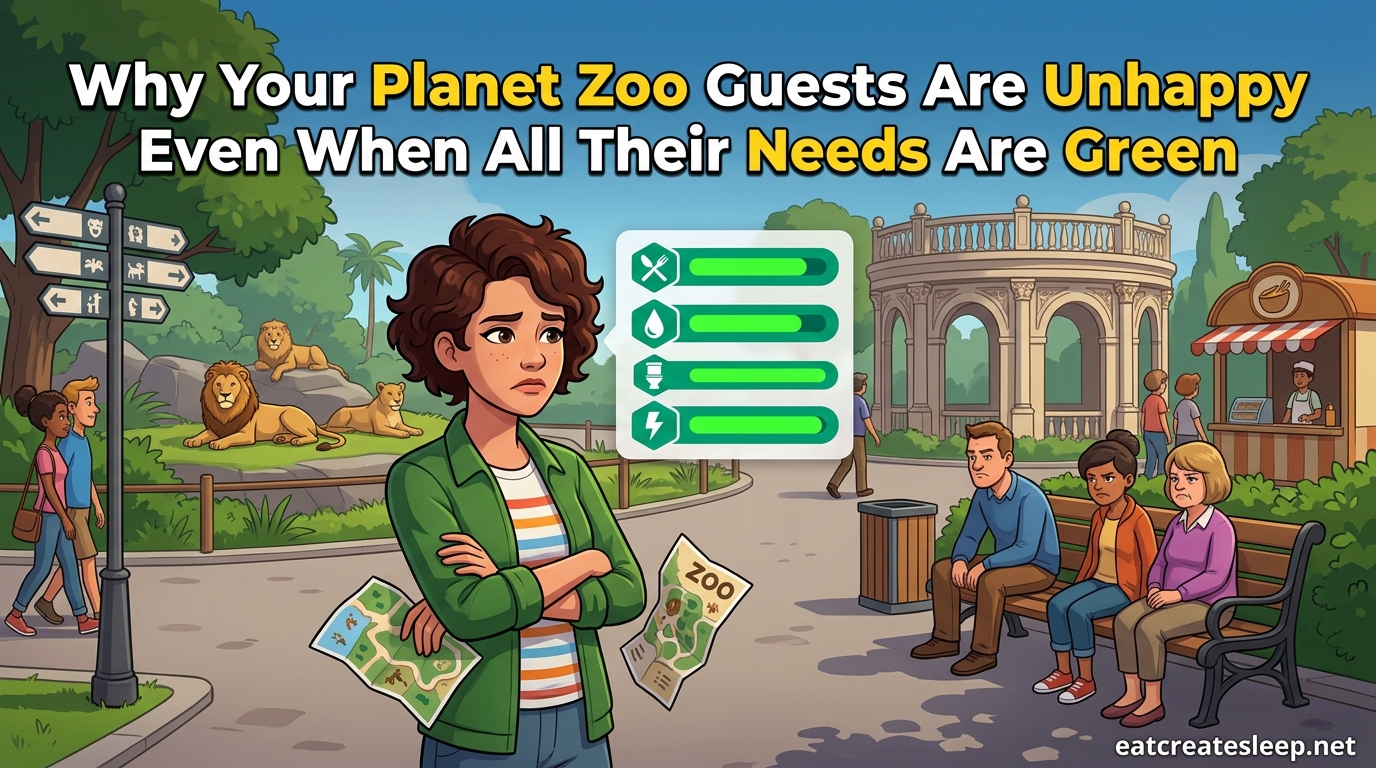
You built the habitats, planted the trees, dropped in food courts, and every single guest need bar glows a healthy green. Yet the overall happiness number stubbornly sits at 50 to 60 percent, and your donations keep cratering. If you are wondering why your Planet Zoo guests are unhappy even when all their needs are green, you are not missing something obvious. You are running into a hidden mechanic the game never properly explains.
The short version: in Planet Zoo, guest happiness is a separate stat from the visible need bars (hunger, thirst, energy, toilet, education). Walking drains happiness constantly, and long distances between attractions can drain it faster than benches and shops can refill it. Even with every other bar in the green, a tired, walking guest will tank your happiness score.
Our team has spent hundreds of hours in franchise and sandbox zoos watching this exact pattern, and after digging through Reddit threads, Frontier forums, and Steam discussions, the community has pieced together the actual rules. This guide explains the mechanic, the most overlooked fixes (yes, picnic benches matter), and how to diagnose your zoo with the tools the game already gives you.
By the end, you will understand exactly what is bleeding happiness out of your guests, even when every other stat looks perfect on paper. The fix is rarely a full rebuild. It is usually a handful of targeted changes to how your paths, benches, and amenities are laid out.
Table of Contents
The Hidden Walking Happiness Decay Mechanic in Planet Zoo
This is the single biggest reason players ask why their Planet Zoo guests are unhappy even when all their needs are green. Happiness is not a sum of the other need bars. It is a separate value that decays over time, and the decay rate increases while a guest is walking.
Think of it like a hidden stamina meter layered on top of the energy bar. Even when energy, hunger, thirst, toilet, and education all show green, the happiness value keeps ticking down for every second the guest spends walking between habitats, shops, and facilities. The only things that push it back up are resting, eating, drinking, using a toilet, viewing animals, and finishing educational activities.
So when a guest walks for two minutes across a sprawling zoo to reach the next exhibit, their happiness is bleeding out the entire time. By the time they arrive, the bars look fine, but the hidden happiness counter has dropped. Stack enough guests doing this and your overall happiness plummets to 50 or 60 percent even though every individual need heatmap glows green.
Players on the Frontier forums have reported identical scenarios: 90 percent green on every individual need heatmap, yet overall happiness stuck around 61 percent. The cause is almost always the same: long walks with no rest breaks in between. Steam community threads echo the same story, with players confused by 50 percent happiness ratings despite every bar showing green in the heatmaps.
This is also why the problem feels random. Some guests arrive at a habitat happy because they had a short walk. Others arrive miserable because they crossed half the zoo. The average comes out somewhere in the middle, and that average is what your happiness percentage reflects.
Why Distance Between Attractions Drains Guest Energy Faster
Distance is the multiplier on the happiness decay problem. A compact zoo where habitats, food, toilets, and benches are clustered close together keeps walks short. A sprawling zoo with habitats spread across the map turns every transition into a happiness drain.
Energy depletion compounds the problem. As energy drops, guests walk slower, which means they spend even more time walking, which drains more happiness. It is a negative feedback loop. By the time a guest with low energy reaches a bench, they have already lost a chunk of happiness that the bench cannot fully restore.
The fix is not always to rebuild your entire zoo. Start by adding intermediate rest stops along the main guest paths. A bench or picnic area halfway between distant habitats gives guests a chance to reset their happiness before the next stretch of walking.
Watch how guests flow through your zoo. If you see long single-file lines marching across empty path sections, that is a happiness drain in progress. Break up those long stretches with scenery, small exhibits, vendor kiosks, or rest clusters. Even a small visual distraction can encourage guests to pause, which slows the decay slightly.
Pay attention to dead ends. Guests who walk down a dead-end path to reach a habitat and then have to backtrack are losing happiness twice on the same stretch. If you have habitats tucked away off the main loop, consider adding a connecting path so guests can continue forward rather than retracing their steps.
Path width also matters more than players expect. Narrow paths with heavy foot traffic cause guests to slow down and cluster, which extends the time they spend in transit. Wider paths keep guests moving at full speed, reducing the total walking time between any two points.
Picnic Benches vs Regular Benches: Energy Restoration Compared
This is the tip that comes up in almost every Reddit thread on this topic, and it is a genuine game-changer. Picnic benches restore significantly more energy per use than regular benches. They are not the same item reskinned.
A regular bench gives a guest a quick breather. Useful for stopping a tired guest from collapsing, but the energy restoration is modest. A picnic bench functions more like a proper rest stop. Guests who sit at a picnic bench recover a much larger chunk of energy in a single use, which means they can handle a longer walk afterward without their happiness cratering.
If you are only placing regular benches, you are giving guests the equivalent of a quick stretch instead of an actual rest. Swap them out for picnic benches in high-traffic areas and along long paths, and you will see happiness climb without changing anything else about your zoo.
Our recommendation: use regular benches for short rests near habitats and viewing areas, and use picnic benches along long transit paths where guests need a full energy reset. A mix of both is more cost-effective than spamming one type. Place a picnic bench cluster every 15 to 20 seconds of walking time along your main loop.
Players who have tested both report happiness swings of 10 to 20 percentage points just from switching bench types in problem areas. The cost difference between the two bench types is trivial compared to the donations you gain back from higher happiness.
Do not forget the visual cue. If you see guests walking past empty regular benches, that is a sign the benches are not worth their time. They need a real rest stop, which means a picnic bench, not a quick perch.
How to Diagnose Unhappy Guests Using Heat Maps and Guest Thoughts
The game hands you the diagnostic tools, but they are easy to overlook. The heatmap view is your first stop. Click any guest need (hunger, thirst, energy, toilet, education) and the map color-codes every path and area based on the average satisfaction of guests standing there.
If every individual heatmap looks green but your overall happiness is still low, you have confirmed the walking decay problem. The next step is to click on individual guests and read their thoughts in the guest panel. Aggregate happiness hides individual misery. A guest might have all green bars but a thought like “I am tired” or “This zoo is too big” that signals the happiness drain.
Pay attention to recurring negative thoughts across multiple guests. If you see the same complaint repeatedly, that is your bottleneck. “I cannot find a bench” means you need more rest stops. “I have been walking forever” means your layout has dead stretches. “This zoo is hard to navigate” means your paths are confusing and adding unnecessary walk time.
Do not rely on the overall happiness percentage alone. Click through 10 or 15 random guests and scan their thought lists. The patterns will jump out fast. You will usually find one or two complaints dominating the list, and those complaints point directly at the fix.
Check guests at different points in your zoo, not just the entrance. A guest near the gate has had a short walk and probably feels fine. A guest near the back corner has been walking for minutes and is likely the one dragging your average down. Sample guests from every section of the park.
The guest thoughts panel also reveals queue complaints that do not show up on need bars. Long queues for food, drinks, or toilets frustrate guests and add to walking time as they stand in line. If you see queue complaints, add more vendor points or toilets in that area.
Rest Area Placement Strategy to Keep Happiness High
Rest areas are not decorative. They are the single most effective tool against the walking happiness decay mechanic. The goal is to make sure no guest ever walks for more than 15 to 20 seconds without passing a place to sit.
Place picnic benches at every path intersection, every habitat entrance, and at the midpoint of any path stretch longer than a screen length. Add them near food courts and toilets so guests can rest while their party members handle other needs. A bench outside a busy toilet block is more useful than a bench in the middle of an empty path.
Watch where guests naturally cluster. If you see groups of guests standing still on a path, they are likely waiting for someone or catching their breath. That is a perfect spot for a picnic bench. Guests standing around without sitting is a sign your benches are in the wrong places.
Avoid hiding benches behind scenery or in side paths. Guests will not find them. Place them directly on the main path where foot traffic already flows. If you want a scenic rest area, build it next to the path rather than tucked away from it.
Cover rest areas with shade or shelters where possible. Guests in extreme heat or cold lose happiness faster, and a shaded bench gives them a place to recover from temperature stress at the same time they rest their legs. Combine temperature control with seating for a double win.
Food, Drink, and Toilet Distribution Tips
Concentrated food courts look tidy, but they create the same problem as sprawling habitats. Guests walk all the way to the food court, satisfy their hunger, then have to walk all the way back to the habitats. That round trip drains happiness twice.
Spread smaller vendor kiosks, vending machines, and toilet blocks throughout the zoo. A guest should be able to grab a drink or use a toilet within a short walk of any habitat. This reduces the maximum walk distance for any single need and keeps happiness from draining during long detours.
Use the heatmap to find dead zones. If the hunger heatmap shows red patches in certain areas of your zoo, those are spots where guests cannot reach food quickly enough. Drop a kiosk or vending machine there rather than forcing guests to backtrack.
The same logic applies to bins. Caretakers cannot keep up if bins are too far apart, and litter drives down happiness for every guest who walks past it. Cluster bins near food vendors and benches where guests naturally eat.
Toilets deserve special attention because guests will hold a toilet need for a surprisingly long time before walking to find one. During that time, their happiness is decaying from the unmet need plus the walking. Place small toilet blocks at regular intervals along the main loop rather than one large toilet facility near the entrance.
Drink vendors are often overlooked compared to food. Thirst builds faster than hunger for most guests, especially on hot maps. A drink vending machine is cheap, takes up little space, and solves thirst problems without a long detour.
How Staff Facilities Negatively Impact Nearby Guests
Staff facilities are a sneaky happiness killer that does not show up on the visible need bars. Power generators, water treatment plants, keeper huts, and other back-of-house buildings generate a negative effect on guests who walk too close to them.
This is a separate mechanic from the visible needs. A guest who walks past a staff facility does not gain a new red bar, but their happiness takes a small hit. Stack several staff buildings near a main path and you create an invisible happiness drain zone.
The fix is to tuck staff buildings behind habitats, off the main path, or behind scenery walls. Use the terrain and foliage tools to hide them from guest sightlines. The game treats anything within a guest’s view radius as affecting them, so a building behind a hill or wall is effectively invisible to the happiness system.
Check your layout for staff buildings that ended up on the main guest loop. Power generators in particular have a wide effect radius and are easy to overlook because they are small. Move them off the path or hide them behind scenery.
Keeper huts and staff rooms are necessary, but they do not need to be on the guest path. Place them in dedicated staff zones behind habitats or in areas guests never visit. If a path is purely for staff, guests will not wander down it, and the buildings there have no effect on happiness.
The trade center is another easy one to misplace. It generates a lot of foot traffic from trucks and looks utilitarian, which hurts nearby guest happiness. Park it at the edge of the map behind a tree line.
Animal Viewing Quality and Education Effects on Happiness
Animal viewing is one of the few things that actively raises happiness instead of just slowing the decay. A guest who sees an animal up close, especially one performing an enrichment activity, gets a happiness boost on top of satisfying their education need.
The key is sight lines. Guests need clear, unobstructed views of the animals. Glass barriers are better than fences for viewing quality. Elevated viewing platforms and one-way glass give guests premium views that generate bigger happiness boosts. If guests have to squint or peer through gaps, the boost is smaller.
Education compounds the effect. Education boards, speakers, and viewing telescopes all add to the education bar, but they also contribute to happiness when a guest uses them. A habitat with strong education stations and good sight lines creates a double win: green education bar plus a happiness bump.
Place enrichment items where guests can see them. Animals using a feeder or toy in clear view of a viewing gallery generates more happiness per guest than the same activity hidden behind a rock. Plan enrichment placement with the viewing angle in mind, not just animal welfare.
Scenery rating around habitats adds another layer. Guests who walk through a visually appealing area near an exhibit get a small happiness boost from the scenery itself. Use foliage, rocks, and themed decorations around viewing areas to compound the animal viewing bonus.
How Guest Happiness Affects Donations and Zoo Income
Happiness is not just a vanity stat. It directly controls donation revenue, which for many zoo layouts is the largest income source. Happy guests donate. Unhappy guests do not.
Donation bins are not enough on their own. A donation bin next to an unhappy guest generates nothing. The same bin next to a guest who just had a great animal viewing experience with full green needs and high happiness can generate a meaningful donation.
This is why players often report that their income collapses even though the zoo looks fine on paper. The happiness drain from walking and staff facilities silently reduces donations across the entire zoo. Fix the happiness problem and donations recover without adding a single new bin.
Place donation bins at the exit of every habitat, especially right after premium viewing spots. Guests are most likely to donate immediately after a positive animal encounter. A bin right next to a one-way glass viewing gallery will outperform a bin in the middle of a path.
Tours and educators amplify the donation effect. A guest who has just finished a guided tour or listened to an educator talk is primed to donate. Position bins at the end of tour routes and near speaker stations to catch guests at peak satisfaction.
FAQs
How to make guests happy in Planet Zoo?
To make guests happy in Planet Zoo, focus on reducing walking time between habitats with rest areas, swap regular benches for picnic benches (they restore far more energy), spread food, drink, and toilet facilities throughout the zoo instead of clustering them, hide staff buildings behind scenery, and ensure guests have clear sight lines to animals with enrichment items visible. Happiness decays while guests walk, so the goal is to minimize long walks and maximize rest opportunities.
How to stop facilities having a negative impact on guests in Planet Zoo?
Staff facilities like power generators, keeper huts, and water treatment plants generate a hidden negative effect on nearby guests. Move them off the main guest paths, hide them behind terrain hills, or screen them with foliage and walls. The game only affects guests who can see the building, so blocking the sight line with scenery eliminates the penalty.
Why are guests not donating Planet Zoo?
Guests do not donate when their happiness is low, even if their individual need bars are green. Donations scale with guest happiness, and happiness drains while guests walk. If your zoo has long paths between habitats, insufficient picnic benches, or staff buildings visible from main paths, happiness will be low and donations will suffer. Fix the happiness decay and donations will recover without adding more bins.
Is it bad if animals inbreed in Planet Zoo?
Inbreeding in Planet Zoo reduces the genetic diversity of offspring, which lowers their fertility and immunity stats over time. This is tracked in the genetics panel when you compare animals for breeding. To avoid inbreeding, periodically introduce unrelated animals from the trade center and avoid breeding close relatives. Separate bloodlines keep your population healthy.
Conclusion
If you came here wondering why your Planet Zoo guests are unhappy even when all their needs are green, the answer is the hidden happiness decay mechanic. Happiness is not the sum of your need bars. It is a separate stat that drains while guests walk, and only rest, food, drink, toilets, education, and quality animal views push it back up.
The fastest fixes are swapping regular benches for picnic benches, breaking up long path stretches with rest clusters, spreading amenities instead of clustering them, and hiding staff buildings off the main sight lines. Run the heatmaps, click through individual guest thoughts, and the patterns will tell you exactly where your zoo is leaking happiness.
Once you understand the walking decay rule, the rest of the happiness puzzle falls into place. Fix the layout, watch the donations recover, and your zoo will run the way you always expected it to.