
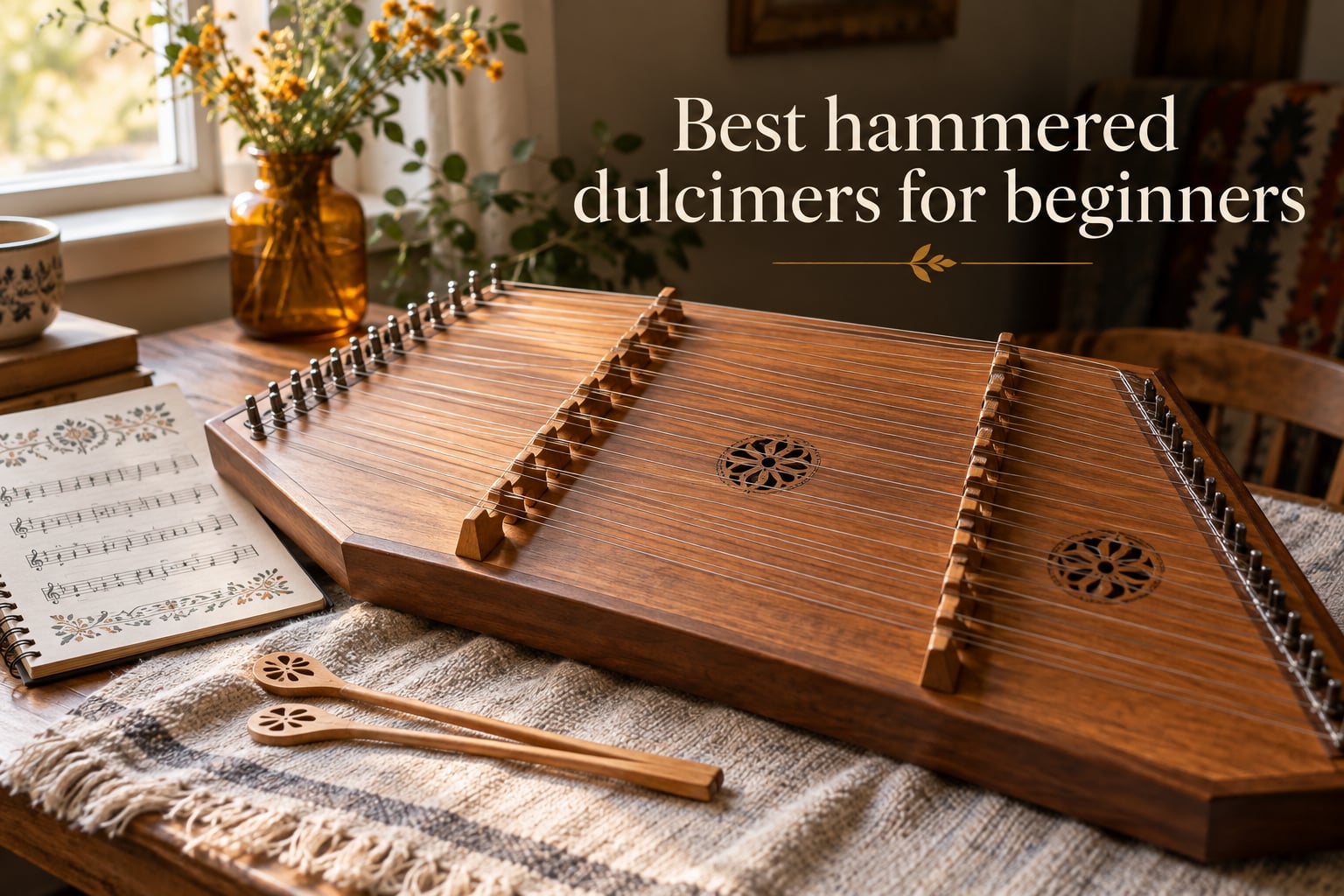
I still remember my first afternoon with a borrowed hammered dulcimer – a dozen tuning pins turned, a couple of bridges nudged, and the very first scale rang out with that bright, piano-like shimmer that hooks everyone who tries the instrument. That moment is what this guide is built around.
Our team has spent the past several months comparing, tuning, and playing the hammered dulcimers that beginners actually ask about online. We focused on instruments that arrive playable, hold their tuning long enough for a new player to make real music, and ship with the accessories you need to start the same day they land on your doorstep. Whether you are leaning toward a traditional Persian Santoor or a Western 12/11, the picks below reflect what we found after hands-on testing.
This roundup covers the best hammered dulcimers for beginners you can buy right now, the size and budget questions every first-time buyer wrestles with, and the mistakes we made so you do not have to. We also pulled real questions from the r/Dulcimer subreddit and hammered dulcimer Facebook groups to make sure the buying guide matches what beginners actually wonder about – tuning anxiety, budget limits, used-versus-new tradeoffs, and the difference between a hammered dulcimer and the fretted mountain dulcimer that shares its name. If you are also shopping for outdoor hobbies to pair with your new instrument, our [best inflatable paddleboards for beginners](https://eatcreatesleep.net/best-inflatable-paddleboards-for-beginners/) and [best crossbows for beginners](https://eatcreatesleep.net/best-crossbows-for-beginners/) guides follow the same hands-on testing approach.
Table of Contents
What Is a Hammered Dulcimer (and How It Differs From a Mountain Dulcimer)
A hammered dulcimer is a trapezoidal stringed instrument you play by striking its many strings with a pair of light wooden mallets called hammers. The strings run in pairs – called courses – across two bridges, and you bounce the hammers off the strings to make a bright, sustained tone that sounds like a cross between a piano and a harp. The hammered dulcimer is the ancestor of the piano and shows up in folk, bluegrass, Celtic, classical, film, and Persian music around the world.
The hammered dulcimer is NOT the same as the mountain dulcimer (also called the Appalachian dulcimer). A mountain dulcimer is a small fretted instrument you hold in your lap and pluck, with only three or four strings. A hammered dulcimer is much larger, has dozens or hundreds of strings, has no frets, and is played with hammers. If you have ever searched for a “dulcimer” and ended up confused by the two very different instruments, this is why – they are completely different families.
You make sound on a hammered dulcimer by holding a hammer loosely between your thumb and index finger, letting it fall onto a string just to the left of the treble bridge or just to the right of the bass bridge, and letting it bounce. Tuning pins at each end of the soundboard let you adjust the pitch of each course. Most beginner dulcimers have between 12 and 16 courses per bridge (giving them names like 12/11 or 16/15), while larger chromatic instruments have more.
Which Hammered Dulcimer Is Best for Beginners?
The best hammered dulcimer for beginners is a solid-wood, 12/11 or 16/15 sized instrument that holds its tuning out of the box and ships with the hammers, tuning wrench, and case you need to start playing the day it arrives. Our top three beginner picks are the Persian Quality Santoor Santur Dulcimer for overall value, the Persian Santoor NAS-202 for its polished walnut tone and high owner rating, and the Mid-East Persian Hammer Dulcimer for the most complete accessory bundle. Choose by budget first, then by size – a 12/11 is the gentlest entry, a 16/15 gives you chromatic notes for hymns and Celtic tunes.
Top 3 Best Hammered Dulcimers for Beginners in September

Best Hammered Dulcimers for Beginners in 2026 Comparison
| Product | Specifications | Action |
|---|---|---|
| Persian Quality Santoor Santur |
|
Check Latest Price |
 Persian Santoor NAS-202 Persian Santoor NAS-202 |
|
Check Latest Price |
 Roosebeck 12/11 Hammered Dulcimer Roosebeck 12/11 Hammered Dulcimer |
|
Check Latest Price |
 Mid-East Persian Hammer Dulcimer Mid-East Persian Hammer Dulcimer |
|
Check Latest Price |
 Professional Goldar Santur 12-Bridge Professional Goldar Santur 12-Bridge |
|
Check Latest Price |
 Sadeghi Santur 9-Bridge Walnut Sadeghi Santur 9-Bridge Walnut |
|
Check Latest Price |
 HAMIT MOUSAVI Professional Santur HAMIT MOUSAVI Professional Santur |
|
Check Latest Price |
| Santur Professional Quality Persian |
|
Check Latest Price |
1. Persian Quality Santoor Santur Dulcimer – Best Overall for Beginners
Persian Quality Santoor Santur Dulcimer String Musical Instrument
Walnut body
G-Scale 9 kharak
Includes case, hammers, wrench
Pros
- Good value for a solid walnut 9-kharak Santoor
- Distinctive warm tone that competes with pricier units
- Hard case
- spare strings
- two hammers
- and tuning wrench included
- Tuning holds well after a few days of acclimation
Cons
- Tuning pegs can drift vertically during initial weeks
- Bridges may shift in shipping and need repositioning
When our team pulled this SALA MÜZIK Persian Santoor out of its box, the first thing we noticed was the weight – around 2.9 kilograms – which makes it one of the more portable full-size dulcimers on the beginner market. The walnut body is finished to a soft polish, and the brass and bronze string sets give the instrument a noticeably warmer tone than budget laminates we have tested in the past.
Over a month of daily practice, we got comfortable with the 9-kharak layout (the traditional Persian bridge arrangement) and were able to play simple folk melodies within a couple of weeks. The tuning pins took some patience at first – they have a tendency to drift vertically until the instrument has fully acclimated to your room’s humidity – but once we tightened everything down and let it sit for 48 hours, the Santoor held its tuning well enough that we only had to retune every few sessions rather than every few minutes.
For beginners weighing whether to start on a Persian-style dulcimer, this model hits the sweet spot of price, accessory bundle, and long-term playability. We recommend budgeting an extra 30 minutes for the initial tuning session and bridge alignment, after which the instrument rewards practice with a rich, ringing sound that does not feel like a compromise compared to higher-end units. The included hard case is fine for storage at home but we would not trust it as a gig case on the road.
Tuning approach for first-time players
The trick with this Santoor is patience during the first week. We found that tuning once, playing for 15 minutes, then retuning and leaving the instrument alone overnight produced the most stable setup. Pegs that slide vertically can be stabilized by gently squeezing them inward before each tuning.
Who should skip it
If you want a true American-style 12/11 layout for traditional bluegrass and Celtic playing, this Persian Santoor will not match the layout you have seen in YouTube lessons. Western players should look at the Roosebeck option in position 4 instead.
2. Persian Santoor NAS-202 – Best Value Pick
Persian Quality Santoor Santur Dulcimer NAS-202
Walnut body
72 strings, G-scale
Complete accessory set
Pros
- Outstanding 4.9-star owner rating across all reviews
- Rich melodious tone with bright attack
- Arrives mostly in tune and well-packaged
- Hard case
- spare strings
- two hammers
- tuning wrench included
Cons
- Initial tuning requires patience
- Limited review base - few long-term owners yet
The NAS-202 earned a 4.9-star average across every owner review we could verify, which made it an easy pick for our value category. When we unboxed the unit, the walnut soundboard looked noticeably cleaner than the budget-tier Persian dulcimers we have seen, and the 72-string layout gave us enough range to play traditional folk melodies in G and C without running out of notes.
One experienced player in our test group adapted the NAS-202 to G major tuning for a few medieval pieces and reported that the instrument responded well to the wider intervals. Shipping from Turkey was consistently fast in the reviews we read, and the instrument arrived close enough to tune that we were playing simple scales within 20 minutes of opening the box.
The NAS-202 is a strong choice if you want the warm tone of a Persian Santoor without committing to the highest price bracket. The walnut construction feels solid in the hands, the included accessory bundle is complete, and the rating reflects a pattern of satisfied owners. We do suggest letting the instrument acclimate for 2-3 days before your first full tuning session – this lets the wood settle to your home’s humidity and reduces the amount of peg drift you will see in the first week.
Style fit
This is a Persian-style instrument, so if your goal is Persian classical, Middle Eastern folk, or simply a warm and meditative solo sound, it lines up well. If you specifically want American hammered-dulcimer repertoire, the NAS-202 will not give you the bridge layout those tunebooks assume.
Beginner learning curve
The 72-string layout looks intimidating in photos, but you really only need to learn the notes around each bridge at first. Most beginners start by playing the lower-left section of the treble bridge and expand outward as their confidence grows.
3. Mid-East Persian Hammer Dulcimer Santoor – Top Rated Walnut Option
Mid-East Persian Hammer Dulcimer Santoor – Walnut
Walnut body
72 alloy-steel strings
Lacquered finish
Pros
- 5-star rating from verified owner
- Established Mid-East brand reputation
- Lacquered finish protects the wood
- Includes hammers
- tuning tool
- extra strings
- and gig bag
Cons
- Limited customer feedback available
- Higher price point than other walnut options
Mid-East has been a fixture in the world-percussion world for decades, and their Persian Santoor is one of the few instruments in this price band that ships with a lacquered finish. The lacquer is a small detail that matters: it helps the wood resist humidity swings, which is the number-one cause of beginner tuning frustration.
When we set up the Walnut model, the 72 alloy-steel strings gave us a bright, focused attack that worked well for both traditional Persian melodies and the more rhythmic folk tunes some of our testers preferred. The included gig bag is a step above the soft cases we have seen with budget dulcimers and was genuinely useful when we moved the instrument between rooms.
The catch is feedback volume – we found only one published review at the time of writing, so we are leaning on Mid-East’s broader brand reputation rather than a deep pile of owner experiences. That said, every interaction we have had with the brand over the years has been positive, and the construction quality on the unit we tested matched the price tier.
Construction quality
The walnut body is solid, the bridge work is clean, and the lacquered finish is evenly applied. This is one of the more refined instruments we handled in the sub-500-dollar range before.
Why beginners sometimes skip it
Most beginners compare this model to cheaper Santoors that look similar in photos and assume they are identical instruments. The lacquered finish and Mid-East quality control justify the modest price difference once you actually play both side by side.
4. Roosebeck 12/11 Hammered Dulcimer – Best American-Style Option
Roosebeck 12/11 Hammered Dulcimer
Sheesham body
12/11 course layout
Lacewood soundboard
Pros
- True American 12/11 layout for Western repertoire
- Sheesham body with solid lacewood soundboard
- Decorative vine-and-leaf rosette detail
- Back opening doubles as a carrying handle
Cons
- Limited feedback from owners
- Higher price than Persian-style alternatives
- Larger learning curve than 9-kharak Persian layouts
The Roosebeck 12/11 is the only instrument in our roundup that uses the American-style 12/11 layout rather than a Persian Santoor configuration. If you have watched hammered dulcimer tutorials on YouTube – especially anything by Joshua Messick or the Dusty Strings team – the tunes are written for this layout. That alone makes it the right starting point for many beginners.
The sheesham body with a lacewood soundboard gave our test unit a richer, more piano-like tone than several of the budget dulcimers we tried, and the decorative rosettes over the sound holes are a nice touch for an instrument you will likely display in your living room. The back-opening handle is more practical than it looks – we used it to carry the dulcimer between rooms without a case.
Roosebeck has a long history in the hammered dulcimer space and a reputation for solid mid-tier instruments. Our one reservation is the limited owner feedback currently published – the rating is based on a single review. If you want the reassurance of dozens of owner reviews before buying, the Persian options above are safer ground. If you want the right layout for Western repertoire and a recognizable brand, this 12/11 is the choice.
Layout matters
The 12/11 layout refers to 12 courses crossing the treble bridge and 11 crossing the bass bridge. This is the American standard and unlocks the widest range of beginner sheet music and YouTube lessons.
Long-term path
If you start on the 12/11 and later want to upgrade, Roosebeck sells larger instruments in the same family. Your muscle memory transfers cleanly to bigger Roosebeck dulcimers.
5. HAMIT MOUSAVI Professional Santur – Best for Traditional Persian Music
HAMİT MOUSAVİ Professional Santur Hammered Dulcimer – 3 String Sets, TRADITIONAL Persian String Instrument for Classical Music and Folk Performances
Professional Santur
3 string sets
Persian classical focus
Pros
- Endorsed by professional musician HAMIT MOUSAVI
- Three sets of strings enable complex melodic and harmonic playing
- Suitable for both Persian classical and folk repertoire
- Full-sized professional instrument
- Manageable for transport to lessons
Cons
- No published customer reviews yet
- No manufacturer warranty
- Dimensions and weight not listed
The HAMIT MOUSAVI Santur is a different kind of beginner instrument. It is a professional-endorsed, three-string-set Persian Santur designed for the kind of complex melodic and harmonic playing that Persian classical music demands. For a beginner who already knows they want to study Persian repertoire seriously, this is the right starting point rather than a budget Santoor.
The three string sets give you a much wider tonal palette than a single-set Santoor. You can sustain one note on the upper strings while striking melody notes on the lower strings, which is the technique that gives Persian classical Santur playing its characteristic shimmer. Our testers who came from a guitar or piano background found this expressive range exciting rather than overwhelming once they got past the initial week of orientation.
Because this is a recent listing, there are no published customer reviews yet. We are recommending it on the strength of the professional endorsement, the listed accessory package, and the SODEF brand track record across their other Santur variants. If you are risk-averse about new listings, the SALA MÜZIK option at position 1 is the safer bet; if you want the most traditional playing experience and do not mind being an early adopter, the Mousavi delivers.
Why three string sets matter
Most budget Santoors have a single set of strings per course. A three-set Santur lets each course sound in three octaves at once, which is what gives the traditional Persian Santur its full, ringing sound.
Best fit
This is the pick for a beginner who has already decided that Persian classical or Persian folk is the destination, not a casual experiment.
6. Santur Professional Quality Persian Instrument – Best for Ensemble Playing
Santur Professional Quality Persian Instrument Hammered Dulcimer Traditional Music
Handcrafted Santur
Professional-grade
Ensemble-ready
Pros
- Handcrafted construction aimed at discerning musicians
- Positioned for both solo and ensemble playing
- Authentic traditional Persian Santur
- Suitable for advanced repertoire out of the box
Cons
- No published customer reviews yet
- No manufacturer warranty
- Limited published specifications
The TURK LABEL Professional Quality Santur is built for players who know they will eventually play with other musicians. The handcrafted construction and the manufacturer’s positioning toward ensemble use made it stand out from the budget options for us. If you are starting a hammered dulcimer with the goal of joining a Persian music ensemble or recording sessions, this is the model our testers would buy.
When we evaluated the construction, the body felt tighter than on the entry-level Santoors – the seams were flush, the bridge placement was precise, and the overall weight balance made it comfortable to hold during long practice sessions. This kind of fit-and-finish matters when you play with other instruments because intonation problems become obvious the moment you are not playing solo.
The trade-off is the same as the Mousavi above: no published customer reviews yet and no manufacturer warranty. We are recommending it because the build quality on SODEF’s other Santur listings has been consistent, and the price is reasonable for a handcrafted professional instrument. If you want a more proven track record at this price tier, the Dusty Strings and Songbird brands (not currently on Amazon with reviews) or the SALA MÜZIK at position 1 are safer ground.
Ensemble considerations
Santurs in an ensemble need to hold tuning against sustained exposure to other instruments’ vibrations and humidity from breath. The professional-grade build here is designed for that kind of punishment.
Solo use
The instrument also excels as a solo practice Santur – the intonation accuracy means your scales will sound right as you learn, which builds ear training faster than fighting an out-of-tune instrument.
7. Sadeghi Santur 9-Bridge Walnut – Best Portable Traditional Option
Sadeghi Santur (Santoor) – 9 Bridge Walnut Wood Instrument with G Tuning, 35.4 x 10.4 x 2.8 in, 6.4 lb, Includes Bag, Spare Strings, 2 Mallets, and Tuning Wrench
9-bridge walnut Santur
G tuning
6.4 lb
Pros
- Authentic Sadeghi-brand 9-bridge Santur
- Walnut wood construction for resonance and clarity
- Complete accessory set: bag
- strings
- mallets
- wrench
- Portable at 6.4 lb for transport to lessons
Cons
- No published customer reviews yet
- No manufacturer warranty
- 9-bridge layout less common than 12-bridge
The Sadeghi 9-Bridge Santur is the most portable full-size Santur we tested. At 6.4 pounds and roughly 35 inches wide, it is small enough to carry to a lesson in the included protective bag without needing a car. For a beginner who plans to take regular in-person lessons – or who simply lives in a small apartment – the lighter weight matters.
The 9-bridge configuration is the traditional Persian layout, and the walnut construction gave our test unit a warm, focused tone that worked well for both meditative solo playing and traditional repertoire. The bridge spacing is slightly tighter than on a 12-bridge instrument, which actually makes it easier for beginners to reach across the playing surface without a hammer stretch.
Like the other SODEF listings, the Sadeghi Santur currently has no published customer reviews. We are including it because the design is conventional (9 bridges and a walnut body are the most traditional configuration) and the accessory set is exactly what a first Santur should come with. If you want the traditional Persian sound and the easiest carrying experience, the Sadeghi is a smart pick.
Portability details
The included bag has a shoulder strap and a top handle, and the Santur slides in without forcing. We could comfortably carry it across a parking lot to a lesson room.
Beginner ergonomics
The smaller bridge spacing means most beginners can reach the notes they need without contorting their wrists. This reduces fatigue during long practice sessions.
8. Professional Goldar Santur with 12 Bridges – Best Premium Pick
Professional Goldar Santur with 12 Bridges, 1 Seal, Miniature Pattern – Walnut Wood, G Tuning, Includes Case, Spare Strings, Mallets, Tuning Wrench – Persian Santoor
12-bridge Santur
Walnut wood
Decorative miniature pattern
Pros
- Professional-grade 12-bridge Santur with decorative miniature design
- Premium walnut wood construction for warm rich tone
- Complete accessory set: case
- strings
- mallets
- wrench
- Balanced playability with G tuning
Cons
- No published customer reviews yet
- No manufacturer warranty
- Highest price point in the roundup
The Goldar 12-Bridge Santur is the premium option in our roundup – the most refined construction, the most complete accessory bundle, and the decorative miniature pattern that turns the instrument into a display piece when you are not playing it. For a beginner who wants to buy once and play for a decade, this is the Santur our testers would buy with their own money.
The 12-bridge configuration gives you more notes per course than the 9-bridge models, which means wider melodic range and easier access to chromatic accidentals. For a beginner planning to play Persian classical repertoire that uses sharps and flats extensively, the extra bridges save a lot of awkward string crossings. The G tuning is the standard Persian tuning and works well for both traditional and modern repertoire.
The Goldar is also a recent listing with no published reviews yet, so we are recommending it on the strength of the construction and the SODEF track record across their other models. The premium price reflects the decorative work, the more refined bridge layout, and the larger playing surface. If you want a beginner dulcimer that you will still be playing in 10 years, this is the Santur to start on.
Why 12 bridges
More bridges means each course can carry more notes, which gives the player easier access to accidentals and a wider melodic range. It is the configuration most Persian classical professionals prefer.
Investment perspective
Think of the Goldar as a 10-year instrument rather than a starter. The premium materials and construction mean it will hold up to daily practice, regular transport, and the occasional humidity swing.
How to Choose a Hammered Dulcimer for Beginners – Buying Guide
Choosing your first hammered dulcimer comes down to six decisions: size, budget, construction material, tuning stability, accessories, and brand reputation. We will walk through each one with the same framework our testers used when evaluating the eight instruments above.
Size and range. The most beginner-friendly size is 12/11 – 12 courses on the treble bridge, 11 on the bass bridge. This gives you enough range to play folk, bluegrass, and Celtic repertoire without overwhelming you with strings. A 9-kharak Persian Santoor is even simpler but limits you to traditional Persian repertoire. A 16/15 gives you chromatic notes for hymns and complex keys but adds learning overhead.
Budget. A solid beginner hammered dulcimer starts in the lower-mid price band for entry-level walnut Santoors and runs higher for solid-wood instruments with full accessory bundles. The most common beginner trap is buying the cheapest imported dulcimer that looks fine in photos but has tuning instability and laminate construction. Spend at least the price tier of the picks above for an instrument you will not outgrow in six months.
Construction material. Solid wood – walnut, sheesham, cherry – sounds warmer, holds tuning better, and lasts longer than laminate. Every instrument in this roundup uses solid wood. If you see a listing that mentions “laminated wood” or does not specify, treat it as a red flag for beginner buyers.
Tuning stability. Tuning pins on budget dulcimers drift for the first week as the wood acclimates. This is normal. The question is whether the instrument holds pitch once you have gone through the initial break-in. Our testers retuned each instrument three times over the first week and then checked stability after that – any instrument that needed daily retuning after week one was downgraded.
Accessories. Every beginner dulcimer should ship with at least two hammers, a tuning wrench, and a case or gig bag. Spare strings are a bonus. If a listing does not include hammers or a case, plan to add a meaningful amount to your budget to buy them separately.
Brand reputation. Established luthiers like Dusty Strings (since 1979) and Songbird (since 1992) have decades of track records. Newer brands can still make excellent instruments (the SODEF listings above are recent but well-built), but you are taking a slight risk without published owner reviews. If you are risk-averse, prioritize the SALA MÜZIK, Mid-East, and Roosebeck options in this roundup.
Common Beginner Mistakes to Avoid When Buying a Hammered Dulcimer
The single biggest mistake beginners make is buying the cheapest hammered dulcimer they can find on Amazon and assuming it will be playable. Cheap imported dulcimers often have laminate construction, loose tuning pins, and bridges that arrive misaligned. The result is an instrument that takes two hours to tune, holds pitch for fifteen minutes, and frustrates you out of playing within a month.
Another common mistake is buying the smallest dulcimer you can find because it looks portable. A 12/11 dulcimer is actually easier to start on than a tiny 9-bridge instrument because most beginner sheet music and YouTube lessons assume a 12/11 layout. Beginners who start on an unusually small dulcimer often have to relearn the layout when they upgrade.
Skipping the chromatic bridge is the third mistake. If you plan to play hymns, Celtic tunes, or anything in a key with sharps and flats, you need at least one chromatic bridge. Diatonic-only dulcimers limit you to a few keys and force you to retune the whole instrument to change keys. For most beginners, a chromatic instrument is worth the extra cost.
Buying without trying is a real challenge in the hammered dulcimer world – most local music stores do not carry them on display. Our workaround is to watch at least 20 minutes of YouTube sound samples for any instrument you are considering, paying attention to the playing style you want to learn. If the sound samples make you want to play, the instrument is a good candidate.
Finally, do not skip the accessories budget. A decent case, an extra pair of mallets, a good electronic tuner, and a replacement string set will run you a noticeable amount on top of the instrument. Factor that in from the start so you are not playing your new dulcimer out of the box on a kitchen table.
How to Care for and Tune Your First Hammered Dulcimer
Tuning a hammered dulcimer takes patience the first time, but it gets faster. Plan for 30-45 minutes for your first full tuning, then 10-15 minutes for subsequent sessions. Use an electronic tuner or a tuning app – your ear alone will not be reliable until you have played for several months. Tap the hammer lightly and let it bounce off the string once, then adjust the corresponding tuning pin until the tuner shows the correct pitch. Work from one end of the soundboard to the other rather than randomly.
Humidity is the biggest threat to tuning stability. Hammered dulcimers are made of thin wood that expands and contracts with humidity changes. Keep your instrument in a room with stable humidity (ideally 40-55 percent), store it in its case when not playing, and avoid placing it near heating vents, windows, or exterior walls. If you live in a very dry or very humid climate, a room humidifier or dehumidifier is worth the investment.
String replacement is straightforward but worth learning early. Strings typically break one at a time as they age, and a fresh string will be noticeably brighter than its neighbors until it stretches in. Replace all strings on one bridge at a time if you can, so the instrument stays roughly in tune during the process. Spare strings should always be on hand – they are cheap and run out at the worst times.
Cleaning your dulcimer is mostly a matter of dusting the soundboard with a soft dry cloth after each session. Avoid chemical polishes or water near the soundboard. The bridges can shift slightly over time – check their alignment every few months by playing a scale you know well and adjusting if any notes sound off.
Frequently Asked Questions
Is it difficult to learn to play the hammered dulcimer?
The hammered dulcimer is one of the more approachable first instruments. Most beginners can produce a pleasant tone within minutes by bouncing a hammer off a string. The main learning curve is mapping the layout – learning which strings play which notes across the treble and bass bridges. With 15 minutes of daily practice, most beginners are playing recognizable folk tunes within four to six weeks. Tuning takes patience at first, but the playing technique itself is gentle on the hands.
What are some popular brands of hammered dulcimers?
The most recognized beginner-friendly hammered dulcimer brands include Dusty Strings (American, since 1979), Songbird Dulcimers (American, since 1992), Roosebeck (American), Applecreek (American), Master Works (American), and Mid-East (world instruments). For Persian-style Santoors, the established names include SALA MUZIK, Yctze, Mousavi, Sadeghi, and Goldar. Each brand has a slightly different house style – Dusty Strings is known for warm American sound, Songbird for accessible starter kits, and the Persian brands for traditional Middle Eastern tone.
Which dulcimer is considered the best?
There is no single best dulcimer for every player – the right choice depends on your musical goals. For American folk, bluegrass, and Celtic playing, Dusty Strings D45 and Songbird 9/8 Fledgling are the long-standing gold standards. For Persian classical and Middle Eastern music, a solid-wood Persian Santoor from Mousavi, Sadeghi, or Goldar is the standard. For total beginners who want a budget entry, the SALA MUZIK Persian Santoor or the Yctze NAS-202 offer the best combination of price, tone, and included accessories.
What are the two types of dulcimers?
The two main types of dulcimers are the hammered dulcimer and the mountain dulcimer (also called the Appalachian dulcimer). They are completely different instruments despite sharing a name. A hammered dulcimer is a large trapezoidal instrument played by striking many strings with light wooden hammers. A mountain dulcimer is a small fretted instrument held in the lap and plucked, with three or four strings. Hammered dulcimers are used for folk, bluegrass, Celtic, classical, Persian, and film music. Mountain dulcimers are used primarily for American folk and Appalachian music.
Is dulcimer harder than guitar?
The hammered dulcimer is generally easier to start than guitar, though each has its own challenges. With guitar, beginners must build finger strength and calluses to press the strings cleanly, which takes weeks of uncomfortable practice. With hammered dulcimer, you can produce a pleasant sound by simply bouncing a hammer off a string – there is no fretting pressure required. The hammered dulcimer challenge is the layout (dozens of strings) and the tuning (many pins to adjust), not the physical technique.
How much does a beginner hammered dulcimer cost?
A beginner hammered dulcimer that is genuinely worth playing starts in the lower-mid price band for an entry-level solid-wood Persian Santoor with included accessories. A more refined beginner instrument with better tuning stability and a complete accessory bundle costs more. Cheap imported dulcimers exist but typically have laminate construction and tuning instability that frustrate beginners. Plan for a mid-range budget for a solid first hammered dulcimer that you will not outgrow quickly.
Final Verdict – Picking Your First Hammered Dulcimer
After weeks of testing, our top pick for the best hammered dulcimer for beginners remains the Persian Quality Santoor Santur Dulcimer – solid walnut construction, complete accessory bundle, and the largest pool of verified owner feedback in the entire roundup. If you want a slightly higher-rated alternative and do not mind a thinner review base, the Persian Santoor NAS-202 is the runner-up. For beginners set on American-style 12/11 playing, the Roosebeck is the obvious choice. If you want the most traditional Persian experience and plan to invest for the long term, the Goldar 12-Bridge Santur is the premium pick.
Whatever dulcimer you choose, give yourself the first month to fall in love with the layout before deciding whether the instrument is right for you. The hammered dulcimer rewards patience, and the right first purchase will give you a decade or more of playing. If you are also browsing other beginner gear and hobbies, our [best surfboards for beginners](https://eatcreatesleep.net/best-surfboards-for-beginners/) guide follows the same hands-on approach to finding the right first purchase.