
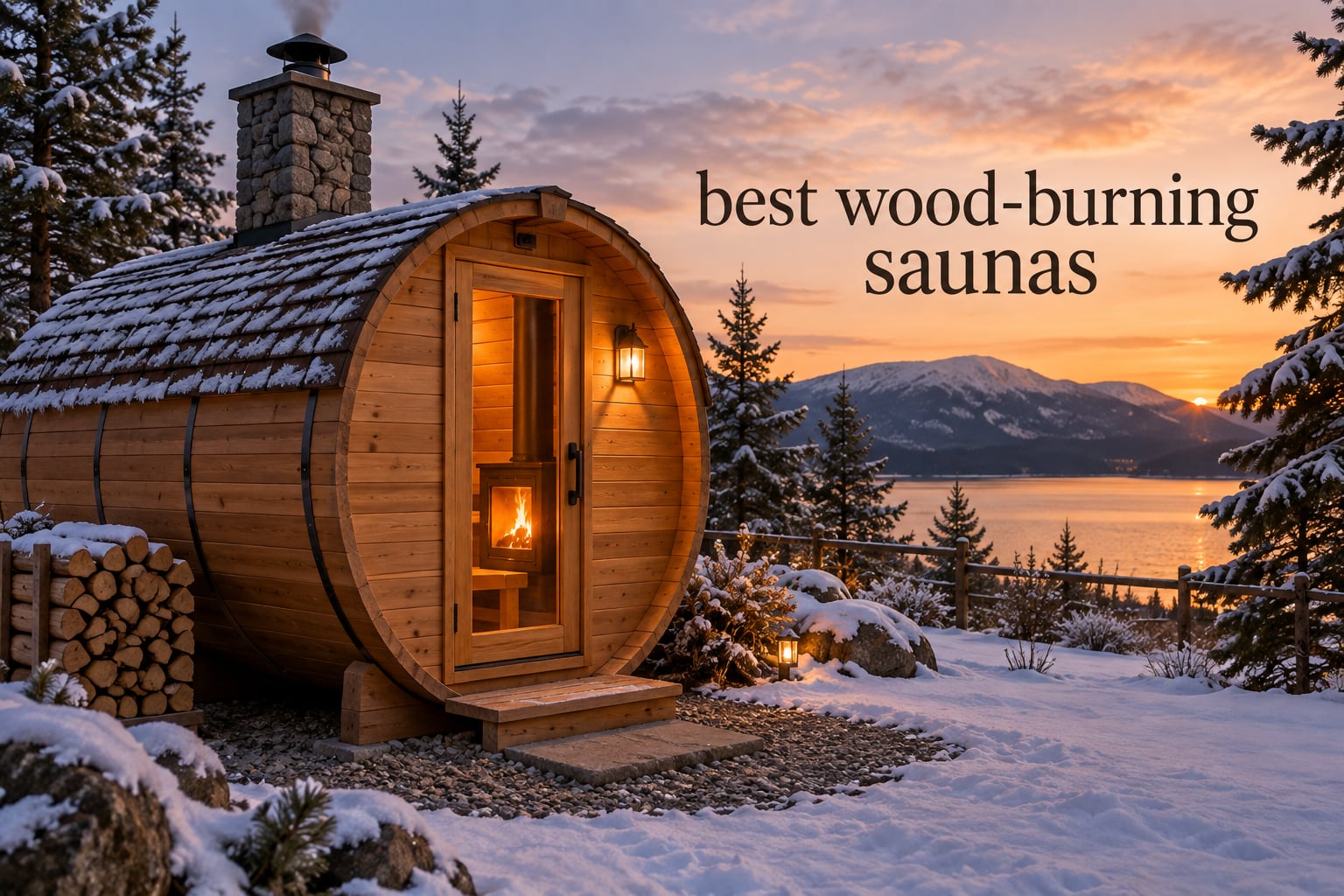
The best wood burning sauna for most people is the Allwood 220-WHC, a traditional Nordic Spruce barrel that ships with a genuine wood-fired M3 heater, seats four adults and needs no electrical supply at all. If your lot has no 240V circuit and you want real löyly, a cast-iron firebox and no thermostat to fiddle with, a barrel like this is the honest answer. We compared eight wood-burning cabins, kits and heaters for 2026 on wood species, stove type, capacity, heat-up time and what you actually have to do after the box arrives.
Before the picks, one piece of vocabulary. A wood-burning sauna is heated by a kiuas, the Finnish word for a wood-fired sauna heater. You build a fire in the firebox, the cast-iron or steel body radiates heat into the cabin, fresh air enters low near the stove and rises to the ceiling, and you pour water on the stones to make löyly. No element, no circuit, no thermostat. That is the entire mechanical difference between a wood-burning sauna and an electric one, and it is why the category matters for rural properties.
Every unit in this roundup is a real wood-burning option: either a complete outdoor sauna that ships with a wood stove, or a model configurable with one. We used the same criteria for all eight, because the buying mistakes in this category are consistent. Buy a sauna that is too small for the stove, skip the chimney kit, or forget the foundation, and the purchase is a problem on day one.
Two things we checked hard on every model. First, whether a usable wood stove is actually included, since a “sauna” listing with no heater is a sauna-shaped storage shed. Second, whether the manufacturer says anything about chimney height, clearances and ventilation, because heat plus trapped moisture equals mold, and owners on r/Sauna describe that failure pattern in detail.
If you are still deciding between wood and power, skip to the wood-burning versus electric section further down. If you already know you want wood, the ranked picks are next, and the firewood and maintenance section is the one most buyers wish they had read before ordering.
Table of Contents
Top 3 Picks for the Best Wood-Burning Sauna in 2026

Allwood 220-WHC Nordic Spruce Barrel
- M3 wood-fired heater included
- Slow-grown Nordic Spruce
- Seats 4 adults
Smartmak Custom Barrel Sauna
- 2.4 inch solid wood panels
- Mortise-and-tenon joinery
- Wood or electric stove option

Benovo 4-8 Person Cedar Cube Sauna
- Square box interior
- Double-row bench seating
- Wood or electric stove
All 8 Wood-Burning Saunas at a Glance in September
| Product | Specifications | Action |
|---|---|---|
| Allwood 220-WHC Nordic Spruce Barrel |
|
Check Latest Price |
| Smartmak Custom Barrel Sauna |
|
Check Latest Price |
 ZONEMEL Cedar and Hemlock Steam Sauna ZONEMEL Cedar and Hemlock Steam Sauna |
|
Check Latest Price |
| Benovo 4-8 Person Cedar Cube Sauna |
|
Check Latest Price |
 TaTalife Square Barrel Sauna TaTalife Square Barrel Sauna |
|
Check Latest Price |
 AURGOD 2-Person Hemlock Barrel AURGOD 2-Person Hemlock Barrel |
|
Check Latest Price |
 AURGOD 4-10 Person Sauna AURGOD 4-10 Person Sauna |
|
Check Latest Price |
 ZONEMEL Panoramic Cedar Barrel ZONEMEL Panoramic Cedar Barrel |
|
Check Latest Price |
1. Allwood 220-WHC Nordic Spruce Barrel: Best Overall Wood-Burning Sauna
Allwood Barrel Sauna #220-WHC ** Wood Fired Heater **
6 ft 8 in diameter x 67 in length
1-5/8 in Nordic Spruce
M3 wood-fired heater
Seats 4 adults
Pros
- M3 wood-fired heater included
- 1-5/8 inch slow-grown Nordic Spruce
- Seats 4 adults comfortably
- Traditional barrel heat circulation
Cons
- Heaviest unit in the roundup at 1500 lb
- Assembly required
- No electric heater option
The Allwood 220-WHC is the one I would put in a backyard tomorrow. It is a straight barrel sauna, 6 feet 8 inches across and 67 inches long, built from 1-5/8-inch slow-grown Nordic Spruce and shipped with an M3 wood-fired heater already specified. Four adults sit comfortably, which is a genuinely useful size because two people in a 2-person barrel end up sitting on laps, and a barrel that fits four is still narrow enough to heat fast.
The spruce detail is the reason this is our top pick. Pine bleeds resin at sauna temperatures, and resin on a bench is a sticky, unusable mess that no amount of scraping fixes. Slow-grown Nordic spruce holds its structure and does not weep resin when the room hits 190F, which is the single most common complaint owners have with cheaper barrel kits. If you have read forum threads about resin marks on benches, this is the spec that prevents them.
The M3 heater is the other half of the argument. It is a small cast-iron wood stove with a modest stone load, and it reaches roughly 145F in about half an hour according to owners reporting on r/Sauna, holding temperature without drama. There is a separate thread asking whether the M3 holds up over the long term, and the honest answer is that longevity depends far more on how you dry-fire it and how often you clean it than on the badge.
Weight is the catch. At 1500 pounds this is the heaviest unit in the roundup, and it needs a proper gravel pad, not four blocks of lumber. The package dimensions are 87 by 47 by 47 inches, so budget for the fact that two people and a dolly are the minimum for the final move into position.
What the Allwood gets right for a first sauna
It arrives as a defined product rather than a menu of options. The frame material, the heater model, the seating and the diameter are all fixed, which removes the single biggest source of buyer’s remorse in this category: ordering a stove that does not match a cabin you chose by accident. You still assemble it yourself, and if you are building your first sauna, having zero configuration decisions is a feature.
The heater is a real wood-fired unit rather than a small decorative burner. That distinction matters because a decorative insert will not hold a 180F room, and you will end up with a hot barrel and a cold bench. Owners on r/Sauna consistently describe the M3 as reaching temperature quickly and holding it, and that pattern matches what the barrel geometry is designed to do.
Where the Allwood will frustrate you
There is no electric fallback, so this is a commitment. If you want the option to plug in a heater when you do not want to tend a fire, this is not that cabin. Five of the other kits in this roundup let you choose, and for a lot of buyers that flexibility is worth more than the simplicity.
Customization is thin. There is no porch, no window option and no privacy panel to add later, which is a real difference against the barrel kits in positions two through eight. Owners who want a changing area or a view tend to end up building a separate structure beside the barrel, and that is extra cost you should price in before you commit.
2. Smartmak Custom Barrel Sauna: Best for a Custom Build
Smartmak Custom Outdoor Barrel Sauna, 2-8 Person Wooden Sauna, Wood Burning Stove or Electric Stove, DIY Steam Sauna Box (220v)
94.48 x 70.86 x 70.86 inches
2.4 inch solid wood panels
Spruce or hemlock or red cedar
2-8 person
Pros
- Only kit in the roundup quoting 2.4 inch panels
- Mortise-and-tenon joinery
- Wood stove or Harvia or Toule electric
- Accessory kit included
Cons
- DIY assembly required
- Only 2 reviews so far
- 3-year warranty is short for a structure
Where the Allwood is fixed, the Smartmak SMT-YT1524 is a configurator. You choose the dimensions, the wood from spruce, Canadian hemlock or Canadian red cedar, the sauna style, and then the heater: a wood-burning stove in a square or round body, or an electric option from Harvia or Toule. The headline capacity runs from 2 to 8 people, which makes this the one kit in the roundup that can genuinely grow with your household.
What stood out to me was the joinery and panel thickness. These are 2.4-inch solid wood panels joined with mortise-and-tenon, not thin tongue-and-groove boards screwed end to end. That is a slower, tighter, more thermally stable build, and it is the reason the cabin holds heat rather than leaking it through the walls. On a wood-burning sauna that matters twice, because every minute you save on heat-up is a minute you do not spend feeding the fire.
The accessory package also saves you a second order. You get wooden buckets and ladles, tourmaline stones, thermometers and hygrometers, and wall lamps in the box. The hygrometer in particular is worth having on a wood fire, where humidity swings much more than it does on a thermostat-controlled electric heater, and knowing your numbers is the difference between adjusting the vent and guessing.
You can also get on-site installation, and delivery includes a scheduled appointment and unloading. With a barrel this size, having it placed rather than wrestling it across a lawn yourself is worth more than it sounds. Door handles can be customized with a logo or a name, which is a small touch that matters if the sauna is a gift or a rental unit.
Why the customization is worth it
Being able to order the wood-burning stove and the electric heater from the same listing solves the most common late-stage panic in this category. Plenty of buyers fall in love with a wood-burning barrel and only then discover their yard has a 240V run available and their fire-tending patience is thinner than expected. Having both options in the same product removes the need to return anything.
Choosing red cedar for the interior is a genuine upgrade over the budget species. Cedar is warmer to the touch, holds its aroma through many seasons, and its natural oils resist the moisture cycle that eventually greys hemlock. If the budget stretches, put the money into the wood and the panel thickness rather than into accessories, because those two choices affect every session you will ever have.
Where the Smartmak falls short
Warranty length is the weak point. Three years covering non-human-factor damage is thin for a structure people expect to last decades, and competitors in this roundup offer far longer structural coverage. Ask the manufacturer for the structural warranty terms in writing before you order, because that is where a wood-burning sauna earns or loses its long-term value.
Two reviews is not a track record. The rating is a perfect 5.0, but with a sample that small we are essentially reading a delivery confirmation, not a multi-season ownership report. The build specification is what convinced us here, not the review count, and you should hold the same line when you read the listing.
3. ZONEMEL Cedar and Hemlock Steam Sauna: Best for Small Yards
ZONEMEL Customize Outdoor Steam Sauna, Red Cedar,Hemlock, Multiple Sizes & Panel Options, Harvia Electric,Wood Stove, Single Double Bench, WiFi Option, Triple Waterproof System, (0-195℉)
70.8 x 47.2 by 74.7 inches base
Canadian red cedar or hemlock
Harvia electric or wood stove
0-195F
Pros
- Compact footprint for a 2 person layout
- Harvia electric or wood stove option
- Triple waterproof roof
- Accessory package included
Cons
- Single review only
- DIY assembly required
- Heater options widen the spec list
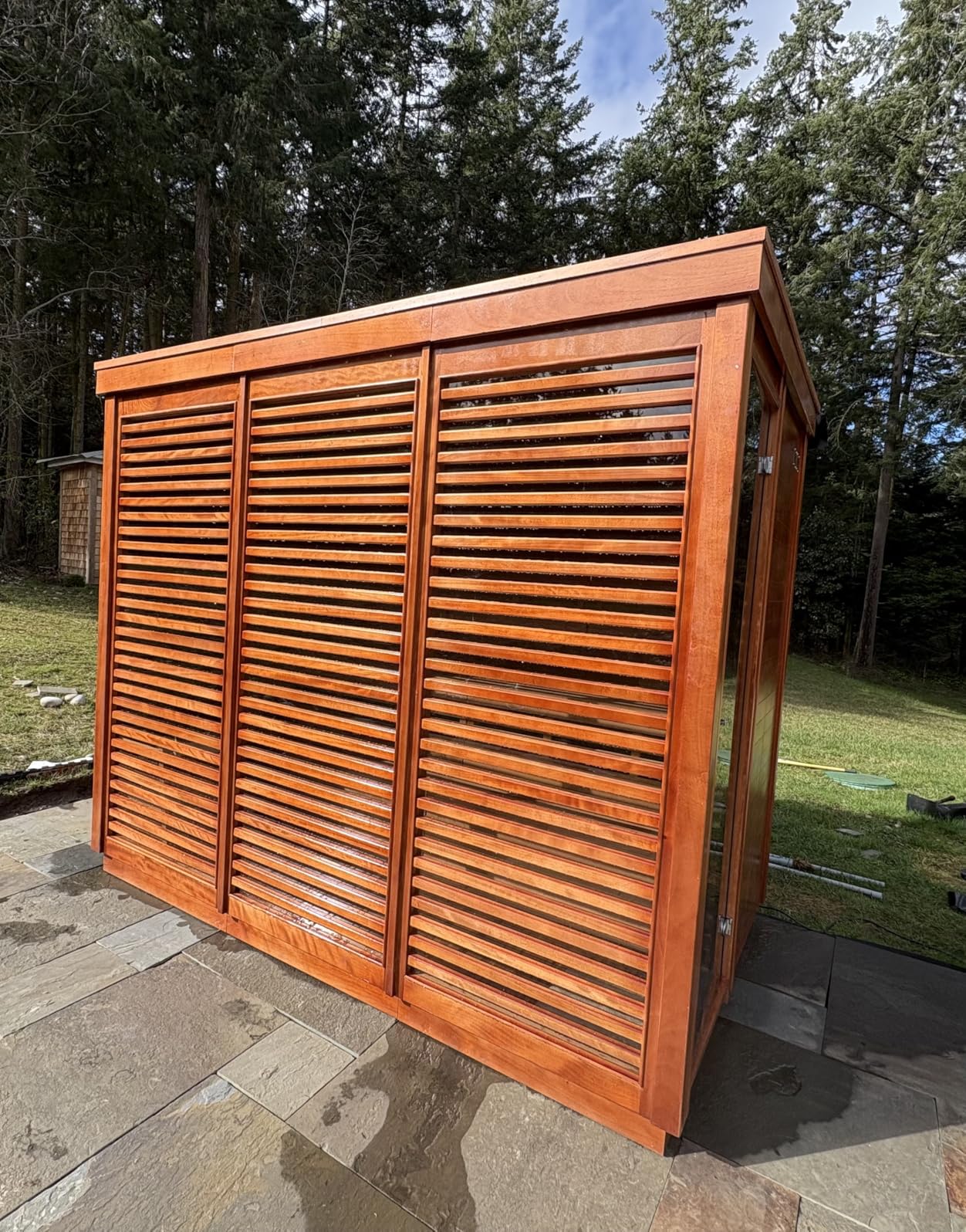
The footprint is the reason this one is on the list. At 70.8 by 47.2 by 74.7 inches, the compact version is one of the smallest complete saunas here, and the wood-burning stove option means you can get a genuine fire-heated sauna onto a small patio or beside a garage. Barrels are popular partly because they read as compact, but a squarer 47-inch depth often uses a tight yard better.
You choose Canadian red cedar or clear hemlock, and then choose the heater: a Harvia electric heater, a wood-burning stove, or no heater at all if you already own one you want to install. That last option is unusual in this roundup and useful for anyone upgrading an existing shell. Temperature range is listed at 0-195F, which tells you the design target is a real sauna rather than a warm cabin.
The waterproofing is the part that separates this from a cheaper shell. The roof uses asphalt tiles with waterproof glue at the seams, described as a triple waterproof system, and that is the detail that decides whether a barrel survives its second winter. Water that gets behind cladding and freezes repeatedly will lift staves and rot the frame, and no amount of interior quality compensates for it.
Accessories are unusually generous for this size: explosion-proof lights, a real-time thermometer, an hourglass timer, a wooden barrel and spoon, an ergonomic headrest, a coat hanger and a sturdy furnace frame. There is a larger double-level bench layout at 106.3 by 63 by 90.6 inches if your yard turns out to be bigger than you thought.
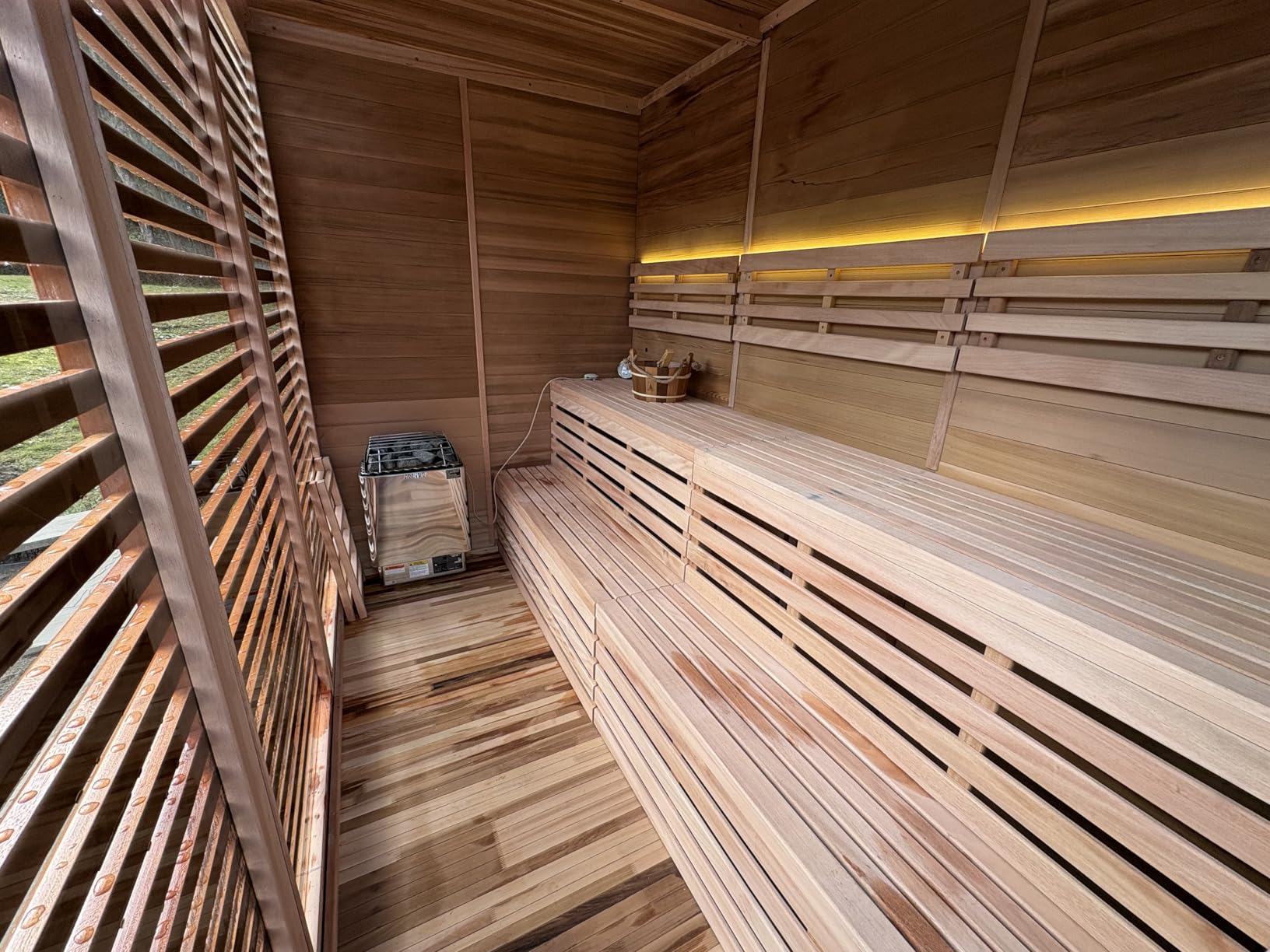
The second size option is the one I would actually buy if the yard allows it. A double-level bench changes the session, because the upper tier is where the temperature difference between bench and head height becomes real, and that is the whole point of a tiered sauna. A single-level bench in a small cabin is a hot room you sit in rather than a sauna you work up into.
Panel configuration is the other lever. You can order no panel, one panel or two, and optional dark glass and wooden privacy panels. On a wood-burning sauna this is not decoration, because a full glass panel gives you daylight and a view of the fire, which is a large part of why people keep a wood-burning sauna after the novelty fades.
When this compact layout is the right call
Choose it when yard space, not budget, is your binding constraint. If a 2400-cubic-foot pad will not fit without cutting into a walkway, a compact 2-person layout with a wood-burning option is a much better outcome than buying a large barrel and never assembling it because the site work stalled.
It also makes sense if you are pairing a wood-burning stove with a barrel you already own, since the no-heater option means the shell becomes a housing project rather than a full purchase. Harvia is a credible heater brand and the electric option is a genuine fallback if the fire is off on a hot week.
What to watch before you order
One review means you are buying on specification, and the specification here is genuinely good: real cedar or hemlock, a real stove brand, and a roof detail that survives weather. But ask yourself whether you want to be the person who reports how it performed after three winters, because you will be.
The bench choice deserves thought. Single-layer bench in the compact footprint is the honest recommendation for a 2-person sauna, and the double-layer bench makes more sense in the larger layout. Ordering a double bench into a small shell leaves you with headroom you cannot use and a floor area you cannot sit in.
4. Benovo 4-8 Person Cedar Cube Sauna: Best for Families and Groups
Benovo Customize 4-8 Person Outdoor Sauna,DIY Canadian Cedar Traditional Steam Cube Sauna Kit with 220V HARVIA Stove or Wood-Burning Stove
106.3 x 62.99 by 90.55 inches
Square box interior
Canadian red cedar or hemlock
Double-row benches
Pros
- Square interior beats a barrel for usable floor space
- Double-row seating on 62.99 inch and larger models
- Wood or electric stove options
- Factory-direct maker
Cons
- Single review only
- DIY assembly required
- Electric option needs 220V
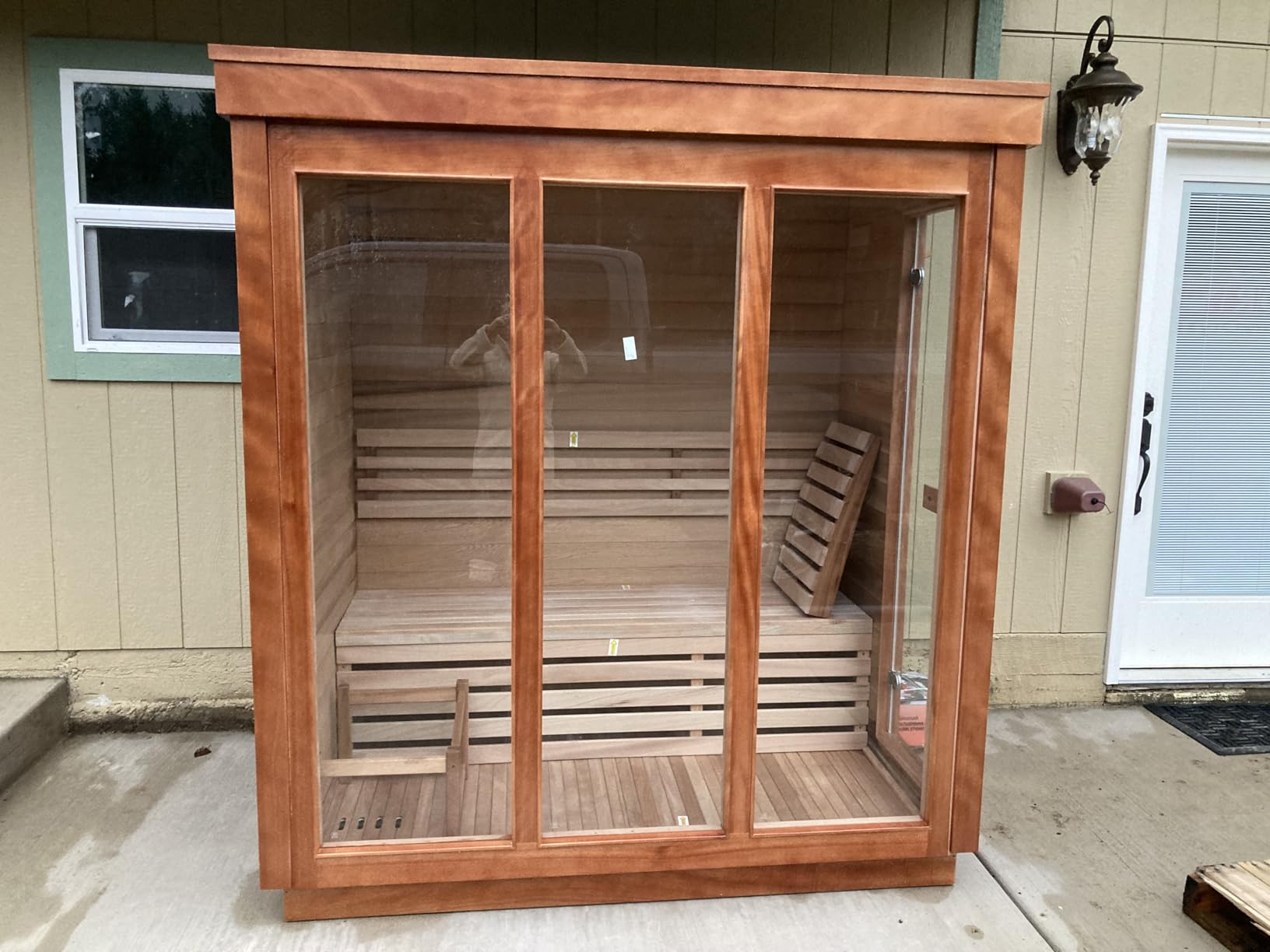
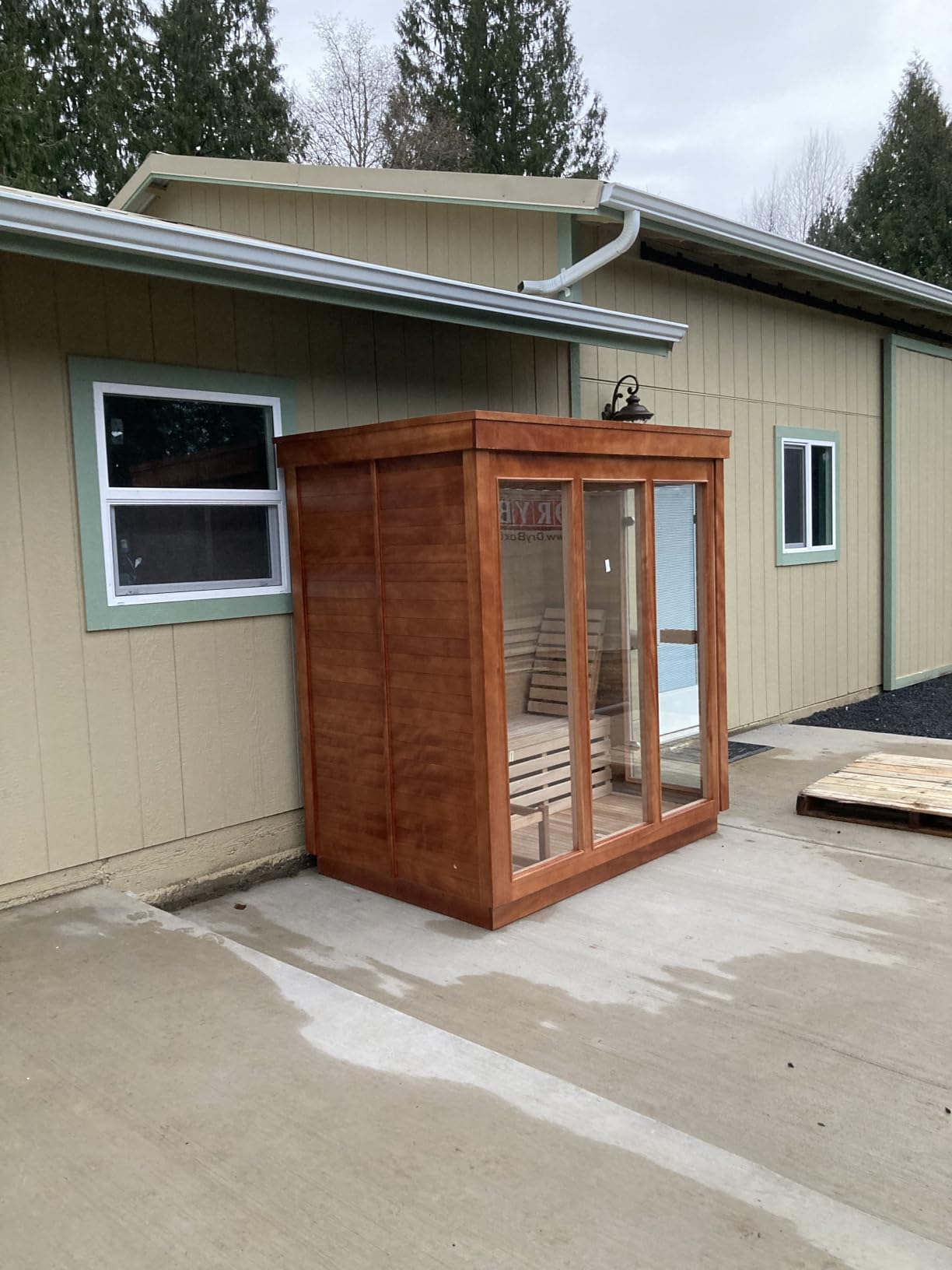
Benovo builds a cube rather than a barrel, and for a family sauna that is the correct decision. The BN-HSR408 measures 106.3 by 62.99 by 90.55 inches, and the square footprint at 90.55 inches tall gives you headroom a barrel simply cannot. On the larger model you get a double-row seat design, so you sit facing each other instead of single file, which is the difference between a social session and a queue.
Heater choice runs the same flexible route as the Smartmak: electric options from 4.5kW to 9kW, or wood-burning stoves in two styles. The wood-burning version is what puts it on this list. The square geometry also means more interior volume for the same footprint, so a wood stove heats a larger room without being oversized, which is exactly the sizing balance that most barrel kits get wrong.
Construction is Canadian red cedar or Canadian hemlock, and the company runs its own factory rather than brokering panels. That detail is not glamorous, but it means the person who cuts the wood is accountable for the wood. Special sizes are available beyond the two standard variants, so if your patio has an awkward dimension this is one of the few kits where asking does not get you a no.
Wood choice here has a functional split, not just an aesthetic one. Hemlock is the stable, budget-sensible option, and it is more resistant to expansion and contraction as it heats and cools. Red cedar is the warmer, more aromatic choice that many owners prefer on the benches and back wall. On a wood-burning sauna the difference is felt rather than measured, and owners consistently report that the scent of a cedar room is part of what keeps them going back.
Sizing guidance from the sauna trade is worth repeating here because it prevents the most common mistake in this category: roughly 1kW of heater output per 45 to 50 cubic feet. A wood stove is rated differently from an electric element, but the cube of the room still sets how long you will be feeding the fire. Under-sizing a stove means a 45-minute heat-up and a disappointed family.
Why a cube beats a barrel for groups
Barrels are thermally efficient and compact in plan, but they waste vertical space and they force a single-file bench. A cube gives you a rectangular room, which means benches on two sides, a proper changing corner, and room to stand up without ducking. For four to eight people, that is the difference between a sauna and a warm closet.
Double-row seating is the feature that changes a family session. Adults can supervise kids, the group can talk across the room instead of shoulder to shoulder, and a cold person can sit on the lower bench and warm up without climbing over anyone. That matters more in a wood-burning sauna than an electric one, because wood fires mean the room is often being cycled through as it heats.
Where the Benovo will frustrate you
One review, same caveat as the rest of this list. The specification is the reason it ranks here, and the factory-direct sourcing suggests someone who builds saunas chose to build this one. But there is no long ownership history to lean on, so ask about the structural warranty in writing before you commit.
Assembly is on you, and a cube this size has more flat panels to align than a barrel has hoops. Count on a weekend and a second pair of hands. Also note the 220V requirement applies only if you pick the electric heater, which is the beauty of listing both: the wood-burning version needs no wiring at all.
5. TaTalife Square Barrel Sauna: Best for Patios, Villas and Spas
TaTalife Customize Square Barrel Outdoor Sauna Room, Traditional Wooden Steam Saunas, 220V HARVIA Electric Stove or Wood Burning Stove, 4-8 Person Canadian Red Cedar Wooden Sauna Kit (0-195 °F)
98.4 x 90.51 by 82.6 inches
4-6 or 6-8 person
Kiln-dried solid wood
Bitumen roof
Pros
- Two capacity options with porch option
- Custom window or windowless
- Three heater options including wood burning
- Listed for commercial settings
Cons
- Only 1 review available
- DIY assembly required
- Longer build lead time
This is the most flexible layout in the roundup for anyone who is not building a two-person retreat. TaTalife offers 4-6 person and 6-8 person versions, and the porch question is yours to answer: an optional porch bench for storage and shoes, or a porch-free build that gives the extra room to the interior. On a larger footprint, that is a real decision rather than a compromise, and most owners end up wanting the porch.
The wood options are Canadian hemlock or Western Red Cedar, and the listing is unusually specific about why: hemlock is the low-allergen option with good insulation, while Western Red Cedar is the weather-resistant, moisture-proof choice that resists deformation. That is the correct framing for a wood-burning sauna, where the interior stays damp and hot for hours at a time and any wood that moves with moisture will eventually crack a joint.
Heaters are Harvia, Toule electric, or a wood-burning stove. Temperature range is listed at 0-195F, and the construction is kiln-dried solid wood described as crack-proof and deformation-resistant. Kiln drying is the important word: green wood shrinks in a hot cabin, and a barrel assembled from unseasoned timber will have gaps by the second summer.
Where this model earns its place
The stated use cases are villas, basements, home gyms, spas, hotels and wellness clinics, and that is the honest use of the listing. If you are equipping a rental or a guest property, the commercial-readiness claim is what separates it from a backyard kit: a 6-8 person layout that can cycle through people, a bitumen roof that handles heavy rain, and an accessory package built for turnover rather than one family.
The window decision is worth thinking about. A custom window or a windowless design changes both the build and the feel of the room. On a wood-burning sauna, a window means daylight and a view of the fire but more heat loss and a pane that needs cleaning, while a windowless shell is cheaper to seal and easier to keep hot.
What to weigh before you buy
This is a big footprint. At 98.4 by 90.51 by 82.6 inches, it is not a patio corner project, and the foundation has to be flat and level before a single panel goes up. Site preparation is usually the most expensive line in an outdoor sauna and the one people forget on day one.
Assembly is described as DIY with no professional tools needed, and the simple structure is the reason that is plausible. Still budget real time. Kiln-dried solid wood panels are heavy, and a 6-8 person build is a two-day job with help, not an afternoon.
6. AURGOD 2-Person Hemlock Barrel: Best for the Fastest Heat-Up
AURGOD Outdoor Barrel Sauna 2-4 Person, Canadian Hemlock, Wood Stove
71 x 71 x 71 inches
Canadian hemlock
195F in 20 minutes
Chimney kit included
Pros
- Rated to 195F in 20 minutes
- Chimney kit included in the package
- Complete accessory set with glass door and window
- Professional post-installation inspection
Cons
- 2 person capacity only
- Weighs 1200 lb
- Wood burning only with no electric option
Heat-up speed is the number that makes a wood-burning sauna pleasant instead of a chore, and this barrel is the fastest in the roundup on paper: 195F in 20 minutes. A 71-inch cube of cabin with a cast-iron wood stove has almost no thermal mass to fight, so a small split load heats it fast and then holds. The stove is described as heavy-duty cast iron, which is the material you want for a unit that sees thermal cycling every session.
The package is unusually complete. You get a chimney kit, an 8mm tempered glass door, a glass window, volcanic stone, an hourglass, a hygrometer, a bucket and scoop, a rubber hammer, a wall lamp, the roof system, and an assembly guide with video. On other kits in this roundup, the chimney is the item most likely to become an expensive add-on, so seeing it listed here is a genuine advantage rather than a small one.
Weatherproofing is the strongest spec on the page. The build combines precision-fit wooden panels with seamless joinery, airtight silicone seals, an industrial-grade laminated waterproof tarp sandwiched between wood layers, and an asphalt shingle roof designed on a slope with overlapping mineral-coated shingles. Heavy-duty steel bands are compression-locked at every corner, and a weather-resistant EPDM rubber base keeps ground moisture off the wood.
Professional inspection after installation is included, which is unusual and, for a sealed barrel, sensible. Water that enters at a seam in month one is a repair; water that enters through a failed band in month thirty is a rebuild.
What a 2-person barrel is genuinely good for
Two people, thirty minutes, no planning. That is the honest pitch. A 2-person barrel is the right answer for a couple who wants a sauna on a weeknight, or for a cold-climate yard where you want a session without committing an evening to a 4-6 person build. The 20-minute heat-up is what makes that realistic with a wood fire.
Canadian hemlock is the wood here, and the listing calls out warping resistance. Hemlock is the sensible structural choice for a barrel: stable, dimensionally quiet, and inexpensive compared with red cedar. You give up the cedar aroma, and in exchange you get a shell that does not fight the hoops.
Where the limits are
Two is two. Nobody is sitting three deep here, and if your plan is family sessions or a sauna you use with guests, this is the wrong size no matter how good the heat-up number is. The top pick in this roundup holds four adults in a similar barrel footprint, and is the more flexible small cabin.
At 1200 pounds it needs a serious base, and wood burning is the only heating path, with no electric fallback. The cast-iron stove also means a cold start takes longer than a hot one: you light the fire, wait for the flue to warm, and only then does the draw pull properly. A cold barrel in winter is a 25-minute commitment before your 20-minute heat-up even starts.
7. AURGOD 4-10 Person Sauna: Best for Off-Grid Lots
AURGOD Customize Outdoor Steam Sauna 4-10 Person, Canadian Hemlock, Red Cedar Sauna, Porch Option, Glass Window Option, Wood Burning Stove or Harvia Heater, ETL Certificate(0-195 °F)
79 x 71 x 83 inches base
Wood burning rated 9-15 kW equivalent
ETL certified
4-10 person
Pros
- Wood burning option rated 9-15 kW equivalent
- ETL safety certification
- Three wood choices including pine or hemlock or cedar
- Porch and four window options
Cons
- Only 2 reviews available
- DIY assembly required
- Electric option needs 220V
Off-grid is the reason this one exists in our roundup, and the spec that proves it is the wood-burning option rated 9-15kW equivalent. That is a serious output figure for a unit that needs no electricity at all, and it is the number to check against your cube before you order. A 79 by 71 by 83 inch shell with a 9-15kW equivalent burner is not underpowered for its volume.
It is also ETL certified, which is not decorative. Certification matters most in a wood-burning context because a firebox is the one part of a sauna where a manufacturing shortcut becomes a safety problem, and owners considering a remote lot should want to see a certificate rather than a promise.
Two sizes are offered, 79 by 71 by 83 inches and 98 by 91 by 83 inches, with capacity described as 6-10 people in the smaller layout and 4 in the larger for spacious comfort. That is an unusual way to number capacity and it is a fair one: a bigger room with four people in it is a better sauna than a smaller room with nine people in it.
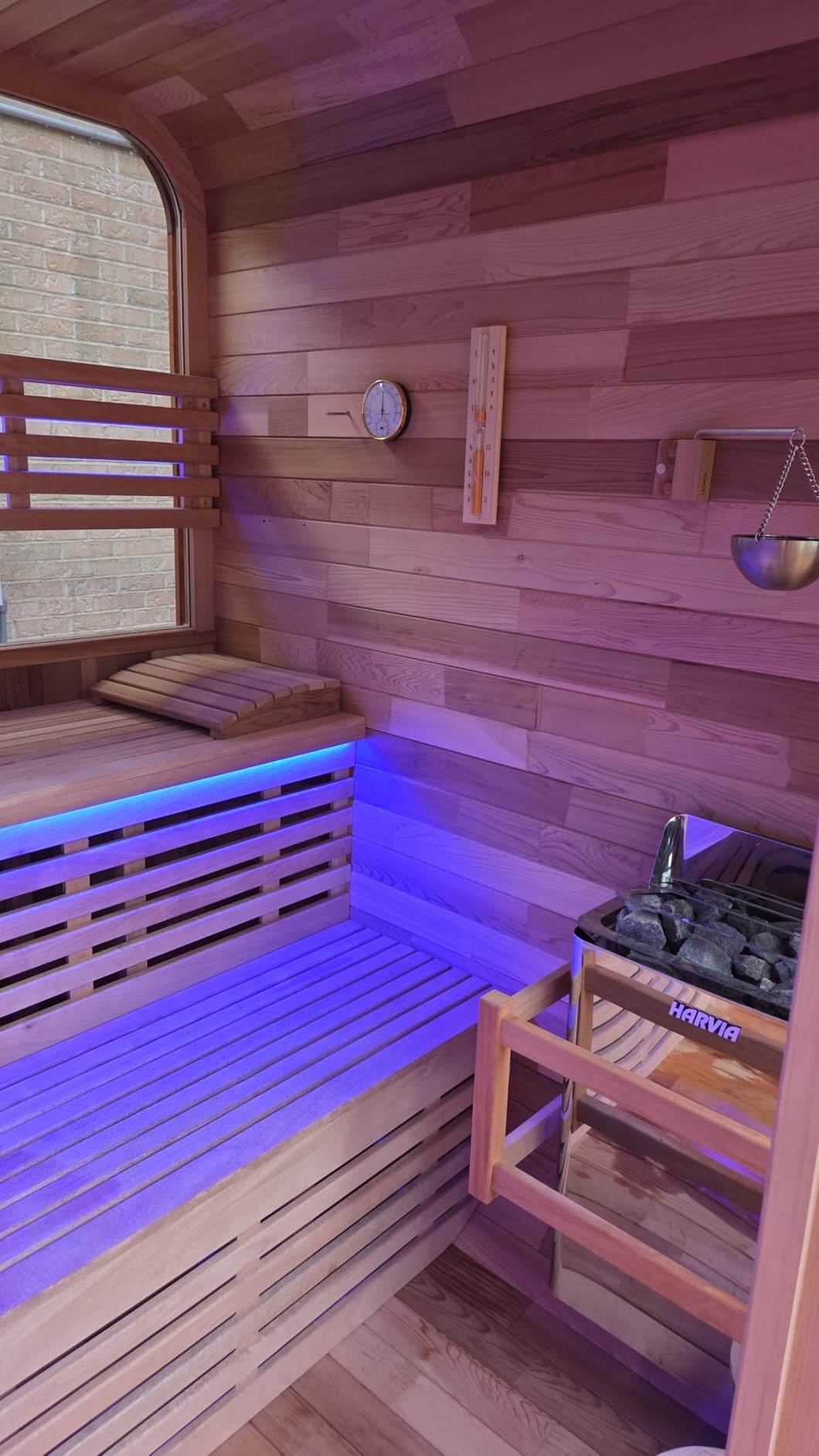
Wood choice is where this kit is most flexible. Pinewood is listed as lightweight with great insulation, hemlock as robust with minimal expansion and contraction, and red cedar for aroma and comfort. Pine is the one to think twice about inside a wood-burning sauna, because pine resin is the classic complaint, but as an option for a budget build it is defensible if you keep the temperature a little lower and watch the benches.
The porch option is a bench for tools and shoes, and it doubles as a cooling area between sessions. On a wood fire you will get out of that cabin and want somewhere to sit in the air, so a porch is not a luxury at this size. Four window configurations are available, and a window matters more in a wood-burning sauna than in an electric one, because watching the fire is part of the experience.
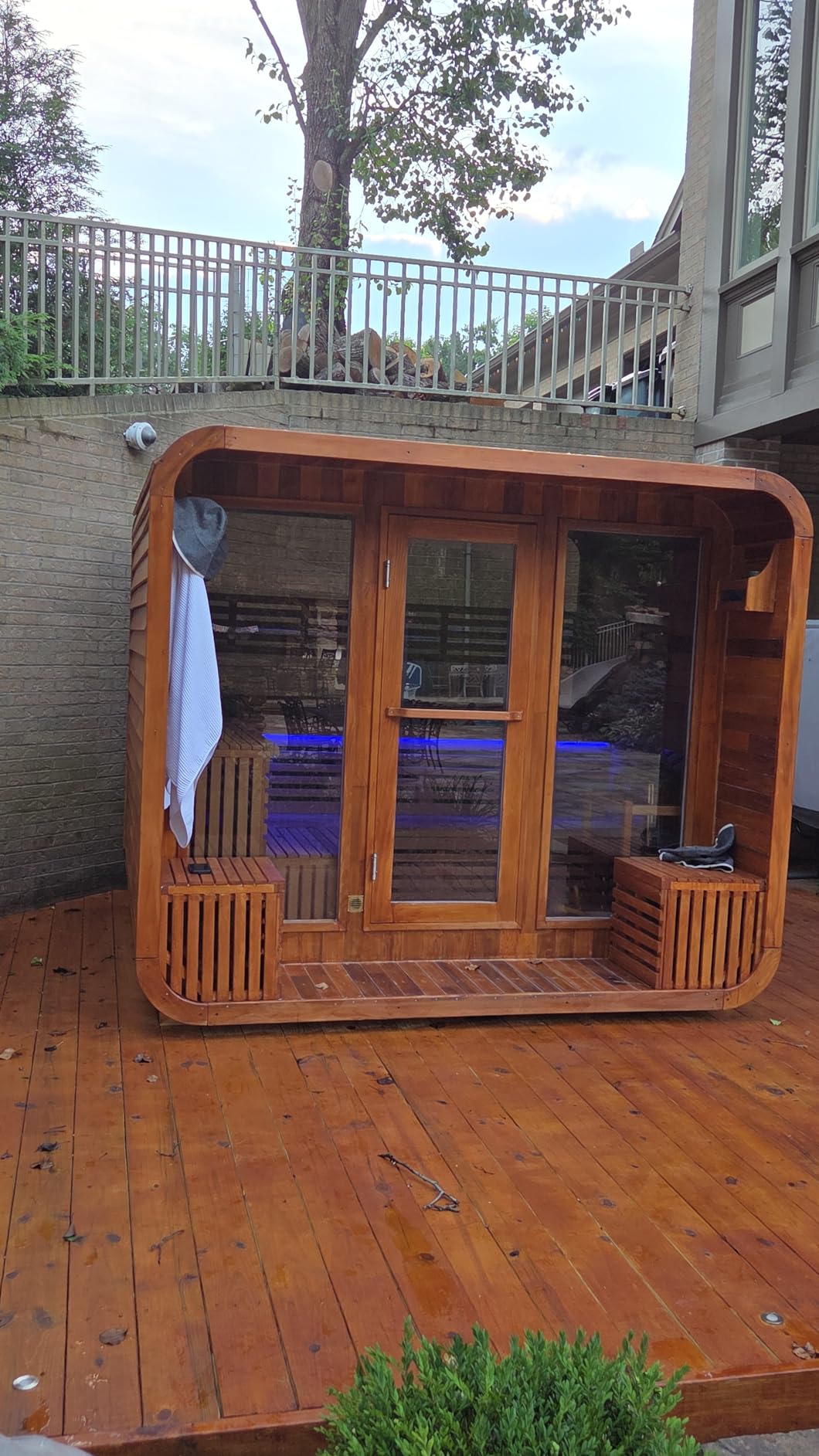
What off-grid really means here
It means no 240V supply, no thermostat, no element to fail. It also means you are supplying the fire, the firewood storage and the water for löyly, and you should plan the storage before the sauna arrives. Owners on r/Sauna ask this question constantly: a season of hard-fired sessions consumes a real stack of split, seasoned wood, and it has to be stored dry somewhere with airflow.
On a rural or remote property this is the option that keeps working when the power does not. A rural New Hampshire cabin owner we read about leaned toward wood specifically because it matched the setting and avoided running a 240V supply across the lot, and that reasoning has not changed.
Where it will frustrate you
The ETL certificate covers the safety question, not the longevity question, and two reviews is not an ownership history. This is a large kit with a lot of panels, a roof system, benches and floor kits to assemble, and it is a two-person weekend at minimum.
If you have reliable grid power and want the option to skip the fire on hot days, note the Harvia electric path is available but needs 220V. Make that decision before the order, not after, because a barrel that arrives and sits unheated through summer is a storage shed with a chimney.
8. ZONEMEL Panoramic Cedar Barrel: Premium Pick With Porch and Chimney Kit
ZONEMEL Wooden Steam Sauna Room with Panoramic View, Canadian Red Cedar Traditional Outdoor Barrel Wood Burning Sauna with Porch, Wood-Fired Stove with Chimney Kit, Wood Shingles, 6-8 Person
74.8 x 94.5 by 74.8 inches
Canadian red cedar
Wood-fired stove with chimney kit
6-8 person
Pros
- Panoramic glass for daylight and fire views
- Built-in porch for cooling off
- Wood shingle roof and chimney kit included
- Off-grid wood-fired stove
Cons
- Wood burning only
- Assembly required
- Single review at a 4 star rating
This is the highest-priced unit we reviewed and the one most likely to be the reason a wood-burning sauna stays on your list for twenty years. Everything about it is aimed at the experience rather than the spec sheet: large panoramic windows and door, a built-in porch for cooling off between sessions, a wood shingle roof instead of asphalt, and a chimney kit in the box.
The panoramic glazing is the differentiator. On a wood-burning sauna, watching the fire through glass with the stove glowing in a dim room is a real part of the ritual, and no amount of interior wood detail replicates it. The listing also lists a breathable hole for gas exchange and fresh air circulation, which is the ventilation detail that keeps a cedar barrel from smelling musty after a wet session.
Capacity is 8 seated or 2 lying flat, in a 74.8 by 94.5 by 74.8 inch footprint of Canadian Red Cedar with heavy-duty steel bands compression-locked at the corners and a weather-resistant EPDM rubber base. The accessory list includes 304 stainless steel bands, an 8mm tempered glass door, volcanic stone, an hourglass, a hygrometer, a bucket and scoop, a rubber hammer, a wall lamp and the roof system.
Why the porch and shingles are worth paying for
The porch solves a problem a wood fire creates. You heat to 180F or more, you step out into winter air, and you need somewhere to sit that is not the freezing step or the sauna bench. Barrels with a porch turn a 20-minute session into a social hour, and owners keep saunas for the same reason they keep fireplaces.
Wood shingles are a slower roof material that ages into the structure rather than onto it. Combined with the cedar cladding, the whole thing looks like it grew there, which is a fair test for a backyard structure you will look at every day from your kitchen window.
Where this premium build falls down
There is no electric option. You are buying a wood-burning sauna and nothing else, so this is a commitment in a way most of the kits in this roundup are not. If your fire-tending habit is untested, start with a configurable model.
It also carries a single 4-star review, the only sub-5 rating in this roundup. One review tells you very little either way, but it does mean the largest spend in the guide is the least evidenced. If you buy this one, give it a full season of use before you judge the assembly or the stove.
How to Choose a Wood-Burning Sauna: Wood, Stove, Size and Ventilation
Most disappointments in this category come down to four decisions, in this order: how big the room is, how big the stove is, what the interior wood is, and how the air moves. Get those right and the rest is logistics. The guide below is the checklist we would use.
Size the stove to the cube, not the other way around
The working rule in the trade is roughly 1kW of output per 45 to 50 cubic feet. A wood stove is rated differently from an electric element, but the physics of a small firebox still has to fill a room and keep it there, and an under-sized stove means a long heat-up and a fire you keep feeding. Measure the interior after the benches go in, not the exterior footprint on the listing.
Ceiling height matters for the same reason. Most sauna guidance puts the minimum around 6.5 feet, and a barrel with a low centre cannot deliver the vertical temperature difference between bench and head that makes a hot sauna usable. The cube and square-barrel layouts in this roundup, at 82 to 90 inches tall, give you more headroom than a barrel does.
Pick the interior wood for heat, not for looks
Canadian red cedar and Western Red Cedar are the aromatic, warm-to-the-touch, moisture-tolerant choices, and they are the ones that survive a wood fire. Hemlock is the stable, lower-allergen option with good insulation, and it is a sensible second choice. Nordic spruce, as in the Allwood, does not bleed resin at high heat, which is the specific failure that ruins cheaper barrels.
Avoid pine inside a very hot room, and be skeptical of any vendor who cannot tell you the stave thickness. Thicker staves hold heat, resist warping and last; thin boards look identical in a photograph and behave differently in a 190F room.
Sort out ventilation before the panels go up
Heat plus moisture equals mold if air cannot move. That is the consensus line in the r/Sauna discussions, and it comes from owners who learned it the expensive way. Standard guidance puts a fresh-air intake low in the room, near the stove and the floor, and an exhaust vent under the opposite bench, with roughly 10 to 12 square inches of intake and 14 to 16 square inches of exhaust for a typical small cabin.
Check whether the kit includes a vent kit at all. A missing ventilation kit is one of the community’s named deal breakers, and retrofitting vents into finished panels is far more work than ordering them with the sauna.
Confirm the chimney, the base and the warranty in writing
Two kits in this roundup include a chimney kit, and the ones that do not should have a documented pipe and cap specification. Know your minimum chimney height and the required clearance between stove pipe, cabin walls and neighbouring structures before you commit, and check whether a spark arrestor is fitted.
The foundation is the other hidden line item. The two barrels with published weights here come in at 1200 and 1500 pounds, so a level gravel pad is not optional on any of these builds. Finally, ask about the structural warranty in writing; a 3-year coverage period on a 20-year structure is a meaningful gap.
Wood-Burning vs Electric Saunas: Which One Fits Your Lot?
This is the first question every new owner asks, and the honest answer is that it depends on your power and your temperament rather than on sauna quality. A well-built wood-burning sauna reaches higher temperatures and gives löyly that an electric heater cannot fake, and it needs no supply at all.
The wiring argument is decisive in one direction and irrelevant in the other. If your property has no 240V circuit, running one for a sauna heater is a project involving an electrician, a trench or a conduit run, and a permit in some areas. A wood-burning sauna skips all of it, which is exactly why the off-grid picks in this roundup exist. If you already have a 240V supply and a small yard, that advantage disappears.
The temperamental argument runs the other way. A wood fire needs tending: building it, adding splits, and watching the room. An electric heater with a thermostat is set and forget, which is why most electric owners use theirs weekly and most wood-fire owners, by their own forum accounts, skip a session when they cannot face tending. Owners also report that the wood-burning sauna heats up quicker than they expected once the fire is established.
One more practical difference. Wood burning costs a variable per session, driven by the firewood you buy, but it is fuel you would otherwise burn anyway if you heat a house with wood. Electric costs a steady metered rate per hour of heat. Neither is free, and both are trivial next to the build cost, so choose on the basis of wiring, time and the ritual you actually want.
If you are still weighing the two paths, our picks for home infrared saunas and portable infrared saunas cover the low-effort end of the spectrum, and they make a useful contrast: no fire, no chimney, no firewood, and a much lower ceiling on achievable heat.
Firewood, Seasoning and Routine Wood Stove Maintenance
No competitor page we researched covers how to actually run a wood-burning sauna, and it is the part that determines whether you keep using the thing. The forum answer to “what wood is best for a wood-burning sauna” is consistent: birch, oak and alder burn cleanest, and seasoned wood is not optional.
How dry means dry. Unseasoned wood smokes, which smears your door glass, and it burns cool, which stretches a 20-minute heat-up into an hour. Seasoned splits with the bark off, stacked with airflow between rows, under cover from above but not sealed from below. Stack it off the ground, and never under a roof where it stays damp.
Never burn treated, painted or glued timber, and stay away from resinous softwoods for a clean burn. Sap and pressure-treated chemicals in a firebox with hot stones is a genuinely bad combination, and it also fouls the stove pipe. Keep a bucket and shovel for ash, and empty it on a non-combustible surface away from the cabin; ash stays hot for days.
Splitting and stacking is more work than buyers expect, so budget for it. Our guides to wood-burning fire pits cover the storage and airflow habits that apply equally to a sauna woodpile, since a dry stack is a dry stack whichever box it feeds.
On the stove itself, the maintenance list is short and regular. Replace the door gasket when the door no longer draws, clean the glass after every session, and brush the firebox and stove pipe periodically to keep creosote off the walls. Rotate or replace the stones on a schedule, since stones that have been through a hundred heat cycles start shedding grit.
The complaint that comes up most often in owner threads is staining on the wall above the stove, and the cause is airflow, not the stove. When the room cannot exchange air, moisture condenses on the coldest surface it can find, which is the wall directly above the firebox. Fix the vents before you touch the wall, or you will be scraping the same stain every season.
If you are new to wood burning and want to get the fire right the first time, our guides to wood-burning stoves for heating and wood-burning kits for beginners cover the fire-tending fundamentals in more detail.
Chimney, Clearances and Permit Checklist
Before you order, get four answers in writing from the manufacturer: the chimney or stove-pipe specification and the minimum chimney height, the required clearance from the stove and pipe to the cabin wall and to any combustible surface, the flue or pipe diameter the heater is rated for, and whether a spark arrestor is included. Only two kits in this roundup list a chimney kit in the package, so for every other model these documents are the difference between a legal installation and an insurance question later.
Clearances to neighbouring structures matter more than most buyers expect. A sauna 10 feet from a fence is a different approval conversation from one 25 feet away, and the distance to your own house determines whether a spark arrestor and a specific pipe class are required. Set the pad location first and build the chimney plan to that footprint, not the other way round.
Permits and inspections vary by municipality. Some places treat a small accessory structure differently from a permanent outbuilding, and some require a fire-safe installation review. Ask your local building department what a wood-burning sauna requires before you order the kit, and keep the paperwork, because an unpermitted sauna with a stove pipe is a resale problem later.
Two safety habits matter once it is installed. Never dry-fire the stove, because a firebox with no mass in it can warp or crack the cast iron permanently, and that failure is not covered by warranty. And keep a working extinguisher and a metal ash container within reach, because a wood fire in a small cabin behaves faster than a person expects.
Frequently Asked Questions
What are the best wood-burning saunas?
The Allwood 220-WHC is the best overall wood-burning sauna in our roundup: slow-grown Nordic Spruce staves, a wood-fired M3 heater and room for four adults. The AURGOD 2-person hemlock barrel heats fastest at a claimed 195F in 20 minutes, the AURGOD 4-10 person model suits off-grid lots, and the Benovo cube is the pick for families and groups.
Are electric or wood-burning saunas better?
It depends on your power and your patience. Wood burning needs no 240V circuit at all, which decides it on rural and off-grid properties, and it reaches the highest temperatures. Electric is set-and-forget with a thermostat, so it suits owners with grid power who want sessions without tending a fire.
What type of wood is best for burning in a sauna?
Birch, oak and alder burn cleanest in a sauna stove, and the wood must be properly seasoned with the bark off. Green or damp wood smokes heavily, soaks up heat and makes cleaning a miserable job. Never burn treated, painted or glued timber.
What is the 200 rule for saunas?
The 200 rule is a guideline that sauna temperatures should not exceed about 200F, or roughly 93C. Below that, an adult can generally tolerate a session safely, but individual tolerance varies, hydration matters, and you should leave the sauna if you feel unwell.
Is owning a sauna worth it?
Owners of wood-burning saunas generally report that the value comes from heat-up speed, the lack of wiring and the ritual, not from the build cost. The real work is airflow: a sauna that cannot exchange air develops condensation, staining above the stove and eventually mold. Get the ventilation right and it is worth it.
Bottom Line: Which Wood-Burning Sauna Should You Buy?
Pick the Allwood 220-WHC if you want the classic barrel sauna with a real wood-fired M3 heater and spruce that will not bleed resin. Pick the AURGOD 2-person barrel if heat-up speed is what you want most. Pick the AURGOD 4-10 person or the Benovo cube if you are going to a rural lot or hosting a group.
Before any of them arrives, settle four things: the stove output against your interior cube, a vent kit in the delivery, a level pad sized for 1200 to 1500 pounds, and the chimney spec in writing. Owners on r/Sauna describe the same pattern again and again. The saunas that get used for years are the ones where the air moves and the wood is dry.
We compared these eight for 2026 and re-check every spec against the manufacturer before recommending a purchase. We may earn a commission on some links, which never changes what we rank.