
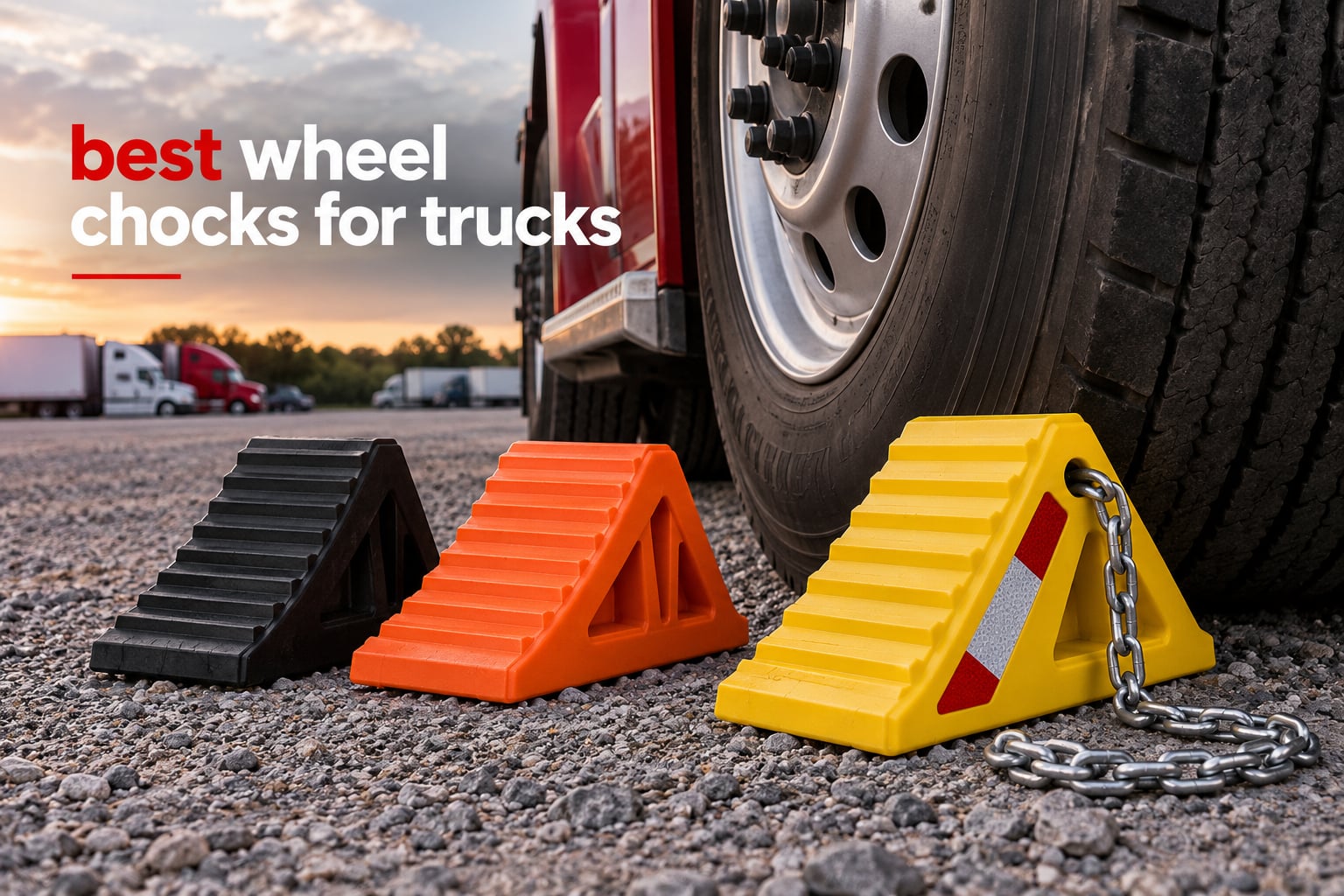
A wheel chock is the cheapest insurance a truck owner ever buys. Parking brakes fade, air pressure bleeds down overnight, and a sloped driveway does not care about your good intentions. The right chock transfers the roll of a 33-inch tire into the ground before the rig ever moves.
We pulled ten of the highest-rated truck wheel chocks on the market and put them through the same checklist: measured height against tire diameter, checked the stated load rating, looked at how much rubber touches the pavement, and read what owners say after months of use. The short answer for the best wheel chocks for trucks is solid molded rubber, sized to about one-quarter of your tire diameter, sold in pairs, and rated well above your heaviest axle group. Within that, the MAXXHAUL 8 x 4 x 6 in two-pack is the pick most trucks should end up with, because it has the largest review base in the group and a molded handle you can grab with gloves on.
Below that, the difference comes down to three things: how much surface area the chock puts on the ground, whether you can see it at night before you pull away, and whether it stays with you or gets left in a yard. We cover all ten, plus the placement rules that keep a tandem trailer still and the one weather caveat every manufacturer buries in the fine print.
Table of Contents
Top 3 Picks for the Best Wheel Chocks for Trucks for October 2026


All 10 Picks at a Glance for October 2026
Every chock below is solid rubber. What separates them is footprint, weight, rating, and whether it carries a handle, an eyebolt, or reflective tape.
| Product | Specifications | Action |
|---|---|---|
| MAXXHAUL Solid Rubber 2-Pack |
|
Check Latest Price |
| MaxxHaul Large 10 x 8 x 6 in Pair |
|
Check Latest Price |
| AFA Tooling 8T Four-Pack |
|
Check Latest Price |
 ROBLOCK 9 x 7.1 x 5.5 in Pair ROBLOCK 9 x 7.1 x 5.5 in Pair |
|
Check Latest Price |
 SECURITYMAN Orange Pair SECURITYMAN Orange Pair |
|
Check Latest Price |
 HOXWELL Four-Pack 8 x 4 x 6 in HOXWELL Four-Pack 8 x 4 x 6 in |
|
Check Latest Price |
 ROBLOCK Reflective Four-Pack ROBLOCK Reflective Four-Pack |
|
Check Latest Price |
 AFA Tooling 4T Four-Pack AFA Tooling 4T Four-Pack |
|
Check Latest Price |
 MaxxHaul 50019 Three-Sided Pair MaxxHaul 50019 Three-Sided Pair |
|
Check Latest Price |
 RELIANCER Extra Large 10 x 6 x 7.3 in RELIANCER Extra Large 10 x 6 x 7.3 in |
|
Check Latest Price |
1. MAXXHAUL Solid Rubber 2-Pack 8 x 4 x 6 in – the default choice for most trucks
MaxxHaul Solid Rubber Wheel Chock 2-Pack | 8″ x 4″ x 6″ Heavy-Duty Tire Stop | Non-Slip Traction Pads | Built-in Handle | All-Weather Vehicle Safety Block | Black | (70472)
Solid molded rubber
8 x 4 x 6 in per chock
8.4 lb per pair
Built-in handle
Pros
- Solid rubber resists cracking and crushing
- Compact size fits behind tires and in storage boxes
- Molded handle works with gloves
- Rated 4.8 across more than 18k reviews
Cons
- Small footprint is modest for the biggest commercial wheels
- Low profile is hard to spot in the dark
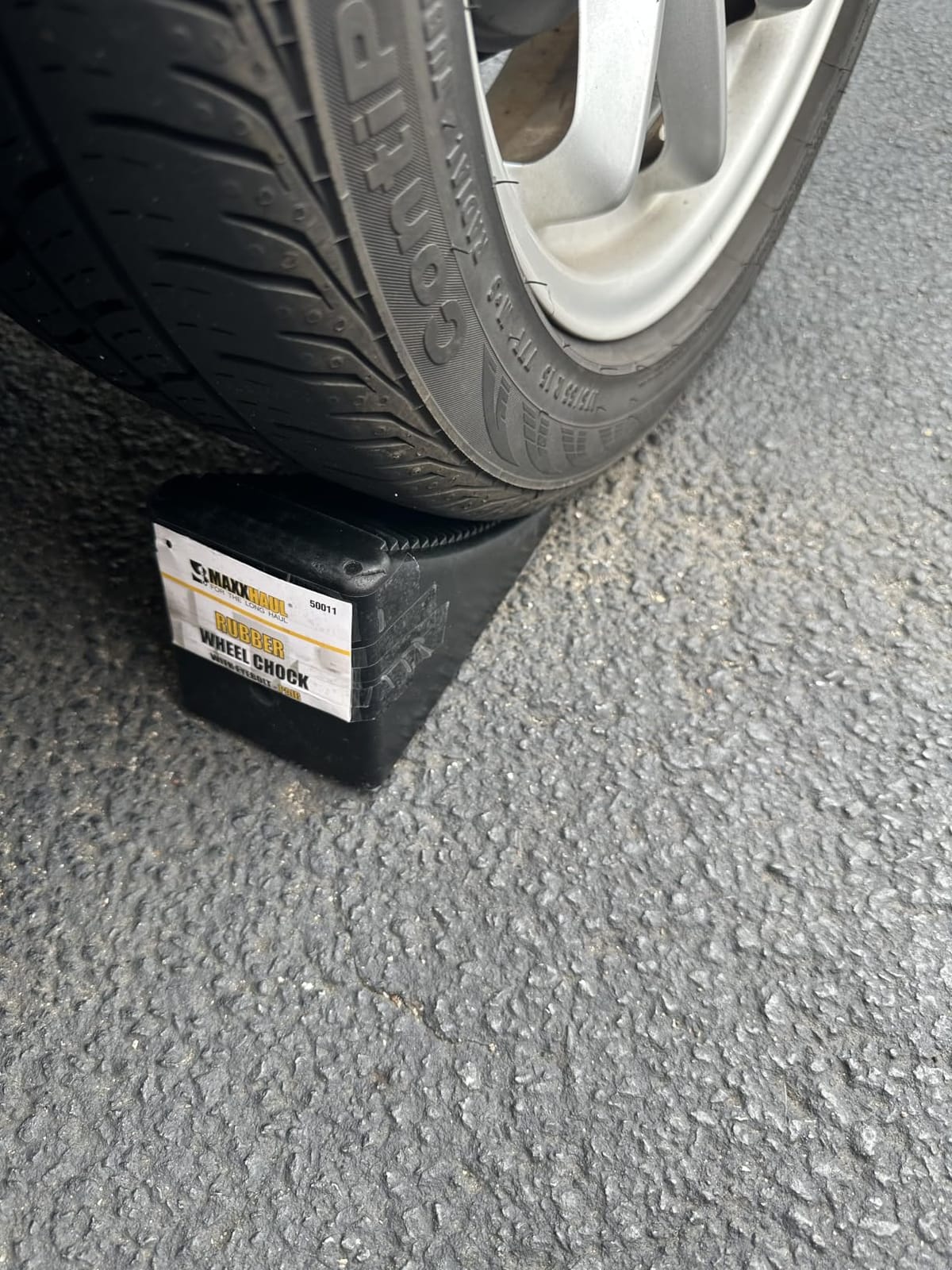
I keep coming back to this one because it is boring in the best way. The rubber is solid molded rather than hollow, so it does not flex when you kick a 33-inch tire into it, and the ribbed traction pads on the bottom keep it planted on damp concrete. It is the chock I put behind the rear tires of a half-ton pickup when the driveway tilts, and it has never moved.
The 8 inch length is the honest compromise. A 32-inch tire wants roughly an 8 inch chock, so this sits right at the sizing rule, and the 4 inch width means it covers part of the tread without trying to swallow the whole tire. The molded handle is a small thing that matters more than it sounds, because pulling a rubber block out from under a loaded wheel with bare hands is a genuinely unpleasant job.
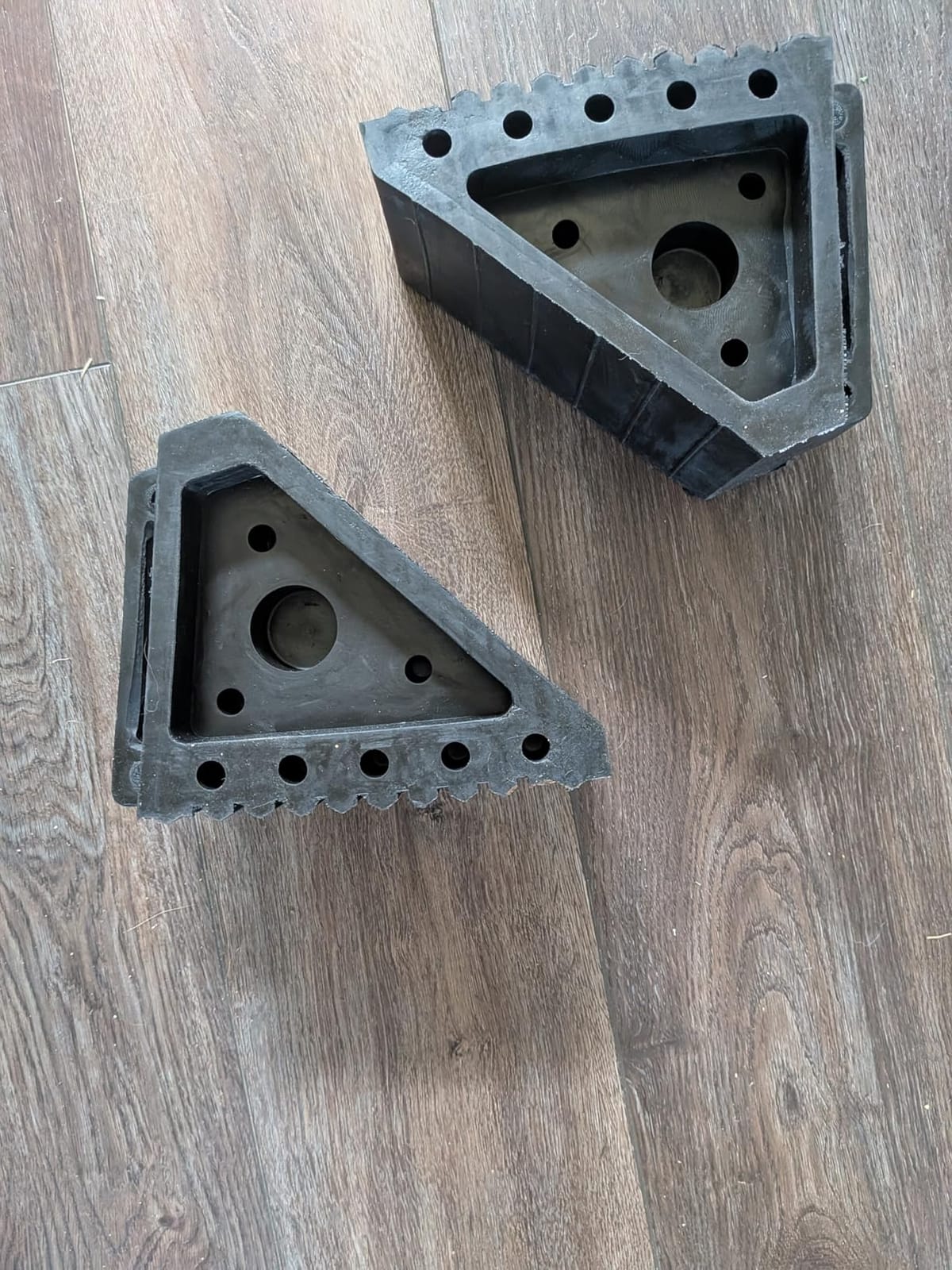
Reviewers consistently describe it as stiff, crush-resistant, and easy to wedge in with a single push rather than a hammer. Owners also flag the same limitation the spec sheet implies: at 8 x 4 x 6 inches and 8.4 pounds for the pair, it is compact, so on a fully loaded tandem axle or a wide commercial tire you are giving up some contact area.
The other recurring note is visibility. Black rubber on black asphalt at night is genuinely hard to spot when you walk back out to the truck. If you chock in a dark yard, a reflective or colored chock is the safer buy even if this one is the better value.
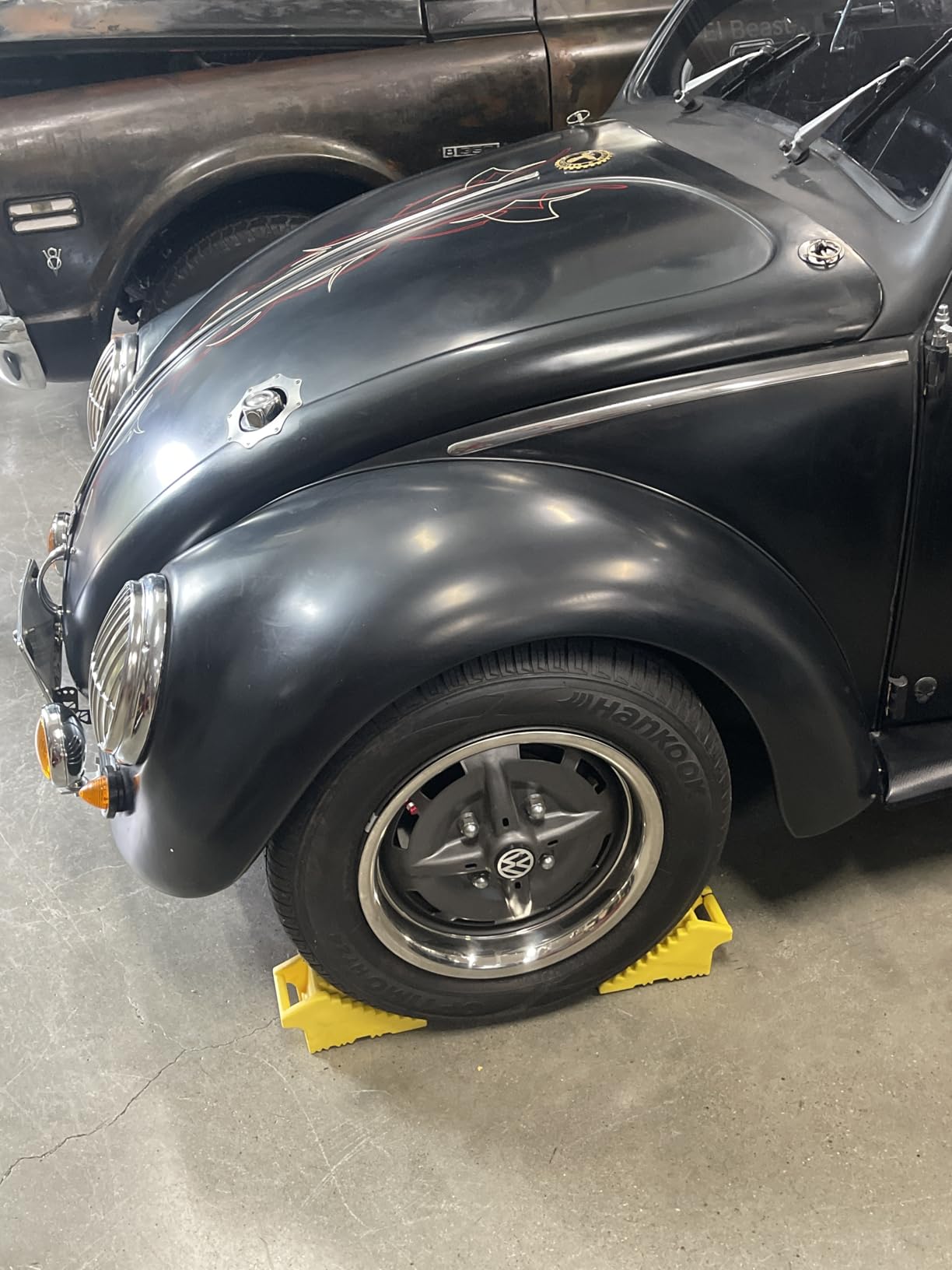
Will 8 inches be enough for my truck tires?
For a half-ton or three-quarter ton pickup on 32 to 33 inch tires, yes, this matches the one-quarter sizing rule almost exactly. The 6 inch height also means it reaches past the bottom curve of the tire rather than sitting on the shoulder, which is where cheap plastic chocks fail.
For a dually, a box truck, or a tractor-trailer, look at the taller chocks further down this list. Those wheels carry far more load per tire, and a smaller block under that load is the scenario owners report as the chock squashing or kicking back out.
What am I giving up for the low price?
Surface area and night visibility, mostly. At 8.4 pounds for two chocks, this is not the heaviest option here, and weight itself is treated as a feature by drivers who want a chock that stays planted instead of walking away under load.
There is no printed pound rating in the listing, so you are relying on the rubber formulation and the review history rather than a number. For a pickup on a slope, that is fine. For a commercial axle group, match a stated rating instead.
2. MaxxHaul 10 x 8 x 6 in Pair with Steel Eyebolt – the one with real footprint
MaxxHaul Rubber Wheel Chock 2 Pack, Large 10″ x 8″ x 6″ Heavy Duty Tire Stop with Non Slip All Weather Grip, Oil Resistant Rubber Block with Steel Eyebolt for Vehicle and Trailer Safety (80681)
Oil-resistant solid rubber
10 x 8 x 6 in per chock
16.6 lb per pair
Alloy steel eyebolt
Pros
- Oversized 10 x 8 in footprint resists tipping
- Dense oil-resistant rubber holds on inclines
- Eyebolt accepts a chain or rope tether
- Textured surface works on gravel and wet floors
Cons
- Strong rubber odor out of the box
- Included washers are small and dig into the rubber
- 16.6 lb per pair is heavy to carry
This is the chock I would put behind a trailer with 35 inch tires, and the difference from a smaller block is obvious the first time you kick it in. The 10 by 8 inch base resists tipping in a way that an 8 inch chock does not, and at 16.6 pounds for the pair, there is a lot of mass resisting the roll.
Drivers on r/Truckers describe weight as a feature rather than a flaw. A chock that stays planted under a loaded trailer is worth more than a lighter chock that is easier to carry, and forum members upgrading from cheap plastic almost always land on heavy rubber for exactly that reason. The rubber is also oil resistant, which matters in a yard where hydraulic drips happen.
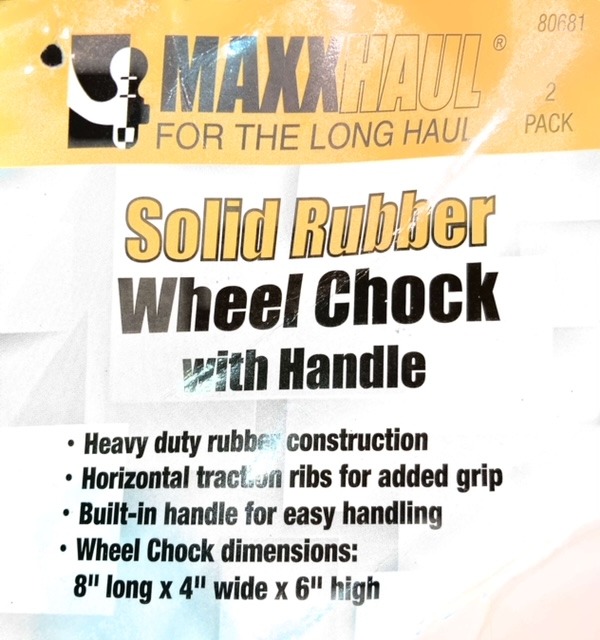
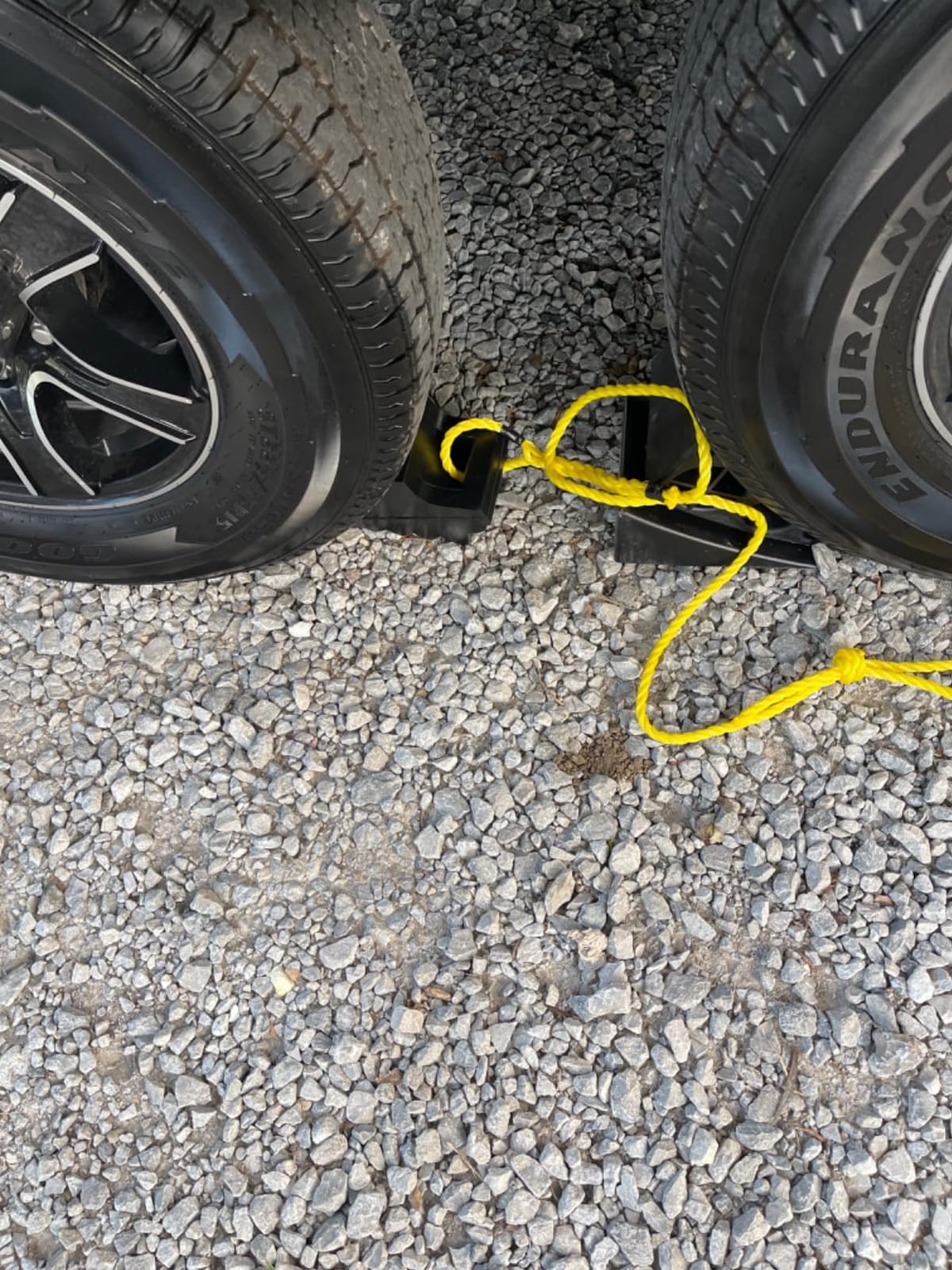
The steel eyebolt is the detail that separates this from other big rubber blocks. It lets you tether the chock to a chain or rope so it comes out with the rig instead of being left behind and run over. Owners with boat trailers and heavy equipment report that this simple loop is what makes the chocks part of the truck rather than yard clutter.
Two complaints come up repeatedly. The rubber smell on arrival is strong enough that some owners store the pair outside rather than in the cab, and the included washers are small enough to dig into the rubber around the eyebolt under a tight chain. Neither affects function, but both are annoying.
Is the extra weight a problem for daily use?
It depends on your job. If you chock up eight times a shift, 16.6 pounds for the pair is noticeable, and the steel eyebolt lets you rope them so you carry both at once rather than one in each hand. For a weekend pickup on a driveway, it is simply dead weight you leave in the bed.
Does the eyebolt actually help?
Yes, provided you buy your own chain or rope. Owners report two main wins: retrieval without crouching behind the tire, and not leaving a chock on a road where someone else finds it. The other forum-consistent request is that the supplied cords should be included, which they are not.
3. AFA Tooling 8T Four-Pack with Handles – the fleet and RV set
Wheel Chocks for Cars, RVs, Trucks, Trailers, and Vehicles G.V.W. up to 8T, 4 Pack – Anti Slip Bottom Tire Chock for All Weather Use – RV, Travel Trailer, Pop Up Camper Accessory
Nylon-reinforced rubber
Rated to G.V.W. 8T
9.1 x 3.7 x 4.7 in
4 chocks plus rope ties
Pros
- Handles instead of rust-prone eyebolts
- Ribbed bottom grips with one push and no hammering
- Resists cracking in sun
- ice
- salt and mud
- Four pieces cover a full axle of tires
Cons
- Medium size runs small for very large RVs or heavy trucks
- Strong rubber smell on arrival
- Narrow profile covers only part of tread width
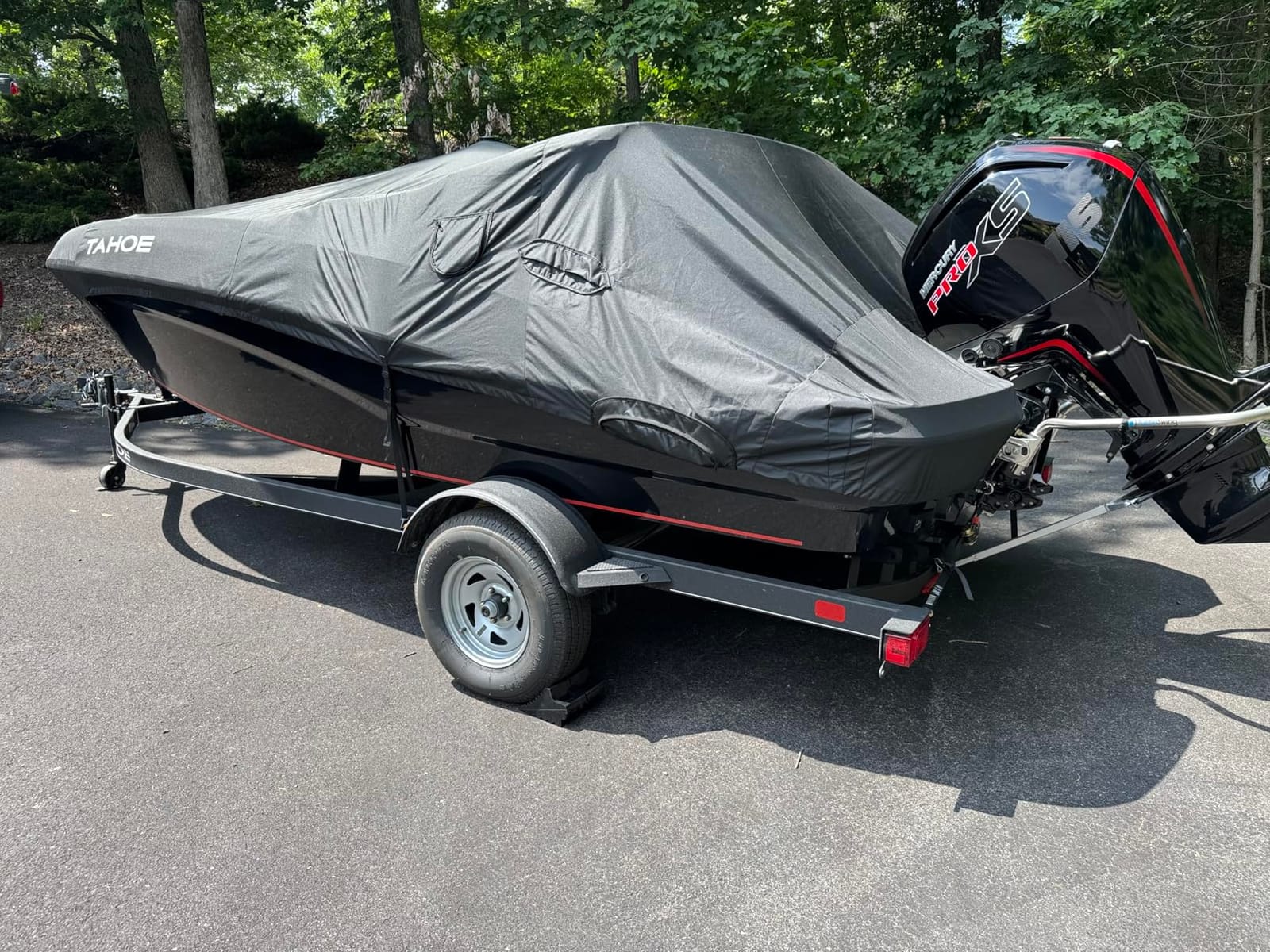
Four chocks in one pack is the quiet advantage here. Anyone doing trailer swaps or RV service knows the real failure mode is not grip, it is coming back to the rig and finding one chock missing. A four-pack with rope ties means you carry all four at once and you cannot leave half the set behind.
The listing rates this set to a gross vehicle weight of up to 8 tons, which puts it in range for most Class C motorhomes, travel trailers on the ball, box trucks, and pickups. The nylon-reinforced rubber is the part worth noting: it is specifically built to survive the salt, sun, and freeze-thaw cycles that crack unreinforced rubber, which is why trailer owners who replaced plastic chocks keep reporting no cracks after a full season.
Handles beat eyebolts in one respect that matters on salt roads: a steel ring is a corrosion waiting to happen, while a molded rubber handle just gets scuffed. Owners also like that the ribbed design takes a single push with a boot to seat, so nobody is swinging a hammer at 6 am in a truck yard.
The honest drawback is size. At 9.1 inches long and 3.7 inches wide with a 4.7 inch height, this is a medium chock, and the narrow profile means it contacts part of the tread rather than the full width. Owners of the largest RVs and the heaviest trucks say it runs smaller than they expected.
How many tires can one of these sets cover?
Four chocks cover two tires fully, which handles a tandem axle, a dually, or a four-wheel-drive pickup with one wheel chocked on each side. For a tractor-trailer with a tandem bogie you are still short, and you would want a second set or the larger chocks above.
Are handles better than an eyebolt?
For longevity, yes. There is no steel to rust or seize, and the rope ties included let you lash the set together for transport. For chain-and-hook security around a trailer, an eyebolt gives you a stronger attachment point than a molded handle loop.
4. ROBLOCK 9 x 7.1 x 5.5 in Pair with Eyebolt – curved face, heavy base
ROBLOCK 2 Pack Wheel Chocks Rubber Heavy Duty Black with Eyebolt, 9″ Length x 7.1″ Width x 5.5″ Height, for Cars, RVs, Trucks, Trailers, and Vehicles, Anti-Slip Design Tire Chock for All Weather Use
UV and weather resistant rubber
9 x 7.1 x 5.5 in per chock
13.2 lb per pair
Curved contact face
Pros
- Grooved base grips driveways without sliding
- Curved top matches the tire profile for tight contact
- Built-in steel eyebolt for rope tie-off
- Heavy enough that a tire is unlikely to roll over
Cons
- Sold without pull cords despite the eyelet
- Gives you a small chock in a large box
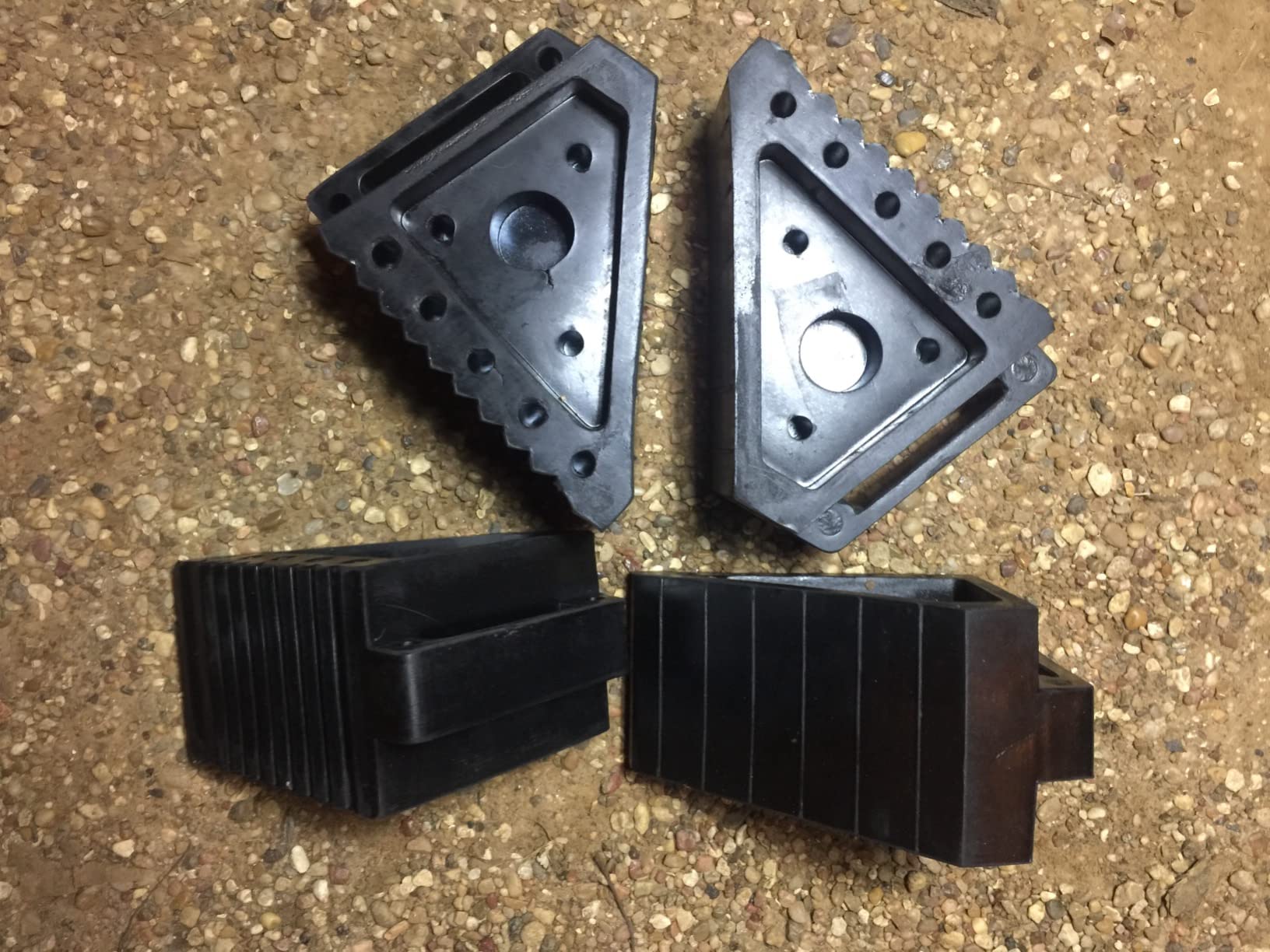
The curved top is the detail I noticed first. Rather than a flat face that touches the tire at one point, this radiuses the contact surface so it sits flush against the sidewall curve, which spreads the load and makes the chock feel far more solid once it is seated.
Camper and boat trailer owners report that it holds firmly on sloped driveways, which is the situation where a flat-faced chock tends to skip sideways. At 13.2 pounds for the pair, it is heavy enough that a tire rolling forward is more likely to climb the chock than push it aside, and that weight is the same quality signal drivers on r/Truckers talk about.
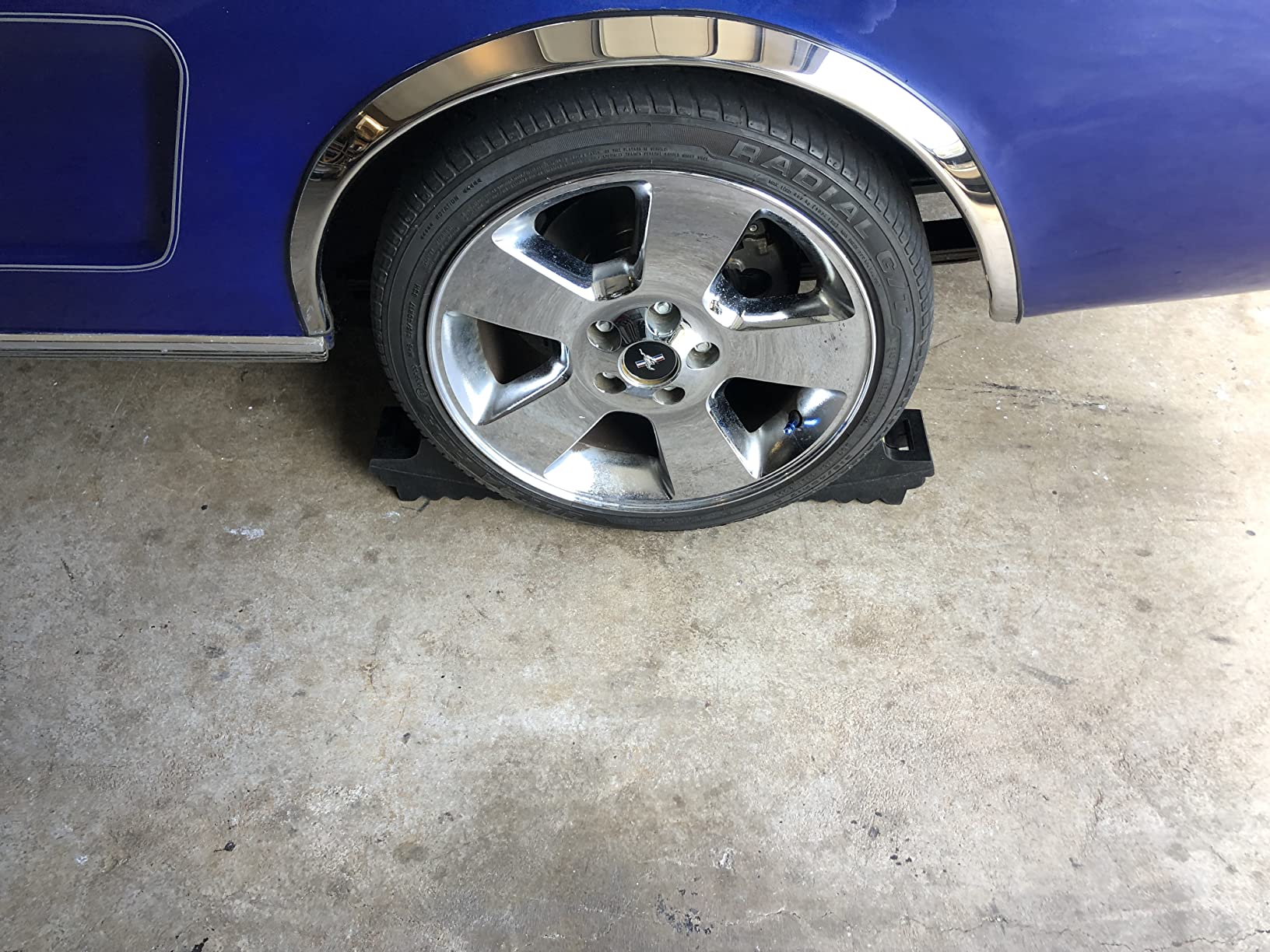
The steel eyebolt is a bolt-on fitting, so you can add your own rope or chain. That is the most common buyer request in the reviews, because the mounting point is clearly there and the cord is clearly not included. It is a small annoyance with an easy fix and it does not affect how the chock grips.
Rubber here is described as UV resistant, which matters for anyone storing chocks on a truck bed or in a sun-exposed yard. The triangular grooved base is what does the work on gravel and grass, where a smooth bottom face would just skate.
Does the curved face really make a difference?
Yes, particularly on smaller tires and on pavers. A flat face contacts a narrow band near the base of the tread, while a radiused face follows the tire profile, so the chock seats with one push and stays engaged. On a sloped driveway that is the difference between a firm stop and a slow creep.
Is the size right for a pickup or a semi?
Nine inches long by 7.1 wide with a 5.5 inch height is a solid mid-to-large chock that suits pickups, SUVs, and light commercial work. It is not sized for a full tandem bogie, where you would want the taller blocks, but it is a strong all-rounder for one-axle trucks.
5. SECURITYMAN Orange Two-Pack – the one you can actually see
SECURITYMAN Heavy Duty Wheel Chocks (2 Pack) – Durable, Non-Slip, Solid Rubber Wheel Chocks for Boat Trailers, RV, Truck, Camper – Perfect on All Surfaces and in All Weather – Orange…
High-visibility orange rubber
8.19 x 7.32 x 6.73 in package
Holds up to 20000 lb per listing
Predrilled tie-off hole
Pros
- Orange color is easy to spot before driving off
- Wedge shape jams under the tire without hammering
- Molded handle and pry hole for removal
- Light at 4.2 lb so it stores anywhere
Cons
- Some buyers say it feels more like hard plastic than solid rubber
- Light weight raises questions under real load
- Contour suits larger SUV and truck tires over small ones
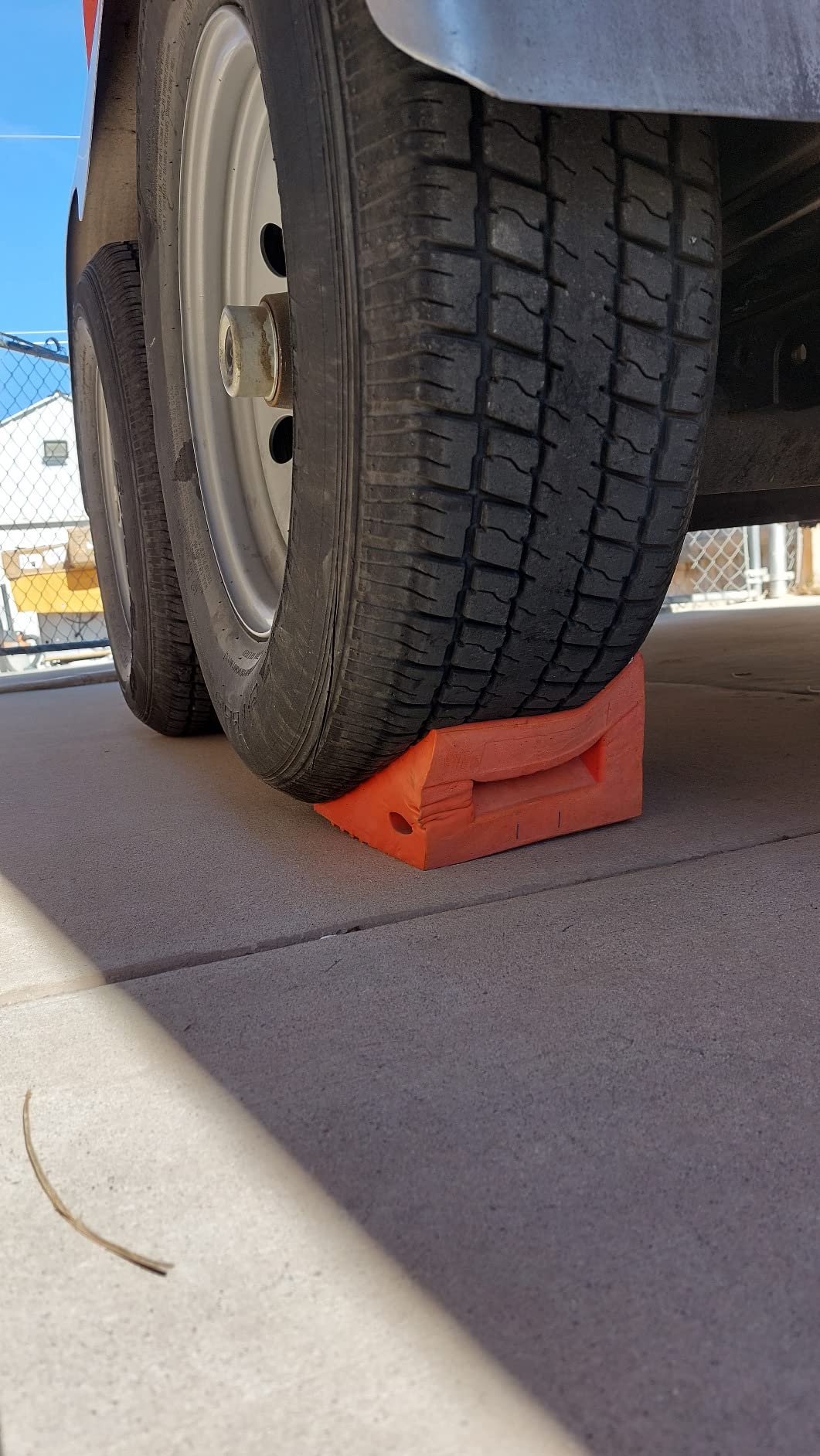
Color is the whole argument for this one, and it is a better argument than it sounds. Every black rubber chock on this list disappears against wet asphalt at night, and the most common accident drivers describe is not a chock failure but a chock nobody noticed. Orange solves that at no cost.
The listing states it prevents up to 20,000 pounds of unintended movement, which is the only printed pound rating among the picks that is stated per chock rather than as a gross vehicle weight. The wedge shape is designed to jam under the tire with a boot rather than a hammer, and the molded handle plus pry hole handle removal on the uphill side of a slope.
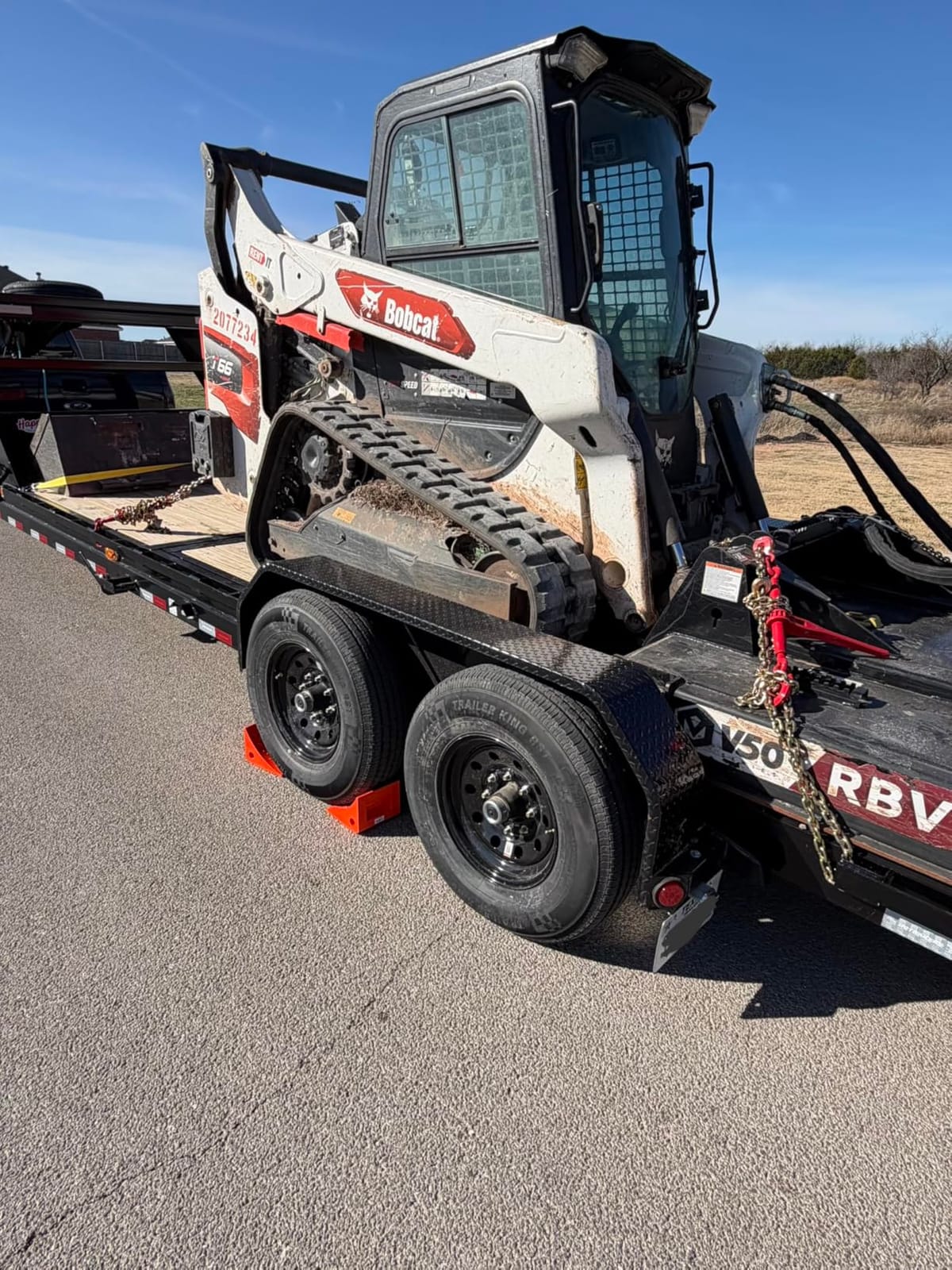
Owners mostly report being happy with grip and visibility, particularly on sloped driveways with larger tires. A minority question the material itself, saying it feels more like hard plastic than the solid rubber promised, and the 4.2 pound weight is the reason some of them worry about deformation under a heavy load.
That concern is worth taking seriously if your truck is a loaded rig rather than a family pickup. At 4.2 pounds for the pair, this is by far the lightest option in the roundup, and drivers who want planted weight should look at the heavier rubber blocks instead.
Is high visibility worth giving up some weight?
For a pickup on a driveway, absolutely. Nobody is loading a camper onto it, and the single greatest risk is pulling away with a chock still in place. For a commercial yard where a 20,000 pound claim has to do real work, choose the heavier rubber instead and solve visibility with reflective tape on a larger chock.
Does it fit smaller tires?
The contour is shaped for larger SUV and truck tires, and owners with small car wheels say the profile sits awkwardly on a narrow tire. This is a truck chock, and for a truck tire it seats cleanly on the first push.
6. HOXWELL Four-Pack 8 x 4 x 6 in with Rubber Handles – four units, modest weight
HOXWELL Solid Heavy Duty Rubber Wheel Chocks 4 Packs, Premium Wheel Stopper for Car, Travel Trailers, RV, Truck, and ATV(4 pcs, Black) 8″ x 4″ x 6″
Reinforced premium rubber
8 x 4 x 6 in per chock
15 lb for four
4 chocks per pack
Pros
- Rubber resists slipping
- crushing and oxidation
- Ribbed triangular base grips with a single push
- Rubber handle can be roped so pairs travel together
- Four-pack covers both axles of a truck
Cons
- Compact size is modest for heavy commercial wheels
- No reflective marking for night visibility
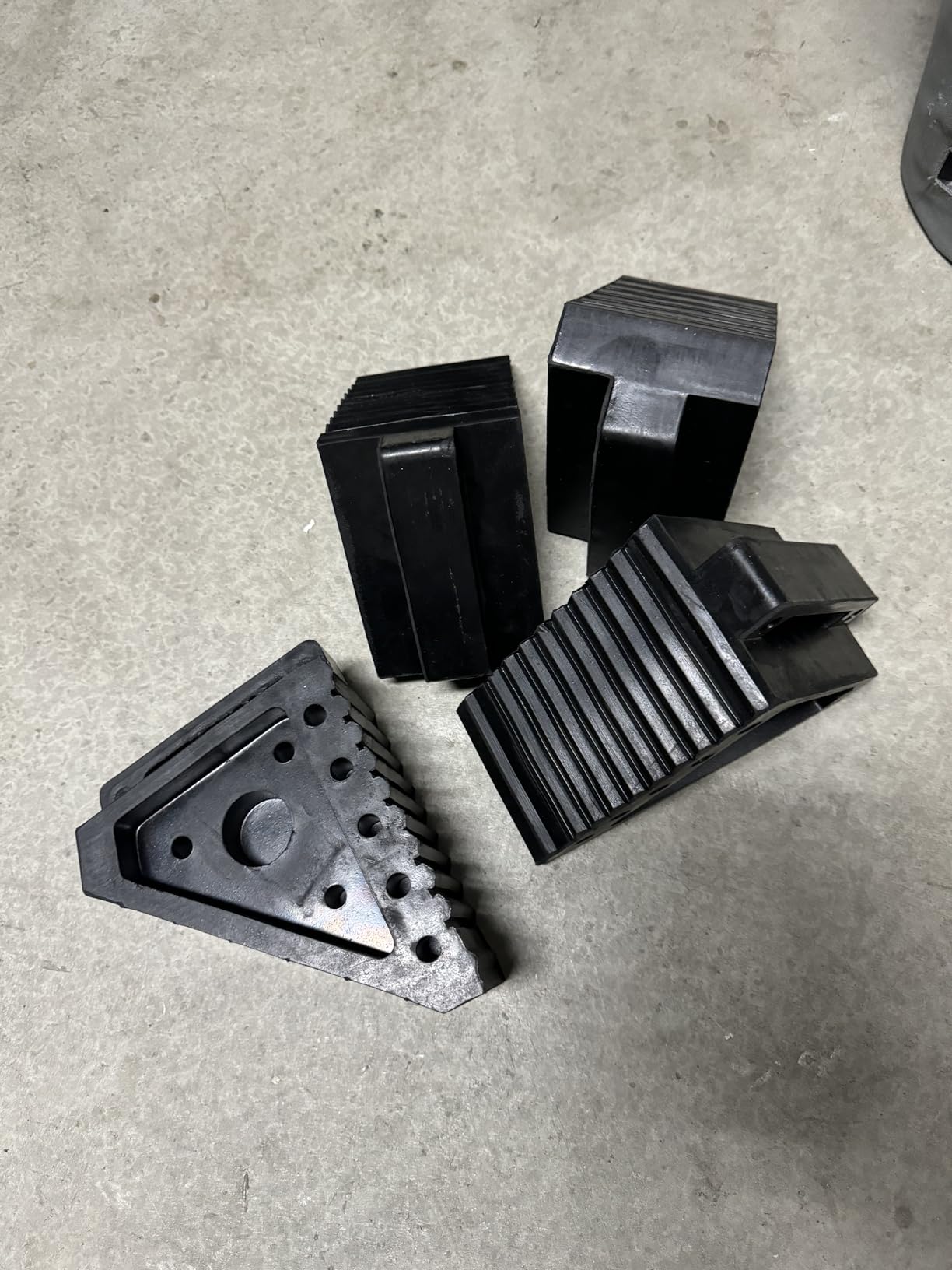
Same wedge dimensions as the opening pick, but you get four of them and a rubber handle instead of a bare block. That is the trade. If you chock both axles on a truck regularly, a four-pack removes the problem of the fourth chock existing somewhere you have not looked yet.
The manufacturer describes the rubber as twice as strong as ordinary rubber, upgraded to resist slipping, crushing, tearing, and oxidation. Whether that claim holds to the pound is unverifiable from a listing, but the buyer feedback is consistent: the rubber quality gets called out as noticeably better than the plastic chocks these replaced, and the ribbed triangular base seats with one push rather than a hammer.
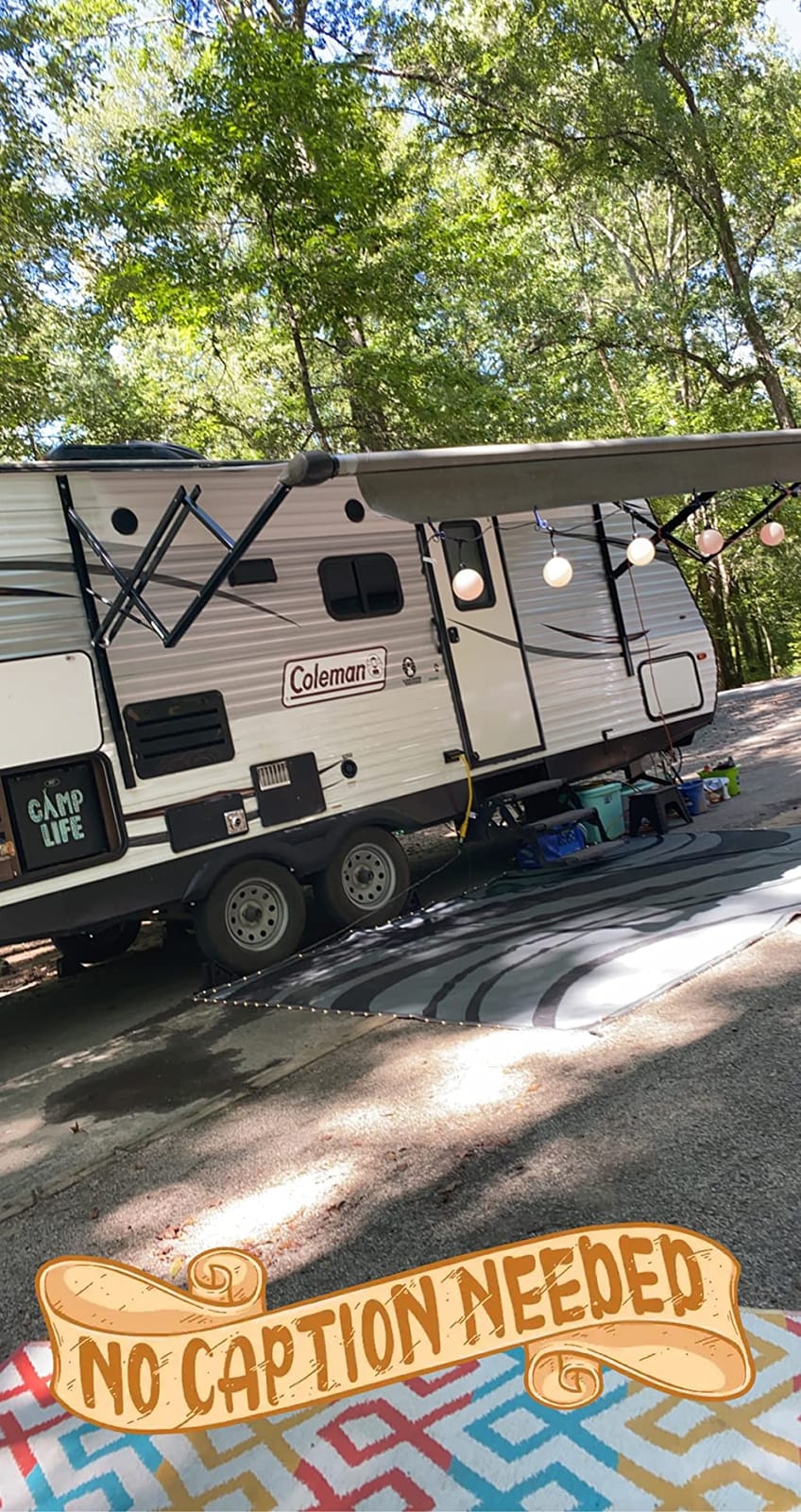
At 15 pounds for four chocks, you are paying a modest amount of mass per unit, and the handle can be roped so a pair carries together. That is a genuine ergonomic win for a driver who chocks up multiple times a shift and does not want to make four trips to the bed.
The trade-off is the same one as the compact MAXXHAUL: 8 x 4 x 6 inches is right for a 32-inch tire and modest for anything larger. There is also no reflective marking, so this is a daylight-and-good-weather chock, not a dark yard chock.
Why choose this over the compact two-pack?
Quantity. The per-chock design and rubber are broadly the same idea, so if you are chocking two tires today and want to add a second vehicle, a trailer, or both axles of a truck, a four-pack spreads the cost across four usable chocks instead of two.
Will it hold a heavy commercial truck?
It will sit there, but I would not make it your only line of defense on a loaded tandem axle. The footprint is modest for those wheel loads, and a taller chock gives you more engagement with the tire profile and more margin if the ground is soft.
7. ROBLOCK Four-Pack with Reflective Tape and 30 in Rope – the yard and fleet visibility set
ROBLOCK 2 Pairs Wheel Chocks Heavy-Duty Rubber Wheel Block Non-Slip Base with Nylon Rope Yellow Reflective Tape – 4 Pack Wheel Stopper for Travel Trailers, Car, Camper, Truck, Black
Oil and weather resistant rubber
7.8 x 4.1 x 3.9 in each
6.6 lb per chock
30 in connecting rope
Pros
- Included rope makes paired chocks easy to carry and remove
- Reflective tape keeps them visible at night
- Rubber resists oil
- weather and UV better than plastic
- Heavy enough that a tire is unlikely to roll over
Cons
- Rope may be polypropylene rather than nylon
- One pack is two chocks
- so two sets cover two tires
- Rope length is short for some trailer wheels
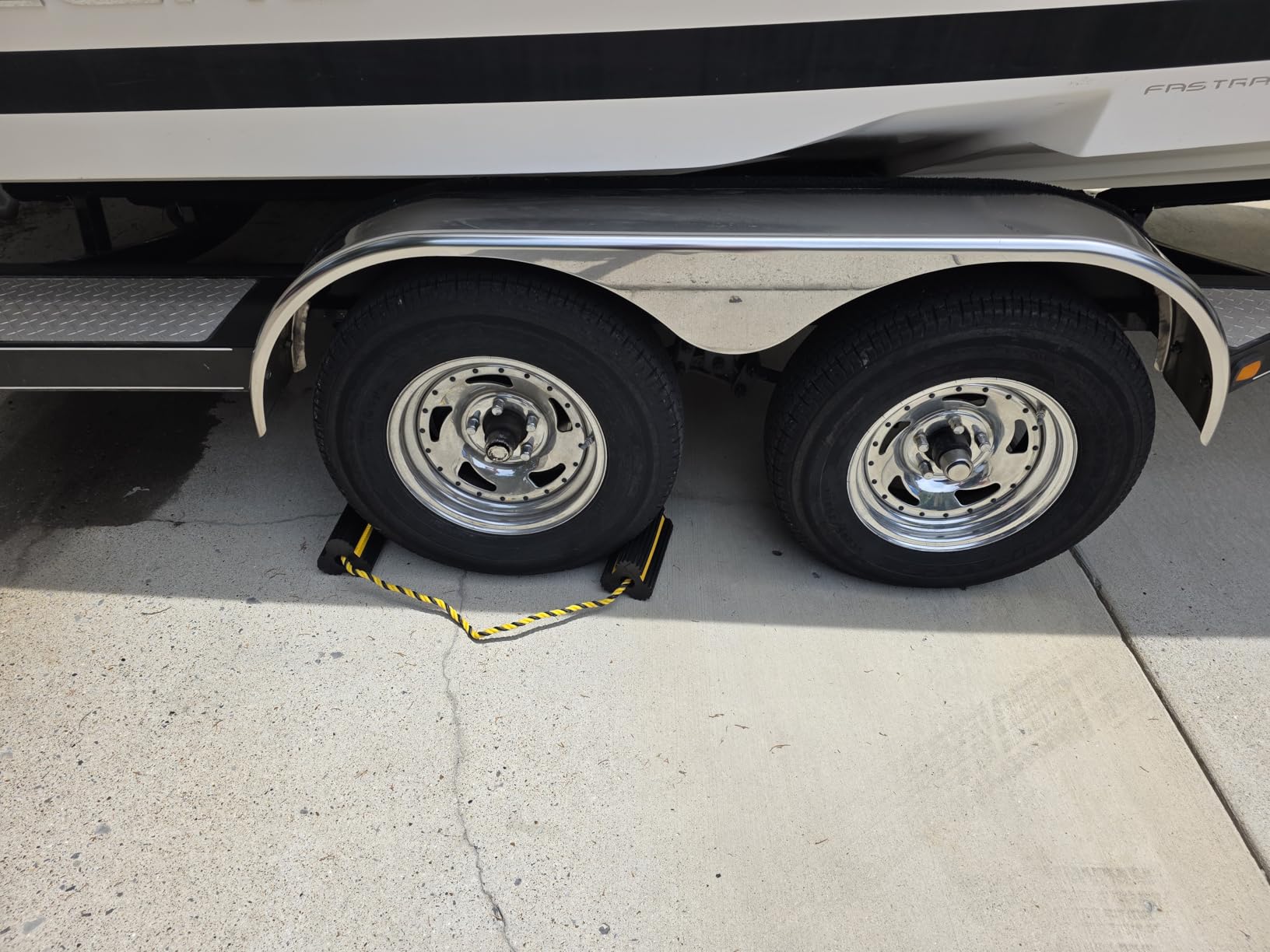
This is the set I would put on a work truck that lives in a dark yard. Reflective tape on three sides means the chock is visible from any angle, which directly addresses the failure mode that black rubber chocks share: a driver walking back out at night cannot see them.
RV and fifth-wheel owners who chock in campsites and driveways rate it highly for the same reason. The 30 inch connecting rope is included, so the paired chocks carry together and come out in one motion, and at 6.6 pounds per chock the mass is enough that a tire is unlikely to roll over the top.
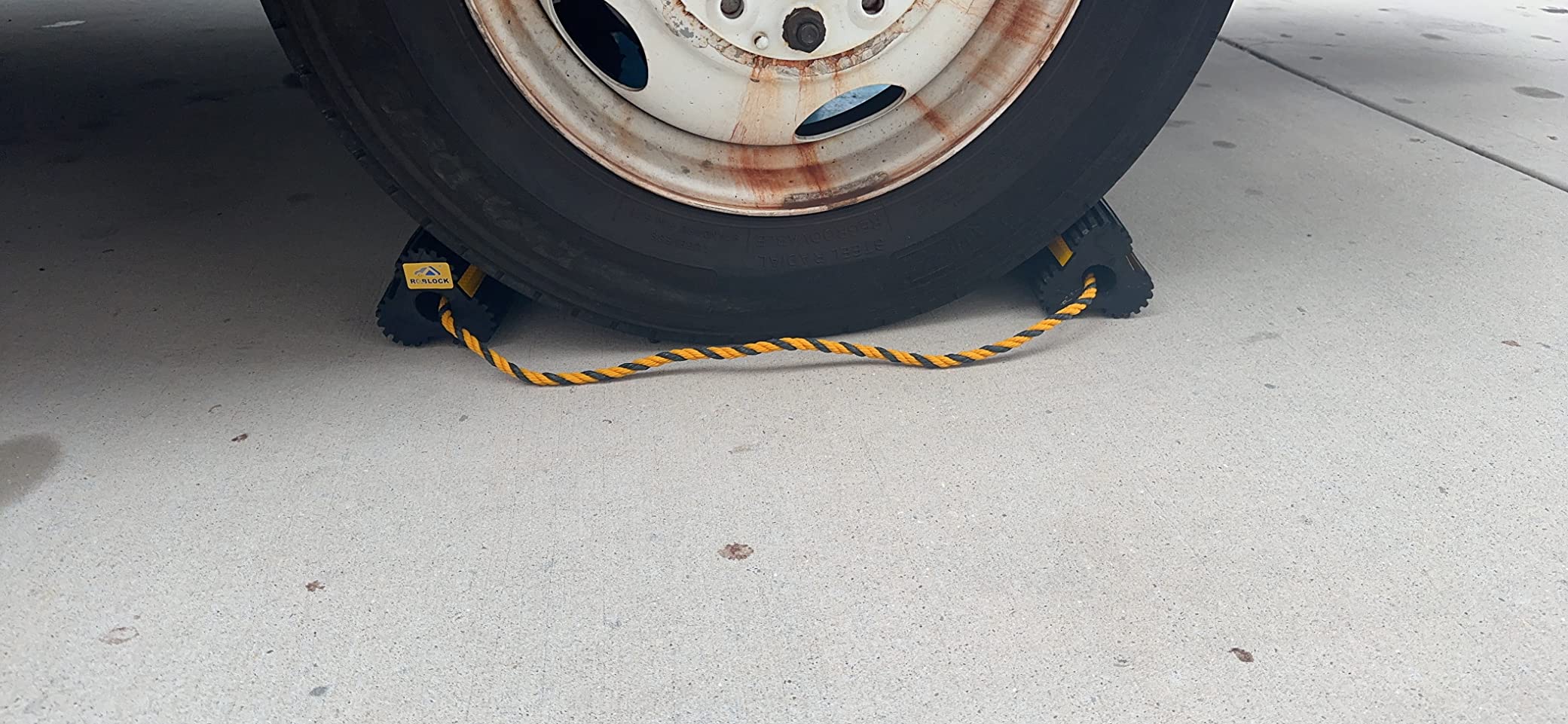
Two complaints dominate the reviews and both are about the rope, not the rubber. Some owners say the cord feels like polypropylene rather than nylon and may soften or degrade in prolonged sun, and the 30 inch length is short on some trailer wheels where you need reach from the fender. Neither affects the chock function.
The other confusion is arithmetic: a pack here is two chocks, not four, even though the listing says four pack. For a tandem axle where you chock two tires, you need two of these sets, and reading the pack count carefully is the difference between having four chocks and having two.
Are these big enough for a truck tire?
At 7.8 inches long, 4.1 wide, and 3.9 high, these sit below the one-quarter rule for a 32-inch tire, which wants closer to 8 inches. They work well for standard-width truck and trailer tires, but the reduced height means less engagement with the tire profile on very tall tires.
Is reflective tape worth choosing over solid rubber?
If you chock in daylight on a private driveway, it adds nothing. If you chock in a yard, a depot, or a campsite after dark, it removes a real and common accident. That is the clearest split in this whole roundup between safety features and pure grip.
8. AFA Tooling 4T Four-Pack with Eyebolts – small vehicles, carts, and aircraft
AFA Tooling 4T Rubber Wheel Chocks, 4 Pack, Two Pairs & Tie-Off Eyebolts
Nylon-reinforced rubber
Rated to G.V.W. 4T
4.1 x 8 x 5 in per chock
Eyebolts included
Pros
- Full tire contact along the chock length with no rollback
- Hollow rubber cores add weight without being unwieldy
- Eyebolts let you tie off so chocks are not run over
- Reported to hold even with an engine running
Cons
- Eyebolt nut uses a flat washer with no lock washer
- Small relative to motorhome tire width
- Strong rubber odor on arrival
This four-pack is rated to a gross vehicle weight of up to 4 tons, which makes it the light-duty end of the roundup. That covers golf carts, personal watercraft, jet skis, small trailers, and a half-ton pickup, and owners using it on small aircraft report it holds the wheel steady even with the engine running.
The hollow rubber core is an interesting piece of engineering. It adds the mass needed to resist creep without becoming a block you cannot lift one-handed, and the nylon-reinforced compound is the same weather-resistant material used in the larger set above. Full contact along the length of the chock means no rollback, which owners single out as the difference from narrower blocks.
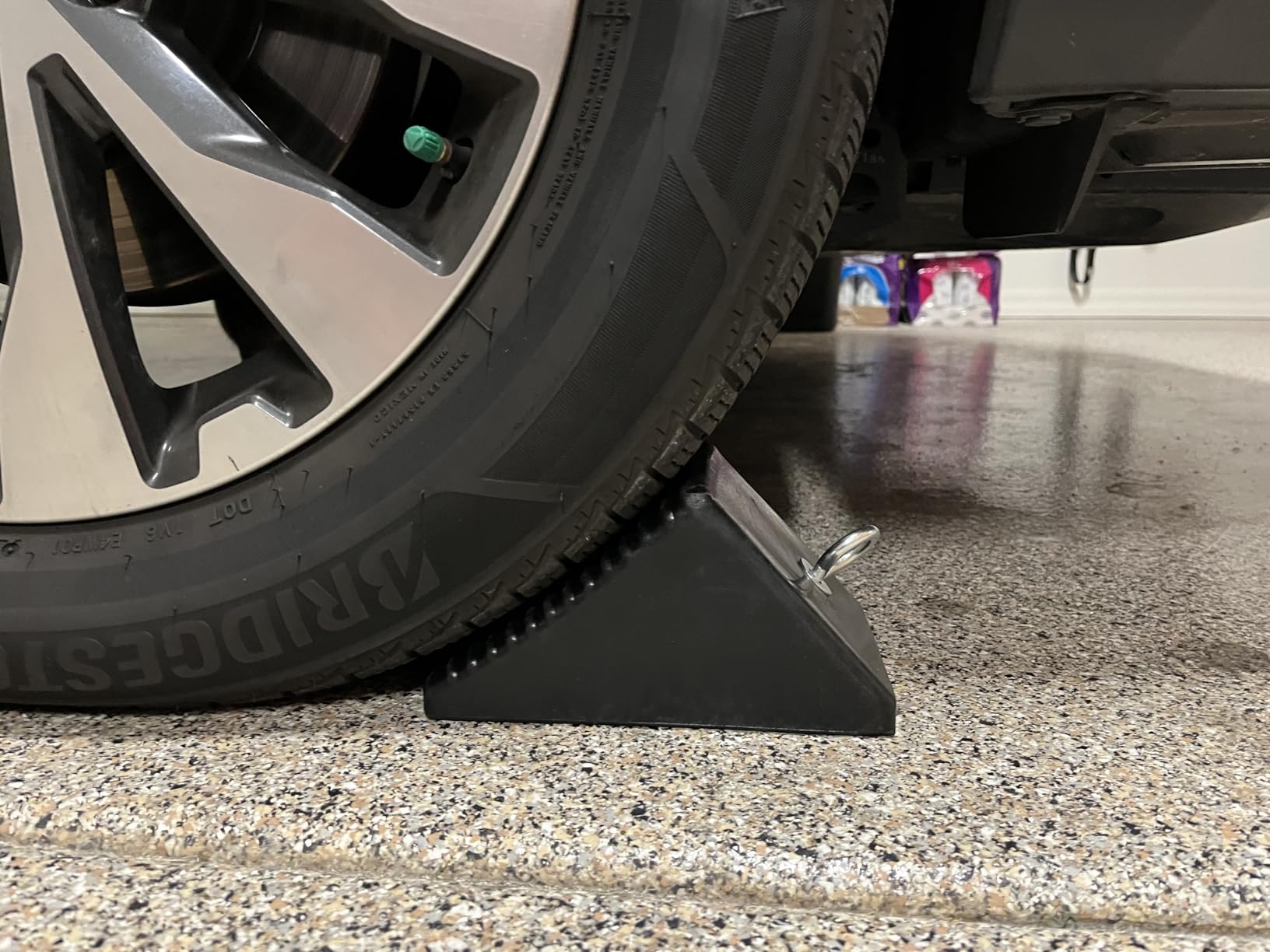
Eyebolts are included here, and that is the main reason to pick this set over the 8T version. If your chocks live in a yard where they might be run over, a bolt-on tie-off point means you can lash each chock to the trailer frame. Owners do flag that the supplied nut uses a plain flat washer with no lock washer, so add a lock nut if you are tying off against vibration.
Against a motorhome tire it is genuinely small, and that is the expected limitation of a 4-ton rating. The rubber odor on arrival is the same complaint that appears on most rubber chocks in this roundup, and it fades after a few days in sun and air.
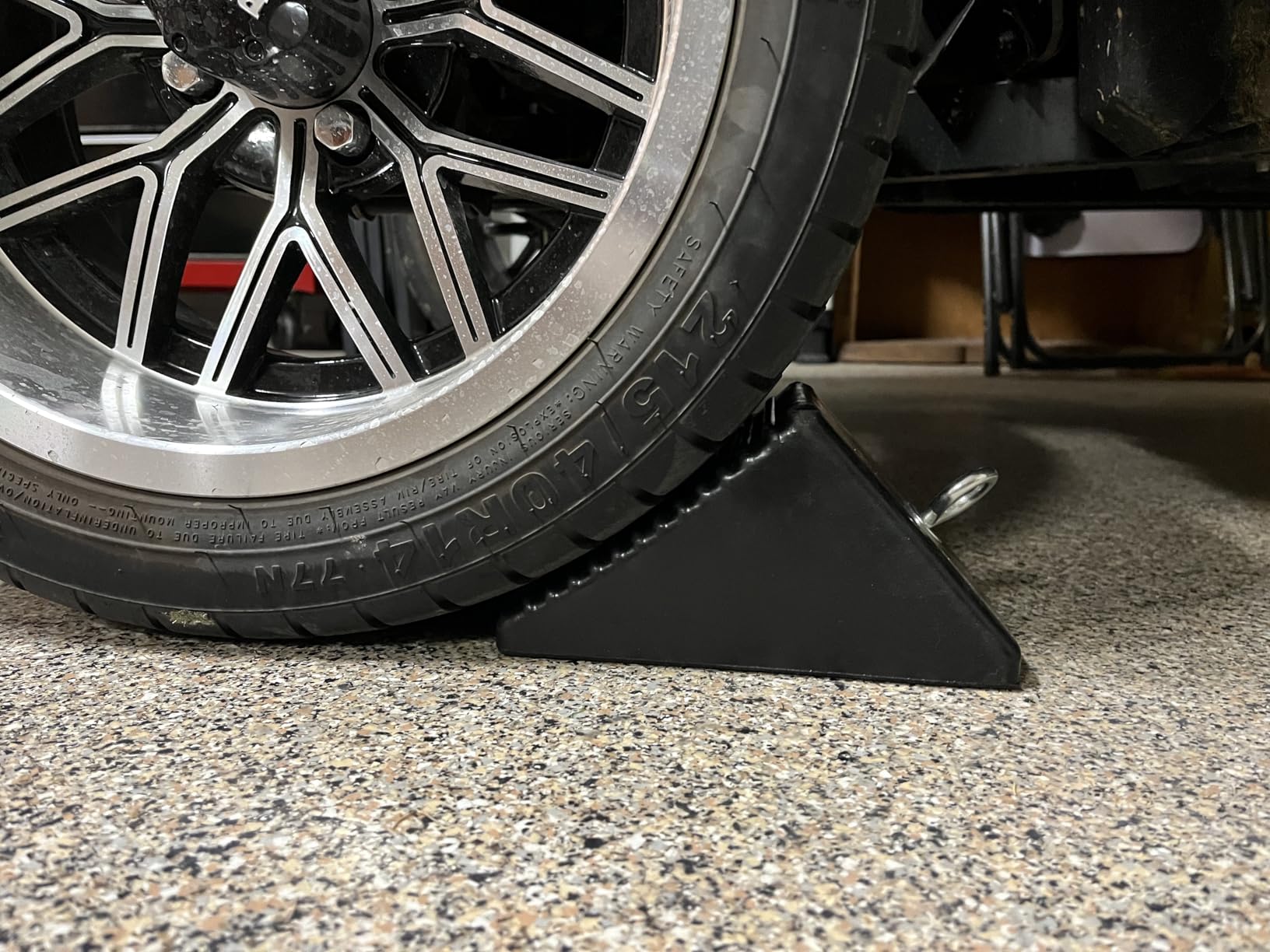
Can four of these handle a full-size pickup?
A half-ton pickup on stock tires falls inside the 4-ton envelope, so yes with the proper count. One chock per tire, four tires chocked, and the parking brake set is more than adequate for a vehicle of that weight. Push into a loaded truck or a Class A motorhome and you are outside the rating.
Why does the hollow core matter?
Because grip comes from mass and contact area, and a solid block that size would be awkward to lift repeatedly. The hollow core concentrates the rubber where it resists compression while keeping the total weight reasonable, which is why these carry well but stay light enough to reposition with one hand.
9. MaxxHaul 50019 Three-Sided Pair with 36 in Rope – compact with reflectives on every side
MaxxHaul 50019 Heavy Duty 3-Sided Rubber Wheel Chock with Yellow Reflective Strips and Nylon Rope and Non-Slip Base – 1 Pair
Reinforced rubber with traction pad
9-1/2 x 5 x 4-1/4 in
36 in nylon rope included
Reflective tape on all sides
Pros
- Three-sided shape and traction pad grip varied surfaces
- Reflective tape on all sides for nighttime visibility
- 36 in rope makes handling and storage simple
- Ribbed rubber resists crushing
Cons
- Modest 9.5 in length for the heaviest truck tires
- Sold as a single pair
- so a second set is needed
- Smallest review base in the roundup
The three-sided wedge shape is what makes this one interesting. Rather than a simple ramp, the extra angled faces give the chock more ways to resist a tire pushing against it from a slightly off-center angle, and the traction pad on the bottom adds grip on hard surfaces where a smooth base would skate.
Reflective tape wraps all three sides, and the 36 inch nylon rope is longer than most competing cords in this roundup. For a boat trailer, a small utility trailer, or a pickup at a campsite, that combination means you can see the chocks in the dark and you can pull them out without crawling behind the tire.
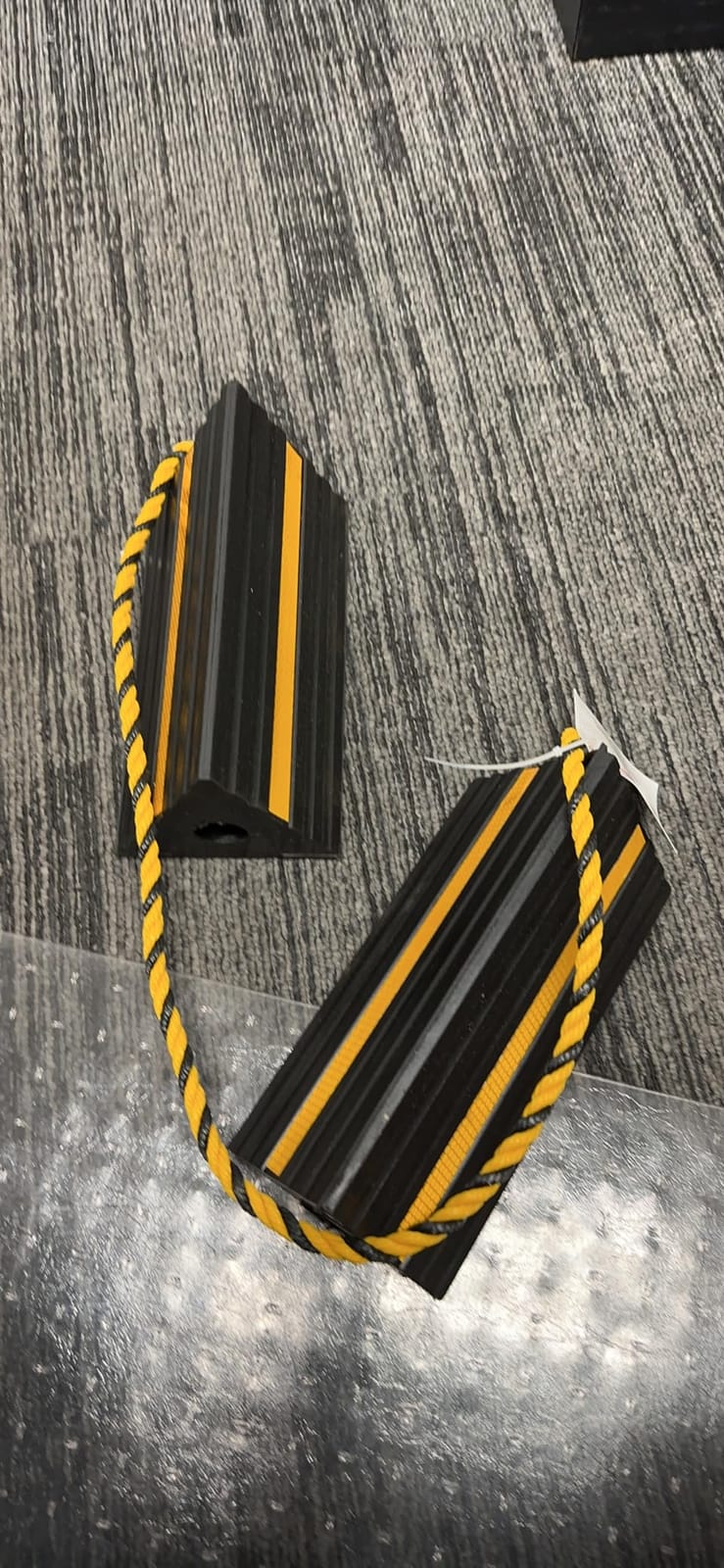
At 9.5 inches long, 5 wide, and 4.25 high, this sits right at the compact end of the truck range. It handles standard truck and trailer tires well, and owners like the reinforced ribbed rubber for resisting crushing, but it is not the chock to reach for on a full tandem bogie.
The honest caveat is the evidence base rather than the product. With the smallest review count in the roundup, the feedback is thinner than the rest, so the design is sound on paper and in owner reports, but it has less long-term history behind it than the heavily reviewed picks above.
Does the three-sided shape help on a slope?
It does help. On a sloped driveway, a tire pushing downhill can creep the chock slightly before the flat face loads up fully. The angled side faces catch that initial creep and keep the block engaged rather than letting it walk away a few inches, which is where cheaper wedges let a rig drift.
How many do I need for one truck?
One pair covers two tires, so a four-wheel truck chocked on all four corners needs two sets. The included 36 inch rope is long enough to carry a pair together, so two sets means two ropes and two trips rather than four.
10. RELIANCER Extra Large 10 x 6 x 7.3 in – sized for hauler and fire truck wheels
RELIANCER 2 Pack Wheel Chocks Heavy Duty Extra Large Industrial Rubber Wheel Chock Blocks w/Handle Reflective Strips for Travel Trailer Hauler Truck Fire Truck Commercial Vehicle RV 10″ x 6″ x 7.3″
Oil, UV and slip resistant rubber
10 x 6 x 7.3 in per chock
6.8 lb each, 13.6 lb per pair
3 reflective strips
Pros
- Tallest and deepest block in the roundup
- Non-slip oil-resistant bottom grips harder than plastic
- Curved face sits flush for full tire contact
- Three reflective strips visible from any angle
Cons
- Lowest average rating in the set
- Bulky footprint takes more storage room
- Smaller review base than the other picks
This is the tallest chock in the group at 7.3 inches, and height is the variable that decides whether a chock can stop a big tire. A taller block reaches further up the tire profile, so it engages before the tire can develop much forward force, which is exactly the geometry you want on a hauler, a fire truck, or a commercial wheel.
The 10 by 6 inch footprint gives it a large contact patch with the ground, and the curved face sits flush against the tire so the load spreads instead of concentrating on one edge. The non-slip, oil-resistant rubber bottom is specified to grip harder than plastic or bare concrete, which matters in a loading area where hydraulic fluid and diesel are normal.
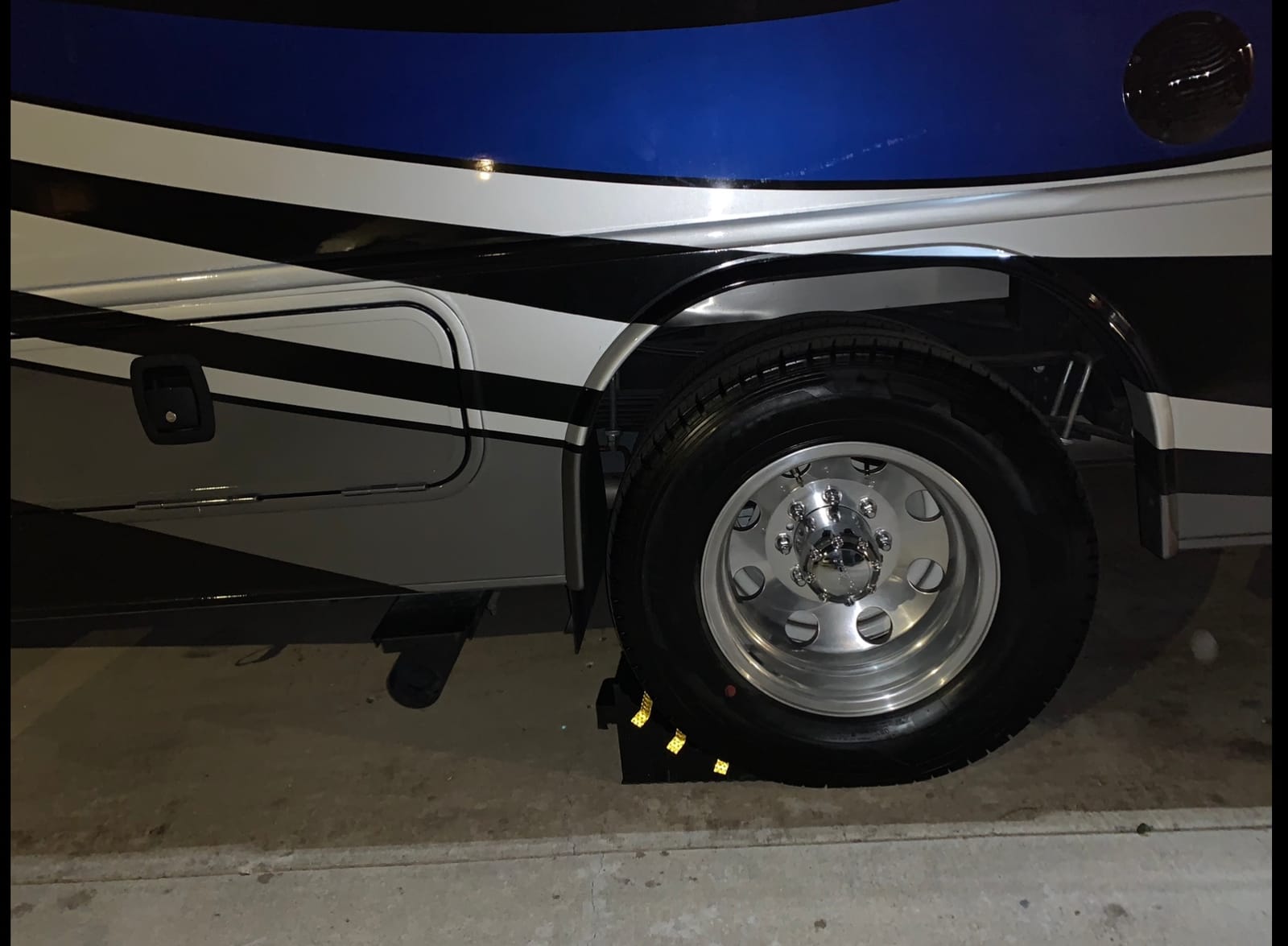
Three high-visibility reflective strips per chock is the best night visibility in the roundup by some margin, and a built-in rubber handle covers the transport problem that a block this size would otherwise create. It is rated for service and leveling ramp use as well, so it is not limited to a single job.
The tradeoff is bulk and a thinner evidence base. It is the largest item here, so it eats storage space in a truck bed or a toolbox, and it carries the lowest average rating of the ten, which reflects mixed feedback on value and bulk rather than on grip.
Does chock height actually change how well it works?
Yes, and it is the single most important dimension. A short chock only touches the tire near the very bottom, where the contact patch is narrow and the available traction is lowest. A taller chock contacts the wider, firmer part of the profile, so the same push from the tire produces a much stronger braking effect against the ground.
Is the size overkill for a pickup?
It is not dangerous, just more than you need. On a half-ton pickup, a 7.3 inch block is a lot of rubber to shove under a tire for no additional benefit, and the footprint means two of them occupy a real chunk of bed space. Reserve this one for wheels that carry serious load or tires that are genuinely tall.
How to Choose a Wheel Chock for Your Truck
Every chock in this roundup is solid rubber, so material is the one variable that is already settled. Choosing between them comes down to height, footprint, visibility, and how many you need to carry.
The one-quarter sizing rule. Measure your tire diameter and take roughly a quarter of it as your chock height. A 32-inch tire needs about an 8 inch chock, a 35-inch tire needs closer to 9 inches. This single rule eliminates most bad purchases, because undersized chocks contact the tire at its narrowest point and let the vehicle creep.
Match the rating to your heaviest axle group, not to your vehicle. A printed load rating is per chock, and your real load is concentrated on one axle group at a time. A chock rated well below your tandem axle load is decoration, not safety. Where a listing states a gross vehicle weight rating rather than a per-chock figure, treat it as a class indicator and add margin.
Favor footprint and height over weight alone. Contact area with the ground and contact height on the tire both contribute to holding force. A taller, wider chock usually beats a small dense one, which is why the 7.3 inch and 6 inch tall blocks earn their place for commercial work.
Decide on visibility early. Black rubber chocks on black asphalt are the single most common visual failure in this category. If you chock after dark in a yard, a depot, or a campsite, reflective tape or a bright color is a safety decision rather than a style preference.
Handle and tether matter for daily use. A molded handle or an eyebolt is what lets you seat and retrieve the chock without crawling behind the wheel. For drivers chocking six to eight times a shift, a four-pack with rope ties or chains is the difference between one trip and four.
Watch the pack arithmetic. A four-pack containing two pairs means four chocks, while a pack described as four units may hold only two. This is the most common buyer confusion in the category, and getting it wrong means chocking one tire and assuming you have covered the other.
How many wheel chocks does a truck need?
Two is the absolute minimum for any vehicle: one chock on each side of the same axle, on the downslope side if you are on a grade. Beyond that, the count scales with the chassis.
1. Pickup or SUV: one chock per tire, so two in front and two behind, or a minimum of two on the downhill wheels for short-term parking. 2. Dually or four-wheel-drive truck: four chocks, one per tire on the driven axle, positioned fore and aft on the same side so one chock cannot be pushed free without the other resisting. 3. Semi tractor and tandem trailer: four is the working minimum. Chock the tandem bogie at both the leading and trailing wheels on the downhill side, which prevents the trailer from pivoting around a single chock point. 4. Equipment or flatbed trailer: four, chocked on both wheels of both ends, because equipment trailers carry high center loads that make fore-aft movement more likely.
The fore-and-aft rule is the one drivers most often miss. A single chock on one wheel of a tandem axle acts as a pivot, and the far wheel can walk. Two chocks on the same side, one against each wheel of the axle, close that pivot.
How do you chock a semi trailer so it cannot move?
1. Set the parking brake and keep it set. Never rely on the brake alone; air brakes can bleed down and fail. 2. Place chocks snug against the tire on the downhill side, tight to the tread, angled so the tire rolls into the wedge rather than lifting it. 3. Seat the chock with a boot or a push on the handle. If it needs hammering, it is the wrong size or the wrong position. 4. Add a second chock on the same side against the other wheel of the tandem, fore and aft, to prevent pivoting. 5. Tether each chock to the frame with the eyebolt, chain, or rope so it cannot be run over or left behind. 6. Recheck after any movement. Walk back before you get in and confirm you can see the chocks, which is where color and reflective tape earn their keep.
If the parking brake has been bled off for maintenance, chocking is not optional. That is precisely the situation a chock exists for, and treating it as a backup to a working brake is a mistake forum members describe as a near miss rather than a hypothetical.
Do wheel chocks work on ice and snow?
Not the way most buyers assume. No chock grips ice or oil, and every manufacturer buries that in the fine print. Rubber stays flexible in the cold rather than becoming brittle like some cheaper polyurethane, which is why the reinforced rubber picks hold up in winter, but flexing is not the same as biting into a frozen surface.
On ice, chocks are a supplement rather than a solution. The parking brake, engine braking, and reduced speed do the real work, and if you must chock on a frozen surface, put something down first that is not the chock itself. Also worth knowing: unreinforced plastic chocks crack and deform under real weight, and cheap polyurethane turns brittle in sustained sub-freezing temperatures, which is the failure reported most often by drivers replacing them.
On the X-chock question that comes up constantly in RV communities: an X-chock sits between dual wheels and stabilizes the vehicle against fore-aft motion, but owners on r/GoRVing report using them mostly to steady a parked rig rather than as a replacement for standard chocks. The forum consensus is that they complement chocks rather than substitute for them, particularly for a truck with a single wheel on each side.
How do I store chocks on a work truck?
Weight is a feature in this category, and that makes storage the practical problem. A chained or roped twin set keeps the pair together so you cannot leave half behind, and a four-pack with rope ties carries in one trip. Mounting a rail or hook in the bed near the tailgate is the most common driver solution, since the retrieval point is where you need it, not where the toolbox is.
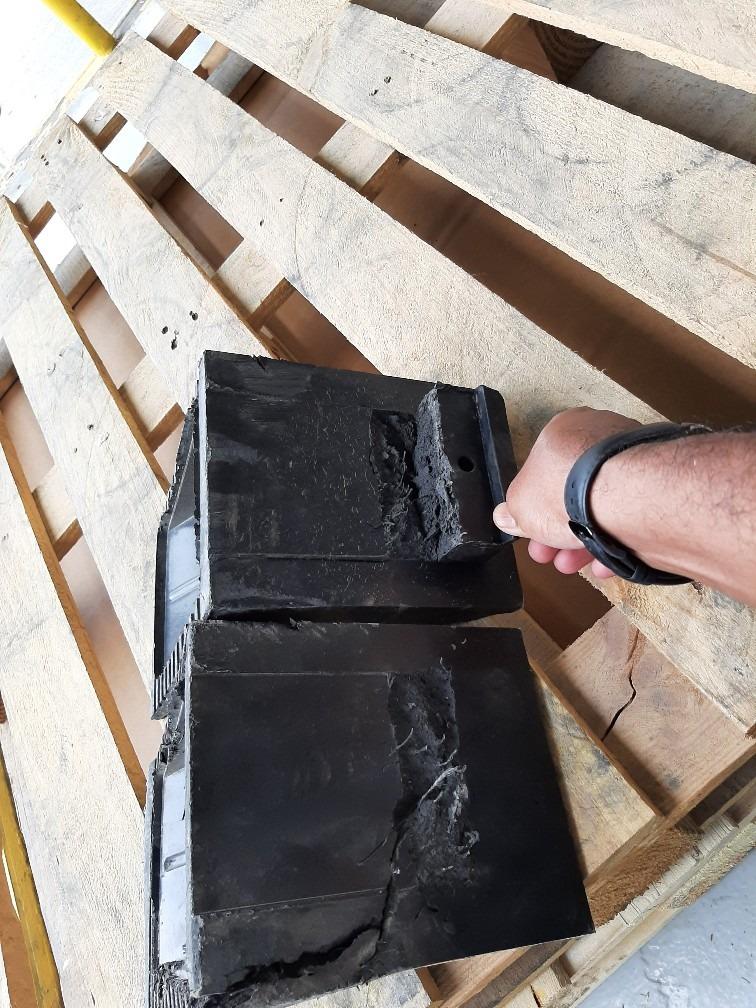
Rubber chocks also smell strongly on arrival, and owners who store them inside a cab report the odor lingering for weeks. Keeping them in the bed, or in a sealed bin in the bed, solves it. Beyond storage, inspect them: cracks along the base, flattened ribs, a face that no longer curves to match a tire, or a chock that has visibly compressed are all reasons to replace rather than reuse.
If you want the short version of the sizing and count rules, the dually wheel guide covers the same load-matching logic applied to dual rear wheels, and our wheel stand reviews cover the other half of the jacking-and-stabilizing problem.
Frequently Asked Questions
Which wheel chocks are the best rated?
The best rated chocks in this roundup are the solid molded rubber models with the largest review histories. The MAXXHAUL 8 x 4 x 6 inch two-pack leads with a 4.8 average across more than 18,000 reviews, and the AFA Tooling 8T four-pack also holds a 4.8 average. For stated load ratings, the SECURITYMAN orange pair lists capacity for up to 20,000 pounds and the AFA Tooling sets are rated by gross vehicle weight at 8 tons and 4 tons.
Which type of wheel chocks is better, plastic or rubber?
Rubber wins for trucks. Plastic chocks flex, crack, and lose their shape under real vehicle weight, which is the most common complaint from owners replacing them. Rubber deforms less, grips better, and does not shatter on hard surfaces. The only argument for plastic is cost and weight, neither of which matters much next to a chock that fails under load.
Are Harbor Freight wheel chocks any good?
They get a positive verdict from long-haul drivers who use them as an everyday fleet chock, because the solid rubber is heavy and stiff and inspires confidence. The recurring feedback on forums is that weight is the feature rather than the flaw, since a chock that stays planted under load is worth more than a lighter one. Judge them on height against your tire diameter and on the stated rating versus your axle load, not on brand.
What are the differences between rubber and plastic wheel chocks?
Rubber is heavier, softer, and grips better, so it resists crushing and stays planted under load. Plastic is lighter and cheaper but flexes, cracks, and can lose its shape, especially in cold weather where cheaper polyurethane becomes brittle. Rubber also tolerates oil and UV exposure better. For anything heavier than a passenger car, the difference is decisive.
How many wheel chocks does a truck need?
Two is the bare minimum for any vehicle, placed on both sides of the same axle on the downhill side. A four-wheel-drive truck or dually should have four, one per tire. A semi tractor with a tandem trailer needs four as a working minimum, chocked at both the leading and trailing wheels on the downhill side so the trailer cannot pivot around a single chock point.
How big should my wheel chock be for truck tires?
Chock height should be roughly one quarter of your tire diameter. A 32 inch tire needs about an 8 inch chock and a 35 inch tire needs closer to 9 inches. Undersized chocks touch the tire at its narrowest point and allow slow creep, which is the most common sizing mistake. Also check that the width covers a meaningful part of the tread rather than a narrow strip.
Do wheel chocks work on ice and snow?
Not reliably. No chock grips ice or oil, a fact most manufacturers bury in their fine print. Reinforced rubber stays flexible in the cold rather than becoming brittle, which prevents cracking, but flexible is not the same as gripping a frozen surface. Treat chocks as a supplement on ice, keep the parking brake set, and use engine braking rather than relying on the chock to hold a roll.
The Verdict on the Best Wheel Chocks for Trucks
If you take one thing from this roundup, match the chock height to about a quarter of your tire diameter and buy a pair, not a single unit. Beyond that, the MAXXHAUL solid rubber 8 x 4 x 6 inch two-pack is the pick most trucks should end up with, because solid molded rubber resists crushing, the molded handle works with gloves, and more than 18,000 reviews give you a far clearer picture than any spec sheet alone.
Buy the MaxxHaul 10 x 8 x 6 inch pair instead if you run a trailer with 35 inch tires and want maximum footprint and a steel eyebolt for tethering. Choose the AFA Tooling 8T four-pack when you chock both axles regularly and losing a chock is your biggest risk. Go taller and reflective for commercial and fire truck wheels, and add color or reflective tape in any case where you chock after dark, because the chock you cannot see is the one that fails.
Check the chocks every season for cracks, worn ribs, and a face that no longer curves to match a tire, and keep two more in the bed than you think you need.