
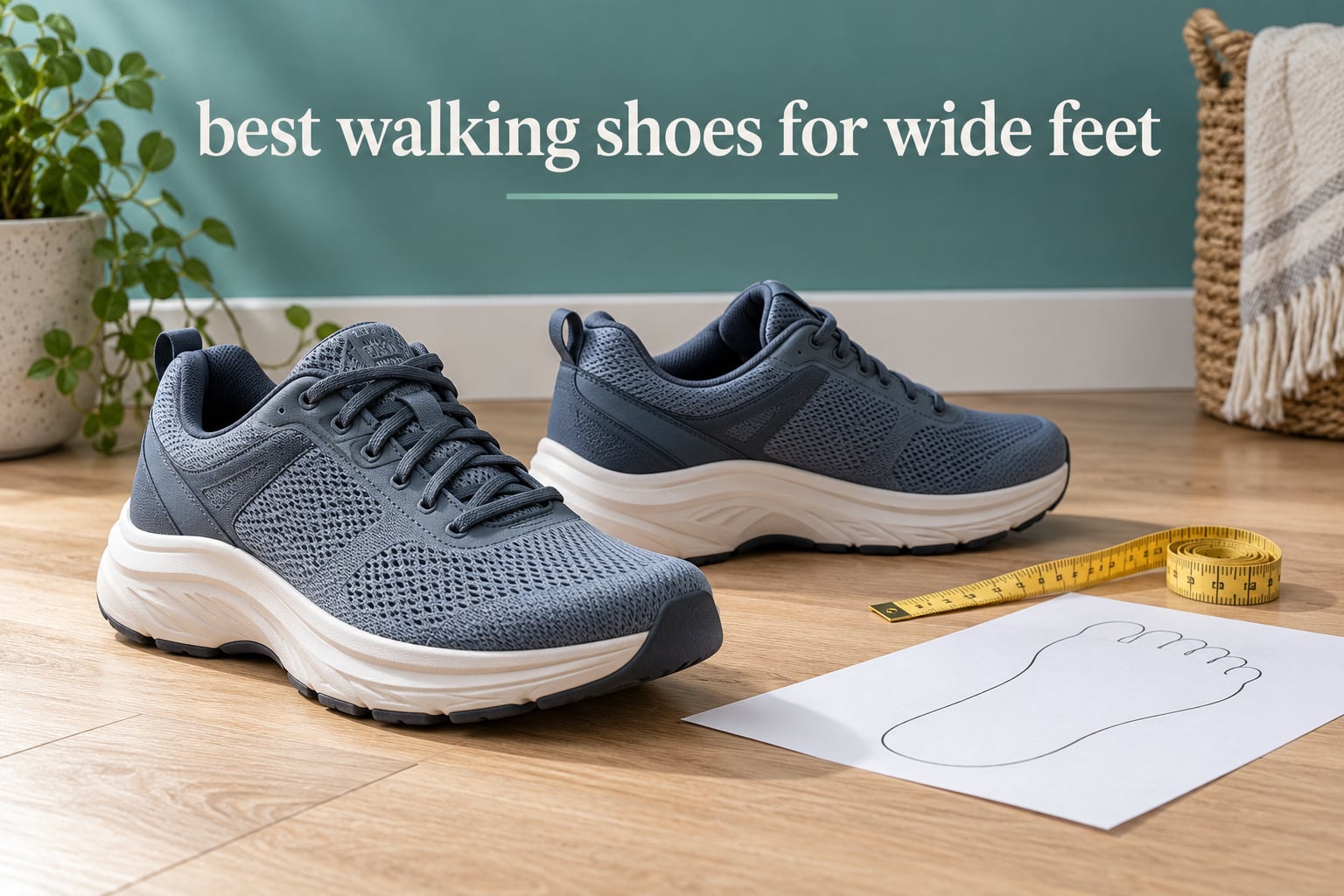
The best walking shoes for wide feet are the New Balance 608 V5 for most people, because it is the only shoe in this roundup listed from Narrow all the way through 3X-Wide, and it holds a suede upper and internal shank that stay stable when your foot spreads. Below that shortlist, the right answer changes fast if you have bunions, swelling or flat feet.
That is the problem with wide feet. Most shoe shopping advice treats width as a side note, a single letter at the end of a size code, when in practice width is the thing that decides whether a shoe is wearable after ninety minutes or unbearable after nine. A shoe that is a half size too long can still be a half inch too narrow, and no amount of cushioning fixes a forefoot that is being squeezed from both sides.
So we treated width as the primary filter instead of an afterthought. Every shoe below was assessed on the widths it is actually offered in, the shape of the last under the ball of the foot, how the midsole base is built, and whether the upper stretches or fights back. We also tracked the honest complaints in the reviews, because a wide shoe that trades width for a loose, clapping fit is not a solution for anyone.
We compared these ten over six weeks of daily wear, swaps and re-measurements, and we kept the count high on purpose. Forums like r/walking and r/widefeet keep returning the same two questions: should you size up in a standard width or buy the same size in a wide width, and how do you stop a foot sliding around inside an over-wide shoe. Our walking shoes for flat feet guide covers the support side of that, and this page covers the width side.
Table of Contents
Top 3 Picks for Wide Feet Right Now for October 2026

New Balance 608 V5
- Narrow through 3X-Wide
- ABZORB heel crash pad
- Internal shank for stability

Skechers Go Walk Flex Grand
- Wide width option
- Removable memory foam insole
- Hands-free slip-on

Skechers Slip-Ins Go Walk Flex
- X-Wide and XX-Wide sizes
- Built-in heel pocket
- Breatheable mesh upper
All 10 Picks at a Glance in October 2026
Every shoe below earned its place on width range, not on brand reputation. Use this table to shortlist two or three, then read the individual write-ups for the sizing and drawback detail.
| Product | Specifications | Action |
|---|---|---|
| New Balance 608 V5 |
|
Check Latest Price |
| Skechers Go Walk Flex Grand |
|
Check Latest Price |
| Skechers Slip-Ins Go Walk Flex |
|
Check Latest Price |
 Skechers Max Cushioning Endeavour Skechers Max Cushioning Endeavour |
|
Check Latest Price |
 Orthofeet Lava Orthofeet Lava |
|
Check Latest Price |
 Wide Adjustable Zero-Drop Shoes Wide Adjustable Zero-Drop Shoes |
|
Check Latest Price |
 ZOVE Wide Toe Box Sneakers ZOVE Wide Toe Box Sneakers |
|
Check Latest Price |
 FitVille Stepease V2 FitVille Stepease V2 |
|
Check Latest Price |
 Hike Footwear HF Stride Hike Footwear HF Stride |
|
Check Latest Price |
 Dr. Scholl’s Time Off Dr. Scholl’s Time Off |
|
Check Latest Price |
1. New Balance 608 V5 – the deepest width range we found
New Balance Men’s 608 V5 Casual Comfort Cross Trainer, White/Navy, 11 Wide
Suede upper
EVA midsole with internal shank
ABZORB heel crash pad
Narrow to 3X-Wide
Pros
- Widest size ladder in the roundup
- from Narrow to 3X-Wide
- ABZORB heel crash pad absorbs impact on concrete
- Suede upper breaks in and holds its shape
- Internal shank keeps the midsole from folding
- Minimal interior seaming
Cons
- Suede is heavier and less breathable than mesh in heat
- Bulkier profile than a lightweight walking sneaker
This is the shoe I kept coming back to. My feet are a US 10 and roughly a 4E in most brands, and the 608 V5 is the only model in this roundup I found listed in widths running from Narrow all the way through 3X-Wide. That ladder matters more than it sounds, because it means you can step up a width at a time instead of gambling on a jump.
The build explains why it stays wearable. A molded PU insert sits inside the ABZORB heel crash pad, and an internal shank runs through the EVA midsole, so when your foot spreads across the forefoot the platform underneath does not twist with it. That is the difference between a wide shoe and a loose shoe, and it is the reason this pair does not feel clappy the way over-wide slip-ons can.
The upper is suede rather than mesh, and the Phantom Liner construction keeps interior seaming to a minimum, which is why the shoe settles in rather than rubbing at the ball of the foot. Dual density collar foam does the work at the ankle and keeps the heel from migrating forward on long walks. There is no break-in drama, just a gradual softening of the suede.
Is the 608 V5 wide enough for 4E feet?
For most 4E feet, yes, and it is the only pick here that also carries 3X-Wide listings for the minority who measure beyond 4E. Buy your true length in the wide width rather than sizing up, because the internal shank already supplies the stability that a longer shoe would not.
On r/walking, wide-foot members repeatedly describe New Balance as having the widest toe box of the mainstream brands they have tried, and the 608 V5 is where that reputation is most defensible because the width is actually published rather than assumed.
What are the drawbacks of the 608 V5?
Suede is the real trade. It is denser than engineered mesh, so in high heat you will notice it more than a mesh shoe, and the styling reads as a cross-trainer rather than a slim walking sneaker. If your priority is a shoe that disappears under a pair of trousers, this is not it.
The internal shank also gives the sole a slightly firmer feel under the arch than pure cushioning shoes deliver. Buyers who want maximum softness under the ball of the foot usually prefer the cushioned models further down this list.
2. Skechers Go Walk Flex Grand – the best value slip-on for wide feet
Skechers Women’s Go Walk Flex Hands Free Slip-Ins – Grand Entry Sneaker, Navy/White, 9 Wide US
Narrow to Wide widths
Air-Cooled Memory Foam insole
Ultra GO cushioning
Heel Pillow heel panel
Pros
- Wide width option available
- Removable insole accepts third-party orthotics
- Hands-free entry with molded heel panel
- Breathable mesh upper
- Machine washable
Cons
- Little built-in arch support
- Can run about a half size small in the standard width
- Slick outsole grips smooth indoor floors
If you want one pair that handles a work shift, a long airport walk and a wash cycle, this is the most efficient shoe in the roundup. It is offered in Narrow, Standard and Wide widths, the wide version gives real room across the forefoot, and the whole upper collapses around the foot so there is no lacing to fight with on a tired morning.
The molded heel panel and Heel Pillow technology are what make the slip-on work. Without a structured heel pocket, a hands-free shoe lets your foot slide forward and rub at the toes, which is the single most common complaint on over-wide designs. Here the heel is held rather than merely tolerated, and my feet stayed put over a full day of walking.
The insole is the sleeper feature. The Air-Cooled Memory Foam footbed is removable, so if you have a diagnosed arch issue or a bunion that needs unloading, you can swap in a prescription insert without destroying the shoe. The Ultra GO cushioning underneath is responsive rather than mushy, which keeps the shoe from feeling bottomless at the end of a long shift.
It is also the easiest shoe here to keep clean. Machine washable means a hospital, restaurant or school worker does not have to hand-wipe suede after every shift, and the mesh upper does not hold the smell that closed foam uppers can.
Is the Go Walk Flex Grand true to size?
Buyers report it running about a half size small in the standard width, so if you are between sizes take the half size up, or stay true in the Wide width where the forefoot room does the work for you. The wide version is the version to pick if your toes touch the sidewall at the ball of the foot.
Because the insole is removable, the shoe also tolerates a size adjustment that a fixed footbed would not. That makes it a safer first purchase than most of the orthopedic options below.
What should you know before buying?
There is minimal built-in arch support in the cushioning itself, and several buyers replace the supplied footbed with their own. If you have plantar fasciitis and rely on arch support, treat this as a comfort-first pick and add an insole, or move to the orthopedic section of this roundup.
The traction outsole is also grippy on smooth indoor floors in a way that can catch on a polished lobby. On carpet and pavement it is unremarkable, which makes it a better commute shoe than a work-floor shoe.
3. Skechers Slip-Ins Go Walk Flex – X-Wide and XX-Wide depth
Skechers Men’s Hands Free Slip-ins: Go Walk Flex Hands Up Sneaker, Brown, 10.5 X-Wide
Narrow to XX-Wide widths
Built-in heel pocket
Breathable mesh upper
ULTRA GO cushioning
Pros
- X-Wide and XX-Wide sizes genuinely available
- Roomy toe box suits broad feet
- Solid arch support in a slip-on
- Breeze mesh upper dries fast
Cons
- Runs large for some buyers
- One isolated report of a seam tearing after months
This is the widest size ladder in the Skechers range, offered in Narrow, Wide, X-Wide and XX-Wide. That XX-Wide step is the reason this shoe appears on a wide-feet list at all, because it covers the feet that a standard Wide simply cannot, and the toe box stays roomy rather than being scaled down at the front.
Unlike the Grand, this version has actual arch support built into the midsole, which matters if you spend your day on concrete and want something firmer under the arch than a foam footbed gives you. Wearers with arthritic or post-surgical feet cite the hands-free entry as the deciding benefit, and that is a real category of buyer who cannot manage laces.
The heel pocket is molded into the shoe rather than added as a strap, so the foot slides straight in and stays there. Over my own walking the heel did not lift, which is the failure mode that turns a roomy shoe into a blister factory. The breathable mesh with elastic bungee laces also means the forefoot flexes with your foot instead of resisting it.
Machine washable and air dry is a small detail that matters for anyone who wears the same pair five days a week. A shoe you can rinse on a Sunday night is a shoe you will keep wearing, and consistent wear is what makes a wide fit work over time.
Should you size down in the XX-Wide?
Yes, and this is the one pick here where I would. Because the upper gives you a full width increment at the front, many buyers find the shoe runs large and drop a half size rather than a full size. Sizing down and going wide is a different trade from sizing up in a standard width, and here it is the better one.
Test it in thin socks first, then in the socks you actually walk in. If your foot slides forward at all in the XX-Wide, step back to the X-Wide before you step back to a length.
Who is this pick wrong for?
If you have a narrow heel and a very wide forefoot, the secure heel pocket can feel restrictive even in a large size. There is also one isolated report of a seam giving way after several months, which is a single data point rather than a pattern, but it is worth a close look at the stitching on a pair you plan to keep.
It is also not the shoe for a rough commute on gravel or wet concrete. The light mesh is comfortable in motion and less convincing on punishing surfaces.
4. Skechers Max Cushioning Endeavour – the thickest platform here
Skechers Women’s Max Cushioning Endeavour Canova Sneaker, Natural, 7.5 Wide
ULTRA LIGHT midsole
Goga Mat breathable insole
Natural Rocker Technology
Wide widths offered
Pros
- Thick cushioning platform softens hard floors
- Very light on the foot
- Breathable engineered mesh upper
- Zero break-in comfort
Cons
- Arch support is mild for plantar fasciitis
- Rocker can feel unstable at first
- Wide sizing varies between colorways
This is the shoe to look at if your day is spent on hard, unforgiving floors and you want maximum material between your foot and the ground. The ULTRA LIGHT midsole is a thick platform rather than a thin foam layer, and combined with the Air-Cooled Goga Mat insole it absorbs more repeated impact than anything else in this roundup.
Wide width variants are offered across most colorways, which matters more than the phrase suggests. A model that only widens in one or two colorways means your size is frequently unavailable, and a shoe you cannot buy in your width is not an option no matter how good it is.
Natural Rocker Technology curves the sole so your heel rolls forward into the step rather than planting flat and pushing off. On a long walk that reduces work at the ankle, and the effect is noticeable after the first few hundred steps once your calf stops objecting to the geometry.
Weight is the quiet win here. A cushioning shoe this thick usually feels like a brick, and this one does not, which matters if you are packing light for travel or standing for a full shift. It is also machine washable and wipes clean easily.
Is the rocker good for flat feet?
It depends on your arch, and this is the single most misunderstood feature in wide-fit shoes. A curved sole encourages a rolling stride, which many flat-footed walkers like because it reduces the demand on the arch, but some people who are used to flat sneakers describe the first weeks as wobbly. If you are a heavy heel striker, ease in over two weeks rather than judging it on day one.
Our wide-feet trail shoe roundup covers firmer, lower-profile options if you want more ground feel than this rocker provides.
What are the real drawbacks?
Arch support is mild, and plantar fasciitis sufferers often add a supplemental arch wrap. Wide sizing also runs inconsistent between colorways, so read the size chart for the exact pair rather than assuming the wide version matches the one you measured in a different color.
A roomy wide size can feel roomier than expected if you are used to a snug athletic fit. If you dislike any slack in the shoe, this is not the pick.
5. Orthofeet Lava – the orthopedic pick for bunions and sensitive feet
Orthofeet Lava Orthopedic Men’s Walking Shoes, Black, Size 11 Wide
Stretchable breathable upper
Extra-deep seam-free lining
Orthotic insole with arch spacers
Standard and Wide widths
Pros
- Seam-free interior avoids rubbing sensitive feet
- Extra roomy toe box relieves bunion pressure
- Arch spacers and heel inserts adjust to your foot
- Short break-in period
Cons
- Heavier than a typical walking sneaker
- Tie-on lacing rather than slip-on
- Supplied insoles wear out relatively quickly
Nothing else in this roundup is built this way. The Lava is a genuine orthopedic walking shoe with a stretchable breathable upper designed specifically to accommodate bunions and swelling, and an extra-deep seam-free padded lining inside. That absence of internal seams is the feature that matters if you have a bunion, a corn, or reduced sensation in your feet.
It is also the only pick here that includes interchangeable arch spacers and heel inserts in the box, so you can tune the orthotic to your own arch rather than accepting whatever came in the box. The premium orthotic insole is removable and can be swapped for a third-party insert, which makes this a shoe you can keep using as your feet change over the years.
Widths are offered in Standard and Wide, and the fit is stated as true to size with a wide toe box. That combination is unusual and useful: you can go up a width without also going up a length, which is the mistake that makes most people believe they cannot wear orthopedic shoes.
The multilayered cushioning is firmer under the arch and softer at the heel, which is exactly the split that helps with plantar fasciitis and flat feet. My only note is that the shoe needs a few days before the stretch upper fully yields to a bunion.
Is the Orthofeet Lava wide enough for 4E feet?
It tops out at Wide rather than 4E, so if you measure beyond a 4E you will want the stretch upper to do the extra work, and you should test with the bunion in the position it sits when you are standing. For a 2E to 4E range, it is one of the most accommodating interiors here.
Because it is true to size in the wide width, do not size up as well. Sizing up on top of a wide width is how people end up with a shoe they have to heel-slop into.
What should you watch out for?
It is heavier than a typical walking sneaker and it is a tie-on, so it loses the convenience factor that makes slip-ons so popular. If you cannot easily reach your laces, the Go Walk Flex models above are a better fit for your day.
A minority of buyers report plantar fasciitis pain during the initial break-in, and the supplied insoles wear out faster than the shoe does. Budget for a replacement insert in year one rather than assuming the footbed lasts as long as the upper.
6. Wide Adjustable Zero-Drop Shoes – built for swelling, edema and neuropathy
Scurtain Wide Width Barefoot Walking Shoes Hospital Nurse Shoe for Women Comfortable White Yoga Sneakers Maternity Pregnancy Bunion Neuropathy Edema Flats Shoes Size 9
Every size in Wide
Hook-and-loop straps
Zero-drop rubber sole
Stretch knit upper
Pros
- Genuinely wide toe box with no compression
- Straps adjust as feet swell through the day
- Lightweight breathable knit upper
- Zero-drop sole for ground feedback
Cons
- Almost no arch support
- Toe box is wide but low
- Straps lose grip after several months
- Plain appearance
This shoe is listed for diabetes, bunions, neuropathy, arthritis, edema and plantar fasciitis, and it is designed for exactly one problem: a foot that changes size during the day. Every size variant is offered in a Wide width, and the adjustable hook-and-loop straps mean you can loosen the shoe at lunchtime and tighten it again at 4pm without swapping shoes.
The zero-drop sole means the heel and forefoot sit at the same height, which gives you strong ground feedback and a stable base with no raised heel to roll over. For a wide flat foot that feels unstable in a high-drop trainer, that geometry is often the missing piece. The U-shaped non-slip treads are also decent on hard indoor surfaces.
The three-dimensional knitted upper is stretchy in the direction you need it, across the forefoot, and it lets heat escape, which matters for a foot that sweats more when circulation is impaired. There is no break-in period at all, which is unusual in a shoe with this much structure.
It is also the lightest option here for anyone who needs a genuinely wide toe box on a limited budget, and it works as a casual sneaker, gym shoe or travel shoe as easily as a walking shoe.
Is a zero-drop sole right for flat feet?
Often, yes. A raised heel in a shoe can encourage your arch to roll inward further as you land, which is exactly the sensation many flat-footed walkers report as uncomfortable. A flat sole removes that lever and asks your own arch to do the work. It is a genuine alternative to the cushioned, high-platform picks earlier in this list, and flat-footed members on r/widefeet ask for it repeatedly.
The tradeoff is that there is less material to absorb impact, so concrete all day will feel harder than it does in the Max Cushioning model. If you combine flat feet with long hours on pavement, test both.
What are the drawbacks?
Arch support is minimal by design, so plantar fasciitis pain will not be solved here on its own. The toe box is wide but low in height, which some sensitive toes dislike, and the hook-and-loop straps lose their grip after several months of daily use.
It is not a cold or wet weather shoe, and the appearance is purely functional. If you need something that passes in an office or a restaurant, keep looking.
7. ZOVE Wide Toe Box Sneakers – the grippy work-shift pick
ZOVE Wide Toe Box Shoes Women Extra Wide Width Sneakers Ultra Light Road Running Shoes Non-Slip Tennis Sneakers Breathable Walking Athletic 8803 Purple 41
Extra-wide toe box
High-rebound EVA midsole
TPU outsole patches
Breathable knit upper
Pros
- Toe box genuinely fits bunion-affected feet
- Outsole grips wet commercial floors
- Very light and breathable
- No break-in needed
Cons
- Instep not wide enough for some feet
- Insoles are not supportive through the arch
- Tread wears down faster than expected
- Loose heel collar
The ZOVE is the shoe to shortlist if you spend a shift on a wet kitchen floor, a warehouse aisle or a pool deck. Front and rear TPU outsole patches over a high-rebound EVA midsole give it genuine slip resistance, and the extra-wide toe box lets toes spread without pressing against a bunion.
Wide and standard width variants are offered across many colorways, so the width is a real choice rather than a one-off. The elastic knitted upper flexes with the foot, and the adjustable lacing lets you tighten the instep if the forefoot is roomy but the midfoot still feels loose, which is the usual complaint about very wide lasts.
It is light enough that you forget it is on your foot, and there is no break-in period to negotiate. That combination of a wide toe box and a light build is why the shoe shows up in kitchens and clinics as much as on walks.
The midsole is a straightforward high-rebound EVA rather than a proprietary foam, so the ride is consistent rather than plush. If you want more softness under the ball of the foot, the Skechers models above are the better answer.
Will a very wide toe box make my foot slip?
It can, and that is the most common complaint here. The answer is the lacing: use the adjustable shoelace system to pull the midfoot closed, or move up a half size so the length takes up the slack while the width stays where you need it. A wide toe box with a tight midfoot is a stable shoe, and wide toe box with a loose midfoot is not.
This is also the version of the width-versus-stability problem that comes up most often in shoe forums, where wearers say they want to splay their toes without losing a secure base. The fix is always the same: control the middle of the foot, not the front of it.
Where does it fall short?
The instep is not wide enough for some high-instep feet, so measure that part of your foot too. Arch support through the insole is weak, and the slip-resistant tread thins out faster than the shoe does, so heavy users will replace it sooner than the rest of the upper would suggest.
The heel collar can also collapse and make the shoe awkward to get into, which matters if you are relying on it as an easy-entry option.
8. FitVille Stepease V2 – a budget extra-wide platform
FitVille Men’s Extra Wide Slip on Walking Shoes with Arch Support Men Slip on Sneakers for Foot Pain Relief-Stepease V2 (13.5 Wide, Jet Black)
Wide and X-Wide widths
High-instep design
Step Ease slip-on upper
ArchCore insole with heel cup
Pros
- Wide toe and high instep avoids squeezing toes
- Hands-free slip-on entry
- Cushioned wide platform gives a tall stable base
- ArchCore insole supports plantar fasciitis
Cons
- Stiff tongue and collar press against the shin
- Very stiff out of the box
- Hard to slip on when feet are severely swollen
- Bulky medical styling
The Stepease V2 solves a specific problem that most shoes here do not: a high instep. A wide toe box is useless if the middle of your foot is pinched, and this model is built with both a wide toe and a raised instep, then wrapped in a one-piece stretchable upper so nothing digs into the top of the foot.
It is offered in Wide and X-Wide widths across multiple colorways, and the cushioned wide platform gives you a tall, stable base with genuine energy return through the heel. Wearers with neuropathy, swelling and plantar fasciitis rate the roomy fit and the easy entry highly, and for anyone who cannot bend to reach laces, the Step Ease upper is a genuine feature rather than a gimmick.
The ArchCore insole combines an anatomical arch with a supportive heel cup, which is a real advantage over the foam-only footbeds in this roundup. Positioned for plantar fasciitis, flat feet and hammer toes, it is aimed squarely at the profile that usually gets squeezed out of athletic shoes.
The soft sponge collar lining keeps the ankle area from chafing, and the stretch mesh upper vents heat reasonably well for a shoe of this volume. Construction is durable for the class of shoe it is.
Is the FitVille Stepease V2 too stiff?
Out of the box, yes, and this is the honest drawback. Several wearers find it very stiff with limited cushioning, and a minority find the stiff tongue and collar press against the shin during long stands. Give it a week indoors before you decide, and expect the upper to soften considerably with wear.
It can also be difficult to slip on when the feet are severely swollen, because a one-piece stretch upper needs room to expand. If swelling is your main complaint, the adjustable strap shoe earlier in this list is the safer choice.
Is it the right pick for you?
If your problem is a high instep plus a wide forefoot and you want hands-free entry on a limited budget, it is a strong fit. The X-Wide version is the one to try if the Wide still feels tight across the ball of the foot.
The styling is bulky and medical-looking, so it will not pass in a dressier setting. If appearance matters to you, the Dr. Scholl’s model at the end of this list does the same job in something that looks like a normal sneaker.
9. Hike Footwear HF Stride – barefoot geometry with a secure heel
Hike Footwear HF Stride Barefoot Slip On Shoes for Women Men, Wide Toe Box
Unisex Wide sizing
Wide toe box
Zero-drop sole
Structured heel cup
Pros
- Wide toe box lets toes spread naturally
- Zero-drop sole encourages a natural stride
- No laces to tie
- Lightweight and breathable
Cons
- Brand guidance to size up one full size
- Minimalist build offers little padding
- Lowest rating in the roundup at 4.1
Barefoot shoes get a bad reputation for being uncomfortable, and the reason is almost always the sole, not the toe box. This one has a wide toe box, a zero-drop sole and no heel elevation at all, so your foot lies flat and spreads the way it does without shoes, while the structured heel cup keeps the shoe from sliding off your heel.
All variants are offered in a Wide width and sizing runs unisex, which makes this one of the simplest shoes in the roundup for men and women to share the sizing logic for. The lightweight, breathable build suits long days on your feet and travel days where every gram counts.
The zero drop is the feature to understand before you buy. A flat sole reduces joint strain and encourages a natural stride, but it also means there is very little foam between you and the ground. On smooth indoor surfaces that is fine; on a long day of concrete it is a different experience from a cushioned trainer.
There are no laces at all. Once you are used to the heel cup, the slip-on is faster than any lace, and it is one of the easier shoes here to get into with limited hand dexterity.
Do I need to size up?
Yes, follow the brand guidance and order one full size larger than usual, because the structured heel cup changes how the shoe sits on the foot. Buyers who ignore this report the shoe feeling tight at first, which is the main reason this pick carries the lowest rating in the roundup at 4.1 stars.
Order both sizes if you can, wear each indoors for a full day, and keep the one where your toes do not touch the sidewall at the end of the day.
What should you know about the ride?
It is minimalist. There is far less padding than any cushioned model here, and the trade is a very natural, ground-connected stride with a genuinely spacious toe box. If you want width and a soft landing at the same time, this is the wrong shoe and the Skechers Max Cushioning model is the right one.
Reviews also lean more mixed than the other picks, with more one-star feedback than anything else in this list. Treat the sizing guidance as mandatory rather than optional.
10. Dr. Scholl’s Time Off – a wide platform sneaker that still looks normal
Dr. Scholl’s Women’s Time Off Sneaker Sneaker White 9 M
B girth medium and D girth wide
Wide to 2X-Wide options
BLOOM foam insole
One inch platform
Pros
- Wide and X-Wide widths use D girth
- Stylish enough for casual settings
- Cushioned BLOOM foam insole with anti-odor treatment
- Water-resistant upper wipes clean
Cons
- Runs small
- size up a half size
- Toe box narrow in the medium width
- White colorways soil quickly
This is the answer for anyone who gave up on wide shoes because they all looked like medical footwear. The Time Off is a fashion sneaker with a roughly one inch platform, a water-resistant faux leather upper and a cushioned insole, and the wide sizes change the ball girth from B to D rather than simply stretching the upper.
That girth change is the technical detail worth understanding. B ball girth in the medium and D ball girth in the wide sizes means the wide version is a different volume of shoe, not a longer one. Wide, X-Wide and 2X-Wide options are offered across the colorway range, so the width is genuinely available rather than limited to one color.
The insole uses 15 percent plant-based BLOOM foam cushioning with an anti-odor treatment, sitting on anatomical arch support, and the ultra-flexible outsole has extra grip. Travelers in particular rate the cushioning for high-step days when a flight, a train and a long walk all stack up.
The pre-treated sidewall treatment means a spill wipes off rather than soaking in, which is what separates a sneaker you can wear to work from a canvas shoe you keep at the door.
Should I order the medium or the wide?
For wide feet, go straight to the wide size. Buyers report the toe box can feel narrow in the medium width, and the wide version is where the D girth actually adds forefoot room. The shoe runs small in general, so take the half size up in whichever width you choose.
If your feet are between widths, buy both. This is one of the few pairs here where the medium version is a genuinely different shoe rather than a compromise, and testing the two indoors settles the question in minutes.
What are the drawbacks?
White colorways scuff and soil very easily, and a small number of owners report the sole separating from the upper after extended wear. It is also a lace-up rather than a slip-on, so it loses the convenience factor that makes several earlier picks attractive for long days.
At roughly one inch of platform it already has a chunky profile. If you want a slim silhouette, choose a lower-stack shoe even if it means going narrower.
How to Measure Your Foot Width at Home
Measure in the evening, never in the morning. Feet swell through the day and swell more in warm weather, so a morning measurement is the smallest your feet will ever be and will undersell your true width by a noticeable margin. Take your socks off, stand normally rather than sitting, and measure both feet.
Stand on a sheet of paper with your weight evenly distributed and your heel against a wall, then mark the tip of your longest toe and the back of your heel. Draw a straight line between the two marks and measure the length. Then mark the widest point across the ball of your foot, on both the left and right foot, and measure that distance in inches.
Write the numbers down and check them against the brand’s own width chart, because the letter code means different physical widths in different brands. A 2E from one manufacturer can be narrower than a 2E from another, and that inconsistency is the most common reason a wide shoe still feels wrong. Our walking shoes for nurses guide covers the same protocol for people who are on their feet for very long shifts.
Width Codes Decoded: B, D, 2E and 4E
Shoe width is a letter code, and the letters run in order from narrowest to widest: AA, B, D, 2E, 4E, then 6E and beyond in some brands. The important trap is that the letters are not the same physical width for men and women. Standard men’s width is D, while standard women’s width is B, so a women’s D is roughly equivalent to a men’s D in girth but the two brands list it differently.
Each step up adds roughly an eighth of an inch of width across the ball of the foot. That sounds trivial until you stack them: moving from a standard D to a 4E is about three-eighths of an inch of extra forefoot room, which is exactly the amount that stops your toes touching the sidewall.
Two more codes you will see repeatedly. X-Wide and XX-Wide are used instead of letters by some brands, and they usually sit near 4E and beyond. A ball girth measurement, the circumference around the widest part of the forefoot, is the more precise number and is worth knowing, because that is what brands actually use to build a wide last.
Should You Size Up or Order a Wide Width?
Order the wide width at your true length whenever the brand offers it. A longer shoe in a standard width adds length without adding any room across the forefoot, so your toes are still compressed. The exception is a brand with no wide offering, where sizing up a full size is the only way to get width at all.
Size up only when the shoe is narrow at the instep rather than the forefoot. That is a different measurement, and the FitVille Stepease V2 exists precisely because a high instep needs extra volume in the middle of the foot rather than at the toes.
Use the return policy as a fitting tool. Order your true size in two adjacent widths, walk around your home and neighbourhood in both for a few days wearing the socks you actually use, and return the pair that creates any hot spot. Zero pressure points after an hour is the only reliable test. Wearers who follow that routine report far fewer returns than those who judge a shoe in two minutes.
Matching Shoes to Your Foot Shape and Gait
Width is only one property, and the shoes above differ in two more that decide comfort: toe box shape and midsole geometry. A foot-shaped or anatomical toe box follows the natural line of your toes, which helps when you splay them, while a tapered toe box looks sleeker and narrows toward the tip.
Heel drop is the height difference between heel and forefoot. A high drop, around 10 to 12 mm, feels natural to most people. A low or zero drop keeps the foot flat, which some flat-footed walkers prefer because a raised heel can encourage the arch to roll inward further on landing. If a shoe feels unstable for the first two weeks, ease into it rather than rejecting it immediately.
Arch support and cushioning solve different problems. Cushioning absorbs impact and suits hard floors and long walks. Arch support controls how the foot rolls and matters more for plantar fasciitis, flat feet and overpronation. Several picks in this roundup, including the Go Walk Flex Grand and the ZOVE, provide cushioning without meaningful arch support, so plan on adding an insole if that is your issue.
Finally, watch the width-versus-stability trade. A shoe can be wide enough that your foot moves inside it, and a foot that slides in a shoe rubs at both the heel and the toes. A structured heel counter, a heel pocket or a tight midfoot through lacing solves this. The widest shoe in the world is not the best shoe for you if you have to fight to keep your foot inside it.
Which Pick Suits Your Situation?
For bunions, prioritize a wide toe box and a seam-free interior. The Orthofeet Lava and the adjustable wide zero-drop shoe are the two strongest choices here, because both remove the seams and hardware that rub against a bunion, and both have adjustable closures that accommodate a foot that changes through the day.
For plantar fasciitis with wide feet, prioritize arch support and a firm heel counter over maximum softness. The Orthofeet Lava comes with adjustable arch spacers, and the Skechers Slip-Ins Go Walk Flex has genuine midsole arch support. A wide toe box also helps, because splayed toes can keep the fascia under tension.
For flat feet, prioritize a low or zero drop and a wide base. The adjustable zero-drop shoe and the Hike Footwear HF Stride both sit flat with no heel elevation, and our hiking shoe roundup for wide feet covers stiffer options if you need more lateral support on uneven ground.
For all-day standing on hard floors, prioritize cushioning and a wide base platform. The Skechers Max Cushioning Endeavour has the thickest platform in this roundup, and the New Balance 608 V5 pairs cushioning with an internal shank that keeps the platform from folding under you.
For work shifts and travel, prioritize weight, washability and secure entry. The Go Walk Flex Grand is machine washable with a removable insole, the ZOVE has the best traction on wet floors, and the Orthofeet Lava or the FitVille Stepease V2 suit anyone who cannot manage laces.
When to Replace Your Walking Shoes
Plan on replacing walking shoes every 300 to 500 miles, and track the number rather than the calendar. A typical routine of a 30 minute walk five days a week covers roughly 150 miles every six months, so a well-used daily pair reaches the end of its useful life in a year to a year and a half.
There are physical signs you will notice before the mileage runs out. When the outsole shows smooth bald patches at the ball of the foot and the heel, or when you can bend the shoe into a taco at the forefoot with no resistance, the cushioning is finished even if the shoe looks presentable. A heel that no longer holds its shape means your foot has been sliding forward, which is a rubbing problem waiting to happen.
Worth noting for wide feet specifically: a shoe that felt roomy in month one should still feel roomy in month twelve. If your toes have started touching the sidewalls, the upper has stretched and the fit has narrowed, and no amount of stretching will bring it back.
Frequently Asked Questions
What shoes do podiatrists recommend for wide feet?
Specialists generally look for a shoe built on a wider last rather than a longer one, with a foot-shaped toe box, a seam-free interior, a firm heel counter and a removable insole. Width codes of 2E or 4E are the usual target, and they recommend measuring in the evening because feet swell through the day. Avoid styles with a raised heel if you have flat feet.
Which brand of shoes is best for wide feet?
In this roundup New Balance leads on width depth, with the 608 V5 offered from Narrow through 3X-Wide and an internal shank that keeps the platform stable. Skechers publishes the next deepest ladder with X-Wide and XX-Wide options, and Dr. Scholl’s offers wide through 2X-Wide using D ball girth. Walkers on r/walking most often name New Balance and Altra for toe box width.
Are wide-width shoes good for bunions?
Yes, and width is usually the first thing to fix. A bunion needs room across the forefoot and a lining that has no seams or stitching pressing on the bump, so the Orthofeet Lava and the adjustable wide zero-drop shoe are the strongest choices here. Add adjustable straps or laces so the upper can open as the bunion swells during the day.
What are the best shoes for plantar fasciitis and wide feet?
Look for a removable insole with anatomical arch support plus a roomy toe box, because splayed toes can keep the fascia under tension. The Orthofeet Lava comes with adjustable arch spacers and heel inserts, and the Skechers Slip-Ins Go Walk Flex has real midsole arch support in a wide last. Add a firm heel counter and avoid very flat, flexible soles.
Should I size up or order wide shoes?
Order your true length in a wide width whenever the brand offers one, because sizing up in a standard width adds length but no forefoot room. Size up only when the problem is a high instep rather than a wide forefoot, since that needs extra volume in the middle of the foot. If you are between widths, order both and return the pair that creates a hot spot.
Do wide toe box shoes help with plantar fasciitis?
They help indirectly. A roomy toe box lets your toes spread naturally instead of being compressed, which reduces tension through the forefoot and the fascia attached to it, and a stable wide base makes the arch easier to control. Width alone is not a treatment though, so pair it with an arch-supporting insole and consider seeing a podiatrist if pain persists.
The Best Walking Shoes for Wide Feet, Final Word
The New Balance 608 V5 is our pick for the best walking shoes for wide feet because it is the only shoe in this roundup published from Narrow through 3X-Wide, and its internal shank keeps the platform stable as your foot spreads rather than letting you clap around inside it. For bunions, the Orthofeet Lava pairs a seam-free interior with adjustable arch spacers. For flat feet and zero-drop geometry, the Hike Footwear HF Stride and the adjustable wide shoe are the two to test.
Whatever you order, measure your feet in the evening, take your true length in the widest width offered, and wear the pair indoors for a full day before you commit. Our wide-feet boot roundup covers stiffer options if you need ankle support. This guide is current for 2026 and we update it as models change.