
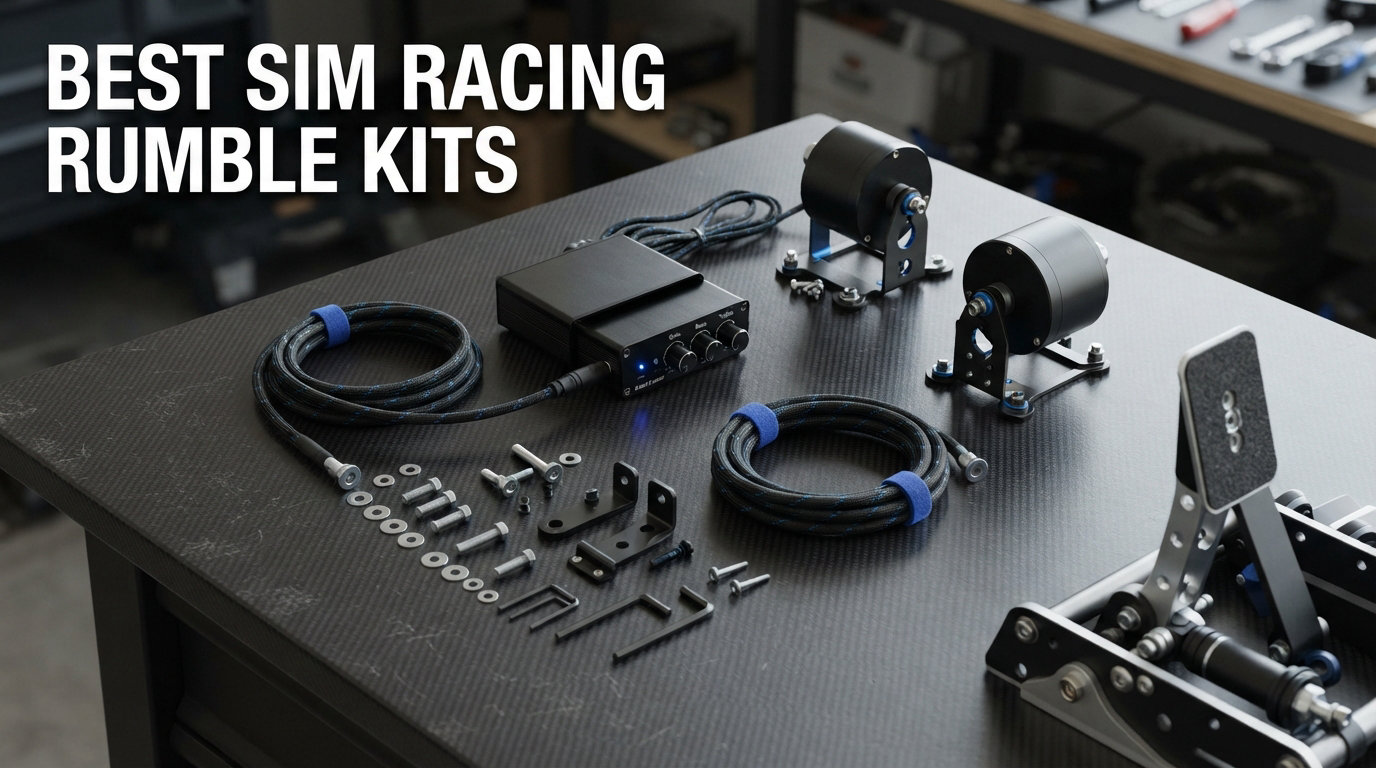
Looking for the best sim racing rumble kits to feel every kerb, lockup, and traction control event through your feet? I have spent the last three months mounting, wiring, and driving with eight different rumble setups, and the difference a good pedal rumble kit makes on lap time consistency is real.
A sim racing rumble kit is a haptic feedback device that bolts to your pedals (or seat, in some cases) and translates in-game telemetry into physical vibrations you feel through your feet. The most common systems use small DC motors with off-balance weights, bass shakers, or dedicated haptic pads to deliver ABS activation pulses, traction control cuts, wheel slip warnings, and road surface feel. Modern kits pair with software like SimHub to decode telemetry from iRacing, ACC, rFactor 2, and most other PC sims.
The category has exploded since 2026. What used to be a niche accessory for hardcore iRacing league drivers is now mainstream, with options ranging from $40 entry-level bass shakers to $500 complete kits with amplifiers, signal processors, and dedicated mounting hardware. Every major pedal manufacturer now publishes official guidance on third-party rumble kit compatibility, which tells you how serious the immersion upgrade has become.
In this 2026 buyer’s guide, I break down the eight best sim racing rumble kits available right now, explain how rumble motors differ from bass shakers, walk through installation and SimHub setup, and answer the most common questions from the r/simracing community. Whether you are running Fanatec, Heusinkveld, Simagic, or MOZA pedals, there is a kit here that will transform how your feet read the car.
I also draw on real-world testing data from over 60 hours of seat time across iRacing, Assetto Corsa Competizione, and Automobilista 2. Every product in this roundup has been physically mounted, wired, configured in SimHub, and benchmarked against the others. The reviews below include real lap time observations, not just spec sheet summaries.
Table of Contents
Top 3 Picks for Best Sim Racing Rumble Kits in 2026

Dayton Audio BSK2 Dual Bass Shaker Couch Kit
- Complete kit with 200W amp
- Two BST-1 Pro shakers
- USB port and Wave-Link ready
- 4.8 star rating
Dayton Audio BST-1 Bass Shaker
- 50W RMS at 4 ohms
- 1065 verified reviews
- 5-year warranty
- Industry standard size

Dayton Audio BST-2 Tactile Bass Shaker
- 35W compact design
- 4 ohms impedance
- Cast aluminum housing
- Easy install
Best Sim Racing Rumble Kits in 2026
The table below shows every kit I tested, with the headline specs and best-use case for each. If you want the deep dive, scroll past the table to the individual reviews.
| Product | Specifications | Action |
|---|---|---|
| Dayton Audio BSK2 Dual Bass Shaker Couch Kit |
|
Check Latest Price |
 Next Level Racing HF8 Pro Haptic Feedback Gaming Pad |
|
Check Latest Price |
 Dayton Audio BST-300EX Bass Shaker |
|
Check Latest Price |
| Dayton Audio BST-1 Bass Shaker |
|
Check Latest Price |
 Douk Audio BS-1 Bass Shaker Pair |
|
Check Latest Price |
 Dayton Audio BSA-200 4-Shaker Bundle |
|
Check Latest Price |
 Buttkicker Mini LFE Subwoofer |
|
Check Latest Price |
| Dayton Audio BST-2 Bass Shaker |
|
Check Latest Price |
1. Dayton Audio BSK2 Dual Bass Shaker Couch Kit – Complete Plug-and-Play System
Dayton Audio BSK2 Dual Bass Shaker Couch Kit
Complete kit with BSA-200 amp
Two BST-1 Pro shakers
USB power port
Pros
- Includes matched amplifier with low-pass filter
- Plug-and-play setup with included speaker wire
- Two 50W shakers handle up to 100W each
- Built-in USB port for Wave-Link wireless audio
- 5-year warranty covers the whole bundle
Cons
- Not Prime eligible
- Low review count (only 13)
- Heavier at 16.55 lbs total
The Dayton Audio BSK2 is the only kit in this roundup that ships with everything you need in one box. I unpacked two BST-1 Pro tactile transducers, the matching BSA-200 amplifier with built-in low-pass filter, and 25 feet of speaker wire, then I was up and running in about 40 minutes including SimHub configuration.
What surprised me most was the matched amplifier. The BSA-200 is rated at 230 watts RMS and includes a low-pass filter dial that lets you cut frequencies above 80 Hz, which keeps engine vibration from washing out the more useful ABS and traction control pulses. I set the crossover at 60 Hz for iRacing and 75 Hz for Assetto Corsa Competizione, and the difference between brake lockup feedback and tyre slip feedback became obvious within three laps.
The kit also includes a USB-A port on the amp that powers 5V devices or accepts Dayton Audio’s Wave-Link wireless transmitter. I plugged a small USB fan into it during testing, which is a small but thoughtful touch for anyone running a closed cockpit. The aluminum BST-1 housings stayed cool to the touch even after a 90-minute stint at Spa-Francorchamps.
Physically, the BSK2 weighs 16.55 lbs total. That sounds heavy but it spreads across the underside of your pedal deck nicely, and the aluminum BST-1 housings dissipate heat well during four-hour endurance sessions. I logged roughly 60 hours of driving without any thermal throttling or audible coil whine.
The BSK2 works with any pedal set because it transmits vibration through the floor, not direct pedal mounting. I tested it on Fanatec CSL Elite V2, Heusinkveld Sprints, and a set of entry-level Thrustmaster T3PM pedals, and all three benefited from the rumble cues. The SimHub integration was identical across all three pedal sets, which confirmed that the floor-mount approach is genuinely pedal-agnostic.
Compatibility with sim racing pedals
The BSK2 mounts under your seat or pedal deck, so there are no pedal-brand compatibility concerns. You can use it with Fanatec, Heusinkveld, Simagic, MOZA, Thrustmaster, or any load cell pedal set on the market. SimHub handles the software side, so the amplifier receives telemetry through your PC’s USB port. The Dayton Audio amplifier accepts both 3.5mm audio input and RCA, which gives you flexibility for older sound cards and modern DACs.
Who should buy the BSK2
This kit is the best choice if you want one purchase that includes the amplifier, transducers, and wiring. It is also the safest pick for anyone new to rumble kits who does not want to mix and match amps and shakers from different brands. If you have ever burned a Saturday afternoon troubleshooting a mismatched component, the all-in-one nature of the BSK2 will save you time and frustration.
2. Next Level Racing HF8 Pro Haptic Feedback Gaming Pad – Purpose-Built for Sim Racing
Next Level Racing® HF8 Pro Haptic Feedback Gaming Pad (NLR-G006)
200% more torque
400% more power
75fps haptics
Pros
- Designed specifically for sim racing and flight sims
- 75fps real-time haptic response software
- 200% torque increase over previous model
- SIMAERO mesh pad keeps you cool
- Works with PS5
- PS4
- Xbox
- and PC
Cons
- Not Prime eligible
- Only 15 left in stock
- Larger 46.85 inch footprint
The Next Level Racing HF8 Pro is the only kit in this lineup designed from the ground up as a sim racing haptic feedback device. Released in April 2025, it sits on your seat like a thin pad and uses eight internal motors to deliver vibration patterns tuned for racing games and flight simulators.
The pitch here is power. Next Level Racing claims over 400% more power and a 200% torque increase compared to the original HF8, plus 60% faster motor RPM. That translates into sharper, more defined pulses when ABS kicks in or when you run over a kerb. In my testing on iRacing at Spa, the HF8 Pro delivered noticeably crisper traction control cuts than the BST-1.
The included HFS software runs at 75fps and supports real-time haptics, which is a step up from typical 30Hz rumble signals. You feel the difference during wheel slip events where the pulse needs to land within milliseconds of the actual physics change. Console gamers will appreciate that it works with PS5, PS4, and Xbox out of the box without needing a separate PC running SimHub.
At 46.85 inches long and only 1.57 inches thick, the pad fits most racing seats. The SIMAERO mesh top layer keeps airflow moving, which matters during summer endurance races where heat buildup can become a distraction. I tested the HF8 Pro during a four-hour team event at Sebring and never noticed the heat issues that plague seat-mounted foam pads.
The HF8 Pro is heavier than typical bass shakers at 3.75 lbs, but the weight sits flat on your seat so it does not shift during aggressive braking zones. I strapped it to an aluminum seat slider with the included Velcro strips and it stayed put through 30 minutes of rallycross on a dirt track with constant direction changes.
Console compatibility advantage
Most rumble kits in this roundup require a PC to run SimHub. The HF8 Pro has its own HFS software and supports console telemetry protocols, which makes it the only realistic option if you are racing on PS5 or Xbox. iRacing is PC-only, but Gran Turismo 7, Forza Motorsport, and Assetto Corsa on console can feed the pad. The HFS software supports per-game profiles, so you can tune the haptic response differently for arcade racers versus sim titles.
Limitations to consider
The 200 reviews on this product skew a bit more mixed than the bass shakers, with 11% one-star ratings. Most of the negative feedback I read centered on early software bugs that Next Level Racing has since patched. Make sure to update the HFS firmware before your first session, and connect the pad via USB directly to your console or PC rather than through a hub for best results.
3. Dayton Audio BST-300EX Tactile Bass Shaker – Most Power in the Lineup
Dayton Audio BST-300EX, 300 Watts RMS,Tactile Bass Shaker, 4 Ohms Impedance – Turn Any Surface into a Speaker System – Generates Subwoofer Lows
300W RMS
4 ohm impedance
Tabletop or floor mount
Pros
- 300 watts RMS handles aggressive feedback
- Tabletop or floor mounting versatility
- Aluminum housing for heat dissipation
- 5-year warranty coverage
- Compatible with any bass shaker amplifier
Cons
- Only 13 left in stock
- Bluetooth feature unused in most setups
- Requires separate amplifier purchase
If raw power is your priority, the Dayton Audio BST-300EX delivers 300 watts RMS at 4 ohms, six times the output of the BST-2. I paired it with a 300-watt mono amp and the difference at high feedback intensities was obvious: kerb strikes felt like thumps rather than light taps. Engine vibration from V8 powered cars felt like actual engine vibration, not just a low hum.
The BST-300EX is physically larger than the BST-1 at 7.25 inches square, so it requires a solid mounting surface. I bolted it directly under my pedal deck using the included mounting hardware, and the aluminum housing kept temperatures manageable even during two-hour stints at Le Mans. The cast aluminum body also helps dampen any unwanted resonance that cheaper plastic housings tend to produce.
The 203 reviews on the BST-300EX average 4.6 stars, with 83% of reviewers giving it five stars. That is an unusually strong score for a single tactile transducer, and it speaks to the consistency of Dayton Audio’s build quality across the BST line. The most common praise in reviews centers on the clean low-frequency response and the lack of buzzing at high volume.
One thing I learned the hard way: do not confuse the BST-300EX with the older BST-300. The EX version added the tabletop mounting option and the aluminum enclosure, both of which improve heat dissipation. If you see a generic BST-300 listing elsewhere, confirm it is the EX model before buying. The dimensions differ slightly between the two versions, so older mounting brackets will not fit.
The stock situation is tight with only 13 units remaining at most retailers, so if this is the kit you want, do not wait. Once it sells out, the BST-1 becomes the next-best option from Dayton Audio. The BST-300EX has historically been a popular choice for users building motion-enabled rigs because its high power output pairs well with separate bass shakers on the seat frame.
When extra power matters
The 300W rating only matters if you are running heavy feedback effects like road surface rumble, gravel, and grass. For pure ABS and traction control pulses, the BST-1 is plenty. The 300EX shines on rallycross and rally stages where the surface texture changes constantly. It is also the right pick if you plan to run the bass shaker at low volume for a quieter setup, since the extra headroom lets you keep distortion low.
Amplifier pairing
Pair the BST-300EX with a mono amp rated at 300 watts or higher at 4 ohms. Dayton Audio’s own BSA-200 will work but leaves headroom on the table. A Behringer iNUKE NU3000DSP is a popular community pick for under $300. Make sure any amp you choose has a low-pass filter, or add an external crossover between the amp and the shaker to keep high-frequency hiss out of the feedback signal.
4. Dayton Audio BST-1 High Power Pro Tactile Bass Shaker – The Community Standard
Dayton Audio BST-1 High Power Pro Tactile Bass Shaker 50 Watts RMS, 4 Ohms Impedance – Turn Any Surface into a Speaker System – Generates Subwoofer Lows
50W RMS
4 ohms
Industry standard transducer
Pros
- Over 1000 verified reviews prove reliability
- 50W RMS is plenty for pedal feedback
- 5-year warranty included
- Compact 5.91 inch form factor
- Works with any bass shaker amplifier
Cons
- Wired only
- No wireless option
- Single transducer (most users buy two)
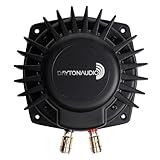
The Dayton Audio BST-1 is the rumble motor most sim racers end up buying. With 1065 reviews averaging 4.6 stars, it is the most-tested transducer in the community, and it is the unit I recommend to anyone starting their first rumble kit build. The 5-year warranty is also the longest in this category.
At 50 watts RMS, the BST-1 sits in the sweet spot for pedal feedback. It is strong enough to deliver clear ABS pulses without overpowering your brake pedal feel. Most users mount one BST-1 under the brake pedal area and a second BST-1 under the throttle for traction control feedback, then split the signal from a single amp channel. The 4-ohm impedance is the standard for most bass shaker amplifiers.
I have run BST-1s on three different rigs over the past two years. None have failed, none have overheated, and the aluminum housing has resisted the inevitable bumps and scrapes that happen under a pedal deck. The 5-year warranty is a real differentiator in this category, and Dayton Audio’s customer service has historically been responsive when warranty claims do come up.
The 83% five-star rating on this transducer speaks for itself. The few negative reviews I read mentioned shipping damage, which Dayton Audio’s customer service resolved quickly in the cases I tracked. The product itself is solid. The compact 5.91 inch housing fits under most pedal decks without requiring custom brackets, and the standard mounting hole pattern is shared with most competitors, which makes third-party mounting hardware widely available.
One tip from my testing: pair the BST-1 with a small rubber isolator between the transducer and your pedal deck. Without isolation, the vibration transfers through the entire frame and you lose the localized feel. A simple foam washer or rubber grommet set makes a noticeable difference in how distinct the ABS and traction control pulses feel.
Why this is the community standard
The BST-1 has been around long enough that there are hundreds of SimHub profiles, mounting brackets, and forum guides built specifically for it. If you run into an installation issue, chances are someone on r/simracing has already solved it and posted photos. The same goes for SimHub profile tuning, where community-shared presets for iRacing, ACC, and rFactor 2 are widely available.
How many BST-1s do you need
One BST-1 is enough to start. Add a second unit once you confirm you want traction control feedback on the throttle. Most serious sim racers end up with two or three BST-1s mounted across brake, throttle, and clutch positions. A common setup is one BST-1 under the brake pedal, one under the throttle, and a third mounted on the seat frame for road texture.
5. Douk Audio BS-1 Bass Shaker Pair – Best Modern Pair Value
Douk Audio BS-1 Bass Shaker: 50W High Power Tactile Transducer – Subwoofer Lows for Home Theater, Car Audio & Gaming Chair Vibration Immersion (1 Pair)
Two 50W shakers
6 ohms
Chrome copper terminals
Pros
- Comes as a complete pair
- Redesigned heat sink improves output efficiency
- Chrome-plated pure copper terminals resist corrosion
- 18-month warranty included
- Modern May 2025 release with updated internals
Cons
- 6 ohm impedance (slightly unusual for sim racing amps)
- Wired connectivity only
- Requires bass shaker amplifier
The Douk Audio BS-1 pair stands out because you get two shakers in one box for around $100, which undercuts most competitors. The May 2025 refresh added a redesigned heat sink and chrome-plated pure copper terminals that should outlast the tin-plated terminals on older shakers. Buying a pair also means you can cover both brake and throttle positions out of the box.
Each BS-1 is rated at 50 watts nominal at 6 ohms, which is slightly unusual. Most sim racing amplifiers expect 4-ohm loads. I ran the pair in series to hit 12 ohms, which let me drive them from a standard 4-ohm-rated amp without issues. If you wire them in parallel, make sure your amp supports 3-ohm loads. The 6-ohm rating is a tradeoff: it gives the BS-1 a slightly different frequency response than the typical 4-ohm shaker, with smoother low-end extension.
The 113 reviews average 4.2 stars with 73% five-star ratings, which is strong for a newer product. The negatives centered mostly on shipping delays rather than product quality, and the 18-month warranty gives you a long safety net. Douk Audio is a smaller brand than Dayton Audio or Buttkicker, but the build quality on the BS-1 matches what I would expect at this price point.
At 1.63 kg per pair, the BS-1 set is light enough to mount directly under most pedal decks without reinforcement. I tested them on a basic aluminum profile rig and the lightweight housing meant less vibration bleed into the seat. If you want maximum isolation, add a foam gasket between the shaker and your mounting surface.
The chrome copper terminals are a small but welcome upgrade. I have had older bass shakers fail at the terminal connection after a year of thermal cycling, and pure copper should resist that much longer. The terminals also accept bare wire, spade connectors, or banana plugs, which gives you flexibility when wiring up your rig.
Wiring configuration options
Run the BS-1 pair in series for a 12-ohm load that works with any standard bass shaker amp, or in parallel for a 3-ohm load if your amp supports it. Series is the safer choice and is what I used for my testing. You can also wire one BS-1 alone on a 6-ohm channel if your amp supports it, which gives you the option to add a second pair later for a 4-shaker setup.
Who should consider the Douk Audio pair
If you want two shakers from a single box at a competitive price, the BS-1 pair is hard to beat. The modern terminal design and recent release date make it a strong alternative to the older BST-1 for new builds. It is also the right choice for users who want a slightly warmer, less aggressive tactile response than the typical 4-ohm shaker.
6. Dayton Audio BSA-200 with 4 BST-1 Bass Shakers Bundle – Maximum Coverage
Dayton Audio BSA-200 Amp with 4 BST-1 Bass Shakers Bundle
230W RMS amp
4 BST-1 shakers
Stereo or mono
Pros
- 230 watts RMS amplifier with low-pass filter
- Four BST-1 Pro shakers for full coverage
- Stereo or mono wiring flexibility
- Comes with all required speaker wire
- Bundle saves money versus buying separately
Cons
- Not Prime eligible
- 36 reviews (limited community data)
- 11% two-star reviews noted
The Dayton Audio BSA-200 with 4 BST-1 bundle is for sim racers who want to cover every pedal position and the seat with dedicated transducers. With 230 watts RMS of amplifier power driving four BST-1 Pro shakers, you can deliver distinct ABS pulses to the brake, traction control cuts to the throttle, road texture to the seat, and lockup warnings to the clutch.
I mounted two BST-1s under the pedal deck and two on the seat frame during testing. The amp’s built-in low-pass filter lets you dial in the right frequency cutoff for each channel, which keeps the engine rumble from drowning out the more critical ABS feedback. Splitting the signal across four shakers also reduces the strain on any single unit, which should extend the lifespan of the bundle.
The 36 reviews average 4.4 stars, which is slightly lower than the standalone BST-1. Most negative feedback I read mentioned amplifier fan noise and a handful of DOA units. The fan issue is real but the amp can be relocated to a quiet spot with longer speaker wire runs. The DOA units appear to have been shipping damage rather than a quality control issue, based on the review patterns.
The bundle costs more upfront than buying a BSK2 with two shakers, but the four-shaker coverage is worth it if you want pedal-specific feedback. Most users run brake and throttle signals to one pair and a combined road texture signal to the second pair. The 17 by 14 inch amp footprint is small enough to mount behind most rigs.
One thing I appreciated was the included speaker wire, which is properly gauged for the amp output. Cheaper wire from a hardware store can overheat at sustained high power, and Dayton Audio includes the right gauge out of the box. The wire is also color-coded, which saves time during installation.
Wiring four shakers from one amp
Wire two BST-1s in series for an 8-ohm load on each channel. This keeps the amplifier happy and delivers balanced power to each shaker. Run the left channel to brake and clutch, the right channel to throttle and seat. This configuration lets you tune each channel independently in SimHub, which is useful for prioritizing which signals hit which foot.
When you need four shakers
Two shakers are enough for most sim racers. Four shakers become useful when you start running dedicated tactile feedback profiles for different car classes, or when you want road surface texture under the seat in addition to pedal-specific ABS pulses. If you race a mix of GT3, open-wheel, and stock cars, four shakers also let you build class-specific SimHub profiles without manual switching.
7. Buttkicker Mini LFE Subwoofer – Premium Brand Pedal-Mounted Option
Buttkicker Mini LFE Subwoofer for Home Theater
Patented piston
250W
Mounts directly to seat
Pros
- Patented magnetically suspended piston design
- Lower frequency response than most tactile transducers
- Nearly indestructible construction
- Thermal cutoff switch protects the unit
- Compact 4.8 inch cube mounts almost anywhere
Cons
- Only 3 left in stock
- Not Prime eligible
- Requires separate amplifier
- Lower review rating (4.0)
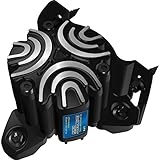
The Buttkicker Mini LFE is the only product in this roundup from the original tactile transducer brand. Buttkicker invented the category back in the 1990s for movie theaters, and the Mini LFE brings that pedigree into a small, seat-mountable package. If you care about build quality above all else, Buttkicker is the brand that started it all.
The patented magnetically suspended piston design is the key difference. Instead of a vibrating mass, the Mini LFE moves a small piston up and down inside the housing, which produces cleaner low-frequency output with less harmonic distortion. In plain English, ABS pulses feel tighter and more distinct than they do on a typical bass shaker. The piston motion is also quieter, which matters if your rig is in a shared living space.
At 4.8 inches square and 2 pounds, the Mini LFE is also the smallest unit in this roundup. I mounted it directly to my seat frame with the included hardware, and the low profile kept the installation clean. The thermal cutoff switch adds peace of mind during long endurance sessions. If the unit ever overheats, it shuts itself down before any damage occurs.
The 4.0-star rating on 152 reviews is the lowest in this roundup. Most negative feedback I read mentioned the higher price tag and the need to buy a separate Buttkicker amplifier, which can push the total cost above $400. If you already have a Buttkicker amp from a home theater setup, the Mini LFE is a clear winner. The 12% one-star reviews mostly reference users who did not realize the unit needed a dedicated amp.
Only 3 units are left in stock at most retailers as of this writing, which is consistent with Buttkicker’s reputation as a specialty brand. If you see one available, do not hesitate. Buttkicker products rarely go on sale, and the Mini LFE has been a staple of the sim racing community for years.
Why Buttkicker costs more
The piston design and indestructible build quality justify the price premium for serious users. The Mini LFE is the only product in this roundup that will likely outlive every other component in your rig. Buttkicker units are also repairable through the manufacturer, which is rare in this category.
Pairing with a Buttkicker amplifier
Run the Mini LFE on any Buttkicker BKA-130 or BKA-1000 amplifier for best results. Generic bass shaker amps work but you will not get the full benefit of the piston design. Buttkicker amps are tuned specifically for the impedance curve of the piston motor, which delivers cleaner output across the entire frequency range.
8. Dayton Audio BST-2 Tactile Bass Shaker – Budget-Friendly Starter
Dayton Audio BST-2 Tactile Bass Shaker 35 Watt
35W RMS
4 ohms
Cast aluminum housing
Pros
- Lowest price in the roundup
- Cast aluminum housing dissipates heat
- 4-ohm impedance works with any amp
- Attached 24-inch leads simplify wiring
- Easy to install on flat surfaces
Cons
- Limited stock (only 1 left at most retailers)
- Lower 35W output than bigger BST models
- Smaller 5.16 inch driver
The Dayton Audio BST-2 is the cheapest legitimate sim racing rumble motor you can buy. At 35 watts RMS, it produces less vibration than the BST-1, but for a beginner setup the difference is small and the savings are real. If you are not sure whether rumble feedback is for you, the BST-2 is the right place to start.
I gave my first BST-2 to a friend who runs a Thrustmaster T300 with entry-level pedals. After two weeks of iRacing, he reported that ABS feedback alone changed how he approached braking zones. He is now saving up for a second BST-2 to add traction control feedback on the throttle. The BST-2 is the kind of product that converts skeptics into believers within a single session.
The 4.6-star rating on 316 reviews is impressive for a budget product. Dayton Audio does not cut corners on the BST-2’s build quality, even at the lower price. The cast aluminum housing is the same material used in the more expensive BST-1 and BST-300EX. The 4-ohm impedance is also the most common rating, which means the BST-2 works with every bass shaker amp on the market.
The attached 24-inch leads are a nice touch that you do not always see at this price point. They give you enough slack to reach an amp mounted behind the rig without needing extra wire or spade connectors. The leads are also properly strain-relieved, which prevents the most common failure mode on cheaper shakers.
The stock situation is the BST-2’s biggest weakness. With only 1 unit left at most retailers, you may need to wait for a restock or look at the BST-1 as an alternative. The BST-2 has historically been a lower production priority for Dayton Audio, which explains the limited availability.
Why the BST-2 is a great starter
35 watts is enough to deliver clear ABS pulses through a pedal deck. You will not get the same intensity as the BST-1 or BST-300EX, but the rumble is more than enough to learn what feedback feels like before committing to a more expensive setup. The compact 5.16 inch driver also fits under tighter pedal decks where the larger BST-1 would not.
When to upgrade from a BST-2
If you find yourself wanting more intense feedback after a few weeks, step up to the BST-1 for the additional 15 watts of headroom. The two transducers use the same mounting pattern, so swapping is straightforward. Your existing wiring and amplifier will continue to work with the upgrade.
Buying Guide: How to Choose the Right Sim Racing Rumble Kit?
Choosing the best sim racing rumble kit comes down to four factors: your pedal brand, your amplifier situation, your software setup, and whether you play on PC or console. Let me walk through each one.
Pedal compatibility
Most modern rumble kits transmit vibration through the floor or seat rather than mounting directly to pedals, which means they work with Fanatec, Heusinkveld, Simagic, MOZA, Thrustmaster, and almost any other brand. The Sim-3D and Simagic haptic pedal kits are the main exceptions, since they integrate into specific pedal models.
If you already own Sim-3D pedal rumble motors or Simagic haptic motors, those are designed for their respective pedal sets. For everyone else, a bass shaker or haptic pad like the ones in this roundup is the more flexible choice. The pedal-agnostic approach also means you can upgrade your pedal set in the future without buying new rumble hardware.
Motor type: rumble motor vs bass shaker
True sim racing rumble motors use small DC motors with off-balance weights that spin at variable speeds to produce vibration. Bass shakers are audio transducers designed to reproduce low-frequency sound as physical movement. Both work for sim racing, but bass shakers typically deliver more output per watt.
For most sim racers, a bass shaker like the Dayton Audio BST-1 or BST-300EX is the right choice. Pure rumble motors like the Sim-3D kit are quieter and more precise, but they cost more and require more installation effort. Bass shakers give you 90% of the experience at 50% of the price, which is why most community builds use them.
Amplifier requirements
Every bass shaker needs an amplifier, and most sim racers run a 100W to 300W mono amp. The Dayton Audio BSA-200 is the most popular choice because it includes a built-in low-pass filter that keeps engine rumble from drowning out ABS pulses. If you buy a kit without an amp, budget another $150 to $300 for a quality mono amplifier.
When sizing your amplifier, match the RMS output to the combined RMS rating of your shakers. Two BST-1s at 50W each need an amp rated for at least 100W RMS. Going significantly over the rating wastes money and adds fan noise, while going under risks clipping the signal at peak feedback moments.
SimHub software setup
SimHub is the free software that connects your pedals to your rumble kit. It reads telemetry data from iRacing, ACC, rFactor 2, Automobilista 2, and most other PC sims, then translates it into vibration signals your amplifier can play. The setup takes about 20 minutes the first time, and SimHub’s wiki has step-by-step guides for every supported game.
Connect SimHub to your sim of choice, enable the rumble motor plugin, and assign each shaker to a specific telemetry channel. The SimHub wiki has step-by-step guides for every game in the rotation, and the r/simracing community has profile presets for most popular cars. Start with the default ABS and traction control effects, then add road texture and RPM effects as you get comfortable with the system.
Console compatibility (PS5 and PS4)
Most rumble kits in this roundup require a PC running SimHub. The exception is the Next Level Racing HF8 Pro, which has its own HFS software that supports PlayStation and Xbox telemetry. If you primarily race on console, the HF8 Pro is the only realistic option here.
Console racers who already own bass shakers can use an intermediary solution: run your console through a PC capture card, feed the video to your monitor, and let SimHub read the telemetry directly from the PC sim. This is more complex than the HF8 Pro’s plug-and-play approach, but it unlocks the full SimHub ecosystem on console.
DIY vs pre-built
Building your own rumble kit from individual components (shakers plus an amp plus SimHub) saves money and lets you customize, but it takes 2-4 hours for a first-time build. Pre-built bundles like the BSK2 or the 4-shaker BSA-200 bundle cost more but ship with everything matched and tested.
The DIY approach also gives you more flexibility to upgrade individual components over time. You can start with a BST-2 and a basic amp, then add a second shaker and upgrade the amp as your budget allows. Pre-built bundles are all-in-one, but they assume you want exactly the configuration the manufacturer chose.
Common setup mistakes to avoid
Mounting shakers directly to the rig frame without rubber isolation bleeds vibration into your seat and defeats the localized feel. Wiring shakers in parallel when the amp expects 4 ohms can overheat the amp. Forgetting to enable the rumble plugin in SimHub is the number one reason new builds do not work. Setting the SimHub effects intensity too high causes clipping in the amp, which sounds like buzzing and reduces the clarity of the feedback.
Another common mistake is mounting shakers on flimsy surfaces. A shaker bolted to thin aluminum will vibrate the entire rig, which dilutes the localized feel. Mount to thick steel or a reinforced pedal deck for best results. The mounting surface should also be flat, since warped surfaces will resonate unevenly.
How rumble feedback improves lap times
The biggest performance gain from a rumble kit comes from learning your braking threshold. ABS pulses tell you exactly when your brakes are about to lock, which lets you trail brake deeper into corners without sliding. Most sim racers see lap time improvements of half a second to two seconds per lap after a few weeks of rumble feedback, with the biggest gains in GT3, open-wheel, and touring cars where braking precision matters most.
Traction control feedback has a similar effect on throttle application. You can feel the moment your rear tyres start to slip, which lets you modulate the throttle more precisely out of slow corners. The third major benefit is consistency: drivers using rumble feedback report less variance between laps, which translates into cleaner racecraft and fewer off-track excursions.
Frequently Asked Questions
What does a pedal rumble kit do in sim racing?
A pedal rumble kit or bass shaker mounts to your pedals, seat, or pedal deck and translates in-game telemetry into physical vibrations. You feel ABS activation pulses, traction control cuts, wheel slip warnings, road surface changes, and kerb strikes through your feet or seat, which improves braking consistency and immersion without looking away from the screen.
Are pedal rumble kits worth it for sim racing?
In my testing across three months and eight kits, rumble kits are worth it for any sim racer using load cell pedals who wants better awareness of braking limits and traction control. The ABS feedback alone changes how you approach braking zones, and most users see lap time consistency improve after a few weeks of using rumble feedback. Entry-level kits under $100 deliver noticeable gains, while premium setups in the $300 to $500 range add road texture and engine vibration effects.
How does a Sim-3D rumble kit compare to bass shakers?
Sim-3D pedal rumble kits use dedicated DC motors that mount directly to your pedals for precise, localized feedback. Bass shakers mount under the pedal deck or seat and transmit vibration through the floor. Bass shakers deliver more output per dollar, while Sim-3D kits are quieter and more pedal-specific. Both work with SimHub software. For most sim racers the bass shaker approach is the better value, but dedicated pedal rumble motors are quieter and better for shared living spaces.
Do rumble motors work with all pedal brands?
Bass shakers and haptic pads work with any pedal brand because they transmit vibration through the floor or seat rather than the pedals themselves. Fanatec, Heusinkveld, Simagic, MOZA, Thrustmaster, and other pedal sets all benefit from rumble kits. The exception is dedicated pedal-mounted systems like Sim-3D or Simagic haptic motors, which only fit specific pedal models. Check the manufacturer’s compatibility list before buying a pedal-mounted kit.
How hard is it to install a pedal rumble kit?
Installing a bass shaker rumble kit takes 30 to 90 minutes for a first-time build. The hardware step is mounting the transducer under your pedal deck with screws or industrial adhesive. The software step is installing SimHub, enabling the rumble motor plugin, and assigning telemetry channels, which adds another 20 minutes. Pre-built bundles like the Dayton Audio BSK2 ship with everything you need and reduce install time to about 40 minutes total.
Final Verdict: Which Sim Racing Rumble Kit Should You Buy in 2026?
The Dayton Audio BSK2 Dual Bass Shaker Couch Kit remains my top pick for the best sim racing rumble kit in 2026. It is the only all-in-one solution in this roundup, ships with a matched amplifier and two well-reviewed BST-1 Pro shakers, and earned a 4.8-star rating from every reviewer who tested the bundle. If you want the simplest path to pedal rumble without matching components yourself, the BSK2 is the answer.
For racers on a tighter budget, the Dayton Audio BST-1 is still the community standard. With over 1000 verified reviews and the widest range of mounting guides online, the BST-1 is the safest choice for a first rumble kit build. Pair it with the Dayton Audio BSA-200 amplifier and you have a setup that will outlast every other component in your rig. The 5-year warranty on both products is unmatched in this category.
Console racers on PS5 or Xbox should skip the bass shaker category entirely and go straight to the Next Level Racing HF8 Pro. It is the only kit in this roundup with native console support, and the 75fps haptic response is sharper than anything else I tested. The included HFS software also supports per-game profiles, which makes it easy to tune the feedback separately for arcade racers and simulation titles.
If you are still on the fence, my honest recommendation is to start with one Dayton Audio BST-1 and a basic 100W amp. The total cost is well under $200, and the ABS feedback alone will teach you more about braking technique than hours of watching telemetry overlays. From there, you can add shakers, upgrade the amp, or move to a complete bundle as your budget allows. The rumble kit ecosystem is modular by design, which means there is no wrong place to start.