
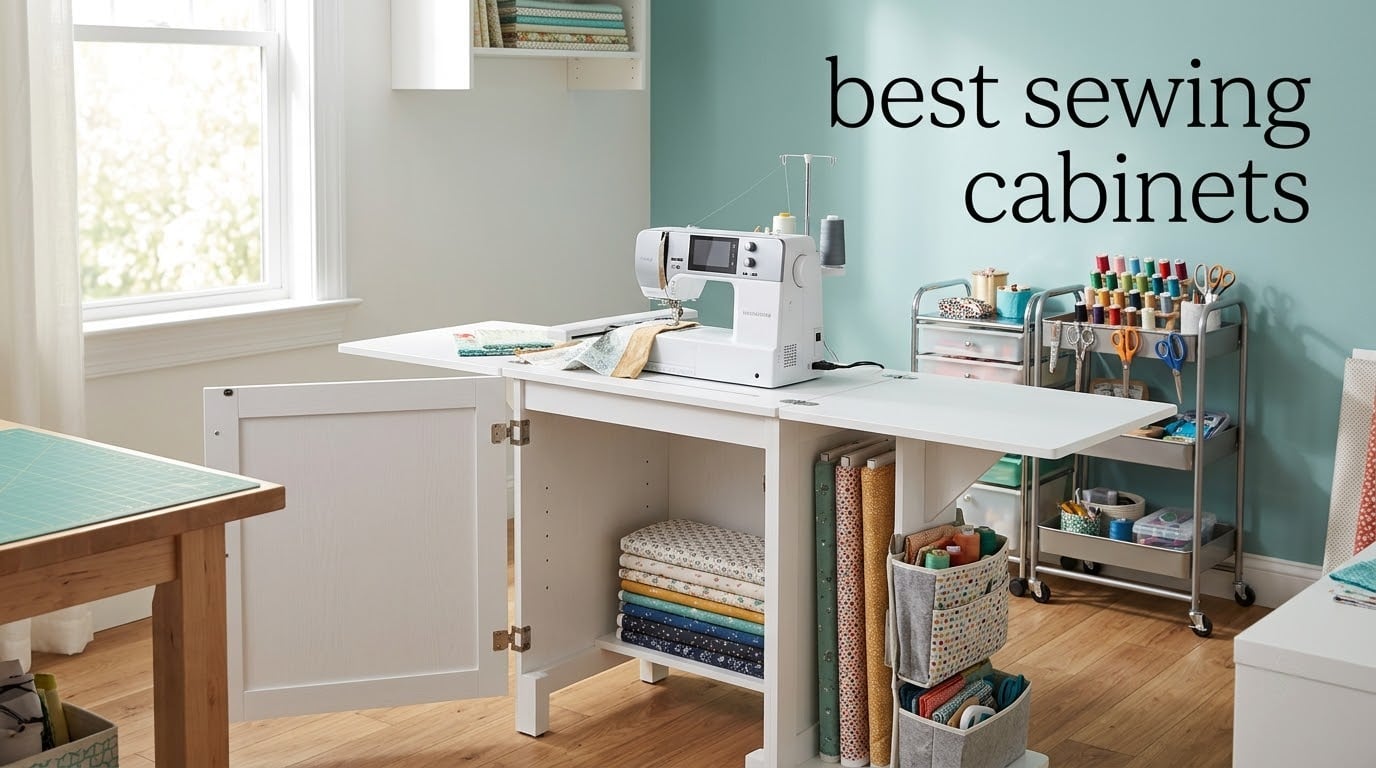
A good sewing cabinet is a sturdy workstation, a reliable machine lift and storage that actually holds your notions, and nothing else. That simplicity is why the category splits so cleanly: some cabinets simply fold flat into the wall, some raise your machine on a three-position lift, and some just close their doors and hide everything. Our team spent six weeks comparing ten of the most-reviewed cabinets and tables on the market, and the lift mechanism turned out to be the decision that matters most, not the finish color or the drawer count.
I have sewn on a dining table for most of my life, hauling the machine out and putting it away again every session. The physical drag of that setup is the reason projects stall. Sewists who move to a dedicated cabinet consistently report two changes: they sew more often because there is no setup, and they sit straighter because the machine finally comes to them instead of the other way around. Both of those are the reason we built this roundup around [the best sewing machines](https://eatcreatesleep.net/best-sewing-machines/) as much as the furniture itself, since a cabinet only helps if the machine on top of it fits.
Before you read further, three questions narrow almost every decision in this category: what machine do you own and how heavy is it, how much room can you give up permanently, and do you want a lift or would a drop leaf do the same job. Answer those and half the list below disappears. If you are still deciding on the machine itself, our [beginner sewing machine guide](https://eatcreatesleep.net/best-sewing-machines-for-beginners/) and the [mini machine picks](https://eatcreatesleep.net/best-mini-sewing-machines/) cover the smaller formats that suit compact cabinets better than full-size ones.
We scored every cabinet on machine fit and lift first, work surface second, and storage third, with build quality and assembly difficulty weighted against the finish. We did not stress-test lifts to failure, so treat the durability notes as owner-reported rather than lab results. Here is the short version before the detail.
Table of Contents
Top 3 Best Sewing Cabinets and Tables for 2026
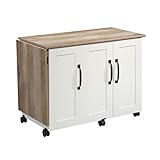
Sauder Drop-Leaf Sewing Cart
- Drop-leaf extension
- Locking casters
- 75 lb capacity
- 5-year warranty
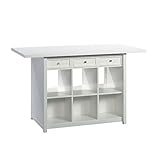
Sauder 60-Inch Craft Table
- 60-inch surface
- Three double-sided drawers
- Six open shelves
- Seats four

BOWERY HILL Drop-Leaf Table
- Melamine top
- Tambour roll-open door
- Two storage bins
- 62-inch footprint
Best Sewing Cabinets in September Quick Comparison
| Product | Specifications | Action |
|---|---|---|
| Sauder Drop-Leaf Sewing Cart |
|
Check Latest Price |
 Sauder Craft and Sewing Armoire Sauder Craft and Sewing Armoire |
|
Check Latest Price |
| Sauder 60-Inch Craft Pro Table |
|
Check Latest Price |
| BOWERY HILL Drop-Leaf Sewing Table |
|
Check Latest Price |
 Arrow K8405 Wallaby Kangaroo Cabinet Arrow K8405 Wallaby Kangaroo Cabinet |
|
Check Latest Price |
 Kangaroo and Joey K8805 Cabinet Kangaroo and Joey K8805 Cabinet |
|
Check Latest Price |
 Magshion 60-Inch Sewing Table Magshion 60-Inch Sewing Table |
|
Check Latest Price |
 Arrow Harriet Hydraulic Lift Cabinet Arrow Harriet Hydraulic Lift Cabinet |
|
Check Latest Price |
 Sew Ready Folding Craft Armoire Sew Ready Folding Craft Armoire |
|
Check Latest Price |
 Furnivio 71-Inch LED Craft Cabinet Furnivio 71-Inch LED Craft Cabinet |
|
Check Latest Price |
1. Sauder Drop-Leaf Sewing Cart – Best Overall Sewing Cabinet
Sauder Miscellaneous Storage Sewing Cart, Drop-Leaf Craft Table, Sewing Table with Storage – Soft White Finish
19.5D x 38.5W x 28.5H
75 lb capacity
Drop-leaf adds 16 inches
Easy-roll casters, two locking
Pros
- Drop-leaf extends the surface for bulky projects
- Door bins and two bays hold a machine and notions
- Locking casters let you roll it aside when guests arrive
- Closes to look like plain furniture
- Owners report repairing it easily after a move
Cons
- Assembly takes around two hours and helps to have a second person
- White finish shows fingerprints and smudges quickly
- Drop-leaf hinge can loosen with frequent folding
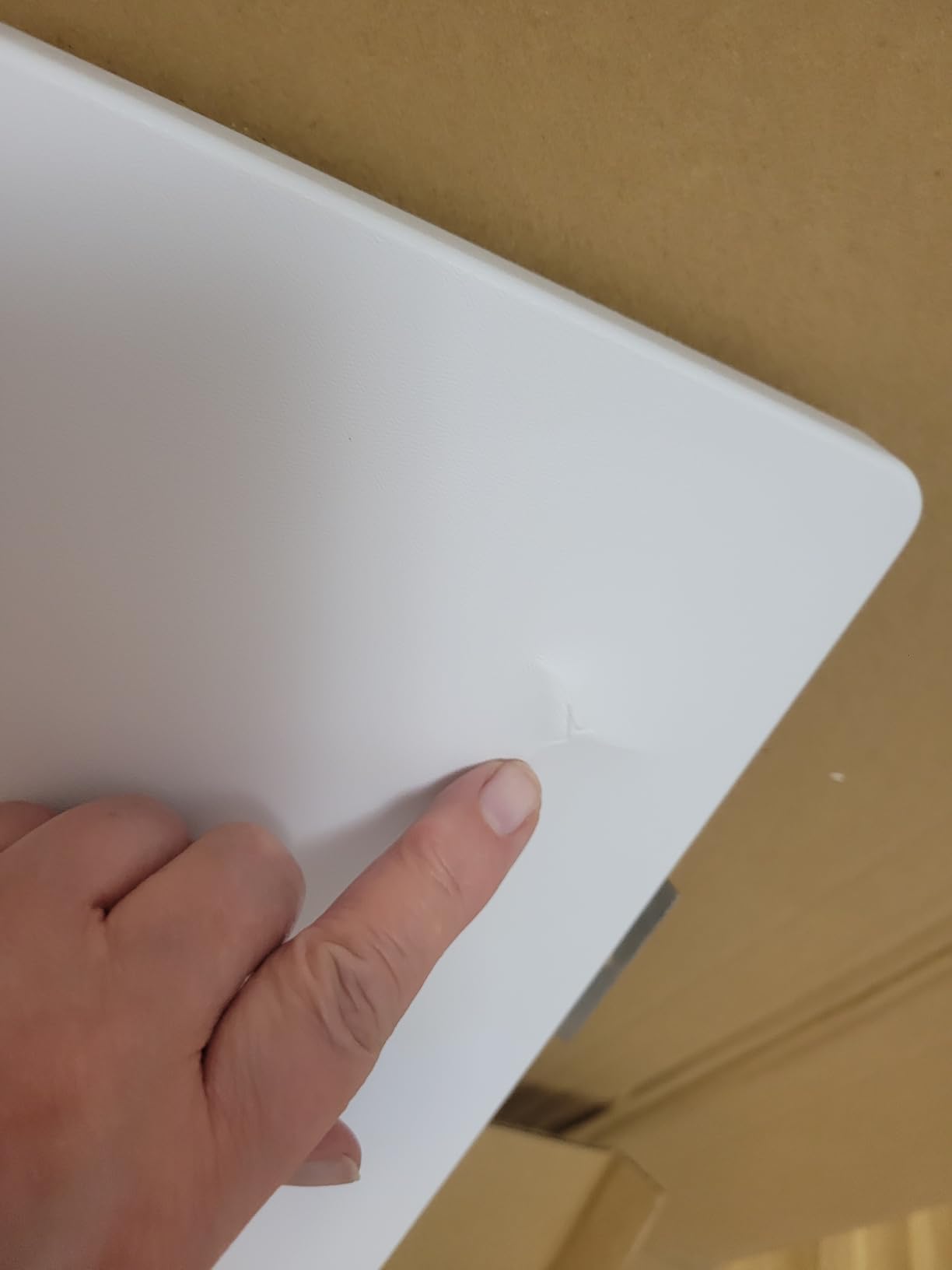
- Some pieces arrive with chipped edges
This is the cabinet I recommend to almost everyone who asks, and the reason is the review count rather than the spec sheet. Nearly five thousand owners have used it, which means every common problem in this category has already been reported, solved and re-reported. For our purposes that is worth more than a feature nobody has stress-tested yet.
In daily use it behaves like a small sideboard. The drop leaf adds roughly 16 inches of surface when you raise it, which turns the top from a machine-only perch into a genuine work area for pressing and assembly. Below, two storage bays and a hidden shelf take a standard machine, and the door bins swallow notions that would otherwise migrate across the kitchen counter.
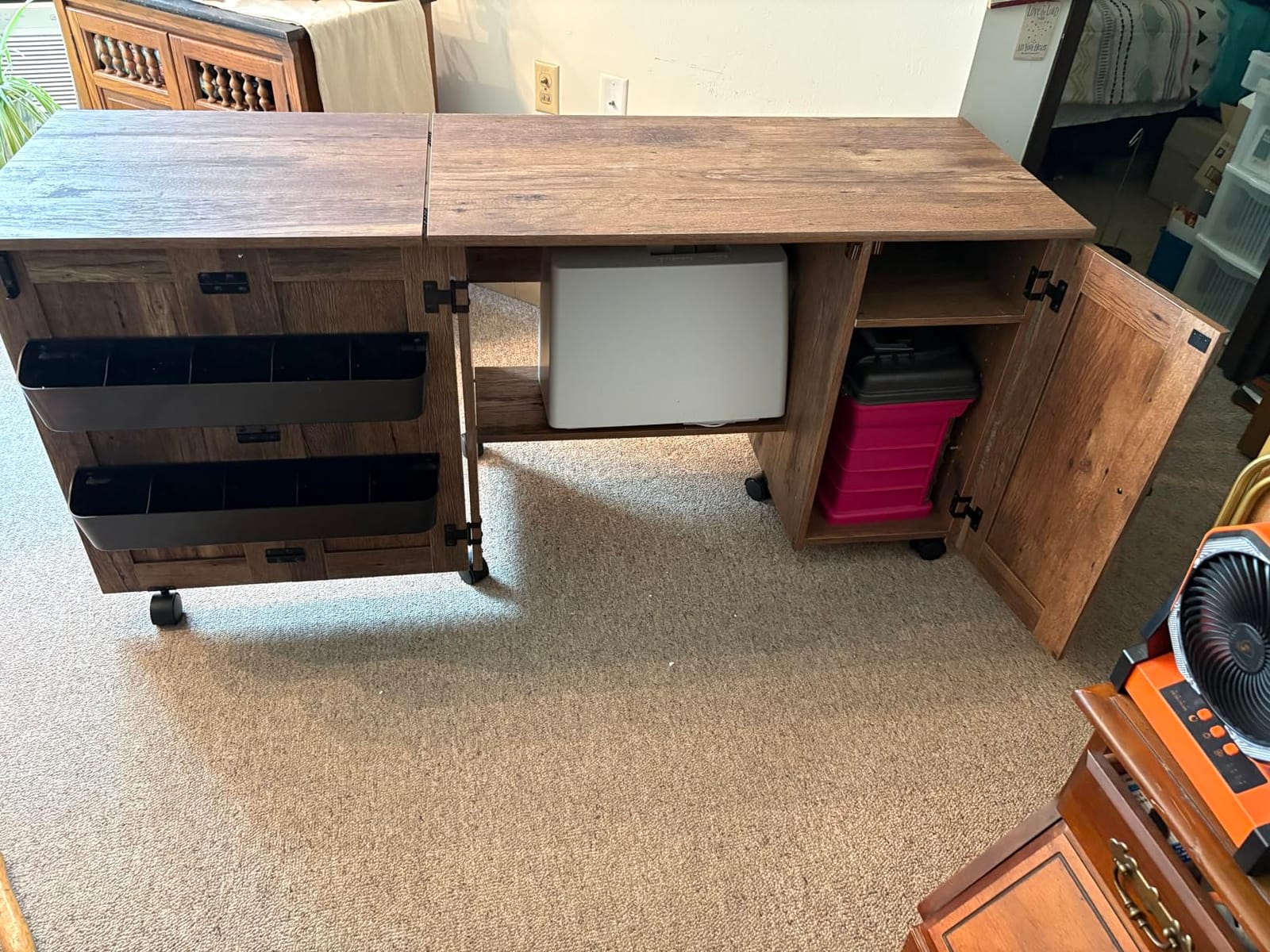
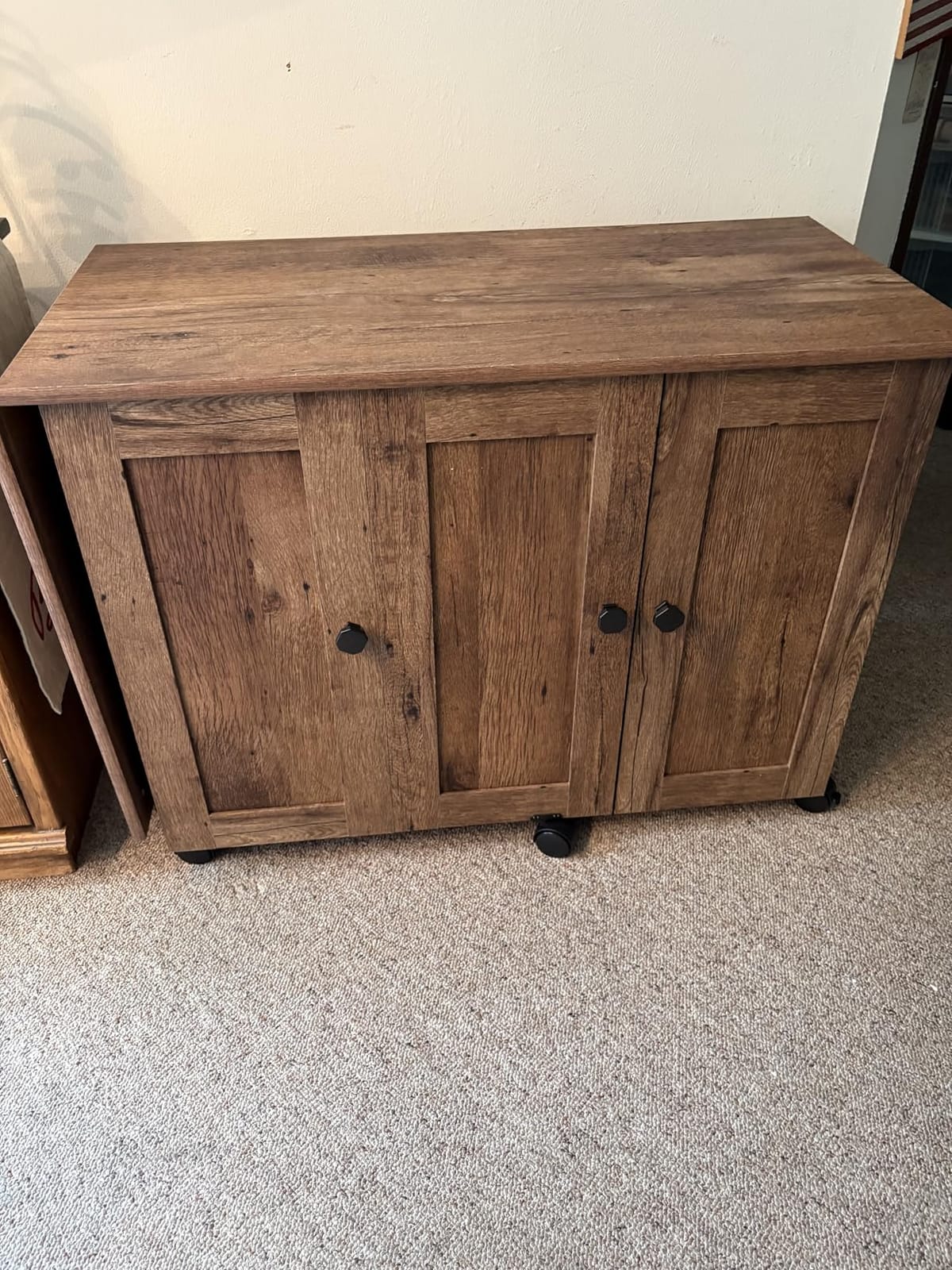
The engineering is deliberately plain: engineered wood, a raised-panel door, plastic handles, and easy-roll casters with two that lock. The 75 lb maximum capacity is above what most home machines weigh, so a heavier machine is not a problem here. At 68.9 lb the whole thing is heavy enough to stay put while you sew but light enough for two people to move through a doorway.
The finish is Soft White with Lintel Oak accents, which reads as ordinary furniture rather than craft equipment. That matters more than it sounds. In a multipurpose room, a cabinet that looks like a piece of furniture gets used, while one that looks like a hobby gets stepped around.
Why it works for a first cabinet
Because it removes the two biggest obstacles at once. Setup effort drops to opening a door, and the machine never has to be dragged across a room, which is the part that quietly wears out both the machine and the owner. Owners on r/quilting repeatedly point people toward Arrow and similar enclosed bases for the same reason.
The storage is not deep, so a serger alongside a main machine will not fit inside. It is built for one machine plus notions, and if that is your setup it is a clean fit.
Where it falls short
Assembly is the honest weak point. Owners consistently describe around two hours of build time, and a second pair of hands saves the relationship. The white finish shows fingerprints readily, which is a purely cosmetic grievance but an annoying one daily.
Owners also report a drop-leaf hinge loosening with repeated use, and some pieces arriving with chipped or crushed veneer. Both are fixable and neither is a safety issue, but inspect the box before you build it.
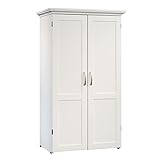
2. Sauder Craft and Sewing Armoire – Best for Multipurpose Rooms
Sauder Miscellaneous Storage Craft & Sewing Armoire, L: 35.11″ x W: 21.81″ x H: 61.58″, Glacier White finish
21.75D x 35.13W x 61.63H
50 lb top surface
Six adjustable shelves
Built-in six-outlet power strip
Pros
- Power strip lets machines stay plugged in behind closed doors
- Fold-out surface fits a machine and serger side by side
- Six adjustable shelves for fabric
- kits and office gear
- Doors hide everything when idle
Cons
- Assembly is lengthy and confusing for first-time builders
- Thin back panel described as cardboard-like
- Sliding table and brackets can misalign and slip
- Some pieces arrive missing hardware or instructions
The armoire pitch is simple: when you are not sewing, this looks like a bookcase. That is a genuinely different proposition from a cart on casters, and in a guest room or a dining room that doubles as a craft space it is the difference between a workspace you keep and one you hide.
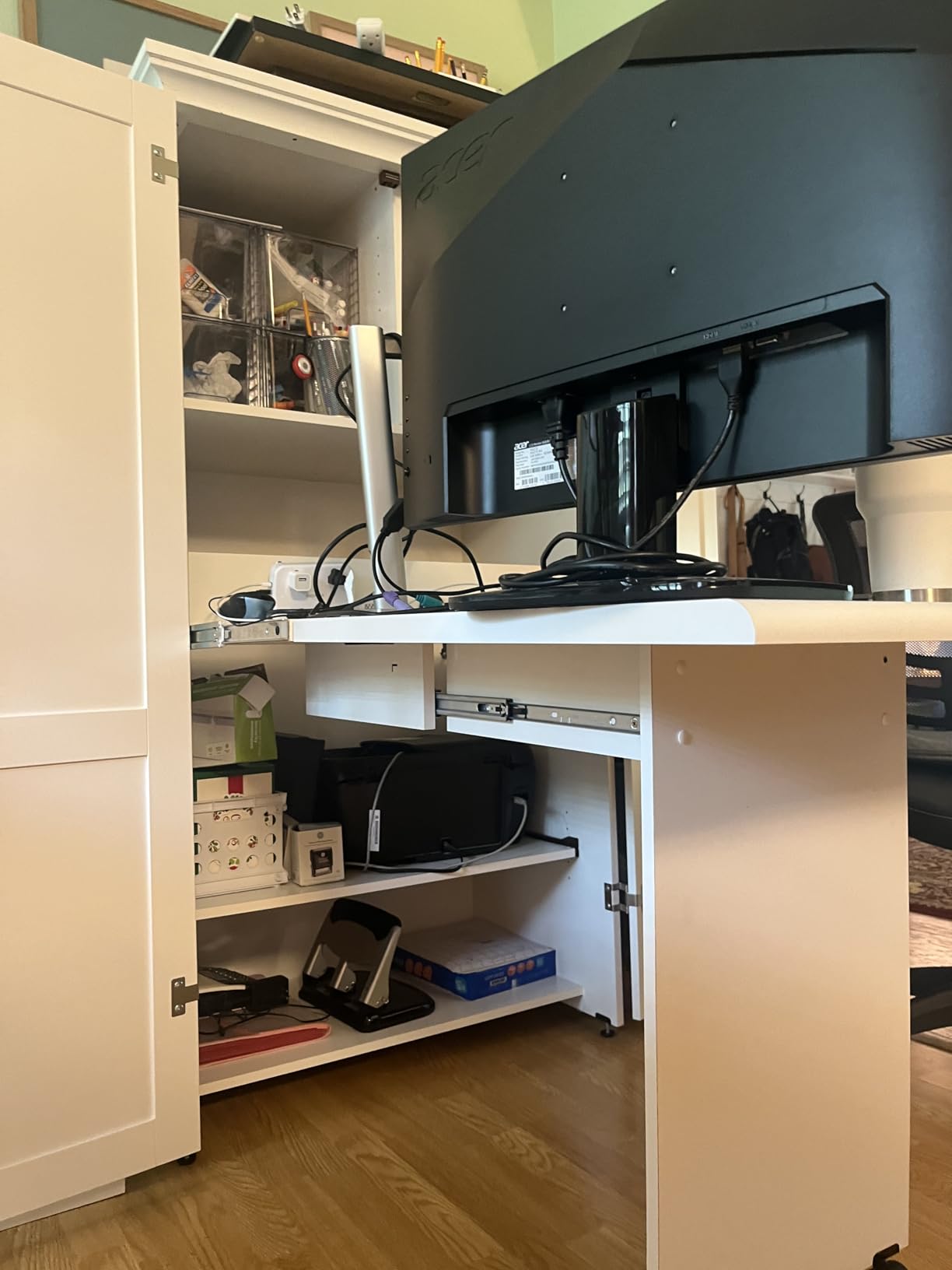
The standout detail is the built-in power strip on the centre shelf, with six outlets. Machines, irons, cutting light and a printer can stay connected permanently, and the whole thing closes. On a cart you are unplugging and rewiring every session, which is exactly the friction the cabinet is supposed to remove.
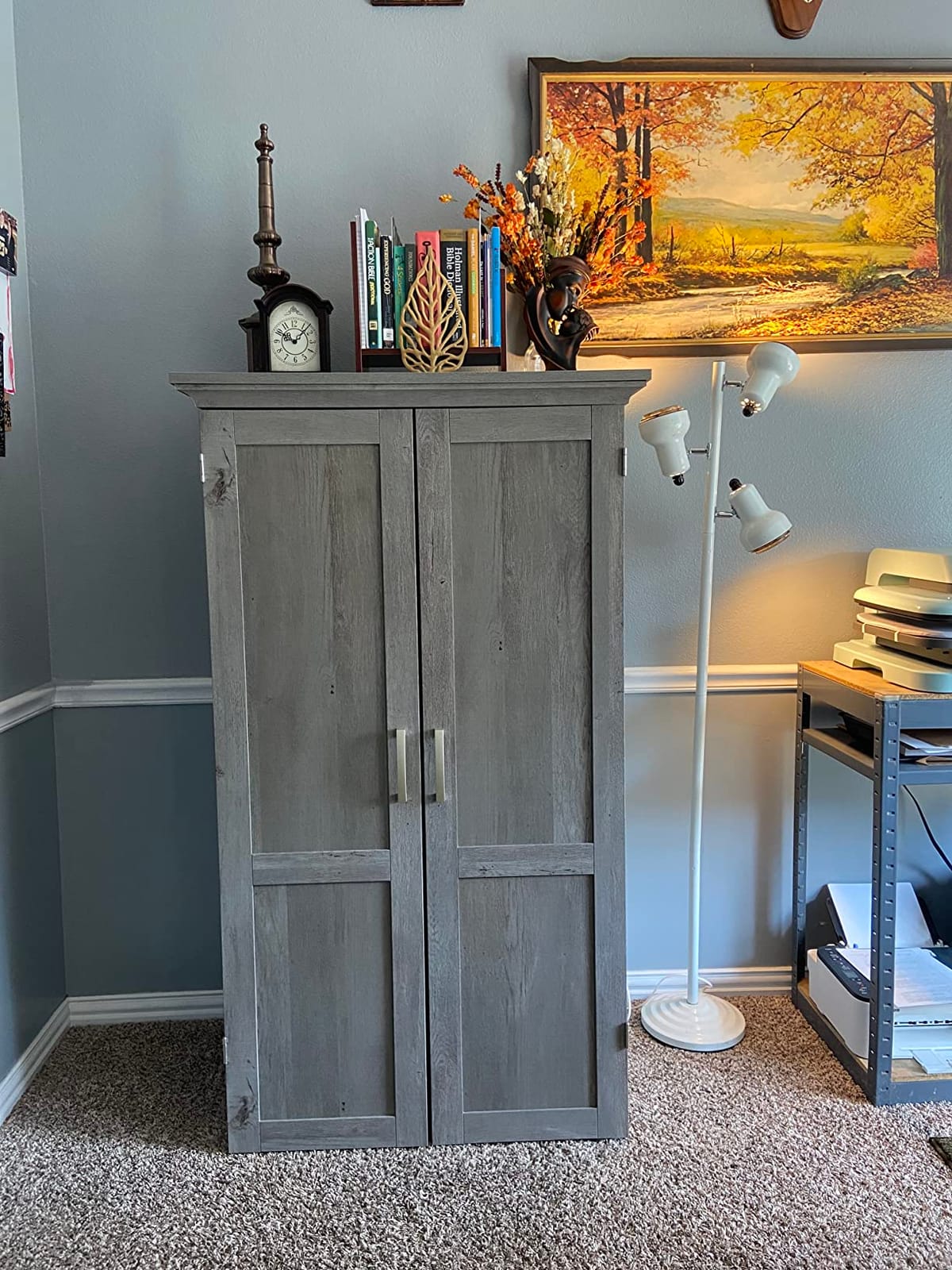
The fold-out work surface tucks inside the cabinet when unused, and the top surface carries a 50 lb rating. At 21.75 inches deep and 35.13 inches wide, the open surface is wide enough to run a machine and a serger together, which is where this design pulls ahead of a drop-leaf cart.
It arrives in multiple boxes, and the manufacturer does not list a unit weight, so plan for two people. The Glacier White cottage styling is neutral enough for a bedroom or a study.
Who this suits
Anyone whose sewing space has to disappear on demand, and anyone who is tired of unplugging machines every evening. The shelf count of six adjustable levels means fabric bolts, cross-stitch kits and craft supplies can share the same carcass without fighting for room.
It is also the practical answer if you sew in the evening and want the light and the machine to be ready without a full setup ritual.
Where it falls short
The 4.1 rating reflects real build complaints rather than concept problems. The back panel is thin and described as cardboard-like, which matters if you plan to hang heavy notions on the reverse. The sliding table and its extension brackets are the most common failure point, and misaligned rails mean a surface that will not sit square.
Assembly runs long enough that first-time builders regularly report confusion, and some pieces arrive without hardware or instructions. If you are not comfortable with flat-pack furniture, budget the time honestly.
3. Sauder 60-Inch Craft Pro Table – Top Rated for Large Work Surfaces
Sauder Craft Pro Series Craft Table/ Pantry cabinets, White finish
30D x 60W x 36H
50 lb recommended load
Three double-sided drawers
Six open shelves
Pros
- 60-inch surface is among the largest in the category
- Drawers open from both sides
- Seats four so it doubles as a general work table
- Clean white finish suits most rooms
Cons
- Weighs 164.5 lb and takes more than one person to move
- Not a cabinet
- so supplies stay visible
- Assembly time is frequently criticised
This is the highest-rated unit in the group at 4.7, and the reason is proportion. A 60-inch by 30-inch top gives you a real cutting and layout surface, which is what quilting sewists actually lack when they are stuck on a 38-inch cart. You can spread out a panel, lay a pattern flat and still have machine space.
At 36 inches tall it works seated, and the four-person seating capacity means it doubles as a general craft or work table on days when the machine stays covered. That dual role is what makes it feel like furniture rather than equipment.
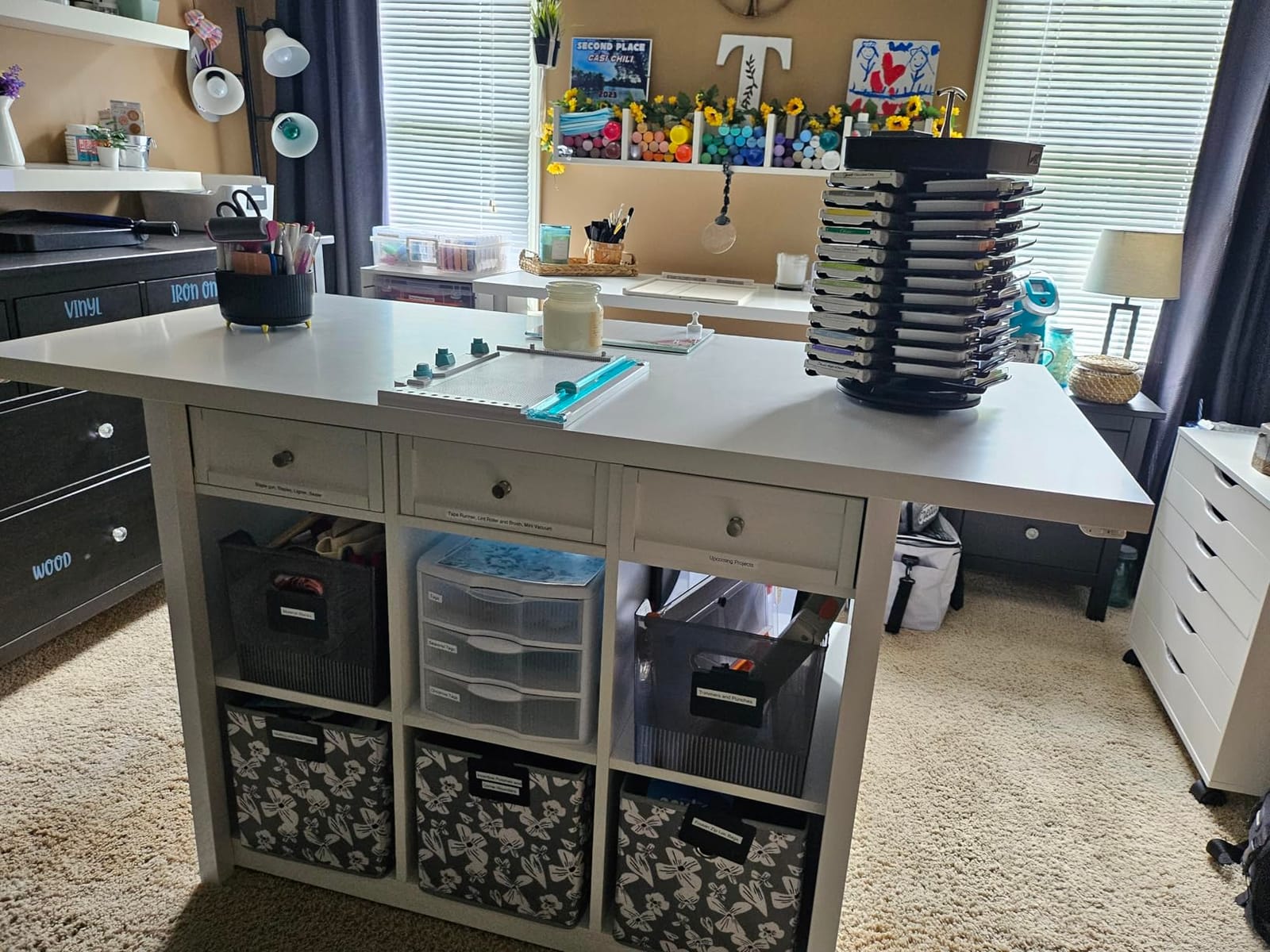
Storage is the quiet strength. Three removable drawer boxes open from both sides, so you can reach notions from either chair, and six open shelves hold fabric and bulk supplies where you can see them at a glance. Open shelving sounds like a compromise until you are hunting for a specific print at eleven at night.
The 50 lb recommended load is a sensible figure for machines, irons and fabric bolts. White engineered wood suits transitional through modern rooms, and the 5-year limited parts warranty is the same cover the rest of the Sauder range carries.
Best for quilting layouts
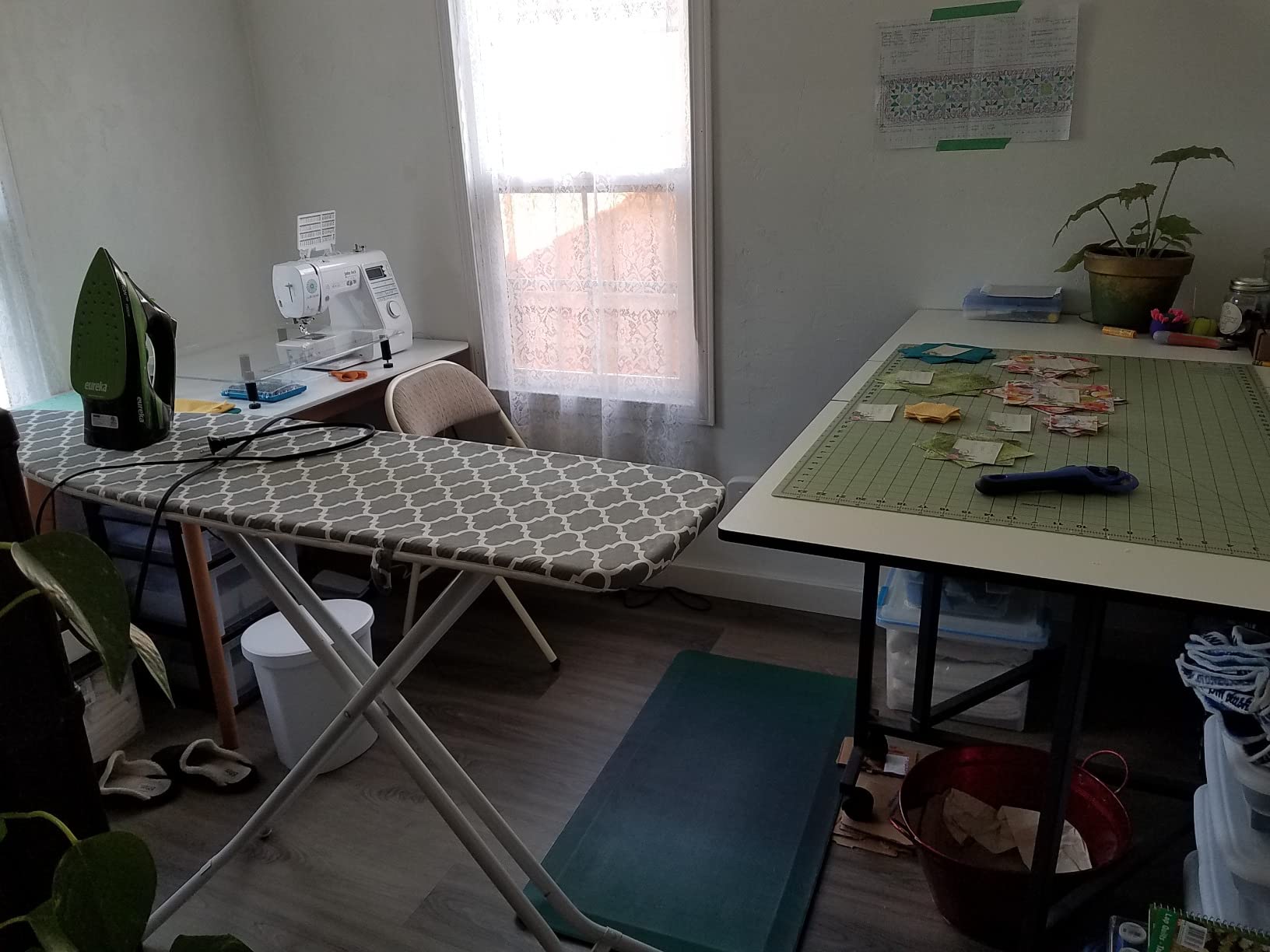
Nothing else in this list gives you a surface long enough to work on. If you cut full-width fabric strips or need to lay a quilt top flat, the 60-inch top removes a step that fold-flat cabinets force on you.
It is also the natural companion piece to a dedicated sewing cabinet, giving you a cutting station and a sewing station instead of trying to make one surface do both jobs.
Where it falls short
It is not a cabinet. Everything stays visible, which is a problem in a shared room and a benefit in a dedicated craft space. There is no door, no drawer closure against dust and no concealment of a machine in progress.
Weight is the other issue. At 164.5 lb it is not a one-person job, and you need to decide where it lives before it arrives, not after. Owners also pair this table with frequent complaints about assembly time.
4. BOWERY HILL Drop-Leaf Sewing Table – Best Value Long-Surface Cabinet
BOWERY HILL Engineered Wood Drop-Leaf Sewing or Craft Table with Melamine Top Surface, Storage Behind Roll-Open Door, Easy-roll Casters in Soft White
19.5D x 62.25W x 28.5H
75 lb capacity
Melamine top
Two adjustable shelves
Pros
- Melamine top resists heat
- stains and scratches
- 62-inch footprint gives a long uninterrupted run
- Roll-open door closes in one gesture
- Two bins plus a machine shelf behind the door
Cons
- Tambour door is less convenient than a hinged door
- Heavier and less mobile than lighter cart designs
- Fewer finishing touches than furniture-grade cabinets
This is the one to buy when you want a long sewing surface and a closed cabinet but do not want to climb into the premium lift category. The 62.25-inch width is unusual for a cabinet of this size, and it gives you room for a large machine plus a cutting mat without a separate table.
The melamine top is the quiet hero. It is rated heat, stain and scratch resistant, which matters when you are pressing fabric, setting a hot iron down or working with rotary cutters. Finishes that need careful handling are fine until the first dropped rotary blade.
Behind the roll-open door sit two storage bins and a sewing-machine shelf, with two adjustable shelves above. The tambour door hides the whole interior in one gesture, so the cabinet looks like a sideboard when you are done, which is the point.
At 73 lb it is heavier than a plastic-and-steel cart, so plan the move as a two-person job. It carries no Prime badge, so the seller sets its own fulfilment terms rather than using the standard programme the Prime listings use.
Best for long fabric runs
The uninterrupted 62-inch surface is what separates this from a standard drop-leaf cart. Long seam allowances, bias binding runs and row-after-row piecing all become calmer when you are not constantly rotating the work.
It also suits anyone whose machine is wide. The footprint takes a full-size machine with room around it, and the door closes over it.
Where it falls short
Tambour doors are a trade-off. They are neat when closed, but they give you less direct access to the interior than a hinged door, and you cannot prop one open with a bin of notions behind it.
Owners also note that it is heavier and less mobile than lighter cart-style units, and that it carries fewer finishing touches than comparable furniture-grade cabinets. If you intend to move it often, this is not the design for that.
5. Arrow K8405 Wallaby Kangaroo Cabinet – Best for Quilting with a Real Lift
Arrow K8405 Wallaby Kangaroo Sewing, Cutting, Quilting, Crafting Cabinet and Table, Includes Storage and Airlift, Portable with Wheels, Teak Finish
43D x 30W, 14.5 inch minimum height
55 lb lift capacity
Three-position hydraulic lift
33 spool holders
Pros
- Three-position lift moves between free arm
- flat bed and storage
- Quilt leaf and serger leaf add real working area
- Dedicated storage with 33 spool holders
- Locking doors and portable wheels
- Lifetime warranty
Cons
- Four-figure cost against flat-pack alternatives
- Pressed panels can crack around cam-lock holes
- Assembly is long and needs two people
This is where the category stops being furniture and becomes equipment. The Wallaby is built around a three-position hydraulic lift, so the machine travels between free arm, flat bed and storage without you touching the machine itself. Once you use that, a drop leaf feels like a compromise.
The rear quilt leaf is the second reason to look here. It extends the work surface behind the machine for large projects, and the separate serger foldout leaf means a second machine has a real home instead of competing for the same 30-inch width.
Storage is genuinely designed rather than retrofitted. Thirty-three spool holders, a large door bin and a dedicated notions drawer mean thread is stored where a hand can reach it. Full-view soft-closing drawers, locking cabinet doors and locking wheels complete a package that reads as a sewing room centrepiece.
Who should buy a lift cabinet
Sewists who sew often, sit for long sessions, or own a machine heavy enough that lifting it is a real consideration. The flatbed position alone changes posture, because the machine sits at working height rather than on a table you lean across.
Owners on r/quilting recommend Arrow cabinets by name, including older and discontinued models, and Missouri Quilt Co forum members point newcomers toward Arrow, Horn of America and Koala as the credible specialty brands when a budget will not stretch far. That is the shortlist the wider sewing community actually trusts.
Where it falls short
The 4.0 average on a small review base tells you the concept lands and the execution is uneven. Owners report finish cracking around cam-lock holes during assembly, and the panels are pressed engineered wood rather than solid timber.
Assembly is a genuine project for two people, and the hydraulic lift is the most expensive single component in the category. A hydraulic lift needs periodic lubrication, and no piece of furniture should surprise you with a repair bill later. Owners who reach this price point treat it as a long-term centrepiece, and that expectation is part of the deal.
6. Kangaroo and Joey K8805 Cabinet – Best for Serger Setups
Kangaroo Kabinets K8805 Kangaroo and Joey, Sewing Cabinent and Three Drawer Storage Unit, Teak
55W x 21D x 29.5H closed
40.5 inch depth with quilt leaf open
Fits machines to 22 inch wide
Electric lift
Pros
- Two-cabinet layout runs a main machine and serger side by side
- Rear Joey table gives a dedicated fabric surface
- Four drawers for notions and fabric
- Caster locks hold position on carpet
Cons
- Assembly often runs seven hours or more for two people
- Assembly videos play too fast to follow
- Some pieces arrive with a damaged back panel
- Caster locks and drawer alignment can be off after assembly
If you run two machines, this is the geometry that solves it. The main cabinet and the Joey three-drawer storage unit sit side by side, so a serger has its own space rather than sharing a 30-inch top. That single layout decision is what no fold-flat cart in this list can replicate.
Behind the machine, the Joey unit doubles as a fabric surface, and a quilt leaf extension of roughly 25.75 by 16.5 inches opens the working area further. Closed, the pair measures 55 inches wide by 21 deep by 29.5 high; open with the quilt leaf, depth reaches 40.5 inches, so measure your floor space before committing.
Fit for the machine you already own
Cabinets specify two numbers that matter more than any feature list: the lift opening and the maximum machine weight. This model accommodates machines up to 22.125 inches wide by 11.125 deep by 13.875 tall, and the electric lift handles the raising. Measure your machine before ordering, because an insert that does not fit ends the project early.
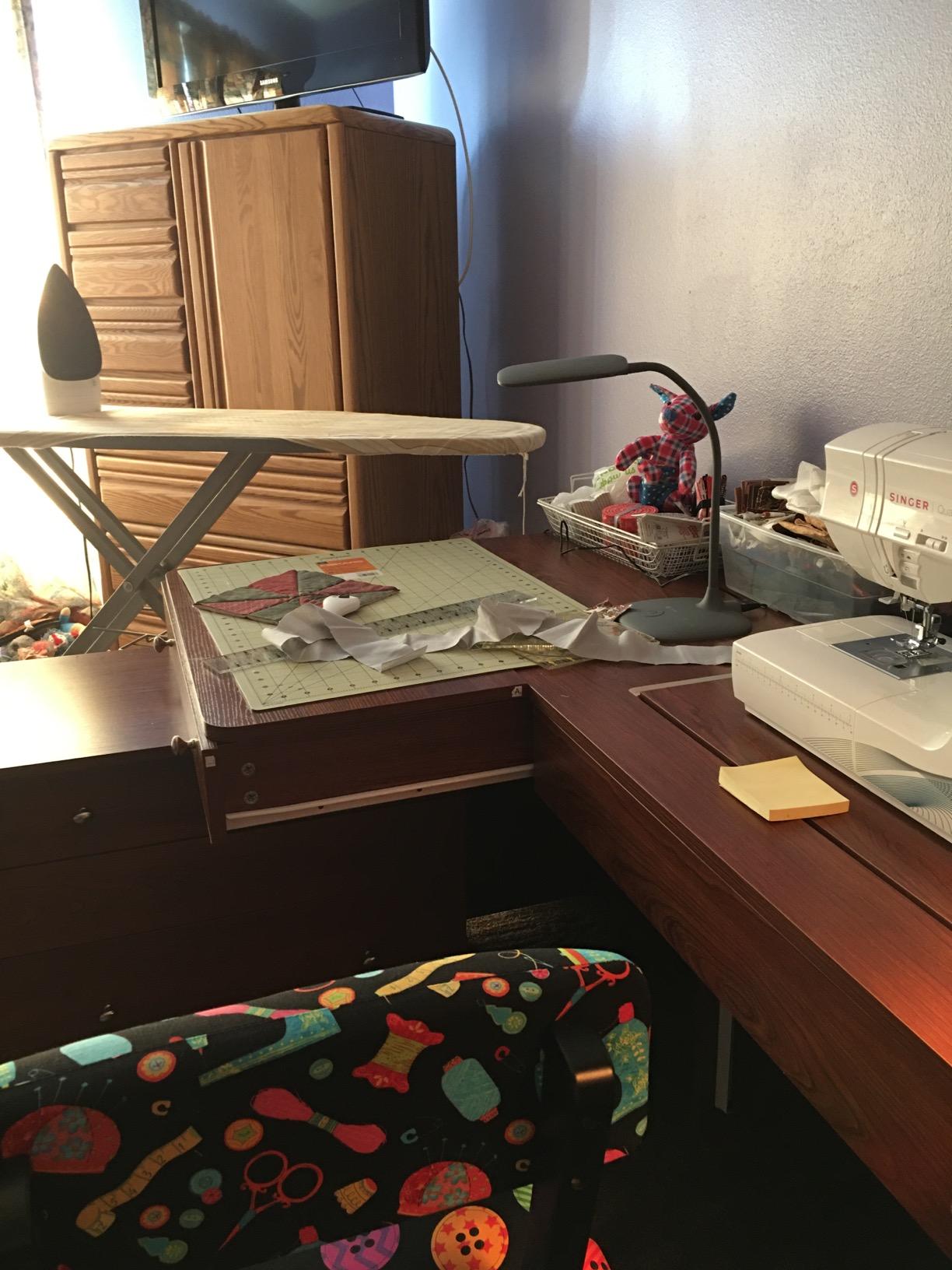
Storage volume is listed at 94.2 litres across six compartments and three drawers, with a fourth drawer in the Joey unit. Caster locks are fitted on both pieces so the setup stays put on carpet while you sew, and the Teak finish is available in White Ash as an alternative.
The two-cabinet arrangement is the reason buyers choose this over a single lift cabinet. A serger on its own Joey table keeps a bulkier second machine out of the main cabinet’s footprint, so the machine well stays at its intended width and the lift operates within its rated range.
Where it falls short
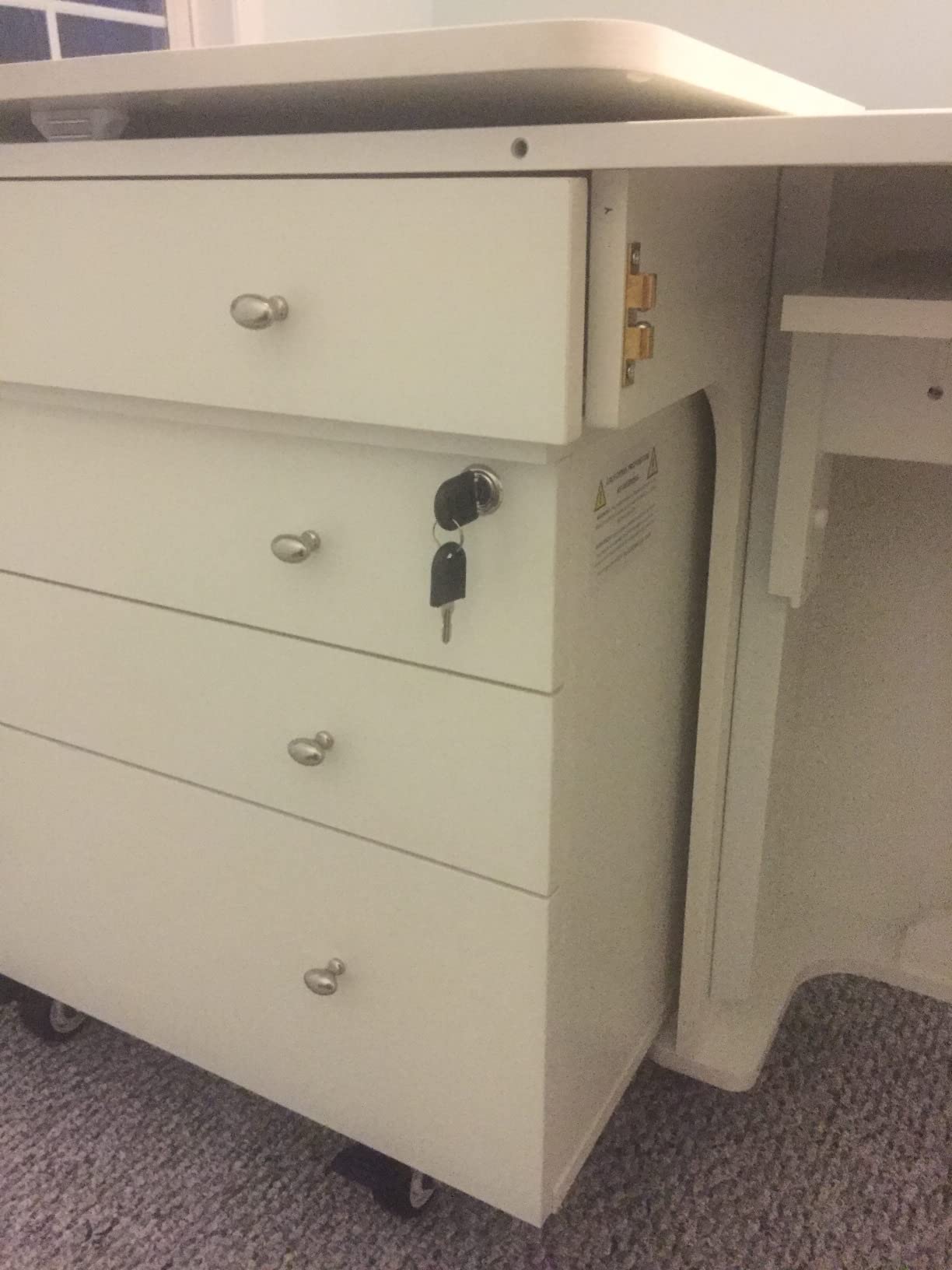
Assembly is the headline complaint, and the number owners give is seven hours or more for two people. The assembly videos run too fast to follow, which means you are working from printed diagrams in a teak-finish carcass with many panels to align.
Some pieces arrive with a damaged or unusable back panel, and owners report caster locking and drawer alignment needing adjustment after assembly. The teak finish also chips at the edges, so treat the surface carefully during the build.
7. Magshion 60-Inch Sewing Table – Best Budget Workspace with a Steel Frame
Magshion 60″ Sewing Machine Table with Storage, Heavy-Duty Sewing Desk with Adjustable Shelf, 3 Drawers and Open Grid Shelf, Multi-Use Sewing Cabinet & Craft Table, 305-Lb Capacity, Black/White
23.5D x 60W x 29.5H
305 lb steel frame capacity
Six-position adjustable machine platform
0.7 inch tabletop
Pros
- Height-adjustable machine platform suits shorter sewists
- Steel frame and 305 lb rating exceed the price
- Many buyers assemble it in about 30 minutes
- Doubles as a computer or study desk
- Long 60-inch surface fits fabric and a cutting mat
Cons
- Fabric-style drawers feel cheap and lack internal support
- Particle board top and lower shelf can crumble
- Adjustable platform can wobble
- Not deep or wide enough to be a dedicated cutting table
The distinguishing feature here is the height-adjustable machine platform with six positions, which doubles as a laptop or keyboard tray. For a shorter sewist, that solves a problem no cabinet in this list addresses: getting the needle to a comfortable height without a riser under the chair.
It also goes the other way. If you are tall and tired of hunching, raising the platform brings the work to you, and the same tray takes a laptop when the machine is covered.
The frame is the second argument. A powder-coated alloy steel frame rated to 305 lb sits under a 0.7 inch tabletop, with six floor levelers for uneven floors. That is a genuinely different construction approach from the engineered wood carcasses elsewhere on this list, and it is why the desk does not wander when you sew fast.
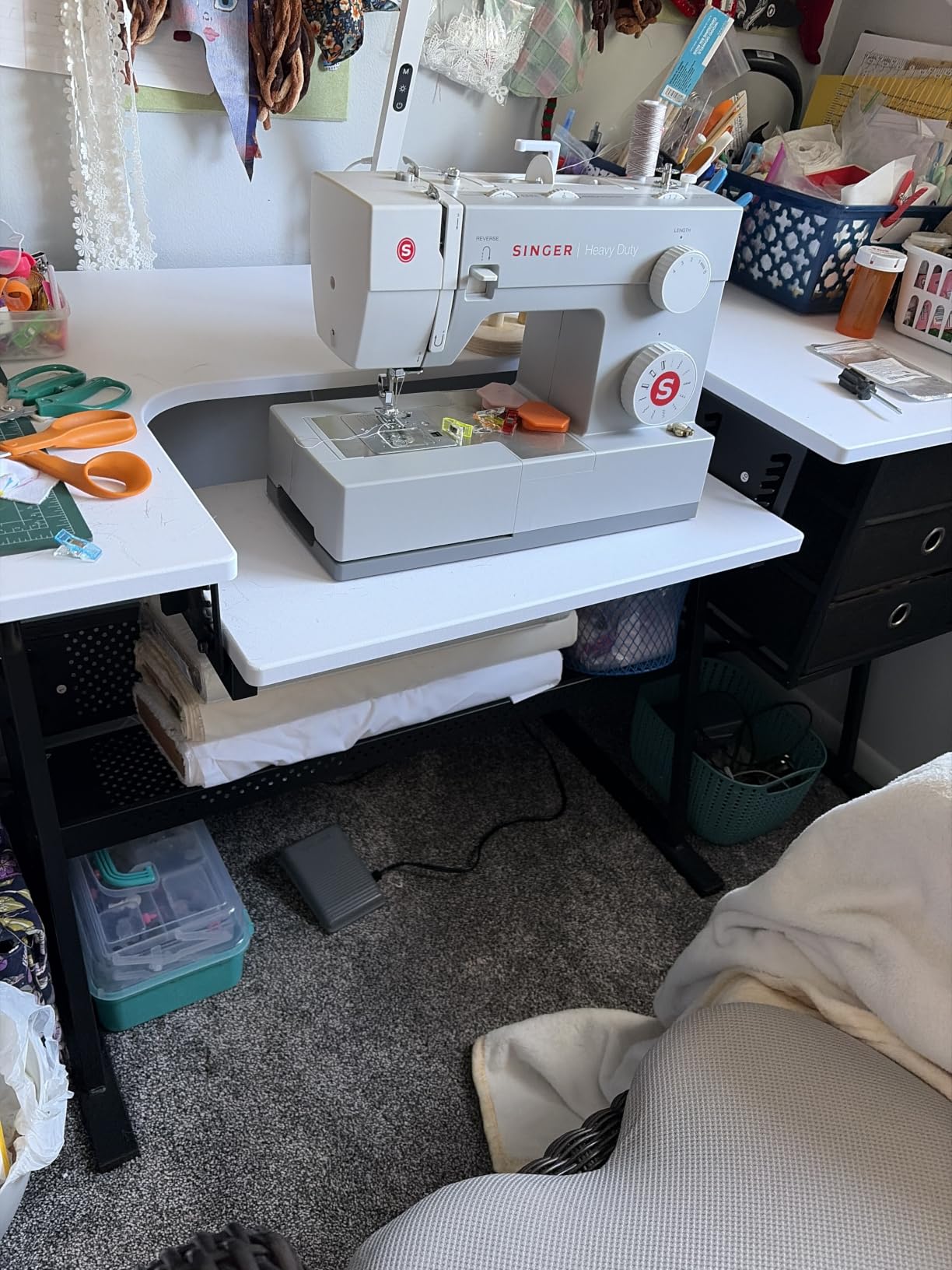
A 9.5 inch foldable side shelf adds a little more surface when a bulky project needs the room, and this listing carries the Prime badge the non-Prime cabinet listings further up this page do not.
Best for a multi-use room
As a sewing table it competes with craft desks and study desks, and at 60 inches wide with a 73.4 inch surface diagonal it handles a cutting mat and fabric spread. Three drawers rated at 6.6 lb each take notions, and a lower open grid shelf stores fabric rolls and bulk supplies.
Many buyers assemble it in about half an hour, and two people are recommended. That is a completely different commitment from a lift cabinet, which makes it a realistic first cabinet for a renter or a student who may move again in a year.
Where it falls short
The soft parts are the weak parts. Owners describe the fabric-style drawers as cheap and lacking internal support, and the particle board top plus tongue-and-groove lower shelf can crumble or come apart under normal loads of fabric books.
Two more cautions: the adjustable platform can wobble, and the lower shelf bracket holds poorly. Owners also note it is not wide or deep enough to serve as a dedicated cutting table, so plan a separate cutting surface if you quilt.
8. Arrow Harriet Hydraulic Lift Cabinet – Best for a Real Hydraulic Lift
Arrow Classic Sewing Furniture Harriet Full-Size Sewing Cabinet with Hydraulic Machine Lift, Drawers, Expandable Leaves, Locking Wheels – Ash White
19.87D x 82.68W x 30.5H
55 lb lift capacity
Three-position hydraulic lift
10-year limited warranty
Pros
- 82-inch work surface for large sewing and quilting
- Four deep drawers for notions and accessories
- Hydraulic lift accepts machines up to 55 lb
- Locking casters hold the cabinet steady
- 10-year limited warranty
Cons
- Pressed panels and white finish chip around cam-lock holes
- Drawer pilot holes can be misaligned
- Machine tray can wobble under a heavy machine
- Some units arrive with wrong assembly instructions
The Harriet is the most conventional sewing cabinet in this roundup, and that is a recommendation. It is 82.68 inches wide with a 19.87 inch depth, so the machine sits in a proper sewing well and the work surface extends to both sides, with expandable leaves for when a quilt block needs more room than the machine.
The lift is a three-position hydraulic unit rated to 55 lb, moving the machine between free arm, flat bed and storage. As with the other lift cabinets here, it is compatible with custom acrylic sewing inserts if you want the surface to sit flush rather than leaving a step under the presser foot.
Storage is the reason this cabinet earns its size. Four large drawers on the right hold notions and accessories, and there are four interior embroidery hoop storage hooks plus a large storage cubby. The 10-year limited warranty is longer than the Sauder range offers and far longer than a typical flat-pack table.
Heavy-duty locking casters give the stability a lift cabinet needs, because a machine at free-arm height under load will find any wobble in the frame. Ash White suits a bright craft room.
Who this is right for
Sewists who already know they want a hydraulic lift and have the floor space for 82 inches. The drawer depth suits bulk notions, fabric and accessories, and the hoop hooks are a small detail that only matters if you own an embroidery machine.
If you have a heavy machine, check its weight against the 55 lb lift rating before ordering. That single number, plus the machine’s physical dimensions against the opening, decides whether the fit works.
Where it falls short
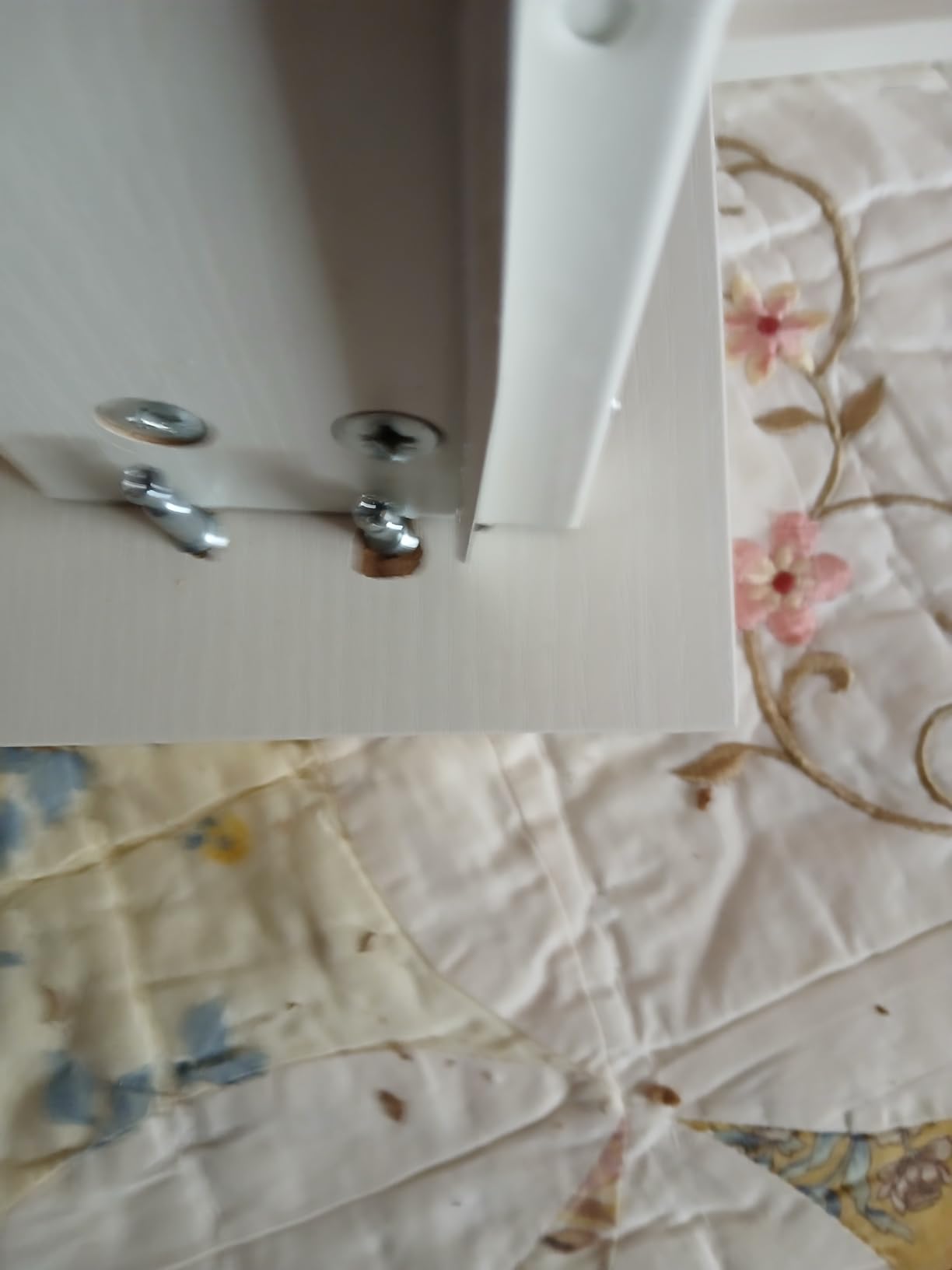
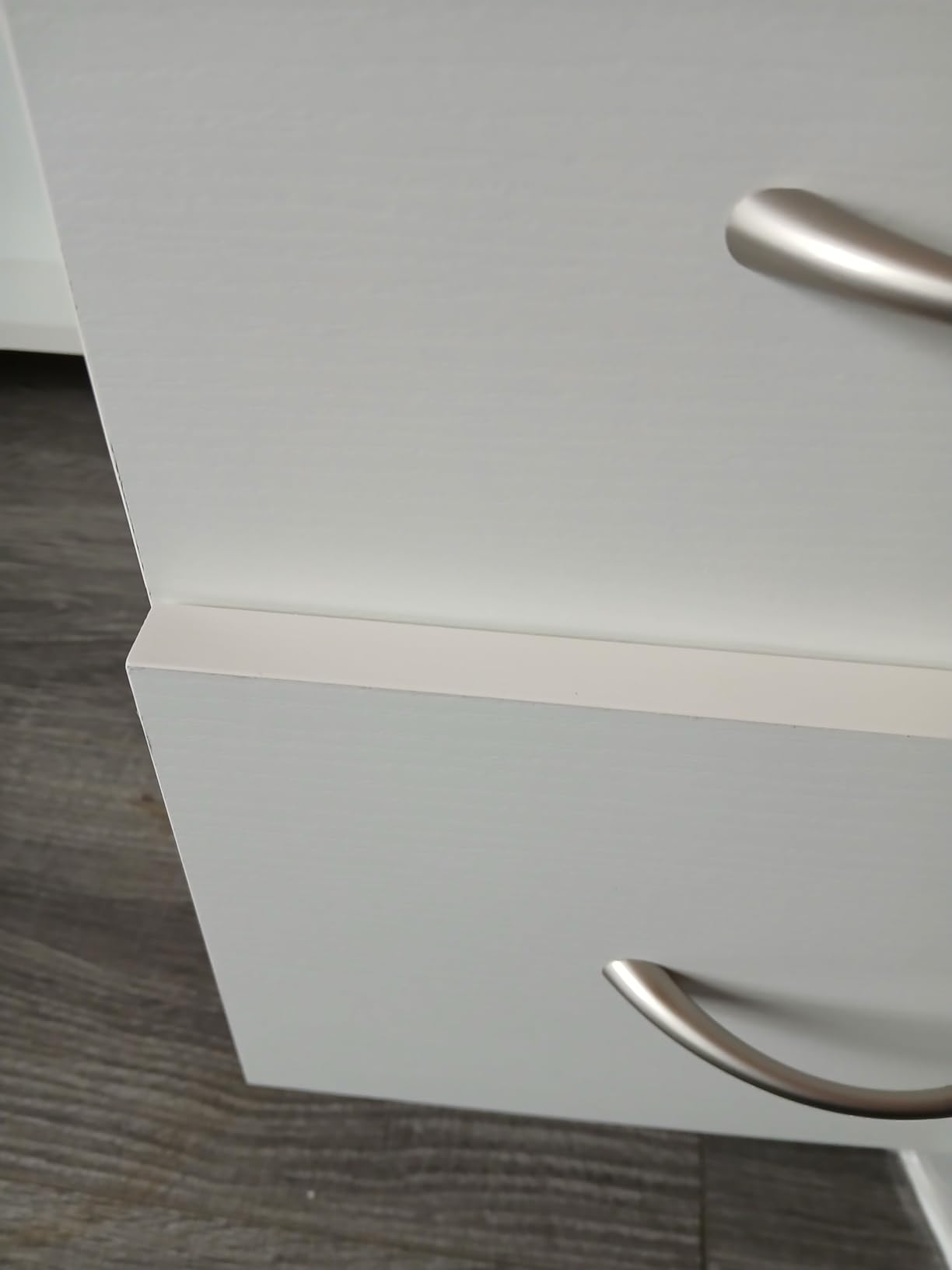
Pressed wood panels in a white finish chip and crack around cam-lock holes during assembly, and that is the most common negative review. Drawer pilot holes can be misaligned, leaving drawers crooked or unable to close, and the machine tray can wobble under a heavier machine.
Some units also arrive with incorrect assembly instructions. At 82 inches wide this is not a one-person move, so confirm your floor space and your doorway before ordering.
9. Sew Ready Folding Craft Armoire – Best for Small Footprints
Sew Ready Folding Craft Armoire Cabinet – 58.75″ Tall Multipurpose Workstation with Drop-Leaf Table, Wheel, Powder-Coated Steel Frame, Charcoal/White
12D x 24.5W x 58.75H
22.75W x 27.25D fold-down top
25 lb work surface limit
Ready assembled
Pros
- Arrives fully assembled and rolls into place
- Only 24.5 inches wide
- Steel frame feels sturdier than the price suggests
- Fold-down table is stable with the swing leg locked
Cons
- Fiberboard panels chip or break at connection points
- Shelves do not sit flush with the cabinet back
- Doors cannot swing clear of the open tabletop
- 76.8 lb weight needs two people to position
The narrowest footprint here at 24.5 inches wide and 12 inches deep makes this the practical answer to a small apartment or a studio where a 60-inch table simply cannot go. At 58.75 inches tall it has real vertical presence, and the closed doors mean it reads as a storage piece rather than a workstation.
The feature that changes the buying decision is that it arrives fully assembled. You roll it into position, extend the fold-down tabletop of 22.75 by 27.25 inches, lock the swing-leg caster, and sew. No flat-pack build, no missing pilot holes, no six-hour Saturday.
Best for apartment sewing
Small rooms are where most sewing gets abandoned, and this design removes both obstacles: space and setup. Nine enclosed shelves plus a large bottom compartment take notions and fabric, and the fold-down top hides completely when the room is needed for something else.
Owners like the powder-coated steel frame with adjustable levelers, which is more stable than a comparable engineered wood carcass of the same size. If you rent, this is the easiest unit on the list to move between homes.
Where it falls short
The 25 lb work surface limit is the constraint to understand. It suits a standard home machine, not a heavy or large one, and a serger plus main machine will not fit on a 22.75 inch top.
Owners also report fiberboard panels chipping or breaking at connection points, shelves that do not sit flush with the back panel so small items can fall through the gap, and top doors that cannot swing fully clear of the open tabletop. One reviewer recommends a wall bracket that is not included, so anchor it yourself if the cabinet stands in a busy corner.
10. Furnivio 71-Inch LED Craft Cabinet – Best for Craft Storage and Low-Light Work
Furnivio Craft Cabinet with Storage – 71″ Sewing Cabinet with LED Lights, Adjustable Shelves, Hobby Storage Cabinet for Craft Room, Food Pantry Cabinet for Kitchen, Dinning Room or Living Room
15.4D x 31W x 71H
Built-in LED light strip
Five shelves
Stain-resistant laminate
Pros
- Integrated LED strip lights detailed work at night
- 71-inch height uses vertical space well
- Laminate surfaces wipe clean after craft spills
- Doubles as pantry or hobby storage elsewhere
Cons
- No fold-out work surface
- so a separate table is still needed
- Shelving is fixed on this version
- 95.7 lb weight makes it awkward to move alone
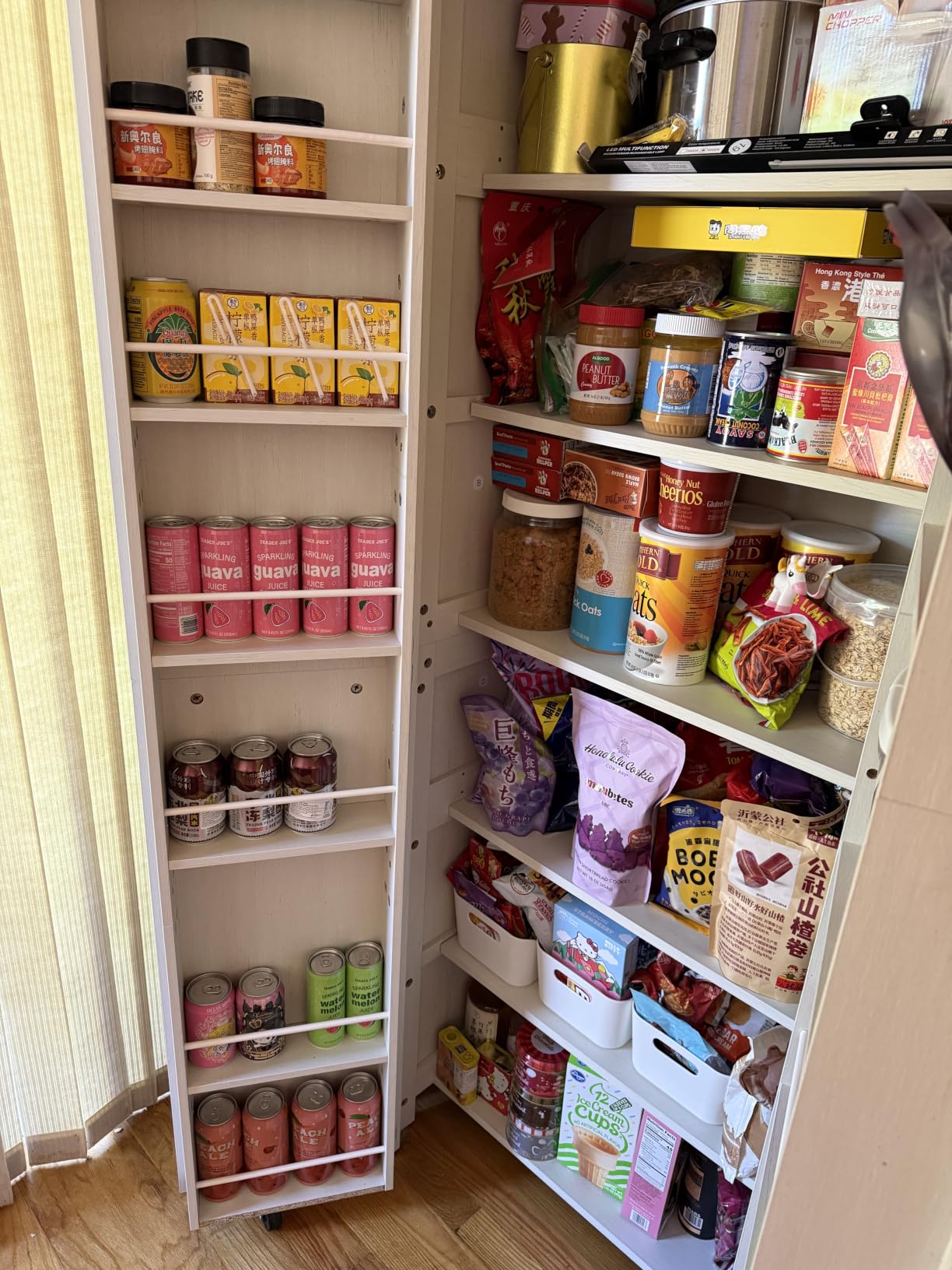
This is a storage cabinet with a sewing label rather than a workstation, and that is a legitimate choice for a mixed craft room. At 71 inches tall and 15.4 inches deep it is a narrow vertical column, so it stores fabric, kits and machines without claiming floor area.
The built-in LED light strip is the reason it earns a place on a sewing list. Evening handwork and detail stitching suffer badly under a room light, and owners single the strip out as the feature that made the cabinet worth buying. Energy-efficient LEDs mean leaving it on during a long session is not a concern.
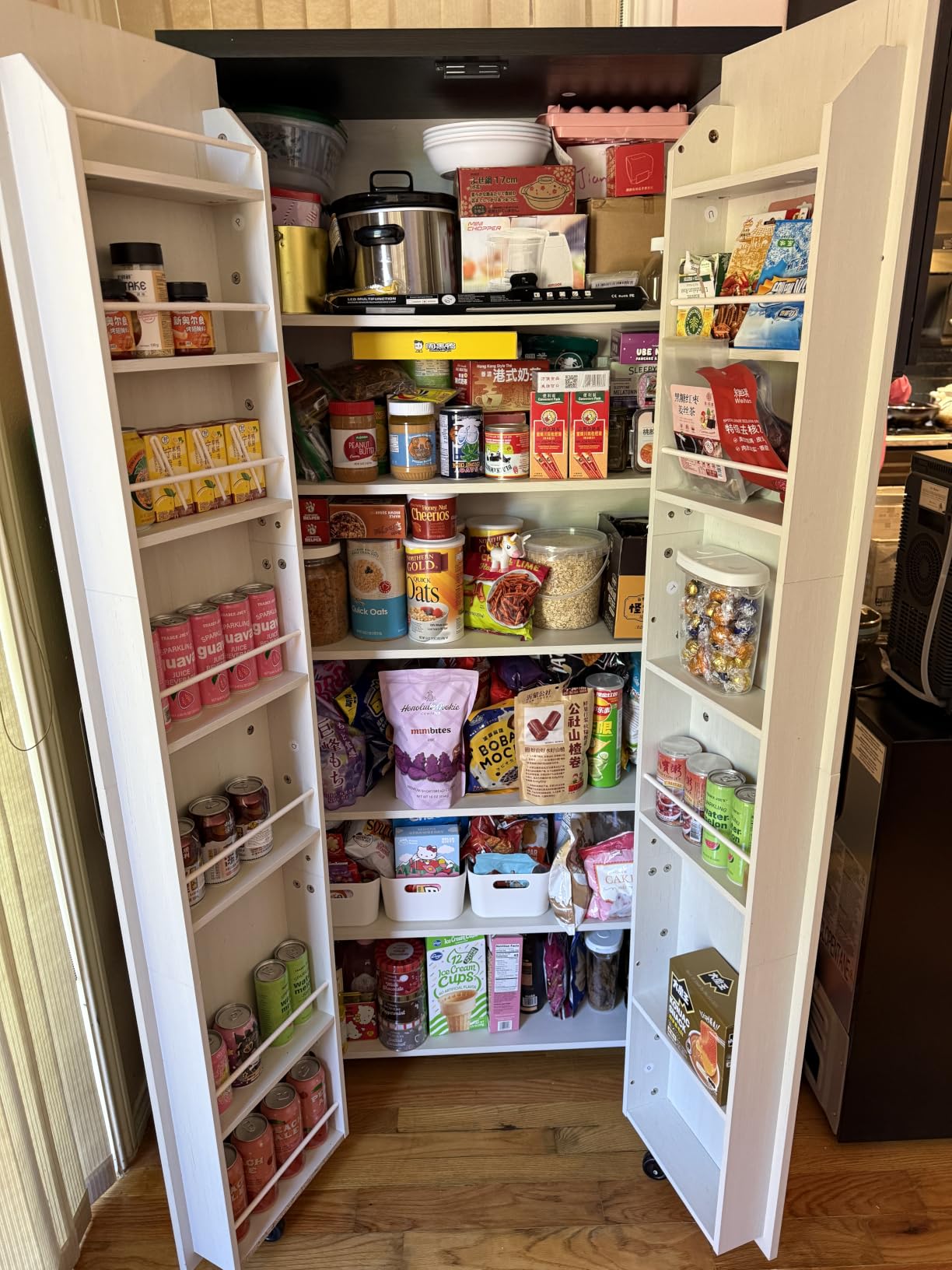
Five shelves carry sewing machines, fabric stacks and paint bottles, with scratch- and stain-resistant laminate surfaces that wipe clean after a craft spill. The Shaker door style and white grain finish sit comfortably in a kitchen, dining room or living room, and the listing explicitly covers use as a pantry or hobby cabinet outside the craft room.
The review base is small at 23 owners, so treat the details with normal caution and confirm the finish and shelf layout in person if you can.
Who should pair this with a sewing table
Sewists who want machine storage and supply organisation away from the work surface. Keep the cabinet along a wall and pair it with one of the folding tables earlier in this list, ideally within a few steps so the machine move stays short.
It is also useful as overflow storage once fabric starts multiplying, since a craft room rarely runs out of vertical space before it runs out of horizontal space.
Where it falls short
There is no fold-out work surface. You still need a separate sewing table, and this cabinet does not solve the setup problem on its own. If you buy it expecting a complete workstation, you will be disappointed.
The second gap is a mismatch between the marketing and the unit: buyers report the shelving is fixed on this version despite adjustable-shelf claims. At 95.7 lb it is also awkward to reposition alone, so place it first and keep it there.
How to Choose the Best Sewing Cabinet for Your Home
There are four cabinet types, and the difference between them matters more than any finish option. A fold-flat design collapses into a side table and is the cheapest way to get a machine off the dining surface. A lift cabinet raises the machine on a three-position platform between free arm, flat bed and storage. An armoire closes its doors to hide the workspace. A cutting table is a large open surface with storage beneath and no machine lift at all.
Next, the lift itself. A manual platform means you lift the machine yourself. A hydraulic lift uses a spring-loaded piston and moves between the three positions with a handle, and it needs periodic lubrication to stay smooth. An electric lift uses a dual-rail motor drive and is the quietest option, with fewer positions to judge by eye. Hydraulic is the traditional choice and the easiest to service; electric is the modern choice and the most hands-off.
Machine fit comes down to two numbers, and buyers who skip them are the ones who end up with a cabinet they cannot use. Measure the machine’s weight against the lift capacity, which on the cabinets here is commonly 55 lb, and measure the machine body against the lift opening, including any handle or spool pin that sticks up. Custom acrylic inserts can make the surface flush, but an insert is an extra purchase and only worth ordering once the fit is confirmed.
For the work surface, think about what you actually do. Garment sewing needs less width than quilting. A quilting cabinet wants a quilt leaf at the rear and a serger foldout leaf at the side. A cutting table is not a cabinet, and pairing a compact cabinet with a large cutting table is often a better use of money than buying one oversized piece.
Storage should be measured against your notions, not your ambition. Two storage bays and a door bin suit one machine plus everyday supplies. Six adjustable shelves suit fabric bolts and kits. Drawer depth matters more than drawer count, because notions storage means bobbins, thread and hardware, all of which are small but numerous.
Mobility is where the cheap and expensive designs diverge most clearly. Lockable casters matter in a shared room, and caster locks that engage reliably matter more than the number of wheels. Owner complaints across this category repeatedly mention doors that will not close with the machine stored inside, usually because door bins overhang, so check that before ordering.
Before you order anything, take four measurements. First, the narrowest point of every doorway and hallway on the route into the room. Second, the cabinet depth plus the extra clearance needed with the front door or tabletop open. Third, your ceiling height, since tall armoires are often described with a height that does not include the carton. Fourth, your seated knee-toe depth, so your knees clear the machine well while you sew.
On the brand question: sewing cabinets come from a small number of specialist makers, plus a large marketplace furniture trade that sells sewing-shaped tables. Sewists ask who makes the real cabinets, and the names that come up on forums are Arrow, Horn of America, Koala and Kangaroo. Members of the Missouri Quilt Co forum point newcomers toward Arrow, Horn and Koala as the credible specialty brands when a budget is tight, and r/quilting users recommend Arrow by name, including older and discontinued models. Koala appears in the same specialist tier. Warranty length is the most honest signal of build quality: a lifetime warranty on the Arrow K8405, a 10-year limited warranty on the Arrow Harriet and 5-year limited parts warranties on the Sauder units describe a real difference in how long the makers expect the cabinet to last.
One more issue worth knowing before you buy: some cabinets are listed by several different dealers, each with its own terms and return policy, and dealer credibility matters as much as the model. Larger authorised dealers and specialist sewing stores are treated as safer than unbranded third-party sellers. When a listing has several sellers, check which one is authorised and what their return window actually is.
Finally, be honest about assembly. Owners across sewing forums and Reddit describe two to six hours on flat-pack cabinets, needing a second person, and occasionally meeting misaligned or missing pilot holes. Screwdriver-level flat packs with pre-drilled holes and labelled hardware bags are the fast ones. Anything arriving fully assembled is the fastest, which is why the Sew Ready armoire on this list is worth a look even though its work surface is limited.
Frequently Asked Questions
Are Horn sewing cabinets any good?
Horn of America is one of the specialist cabinet makers sewists name most often on forums, alongside Arrow and Koala, and members of the Missouri Quilt Co forum point beginners toward those brands when a budget is limited. Horn cabinets typically run into the upper price band of the category and carry longer warranties than flat-pack sewing tables. If you are weighing a Horn against an Arrow, compare the lift type and the machine fit numbers first, then the warranty length.
Who makes sewing cabinets?
The specialist makers are Arrow, Horn of America, Koala and Kangaroo, and Kangaroo cabinets are built under the Arrow Sewing Cabinets brand. Below that tier, large furniture makers such as Sauder sell sewing-shaped carts, tables and armoires, and marketplace brands sell steel-framed sewing desks. Forum sewists consistently treat the specialist brands as the credible choice for a lift cabinet and the furniture brands as the sensible choice for a fold-flat table.
What is the best cutting table for sewing?
For most home sewists, a dedicated table of 60 inches wide or more is the best cutting table, because it lets you spread a full fabric width flat. The Sauder 60-Inch Craft Pro Table on this list is the clearest example, with a 30 inch depth that accepts a full cutting mat. A narrow drop-leaf cabinet is a working surface, not a cutting table, and owners of those units report it cannot handle a large mat. If floor space is tight, pair a compact cabinet with a separate cutting table rather than buying one oversized piece.
What is the best height for a sewing table for cutting?
Around 36 inches is the standard cutting height, which is the height of the Sauder 60-Inch Craft Pro Table and close to the 30 inch seated working height of most fold-flat carts. If you prefer to cut standing, build a surface at your own elbow height instead of buying to a catalogue figure, and check that your cutting mat matches the tabletop depth. For seated machine work, a cabinet with a lift solves height more precisely than a fixed table does.
What is the difference between a sewing cabinet and a sewing table?
A sewing table is an open surface for a machine, with storage underneath if it has any. A sewing cabinet is built around the machine: it stores it, hides it behind doors when closed, and often raises it on a lift to a working height. That lift is the main functional difference, along with the enclosed storage and the ability to look like furniture. If you sew rarely or in a shared room, a table is usually enough. If you sew often, the cabinet removes the setup step entirely.
Final Verdict on the Best Sewing Cabinets in 2026
The best sewing cabinets for most people in 2026 start with the Sauder drop-leaf cart, because it is the easiest way to stop sewing on the dining table. Quilters who need a real cutting surface should look at the Sauder 60-Inch Craft Pro Table, and sewists who run two machines need the Kangaroo and Joey two-cabinet layout. Only buy a hydraulic lift cabinet such as the Arrow Harriet or the Wallaby if you already know you will sew several times a week. Whichever you choose, measure the machine, the doorway and the floor before you order, because those three numbers decide more than the finish ever will.
If you are still choosing the machine itself, our [computerized sewing machine reviews](https://eatcreatesleep.net/best-computerized-sewing-machines/) cover the computerized formats that suit these cabinets best.