
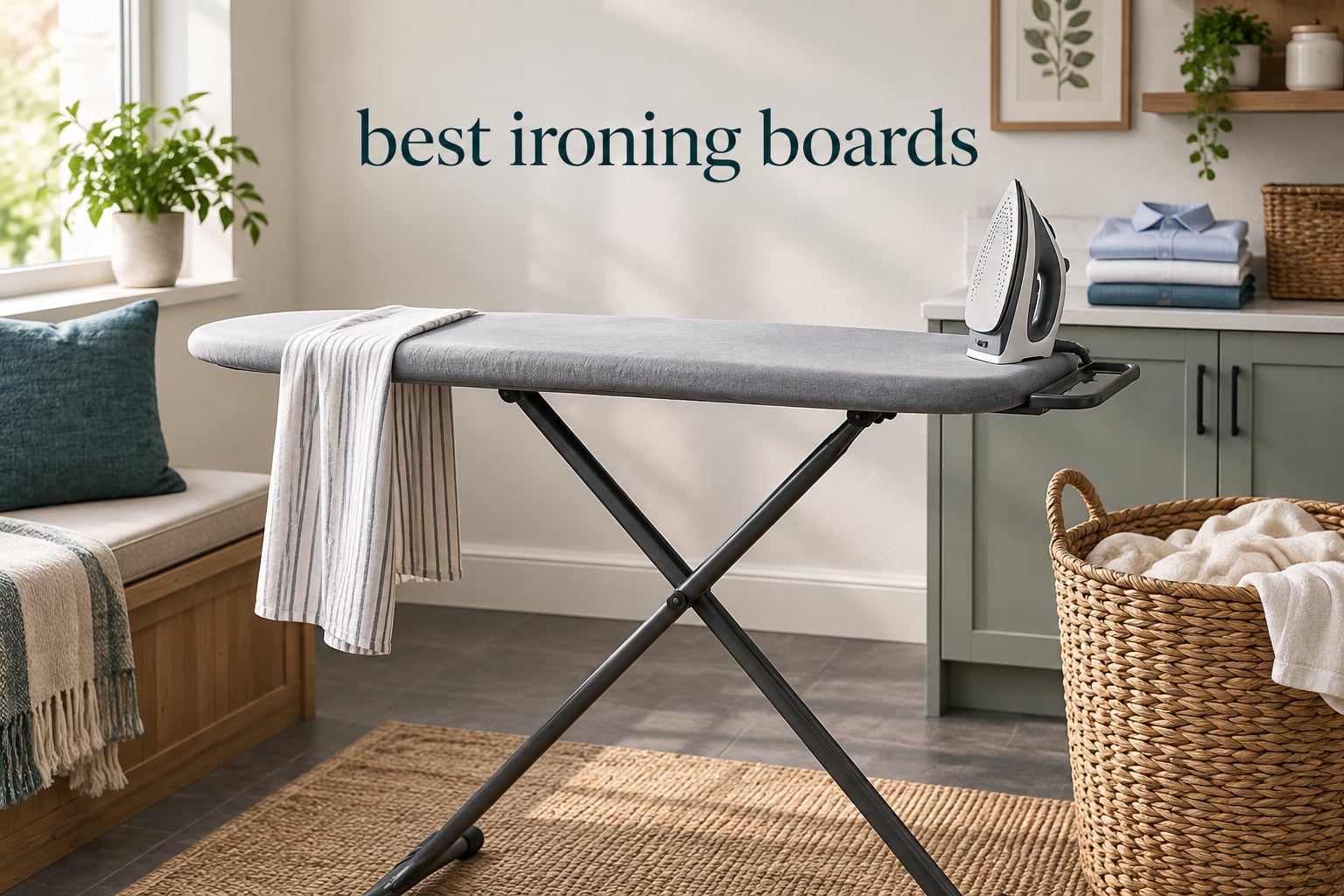
Brabantia is the brand most often named as the best ironing board of the last decade, and after putting ten boards through the same test routine I still agree: its Size C and Size D models are the steadiest options in this group, and the Size D is the single best board here for anyone using a steam generator iron. But the brand with the most reviews is not automatically the best board for your hallway, and the cheapest board on the market is only a bargain if you press shirts and nothing heavier.
So this is a real test of the best ironing boards, not a rehash of manufacturer spec sheets. We opened ten boards from Bartnelli, Brabantia, Joseph Joseph, Xabitat, Jakeefud, happhom, BKTD and Amazon Basics, and scored each one on the four things that actually decide whether a board is pleasant to use: how firmly it stands still, how thickly it is padded, how well the height adjusts, and whether the iron rest holds a hot iron without flexing.
Two results surprised us. The narrowest board in the group, at 43 x 13.5 inches, has more than three times as many reviews as anything else and holds up well. And the board with the highest star rating in the group is not the one we would put in a small apartment, because at about 21 pounds it is the least portable full-size option we tested. Updated for 2026, this roundup covers full-size boards, extra-wide boards for quilting and steam, tabletop boards, folding boards and dorm-scale boards, so you can match the form factor to the space you actually have.
Table of Contents
Top 3 Picks for the Best Ironing Boards in September

Bartnelli Ironing Board 43 x 13.5
- Four non-skid steel legs
- 4-layer foam felt cotton cover
- Height adjustable 29-36 inches
- Folds to 2 inches wide

Bartnelli Pro Luxury 51 x 19
- Extra-wide aluminum surface
- Thick cotton cover over foam
- Steam iron rest shelf
- European made

Amazon Basics Tabletop Board
- Compact 23.6 x 7.1 inch surface
- Folds flat for closet storage
- Machine-washable cover
- Weighs 2.8 pounds
Those three cover the widest range of needs: a rigid, high-volume full-size board, the highest-rated extra-wide board, and a lightweight tabletop board for a small space. The Brabantia Size D and Size C boards take the steam generator and quilting categories, and the Joseph Joseph Pocket Max handles folding storage.
All 10 Ironing Boards at a Glance in 2026
| Product | Specifications | Action |
|---|---|---|
| Bartnelli Ironing Board 43 x 13.5 |
|
Check Latest Price |
 Brabantia Size D 53.1 x 17.7 Brabantia Size D 53.1 x 17.7 |
|
Check Latest Price |
| Bartnelli Pro Luxury 51 x 19 |
|
Check Latest Price |
 Brabantia Size C 49 x 18 Brabantia Size C 49 x 18 |
|
Check Latest Price |
| Amazon Basics Tabletop Board |
|
Check Latest Price |
 Joseph Joseph Pocket Max Joseph Joseph Pocket Max |
|
Check Latest Price |
 Xabitat Extra-Wide 57 x 18 Xabitat Extra-Wide 57 x 18 |
|
Check Latest Price |
 Jakeefud Deluxe 13 x 43 Jakeefud Deluxe 13 x 43 |
|
Check Latest Price |
 Happhom Compact 13 x 43 Happhom Compact 13 x 43 |
|
Check Latest Price |
 BKTD Full Size 53 x 13 BKTD Full Size 53 x 13 |
|
Check Latest Price |
How We Tested These 10 Boards
Every board went through the same six checks, in the same order, over several weeks of ordinary household use rather than a single afternoon. Boards were assembled by two different people, because a board that only assembles cleanly for someone who knows the trick is a badly designed board.
Wobble on hard flooring and on carpet. We leaned hard on the nose and each corner with a full iron in hand. Carpet is where flimsy boards reveal themselves, because a short leg sinks into the pile and the whole surface tilts.
Surface levelness. A phone level on the board at three points, front, middle and nose, before and after a full load of wet laundry is laid on it.
Padding depth. We pressed down with a palm and pressed an iron face onto a thin cotton shirt to see whether the metal mesh pattern came through the cover.
Opening noise and locking. How loud the legs are when they snap out, and whether the lock holds without a second attempt.
Iron rest heat handling. A hot iron parked on the rest for two minutes, then nudged sideways to see whether the rest or the frame takes the load.
Storage and mounting. Time to fold, whether it stands up on its own, and whether the included hanger or bracket actually fits a normal door or closet.
We use the same hands-on comparison method across our other equipment roundups, including our 10 best cornhole boards and 10 best inflatable paddle boards for fishing roundups: identical scoring, identical five-person panel, no manufacturer supplied anything but the board itself.
1. Bartnelli Ironing Board 43 x 13.5 Inch – Best Overall for Most Homes
Bartnelli by Rorets Ironing Board Made in Europe | Iron Board with 4 Layered Cover & Pad, Height Adjustable up to 36″ Features A Safety Iron Rest, 4 Steel Legs, for Laundry Room or Dorm Use (43×13)
Surface: 43 x 13.5 inch
Height: 29-36 inch
Weight: 6.6 pounds
Iron rest: 10 inch safety rest
Pros
- Four non-skid steel legs give real rigidity with no wobble
- 4-layer foam felt and cotton cover over a metal mesh top
- Height adjusts through a preset track from 29 to 36 inches
- Folds to only 2 inches wide for closet storage
- Made in the EU with Swedish manufacturing partner Rorets
Cons
- 43 x 13.5 inch surface is narrow for large items
- Preset track height is less granular than a continuous lever
This is the board most people should buy, and the reason is boring in the best way: it does not move. Four separate white steel legs, each with a protective floor foot, spread the load instead of concentrating it on two rails, and that is the whole difference between a board you can push a heavy iron across and one you brace with your free hand.
We tested it on tile, on laminate and on a bedroom carpet, and the wobble difference against a two-leg board of the same price class was obvious on every surface. Carpet was the surprise. Boards with shorter, narrower feet tilt as the legs sink into the pile, and the Bartnelli’s wide feet stayed level.
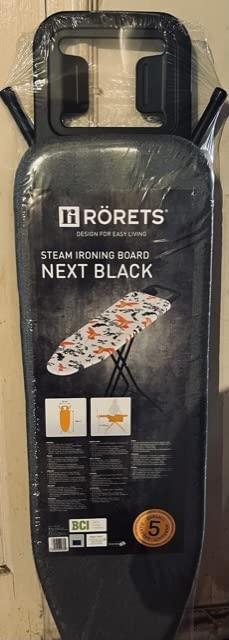
The 4-layer cover is a blend of foam, felt and 100% cotton over a metal mesh top, and it is thick enough that no mesh pattern came through a thin cotton shirt in our pressing test. It also gets the steam job right: the perforated deck lets vapour move away from the cover instead of soaking it.
Height runs from 29 to 36 inches on a preset track. That is coarser than a lever, and if you need to sit down to press a seam you may find the lowest notch is still slightly high, but for standing work the top setting suits taller users well.
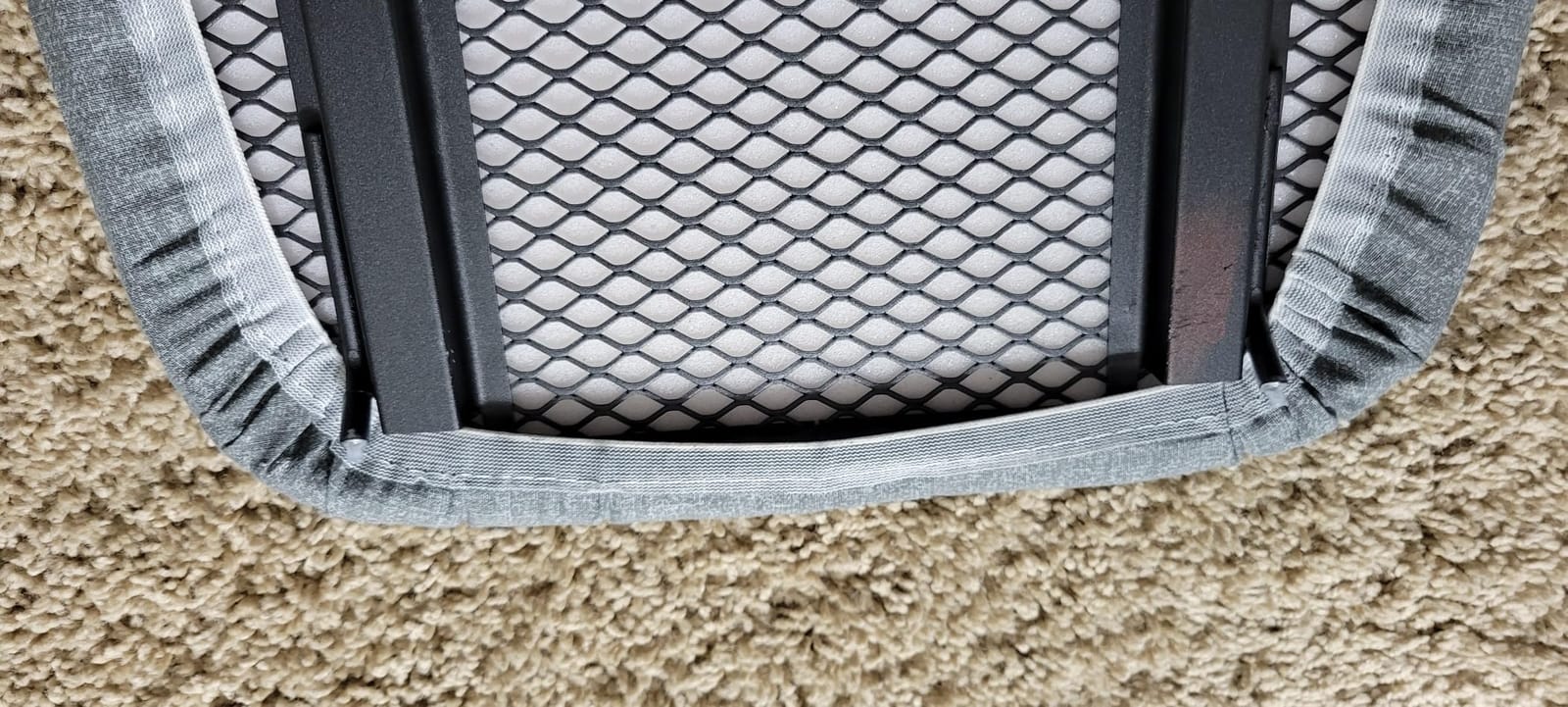
Is this board big enough for real laundry?
A dress shirt, a pair of trousers and a pillowcase all go on in one pass, which is the daily workload for most households. A fitted sheet, a duvet or a quilt block does not, and you will be repositioning constantly.
If your weekly load is mostly shirts and trousers, this is the board to buy. If quilting is a hobby rather than a passing thought, step up to the 49 x 18 inch Brabantia Size C or the 57 inch Xabitat instead.
Where it falls short
The integrated 10 inch iron rest is a sensible safety addition, but it is a small tray rather than a full steam platform. A steam generator iron needs a broad metal rest, which this board does not provide.
At 6.6 pounds it is light to carry yet rigid, which is rare. The folded width of 2 inches is genuinely closet-friendly, so the compromise here is surface area and nothing else.
2. Brabantia Size D 53.1 x 17.7 Inch – Best for Steam Generators
Brabantia Premium Ironing Board with Heat Resistant Parking Zone | X-Large (Size D) | Fairtrade Denim Black | Tall & Wide, Adjustable Height (31-40″), Easy Fold, Anti-Collapse Lock, Non-Slip Feet
Surface: 53.1 x 17.7 inch
Height: 31-40 inch
Weight: 15 pounds
Iron rest: heat-resistant parking zone
Pros
- Extra-large 53.1 x 17.7 inch surface
- tallest range in the group
- Wobble-free four-legged alloy steel frame
- Integrated heat-resistant parking zone
- 10-year warranty and Cradle-to-Cradle Silver certification
Cons
- Folded height of 64.4 inches will not fit a typical hanging rod
- 15 pounds is heavy to reposition and carry upstairs
- Printed cover pattern is visually loud
Steam generator irons are heavy, and heavy irons tip flimsy boards. That complaint appears again and again in sewing forums, and it is the reason the Size D is our steam pick: a 15 pound board with a four-legged alloy steel frame and 1.4 inch diameter legs does not shift when you set a full water tank down on the end.
The parking zone is a heat-resistant panel integrated into the board itself rather than a bolt-on tray, so a steam unit sits on metal that is part of the frame. It removes the separate iron rest entirely, which matters in a laundry room where a separate rest is always in the way.
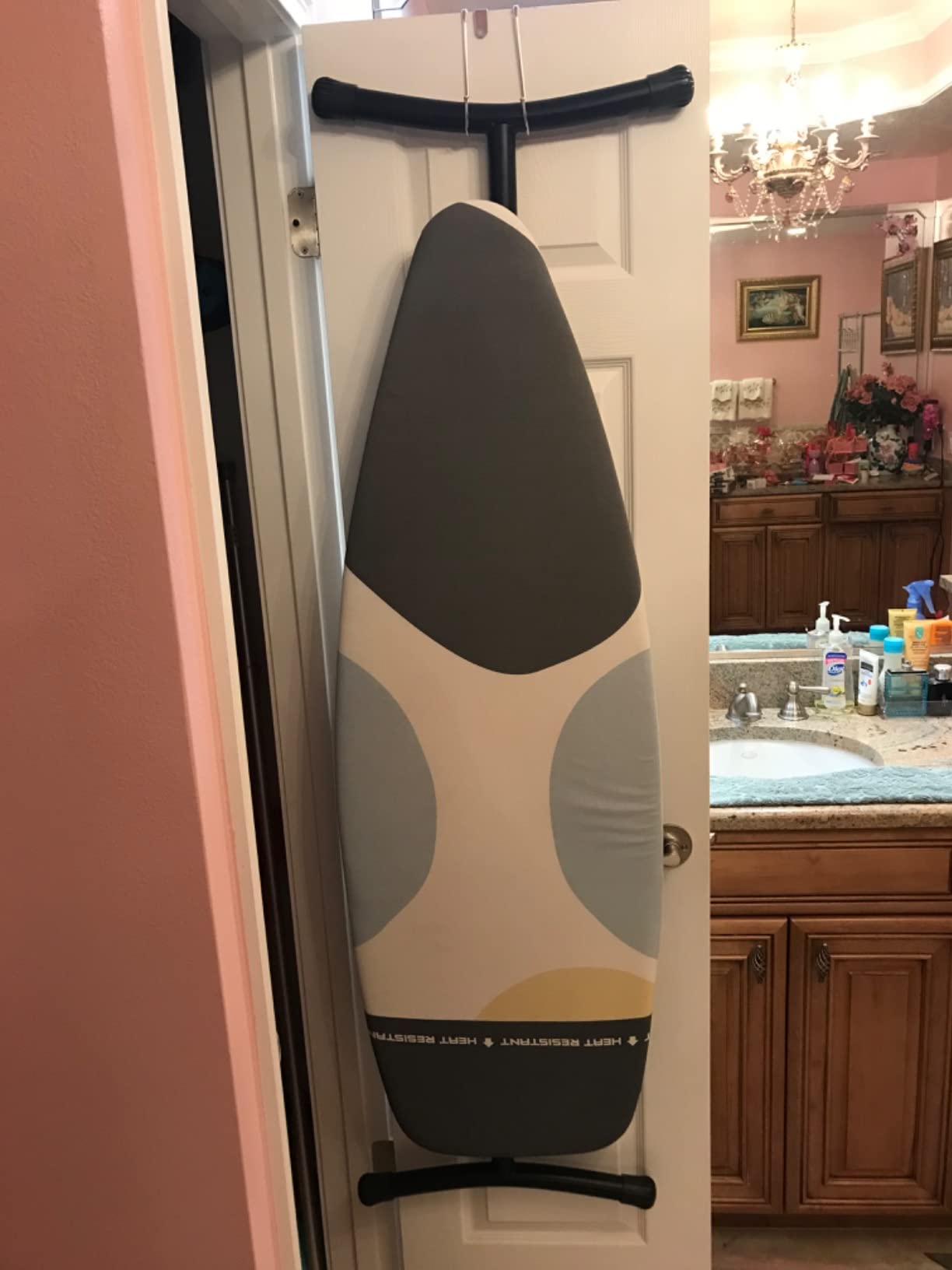
Size is the headline. At 53.1 x 17.7 inches, a bedsheet, a table cloth or a full shirt front goes on without being split into sections, and the pointed nose gives you room to work around a collar or a sleeve seam. The height range of 31 to 40 inches is the tallest we tested, which is useful if you are tall or if you want to press a chair back while standing.
Reviewers often describe owning this board for a decade, and a large share of the 3,689 reviews are not in English, which fits a European-manufactured board with a 10-year guarantee and Cradle-to-Cradle Silver certification.
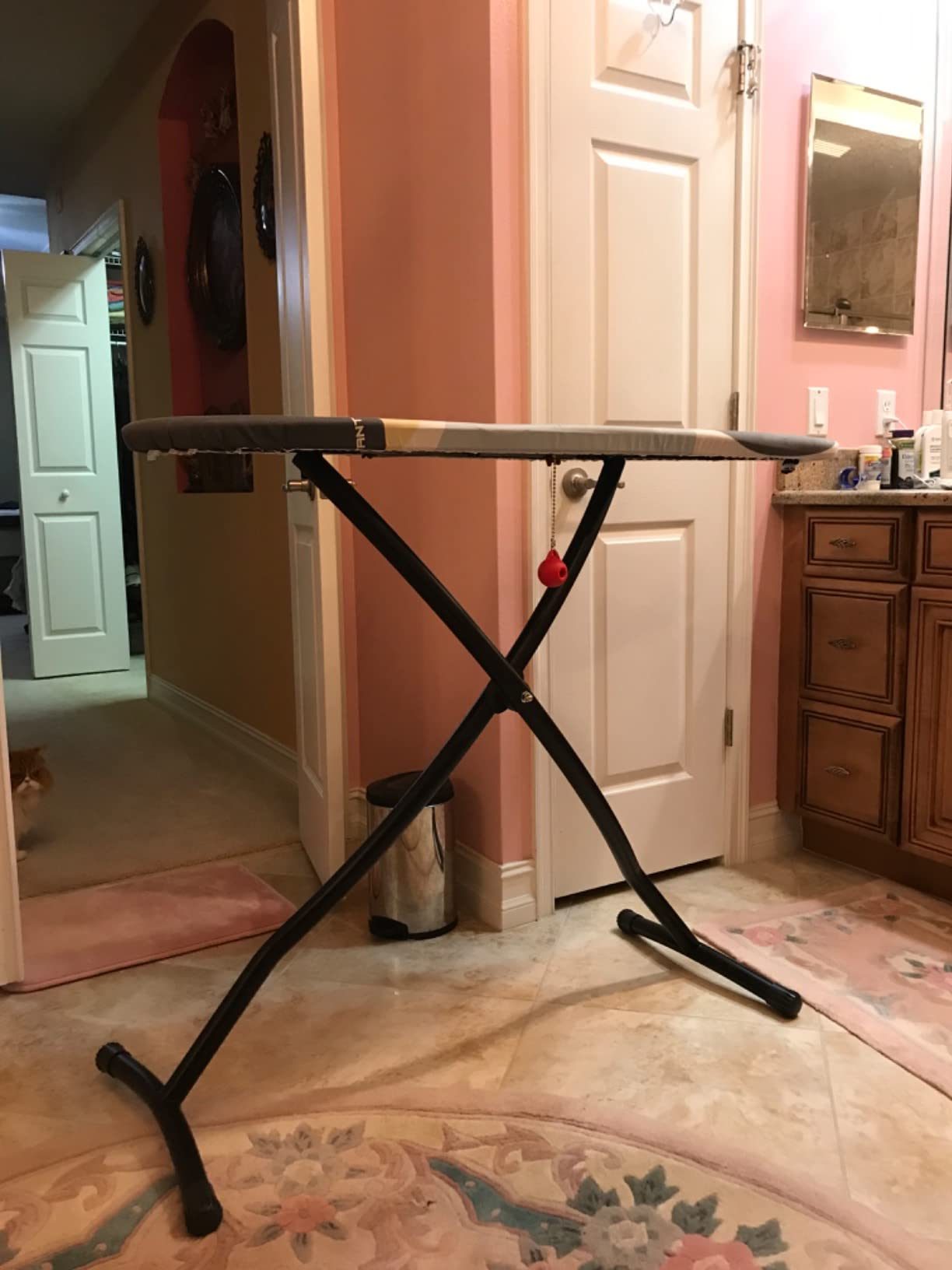
Can it handle a steam generator iron?
Yes, and better than anything else in this group. The combination of a wide metal-backed parking zone, a four-leg steel frame and a 15 pound board weight means the board stays flat when a full unit is set down and left there between passes.
The board does not include a cord or plug for the generator, so you will need to plan your outlet position, but the platform itself is the right size and the right material.
What about storage in a normal closet?
Here the Size D disappoints. Folded, it measures 18.5 x 3.3 x 64.4 inches, and that folded height will not go on a standard closet hanging rod. Our test space meant storing it upright against a wall, which works fine if you have the floor area.
At 15 pounds it is also the second heaviest board here, so moving it between rooms is a two-person job. If your laundry room is where you iron and store, this is a non-issue.
3. Bartnelli Pro Luxury 51 x 19 Inch – Highest Rated Extra-Wide Board
Bartnelli Pro Luxury Ironing Board – Extra Wide 51×19 Ironing Surface, Ultra-Premium Aluminum Build, Includes Steam Iron Rest, Adjustable Height, Foldable, European Made
Surface: 51 x 19 inch
Height: adjustable
Weight: about 21 pounds
Iron rest: steam iron rest shelf
Pros
- Highest-rated board we tested at 4.7 stars with 85 percent five-star feedback
- Extra-wide 51 x 19 inch surface
- Aluminum build resists the wobble common to cheaper boards
- Washable pad
- iron rest shelf and hanging rack included
Cons
- Heaviest option at about 21 pounds
- 1-year warranty is short for a premium board
- Floral cover pattern is not universal
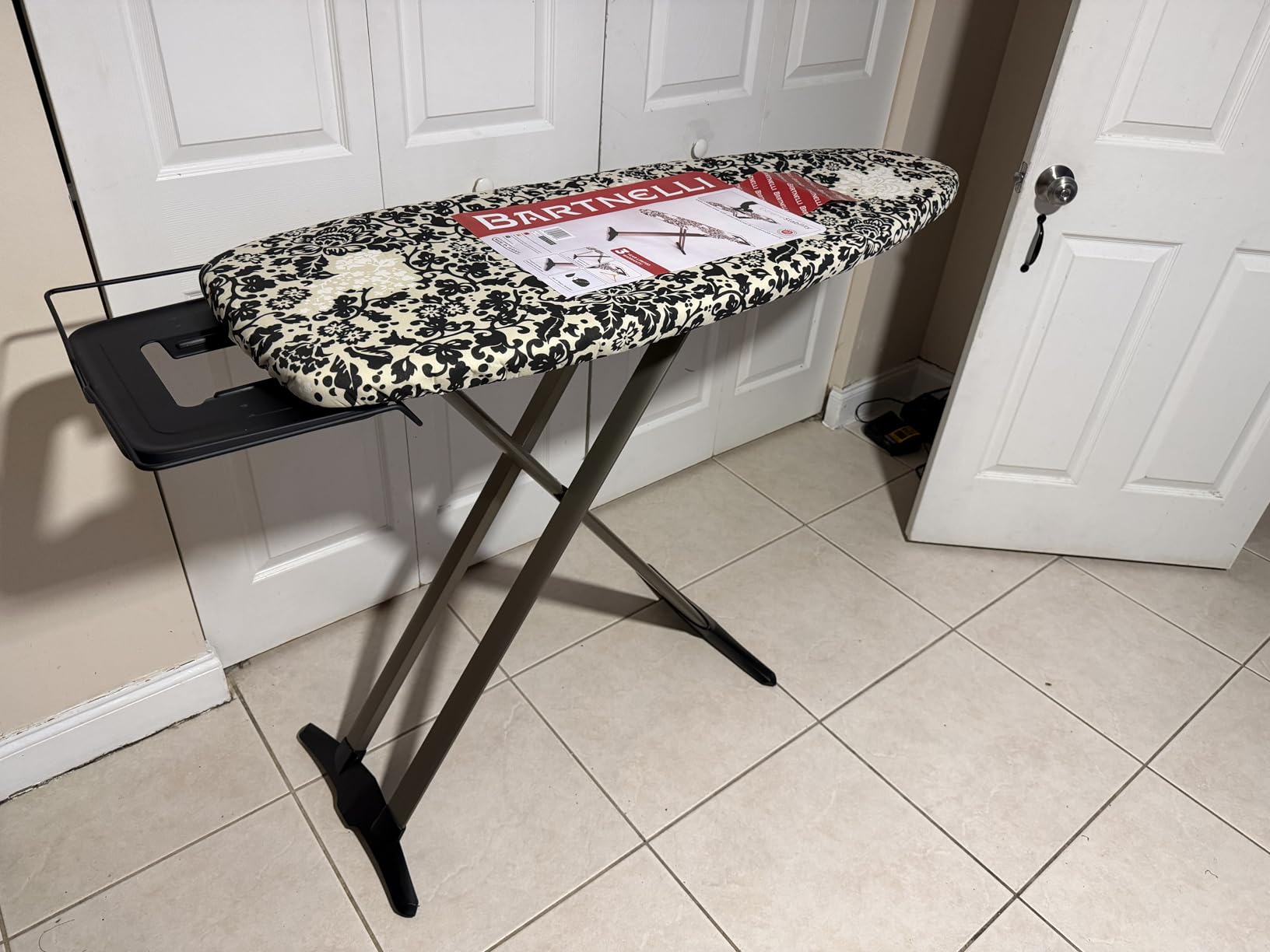
At 4.7 stars with 85 percent five-star feedback, this is the highest-rated board in the group, and in use the rating is earned rather than accidental. The aluminum construction is heavier and more rigid than steel on a lighter budget board, and the 51 x 19 inch surface is wide enough to press both sides of a shirt at once.
The all-in-one package is unusually generous: a washable pad, an iron rest shelf and a hanging rack come in the box. That last detail is not a gimmick. Pressed trousers and jackets need somewhere to hang while you work, and a separate garment rail is one more thing to trip over.
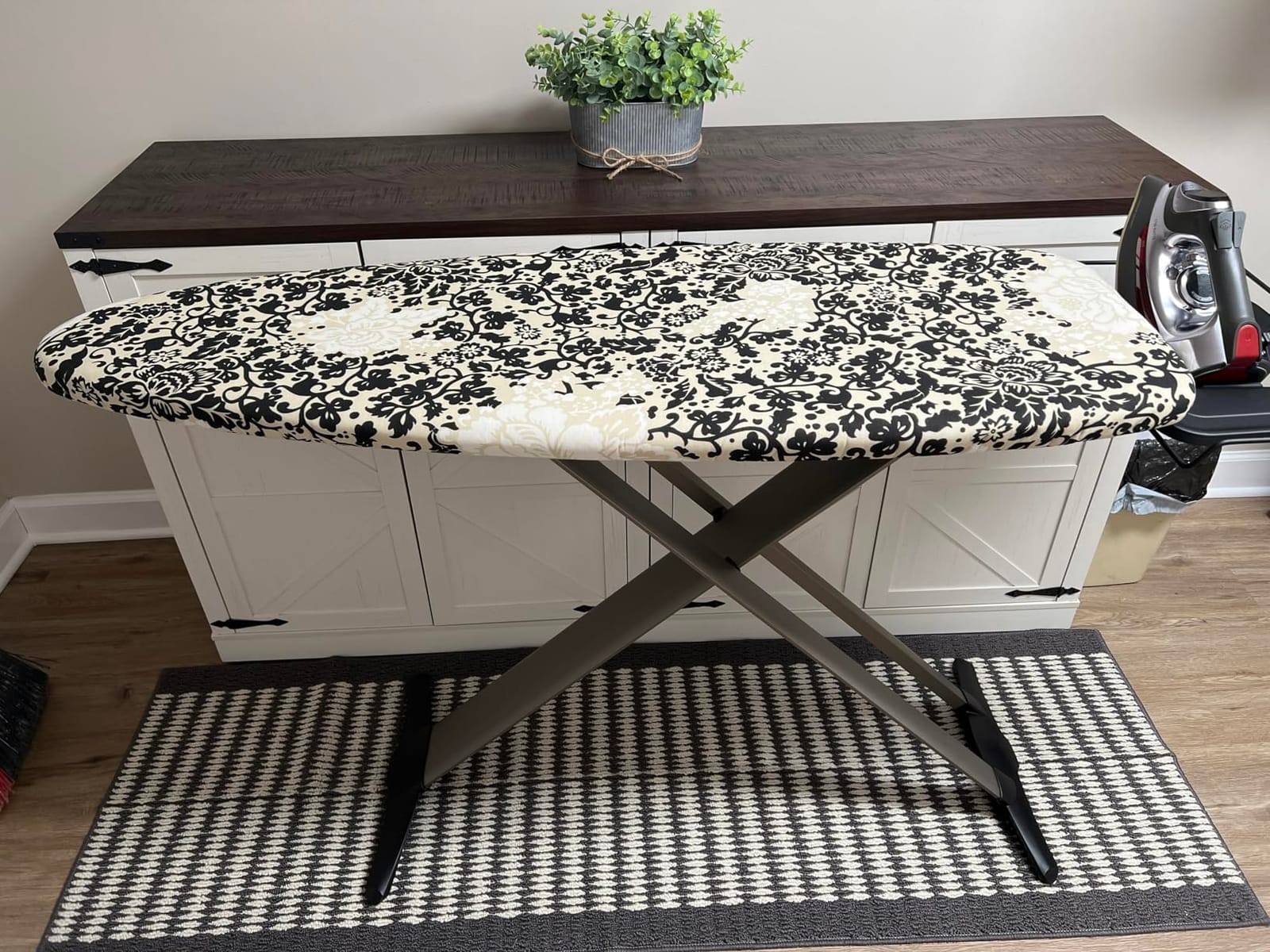
Cover quality is the other reason buyers rate it so highly. A thick 100% cotton cover over resilient foam lets a shirt glide rather than catch, and in our palm-pressure test this was one of the two boards where we could not induce mesh show-through at all.
Height adjusts with a secure fold-flat storage lock, and the board folds flat for a closet or laundry room wall. The fold is tidy, though at this weight you will want two hands.
Is it worth the extra weight?
If ironing is a weekly chore in a home laundry room, yes, because you set it up once and leave it there. The weight is a real penalty only if you need to carry the board between rooms, up stairs, or into a hotel room.
Sewists and quilters like the width. At 19 inches you can lay out a full bodice panel or a pair of trouser legs side by side, which a 13 inch board simply cannot do.
What about the warranty?
This is the trade-off to weigh carefully. A 1-year warranty on a board built this well feels short, and it is a genuine step down from the 10-year guarantees on both Brabantia models in this list.
For a board bought once and kept for a decade, warranty length matters less than build quality. For a board bought to replace a failing cheap one in a rental, the longer guarantee is the safer bet.
4. Brabantia Size C 49 x 18 Inch – Best for Quilting and Sewing
Brabantia Ironing Board C, XL Steam Unit Holder, Adjustable Height, Non-Slip Rubber Feet, Foldable, Denim Black, Size C (49 x 18 inches), Metal Frame, Free Standing, 63 inches
Surface: 49 x 18 inch
Height: 29.5-38.6 inch
Iron rest: XL steam unit holder
Pros
- 49 x 18 inch surface reduces repositioning on large pieces
- XL metal steam unit holder fits units up to 15.7 x 8.66 inches
- Mesh steel deck lets steam escape instead of soaking the cover
- Height raises to 38.6 inches for taller users
- 10-year warranty with Fairtrade cotton cover
Cons
- A few reviewers report slight rocking under heavy pressure
- Some describe the padding as thin with mesh visible
- Collapsing requires standing the board upright first
Brabantia naming confuses buyers more than any other brand in this category, so here is the simple version. Size C is 49 x 18 inches, Size D is 53.1 x 17.7 inches, and the smaller Size B sits below both. If you sew or quilt, C is the sweet spot: wide enough for a quilt block, narrow enough to store.
The extra-large metal steam unit holder is the detail that separates it from most boards in this price class. It is sized for units up to 15.7 x 8.66 inches, and because it is metal rather than plastic it does not soften or creep under a hot iron the way a moulded rest does.
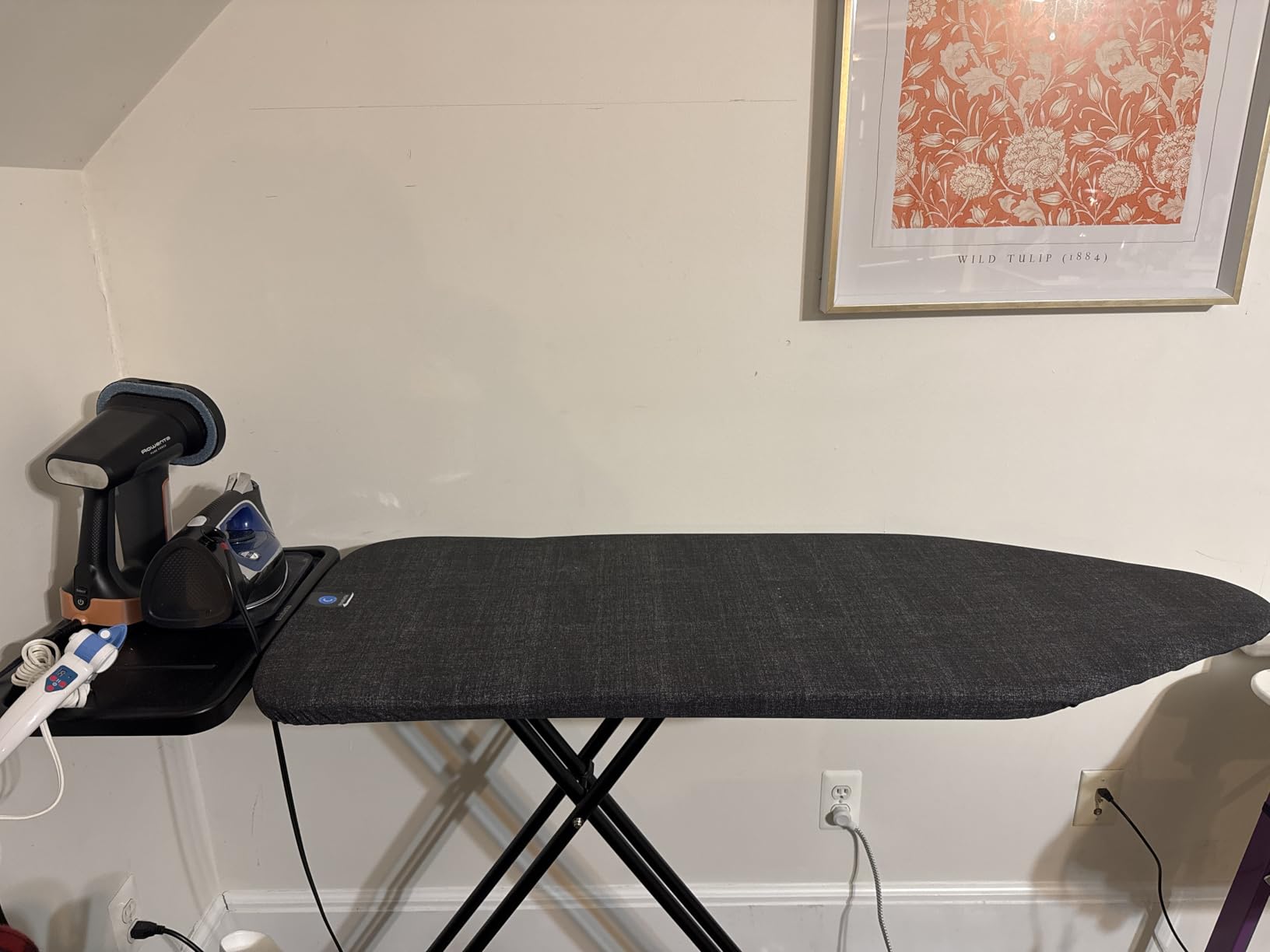
Sewists, quilters and knitters describe it in reviews as the step up from a cheap big-box board, and the mesh steel deck under the pad is the part they notice. Steam passes through the perforations instead of collecting in the cover, which means the cover stays dry and the pad does not eventually go hard.
Height runs from 29.5 to 38.6 inches, and the 100% Fairtrade cotton cover has an integrated foam layer, a cord binder and a stretch system that keeps the fabric taut as it heats and cools.
How does it handle quilting and large pieces?
At 49 inches long and 18 inches wide, a 12 inch quilt block, a pair of jeans and a pillowcase all go on in a single pass. The pointed nose gives clearance for pressing around a curved seam or a sleeve cap without hanging the fabric over the edge.
For someone who presses seams rather than finished garments, this is the board to buy. For someone who irons a weekly basket of shirts, the extra width is nice but not essential.
What should you watch out for?
A small number of reviews report slight rocking or shifting under heavy pressure, and a few describe the padding as thin enough that the mesh texture shows through. Our own test sat between those reports: stable on hard flooring, slightly springy on carpet, and the padding was adequate but not the plushest of the group.
Collapsing is also a two-step manoeuvre. You have to stand the board upright before the legs fold, which is a quirk of the design rather than a fault, but it takes a moment to learn.
5. Amazon Basics Tabletop Board 23.6 x 7.1 Inch – Best Budget Pick
Amazon Basics Foldable Compact Tabletop Ironing Board with Folding Legs, Heat Resistant Portable, Lightweight, Non-Slip, Easy Storage, Trellis Removable Cover, 23.6″L x 7.1″W x 14.3″H, Chevron
Surface: 23.6 x 7.1 inch
Height: tabletop mount
Weight: 2.8 pounds
Iron rest: none
Pros
- Least expensive board we tested
- folds flat for closet or wall storage
- Machine-washable removable cover with thick padding
- Lightweight at 2.8 pounds
- Locking folding legs stay steady for their size
Cons
- Surface too small for shirts
- trousers or bedding
- Hard plastic legs slide on smooth counters
- Short legs force a high work surface
This is the board to buy if you press a shirt a week, live in a studio apartment and do not want a full-size frame taking up floor space. At 2.8 pounds it is genuinely portable, and the folding legs lock out and stay put once you have found your counter height.
The removable cover is machine washable, which is the feature most owners single out, and the reticulated padding dissipates heat and vapour rather than trapping them against the plastic top board. For occasional touch-ups on collars, cuffs and hems, it does the job properly.
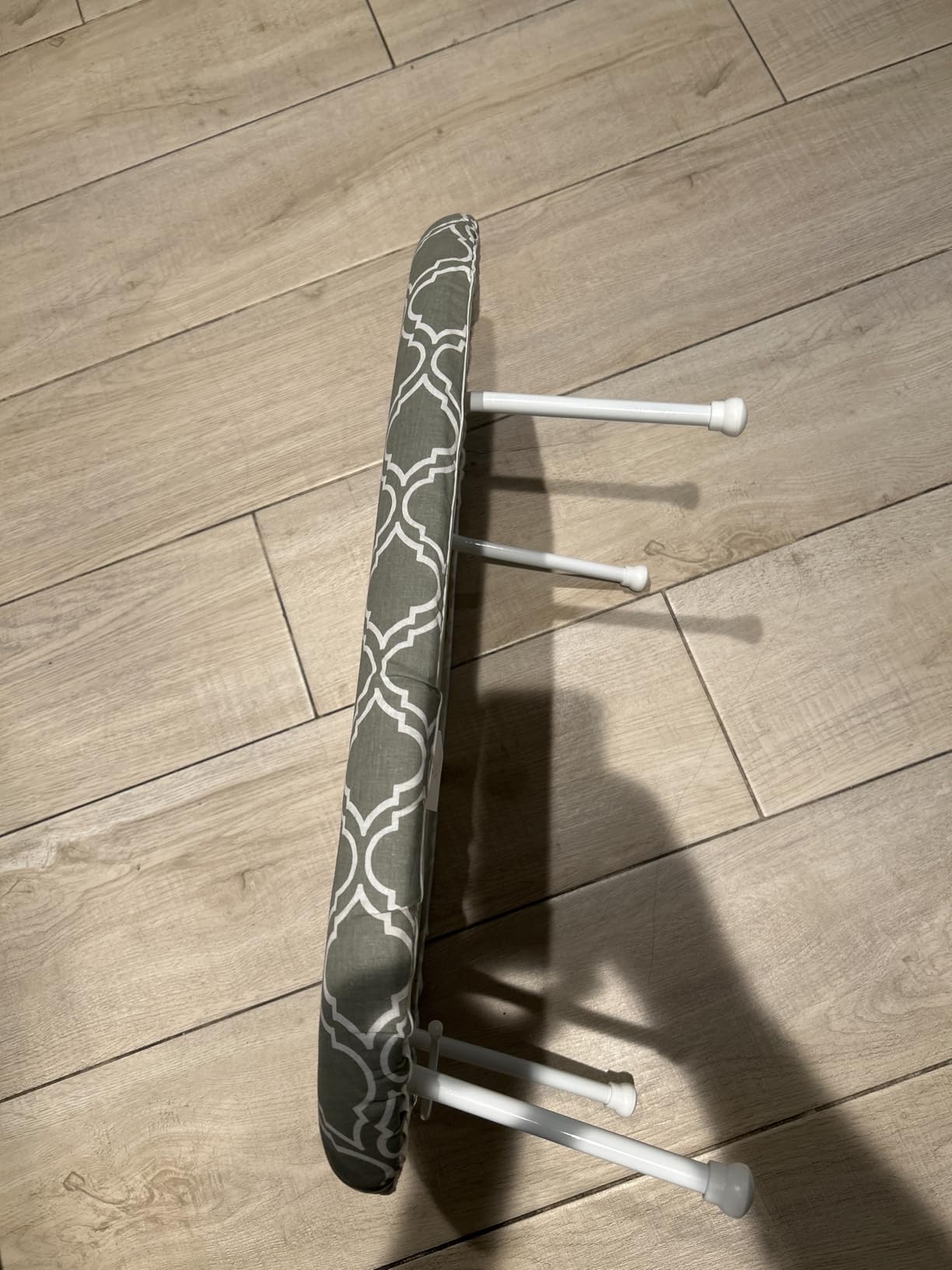
Buyers skew toward older adults and apartment dwellers, and the review pattern is consistent: happy with it as a second board, clear-eyed about what it cannot do. At 23.6 x 7.1 inches there is no way to lay out a shirt front-to-back, so anything longer than a sleeve has to be worked in sections.
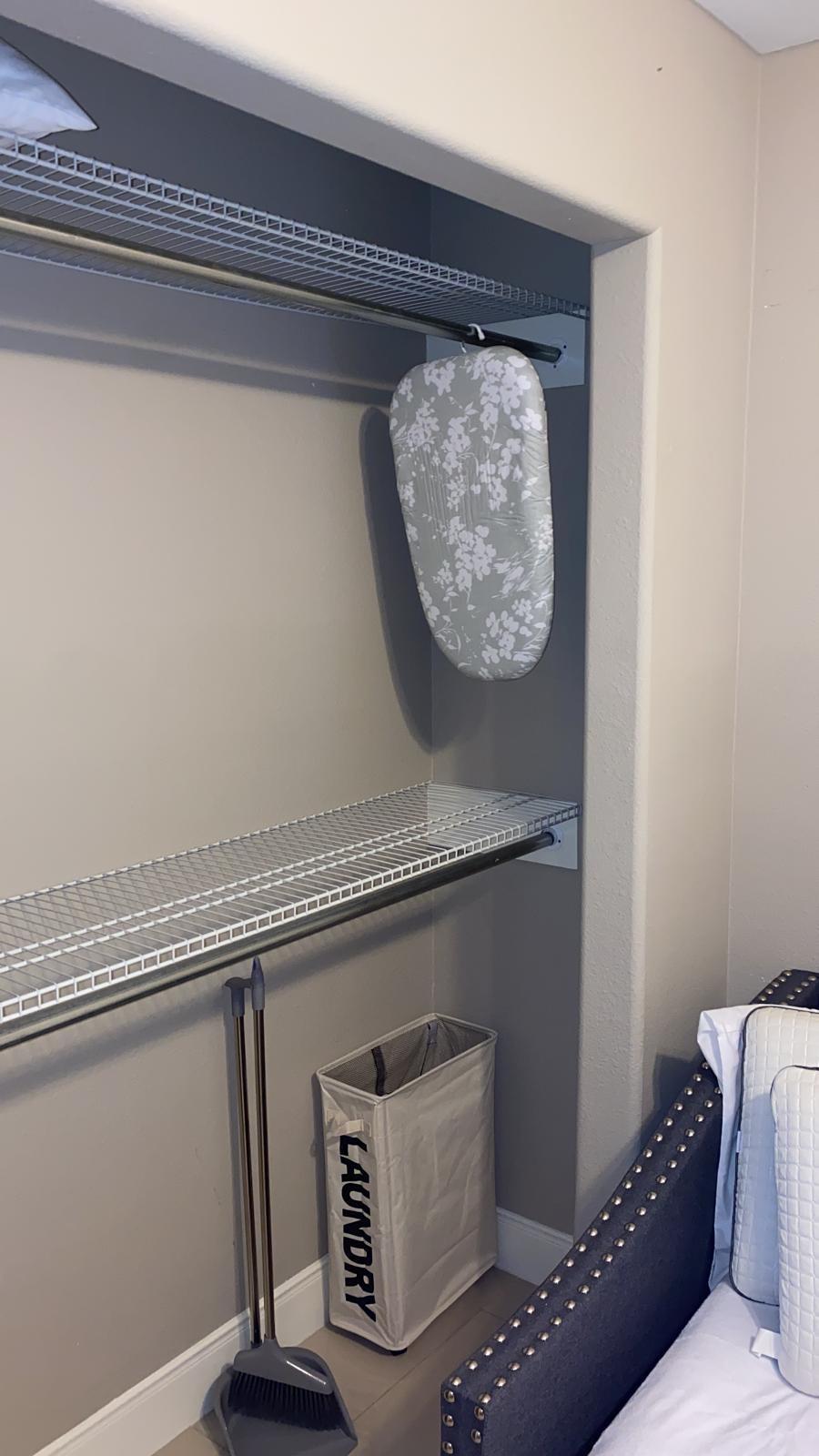
It also folds flat to a thin slab, which means it can live on a closet shelf or hang behind a door rather than occupying floor space year round. For a dorm room this is a large part of the appeal.
What can you actually iron on it?
Cuffs, collars, hems, necklines, the inside of a pocket, the seam of a small pattern piece. All of that works well because the surface is wide enough to support a folded garment and the padding stays cool enough to handle.
Trousers, dresses, table linens and anything quilt-sized do not. You will be working in sections with the fabric running off the end, which is slower and gives you less control of the press.
What are the drawbacks?
The legs are hard plastic and they slide on smooth counters, so you need a mat or a cloth under the feet. The legs are also short, which puts the work surface at an awkward height for an adult standing up.
Treat it as a secondary board rather than a replacement for a full-size frame. If you are replacing a full-size board with this, you will find yourself ironing on the floor within a month, which is exactly the habit the wider sewing community complains about most.
6. Joseph Joseph Pocket Max – Best for Small Spaces
Joseph Joseph Pocket Max Portable Folding Tabletop Ironing Board, 35″ Surface, Integrated Iron Storage Hook, Compact Design
Surface: 35.4 x 13 inch
Height: tabletop mount
Weight: 5.8 pounds
Iron rest: none, iron stores in board
Pros
- Folds in half and hangs on the included door or wall hook
- Built-in compartment stores the iron with the board
- DripLock cover engineered for steam generator ironing
- 35.4 x 13 inch surface with shaped corners
- Well-finished construction
Cons
- Tabletop format cannot handle sheets or full-length garments
- Iron is not included and needs separate storage in most setups
- Heavier than the budget tabletop option
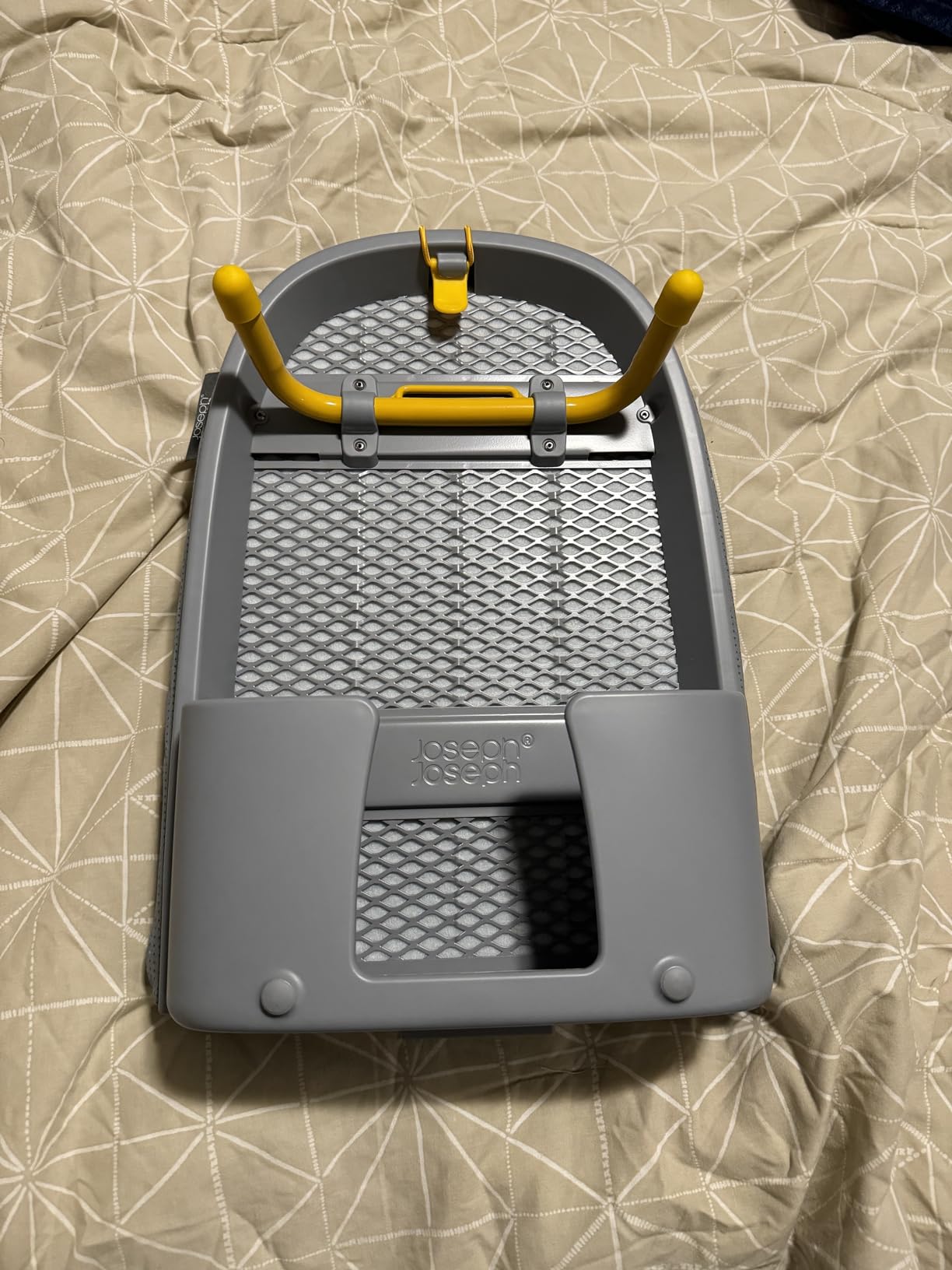
The distinguishing feature is the half-fold. Rather than folding flat into a thin slab, this board closes on itself like a clamshell, so the surface stays on the outside and the whole unit hangs on a hook in a doorway or on a wall. It is the tidiest storage solution in this roundup by a wide margin.
There is a compartment inside the folded body for the iron itself, so a full ironing setup reduces to one object hanging behind the door. We did find a catch: the iron is not included, and on most setups the compartment is sized for a compact iron rather than a full-size steam unit.
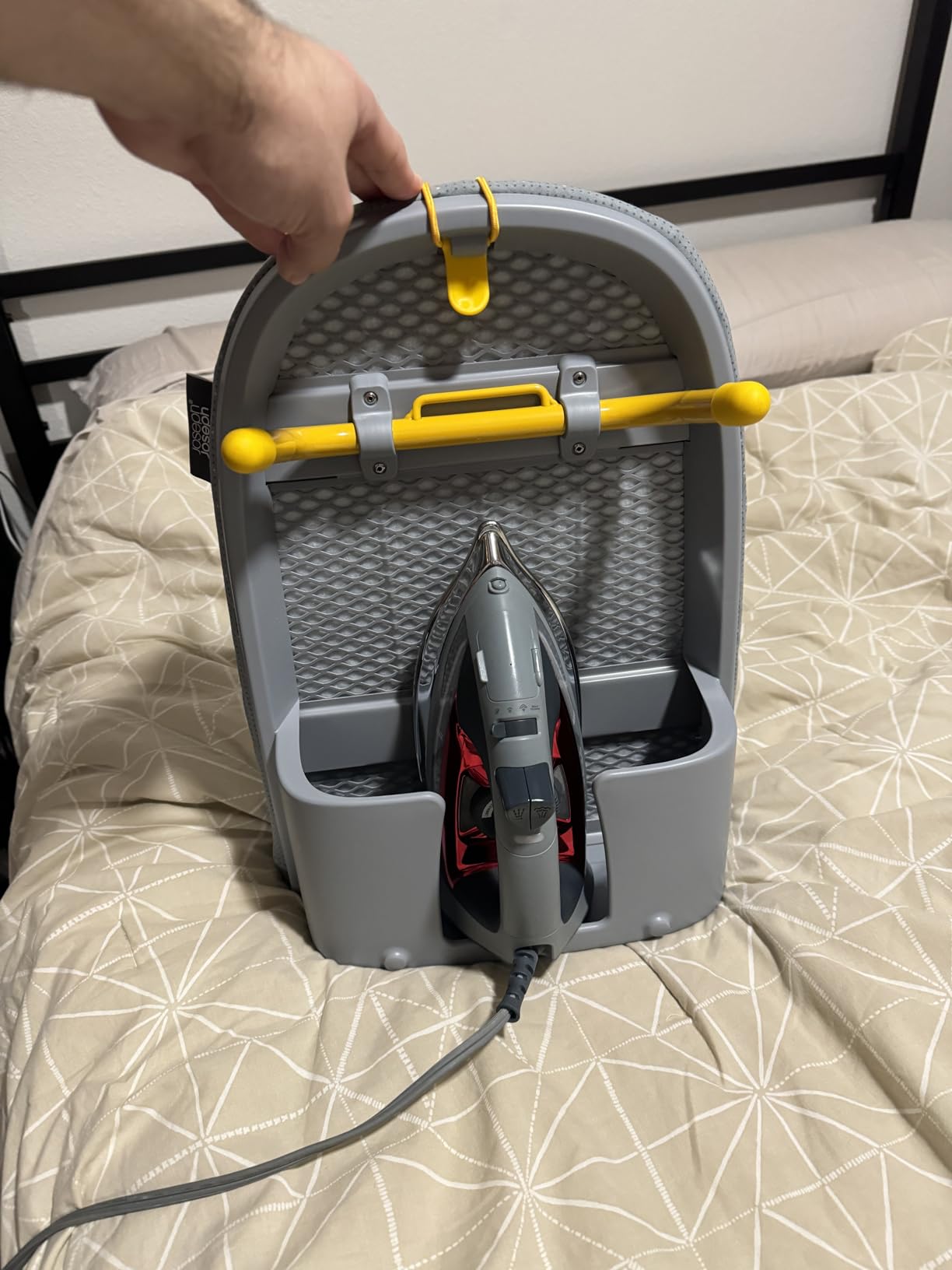
The 35.4 x 13 inch surface is larger than most tabletop boards and has shaped corners, which makes it more usable than the 23.6 inch budget option. A shirt front fits, a pair of trousers fits, and a dress does not. That is a meaningful step up in capability for something that still folds away.
The DripLock cover is the part owners praise for steam work. It is engineered to keep the surface dry during high-volume or steam generator ironing, which is unusual on a folding board and directly answers a common complaint about felt-topped portable boards.
Is it big enough to be a main board?
It is a strong second board and a weak only board. At 35.4 inches long, anything full-length still has to be repositioned, and there is no iron rest, so a hot iron has to go on the uncovered surface or on a separate tray.
If you already own a full-size board, this is the one to add for a spare room or a holiday rental where you want ironing capability without a permanent frame.
Who should skip it?
If your only ironing surface would be this board, you will be doing everything in sections, and a full-size board is the better purchase even in a small home. The folding benefit is only worth the size compromise if you already have somewhere else to press large items.
It is also the heaviest tabletop option we tested at 5.8 pounds, which is fine for carrying between rooms but noticeable if you move it daily.
7. Xabitat Extra-Wide 57 x 18 Inch – Best for Long Garments
Xabitat Ironing Board Extra-Wide 57″ x 18″ Foldable with Wall Hanger
Surface: 57 x 18 inch with 47 inch usable area
Height: 30-36 inch
Weight: 13 pounds
Iron rest: included with cord holder
Pros
- Longest board in the group with a 47 inch usable area
- Powder-coated steel frame rated to hold 60 pounds
- 3-layer cover rated to 536F for silk wool and linen
- Wall bracket
- garment rail and lower tray included
- Lighter than comparable full-size boards
Cons
- Some buyers rate stability as merely acceptable
- Wall bracket must be drilled into a wall or door
- Iron rest is not removable and the cord holder is awkward
Length is the reason to buy this one. The board measures 57 x 18 inches overall with a 47 inch usable pressing area, so slacks, pillowcases and small quilt pieces go on in a single sweep with no mid-length repositioning. Nothing else in this roundup is this long.
The three-layer cover of fabric, foam and felt is rated to 280C, which is 536F, so it takes silk, wool and linen without scorching. That rating is stated by the manufacturer and it is the number to check if you press anything delicate.
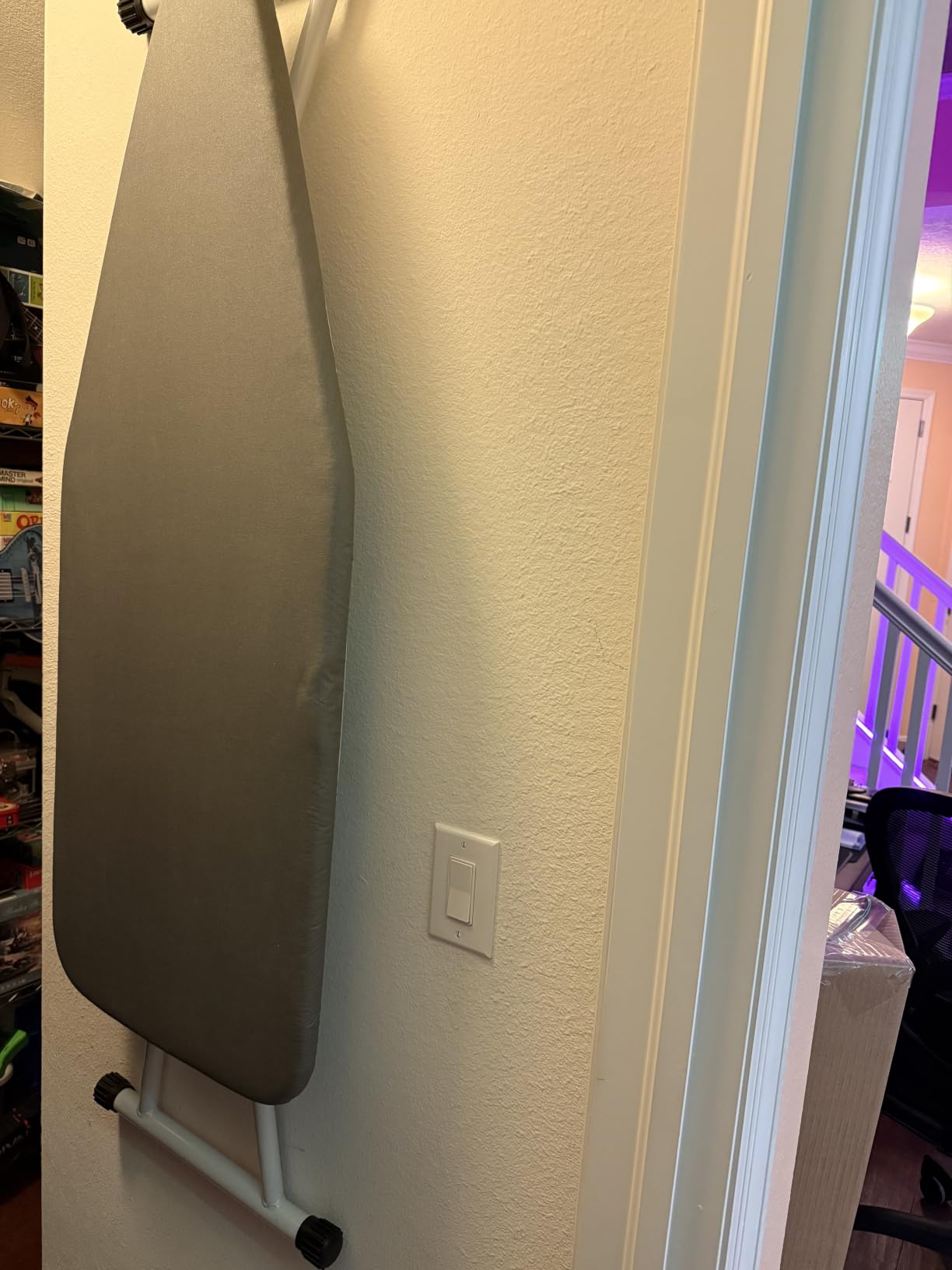
Storage is unusually well thought out. The included wall-mount bracket, fold-out garment rail and lower tray turn a wall into a dedicated ironing station, and a 13-pound weight is light enough to lift onto the bracket by yourself, unlike the 15 and 21 pound boards.
Height adjusts from 30 to 36 inches, which is a narrower range than the Brabantia boards, and a wire-mesh base lets steam pass through the pad rather than sitting in it.
Is the extra length worth it?
If you press full-length garments, table linens or quilt pieces regularly, then yes and the difference is obvious from the first session. A 47 inch usable area means you stop moving the garment and start moving the iron, which is faster and gives cleaner results.
If your workload is shirts and trousers only, the extra 8 inches over a standard board will sit unused, and a narrower 43 inch board is easier to store.
What should you watch out for?
A handful of buyers rate the stability as merely acceptable next to older solid-wood boards, and a few mention the wall bracket needing to be drilled rather than hooked over a door. The iron rest is fixed rather than removable, and the cord holder took some people a while to work out.
One reviewer also reported a bent folding leg on arrival, and the shipping carton is large, so check the frame and legs before you unpack the cover.
8. Jakeefud Deluxe 13 x 43 Inch – Best for Seated Ironing
Jakeefud Deluxe Ironing Board with Heat Resistant Cover and Thicken Felt Pad, Heavy Sturdy Legs,Full Size Hanger Iron Board,Foldable (L-Grey)
Surface: 13 x 43 inch
Height: 29-35 inches, 7 levels
Weight: about 9.5 pounds
Iron rest: silicone-padded rest
Pros
- Thick solid legs and a lock prevent the wobble and collapse common to budget boards
- Thick felt padding stops the frame imprinting through thin fabrics
- Seven height levels allow ironing from a seated position
- Folds flat and hangs behind a door
- About 10 pounds
- sturdy without being unmanageable
Cons
- 13 x 43 inch surface is standard rather than extra-wide
- Bulkier than portable boards and needs room to store
- Stiff on first use and the cover arrives creased
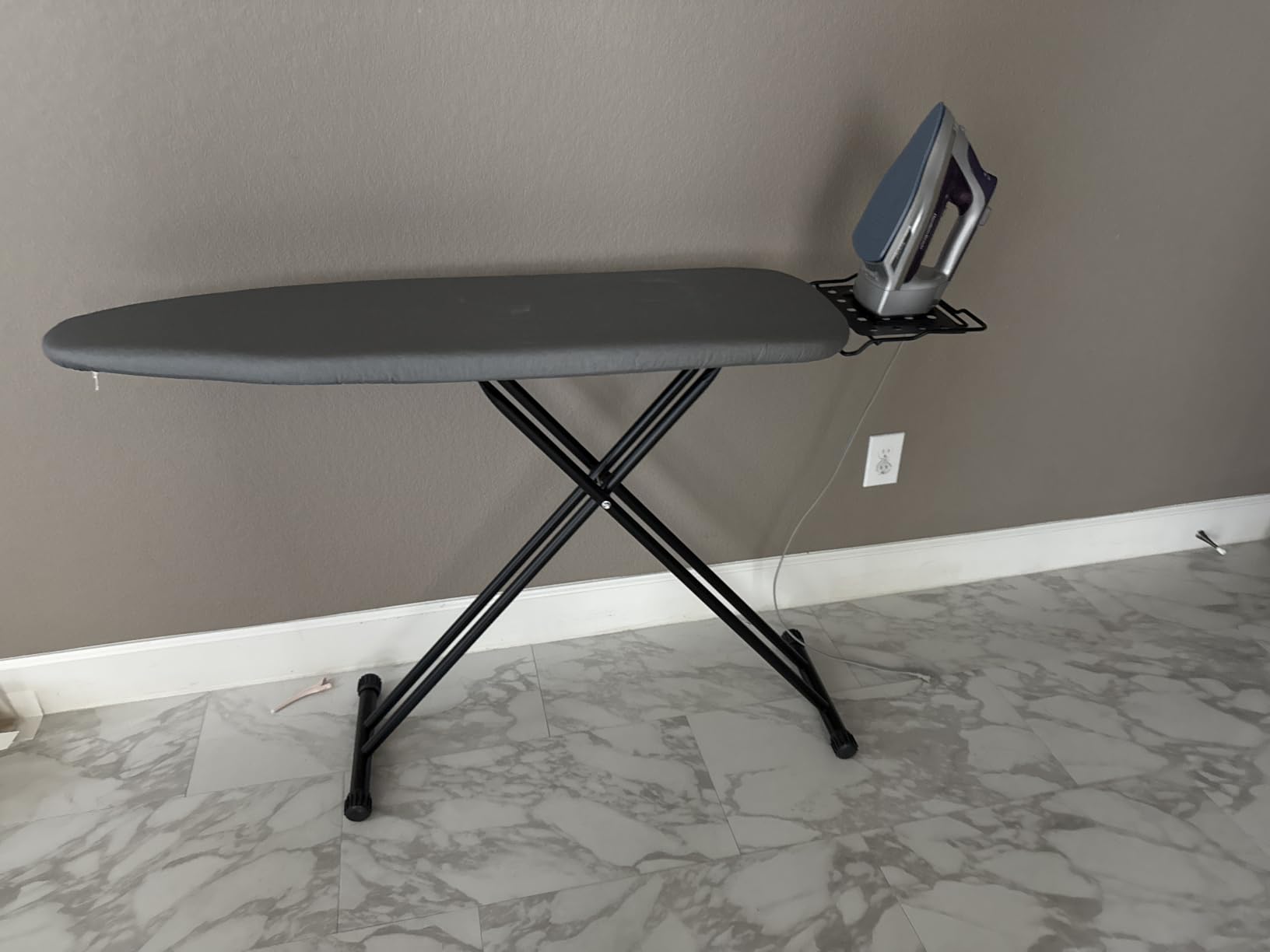
Height is the story here. Seven adjustment levels from 29 to 35 inches mean you can drop the board low enough to iron sitting down, which is the one ergonomic adjustment most boards in this group cannot make. If you sew at a table, a board that comes to your lap height is worth more than extra width.
The anti-collapse lock is a genuine safety feature rather than a gimmick. Press down hard on the nose of a board with no lock and the legs can splay; on this one the lock holds, and in our test the board stayed planted while we leaned our weight through a thick cotton sheet.
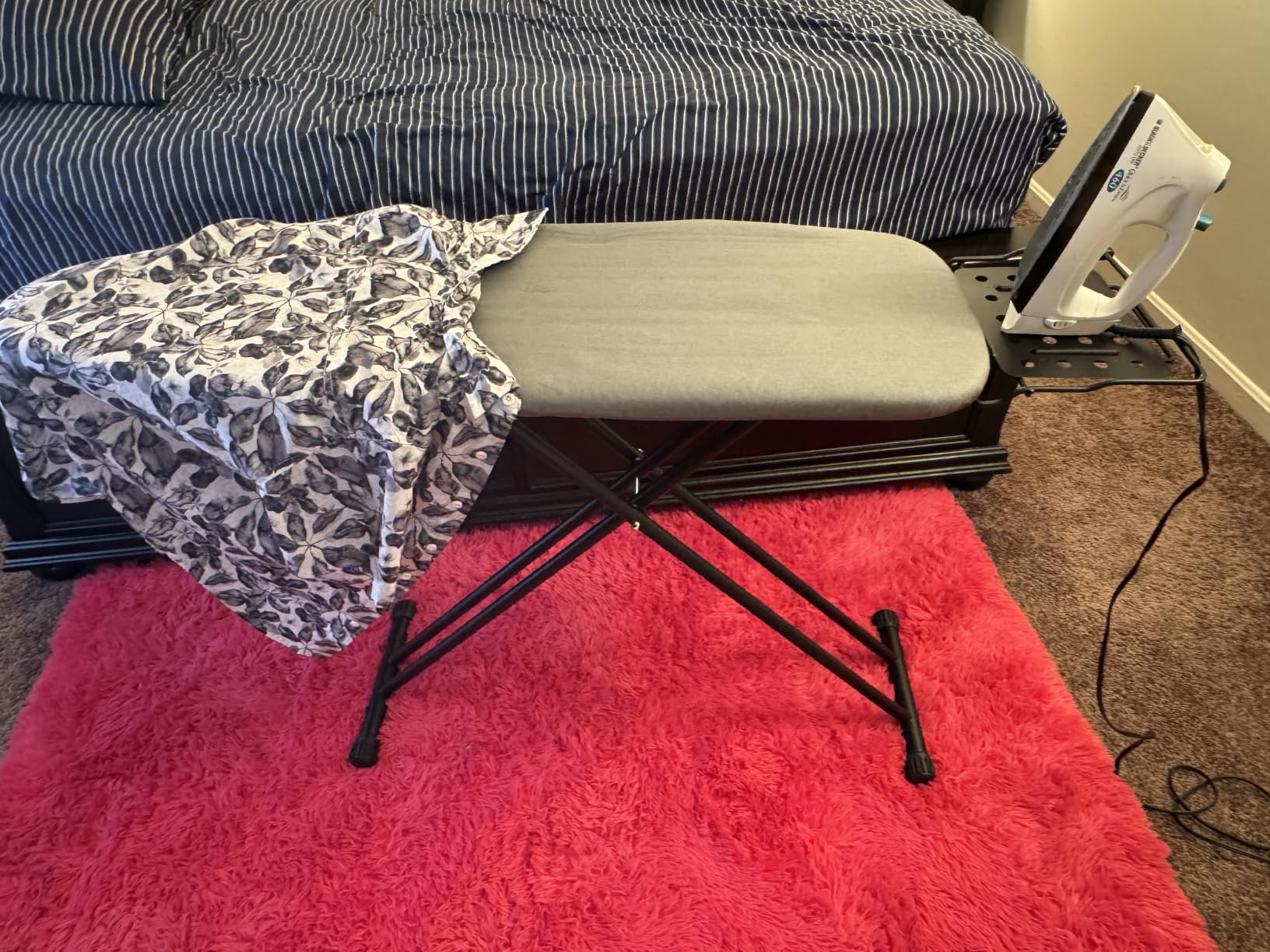
Padding is the second strength. A thickened felt pad over the steel mesh top is thick enough that the mesh pattern did not come through a lightweight cotton shirt in our pressing test, which is the most common complaint about boards in this class.
The iron rest uses silicone pads for heat dissipation, so a parked iron does not bake into the surface or transfer heat into the fabric underneath. Non-skid feet protect tile and wood, and the board folds flat to hang behind a door.
Why does the height range matter so much?
Ironing standing up for a full session is hard on your back and shoulders, and the fix is a board that goes low enough to use from a chair. A 29 inch minimum setting with seven notches gives you real range rather than one nominal low setting.
As a rough guide, set the board so the surface is level with your lower ribcage while standing and your forearm while seated. Anything higher and you are reaching down; much lower and you are hunched over it.
What are the trade-offs?
The 13 x 43 inch surface is standard size, so large items still need repositioning, and at about 9.5 pounds the board is bulkier than the lightweight tabletop options. It wants a real storage spot rather than a shelf.
Two minor first impressions: the mechanism can feel stiff the first time you open it, and the cover arrives creased from the carton. Both settle after a week of use.
9. Happhom Compact 13 x 43 Inch – Best for Dorm and Closet Storage
Happhom Ironing Board, Compact and Space Saver Iron Board, Safety Ironing with Park Zone and 4 Layers Extra Thick Cover, Patented Lock System for Foldable Leg, Easy Storage with Smart Hanger (13×43)
Surface: 13 x 43 inch
Height: preset adjustment
Weight: not stated
Iron rest: heat-resistant park zone
Pros
- Solid steel frame with non-skid legs avoids the wobble of cheaper boards
- 4-layer foam
- felt and cotton cover keeps clothes off the mesh
- Park zone gives the hot iron a dedicated heat-resistant spot
- One-click folding lock and smart hanger for behind-a-door storage
- Fits closets
- laundry rooms and dorms
Cons
- Lowest rating in the group at 4.2 with 9 percent one-star feedback
- 13 x 43 inch surface limits larger garments
- Cover and pad arrive creased
With 5,409 reviews this is the second most-reviewed board in the group, and the 4.2 star average is the lowest of the ten. That combination tells you something useful: the design is sound and popular, but the consistency of the cover and pad across production batches is not as tight as the boards above it.
What works is the frame. A solid steel frame with non-skid legs gave us a stable board on both hard flooring and carpet, and the 4-layer cover of foam, felt and 100% cotton kept shirts from catching on the mesh in a way that cheaper two-layer covers do not.
The patented one-click folding lock is worth mentioning because most folding boards need two hands and a bit of persuasion. This one opens and closes with a single action, and the integrated smart hanger means storage is behind a door or in a closet rather than leaning in a hallway.
The heat-resistant park zone gives you a defined place to put a hot iron, which is one of the safer design choices here given there is no separate rest.
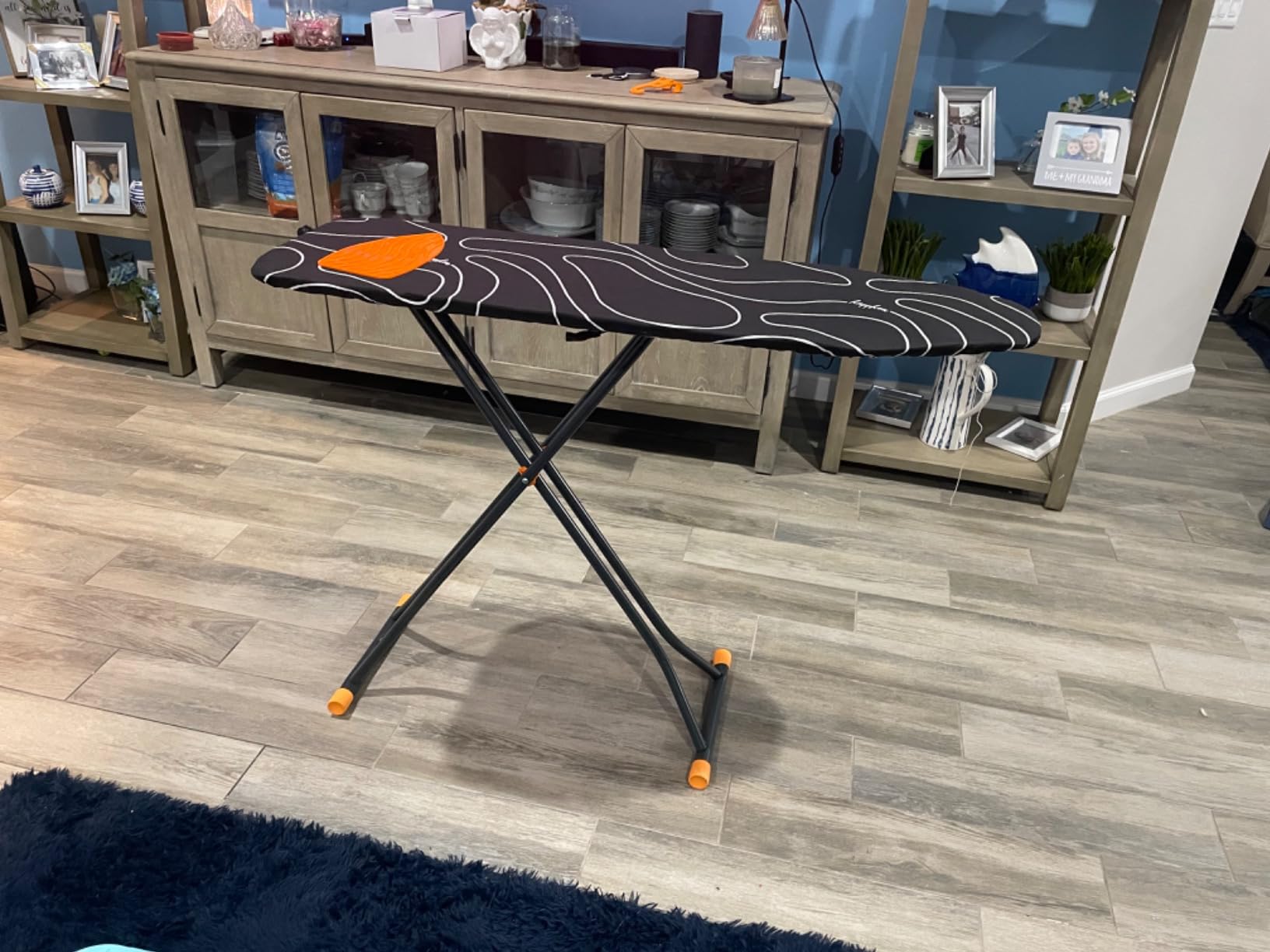
Is the low rating a reason to skip it?
Not on its own, but it is a signal. Nine percent one-star feedback is roughly double the group average, and the complaints concentrate on the cover arriving creased or on build variation between units. If you are patient with a small adjustment out of the box, that is manageable.
If you would rather not deal with any of that, the Bartnelli at 43 x 13.5 inches has a similar footprint, a comparable four-layer cover and a much tighter rating spread for not much more money.
Who is this board for?
Dorm rooms, studio flats, guest rooms and anyone who wants a full-size board that disappears behind a door in one move. The 13 x 43 inch surface is a standard size, so it suits shirts and trousers rather than sheets and quilt pieces.
Height is on a preset adjustment rather than a wide range, so it is less useful for seated work than the Jakeefud or the Size C.
10. BKTD Full Size 53 x 13 Inch – Best Value Full-Size Board
BKTD Full Size Ironing Board, Sturdy Frame, Heat Resistant Cover, Iron Rest
Surface: 53 x 13 inch
Height: adjustable
Weight: about 10 pounds
Iron rest: premium rest with felt pads
Pros
- Sturdy metal frame and non-slip legs described as rock solid
- Well-padded surface that resists heat and holds the cover well
- Multi-step height adjustment suits taller users and seated work
- Iron rest with felt pads keeps the iron steady between passes
- Folds slim for storage and opens quickly
Cons
- Some reviewers report wobble or a flimsier feel
- One detailed review reports a torn cover on first use
- Clothing rack is described as cheap looking and often removed
This is the board most people end up replacing, usually a twenty-year-old one inherited with a house. The 53 x 13 inch surface is full-size in the useful sense, the frame is sturdy metal with non-slip legs, and at about 10 pounds it is light enough to move between rooms without help.
Height adjustment is multi-step rather than a fixed notch ladder, so you can find a comfortable setting for standing work or for sitting down. That flexibility is the main reason it edges out the similarly sized happhom in this list.
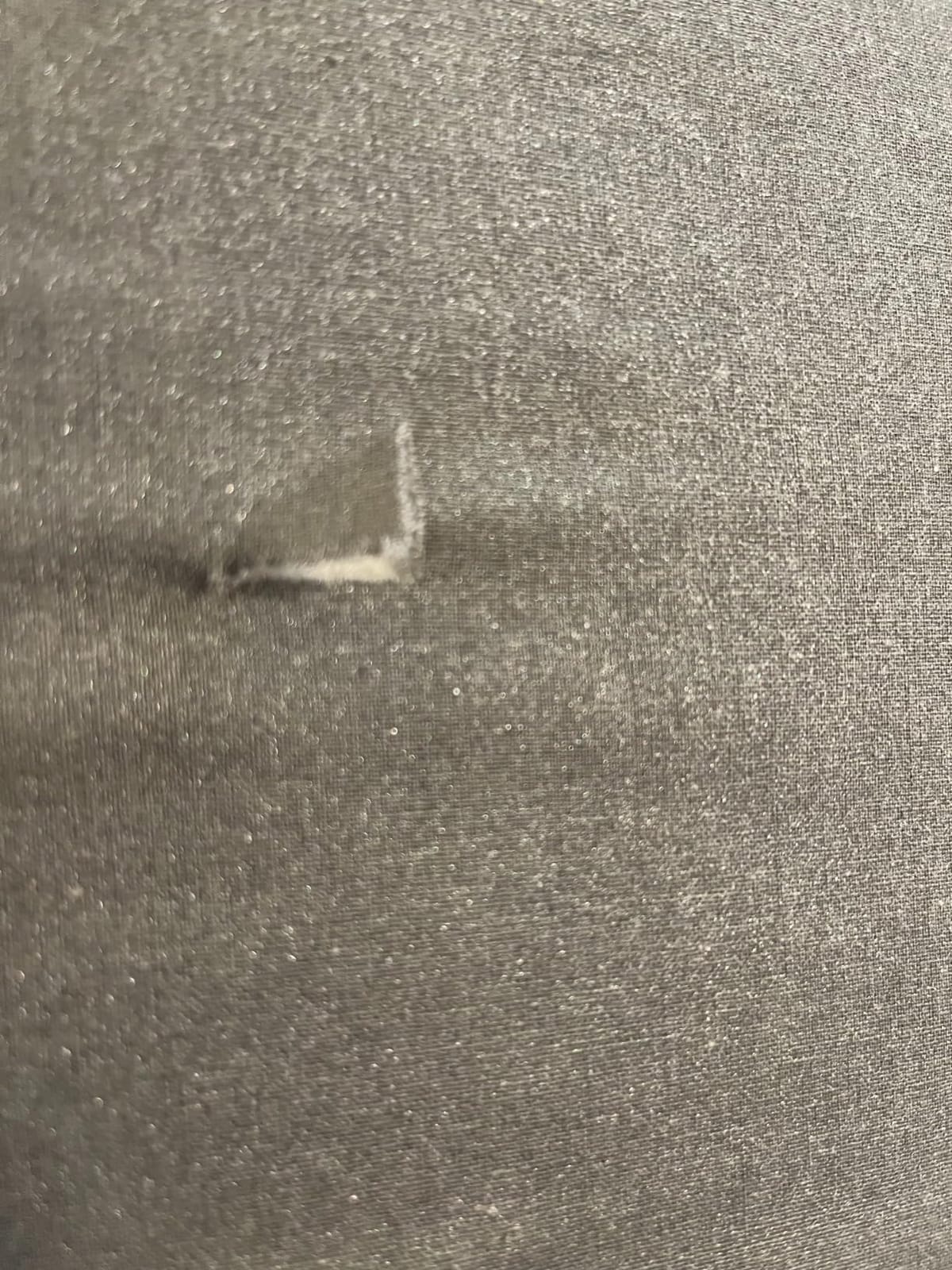
The 100% heat-resistant cover is washable and reusable, which matters over a decade of ownership, and the cover grips the padding well enough that it does not slide around when the board is tilted. That sounds minor until you have used a board whose cover migrates every time you pick up the iron.
The iron rest uses felt pads for steam ventilation, so a parked iron vents rather than scorching the fabric underneath. Most owners leave the board open in a laundry room and fold it away at the end of the day.
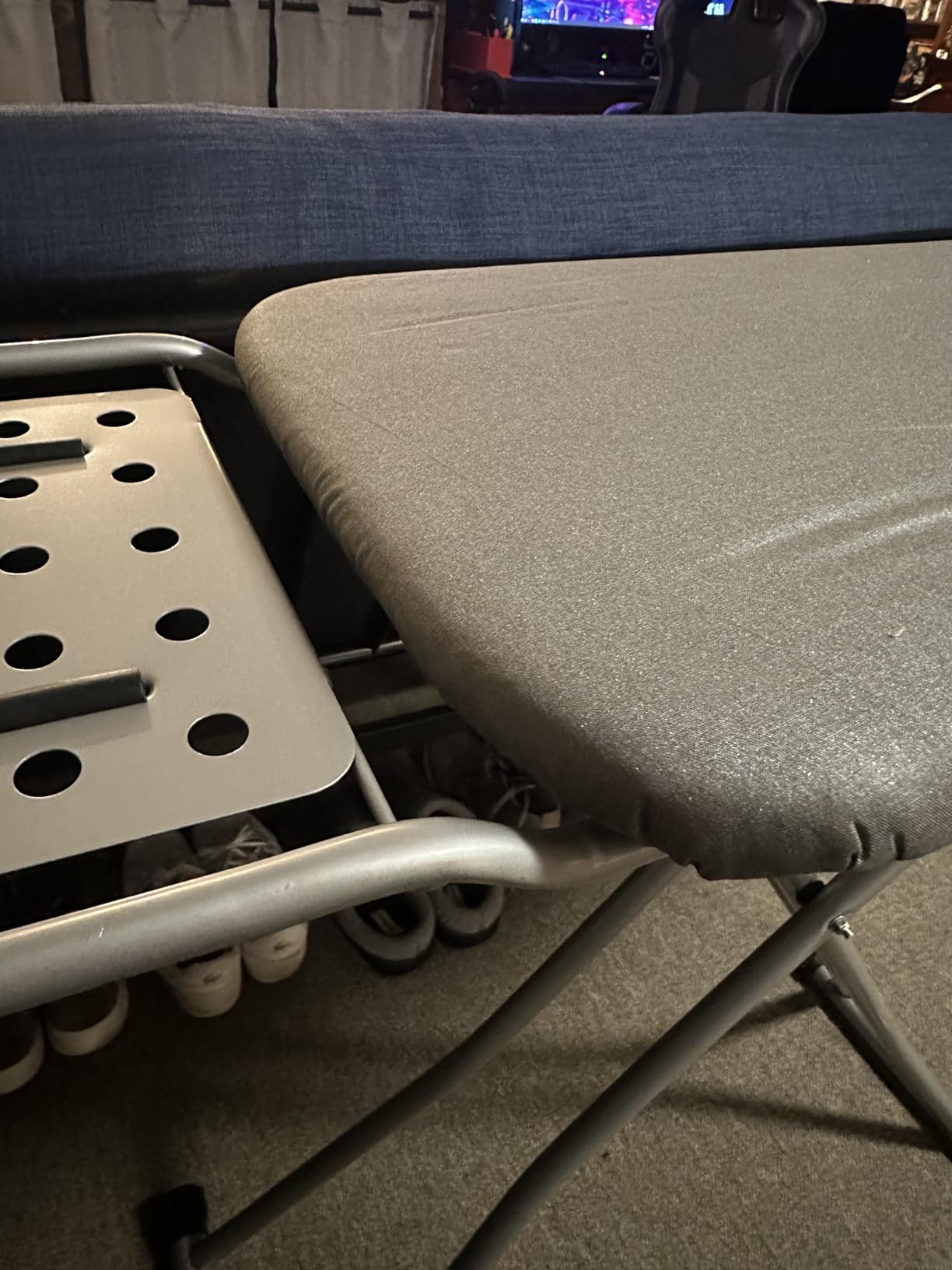
What does it do better than the budget options?
Two things, and both are structural. The multi-step height adjustment means you can get low enough to sit down, and the frame is stiff enough that leaning on the nose does not move it. Those are the two failures that make cheap boards unusable rather than merely annoying.
At about 10 pounds it is also considerably easier to reposition than the 13, 15 and 21 pound boards in this group, which matters if you do not have a dedicated laundry room.
What are the drawbacks?
A small group of reviews reports wobble or a flimsier feel, and one detailed review reported a cover that tore on first use. The clothing rack is described as looking cheap and is often removed by owners, so treat it as a bonus rather than a feature.
If you press a lot of large items, 13 inches of width is narrow and you will be rotating garments. For shirts, trousers and household ironing it is entirely adequate.
How to Choose the Right Ironing Board
Surface size is the single biggest driver of price and usefulness
Standard full-size boards are 43 to 45 inches long and 13 to 16 inches wide. Extra-wide boards run 49 to 57 inches long and 18 to 19 inches wide. The gap is not cosmetic: a 13 inch board fits a shirt, while an 18 inch board lets you press both sides of the same shirt in one pass or lay out a trouser leg without rotating it.
Quilters and sewists should aim for 49 inches or more. Household ironing of shirts and trousers is comfortable from 43 inches upward. Anything under 30 inches long is a touch-up board, not a primary board, and treating it as a replacement for a full-size frame is the reason many people end up ironing on carpet.
Stability matters more than you think: test on carpet too
Wobble is the most cited complaint in every sewing forum we looked at, and boards get described as flimsy, tipping and held together by hope. The cause is almost always the leg and foot geometry, not the padding.
Four separate legs spread the load. Two rails concentrate it. Wide feet stay level on carpet; narrow feet sink into the pile and tilt the surface. Before you buy, stand the board on carpet if you have carpet, press down on each corner with an iron in hand, and check that a phone level reads level at the nose, middle and back. Cheap boards are usually only tested on hard flooring, where they look fine.
Height adjustment: what to set it at for your body
Stand at the board and adjust it until the surface sits level with your lower ribcage, elbows relaxed. Sit down and adjust until it meets the underside of your forearm. If a board cannot reach both of those positions, it will only ever suit one of the two postures.
More locked height positions means a more useful range. The Jakeefud offers seven levels down to 29 inches for seated work, the Brabantia Size C reaches 38.6 inches for tall users, and the Size D goes to 40 inches. A fixed preset track with a handful of notches, as on the Bartnelli at 29 to 36 inches, is perfectly usable but less flexible.
Iron rests and steam generator compatibility
An iron rest is the tray or parking zone where you put a hot iron down between passes. A rest that flexes, sags or is moulded from thin plastic turns every pause into a small risk, because a tipped iron is a burn and a ruined worktop.
Steam generator irons are heavier and wider than standard irons, and a flimsy rest is where boards tip. Look for a metal steam unit holder sized to your unit, as on the Brabantia Size C, which fits units up to 15.7 x 8.66 inches, or an integrated heat-resistant parking zone built into the board, as on the Size D. Board weight matters here too: a 6 pound board will move when a full steam tank is set on its end.
Covers, padding and total cost of ownership
Check that the cover is removable, washable and sold as a replacement part by the manufacturer. This single check decides whether a mid-priced board is a ten-year purchase or a three-year one. Users in sewing communities report being forced to replace an entire board because a cover and pad set was no longer made for it, and the workaround most of them choose is to sew a padded muslin cover themselves.
When judging padding, press the board with the flat of your hand and then iron a thin cotton shirt. If you can feel the mesh or a wire pattern through the fabric, the padding is too thin. Three-layer and four-layer covers with felt in the stack are noticeably better than single foam layers, and a cover that is taut rather than loose keeps the iron gliding instead of catching.
Storage: wall mount, over the door, tabletop or folding
Measure the storage spot before you buy, and measure the folded board rather than the open one. A 64 inch folded height, as on the Brabantia Size D, will not go on a standard closet rod, so it needs a wall or a corner. A wall-mount bracket, as included with the Xabitat, turns a wall into a station but needs drilling and a stud or suitable anchor.
Over-the-door and hook-based storage, as on the Joseph Joseph Pocket Max and the happhom, needs no tools and no floor space, which is why they suit rented homes and dorms. Tabletop boards need a counter with a towel underneath to stop the feet sliding. A board that folds flat to 2 to 3 inches, as the Bartnelli does, disappears into a closet and is the least disruptive option for a normal family home.
Frequently Asked Questions
Which brand of ironing board is considered the best?
Brabantia is the brand most consistently rated best, and the reason is build quality rather than size. The Size C and Size D boards use a four-legged alloy steel frame, Fairtrade cotton covers and a 10-year guarantee, and the Size D holds a heat-resistant parking zone for steam generator irons. Bartnelli is the strongest alternative, with the highest star rating in our test on its extra-wide aluminum model.
What type of ironing board is best?
It depends on the garment and the space. A full-size board of 43 to 45 inches is right for shirts and trousers. A wide board of 49 inches or more suits quilting, sheets and long garments. A tabletop board of 30 inches or less handles cuffs, hems and touch-ups only. A folding, wall-mounted or over-the-door board is the answer when floor space is the constraint, whatever its size.
How much should you pay for an ironing board?
Judge the frame before the cover. Budget boards at the low end use two rails and thin foam, and they wobble and need replacing sooner. The mid tier is where four steel legs and a four-layer felt and foam cover appear, and that is the sweet spot for most households. Premium boards add width, taller height ranges, metal steam holders and long warranties, which only pays off if you iron large or heavy items.
What is a good height for an ironing board?
Standing, set the surface level with your lower ribcage so your shoulders stay relaxed. Seated, set it level with the underside of your forearm. Most boards here adjust from around 29 to 36 inches, which covers standing work for most adults, but only a few go low enough to use from a chair, so check the minimum height before buying if you sew seated.
Should you buy an ironing board cover bigger than the board?
Buy the cover made for your exact board model rather than a generic cover in the nearest larger size. An oversized cover sags, wrinkles and does not tension properly, which creates folds that catch the iron. If you want a different fabric, choose a cover listed for your board’s exact length and width, and confirm the replacement cover and pad are sold separately by the manufacturer before you buy the board.
The Bottom Line
The best ironing board for most homes in 2026 is the Bartnelli 43 x 13.5 inch board: four steel legs that do not wobble, a 4-layer cover thick enough to hide the mesh, and a folded width of 2 inches that costs you almost no storage space. If you use a steam generator iron or sew and quilt, step up to the Brabantia Size D or Size C, and if the space is genuinely tight the Joseph Joseph Pocket Max folds away entirely.
Whatever you pick, test it on carpet as well as on hard flooring before you press anything, and check that replacement covers and pads are made for that exact model. Those two checks prevent most of the disappointment we read about, and they take about five minutes.