
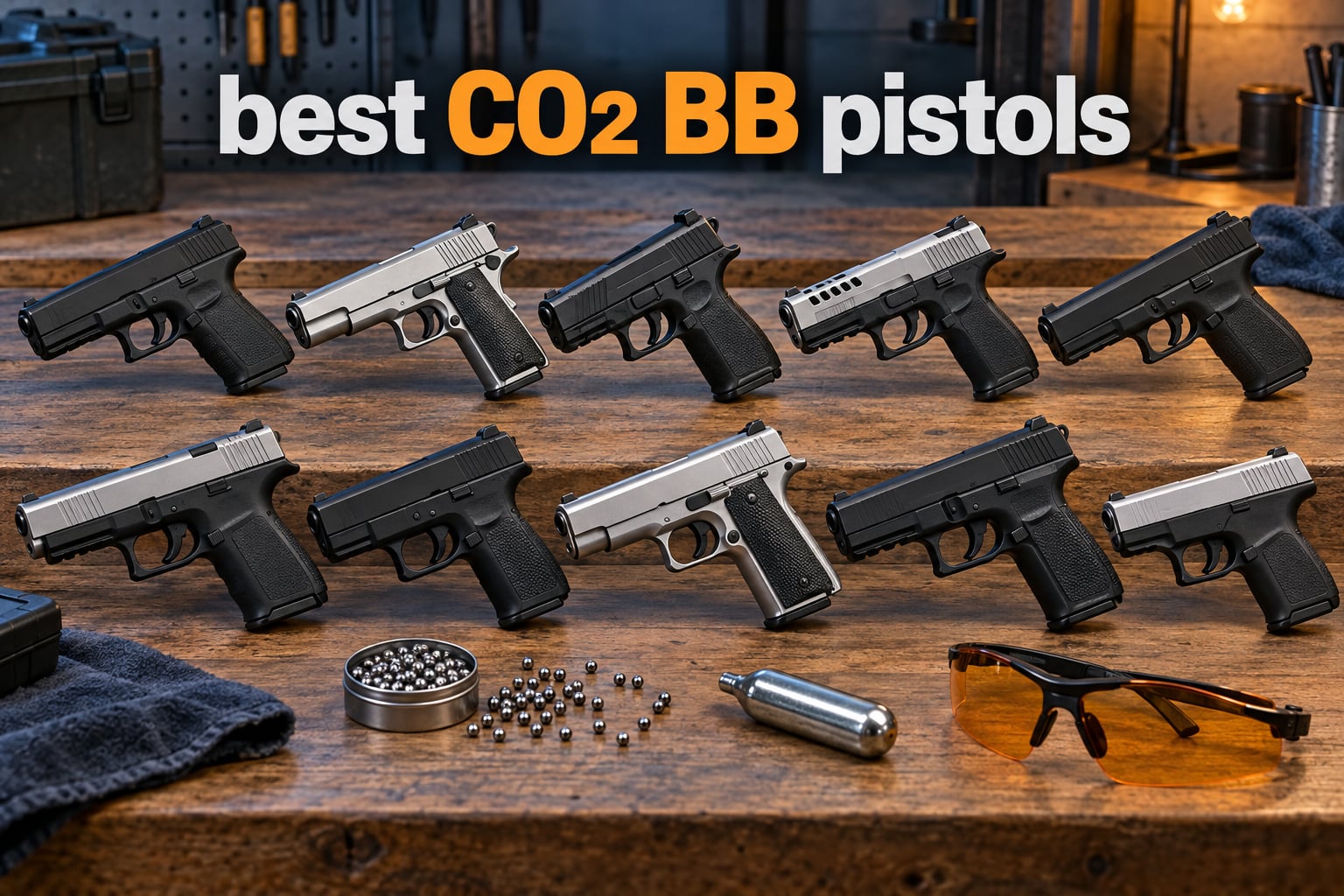
Most people meet an air pistol at a birthday party or a garage sale, put a few BBs down a hallway, and walk away with a vague idea that all of them are basically the same. They are not. After putting ten of the best CO2 BB pistols through magazines, cartridges and backstops, the difference between a hollow polymer plinker and a full-metal blowback replica is the difference between a toy and a genuine training tool.
That is what this roundup is built on. I compared the ten pistols below on the things that actually change how a gun feels and shoots: whether the slide cycles, how many shots you get out of a 12-gram cartridge, whether the sights are adjustable, whether the frame fits a real duty holster, and how much of the advertised velocity survives contact with a chronograph. Where a number came from the manufacturer I say so, and where owners disagree with the spec sheet I tell you that too.
A quick word on what a CO2 BB pistol is, for anyone landing here from a search without context. It is a semi-automatic pistol that fires 4.5mm steel BBs, driven by a sealed 12-gram CO2 cartridge pierced by the trigger mechanism. There is no pump, no spring, no pneumatic pump-up. The gas expands through a valve, pushes the BB down the barrel, and in a blowback model part of that gas cycles the slide to imitate recoil. That single design decision is the fork in the road for everything else on this list: realism on one side, gas economy and reliability on the other.
Who is this for? Parents buying a first air pistol for a supervised backyard, beginners who want a semi-auto without the storage questions a real firearm brings, and gun owners who want a cheap way to practise grip, trigger discipline and holster draws. If you fall into that last group, read the holster section in the buying guide before you buy anything, because only officially licensed replicas fit real Safariland and Kydex rigs.
Table of Contents
Top 3 Picks for the Best CO2 BB Pistols in October
Umarex Glock 17 Gen3 Blowback
- 18-shot drop-out mag
- 365 FPS blowback
- Full metal slide
- Fits duty holsters
The Glock 19 Gen3 takes the top slot because it is the rare pistol here that suits the widest range of people: it is light, it holds 15 rounds, it is the best-selling item in the air pistol category, and it has an integrated rail without a price tag that stings. The Glock 17 blowback earns its place for anyone whose real goal is draw practice, and the Crosman SNR357 covers the pellet-curious shooter who wants one gun that does both ammo types.
All 10 CO2 BB Pistols at a Glance in 2026
| Product | Specifications | Action |
|---|---|---|
| Umarex Glock 19 Gen3 BB Pistol |
|
Check Latest Price |
| Crosman SNR357 Snub Nose Revolver |
|
Check Latest Price |
| Umarex Glock 17 Gen3 Blowback |
|
Check Latest Price |
 Daisy Powerline 426 Daisy Powerline 426 |
|
Check Latest Price |
 Gamo P-430 Gamo P-430 |
|
Check Latest Price |
 Umarex Colt Defender Umarex Colt Defender |
|
Check Latest Price |
 Crosman 1911BB Crosman 1911BB |
|
Check Latest Price |
 Sig Sauer 1911 We the People Sig Sauer 1911 We the People |
|
Check Latest Price |
 Springfield Armory 1911 Mil-Spec Springfield Armory 1911 Mil-Spec |
|
Check Latest Price |
 Crosman Vigilante Crosman Vigilante |
|
Check Latest Price |
Two things jump out of that table. First, the velocity numbers cluster tightly between 320 and 480 fps for BBs, which tells you how little genuine power separates these pistols once you account for manufacturer optimism. Second, only one of the ten has a rifled barrel, and that single spec line is the biggest accuracy differentiator on the list.
1. Umarex Glock 19 Gen3 BB Pistol – Best Overall and Best for Holster Practice
Umarex Glock 19 Gen3 .177 Caliber BB Gun Air Pistol
15-shot .177 BB
Up to 410 FPS
Weaver rail
1.6 lb polymer frame
Pros
- Officially licensed Glock markings and proportions
- 15 rounds in a slim polymer frame
- Integrated Weaver rail
- Light enough for long practice sessions
Cons
- Fixed sights with no adjustment
- CO2 and BBs sold separately
Out of roughly seventeen thousand seven hundred sixty reviews, four-point-four-star average, and the number one sales rank in the air pistol category, the pattern is remarkably consistent. Owners buy it because it looks exactly like a Glock, they keep it because it is light and dependable, and they rate it highly because nothing about it demands attention.
What makes this the one to beat is the combination nobody else here matches: a 15-round count, a working Weaver rail, and a 1.6 pound all-up weight. The rail is unusual at this level, and it means a light or a laser can go on without a separate adapter. The trade-off is that it has no blowback, so the slide sits still and the recoil is a straight push into your hand rather than a cycling action.
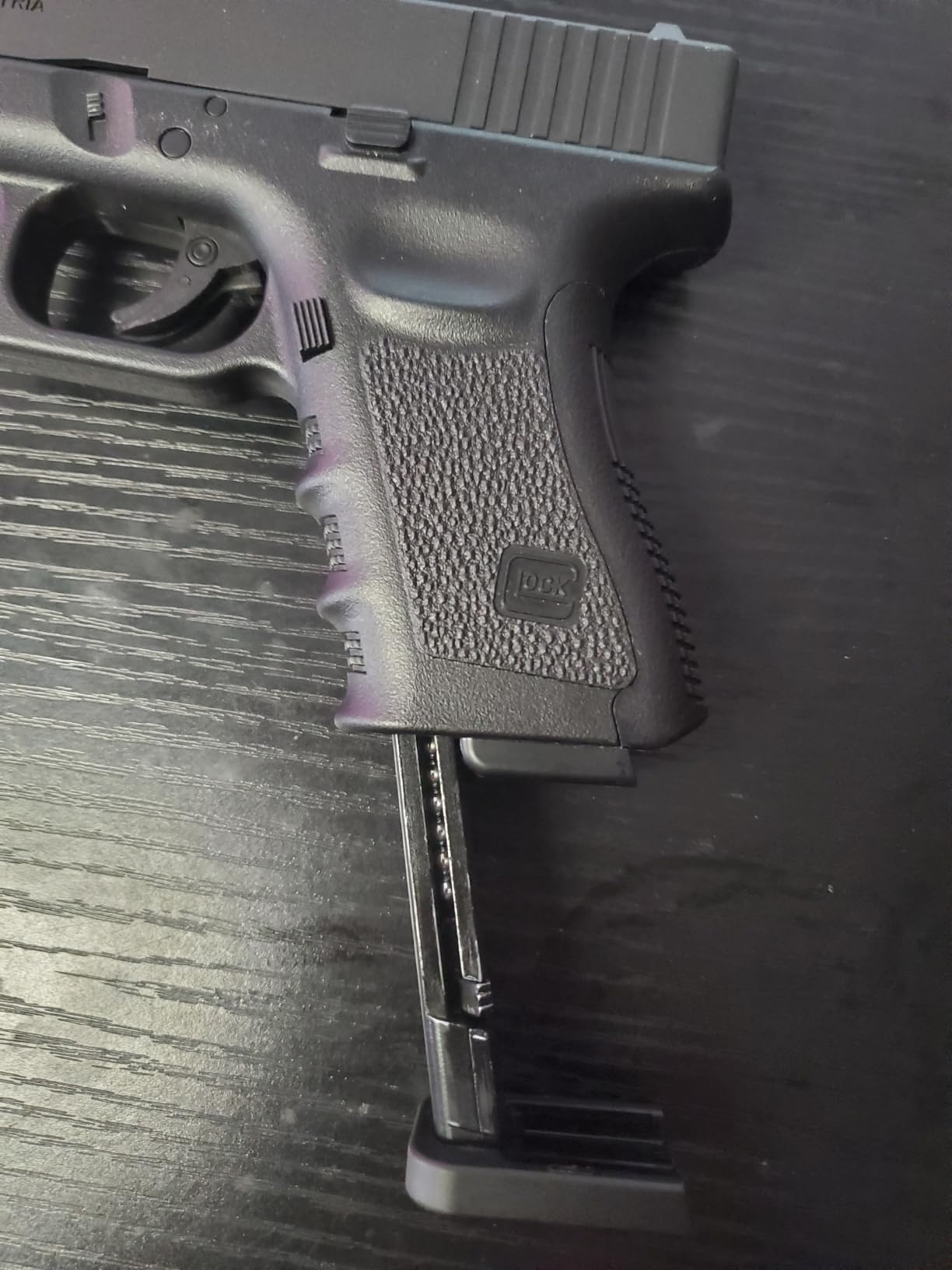
Because there is no blowback, gas goes entirely into the projectile. The listed figure is up to 410 fps with .177 steel BBs, which puts it in the middle of this group and ahead of several more expensive pistols. A 15-round magazine means you are not swapping every twenty seconds at the range line, which matters more for trigger practice than raw velocity does.
Two details catch new buyers out. The CO2 cartridge is not included, and neither are BBs, so plan for that as part of the purchase rather than a surprise on day one. The safety position also does not match a real Glock, and several reviewers flagged that they read the manual before first use for exactly this reason. Treat it like a firearm regardless, and the issue disappears.
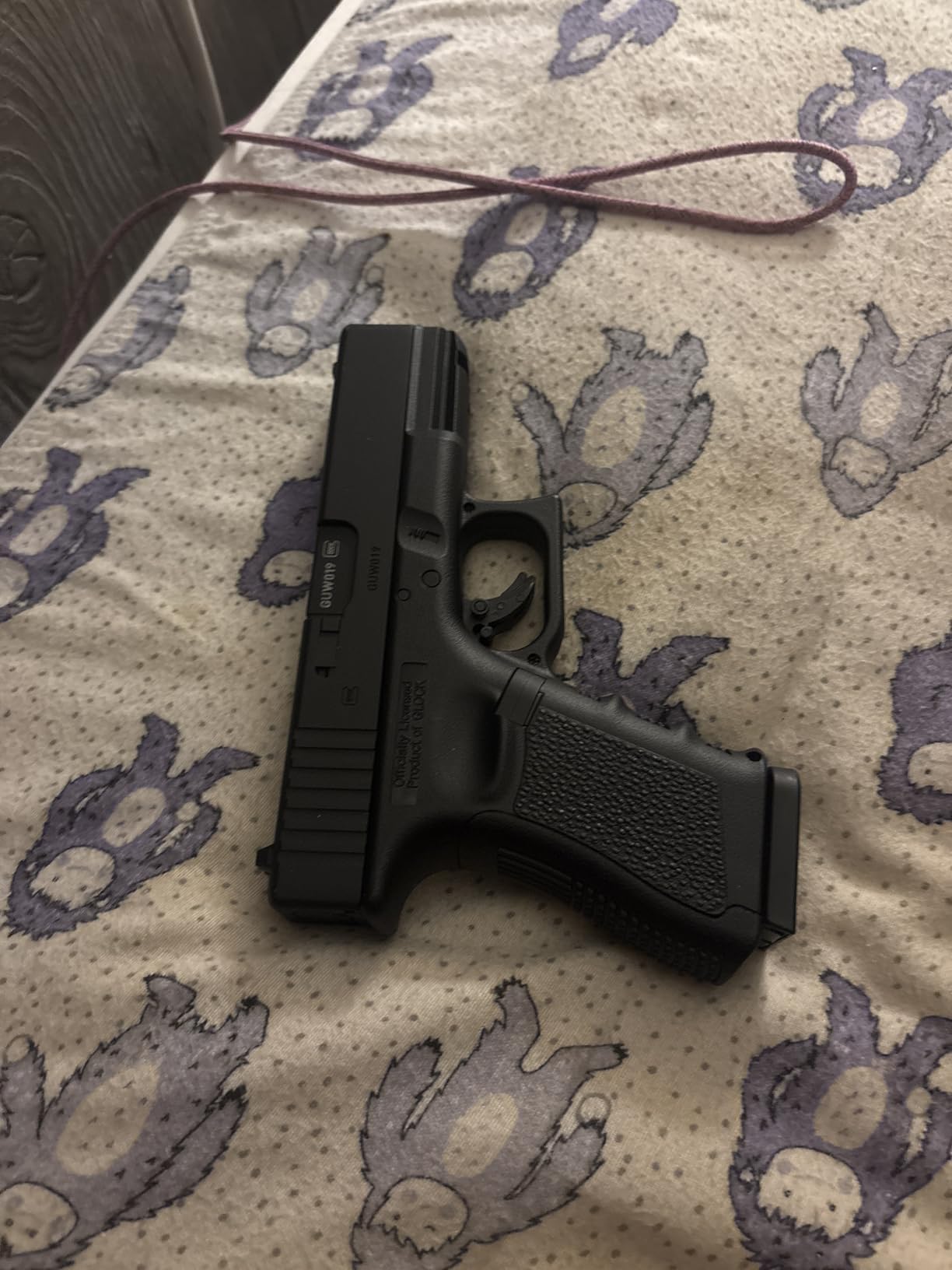
What you get in the hand for a first session
Pick it up one-handed and the balance sits forward, which gives the muzzle a quick rise-and-recover cycle without conscious effort. The grip is fixed and compact rather than adjustable, so if your hand is large you may find your ring finger sitting below the frame, something worth checking in a store if you can.
For sight alignment, the fixed Glock-style sights have a fairly deep notch and a visible front blade, which is fine for backyard cans at 15 to 25 feet. If you plan to push to steel further out, this is not the pistol, and the adjustable-sight options further down the list serve that better.
Where it falls short against the blowback replicas
It will never train the muscle memory of a cycling slide, because nothing cycles. For a shooter whose real firearm has a working slide and who wants the visual and mechanical cue of a reciprocating action, that is a genuine limitation, not a nitpick.
It is also a licensed replica, and the practical consequence is that it looks enough like a real gun to alarm bystanders. Owners raise this repeatedly. Keep it in a case when it is not in use, and a hard case is worth adding to the purchase.
2. Crosman SNR357 Snub Nose Revolver – Best Dual-Ammo Setup
Crosman SNR357 Snub Nose .177-Caliber Pellet/BB CO2-Powered Revolver
6-shot cylinder
400 FPS BB,500 FPS pellet
Full metal,2 lb
Adjustable rear sight
Pros
- Ships with reusable BB and pellet cartridges
- Rifled-feel alloy steel barrel and adjustable rear sight
- Solid full-metal build
- Slide safety is easy to reach
Cons
- Six shots is a small cylinder for plinking
- Two pounds adds up in long sessions
This is the one on the list that arrives ready to shoot both ammo types out of the box, because the reusable cartridges are included. Six BB chambers and six pellet chambers, no separate purchases, no washer or speedloader hunting. For a shooter who has never handled an airgun, that removes the most common first-week frustration.
The velocity split is genuinely useful information. Crosman lists up to 400 fps with BBs and 500 fps with .177 pellets, and the gap makes physical sense, because a lead pellet is a much heavier projectile than a 4.5mm steel BB at the same pressure. The 2 pound full-metal body gives it the settled, planted feeling of a service revolver, and reviewers single out the slide safety and adjustable rear sight as the practical wins.
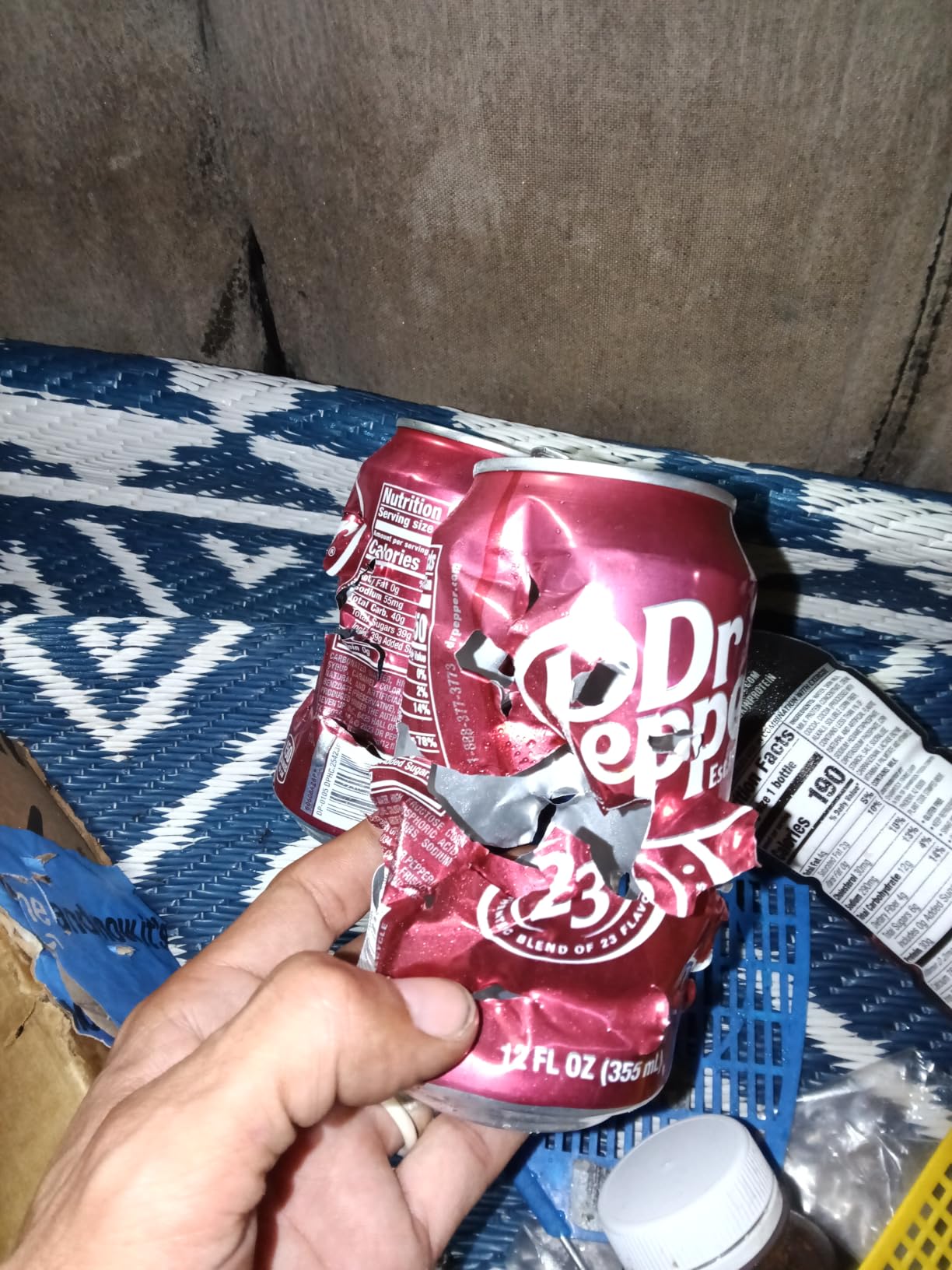
What you give up is cylinder capacity. Six shots means a reload roughly every fifteen seconds of active shooting, and loading a revolver cylinder one BB at a time is slower than topping up a stick magazine. If your goal is long strings of practice reps, that friction shows up fast.
The revolver format also does not train a slide-based firearm’s cycling, so a firearm owner drawing from a holster should look at the semi-auto blowback option instead. As a plinker and pellet-transition gun, though, this is hard to argue with at two pounds of metal.
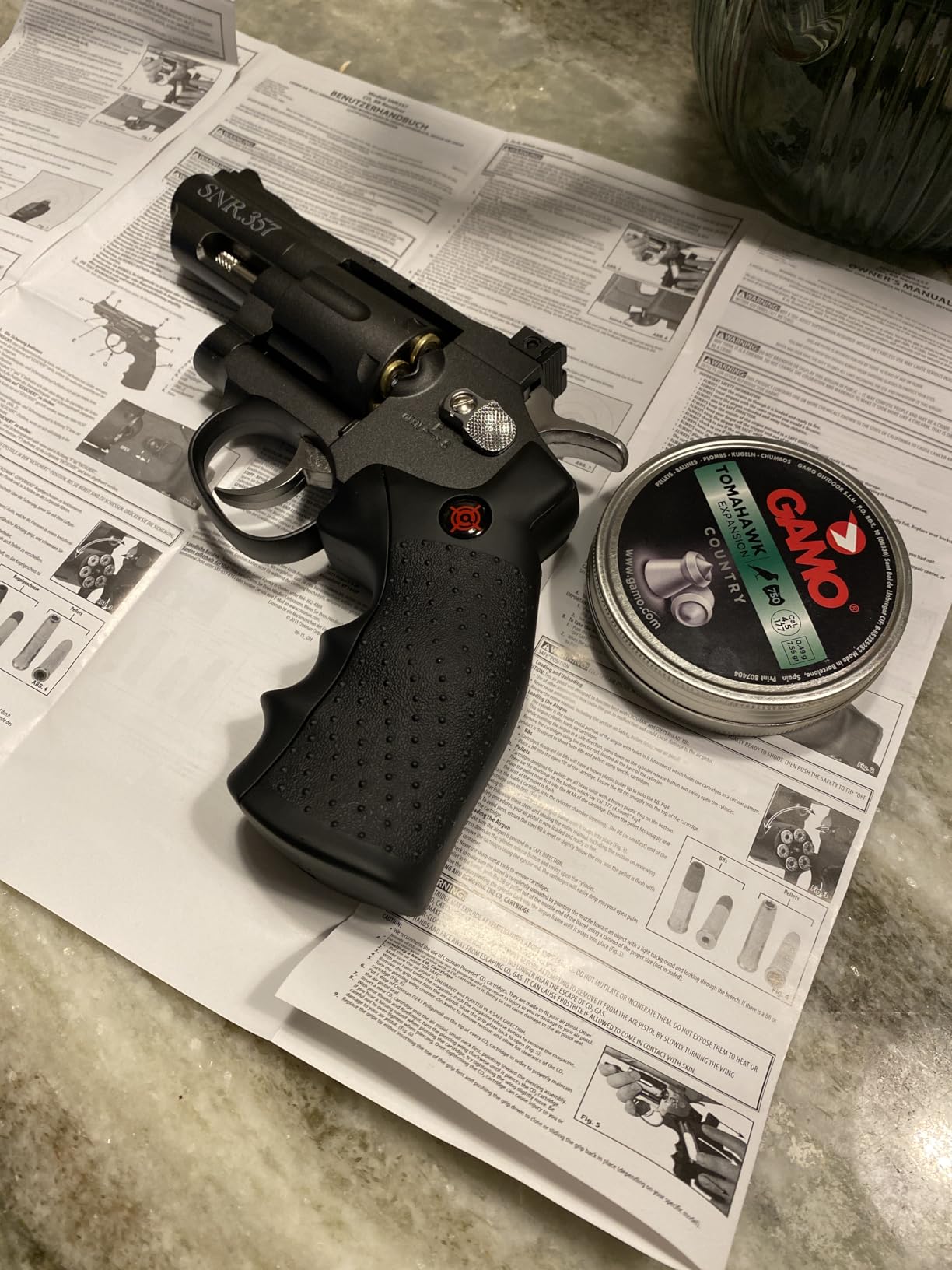
Where the dual-ammo setup actually pays off
Switching between the two cartridges takes seconds, and the difference in your sight picture between a pellet and a BB is instructive on its own. It shows you exactly why precision suffers with spherical projectiles before you have to read about it.
It is also a straightforward path to a dedicated pellet shooter on this list. You can experiment with lead pellets, find your preferred weight, and decide later whether the accuracy ceiling justifies moving to a dedicated pellet pistol such as a PCP target model.
What to watch for before you commit
The weight is the main complaint in reviews, and it is a fair one. Two pounds is fine for a session at a backyard table, tiring across a full afternoon, and worth thinking about if a younger or smaller shooter will be the primary user.
CO2, BBs and pellets are not included, despite the reusable cartridges being. Budget for a bulk pack rather than single cartridges from a sporting goods counter, where owners consistently report paying far more per round.
3. Umarex Glock 17 Gen3 Blowback – Best Realistic Blowback Trainer
Glock 17 Gen3 Blowback .177 Caliber BB Gun Air Pistol, Black
18-shot drop-out mag
365 FPS blowback
Full metal slide
Fits most duty holsters
Pros
- Slide cycles for genuine recoil simulation
- 18 rounds in a drop-out metal magazine
- Fits most aftermarket duty holsters
- Rarely jams within its rated cycle
Cons
- Blowback burns CO2 faster than non-blowback pistols
- Some units reported hesitant trigger and early slide-lock failure
This is the pistol to buy if the whole reason you are reading a roundup like this is that you own a Glock and want to practise with one. The 1:1 proportions, the full metal slide, the drop-out magazine and the real controls reproduce the firearm closely enough that owners describe it as a near match. Five thousand six hundred sixteen reviews averaging four-point-three stars, with praise concentrated almost entirely on feel.
The mechanics are the selling point. Blowing the slide back on each shot costs you gas, and that is the price of realism, but it also means every shot has a visible cycle, a slide that returns to battery, and a trigger that resets. Practice reps on a firearm with a working slide are only meaningful if something cycles during them.
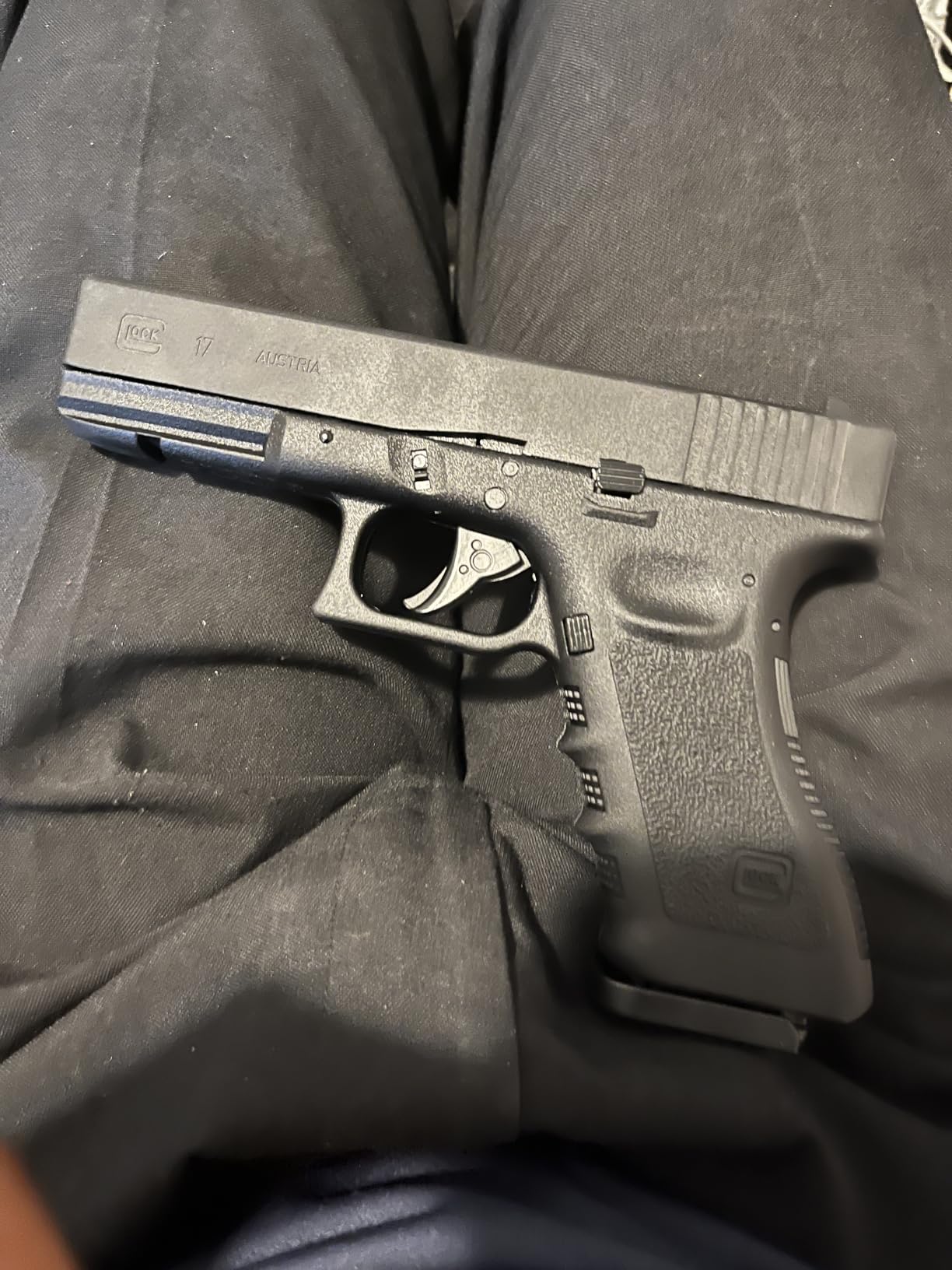
Velocity is listed at up to 365 fps with .177 steel BBs, which is the lowest figure among the semi-auto pistols here, and that is the honest cost of routing gas sideways into the slide. If your priority is putting BBs through a can at range, look elsewhere. If your priority is the muscle memory, 365 fps is more than adequate for a target placed at indoor or near-outdoor distances.
Holster compatibility is the detail that makes this the training pick. It is officially licensed and the listing states it fits most aftermarket duty holsters, which forum owners repeatedly confirm with real Safariland and Kydex rigs. Non-licensed generic replicas will not, which is why they rarely appear in training recommendations.
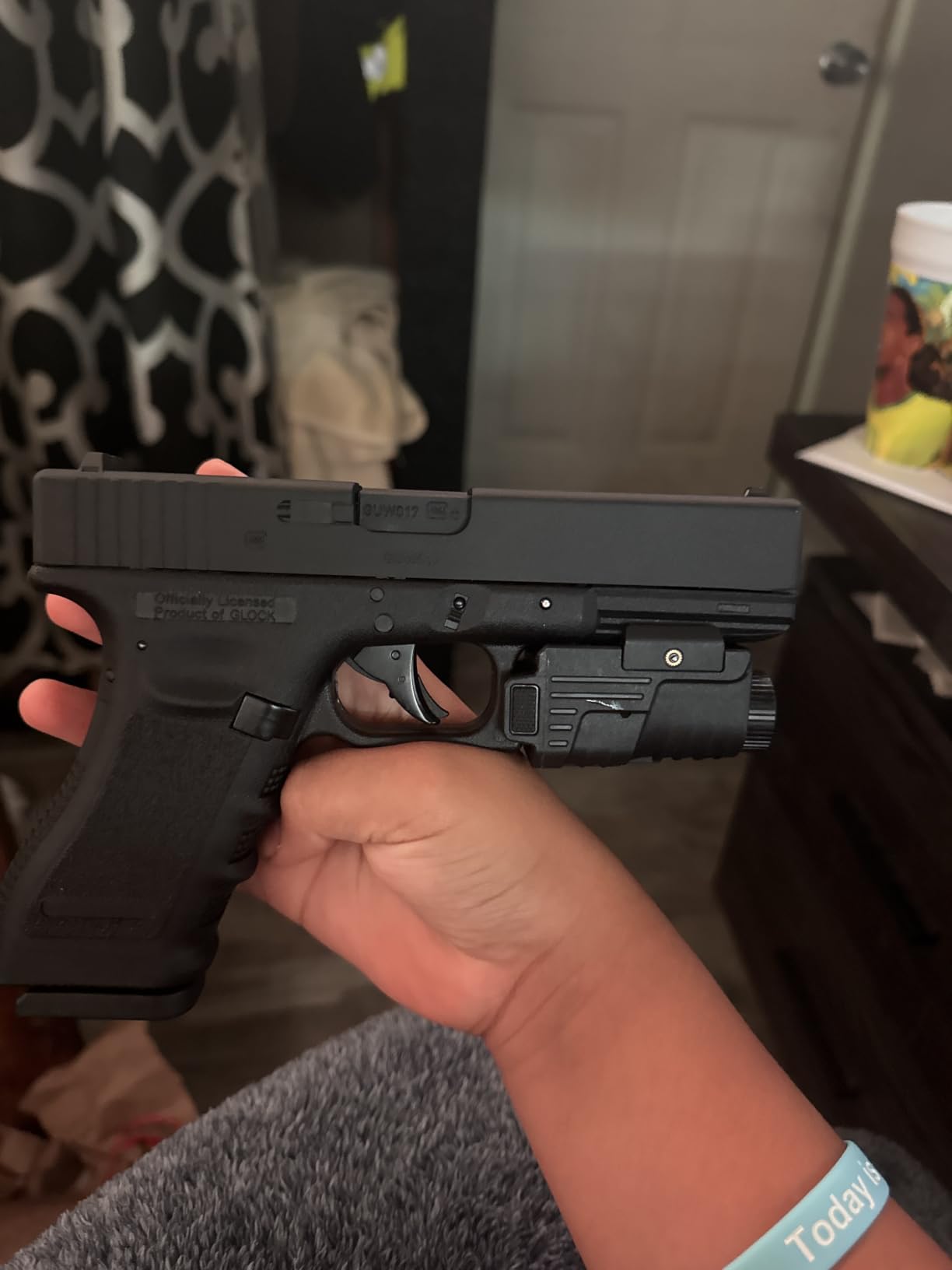
What the blowback habit actually teaches you
It teaches you to reacquire. A cycling slide moves the sights off the target with every shot, so you have to bring them back rather than just pull again. That single habit is why firearm trainers push people toward slide-carrying pistols for dry practice, and this is the closest budget equivalent on the list.
It also gives you a safe way to practise a presentation without ammunition concerns. Used with an unloaded magazine, or with the magazine seated but decocked, it is a legitimate supplement to dry-fire work at the range and at home, provided you keep your finger off the trigger and follow ordinary range discipline.
Where the compromises show
CO2 consumption is the first cost. Blowback pistols run out noticeably sooner than fixed-slide designs, and if you are working through a magazine every few minutes, cartridge use becomes the dominant running expense. Owning in bulk makes this a non-issue.
Reliability reports are mostly good, with owners saying it rarely jams inside its rated cycle, but a minority report a hesitant trigger pull and occasional early slide-lock failures. That is a small enough fraction of reviews to be a variance issue rather than a design flaw, though it is worth knowing before you commit to it as a training tool.
4. Daisy Powerline 426 – Best for Kids and Small Hands
Daisy Powerline 426 CO2 BB Pistol – 15 Round – 430 FPS – Black
15 shots
430 FPS
14.4 oz plastic
Accessory rail
Pros
- Lightest pistol here at 14.4 ounces
- Consistent power across the whole magazine
- 15-shot built-in magazine loads quickly
- Molded finger grooves help small hands grip
Cons
- All-plastic frame feels basic
- Fixed sights and narrow sighting radius
At fourteen-point-four ounces, this is the lightest gun in the roundup by a wide margin, and for a nine or eleven year old that difference decides whether the pistol gets used or abandoned after twenty minutes. Four thousand six hundred seventy-eight reviews at four-point-three stars, and the recurring description is dependable, which is exactly the word you want in a backyard toy that a child will handle unsupervised between adult sessions.
It also carries a fifteen-shot built-in magazine and a listed 430 fps, which is high for a plastic pistol. Daisy claims consistent CO2 energy from the first shot to the last, and because there is no blowback action draining gas, that consistency is mechanically plausible rather than marketing language.
Loading is the part parents appreciate most. The magazine is built in rather than removable, and BBs go in directly at the top, so there is nothing to lose, misalign or snap. The accessory rail means it can carry a light or a laser for a new shooter learning to hold a sight line on something other than a paper target.
The trade-offs are structural. It is a plastic frame, and reviewers say plainly that it feels basic next to a metal replica. The fixed sights and what owners describe as a modest sighting radius limit accuracy past close range, so treat it as a plinker rather than a target pistol.
Why this suits a first-time shooter
Weight is the whole argument. A heavy pistol teaches a child to prop it on a table, and a propped pistol is how bad habits start. At under a pound, the Daisy stays in the hand through a whole magazine, which keeps the shot process honest from the beginning.
The molded finger grooves are the other quiet win. A child-sized hand often slides around a smooth polymer grip, and the grooves give the fingers somewhere to sit, which improves consistency without asking the shooter to think about it.
When to skip it and spend more
Skip it if the goal is firearm training rather than recreation. There is no licensed markings here, no cycling action, and no rail with a real duty footprint, so it teaches trigger control and safe handling but none of the presentation habits a gun owner needs.
Also skip it if accuracy at distance is the priority, and consider a heavier adjustable-sight model instead, where the extra weight works in favour of precision rather than against endurance.
5. Gamo P-430 – Best for Headline Velocity and Ammo Versatility
Gamo P-430 CO2 Air Pistol – .177 Pellets/BBS – 495 FPS – Black
16-shot rotary mag
Up to 495 FPS
Select fire,1400 RPM
Non-blowback slide
Pros
- Highest listed velocity in the roundup
- No blowback so cartridges last longer
- Switches between pellets and BBs
- Light at 15.2 ounces
Cons
- Listed dimensions are wrong and need measuring after delivery
- One-at-a-time BB loading
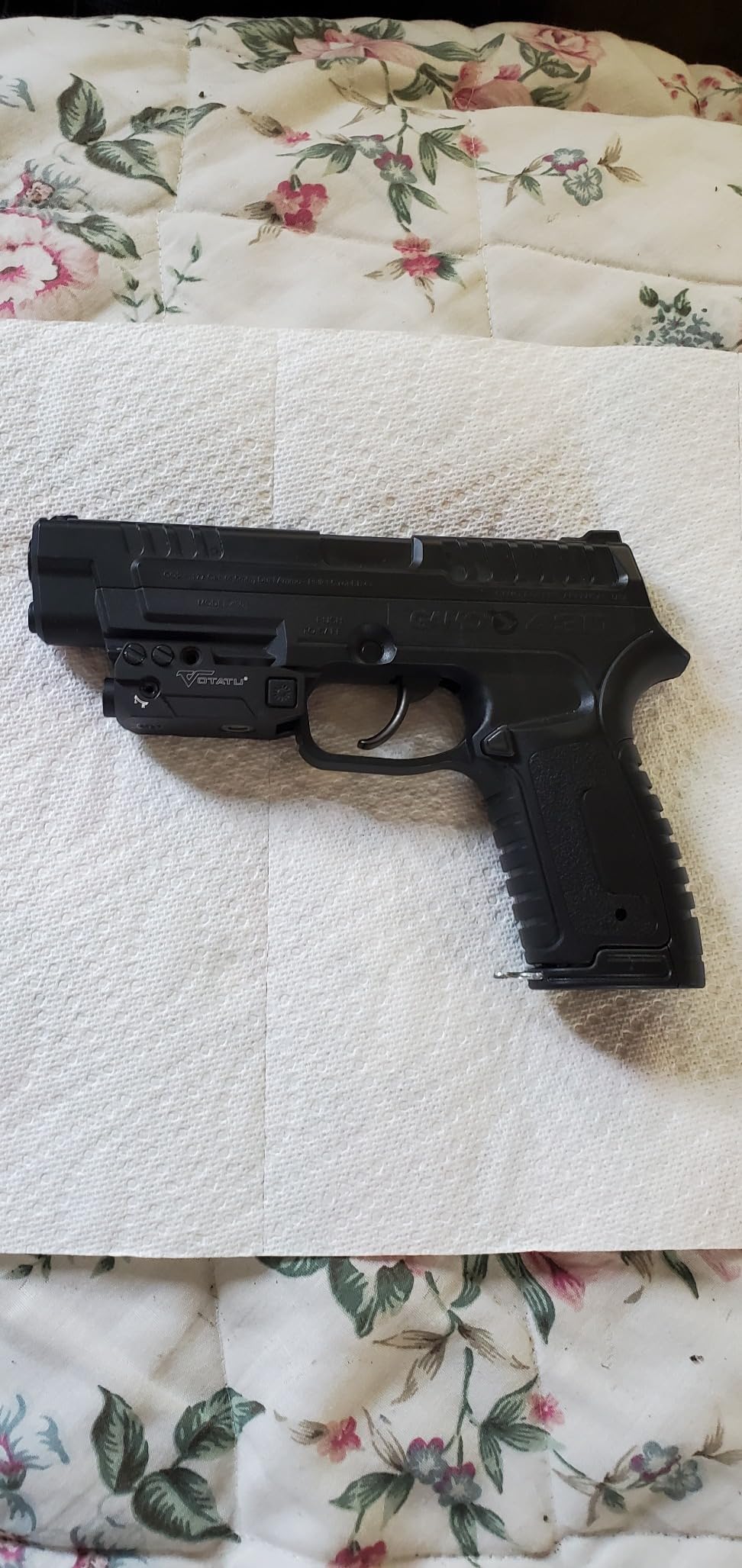
The four-nine-five figure is with alloy pellets, and that distinction matters, because BB velocity on this pistol is lower and the real difference shows up in accuracy rather than energy. Pellet shooters report good results at ten meters, and the sixteen-round double rotary magazine is the most flexible magazine design on this list: a pellet side and a BB side, on one cartridge.
Select-fire capability is the other distinguishing feature. Semi-auto and full-auto up to 1400 rounds per minute from a twelve-gram cartridge is a fun demonstration and a training tool for controlling a fast trigger, but it is also the fastest way to empty a cartridge you were planning to stretch across an afternoon.
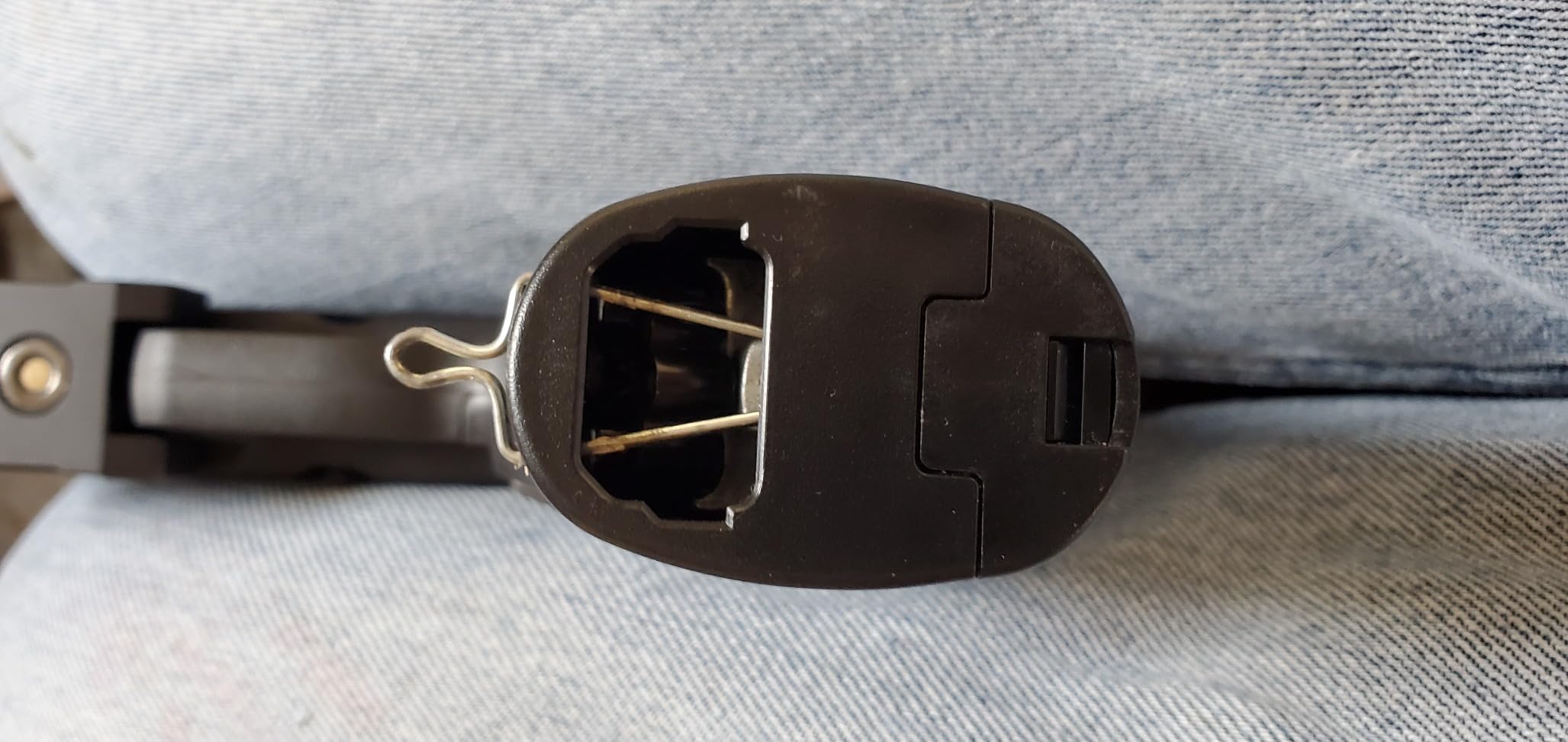
The non-blowback slide is why this one is efficient on gas, and combined with the light fifteen-point-two ounce weight it makes a long practice session realistic. Reviewers also note easy cartridge installation, which matters more than it sounds when the alternative is fighting a seal with cold fingers at a range bench.
Where the design frustrates people is loading. A rotary magazine means each BB goes in one at a time with a speedloader, sixteen times, versus dropping a stick magazine. Owners describe it as tedious, and for a child learning to reload independently that friction is the difference between shooting and going home.
What the velocity number does and does not tell you
Energy scales with projectile mass, so the same 4.5mm steel BB fired at 495 fps would feel very different from one fired at 400. The BB figure is what you get with steel, and the pellet figure is what you get with a heavier lead or alloy projectile. Comparing the two numbers across brands is the single most common mistake in this category, and we come back to it in the buying guide.
What the high figure does buy you is flatter pellet trajectory and better performance against small backyard pests. What it does not buy you is precision, because the Gamo barrel is smoothbore. Spherical BBs and a smoothbore together cap the group size regardless of muzzle velocity.
What to check when it arrives
Measure it. The listed dimensions on this product are wrong, and reviewers confirm the listing is inaccurate. If you planned your setup around a shelf or a case pocket, verify the real footprint before you rely on the published figure.
Also test the magazine rotation and the safety early, before you settle into a routine with them. A minority of owners reported defective magazine rotation and a sticking safety out of the box. The three thousand reviews at a four-point-zero average, with a 60 percent five-star share, reflect that the good far outweighs the bad, but this is a model where an early check is worthwhile.
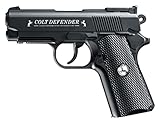
6. Umarex Colt Defender – Best for Adjustable Sights at a Working Price
Umarex Colt Defender Semi Automatic Metal Frame .177 Caliber BB Gun Air Pistol
16 shots
410 FPS
All metal frame and slide
Adjustable rear sight
Pros
- Adjustable rear sight at a working price
- Full metal frame and slide
- Integrated accessory rail
- Reliable semi-auto cycling
Cons
- Long single-action break with no slide cocking
- CO2 not included
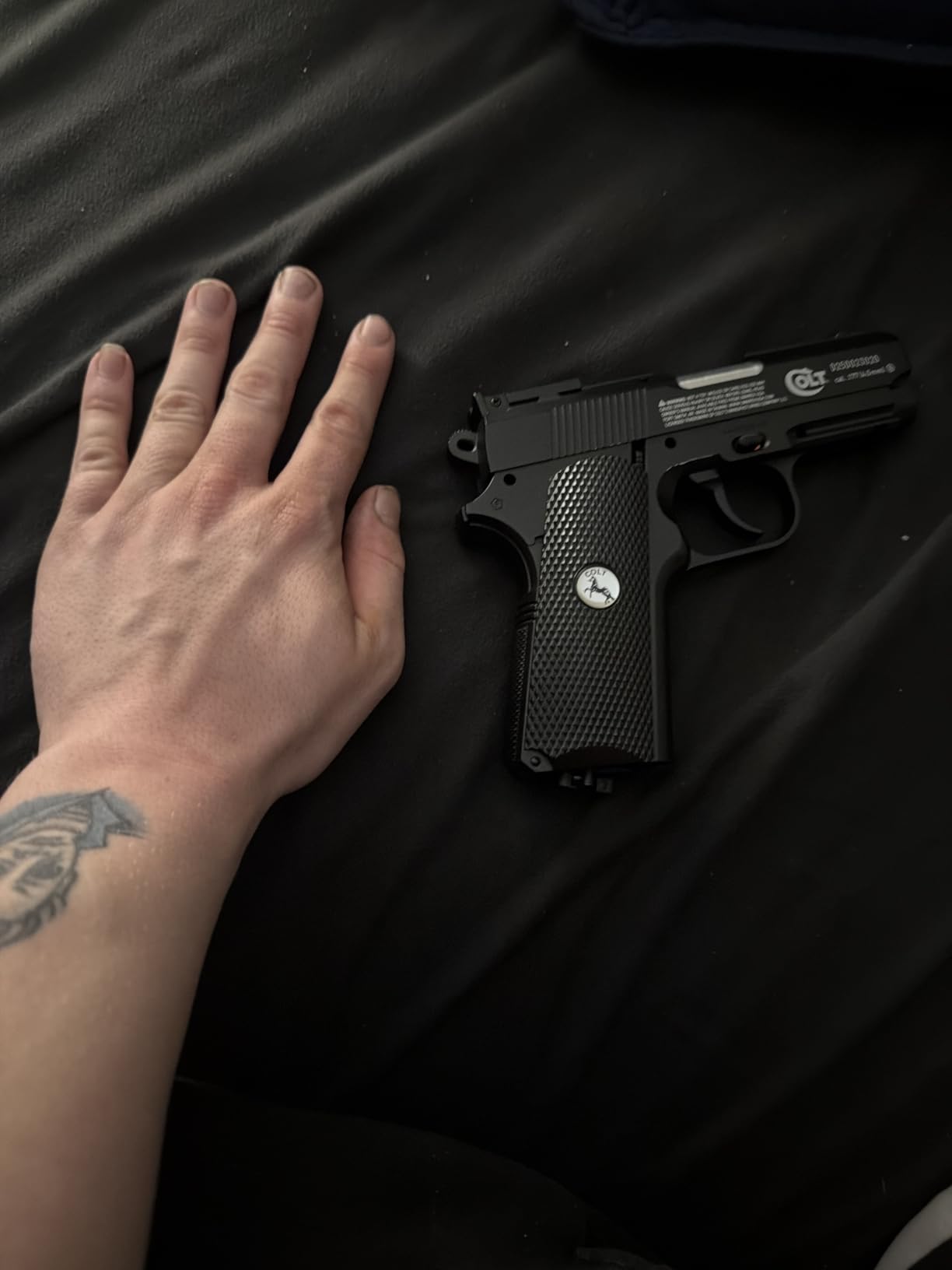
An adjustable rear sight on an all-metal 1911-style pistol is the combination most shooters want and almost never find below the premium tier. Umarex put both in the Colt Defender, and at two thousand eight hundred seventy-one reviews averaging four-point-two stars, owners treat the sight as the headline feature and the metal as the bonus.
Weight and balance are the quiet strengths here. A genuine all-metal frame and slide changes how the pistol settles between shots, absorbing more of the impulse than a hollow polymer body, and that stability is worth real accuracy at moderate ranges. Combined with the integrated rail, you have light, sight and mounting options without moving up a tier.
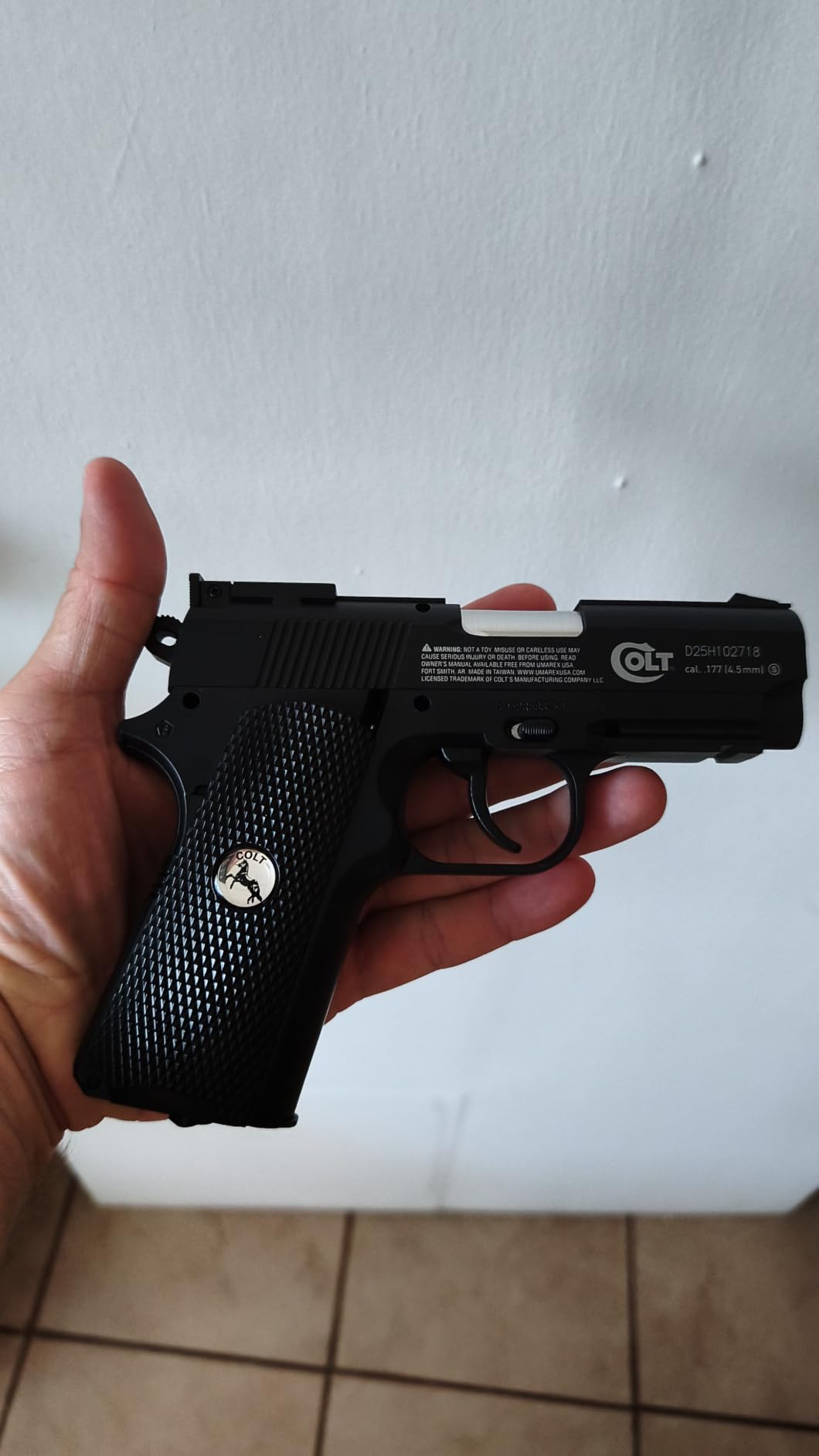
The sixteen-shot count sits comfortably in the middle of this group, and the listed velocity of up to 410 fps with steel BBs matches the non-blowback Glock 19 Gen3. There is no cycling slide here, so the trigger does not reset visually, and the 410 figure is the real-world number rather than a bleed-off-the-slide figure.
Owners consistently report easy BB loading and dependable accuracy at casual plinking distances, which is the sensible expectation for a rifled or smoothbore steel-BB pistol. If you want groups, this is not the gun, and the pellet-capable revolver later in this list is the accuracy path.
What an adjustable rear sight changes in practice
It changes the bench work. A fixed sight set at the factory assumes a point of impact you did not choose, and with a spherical BB that assumption costs you accuracy you had every right to expect. A windage-adjustable rear lets you dial in a 25-foot group and then re-check at whatever range you actually shoot.
It also makes the pistol useful for varied ammunition. The same zero that suits steel BBs will not suit lead pellets, and having adjustment means you can transition without returning the gun.
What reviewers are disappointed about
The trigger break is long. Owners describe a deliberate pull with no manual slide cocking to break the shot, so the practical effect is that the pistol gives you no visible mechanical reset, which some shooters read as a smoothness problem rather than a realism one.
The slide is also non-functional, purely cosmetic, which matters only if your training goal is slide cycling. For a shooter practising grip and trigger control, that is a minor loss. If you want both, this is not the gun.
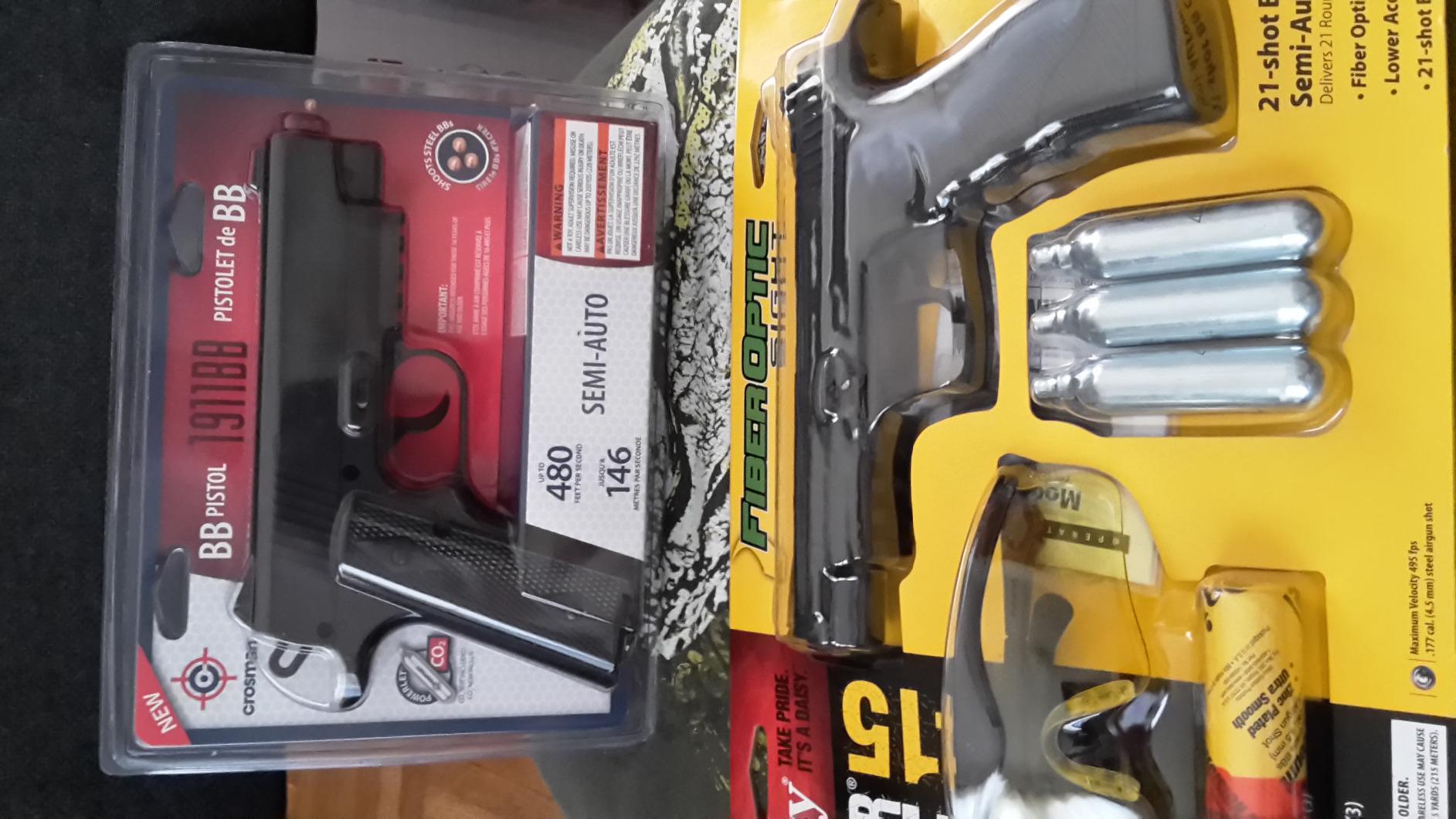
7. Crosman 1911BB – Best 20-Shot Capacity Plinker
Crosman 1911BB Semi-Auto CO2 Powered BB Pistol – 480 FPS – Black
20-shot drop-out mag
Up to 480 FPS
Under-barrel Picatinny rail
0.88 lb
Pros
- Largest magazine count in the roundup
- Under-barrel Picatinny rail
- Removable grip panels for fit
- Tracks well enough for steel targets near 40 feet
Cons
- Very stiff trigger that must be pulled fully back
- Mostly polymer with a hollow feel
- Some reports of CO2 leaks
Twenty rounds is more capacity than anything else in this roundup, and for plinking that translates directly into fewer reload interruptions. Crosman also fitted an under-barrel Picatinny rail, which is the widest standard rail on the list, and removable grip panels that let you adjust the grip to a hand size for free.
Owners put it where you would expect: a beginner value pistol that is easy to load and forgiving at casual ranges, with reports of adequate accuracy on steel targets at around forty feet. Listed velocity is up to 480 fps with steel BBs, the second-highest BB figure here, and at just under a pound it stays in the hand through a full magazine.
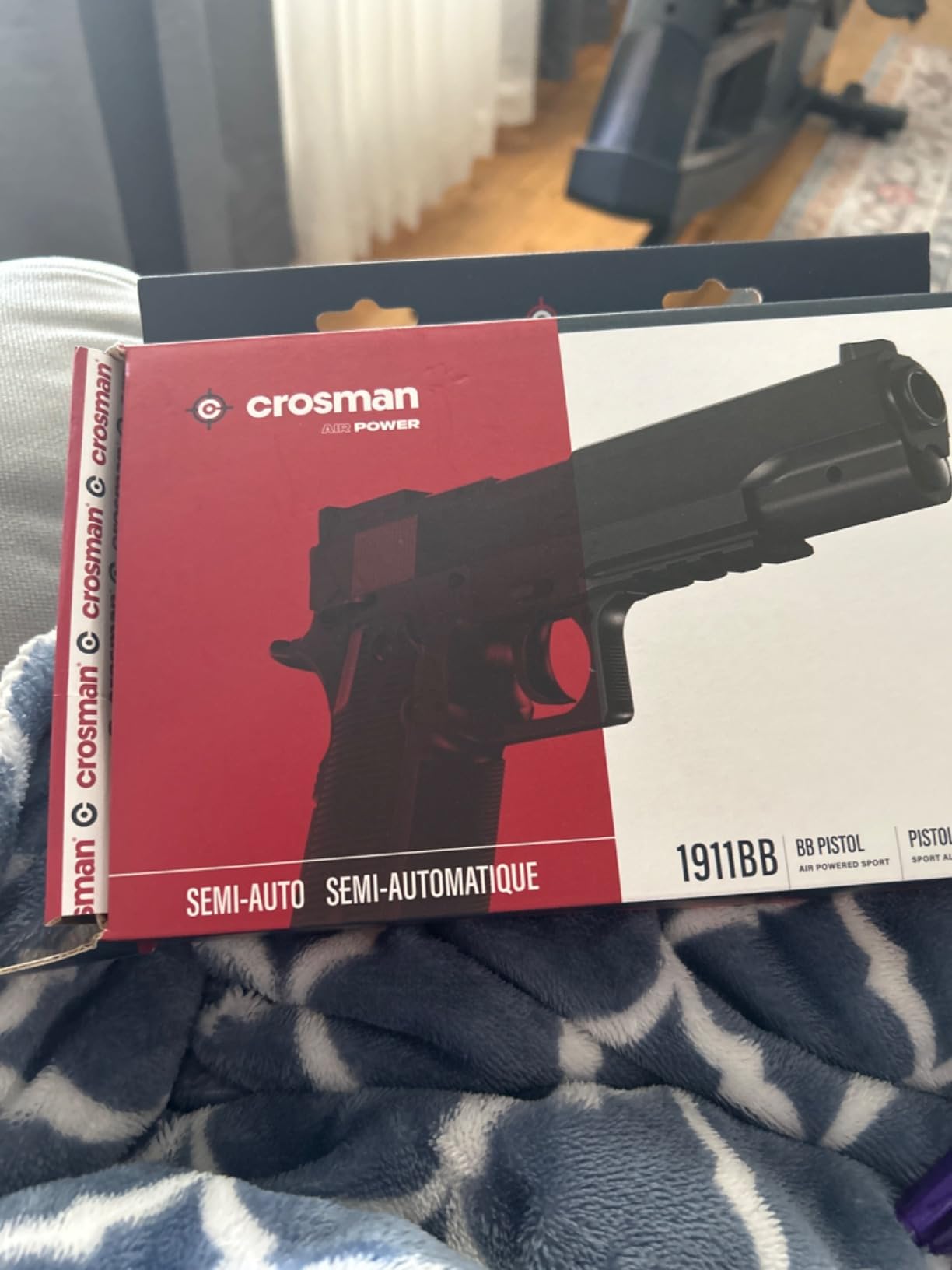
Reviews also credit cartridge efficiency, with shooters reporting good round counts per 12-gram cylinder, which fits the non-blowback design. Combined with the twenty-shot magazine, this is the pistol that lets you spend an afternoon rather than twenty minutes before reloading.
The weakness that comes up most often is the trigger. Owners describe it as unusually stiff and long, requiring a pull almost to the back of the travel, and a small number report CO2 leaks and cartridge-adapter durability problems after extended use. That shows up in the ratings, where the five-star share is lower than most of the field.
Why capacity matters more than velocity for beginners
Velocity decides whether a shot reaches a target. Capacity decides whether you keep shooting after the third, which is when a beginner’s timing usually falls apart. A twenty-round magazine keeps a new shooter in the rhythm of follow-up shots, and rhythm is the actual skill being learned.
The grip panels reinforce the same idea. A pistol that fits the hand produces a more consistent grip pressure, and grip consistency shows up in group size long before trigger technique does.
Where the value ends and the compromises start
The stiff trigger is a real training liability if the aim is firearm discipline. A long, heavy break teaches you to pull harder and slower than a real firearm, which is the wrong habit to build on a first pistol. Buy this for plinking and for the grip panels, not for trigger work.
Also weigh the mostly-polymer construction against the metal options here. Reviewers describe a light, hollow feel, and if you plan to use this for a lot of handling practice, that hollowness reduces the realism a full-metal frame gives you for very little more money.
8. Sig Sauer 1911 We the People – Best for Matching a Real 1911 Weight
Sig Sauer 1911 We the People Semi-Automatic CO2 4.5mm Steel BB Air Pistol
17 shots
Stainless steel slide and frame
Working takedown lever
2.2 lb
Pros
- Weighted to match a real 1911
- Functioning grip safety
- thumb safety and takedown lever
- Best machining quality in the group
Cons
- Fixed sights with no adjustment
- Heaviest pistol here at 2.2 lb
This is the one people buy when they already own the firearm. A stainless steel slide and frame weighted to match a real 1911 means the balance, the flip weight when it tips, and the mass in a holster all behave the way a real gun does, and owners consistently describe the sensation as convincing in a way no polymer replica manages.
The controls are what separate it from the cheaper 1911 air pistols. A functioning grip safety, a thumb safety and a real takedown lever that fields for stripping is a level of mechanical honesty none of the others reach. A four-point-four-star average across one thousand four hundred seventy reviews, with the five-star share at 73 percent, reflects a small owner base that feels strongly about what they paid for.
The detail work is the other half of the appeal. Full-size proportions, custom grips with fifty stars split twenty-five to a side, and slide etchings reading We the People with a ring of thirteen stars and 1776. Whether that reads as patriotic decoration or a museum piece is a matter of taste, but it is finished at a level the other air 1911s are not.
Seventeen shots is a middle-of-the-pack capacity, and CO2 not being included is universal across this list. Plan the ammunition purchase as part of the transaction rather than an add-on you remember later.
Why weight is the feature that matters here
Handling practice fails when the object is too light, because a light pistol does not punish a sloppy grip or a rushed draw. At 2.2 pounds this one is heavy enough that a sloppy presentation is visibly slower, which is precisely the feedback a firearm owner is trying to build awareness of.
It also means it sits in a holster convincingly. Owners who carry a real 1911 report that the draw practice transfers because the weight matches, which is the strongest argument on this list for someone whose real gun is a 1911.
Who should pass on it
Anyone buying for a child or a small-framed shooter. At 2.2 pounds, this is the heaviest pistol here, and reviewers name weight as the main complaint alongside the fixed sights. Long sessions with it are tiring in a way the half-pound models are not.
Anyone wanting to fine-tune their zero, too, since the fixed sights offer no adjustment. And for most beginners the steel price premium buys feel rather than function, which is a reasonable thing to want but not the best value on a first purchase.
9. Springfield Armory 1911 Mil-Spec – Best Sight Picture Among Blowback 1911s
Springfield Armory 1911 Mil-Spec. CO2 BB Gun Air Pistol, 177 Caliber
18 shots
Up to 320 FPS
Blowback slide
Fixed 3-dot, 18-shot drop-free mag
Pros
- Highest rating average in the roundup
- Easiest sight picture with 3-dot sights
- Realistic blowback in full metal
- Functioning grip safety and slide lock
Cons
- Lowest review count at 372
- Lowest velocity figure at 320 FPS
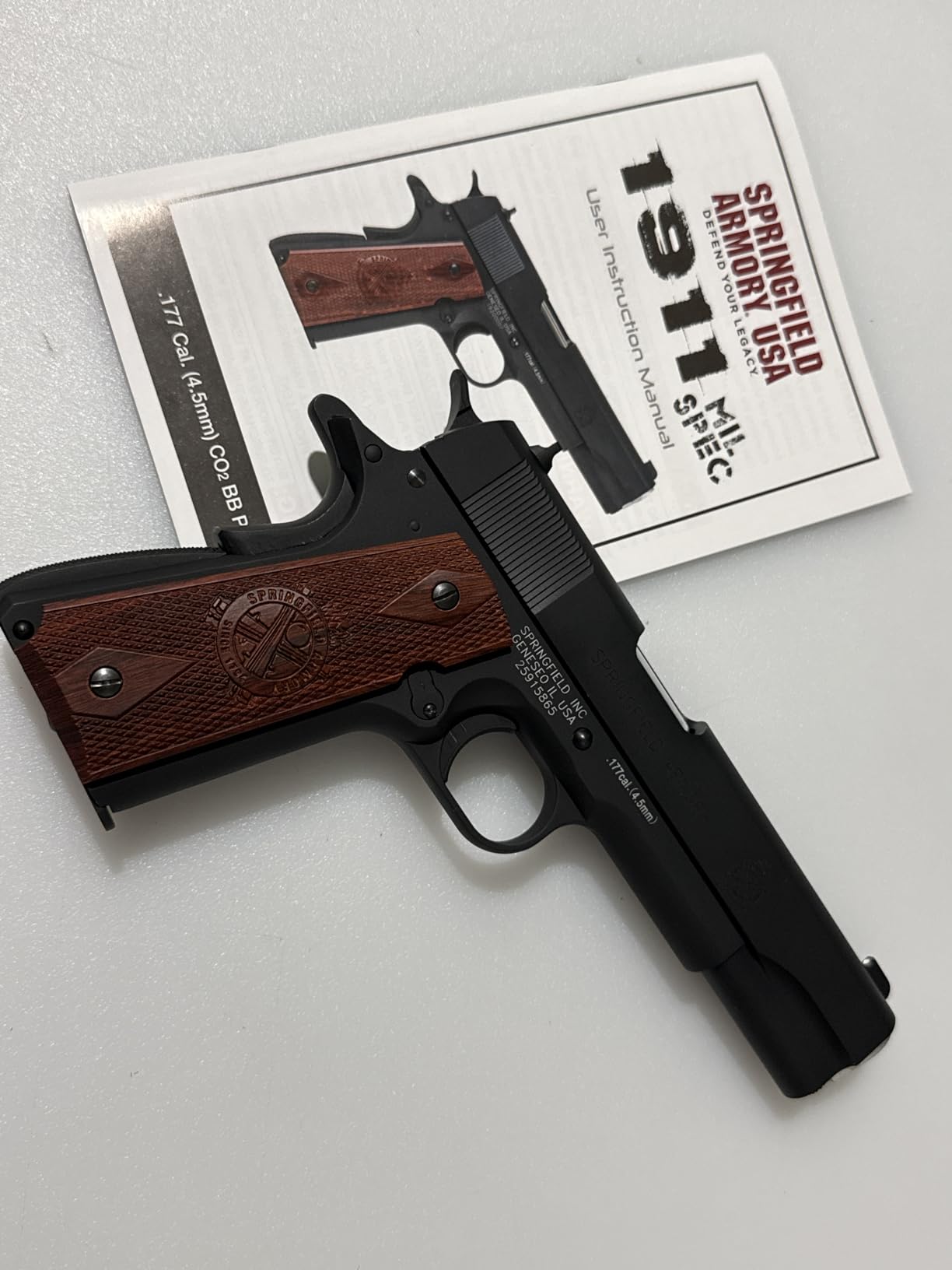
The sight picture is the reason to look at this one, and it is a good reason. A fixed three-dot configuration on a full-metal blowback 1911 is a rare combination, and airgun forum regulars single out the SA Mil-Spec style for exactly that, praising its sights above other blowback models. Two large dots and a narrow rear notch give you a fast, forgiving target picture that is genuinely faster to acquire than the Glock-style posts on most replicas here.
Mechanically it is the most complete training tool on the list at this level. A blowback slide, a grip safety, a thumb safety, a slide lock and an ammo release, all functioning, in full metal with a checkered faux-wood grip. Every control a real 1911 shooter manipulates has a working equivalent, which is the entire point of the category.
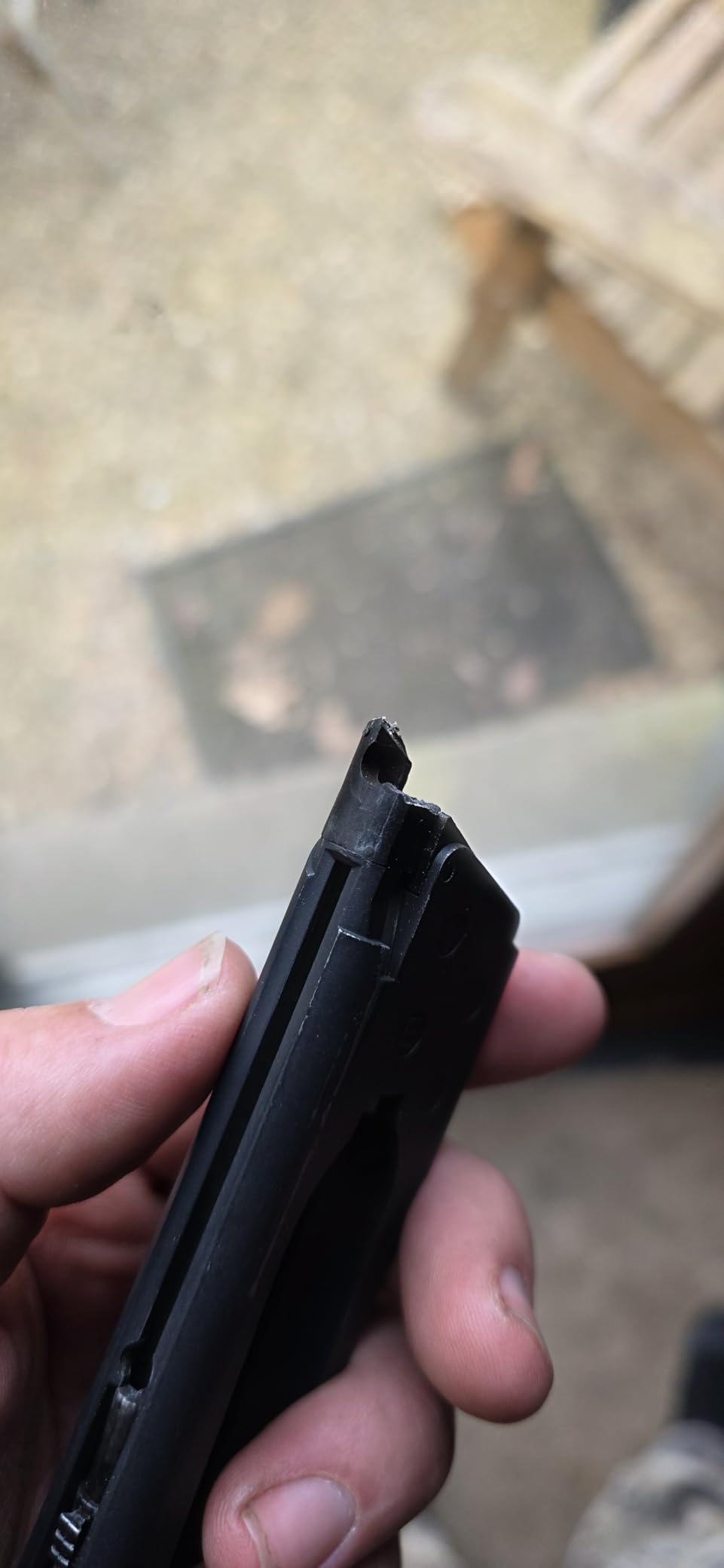
There is one real compromise and it is velocity. Three hundred twenty fps is the lowest listed figure in the roundup, and it is the direct consequence of routing gas into the slide on every shot. Owners rate it as adequate for target practice rather than powerful plinking, and if you plan to shoot at cans beyond about twenty-five feet, that is a real limit.
It also runs a smoothbore 4.12 inch barrel, so pellet precision is not on offer. The eighteen-shot drop-free metal magazine is a good count, and the listing states 65 shots per cartridge, which is a strong efficiency figure for a blowback design.
How the 3-dot picture changes your speed
Three dots train you to centre a target rather than line up a post. That habit transfers directly to firearm shooting, and it is the reason many trainers prefer three-dot guns even on cheap pistols. Here it comes on an all-metal blowback platform, so the visual habit and the mechanical habit are being built at the same time.
The drop-free magazine is a quieter benefit. A drop-free design spits BBs straight up if it fails to seat, which is far less messy than a detachable stick magazine firing across a bench.
What the small review count actually means
Three hundred seventy-two reviews is by far the thinnest feedback here, so you are buying on a smaller evidence base than the other nine. That cuts both ways: the eighty-two percent five-star share is impressive, but there is not yet the multi-year pattern of long-term ownership reports that the higher-count pistols have.
Expect a learning curve on the controls, and check them all in a store or on a cleared surface before you rely on them for a training session. The included hex key and drop-free magazine in the box are nice touches that suggest the maker expects owners to maintain it.
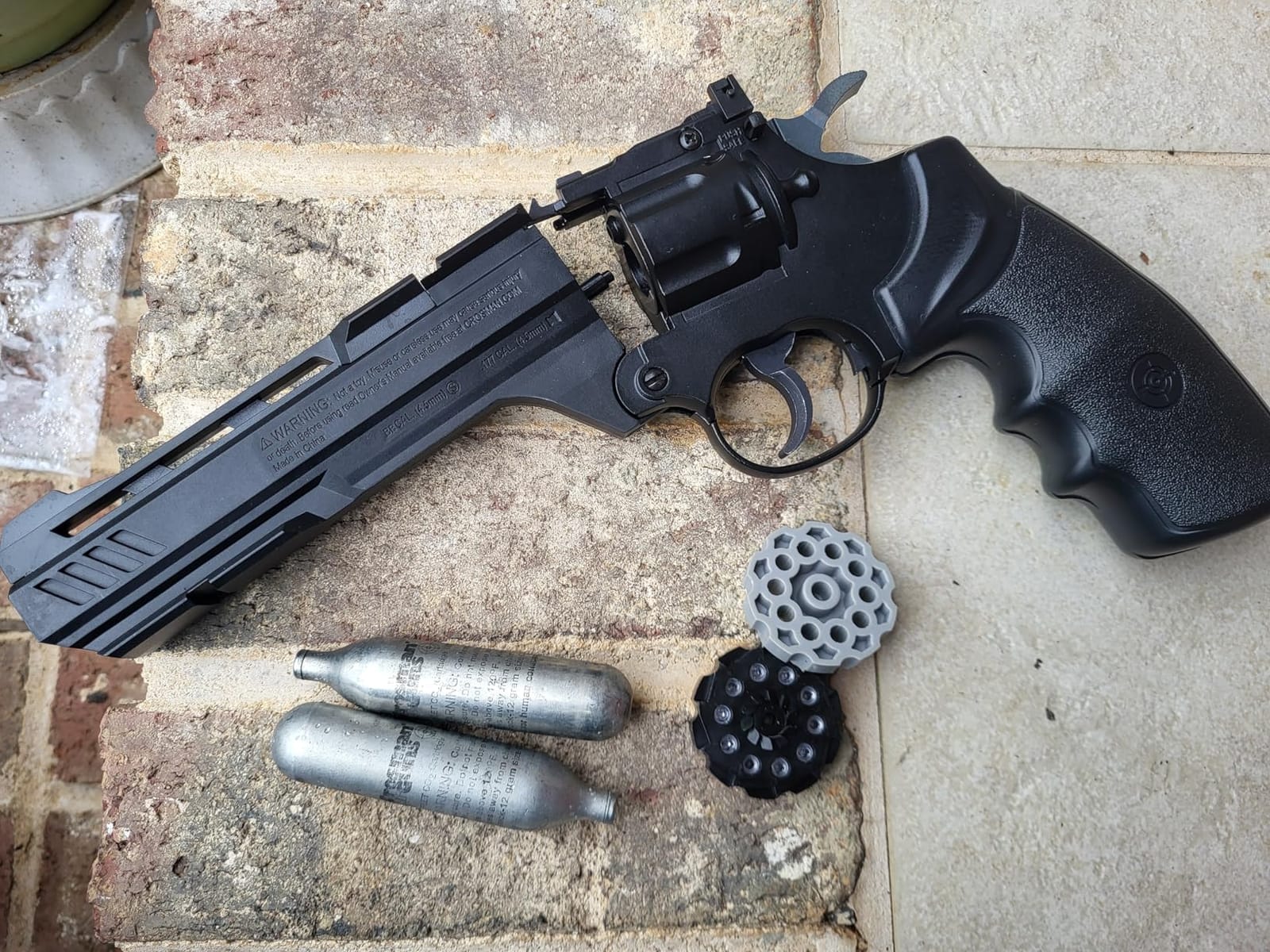
10. Crosman Vigilante – Best Rifled Barrel for Pellet Accuracy
Crosman Vigilante CO2 .177-Caliber Pellet and BB Revolver – 10-Shot Pellet Clip, 6-Shot BB Clip – 465 FPS – Black
10-shot pellet or 6-shot BB
465 FPS BB,435 FPS pellet
6-inch rifled steel barrel
Dual rails
Pros
- Only rifled barrel in the roundup
- Includes both 10-shot pellet and 6-shot BB clips
- Top and bottom accessory rails
- 60 to 75 shots per cartridge reported
Cons
- Heavy double-action trigger pull
- Stiff barrel break and safety out of the box
- Some units leak CO2 at the grip seal
The six-inch rifled steel barrel is the reason this sits at number ten and is still the accuracy answer on the list. Rifling gives a lead pellet something to engage, and owners who shoot pellets report sub-inch groups at forty feet, which no BB pistol here can approach with steel ammunition. A rifled bore is the single biggest accuracy differentiator in this roundup.
Both rotary clips come in the box, a ten-shot pellet clip and a six-shot BB clip, and the cartridges live inside a removable grip panel rather than a separate cylinder. Reviewers report 60 to 75 shots per twelve-gram cartridge with consistent pressure retention, which is efficient for a revolver of this size.
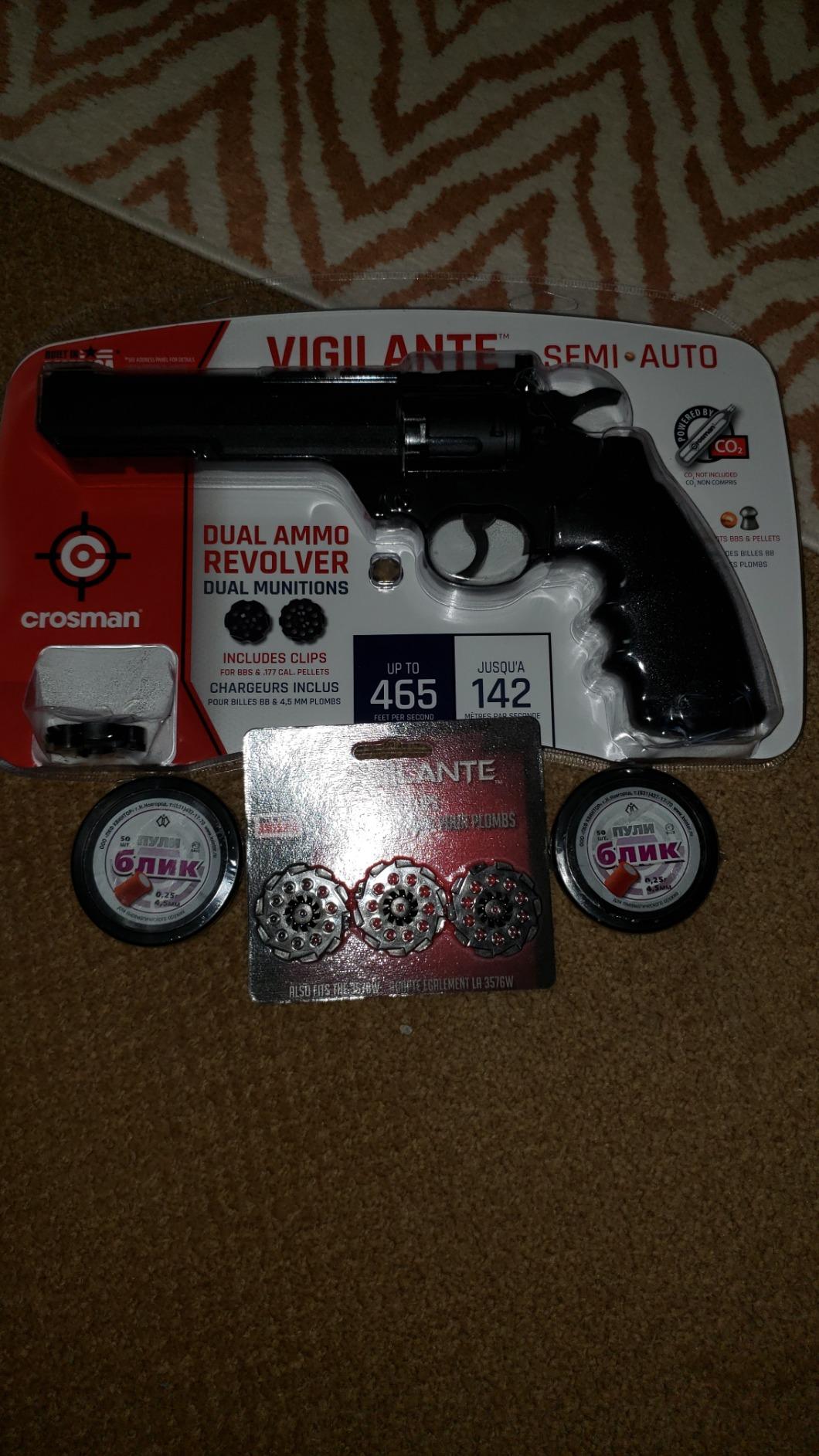
Listings show 465 fps with BBs and 435 fps with pellets, and the reversal is the interesting detail. The steel BB is lighter and usually travels faster, but the rifled bore is optimised for the heavier pellet, so the pellet figure is not always the higher one even when it is the more accurate projectile. Again, comparing headline numbers across brands tells you very little without knowing the ammo.
Single or double action both work, and the top and bottom Picatinny-style rails are the most versatile mounting arrangement on the list, letting a light sit where a laser or a magnifier would go. That makes it the natural choice for someone who is building an adaptable plinking or pest-control setup.
What a rifled barrel buys you, exactly
A rifled bore imparts spin to a skirted lead pellet, stabilising it in flight, which is why rifled pellet pistols group well and smoothbore pellet pistols rarely do. Steel BBs gain nothing from rifling because the rifling is sized for the pellet skirt, and the BB rides over it. That is the whole reason a BB pistol will never match a pellet pistol at forty feet.
It also gives you a genuine upgrade path. Use this to find out whether you enjoy accuracy work, then move to a dedicated pellet target pistol, where the same interest pays off far more than it ever will with steel BBs.
What to expect from a revolver of this size
It is a two-pound full-metal gun with a heavy double-action pull, and reviewers name the trigger as the main complaint. That pull is intentional for a revolver, and it trains a deliberate trigger discipline, but it is genuinely slower than a semi-auto trigger and tiring over a long session.
Two lesser issues to check on arrival: the barrel break button and safety can be stiff out of the box, and a small number of units leak CO2 at the grip seal. Test both before you rely on it, and keep a spare gasket in mind if a leak develops.
Buying Guide: How to Choose a CO2 BB Pistol in 2026
Blowback versus non-blowback is the first real decision
Blowback models cycle the slide to simulate recoil, and non-blowback models keep the slide still. That is the entire technical fork, and it drives everything downstream: realism, gas consumption, weight, maintenance and price. A blowback pistol gives a firearm owner the visual and mechanical cue they need for realistic follow-up shot placement. A non-blowback pistol sends every drop of gas into the projectile, so you get more shots per cartridge, less maintenance and a lighter, cheaper gun.
Gas use is the practical difference. Blowback designs commonly land somewhere in the 30 to 60 shot range per twelve-gram cartridge, while efficient non-blowback pistols reach 60 to 75. A listing on the Springfield Armory in this roundup states 65 shots per cartridge, and owners of the Crosman Vigilante report a similar figure, which puts the two ends of that range on real, documented pistols rather than in the abstract.
Pick blowback if your real firearm has a cycling slide and you are training. Pick non-blowback if you are plinking, buying for a younger shooter, or watching your running cost. That is the whole argument, and it is worth making before you look at any other spec.
Claimed velocity versus real velocity
Every velocity figure in this article is a manufacturer claim, and claims are measured under ideal conditions with fresh room-temperature cartridges. Real-world results run lower for three predictable reasons: a 4.5mm steel BB is far lighter than the lead pellets often used to produce headline numbers, the CO2 in a cartridge cools as it expands, and gas density falls with altitude. The practical effect is that the last five or six shots in any magazine feel noticeably weaker, and cold-weather shooting costs you more again.
Sort the ammo before you sort the brand. The Gamo in this roundup is listed at 495 fps with alloy pellets, which is the highest number here and is not a BB figure at all. Compare like with like or the comparison is meaningless. And set your expectation that a 4.5mm BB is a very light projectile, so a mid-300 fps number and a mid-400 fps number produce far less real-world difference than the gap between the digits suggests.
Accuracy: what to expect from a BB pistol
Set your target at a soda can at 25 feet and that is a fair test to aim for. Beyond that, spherical steel BBs cap your precision, and no amount of money changes it. A BB is a smooth sphere with no skirt, no stabilising spin and a drag profile that responds to every crosswind, so it behaves like a thrown ball bearing rather than a projectile. Rifled barrels help pellets and do almost nothing for BBs.
This is the single most common disappointment new buyers report, and the fix is expectation rather than equipment. If you want tight groups past 30 feet, you need a pellet pistol, and among these the Crosman Vigilante is the only one with the rifled barrel to get you started.
Sights, rails and weight
Sights split three ways on this list. Fixed Glock-style posts are the most common and the fastest to acquire on a close target. A fixed three-dot configuration, as on the Springfield Armory, is faster still and trains better habits. An adjustable rear sight, found on the Colt Defender and both Crosman revolvers, is the only option that lets you re-zero for different ammo or ranges, and it is worth paying for if you intend to vary either.
Rails vary more than most buyers expect. Weaver, Picatinny and the compact rails on the polymer pistols are not interchangeable, so check what your light or laser actually mounts to before you commit. A Picatinny rail accepts nearly everything, which is why the Crosman 1911BB and the Vigilante are the easiest to kit out.
Weight is the factor most often overlooked. Under a pound, as with the Daisy Powerline 426, keeps a young or small shooter shooting through a full magazine. Near two pounds, as with the Crosman revolvers and the Springfield, settles the pistol on target and absorbs recoil, which helps precision and tires the hand. Know which problem you have before choosing.
Holster fit: only licensed replicas will work
If you own a firearm and want to practise a holstered draw, this is the decision that matters most and the one most roundups gloss over. Only officially licensed replicas, like the Umarex Glock 19 Gen3 and the Glock 17 Gen3 blowback on this list, are dimensionally close enough to fit real Safariland, Kydex and similar duty holsters. Generic and unlicensed replicas will rattle in the shell or not seat at all, which makes draw practice useless.
Owners confirm the licensed Glock replicas fit real rigs, and they are repeatedly recommended for exactly that reason. Check the model designation matches your real firearm, and confirm the fit yourself with a dry rig before you rely on it.
What else you need to own
CO2 cartridges are not included with any of these pistols, and neither is ammunition. Buy ammunition in bulk multipacks rather than single cartridges from a sporting goods counter, where owners consistently report paying far more per round. A speedloader for the rotary magazines, a pellet washer if you shoot lead, and a good pair of safety glasses round out the kit.
Storage matters here because these are realistic replicas. A hard case keeps one out of a child’s reach and out of sight in a vehicle, and locking cases are worth considering if you own real firearms. Our guides to the [best pistol safes](https://eatcreatesleep.net/best-pistol-safes/) and the [best pistol cases](https://eatcreatesleep.net/best-pistol-cases/) cover the options for both.
Safety rules that apply to every pistol here
Treat an air pistol like a firearm, every time. That means always knowing where the muzzle is pointing, never loading it until you are behind a safe backstop, and keeping fingers off the trigger until the sights are on target. Use eye protection, because steel BBs and lead pellets are genuinely capable of damaging an eye, and use a proper backstop rather than a fence or a wall behind your target.
Keep ammunition locked away separately from the pistol so a child cannot access one without the other. Under-sixteen shooters should be under direct adult supervision, with the adult handling the loading and unloading, and the shooting happening at a distance well behind anyone not shooting. Practise the same commands you would with a real firearm, because that is the point of the exercise.
Frequently Asked Questions
Which CO2 BB pistol is the most accurate?
Among the ten pistols in this roundup, the Crosman Vigilante is the most accurate, because it is the only one with a 6-inch rifled steel barrel, and owners report sub-inch pellet groups at 40 feet. With steel BBs none of these pistols can group tightly past about 30 feet, because a spherical BB has no aerodynamic stability. Set your realistic target at a soda can at 25 feet.
Which CO2 pistol is the most powerful?
The Gamo P-430 carries the highest listed figure in this roundup at up to 495 FPS, but that number is with alloy pellets, not steel BBs. Among BB-firing pistols the Crosman 1911BB is listed at up to 480 FPS and the Daisy Powerline 426 at 430 FPS. Remember that CO2 cools as it expands, so real velocities in the field run below these claims.
What are the best CO2 airsoft pistols?
The pistols in this guide are airgun pistols firing 4.5mm steel BBs, not airsoft pistols. Airsoft pistols fire 6mm plastic BBs at far lower energy and are a completely different category. If you want realistic cycling slide behaviour and licensed realism for training purposes, the Umarex Glock 17 Gen3 blowback is the strongest choice on this list.
Which CO2 air gun is considered the best?
For most people the Umarex Glock 19 Gen3 is the best overall pick, combining a 15-round magazine, an integrated Weaver rail, a light 1.6 pound polymer frame and the largest owner base in the category. For gun owners training with a holster, the Umarex Glock 17 Gen3 blowback fits most duty holsters, and for pellet accuracy the Crosman Vigilante wins outright.
How many shots does a CO2 cartridge last?
It depends on the design. Efficient non-blowback pistols commonly get 60 to 75 shots from a 12-gram cartridge, while blowback models that cycle the slide typically manage 30 to 60 because gas is spent moving the action. The Springfield Armory 1911 Mil-Spec on this list is stated at 65 shots per cartridge, and owners of the Crosman Vigilante report a similar figure. Cold weather and full-auto fire both cut that sharply.
Is a CO2 BB pistol better than a pellet pistol?
Neither is better, they are better at different jobs. Steel BBs are cheaper, more durable, safer around children and the right choice for plinking and general handling practice. Lead and alloy pellets are more accurate because a skirted projectile is stable in flight, so a pellet pistol wins for precision work. The Crosman Vigilante in this roundup fires both, which makes it a good first step into either.
Are CO2 BB guns safe for children?
Used with supervision and proper protection, yes. Always wear eye protection, use a solid backstop, and keep the muzzle pointed somewhere safe. Shooters under sixteen should be directly supervised by an adult who handles loading and unloading, with everyone not shooting standing well behind the firing line. Store the pistol and the CO2 cartridges locked in separate places so a child cannot use one without the other.
Do CO2 BB pistols fit real gun holsters?
Only officially licensed replicas do. The Umarex Glock 19 Gen3 and the Glock 17 Gen3 blowback are both stated to fit most aftermarket duty holsters, and owners confirm they work in real Safariland and Kydex shells. Generic and unlicensed replicas will not seat properly, which makes draw practice useless. Check the model designation matches your real firearm and test the fit on a dry rig first.
Do I need a CO2 cartridge press or speedloader?
A cartridge press is not necessary for any of these pistols, since the trigger mechanism punctures the 12-gram cartridge in the grip. You will want a speedloader for the rotary-magazine designs, the Gamo P-430 and the Crosman revolvers, because those load one round at a time. A pellet washer is worth having if you shoot lead ammunition. Bulk multipacks of CO2 are far cheaper per round than single cartridges.
Final Verdict on the Best CO2 BB Pistols in 2026
Ten pistols, one clear winner for most people. The Umarex Glock 19 Gen3 gives you a 15-round magazine, a working accessory rail, a light frame and the largest owner base in the category, which makes it the safest first CO2 BB pistol and the easiest to live with. It is also our pick as the best CO2 BB pistol overall in 2026.
Buy something else if your situation is specific. A gun owner practising a holstered draw wants the Umarex Glock 17 Gen3 blowback, because it cycles and it fits real duty holsters. A parent buying for a child wants the Daisy Powerline 426, because fourteen ounces stays in a small hand. A shooter chasing accuracy wants the Crosman Vigilante, the only rifled barrel here. And a shooter whose real gun is a 1911 wants the Sig Sauer We the People or the Springfield Armory Mil-Spec, where the weight and the controls finally match the firearm.
Whatever you choose, buy cartridges in bulk, wear eye protection, and set a soda can at 25 feet as your first target. You will be shooting well before you get to the point where accuracy stops being about the gun.