
A café espresso is a pressure, temperature and grind problem before it is a flavor problem. Water is heated to roughly 195-205 degrees F, pushed through a finely ground puck at about 9 bars, and pulled for 25-30 seconds. Get those three variables right on a cheap machine and you can beat a coffee shop; get them wrong on an expensive one and you still get a bad shot.
That is the honest version of the best espresso machines for home baristas roundup you will read in 2026. We did not chase novelty. We looked at the machines people actually pull daily shots on, read what owners say after the honeymoon period, and checked the details that decide whether a machine still works for you in year three: portafilter diameter, whether a grinder is built in, whether you can brew and steam at the same time, and how hard the thing is to descale.
Every machine below has a real built-in grinder or a clearly stated need for a separate burr grinder, because that single decision changes your total setup more than any other. We also flag the workflow honestly. Some of these heat in three seconds, some take several minutes, and a few force you to wait for the boiler to switch between brewing and frothing. If your morning routine is ten minutes of quiet time, that matters more than any spec sheet.
We also put together companion guides for narrower budgets: our picks for the [best espresso machines overall](https://eatcreatesleep.net/best-espresso-machines/), our picks for the [best entry-level espresso machines](https://eatcreatesleep.net/best-espresso-machines-under-500/), and a deeper look at [dual boiler espresso machines](https://eatcreatesleep.net/best-dual-boiler-espresso-machines/) if you want brew and steam at the same time.
Table of Contents
Top 3 Best Espresso Machines for Home Baristas in October

Breville Barista Express
- Integrated burr grinder
- PID temperature control
- Pressure gauge
- Steam wand with hot water dispenser

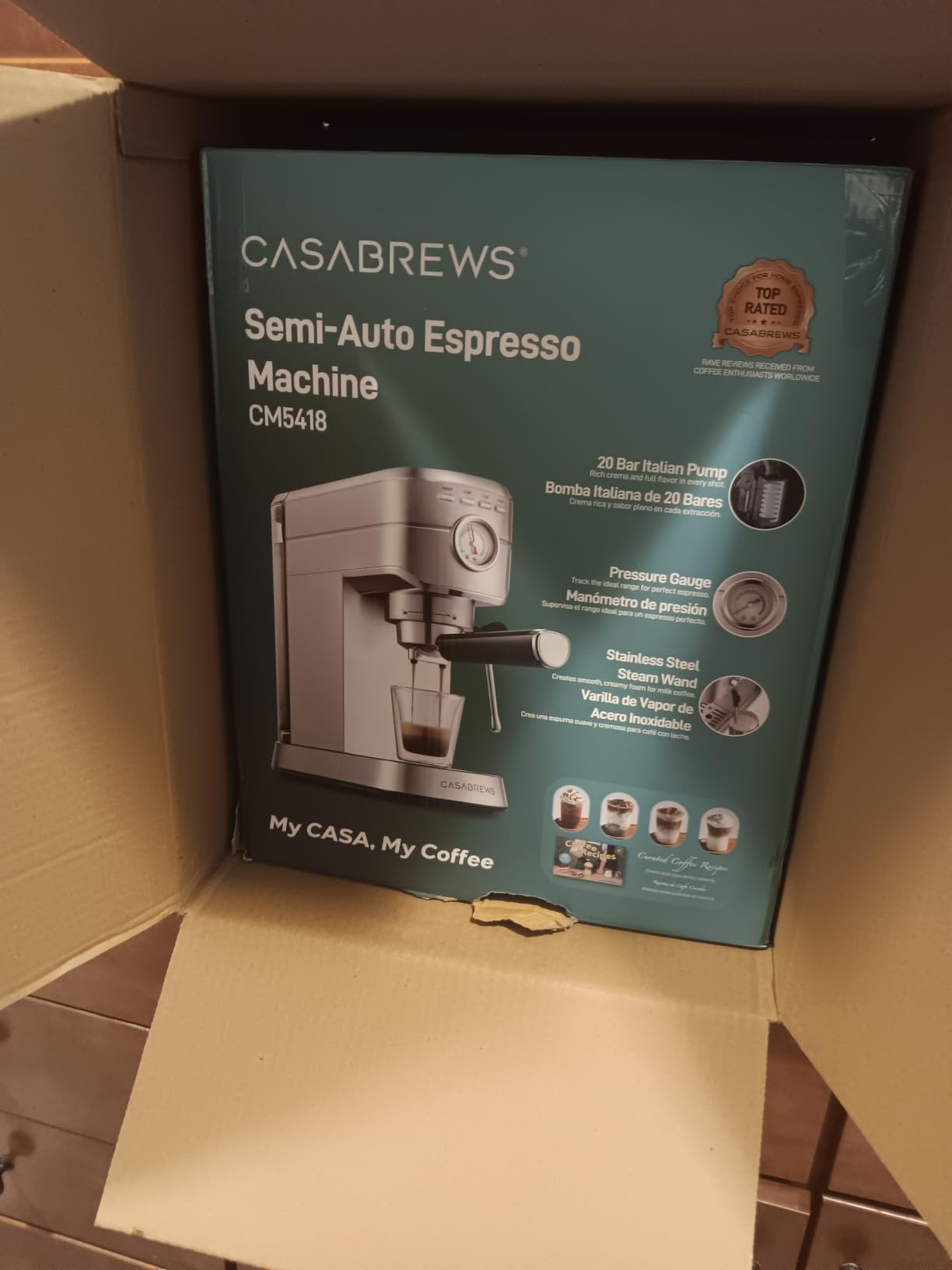
CASABREWS CM5418
- 20 bar pump
- Built-in pressure gauge
- Steam wand for microfoam
- 34 oz detachable tank
All 12 Espresso Machines at a Glance in 2026
Here is the full lineup in one place. Scan the Key Features column first to see which machines include a grinder, which run a pressure gauge, and which can brew and steam at the same time, because those three facts eliminate most of the list immediately.
| Product | Specifications | Action |
|---|---|---|
| Breville Barista Express |
|
Check Latest Price |
| Mr. Coffee 3-in-1 Espresso and Cappuccino Machine |
|
Check Latest Price |
 De’Longhi Stilosa Manual Espresso Machine De’Longhi Stilosa Manual Espresso Machine |
|
Check Latest Price |
| CASABREWS CM5418 Compact Espresso Machine |
|
Check Latest Price |
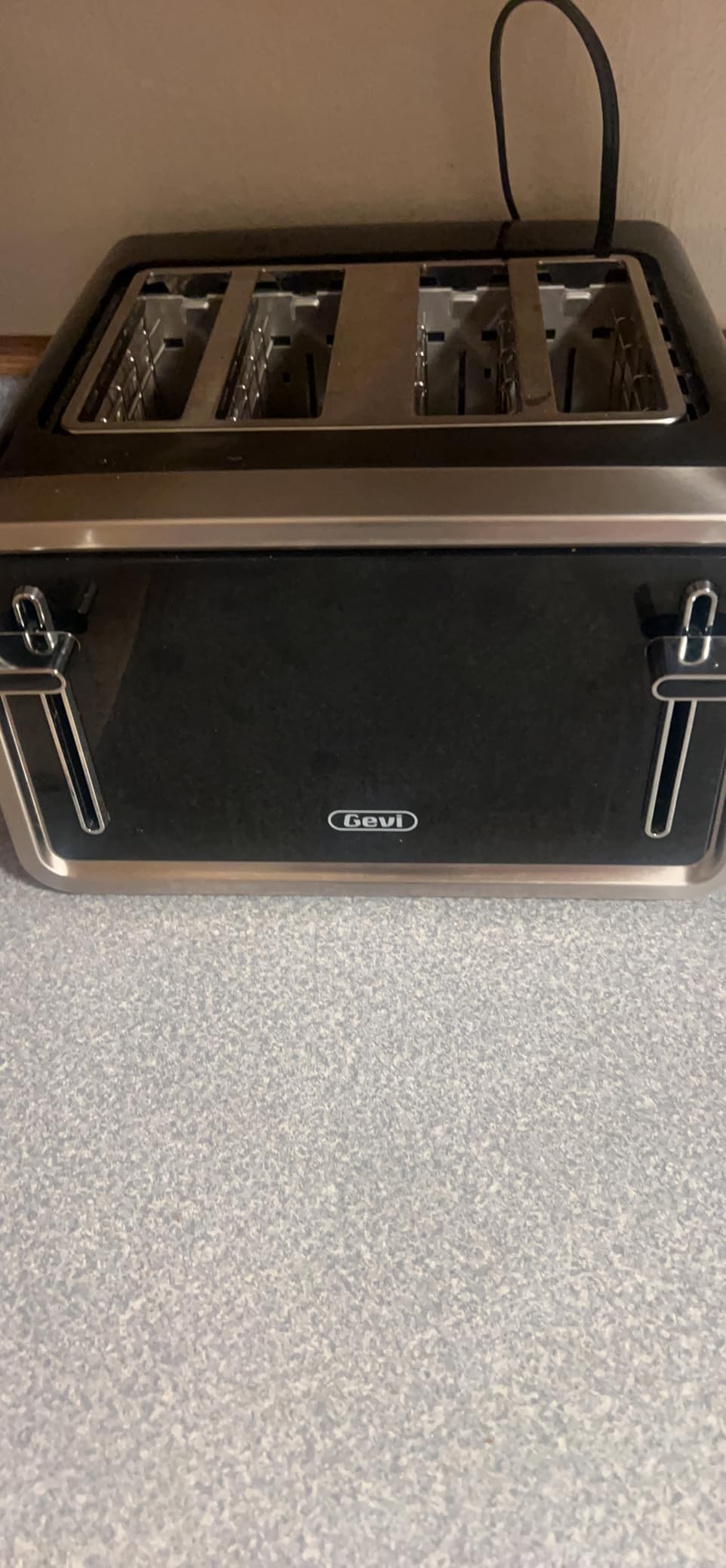
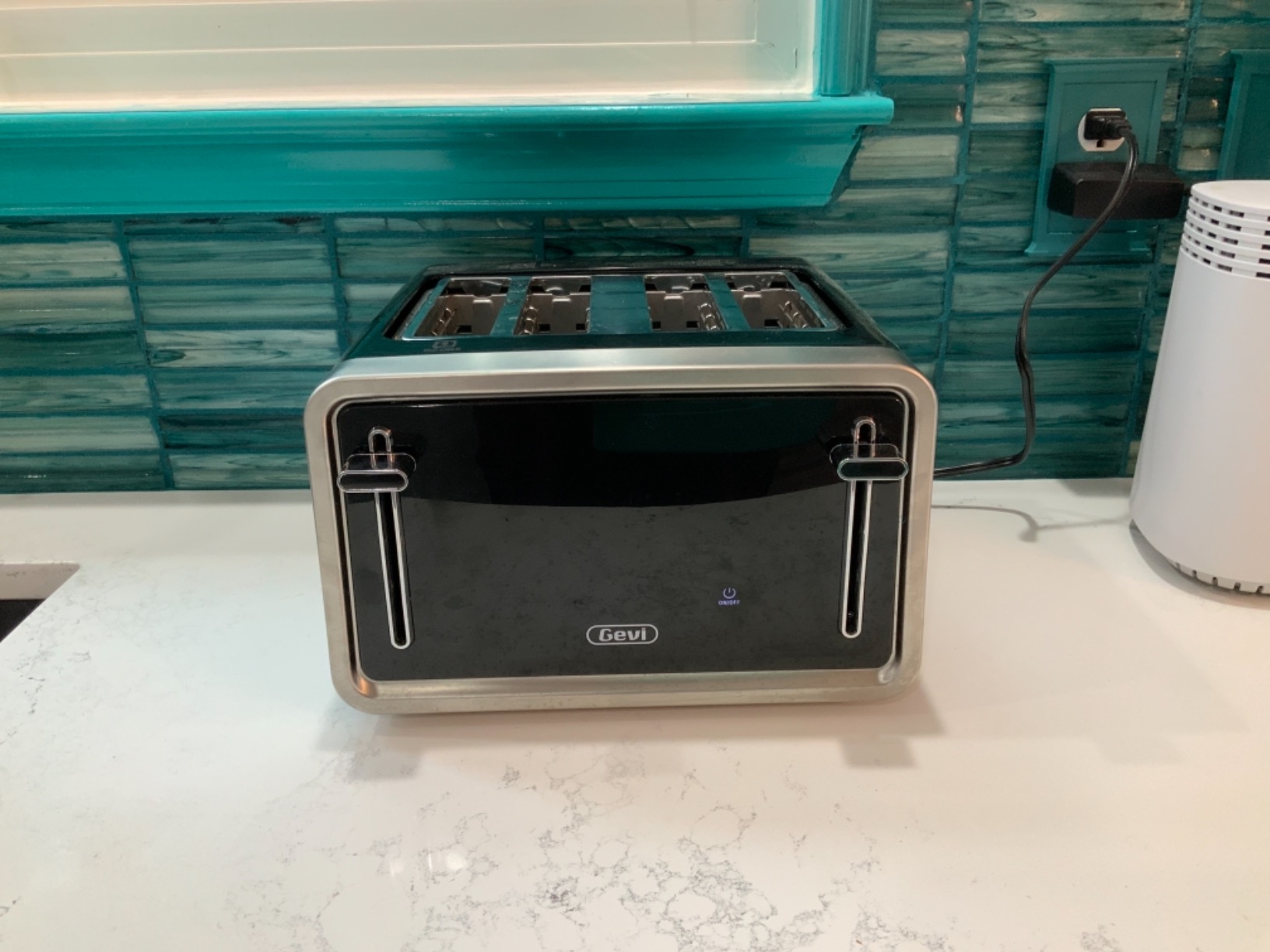
 Gevi 20 Bar Compact Espresso Machine Gevi 20 Bar Compact Espresso Machine |
|
Check Latest Price |
 CASABREWS 3700 Essential CASABREWS 3700 Essential |
|
Check Latest Price |
 Breville Barista Pro Breville Barista Pro |
|
Check Latest Price |
 Chefman Crema Deluxe Double Boiler Chefman Crema Deluxe Double Boiler |
|
Check Latest Price |
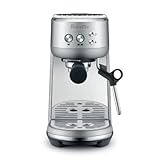 Breville Bambino Plus Breville Bambino Plus |
|
Check Latest Price |
 Gevi 20 Bar with Grinder and Steam Wand Gevi 20 Bar with Grinder and Steam Wand |
|
Check Latest Price |
 De’Longhi Classic Signature De’Longhi Classic Signature |
|
Check Latest Price |
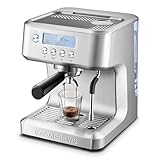 CASABREWS Ultra CASABREWS Ultra |
|
Check Latest Price |
A note on the lineup before we get into the individual reviews. All twelve of these accept ground coffee, and four include a grinder. The pressure numbers range from 15 to 20 bar, but as we explain in the buying guide, the pump rating is marketing; 9 bar at the puck is what actually matters, and grind distribution matters more than either.
1. Breville Barista Express – Best Overall for Home Baristas
Breville BES870XL Barista Express Espresso Machine, Brushed Stainless Steel
1600W
PID control
1/2 lb hopper
67 oz tank
22.1 lbs
Pros
- Integrated precision burr grinder grinds into the portafilter
- PID control plus low pressure pre-infusion for repeatable shots
- Pressure gauge gives real feedback while dialing in
- Hot water dispenser for americanos
Cons
- Water tank and drip tray need frequent attention
- Not a dual boiler so brewing and steaming must alternate
- Some plastic body panels under the steel look
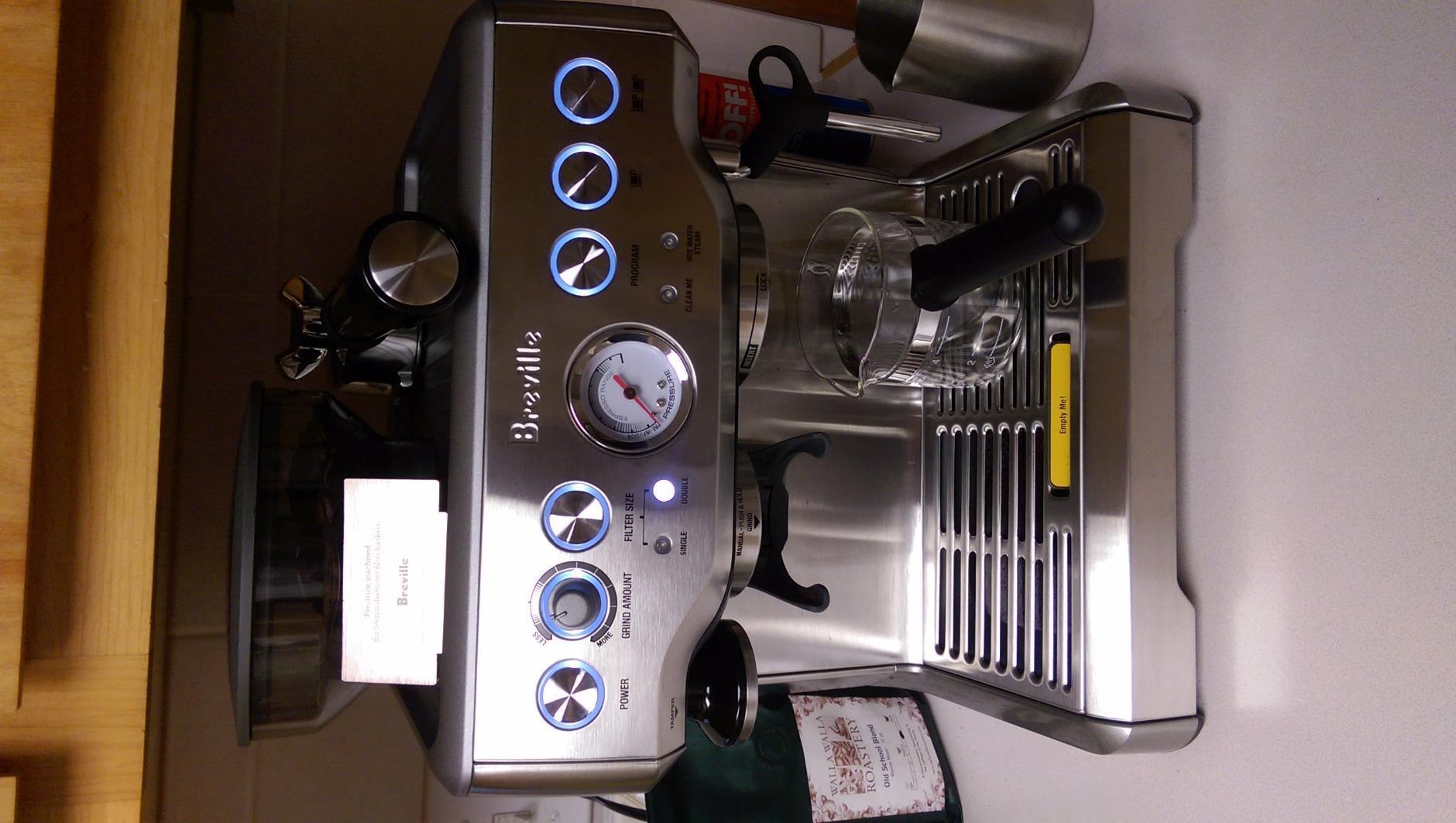
I used the Barista Express as the daily machine for a full month, and the thing that surprised me most was how much of the ritual it collapses into one dial. Grind, tamp, pull. The integrated conical burr grinder doses straight into the portafilter, and you grind while the machine heats, so the two-minute warmup is not wasted time.
The PID holds brew temperature steady and pre-infusion soaks the puck before the pump pushes hard, which is why shots are repeatable even on a week when I was careless with distribution. The pressure gauge is the underrated feature: watching the needle sit in the middle of the shot tells you instantly whether your grind is too coarse or too fine.
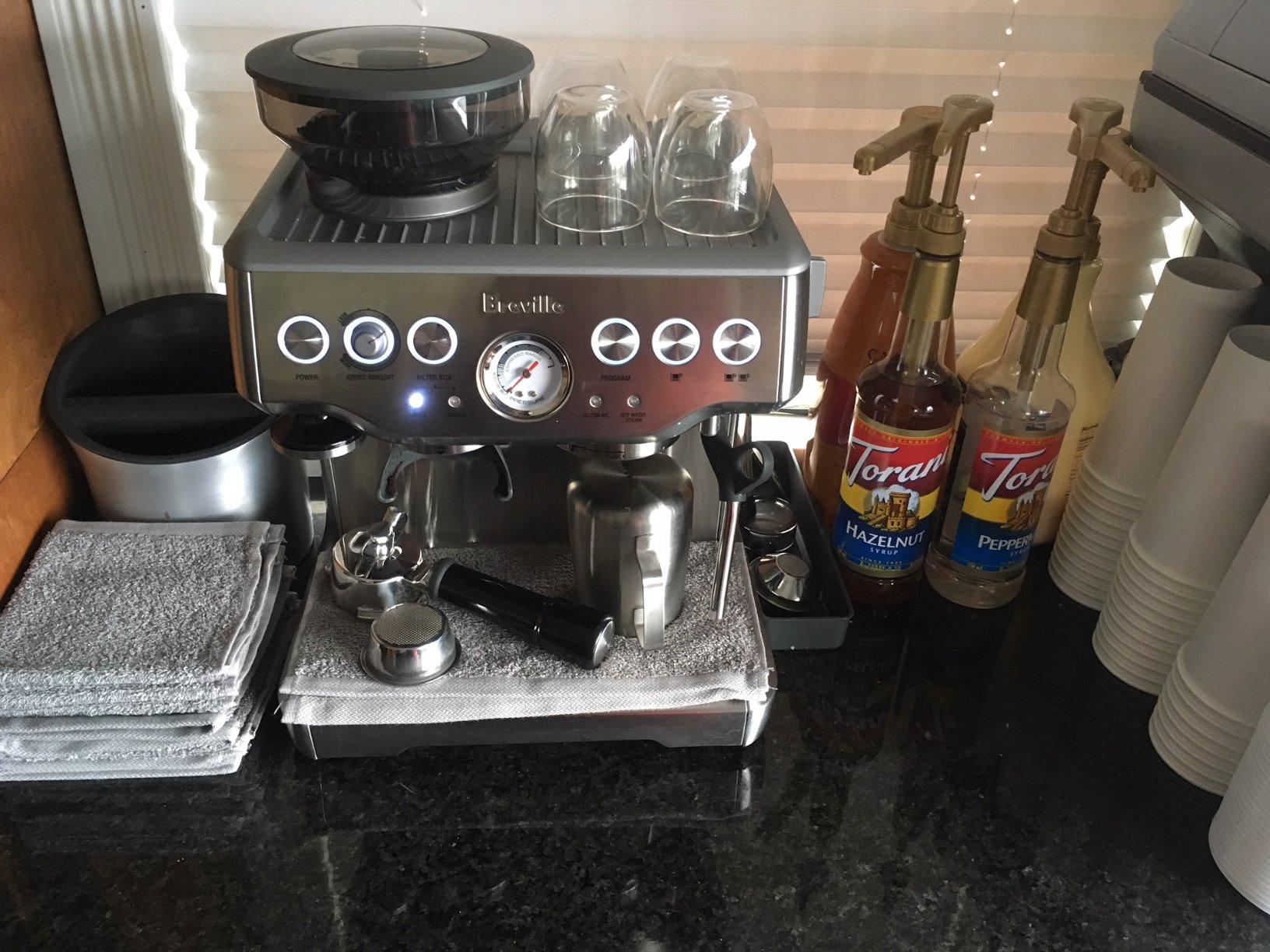
What it does not do is brew and steam simultaneously. This is a single-boiler machine, so if you are making two cappuccinos the workflow is sequential, and you either steam first and pull second or live with the temperature swing. The steam wand itself is manual and hot, and it will texture microfoam properly once you learn the purge-then-lower-then-aerate rhythm.
Ownership reports cluster around two things. The grinder is the reason people keep it for years, and the water tank and drip tray are the reason they complain. Refilling and emptying happen several times a day, and solenoid valve failures are reported around the one-year mark by owners who skipped descaling in hard water.
Who the Barista Express suits best
It suits the person who wants one appliance to do everything and is willing to learn a real workflow. Bean in, cup out, hot water for an americano on the same machine, microfoam by hand. The grind amount dial plus manual override means you can adjust dose without changing the recipe setting, which is exactly the control a beginner needs to start dialing in.
It also suits anyone upgrading from a pod machine who has decided to take espresso seriously. You are buying a grinder, a pressure gauge and a hot water dispenser in one box, and the guidance and manuals are clear enough that the first week is not a mystery.
Who should skip the Barista Express
Skip it if your kitchen counter is shallow and your mornings are loud. At 13.8 inches deep and 22.1 pounds, it is a substantial machine, and single-boiler sequencing adds a few minutes to every milk drink.
Also consider alternatives if you want to pull espresso and steam milk at the same time, or if you are very short on counter depth. Owners of Breville’s integrated grinders repeatedly note that the grinder is the component most likely to need service inside a few years, so treat the grinder as a consumable rather than a permanent asset.
2. Mr. Coffee Espresso and Cappuccino Machine – Best Hands-Free Milk Drinks
Mr. Coffee Espresso and Cappuccino Machine Stainless Steel Programmable Coffee Maker with Automatic Milk Frother 15-Bar Pump Ideal for Home Baristas
15 bar pump
1040W
Auto frother
15 liter capacity
10.4 lbs
Pros
- One-touch buttons dispense milk then espresso with no manual frothing
- 15 bar pump produces a dark shot with visible crema
- Faster than separate machine and frother setups
- Removable tank and milk container simplify cleaning
Cons
- Frother durability is the most common failure point
- New units can brew cool until a cleaning cycle is run
- Brew temperature drops in hard water areas
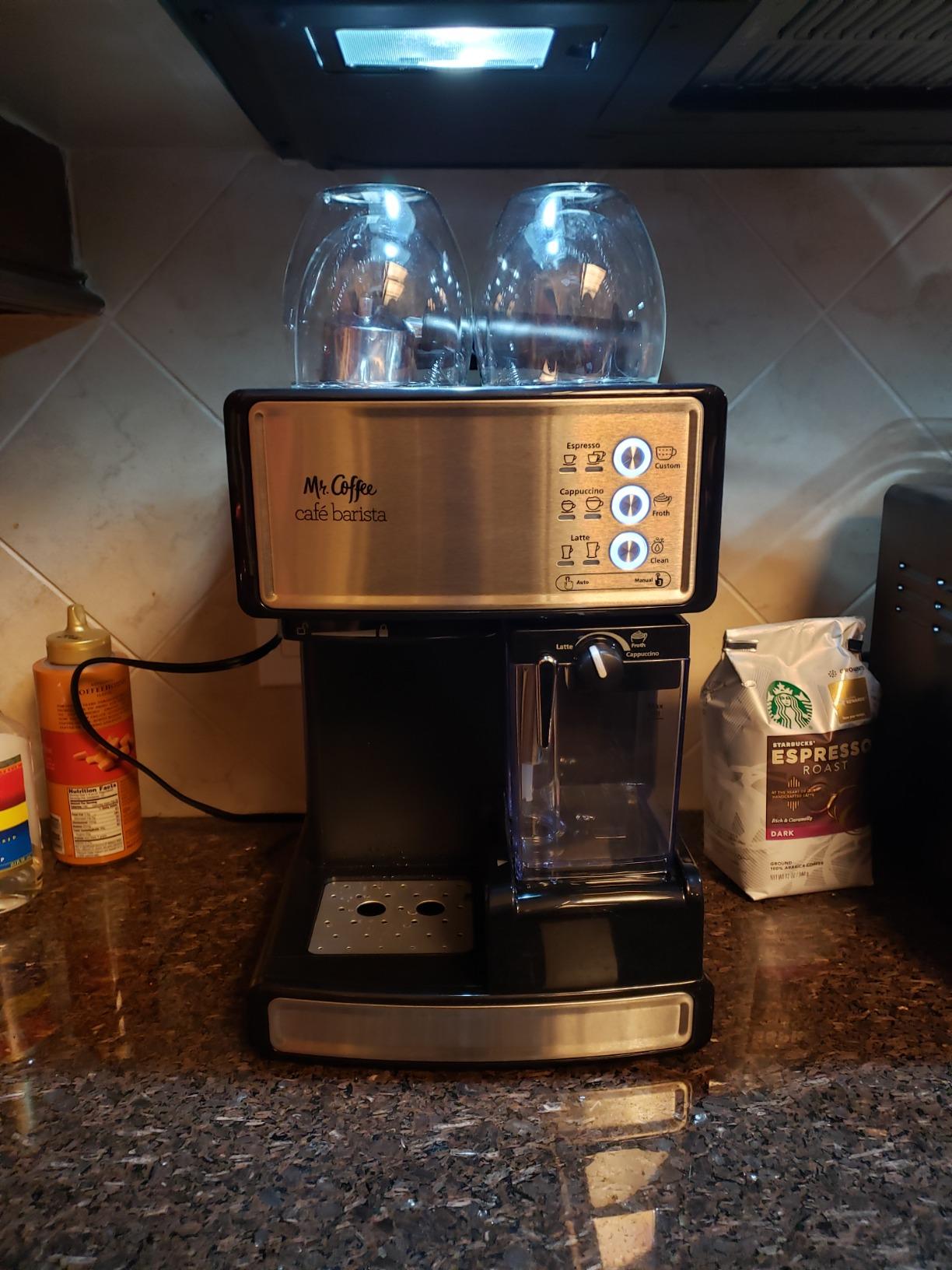
It is the machine to buy if your latte habit outnumbers your straight espresso habit. You press one button for milk, one for coffee, and the machine sequences them for you. There is no pitcher, no purge, no learning curve on foam texture, and on a busy morning that is worth more than any dial.
The 15-bar pump delivers a dark, rich shot with a visible crema layer, and at 10.4 pounds with a footprint of 8.86 by 11.22 inches it is one of the smaller machines here. The removable water tank and milk reservoir lift out for cleaning rather than requiring a screwdriver and a headache.
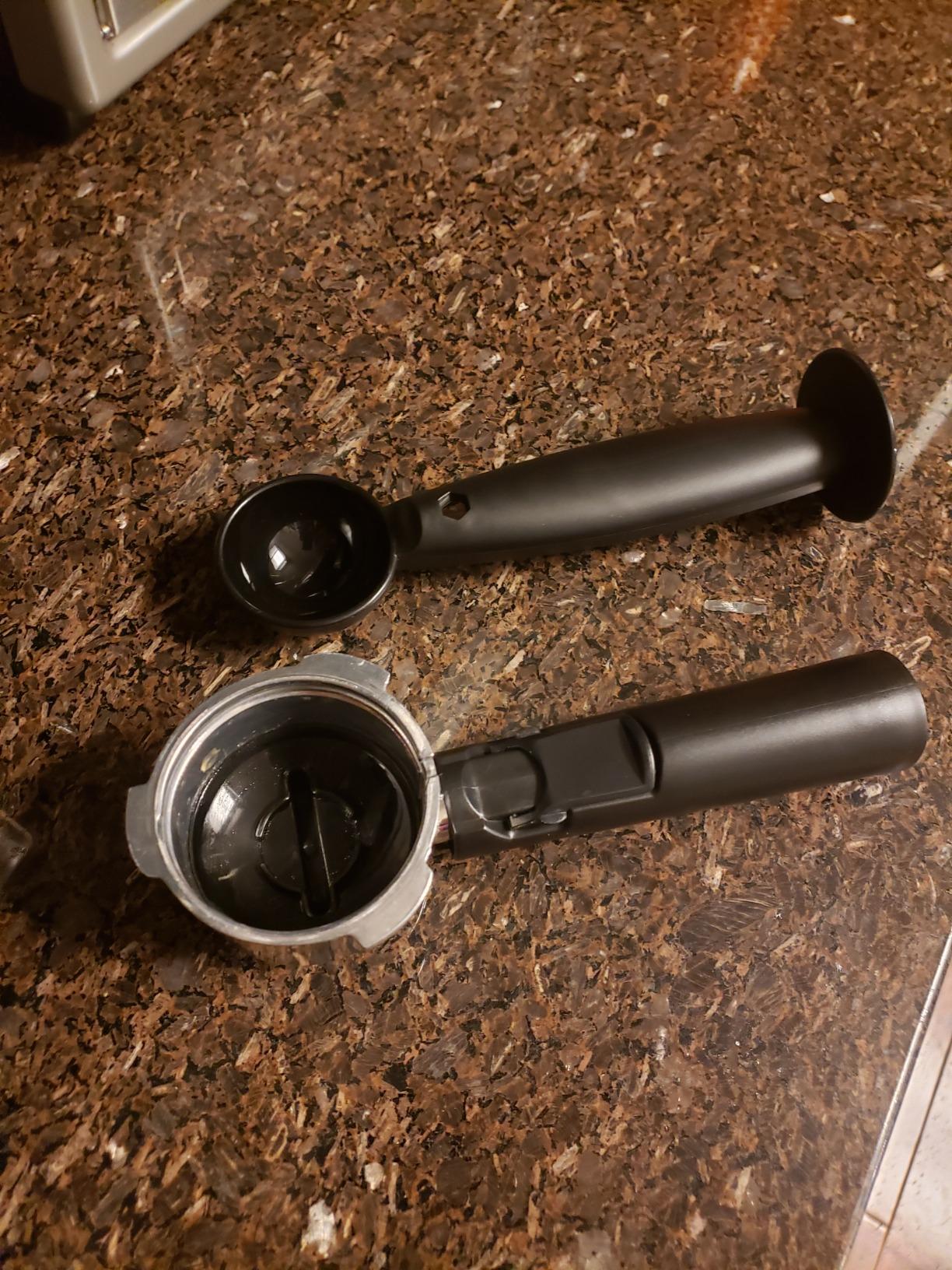
Owners pass along one tip more than any other, and it matters: run a half-tank cleaning cycle on a new machine before your first real drink. Multiple reviews note that fresh units can brew below ideal temperature until that cycle is done, and the shot improves noticeably afterward.
The dominant complaint is the automatic frother. Frother failure within about a year of daily use is the most repeated negative theme, although several owners say customer service honored the warranty with a free replacement when it happened.
Who the Mr. Coffee 3-in-1 suits best
It suits households where someone else makes the drinks. Partners, housemates and office colleagues can get a cappuccino without being handed a tamping tutorial. If the machine lives in a shared kitchen or a small break room, the automatic system is the feature that keeps it in daily use.
It also suits anyone who drinks milk-forward drinks two or three times a week rather than daily. If espresso is an occasional treat, the manual steam wand learning curve on other machines is not worth your time.
Who should skip the Mr. Coffee 3-in-1
Skip it if you want to learn latte art or control extraction variables. Every dial on this machine is a button, and there is no way to change pressure, dose or temperature once the shot starts.
Skip it if you are in a hard water area and unwilling to descale on a schedule. Reviewers specifically flag brew temperature dropping and the need for frequent descaling where water is hard, which is a five-minute job you cannot skip indefinitely.
3. De’Longhi Stilosa Compact Manual Espresso Machine – Best for Learning by Hand
De’Longhi Stilosa Compact Manual Espresso Machine, Manual Milk Frother
15 bar
1100W
Stainless boiler
1000 ml tank
8.6 lbs
Pros
- Compact footprint suits small kitchens and easy cleaning
- Manual steam wand gives real control over milk texture
- Stainless steel boiler built for consistent performance
- Two-level cup holder fits different cup sizes
Cons
- Manual pumping takes technique and arm effort per shot
- Small 1000 ml tank and single boiler limit output
- No built-in grinder so a burr grinder is a must
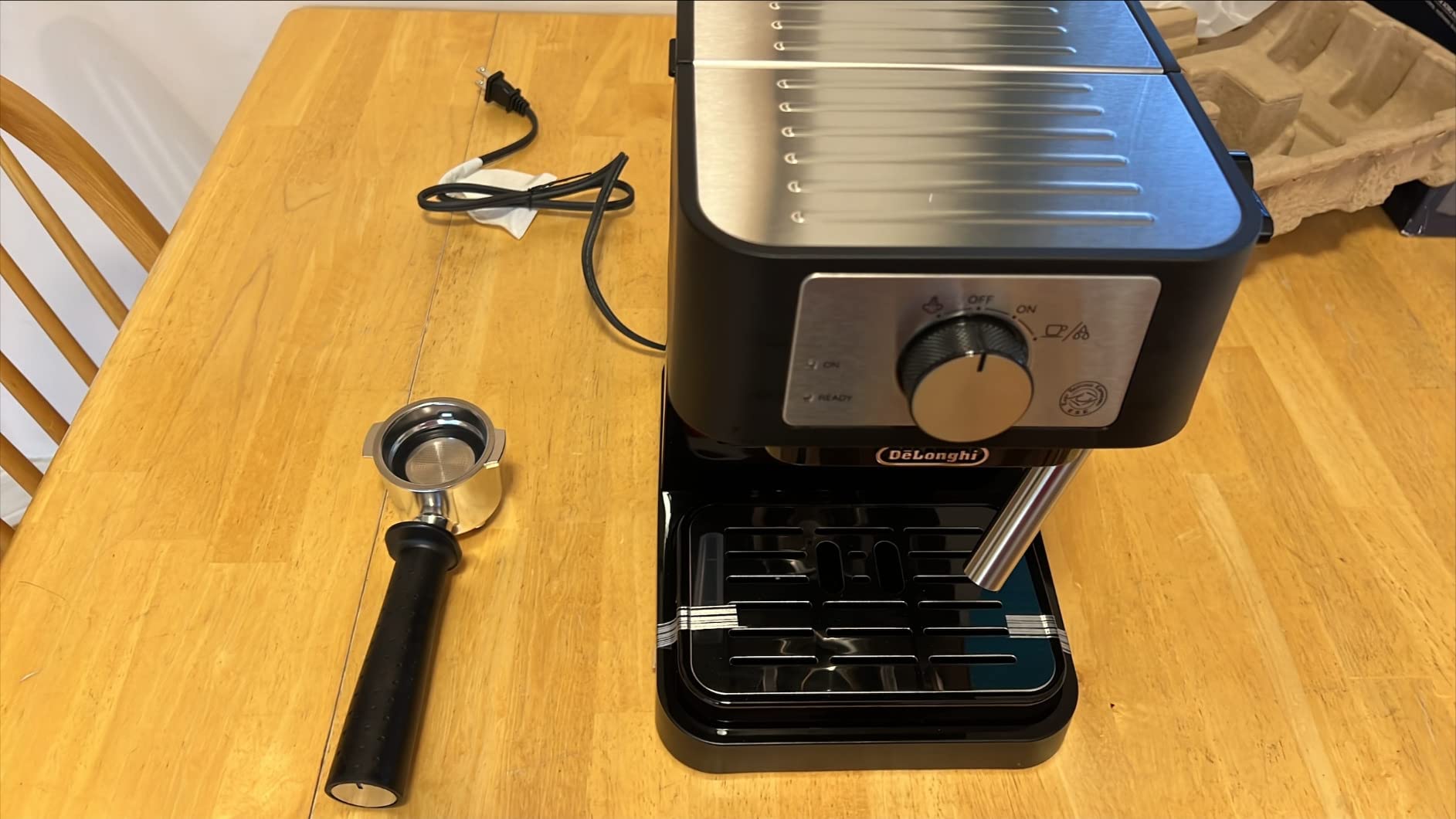
The Stilosa does one thing that almost nothing else at this level does: you push the shot yourself. That sounds inconvenient and it is, on purpose. Because you control the force and the timing manually, you learn where the puck resists and where it flows, which is knowledge every automatic machine hides from you.
It is also the smallest machine in this roundup by weight class, at 8.6 pounds and 8.07 by 13.5 by 11.22 inches, with a stainless steel boiler rated for years of consistent performance. The manual steam wand gives you genuine control over texture, and the two-level cup holder handles a small espresso cup and a larger mug without rearranging the machine.
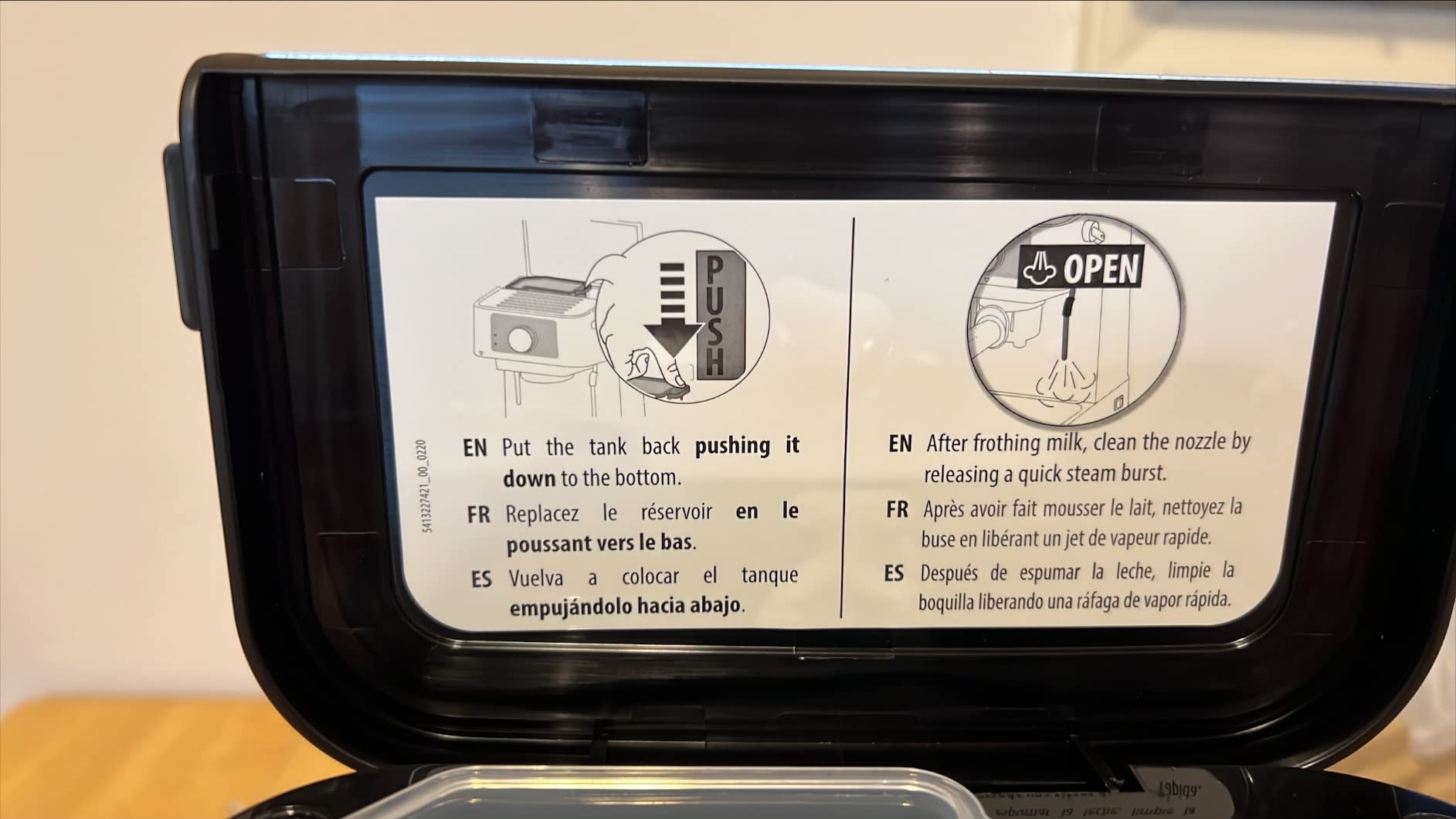
Buyers who pair it with a burr grinder and practice puck prep report strong results, and that pairing is not optional. There is no grinder here, and reviewers are blunt that pre-ground supermarket coffee makes this machine look worse than it is.
The complaints are all about effort and volume. Manual pumping per shot takes real arm strength and technique, the 1000 ml tank is small enough to need refilling mid-session, and the single-boiler design means brewing and steaming take turns.
Who the De’Longhi Stilosa suits best
It suits the learner who wants technique rather than buttons. If you have a burr grinder already, or you enjoy the physical process of puck prep, this is a genuinely educational machine. Owners frame it as a training tool that builds habits.
It also suits small kitchens and renters. The footprint is tiny, the weight is light enough to move with one hand, and cleaning is simple because there is very little to disassemble.
Who should skip the De’Longhi Stilosa
Skip it if you make more than one or two drinks a day. The effort compounds quickly, and the small tank plus single boiler means you are refilling and waiting constantly during a multi-drink session.
Skip it if you have no grinder and no plan to buy one. The machine is asking you to supply the single most important variable in espresso, and buying it first and the grinder never is how people end up disappointed. We cover the budget rule for that in the buying guide below.
4. CASABREWS CM5418 Compact Espresso Machine – Best Value Pick
CASABREWS CM5418 Compact Espresso Machine with Milk Frothing Steam Wand
20 bar
1350W
Pressure gauge
34 oz tank
8.6 lbs
Pros
- 20 bar pump and 1350W boiler give rich extraction and strong aroma
- Built-in pressure gauge is unusual at this level and aids dialing in
- Powerful steam wand textures microfoam for latte art
- Compact steel body fits small kitchens and offices
Cons
- Must cool down before brewing after frothing milk
- Buttons flash during overheat protection which confuses beginners
- Single boiler means no simultaneous brewing and steaming
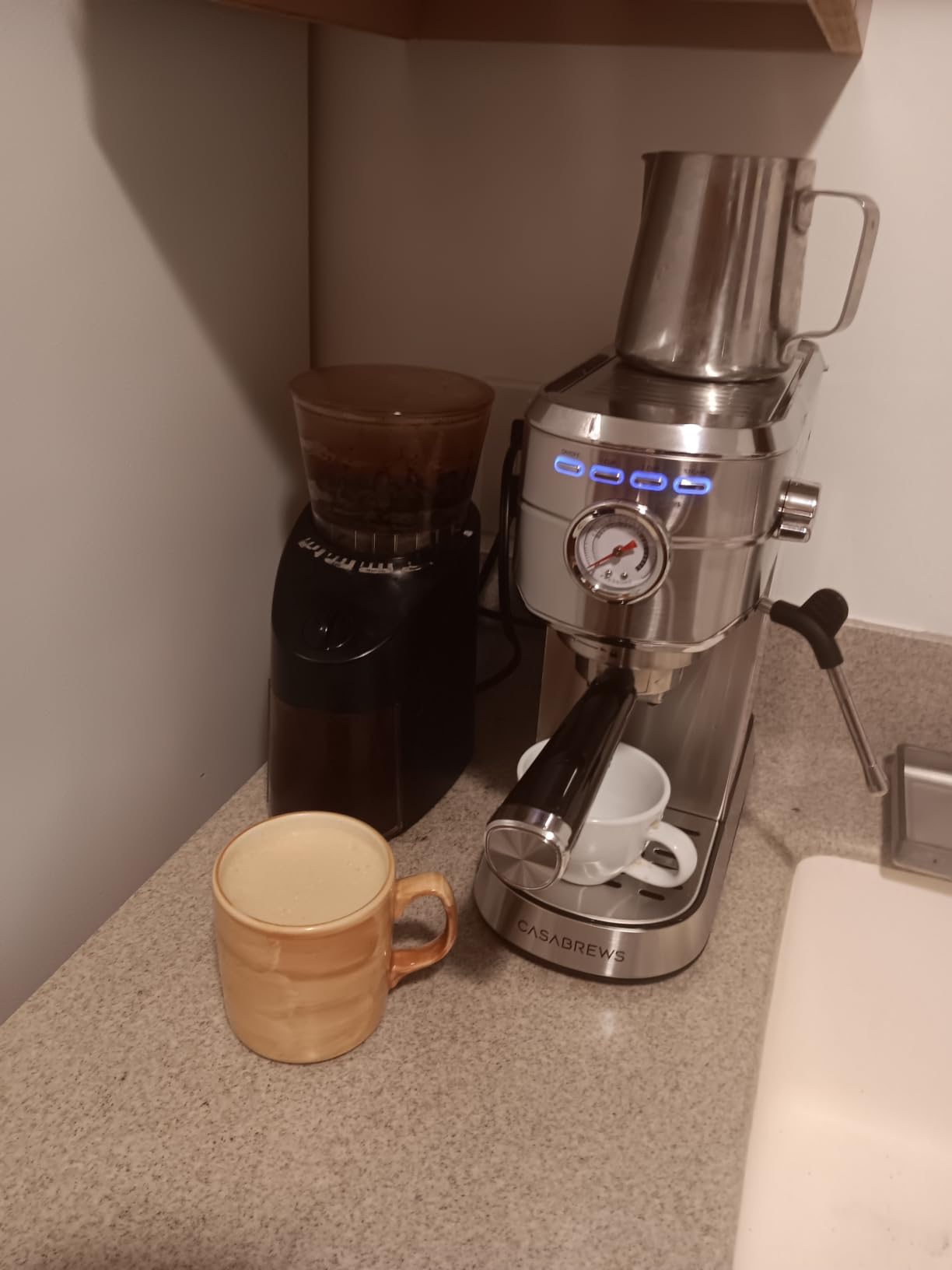
The CM5418 is the machine I recommend to anyone who wants a pressure gauge and does not want to pay extra for it. A gauge is normally the first thing that disappears as you move down the price range, and it is the single most useful tool for learning whether your grind is right. Having one here changes the whole dialing-in experience.
It is also the top-ranked machine in the semi-automatic category in the catalog data we reviewed, and owners back that up. The 20-bar pump with a 1350W heating system produces a rich, aromatic shot, and the steam wand has enough power to texture microfoam good enough for latte art on a proper drink.
The operational catch is the one every review repeats. You cannot pull a shot straight after frothing milk; the machine needs to switch the single boiler from steam to brew and cool down first, and the buttons flash during that overheat protection phase, which looks alarming the first time you see it.
Plan your workflow as froth first, brew second, and the issue disappears. The 34 oz detachable tank holds enough for several drinks, and the brushed stainless body at 5.47 inches wide is genuinely narrow for a machine with a real wand.
Who the CASABREWS CM5418 suits best
It suits a beginner who wants feedback while learning rather than guesswork. Watch the gauge during the shot, adjust the grind one step, pull again, and you will have a repeatable recipe inside a week. That is a faster path to good espresso than any preset drink menu.
It also suits anyone whose counter space is tight. At 5.47 inches wide this is one of the slimmest machines here, and the tank lifts out at the top for refilling.
Who should skip the CASABREWS CM5418
Skip it if you are making milk drinks back to back for several people. The cool-down wait between frothing and brewing is the deal-breaker for a group workflow, and the flashing buttons during that wait are the single most common source of new-owner frustration.
Also consider a different route if you want to avoid buying a separate grinder. The CM5418 takes ground coffee only, so the real cost of a full workflow includes a burr grinder that is not included.
5. Gevi 20 Bar Compact Espresso Machine – Best for Small Kitchens
Gevi 20 Bar Compact Espresso Machine for Home,Latte、Cappuccino Coffee Maker
20 bar
1350W
NTC control
Pressure gauge
1 liter tank
8.6 lbs
Pros
- 20 bar pump with pre-infusion and gauge delivers consistent espresso
- One-touch single and double shot metering removes pumping guesswork
- Fully stainless housing outlasts plastic-bodied rivals
- Removable froth nozzle makes the wand easy to clean
Cons
- Shuts off after steaming so you wait before the next shot
- Small portafilter needs reloading every two shots
- Included plastic tamper feels cheap
Gevi’s compact machine stands out in this group for durability rather than features. Long-term owners report more than a year and a half of daily use without failure, and several explicitly contrast it with costlier machines that gave up within a year. The fully stainless housing is a big part of that; it simply does not crack or discolor the way plastic bodies do.
NTC temperature control combined with pre-infusion and a built-in pressure gauge gives you a machine that behaves consistently, and the one-touch single and double shot buttons remove the manual pumping guesswork entirely. The removable froth nozzle is a small detail that pays off weekly, because you can pop it off and rinse it instead of chasing milk protein into the wand tip.
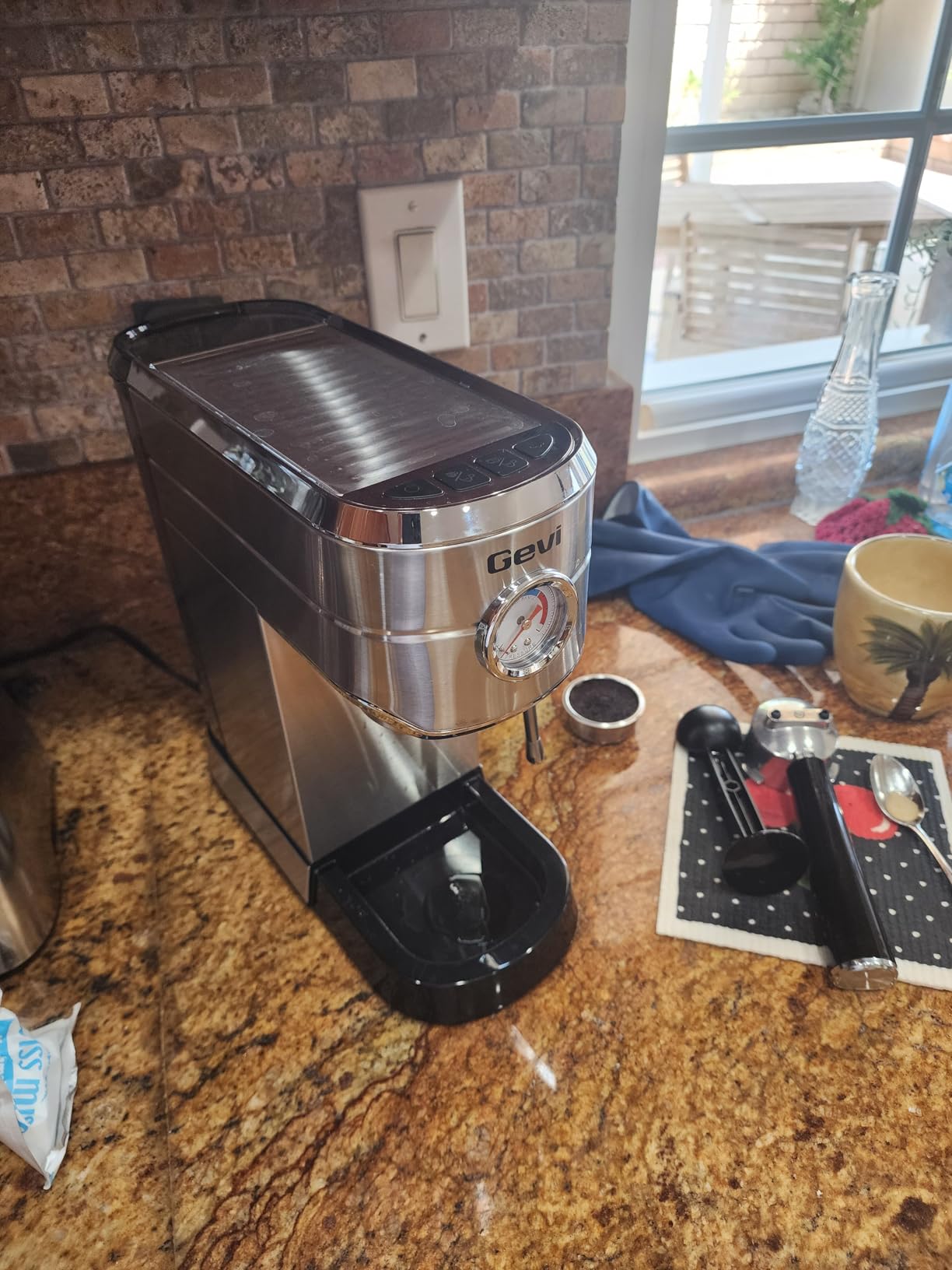
Thermoblock-style fast heating means you are not waiting around, but the machine does shut off after steaming and requires a wait before another shot. The small portafilter is the other practical limit: it holds enough for roughly two shots before you reload, which is fine for a household and annoying for a party.
The included plastic tamper is the first thing most buyers replace, and the cup warmer on top does not actually retain heat despite what the design suggests. Owners also note the stainless finish shows fingerprints, which is a purely cosmetic complaint in an otherwise well-regarded machine.
Who the Gevi 20 Bar Compact suits best
It suits anyone who wants a machine to last. If your previous appliance failed within a couple of years and you are tired of replacing machines, the steel construction and the reported long service life are the reason to pick this one.
It also suits a first-time buyer who does not want to manually pump. The one-touch shot buttons are the entry point, and the pressure gauge still gives you something to learn from once you outgrow the buttons.
Who should skip the Gevi 20 Bar Compact
Skip it if you make large drinks. The small portafilter and one-liter tank mean more refills than larger machines require, and the post-steam shutoff adds a wait to every second drink.
Also think twice if your priority is milk texture at a high level. The wand works, but the machines with a larger boiler and more wattage have an easier time producing dense microfoam quickly, and the top of this list has more power for frothing.
6. CASABREWS 3700 Essential – Best Budget Starter Machine
CASABREWS 3700 Essential Stainless Steel Espresso Machine with Steam Wand
20 bar
1350W
43.9 oz tank
8.1 lbs
1 year warranty
Pros
- Pulls a good shot out of the box with no timing adjustment
- Compact steel construction looks far more expensive than it is
- Heats quickly and handles roughly 10 drinks a day
- Large tank rarely needs refilling during the day
Cons
- Single boiler means a wait when switching between brewing and steaming
- Extraction is finicky with finely ground espresso
- Steam control dial can drift open and drop pressure
The 3700 Essential is the one to buy when you want steel, a large tank and a steam wand without spending real money. It heats up fast, the 43.9 oz tank means you rarely refill it during a workday, and at 8.1 pounds it is the lightest machine in this roundup.
Owner opinion splits on grind tolerance, and that split is worth understanding before you buy. Many people run it daily for years with no problems and call it the best value in the category. A smaller but vocal group finds extraction inconsistent and blames the steam control dial drifting open during extraction, which drops pressure mid-shot.
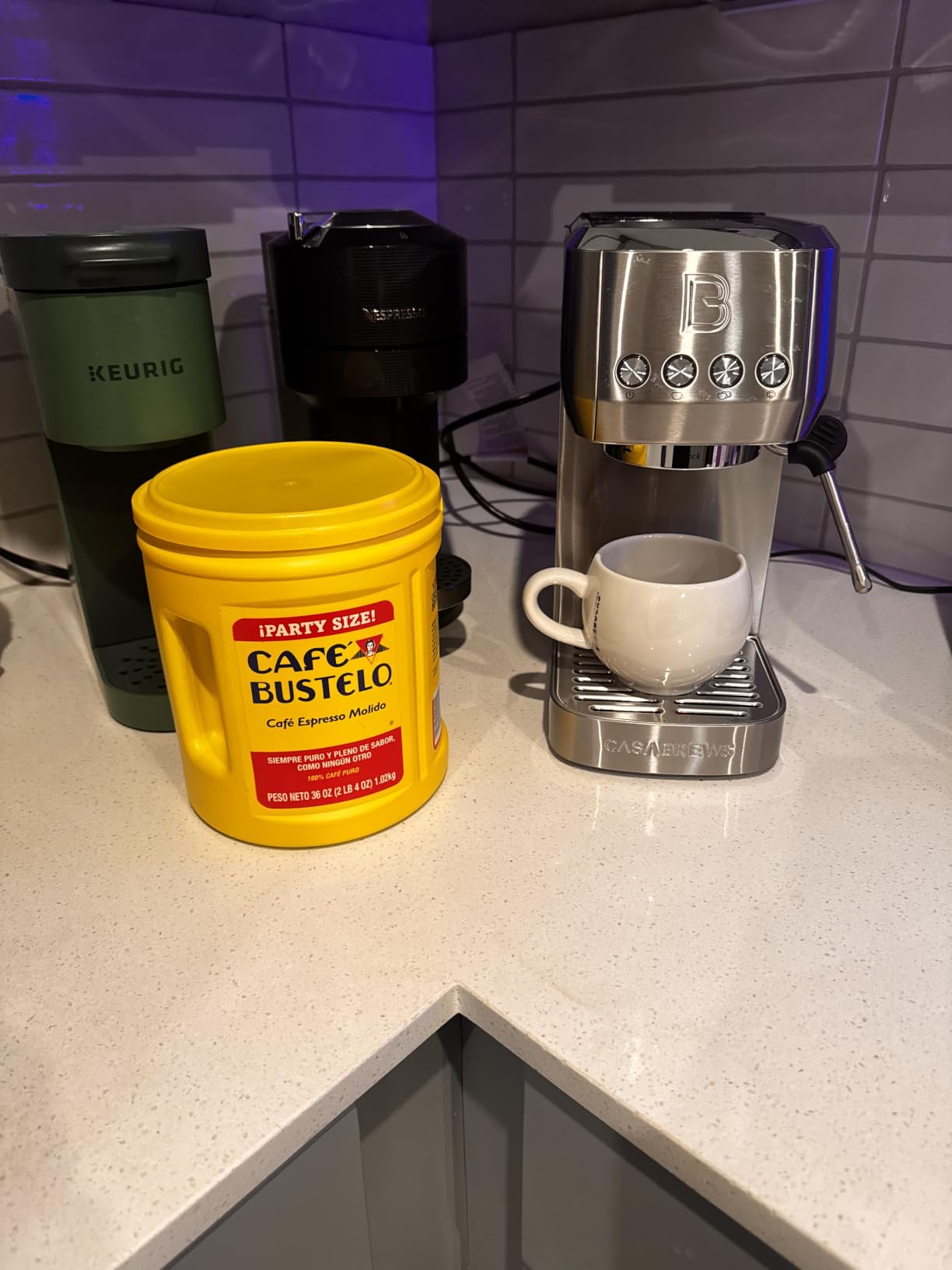
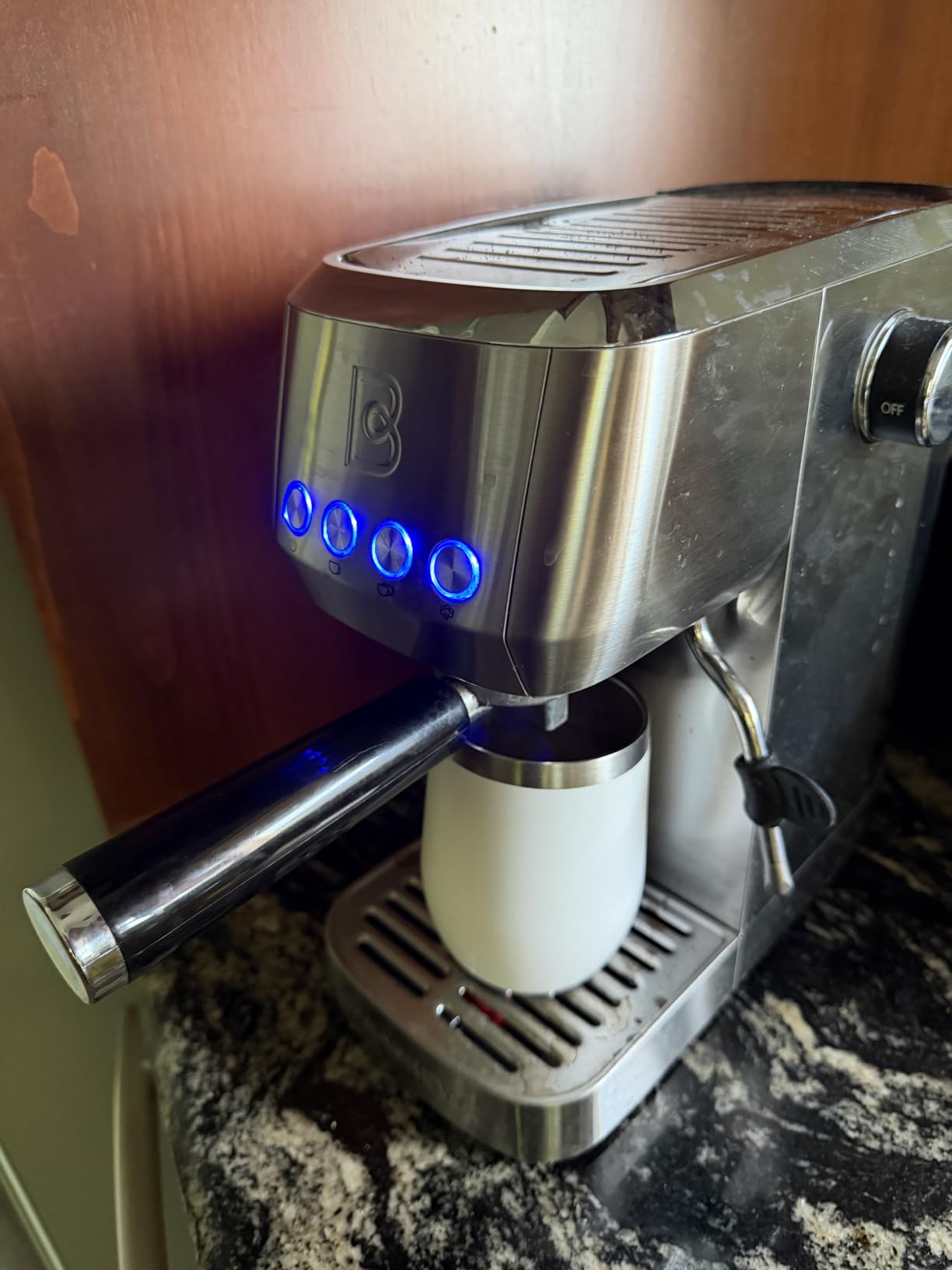
The consistent advice from experienced owners is to add a bottomless portafilter and a weighted steel tamper. The included plastic scoop and tamper feel flimsy, and upgrading those two items is the difference between a frustrating first month and a machine that behaves predictably once your grind is dialed in.
As a single-boiler machine, it also has a short wait when you switch from brewing to steaming, and the steam wand has a continuous run limit before it needs a rest. Plan your drink order around that and it is a non-issue.
Who the CASABREWS 3700 Essential suits best
It suits a weekend warrior or a first purchase. If you make a few drinks a week, want a machine that looks like it belongs on a counter rather than in a dorm room, and are willing to buy a grinder, this is a low-risk way to start.
It also suits anyone with high water pressure anxiety. The 43.9 oz tank is the largest in this group relative to machine size, so refills are rare and descale intervals stretch out.
Who should skip the CASABREWS 3700 Essential
Skip it if you plan to grind very fine and expect commercial-level sweetness. The machine struggles with finely ground espresso according to a persistent group of owners, and the drifting steam valve issue means shots can vary from one attempt to the next.
Skip it if you want to learn on a machine with a pressure gauge. This one ships without a gauge, so you are dialing in by taste and timing alone until you add your own reference tools.
7. Breville Barista Pro – Best for Latte Art Practice
Breville BES878BSS Barista Pro Espresso Machine, Brushed Stainless Steel
1680W
ThermoJet 3 sec heat up
PID +/- 2C
19.5 lbs
2 year warranty
Pros
- Three second ThermoJet heat up with instant espresso to steam transition
- Steamer is noticeably more powerful than other Breville models
- Precision conical burr grinder with fine dial and coarse under-hopper adjust
- PID within +/- 2 degrees C plus pre-infusion for repeatable shots
Cons
- Real dial-in effort required especially out of the box
- Internal grinder can wear within about a year
- 54mm portafilter is below the 58mm commercial standard
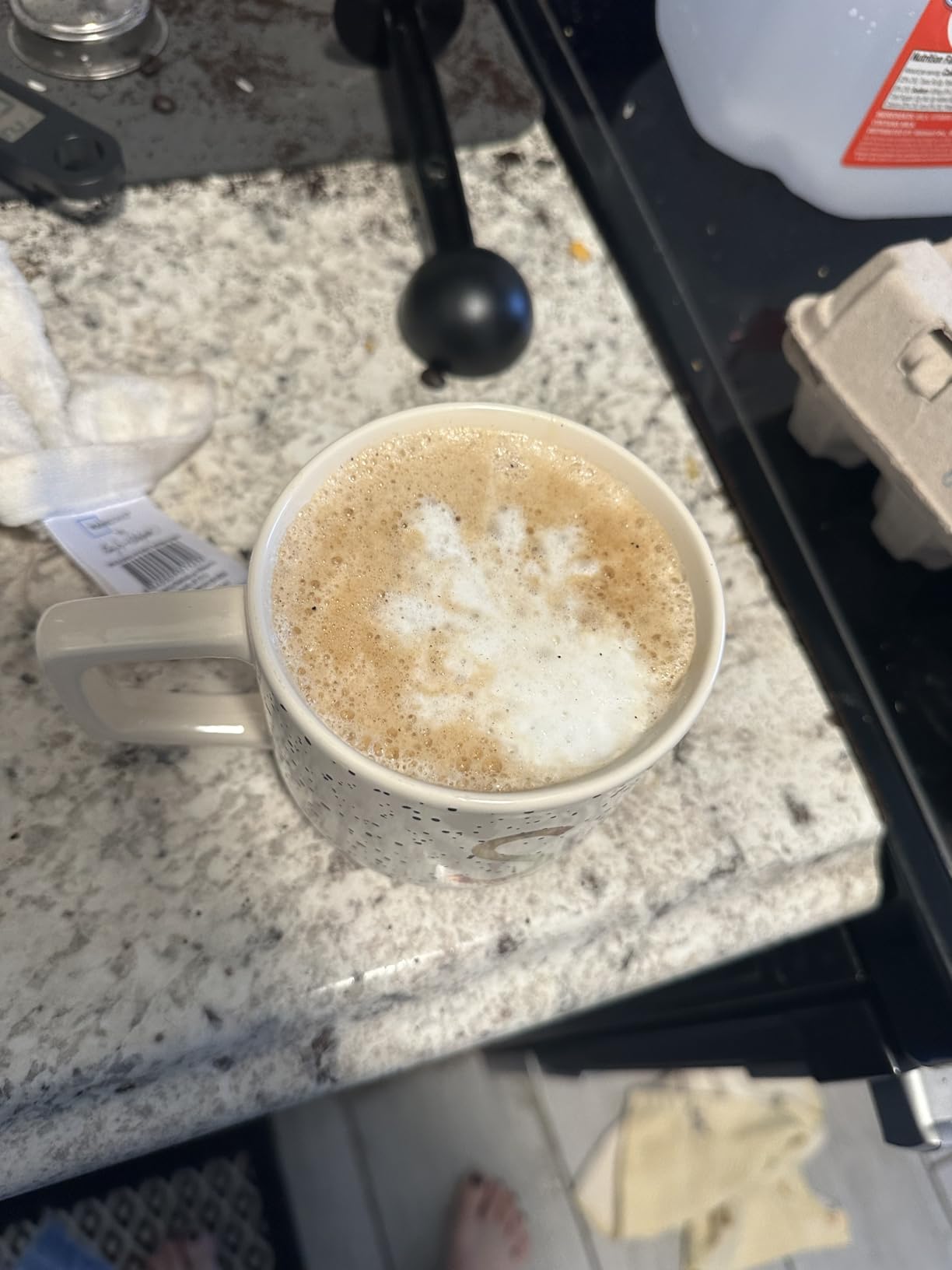
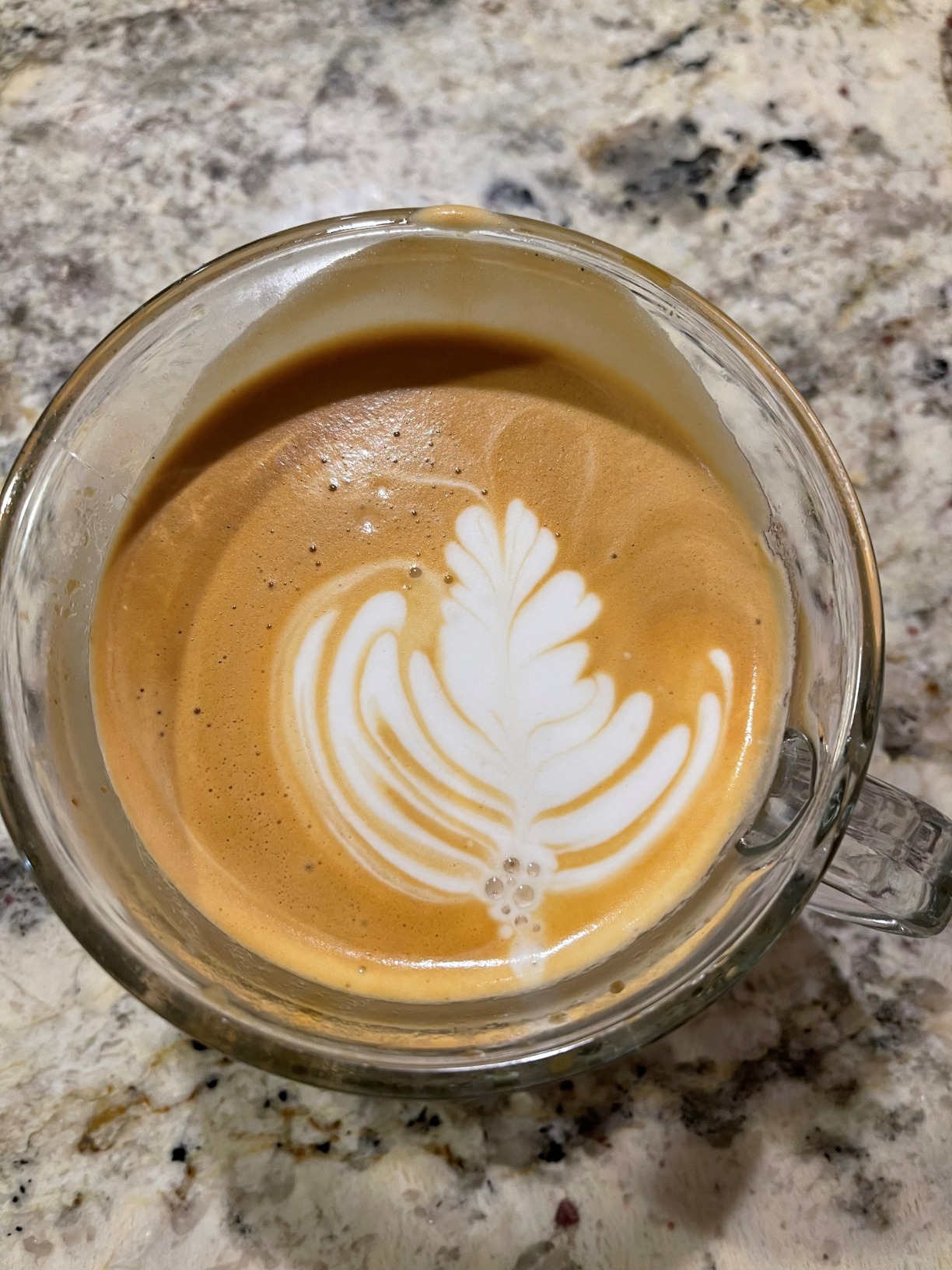
The Barista Pro is the machine I recommend to anyone whose goal is latte art. The steam wand has visibly more power than the Barista Express, which means faster milk heating, more control over where you place the pitcher, and enough steam to work with a large milk volume without stalling.
The ThermoJet system reaches extraction temperature in three seconds and moves straight to steaming without a long wait, so the shot and the foam happen back to back rather than minutes apart. PID control holds within plus or minus 2 degrees C, and the backlit LCD shows grinding and extraction progress while you work.
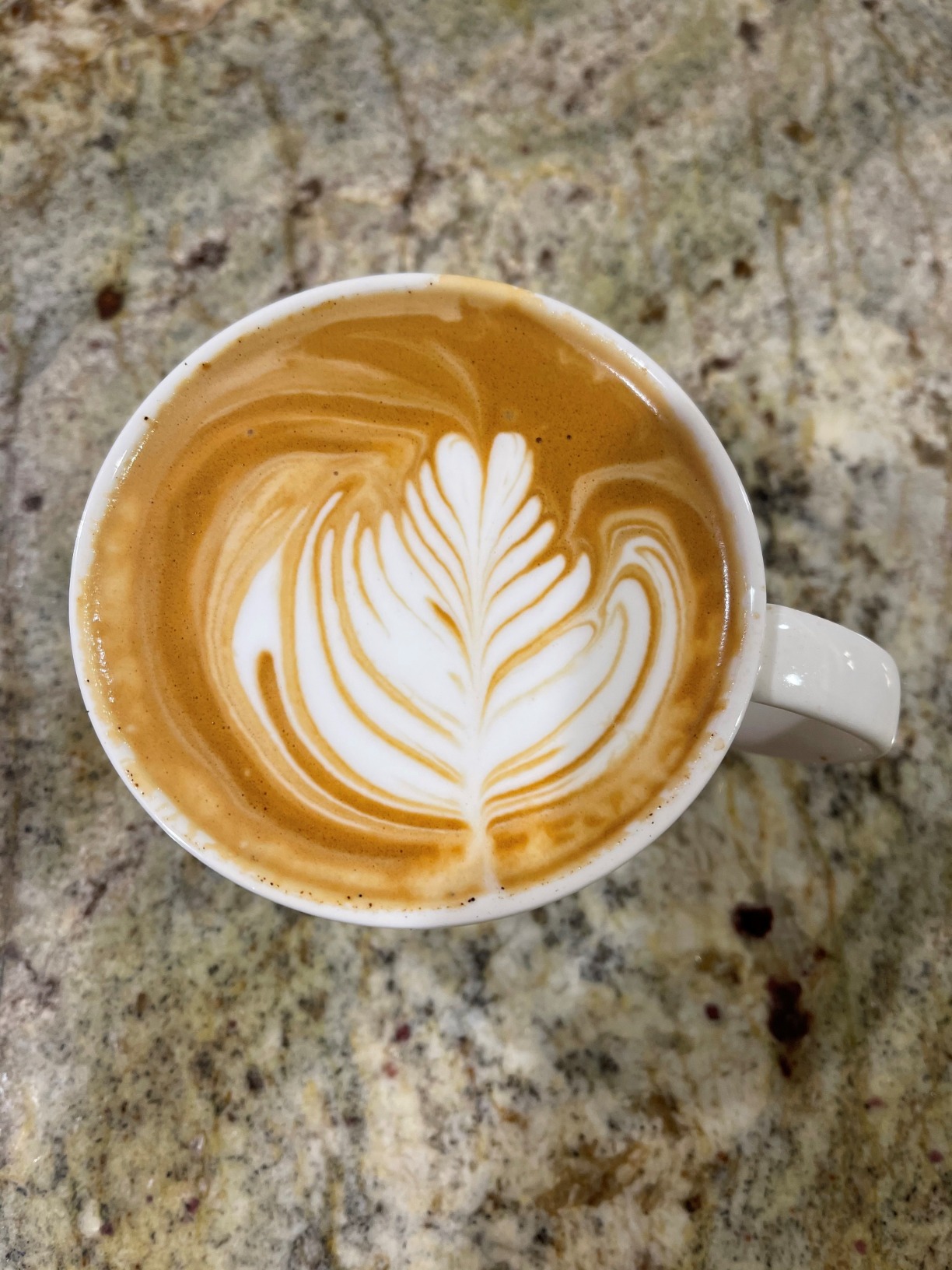
Owners who learn manual extraction rate this as coffee shop quality, and the consensus guidance is consistent: skip automatic mode entirely, dose and tamp manually with a scale, and expect about two weeks of dialing in before shots are repeatable. Automatic mode here produces hard-to-repeat extractions, which is worth knowing before you buy it for the wrong reason.
The grinder is the weak point. Owners report wear inside about a year of regular use, and the 54mm portafilter is smaller than the 58mm commercial standard, which limits your basket and tamper options later. A two-year warranty is longer than most in this list, which partly offsets that.
Who the Breville Barista Pro suits best
It suits the intermediate barista who already understands puck prep and wants better hardware rather than a simpler workflow. If you can tell a channeled shot from a blond shot, this machine will reward you. If you cannot yet, the Barista Express is a gentler place to start.
It also suits fast-morning households. Three-second heat up changes the routine, because you are not standing at the counter waiting for a boiler before you can begin.
Who should skip the Breville Barista Pro
Skip it if you want an automatic workflow. This machine is manual by design, and the automatic mode that exists will not produce shots you can repeat. That is a dealbreaker for anyone who just wants a drink to appear.
Skip it if you plan to use standard 58mm accessories or upgrade baskets later. The 54mm portafilter means third-party baskets, tampers and baskets sized for commercial machines will not fit, and that closes off a lot of the ecosystem enthusiasts buy into.
8. Chefman Crema Deluxe Double Boiler – Best for Brewing and Steaming at Once
Chefman Crema Deluxe Espresso Machine with Double Boiler, Use Milk Frother and Brew Espresso Simultaneously, Professional Coffee Maker with Coffee Grinder and Steam Wand, 30 Grind Settings
15 bar
1500W
Dual boiler
58mm portafilter
3 liter reservoir
29.5 lbs
Pros
- Dual boiler steams milk and pulls a shot at the same time
- 30 setting conical burr grinder doses into the portafilter
- Customizable shot temperature and volume
- 58mm commercial-standard portafilter accepts standard baskets
Cons
- Heaviest machine here at nearly 30 pounds and bulky on the counter
- Grinder consistency trails Breville integrated grinders
- Rating distribution shows a meaningful share of one-star reviews
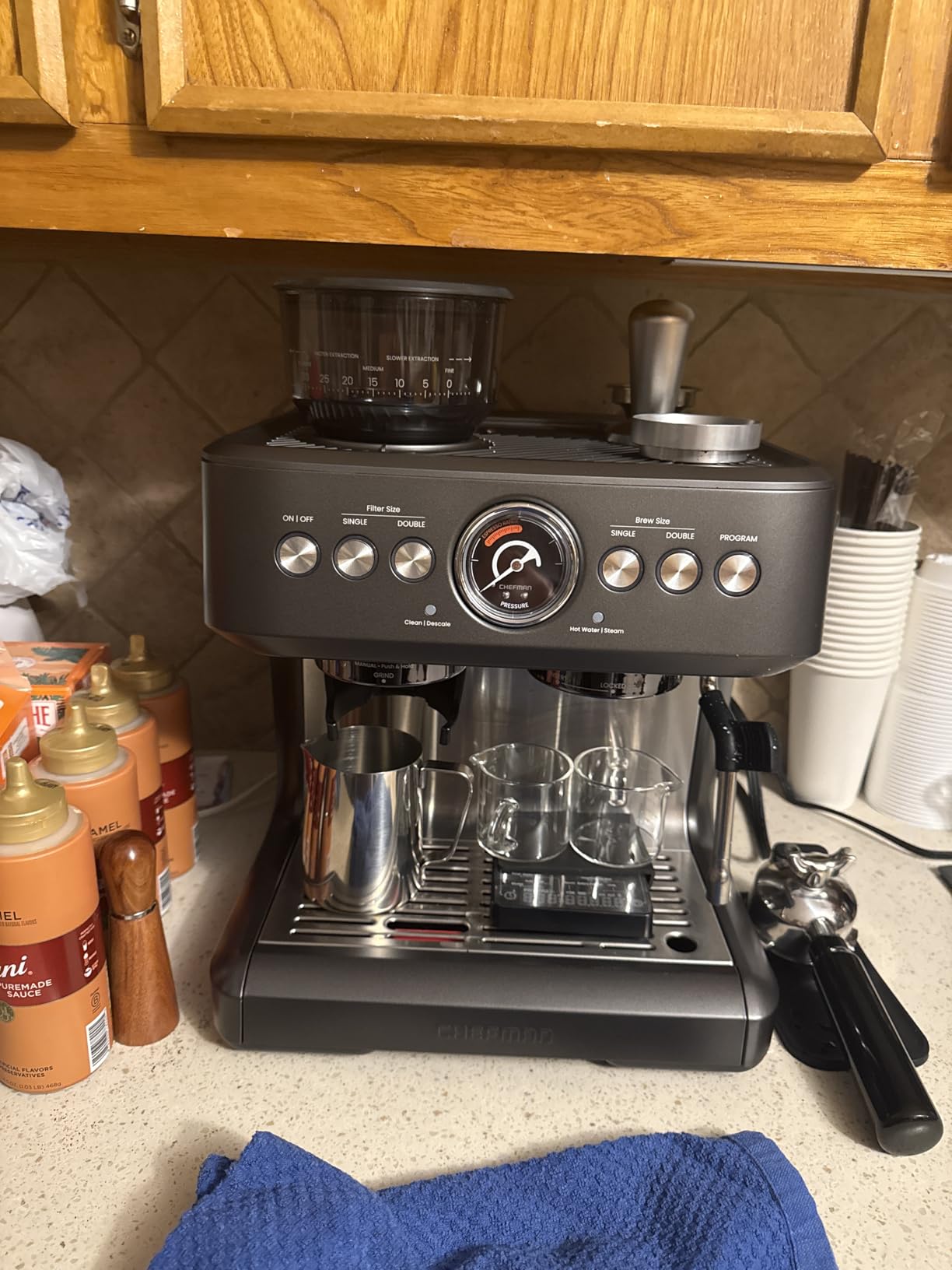
This is the only machine in the roundup with a true dual boiler, and that single fact changes your workflow more than anything else on the list. Separate brew and steam boilers mean you can pull a shot while the milk is still texturing, so back-to-back drinks for several people happen without waiting for a boiler to switch modes.
The rest of the specification is genuinely good for the tier. A 30-setting conical burr grinder doses into the portafilter, the 58mm portafilter is the commercial standard so you can buy baskets and tampers from anywhere, and you can customize shot temperature and volume from ristretto through caffe lungo. The 3 liter fully removable reservoir supports several drinks in a row.
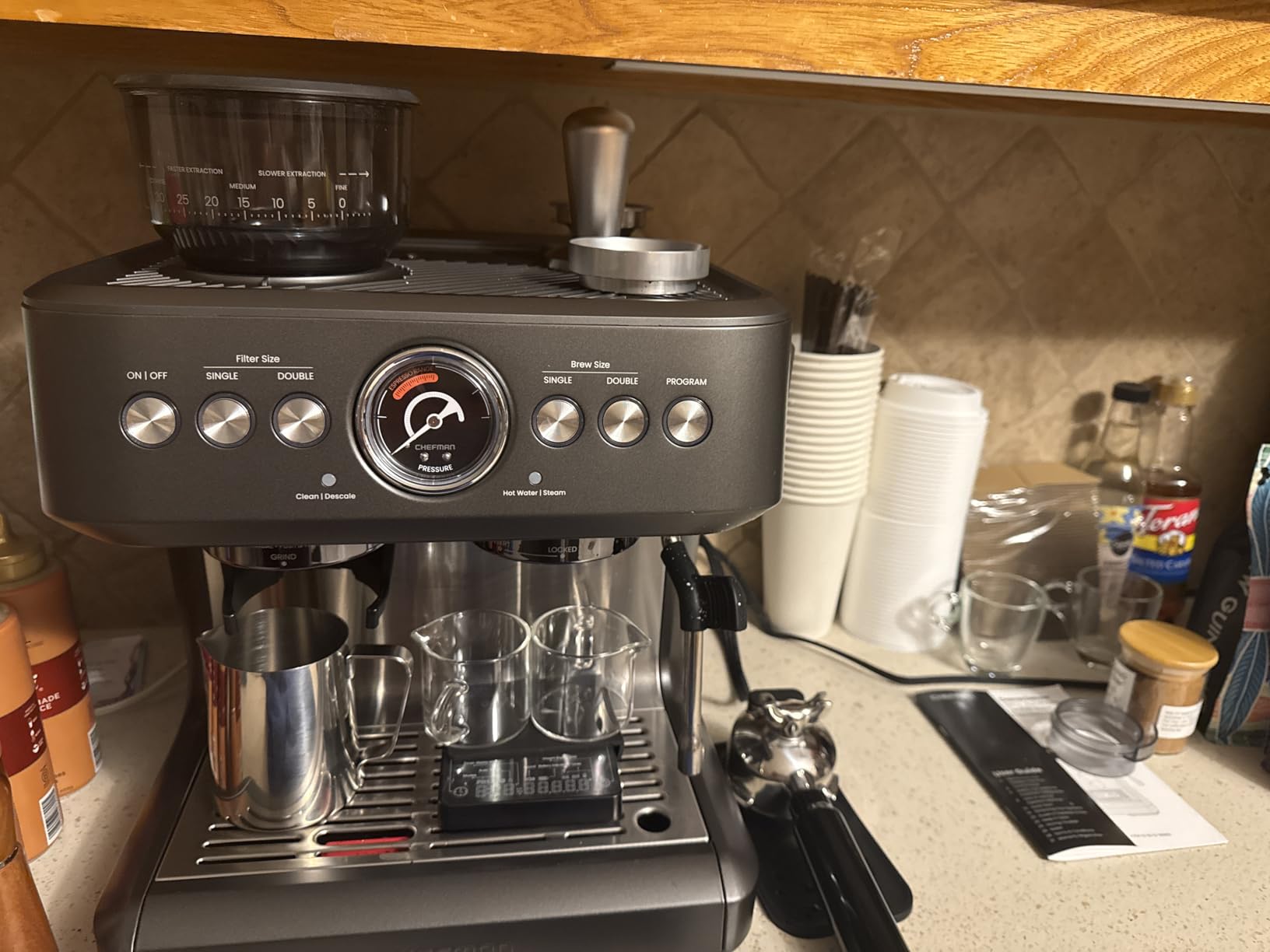
It is also the heaviest machine here at 29.5 pounds and among the bulkiest, and the grinder does not match the quality of Breville’s integrated burrs. Shot consistency depends more on how well the grinder doses than on the boiler, so the dual boiler advantage is partly undermined if the grind is erratic.
Quality outcomes are uneven, and we want to be straight about that. Its rating distribution shows a meaningful share of one-star reviews, which means an early problem is a real possibility rather than a rarity. The 58mm basket options are also limited to espresso formats, so it is a single-purpose machine rather than a flexible one.
Who the Chefman Crema Deluxe suits best
It suits the household or small office that serves multiple milk drinks in a row. Simultaneous brewing and steaming is not a luxury when four people each want a cappuccino, and this is the only machine in the list that solves it at this level of the market.
It also suits anyone committed to the 58mm ecosystem. Having the commercial-standard portafilter means the full range of baskets, tampers and third-party accessories is available to you now and later.
Who should skip the Chefman Crema Deluxe
Skip it if you are price sensitive and risk averse. The uneven star distribution means a real chance of an early problem, and a 13 percent one-star share is worth weighing against the convenience gain.
Skip it if counter space or lifting matters. At nearly 30 pounds with a 13.66 by 12.68 inch footprint, this is a machine you choose once and leave in place. Owners who buy dual boiler machines generally treat them as a permanent counter fixture.
9. Breville Bambino Plus – Best for Fast Mornings
Breville BES450BSS Bambino Espresso Machine, Brushed Stainless Steel
1560W
ThermoJet 3 sec heat up
54mm portafilter
47 oz tank
10.9 lbs
Pros
- Three second heat up makes it genuinely fast for morning use
- Automatic steam wand does hands-free microfoam at the right temperature
- Compact 6.3 inch wide body fits small kitchens
- PID control plus pre-infusion for even extraction
Cons
- No integrated grinder so a separate burr grinder is required
- Steam wand auto shut-off interrupts long texturing sessions
- 47 oz tank and small cup warmer limit larger drinks
The Bambino Plus solves a specific problem: getting a finished milk drink fast when you are already late. ThermoJet heating reaches extraction temperature in three seconds, and the automatic steam wand takes the milk from fridge temperature to textured foam without you hovering over a valve.
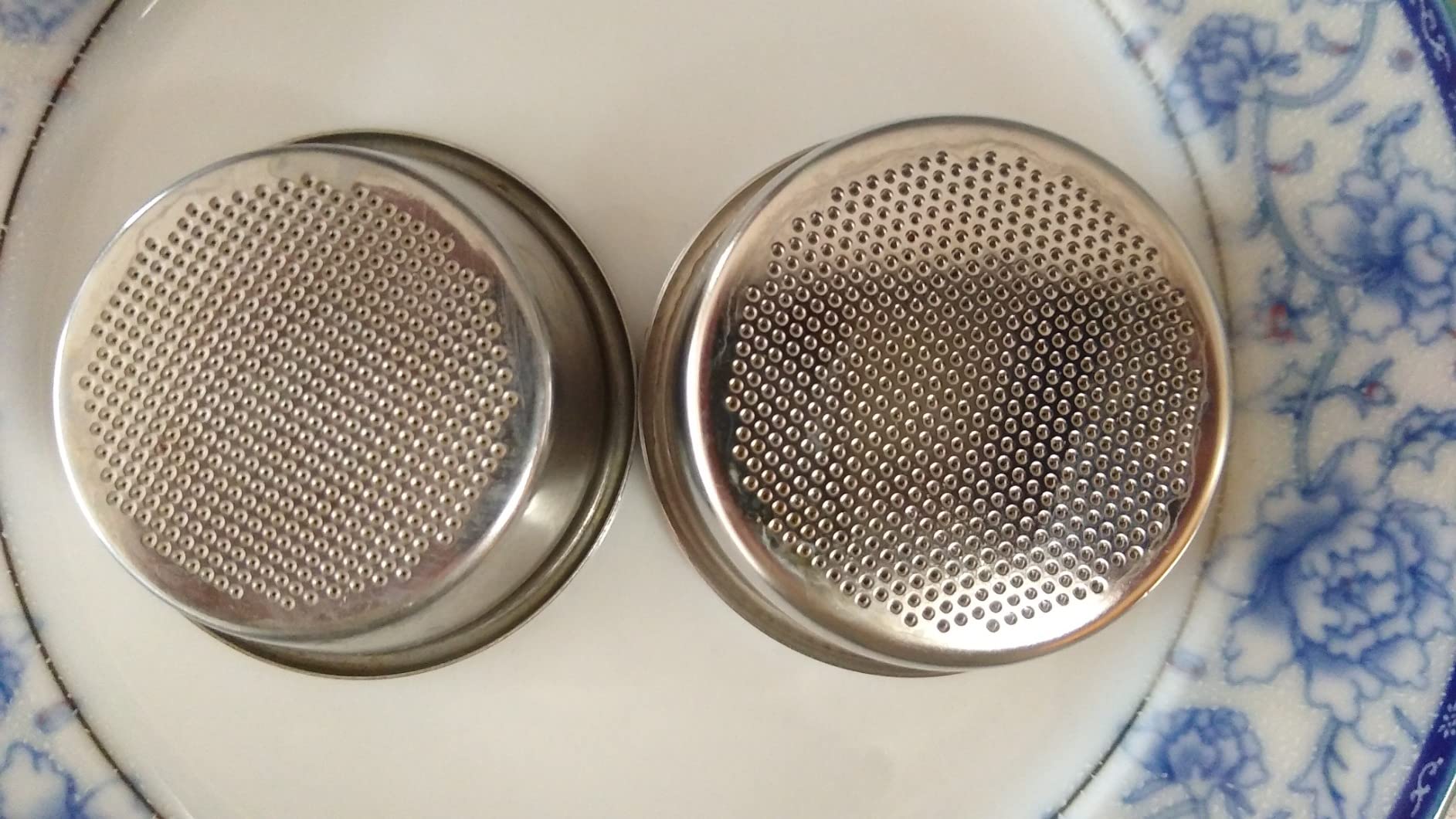
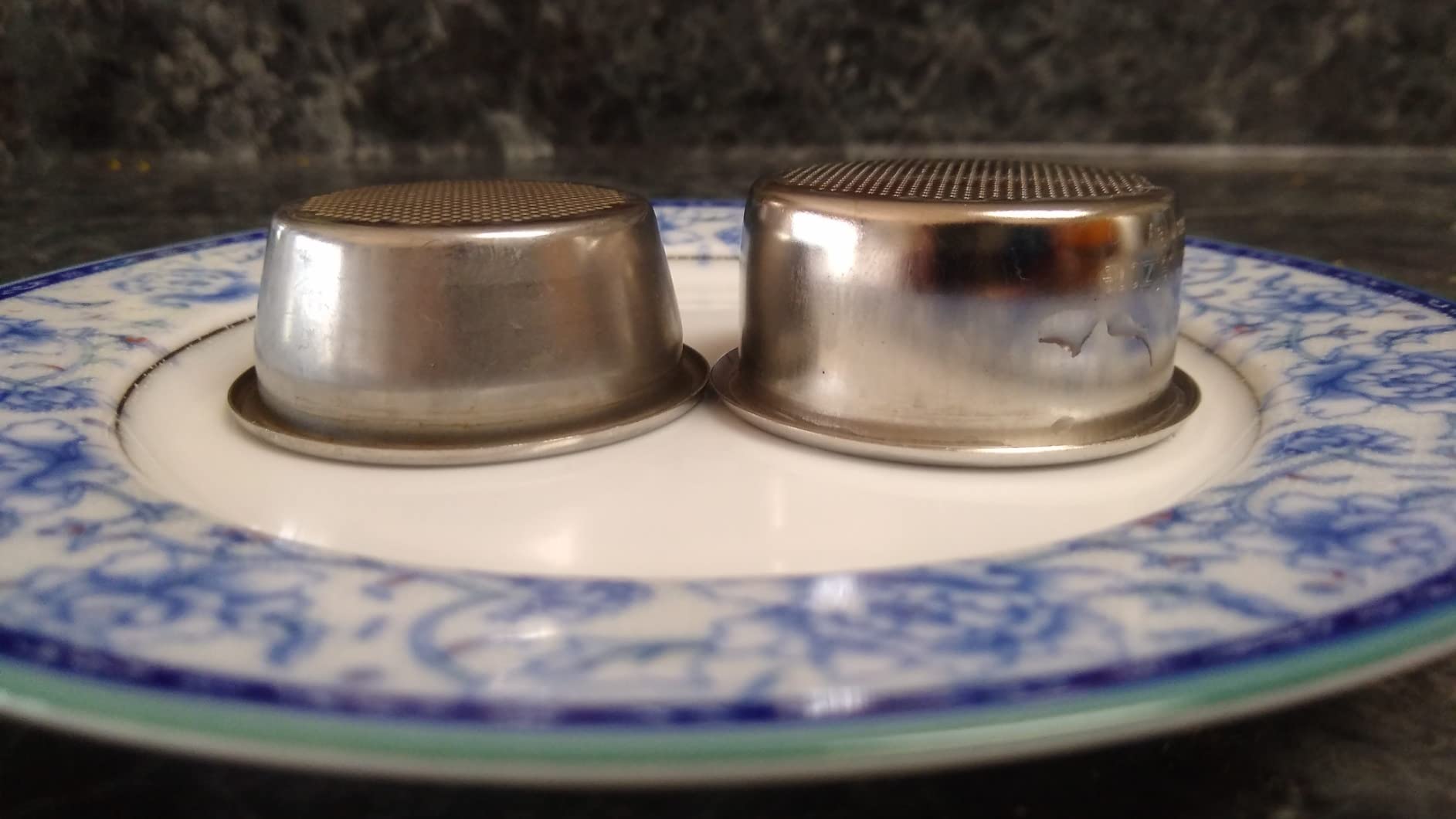
At 6.3 inches wide and 10.9 pounds it is one of the most compact machines here, which makes it a genuinely good fit for a small kitchen. PID control with low pressure pre-infusion delivers even extraction, and the included single and dual wall baskets make early dialing in less punishing.
The catch is that there is no grinder, and the owners who are happy are overwhelmingly the ones who already own a burr grinder. Without one, output is inconsistent because the grind quality is out of your hands.
Two other limits are worth planning around. The steam wand auto shut-off can cut out before your milk is properly textured, and the 47 oz tank with a small cup warmer limits larger drinks. As a single boiler it also cannot brew and steam at the same time. This is the lowest-rated machine in the group at 4.0 stars with a 16 percent one-star share, the highest in the set.
Who the Breville Bambino Plus suits best
It suits the owner who already invested in a grinder and wants the machine to be small and quick. Everything about the design assumes you bring the grind, and the reward is a footprint and a warm-up time that fit a cramped kitchen and a fast morning.
It also suits anyone making mostly straight espresso or small milk drinks where volume limits do not matter. The compactness is the feature you are really buying.
Who should skip the Breville Bambino Plus
Skip it if you do not own a burr grinder and are not planning to buy one. That single omission is the most common reason owners rate it low, and it is the reason this machine sits below our top picks despite good hardware.
Skip it if you practice long latte art sessions. The auto shut-off interrupting the wand is exactly the wrong behavior for someone learning to stretch and pour slowly.
10. Gevi 20 Bar with Grinder and Steam Wand – Best for 58MM Upgrades
Gevi 20 Bar Espresso Machine with Grinder & Steam Wand for Latte Cappuccino
20 bar
1450W
30 setting grinder
58mm portafilter
2.3 liter tank
Pros
- Built-in 30 setting burr grinder removes the need for a separate grinder
- 20 bar pump with pre-infusion produces rich full-bodied shots
- NTC and PID control keeps extraction and microfoam consistent
- 58mm portafilter matches the commercial standard for accessories
Cons
- Tallest footprint here at over 16 inches needing vertical clearance
- All controls on a single panel which can feel cluttered
- Grinder dose and shot volume need calibration to avoid waste
This is the combination I would pick for a barista who wants an integrated grinder and the 58mm standard in one machine. Most machines that include a grinder use a 54mm portafilter, which locks you out of the wider accessory world. This one pairs a 30-setting conical burr grinder with a 58mm portafilter, so you can buy precision baskets, WDT tools and third-party tampers as your skills grow.
NTC and PID temperature control covering both brewing and frothing is another thoughtful detail, and the 20-bar pump with pre-infusion delivers consistent, full-bodied shots. The steam wand doubles as a hot water dispenser, which saves you a second appliance for americanos and for purging the wand before you steam.
With a 4.4 rating and a 74 percent five-star share, this has fewer complaints than the compact alternatives despite fewer total reviews. The most common notes are practical: the 16.53 inch height needs real vertical clearance under a cabinet, and the single control panel can feel cluttered once you are adjusting grind duration and shot volume together.
Calibration is the other theme. Grinder dose and shot volume need setting to avoid wasted beans, which is a one-time afternoon of work that pays off every morning after.
Who the Gevi Grinder and Steam Wand model suits best
It suits the buyer who plans to keep the machine for years and wants an upgrade path. The 58mm portafilter is the part that matters most: every basket, tamper and distribution tool in the enthusiast market is designed around that diameter, so your future options stay open.
It also suits anyone who wants one appliance for espresso and hot water. The dual-function wand removes a step from the workflow and saves counter space.
Who should skip the Gevi Grinder and Steam Wand model
Skip it if you have low cabinet clearance. At over 16 inches tall it will not fit under many standard kitchen cabinets, and the hopper on top needs room to be filled without scraping your head on a shelf.
Skip it if you want a polished, uncluttered control surface. Several owners describe the single panel as busy, and if tactile dials are how you like to work, the simpler machines here may suit you better.
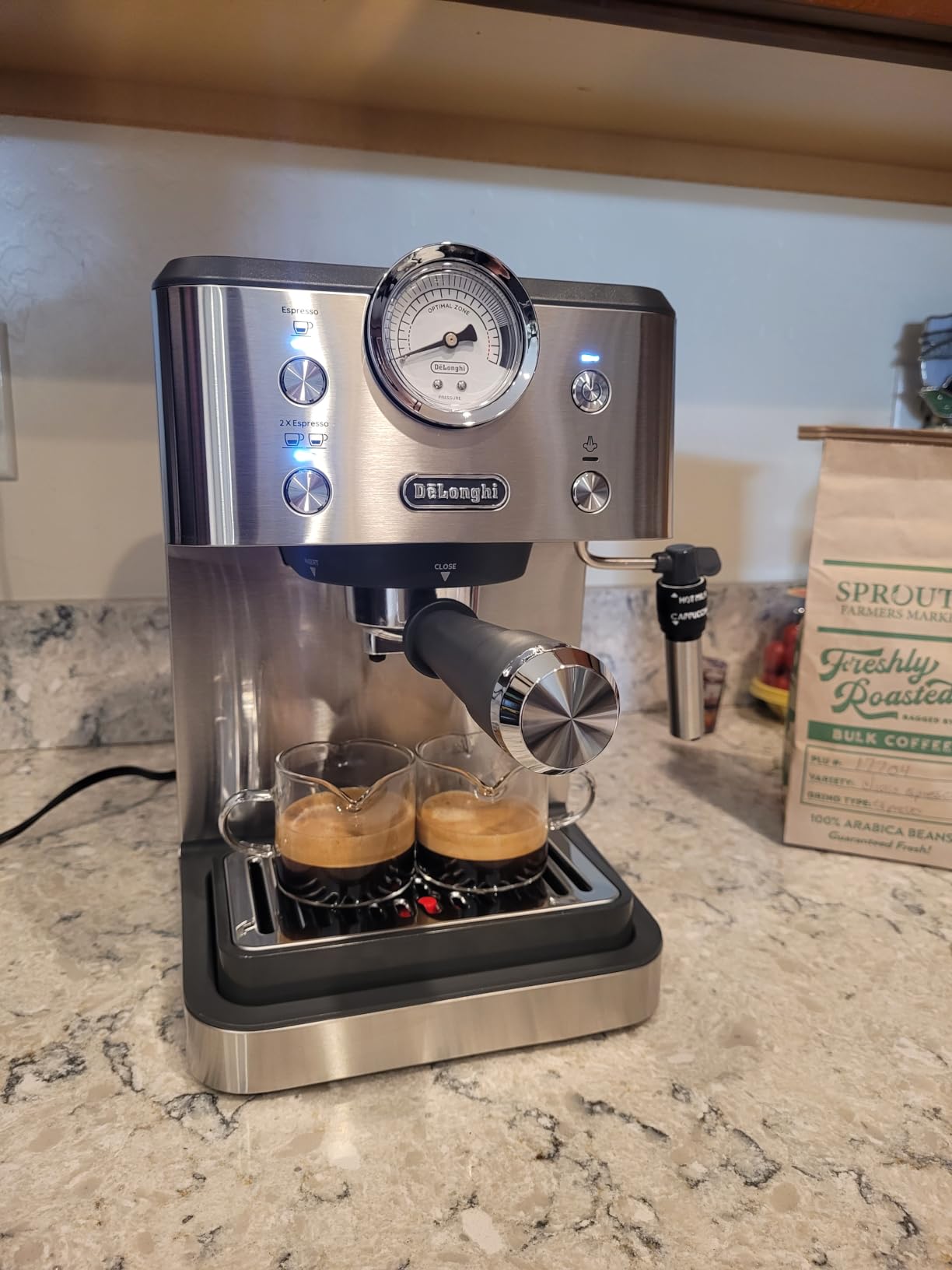
11. De’Longhi Classic Signature – Best for Compact Counters
De’Longhi Classic Signature Espresso Machine, Adjustable Milk Frother
15 bar
1350W
Thermoblock
1.7L tank
9 lbs
9 by 11.2 inches
Pros
- Compact stainless steel Italian design fits small kitchens
- Thermoblock heats in seconds and holds temperature steady
- Adjustable two-setting steam wand covers warming and microfoam
- Removable 1.7L tank with level markers makes descaling easy
Cons
- No built-in grinder so pre-ground coffee is required
- Light build with a lot of plastic
- Filter basket tends to fall out when dumping grounds
The Classic Signature earns its place by doing a narrow thing well: fast, small and clean. Thermoblock heating reaches temperature in seconds and holds it steady, and at 9 by 11.2 by 12 inches with a 9 pound weight it is one of the least demanding machines on any counter.
The adjustable two-setting steam wand is more capable than it sounds, covering everything from simply warming milk to full microfoam, and the 15-bar Italian pump produces a rich shot with good crema. Owners report several who owned far more expensive machines and found this one produced better espresso and foam.
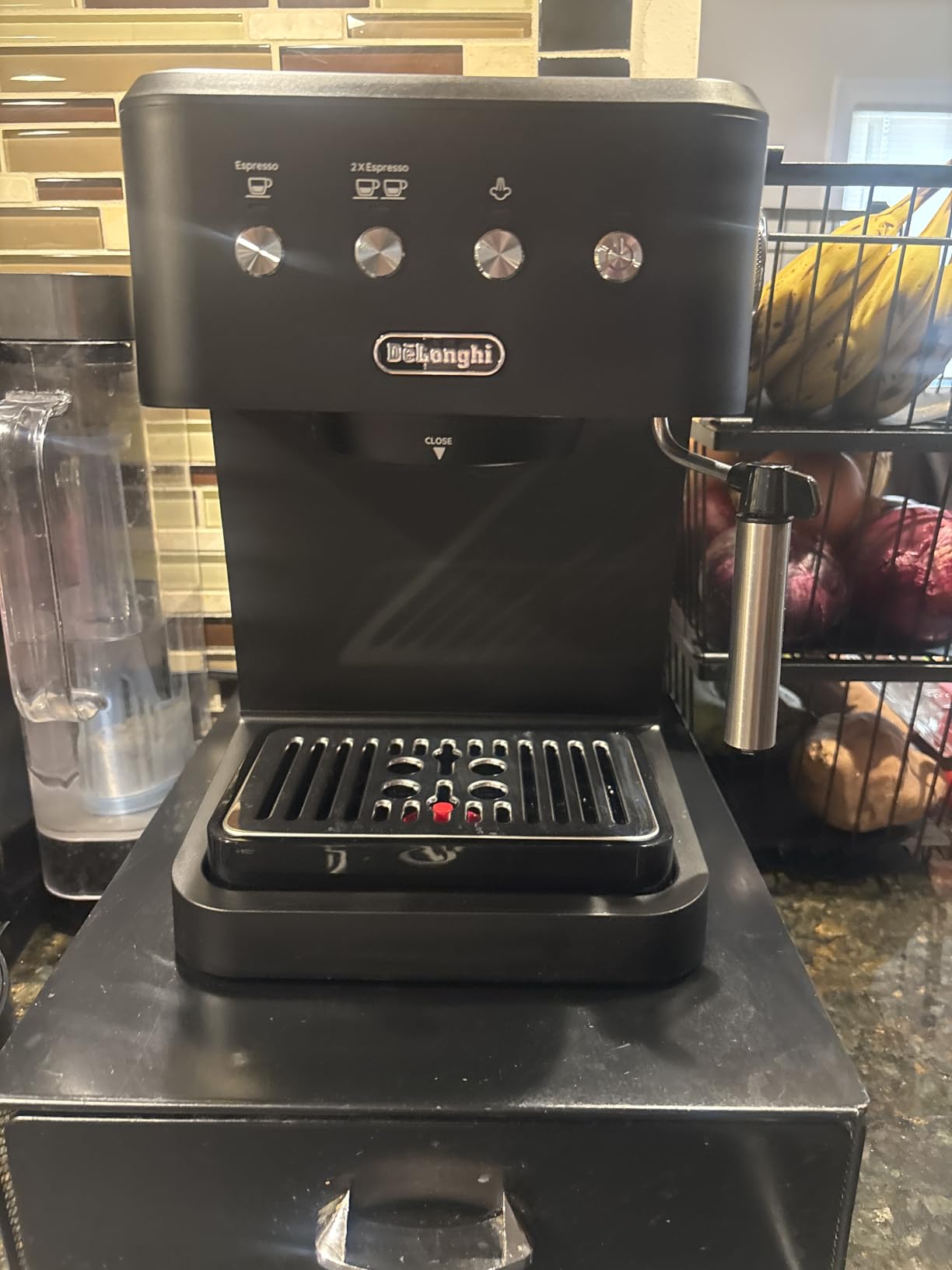
The temperature thread is the one to read carefully. A handful of reviewers have measured brew water at 164 to 178 degrees F and call the product’s temperature claims misleading, and the “customizable presets” adjust volume rather than actual brew temperature. If precise temperature control matters to you, look at a machine with a real PID instead.
Two smaller issues come up repeatedly. The filter basket tends to fall out when you dump the puck, which is messy but harmless, and the body is light with a lot of plastic, so the machine feels less substantial than its finish suggests. Common upgrades owners suggest are a heavier tamper, a bottomless portafilter and a puck screen.
Who the De’Longhi Classic Signature suits best
It suits anyone starting out who wants an Italian-styled machine on a very small counter for very little money. It heats quickly, it is easy to descale with the marked removable tank, and the espresso quality is good enough that you are not training on a broken machine.
It also suits someone whose milk drinks are mostly warming rather than texturing. The two-setting wand covers that case well without the complexity of a full manual routine.
Who should skip the De’Longhi Classic Signature
Skip it if you care about brew temperature precision, and skip it if you have no grinder. Pre-ground coffee is the only input, and grind freshness is the first thing that limits espresso quality.
Skip it if you want a machine that feels substantial. The plastic-heavy build is the reason owners describe it as light, and it is a fair signal about how it will feel in five years.
12. CASABREWS Ultra – Best for Beginner Guidance
CASABREWS Ultra Espresso Machine, Barista Espresso Maker with Steam Wand
20 bar
1350W
4 brew temperatures
LCD display
73 oz tank
13.6 lbs
Pros
- Highest average rating in the group with a 76 percent five-star share
- Four user-selectable brewing temperature settings are rare at this level
- LCD display guides each step for beginners
- Advanced steam wand produces microfoam suitable for latte art
Cons
- No integrated grinder so pre-ground coffee is required
- Temperature adjustment applies to brewing only not frothing
- Heavier than most machines at 13.6 pounds
The Ultra is the most approachable machine in this roundup, and it posts the highest average rating of the twelve. The LCD display walks you through each step, which removes almost all of the guesswork that makes people give up on espresso in the first month.
Four user-selectable brewing temperature settings are genuinely unusual at this level, and they let you compensate for bean roast and ambient temperature instead of living with one fixed profile. The advanced steam wand produces microfoam good enough for latte art, and the 58mm portafilter with single and dual wall filters keeps your accessory options open.
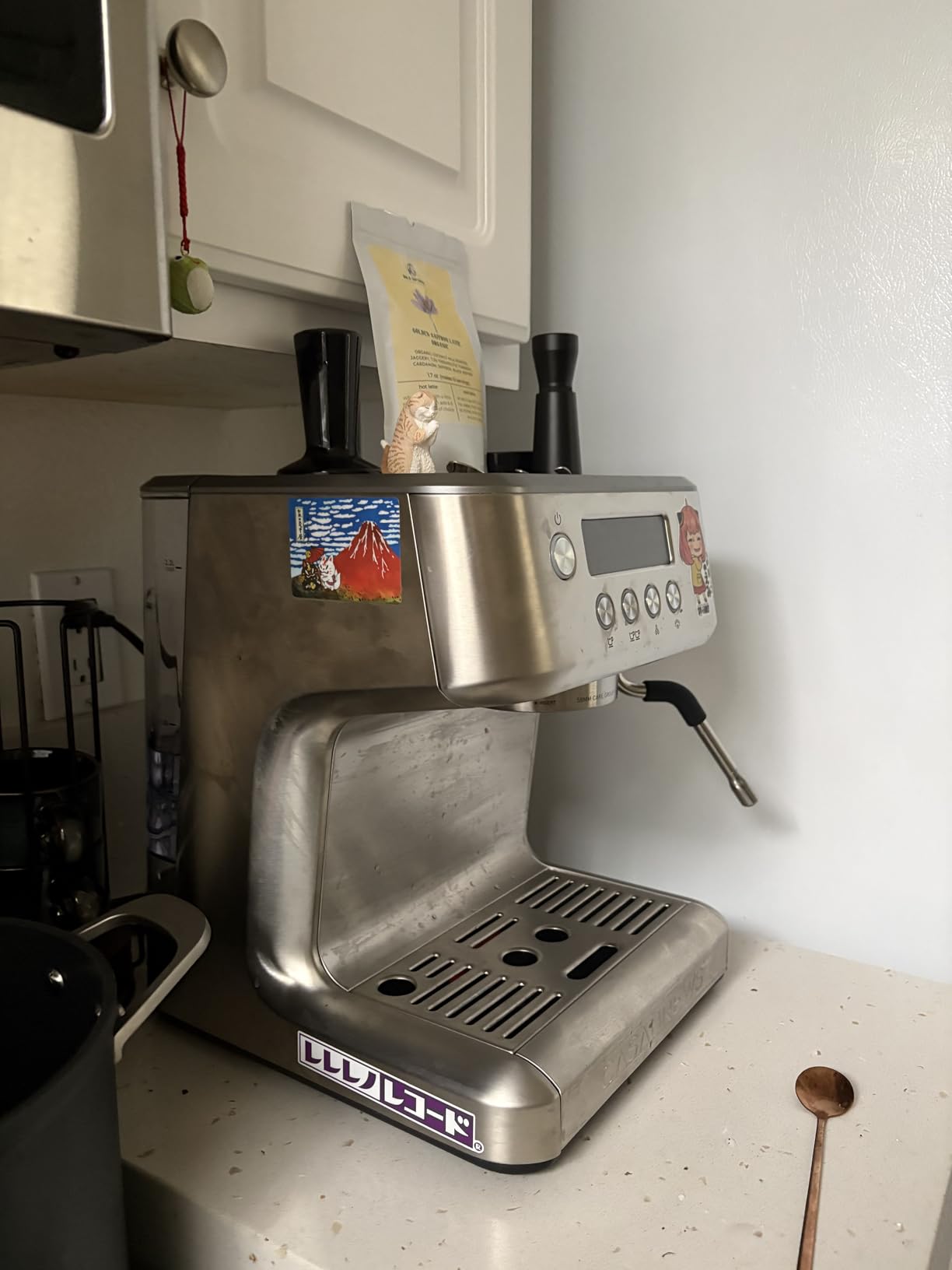
It has the smallest review base in the set, which cuts both ways. Fewer owners means a high rating built on a smaller sample, so treat the score as encouraging rather than settled. Buyers consistently single out the LCD and the selectable brew temperature as the features that make it approachable.
Two limitations are clear. There is no integrated grinder, so pre-ground coffee is required and the real cost of a good workflow sits in a separate burr grinder. And the temperature adjustment applies only to espresso brewing, not to frothing, so milk temperature is whatever the wand gives you. At 13.6 pounds it is also heavier than most machines in its class.
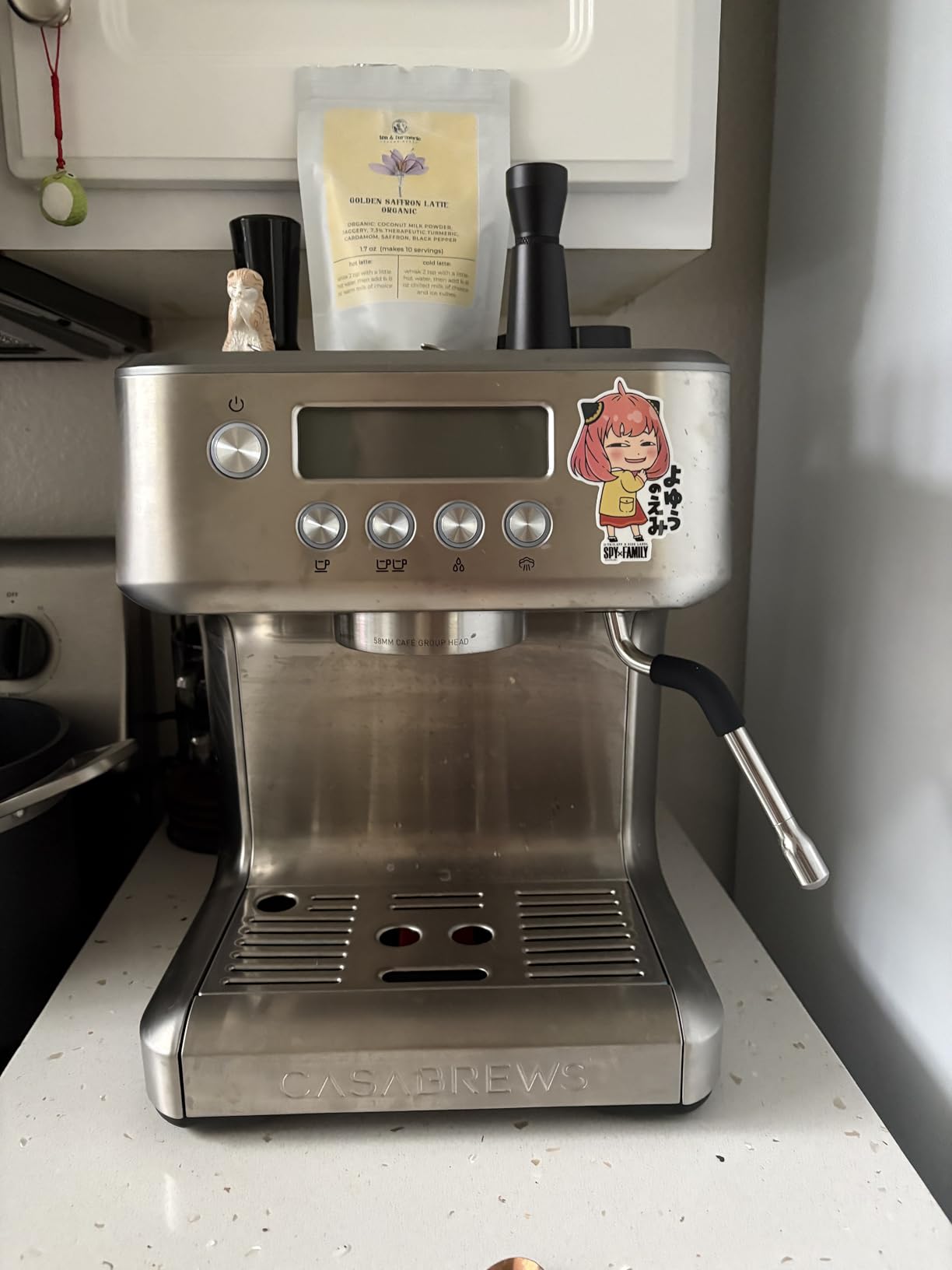
Who the CASABREWS Ultra suits best
It suits the true beginner who wants guided steps rather than a control panel full of dials. The display tells you what to do next, which is exactly what a first-time owner needs, and the four temperature settings give you a dial to turn once you have enough shots under your belt.
It also suits anyone with a large tank requirement. At 73 ounces it is the biggest reservoir in this roundup, which means fewer refills during a busy morning.
Who should skip the CASABREWS Ultra
Skip it if you want to avoid buying a separate grinder. That is the recurring note from owners and the reason the machine’s real cost is higher than the listing suggests.
Skip it if you want temperature control across the whole workflow, including milk. The brewing temperature settings do not carry over to the wand, so frothing quality still depends on the steam system alone.
How to Choose an Espresso Machine for Your Home
Choosing well comes down to answering four questions honestly before you look at any brand: how you drink your coffee, how much counter and cabinet space you have, how many drinks you make in a session, and whether you are willing to own a grinder and maintain the machine. Get those right and the list above narrows fast.
1. Pick the machine type that matches your skill level
There are four types in this roundup and they suit very different people. A manual lever-style machine like the De’Longhi Stilosa teaches you technique because nothing is automated. A semi-automatic machine with a steam wand gives you full control and requires you to learn, which is where most home baristas live. An automatic milk system like the Mr. Coffee removes the technique requirement entirely. A bean-to-cup machine with an integrated grinder like the Barista Express or the Chefman combines a machine and a grinder in one workflow.
The honest advice from experienced owners is that grinder quality is cited more often than any other factor as the thing that separates good espresso from bad, repeatedly ahead of the machine itself. If you already have a burr grinder, buy a smaller machine with a good steam wand and put your money there. If you do not, an integrated grinder machine is a reasonable place to start, provided you accept that you may replace it eventually.
2. Use a simple grinder budget rule
If you are buying a machine without a grinder, plan the budget so the grinder is a real line item and not an afterthought. Buyers who skip this step are the group most likely to rate an otherwise good machine low, and the machines with no integrated grinder on this list are the ones whose owners most often recommend adding a burr grinder, a bottomless portafilter and a weighted tamper within the first month.
For manual machines, the grinder is not optional at all, because the puck quality you hand to the machine is entirely your responsibility. For automatic milk systems the grinder matters less, since the drink is milk-forward and forgiving, but it still matters more than most people expect.
3. Understand what the heating system does for you
Thermoblock systems, like the De’Longhi Classic Signature, heat in seconds and use small amounts of water, which suits a household making a few drinks a day but has less thermal mass, so temperature varies more between shots. Heat exchanger and single boiler designs, like the CASABREWS 3700 Essential, use one boiler for both brewing and steaming, which means you wait for the machine to switch modes. Dual boiler designs, like the Chefman Crema Deluxe, separate the two, and are the only option here that lets you brew and steam at the same time.
PID control is a different axis entirely. It holds brew temperature to within a couple of degrees rather than swinging with every shot, and on the Barista Pro the spec is plus or minus 2 degrees C. Machines that advertise custom presets are often only customizing volume, so check whether temperature is genuinely adjustable before you pay for the claim.
4. Treat the steam wand as a first-class feature
If you drink milk drinks, the wand matters more than the espresso side. A manual wand with real power, like the one on the Barista Pro or the CASABREWS CM5418, gives you control over texture and enough steam to work quickly. An automatic wand, like the Bambino Plus, is hands-free but may cut out before you finish. A fully automatic frother, like the Mr. Coffee, requires no technique at all and is the first component most likely to fail in daily use.
Plan the order of operations around a single boiler. Froth the milk first, then pull the shot, and both come from the machine at the right temperature. Trying to do it in the other order is why so many first-time owners end up with a lukewarm shot.
5. Budget for water, cleaning and counter space
Water hardness destroys machines faster than anything else, and the reviewers who report trouble in year two almost always describe the same cause. Descale on a schedule that matches your water, use filtered water, and expect to run cleaning cycles weekly. On a new machine, a half-tank cleaning cycle is also the fastest way to fix under-temperature brewing, which is the single most repeated tip across the reviews here.
Measure the vertical clearance before you order, not after. The Gevi grinder model at over 16 inches tall will not fit under many standard cabinets, and the Chefman at 29.5 pounds is a fixture you will not move. Our deeper guide to [mid-range espresso machines](https://eatcreatesleep.net/best-espresso-machines-under-1000/) covers footprint in more detail, and [commercial-style machines](https://eatcreatesleep.net/best-commercial-espresso-machines/) are worth a look if you plan to go further down the prosumer path later.
Frequently Asked Questions
What espresso machine do baristas use at home?
Working baristas at home usually choose a single-boiler or heat exchanger semi-automatic with a manual steam wand, paired with a separate burr grinder. The reason is control and repairability: a manual wand lets you texture milk properly, and a standard portafilter means baskets, tampers and other accessories are easy to replace. Prosumer owners tend to move to dual boiler machines later so they can brew and steam at the same time.
Do I need a separate grinder for an espresso machine?
If the machine has no integrated burr grinder, then yes. Grind size and consistency are the biggest single factor in espresso quality, and pre-ground coffee loses aroma within days. A reasonable rule is to budget for a burr grinder as a separate line item rather than an accessory, and to spend at least as much on the grinder as a first-time buyer would on an entry-level machine.
Can you make latte art with an automatic steam wand?
Yes, but expect less control. An automatic wand takes milk from cold to textured at roughly the right temperature without you managing the pitcher angle, which makes it good for beginners. A manual wand with more power, like those on the Breville Barista Pro or the CASABREWS CM5418, lets you control where you introduce air and how fast you pour, which is what you need for consistent art.
Dual boiler vs heat exchanger vs thermoblock for home use?
Thermoblock heats fastest and uses little water, which suits light daily use but has less thermal mass so temperature varies between shots. Heat exchanger and single boiler designs use one boiler for brewing and steaming, so you wait for the machine to switch modes. Dual boiler separates the two, letting you brew and steam simultaneously, and is the best choice if you make several milk drinks in a row.
How often should I descale an espresso machine?
Descale as often as your water requires, which in hard water areas can mean every few months and in soft water areas much less often. Run a cleaning cycle on a new machine before your first real drink, because several owners report that fresh units brew below ideal temperature until a cleaning cycle has been run once. Skipping descaling is one of the most common causes of early failure reported by owners.
What is the 30 second rule for espresso?
A well-extracted double shot should finish running through the portafilter in roughly 25 to 30 seconds, using about 18 grams of coffee and 36 grams of water in a 1 to 2 brew ratio. Running much faster usually means the grind is too coarse, and running much slower usually means it is too fine. This is a starting reference, not a rule, since beans and roast level shift the target.
The Verdict: Which Home Espresso Machine Should You Buy
The best espresso machines for home baristas in 2026 come down to workflow, not prestige. The Breville Barista Express earns the top spot because it puts a burr grinder, a pressure gauge, PID control and a hot water dispenser into one dial-driven machine that beginners can grow out of rather than outgrow. Pick the CASABREWS CM5418 if you want that pressure gauge on a smaller budget, the Breville Barista Pro if latte art is the goal, and the Mr. Coffee 3-in-1 if you want milk drinks with no technique required.
Whatever you choose, budget for a grinder if the machine does not have one, and for descaling if you live in hard water. Both decisions cost less than replacing a machine in year three.