
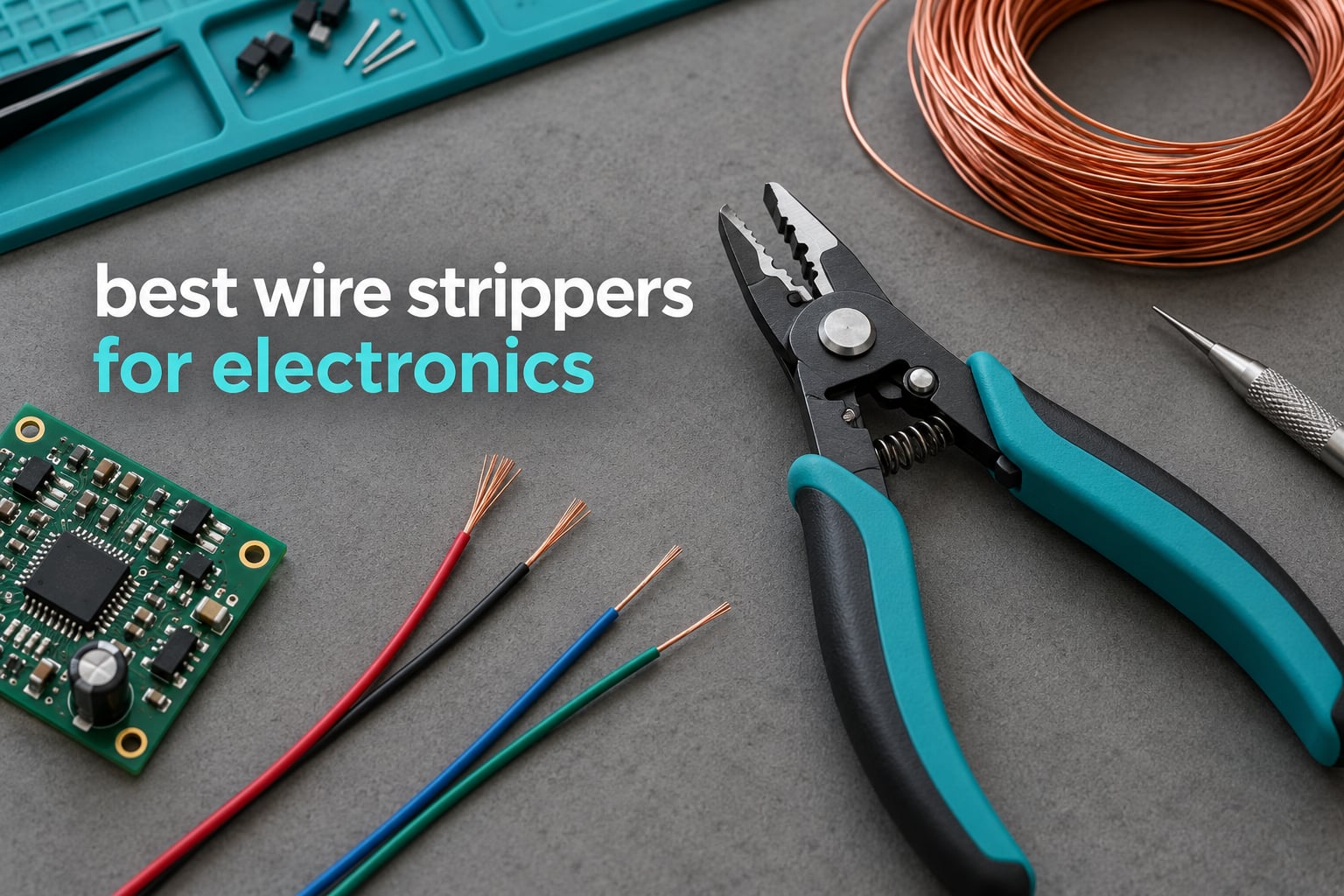
Most people who search for the best wire strippers for electronics do not have a tool problem. They have a gauge problem. Their existing strippers were bought for 10-18 AWG house wire or automotive cable, and they physically cannot reach down to the 26-30 AWG hookup wire that sits on a breadboard or feeds a microcontroller header. The search results for this query make the problem worse: the same handful of electrician tools with hundreds of ratings keep surfacing for a job they cannot do.
We built this roundup the other way around. We started from the wire, not from the tool. Ten precision strippers are reviewed below, each with its verified minimum gauge, whether it handles stranded as well as solid conductor, and what it actually feels like on the bench. Last updated in October 2026 with a stated checking method, because nothing else on this topic has one.
One finding shapes the whole list: every tool that made the cut is a manual precision stripper. Automatic self-adjusting strippers are excellent on 18-22 AWG and become a frustrating compromise the moment you drop below about 24 AWG. If you wire microcontroller boards, LEDs, sensors or fine jumper leads, notches sized to the gauge beat self-adjusting mechanisms almost every time. The bench power supply on your desk and the stripper in your hand are part of the same problem: the wrong tool for the scale of the work.
Everything below is verified from manufacturer specifications and aggregated buyer feedback, with the small print called out honestly. Where a tool has a thin review base or a stated weakness, we say so.
Table of Contents
Top 3 Picks for the Best Wire Strippers for Electronics in 2026

Klein Tools 11057
- 20-30 AWG solid and 22-32 AWG stranded
- Precision ground stripping holes
- Cuts and shears 6-32 and 8-32 screws
- Made in USA

Capri Tools 20010
- 22-8 AWG precision range
- Fast compound stripping action
- Cast alloy chassis
- Recoiling spring wire grip

DOWELL 22-30 AWG Stripper
- 22-30 AWG range
- Integrated cutter
- Stainless steel body
- Ergonomic TPE handle
The Klein 11057 takes the top slot because it covers the widest verified electronics range of anything in this roundup while carrying by far the deepest review base. The Capri Tools 20010 wins on speed when you are terminating cable all afternoon. The DOWELL stripper delivers the cleanest cut per dollar on fine hookup wire, and buyers keep comparing it favourably to tools costing several times more.
All 10 Wire Strippers for Electronics Compared in October
| Product | Specifications | Action |
|---|---|---|
| Klein Tools 11057 Wire Cutter Stripper |
|
Check Latest Price |
| Capri Tools 20010 Precision Wire Stripper |
|
Check Latest Price |
| DOWELL 22-30 AWG Wire Stripper |
|
Check Latest Price |
 ENGINEER PA-06 Precision Wire Stripper ENGINEER PA-06 Precision Wire Stripper |
|
Check Latest Price |
 ENGINEER PA-14 Micro-Precision Stripper ENGINEER PA-14 Micro-Precision Stripper |
|
Check Latest Price |
 iFixit Mandible Wire Strippers iFixit Mandible Wire Strippers |
|
Check Latest Price |
 KATA 7 Inch 20-32 AWG Stripper KATA 7 Inch 20-32 AWG Stripper |
|
Check Latest Price |
 Jonard Tools ST-450 Adjustable Stripper Jonard Tools ST-450 Adjustable Stripper |
|
Check Latest Price |
 Jonard Tools JIC-2030 Stripper and Cutter Jonard Tools JIC-2030 Stripper and Cutter |
|
Check Latest Price |
 Jokari 40024 PWS-Plus 001 Stripper Jokari 40024 PWS-Plus 001 Stripper |
|
Check Latest Price |
1. Klein Tools 11057 – Best All-Round Stripper for 20-30 AWG
Klein Tools 11057 Wire Cutter/Stripper, Made in USA, Heavy Duty Cutter for 20-30 AWG Solid and 22-32 AWG Stranded Wire
Strips 20-30 AWG solid and 22-32 AWG stranded
Screw cutter and looper
12 inch alloy steel
Pros
- Strips 20-30 AWG solid and 22-32 AWG stranded cleanly on the first pass
- Built in the USA from alloy steel with no play in the jaws
- Handles 24
- 28 and 30 AWG hookup wire as well as heavier work
- Coil spring self-opening action and readable gauge markings
- Doubles as a screwdriver
- looper and bender
Cons
- Integrated cutter is only adequate on heavier conductors
- No compound or precision mechanism so quality depends on technique
The Klein 11057 is the tool I recommend first to anyone moving from house wiring to electronics, and it holds a 4.8 rating across more than 2300 reviews. It cuts, strips and loops 20-30 AWG solid and 22-32 AWG stranded wire, which puts 28 AWG hookup and 30 AWG LED wire comfortably inside its range rather than at the very bottom edge. That range matters more than any other spec on this list.
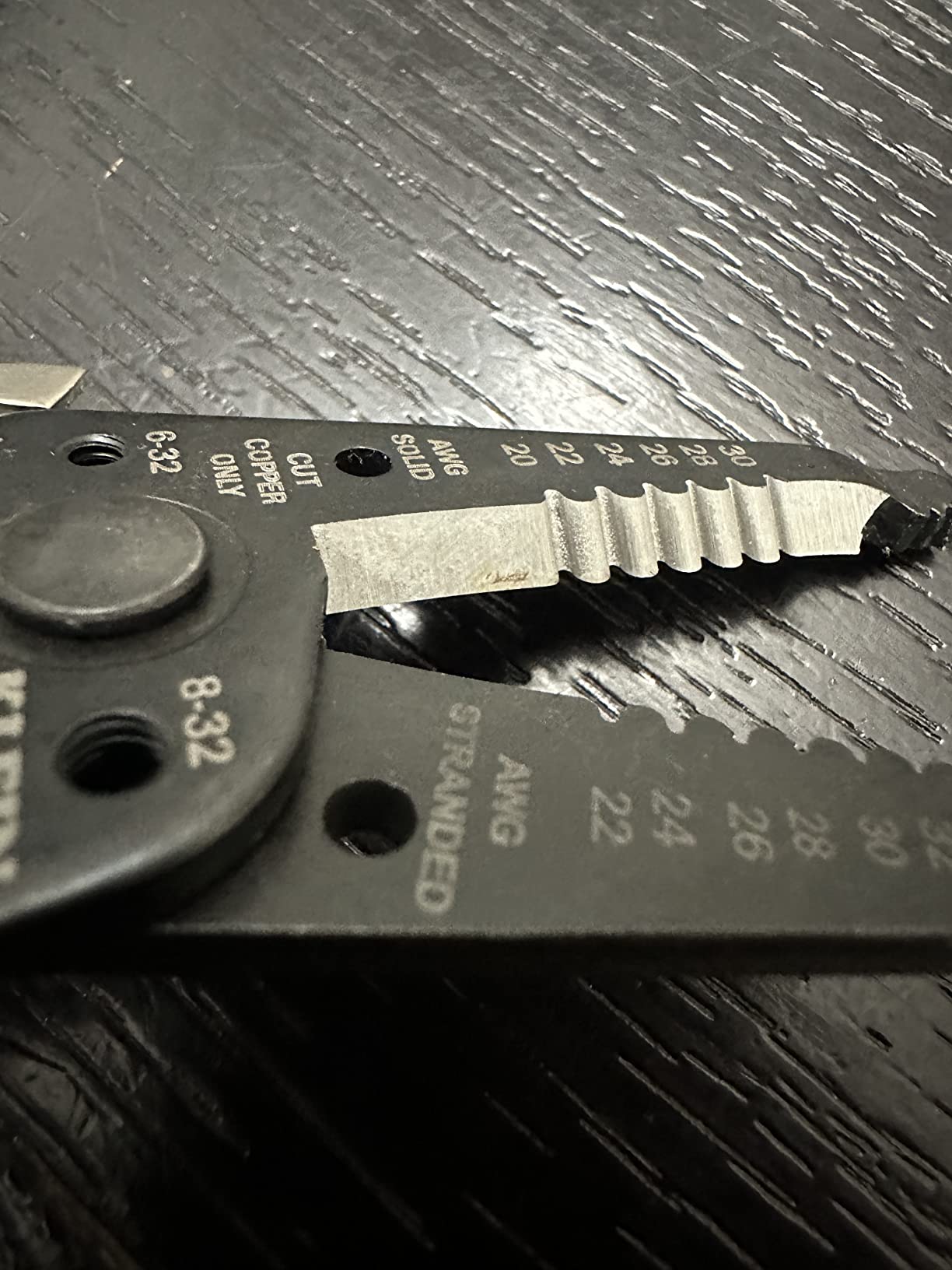
What sets it apart is the set of precision ground stripping holes rather than a V-notch. Each hole is drilled and ground to a specific diameter so the blades meet the insulation without closing onto the conductor. On 24 AWG red hookup the result is a clean, square end with no flattened copper and no score marks down the strand.
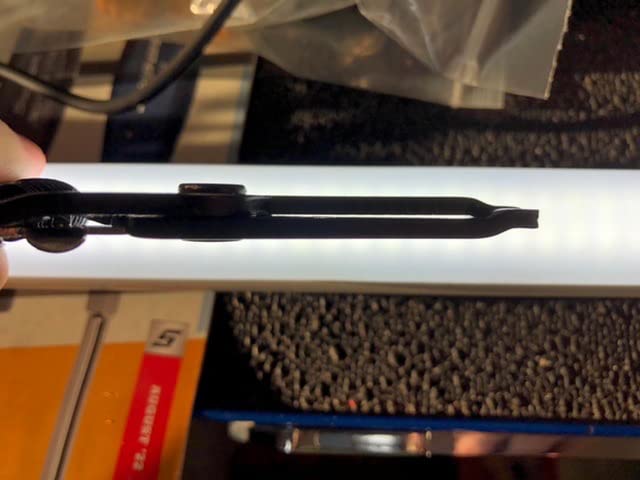
The build is unremarkable in the best way. It is alloy steel, made in the USA, 12 inches long and 5.1 ounces, with a serrated nose for bending and pulling and holes for forming loops. A coil spring returns the handles quickly, which matters more than it sounds when you are on your fifth breadboard jumper of the morning. The serrated nose also lets you seat a wire into a screw terminal or wrap it around a trimer pin without reaching for a second tool.
It also shears 6-32 and 8-32 screws, so it doubles as a small driver set for enclosure work. Buyers frequently use it for terminal crimping on the same bench where they solder.
Why it suits a mixed electronics and hobby workload
This is the stripper for a bench that sees Arduino jumpers, sensor leads, 22 AWG silicone hookup and the occasional 20 AWG supply lead. The ground holes mean you do not have to think hard about which notch to use, and the wide range means you rarely hit the limit in either direction. If you only buy one tool, this is the one I would buy first.
Where it falls short
It is a hand tool with no mechanical advantage, so the cut quality lives and dies on technique. On very stiff insulation, or when the handle is pulled hard, the result can be a slightly flattened end. The integrated cutter is adequate rather than excellent, and some users note it does not cleanly sever every strand of heavier wire in a single pass. Those are honest limits, not defects.
2. Capri Tools 20010 – Best for Fast Compound Stripping
Capri Tools 20010 Precision Wire Stripper
22-8 AWG precision range
Cast alloy chassis
14.4 ounce body
Pros
- Compound stripping action makes repeated precise strips fast and consistent
- Machined stripping holes remove insulation without nicking the conductor
- Cast alloy chassis gives a solid heavy-duty feel
- Tension-loaded wire grip plus recoiling spring for one-handed repetitive work
Cons
- 22-8 AWG range stops short of the micro-thin 34-38 AWG end
- Heavier cast alloy body is clumsy for cramped PCB work
The Capri Tools 20010 is the one to buy if your stripping is a production activity rather than an occasional hookup. The compound leverage means each squeeze produces far more blade force than a single-jaw tool, so the handles travel a short distance and a strip completes in one movement. With over 2100 reviews averaging 4.7, this is a long-serving bench tool rather than a novelty.
The stripping holes are machined precisely enough to lift insulation without damaging the conductor underneath, and the tension-loaded wire grip holds the conductor steady so you can concentrate on the squeeze. A recoiling spring design returns it for the next wire, which is exactly what you want in a harness run or a batch of forty identical leads.
Why it suits repetitive bench work
Custom cable harness assembly, control panel wiring, and any job where you are terminating more than a handful of conductors is where the compound action pays for itself. The 22-8 AWG range covers most electronics hookup and much of the light power side, so one tool covers a lot of bench traffic. Buyers describe it as a long-term bench purchase that replaces a lighter accessory tool outright.
Where it falls short
Two limits are worth stating clearly. First, the range bottoming out at 22 AWG means this is not a fine-wire tool, so magnet wire, litz and anything at 34 AWG is out of reach. Second, 14.4 ounces of cast alloy is heavy and wide, and on a crowded PCB inside an enclosure you will want a slim nose-dive stripper instead. A companion tool for fine gauges is common practice on a well-equipped bench.
3. DOWELL 22-30 AWG – Budget Pick Precision Stripper
DOWELL Wire Stripper, 22-30 AWG Wire Cutter, Stripping Tool
22-30 AWG stripping range
Integrated cutter
7 inch stainless steel
Pros
- Strips 22-30 AWG cleanly with no nicks
- residue or cut strands
- Ergonomic TPE handle grips well with wet or oily hands
- Cuts and strips in one tool with gauge sizes printed on the jaws
- Praised repeatedly as better value than far costlier strippers
Cons
- Safety lock has no positive catch and can pop open on its own
- Arrives with a light film of manufacturing oil to wipe off
The DOWELL stripper is the value pick in this roundup and one of the most thoroughly reviewed tools in it, sitting at 4.7 across more than 2200 reviews. It removes insulation from 22-30 AWG wire, which covers the overwhelming majority of microcontroller and breadboard hookup you will encounter, and the stripped ends come back square with no cut strands and no insulation residue left behind.
It is a 7 inch stainless steel tool with a thermoplastic elastomer handle, weighing 127 grams, and the gauge sizes are printed directly on the cutting area so you are not squinting at a separate chart. The same jaws double as a cutter for copper and fine iron wire, which makes it useful for chassis ground straps and small hookups.
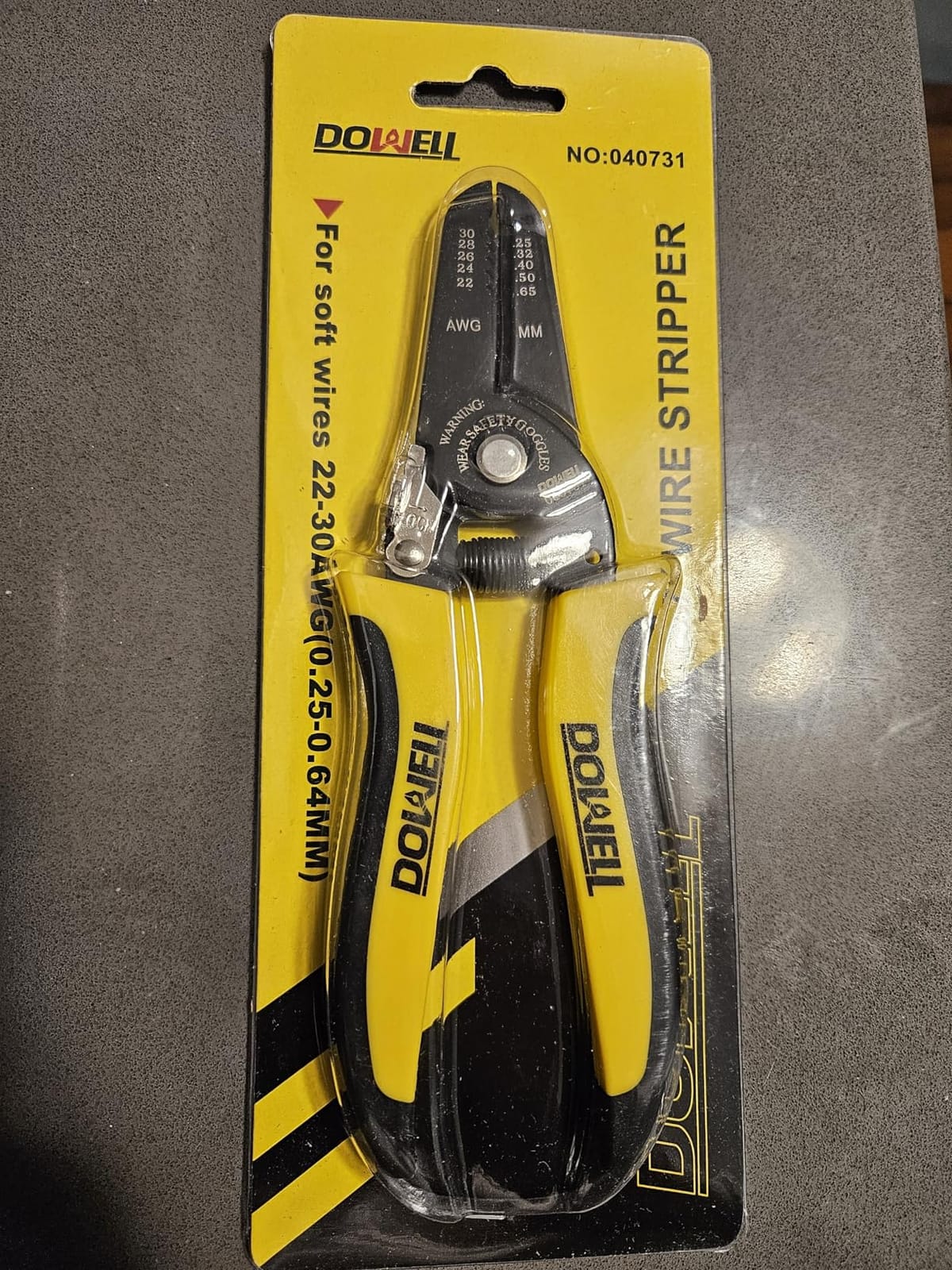
The grip is genuinely good in a way that cheap tools usually are not. Buyers specifically mention working with wet or oily hands, which describes a garage bench, a model railway layout or an outdoor electronics enclosure. The finish is smooth, the spring action is even, and there is no flex in the head when you squeeze.
The stripped ends are square and consistent, which is what makes it a safe first tool. Nothing about the design is cutting-edge, and that is the point at this price. You get correctly sized holes, a steady spring and a handle you can grip with cold or damp hands, and the whole thing fits in a shirt pocket. For a breadboard, a sensor break-out or a first enclosure, that combination removes the usual beginner mistakes before they start.
It also earns a permanent place on a mixed bench, because the integrated cutter covers the ground and hookup pigtails that surround almost every electronics build. Nothing at this level should have to be sharpened, adjusted or fumbled with before the first strip. Take it out of the packaging, wipe the jaws, and it works.
Why it suits a first electronics tool
This is the sensible first wire stripper for someone building a breadboard prototype or a small microcontroller project. At this level of gauge, tool quality matters, but the quality you actually need is blade alignment and a correctly sized hole, and this tool has both. If you are adding a second tool to the drawer, a micro-precision stripper covers 32-36 AWG and this covers 22-30 AWG without a gap.
Where it falls short
Two small annoyances. The safety lock has no positive catch, so it can spring open on its own inside a tool bag, and the tool arrives with a light film of manufacturing oil on the metal parts that needs wiping before first use. Neither affects the cut quality. It also stops at 30 AWG, so very fine magnet wire is out of range.
4. ENGINEER PA-06 – Best Japanese-Made Precision Stripper
ENGINEER PA-06 Precision Wire Stripper For Thin Wires AWG 30-18
28-16 AWG solid and 30-18 AWG stranded
175mm long
134g
Pros
- Strips cleanly with no nicking
- verified under magnification on 30 AWG wire
- Sharp well-aligned high carbon steel jaws need no touch-up
- Handles silicone and PTFE insulation from 30 AWG to 18 AWG
- Light smooth spring action and a slim nose that reaches tight spots
Cons
- Gauge markings are small and hard to read
- Printed metric figures are hole diameters rather than wire diameters
- Tips are unserrated and not perfectly square
The ENGINEER PA-06 is a Japanese-made precision stripper with high carbon steel jaws that reviewers with long tool histories place alongside the best-known European brands. It strips solid wire from 28 to 16 AWG and stranded wire from 30 to 18 AWG, so it covers hookup, hookless and light power wire from 30 AWG upward, in a 175mm body weighing 134 grams.
What earns the praise is that the jaws arrive sharp and aligned, with no burrs and no touch-up needed out of the box. Buyers check the result under magnification on 30 AWG and find a clean cut with no damage to the copper conductor. It also handles silicone and PTFE insulation, which are the two jacket types that trip up cheaper blades.
That combination of a slim nose and light spring action is what separates it from a general stripper. It reaches between board components, into a partly closed enclosure, and around a terminal block where a wide body simply will not fit. The handles return smoothly, so the tool does not creep closed in a tool roll, and the oil-resistant grips stay usable across a long session.
Owners with decades of experience describe it as a single stripper that removes the need for a second general-purpose tool on a bench that also does small assembly work. A 4.8 rating across 339 reviews is a strong signal for this niche, and the review base, while smaller than the big sellers, is unusually consistent.
Why it suits a serious bench
The slim nose reaches into the gaps between components and inside partially assembled enclosures, and the light spring action means it stays controllable on delicate work. It is the do-all tool on a bench that also does small assembly work, and owners with decades of experience describe it as a single stripper that removes the need for a second general-purpose tool. A 4.8 rating across 339 reviews is a strong signal for this niche.
Where it falls short
The labelling is the main complaint, and it is a fair one. The gauge figures are small, only one side is marked, and the metric numbers printed on the tool refer to hole diameters rather than wire diameters, which is a genuine source of confusion for anyone new to the format. The tips are also unserrated, so this is not the tool to grab when you need to bend a wire sharply.
5. ENGINEER PA-14 – Best for Micro-Thin Wire Down to 34 AWG
ENGINEER PA-14 Precision Wire Stripper for Micro-Thin Wire Made in Japan
32-20 AWG solid and 34-22 AWG stranded
175mm long
134g
Pros
- Strips 32-34 AWG micro-thin wire with zero nicks
- confirmed under high magnification
- Sharp round finishing edge gives a fluid low-friction cut with no tugging
- Jaws aligned out of the box with all notches visible when closed
- Oil-resistant grips stay comfortable over long sessions
Cons
- A minority of units have undersized slots that cut through the wire if fully closed
- Narrow hanger opening at the back needs a separate ring
- Printed metric figures are conductor diameters and easy to misread
The PA-14 is the tool for the wire that makes people nervous. It strips stranded copper from 34 down to 22 AWG and solid wire from 32 to 20 AWG, which puts magnet wire, litz-class bundles, headphone leads, coil wire and thin instrumentation cable firmly in range. Owners with 30 years of tool experience describe it as the best micro-thin stripper they have used.
The blade edge is described as a sharp round finishing edge, and the effect is a fluid, low-friction cut with no tugging or clamping of the conductor. At 4.5 across 464 reviews, the average is held down by one recurring issue rather than by general dissatisfaction, and it is worth understanding before you buy.
The jaws are aligned out of the box and all the notches remain visible when the handles are compressed, so you can confirm you are in the slot you think you are in before committing. The spring pressure is tuned for delicate work, and the oil-resistant thermoplastic rubber grips stay usable through a long session. The handles latch shut for storage, which keeps the blade protected.
The round finishing edge matters more than it sounds at this gauge. A flat or V-shaped edge tends to pinch a 32 AWG conductor between the blades rather than sliding past it, and the result is a flattened or scored strand. A round edge rolls over the jacket instead, which is why the cut stays square even on stiff PTFE.
Oil resistance is the other practical win. Coil winding, sensor lead termination and instrument cable work all involve lubricants and flux, and a grip that turns slick halfway through a batch is a real problem. These grips stay usable, and the light body means the tool does not tire the hand over a long session.
Why it suits magnet wire and fine instrumentation work
When the conductor is only a fraction of a millimetre across, blade geometry stops being a detail and becomes the whole reason for the tool. The PA-14 is the right choice for transformer and coil winding, sensor lead termination, headphone and earphone cable repair, and any harness where the wire is thinner than a pencil lead. If your work lives at 32 AWG or below, nothing else in this roundup handles it as confidently.
Where it falls short
Some units in the minority have undersized slots, and in the smallest sizes closing the handles fully will cut straight through the wire rather than strip it. The lesson is to close gently and feel for the blades meeting insulation rather than squeezing to the stop. The narrow hanger opening also means it needs a separate ring to sit on a hook, and again the metric markings refer to conductor diameters in millimetres, which is easy to misread.
6. iFixit Mandible – Best for Electronics Repair and Teardown
iFixit Mandible Wire Strippers – Auto-Open Latch for Electronics Repair
Cuts, strips and bends 30-10 AWG
Spring auto-reset handle
3.2 ounce body
Pros
- Strips 30-10 AWG cleanly without nicking the copper
- Compact and more ergonomic than strippers sized for house or HVAC wiring
- Spring-loaded auto-reset reduces hand fatigue on repetitive bench work
- Rubberized handles plus built-in cutter and nose pliers
- Lifetime guarantee from iFixit
Cons
- Locking latch can pop open inside a crowded tool bag
- Not intended for heavy cable or industrial wiring
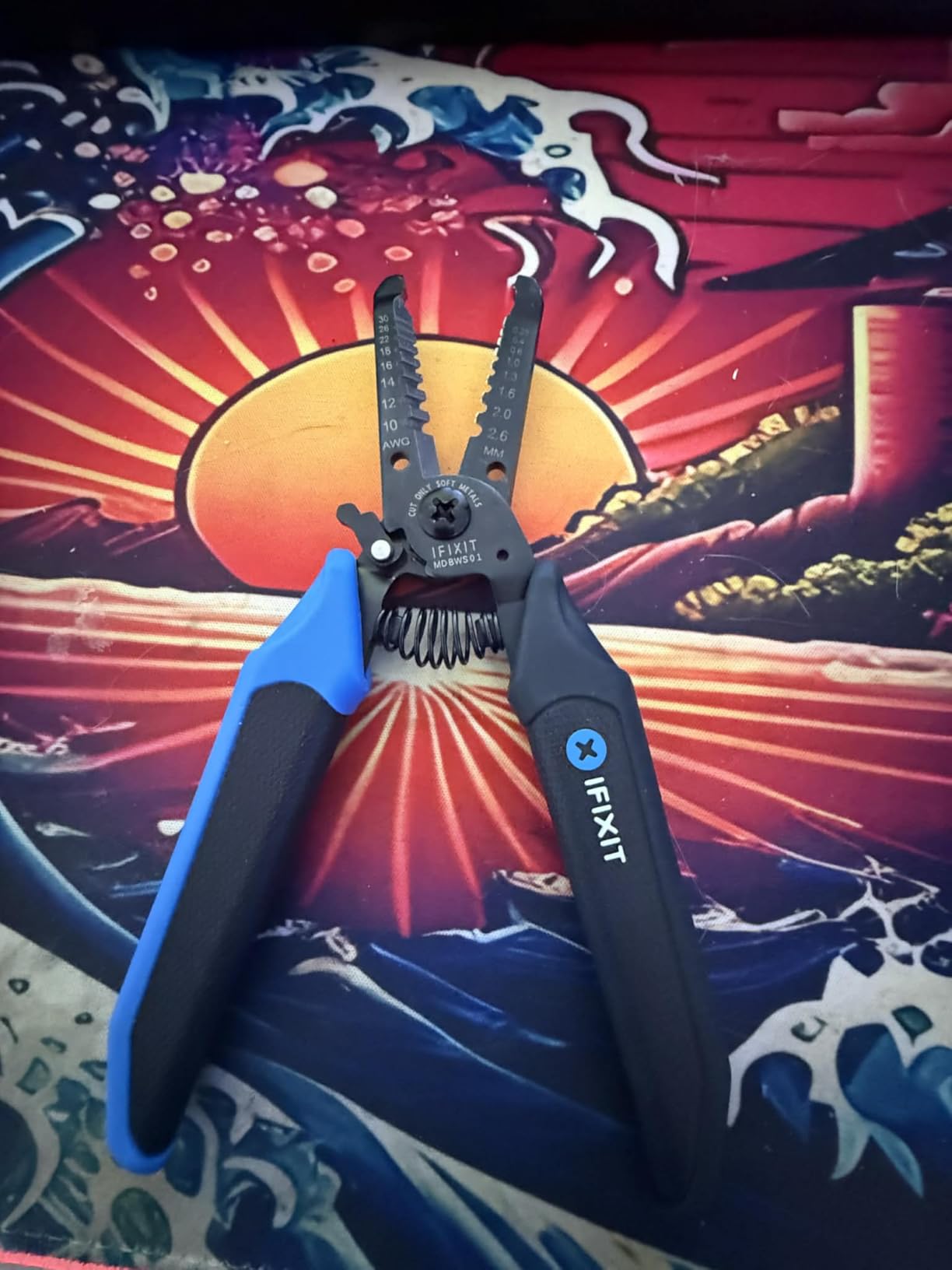
The iFixit Mandible is built for repair work rather than production work, and that is a real strength. It cuts, strips and bends 30-10 AWG wire, removes insulation without harming the wire beneath using sharp well-aligned blades, and weighs just 3.2 ounces. Electronics rework hobbyists rate it at 4.6 across 231 reviews as a capable compact stripper that replaces bulkier automatic tools in the drawer.
The spring-loaded handle resets automatically after each use, which is the detail that matters on a repair bench. You are not resetting a mechanism by hand between every terminal, and over a long teardown session that removes a surprising amount of hand fatigue. The rubberized handles give good control on small wires, and the nose doubles as a set of pliers for bending and pulling.
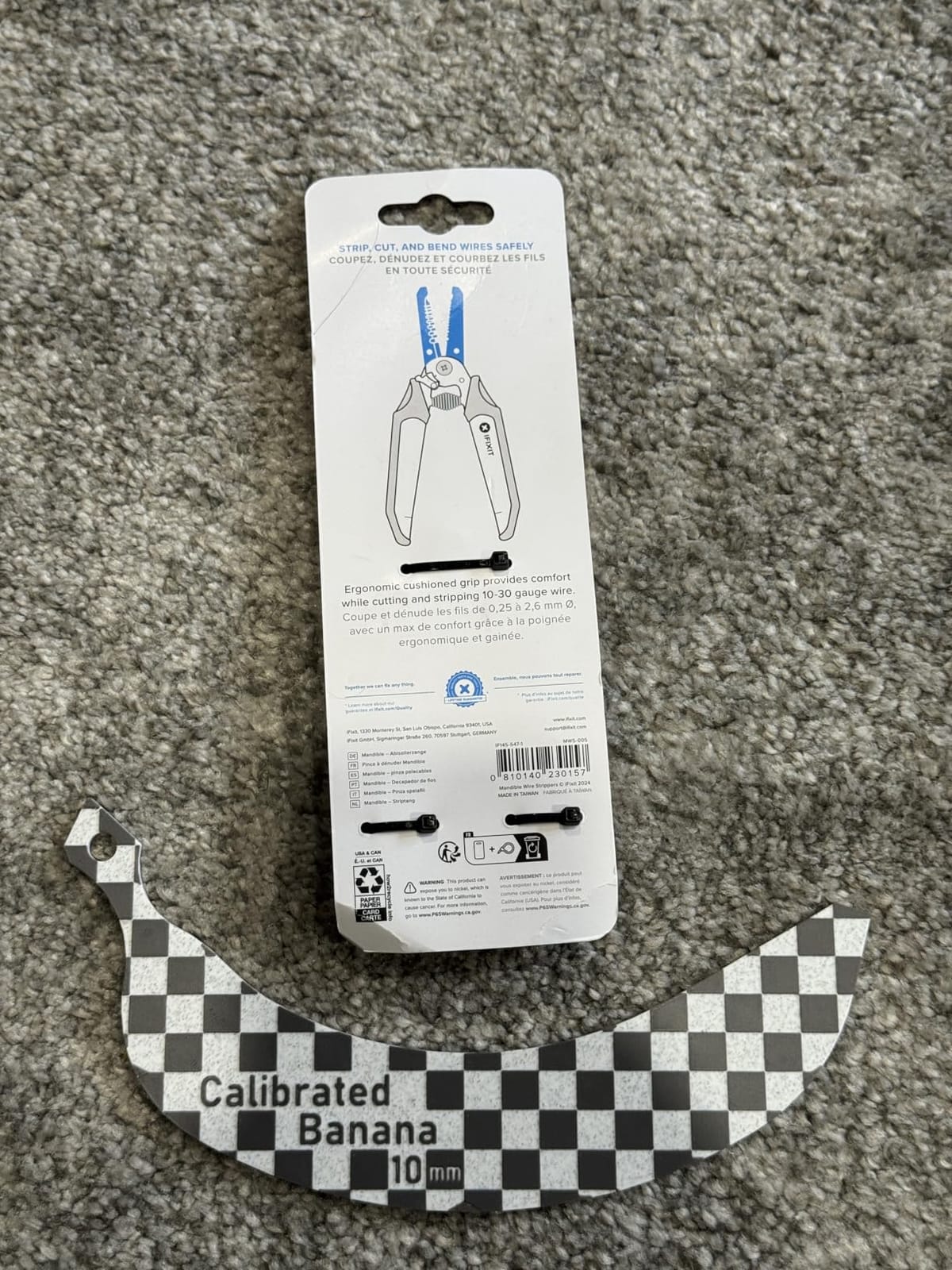
The build carries a lifetime guarantee from iFixit, which is unusual for a tool at this level and reflects a company that publishes repair documentation. For anyone who strips wire as part of a repair rather than a build, that guarantee and the auto-reset action together justify the choice on their own.
Because the tool is small, it is the one most likely to end up in a laptop bag, a camera kit or a field service case rather than on the bench. It disappears into a pocket, it does not need a case of its own, and it is the size that works when you are holding a board in one hand and a short lead in the other.
The 30-10 AWG span is broader than the rest of this list on the heavy end, which means the same tool covers a battery lead and a magnet-wire jumper without a second purchase. For a repair bench where the work is unpredictable, that breadth is worth more than a narrower range optimised for one task.
Why it suits repair and teardown work
Opening a device, separating a battery pack lead, or re-terminating a damaged display flex all reward a small, light tool with a spring return. At 30 AWG fine gauge down to 10 AWG power wire, it also spans enough range that you can keep working after the teardown turns into a repair. For a repair-focused bench it is one of the few compact options that does both.
Where it falls short
The locking latch is the only repeated complaint, and it pops open on its own inside a crowded tool bag, so the pocket needs a small clip. Selecting the correct slot also takes a little practice, and it is plainly not a heavy cable or industrial wiring tool. Anyone running 12 AWG mains cable on a regular basis should keep a full-size stripper alongside it.
7. KATA 7 Inch 20-32 AWG – Best Value for Maker Benches
KATA 7 Inch Precision Wire Stripper, 20-32 AWG Tool for Electronics DIY
20-30 AWG solid and 22-32 AWG stranded
7 inch carbon steel
179g
Pros
- Strips down to 30 AWG stranded where most big-box strippers stop at 22 AWG
- Heat-treated carbon steel blades stay sharp on fine wire
- Feels solid and beats similarly priced hardware store tools
- Comfortable grip even for users with arthritic hands
- Strips
- cuts
- clamps and crimps terminals
Cons
- Some units report misaligned blades that bend stranded wire instead of stripping it
- Intended for low-voltage electronics only
- not household power wiring
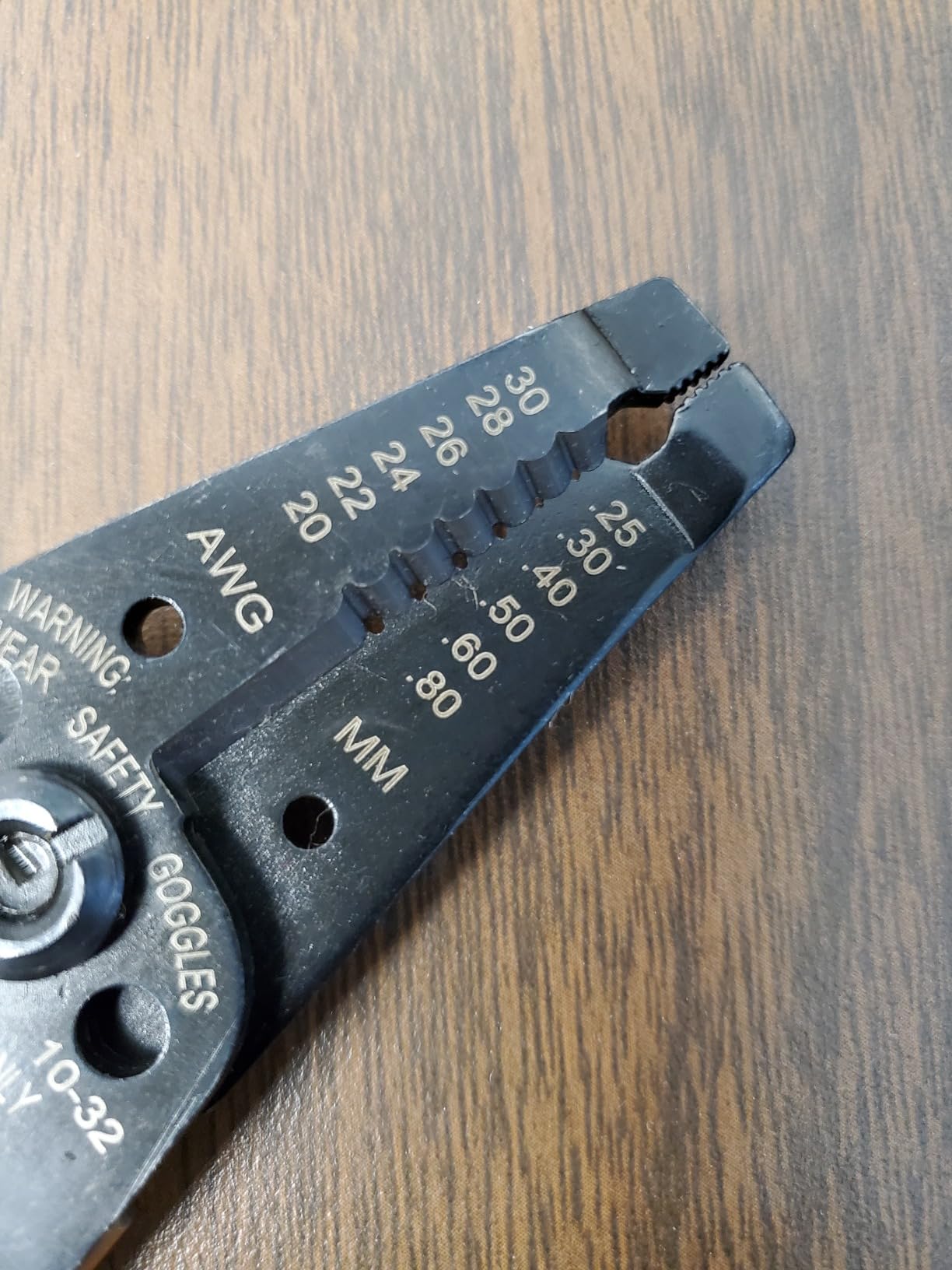
The KATA stripper covers 20-30 AWG solid and 22-32 AWG stranded in a 7 inch carbon steel body weighing 179 grams, and it is the cheapest way to put a second precision stripper on a bench. The blades are 50 grade heat-treated carbon steel with a sharp cutting edge, and reviewers rate it at 4.7 across 143 reviews.
Most of the appeal is reach. Big-box strippers frequently stop around 22 AWG, so the bottom two-thirds of this tool’s range is the part that makes it useful for electronics. It also strips, cuts, clamps and crimps insulation terminals, which covers a surprising amount of a small build’s work in one hand.
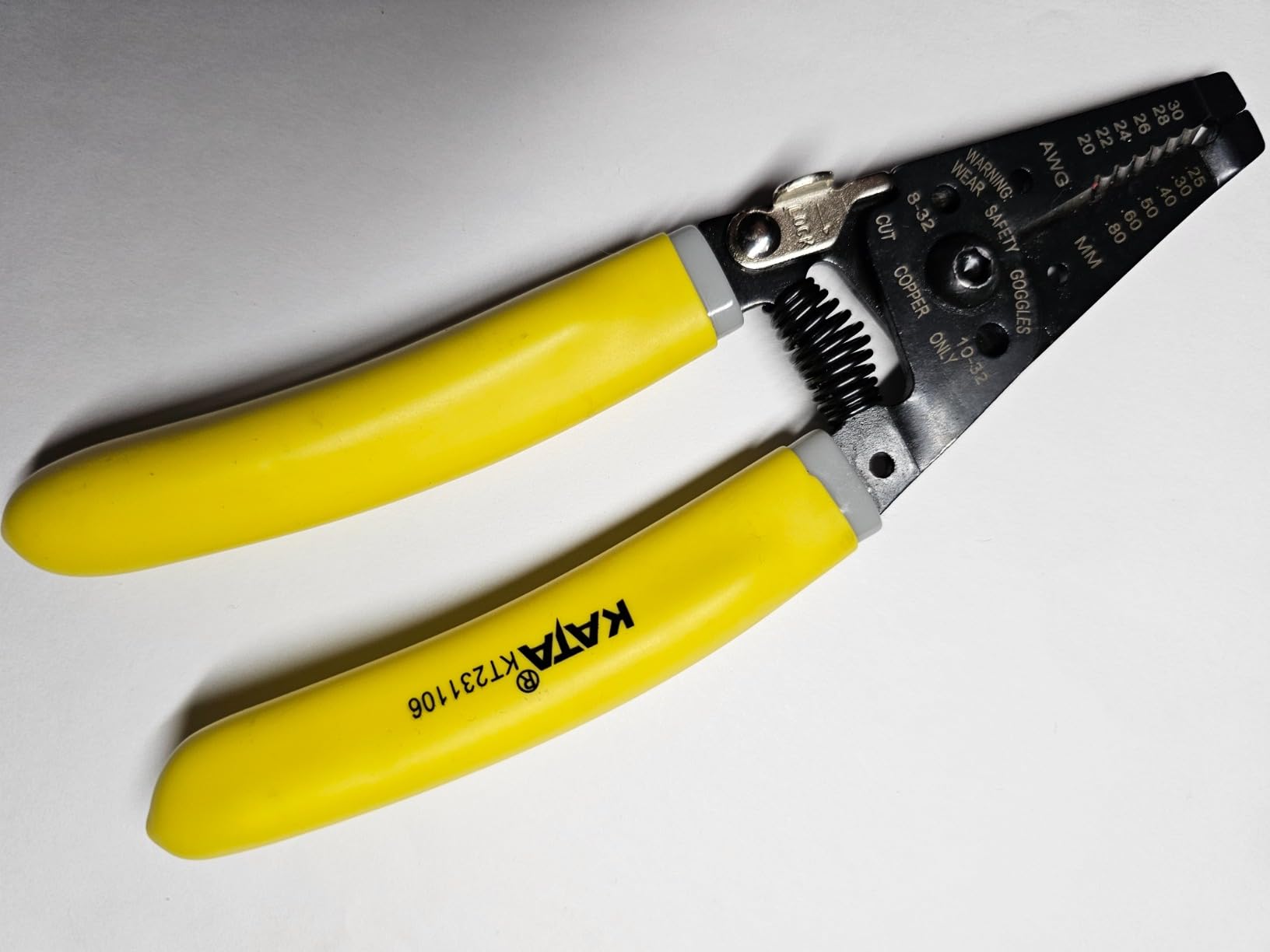
Model builders, camera cable tinkerers and makers rate it as a genuine step up from hardware store equivalents, and the grip is comfortable enough that reviewers with arthritic hands single it out. The 7 inch length keeps the nose inside a small enclosure better than a full-size electrician stripper.
Heat treatment is what keeps the blades sharp on fine wire, and it is the reason this tool holds an edge where a cheaper stamped stripper goes blunt after a few dozen cuts. On stranded hookup, a dull blade is what bends the strands instead of lifting the jacket, so the treatment is doing real work rather than reading as a spec sheet line.
Crimping and terminal work is the quiet bonus. Most small builds need a handful of insulated terminals crimped, and having that in the same tool removes a step from the process. On a shared bench or a classroom kit, one multi-function tool that covers the fine gauges beats passing several tools between people.
Why it suits a maker bench or a second tool
This is the stripper for a shared bench, a classroom kit or a tool bag that needs its own fine-gauge tool. At a low enough cost that a school or club can buy in quantity, and specified firmly for electronics rather than household power wiring, it removes the temptation to pass one tool around and get inconsistent results. The voltage regulator is usually the fiddly part of a small build; the wiring is where the tool gap shows.
Where it falls short
There is a real quality control caveat. Some units arrive with blades that are not perfectly aligned, and on fine stranded wire that misalignment bends the strands rather than stripping them cleanly. Check the first strip on scrap wire before trusting it with a short run. The tool is also explicitly not for household power wiring, which is a limit you should respect rather than test.
8. Jonard ST-450 – Best for 26-36 AWG Micro Work
Jonard Tools ST-450 Adjustable Precision Wire Stripper, 26-36 AWG
26-36 AWG range
Adjustable stop 0.039 to 2.0 inch
1 oz compact body
Pros
- The only stripper many reviewers found that reaches 36 AWG
- Extremely precise
- 34 AWG wire can pass through a 30 AWG slot with light scraping
- Adjustable depth stop gives repeatable strip lengths for mass termination
- Compact and light at 1 oz
- works well in tight spaces
- Cuts fine silicone stranded wire cleanly on every pass
Cons
- Struggles with stiff PTFE and Kevlar-jacketed wire at the fine end
- Technique-sensitive
- the depth block can shift and it will occasionally miss a strip
- Build looks and feels cheaper than the precision it delivers
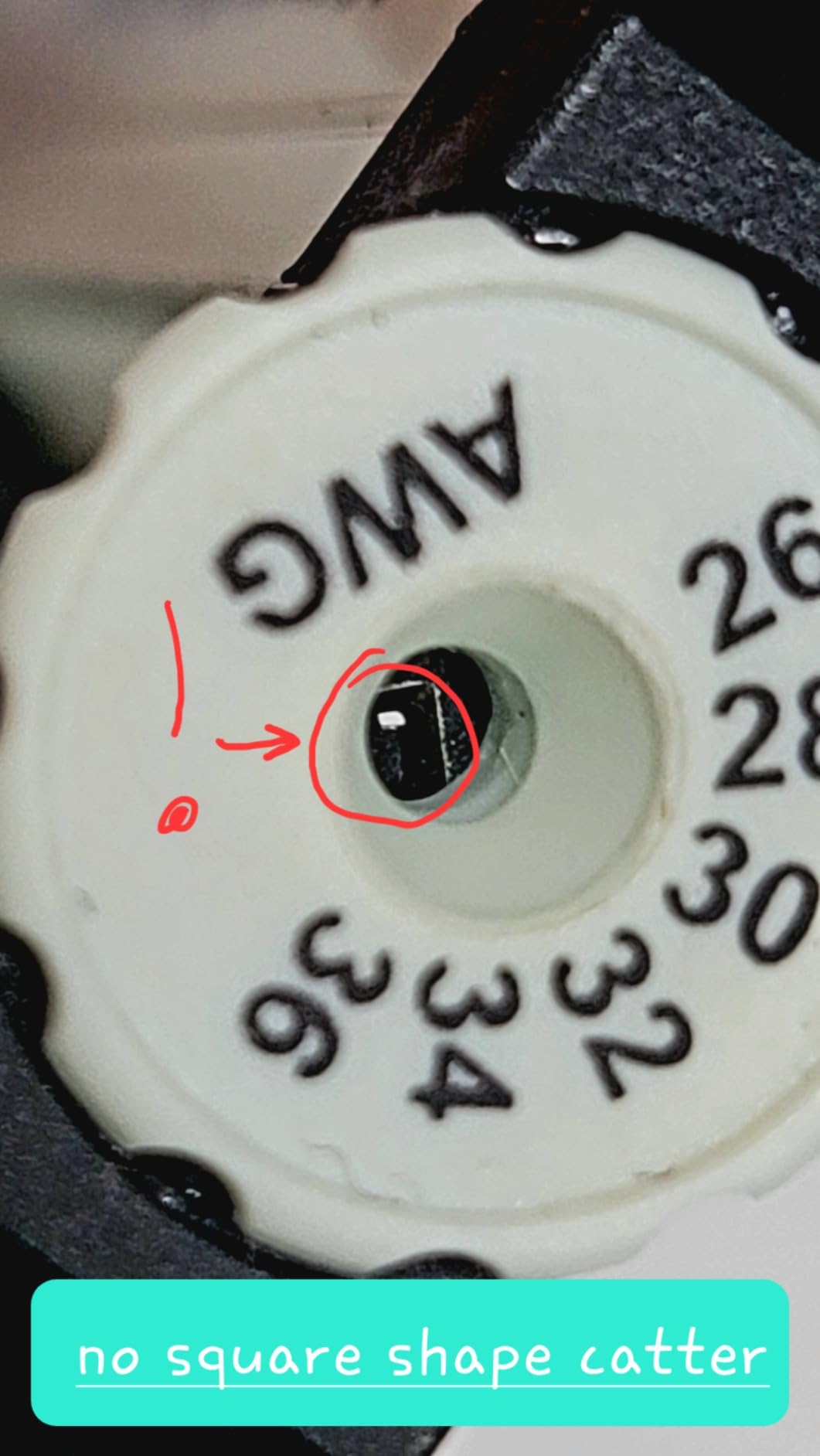
The Jonard ST-450 does the one thing most precision strippers cannot: it holds a consistent strip length. Its adjustable stop strips wire at lengths from 0.039 inch to 2.0 inch, across a 26-36 AWG range, using a hardened steel blade and a body that weighs 1 ounce and measures 3.88 inches. Reviewers with long tool histories call it the most precise micro-gauge stripper they have used.
That consistency is the answer to the strip-length problem that electronics hobbyists hit constantly. The technique is simple once you have a mechanical stop: set the stop to your length, feed the wire until it touches, and squeeze. Every strip comes out identical, which is what you need when you are cutting forty identical sensor leads rather than making one jumper.
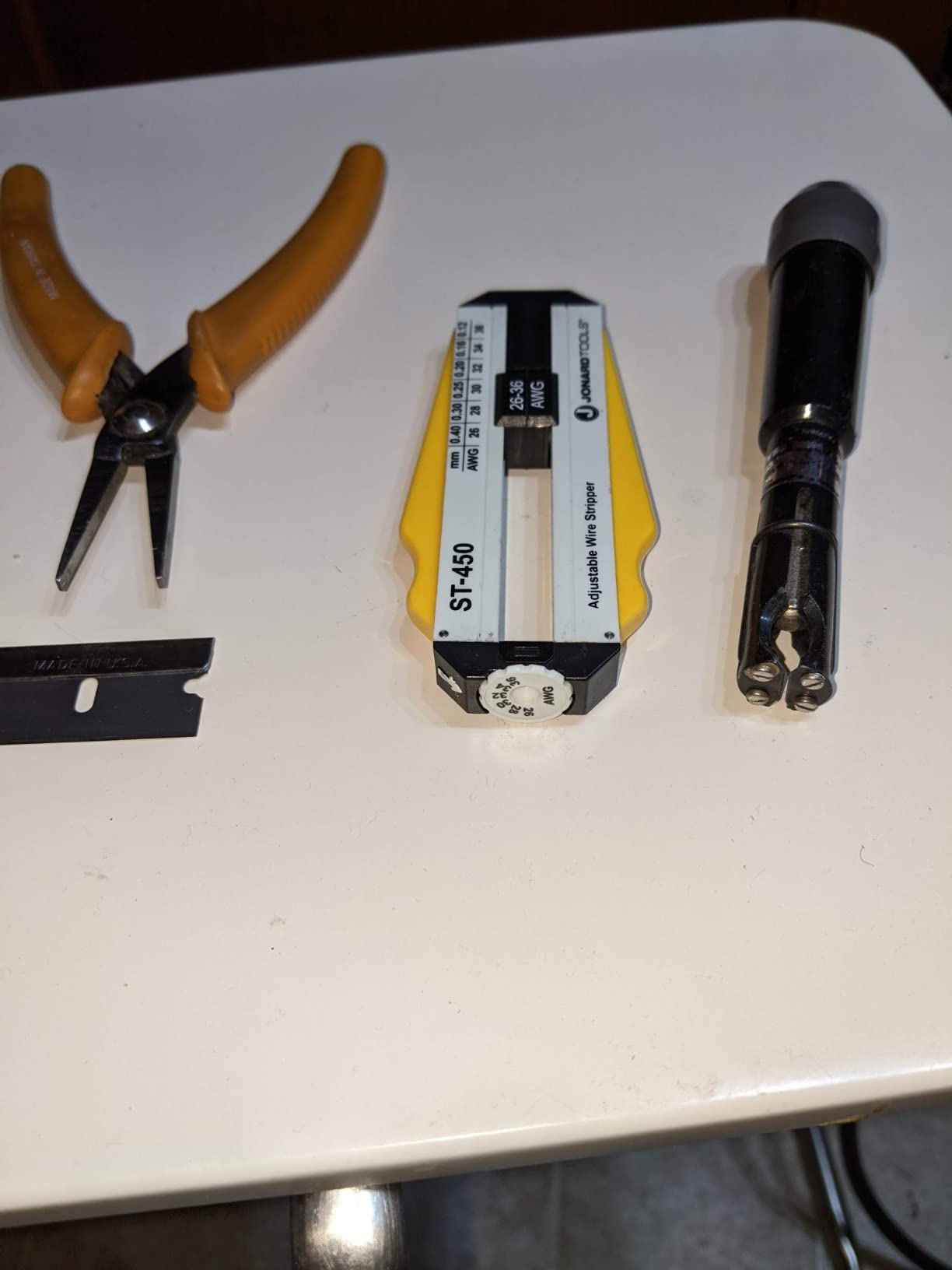
The precision is remarkable at the fine end. Reviewers report that 34 AWG wire can be fed through a slot set for 30 AWG with only light scraping, and that fine silicone stranded wire cuts cleanly on every pass. At 1 ounce and under 4 inches, it fits into enclosures and between components where a full-size stripper cannot reach.
The stripping mechanism is the differentiator. Rather than a fixed set of notches, the opening adjusts to the conductor, so one tool covers the whole 26-36 AWG band instead of the narrower window a conventional stripper offers. That range is what makes it viable as a single micro tool rather than a specialist for one gauge.
The stop is the second differentiator, and it is the one that shows up in repeat batches. Set it once and the length does not drift between strips, which removes the measuring step entirely on short leads where a fraction of a millimetre decides whether a crimp seats properly.
Why it suits mass termination and micro harnesses
If your work involves a batch rather than a one-off, the adjustable stop is the feature that pays. Connector leads, sensor pigtails, and addressable LED runs all benefit from identical strip lengths because the crimp and the strain relief both behave predictably. It is also the tool for anyone working at the boundary of what a normal stripper can reach at all.
Where it falls short
The 4.3 rating is the lowest in this roundup and the reasons are specific. Stiff PTFE and Kevlar-jacketed wire at the 32 AWG end is a genuine problem, and the tool is technique-sensitive: the depth block can shift and the tool will occasionally miss a strip. The build also looks and feels cheaper than the precision it delivers, so budget for replacement rather than expecting a lifetime tool.
9. Jonard JIC-2030 – Best for JST Leads and Fine Copper
Jonard Tools JIC-2030 20-30 AWG Wire Stripper and Cutter, 6-3/4″ Length
20-30 AWG single and stranded
6-3/4 inch length
Looping hole
Pros
- Cuts insulation accurately without nicking 28 AWG conductors
- Sharp blades mean no potato-peeling of insulation
- Strip length is consistent from cut to cut
- Simple
- light and comfortable in the hand
- Durable enough for daily use
Cons
- Coil spring is short and can pop out when the lock is released
- Does not reach below 30 AWG for the thinnest magnet or litz wire
- Some 30 AWG wire does not strip as the marking implies
The Jonard JIC-2030 is a straightforward 6-3/4 inch stripper for 20-30 AWG single and stranded wire, with a coil spring, a wire looping hole for quick bending, and hardened, tempered and ground cutting edges finished in 50 HRC black oxide. It rates 4.3 across 204 reviews, and its appeal is simplicity rather than subtlety.
Buyers value it for connector work in particular, and one common use is JST 2.0 leads on battery packs where a nick in a 28 AWG conductor would be a real problem. The blades are sharp enough that you never have to peel insulation off by hand, and the strip length stays consistent from one cut to the next, which matters when the leads are going into a moulded housing.
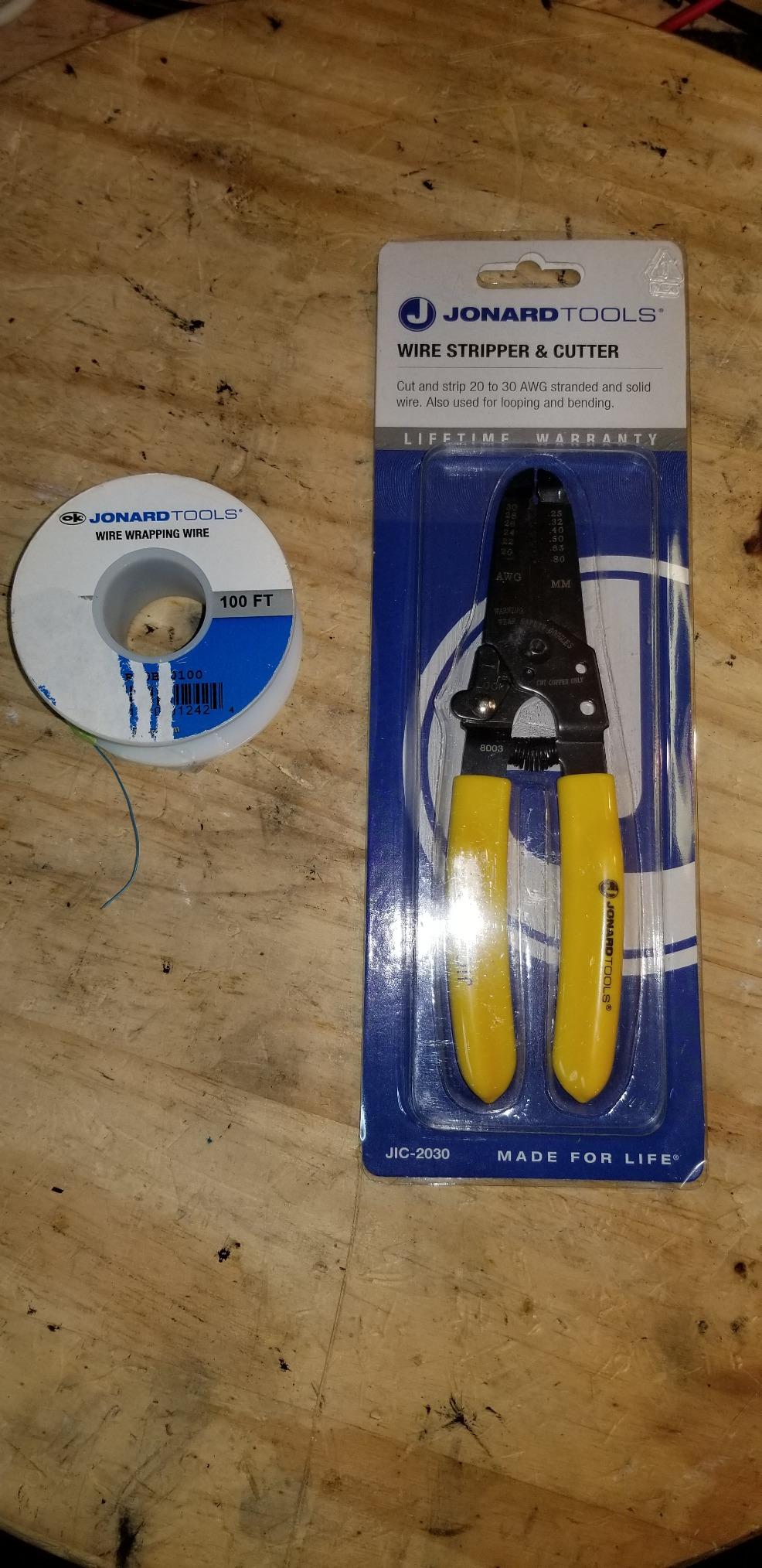
It is light, well made and comfortable, and buyers report it is durable enough for daily use on model trains, toy repairs and fine copper work. The looping hole is a small extra that saves time when you need a formed wire end rather than a bare one.
The ground cutting edges are the reason the strip length stays consistent. A stamped edge deforms as it dulls, and a deformed edge produces a strip that varies from one wire to the next, which is exactly what causes a crimp to sit wrong in a moulded housing.
At 6-3/4 inches it is short enough to work inside a small enclosure, and light enough for long batches of fine copper without the hand tiring. There is no mechanism to reset, nothing to adjust and no compound action to learn, which is a virtue on a bench where the work changes constantly.
Why it suits connector and lead work
JST, DuPont and similar crimp connectors are the bulk of the wiring in a small electronics project, and 20-30 AWG is the range most of that wire falls into. A stripper that is consistent at short lengths and light enough for long batches is a good match, and this one costs less than the compound-leverage alternatives while doing the same core job. It also pairs naturally with the marine electronics style harness work that involves long custom cable runs.
Where it falls short
The coil spring is short and can pop out, because releasing the lock lets the handles open far enough to free it. The tool also does not reach below 30 AWG, so the thinnest magnet and litz wire is out of range, and some users report that particular 30 AWG wire does not strip as the marking suggests. Test the wire you actually use before committing to a long run.
10. Jokari 40024 – Best for Repeatable Harness Work
Jokari 40024 PWS-Plus 001 Micro-Precision Stripper
26-36 AWG working range
Adjustable length stopper
50g compact body
Pros
- Covers the full micro-fine range from 26 to 36 AWG in a single tool
- Adjustable length stopper keeps strip lengths repeatable for harness and lead work
- Integrated cutter for wire up to 20 AWG
- Compact 50g body with an exchangeable blade for long service life
- TUV and GS approved build quality
Cons
- Fixed 26-36 AWG range means it cannot handle thicker hookup wire
- Blade replacement is needed periodically and the spare-blade supply is limited
The Jokari 40024 is a specialist instrument rather than a general tool. Its working range is AWG 36, 34, 32, 30, 28 and 26, covering 0.12 to 0.40 mm conductors, and it carries an adjustable length stopper with an integrated cutter for wire up to 20 AWG. It is built for electronics, telecommunications and modelling work, and holds 4.5 across 245 reviews.
The stopper is the reason professionals reach for this class of tool. Combined with a 4.02 inch, 50 gram body, it turns micro-fine harness work into a repeatable operation where every strip lands at the same length. The exchangeable blade is the other serious feature: a dull blade is the main cause of crushed and nicked ends on fine wire, and this is one of the few tools where replacing it is straightforward.
Stating the gauges individually rather than as a range is a deliberate choice by the manufacturer, because at this size the wire is identified by conductor diameter. That makes it straightforward to match the tool to magnet wire and litz specified in millimetres, which is how much of this work is still documented.
It is also a tool you can hand to someone new. The step sizes are unambiguous, the stopper removes judgement from the operation, and the integrated cutter means the same tool prepares the wire before it is stripped. On a production-ish bench, that predictability is worth more than a wider gauge range.
Why it suits professional micro harness work
Telecommunications patching, small sensor harnesses and modelling electronics all involve the same problem: very thin wire, terminated in quantity, with a length that has to be right every time. The TUV and GS approval also makes it a natural choice for anyone who has to sign off on their own workmanship. The integrated cutter removes the need for a second tool on short micro harnesses.
Where it falls short
It is a narrow instrument on purpose. The fixed 26-36 AWG range means it cannot handle thicker hookup wire at all, so it complements a general stripper rather than replacing one. Spare blades are needed periodically and the supply is limited compared with mass-market tools, so factor that into a decision if you buy it for daily production work.
How We Picked and What We Checked
No competitor on this topic publishes a method, so here is ours. Every product in this roundup was selected against five criteria, and a tool only made the list by clearing all five.
1. Verified minimum gauge. The stated minimum AWG had to reach at least 30 AWG for stranded wire, or the tool had to have a compelling reason to be included as a category representative. This single filter removes most electrician strippers from consideration, including the heavily reviewed ones that surface in product carousels for this query.
2. Nick-free result on the conductor. Buyer reports of a clean cut with no flattened copper and no cut strands, rather than a brand name alone. A tool that only works on thick wire fails this outright.
3. Stranded as well as solid. Most electronics wire is stranded, and a tool rated for solid core only is half a tool.
4. Repeatability. A strip length you can land the same way twice, and a blade that stays sharp across a batch rather than one lucky strip.
5. Build and serviceability. Steel rather than stamped plate, a return spring, and where possible a replaceable blade or a repair guarantee.
Ratings and review counts are copied exactly as recorded in the product data, including the thin ones. Where a tool has fewer than 200 reviews we treat its feedback as directional rather than conclusive, and we name the specific weakness that its rating reflects.
How to Choose a Wire Stripper for Electronics
Start with the thinnest wire you actually use, not the thickest. Buy for the bottom of your range, because a tool rated to 22 AWG is useless the moment you reach for a 28 AWG sensor lead. Work downwards from there, and note the gauge you will handle most.
Match the tool category to the wire
Between 20 and 22 AWG, almost anything works, including automatic self-adjusting strippers and general electrician tools. From 24 to 26 AWG you want precision ground holes or carefully sized notches. Below 28 AWG you need a dedicated micro-precision stripper, and below 32 AWG you are in magnet wire and litz territory where only a specialist tool will do the job cleanly.
This is the AWG-to-tool mapping the forums never laid out, and it is the single most useful thing on this page. The full range of picks below sits inside it.
Choose manual precision over automatic in most cases
Automatic self-adjusting strippers scan the wire as the jaws close and stop the blades at the insulation boundary, which removes gauge selection entirely. On 18-22 AWG that is genuinely fast. Below about 24 AWG, the mechanism is working near its limit, the strip length is less controllable, and the jaws have less material to grip a thin conductor, so the nick risk goes up rather than down.
Manual precision strippers put you in charge of exactly how far the blades close. You choose the notch, you feel the resistance change as the blades meet insulation, and you release. That feedback loop is why experienced electronics work overwhelmingly prefers them for fine wire, and why every tool in this roundup is manual.
Why cheap strippers nick wire
A nick happens when the blades close past the insulation boundary and cut into the conductor. Three things cause it, and all three are visible in the tool before you buy.
First, blade geometry. A precision stripper has opposed cutting edges shaped so they meet at the insulation surface. A generic stripper often uses a V-notch, which concentrates force on the bottom of the conductor and slices into it. Ground holes and matched notches beat V-notches on fine wire, and it is the main reason a machined tool outlasts a stamped one.
Second, blade alignment. If the two edges do not meet squarely, one edge leads and shears sideways into the conductor instead of lifting the insulation. Cheap tools lose this alignment quickly, which is why the KATA caveat about bent stranded wire matters.
Third, force. Crushing is the opposite failure: too much force and the wire is flattened rather than cut, creating a high-resistance joint that overheats later. On a 30 AWG conductor there is almost no margin between cutting and crushing, which is why leverage matters more as wire gets thinner. Tools with compound action and long handles reduce the hand force needed for the same result.
Control strip length precisely
Consistent short strips are the most common complaint in electronics forums and the least often solved. Four methods work, in order of reliability.
1. Use a mechanical stop. The Jonard ST-450 adjusts from 0.039 inch to 2.0 inch, and the Jokari 40024 has a similar stopper. Set it once and every strip matches.
2. Measure from the free end of the wire, never from the point where the insulation starts. Insulation thickness varies between manufacturers, so measuring from the insulation is the main reason two nominally identical strips measure differently.
3. Mark a depth guide. A scribe line on the tool body, or a strip of tape on the jaw, gives you a physical stop your eye can check instantly.
4. Use heat shrink as a depth marker. For very short strips on fine wire, slide a length of heat shrink on before stripping and use it as a visual stop. It is a simple trick that works on cables where 1-2 mm matters.
Check the blade before you trust the tool
A dull blade crushes rather than cuts, and on fine wire the difference is instant. If a strip starts to flare, bend, or leave a visible score on the copper, stop and clean or replace the blade rather than adjusting your technique. Wipe the metal parts clean, use a light film of oil on pivot points only, and store precision strippers with the handles latched shut.
Buy one tool per gauge tier if you work across the range
Experienced bench builders frequently own more than one stripper, and the pattern is consistent: a fine wire tool for magnet and litz, a general precision tool for 22-30 AWG hookup, and an automatic for thicker wire. A single tool that spans 20-32 AWG is a good start, but if your work regularly includes wire at both extremes, two tools will beat one compromise.
Common Wire Stripping Mistakes
These eight errors account for most damaged wire we see, and all of them are avoidable.
1. Stripping too deep. Squeezing to the mechanical stop instead of releasing as the blades meet insulation.
2. Pulling toward your body. Always draw the tool toward the free end of the wire so the cut insulation slides off.
3. Using the wrong notch. A wire in a too-small hole gets crushed, not stripped. Match the marking to the wire.
4. Twisting instead of pulling. Rotation shears the strands. Pull straight and let the tool do the cutting.
5. Pushing a tool past its range. Below the rated minimum, blades bite the conductor with no resistance to warn you.
6. Re-stripping an already stripped end. A second cut into exposed copper is a nick in every case. Cut further back instead.
7. Using pliers jaws on stranded wire. Pliers-type jaws crush rather than cut, so strands break and the joint runs hot.
8. Peeling insulation by hand. It looks faster and it is the fastest way to score a conductor. Use the tool.
Frequently Asked Questions
What is the best way to strip electrical wire?
Measure your strip length first, then select the notch or hole matching the wire gauge. Close the handles firmly but do not squeeze past the point where the blades meet the insulation, and draw the tool toward the free end of the wire rather than toward your body. Inspect the conductor under light before committing it to a terminal. Repeating this sequence consistently is what separates a clean strip from a nicked one.
What are common wire stripping mistakes?
The most common errors are stripping too deep, pulling the tool toward your body instead of the free end, using a notch smaller than the wire gauge, twisting rather than pulling, and using pliers-type jaws that crush stranded wire instead of cutting it. Re-stripping an already stripped end and peeling insulation off by hand are also frequent, and both score the conductor. Each of these is avoidable with the right hole and a light touch.
What is the best way to strip very thin wire?
Use a dedicated micro-precision stripper with individually sized holes, because a notch or automatic mechanism has too little material to grip a 30-34 AWG conductor safely. Close the handles gently and feel for the blades meeting insulation rather than squeezing to the stop. For magnet wire and litz, thermal strippers that melt insulation without a blade are worth considering. Most automatic self-adjusting strippers bottom out around 24-26 AWG.
What is a good tool for stripping small gauge wire?
Match the tool to the gauge band. At 20-22 AWG almost any stripper works. At 24-26 AWG you want precision ground holes. Below 28 AWG use a micro-precision stripper, and below 32 AWG you need a specialist tool for magnet wire and litz. The Klein Tools 11057 and DOWELL cover 22-32 AWG, while the ENGINEER PA-14 and Jonard ST-450 cover 32-36 AWG.
What tool should I use to strip 22 gauge wire?
Twenty-two AWG is comfortably inside the electronics range, so a precision hole stripper is the right answer rather than an electrician tool. Most automatic self-adjusting strippers rated 10-18 AWG cannot do this job at all. The Klein Tools 11057, Capri Tools 20010, DOWELL and Jonard JIC-2030 all cover 22 AWG, and the DOWELL is the most economical of them.
Do automatic wire strippers nick wire?
They can, and the risk rises as the wire gets thinner. An automatic mechanism is calibrated for a narrower range of gauges than its label suggests, and near the fine end of that range the jaws have little to grip, so the blades can close into the conductor. Below roughly 24 AWG, a manual precision stripper with correctly sized holes gives you direct control over how far the blades travel.
What is the best DIY drill-powered wire stripping machine for home use?
For electronics-scale wire a drill-powered stripper is the wrong tool, because the speed and force involved are far more likely to damage conductors thinner than 20 AWG. That approach only makes sense for heavy gauge and scrap copper. For 22-36 AWG electronics wire, a precision stripper such as the DOWELL or a micro-precision model like the Jonard ST-450 is the correct answer.
How do I strip wire to an exact length?
Use a tool with a mechanical strip stop and set it once, which gives identical results every time. The Jonard ST-450 adjusts from 0.039 inch to 2.0 inch and the Jokari 40024 has a similar stopper. If your tool has no stop, always measure from the free end of the wire rather than from the insulation, and use heat shrink on the wire as a visual depth marker for very short strips.
Final Verdict
For most people building electronics, the best wire strippers for electronics are the Klein Tools 11057 for 20-32 AWG general work and the DOWELL 22-30 AWG stripper if you want a second tool without spending much. That pair covers breadboarding, Arduino wiring, sensor leads and connector hookups with nothing thin left uncovered.
When you drop below 28 AWG the choice narrows quickly. The ENGINEER PA-14 handles magnet wire and litz down to 34 AWG stranded, and the Jonard ST-450 is the answer whenever consistent strip length matters more than anything else. For professional harness work in the micro-fine band, the Jokari 40024 adds a mechanical stopper and a replaceable blade.
Whichever you pick, buy for the thinnest wire you actually use, keep the blades clean and sharp, and check the first strip on scrap before you commit a short run. The list here was last checked in October 2026; when a new model clears the same minimum-gauge and nick-free criteria, it will earn a place on it.