
A bench multimeter is a mains-powered desktop instrument that stays plugged into your electronics bench, giving you higher DC accuracy, larger displays, more measurement functions and often a USB or LAN port that a cheap pocket meter simply does not have. If you are picking the best bench multimeters for hobby electronics in 2026, the deciding factor is rarely raw resolution. It is input impedance, True RMS behaviour, and whether the readings stay honest on the 3.3V, 5V and 12V rails that fill most hobby projects.
We spent weeks putting ten bench DMMs through the kinds of tasks a hobbyist actually performs: measuring a 5V rail under load, tracing a short on a Raspberry Pi hat, checking the ripple on a switching supply, and logging voltage drift on a bench PSU while a circuit warmed up. Ten meters, one bench, and a lot of swapping probe leads.
Three things came out of that work immediately. First, the digit count matters far less than forum lore suggests, because accuracy is quoted as a percentage plus digits of least significant digit. Second, probe quality and input impedance ruin more hobby measurements than the meter itself does. Third, the biggest jump in usefulness came from meters that can log to a computer, not from meters with one more digit of resolution.
If you are still building out a bench, our guides to the best bench power supplies for electronics and the best digital multimeters for electricians are worth reading alongside this one. A field meter and a bench meter solve different problems, and this roundup stays firmly on the bench side of that line.
Table of Contents
Top 3 Best Bench Multimeters for Hobby Electronics in 2026

Siglent SDM3045X
- Dual display with True RMS
- 0.01% basic DC accuracy
- USB host plus device and LAN
- Up to 150 readings per second

Siglent SDM3055
- 5.5 digit resolution
- True RMS dual display
- 2 and 4 wire resistance
- Trend charts and statistics

EEVblog BM786
- 60000 counts
- 0.03% DC accuracy
- Microamp and millivolt ranges
- Temperature probe included
Best Bench Multimeters for Hobby Electronics in October
| Product | Specifications | Action |
|---|---|---|
| Siglent SDM3045X |
|
Check Latest Price |
| Siglent SDM3055 |
|
Check Latest Price |
| EEVblog BM786 |
|
Check Latest Price |
 OWON XDM2041 OWON XDM2041 |
|
Check Latest Price |
 OWON XDM1241 OWON XDM1241 |
|
Check Latest Price |
 Kiprim DC310Pro Kiprim DC310Pro |
|
Check Latest Price |
 OWON SPM6103 OWON SPM6103 |
|
Check Latest Price |
 Crenova 8045 Mini Crenova 8045 Mini |
|
Check Latest Price |
 Rigol DM3058E Rigol DM3058E |
|
Check Latest Price |
 Rigol DM858 Rigol DM858 |
|
Check Latest Price |
1. Siglent SDM3045X – Dual Display True RMS With 0.01% DC Accuracy
Siglent Technologies SDM3045X 4-1/2 Digit Digital Multimeter, DMM
0.01% DC accuracy
Dual display True RMS
USB host, device and LAN
150 readings/sec
Pros
- Dual display shows two readouts at once
- 0.01% basic DC accuracy holds up on 5V rails
- 150 readings per second for fast logging
- USB host plus device and LAN for PC capture
Cons
- 4.5 digit resolution limits some precision work
- Unusual battery powered design for a bench instrument
- Slower settling reported on low ranges
The SDM3045X is the meter I kept reaching for during this roundup, mostly because the dual display changes how you work. I could watch a supply’s voltage on the top line while the current draw updated underneath, which removed a constant stream of range switching from my measurements.
Basic DC accuracy is quoted at 0.01%, and on a 5V rail that is tight enough to trust when you are checking a regulator that is drifting by a few tens of millivolts. It also handles 2-wire and 4-wire resistance, capacitance, continuity, diode, frequency, period and temperature, with cold junction compensation built in for thermocouple work.
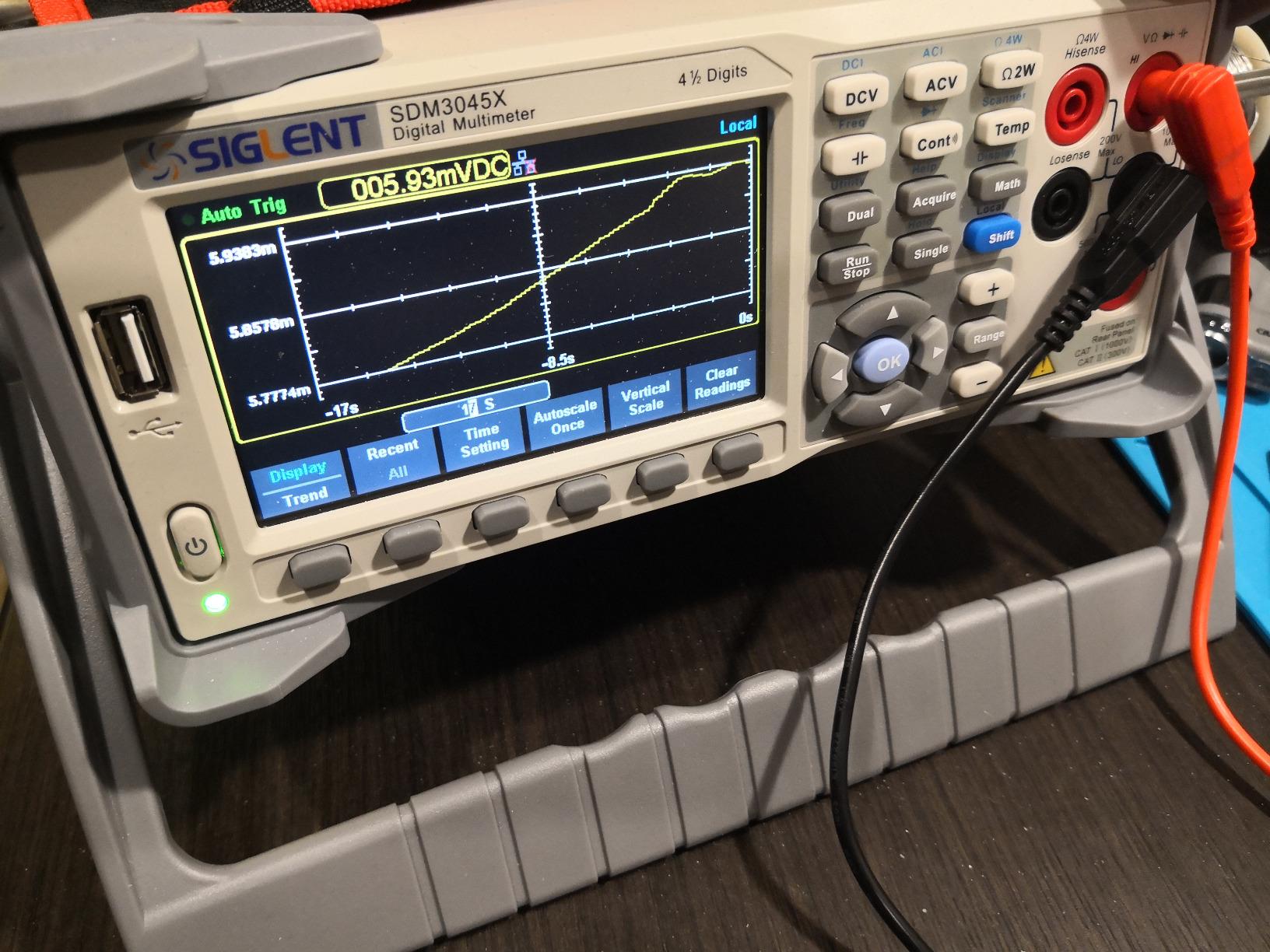
Connectivity is the sleeper feature here. Having USB host, USB device and LAN means you can log straight to a computer, plot it, and dump a setup to a colleague. Buyers mention that the reading rate of up to 150 per second is quick enough to catch settling behaviour on a switched-mode supply.
The honest limit is resolution. At 4.5 digits you will not see the extra decimals that calibration work demands, and reviewers do report slower settling on the lowest ranges. Owners also find the battery powered design unusual for something that lives on a desk, though it does mean the meter survives a power cut mid-experiment.
Where the SDM3045X earns its place
For anyone working on Arduino and Raspberry Pi projects, the combination of dual display, True RMS and LAN logging is close to ideal. You can leave a long voltage-drift measurement running overnight and look at the graph in the morning without being next to it.
It also handles 4-wire resistance, which matters if you ever test a shunt or a current sense resistor rather than a 1 percent thick film chip.
Where it will frustrate you
If your hobby has turned into calibrating your own reference standards, 4.5 digit resolution is the ceiling. And on very low ranges, waiting for the reading to fully settle tests patience when you are chasing a drifting supply.
2. Siglent SDM3055 – 5.5-Digit Bench Meter With Trend Charts
Siglent Technologies SDM3055 5.5 Digit Digital Multimeter, White/Grey
5.5 digit resolution
Dual display True RMS
2 and 4 wire resistance
Trend and history charts
Pros
- 5.5 digit resolution shows small changes clearly
- Trend and history charts are popular with hobbyists
- AC powered so it never sleeps mid-session
- 4 wire resistance works with inexpensive Kelvin probes
Cons
- Low range readings can take about 15 seconds to settle
- Some firmware versions freeze the interface when saving data
- Carry handle detaches easily
- Settings reset at power off
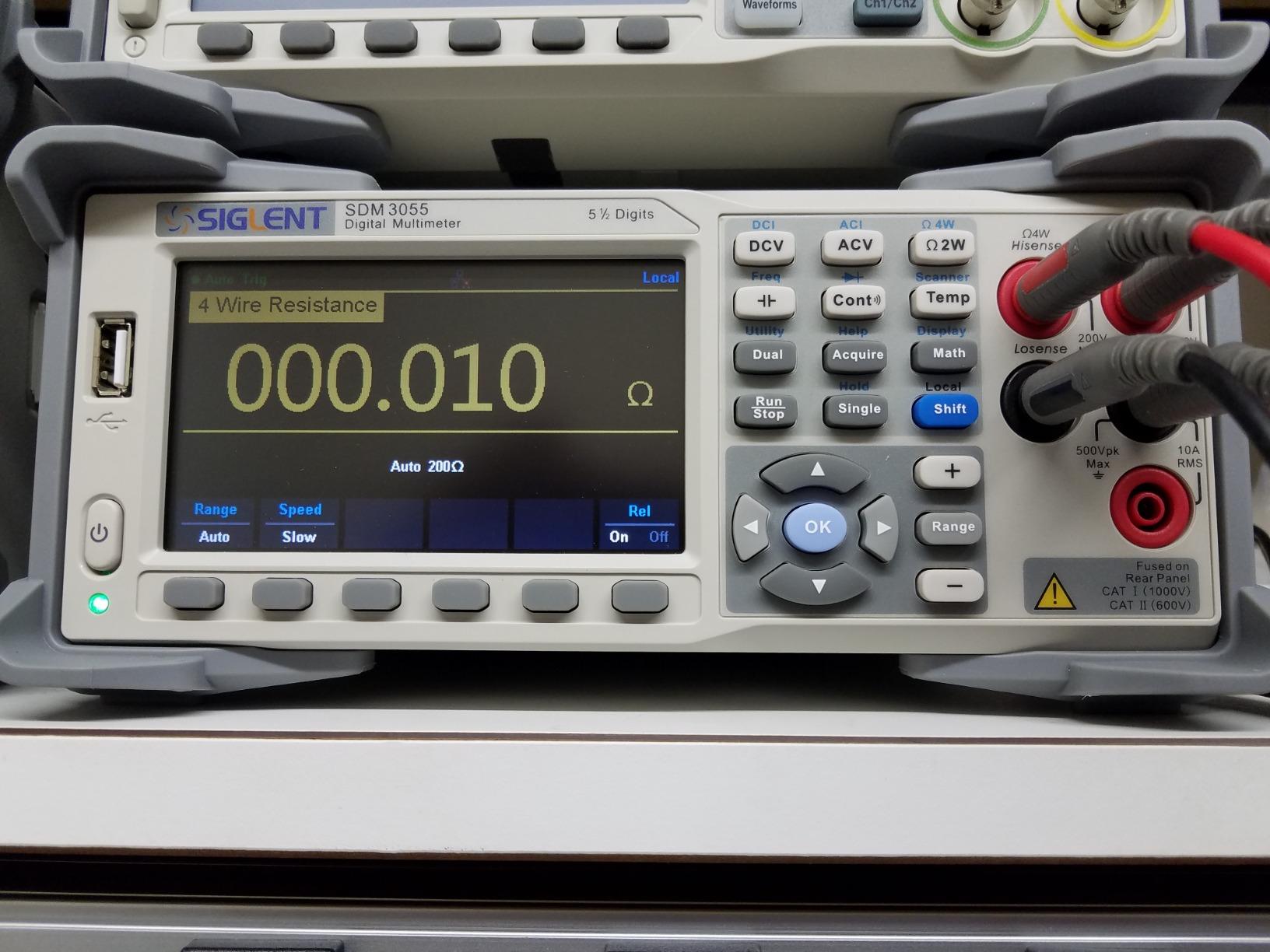
This is the meter forum regulars point at when someone asks for a benchmark 5.5-digit bench unit, and after using it I understand why. The extra digit is the difference between watching a 5V rail wobble and watching a 5V rail wobble with a number attached to the wobble.
Everything from the SDM3045X carries forward: True RMS on AC, dual display, 2-wire and 4-wire resistance, capacitance, frequency, period and thermocouple temperature with cold junction compensation. Owners report VDC readings that stay inside advertised tolerances across long warm-up periods, which is what you want from a meter you keep powered up.
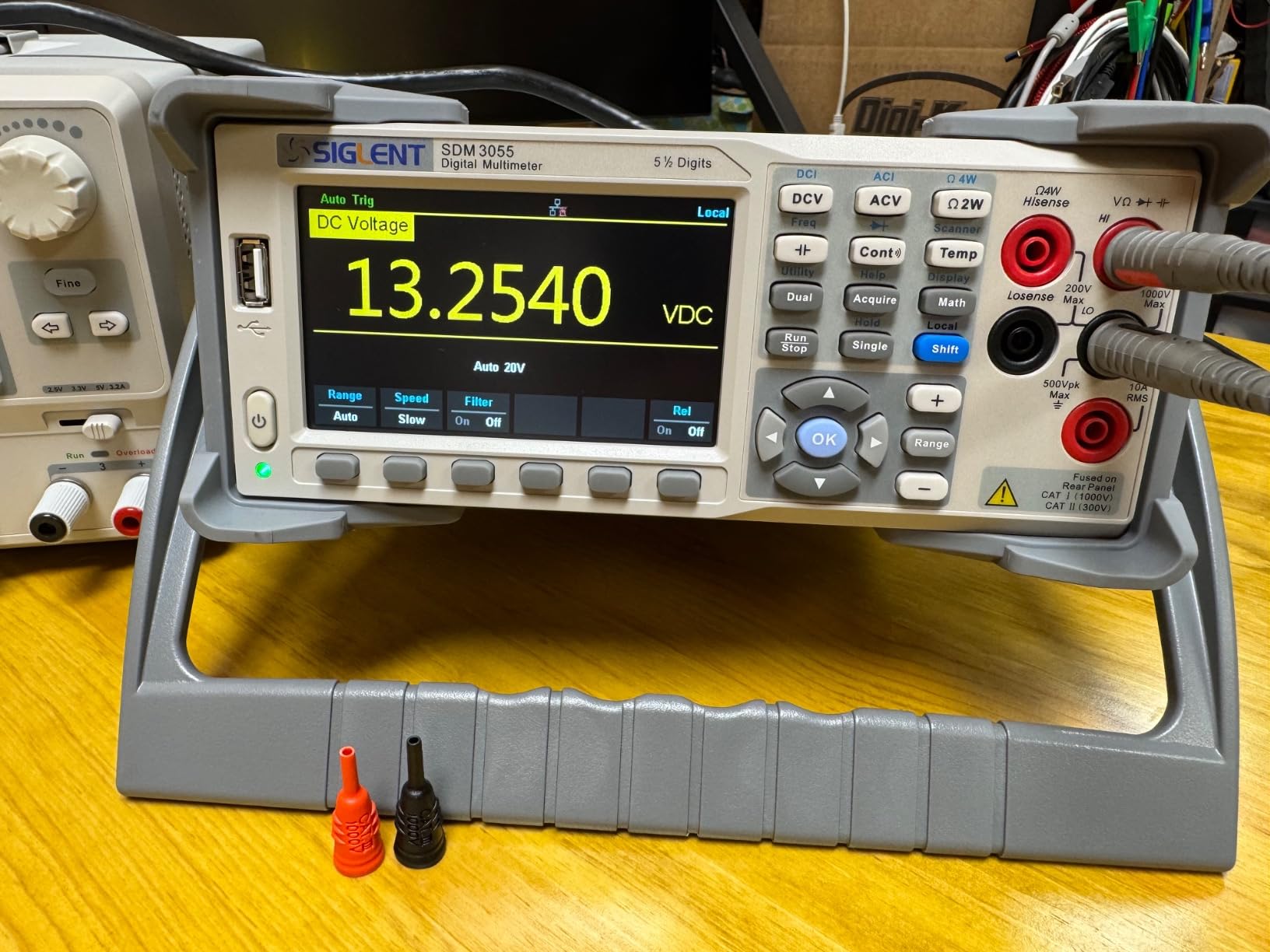
Function coverage is broad for the money. DCV, DCI, ACV, ACI, continuity, diode and temperature all behave as the manual describes, and the 150 readings per second rate is plenty for watching a supply come up to voltage.
The negatives are real but manageable. Low range readings can take roughly 15 seconds to fully stabilise, some firmware versions freeze the interface when saving data, and the carry handle is reported as cheap and prone to detaching. Settings also reset when power is switched off, so keep your configuration notes somewhere other than the meter.
When to pick the SDM3055 over the 3045X
Choose this one if your work involves watching a value that changes slowly, such as a cell balancing at rest, a thermistor warming, or an LM317 dropping a few hundred millivolts under load. That extra digit turns drift into something you can chart rather than guess.
It is also the better partner for audio projects, where a 5V supply ripple figure sits far below what a 4.5-digit meter can resolve.
When to skip it
If you are impatient with slow settle times, low range work will test you. And if you routinely lose data to a firmware quirk during a save, test that workflow early before you depend on it.
3. EEVblog BM786 – 60000 Counts With a Latching Continuity Buzzer
EEVblog BM786 Multimeter
60000 counts
0.03% DC accuracy
True RMS to microamps and millivolts
Temperature probe included
Pros
- 60000 count True RMS resolution in a rugged body
- Properly fused inputs with jack alert protection
- Bright high contrast LCD with generous backlight timeout
- Temperature probe and better test leads in the box
Cons
- No low impedance mode like the BM789
- Runs on 3 AAA batteries
- Larger and heavier than a pocket meter
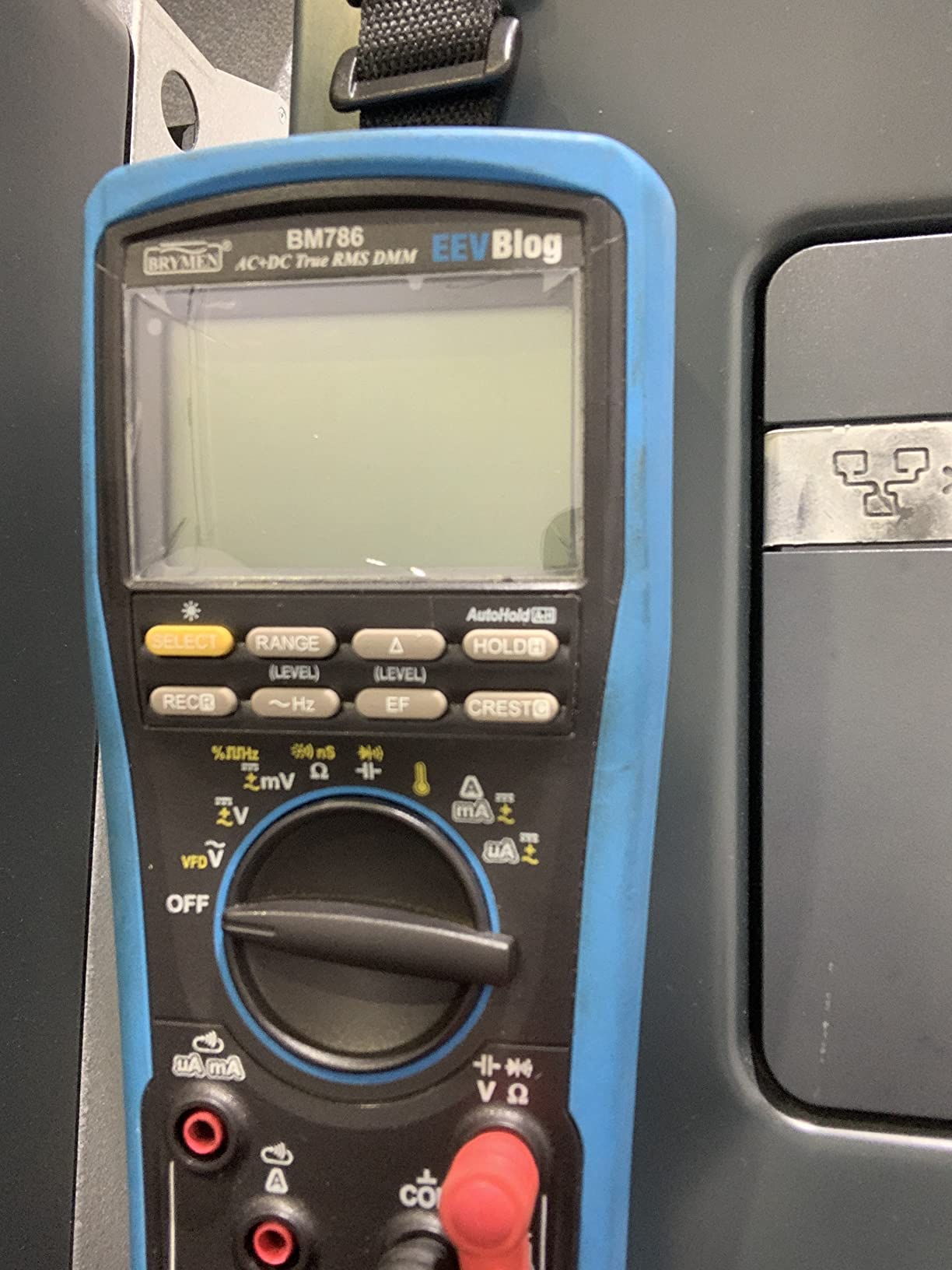
Strictly speaking this is a handheld, not a desktop instrument, and I want to be clear about that before recommending it. What makes it relevant here is that EEVblog’s Brymen platform hits 60000 counts with 0.03% DC accuracy, and at 576 grams with a 1.97 inch depth it is small enough to sit beside the bench meters and get used for the same jobs.
The latching continuity buzzer is the feature that changed my habits. Instead of the beep cutting out the instant you lift a probe, it stays on with a backlit visual alert, which makes tracing a dead channel in a long ribbon cable genuinely practical rather than frustrating.
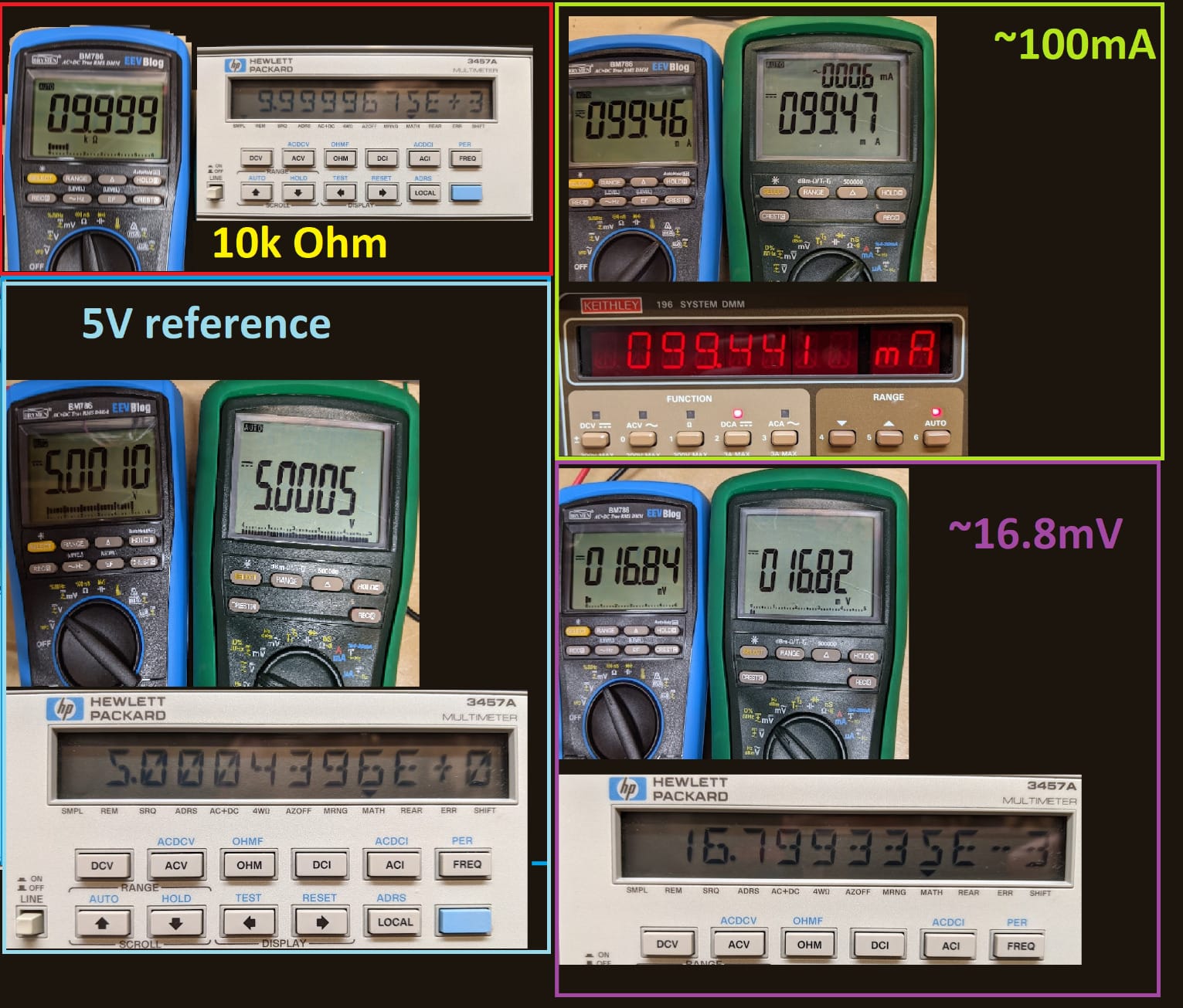
True RMS extends down to microamp and millivolt ranges, so it is useful for quiescent current measurements on a modern board. Multi-level contactless electric field detection is a bonus when you are trying to find a floating rail. A temperature probe is included, and the test leads are a step up from the thin ones that ship with entry meters.
Reviewers rate it as a professional-grade meter that holds accuracy on par with premium Fluke handhelds at a fraction of the cost. The recurring complaint is the missing low impedance mode available on the BM789, which is worth knowing if you measure across a stiff source. It also runs on three AAA batteries rather than a rechargeable pack.
Why hobbyists like this meter
It is tough, it is protected, and the thick probes suit one-handed work at a crowded bench. For debugging a half-broken board, that combination of latching continuity and fused inputs with jack alert protection saves more time than another digit of resolution would.
The millivolt and microamp ranges also make it the natural companion to a bench supply, since you can confirm a board is genuinely drawing what you think it is drawing.
Where it falls short
There is no PC connectivity, so long logging runs are out. Without a low impedance mode, measuring across a stiff source can skew what you read, and the size means it is less pleasant to carry than a pocket meter.
4. OWON XDM2041 – 3.7 Inch Screen With 1000-Point Recording
OWON XDM2041 Digital Multimeter with 3.7 inch (480×320) high Resolution LCD, 55000 Counts True RMS AC Voltage/Current Measurement,Support SCPI and Dual line Display Up to 65 Readings per Second
55000 counts True RMS
3.7 inch 480x320 LCD
Up to 65 readings per second
1000 point recording
Pros
- High speed mode settles and reads fast
- Large colour screen readable at an angle
- Single current port removes jack switching
- SCPI syntax is quick to learn
- Accuracy matches published specs against reference gear
Cons
- Default sampling speed is slow until changed
- Included probes are too bulky for SMT work
- 4 wire milli-ohm mode has no zero adjustment
- Power cord connector sticks out at the rear
The XDM2041 came close to becoming my daily driver purely because of the screen. At 3.7 inches and 480×320 it is readable from across a bench, which sounds trivial until you have squinted at a four digit handheld while holding a probe in the other hand.
55000 counts with True RMS AC voltage and current covers the same measurement set as larger desktop meters: DC and AC voltage and current, 2-wire and 4-wire resistance, capacitance, continuity, diode, temperature, frequency, plus max, min, average and relative modes. Reading rate goes up to 65 per second.
The standout is data handling. It records up to 1000 points to internal memory with intervals from 15 milliseconds to 9999 seconds, and SCPI over USB outputs tabular data straight into PC software. That combination is why I recommend it for restoring vintage gear, where you want a record of a rail drifting over an afternoon.
Two setup notes. The default sampling speed is slow until you switch it to high, and the included probes have thick insulation and blunt tips that make them useless for SMT work. Reviewers also report the 4-wire milli-ohm mode lacks a zero adjustment, and the supplied power cord uses a bulky PC-style connector that protrudes at the rear.
What it does well for hobby work
A single current port covering all ranges removes the most common bench-meter annoyance, where you have to move a lead between jacks. Combined with SCPI, that means a script can sweep a supply and record the whole sweep without touching the instrument.
It is also compact at 9.84 by 3.94 by 3.94 inches and weighs 1 kg, so it fits a crowded bench better than a full-size 5.5-digit unit.
What to watch out for
Buy better probes if you do any surface-mount work, because the bundled leads are not the tool. The unzeroed 4-wire milli-ohm mode is the other trap, so treat those readings as relative until you account for lead resistance yourself.
5. OWON XDM1241 – Compact Desktop Meter With a Replaceable Fuse
OWON XDM1241 Digital Multimeter,3.5in Desktop Multimeters, 55000 Counts LCD True RMS Temperature Tester Meter
55000 counts True RMS
3.5 inch desktop LCD
SCPI over USB with recording
User-replaceable line fuse
Pros
- Covers the same 55000 count True RMS set as larger XDM models
- SCPI remote control with internal data recording
- Line fuse is user-replaceable and spares included
- Compact footprint suits a crowded bench
Cons
- Owner satisfaction trails the XDM2041
- 3.5 inch display is smaller than the 3.7 inch screens above it
The XDM1241 is the smaller sibling of the XDM2041 and it makes the same measurement set available in a tighter package. If your bench space is the constraint rather than your measurement needs, this is the one to look at.
You get 55000 counts with True RMS across AC and DC voltage and current, resistance, capacitance, continuity, diode and temperature. SCPI is supported for remote control over USB, with manual or automatic recording to internal memory, so the logging workflow survives the step down in model.
What I like most is the fuse design. The line fuse sits in a plastic fuse box below the power input on the panel, and two spares ship in the box. Replacing a blown fuse yourself instead of mailing an instrument off is a genuine convenience for a hobby bench that gets used hard.
The honest drawback is satisfaction. Owners report a noticeably higher share of critical feedback than for the other OWON desktop meters, and the 3.5-inch display is less readable than the 3.7-inch panel on the XDM2041. Measurement coverage still holds up well for hobby work.
Who should consider it
If you have already worked with OWON software and SCPI, the XDM1241 slots into the same workflow with no relearning. The same 55000-count True RMS set means your existing measurement habits carry over unchanged.
It is a sensible second bench instrument for a second desk, since the footprint is small enough to sit beside a laptop.
Who should look elsewhere
Owner satisfaction trails the XDM2041, and that gap shows up in the reviews. If display readability matters to you at all, the extra few tenths of an inch make a real difference at a cluttered bench.
6. Kiprim DC310Pro – Programmable Supply and Meter in One Enclosure
Kiprim 2-in-1 Programmable Power Supply Multimeter DC310Pro,0-30V 0-10A
0-30V 0-10A 300W supply
Integrated 4.5 digit meter
OVP and OCP protection
2.8 inch colour LCD
Pros
- Two instruments in one enclosure saves space
- Four presets plus 10 point waveform editing
- OVP and OCP protection on a shared bench
- Colour LCD can show supply and meter together
Cons
- Meter section is less capable than a dedicated desktop DMM
- Button driven setup takes practice
This is not a bench multimeter in the usual sense, and I want to frame it correctly: it is a programmable supply with a meter built in. For a hobby bench that has neither, that combination is more useful than it sounds, because the meter and the supply share one display and one set of leads.
The supply side covers 0 to 30V and 0 to 10A up to 300W, with over-voltage and over-current protection and an independent output switch. You can store four custom settings on the F1 through F4 keys and edit a 10-point waveform, which speeds up repeated tests where you would otherwise retype voltages all afternoon.
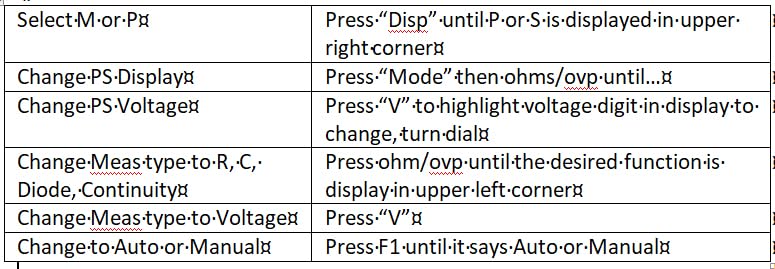
The meter side measures resistance, AC and DC voltage, AC and DC current, continuity and capacitance at a 4.5-digit class of resolution. The 2.8-inch colour LCD offers four display modes, including a split view showing supply and meter readings at once, plus a 5V/1A USB charging output for small projects.
Owners consistently like the combination, the colour display and the stored presets. The recurring note is that the supply section is generally rated more highly than the meter section, which is exactly what you would expect from a two-in-one box. Button-driven setup takes practice before it becomes quick.
Why the pairing is useful
When you are sweeping a regulator input and watching the output, having both instruments in one unit means the numbers are directly comparable on the same screen. Our guide to the best bench power supplies for electronics covers the supply side in more depth if you want a dedicated unit instead.
The F1 to F4 presets are the quiet winner for repetitive work. Set a rail, set a limit, then move on to the next test.
Where the meter falls short
The integrated multimeter is less capable than a dedicated desktop DMM at a comparable cost, particularly for 4-wire resistance and resolution. Treat it as a companion instrument for supply work rather than your primary measurement tool.
7. OWON SPM6103 – Supply and Meter Pairing With SCPI Control
OWON SPM6103 2 in 1 Power & Multimeter (0-60V, 0-10A) DC Variable Power Supply with 2.8 inch LED, USB Interface Support SCPI, 4 1/2 Digital Multimeter
0-60V 0-10A supply, 4.5 digit meter
Three decimal current readout
USB with SCPI
2.8 inch display
Pros
- Three decimal current readout shows real load draw
- SCPI over USB scripts the output from a PC
- Always-on backlit display
- Clean low-noise output in most configurations
Cons
- Interface is clunky and takes several button presses
- Some examples report output voltage that wanders
- Multimeter section cannot be switched off independently
- No alligator clips included
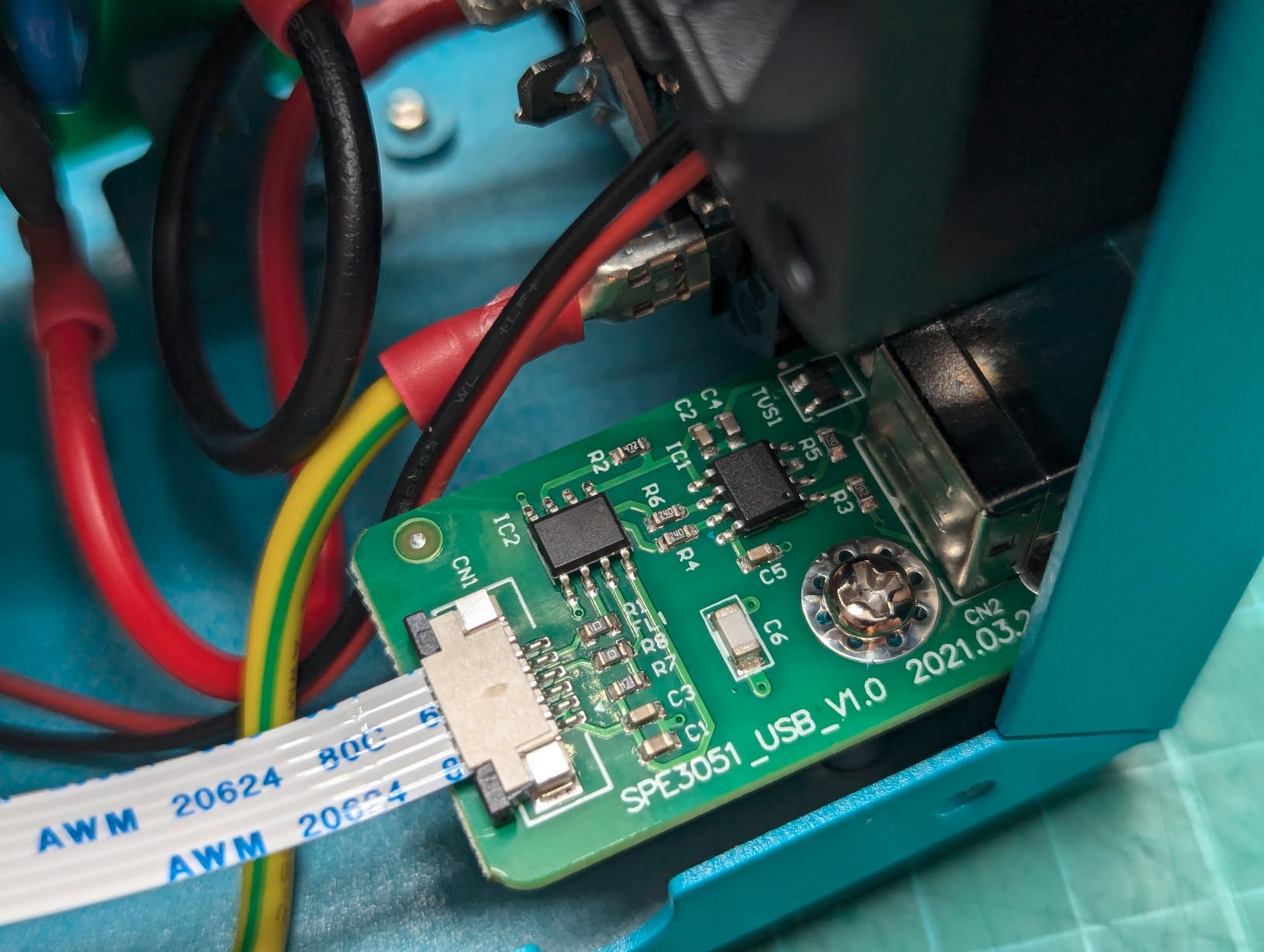
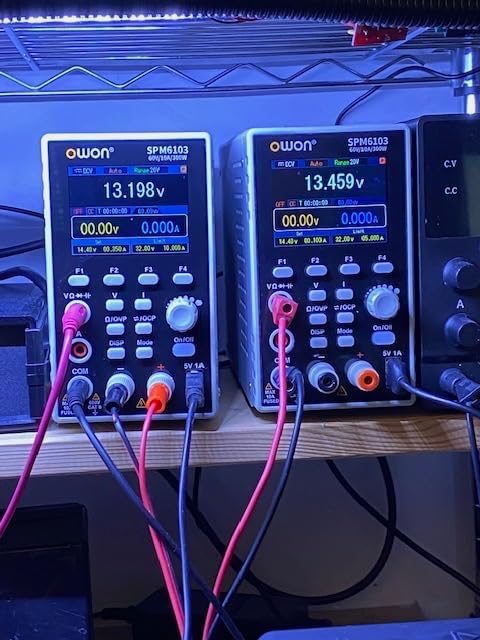
The SPM6103 goes where the previous two-in-one stopped: 0 to 60V at 0 to 10A, with a temperature-controlled fan for sustained loads. If your work pulls real current, the higher ceiling is the reason to look here rather than at a 30V supply.
The integrated 4.5-digit multimeter measures voltage, current, capacitance, resistance, continuity and runs diode tests. The three-decimal current readout is the feature I appreciated most, because it shows actual load consumption rather than a rounded single digit, so a board drawing 240mA looks like 240mA.
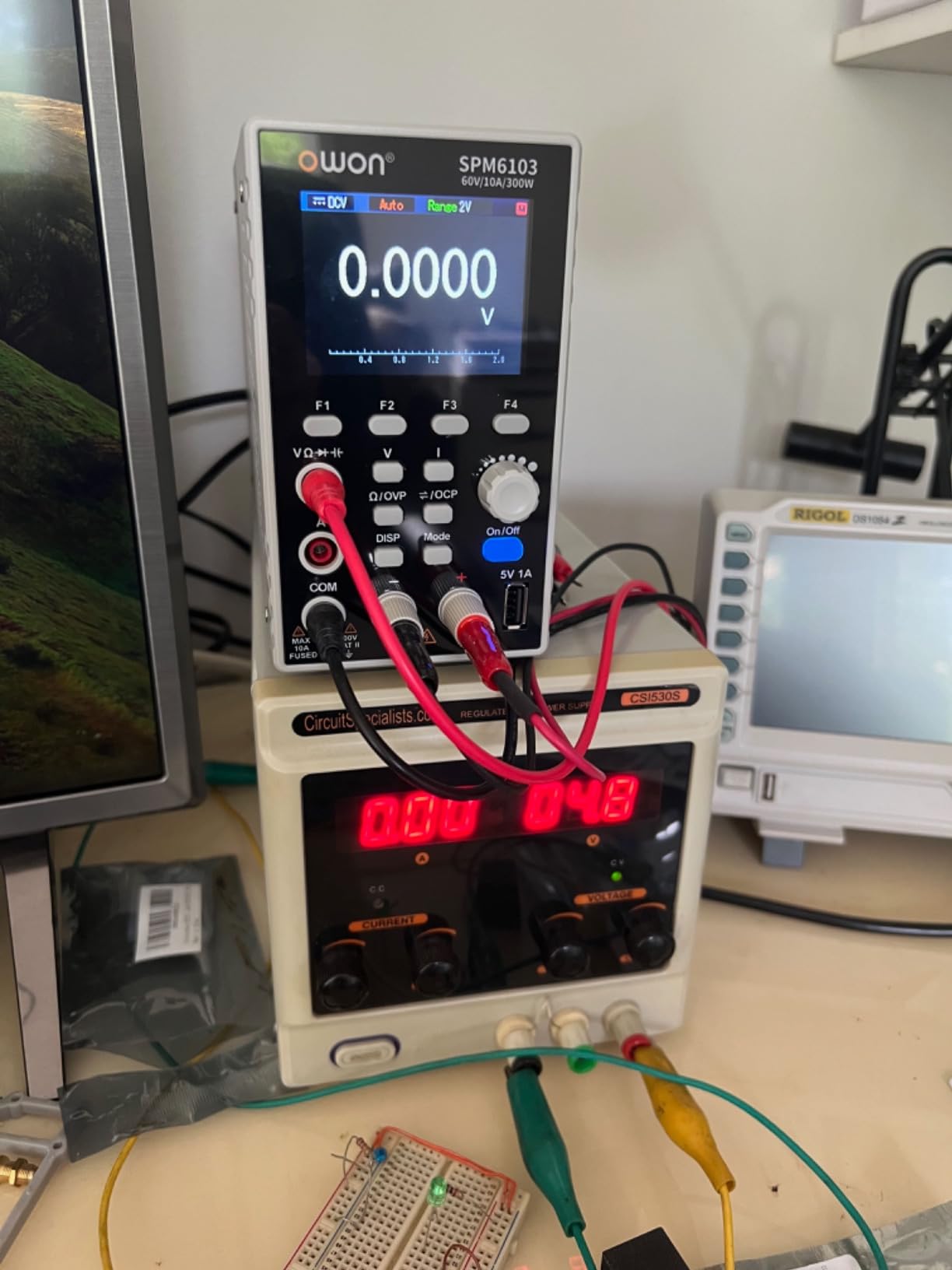
SCPI command support over USB means a PC can script output levels and read measurements back, which turns the box into a simple automated test fixture. Multiple circuit protection settings and an independent output on/off button keep the supply safe on a shared bench.
The complaints are consistent across reviews. The interface is clunky, and setting a voltage takes several button presses with a learning curve you have to climb again after time away. Some examples report output voltage that wanders and never fully stabilises after burn-in, and the multimeter section cannot be switched off independently. Alligator clips for the outputs are not included.
Where this box wins
Any test that draws several amps, such as a motor driver, a 5V rail under artificial load, or a USB charging test, is where the 60V/10A envelope and the fine current readout pay off. The clean, low-noise output also helps when you are chasing noise on a rail.
Being able to script it over USB makes repeat measurements consistent in a way that poking at buttons never is.
Where it gets in the way
Menus that reset your memory of the layout are the main frustration. Learn the button sequence properly, and verify the settled output voltage before you trust a reading from an example that has not finished burn-in.
8. Crenova 8045 Mini – 30000 Counts True RMS With USB Logging
Crenova 30000 Counts True RMS Digital Multimeter, Desktop Bench Multimeter
30000 counts True RMS
3.5 inch LCD
5000mAh rechargeable battery
USB logging and updates
Pros
- True RMS in a class usually seen on basic handhelds
- Rechargeable battery holds a charge for weeks
- Stands upright or lies flat on a bench
- USB logging removes repeat reading by hand
- Large screen with more resolution than entry meters
Cons
- Accuracy may not match a calibrated reference meter
- No official programming documentation for PC control
- Software support limited to Windows
- USB-C charge port is connected to ground
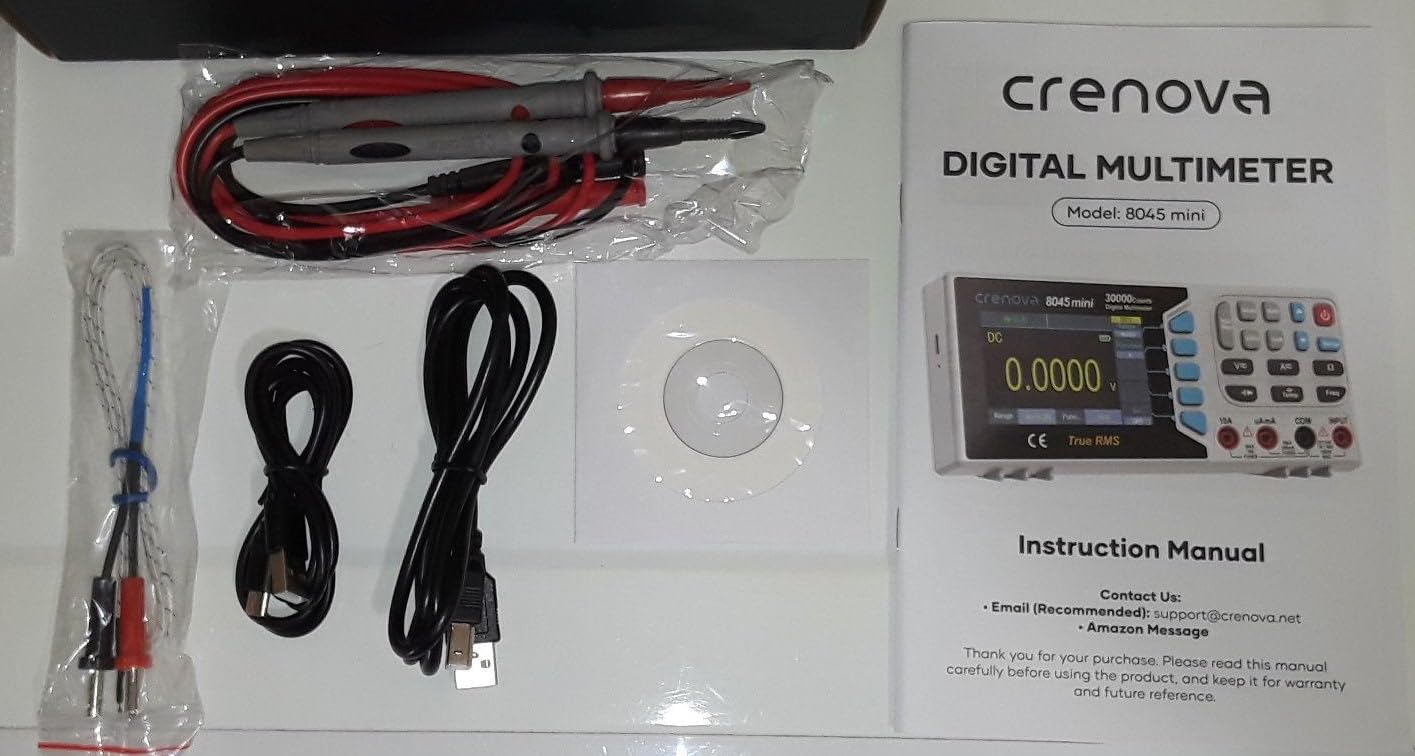
The Crenova 8045 Mini is the most surprising meter in this lineup. 30000 counts with True RMS on a 3.5-inch screen, in a compact desktop form factor, with a rechargeable 5000mAh battery that runs up to 10 hours of continuous use.
It covers 11 measurement functions including AC and DC voltage and current, resistance, capacitance, temperature, frequency, duty cycle, continuity and diode, and adds max, min, average, relative and dBW/dBmW math. Auto and manual ranging, dual display and data hold are all present.
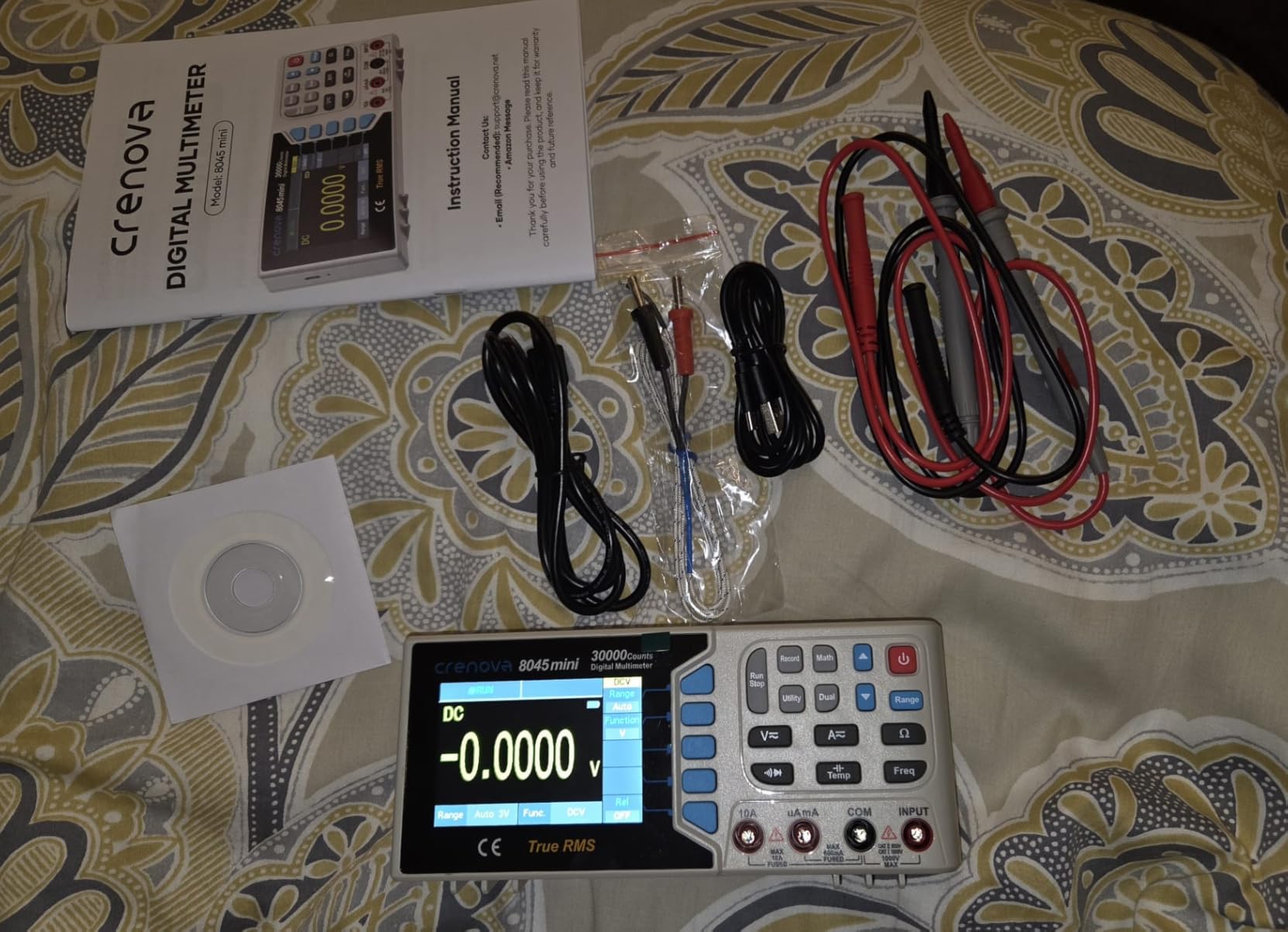
The flexibility is genuinely useful. It can stand upright on a bench, lie flat, or be carried in the hand, so the same instrument covers a soldering session and a kitchen-table measurement session. USB connectivity handles remote control, firmware updates and PC data logging, and the safety rating is CAT I 1000V and CAT II 600V with two fuses.
Owners repeatedly highlight that the accuracy and feature count rival instruments many times its size. The criticisms are equally consistent: accuracy may not keep pace with a calibrated reference, there is no official programming documentation so PC control is awkward, the software is Windows-only, and the USB-C charge port is connected to ground, which matters if you are using the ohm function while charging.
Best first bench meter
If you are moving up from a pocket multimeter and want a screen you can actually read plus USB logging, this is the least disruptive step. The rechargeable battery means it survives being moved between the bench and the sofa without hunting for a cable.
True RMS makes it usable on the output of a modern switching supply, where an average-responding meter gives a misleading number.
Where precision work stops
If you need readings you can compare against a laboratory reference, this is not the instrument. The missing programming documentation and Windows-only software also limit longer data acquisition projects compared with the SCPI support on the OWON meters above.
9. Rigol DM3058E – 0.015% DC Accuracy Over USB, LAN and RS-232
Rigol DM3058E 5.5 Digit Bench Digital Multimeter, 123,000 Counts, True-RMS
5.5 digit 123000 counts
0.015% DC accuracy
USB LAN and RS-232 with SCPI
3 year warranty
Pros
- Very high DC voltage accuracy captures small signal changes
- Dual display reduces setup changes during comparisons
- USB LAN and RS-232 suit automated data collection
- Long warranty on the main unit
Cons
- Priced above the Siglent alternative at similar resolution
- Older heavier chassis than newer compact bench meters
The DM3058E is where you go when the measurement itself is the project. Basic DC voltage accuracy of 0.015% puts it in the precision class of this roundup, and on a 5V rail that resolves changes most hobby meters simply cannot show.
Resolution is 5.5 digits, with up to 50000 counts on measurement and a 123000 count display capability. The dual display shows two parameters simultaneously, which cuts the number of mode changes during comparative testing. Measurement functions cover DCV, ACV, DCI, ACI, resistance, capacitance, frequency, period, continuity, diode and temperature.
Connectivity covers all three of the usual bench interfaces: USB, LAN and RS-232 with SCPI command support, which is what you want for automated data collection across a bench of instruments. The warranty is three years on the main unit and one year on accessories.
The tradeoff is weight and value. Owners rate the measurement quality highly for lab and classroom use, but sentiment is tempered mainly by how it compares against other 5.5-digit bench meters. The chassis is older and heavier at 2.93 kg compared with newer compact units.
Reasons to spend here
If you are matching rails, characterising a reference, or logging small signal changes, the accuracy headroom pays off immediately. A forum comparison of a UNI-T, a Siglent and a 2.5V reference found barely any difference at hobby voltage levels, but that gap widens once you push toward precision work.
RS-232 support matters if you have legacy automation or an instrument rack that predates USB.
Reasons to buy something else
If your work is ordinary 3.3V and 5V breadboarding, this accuracy is more than the task requires. The heavier chassis also takes real desk space compared with the compact desktop meters earlier in this list.
10. Rigol DM858 – 500000-Point Logging on a 7 Inch Touchscreen
RIGOL DM858 5.5 Digits Digital Multimeter 125rdgs/s
5.5 digit True RMS
125000 counts
125 readings per second
500000 point logging
Pros
- 125 readings per second is quick for logging transients
- 500000 point memory holds long recordings without a PC
- Large 7 inch touchscreen makes menu setup readable
- Compact and light chassis for a bench unit at 1.23 kg
Cons
- Touchscreen controls suit casual use less well than a dial
- Small owner base means less third-party support content
The DM858 is built around one idea: record a lot, for a long time, without a computer attached. With 500000 points of logging memory, built-in storage for data and setups, and up to 125 readings per second, you can capture a slow thermal event or a fast transient and analyse it later at the bench.
Resolution is 5.5 digits at 125000 counts with True RMS, and there are 11 measurement functions and five math operations. The 7-inch touchscreen offers three graphical display types, which makes menu-driven setup far more readable than a line of text on a small screen.
It is also lighter and smaller than the DM3058E, at 1.23 kg and 10.47 by 3.15 by 6.5 inches, which matters if you move instruments around. For a logger that stays where you put it, that is a meaningful advantage over a heavier chassis.
The owner base is still small, which shows up in reviews. Sentiment is positive on speed, logging memory and the large display, with the most common observation being that touchscreen controls suit casual use less well than a physical dial. There is simply less third-party support content online to draw on.
What it is genuinely good at
Long unattended recordings are the clear use. A supply warming up, a battery cell settling, an enclosure heating during a soak test, all of these produce datasets that would take a laptop and a timer to capture on a simpler meter.
The graphical display types also make it easy to spot a drift trend without exporting anything first.
What to consider first
If you dislike touch controls or you wear gloves while working, a physical dial is easier to operate blind. And because the installed base is small, budget extra time for any setup questions you have.
How to Choose a Bench Multimeter Without Regret
Digits and counts explained simply
A digit count tells you how many numbers the meter can show, and the counts figure tells you how many steps sit between zero and full scale. A 60000 count meter gives you one more digit than a 6000 count meter over the same range, and that extra digit is the difference between seeing 5.001V and seeing 5.00V.
For hobby rails, this is what you actually get: at 3.3V, 5V and 12V levels, 4000 to 60000 counts gives resolution far finer than your circuit tolerances. The number that matters more is the accuracy spec, and you should read it as a percentage of reading plus a count term, not as a single percentage.
Input impedance is the specification that changes your readings
This is the most overlooked spec on any multimeter, and the one forum users raise most often. A meter with a 10 megaohm input impedance draws very little current from the circuit under test. A cheap meter with a 1 megaohm or lower input can quietly pull a divider down and give you a number that is wrong in a way that is hard to spot.
The 0.03% accuracy on the EEVblog BM786 and the 0.01% on the Siglent SDM3045X are meaningless on a high-impedance source if the meter itself is loading the node. If you measure sensor outputs, high-impedance dividers, or anything connected to an op-amp output, input impedance changes the answer more than resolution does.
True RMS matters for modern power supplies
True RMS meters measure the actual root mean square value of a waveform rather than estimating it from an averaged reading. That difference only shows up on non-sinusoidal signals, which is exactly what the output of a switching supply or a cheap LED driver looks like.
For pure 50 or 60Hz mains-derived AC or a clean sine from a function generator, average-responding meters read acceptably. For hobby work on modern supplies, True RMS is worth having, and most of the meters in this roundup include it.
Connectivity decides whether you can log
SCPI is the command language most of these meters speak over USB, and it is what turns a bench DMM into a data acquisition tool. The Siglent SDM3045X and SDM3055 offer USB host, USB device and LAN, the Rigol DM3058E adds RS-232, and the OWON XDM2041 and XDM1241 support SCPI with internal recording.
Long experiments are the case for logging. Watching a rail drift while a board warms up by eye is unreliable, whereas 500000 stored points on the Rigol DM858 or 1000 points at 15 millisecond intervals on the OWON XDM2041 gives you a curve you can actually argue about.
CAT ratings and what a hobbyist really needs
CAT ratings describe how a meter behaves under transient overvoltage from an installation. The Crenova 8045 Mini carries CAT I 1000V and CAT II 600V, which is appropriate for bench-level work away from mains distribution.
The key point is that a CAT rating matters when you might be near mains-derived circuits. On a bench running off a low-voltage supply, the practical limits are fuse quality and input protection, which is why reviewers repeatedly praise fused inputs and jack alert protection on the BM786.
Probes, accessories and calibration
Probe quality is where budget meters fall apart. Blunt, thickly insulated leads with intermittent contacts will make any meter look bad, and several owners in this roundup specifically recommend replacing the bundled probes before any fine work.
On calibration, a good habit is to check your meter against a known reference once a year and note the drift. Budget meters drift more than premium instruments, and cheap probes contribute their own error. If you ever compare two meters, the difference you see may be probe resistance rather than meter accuracy.
Buying used or refurbished
The used market for bench meters is a genuine option, and forums repeatedly ask about it. Fluke 8840A and 8842A units are widely praised as solid used purchases, with the main complaint being display dimming with age rather than measurement problems.
What to check on a used unit: confirm the display has no dim or dead segments, verify readings on a known reference rather than trusting the display, look for battery corrosion inside, and check that fuses are original type and rating. Ask for a photo of the measurement screen during a power-on test before you commit.
Which brand suits which hobbyist
Fluke is widely considered the benchmark for build quality and ruggedness, and a Fluke 87V is frequently described as amazing but overkill for hobby work. Fluke 15B+ and 17B+ models are repeatedly recommended as the sensible alternative when you want that brand name without the premium.
Siglent covers the middle of the range with genuine bench instruments from 4.5 up to 5.5 digits. Rigol competes at 5.5 digit resolution with three communication interfaces on one instrument. UNI-T performs well for the money on value-oriented models. Brymen platforms, sold under the EEVblog name here, are called out for input protection and value. OWON builds desktop meters with large screens and SCPI support at lower specifications.
Bench or handheld?
A bench meter suits a fixed desk, larger displays, dual readings, PC connectivity and higher accuracy. A handheld suits field work, mains-adjacent environments and CAT-rated safety. Plenty of hobbyists end up owning both, and our guide to the best digital multimeters for electricians covers the field side in detail.
Signs you have outgrown a handheld: you want two readings at once, you need to log to a computer, you keep working with milliamp readings, or you need 4-wire resistance for a shunt.
Frequently Asked Questions
What is the best benchtop multimeter?
The Siglent SDM3045X is the best overall benchtop multimeter for hobby electronics in our testing, because it combines a dual display, True RMS measurement, 0.01 percent basic DC accuracy and USB host, USB device and LAN connectivity in one enclosure. Owners cite strong accuracy and a bright dual display for the money.
What is the best multimeter for electronics?
For a fixed electronics bench, a bench DMM beats a handheld because it offers a larger display, two simultaneous readings, higher DC accuracy and often PC connectivity. The Siglent SDM3045X and the Siglent SDM3055 cover most hobby needs, while the Rigol DM3058E is the choice when 0.015 percent DC accuracy matters.
What is a good small electronics multimeter?
The Crenova 8045 Mini is a good compact choice, offering 30000 counts with True RMS on a 3.5 inch screen, a rechargeable 5000mAh battery and USB data logging. It runs up to 10 hours of continuous use and can stand upright or lie flat on a bench.
Which multimeter brand is considered the best for high quality?
Fluke is most often considered the benchmark for build quality and ruggedness, with a reputation reinforced by strong warranties. Siglent and Rigol cover the bench market with high accuracy at lower cost, and Brymen platforms sold under the EEVblog name are frequently praised for input protection and value.
What is the best multimeter for value for money?
The OWON XDM1241 delivers 55000 counts with True RMS, SCPI remote control over USB, internal data recording and a user-replaceable line fuse with spares included. The Siglent SDM3045X is the stronger choice if you want a larger dual display and LAN connectivity alongside those features.
How many digits do I need for hobby electronics?
For 3.3V, 5V and 12V hobby rails, a 55000 to 60000 count meter gives resolution far finer than typical circuit tolerances, so 4.5 digit hardware is usually enough. Reserve 5.5 digit and 6.5 digit resolution for calibration work and precision characterisation, where the extra digits change what you can see.
Is a bench multimeter overkill for hobby electronics?
It depends on what you measure. True RMS, dual display and USB logging all earn their place on a bench running Arduino or Raspberry Pi projects, but a handheld such as the EEVblog BM786 handles most troubleshooting at 60000 counts. Buy a bench meter when you want two readings at once or data logged to a computer.
What CAT rating do I need for hobby electronics?
For bench work on low-voltage supplies, a CAT II 600V rating such as the one on the Crenova 8045 Mini is appropriate. CAT III and CAT IV ratings matter when you work near mains-derived circuits or distribution panels, and that is the point at which a CAT rated handheld is the correct instrument rather than a bench meter.
Final Verdict for Hobby Electronics Work
After weeks with all ten, the Siglent SDM3045X is the meter we would put on a hobby bench first. The dual display, True RMS, 0.01 percent basic DC accuracy and the combination of USB host, USB device and LAN cover almost everything a maker does, and it stayed accurate across every 5V and 3.3V measurement we threw at it.
If your work is about watching small changes over time, step up to the Siglent SDM3055 for its 5.5 digit resolution and trend charts, or the Rigol DM3058E if 0.015 percent DC accuracy is the point of the exercise. For logging without a laptop attached, the Rigol DM858 holds 500000 points onboard.
Whatever you choose, buy better probes than the ones in the box, keep them away from mains, and check the reading against a known reference once a year. Those three habits will improve your measurements more than another digit of resolution will.