
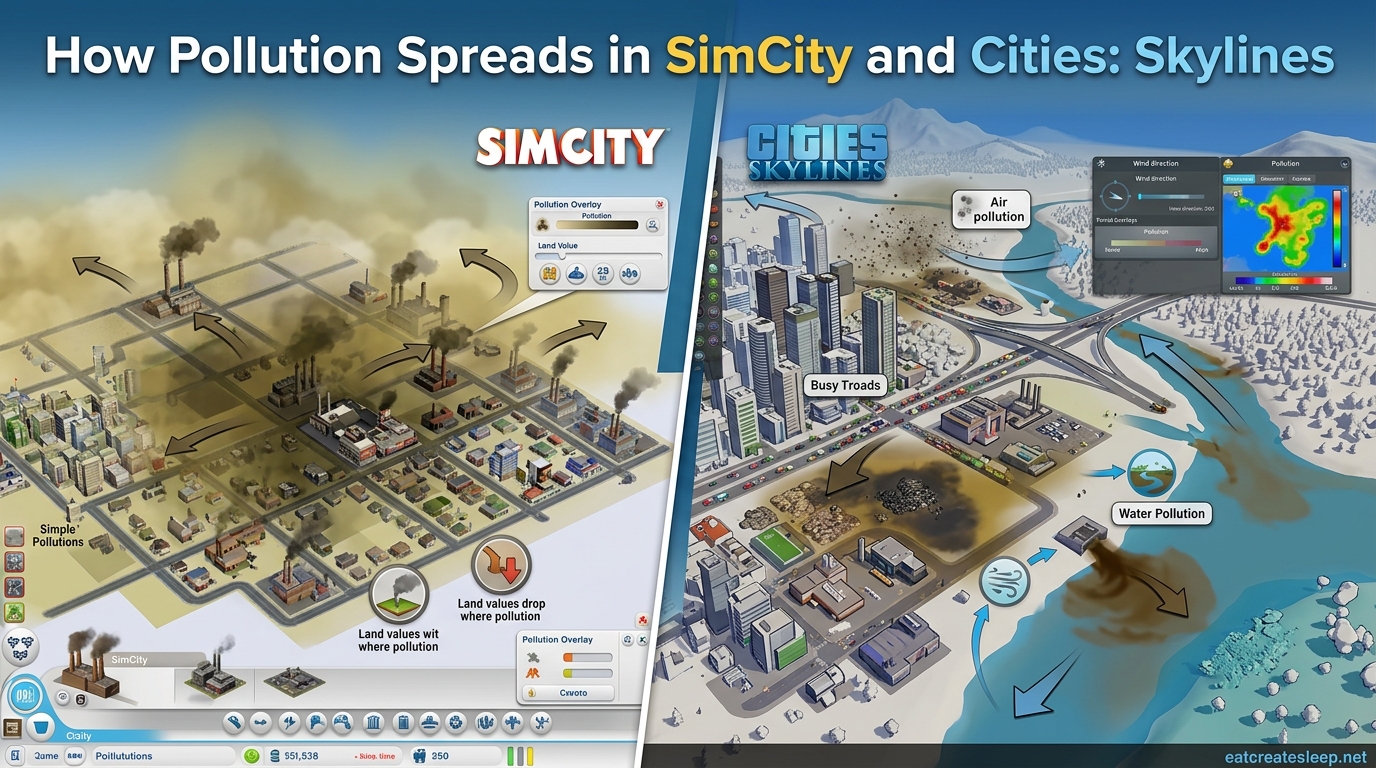
If you have ever watched your citizens get sick, your land values crater, and your residential zones turn into ghost towns, pollution is usually the suspect. Both SimCity and Cities: Skylines model pollution as a spreading hazard that moves outward from source buildings. But each game handles the spread distances, pollution types, and cleanup mechanics differently.
Understanding how pollution spreads in SimCity and Cities: Skylines is the difference between a thriving metropolis and a city full of sick, unhappy residents. Our team has spent hundreds of hours across both franchises testing zoning layouts, measuring pollution radii, and figuring out exactly how far industry needs to sit from homes.
In this guide, we break down every pollution type in both games, explain the spread mechanics with specific distances, compare the two systems side by side, and share the mitigation strategies that actually work. Whether you are playing SimCity 4, SimCity (2013), Cities: Skylines, or its sequel, this article covers what you need to know.
Table of Contents
How Pollution Spreads in SimCity and Cities: Skylines: The Basics?
Pollution in both SimCity and Cities: Skylines is a contamination mechanic produced by specific buildings and activities. Industrial zones, power plants, traffic, and sewage all generate pollution that radiates outward to surrounding tiles, lowering land value, damaging citizen health, and reducing happiness.
The core mechanic is similar in both games: each polluting building has a pollution radius, and any residential, commercial, or civic building inside that radius suffers negative effects. The pollution spreads as a gradient, meaning tiles closer to the source receive stronger contamination than tiles on the outer edge.
The biggest difference between the two franchises is how they categorize pollution. SimCity focuses primarily on air pollution and water pollution, with air being the dominant concern. Cities: Skylines splits pollution into three distinct types: ground pollution, water pollution, and noise pollution, each with its own spread rules and cleanup methods.
Wind, water flow, and terrain also affect spread direction in both games, which is why placing industry upwind of homes or downstream of water pumps causes disasters that new players rarely see coming.
Pollution Types in SimCity
SimCity has always treated pollution as a threat to the aura rating of an area. The lower the aura, the lower the land value, the unhappier the citizens, and the harder it becomes to attract high-wealth residents. The series breaks pollution into two main categories: air pollution and water pollution.
Air Pollution in SimCity
Air pollution is the primary pollution type across the SimCity franchise. It spreads from industrial zones (especially heavy industry and dirty manufacturing), coal and oil power plants, airports, high-traffic roads, and military bases. Once generated, the pollution drifts outward and, depending on the game, can also be carried by wind.
SimCity uses a five-level severity system for air pollution, ranging from minimal to hazardous. At the lower levels, citizens complain and land values dip. At hazardous levels, residents abandon their homes, crime spikes, and the area becomes effectively unlivable. In SimCity 3000, severe air pollution produces visible toxic clouds and triggers acid rain, which damages buildings and further degrades the environment.
The biggest air pollution producers in SimCity are coal power plants and heavy industrial zones. A single coal plant can contaminate a wide radius around it, which is why experienced players recommend switching to cleaner power sources like solar, wind, or fusion as soon as the city budget allows.
Water Pollution in SimCity
Water pollution in SimCity comes from industrial runoff, untreated sewage, and proximity to polluting buildings near water sources. When water becomes polluted, water towers and pumping stations drawing from that source deliver contaminated water to residents. This causes immediate spikes in sickness and can trigger mass illness across entire neighborhoods.
The water pollution system becomes particularly punishing in SimCity 4, where water pipes connect your entire city to a single network. If one pumping station draws from a polluted source, the contamination spreads through the pipe system and affects every connected building. Players on Reddit frequently report sudden city-wide illness outbreaks traced back to a single polluted pump.
How SimCity Air Pollution Spreads
Air pollution in SimCity spreads radially from each source building, with the highest concentration at the center and decreasing intensity moving outward. The spread radius depends on the type and intensity of the source. A small dirty industrial zone produces a tight pollution footprint, while a coal power plant covers a much larger area.
Wind direction plays a role in some SimCity versions, carrying pollution further in the downwind direction. This means a coal plant placed upwind of your residential zones will contaminate a larger effective area than the same plant placed downwind. Checking the wind direction overlay before placing heavy industry is a habit every seasoned SimCity player develops quickly.
One community-tested tip from the r/simcity4 subreddit: placing industry at the map edge effectively cuts the pollution impact in half, because pollution cannot spread beyond the playable boundary. This trick lets you concentrate dirty industry in a corner where it only contaminates one quadrant instead of four.
Pollution Types in Cities: Skylines
Cities: Skylines takes a more granular approach to pollution, splitting it into three distinct categories that spread differently and require different mitigation strategies. The three types are ground pollution, water pollution, and noise pollution, each visible through its own dedicated overlay in the pollution info view.
Ground Pollution in Cities: Skylines
Ground pollution is the most persistent pollution type in Cities: Skylines. It comes from industrial zones, with ore and oil industries producing the heaviest contamination. Generic industry also pollutes the ground, though at a lower intensity. Power plants, garbage processing facilities, and certain service buildings contribute as well.
Ground pollution spreads in a radius around each source, soaking into the terrain tiles. Any residential or commercial building built on polluted ground suffers increased sickness rates and depressed land value. The pollution stays tied to the land, which means it does not drift or flow like air or water pollution.
The persistent nature of ground pollution is what catches new players off guard. Even after you demolish the offending industry, the ground stays polluted. According to community reports, it takes approximately one to two years of in-game time for ground pollution to fully clear after the source is removed. During that window, you cannot safely zone residential on the affected tiles.
Water Pollution in Cities: Skylines
Water pollution in Cities: Skylines flows through the water simulation and follows the current. Sewage drainage pipes are the primary source, dumping untreated wastewater directly into rivers and lakes. Industrial buildings near water also contribute, as does any ground pollution that reaches a water body.
The directional flow of water is what makes this pollution type tricky. Pollution travels downstream with the current, which means anything placed downstream of your sewage outlet gets contaminated. The critical mistake players make is placing water pumping stations downstream of drainage pipes, which feeds polluted water directly into the city supply.
Players on r/CitiesSkylines frequently report water pollution readings of 30 to 50 percent caused by this exact mistake. The fix is simple: always place pumping stations upstream of any sewage output, with as much distance between them as the map allows.
Water treatment plants, unlocked through milestones, reduce the pollution output of sewage by filtering the wastewater before release. Upgrading all drainage pipes to water treatment plants is one of the most effective single actions for cleaning up a polluted water supply.
Noise Pollution in Cities: Skylines
Noise pollution is the third type, generated by high-traffic roads, industrial zones, commercial buildings with high activity, airports, and certain monuments. Unlike ground and water pollution, noise pollution does not affect citizen health directly. Instead, it reduces happiness and suppresses land value in the affected radius.
Noise pollution spreads from its source in a relatively short radius, with highways and high-capacity roads producing the largest footprints. Residential zones next to highways suffer the most, with citizens complaining about noise and land values staying depressed no matter how nice the surrounding amenities are.
Trees are the primary mitigation tool for noise pollution. Planting dense tree lines between noisy roads and residential zones absorbs a meaningful amount of noise, though players note you need large numbers of trees to see a real difference. A few scattered trees will not cut it.
Pollution Spread Distances and Radius Mechanics
One of the most common questions players ask is how far pollution actually travels from its source. The answer depends on the game, the pollution type, and the intensity of the source, but there are useful rules of thumb that can guide your zoning decisions.
In SimCity, air pollution from a standard industrial zone typically extends roughly 6 to 8 tiles before fading to negligible levels. Heavy polluters like coal power plants have a much larger radius, often reaching 12 to 15 tiles or more. Wind can extend the downwind reach by several additional tiles, which is why wind awareness matters when placing industry.
In Cities: Skylines, ground pollution from a standard industrial zone spreads across a small surrounding area of roughly 6 to 10 tiles, with the highest concentration in the immediate vicinity of the source buildings. Heavy industry and specialized oil or ore industries pollute a wider radius than generic industry. Noise pollution has a shorter reach, typically affecting tiles within 4 to 6 tiles of the source road or building.
The map-edge trick works in both games. Placing dirty industry in a corner or along an edge means pollution cannot spread in the directions blocked by the boundary, effectively halving the contaminated area. This is one of the highest-impact zoning decisions you can make early in a city build.
Buffer zones are the other key strategy. Leaving a gap of clean green space between industry and residential ensures the pollution gradient falls to safe levels before reaching homes. The exact buffer width depends on the pollution intensity, but a gap of 8 to 10 tiles handles most standard industry in both games.
SimCity vs Cities: Skylines Pollution Comparison
The two franchises share the same core concept but execute pollution in meaningfully different ways. Here is a side-by-side breakdown of how each system works.
Pollution types: SimCity focuses on air pollution and water pollution, with air being the dominant concern. Cities: Skylines uses three types: ground pollution, water pollution, and noise pollution, giving players more systems to manage simultaneously.
Spread mechanic: SimCity air pollution spreads radially and can be carried by wind. Cities: Skylines ground pollution stays fixed in place, water pollution flows with the current, and noise pollution radiates in a short fixed radius.
Persistence: SimCity pollution clears quickly once the source is removed, usually within a short timeframe. Cities: Skylines ground pollution is persistent, taking one to two in-game years to fully clear even after demolition.
Primary tools: SimCity relies on ordinances like the Clean Air Act, tree planting, and zoning strategy. Cities: Skylines uses service buildings like water treatment plants, policy options, DLC features like Filter Industrial Waste, and tree placement.
Wind and water: SimCity models wind direction for air pollution spread. Cities: Skylines models water current direction for water pollution, making upstream and downstream placement critical for water infrastructure.
Visibility: Both games offer pollution overlays. SimCity shows air pollution as colored tiles across the city. Cities: Skylines provides separate overlays for ground, water, and noise pollution, accessible through the info view menu.
The practical takeaway is that Cities: Skylines demands more active management of multiple pollution systems, while SimCity focuses your attention on air pollution as the primary threat. Players coming from SimCity often underestimate ground pollution persistence in Cities: Skylines, while SimCity veterans are usually well-prepared for the wind and water current mechanics.
Preventing and Reducing Pollution
Prevention is always cheaper than cleanup in both games. Once pollution takes hold, especially ground pollution in Cities: Skylines, the recovery process is slow and limits what you can do with the affected land. Building pollution awareness into your zoning strategy from the start saves enormous headaches later.
Strategies in SimCity
The most effective SimCity pollution strategies combine zoning, ordinances, and clean infrastructure. Start by placing all heavy industry at the map edge, ideally downwind of your residential and commercial zones. Use the wind overlay to confirm direction before committing to a layout.
Enact the Clean Air Act ordinance as soon as it becomes available. This single ordinance reduces air pollution output across your city and is one of the most cost-effective mitigation tools in the game. Pair it with the trash reduction ordinance and tree planting programs to compound the effect.
Transition away from coal and oil power plants as early as your budget allows. Solar, wind, and fusion power produce zero air pollution, eliminating one of the largest single pollution sources in the game. Nuclear power is also clean, though it carries its own risks in some SimCity versions.
Plant trees liberally around industrial zones and between industry and residential areas. Trees in SimCity absorb a meaningful amount of air pollution, and dense tree lines can create effective buffer zones. The effect stacks, so more trees always help.
For water pollution, keep pumping stations and water towers far from industrial zones and sewage outputs. In SimCity 4, the shared pipe network means a single contaminated source can poison the entire city, so check every pump placement carefully.
Strategies in Cities: Skylines
Cities: Skylines gives you more tools but also more systems to manage. Start with zoning discipline: separate industrial zones from residential and commercial zones with buffer space, and place heavy industry at the map edge whenever possible.
For water pollution, the single most important decision is pump and drainage placement. Always put pumping stations upstream of drainage pipes, with maximum distance between them. Upgrade drainage pipes to water treatment plants as soon as you unlock them through population milestones. Water treatment plants significantly reduce the pollution content of released wastewater.
The Green Cities DLC adds the Filter Industrial Waste policy, which reduces ground pollution output from industrial zones. Community testing indicates the reduction is slight rather than dramatic, so treat it as a supplement to good zoning rather than a replacement for it.
Trees are your main tool for noise pollution mitigation. Plant dense tree lines along highways and between busy roads and residential zones. The effect is real but requires volume, so do not expect a handful of trees to make a noticeable difference.
The Eden Project monument, unlocked by meeting specific city requirements, dramatically reduces city-wide pollution. It is a late-game tool that can rescue a heavily polluted city, but it requires significant investment to reach.
For ground pollution cleanup, patience is the only real option. Once you remove the polluting source, the ground gradually heals over one to two in-game years. During that period, avoid zoning residential on the affected tiles, as citizens will get sick and abandon the buildings.
Managing traffic also reduces pollution indirectly. Heavy congestion increases the pollution output of vehicles, so well-designed road networks, public transit, and district policies that discourage car use all contribute to cleaner air and quieter streets.
FAQs
How does pollution work in Cities: Skylines?
Cities: Skylines has three pollution types: ground pollution from industry, water pollution from sewage, and noise pollution from traffic and busy buildings. Each spreads differently, with ground pollution staying fixed in place, water pollution flowing with the current, and noise pollution radiating in a short radius. Pollution lowers land value, causes citizen sickness, and reduces happiness.
How to reduce pollution in SimCity?
To reduce pollution in SimCity, place heavy industry at the map edge downwind of residential zones, enact the Clean Air Act ordinance, switch from coal and oil power to clean energy like solar or fusion, plant dense tree buffers between industry and homes, and keep water pumps far from industrial zones and sewage.
Will pollution go away in Cities Skylines?
Yes, but ground pollution is persistent. After you remove the polluting source, ground pollution takes approximately one to two in-game years to fully clear from the affected tiles. Water pollution clears quickly once you stop dumping sewage or upgrade to water treatment plants. Noise pollution disappears immediately when the noise source is removed.
Do trees reduce pollution in Cities: Skylines?
Trees reduce noise pollution in Cities: Skylines when planted in dense lines between noisy roads and residential zones. The effect requires large numbers of trees to be noticeable. Trees do not significantly reduce ground pollution or water pollution.
How far can pollution travel from its source?
In SimCity, air pollution from standard industry spreads roughly 6 to 8 tiles, while coal plants can reach 12 to 15 tiles or more with wind extending the downwind range. In Cities: Skylines, ground pollution spreads about 6 to 10 tiles from industry, and noise pollution affects roughly 4 to 6 tiles. Placing industry at the map edge halves the contaminated area.
How long does it take for ground pollution to go away in Cities: Skylines 2?
Ground pollution in Cities: Skylines takes approximately one to two in-game years to fully clear after the polluting source is demolished. During that recovery period, you should avoid zoning residential on the affected tiles because citizens will get sick and abandon the buildings.
Conclusion
Pollution is one of the most impactful mechanics in both SimCity and Cities: Skylines, and understanding how it spreads is essential for building a healthy, high-value city. SimCity focuses on air and water pollution with wind-driven spread, while Cities: Skylines adds ground pollution persistence and noise pollution as additional systems to manage.
The fundamentals are the same in both games: separate industry from residential with buffer space, place dirty buildings at the map edge, manage your water infrastructure direction carefully, and use ordinances, trees, and clean technology to reduce the pollution load. Master how pollution spreads in SimCity and Cities: Skylines, and your cities will stay healthier, wealthier, and more attractive to residents for the long haul.
Start your next city build with pollution planning in mind from the very first zone you place. Your citizens will thank you with higher happiness, better health, and the kind of land values that turn a small town into a thriving metropolis.