
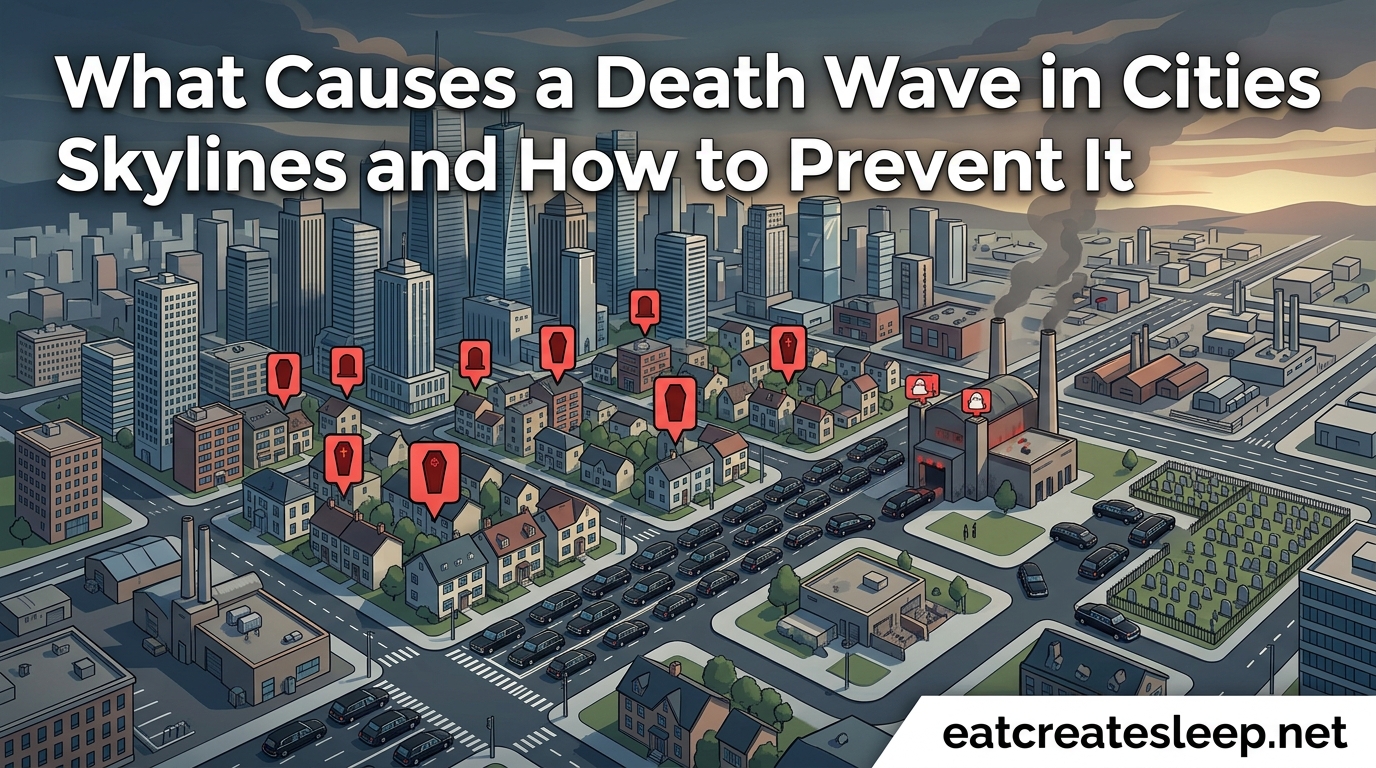
If you have ever watched your thriving metropolis of 100,000 residents suddenly crater to 20,000 in a matter of in-game weeks, you have already met the death wave Cities: Skylines players dread most. I have lost cities to this phenomenon more times than I care to admit, and the frustration of seeing blocks of abandoned buildings pile up is real. The good news is that death waves are not random bad luck. They follow a predictable pattern tied to how you grow your city, which means you can prevent them once you understand the mechanics. This guide breaks down exactly what causes death waves, how to spot one coming, and the steps to stop or avoid them entirely in both the original game and Cities: Skylines 2.
Table of Contents
What Is a Death Wave in Cities: Skylines?
A death wave is a massive, simultaneous die-off of citizens that overwhelms your deathcare infrastructure and crashes your population. Instead of a steady trickle of deaths spread across the year, hundreds or thousands of Cims die within the same short window. Hearses cannot collect bodies fast enough, buildings get abandoned, and the population graph looks like a cliff edge.
The root cause is always an age imbalance. When too many citizens share the same age bracket, they move in together, age together, and eventually die together. The simulation has no natural mechanism to spread out deaths when the population distribution is skewed.
Death waves can lop off 50 to 80 percent of your population in a single cycle. Worse, they tend to repeat. If you react by zoning a huge new residential block to recover your numbers, you create the next bubble, and the wave comes back roughly one in-game lifespan later. This is why players on forums describe populations swinging from 100K down to 20K and back over and over.
What Causes a Death Wave in Cities: Skylines?
Rapid Residential Zoning Creates a Population Bubble
The single biggest cause of a death wave is zoning a large area of residential land all at once. When you paint an entire district of high-density residential in one sitting, the game fills those homes with adults of roughly the same age. These new residents become a single cohort that ages on the same timeline.
Fast-forward a few in-game years, and that cohort hits old age at the same moment. They start dying in a concentrated burst that no amount of cemeteries can handle. Players on the CitiesSkylines subreddit call this the population bubble, and it is the mechanic behind almost every death wave.
Adults Migrate In at Similar Ages
When residential demand is high and you zone quickly, immigrants arrive as young adults or adults, not as a mix of children, teens, adults, and seniors. The game tends to spawn new citizens in the adult age range because that is the productive workforce your city is demanding. This compounds the bubble effect.
Deathcare Capacity Cannot Scale Instantly
Even a well-supplied city has a ceiling on how many bodies it can process per week. Each cemetery and crematorium spawns a limited number of hearses, each with limited capacity and travel range. A normal city might handle 30 to 50 deaths per week without strain. A death wave can dump 500 deaths into that same window.
Traffic Chokes Hearse Response
Hidden behind the obvious capacity issue is traffic. Hearses are road vehicles, and they obey the same pathfinding and congestion rules as every other car. If your road network is gridlocked, hearses sit in traffic while bodies pile up. Many players who think they have a deathcare shortage actually have a traffic problem.
Reactive Zoning Fuels the Next Wave
The instinctive response to a population crash is to zone more residential to recover. If you give in to that urge, you immediately start building the next cohort that will die together. This feedback loop is why death waves become chronic in affected cities.
Signs a Death Wave Is Approaching
Catching a death wave early gives you time to prepare. Watch for these warning signs.
Population age skew: Open the population info panel and look at the age distribution bar. If the senior segment is abnormally large relative to other age groups, a die-off is imminent.
Rising death count: The demographics panel shows current deaths per week. If that number starts climbing steadily over several weeks, the wave is building.
Hearse activity spike: If you suddenly see hearses backed up at buildings or your crematoriums and cemeteries show near-full capacity, you are already in the early stage.
Recent rapid expansion: If you zoned a large residential area roughly 30 to 50 in-game years ago and have not had a death wave yet, expect one soon.
How to Prevent Death Waves in Cities: Skylines?
Prevention comes down to one core principle: grow your population gradually so ages stay mixed. Here are the specific tactics that work.
1. Zone Residential in Small Batches
Instead of painting an entire tile of high-density residential at once, add housing in chunks of a few hundred residents at a time. Spread your zoning across multiple sessions or in-game weeks. This staggered approach means new citizens arrive in mixed age waves rather than a single cohort.
2. Watch the RCI Demand Bar
The RCI bar tells you what your city actually needs. Zone residential only when the green residential bar is clearly tall. If the bar is short, resist the urge to zone. Many death waves start because players zone based on available land rather than actual demand. Let demand guide your pace.
3. Mix Low-Density and High-Density Residential
Low-density residential fills more slowly and tends to attract families with a wider age spread. Mixing low-density and high-density in the same district keeps age distributions healthier. Reserve high-density for targeted infill, not bulk expansion.
4. Build Distributed Deathcare Before You Need It
Place cemeteries and crematoriums proactively as you grow, not reactively when bodies pile up. A good rule of thumb from experienced players is one crematorium or cemetery per roughly 10,000 to 15,000 residents, distributed across districts rather than clustered. Crematoriums process bodies faster than cemeteries, so prioritize them for high-population areas.
5. Keep Hearse Traffic Clear
Design your road network so hearses can reach every residential block without sitting in gridlock. Use dedicated service roads, avoid single chokepoints into residential districts, and keep industrial traffic separate from residential streets. Roundabouts and one-way pairs help, but the key is giving hearses multiple paths to every block.
6. Use Districts to Manage Growth
Create separate districts and grow them on staggered schedules. While one district is expanding, let another mature. This district-level pacing prevents the entire city from aging in lockstep and adds a layer of protection the AI cannot easily disrupt.
How to Stop a Death Wave Already in Progress in 2026?
If a death wave is already crashing through your city, you can still limit the damage with the right moves.
Do not zone more residential. This is the most important rule. Adding housing mid-wave creates the next wave. Wait for the current die-off to pass before expanding.
Pause and assess deathcare. Open the deathcare overlay and check where coverage is thin. Drop temporary cemeteries near the hardest-hit blocks. Cemeteries are cheaper than crematoriums and still collect bodies, even if they fill up faster.
Empty full cemeteries. Use the empty building function to send accumulated bodies from full cemeteries to crematoriums with spare capacity. This frees up cemetery space for new collections.
Fix traffic around deathcare buildings. If hearses are stuck, redirect traffic with road changes, remove bottlenecks, or temporarily lower industrial output to clear congestion.
Ride it out. Death waves are self-correcting once the affected cohort dies off. The population will stabilize, often at a lower level. Focus on keeping services running and avoid panic-zoning.
Cities: Skylines 2 Death Wave Differences
Cities: Skylines 2 changed the citizen lifecycle system, which affects how death waves behave. Lifespans are longer and slightly more varied in the sequel, which softens the edge of death waves compared to the original. However, the core mechanic remains: rapid residential expansion still creates age cohorts that die together.
Players in CS2 report that death waves are less catastrophic but still noticeable, especially after large zoning pushes. The same prevention rules apply. Zone gradually, distribute deathcare, and keep traffic flowing. Mods remain popular in CS2 as well, with community lifecycle rebalance mods available on the Paradox Mods platform for players who want even finer control.
FAQs
What causes a death wave in Cities: Skylines?
A death wave is caused by rapid residential growth that fills new homes with citizens of the same age. That cohort ages together and dies together in a concentrated burst that overwhelms cemeteries and crematoriums.
How do I stop death waves in Cities: Skylines?
Zone residential in small batches, mix low-density and high-density housing, distribute cemeteries and crematoriums across districts, and keep hearse traffic clear. Never panic-zone new residential during an active wave.
How many crematoriums do I need per district?
A common guideline from experienced players is one crematorium or cemetery per 10,000 to 15,000 residents, spread across districts rather than clustered in one area.
Is there a mod to prevent death waves?
Yes. The Citizen Lifecycle Rebalance mod for the original Cities: Skylines randomizes lifespans and ages to break up population bubbles. Similar lifecycle mods are available for Cities: Skylines 2 on the Paradox Mods platform.
Why does my population keep crashing from 100K to 20K?
Your city has a repeating age bubble. Each crash is a cohort dying, and each recovery-zone creates the next cohort. Stop zoning large residential blocks at once and grow gradually to break the cycle.
Conclusion
A death wave in Cities: Skylines is not bad luck or a broken simulation. It is a direct consequence of how you grow your city. Zone gradually, distribute your deathcare, keep hearse traffic flowing, and resist the urge to panic-zone during a crash. When you manage the death wave Cities: Skylines throws at you this way, it becomes a manageable problem rather than a repeating disaster. Your next step is to open your current save, check the population age panel, and start staggering your next round of zoning.