
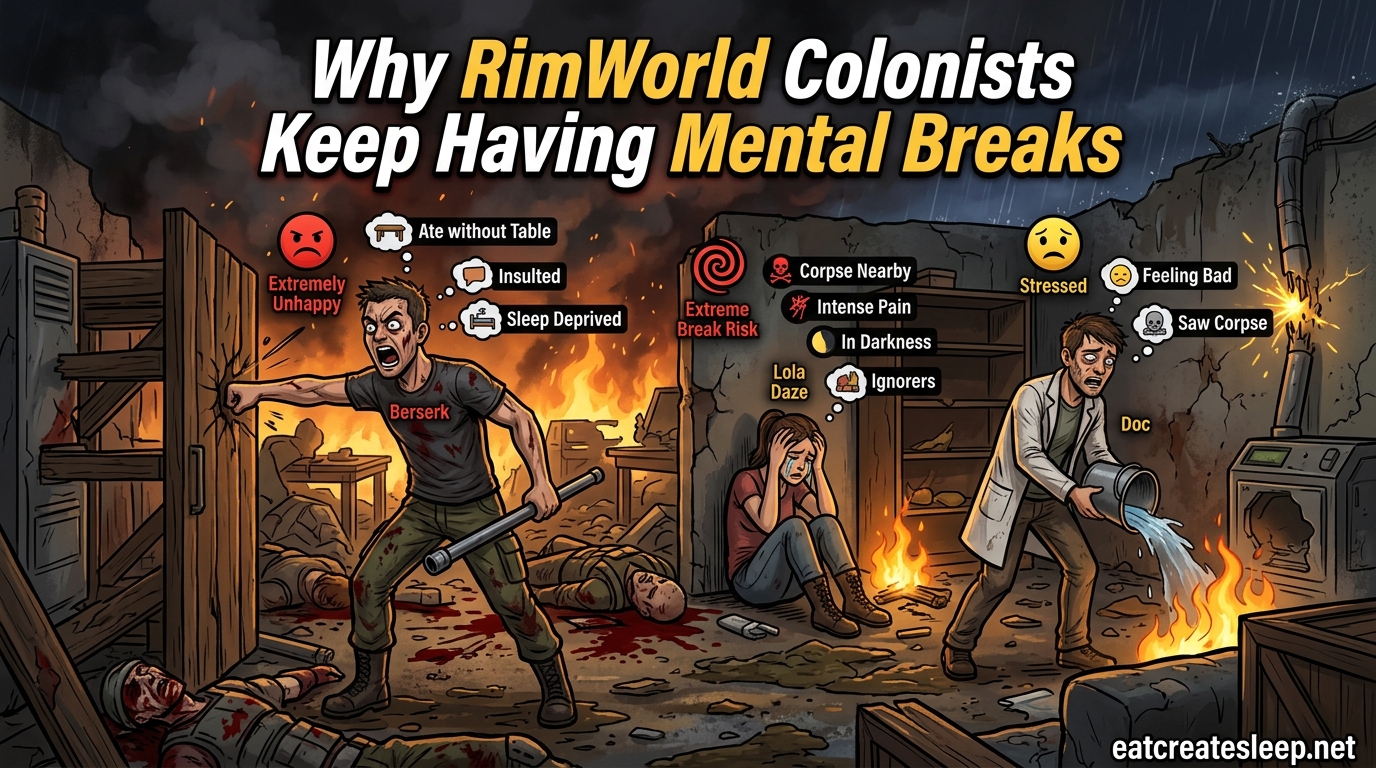
If you have ever watched your best crafter punch a wall, set the stockpile on fire, then wander into a manhunting pack of wolves, you already know the pain this article addresses. Why your RimWorld colonists keep having mental breaks is one of the most asked questions in the community, and the answer is rarely what new players expect.
I have lost colonies to cascading breakdowns more times than I care to admit, and the pattern is always the same: one pawn snaps, the rest get dragged down by the chaos, and within an in-game hour your thriving settlement looks like a crime scene. The good news is that RimWorld mental breaks are not random. They follow rules, and once you understand those rules, the cycle stops.
This guide breaks down exactly what a mental break is, the three severity levels, why breakdowns keep recurring in your colony, how to end one that is already happening, and the prevention strategies that actually work long term. By the end, you will be able to read your colonists’ mood bar like a warning gauge instead of a surprise attack.
Whether you are on your first crashlanded trio or your hundredth colony, the principles here are the same. Mood is the resource that keeps every other system running, and the breaks you keep seeing are the game’s way of telling you something is off in the foundation.
Table of Contents
What a Mental Break Actually Is in RimWorld?
A mental break in RimWorld is an uncontrollable pawn event triggered when a colonist’s mood drops below their mental break threshold. When this happens, the pawn temporarily leaves your control and starts acting out one of several scripted behaviors, ranging from hiding in their room to going on a murderous rampage.
The mechanic is the game’s way of simulating psychological stress. Your pawns are not robots. They remember the bodies they carried, the bedrooms they slept in, the food they ate, and the loved ones they buried. When negative thoughts pile up faster than positive ones, the mood bar drops, and eventually the pawn snaps.
Understanding this single mechanic is the difference between a stable colony and one that collapses every quadrum. The threshold is not fixed at a single number. RimWorld uses three distinct trigger points, and each one unlocks a more dangerous pool of break types.
This is also why the wiki definition is the snippet Google tends to surface. The definition is short and precise, but the practical implications run much deeper. Knowing the rule is one thing, applying it to a colony mid-crisis is another.
Mood vs. Mental Break Threshold
Two separate numbers control the system. Mood is the live value shown in the colonist’s needs tab, raised by good food, beauty, comfort, recreation, and positive thoughts, and lowered by pain, hunger, exhaustion, death, and trauma. The mental break threshold is the percentage below which a break becomes possible, modified by traits and difficulty settings.
The default thresholds are 35 percent for a minor break, 20 percent for a major break, and 5 percent for an extreme break. If a colonist is sitting at 36 percent mood, they are safe. Drop them to 34 percent and the dice start rolling. Drop them below 5 percent and you are staring down berserk triggers that can end a run.
Traits shift these numbers. A Steadfast colonist has a lower mental break threshold, meaning they can tolerate worse mood before cracking. A Nervous colonist has a higher threshold, so they break more easily. Pessimist and Optimist traits change the math by altering mood generation rather than the threshold itself.
Difficulty also matters. On lower story settings the threshold sits at the default, but on blood and dust or losing is fun conditions, pawns get fewer mood buffs and more frequent threats, which makes prevention much more demanding.
How the Break Is Chosen
When mood falls below a threshold, the game does not immediately fire a break. Instead it starts a mean time between (MTB) check. The further below the threshold, the shorter the interval between checks, so a pawn at 4 percent mood is rolling the dice far more often than one at 33 percent.
The break type itself is chosen from a pool determined by the lowest threshold the pawn has crossed. A colonist at 30 percent can only roll minor breaks. A colonist at 3 percent can roll from minor, major, and extreme pools, which is why low mood is exponentially more dangerous than slightly-low mood.
This is why players see so-called random berserks. It is not random. It is the result of a mood bar being allowed to fall so low that the extreme pool unlocks. The fix is almost always the same: never let mood get that low in the first place.
Mean time between also means that one bad night will not always end a pawn. A mood dip into the danger zone for an hour is survivable. The problem is sustained low mood over days, which gives the dice hundreds of rolls.
The Catharsis Aftermath
One mechanic that catches new players off guard is catharsis. After a colonist finishes a mental break, they receive a temporary mood buff called catharsis, which gives roughly plus 40 mood for a short window. This is the game telling you the pawn has released their tension.
Catharsis can trick you into thinking the problem is solved. The mood bar shoots up, the pawn goes back to work, and you relax. But the buff fades, and if you have not fixed the underlying cause, the next crash is coming. Treating catharsis as a cure instead of a warning is one of the most common reasons RimWorld mental breaks keep happening.
Think of catharsis as a reset button, not a fix. It clears the immediate danger and gives you a grace period to make changes. If you waste that grace period, the break will repeat, often at a worse severity because the underlying debuffs have stacked further.
The Three Severity Levels Explained
RimWorld splits mental breaks into three severity tiers. Each tier has its own threshold, its own pool of break types, and its own level of threat to your colony. Knowing which tier you are dealing with tells you how urgent the response is.
Minor Breaks (Below 35 Percent Mood)
Minor breaks trigger when mood drops below 35 percent. They are annoying but rarely lethal. The pawn is out of your control for a short time, makes a mess, then recovers. The danger is mostly in lost productivity and the small chance of secondary problems like food binges wasting resources.
Common minor break types include food binge, where the pawn eats raw or stored food until sick; sad wandering, where they drift around the map doing nothing; hide in room, where they lock themselves away; insulting spree, where they damage social relations by insulting everyone nearby; and crying jags.
Most experienced players let minor breaks run their course. The catharsis buff is often worth the lost time, and forcing an end to a minor break is usually more trouble than it is worth. The real fix is figuring out why the pawn was below 35 percent in the first place.
One small caveat: insulting sprees can damage relationships enough to start social fights, which then cause injuries and further mood debuffs. If a volatile pawn is mid-insulting-spree near your leader, you may want to draft and arrest them before the damage stacks.
Major Breaks (Below 20 Percent Mood)
Major breaks trigger below 20 percent mood and are where things start getting dangerous. The break types in this pool can cause real damage, and they last longer. A single major break during a raid can spiral into colonist deaths.
Common major break types include social drug binge, where the pawn consumes your entire stash of beer, smokeleaf, or harder drugs; psychotic wandering, where they wander the map ignoring threats; destructive tantrum, where they smash the nearest furniture or building; and slaughter of random animals.
Major breaks are the tier where intervention starts mattering. A destructive tantrum aimed at your only component bench can set the colony back months. A social drug binge on Luciferium or go-juice can permanently cripple a pawn. Watch the mood bar closely once anyone approaches the 20 percent line.
The tantrum target is not random. The pawn picks the nearest destructible object. Knowing this, you can bait a tantrum by placing a cheap stool or sign post between the breaking pawn and your vital infrastructure. It sounds silly, but a sacrificial chair can save your deep drill.
Extreme Breaks (Below 5 Percent Mood)
Extreme breaks trigger below 5 percent mood and are the tier that ends colonies. The break types here are violent, long lasting, and capable of cascading through your population. If you are seeing extreme breaks regularly, something is structurally wrong with how your colony handles mood.
Common extreme break types include berserk, where the pawn attacks the nearest human until subdued or killed; fire starting spree, where they run around igniting everything; murderous rage, a targeted version of berserk that fixates on a specific colonist; and giving up and leaving, where the pawn walks off the map forever.
This is the tier where you must intervene immediately. A berserk pawn with a charge rifle will kill your other colonists. A fire starting spree during a dry thunderstorm can burn the entire base. Giving up and leaving costs you a colonist permanently. Extreme breaks are the symptom, and chronic low mood is the disease.
Giving up and leaving deserves special attention because it is the only break that permanently removes a colonist without killing them. If a pawn you care about is below 5 percent, prioritize them above everything else. A single lavish meal and a few hours in a beautiful bedroom can pull them back from the edge.
Why Your RimWorld Colonists Keep Having Mental Breaks?
The word keep is doing a lot of work in this question. A single mental break is a fluke or a bad day. Repeated breaks mean the colony has a structural mood problem that catharsis buffs are masking. Here are the most common reasons the cycle refuses to stop.
The Cascade Effect
The number one reason RimWorld mental breaks keep happening is the cascade. One pawn snaps, the snap causes problems, those problems lower the mood of nearby pawns, and they snap too. A berserk colonist who kills a dog gives every animal lover in the colony a stacked mood debuff. A fire starting spree that burns the dining hall gives everyone an ugliness debuff for weeks.
The cascade is why a single bad event can snowball into colony collapse. The fix is to break the chain early. Subdue the breaking pawn fast, clean up the damage before it spreads, and make sure the rest of the colony has mood buffers like good food and recreation ready to absorb the shock.
Reddit users describe this pattern constantly. A new player posts about losing six colonists in a day, and the commenters all spot the same thing: the first break was survivable, but the cascade turned it into a wipe. Stopping the cascade is the single most important skill in mid-game RimWorld.
Unmet Needs Going Unchecked
Every colonist has a needs tab, and every need has a satisfaction bar. Food, rest, recreation, comfort, beauty, and room quality all feed directly into mood. If your colonists are eating nutrient paste in a concrete room with no recreation, their mood is going to sit near the minor break threshold permanently.
Players who skip building a recreation room, a decent dining hall, or bedrooms with some beauty are setting themselves up for chronic low mood. The breaks are not the bug. The breaks are the system correctly reporting that your colonists are miserable.
The needs tab is your diagnostic tool. Click any colonist, open the needs tab, and read which bars are red. The fix is almost always obvious: a red recreation bar means build more joy sources or schedule joy time; a red comfort bar means better chairs and beds; a red beauty bar means clean up the rooms and add art.
Wrong Jobs for Their Traits
Colonists have passions and traits that affect how they feel about their work. A colonist with a burning passion for cooking gains mood from working in the kitchen. A colonist with no passion for cooking assigned to the stove all day gains nothing and may pick up an unhappy thought from doing dull labor.
Traits compound this. A Pyromaniac gets mood buffs from fire and will occasionally start fires regardless of mood, which is its own headache. A Greedy colonist wants an impressive bedroom and gets debuffs without one. A Night Owl forced onto a day shift takes a permanent mood hit. Mismatched jobs and trait-ignorant scheduling quietly bleed mood from your colony all day.
Some traits are actively dangerous when paired with stress. A Tortured Artist gets mood debuffs from inspiration but produces better art. A Volatile Untempered trait, where available, can shorten the fuse. Read the trait list before assigning roles, and avoid putting trait-volatile pawns in high-stress jobs like cooking during a famine.
Death, Trauma, and Body Storage
This is the one most beginners miss. Unburied corpses give a significant mood debuff to any colonist who sees them, and the debuff stacks with each body. A battlefield littered with raider corpses after a raid can drag every colonist who walks past into break range.
The fix is simple and immediate: build graves, a stockpile zone far from base, or a crematorium. Even raiders deserve a hole in the ground. Once the bodies are gone, the debuff disappears and mood recovers within a day or two.
Related trauma debuffs stack too. A colonist who saw a friend die, ate raw human meat, or was recently wounded will carry those thoughts for a long time. If multiple negative thoughts pile on at once, even a well-run colony can dip into break territory.
Human meat and butchering humans is a particularly nasty trap. If you are butchering raiders for meat or leather, every colonist who eats the resulting meals picks up a stacked debuff. Some colonies embrace this with cannibal traits, but for most pawns it is a slow mood killer.
Psychic Events and Environmental Stress
RimWorld throws external mood shocks at you on a timer. Psychic soothe pulses raise mood, but psychic drone pulses lower it, often targeting a specific gender. A psychic drone against females during a raid, when half your fighters are women, is a classic colony-ending combo.
Anomaly DLC content adds more of these. Entities, anomalies, and psychic phenomena can dump mood debuffs on the entire map at once. If you are playing with Anomaly enabled and ignoring the containment hygiene, you are inviting wave after wave of mood pressure.
Weather and temperature also play in. Extreme heat without coolers, extreme cold without parkas, and toxic fallout that traps everyone indoors all generate mood pressure. The mental break is the symptom. The unmanaged environment is the cause.
Volcanic winter and toxic fallout are especially nasty because they confine colonists indoors for long stretches, which kills outdoor recreation options and cabin-fever mood. If a long-term fallout event hits, switch your recreation sources to indoor ones and double down on beauty and meals to compensate.
DLC-Specific Mental Breaks to Watch For
If you are playing with RimWorld’s DLCs, there are extra break sources and modifiers to know about. Most general guides skip these, but they are common reasons why experienced players suddenly start losing colonies that were stable in the base game.
Ideology Breaks and Roles
The Ideology DLC adds belief systems that change what makes colonists happy or miserable. A colony that follows a Flesh Purist ideoligion will hate body modifications and will break faster if you install bionics. A Rancher colony gets mood from animals and loses mood when herds die.
Roles like the Moral Guide and Leadership positions come with their own mood expectations. A Moral Guide who fails to satisfy ritual requirements picks up debuffs. Watch the role tabs and make sure role-specific needs are met.
Rituals themselves are powerful mood tools. A successful ritual can give the entire colony a stacked mood buff for days. A failed or skipped ritual can do the opposite. Schedule rituals around difficult seasons, like right after a raid, to use the buff as a cushion.
Biotech and Gene-Modified Pawns
Biotech adds genes that can change mood thresholds. Some gene packages make pawns emotionally resilient, others make them fragile. A gene-modified super-soldier might be Steadfast by default, while a gene for high metabolism might make hunger debuffs hit harder.
Mechanitors and mechanoid workarounds also shift the workload. Offloading hauling and cleaning to mechs means fewer organic pawns stuck in low-joy jobs, which is a major mood win. If you have Biotech, lean on mechs for the drudge work.
Children add another layer. Kids have their own mood rules, learning speeds, and recreation needs. A colony with several kids needs more recreation variety and safer rooms, because a child’s death is one of the largest mood debuffs in the game.
Anomaly and Psychic Pressure
Anomaly is the biggest mood-disruption DLC. Entities held in containment generate passive psychic pressure on the map. If your containment is poorly managed or you hold too many high-tier entities, the entire colony takes mood debuffs continuously.
The solution is to scale containment to your colony’s mental infrastructure. Do not over-capture entities early. Build containment rooms with high beauty, good hygiene, and proper wards. Treat entity management as a mood budget, not just a research resource.
Some Anomaly events directly trigger special mental breaks on specific colonists. Watch for anomaly alerts, and keep your psychically sensitive pawns on safer duties during high-entity periods.
How to Stop a Mental Break Once It Starts in 2026?
Once a colonist has snapped, you have a short window to limit the damage. Different severity levels call for different responses. Here is how to handle each tier when it happens.
Let Minor Breaks Run
For minor breaks, the best move is usually no action. Let the pawn hide in their room, wander around, or eat too much. The break ends on its own, they get the catharsis buff, and you move on. The lost productivity is minor and the catharsis often prevents a worse break later.
The exception is the food binge. If a bingeing pawn is heading for your survival food stockpile, draft a colonist to wall off the food or physically block access. A food binge during a famine can starve the colony.
The insulting spree is the other minor break worth interrupting. If it is happening near a leader or a socially fragile colonist, the relationship damage can cascade into social fights. Draft someone to drag the insulter away from the crowd.
Arrest the Pawn
For major breaks, and for extreme breaks that do not involve immediate violence, the arrest system is your best tool. Draft a colonist, order them to arrest the breaking pawn, and send them to a prisoner bed or holding spot. Arrested colonists are instantly removed from the break state.
The trade-off is a mood debuff for being arrested, which can be a problem if the pawn was already low. The trick is to arrest them, then immediately release them from the prisoner tab once the break is over. They rejoin the colony, and as long as you fix the underlying mood issue, they will not immediately snap again.
Reddit players have refined this trick into a reliable strategy. Arrest, wait out the break duration, release. The pawn comes back with the arrest debuff but without the break, and the debuff fades faster than the cascade would have.
Make sure you have a prisoner bed or holding spot ready before the break happens. A common mistake is trying to arrest a pawn with nowhere to put them, which means the arrest order fails and the break continues.
Beat Them Down With Melee
For berserk and murderous rage, you may not have time to arrest. A berserk colonist with a ranged weapon will shred anyone trying to grab them. The brutal but effective solution is to send a melee pawn with fists or a blunt weapon to down them.
Downed pawns stop the break instantly. They wake up in a medical bed, possibly with a catharsis buff from the break, and the social damage from a beating is usually less than the damage a berserk rampage would have caused. This is not elegant, but it ends extreme breaks fast.
Be aware that beating a colonist down damages relations between the beater and the beaten. In small colonies this can cause long-term friction. Use it when you need it, but try to rotate who does the beating or use your most socially isolated pawn.
For murderous rage specifically, the target colonist is fixed. Move the target away from the raging pawn if you can, then have a melee fighter intercept. Do not let the target try to fight back, because they will often lose and the death debuff is catastrophic.
Dev Mode for Emergencies
If a break is happening during a bug, an unfair event, or you are playing a story you want to control, dev mode lets you force the break to end instantly. Open the development menu with the gear icon, find the mental break entry for that pawn, and clear it.
This is a last resort and not a strategy. If you are using dev mode every raid to clear breaks, the underlying mood problem is still there and will keep coming back. Use it to recover from genuine bugs or extreme bad luck, then fix the cause.
Prevention Strategies That Actually Work
Stopping breaks in the moment is survival. Preventing them is how you build a colony that lasts. These are the mood strategies that consistently keep colonists above the 35 percent line.
Build for Beauty and Comfort
Mood is generated passively by the environment your colonists live in. A bedroom with a good bed, a lamp, and a sculpture provides beauty and comfort thoughts every time the pawn sleeps. A dining hall with flooring, sculptures, and plants gives a mood buff at every meal.
The rec room is the third pillar. Colonists go there during recreation time, and an impressive rec room with a horseshoes pin, a poker table, a tube television, and some art gives a stacking mood buff. These three rooms are not luxury. They are the foundation of mood management.
Aim for at least slightly impressive on each. Purity and wealth matter, but even a cheap but clean, floored, lit room beats a dirt hut. Beauty thoughts add up across the day and keep baseline mood safely above break thresholds.
Avoid the wealth trap. More wealth means stronger raids, so do not stuff every room with gold sculptures. A small wood or jade art piece in each bedroom gives most of the mood benefit at a fraction of the wealth cost.
Upgrade the Food
Nutrient paste gives a mood debuff. Cooked simple meals are neutral. Fine meals give a small buff. Lavish meals give a larger buff. The jump from paste to fine meals is one of the cheapest mood gains in the game.
Assign a cook with at least some passion, set up a stove with a dedicated ingredient stockpile, and switch your meal policy to fine meals as soon as you can afford the meat and vegetables. The mood swing from this one change alone can lift an entire colony out of break range.
For colonies with meat shortages, vegetarians can survive on simple meals made from rice and potatoes. The neutral mood is still better than paste. If you have a steady meat supply, lavish meals during high-stress periods like raids can be worth the ingredient cost.
Manage Recreation Variety
Colonists get bored of doing the same recreation over and over. A pawn who plays horseshoes every night gets diminishing returns. Building two or three different recreation sources, like horseshoes plus television plus chess, keeps the recreation satisfaction bar high.
Schedule recreation time into the timetable. A common mistake is setting everyone to work all day with no scheduled joy. Pawns will recreate when mood drops, but if you force them to work through it, they spiral. Give them at least a few hours of anything or recreation each day.
Outdoor recreation counts for a separate bonus. A hoopstone ring or campfire outside can give a small outdoor-joy buff on top of the regular recreation buff. This matters during long volcanic winters when cabin fever is a risk.
Match Jobs to Passions
Open each colonist’s bio tab and check their passions, the little flaming squares next to skills. A colonist with a burning passion for plants wants to be your grower. A colonist with minor passion for crafting wants the smithing bench. Assigning work to passions gives mood buffs and skill gains.
This also works in reverse. A colonist with no passion for a skill, forced to do it all day, gets no joy from the work. If you have a pawn stuck on hauling or cleaning with no passion for it, consider a slave, an animal, or a mech to handle the drudge work.
Use Drugs Strategically
Alcohol, smokeleaf, ambrosia, and psychite tea all provide mood buffs when used in moderation. A scheduled beer with dinner or a weekend smokeleaf break can give a meaningful mood bump to a stressed colony.
The catch is addiction. Set up drug policies carefully. Limit use to once or twice a day, avoid hard drugs like go-juice and Luciferium for mood purposes, and watch for tolerance buildup. A well-managed beer policy is a mood stabilizer. A poorly managed smokeleaf habit is a new problem.
Reddit’s community consensus is that ambrosia, when it lands naturally, is the safest mood drug in the game. Set up a small ambrosia stockpile and let pawns snack on it during recreation. The mood buff is solid and the addiction risk is low.
Bury the Dead
This deserves a second mention because of how often it breaks new players. Build a graveyard or a dumping stockpile far from base. Set a hauler to clear bodies after every raid. Never leave corpses where colonists walk.
The corpse debuff is large, it stacks per body seen, and it lingers as a memory even after the body is gone. A clean battlefield is one of the fastest mood recoveries you can engineer, and it costs almost nothing.
Watch the Traits When Recruiting
Every prisoner you recruit is a future mood problem or a future mood asset. A Steadfast, Optimist, Iron-willed colonist is a long-term mood fortress. A Nervous, Pessimist, Depressive colonist will break at the first sign of trouble.
This does not mean reject every Nervous pawn. It means know what you are signing up for. A Nervous colonist with great skills is worth the trouble if your colony has strong mood infrastructure. A Nervous colonist with no passions and bad skills is a mood liability you do not need.
Keep the Colony Small Enough to Manage
Bigger colonies mean more pawns to keep happy, more death events, more social friction, and more chances for a cascade. If you are constantly struggling with breaks at twenty colonists, try playing at ten or twelve for a while. The mood math is much easier to keep positive with a smaller population.
This is also why storytellers have population curves. The game knows that managing mood across fifty pawns is a different challenge than managing five. Do not feel obligated to recruit every prisoner. Quality of colonist matters more than quantity.
Common Beginner Mistakes That Cause Chronic Breaks
If you are new to RimWorld and your colonists keep snapping, check this list before anything else. These are the patterns that show up again and again in help threads on Reddit and in the RimWorld Discord.
Sleeping on the Ground
Without a bed, colonists get the slept on the ground debuff every night. This is a flat mood penalty that stacks with every other problem. Build beds immediately, even before walls if you have to. A bed in an open room is better than a sleeping spot on dirt.
Eating Raw Food
Raw food gives a mood debuff when eaten. Cooked simple meals are cheap and remove that debuff entirely. If your colonists are eating raw berries and rice straight from the field, they are mood-capped below where they should be.
No Recreation Room at All
Many beginners build a barracks, a kitchen, and a warehouse, then forget the rec room. Without a rec room, recreation time happens outside or not at all, which means the recreation need is never properly filled. Build a small rec room early, even if it only has a horseshoes pin.
Ignoring the Beauty Bar
The beauty bar in the needs tab shows what your colonist is currently looking at. If it is red, they are staring at something ugly. Move them, clean up the area, or add art. Beauty is one of the cheapest mood levers in the game and the most commonly ignored.
Forcing Night Owls Onto Day Shift
The Night Owl trait gives a permanent mood debuff during the day. Set Night Owl colonists to the night shift in the schedule, and restrict their work assignments to nighttime. They will be happier and more productive.
FAQs
How do you stop mental breaks in RimWorld?
To stop mental breaks, keep colonist mood above 35 percent by providing good food, beautiful rooms, scheduled recreation, and matched jobs. If a break is already happening, arrest the pawn, beat them down with melee, or let minor breaks run their course for the catharsis buff.
How long do mental breaks last in RimWorld?
Mental breaks typically last between a few in-game hours and roughly half a day depending on severity. Minor breaks are shortest, extreme breaks like berserk can run longer if not interrupted. Catharsis mood buff lasts for a short window after the break ends.
How do you make colonists happier in RimWorld?
Raise mood by upgrading from nutrient paste to fine or lavish meals, building impressive bedrooms and a recreation room with multiple joy sources, matching jobs to colonist passions, scheduling recreation time, burying the dead, and using moderate drug policies like beer or ambrosia.
How do you stop murderous rage in RimWorld?
Murderous rage is an extreme break below 5 percent mood and the pawn will attack a target colonist. Immediately draft a melee fighter to down the raging pawn, or arrest them if you can reach them safely. Fix the underlying mood cause or the rage will repeat after catharsis fades.
What is the mental break threshold in RimWorld?
The default mental break thresholds are 35 percent mood for minor breaks, 20 percent for major breaks, and 5 percent for extreme breaks. Traits like Steadfast lower the threshold, while Nervous raises it, making those colonists more or less prone to breaking.
Conclusion: Breaks Are a Symptom, Not the Disease
The reason your RimWorld colonists keep having mental breaks is almost never the breaks themselves. The breaks are the warning light. The disease is chronic low mood, caused by unmet needs, ugly environments, mismatched jobs, untreated trauma, and cascading damage from earlier breaks you did not interrupt.
Fix the foundation and the breaks stop on their own. Get your colony onto fine meals, build a beautiful bedroom for every pawn, schedule recreation, bury your dead, and pay attention to passions when assigning work. Once baseline mood sits comfortably above 35 percent, the dice stop rolling and the cascade never starts.
Why your RimWorld colonists keep having mental breaks comes down to one principle: mood management is the core of the game, not an afterthought. Treat the mood bar with the same respect you treat your food supply and your defenses, and your colony will outlast anything the storyteller throws at it.
Start with the basics if you are mid-crisis. Bury the bodies, switch to fine meals, and build a single rec room. Those three changes will pull most colonies out of the red within a quadrum. From there, layer in the deeper fixes and the breaks become a memory instead of a constant threat.