
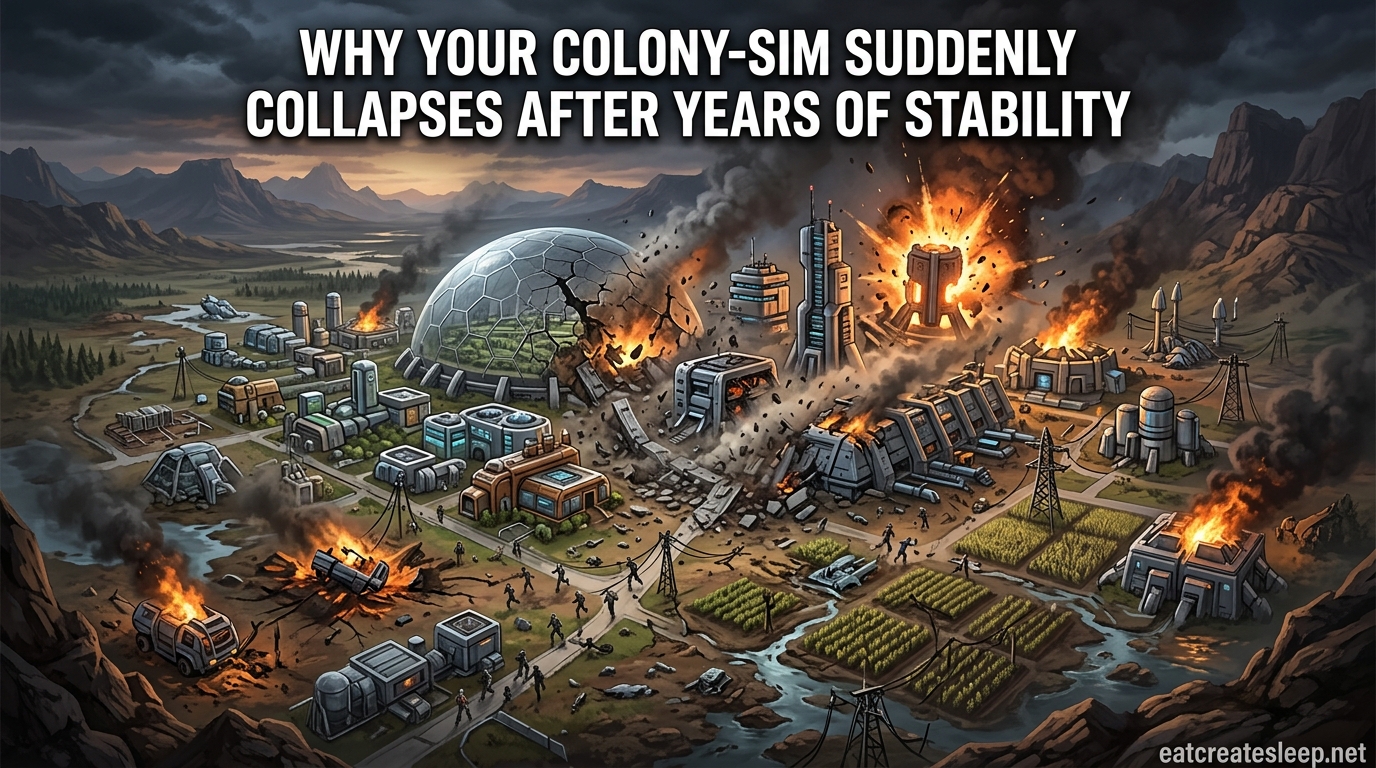
You built it from nothing. Three survivors, a wooden shack, and a dream. Now you are 200 hours deep, your colony is generating more food than it can store, your colonists walk around in power armor, and the killbox has not been seriously threatened in months. Everything is fine.
If you have spent real time in RimWorld, Oxygen Not Included, Factorio, or Dwarf Fortress, you already know exactly what I am describing. This is the moment when a colony sim collapses after stability, and it is one of the most discussed, least explained phenomena in the genre. Players on r/RimWorld and r/Oxygennotincluded have been asking the same question for years: why does a base that survived six years of raids, famines, and toxic fallout suddenly disintegrate when nothing obviously went wrong?
This guide breaks down the real mechanics behind the stability-collapse paradox, draws on community data from across the genre, and gives you concrete strategies to keep your colony alive past the point where most players restart. We will look at why colony sim collapses after stability happen, what warning signs appear before the crash, and how different games handle late-game failure differently.
Table of Contents
Understanding Colony Collapse Mechanics
Colony collapse is what happens when a stable settlement breaks down rapidly after a long period of success. The collapse is rarely caused by a single catastrophic event. Instead, it is the result of small, compounding problems that were masked by overall stability until one trigger event tips the entire system past its recovery point.
Think of it like a Jenga tower. You can pull out a dozen blocks and the structure still stands because the remaining blocks redistribute the load. But every removed block makes the next removal more dangerous, and at some unpredictable point, pulling one more block brings the whole thing down. The tower looked stable right up until the moment it was not.
Colony-sim games are designed around this principle. The systems that create early-game tension (hunger, mood, threats, resource scarcity) do not go away when your colony succeeds. They scale. And the scaling is rarely linear. A colony of 12 colonists eating simple meals needs roughly 1,200 units of raw food per quadrum. A colony of 35 needs 3,500, plus more cooks, more freezers, more haulers, and more space. Every system in the game is now under three times the load, but the player often still manages it with the mental model of a 12-person settlement.
This mismatch between perceived stability and actual structural fragility is what game designers call an unstable equilibrium. Your colony looks balanced, but the balance depends on dozens of conditions all staying true simultaneously. Break one condition and the cascade starts.
Why Stability Itself Can Be Dangerous?
The most counterintuitive thing about colony sims is that stability is often the precondition for collapse. This is what the community calls the stability paradox, and it shows up in nearly every game in the genre.
When your colony is struggling, you are engaged. You are watching every food bar, every mood notification, every approaching raid. Your attention is the most powerful defensive system your colony has, and active threat keeps that attention sharp. When the threat recedes, your attention recedes with it. You start fast-forwarding. You start building that megaproject you have been planning. You stop checking whether the freezer temperature is still below zero because it has been fine for two years.
Meanwhile, the game is still running. Raids scale with colony wealth in RimWorld, so your peaceful, wealthy colony is now generating larger and larger threats that you are paying less and less attention to. Resource consumption keeps climbing. Performance starts degrading as the save file bloats. And because nothing has gone wrong in so long, you have not built redundancies for the things that used to threaten you. You decommissioned the backup power grid last summer because the main one never failed.
Then a solar flare knocks out the main grid during a cold snap, the freezer thaws, food spoils, three colonists break down because they ate raw food and got food poisoning, a raid shows up while half your fighters are bedridden, and suddenly you are in a death spiral that started with a single power outage.
Stability did not cause the collapse. Stability made the collapse possible by eroding the habits that kept the colony alive.
Common Warning Signs Before Collapse
Colonies rarely die without warning. The warning signs are usually there, but players miss them because the colony still looks stable on paper. Here are the signals that experienced players have learned to watch for:
1. Resource buffers quietly shrinking. You used to keep 5,000 meals in storage and now you are hovering around 1,200. The number never hit zero, so you never panicked. But your margin for error has shrunk by 75 percent. A single bad harvest or a disrupted supply line now means famine.
2. Colonist mood trending downward. Not crashing, just slowly drifting. A colony that averaged mood at 75 percent six months ago is now averaging 60 percent. Nobody has had a mental break yet, but the floor is lower than it used to be. One bad event (a loved one dying, a social fight, a tainted food binge) now pushes multiple colonists into break territory simultaneously.
3. Specialization without redundancy. You have one great cook, one great doctor, one great constructor. If your cook gets downed in a raid, nobody else can keep up with meal production. If your doctor dies, wounded colonists start accumulating infections. Specialization is efficient, but it creates single points of failure.
4. Performance issues. The game starts stuttering when you fast-forward. This is not just an annoyance. Performance degradation in colony sims often means the save file is getting unwieldy, pathfinding is struggling with your base layout, or too many entities are being tracked. In Oxygen Not Included and Factorio, late-game performance problems frequently precede cascading mechanical failures because the simulation cannot keep up.
5. Defensive complacency. You have not updated your killbox, your traps are half-depleted, and your colonists are wearing civilian clothes around base because armor slows them down. The defenses that saved you a year ago are still there in theory, but they are no longer maintained at functional levels.
6. Wealth inflation without infrastructure growth. You have been hoarding silver, gold, and valuable items. Your colony wealth has tripled, which means raid points have tripled, but your defensive capacity has stayed the same. You are effectively painting a bigger target on your base without buying a bigger shield.
7. Boredom-driven risk-taking. This is the most dangerous sign. You start taking unnecessary risks because the colony is too safe. You pick a fight with a faction you could have avoided. You settle a second tile. You stop micromanaging combat because you assume your colonists can handle it. Boredom kills more late-game colonies than any raid.
Game-Specific Collapse Mechanics
Every colony sim handles late-game failure differently, and understanding the specific mechanics in each game is essential for long-term survival. Let us look at the three most discussed examples from the community.
RimWorld: The Storyteller Problem
RimWorld is governed by an AI storyteller that controls event pacing and difficulty. The three default storytellers (Cassandra Classic, Phoebe Chillax, and Randy Random) each handle scaling differently, but all of them increase threat points based on your colony wealth and population over time.
This is the core mechanic behind RimWorld collapse. A colony that survived years of threats at moderate wealth now faces threats calibrated for a wealthy, populous settlement. If you have not scaled your defenses proportionally, the storyteller will eventually throw a raid, mechanoid cluster, or infestation that exceeds your defensive capacity. Cassandra is particularly punishing because she scales steadily and consistently, so the threat curve keeps climbing whether or not you are improving your defenses.
The community consensus from r/RimWorld is that colonies typically last between three and five in-game years on average, with dedicated players pushing eight to twelve years. The years two through five window is widely considered the sweet spot where the colony is established enough to be fun but not yet so wealthy that threat scaling becomes unmanageable.
Beyond year five, most collapses come from compound events: a raid coinciding with a disease outbreak, or a toxic fallout hitting during a food shortage. The storyteller is designed to create narrative tension, and tension requires stakes. A stable, wealthy colony is a narrative with no stakes, so the storyteller raises the stakes until something breaks.
Oxygen Not Included: The Stress Spiral
Oxygen Not Included handles collapse differently. Rather than external threats scaling with success, ONI collapses come from internal systems breaking down, most commonly through stress and morale mechanics.
Every duplicant in ONI has a stress meter and a morale requirement. Morale is provided by food quality, room quality, recreation, and downtime. Stress accumulates when morale falls below the requirement dictated by the duplicant’s skill points. Here is where the death spiral begins.
As your colony grows, you assign more skills to duplicants to handle the increased workload. Higher skills mean higher morale requirements. But morale infrastructure (great halls, recreation rooms, good food, atmo suits) does not always keep pace. A duplicant who was comfortable at three skill points now needs 14 morale at six skill points, but you are still feeding them pickled meal and they sleep in a barracks instead of a private bedroom.
Stress builds. A stressed duplicant destroys equipment, vomits, or goes on a destructive binge. The destruction reduces colony efficiency, which means tasks take longer, which means other duplicants get less downtime, which means their stress builds too. This is a textbook cascade failure, and it can take a colony from stable to unrecoverable in under ten cycles.
The r/Oxygennotincluded community has documented this pattern extensively. The most common advice for preventing ONI collapse is to never increase a duplicant’s skill points beyond what your morale infrastructure can support. A lower-skilled, content duplicant is more valuable than a higher-skilled, stressed one.
Factorio: Megabase Performance Death
Factorio does not have mood, stress, or morale systems. Its version of collapse is mechanical and often self-inflicted. The game scales through pollution, which triggers biter attacks, and through logistics complexity, which threatens throughput.
The late-game Factorio collapse usually comes in one of two forms. The first is a biter evolution spike that outpaces your military technology. If you have been generating massive pollution clouds from a sprawling factory, biter evolution has been climbing the entire time. When evolution reaches a certain threshold, large biter bases spawn close enough to your factory that attacks become constant and overwhelming. If your defenses have not scaled with your factory output, the walls fall.
The second, more insidious collapse is throughput death. As your factory grows, your logistics network becomes more complex. A single bottleneck, whether in iron plate supply, power generation, or train network routing, can cause cascading shortages across the entire factory. One assembler stops getting materials, so the assembler downstream stops, so the assembler downstream of that stops, and within minutes your entire production chain is idle.
The Factorio community treats these collapses as design problems rather than survival problems. The solution is not to react faster but to design more robustly: redundant supply lines, buffered intermediates, separated power networks, and military expansion to clear biter nests before evolution makes them unmanageable.
The Psychology of Restart Culture
There is a reason the Reddit threads about stable colonies are often titled things like “When your colony is stable but too stable.” Many players do not experience collapse because the game kills them. They experience collapse because they engineer it.
The community phenomenon known as restart culture describes the pattern where players abandon a stable colony to start a new one, often with a self-imposed challenge or restriction. This is not a failure of the game. It is a feature of how colony sims engage players. The early game is where the genre’s core tension lives: scarcity, danger, and the constant risk of failure. The late game, once stability is achieved, removes that tension.
Players who push past the boredom threshold without restarting often end up creating the conditions for collapse through neglect or deliberate risk-taking. They stop optimizing defenses. They overextend. They pick fights. In a sense, the player becomes the storyteller, generating their own threats because the game has stopped generating satisfying ones.
Understanding this pattern matters because it reframes the question. When players ask why their colony collapses after years of stability, part of the honest answer is that many players subconsciously want it to. A stable colony with no challenges is not what most colony-sim players are looking for. The collapse is not always a failure of management. Sometimes it is the game’s core loop reasserting itself.
Prevention and Survival Strategies
If you want to keep a colony alive past the point where most players restart, you need to treat stability as a threat rather than a goal. Here are the strategies that experienced players across the genre rely on:
1. Maintain redundant systems for every critical function. Two power networks. Two food sources. Two doctors trained to a usable level. If any single system fails, a backup should be ready to take over without you needing to improvise under pressure. Redundancy is expensive in the early game and essential in the late game.
2. Keep resource buffers above historical minimums. Track what your lowest food, medicine, and ammunition reserves were during your hardest moments. Treat those numbers as your floor, not your average. If your food storage drops below that floor for any reason, treat it as a crisis before it becomes a famine.
3. Train every colonist in every critical skill to a baseline level. Specialization is efficient, but cross-training is resilient. You do not need everyone to be a master cook. You need three people who can produce edible meals if your primary cook is incapacitated.
4. Cap colony wealth deliberately. In RimWorld and similar games, wealth drives threat scaling. If your defenses cannot handle the threat level your wealth generates, either reduce wealth (gift surplus to factions, avoid hoarding valuable items) or increase defenses until they match the threat curve.
5. Run regular stress tests. Periodically simulate failure conditions. Turn off the main power grid and see if the backup holds. Stop food production for a quadrum and see how far reserves stretch. Identify your weakest system before the game does it for you.
6. Manage save file health. In games prone to performance degradation (ONI, Factorio, late-stage RimWorld), prune unnecessary entities, limit animal populations, avoid excessive stockpiling of low-value items, and use performance mods if available. A lagging simulation is a simulation that is failing to track the conditions your colony depends on.
7. Set your own endgame goals. If boredom is what kills late-game colonies, give yourself objectives that require sustained effort. Build a ship. Complete the research tree. Establish a second colony under harder conditions. Self-imposed challenges give the late game stakes without relying on the game to generate threats for you.
FAQs
What is the stability of a colony?
Colony stability refers to a state where a settlement’s core systems (food production, mood management, defense, resource supply) are functioning reliably enough that the colony is not under immediate threat of failure. Stability is usually measured by surplus resources, colonist contentment, and the absence of active crises.
What is the average lifespan of a colony in RimWorld?
Based on community data from r/RimWorld, most player colonies last between three and five in-game years on average. Dedicated players with optimized defenses and redundant systems push that to eight to twelve years. Colonies rarely collapse from a single event; they fail when compounded problems exceed recovery capacity.
What is the most common reason for colony collapse?
The most common reason for colony collapse is a cascade failure triggered by a single event hitting a colony with already-eroded safety margins. Typical triggers include raids scaling past defensive capacity, food spoilage during power outages, and mood breaks spreading through a colonist population with low baseline morale. The root cause is usually neglected redundancy, not the trigger event itself.
How common is it for players to have difficulty keeping a colony alive for a long time?
It is very common. Community discussions on r/Oxygennotincluded and r/RimWorld indicate that most players experience late-game collapse multiple times before achieving a long-term stable colony. Newer players in particular struggle with the difficulty curve because early-game habits do not scale into late-game management requirements.
What causes sudden base collapse in colony sims?
Sudden base collapse is typically caused by an unstable equilibrium breaking. The colony appeared stable but was relying on conditions (adequate food reserves, functional power, content colonists) that were already degrading. A trigger event (raid, disease, power failure) removes one condition, and the interconnected systems fail in sequence because there is no redundancy to absorb the shock.
How do I prevent colony collapse after years of stability?
Prevent collapse by maintaining redundant systems for every critical function, keeping resource buffers above historical minimums, cross-training colonists in multiple skills, capping colony wealth to match defensive capacity, running regular stress tests on your infrastructure, and managing save file health to avoid performance degradation. Treat stability as a signal to reinforce, not to relax.
Conclusion
When your colony sim collapses after stability, the collapse is rarely random. It is the visible result of invisible decay: shrinking buffers, drifting moods, eroding redundancy, and attention that faded along with the perceived threat. The genre is built on unstable equilibriums, and the games are designed to punish complacency.
The players who hold colonies together for a decade or more are not luckier than the rest of us. They build redundancy, respect scaling, and treat a quiet colony as a warning sign rather than a victory lap. If your next colony falls apart after years of stability, look past the triggering event. The real cause started long before the crash, in the months when everything seemed fine.