
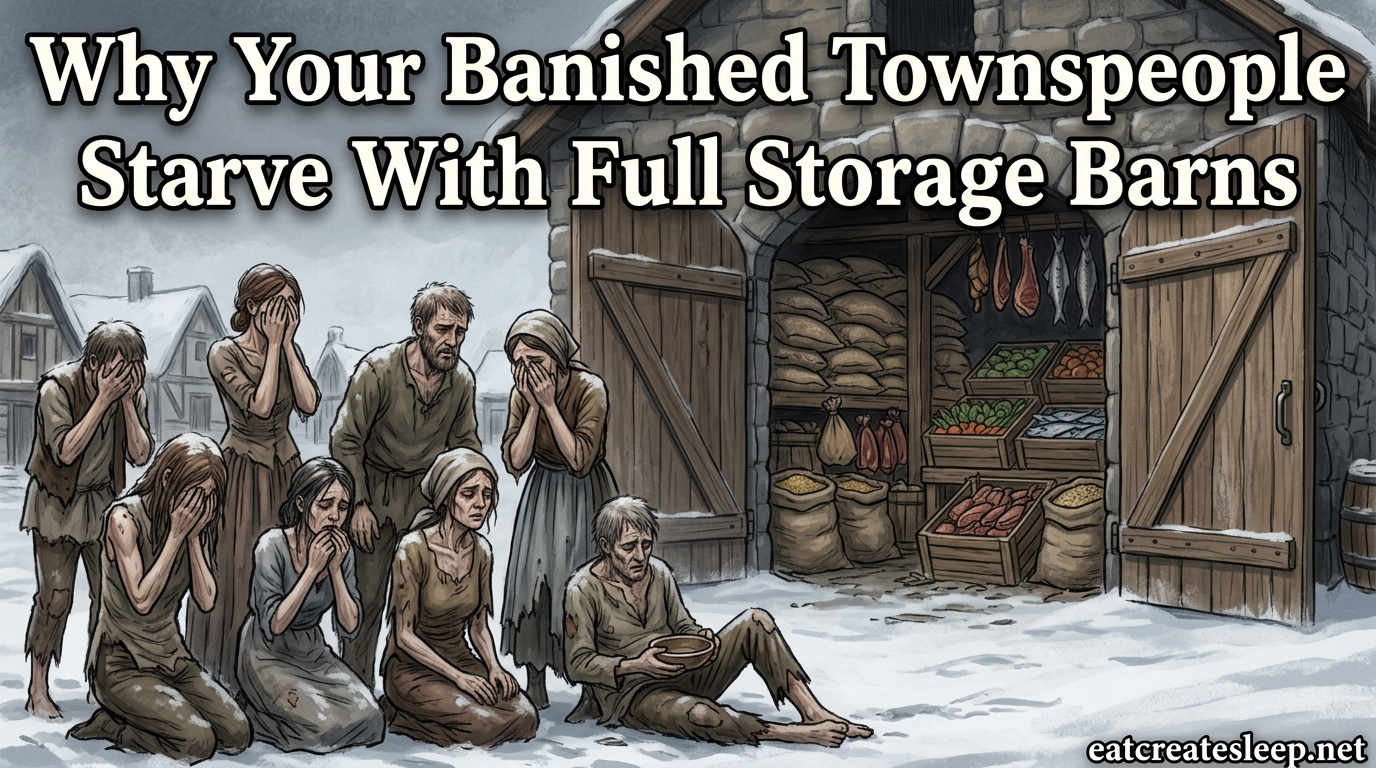
You check your town overview and see 2,000 food stored safely in your barns. A moment later, the dreaded red skull icon pops up over a villager. Then another. Then a child. Despite the numbers on your screen, Banished starvation with full storage barns is one of the most frustrating and counter-intuitive mechanics in the entire game.
If this has happened to you, you are not alone. Since Shining Rock Software released Banished in 2014, players on Reddit, Steam, and the gaming.stackexchange forums have reported the same baffling scenario: stockpiles full, citizens dropping dead from hunger. This guide breaks down exactly why your Banished townspeople starve with full storage barns, what the game’s hidden mechanics are doing behind the scenes, and how to fix every common cause.
The short version: in Banished, having food is not the same as eating food. Food sitting in a barn does not magically teleport into stomachs. Villagers have to physically walk to storage, pick food up, and carry it home. When that journey is too long, when barns are clogged with leather and wool, or when your laborer supply chain breaks down, starvation kills even in a town that looks wealthy on paper.
Table of Contents
The Four Real Reasons Villagers Starve With Full Barns
Why your Banished townspeople starve with full storage barns almost always comes down to one of these four root causes:
- The pathing problem – villagers die on long walks between work, barn, and home.
- Storage barn space pollution – non-food items like leather, wool, and tools crowd out edible goods.
- Food distribution AI – citizens only pull food from the single nearest barn, ignoring food elsewhere.
- The “food dance of death” – carrying capacity limits cause a labor trap where workers carry food instead of producing it.
The rest of this article walks through each cause in depth, then gives you a solutions section you can put into practice immediately.
Root Cause #1: The Pathing Problem – Villagers Starve On The Walk Home
The single most common reason players see Banished starvation with full storage barns is pathing distance. Banished’s citizens are not abstracted spreadsheet entries. They are physical agents who must walk to a barn, collect food, and walk it back to their house before their hunger meter runs out.
Every adult villager has a hunger meter that depletes continuously. When it gets low enough, the villager stops whatever task they are doing and heads to the nearest food source. If that source is close, they eat, refill, and go back to work. If that source is a long walk away – especially across a river with only one bridge, or up a mountain – they can literally die before reaching it.
How Banished’s Pathing AI Works
Banished uses a simple but rigid pathing system. When a villager needs food, the AI picks a destination using a basic nearest-distance calculation. The villager then walks in a straight-ish line along valid path tiles to get there. There is no intelligent re-routing, no concept of “this barn is closer as the crow flies but the walk is twice as long because of the river.”
This is why bridges cause so many starvation deaths. A villager on one side of a river may path to a barn that is geographically close but requires walking all the way to the only bridge, crossing, then walking back. By the time they arrive, they have already collapsed.
Real Player Example
One Steam community player documented the exact death spiral: a citizen walked to the nearest storage barn, found no food that met their needs, ran back home empty-handed, then ran to a second barn further away. They died en route. The player had 692 food stored and only 16 people – on paper, more than enough. The food existed. The villager simply could not reach it in time.
This is the core paradox of Banished starvation: the food exists, but existence is not access. Your storage total is a lie if your citizens cannot physically walk to where the food is.
Root Cause #2: Storage Barn Space Pollution – Leather, Wool, and Tools
The second major cause is one most guides miss entirely: storage barns do not store only food. A Banished storage barn holds every small-sized resource your town produces. That includes food, yes, but also logs, stone, iron, tools, clothing, leather, wool, firewood, and herbs.
Each storage barn has a fixed capacity – 6,000 units of weight. When your hunters bring in leather, your shepherds bring in wool, and your tailors produce coats, all of that sits in the same barn as your food. Over time, non-food items can quietly consume a large percentage of your barn’s total capacity.
The Hidden Trap
Here is where it gets nasty. A barn can show as “full” on your overview, but be full of leather, wool, and tools rather than food. Your town looks wealthy, but the actual edible inventory is tiny – sometimes just a few hundred units. New food produced by gatherers and fishermen has nowhere to go, so it sits at the production building, uneaten.
Players on the Banished wiki and Reddit have confirmed this repeatedly. A town with 4,000 units stored might only have 800 actual food. The rest is leather, wool, coats, and iron. When your citizens go to the barn to eat, there may not be enough variety – or enough volume – to feed everyone before the next production cycle.
Stockpile vs Storage Barn
Banished has two storage systems, and confusion between them causes problems. The stockpile is an outdoor area that holds raw materials: logs, stone, and iron ore. The storage barn is enclosed and holds food, tools, clothing, herbs, and other finished goods. If you do not build enough stockpiles, raw materials overflow into your barns and eat into food capacity. If you do not build enough barns, food has nowhere to be stored and rots (metaphorically) at the source.
The fix is two-fold: keep your stockpiles large enough that logs and stone never migrate into barns, and build enough barns that food-producing buildings always have room to drop off their goods. A general rule is one storage barn per major production cluster, plus extras as your population grows.
Root Cause #3: Food Distribution AI – Citizens Only Use The Nearest Barn
This is the mechanic that breaks the most experienced players. In Banished, a citizen does not intelligently search all barns in town for food. They use the nearest storage barn, period. If that barn is empty or out of food variety, they do not path to the next closest one automatically – they may walk back home hungry and then try a different barn, wasting precious time.
The Steam community thread on this issue describes the exact behavior: citizens walk to the nearest barn, fail to pick up food, run back to their house, then path to a second barn. The double-walk is often fatal. This is why your Banished townspeople starve with full storage barns even when the second barn nearby is overflowing.
Why Multiple Barns Can Make Things Worse
Many players intuitively build multiple storage barns to “spread out” food. This can backfire. If Barn A is next to a housing cluster but Barn B (which has all the food) is across the map, the citizens nearest Barn A will keep walking to it, finding nothing, and either dying or wasting huge amounts of time. The food in Barn B might as well not exist for them.
This is also why a centralized single barn can sometimes work better than several distributed ones – but only early game. Once your town grows past 30-40 citizens, a single barn creates bottlenecks at the pathing layer and the laborer layer.
The Market Solution
The market exists to solve exactly this problem. A vendor at the market collects goods from all barns and stockpiles within its radius and redistributes them to citizens in that area. Citizens inside a market’s coverage can shop at the market instead of walking to a distant barn. This dramatically cuts down on travel distance and prevents the “walk to empty barn, walk home, walk to other barn” death loop.
The key insight: markets are not a luxury building. They are the answer to Banished food distribution problems once your town reaches a certain size. Build a market as soon as you can staff it with vendors, and place houses around it rather than scattering them across the map.
Root Cause #4: The “Food Dance Of Death” – Carrying Capacity Trap
This is the most insidious cause of Banished starvation with full storage barns, and the one that catches even veteran players off guard. The community calls it the “food dance of death.” Once you understand it, you will see it everywhere in struggling towns.
How The Food Dance Of Death Works
Every Banished citizen has a fixed carrying capacity. An adult can carry 100 units of weight. A child can carry 50. A trader or specialized merchant can carry more. When a laborer or worker finishes producing food at a gatherer’s hut, fishing post, or farm, they do not carry that food to the barn themselves. Instead, they drop it at the production building and a laborer is dispatched to move it to storage.
Here is where the trap springs. If you do not have enough free laborers, food piles up at production buildings and never reaches the barn. Citizens trying to eat walk to the barn, find it empty, and starve – even though food is sitting 20 tiles away at the fishery, untouched.
The “dance” begins when the system gets worse. As more citizens starve, your laborer pool shrinks. As your laborer pool shrinks, less food gets moved to barns. As less food reaches barns, more citizens starve. The spiral accelerates rapidly and can wipe out a town in a single season.
The 100 Unit Limit And Why It Matters
The carrying capacity of 100 units per adult is hard-coded. A fisherman catching 8 fish at a time can move them only in batches. A farmer harvesting a field makes dozens of trips. When food reserves get critically low, every adult in your town becomes a food-carrier instead of a food-producer. Production collapses, the death spiral compounds, and your town dies despite the appearance of “plenty” on the overview screen.
The classic Reddit thread on Banished data and tips describes it precisely: when reserves run low, “workers constantly carry 8 fish” back and forth, never producing net new food. The town looks busy. The barns look active. But the system is eating itself alive.
Children Make It Worse
Children can only carry 50 units, and they cannot work production jobs. A town with too many children and not enough adults enters the food dance of death faster, because the carrying capacity per capita drops while the mouths to feed keep growing. Manage your population growth carefully – too many houses built too fast means too many children means not enough laborers means starvation.
How To Prevent Starvation In Banished – Practical Solutions
Now that you understand why your Banished townspeople starve with full storage barns, here are the practical fixes. Each one addresses a specific root cause from the list above.
1. Build Barns Near Every Housing Cluster
The single most effective fix is distributed storage. Instead of one mega-barn in the town center, place a storage barn next to every cluster of 5-8 houses. Citizens should be able to walk from their front door to a barn in under 10 seconds of game time. This eliminates the pathing starvation death almost entirely.
Pair each barn with a stockpile so raw materials have somewhere to go. Keep barns close to food production buildings – gatherer’s huts, fisheries, and farms should have a barn within a few tiles so laborers do not waste time walking.
2. Build A Market Once You Pass 30 Citizens
The market is the single best starvation prevention tool in the mid and late game. Place it at the center of your housing zone, staff it with at least 2-3 vendors, and make sure its coverage radius includes most of your homes. Vendors will pull food and goods from every barn in range and distribute them locally, eliminating the “nearest barn only” AI problem.
Build houses around the market, not in random clusters across the map. The market radius is your housing boundary until you build a second market.
3. Keep A Laborer Surplus At All Times
Never let your laborer count drop to zero. Laborers are the unsung heroes of Banished – they move food from production buildings to barns, they haul logs and stone, they clear land. Without enough of them, the food dance of death begins.
A good rule: maintain at least 10-15% of your adult population as unassigned laborers at all times. If your laborer count drops below 5, you are one bad harvest away from a death spiral. Pull workers from non-essential jobs (stonecutter, extra tailors, etc.) back into the laborer pool before it is too late.
4. Limit Housing Sprawl And Population Growth
Every new house creates new adults who want children. Children eat food but cannot produce it efficiently. Build houses slowly – one or two at a time, not in blocks of ten. Watch your student and child population in the town overview. If children outnumber working adults, you are in danger.
A steady-state growth rate of 2-3 new houses per year is safer than 10 houses at once. Boring, maybe, but stable.
5. Build Trading Posts Early
Trading posts solve two problems at once. First, they let you convert excess food and goods into a stream of imports – you can trade leather, wool, and tools (the very items clogging your barn) for food varieties you cannot produce locally. Second, merchants who arrive by river have a 500-unit carrying capacity, dramatically outperforming your own laborers for moving bulk goods.
Build a trading post as soon as you have a river edge available. Even early game, the ability to offload excess leather for food is a lifesaver.
6. Diversify Food Production
Banished citizens need food variety, not just raw calories. A barn with 5,000 units of only fish will still trigger hunger complaints. Build a mix of gatherer’s huts (forest goods), fisheries, hunter’s lodges (meat), crop fields (grain and vegetables), and orchards (fruit). Aim for at least 4-5 distinct food types in storage at all times.
Gatherer’s huts in dense forests are the most calorie-efficient food source per worker in the early game. Pastures and crop fields scale better in the mid and late game. Fishing posts are reliable but only produce one food type.
7. Use The Priority Tool Sparingly
The priority tool (the up-arrow icon) lets you flag resources for immediate collection. Used well, it can break a laborer logjam by forcing them to move critical food to a barn. Used badly, it pulls every laborer off their current task and creates chaos.
Reserve the priority tool for emergencies: a production building overflowing with food while a nearby barn sits empty. Click the food pile at the source, set priority, and laborers will rush to move it. Cancel the priority once the food reaches the barn.
Food Production Methods – A Quick Comparison
Players often ask what produces the most food in Banished. The answer depends on worker count, biome, and game stage, but here is a general ranking based on community-tested data.
Gatherer’s hut – the early-game champion. A single gatherer’s hut in a dense old-growth forest can produce 1,000-2,000 food per year with 4 workers. It also produces four different food types (roots, berries, mushrooms, onions), which helps with the variety requirement.
Fishing post – consistent and low-maintenance. Produces 600-1,000 fish per year on a good lake or river spot. Only one food type, so pair with other sources.
Hunter’s lodge – moderate food output but also produces leather, which you need for clothing. About 400-800 food per year plus hides.
Crop field – high yield per tile but labor-intensive and vulnerable to early frost. A 15×15 field staffed by 4 educated farmers can produce 800-1,500 food per year if harvested before winter.
Pasture – produces meat and wool or leather. Slower to ramp up since livestock must breed, but very stable once established.
Orchard – long-term investment. Takes 3-4 years to mature, then produces fruit steadily. Not a solution for early-game starvation.
For most towns, the best early combination is one gatherer’s hut, one fishing post, and one hunter’s lodge clustered near your first barn. Add crop fields once you have 20+ educated adults.
FAQs
How do you avoid starvation in Banished?
Build a storage barn within walking distance of every housing cluster, construct a market once your population passes 30, keep at least 10-15% of adults as unassigned laborers, diversify food production across 4-5 food types, and limit housing growth to 2-3 new houses per year. Place trading posts early so you can offload leather and wool for imported food.
Why do townspeople starve with full storage barns in Banished?
Townspeople starve because villagers can only access food by physically walking to the nearest barn and carrying it home. If the nearest barn is too far, has no food variety, or is clogged with non-food items like leather and wool, citizens die en route or return empty-handed. The food exists in your town but cannot reach mouths fast enough.
What produces the most food in Banished?
The gatherer’s hut is the most calorie-efficient early-game food source, producing 1,000-2,000 food per year with 4 workers in a dense forest. Crop fields staffed by educated farmers out-scale gatherers in the mid and late game, yielding 800-1,500 food per 15×15 field. Fishing posts are reliable at 600-1,000 fish per year but only produce one food type.
What is the cause of death in starvation in Banished?
In Banished, starvation death occurs when a citizen’s hunger meter fully depletes. The most common trigger is a long walk to the nearest storage barn with no food arriving in time, often compounded by the food dance of death where laborers are too few to move food from production buildings to barns. Citizens die physically in transit, not from a lack of food in the abstract.
Conclusion – Stop Trusting Your Storage Numbers
Understanding why your Banished townspeople starve with full storage barns requires letting go of one assumption: that the food number on your overview screen tells you anything useful about whether your citizens can actually eat. It does not. Food only matters if it is close enough to walk to, varied enough to satisfy, and free of competition from leather, wool, and tools crowding the barn.
The four root causes – pathing distance, storage pollution, nearest-barn-only AI, and the food dance of death – all share one fix: design your town around the walk, not the storage total. Put barns near homes, build markets in mature towns, keep laborers in reserve, and grow your population slowly. Do that, and the red skulls will stop appearing no matter how large your town gets.
Banished rewards patience and punishes overconfidence. The next time your storage number looks healthy and a citizen drops dead anyway, do not blame the game. Follow the citizen with the info panel, watch where they walk, and you will see exactly which of the four causes is at work. Fix the layout, not the number.