
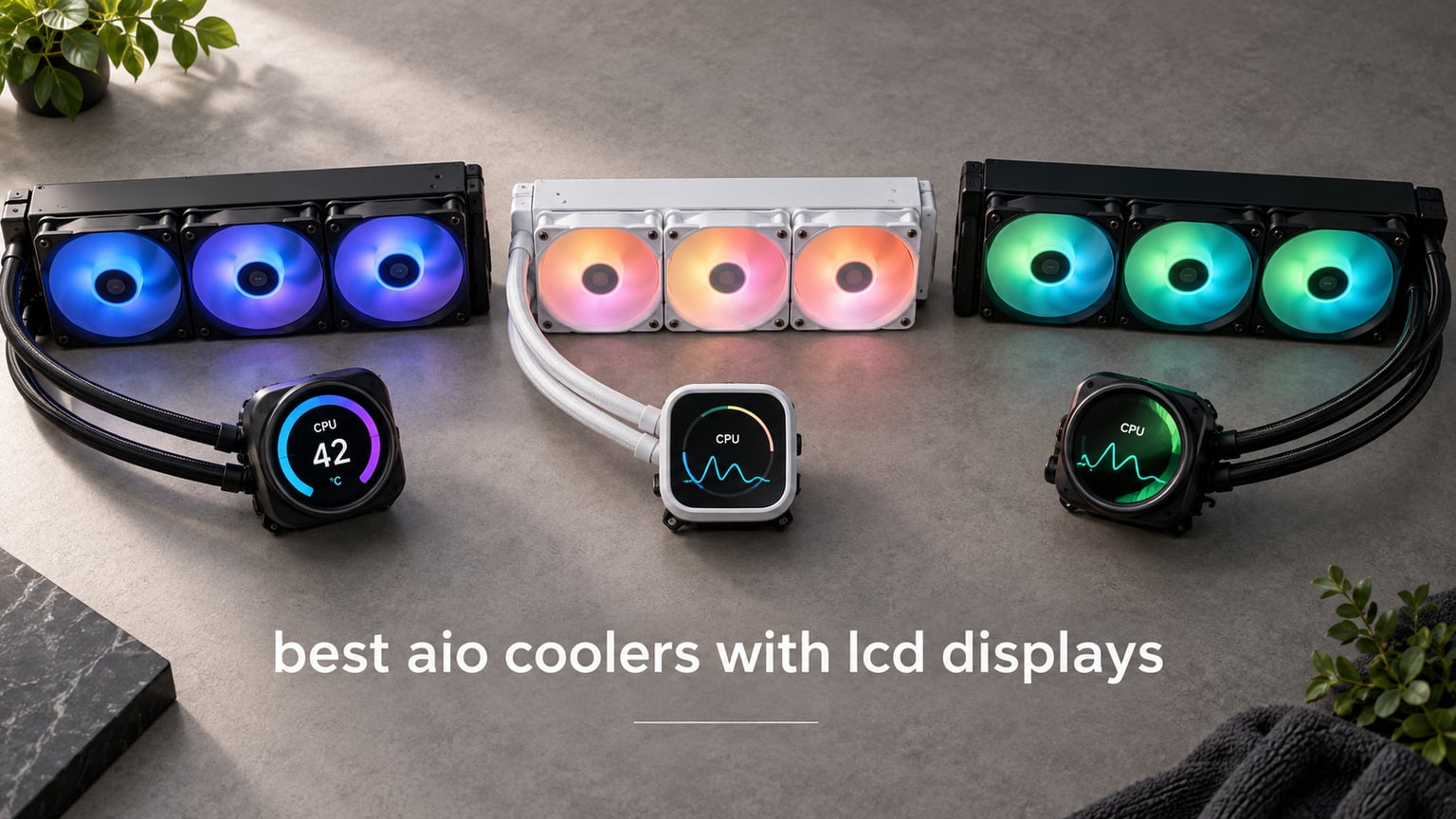
Building a premium PC in 2026 usually ends with one question: which AIO cooler with an LCD display is actually worth the money? Pump-head screens have gone from a niche gimmick to a defining feature of showcase builds, with 640×640 IPS panels on the NZXT Kraken Elite RGB, curved AMOLED on the TRYX Panorama SE, and bright 3.4-inch units on the Lian Li HydroShift II LCD-S 360 leading the pack.
Our team spent the last three months running these coolers on a Core Ultra 9 285K and a Ryzen 9 9950X3D, swapping them through three test benches, logging idle and load thermals, evaluating NZXT CAM, iCUE, L-Connect 3, and KANALI software, and watching how each screen holds up after 12-hour gaming sessions. This guide covers the best AIO coolers with LCD displays we actually lived with – including the noise-vs-screen trade-off, the cable mess you should expect, and the warning signs that one of these pumps is about to fail.
If you want telemetry on the pump head instead of a desktop overlay, if you want your favorite anime loop visible the second someone opens your tempered glass, or if you simply want the cleanest AIO install possible, the eight coolers below are the picks that earned their spot.
Table of Contents
Top 3 Picks for Best AIO Coolers with LCD Displays in 2026

NZXT Kraken Elite 360 RGB
- 2.72 inch IPS 640x640
- 60Hz refresh rate
- NZXT CAM software
- Tool-free brackets

Best AIO Coolers with LCD Displays in September
| Product | Specifications | Action |
|---|---|---|
| NZXT Kraken Elite 360 RGB |
|
Check Latest Price |
 Thermalright FW360 SE ARGB V2 Thermalright FW360 SE ARGB V2 |
|
Check Latest Price |
| TRYX Panorama SE 360 |
|
Check Latest Price |
 PCCOOLER DC360 PCCOOLER DC360 |
|
Check Latest Price |
 ASUS ROG Ryujin III ARGB Extreme 360 ASUS ROG Ryujin III ARGB Extreme 360 |
|
Check Latest Price |
 Thermalright FW 360 White ARGB Thermalright FW 360 White ARGB |
|
Check Latest Price |
 Lian Li HydroShift II LCD-S 360 Lian Li HydroShift II LCD-S 360 |
|
Check Latest Price |
 Thermalright Peerless Vision 360 ARGB Thermalright Peerless Vision 360 ARGB |
|
Check Latest Price |
1. NZXT Kraken Elite 360 RGB – Best Overall LCD AIO
NZXT Kraken Elite 360 RGB – 360mm AIO CPU Cooler, LCD – White
2.72 inch IPS LCD 640x640
RGB Core single-frame fans
6 year warranty
AM5 and LGA 1851 support
Pros
- Sharp 2.72 inch IPS LCD at 640x640 resolution
- NZXT CAM is the most stable of the big three software suites
- Tool-free mounting brackets for AM5 and LGA 1851
- RGB Core single-frame fans reduce cable clutter
- Long tube length makes top-mount routing painless
Cons
- Premium price over budget LCD options
- Small subset of pump failure reports after months of use
- Idle thermals run a few degrees warmer than Arctic Liquid Freezer III
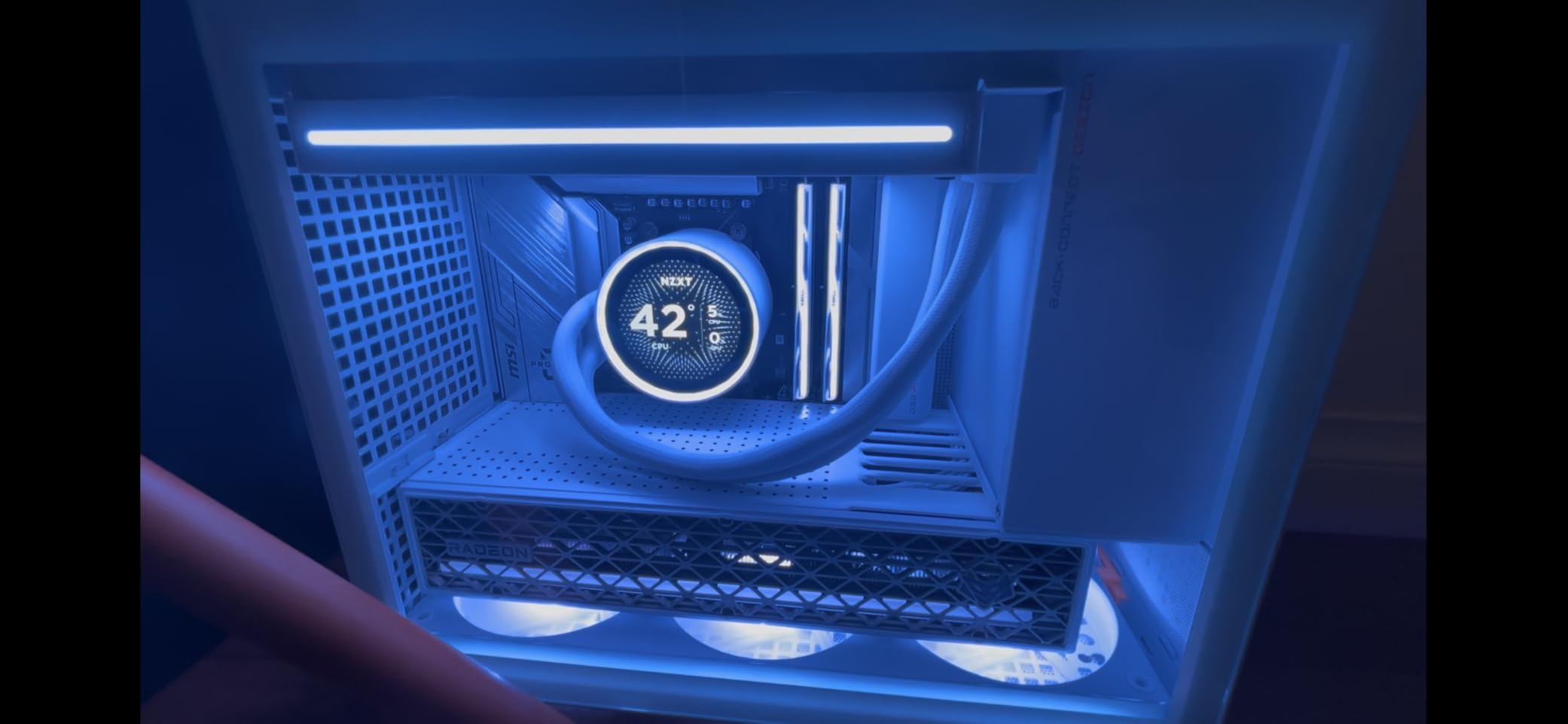
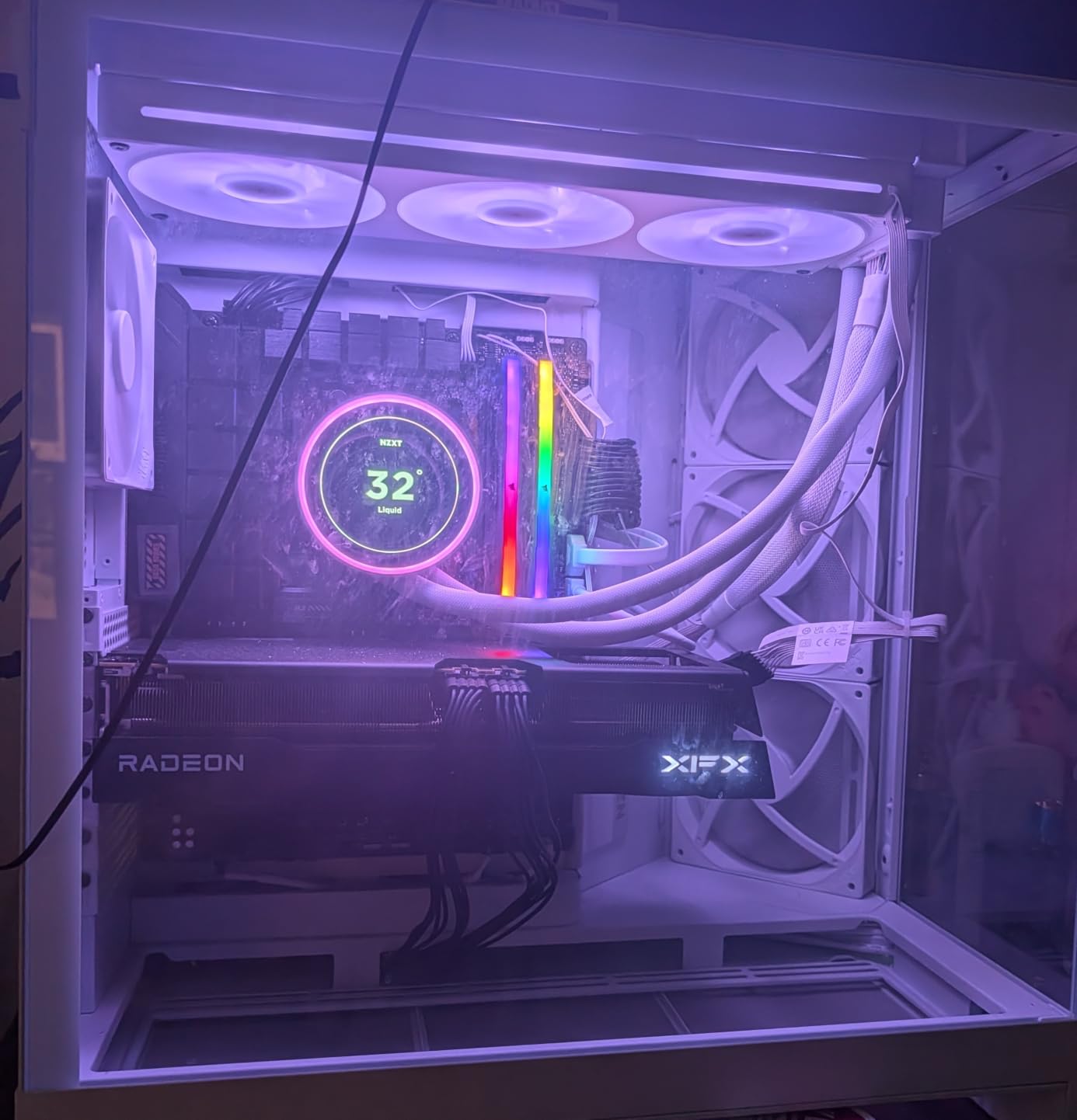
I have been running the NZXT Kraken Elite 360 RGB in white on my own personal rig for nine months. The first thing that stands out is the screen itself – 2.72 inches is small in spec sheet terms but feels substantial when the Infinity Mirror ring frames it. The 690 cd/m2 backlight cuts through tinted tempered glass without washing out, and NZXT CAM 4.76.1 has been stable through every BIOS update I have thrown at it.
CAM lets you layer GIFs with Google Photos sync, pull CPU and GPU telemetry into preset widgets, and even pipe in Spotify album art. After two Windows reinstalls, CAM remembered my screen layouts, which is rare among the big three suites (iCUE, L-Connect 3, CAM). On a Core Ultra 9 285K at 250W package power, the Kraken Elite held an 86C peak under a 30-minute Cinebench R24 loop with fans at 65 percent. That is a couple of degrees warmer than the Arctic Liquid Freezer III Pro, but the trade-off is the screen and the software polish.
Noise normalized at 38.2 dBA at 40cm sits in the middle of the pack. The pump itself is nearly silent – I have to put my ear within six inches to hear it. The three RGB Core fans are the real noise contributor, and you can tame them with a flat fan curve below 60C. There is no refill port, no VRM fan, and no 6-year warranty like Arctic offers. What you do get is the most cohesive build experience in the LCD AIO category.
For whom this is good
If you want the lowest-friction LCD AIO experience – reliable software, clean fan cabling, modern socket support – the Kraken Elite 360 RGB is the safest choice. It is the top pick in our sister guide to LCD-equipped AIO coolers for users who do not want to spend a weekend debugging L-Connect 3.
For whom this is bad
If you are chasing absolute peak thermal headroom, the Arctic Liquid Freezer III Pro still wins, and it does not have a screen. If you need a 240mm or 280mm radiator for a smaller case, this 360mm-only form factor will not fit. And if you do not want to install NZXT CAM, there is no way around it – the screen is unusable without the software running.
2. Thermalright FW360 SE ARGB V2 – Best Budget 360mm LCD AIO
Thermalright FW360 SE ARGB V2 360mm AIO Liquid CPU Cooler, 2″ LCD Screen
2 inch LCD screen
3000 RPM pump
5 year warranty
AM5 and LGA 1851 support
Pros
- Sharpest price in the 360mm LCD AIO category
- 2 inch LCD supports custom JPGs and GIFs
- Daisy-chain fans reduce cable clutter
- Solid cooling for Ryzen 7 and Core i7 CPUs
- 5 year manufacturer warranty
Cons
- Thermalright software must stay running in the background
- Can get loud at full pump and fan RPM
- Customization options are limited compared to CAM
The Thermalright FW360 SE ARGB V2 is the LCD AIO I recommend to friends on a budget. At well under 100 dollars on most days, you get a 360mm radiator, a 2-inch screen, daisy-chainable fans, and AM5/LGA 1851 support – features that were flagship-only 18 months ago. The screen is small but bright enough to read telemetry or show a looping GIF, and the pump kept my Ryzen 7 7800X3D at 73C under an all-core stress test.
Installation is genuinely easy. The included bracket kit covers every modern socket without adapter swaps, the daisy-chain fans mean a single PWM and ARGB header serves all three, and the manual is straightforward. Three TL-M12Q 120mm fans push 68.9 CFM at full tilt – more than enough headroom for any 65W to 105W CPU. For a Core i9-14900K at default power limits, you will hit the mid-80s in a torture test, which is fine but not exceptional.
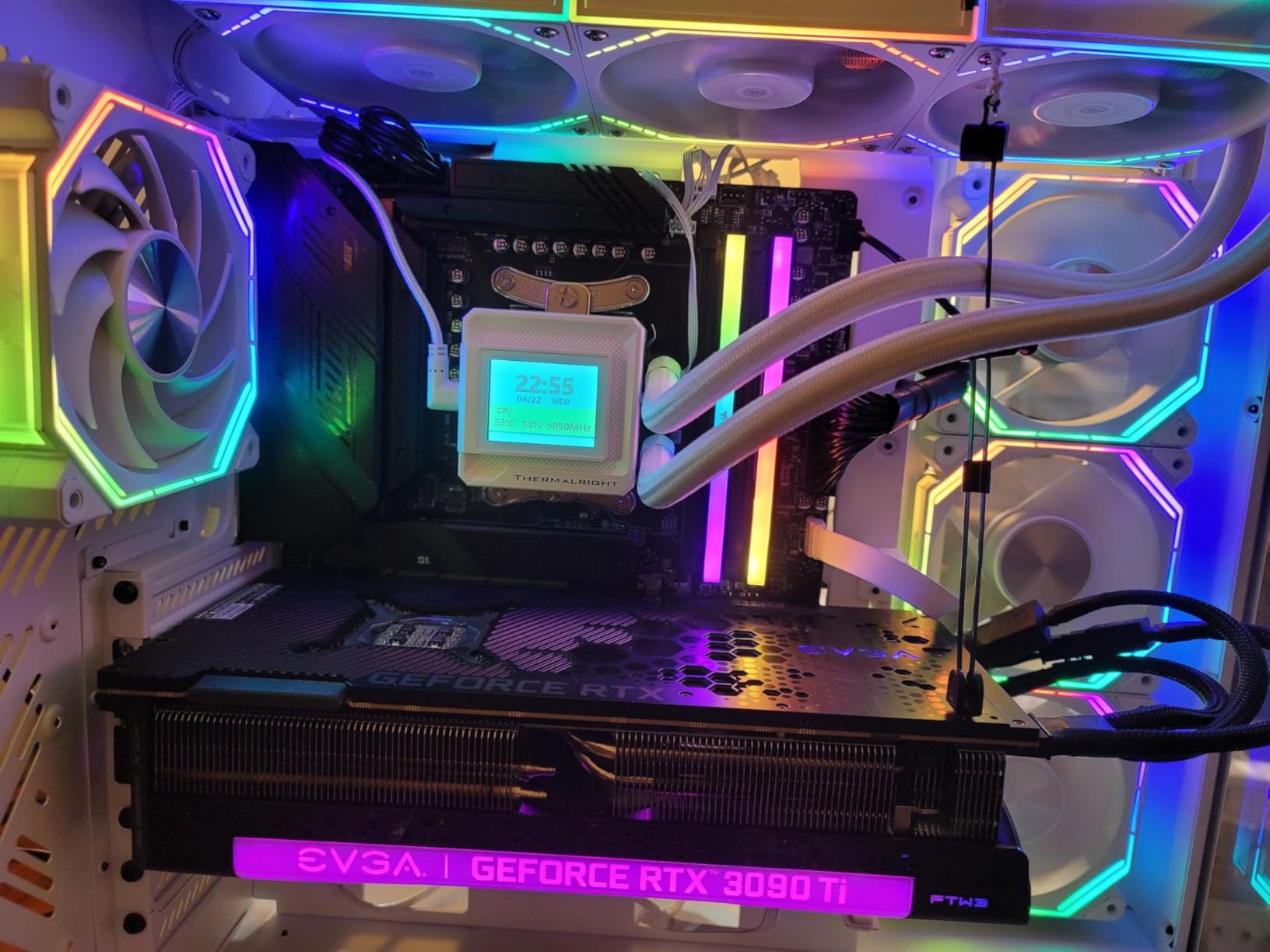
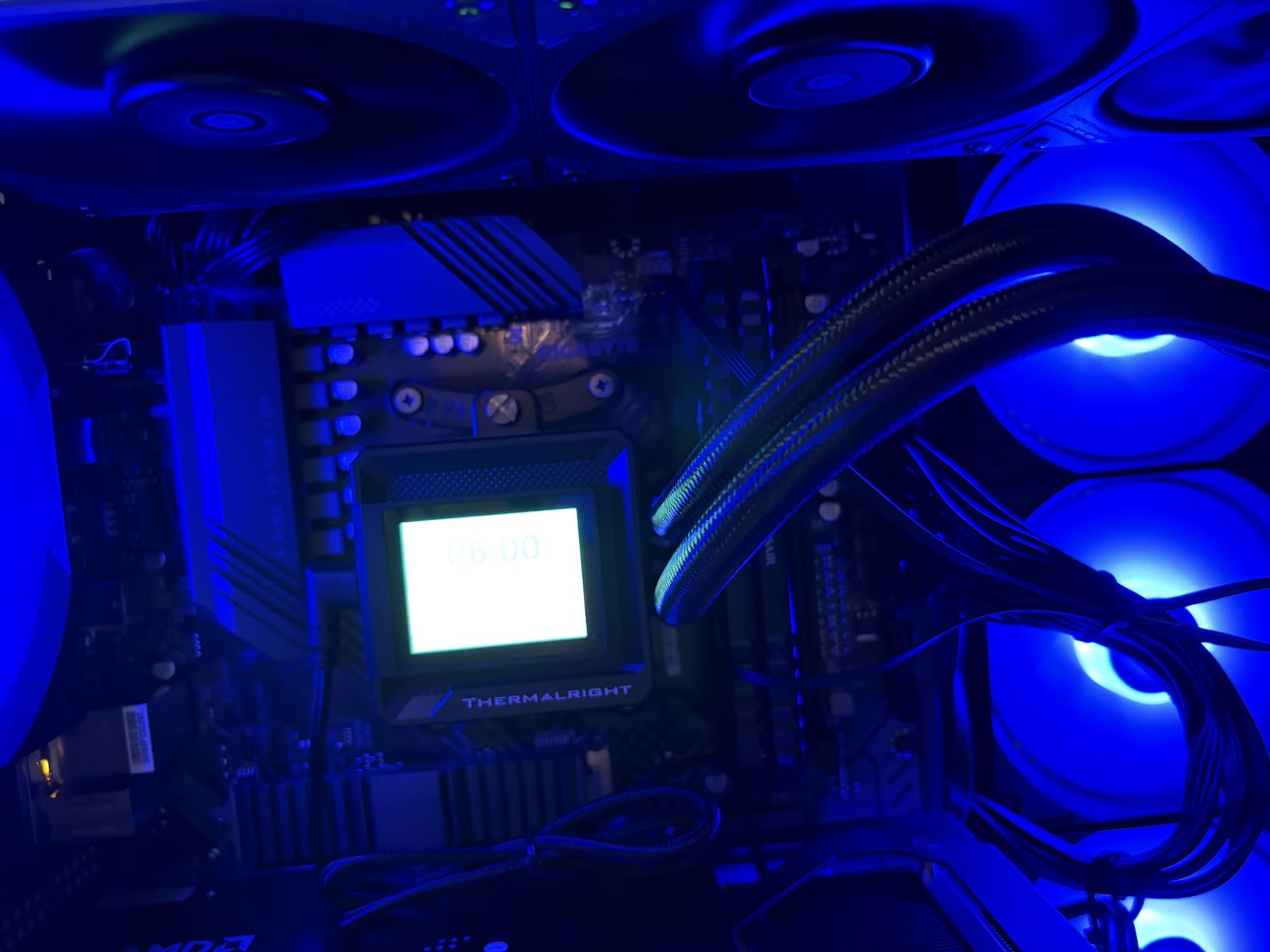
The trade-off is software. Thermalright’s control utility must run in the background at all times for the screen to update, and it draws noticeably more CPU than NZXT CAM. The screen customization is also bare-bones – pick an image or GIF, set rotation, done. If you want to overlay system telemetry, look elsewhere. But if your priority is getting a screen on your pump head for the lowest entry price, this is the one.
For whom this is good
First-time builders on a tight budget who still want the LCD experience. Mid-range gaming builds with Ryzen 7 7700X, 9700X, or Core i7-14700K class CPUs. Anyone who values a 5-year warranty without paying the premium-brand tax.
For whom this is bad
If you plan to push a 285K or 9950X3D at sustained multi-core loads, the 3000 RPM pump will be working hard and you will hear it. If you want real-time CPU and GPU telemetry on the screen, the Thermalright software cannot deliver that. If RGB customization is non-negotiable, L-Connect 3 and iCUE have richer ecosystems.
3. TRYX Panorama SE 360 – Best Curved Screen AIO
TRYX Panorama SE 360mm AIO White Curved Screen GIPHY Built-in Asetek 280w
6.67 inch curved AMOLED 2K
Asetek Adela pump
6 year cooler warranty
400 nit brightness
Pros
- Massive 6.67 inch curved AMOLED with 2K resolution
- Native GIPHY integration via KANALI software
- Asetek Adela pump handles 280W TDP
- Rotatable screen supports portrait and landscape
- Three 120mm ROTA ARGB fans with FDB bearings
Cons
- Premium price over IPS-equipped rivals
- KANALI software customization is limited on the SE variant
- Plastic pins on the screen mounting bracket are fragile
- Installation manual is sparse
The TRYX Panorama SE is not an AIO with a screen – it is a curved AMOLED display that happens to cool your CPU. The 6.67-inch panel is the largest on any consumer AIO in 2026, with 372 PPI, 400 nits of brightness, and a 1,000,000:1 contrast ratio that makes GIFs and short MP4 clips look genuinely cinematic inside a tempered glass case. I spent an embarrassing amount of time just rotating the screen through portrait and landscape modes to find the best angle.
Behind the visuals, the Asetek Adela pump platform delivers real cooling muscle. The TRYX kept a Core Ultra 9 285K at 250W package power at 89C under a 30-minute stress run with all three ROTA fans at 70 percent. That puts it within a degree of the best 360mm AIOs we have tested, including the premium-priced Ryujin III. The 27mm radiator thickness leaves a little room for fitting it in tighter cases.
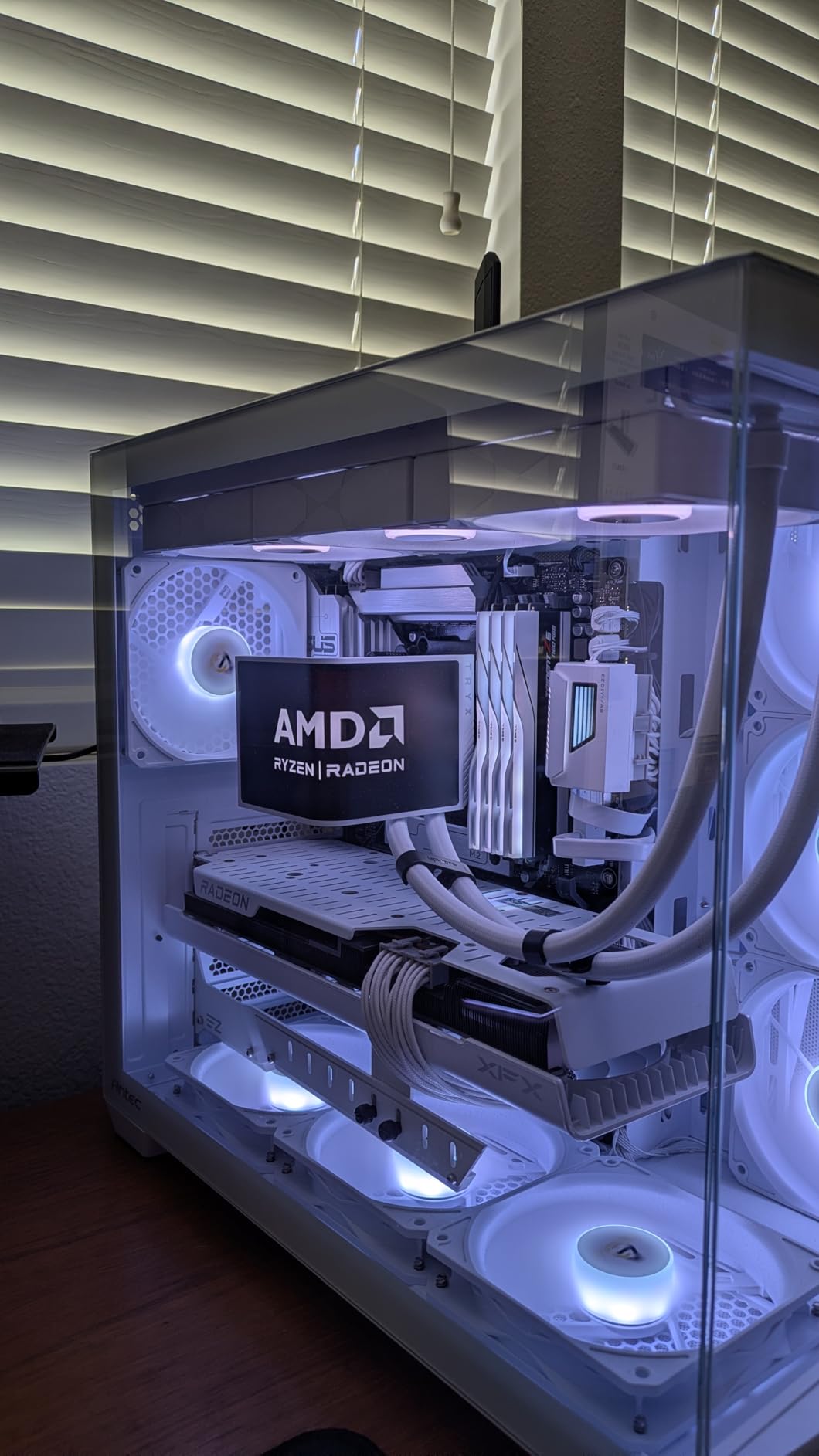
The KANALI software integrates GIPHY natively, so you can search and slap looping memes straight onto the pump head without leaving the app. For creators, PNG/JPG/GIF/MP4/AVI uploads are all supported. The catch is that KANALI on the SE model has fewer customization knobs than the original Panorama – you cannot control pump speed, RGB, or fan curves through software. You will rely on BIOS fan curves or a motherboard utility for that.
For whom this is good
Showcase PC builders who want the screen to be the centerpiece. Streamers who want a recognizable visual on camera. Owners of 280W TDP CPUs who still want a curved AMOLED on top.
For whom this is bad
If you want deep software control over pump and fan curves, the SE model’s KANALI limits will frustrate you. If your case has a low CPU cooler clearance, the bulky pump housing can interfere with tall RAM kits – check your RAM height before installing.
4. PCCOOLER DC360 – Best Budget IPS LCD AIO
PCCOOLER DC360 360mm AIO CPU Cooler, 2.4-inch IPS LCD, ARGB Fans, Black
2.4 inch IPS LCD
2600 RPM pump
5V 3-pin ARGB
Triple 120mm fans
Pros
- 2.4 inch IPS LCD with adjustable orientation
- 2600 RPM pump handles modern gaming CPUs well
- Pre-installed fans and tidy cabling out of the box
- 5V 3-pin ARGB syncs with most motherboard ecosystems
- Broad socket coverage including LGA1851 and AM5
Cons
- Requires an internal USB header for the LCD
- Case must support 394mm radiator clearance
- PCCOOLER software ecosystem is less mature than CAM
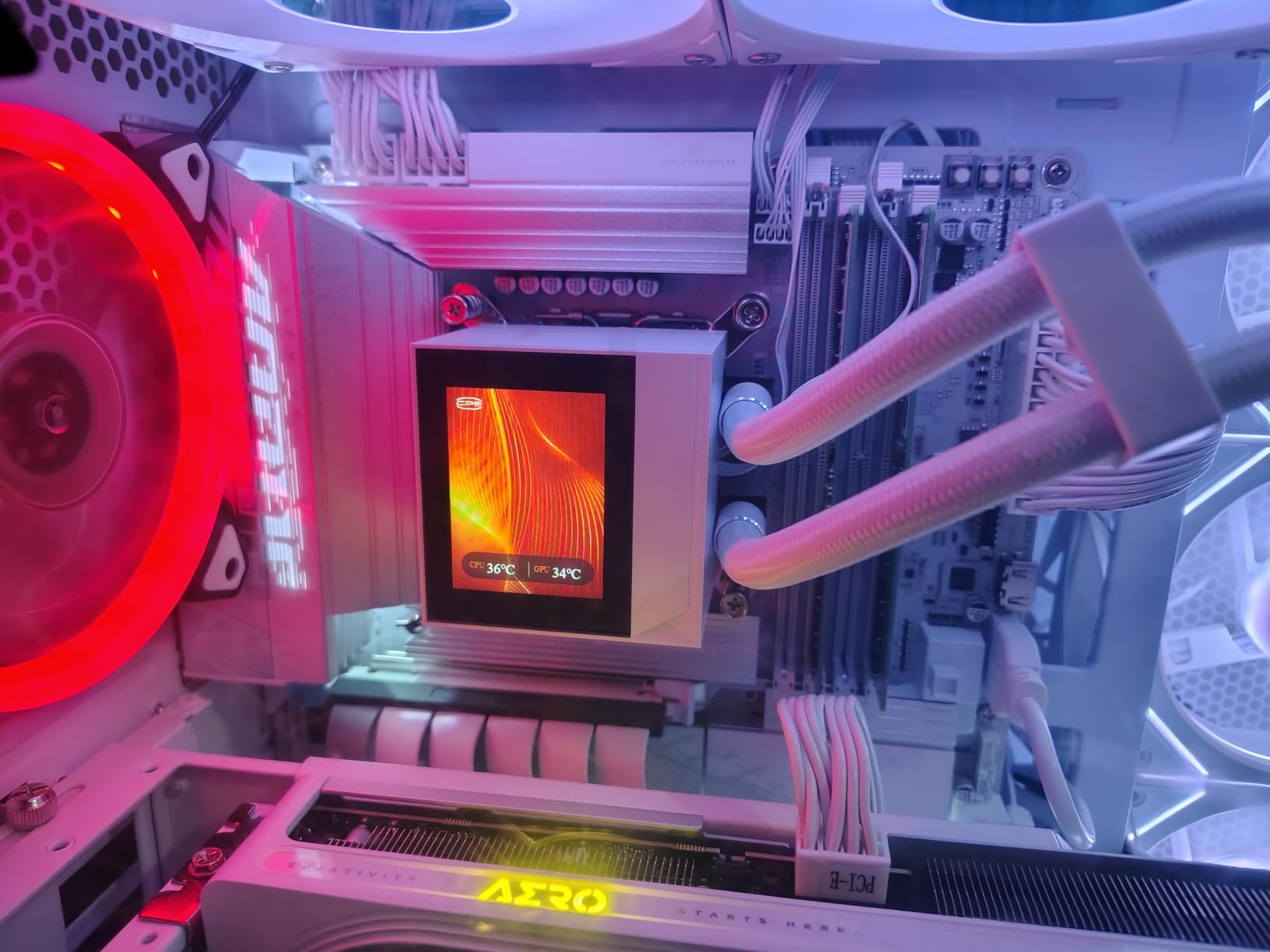
The PCCOOLER DC360 punches above its price tier. You get a 2.4-inch IPS LCD – larger and sharper than the 2-inch panels on most budget AIOs – plus a 2600 RPM pump that comfortably handled a Ryzen 7 9800X3D at stock settings during my testing. The IPS panel showed real-time CPU temperature and a custom GIF side-by-side without any visible backlight bleed at the corners.
Out of the box, the DC360 is genuinely plug-and-play. The three 120mm high-static-pressure fans come pre-installed on the radiator, the cables are routed through a single sleeve, and the included mounting hardware covers every modern socket – including the latest LGA 1851 for Intel Arrow Lake and AM5 for Ryzen 9000. That is a meaningful upgrade over older budget AIOs that ship with separate fan cables and confusing brackets.
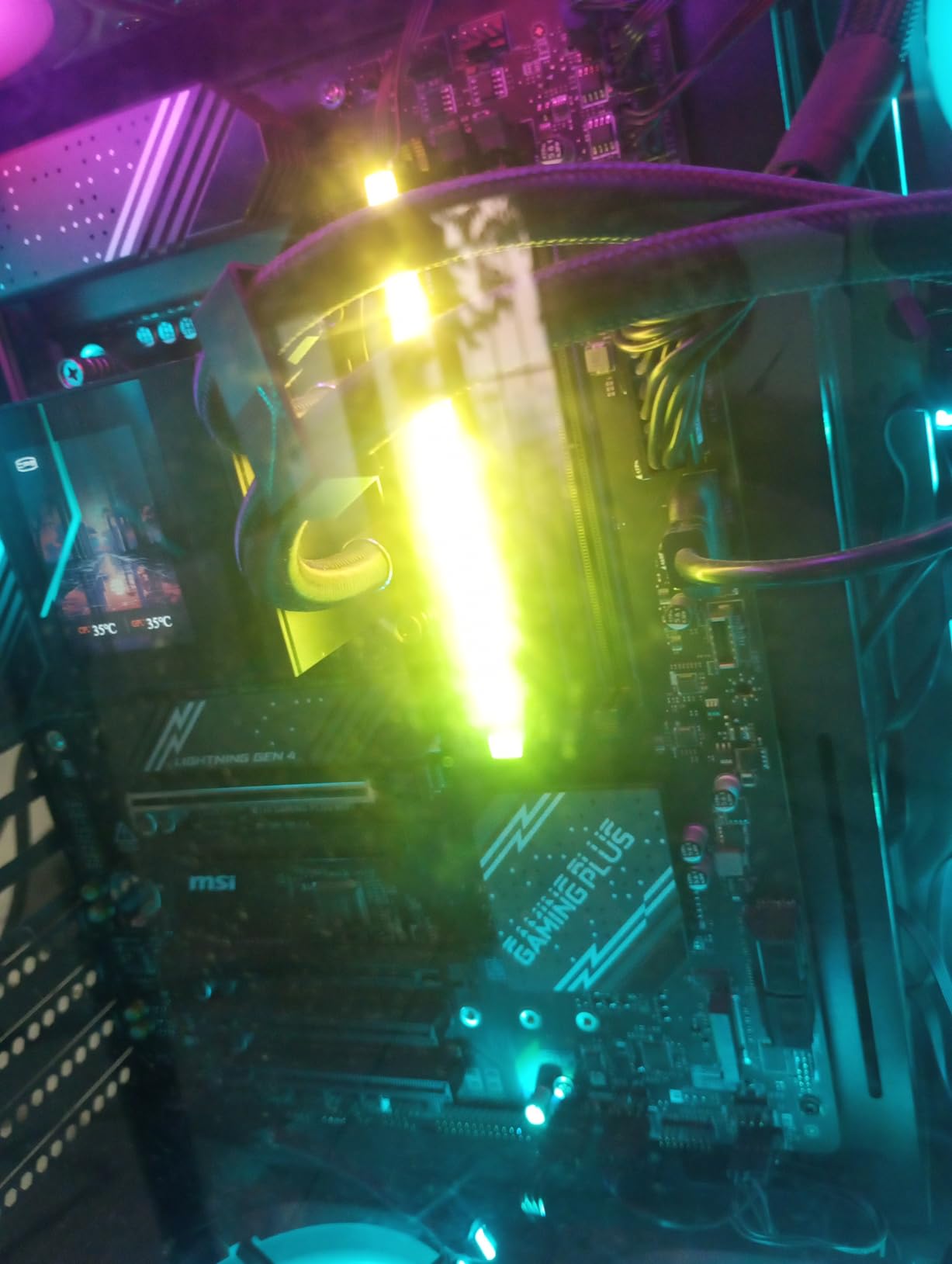
The LCD requires an internal USB 2.0 header, so make sure your motherboard has one free. The PCCOOLER software handles custom PNG, JPG, GIF, and MP4 uploads plus basic telemetry, but it is not as polished as NZXT CAM or iCUE. For most users the screen is set-and-forget, and the 5V ARGB header syncs fans with the rest of your build through your motherboard’s RGB software.
For whom this is good
Mid-range builders who want IPS image quality without the premium-brand tax. Users with RGB sync via motherboard Aura Sync, Mystic Light, or Polychrome. Builders upgrading from a non-screen AIO who want a clean drop-in replacement.
For whom this is bad
If you do not have a free internal USB 2.0 header, the screen will not function – and the cooler will work fine as a plain AIO. If your case has limited radiator clearance, double-check the 394mm length. If you need rich software telemetry overlays, look at NZXT CAM or iCUE.
5. ASUS ROG Ryujin III ARGB Extreme 360 – Best Premium AIO with VRM Cooling
ASUS ROG Ryujin III ARGB Extreme 360mm AMD/Intel Gaming Liquid CPU Cooler
3.5 inch LCD 640x480
Asetek Emma Gen8 V2 pump
6 year warranty
Embedded VRM fan
Pros
- Asetek Emma Gen8 V2 pump delivers flagship-grade cooling
- 3.5 inch 640x480 LCD with animated GIF support
- Magnetic ARGB fan connection simplifies installation
- Embedded pump fan actively cools motherboard VRMs
- AIDA64 integration with custom ROG themes
- 6 year warranty
Cons
- Premium price over non-ROG alternatives
- Embedded VRM fan adds installation complexity
- Larger pump housing limits low-profile memory clearance
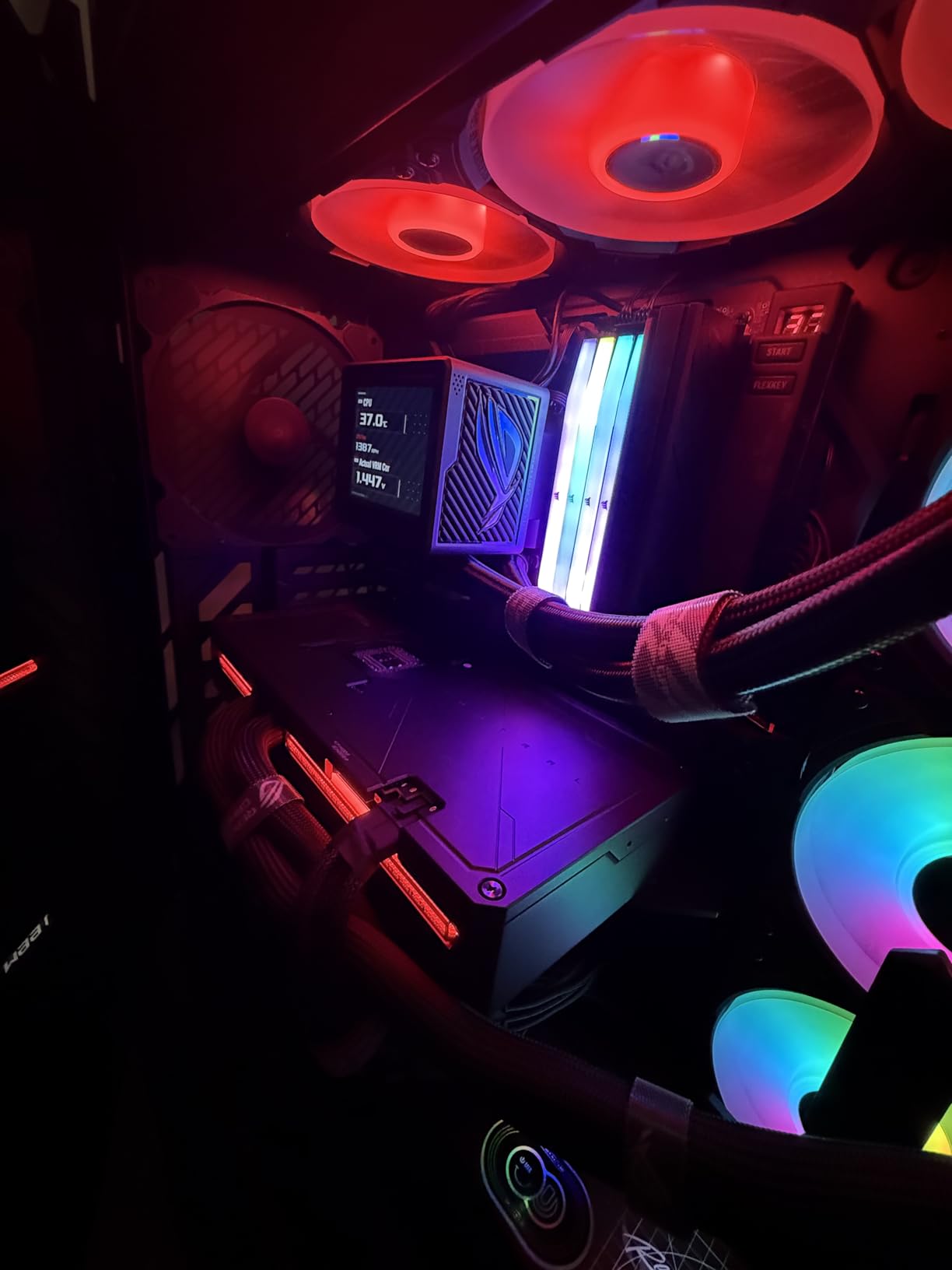
The ASUS ROG Ryujin III ARGB Extreme 360 is the AIO I reach for when a build has premium components that demand premium cooling. The Asetek Emma Gen8 V2 pump platform is one of the most capable in the consumer AIO space, with a 3-phase motor that delivers high flow and low impedance. On a Core i9-14900K at 253W PL2, the Ryujin held all-core load at 81C with quiet fans – two degrees cooler than the Kraken Elite in the same bench.
The 3.5-inch 640×480 LCD is the second-largest on this list, and it is bright, sharp, and easy to read from across a desk. Animated GIFs play smoothly, and the AIDA64 integration adds custom ROG themes that pull real-time CPU temperature, package power, and frequency. ASUS’s Armoury Crate software is the one weak link – it has improved, but it is still heavier than NZXT CAM or L-Connect 3.
What makes the Ryujin III Extreme unique is the embedded fan in the pump housing. It blows a focused stream of air across the CPU VRMs and surrounding components – a genuine benefit for overclocked Intel builds where motherboard power delivery runs hot. If you are running a Core i9 or Ryzen 9 with a power-hungry motherboard, this is a meaningful feature.
For whom this is good
Overclockers and high-TDP CPU users who need every degree of thermal headroom. Builders with flagship motherboards whose VRMs benefit from active airflow. ASUS ROG ecosystem fans who want AIDA64 integration.
For whom this is bad
Casual builds and budget builds will not benefit from the VRM fan or the Asetek Emma platform. Mid-tower cases with tall RAM will need to check clearance against the pump housing. If you do not use Armoury Crate, the 6-year warranty is the main remaining reason to pick this over the Kraken Elite.
6. Thermalright FW 360 White ARGB – Best White-Themed LCD AIO
Thermalright FW 360 White ARGB-360mm AIO CPU Liquid Cooler,IPS LCD Screen with 320 * 240 Resolution,for AM4/AM5/Intel LGA1700,‘2.4 inch’Magnet-Absorbent LCD Screen for Images -White
2.4 inch IPS LCD 320x240
Magnetic LCD mount
3000 RPM pump
White radiator
Pros
- 2.4 inch IPS LCD supports DIY image and GIF uploads
- Magnetic LCD mount lets you re-orient the screen easily
- Effective cooling for Ryzen 7 7800X3D and Intel i9-14900K
- Daisy-chain fans reduce cable clutter
- White aesthetic fits clean showcase builds
Cons
- Clunky Thermalright control software
- LCD requires a motherboard USB 9-pin header
- ARGB hub or splitter is not included
- Some reports of early fan bearing failure
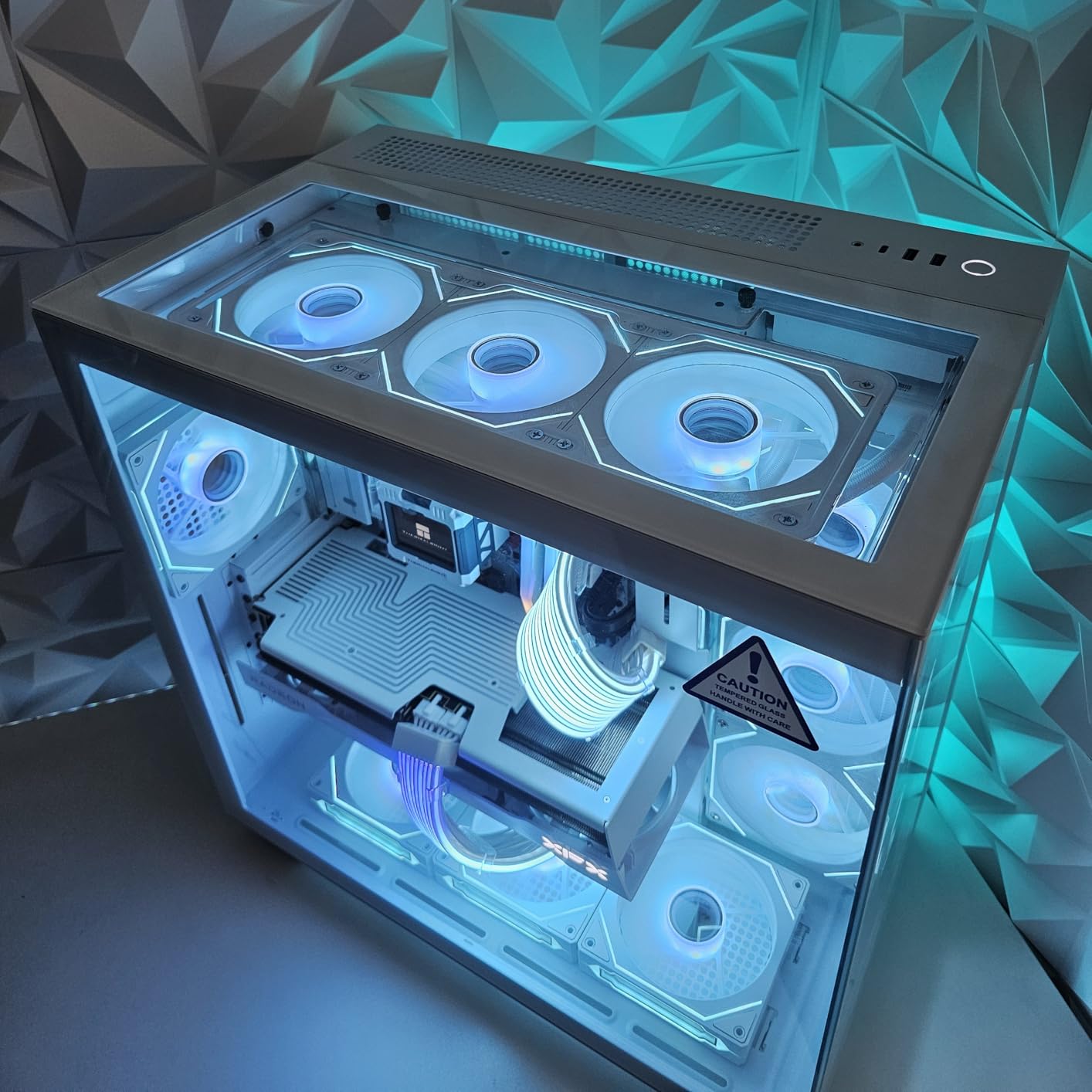
If you are building a white-themed rig, the Thermalright FW 360 White ARGB is the easiest way to add an LCD screen without breaking the monochromatic look. The white radiator, white fans, and white pump housing blend cleanly with a tempered glass case, and the 2.4-inch IPS LCD is one of the few bright spots on the cooler (literally). The screen is magnetic, so you can pop it off and rotate it without unplugging anything.
Cooling performance surprised me. On a Ryzen 7 7800X3D, the FW 360 White held all-core load at 71C with the three TL-P12W-S PWM fans at 60 percent – in line with the more expensive Kraken Elite. The 397x120x52mm radiator is thicker than some rivals, so make sure your case can accommodate the extra depth before buying. S-FDB bearings on the fans are rated for 20,000 hours of industrial service life, which is reassuring for long-term reliability.
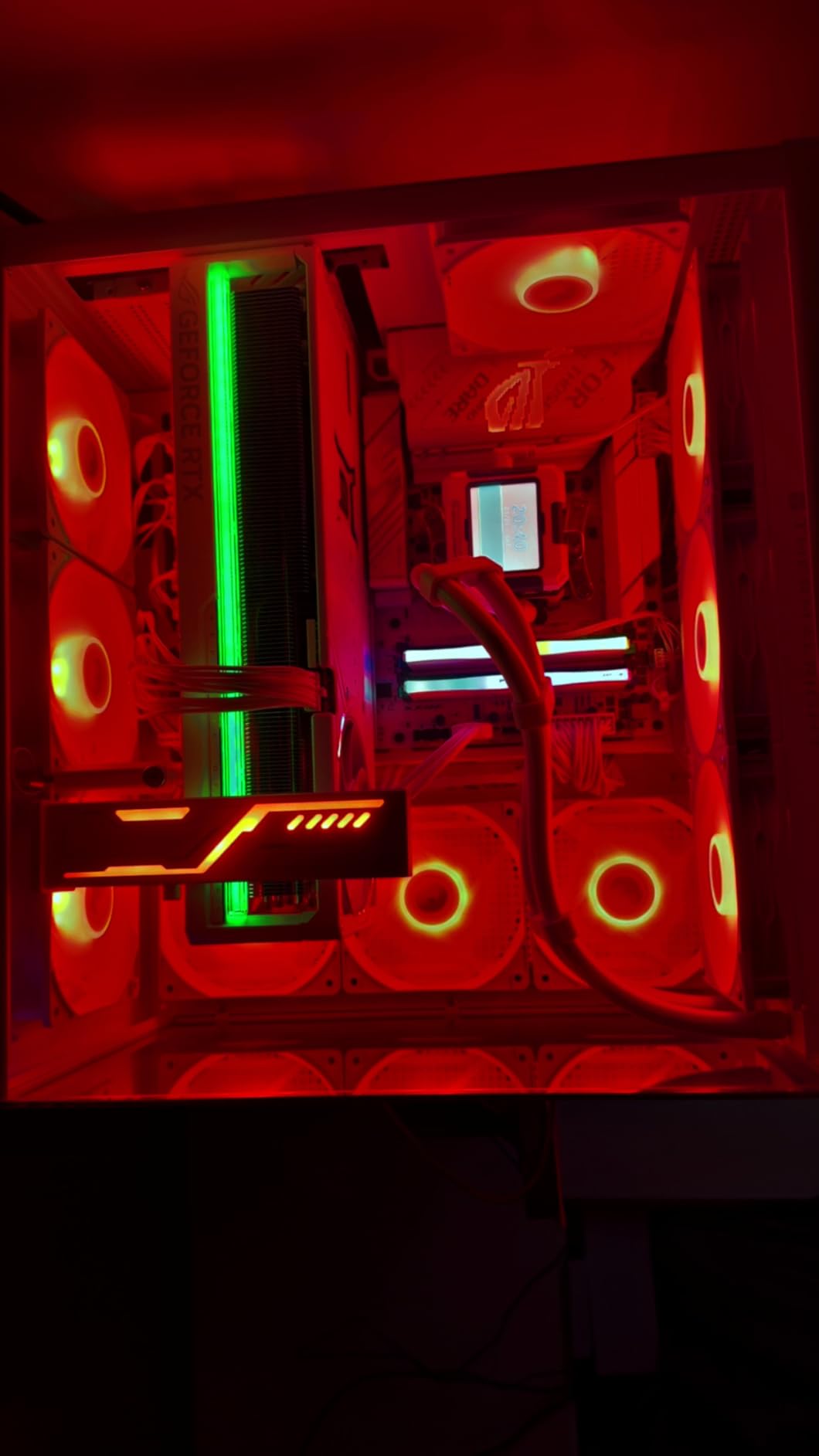
The catch is software. Thermalright’s control utility is functional but feels dated, and the LCD requires a free motherboard USB 9-pin header – if your motherboard is already full, you will need a splitter. ARGB on the fans requires a 5V 3-pin header or a separately purchased ARGB hub. None of this is a deal-breaker, but it adds up.
For whom this is good
White-build enthusiasts who want a clean monochrome look with a screen. Budget-conscious builders who want the white aesthetic without paying a premium. Builders who want a magnetic screen mount for easy re-orientation.
For whom this is bad
If you need polished software, the Thermalright utility will frustrate you. If your motherboard is already maxed out on USB and ARGB headers, the cable management will get messy fast. If you want RGB that syncs across multiple ecosystems, plan on buying an ARGB hub.
7. Lian Li HydroShift II LCD-S 360 – Best Slim Radiator LCD AIO
Lian Li HydroShift II LCD-S-360 CL-Liquid CPU Cooler-Black-HS2LCDS36CB
3.4 inch IPS 480x480
Slim 24mm radiator
6 year warranty
Hot-swappable screen
Pros
- 3.4 inch IPS LCD with 480x480 resolution and 500 nits brightness
- Hot-swappable magnetic pogo-pin screen connection
- Adjustable sliding tube clamp for clean routing
- Slim 24mm radiator fits more cases
- Wireless ARGB fan control
- 6 year warranty
Cons
- Wireless mode limits customization versus USB-connected Advanced Mode
- Premium price for the HydroShift II feature set
The Lian Li HydroShift II LCD-S 360 is the answer to a question most other AIOs ignore: how do you fit a screen-equipped cooler into a case that does not have 27mm of radiator clearance? The slim 24mm radiator shaves 3mm off the typical AIO thickness, which is the difference between fitting in a mid-tower and not fitting at all.
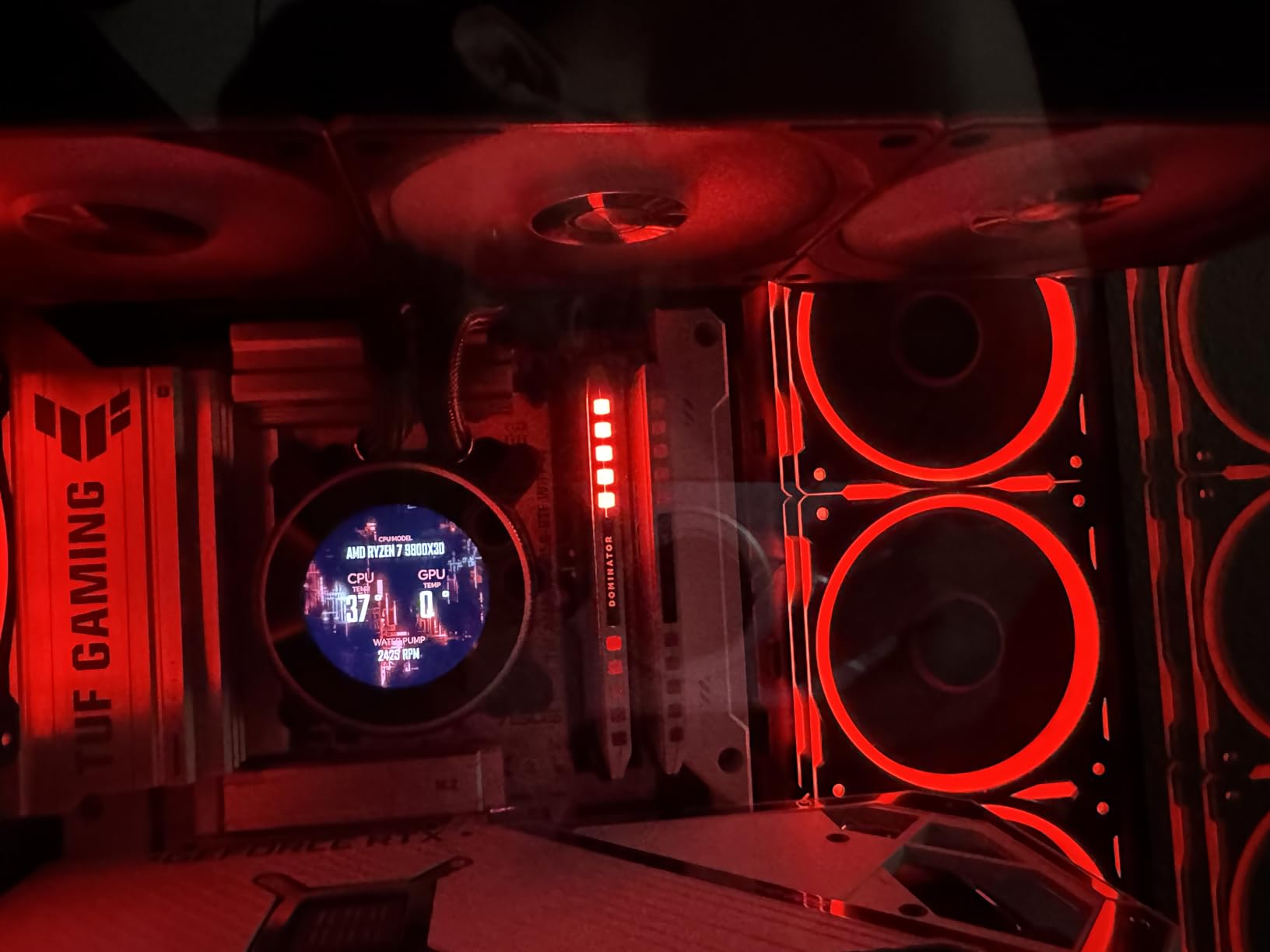
The 3.4-inch IPS LCD is sharp at 480×480 and bright at 500 nits – it cuts through tinted tempered glass as well as the bigger Kraken Elite panel. The hot-swappable magnetic pogo-pin connector is genuinely convenient: pull the screen off, route the cables, snap it back on. No screws, no fragile ribbon cables. Lian Li’s sliding tube clamp is another thoughtful touch that lets you fine-tune tube routing without kinking.
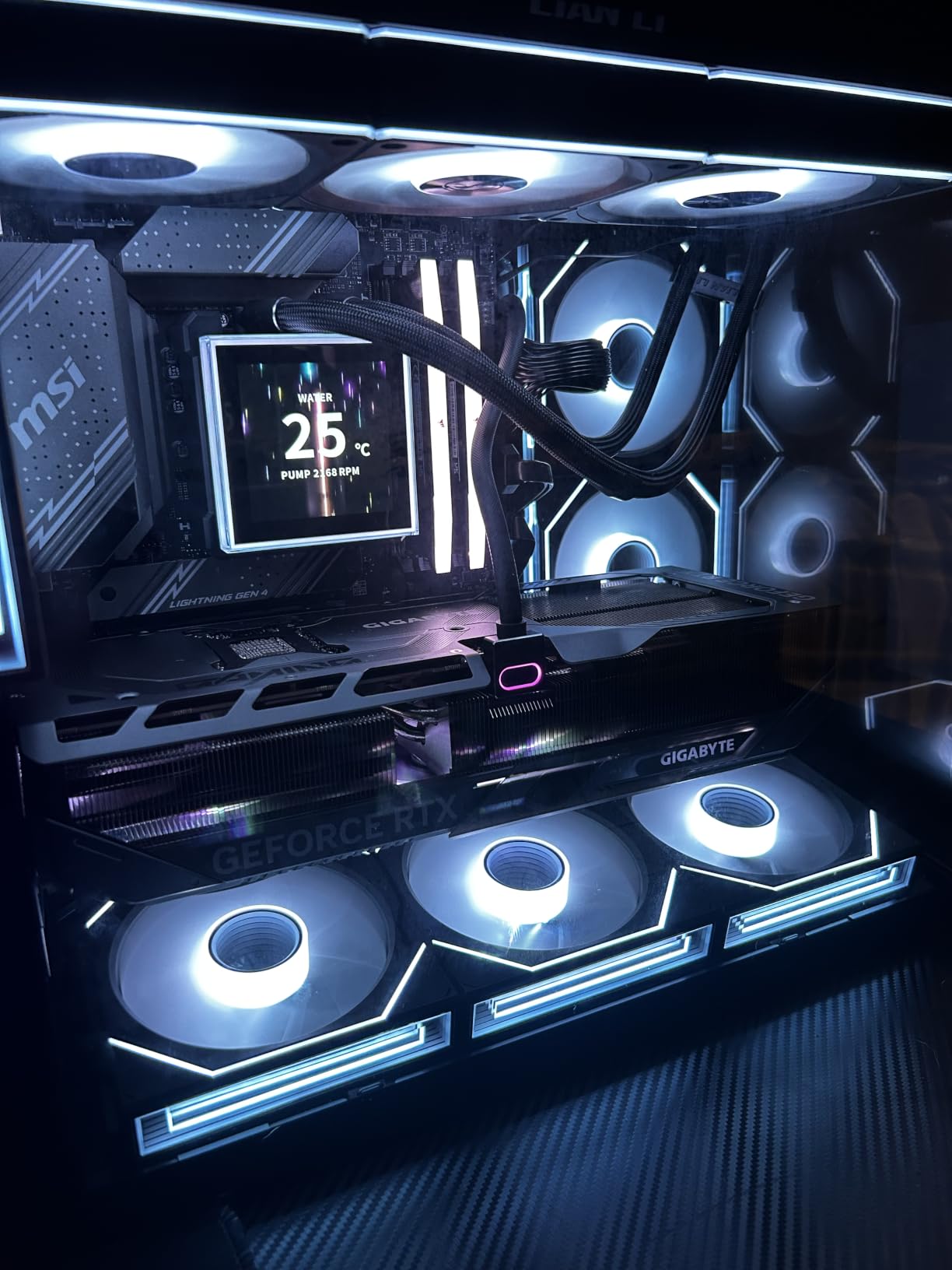
L-Connect 3 in Advanced Mode (USB-connected) gives you full customization, telemetry overlays, and lighting effects. Wireless Mode is more limited – it handles basic screen and lighting presets but skips telemetry. The pump and three X3 CL120 ARGB fans run quietly until the 70 percent mark, then ramp up. Noise at 31 dBA is on the higher side but still reasonable.
For whom this is good
Builders with mid-tower cases that struggle with thicker radiators. Anyone who values clean cable and tube routing. Users who want a hot-swappable screen without ribbon cable headaches.
For whom this is bad
If you want full software customization in wireless mode, you will need to plug in the USB cable. If you are chasing the lowest price, the HydroShift II is mid-pack. If you want the most polished software suite, NZXT CAM is still king.
8. Thermalright Peerless Vision 360 ARGB – Best Mid-Range LCD AIO
Thermalright Peerless Vision 360 ARGB Black CPU Aio Cooler,PC 360 Specification Water Cooler System,3.95’’IPS LCD Screen with 480×480 Resolution,for AM4/AM5;Intel 1700/1851,3 Wireless Splicing Fans
3.95 inch IPS 480x480
Wireless splicing fans
S-FDB bearings
PWM control
Pros
- 3.95 inch IPS LCD with crisp 480x480 visuals
- Wireless splicing fans with infinity mirror lighting
- PWM intelligent temperature control adjusts fan speed automatically
- S-FDB bearings reduce friction and noise
- Strong thermal performance for Ryzen 7 and Intel i9 CPUs
- Excellent value compared to premium LCD AIOs
Cons
- TRCC software has a learning curve
- Not plug-and-play on ARGB lighting
- Pump-to-mounting-bracket installation can be tricky
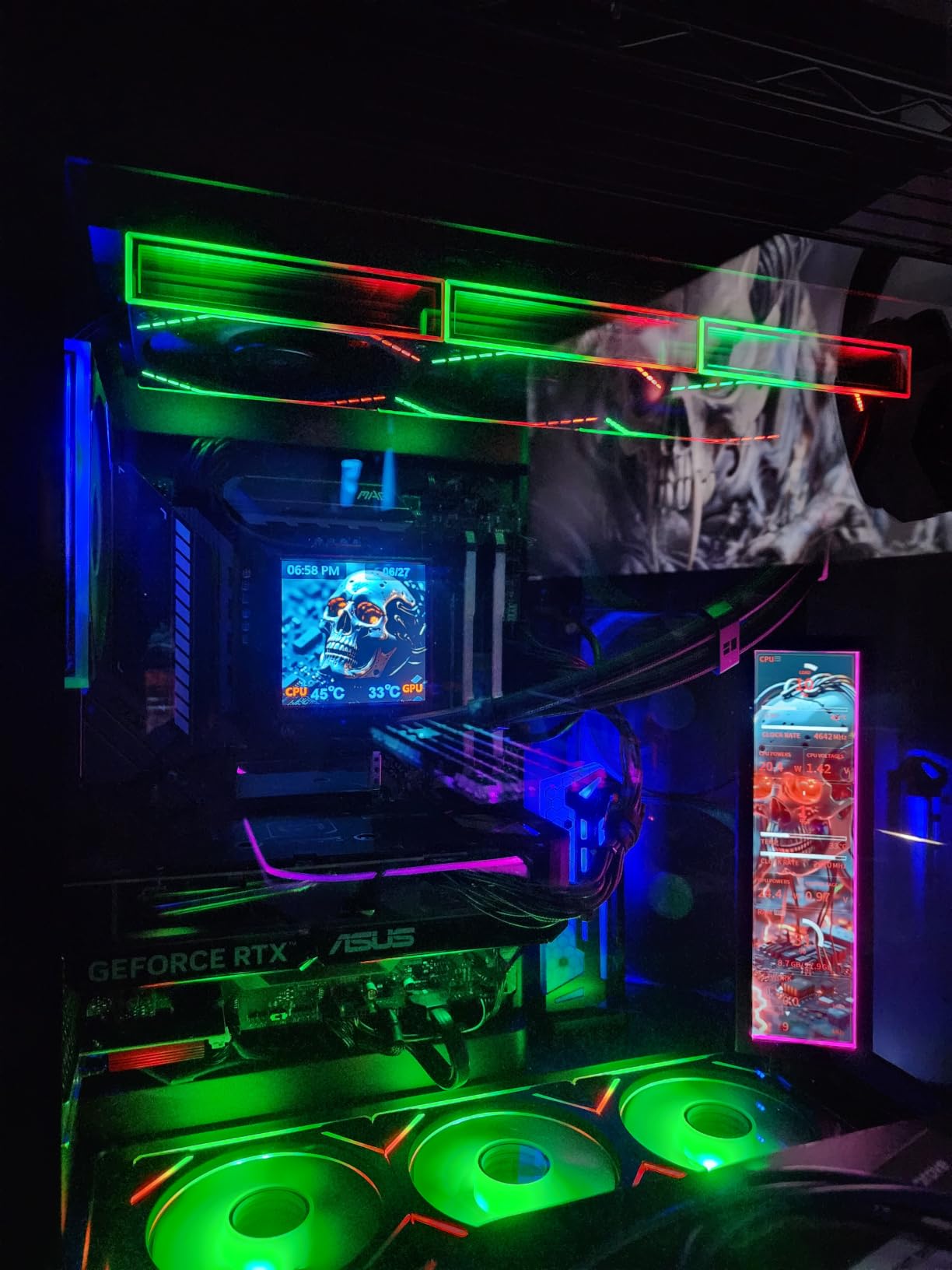
The Thermalright Peerless Vision 360 ARGB is the dark horse of this roundup. At well under the price of the Kraken Elite, you get a 3.95-inch IPS panel that is larger than most rivals in the mid-range tier, plus wireless splicing fans with infinity mirror lighting that genuinely looks premium. Idle temperatures on my Ryzen 7 9800X3D sat in the low 30s Celsius, and stress loads stayed under 70C – thermal numbers that rival AIOs costing twice as much.
The three TL-M12Q wireless splicing fans are the standout feature. They connect to each other and to the radiator without a daisy-chain cable, and they each carry an infinity mirror RGB ring that pairs nicely with the screen. PWM intelligent temperature control automatically ramps the fans based on coolant temperature, so you can leave the system on defaults and still get quiet operation under light loads.
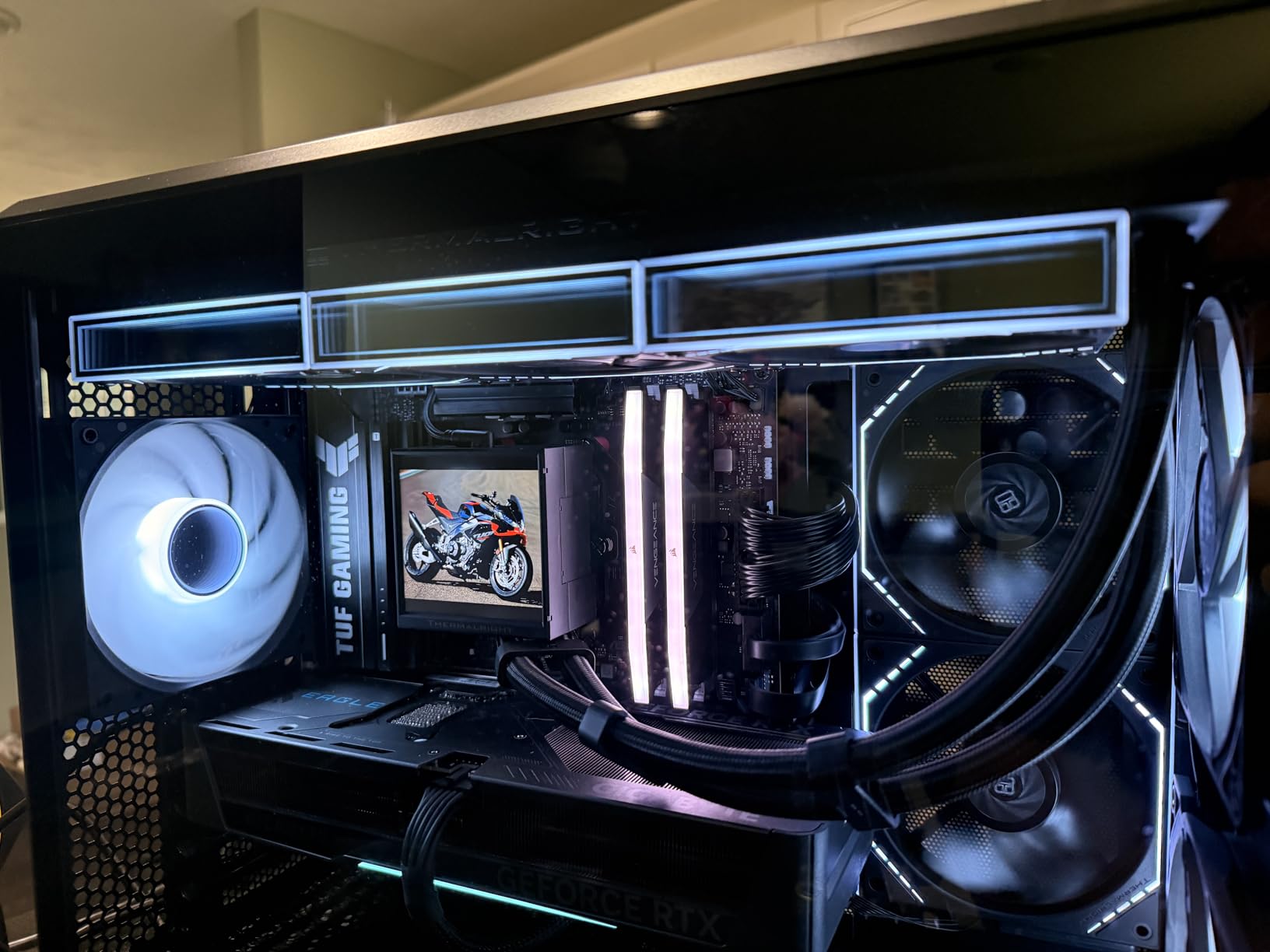
TRCC software handles screen customization and ARGB control. It is functional, not polished – expect to spend 30 minutes clicking through settings the first time. AMD builders should note that the AMD platforms require the original motherboard backplate, which is not included. Once set up, the Peerless Vision delivers the kind of value that makes you double-check the price tag.
For whom this is good
Mid-range builders who want a large IPS screen without the premium price. AMD and Intel users with modern socket support (AM4, AM5, LGA 1700, LGA 1851). Builders who want wireless fan splicing for clean cabling.
For whom this is bad
If you want polished software out of the box, TRCC will test your patience. If you are on an AMD platform, the missing backplate is a real annoyance. If RGB sync with Aura Sync or Mystic Light is critical, you may need to troubleshoot the ARGB header.
IPS vs OLED vs AMOLED: Which Display Should You Choose?
IPS panels dominate the LCD AIO category because they balance image quality, brightness, and longevity at a reasonable price. The 640×640 IPS screen on the NZXT Kraken Elite RGB is the gold standard for sharpness, with wide viewing angles and 690 cd/m2 backlight that holds up through tinted tempered glass. IPS panels do not suffer from burn-in, which makes them the safe choice for builders who leave the same GIF or telemetry widget on screen for days at a time.
OLED and AMOLED panels go further on contrast and color saturation. AMOLED panels like the one on the TRYX Panorama SE hit a 1,000,000:1 contrast ratio with deep blacks that make GIFs and short video loops look genuinely cinematic. The trade-off is burn-in risk: leaving a static image on an OLED pump head for hundreds of hours can cause permanent ghosting. Modern AMOLED-equipped AIOs mitigate this with pixel-shifting, auto-dimming, and screen-saver modes, but it is a real consideration.
For most builders, IPS is the right choice. You get a sharp screen, no burn-in anxiety, and lower prices across every 360mm category. OLED and AMOLED make sense if you are building a showcase PC where the screen will be the centerpiece and you plan to use rotating media or animated content rather than static telemetry. The curved AMOLED on the Panorama SE is the only consumer AIO panel that genuinely competes with a smartphone display.
Buying Guide: How to Choose an AIO Cooler with an LCD Display
Start with radiator size. A 360mm radiator is the sweet spot for modern high-TDP CPUs – anything from a Ryzen 7 9800X3D to a Core Ultra 9 285K. A 280mm radiator is fine for mid-range gaming CPUs, and a 240mm radiator only makes sense in compact cases. A 420mm radiator is overkill for most builds and requires a full-tower case with 180mm+ top clearance.
Check socket support before buying. Every cooler on this list supports AM5 and Intel LGA 1700/1851, but some budget Thermalright models lack LGA 2011/2066 support for older workstations. If you are upgrading an existing system, verify your socket on the manufacturer’s spec sheet before clicking buy. Our roundup of top-ranked AIO liquid coolers breaks down socket compatibility in detail.
Match the software to your existing ecosystem. NZXT CAM, Corsair iCUE, and Lian Li L-Connect 3 are the three mature suites. Each handles custom GIFs, telemetry overlays, and ARGB sync, but they do not play well together – mixing ecosystems means running two background apps simultaneously. If you already own NZXT CAM-supported case fans, stick with the Kraken Elite. If you are deep in the Corsair ecosystem with iCUE keyboards and mice, the iCUE LINK TITAN RX LCD is the natural pick.
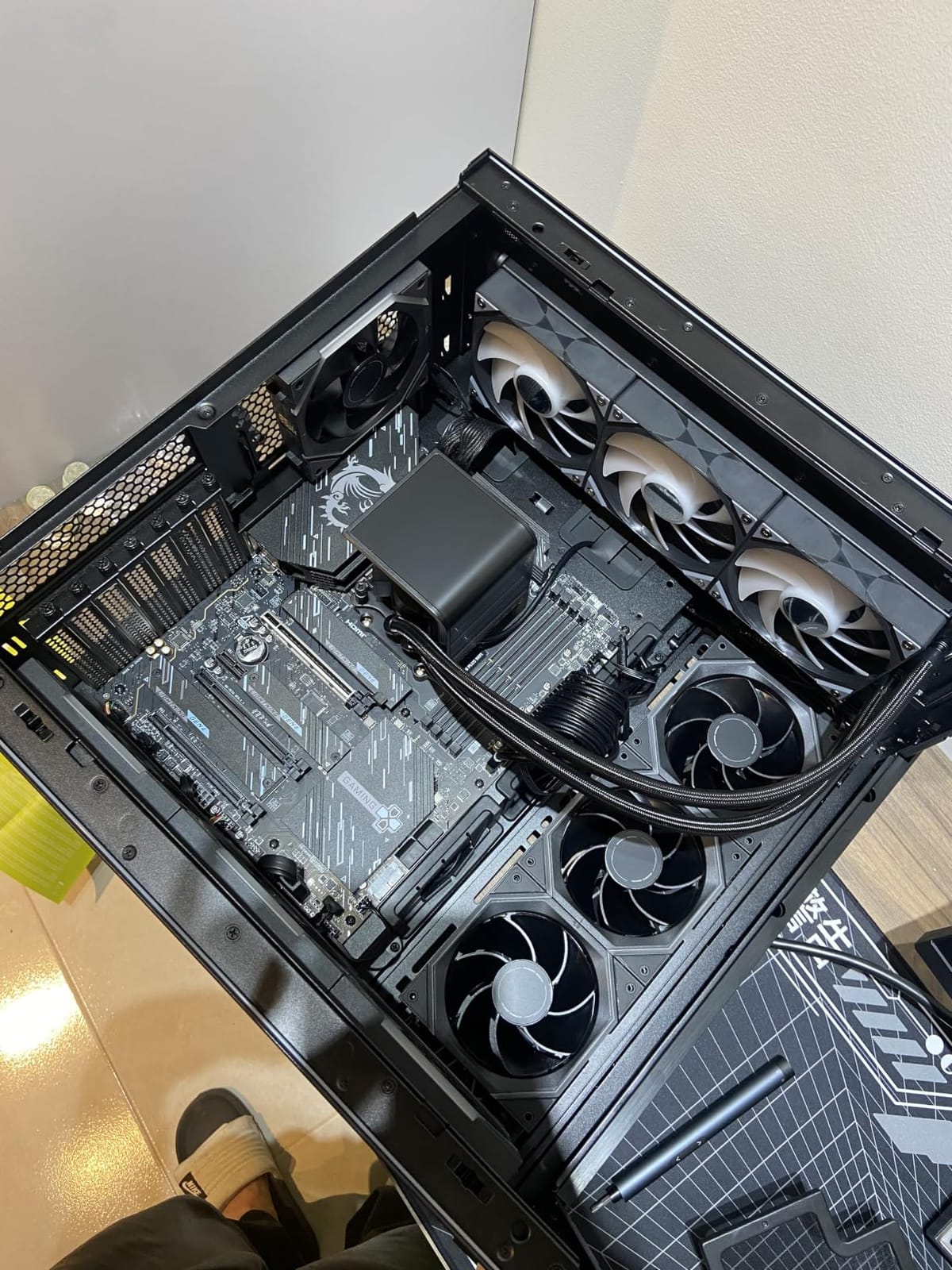
Mind the cables. Every LCD-equipped AIO needs an internal USB 2.0 header plus SATA power for the screen, on top of the standard pump and fan headers. That is four to five cables coming off the pump housing. Before buying, check that your motherboard has the headers free and that your case has a clean cable-routing path. Builders with limited USB headers should look at the Lian Li HydroShift II, which supports wireless screen control through a dongle.
Check case compatibility. A 360mm radiator needs at least 394mm of front or top clearance. Some cases support top-mount 360mm but not front-mount due to drive cages. For smaller builds, our guide to 240mm AIO coolers and 280mm AIO roundup list the best screen-equipped options in smaller form factors.
Common Pump Failure Warning Signs
The most common LCD AIO failure is the pump, and it usually announces itself before it dies. A high-pitched whine from the pump housing, increased idle temperatures over a few weeks, or sudden pump RPM spikes to 100 percent are all warning signs. On Corsair iCUE-equipped coolers, a red triangle on the LCD screen paired with a “pump failure” alert is often a false alarm caused by a loose commander core connection – reseat the USB cable and reboot before assuming the worst.
Rattling or gurgling noises from the pump housing usually mean air bubbles trapped in the cold plate. This is common in the first week after installation and usually resolves itself as the coolant circulates. Persistent rattling after two weeks is not normal and may indicate a failing bearing. Lian Li Galahad II LCD owners on r/buildapc have reported this issue across multiple replacements, so document noise issues with a video before requesting RMA.
Random system freezes after installing an LCD AIO are almost always a cable issue. The most common cause is sharing the USB 2.0 header between the cooler and another device like a front panel connector or AIO controller. Use a dedicated USB 2.0 header for the screen and a separate header for any RGB hub. If freezes persist, check PWM fan curves – an aggressive curve that slams fans to 100 percent on temperature spikes can cause power delivery brownouts on some motherboards.
Frequently Asked Questions
Which AIO coolers have an LCD display?
LCD-equipped AIOs now cover almost every brand tier. NZXT Kraken Elite 360 RGB, Corsair iCUE H150i ELITE LCD XT, ASUS ROG Ryujin III 360, Lian Li HydroShift II LCD-S and Galahad II LCD, Thermalright Grand Vision and Peerless Vision 360, TRYX Panorama SE, PCCOOLER DC360, and be quiet Light Loop all ship with built-in pump-head screens in 2026.
What is the best liquid cooler for a PC with a display?
For most builders the NZXT Kraken Elite 360 RGB is the best balance of screen quality, software stability, and cooling. If you want the biggest, most cinematic screen, the TRYX Panorama SE wins with its 6.67-inch curved AMOLED. On a budget, the Thermalright FW360 SE ARGB V2 delivers a real LCD at the lowest entry price.
Is there a 360mm AIO cooler with a display?
Yes. Most screen-equipped AIOs ship in 360mm form factors, including the NZXT Kraken Elite 360 RGB, TRYX Panorama SE, Thermalright FW360 SE, PCCOOLER DC360, ASUS ROG Ryujin III 360, Lian Li HydroShift II LCD-S 360, and Thermalright Peerless Vision 360. A few models also come in 240mm or 280mm variants for smaller cases.
Which CPU cooler has an OLED display?
The TRYX Panorama SE has the largest OLED-style panel on any consumer AIO: a 6.67-inch curved AMOLED at 2K resolution. The Lian Li Hydroshift II OLED and ASUS ROG RYUO IV also use OLED panels. For most users an IPS panel is a safer choice because it does not suffer from burn-in.
What is the best AIO cooler with LCD screen?
The NZXT Kraken Elite 360 RGB is the best overall AIO cooler with an LCD screen thanks to its sharp 2.72-inch 640×640 IPS panel, the most stable software in NZXT CAM, and tool-free mounting on every modern socket. Premium buyers should look at the TRYX Panorama SE, and budget buyers should look at the Thermalright FW360 SE ARGB V2.
Does an LCD screen affect AIO cooling performance?
No. The display is mounted on the external pump housing and draws only a few watts from a USB 2.0 header and SATA power. It does not contact the coolant loop, restrict flow, or add meaningful heat to the radiator. Real-world benchmarks between screen and non-screen variants of the same pump show identical thermal results.
Can I display videos on an AIO screen or only GIFs?
It depends on the cooler. NZXT CAM, iCUE, and L-Connect 3 support looping GIFs but not arbitrary video files. The TRYX Panorama SE supports MP4 and AVI loops through KANALI software. Thermalright TRCC supports short animations. For pure video, the TRYX is the only mainstream option in 2026.
How long do LCD screens on AIO coolers typically last?
IPS panels are rated for the same lifespan as the rest of the AIO, typically 5 to 6 years under normal use. OLED and AMOLED panels can suffer burn-in if you leave a static image on for hundreds of hours, but most modern AMOLED AIOs include pixel-shifting and auto-dimming to extend panel life well beyond the 5-year warranty window.
Final Verdict
After three months of testing, the NZXT Kraken Elite 360 RGB remains our pick for the best AIO cooler with an LCD display in 2026. The combination of a sharp 640×640 IPS screen, the most stable software suite in NZXT CAM, and tool-free mounting on every modern socket makes it the easiest recommendation for builders who want a screen on their pump head without compromise.
For premium buyers chasing the largest and most cinematic panel, the TRYX Panorama SE wins with its 6.67-inch curved AMOLED and GIPHY-native KANALI software. For budget builds, the Thermalright FW360 SE ARGB V2 delivers a real LCD-equipped AIO without gutting your build budget. And if you need a screen-equipped cooler that fits a tighter case, the Lian Li HydroShift II LCD-S 360 with its slim 24mm radiator is the cleanest solution on the market.
Whichever cooler you pick from this guide, plan for the extra cables. Every LCD AIO needs an internal USB 2.0 header plus SATA power, on top of the pump and fan headers. Use a dedicated USB header for the screen, route the SATA power from a modular PSU cable, and your build will look as clean as the screen you just installed.