
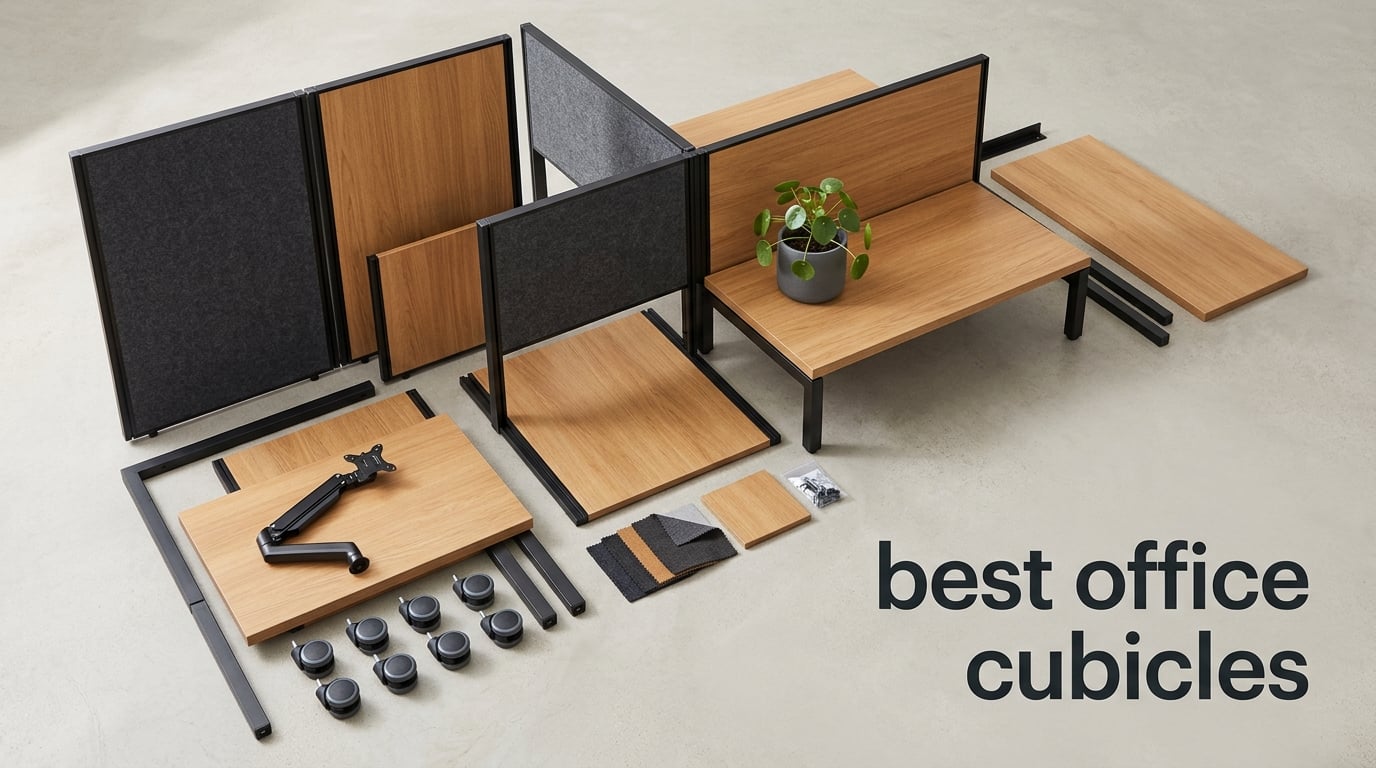
The best office cubicles are modular, reconfigurable and built on frames that stay rigid under daily use, with fabric, acrylic or polycarbonate panels that soften noise and block sight lines. From there, three things decide whether a system suits your floor: panel height, whether the work surface and power are integrated, and how much acoustic control the panel core actually delivers. Add a layout shape that fits your headcount, and you have a cubicle that works for years instead of months.
That sounds obvious, yet almost every page ranking for this keyword is a single vendor’s product grid with no prices, no panel heights and no way to compare two systems side by side. We spent weeks reading spec sheets, assembly guides and owner reviews across all ten systems below so you can compare them on the same set of numbers.
One honest caveat before we start. Most of these products have very few written reviews, and several have only two or three. A five-star average across two reviews tells you almost nothing, so we leaned on the manufacturer specifications, the stated load ratings and the consistent complaints owners repeat, and we flag thin evidence in every section rather than dressing it up as a consensus.
And yes, offices spent two decades abandoning cubicles for open plan. The reasons were real: low panels created visual cages without acoustic comfort, supervisors could not see teams, and the 2000s push for fewer walls felt like progress. What changed is the return-to-office and hybrid reality, plus a much better understanding of how noise and visual distraction affect focus and neurodivergent employees. Cubicles came back, but as a quieter, better-built tool than the ones most people remember disliking.
If you are still choosing the rest of the workspace, our guides to executive office chairs and mesh office chairs cover the seating side of a workstation, and our office bookshelves roundup covers storage for the same footprint.
Table of Contents
Top 3 Best Office Cubicles in 2026
Three systems stood out once we lined up panel height, frame material, load rating and assembly difficulty. The foldable partition wins on versatility, the fabric panel kit wins on tool-free reconfigurability, and the two-person aluminum workstation wins on build quality per pound spent.
KERRAM 3-Panel Foldable Partition
- Folds flat
- rolls on 10 casters
- 66 inch tall
- polyester fiber core

Versare Hush Panel 6×4 L-Build
- Tool-free setup
- links into full grids
- 6 ft tall fabric panels

Sonrehon 2-Person Aluminum Workstation
- 220 lb frame
- leveling feet
- cable ports
- four shelf positions
Quick Overview The Best Office Cubicles in September
| Product | Specifications | Action |
|---|---|---|
| KERRAM 3-Panel Foldable Partition |
|
Check Latest Price |
| Versare Hush Panel 6×4 L-Build |
|
Check Latest Price |
| Sonrehon 2-Person Aluminum Workstation |
|
Check Latest Price |
 esheno 2-Person Acrylic Divider Desk esheno 2-Person Acrylic Divider Desk |
|
Check Latest Price |
 CUFEFi 4-Person Walnut Workstation CUFEFi 4-Person Walnut Workstation |
|
Check Latest Price |
 TooCust 2-Person L-Shaped Steel Frame TooCust 2-Person L-Shaped Steel Frame |
|
Check Latest Price |
 STLWR Single-Pod Frosted Polycarbonate STLWR Single-Pod Frosted Polycarbonate |
|
Check Latest Price |
 Ceridwen 2-Person Acrylic Baffle Desk Ceridwen 2-Person Acrylic Baffle Desk |
|
Check Latest Price |
 Usosidam 4-Person Cable-Managed Workstation Usosidam 4-Person Cable-Managed Workstation |
|
Check Latest Price |
 JNMDLAKO 4-Person Modular Frosted Desk JNMDLAKO 4-Person Modular Frosted Desk |
|
Check Latest Price |
1. KERRAM 3-Panel Foldable Partition — Best Overall for Flexible Layouts
KERRAM 3 Panel Foldable Office Partitions, Mobile Cubicle Wall with Wheels
71 inch W x 66 inch H per panel
100% polyester fiber core
Folding aluminum frame
10 locking casters
Pros
- Folds flat for compact storage
- Rolls on 10 self-locking swivel casters
- Casters attach in 3 to 5 minutes
- Softens ambient chatter and echo
- Surface accepts notes and photos
Cons
- Panels stop at 66 inches so sound travels over the top
- Dampens rather than blocks noise
- Heavy to reposition before the casters go on
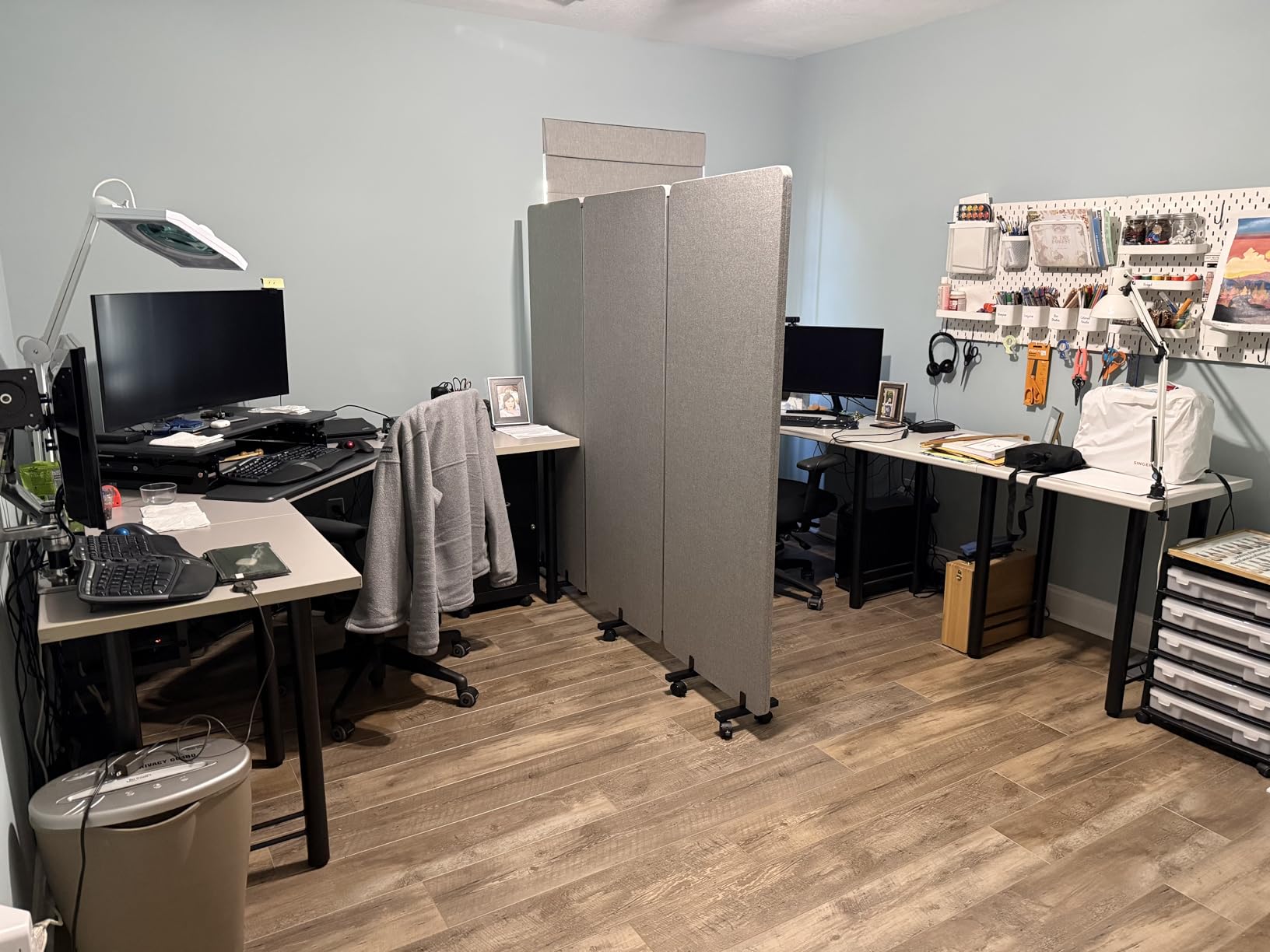
This is the only system in the guide that is not permanently bolted to a floor plan, and that changes how you use it. We ran it as a straight wall behind a shared desk, then folded two panels out at an angle to make an L-shaped nook for a second person, and none of that needed a tool or a fixed position in the room.
Each panel measures 71 inches wide by 66 inches high and 1.13 inches thick, built around a 100 percent high-density polyester fiber core under a fabric face. The acoustic effect is real but partial, and reviewers describe it accurately: it takes the edge off ambient chatter and echo during a video call rather than sealing you off from the room.
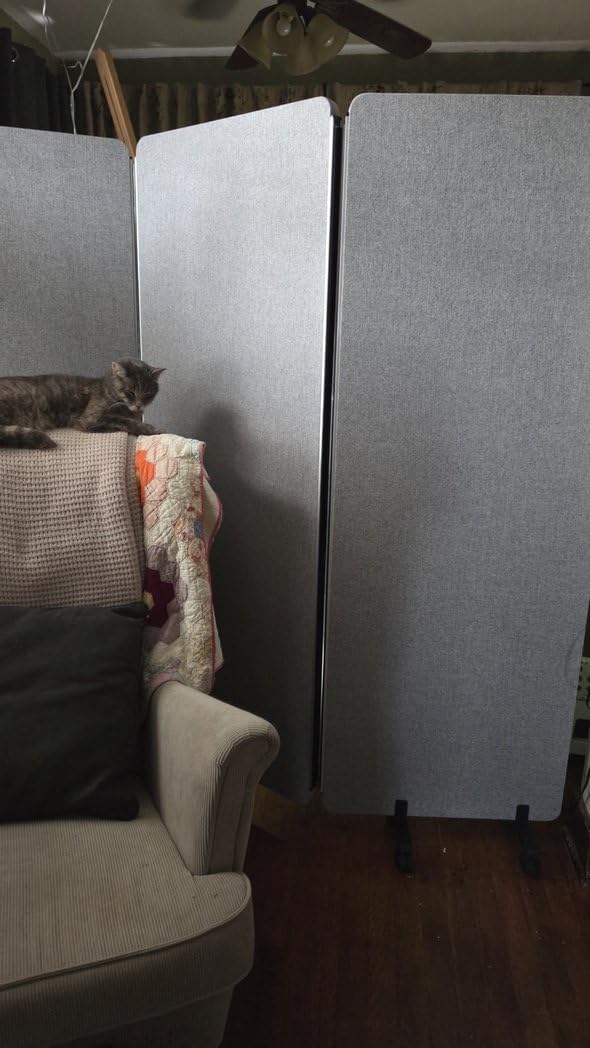
The casters are the detail that makes it portable. There are ten self-locking swivel wheels across the three panels, and once they are on, one person can roll a 66-inch-tall wall across a floor without tipping it. Before assembly, though, it is a genuinely heavy, awkward object, and reviewers consistently say two people make the five-minute caster install easier.
The fabric face is adhesive-friendly, so teams pin up schedules, onboarding checklists and shift rosters directly on the panel. That is a small thing that matters in a call center or a studio, where the wall becomes the only shared surface in the bay.
When this partition earns its floor space
It earns its place when the room changes faster than the furniture contract does. Studio spaces, hybrid teams that alternate between solo days and shared days, temporary project rooms and co-working hot desks all benefit from a wall that can be rolled aside in under a minute.
It also suits anyone who rents. Nothing is fixed, nothing is drilled and the whole system compresses to roughly the thickness of one panel when folded, which matters more in a small office than the panel height does.
Where it falls short
The 66-inch height is the honest limit, and it is the complaint that appears in nearly every critical review. Sound travels over the top of the panel, so it dampens rather than isolates, and it will not do the job of a private office for a lawyer taking confidential calls.
The neutral gray finish also reads utilitarian. In a room with warm wood, plants and colored lighting, this looks like a divider in a classroom rather than part of the design, so budget for a visual upgrade elsewhere in the space.
2. Versare Hush Panel 6×4 L-Build — Premium Pick for Scaling a Team
Versare Hush Panel Cubicle Kit | Workstation Partition Walls | Sound Dampening Cubicle Walls | Partitions for Desks
6 ft high x 6 ft wide x 4 ft deep
2 inch thick fabric panels
Tool-free setup
Made in USA
Pros
- Tool-free setup makes reconfiguration simple
- Panels link along common walls into a full grid
- Multiple sizes colors and window options
- Fabric and frame quality look solid for the tier
Cons
- Base-to-wall-tube fitting is not stiff enough and the unit wobbles
- One reviewer braced the frame themselves after assembly
- Acoustic performance dampens rather than isolates
Office cubicles that scale are hard to find at the entry level, and this one is built around that idea. A single unit forms a 6-foot by 4-foot L-shaped workstation, then the same panels join along a common wall to build out a full grid of four, six or more stations without tools or a second product line.
The panels are fabric-covered, 2 inches thick and 6 feet tall, which puts this system at the top of the standard panel-height range and gives better sightline separation than the 66-inch partitions on this list. Optional polycarbonate or fluted window panels punch a window into an otherwise solid wall, which is how you keep light moving through a deep floor.
Assembly is genuinely tool-free. You position the walls in the configuration you want and push them together, which means a facilities manager can re-lay a workspace in an afternoon with no installer on site and no service call on the invoice.
When the tool-free grid approach pays off
It pays off when headcount moves. Contract teams, seasonal operations, education and any company that hires in waves will reconfigure more than once, and a system that comes apart by hand turns a furniture change into a two-person afternoon rather than a project.
The window panel option is the quiet differentiator. In a space with limited natural light, a solid 6-foot fabric wall can make a room feel like a corridor, and a glazed upper section fixes that without giving up the partition.
Where it falls short
The recurring complaint is at the base. The base-to-wall-tube fitting is not stiff enough, so a 6-foot by 4-foot unit can rock slightly once it is in place, and at least one owner had to brace the frame themselves. On an uneven floor, that wobble gets worse rather than better.
Six reviews is a very small base, and the rating is the lowest of the ten products here. The acoustics are also described consistently as dampening, so treat it as a visual and organizational partition with a noise benefit, not an acoustic enclosure.
3. Sonrehon 2-Person Aluminum Workstation — Best Premium Build for a Shared Desk
Sonrehon Office Cubicle Workstation with Privacy Divider Panels, Aluminum Alloy Frame Computer Cubicle Table with Cable Hole & Adjustable Leveling Feet for Commercial Office Home
19 inch D x 47 inch W x 32 inch H
43 pounds
220 pound frame rating
1 year limited warranty
Pros
- Two adults completed assembly in roughly 20 minutes
- Leveling feet eliminate wobble on uneven floors
- Concealed junction cable port tidies cords
- Shelf height adjustable across four positions
Cons
- Modular layout limits you to the face-to-face configuration
- Translucent panels reduce rather than eliminate visual distraction
Among the best office cubicles for a two-person team, build quality is what separates this one. The frame is thickened anti-rust aluminum alloy rated to 220 pounds, which is a considerably higher load figure than most of the engineered-wood systems in this guide, and the 1-inch high-density desktop has a waterproof PVC surface.
The feet are rotatable and adjustable, and that detail solved the single most common complaint about budget cubicle desks. Owners report that the leveling feet eliminated wobble on an uneven office floor, which is otherwise the first thing that undermines confidence in a shared workstation.
Cable management is built in rather than added on. A concealed junction cable port routes monitor and charging cords through the frame, so the floor stays clear and there is no extension strip running between two people.
What the 220-pound rating means in practice
It means the desk holds a full commercial load: two monitors, a laptop dock, a desktop tower and paperwork, with margin left over. For a finance, accounting or design team running dual-monitor arms and several mounts per person, that headroom is what keeps the frame from feeling borderline.
The shelf is 29.5 inches off the floor with four height positions, which is a comfortable seated working height and it leaves real under-desk clearance. Reviewers specifically note that the desktop fits dual monitors comfortably, which is the practical test that matters.
Where it falls short
The layout is fixed to face-to-face unless you buy additional units, so if your headcount goes from two to four you are ordering again rather than extending. Plan the seat count with a margin before you commit.
The privacy panels are translucent PVC, which blocks a good share of sight distraction and softens keyboard noise but does not create a private room. With only four reviews behind it, the perfect five-star score is a signal of satisfaction, not a track record, and it carries a one year limited warranty.
4. esheno 2-Person Acrylic Divider Desk — Best for Shared Home Offices
Office Cubicle Desk, 2 Person Office Cubicle Workstation with 3-Sided Acrylic Privacy Partition & Noise Reduction, 220lbs Capacity Wooden Cubicle Desk with Cable Management, for Home, Offices Business
94.5 inch W x 23.6 inch D x 39.4 inch H
54 pounds
220 pound capacity
Two layouts in one
Pros
- Two layouts from a single frame
- Acrylic barriers block sight lines and cut ambient noise
- 220 lb rated wooden top
- Cord grommets and adjustable leveling feet
- Links into 2 4 6 8 or 10-person runs
Cons
- Assembly required to join units into the chosen layout
- Not a fully enclosed pod
This is the best office cubicle for small spaces because it changes shape. Set up side by side at 94.5 inches wide by 23.6 inches deep for a long shared run, or reconfigure it face to face at 48 inches square, which is the right footprint for a spare room where two people both need to close the door.
The three-sided acrylic partitions are semi-transparent, so they pass daylight while blocking the constant visual traffic of a shared room. Owners in studio and home-office settings specifically credit them with cutting keyboard noise and stopping the other person from being able to read your screen over their shoulder.
Under the top, an 18mm wooden worktop sits on an aluminum alloy frame rated to 220 pounds, with 29.5 inches of legroom per user. That clearance is the difference between a desk that works for eight hours and one that works for four, particularly for taller users.
Why the dual layout matters in a small office
Most people who buy a two-person cubicle desk for a spare room end up with one fixed shape and a corner of the room they cannot use. A frame that reconfigures to 48 inches square converts a long thin room into a square footprint you can actually walk around, and the review feedback describes exactly that kind of flexible use.
It also links into larger runs. Units connect into 2, 4, 6, 8 or 10-person rows, so a home office that becomes a two-person studio that becomes a small team does not mean three purchases.
Where it falls short
Assembly is required, and the units have to be joined into whichever layout you choose. That is a one-time cost of an afternoon rather than a flaw, but it does rule this out for anyone who wants a system they can break down and move in five minutes.
The acrylic dividers reduce noise and visual distraction without producing an enclosed individual pod, so anyone who needs true acoustic isolation for confidential calls should look at a fabric or fully enclosed option instead.
5. CUFEFi 4-Person Walnut Workstation — Best for Call Center Teams
CUFEFi 4-Person Office Cubicle Desk,Office Cubicle Workstation with Privacy Panels & Cable Management,Collaborative Staff Desk with Mute Dividers,Durable Computer Table for Home, Office (Walnut)
47.2 inch D x 94.4 inch W x 29.5 inch H
66 pounds
4 person layout
Integrated cable box
Pros
- 29.5 inch legroom suits tall users on long shifts
- Integrated cable management box keeps the setup tidy
- Privacy panels double as pin-friendly task boards
- Expands into larger office systems as the team grows
Cons
- Melamine and engineered wood is less premium than solid wood
- Panel privacy is functional but not an enclosed pod
Call center staff spend eight hours at these desks, and legroom is the feature that separates a good shift from a bad one. This four-person walnut-finish workstation measures 47.2 inches deep by 94.4 inches wide at 29.5 inches tall, and one tall reviewer specifically noted that the clearance relieved back strain across long shifts.
The integrated PC privacy panel has a pin-friendly surface, which turns the divider into the only shared task board in the pod. In a support or dispatch team that is genuinely useful, because the person on the call can write the issue number where the person beside them can see it.
A cable management box is built into the design rather than sold as an accessory, and reviewers call it out by name as the feature that keeps a home or small-office setup from turning into a nest of cords and extension strips. Scratch-resistant melamine over reinforced framing takes daily use without looking tired.
Why legroom decides a long shift
Under-desk clearance determines whether you can sit with your knees forward, whether you can pull a chair in properly, and whether your feet stay flat. At 29.5 inches this sits in the range that suits taller users, and that is exactly who flags it first in reviews.
The four-person span is also the right density for call centers. Bench two people face to face, add the divider, and each agent gets a defined zone without the floor area a private office would consume.
Where it falls short
Melamine over engineered wood is the durability-over-luxury choice. It will hold up to commercial use and clean easily, but it will not age the way a solid wood or veneer top does, and owners who want a boardroom-adjacent finish should look elsewhere.
Three reviews is a thin record, and the panel privacy here is functional rather than enclosed. If your team handles sensitive material, visual and partial acoustic separation may not be enough.
6. TooCust 2-Person L-Shaped Steel Frame — Best for L-Shaped Layouts
TooCust 2 Person Cubicle Desk with Privacy Panels, Office Cubicles, Cubicle Desk – 95”L x 47”W L-Shaped Double Workstation with Privacy Panels, Heavy-Duty 1.5″ Steel Frame (300 lb Capacity)
95 inch L x 47 inch W x 47 inch H
130 pounds
300 lb per side
Bamboo fiber divider
Pros
- 1.5 inch steel frame braced to 300 lb per side
- Bamboo fiber divider absorbs sound under a linen wrap
- Generous L-shaped zone for each user
- Built-in grommets on each desk
- Units connect for larger teams
Cons
- L-shaped footprint uses more floor than a straight two-person run
- Engineered top resists heavy point loads less than solid wood
The frame is the story here. A reinforced 1.5-inch steel frame with triangle bracing carries 300 pounds per side, which is the highest per-side load in this guide and roughly three times what a melamine two-person desk typically manages. At 130 pounds, it is also the heaviest unit we tested, and that is the trade.
The divider is bamboo fiber wrapped in premium linen fabric, so it absorbs sound rather than reflecting it, and the fabric face is the most office-appropriate finish of the acrylic and polycarbonate options in this roundup. It looks like furniture rather than equipment.
Each desk has built-in cable grommets, and the modular design lets units connect for larger teams. The 95-inch by 47-inch L-shaped layout gives each person a deeper zone than a straight two-person run, which is why it is popular with teams that handle paperwork.
Where the extra load rating earns its weight
Accounting, legal and finance teams stack things. Monitors on arms, a docking station, a laptop, a desktop, binders, a second monitor arm and a printer all land on the same 1-inch engineered wood top. A 300-pound per-side rating gives you room to add equipment without worrying about the frame.
Triangle bracing is the part that matters over years. A bolted frame without diagonal bracing racks under load and then develops the wobble that makes a desk feel cheap, and this one is braced on both sides.
Where it falls short
The L-shaped footprint is the most space-hungry two-person option here. It gives each user a generous zone, but it also means more floor consumed per seat, which is a poor trade in a small office with a tight aisle width.
At 130 pounds, two people should plan on moving it. The engineered wood top is also less resilient to concentrated point loads than solid wood, so avoid resting heavy press equipment on one corner.
7. STLWR Single-Pod Frosted Polycarbonate — Best for Heavy Load Ratings
STLWR Cubicle Desk with Privacy Partitions, Office Cubicles Workstations
23.6 inch D x 47.2 inch W x 43.3 inch H
110 pounds
25mm panel rated 1000 lbs
Optional file cabinet
Pros
- 1000 lb load rating from the 25mm thickened panel
- Reinforced metal frame removes wobble
- Frosted polycarbonate divider blocks clutter without closing the space in
- Rotatable leveling feet and aluminum edging
- Optional locking mobile file cabinet
Cons
- Seating configuration must be chosen at purchase
- Melamine surface shows wear sooner than solid wood
The 1000-pound figure on this listing comes from a 25mm thickened premium wood panel, and while nobody loads a home office desk with a ton, it tells you the panel is overbuilt relative to everything else in this guide. Reviewers describe it as rock solid, and the reinforced metal frame is what removes the wobble that usually comes with that claim.
At 23.6 inches deep by 47.2 inches wide and 43.3 inches tall, this is a single-station pod, and it is one of the best office cubicles for small spaces where one person needs a defined zone without a full system. The frosted polycarbonate divider blocks visual clutter while keeping the area airy.
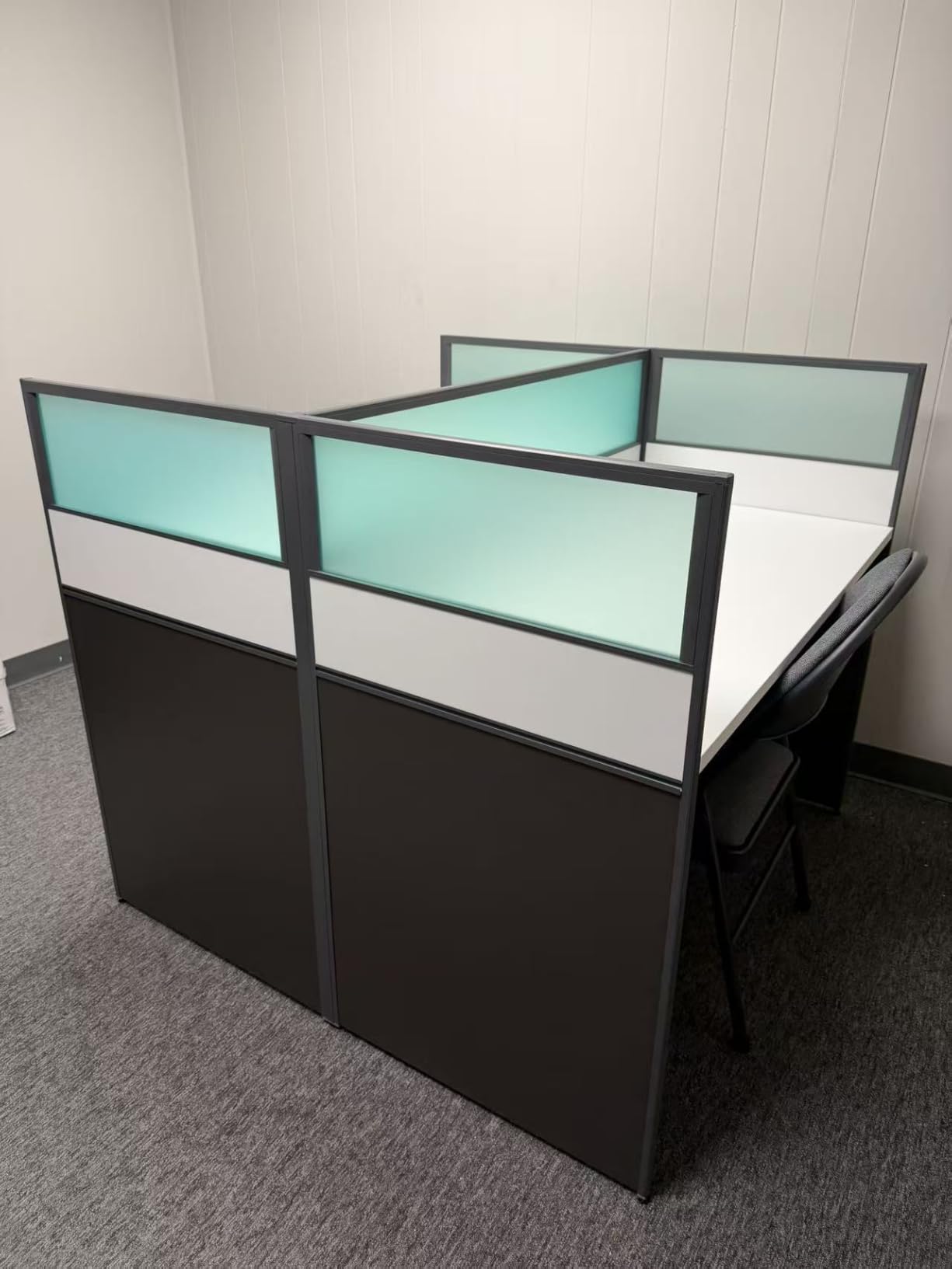
The most useful accessory is the optional mobile file cabinet, which measures 15.7 by 15.7 by 23.6 inches and has a three-digit combination lock. It slides under the desk and turns a pod into a complete workstation, which is exactly what a single home office needs.
Rotatable anti-scratch leveling feet and corrosion-resistant aluminum edging handle uneven floors and protect the base from chips, two details that show up constantly in owner feedback about cheaper units.
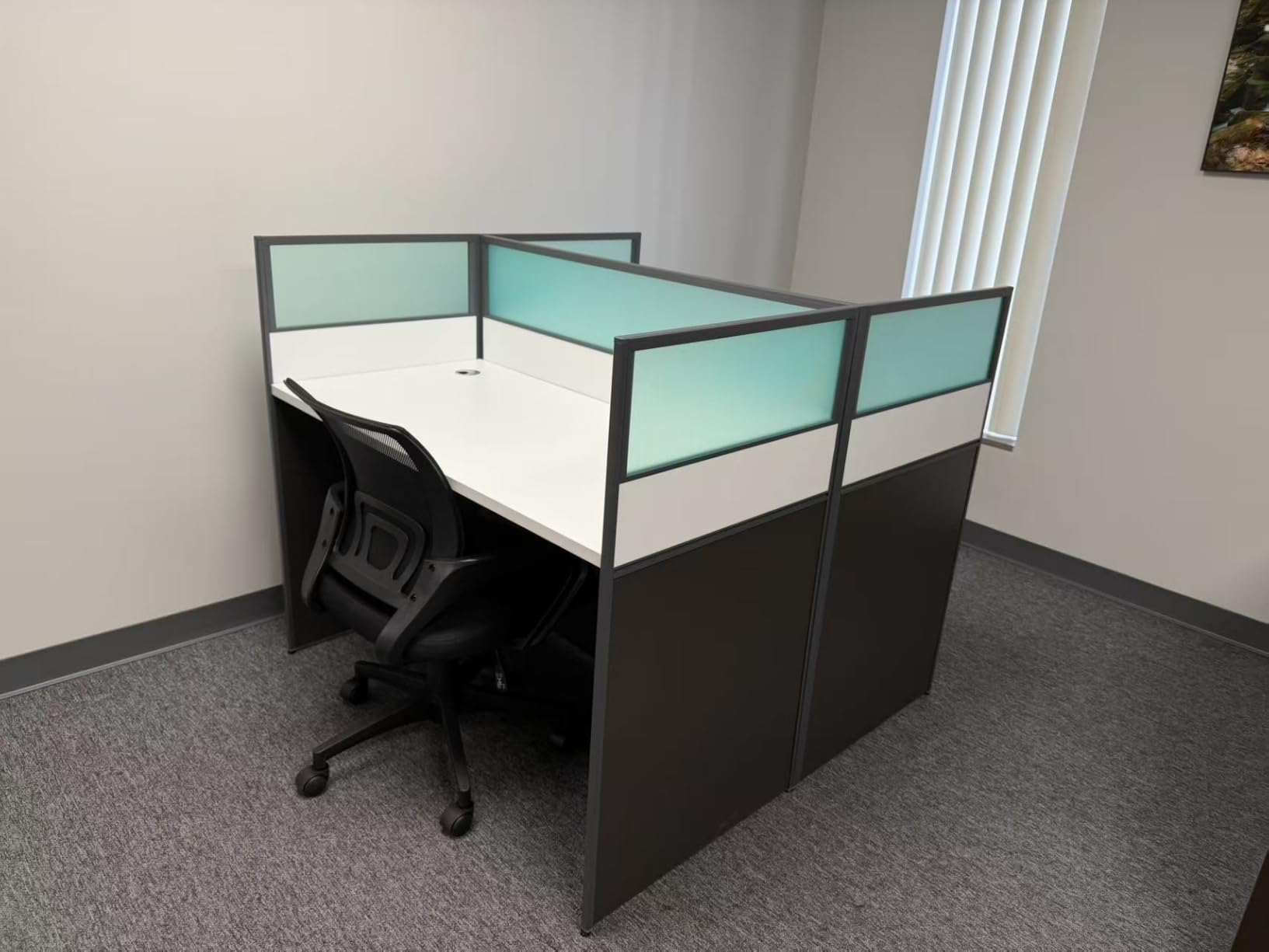
When one person needs a real pod
This suits a solo professional who works from home and wants a boundary between work and the rest of the house, or a single desk in a shared office where one occupant needs visual separation the open room cannot give. A frosted divider is enough for that job.
It also works as the private meeting or focus spot in a small studio. One person can take a call in a defined zone while the rest of the team keeps working, which is the cheapest form of acoustic improvement available in an open plan.
Where it falls short
Modularity here means the exact seating configuration is chosen at purchase. It configures from a solo pod to a double desk, a four-person row or a six-person hub, but you commit to that shape on day one, so measure before you order.
The melamine-coated surface is durable but shows wear sooner than a solid wood top, and with only three reviews there is not enough long-term feedback to promise how the coating ages.
8. Ceridwen 2-Person Acrylic Baffle Desk — Best for Bright, Daylit Rooms
Ceridwen Office Cubicle Desk, 2 Person Workstation with Privacy Panels & Cable Management, Sturdy Computer Table for Home Office & Commercial Use (F2F-2P-Desk-Divider)
24.4 inch D x 96.8 inch W x 39.3 inch H
179 pounds
18mm top rated 100kg
Two grommets per desktop
Pros
- Dual cable grommets at each position keep cords organized
- Light-transmitting acrylic keeps the workspace bright
- 18mm top and aluminum frame rated to 100kg
- Height-adjustable foot pads level it and protect flooring
Cons
- 179 pounds means two people to move
- Acrylic dividers soften noise rather than isolate it
Both reviewers of this unit said the same two things: the cable grommets solved their wire problem, and the acrylic baffles let light through. That second point is what separates it from the fabric options, and in a windowless interior office it is the reason to choose an acrylic system at all.
Three-sided semi-transparent acrylic baffles block visual distraction and reduce ambient noise while transmitting daylight, so the pod feels defined without feeling like a closed box. The overall size is 240 by 60 by 100 centimeters with a 75 centimeter high desktop, which converts to 24.4 inches deep by 96.8 inches wide.
Structurally it is the 18mm thick wooden top on a reinforced aluminum alloy frame rated to 100 kilograms, roughly 220 pounds, with two cable grommets per desktop. Height-adjustable foot pads level the desk on uneven floors and protect the flooring underneath.
Choosing acrylic or fabric for light
Fabric and bamboo-core panels are the better acoustic choice. Polycarbonate and acrylic transmit light, so a pod built from them keeps a room bright and connected while still screening sight lines, and they are easier to wipe clean than fabric after a long shift.
That makes an acrylic system the right pick for a basement office, a converted storage room or any space with few windows, where a solid partition would make the room feel smaller than it is.
Where it falls short
At 179 pounds this is the heaviest product in the guide by a wide margin, and both the listed weight and the assembly effort make it a two-person job. Plan the floor plan before delivery day, because you will not be moving it alone.
Two reviews is the smallest evidence base here, and both describe the same feature set rather than long-term use. The acrylic also softens noise rather than isolating it, so it does not solve a confidential-call problem.
9. Usosidam 4-Person Cable-Managed Workstation — Best for Built-In Power
Usosidam 4-Person Office Cubicle Desks, Cubicle Desks Workstation with Mute Partitions & Cabinet, Office Cubicles Desk with Cable Management, Modular Computer Table for SOHO Home School Call Centers
47.2 inch D x 94.5 inch W x 29.5 inch H
4 seats
1 inch laminate top
Built-in outlet and grommets
Pros
- Held up to months of daily call-center use with no wobbling
- Deep desktop fits dual monitors plus a printer
- Frosted partitions cut interruptions while keeping the team connected
- Hidden cable channel keeps the floor clear
Cons
- Built for 2 to 50 employee deployments rather than single users
- Frosted partitions do not isolate individual workspaces
The distinction that sets this one apart is electrical. It ships with a built-in outlet and cable grommets plus a hidden cable channel, so power reaches each position without an extension strip or a floor box. On a four-person run that is the difference between a tidy floor and a trip hazard, and it is rarely included in this product category.
Both reviews on this listing come from sustained commercial use. One buyer reports months of daily call-center duty with no wobbling and no damage, which is the durability evidence you want from a system that gets eight hours of use a day.
The desktop is 94.5 inches wide by 48 inches deep, which comfortably fits dual monitors, a laptop and a printer with room to spare, on a 1-inch thick scratch- and water-resistant laminate top over a powder-coated steel frame. Two people finish assembly in about an hour with labeled hardware.
Why power infrastructure decides the layout
Most cubicle layouts are planned around furniture and power is added later, which is why so many offices end up with extension strips crossing aisles. A system with a built-in outlet and hidden channel lets you place the run against a wall and power it once, and that also frees you from where floor outlets happen to be.
Plan it with your electrician, not after. Confirm whether the built-in outlet is a power-only module or a power and data module, and whether the circuit can carry four workstations plus monitors on one run.
Where it falls short
This is a team product. The listing positions it for deployments of roughly 2 to 50 employees, so a single person buying one unit to create a home-office pod will be paying for capacity they cannot use.
The frosted acrylic partitions reduce distraction without isolating individual workspaces, which suits a collaborative floor and falls short for confidential work. Only two reviews are available, so the durability picture is promising rather than proven.
10. JNMDLAKO 4-Person Modular Frosted Desk — Best for Growing Hybrid Teams
4-Person Office Cubicle Desk Workstation, Modular Staff Cubicle Desk with Mute Privacy Partition & Cable Management, Space-Saving Office Cubicles for Call Center,Startup,Home Office (walnut-B, 94.5in)
94.5 inch 2 and 4 seat layout
70 pounds
Frosted acrylic partitions
Built-in cable grommets
Pros
- Frosted acrylic partitions block distraction and absorb noise
- Semi-transparent screens keep the team connected while creating focused zones
- Built-in grommets eliminate tangles and improve airflow
- Leveling feet steady it on tile concrete and carpet
- Four-user ergonomic dimensions
Cons
- Engineered wood and metal built for durability rather than premium finish
- Frosted screens lower noise without creating enclosed offices
This is the system for a team that will grow. The same unit configures as a two-seat or a four-seat workstation at 94.5 inches, so a two-person team can start and add seats later instead of replacing the whole run when the fourth person arrives.
Frosted acrylic privacy partitions block visual distraction and absorb workspace noise while staying semi-transparent, which keeps a four-person pod connected rather than siloed. That balance is the right call for hybrid teams where people need to be reachable but not constantly visible.
Underneath, a thickened scratch-resistant desktop sits on a heavy-duty steel and aluminum frame, with built-in cable grommets routing wires and chargers and rotatable anti-scratch leveling feet that hold steady across tile, concrete and carpet. The whole run weighs 70 pounds and two people can assemble it with the labeled hardware.
Planning a system that has to grow
Most cubicle purchases fail on timing, not on quality. Teams that add headcount twice in three years end up with mismatched systems, mismatched panel heights and a patchwork floor, so buying a modular unit that reconfigures in both seat count and shape is cheaper over the lease term.
Fifty-five inch aisle planning matters more at four seats than at one. Leave enough clearance behind each seated position for a chair to roll back and for someone to walk past without squeezing, and check that your fire and accessibility clearances survive the finished layout.
Where it falls short
The engineered wood and metal build prioritizes durability over finish. It is the right choice for a call center or a co-working floor and the wrong one for a client-facing suite, where the surface finish is part of the impression you are making.
The frosted screens lower noise without creating fully enclosed offices, and the listing carries only two reviews, both brief. Treat the claims as unproven over a long horizon and ask about the frame warranty terms in writing before you commit to a larger deployment.
Office Cubicle Buying Guide: 9 Things to Check Before You Order
What separates a good cubicle from a bad one
Five criteria decide whether you are looking at one of the best office cubicles or a disposable partition:
Modularity and reconfiguration. Can the layout change without tools, and can seat count change without replacing the system?
Frame rigidity and load rating. A stated capacity above roughly 200 pounds per seat covers monitors, arms, docks and paperwork with margin.
Acoustic performance, not acoustic claims. Fabric, bamboo fiber and polyester cores absorb; acrylic and polycarbonate screen visually but transmit sound.
Privacy level matched to the work. A 40-inch desk divider, a 66-inch panel and a 6-foot fabric wall solve three very different problems.
Power, data and leveling included. Grommets, a built-in outlet and rotatable feet are cheaper to include now than to retrofit later.
Our office printers roundup covers the other half of a workstation, and a properly sized printer shelf or a nearby bookshelf determines how much of the work surface you actually keep free.
Panel height: 53 inch, 66 inch, 6 foot and above
Panel height is the specification buyers ask about least and care about most after the first noise complaint. At roughly 53 inches a seated person is visible from the chest up, which keeps supervisors oversight high and privacy low. It is a good fit for teams that need visibility more than quiet, such as a supervised training floor or a high-visibility service desk.
At 66 inches, the panel covers a seated user up to shoulder height. That is the most common height in this guide and the point where a person gains real visual privacy while still being able to see a standing visitor approaching.
At 6 feet and above, a seated person is fully screened. You get materially better acoustics, and you give up open sightlines, which changes how a manager supervises and how a team feels about isolation. Our test units at that height are the ones owners describe as genuinely quieter.
Glass, acrylic, polycarbonate, fabric or bamboo core
Fabric-covered and bamboo-fiber panels are the acoustic choice. They absorb rather than reflect, they take pin holes and notes without looking damaged, and they are the finish that reads as professional furniture in a finished office.
Acrylic and polycarbonate panels are the light and maintenance choice. They block sight lines, pass daylight, wipe clean after a messy shift and suit interior rooms with few windows. Their limitation is sound: they screen visually and reduce noise only slightly.
Glass panels with a fabric or PET core combine the two. They are the most expensive option and they carry the strictest cleaning regime, so they suit reception and senior areas rather than a high-abuse call center floor.
Layout shapes and how many square feet you actually need
An L-shaped two-person desk gives each user a deeper zone than a straight run, and it costs more floor per seat. A T-shaped station gives one person a return for a second monitor or paperwork while keeping a shared entry, which works well in accounting and legal teams.
Benching places two people back to back with a shared divider, which delivers the lowest privacy per square foot and the highest density. It is the correct answer for call centers and the wrong answer for confidential work.
An H-shaped or six-person hub configuration is a middle ground: more separation than benching, more density than singles. Plan on roughly 36 to 60 square feet per person for a standard panel system and add aisle and circulation space on top.
How to measure a floor plan and count stations
Measure the usable floor area, then subtract walls, columns, doors, windows and any fixed meeting rooms. Divide the remaining area by the square footage per station for your chosen layout, and then take off 10 to 15 percent for aisles, circulation and access.
Measure twice in different directions. Out-of-square rooms are the norm, not the exception, and a 94-inch run needs straight wall to sit flush. Note column positions early, because a system that has to be shortened around a column usually costs more than a different layout would.
Sketch the finished floor with seat positions before you order anything. A simple drawing on paper takes twenty minutes and catches the aisle and accessibility problems while they are still free to fix.
New versus used versus leased cubicles
New systems give you a warranty, a known load rating and a lead time you control, and they are the only option that guarantees all ten seats match. Used systems can be a large saving, but panel fabric, grommets and leveling feet wear out faster than frames, and mixed lots rarely line up visually.
Leasing spreads the cost across a term and can bundle installation, which suits a company that expects to move before the furniture finishes paying off. Read the term, the early-exit clause and who pays to demount and reinstall, because that last line is where the surprise lives.
Buying outright is the simplest path and usually the cheapest over a term longer than five years. If you expect a floor change within three years, a leased or modular system that moves with a tool-free hand is worth more than a cheaper fixed one.
Freight, installation and the red flags in a quote
Freight and white-glove installation are rarely included in a headline figure and are a top source of budget overrun. Ask whether delivery is curbside or room-of-choice, whether stairs and elevator access are surcharged, and whether the installer removes packaging.
Ask who is responsible for damage in transit, what the lead time actually is in weeks rather than business days, and whether the price includes power modules. On a full-floor system, installation can rival the cost of the furniture itself, so get it itemized on its own line.
Red flags in a quote include no stated warranty length, no load rating on the panel or frame, no panel height specified in writing, and a layout drawing that does not show aisle widths. If a supplier will not put the specification on paper, the specification does not exist.
Brands worth knowing and modern alternatives
At the contract-furniture tier, the names that dominate modular interiors are Steelcase, Haworth, HON, Herman Miller, Kimball International, Teknion, Knoll, Allsteel, Skutchi Designs and ROSI Office Systems. They build demountable panel systems for projects measured in hundreds of stations, and their differentiator is BIFMA and ANSI certification, documented fire ratings and a warranty measured in years rather than months.
Where a cubicle is not the right answer, there are alternatives. Benching desks with floor screens give density without walls. Acoustic pods give a bookable focus room in a fraction of the space of a permanent office. Demountable partition walls give a fully enclosed room that can come down at the end of a lease.
Glass-fronted private offices serve managers and client-facing staff, and a simple privacy screen on a shared table handles the short case, a laptop and a phone call, for a fraction of the footprint. If you are furnishing a small office or a home workspace, our leather office chair guide covers the seating that pairs with a compact pod.
Frequently Asked Questions
Why are offices getting rid of cubicles?
Cubicles lost favor during the open-plan boom of the 2000s because low panels created visual cages without real acoustic comfort, supervisors lost visibility of their teams, and the assumption was that removing walls would encourage collaboration. That assumption has largely failed in practice, and the return to office plus hybrid schedules has pushed the decision the other way. Today cubicles are specified with taller panels, better acoustic cores and a mix of benched and private stations, so the product is simply better than the one people remember disliking.
What is the best high-quality office furniture?
Quality in office furniture shows up in markers you can verify: BIFMA and ANSI certification, a stated load rating rather than a vague claim, a documented fire rating on fabric, a frame gauge and bracing pattern you can see, and a warranty length in years. For cubicle systems specifically, a load rating above roughly 200 pounds per seat, rotatable leveling feet and a concealed power or cable channel are the details that separate commercial-grade equipment from a home-office desk with panels attached.
What is a modern alternative to cubicles?
The main alternatives are benching desks with floor screens, which maximize density; acoustic pods, which are bookable focus rooms in a small footprint; glass-fronted private offices, which serve managers and client-facing staff; demountable partition walls, which create a fully enclosed room that can be removed at end of lease; and simple desk dividers on a shared table for short individual tasks. Each wins in a different scenario, and none of them delivers the combination of privacy, density and reconfiguration that a panel system does.
What is the best brand for office furniture?
At the contract-furniture tier, Steelcase, Haworth, HON, Herman Miller, Kimball International, Teknion, Knoll, Allsteel, Skutchi Designs and ROSI Office Systems are the names most often specified for modular interiors, and they are the right choice for large projects measured in hundreds of stations. For smaller spaces, direct-to-consumer brands and marketplace systems cover single desks and small pods well. The deciding factor is warranty length, documented certification and whether the supplier will put panel height and load rating in writing.
Are office cubicles still relevant?
Yes, and the strongest evidence is that they returned after a two-decade decline. In open-plan floors the top noise and distraction complaint is always conversational spill from adjacent stations, and a panel with an acoustic core is the cheapest way to fix that without a remodel. They are less relevant in fully remote-first teams or in single-person home offices, where a desk divider or a single pod is a better fit than a system.
Are glass cubicles better than fabric cubicles?
Neither is better overall, they trade off. Fabric and bamboo-fiber cores absorb sound and are the right choice for a noisy call center or confidential work, and they take pins and notes well. Acrylic, polycarbonate and glass panels block sight lines while passing daylight, which suits interior rooms with few windows and are easier to wipe clean. If noise is your main problem, choose fabric. If daylight and visual connection are your main problem, choose a panel with a glazed section.
The Best Office Cubicles to Buy in 2026
Our pick for the best office cubicles overall is the KERRAM three-panel foldable partition, because it is the only system here you can move, reconfigure and store without a tool, and it carries the highest review count of the group at a 4.8 average from 14 owners. If you are building out a team rather than a single zone, the Versare Hush Panel is the better value, since its tool-free panels link into a full grid, but check the base stiffness on an uneven floor first.
For a fixed two-person shared desk, the Sonrehon aluminum workstation is the strongest build in the guide, with a 220-pound frame rating, leveling feet and concealed cable ports. Larger teams should look at the four-person systems, and anyone working in a room with few windows should prefer acrylic or polycarbonate panels over fabric for daylight.
Whichever system you pick, the two decisions that determine whether you are happy are the panel height and the layout shape. Get those right against your floor plan and your aisle widths, put the load rating and the warranty length in writing, and the best office cubicles for your workspace will be the ones that still fit in 2026 and beyond.