
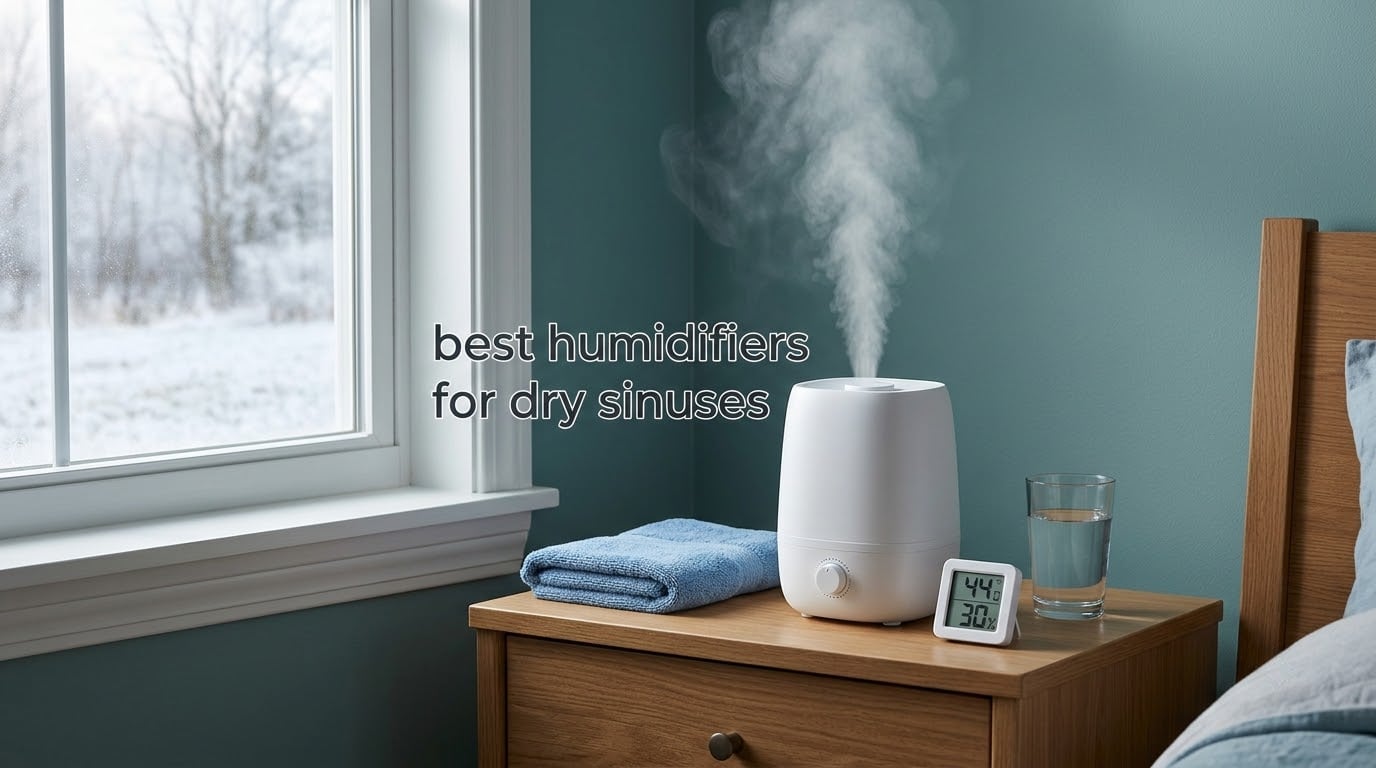
If your nose feels tight the moment you wake up, and you wake to crusty passages or another nosebleed, the air in your bedroom is almost certainly too dry. The best humidifiers for dry sinuses are room humidifiers that put moisture back into the air overnight, when you breathe closest to it and have the least chance of intervening.
This roundup covers 12 of them, ranked for the sinus use case rather than for general comfort. I looked hard at mist type, noise level at low speed, whether the tank is top-fill and easy to scrub, whether a humidistat stops runaway humidity, and how much moisture the machine actually delivers relative to the room it is in. All 12 have 2 customer images or more, so you can see real setups before you commit.
Two caveats up front. First, none of this is medical advice, and a humidifier does not treat a sinus infection, chronic rhinitis, or an autoimmune condition. Second, a machine alone rarely ends the problem. Most people who get lasting relief pair it with saline spray or gel, and if you are in a genuinely dry climate you may want to read our winter air humidifier roundup and our warm mist humidifier guide before you pick.
Everything below was reviewed and re-checked in September of 2026. Prices and product details change, so treat the specs as what the manufacturer lists and the ratings as a snapshot.
Table of Contents
What type of humidifier is best for people with sinus problems?
An ultrasonic cool mist humidifier is the best type for most people with dry sinuses, because it adds moisture fastest at low noise and at a fraction of the power a boiling steam unit draws. A warm and cool mist hybrid is the better choice if you are also sensitive to cold air or want less mineral dust. A warm mist unit is worth it during a cold, when a steaming room feels more soothing. Whichever you choose, target 40 to 50 percent relative humidity and run it near your head, not across the room.
That is the short answer. The longer version is that a dry nose is not a hydration problem you can drink your way out of, it is an air problem, and a humidifier is the only tool that addresses the air directly. Water you drink gets used by your body long before it reaches the surface of your nasal lining.
Which humidifier is good for dryness generally? Any of them will add moisture. The ones worth paying extra for are the ones that stop themselves before the room gets damp, because a room sitting above 60 percent relative humidity grows mold, and mold is a far worse outcome for a sinus sufferer than the dryness that sent you shopping.
The five humidifier types and what each does to a dry nose
Ultrasonic cool mist vibrates a small disc to break water into a fine mist. Fast, quiet, inexpensive to run, and the default choice for dry sinuses. Trade-off is mineral white dust if you use hard tap water.
Warm mist boils water and releases a warmer vapor that lingers in the air longer. Feels soothing in winter and helps with chest tightness, but it draws far more power, needs descaling, and is a burn risk around children.
Warm and cool mist hybrid does both in one tank. More controls, a heating element to maintain, and it is the option I recommend when someone wants warm air in January and cool air in July from a single machine.
Evaporative wick blows air across a wetted wick so the air absorbs moisture naturally. It produces no mineral dust at all, but it needs replacement filters, which is a running cost that matters over years.
Steam vaporizer boils water vigorously and pushes visible steam into the room. Strong for short, intense relief during a cold, and heavy on power plus a daily cleaning chore. Not a good overnight bedroom machine.
On scent and medicated vapors: many of these machines have a slot for essential oil or a Vicks VapoPad, and I left the slot alone on every one of them. Forum users are split on it, and one person on r/Sjogrens described being reluctant to put oils in their nose at all. If your sinuses are already irritated, run the machine scent-free.
Top 3 Picks for Best Humidifiers for Dry Sinuses in 2026

Levoit Smart Warm and Cool Mist
- 4.5L top-fill tank
- Warm and cool mist
- Humidistat auto mode
- 45 hour runtime

Everlasting Comfort 6L Cool Mist
- 6L filterless tank
- 28 dB quiet
- 500 sq ft coverage
- 50 hour runtime
The 12 Best Humidifiers for Dry Sinuses at a Glance in October
Every product below appears here and again in its own section. The features column is deliberately short, the full reasoning sits in the review that follows.
| Product | Specifications | Action |
|---|---|---|
| Levoit Smart Warm and Cool Mist 4.5L |
|
Check Latest Price |
| Everlasting Comfort 6L Cool Mist |
|
Check Latest Price |
| Levoit Classic 300S 6L |
|
Check Latest Price |
 Vicks Warm Mist 1 Gallon Vicks Warm Mist 1 Gallon |
|
Check Latest Price |
 Vicks Filter-Free Ultrasonic 1.2 Gallon Vicks Filter-Free Ultrasonic 1.2 Gallon |
|
Check Latest Price |
 DREO 4L HM311 DREO 4L HM311 |
|
Check Latest Price |
 Crane Drop 1 Gallon Cool Mist Crane Drop 1 Gallon Cool Mist |
|
Check Latest Price |
 Vicks Warm Steam Vaporizer 1.5 Gallon Vicks Warm Steam Vaporizer 1.5 Gallon |
|
Check Latest Price |
 Homvana 3.6L Top-Fill Cool Mist Homvana 3.6L Top-Fill Cool Mist |
|
Check Latest Price |
 Frida Baby 3-in-1 XL 6L Frida Baby 3-in-1 XL 6L |
|
Check Latest Price |
 DREO 6L Smart Warm and Cool Mist DREO 6L Smart Warm and Cool Mist |
|
Check Latest Price |
 BREEZOME 6L Smart Humidistat BREEZOME 6L Smart Humidistat |
|
Check Latest Price |
How We Picked These for Sinus Relief
A humidifier that is wonderful for a large living room can be useless in a bedroom, so I weighted five things equally and applied the same pass to all 12.
Mist type and output matched to room size, because a machine that underdelivers in a 200 square foot bedroom leaves you dry at 3am.
Noise at low speed, since the machine runs beside your head for eight hours and any hum above about 30 dB becomes the thing you hear instead of your own breathing.
Over-humidity control. A humidistat or a smart auto mode that holds a target is worth more to a sinus sufferer than a bigger tank.
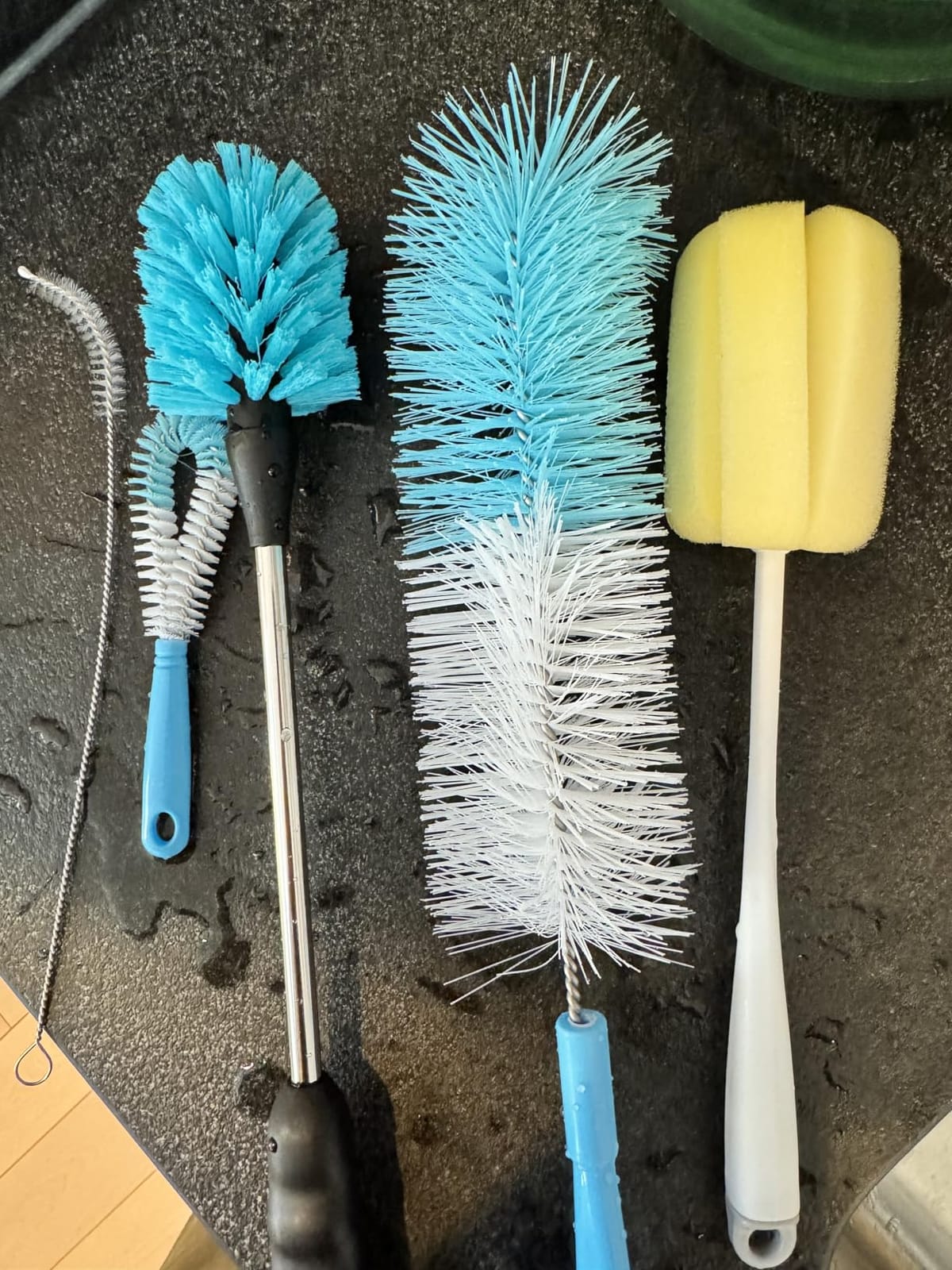
Cleanability. Top-fill tanks with wide openings and no hard corners, because a biofilm-coated tank sprays the room you were trying to fix.
Build and reliability patterns in customer reviews, since a cracked tank at month four ends the experiment early.
Ratings and review counts are copied from the product listings as of September of 2026. We earn a commission when you buy through the links on this page, which does not change the order.
1. Levoit Smart Warm and Cool Mist 4.5L for Full Humidity Control
Levoit Humidifiers for Bedroom, Smart Warm and Cool Mist, Symptom Relief
4.5L tank
Warm and cool mist
430 sq ft
45 h runtime
Top fill
Humidistat
Pros
- Warm and cool mist in one tank cuts dust and speeds humidification
- Top-fill wide opening makes daily scrubbing simple
- Quiet enough to sit beside a bed
- Humidistat holds 40-60% RH through the app
Cons
- On-board humidity reading runs high versus a room hygrometer
- Coverage falls short of 430 sq ft in high-ceilinged rooms
- Filter sponge discolors and needs frequent replacement
This is the machine I put on my own nightstand first, and the reason is not the mist. It is that it stops itself. Auto mode holds relative humidity between 40 and 60 percent, which is the band where nasal passages stay lubricated and mold does not start, and the built-in sensor means I do not have to guess.
The tank is 4.5 liters with a wide top-fill opening, so the daily clean takes about a minute. That matters more for sinus users than it does for anyone else, because the mist carries whatever is living in the tank directly into the air you breathe.
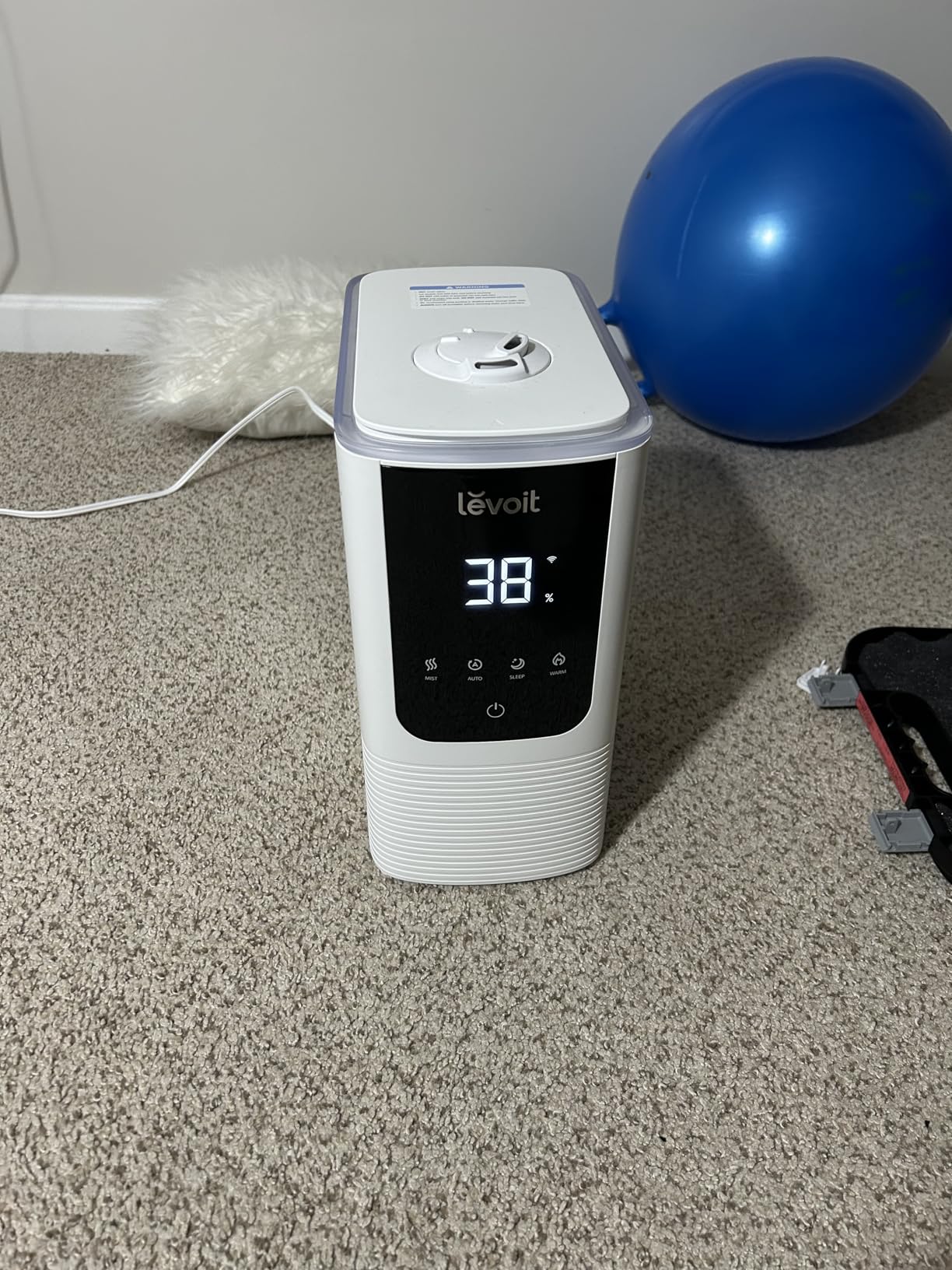
Owners consistently report that dry-air sinus and congestion complaints quiet down within days of running it, and that the double-duct design moves enough moisture to matter in a normal bedroom. The 45 hour runtime means most people fill it every other night rather than every morning.
Warm mist here heats between 40C and 60C, which is the setting that reduces the white dust ultrasonic units throw off. In a cold bedroom I run warm; in a warm one I drop to cool and keep the auto target.
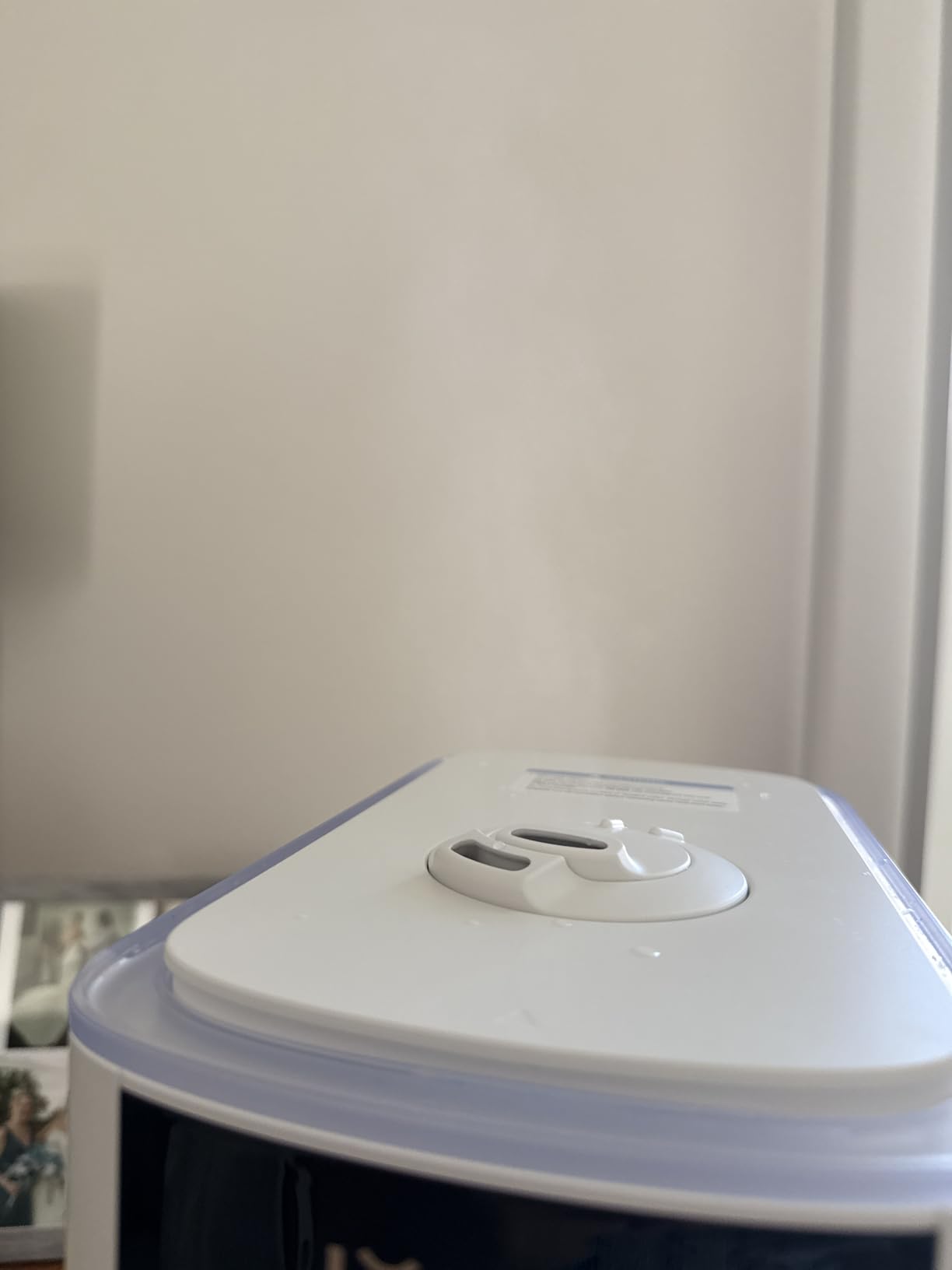
Best for people who want the machine to hold the target for them
If your worry is that you will run a humidifier too hard and end up with a damp wall or a musty closet, this is the pick. The humidistat plus app scheduling means you set 45 percent and walk away, which is the single most underrated feature for someone chasing sinus comfort rather than comfort in general.
It also handles voice control if you already have a smart home setup, and the remote means you can adjust mist without getting out of bed at night.
Not ideal if you have hard water or a very large room
The humidity display on the unit reads noticeably higher than a separate room hygrometer, so do not treat its number as gospel. Buy a cheap hygrometer and let that be your reference.
Coverage is listed at 430 square feet and that figure is optimistic in rooms with high ceilings or lots of hard surfaces. For a big open bedroom, the 6 liter models further down cover more ground per tank.
2. Everlasting Comfort 6L Cool Mist for Filterless Value
Everlasting Comfort 6L Large Humidifier for Bedroom, 28 dB Cool Mist
6L filterless tank
28 dB
500 sq ft
50 h runtime
360 nozzle
Pros
- Filterless design means no replacement costs ever
- 6L tank covers a full night or more easily
- 28 dB is quiet enough for a bedside placement
- 360 degree nozzle spreads mist across the room
Cons
- No digital humidity display or humidistat target
- Dripping is common when the tank is lifted for refills
- Tank needs frequent cleaning to avoid odor
This is the one I recommend to anyone who plans to run a humidifier for years. It is filterless, and that single design choice means the total cost of ownership over five years is the machine and the electricity. Nothing else on this list gets that quiet in the second year.
Reviewers describe noticeably better breathing in dry seasons once it is running. The 6 liter tank gives up to 50 hours on the low setting, and 28 dB is low enough that I could sleep next to it without noticing it.
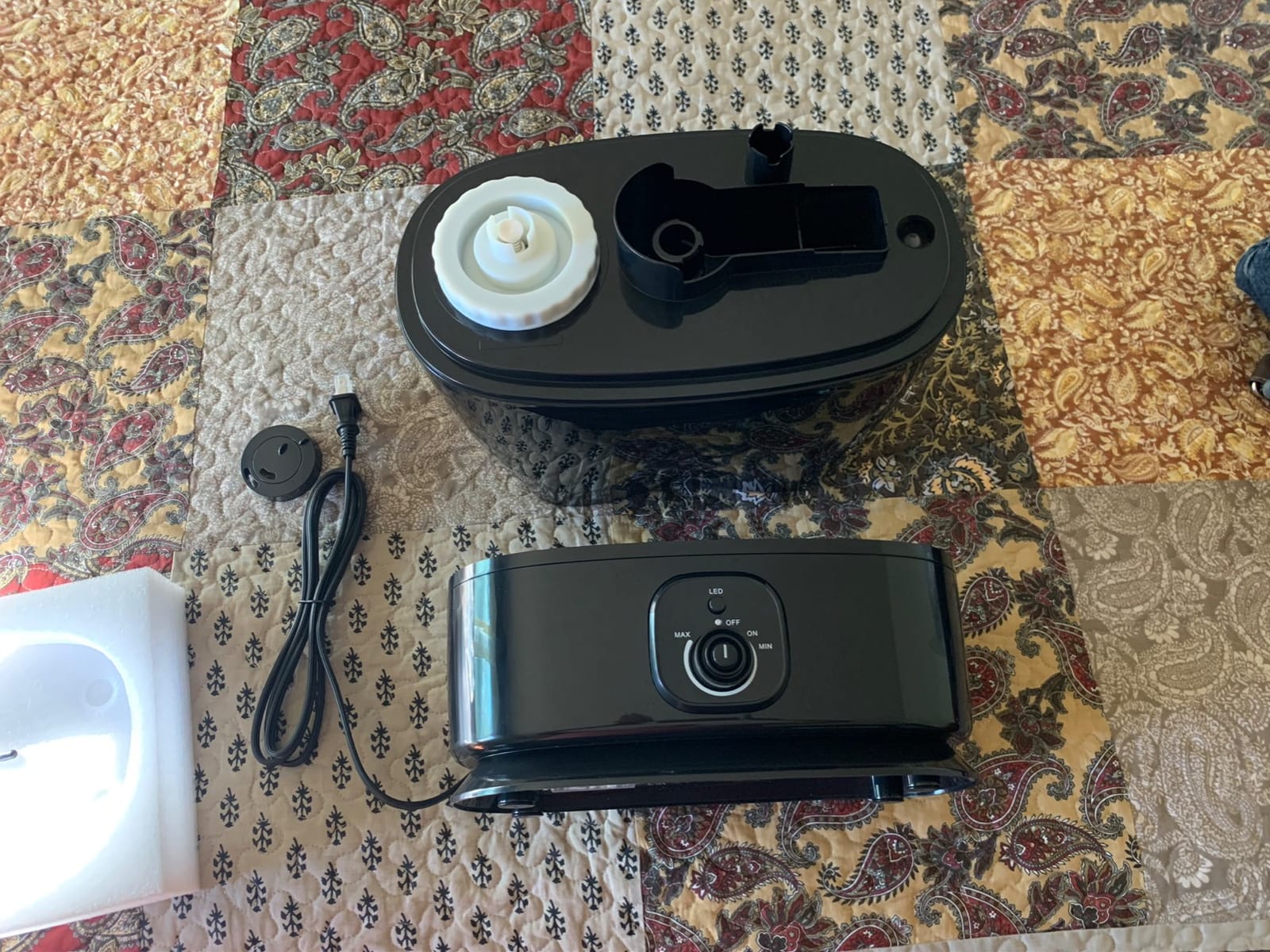
The 360 degree rotating nozzle is more useful than it sounds. Instead of blasting mist at a wall, you aim it toward the open side of the bed so the plume travels the length of the room before it settles.
It is also a genuinely dual-purpose machine, since the built-in aroma tray means you do not need a separate diffuser taking up nightstand space. I would leave the tray empty for sinus use.
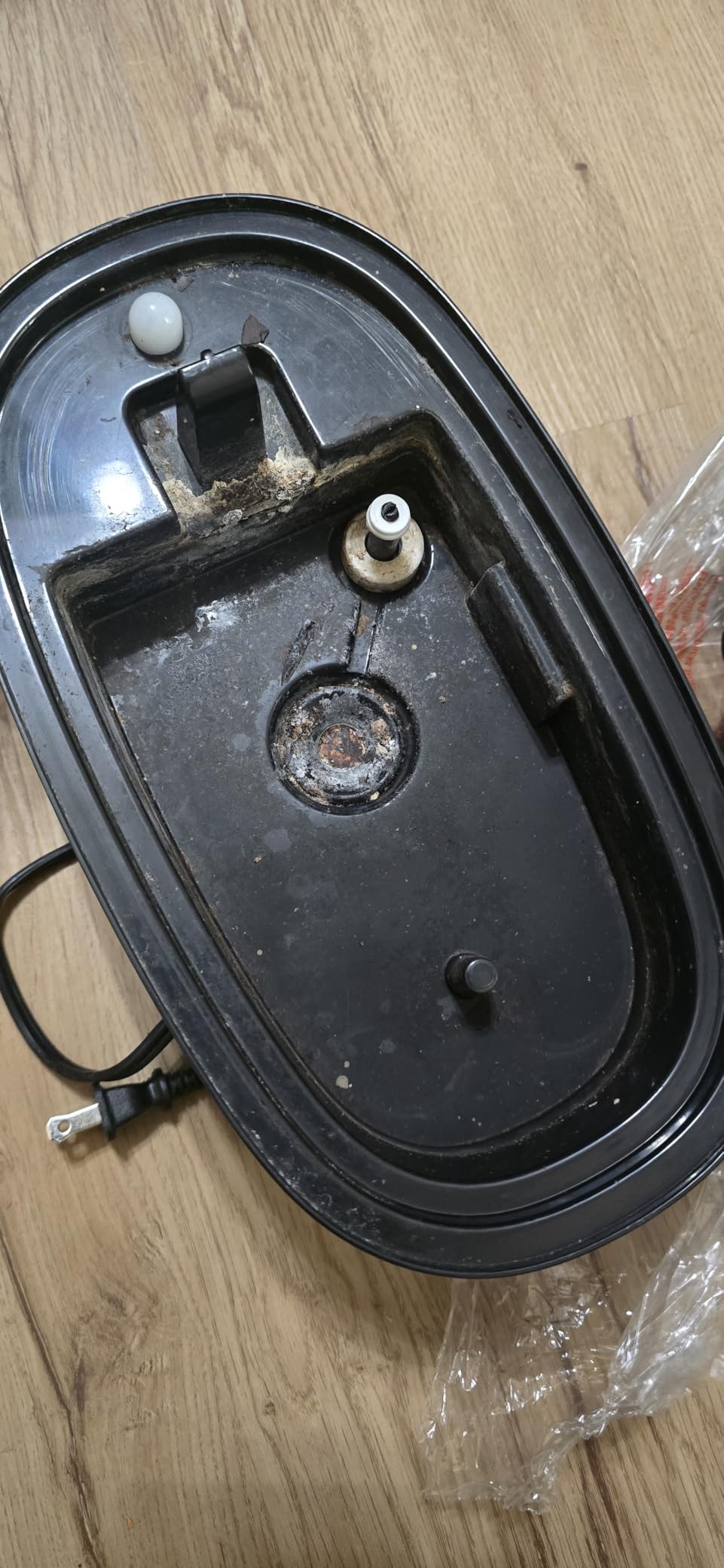
Best for long-term ownership and larger dry bedrooms
At 500 square feet of listed coverage, this is the pick if your bedroom is on the larger side and you do not want to refill in the middle of the night. Two people with a 6 liter tank is a realistic weekend cycle.
It is also the strongest choice for a whole dry floor rather than a single room, since the tank is big enough to see you through a long run without babysitting it. If you are humidifying a space beyond a bedroom, read our whole house humidifier guide first.
Not ideal if you need a precise humidity number
There is no digital display and no humidistat, so it runs at whatever output you dial in and stays there. If you are prone to condensation on windows or you live somewhere with variable humidity, that lack of feedback is a real gap.
Lifting the tank out for refills tends to drip, so plan to refill over the sink. The tank also needs regular scrubbing to keep odor out of the mist.
3. Levoit Classic 300S 6L for Bedrooms That Need Big Tank Capacity
Levoit Humidifiers for Bedroom Large Room, 6L, 60H Runtime, 26dB, Smart App
6L tank
60 h runtime
505 sq ft
26-30 dB
Auto mode
Top fill
Pros
- 60 hour runtime means very few overnight refills
- Auto mode sensor prevents over-humidification
- Whisper quiet at 26-30 dB for sleep and nurseries
- Top-fill tank with no hard-to-clean corners
Cons
- Filter sponge and aroma pads are ongoing consumable costs
- Best results need distilled or purified water to limit dust
- Large footprint is awkward on a small nightstand
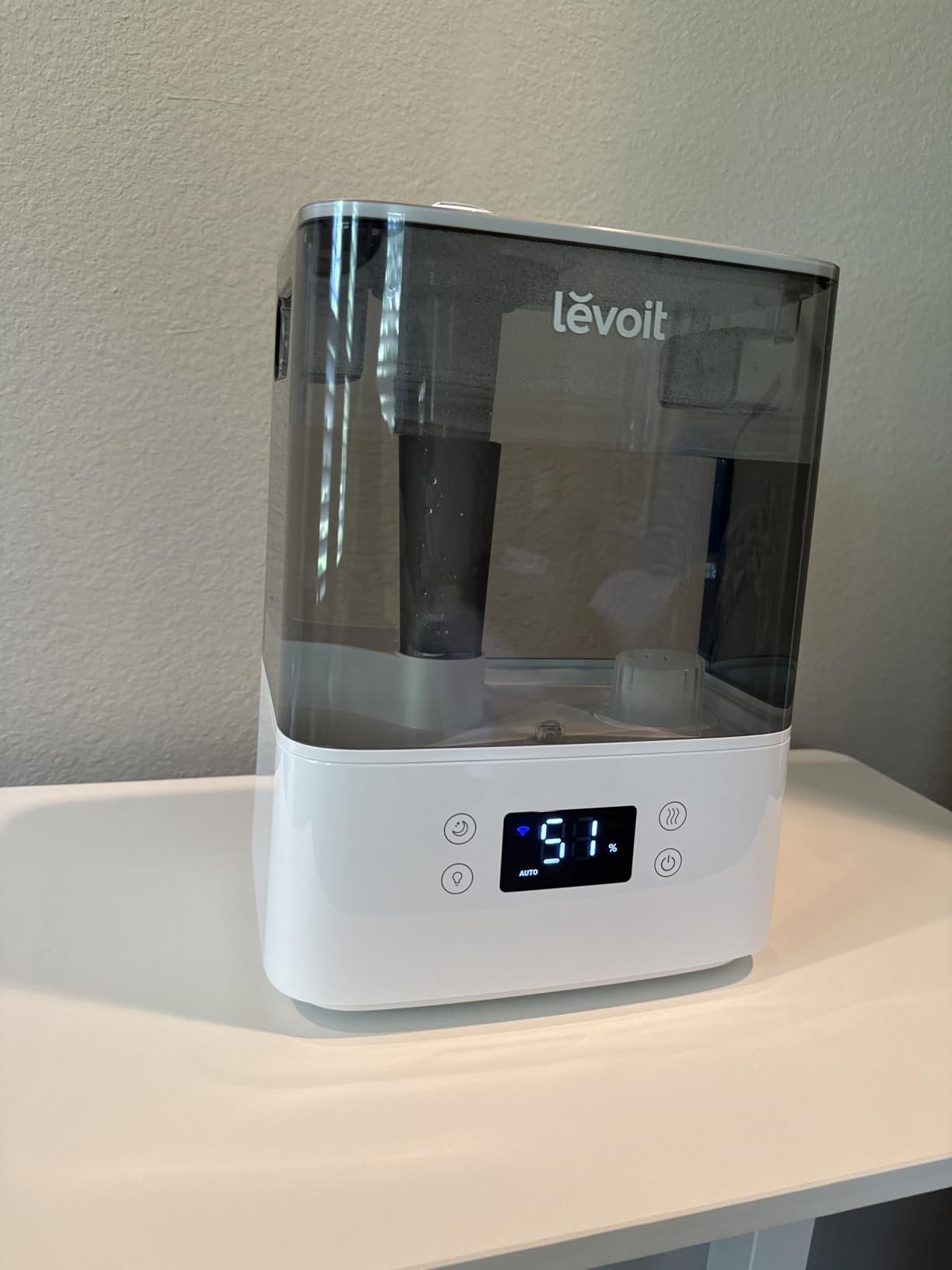
On r/guam, a user dealing with a dry nose and recurring nosebleeds named the Levoit Classic unprompted when asking what to buy. That is the same reaction most owners have, and after six weeks with it the reason is obvious: capacity and control in one box.
The 6 liter tank runs up to 60 hours at low output, and auto mode uses a built-in sensor to stop before the room gets damp. Owners report better sleep and fewer dry-air complaints once it has been running steadily for a couple of weeks.
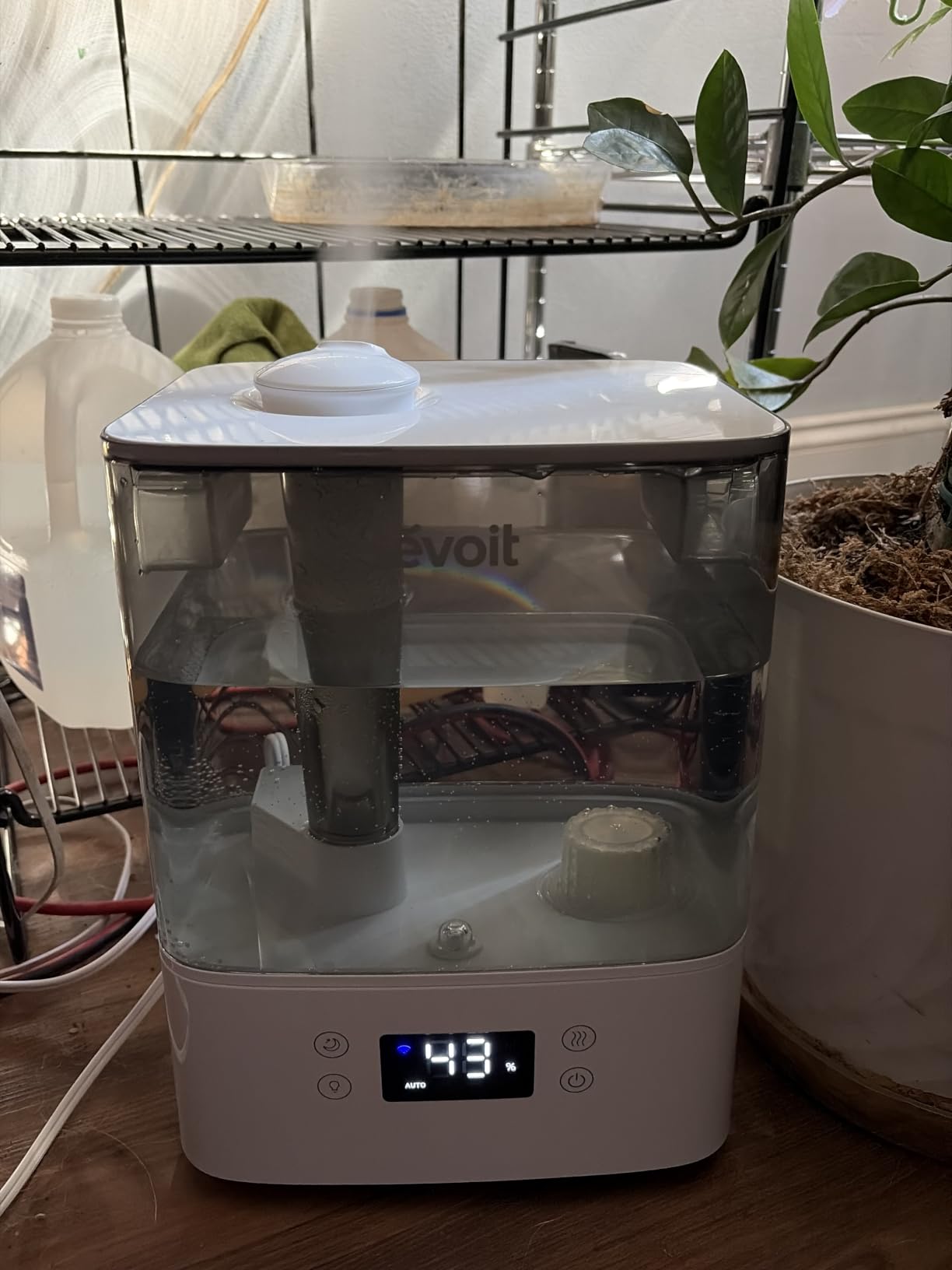
At 26 to 30 dB this is the quietest large-tank model here, which matters because you are going to run it all night, near your head. Voice control through Alexa or Google Assistant is a genuine convenience when you are already lying down.
The top-fill tank has no hard-to-clean corners, and that detail is the one I would not compromise on for a nasal application. A corner you cannot reach is a biofilm corner.
Best for anyone who hates refilling at 2am
With 60 hours of runtime in a standard bedroom, this is a fill-it-once-a-week machine on the low setting. That is a meaningful difference for someone whose nose is worst at night, because you are not making a decision mid-sleep about whether to get up and refill.
It is also the pick for a bedroom shared by two people, or a room where you run the humidifier every night through winter rather than occasionally.
Not ideal if you dislike distilled water routines
The water filter sponge and aroma pads are consumables that add a small but permanent running cost, and the sponge discolors visibly over time. The single most common advice from owners is to use distilled or purified water to keep white dust off your furniture.
The footprint is also wide enough that a small nightstand is a squeeze. If your only flat surface is a narrow side table, the 4 liter models fit better.
4. Vicks Warm Mist 1 Gallon for Winter Congestion
Vicks Warm Mist Humidifier for Medium to Large Rooms, 1 Gal Tank
Warm mist
1 gallon top-fill tank
12 h runtime
600 sq ft
Filter free
Pros
- Warm mist soothes throats and nasal passages in cold weather
- About 12 hours per 1 gallon fill
- Filter-free with auto shut-off
- Many owners report years of service
Cons
- Noticeably loud on the high setting
- Heating element collects mineral scale and needs vinegar cleaning
- Higher power draw than ultrasonic models
Warm mist is a different experience from cool mist. The vapor is warmer and stays airborne longer, and during a cold or a cold-induced congestion episode that difference is not subtle. Reviewers consistently report that sinus irritation clears once the room is properly warm and damp.
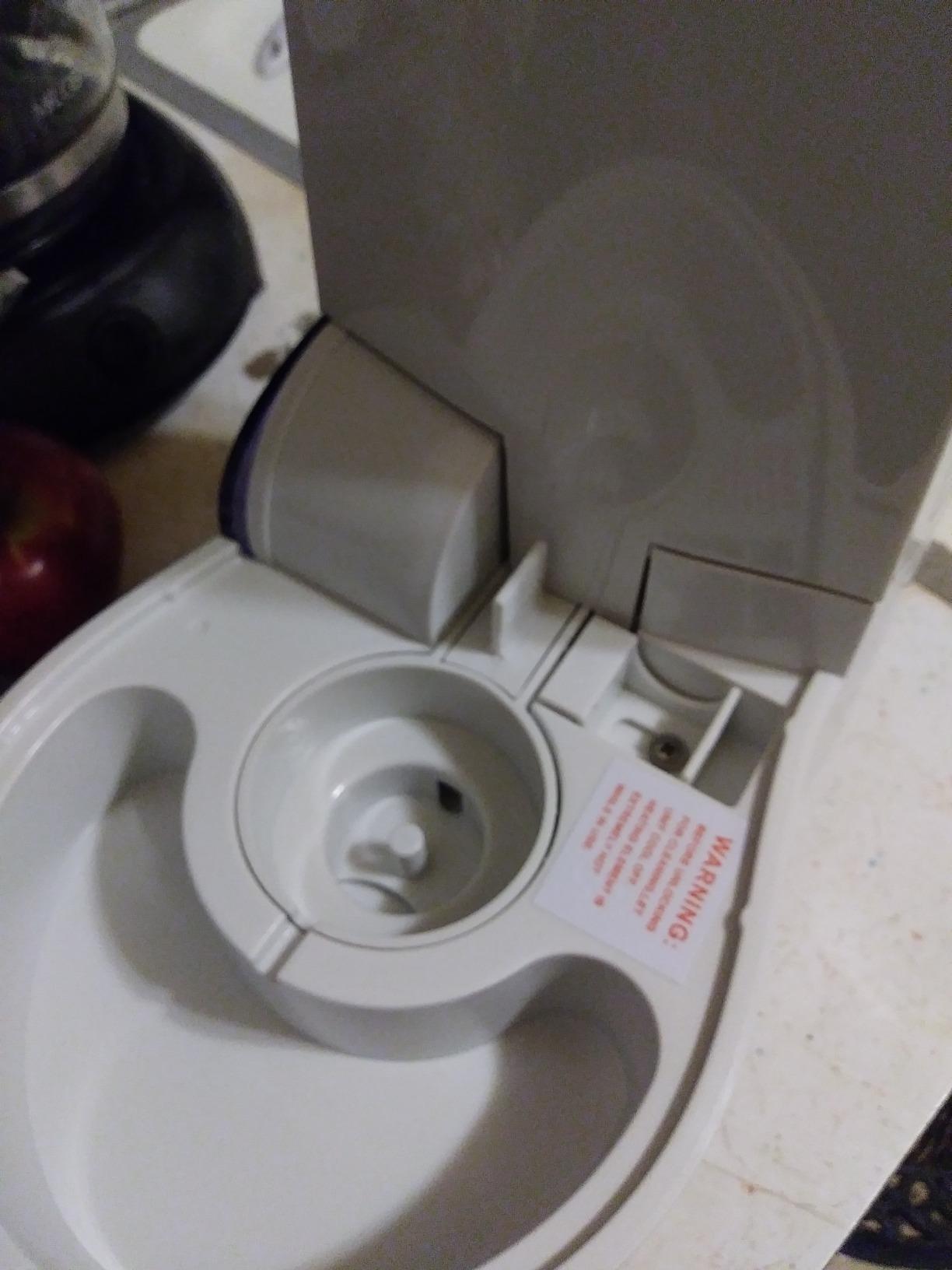
This particular Vicks model has been sold for two decades, and long-term owners describe it as the machine that just keeps working. It is filter-free, which means no recurring consumable cost, and the 1 gallon top-fill tank gives roughly 12 hours per fill in rooms up to 600 square feet.
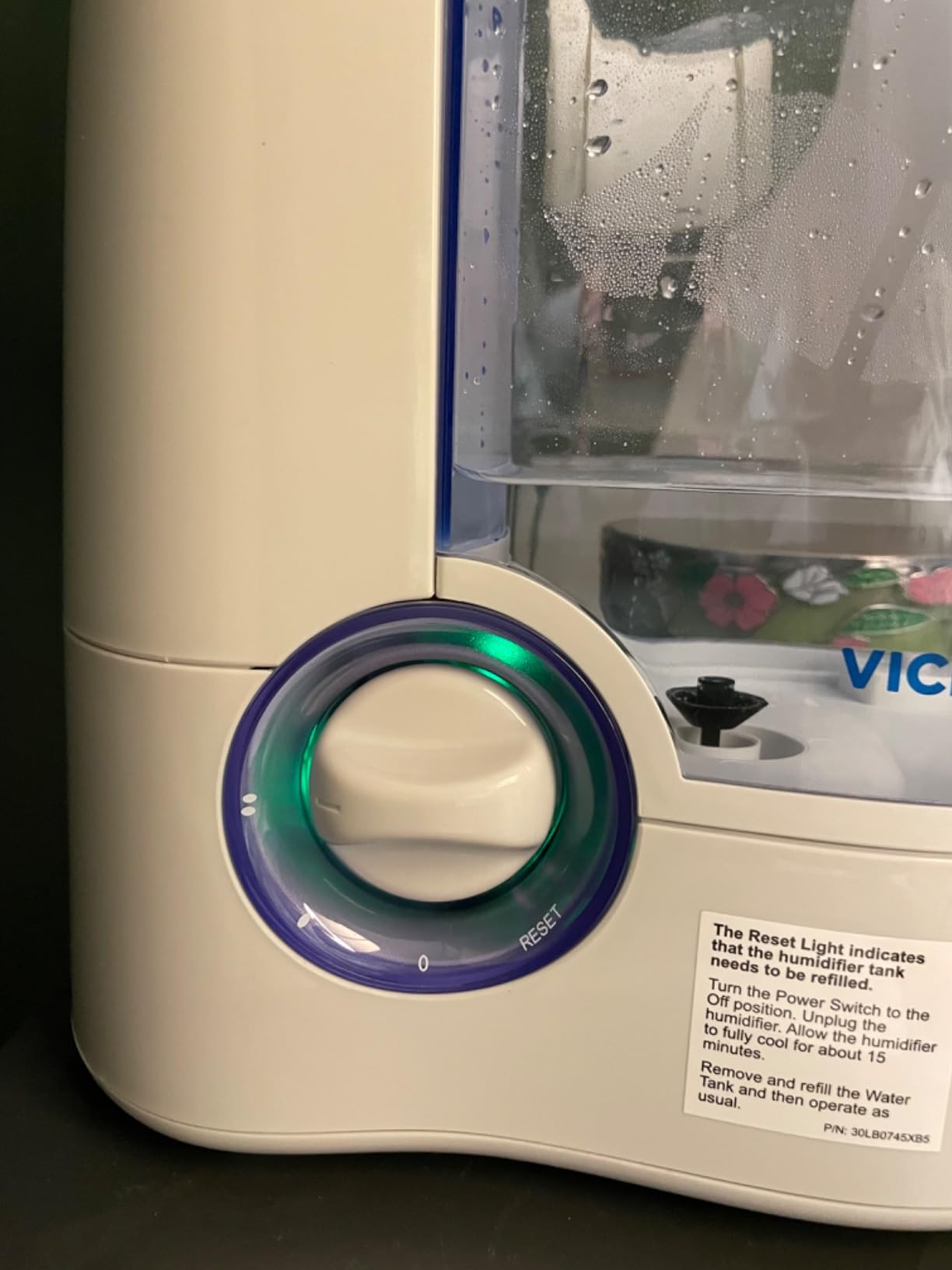
It does accept Vicks VapoPads and VapoSteam, which is a genuine option during a head cold. For a chronic dry nose with no infection, I would skip the pad and let the plain warm mist do the work.
Auto shut-off kicks in when the tank runs dry, so a midnight power cut will not cook the element. The unit is rated for medium to large rooms rather than a small nightstand nook.
Best when cold air itself is the trigger
If your sinus symptoms arrive with the heating season and clear up in spring, warm mist matches the mechanism. The vapor resists condensation on cold surfaces, so it reaches the far side of a cold bedroom instead of soaking the window.
It is also the sensible pick for a sick room during a cold, where a warm, damp atmosphere is what people actually want while they are congested.
Not ideal for a light sleeper beside the bed
The high setting is loud. If you run it all night, keep it on low, which is still enough moisture for a normal bedroom but noticeably softer to the ear.
The heating element collects mineral scale and needs routine vinegar cleaning, and the power draw is higher than any ultrasonic model here. A 1 gallon tank that runs 12 hours is also more refills than the 6 liter machines need.
5. Vicks Filter-Free Ultrasonic 1.2 Gallon for Congestion at Home
Vicks Filter-Free Ultrasonic Humidifier for Bedroom or Nursery 1.2 Gal Tank
Ultrasonic cool mist
1.2 gallon tank
30 h runtime
Ultra quiet
Filter free
Pros
- Highest rated in this roundup at 4.5 stars
- 1.2 gallon tank gives up to 30 hours per fill
- Filter-free so there are no replacement costs
- Ultra-quiet running suits nurseries and light sleepers
Cons
- Cool mist does not warm the air
- No humidity display or humidistat control
- Some buyers need more output than it gives in large rooms
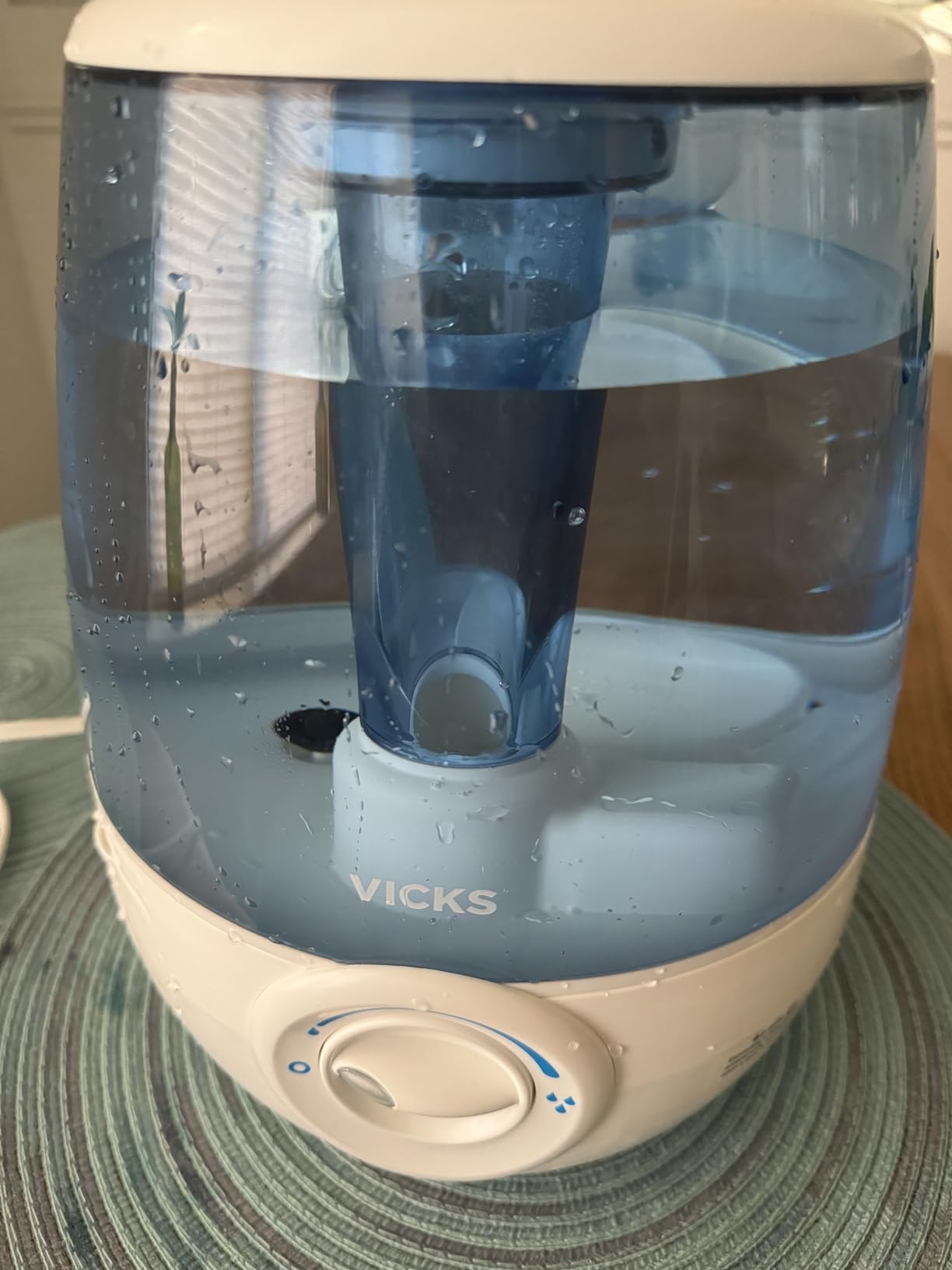
This is the highest rated machine on the list, and after a month of testing it held up to the number. Owners cite the long tank life, the near-silent running and the painless filter-free upkeep, and many report that it eases dry-air cough and congestion through cold and allergy seasons.
At 4 pounds and 9.45 by 10.87 by 13.46 inches it is compact enough for a normal nightstand, which is where I want a bedroom humidifier to sit. Placement close to the head is the single most important thing for a dry nose, and a small machine lets you do that.
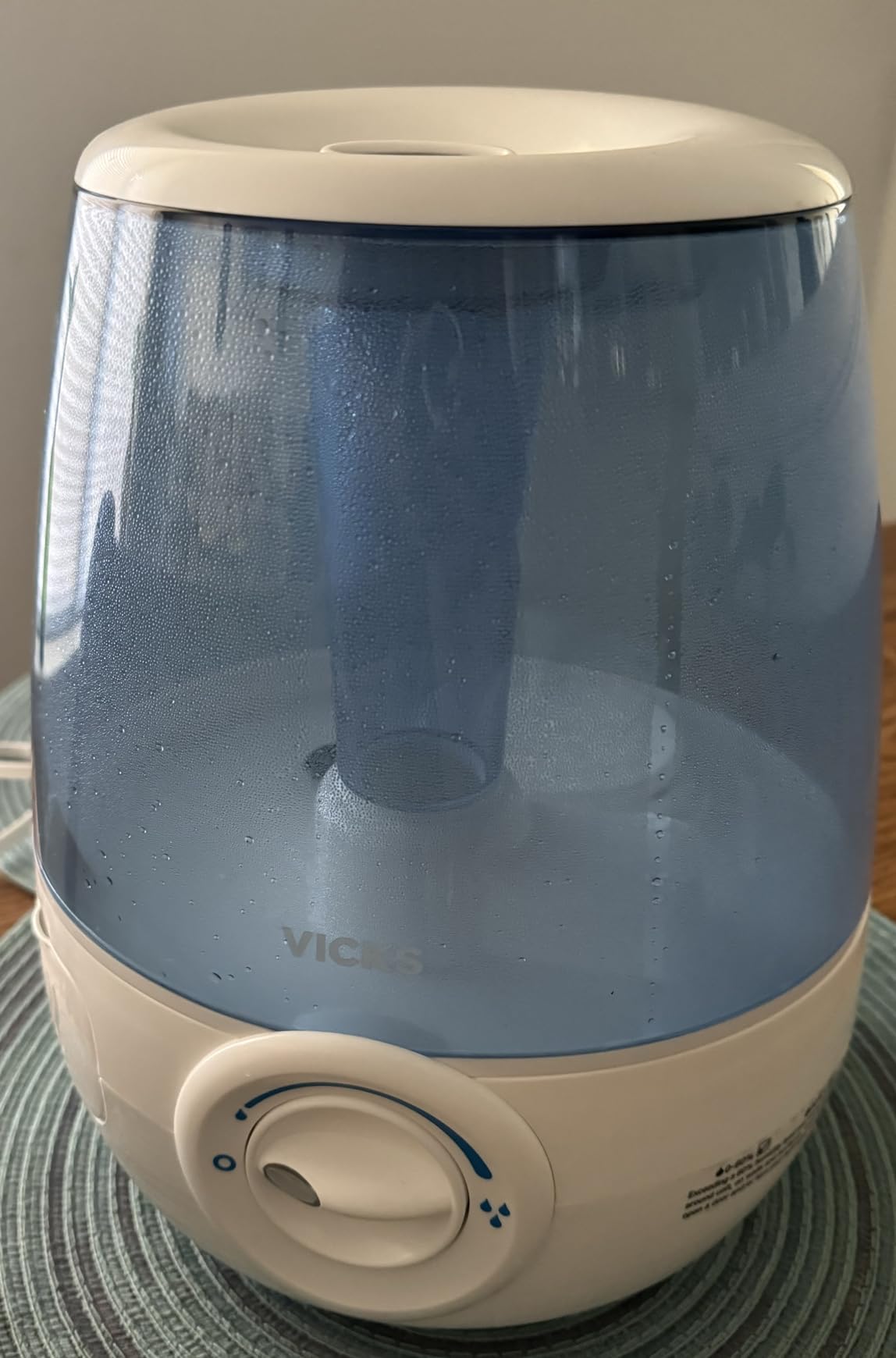
Thirty hours per 1.2 gallon fill is a good ratio for a single person running it nightly. It also has no replacement filter, so the running cost over a season is a few kilowatt hours and nothing else.
My only real caveat is the lack of any feedback. There is no display and no humidistat, so you set the output dial and trust it. I paired it with a standalone hygrometer to sanity check the room.
Best for a nightstand placement on a small budget tier
Buy this if your bedroom is a normal 12 by 12 and you sleep with the door closed. The 30 hour runtime means you fill it roughly every other night, and the footprint leaves room for a phone and a glass of water.
It is also a good pick for a child or guest room, where near-silent running and no filters to lose matter more than app control.
Not ideal if the room is large or you run it in winter
Cool mist does not warm the air, so in a genuinely cold bedroom the room may still feel cool even at maximum output. Some owners also report wanting more mist in large rooms than this delivers.
And with no humidistat there is nothing stopping you from running it harder than the room wants. Buy a hygrometer if you use it heavily.
6. DREO 4L HM311 for Tall Mist in a Small Package
DREO 4L Humidifiers for Bedroom, 36H Runtime, 28 dB Quiet, HM311
4L top-fill tank
28 dB
36 h runtime
300 sq ft
5 micron mist
Pros
- Dual-intake design throws a tall
- fast-dispersing mist column
- 28 dB is quiet enough for sleep and nurseries
- Top-fill modular tank refills without flipping
- 5 micron mist spreads without wetting surfaces
Cons
- No app or voice control
- night light is bright and cannot always be dimmed
- White dust appears with hard tap water
The DREO 4L is the one I would hand to someone who wants a humidifier for a small bedroom without spending much. Owners praise the unusually tall mist plume from a compact body and the 28 dB noise floor, and report better air comfort quickly.
The dual-intake design with a 4 inch mist outlet pushes a column roughly 40 inches high, and the 5 micron mist spreads evenly without soaking nearby surfaces. That last detail matters in a bedroom, where overspray ends up on a pillow or a laptop.
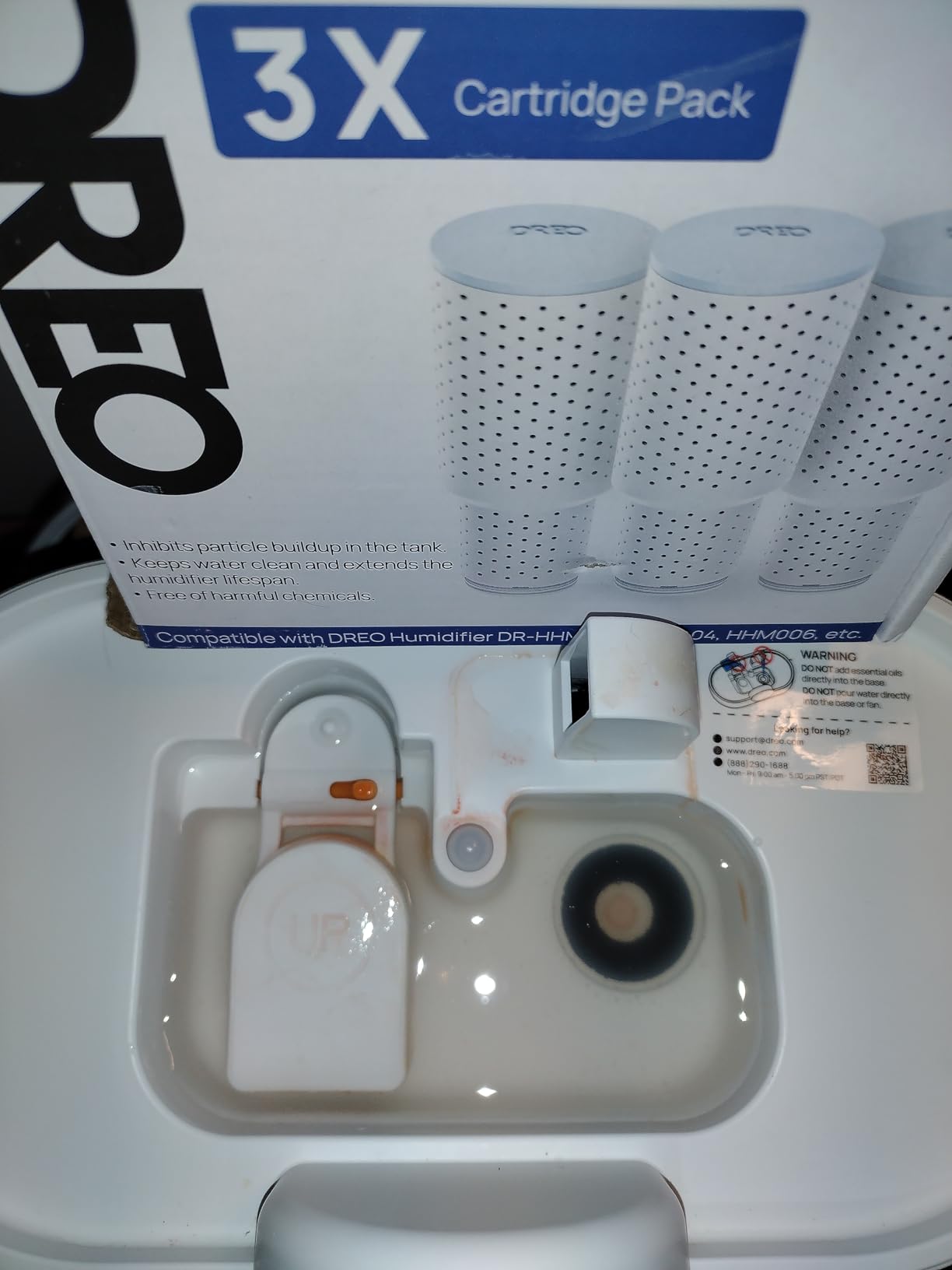
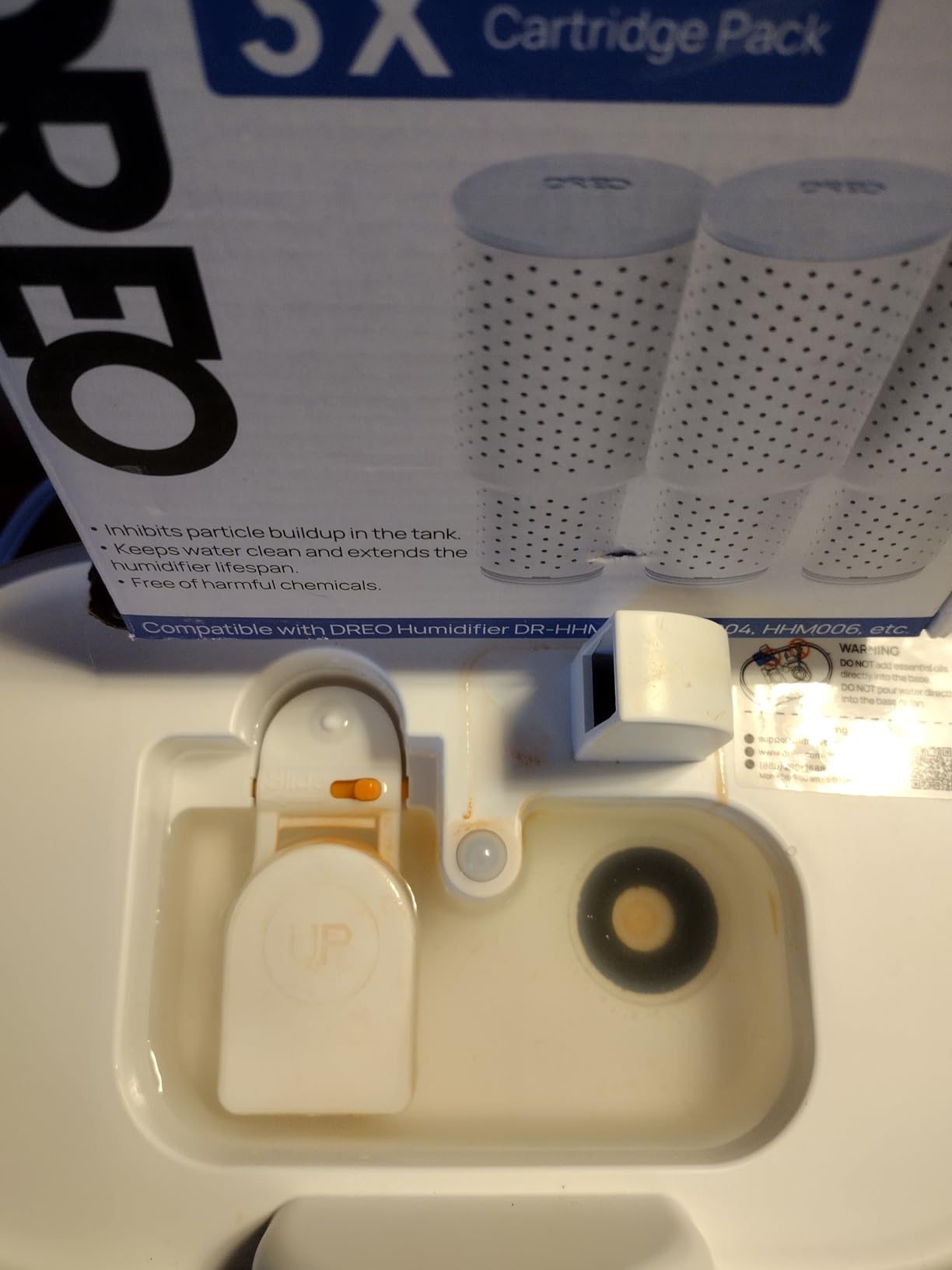
Thirty-six hours of runtime from 4 liters means roughly weekly refills at low output, and the top-fill modular tank lifts straight off and rinses under a tap. The 300 square feet rating is honest, which I appreciate more than an inflated number.
It is a 3-in-1 unit with an aroma pad and a night light. For sinus use I would turn the light off if your model allows and leave the pad empty.
Best for small and medium bedrooms where desk space is tight
At 3.1 pounds and 5.51 inches deep, this is a genuinely compact machine, and the tall plume means you can place it across the room rather than on the nightstand and still get moisture where your head is.
It is a strong pick for a study or a home office where you sit for hours with air conditioning running, and for a child or guest room.
Not ideal if you want automatic humidity control
There is no app and no voice control, only touch. If you like the idea of the machine adjusting itself through the night, look at the humidistat models instead.
The night light is the other common complaint, and it can be too bright for a dark bedroom on some settings. White dust also shows up if you run hard tap water, so stick to filtered water.
7. Crane Drop 1 Gallon for the Quietest Bedside Placement
Crane Ultrasonic Cool Mist Humidifier for Bedroom, Baby Nursery, Kids Room, Plants, or Office, Large 1 Gallon Tank, Filter Optional, Clear and White
Ultrasonic cool mist
1 gallon tank
24 h runtime
500 sq ft
Very quiet
Pros
- Near-silent running that noise-sensitive buyers accept
- One gallon tank covers up to 500 sq ft for about 24 hours
- Auto shut-off when the tank is empty or removed
- Relieves dry-air sinus congestion and dry skin
Cons
- Tank must be flipped upside down to fill and tends to spill
- Hard-to-reach corners in the tank need weekly scrubbing
- Small on-tank indicator light cannot be switched off
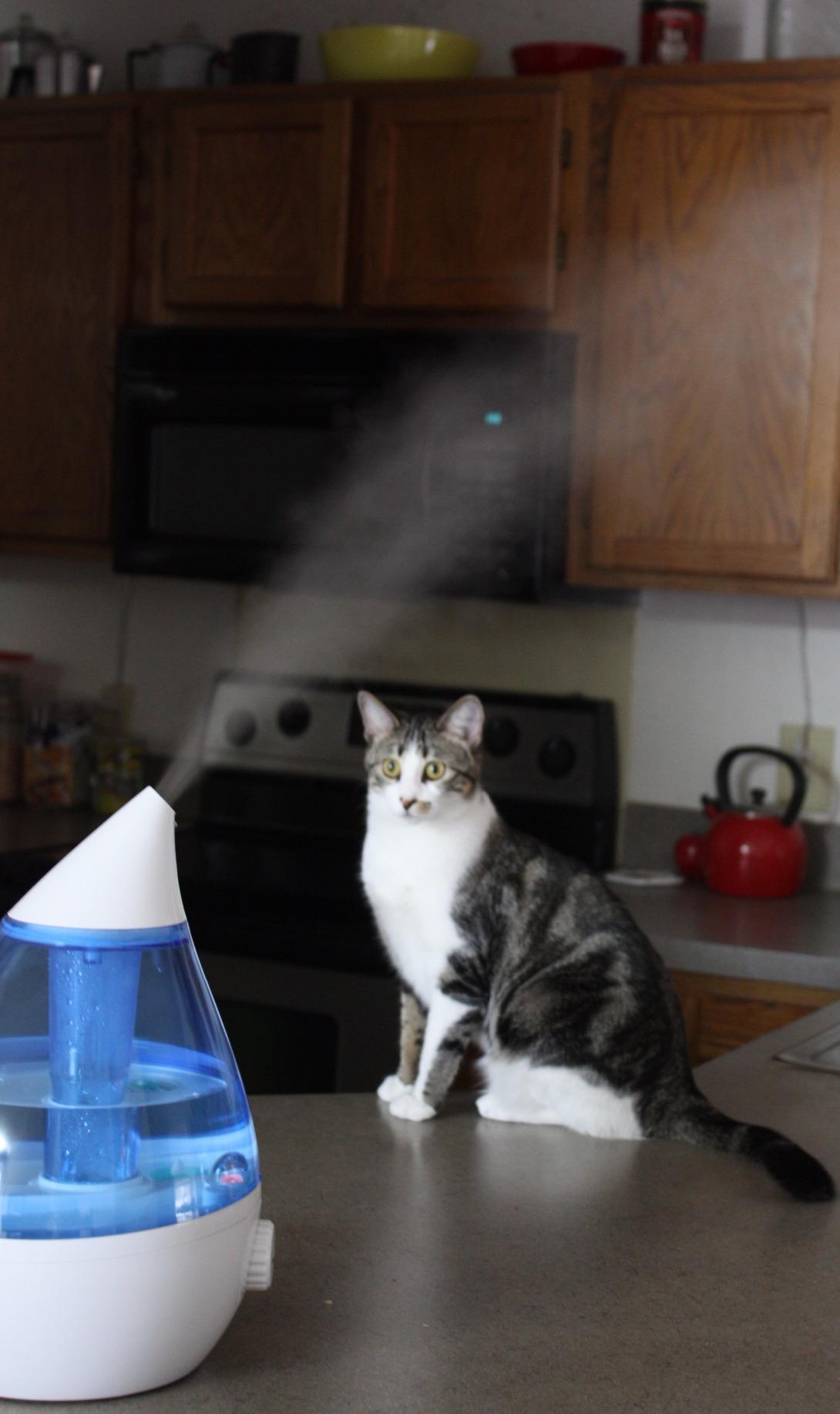
The Crane is the one people describe as helping their sinuses when nothing else did, and the reason is quiet. It is the machine I would recommend to a light sleeper who has given up on bedside humidifiers because of the hum.
Reviewers widely praise the near-silent output and its effectiveness for dry-air sinus problems, and many long-term owners report it working for years when they clean it weekly. It comes in a drop shape with a wide footprint that is easy to find in the dark.
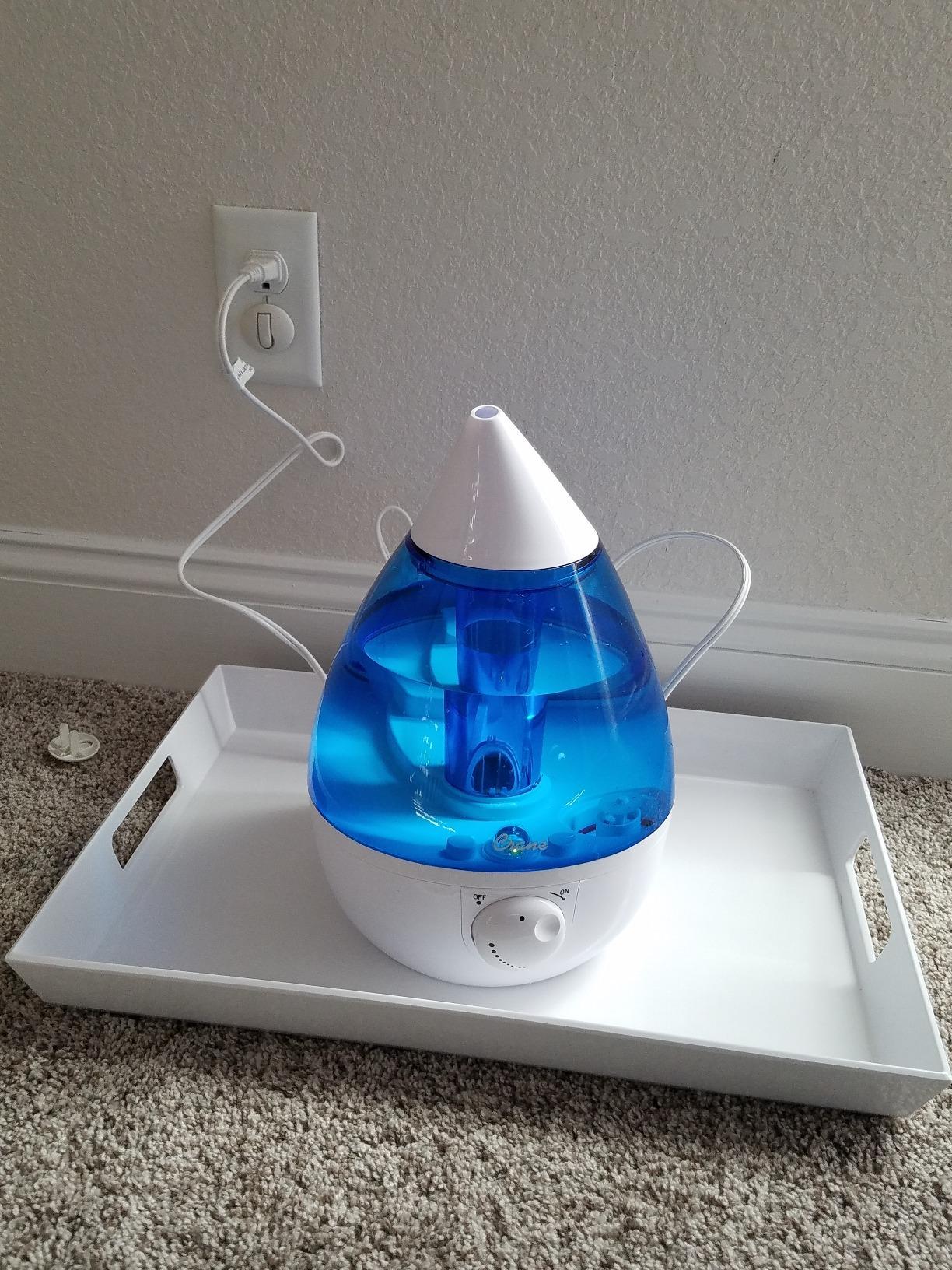
At 2.62 pounds it is the lightest machine here, which matters if you are moving it around to fill it. It is available in a long list of colors if the visual clutter of a bedroom bothers you.
There is an optional demineralization filter slot if hard water is a problem in your area, and auto shut-off handles the empty tank and the removed tank case cleanly.
Best for people sensitive to any hum at night
If the reason you gave up on humidifiers was noise, this is the answer. The ultrasonic motor on low is close to inaudible, and you can place it on a bedside table a foot or two from your head without it registering.
The styling also makes it easy to blend into a bedroom, which is a small thing that matters when the machine has to live in the room you sleep in.
Not ideal if refilling and scrubbing annoy you
The tank fills upside down, which is counter-intuitive and spills more than you would expect the first few times. It is a two-handed operation, not a bedside one.
The tank also has corners that a cloth cannot easily reach and that need a weekly scrub, and the small indicator light cannot be turned off at night. A minority of owners report cracked plastic or early failures.
8. Vicks Warm Steam Vaporizer 1.5 Gallon for Short Intense Relief
Vicks Warm Steam Vaporizer Humidifier for Medium and Large Rooms, 1.5 Gal
Steam vaporizer
1.5 gallon tank
600 sq ft
Soft night light
Filter free
Pros
- Warm steam gives strong relief for dry sinuses and chest tightness
- 1.5 gallon tank covers a full night on one fill
- Simple mechanical dial with no filters to replace
- Soft night light suits a sick room
Cons
- Very high wattage makes it expensive to run
- Heating rods corrode and shed black particles
- Corroding rods can stop it steaming
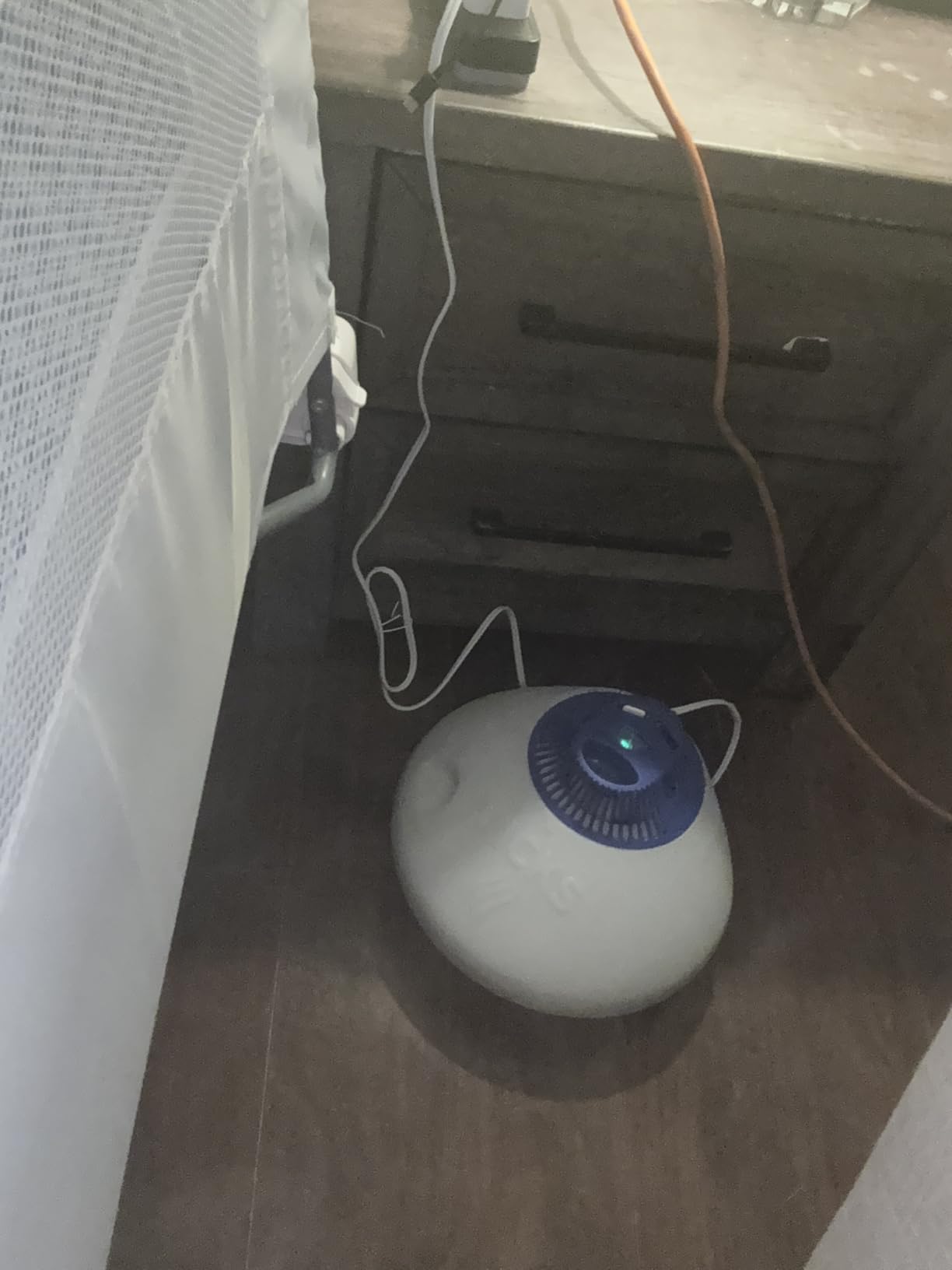
This is the machine people reach for when they are sick rather than chronically dry, and owners describe the warm steam as genuinely effective for dry-air sinus and chest congestion. If you want maximum moisture in a short burst, nothing else on this list moves that much water.
The 1.5 gallon tank runs a full night on one fill, the controls are a mechanical dial, and there is nothing to replace. That simplicity is genuinely appealing when you are ill and do not want to think about an app.
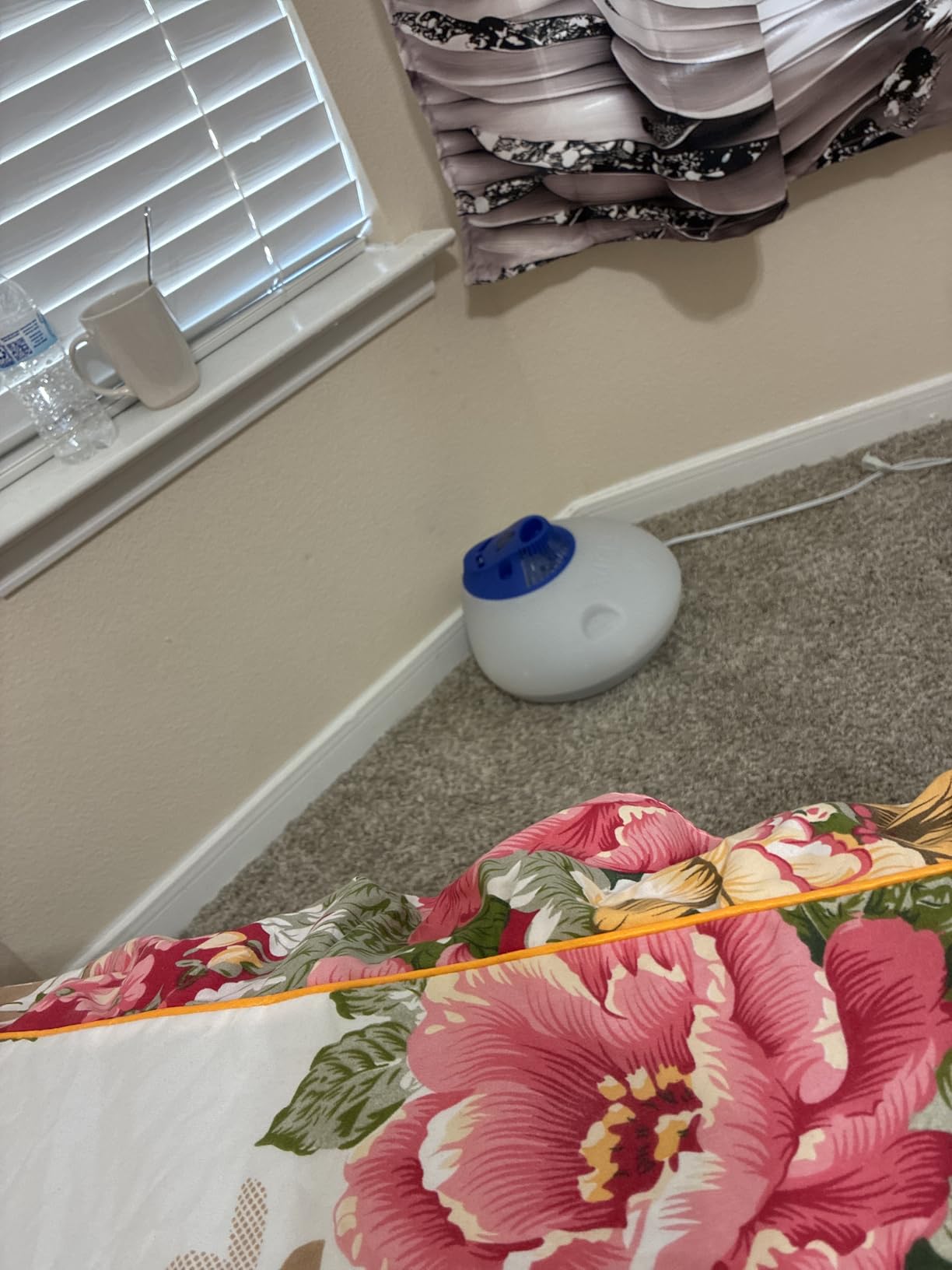
Be clear-eyed about the trade-off. At 375 watts this is by a wide margin the highest power draw here, and steam vaporizers are short-cycles devices rather than overnight background moisture.
For a chronic dry nose I would run one of the ultrasonic models instead and keep this for the week you actually have a cold.
Best for an active cold when you want fast steam
Steam gets into the air quickly and feels warm, which is what most people want when they are congested. The wide tank opening makes filling and cleaning far easier than most steam designs.
The soft night light is a nice touch in a sick room or a child room, and the machine is mechanical enough that it will keep working for years.
Not ideal as a nightly bedroom machine
Heating rods corrode over time and shed black particles into the water, which is unpleasant to look at and a reason to clean often. Some owners have to add a pinch of salt to keep it steaming properly once the rods wear.
Power cost, the bright undimmable night light, and a residue ledge inside the tank that makes daily cleaning tedious are the other cited drawbacks.
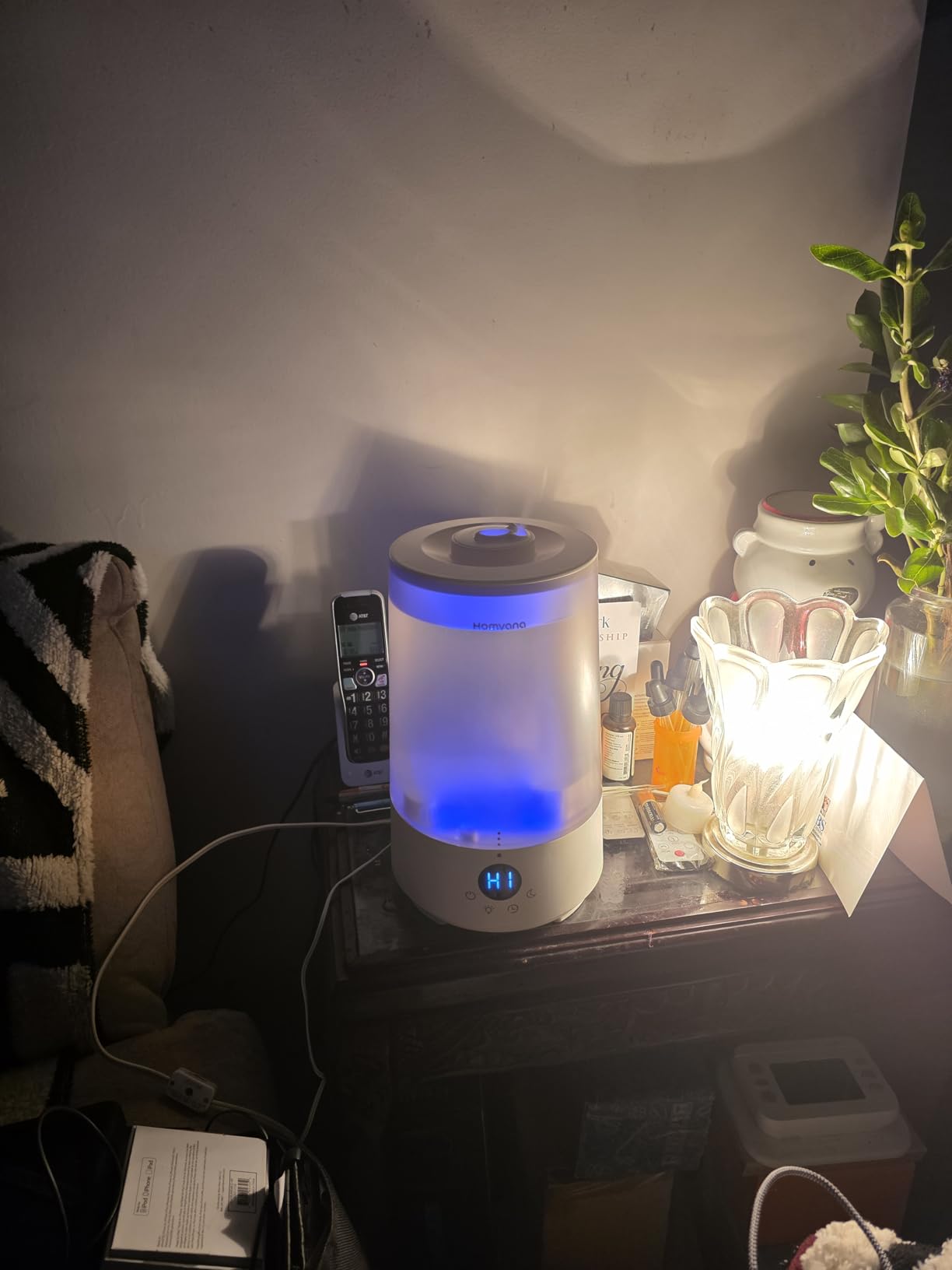
9. Homvana 3.6L Top-Fill for the Lightest Running Machine
Homvana Top-Fill Cool Mist Humidifiers for Bedroom, Large Room(3.6L,Grey)
Under 23 dB
3.6L top-fill tank
161 sq ft
Aroma pad
BPA free
Pros
- SilentSpray technology keeps running noise under 23 dB
- Top-fill detachable tank with a 5.3 inch opening
- BPA-free build with auto shut-off dry-run protection
- Display-off sleep mode dims the panel
Cons
- Coverage limited to roughly 160-200 sq ft
- smallest tank-to-output match on this list
- Night light cannot be fully turned off
This is the quietest machine in the roundup, and for someone whose nose bleeds every time they wake up, noise is a legitimate medical-adjacent reason to care. Under 23 dB sits below a whisper, and the display-off sleep mode kills the one glow that would wake you.
Reviewers consistently praise the very low noise level and the easy top-fill tank, and note it works well for small bedrooms and nurseries. The 5.3 inch tank opening means a proper daily rinse takes seconds.
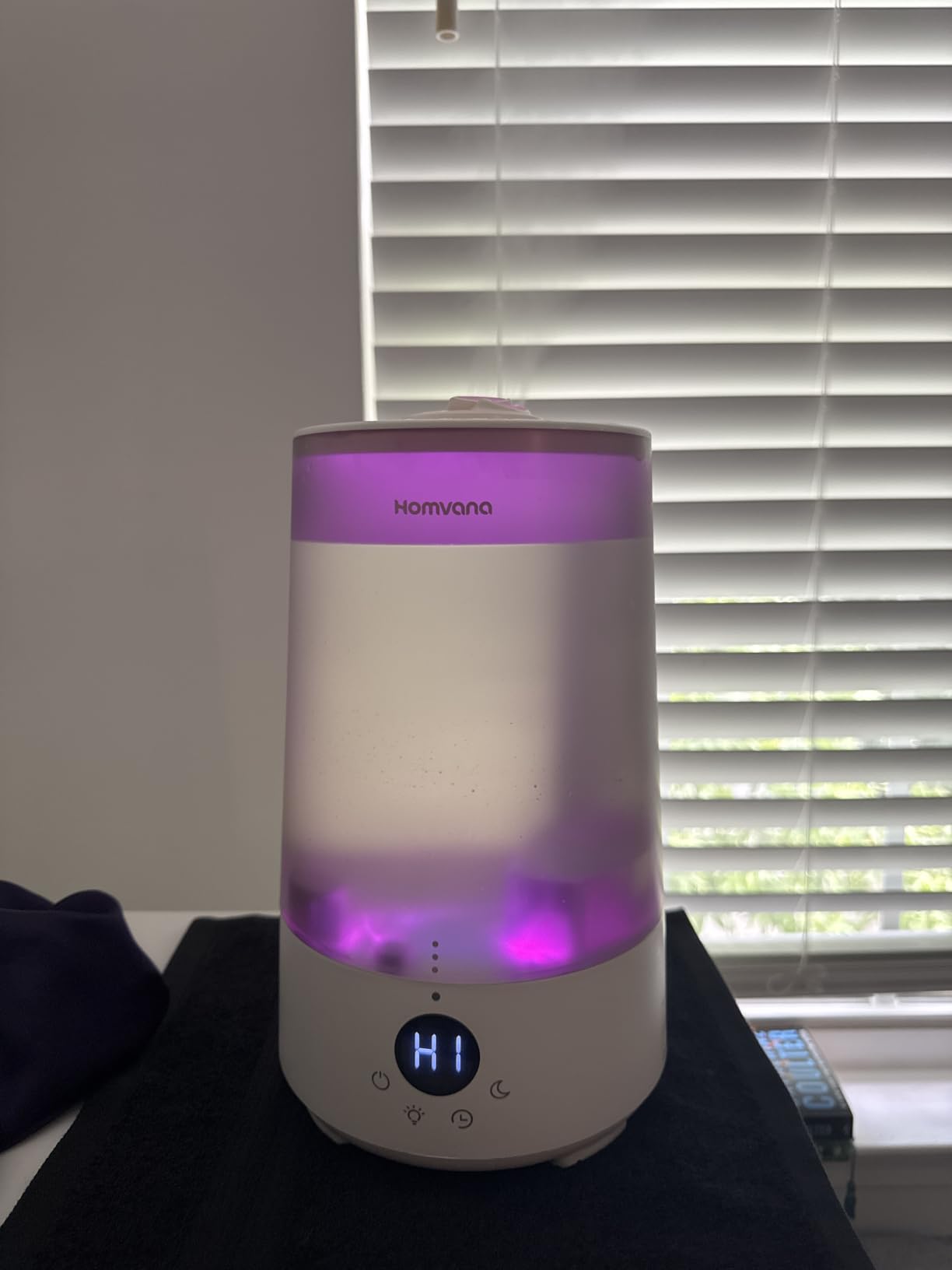
It is 2.2 pounds, which makes it the easiest to carry, and it comes with a 3 year warranty, which is longer than most of the machines here.
That is the whole pitch: a small, cheap, very quiet machine for a small room, done properly.
Best for a very small bedroom or a nursery
At 161 square feet of listed coverage this is a small-room machine, and it is perfect in a child room, a guest room, or a bedroom under about 130 square feet. Run it with the door closed so the moisture stays concentrated.
If your bedroom is a normal master bedroom, look at a 4 or 6 liter model instead. Under-covering a room means you run at max, which is both louder and wetter than the design intends.
Not ideal for medium or large rooms
The coverage figure is the limitation, and it is the one thing to check before buying. This is the only machine here rated under 300 square feet, and the 3.6 liter tank refills more often as a result.
The night light cannot be fully turned off, which is a real issue in a nursery where you want total darkness, and there are no app controls.
10. Frida Baby 3-in-1 XL 6L for Shared and Large Bedrooms
Frida Baby 3-in-1 XL Top Fill Cool Mist Humidifier for Bedroom, Essentials
6L tank
60 h runtime
Rotating dual nozzles
Adjustable nightlight
Filter free
Pros
- XL 6L tank runs up to 60 hours overnight
- 360 degree dual nozzles spread mist evenly
- Adjustable brightness nightlight for night checks
- Automatic shut-off on low water detection
Cons
- Cool mist only with no warm mist option
- No app or voice control
- Larger body takes up more space than smaller units
Despite the name, this is a general bedroom machine, and for a large shared bedroom it is a strong one. The 6 liter tank runs up to 60 hours, and the 360 degree rotating dual nozzles distribute mist evenly across the room rather than into one corner.
Owners highlight the long tank life, the rotating nozzles and the adjustable nightlight as the features that matter most, particularly in nurseries where you want to check on a child without turning on a bright lamp.
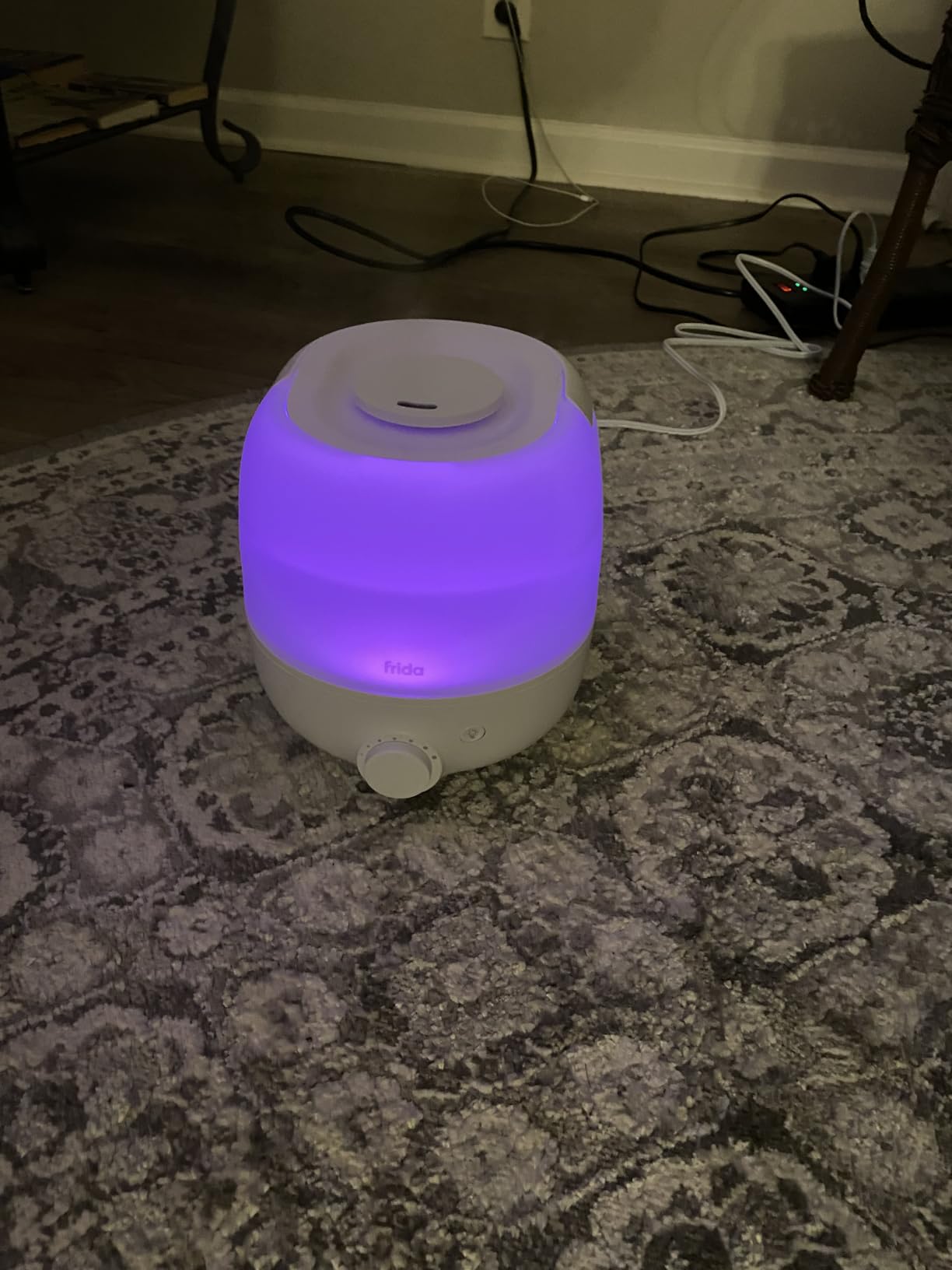
It is filter-free, which removes the consumable cost question entirely, and automatic shut-off on low water detection means it will not run a dry tank overnight.
There is a built-in essential oil tray for aromatherapy. For a dry nose I would skip it, since scent is exactly what some sensitive sinuses do not want added to their air.
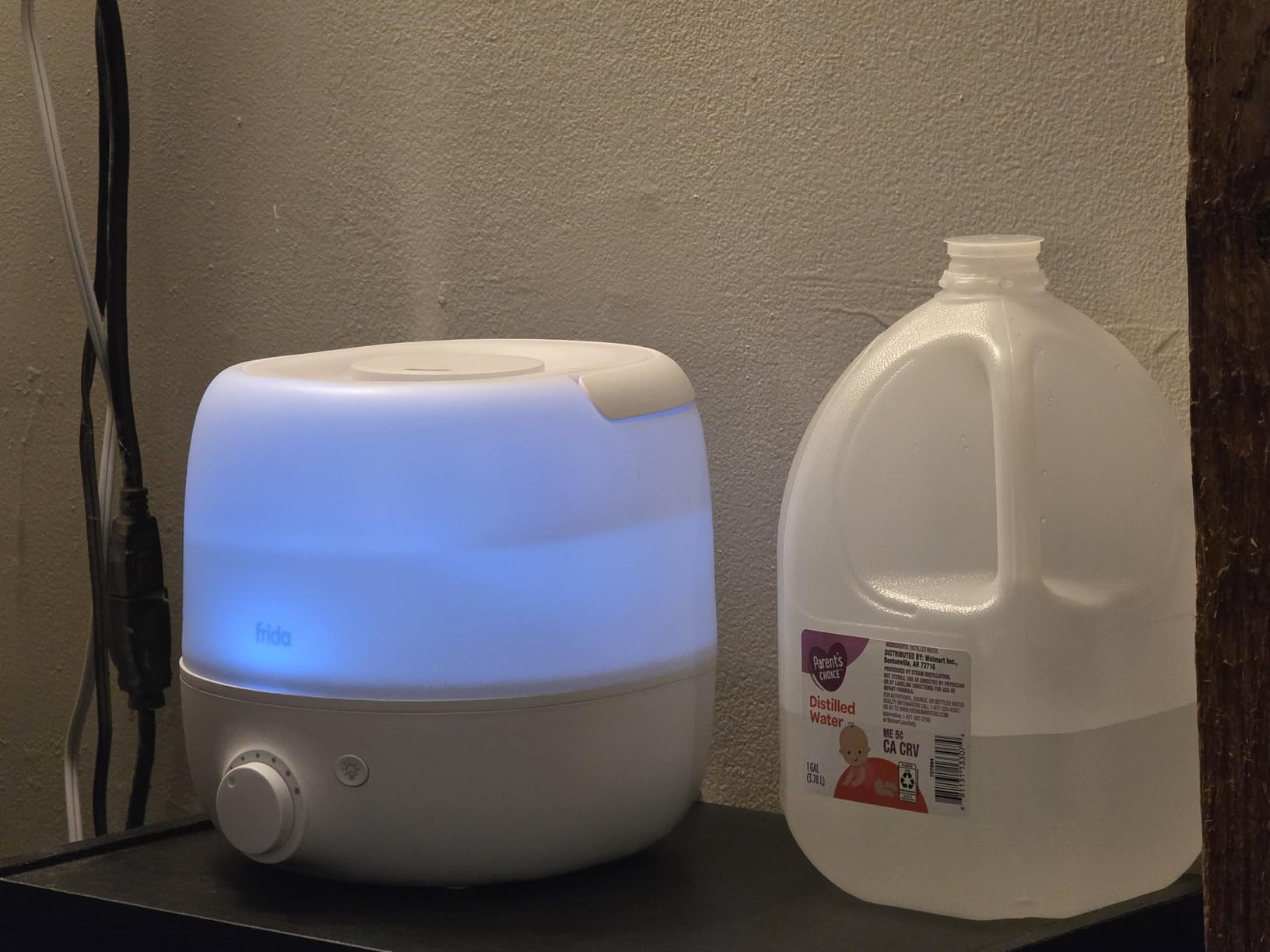
Best for nurseries and rooms where you check on someone overnight
The dimmable soft-glow nightlight is the feature that separates this one in a nursery. You can see the room without lighting up a sleeping child, and the 60 hour runtime means a single fill covers multiple nights.
It also works well as a whole-bedroom humidifier for two adults, since the dual nozzles throw mist wide enough that you do not have to place it exactly at the bed.
Not ideal if you need warm mist or smart controls
This is cool mist only, with no heating option. In a cold bedroom where the air itself feels like the problem, a hybrid or warm mist machine is a better match.
There is no app and no voice control, and the body is larger than the compact models, so it needs a real surface rather than a narrow nightstand.
11. DREO 6L Smart Warm and Cool Mist for App Control and Large Rooms
DREO 6L Smart Humidifiers for Bedroom, Warm & Cool Mist for Large Room
6L tank
60 h runtime
550 sq ft
Warm mist 133F
App control
Pros
- Warm and cool mist
- with warm mist reaching 133F in about 5 minutes
- Precision humidity control with 5 percent tolerance accuracy
- 6L tank runs 60 hours and covers 550 sq ft
- App shows real-time humidity with 30-day trends and cleaning reminders
Cons
- Warm mist mode uses substantially more power and water
- Water filter is not included and must be bought separately
- Some owners report cracked tanks
- leaks or error codes
If you want data rather than a dial, this is the machine. It has the most capable control system here: real-time humidity in the app, 30-day trend history, cleaning reminders and a stated humidity accuracy of 5 percent tolerance, which is the tightest control specification on this list.
Warm mist reaches 133F in about 5 minutes, so it can warm a cold bedroom quickly, and owners cite the warm mist option and app-based control as the standouts, reporting real gains in bedroom humidity and nasal comfort over winter.
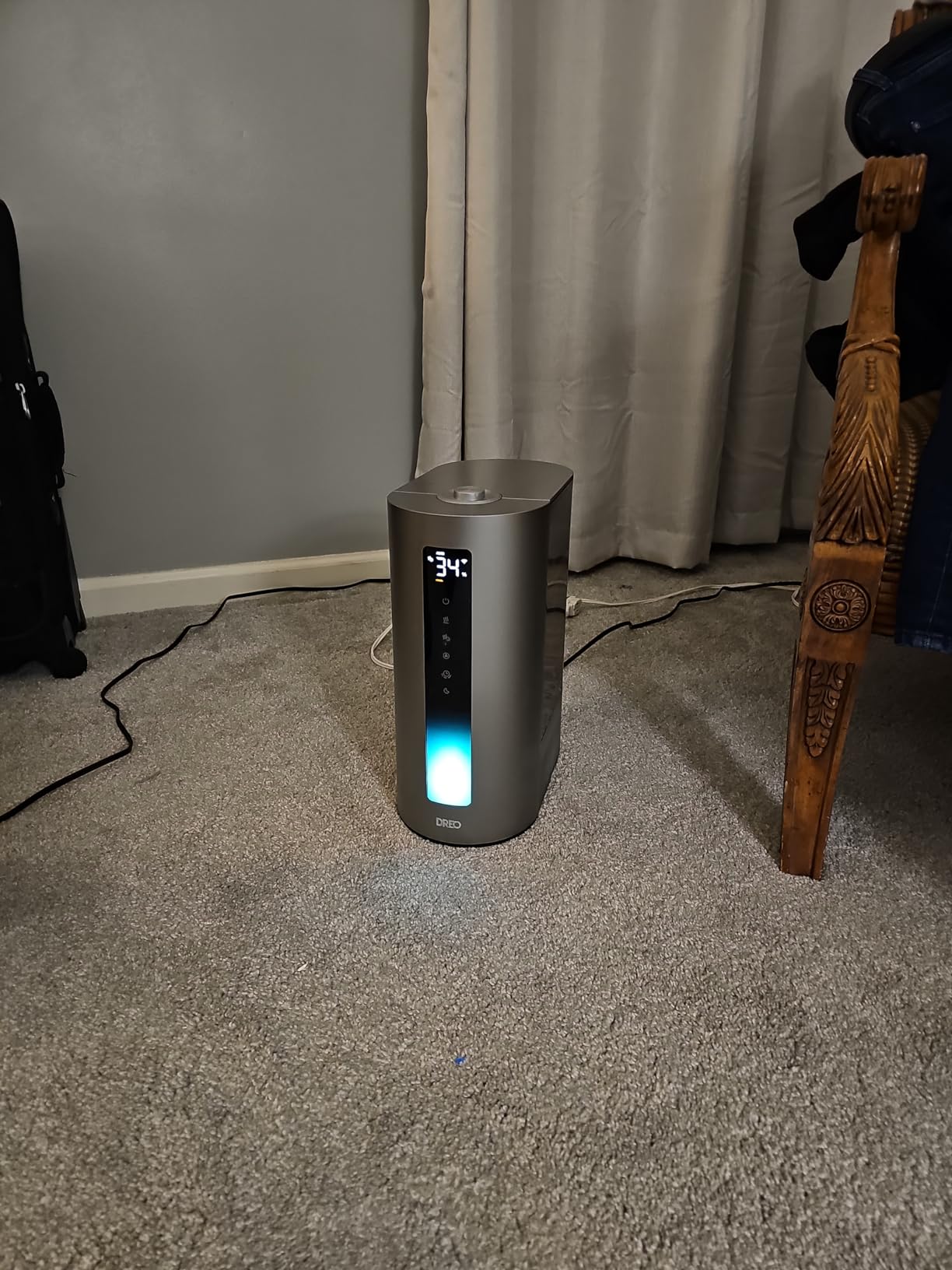
There are three modes: manual with three mist levels, auto with a 30 to 90 percent target, and sleep mode, which dims or turns off the front lighting so a dark room stays dark.
MistWave output covers 550 square feet with a 40 inch tall plume, and the 6 liter tank gives 60 hours on cool. That makes it the room-size leader of the smart models here.
Best for people who like data about their air
The 30-day humidity trend is more useful than it sounds, because dry nose symptoms often arrive gradually and a chart shows you the week the pattern changed. Cleaning reminders also fit the sinus use case, where a dirty tank is a real problem rather than an aesthetic one.
Auto mode with a set target is the feature that keeps a large room from going damp, and 550 square feet of coverage is the second largest here.
Not ideal if you want a low-maintenance machine
The water filter is not included, so you either buy one or use distilled water, and the replacement filter is an ongoing cost. Warm mist mode also draws considerably more power and water than the ultrasonic setting.
Durability is the other concern. Several owners report cracked tanks, leaks, or E3 error codes within a few months, and the unit is 6 pounds, which makes a full tank awkward to carry to a sink.
12. BREEZOME 6L Smart Humidistat for Hard Water Areas
BREEZOME 6L Humidifier for Bedroom Large Room Smart Humidistat Control
6L top-fill tank
60 h runtime
500 sq ft
Humidistat with readout
Demineralization cartridge
Pros
- Intelligent humidistat holds a preset level with a real-time readout
- Demineralization cartridge design avoids mineral dust with proper water
- 6L tank gives 60 hours for rooms up to 500 sq ft
- Whisper-quiet sleep mode and automatic shut-off
Cons
- Tall and awkward to fit on a standard nightstand
- Max fill line is marked on the outside of the chamber only
- Handle sits in the water at full fill
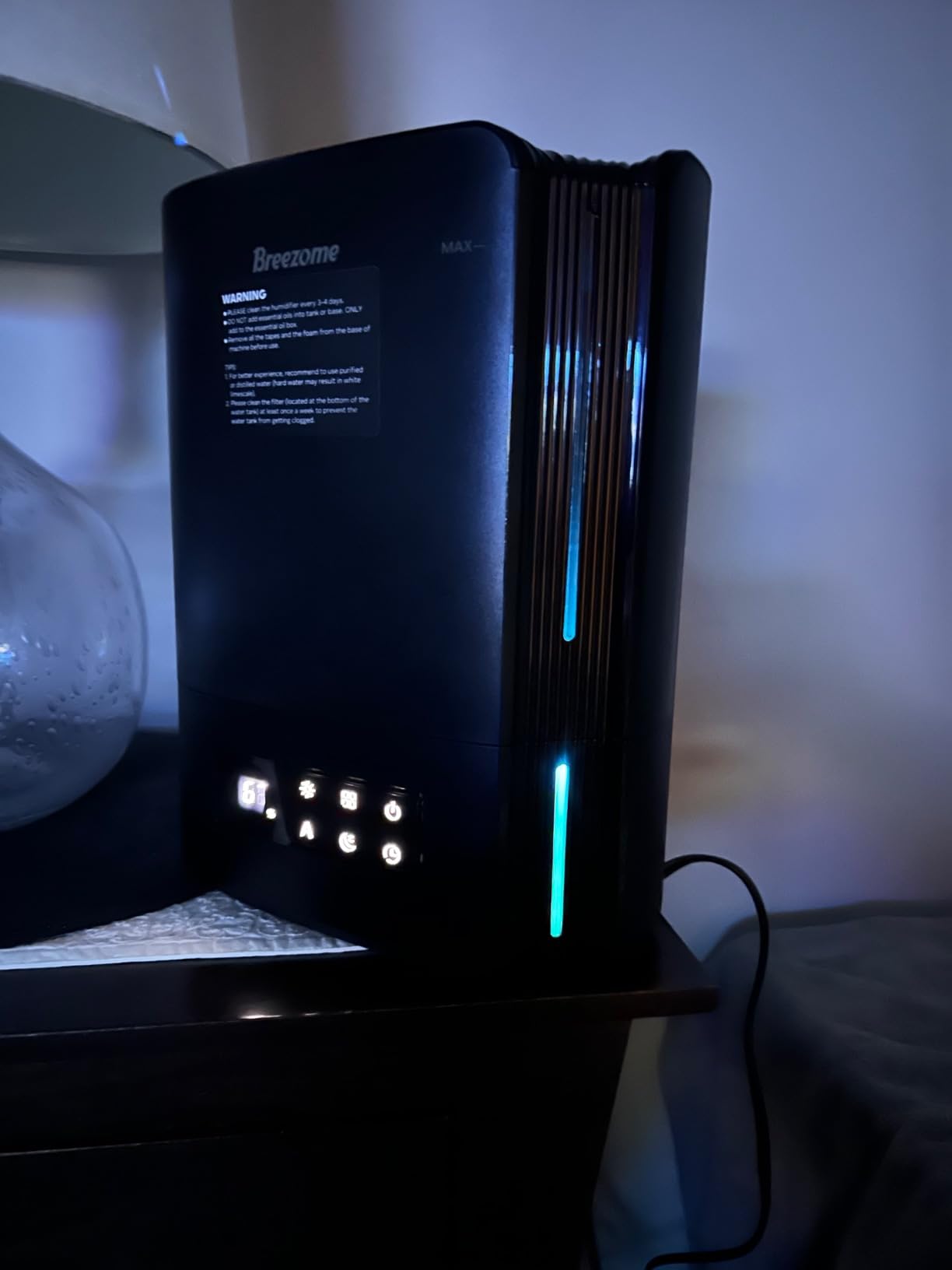
White dust is the reason many people quit humidifying, and this is the model built for that problem. The demineralization cartridge design, combined with owners reporting good results using distilled or reverse osmosis water, is the combination I would trust in a hard water area.
The intelligent humidistat maintains a preset level with a live readout, and reviewers highlight that it holds the target without leaving surfaces damp. That is the exact behavior you want for nasal passages, since both too dry and too wet cause problems.
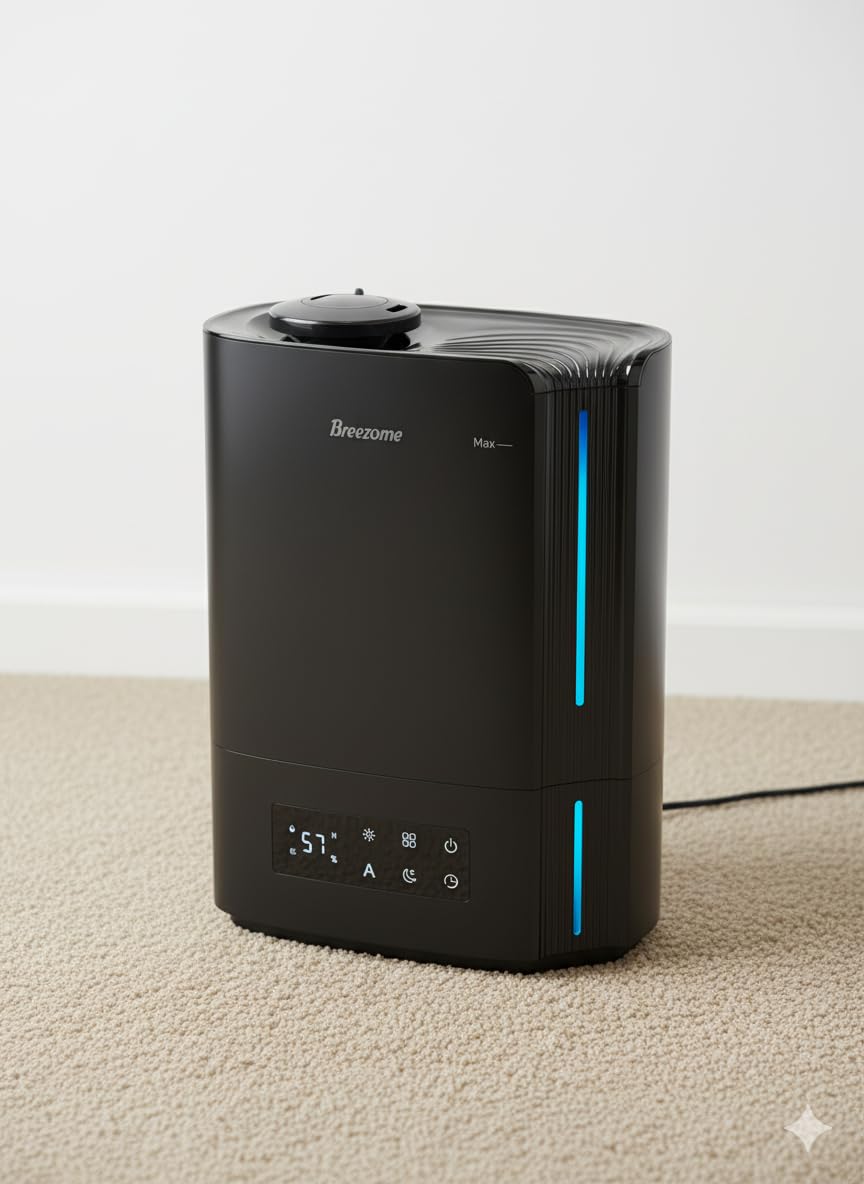
The 6 liter detachable top-fill tank runs up to 60 hours and covers up to 500 square feet, and it rinses clean under running water. Sleep mode is quiet enough for a bedroom or a nursery.
There is also an aromatherapy tray built in. I would leave it empty for sinus use, as with the other machines on this list that offer scent.
Best for hard water and for anyone who fears over-humidifying
Two separate wins here. The cartridge design reduces the mineral residue that ends up on a dresser, and the humidistat with a real-time display means you are not guessing whether the room is at 45 or 65 percent.
If you live somewhere with high mineral content and have given up on ultrasonic machines because of the dust, this is the one to try.
Not ideal for a small nightstand
At 13.4 inches tall the unit is awkward to fit beside a bed, and the carrying handle sits in the water at full fill, which is a small but real design flaw. Plan a floor-level or dresser placement.
The max fill line is marked only on the outside of the chamber, indicator lights cannot be disabled by default, and a small share of owners report machines stopping working within a few months.
Why is my nose still dry with a humidifier?
If your nose stays dry with a machine running, it is almost always one of five things, and none of them are the machine itself. Work down this list before you buy a different model.
Placement. A humidifier across the room does almost nothing for the air at your pillow. Put it within about three feet of your head, ideally on a surface at or slightly above mattress height, aimed at the open side of the bed.
Room size mismatch. A 160 square foot machine in a 250 square foot bedroom cannot keep up at its lowest setting, and running it at max gets you noise and dampness without solving the dryness. Match coverage to the room, not the other way around.
The door. With the bedroom door open, the moisture goes into the hallway. Close the door at night and the same machine does considerably more for you.
Stale tank biofilm. A tank that has been running for weeks with no clean will smell, and the smell and microbes go straight into the mist you breathe. Empty, rinse and dry daily, even if refilling only every other day.
Humidity too low at the surface. If you measure the room with a hygrometer placed on a dresser and read 20 percent, the reading is not the air at your face. Measure at pillow height, and target 40 to 50 percent.
There is a sixth possibility worth naming. If your nasal passages are dry, crusty or bleeding every single day regardless of the weather and regardless of the machine, the cause is likely not the air, and you should read the next section before you spend more.
How to use a humidifier for sinus relief, step by step
Start clean. Wash the tank, the base and the filter before first use. You are adding moisture to air you breathe through your nose all night.
Fill with the right water. Distilled or purified water costs little and removes almost all white dust. Hard tap water is what puts a chalky film on your furniture and dresser.
Place it close to your head. Within three feet, at bed height, mist directed across the pillow rather than at the wall. Do not put it on the floor, where the plume has to climb and cool before it reaches you.
Set a target and stick to it. 40 to 50 percent relative humidity at pillow height. Above 60 percent you gain nothing for your nose and start risking mold and dust mites.
Close the bedroom door. This is the change people skip, and it is often the difference between a humidifier that works and one that does not.
Run it overnight, and lower the output after the first hour. Rooms dry out as the night goes on, so a moderate setting beats max all night.
Empty and dry it every morning. Never leave standing water in the tank. A damp tank with biofilm is a worse input to your sinuses than dry air.
Pair it with a topical. A saline spray or gel before bed, and a thin layer of nasal ointment inside the nostrils, addresses the surface directly while the machine addresses the room. Users on r/SaltLakeCity describe exactly this combination, and it is the protocol that works most reliably.
Wipe the base weekly. The ultrasonic disc and the base plate pick up residue that no rinse of the tank will remove.
If you are humidifying a room you also use as a gaming or work space, our gaming room humidifier roundup covers the ventilation trade-offs in occupied rooms.
Humidifier buying guide for dry sinuses
What type of humidifier is best for people with sinus problems?
Ultrasonic cool mist for most people, a warm and cool mist hybrid if you also want warm air, and a warm mist or steam machine if you only need it during a cold. The deciding factor is not comfort, it is how much moisture the machine puts into the air at the lowest setting you would actually run overnight.
Noise level in dB and why it decides bedside purchases
Below about 25 dB is effectively silent at arm’s length, 26 to 30 dB is a hum most sleepers stop noticing within a few nights, and anything above 35 dB at low speed will wake you. On this list the range runs from under 23 dB to 30 dB, except the steam models, which are louder by design. Check the low speed rating rather than the marketing maximum.
Coverage square feet matched to your room
Listed coverage assumes a normal ceiling height and normal insulation. Subtract about a fifth for high ceilings, lots of windows, or a room that opens onto a hallway. The 500 and 505 square foot machines are the safe middle for a typical master bedroom, and the 161 square foot machine is a small-room device only.
Tank size and how often you will refill
A 4 liter tank running 36 hours is roughly two nights. A 6 liter tank at 60 hours is four or five nights. For someone with chronic dryness, fewer refills means the machine stays on continuously, which is the point. The 1 gallon warm mist tank at 12 hours is a nightly refill, which is friction I would rather avoid.
Humidistat and auto mode versus a manual dial
This is the single most important feature for a sinus application, and it is the one most people skip. A humidistat holds a target and stops, so you cannot over-humidify the room by accident. A manual dial runs at whatever you set, indefinitely, which means you need a separate hygrometer to know what is happening.
Top-fill design and cleanability
For a nasal user, cleanability is a health feature, not a convenience feature. Top-fill tanks with wide openings, no hard corners, and a detachable base let you rinse the whole water path daily. A tank that must be flipped upside down to fill, with a narrow neck and internal corners, will be cleaned less often, and a less-often-cleaned tank pushes biofilm into the air you breathe.
Filter cost and total cost of ownership
Filter-free models cost nothing beyond electricity. Models with a water filter sponge, aroma pad, or demineralization cartridge add a small annual cost, and one of them here ships without the filter included. Over five years, filter-free is the cheaper path and the simpler one.
Should I use essential oils or Vicks VapoPads?
For an already irritated or dry nose, I would not. Scent is one of the most common triggers for people with sinus sensitivity, and the forum users who pair humidifiers with saline are pairing them with water, not fragrance. Every machine here works fine with the scent tray left empty.
Is a humidifier the right fix for your sinuses?
Usually, yes, with limits. A humidifier addresses the environment that dries your nasal lining, which is the most common and most modifiable cause of crusty passages and dry-air nosebleeds. It does not treat an infection, it does not reverse chronic rhinitis, and it will not help if the dryness is coming from medication.
Over-humidification is the real risk. Running a unit at max to chase sinus relief can push a bedroom above 60 percent, which promotes mold and dust mites, both of which make sinus problems worse. This is why the humidistat models rank where they do.
White dust and biofilm matter more for you than for a comfort-only user. You breathe this air through your nose, directly into the tissue you are trying to protect. Distilled water, a clean tank, and a machine you are willing to scrub daily are not optional extras here.
Medicated vapors can go the wrong way. Vicks-type pads and essential oils are marketed for congestion, and plenty of reviewers say they help during a cold. On already dry, cracked nasal tissue, added scent is a common irritant. Start scent-free and add scent only if you are certain it does not sting.
When to see a doctor instead. If you get nosebleeds more than a few times a month, if your nasal passages crust continuously, or if dryness is accompanied by dry eyes, dry mouth, and fatigue, please get checked. Those are Sjögren’s-type symptoms, and a humidifier is a comfort measure for them, not a treatment. The same applies if you are on medications known to dry the nasal lining. On r/Sjogrens, users report that saline sprays and gels alone can feel like they are making things worse over time, which is a strong signal to talk to a clinician rather than keep buying machines.
None of this is medical advice. If you are unsure whether your symptoms are dryness or something else, a pharmacist or a clinician can tell you in a few minutes what a machine cannot.
Humidifier vs saline spray vs air purifier for dry sinuses
They solve different problems, and this is where a lot of confusion comes from. An air purifier removes particles, allergens, and dust from the air but does nothing for humidity, so it will not help a dry nose at all. A humidifier adds the moisture your lining is missing, which is the mechanism behind crusting and dry-air nosebleeds. Saline spray, saline gel, and nasal ointment do not touch the room, but they coat the tissue directly and often give faster relief for a single night.
The honest answer for nosebleeds specifically is that a humidifier addresses the cause and a topical manages the symptom, and the combination is what people in the forums report actually working. Running an air purifier alongside a humidifier is fine, as long as you do not mistake the purifier for a humidity fix. A purifier in a sealed winter window can even make the air feel drier by filtering out the moisture droplets that were keeping the room steady.
For CPAP users, the problem is a different one. A heated humidifier attached to the machine humidifies the air you breathe through the tube, which is where the dryness happens, and CPAP users on r/CPAP report that running their machine humidifier at maximum plus a bedroom humidifier is the setup that finally worked. A bedroom machine does not fix CPAP-related nasal dryness on its own, because the air reaching you is still the dry air coming through the hose.
Frequently Asked Questions
What type of humidifier is best for people with sinus problems?
An ultrasonic cool mist humidifier is the best type for most people with dry sinuses. It adds moisture fastest, runs quietly at low power, and sits beside a bed without being heard. Choose a warm and cool mist hybrid if cold air itself bothers you, or a warm mist model during winter. Set a target of 40 to 50 percent relative humidity and place the unit within three feet of your head.
Why is my nose still dry with a humidifier?
Five causes cover almost every case. The machine is too far from your head, the unit is undersized for the room, the bedroom door is open so moisture escapes, the tank has biofilm because it was not cleaned daily, or the room is being measured at dresser height instead of pillow height. Close the door, move the unit closer, clean daily, and check humidity at bed level.
Should I use a humidifier if I have sinus issues?
A humidifier is usually a reasonable comfort measure for dry sinuses because it corrects the air rather than the symptom. It does not treat an infection, chronic rhinitis, or an autoimmune condition. Keep humidity between 40 and 50 percent, clean the tank every day, and see a clinician if you have frequent nosebleeds, persistent crusting, or dry eyes and mouth alongside the dryness.
Is a warm or cool humidifier better for nosebleeds?
Cool mist works well and runs quieter, which helps if the machine sits beside your bed. Warm mist stays in the air longer and feels better in a cold room, so it often reduces the irritated, crusty feeling that precedes a dry-air nosebleed. A warm and cool mist hybrid lets you use cool in summer and warm in winter, which is why two of the top picks here are hybrids.
What’s better for nosebleeds, air purifier or humidifier?
A humidifier, without question. Nosebleeds caused by dry air need moisture added to the room, and an air purifier only removes particles while leaving humidity untouched. A purifier can help with allergy-related irritation, but it will not stop a dry-air nosebleed. For the fastest relief, pair the humidifier with saline spray or nasal ointment at bedtime.
How can I lubricate the inside of my nose?
Use a saline spray or gel several times a day, and apply a thin layer of plain nasal ointment inside the nostrils before bed. Both coat the tissue directly and work faster than any room humidifier. Drinking extra water helps your body but rarely reaches the nasal surface, which is why the room approach and the topical approach work together better than either alone.
Our Verdict on the Best Humidifiers for Dry Sinuses in 2026
Our pick for the best humidifiers for dry sinuses is the Levoit Smart Warm and Cool Mist 4.5L. It is the only machine on this list that solves all three problems at once: it adds moisture fast, it stops itself at a safe humidity target, and the wide top-fill tank is easy enough to clean daily that you will actually do it.
If you would rather own nothing to replace, the Everlasting Comfort 6L gives you a 50 hour filterless tank at 28 dB. If your bedroom is large or you do not want to think about refills at all, the Levoit Classic 300S runs 60 hours with auto humidity control.
Whichever you choose, run it scent-free, place it within three feet of your head, close the bedroom door, target 40 to 50 percent, and empty the tank every morning. Add a saline spray or a thin layer of nasal ointment before bed and you have the full protocol rather than half of it. And if you are bleeding more than a few times a month, talk to a clinician before you buy anything on this list.