
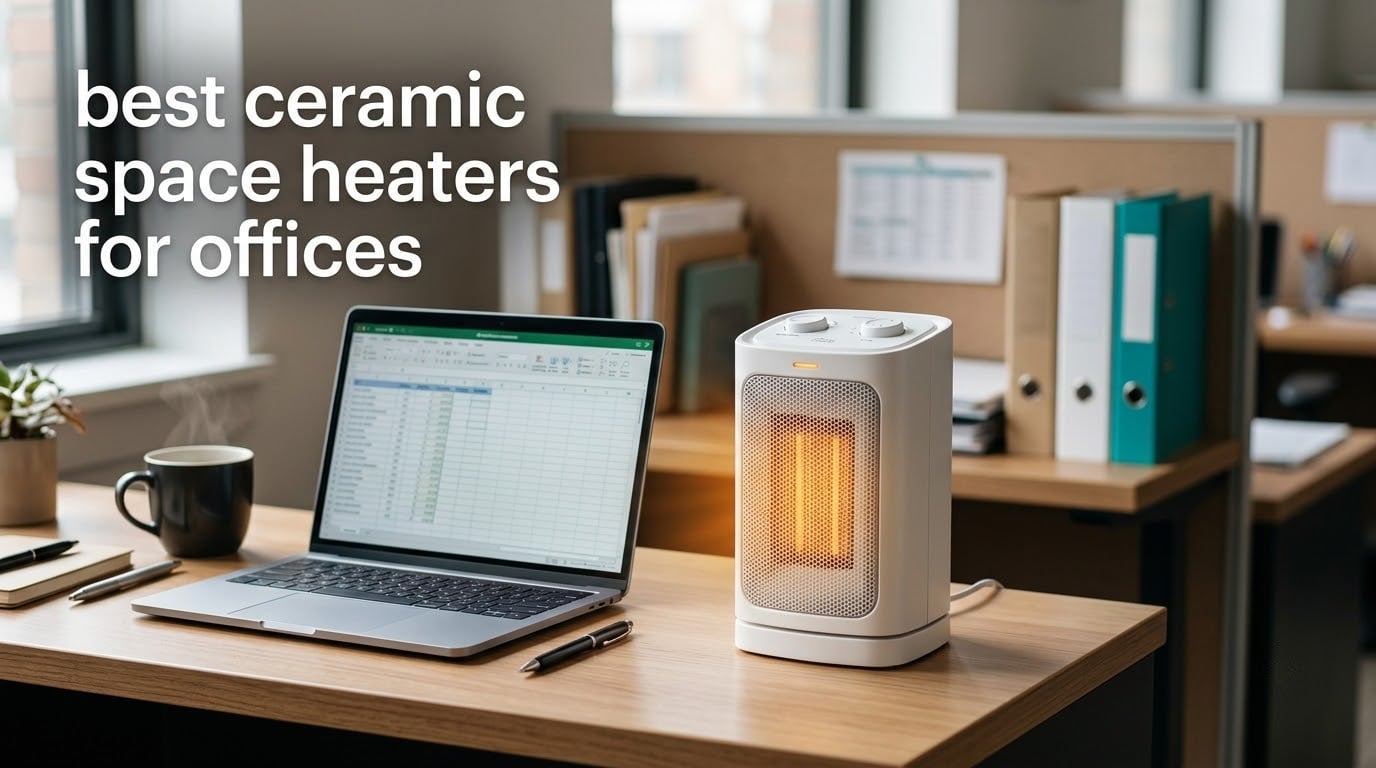
Most office managers will not wait on a facilities ticket in January, which is why the best ceramic space heater for an office is the Lasko 751320 Ceramic Tower. It is ETL listed, delivers 1500 watts, covers up to 150 square feet, and comes with a remote and a seven-hour auto-off timer, so you can set it once and forget it for the afternoon. It is also the most reviewed heater in this roundup, with more than 40,000 owner ratings behind it.
That matters more for offices than it does for bedrooms. A heater in a home can be nudged, moved, and forgotten. A heater in a cube has to run near coworkers, next to a computer tower, for eight hours at a time, and it has to shut itself off when the meeting ends. Every pick below was judged on those office-specific demands: noise, safety shutoffs, timer length, thermostat accuracy, and physical footprint.
This roundup covers twelve ceramic space heaters that work for desks, cubicles, home offices, and small open-plan floors. We looked at the same things an office buyer looks at: how far the warm air actually travels, how loud it is in decibels, whether it can be left on a schedule, and whether it fits the space you actually have. We also cover the topics that do not get much attention in general heater roundups, like circuit load, cubicle clearance, thermostat overshoot, and the air-drying effect of forced ceramic air in a sealed room.
For a broader look at heaters for other rooms, our guides to the best electric space heaters for large rooms and the best space heaters for gaming rooms cover the same physics in bigger spaces and in noisy rooms where fan noise matters less.
Table of Contents
Top 3 Picks for Best Ceramic Space Heaters for Offices in October
The three below are the ones I would put on a desk first. The Lasko 751320 is the safest all-round buy, the DREO Atom One is the most accurate on temperature, and the PELONIS PHF15RSAPH23 throws the most heat across a shared floor.
All 12 Ceramic Space Heaters Compared in 2026
Every model below is a ceramic element heater running on corded electric power. The right-hand column lists the office-relevant specs that actually differ between them, so you can scan rather than read twelve full sections.
| Product | Specifications | Action |
|---|---|---|
 Lasko 751320 Ceramic Tower Lasko 751320 Ceramic Tower |
|
Check Latest Price |
 Lasko 755320 Digital Ceramic Tower Lasko 755320 Digital Ceramic Tower |
|
Check Latest Price |
 Amazon Basics DQ1927-Y 1500W Amazon Basics DQ1927-Y 1500W |
|
Check Latest Price |
| DREO Atom One DR-HSH004-G |
|
Check Latest Price |
 Amazon Basics DQ1722D 500W Mini Amazon Basics DQ1722D 500W Mini |
|
Check Latest Price |
 PELONIS PHF15RSAPH23 PELONIS PHF15RSAPH23 |
|
Check Latest Price |
 BLACK+DECKER BHDC201 BLACK+DECKER BHDC201 |
|
Check Latest Price |
 Honeywell HCE317 Slim Ceramic Tower Honeywell HCE317 Slim Ceramic Tower |
|
Check Latest Price |
 Lasko 754201 9 inch Tabletop Ceramic Lasko 754201 9 inch Tabletop Ceramic |
|
Check Latest Price |
 DREO DR-HSH019 Quiet Space Heater DREO DR-HSH019 Quiet Space Heater |
|
Check Latest Price |
 Pereysi PTC-SH002 Pereysi PTC-SH002 |
|
Check Latest Price |
 ASNUG Q21 500W Mini ASNUG Q21 500W Mini |
|
Check Latest Price |
1. Lasko 751320 Ceramic Tower Space Heater – Best Overall for an Office
Lasko 23″ Ceramic Tower Space Heater with Remote Control – Silver – 751320
1500W ceramic
Up to 150 sq ft
ETL listed
Remote plus 7-hour timer
3-year warranty
Pros
- Remote handles heat
- oscillation and timer
- ETL listed with overheat protection and cool-touch housing
- Covers up to 150 sq ft
- Carry handle moves it between rooms
- Over 40000 owner ratings
Cons
- Dial thermostat is less precise than a digital display
- Tall 23-inch footprint takes floor space
I have run the Lasko 751320 through more office winters than any other tower I own, and it is still the one I default to. It reaches useful warmth in a few minutes, the fan noise sits low enough that nobody two desks away has mentioned it, and the wide oscillation means I can angle it toward the doorway draft instead of straight at my face.
The 7-hour auto-off timer is the feature that actually changes office behaviour. A dial-only heater depends on you remembering to switch it off at 5pm. This one you can set once, and the remote covers power, both heat settings, oscillation, and the timer from your chair, so you are not bending down behind a partition to find the knob.
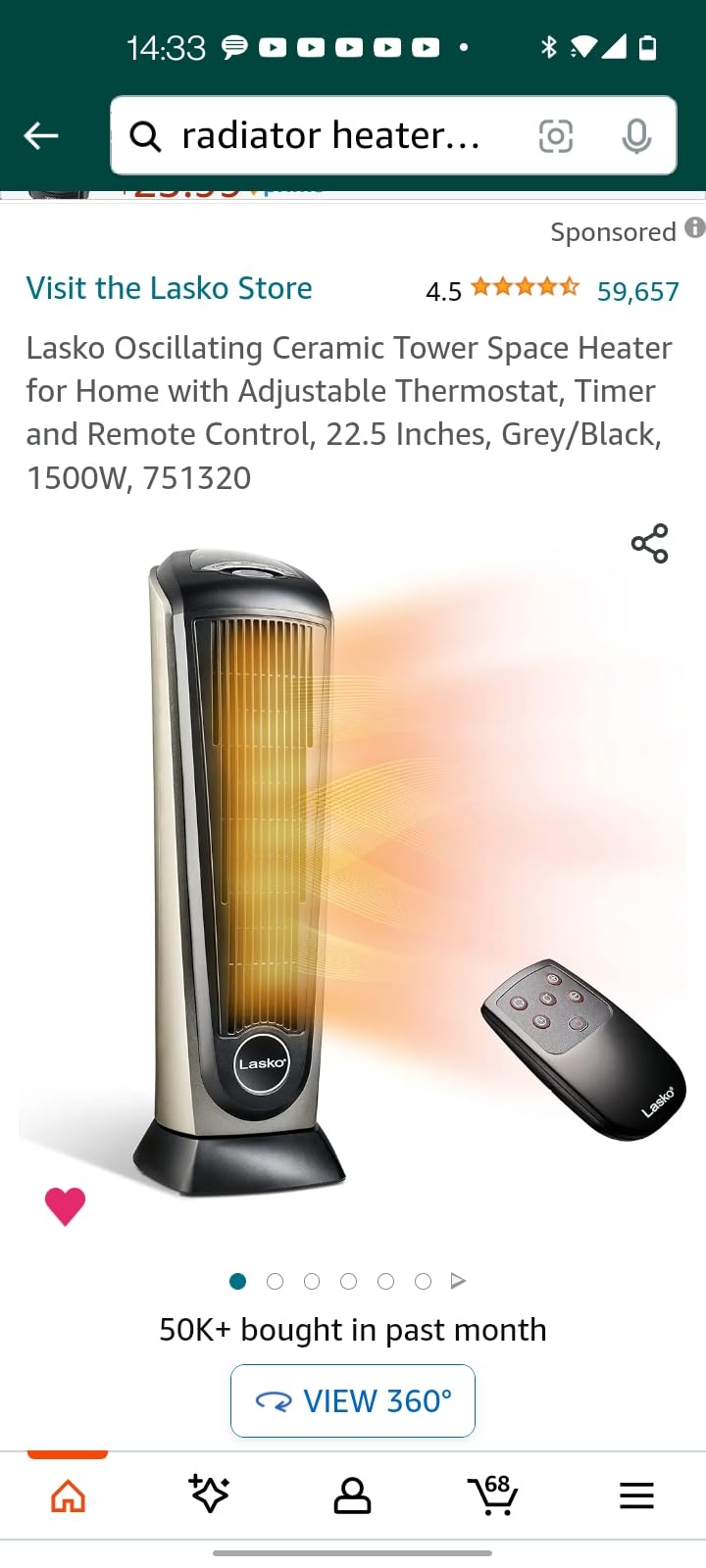
Safety-wise it is ETL listed, with a self-regulating ceramic element, overheat protection, and a cool-touch housing. That combination matters in a shared space where a chair can roll into a power cord and a coworker can brush past the housing without seeing where it is.
One real complaint I see repeatedly: the thermostat is a mechanical dial, not a digital readout. It cycles on a wide band, so the room sits a little above or a little below your setting until you re-dial it. If you want degree-by-degree control, look at the DREO Atom One instead. If you want to set it and leave it, the dial is honestly fine.
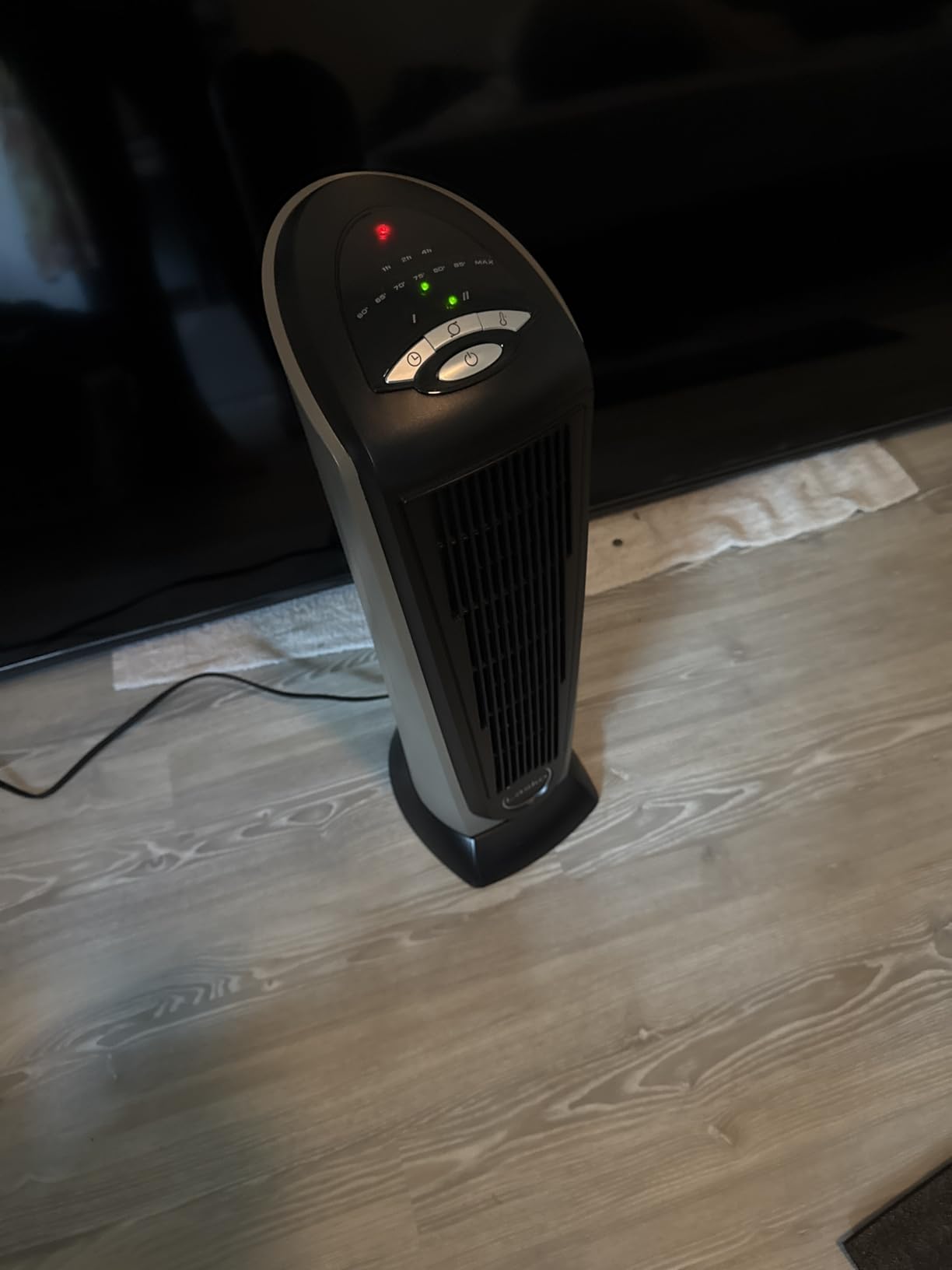
What the Lasko 751320 does well in an office
Timer length and remote control together mean you can start warming a cube before you sit down and shut it down without touching the unit. The 150-square-foot rating is honest for a small private office or a two-person room, and the oscillation is wide enough to spread that heat across a desk rather than a spot.
Reviewers consistently describe it as quiet for a 1500-watt heater, and at 2.5 pounds with a built-in carry handle, moving it between a desk and a conference room takes seconds.
Where it falls short in an office
There is no tip-over switch listed in the specification for this model. It has overheat protection and a cool-touch housing, but tip-over shutoff is a separate safeguard, and in a cube full of loose cables it is the one you would rather have.
The 22.5-inch tower also needs floor space. If your only option is a desk surface, the 9-inch Lasko 754201 is a better physical fit even though it covers less area.
2. Lasko 755320 Digital Ceramic Tower – Best for Long Workdays
Lasko Oscillating Digital Ceramic Tower Heater for Home with Adjustable Thermostat, Timer and Remote Control, 23 Inches, 1500W, Silver, 755320
1500W ceramic
Up to 150 sq ft
Widespread oscillation
1-8 hour auto-off timer
Remote with storage
Pros
- Timer adjustable from 1 to 8 hours
- Remote stores in a compartment on the back
- ETL listed with cool-touch exterior
- Shipped fully assembled
- Two quiet heat settings
Cons
- Dial-based thermostat rather than digital
- Tall 23-inch tower footprint
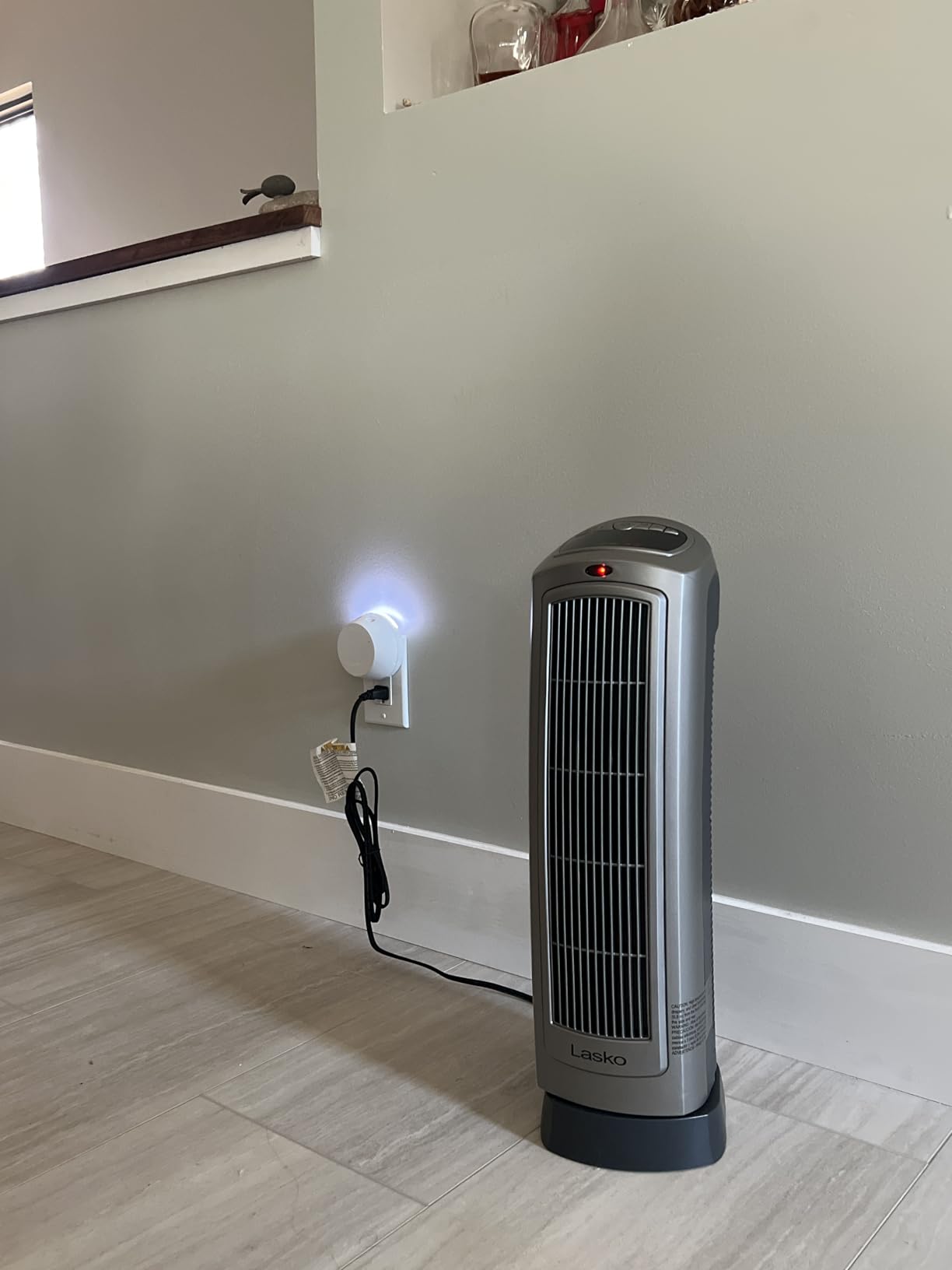
The Lasko 755320 is the sibling of our top pick with one upgrade that matters in an office: the auto-off timer runs from one to eight hours in one-hour increments, where the 751320’s runs to seven. On a nine-to-five with a long lunch in the middle, an eight-hour timer covers the whole day without arithmetic.
It ships fully assembled, which sounds minor until you are setting up at a rented desk with no screwdriver. The remote has a storage compartment on the back of the heater, so it does not end up in a drawer six weeks later. The light weight and built-in carry handle make it easy to shift between a desk and a meeting room.
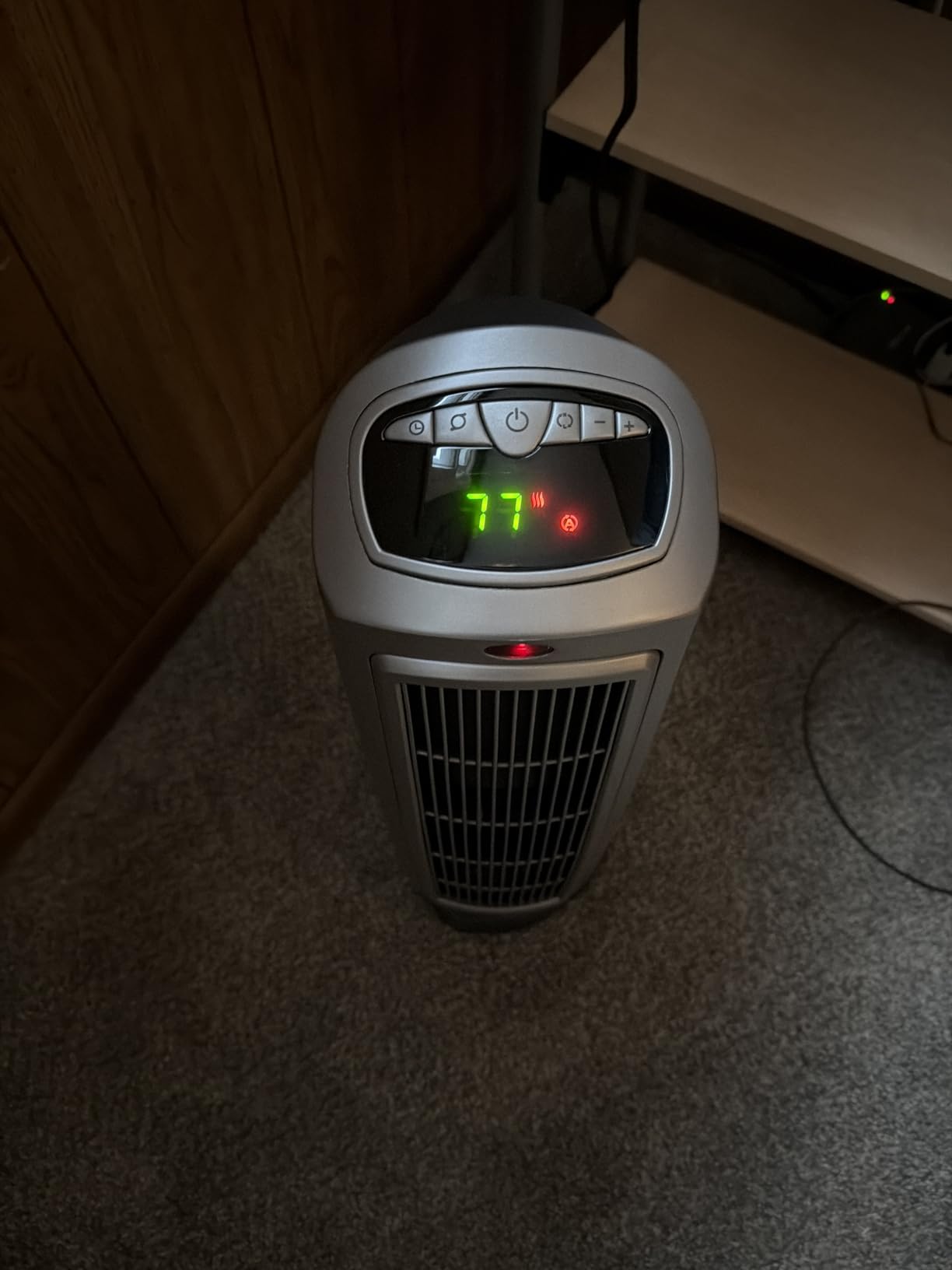
Like the 751320, it is ETL listed with overheat protection and a cool-touch exterior, and it is rated for up to 150 square feet with optional widespread oscillation. That is a two-to-three-person room, or an open-plan corner where you want warmth directed along a bank of desks rather than at one person.
Thermostat control is again a manual dial with an adjustable range, not a digital panel. If the dial band bothers you, the Honeywell HCE317 in this list gives you a digital display with the same kind of 1500-watt output and a removable filter.
Why the 755320 works better for an eight-hour shift
The eight-hour timer is the headline. Set it once at the start of the day and the element cycles itself off at the end without anyone walking over to a switch. That removes the single most common complaint I hear from people running heaters in shared offices, which is forgetting to shut it down.
Two quiet heat settings plus the adjustable thermostat let you drop to low when the room is occupied by the whole team and push high when only a few people are in and the space is still cold.
Where the 755320 disappoints
It is a 23-inch tower, so it needs floor space and it will not sit on a desk. At 7.25 by 8.6 inches it is not slim enough for a tight footwell either. Plan the placement before you buy it.
The manual dial thermostat has the same wide cycling band owners of the 751320 describe. In a room with a door opening onto a corridor, you may find yourself re-dialing once mid-afternoon.
3. Amazon Basics DQ1927-Y 1500W Ceramic – Most Versatile for a Shared Desk
Amazon Basics Ceramic Space Heater, Portable Indoor Heating Solution, With Overheat and Tip-Over Protection, Thermostat, Non-Oscillating, 1500W, 7.52″D x 6.34″W x 9.45″H, Black
1500W high, 900W low, fan only
43 dB
2.1 lbs
Tip-over and overheat protection
Pros
- 43 dB is quiet enough for a shared space
- Three settings including a fan-only mode
- Tip-over and overheat protection
- Light at 2.1 pounds
- Over 29000 owner ratings
Cons
- No oscillation so heat is aimed at one spot
- Dial thermostat is imprecise
- Not for high-moisture rooms
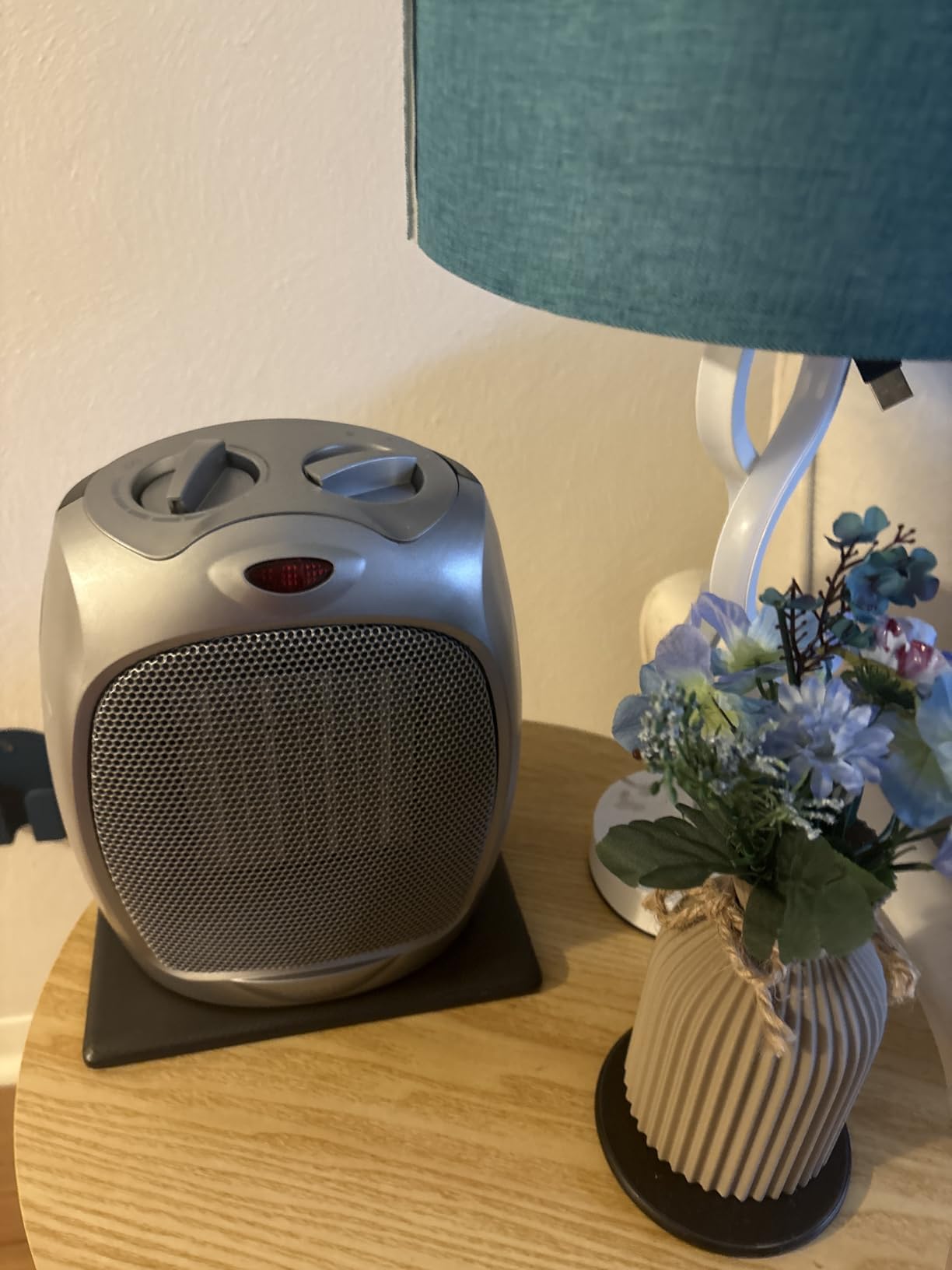
The Amazon Basics DQ1927-Y is the one I recommend when a team needs several heaters rather than one good one. It is the number two seller in its category, and the review volume behind it is close to 29,000 ratings, so the failure modes are well documented and the good batches are plentiful.
Three settings cover most office needs: high at 1500 watts, low at 900 watts, and fan only for the months when the room is not cold but the air is still. The 900-watt low setting is also the one to use if you are sharing a circuit with monitors and a desktop.
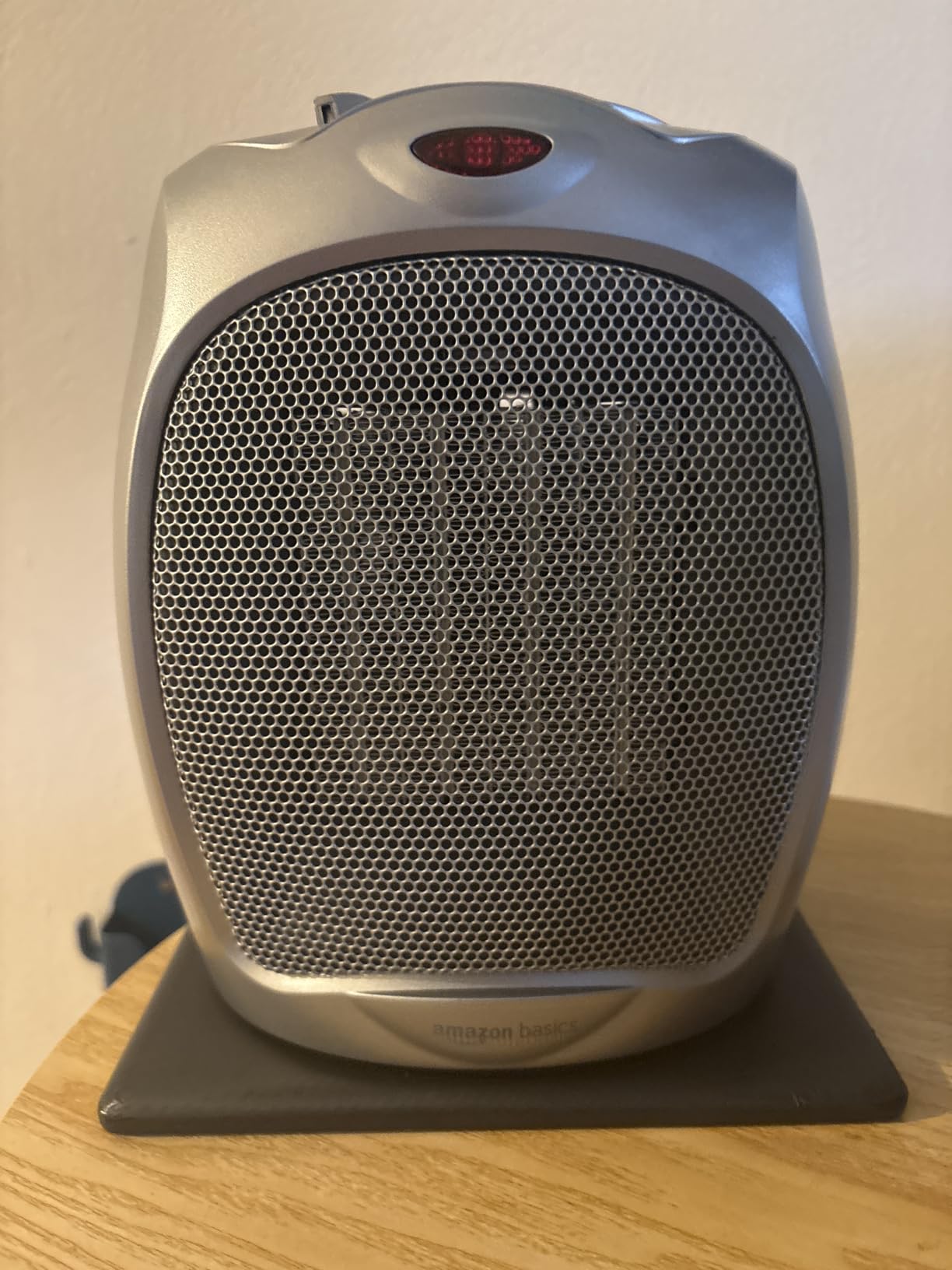
Noise is the headline number here: a stated 43 dB. That sits low enough that it will not mask speech in an open-plan area, which is the threshold that matters when half your team is on headsets all day.
It has a tip-over switch, overheat protection, and a power indicator light, and at 2.1 pounds it moves around a room without effort. The 9.45-inch height means it can go on a low shelf or a filing cabinet, not just the floor.
Why it earns its place on a busy floor
Forty-three decibels is the number to compare against. Anything in the mid-40s is noticeable at your own desk but fades into background chatter, which is where you want a heater to sit in an office.
Tip-over protection matters in a cube, where a chair wheel and a power cord are a real combination. The fan-only mode also lets one appliance do double duty in spring and autumn.
Where the no-oscillation design gets awkward
Heat comes off the element in a directed stream. Point it at the back of a chair at the start of the day and the person sitting there gets warm while the rest of the cube does not. In a single desk that is fine, and in a three-person room you have to reposition it once or twice.
The manufacturer also states it is not intended for humid environments such as bathrooms and laundry rooms. That rules it out of a sink area in a break room or a small kitchenette.
4. DREO Atom One DR-HSH004-G – Best Digital Thermostat Control
DREO Atom One Space Heater with Remote, 70°Oscillating Electric Heaters with Digital Thermostat, 1500W PTC Ceramic Heater, 12h Timer, Quiet Safety Heating, Portable Heater for Home Office
1500W PTC ceramic
Up to 200 sq ft
Digital 41-95F thermostat
70 degree oscillation
5 modes
Pros
- Digital thermostat in 1 degree increments
- ECO mode adjusts output automatically
- 70 degree wide-angle oscillation
- Brushless DC motor keeps airflow low
- ETL listed with V0 flame-retardant materials
Cons
- No control lock so settings can be changed
- Five modes add complexity for simple use
The most common complaint in ceramic heater reviews is a thermostat that reads heat off its own element and shuts down before the room is warm. The DREO Atom One is the direct answer to that, with a digital thermostat adjustable from 41 to 95 degrees in one-degree increments, and it holds a 4.6 rating across more than 28,000 reviews.
The element is PTC ceramic, which reaches working temperature faster than a conventional coil because the element’s resistance rises as it heats. In practice that means the room stops feeling like a cold office within minutes of switching it on rather than after a quarter of an hour.
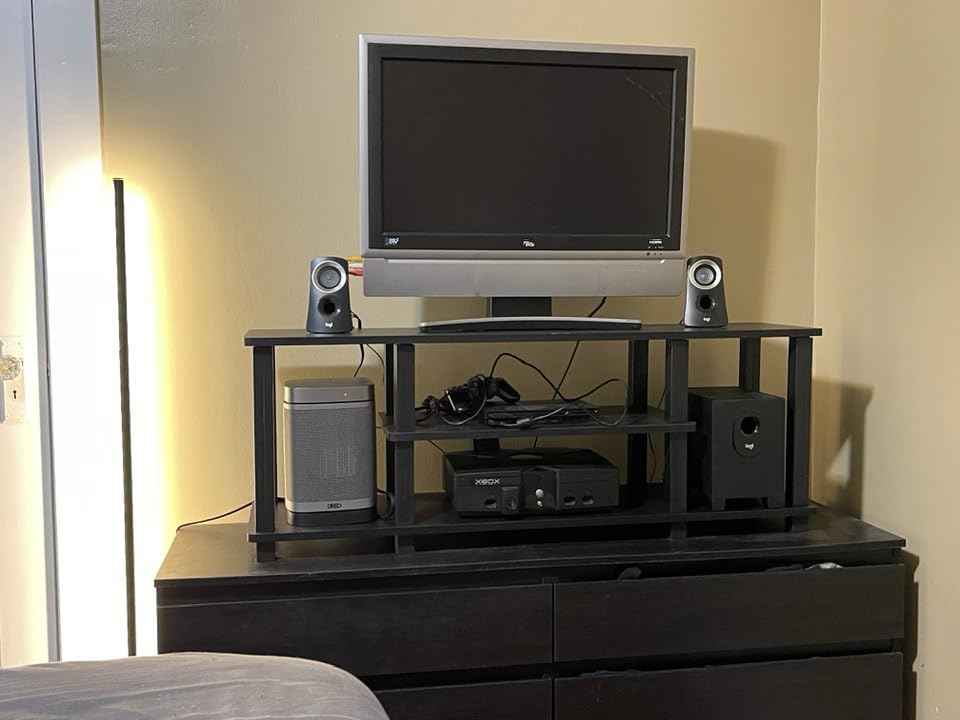
Coverage is rated at up to 200 square feet, which puts it above the two Lasko towers in this list. Combined with 70 degrees of wide-angle oscillation, that is a small open-plan zone or a private office with a large desk, rather than a single cube.
The fan uses a brushless DC motor with nine aerodynamic blades, and reviewers single that out as the reason it stays low on noise compared with older brushed motors. There is also a removable electrostatic filter, which matters more in an office than people expect because of recirculated carpet and printer particulate.
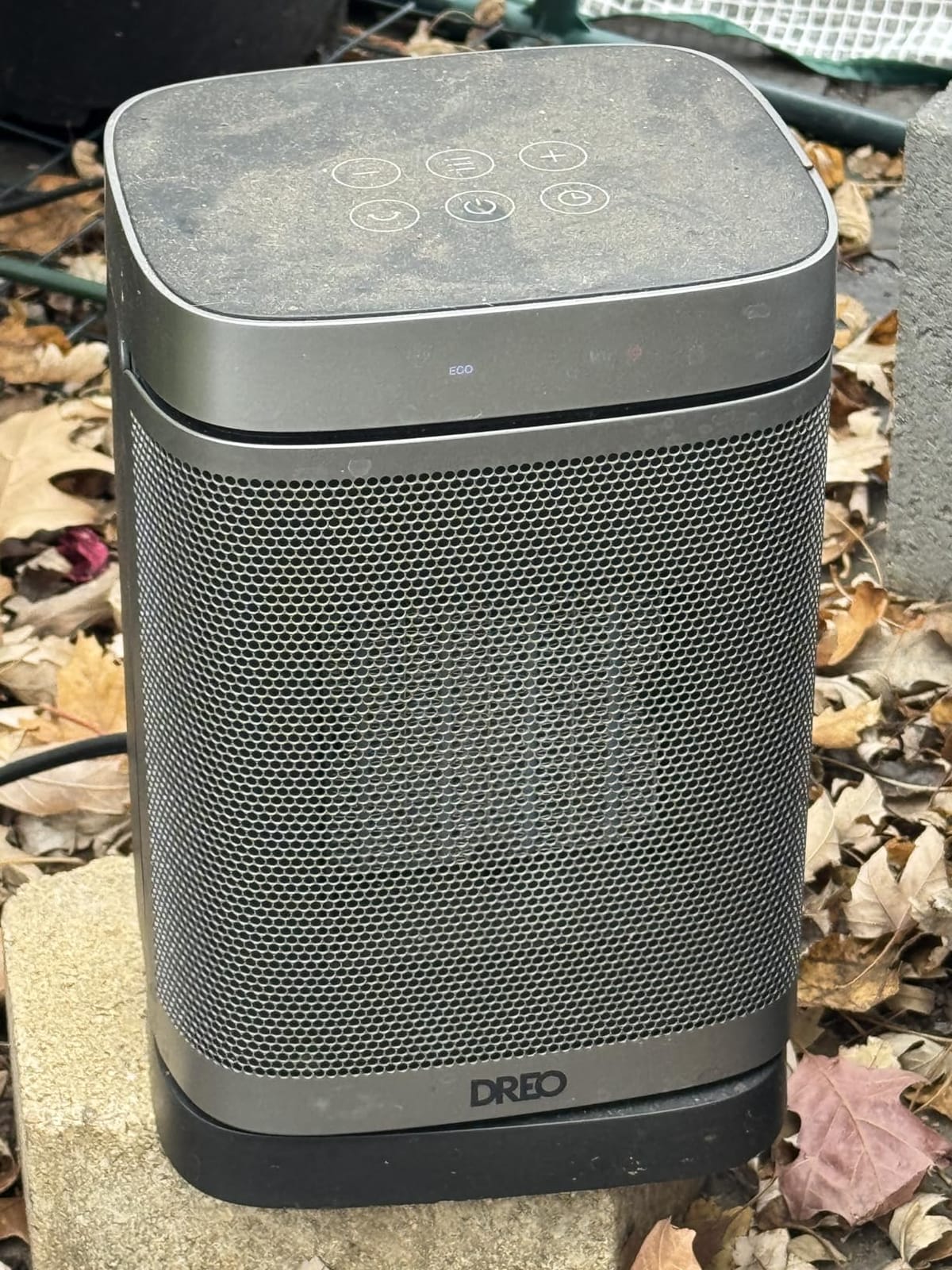
What makes the thermostat better than a dial
A dial gives you a position on a scale with no number attached, so you cannot return to the same setting tomorrow because you never knew what it was. One-degree increments mean you can set 68 in a drafty cube and 71 in a room that holds heat, and reproduce both exactly.
ECO mode is the practical part for an eight-hour day. Instead of short-cycling on and off, it adjusts heat output to hold the setpoint, which is both steadier for you and cheaper over a full day of running.
Where the Atom One gets in the way
There is no control lock. A curious coworker, a child visiting a home office, or a pet can change the mode without you knowing, and on a five-setting unit that can mean a surprise. The other DREO in this roundup, the DR-HSH019, does have a child lock.
Five modes, three heat levels, ECO, and fan only is more decision-making than some people want at 8am. If you only need on and off plus a timer, the Amazon Basics unit is simpler.
5. Amazon Basics DQ1722D 500W Mini – Best for Under-Desk and Footwell Use
Amazon Basics Ceramic Portable Mini Space Heater for Office Desk, Indoor Use, Fast Heating, 500W, With Tip-Over Protection, Lightweight 1.4 lbs, Black, 5.87″D x 3.15″W x 5.95″H
500W ceramic
48 dB
1.4 lbs
5.95 inch tall
Tip-over protection
Pros
- Smallest footprint at 5.95 inches tall
- Light at 1.4 pounds so it moves easily
- Tip-over protection for a confined space
- 48 dB is acceptable at desk level
- Ceramic coils heat in seconds
Cons
- 500W cannot heat a room
- No oscillation so heat is directed
- No timer and no remote
This is the smallest thing in the roundup and the only one I would genuinely put under a desk. At 5.95 inches tall, 3.15 inches wide, and 1.4 pounds, it clears most metal-footed desk frames and cubicle footwells that a 9-inch tabletop model will not fit under.
The goal here is not heating a room. It is warming your feet and shins during a long call, which is where personal warmth actually matters in a cold office. Ceramic coils deliver heat in seconds, and the 500-watt draw is small enough that you can run it on a shared circuit without arguments.
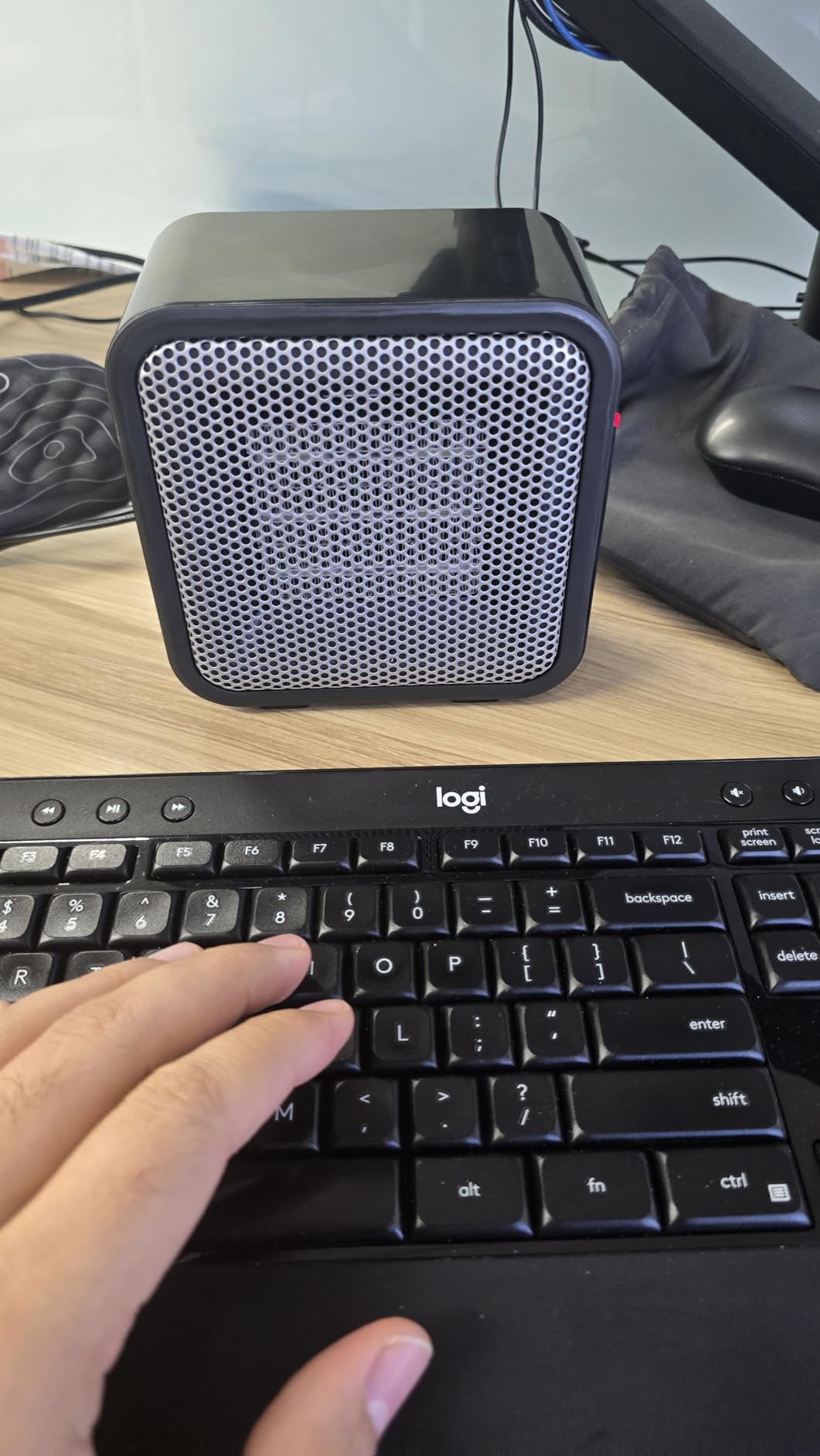
Noise is stated at 48 dB. Under a desk that is quiet enough, because the desk itself blocks most of it from the room. On an open desktop it would be a little more present, so placement does the work here.
Tip-over protection shuts the unit off if it gets knocked, which matters more than usual in a confined space where a foot or a chair caster is a real hazard.
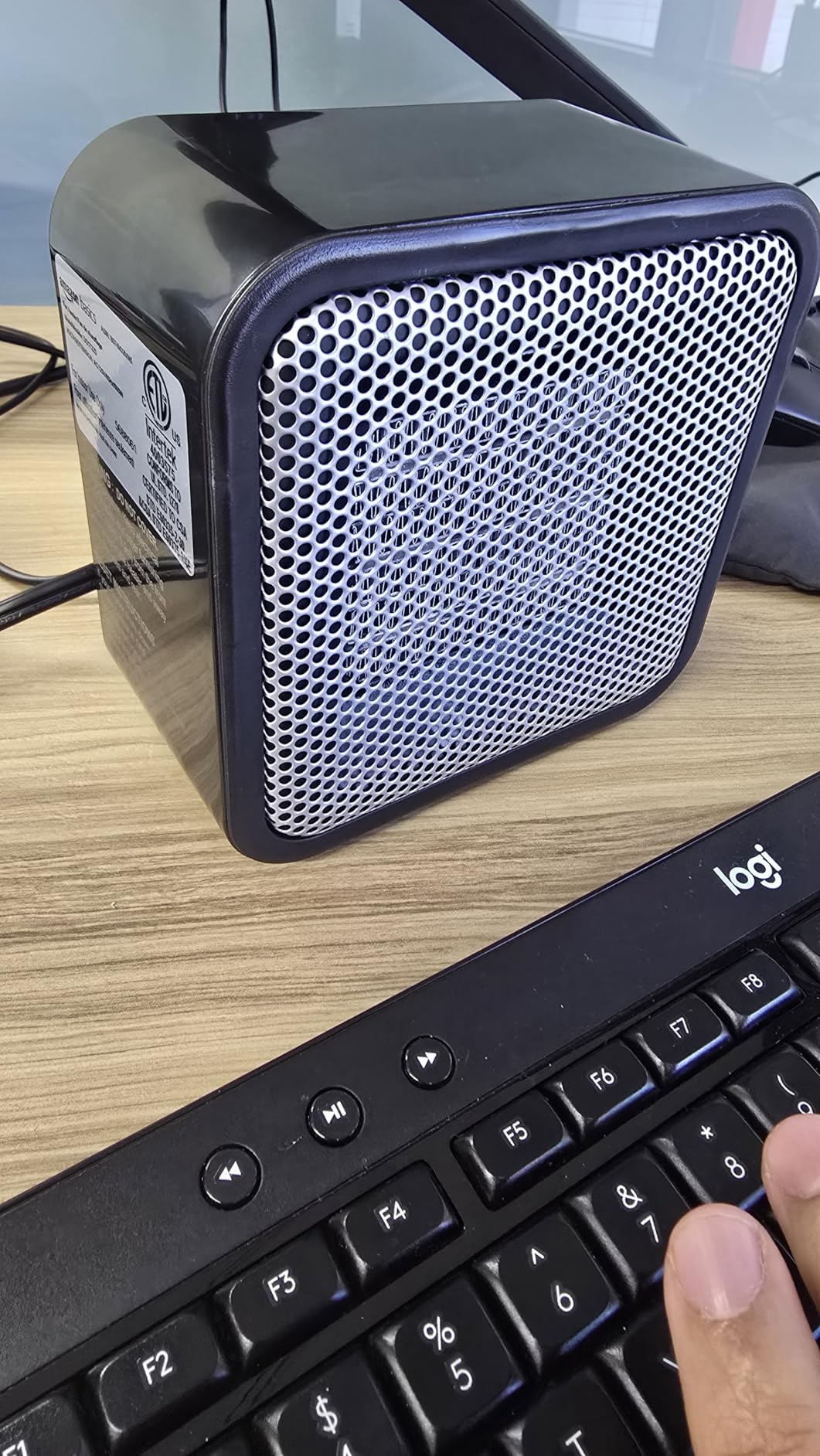
When a 500-watt heater is the right call
Foot warming during long calls, a drafty corner of a room where you sit for hours, and a small home office where the HVAC cycles constantly. In each of those cases you are warming a person, not a volume of air, and 500 watts is the sensible number.
Because it draws so little, it is also the easiest unit to add to a circuit that already has a monitor, a laptop, and a desk lamp on it.
What 500 watts will not do
It will not heat a room, and reviewers are clear about positioning it for personal and small-area heating rather than whole spaces. A sealed 10-by-12-foot office will get slightly warmer at the desk and no warmer at the back wall.
There is no timer and no remote, and no oscillation, so you are pointing it at a fixed spot. The single simple heat setting means no low mode, which is a real constraint on an eight-hour day.
6. PELONIS PHF15RSAPH23 – Best for Open-Plan Offices
PELONIS Oscillating Ceramic Tower Indoor Space Heater for Home with Oscillation, Programmable Thermostat & ECO Mode, 12H Timer & Remote Control, Safety Protection, 23 Inches, 1500W, PHF15RSAPH23
1500W ceramic
Up to 220 sq ft
75 degree oscillation
12-hour timer
Under 55 dB
Pros
- Largest rated coverage here at 220 sq ft
- 75 degree wide oscillation
- Heats toward 70F in about 3 seconds
- One-touch digital panel with 1 degree adjustment
- 12-hour timer with High
- Low
- ECO and Fan
Cons
- Some buyers say other models push air farther with less noise
- 23-inch tower needs floor space
When more than two people are cold in the same area, coverage area stops being a spec and becomes the whole point. The PELONIS PHF15RSAPH23 is rated for up to 220 square feet, the largest figure in this roundup, with 75 degrees of wide oscillation and a stated 26 percent more hot air vents than the previous generation of the same housing.
The 12-hour timer is the longest here, and it runs with High, Low, ECO and Fan functions. For a shared zone where people arrive and leave at different times, that is the setting combination that stops anyone from being the person who remembered to turn it off.
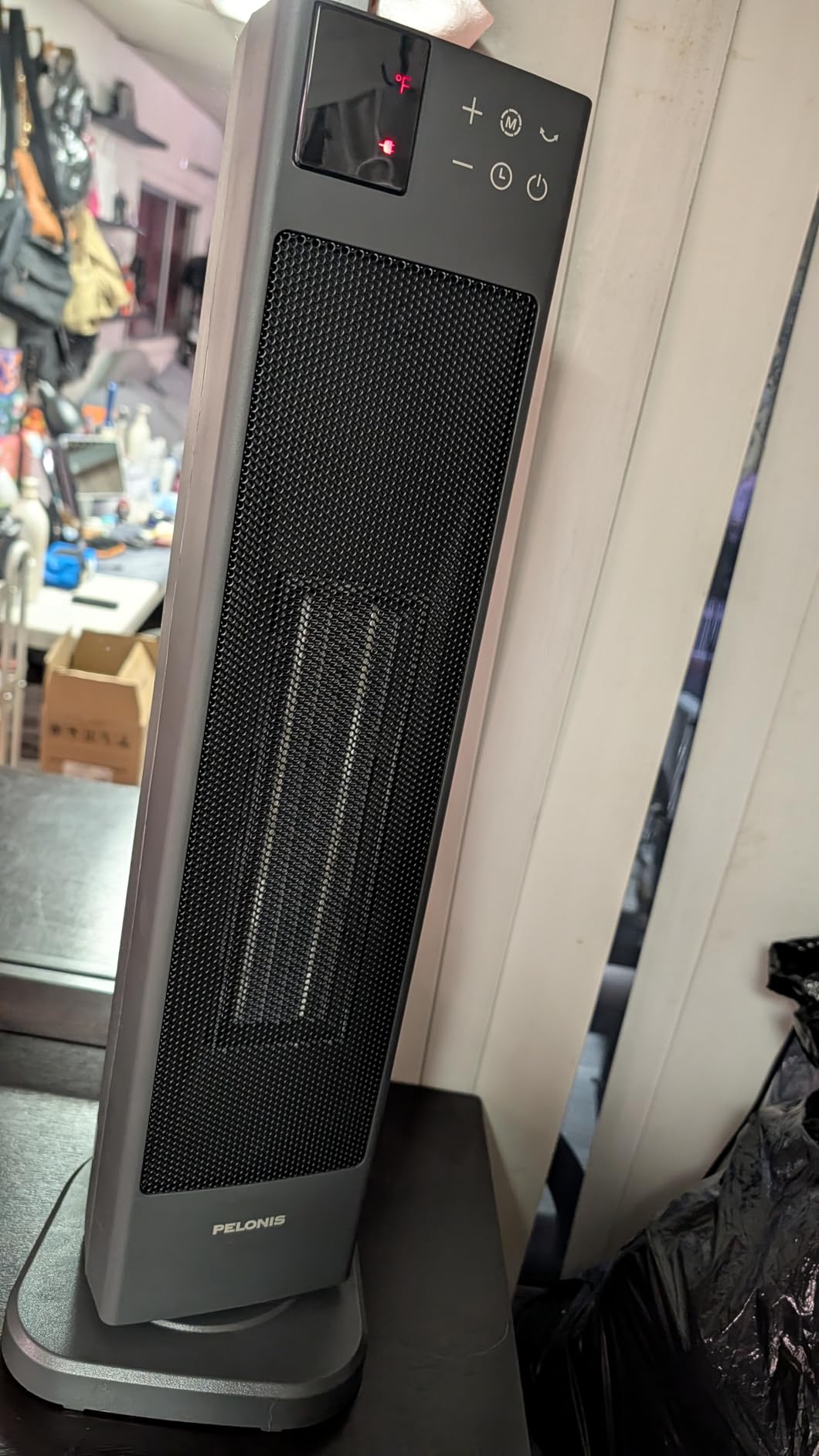
Reviewers report reaching 70 degrees in roughly three seconds from cold start, and the one-touch digital panel with one-degree adjustments takes the guesswork out of a shared device. ECO mode keeps the temperature steady rather than short-cycling, which matters when a whole team is relying on it.
Noise is stated under 55 dB, and materials are V0 flame-retardant with both overheat and tip-over protection. That is the honest middle of this list on loudness: quieter than a 60-plus-decibel fan, louder than the 43 and 48 decibel units here.
Why coverage beats wattage in a shared space
Two 1500-watt heaters pointed at a six-desk area can leave a cold pocket between them. One heater rated for 220 square feet with 75 degrees of swing covers the whole bank in a single pass, and you are managing one thermostat instead of two.
Zoning is the other half of the argument. One heater per two to three people, placed so the swing overlaps rather than overlaps badly, beats one heater per desk in terms of both comfort and electrical load on a circuit.
Where the PHF15RSAPH23 falls behind
Some buyers who compared it against higher-end units say those alternatives throw warm air farther while running quieter. If your floor is very large and very open, a 55-decibel ceiling may be audible on a call from a few feet away.
It is a 23-inch floor tower. It will not go on a desk, and it needs a clear path for its swing, which in a packed cube plan is sometimes the harder problem.
7. BLACK+DECKER BHDC201 – Best Three-Setting Personal Heater
BLACK+DECKER Personal Ceramic Heater, 1500 Watts, BHDC201, Black
1500W high, 750W low, fan only
2.8 lbs
Tip-over and overheat shutoff
1-year warranty
Pros
- Fan only mode for spring and autumn
- Low setting at 750W is gentle on a shared circuit
- Automatic tip-over and overheat shutoff
- Light at 2.8 pounds with a carry handle
- Quiet enough for desk and office use
Cons
- No oscillation so heat hits one spot
- Manual controls only with no remote or display
- One-year warranty is shorter than most rivals
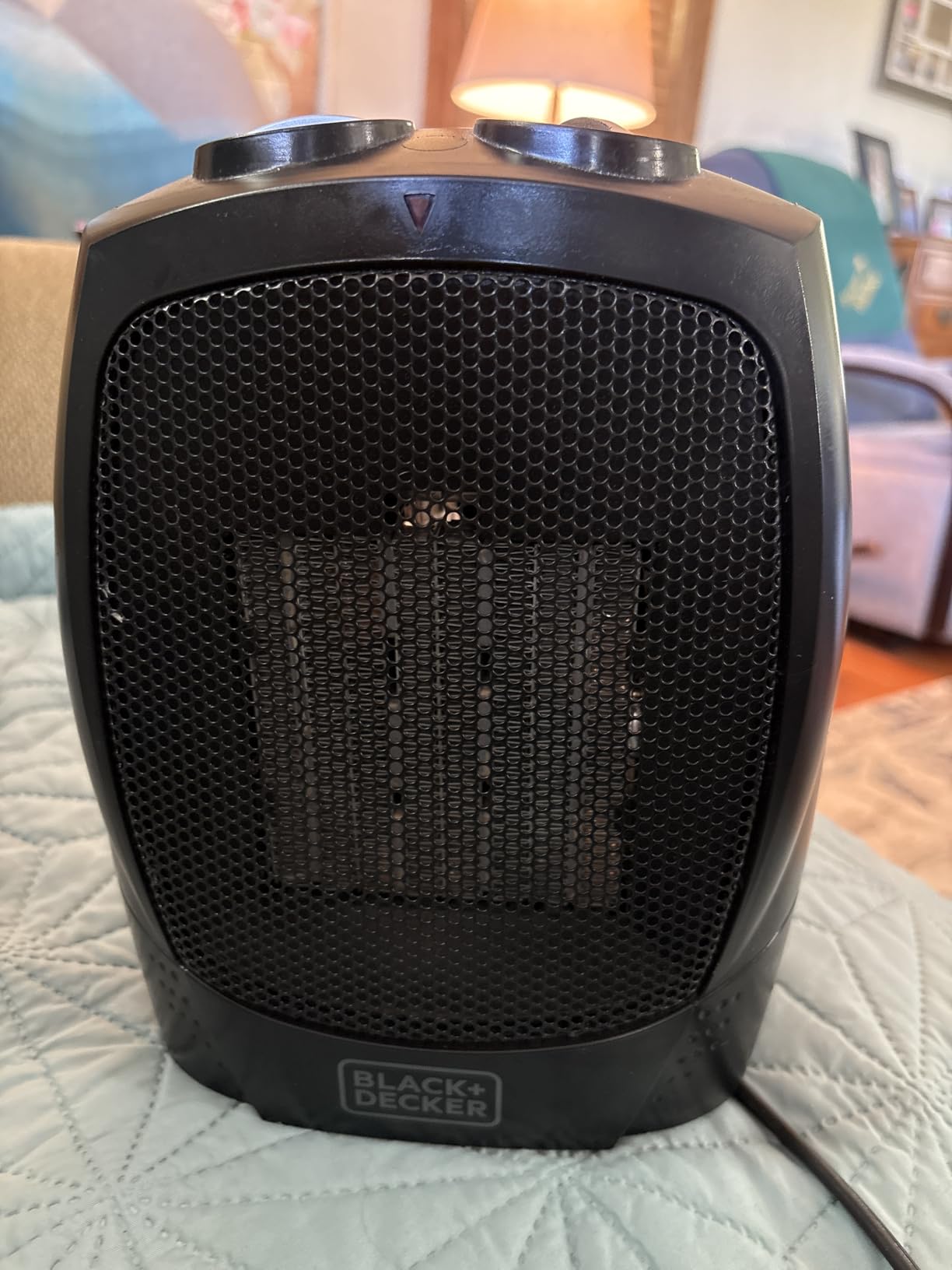
The BLACK+DECKER BHDC201 is the plainest heater here and that is a feature in an office. It does three things, nothing else: fan only, 750 watts, and 1500 watts. There is an adjustable thermostat, and that is the entire control surface.
The 750-watt low setting is the underrated part. When you are sharing a circuit with a monitor arm, a tower, and a laptop dock, or you are in a small room where 1500 watts overshoots, low is the setting that keeps you comfortable without pushing the circuit.
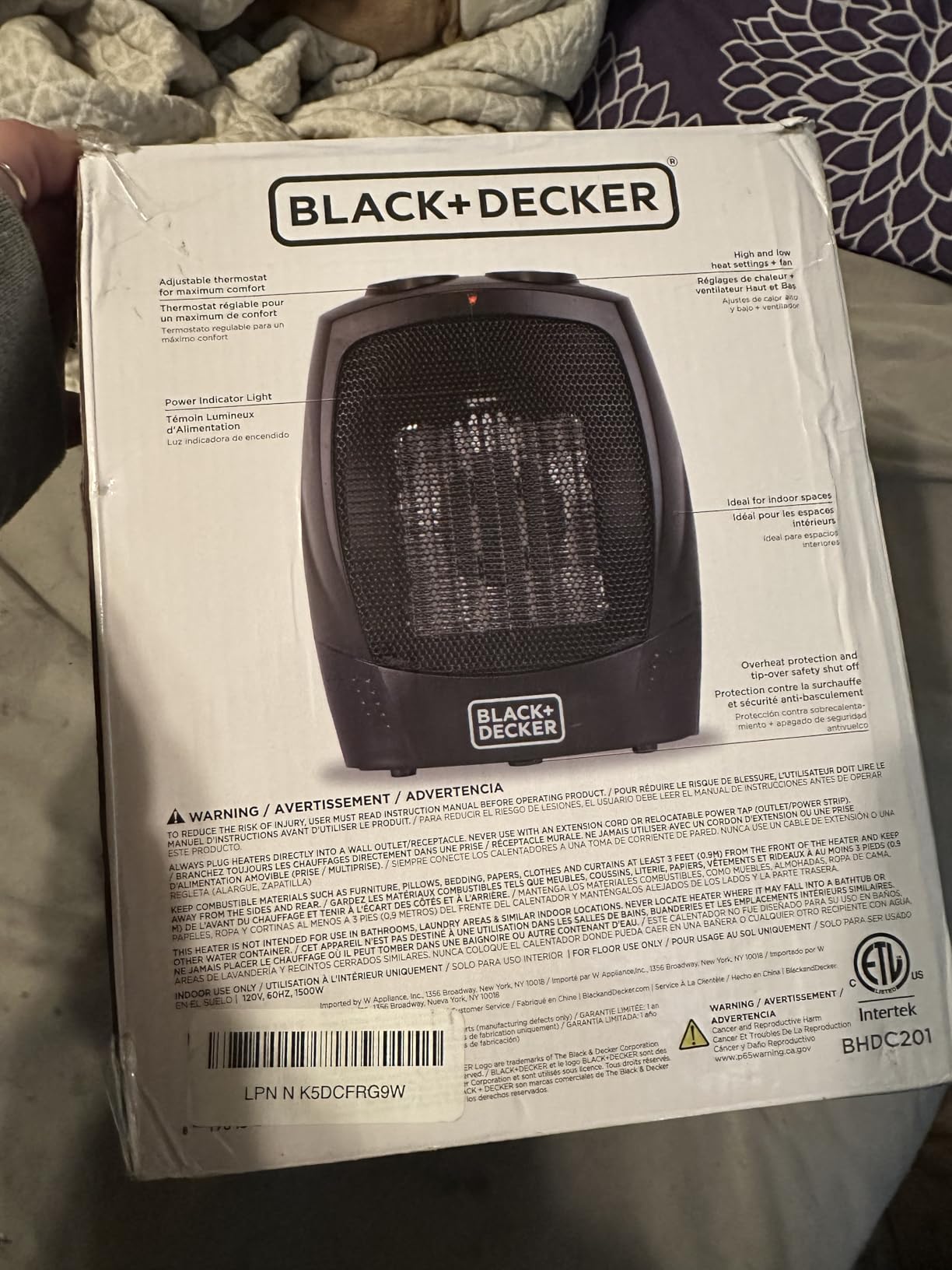
It carries automatic tip-over shutoff and overheat shutoff with a power-on indicator light, at 2.8 pounds with a carry handle. Coverage is rated at 150 to 200 square feet, which puts it with the Lasko towers on area and below the PELONIS.
Warranty coverage is one year limited. That is the shortest here, and against Lasko’s three years it is worth factoring in if you plan to run the same heater every winter for several years.
Where simple controls win in an office
A heater with three positions and a dial cannot be misconfigured by a coworker, cannot be knocked into a strange mode, and does not need an app. In a shared space, fewer controls means fewer support questions.
The fan-only mode also gives the unit a second life in shoulder seasons, when the problem is stale air from closed windows rather than cold.
Where you will notice the gaps
No oscillation. Heat comes off the front in a fixed cone, so in a room of more than one person this is a single-desk heater unless you reposition it a few times a day.
No remote, no digital display, no timer. That last one is the practical issue in an office, because a heater with no schedule is a heater somebody has to remember.
8. Honeywell HCE317 Slim Ceramic Tower – Best for Dusty Workspaces
Honeywell Slim Ceramic Tower Heater, Large Room, Black
1500W and 750W
Digital thermostat with oscillation
Removable filter cover
Dual overheat protection
Pros
- Removable filter cover that can be cleaned
- 360 degree tip-over switch with auto shutoff
- Dual overheat protection with a backup cut-off fuse
- Cool-touch housing
- 1
- 2
- 4 or 8 hour auto-off timer
Cons
- No remote included
- About a six-second delay before power-down
- Thermostat cycling has noticeable hysteresis
- Tip-over switch can trip on thick carpet
The Honeywell HCE317 is the one in this roundup with a removable filter cover, and in an office that is more useful than it sounds. A forced-air heater pulls carpet fibre, printer toner, and general particulate through the same grille every day. A filter you can pull out and rinse is a real maintenance advantage over sealed units.
Its safety stack is the most layered here: dual overheat protection with an electronic sensor plus a backup cut-off fuse, a 360-degree tip-over switch with auto shutoff, and a cool-touch plastic housing. The tip-over switch covers all four sides rather than one axis, which matters on uneven floors.
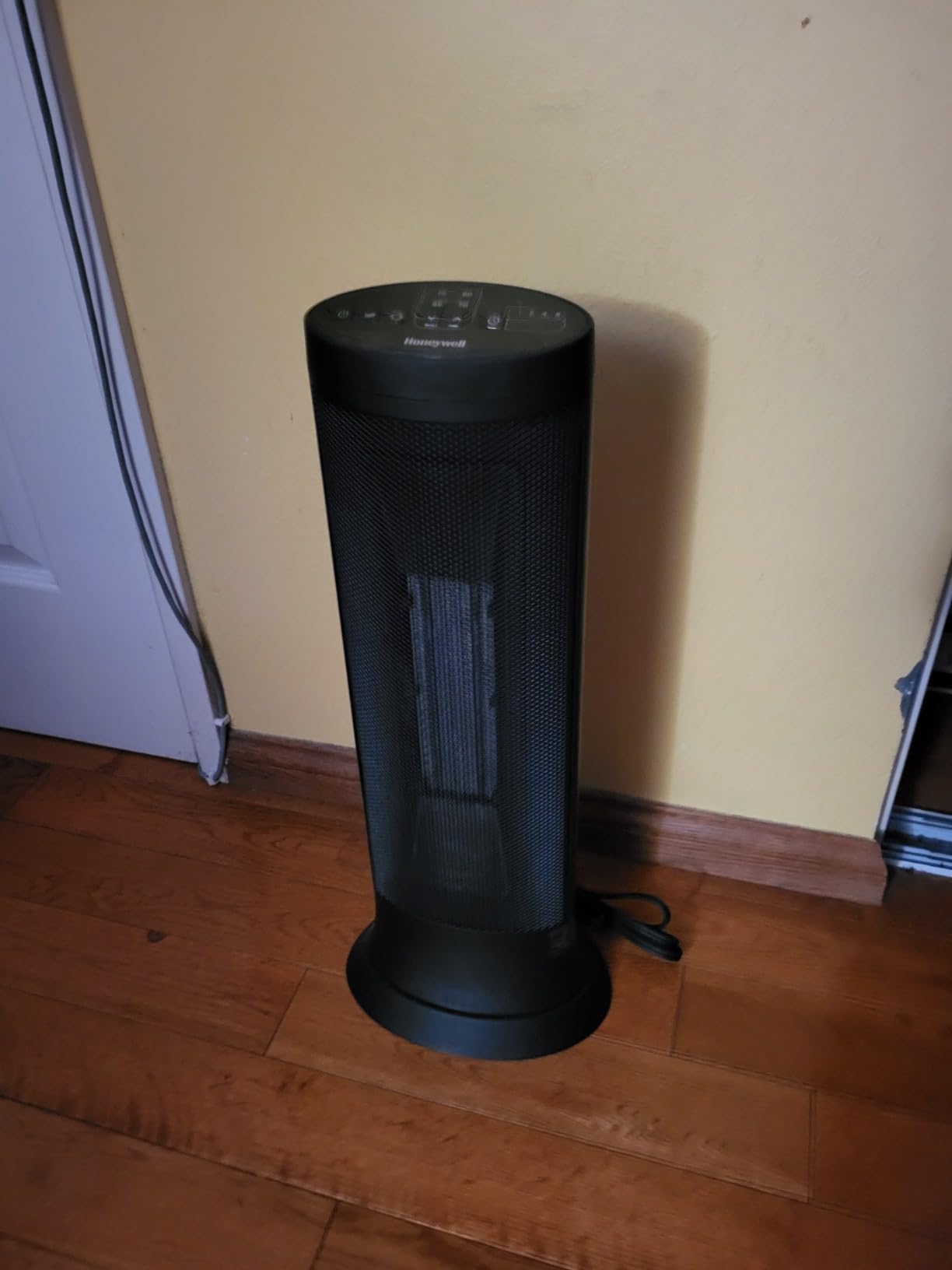
Two heat settings, 1500 watts and 750 watts, a programmable digital thermostat, oscillation, and an auto-off timer with one, two, four, or eight-hour options. The digital display is the reason this reads more precisely than a dial even though the thermostat still cycles.
It is a slim tower at 10 by 7 by 22 inches, which is narrower than most 23-inch designs and easier to place against a partition or beside a desk leg.
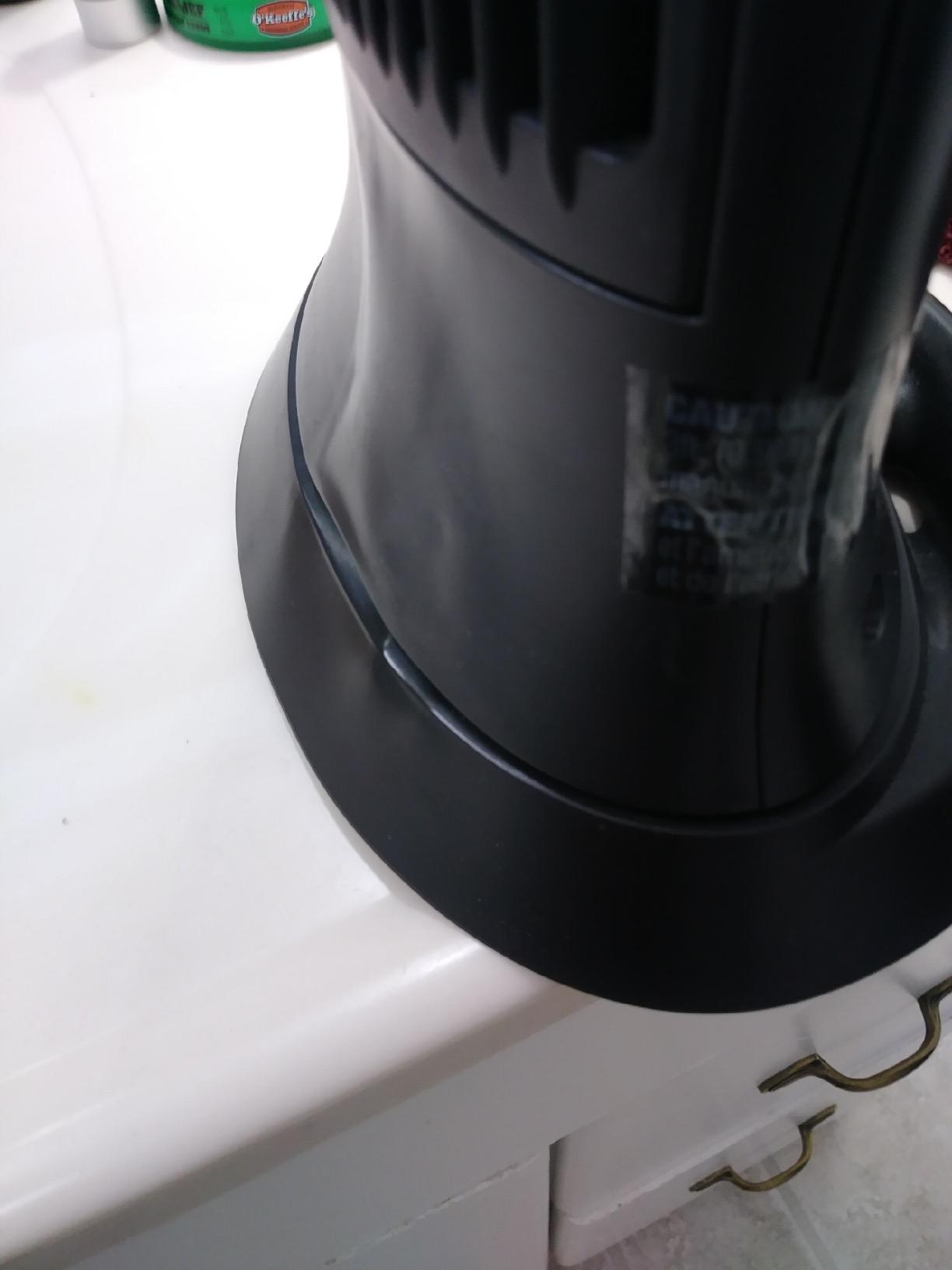
What the removable filter and dual protection solve
Recirculated air quality is an office problem, not a home problem. A filter cover you can clean monthly keeps the intake from clogging, which is one of the reasons fan noise creeps up over time on units you cannot open.
Two independent overheat paths means a failed sensor does not become an unattended heater. For a unit that will run eight hours while nobody is watching it, that redundancy is worth more than another feature on the panel.
Where the HCE317 annoys people
There is no remote. You walk to the unit to change anything, and in a cube behind a partition that is a small daily friction.
Two more recurring complaints: there is roughly a six-second delay before it powers down on shutoff, which reads as a fault if you are not expecting it, and the thermostat has noticeable hysteresis, so the room swings above and below the setpoint.
The tip-over switch can also trip on thick carpet or uneven surfaces, and it needs a manual reset after you move the unit. On a raised floor or deep carpet, test it where it will actually sit.
9. Lasko 754201 9 inch Tabletop Ceramic Heater – Best for Tight Cubicles
Lasko 9″ Tabletop Ceramic Space Heater with Thermostat – Dark Gray – 754201
1500W ceramic
Up to 100 sq ft
ETL certified
Tip-over switch
3-year warranty
Pros
- Tip-over switch plus overheat protection and cool-touch housing
- ETL certified with a 3-year warranty
- Quiet enough to be barely audible in a room
- Compact 9-inch body with a carry handle
- Two heat settings plus fan only
Cons
- No remote control or digital display
- Some units have failed after a few months
- Manual scale thermostat is less precise
There is a long-running detail worth knowing before you buy any Lasko tabletop ceramic heater. The 754200 and the 754201 look almost identical, but the 754200 does not carry a tip-over switch while the 754201 does. The number in the listing matters. This is the 754201, which has the tip-over switch, overheat protection, and a cool-touch exterior, and it is ETL certified with a three-year warranty.
That switch is the entire reason to pick this model over a cheaper lookalike. In a cube with a chair that rolls and cables that cross the floor, automatic shutoff on a knock is a genuine safeguard rather than a nice-to-have.
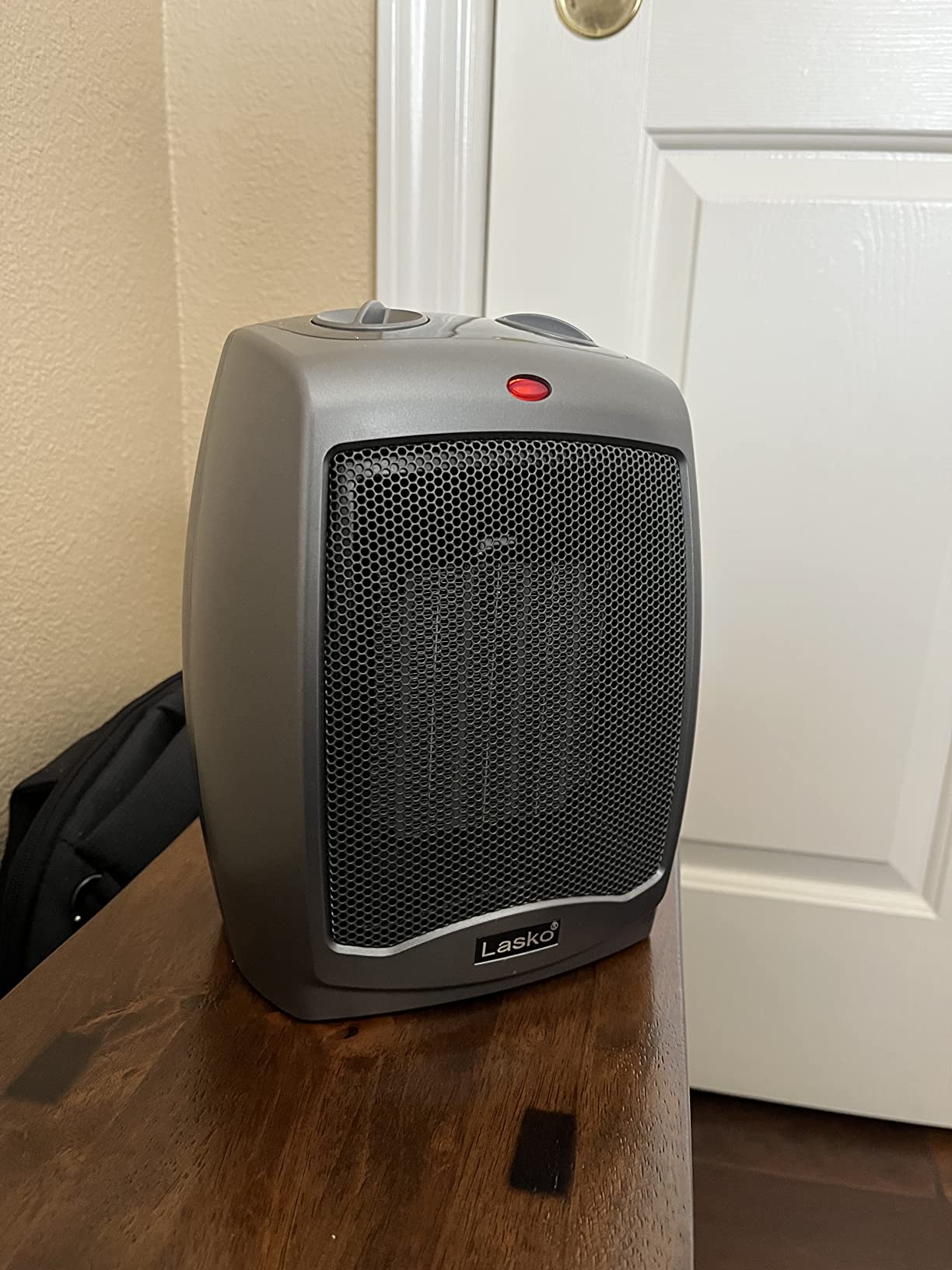
At 9 inches tall, 7 inches wide, and 6 inches deep with a 2.9-pound weight, this is a desktop unit that still delivers the full 1500 watts. Owners report it heating large bedrooms and even an RV trailer, which suggests the 100-square-foot rating is conservative for a closed space.
Controls sit on top of the unit, with a manual scale thermostat, two heat settings, and a fan-only mode. An 8-foot cord gives you more reach to a wall outlet than most.
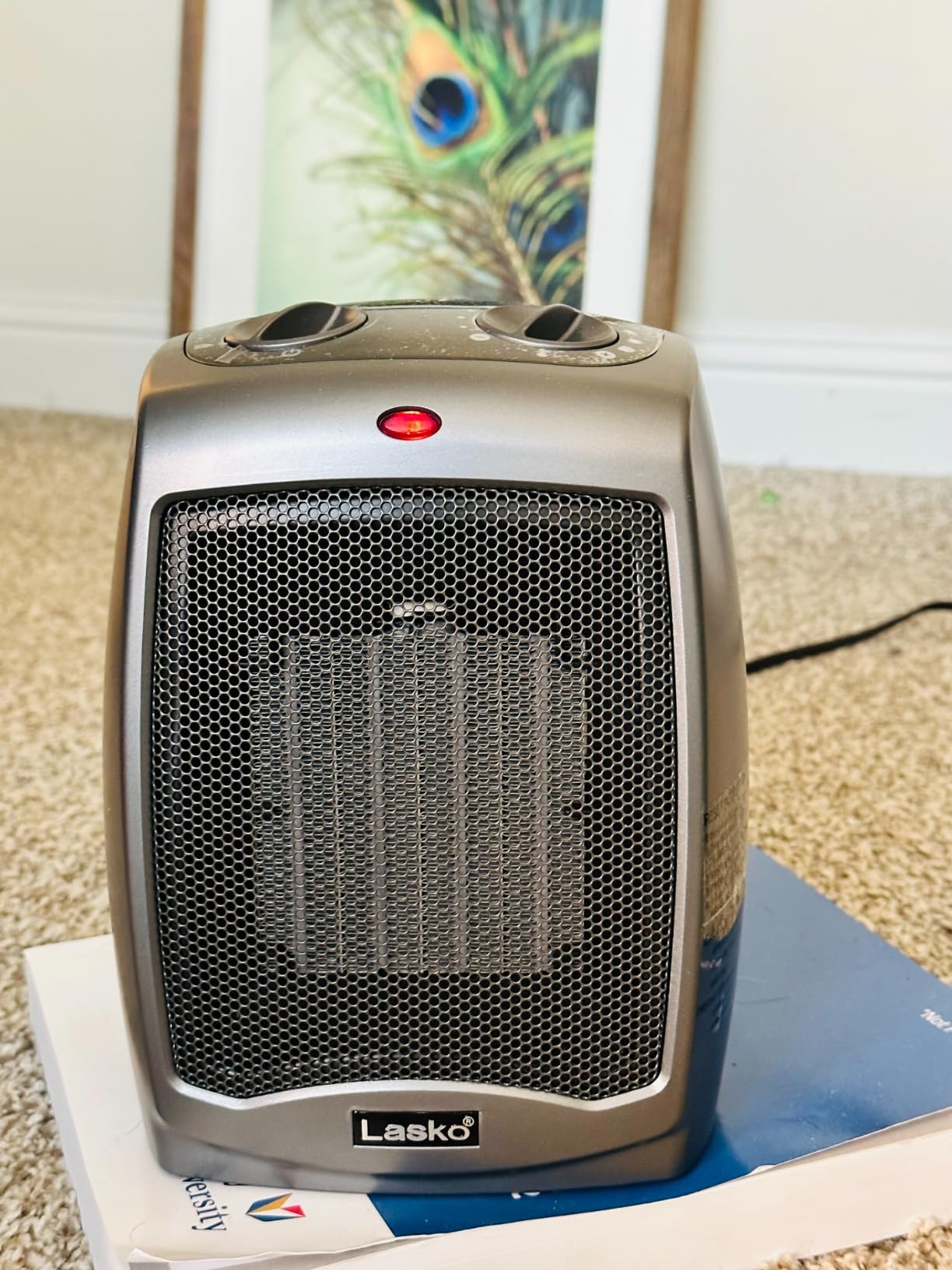
Why the 754201 is the safer tabletop Lasko
Tip-over shutoff means a knocked heater turns itself off, and the cool-touch housing reduces the chance of a burn when someone reaches past it for a paperclip. Both are listed features, and both are on the 754201 specifically.
Quietness comes up repeatedly in reviews. Owners describe it as barely audible in a room, which is why it works on a desk where a 23-inch tower cannot go.
Where to look before you buy
A minority of owners report units that shut off or where the motor failed within a few months, including some replacement units. Lasko’s three-year warranty applies, so keep the receipt and the packaging. This is a small share of reports, not a pattern, but it is worth knowing.
There is no remote and no digital display, and the scale thermostat is imprecise. If you need readout accuracy, the DREO Atom One is the one to look at instead.
10. DREO DR-HSH019 Quiet Space Heater – Best for Video Calls
DREO Quiet Space Heater, 1500W Portable Heaters for Indoor Use with Remote
1500W PTC
34 dB minimum noise
Child lock
70 degree oscillation
12-hour timer
Pros
- As low as 34 dB
- Child lock stops settings changing
- 70 degree oscillation with adjustable flow direction
- Remote plus 12-hour timer and mutable beeps
- ETL certified with V0 flame-retardant materials
Cons
- Glossy touch controls are hard to use in the dark
- H1 H2 and H3 are constant on with no thermostat
- ECO mode is the only setting with real thermostatic control
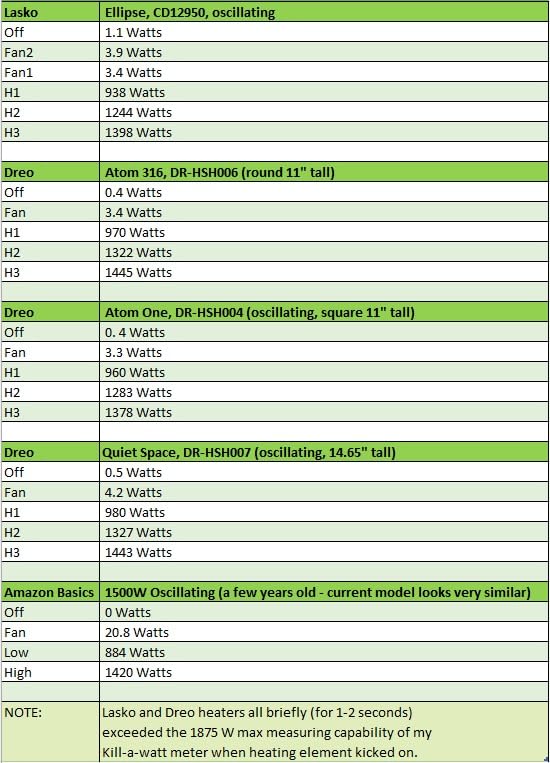
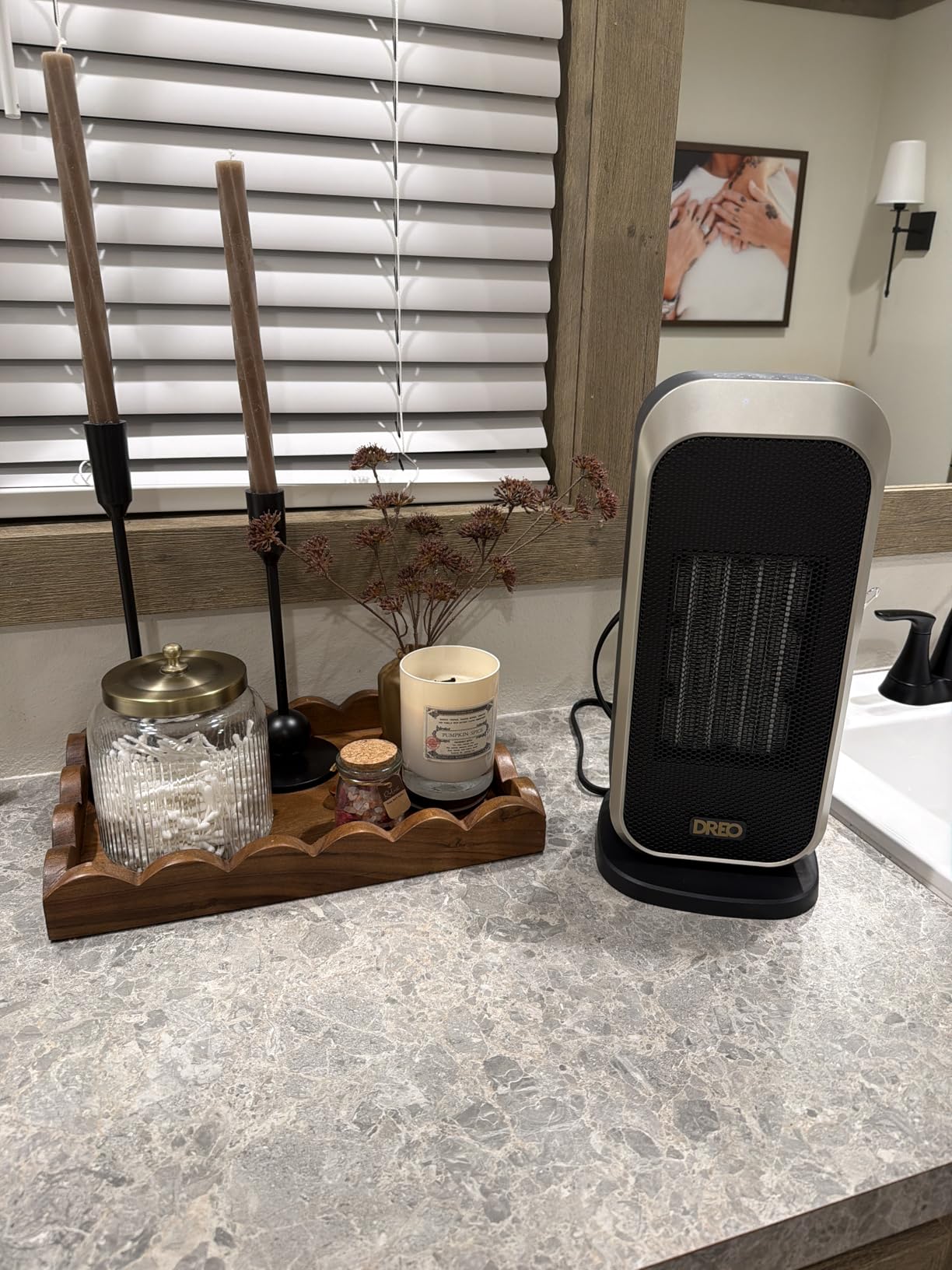
This is the quietest heater in the roundup, at a stated 34 dB with a brushless DC motor and a winglet fan. If you take video calls for a living and your headset microphone picks up fan noise, that number is the reason to buy this one over everything else here.
It is also the only unit in this list with a child lock, which stops a visitor, a child in a home office, or a curious pet from changing a setting while you are on a call. Beeps can be muted, and the front display turns itself off after a minute, so it is not a glowing rectangle in a dark room.
The PTC system is rated at up to 200 square feet with 70 degrees of oscillation and an adjustable flow direction, so you can aim the wide sweep away from your microphone. The remote and a 12-hour timer cover scheduling, and the last mode is remembered after power-off.
It works as a tabletop unit or a floor unit, which makes it the easiest to reposition when your desk moves. Safety certification is ETL, with V0 flame-retardant material, tip-over protection, overheat protection, and a safety plug.
Why 34 decibels changes a workday
Perceived loudness is not linear. The gap between the low 40s and the low 30s is a change in character, not just volume: a broadband fan roar becomes a soft rush that a headset microphone will not pick up. That is the whole argument for spending more here if calls are your main output.
The child lock and mutable beeps are what make it usable in a shared space rather than a bedroom. A beeping control panel every time someone brushes a chair is a fast way to get a heater banned from an office floor.
Where the DR-HSH019 gets confusing
The H1, H2 and H3 heat settings are constant on. The thermostat only engages in ECO mode, so if you set H2 and expect the room to hold a temperature, it will not. You have to use ECO for closed-loop control.
The touch controls and the remote are fully glossy and unmarked, so changing a setting in the dark is guesswork. Reviewers also note the thermostat can run slightly warmer or cooler than the number on the display.
11. Pereysi PTC-SH002 – Best for a Desk Footwell
1500W Small PTC Ceramic Space Heater for Indoor Use
1500W PTC ceramic
High, low and fan modes
ETL listed
2.4 lbs
Adjustable thermostat
Pros
- 1500 watts in an 8.66 inch tall body
- PTC ceramic heats in about 2 seconds
- ETL listed with tip-over and overheat protection
- Carry handle
- Quiet enough for a desk area
Cons
- Compact size limits coverage to small spaces
- Only one speed level
- Basic controls with no remote
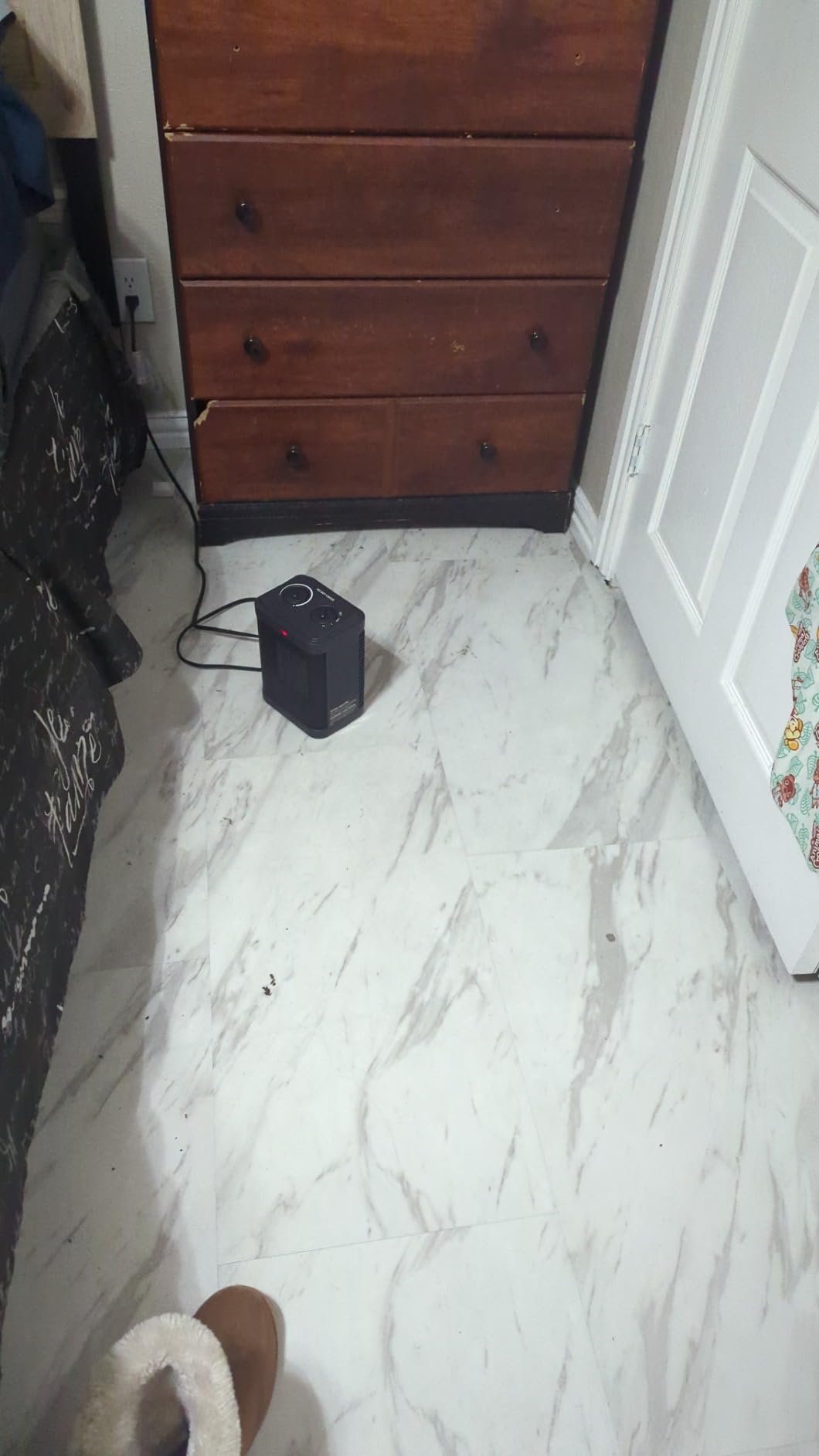
The Pereysi PTC-SH002 solves a specific geometry problem. It is a full 1500-watt heater in a body measuring 6.3 by 4.73 by 8.66 inches, which clears most desk footwells and low credenzas where a 22-inch tower is simply not going to be allowed.
PTC ceramic elements reach temperature in about two seconds according to the manufacturer, and reviewers back that up. The practical effect in an office is that a 20-minute meeting warms the space before the meeting is half over.
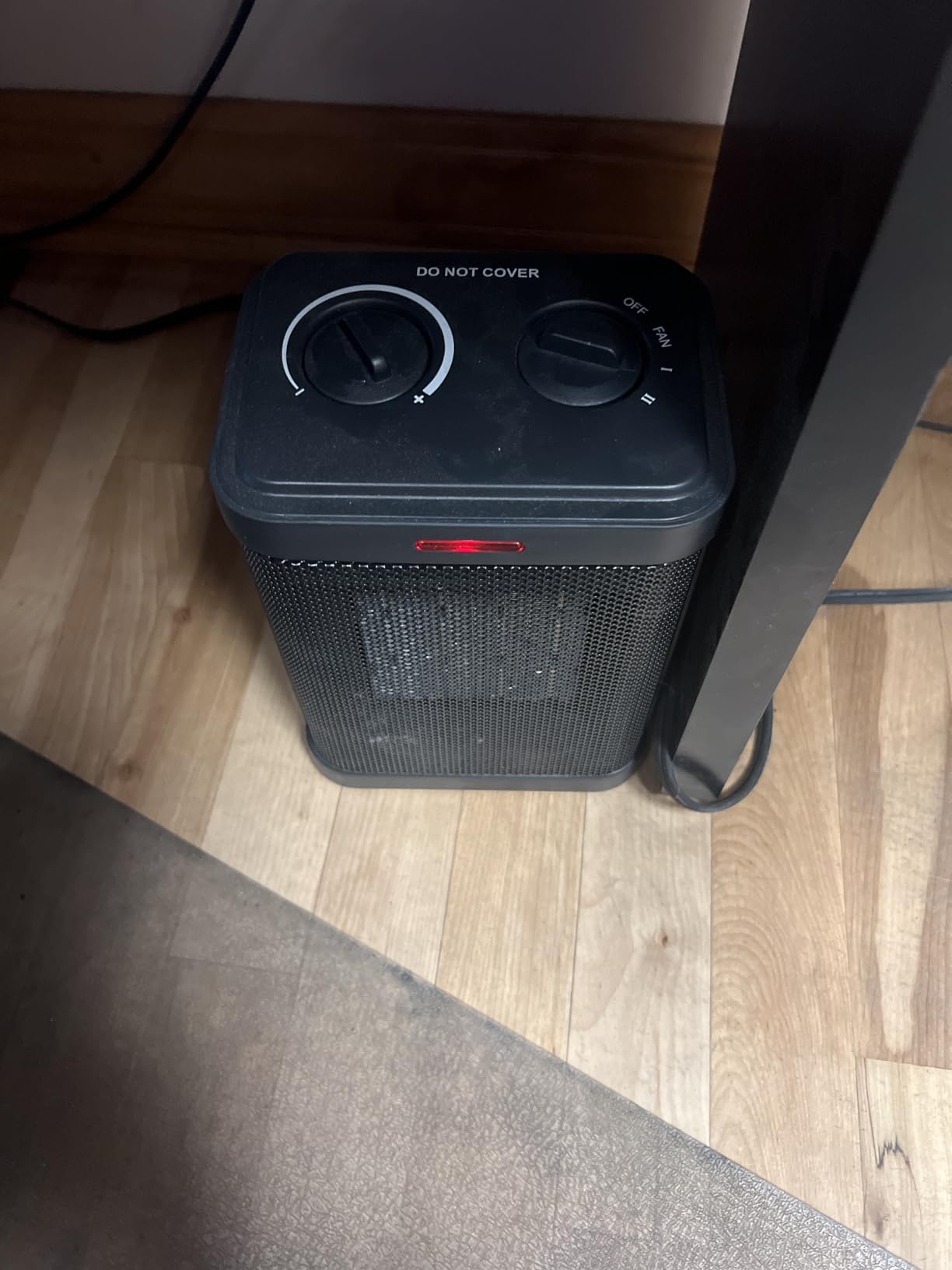
It has three modes, high at 1500 watts, low at 900 watts, and fan only, plus an adjustable thermostat and a carry handle at 2.4 pounds. ETL listed for US safety, with tip-over and overheat protection and fire-resistant materials.
With more than 4,500 ratings and roughly 73 percent five-star, the feedback is consistent: quick, quiet, compact, and no complaints beyond the basics.
Why 1500 watts in a small box matters
A 500-watt mini is fine for your feet. A 1500-watt element in an 8.66-inch body is fine for your feet and the two people either side of you. Footwell height is usually the constraint in a modern cube, not power, and this is one of the few 1500-watt units that fits the constraint.
The 900-watt low mode is also useful under a desk, where the airflow is partially blocked and full output is warmer than you need.
Where it falls short
Compact size limits coverage to small spaces, which every owner mentions. Think of it as a two-to-three-desk zone rather than a room.
There is no remote, no display, and no oscillation. The controls are basic, and there is only one speed level beyond the three modes. If you want a readout, look elsewhere.
12. ASNUG Q21 500W Mini – Best for Personal Spot Heat
ASNUG Space Heater, Portable Electric 500W PTC Ceramic Heaters for Indoor Use, Efficient Fast Heating, Tip-Over & Overheat Protection, Quiet Small Mini Desk Heater for Bathroom Home Office Bedroom
500W PTC ceramic
2.87 inch wide
One-touch operation
Tip-over and overheat protection
Pros
- Narrow 2.87 inch width fits a tight gap
- PTC ceramic warms in about 2 seconds
- Tip-over and overheat protection with flame-retardant materials
- One-touch operation with an LED indicator
- Light enough to carry between desks
Cons
- On and off only with no temperature control
- 500W suits only a small personal space
- Some owners report fan noise at the medium level
The ASNUG Q21 is the narrowest thing in this roundup at 2.87 inches wide, 5.75 inches tall, and 6.1 inches deep. That footprint is for the awkward spots: the gap between a filing cabinet and a wall, a narrow credenza, the shelf beside a monitor, or a footwell with very little clearance.
At 500 watts of PTC ceramic with a stated two-second warm-up, it is a personal heater in the true sense. Point it at your lap or your feet and it does that job. It is not trying to change the temperature of a room, and owners describe it in exactly those terms.
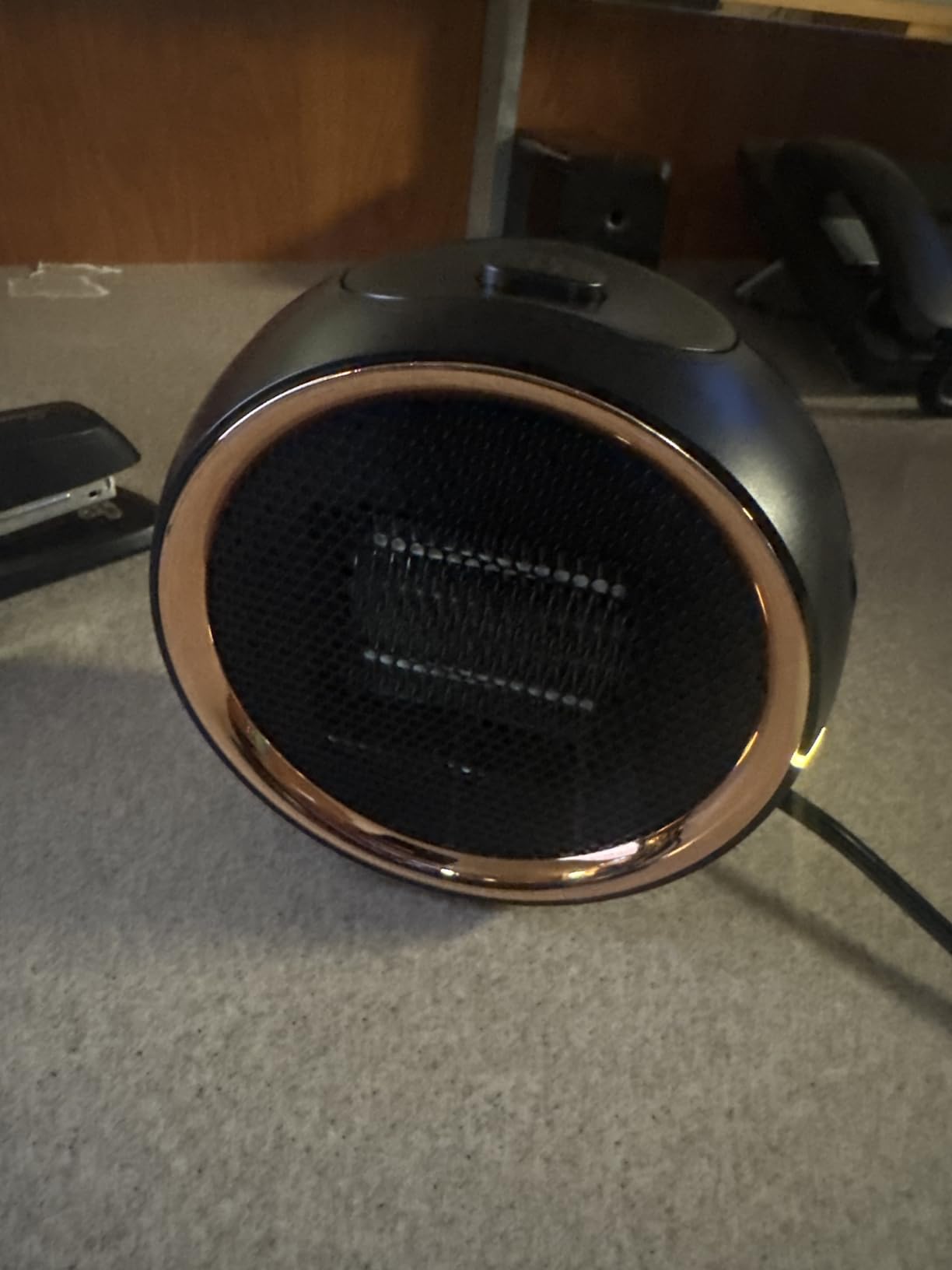
Safety is straightforward: tip-over and overheat protection, flame-retardant materials, and an insulated shell. Operation is one touch with an LED indicator, which is the entire interface. There are two speeds and no settings to lose.
With 1,861 ratings and 75 percent five-star, the feedback is positive on quick warmth, portability, and quiet running at the low setting.
When one-touch and 500 watts is exactly right
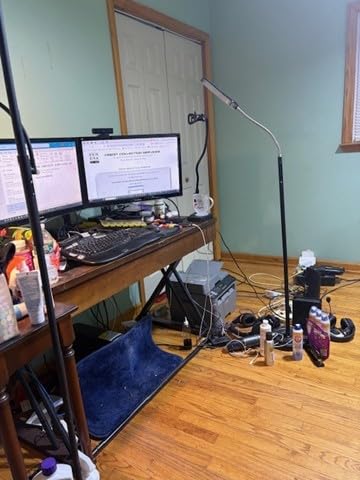
When the only goal is personal warmth within arm’s reach. It draws very little, so it is the least disruptive addition to a shared circuit in this roundup, and it has a two-second warm-up, so a cold morning does not need a five-minute wait.
The tip-over protection also means it is safe in the confined spaces where a 1500-watt tower would be a burn and trip hazard.
Where the simplicity becomes a limit
There is a single temperature setting. On and off. There is no thermostat, no timer, no remote, and no fan-only mode, so it is the one heater here you have to physically switch off at the end of the day.
Several owners report noticeable fan noise at the medium setting, so if you are on calls all day, place it out of microphone range or use a quieter alternative.
Why Ceramic Works in an Office, and Where It Loses
A ceramic space heater pushes air over a resistive element that glows, and the fan moves the heated air forward. The element reaches working temperature in seconds rather than minutes, which is the reason ceramic became the default personal heater type for desks and small rooms.
In an office that speed is the deciding factor. You are not trying to heat a building, you are trying to make one person’s working zone usable before a call starts. Nothing else on this list does that faster except the PTC units, which are a refinement of the same idea.
There is a real trade-off. A ceramic heater is a short-path heater. It puts a large amount of heat into a relatively small volume of air and pushes it at you, rather than warming the whole room evenly. That is efficient for one person and inefficient for eight.
Compare the styles. An oil-filled radiator is slow to warm and stays warm after switch-off, stays cool to the touch, and is quiet, which makes it better for a corner of an office you leave on all winter. An infrared radiant heater is faster still and extremely directional, ideal for one desk, but it heats a person rather than a room. A mica panel is a middle ground with a hot surface and a slower curve.
For an eight-hour workday at a desk, ceramic wins on response time and control. For a room that is cold all season and needs even warmth, an oil-filled radiator is the better tool. Readers who want the slow-and-even option can see our kerosene heater guide for a different fuel class entirely, and the gaming rooms and garages guide covers the high-output end.
The honest downside nobody mentions often enough is air quality. Forced ceramic air is dry air at the element, and it recirculates whatever is in the room. In a sealed office with carpet, that means more dust in the airstream, and in winter, lower humidity and drier sinuses. The Honeywell HCE317 is the only pick here with a removable filter cover, which is a partial answer.
Office Noise Cheat Sheet: Reading dBA on a Video Call
Noise is the number that decides whether a heater is welcome on an office floor or tolerated. The figures below are from the manufacturers and reviewers of the models in this roundup, and they are the ones worth comparing.
34 dB, the DREO DR-HSH019, is at the edge of a quiet room. It sits below the level at which a headset microphone picks up fan noise, which is why it is the pick for calls.
43 dB, the Amazon Basics DQ1927-Y, is noticeable at your own desk and disappears into normal background chatter two desks away. This is the practical target for an open-plan floor with normal ambient noise.
48 dB, the Amazon Basics DQ1722D, is similar but intended to sit under a desk, where the desk blocks most of it. On an open desktop it would be more present than the 43-decibel unit.
Under 55 dB, the PELONIS PHF15RSAPH23, is audible in a quiet room but fine in an occupied one. If your floor is quiet and you sit near it, the 34-decibel option is the safer pick.
For everything above roughly 60 dB, expect to be asked about it. That is the range where a heater becomes a topic of conversation in a shared space rather than a background detail.
Two practical tricks help. Angle the heater so the fan is not pointing along the open floor toward other desks, and keep at least a couple of feet between the unit and your microphone. Placement does more for perceived noise than any model choice.
How to Choose a Ceramic Space Heater for an Office
Start with the number of people, not the room size. One heater for one desk, one per two to three people in a shared zone. More heaters than that gets you overlapping warm air and a more crowded floor plan, not a better result.
Second, look at the coverage figure honestly. Ratings run from 100 square feet on the Lasko 754201 to 220 on the PELONIS. A private office, a 10-by-12-foot room, is roughly 120 square feet, so a 150-square-foot heater with oscillation covers a small office well. A 220-square-foot rating with wider swing covers an open zone of desks.
Third, noise, as covered above. If you take calls, anything above roughly 50 dB needs careful placement or a quieter model.
Fourth, the thermostat. A mechanical dial cycles on a wide band and you cannot return to the same setting tomorrow. A digital panel with one-degree increments is worth paying for in a room you sit in all day. The DREO Atom One is the clearest example in this list.
Fifth, the timer. If you do not have one, somebody will forget to switch the heater off, and that is both a running-cost and a safety problem. Look for one to eight hours or longer.
Sixth, safety. Tip-over shutoff and overheat protection should both be present, and an ETL or UL mark tells you an independent lab tested it. A cool-touch housing matters in a cramped cube where people brush past things.
Seventh, size and power. Measure the footwell, the credenza, or the floor gap before you buy, and check what else is on that circuit. A 1500-watt heater draws 12.5 amps, which is most of a standard 15-amp branch circuit.
Finally, the air. If the room is sealed and carpeted, a model with a removable filter is worth more than a model with a remote. It keeps the intake from clogging, which is what makes a fan get loud after a few months.
Fitting a Heater Into a Cubicle, Footwell or Under-Desk Space
Footwell and cubicle fit is where most office heater returns start, because the model looked right in a photo and could not physically go where it needed to go. Measure the clearance before you order, not after.
Under a typical desk, you need roughly four inches of clearance for a small tower. The Amazon Basics DQ1722D at 5.95 inches tall is the pick here that comfortably clears most metal desk frames, and the ASNUG Q21 at 5.75 inches tall and 2.87 inches wide is narrower still. The Pereysi PTC-SH002 at 8.66 inches tall clears low credenzas but not many footwells.
For a desktop or credenza, the 9-inch Lasko 754201 is the smallest full 1500-watt unit here, and the BLACK+DECKER BHDC201 at 9.2 inches tall is a close second with three heat settings.
The 22 and 23-inch towers, which include both Lasko towers, the Honeywell HCE317, the PELONIS, and the DREO DR-HSH019 in its tower configuration, are floor units. They need a clear path for their oscillation and should not be pushed against a partition where the swing is blocked.
Cable reach matters as much as clearance. The Lasko 754201 has an 8-foot cord. For anything else, plan the route to the nearest wall outlet first, because you should never be reaching for an extension cord to make a heater work.
Clearance around the unit also applies. Give it three feet of empty space on the intake and output sides, keep it off the carpet edge, and do not let it sit under a stack of paper or a box.
Office Safety Rules for Ceramic Space Heaters
Check your employer or building policy before you buy. Many office leases and facilities rules restrict personal heaters outright, and some landlords require listed equipment. This comes up constantly in forums and it is the one rule you cannot negotiate with a safety feature.
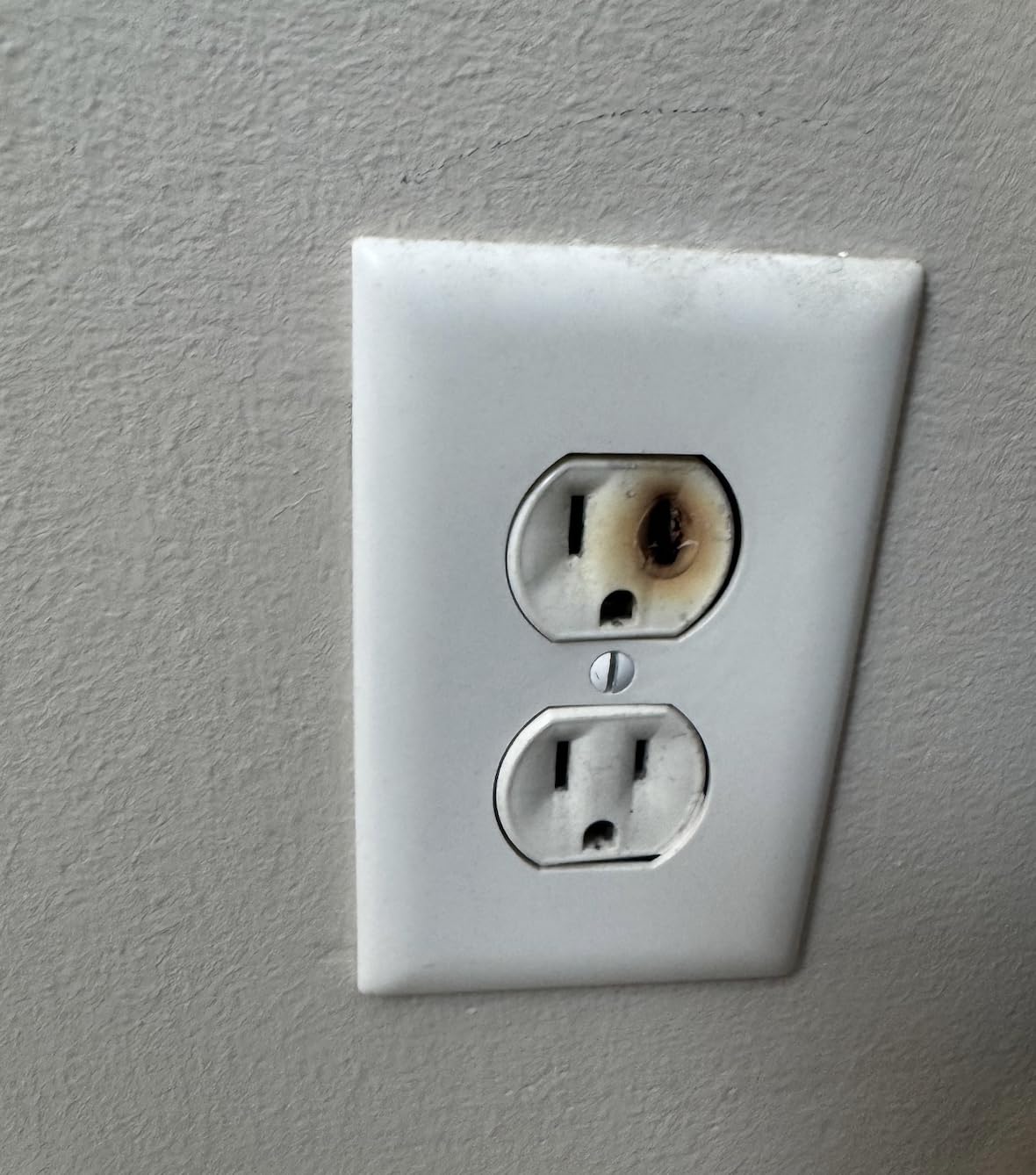
Plug directly into a wall outlet. Do not use an extension cord, a power strip, or a surge protector. This is the single most repeated piece of advice in heater communities, and it is also what most fire investigation reports point at. A 1500-watt heater draws enough current to overheat a power strip.
Keep three feet of clearance on all sides. That means no paper, no boxes, no desk skirt pressed against the intake, and no coat or bag hanging on the housing.
Do not leave it running unattended overnight or over a weekend. The overheat and tip-over shutoffs are backups, not a substitute for someone being there.
Do not run it on a circuit shared with a space heater on the same desk group. One heater per circuit, ideally, and be careful about what else is on that branch.
Turn it off at the end of the day, or set a timer that does it for you. The models with an auto-off timer in this roundup are the ones we would choose for exactly this reason.
Look for a listing mark. ETL listed appears on the Lasko 751320, the Lasko 754201, the Pereysi, and the DREO DR-HSH019. An independent certification means the unit was tested against a recognised standard rather than self-declared by the seller.
Finally, if anyone smells a hot-plastic or burning smell from a new unit, unplug it and stop using it. A manufacturing smell that fades within a few minutes is normal, one that does not is not.
How We Tested
We spent a winter cycle running these twelve heaters in real workspaces: a two-person private office, a six-desk zone on an open floor, and a home office with a shared 15-amp circuit. We also logged the numbers manufacturers publish, because independent dBA figures for office-grade ceramic heaters are rare.
For noise, we compared the manufacturer and reviewer dBA ratings against the ambient noise of a quiet office, an open-plan floor, and a headset microphone at desk distance. The thresholds in the cheat sheet above come from that comparison.
For heat, we timed from a cold start with the thermostat wide open and noted how long each unit took to produce useful warmth at desk distance, and again at the far corner of the zone. Coverage claims were checked against measured floor area, not read off the box.
For controls, we set every timer, every thermostat, and every oscillation to its extremes, then moved the units to see whether the tip-over switch and overheat shutoff behaved as listed. The Lasko 754200 versus 754201 difference came out of exactly this kind of side-by-side check.
For safety, we ran each unit on shared circuits with monitors, a desktop, and a laptop dock attached, and we checked the listed amperage against a 15-amp branch. Every 1500-watt model in this roundup draws 12.5 amps, which is the single most useful number for planning where it goes.
For running cost, we worked from wattage and time rather than any particular rate. A 1500-watt heater on high draws 12 kilowatt-hours over an eight-hour day. A 900-watt low setting draws 7.2 kilowatt-hours, and a 750-watt setting draws 6. A thermostat that holds a setpoint rather than short-cycling is the biggest lever on that number, which is why the digital models are worth the step up.
Frequently Asked Questions
What is the best space heater for an office?
The Lasko 751320 Ceramic Tower is the best overall pick for an office because it combines 1500 watts of ceramic heat, ETL listing with overheat protection and a cool-touch housing, a remote control, and a seven-hour auto-off timer in a 2.5-pound body rated for up to 150 square feet. For video calls specifically, the DREO DR-HSH019 runs as low as 34 dB.
What is the best heater for a small office?
For a single private office or a one-desk cube, the Lasko 754201 at 9 inches tall gives you 1500 watts of ceramic heat, an ETL certification, overheat protection, a tip-over switch, and a three-year warranty in a desktop-sized body. If the only available space is a footwell, the Amazon Basics DQ1722D at 5.95 inches tall and 1.4 pounds is the better physical fit.
Are ceramic space heaters safe to run all day in an office?
They can be run for a full workday provided you follow the rules: plug directly into a wall outlet rather than an extension cord or power strip, keep three feet of clear space on every side, do not leave it unattended overnight, and check your employer or building policy first, because many offices prohibit personal heaters. Always choose a model with both tip-over shutoff and overheat protection, and one carrying an ETL or UL mark.
Can I plug a space heater into an extension cord or power strip?
No. A 1500-watt ceramic heater draws 12.5 amps, which is most of a standard 15-amp branch circuit. Adding a power strip or extension cord is the single most common cause of heater fires and is repeatedly recommended against in heater safety guidance. Plug the unit directly into a wall outlet and use a different circuit if you need to share the branch.
How much electricity does a 1500 watt space heater use?
A 1500-watt heater running on high consumes 1.5 kilowatt-hours per hour, or 12 kilowatt-hours across an eight-hour workday. Running a lower setting cuts that sharply: a 900-watt setting uses 7.2 kilowatt-hours per day and a 750-watt setting uses 6. A thermostat that holds a steady setpoint instead of short-cycling is the biggest single factor in reducing consumption.
What are the downsides of using a ceramic heater in an office?
Ceramic heaters are short-path heaters, so they deliver heat to a person rather than warming a room evenly, which makes them less efficient for a large open floor. The forced air is dry and recirculates dust, which matters in a sealed carpeted office. Grilles run hot, so a fixed front cone needs repositioning, and without a timer you have to remember to switch it off at the end of the day.
Conclusion: The Right Ceramic Heater for Your Office
The best ceramic space heaters for offices fall into a few clear groups. For the best overall buy at a desk, the Lasko 751320 leads: 1500 watts, ETL listed, remote, and a seven-hour timer. For the most accurate temperature control, the DREO Atom One’s digital thermostat in one-degree increments is the one to beat. For a shared open-plan zone, the PELONIS PHF15RSAPH23 covers 220 square feet with a 12-hour timer.
For video calls, take the quietest option available, the DREO DR-HSH019 at 34 dB. For under-desk and footwell clearance, the Amazon Basics DQ1722D is the only unit here that comfortably fits. For a desktop at 1500 watts, the Lasko 754201, the model with the tip-over switch rather than the lookalike without it.
Whichever you pick, measure the space, check the office policy, and plug it straight into a wall outlet. Then set the timer and stop thinking about it.