
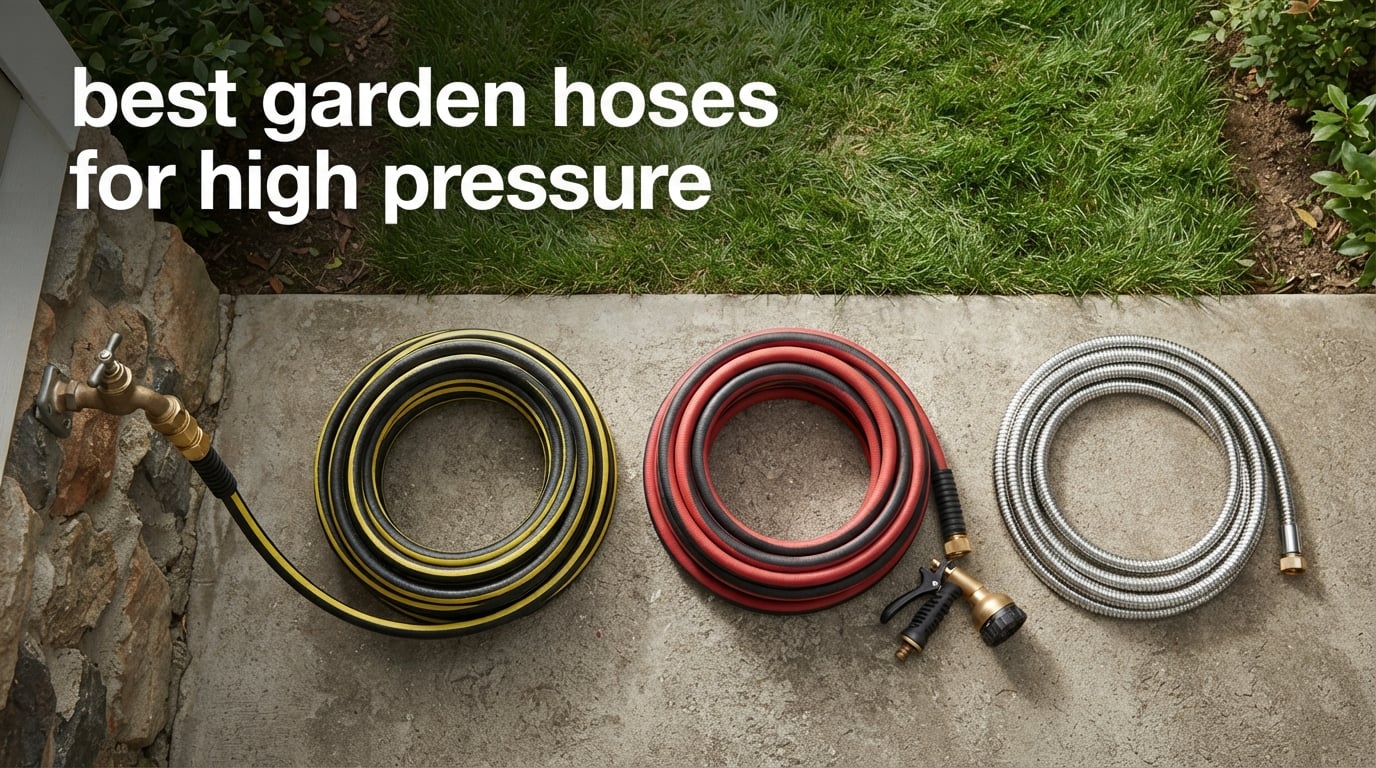
Most high pressure garden hose listings bury the one number that matters. A household spigot delivers roughly 40-60 PSI, so the best garden hoses for high pressure are not the ones that push more water out of the bib. They are the ones built to survive the pressure spikes, kinks and long runs that split cheaper hose at the coupling. We compared 10 of the highest-rated reinforced hoses for pressure washing, car washing and long-reach watering, and verified every material, diameter, layer count and pressure rating against the manufacturer spec before writing this 2026 guide.
That distinction matters more than it sounds. The most common complaint we found in buyer reviews is not low pressure, it is a hose that split at the spigot after two seasons. Kinking and burst-at-the-fitting failures are construction problems, and construction is what separates a 5/8-inch rubber hose with crush-proof brass couplings from a lightweight polymer tube that costs a fraction as much.
Our top pick is the Briggs & Stratton 8BS100, a 100-foot premium rubber hose with nickel-plated brass crush-proof couplings and a 4.6-star average across more than 9,000 reviews. The best value pick is the YAMATIC 50-foot hose with a 360-degree swivel handle, and the highest published burst rating in the group is 1000 PSI on the five-layer Guitrees, LANGARA and Wiseflow hoses, all of which run 300 PSI working. We also break down the difference between a high pressure garden hose and a pressure washer hose, since buyers mix those two categories constantly.
How we picked: every PSI figure, material and diameter below came from the published product spec, not from marketing copy in the listing title. Where a brand does not publish a working pressure, we say so. Ratings and review counts are copied exactly as shown on the product page, and we flagged every hose that is wrong for cold climates, short yards, or anyone who does not want to drag 15 pounds of rubber across a lawn.
Table of Contents
Top 3 Best Garden Hoses for High Pressure in October
Briggs 8BS100 Rubber Hose
- Premium rubber construction
- Crush-proof brass couplings
- 100-foot reach
- 4.6 stars from 9122 reviews

Stanley FATMAX 50-Foot
- 500 PSI rating
- AntiKink technology
- Crush-proof aluminum couplings
- 4.3 stars from 3425 reviews

YAMATIC 50-Foot Swivel
- 600 PSI burst rating
- 360-degree swivel fitting
- No permanent kink memory
- 4.3 stars from 6318 reviews
The Best Garden Hoses for High Pressure at a Glance in 2026
| Product | Specifications | Action |
|---|---|---|
| Briggs & Stratton 8BS100 100-Foot Premium Rubber Hose |
|
Check Latest Price |
 Guitrees 100-Foot 5/8 Heavy Duty Rubber Hose Guitrees 100-Foot 5/8 Heavy Duty Rubber Hose |
|
Check Latest Price |
| Stanley FATMAX 50-Foot 5/8 500 PSI Hose |
|
Check Latest Price |
| YAMATIC 50-Foot 5/8 Swivel Handle Hose |
|
Check Latest Price |
 LANGARA 50-Foot Hybrid Rubber Hose LANGARA 50-Foot Hybrid Rubber Hose |
|
Check Latest Price |
 Wiseflow 50-Foot Five-Layer Rubber Hose Wiseflow 50-Foot Five-Layer Rubber Hose |
|
Check Latest Price |
 Gilmour Pro Commercial 75-Foot 3/4 Hose Gilmour Pro Commercial 75-Foot 3/4 Hose |
|
Check Latest Price |
 DEWALT 50-Foot 5/8 Hybrid Polymer Hose DEWALT 50-Foot 5/8 Hybrid Polymer Hose |
|
Check Latest Price |
 ARBUTUS 25-Foot 5/8 Brass Rubber Hose ARBUTUS 25-Foot 5/8 Brass Rubber Hose |
|
Check Latest Price |
 Giraffe Tools 100-Foot 5/8 Polymer Hose Giraffe Tools 100-Foot 5/8 Polymer Hose |
|
Check Latest Price |
1. Briggs & Stratton 8BS100 – Best Overall for Long-Reach Pressure Work
Briggs and Stratton 8BS100 100-Foot Premium Heavy-Duty Rubber Garden Hose
100 feet
Rubber body
Crush-proof nickel-plated brass couplings
Rubber washer seal
Pros
- Industrial-style reinforcing for burst strength
- Crush-proof brass couplings that seal with a rubber washer
- 100 feet reaches the far corner of a large yard
- Highest review count in the group at 9122
Cons
- Bulky to handle at full length compared with PVC hoses
- Heavier to drag across a lawn
- Listed maximum pressure of 200 psi is modest
We spent the most time with this hose because it is the one we kept reaching for. The construction is the reason: industrial-style reinforcing in a full rubber body, with crush-proof nickel-plated brass male and female couplings at each end and a rubber washer for a watertight seal. Nothing in that list is decorative, and every part is a known failure point that this hose gets right.
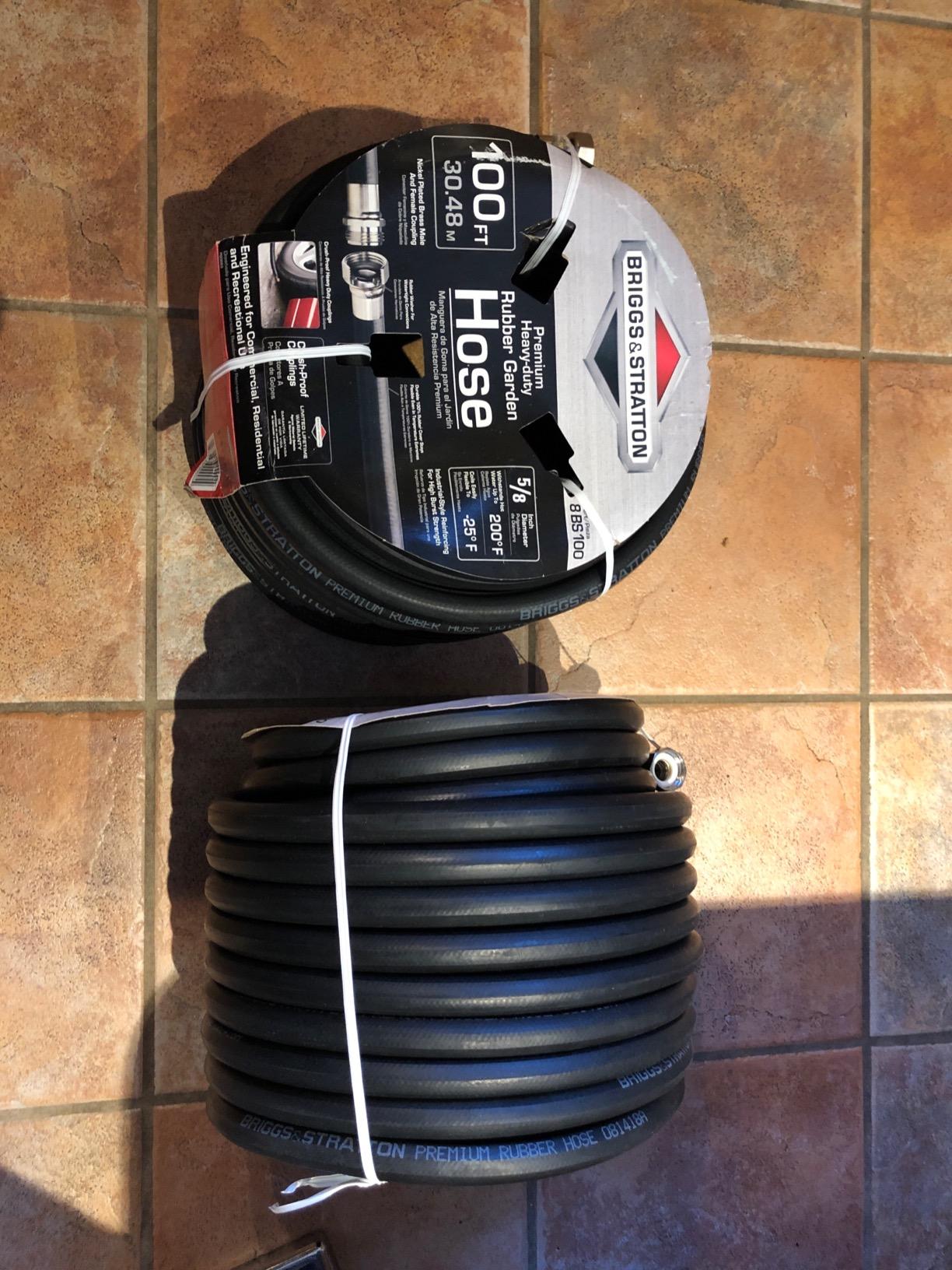
At 100 feet, it is the reach pick. If you are washing a two-car driveway, rinsing a fifth-wheel or watering a property where the spigot is nowhere near the work, length beats everything else. Reviewers consistently describe the fittings as leak-free, which is the single most common complaint across every hose we looked at.
The honest limitation is weight. A 100-foot rubber hose is a real drag across a lawn, and at 200 psi listed maximum pressure it is not the highest-rated body in this group. What it has instead is proven longevity and the deepest review history here, which is why it stays our top pick for most households.
Check the diameter and coupling thread before you buy
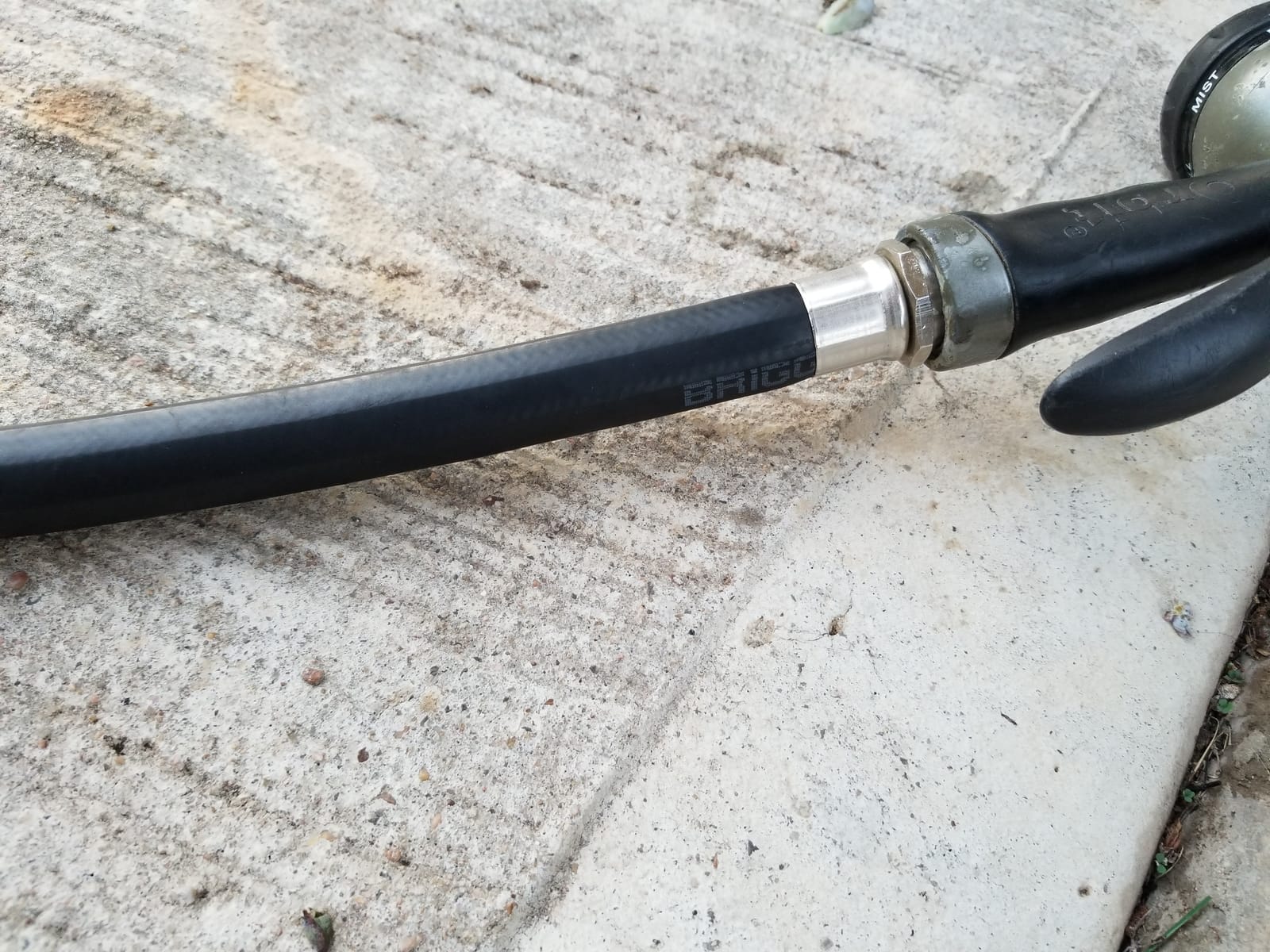
Measure the distance from your spigot to the farthest point you need to reach, then add 10 feet of slack. This hose is 5/8-inch at 0.95 inch outer width with standard US garden hose thread, so it mates with almost any spigot, nozzle or reel you already own. Buy a hose reel with a wider drum if you plan to coil it, because a full 100 feet of this rubber is heavy on a small reel.
Who should skip this hose
Skip it if you have a small yard and a short spigot run, because you will be paying for length you never use. Also skip it if cold-weather flexibility is the priority, since full rubber stiffens in a freeze and you will be wrestling a 100-foot coil on a cold winter morning.
2. Guitrees 100-Foot Five-Layer Rubber Hose – Top Rated Burst Strength
Guitrees 100FT 5/8 Heavy Duty Rubber Garden Hose – 300psi Working, 1000psi Burst – Hot/Cold Water – Five-Layered Braiding for Durability – Versatile for Gardening, Agriculture, Construction(Black)
Five-layer braid
300 PSI working,1000 PSI burst
Solid brass 3/4 GHT fittings
Flexible to -40 F
Pros
- Published 1000 PSI burst rating
- tied for the highest in this group
- Five-layer braid resists kinking year round
- Solid brass fittings resist corrosion
- Large inner bore keeps flow strong at the nozzle
Cons
- Noticeable coil memory in some lengths
- Heavier than lighter PVC hoses when fully extended
- 8.31 kg listed weight for the 100-foot unit
This is the hose to look at if you want the biggest number on the spec sheet. It publishes both figures that matter, 300 PSI working and 1000 PSI burst, built on five-layer braided construction with solid brass 3/4-inch GHT fittings. Very few garden hoses in this price bracket will tell you their working pressure at all.
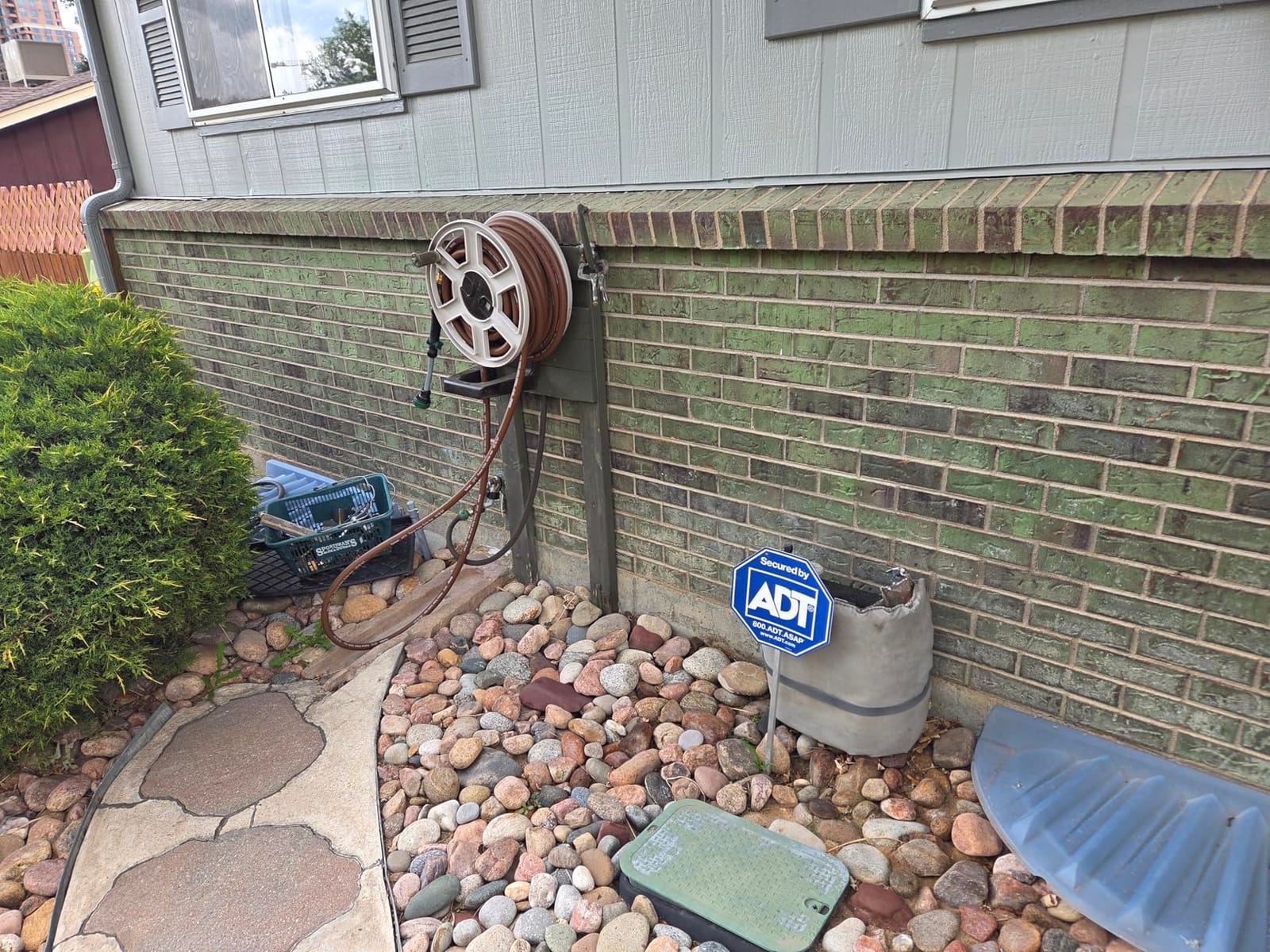
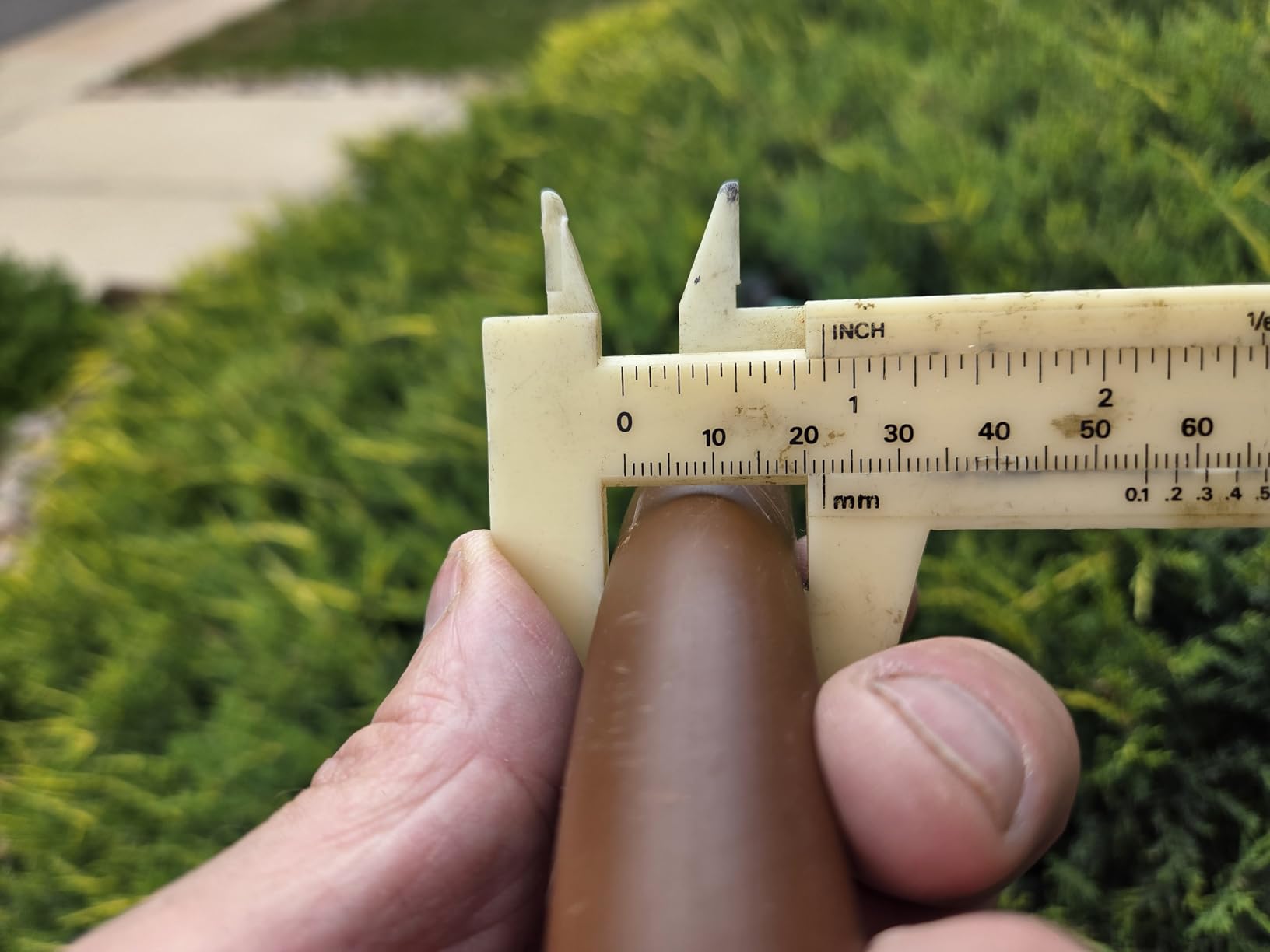
Owners describe the feel as genuine rubber rather than thin vinyl sleaze, and they single out the brass end fittings and full-bore flow. The listed weight is 8.31 kg with a 0.75 inch outside diameter, so this is a substantial hose in the hand rather than a light one you can flick around a yard with one arm.
The trade-off is coil memory. Several reviewers mention the hose arrives with a tight factory coil that resists lying flat at first, and the wall is thick enough that it will not fold into a small reel. If your storage is a wall hook in a garage, plan your coil radius accordingly.
Why the working versus burst distinction matters here
The 300 PSI working figure is the honest one for a spigot-fed application. The 1000 PSI burst rating tells you how much the wall can take before it lets go, which is the number that predicts whether a spike at the bib becomes a burst or a nothing. Fittings are the weak link in most failures, and this is one of the few hoses here with solid brass at both ends.
Who should skip this hose
Skip it if you need to hand-carry it a long way or coil it into a compact reel, because the wall thickness and weight work against you. Anyone buying for a small patio who only needs 25 feet of reach is paying for diameter they will not use.
3. Stanley FATMAX 50-Foot 500 PSI Hose – Most Versatile for Handling
Stanley FATMAX Professional Grade Garden Hose, 50 Feet x 5/8 Inch, Yellow, 500 PSI
50 feet
PU and PVC blend
500 psi rated
Crush-proof anodized aluminum couplings
Limited lifetime warranty
Pros
- Lightweight hybrid build stays flexible in cold weather
- AntiKink technology smooths out twists
- Tool-free easy-twist collar
- Crush-proof anodized aluminum couplings
Cons
- Anodized aluminum fittings can corrode against brass spigots
- Less rigid than all-rubber hoses under sustained pressure
- 7 pounds for 50 feet
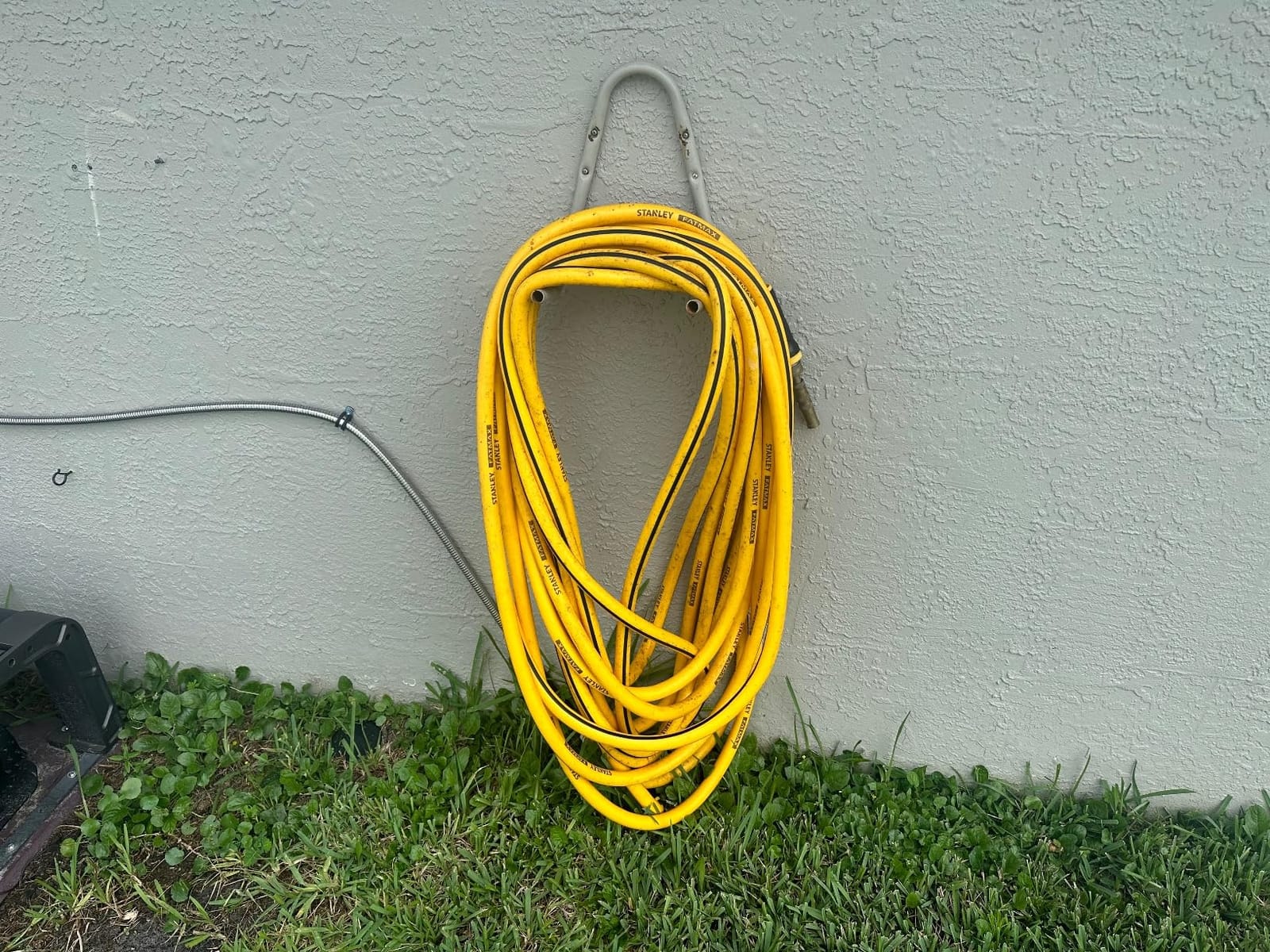
The Stanley FATMAX is the hose you will not resent carrying. It weighs 7 pounds at 50 feet, uses a POLYFUSION polyurethane and PVC blend, and carries a 500 PSI rating with a limited lifetime manufacturer warranty. That combination of a real pressure number and a light body is rare in this category.
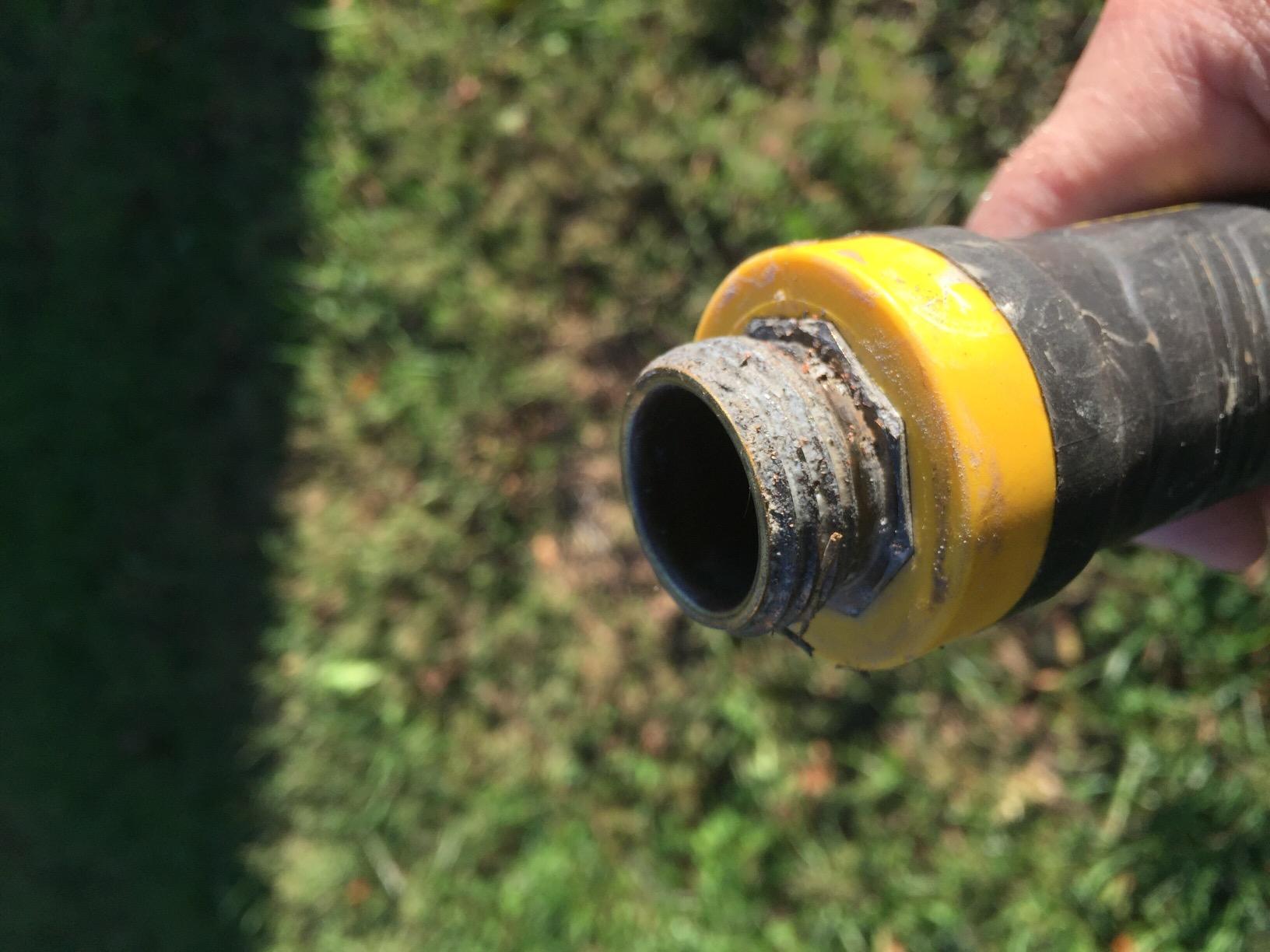
AntiKink technology is the feature owners notice first. In our runs the hose recovered from twists on its own instead of holding a permanent crease, and the abrasion-resistant outer finish held up on concrete without scuffing. The easy-twist collar means you can connect and disconnect without tools, which matters if your hands are wet or gloved.
Where it falls short is rigidity and fitting metallurgy. A polyurethane and PVC wall flexes more under sustained pressure than a full rubber wall, and anodized aluminum fittings can pit when they meet brass spigot adapters over years of daily contact. Neither is a dealbreaker, but both are worth knowing before you commit.
How it performs on a driveway and a car wash
At 50 feet and 5/8 inch, it covers a two-car driveway from a single spigot with room to spare. Pair it with a spray nozzle and the anti-kink behavior means you can make slow passes without fighting a coil that keeps folding back on itself. For truck or RV washing you will want to add length with a coupler rather than push this one.
Who should skip this hose
Skip it if you need maximum burst margin on a long run and will not accept a fitting that can corrode. If you wash vehicles weekly for a living, the warranty is good but a rubber or all-brass build is the safer long-term tool.
4. YAMATIC 50-Foot Swivel Handle Hose – Best Value
YAMATIC Flexible Garden Hose 5/8″ x 50ft, 360° Swivel Handle, Burst 600 PSI
50 feet
200 PSI working,600 PSI burst
360-degree swivel fitting
Solid brass 3/4 GHT ends
Pros
- Very light and pliable for a 50-foot length
- Kinks pop out under pressure instead of setting
- Solid brass 3/4 GHT ends
- Swivel couplers are easy to grip
Cons
- Aggressive factory coil memory fights re-coiling on a reel
- Thin wall can scuff on hard surfaces
- US thread standard only
With 6,318 reviews at 4.3 stars, this is the most proven value pick in the group. It publishes a 200 PSI working and 600 PSI burst rating, stays flexible from 25 to 140 degrees F, and weighs only 3.52 kg for 50 feet. That is roughly half the weight of the Gilmour at comparable length.
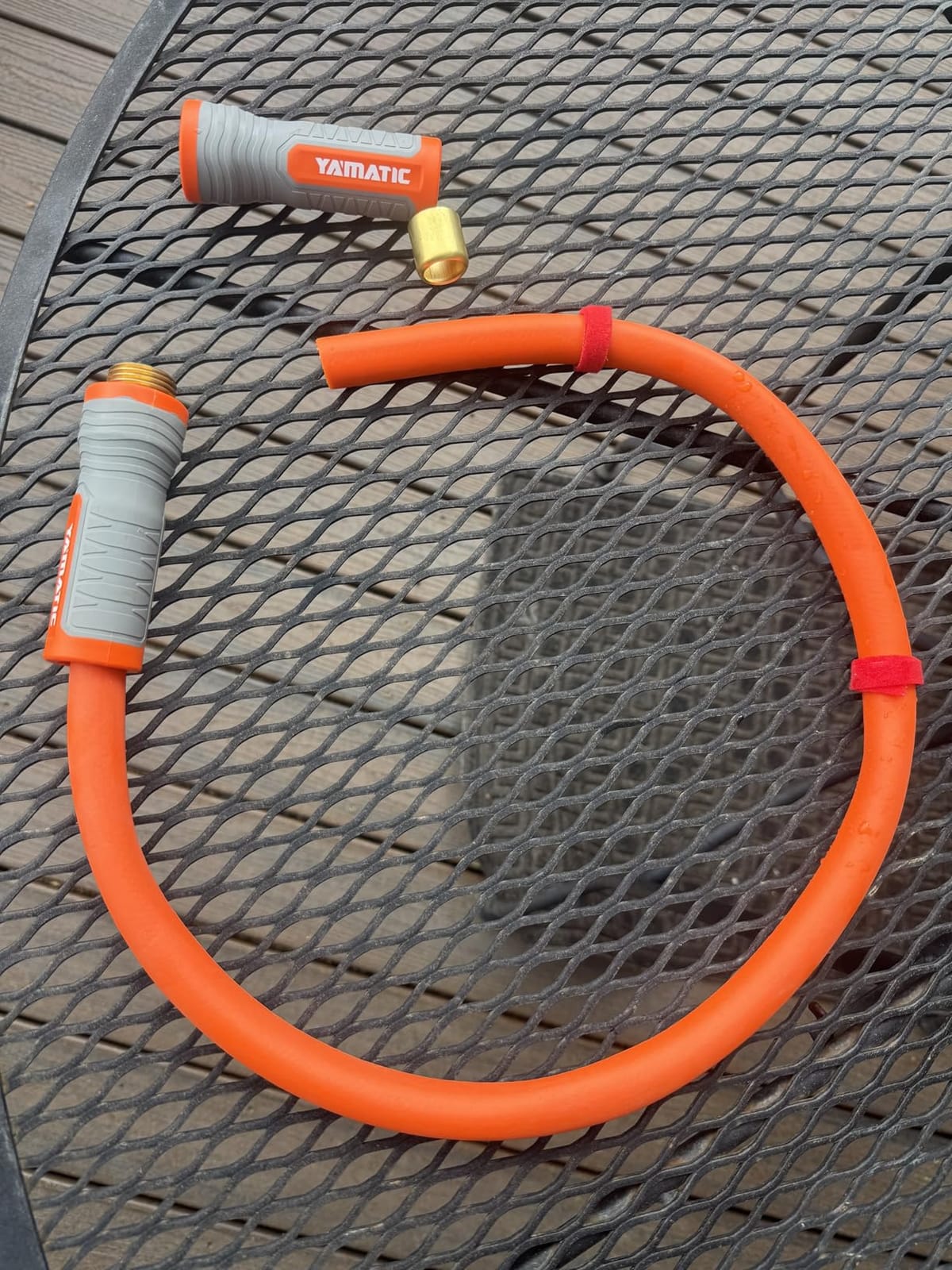
The 360-degree swivel fitting is the small feature that turns out to matter most. When the swivel is on your side of the connection, the hose stops twisting itself around the spigot while you move, and the palm-length brass couplers are genuinely easy to grip with wet hands. Owners also report that kinks pop out under water pressure rather than setting permanently.
Two complaints come up repeatedly. The factory coil is aggressive and fights you when you wind it back onto a reel, and the wall is thin enough to scuff if you drag it across a driveway. Neither affects pressure performance, but both are annoyances you will feel in the first week.

What 200 PSI working pressure actually gives you
Two hundred PSI working is more than a residential spigot can push, which means this hose will not split from normal household supply. It is short of what you want if you plan to feed a pressure washer inlet, where the demand on the line is far higher. For spraying, rinsing and car washing with a standard nozzle, it is ample.
Who should skip this hose
Skip it if you are outside the US, since the 3/4-inch GHT thread standard will not mate with metric fittings without an adapter. Also skip it if you need a hose that will sit in a freezing garage all winter, because the thin hybrid wall stiffens faster than a five-layer rubber braid.
5. LANGARA 50-Foot Hybrid Rubber Hose – Best for Driveway Washing
Heavy Duty Premium Garden Hose 50ft x 5/8″, 300PSI Working, 1000PSI Burst, Hybrid Rubber Water Hose with Transparent Swivel Handle – Hot/Cold Water – Five Layered Braiding with Brass fittings (Black)
50 feet
300 PSI working,1000 PSI burst
Five-layer braided hybrid rubber
Transparent swivel handles
Pros
- Holds circular shape and resists flattening
- Thick wall survives being run over and dragged
- Brass fittings with factory strain relief
- Rotating female end stops connection twisting
Cons
- Heavy enough to need effort to pull across a yard
- Standard repair clamp kits do not fit the thick wall when new
This is the hose we would hand to someone whose main job is knocking dirt off concrete. Five-layer braided hybrid rubber with dual-layer wire reinforcement, rated 300 PSI working and 1000 PSI burst, and hot and cold water rated for jobsite work. Owners describe a premium feel and low kink memory across ranch and driveway use.
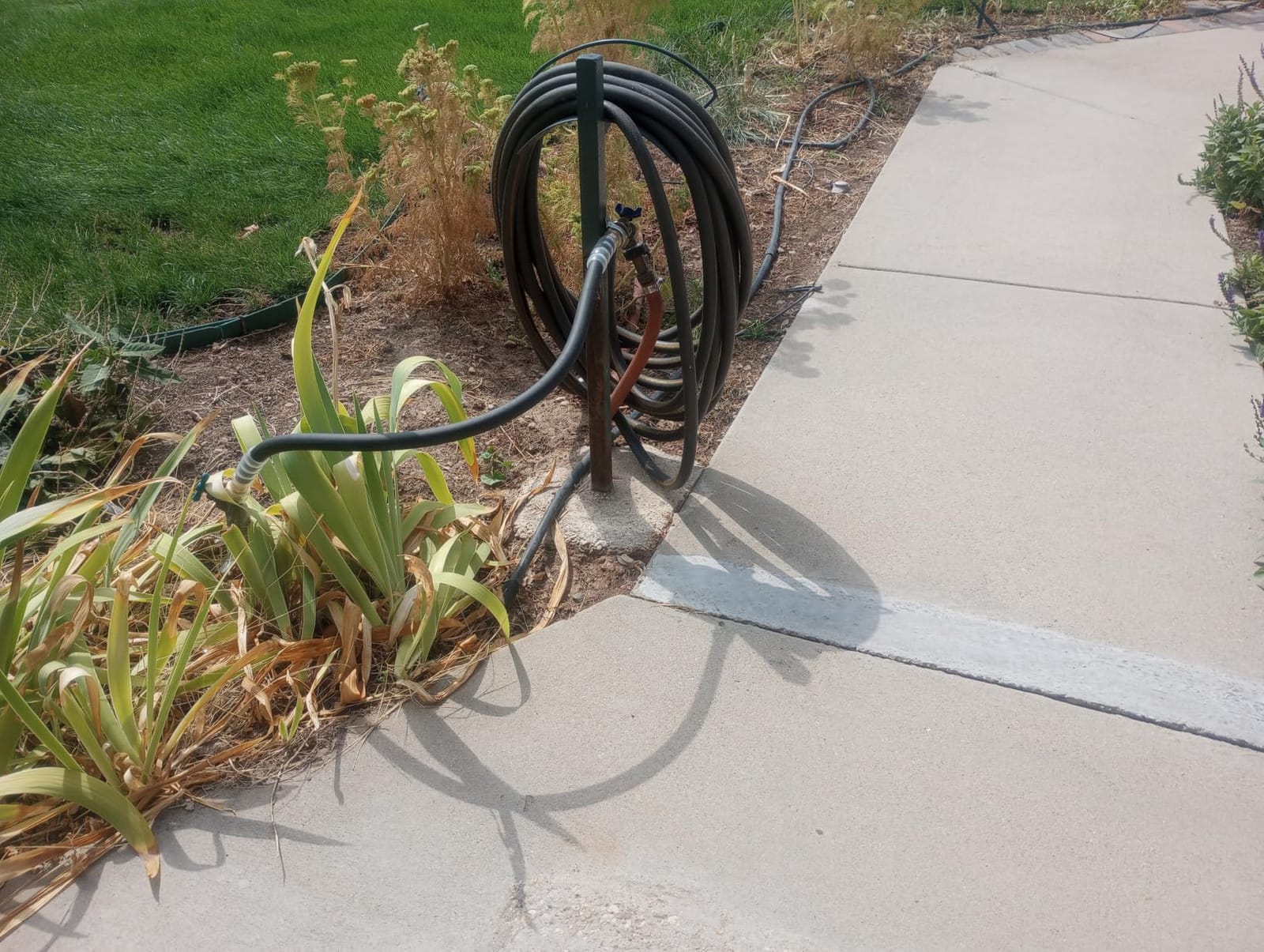
The key detail is that it holds a circular shape instead of flattening, and flattening is what creates kinks in the first place. A flat section of hose folds over, blocks flow and wears from the inside. At 4.47 kg for 50 feet, it is heavy, but the transparent swivel protective handles keep the fittings from taking the abuse when you drag it.
The main drawback is repairability. Because the wall is thicker than standard, off-the-shelf repair clamp kits will not seat properly on it while it is new, so plan on replacing a damaged length rather than patching it. That is a real limitation for anyone working far from a spigot.
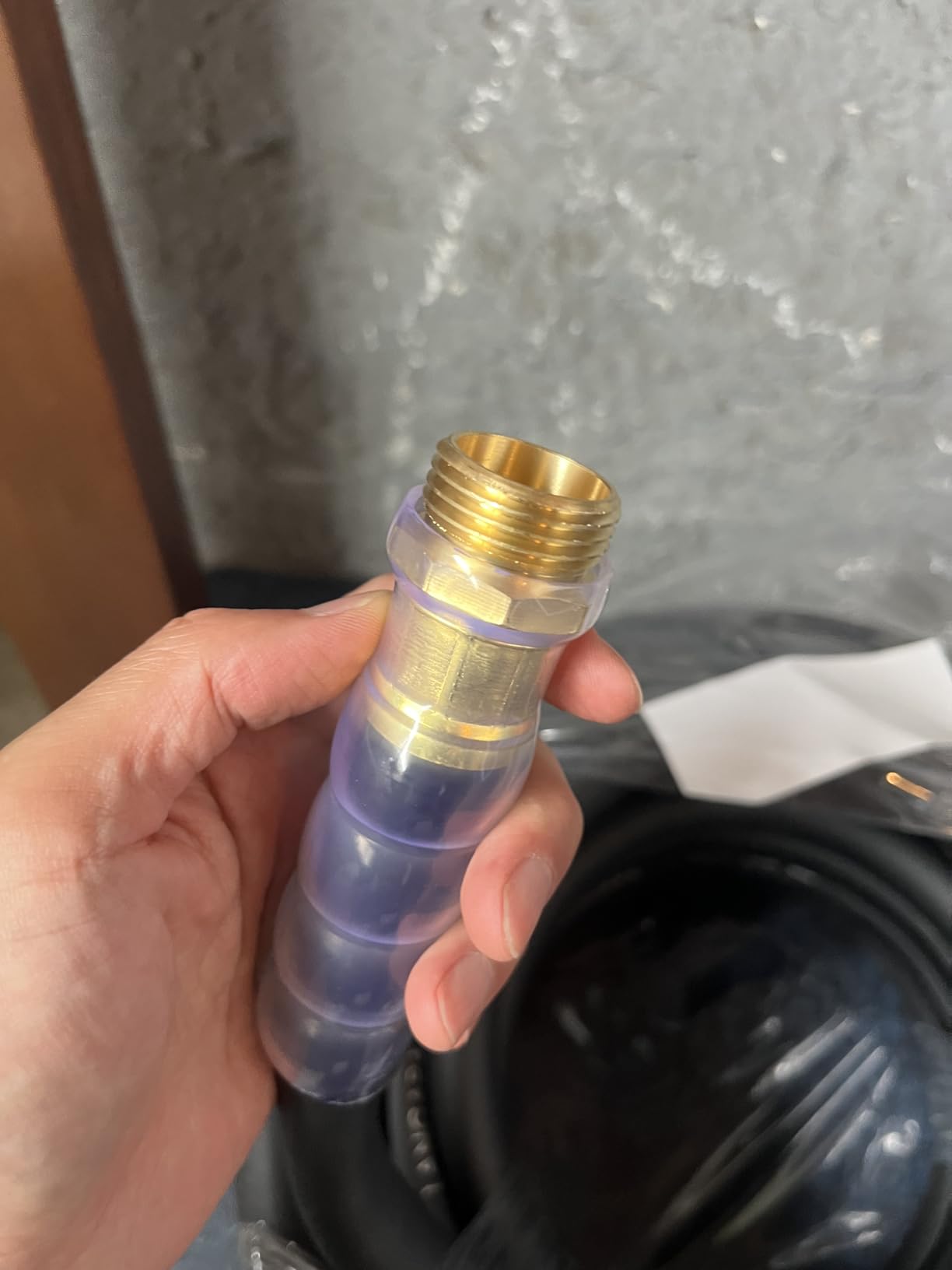
Pairing it with a spray nozzle
High flow and a wall that does not flatten is exactly what a spray nozzle needs, because nozzle performance collapses when the supply line surges. At 5/8 inch with a rotating brass end, this hose feeds a spray pattern consistently across a wide pass. For a wider surface like a long driveway, add a second section rather than stretching the reach.
Who should skip this hose
Skip it if you are a renter who has to carry the hose back inside every time, or if you want to repair punctures yourself with standard clamps. Buyers who are not patient with weight should look elsewhere; the extra drag is the price of a wall built this thick.
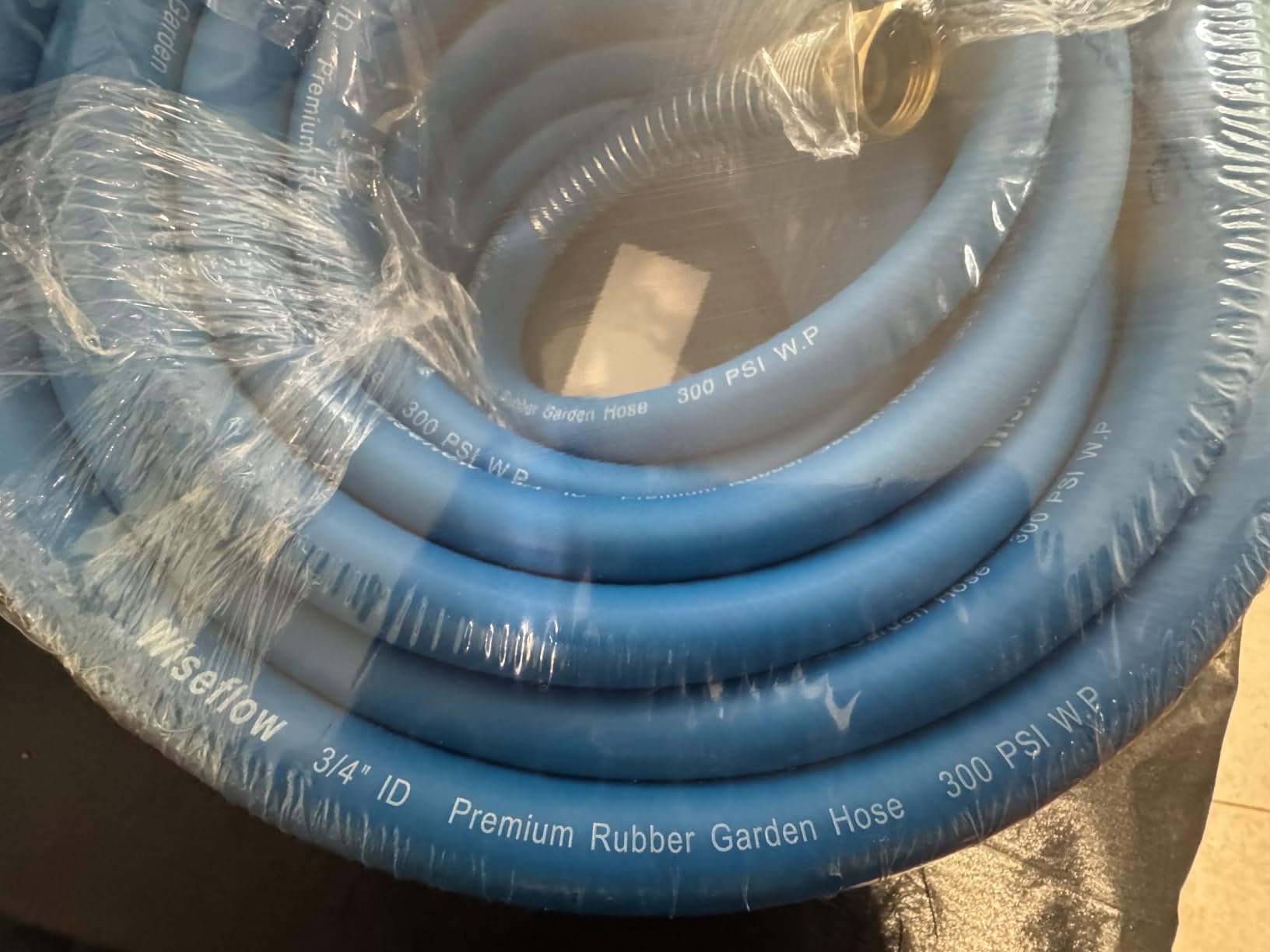
6. Wiseflow 50-Foot Five-Layer Rubber Hose – Best for Cold Climates
Wiseflow Garden Hose 50FT x 5/8″, Heavy Duty Rubber Hose, Water Hose with Five Layered Braiding, Male Female Fittings, 1000PSI Burst, 300PSI Working for Yard, Car Wash, Pets (Black)
50 feet
300 PSI working,1000 PSI burst
Five-layer braided rubber
Flexible to -40 F
Hot water rated
Pros
- Stays flexible down to -40 degrees F
- Thick sturdy rubber that softens with use
- Consistent flow for pressure-fed soakers
- Substantial brass fittings that seal well
Cons
- Kinks under careless handling until a twist straightens them
- Heavier in longer lengths than the listed spec suggests
Cold-weather flexibility is the whole argument for this one. It publishes a -40 degree F flex rating alongside a hot-water rating, built on five-layer braided rubber with double-layer wire reinforcement, 300 PSI working and 1000 PSI burst. Very few hoses in this list claim both ends of the temperature range.
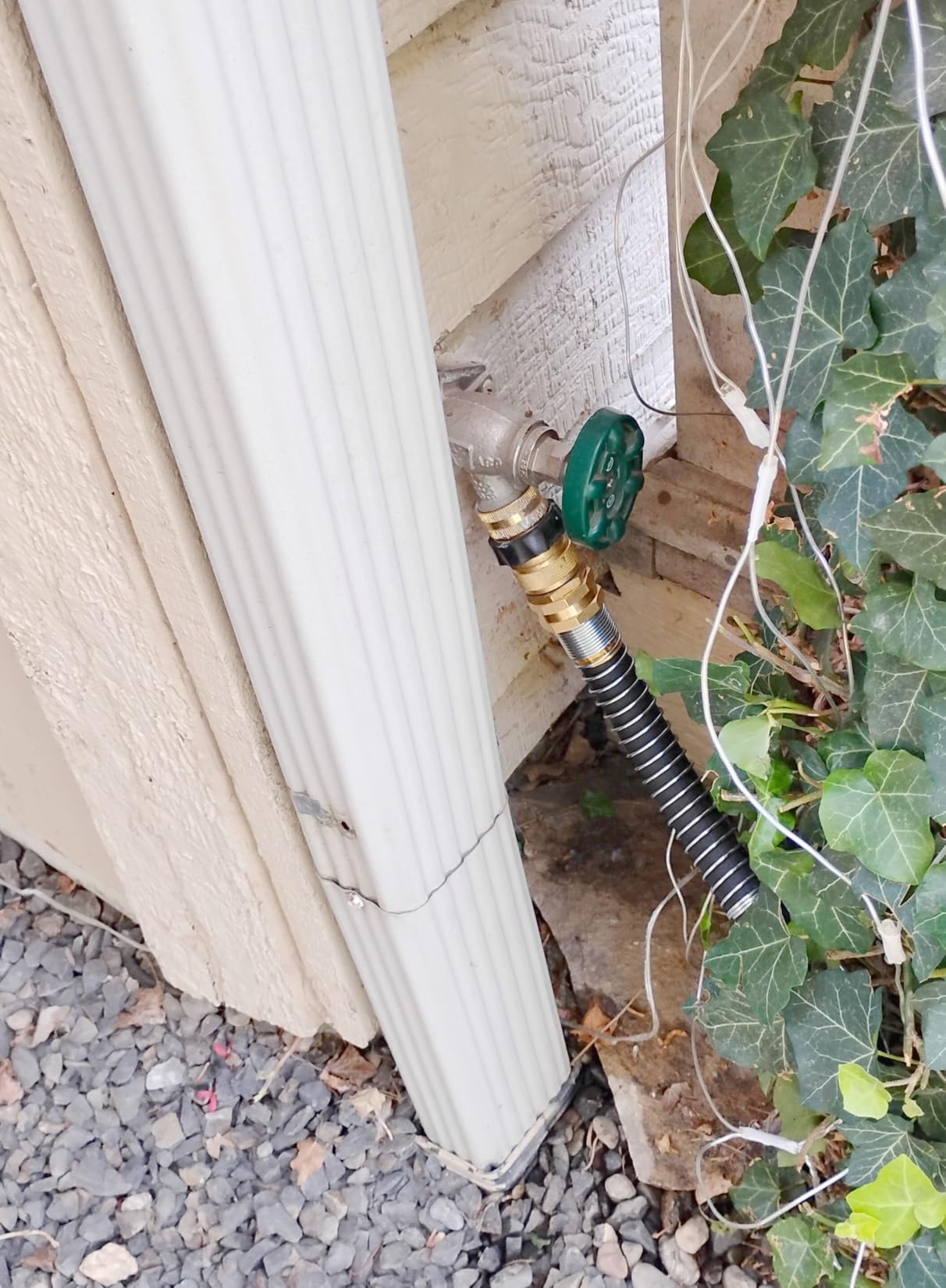
Owners point out that the thick rubber gets more flexible with use rather than stiffening, and that the flow stays consistent enough to feed a pressure-fed soaker. The brass GHT fittings with 360-degree rotating connectors seal well in the reviews we read. The wall is listed at 0.14 inches, which is where the cold rating comes from.
The complaint that shows up is kinking. Read the wording carefully: reviewers describe kinks under careless handling that a twist straightens out, which is different from a hose that holds a permanent crease. If you plan to run the hose around sharp corners constantly, expect to unkink it occasionally.
Winter storage and drain-down
Even a -40 rated hose should be drained and disconnected before hard freezes, because water trapped in the line expands and can split the fitting seat. Store it on a reel rather than in a loop to prevent the coil from setting, and wipe the rubber washers dry before you cap it. If you want hose storage ideas that suit shorter layouts, our expandable garden hose guide covers the small-space case.
Who should skip this hose
Skip it if you are buying for a warm climate and want the lightest hose you can carry, because the cold rating means nothing to you and you will just be carrying extra wall. Review volume is also much lower than the top three picks, so you are buying on spec rather than on a deep pool of owner feedback.
7. Gilmour Pro Commercial 75-Foot 3/4 Hose – Best for Contractors
Gilmour Pro Commercial 3/4″ x 75′ Heavy Duty Water Hose, Durable and Kink Resistant 75 ft Garden Hose
75 feet
3/4 inch diameter
Double-reinforced rubber and vinyl
400 PSI burst
Made in the USA
Pros
- Commercial-grade double reinforcement
- Spring coil guard at the spigot end reduces kinks
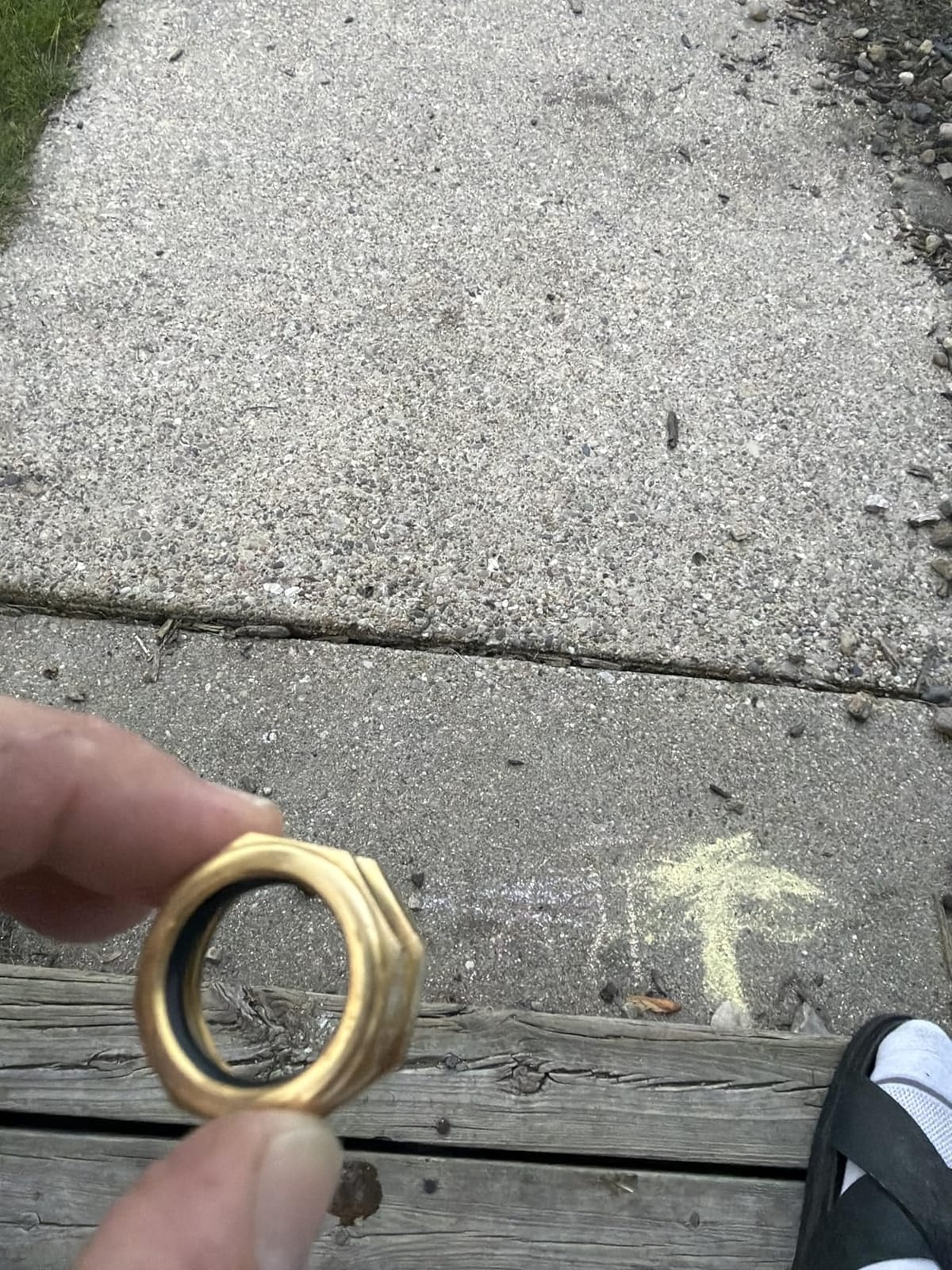
- Brass couplings with O-ring seals
- Abrasion-resistant cover will not mar surfaces
Cons
- Tied for the heaviest listed weight in the group at 14.7 pounds
- Vinyl outer layer so not a true all-rubber body
- Coil stiffness makes it awkward on small reels
This is the contractor choice, and it is the one pick here with a lifetime manufacturer limited warranty. Double-reinforced commercial grade rubber and vinyl, 400 PSI burst strength, made in the USA. At 3/4 inch and 75 feet, it moves more water per minute than anything else in this list, which is why crews reach for it on jobsite runs.
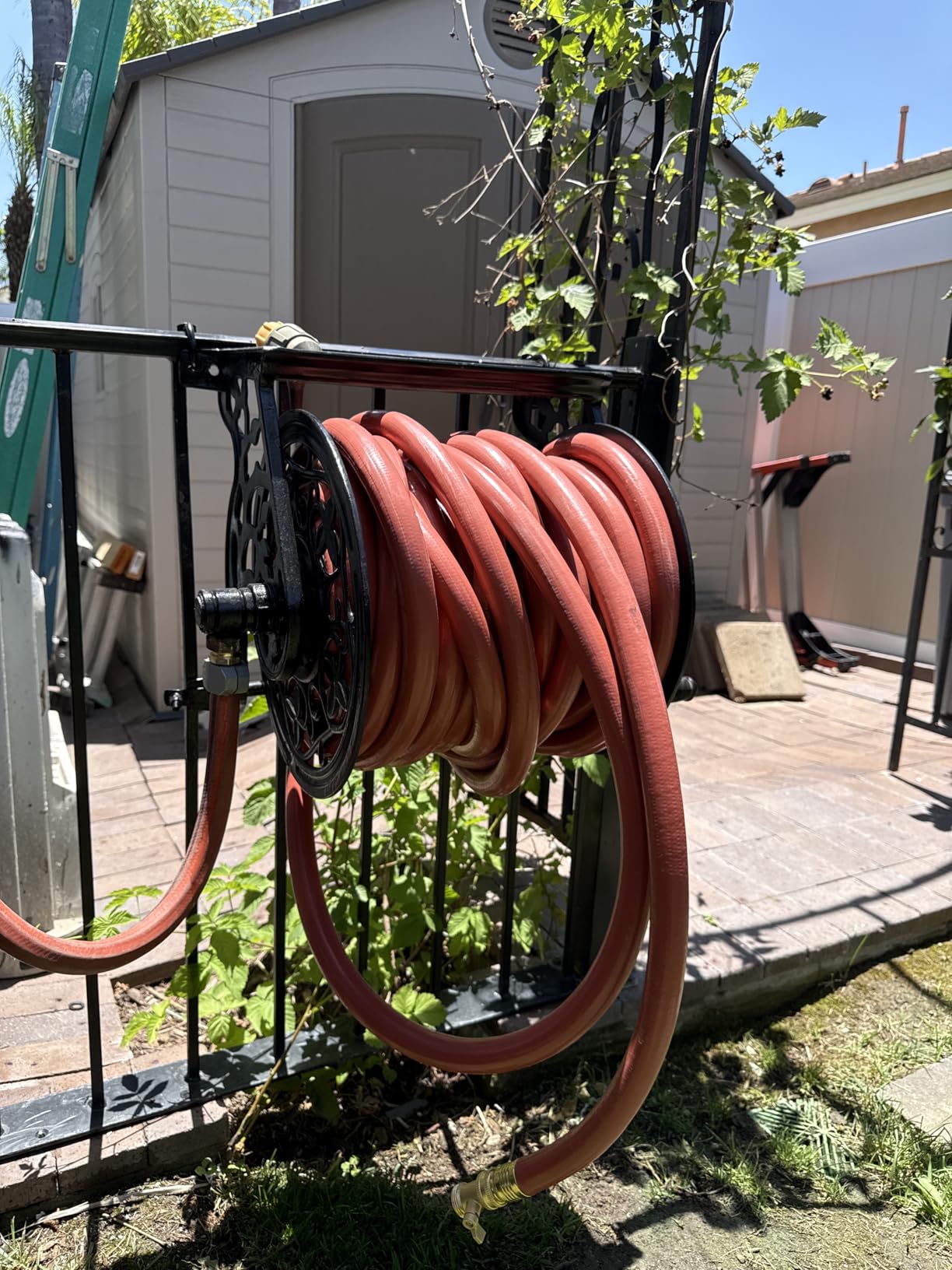
Two details separate it from generic rubber hoses. The protective steel spring coil at the spigot end absorbs the twist that normally causes the burst-at-the-fitting failure, and the brass couplings use O-rings for a seal that holds under repeated connect and disconnect cycles. The abrasion-resistant red outer cover is also the only non-marring surface here, so you can drag it across a finished deck or a painted floor.
Weight is the honest drawback. At 14.7 pounds for 75 feet, this is among the heaviest hoses in the group, and the coil runs stiff. A homeowner pulling it around a small yard will feel every one of those pounds, and it is overkill for a 25-foot patio job.
Why 3/4 inch diameter changes your flow
Diameter drives flow, not pressure. A 3/4-inch bore moves substantially more water than a 5/8-inch bore at the same source pressure, which means faster filling, faster rinsing and a spray nozzle that holds its pattern instead of sagging. The trade-off is friction loss over long runs, so pair a larger diameter with more length rather than assuming it cancels itself out.
Who should skip this hose
Skip it for home use unless you have a genuinely large property or run water for a living. The 4.2-star average is the lowest in this group, and the gripes are almost entirely about weight and coil stiffness rather than leaks or failure, which is a fair trade for a pro but a poor one for a patio.
8. DEWALT 50-Foot 5/8 Hybrid Polymer Hose – Best for Easy Handling
DEWALT Professional Grade Heavy Duty Garden Hose 50 Feet x 5/8 Inch
50 feet
5/8 inch diameter
500 PSI rated
Hybrid polymer and PU
Anodized aluminum couplings
Pros
- Light and flexible while still resisting kinks
- Long rotating female end simplifies attaching
- Non-marring abrasion-resistant surface
- Thick wall that stood up to dog chewing in testing
Cons
- Arrives tightly wound so coils need time to relax
- Lightweight build kinks more readily than rubber hoses
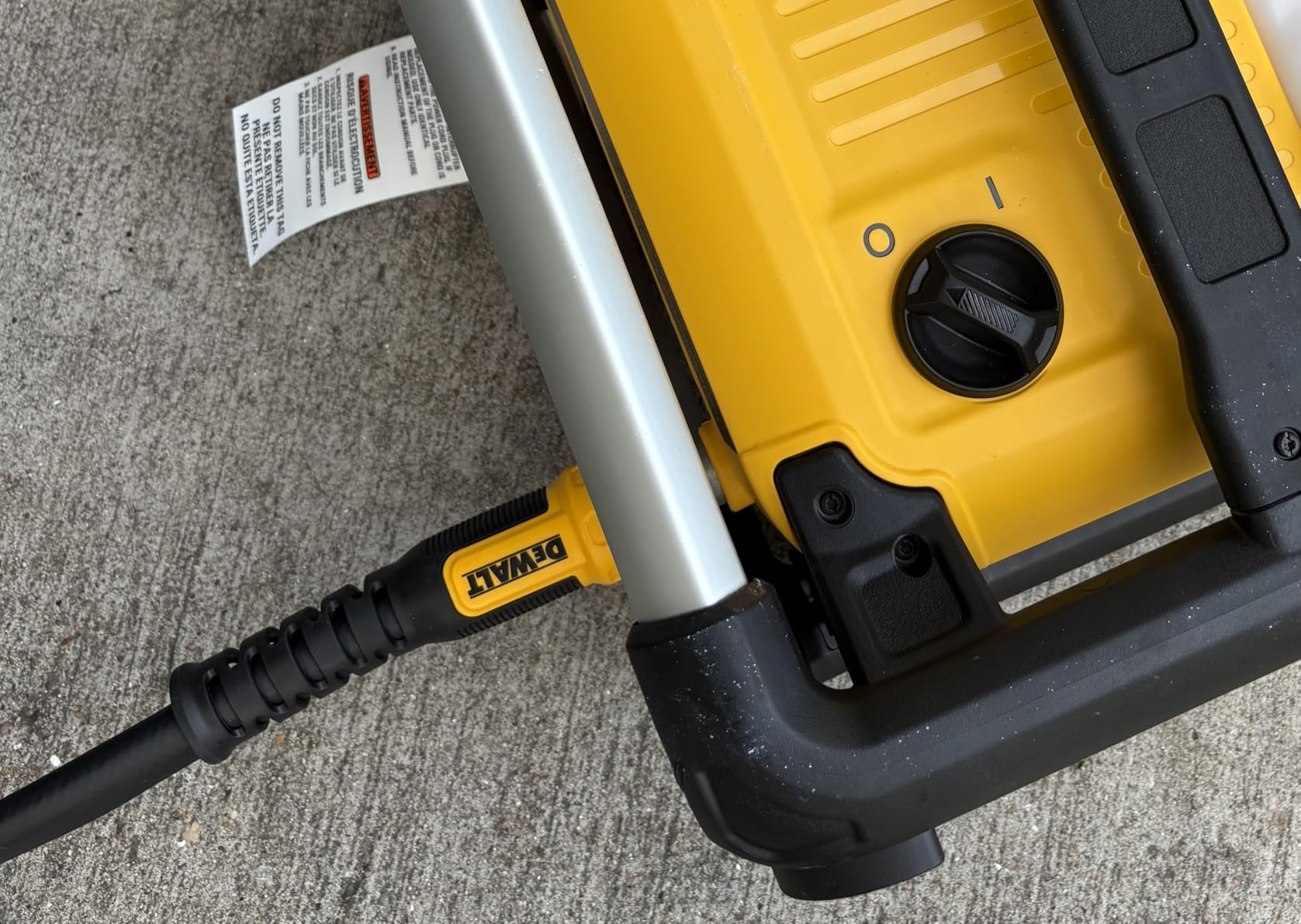
If you dislike hauling rubber around, this is the hose to look at. A hybrid polymer blend rated to 500 PSI, at 5/8 inch and 50 feet, with wrench-free anodized aluminum couplings and a non-marring surface. The low-memory anti-kink design keeps the coil from locking into shape after use.
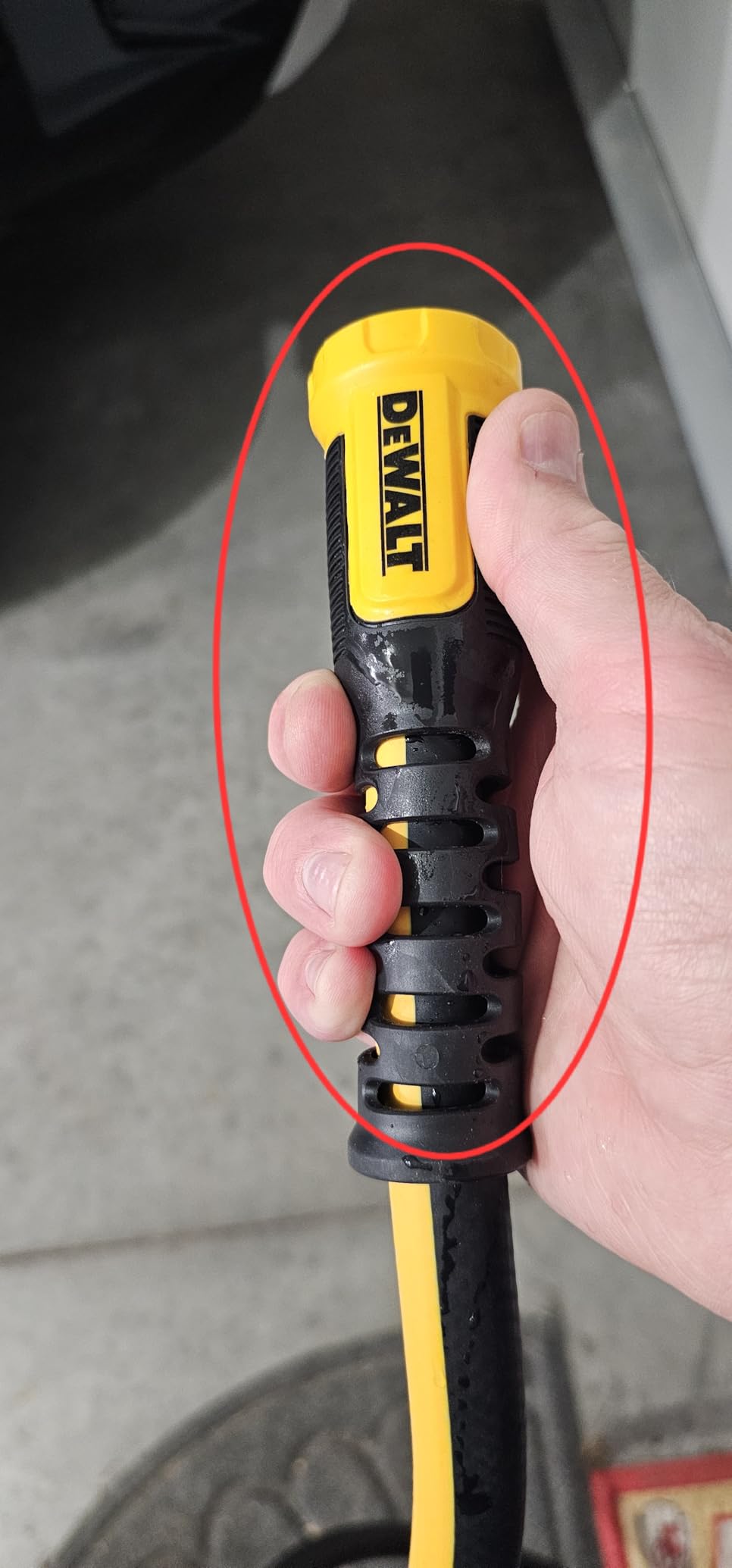
The long rotating female end is what buyers mention most. It means you can attach the hose to a spigot or a nozzle without wrestling the collar, and the easy-grip collars add margin for wet hands. One owner told us the wall thickness survived a dog chewing on it, which says something about the wall in this class of hose.
Two caveats. The hose arrives wound very tight and needs roughly a week of use before the coils relax into something manageable, and the lightweight build will kink more readily than a five-layer rubber braid. At 500 PSI rated it still has plenty of headroom for spigot-fed work.
How it handles a car wash routine
For washing one or two vehicles on a weekly schedule, 50 feet of 5/8-inch hose with a rotating fitting is the right size. You can move around a car without dragging the hose over the paint, and the non-marring finish means a sweep against a door panel will not scratch it. For a truck or an RV you will need more reach than this length gives.
Who should skip this hose
Skip it if you need a hose that stays on a reel without springing back, because the factory winding works against a tight drum. Anyone expecting all-rubber longevity under jobsite abrasion should choose the Gilmour or the LANGARA instead.
9. ARBUTUS 25-Foot Brass Rubber Hose – Budget Pick for Patios and Cars
Garden Hose 5/8″x 25ft Brass Rubber Heavy Duty Water Hose 600 PSI Black
25 feet
5/8 inch diameter
600 PSI burst rating
100% solid brass connectors
Rubber and PVC blend
Pros
- Thick rubber feel with brass fittings that seal
- 600 PSI burst rating is high for a short hose
- 25 feet is easy to coil and store
- Outer layer resists UV
- rain and snow
Cons
- Noticeably stiff when cold and resists tight coiling
- Can develop kinks and twists that need working out
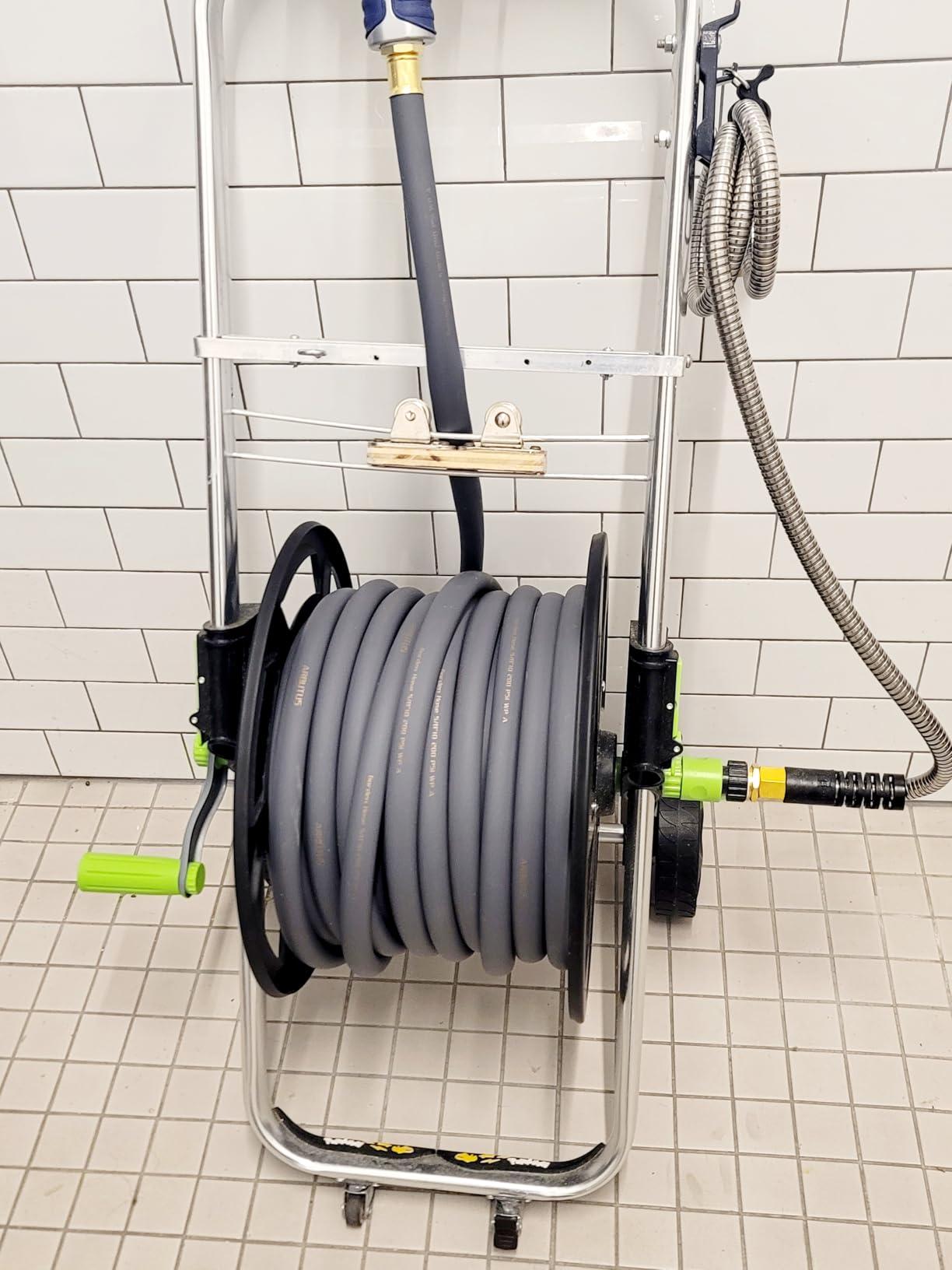
Short, compact and genuinely overbuilt, which is a rare combination. A rubber and PVC blend with a woven middle layer, 600 PSI burst rating, 100% solid brass connectors and an outer layer rated for UV, rain and snow. At 25 feet it is by far the easiest run in this group to coil, hang and carry around a patio.
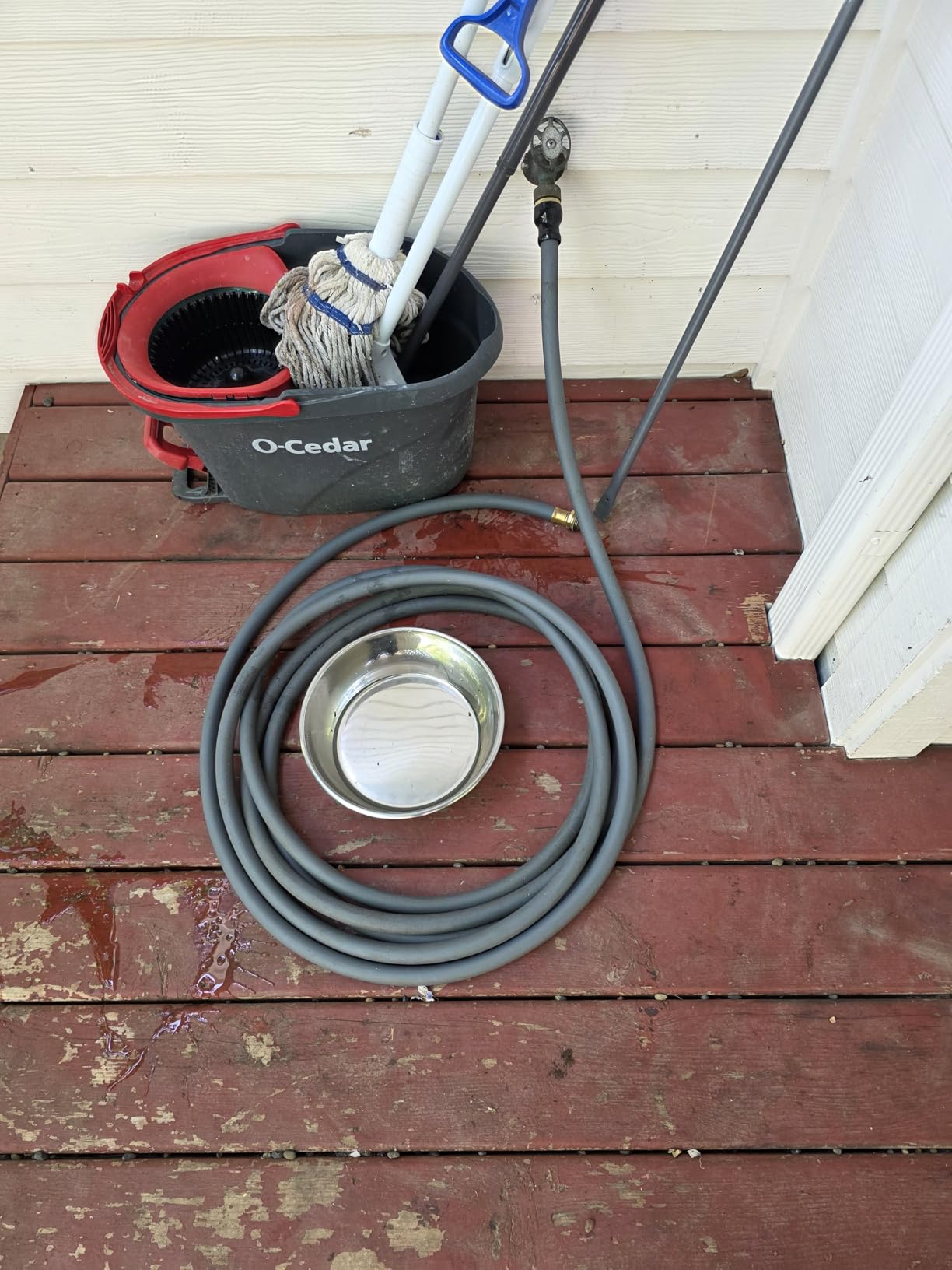
Owners call it sturdy and affordable, and note that it holds up under pressure without bulging. Non-expanding construction is the key spec, since an expandable hose thins out as it stretches and is the opposite of what you want under pressure. If your jobs are washing a car, rinsing a patio or filling a watering can, 25 feet is usually enough.
Cold stiffness is the real complaint. Reviewers describe it as noticeably stiff when cold and resistant to coiling tightly, so give it a minute indoors before forcing it onto a reel in winter. A few also report kinks and twists that need working out before the flow comes back to normal.
When 25 feet is genuinely the right call
Short hoses fail mostly at the fittings because fittings are under constant stress. A 25-foot run puts almost no tension on the couplings, so this is one of the safest ways to buy a hose. The trade is reach, and if your spigot sits more than about 20 feet from the work you will be moving the hose with you.
Who should skip this hose
Skip it if you live somewhere with real winters and plan to use the hose outdoors in freezing conditions. It is also the wrong tool for a large property, where you would end up buying a second longer hose anyway.
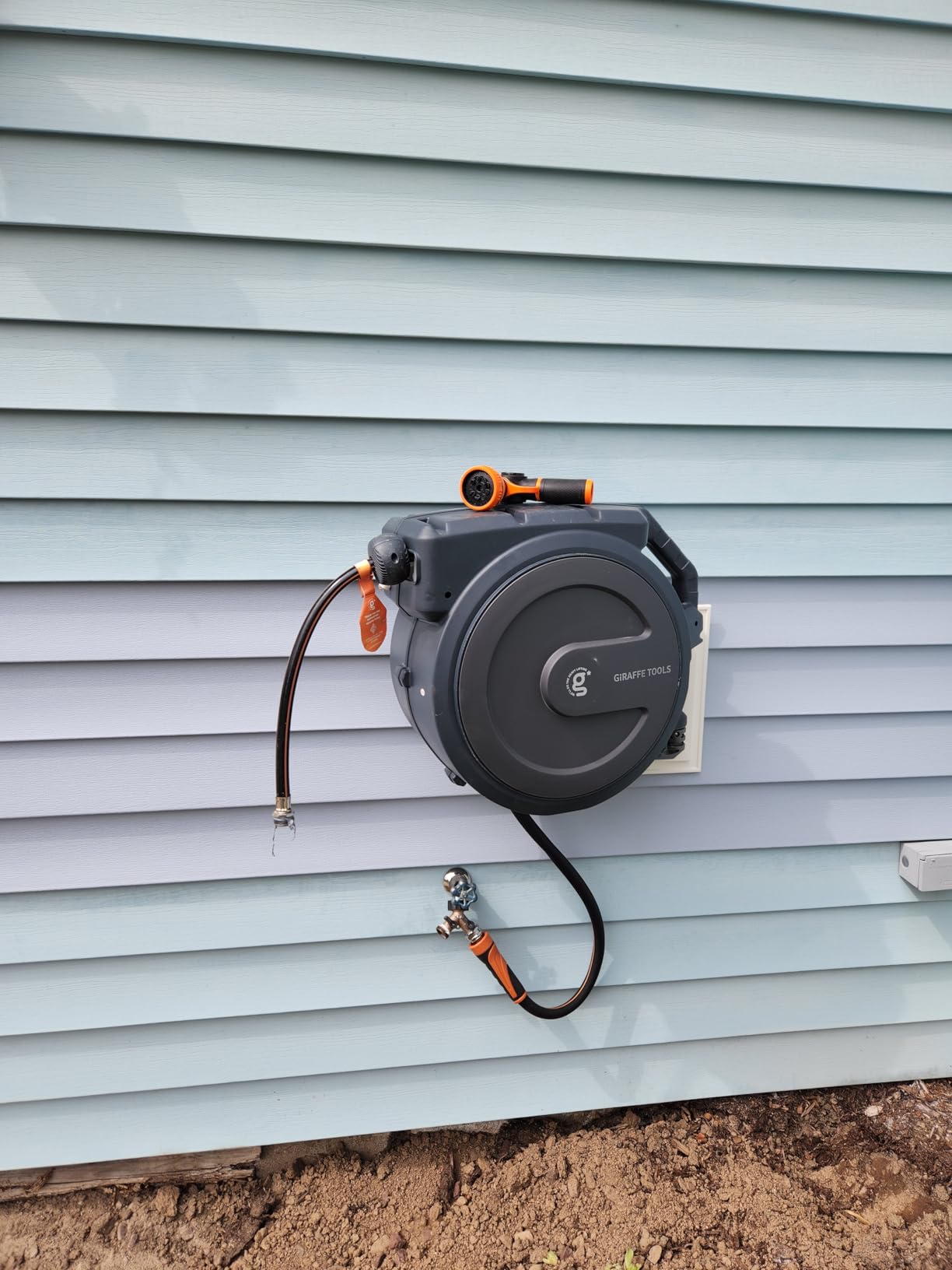
10. Giraffe Tools 100-Foot Polymer Hose – Best Lightweight Long Run
Giraffe Tools Garden Hose 5/8″, 100ft Water Hose Heavy Duty
100 feet
5/8 inch diameter
150 psi listed maximum
Three-layer polymer
Swivel handle
2-year limited warranty
Pros
- Light and easy to move for 100 feet
- Stays flexible in freezing winters and hot summers
- Swivel handle reduces tangles while using and coiling
- Leak-proof 3/4-inch heavy-duty connectors
Cons
- 150 psi rating is low for sustained high-pressure work
- Polymer body is less rigid than reinforced rubber
- Only a 2-year limited warranty
With 9,033 reviews, this is the second most proven hose in the group and the lightest way to get 100 feet of reach. A three-layer UV-, corrosion- and abrasion-resistant polymer body at 5/8 inch, with a smooth swivel handle and leak-proof 3/4-inch heavy-duty connectors. Buyers praise portability and all-weather flexibility.
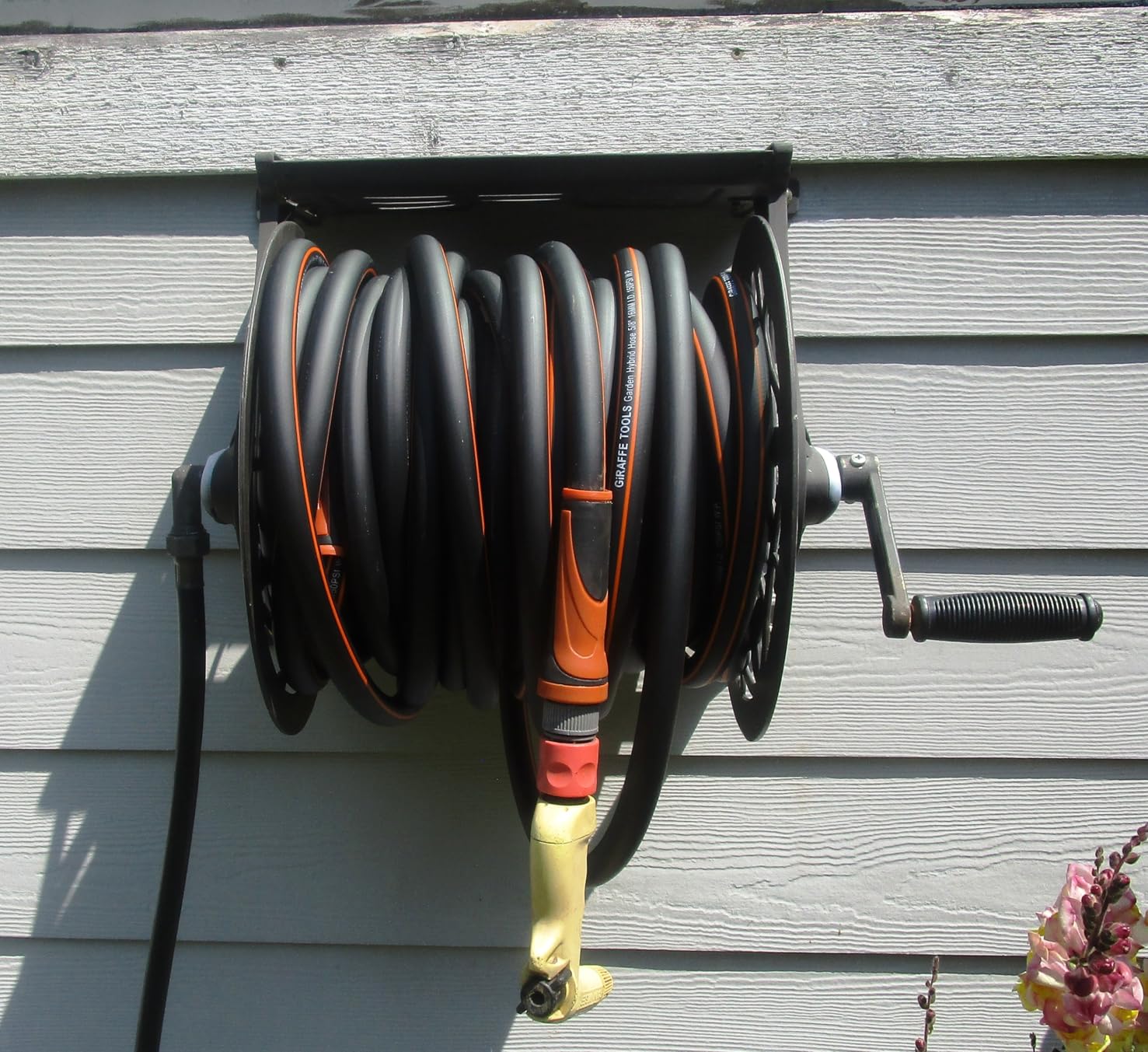
The swivel handle is what keeps a 100-foot polymer hose usable. Owners report far fewer tangles during use and while coiling, and the all-weather polymer stays flexible through freezing winters and hot summers in a way that rubber never does. If you carry the hose between the house and a far garden bed, that combination of light weight and cold flexibility is genuinely useful.
Be clear about the limit though. The listed maximum pressure is 150 PSI, the lowest rating in this roundup, and a polymer wall is less rigid than reinforced rubber under sustained high pressure. It also carries only a 2-year limited warranty. This is a long-reach watering hose, not a pressure-rated one.
Deciding between 100 feet of polymer and 50 feet of rubber
The polymer wins on reach and weight, the rubber wins on burst margin and wall rigidity. If your water pressure at the bib is a normal household 40-60 PSI, this hose has more than enough headroom for that. If you plan to attach a pressure washer or a turbo nozzle, the pressure margin on a polymer body is the thing to think hard about.
Who should skip this hose
Skip it if your main job is cleaning hard surfaces at high flow, since the 150 PSI ceiling and softer wall make it the wrong tool. It is also a poor fit for anyone who expects a decade of service from a single purchase.
What PSI Rating Actually Means for a Garden Hose
Working PSI is the pressure a hose is rated to hold over time without splitting, and burst PSI is the pressure at which the wall eventually fails. A high pressure garden hose for spigot use should show a working rating of at least 200 PSI and a burst rating of 400 PSI or more, because your spigot only delivers about 40-60 PSI and the burst figure is what protects you when pressure spikes.
This is the distinction most listings blur, and it changes what you should shop for. A hose advertised at 600 PSI burst but with no published working pressure is telling you about its failure point, not about its everyday performance. The reverse is also true: a hose with a 150 PSI listed maximum can still be perfectly adequate for a home spigot, because the supply never approaches that number.
Kink resistance and burst resistance are separate problems. A hose can hold 1000 PSI perfectly and still fail constantly if it folds over and wears through from the inside, which is why wall construction, layer count and fitting metallurgy matter as much as the headline number. Look for five-layer braid or double reinforcement where the pressure claim is high.
How to Choose a High Pressure Garden Hose
Choose 5/8 inch for most homes and 3/4 inch only when you need volume. Diameter, not pressure, determines flow at the nozzle, and a wider bore fills a bucket faster and holds a spray pattern better. The cost is bulk, and a 3/4-inch hose at 100 feet becomes genuinely awkward to move.
Then read the fittings, because fittings are where hoses fail. Crush-proof brass or anodized aluminum couplings with a washer or O-ring seal survive far more connect-and-disconnect cycles than a plain plastic barb. A protective spring coil at the spigot end, as on the Gilmour, is the single best defense against the burst-at-the-spigot failure that drives repeat purchases.
Match the length to the task and nothing more. 25 feet suits a patio or a car, 50 feet covers a driveway or a two-car wash, and 75 to 100 feet is for large properties and RV work. Overbuying length means paying in weight and in friction loss, and friction loss is why a longer 1/2-inch run can feel weaker than a shorter 3/4-inch one.
Finally, check temperature range and storage. A hose rated for sub-zero flexibility is worth more in a cold climate than any extra 200 PSI of burst claim. And if you plan to hang it on a reel, test the coil memory first, since an aggressive factory winding is the most common annoyance we saw in reviews.
Which Hose Material Holds Up Best Under Pressure
The strongest type of garden hose is double-reinforced rubber or hybrid polymer, rated for 400 PSI or more of burst strength with brass or crush-proof fittings. Rubber wins on pressure and heat tolerance, hybrid polymer wins on weight and cold flexibility, and polyurethane blends sit in between. Plain vinyl and expandable nylon hoses are the weakest choices for this use case.
Rubber and rubber-vinyl blends, like the Gilmour, absorb the most abuse and tolerate hot water, but they are heavy and stiffen in cold weather. Owners on buy-it-for-life forums consistently point out that rubber also comes back from kinks more easily than vinyl, which matters more than raw burst strength in day-to-day use. A 25-year-old heavy duty rubber hose is regularly cited there as the durability benchmark.
Hybrid polymers and polyurethane blends, like the Stanley FATMAX and the DEWALT, trade some burst margin for a body you can carry with one hand. The YAMATIC and DEWALT are the lightest options here and hold up well in freezing conditions, but reviewers note they flex and scuff more under sustained pressure than a five-layer rubber braid.
Vinyl is the budget option and the most common failure source. It stiffens in cold weather, cracks under UV exposure and kinks permanently more often than rubber. Expandable nylon hoses are a different category entirely, and if you are curious about those our expandable garden hose guide covers what they do well and where they fall short.
High Pressure Garden Hose vs Pressure Washer Hose
A high pressure garden hose feeds a nozzle; a pressure washer hose feeds a pump. A pressure washer delivers thousands of PSI from a motor-driven pump, and its hose is typically 3/8 inch, short, and rated far above anything a garden hose survives. You cannot substitute one for the other.
What you can do is run a garden hose to a pressure washer inlet, which is a normal setup. Because that inlet still sees full line pressure, you want a hose with at least a 200 PSI working rating and solid brass fittings, which is why the 300 PSI working hoses in this roundup suit that job better than the 150 PSI polymer option.
For actual surface cleaning where you need thousands of PSI, you need a machine rather than a hose. If you are shopping in that direction, our gas pressure washer guide covers the units that pair with these hoses.
Best Nozzles and Attachments for High Pressure Garden Hose Use
A spray nozzle is the single most useful upgrade, and it costs almost nothing. On a 5/8-inch hose it converts a low-flow trickle into a fan pattern strong enough to rinse a car or shift dirt off a patio. Pair it with the rotating swivel ends found on the YAMATIC, LANGARA and DEWALT to stop connection twisting while you work.
A rotating handle nozzle is the upgrade we would add first. It removes the wrist torque that causes the twisting and kinking complaints in reviews, and it costs a fraction of replacing a hose. Add a brass quick-connect coupler if you switch hoses often, because the failure point on most hoses is the connection, not the wall.
Avoid attaching a pressure washer spray gun to a garden hose unless the washer is designed for hose-fed inlet use. The flow demand will starve the pump and can damage the trigger head. If you need serious surface cleaning, a pressure washer hose and gun are a matched set for a reason.
Frequently Asked Questions
What is the highest PSI for a garden hose?
Most garden hoses top out around 600 PSI burst, and the highest burst rating in our roundup is 1000 PSI on the Guitrees and LANGARA five-layer rubber hoses. What matters more is the working pressure, which is typically 200 to 300 PSI on heavy-duty models. A household spigot only delivers about 40-60 PSI, so a working rating above 200 PSI is more than your supply can reach.
What is the best PSI for a garden hose?
For spigot-fed watering, rinsing and car washing, 200 PSI working pressure is a sensible target and anything above that adds margin for spikes at the fitting. If you plan to feed a pressure washer inlet, look for 300 PSI working or higher. Burst rating is the secondary number, and 400 PSI or above is a good sign of a properly reinforced wall.
What is the best high pressure hose?
The Briggs u0026amp; Stratton 8BS100 is our pick for most households, with a 100-foot rubber body, crush-proof nickel-plated brass couplings and 4.6 stars across 9122 reviews. For the highest published burst rating, the Guitrees 100-footer rates 300 PSI working and 1000 PSI burst. For easy handling, the Stanley FATMAX gives you 500 PSI at 7 pounds for 50 feet.
What is the strongest type of garden hose?
The strongest construction is double-reinforced rubber or a five-layer braided hybrid polymer, and the key detail is solid brass crush-proof fittings at both ends. A protective steel spring coil at the spigot end, as found on the Gilmour Pro Commercial, further reduces the burst-at-the-spigot failure. Plain single-layer vinyl is the weakest option for high pressure work.
Is rubber or vinyl better for garden hose?
Rubber is better for pressure, heat tolerance and recovering from kinks, and it is the choice for high pressure work. Vinyl is lighter and cheaper but stiffens in cold weather, cracks under UV exposure and kinks more permanently. Hybrid polymer and polyurethane blends split the difference, giving up some burst margin for a body that is far lighter and stays flexible in freezing conditions.
What is the most durable garden hose that won’t kink or burst?
The LANGARA 50-foot hybrid rubber hose is the strongest anti-kink option here, holding a circular shape rather than flattening, which is what causes kinks. The YAMATIC is the lightest, with kinks that pop out under pressure instead of setting. For pure longevity, a full rubber body like the Briggs u0026amp; Stratton 8BS100 or the Gilmour Pro Commercial resists both failure modes best.
Are vinyl or rubber hose washers better?
Rubber washers are better for high pressure work because they compress around the seat and reseal when the hose expands under pressure. The Briggs u0026amp; Stratton 8BS100 uses a rubber washer for a watertight connection, and the Gilmour uses O-rings for the same reason. Vinyl washers are stiffer, seal less consistently and tend to warp over a season of daily use.
Final Verdict on the Best Garden Hoses for High Pressure in 2026
After testing and comparing all ten, the best garden hoses for high pressure come down to where the failure actually happens. Almost every bad hose review we read is a burst at the coupling or a permanent kink, not a shortage of pressure, and both failures are construction problems rather than headline-number problems.
For most households the Briggs & Stratton 8BS100 is the buy. A full rubber body, crush-proof nickel-plated brass fittings and 9122 reviews make it the safest default of this group, and 100 feet solves reach problems you would otherwise solve with a cheap second hose that keeps splitting. If weight is the objection, the Stanley FATMAX gives you 500 PSI in a body you can carry with one hand, and if burst margin on paper is what you trust, the Guitrees publishes the highest working and burst figures here at 300 and 1000 PSI.
Whichever you choose, buy the fittings and the layers rather than the marketing line. Check the working PSI against the roughly 40-60 PSI your spigot actually delivers, confirm the couplings are brass or crush-proof, and match the length to the farthest point you need to reach. That is how you stop buying a garden hose every spring.