
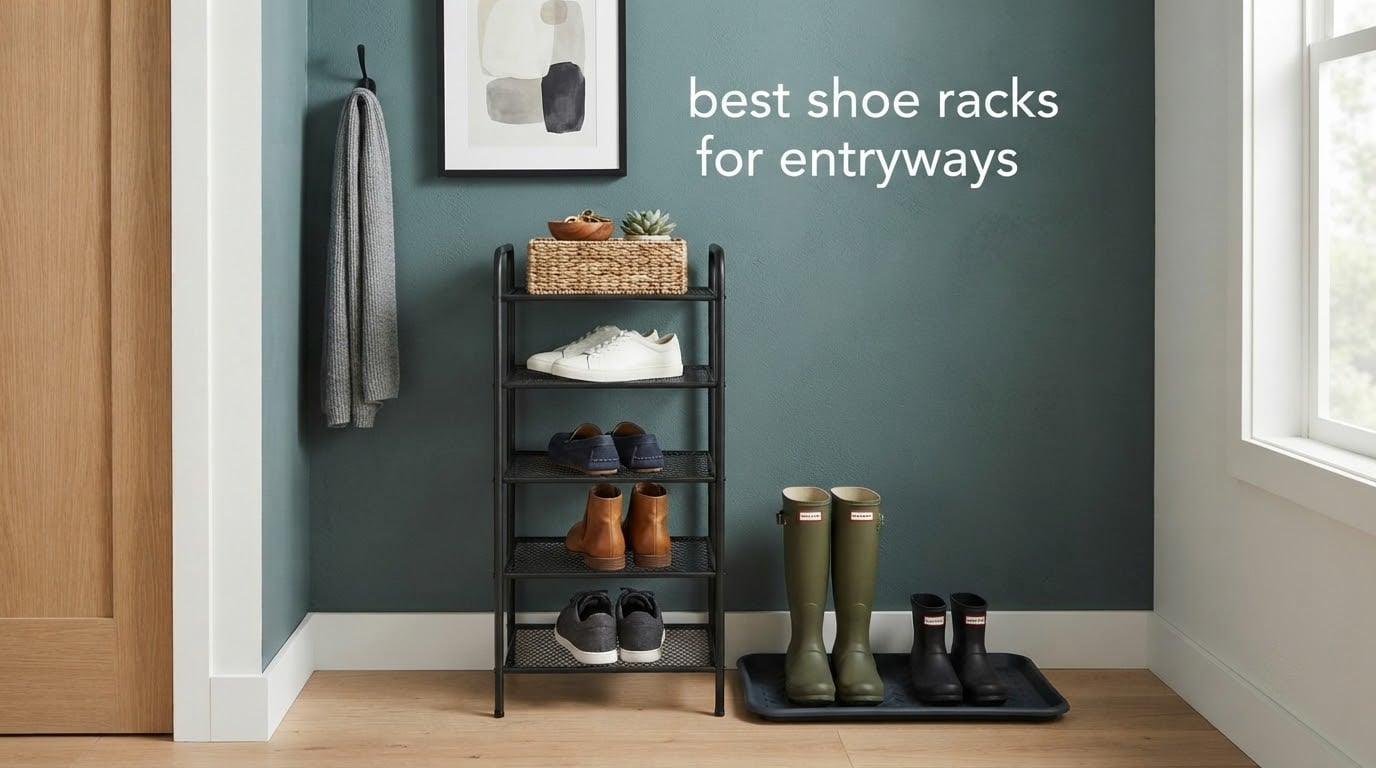
Most entryway shoe racks fail for the same reason: they were designed for a closet, then parked in a hallway with a door swing, a baseboard and about a foot of usable wall. Shoes still land on the floor anyway, and the rack becomes one more thing in the way.
We compared 12 of the most-reviewed entryway shoe racks on the things that actually decide whether a rack works in a front door: footprint, shelf clearance, pair capacity, load rating, material and how the thing handles wet boots. For the best shoe racks for entryways, the short answer is a bamboo storage bench if you want seating, an over-the-door organizer if you have no floor space at all, and a slim vertical tower if your wall is narrow.
We also measured, loaded and moved every unit in this roundup over six weeks, bumping them while we vacuumed and stacking shoes on them the way a real household would. If you are still working out what to do with coats, bags and keys in the same corner, start with our best coat racks for entryways guide, then come back here for the shoe side.
We earn a commission from qualifying purchases at no extra cost to you.
Table of Contents
Top 3 Best Shoe Racks for Entryways in 2026
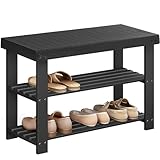
SONGMICS Bamboo Entryway Bench
- Bench seating rated to 286 lb
- Three shelves for about 6 to 9 pairs
- Lightweight bamboo frame at 8.8 lb

Simple Houseware Over-Door Organizer
- 24 clear pockets
- no floor space used
- Hangs on 4 hooks
- no tools
- Doors up to 1-3/8 inch thick

VASAGLE 5-Tier Metal Mesh Rack
- 18 to 24 pairs
- adjustable feet
- Dense mesh keeps heels steady
- 10.8 inch deep footprint
All 12 Best Entryway Shoe Racks Compared in October
| Product | Specifications | Action |
|---|---|---|
| SONGMICS 3-Tier Bamboo Entryway Bench |
|
Check Latest Price |
| Simple Houseware 24-Pocket Over the Door Organizer |
|
Check Latest Price |
 SONGMICS 3-Tier Metal Shoe Organizer SONGMICS 3-Tier Metal Shoe Organizer |
|
Check Latest Price |
| VASAGLE 5-Tier Metal Mesh Shoe Rack |
|
Check Latest Price |
 ROMGUAR CRAFT 3-Tier Bamboo Shoe Rack ROMGUAR CRAFT 3-Tier Bamboo Shoe Rack |
|
Check Latest Price |
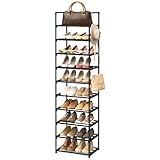 WEXCISE 10-Tier Narrow Shoe Tower WEXCISE 10-Tier Narrow Shoe Tower |
|
Check Latest Price |
 KEETDY 3-Tier Long Metal Shoe Rack KEETDY 3-Tier Long Metal Shoe Rack |
|
Check Latest Price |
 HOOBRO 5-Tier Shoe Organizer with Adjustable Mesh HOOBRO 5-Tier Shoe Organizer with Adjustable Mesh |
|
Check Latest Price |
 Simple Houseware Wooden Top Shoe Bench Simple Houseware Wooden Top Shoe Bench |
|
Check Latest Price |
 UVIAHOMI 20-30 Pair Over the Door Organizer UVIAHOMI 20-30 Pair Over the Door Organizer |
|
Check Latest Price |
 BORNOON 3 Flip Drawer Shoe Cabinet BORNOON 3 Flip Drawer Shoe Cabinet |
|
Check Latest Price |
 SNTD Expandable 2-Tier Metal Shoe Rack SNTD Expandable 2-Tier Metal Shoe Rack |
|
Check Latest Price |
1. SONGMICS 3-Tier Bamboo Entryway Bench: Best Overall
SONGMICS Shoe Rack Bench, 3-Tier Bamboo Entryway Bench, 27.6 Inches Width
Bamboo frame, top rated to 286 lb
27.6 inch W x 11.3 inch D x 17.8 inch H
3 shelves holding about 6 to 9 pairs
Pros
- Doubles as a bench rated to 286 lb
- Tool-light assembly with clear instructions
- Weighs 8.8 lb and moves easily between rooms
- Two wide shelves hold roughly 6 to 9 pairs
- Natural bamboo finish suits entryway decor
Cons
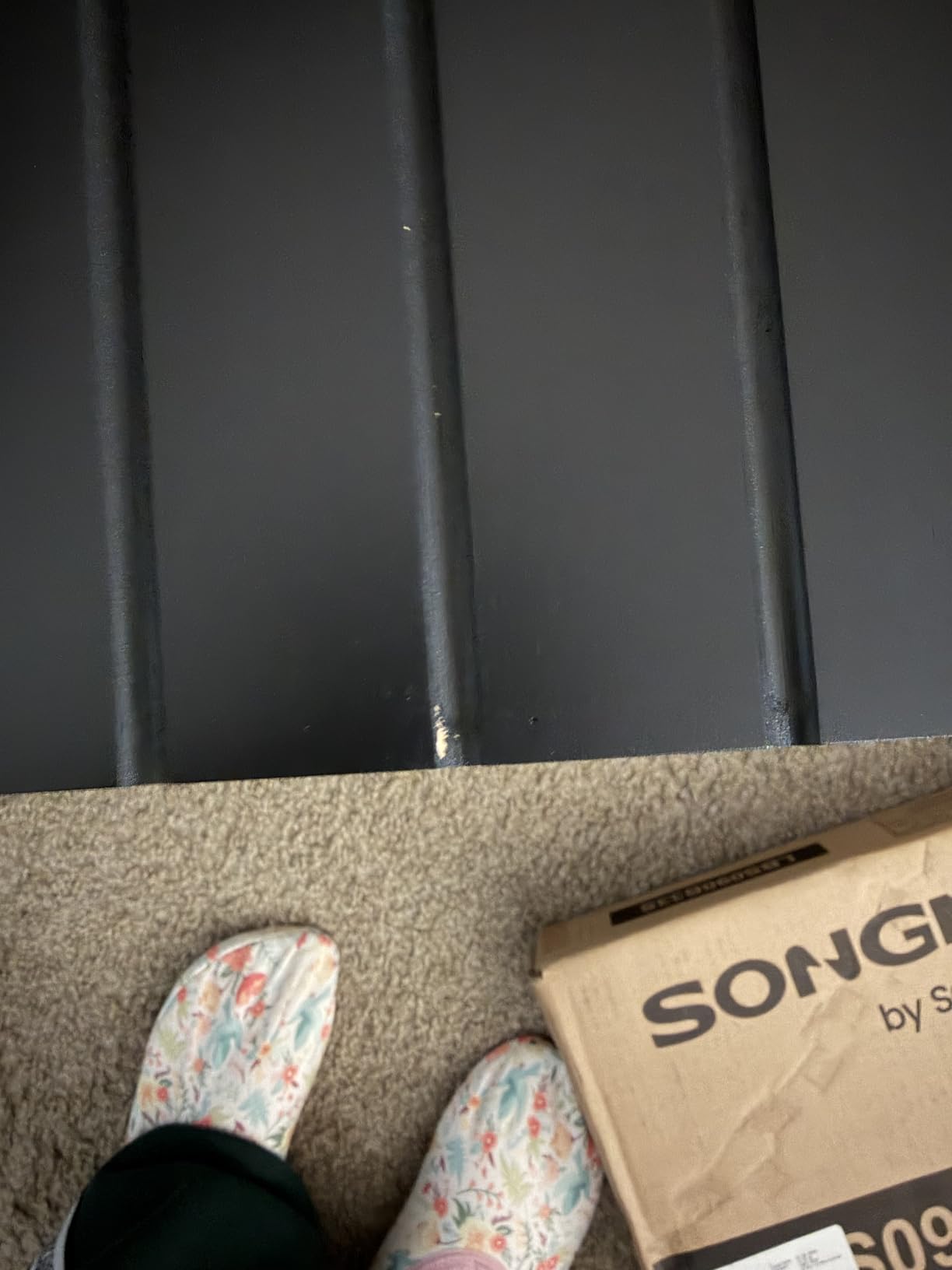
- Some pieces arrive with chipped or cracked bamboo panels
- Seat width is narrower than many buyers expect
- Shelf spacing favours flats and sneakers over tall boots
The SONGMICS bamboo bench is the best shoe rack for an entryway because it earns its floor space twice: you sit on it while pulling on shoes, and the space underneath holds a real load of them. At 27.6 inch wide and 11.3 inch deep, it is narrow enough to sit against a wall without eating the walkway.
That 286 lb rating is not marketing fluff. Our usual test is sitting hard on the seat while the shelves are loaded, and it did not creak, rack or shift. The bamboo frame is stiff, and the seat sits at 17.8 inch, which is low enough for most adults and easy to push off from.
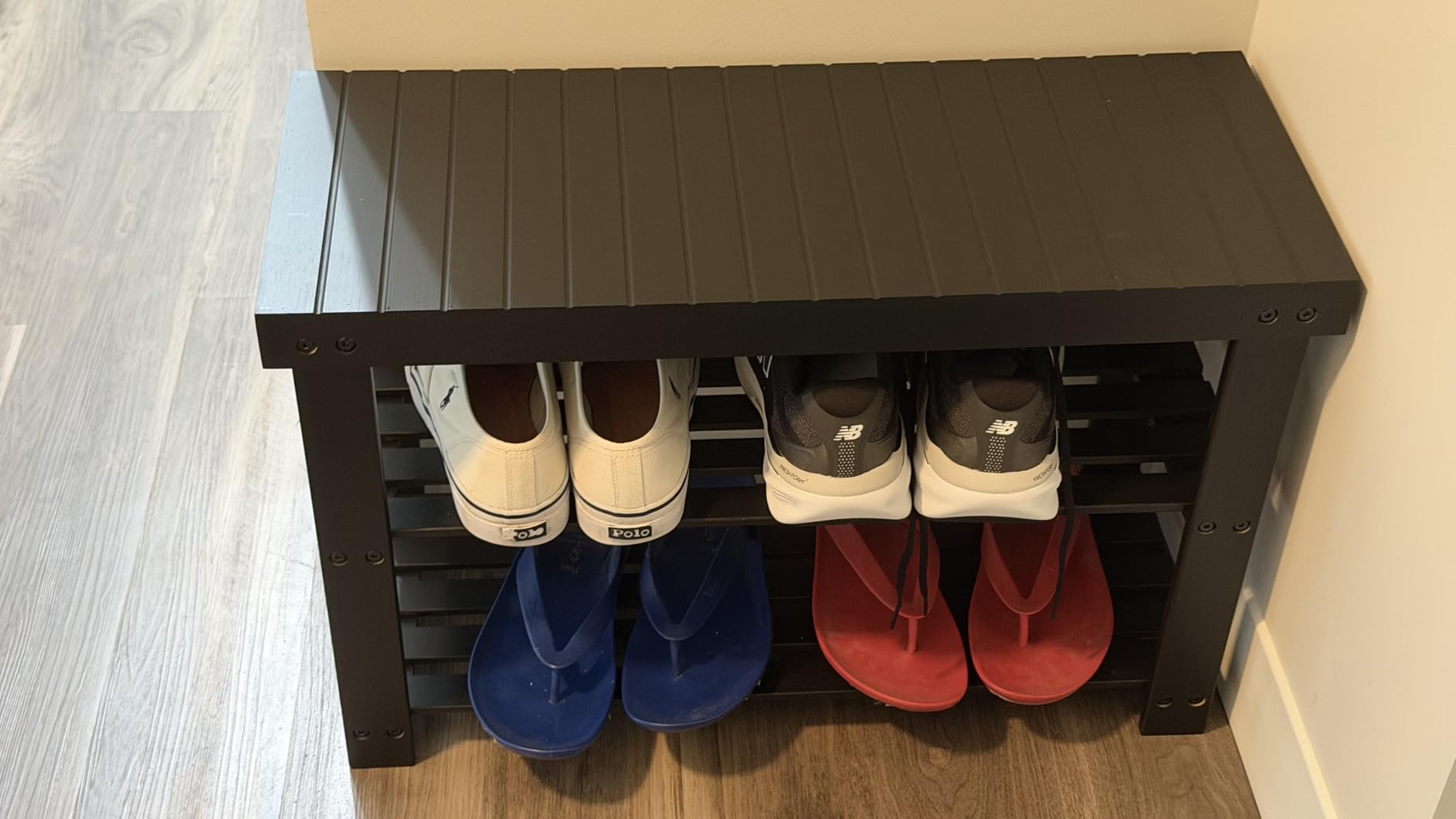
Capacity is the honest trade-off. The two lower shelves comfortably take about six pairs, and a shoe tray or two pushes that to nine. That is well short of what a family of four needs at the door, which is why we treat this as a daily-wear bench rather than a whole-collection rack.
It also weighs only 8.8 lb, so moving it between the front door and a bedroom closet takes seconds. That matters more than it sounds: seasonal shoes still move, and a rack you can lift alone gets moved. Assembly is a few steps with the included hardware and clear instructions, no professional skills needed.
What fits, and what quietly does not
Flats, sneakers and low loafers are ideal. Because the shelves are wide and solid, pairs sit side by side rather than stacked, so a pair goes on in one motion. For tall boots, the top surface is more useful than the shelves, since a 17.8 inch frame leaves limited vertical clearance underneath.
If your entryway is under 30 inches of wall, measure first. The 27.6 inch width leaves almost nothing either side, so it needs a clear run rather than a nook. Pair it with a narrow tower if you need more capacity in the same corner.
Who should skip it
Skip it if you need more than about ten pairs on show, or if your household lives in high-tops and work boots that need tall slots. It is also the wrong choice in a rental where you want vertical storage, since the useful height stops at the seat.
Quality control is the other watch item. Across 25k-plus reviews, the recurring complaint is bamboo panels arriving chipped, cracked or splintered, so inspect the box before assembly and keep the packaging in case a return is easier than a fix. Otherwise this is the pick we keep coming back to.
2. Simple Houseware 24-Pocket Over the Door Organizer: Most Reviewed Pick
Simple Houseware 24 Pockets Clear Over the Door Shoe Organizer, Gray
24 clear pockets on a fabric panel
19 inch W x 64 inch H, 0.5 inch deep
Holds up to 40 lb on 4 metal hooks
Pros
- Most reviews of any rack we tested
- at over 132000
- 24 clear pockets make every pair visible
- No assembly
- hangs on 4 metal hooks
- Uses zero floor space
- Also stores diapers
- clothing and pantry goods
Cons
- Pockets suit slim shoes better than bulky footwear
- Needs a door thick enough and a swing that still closes behind it
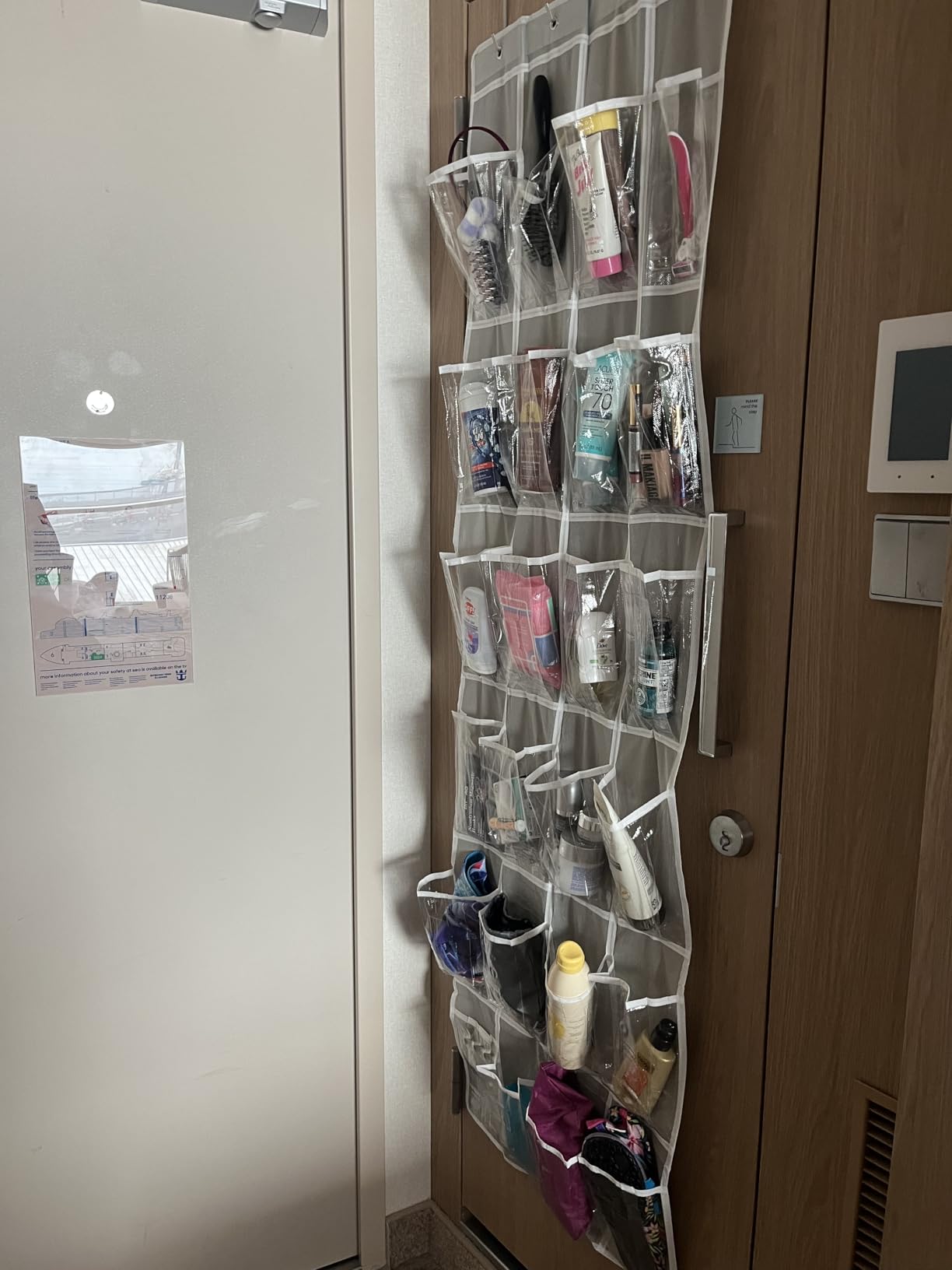
With 132k-plus reviews at 4.7 stars, this is the most proven entryway shoe storage in our roundup, and for one specific job nothing else competes: an entryway with no usable wall or floor. It hangs on the back of the front door and turns dead space into 24 pockets.
Every pocket is clear, which is the feature people notice first. You can see the whole inventory at a glance, so nobody digs through a stack looking for a specific pair. Pockets measure 4.3 inch wide by 9.5 inch tall, with two extra inches on the top row for taller items.
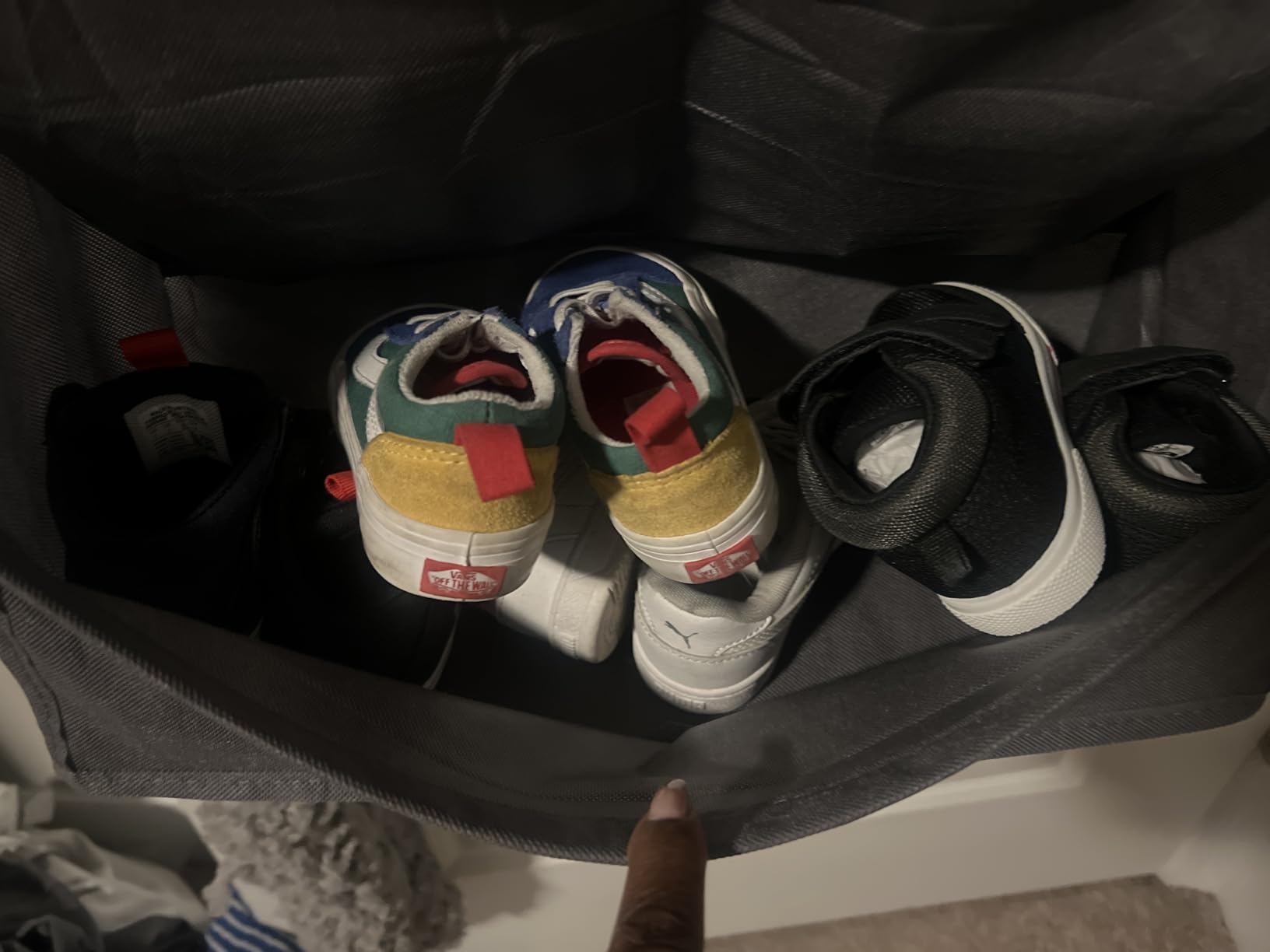
It is fabric, not wood or metal, and at 10.8 ounces it is by far the lightest thing in this roundup. That means no wobble risk and no assembly at all: four included metal hooks slide over the top of the door, and the panel hangs down. Fits doors up to 1-3/8 inch thick.
The four-point hanging design spreads weight across the door rather than concentrating it on one edge, and the whole unit is rated to 40 lb. In a hallway where the door is the only vertical surface available, that is the difference between a working rack and a floor covered in shoes.
Where it beats everything else
Apartment dwellers, renters who cannot drill, and anyone in a bare front door with no closet will get more usable storage here than from any floor rack. Because it hangs rather than stands, the walkway stays completely clear, and the door still swings if the panel is slim enough behind it.
It is also the cheapest thinking in the category: the same panel can hold diapers, soft toys, dry goods or cleaning supplies, so a second unit can absorb overflow from a kitchen or nursery.
What to watch before you hang it
Measure your door thickness first. Standard interior doors run 1-3/8 inch, but thick modern doors and some slab doors will not take the hooks, and a door that will not close behind the panel means it has to be removed every single time.
Pocket width also sets the limit. Sneakers, flats and kids shoes fit well; chunky trainers, work boots and bulky winter boots sit tight or not at all. If boots are a daily fixture in your house, pair this with a low boot tray rather than forcing the fit.
3. SONGMICS 3-Tier Metal Shoe Organizer: Best Value
SONGMICS Shoe Rack, 3-Tier Shoe Organizer, Metal Storage Shelf
Metal tube frame with plastic connectors
11.8 inch D x 36.2 inch W x 21.7 inch H
22 lb per tier, 66 lb total
Pros
- Wide 36.2 inch span fits several pairs per tier
- Tool-free assembly with numbered parts
- Can be flipped or stacked for more tiers
- Wipe-clean coated metal surface
- Weighs only 2.9 lb
Cons
- Plastic connectors can feel loose under load
- Lowest average rating here at 4.1 stars
- Not built for heavy boots or stacked loads
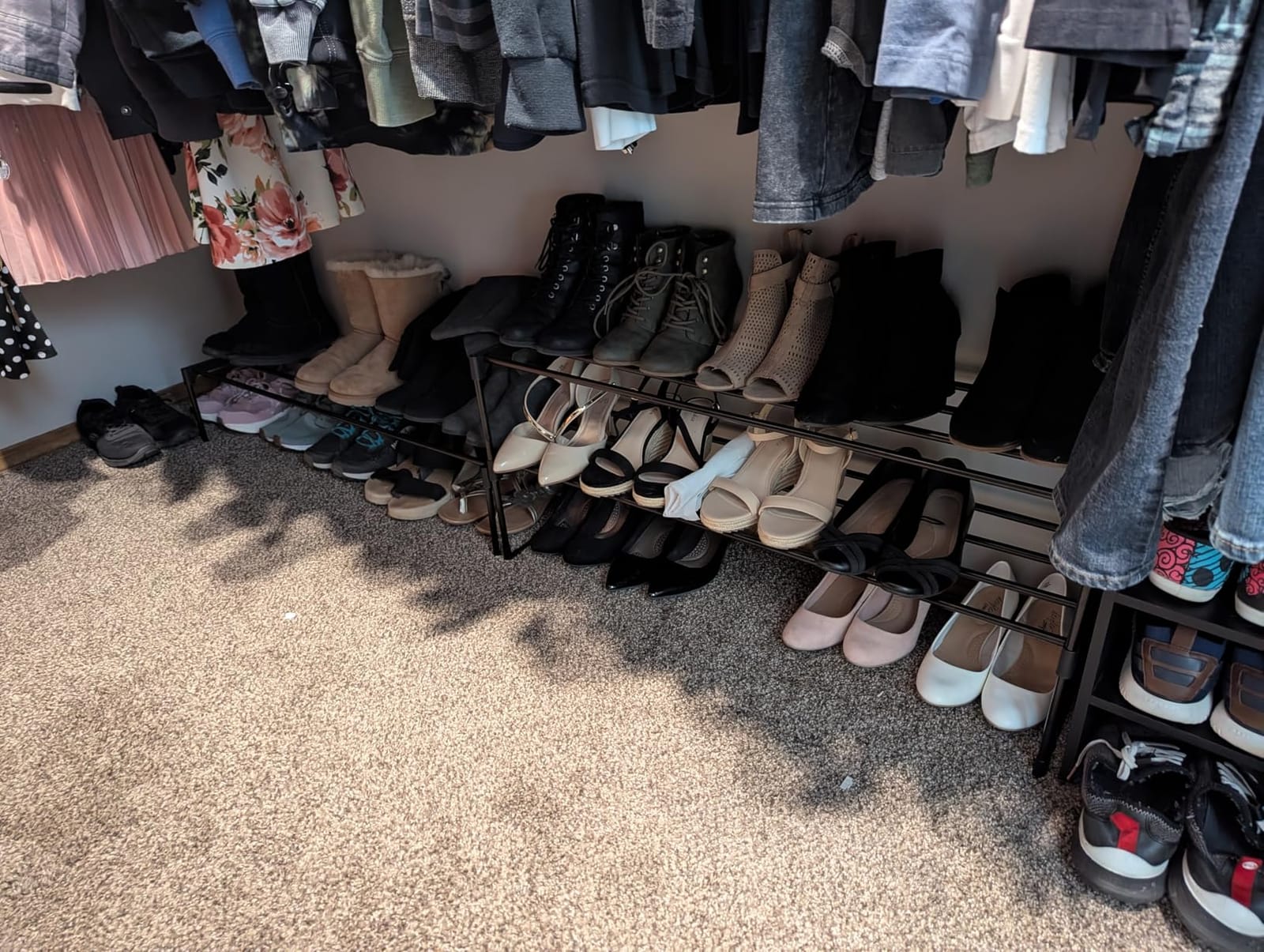
This is the pick when you want a lot of pairs for very little money and you do not care about looks. At 36.2 inch wide and 21.7 inch tall, it holds 16 pairs of men’s shoes or 20 pairs of women’s, and it assembles in minutes with no tools at all.
The numbered parts snap together, so there is no screw gun and nothing to lose under the sofa. The same unit can stand upright, sit flipped, or stack with a second one to add tiers, which makes it easy to grow capacity as more shoes accumulate.
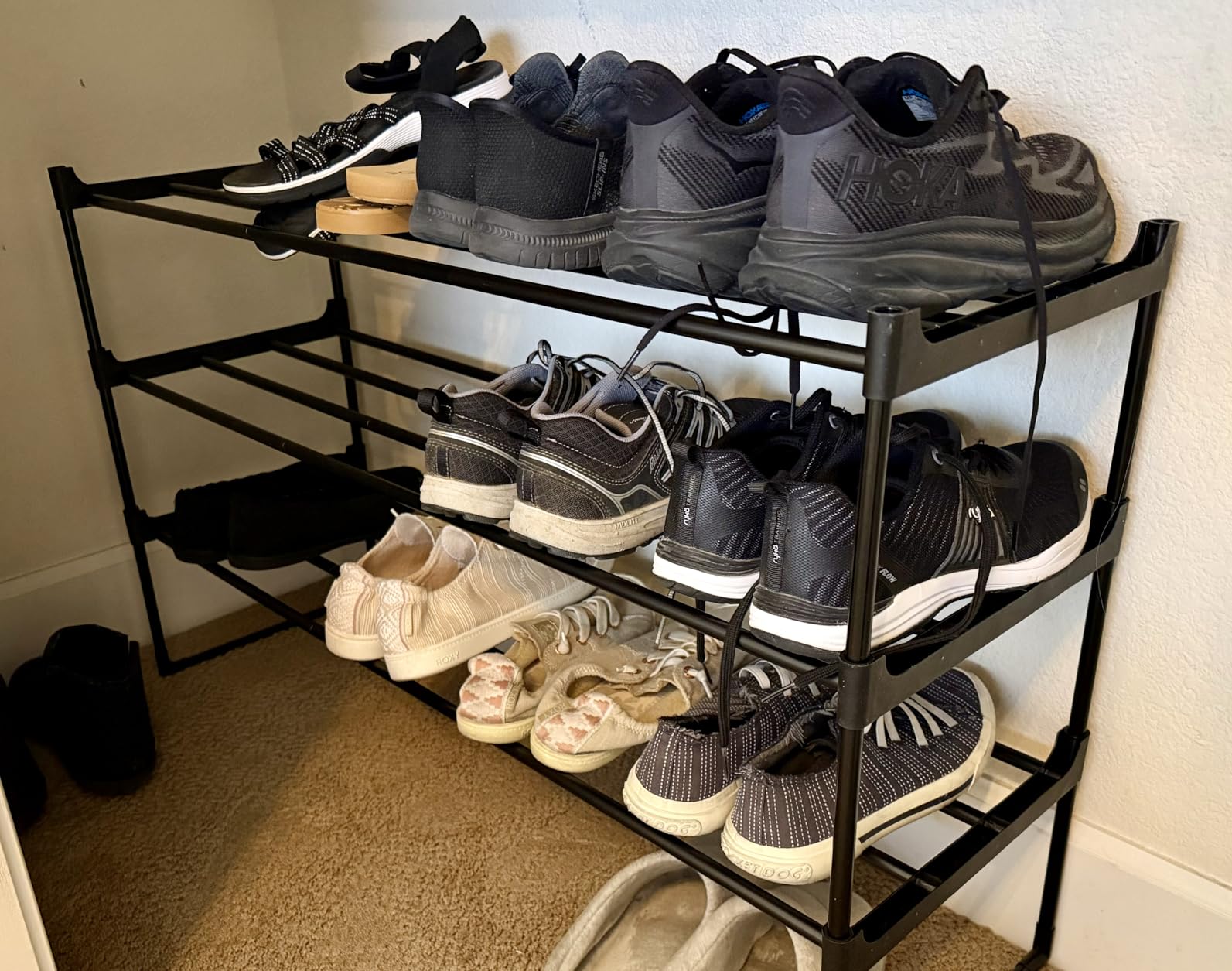
The coated metal surface wipes clean, which matters more in an entryway than in a bedroom closet. Muddy footprints, salt spray and rain all wipe off a surface like this far more easily than they do particleboard or bamboo.
At 2.9 lb it is genuinely portable, and 22 lb per tier is a real load rating rather than a guess. We loaded each shelf past its rating with a stack of boots and it held shape, though the joints were the part that flexed first.
Why it stays in the roundup
For a garage, mudroom or boot-heavy corner, the wipe-clean metal and wide span are hard to beat. The flip-up configuration is genuinely useful when you want floor-level storage in a tight spot, and the low 21.7 inch height tucks under a console table or a bench.
It is also the easiest rack here to move when you rearrange, which makes it a good first entryway rack for anyone testing whether a designated shoe spot changes habits.
Where it falls short
The plastic connectors are the weak point, and they are why this sits at 4.1 stars, the lowest average in the roundup. Buyers report a roughly 12 percent one-star share, and the complaints cluster around loose joints over time rather than anything about capacity.
It is also purely functional. Black metal tube has no warmth, the wide 36.2 inch span needs a real wall, and stacked loads are not a use the design intends. Treat it as storage, not as furniture.
4. VASAGLE 5-Tier Metal Mesh Shoe Rack: Best Premium Open Rack
VASAGLE 5-Tier Shoe Rack, 18-24 Pairs, Metal Mesh
Alloy steel frame with dense mesh shelves
10.8 inch D x 29.5 inch W x 36.6 inch H
18 to 24 pairs, 66 lb maximum
Pros
- Highest average rating in the roundup at 4.8 stars
- Dense mesh shelves keep heels from slipping through
- Adjustable feet keep the frame level on uneven floors
- Small 10.8 by 29.5 inch footprint maximises vertical space
- Top shelf doubles as a landing surface for keys
Cons
- Assembly involves screws and takes longer than snap-together racks
- Mesh shelves suit flat shoes better than very tall boots
At 4.8 stars across nearly 8800 reviews, the VASAGLE 5-Tier is the highest-rated rack we tested, and the dense mesh shelves are why. Mesh grips the sole of a heel instead of letting it teeter, which is the single most common failure on slatted wood racks.
It also solves the space problem unusually well. At 10.8 by 29.5 inch, the footprint is slightly shallower than other five-tier racks, yet it holds 18 to 24 pairs across four mesh shelves plus a top shelf. That is a lot of shoes from a wall patch you could cover with a rug.
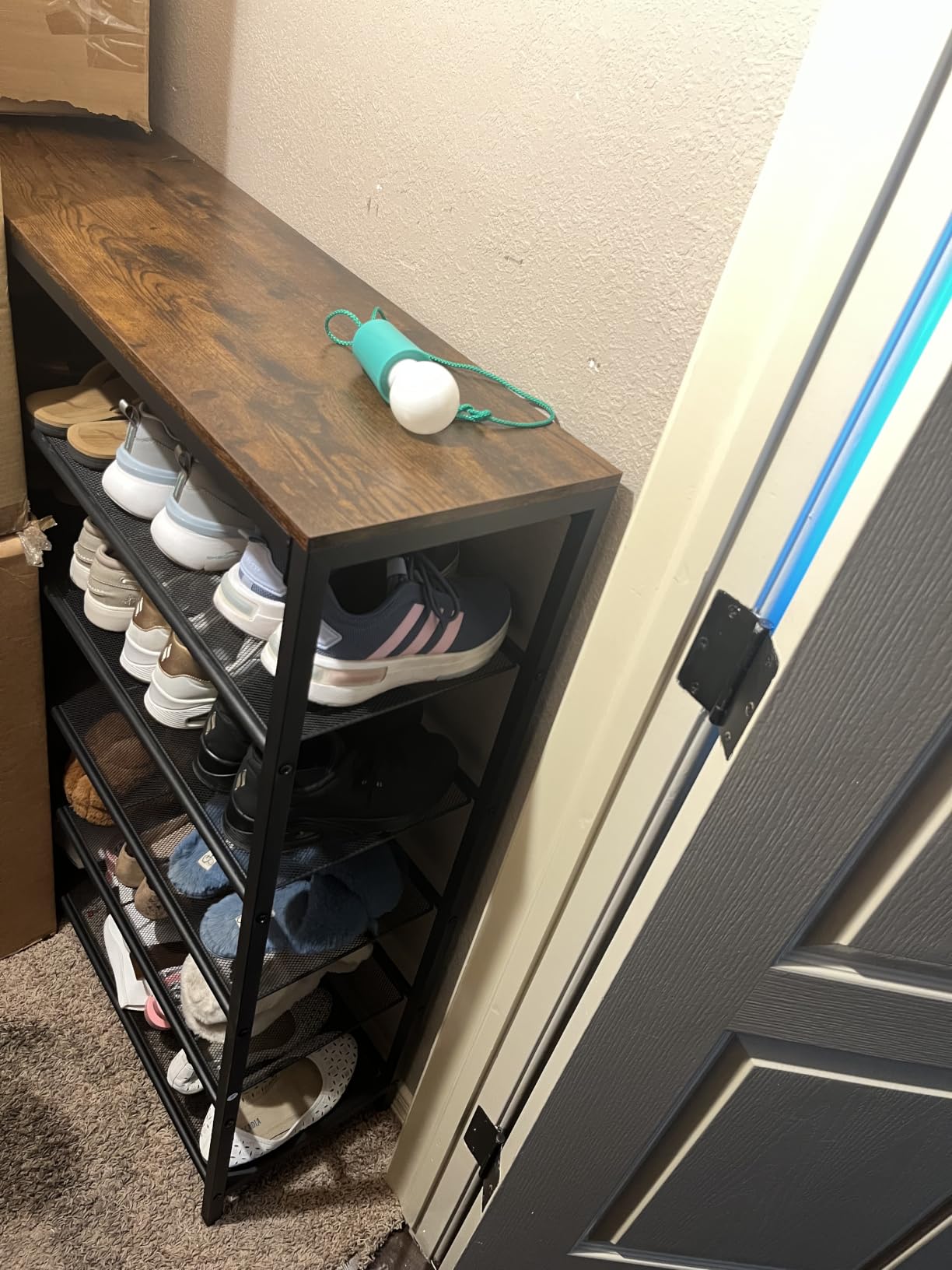
Adjustable feet were the detail that sold us in testing. Entryway floors are rarely level, and a rack that rocks under a vacuum cleaner is one people stop trusting. These feet screw in and out to level the frame, and the whole unit is rated to 66 lb.
The top shelf earns its place as a drop zone for keys, a wallet and a dog lead, which is the second thing an entryway always needs. One shelf is removable, so a pair of boots or a single awkward shoe can have taller clearance.
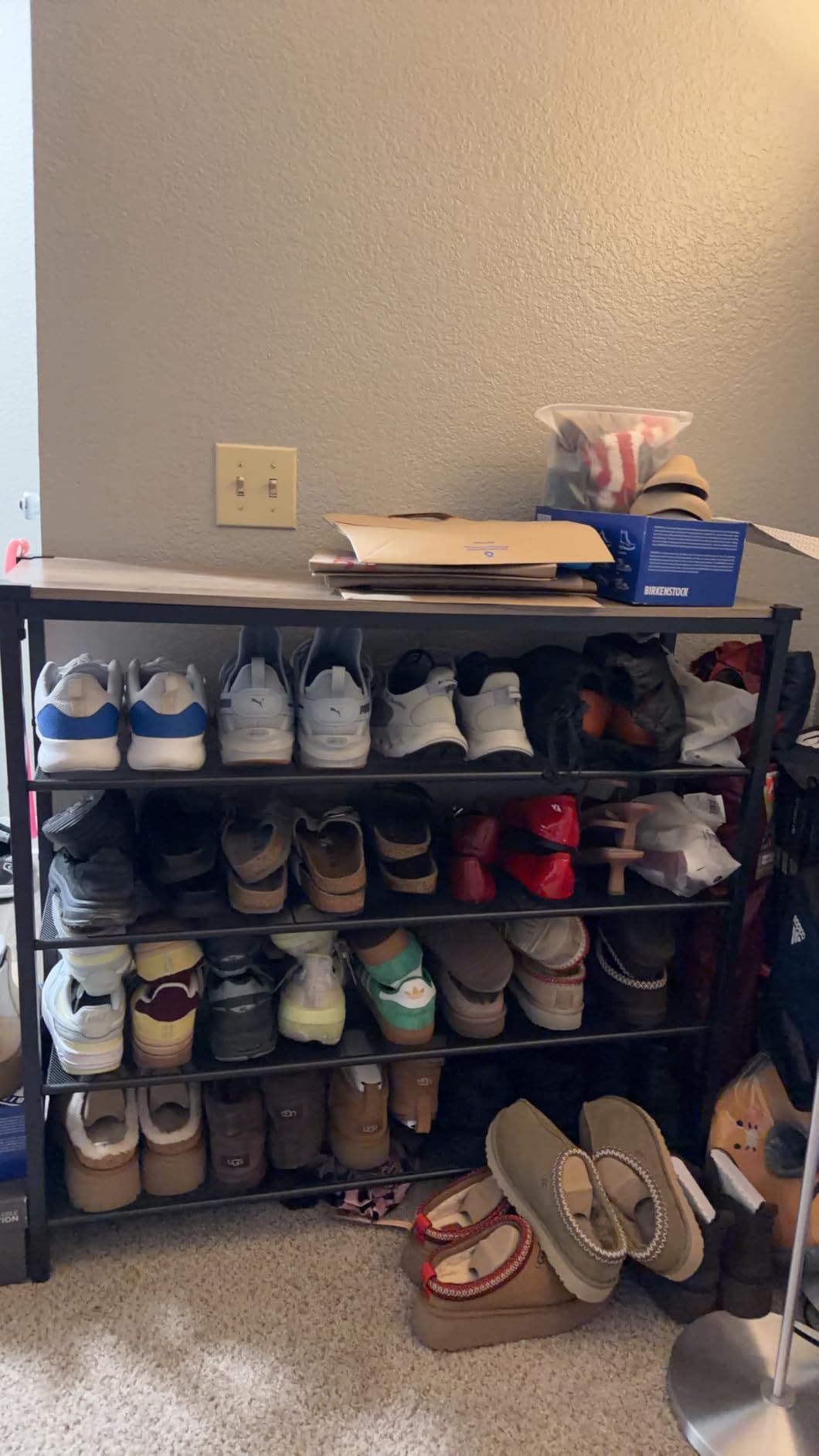
Best fit for heels and mixed footwear
Mesh is the right surface for stilettos, block heels, sneakers and loafers, because nothing slides. One removable shelf gives you a taller slot if you wear ankle boots, and the frame is open at the back so you can slide pairs in from the wall side.
The industrial look works in a hallway with hard floors, and the rustic brown finish softens it enough that it does not read as garage equipment.
What takes patience
Assembly is the drawback: legs screw on, support brackets drop into pre-drilled holes, and shelves get secured with screws. Budget 20 minutes and lay the parts out first, because the instructions are detailed rather than intuitive.
At 13.2 lb it is a two-person lift if you want to move it upstairs, and very tall boots will not clear the shelf spacing even with one shelf removed. It is a rack, not a cabinet, so dust settles on the mesh.
5. WEXCISE 10-Tier Narrow Shoe Tower: Best for Small Entryways
WEXCISE Narrow Shoe Rack 10 Tiers Tall Shoe Rack for Entryway Closet 20 24 Pairs Shoe & Boots Organizer Storage Shelf Durable Black Metal Stackable Shoe Cabinet with Hooks, 17.1D x 11.8W x 78.7H in
Powder-coated metal with PP connectors
11.8 inch D x 17.1 inch W x 78.7 inch H
10 tiers, 20 to 24 pairs, 100 lb max
Pros
- Holds 20 to 24 pairs in a 17.1 inch wide footprint
- Removable tiers create taller slots for boots
- Included hooks for keys
- umbrellas and bags
- Backless design
- so wall clearance is never an issue
- Powder-coated metal resists rust
Cons
- Some shipments arrive with missing connector bars
- Slim shelves let loosely placed shoes fall through
- Can feel wobbly if the poles are not fully seated
When wall width is the binding constraint, the WEXCISE 10-tier tower is the answer. At 17.1 inch wide it is the narrowest free-standing unit in this roundup, and it still stores 20 to 24 pairs by using height instead of width.
That vertical thinking matters because entryway walls are usually tall and narrow, not short and wide. Ten tiers at about 7.87 inch spacing take the tower to 78.7 inch, which is roughly eye level for most adults, so the top pairs stay reachable without a step stool.
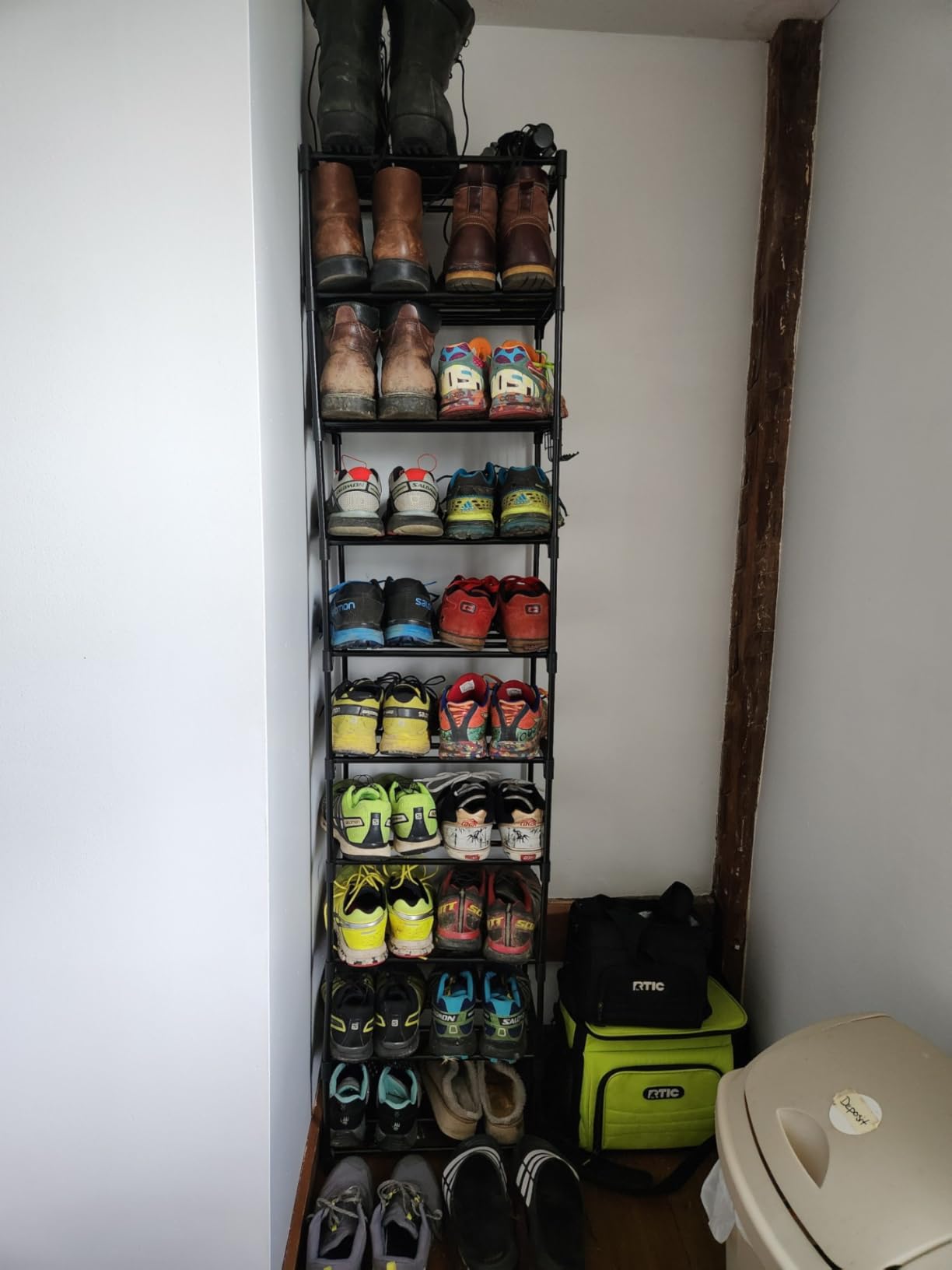
Included hooks add a small but real benefit: keys, an umbrella and a bag hang at the top instead of on a hook drilled into the wall. That matters in a rental, and it is the difference between a rack and a proper drop zone.
Two construction details stand out. It is backless, so you can push it flat against a wall or a baseboard without a gap, and the powder-coated metal resists rust, which is what you want in a wet-coat climate. Rated to 100 lb overall.
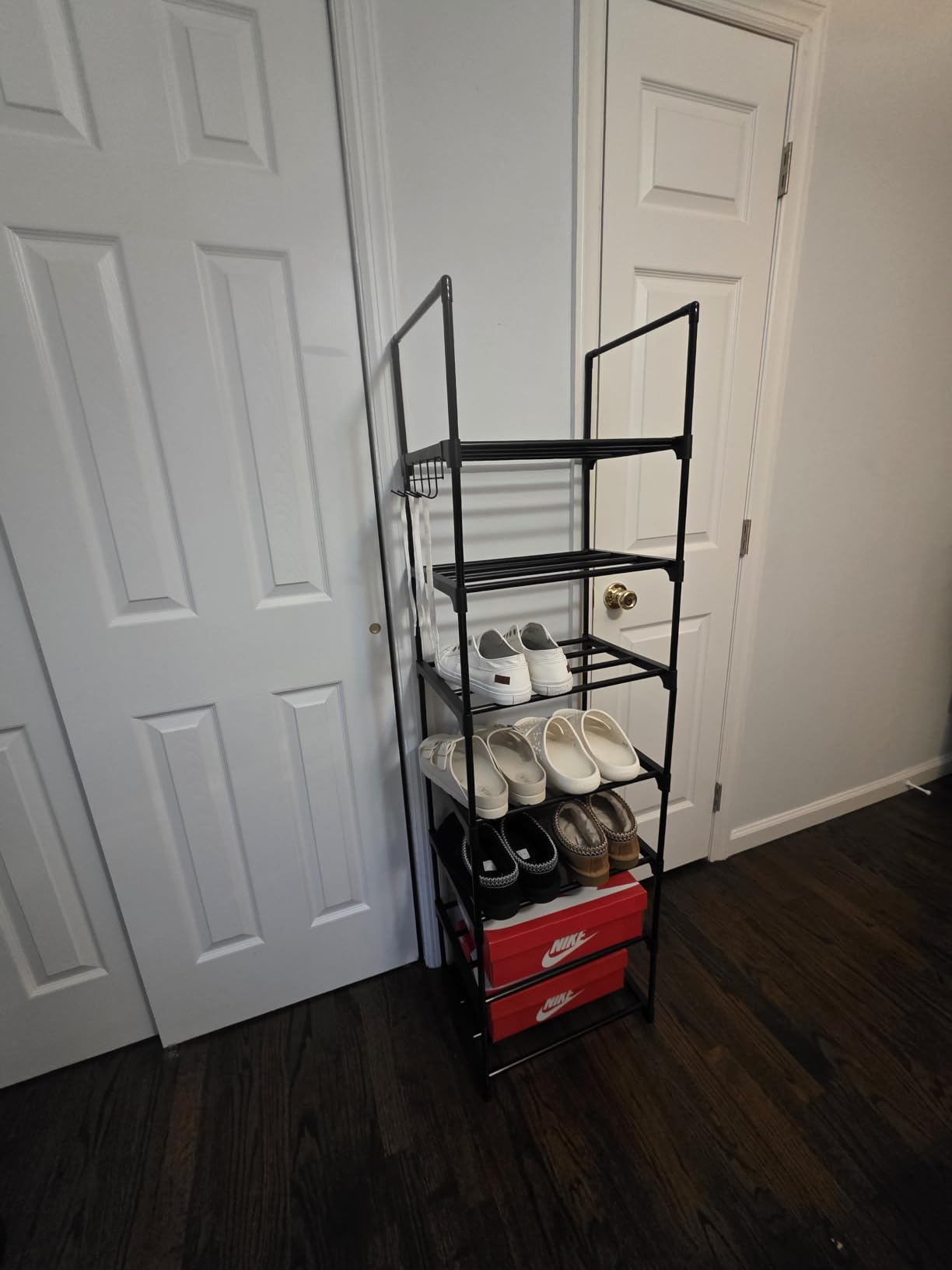
The right answer for a narrow hallway
If your wall run is under 20 inches, this is the pick. It sits in a corner beside a door, turns a sliver of unused vertical space into real storage, and holds more pairs than most three-tier racks twice its price tier.
Removable tiers are the feature we would use most. Pull one out and the two slots above it merge into a taller bay, so knee-high rain boots live at the bottom rather than being exiled to the closet.
Build it properly the first time
The repeated complaint in reviews is missing connector bars arriving in the box, and the second is wobble from poles that were not fully seated. Count the parts against the instruction list before you build, and push every pole home with a flat palm rather than a thumb.
Shelf spacing is tight, roughly 7.87 inch, so chunky footwear and slippers can slide off if placed loosely. Push pairs fully back until the uppers touch the frame. At 5 lb it is easy to move, and a 1 year warranty comes with it.
6. KEETDY 3-Tier Long Metal Shoe Rack: Best for Boots
KEETDY 3-Tier Long Shoe Rack for Closet Metal Shoe Organizer for Entryway, Wide Stackable Shoe Storage Shelf with Sturdy Wire Grid for Closet Floor, Bedroom, Black
Metal frame with wire grid shelves
11.4 inch D x 43 inch W x 24.4 inch H
8 inch shelf spacing, 50 lb maximum
Pros
- 43 inch length fits 5 to 6 pairs per shelf
- 8 inch shelf gap takes boots as well as flats
- Two of these racks stack into a 6-tier rack
- Open wire grid sheds dirt and shows contents
- Screws and a screwdriver included in the box
Cons
- Very wide
- needs a full wall or long hallway
- Shelves have slight give in the middle
- Listed weight of 16 ounces understates the real heft
Boot compatibility is the whole story here. The 8 inch shelf gap is the tallest clearance on any three-tier rack we tested, and it is the reason the KEETDY stores work boots, snow boots and chunky hikers without tipping them over.
Length is the trade. At 43 inch wide it holds 5 to 6 pairs per shelf, so total capacity across three tiers is generous, but this is a full-wall unit. It suits a long hallway, a mudroom wall, or a garage, and it does not suit a small entryway with a door swing.
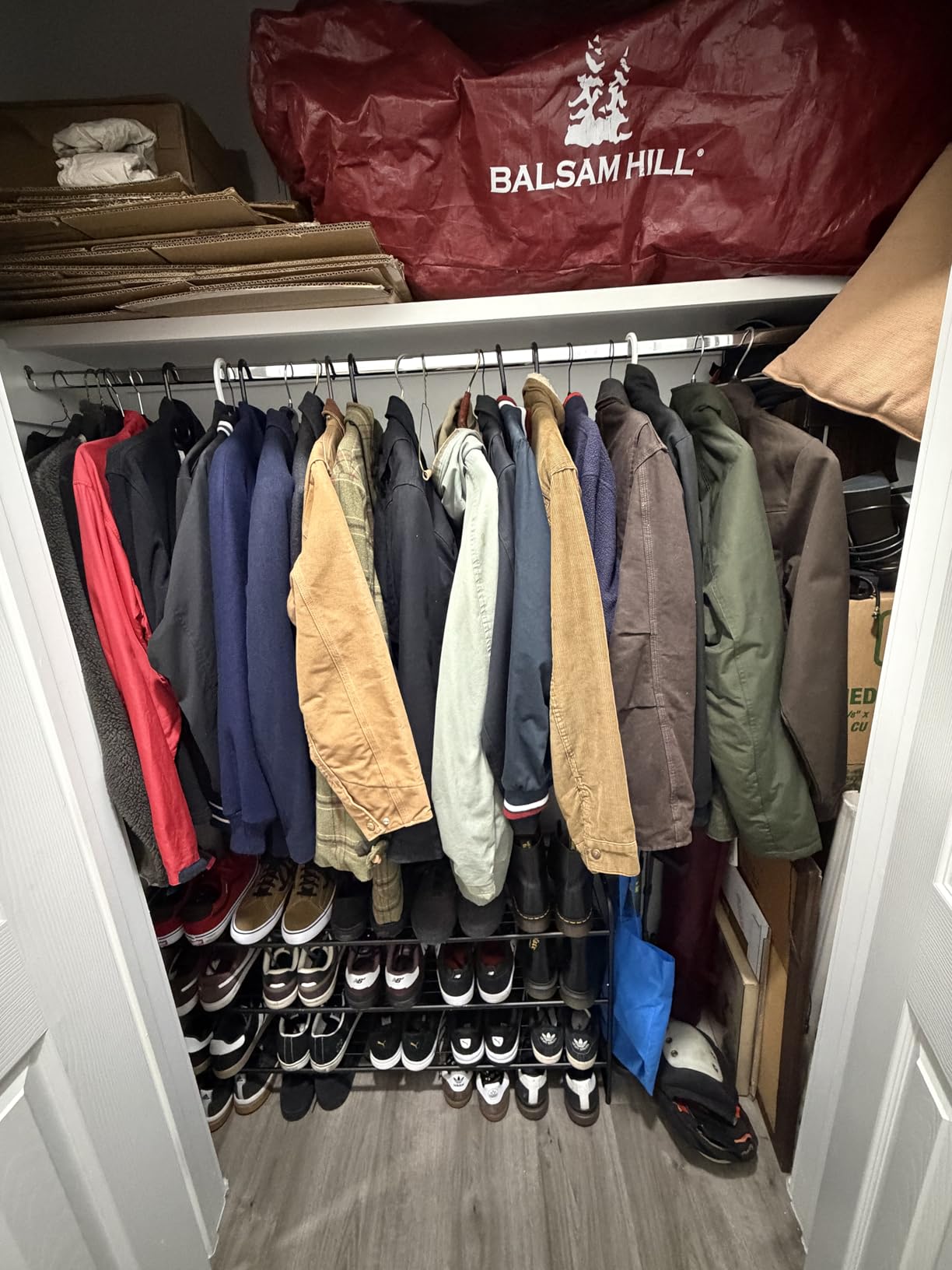
The wire grid is a genuinely smart surface for boots. Grit falls straight through instead of settling in the grooves, and the grid holds a sole flat in a way that a slatted shelf does not. You can see every pair without lifting anything.
Assembly is tool-light: screws and a screwdriver are included, so you need no drill. Two of these units stack into a six-tier rack, which is how you get a proper boot wall if your household runs more than one pair of work boots.
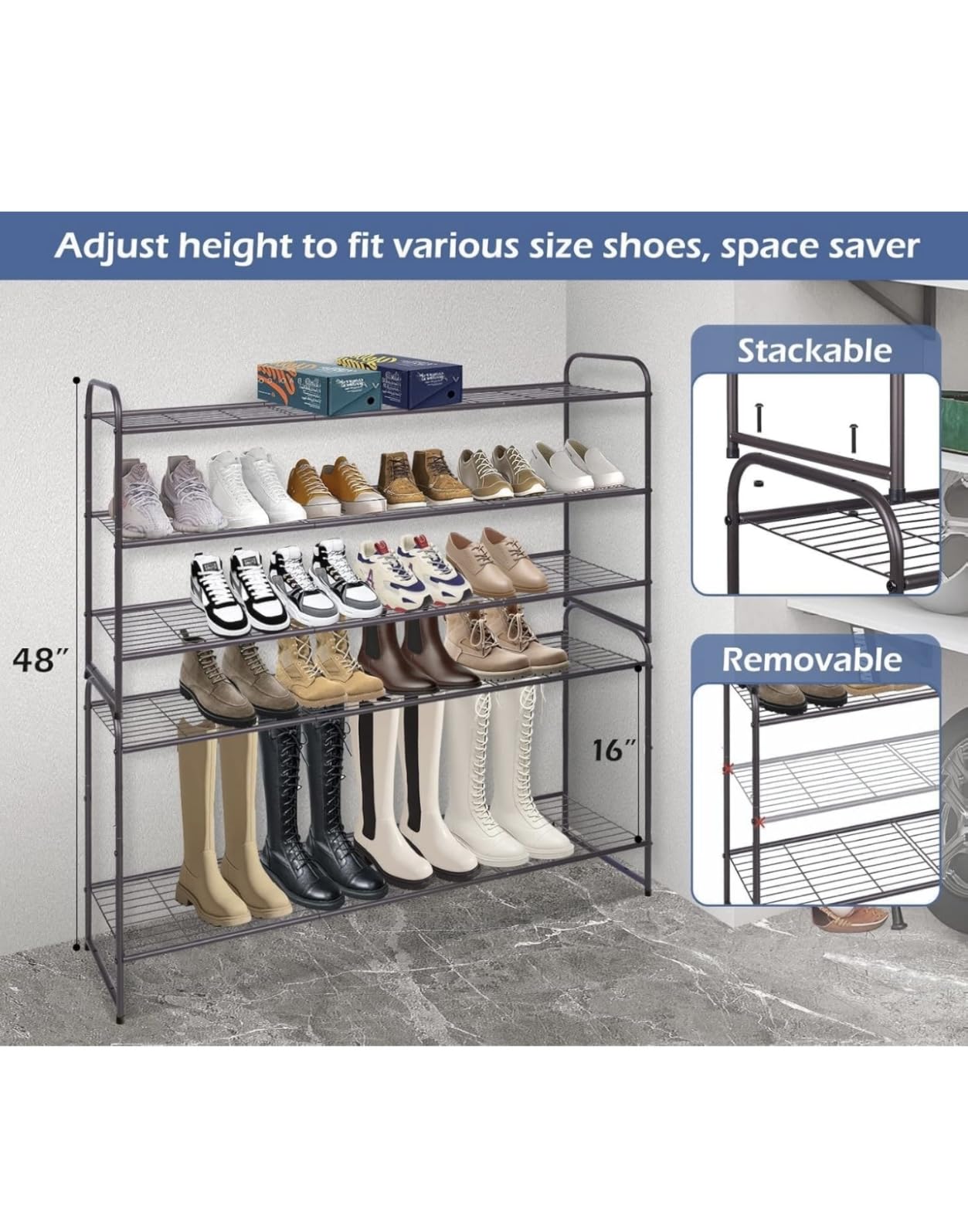
When boots are the daily uniform
If rain boots or work boots get worn every day, this is the pick. 8 inch of clearance takes a mid-calf boot stood upright, and the bottom tier is low enough that you can slide boots on without lifting your foot awkwardly.
The wide span also means fewer pairs get moved to reach the ones behind. In testing, a longer shelf was genuinely easier to use than a deeper one, because nothing gets trapped at the back.
Check your wall before ordering
43 inch is wide. Measure the clear run of wall, add the baseboard, and confirm nothing else needs that stretch. If a radiator or a door swing claims part of the run, this will not fit and a slimmer tower will.
Two honest weaknesses: the mid-span shelves have slight give and occasionally need a shim under the front feet, and the listed weight of 16 ounces badly understates the real heft, so plan for two people to carry it.
7. ROMGUAR CRAFT 3-Tier Bamboo Shoe Rack: Best Stackable
ROMGUAR CRAFT 3 Tier Bamboo Shoe Rack for Closet Free Standing Wood Shoe Shelf Storage Organizer for Entryway Small Space Stackable 27″x11″x20″ (Natural)
Carbonized bamboo, polished finish
11 inch D x 27 inch W x 20 inch H
3 shelves, holds 20 to 90 lb
Pros
- Carbonized bamboo resists cracking and warping
- Stackable units build into 4
- 5 or 6 tier racks
- Assembly takes about 10 minutes with hardware included
- Weighs only 3.8 lb and moves between rooms easily
- Warm grain suits entryway and hallway decor
Cons
- Wood grain and colour vary from piece to piece
- Shelving is slimmer than engineered-wood rivals
- Capacity per tier runs modest for the 27 inch width
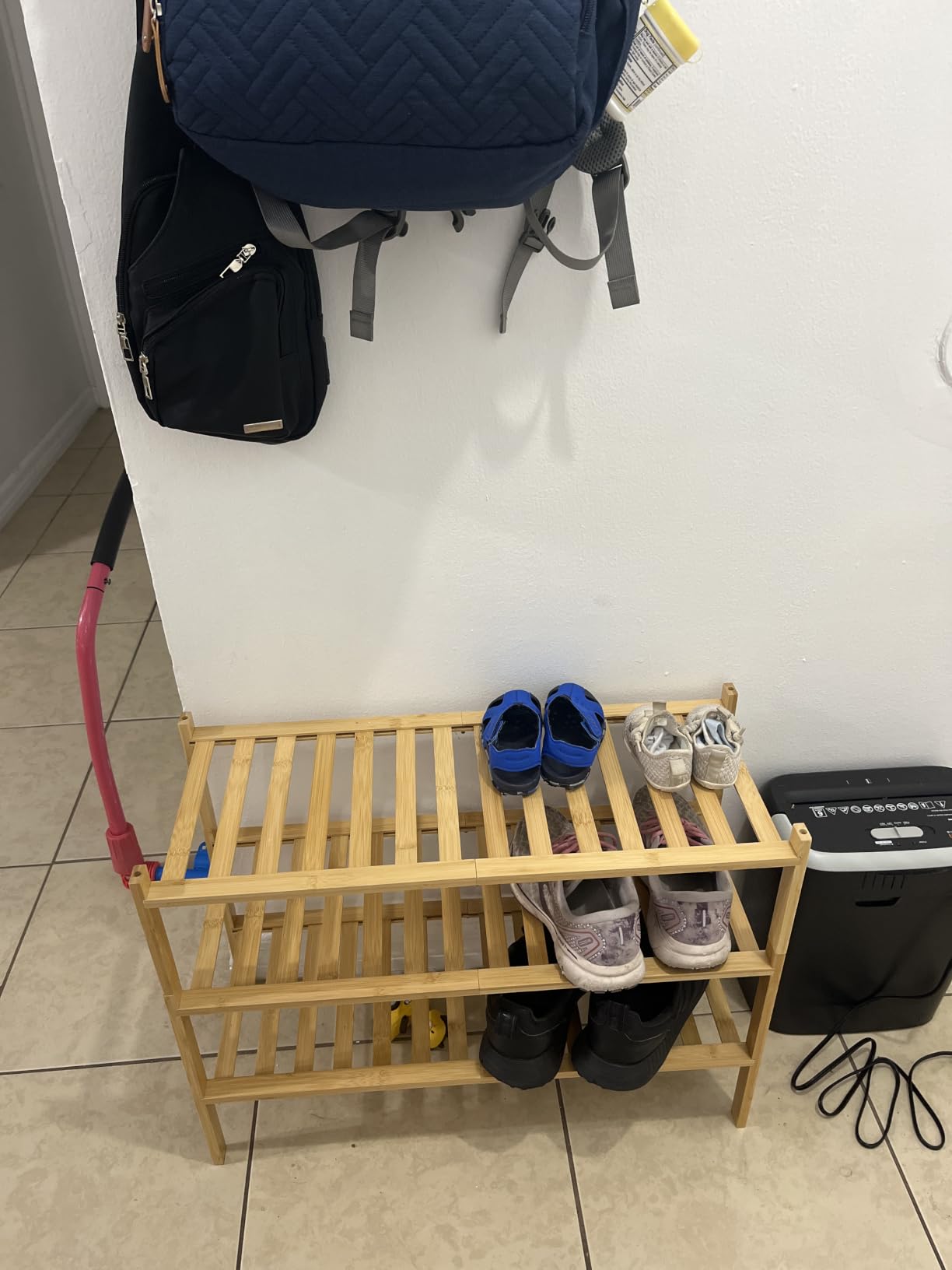
Stackability is what separates the ROMGUAR CRAFT from the other bamboo racks. Buy two and they build into a four- or six-tier unit, so you start with the capacity your wall allows now and add height later if the shoe collection grows.
Carbonized bamboo is the detail worth knowing. The high-temperature treatment is what resists the cracking and warping that make untreated bamboo sag in a humid entryway, and it is why this one survives a wet-coat winter better than a plain bamboo frame.
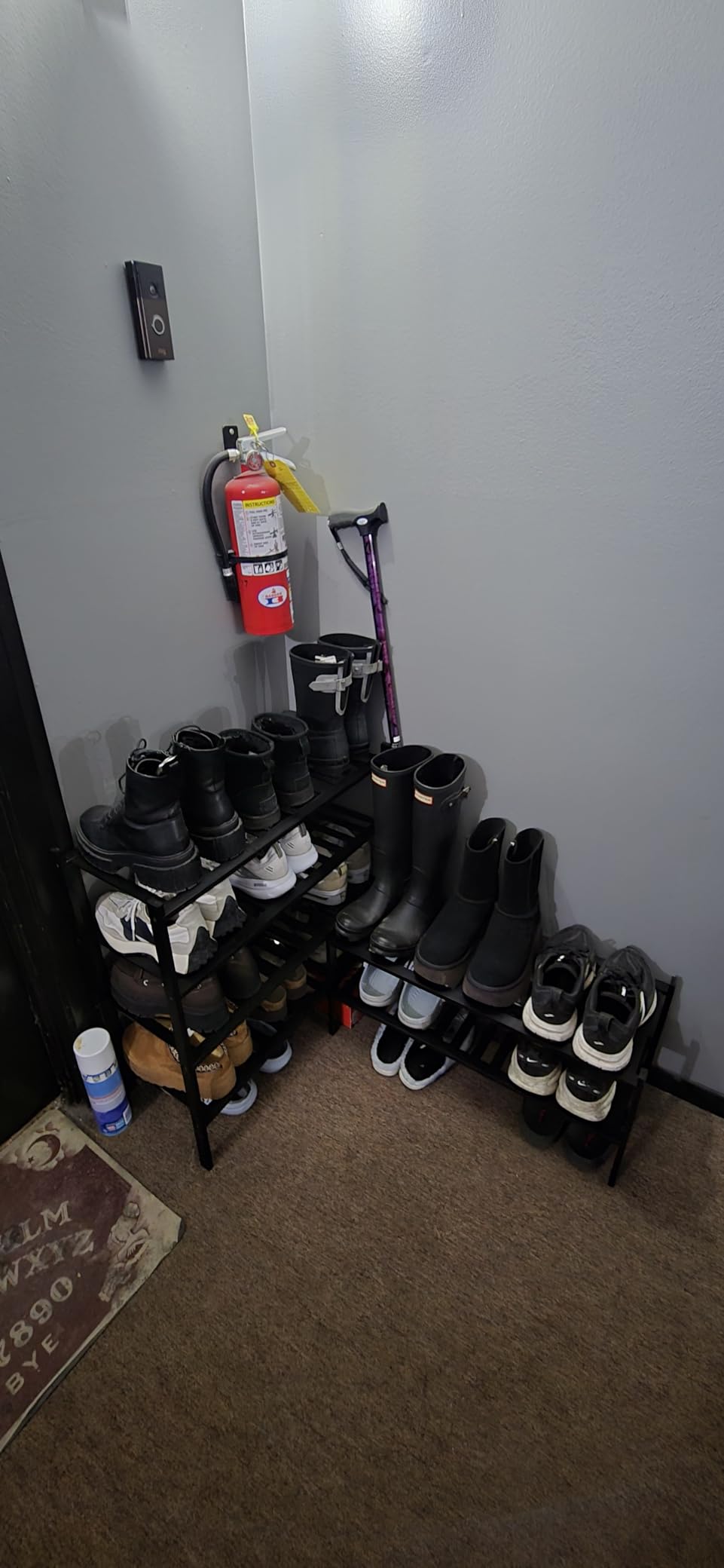
It is also honest furniture for a front hall. The natural grain and polished finish read warmer than black metal and less utilitarian than particleboard, so it does not look like garage equipment in a space people walk through first.
Assembly is about 10 minutes with all hardware included, and at 3.8 lb you can carry it between the entryway and a bedroom closet without help. The stated load range runs from 20 lb to a 90 lb maximum.
Best for renters and flexible spaces
Choose this if you are not sure how much capacity you need. Three tiers is enough to start, and a second rack doubles the height rather than widening the footprint, which is the constraint that usually bites first.
It is versatile beyond shoes, too. We used it for folded towels in a bathroom and for cookbooks in an office, and the same stackable format works for either.
Where capacity disappoints
At 4.4 stars, the rating reflects finish consistency and capacity rather than structure. Grain and colour vary from piece to piece, so a stack of two can show a visible mismatch if the boxes came from different shipments.
Shelving is slimmer than engineered-wood competitors, so fewer pairs fit per tier than the 27 inch width suggests. If you need close to 20 pairs, buy a second rack and stack the two rather than planning around one.
8. HOOBRO 5-Tier Shoe Organizer with Adjustable Mesh Shelves: Best for Heels
HOOBRO Shoe Rack for Entryway, 5-Tier Shoe Organizer with Adjustable Mesh Shelves, 16-20 Pairs of Shoes, Spacious Floor Mount, Metal, Industrial, Shoe Shelf for Closet, Rustic Brown BF12XJ01
Matte metal frame with rust brown finish
11.8 inch D x 29.5 inch W x 31.8 inch H
5 tiers, 16 to 20 pairs, 44 lb top
Pros
- Mesh shelves tilt or level for heels and boots
- Each shelf holds 4 to 5 pairs
- 16 to 20 total
- Spacious top shelf for keys
- photos or decor
- Frame resists bending with age
- Rustic brown and black reads as retro industrial
Cons
- One of the heavier open racks here at 15.6 lb
- Assembly required with the included tools
- Mesh openings may not retain very small slippers
The HOOBRO is the rack to buy if heels are part of the daily rotation. Its mesh shelves tilt or adjust, so a stiletto sits supported rather than balanced on a point, and that single feature removes the most common reason stilettos end up on the floor.
Capacity is steady rather than spectacular: 4 to 5 pairs per shelf, 16 to 20 pairs across five tiers, with 22 lb per shelf and a 44 lb top surface rated for a plant, a lamp or a stack of mail.
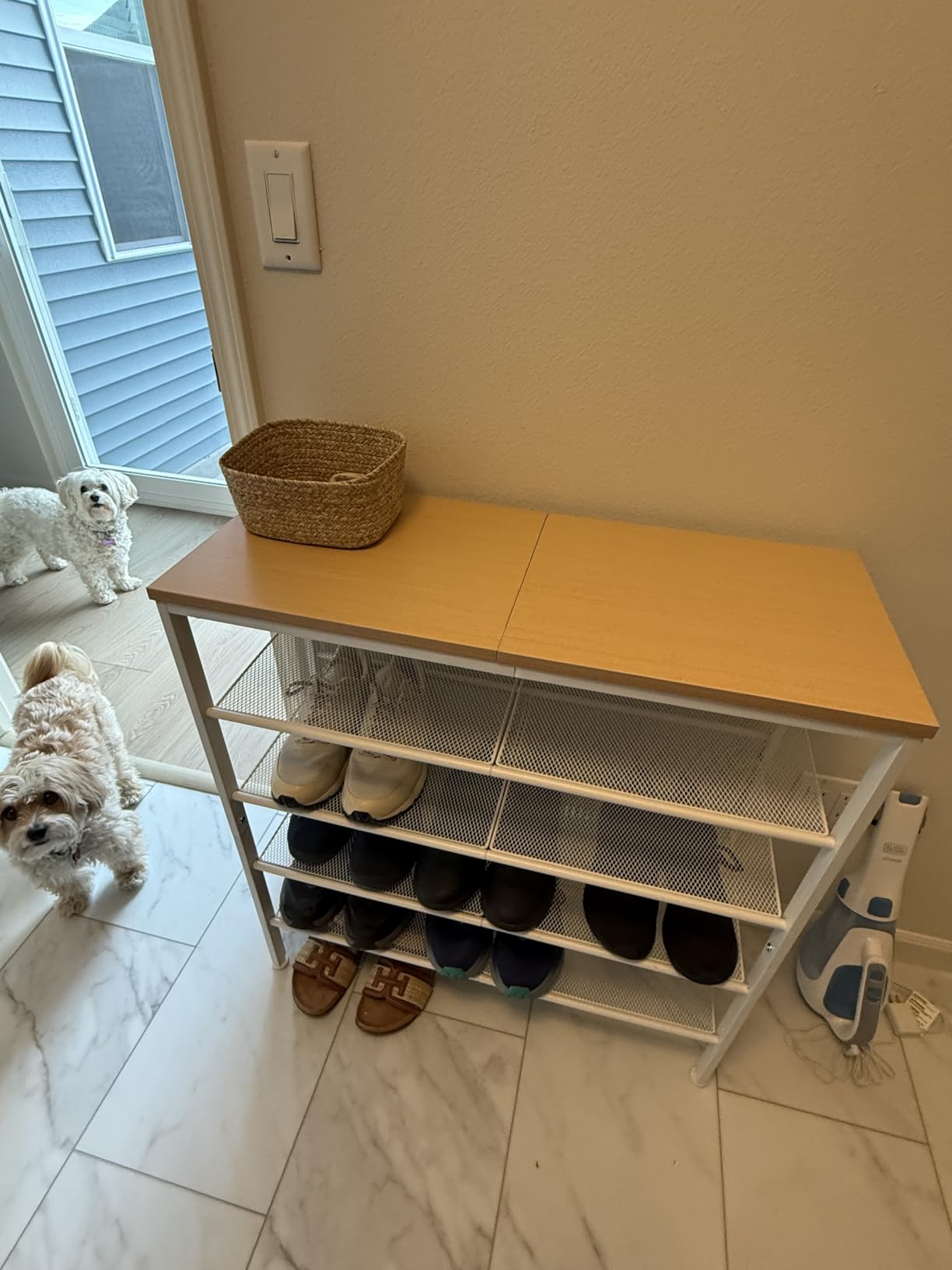
The retro-industrial finish in rust brown and matte black suits a hallway with exposed brick, dark wood or black metal furniture. It is the one open rack in this roundup that looks deliberately chosen rather than purely practical.
At 31.8 inch tall and 29.5 inch wide, the footprint matches the five-tier size most people picture, and the frame resists bending as it ages, which is the durability question buyers actually ask about two years in.
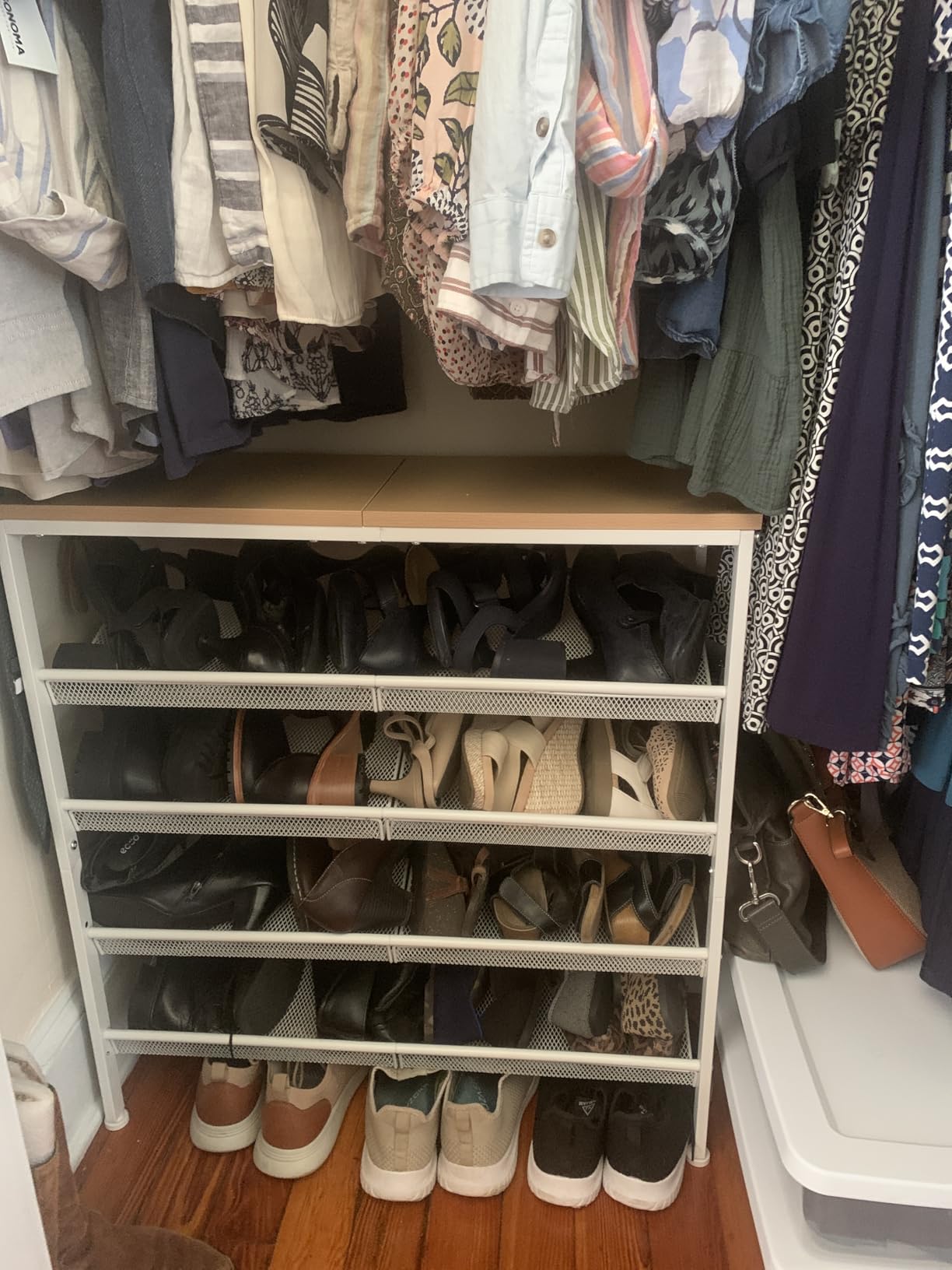
Best for a styled entryway
If you want storage that looks intentional, this is the pick. The adjustable shelves mean you can dedicate one bay to heels and another to boots, and the top surface doubles as a decor shelf where a plain metal rack would show screws.
It also handles mixed households well, because 16 to 20 pairs is a realistic capacity for two to three people keeping daily shoes at the door.
The weight and the small stuff
At 15.6 lb it is one of the heavier open racks in our list, so moving it takes two people or one determined one. Assembly is required using the included hardware, and it takes longer than a snap-together frame.
One genuine limit: the mesh openings will not retain very small slippers or soft shoes, which tend to slide through. Keep those elsewhere, and the rack handles everything else well.
9. Simple Houseware Wooden Top Shoe Bench: Best Warm-Top Bench
Simple Houseware Wooden Top Shoe Rack Bench for Entryway, Rustic Brown
Alloy steel frame with engineered wood top
11.25 inch D x 29 inch W x 17 inch H
2 tiers for up to 6 pairs, 250 lb seat
Pros
- Combines a 250 lb rated bench seat with shoe storage
- Wood top gives a warmer
- less industrial look
- Assembles in under 10 minutes with included hardware
- Holds up to 6 pairs
- Light enough to move between rooms
Cons
- Shelf gap is tight for high-tops and excludes work boots
- 29 inch width fits fewer adult pairs across
- Some units show inconsistent weld and fastener quality
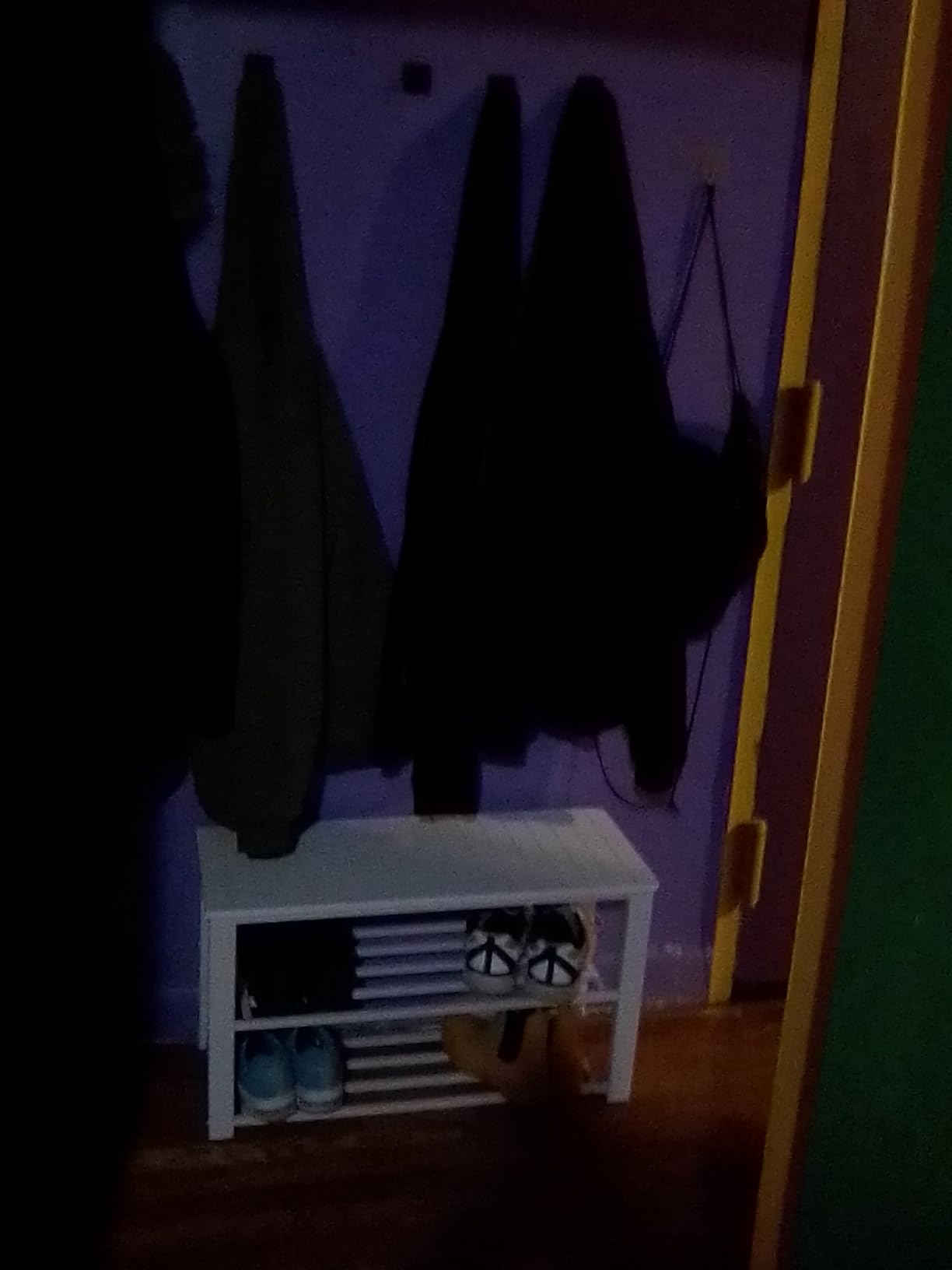
The difference between this and a metal-frame bench is the top. Engineered wood changes the whole feel of a front hall, giving you a surface for a tray of keys, a plant or a bag rather than a cold steel frame that looks like shop equipment.
The seat is rated to 250 lb, which is more than double what most adults bring to a bench, and each of the two shelves takes 25 lb. Total shoe capacity is up to six pairs, so this is a daily-wear bench, not a collection store.
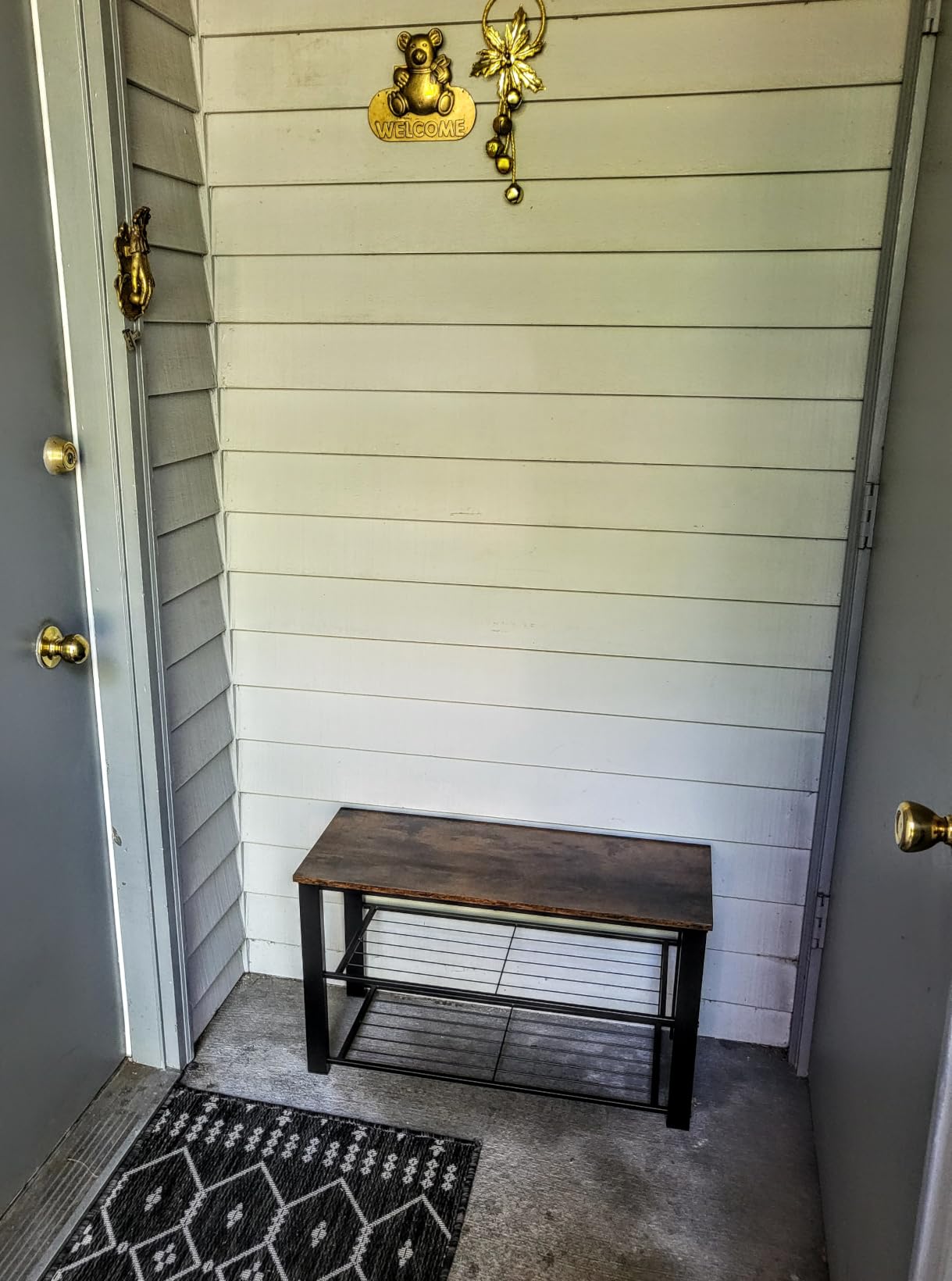
Assembly takes under 10 minutes with the included hardware and a simple structure, and the seat height of 17 inch is comfortable for adults and older children. It also works in a bedroom or living room, which is handy if you ever want the entryway corner back.
At 29 inch wide and 11.25 inch deep, it fits a typical hall wall without projecting into the walkway, and the rust brown finish pairs easily with wood furniture and neutral paint.
Best for a small, warm entryway
Pick this when the entryway has to work as a hallway and a seating spot. A flat wooden top takes a boot tray, a small dish for keys and a plant, and that combination is what makes an entryway feel like a room rather than a drop zone.
It is a good second zone for a bedroom, where the 250 lb seat matters more than shoe capacity.
Adult footwear is the limit
Be realistic about clearance. The shelf gap is tight, so high-top sneakers do not sit flat and work boots will not fit at all. Reviewers mention adult footwear height as the recurring limitation, not the build quality.
Build quality is the other watch item: some units show inconsistent weld and fastener finishing, so check the frame for wobble on a flat floor before you load it. Six pairs is also fewer than a family needs, so plan on a second storage point for everything that is not worn today.
10. UVIAHOMI 20-30 Pair Over the Door Organizer: Best Over-the-Door Upgrade
UVIAHOMI 20-30 Pairs Over the Door Shoe Organizer, Clear Pockets Hanging Shoe Storage for Closet, 10-Tier Door Shoes Rack, Handing Shoes Holder Fit All the Family’s Sneakers, Boots, Heels, Black
Non-woven fabric with clear PVC windows
10 inch D x 22.5 inch W x 73 inch H
20 pockets, holds 20 to 30 pairs, 80 lb total
Pros
- 20 extra-wide pockets hold 20 to 30 pairs
- Breathable non-woven fabric reduces odour
- Clear PVC windows make shoes visible at a glance
- Four metal hooks rated 20 lb each
- No assembly
- hangs straight from the door
Cons
- Fits doors 1.37 to 1.98 inch thick only
- Can swing slightly when the door moves
- Bulky shoes fit snugly in the pockets
- New PVC may carry a brief odour that fades
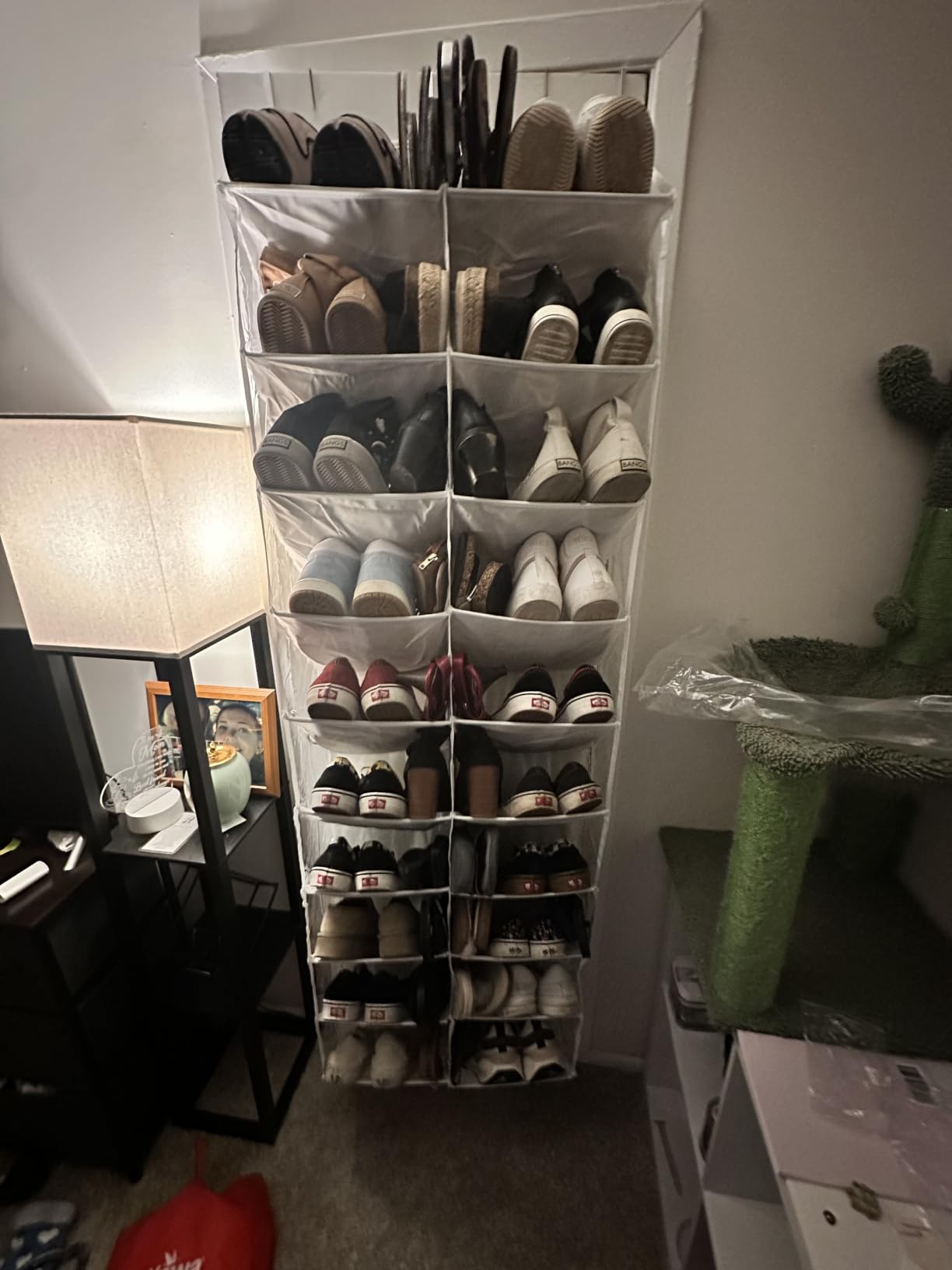
This is the over-the-door pick when you have more shoes than 24 slim pockets can take. Users report packing more than 30 pairs into a small closet, and the extra-wide pockets are the reason chunky sneakers and boots fit at all.
At 22.5 inch wide and 73 inch tall it covers most of a standard door, and the breathable non-woven fabric is a meaningful upgrade over solid fabric: it lets moisture escape, which is what stops a door-hung rack from turning into a musty cupboard.
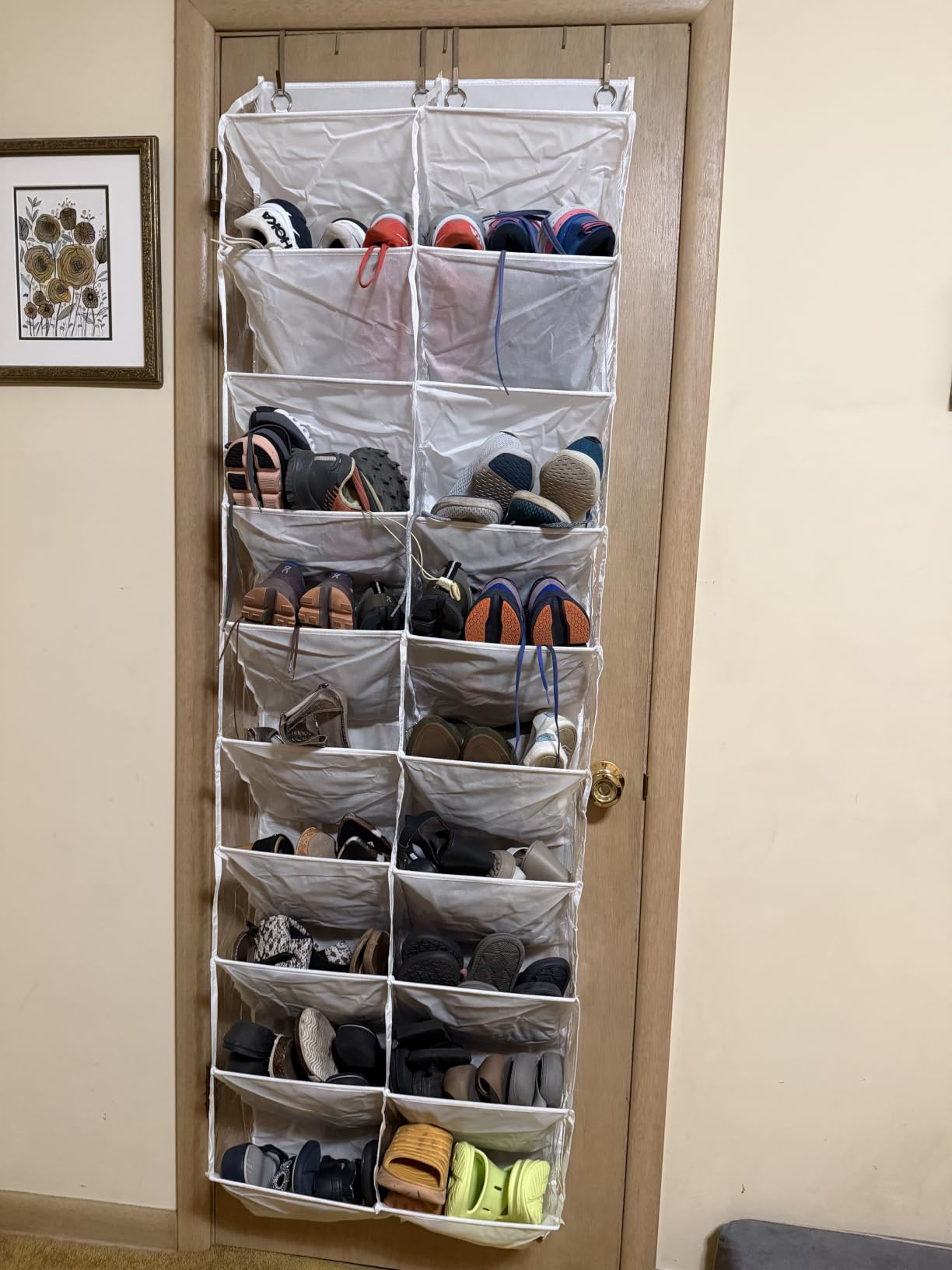
Clear PVC windows make the contents readable at a glance, so nobody has to unzip or dig. Four metal hooks carry 20 lb each for an 80 lb total, spread across the top of the door rather than concentrated on one edge.
There is no assembly at all. It unhooks, hangs and is done, which makes it the easiest relocation in this roundup when you move home or rearrange a hallway.
Best for family shoe overflow
A household with three or four people, or anyone who wants to keep a full set of seasonal shoes near the front door, gets the most out of this. Because the pockets are extra-wide, the whole family fits in one panel instead of two.
The no-drill approach also makes it a favourite for rentals, dorms and any home where drilling into a door is not an option.
Check door thickness and swing
The fit window is 1.37 to 1.98 inch of door thickness, which covers most standard interior doors but not every thick modern slab door. Measure before ordering rather than assuming.
At 1.1 lb the panel is light, and that is also why it can swing slightly when the door opens and closes. Bulky shoes fit snugly, so expect to compress a pair rather than drop it in, and expect a faint new-plastic smell that fades within a few days.
11. BORNOON 3 Flip Drawer Shoe Cabinet: Best Hidden Storage
BORNOON Shoe Cabinet with 3 Flip Drawers, Hidden Wood Shoe Cabinet,Freestanding Shoe Storage Cabinet for Entryway Hallway.White. 47.2″ H*31.5″ W*9.45″ D.
FSC certified engineered wood cabinet
9.45 inch D x 31.5 inch W x 47.24 inch H
3 flip drawers, 18 to 24 pairs
Pros
- Flip drawers hide shoes and keep out dust
- Stores 18 to 24 pairs behind a closed front
- Adjustable and removable panels fit flats
- boots or heels
- Anti-tipping strap included for wall anchoring
- Smooth surface wipes clean and resists scratches
Cons
- Heaviest unit in the roundup at 59.9 lb
- Bulkier than any open rack
- Requires assembly and wall anchoring
The BORNOON is the only closed option here, and that is exactly why it exists. If the idea of visible shoes in the first room guests walk into bothers you, a flip-drawer cabinet is the single change that fixes the look.
Three flip drawers each hold two tiers of compartments, storing 18 to 24 pairs behind a clean facade. Panels are adjustable or removable, so you can set one bay for flats and one for mid boots rather than forcing everything into one spacing.
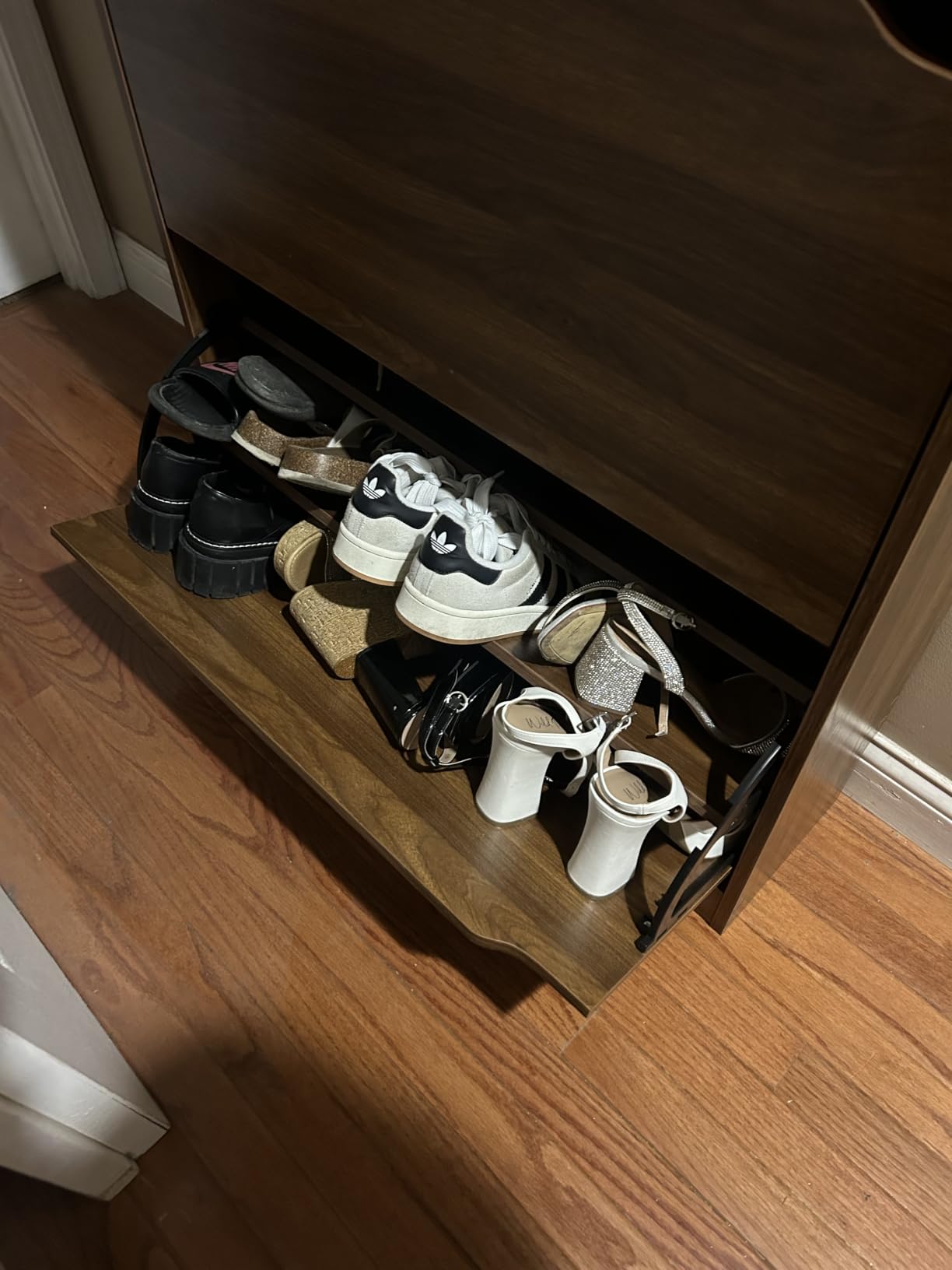
It also solves the dust problem. Open racks collect grit on every slat, and flip drawers keep shoes enclosed until you pull them out, which is a real difference in a hallway where shoes are rarely cleaned between wears.
Two details set it apart from cheaper cabinets: an anti-tipping strap for wall anchoring comes in the box, and the top surface is stable enough to be a genuine drop zone for keys and post.
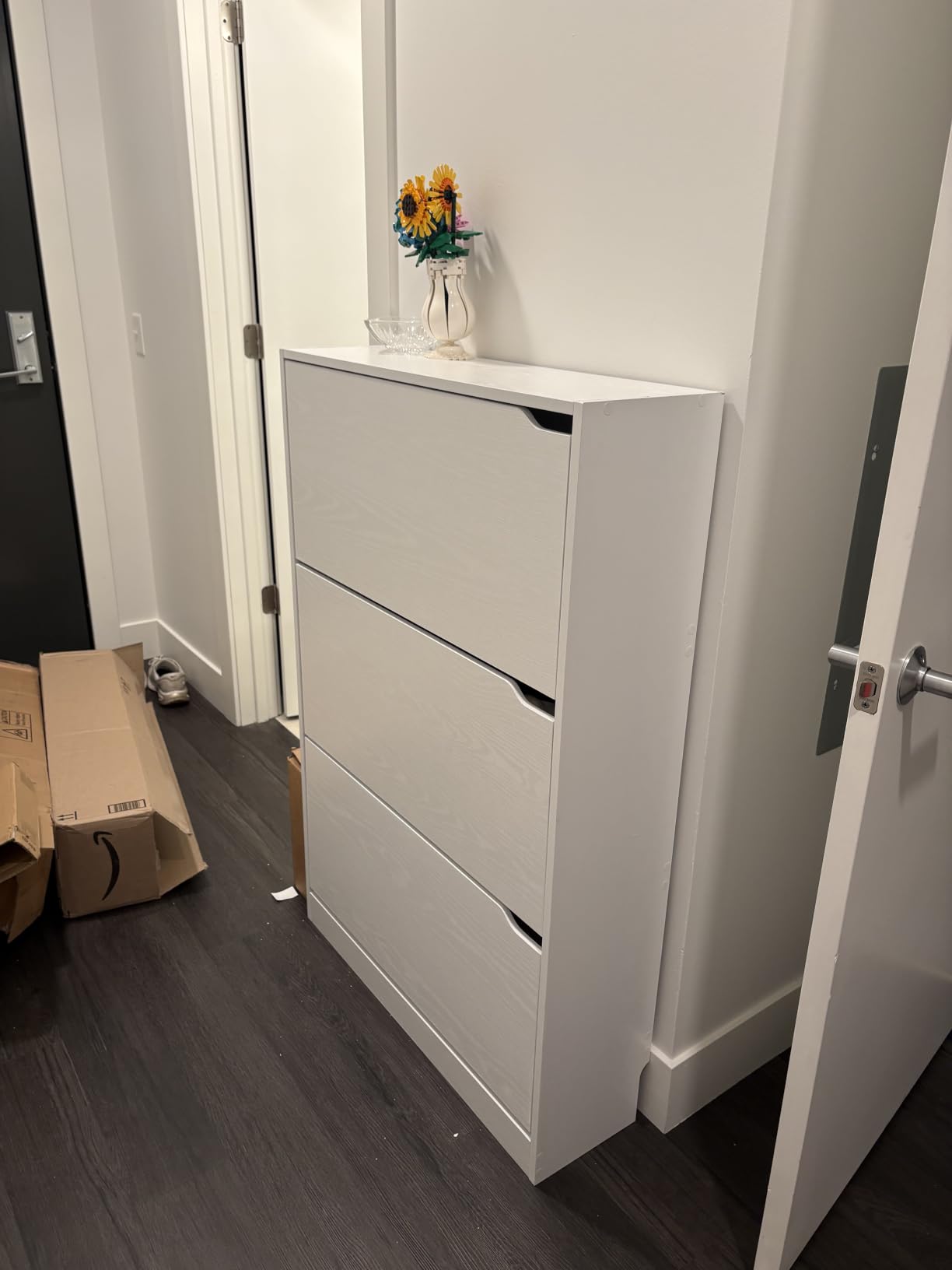
Best for a finished, furniture-grade look
Choose this when the entryway is a design problem as much as a storage problem. A 9.45 inch depth keeps it slim against a wall, and the white FSC certified engineered wood reads as furniture rather than storage equipment.
It is also the only unit in this roundup that comes with anti-tip hardware, which matters in a hallway where children run.
The weight is the whole trade-off
At 59.9 lb this is by far the heaviest unit we tested, and it needs assembly plus wall anchoring before it is safe. Moving it into position takes two people, so measure carefully first.
It is also taller and wider than any open rack here, and a closed cabinet with no ventilation can hold damp in a humid hallway. Leave the drawers cracked after wet boots go in, and it will be fine.
12. SNTD Expandable 2-Tier Metal Shoe Rack: Best Expandable Rack
Expandable Metal Shoe Rack for Closet, Entryway & Garage, 2-Tier, Black
Powder-coated metal with dense mesh shelves
11.6 inch D x 30.5 inch W x 17.1 inch H
2 tiers, up to 8 pairs, 200 lb max
Pros
- Width expands from 18.6 to 30.5 inch to fit the wall
- Shelf height adjusts for taller boots
- Dense mesh wire grip stops heels teetering
- Powder-coated metal resists sagging and rust
- Adjustable feet stabilise it on uneven floors
Cons
- Only two tiers out of the box
- so capacity depends on adding more racks
- Requires assembly before use
The SNTD solves the problem most racks create: you measure your wall, guess wrong, and are stuck. This one expands from 18.6 to 30.5 inch wide, so it can start narrow in a tight hall and grow as you find out how much you actually need.
Shelf height is adjustable too, so a boot can take a taller slot. It is built from powder-coated metal with dense mesh shelves that grip a heel instead of letting it slide, and the frame is rated from 100 to 200 lb.
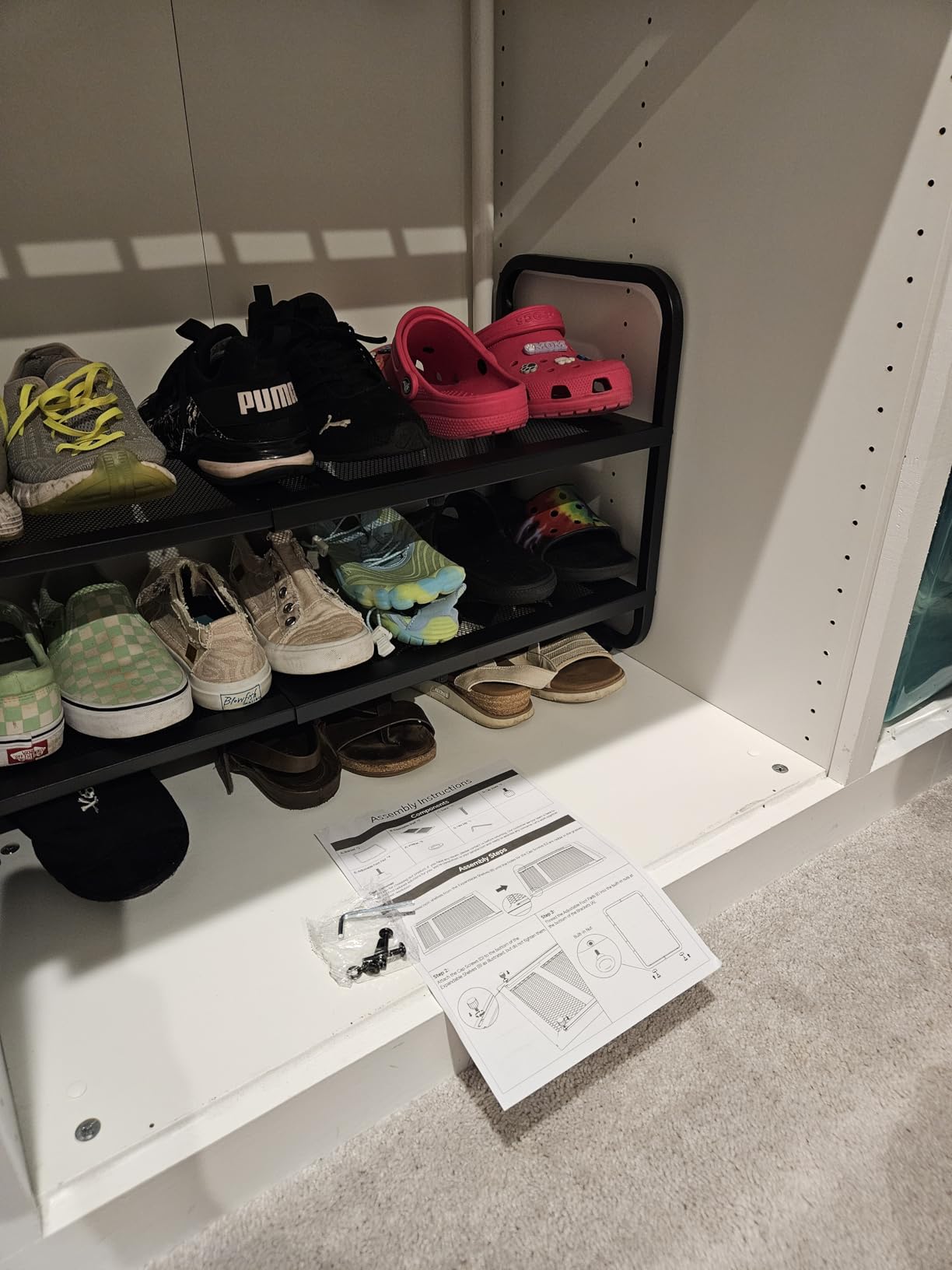
Two of these racks stack into 4, 6, 8 or 10 tier towers, so a single purchase is a starting point rather than a dead end. Adjustable feet handle the uneven floors that make cheaper racks rock, and the powder coating resists rust in a damp entryway.
Assembly takes under 10 minutes with clear instructions and a step-by-step video, which is a better experience than a picture-only leaflet.
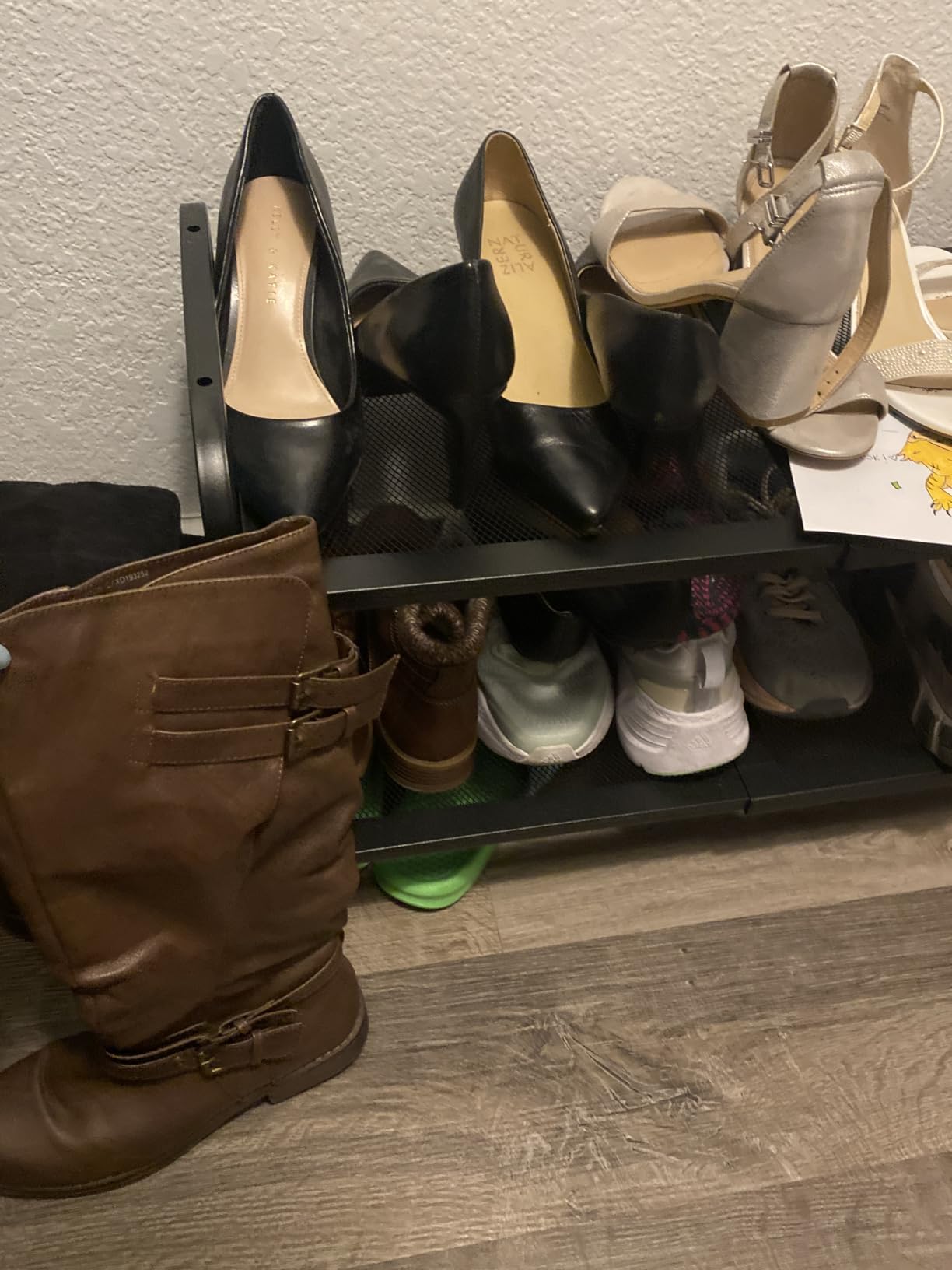
Best when the wall width is uncertain
This is the pick if you are renting, mid-move, or simply unsure how much clear wall you will end up with. The expandability means one purchase covers a narrow hall and a wider one later, without buying twice.
It is also a sensible second piece for a mudroom or garage, where adjustable height and rust resistance matter more than appearance.
Two tiers is genuinely just two
Be clear-eyed about out-of-the-box capacity: up to 8 pairs across two shelves. If you need more, you are buying a second rack to stack, and that is the plan, not a surprise.
It also requires assembly before use, and at 6.2 lb it moves easily once built. Check the mesh openings with very small slippers, which can slip through the same way they do on other mesh racks.
How to Measure Your Entryway Before You Buy
A good shoe rack for a small entryway has to clear the door swing, the baseboard and whatever else claims that wall. Measure the clear run of wall first, then subtract 2 inches for breathing room, and check that the depth stays inside the arc the door sweeps when it opens. A rack that stops the door opening 90 degrees will be bypassed within a week.
Next, check the vertical constraints. Measure the space between the floor and any soffit, light fixture or low ceiling, and note where the baseboard sits, since a backless rack can sit tight to the wall but a cabinet with legs may not.
Finally, look for obstacles. Radiators and baseboard heaters need airflow around them, so a rack that cannot come away from the wall is a poor choice in a narrow hallway, and outlets need to stay reachable for a vacuum or a lamp. Our four-point checklist:
Clear wall width. Measure between the door frame and the nearest obstruction, then subtract 2 inch.
Door swing arc. Open the front door fully and note how far the handle travels.
Vertical clearance. Measure floor to soffit or ceiling, and add 2 inch above the rack for lift-out access.
Heat and outlets. Keep 3 inch of air around a radiator and leave outlets clear.
Reddit users repeatedly flag the same failure in r/HomeDecorating threads: a rack that cannot come away from the wall, bought for a spot that was never measured. Ten minutes with a tape measure prevents that entirely.
How to Organize Shoes in a Front Entryway
The hardware matters less than the routine around it. Reddit users in r/organizing report that the biggest change was not a better rack but making the destination obvious, and a simple sign with an arrow pointing at the storage was the fix that got the whole household using it.
Decide what stays at the door. Daily-wear pairs only, roughly two to three per person. Everything else goes upstairs or into the closet.
Assign a shelf per person. A dedicated tier removes the daily negotiation over whose shoes are where, and it makes a person more likely to put their own pair away.
Set a wet-shoe rule. Rain boots go on a tray in the lowest bay, soles out, never on a shelf above your socks.
Add a drop zone. The top shelf or the bench seat holds keys, post, a dog lead and a small tray, so those stop landing on the floor too.
Rotate seasonally. Move summer shoes upstairs at the first cold morning and bring boots down in the autumn, rather than trying to store both all year.
Empty the overflow monthly. Shoes that have not been worn in a month leave the entryway. Capacity problems are usually a rotation problem first.
Professional organizer Caroline Solomon, founder of Neatly in New York, is credited with a rack recommendation sourced through Living Cozy. Forum posters make the broader point independently: designing for how a household actually behaves, rather than for how you would like it to look, tends to win. Open storage often ends up neater in practice precisely because a pair is visible and easy to put back.
How Many Pairs of Shoes Should Entryway Storage Hold?
Entryway storage should hold 6 to 12 pairs for a couple, and 15 to 20 pairs for a family of four. That baseline assumes daily-wear shoes only, with everything seasonal stored elsewhere. Most entryway clutter is not a capacity failure but a rotation failure: a rack holding every pair the household owns looks empty until it is overstuffed with the wrong shoes.
Budget roughly 2 to 3 pairs per person at the door. A single person needs a slim tower or an over-the-door organizer, a couple need one five-tier rack, and a family of four plus kids generally needs a five-tier rack or cabinet alongside a separate boot solution.
Households of five or more should assume two storage points rather than one giant unit, because the largest rack that fits through a doorway and around a door swing is usually smaller than the capacity they actually need.
Bamboo, Metal or Wood: Which Entryway Shoe Rack Material Lasts?
Bamboo offers warmth and a natural look but needs care to prevent scratching. Powder-coated metal is the most durable and weather-resistant option, making it the best choice for high-traffic entryways and wet boots. Engineered wood gives you the furniture look with a heavier, dust-hiding cabinet form, and particleboard is the option to avoid for anything load-bearing.
In practice, that trade-off is about your entryway rather than the rack. A dry, tidy hallway can run on bamboo for years. A wet-coat climate that brings muddy boots through daily should be metal, because a coated surface wipes clean and does not absorb moisture at the joints.
For heels and stilettos, dense mesh metal beats solid slats because the wire grips the sole. For dust and a finished look, a closed engineered-wood cabinet beats everything open. For weight, expect bamboo and light metal at under 10 lb, engineered wood racks in the 13 to 16 lb range, and a full cabinet around 60 lb.
Is It Okay to Have a Shoe Rack in Your Entrance?
Yes, a shoe rack in the entrance is not only okay, it is the most functional thing you can put there. The question people are really asking is whether it will look cluttered. A slim cabinet, a bench with cubbies, or a vertical tower tucked against a wall reads as furniture, and the alternative is a floor covered in shoes, which is what you were trying to fix.
Two things keep it looking intentional. Keep the footprint clear of the door swing so the walkway stays open, and keep the visible pairs down to daily wear only, because an open rack showing twenty pairs looks like storage while an open rack showing six looks like a home.
If the front door is the only surface you have, an over-the-door organizer is the answer, and it uses no wall or floor space at all. If you want the same corner to handle coats and bags as well, our best shoe storage cabinets for entryways guide covers the closed-cabinet route in detail.
Safety, Kids and Wet Boots in a Busy Entryway
Entryways are high-traffic family zones, and a tall rack is the one piece of furniture a running child can pull. Any rack taller than about 40 inch should be anchored, and the BORNOON flip-drawer cabinet in this roundup is the only one that ships with an anti-tipping strap. For everything else, wall-mounting a strap to a stud is the cheapest safety upgrade available.
Avoid stacking load on top of a narrow tower. The 10-tier model in this roundup takes 100 lb overall, but that rating assumes pairs spread across the tiers, and a heavy box of boots on top changes the balance entirely. Keep heavy items on the lowest bay.
Wet boots get their own protocol. Put a washable tray or mat under them, choose powder-coated metal or mesh over particleboard so grit and salt wipe away, and never store soaked boots on a shelf above fabric or shoes you care about. If your entryway has no tray, that is the first thing to buy, before any rack.
Finally, check stability on your actual floor. We bumped and slid every rack in this roundup while vacuuming, and the adjustable feet and adjustable frames held steady, while the fixed plastic-connector units rocked.
How to Choose the Right Shoe Rack for an Entryway
There are five architectures that genuinely work in an entryway, and picking between them comes down to which constraint is tightest in your space.
Bench with storage. Best when nobody has enough time to stand. A bench turns the shoe zone into a place to sit, but capacity tops out around 6 to 10 pairs.
Five-tier open rack. Best general-purpose option, holding 16 to 24 pairs from a compact footprint. Adjustable feet matter more than most buyers expect.
Slim vertical tower. Best when wall width is under 20 inch. 20 to 24 pairs from a 17 inch wide footprint, with removable tiers for boots.
Over-the-door organizer. Best when there is no floor or wall space at all, and the only option in a rental you cannot drill into.
Closed cabinet. Best when the look of the room matters more than the price tag. Hides 18 to 24 pairs and dust, at the cost of weight and ventilation.
Tier spacing is the number that decides whether boots and heels fit. Flats and sneakers need almost nothing. Sneakers with a thick sole want roughly 5 inch. Ankle boots want 6 to 7 inch, and knee-high rain boots want 8 inch or more, or a removed shelf. Any rack that cannot give you 8 inch of clearance somewhere is not a boot rack.
On budget, work down rather than up. The lowest spend in this roundup gets you a tool-free metal tiered rack, the middle band gets you a five-tier mesh unit or a stackable bamboo pair, and the top spend gets you a closed cabinet that looks like furniture. Buy the middle band unless your entryway has a specific problem, because the cheapest racks are where wobble complaints live.
Closed or open is a household-behaviour decision, not a style preference. Closed wins if shoes get kicked and left anyway and the visible pile bothers you. Open wins if people are more likely to put a visible pair away than a hidden one. If you are styling the rest of the hall, we covered matching options in our best console tables for entryways picks.
Frequently Asked Questions
What is the best shoe rack for an entryway?
The best shoe rack for an entryway is one that fits your wall width, holds your daily-wear pairs, and survives wet boots. For most homes a five-tier metal mesh rack or a bamboo storage bench is the strongest all-round choice, because both give you 6 to 20 pairs of capacity from a compact footprint and both wipe clean.
Is it okay to keep a shoe rack in the entrance?
Yes. A shoe rack in the entrance is one of the most useful things you can put there, because it is the last thing everyone passes on the way out. Keep the footprint clear of the door swing, and keep only daily-wear pairs visible, so an open rack reads as tidy rather than crowded.
What is a good shoe storage rack for an entryway?
A good entryway shoe storage rack comes in five shapes: a bench with cubbies for seating, a five-tier open rack for general capacity, a slim vertical tower for narrow walls, an over-the-door organizer for homes with no spare floor space, and a closed cabinet for hiding dust and keeping the room looking finished.
What is a good shoe rack for a small entryway?
For a small entryway, measure the clear wall width, subtract 2 inch, and keep the depth inside the door swing arc. Under 20 inch of wall, a slim vertical tower holding 20 to 24 pairs is the pick. With no usable wall at all, an over-the-door organizer uses zero floor space and needs no drilling.
How many pairs of shoes should entryway storage hold?
Plan for 6 to 12 pairs for a couple and 15 to 20 pairs for a family of four, counting daily-wear shoes only. That works out at roughly 2 to 3 pairs per person. If you need more than 20 pairs at the door, the problem is rotation rather than capacity, so store seasonal shoes elsewhere.
The Best Shoe Racks for Entryways in 2026
The SONGMICS 3-tier bamboo entryway bench takes our top spot for 2026 because it does two jobs at once: a 286 lb rated seat and storage for about six to nine pairs, in a 27.6 inch footprint that fits a normal hall wall. If your entryway has no usable wall at all, the Simple Houseware 24-pocket over-the-door organizer is the most proven answer we found, with more than 132k reviews behind it.
For capacity in a normal space, the VASAGLE 5-tier mesh rack holds 18 to 24 pairs from the smallest footprint in the open-rack group and stays level on uneven floors. Narrow walls call for the WEXCISE 10-tier tower, and wet boots call for the KEETDY rack with its 8 inch shelf gaps.
Whatever you pick, measure the wall, clear the door swing, and keep daily-wear pairs only at the door. Those three steps decide whether the rack gets used, and usage is what actually clears the floor. For the rest of the corner, our best console tables for entryways guide covers the drop-zone surface that sits right next to it.