
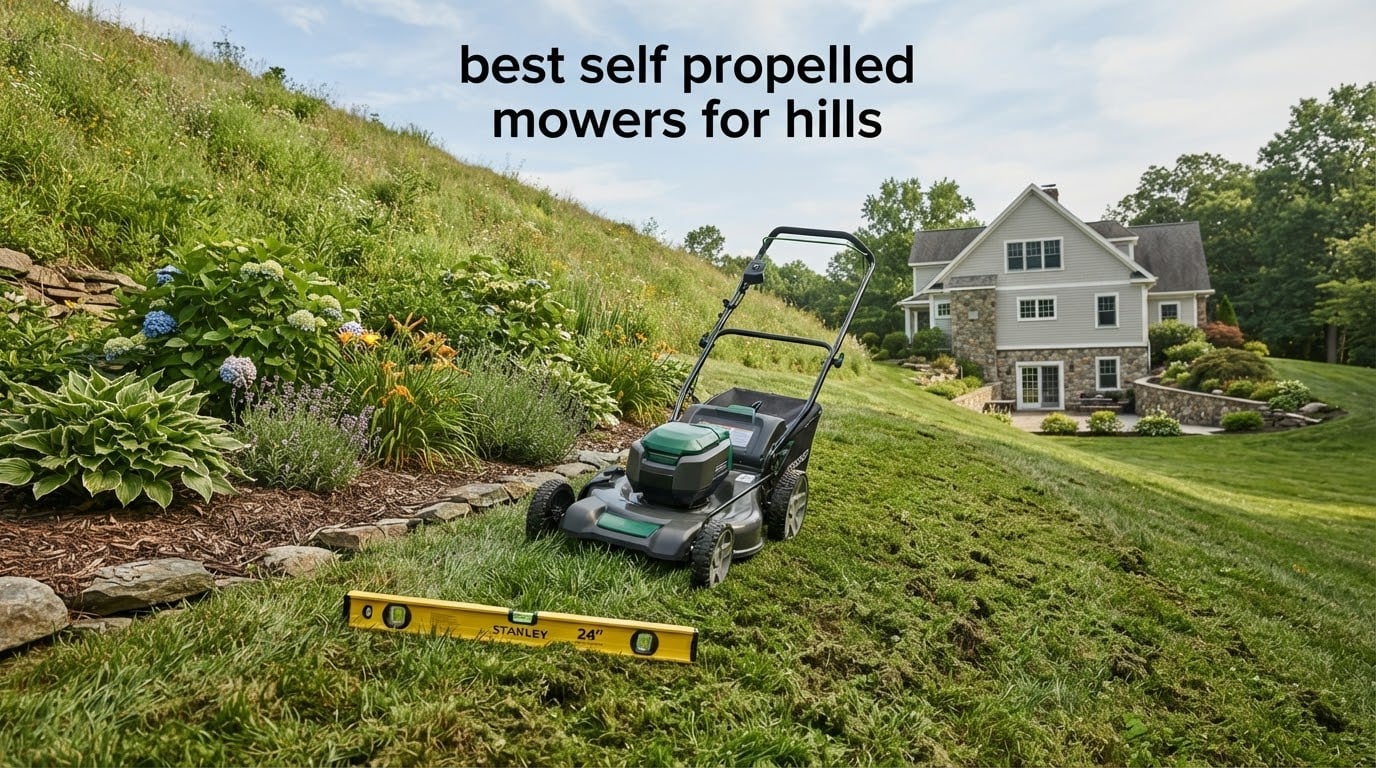
The best self propelled mowers for hills are rear-wheel-drive and all-wheel-drive models with variable-speed self-propel. The drive layout matters more than anything else on a slope, because climbing a grade shifts the mower’s weight rearward onto the driven wheels. Front-wheel-drive mowers lose that loading, their wheels spin, and you end up pushing a running mower up the hill.
That single fact reframes the whole buying decision. Horsepower, deck material, battery platform, even brand loyalty all matter, but on a slope they are second-order. Owners on lawn forums keep naming the same handful of hill-holding machines, and the pattern in those threads matches the specs exactly: rear drive, variable speed, enough torque to keep the blade turning under load.
We spent weeks working through the specifications, drive systems, and owner-reported behaviour of the ten self propelled lawn mowers for hills below, then graded each one by the slope it can realistically hold. We also added the sections competitors leave out: how to measure your own grade, why mowers stall partway up a hill, and how to mow a bank without losing control on the way down. If you are still comparing general-purpose mowers, start with our self propelled lawn mower roundup first.
Before the picks, here is the short version of what to look for in a self propelled mower for hills.
Rear-wheel drive or all-wheel drive. The driven wheels need the weight of the machine pressing into them. Avoid front-wheel drive on any grade you cannot walk up comfortably.
Variable-speed self-propel. A single-speed drive forces you to run flat-out uphill and then brake downhill, or jog to keep up. A speed dial lets you match the drive to the grade.
Enough torque to keep the blade loaded. When the engine or motor bogs, the blade stops spinning, grass wraps the deck, and the drive bogs with it.
Weight you can control. Too heavy uphill is a problem, and too heavy downhill is a bigger one. Battery mowers in the 50 to 60 pound range are the sweet spot for side slopes.
Table of Contents
Top 3 Best Self Propelled Mowers for Hills in 2026

EGO POWER+ LM2135SP
- Rear-wheel drive with 0.9-3.1 mph variable Touch Drive
- 7.0 ft-lbs cutting torque
- 56V 7.5Ah battery with 60 minute rapid charger
- 5-year limited warranty

Greenworks 80V 21-Inch
- Rear-wheel drive with variable speed
- 80V brushless motor and steel deck
- LED headlight
- 4-year limited warranty

SENIX 22-Inch 201cc
- Rear-wheel drive with 11-inch rear wheels
- 201cc 4-cycle OHV gas engine
- 22-inch steel deck
- Variable speed self-propel
The 10 Best Self-Propelled Mowers for Hills at a Glance in October
Every mower below is a walk-behind with a rear-wheel drive or a drive layout that survives a grade. We sorted them by the steepest sensible slope each can hold, not by price or brand.
| Product | Specifications | Action |
|---|---|---|
| EGO POWER+ LM2135SP |
|
Check Latest Price |
| Greenworks 80V 21-Inch |
|
Check Latest Price |
| SENIX 22-Inch 201cc |
|
Check Latest Price |
 Greenworks 60V Dual-Battery Greenworks 60V Dual-Battery |
|
Check Latest Price |
 EGO POWER+ LM2114SP EGO POWER+ LM2114SP |
|
Check Latest Price |
 SKIL PWR CORE 40 20-Inch SKIL PWR CORE 40 20-Inch |
|
Check Latest Price |
 PowerSmart 20-Inch Dual 40V PowerSmart 20-Inch Dual 40V |
|
Check Latest Price |
 YARDMAX 22-Inch 201cc CVT YARDMAX 22-Inch 201cc CVT |
|
Check Latest Price |
 PowerSmart 22-Inch 170cc PowerSmart 22-Inch 170cc |
|
Check Latest Price |
 BILT HARD 21-Inch 201cc BILT HARD 21-Inch 201cc |
|
Check Latest Price |
1. EGO POWER+ LM2135SP Review: The Best Self-Propelled Mower for Hills Overall
EGO POWER+ 21″ Cordless Electric Lawn Mower Kit, Self-Propelled – LM2135SP
Rear-wheel drive
Variable 0.9-3.1 mph
56V 7.5Ah battery
21-inch Select Cut deck
55.3 lbs
Pros
- 7.0 ft-lbs of cutting torque handles thick grass
- Variable Touch Drive speed matches the grade
- 60 minutes runtime and 60 minute recharge
- Interchangeable Select Cut blades
- 5-year limited warranty
Cons
- 55.3 pounds is heavy to reposition on a side slope
- Battery and charger add cost to the platform
- 9 percent of reviewers gave one star
The EGO POWER+ LM2135SP is the mower we would put on almost any hilly yard, and the one we would defend hardest. The Touch Drive self-propel dial runs from 0.9 to 3.1 mph, which means you can crawl at walking pace up a grade and then open it up on the flat without changing machines or walking faster.
On a side slope that range matters more than the headline torque. The drive wheels stay loaded through the turn, and you can slow the whole machine to a controlled walk rather than fighting to keep your feet under you. Combined with 7.0 ft-lbs of cutting torque, that means the blade keeps spinning through dense grass instead of loading up the deck and stalling the drive.
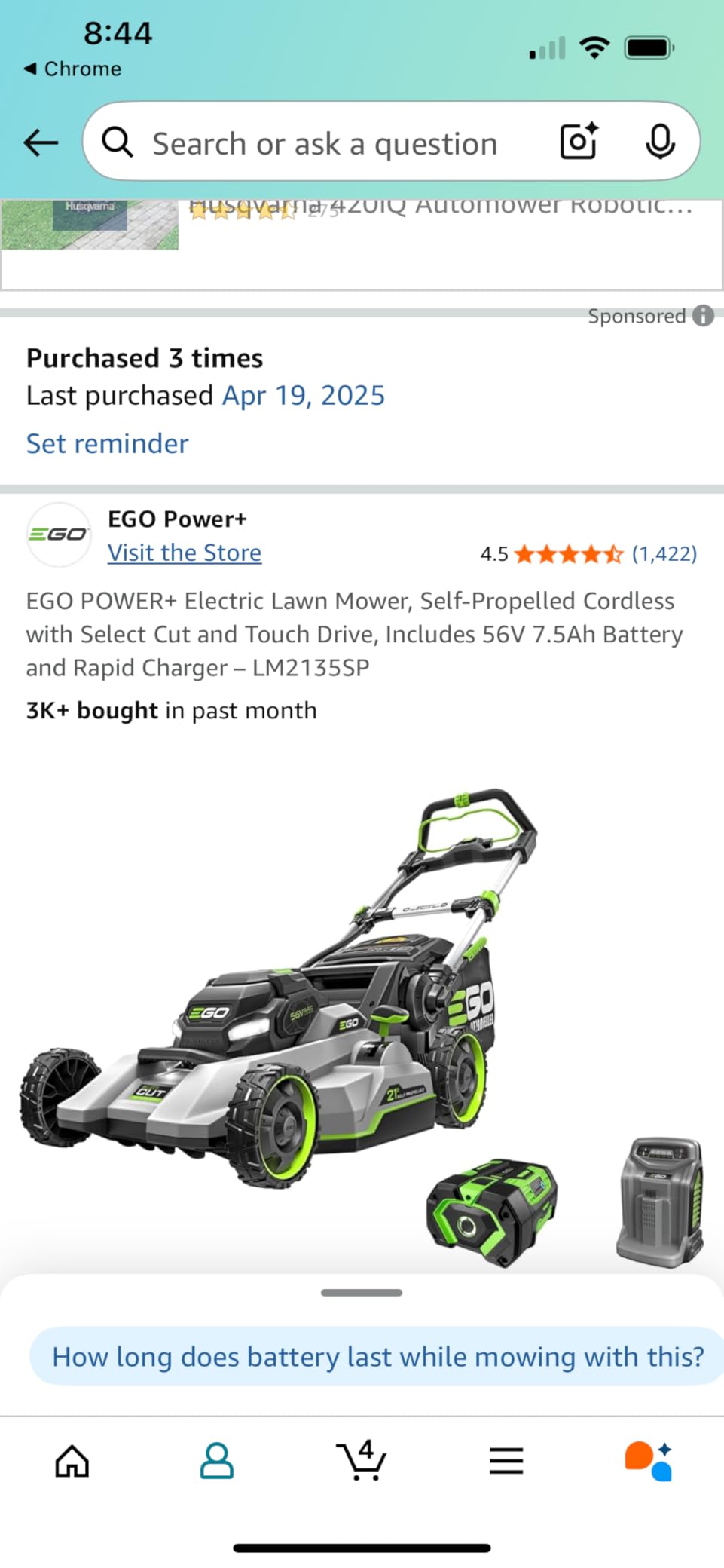
Owner feedback supports the spec sheet. At 1,644 reviews it carries the largest review base of any mower we looked at, and the most common theme is that the variable speed control is what makes sloped and uneven lawns manageable. Runtime is listed at up to 60 minutes on the included 7.5Ah pack, and the rapid charger turns that around in 60 minutes.
The Select Cut system lets you swap the lower blade between mulching, high-lift bagging, and extended runtime configurations. That matters on hills because high-lift bagging is the mode you want for a sidehill with a full bag, and the extended runtime blade is the one you want on the long climb where you are cutting growth rather than collecting it.
What to check before you buy the LM2135SP
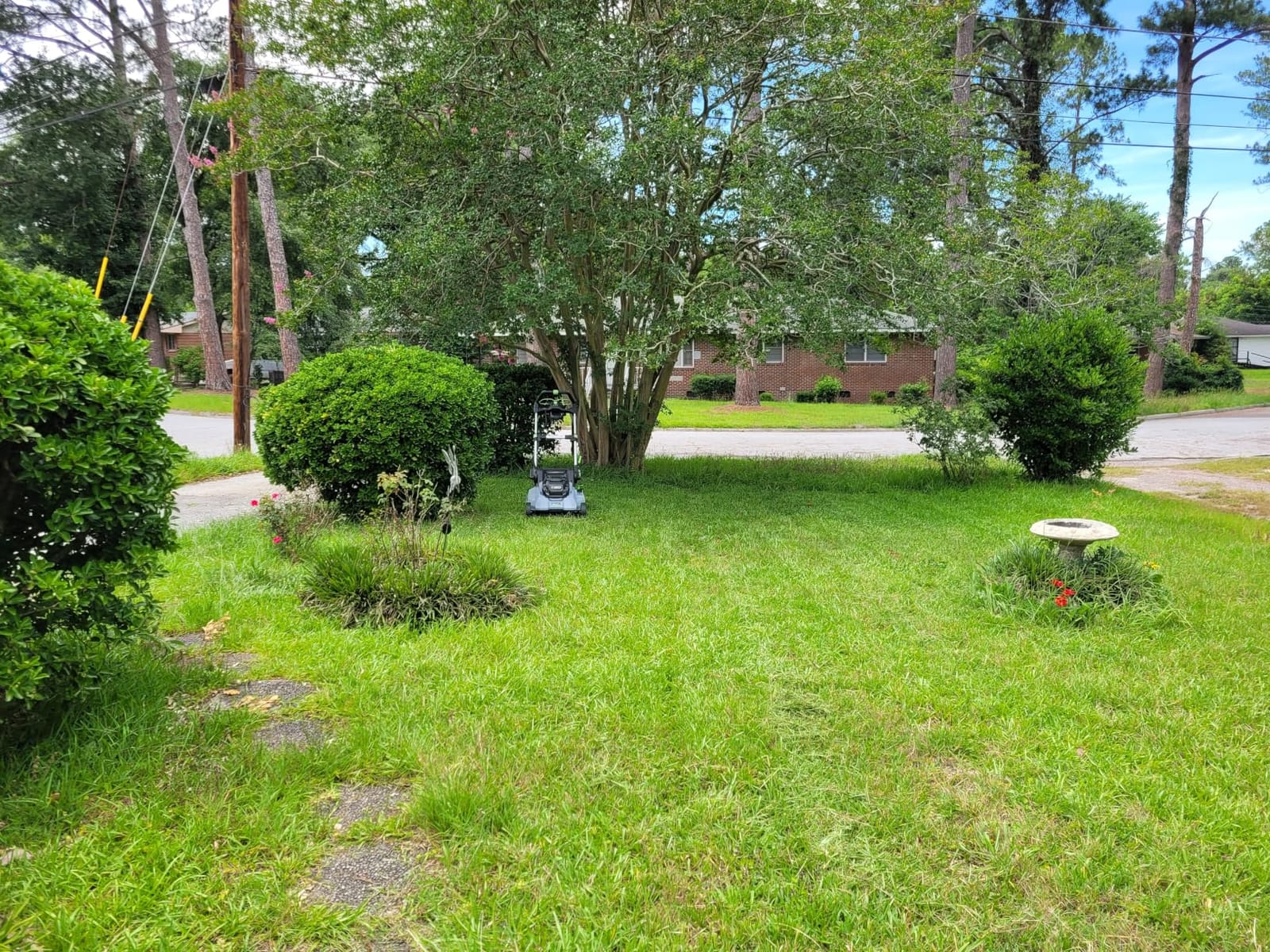
It weighs 55.3 pounds with the battery fitted, which is more mass than the lighter EGO kit below but less than the 75 pound Greenworks 80V. On a steep side grade, that weight is noticeable when the drive is disengaged and you have to lift or pivot the machine to change direction. If your hill is a side bank rather than a straight climb, the lighter EGO LM2114SP below is the better tool.
Who should skip it
Skip it if your slope is above 15 degrees, or if weight is the deciding factor because you need to move the mower between storage and the lawn regularly. It is the one we would recommend to a reader whose push mower stalls halfway up the bank and who does not want to deal with gas.
2. Greenworks 80V 21-Inch Review: Top Rated for Hills
Greenworks 80V 21in Self-Propelled Lawn Mower, 4.0 Ah Battery and Charger
Rear-wheel drive
80V brushless motor
21-inch steel deck
4.0Ah battery
75 lbs
Pros
- Rear-wheel drive with variable speed control
- 80V is the highest voltage platform here
- Steel deck resists flex on slopes
- Works with 75+ Greenworks 80V tools
- 4-year limited warranty
Cons
- Only one 4.0Ah battery included
- 75 pounds is heavy for a cordless mower
- 5 percent one-star share
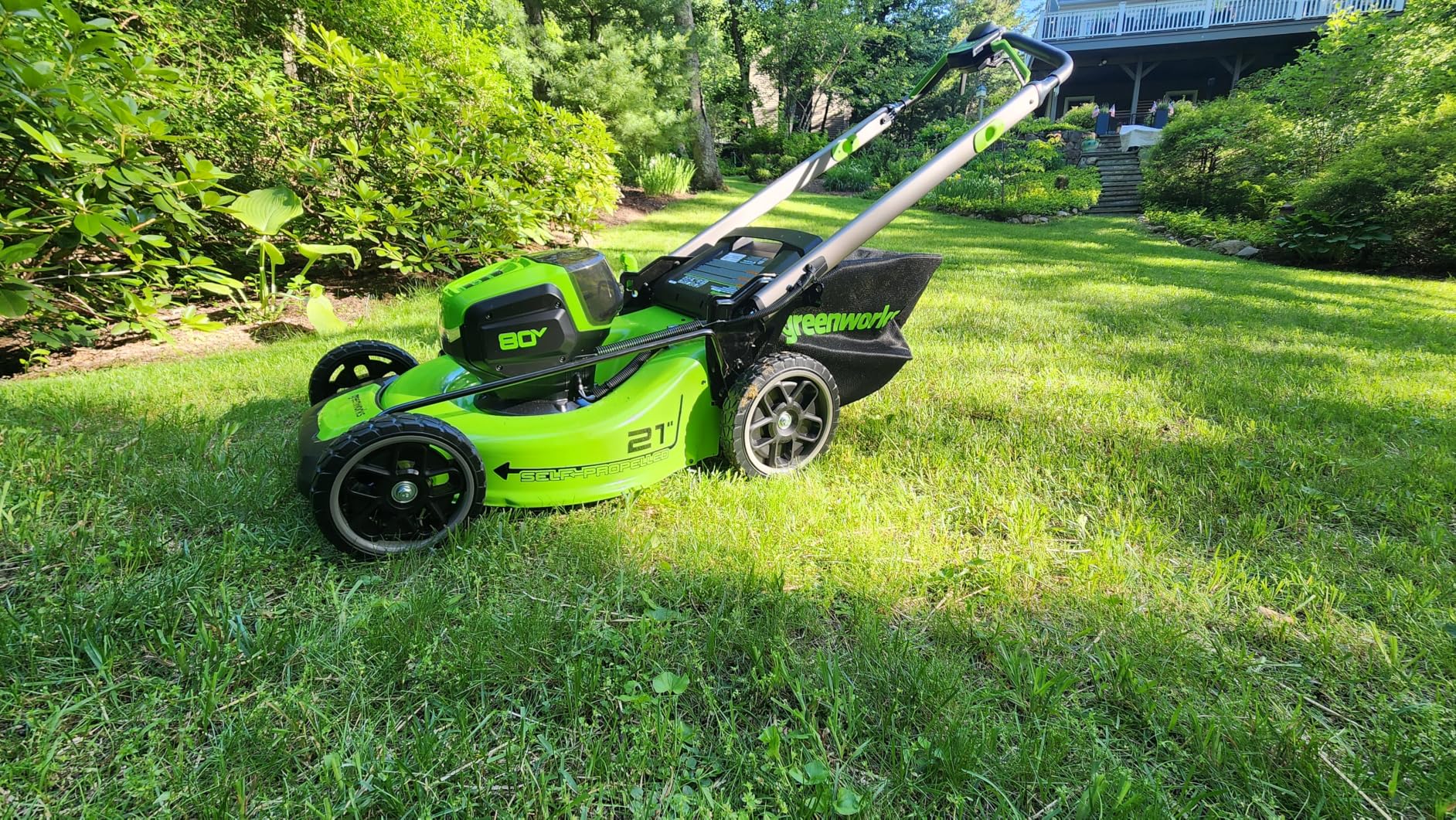
The Greenworks 80V is the strongest argument you can make for a single-battery mower. The manufacturer states that the rear-wheel drive and variable speed control exist for traction, maneuverability, and control, and reviewers consistently point to those same two features when they describe mowing slopes.
80 volts is the highest platform in this group, and that headroom shows up exactly where a hill needs it: torque reserve. When you hit a bank with a half bag of wet clippings, the motor has surplus power to keep the blade loaded rather than bogging and letting the grass wrap the deck. The 21-inch steel deck is a further plus, since steel holds its shape on uneven ground where lighter plastic decks flex.

A 4.4 average across 702 reviews with a 5 percent one-star share makes it one of the tightest rating spreads we saw. Its single-battery limitation is real on a big lot: the included 4.0Ah pack is the smallest in this group, so expect fewer minutes per charge than the dual-battery kits. On an acre, that is the reason to step up to the Greenworks 60V.
What to check before you buy the 80V
At 75 pounds it is heavy for a battery mower. If your hill is a side slope that requires lifting and pivoting the machine repeatedly, weight is the deciding factor and this is not the one. Straight climbs and long grades suit it well; tight maneuvering between trees and rocks on a bank does not.
Who should skip it
Skip it if you need to reposition the mower by hand often, or if you mow a slope in the early morning when the dew is heavy and you need more runtime per charge. This is otherwise a very capable machine on grades from 10 to 15 degrees.
3. SENIX 22-Inch 201cc Review: Best for Steep Grades
SENIX 201cc 22″ 3-in-1 Variable Speed Self Propelled Gas Lawn Mower
Rear-wheel drive
11-inch rear wheels
201cc OHV gas
22-inch steel deck
79 lbs
Pros
- 11-inch rear wheels give strong grip on ruts
- 201cc OHV torque climbs under load
- 22-inch steel deck covers more per pass
- Variable speed self-propel
- Single-lever height adjustment
Cons
- 3.9 is the lowest average rating here
- 18 percent one-star share is the largest
- Gas maintenance and fuel storage
- 79 pounds is heavy to reposition
The SENIX is the most mechanically aggressive machine on this list for a reason: 11-inch rear wheels. Those are far larger than the wheels on the other machines here, and tire diameter is what converts weight into forward traction. Where a smaller tire sinks into a soft rut, an 11-inch wheel bridges it.
The 201cc four-cycle OHV engine is the other half of the hill case. A gas engine keeps its RPM under load in a way that a small battery motor cannot, and the drive is rear-wheel with variable speed, so the same machine that charges a 12 degree bank will slow to a crawl coming back down. The 22-inch steel deck means fewer passes, which halves the time you spend holding a machine on a grade.
We would not hide the rating: 3.9 is the lowest average here, and the 18 percent one-star block is the largest, with durability and starting reliability accounting for much of the critical feedback. That is a real risk on a machine weighing 79 pounds that you will also be servicing yourself.
What to check before you buy the SENIX
You are buying an engine, not a battery. That means fuel storage, oil changes, a spark plug, and a choke or primer, and the 18 percent of reviewers who gave one star largely describe exactly that. If you have never maintained small gas equipment, this is the wrong place to start.
Weight is the second check. At 79 pounds it is hard to pivot on a side grade, and sidehill mowing with a bag is the scenario where that matters most. If your slope is a straight up-and-down grade rather than a cross-slope, the weight is an asset.
Who should skip it
Skip it if you are near a gas ban, if you live in an apartment with no outdoor fuel storage, or if the review spread makes you uncomfortable about durability. For a straight, aggressive grade with tall grass and a large property, this is the machine: the traction package is the best mechanical answer to a hill in this roundup.
4. Greenworks 60V Dual-Battery Review: Best for Large Hilly Yards
Greenworks 60V 21in Self-Propelled Lawn Mower, (2) 4.0 Ah Battery Kit
Rear-wheel drive
Two 4.0Ah batteries
60V brushless motor
21-inch deck
65 lbs
Pros
- Rear-wheel drive aimed at slopes and thick grass
- On-the-go variable speed adjustment
- Two batteries mean no downtime
- Up to 3/4 acre per charge
- 4-in-1 with turbo leaf pickup
Cons
- Plastic body and deck are lighter duty
- 60V has less torque than the 80V sibling
- 65 pounds is heavy to push unpowered
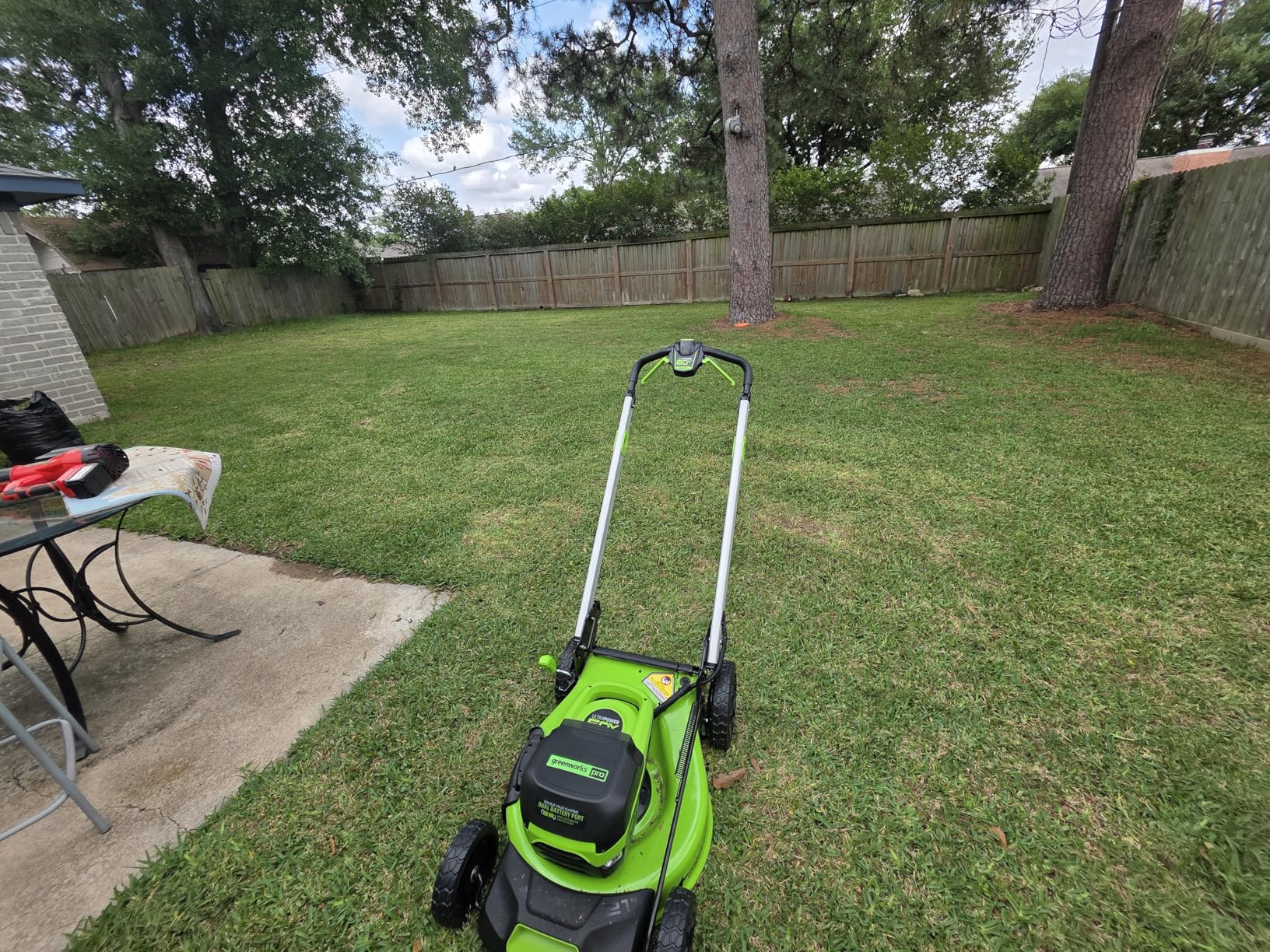
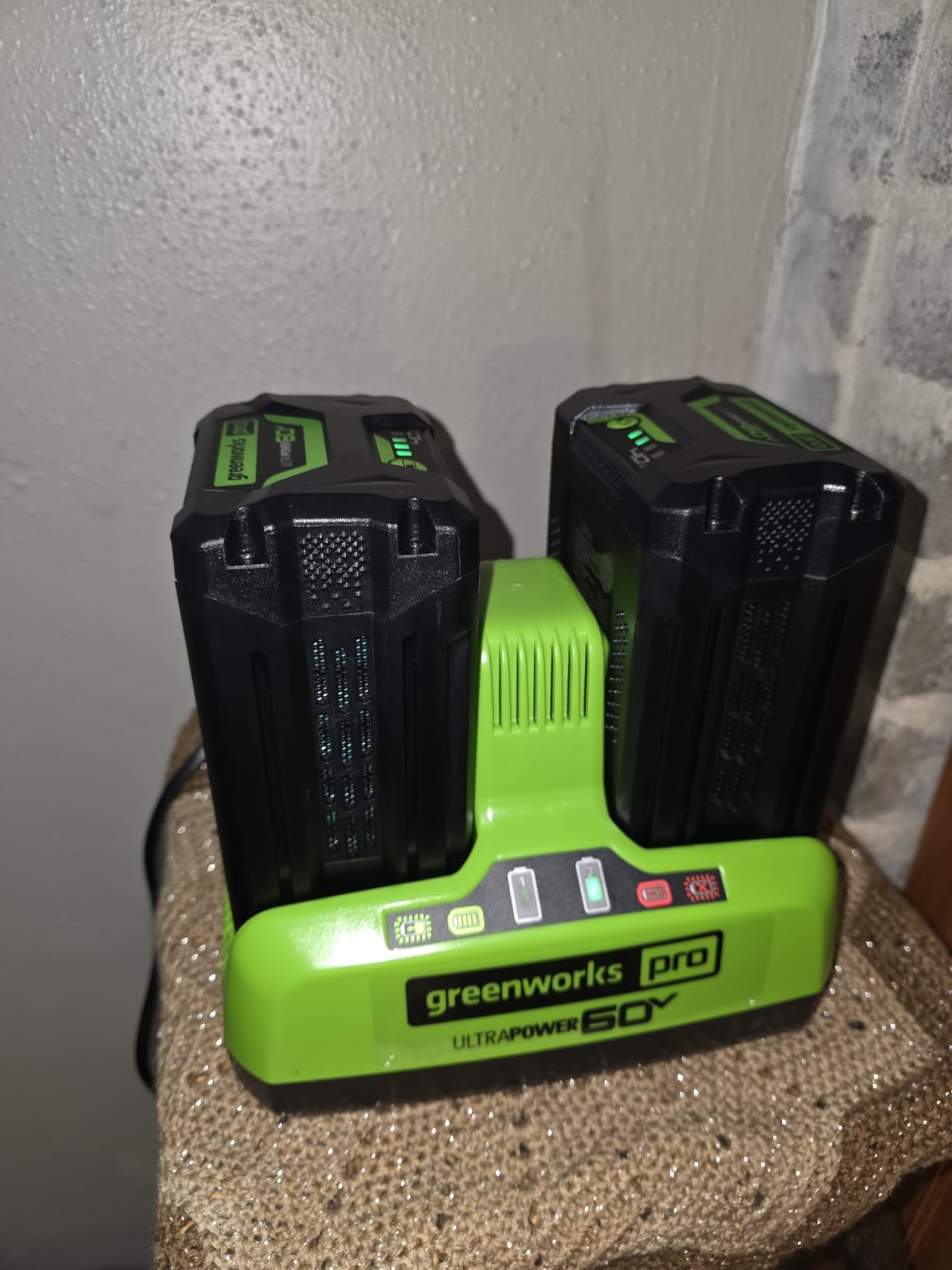
If your hilly yard is also a large yard, the runtime question matters as much as the traction question, and this is the mower that answers both. Two 4.0Ah batteries come in the box, and the stated coverage is up to three quarters of an acre per charge.
The drive layout is the correct one. Greenworks specifies rear-wheel drive traction for slopes and thick grass, with on-the-go speed adjustment so you can change pace as the terrain changes mid-lawn rather than setting a speed at the start of the job and living with it.
That battery swap matters on a hill in a specific way. A slope consumes battery faster than flat ground, so a single-pack mower on a hilly lot means stopping in the middle of a grade to charge, and restarting the climb cold. Swapping packs lets you finish the bank and recharge on the flat.
At 65 pounds it is not a light machine, but the battery is removable, so the awkward lifting is manageable. The 4-in-1 system adds a turbo leaf pickup mode alongside mulching, bagging, and side discharge, which is useful on sloped ground in autumn.
What to check before you buy the 60V
Torque. 60V packs less than the 80V Greenworks, and that gap shows up in very dense or overgrown grass. If your hill is maintained lawn with a normal cutting interval, you will not notice it. If you are cutting back a neglected bank, expect the machine to work harder.
The plastic body and deck are the other consideration. On rocky, root-crossed ground the steel-decked 80V is the safer long-term choice.
Who should skip it
Skip it if your yard is small, because the second battery is capability you will not use. Skip it if the ground is rocky and you want a steel deck. Its 4.4 average across 619 reviews and a 73 percent five-star share put it among the better-regarded batteries here, with reviewers naming the same three strengths: rear-wheel traction for slopes, the dual-battery convenience, and quiet operation.
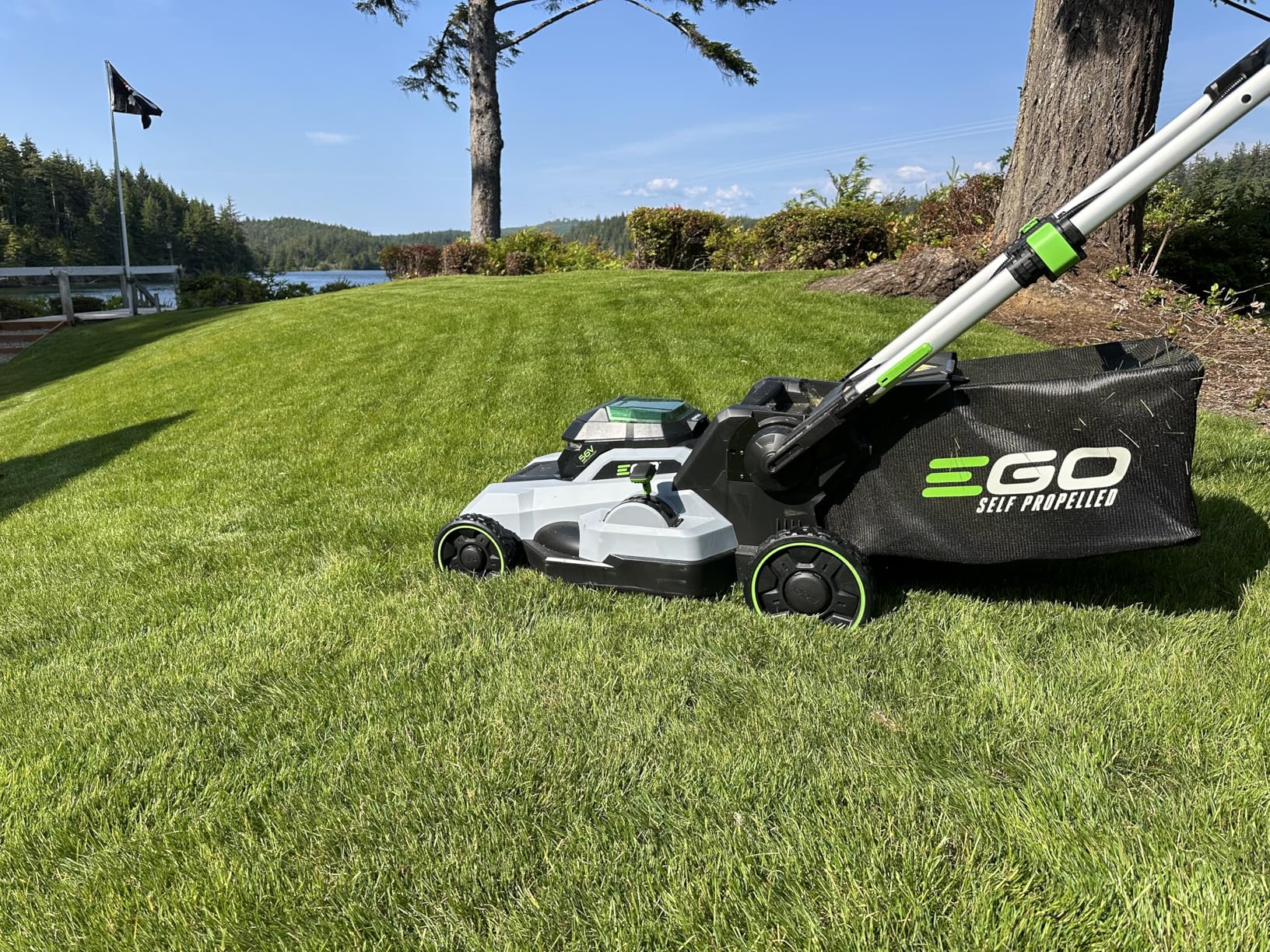
5. EGO POWER+ LM2114SP Review: Lightest Mower to Lift on a Bank
EGO POWER+ 21″ Cordless Electric Lawn Mower Kit, Self-Propelled – LM2114SP
Rear-wheel drive
50.9 pounds
56V 6.0Ah battery
21-inch deck
Dual-toggle drive
Pros
- 50.9 pounds makes it easy to lift and pivot
- 6.0 ft-lbs torque handles thick grass
- Dual-toggle lets you steer with one hand
- Push-button start
- 50 minutes runtime
Cons
- Fixed toggle instead of a variable speed dial
- 50 minutes is shorter than the 7.5Ah sibling
- Less torque headroom than the LM2135SP
The LM2114SP is the mower we would suggest when the hill is a side slope rather than a straight climb. At 50.9 pounds it is the lightest self-propelled machine in this roundup, and weight on a cross-slope is not a comfort issue, it is a control issue.
Its dual-toggle handleset is the underrated feature. Engaging self-propel with either hand means you can keep one hand on the steering and the other on the bail bar, which is exactly what you want when the machine is pulling sideways down a grade. Many self-propelled layouts force both hands onto one control.
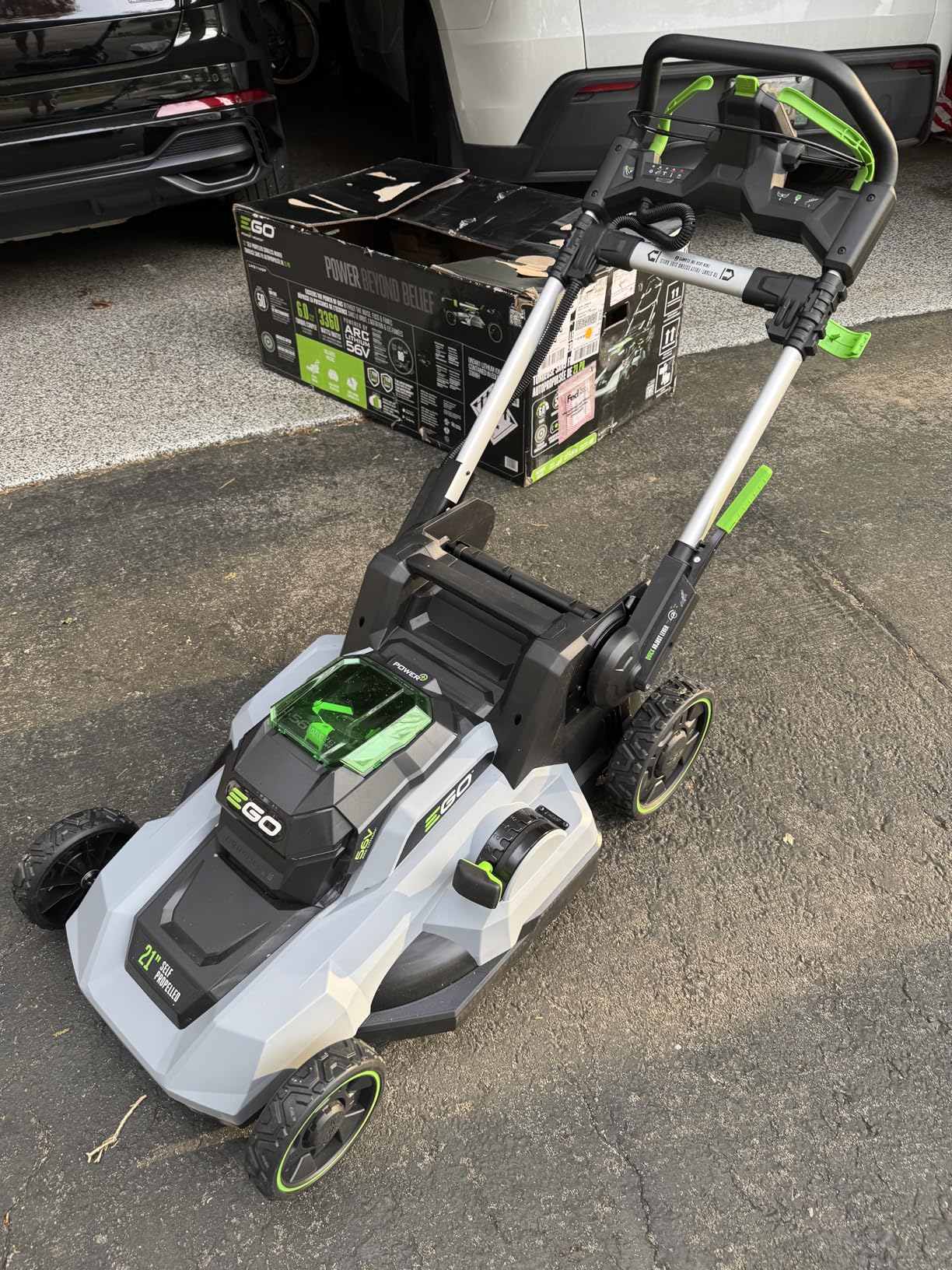
Torque is 6.0 ft-lbs, which is roughly 1 ft-lb less than the LM2135SP, and the battery is a 6.0Ah pack giving up to 50 minutes. That is 10 minutes less than the 7.5Ah-equipped sibling, and on a hill where runtime is already reduced, that difference is worth thinking about.
Reviewers praise the weight, the push-button start, and the torque relative to a gas machine. A 4.4 average with 75 percent five-star ratings puts it in the top band of owner satisfaction here.
What to check before you buy the LM2114SP
The drive engagement is a fixed toggle, not a variable-speed dial. You can hold the drive or release it, but you cannot crawl at a controlled 1 mph. On a steep uphill grade that means either jogging to keep up or releasing the drive and pushing, which is the exact complaint we hear most often from owners of fixed-speed machines.
Runtime is the other one. If your hill is large, the shorter runtime and single included battery mean more stops, and the 50 minutes is a flat-ground figure that a grade will eat into.
Who should skip it
Skip it if you need fine speed control on grades, if your slope is long enough that runtime matters, or if you have a deep deck full of grass to lift over a lip. Buy the LM2135SP instead if you want a speed dial and more torque.
Buy this one if weight is your main constraint: a small yard, a walkout basement grade, or a side bank where you constantly pivot the machine. Ease of handling is the single biggest predictor of whether you keep mowing the hill or abandon it.
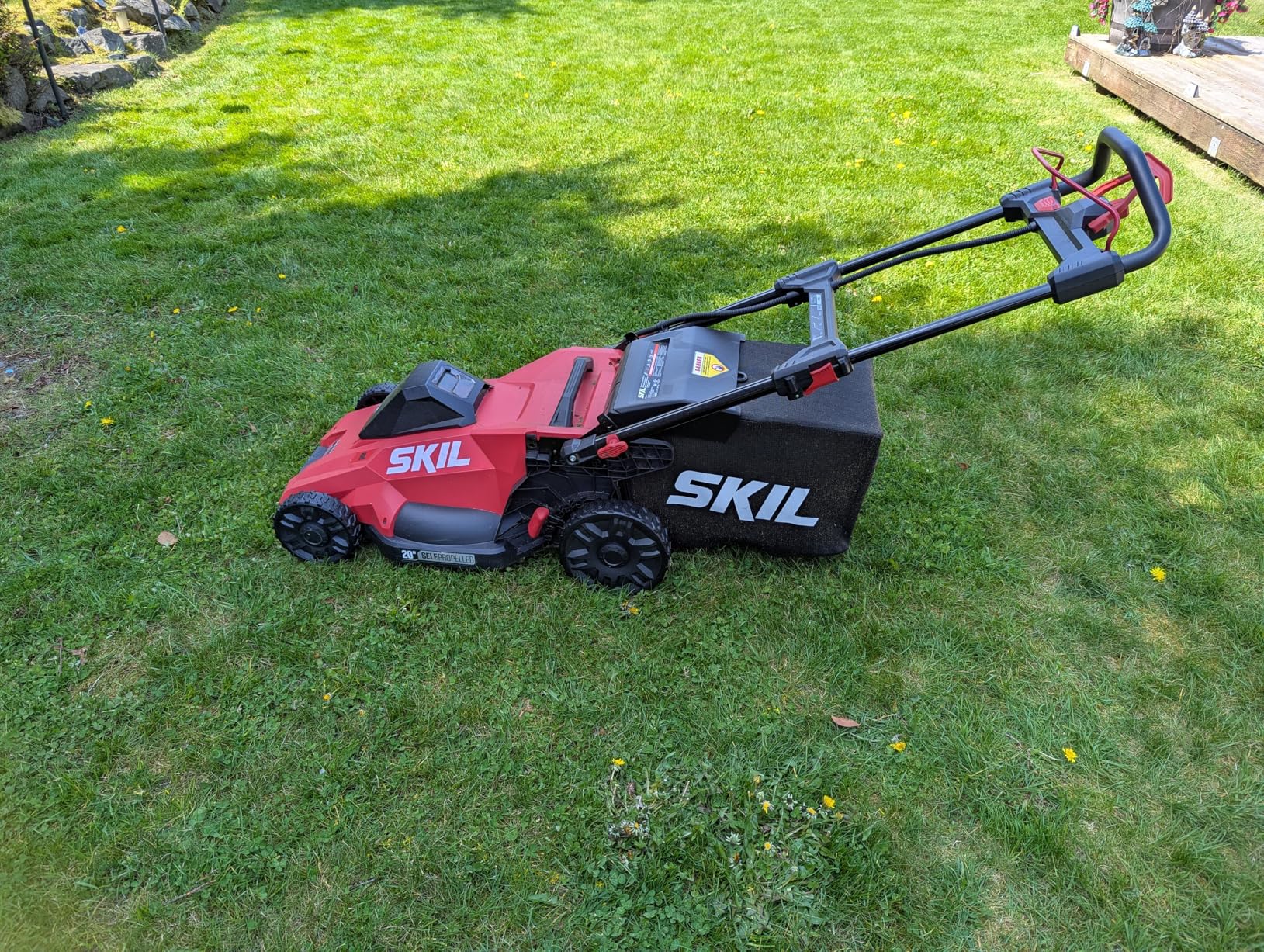
6. SKIL PWR CORE 40 20-Inch Review: Best for Quiet Early Slope Work
SKIL PWR CORE 40 Brushless 40V 20-Inch Self-Propelled Mower Kit, Includes 6.0Ah Battery and Auto PWR JUMP Charger – SM4910C-11
Variable speed self-propel
40V 6.0Ah battery
Up to 50 minutes
20-inch deck
7 height settings
Pros
- Speed dial lets you crawl up grades
- Light enough to lift with one hand
- Push-button start
- Drive works independently of the blade
- Up to 50 minutes runtime
Cons
- Smallest deck here at 20 inches
- Adjust the deck height as soon as you unbox it
- Check the pack date against the December 2024 battery recall
The SKIL PWR CORE 40 has the highest average rating in this group at 4.5, on a review base of 214, and the variable speed self-propel dial is the part that matters for hills. Reviewers specifically call it out for climbing grades slowly and then cruising on the flat.
Lightness is the second hill asset. Owners describe being able to lift it with one hand, which is what makes it practical on a steep site where the drive runs out of grip and you have to reposition the machine by hand. Push-button start removes the recoil pull, and the self-propel drive works independently of the blade motor, so you can drive it to storage without mowing.
Reviewers are split on noise. Many find it much quieter than gas, but note the self-propel motor is audibly louder than the blade. For a neighbor-sensitive early morning job on a slope, that is a real consideration.
The telescoping handle folds for vertical storage, which matters in a garage shared with a mower that has to be carried up and down a slope to reach its spot. Seven height settings from 1.5 to 4 inches and a 3-in-1 system cover the usual ground.
What to check before you buy the SKIL
Adjust the deck height as soon as you unbox it. It arrives set to the lowest cut position, and reviewers report it clogging and stalling in grass around 4 inches tall until the deck is raised a couple of notches. On an overgrown bank, that shows up as exactly the uphill bogging you bought a hill mower to avoid.
Also check the drive bar. The dead-man switch is easy to snag a clothing pocket on, and releasing it late at the end of a row can lock the drive until you rock the machine back and forth. The dead-man switch is a safety feature, so this is about technique rather than a fault.
Who should skip it
Skip it if your mower carries a battery from the December 2024 recall, and check the pack date before buying. Skip it if you have tall, wet grass regularly, since reviewers report weak performance there. Skip it if you want a wide deck, because 20 inches is the narrowest cutting path here.
Buy it if noise is your main constraint and your hill is managed ground you can mow at a moderate height. On grades under 10 degrees with a raised deck, it is one of the easiest machines here to control.
7. PowerSmart 20-Inch Dual 40V Review: Budget Pick for Moderate Slopes
PowerSmart 20″ Self-Propelled Cordless Lawn Mower, Brushless Motor, 2 x 40V 4.0Ah Battery & Charger (MB2420SA)
Rear-wheel drive
Lever-activated self-propel
Two 4.0Ah 40V batteries
20-inch deck
57.5 lbs
Pros
- Rear-wheel drive marketed for steep slopes
- Two batteries mean continuous mowing
- Brushless motor runs cool and quiet
- Light weight of 57.5 pounds aids repositioning
- 3-in-1 clipping system
Cons
- 40V has the least torque headroom here
- 7-inch wheels give limited ground clearance
- 14 percent one-star share
- 20-inch deck needs more passes
The PowerSmart MB2420SA does the one thing that matters most on a hill: rear-wheel drive. The manufacturer describes the self-propel lever as giving extra traction and reducing pushing effort on steep slopes and uneven terrain, and the drive layout is the correct one for a grade.
Two 4.0Ah batteries in the box mean one runs while the other charges, which removes the downtime problem that hurts most on a large hilly property. The brushless motor runs cooler and quieter than a brushed motor with no oil changes and no fuel mixing.
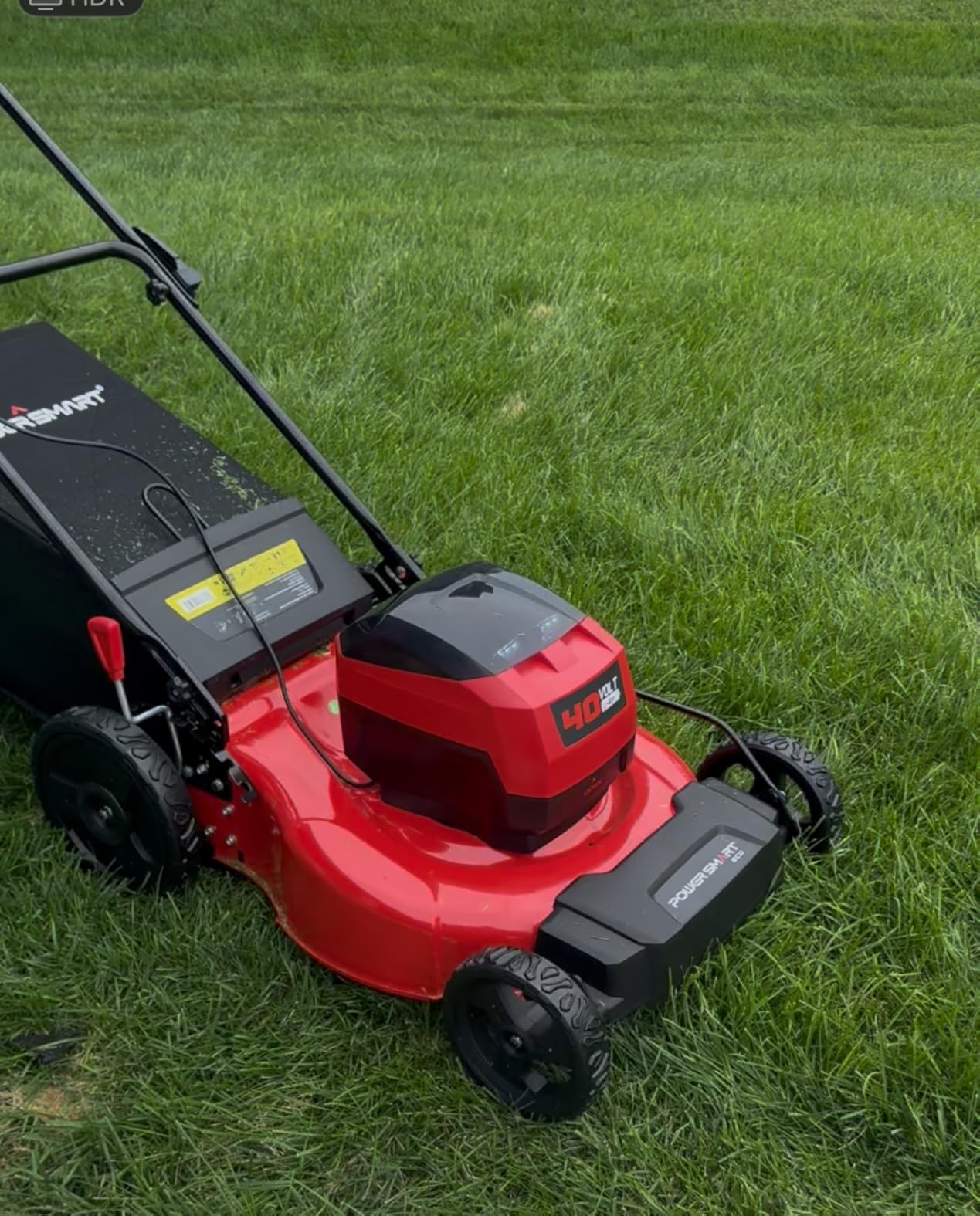
At 57.5 pounds it is light for a dual-battery cordless mower, which helps when you need to lift and pivot on a side grade. The single-lever height adjustment covers six positions from 1.5 to 3.9 inches, and the 3-in-1 system handles mulching, rear bagging, and side discharge.
The 4.0 average with 269 reviews carries a wider spread than the major brands, including a 14 percent one-star block. Reviewers praise the dual-battery swap and the hill drive, and criticise torque limits on very tall or wet grass and the small wheels.
What to check before you buy the PowerSmart
Voltage. 40V is the lowest platform here, which means the least torque headroom. On a maintained lawn with a moderate slope that is irrelevant. On thick, overgrown, or wet grass, the motor will bog before the drive does, and that is the scenario that leaves you pushing.
Wheel size is the second check. Seven-inch wheels give less ground clearance and less rollover protection on rough, sloped ground, and rocks and ruts are where this machine is least happy.
Who should skip it
Skip it if you have rocky or rutted ground, if you routinely mow tall grass, or if long-term brand support matters to you. The review spread suggests this is a value-first choice rather than a buy-forever choice.
Buy it if your yard is small, your slope is in the 5 to 10 degree range, and you want rear-wheel drive without committing to a major platform. The dual-battery arrangement is genuinely useful even on a modest lot.
8. YARDMAX 22-Inch 201cc CVT Review: Best for Rubby, Uneven Ground
YARDMAX 22 in. 201cc Select PACE 6 Speed CVT High Wheel FWD 3-in-1 Gas Walk Behind Self Propelled Lawn Mower, Black (YG2860)
CVT 6-speed transmission
High-wheel front drive
201cc gas
22-inch deck
84.9 lbs
Pros
- CVT gives smooth speed variation
- Spiked rubber tires grip loose ground
- Automatic choke needs no priming
- Single-lever deck adjustment
- Deck cleanout port
Cons
- Front-wheel drive is the weak point on steep uphill grades
- 84.9 pounds is heavy on a side slope
- 17 percent one-star share
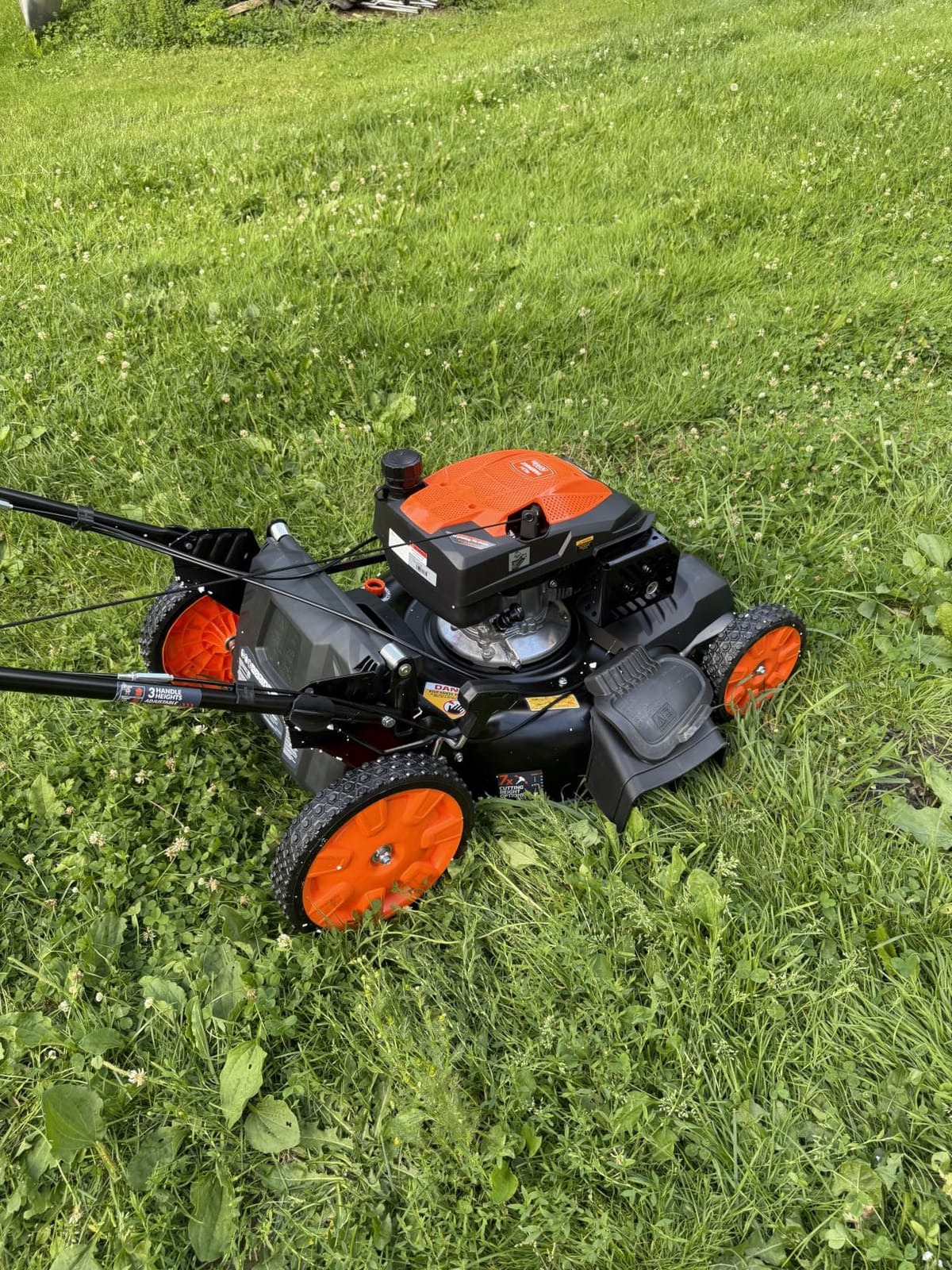
This is the one front-wheel-drive machine we included, and it earns its place on a specific kind of hill: the uneven, rubby, root-crossed bank where traction on loose ground matters more than sustained uphill load holding. The high-wheel design with aggressive spiked rubber tread is genuinely good at that job.
The CVT transmission is the standout feature. Rather than fixed gears, a 6-speed shift lever gives continuous speed variation, so the drive can be matched to your walking pace on changing terrain. On a slope that is more useful than it sounds, because it lets you creep uphill and ease off downhill from the same control.
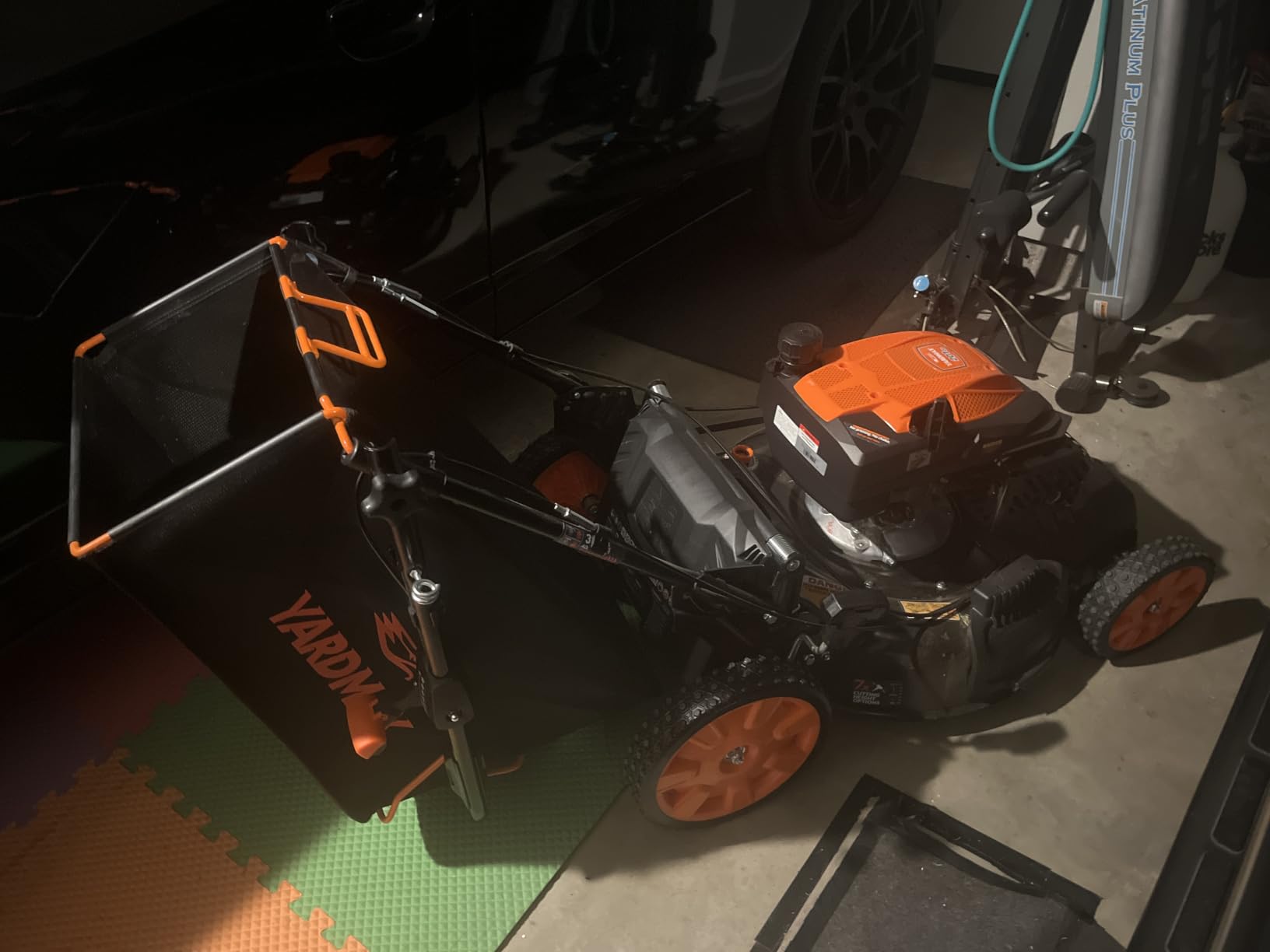
The 201cc engine has plenty of torque for sustained climbing, the automatic choke means no priming, and the single-lever deck adjustment plus cleanout port simplify the parts of ownership that usually go wrong.
The drive layout is the honest caveat. Front-wheel drive unloads its driven wheels when the mower climbs, which is the mechanism that makes front-drive mowers spin out on grades. At 84.9 pounds it is the second-heaviest machine here behind the 89.2 pound BILT HARD, which is difficult on a side slope.
What to check before you buy the YARDMAX
Measure your slope and be honest. Under 8 degrees, this machine handles it with the spiked tires doing the work. Above 12 degrees on a sustained climb, the front wheels are the weak link and no amount of engine torque fixes a wheel with no load on it.
Weight is the other check. At 84.9 pounds, pivoting this machine across a side grade is a two-person job in practice, and a full bag makes it worse. It suits up-and-down mowing on a moderate grade far better than contour mowing.
Who should skip it
Skip it if you have a side bank, if the grade is sustained and steep, or if your problem is a mower that stalls halfway up. The 17 percent one-star share is the second-largest in this group, with durability and satisfaction complaints driving it.
Buy it if your ground is uneven rather than steep, if you want the smoothest speed control available in a walk-behind, and if you mow moderate grades in straight passes. For a suburban lot with trees, roots, and patches, it is a good machine.
9. PowerSmart 22-Inch 170cc Review: Rear Drive With the Widest Deck
PowerSmart 22-Inch 170cc Self Propelled Gas Lawn Mower
Rear-wheel drive
22-inch steel deck
170cc OHV gas
60L bag
75 lbs
Pros
- Rear-wheel drive specified for slope traction
- 22-inch steel deck covers more per pass
- Heavy-duty blade
- Auto choke and recoil start
- Large 60L bag means fewer stops
Cons
- No variable speed control on the drive
- 170cc has the least torque reserve
- Gas maintenance required
- 14 percent one-star share
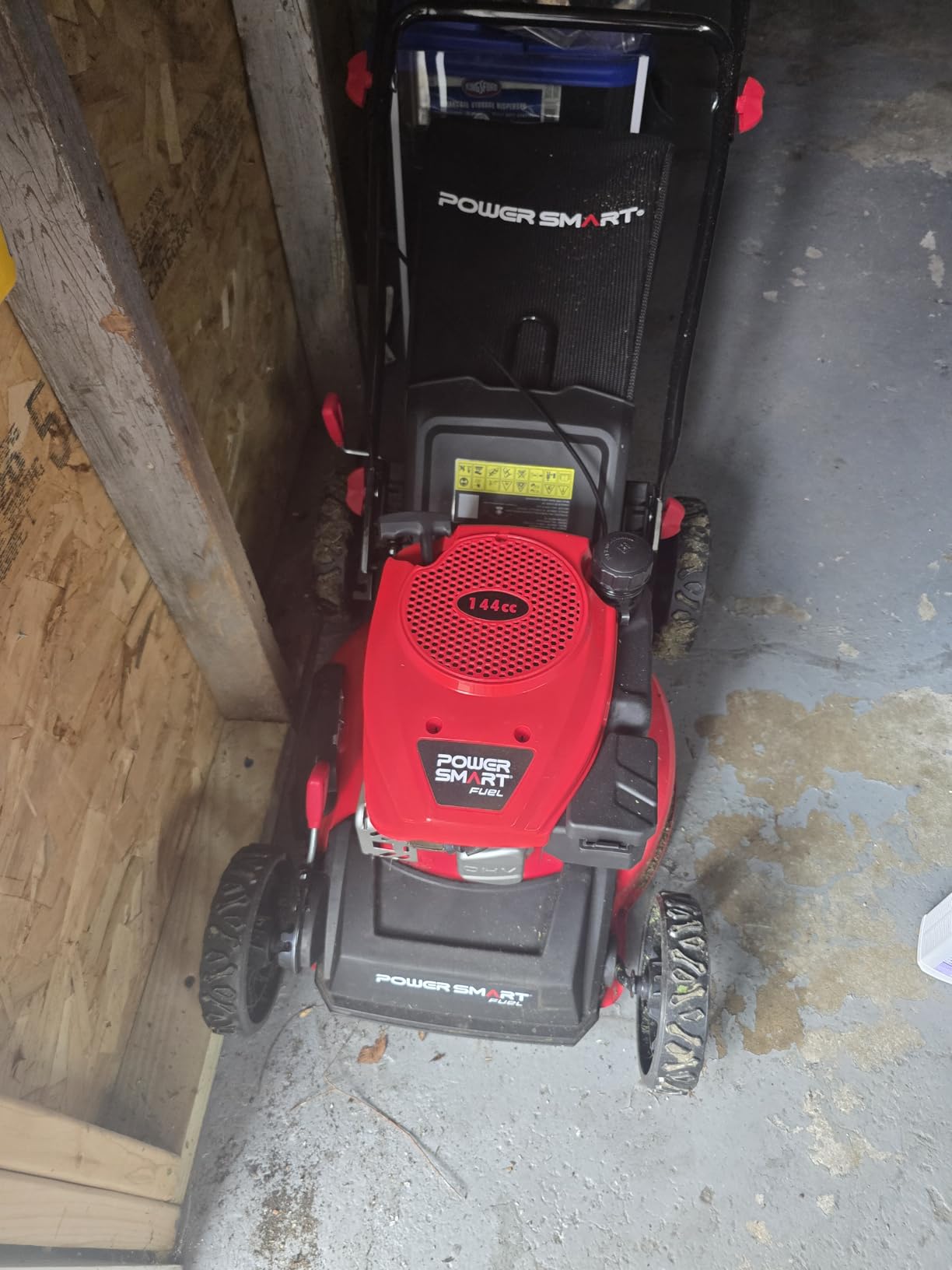
The PowerSmart 22-inch is a rear-wheel-drive gas mower, which puts it in the correct category for hills on paper. The drive is specified for better traction on slopes and uneven terrain, and the 22-inch steel deck means fewer passes over the sloped parts of your yard.
The 60L grass bag is large for a walk-behind, and that is more than a convenience on a slope. Every time you stop to empty a small bag you are stopping on a grade, and every extra stop is another place to lose control.
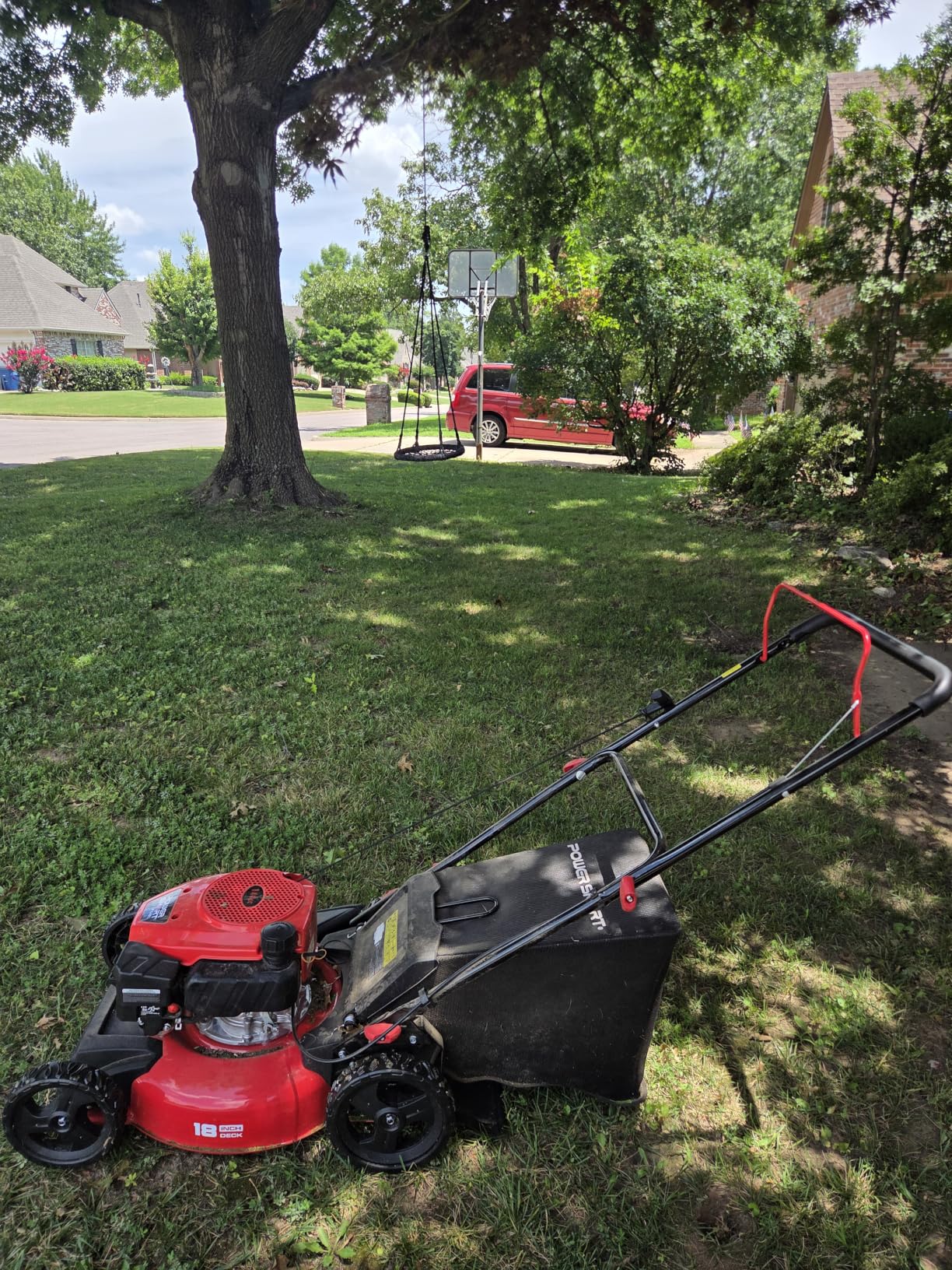
The 170cc four-stroke OHV engine is the smallest displacement here with an auto choke and recoil start. It is rated for thick grass, but it has the least torque reserve of any gas engine in this group, and that reserve is what gets you over a crest at the top of a bank.
The 4.0 average across 391 reviews comes with 58 percent five-star and a 14 percent one-star block. Reviewers credit the steel deck and rear-wheel drive, and criticise the absence of variable speed and build quality.
What to check before you buy the PowerSmart 22-Inch
The absence of variable speed is the important one. Most of this roundup lets you slow the drive for a grade. This one does not, so on an uphill you either jog to keep up or push, and on a downhill you are riding a single-speed drive with the brake bar as your only control. For a reader whose previous complaint was jogging to keep up with the mower, that is the wrong fix.
Engine size is the second. If your grass gets away from you regularly, the 170cc has less margin than the 201cc machines here.
Who should skip it
Skip it if you have sustained grades above 10 degrees, if speed control on descents matters to you, or if you want minimal maintenance. It is a straightforward gas mower with a good drive layout and a lot of deck.
Buy it if you have a large flat-ish yard with one moderate bank, you want to collect a lot of grass in few stops, and you would rather not manage batteries. Rear-wheel drive plus a 22-inch steel deck covers most moderate hilly situations.
10. BILT HARD 21-Inch 201cc Review: Most Gas Torque in the Set
BILT HARD 21″ Self Propelled Gas Lawn Mower – 201cc 4-Cycle OHV, 3-in-1 Bagging/Mulching/Side Discharge, 8 Adjustable Cutting Heights & Smooth Easy Start
Rear-wheel drive
201cc OHV 9.0 ft-lb torque
8 height positions
21-inch steel deck
89.2 lbs
Pros
- 9.0 ft-lb of torque from a 201cc gas engine
- Rear-wheel drive for slope traction
- Eight cutting height positions with all-wheel sync
- No-choke no-primer starting
- Foam-wrapped angled handle
Cons
- Single-speed drive with no variable control
- Heaviest machine in the group at 89.2 pounds
- Only 111 reviews so durability is unproven
- Reported wiring faults on some units
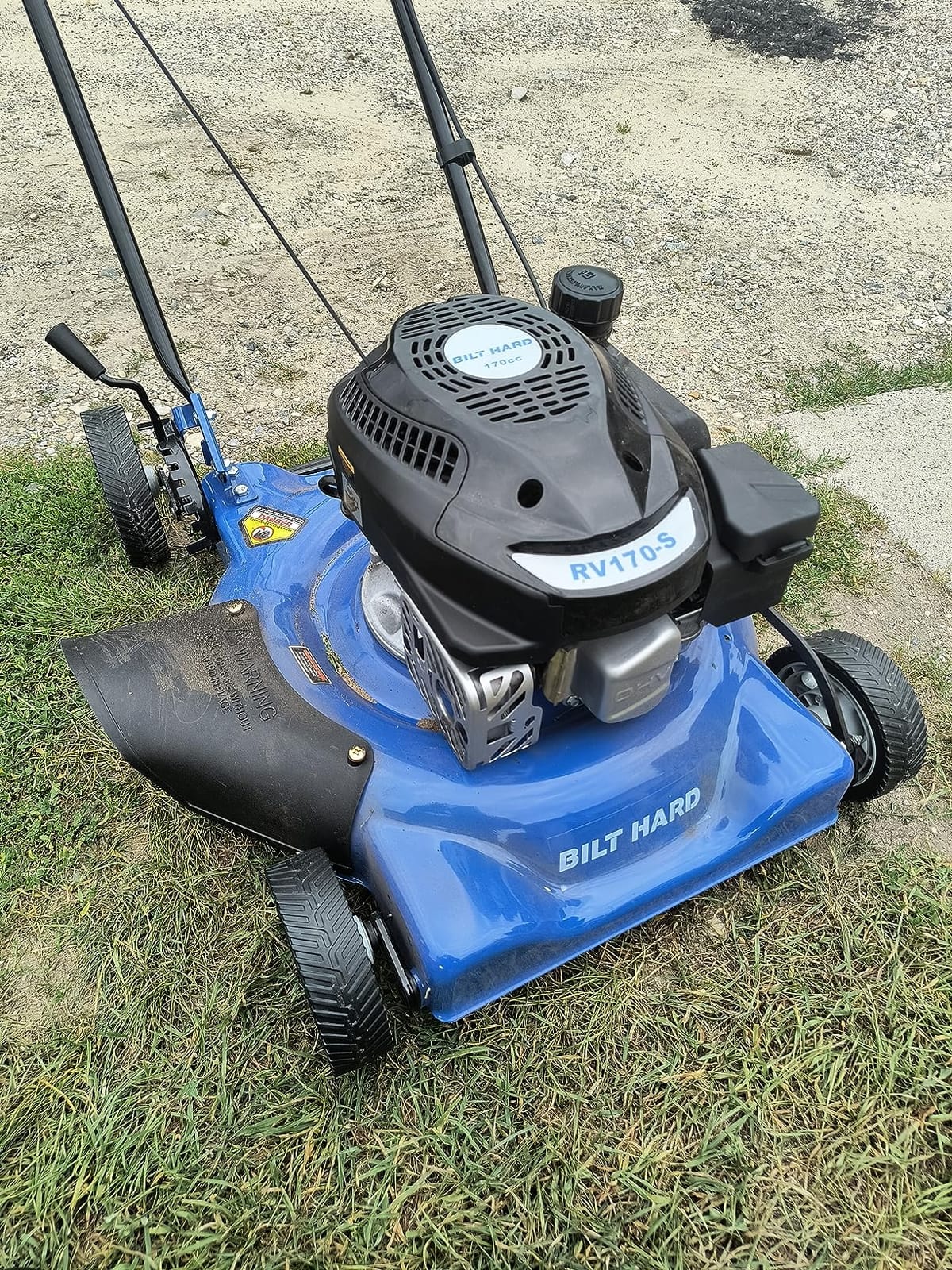
The BILT HARD is the last machine here, and it is here because of one number: 9.0 ft-lb of torque from a 201cc four-stroke OHV engine, the highest stated torque figure among the gas mowers in this group. Torque reserve is what keeps a blade turning under load on a climb.
The drive is rear-wheel with a single-speed self-propel, and the foam-wrapped angled handle is designed to reduce hand fatigue during long climbs. The 8-position height adjustment is the most in this group, and the single lever synchronizes all four wheels, which is genuinely useful when you are changing height on uneven ground.
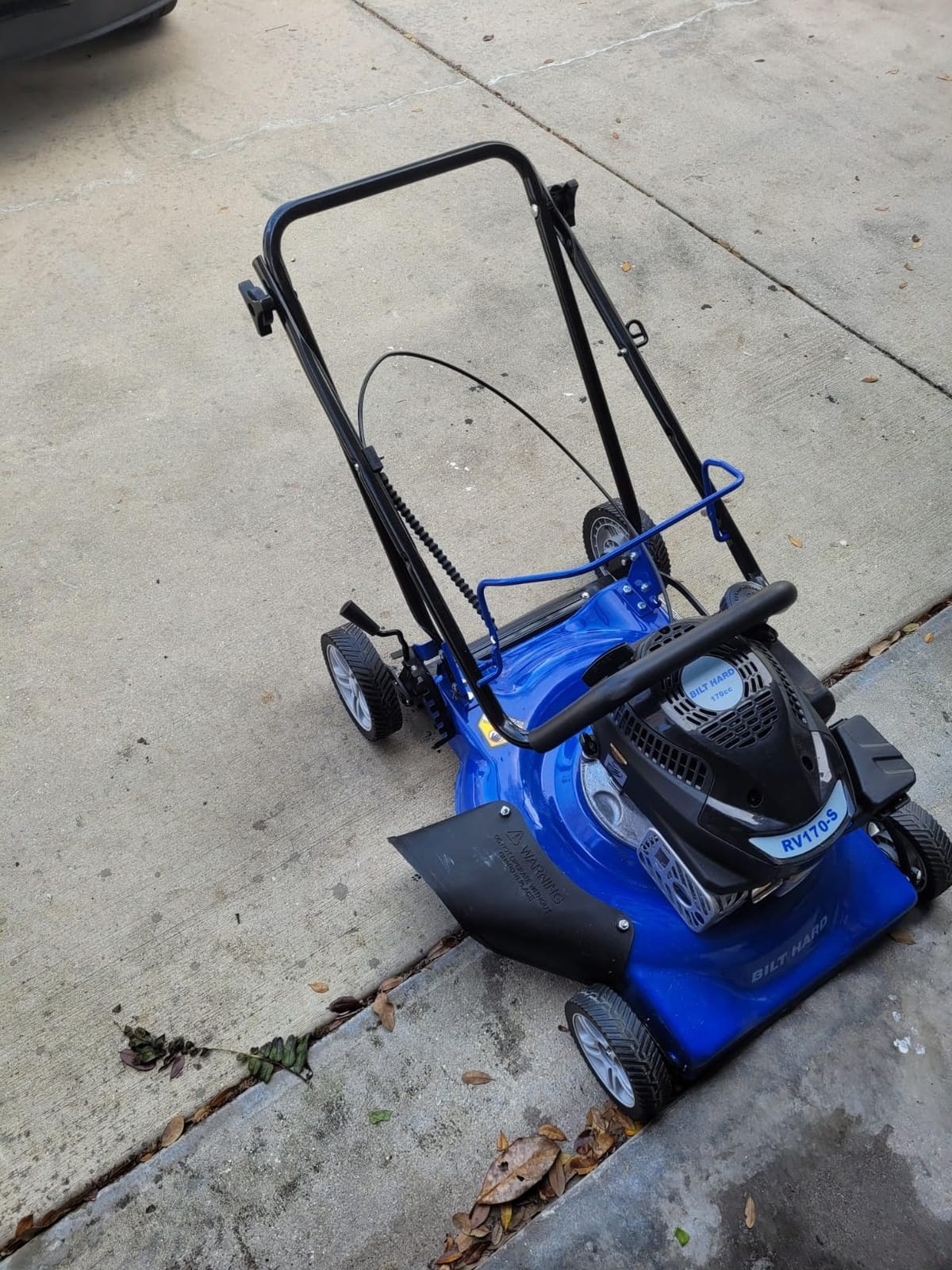
No-choke, no-primer starting means the engine starts on the first pull without adjustments, and the 3-in-1 steel deck covers mulching, side discharge, and rear bagging. Reviewers consistently note easy assembly and first-pull starting.
At 89.2 pounds this is the heaviest machine in the set, which is a real problem on a side slope. And 111 reviews is the smallest review base here, so long-term durability is genuinely not established, with a few owners reporting a wiring fault that stopped the engine starting after a few runs.
What to check before you buy the BILT HARD
Single-speed is the hill caveat. Like the PowerSmart 22-inch, this drive offers no way to slow the machine for a grade, so the drive speed is constant and you manage descents with the bail bar. On a moderate straight grade that is workable. On a side slope it is not.
Weight is the other one. At 89.2 pounds, with a bag on the back, lifting or pivoting this machine across a grade is difficult. Judge it against your own strength and your actual slope before committing.
Who should skip it
Skip it if you have a side bank, if you need variable speed, or if you prefer to buy from a brand with a large service network and a long review history. Skip it if you have never run gas equipment.
Buy it if you have a large yard with a sustained straight grade, you want maximum engine torque, and you value a machine that starts without fuss. The 8 height positions and all-wheel sync lever are practical touches that most competitors at this class lack.
Why Your Mower Stalls Uphill and How to Fix It
A self-propelled mower that bogs halfway up a slope is almost never a dead drive system. In most cases it is a load problem: the blade is asking for more torque than the engine or motor can give at low speed, and the drive bogs with it. Work through these in order, because they go from free to expensive.
Check tire pressure first. Under-inflated tires are the cheapest and most common cause of a mower that will not climb. Pressure drops with temperature, and a soft tire contact patch deforms rather than grips. Inflate to the maker’s specification before every mow on a slope.
Raise the deck one or two notches. The blade entering tall or wet grass creates a load spike that momentarily stops blade rotation, and the grass then wraps the deck skirt. On a grade you should be cutting less than a third of the blade height anyway.
Clear the deck underside. Packed grass under the deck raises the blade into the grass you are trying to cut and doubles the load. The YARDMAX in this roundup has a dedicated cleanout port for exactly this reason.
Inspect the drive belt and cable. Forum troubleshooting threads attribute uphill stalling to drive belt issues more often than anything else. A glazed or stretched belt slips under the extra torque a hill demands, and a stretched control cable cannot hold a speed setting. Both are repairable parts.
Check fuel, oil, and battery state on the climb. A gas engine bogging uphill often needs fresh fuel and correct oil level. A battery mower on a long climb may simply be depleted, and holding a dead drive while the blade keeps running is the situation that ends with you pushing.
Reconsider the drive type. If the machine has front-wheel drive, no amount of maintenance will add grip on a climb, because the driven wheels are unloading as the mower pitches upward. That is a design limit, not a fault.
One more cause is worth naming because it is not mechanical at all: wet grass. A slope cut in the morning dew or after rain has several times the cutting resistance of dry turf, and the grade adds to it. If your mower reliably stalls on one particular hill, try the same hill on a dry afternoon before spending money on parts.
How to Mow a Hill Safely
Mow slopes across the contour rather than up and down. Contour mowing means each pass runs parallel to the base of the hill, so gravity is a constant sideways force instead of a constant uphill pull. Most of the runaway risk on a descent disappears when the grade is consistent across the pass instead of fighting you one way and pulling the other.
Set the drive speed to the slowest setting that will still climb before you start uphill, and keep the bail bar in your hand the whole time. Never walk downhill with the drive engaged at a speed you cannot stop. If you need to change direction, release the drive and pivot the machine rather than steering it around at speed.
Bag weight is the under-rated variable. A full bag sits behind the rear axle, which is helpful for traction on a climb and unhelpful on a sidehill, where it pushes the downhill rear wheel lighter and reduces grip. On cross-slopes, mulch or side discharge is the safer choice, and if you must bag, empty the bag before you start the pass rather than mid-slope.
Cut dry grass. Wet turf on a grade is the combination most likely to produce a slide, and the weight of wet clippings in a bag compounds it. Starting early on a dry morning, or waiting until the afternoon, does more for your safety than any piece of equipment on this list.
Finally, point the machine downhill only when you are ready to stop. If the drive gets away from you, release the bail bar immediately rather than trying to drag it back, and step to one side. Trying to catch a running mower on a slope is how a bad grade turns into a bad day.
Battery vs Gas on Hilly Ground
Batteries lose runtime on hills, and the reason is simple: climbing is work, and work draws current. A grade that takes twice the power of flat ground will halve the runtime from a given pack, which is why the flat-ground runtime figures on the boxes are optimistic for a hilly yard.
That is a real argument for gas on a large, sloped property. Refuelling takes a minute and does not care how steep the lawn is, and engines like the 201cc units in this roundup hold RPM under load in a way that keeps a small battery motor from. If your yard is an acre of hillside, gas is the pragmatic answer.
Batteries win in three places on a slope. Torque delivery is smooth and controlled, so there is no bog-and-surge. There is no hot exhaust or fuel cap to manage on a side grade. And the light weight of a cordless machine, particularly the 50.9 pound EGO LM2114SP, makes a cross-slope far easier to control.
Noise is the fourth. Early morning slope work next to a property line is much more civil with a brushless motor, and the SKIL and EGO kits here are the quietest options we covered. If you already own batteries from a major platform, the cost of adding a mower that fits them changes the calculation completely, and you can read more in our electric lawn mower guide.
The practical rule: if your hilly area is a fraction of your lawn, a battery mower with a spare pack will handle it. If the hill is most of your lawn, gas or a second battery is the honest answer.
Buying Guide: What to Check Before You Buy a Hill-Capable Mower
Measure the slope first. Use a level or a phone inclinometer at the top, middle, and bottom of the grade. Under 10 degrees is forgiving, 10 to 15 is the real test, above 15 is a safety decision, and above 20 needs a different machine entirely.
Match drive to terrain. Rear-wheel drive for slopes, all-wheel drive for uneven and rocky ground, front-wheel drive only for flat lawns. No other specification compensates for the wrong drive layout.
Demand variable speed. A speed dial or CVT is the feature that prevents jogging uphill and running away downhill. Two machines in this roundup have single-speed drives, and that is the main reason they rank where they do.
Check the drive transmission. Gear and belt drives hold a steady speed under load. Cable drives stretch, and a stretched cable cannot hold a setting on a grade, which is a leading cause of uphill bogging.
Think about battery platform cost, not just mower cost. A mower that ships with one small pack may need a second one for a large yard. Buying into a platform you already own removes most of that cost. The Greenworks kits here work with 75+ tools on their respective voltages.
Weigh it against your grade. Weight helps climbing and hurts descending. Battery mowers between 50 and 60 pounds are the most controllable on side slopes. Gas machines above 80 pounds need straight up-and-down passes rather than contour mowing.
Confirm service and parts before you buy. A drive belt, brake cable, or control cable is a consumable part, not a warranty item. Check that the brand sells them and that there is somewhere to take the machine.
One last check that costs nothing: look at your tire pressure gauge before you compare anything. A meaningful share of mowers sold as hill-capable lose their grade because of under-inflation, and no drive system compensates for four soft tires.
Frequently Asked Questions
What is the best self-propelled mower for a hilly yard?
A rear-wheel-drive model with variable-speed self-propel is the best all-around choice for a hilly yard. The EGO POWER+ LM2135SP leads our list because its Touch Drive dial runs from 0.9 to 3.1 mph, letting you crawl uphill and ease off downhill on the same machine. If your hill is a side slope rather than a straight grade, weight matters more, and the lighter EGO LM2114SP is the better tool.
Do self-propelled mowers work on hills?
Yes, on grades up to about 15 degrees, which is the slope most manufacturers rate walk-behind mowers for as a safety limit. Above 10 degrees you want rear-wheel or all-wheel drive and variable speed. Above 15 degrees, a walk-behind is past its safety rating and an all-wheel-drive robot mower or a string trimmer is the sensible choice.
Do I need an all-wheel-drive mower for hills?
Not usually. Rear-wheel drive is enough for most slopes because climbing shifts the mower’s weight onto the driven rear wheels, increasing their grip exactly when you need it. All-wheel drive is worth it on uneven, rocky, or rutted ground where a single rear axle can lose a wheel in a hole, and it costs you extra weight and money.
Why does my lawn mower stall when I go uphill?
The usual causes are a load problem rather than a drive failure. Check tire pressure first, since under-inflated tires cannot grip. Raise the deck a notch or two, clear packed grass from under the deck, and inspect the drive belt and control cable for stretch and glazing. Cutting wet grass on a slope multiplies the load, and front-wheel-drive mowers simply have no traction to give on a climb.
Should I mow a hill across the slope or up and down?
Mow across the contour for moderate slopes under about 10 degrees, because gravity then acts as a constant sideways force rather than fighting you uphill and pulling you downhill. On grades above 10 degrees, mow up and down at a slow drive speed so you can stop the machine at the top. Never mow a steep bank with a walk-behind at all.
Do battery mowers lose power on hills?
Power does not drop, but runtime does. Climbing is work, and work draws current, so a grade can halve the flat-ground runtime quoted on the box. Torque reserves also matter more on a hill because a bogging motor stops the blade, which loads the deck further. On a large hilly property, carrying a second battery or choosing gas is the practical answer.
Which ride-on mower is best for mowing hilly terrain?
A zero-turn mower with rear steering and wide drive tires is the best ride-on for hilly ground, because the drive tires stay loaded through a climb and the machine mows a slope in a fraction of the time a walk-behind takes. For genuinely steep banks, a walk-behind brush cutter with a nylon line head is safer and more capable than any mower deck.
Why is my self-propelled lawn mower so hard to push?
On a slope, hard pushing almost always means the drive wheels have lost their grip. On a climb, front-wheel-drive mowers unload their driven wheels and spin; on a sidehill, a full grass bag behind the rear axle lifts the downhill wheel and reduces grip. Rear-wheel or all-wheel drive, correct tire pressure, and a mulching or side-discharge setting on cross-slopes all reduce the effort.
Conclusion
The best self propelled mowers for hills are rear-wheel-drive machines with variable speed, and the EGO POWER+ LM2135SP is the one we would buy. Its 0.9 to 3.1 mph speed range, 7.0 ft-lbs of torque, and 60-minute runtime cover everything from a 5 degree lawn to a sustained 12 degree bank.
Pick the Greenworks 80V if you want high voltage and a steel deck. Pick the SENIX 22-inch if your grade is aggressive and you want the biggest rear tires here. Pick the EGO LM2114SP if the hill is a side slope and weight is what stops you. Pick the SKIL PWR CORE 40 if noise rules your schedule, and the Greenworks 60V dual-battery if the hilly area is most of a large lawn.
Before you buy anything, measure your slope and check your tire pressure. Those two free steps will save you from the most common complaint on this list, which is a mower that bogs halfway up the hill for reasons that had nothing to do with the machine.