
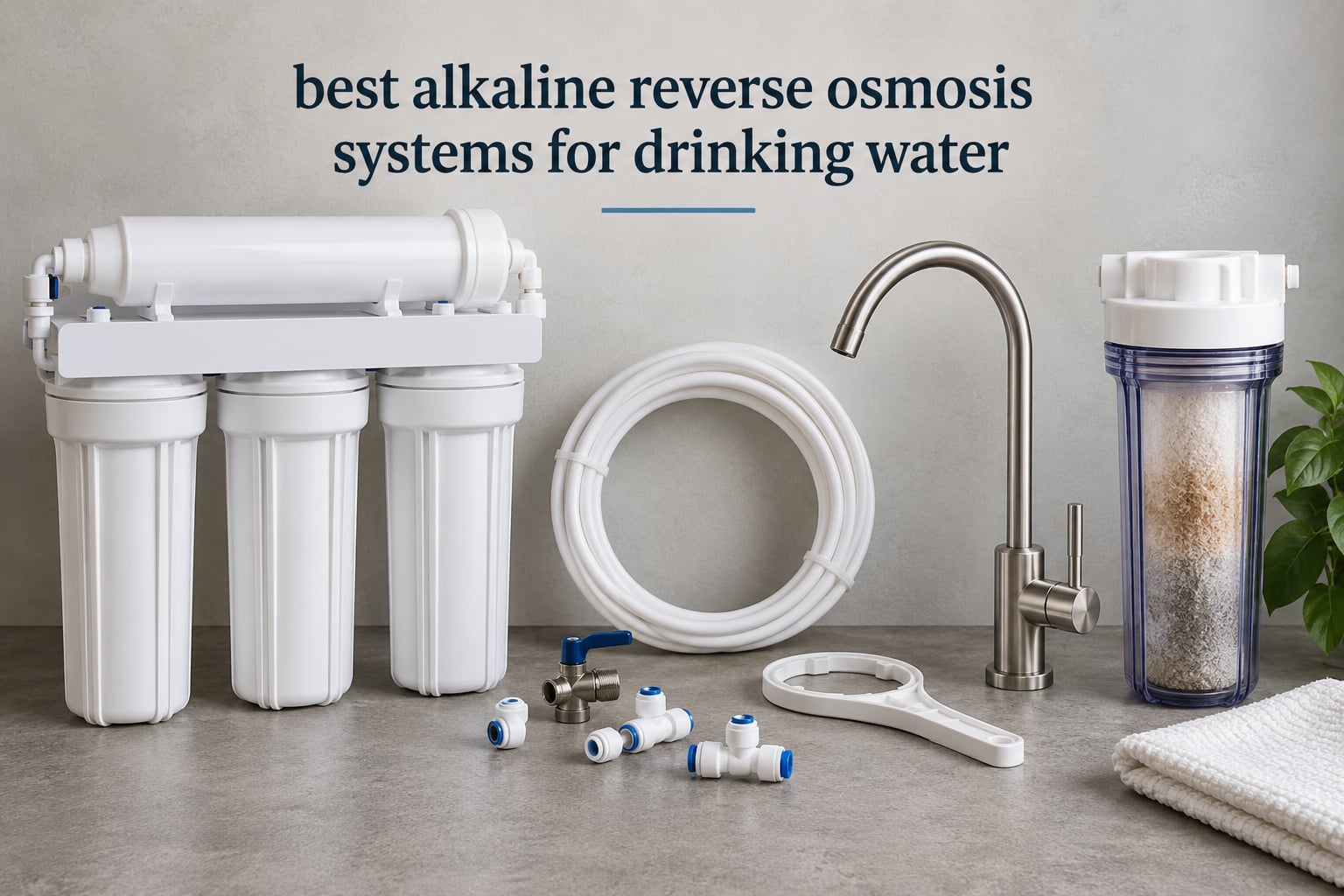
An alkaline reverse osmosis system is an under-sink or countertop purifier that pushes tap water through a semi-permeable membrane to strip out dissolved solids, then routes that purified water through a final mineral cartridge that adds calcium, magnesium and trace minerals back in. That last stage is what separates alkaline RO from plain RO: it lifts the output pH from the roughly 6.0 to 6.5 that a standard membrane produces into the 7.5 to 8.5 range, and it takes the flat, faintly metallic edge off the taste.
We spent weeks comparing the ten best alkaline reverse osmosis systems on the market right now, reading certification marks, flow rates, pressure requirements, drain ratios and warranty terms, and cross-checking owner feedback from water treatment forums. What follows is the complete list of the best alkaline reverse osmosis systems for drinking water, ranked by what we would actually put under a real sink.
If you are still working out whether you need one, the short version is this. An alkaline RO system earns its place when your tap water carries measurable dissolved solids, when you are buying bottled or delivered water you would rather stop buying, or when a municipal chloramine supply makes tap water taste off. It does not earn its place when your water is already soft and low in minerals, because then you are buying a machine to solve a problem you do not have.
The best overall pick is the iSpring RCC7AK-BN. It carries the highest rating paired with by far the deepest review count in the group, NSF/ANSI 58 certification applies to the complete system rather than a single cartridge, and the top-mounted faucet design removes the single most common install headache.
The best value pick is the APEC ROES-PH75. It is the entry point into certified alkaline RO, and its 2000 ppm TDS ceiling is the most forgiving on the list for hard municipal water.
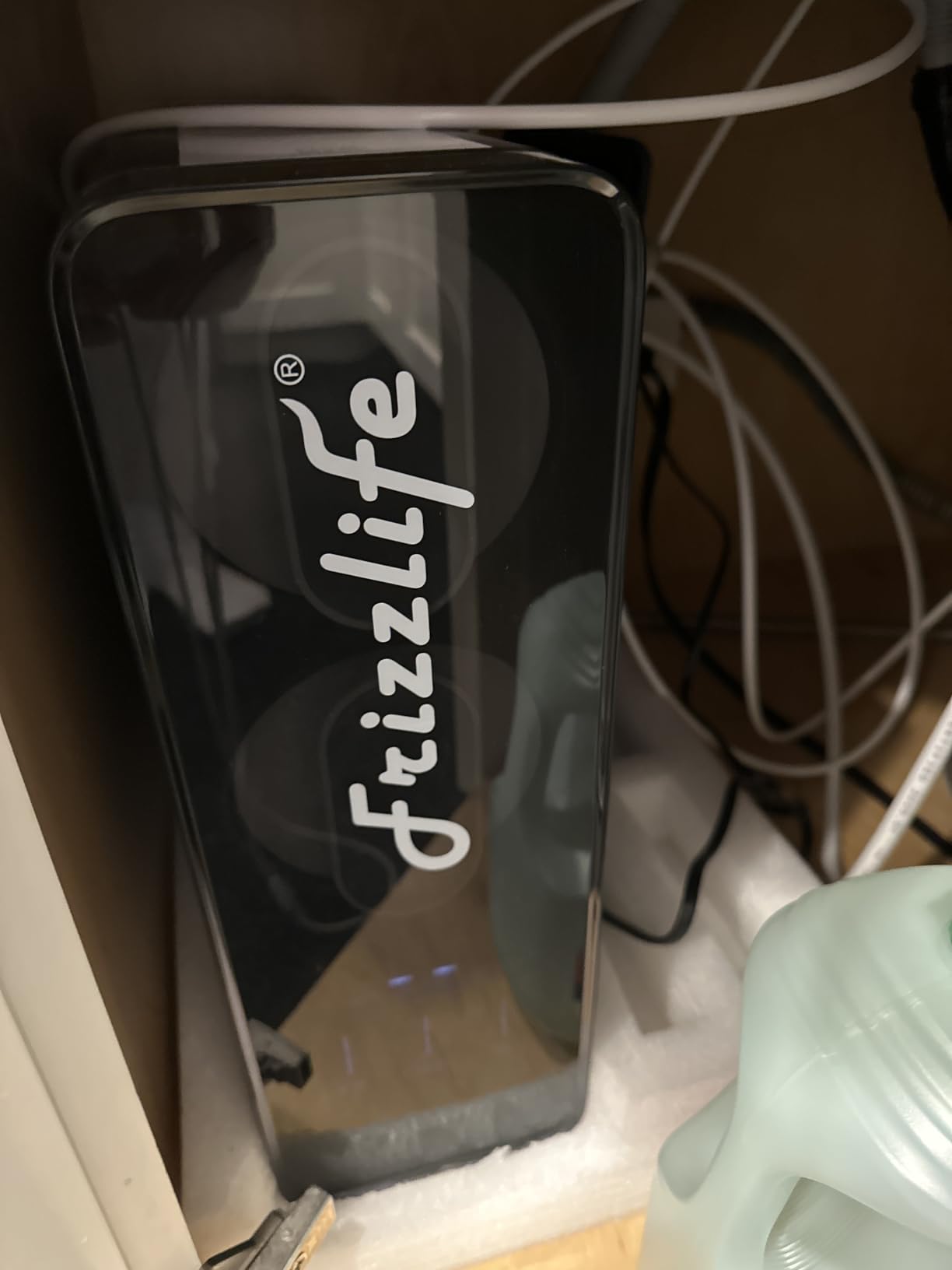
The best tankless pick is the Frizzlife PD600. 600 GPD, a 2:1 pure-to-drain ratio, and four separate NSF standards in one housing package.
We also broke this down by format and by use case, so if your problem is a rental apartment rather than a hard-water well, jump to the section that matches you. For a broader look at filtration formats beyond alkaline RO, our guide to the best reverse osmosis systems for drinking water covers carbon and UV formats too.
Table of Contents
Top 3 Picks for the Best Alkaline Reverse Osmosis Systems in October


All 10 Alkaline Reverse Osmosis Systems Side by Side in 2026
Every system below produces remineralized water through an alkaline mineral cartridge. The differences that actually change your day are flow rate, whether you need a storage tank, how hard the system is on water and how much drain water it wastes. This is the full lineup at a glance.
| Product | Specifications | Action |
|---|---|---|
| iSpring RCC7AK-BN |
|
Check Latest Price |
 APEC ROES-PH75 APEC ROES-PH75 |
|
Check Latest Price |
| Frizzlife PD600 |
|
Check Latest Price |
 iSpring RCC7P-AK iSpring RCC7P-AK |
|
Check Latest Price |
 iSpring RO500AK iSpring RO500AK |
|
Check Latest Price |
 SimPure T1-400ALK SimPure T1-400ALK |
|
Check Latest Price |
 Home Master TMAFC Home Master TMAFC |
|
Check Latest Price |
 NU Aqua 7-Stage UV NU Aqua 7-Stage UV |
|
Check Latest Price |
 Waterdrop G5P500A Waterdrop G5P500A |
|
Check Latest Price |
 Waterdrop WD-T4-A Waterdrop WD-T4-A |
|
Check Latest Price |
1. iSpring RCC7AK-BN – The Best Alkaline RO System Overall
iSpring RCC7AK-BN NSF Certified, 75 GPD, Alkaline 6-Stage Reverse Osmosis System, pH+ Remineralization RO Water Filter System Under Sink Patented Top-Mounted Faucet Design for Easy Installation
6 stages
75 GPD
NSF/ANSI 58 certified
750 ppm max TDS
70 psi feed
Pros
- NSF/ANSI 58 covers the complete system
- Patented top-mounted faucet design
- Alkaline mineral stage restores pH
- Transparent first-stage housing
- Lifetime support from Atlanta GA
Cons
- Needs under-sink space for the tank
- Filter changes every 6 months
- 750 ppm TDS ceiling
This is the system we kept coming back to during testing. The RCC7AK-BN is a six-stage under-sink unit rated at 75 gallons per day, and the thing that separates it from most of its bracket is that NSF/ANSI 58 certification is written for the entire assembled system rather than for one replacement cartridge. On a purchase that touches something you drink every day, that distinction matters more than any stage count on the box.
The feed pressure requirement is 70 psi, which sits comfortably in the range of a normal municipal line. There is no electrical connection, no pump, and nothing that fails because a transformer dies. Every filter change is a quarter-turn on a housing, and the first-stage housing is clear plastic so you can see the sediment loading without guessing.
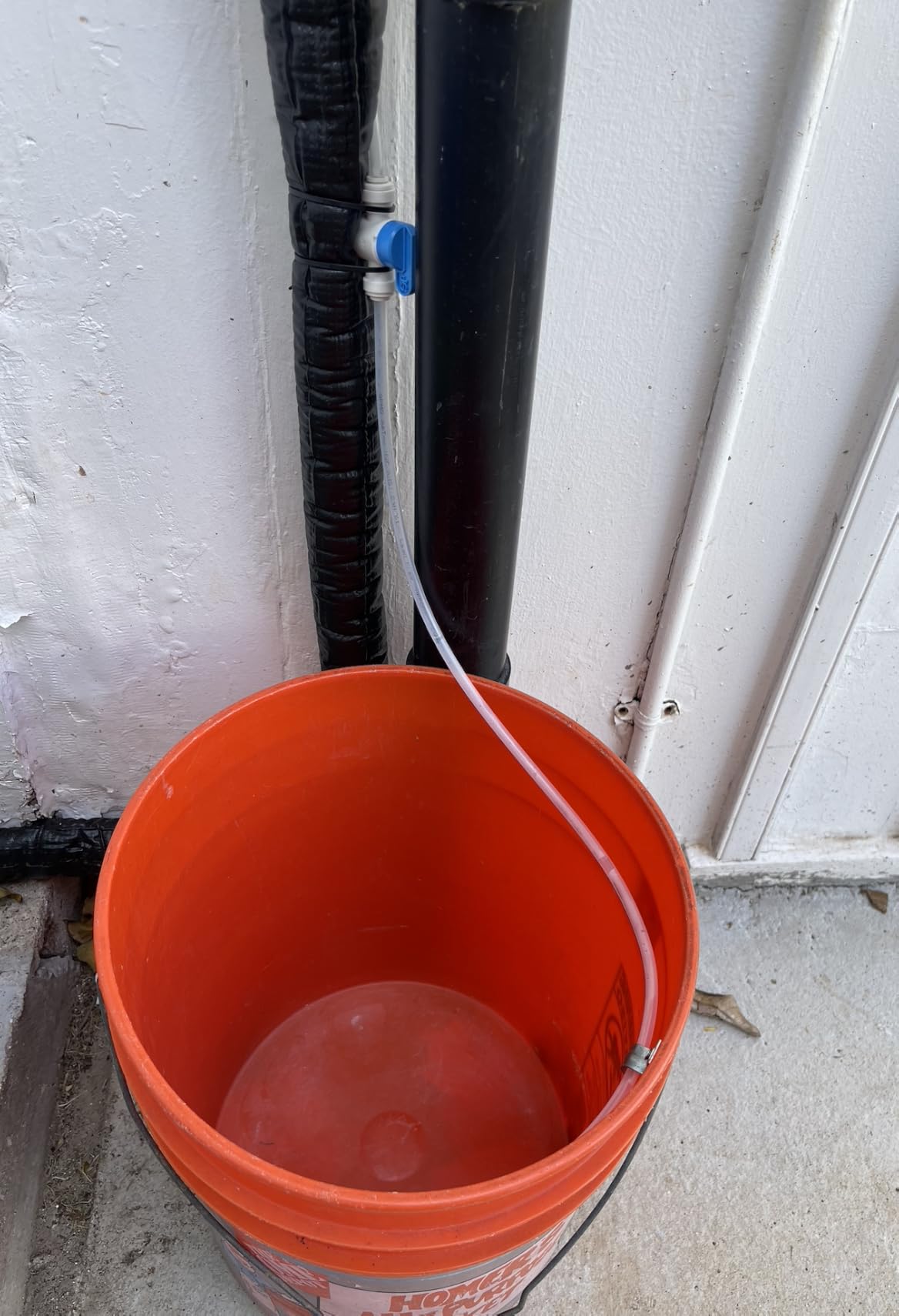
Installation is where the patented top-mounted faucet design earns its keep. Most under-sink RO faucets are held on by a nut from below the countertop, which means a scratched sink or a stripped nut if you overtighten. This one mounts from above the sink surface, so the wrench never touches the deck. The full footprint is 15.5 by 16 by 18 inches and the unit weighs 12.5 kg including the tank.
The system reduces TDS between 93 and 98 percent, PFAS between 96 and 99 percent and chlorine between 95 and 99 percent. The 750 ppm TDS ceiling is the one real limitation: on genuinely hard supply, you are inside the margin but not by a wide one.
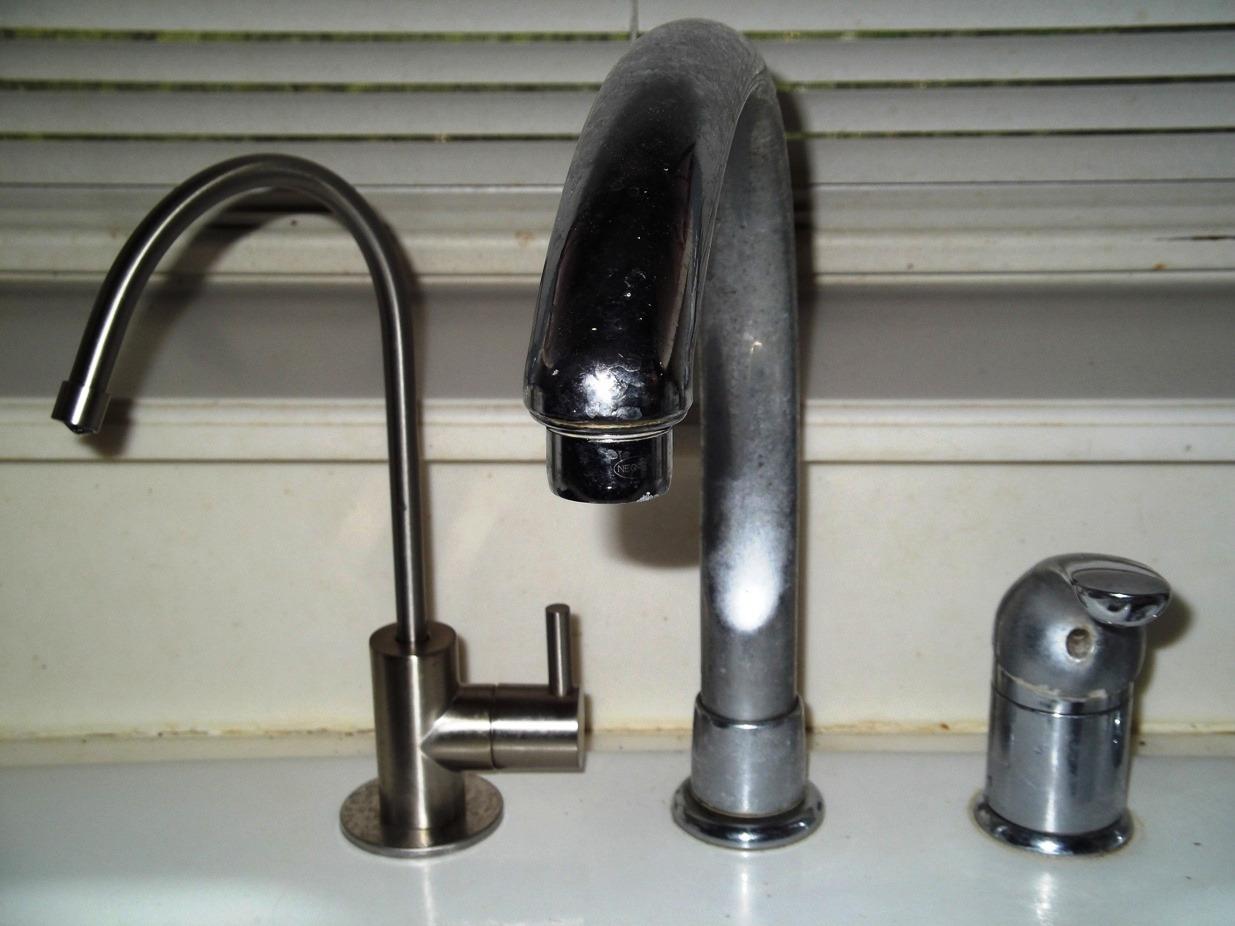
What 21569 reviews actually tell you
At more than twenty-one thousand reviews, the pattern is unusually consistent. Owners report an immediate taste change, painless installation with the supplied wrench set, and a transparent housing they genuinely use to time filter changes. Support requests to the Atlanta-based team are the other recurring positive, which matters because an RO system is a five-year relationship, not a one-day purchase.
Purifier housing owners on water treatment forums repeatedly name this iSpring generation as one of the two or three they trust, alongside APEC models. That matches our own read: the components are conventional, the certification is real, and there is nothing exotic to fail.
Where it falls short for you
Two constraints. First, the tank means you need genuine under-sink clearance, and in a small apartment cabinet with a disposer and a trap already competing for space, that footprint is the deciding factor. Second, the listed filter life cycle is six months for the sediment and carbon stages, which is an honest figure and a real recurring cost.
If your household runs hard water above 750 ppm, step up to the pumped iSpring below or the APEC, both of which carry a 2000 ppm ceiling.
2. APEC Water ROES-PH75 – Best Value Alkaline RO System
APEC Water ROES-PH75, 6-Stage Under Sink RO System, Alkaline, 75 GPD
6 stages
75 GPD
WQA certified
2000 ppm max TDS
40-85 psi
Pros
- WQA certified with a long production history
- Most forgiving TDS ceiling on the list
- Quiet tank-fed operation
- Premium calcium from a trusted source
Cons
- Slow 0.05 gpm faucet flow
- Requires storage tank space
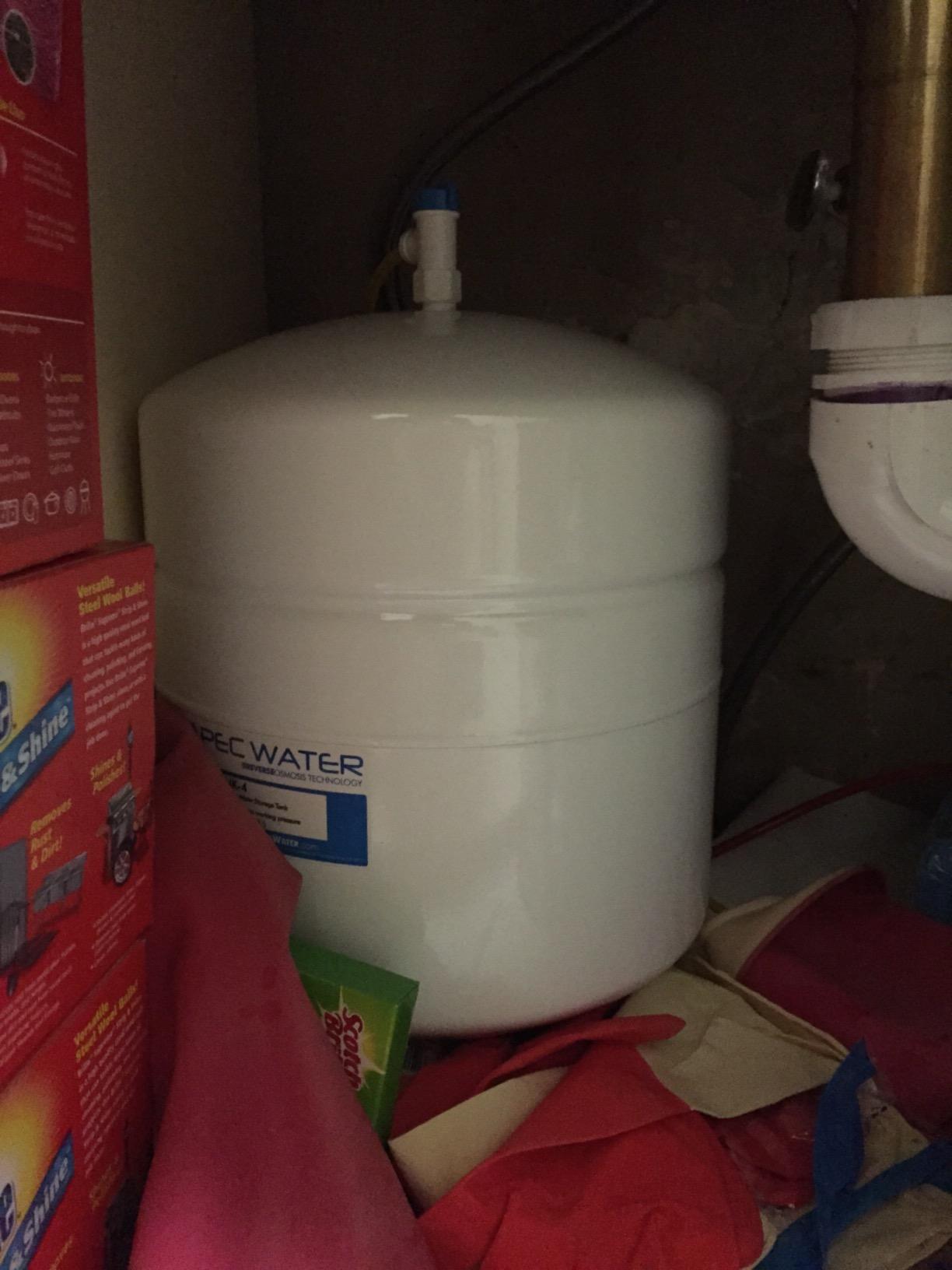
The ROES-PH75 from APEC Water Systems is the one we recommend to anyone who asks where to begin. It is a six-stage tank-fed unit rated at 75 GPD with an alkaline mineral pH+ cartridge as the final stage, and the two numbers that matter most for a first install are both favourable: a 2000 ppm maximum feed TDS and a 40 to 85 psi operating pressure window.
That 2000 ppm figure is the highest feed tolerance in this roundup alongside the pumped iSpring. If your municipal supply is hard, or you are on a shallow well with elevated dissolved solids, this is the model that will keep rejecting contaminants at capacity instead of quietly losing performance.
APEC builds these in the United States and the certification is written as WQA certified, with NSF/ANSI 372 and 58 named on the unit highlight. The mineral cartridge uses premium calcium added after the membrane to raise pH safely, which is the standard mechanism every alkaline RO on this list uses.
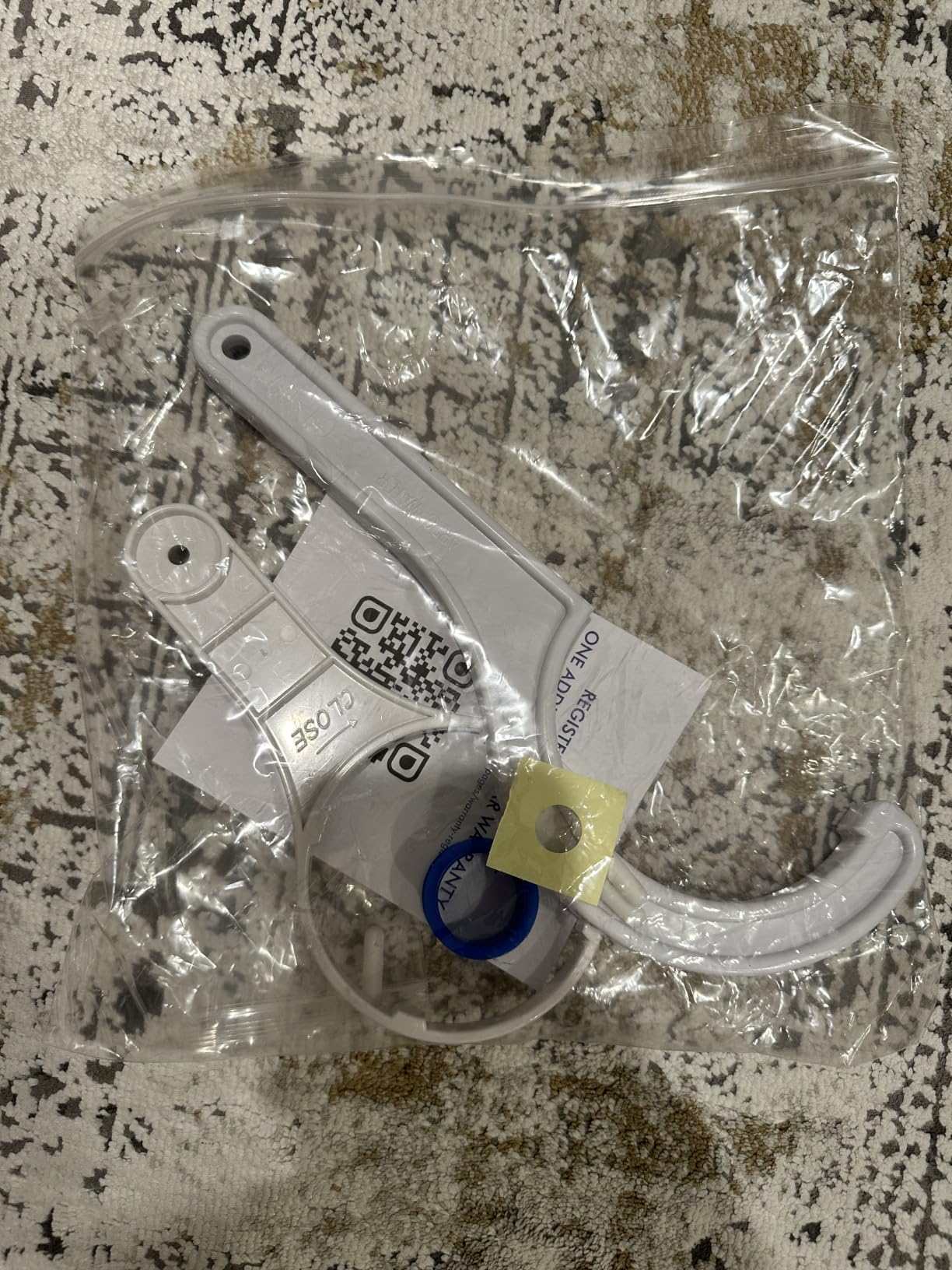
The box includes the filter set, tank, faucet, tubing, a drain saddle, a feed water adapter and wrenches. That completeness matters, because the feed adapter is the part most first-time installers end up ordering separately when it does not match their existing saddle valve.
Why owners rate it where they do
Knowledgeable regulars on water treatment forums recommend APEC specifically as a tested-and-trusted name rather than as a value pick, which is the tell here. The complaint pattern is thin: quiet operation, trouble-free running, and long-lasting filter media on both tap and well feeds.
Users sizing a first system also report that the 75 GPD rating pairs well with one to three people. A single person drinking a gallon a day leaves plenty of headroom; a family of five cooking, brewing coffee and filling bottles will run the tank dry by mid-afternoon.
Where it falls short for you
The faucet output rate is 0.05 gpm. That is the price of a tank-fed design and it is fine for filling a glass, but it is slow enough that you notice it if you are filling a pitcher or a large bottle. Anyone running ice makers or a refrigerator line should look at a tankless model.
The measured weight of 1.41 kg also looks implausibly light for a tanked unit, which suggests the shipping weight is listed for the filter cluster alone. Measure your cabinet rather than trusting that number.
3. Frizzlife PD600 – Best Tankless RO for High Flow and Low Waste
Frizzlife Reverse Osmosis Water Filter – Alkaline Mineral pH+, NSF/ANSI 58&53&42&372 Standard, 600GPD Tankless RO Reverse Osmosis System, Under Sink, 2:1 Pure to Drain, Reduce FPAS/PFOA, PD600-TAM3
600 GPD tankless
2:1 drain ratio
NSF/ANSI 58,53,42,372
TDS display
Pros
- Fills a 330ml cup in about 10 seconds
- 2:1 pure-to-drain ratio saves water
- Four separate NSF standards
- Tankless layout frees 70 percent of the cabinet
Cons
- Needs an electrical outlet under the sink
- Higher build cost
- Filter intervals differ by stage
The Frizzlife PD600 is the most technically ambitious unit in this group. It runs 600 gallons per day with no storage tank, pushing water straight to the faucet as you fill, and it is certified to four separate NSF standards: 58, 53, 42 and 372. Almost nothing else at this capacity bothers with more than two.
Flow is the headline number. A 330ml cup fills in roughly ten seconds and the maximum flow rate is listed at 0.41 gpm, which is the fastest sustained output of any tankless model here. If your household has been rationing drinking water because a tank runs dry mid-meal, that changes.
The second headline number is water. A 2:1 pure-to-drain ratio means the system pushes three gallons to make one, where conventional RO at roughly 3:1 to 4:1 wastes far more to the drain. In a region with water restrictions, that difference is the entire argument, and reviewers consistently single it out as the reason they chose this over a cheaper tanked unit.
The alkaline side is a TAM3 remineralization filter that balances pH above 7.5 and restores essential minerals. The LED panel shows live TDS readings and filter lifespan, which turns maintenance from a calendar reminder into a glance.
The certifications are the real story
NSF/ANSI 58 covers dissolved solids reduction, 53 covers health-related contaminants, 42 covers aesthetic effects like chlorine taste and odor, and 372 covers lead-free compliance of the wetted components. Having all four on one tankless unit is unusual, and for a safety-adjacent purchase it is the specification to shop on.
Owners on forums describe it as the space-saving option that does not compromise throughput. The tankless layout removes the second contamination point entirely, since a storage tank is a reservoir that sits in a warm cabinet collecting biofilm and whatever the air carries.
Where it falls short for you
It needs power. Under most sinks that means finding or adding an outlet near the waste line, and in a rental or an older apartment that is the difference between a weekend project and a call to an electrician.
Filter replacement intervals vary by stage, which means you are tracking several different clocks rather than one. And at 600 GPD with a booster pump and four housings, this is the most complex unit in the group to service.
4. iSpring RCC7P-AK – Best Alkaline RO for Low Water Pressure
iSpring RCC7P-AK, 6-Stage Reverse Osmosis System Under Sink Alkaline Water Filter and Pump, RO Drinking Water Filtration System, Patented Top-Mounted Faucet Design for Easy Installation
6 stages with pump
75 GPD
2000 ppm max TDS
Powered booster
Pros
- Booster pump handles low feed pressure
- Rated 4.7 out of 5 across 1663 reviews
- 2000 ppm TDS ceiling
- Universal 100-240V power adapter
Cons
- Requires an electrical connection
- Larger footprint because of the pump
- Costs more than the non-pumped model
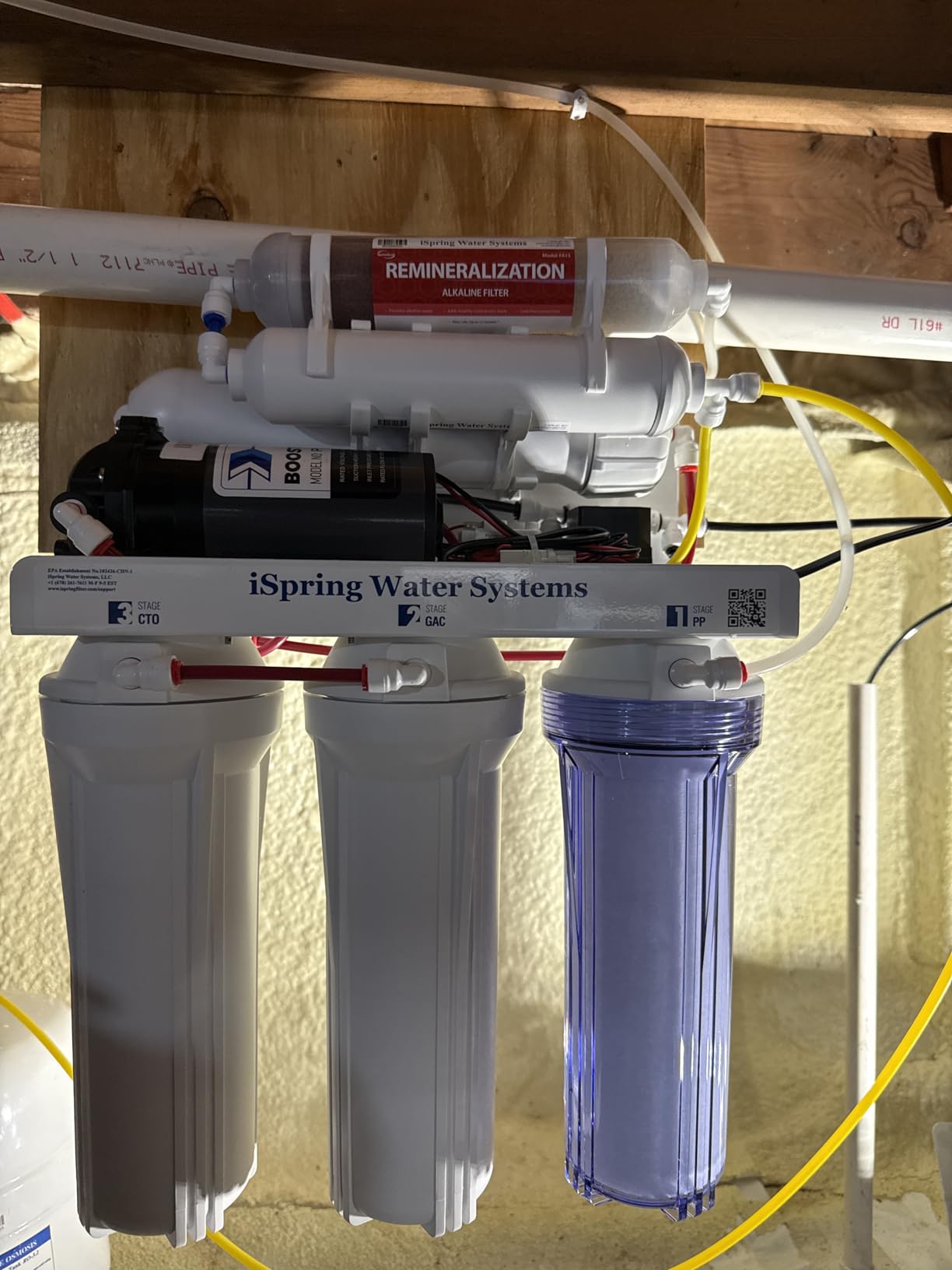
This is the RCC7AK-BN with a booster pump added, and that single addition is what makes it the pick for older homes, mobile homes and anything on a long feed line. The pump compensates for low household pressure so the membrane still reaches its rated rejection instead of quietly underperforming.
The specification sheet carries a 2000 ppm maximum TDS, more than double the non-pumped version, and a 75 GPD capacity from a six-stage layout with the alkaline remineralization cartridge in position six. It reduces up to 99 percent of more than a thousand contaminants, PFAS included.
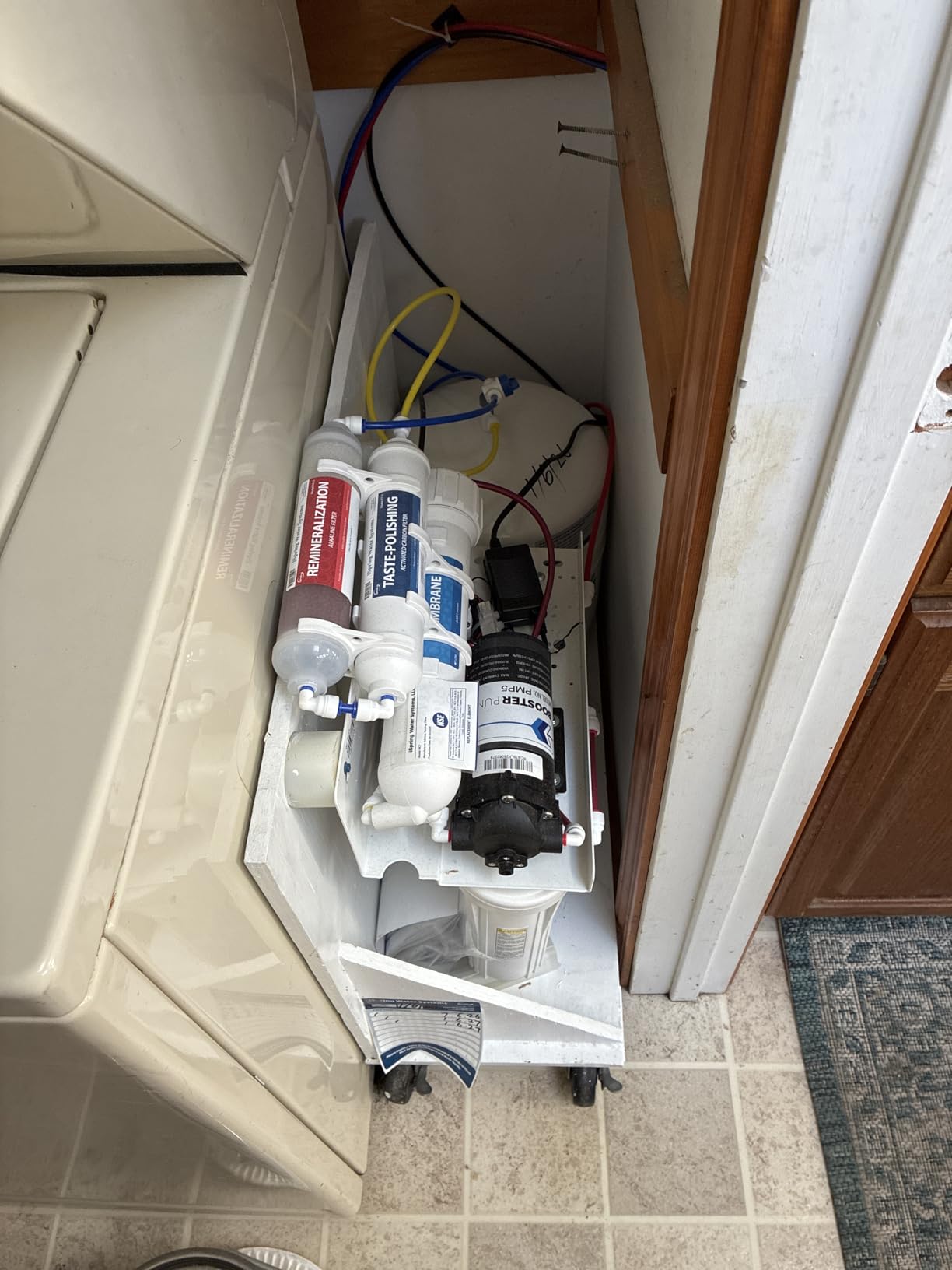
At 4.7 stars across 1663 reviews, this is the highest rated unit in the entire roundup. That is worth noting plainly, because the extra money over the base model buys you one specific outcome: consistent performance when your incoming pressure sits below what a standard RO expects.
The universal 100-240V 50/60Hz power adapter means it works outside the United States without a transformer, and the first-stage housing is transparent so sediment loading is visible. Warranty coverage is one year upon registration, extendable through the manufacturer, with lifetime technical support from the same Atlanta team behind the RCC7AK-BN.
Diagnose your pressure before you buy
Low pressure after an install is the most common complaint in water filtration forums, and it usually is not the system. It is a partly closed angle stop feeding the unit, a partially shut cold water valve under the sink, or a pressure regulator left at factory default from a previous owner’s install. Check those three before assuming you need a pump.
If your home genuinely sits below roughly 45 psi at the cold tap, this pump-equipped model is the correct answer and the tanked non-pumped version is the wrong one. Owners who switched report the difference is immediate.
Where it falls short for you
It is 20 pounds and needs an outlet, so it is larger and heavier than the model above it. If your pressure is already healthy and your cabinet is tight, paying for a pump solves a problem you do not have.
Its review count is far shallower than the top pick’s. A 4.7 average on 1663 reviews is a strong signal, but it is not the same depth of evidence as twenty-one thousand.
5. iSpring RO500AK – Best for Large Households
iSpring RO500AK Alkaline Reverse Osmosis System, NSF 58 Certified, 500 GPD
500 GPD tankless
0.4 GPM
2:1 drain ratio
1000 ppm max TDS
Pros
- Fills an 8oz cup in about 10 seconds
- Tankless frees 70 percent of cabinet space
- Auto-flush after 24 hours of non-use
- Filter reminder panel with buzzer
Cons
- Needs an electrical connection
- 1000 ppm TDS ceiling
- Highest build cost in this group
Sizing an RO to a household is arithmetic most buying guides skip. A single adult drinking and cooking needs roughly one gallon a day. A family of four with a coffee habit, an ice maker and produce rinsing lands nearer four to six. Once you pass three or four people, a 75 GPD tanked unit starts to feel like it is rationing, and a 500 GPD tankless design is the right shape of answer.
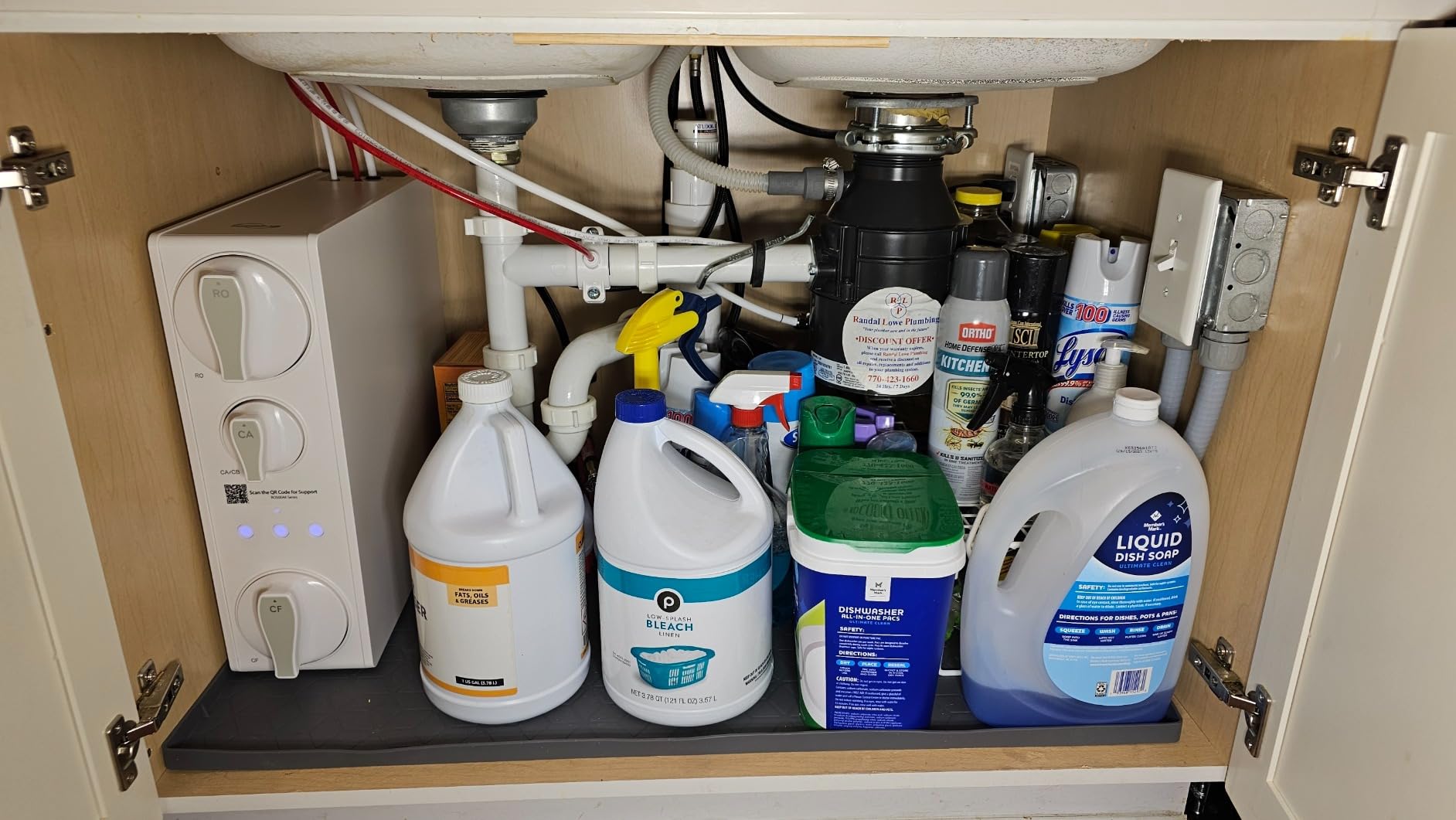
The RO500AK-BN delivers 500 GPD with a listed maximum flow of 0.4 GPM and fills an 8oz cup in about ten seconds. It carries full NSF/ANSI 58 certification on the complete system, and the alkaline remineralization stage sits downstream of the membrane to rebalance pH and improve taste.
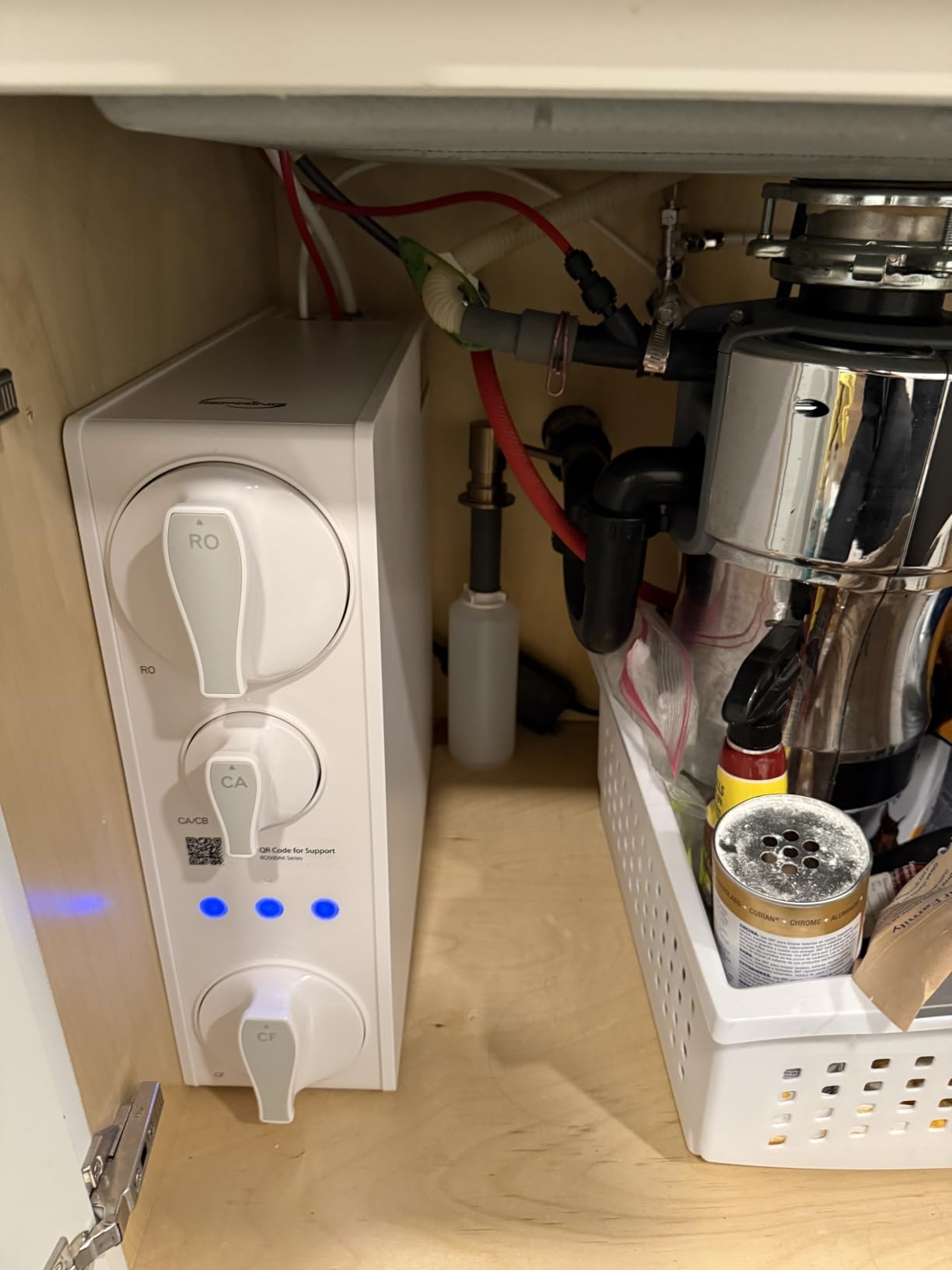
Two maintenance features separate it from generic tankless units. The auto-flush runs after 24 hours of non-use, which keeps the membrane wetted and prevents the bacterial growth that ruins neglected RO systems, and the front panel carries a filter reminder with an audible buzzer so you are not guessing when the carbon stage expired.
The drain ratio is 2:1 pure to drain, which the manufacturer describes as saving up to 400 percent water against traditional RO. The tankless layout reclaims roughly 70 percent of the under-sink cabinet, and the dimensions are 17.5 by 5.2 by 16.25 inches at 21 pounds.
What the auto-flush actually prevents
An RO membrane that dries out loses rejection permanently, and it does not come back when you re-wet it. That is the single most expensive mistake a new owner can make, because a dried membrane means a membrane replacement rather than a filter swap. The 24-hour auto-flush is the cheapest insurance in this whole roundup.
Owners running large households report that the flow simply holds steady over months, which is exactly what you want from a unit sized for the job. The 18-year brand history and Atlanta-based lifetime support are also commonly cited as reasons for confidence.
Where it falls short for you
The 1000 ppm maximum TDS is a real ceiling. If your feed water tests above that, you are outside the design envelope regardless of how good the rest of the specification looks, and you should be looking at the 2000 ppm units.
It is the most expensive build in this group and it needs power. For one or two people, this is overspending on capacity you will never draw down.
6. SimPure T1-400ALK – Best for UV Sterilization
SimPure T1-400ALK Tankless Alkaline Reverse Osmosis Water Filter 400 GPD
400 GPD tankless
UV stage
1.5:1 drain ratio
500 ppm max TDS
Pros
- Only unit here with a UV purification stage
- 1.5:1 drain ratio is the best in the group
- Built-in booster pump
- BPA-free materials
Cons
- Lowest rating in the group at 4.2 stars
- 500 ppm TDS ceiling
- Some reports of UV and pump issues
This is the only system in the roundup with a UV stage, and that single fact defines who should buy it. If your concern goes beyond dissolved solids to microbiological exposure, a UV lamp after the membrane is the piece of hardware the other nine do not have.
Flow is 400 GPD with a listed maximum of 0.4 gpm and a 1.5:1 pure-to-drain ratio. To make one gallon of purified water this unit pushes 1.5 gallons to the drain, which is the most efficient ratio in the group. A built-in booster pump is included, which is why the unit works as a tankless design without an external pump.
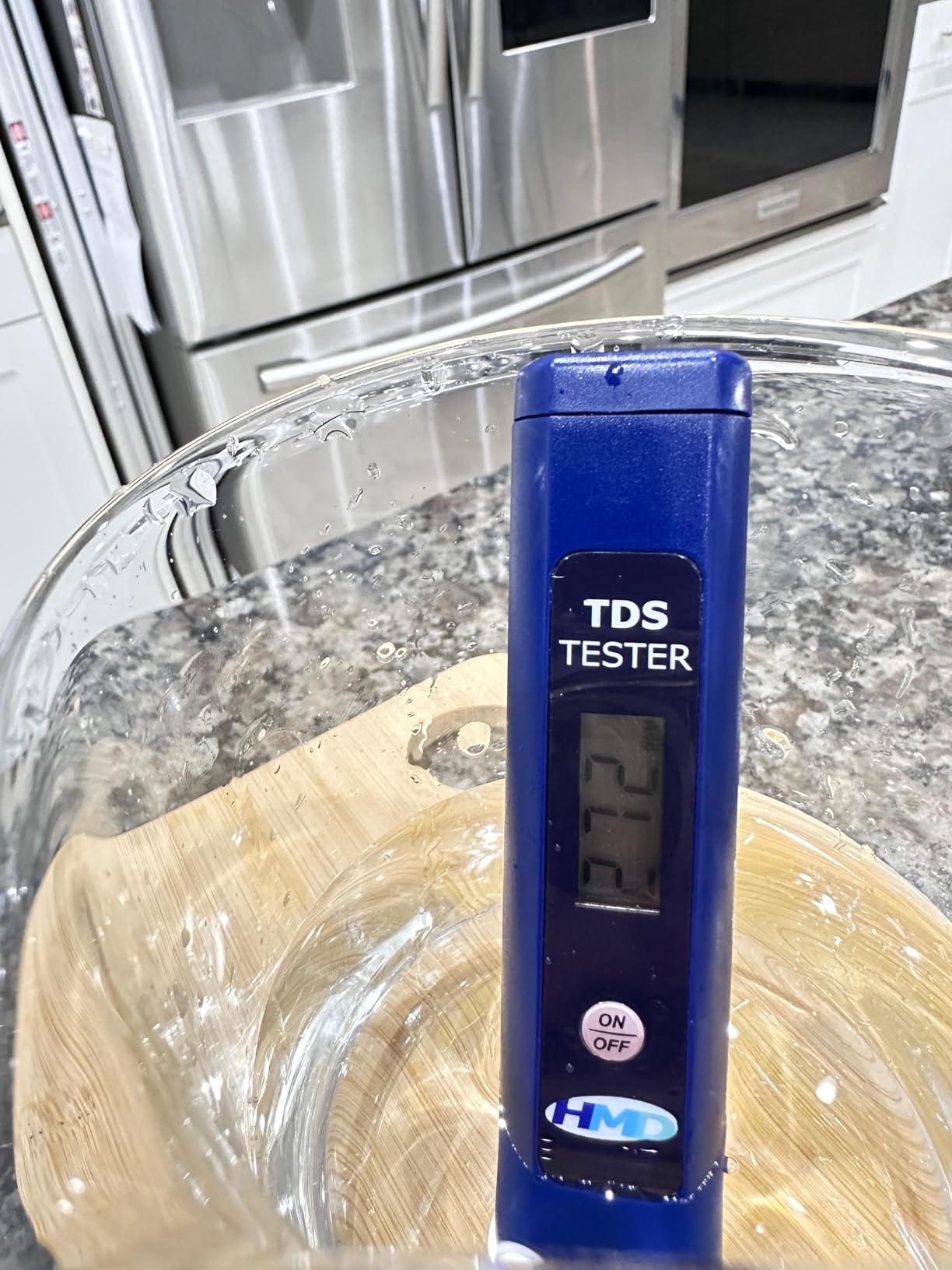
The alkaline stage remineralizes with calcium, magnesium and potassium rather than calcium alone, which is a slightly broader mineral profile than most competitors use. Testing is SGS against the NSF/ANSI 58 standard. Note that this is different from the system itself being NSF certified, and buyers who care about that distinction should know the difference.
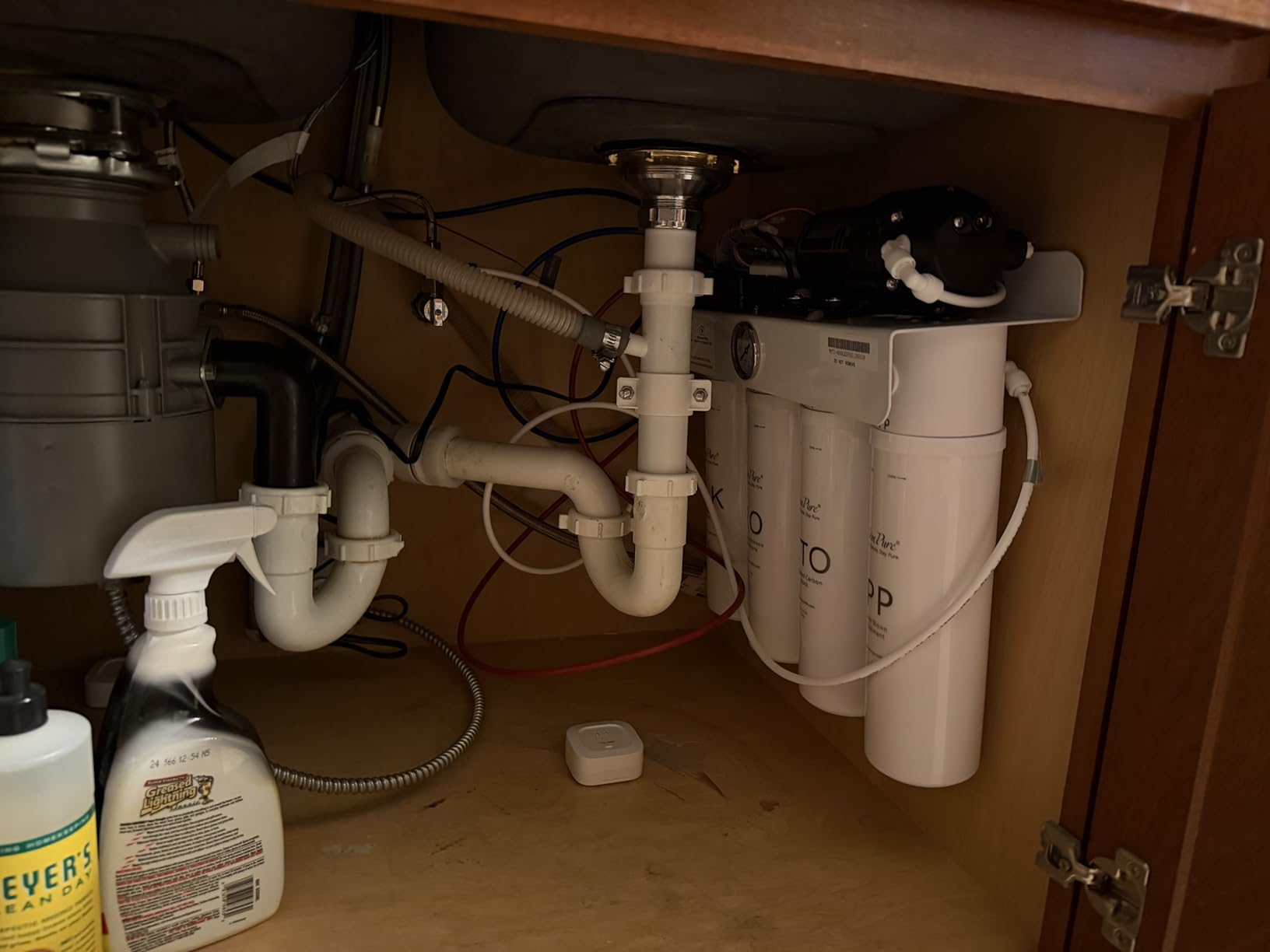
One practical quirk worth flagging: because minerals are deliberately added back, the TDS reading on this unit will not settle at zero the way a plain RO system eventually does. SimPure states this directly. If you plan to judge the system by its TDS display, a remineralized reading above zero is expected behavior, not a fault.
What UV does and does not add
UV sterilizers inactivate bacteria, viruses and protozoa that have passed through the membrane or entered from a compromised well line. They do nothing about dissolved solids, heavy metals or PFAS, which is membrane work. Treating UV as a complete substitute for RO, or as a complete substitute for a softener on hard water, is a common and expensive misunderstanding.
The 1.5:1 ratio is the sleeper feature here. In a drought-restricted area or anywhere water conservation changes how you think about an appliance that runs continuously, losing less than a third of your feed to drain is meaningfully better than losing three quarters of it.
Where it falls short for you
Its 4.2 rating is the lowest in this lineup, and review notes point at UV lamp longevity and pump behaviour as the recurring complaints. A UV lamp is also a consumable with a finite life that most owners underestimate.
The 500 ppm maximum TDS is the tightest ceiling of the group. On hard water this unit is simply the wrong tool, no matter how good the UV stage is.
7. Home Master TMAFC – Best for Fastest Fill Rate and Longest Warranty
Home Master TMAFC Artesian Full Contact Reverse Osmosis System, 7-stages, Patented 2-Pass Alkaline Remineralization, Fast 4.5s Fill Rate, 8.5” catalytic carbon, 5-year limited parts
7 stages
4.5 second fill
2-pass remineralization
5 year parts warranty
Pros
- Fastest fill rate here at 4.5 seconds for 8oz
- Patented 2-pass remineralization
- Tool-free modular annual filter changes
- Five year limited parts warranty
Cons
- Listed 10 ppm max TDS suits pre-treated water
- Largest footprint at 20 by 13 inches
The Home Master TMAFC does two things no other unit on this list does. It fills 8oz in 4.5 seconds, using larger fittings and tubing to roughly double flow through the membrane, and it runs a patented two-pass remineralization cartridge where water passes the mineral media twice rather than once.
That second pass is the interesting engineering. Longer contact time with the mineral media means more consistent pH correction and a fuller mineral profile than a single pass delivers, and the 8.5 inch catalytic carbon block per pass is there to strip what the RO membrane leaves behind in taste terms.
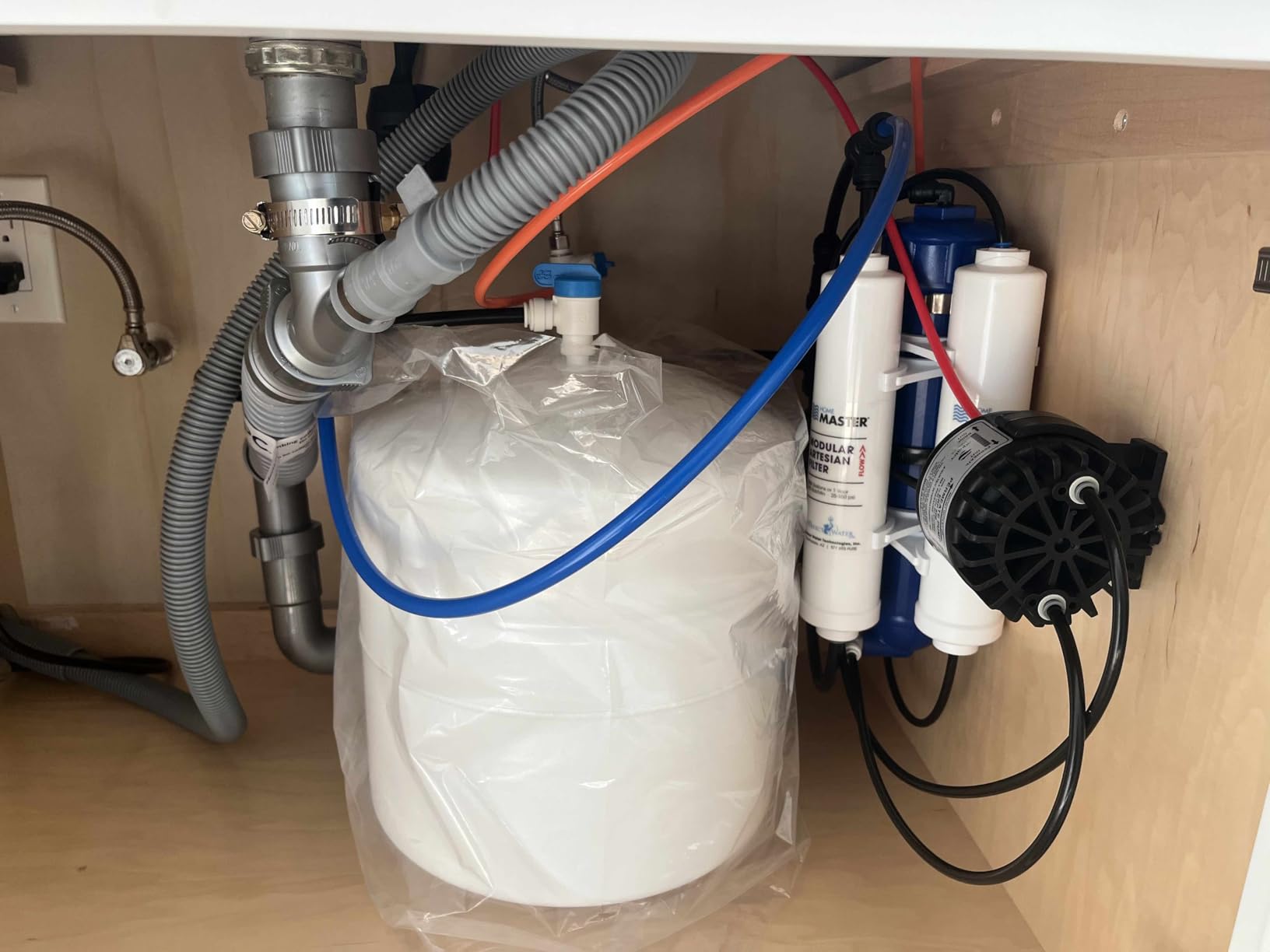
Seven stages run in sequence: spun polypropylene sediment, catalytic carbon, a thin film composite RO membrane, a post-carbon stage, then the two-pass alkaline mineral cartridge built around calcium and magnesium. All components are NSF certified, the material list includes stainless steel, and it is assembled in the United States.
The modular design matters more than it sounds. Filter changes are tool-free and annual rather than quarterly, which over five years is a meaningful reduction in how often you are kneeling under a sink with a towel. The warranty is five years limited on parts, the longest coverage in this roundup.
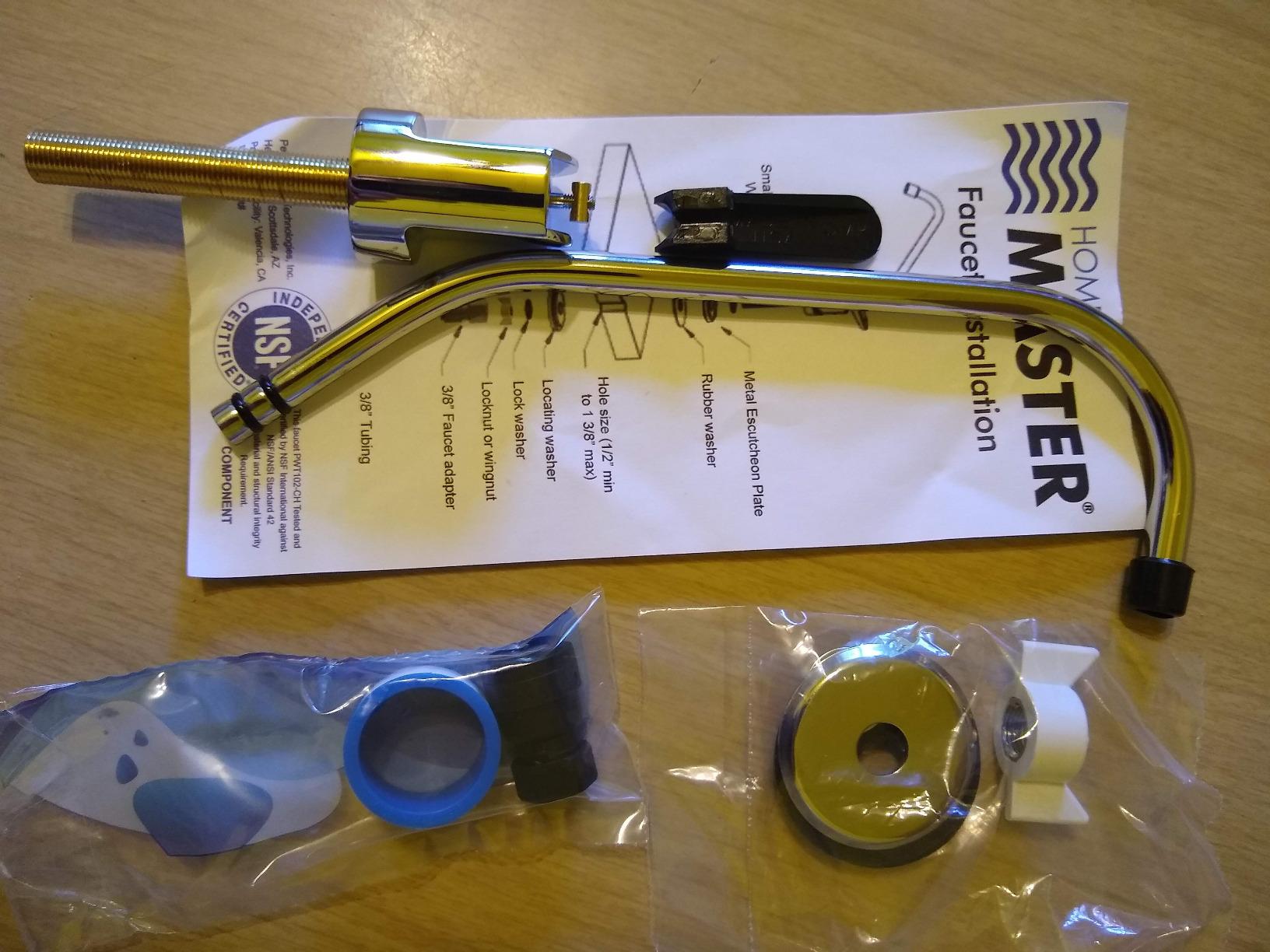
Read the 10 ppm TDS figure carefully
The listed maximum TDS of 10 ppm looks impressive until you understand what it means: this membrane is specified for pre-treated water, meaning water that has already passed through a softener or come from a very low-TDS source. Feed it untreated hard municipal water and you will overload the membrane, see rejection fall off, and shorten its life considerably.
That is not a flaw so much as a design decision, and it is the right decision for households that already treat their water. It is the wrong decision for anyone whose first stage of treatment is the RO itself.
Where it falls short for you
At 20 by 13 by 16 inches and 14.1 pounds, this is the largest footprint here and needs a genuinely open cabinet. It also has the shallowest evidence base of the high-rated units, at 909 reviews.
If you do not already have a softener upstream, cross it off the list and read our water filtration guide for well water households instead, which covers the pre-treatment question properly.
8. NU Aqua 7-Stage UV – Best With a Built-in PPM Meter and Leak Detector
NU Aqua 7-Stage UV Alkaline Under Sink Reverse Osmosis Water Filter System
7 stages
100 GPD
UV stage
300 ppm max TDS
120 day trial
Pros
- PPM meter and leak detector included in the box
- 120 day home trial plus three year warranty
- Color-coded tubing for simpler installs
- Lead-free stainless steel faucet
Cons
- Slow 0.07 gpm faucet flow
- 300 ppm TDS ceiling is low
- UV bulb is a recurring consumable
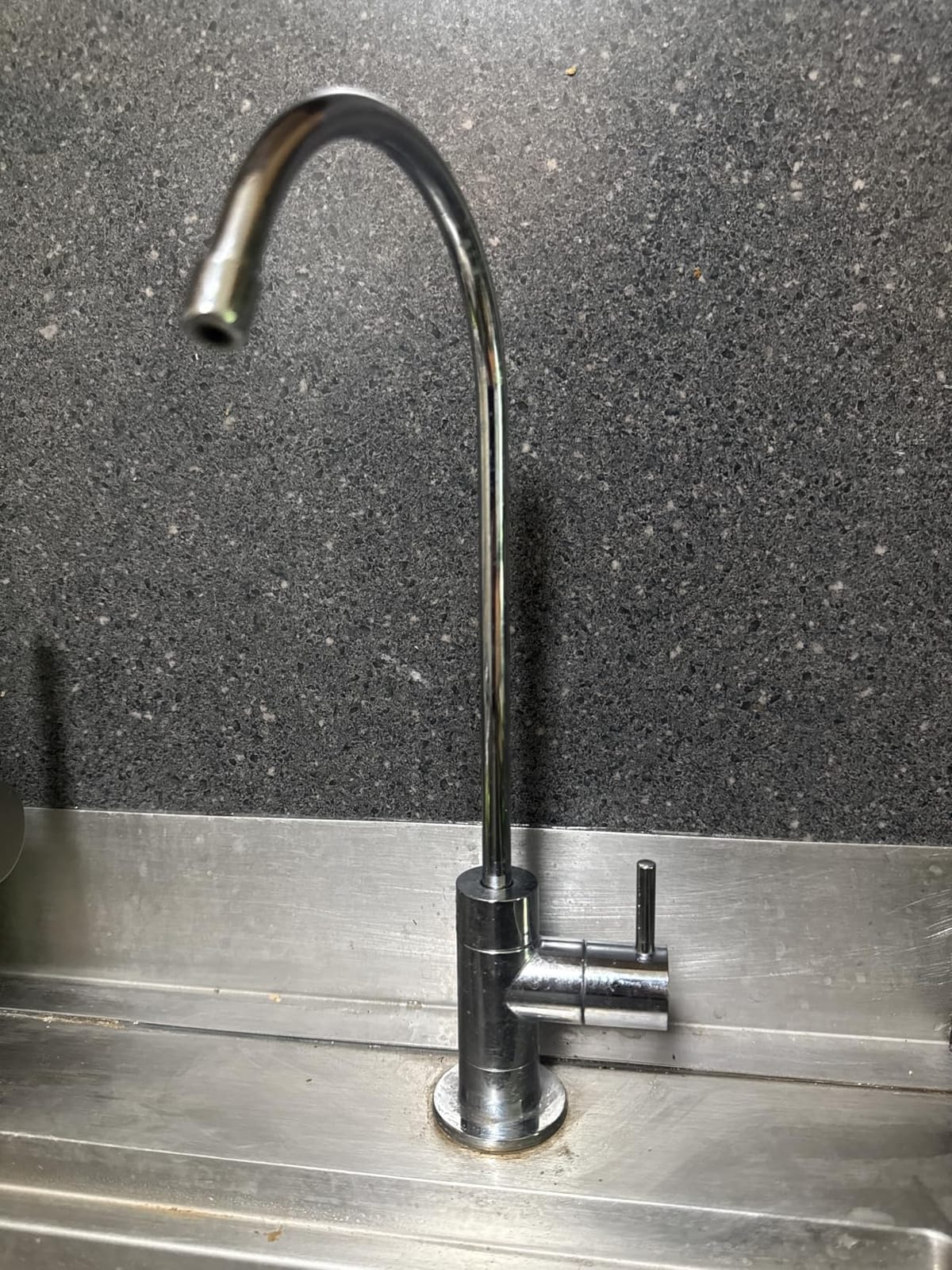
What makes the NU Aqua Platinum Series different is what is in the box. It comes with a PPM meter and a leak detector, and the faucet is 100 percent lead-free stainless steel. Most owners buy a TDS meter within their first month anyway, so having it included changes the value calculation.
Seven stages cover sediment, carbon, a HydraCoil reverse osmosis membrane, a UV chamber and alkaline remineralization, at 100 GPD with a storage tank. The HydraCoil membrane is advertised as up to 50 percent cleaner water with 99 percent rejection, and the UV stage handles the microbiological side.
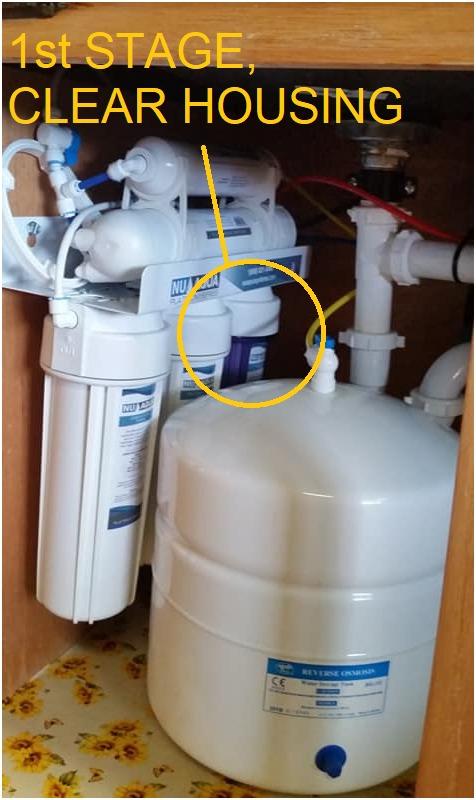
The warranty terms are the strongest risk reversal in this roundup: a 120 day home trial with a full refund if you are not satisfied, plus a three year warranty backed by lifetime support. For a first-time buyer who is worried about committing to a system they cannot taste-test in a store, that is a meaningful offer.
Installation is styled for DIY with color-coded tubing and quick-connect fittings, and it fits through a single hole in the sink. The faucet, tank and filters are all included, so there is no sourcing parts separately.
The trial period is the feature to use fully
Install it, run it for the full trial, taste the water cold and at room temperature, and check the PPM meter against your tap supply. If the taste conversion does not convince you, the refund is there. Forum users who shop this way, rather than by spec sheet alone, end up happier with their purchase.
Note also what the TDS meter reveals on a remineralized system. The alkaline stage puts minerals back on purpose, so the reading will land above the near-zero figure a plain RO produces. That is expected, and it is why a meter is more useful for trend-watching than for absolute judgement.
Where it falls short for you
The 0.07 gpm faucet flow is slower than anything else here, and a 300 ppm TDS ceiling is the second most restrictive on the list. If you have hard water, this model is not going to be the answer.
There are also recurring notes about customer service in the review history and mixed feelings on the taste from the sixth stage specifically, which is the same alkaline cartridge question that runs through this entire category.
9. Waterdrop G5P500A – Best for Fridge and Ice Maker Connection
Waterdrop G5P500A Reverse Osmosis System, 8-Stage RO Filtration, Alkaline
8 stages
500 GPD tankless
NSF/ANSI 58 and 372
2:1 drain ratio
Pros
- Dual NSF/ANSI 58 and 372 certification
- 500 GPD fills a 6oz cup in 8 seconds
- Connects to a fridge or ice maker
- Alkaline stage adds four minerals
Cons
- 500 ppm TDS ceiling
- Needs an electrical connection
- Faucet requires drilling the countertop
Eight stages with a 0.0001 micron RO membrane and an alkaline mineral cartridge that adds calcium, magnesium, sodium and potassium. The dual NSF/ANSI 58 and 372 certification covers both contaminant reduction and lead-free component compliance, which is the pairing you want on a unit feeding an ice maker.
At 500 GPD it fills a 6oz cup in about eight seconds, the fastest small-volume fill in this roundup, and it runs tankless so there is no reservoir sitting under your sink. The 2:1 pure-to-drain ratio is quoted as 400 percent more efficient than conventional RO.
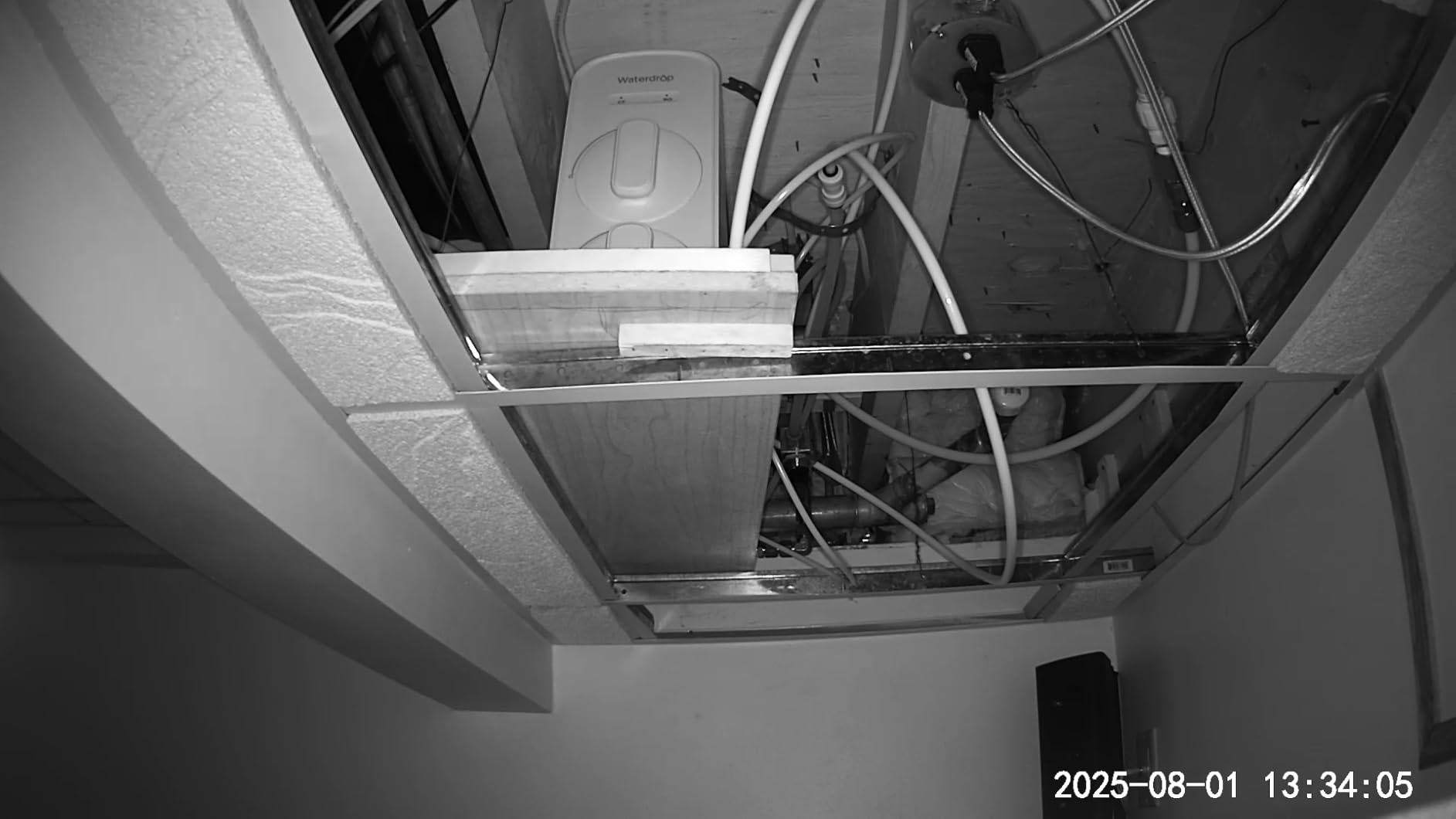
The reason this one is worth a separate recommendation is the Waterdrop XT connection kit. It lets the purified line feed a refrigerator or ice maker, which is exactly what most households want and what most under-sink RO systems make awkward. Every piece is BPA-free, and the system ships with two filters pre-installed so the first install is shorter.
Waterdrop is frequently named an owner favourite in under-sink RO discussions, and the best sellers rank here is markedly stronger than most of the newer high-flow models, which usually tells you something about how long the line has been proven.
Check your TDS before buying
The 500 ppm maximum is the deciding constraint. If a TDS meter on your cold tap reads meaningfully above that, this membrane will not operate inside its rated envelope and no amount of certification changes that.
It is also a newer model with 748 reviews, so the long-term durability record is shorter than the 21,569-review system at the top of this list. That is a normal trade for a design this recent, but it is worth knowing you are buying less history.
Where it falls short for you
The faucet requires a countertop drilling hole, so if your sink deck is tiled, laminate or you rent the place, that is a conversation with your landlord before you buy. It also needs an outlet, and the working pressure range of 14.5 to 87 psi is wide enough that very low feed pressure will underperform.
One reviewer in our research noted that a lower-priced Waterdrop countertop model outperformed the flagship in their testing, which is a useful reminder that model hierarchy within a brand does not track performance.
10. Waterdrop WD-T4-A – Best Dual-Stream System
[Dual Flow] Waterdrop WD-T4-A Alkaline pH+ Reverse Osmosis Water Filter, NSF/ANSI 372 Certified, 10-Stage, 450GPD Tankless Undersink RO Filtration System, 2:1 Pure to Drain, BPA Free, Plug-in required
450 GPD dual flow
10 stages
NSF/ANSI 372
2:1 drain ratio
Pros
- Separate plain RO and alkaline streams from one unit
- Ten filtration stages
- LED filter life indicators plus buzzer
- Lightest tankless unit here at 10.98 kg
Cons
- Alkaline stream taste is mixed in reviews
- Needs an outlet
- Faucet drilling required
The WD-T4-A solves a problem no other system here addresses: one unit producing two different kinds of water. A single faucet delivers either standard RO output or the alkaline mineralized stream, so the people in your household who find remineralized water too mineral-tasting can have plain RO from the same machine.
That is a genuinely useful design for shared homes, and it answers the most common objection owners raise about alkaline cartridges, which is that some people simply do not want the added minerals in their water. Ten stages run behind it, certified to NSF/ANSI 372 for lead-free components, and the tankless body frees roughly 70 percent of the cabinet.
![[Dual Flow] Waterdrop WD-T4-A Alkaline pH+ Reverse Osmosis Water Filter, NSF/ANSI 372 Certified, 10-Stage, 450GPD Tankless Undersink RO Filtration System, 2:1 Pure to Drain, BPA Free, Plug-in required customer photo 1](https://eatcreatesleep.net/wp-content/uploads/2026/10/B0F5V9G355_customer_1.jpg)
Maintenance is unusually well signposted. LED indicators and a buzzer alert on filter life, and the published intervals are clear: composite filter at 6 months, RO membrane at 24 months, carbon block at 12 months and the alkaline filter at 12 months. Most owners improvise their schedule and get it wrong; this unit hands it to you.
At 450 GPD with a 2:1 ratio, performance sits close to the larger tankless models while the 10.98 kg weight keeps it manageable during installation.
![[Dual Flow] Waterdrop WD-T4-A Alkaline pH+ Reverse Osmosis Water Filter, NSF/ANSI 372 Certified, 10-Stage, 450GPD Tankless Undersink RO Filtration System, 2:1 Pure to Drain, BPA Free, Plug-in required customer photo 2](https://eatcreatesleep.net/wp-content/uploads/2026/10/B0F5V9G355_customer_2.jpg)
Who the second stream is actually for
If you drink coffee, brew tea or cook, alkaline water is generally the better stream. If you fill a humidifier, run an aquarium or top up a steam iron, the plain RO stream is more appropriate because it carries no added minerals to leave scale behind. That split is the design’s whole argument.
The flip side is honest to state: reviewers are mixed on the taste of the alkaline stream specifically, and a few report the pump occasionally needing a cycling nudge. Both are manageable, but neither is absent.
Where it falls short for you
With 482 reviews it carries the thinnest evidence in this roundup. If buying something you intend to live with for five years, that is a real consideration, and the savings over a plain 450 GPD tankless unit may not be as large as the two-stream feature suggests.
Like the other tankless models here it needs a plug, and the faucet requires a drilled countertop hole.
What Alkaline Reverse Osmosis Actually Does
Standard reverse osmosis pushes feed water through a semi-permeable membrane at pressure and rejects roughly 95 to 99 percent of dissolved solids. That includes lead, fluoride, arsenic, nitrates, PFAS and the total dissolved solids that give hard water its reputation. What it also removes, and what almost nobody mentions until they taste the result, is the mineral buffer.
Strip that buffer out and the water tastes flat with a faintly acidic edge, typically measuring between pH 6.0 and 6.5. The alkaline stage is a post-membrane cartridge containing calcium, magnesium and often potassium. Water passing through it picks those minerals back up, and because those minerals buffer against acidity, the output pH climbs into the 7.5 to 8.5 range while the taste rounds out.
Does the alkaline stage earn its money? That is the most argued-over element in this category, and the honest answer is that it depends on your reference point. Forum owners who tested their own setups have reported that the alkaline cartridge does little to nothing beyond taste, while others who swapped in a dedicated remineralization cartridge report an immediate, obvious difference. What nobody disputes is that plain RO water tastes thinner than the same membrane with a mineral stage on the end.
One practical consequence catches new owners out. Because minerals are added back on purpose, a TDS meter on an alkaline system will not read the near-zero figure a plain RO produces. That is not a fault, and it is why TDS is useful for spotting a failing membrane but a poor tool for judging an alkaline cartridge.
And to answer the question forums ask constantly: no, RO does not fix hard water. It removes the dissolved minerals that cause hardness, but the pipes, heater anode and appliance scale are a separate plumbing problem. Owners running a softener upstream of an RO are doing two different jobs, and the pairing is common and sensible.
How We Evaluated These 10 Systems
We compared all ten on the same five criteria, using published specifications where they exist and owner feedback where they do not.
Certification first. We checked whether NSF/ANSI 58, 53, 42 or 372 certification applies to the complete system or only to an individual cartridge, and whether testing came from WQA or from a laboratory such as SGS. System-wide certification outranks component certification every time on a product you drink from.
Flow rate against household size. GPD and GPM were checked against realistic daily consumption rather than headline capacity, because a 75 GPD unit rated under ideal conditions behaves very differently in a household of four than the number suggests.
TDS ceiling against real feed water. Every system’s maximum input TDS was recorded, because it is the single most decisive number for anyone on a well or on hard municipal supply.
Wastewater ratio. Drain ratio separates the efficient tankless designs at 2:1 and 1.5:1 from conventional systems that waste three or four gallons per gallon made.
Ownership burden. Pressure requirements, electrical needs, under-sink footprint, warranty length and published filter intervals, because the sticker price on any given day tells you very little about the total over five years.
We earn a commission when you buy through the links on this page, at no additional cost to you. That does not change the ranking, and the products appear in the order we would choose them for real kitchens.
Buying Guide: 7 Factors That Decide Which System Fits Your Sink
1. Measure your feed water TDS before anything else. A meter under the cold tap costs less than a bad purchase. Below 200 ppm opens the whole list. Between 200 and 750 ppm narrows you to the higher-ceiling units. Above 1000 ppm you are looking only at the 2000 ppm models, and on a well you likely need pre-treatment first.
2. Size GPD to the household. One to two people: 75 GPD is comfortable. Three to four: 75 GPD works but a 400 to 500 GPD tankless unit removes the wait. Five or more, or anyone running an ice maker or refrigerator line: go tankless at 450 GPD or higher.
3. Check pressure and power before you pick a format. Tanked systems run on household pressure alone and need nothing plugged in. Tankless and pumped systems need an outlet, which in a rental or an older kitchen can be the hardest part of the job. Below roughly 45 psi at the cold tap, budget for a booster pump.
4. Prefer system-level certification. NSF/ANSI 58 on the assembled unit rather than on one cartridge. Add 372 for lead-free components if you are filling an ice maker or baby formula, and 53 if you care about health-related contaminant claims rather than taste and odor alone.
5. Look at the drain ratio, not just the price. 3:1 wastes three gallons per gallon produced. The 2:1 systems here waste two, and the SimPure at 1.5:1 wastes less than two. Over a year of daily drinking water that difference is measurable, and it matters more where water is restricted.
6. Budget for the filters, not the machine. A six-month carbon and sediment interval means two sets a year on any conventional unit. The membrane runs 24 to 36 months. Compare annual consumable costs across models before committing, because a cheap system with expensive filters is not cheap.
7. Decide tanked or tankless on space and habit. Tanked units are quieter, need no power, cost less and hold water for outages, but take cabinet space and create a second surface where biofilm can grow. Tankless units free roughly 70 percent of the cabinet, produce water only on demand and keep nothing stored, but need power and a wider feed range.
Before you finalize a kitchen or basement upgrade, our water cooling guide for gaming PCs covers closed-loop systems for a completely different kind of build, in case your search drifted.
Frequently Asked Questions
Which RO is best for alkaline water?
The iSpring RCC7AK-BN is the strongest all-round alkaline RO system, with NSF/ANSI 58 certification on the complete unit, 75 GPD output, alkaline remineralization in stage six and a 4.6 rating across more than 21000 reviews. For high flow choose the Frizzlife PD600, and for hard water with high feed TDS choose the APEC ROES-PH75 or the pumped iSpring RCC7P-AK, both rated to 2000 ppm.
What is the best reverse osmosis system for drinking water?
For drinking water at the kitchen tap, the best reverse osmosis system is whichever alkaline unit matches your household size and feed water. The iSpring RCC7AK-BN suits one to three people, the iSpring RO500AK at 500 GPD covers a family of four or more, and the Waterdrop G5P500A feeds a fridge or ice maker. Always verify feed TDS and pressure first.
Is it better to drink alkaline water or reverse osmosis water?
They purify identically because the RO membrane does all the contaminant removal in both cases. The difference is the final mineral cartridge: alkaline RO adds calcium, magnesium and potassium back, raising pH from about 6.0-6.5 to roughly 7.5-8.5 and rounding out taste. If you dislike the taste of added minerals, a plain RO or dual-stream system suits you better.
Is RO water hard on the kidneys?
RO removes dissolved minerals including calcium and magnesium, and a diet very low in both is a separate consideration from water alone, since most calcium and magnesium comes from food. Healthy kidneys regulate mineral balance easily and do not require mineral-rich water. If you have kidney disease or are on a restricted diet, ask your clinician before changing your water source.
Does RO fix hard water?
No. RO removes dissolved minerals from the water you drink, but hard water also scales pipes, heater anodes and appliances, and that scale sits inside your plumbing where no membrane reaches. A water softener addresses hardness house-wide while RO addresses drinking water at one tap. Running both is common and the two do different jobs.
What should I do if my reverse osmosis system has low water pressure?
Start with the easy checks. Open the cold water shut-off valve under the sink fully, then open the angle stop feeding the filter to let air out of the line. Confirm the drain saddle is not kinked or pushed too far into the waste pipe. If pressure at the cold tap is below 45 psi, choose a model with a booster pump such as the iSpring RCC7P-AK or SimPure T1-400ALK.
Conclusion: Which Alkaline RO System Suits You
If you want one answer to the question of the best alkaline reverse osmosis systems for drinking water, take the iSpring RCC7AK-BN. It is certified end to end, it has the deepest owner history in the group, and its top-mounted faucet makes the install the least painful part of the process.
Buy the APEC ROES-PH75 if you are on hard municipal water and want the most forgiving TDS ceiling for the least outlay. Buy the Frizzlife PD600 if flow rate and low drain waste matter more to you than the price tag. Buy the iSpring RCC7P-AK if your pressure is weak, and the iSpring RO500AK if four or more people are drinking from one tap every day.
Whichever you choose, measure your feed TDS and check the pressure before you order. Those two numbers decide more than any other spec on the page, and they take five minutes to find out. Then stop buying bottled water.