
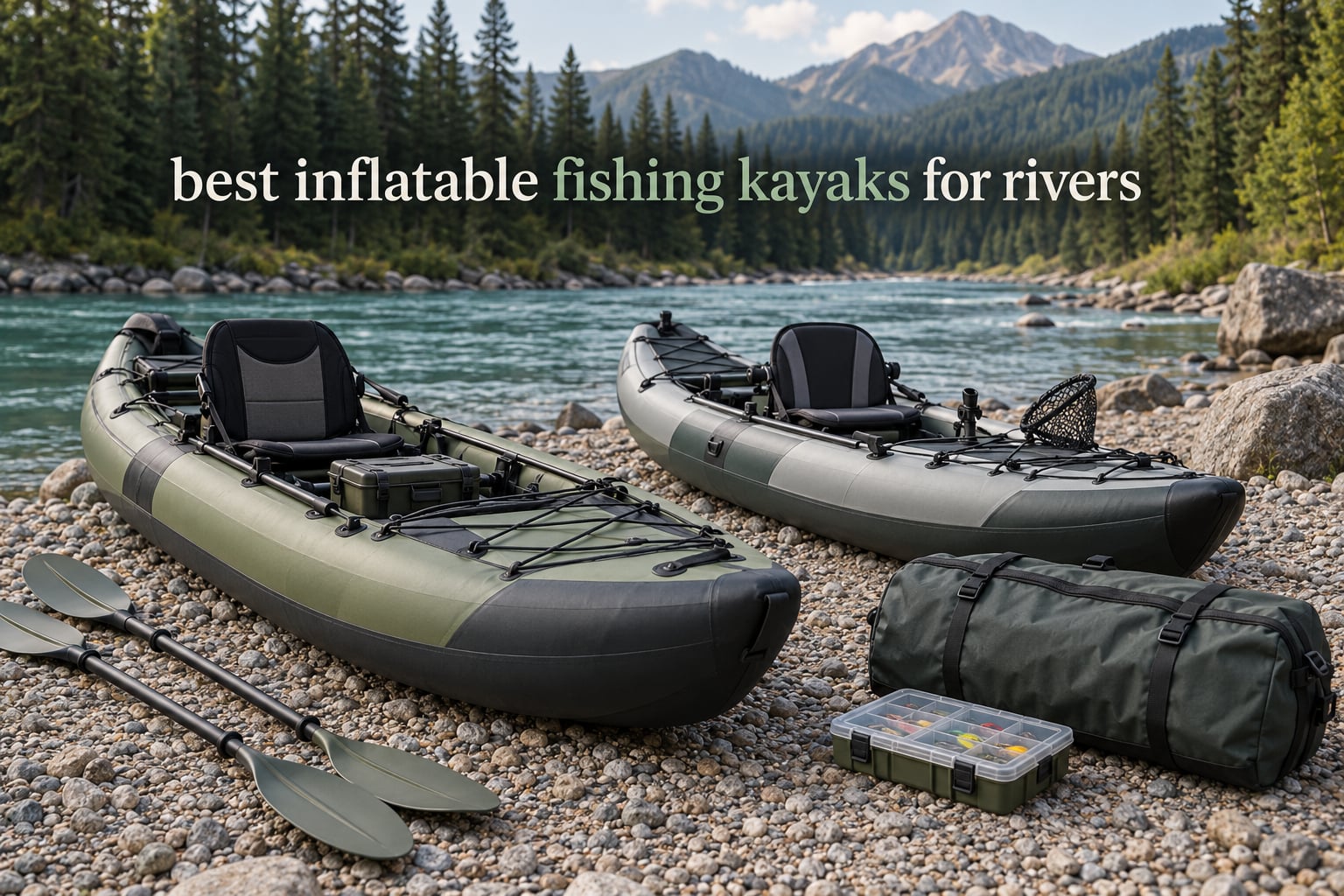
Most boats sold as inflatable fishing kayaks are flatwater hulls with a rod holder screwed to the side. You notice the difference about two minutes into a river trip, when a standing wave washes over a floor with no raised edge and no drains, the water sits there instead of leaving, and your drift speed doubles while you bail with a paddle. That is the single biggest reason anglers buy the wrong inflatable for moving water, and it is the reason this ranking of the best inflatable fishing kayaks for rivers scores every boat on two axes at once: how the hull handles current, and whether the boat is actually rigged to fish.
To be direct about the objection that comes up on every forum thread about this category: inflatable kayaks are not bad for fishing. Two of the ten boats below come with rod holders straight out of the box, and one of those also adds an adjustable camera mount. What matters is whether the boat you choose drains water, tracks straight when the wind and current push from different directions, and holds its shape when you stand up to cast. Those are the specs that separate a river boat from a pool toy with fishing graphics on the side.
We worked through ten inflatable fishing kayaks rated for river use, weighing capacity against angler plus gear, tracking aids against current, drain systems against wave height, and rig readiness against the way people actually fish moving water: drifting a bank, holding a seam with an anchor, standing to spot fish in clear water, or hiking in alone to a remote put-in. Our picks are in the buying guide near the end, where we break down the specs that separated them. If you want the short version first, the table below holds all ten, and the top three sit above it.
One more note before the picks. If you are still working out which kayak fits your setup, our broader inflatable fishing kayak roundup and hard-shell fishing kayak guide cover the gear side in more depth. This page stays on moving water.
Table of Contents
Top 3 Best Inflatable Fishing Kayaks for Rivers in 2026

Intex Excursion Pro K2
- Two detachable rod holders and phone mount
- Two removable skegs for tuning tracking
- 3-ply SuperStrong PVC
- 400 lb capacity

Sea Eagle 380x Explorer
- Class IV whitewater rating
- 16 self-bailing drain valves
- Removable 10 PSI drop-stitch floor
- 1000 denier PVC

Advanced Elements StraitEdge Angler
- Two rod holders and lumbar support
- Patented aluminum rib frame
- Compact 9 ft 8 in footprint
- 300 lb capacity
Those three cover the most common river setups: the all-rounder with the largest proven owner base, the boat rated for the hardest rapids on the list, and the purpose-built solo angler setup. Each of the remaining seven earns its place for a specific water type, and the reviews say which one.
All 10 Inflatable Fishing Kayaks Compared for October
| Product | Specifications | Action |
|---|---|---|
| Intex Excursion Pro K2 |
|
Check Latest Price |
| Sea Eagle 380x Explorer |
|
Check Latest Price |
| Advanced Elements StraitEdge Angler |
|
Check Latest Price |
 Sea Eagle 370 Pro Sea Eagle 370 Pro |
|
Check Latest Price |
 BRIS 14.1 ft Inflatable Boat BRIS 14.1 ft Inflatable Boat |
|
Check Latest Price |
 GYMAX 12.5 ft Tandem GYMAX 12.5 ft Tandem |
|
Check Latest Price |
 Goplus 12.5 ft Tandem Goplus 12.5 ft Tandem |
|
Check Latest Price |
 Retrospec Coaster Retrospec Coaster |
|
Check Latest Price |
 Sevylor QuickPak Sevylor QuickPak |
|
Check Latest Price |
 BEYOND MARINA Full Drop Stitch BEYOND MARINA Full Drop Stitch |
|
Check Latest Price |
1. Intex Excursion Pro K2 – The Proven All-Rounder With Fishing Kit Included
INTEX Excursion Pro K2 Inflatable Kayak 2-Person Set with Paddles & Pump
12 ft 9 in tandem
400 lb capacity
44.7 lb packed
3-ply SuperStrong PVC
Pros
- Rod holders and an adjustable camera mount included
- Two removable skegs you can tune for depth
- Large owner base with steady reports on durability
- Bow and stern storage plus stainless D-rings
Cons
- 400 lb capacity is modest for two adults with gear
- 44.7 lb is heavy to carry more than a short distance
- Not drop-stitch so it flexes more than the rigid models
The Excursion Pro K2 is the boat we kept coming back to while comparing this group, and the reason is the accessory list rather than the hull. It ships with two detachable fishing rod holders and an adjustable mount for a phone or action camera. Very few boats in this roundup include any fishing hardware at all, and this one includes the two things an angler reaches for first.
On moving water it behaves like a well-built inflatable should. Three-ply laminate PVC holds more pressure than the single-skin boats further down the list, and that stiffness is what stops it feeling like a noodle when you edge into a current seam. The two removable skegs are the quiet hero: take one out for shallow gravel bars where it can ground, fit both for a clean line across a seam.
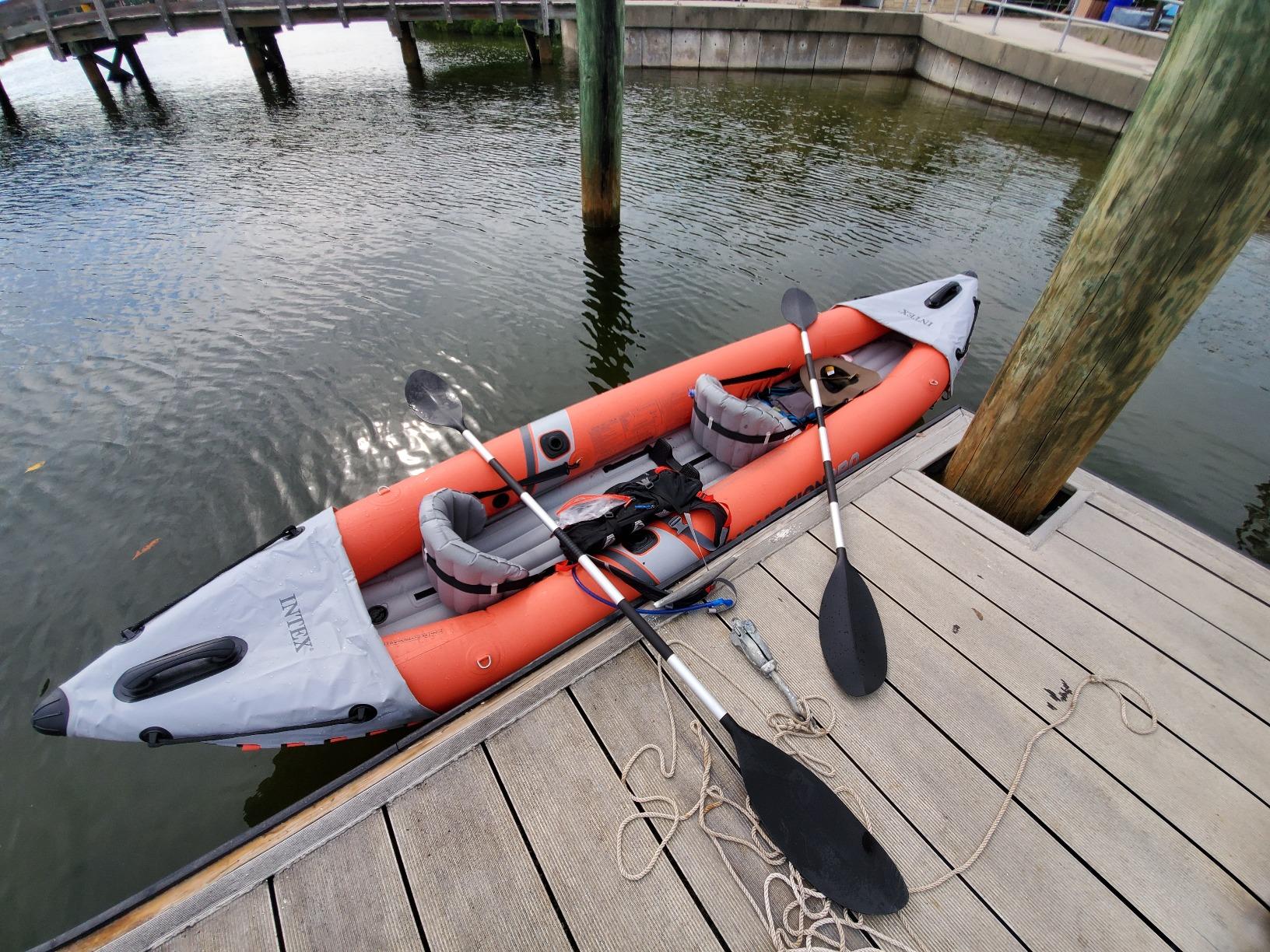
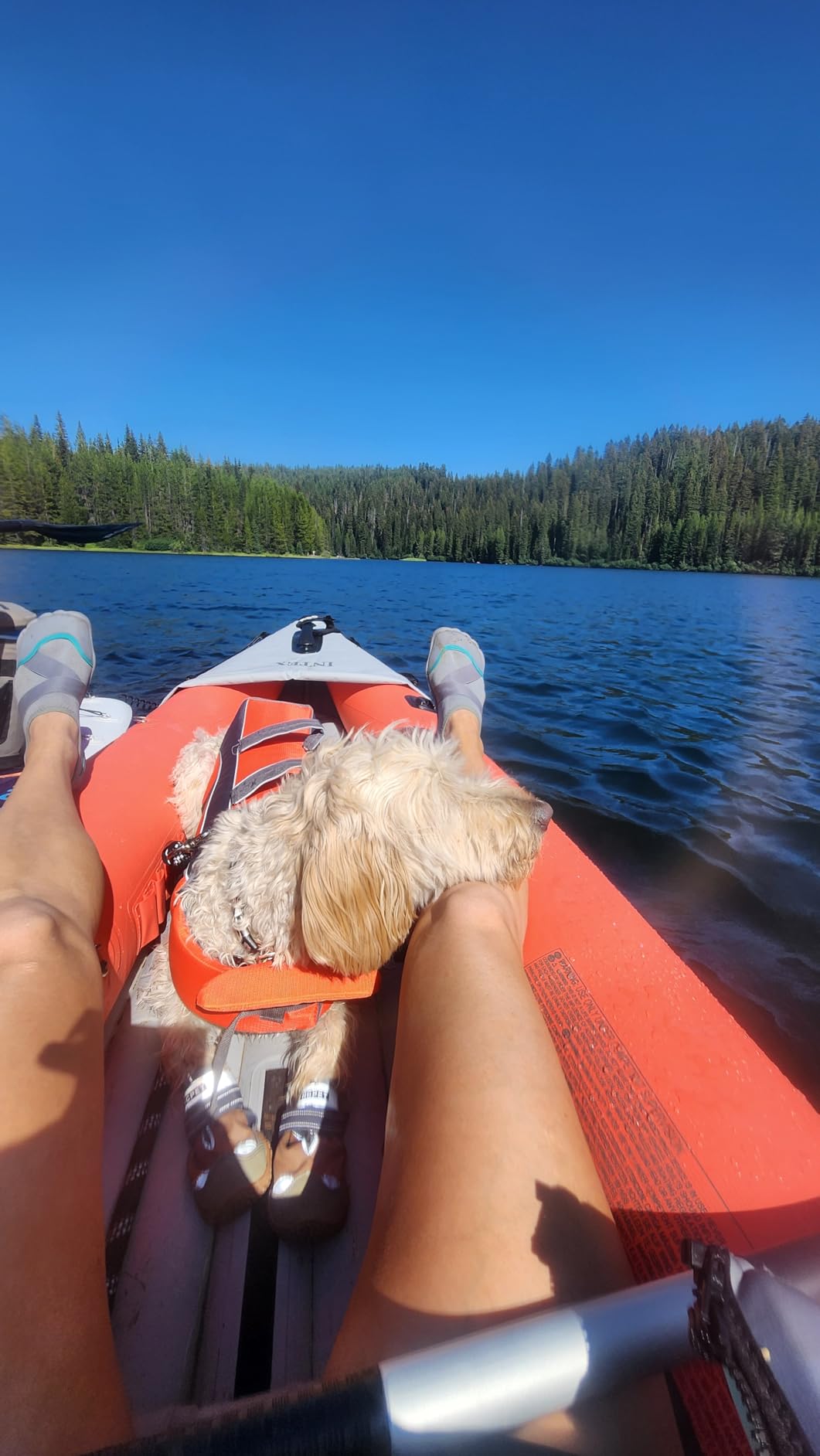
The trade-off is honest and worth saying out loud. At 400 lb total capacity, two adults plus tackle, cooler and a dog pushes you toward the ceiling. Our sizing rule later in this guide is to stay under roughly three quarters of rated capacity, which on this boat is around 300 lb loaded. Solo with a rod tube and a cooler, there is plenty of room.
The carry weight of 44.7 lb also matters more on a river than on a lake. If your put-in is a paved ramp you are fine. If it is a quarter mile of gravel, you will feel it, and you would be better served by a lighter solo boat further down this list. If you want the wider view of tandem and multi-person options, our tandem inflatable kayak picks cover that in more detail.
When this is the right river boat
Choose it for Class I and Class II water, wide runs with gravel bars, and multi-day trips where carrying gear volume matters more than pack weight. It suits a solo angler who wants rod holders without buying them, and it holds its shape well in a moderate breeze.
It is also the safest buy in terms of evidence. More than six thousand ratings is a far bigger sample than any other boat here, and the pattern of reports is consistent: durable, stable enough, easy to fold, and simpler to maintain than the rigid drop-stitch models.
Where it falls short
It is not drop-stitch, so the floor is softer than the GYMAX, BRIS and BEYOND MARINA boats here. Standing to cast is possible but wobbly compared with a rigid deck. Two people and a full camp load exceed what this hull likes to carry.
The warranty here is a 90-day limited term, which is worth factoring in if you keep your boat inflated on a porch or in a truck bed year round. Plan on deflated storage between trips.
2. Sea Eagle 380x Explorer – The One Boat Here Rated For Class IV Reaches
Sea Eagle 380x Inflatable Kayak with Pro Package
12 ft 5 in tandem
750 lb capacity
40 lb packed
Removable 10 PSI floor
Pros
- 1000 denier PVC with quadruple-overlapped seams
- 16 self-bailing drains you can open for rapids and close for touring
- Removable drop-stitch floor inflates to 10 PSI
- Swept-back removable rear skeg
Cons
- Fishing features are not included
- Packed floor and pump add bulk to a solo carry
- Modest review base for the rating it carries
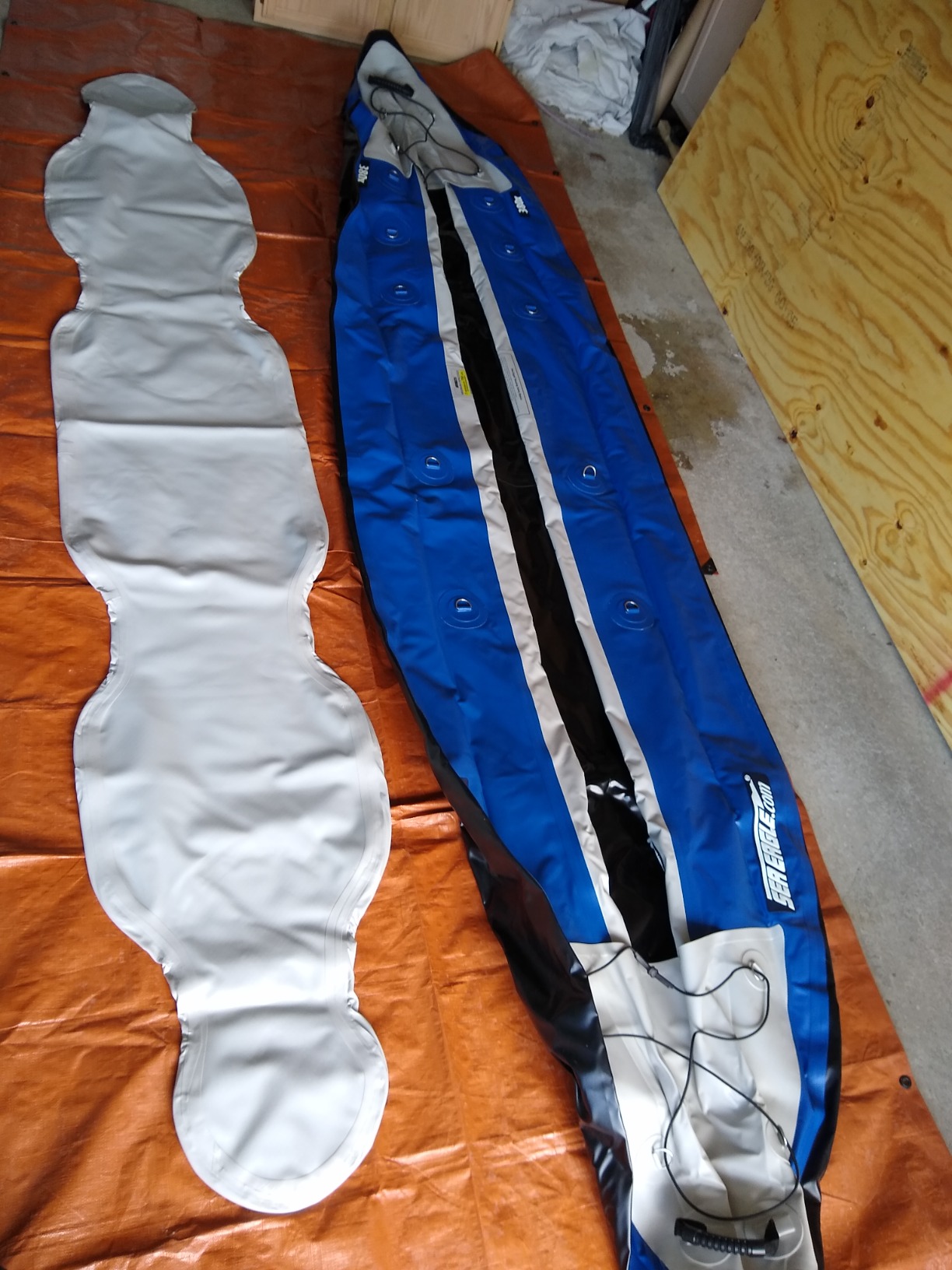
This is the boat to look at if your river has rock. Every other inflatable on this list is a Class I to Class III proposition at best, and the difference matters: a class rating describes the water, and this hull is built to the top of that scale. The removable drop-stitch floor inflates to 10 PSI, which is a genuinely rigid platform rather than a soft air deck.
The drain system is the part we like most for anglers. Sixteen rapid self-bailing drain valves sit around the perimeter, and you open them for wet river work and close them for flatwater touring. That solves the problem that ruins most fishing inflatables on moving water, where water that lands in the boat simply stays there and raises your draft until the bow starts to feel heavy.
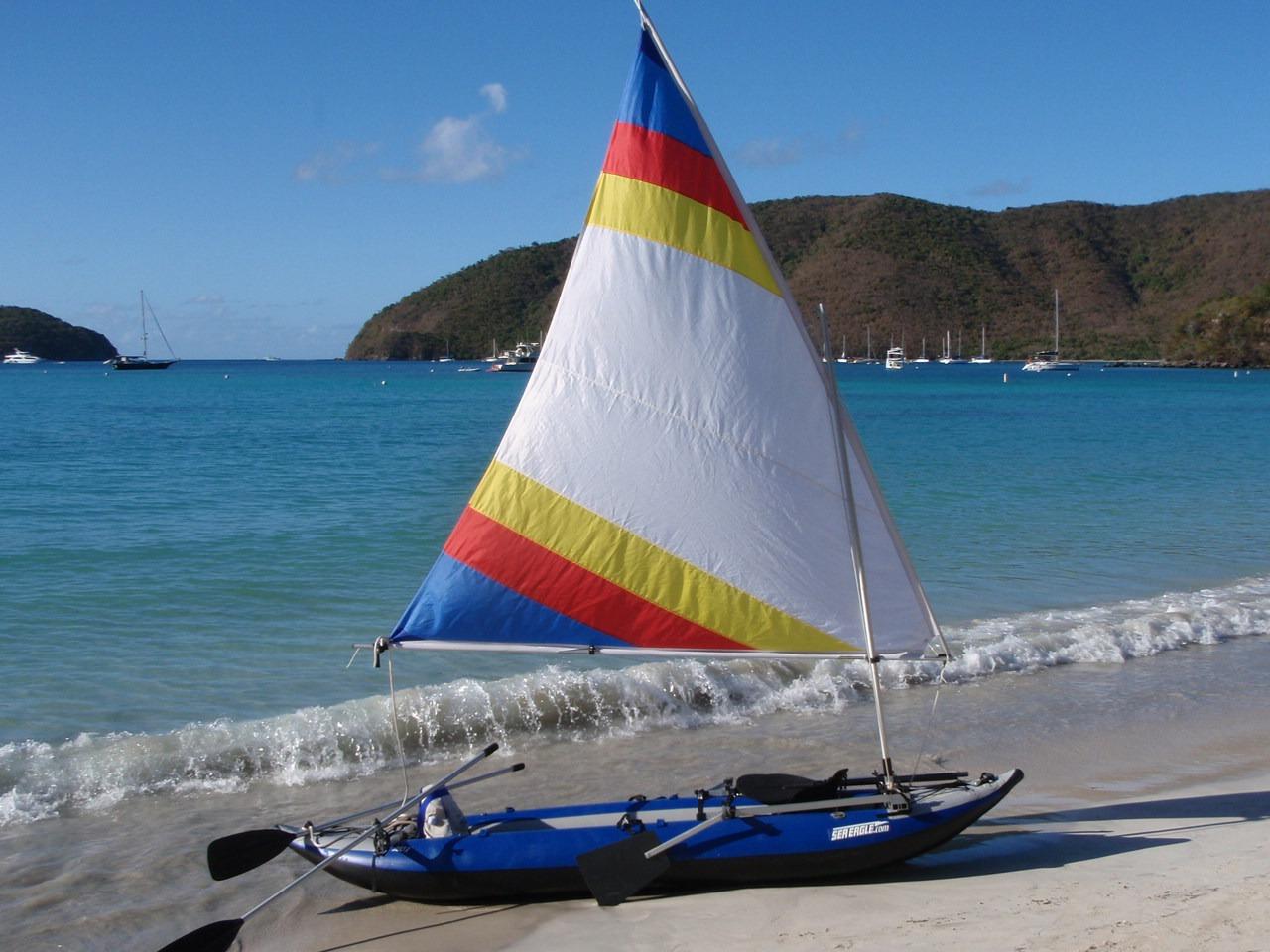
Underneath, it is 1000 denier reinforced PVC with quadruple-overlapped glued seams, and reviewers repeatedly point out that it holds up against the rock and wood that eats softer boats. The removable swept-back rear skeg keeps it tracking straight, which is what lets you hold a line along a bank without spending every stroke correcting course.
It will seat two to three adults up to 750 lb, and the tall back seats in the package give real lumbar support for long sessions. Inflation takes about eight minutes with the supplied pump.
When this is the right river boat
It suits upper sections with ledges, canyon reaches and higher flow after rain, plus anyone who wants one boat for both whitewater and quiet water trips. The open drains and rigid floor also make it the natural pick for standing to cast into clear water.
For two people planning an overnight trip, the capacity and the removable floor mean you can add a dry bag or a cooler without the hull losing shape.
Where it falls short
Build cost is the obvious one. Nothing else in this roundup reaches this construction tier, and what the extra spend buys here is hull rating and floor rigidity rather than fishing features, which you will still have to add yourself.
The rating is impressive but not fully proven by owners. Fifty-eight ratings is a thin base for such a strong claim, so treat the Class IV figure as a ceiling for the boat under stated conditions rather than a promise about any reach on your local river.
3. Advanced Elements StraitEdge Angler – Built For One Angler and One Rod
Advanced Elements Straitedge Angler
9 ft 8 in solo
300 lb capacity
41 lb packed
Aluminum rib frame
Pros
- Purpose-built angler layout with two rod holders
- Inflatable lumbar support behind the high-back seat
- Patented aluminum ribs add real rigidity
- Compact length suits narrower river sections
Cons
- Single seat so no tandem option
- 300 lb capacity leaves little room for gear
- 41 lb is heavy for a solo fishing kayak
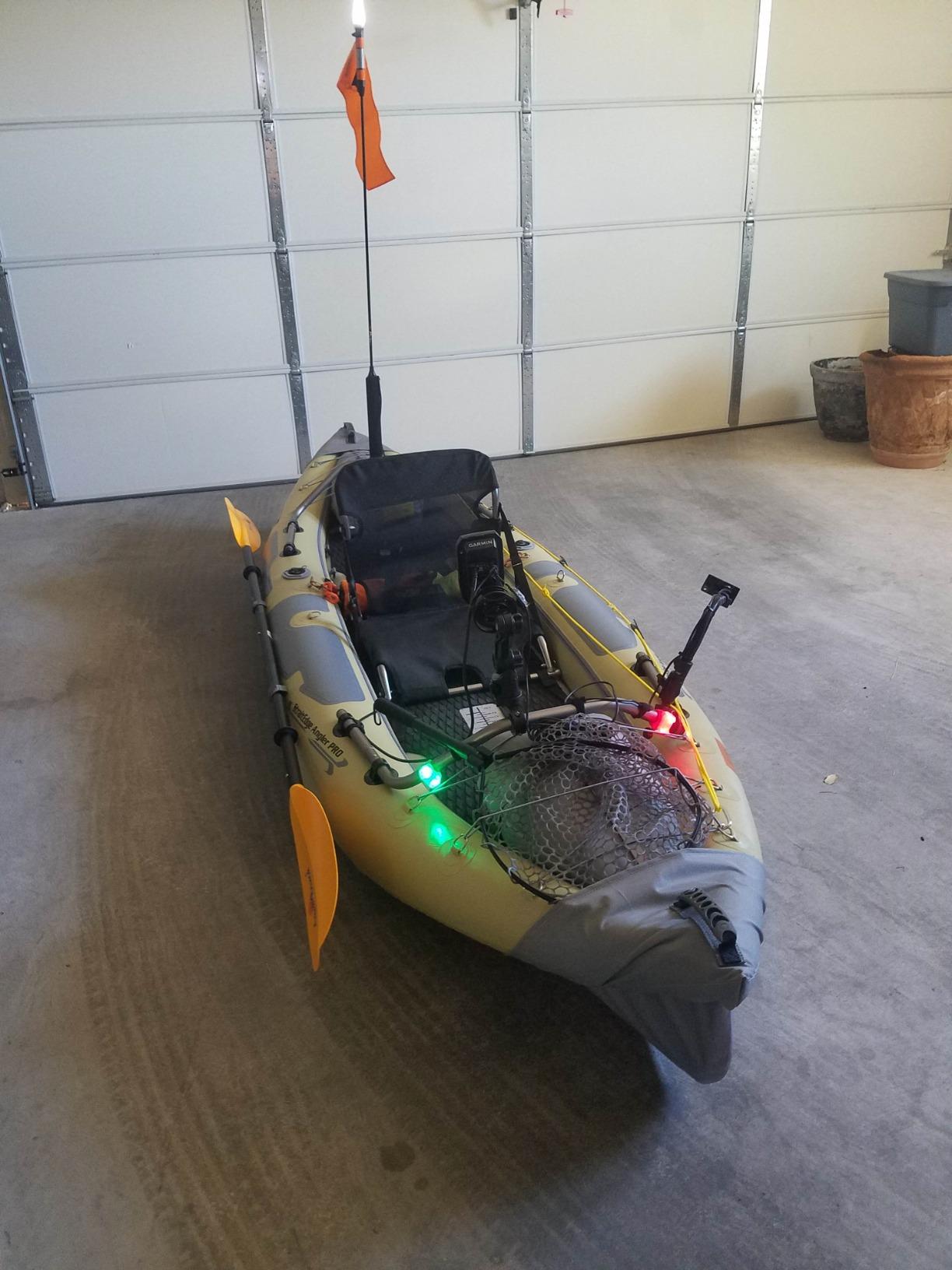
Strip out the angler layout and the StraitEdge is a 9 ft 8 in inflatable with an aluminum rib skeleton inside the tubes. That frame is why it feels firmer underfoot than similarly sized inflatables, and on a river it means less flex when you shift weight to cast toward structure.
The fishing case is the strongest here because it is factory-built. Two rod holders, a high-back seat with inflatable lumbar support, abrasion pads on the wear points, and a removable mounting rail for a fish finder or extra tackle. The rail is the piece most anglers end up using most, since it turns a solo cockpit into a rig you can reconfigure for the day.
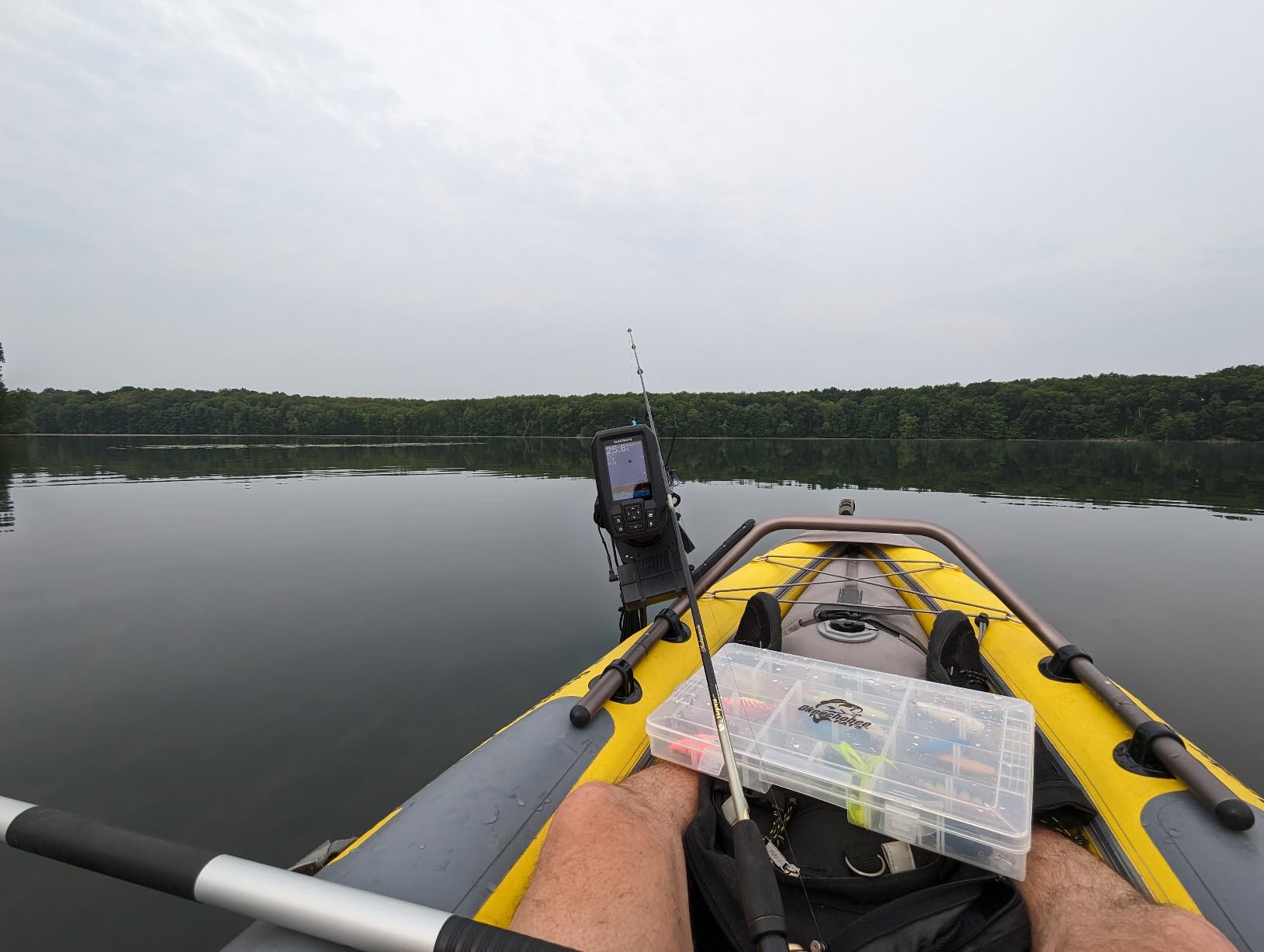
At 9 ft 8 in by 35 in, this is a small boat, and that is the point. Shorter hulls are easier to hold in tight eddies and behind upstream rocks, they spin faster when you want to reposition onto a lie, and they are easier to control with a single paddle blade if you end up doing any brace work.
The trade is capacity. At 300 lb it is one of the tightest here, and once you add a full tackle bag, a jacket and a dog, the boat is at its working limit. Our sizing guidance later applies with real force to this one.
When this is the right river boat
It fits solo anglers working structure close to the bank, pockets behind wood, and short eddy lines where you want to reposition quickly. It is a strong match for anyone who fishes standing and needs a rail to hang a transducer or camera from.
For solo beginners, the wide beam and rib frame give a forgiving platform, and the short length means mistakes are easy to correct.
Where it falls short
It is single-seat only, so a pair looking to share one boat should look at the tandem models instead. Packed weight of 41 lb is also noticeable for a boat this small, so the hike-in case only works on short carries.
At forty ratings the owner feedback is thin. Nothing in the reports suggests a problem, but there is not the same depth of long-term durability evidence you get from the Excursion Pro.
4. Sea Eagle 370 Pro – Three Anglers, Class III Rated, 33 lb Packed
Sea Eagle 370 Pro 3 Person Inflatable Sport Kayak with Pro Package Includes Paddles, Deluxe Seats, Pump, and Carry Bag
12.5 ft
650 lb capacity
33 lb packed
16 drain valves
Pros
- Class III rated with 16 self-bailing drain valves
- Packs into a small car trunk with no roof rack
- Inflates in 10 to 20 minutes with the included foot pump
- Two skegs give noticeably straighter tracking in current
Cons
- Slower on the water and needs more paddle effort
- 15 inch cockpit is narrow for an adult in a PFD
- Interior length is short for two paddlers plus gear
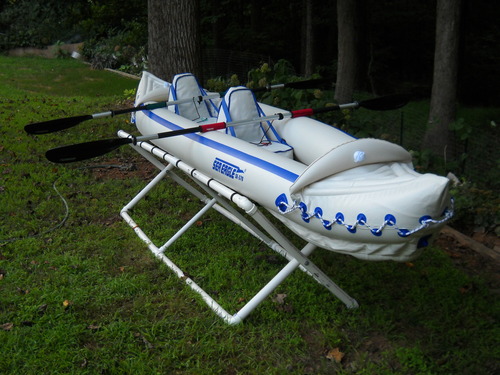
Few inflatables pack this small and still carry three people. At 33 lb in the bag, the 370 Pro is the one we would actually load into a small car for a weekend river trip, and the 650 lb rating leaves room for three anglers in lighter gear or two with a full camp load.
River suitability is the draw. The boat is rated to Class III whitewater and carries 16 rapid self-bailing drains with open and close valves, so you can drain wave water rather than carrying it. Owners consistently describe it as stable and predictable in small rapids and in light to moderate wind.
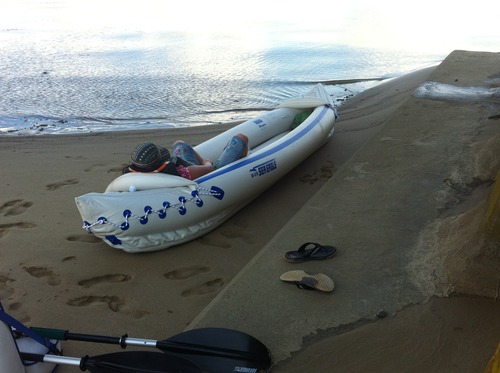
The included skegs are fixed rather than removable, which matters if you plan to run very shallow water where they could bend, so check your draft before a low-water trip. The I-beam floor adds rigidity and handles abrasion better than a flat air deck, and the inflatable seats sit high off the floor with better back support than most competitors.
Unlike several boats here, this one is a pure paddling platform with no fishing hardware. You will be adding rod holders yourself, either with an adhesive tube mount or by running D-ring straps along the seat base, which is fine but worth budgeting time for.
When this is the right river boat
It works for two or three people on Class I to Class II water and moderate Class III reaches, for anyone whose launch is a long way from the vehicle, and for split-group trips where the gear does not fit in one car.
With more than fifteen hundred ratings behind it and a three-year parts warranty, it is the low-risk choice when you want durability evidence rather than a spec sheet.
Where it falls short
The 15 inch cockpit width is narrow, and paddlers wearing a flotation aid with wide side panels report pressing against it. The interior length is around 10 ft 8 in, which makes two paddlers plus a gear pile tight.
It is also simply slower than a hard-shell, and the included paddles are short for the boat’s width, which shows up as fatigue over a long float.
5. BRIS 14.1 ft Inflatable Boat – The Standable Casting Platform
BRIS 14.1ft Inflatable Boat Inflatable Kayak 3 Person Kayak Canoe Fishing poonton Boat
14.1 ft pontoon style
770 lb capacity
3 plywood bench seats
1,100 denier welded PVC
Pros
- Heat-welded quadruple overlap seams rated for fresh and salt water
- Drop-stitch air deck you can stand and walk on
- Three marine plywood bench seats
- Large 17.5 inch tubes add buoyancy and stability
Cons
- Heaviest and bulkiest boat here at roughly 86 lb
- Awkward to carry solo down a river bank
- Drop-stitch floor means real effort on the included foot pump
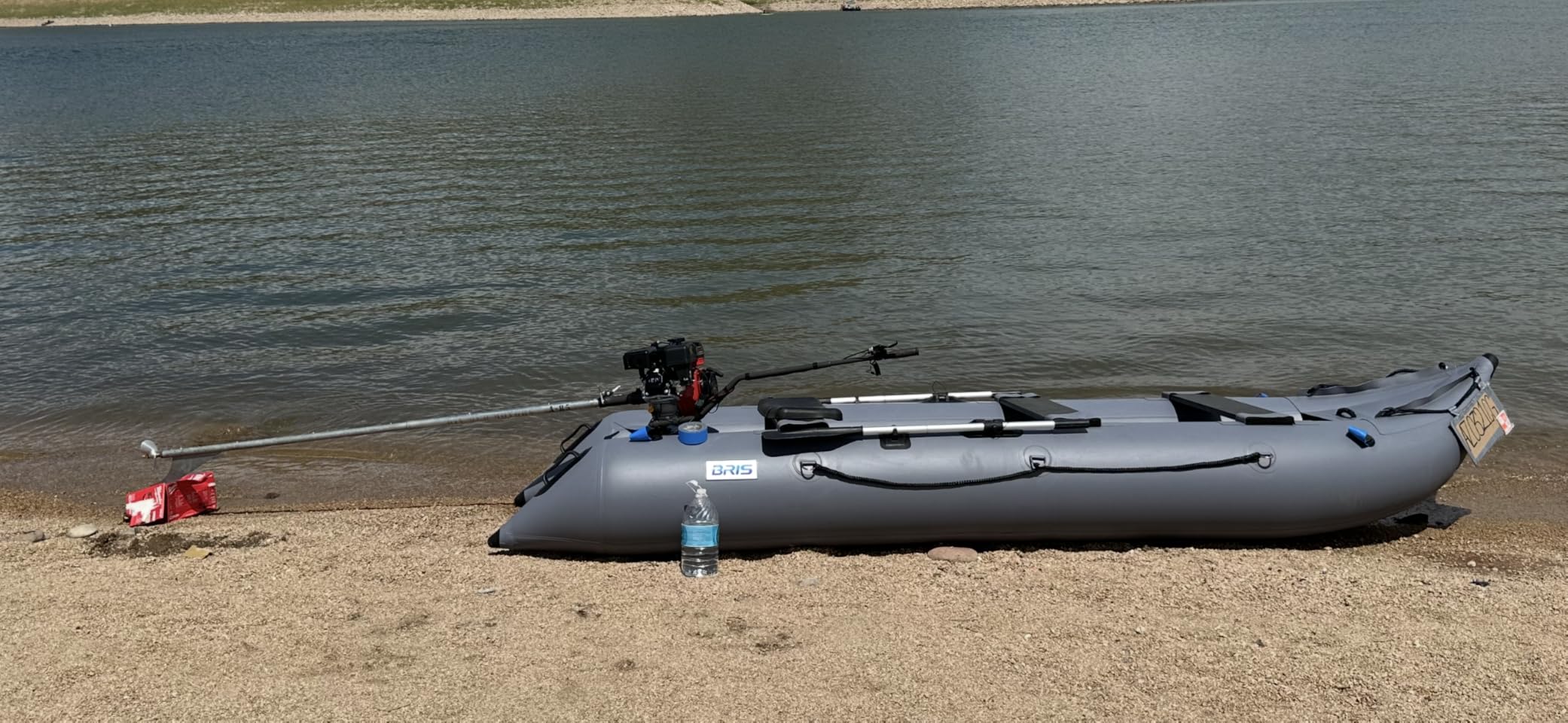
This is not really a kayak, it is a pontoon boat shaped like one, and that is why it stands up. The high-pressure drop-stitch air deck is rigid enough to stand and walk on, which is the single biggest advantage for an angler who casts from a standing position into current. Most inflatables are seated-cast boats only.
The construction is the most serious in this roundup. Heavy-duty 1,100 denier PVC with polyester support and all seams heat welded with mostly quadruple overlap are rated for fresh and salt water. There are two air chambers per side tube, so redundancy is genuinely strong, and four fins handle tracking on open water.
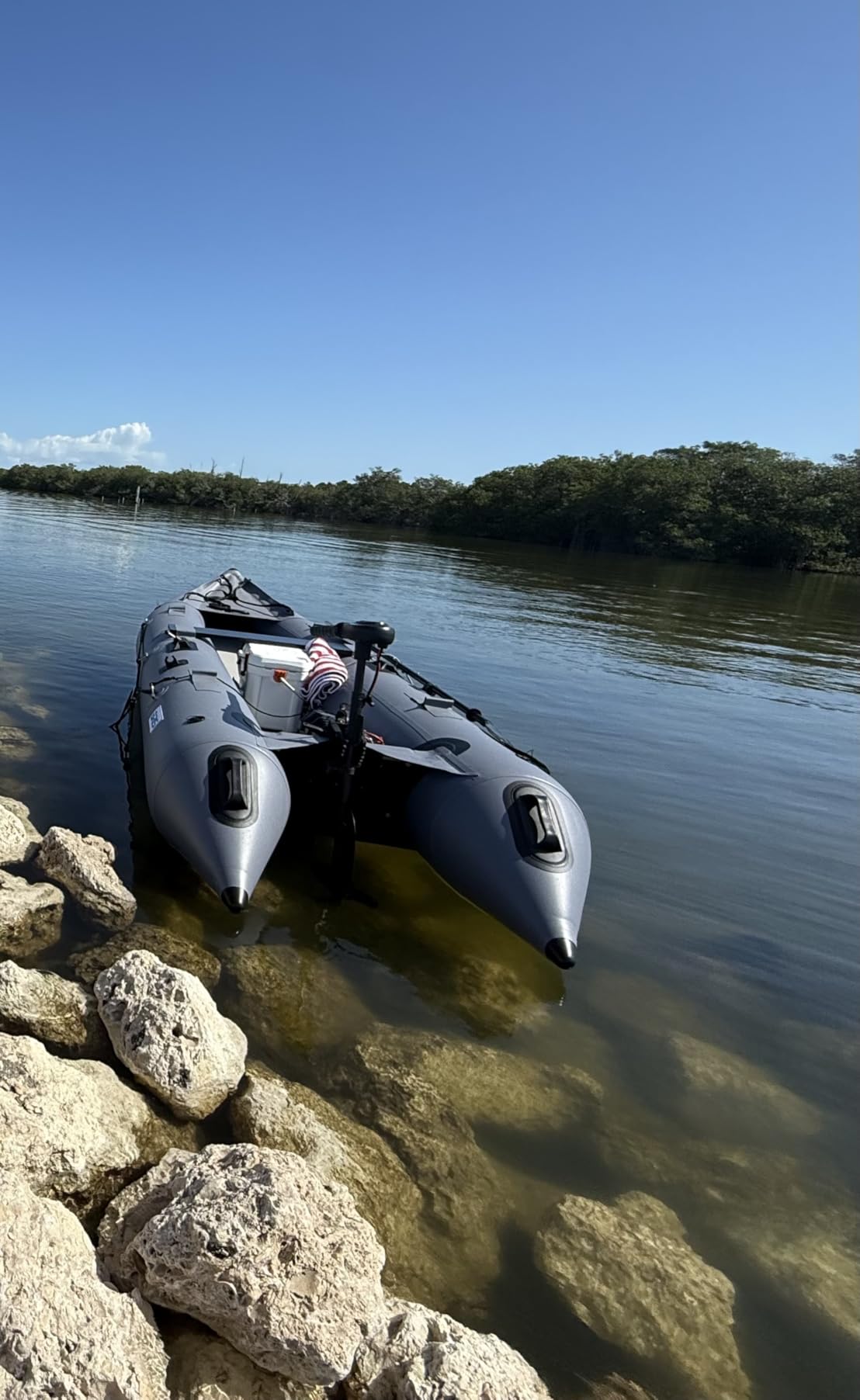
The three marine plywood bench seats also beat inflatable seats for long days. They hold position, they do not need reinflating, and they give you somewhere to brace when you stand up and cast across moving water.
The honest drawback is weight. Around 86 lb packed, this is the heaviest boat here by a wide margin, and at 14.1 ft it is awkward for one person to carry on a sloped bank. It is a car-camp or trailer boat, not a hike-in boat.
When this is the right river boat
It fits anglers who stand to cast, who want three seated fishing positions on a wide slow reach, or who fish from an established camp where the boat stays rigged on the water for days. The welded seams also suit anyone fishing saltwater inlets and tidal water.
The stability from the 17.5 inch tubes makes it a good boat for someone new to inflatables who is nervous about balance in current.
Where it falls short
Solo carrying is the dealbreaker for most river anglers. Nobody wants to shoulder this across a gravel bar alone, and the long hull is hard to control from a single seat position in a tight spot.
A high-pressure floor also means a high-pressure pump. The included foot pump works, but it is a workout, and most owners end up buying an electric or SUP-style pump.
6. GYMAX 12.5 ft Tandem – Drop-Stitch Rigidity in a Tandem Hull
GYMAX Inflatable Kayak, 12.5Ft 507lbs Tandem Kayak with 2 Aluminum Paddles, 2 Padded Seats, Footrests, 2 Fins, Hand Pump, Carry Bag & Repair Kit, 2 Person Fishing Touring Kayak for Adults Youth (Blue)
12.5 ft tandem
507 lb capacity
39 lb packed
Removable drop-stitch floor
Pros
- Removable high-pressure drop-stitch floor adds real rigidity
- Very stable laterally with two adults aboard
- Three independent air chambers including the floor
- Handles wake and light current without flexing
Cons
- Included paddles are widely criticised and throw water
- Front skeg can catch on submerged wood and should be used carefully
- Seat backrests are short so extra padding helps
The removable drop-stitch floor is what separates this from every other tandem at the same tier. Owners report it transforms the feel of the boat, holding its shape under load instead of ballooning, and one reviewer stood on the floor without significant flex. On a river that rigidity is the difference between a stable casting platform and a wobble.
Three independent air chambers, with the floor acting as the third, give the redundancy you want on moving water. Reported capacity use of around 400 lb plus gear has held up in owner tests, and the boat tracked straight and turned quickly with the rear skeg fitted.
Storage is well handled for a tandem: a zipper bag behind the seats plus front bungee cords, which matters when you are carrying tackle for two people rather than one. It can be set up solo by moving a seat to the center if you want a more stable platform for casting.
The skeg warning is worth repeating. Several owners report the front skeg catching on submerged logs, and it can bend or fishhook. On a clear river with known wood, install it with care or run without it in shallow sections.
When this is the right river boat
It suits two people on calm Class I to Class II water who want a rigid floor they can stand on, plus a tandem layout that carries a decent amount of gear. It also works solo for anyone who prefers extra width and stability over a narrow efficient hull.
If you want a drop-stitch floor without moving to the top tier, this is the most direct route to it in this list.
Where it falls short
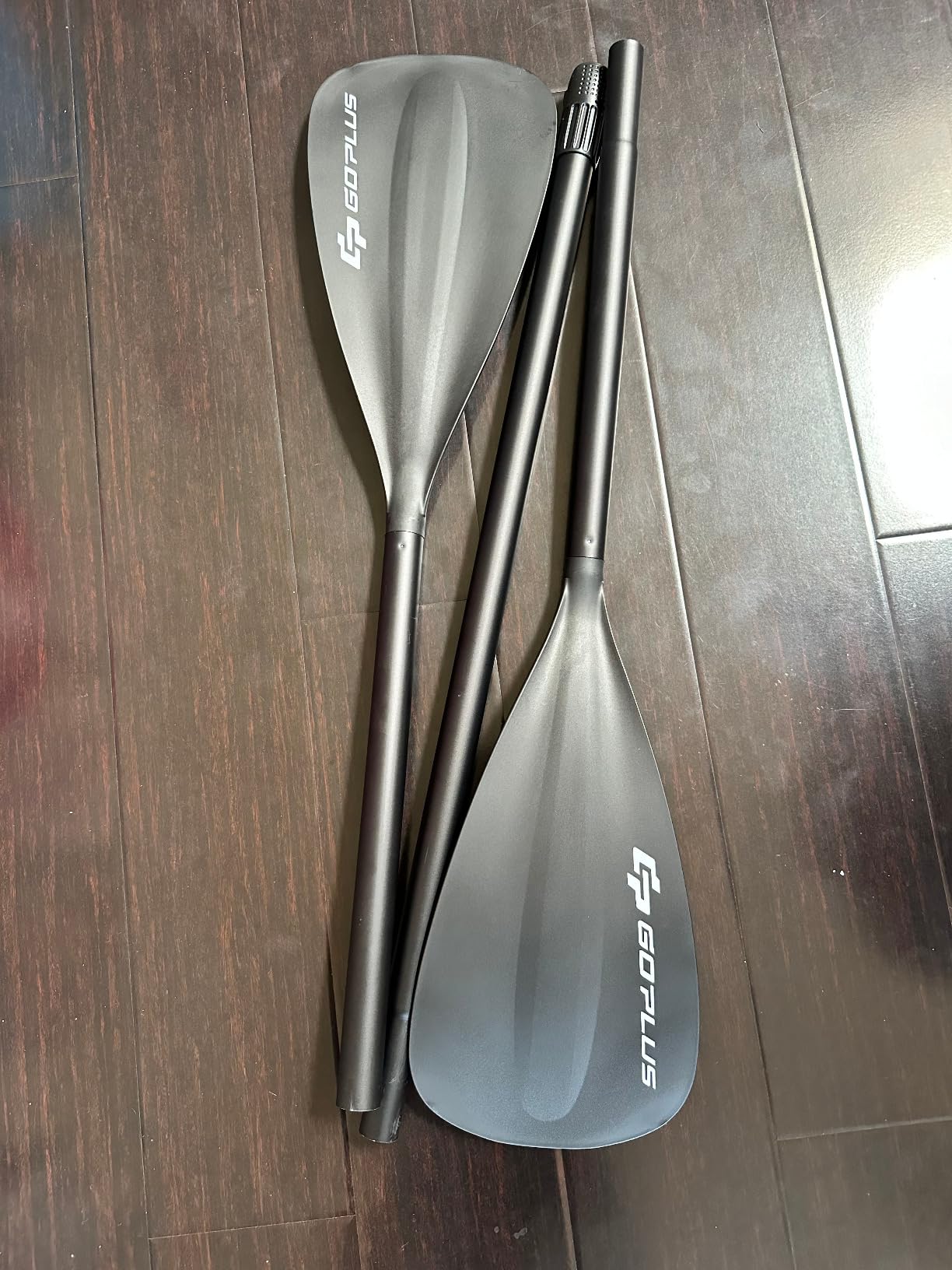
The supplied paddles are the most repeated complaint. They are short and throw a lot of water, so plan to buy a proper paddle pair before a long trip, particularly where you will be doing corrective strokes in current.
Instructions are thin and the included repair kit reportedly ships without glue. Know how to patch a chamber before you need it, because a wet repair on a river bank is a much worse time to learn.
7. Goplus 12.5 ft Tandem – A Forgiving First River Boat
Goplus Tandem Inflatable Kayak, 12.5FT 2-Person Kayak Set for Adults
12.5 ft tandem
507 lb capacity
Three chamber build
Fins for steering
Pros
- Three chamber construction with a drain hole
- Light and simple to inflate with the included hand pump
- 507 lb rating fits two adults with room
- Adjustable EVA seats and a three-level footrest
Cons
- Low maximum inflation pressure of 2.18 PSI
- Warranty is only three months
- Supplied paddles lack drip rings and paddle holders sit under your hands
This is the boat we would put a first-time river angler in. Three independent chambers, two fins for steering, a drain hole and a 37 inch beam give a wide, stable platform that forgives small mistakes, which is exactly what you want when the water is moving and your instincts are untested.
Inflating is straightforward with the included hand pump, and the whole package deflates into a carry bag with four handles for moving it down to the water. That handles one of the real barriers people mention about inflatable ownership, which is that getting a boat to the put-in alone feels like a chore.
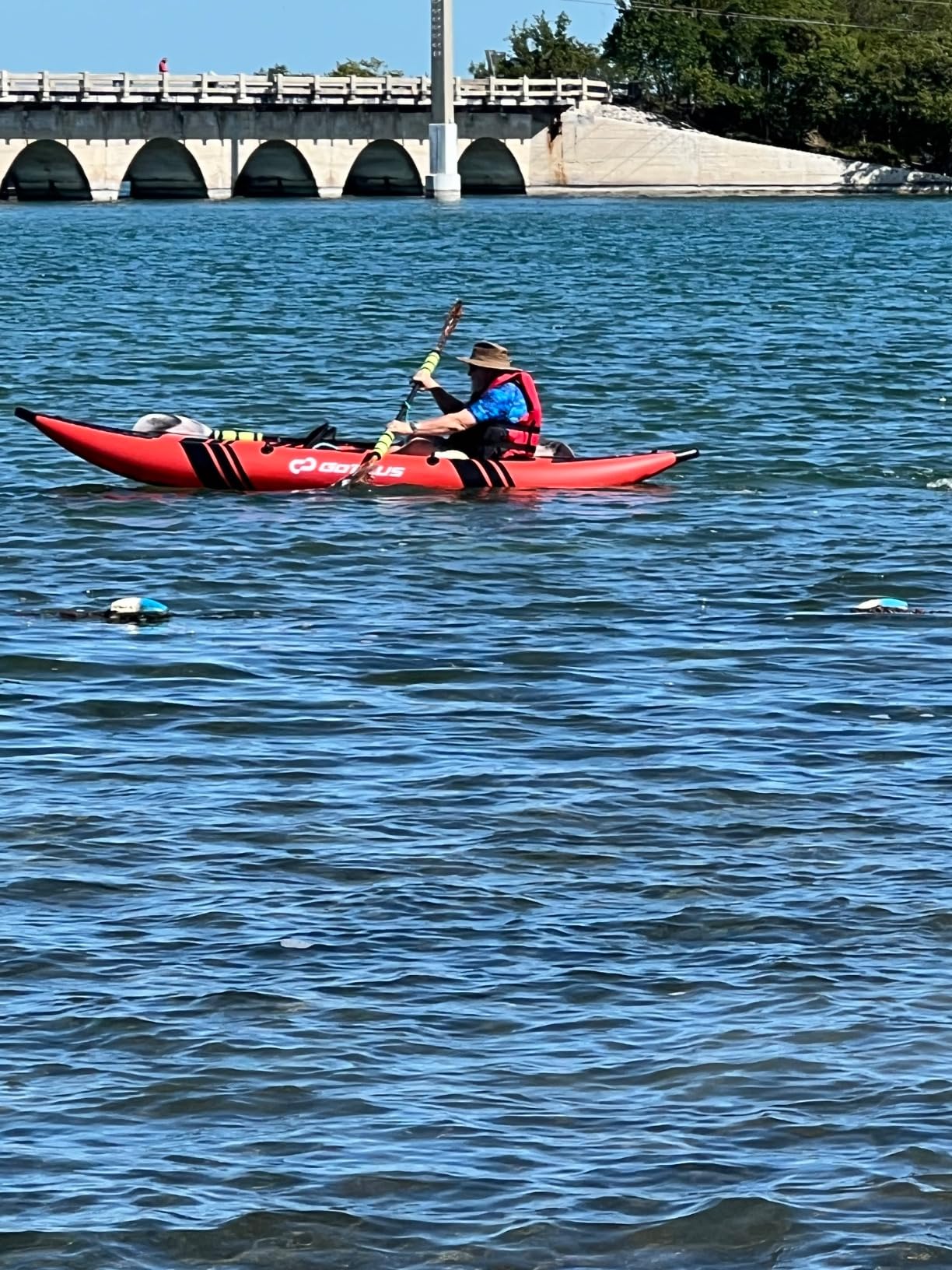
The 507 lb rating fits two adults comfortably with gear, which is rare at this tier. The adjustable EVA seats and a three-position footrest let you set a relaxed sitting position for long floats, and the removable seat layout means you can fish tandem or reposition for solo use.
The ceiling is inflation pressure. At a maximum of 2.18 PSI, the floor is soft by comparison with a true drop-stitch deck, so this is a seated-cast boat with good lateral stability rather than a platform you can stand and fish from.
When this is the right river boat
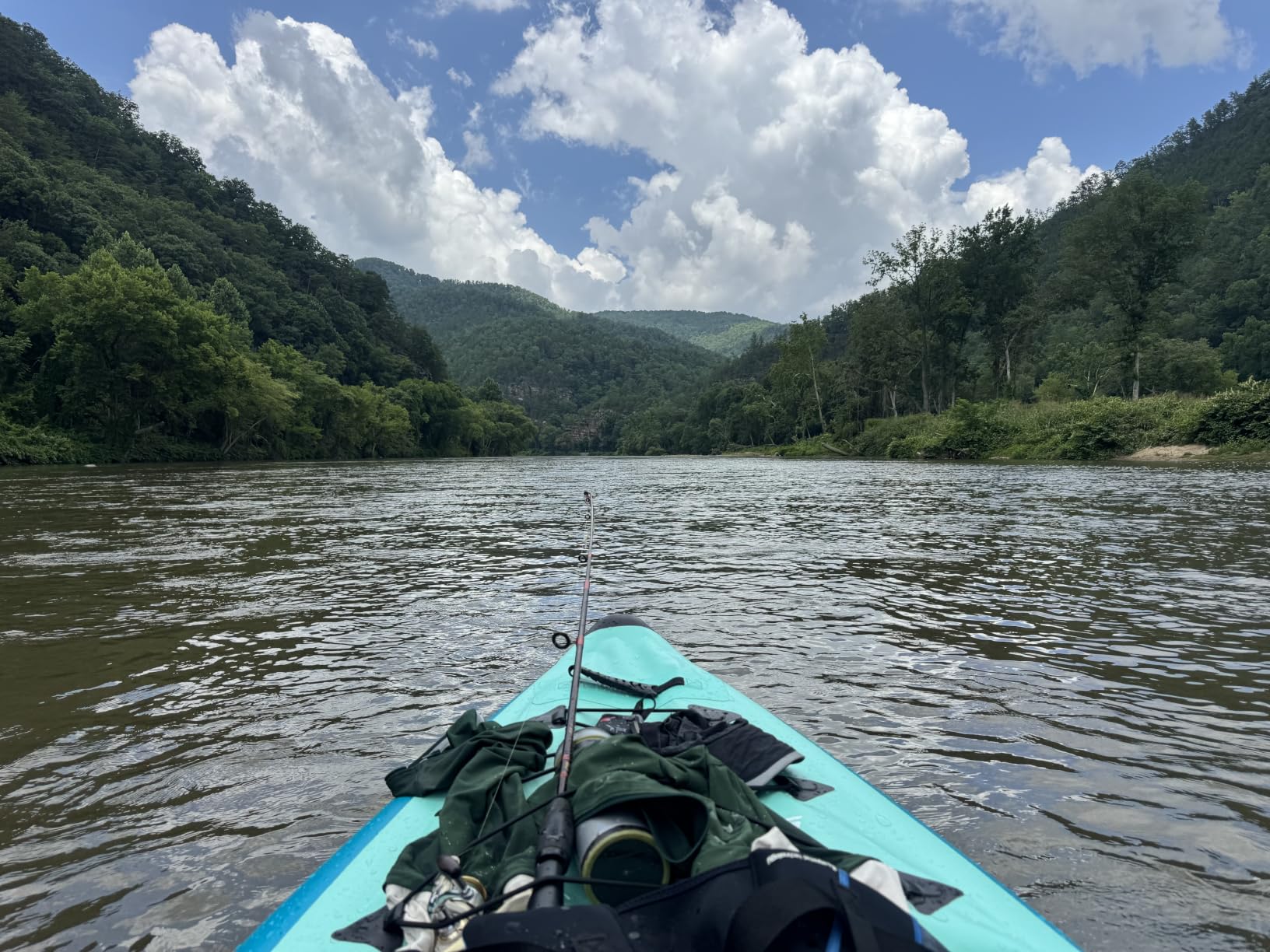
It suits beginners on calm river sections, families fishing together on protected water, and anyone who wants tandem capacity without carrying a heavy rig. The drain hole and simple setup make it a good first boat for learning boat handling before you graduate to harder water.
It also works as a two-person boat for slow drift fishing where you want to be able to move freely and cast without worrying about flex.
Where it falls short
The three-month warranty is the shortest here, and a short term tells you something about expected service life in wet, abrasive conditions. Check seams carefully each season.
Owner feedback shows this boat draws the highest share of one-star ratings in the group, with the supplied paddles as the usual reason. Budget for a paddle upgrade, and expect seat straps and backrests to be less supportive than the photos suggest.
8. Retrospec Coaster – 23 lb, Small Packed, Built for a Solo Carry
Retrospec Coaster Inflatable Kayak for Adults, Fishing Kayak, Fishing
9 ft 10 in
220 lb single and 440 lb tandem
23 lb packed
900 denier fabric
Pros
- Packs to 23 lb with 900 denier fabric
- Assembles in minutes with no fiddly parts
- Heavy-duty tarpaulin hull resists abrasion
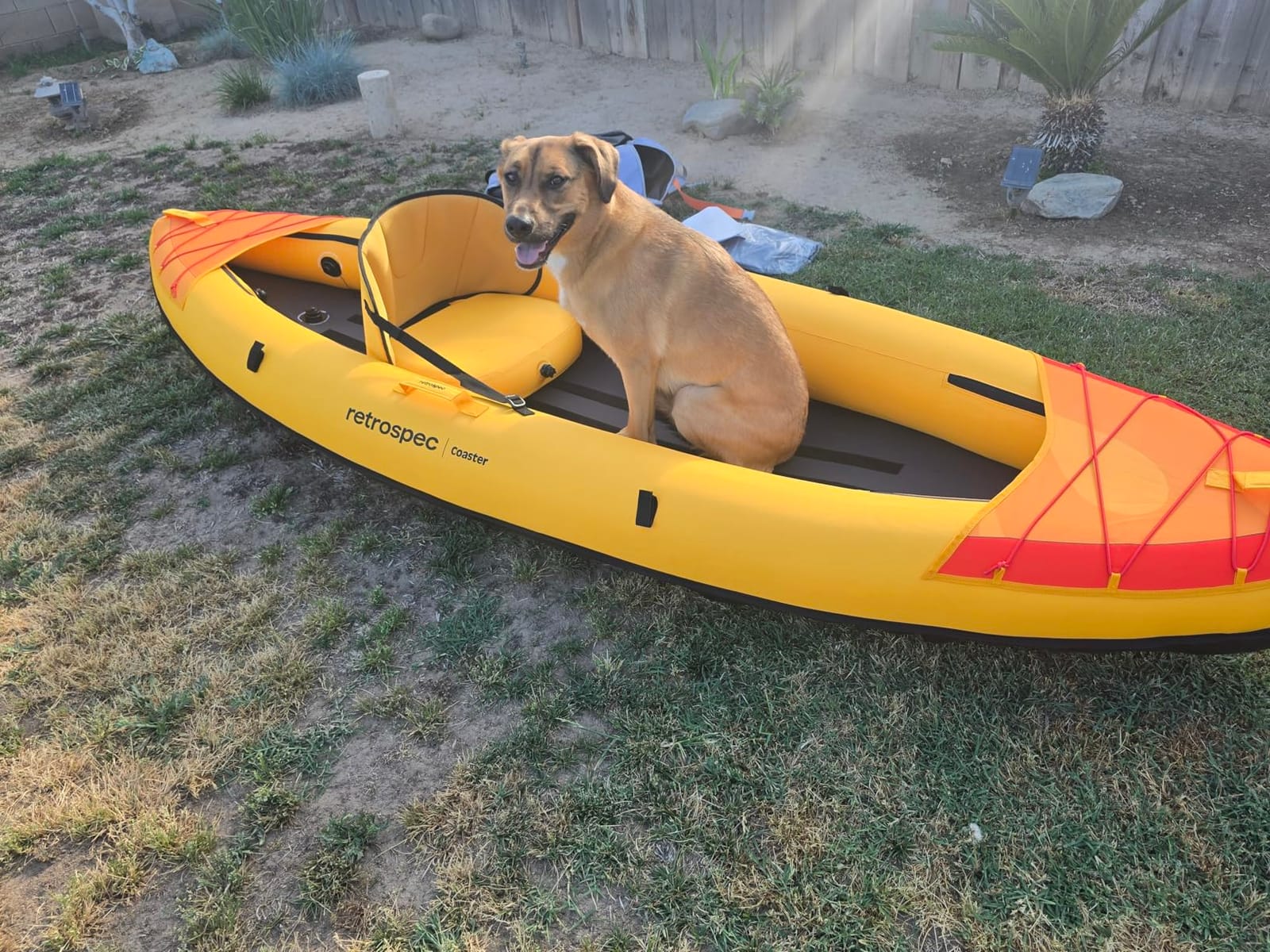
- Dog-friendly cockpit with room for a pet
Cons
- 220 lb on the single version leaves little gear room
- No drop-stitch floor so it is noticeably softer
- Low-pressure hand pump makes inflation slow
If your launch is a real walk-in, pack weight is the number that decides your purchase, and at 23 lb the Coaster is the boat we would actually carry. It rolls into a compact bag that fits in a small car, and assembly needs no valve rings or complicated steps. Unroll, fit the fins, inflate, snap in the seat.
The fabric is better than the price suggests. 900 denier puncture-resistant material over a heavy-duty tarpaulin hull is a spec you normally see higher up the list, and it is the reason we ranked this boat well above the other ultralight models for river work. Stability is good for a boat of this size, and the cockpit leaves room for a paddler and a dog.
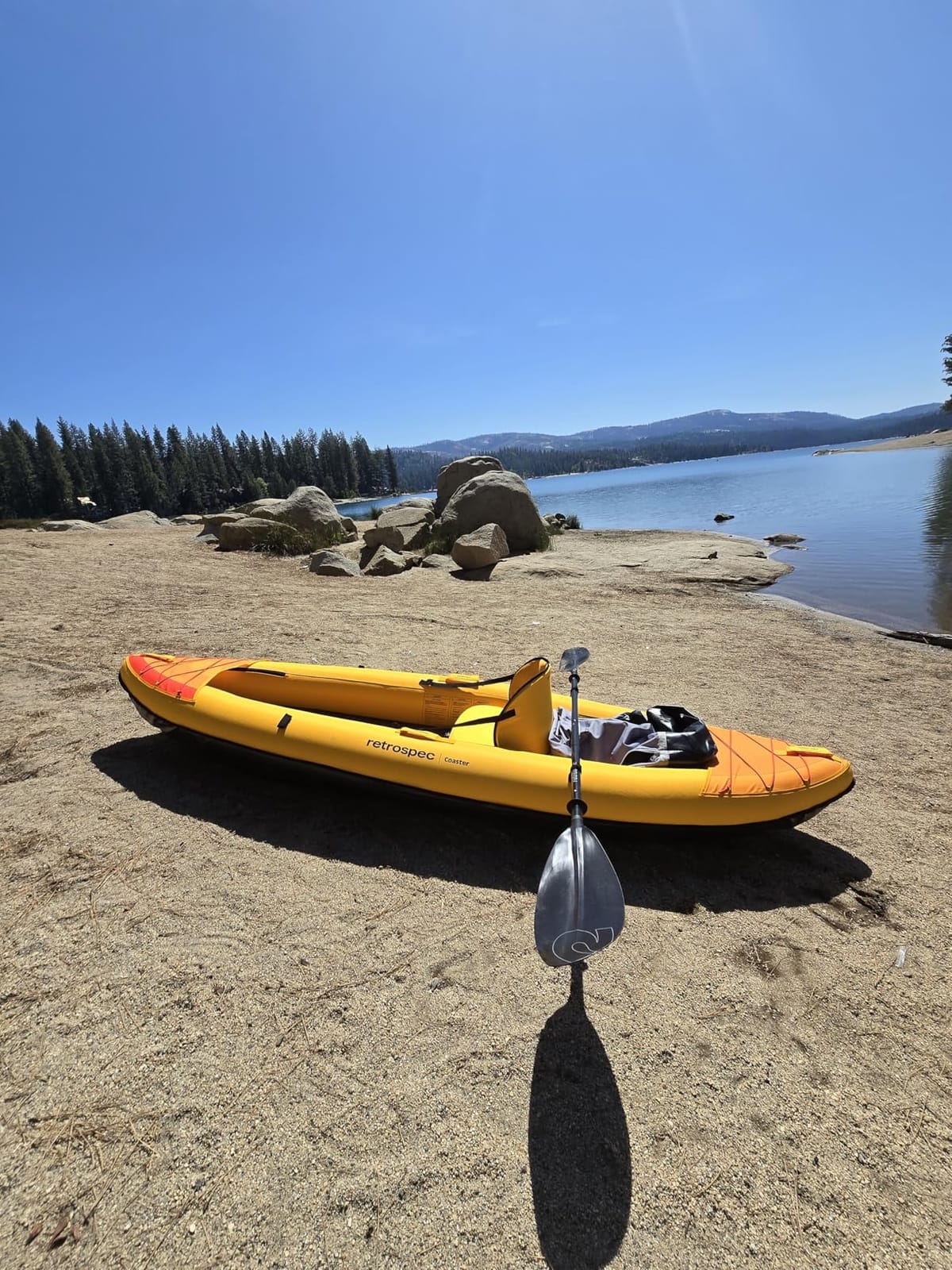
The tandem version at 440 lb is the one to consider for a pair, and both versions share the same hull material. Removable fins, a footrest, a dual-action pump and a paddle are all included, which makes it one of the more complete packages in the entry tier.
For fishing, you will be adding your own hardware. There are no integrated rod holders in the standard package, so plan a rail or strap-based mount, and expect to add a small bungee system for a tackle bag since the open deck gives you nowhere to hang it.
When this is the right river boat
It fits solo anglers on remote walk-in launches, anglers fishing with a dog, and anyone who wants a boat that lives in the closet between trips. On protected Class I water with calm sections it tracks and handles fine with its fins fitted.
It is also a good first inflatable, since there is nothing complex to learn and nothing expensive to damage while you are finding your feet.
Where it falls short
Without a drop-stitch floor the boat is soft, and standing to cast is not realistic. That limits you to seated fishing and to calmer water where you do not need to brace hard.
The single version’s 220 lb rating leaves very little room once gear is loaded, and inflation with the supplied low-pressure pump is slow enough that you will want an electric pump for regular use. Our wider beginner coverage is in the adult inflatable kayak picks.
9. Sevylor QuickPak – Smallest Solo Pack With a Clever Seat System
Sevylor Kayak with Backpack Portable and Lightweight Outdoor 1 Person Kayak with 5 Minute Set Up
9 ft 10 in solo
400 lb capacity
20.3 lb packed
21 gauge PVC
Pros
- Lightest boat in this roundup at 20.3 lb
- Backpack converts into the seat so nothing extra to pack
- Multiple air chambers give redundancy
- Two-year manufacturer warranty
Cons
- 21 gauge PVC is thinner and less rugged than the denier fabrics used elsewhere
- Rounded hull is less stable and less trackable than drop-stitch models
- No rod holders in the standard package
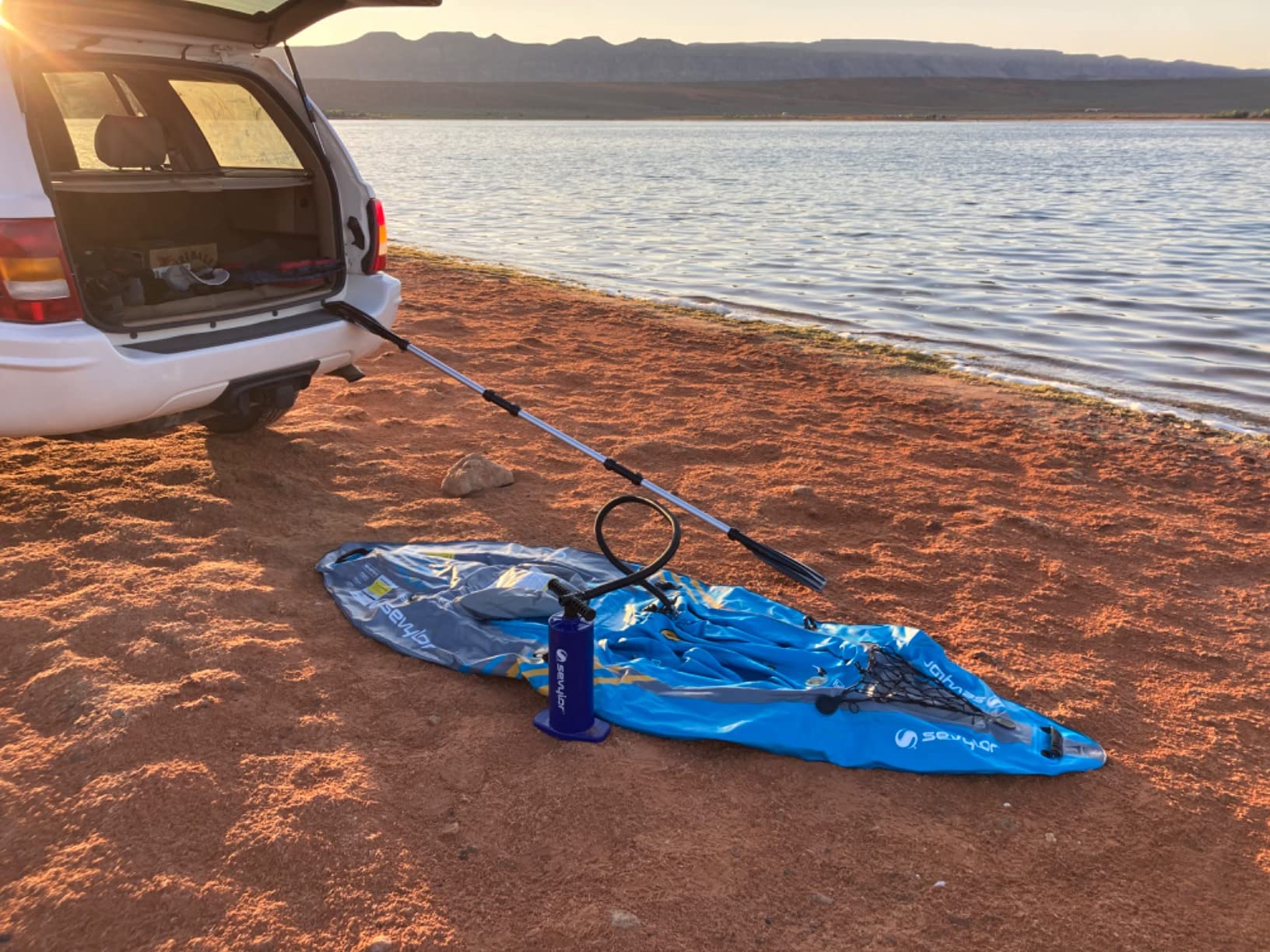
At 20.3 lb, the QuickPak is the boat you can carry furthest, and the backpack that converts into the seat removes the last piece of bulk. Nothing extra to pack for the trip, which is why this design has stayed in circulation for years with close to three thousand ratings behind it.
Be clear-eyed about where it belongs though. This is a lake-oriented inflatable. The 21 gauge PVC is markedly thinner than the 900 to 1,100 denier fabrics on the BRIS and Retrospec boats here, and the hull builds toward a rounded shape that is less stable and less trackable than the drop-stitch models. On a narrow river corridor it will feel soft and slow to correct.
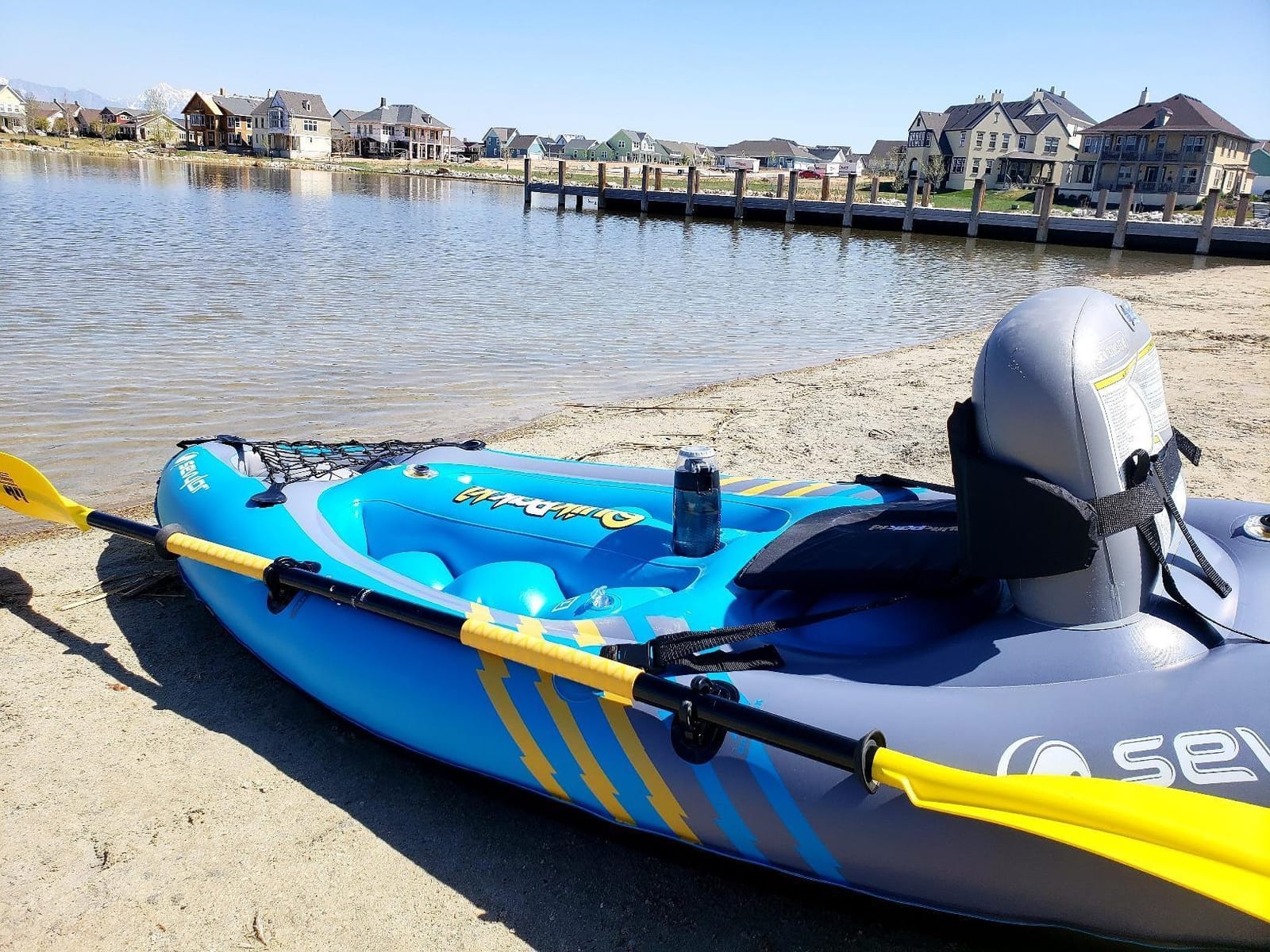
What it does have going for it is redundancy and valves. Multiple air chambers mean one puncture does not end your day, and the Double Lock valves speed up both inflation and deflation. A tarpaulin bottom takes the punishment from rocks and gravel that would mark a bare hull, and the bungee storage area gives you somewhere to put a jacket.
Capacity is a genuine strength at 400 lb for a solo boat, which is far more than the light Retrospec single. That gives you room for a proper tackle load, a cooler and a dog if you are running this solo.
When this is the right river boat
It suits solo anglers on slow, flat sections of a river where you want to reach a remote put-in without a roof rack, plus paddle-and-camp trips where backcountry access matters more than tracking.
It is also a reasonable first boat for a couple splitting up to fish different water, since each person can carry their own.
Where it falls short
Thin fabric and a rounded hull mean this is not the boat for current, wind or anything with a class rating above gentle water. The gunwale height is also low, which matters on a choppy day.
There is no fishing hardware in the box, so plan on adding rod holders and any anchor system yourself. For the full family of boat choices, our complete inflatable kayak roundup breaks down hull construction types in more depth.
10. BEYOND MARINA Full Drop Stitch – Deep Hull Value With a Packing Struggle
Beyond Marina Inflatable Kayak 2 Person – Full Drop Stitch, Explorer 13.7ft
13.77 ft
507 lb capacity
38.5 lb hull
19.7 in deep hull
Pros
- Full drop-stitch hull feels far more like a hard-shell
- Deep 19.7 in hull tracks straight and handles current well
- Inflates in about five minutes with a SUP pump
- Wheeled carry bag is a rare inclusion
Cons
- Very difficult to refold and repack after a trip
- Hull is heavier than advertised and backpack straps are impractical
- Seats offer poor back support and attachments feel unreliable
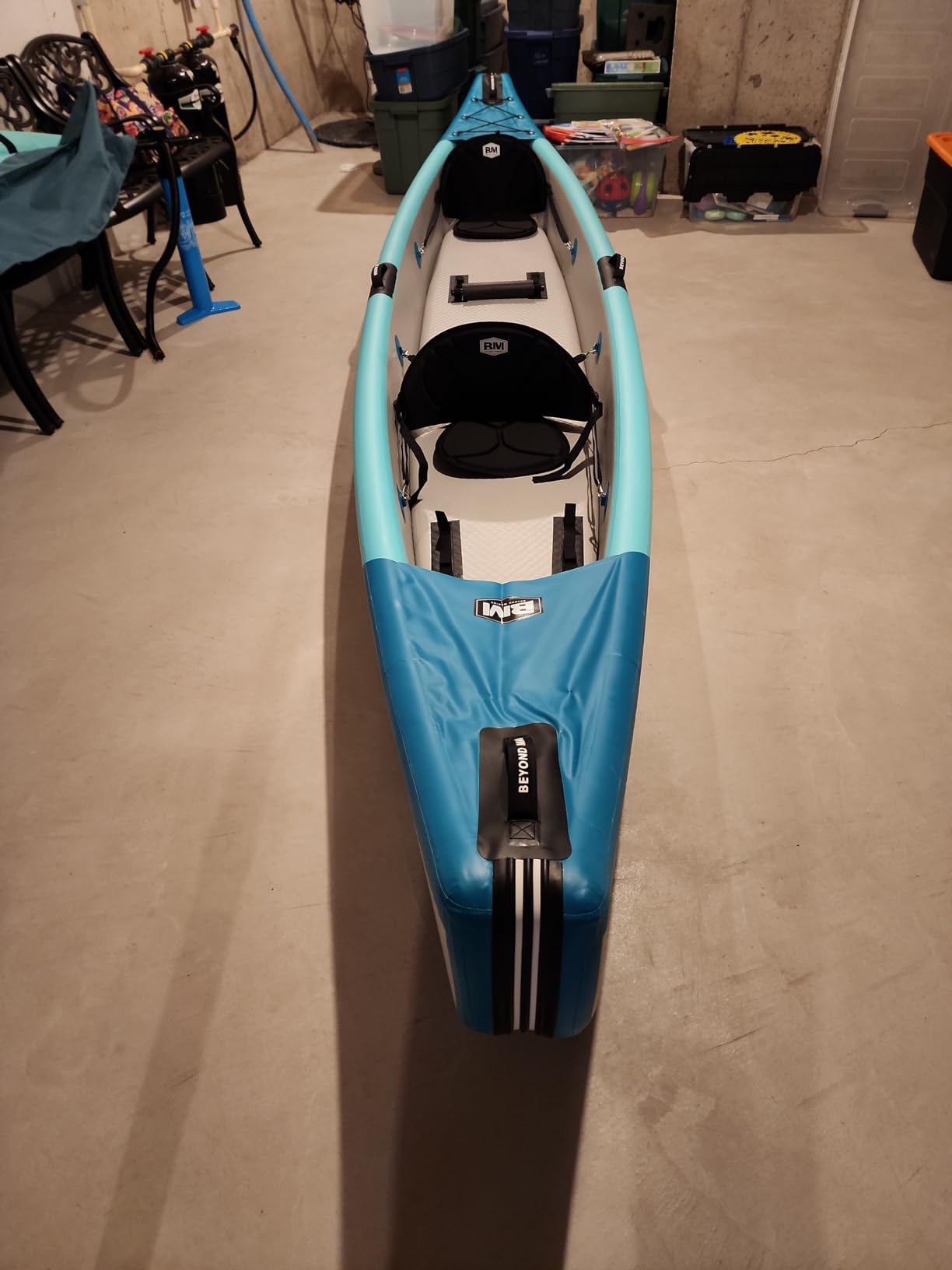
The hull is the reason to look at this boat. A full drop-stitch build with a 19.7 inch depth, which the maker claims is far deeper than typical competitors, gives a rigid platform that handles chop and faster current once the fins are in. Reviewers consistently describe it as tracking straight and feeling close to a hard-shell.
It also inflates fast. With a SUP-style pump it takes about five minutes, and the bag has wheels, which is a real convenience when you are carrying a boat that does not fold away small.
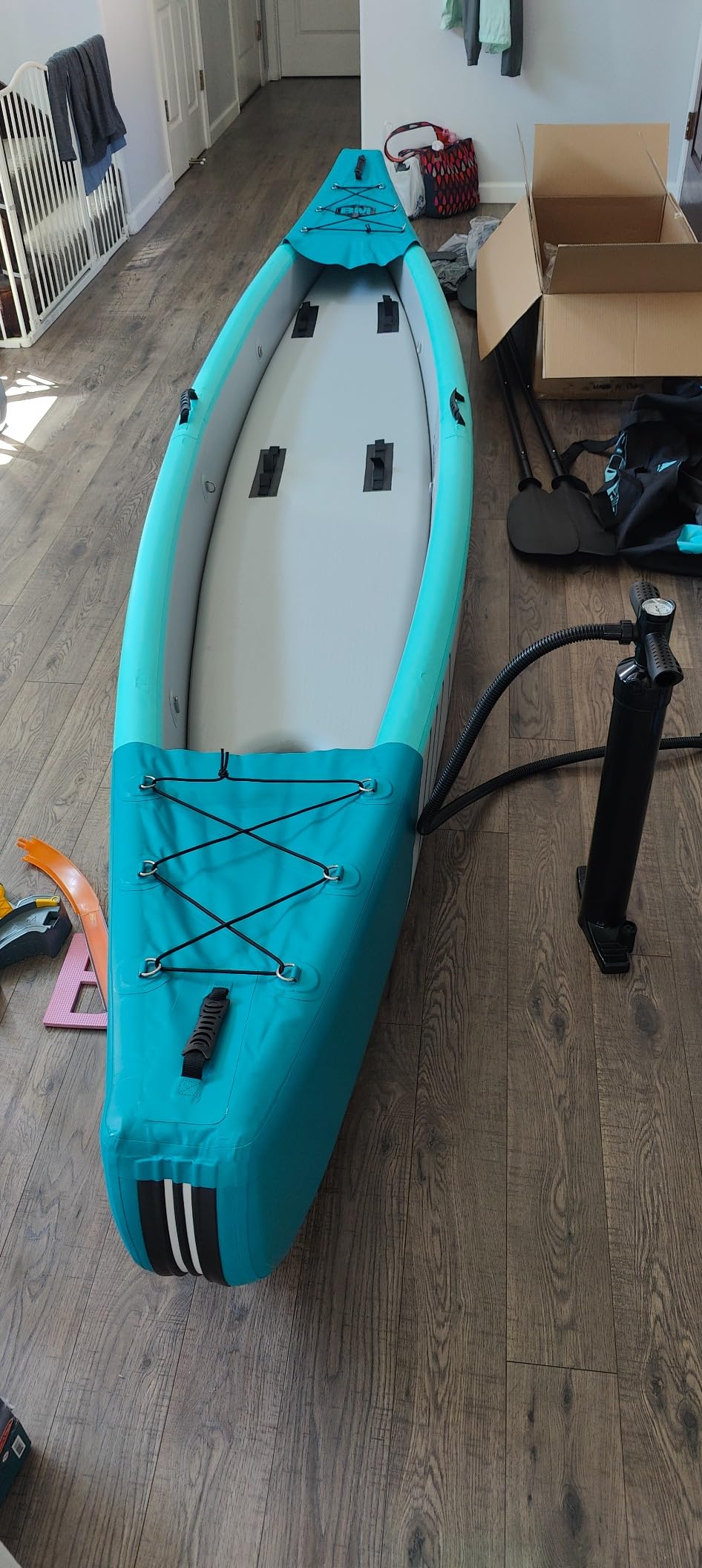
The problem is the trip home. Almost every review mentions difficulty folding the boat and getting it back into the bag, and several note the hull is heavier than the stated figure. Combined with impractical backpack straps, this is a boat you will want to unfold rather than pack, which undercuts the main reason people buy inflatable in the first place.
The seats are also the weak point, with poor back support and attachment points that feel unreliable. Fix that with a seat pad and you have a workable boat, but it is an extra step the simpler models do not need.
When this is the right river boat
It fits anglers who want a rigid hull without moving to the top construction tier, who fish from a vehicle-side launch rather than a backcountry one, and who want a stable platform for larger paddlers or dogs in the cockpit.
The deep hull gives it a useful margin on windier days than the flat-floored models, which is useful on an open reservoir section between river reaches.
Where it falls short
This has the smallest review base in the roundup at twenty-five ratings, so the evidence behind any strong claim here is thin. One serious report describes repeated capsizing, and we would treat that as a reminder to check your loaded weight against the 507 lb figure carefully.
Add the packing difficulty to that and the boat makes most sense as a camp or garage boat rather than one you move every weekend.
How to Choose an Inflatable Fishing Kayak for Rivers
Self-bailing floors are the spec that separates river boats from lake boats
A self-bailing floor sits above the lowest point of the hull and slopes water toward drains cut through the perimeter, so water that lands in the boat runs back out to the river instead of pooling. On flat water this barely matters. On a river it is the difference between a boat that sheds a wave train and one that slowly sinks lower with every set you get hit by. If a listing does not mention drains, self-bailing or a raised floor, assume it does not have one.
Drain count is worth checking as a second signal. Two of the boats here carry sixteen drains with open and close valves, which lets you dry the boat for touring and open them for wet river work. That switch is more useful than it sounds, because a boat that drains constantly on a sunny flatwater trip ends up wet and unpleasant.
Tracking decides whether you can hold a bank
A kayak wanders when the hull lacks directional grip, and on a river that wandering fights you while the current is already moving the boat. Skegs are the affordable fix and several boats here include them. Removable skegs are better still, because you can pull them for shallow gravel bars where a fixed skeg can ground or bend.
Longer hulls track better, which is why the 14.1 ft BRIS and the 13.77 ft BEYOND MARINA feel planted compared with the short 9 ft 8 in StraitEdge. The trade-off is turning circle and pack weight. Rule of thumb: drift and hold a bank if the water is moving anyway, and pick maneuverability if you need to reposition quickly onto lies.
Size your load to about three quarters of rated capacity
Total loaded weight means you, your gear, your dog and your cooler added together. Stay near 70 to 75 percent of the rated figure rather than the full number. Inflatables handle less than their rating gracefully when fully packed, because the hull loses shape and tracking degrades. This is where the 507 lb tandems and the 750 lb 380x earn their ratings, and where the 220 lb Retrospec single runs out of room quickly.
Air chambers and inflation pressure set the platform
Three independent air chambers is the practical minimum. One puncture should not end the trip, and boats with two chambers force a choice between finishing the float and staying dry. The GYMAX is a good example, because its drop-stitch floor counts as the third chamber.
Pressure is what converts air into structure. Drop-stitch floors inflated to around 10 PSI feel like a hard shell, while a low-pressure floor around 2 PSI feels soft and flexy. That gap is the biggest single difference in how these boats cast and stand, and it explains why the BRIS and GYMAX decks feel stable while the Goplus does not.
Rigging: rod holders, motor mounts and anchor points
Only two boats in this roundup include any fishing hardware, so plan your rig before you buy. Options in order of simplicity: adhesive tube mounts, D-ring strap systems for a rod tube across the lap, or a rail-mounted setup like the StraitEdge. For a river, add an anchor trolley or at minimum two D-rings for a small bag anchor, because holding position against current with a paddle alone is exhausting.
Self-propelled drift is worth considering on long slow reaches, either with a trolling motor on a stern mount or with a pedal drive. Check the boat’s transom and reinforcement before fitting either, and note that adding a motor changes the boat’s registration status in most states.
Materials and lifespan
Fabric denier is the durability number. 1,100 denier with heat-welded seams is the strongest construction here, 900 denier with a tarpaulin bottom is solidly mid-range, and 21 gauge PVC is the thin end of the scale and will wear faster in abrasive river conditions. Rinse mud off after every trip, dry the boat fully before packing it, and store it out of direct sun. Inflating the hull once a month while it sits in a garage helps the material keep its shape.
Match the boat to the river, not just the rating
Flow matters as much as gradient. The same river is a gentle Class I float at low water and a different boat decision after a week of rain. Check the gauge reading before you go and pick the boat that handles the higher number, because you can always paddle easy water slowly. A class rating is a ceiling for the boat, not a promise about any individual paddler.
River Safety: PFD, Cold Water and Stopping Drift
The PFD is the most important purchase on this page
Wear a properly fitted buoyancy aid every trip, every time, regardless of how calm the reach looks. A foam flotation vest starts working the instant you hit the water. An inflatable belt-pack requires you to pull a cord, and pulling a cord underwater in moving water is exactly the moment you may not manage. On a river, choose foam.
Thigh straps matter more than most buyers expect. On an inflatable, straps that keep your legs inside the hull stop you washing out of the boat in a wave, and they are a few dollars of hardware that changes how a swamped boat behaves.
Cold water sets the season
Below roughly 60F water temperature, immersion triggers a gasp response and rapid breathing before hypothermia is even a concern. That is why a drysuit or wetsuit is standard practice on northern rivers in spring, and why many outfitters float-trip through shoulder season rather than launching from a ramp. Wear the thermal layer regardless of air temperature, because air temperature tells you nothing about what the water is doing.
How to stop a kayak from drifting
Get the bow into the current first. Turning downstream into moving water spins you; turning across the current at an angle gives you paddle surface to work with.
Use short, firm strokes close to the hull. Long slow sweeps waste energy on a soft inflatable. The faster boats like the Excursion Pro and 380x answer a short stroke immediately.
Use eddy lines and seams. Anchoring in the eddy behind an obstruction holds far better than fighting the main flow. A small bag anchor on a trolley line or two D-rings gets you there.
Back out of a slow zone before trying to cross. Crossing current from inside an eddy with a paddle instead of the bank is the most common way beginners end up in trouble.
Keep a throw bag and a knife in the boat. If you do swim, having flotation thrown to you shortens the time you are in the water.
Carry a pin kit and know how to patch a chamber before you need it. Every boat here is repairable in the field with adhesive patches, and the cost of getting it wrong is a swim in moving water.
Frequently Asked Questions
Are inflatable kayaks safe for whitewater rapids?
It depends entirely on the boat. Most inflatable fishing kayaks are built for Class I to Class II water, and only a few carry higher ratings. Of the ten boats reviewed here, the Sea Eagle 380x Explorer is rated to Class IV whitewater and the Sea Eagle 370 Pro to Class III. Treat a class rating as a ceiling for the boat under its stated conditions, not a promise about any reach or any paddler.
What class of rapids can an inflatable kayak handle?
Entry-level inflatable kayaks with thin fabric and no self-bailing floor suit Class I water, and a rigid multi-chamber boat with welded seams and drains can handle Class II to Class III. Check the manufacturer’s rating before you commit, then read the loading guidance, because an overloaded inflatable loses tracking and handles far worse than the rating suggests.
Are inflatable kayaks bad for fishing?
No. Anglers run them on rivers every season, and two of the boats in this roundup ship with rod holders and a camera mount as standard. What makes a difference is the rig: rod holders, a rail or D-rings for gear, an anchor system for holding a seam, and a floor rigid enough to cast from. A self-bailing floor matters most of all on moving water.
How to stop a kayak from drifting?
Turn the bow into the current first rather than spinning downstream, use short firm strokes close to the hull, and work with the river instead of against it. Fish from eddies and behind obstructions where the reversed flow holds you without an anchor. If you need true holding position, add a small bag anchor on a trolley line or two D-rings, and practice the technique on calm water first.
Are inflatable kayaks tip over easily?
It depends on the hull and the load. Flat, low-pressure boats with narrow cockpits are more affected by a shifting angler than deep drop-stitch hulls or wide-beam models. Keep your total load near 70 to 75 percent of rated capacity, keep low and centered when you move, and use thigh straps so a wave cannot sweep your legs out of the hull.
What is the average lifespan of an inflatable kayak?
Lifespan is driven far more by fabric weight and care than by the calendar. Higher denier with welded seams and replaceable floor panels outlast thin PVC in abrasive river conditions. Rinse mud off, dry the hull fully before packing, store it out of direct sun, and inflate it monthly if it lives in a garage. A well-kept boat in this roundup should give you many seasons.
Are inflatable kayaks good for beginners on rivers?
For Class I and Class II water, yes, and the wide-beam models with three independent chambers are the most forgiving. Start on a short familiar section with a buddy, wear a foam flotation aid, and practice turning and stopping in still water first. Move up to a class-rated boat with a self-bailing floor before you take on faster water or a multi-day trip.
Do you need a wetsuit to paddle an inflatable kayak?
On cold water, yes. Below roughly 60F water temperature, immersion causes an involuntary gasp and rapid breathing long before hypothermia becomes the danger, and air temperature tells you nothing about the water. A wetsuit or drysuit is standard practice on northern rivers in spring. In warm summer water a lightweight quick-dry layer is usually plenty.
Pick Your Water First
Start with the river, not the boat. Decide what class of water you actually fish, what flow you expect after rain, and whether you fish alone from a walk-in launch or from a camp with a vehicle beside you. Only then look at self-bailing floors, drain counts, skegs and floor rigidity. Our pick for most anglers working moving water is the Intex Excursion Pro K2, because it comes with rod holders and holds up across the widest range of river conditions. Push the water harder and move up to the Sea Eagle 380x Explorer. Fish solo from tight access and you want a rail and rod holders already fitted, take the Advanced Elements StraitEdge Angler.
The rest of this page exists to help you avoid the boat with rod holders bolted onto a flatwater hull. Whichever one you choose, wear the flotation aid, check the gauge, and keep your load under three quarters of the rated capacity.