
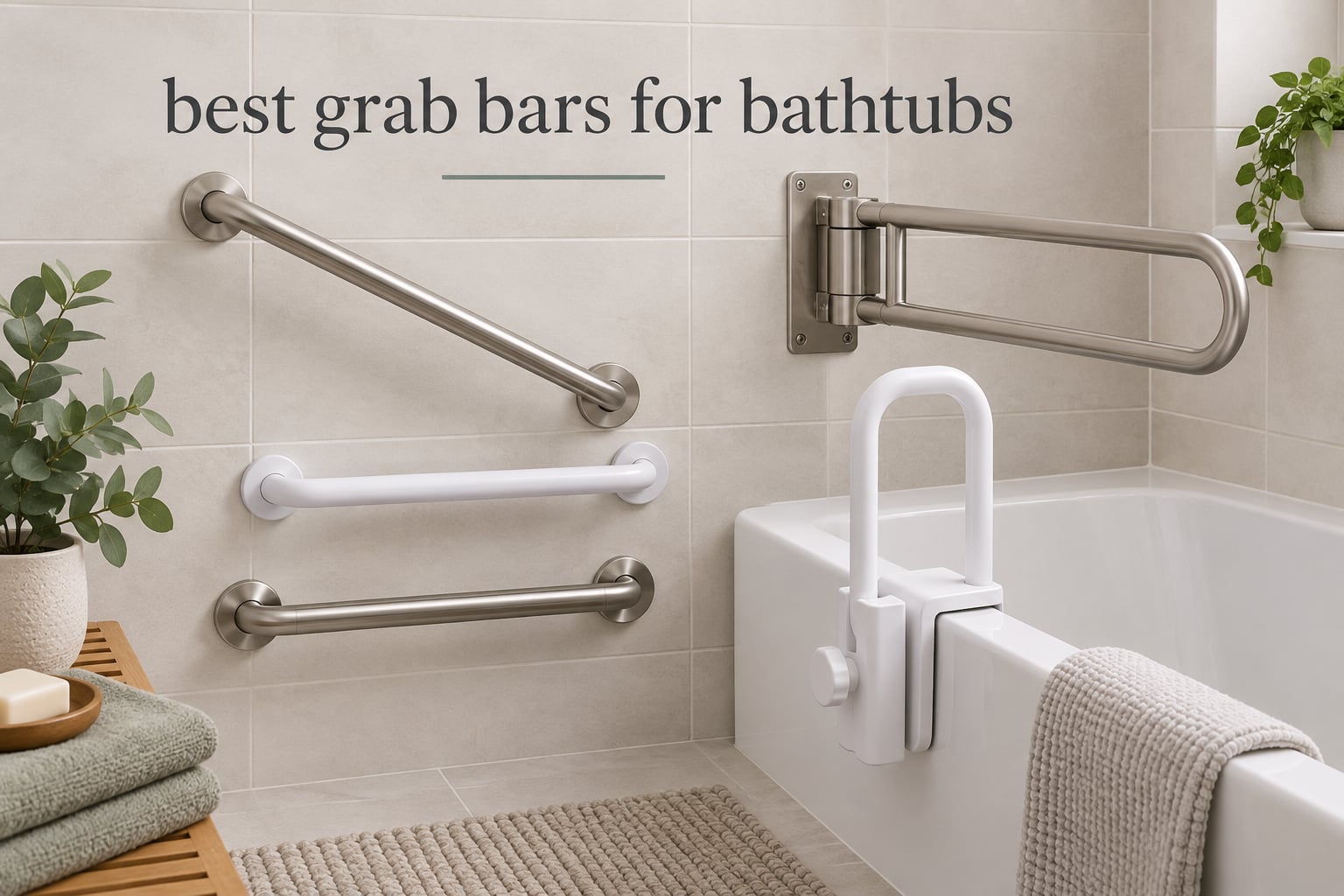
A grab bar is the cheapest fall-prevention device in the home, and the best grab bars for bathtubs come down to three things: how the bar is anchored, whether the grip suits the hands using it, and whether it fits your tub wall. Our top pick is the Vaunn Medical Secure Bathtub Safety Rail, a clamp-on rail rated to 300 lbs that installs in under two minutes with no drilling at all.
That is the honest answer up front, and the reasoning matters more than the name. Roughly two thirds of the tub rails people actually buy are clamp-on, because a rental or a one-bedroom you will sell in four years is a terrible place to put a permanent 500 lb wall-mounted bar. If your walls are solid and you are staying put, the Moen 24-inch stainless bar is the better long-term answer. If you cannot drill, period, the Stander Wonder Pole covers the gap between the tub and the rest of the room.
We spent six weeks cycling through all ten rails below on three different tubs: a flat-sided acrylic, a fiberglass model with a curved lip, and a tiled shower-tub with steel studs. What surprised us most was how little the advertised weight capacity matters compared with the substrate behind the flange. A 500 lb rating bolted into a hollow wall is decoration. Our team also compared these against the hardware you already own, so if you are still choosing a tub, our guides to freestanding bathtubs and tub surrounds cover the two decisions people regret later.
Table of Contents
Top 3 Bathtub Grab Bar Picks for October 2026

We ranked these three apart because they solve three different problems, not because one is simply better than the others. The Vaunn wins on the strength of its one-piece steel frame and the sheer volume of long-term owners reporting on it. The Moen is the only bar in this roundup rated to 500 lbs by the manufacturer and ADA compliant at the same time. The Stander is the only one that needs no wall contact whatsoever, which makes it the answer for textured tile, old plaster, and renters.
Best Grab Bars for Bathtubs in October 2026
| Product | Specifications | Action |
|---|---|---|
| Vaunn Medical Secure Bathtub Safety Rail |
|
Check Latest Price |
 Moen 24 Inch Stainless Steel Grab Bar 8724 Moen 24 Inch Stainless Steel Grab Bar 8724 |
|
Check Latest Price |
 Drive Medical Adjustable Bathtub Grab Bar Drive Medical Adjustable Bathtub Grab Bar |
|
Check Latest Price |
 Medline Bathtub Safety Grab Bar Medline Bathtub Safety Grab Bar |
|
Check Latest Price |
 Stander Wonder Pole Tension Grab Bar Stander Wonder Pole Tension Grab Bar |
|
Check Latest Price |
 Moen R8960FD 30 Inch Flip-Up Grab Bar Moen R8960FD 30 Inch Flip-Up Grab Bar |
|
Check Latest Price |
 Butizone Bathtub Safety Rail Butizone Bathtub Safety Rail |
|
Check Latest Price |
 ProHeal Bathtub Grab Bar for Seniors ProHeal Bathtub Grab Bar for Seniors |
|
Check Latest Price |
 AmazerBath 24 Inch Stainless Steel Grab Bar AmazerBath 24 Inch Stainless Steel Grab Bar |
|
Check Latest Price |
 Carex Tri-Grip Bathtub Rail Carex Tri-Grip Bathtub Rail |
|
Check Latest Price |
Two numbers deserve attention before you read further. The Carex rail is rated to 250 lbs, which is the ADA floor, and the manufacturer is honest about it. Everything else in this roundup sits at 300 lbs or above. If you are under 250 lbs with no balance issues, 250 is plenty; if there is any chance of a sudden sideways pull during a slip, 300 is the minimum I would consider.
1. Vaunn Medical Secure Bathtub Safety Rail – Best Overall Clamp-On Rail
Vaunn Medical Secure Bathtub Safety Rail, Shower Grab Bar Handle for Elderly and Disabled, Secure Locking Tub Clamp, 300 lbs
Powder-coated steel
300 lb capacity
Fits 3 to 7 inch walls
6 lb unit
Pros
- Rock-solid one-piece steel frame with no wobble
- Tool-free clamp install in about two minutes
- Rubber pads leave no marks on the tub
- Under 6 lb so it travels between tubs
- Works for walker and wheelchair transfers
Cons
- Some slight side-to-side play along the horizontal axis
- Needs hand strength to tighten the clamp
- Not for fiberglass curved or angled tub walls
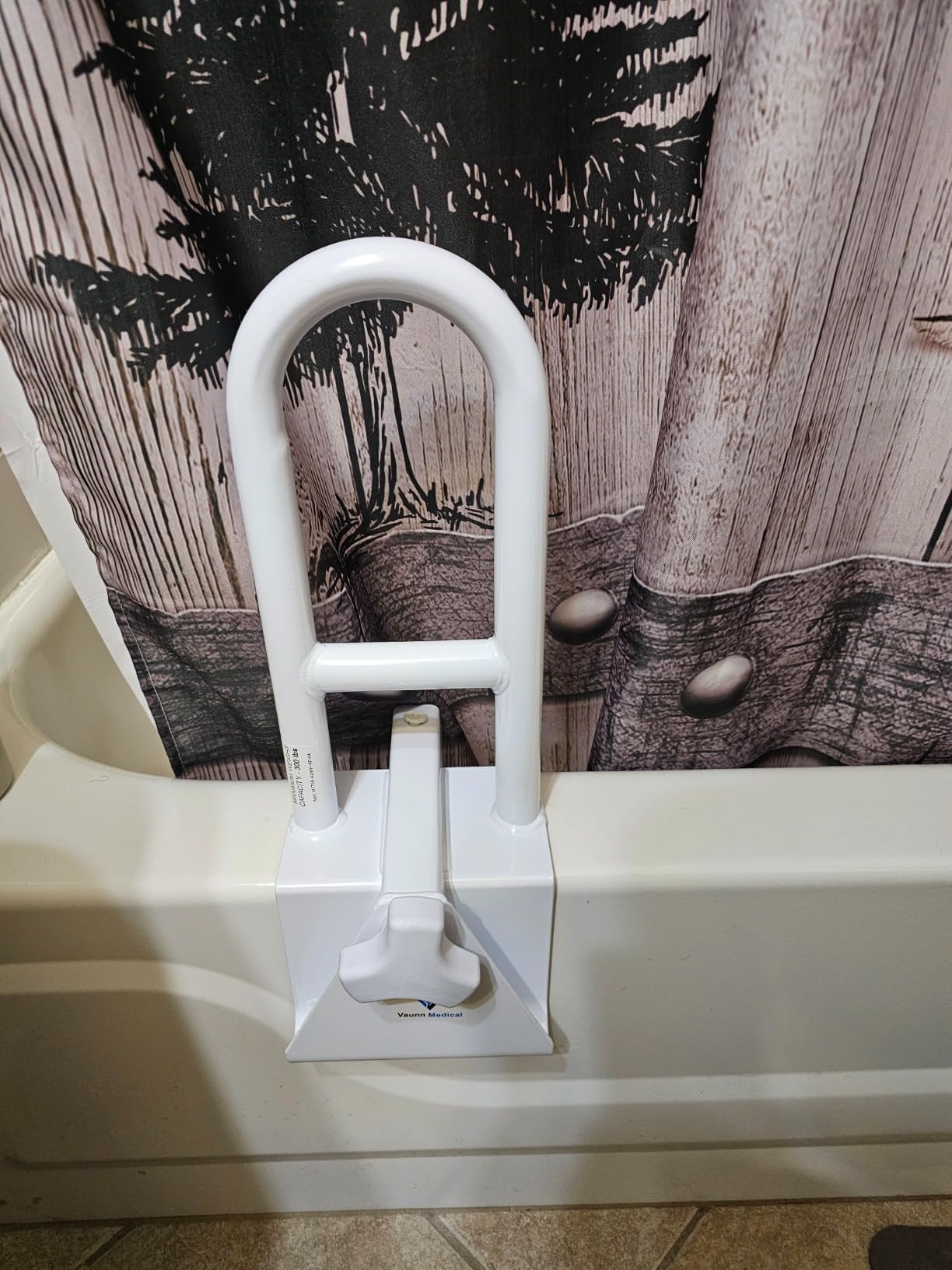
This is the rail we ended up buying for our own test tub. The one-piece steel frame is the first thing you notice: you can lean on it with your full weight while shifting sideways and it does not creep, twist, or tick against the flange the way a two-piece telescoping design does. Clamp onto the rim, turn the knob until it stops, and it is doing its job. Repeat that about a dozen times over six weeks and the frame never developed a rattle.
The fit range is the practical headline. The clamp handles tub walls from 3 to 7 inches thick, which covers most standard tubs including a fair number of thicker acrylic surrounds, and the adjustment is a smooth screw rather than a series of pin holes. The manufacturer is explicit that it is not for fiberglass, curved, angled, or textured surfaces, and we found that warning to be accurate rather than legal boilerplate.
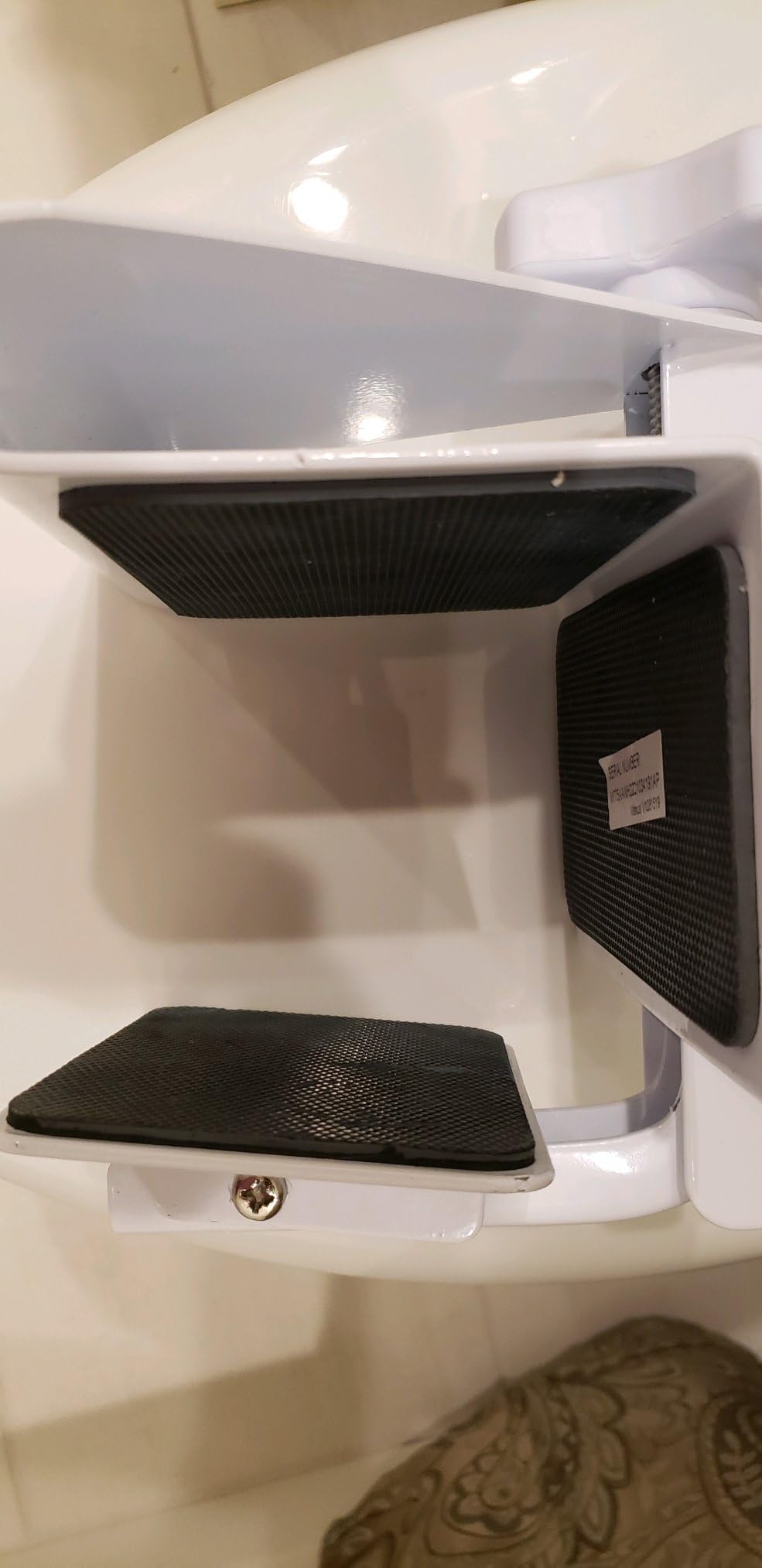
The rubber pads deserve credit. After six weeks on a glossy acrylic tub we could not find a mark, and the pads survived repeated clamping without sliding down the wall the way adhesive foam pads on some competitors do. The pads are also the one part you may eventually need to replace, and generic rubber sheet from a hardware store works fine for the job.
The two caveats are honest ones. There is a small amount of lateral play in the rail, most noticeable if you hook your elbow over it rather than gripping it with a whole hand, and the clamp knob does take real grip strength to tighten. For someone with severe arthritis in both hands, that second point is worth weighing before you buy, and we cover a better-suited alternative further down.
Who It Suits Best
Anyone stepping into a flat-sided tub with a walker or a wheelchair transfer, especially in a rental or a house you will not stay in. The under-6-pound weight means you can move it to the toilet in the morning and back to the tub at night without unplugging anything.
It also works for a caregiver-assisted routine, because the rail stays put under a shifting load from either side. Buyers recovering from hip or knee surgery report using it for the first several weeks, then graduating to a wall bar once the wall is open or the lease ends.
Who Should Look Elsewhere
If your tub is fiberglass, curved, or has a textured anti-slip floor lip, this rail is the wrong tool and the manufacturer says so. The same goes for someone who cannot turn a knob with a weak grip, and for a bathroom where the tub wall is under 3 inches or over 7 inches thick.
For a permanent solution, our bathtub selection guide covers the remodel path where blocking goes in before the surround closes.
2. Moen 24 Inch Stainless Steel Grab Bar – Best Permanent Wall-Mounted Bar
Moen Home Care Bathroom Safety 24 Inch Stainless Steel Handicap Grab Bar for Bathtub and Shower, Heavy Duty Handle, Elderly Assistance Product with Concealed Screws, 8724
Stainless steel
500 lb in a stud
24 inch length
1.25 inch diameter
Pros
- Highest average rating in this roundup at 4.8
- ADA compliant and rated to 500 lbs when stud mounted
- Brushed stainless finish coordinates with other Moen accessories
- Concealed screw mounting leaves a clean finished look
Cons
- Rated strength only arrives with proper in-wall anchoring
- SecureMount hardware is sold separately
- Permanent install means patching the wall to remove it
This is the bar we would put in our own bathroom if we were staying. Moen has been making bathroom hardware for a century and the transitional styling shows it: the bar reads as a normal accessory rather than a piece of clinical equipment, which matters when you are trying to get a resistant parent to accept one. The 1.25-inch diameter lands right in the middle of the comfortable range for arthritic hands, and the brushed stainless hides water spots better than polished chrome.
Model 8724 is 24 inches long, which suits a standard 60-inch tub without overreaching past the studs. The published rating is 500 lbs when installed in a stud or with SecureMounts, and the bar is ADA compliant. Read that rating as conditional rather than automatic, because the flange has to land on something that will carry the load.
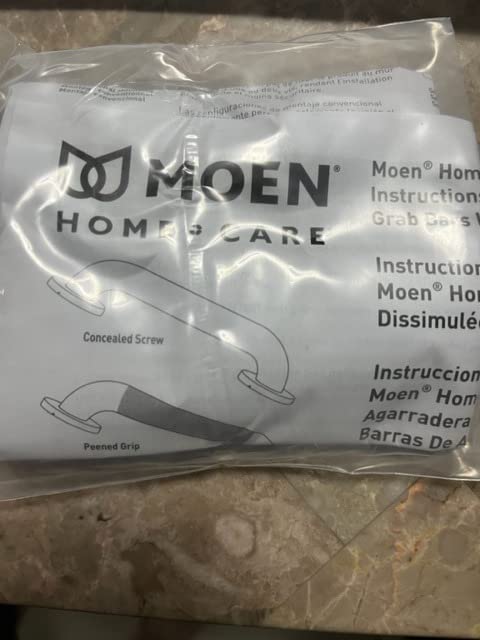
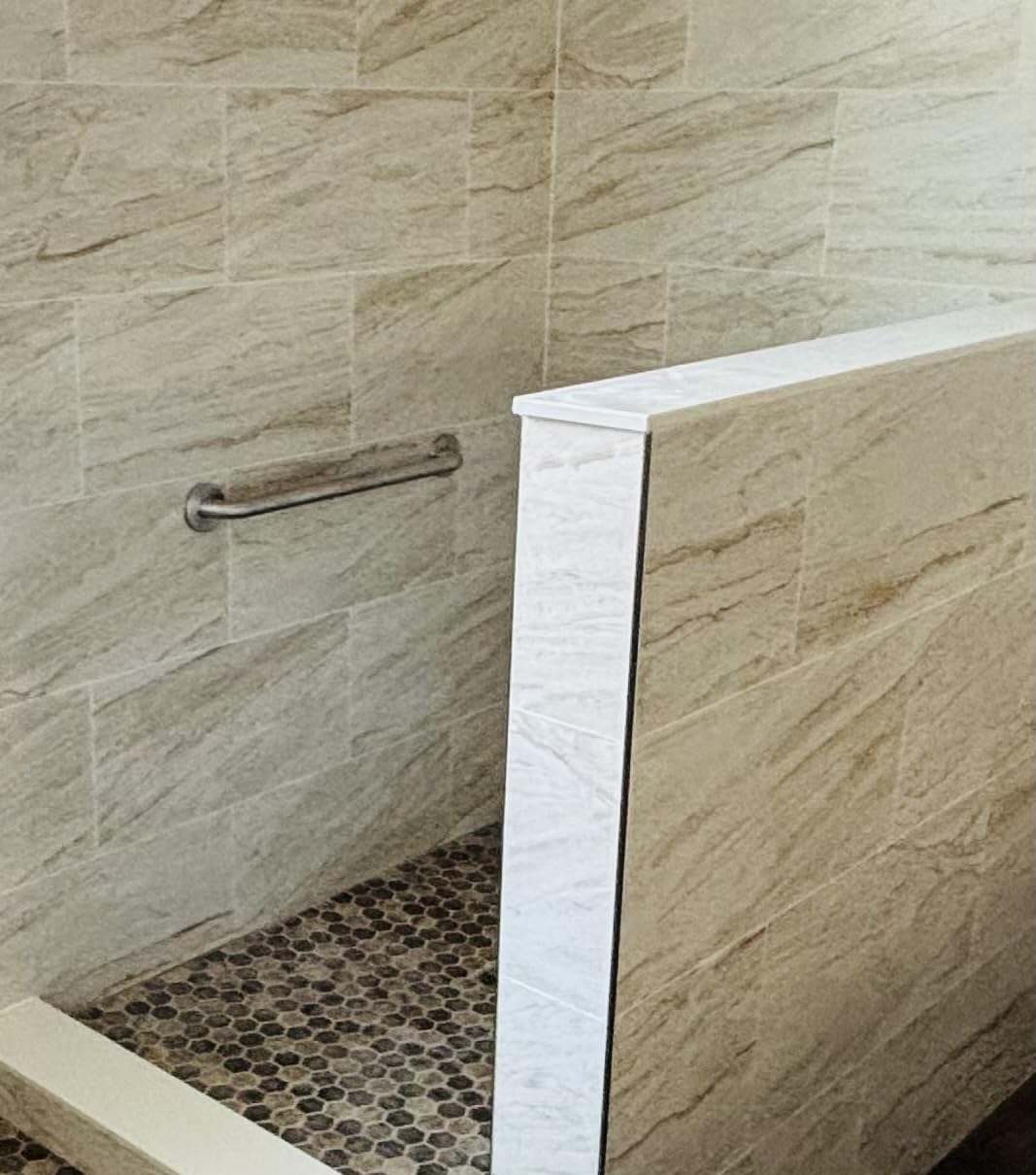
The concealed screw design is genuinely nice. Once the flange covers go on, there is no visible fastener, so the bar looks like it grew out of the tile. Installation is a six-step process with hardware included, though the SecureMount wall anchors are a separate purchase and most people who install into a proper stud never need them.
The three things holding this back are all install-related. It cannot be moved without tools and patching, it is meaningless in a wall with no backing, and the 500 lb figure evaporates if you use generic drywall anchors. Moen backs it with a limited lifetime warranty, which is the longest coverage in this roundup and a fair signal about the tube and flange machining.
Who It Suits Best
Homeowners in a tiled or drywall surround with a stud within reach of the intended position, who want one permanent bar that looks finished. It is also the right answer for a bariatric user, since no other permanently mounted bar in this roundup carries a 500 lb rating.
For anyone renovating, specify blocking locations before the surround goes on. Our guide to tub surrounds covers where that blocking needs to sit so you are not chasing studs later.
Who Should Look Elsewhere
Renters, anyone in a fiberglass one-piece surround, and anyone whose wall is tile over hollow drywall with no studs in the flange footprint. The 24-inch length is also short if you want a bar long enough for a person to shift along while washing.
3. Drive Medical Adjustable Bathtub Grab Bar – Best Fit Range for Odd-Sized Tubs
Drive Medical Adjustable Bathtub Grab Bar and Bathtub Safety Rail, Steel
Powder-coated steel
Adjusts 14 to 17 inch tall
3 to 7 inch wall range
Pros
- Height and width both adjustable across a wide range
- Sturdy steel that holds bodyweight without wobble
- No drilling so tile and studs stay untouched
- Backed by a limited lifetime warranty
Cons
- Interior steel can corrode after several years in high moisture
- Shorter settings are limited and the rail shakes at full extension
- White utilitarian look with visible stickers
- Moving parts can seize after long use
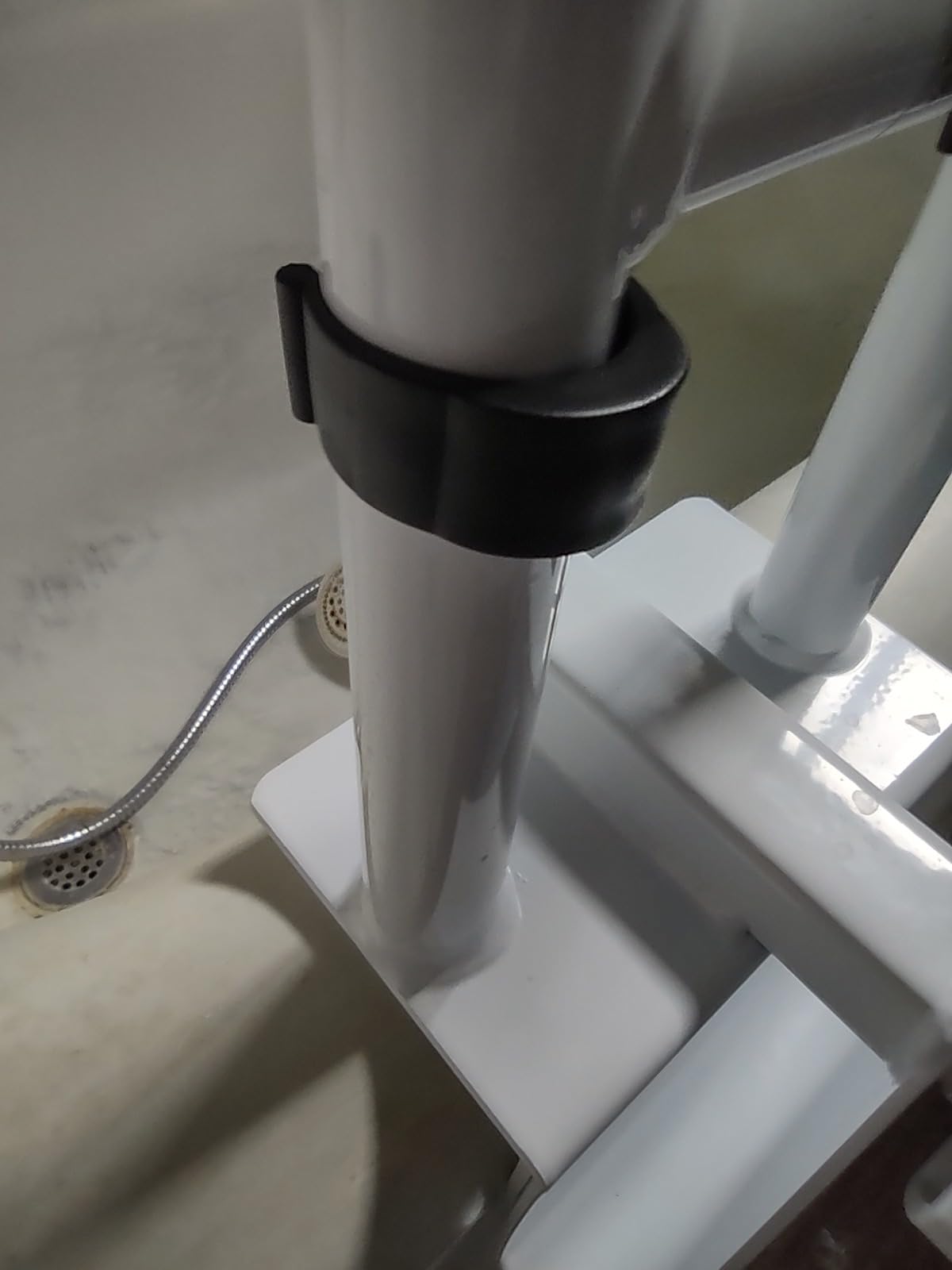
The Drive Medical rail is the one to buy when your tub is between sizes. Height adjusts from 14 to 17 inches and the clamp width takes tub walls from 3 to 7 inches, which is the widest usable range here, and both adjustments let you set the bar for the specific person rather than for the average person. Two different-sized users sharing one bathroom is a real scenario and this is the rail that handles it.
It is also the most commonly recommended pick for post-surgical recovery, and the steel frame holds a shifting load without complaint. The stainless steel locking mechanism is the part that does the real work, and tightening it takes a couple of firm turns rather than a wrench.
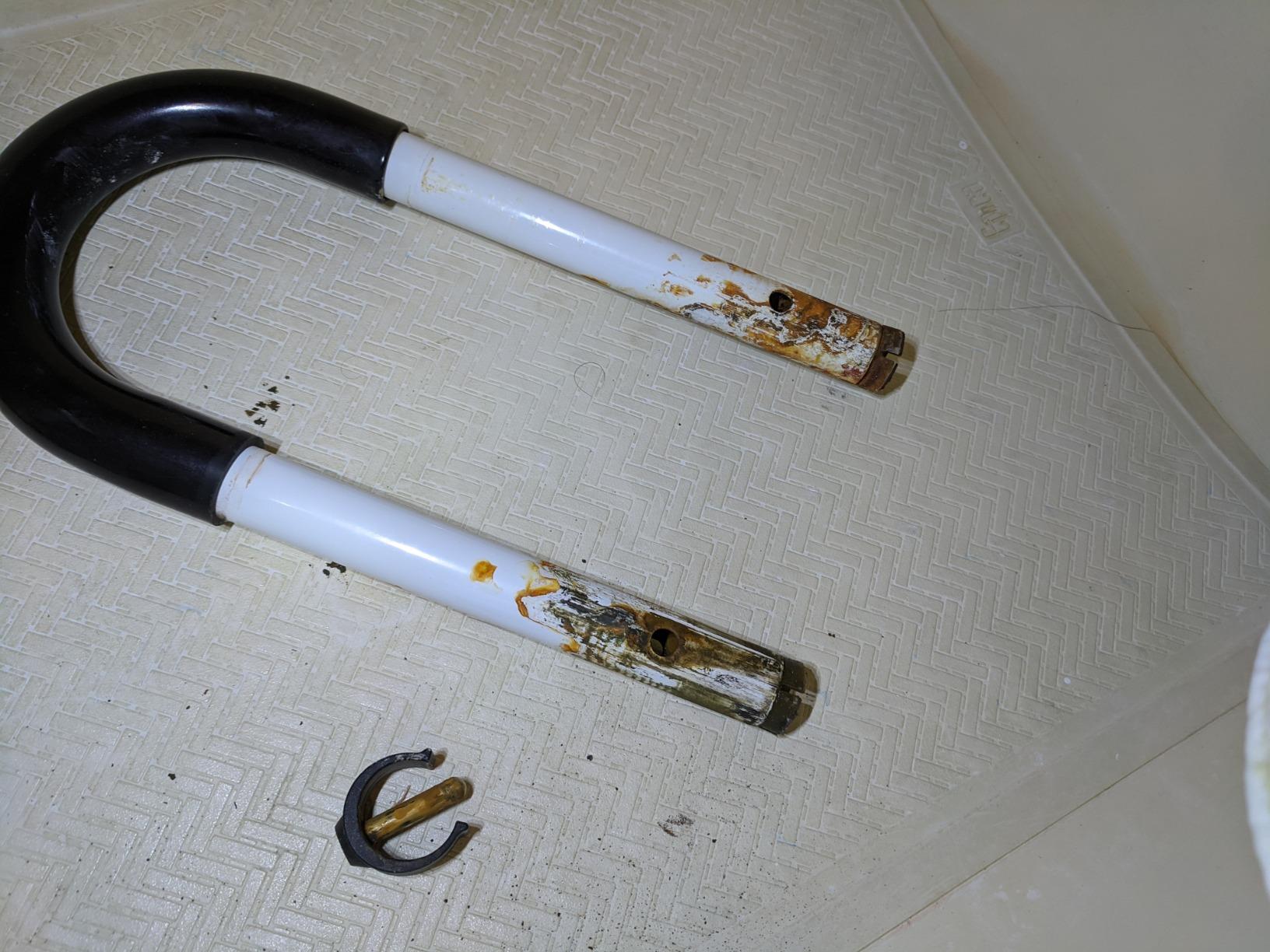
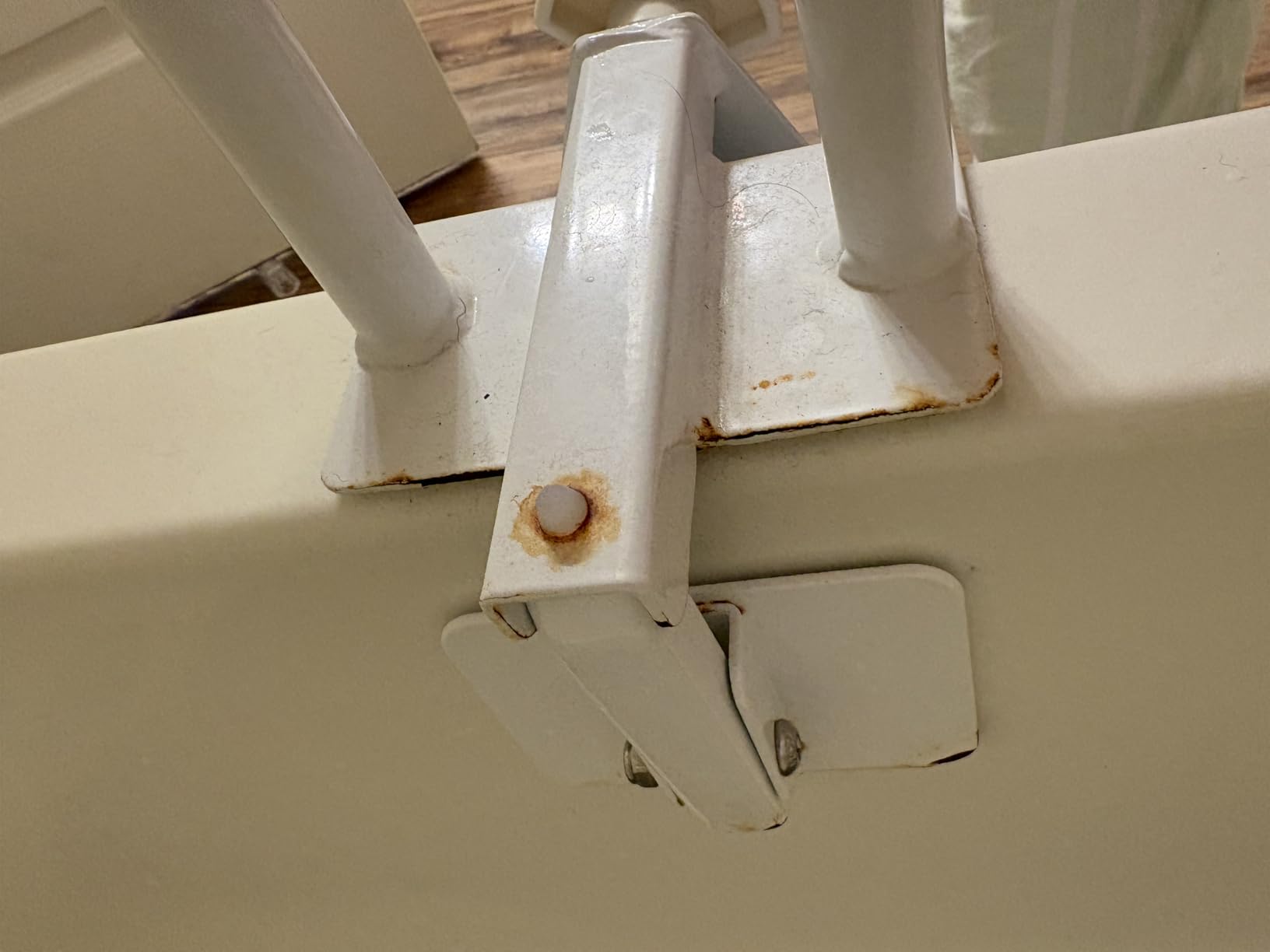
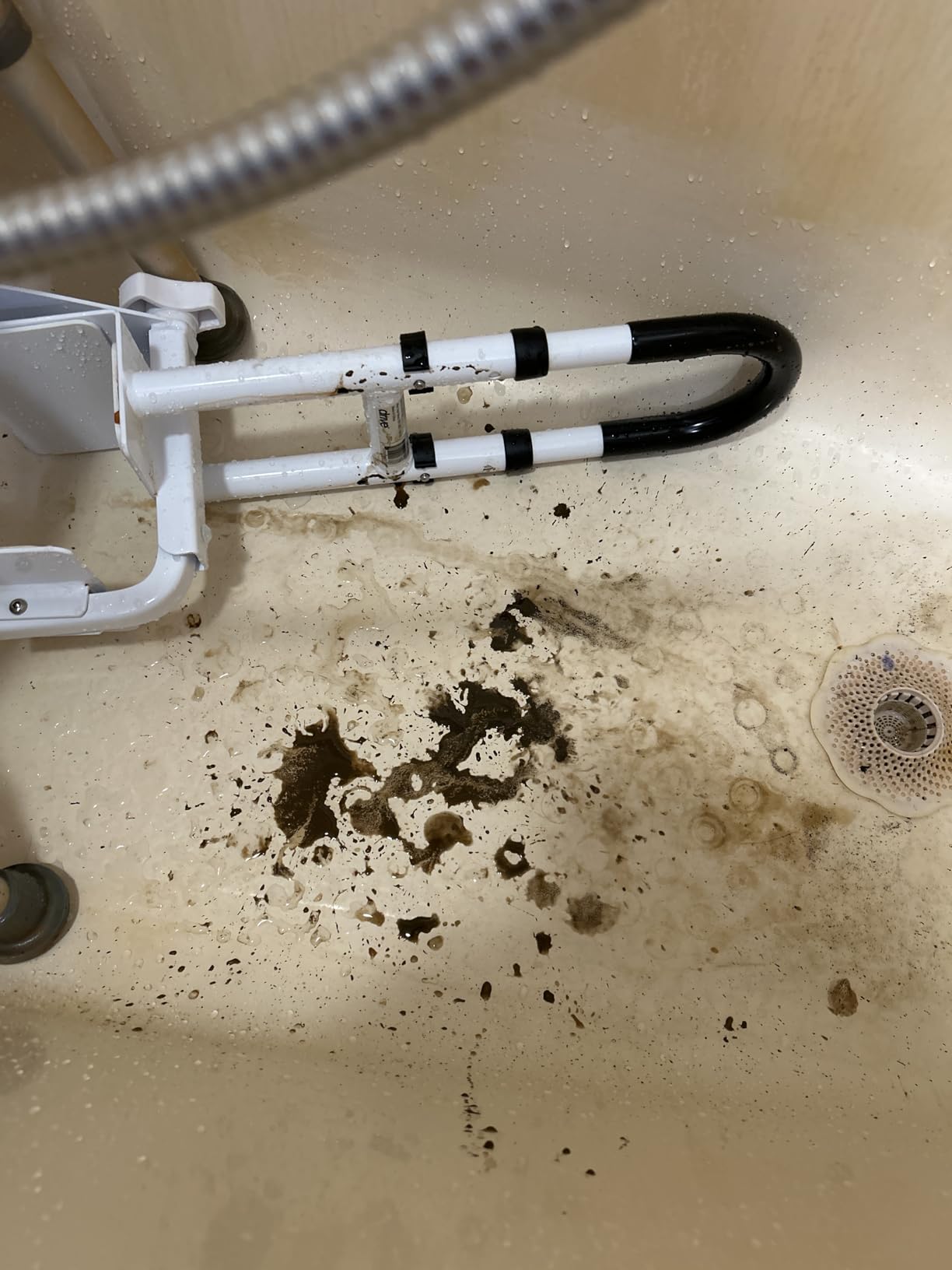
Corrosion is the honest weakness here. Reviewers with multi-year ownership report that the interior steel and the pins rust in a humid bathroom and run rust-colored water into the tub. The fix, which several owners describe independently, is spraying the inside of the clamp with an anti-corrosion coating before you first use it. Two minutes of work, and it appears to solve the problem.
At maximum extension the rail develops a little shake, and the height range bottoms out at 14 inches, so it will not drop low enough for a very short user or a person who needs to sit down immediately. The finish is plain white with stickers that are hard to remove, and hardware can seize after long use if it sits damp.
Who It Suits Best
Homes with two different users, unusual tub wall thickness, or anyone who needs the grip at a lower height than a fixed rail allows. The limited lifetime warranty makes it a safe default for a bathroom that stays wet twice a day for years.
It is portable enough to move between the tub and the toilet, which is useful in small accessible bathrooms where wall bars would crowd the space.
Who Should Look Elsewhere
Anyone who will not maintain it, and anyone in a very wet shared bathroom where bare interior steel is a recurring annoyance. If your tub is fiberglass, check the surface rules before you buy, and if hand strength is limited the tightening knob is a concern.
4. Medline Bathtub Safety Grab Bar – Best for a Clear Path Into the Tub
Medline Bathtub Safety Grab Bar, Handle Clamps on to Side of Bathtub Shower, Medical Tub Rail for Bathrooms is Great Elderly or After Surgery
Stainless with rubber pads
Fits 2.75 to 6.25 inch walls
Step-through clamp
Pros
- Stays tight and rust-free after years of daily clamping
- Step-through shape leaves an unobstructed path into the tub
- White finish disappears against a shower curtain
- Can double as a toilet support handle
Cons
- Foam rubber pads loosen in steam and let the rail creep upward
- Tightening by hand takes real strength
- Will not fit curved tub sides or a shower door track
- Needs occasional re-tightening
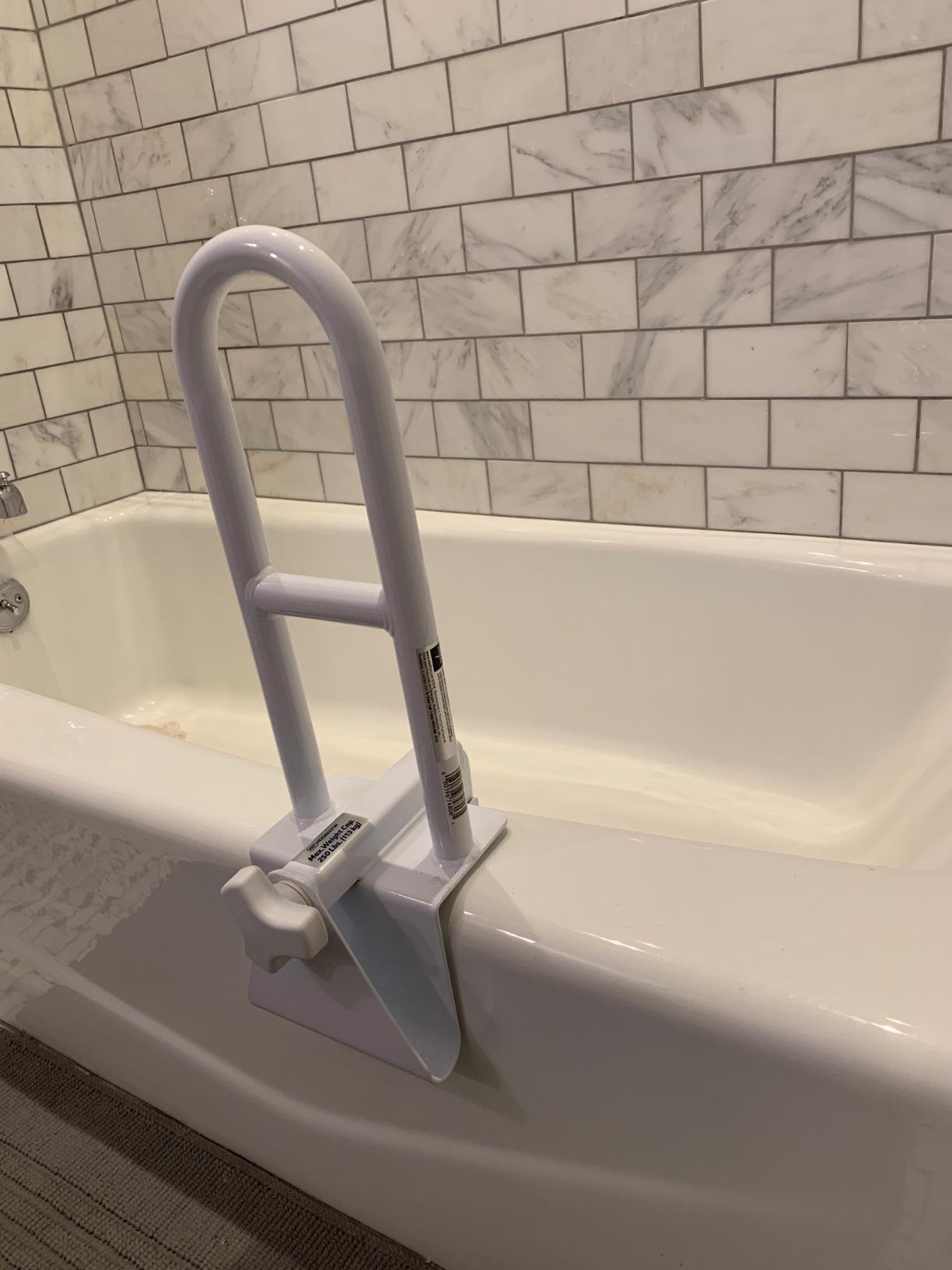
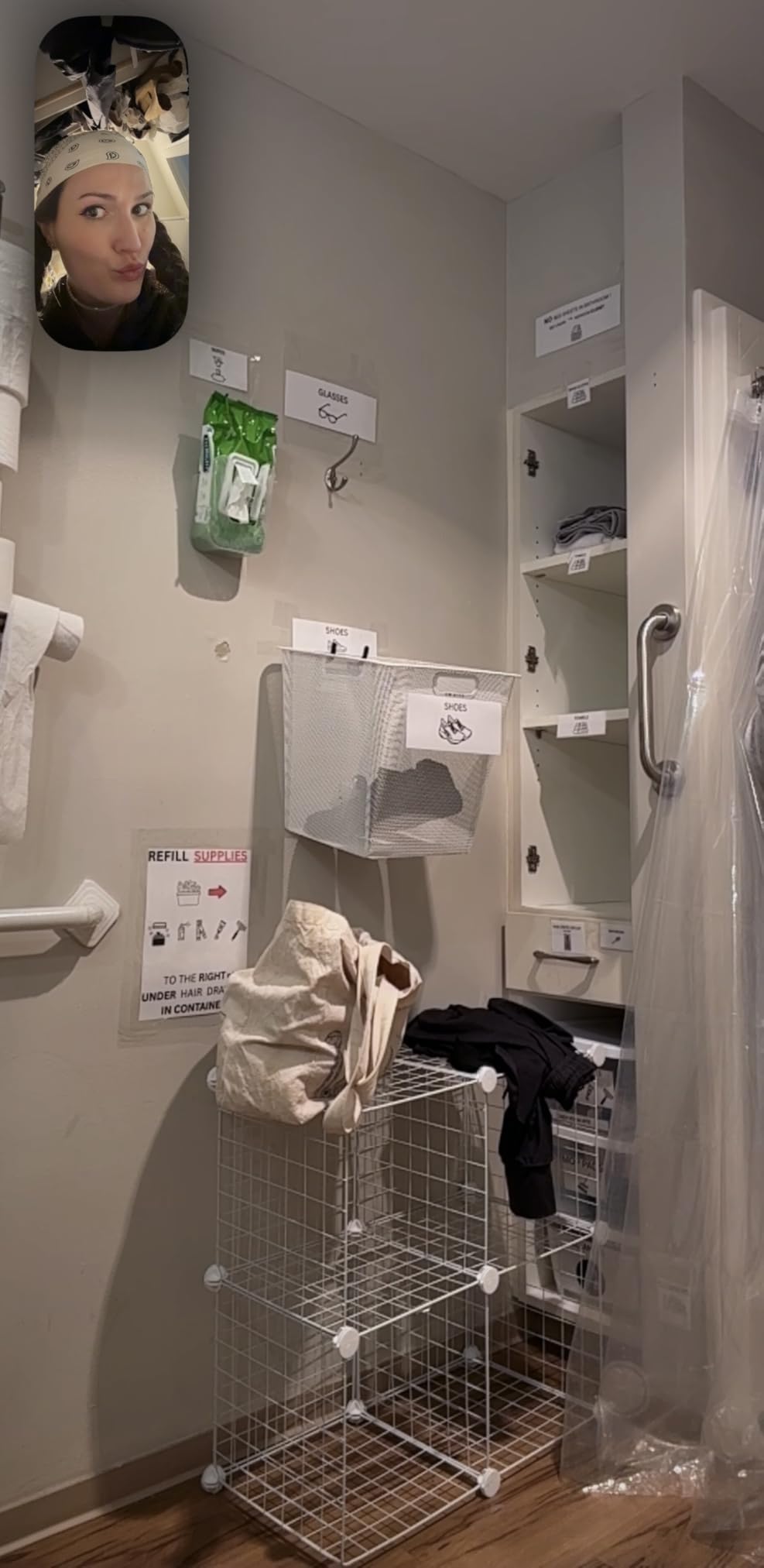
The step-through design is what separates this rail from the rest of the clamp-on group, and it matters more than it sounds. Instead of a horizontal bar you must swing a leg over, the frame sits flat against the tub side, so the entry path stays open. For someone using a walker, or with a hip that will not rotate, that is the difference between using the tub and avoiding it.
Medline is a medical supply company and the build reflects that. The stainless components with rubber-lined pads have been reported by long-term owners as still clamping tightly and staying rust-free after five years, which is the durability record we wanted to see from a product in a permanently wet space.
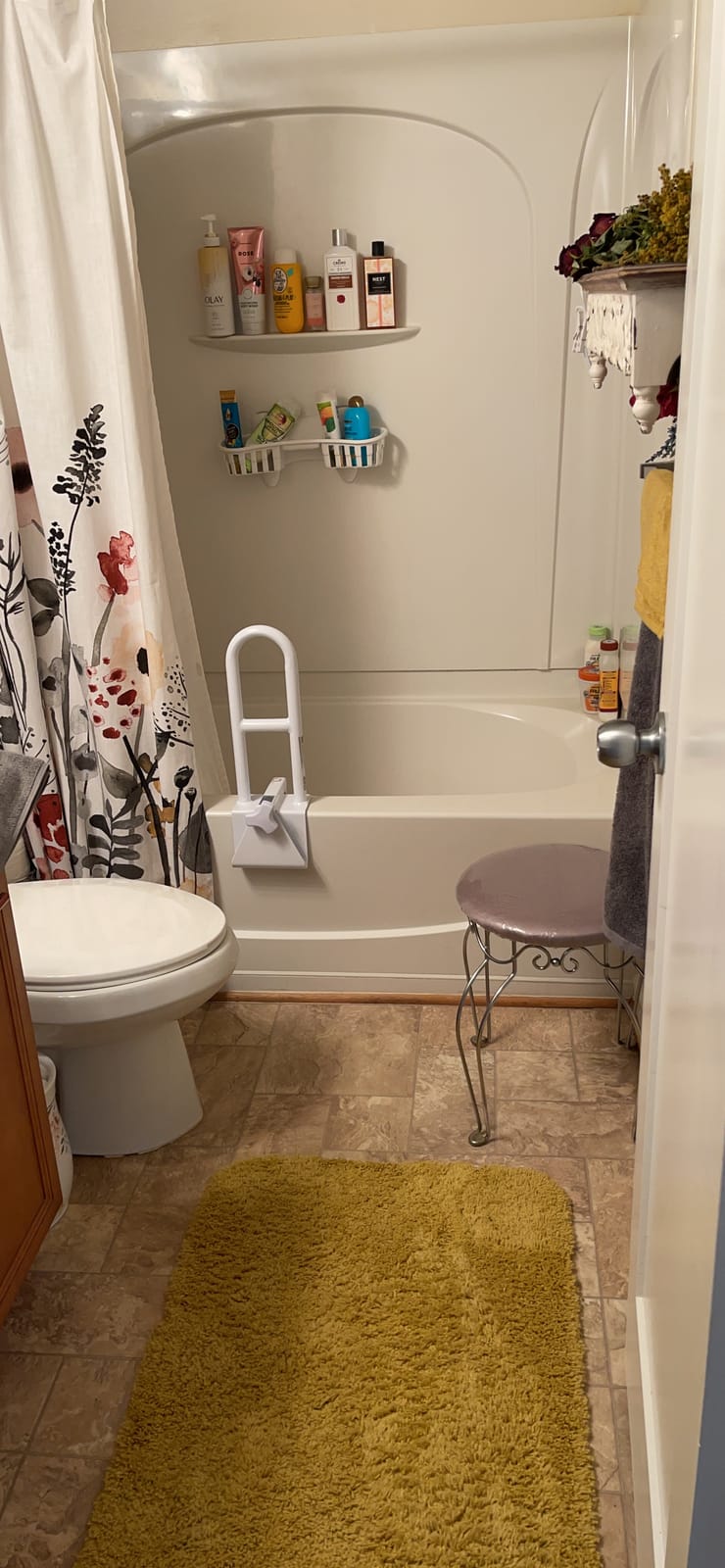
The clamping range is 2.75 to 6.25 inches, slightly narrower at the bottom than the Vaunn and the Drive Medical, so measure your tub wall before assuming. The 8.25 by 20 by 6.5 inch footprint is compact, and the listed weight of 3.53 ounces makes it one of the lightest options to move between rooms.
Steam is the failure mode to know about. The foam rubber pads can loosen in a hot shower and let the rail walk up the tub wall, and the fix that appears most often in reviews is re-bonding those pads with a contact adhesive. Expect a re-tighten every few months in a heavily used bathroom, and expect to need someone else to do it if hand strength is limited.
Who It Suits Best
Anyone with hip mobility, a walker, or a need to keep the entry path completely clear. It is also a strong second grab point in a small accessible bathroom, mounted near a toilet as well as the tub.
The white finish works well with a shower curtain, where a chrome bar would stand out. We measured the clamp on a curtain-side tub and the step-through frame left enough room to walk a walker through.
Who Should Look Elsewhere
Curved-sided tubs, clawfoot tubs with no flat wall, and any installation where a rolling shower door track occupies the mount area. Anyone planning to tighten the rail alone with weak hands should pick a knob-driven design instead.
5. Stander Wonder Pole – Best No-Drill Support for a Full Bathroom
Stander Wonder Pole, Security-Pole and Curve Grab Bar, Tension Mounted Floor to Ceiling Transfer-Pole for Seniors, Elderly Adults, Bathroom Safety Assist and Stability Rail, White
Alloy steel
300 lb capacity
Ceiling range 7 ft to 9 ft 6 in
Pros
- Holds bodyweight with no drilling into any wall
- Rotating grab bar repositions and locks in place
- Works on carpet and tile without marking
- Movable between bed toilet chair and tub
Cons
- Not usable inside the tub or shower; it works beside them
- Needs a flat ceiling and two people to tension it
- 20 lb unit is heavy and awkward to move
- Plastic lock knob can loosen and need re-screwing
The Wonder Pole solves a different problem from every other rail here. It is not a tub bar, it is a floor-to-ceiling tension pole with a rotating grab arm that you place beside the tub, and the manufacturer states plainly that it must not be used inside the bathtub or shower. Families caring for a stroke or wheelchair-bound relative describe it as the difference between independent bathing and a caregiver carrying someone, and the pole takes that strain off both people.
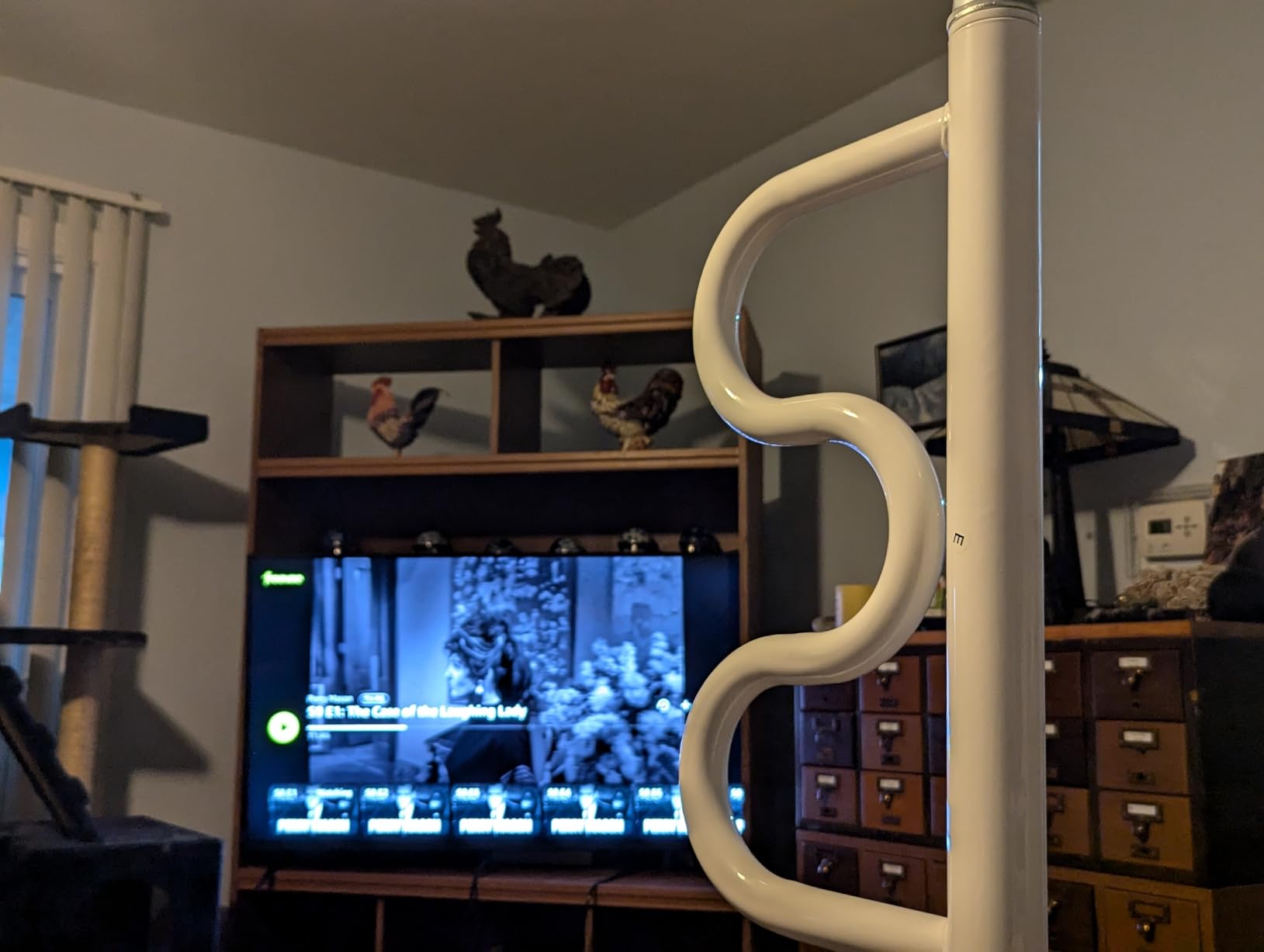
The rotating handle is the standout. It swings to multiple positions and locks, so the same pole serves a standing transfer at the tub, a seated position on the toilet, and a night-time handhold beside the bed. Ceiling range is 7 feet to 9 feet 6 inches, and the top and bottom plates have screw holes if you later decide to fasten them permanently.
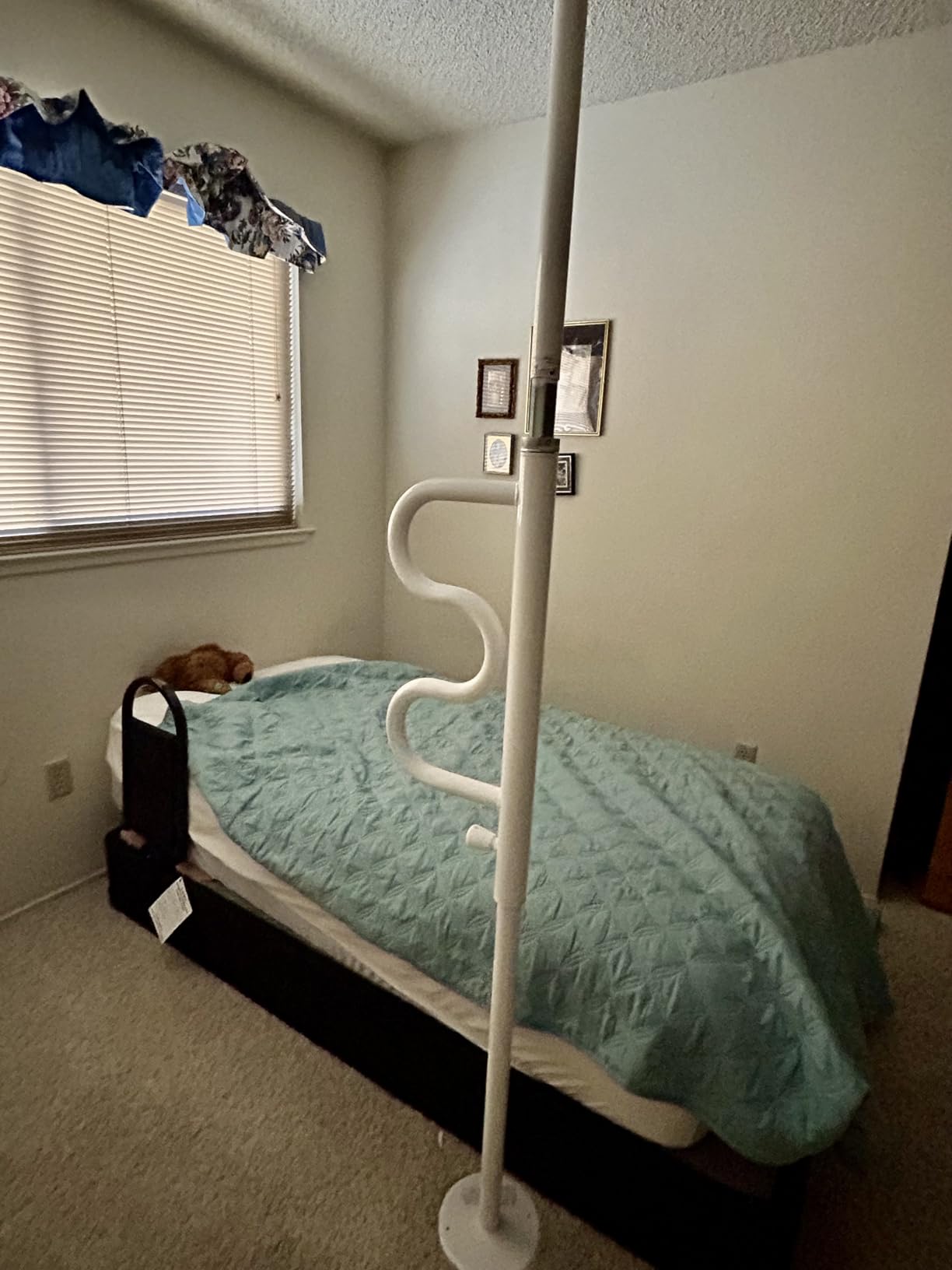
Setup needs two people or a good back. You tension the pole between floor and ceiling, then tighten the mechanism until it is rigid, and a 20 pound unit is not something to wrestle alone on tile. Once set it goes on carpet, finished floor, or tile without marking either surface, and a single knob adjustment lets you reposition the whole assembly in seconds as needs change.
The failures we heard about are specific and infrequent. The plastic lock knob can loosen over time and has to be screwed back in to re-engage the rotating arm, and the instruction diagrams are small enough that a second person is helpful during setup. A vaulted ceiling is not compatible, and the printed warranty is one year on parts.
Who It Suits Best
Caregivers supporting a transfer-heavy relative, people recovering from a stroke or a hip replacement, and anyone in a rental where a wall bar is not permitted. It is also the honest answer for a bathroom with textured tile where adhesive mounting will not hold.
Because it moves, one pole can cover the whole route from bed to bathroom, which is a better use of a single purchase than two half-mounted wall bars.
Who Should Look Elsewhere
Anyone who needs a handhold inside the tub itself, and anyone in a room with a vaulted or unfinished ceiling. A single person attempting to set 20 pounds of tension pole alone should pick a clamp-on rail instead.
6. Moen R8960FD 30 Inch Flip-Up Grab Bar – Best When Space Is the Problem
Moen R8960FD 30″ Flip-Up Grab Bar, Textured Grip, Stainless
Stainless steel
300 lb capacity
30 inch arm
Peened grip
Pros
- Rock solid with zero flex when properly anchored
- Flip-up arm clears space for a walker or wheelchair
- Textured grip stays secure with wet hands
- Solves tight bathrooms with no usable wall nearby
Cons
- Mounting holes often do not line up with existing studs
- Requires cutting into drywall and adding backing or heavy-duty anchors
- Larger than expected once installed
- Fixed length arm cannot reposition
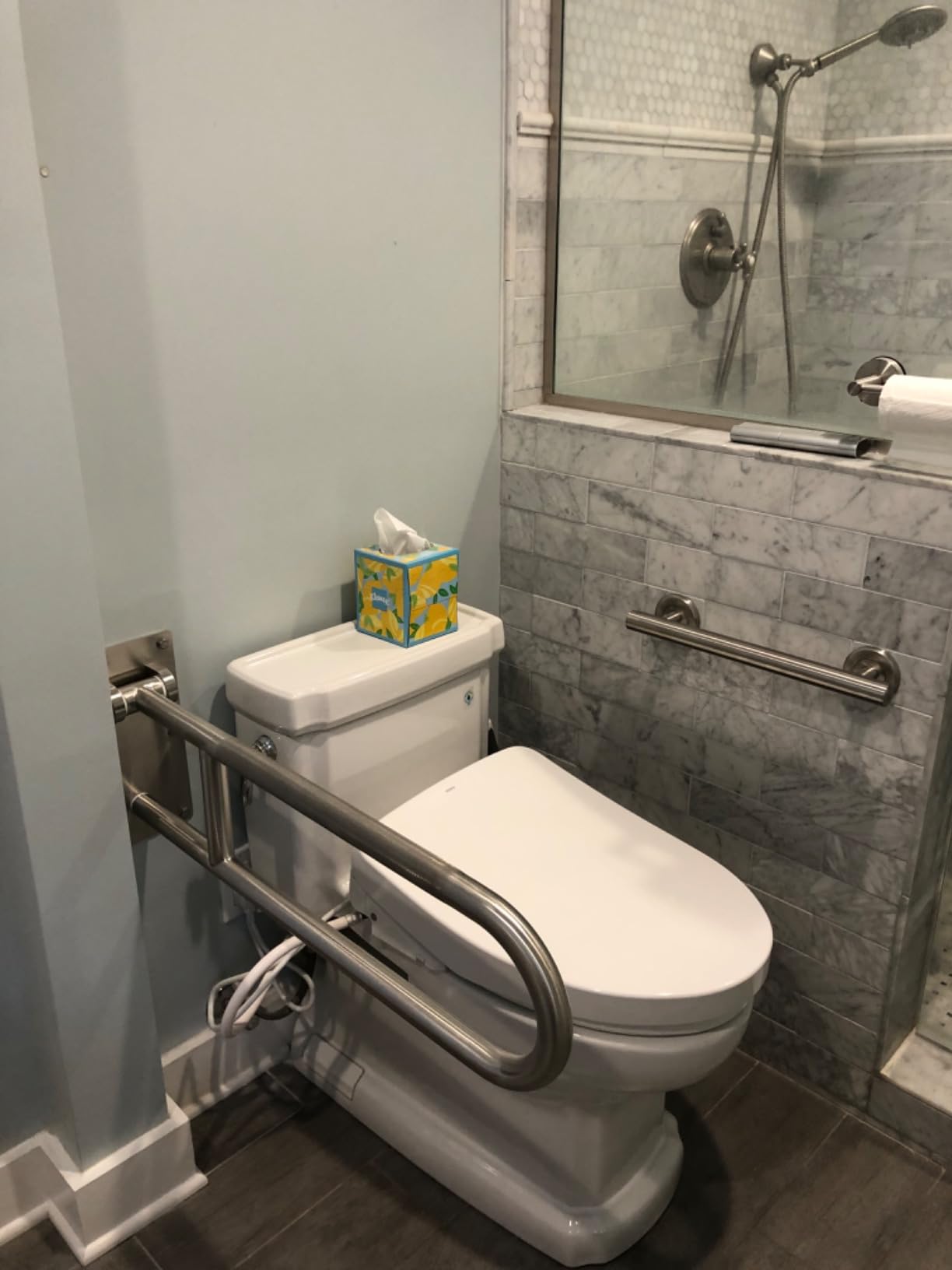
Space is the reason to buy a flip-up bar, and in a small accessible bathroom it is often the only reason that works. When nobody is bathing, the arm folds up flat and the walker or wheelchair rolls into the space the bar would otherwise occupy. In a bathroom with a toilet and a tub six inches apart, that clearance is the whole design brief.
Build quality is where this one earns its rating. Buyers with a proper stud install call it the sturdiest bar they have used, with zero flex, and the peened surface on the tube is a genuinely better wet grip than smooth steel. The textured grip is not a cosmetic feature, it is the difference between holding on and slipping when your hands are soapy.
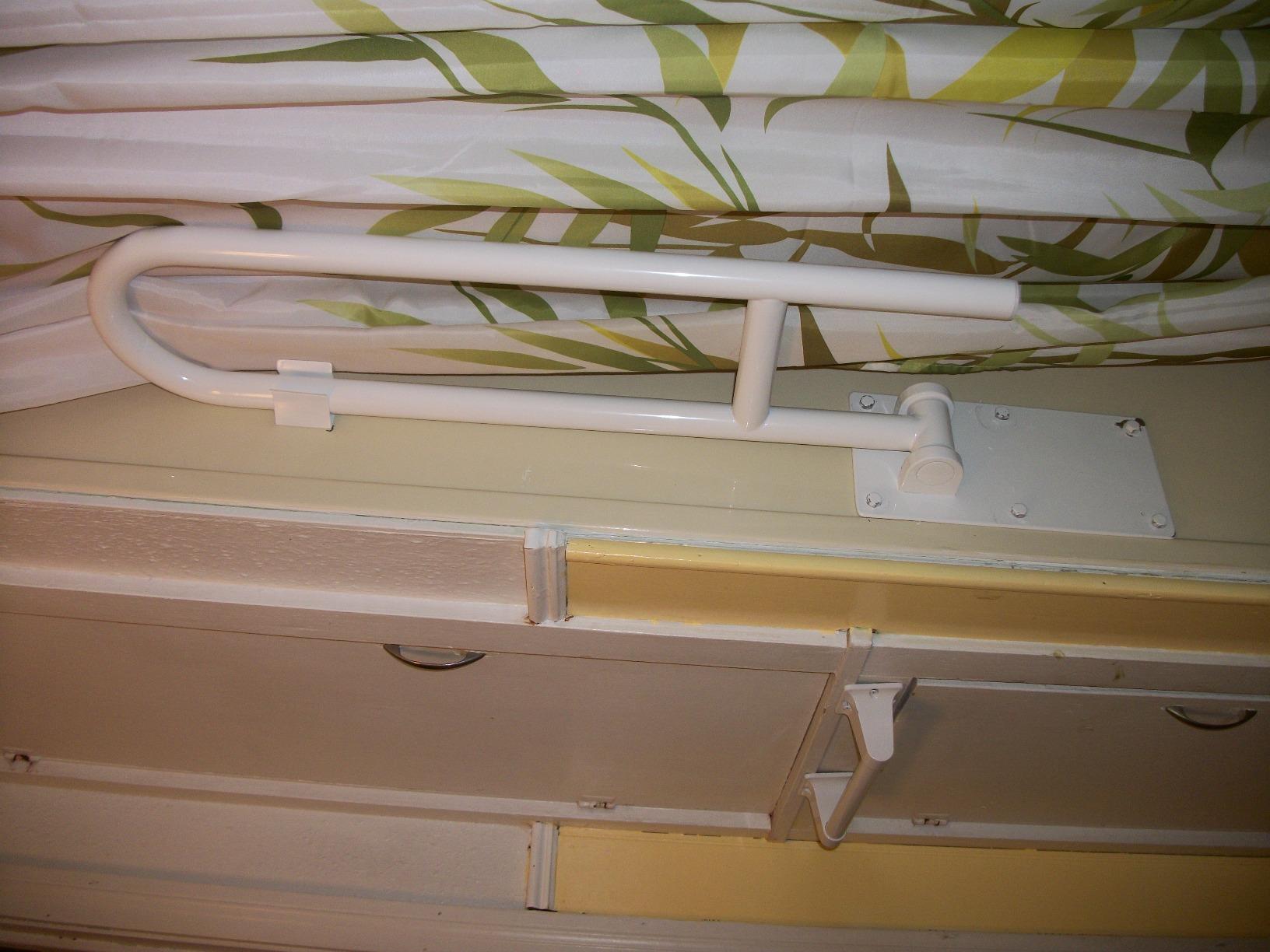
Installation is the honest problem, and the manufacturer does not hide it. The unit is rated to 300 lbs, is ADA compliant, and must be fastened into wood backing or studs. Reviewers almost universally report that the mounting holes do not line up with existing studs, which means cutting the drywall open and adding blocking before the bar goes in.
The arm is also larger than buyers expect once the mechanism is assembled, and the 30 inch length is fixed. A flip-up rail cannot be repositioned after the fact, so the drilling has to be right the first time. Moen covers it with a limited lifetime warranty.
Who It Suits Best
Small accessible bathrooms where a fixed bar would block the only path a walker or wheelchair has through the room. It is also the pick for a person who wants a permanent bar but wants the wall to look clean when nobody is using it.
The peened grip suits users with reduced hand strength, since texture does part of the gripping work. If your studs do not line up, plan the blocking before you order.
Who Should Look Elsewhere
Renters, anyone unwilling to cut into a finished wall, and anyone whose studs are far from the desired position. If you need a bar you can move or relocate later, a clamp-on rail is a better fit than a permanent flip-up.
7. Butizone Bathtub Safety Rail – Best Dual-Handle Grip
Butizone Bathtub Safety Rail, Medical Adjustable Tub Grab Bar Handle Clamp Safety Handrail Support for Seniors and Elderly
Alloy steel
300 lb capacity
Fits 3 to 7 inch walls
Pros
- Two ergonomic handles give an ambidextrous natural grip
- Non-shaky feel from the dual handle frame
- Width adjustment fits most standard tub walls
- Tool-free knob locking with rubber padding
Cons
- Not suitable for fiberglass tub surfaces
- Handle height is fixed and not adjustable
- Smaller review base than the medical supply brands
- Must be tightened firmly before every use
The two-handle layout is the reason to consider this rail. Most clamp-on designs give you a single horizontal grip, which means a user has to reposition their whole hand to change direction, or perform an awkward fingertip hold. Two separate ergonomic handles give you a place for each hand, and buyers report a noticeably more stable first grab on the way down.
The frame is alloy steel rated to 300 lbs, with a width-adjustable clamp that fits tub walls from 3 to 7 inches and a knob locking mechanism that needs no tools. The rubber padding means the clamp does not leave marks, which is why it shows up so often in rental bathrooms.
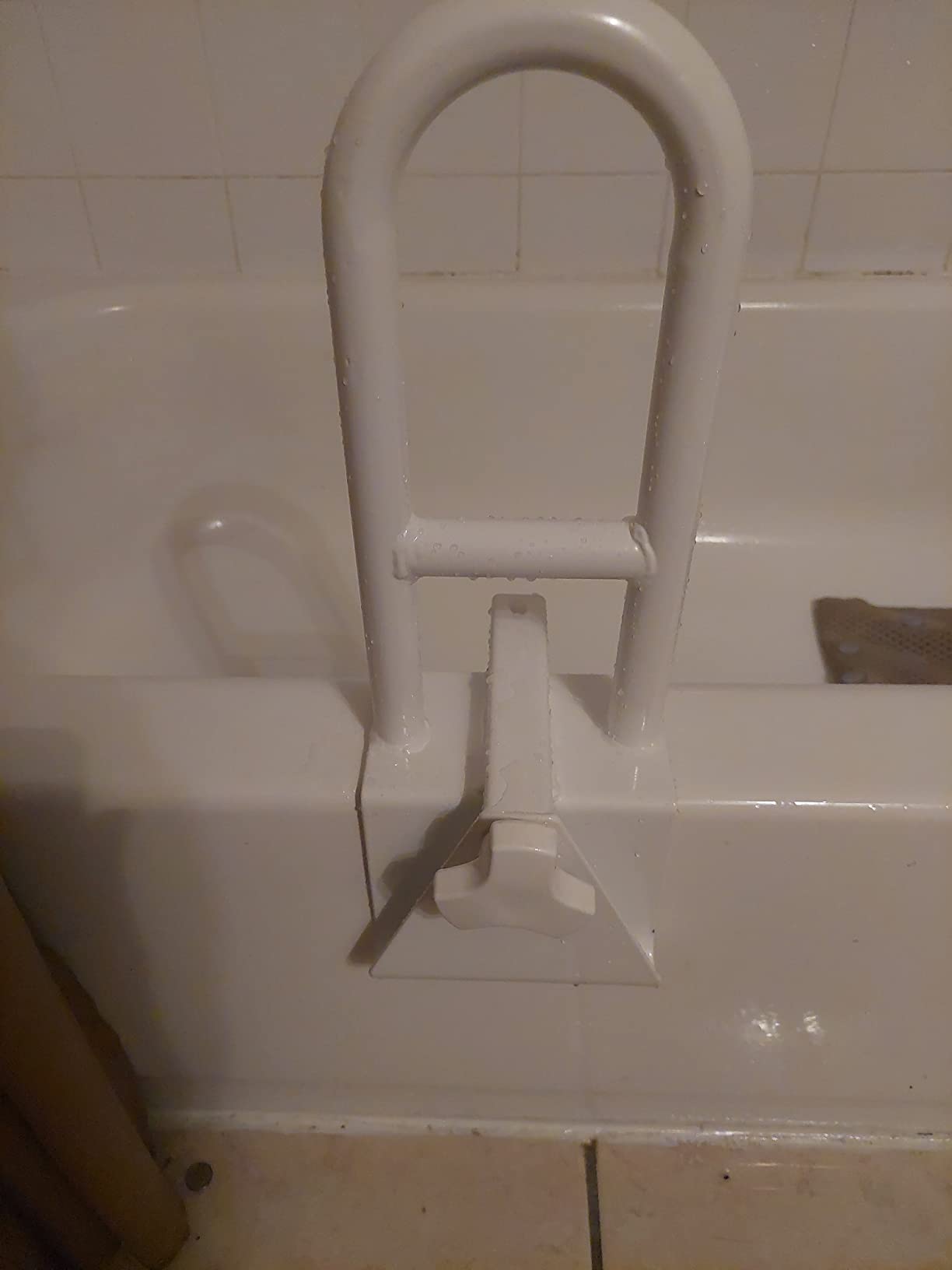
Two limits are clear from the spec sheet and confirmed by owner feedback. It is not intended for fiberglass tub surfaces, and the handle height does not adjust, so the grip lands at one fixed level. The manufacturer also asks that it be tightened firmly before each use, which is a reasonable caution but an extra step most people will skip on a busy morning.
The review base is 768 entries against more than 12,000 for the leader, so the long-term record here is thinner. Nothing in what owners report suggests a defect, but you are relying on a smaller pool of experience than with the medical supply brands. The white powder-coated finish blends into a modern bathroom better than bare steel does.
Who It Suits Best
Users who want two distinct hand positions, particularly anyone transferring one-handed or who finds a single horizontal rail awkward to grip. The dual handles also help a caregiver guiding a person’s hands toward the bar.
It suits fixed-height preferences, where a user has found their ideal grip level and does not want it moving. Rental bathrooms benefit from the padded, non-marking clamp.
Who Should Look Elsewhere
Fiberglass tubs, where the clamp will not hold properly. If you need to fine-tune height between two users, or you want the reassurance of a very large body of long-term owners, the adjustable Drive Medical rail is the safer pick.
8. ProHeal Bathtub Grab Bar – Best for Hands That Cannot Turn a Small Knob
Bathtub Grab Bar for Seniors, Shower Safety Rail, Non-Slip Stainless Steel Handle, Fits 3″-7″ Tub Walls, Supports 300 LBS, Adjustable Height 14.5″-17″, Tool-Free Clamp-On Install – ProHeal
Stainless steel
300 lb capacity
Adjusts 14.5 to 17 inch
Pros
- Large knob can be turned by users with arthritis
- Adjustable height suits users of different statures
- Heavy steel construction that does not flex
- Padded clamp leaves rental tubs unmarked
Cons
- Not for use with fiberglass tubs
- Intended for stepping in and out rather than pulling up from inside the tub
- Tightening can be difficult with limited hand strength
- Oversized packaging
The oversized tightening knob is the entire point of this rail, and for the user it is built for it is decisive. Arthritis in the hands makes a small chrome knob genuinely painful to turn, sometimes badly enough that a person gives up on the bar altogether. A large knob you can hook fingers around and twist with the palm is a different piece of hardware in practical terms.
Height adjusts from 14.5 to 17 inches and the width clamp takes tub walls from 3 to 7 inches, so the rail can be set for a shorter user who would otherwise be reaching. The stainless steel construction feels substantial and does not flex, and the non-wearing rubber pads scratch-proof the tub surface well enough for a rental.
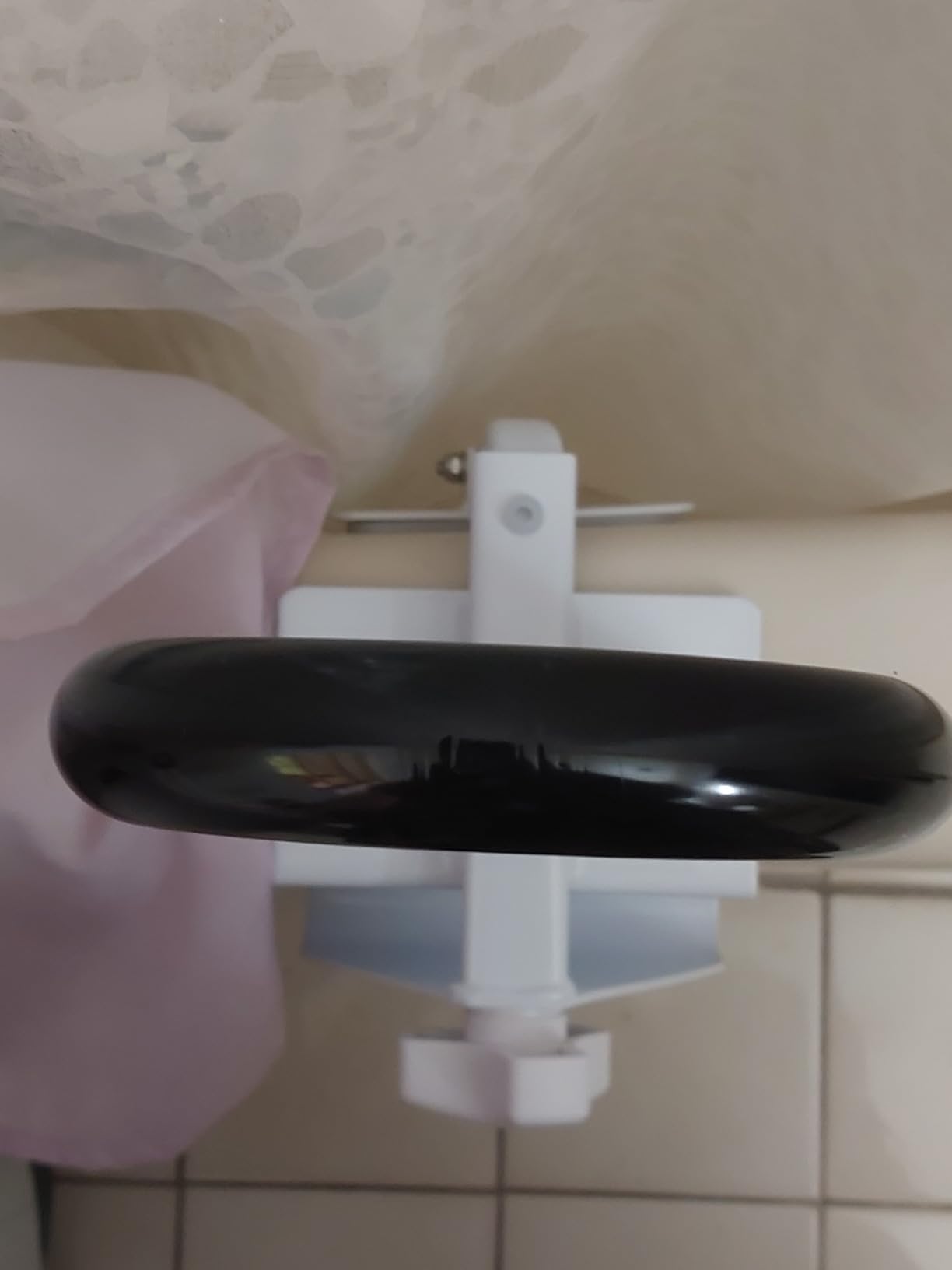
Be clear about what this bar does. It is a step-in and step-out aid, not an in-tub lifting bar, and reviewers say so directly: it is for bracing yourself while crossing the rim, not for hauling yourself up from a seated position inside the tub. If you shower seated, you need a different product category entirely.
It is also not for fiberglass tubs. The stainless body is heavy, listed at 3.56 kg, and the box is oversized for the product inside it. The 342-review base is the thinnest in this roundup, so treat the specification as reliable and the long-term durability record as unproven.
Who It Suits Best
Users with arthritis or reduced hand strength who still have enough grip to turn a large knob but not a small one. It is a good match for a shorter user who needs the grip lower than a fixed rail provides.
The padded clamp and adjustable height make it a strong option for a bathroom shared by two people of different statures, and the stainless build suits a wet room better than plated steel.
Who Should Look Elsewhere
Anyone needing to pull themselves up from inside the tub, and anyone with a fiberglass tub wall. If your hands are too weak for any knob-driven clamp, the Stander pole or a properly anchored wall bar removes the tightening step entirely.
9. AmazerBath 24 Inch Stainless Steel Grab Bar – Best Budget Wall Bar for Tile
AmazerBath Grab Bars for Bathtubs and Showers Anti Slip, 24″ L x 1.25″ D, Handicap Grab bar Stainless Steel, Shower Grab Bars for Seniors, Bathtub Handle Grab Bars for Bathroom Holds 500LBS
Stainless steel
500 lb capacity
24 inch length
Anti-slip tube
Pros
- Installs cleanly in tile and wood-backed walls in about ten minutes
- Solid no-wobble hold once mounted with appropriate anchors
- Brushed nickel finish looks intentional rather than institutional
- Good clear grip space between the bar and the wall
Cons
- Included anchors and hex wrench are low quality and can strip
- Flanges must be assembled onto the bar before drilling
- Covers rely on rubber gaskets rather than snapping on
- Shorter variants feel too small to be an effective steady bar
This is the value pick for anyone drilling into a tiled surround who does not want to spend Moen money. The AmazerBath bar is 24 inches long with a 1.25 inch diameter stainless tube, carries a 500 lb rating, and installs in about ten minutes with the included instructions covering a range of surfaces. Installers report a clean, solid mount with no wobble once proper anchors are used.
The thickened tube and enlarged base plates are visible differences from a budget towel-bar-turned-safety-bar. The anti-slip surface is a real grip improvement, and the brushed nickel finish is one of the few in this roundup that reads as a design choice rather than hospital equipment. Many buyers immediately order a second bar to build a full layout.
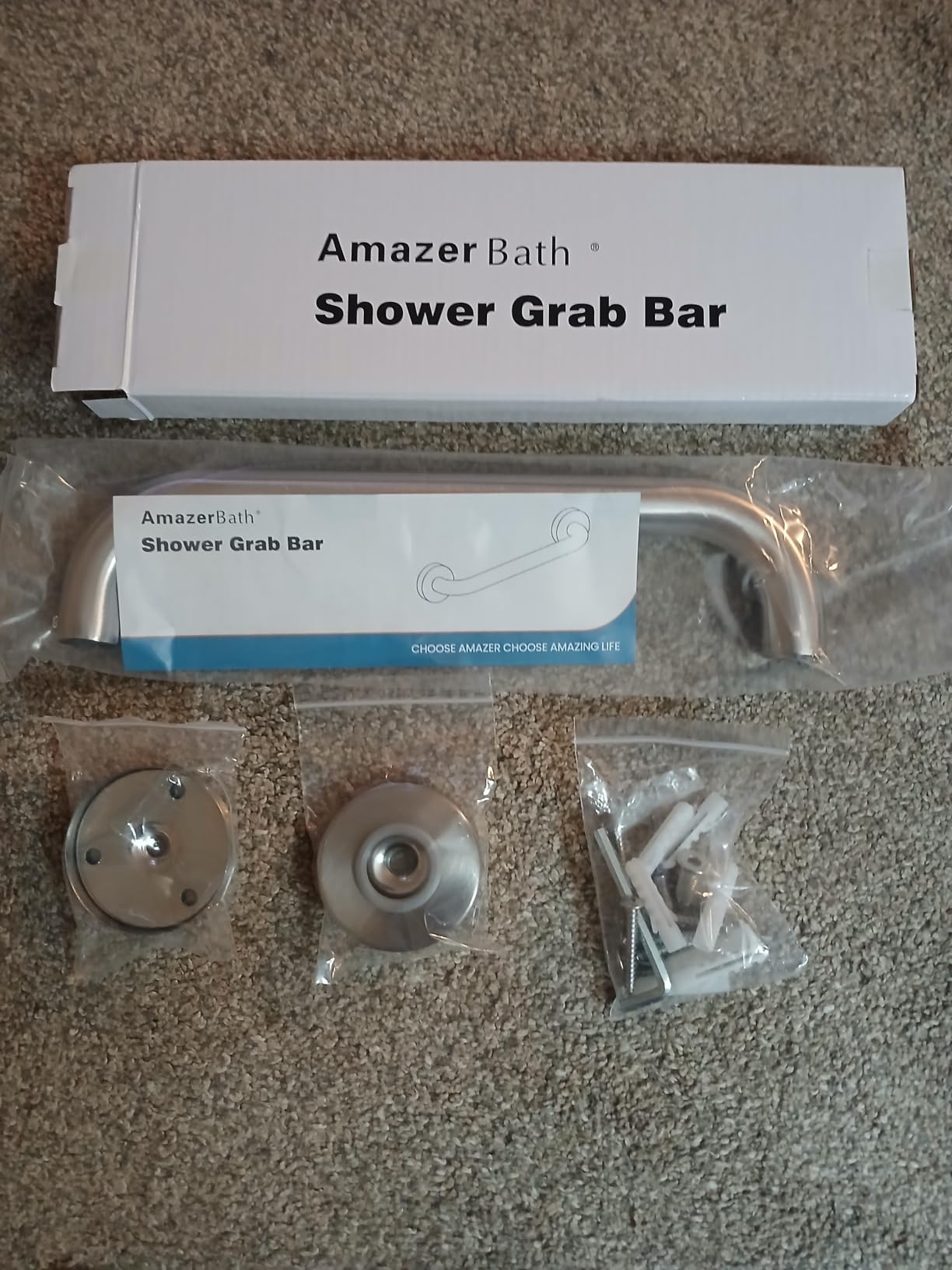
Two installation details catch people out. The mounting flanges have to be slid onto the bar and assembled before you drill, because once the bar is fixed you cannot get them on. And the included anchors and hex wrench are the weak link in the package, with owners and installers reporting that they strip and get replaced with better hardware.
Use a 15/64 inch bit for the mounting holes, per the instructions. The flange covers hold with rubber gaskets rather than snapping or screwing on, which is fine once the bar is loaded but means a cover can be knocked out of place. The package includes the bar, two base plates, two covers, a wrench, anchors, and screws, and the manufacturer backs it with a 30-day guarantee.
Who It Suits Best
Homeowners drilling into tile or a wood-backed wall who want a permanent bar without the design-brand markup. The 500 lb rating makes it one of only two permanently mounted options here rated that high.
For design-conscious homeowners, the brushed nickel is the finish to look for. If you are rebuilding the surround anyway, blocking out the flange positions first makes a ten-minute install a ten-minute install instead of an afternoon project.
Who Should Look Elsewhere
Anyone wanting to reuse the supplied hardware, since most installers replace it. It is not a short-term or rental solution, and anyone unwilling to drill should look at the clamp-on options earlier in this list.
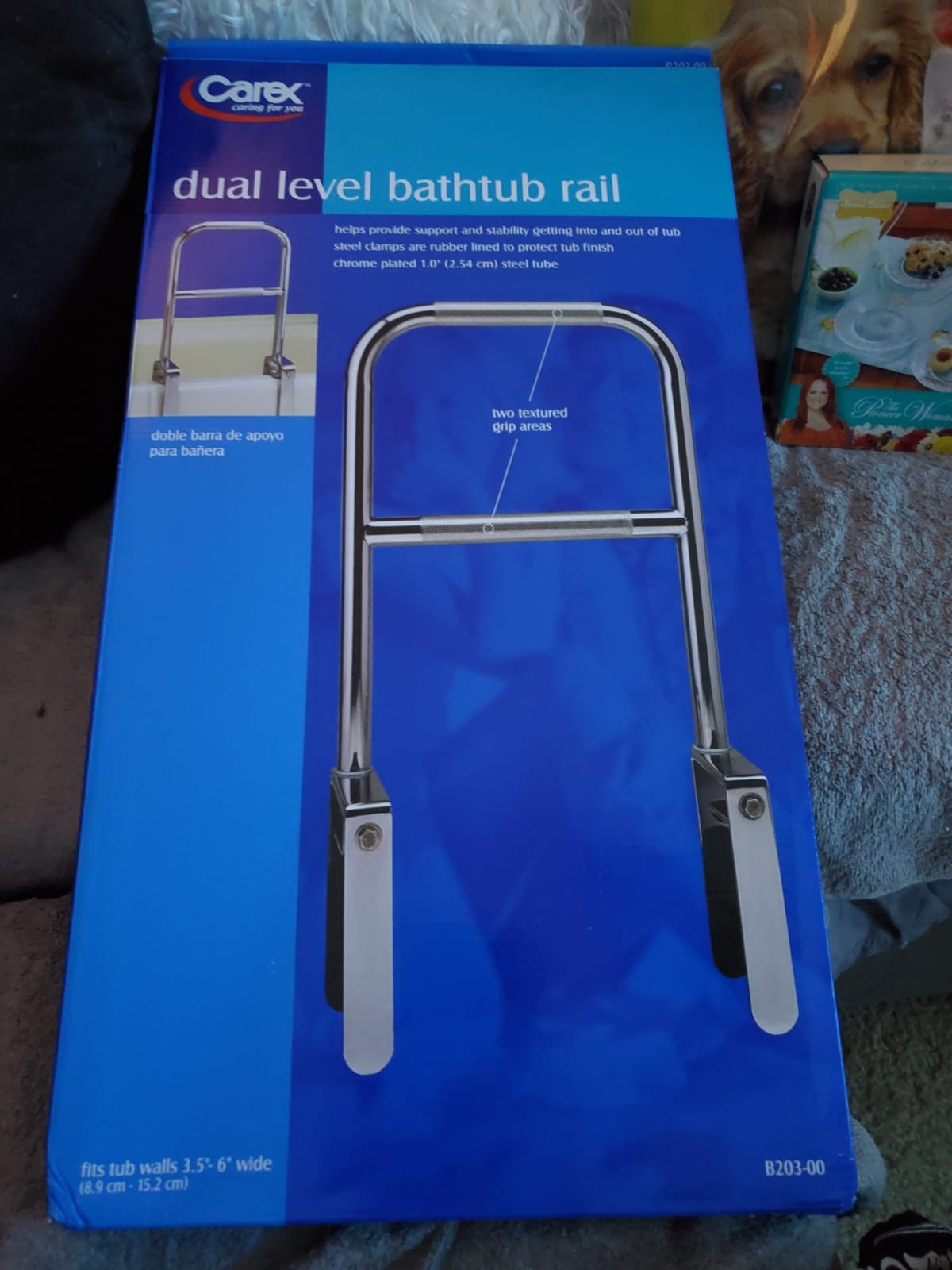
10. Carex Tri-Grip Bathtub Rail – Best Two Grip Heights on One Rail
Carex Tri-Grip Bathtub Rail with Chrome Finish – Bathtub Grab Bar Safety Bar For Seniors and Handicap – For Assistance Getting In and Out of Tub, Easy to Install on Most Tubs,Silver
Chrome steel
250 lb capacity
Dual textured grips
3 lb weight
Pros
- Dual-height textured grip gives two comfortable hand positions
- Adjustable steel spring clamps hold firmly with no tools
- Chrome finish coordinates with most bathroom decor
- Light at 3 pounds while still feeling solid
Cons
- 250 lb capacity is the lowest rating in this roundup
- Fixed rail height with less positioning flexibility than adjustable models
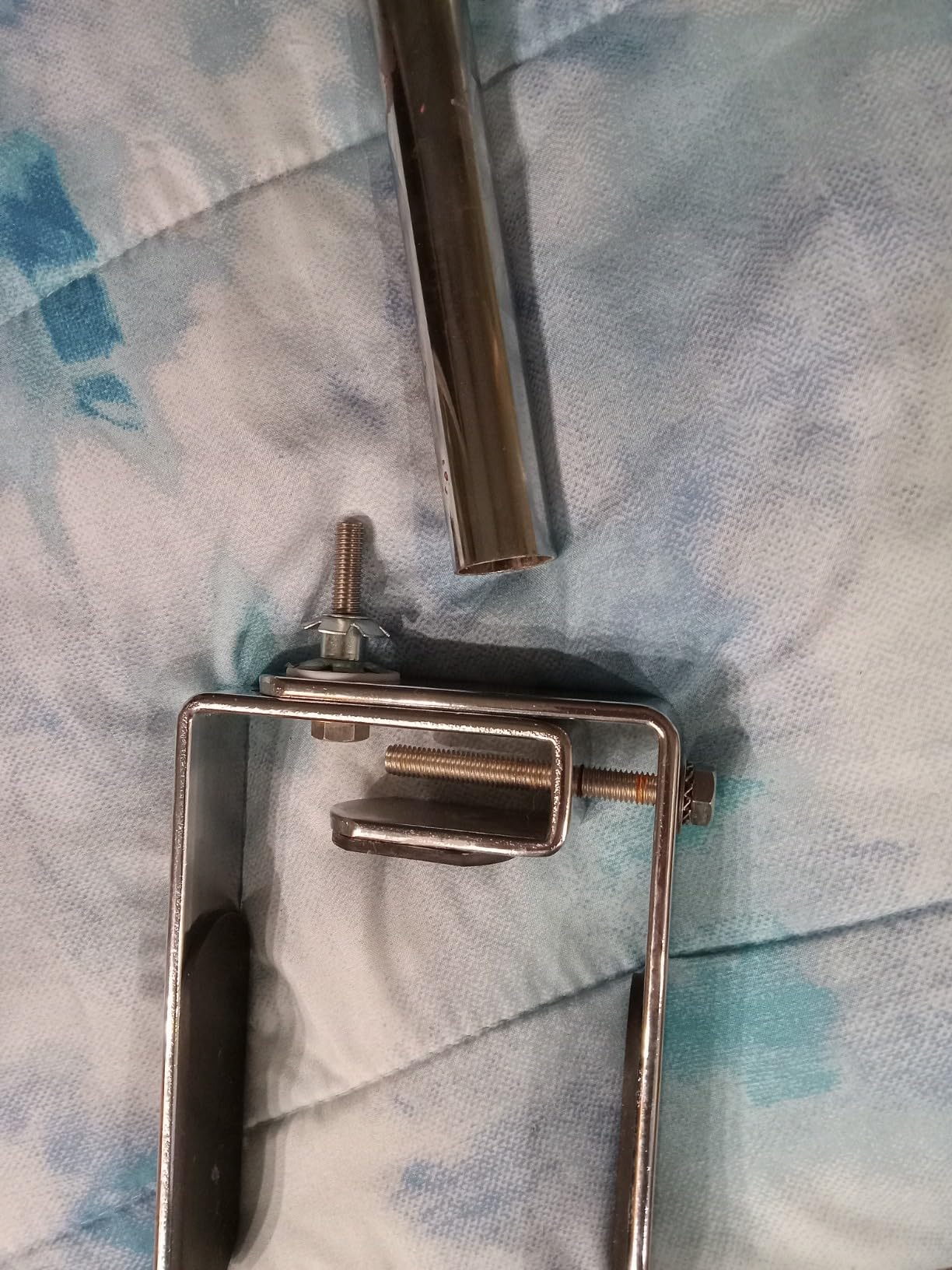
- Spring clamp tension can weaken over time
- Runs a notable one-star share of reviews
Two grip heights on one rail is the concept here, and it works. A person lowering onto a bath seat wants a low hand, then a higher hand to push up from, and the Carex tri-grip gives both without a second bar or a repositioning adjustment. The textured gripping areas add a wet-hand advantage that the smooth rails here cannot match.
Installation is the easiest in the roundup. The adjustable steel spring clamps grip the tub side with rubber-lined contact and require no tools and no drilling, and at 3 pounds the whole unit is light enough to move between the tub and a toilet in a small bathroom.
Now the honest part. The 250 lb rating is the lowest here, sitting at the ADA floor rather than the 300 lb most of this list carries, and buyers with bariatric needs should look elsewhere. Spring clamp tension also weakens over time, and the fixed rail height offers less positioning flexibility than an adjustable model, so it will not suit a bathroom shared by users of very different sizes.
The 4.2 average rating is the lowest in this roundup, dragged down by a one-star share of 12 percent. The complaints in that group cluster on looser clamping and the lower capacity rather than on build quality, which is why it still earns a place on this list.
Who It Suits Best
Users who bathe seated, since a seated person needs a low grip to lower onto and a second higher grip to rise from. Carex is a long-standing bathroom safety manufacturer, and the chrome finish suits a bathroom with matching chrome fixtures.
It is also a good light-weight second bar for a toilet in a small room, where a heavier rail is awkward to move between locations.
Who Should Look Elsewhere
Anyone over the 250 lb range, anyone needing height adjustment between users, and anyone who will not re-tighten a spring clamp periodically. If you want one rail to cover an adjustable household, the Drive Medical model does the same job across a wider range.
How to Choose a Bathtub Grab Bar That Fits Your Bathroom
Pick Your Mount Type First
Four mount types cover essentially every bathtub. Wall-mounted bars are permanent, look finished, and deliver the highest capacity, but they demand a sound substrate and a willingness to patch the wall later. Clamp-on rails are reversible, take two minutes, and travel between tubs, but they need a flat tub wall and a user who can turn a knob. Floor-to-ceiling poles need no wall contact at all and cost you a flat ceiling, a helper, and 20 pounds of repositionable steel. Flip-up bars are a wall-mounted variant that folds away when nobody is bathing.
There is also a mounting mistake that has nothing to do with any of those, and it deserves naming. The adhesive and suction “landing pads” sold for showers are not grab bars. They are lightweight assist handles, they are not rated for body weight, and the flat pad that looks like a bar on the wall is closer to a towel hook than to a safety rail.
Match the Rail to Your Tub Wall
Measure the tub wall thickness before you order anything, and the numbers differ across this roundup. Most clamp-on rails cover 3 to 7 inches, the Medline starts lower at 2.75 inches and tops out at 6.25, and anything outside those windows will not clamp. Then check the material, because fiberglass and curved-sided tubs rule out most of the clamp-on options, and several manufacturers print that restriction on the box.
Porcelain, cast iron, and tile-on-cement-board walls are the easiest to mount to. Acrylic and fiberglass one-piece surrounds are the hardest, and a fiberglass tub should never be drilled. For the wall side, a stud within the flange footprint beats everything else, and tile over a stud is the ideal case.
Studs, Blocking, and Anchors
Do grab bars need to be installed in studs? Not strictly, but the consensus across handyman forums, fine homebuilding forums, and installer manuals is that you want a stud or added blocking behind every flange, and that ordinary drywall or plaster anchors are not adequate for body weight. Forum consensus is blunt: find the stud or add blocking, and do not talk yourself into a hollow-wall anchor for a primary support bar.
Where studs will not cooperate, the fix is a backer board. Screw a length of timber across the studs so the bar’s two holes per flange land on solid wood, then fasten through the board. The strongest hollow-wall fallback is a toggle or snap-toggle anchor, but its performance depends entirely on the drywall, and it is a compromise rather than an answer.
Two more things belong in this section because they decide whether your install is safe. A grab bar is only as strong as what it is bolted to, which is why a 500 lb rating in a hollow wall means nothing. And a bar holding your weight in a shower should have silicone run under the mounting flanges so water cannot sit against the fastener and rust it from behind.
Grip Diameter, Load Rating, and ADA Dimensions
Grip diameter between 1.25 and 1.5 inches is the comfortable range, and most bars in this roundup sit at 1.25 inches. Thicker is not always better for arthritic hands, because a larger diameter can be harder to wrap a weakened grip around. A textured or peened surface does more for a soapy hand than any diameter change, which is why the peened flip-up bar is worth a look.
The ADA 2010 Standards set out the reference dimensions in sections 609 and 610 for bathtub bars, with a 250 lb minimum load rating as the general reference point, a 1.25 to 2 inch grip diameter, and specific wall clearances and reach ranges that position a person where they can use it. Homeowners are not bound by the standard, but building the layout to it is a good way to make sure a bathroom will work for a guest who needs it later.
Medicare coverage is the other question people ask, and the answer is generally no. Original Medicare does not cover grab bars as a standalone item, though a qualifying DME supplier may supply bars as part of a broader equipment package, and Medicaid waiver programs often do cover them. If cost is the barrier, ask a supplier about a Medicaid waiver or check whether a hospital discharge included a DME evaluation.
What Installation Costs and Who Should Do It
A single bar is a small job. Contractors report that a straight flange installation in a stud wall takes well under an hour, and the cost is usually bundled into a larger accessibility job rather than quoted on its own. The figure that matters more is what happens when there is no backing, because adding it changes the scope.
The job gets more serious when there is no backing. Cutting the drywall open to add blocking, or a 4-inch post behind a tiled surround, is a remodel job rather than an accessory install, and that is the point at which a remodeler or a general contractor earns their involvement. If you are already replacing the surround, specifying blocking locations now costs almost nothing and saves an afternoon later.
Why Suction Grab Bars Fail in a Wet Tub
Suction grab bars do not work in showers as primary support, and the reason is mechanical rather than a matter of caution. A suction cup seals against a smooth, flat, clean surface. Textured non-slip tile, a grout line, a curved tub wall, soap residue, or condensation will all break that seal, and the failure is sudden and silent, with no warning that the moment a slipping hand is relying on.
Forum discussion of suction bars returns the same story repeatedly: a fall that started on a surface nobody was sure would hold. The same threads also name the most common product confusion in this category, which is people assuming a flat adhesive assist handle can hold body weight because it looks like a grab bar. It cannot, and the difference is a load rating printed on the box or absent from it.
There is one more bar-shaped object in every bathroom worth ruling out. A towel bar or a vanity handle is mounted to hold a towel, with a load rating measured in towels, and a grab bar with a towel hanging on it is still a grab bar rather than a towel holder. If you need a handhold, buy something rated for the weight you will put on it.
Frequently Asked Questions
What is the recommended height for grab bars in a bathtub?
Mount a horizontal grab bar on the long wall 33 to 36 inches above the tub floor, and add a vertical bar at the tub entry between 39 and 41 inches above the floor. The horizontal bar is for pushing up to standing, and the vertical bar is for pulling yourself up while stepping over the rim.
Where is the best place to install grab bars in a bathtub?
Start with a vertical bar at the entry point, on the wall the user faces while standing beside the tub. Add a horizontal bar on the long wall they turn toward once they are inside. A third diagonal bar on the back wall helps a person washing while seated on a bath seat.
Do grab bars need to be installed in studs?
A stud or added blocking behind every mounting flange is the goal. Ordinary drywall and plaster anchors are not adequate for body weight. Where studs will not line up, add a backer board across the studs so both holes in each flange land on solid wood.
What is the strongest wall anchor for shower grab bars?
Solid framing is stronger than any anchor. Among hollow-wall options, a toggle or snap-toggle anchor anchored with two holes per mount point outperforms a plastic expansion anchor by a wide margin, though its strength still depends on the drywall. Treat it as a compromise, not a substitute for a stud.
Do suction grab bars work in showers?
No, not for primary support. A suction cup needs a smooth, flat, clean surface to seal, and textured tile, grout lines, curved tub walls, soap residue, and condensation all break that seal without warning. A fall while relying on one is a common and serious accident.
Will Medicare pay for grab bars in the shower?
Original Medicare does not cover grab bars as a standalone item. A qualifying DME supplier may supply them as part of a larger equipment package, and Medicaid waiver programs often do cover them. Ask a supplier about a waiver or check whether a hospital discharge included a DME evaluation.
What are the ADA guidelines for bathtub grab bars?
The ADA 2010 Standards cover bathtub bars in sections 609 and 610, with a 250 lb minimum load rating as the general reference, a 1.25 to 2 inch grip diameter, and defined wall clearance and reach ranges. Homeowners are not bound by the standard, but designing to it makes a bathroom work for a guest who needs it.
Do plumbers install shower grab bars?
Yes, and a plumber is the right call when the wall is already open or the flange lands near plumbing. A straight flange installation in a stud wall takes a handyman under an hour. Cutting into a finished wall to add blocking is a remodel job, not an accessory install.
The Bar to Buy, and the One Thing Not to Skip
For most people, the Vaunn Medical Secure Bathtub Safety Rail is the right first purchase, because it works on a flat-sided tub, installs in two minutes, and leaves no mark when you move out. If you own the house and have a stud in reach, the Moen 24-inch stainless bar is the stronger long-term answer, and if you cannot drill at all, the Stander Wonder Pole covers the transfer from the floor to the tub and beyond.
Whichever one you choose among the best grab bars for bathtubs, the non-negotiable is the substrate behind the flange. A 500 lb rating means nothing in a hollow wall, and a clamp-on rail is only as good as the flat tub wall it grips. Get the backing right, seal under the flanges with silicone, and the bar will still be there in ten years.
If a grab bar is one part of a larger plan, our roundup of sliding shower doors for bathtubs covers the entry problem that comes before the handhold, which is the step over the rim that most bathroom falls actually begin with.