
There are two very different questions hiding inside the phrase best LED grow lights for indoor plants. One is about a fiddle leaf fig leaning hard toward a window in a dim flat. The other is about a two-foot square tent where someone is trying to grow herbs through winter. Almost every list I have read answers only the second question, which is why so many houseplant owners buy a bright purple panel that scorches a philodendron and then wonder why the plant looks worse.
So this roundup is organised the way the decision actually goes: by space first, then by plant. A tabletop with three pots has completely different requirements from a ceiling-hung panel over a 2×2 footprint, and a snake plant in a hallway corner has different needs again from a seedling tray that has just germinated. Every product below is matched to a specific job, and I say plainly where each one stops being the right answer.
I spent the last several weeks cycling through all ten of these fixtures in a mixed collection: a south-facing shelf, a north-facing office, a propagation corner with seed trays, and a stand of large-leaf tropicals. I logged the things that actually predict satisfaction — build quality, dimming behaviour, how a fixture looks switched on at eye level in a room, and what the plants did afterwards. Where a number appears below, it came from the listing or from the review record, not from marketing copy on the box.
Quick answer: The best LED grow lights for indoor plants depend on the space, not on wattage. A clamp or pot light covers one to three plants, a T5 bar or shelf strip covers a single shelf, and a hung panel covers a 2×2 footprint. Houseplants generally need 100 to 400 µmol/m²/s, far less than the 600 to 900 marketed for flowering vegetables.
Table of Contents
Top 3 LED Grow Light Picks for Indoor Plants in October 2026
The three below are the ones I keep reaching for, and each solves a different problem. The GooingTop clip lamp is the dependable all-rounder, the Barrina T5 pack is the best value per foot of shelf, and the VIVOSUN panel is the one to buy if you want a single fixture to handle a whole growing area and a humid room.
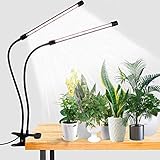
GooingTop Clip Grow Light
- Clip mount with 360-degree gooseneck
- 84 LEDs at 6000K with CRI 90
- 4/8/12 hour circular memory timer

Barrina T5 Four-Pack Bars
- 5000K full spectrum across 4 linkable bars
- 96 LEDs at 20W combined
- Linkable up to 16 fixtures
VIVOSUN LumaLight 100W
- Full spectrum 3000K
- 5000K
- 660nm
- 730nm
- 4-level dimming from 25 to 100 percent
- IP65 waterproof and dustproof housing
Best LED Grow Lights for Indoor Plants in October 2026
All ten fixtures are in the table below with the use case each one is built for. Form factor matters more than any single spec number, so that column is the one to read first.
| Product | Specifications | Action |
|---|---|---|
| GooingTop 6000K Clip Grow Light |
|
Check Latest Price |
 yadoker Halo Light with 60 inch Pole yadoker Halo Light with 60 inch Pole |
|
Check Latest Price |
| Barrina T5 5000K Four-Pack Bars |
|
Check Latest Price |
| VIVOSUN LumaLight 100W Panel |
|
Check Latest Price |
 SYEIORAOM Four-Head Grow Lamp SYEIORAOM Four-Head Grow Lamp |
|
Check Latest Price |
 SANSI Pot Clip-On Two-Pack SANSI Pot Clip-On Two-Pack |
|
Check Latest Price |
 BESTVA DC1000 100W Panel BESTVA DC1000 100W Panel |
|
Check Latest Price |
 Aumtrly 68 inch Floor Grow Light Aumtrly 68 inch Floor Grow Light |
|
Check Latest Price |
 Kullsinss Two-Bar Shelf Strips Kullsinss Two-Bar Shelf Strips |
|
Check Latest Price |
 SANSI 36W E26 Grow Bulb SANSI 36W E26 Grow Bulb |
|
Check Latest Price |
1. GooingTop 6000K Clip Grow Light: Best Overall for a Mixed Plant Shelf
GooingTop Grow Light,6000K Full Spectrum Indoor Plant Growing Lamp
84 LEDs
6000K full spectrum
CRI 90
10W draw
Clip mount with 360 gooseneck
4/8/12 hour timer
Pros
- Stiff gooseneck that holds position instead of drooping
- Heavy-duty clip grips tables
- shelves and pot rims
- Multiple brightness settings with a 4/8/12 hour memory timer
- Compact enough to leave on a crowded tabletop
- Low 10W draw keeps electricity use negligible
Cons
- Timer fires once per 24 hour cycle rather than switching repeatedly
- Documentation does not explain the 24 hour timer behaviour
- Some multi-head versions are dimmer per head than earlier single-head models
This is the light I recommend first to almost anyone, and it is the one I keep on my own desk. The clip is genuinely heavy-duty — it bit onto a 1.3 inch oak shelf edge and stayed put for weeks without marking the wood, and it also clamped over the rim of a terracotta pot when I wanted to light something on a bookshelf with no reachable edge.
The gooseneck is the part that separates it from cheaper clip lamps. It is stiff enough that when I bent it into position over a pothos and came back a month later, it had not crept back toward vertical. That sounds like a small thing until you have owned three lamps that slowly return to the same useless angle.
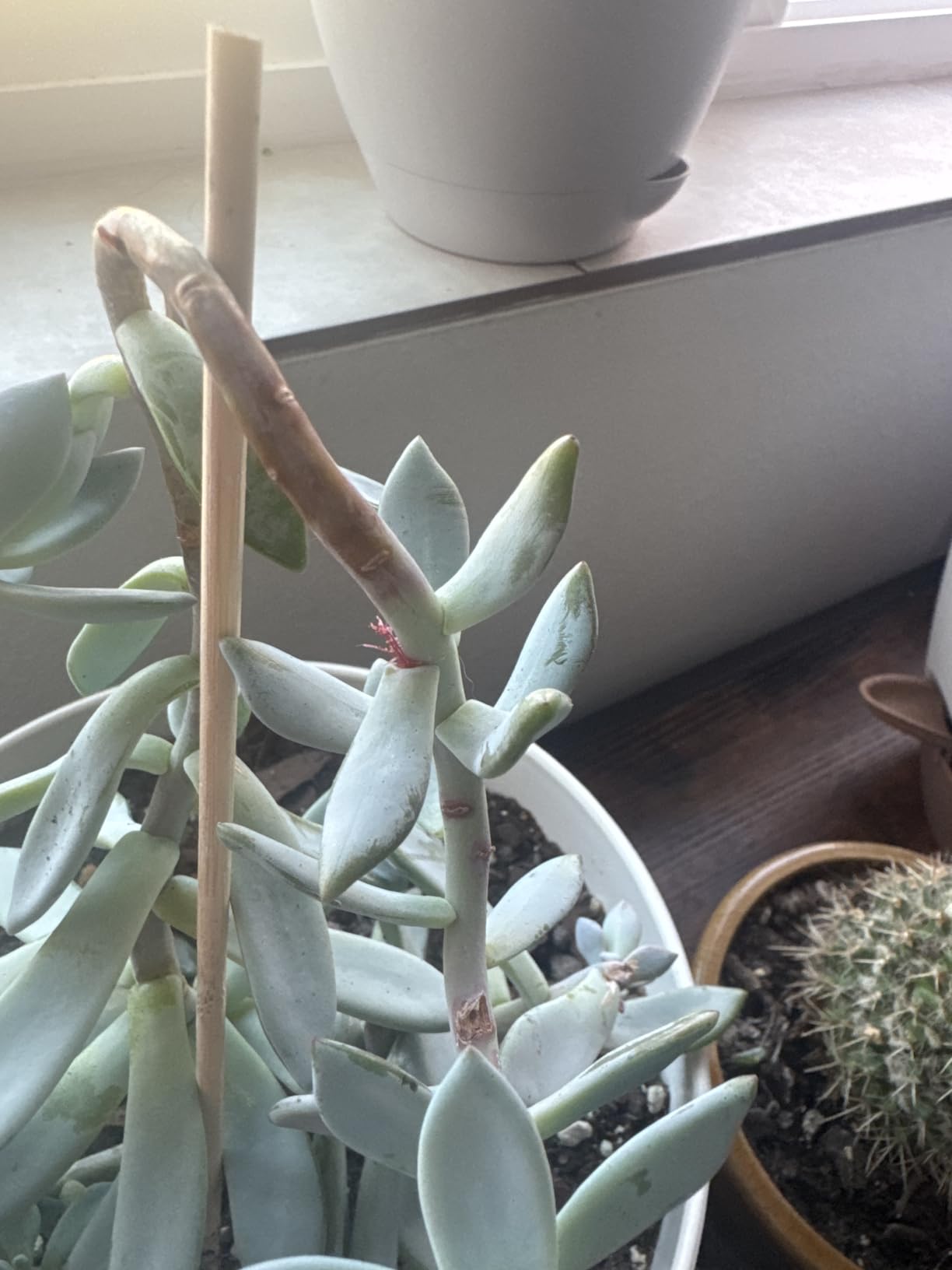
The light itself is 6000K white from 74 white diodes plus 10 red ones, rated at CRI 90, which matters more than the Kelvin number. CRI is how accurately the light renders colour, and at 90 you can still spot the difference between a healthy new leaf and a chlorotic one. Blurple panels distort colour badly enough that visual plant inspection becomes guesswork.
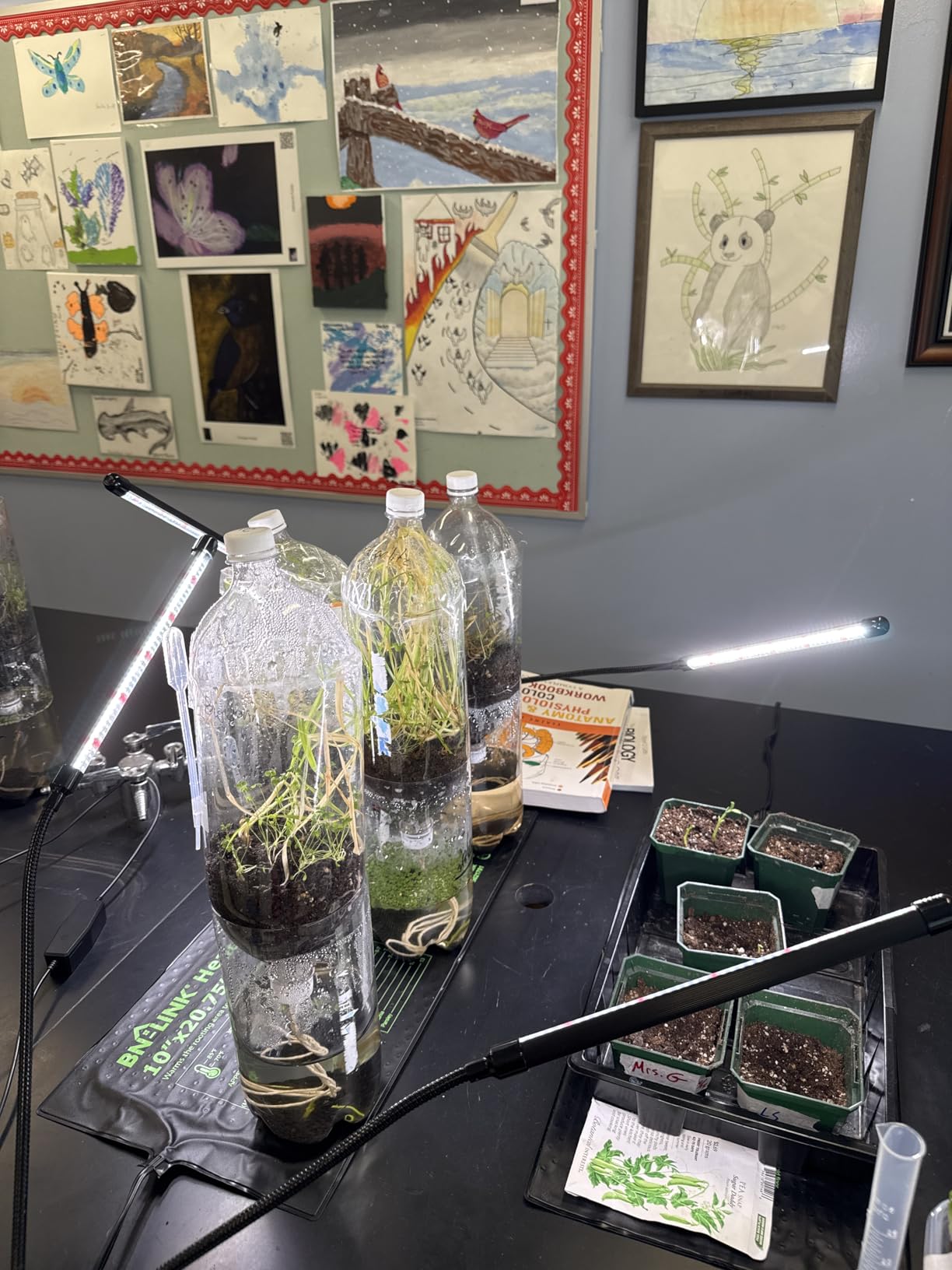
Output is honest at roughly 10W of LED draw for 2500 lumens. That is plenty for herbs, cuttings, succulents on a shelf, and tropical foliage within about a foot. It will not push a dense seed tray to flowering, and it is not built for a full canopy of vegetables.
What this lamp is genuinely good at
It is the best pick for a desk or a single shelf where the plants are close to eye level, because the light lands on the leaf surface rather than shining down through a canopy. Multiple brightness settings and the memory timer mean you can dial it down for a shady corner and back up for a propagation box.
Reviewers frequently report healthy growth on tabletop houseplants, succulents and seed starts, and the review record of 22,000+ entries is the largest in this roundup by a wide margin. In a category where several top carousel items show two to five ratings, that volume matters.
Where it falls short
The timer is the number one complaint, and it is a real misunderstanding rather than a defect. It runs on a 24-hour cycle and fires once per day at your chosen duration, so a 4 hour setting means one four-hour block a day, not four separate blocks inside a twelve-hour window. If you want a scheduled photoperiod that lines up with your own day, set it in the morning.
A smaller group notes dimmer output on some multi-head variants and occasional LED chips arriving scratched from missing protective film. Neither is a dealbreaker, but both are worth a quick inspection before you plug it in.
2. yadoker Halo Light with 60 Inch Pole: Best for Large-Leaf Tropicals
Grow Lights for Indoor Plants, yadoker Full Spectrum 6.3″ Halo Plant Light
72 LEDs
380-800nm coverage
Telescoping pole 13.7 to 61.1 inch
10 step dimming
8/12/16 hour timer
5V USB power
Pros
- Halo design blends into home decor instead of looking like grow gear
- Telescoping pole extends 13.7 to 61.1 inch to follow growth
- 10 step dimming from 10 to 100 percent
- 8/12/16 hour auto timer with a long cord
- 5V low voltage USB power stays cool for long sessions
Cons
- Light casts almost entirely downward and misses anything above the halo
- Modest output for a windowless room
- Light head housing feels flimsy and can pop off if bumped
- Supplied USB plug and cord have a limited lifespan
This is the fixture I would put in a living room rather than hide in a closet. The halo head and bamboo-finish pole read as furniture, which is exactly the problem grow light buyers complain about most — that a purple panel in a lounge makes the room feel like a laboratory.
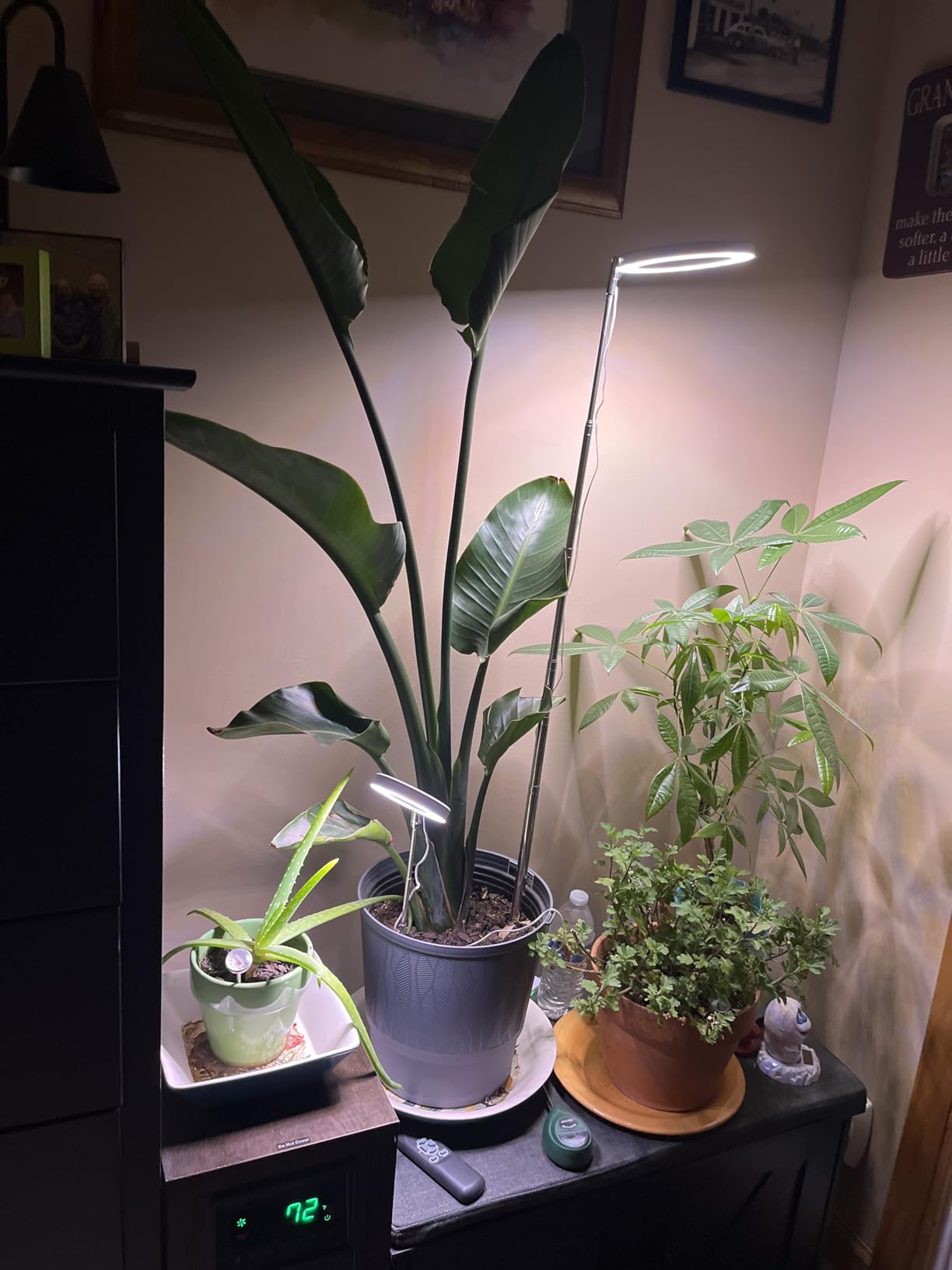
The telescoping pole is the real engineering win. It adjusts from 13.7 inches to 61.1 inches, so the same light can sit low over a propagation tray and then rise to a full metre above a mature bird of paradise. I raised mine about 15 inches a month and the plants tracked it without a fight.
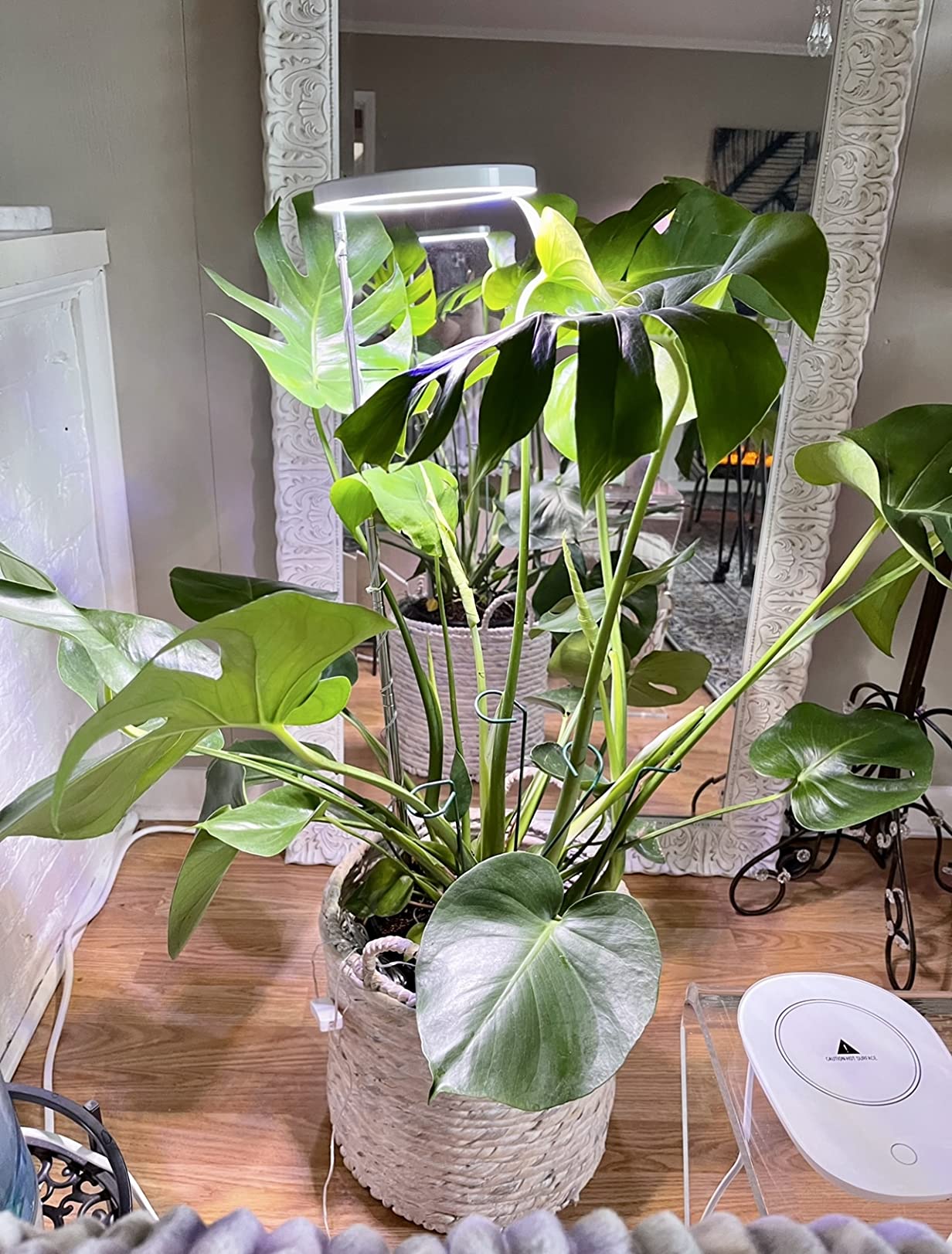
Spectrum is 72 diodes across 380 to 800nm: 36 white at 5000K, 28 warm white at 3000K, 6 red and 2 blue. Mixing warm and cool white is what gives the fixture its forgiving look in a room, and the 10-step dimming runs from 10 to 100 percent so you can find a level that does not glare off glossy leaves at night.
Users report new leaf growth within weeks on monstera, banana and bird of paradise, and this is the most-repeatedly recommended halo light in the category, with many owners buying more than one.
What this lamp is genuinely good at
Tall tropical foliage in a room with no suitable window. The halo sits above the plant rather than beside it, which means a monstera with a 60 inch leaf span gets light across the whole upper surface instead of a bright spot on one side.
The stake-in base is also tidy: it goes into the soil, so there is no clamp to find a surface for and nothing to mar a tabletop. Pair it with the 8, 12 or 16 hour timer and the pole length, and it handles a whole season of growth in one fixture.
Where it falls short
The light throw is almost entirely downward. Anything sitting above or beside the halo, or a second shelf higher up, gets almost nothing, so a plant wall built on open racking will not be lit evenly by this alone.
Output is modest, which is fine for monstera and philodendron but not for a demanding carnivorous plant or a dense group of succulents. Reviewers also flag the light head housing as flimsy, and the included USB plug and cord as the component most likely to need replacing.
3. Barrina T5 5000K Four-Pack Bars: Best Value for Plant Shelving
Barrina T5 Grow Lights for Indoor Plants, 5000K Full Spectrum, 1FT, 4 Packs
96 LEDs across 4 bars
5000K full spectrum
20W combined
Linkable up to 16 fixtures
2 year warranty
Pros
- Brightest 5000K output per watt in the lineup
- Individual on off switch on each bar plus a master cord switch
- Linkable in series up to 16 fixtures with included connectors
- Mounting kit includes tape
- clips and cable ties for tool-free setup
- Slim low-profile housing that suits a living room
Cons
- No built-in timer so an external plug-in timer is required
- Power cords are short and often need an extension
- Linking cables are fixed length with no longer option
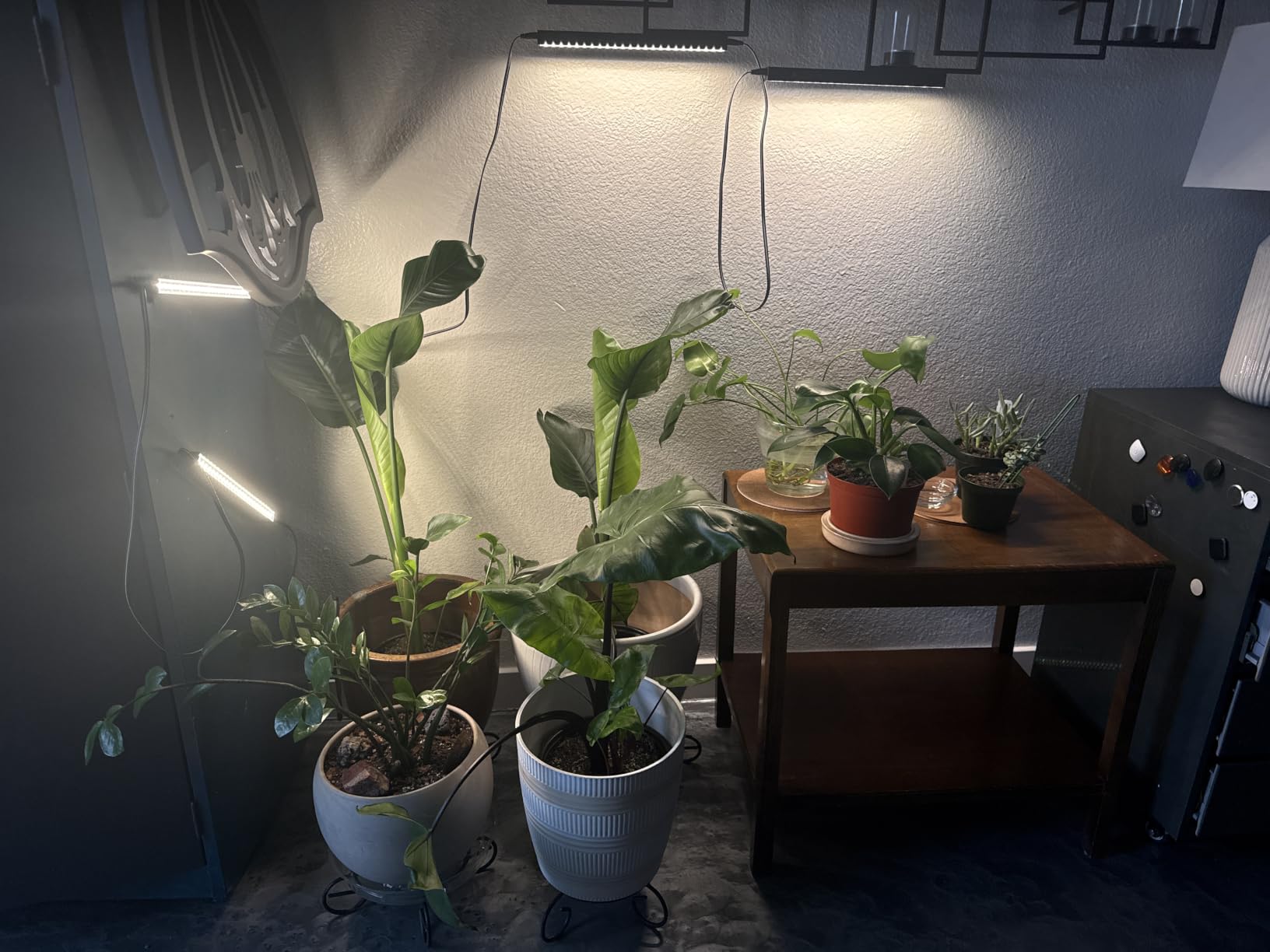
For a long shelf or a bookcase run, this is the fixture I would buy first. Four one-foot bars give you the length to cover a 4 foot shelf, and because they link in series you can extend that to a whole wall of plants with the same kind of fitting.
Each bar has its own on and off switch, and the set includes two switched power cords. That combination means you can light half a shelf and leave the other half dark, or run the whole run from one switch.
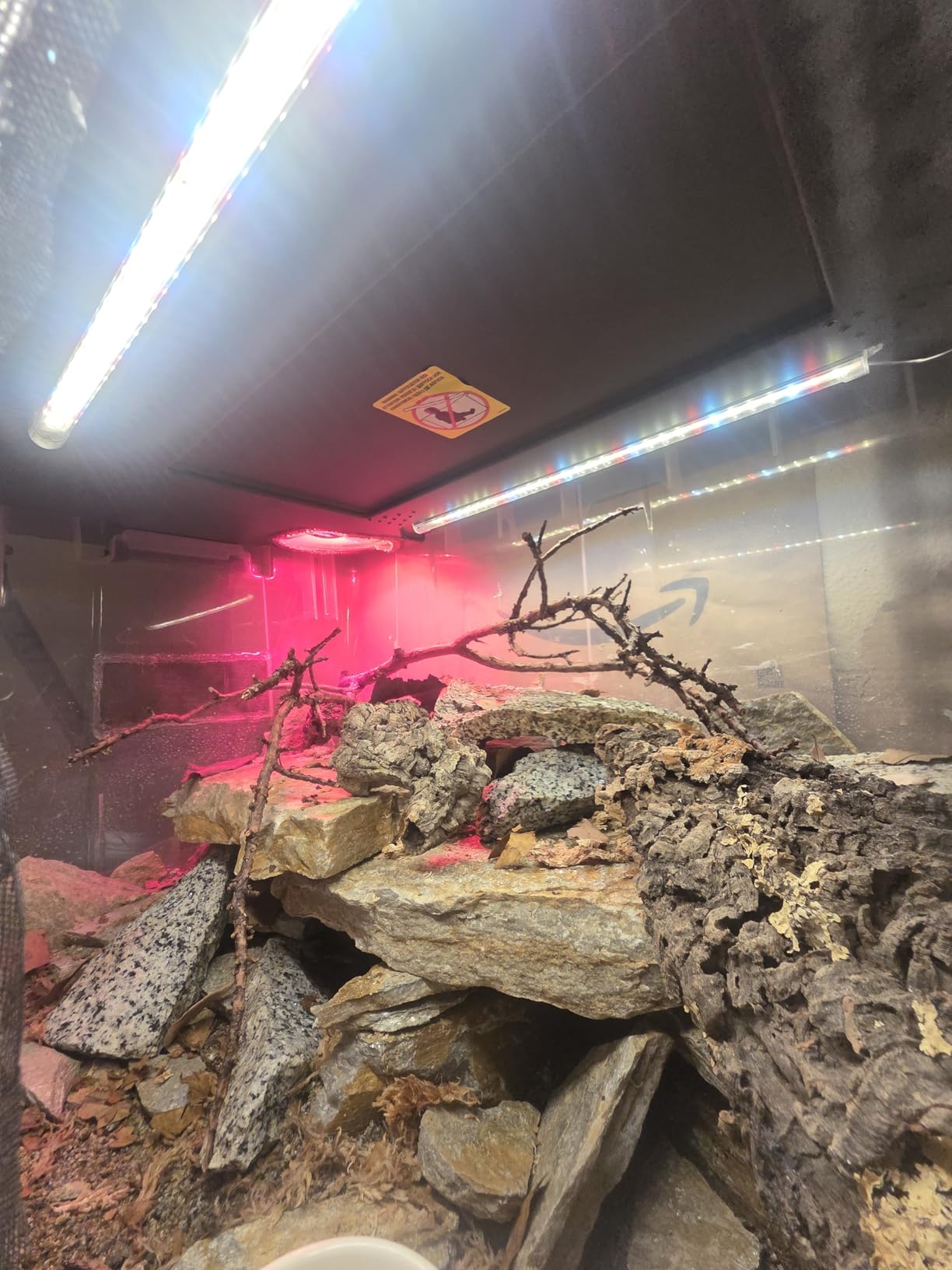
The 5000K full-spectrum output is tuned to plant absorption ratios across seedling, vegetative and flowering stages, with 96 diodes in total drawing 20W combined. Buyers also repurpose these bars in aquariums and vivariums, which tells you the colour rendering is neutral enough not to distort what is under them.
Mounting is the feature I did not expect to care about and now rely on. The kit includes double-sided tape, clips and cable ties, so going under a shelf takes about two minutes and no tools. The housing is slim enough to tuck against the underside of a board.
What these bars are genuinely good at
Shelves, console tables and grow racks, especially where you want the light to look integrated rather than perched. A bar mounted under a shelf lights the top of the plant from a direction that the eye expects, which is why the finished installation reads as furniture lighting.
Because the bars link, they scale with the collection. This is the one to choose if you think you will add more plants this year — the same fitting and the same cord ecosystem carries the next four bars.
Where they fall short
There is no built-in timer. You need a wall or plug-in timer to schedule them, and while several owners report that as a nuisance, others prefer it: physical on and off switches come back on their own after a power cut, and you control the schedule at the socket rather than trusting a clock inside the fixture.
Power cords are short, so longer runs need an extension, and the linking cables come in fixed lengths only. Do not mount them on uncured plaster, dusty, greasy or rough surfaces — the adhesive needs a clean flat one.
4. VIVOSUN LumaLight 100W: Premium Pick for Larger Canopies and Humid Rooms
VIVOSUN LumaLight 100W LED Grow Light, Full Spectrum Plant Light
336 diodes
100W draw
3000K, 5000K, 660nm, 730nm
4 level dimming
IP65 rated
Q90 to 36000 hours
Pros
- Full spectrum diode mix supporting seedling through harvest
- Strategic diode layout for even coverage centre to edge
- Four-level dimming knob from 25 to 100 percent
- IP65 waterproof and dustproof housing tolerates humid rooms
- Q90 flux maintenance rated to 36000 hours
Cons
- App control and scheduling need the separately sold GrowHub hub
- Ceiling or hanging mount required with no stand included
- Higher price than lower-wattage consumer fixtures
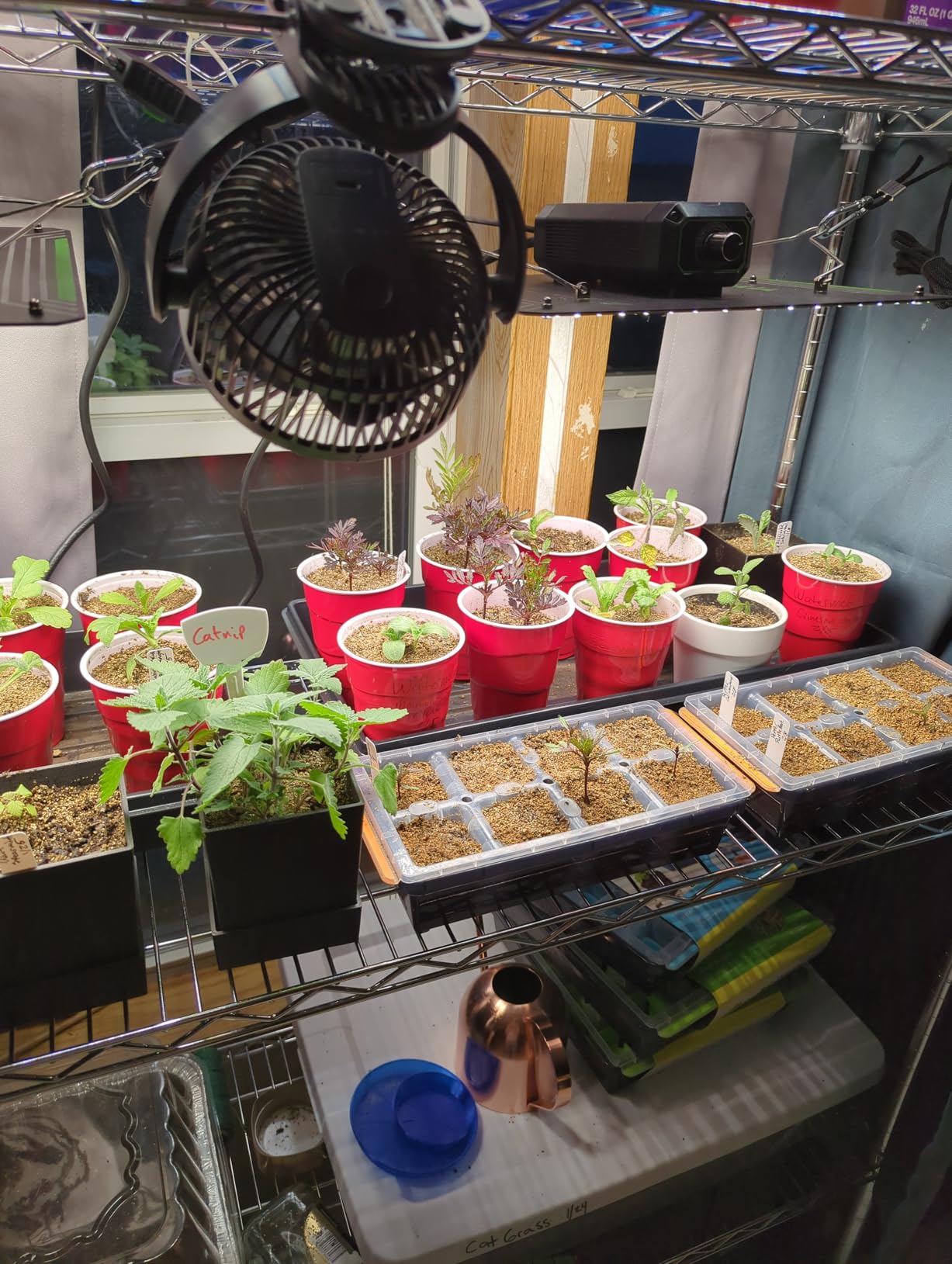
This is the fixture to buy when one panel has to do the work of a small grow tent. At 100W with 336 diodes, it covers a meaningfully bigger footprint than the household lights elsewhere in this list, and the even coverage is what you notice first — the centre and the edge read at similar intensity.
The IP65 sealing is the underrated part. If your plants live in a bathroom, a humid conservatory, or anywhere you would worry about splashing, a water-resistant and dustproof housing removes a failure mode that open aluminium lights do not have.
Spectrum covers 3000K, 5000K, 660nm and 730nm, which spans warm white through to deep red and near-infrared. The 730nm diodes are invisible to your eye, so the fixture looks brighter to a camera than it does to you, and the red content is doing work you cannot see.
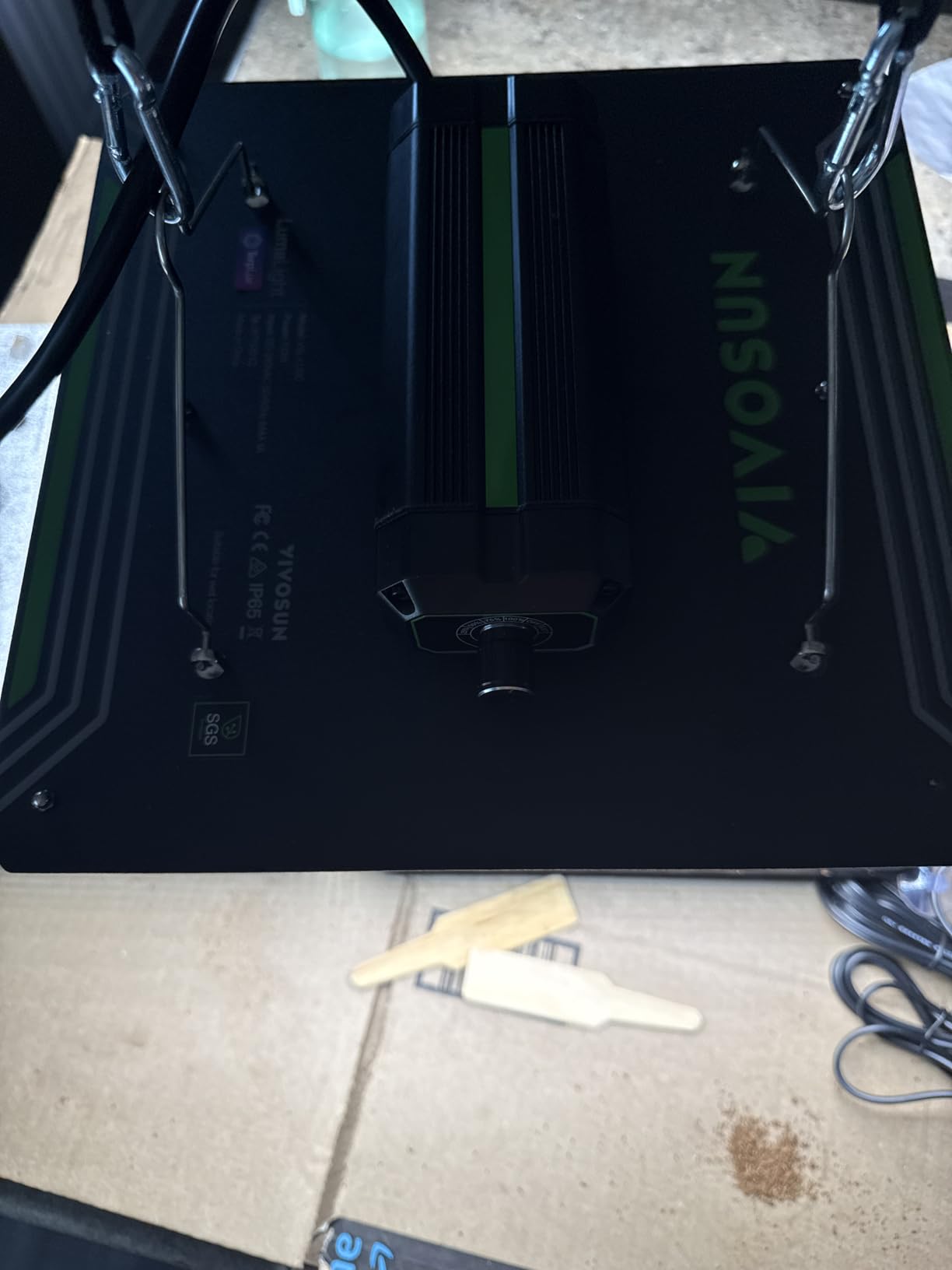
A four-level dimming knob from 25 to 100 percent lets the same panel serve seedlings at low output and a flowering canopy at full. Thermal management is rated for Q90 flux maintenance at up to 36,000 hours, and the warranty is two years unlimited plus three years limited.
What this panel is genuinely good at
A dedicated growing area rather than a windowsill. If you have a 2×2 space or a small tent, or you intend to grow vegetables and herbs rather than foliage plants, this is the output level where you start seeing results that justify the fixture.
It also suits mixed collections with a spread of needs, because dimming and spectrum variety let you run a seedling tray and an herb pot in the same footprint without either one suffering.
Where it falls short
The smart features are an add-on. Scheduling and app monitoring require the VIVOSUN GrowHub hub, which is sold separately, so if you buy this expecting phone control you will need a second purchase. Without the hub, you get the physical dimming knob and rope hangers.
Mounting is hanging only — rope hangers are included, but no stand or clamp. And at this output level it costs noticeably more than the household fixtures, which is a harder sell for a collection of ten houseplants.
5. SYEIORAOM Four-Head Grow Lamp: Budget Pick for Seed Starting
SYEIORAOM Grow Lights for Indoor Plants, Four Head LED Grow Light with Full Spectrum, Red White Spectrum for Indoor Plant Lamp, Adjustable Gooseneck, Suitable for Vegetation
72 full spectrum LEDs
Four aimable heads
Telescopic pole
Freestanding tabletop base
No assembly
Pros
- Four separately aimable heads cover a full seed tray or small table
- Goosenecks and telescopic pole allow precise positioning
- Freestanding base needs no clamp or stake and no assembly
- Collapses to fit a drawer between seasons
- Many owners report units still running after two years of daily use
Cons
- No built-in timer so an outlet timer is needed
- Heads must sit close or seedlings stretch and go leggy
- Height is limited so fast plants outgrow it quickly
- Occasional early failures with dead heads out of the box
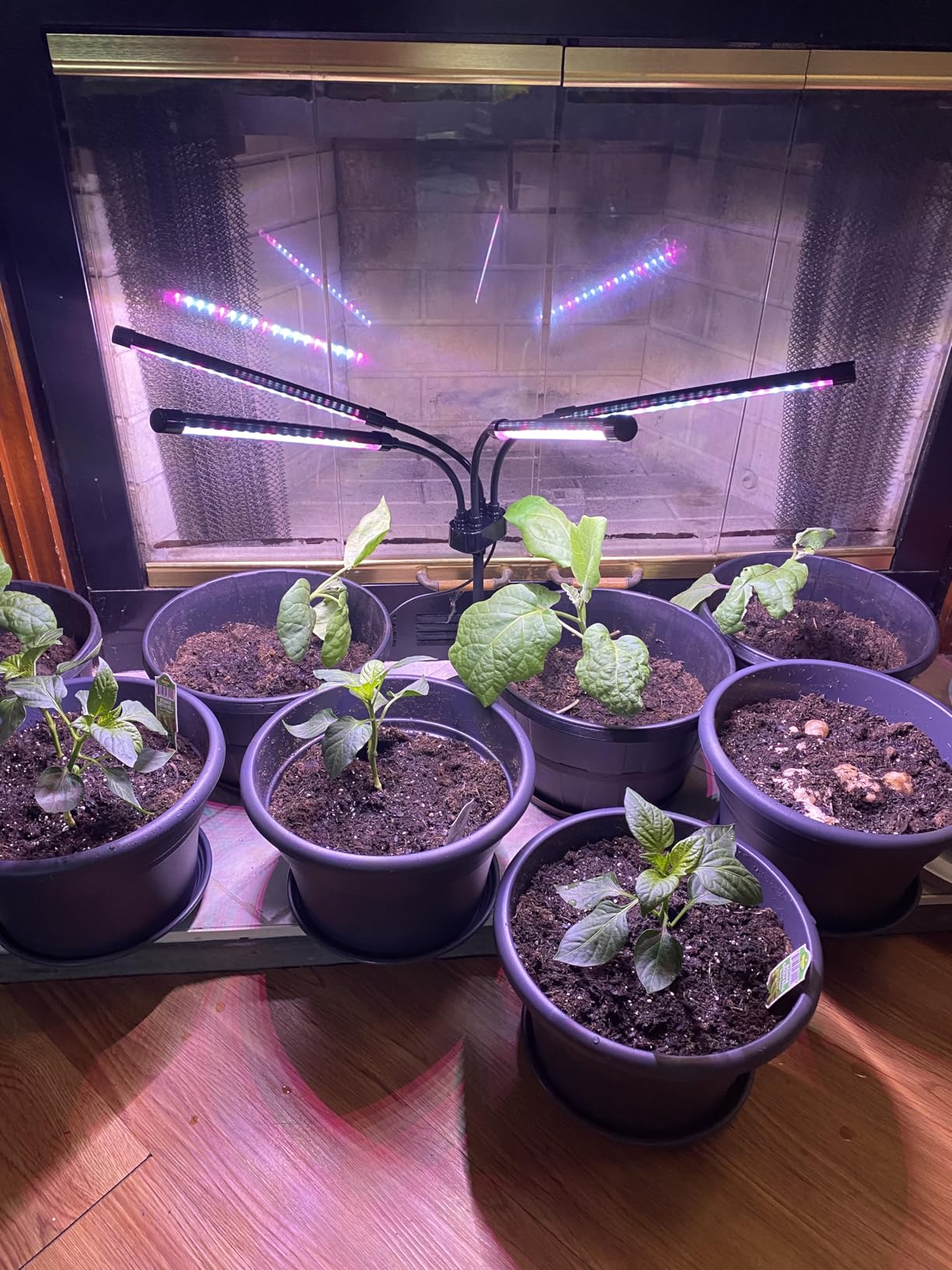
Four independently positionable heads is the concept, and it is a good one for the job it is sold for. Instead of one broad wash of light, you aim four separate goosenecks at four different corners of a seed tray, which is exactly the geometry of a propagation setup.
The freestanding base needs no clamp and no stake, so it works on a table with no reachable edge. It also needs no assembly, and it folds down enough to live in a drawer for nine months of the year — a real advantage for seasonal propagation.
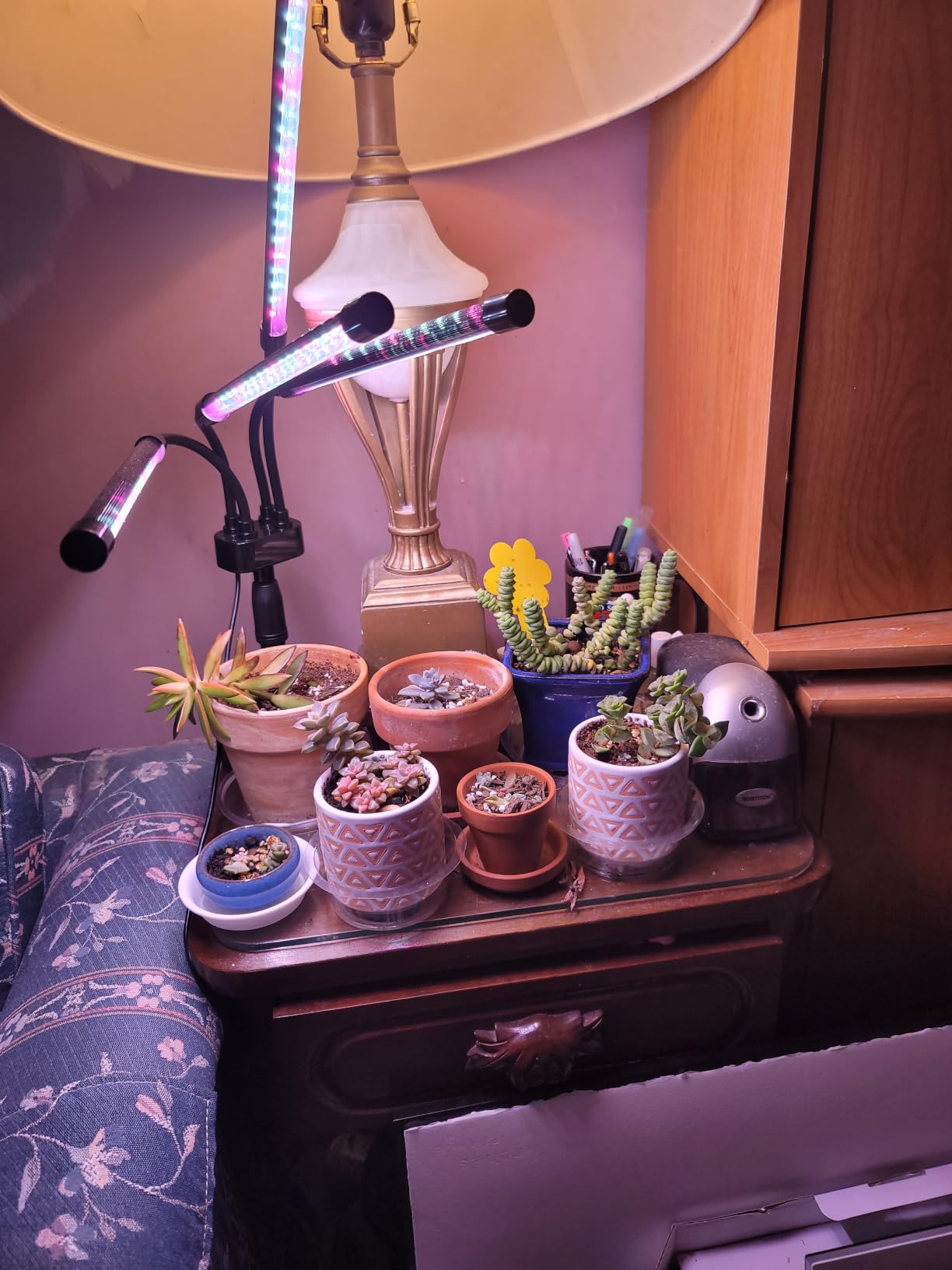
Light comes from 72 high-efficiency full-spectrum diodes balanced between red and white, which suits germination, rooting, vegetative growth and bloom. Reviewers report it measurably out-performing other budget grow lights, and several owners still have theirs after two years of daily use.
The telescopic pole extends the whole assembly upward, so it can cover a seed tray now and a small group of rooted cuttings later without a new fixture.
What this lamp is genuinely good at
Propagation and seed starting, where the priority is even coverage across a flat tray rather than light reaching the top of a tall plant. Four heads pointed at four quadrants reduces the hot and cold spots that make a single head slow down germination at the edges.
It is also a reasonable first grow light for someone who is not yet sure how much light their plants need, because it is simple to set up and easy to move as the collection grows.
Where it falls short
There is no built-in timer, and owners who plug it into an external outlet timer report better results than with basic built-in grow light clocks. It also needs to be positioned close, because at distance seedlings stretch and become leggy — and its maximum height is limited, so fast growth outgrows it.
A recurring group of complaints concerns early failures: units dying within weeks, arriving with dead heads, or all heads going out of arrival. Check every head before you commit to a propagation cycle with a fixed date.
6. SANSI Pot Clip-On Two-Pack: Best for Single Pots
SANSI Grow Lights for Indoor Plants, Pot Clip-On Plant Light, 2-Pack
Ceramic chip LEDs
5W draw
35.78 µmol/m²/s at 6 inch
3/6/12 hour timer
Four brightness levels
ETL listed
Pros
- Delivers 35.78 µmol/m²/s at 6 inches from only 5W of power
- Clip and gooseneck needs no assembly and touches no part of the plant
- Built-in 3/6/12 hour cycle timer with four brightness levels
- 4000K tone stays easy on the eyes in a shared room
- 5V USB power works from an adapter
- power bank or laptop
Cons
- Spring clamp is built for thicker pot rims and wobbles on thin ones
- Short gooseneck lets the head flop around
- 5W output is meant for one pot
- not a collection
- No colour temperature adjustment
- only brightness
This is the pot light I recommend when a single plant is struggling and the rest of the collection is fine. Ceramic chip technology at 5W is the efficiency story here: the stated output is 35.78 µmol/m²/s at 6 inches, which is a serious intensity for a fixture that draws less than a small lamp.
The 4000K tone is the other reason it works indoors. It is neutral enough to sit on a desk without lighting the room like a vending machine, and it is comfortable to have on all day.
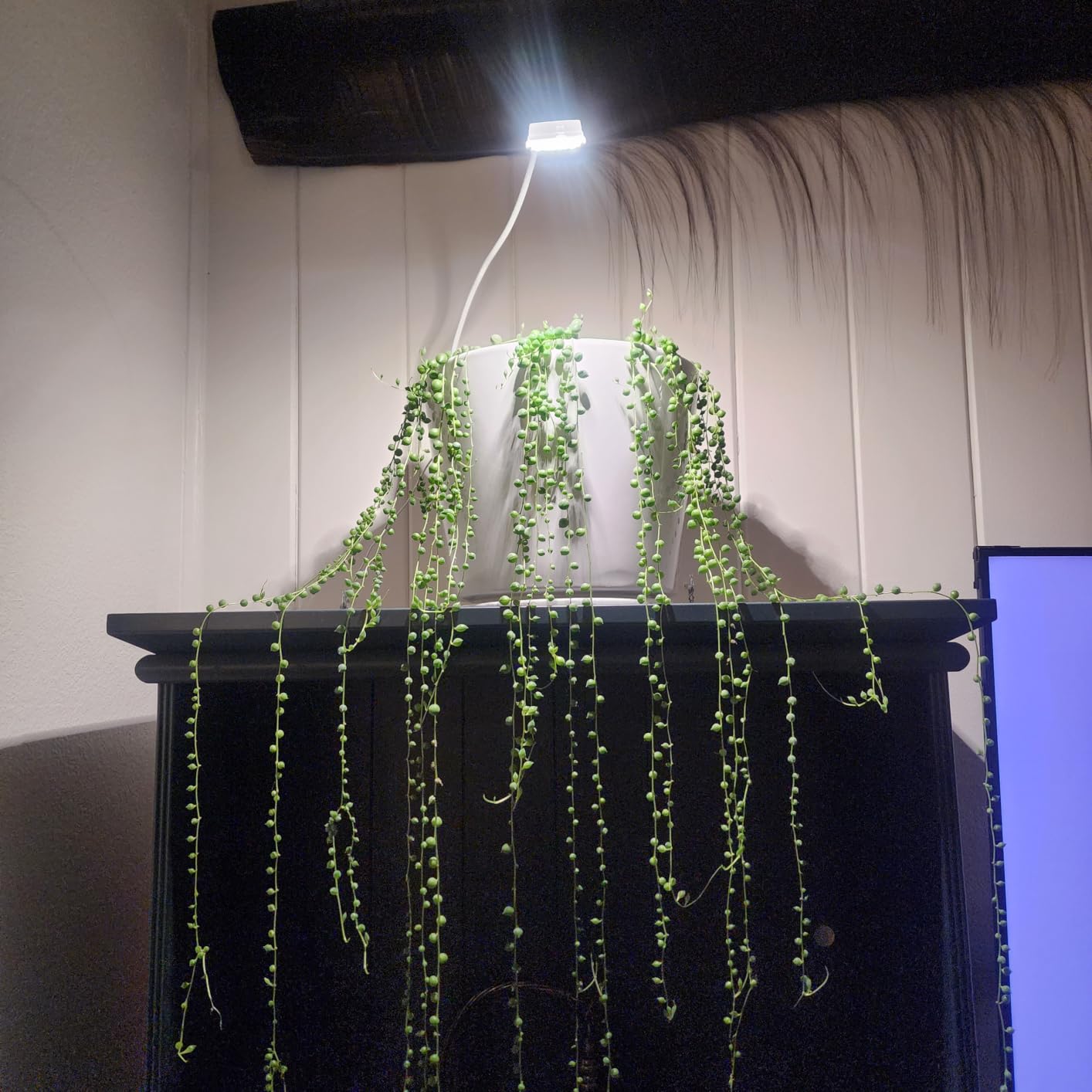
Control is an inline remote with a 3, 6 or 12 hour auto cycle timer and four brightness levels at 25, 50, 75 and 100 percent. That is more control than most fixtures in the clip category offer, and the gooseneck bends so the beam never points directly at you.
Buyers report visible new leaves and better colour on struggling winter plants, and the two-pack format lets you cover two pots in different rooms from one purchase.
What this light is genuinely good at
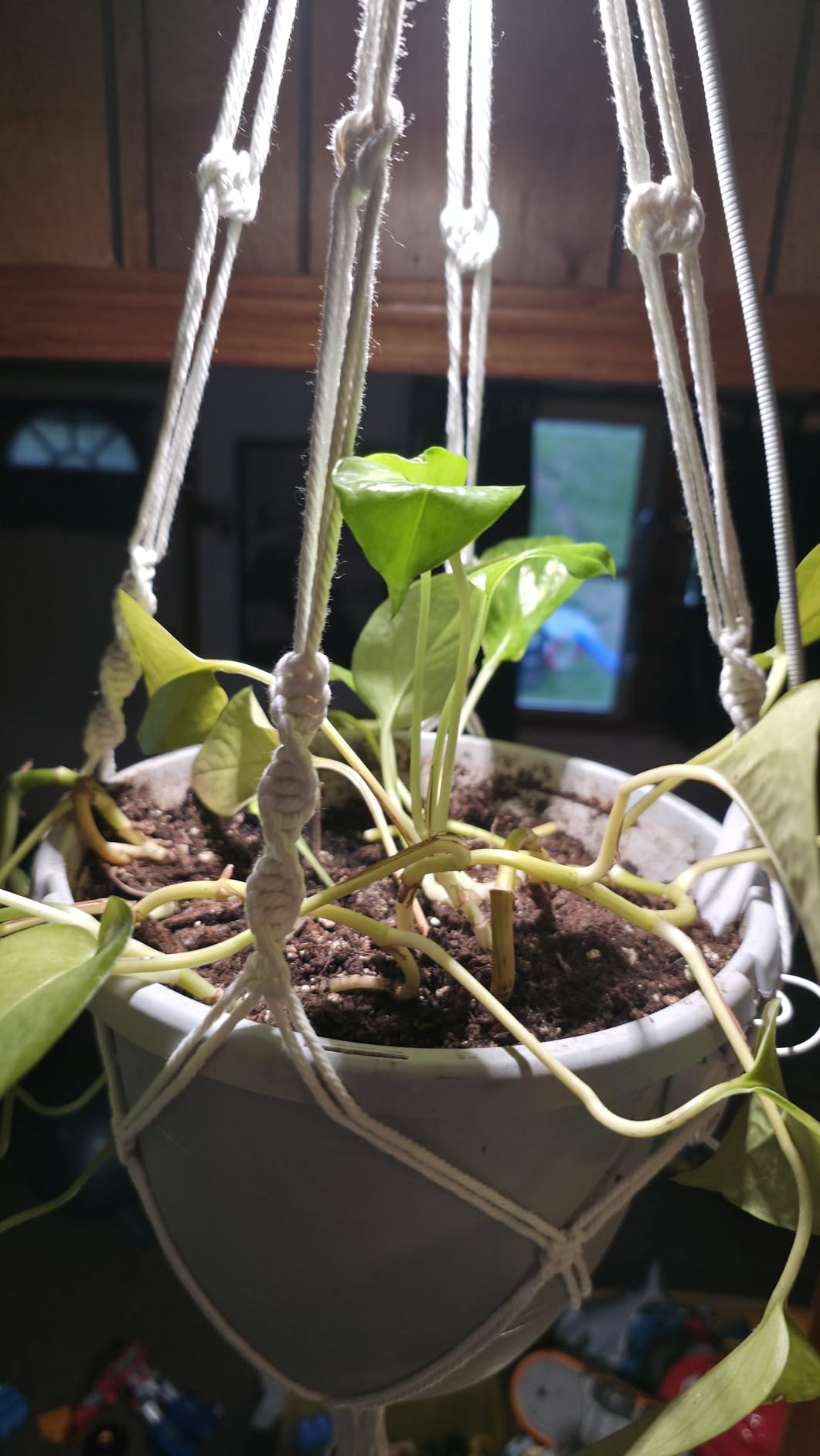
One plant, one problem. A peace lily that has gone pale through winter, an anthurium in a dark corner, or a cactus that has stretched toward a window all benefit from a targeted 5W source that you can clamp on and forget.
It is also the tidiest option for a countertop herb garden or a windowsill, because the clip leaves no footprint and the 5V USB supply means you can power it from a power bank if no socket is within reach.
Where it falls short
The clamp is designed for thicker pot rims. On a small or thin-rimmed pot it wobbles, which is the single most common complaint across the review record — check the rim thickness before you buy.
Five watts is intended for a single small or medium potted plant, not a shelf of them, and the short gooseneck lets the head flop. There is also no colour temperature adjustment, only brightness, and the light must stay plugged in.
7. BESTVA DC1000 100W: Best for a Grow-Tent Style Footprint
BESTVA DC1000 High-Yield Indoor Plant Grow Light, Fits 2×2/2×3/2×4 ft Tents
640 LEDs
100W draw
3000K, 5000K, 460nm, 660nm
VEG and BLOOM modes
Cooling fans
2x2 foot coverage
Pros
- 640 LEDs on a 100W draw
- far more output per watt than older HPS fixtures
- Two custom modes for vegetative growth and for flowering
- Quiet high-speed fans and aluminium radiators hold 50-60F operating temperature
- Hanging hardware kit and adjustable rope included
- Three-year warranty honoured with quick replacements
Cons
- Name implies 1000W but real usable output is far lower
- Coverage is smaller than advertised beyond a 2x2 foot area
- Rows of diodes can fail partway through a cycle
- Very bright
- so eye protection is advised when working underneath
This is a veteran of the category, and the review record spans more than a decade of use. Growers run these in multi-fixture arrays, which tells you the panel does its job consistently rather than impressively once.
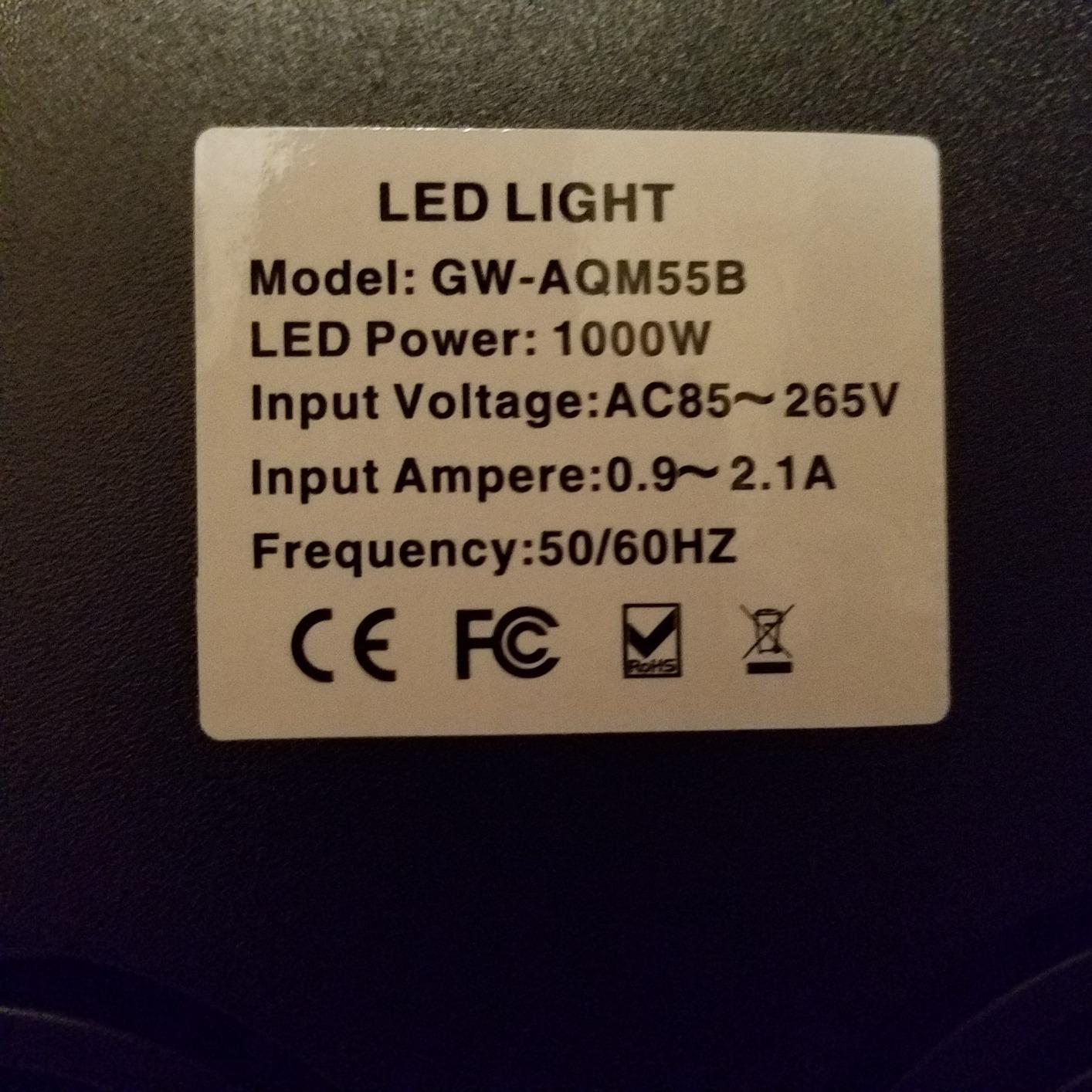
The 640 diodes run on a 100W draw, so it delivers far more light per watt than the high-pressure sodium fixtures it replaced. That comparison is the honest way to read the name on the box — see the buying guide for why the model name is not a wattage figure.
Spectrum runs 3000K, 5000K, 460nm and 660nm, with two switchable modes: VEG for leafy vegetative growth and BLOOM for flowering and fruiting. The cooling system uses multiple quiet high-speed fans and aluminium radiators, holding operating temperature at 50-60F, which directly reduces leaf-burn risk.
Mounting hardware is included — an adjustable hanger rope, a metal hanging kit and a removable power cord — so there is nothing to buy separately.
What this panel is genuinely good at
A 2×2 foot growing area, and up to 3×2 feet for herbs and leafy greens. The dual modes are the feature that matters if you intend to grow anything you actually want to harvest, because a fixture set to bloom mode all year is a waste of output for a coleus.
The active cooling is also worth crediting. A panel that holds 50-60F lets you hang it closer to the canopy than a passive fixture, which is where PPFD is highest.
Where it falls short
Coverage is smaller than the marketing implies beyond 2×2 feet. Buyers also report rows of diodes failing partway through a grow cycle, and the sealed housing design means you cannot open it to repair.
It is very bright, and eye protection is sensible if you will be working directly underneath for long periods. The hanging hardware can also arrive loose with no way to tighten it once assembled.
8. Aumtrly 68 Inch Floor Grow Light: Best for Tall Floor Plants
Aumtrly Black Grow Lights for Indoor Plants, Full Spectrum, with 68″ Stand
20W draw
80 LEDs
17 to 61 inch height adjustment
7.8 inch gooseneck
3 modes, 5 dim levels
16 hour timer
Pros
- The only true floor-standing option here
- with height adjustment from 17 to 61 inches
- Three lighting modes and five dimming levels to match growth stage
- Extended 16 hour timer for an uninterrupted daily cycle
- Full spectrum combining 660nm red with 3200K and 5000K white
- Matte black finish and simple shape that blends into a room
Cons
- Single-head configuration in this listing
- 20W output is modest for more than one or two plants
- Touch-only controls with no dimming remote
- Smallest review base of the ten products covered here
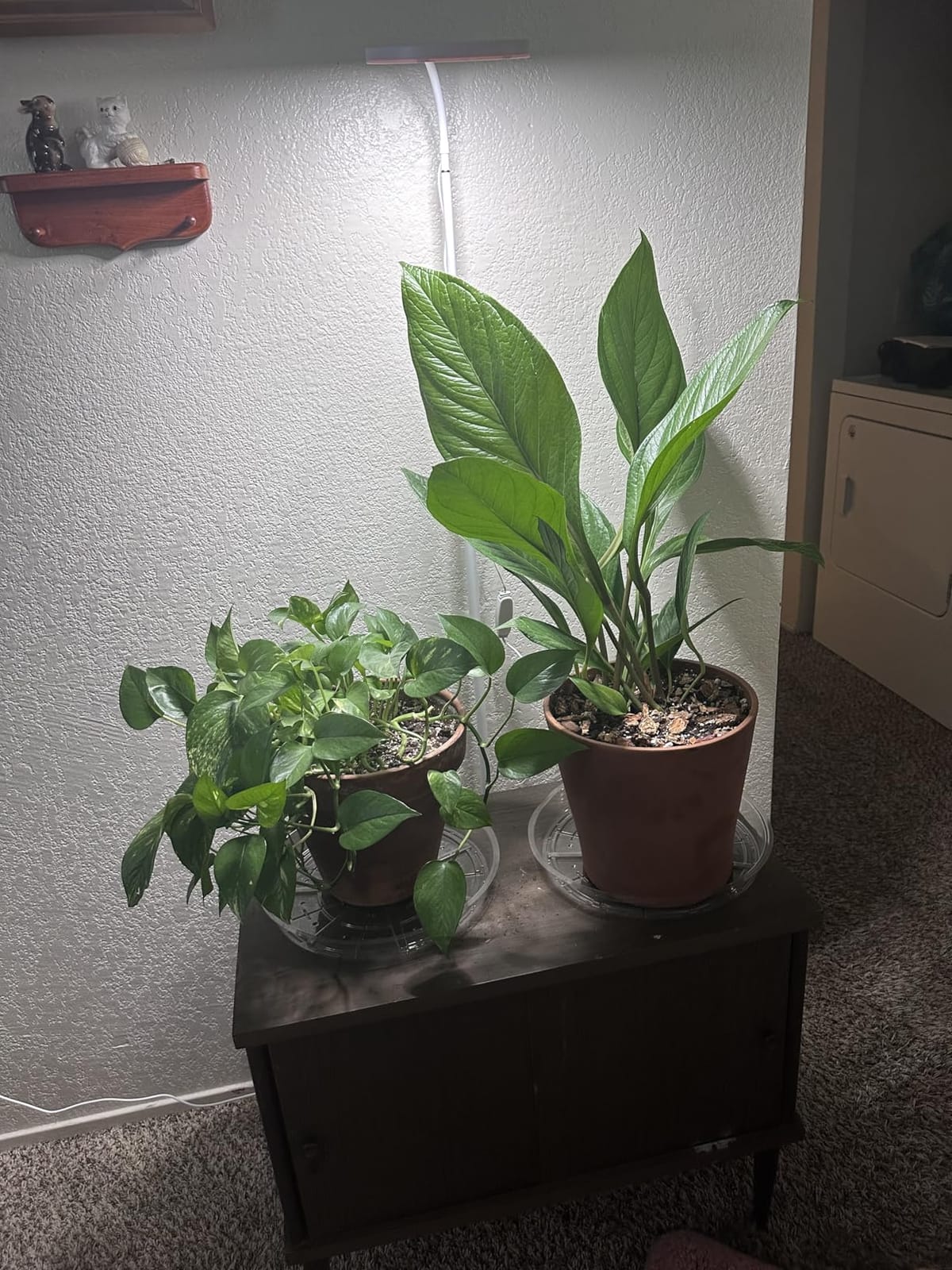
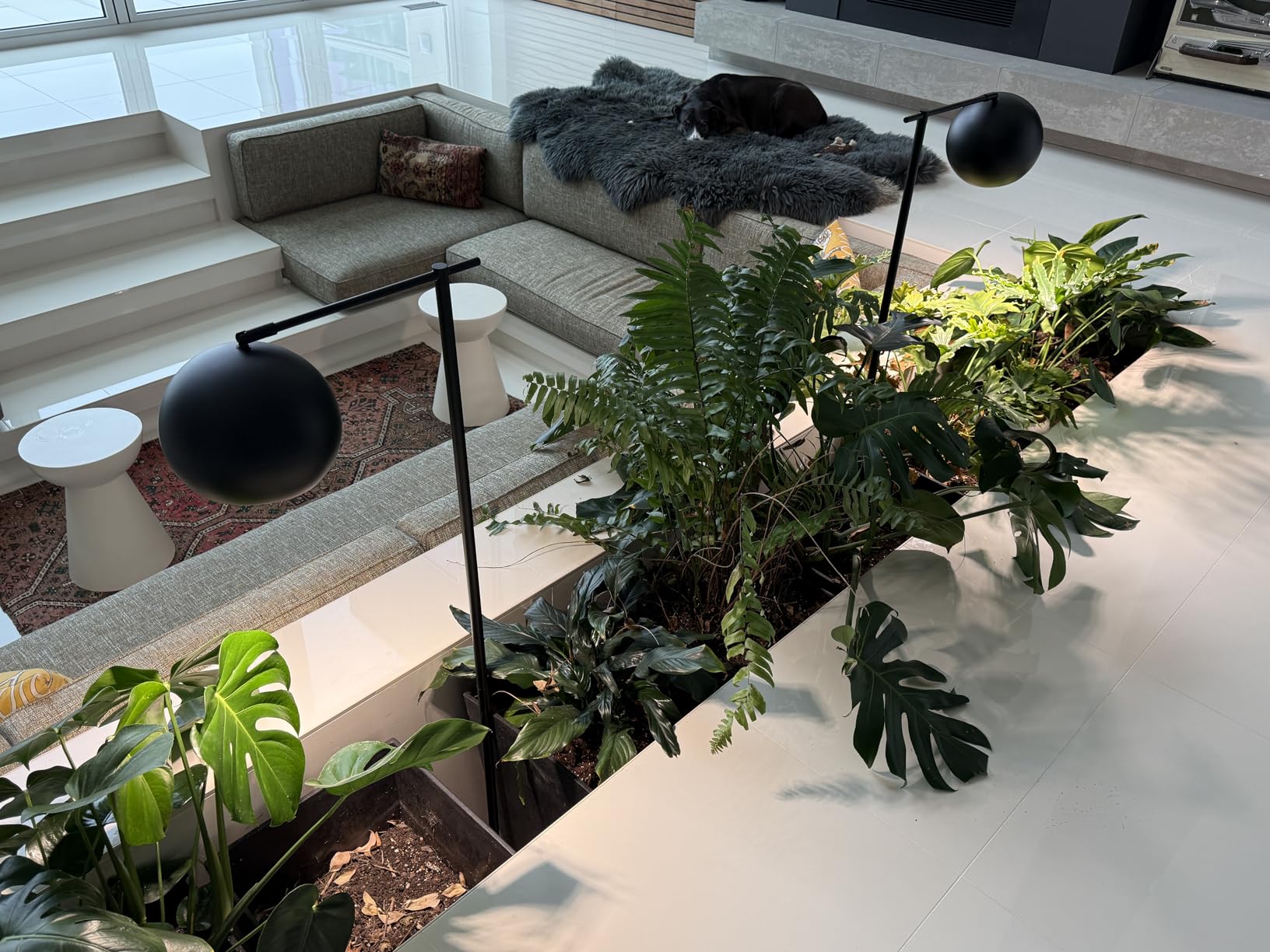
Every other household fixture here clips, stakes or hangs. This one stands on the floor, which solves a specific and common problem: a fiddle leaf fig or a rubber plant that has outgrown your tallest shelf and that no clip lamp can reach.
The telescopic pole adjusts from 17 to 61 inches, topped by a 7.8 inch flexible gooseneck. That combination covers a plant in a large pot on the floor and a small one on a side table with the same fixture.
Output is 20W from 80 diodes, spread across three lighting modes and five dimming levels, with a 16 hour timer setting for an uninterrupted cycle. The spectrum combines 660nm red with 3200K warm white and 5000K white, so it carries the warm and cool mix that suits a shared room.
The matte black finish is deliberate and works. It disappears against a wall or a dark shelf rather than drawing attention to itself the way a bright white plastic housing does.
What this light is genuinely good at
Tall single plants in floor pots, and any room where you want light without hardware on the wall or a clamp marring a surface. The freestanding base means there is nothing to find a mounting point for, which matters in a rental.
The 16 hour timer is the longest continuous photoperiod in this roundup, and the five dimming levels mean a light-sensitive plant can be held back while a sun-loving one gets turned up.
Where it falls short
This listing is a single-head configuration. Multi-head versions exist as separate variants, so if you want to cover two plants at once you are shopping for a different product, and it has the smallest review base here at 1,575 ratings — which, in a category where buyers discount thin review counts heavily, is worth weighing.
Twenty watts is modest for more than one or two tall plants, and the controls are touch-only on the unit with no dimming remote.
9. Kullsinss Two-Bar Shelf Strips: Best for Under-Shelf Lighting
Kullsinss 16in Grow Light Strips, 2-Bar 120 LEDs Full Spectrum Plant Light
120 LEDs per set
380-800nm
20W draw
5 dim levels, 3 spectrum modes
6/12/16 hour timer
95 inch cord
Pros
- 120 LEDs across two slim bars covering 380-800nm
- Smart controller with five dim levels
- three spectrum modes and a 6/12/16 hour timer
- Slim bar profile mounts under shelving and blends into a plant display
- 95 inch cord plus screws
- ties and tape for flexible mounting
- Cool-running aluminium housing with good heat dissipation
Cons
- Low measured intensity of about 2000 lux at 5 cm
- Not enough output for flowering or fruiting stages at a distance
- CRI of 80 is lower than the higher-end fixtures here
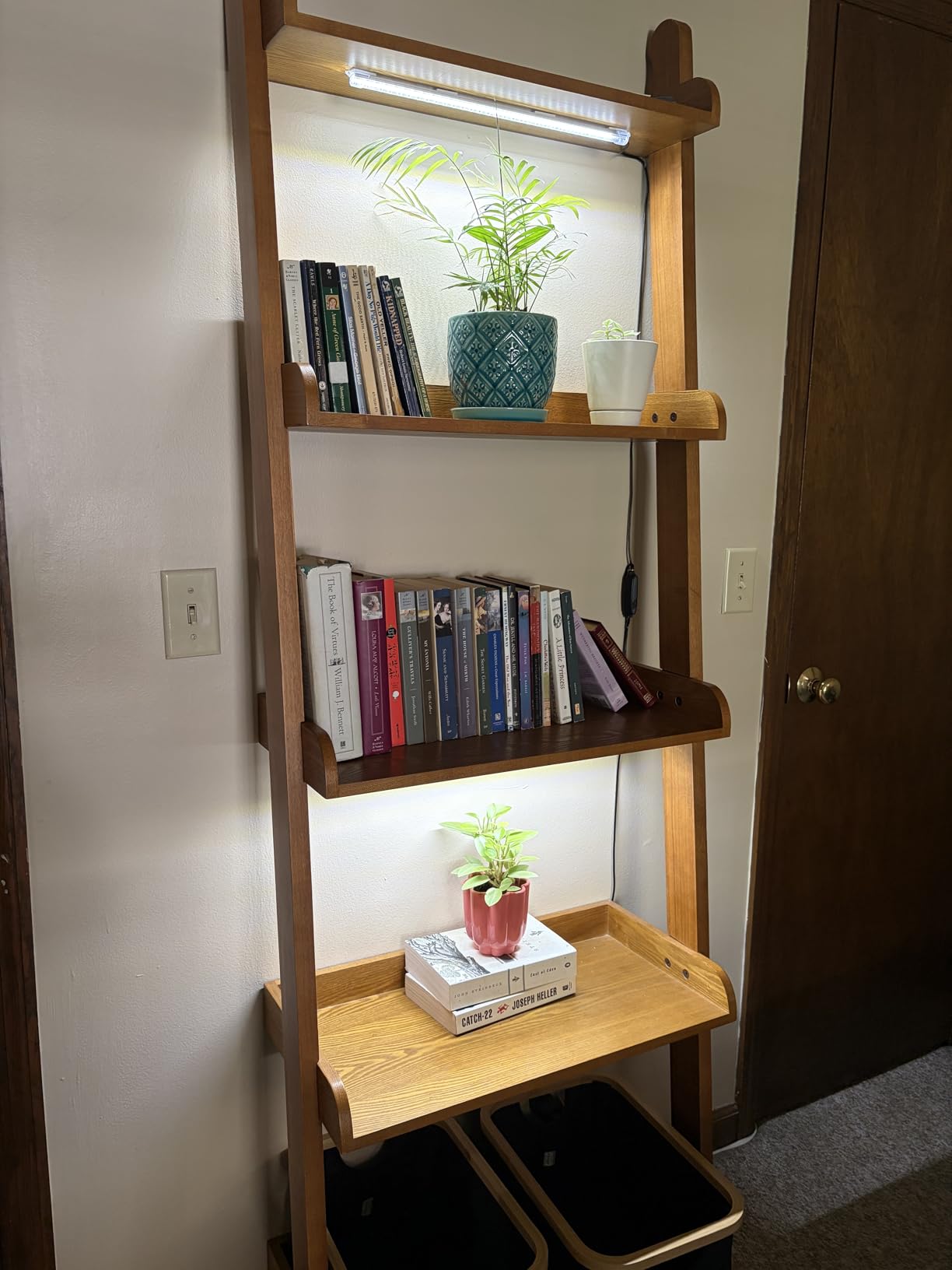
These strips are built to disappear. The bar profile is slim enough to screw or tape to the underside of a shelf board, where it lights the shelf below and stays out of the sightline of anyone sitting opposite.
Each set gives you 120 diodes — 72 white, 36 warm white and 12 red — across two bars, covering 380 to 800nm. The smart controller offers five dimmable levels, three spectrum modes and a 6, 12 or 16 hour auto timer.
Owners use them for low-light foliage under shelving and on herb shelves, and report restored variegation in low-light pothos and rescue of leggy seedlings. That is a specific and honest use case: they are doing a maintenance-level job, not a production one.
Mounting hardware is generous for the money — a 95 inch power cord plus screws, cable ties and double-sided tape, so you can place a set at either end of a long shelf without an extension lead.
What these strips are genuinely good at
Low and medium light houseplants on shelving: pothos, philodendron, ZZ plant, ferns and snake plants that have stretched in a dim corner. At low brightness they are also a good propagation light for cuttings that need gentle, even light rather than intensity.
If decor matters and the fixture will be visible, the under-shelf position means it never is. That is why this is the pick I would suggest to someone who rejected a grow light because of how it looked.
Where it falls short
Output is low. One review measured roughly 2,000 lux at 5 cm, which is enough for shade-tolerant foliage and not much more. At any realistic mounting distance these strips will not drive flowering or fruiting.
CRI of 80 is the lowest in this roundup, so foliage will look slightly flatter under them than under a 90 or 95 fixture. If variegation and leaf colour are the thing you are judging, that is a real consideration.
10. SANSI 36W E26 Grow Bulb: Best for an Existing Lamp
SANSI Grow Lights for Indoor Plants, 36W Plant Lights for Indoor Growing
36W
3250 lumens
265.58 µmol/m²/s at 1 foot
CRI 95 at 4000K
E26 base
5 year warranty
Pros
- 4000K daylight with CRI 95 across 400nm-780nm
- PPFD of 265.58 µmol/m²/s at 1 foot via a secondary optical lens
- Chip-on-ceramic technology improves heat conduction and efficiency
- ETL listed with a 5 year warranty and responsive replacement
- Three wattage sizes let you match a fixture to a collection
Cons
- Runs hot and needs cool-down before handling
- Not for enclosed shades
- Narrow focused cone leaves peripheral plants dimmer
- Not dimmable
- Heavy enough to make a flexible gooseneck sag
If you already own a lamp with an E26 socket, a bulb is the cheapest possible upgrade. This one is the most efficient of the group on paper: 36W producing 3250 lumens, with a stated PPF of 65.6 µmol/s and PPFD of 265.58 µmol/m²/s at one foot through a secondary optical lens.
Colour rendering is the standout specification. CRI 95 at 4000K means plant colour reads true, which is exactly the argument for staying away from blurple if you plan to judge leaf health by eye.
The build is ceramic rather than the usual aluminium base, using patented chip-on-ceramic technology to lower thermal resistance and improve efficiency. The housing carries a V0 flame-retardant rating and a WF2 anti-corrosion shell, and the rated life is 25,000 hours.
Reviewers report dramatic responses, including maranta leaves standing upright within hours and flowering that rivals outdoor growth, and many own several wattage sizes and match each to a different collection.
What this bulb is genuinely good at
Turning a floor lamp or clamp lamp you already own into a grow light. It is also the simplest way to get a CRI 95 output into a room without buying a whole new fixture, and the 4000K tone is neutral enough for an office or a study.
Because intensity is concentrated, it suits a single demanding plant — a flowering houseplant or a small group of succulents — placed at a measured distance rather than a whole shelf.
Where it falls short
Heat is the main caution. It runs hot and needs a cool-down before handling, and it should not be used in an enclosed shade where there is no airflow. Reviewers also note it is not dimmable, so intensity is fixed once you install it.
The cone is narrow and focused, so peripheral plants in a multi-pot arrangement get noticeably less. And at this weight, a flexible gooseneck lamp may sag under it — check what is holding the bulb before you fit it.
How to Choose an LED Grow Light for Indoor Plants
Everything above comes down to four decisions: how bright, what form factor, what spectrum, and how long. Get those right and most of the buying process decides itself. The measurement vocabulary is the part that trips people up, so we will start there.
What PPFD means and why lumens mislead
PAR is photosynthetically active radiation: the 400 to 700nm band of light that plant pigments can actually use. Everything else in the stack describes how much of that band reaches your plant.
PPF (photosynthetic photon flux) is the total usable light a fixture emits, measured in µmol/s. It is a property of the product, not of your room.
PPFD (photosynthetic photon flux density) is how much of that light actually lands on the canopy, in µmol/m²/s. This is the number that matters, and it changes every time you move the fixture.
DLI (daily light integral) is PPFD multiplied by photoperiod, in mol/m²/day. It is how much light a plant gets in a whole day.
PPE (photosynthetic photon efficacy) is µmol/J — how efficiently the fixture converts electricity into usable light. It determines your running cost.
Lumens describe light as a human eye perceives it, weighted heavily toward green around 555nm, which plants barely use. A grow light can be modest in lumens and excellent in PPFD, or the reverse. Lux meters over-report green for the same reason, so treat any lux figure on a listing with suspicion.
One practical shortcut circulates widely among growers: roughly 72 lux approximates 1 µmol/m²/s for most white LED grow lights without added red diodes. If you have no PAR meter, that conversion gives you a usable field estimate instead of nothing.
Match the light level to your plants
Most grow light copy is written for vegetables and flowering crops, where 600 to 900 µmol/m²/s is the target. Houseplants live in a much lower range, and using crop numbers as a guide is how people scorch a calathea.
Low light, 80 to 150 µmol/m²/s: snake plant, ZZ plant, pothos, philodendron, most ferns. Around 8 to 10 hours per day.
Medium light, 150 to 300 µmol/m²/s: monstera, rubber plant, peace lily, string of hearts, most herbs. Around 10 to 12 hours per day.
Bright light, 300 to 500 µmol/m²/s: fiddle leaf fig, calathea, anthurium, succulents and cacti, indoor vegetables. Around 12 to 14 hours per day.
Seedlings and cuttings, 100 to 250 µmol/m²/s: enough to avoid stretching, low enough not to bleach new growth. 14 to 16 hours per day.
Dimming matters here more than in crop growing, because a single fixture serving mixed plants can be turned down for the shade-lovers and up for the succulents on the same shelf.
Pick the form factor that fits the space
This is the decision most lists skip, and it is the one that determines whether the light works at all. Measure the space before you pick a brand.
Clip lamp — one desk or a single shelf, plants within about 12 inches of the source. Best value entry point.
Pot clip — a single potted plant, most compact option, nothing on the surface at all.
Multi-head lamp — a seed tray or a small table where you want even coverage across a flat surface.
Shelf bar or T5 strip — one shelf or a bookcase run, mounted under the board. The most natural-looking option in a living space.
Floor-standing light — a tall plant in a floor pot that no clamp can reach.
Hanging panel — a 2×2 foot growing area or a small tent, where you need even coverage across a canopy.
Grow bulb — you already own a lamp with an E26 socket.
Daisy-chaining is worth checking if you have a long shelf: linkable T5 fixtures extend along a run with the same fitting and no additional switches.
Full spectrum white against blurple
Blurple is the purple-pink glow of a fixture packed with blue and red diodes and little in between. It looks dramatic, and the blue-red contrast in photos is a genuine optical illusion of excess red.
Full spectrum white spreads energy across many wavelengths, adds a broad white continuum rather than two narrow peaks, and lets the light move through a 24-hour photoperiod without stressing plants that dislike constant red. It also renders colour accurately, so you can see chlorosis and pest damage.
At a practical level: blue in the 430 to 453nm range drives compact vegetative growth, and red around 660 to 680nm drives most photosynthesis and flowering. A white full-spectrum fixture contains both without the visual price.
Colour temperature and CRI in a shared room
Kelvin measures how white the light looks. Warm white around 2700 to 3200K reads as cosy and evening-like, neutral sits near 4000K, and cool white at 5000K and above looks clinical. Blurple is a design choice, not a colour temperature.
For a room you sit in, 3200 to 4000K is the range most people stop objecting to, and several fixtures here mix warm and cool diodes specifically to land there. CRI is the companion number: 90 and above renders plant colour closely enough to inspect for yellowing or pest damage, while a fixture at 80 makes everything look flat.
Dimming, timers and photoperiod
Every plant needs a rhythm, not just light. Most houseplants do fine on 10 to 12 hours and will tolerate 8 hours in a dimmer room, while seedlings and cuttings want 14 to 16. Flowering is triggered in some species by a longer uninterrupted dark period, so a timer is more than convenience.
Check how the timer behaves, not just that it exists. Some cycle once per 24 hours, some alternate on and off within a window, and some only remember the last setting. An external wall timer is often the more honest answer, and it also survives power cuts with the switches left where you put them.
For how plants are watered once light is sorted, our guide to watering cans for indoor plants covers the other half of the routine.
Hanging height, coverage and running cost
PPFD falls off with distance in roughly inverse proportion to the square of the distance, which means doubling the hang height cuts the intensity to about a quarter. Move a fixture and you change the light level more than any dial does.
For clip and pot lights, 6 to 12 inches above the leaf surface is the working range. For T5 and shelf bars, 6 to 18 inches. For a hung 100W panel, start around 18 to 24 inches above a 2×2 canopy and adjust from what the plants do rather than from the listing.
Running cost is the most-asked question and the easiest to answer. Multiply true watt draw by hours per day and by 365. A 5W pot light on a 12-hour cycle is about 22 kWh a year. A 20W shelf set on 12 hours is about 88 kWh. A 100W panel on 16 hours is about 584 kWh — the only one of the three that will ever show up noticeably on a bill.
For comparing the fixtures on brightness rather than running cost, our guides to LED panel lights and garage ceiling lights cover the same lumen-versus-useful-output problem from a different angle.
What to look for in a spec sheet, and when to skip a listing
Read the true watt draw, not the model name. A model called DC1000 drawing 100W is doing what the drawing says; the name is not a measurement. Claims that a light replaces 120W of fluorescent plant lighting are brightness comparisons for humans, not photon output.
Then check: is the diode brand named, is there a real warranty length, is there a dimming range or only on and off, and is there a mounting method that suits your space. Five years is the community benchmark warranty. Anything at 12 months on an expensive panel deserves a second look.
Skip the listing outright if PPFD is quoted with no measurement distance, if the peak figure is given at the centre of the fixture with no uniformity data, if there is no dimming on an intense fixture, or if the light output is described only in lumens. If you want a production reference for spectrum terms, our LED video light guide covers the same vocabulary from a different use case.
One last diagnostic worth memorising. Leggy, stretched growth means the light is too weak, too far away, or on for too few hours. Pale, washed-out leaves mean too much, or too close. Bleached or scorched white patches on the sun-facing side mean light stress — dim it, move it up, or swap to a lower-output setting immediately, because that tissue does not recover.
Frequently Asked Questions
Do grow lights actually work for houseplants?
Yes, and most indoor plants are light-limited rather than limited by food or water. A fixture delivering 100 to 400 µmol/m²/s on a 10 to 12 hour photoperiod will visibly change growth on anything that gets less than a few hours of direct sun. Low-light plants like pothos benefit but do not depend on it; succulents, cacti, calatheas, fiddle leaf figs and most herbs genuinely need one.
How much PPFD do houseplants need?
Low-light houseplants such as snake plant, ZZ plant and pothos do well at 80 to 150 µmol/m²/s. Medium-light tropicals like monstera and peace lily want 150 to 300. Bright-light plants including fiddle leaf fig, calathea, succulents and cacti want 300 to 500. Seedlings and cuttings need 100 to 250. Flowering vegetables are a different category entirely at 600 to 900.
What wattage grow light do houseplants need?
Five to ten watts covers a single potted plant within about 12 inches of the source. Ten to twenty watts covers a desk, a seed tray or one shelf of foliage plants. Twenty to forty watts covers a large shelf or a group of tall floor plants. One hundred watts with a hanging panel is for a 2×2 foot growing area, not for a windowsill of houseplants.
Can LED grow lights be too intense for plants?
They can, and it is the most common way people damage a healthy plant. Symptoms are bleached or scorched white patches on the light-facing side of leaves, crisp brown tips, and sudden leaf drop. Fixes are to dim the fixture, increase the distance between fixture and canopy, or shorten the photoperiod. Damaged tissue will not recover, but new growth comes in healthy once intensity is corrected.
What houseplants do well under grow lights?
Anything struggling in a dim room responds well. The most dramatic results are usually seen on monstera, bird of paradise, banana, calathea, maranta, peace lily, anthurium and variegated pothos whose colour has faded. Succulents and cacti benefit from high intensity and long photoperiods. Slow growers like snake plant and ZZ plant will grow fine but will not speed up dramatically.
What color of light is worst for growing plants?
Pure red or pure blue on its own is the least useful, because plants need a broad range of wavelengths and relying on two narrow peaks produces stretched, weak growth. Deep red at 730nm is also largely invisible to the human eye, so a red-only fixture looks dim while working. A full-spectrum white with added deep red covers the range without any of those problems.
Can any LED light be used as a grow light for plants?
A normal household LED bulb can keep an existing plant alive and stop leggy growth, but it usually cannot push growth hard. Household bulbs spend much of their output on wavelengths plants use inefficiently, and the same lumen figure can mean very different PPFD depending on spectrum. A dedicated grow light with published PPFD or PPF at a stated distance is the only way to know what you are actually delivering.
The Right LED Grow Light for Your Plants
There is no single best LED grow light for indoor plants, because the space decides the answer more often than the specification sheet does. For one desk or shelf, the GooingTop clip lamp is the pick I recommend first: stiff gooseneck, CRI 90, and the largest review record in this roundup. For a long shelf, the Barrina T5 four-pack scales further than any other household option here.
If you are lighting a real growing area rather than a windowsill, step up to a hung panel — the VIVOSUN LumaLight if the room is humid, the BESTVA DC1000 if you want VEG and BLOOM modes and active cooling. For a tall floor plant nothing can reach, the Aumtrly stand is the only floor-standing option in the group.
Whatever you choose, set the photoperiod first and hang the light second. The best LED grow lights for indoor plants in 2026 are the ones you leave switched on, positioned correctly, for a consistent number of hours a day, rather than the ones with the highest number on the box.