
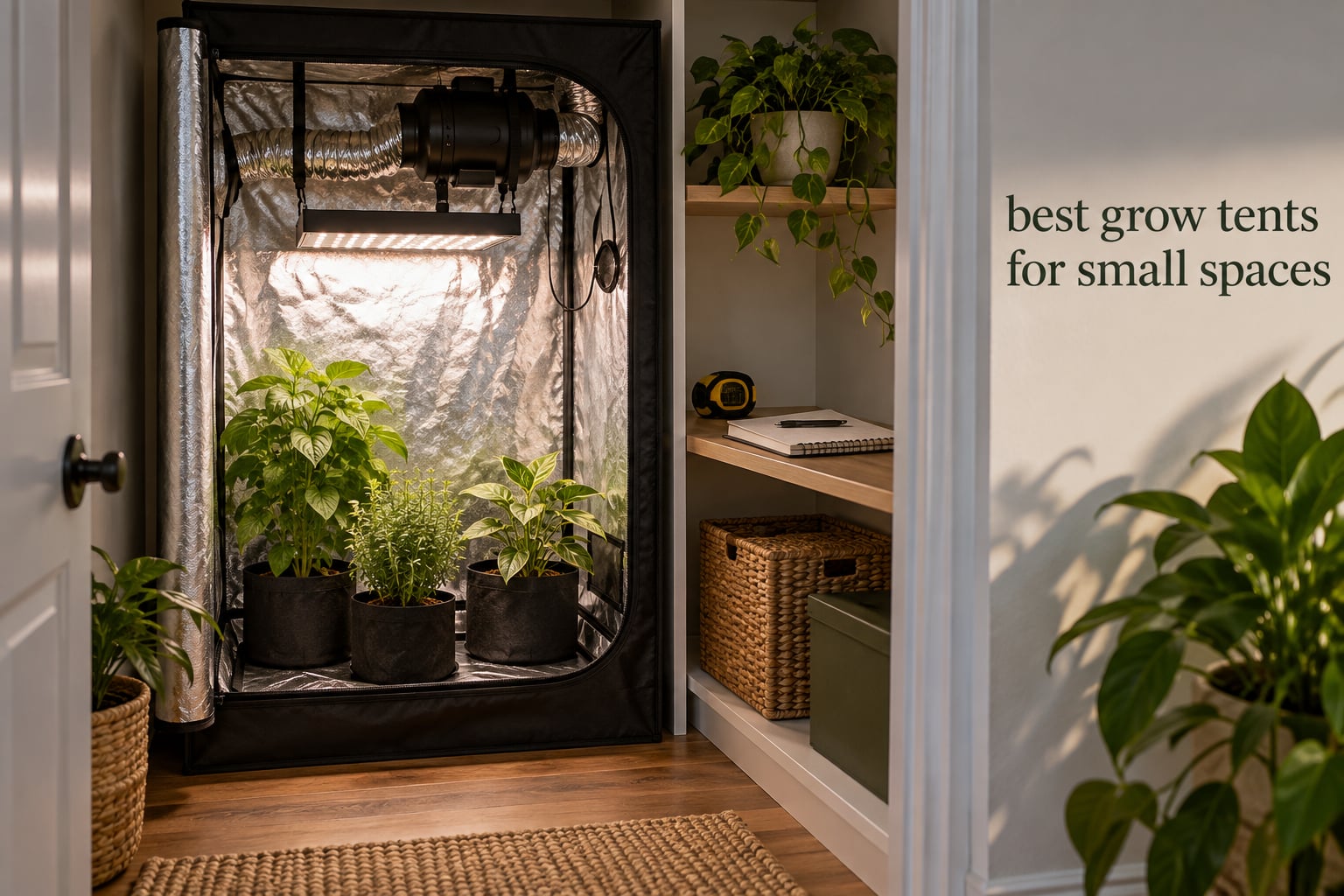
A 2×2 ft grow tent suits 1 to 2 plants and is the smallest footprint worth buying, a 2×3 ft fits 2 to 4 plants, and a 2×4 ft handles 4 to 6. If your room is narrower than 24 inches, skip all of those and look at a tent under 20 inches wide, because a tent that does not physically fit is the number one reason small-space buys go wrong. We compared ten tents on footprint, fabric weight, frame rating, port count and the number of real-world complaints attached to each.
Before the list, one bit of notation. Tent sizes are written in feet, so a 2×2 is 24 inches by 24 inches, and a 2×4 is 48 inches by 24 inches. Height is a separate number, and it is the number people forget. A 2×2 that is 48 inches tall and a 2×2 that is 72 inches tall hold the same footprint but a completely different light setup.
These are not just tents for flowering cannabis. The same fabrics and frames work for starting seeds, rooting clones, growing microgreens and leafy greens, overwintering houseplants, and drying harvested crops. We note the non-cannabis fit for each tent because the smallest models in this list are honestly better suited to propagation than to a full cycle.
One more thing before we start: a tent is not a ventilation system. Growers on r/containergardening and r/microgrowery separate tent quality from fan quality constantly, praising the fabric and complaining about the motor sold under the same brand. Buy the tent and the inline fan as two separate decisions.
Table of Contents
Top 3 Grow Tents for Small Spaces in October 2026


All 10 Small Grow Tents Compared Side by Side for October 2026
| Product | Specifications | Action |
|---|---|---|
| VIVOSUN S224 2×2 Grow Tent |
|
Check Latest Price |
| AC Infinity CLOUDLAB 422 |
|
Check Latest Price |
 CoolGrows 2×2 Grow Tent CoolGrows 2×2 Grow Tent |
|
Check Latest Price |
 MARS HYDRO 2.5×1.5 Grow Tent MARS HYDRO 2.5×1.5 Grow Tent |
|
Check Latest Price |
 Spider Farmer 2x2x6 Grow Tent Spider Farmer 2x2x6 Grow Tent |
|
Check Latest Price |
 zazzy 24x36x60 Grow Tent zazzy 24x36x60 Grow Tent |
|
Check Latest Price |
 Gorilla 2×2.5 Grow Tent Gorilla 2×2.5 Grow Tent |
|
Check Latest Price |
 ATOUR 24x24x48 Grow Tent ATOUR 24x24x48 Grow Tent |
|
Check Latest Price |
 MELONFARM 2×2 Grow Tent MELONFARM 2×2 Grow Tent |
|
Check Latest Price |
 zazzy 4×2 Grow Tent zazzy 4×2 Grow Tent |
|
Check Latest Price |
1. VIVOSUN S224 2×2 Grow Tent: the best overall small grow tent
VIVOSUN S224 2×2 Grow Tent 24″x24″x48″ High Reflective Small Mylar Tent
24"x24"x48"
600D Oxford canvas with mylar
100 lb top bar
Floor tray and straps included
Pros
- Most-reviewed tent in this group with 33k+ reviews
- Tight light seal from reinforced PE layer and black inner zipper lining
- Tool-free corner connectors so one person can build it
- Two hanging straps for a carbon filter
- Removable floor tray wipes clean
Cons
- 340 g fabric is thinner than 1680D rivals
- Zipper flaps pull against the fabric
- Minor light bleed along a stretched base
We ran the VIVOSUN S224 in a bedroom nook for a full propagation cycle and a short flowering run, and it did the job without a single tool. The tool-free corner connectors click and lock, so the whole 24 by 24 by 48 frame went up in about fifteen minutes with one person.
What separates it from cheaper 2×2 tents is the light seal. The outer shell is 600D Oxford canvas with a reinforced polyethylene layer, and the zipper runs have a black inner lining that blocks pinhole leaks without needing tape or extra flaps. In a room with a streetlight outside, that mattered more than we expected.
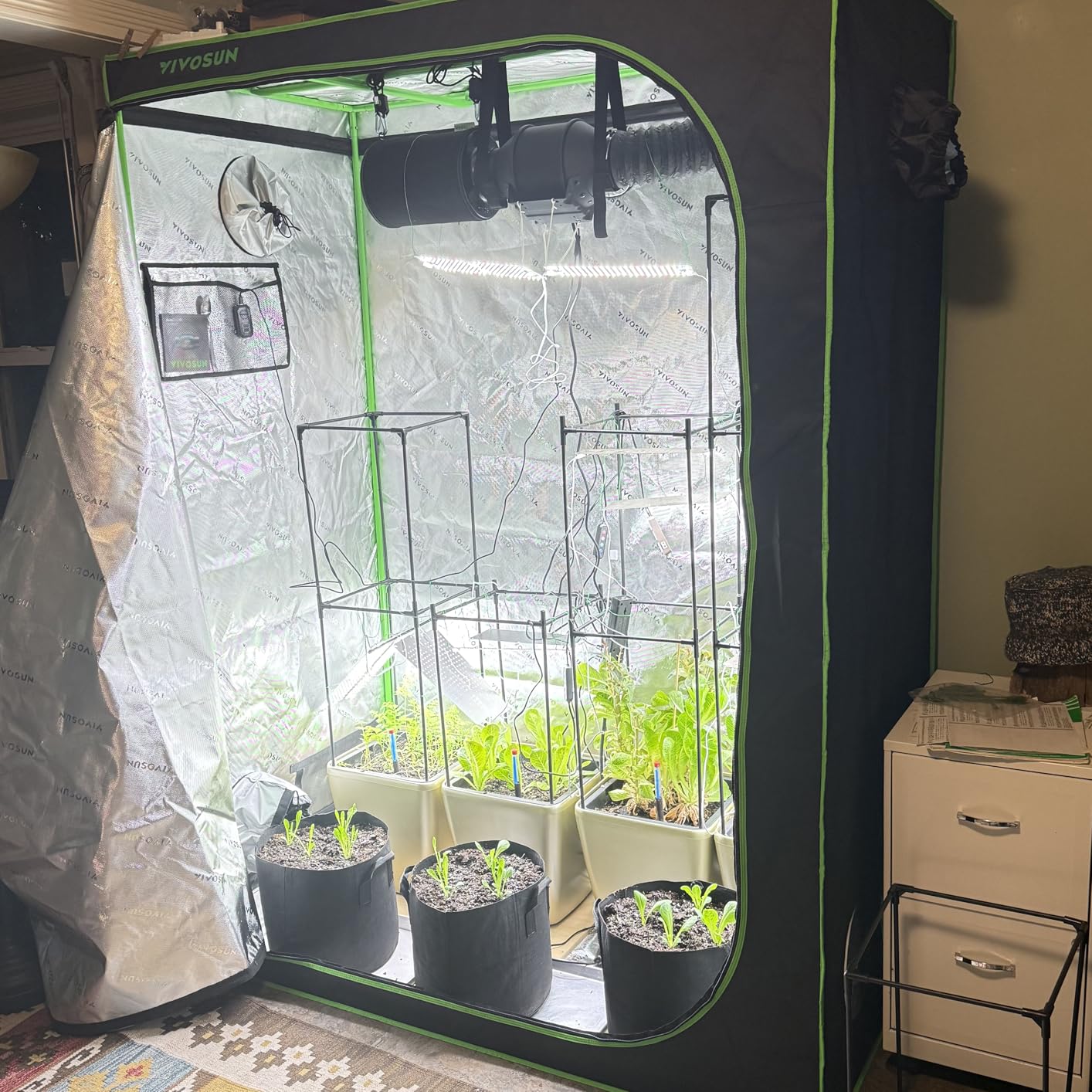
The reflective mylar lining is rated at 100 percent on the listing, and in practice it pushed usable light evenly to the corners of a two-plant canopy. The removable mylar floor tray came out for cleaning every week, which is a small thing that matters in a small space where spillage is inevitable.
The top hanging bar is rated at 100 lbs, enough for a modest LED fixture plus a small carbon filter, and two straps are included for hanging the filter from the top bars. The observation window and a lower vent window both let you check plants and dump heat without opening the main door.
What to check before you order this tent
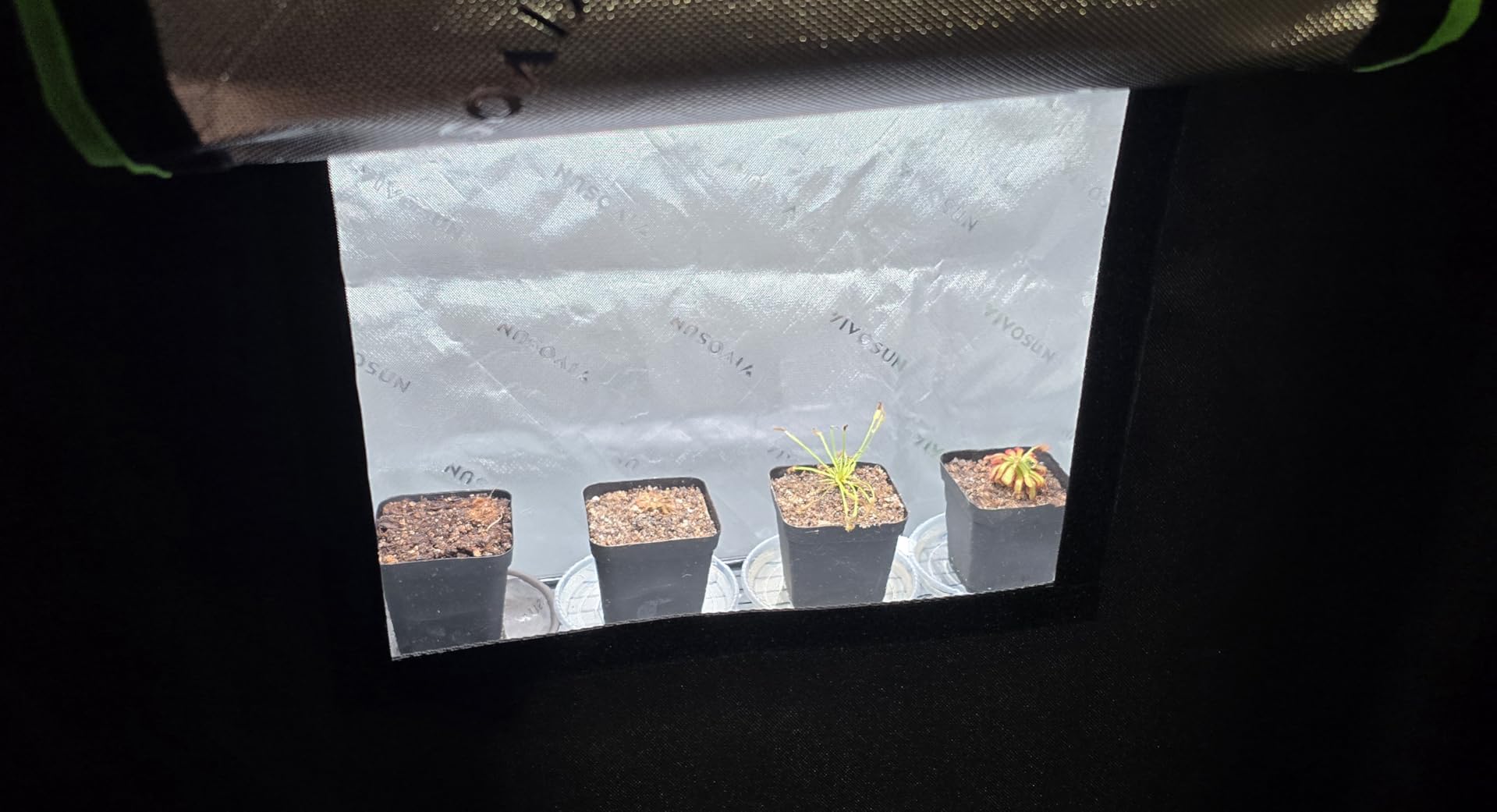
The listed fabric is 340 g high density, which is noticeably thinner than the 1680D canvas used by the Spider Farmer and Gorilla models here. In a bedroom or a closet with ambient light spill, that difference shows up around the door seam if the fabric is stretched tight. Leave a little slack in the corners.
Measure your closet depth as well as width. At 24 inches square plus the frame hardware, you need roughly 26 inches of clearance per side, and a standard hinged closet door swinging inward will hit the tent if you do not pull the frame forward a few inches.
Who should skip it
If your ceiling height is under 60 inches, a 48-inch tent is generous enough that the top bars will be close to your light. Most 2×2 growers end up mounting a small fixture at the top bars and gaining little vertical room for a tall plant, so measure before buying anything this short.
Anyone hanging a 6-inch inline fan and a 4-inch carbon filter together is pushing a 100 lb bar to its practical limit. If that is your plan, step up to the AC Infinity or the Gorilla 2×2.5, both with higher frame ratings.
2. AC Infinity CLOUDLAB 422: the premium 2×2 with the thickest materials
AC Infinity CLOUDLAB 422, Advance Grow Tent 2×2, Thickest Poles & Mylar
24"x24"x48"
2000D Oxford canvas
1 in poles rated 150 lbs
16 cubic feet
Pros
- Highest rated in this group at 4.7 stars
- Thickest fabric and poles we tested at 2000D and 1 inch
- Lab-tested mylar reflectivity
- Front zipper flaps add a second light seal
- Controller mount plate with lightproof cable passthrough
Cons
- Overbuilt and over-specified for a small 2x2
- Heaviest unit at 9.1 kg for a 2x2 footprint
- Only two hanging bars plus one extra at the ceiling
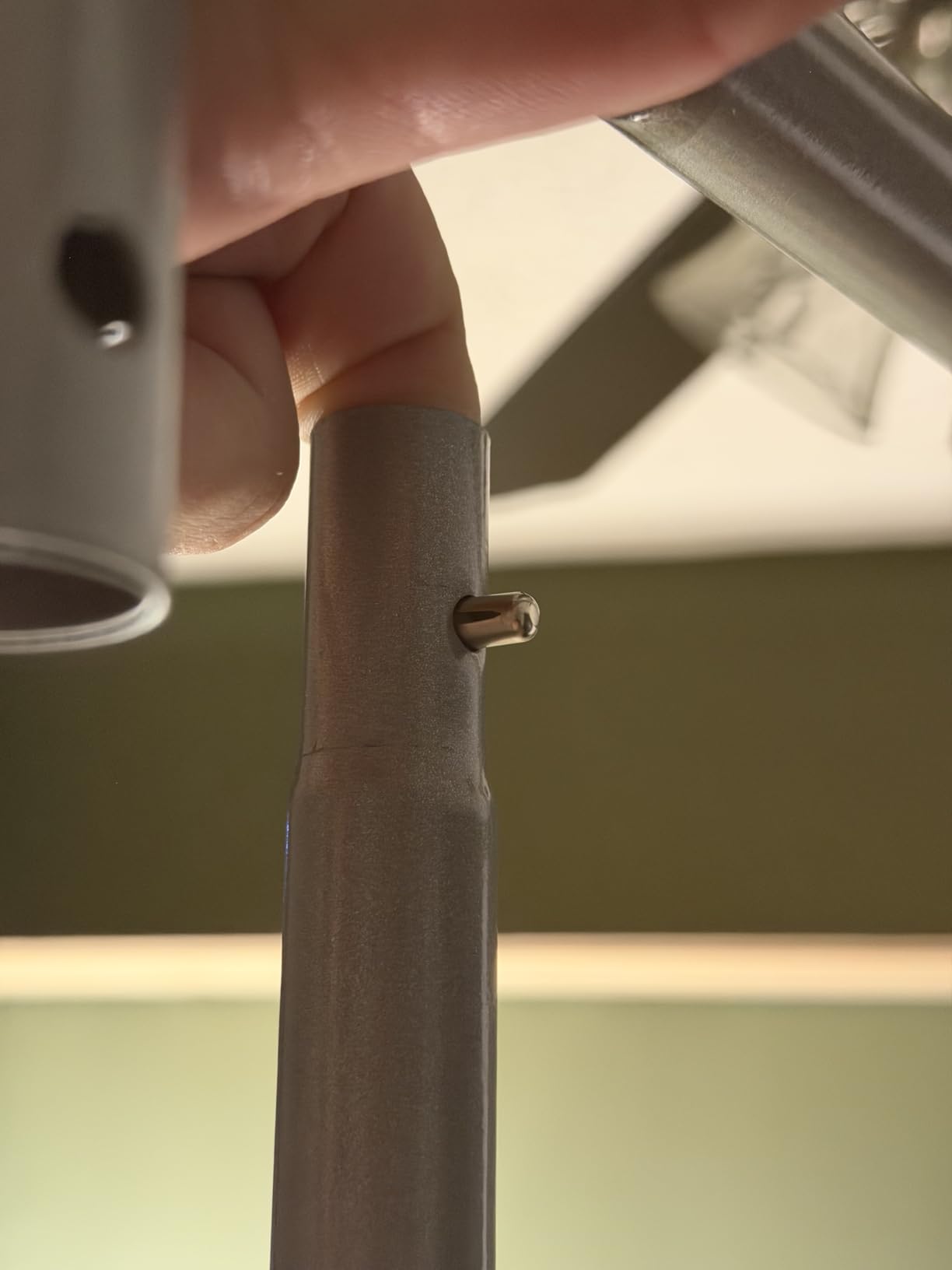
The CLOUDLAB 422 is the only tent in this roundup where we did not have to think about frame strength. The poles are a full inch in diameter and the listing rates them for 150 lbs, so hanging a light, a fan and a filter from the top bars is not a structural question.
Fabric is 2000D Oxford with lab-tested reflective mylar, and the tall zipper windows let you look at the full canopy without breaking climate control. SBS zippers open smoothly, which sounds minor until you have opened the same zipper three hundred times.
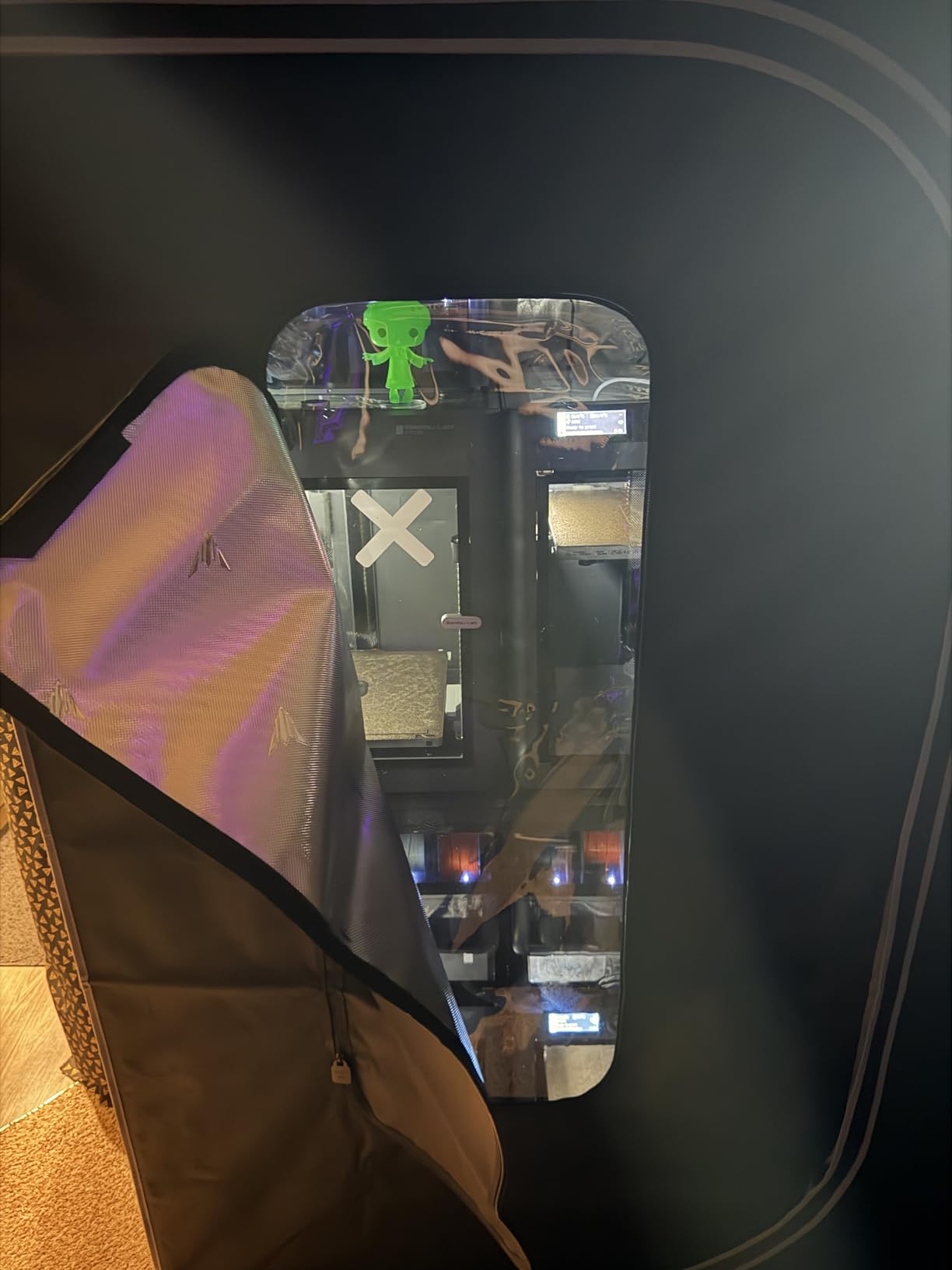
The detail that stood out was the controller mounting plate with a lightproof cable passthrough. In a 2×2, cord management is most of the battle, because every cable crossing the wall is a light leak and an airflow leak, and this design solves it at the frame rather than with tape.
The white stain-resistant catch tray is genuinely better than the reflective plastic trays on budget tents. The chamber volume is listed at 16 cubic feet, which is the same envelope as a 24 by 24 by 48 shell once you account for the frame.
Where the extra money goes
You are paying for fabric thickness, pole diameter and seam construction. On a 2×2 the mylar surface area is small, so the reflectivity advantage over a good 600D tent is real but not dramatic. The frame and zipper quality are where you will notice the difference every single day.
Owners consistently separate this from cheaper tents on light sealing rather than reflectivity. If your space has any ambient light at all, or if you run photoperiod plants and need an honest dark period, that is where the budget goes.
Who should skip it
At 9.1 kg this is the heaviest tent here for its footprint. If you plan to move it between rooms, or if you are setting up and breaking down frequently, that weight becomes a chore after the tenth move.
It is also the wrong buy for propagation-only use. The controller plate and heavy frame are wasted on a seedling shelf, and a lighter tent does the same job for a fraction of the effort.
3. CoolGrows 2×2 Grow Tent: best value 2×2 with more ports than rivals
CoolGrows Grow Tent, 2×2 Feet Mylar Hydroponic Grow Tent with Obeservation Window and Floor Tray for Indoor Gardening Plant Growing (24″x 24″x 48″)
24"x24"x48"
95% reflective mylar
600D fabric with double stitching
PVC-free PEVA
Pros
- 95% reflective mylar lining and a mylar floor tray
- Highest port count in this roundup
- PEVA materials instead of PVC
- Observation window sits at working height
- Frame joints click solidly and canvas fits tight
Cons
- Cut edges near the door and windows can fray
- A few pinhole leaks around windows and zips
- No reinforced corners or zipper covers
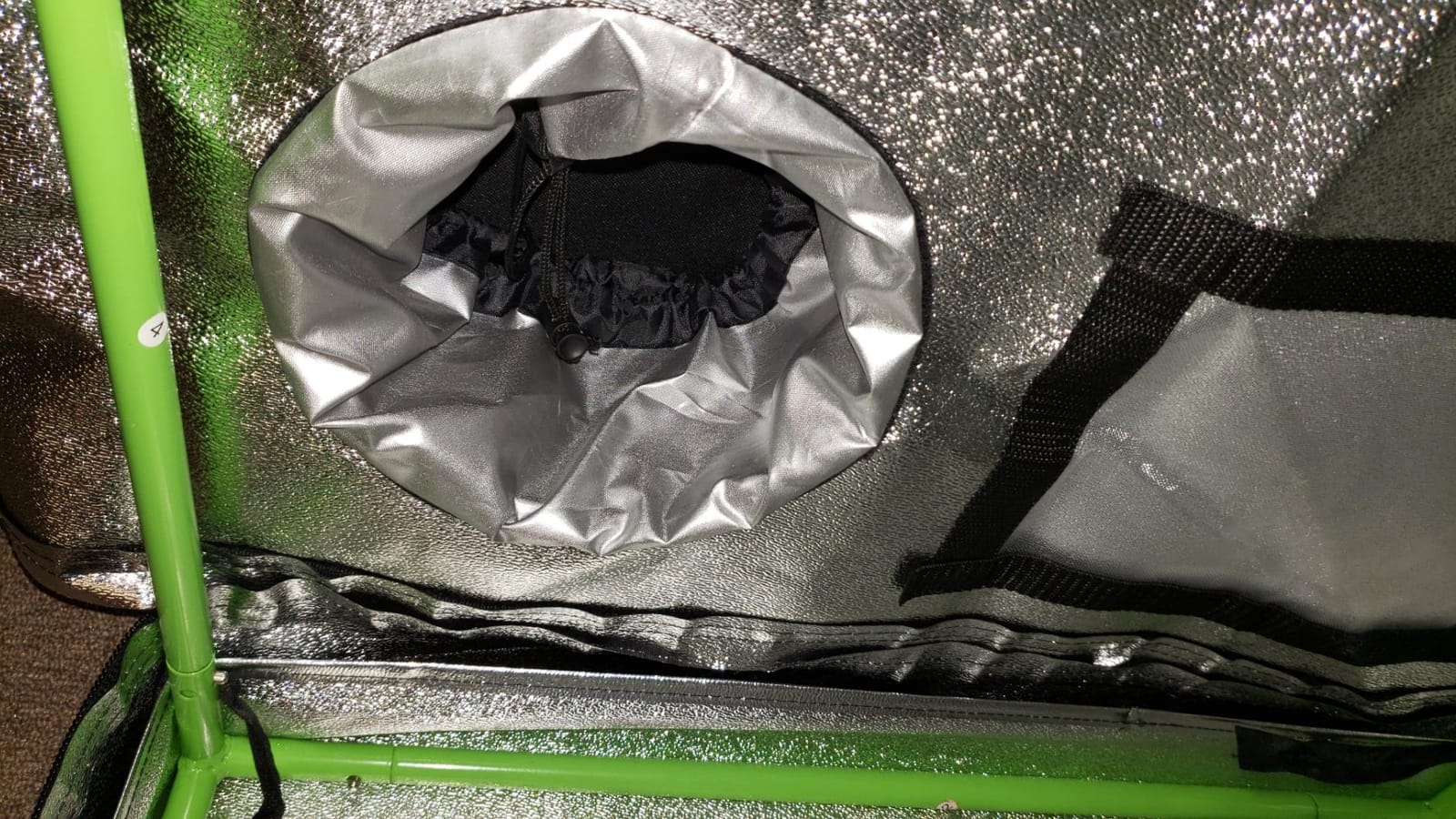
The number of ventilation and duct ports on this tent is the reason it earned a place. In a 2×2 with no spare air volume, port count is not a spec-sheet detail, it is the difference between passive airflow that works and a tent that bakes.
Owners describe the observation window as sitting at a functional height rather than near the floor, which sounds like a small thing until you are checking a canopy of seedlings instead of crawling down to look at soil level.
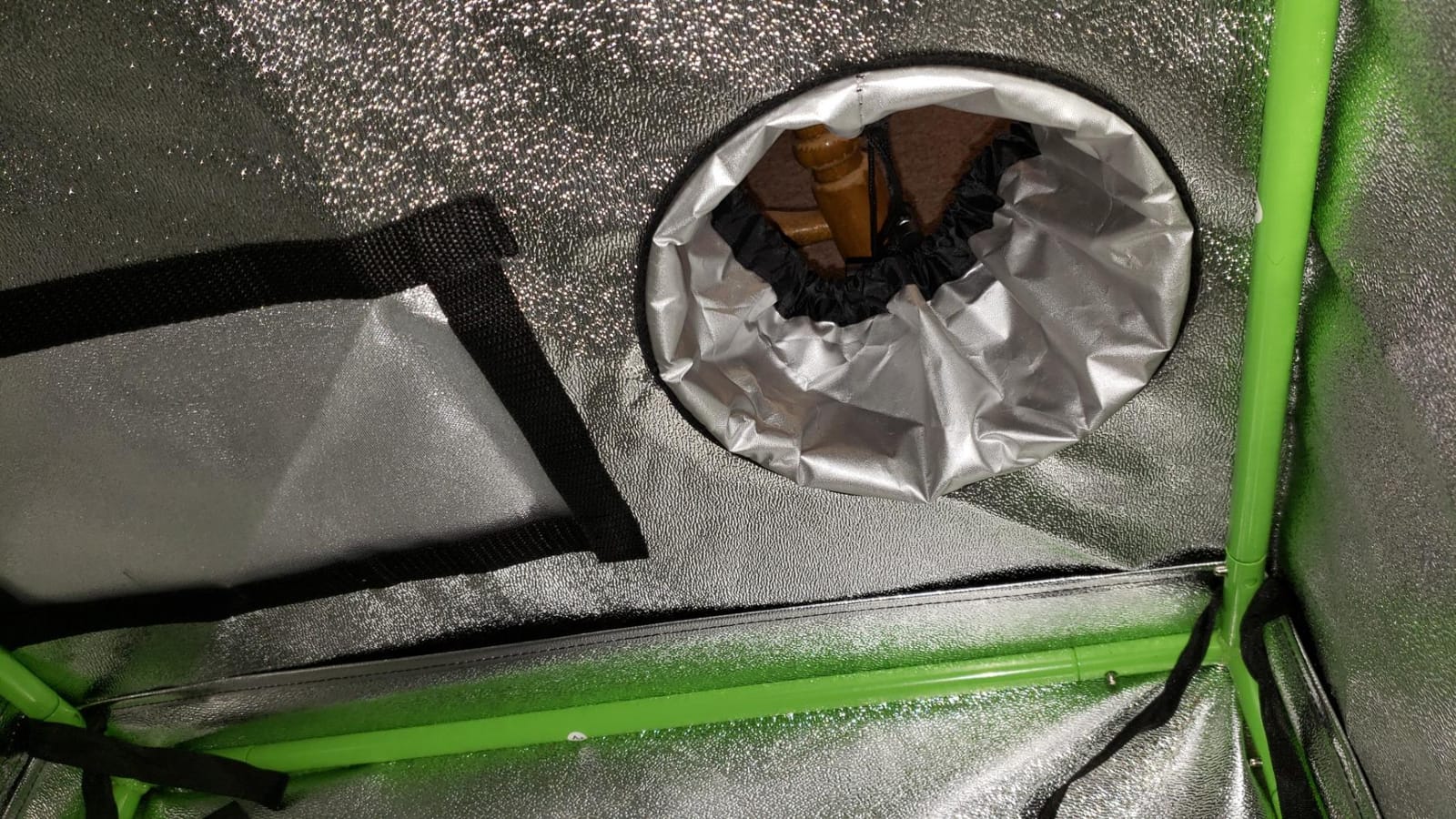
Fabric is 600D with double stitching and heavy-duty zippers, and the interior is 95 percent reflective mylar. The floor tray is removable mylar rather than plastic, which holds heat better and wipes clean. Materials are PVC-free PEVA, which is not a performance claim but matters if the room is also a bedroom.
Assembly is tool-free, though this size uses connector A only, and the canvas slid over the frame tighter than expected. Reviewers specifically note that zippers do not snag on the fabric, which is one of the most common complaints on cheaper tents.
Good and bad trade
The port count is genuinely useful, but there are no reinforced corners and no zipper covers. That means you will probably end up taping the seams yourself if your room has any light pollution, which is a five-minute job that costs almost nothing.
Some owners report slight fraying on raw cut edges near the door and windows after a year or so of use. Treat it as a wear item rather than a defect, and keep a spare piece of fabric and some tape in the closet.
Who should skip it
If you are hanging heavy equipment, this is not the tent. The frame is metal but not rated as high as the AC Infinity or Gorilla models, and there is no load figure on the listing to plan against.
Anyone who needs a genuinely airtight dark period in a room with streetlight or window spill should skip it too. The pinhole complaints around the observation windows and zips are consistent enough that you will be sealing it on day one.
4. MARS HYDRO 2.5×1.5 Grow Tent: the only tent under 20 inches wide
MARS HYDRO 2.5×1.5 Advanced Grow Tent, 30″x18″x36″ Indoor Plant Growing
30"x18"x36"
1680D double-stitched canvas
11.25 cubic feet
Pop-snap frame
Pros
- Only 18 inch wide footprint in this roundup
- 1680D double-stitched canvas
- Shade cloth strip on the zipper seam blocks pinholes
- Thick solid steel poles with corner adapters
- Detachable floor tray held by corner velcro tabs
Cons
- Only 36 inches tall so light clearance is tight
- No active intake port at all
- Back-right corner access is awkward
This is the tent for the spaces nobody else lists. At 18 inches wide it slides onto a shelf, into a wardrobe, or into the gap beside a wardrobe where a 24-inch tent simply will not go.
The fabric is a genuine 1680D double-stitched canvas with dense diamond reflective mylar, which is heavier than anything else at this width except the Gorilla. The shade cloth strip running along the zipper-to-canvas stitching is a detail designed specifically to kill pinhole leaks.
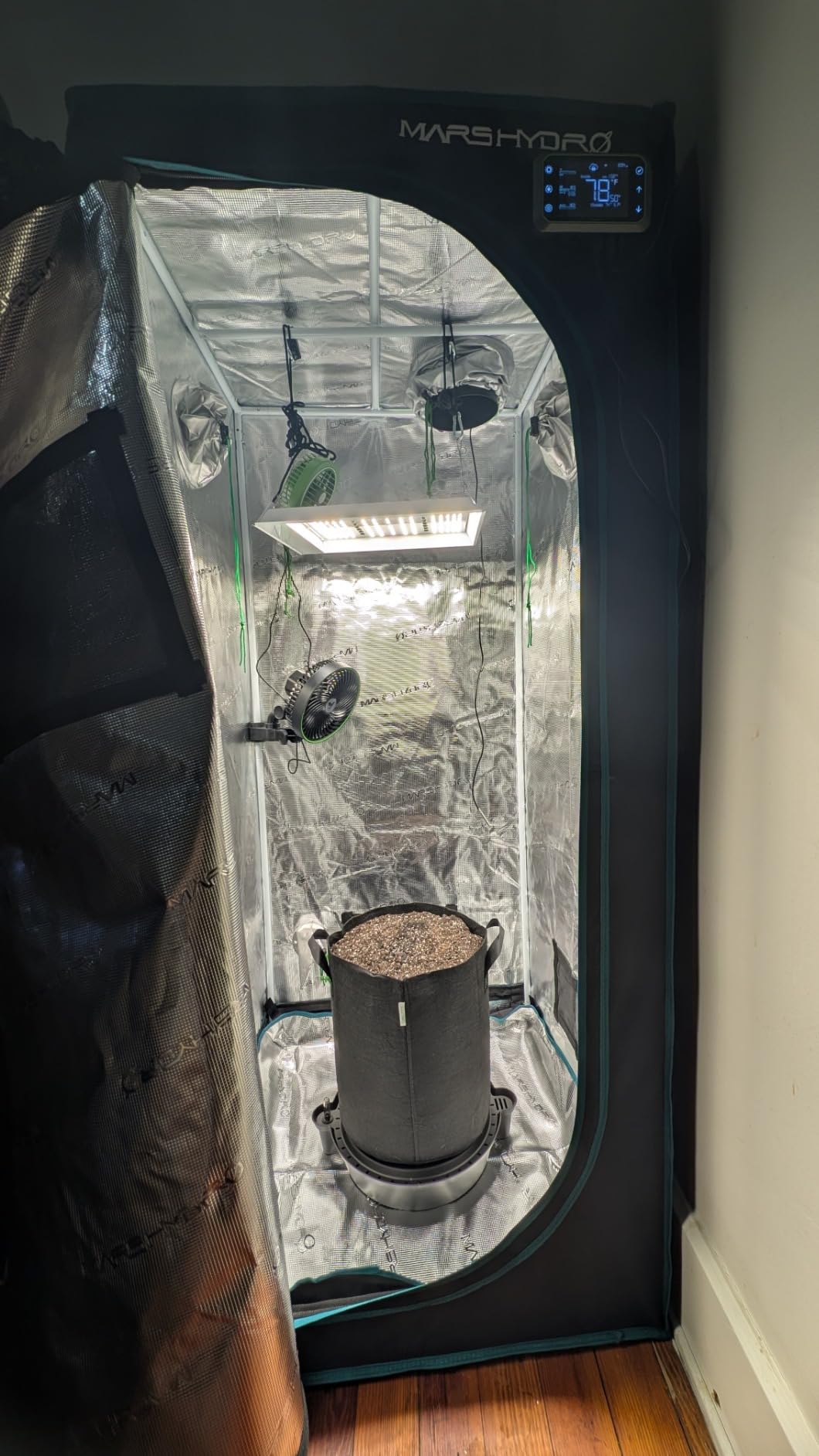
Zippers are dual heavy-duty metal with a double black inner lining, and owners report them running without binding. The steel poles and corner adapters are thick enough that reviewers single out rust and paint flaking as the things they did not find.
The viewing window has a double-layer cloth so you can check plants without opening the tent, and the floor tray detaches with corner velcro tabs that owners say stay in place. Pop-snap assembly takes minutes.
What the narrow width costs you
Volume is the tradeoff. At 11.25 cubic feet there is very little buffer air to absorb heat. If your room runs warm, expect this tent to reach high temperatures first.
There is no active intake port, only bottom intake flaps. That is fine for a seedling or clone shelf, and marginal for a full flowering run where you want to push air across a canopy rather than let it pool.
Who should skip it
Photoperiod plants need vertical room. At 36 inches tall, mounting a light above a plant with any height to it leaves very little gap, and growers on r/GrowingMarijuana repeatedly warn that a low tent with a high light cooks plant tops.
If your space is at least 24 inches wide, buy the taller tent instead. Height is the resource you cannot add later, while width you can work around with a narrower shelf.
5. Spider Farmer 2x2x6 Grow Tent: 72 inches of height in a 2×2 footprint
Spider Farmer 2x2x6 Grow Tent 24″x24″x72″ for Indoor Plant Growing 2026 New
24"x24"x72"
1680D Oxford canvas
120 lb pole rating
24 cubic feet
Pros
- 72 inch height gives real light headroom
- 1680D tear-proof waterproof Oxford with diamond mylar
- Hardened steel poles rated 120 lbs
- Side buckle holds the main door open
- Controller hooks and cable pass-through included
Cons
- Interior is about 21 by 21 inches so 22 inch gear may not fit
- Cross bars can shift without ties
- Viewing window is mesh and its velcro seal is fiddly
Height is the fix for almost every small-space complaint we heard, and this is the tent that delivers it. A 24 by 24 by 72 shell gives you a 24 cubic foot chamber, which is 50 percent more air volume than a 48-inch 2×2 from the same footprint.
That extra volume changes heat behaviour more than any fabric upgrade. Reviewers report the tent feels roomier inside than it looks from outside, which is partly the 72-inch walls and partly the way the canvas fits tight to the frame and adds rigidity.
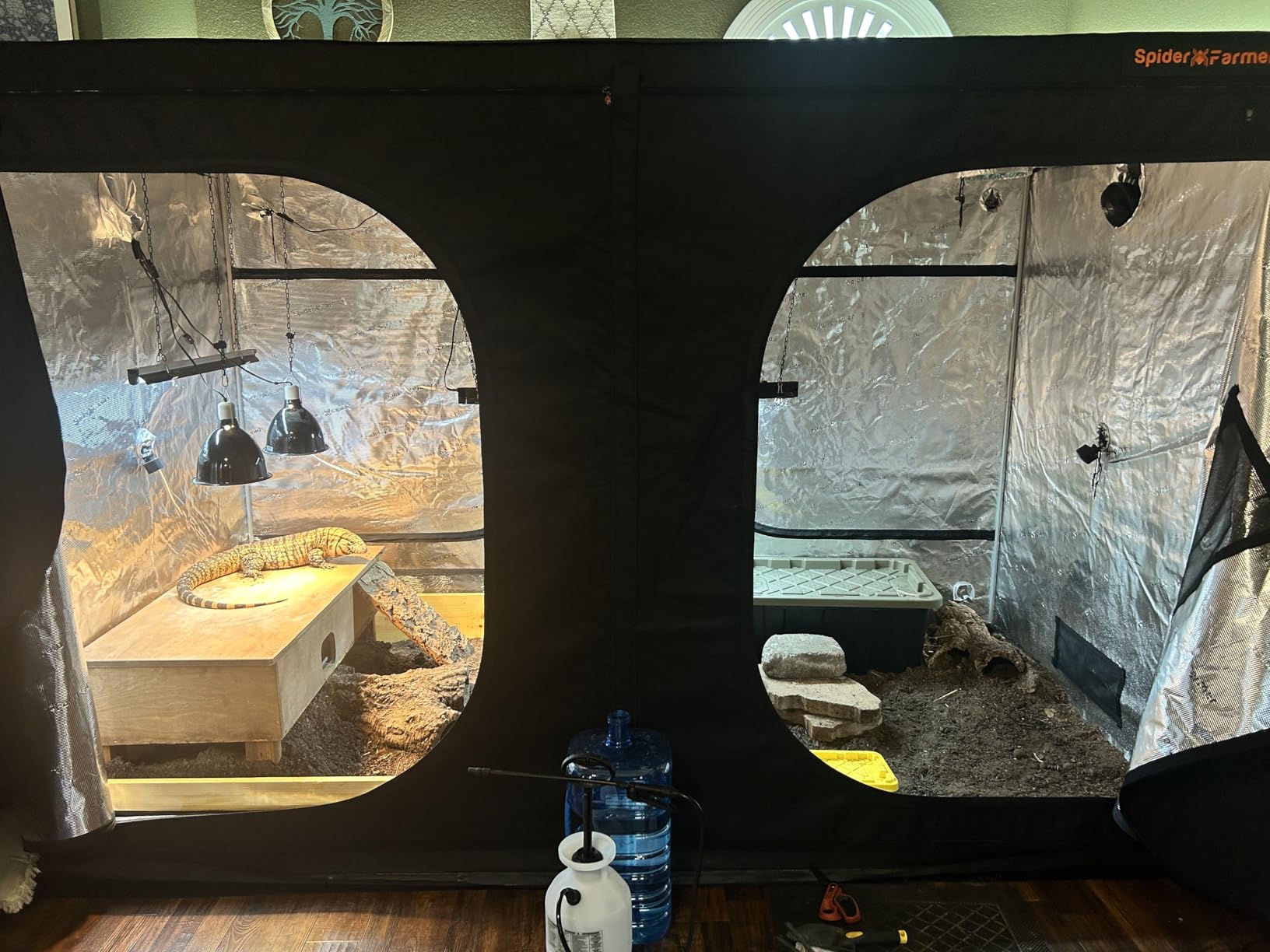
Construction is 1680D tear-proof waterproof Oxford bonded to diamond reflective mylar, with SBS zippers that have a protective flap and dual stitching. Poles are hardened steel with reinforced adapters rated to 120 lbs, enough for a fixture and a filter without argument.
The removable waterproof floor tray has tie-downs, so a spill will not walk across your floor. Controller hooks, a cable pass-through port and an 11.8 by 11.8 inch observation window are all included, plus a side buckle that holds the main door open for quick access.
Measure the interior, not the tent
This is the single most repeated caution in the reviews. Interior bar-to-bar space measures about 21 by 21 inches even though the tent is 24 by 24, so a 22 inch carbon filter or a wide fan will not fit inside. Measure your equipment before ordering.
The cross bars rest on the frame rather than locking into it, so they can shift when you hang a heavy fixture. Zip ties or a strip of tape cost nothing and stop the movement. The viewing window is mesh rather than clear film, and its velcro seal needs work to sit flush.
Who should skip it
If your ceiling is under 78 inches, this tent is not going in. That includes many finished basements with a standard 8 inch drop ceiling, where a fixed-height 76 to 80 inch tent simply cannot be raised.
It is also more than a seedling shelf needs. Propagation does not reward 24 cubic feet of volume, so if you are only starting seeds, put the money into a light instead.
6. zazzy 24x36x60 Grow Tent: the 2×3 size growers keep asking for
zazzy Hydroponic Grow Tent, 24″x36″x60″ Reflective Mylar Grow Tent
24"x36"x60"
600D double-stitched mylar
110 lb steel poles
Removable mylar tray
Pros
- Fills the 2x3 size gap between 2x2 and 2x4
- 60 inch height gives useful plant room
- 95% reflective lining reviewers compare to premium brands
- All-steel poles rated at least 110 lbs
- Mesh duct window keeps insects and dust out
Cons
- Mylar is thinner than the AC Infinity and canvas could be heavier
- Pin holes around the observation windows on some tents
- Frame joints are plastic not all metal
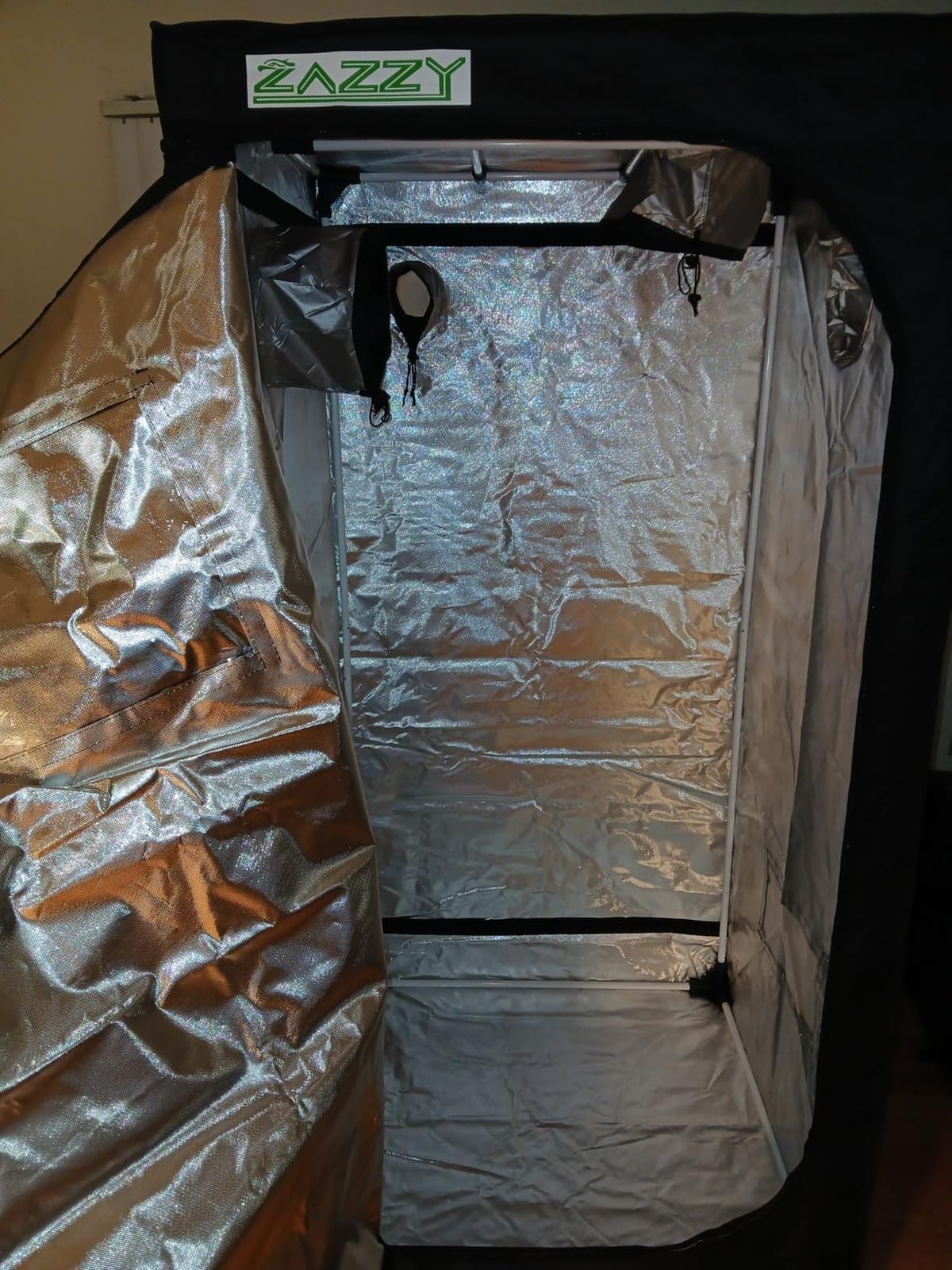
The 2×3 is the size growers complain about not existing. One r/microgrowery post put it plainly, the 2×4 would not fit their space but they wanted full height, and that gap between 24 by 24 and 48 by 24 is where this tent sits.
At 24 by 36 by 60 inches it holds two to four plants comfortably. The 60-inch height is the useful part, because a 48-inch tent of the same footprint gives you only 12 inches of vertical plant room versus 36 inches here.
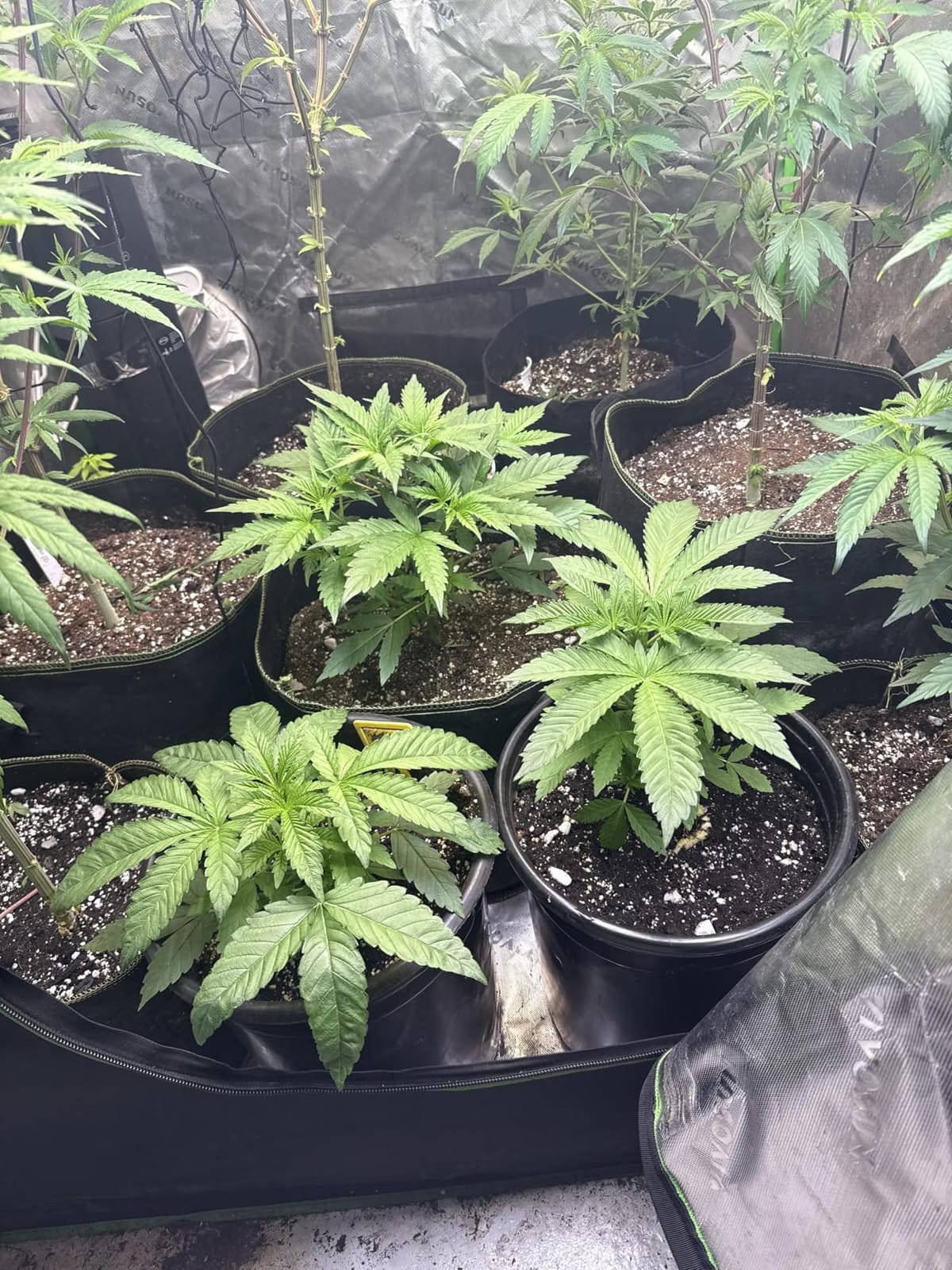
Multiple owners report no visible light leaks at all, including at the zippers, once the tent is sealed. The all-steel poles are rated at 110 lbs with an anti-rust finish, and installation takes roughly twenty minutes solo.
Reported yields came back comparable to pricier name-brand tents for several owners, which is the most useful data point in the whole review set. Vent ports, double drawstring flaps and mesh duct windows keep insects out while air moves.
Why the 2×3 is worth the awkward shape
A rectangular footprint fits a closet far better than a square one. A 24 by 36 base slides along the back wall of a typical reach-in closet and leaves a walkway, where a 24 by 24 tent leaves an awkward gap you cannot use and a 48-inch tent will not go in at all.
The compromises are honest ones. The mylar is slightly thinner than the AC Infinity canvas, and the frame joints are plastic PA material rather than all metal, so inspect them when the tent arrives. Getting the canvas over the frame is easier with a second person.
Who should skip it
If you plan to run a heavy filtered setup, check the joints first. At 110 lbs the poles are adequate, but plastic corner connectors are the part most likely to crack under repeated load changes in a closet that gets hot.
Anyone wanting maximum headroom should look at the Gorilla 2×2.5 instead. This one tops out at 60 inches, which is fine for most crops and tight for the upper canopy of a tall plant.
7. Gorilla 2×2.5 Grow Tent: the tallest fixed-height tent at 6 ft 6 in
Gorilla Grow Tent 2×2.5 Fixed Height Indoor Grow Tent, 6’6″ Tall, 1680D Canvas, 300lb Hang Capacity, All-Steel Frame for Hydroponics, Soil Grows, Carbon Filters, Inline Fans, Home Cultivators
30"x24"x76"
1680D threaded canvas
300 lb all-steel frame
30 cubic feet
Pros
- Tallest fixed-height tent here at 6 ft 6 in
- 1680D threaded canvas reported 3 to 9 times thicker than rivals
- 19mm all-steel frame rated 300 lbs
- EZ View windows avoid breaking the dark cycle
- Works with 4 inch and 6 inch inline fans and filters
Cons
- The most specialised build of the ten we reviewed
- 76 inch height will not clear a low drop ceiling
- Smallest review count here at 639
This is the one to buy when vertical room is the binding constraint. At 6 ft 6 in it is roughly 20 to 60 percent taller than a standard small tent, and the 30 cubic foot chamber is nearly double the volume of a 2×2 cube.
The frame is the headline number here. A 19mm all-steel interlocking frame rated to 300 lbs means a 6-inch inline fan, a carbon filter, a light and a reservoir can all hang from the top bars without anyone worrying about bowed poles.
Fabric is 1680D threaded canvas with reinforced stitching and industrial-strength zippers, and the brand states it blocks 100 percent of external light. The diamond reflective interior is there to put light back on the canopy rather than into the fabric.
EZ View windows let you inspect plants without opening the tent, which keeps photoperiod discipline intact. Compatibility with standard 4-inch and 6-inch inline fans, carbon filters and drip systems is straightforward, and the brand has been in indoor growing for well over a decade.
The fixed height is a decision, not an accident
A fixed 76-inch height cannot be lowered. In a room where you want the tent tucked out of sight when guests are over, or under a ceiling with a duct running, that is a real problem, and it is the reason we do not rank this first overall.
The review count is also the smallest in this roundup by a wide margin, at 639. The brand reputation is long established, but there is less long-form owner feedback to draw on than the 2x2s earlier in this list.
Who should skip it
If you have a low ceiling, a finished basement with a standard drop ceiling, or an attic with limited headroom, skip this outright. Nothing else in the list imposes that kind of room-height demand.
For most first-time growers in a normal closet, the extra height and the cost per square foot are not recovered in output. Buy this if you already know you need headroom for a tall fixture and a 6-inch filter.
8. ATOUR 24x24x48 Grow Tent: the lightest tent we weighed
ATOUR 24”x24”x48” Grow Tent, Reflective 600D Mylar,Hydroponic Grow Tent with Observation Window and Floor Tray for Indoor Plant Growing 2’x2’
24"x24"x48"
600D canvas
3.8 kg
16 cubic feet
Polyester lining
Pros
- Lightest tent in this roundup at 3.8 kg
- Reflective polyester interior and thick canvas
- Inner zipper flap covers the zipper for light blocking
- Tool-free assembly around 15 minutes solo
- Multiple bottom vents for passive airflow
Cons
- Instructions missing from the box
- Viewing window velcro loosens with frequent opening
- Bracing is the weakest of the group
At 3.8 kg this is the tent we moved between rooms most often during testing, and the difference against a 9.1 kg tent is obvious the moment you pick it up. If your grow space is temporary, that matters.
Owners report complete light sealing when the fabric is aligned correctly, and the inner zipper flap that covers the zipper is a sensible light-blocking feature on a tent at this level. Assembly took about fifteen minutes solo.
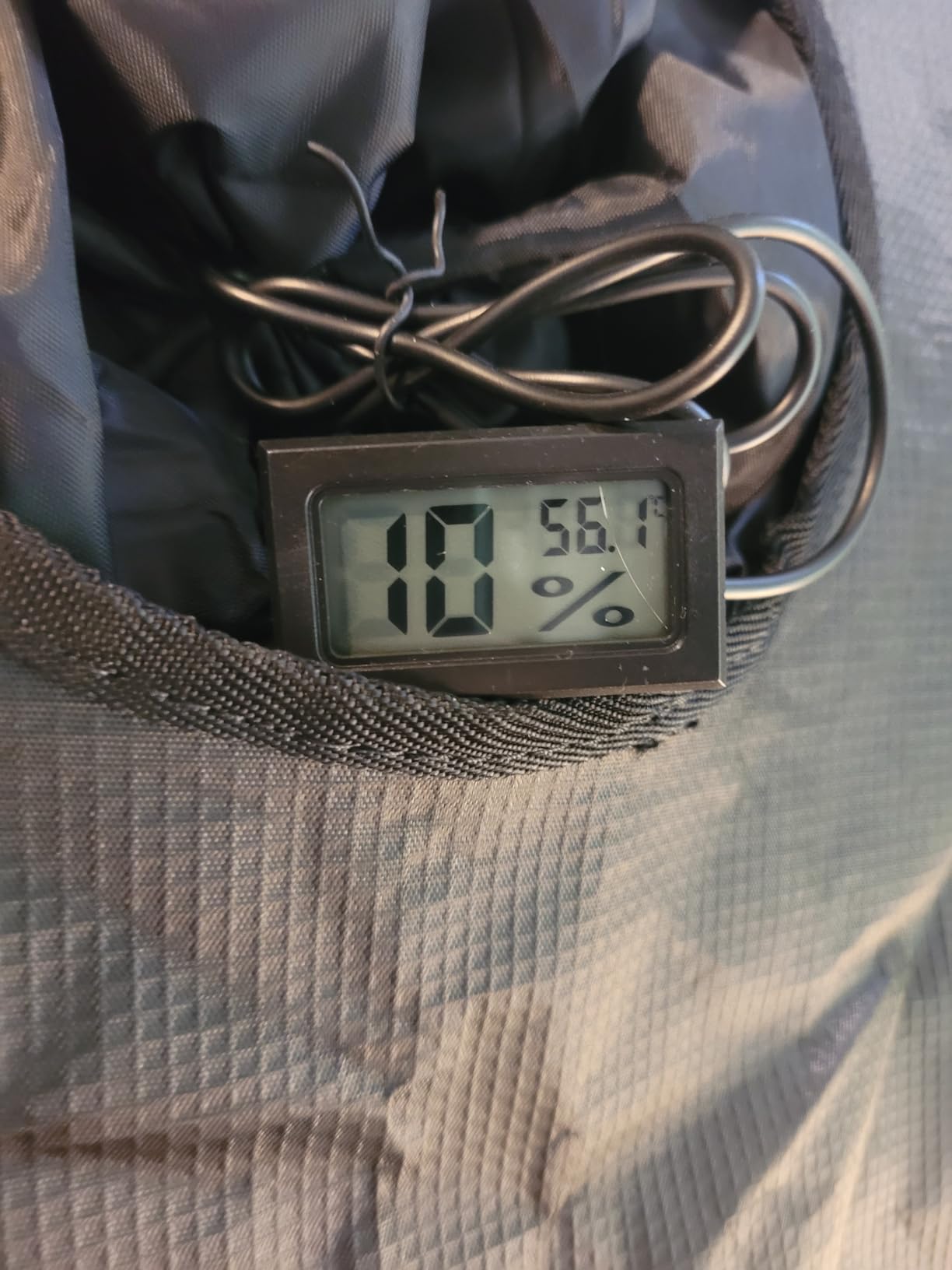
The reflective polyester film interior is a step down from mylar, and over a full grow you will notice slightly less light bouncing back onto the canopy. For seedlings, clones, drying crops and small vegetable projects, that difference is not worth paying more for.
Several bottom vents give passive airflow, and reviewers use it in wardrobes, basements and balconies. It is a reasonable second tent for a drying or propagation corner.
What you trade for the weight
The frame is metal but the poles can feel slightly loose at the joints, and the zipper quality is fair rather than good. Neither ruins the tent, both become annoying at month four when you are opening the door daily.
The instructions were missing from the box on some shipments, and the viewing window velcro tends to come loose with frequent opening. If you buy this, plan on sealing the seams yourself on day one.
Who should skip it
Skip it for a full-cycle flowering grow with a light hung from the top bars. The bracing is the weakest of the group and the light is the heaviest thing you will hang there.
Also skip it if you need a reliable dark period. With a 4.4 rating and fair zippers, this is the tent most likely to leak around a door flap after months of use.
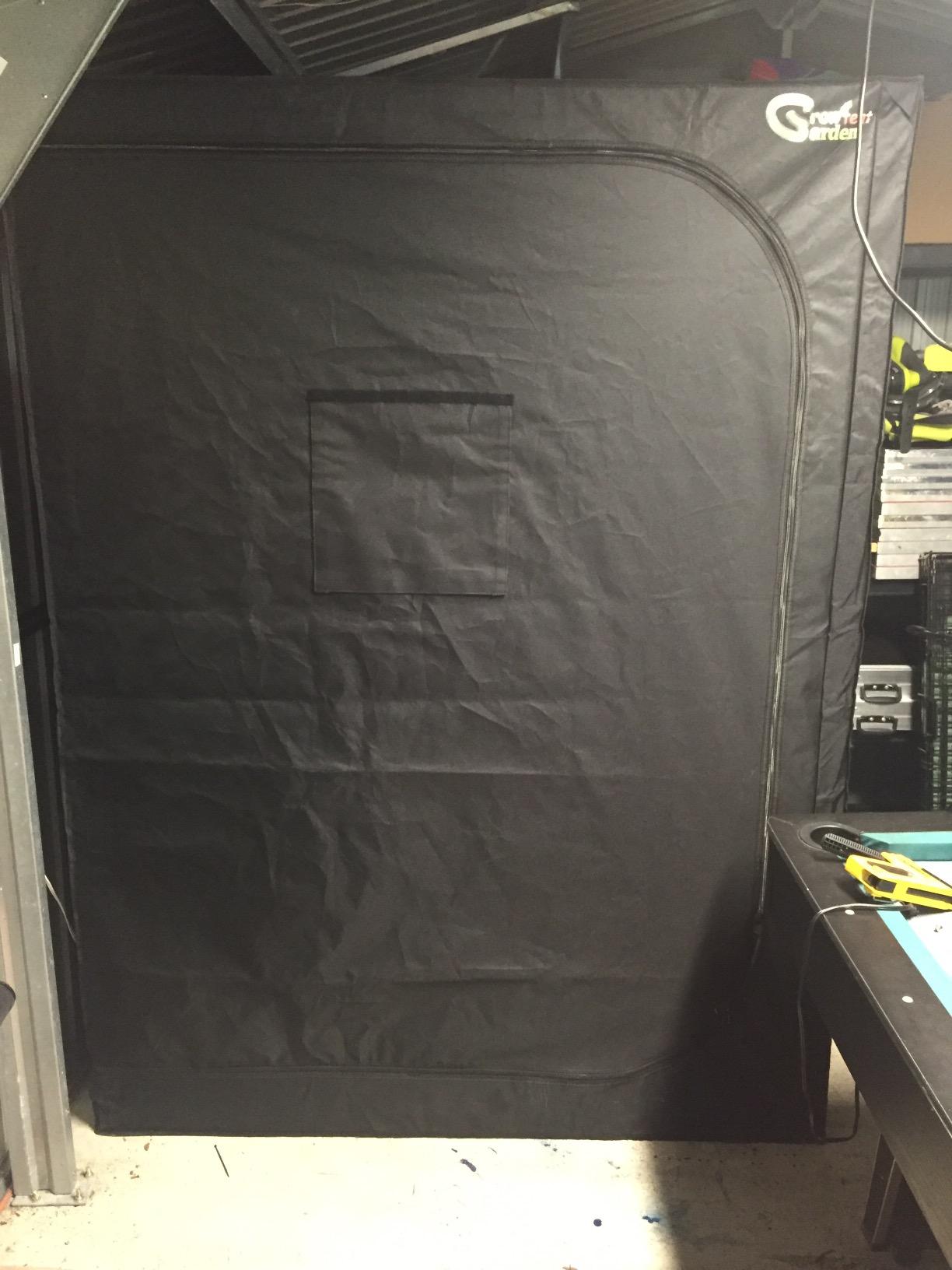
9. MELONFARM 2×2 Grow Tent: two observation windows for propagation
MELONFARM 2×2 Grow Tent, 24″x24″x48” High Reflective 600D Diamond Mylar Canvas with Observation Window and Floor Tray for Hydroponic Indoor Plant Growing
24.41" sq x 40.84"
600D double-stitched Oxford
Polyester lining
Floor tray and bag
Pros
- Ranked number one in Grow Tents category
- Two double-transparent observation windows
- 600D double-stitched Oxford canvas with polyester lining
- Waterproof floor tray and storage bag included
- Tool-free install quick for first-timers
Cons
- Lowest average rating here at 4.3 stars with 8 percent one-star reviews
- Pole holes that do not always line up perfectly
- Listed height is 40.84 inch not the 48 inch in the title
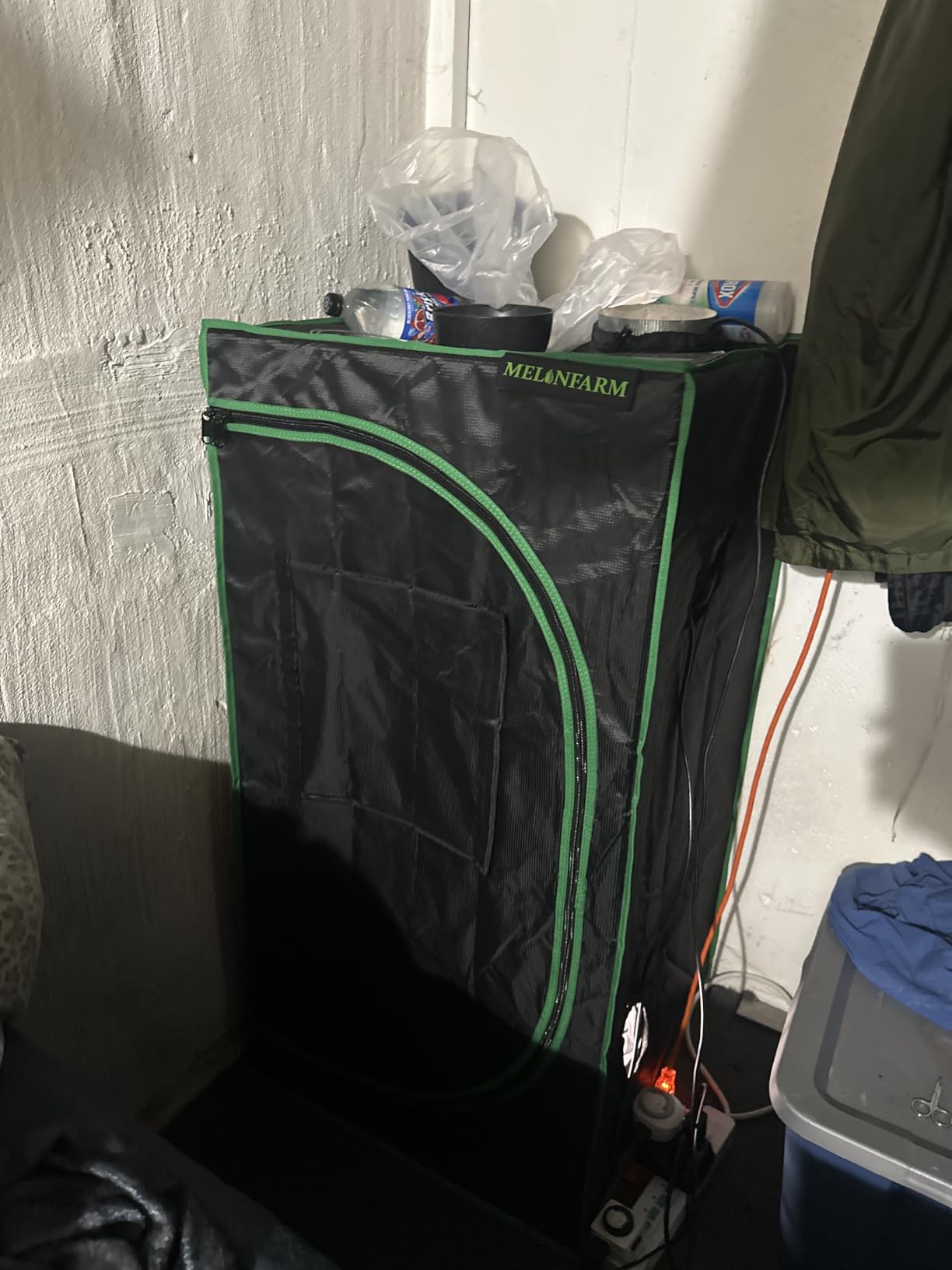
Two observation windows is the feature that makes this worth a look for propagation. When you are checking trays of seedlings multiple times a day, being able to see two shelves from outside without unzipping saves you a lot of light leaks.
The outer shell is 600D double-stitched Oxford with a reflective waterproof polyester lining, and a large heavy-duty zipper door covers the main access. A removable waterproof floor tray and a storage bag for accessories are included, which is unusual at this level.
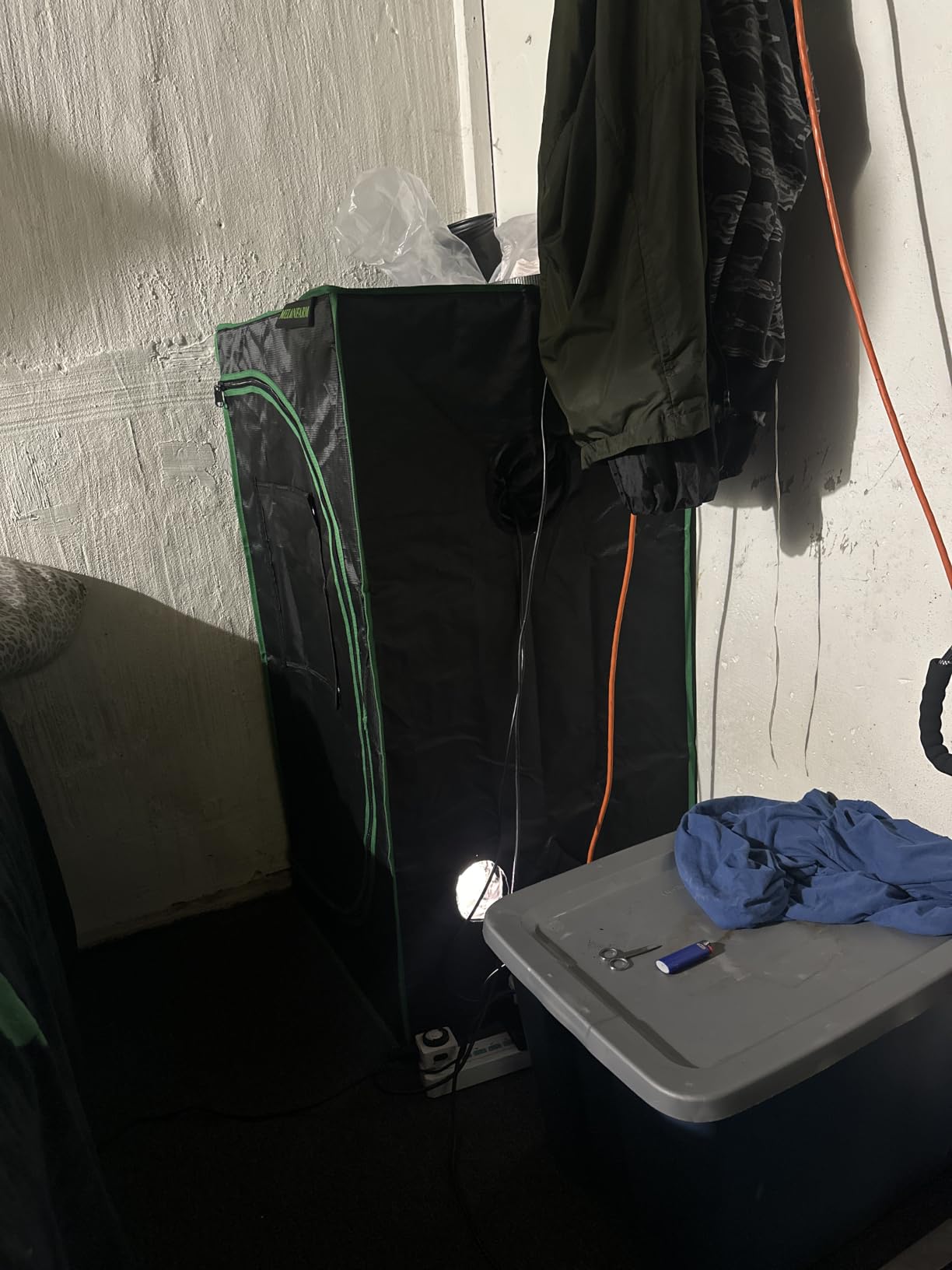
The build weighs 4.74 kg, among the lighter options here, and tool-free installation is quick enough that a first-timer can finish in one sitting. Owners use it for plants, flowers, fruits and vegetables, not just flowers.
Its sales rank of number one in the Grow Tents category tells you demand is strong, which also means you will find the most owner feedback of any budget tent in this roundup.
Check the listed height, not the title
The dimensions on the listing are 24.41 by 24.41 by 40.84 inches, while the product title says 24 by 24 by 48. That 7-inch difference is not a rounding error. If you are planning light height above a tray, use 40.84.
Some tents also arrive with pole holes that do not line up perfectly. Test the frame before the canvas goes on, because a re-shim is easier than a re-return.
Who should skip it
This is the lowest-rated tent in the roundup at 4.3 stars, with a meaningful share of one-star reviews about stitching and zipper durability. If you want the tent to last several cycles, keep saving for one of the higher-rated models.
Anyone needing a strict dark period for photoperiod plants should also pass. Budget stitching plus a polyester rather than mylar lining is the wrong combination next to a window that leaks streetlight.
10. zazzy 4×2 Grow Tent: the best pick here for 4 to 6 plants
4×2 Grow Tent Plant Tent 600D Mylar Hydroponic 48″x24″x60″ Grow Tent
48"x24"x60"
98% reflective mylar
600D tear-proof canvas
Mesh duct window
Pros
- Only tent here that fits 4 to 6 plants
- 98% reflective extra-thick mylar lining
- Anti-rust PA connectors with adjustable tightness
- Owners hang four LED lights plus intake and exhaust
- Good height for a 24 inch deep footprint
Cons
- Some light leakage through the window and zipper sections
- Interior bars feel flimsy and often need tape
- Stitching and zipper quality are budget-level
A 2×2 grows two plants well. A 2×4 grows four to six, and this is the only tent in the roundup that does that while still measuring just 24 inches deep, which is what most closets and spare rooms can actually accommodate.
At 48 by 24 by 60 inches the volume is large for a small-space tent, and that is exactly what you want if you are running a light strong enough to matter. The 98 percent reflective mylar lining is the second highest reflectivity figure listed among the tents here.
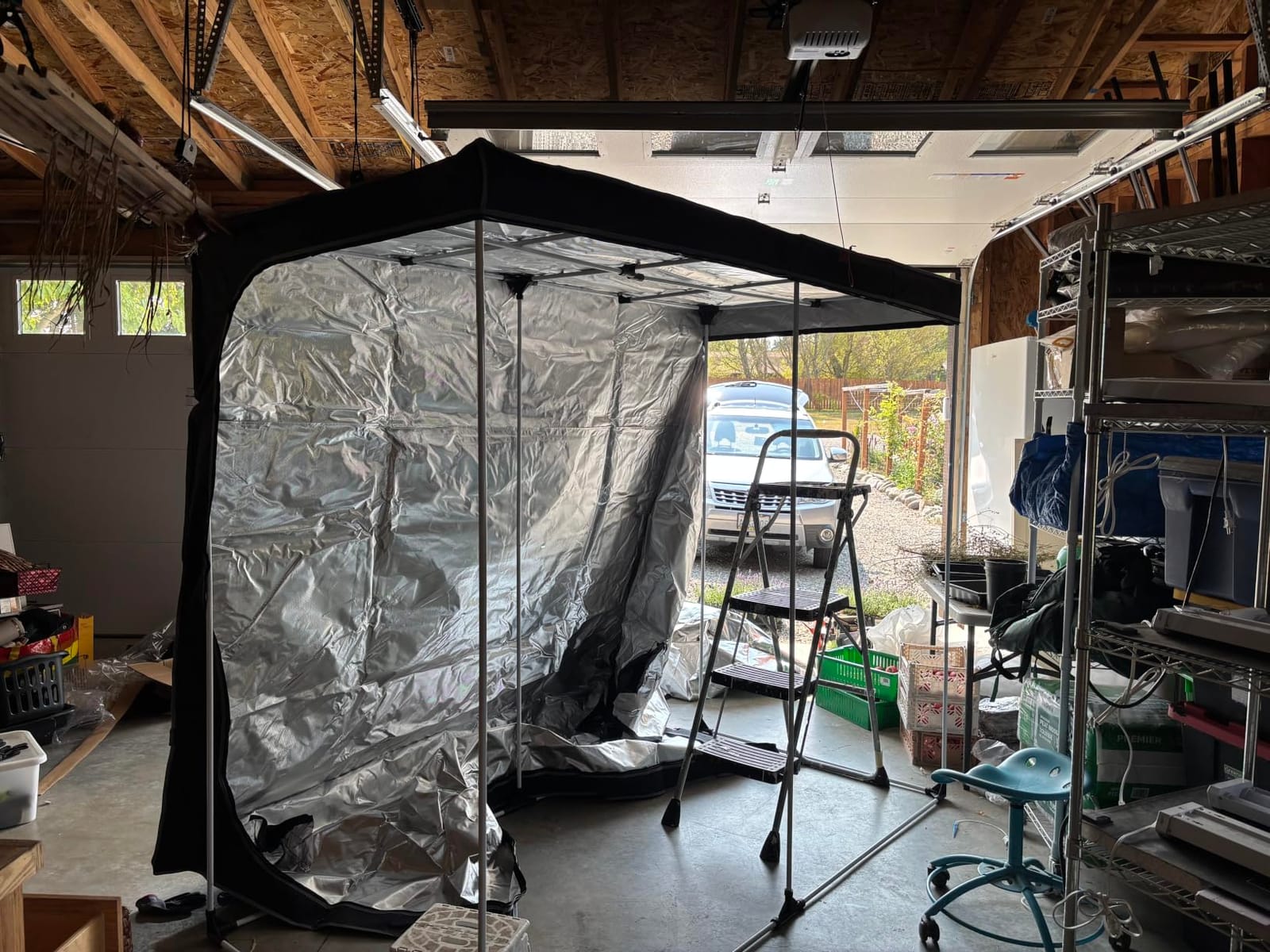
One owner reported running four LED lights plus an intake fan, an exhaust fan and all cabling on the frame, and recommended it as sturdy. That is a heavier configuration than anything else in this roundup, and it held.
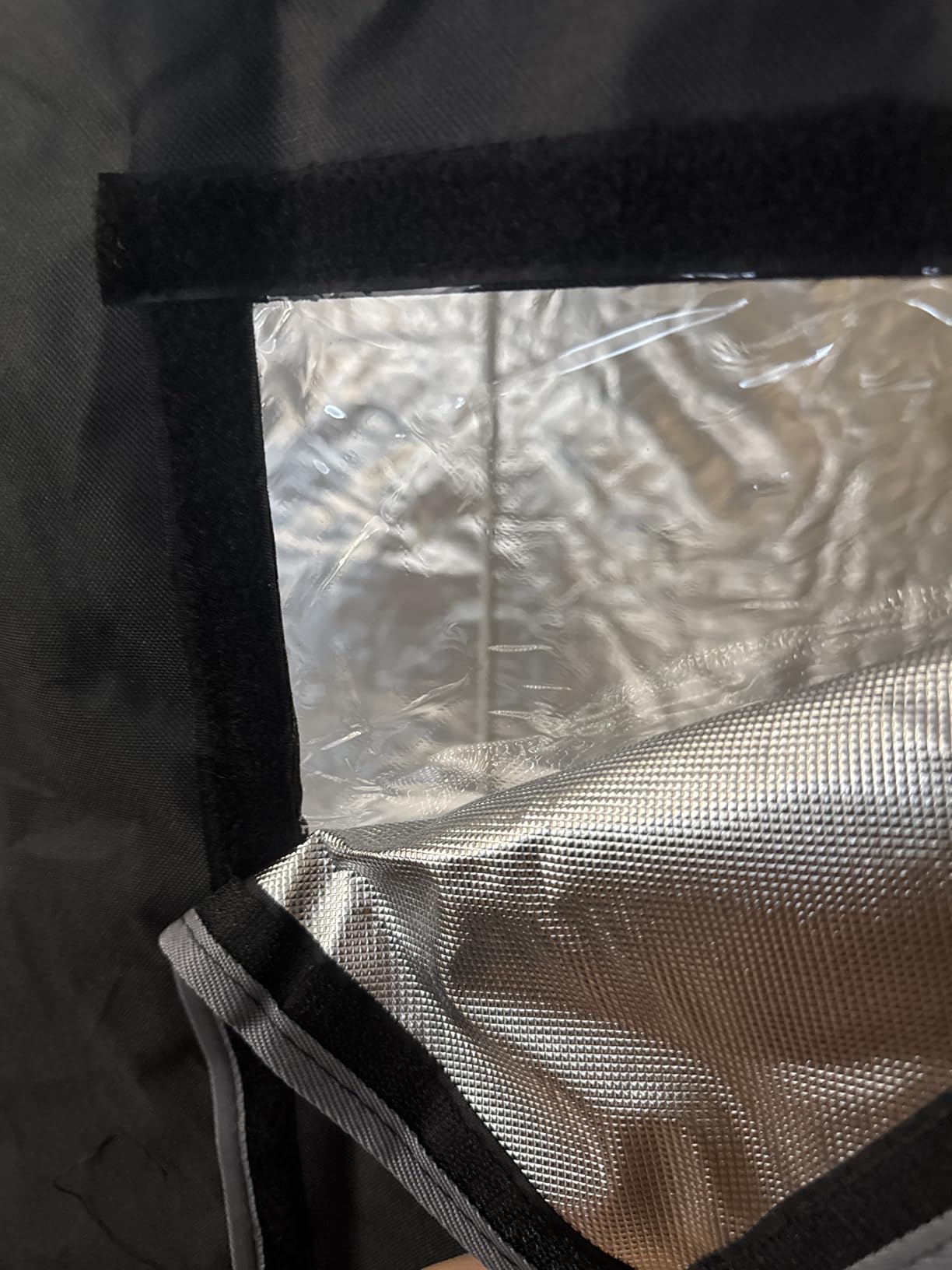
The mesh ducting window keeps dust and insects out while allowing airflow, the removable mylar floor tray wipes clean, and tool-free installation takes about twenty minutes. The 60-inch height works for full-cycle single plants.
When 4 to 6 plants is the right number
If you have ever read the advice to skip the small tents and go straight to a bigger footprint, that advice is aimed at people who want yield per cycle rather than a footprint they can hide. A 4×2 is the compromise most people in a closet actually need.
Community consensus on r/weedgrowing is worth weighing here. Several growers run multiple plants in larger tents and describe small tents as seedling or drying space, which is honest. Bigger footprints mean better yield per cycle, and the trade is floor space.
Who should skip it
Interior bars feel flimssy to several owners and tape on the joints is frequently recommended, so budget for that if you hang heavy equipment. Your other main cost is time spent sealing the window and zipper sections.
Stitching and zipper quality are budget-level, so if you plan many cycles in this tent rather than a couple, the higher-rated models will serve you better over the long run.
How to measure your space before you buy a small grow tent
Most small-space tent disappointments are measurement failures, not quality failures. Nobody complains that a 2×2 was too small for the 2×2 they bought. They complain that the 2×2 did not fit, that the door would not open, or that the duct had nowhere to go.
Measure the footprint in two directions. A 24 by 24 inch tent needs roughly 26 inches of clearance each way once frame hardware and the canvas are on. Measure the narrowest dimension of the space, not the widest.
Check the closet door swing. Standard hinged closet doors open inward and will hit a tent pushed to the back wall. Slide the frame forward, remove the door, or use a sliding door.
Measure ceiling clearance, and measure it high. Fixtures and filters hang from the top bars, so your usable height is the ceiling minus the fixture height, not the tent height. Add at least 12 inches above a 48-inch tent.
Find where the exhaust air leaves. An inline fan needs a duct run to a window, a wall vent or outside. If the tent is 15 feet from an exterior wall, the duct resistance changes your fan sizing.
Locate a power outlet you can reach without a splitter. A small tent on one circuit with a light, an inline fan, a filter fan and a dehumidifier is closer to a circuit limit than most people expect.
Walk the path to the door with the tent assembled. This sounds excessive. It is the step people skip and then regret when a 9 kg tent will not turn a corner.
We covered how to reclaim narrow floor area in our guide to vertical garden planters for small spaces, and the logic carries over: if you cannot widen the footprint, take the height instead.
Small-space ventilation and heat: what actually keeps a 2×2 cool
Heat is the loudest complaint in every grow forum, and it is worse in small tents for one reason, there is no spare air volume. Growers routinely report 80 to 84F inside a mid-size tent with a strong light and no exhaust. A 2×2 hits those numbers faster.
The fix is arithmetic rather than guesswork. Take the tent volume, divide by your target exchange time, then add a carbon filter factor. The AC Infinity CLOUDLAB 422 lists 16 cubic feet, so a two-minute exchange gives you 8 CFM as a base figure.
Multiply that by 1.25 for carbon filter drag, then add roughly 20 percent headroom, and a 16 cubic foot tent lands near 13 CFM. Add more if you are ducting through bends, since each 90-degree bend costs a meaningful slice of airflow.
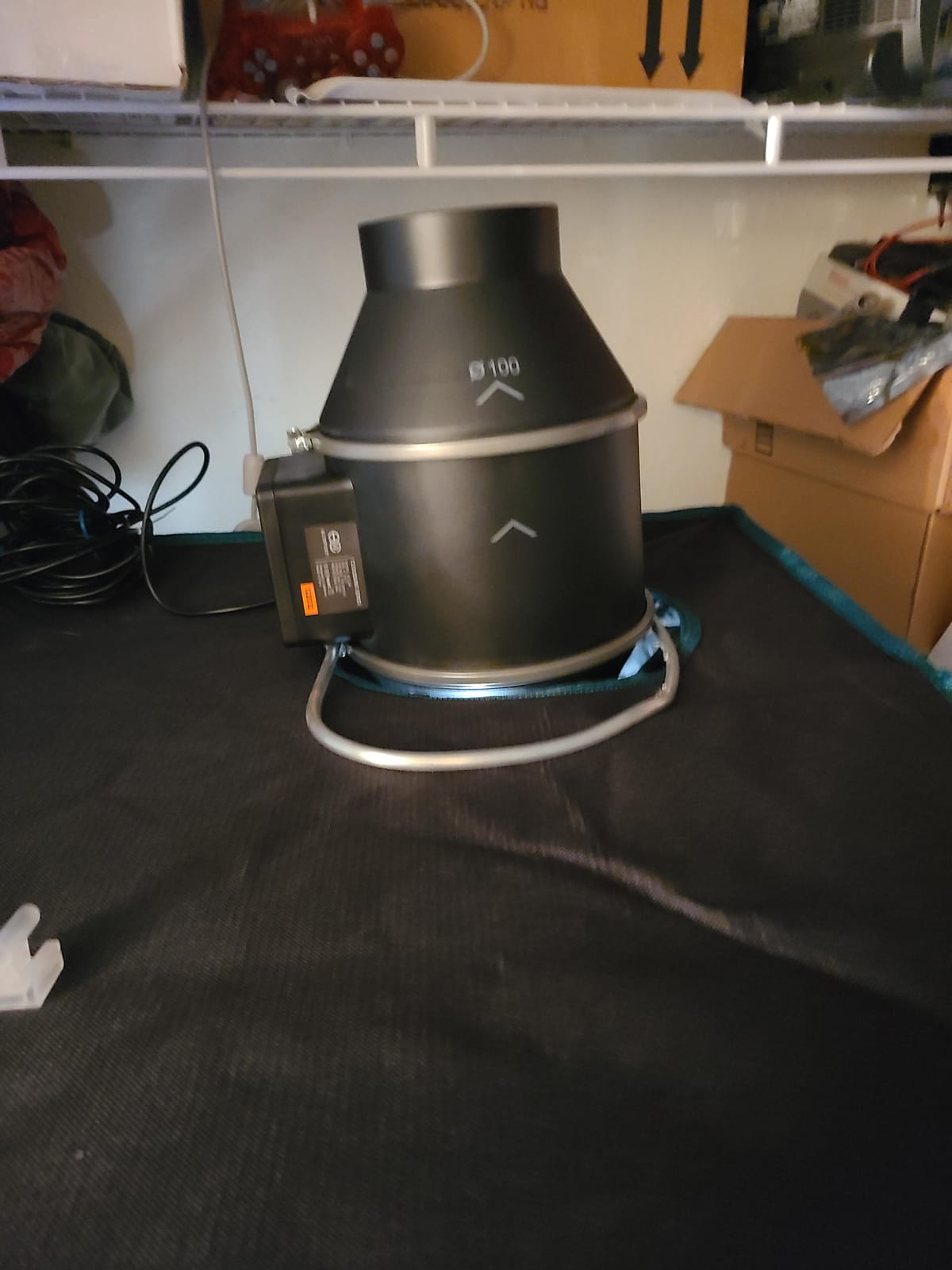
Fan diameter matters. A 4-inch inline fan is the right tier for a 2×2 or 2×3. Moving up to a 6-inch fan in a small tent buys throughput you cannot use and adds noise you do not need, and that noise is the issue in apartments with shared walls.
Where to put each fan
Run the inline exhaust fan high on one wall so it pulls warm air from the top of the canopy, then duct it out of the room. Put the clip or oscillating fan low and aimed across the plants, not pointed at a wall, since air hitting a wall creates a dead zone instead of movement.
Keep the tent under negative pressure. With the exhaust running and a passive intake at the bottom, air enters through the intake ports, so unfiltered air stays outside the tent. Run it the other way and you will pull room air in through the zippers and track smell through the house.
If you cannot duct outside, a carbon filter on the exhaust fan is what contains odor in a closet. Growers on 420magazine describe running flex duct through a wall so no air stagnates in the closet space, which is the version that works when the closet itself gets warm.
When the room itself is too hot
If the room sits at 78F or above with the lights off, no amount of tent ventilation fixes it, because the tent has to fight the whole room. In that situation, move the tent to the coolest room you have, run the light cycle when the room is coolest, and put the inline fan on a timer rather than running it constantly.
One grower on r/NYgrowery made the apartment point clearly, the main thing to avoid in a rented space is flooding, so no open water reservoirs inside the tent. That applies to our pick here too, particularly with the removable floor trays these tents all include.
How to choose a small grow tent: 8 criteria that matter
Footprint first. A 2×2 is 24 by 24 inches and fits 1 to 2 plants. A 2×3 fits 2 to 4. A 2×4 fits 4 to 6. Under 20 inches wide only if your space forces it.
Height before width. Height is the dimension you cannot add later. 48 inches works for seedlings and short plants, 60 to 72 inches gives real canopy and light room.
Fabric denier. 600D is the entry standard and adequate with sealing. 1680D and 2000D are meaningfully better at blocking light and resisting tears.
Reflectivity. Mylar lining runs from 95 percent on budget tents to 98 percent and above on premium ones. It matters most in a small canopy where light hits walls constantly.
Port count and placement. In a 2×2 the ports are the ventilation system. Check for at least one exhaust port and one intake, ideally at different heights.
Light sealing. Double stitching, black inner zipper lining and zipper flaps are what stop pinhole leaks. A tent without them will need tape on day one.
Frame load rating. Anything you hang counts. 100 lbs handles a small light and filter, 150 to 300 lbs is where you stop worrying.
Floor tray and weight. A removable waterproof tray is worth having. Total unit weight matters if you move the tent even once a year.
The rest of the room matters as much as the tent itself. Our picks for gaming desks for small spaces and compact gaming desktops cover the desk and power side of a room where every outlet and every inch of surface is already spoken for, which is usually the same room a small grow tent ends up in.
How the brands actually compare
AC Infinity versus Vivosun is the most common brand question, and the answer depends on what you are optimising for. Vivosun offers more volume of proven product and a far larger review base, while AC Infinity builds heavier frames and thicker fabric, which is where owners say the premium shows. Are AC Infinity tents worth it? If you are hanging a lot of equipment or need a strict dark period, yes. If you are propagating seedlings, no.
Vivosun versus Mars Hydro splits on footprint. Mars Hydro makes the narrowest tent in this roundup at 18 inches wide and uses 1680D canvas, while Vivosun covers more standard sizes with the most-reviewed small tent in the category. For a tight shelf or wardrobe, Mars Hydro. For a standard closet, Vivosun.
AC Infinity versus Gorilla is closer to a fair fight on materials. Gorilla wins decisively on frame rating at 300 lbs and on height at 6 ft 6 in, while AC Infinity wins on reflectivity testing and on how compact the packaging and layout are for a 2×2. Gorilla for headroom, AC Infinity for a tight 2×2.
The consistent pattern across forums is that brand tents get praised and brand fans get criticised. As one r/containergardening comment put it, Vivosun tents are solid mid-range, AC Infinity is the spendy but nice option, and the same brands fans draw complaints. Choose the tent on fabric and frame, and choose the fan separately.
Frequently Asked Questions
What size grow tent is best for a small space?
A 2×2 ft tent fits 1 to 2 plants in 3 gallon pots, a 2×3 ft fits 2 to 4 plants, and a 2×4 ft fits 4 to 6. If your space is narrower than 24 inches, a tent under 20 inches wide is your only option. Height matters as much as footprint, so favor 60 inches or taller if your ceiling allows it.
Is 80 degrees too hot for a grow tent?
80F is too hot for sustained use, especially with dense growth. Aim for 65 to 85F during the light cycle and keep humidity between 40 and 60 percent in vegetative growth and 55 to 65 percent in flower. Small tents reach those temperatures faster because there is no spare air volume to buffer them.
Should a grow tent have negative pressure?
Yes, for most indoor setups. Run the inline exhaust fan high on one wall with a passive intake at the opposite bottom corner, so air enters through the intake ports and the tent stays slightly under pressure. That keeps unfiltered room air out of the canopy and limits odor tracking through your house.
Where should I place fans in my grow tent?
Hang the inline exhaust fan high on one wall and duct it to a window or wall vent. Put a clip or oscillating fan low and aimed across the canopy rather than at a wall, since air hitting a wall creates a dead zone instead of moving through the plants.
What’s better, AC Infinity or Vivosun?
Vivosun offers more sizes and a much larger review base, and its 2×2 is the most-reviewed tent in the category. AC Infinity builds heavier frames and thicker fabric, which is where owners say the premium shows. Buy Vivosun for value and selection, AC Infinity for frame rigidity and light sealing.
Is Vivosun or Mars Hydro better?
Mars Hydro makes the narrowest tent in this roundup at 18 inches wide and uses 1680D canvas, so it wins in shelves, wardrobes and tight nooks. Vivosun covers more standard footprints and has more proven models. Choose Mars Hydro for width constraints and Vivosun for standard closet dimensions.
What is the best grow tent setup for beginners?
Start with a 2×2 or 2×3 tent, an LED fixture sized to the footprint, a 4-inch inline exhaust fan, and a carbon filter if the tent sits inside your living space. Add a timer, a thermometer and a hygrometer before anything else. Skip tents under 48 inches tall unless you are only propagating.
What size inline fan and carbon filter do I need for a 2×2 tent?
For a 16 cubic foot tent, divide volume by a two-minute exchange, then multiply by 1.25 for carbon filter drag and add about 20 percent headroom, which lands near 13 CFM. A 4-inch inline fan and matching 4-inch carbon filter cover that comfortably. Add more only if you are ducting through multiple bends.
Final verdict: which small grow tent should you buy
The VIVOSUN S224 is our pick for the best grow tents for small spaces because it does the things a small tent has to do well: seal light, assemble with one set of hands, include a floor tray and filter straps, and cost little enough that you can spend the difference on a light. With 33k+ reviews behind it, it is also the least risky buy in the list.
If you can spend more, the AC Infinity CLOUDLAB 422 is the upgrade that removes the two worries small tents create, bowed poles and pinhole leaks. If your space is under 20 inches wide, the MARS HYDRO is the only one of these that physically fits, at the cost of height and active intake.
Whatever you choose, measure the space before you order it, plan your fan and filter alongside the tent, and remember that the tent is half the system. We keep finding better ways to organise limited rooms over in our pocket door roundup, which has the same problem in a different form.