
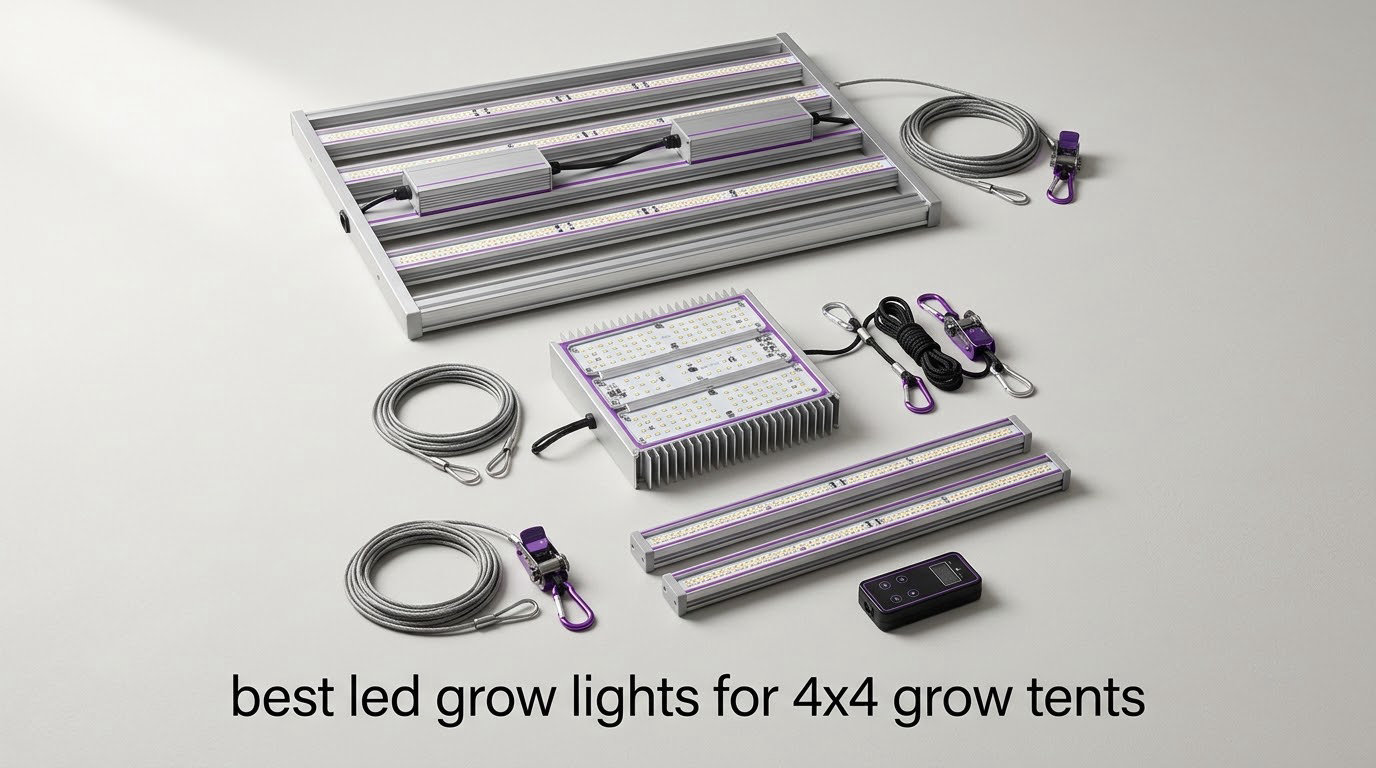
The short answer: a 4×4 grow tent needs a full-spectrum LED with roughly 250 to 400 watts of real draw, and the Spider Farmer SF4000 is the one I would put in it. It is the fixture I keep coming back to after reading the coverage complaints that dominate every 4×4 thread, because it hits the sweet spot between even spread, a real dimmer, and a warranty that is actually five years long.
Most people arrive at this search with the wrong mental model. They have seen a fixture advertised as 1000 watts and assume a 4×4 needs something in that neighborhood, which is how they end up with a light that blasts the middle of the tent and leaves the corners in the dark. The number on the box is a nameplate, not a measurement. What matters is true draw, coverage uniformity from centre to corner, and whether you can dim the thing down when the plants are young.
I have gone through eight fixtures for this roundup and split them by what they actually do inside a 4×4. Some are excellent under a microscope and undersized for sixteen square feet. Some are the right size and cheap. One is simply the best-balanced option you can hang in a square tent right now. Before the picks, I have included a wattage sizing rule so you can check the numbers yourself, and later a section on running cost and heat, because a 480W fixture in a sealed 4×4 is a ventilation decision as much as a lighting one.
If you are also planning the rest of the room, our guides to LED panel lights and LED garage ceiling lights cover the general-purpose fixtures, and this one is strictly about growing plants. Everything here applies equally to peppers, herbs, seedlings and houseplants as it does to flowering crops.
Table of Contents
Top 3 LED Grow Lights for a 4×4 Grow Tent in October 2026

Spider Farmer SF4000
- 2.7 µmol/J system PPE
- 450W listed draw
- Full spectrum 3000K to 760nm
- Dimming knob with controller support

Barrina 720 LED Panel
- 200W with 720 LEDs
- 41000 lumens
- Adjustable folding panels
- 2-year warranty

SAYHON SH2000
- 208W at 2.7 µmol/J
- Separate switchable UV and IR bar
- 0-100% dimming
- 36-month warranty
All Eight Picks Side by Side in October 2026
| Product | Specifications | Action |
|---|---|---|
| Spider Farmer SF4000 |
|
Check Latest Price |
| Barrina LED Grow Light with IR |
|
Check Latest Price |
| SAYHON SH2000 |
|
Check Latest Price |
 KINGPLUS KP3000 KINGPLUS KP3000 |
|
Check Latest Price |
 Spider Farmer SE5000 Spider Farmer SE5000 |
|
Check Latest Price |
 Mars Hydro FC-4800 Mars Hydro FC-4800 |
|
Check Latest Price |
 AGLEX 240W UV IR AGLEX 240W UV IR |
|
Check Latest Price |
 AC Infinity IONFRAME EVO6 AC Infinity IONFRAME EVO6 |
|
Check Latest Price |
1. Spider Farmer SF4000 for the Best Overall 4×4 Setup
Spider Farmer SF4000 LED Grow Lights for Indoor Plants in 4×4 Grow Tent
450W listed draw
2.7 µmol/J system PPE
Fanless aluminum
5-year warranty
Pros
- Even coverage across all sixteen square feet
- Real dimming knob with GGS controller support
- Fanless and completely silent
- Five-year warranty with service centres in US
- CA
- UK
- EU and AU
Cons
- Runs warm to the touch during operation
- Hanging hardware eats vertical clearance in low tents
- Isolated reports of dimmer or diode failure after about a year
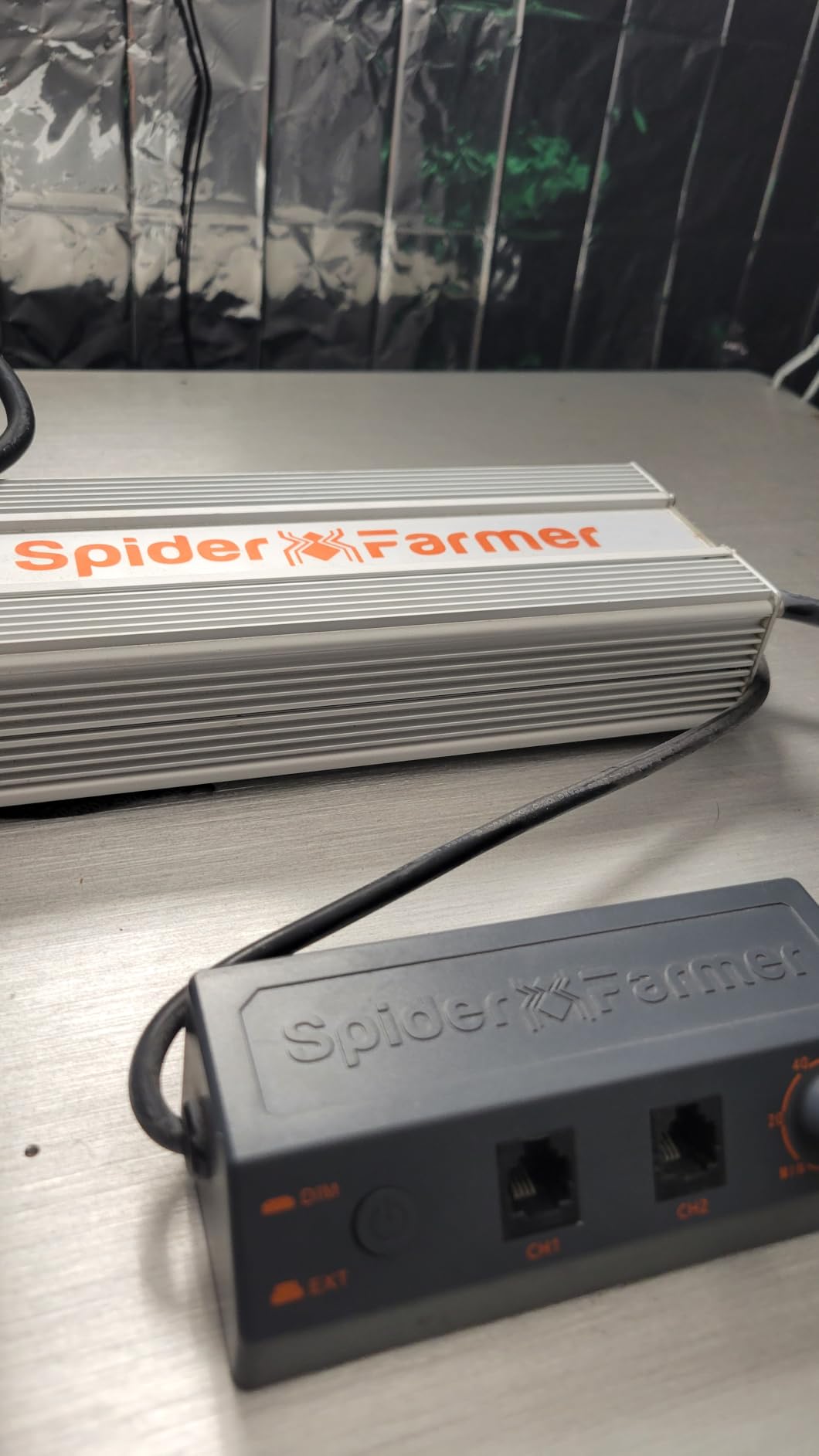
The SF4000 is the light I recommend to anyone who asks me for one answer. It draws 450 watts, it runs fanless so there is no noise to worry about in a quiet room, and its diode layout is deliberately built around coverage rather than a headline number. The 2026 revision gathers the diodes toward the edge of the board specifically to even out PPFD across a square footprint, which is exactly the problem most 4×4 owners report.
It measures 25.39 by 21.1 inches and weighs 14 pounds, which means it fits inside a 4×4 without the awkward overhang you get from some square bar fixtures. The dimming knob on the unit works with GGS controllers and with multi-light unified dimming, so if you ever add a second fixture you can run both from one dial.
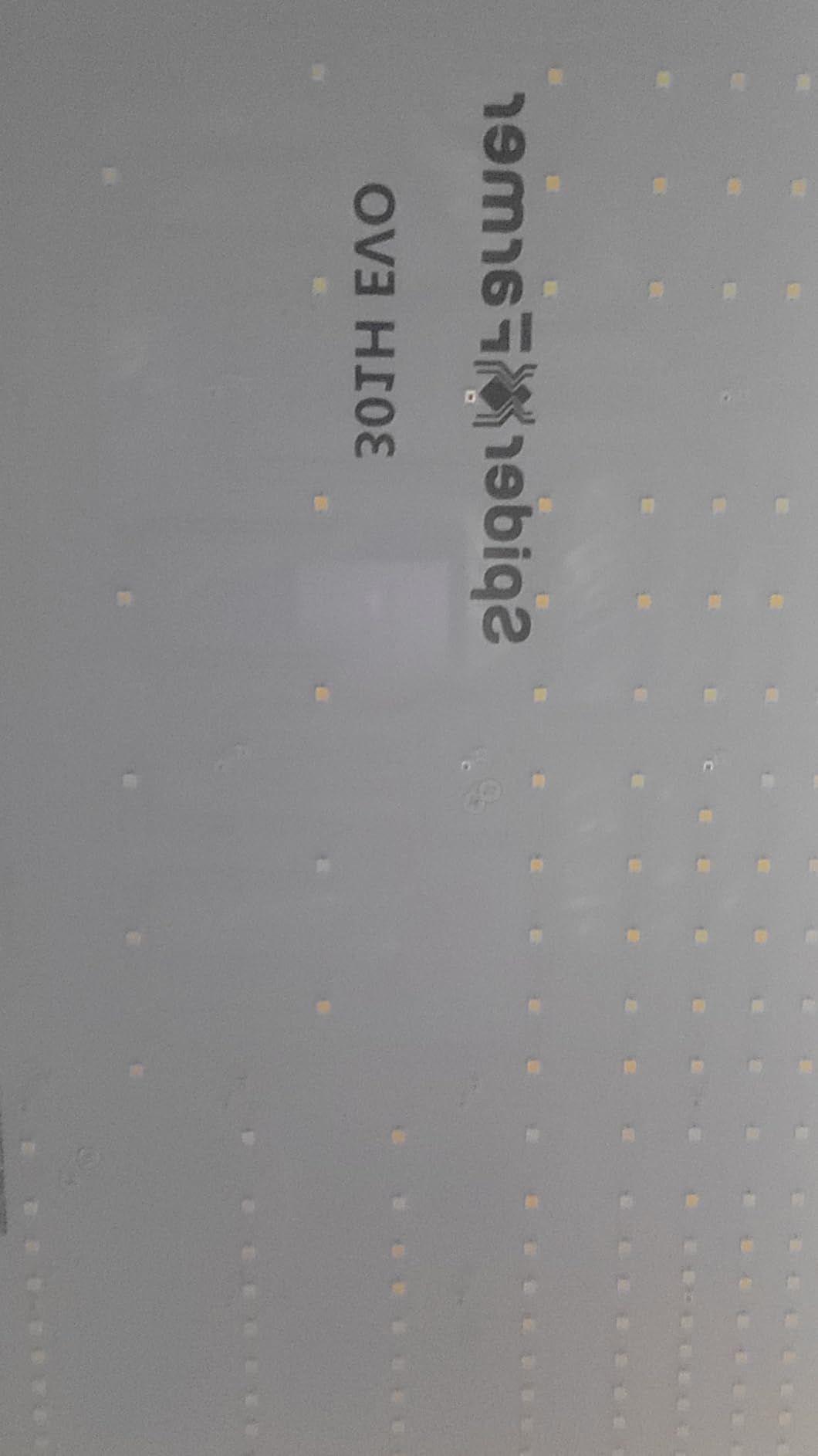
The spectrum is the full 3000K, 5000K, 660nm red and 760nm infrared mix, which covers the whole plant cycle without any stage-specific fiddling. At 2.7 µmol/J system PPE it is not the most efficient fixture in this group, and that is the one place it gives ground to the AC Infinity at the other end of the price range.
What wins for me is the 5-year warranty backed by local service centres, which is the longest coverage in this roundup alongside the SE5000. Owners consistently report good support experiences, with repair parts or replacements supplied quickly, and they repeatedly compare its output favourably against 400 to 600 watt HPS systems while pulling a fraction of the power.
The 12399 reviews behind its 4.6 rating make it the most thoroughly used fixture here, and the pattern in that feedback is consistent: strong yield results, silent operation, and the same two complaints every time, heat at the housing and lost headroom from the hanging cables.
What a 4×4 tent feels like with the SF4000 above it
Expect even light from wall to wall at a standard 18 to 24 inch hang, which is the one thing most budget boards fail at. Because the dimmer goes all the way down, you can start seedlings at roughly 30 percent and climb from there, so you are not forcing young plants to adapt to full-intensity light.
Heat is the thing to plan for. It runs warm to the touch, though with no fan there is no noise layer on top of that. Mount it high and let the tent’s intake and exhaust handle the rest, which is the subject of the running cost and heat section further down.
Where the SF4000 is the wrong choice
It is a lot of light for a 4×4 used only for peppers or a seedling rack, and the 450 watts will be running dimmed most of the time in that case. If your tent is 4×4 but your canopy is small and low, the lower-wattage picks below will serve you better and leave more headroom.
Watch the clearance too. In a tent with a short ceiling, the hanging cables and clips reduce usable vertical space, and in a low 4×4 that can be the difference between a light at 20 inches and a light at 12.
2. Barrina LED Grow Light for the Budget Pick 4×4 Pick
Barrina LED Grow Light, Full Spectrum with IR, 4×4 FT Coverage, Dimmable, Adjustable Light Panel with 720 LEDs, High PPFD, Plant Grow Light for Indoor Plants Seedling Growing Bloom Flowering Fruiting
200W true output
720 LEDs, 41,000 lumens
17.32 by 10.62 inches
2-year warranty
Pros
- Very affordable way to light a 4x4
- Adjustable folding panels aim light where you need it
- Dimmable and daisy-chainable for multi-light setups
- Quick install with included hanging hardware
Cons
- Real output falls short of the advertised 200W
- Flicker reported below 40% dimming
- Better suited to 3x3 flowering than a full 4x4 bloom
- No built-in timer
The Barrina panel is the cheapest credible way to get real light across a 4×4, and for a first grow or a second tent it does a genuinely good job. It runs 200 watts across 720 LEDs producing 41,000 lumens, and the folding panel design is unusual at this price: you can angle each section to aim light at a specific corner instead of relying on a fixed reflector.
At 17.32 by 10.62 inches and 2 pounds, it is the smallest and lightest fixture in the roundup, and it hangs in seconds. The 60-degree beam angle is wide enough that the light spreads rather than concentrates, which is the right behaviour in a square tent.
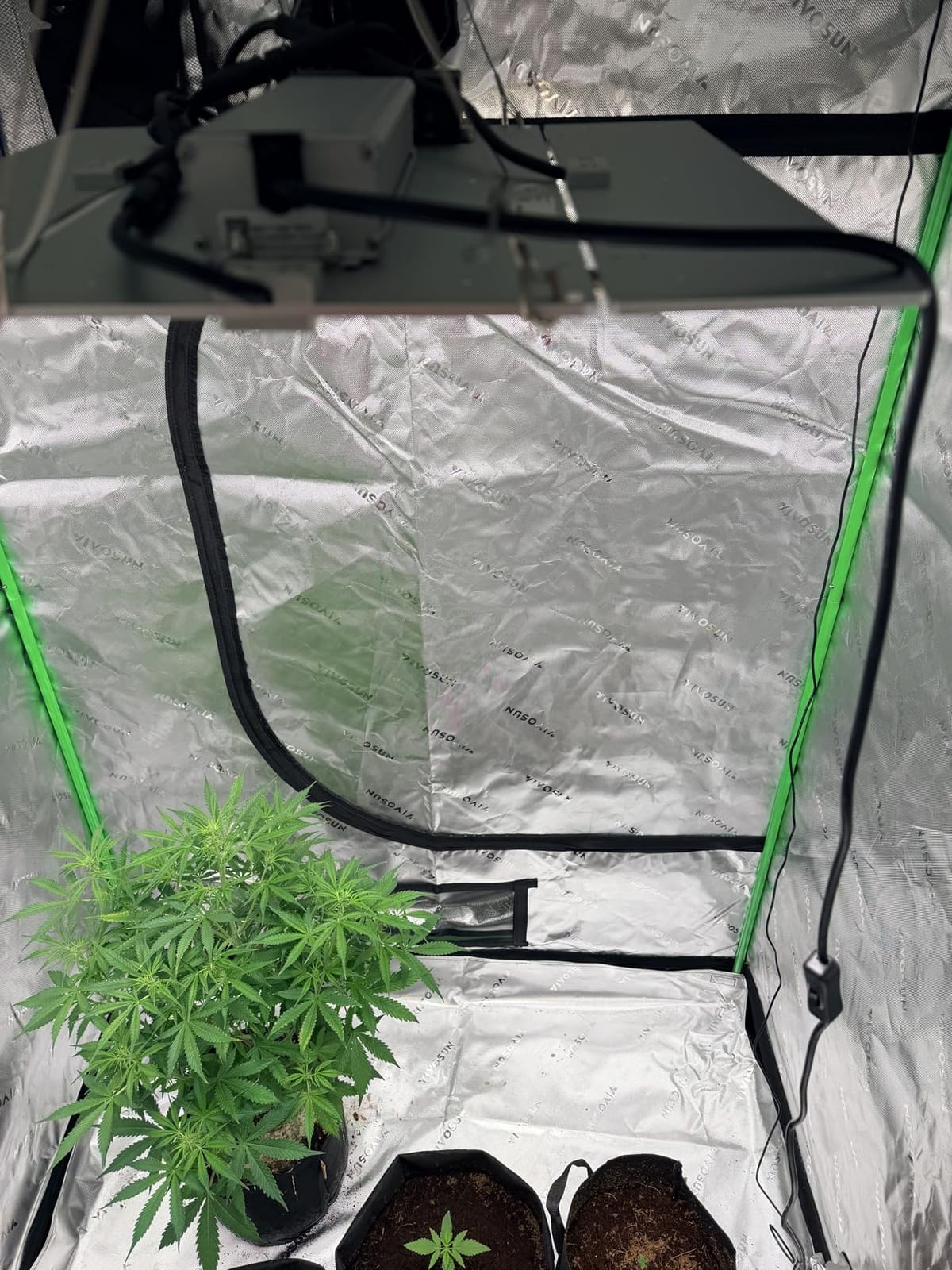
Here is where you have to read carefully. The technical claim is 200W of true output, but a vocal group of technical reviewers disputes the advertised wattage outright, pointing at an under-rated power supply, and the same reviewers report flicker at low dimming settings. Most buyers treat it as a budget upgrade and are happy with the ratio of output to what they paid.
Its own coverage guidance is the honest bit: ideal for 3×3 at bloom stage and 4×4 at veg stage. If you want a 4×4 in full flower, the sensible move is two units rather than one, and because it daisy-chains, that is straightforward. Several owners do exactly that.
The spectrum covers 5000K blue, 3000K warm white, 660nm red and 730nm infrared, and the brand claims up to 50% energy savings against HPS, SMD or blurple lamps. The 2-year warranty is on the short side, and there is no built-in timer, so you need an external timer for any photoperiod beyond on-and-off.
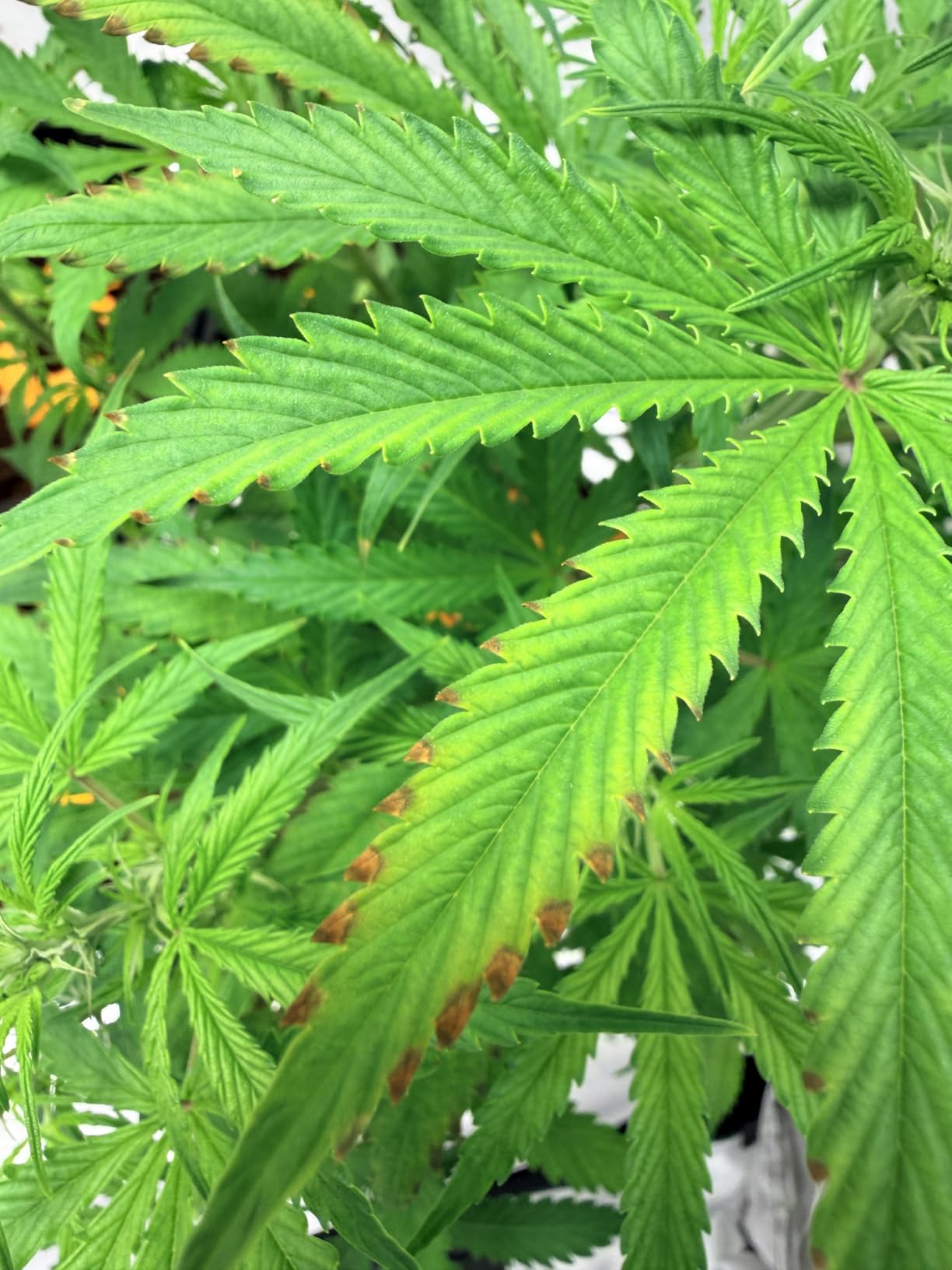
What you get in a 4×4 with the Barrina panel
Plenty of usable light across a vegetative canopy, and with the panels angled you can genuinely direct more of it at the corners that a fixed board would starve. It handles peppers, herbs, seedlings and a mixed edible setup without any drama.
Dimming works, but reviewers recommend staying above 40% because of the flicker, so treat the low end of the dial as unusable rather than as a seedling setting. If you need fine low-level control for propagation, a different fixture suits that better.
Where the Barrina panel falls short
A single unit is a 3×3 flowering light wearing a 4×4 label, and buyers say so directly in the reviews. In a 4×4 in full bloom you will be chasing the corners, which is the exact complaint that makes people move plants around mid-cycle.
It also adds a few degrees of ambient heat in a small tent, and reviewers note the transformer runs hot inside the canopy space. Mount it outside or above the tent where you can, and keep an eye on the 2-year warranty clock.
3. SAYHON SH2000 for the Best Budget 4×4 Performer
SAYHON 2026 Upgraded SH2000 Led Grow Light,Dimmable Full Spectrum LED Growing Lights with UV&IR for Indoor Plants Increase Yield & Crop Quality, Plant Growing Lamps, for 4×4 Tent
208W at 2.7 µmol/J
24 by 11.8 inches
0-100% dimming
36-month warranty
Pros
- Strong measured PAR for the price class
- Independent UV and IR bar with its own switch
- Full 0-100% dimming plus a cord switch
- Fanless and cool running
- Comes with ratchet straps and a clear manual
Cons
- Better matched to 3x3 flowering than a full 4x4
- Reports of strip or diode failure within a few months
- Support response times can stall for weeks
- Some units dim only between 50 and 100 percent
The SH2000 is the pick I would tell someone who measured a budget board with a PAR meter and found it disappointing. Growers with meters report accurate PPFD and vigorous dense growth, and they frequently state the light beats pricier name-brand fixtures. At 208 watts it also claims 2.7 µmol/J efficiency, which is the same figure as the Spider Farmer SF4000 at nearly twice the wattage.
The feature that separates it from everything else in the budget tier is the separate UV and IR supplement bar with its own switch, covering UVA 390nm, IR 730nm and blue 460nm. Being able to turn that band on for the last stretch of flowering and off during veg is a control you normally only get on much costlier hardware.
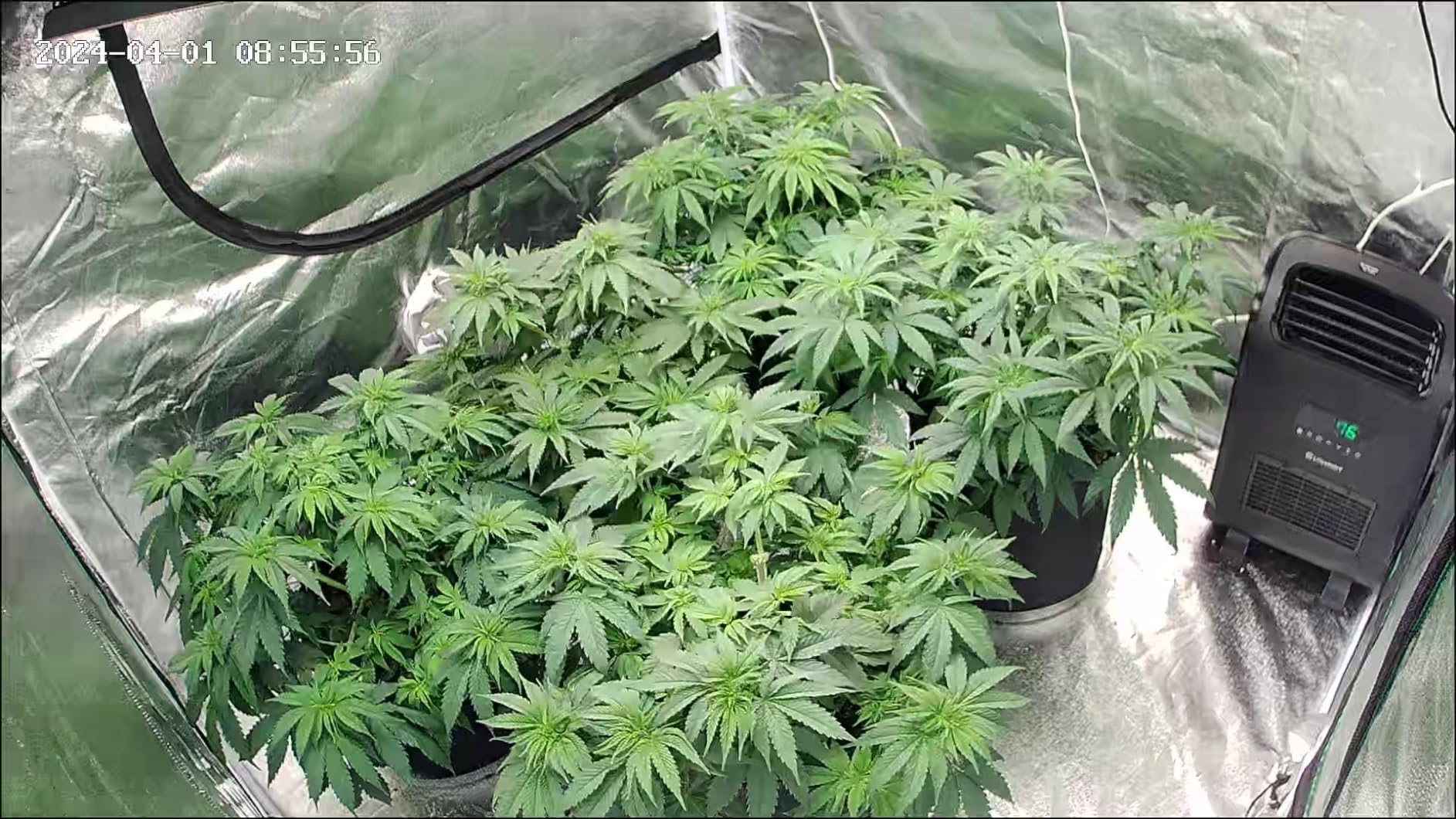
Dimming runs the full 0 to 100% range, and there is a cord switch, though the unit cannot be powered down through the dimmer itself. The 3A+ aluminum heat sink and fanless design keep it cool and silent, and the AC 100-277V working voltage means it is not tied to a single country’s supply.
Its own coverage claim is 4×4 for veg and 3×3 for flowering, which is the same positioning as the Barrina. At 24 by 11.8 inches and 8.8 pounds, it is a long, narrow bar shape, and the 31.53 degree beam is tighter than the Barrina’s 60 degrees, so plan on the dimmer for edge fill.
The 36-month warranty is the best in the budget group, though support responsiveness is the weak point. Buyers report that failing units are generally refunded or replaced, but that the response can take weeks, and several owners report LED strip or diode failure within a few months of use.
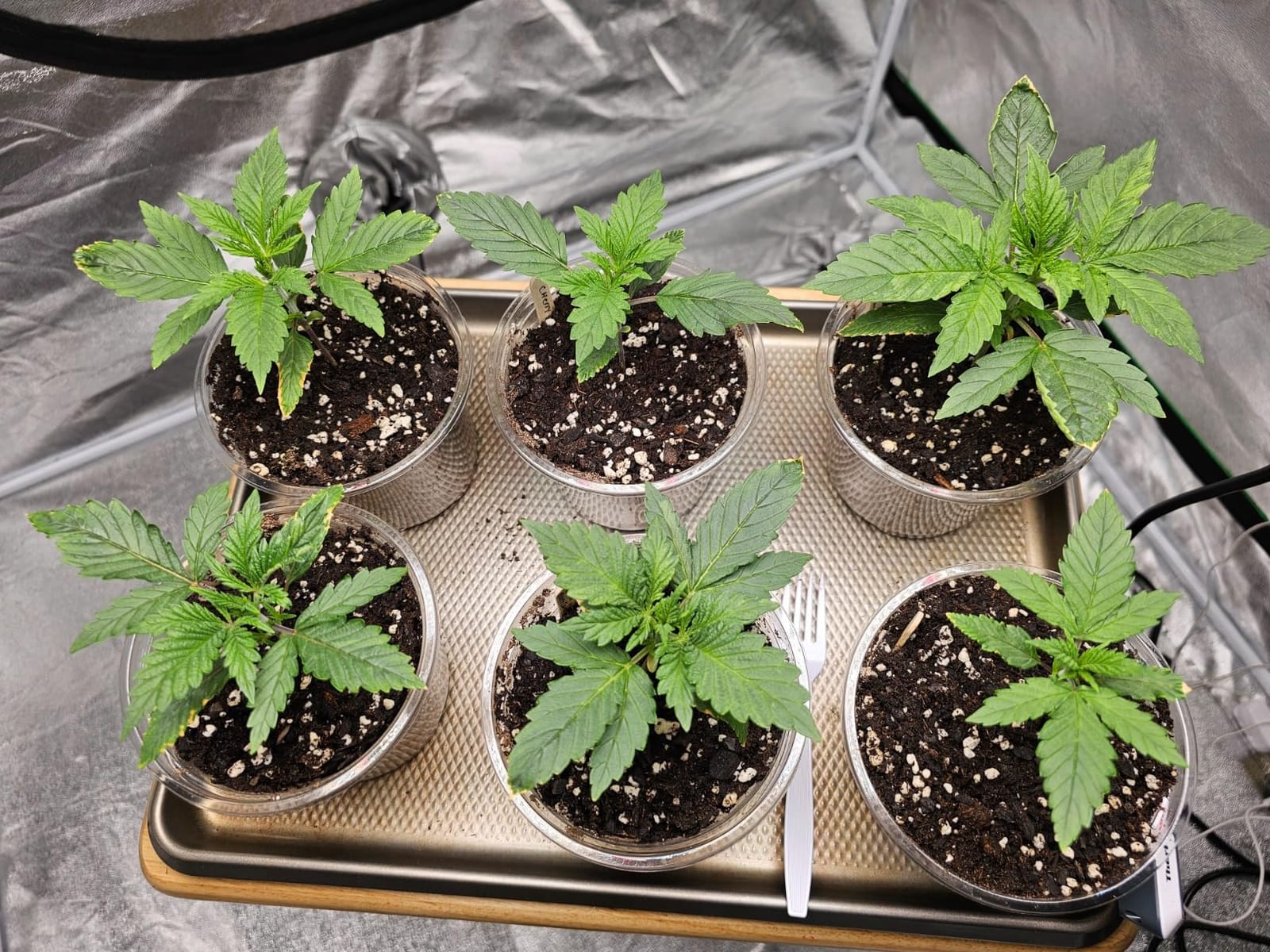
What a 4×4 grow looks like under the SH2000
It covers a vegetative canopy across all sixteen square feet without complaint, and growers using it for peppers and mixed edibles report strong, healthy growth. Full dimming makes it a genuinely useful seedling light, which almost nothing else at this output does as smoothly.
Turn the UV and IR bar on for flower and you get a deeper spectrum than most competitors offer at twice the output. The trade is that you are at 208W, so a dense photoperiod bloom in a full 4×4 will want help from a second fixture or a second tent.
Where the SH2000 is a poor bet
Long-term durability is the honest weakness. Strip and diode failures inside the first few months are reported often enough that you should think of this as a light you may replace once during a few years of use, not a fixture you buy once and forget.
Some units also dim only between 50 and 100%, which makes fine seedling control impossible on those units specifically. And if the light has to last a decade without service, the shorter warranty and slower support response are worth weighing against the longer terms on the Spider Farmer models.
4. KINGPLUS KP3000 for 4×4 Growers Who Want Stage Modes
KingLED KING3000 Grow Light for Indoor Plants, Fits 4×4, 4×5 & 4×6 ft Tents
300W with 1620 LEDs
2000 µmol/m2/s at 6 inches
VEG, BLOOM and combined modes
3-year warranty
Pros
- High diode count and strong PPFD output
- Dedicated red and blue channels in a sunlike spectrum
- Three modes simplify stage changes
- Quiet fans hold the sink around 50-60 degrees F
- Covers a 4x4 footprint for tents and greenhouses
Cons
- No electronic dimmer at all
- Coverage and uniformity fall off toward the outer edge
- Fan noise audible in a quiet room
The KP3000 is the one in this group that solves intensity control with hardware rather than electronics. It has no dimmer at all, so you change output by physically raising and lowering the fixture with the included ratchet hangers, which works but means every adjustment is done with the tent open.
For what it offers, the numbers are strong. 1620 LEDs across 300 watts, 8200 lumens, and up to 2000 µmol per square metre per second at six inches. Spectrum is 460nm blue, 660nm red and 3000K to 5000K white, and there are VEG, BLOOM and combined modes that shift the balance without you touching the height.
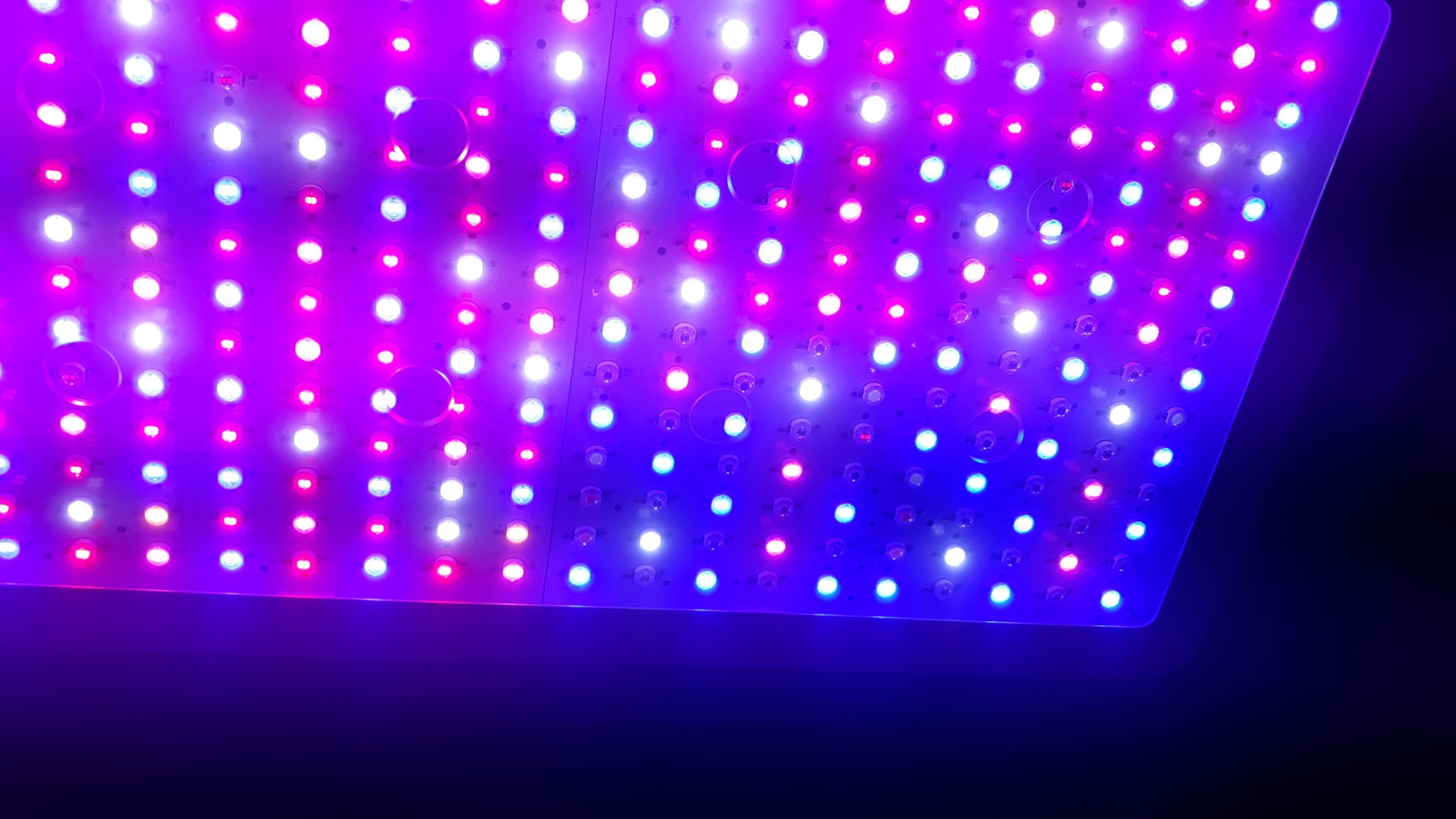
Unlike the fanless options above, the KP3000 runs quiet high-speed cooling fans against a thick aluminum heat sink, holding the fixture around 50 to 60 degrees Fahrenheit. Owners describe it as dependable and well built, and the 3-year warranty comes with a 90-day free return window, which is the most forgiving return policy in this roundup.
It is 23.62 by 13 inches at 9 pounds, which fits a 4×4 frame comfortably and leaves room to lift it as the canopy grows. The box includes the light, an adjustable rope hanger, a hanger hook and the power cord, so nothing else is needed to hang it.
The 4.4 rating across 386 reviews is the lowest here, and the reason shows up clearly: it is the coverage uniformity, not the brightness, that holds it back. Reviewers say light and evenness fall off toward the outer edge of a 4×4 footprint, which is the same weakness that sends people hunting for coverage in the first place.
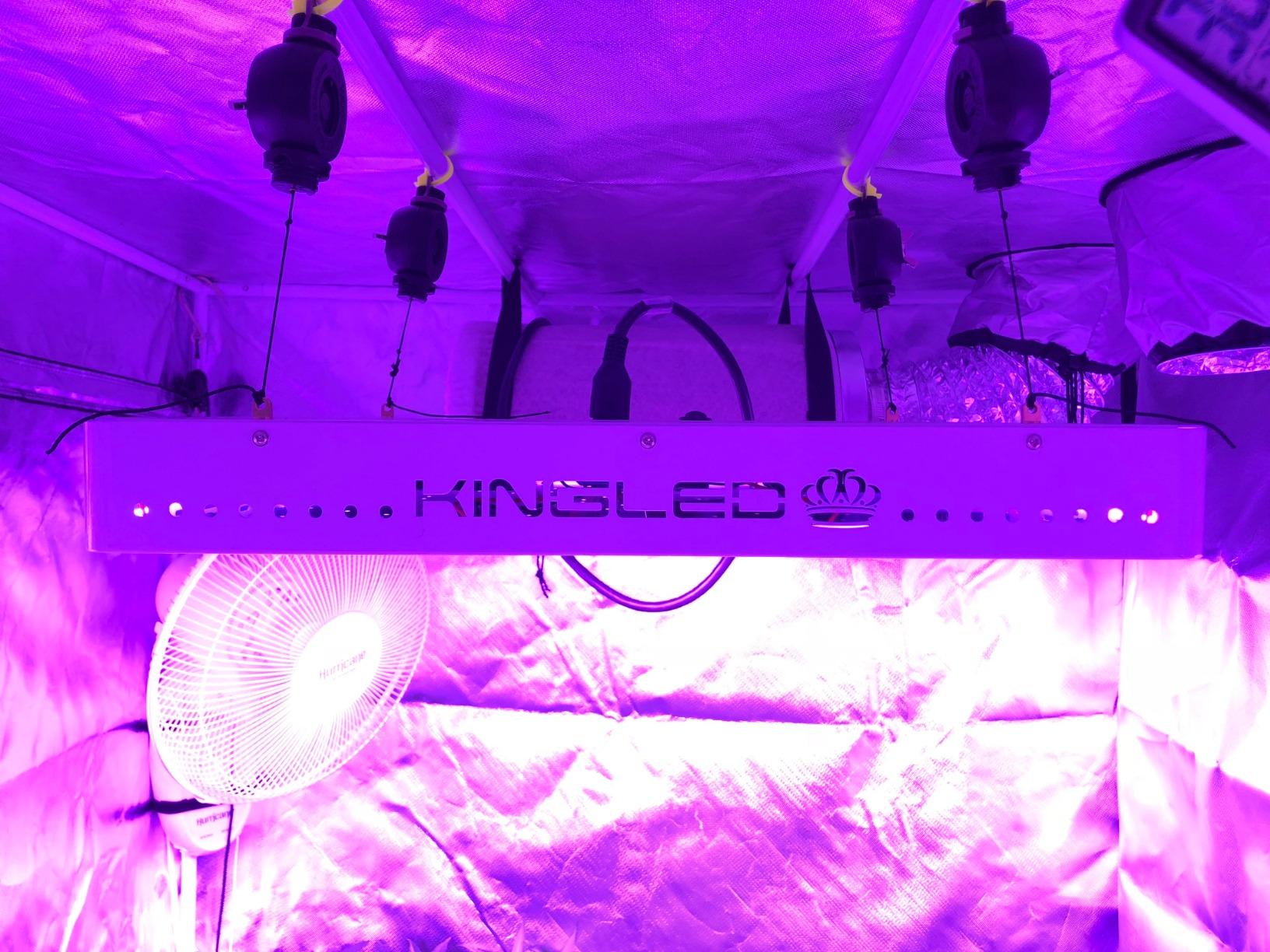
What a 4×4 looks like under the KP3000
Bright and punchy in the middle with plenty of headroom above, and the VEG to BLOOM switch handles the cycle change cleanly. For a 4×4 running a full sea of green it does real work, and the 300W figure is honest rather than inflated.
The fan noise is the detail people notice most in a quiet room at night, and it is the reason this is not higher in my ranking. In a grow space with a fan already running, most owners report it disappears entirely.
Where the KP3000 is the wrong tool
No dimmer means no seedling setting. If you propagate in the same tent, you are running full output on transplants, and the only lever you have is distance, which changes the footprint as you move it.
The edge falloff on a full 4×4 is the deciding factor for me. In a 3×3 footprint it is a non-issue, and in a 4×4 with four plants in a sea-of-green layout you can live with it, but the moment you fill the corners you will be turning plants.
5. Spider Farmer SE5000 for the Best App-Controlled 4×4
Spider Farmer SE5000 LED Grow Light 480W for 4×4 Grow Tents, App‑Controlled
480W true draw at 1420 µmol/s
Bridgelux diodes in a bar layout
5-year service
Pros
- Even wall-to-wall coverage from the bar layout
- Digital brightness display is easy to read and set
- App scheduling with sunrise and sunset simulation
- Detachable remote driver simplifies hanging
- Covers a full 4x4 with a single fixture
Cons
- More heat than smaller fixtures need
- Awkward driver mounting that can shift
- Some kits ship with ratchet clips too large for the holes
The SE5000 is the pick when you want a single fixture that fills a 4×4 wall to wall and you want to control it from your phone. At a true 480 watts it pushes 1420 µmol per second from Bridgelux diodes arranged in a bar-style layout rather than a solid board, and that layout is the reason the coverage is as even as it is.
The box also lists Samsung LM301B diodes among the included components alongside a detachable driver and mounting hardware. The physical frame measures 33.65 by 33.57 inches, so in a 4×4 it nearly touches all four walls, and you need to plan the hang carefully because there is no margin for error on the diagonal.
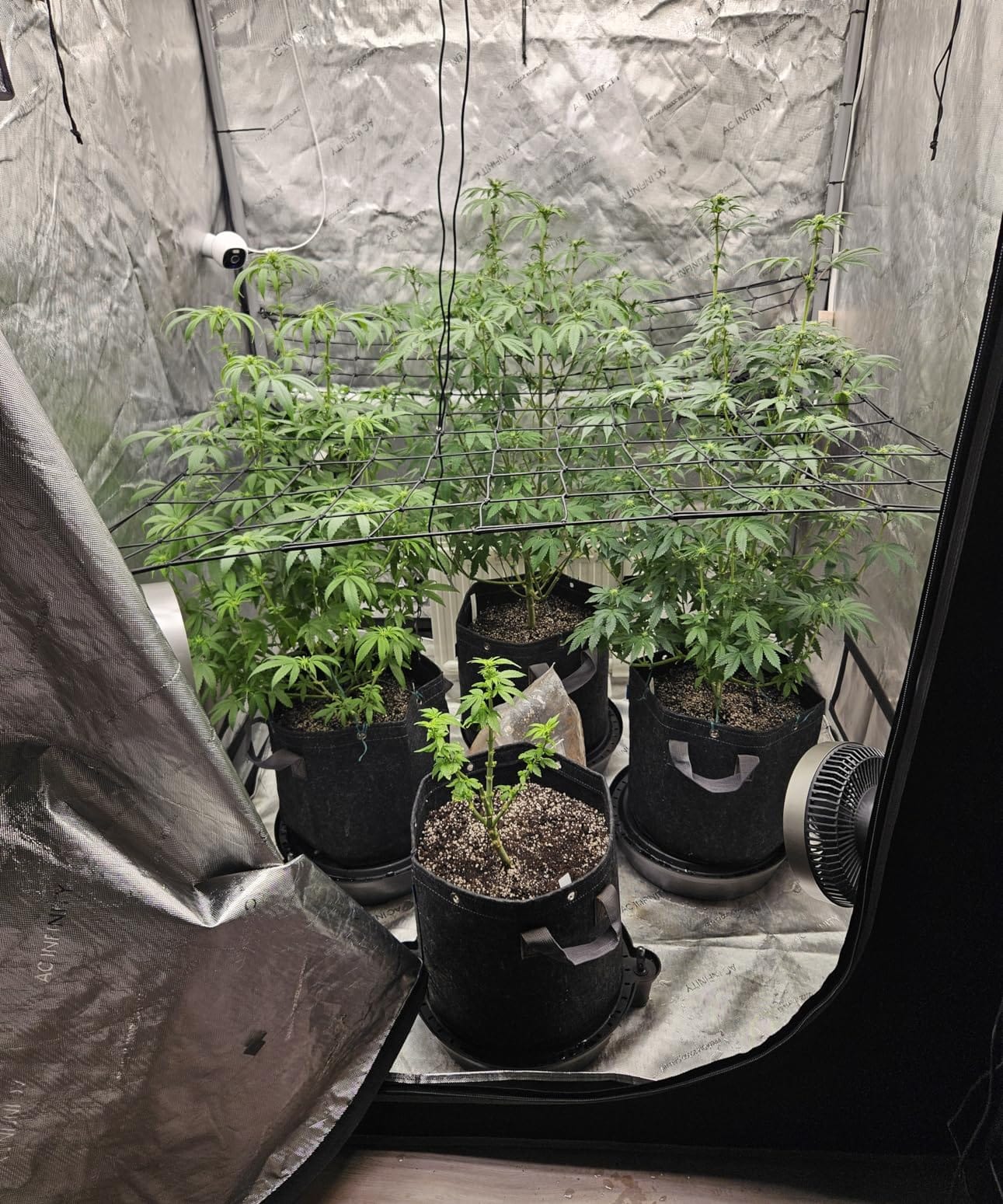
Control is the selling point. A digital dimming display shows the brightness level you set, the app handles custom schedules and sunrise and sunset simulation, and daisy-chain control runs up to 50 SE-series fixtures from one master unit if you ever expand beyond a single tent.
Spectrum is plant-centric: 437nm blue, 50 to 55% of output in 660 to 665nm deep red, and 2800 to 3000K plus 4800 to 5000K white. The detachable driver with a 9-foot cord is genuinely useful, because you can mount the driver outside the tent and keep that heat out of the canopy space.
The 4.5 rating from 274 reviews sits mid-pack, and the review pattern is consistent: owners like the even fill, the readable display and the scheduling, and complain most about heat, the awkward driver mount, and hanger clips that do not fit the mounting holes out of the box.
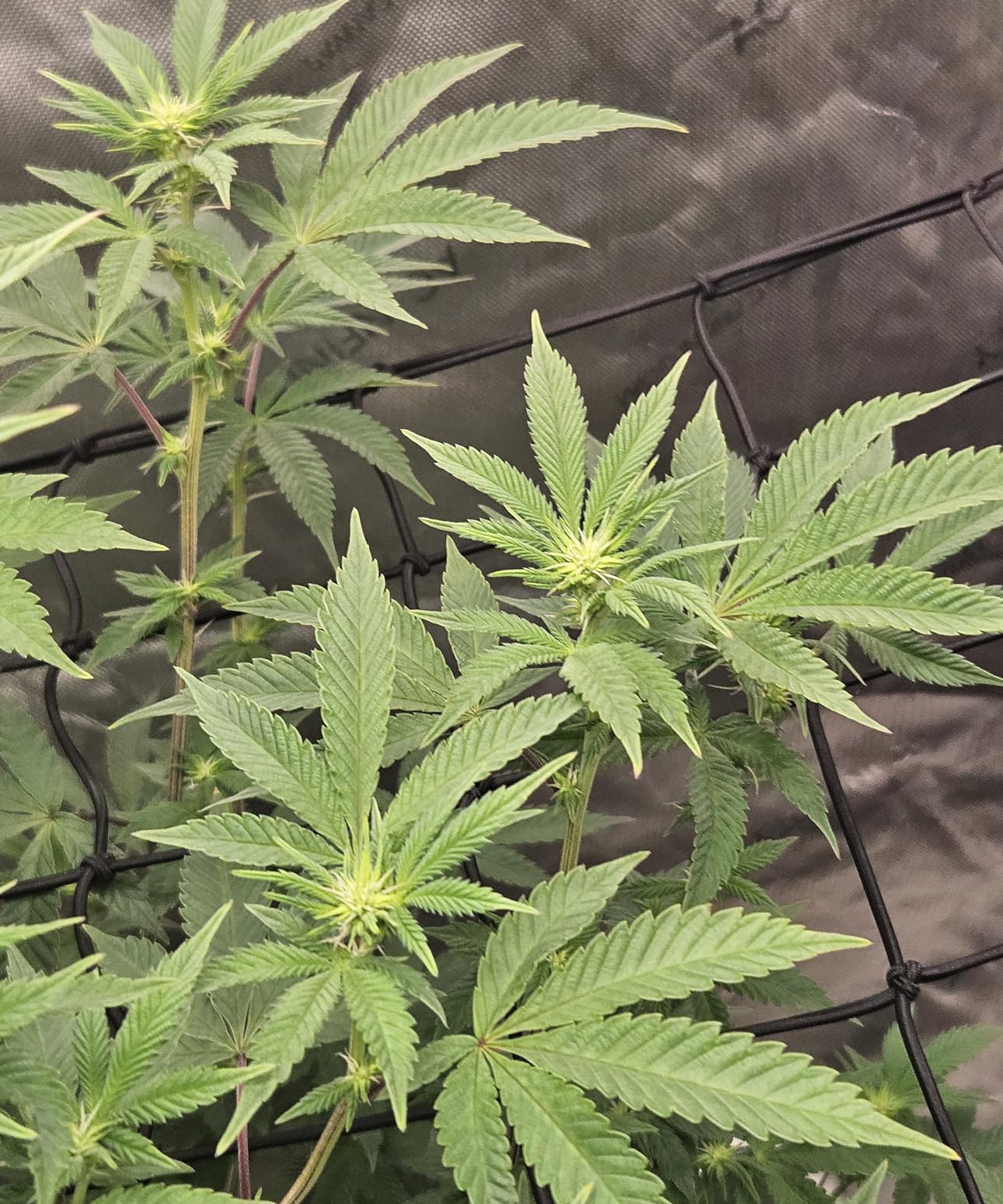
What a 4×4 feels like under the SE5000
Full tent coverage from one fixture with no corners left behind, which is exactly what people moving plants around mid-cycle are trying to solve. Dimming down to 30% for seedlings and climbing to full for flower is all done from the app without opening the tent.
Expect this to be the warmest fixture in your setup. Owners plan fan and driver placement around it accordingly, and if you already have intake and exhaust sorted this is a non-issue.
Where the SE5000 is overkill
For a 4×4 that grows peppers, herbs or a seedling rack, 480 watts is far more than the canopy can use, and you will be running the dimmer down most of the time. It is a flowering-room fixture and it should be treated as one.
It is also physically large. In a tent with low headroom the frame itself can be the limiting factor, and the detachable driver mount is awkward enough that you need to secure it properly rather than leave it resting.
6. Mars Hydro FC-4800 for Deep Red Flowering in a 4×4
Mars Hydro FC-4800 480W 4×4 LED Grow Light Full Spectrum for Indoor Plants
480W at 2.85 µmol/J
Bridgelux 3030 plus Osram 660nm
35.43 by 23.03 inches
5-year warranty
Pros
- High measured PPFD with strong lower-canopy penetration
- Dedicated Osram 660nm deep red chips for flowering
- Remote driver can be mounted outside the tent
- App dimming and scheduling
- Covers a full 4x4 evenly
Cons
- Bars and driver must be assembled by hand
- App control needs a controller sold separately
- Some units arrive with a faulty power port
- Driver box runs hot
- One report of an older model arriving
The FC-4800 is the strongest pure-light option here. It runs 480 watts at 2.85 µmol/J from premium Bridgelux 3030 diodes, and it adds Osram CSSRM6.24 red chips at 660nm on top of that, which is the specific band that drives flower development. Reviewers working from light meters confirm the PPFD figures and call the lower-canopy penetration comparable to older HID fixtures.
The bar structure is built for heat dissipation, and the dimmable driver is designed to be mounted remotely, outside the tent. That single design decision matters more than the raw wattage in a sealed 4×4, because the driver box is where the waste heat concentrates and owners do report it running hot.
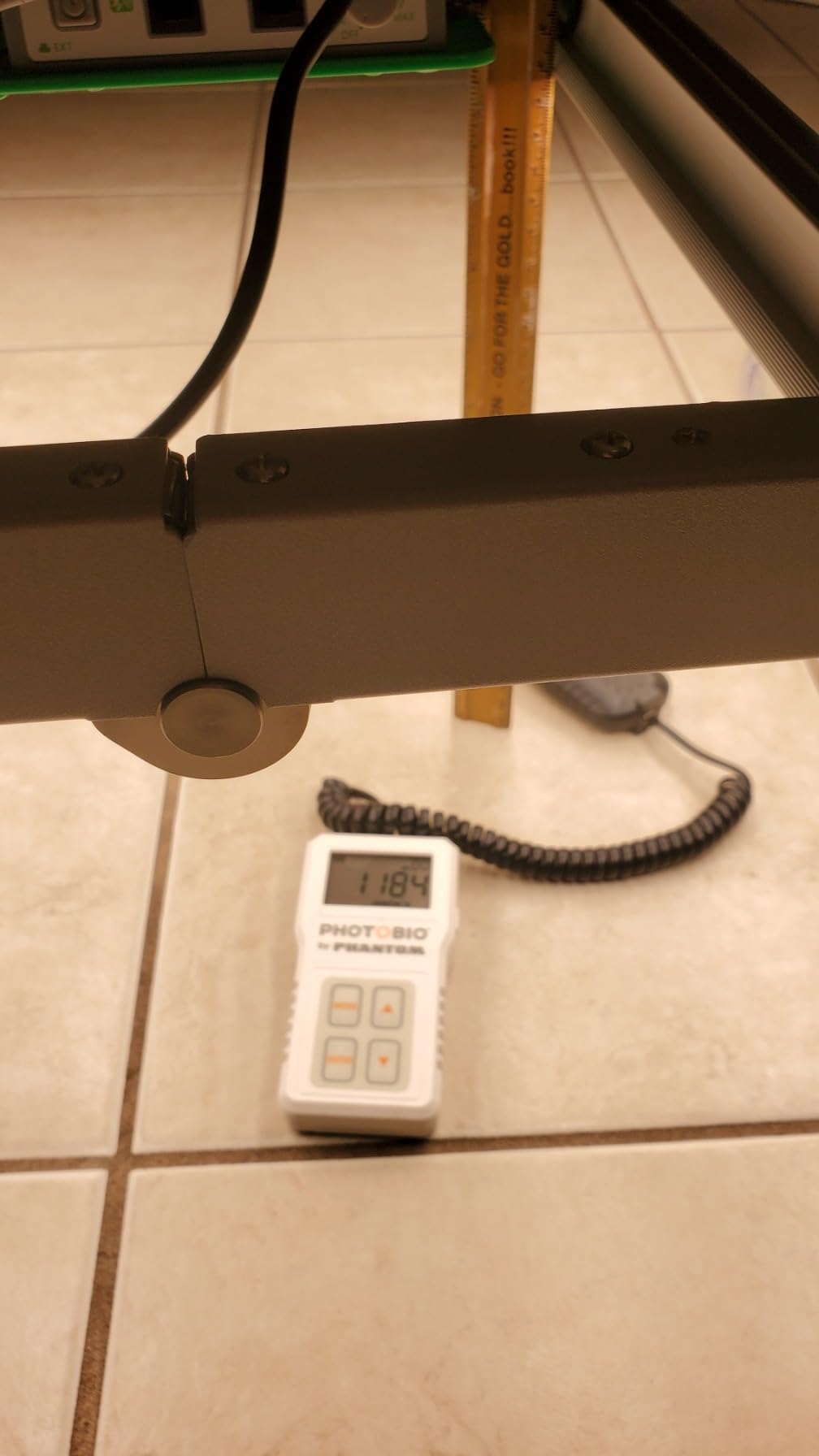
App control works through the MARS HYDRO app with iConnectu, a Controller or an iHub-Pro, and any of those is sold separately. That is a real cost and setup step to factor in if you want wireless dimming, and the fixture itself is not plug-and-play. The bars and driver have to be assembled by hand before first use.
At 20 pounds and 35.43 by 23.03 inches, it is a substantial fixture, and the footprint is a wide rectangle rather than a square. Check your tent before ordering, because in a smaller tent the long bar can be the thing that stops it hanging level.
The 4.5 rating across 241 reviews holds up well, with a 5-year warranty behind it. The complaints are mostly about the first ten minutes: assembly friction, the missing controller, and a small number of defective power-supply connection ports arriving out of the box. One reviewer reported receiving an older non-Evo model instead of the advertised version, which is worth watching for on arrival.
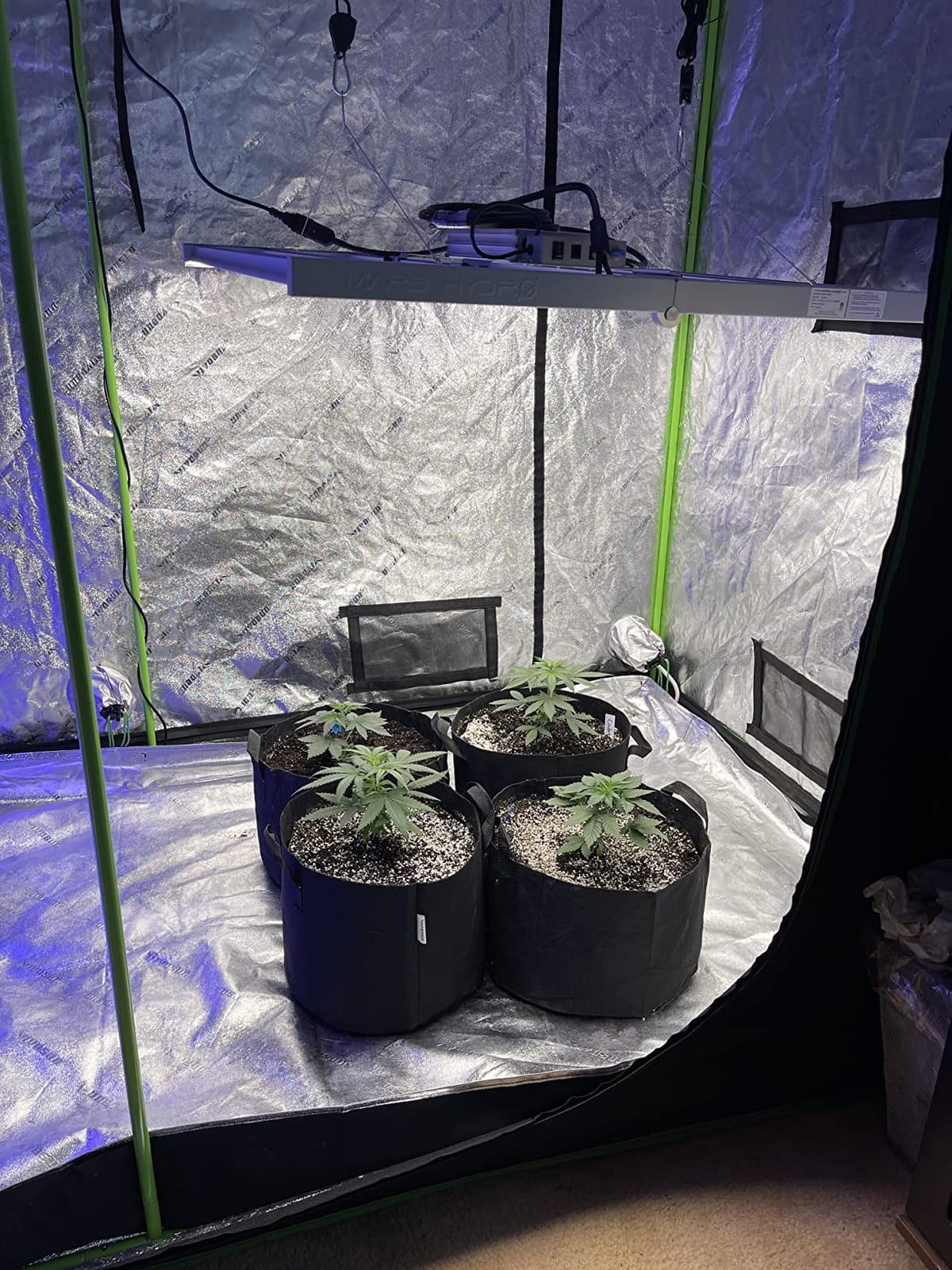
What a 4×4 feels like under the FC-4800
Full and even across sixteen square feet, with the deep red content doing real work in the last two weeks of flower. The remotely mountable driver keeps the hottest component outside the tent, which is the difference between a comfortable 4×4 and a cooky one at peak bloom.
If you are running CO2 enrichment, this is where the extra light intensity starts to make sense. Plants with supplemental carbon can use more photons than ambient air lets them, and 480W is where that argument becomes credible.
Where the FC-4800 is the wrong buy
Setup friction is the practical objection. Manual assembly, then a separate controller purchase for the app features you were probably expecting to have, means a first afternoon that is longer than the Spider Farmer equivalent.
It is also the wrong shape for a low-ceiling 4×4, and the 20-pound weight is worth factoring in if you are hanging and re-hanging it as the canopy climbs. For a purely veg-heavy or edible 4×4 it is simply more light than the crop can use.
7. AGLEX 240W for Clones, Seedlings and Two-Light 4×4 Setups
AGLEX 240W LED Grow Lights UV IR Grow Lights for Indoor Plants with 780PCS Diodes Daisy Chain Foldable & Dimmable Full Spectrum Commercial Hydroponic Growing Lamp 3×3/4×4 Grow Tent
240W with 780 SMD LEDs
1056 µmol/m2/s
Foldable, 0-100% dimming
2-year warranty
Pros
- Slim foldable body fits low-ceiling tents
- UV and IR bands included alongside white and red
- Daisy chain up to 100 fixtures with 0-100% dimming
- Fanless and silent
- Waterproof driver with AC110-277V input
Cons
- Best suited to a 3x3 footprint
- Two units are typical for a 4x4
- Published dimensions are not usable for planning
- 240W is modest for 4x4 flowering
The AGLEX 240W is not a single-light 4×4 solution, and pretending otherwise would be doing you a disservice. It is a 3×3 fixture that becomes a 4×4 solution the moment you run two of them, and because it daisy-chains up to 100 fixtures with full 0 to 100% dimming, that two-light setup is about as easy as it gets.
It carries 780 SMD LEDs at 240 watts with 1056 µmol per square metre per second, and the spectrum is unusually complete for the tier: 3000K warm white, 5000K white, 460nm blue, 660nm red, 730nm IR and 405nm UV. Having a real 405nm UV band at this output is uncommon and growers notice it.
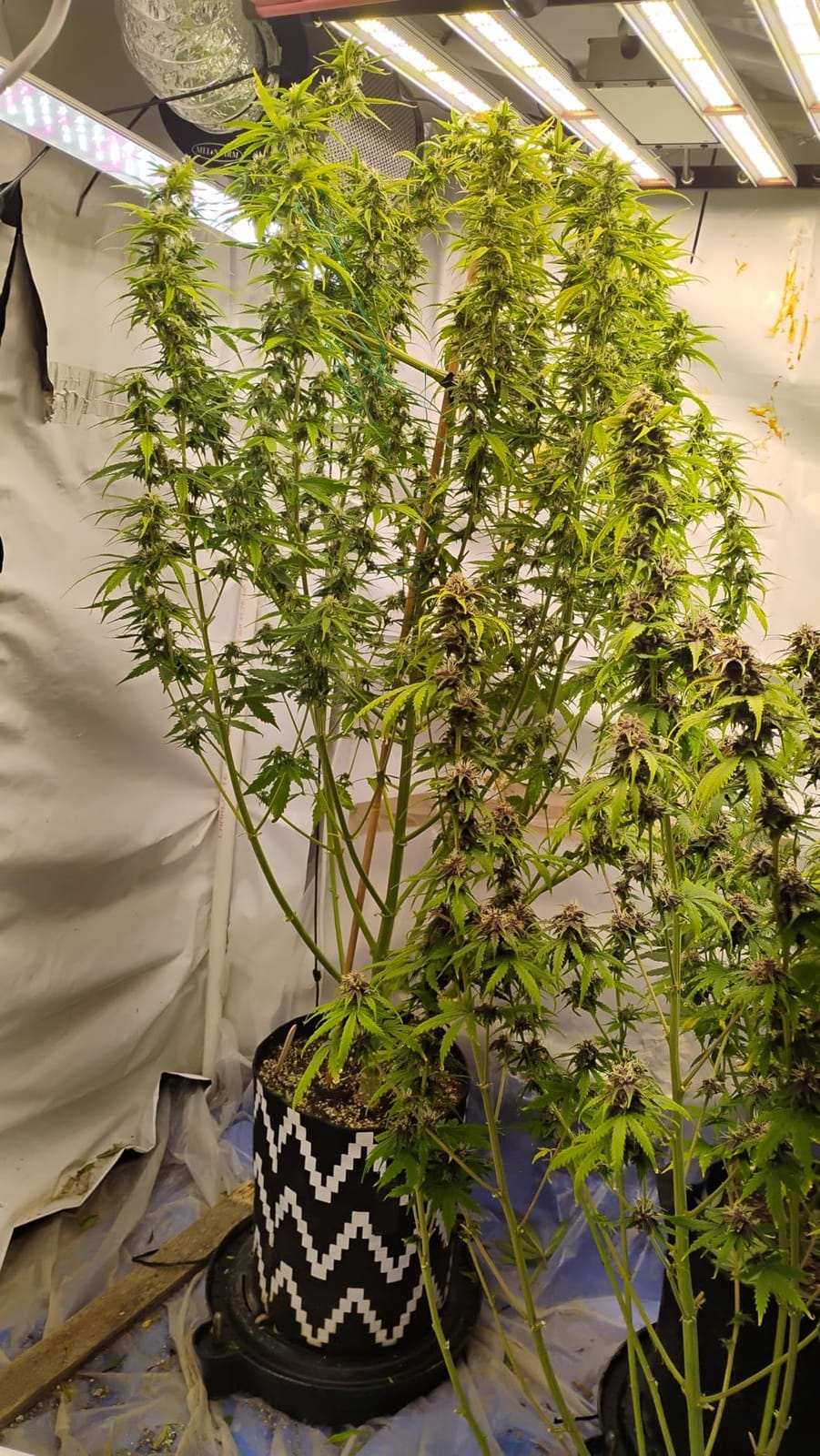
The foldable form factor is the practical star. It collapses flat enough to fit inside a low-ceiling tent where a rigid square board simply will not go, and at 3.65 kilograms it is easy to reposition as the canopy grows. The fanless aluminum body means no noise at all.
The waterproof driver accepts AC110 to 277V at 50 to 60Hz, so the same unit works in a greenhouse, a stand rack or a vertical farm as well as a tent. That versatility is why it earns a place here even though it is the smallest of the eight.
One detail to be aware of before you plan a build: the listed dimensions are reported as unusable, which makes footprint planning harder than it should be. Buyers also consistently describe 3×3 as the real coverage and say a 4×4 typically calls for a pair, which is the honest framing.
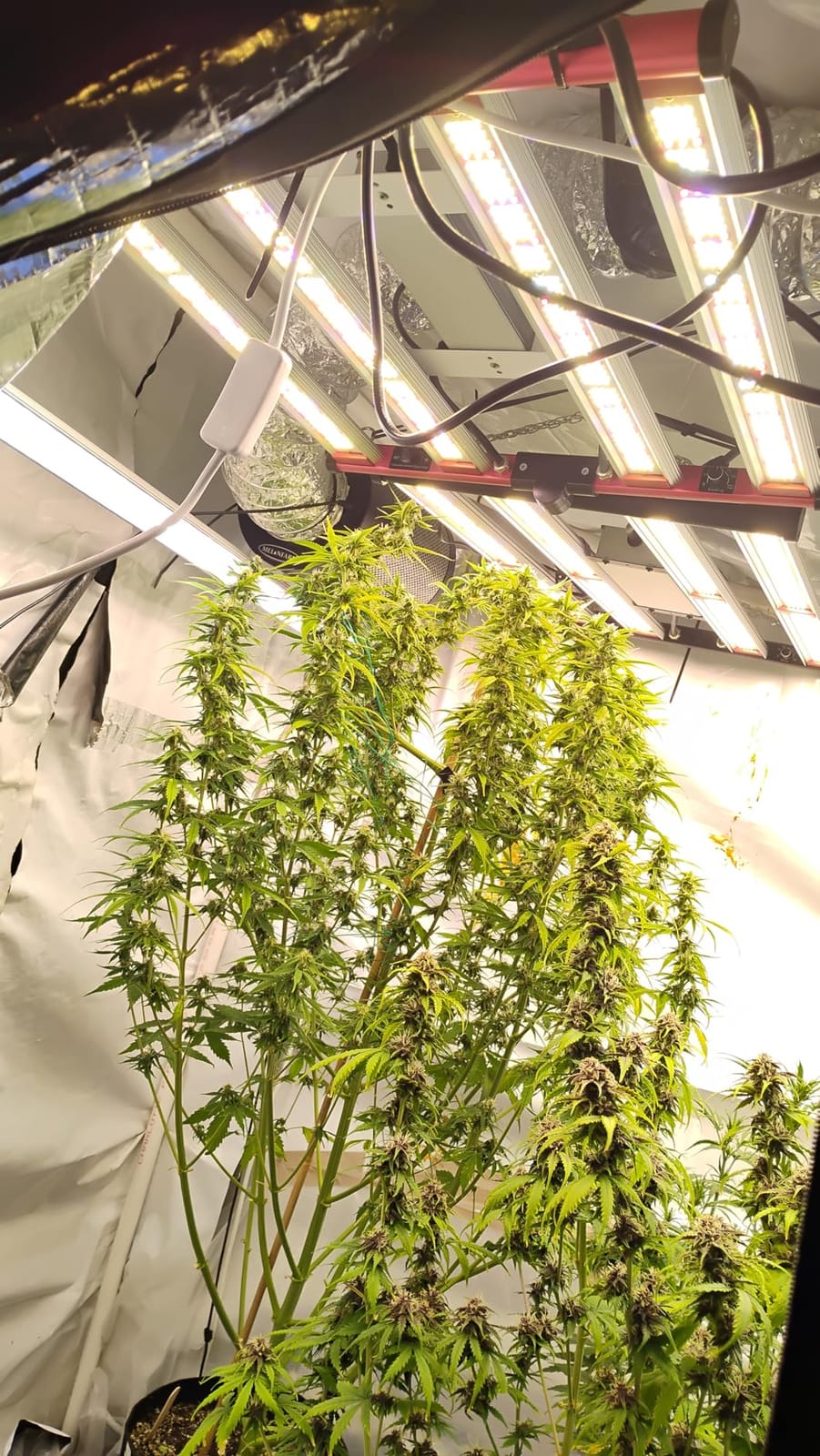
What two AGLEX fixtures do to a 4×4
Split the tent in half and run one over each half, and you get a 480W-equivalent tent with far better centre-to-corner uniformity than a single 480W board, because the light sources are further apart. This is the configuration the two-bar advocates in the forums are describing, and it costs less than a premium single fixture.
It is also the cleanest way to build up incrementally. One unit covers clones, seedlings and mother plants now, and the second unit added at flowering fills the tent when the canopy is ready for it.
Where the AGLEX is the wrong buy
One unit in a 4×4 will not carry a flowering crop, and a 240W draw is genuinely modest next to the 400 to 500W fixtures on this list. If your plan is a single light for one tent, this is not it.
The 2-year warranty is the shortest here alongside the Barrina, and unusable published dimensions mean you cannot plan the hang from the listing alone. Measure your tent before you order.
8. AC Infinity IONFRAME EVO6 for the Most Efficient 4×4
AC Infinity IONFRAME EVO6, 500W Samsung EVO Bar LED Grow Light 4×4
500W at 3.14 µmol/J
1680 Samsung LM301H EVO diodes
ETL certified
5x5 veg, 4x4 flower
Pros
- Top-tier Samsung LM301H EVO diodes with excellent efficacy
- App control with schedules and sunrise and sunset dimming
- Runs cooler at the plug than other 500W fixtures
- Commercial-grade build and packaging
- Removable controller keeps heat out of the tent
Cons
- The highest price point in this roundup
- Produces enough heat to need extra fans in late flower
- Small footprint for its 4x4 rating
- Driver and controller box run very hot
- Awkward to hang solo
The IONFRAME EVO6 has the highest efficiency figure any fixture in this group publishes, at 3.14 µmol/J, using 1680 Samsung LM301H EVO diodes to deliver 1991 PPFD at 500 watts. For a 4×4 that ratio matters, because you get more usable photons from every watt than anything else here and the running cost per cycle reflects it.
The bar-style layout uses algorithmically spaced diodes, and the stated coverage is 5×5 for veg and 4×4 for flower, which means it has a little headroom over a 4×4 rather than being perfectly matched to it. The 32.67 by 32.48 inch frame is compact for a 500 watt light, and owners do raise questions about edge coverage on that basis.
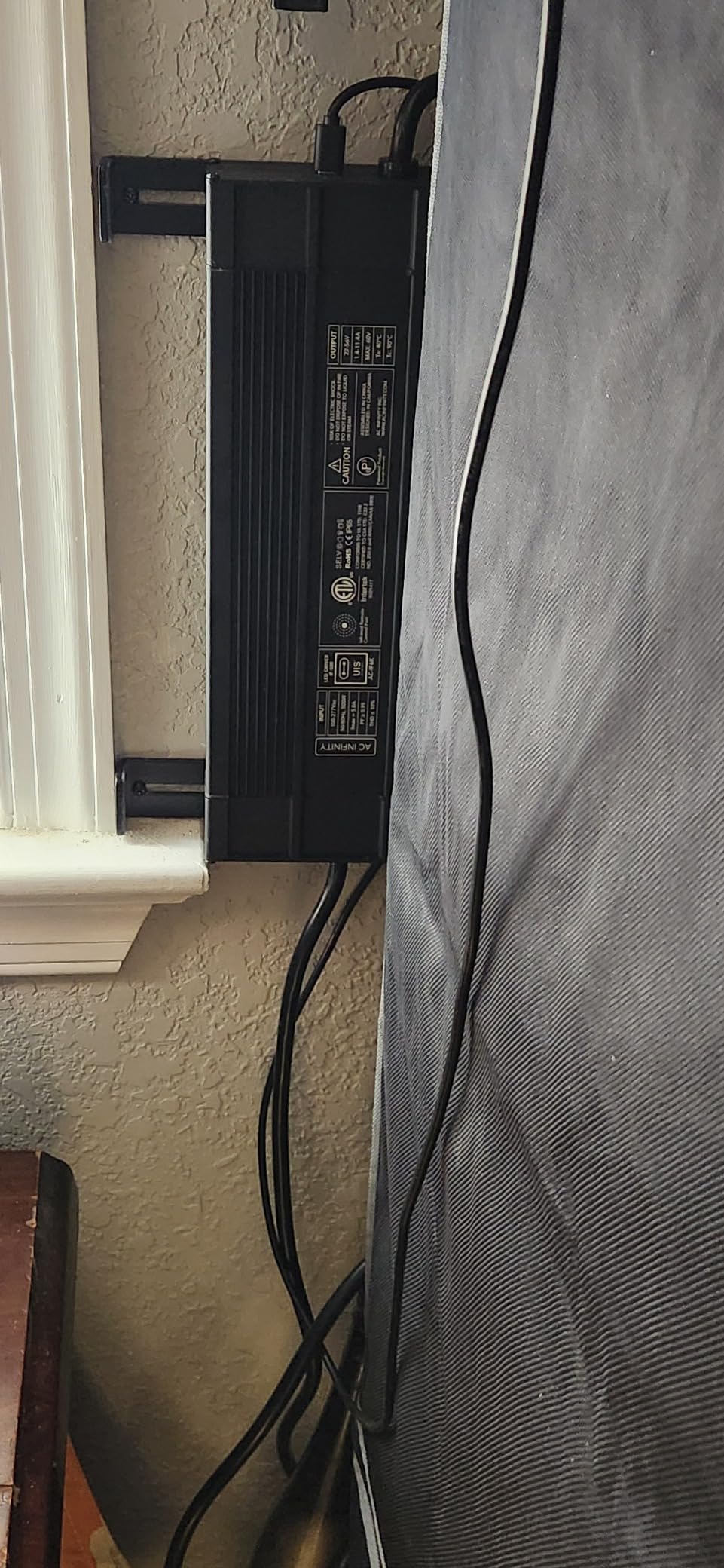
Control is thorough. Ten brightness levels, sunrise and sunset dimming, programmable schedules, UIS platform compatibility for WiFi app control, daisy-chaining for up to 80 fixtures, and a removable passive-cooling driver that mounts outside the tent. It is the most configurable option on the list and it is also the only one here that is ETL certified, which matters if you rent rather than own the space.
Owners report measurable plant responses rather than impressions: shorter internodes, fuller foliage, and unusually low heat at the plug for a 500W fixture when the driver sits outside. Several say the output is so strong that they never run it above 80% power.
The 4.6 rating from 212 reviews matches the SF4000, though with a much smaller review base, and the 2-year warranty is the shortest in the group despite the top price point. That mismatch is the one thing that gives me pause recommending it as a first 4×4 light.
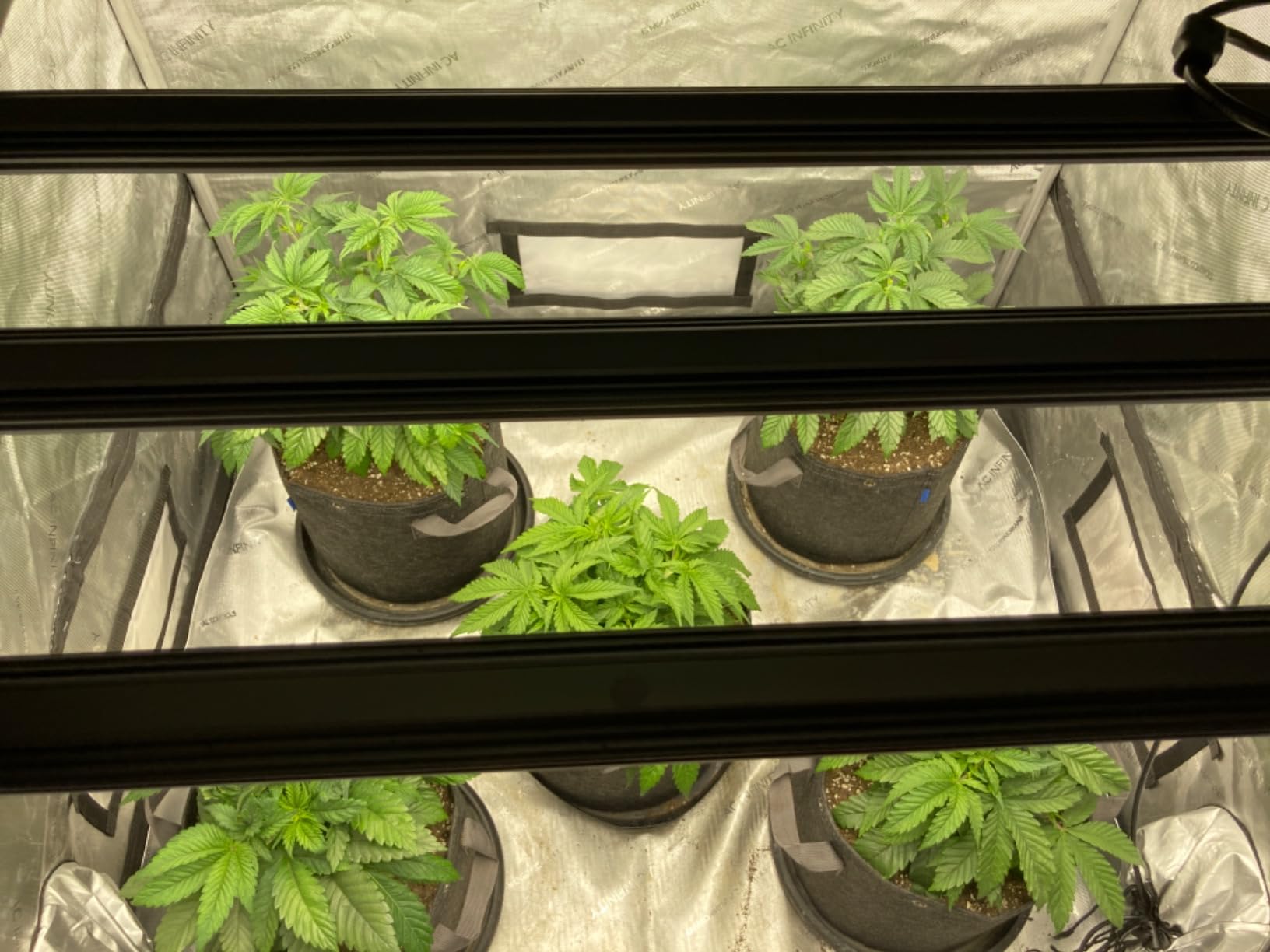
What a 4×4 feels like under the IONFRAME EVO6
Remarkably manageable heat for 500W as long as the removable controller is outside the tent. The efficiency means you can dim it to 70 or 80% and still deliver more light than a 480W competitor at full output, which is why so many owners leave headroom on the dial.
If you are running peppers, fruiting crops, or a dense 4×4 sea of green under CO2, this is where the diode quality pays off. Owners report shorter internodes and denser foliage across the board rather than in flower only.
Where the IONFRAME EVO6 does not fit
It is the most expensive fixture here, and for a first 4×4 that cost buys efficiency you may never fully use. If your canopy is four medium plants on a 12 hour cycle, a 300 watt fixture delivers nearly the same result for a fraction of the outlay.
It also needs active cooling management in a sealed tent during late flower, and the small footprint for its 4×4 rating leaves some edge coverage open to question. No sunglasses are included despite the intensity, which is a small but real comfort detail for anyone working directly under it.
How to Choose an LED Grow Light for a 4×4 Grow Tent?
Board, bar, COB or multi-board: the format matters more than the brand
A square 4×4 punishs single-point fixtures. A COB array or a single small board puts all its output from one direction, so the centre gets hot and the corners get nothing, which is the exact problem described in a r/GrowBuddy thread where a grower’s light “doesn’t cover my tent” and plants get moved around to chase the missing light.
Bar-style and multi-board layouts distribute sources across the footprint, so evenness comes from geometry rather than from hope. Both of the 480W fixtures here are bar designs, and both 500W-class options use spaced bars. If you are choosing between two otherwise equal boards, take the wider one.
This is also the honest answer to the question about the best LED spot lights for a 4×4, which is really a question about whether a focused beam is useful in a square tent. It is not, and the fixtures advertised that way are shaped wrong for the space.
Read true draw, not nameplate wattage
Compare fixtures on measured draw and published efficacy in µmol/J, and treat the wattage on the box as a brand identifier. A fixture quoting 1000 watts, 450 watts and 300 watts may all draw a broadly similar real amount, and the one with the honest number is easier to plan around.
Use efficacy as the tiebreaker, with 2.5 µmol/J as a reasonable floor. Several picks here sit at 2.7, the Mars Hydro reaches 2.85, and the AC Infinity is at 3.14. Below 2.5 you are paying for heat instead of photons.
Diodes and spectrum: what actually changes growth
Named diodes are the most reliable quality signal short of a PPFD map. Samsung LM301B, LM301H EVO, OSRAM and Bridgelux are the names that appear in the fixtures here, and a listing that names its diode brand is telling you something a generic listing is not.
Full spectrum versus dual band matters less than most marketing implies. Every fixture in this roundup runs white plus red plus some IR, and the deep red content is where the real differences sit. Look for a stated 660nm share, and treat a separately switchable UV and IR bar as a genuine feature rather than a gimmick.
Dimming, daisy-chaining and control
Dimming is not a luxury. A seedling has no dimmer problem, and a 500W fixture with no dimmer is a light you can only use at full power or not at all. The KP3000 in this list is the cautionary example, and several budget fixtures dim only across part of their range.
Daisy-chaining matters when you might expand to two fixtures, and it is what makes the two-light setups described below painless. If you are certain you will run a single light forever, it is a feature you will never touch.
A five-point check before you buy any light online
Counterfeit and mislabelled listings are a real problem in this category, and the advice across the forums is consistent: buy direct or from an authorised seller rather than through a third-party marketplace listing. Beyond that, five things are worth verifying before you commit.
The same counterfeit-listing caution applies in cheaper lighting categories, and our roundups of LED video lights and LED cupholder lights run into exactly the same pitfalls with unbranded marketplace sellers.
Check the nameplate against the driver. Listed wattage that wildly exceeds the output claim is a signal the listing is stitched together from another product.
Look for a named diode brand. LM301B, LM301H EVO, OSRAM or Bridgelux. A listing with no diode name is telling you nothing.
Confirm the seller is the brand or an authorised dealer. Warranty terms are worthless if the unit came from a marketplace reseller who disappears.
Find out who honours the warranty and from where. A five-year warranty is only real if there is a service entity you can reach.
Check the certification. ETL or UL listing matters if you rent, share a building, or face an insurance question.
What this light should not be used for
Every pick on this list is designed around a 4×4, and most of them are wrong somewhere else. A 480W to 500W fixture in a 2×2 is overkill and will cook a small tent, and none of these transfer to a 4×8, where you are looking at roughly double the footprint and therefore double the target wattage or two to four separate fixtures.
A 3×3 tent is where the Barrina, the SAYHON and the AGLEX all land in their comfort zone, and several of them are strong picks there instead. If your space is smaller than 4×4, the AGLEX, SAYHON and Barrina are the three to look at first.
If you are not running a dense canopy at all, a mid-range fixture is the honest recommendation. A 4×4 of peppers, herbs or seedlings does not need 500 watts, and buying one anyway means paying for photons you dim away.
One Light or Two for a 4×4 Grow Tent?
Two 240W to 300W lights beat one 480W to 600W light in a square tent, because coverage in a 4×4 is a geometry problem before it is a wattage problem. Two sources placed apart from each other flatten the centre hotspot and reach the corners that a single centred fixture leaves dark.
That is why two AGLEX 240W fixtures or two mid-range 300W boards are a genuinely strong configuration, and it is the argument several experienced growers make from the two-light side. The trade-offs are real, though: two fixtures means two drivers, two hang points, more wiring and roughly double the failure surface.
The single-light case is that it is simpler, cheaper in accessories, and leaves the tent frame uncluttered for the plant canopy. If you buy one, buy one with a genuine dimmer and bar-style distribution, because those two things are what rescue a single fixture from the coverage problem.
Either way, resist the forum advice to size for 640W or more in a 4×4 unless you are running CO2. A 4×4 at 480 true watts with even distribution outperforms a 4×4 at 640 watts with a hotspot, and the difference in electricity over a full cycle is real money.
Running Cost and Heat in a 4×4 Grow Tent
Running cost follows directly from the draw figures above, so here is a full cycle at 12 hours a day for 30 days, and the same fixture at a 20 hour autoflower photoperiod. Multiply by your local utility rate to get a currency figure, because rates vary too widely for me to put a number here that would still be right when you read it.
Spider Farmer SF4000 at 450W: 162 kWh on a 12 hour cycle, 270 kWh at 20 hours.
Barrina panel at 200W: 72 kWh on a 12 hour cycle, 120 kWh at 20 hours.
SAYHON SH2000 at 208W: 75 kWh on a 12 hour cycle, 125 kWh at 20 hours.
KINGPLUS KP3000 at 300W: 108 kWh on a 12 hour cycle, 180 kWh at 20 hours.
Spider Farmer SE5000 at 480W: 173 kWh on a 12 hour cycle, 288 kWh at 20 hours.
Mars Hydro FC-4800 at 480W: 173 kWh on a 12 hour cycle, 288 kWh at 20 hours.
AGLEX 240W at 240W: 86 kWh on a 12 hour cycle, 144 kWh at 20 hours.
AC Infinity IONFRAME EVO6 at 500W: 180 kWh on a 12 hour cycle, 300 kWh at 20 hours.
That is where the efficiency numbers turn into money. The AC Infinity produces 1991 PPFD at 500 watts, so it beats a 480 watt competitor on output while consuming slightly more, and dimming it to 80% puts its cycle cost below the 480W fixtures while still out-producing them.
Heat is the other half of this. A 480 watt fixture dumps close to the heat output of a small room heater into a sixteen square foot space, and the answer to the recommended CFM for a 4×4 grow tent is matched intake and exhaust sized to the light, not to the tent. Mount remote drivers outside where the fixture allows it, which the SE5000, FC-4800 and IONFRAME EVO6 all do.
For a first timer, a 300 watt fixture with an exhaust fan covers a 4×4 flowering cycle comfortably and keeps the tent temperature manageable. The 480 to 500 watt options are better matched to a tent that already has intake solved.
Frequently Asked Questions
What is the recommended LED wattage for a 4×4 grow tent?
A 4×4 grow tent needs roughly 250 to 400 watts of true LED draw, which works out to 32 to 50 watts per square foot of real output. That figure comes from the old HPS sizing rule converted for modern LED efficiency. Check the driver specification rather than the nameplate, because most fixtures labelled 1000 watts actually draw 200 to 260 watts. A 480 watt fixture run dimmed is a valid alternative for a dense canopy or a CO2-enriched grow.
How many plants can I grow under 300W of LED in a 4×4?
About four medium plants in a sea-of-green layout is the realistic ceiling for 300 watts in flower inside a 4×4. Fewer, larger plants give noticeably better results than a crowded canopy, because a dense canopy shades itself and you pay for light that never reaches the lower branches. Under 300W, running four plants in a 4×4 with modest spacing gives each one enough light for a respectable result without the light being the limiting factor.
Is it better to use one big grow light or two smaller ones in a 4×4?
Two smaller lights usually win in a square tent because they flatten the centre hotspot and reach the corners a single centred fixture leaves dark. Coverage in a 4×4 is a geometry problem before it is a wattage problem. One light wins on simplicity, fewer failure points and less wiring. If you buy a single fixture, prioritise a bar-style layout and a genuine dimmer, since those two features are what rescue a single light from the coverage problem.
What is the recommended CFM for a 4×4 grow tent?
Match intake and exhaust to the light wattage rather than to the tent size, because a 480 watt fixture puts close to the heat output of a small room heater into sixteen square feet. A typical sealed 4×4 running a 300 watt light needs a modest inline fan and a vented door, while a 480 to 500 watt setup benefits from a controller fan and a remote-mounted driver. Mount drivers outside the tent wherever the fixture allows it.
What size LED grow light do I need for a 4×8 grow tent?
A 4×8 has twice the footprint of a 4×4, so double the target wattage or use two to four separate fixtures. None of the 4×4 picks transfers directly without either being run at a stretch or being replaced. A more efficient route is two high-output fixtures split front to back rather than one enormous board, which also solves the uniformity problem that a single centred light creates across a long rectangle.
The Best LED Grow Lights for 4×4 Grow Tents in 2026
The Spider Farmer SF4000 is the best LED grow light for a 4×4 grow tent in 2026 because it is the only fixture in this group that combines even centre-to-corner coverage, a real dimmer, fanless silence and a five-year warranty with local service behind it. At 450 watts it sits in the middle of the useful range rather than at either extreme, and its edge-weighted diode layout is designed around the coverage problem that sends people hunting for a new light mid-grow.
If your budget is tighter, the SAYHON SH2000 at 208 watts is the strongest performer per watt in the group, with a switchable UV and IR bar that nothing else at that output offers, while the Barrina panel is the cheapest credible way to get light across sixteen square feet. If you want the most control, the AC Infinity IONFRAME EVO6 has the highest published efficacy at 3.14 µmol/J and the only ETL certification here, but it is the costliest option and needs its heat managed carefully.
Whatever you choose, size it on true draw rather than the number on the box, buy from the brand or an authorised seller, and check your hanging height before the light arrives. Those three steps eliminate most of the disappointment people report in 4×4 tents, and the rest is just choosing how evenly you want the light spread.