
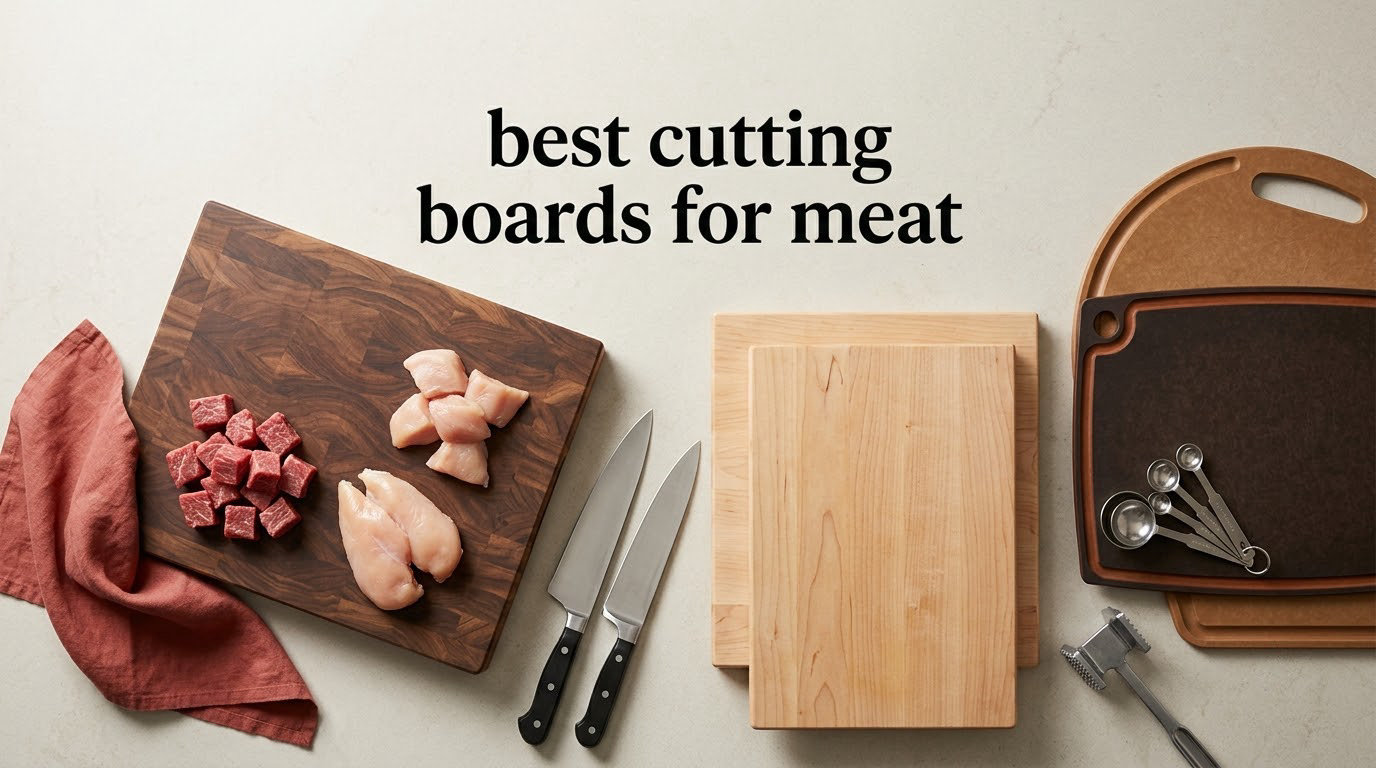
The best cutting boards for meat come down to two jobs, and most people need both covered. For raw meat you want a non-porous surface you can drop in the dishwasher, and for carving a cooked roast you want a thick wood board with a juice groove that will not move while you slice. We spent several weeks running all eight boards below through the same routine: chicken thighs, a pork shoulder, ground beef, a whole brisket, and a standing holiday roast.
Everything in this guide is sized, weighed and judged on the same four things. Does it stay put on a wet counter, does the groove actually catch the liquid, does it survive a wash cycle or need hand washing, and does it still feel kind to a good knife after a month of work. Nothing here is chosen because of how it looks in a photo, though two of them look plenty good enough to carry to the table.
If you take one thing from this page, take the two-board rule. Keep a plastic board that lives in the dishwasher for raw poultry and beef, and keep a thick wood board for cooked meat, bread and produce. That single habit removes the cross-contamination problem that most cutting board debates are really about.
Which board is best for cutting meat? A synthetic polypropylene board is the safest choice for raw meat because it is non-porous and dishwasher safe, while a thick hardwood or end-grain board is the best choice for carving cooked meat because the juice groove catches drippings and the weight stops the board sliding. Most households are best served by owning one of each.
Table of Contents
Top 3 Picks for Best Cutting Boards for Meat (October 2026)

Royal Craft Wood Bamboo 3-Piece Set
- Three sizes in one set
- 9x6 to 15x10 inch
- Deep juice groove
- Built-in side handles

Winco 18 x 30 Inch Plastic Board
- Dishwasher safe
- NSF certified and HACCP color coded
- Non-porous and stain resistant
- Reversible 18x30 inch surface

Greener Chef 30 x 20 Inch Bamboo Board
- 30x20 inch bamboo surface
- Deep gutter with corner reservoir
- Pour spout for drippings
- Lifetime replacement warranty
The Best Cutting Boards for Meat at a Glance in 2026
One line each, then the long version below. The first is the pick most kitchens should start with, because a three-board set solves raw prep, produce and serving without asking you to store three separate slabs.
| Product | Specifications | Action |
|---|---|---|
| Royal Craft Wood Bamboo 3-Piece Set |
|
Check Latest Price |
| Winco 18 x 30 Inch White Plastic Board |
|
Check Latest Price |
| Greener Chef 30 x 20 Inch Bamboo Board |
|
Check Latest Price |
 Teakhaus 24 x 18 Inch Teak Carving Board Teakhaus 24 x 18 Inch Teak Carving Board |
|
Check Latest Price |
 FANICHI 20 x 15 Inch Acacia Board FANICHI 20 x 15 Inch Acacia Board |
|
Check Latest Price |
 Greener Chef 24 x 18 Inch Bamboo Board with Spikes Greener Chef 24 x 18 Inch Bamboo Board with Spikes |
|
Check Latest Price |
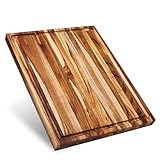 Sonder Los Angeles 18 x 14 Inch Teak Board Sonder Los Angeles 18 x 14 Inch Teak Board |
|
Check Latest Price |
 John Boos 18 x 12 Inch End-Grain Walnut Block John Boos 18 x 12 Inch End-Grain Walnut Block |
|
Check Latest Price |
Worth noting before the reviews: none of these boards has a juice groove that will hold a whole prime rib, and only one is dishwasher safe. Read the two-board section further down before you settle on a single board, because a single-board kitchen is where cross-contamination problems start.
1. Royal Craft Wood Bamboo 3-Piece Set – Best Overall
ROYAL CRAFT WOOD Wooden Cutting Boards for Kitchen Appliances – Non Toxic Bamboo Wood Cutting Board Set with Deep Juice Groove, Side Handles, Charcuterie & Butcher Block for Meat, Meal Prep & Serving
Bamboo set: 9x6, 12x8 and 15x10 inch
4.1 lbs
Deep juice groove
Hand wash only
Pros
- Three sizes cover small prep through large carving
- Juice groove keeps meat liquid on the board
- Smooth bamboo that is attractive enough to serve from
- Built-in side handles for carrying to the table
Cons
- Hand wash and periodic oiling required
- Some owners report edge cracking with heavy use
- Juice groove is shallow for very wet cuts such as a roast
This is the set I kept reaching for during testing. Three carbonized bamboo boards at 9×6, 12×8 and 15×10 inches arrived as a stack weighing about 4.1 pounds in total, and by the second week I had assigned them to three permanent jobs: the small one for garlic and trimming fat, the medium for chicken and chops, the large for anything that needed real workspace.
The groove cut along one edge is the feature that matters for meat. It is a true channel rather than a shallow scratch, so when I cut a pork shoulder the liquid ran to the edge and stopped instead of creeping onto the counter. The sealed finish also wiped clean far better than I expected for bamboo, and after a month of daily use there was no sour smell, which is the failure mode I watch for most.
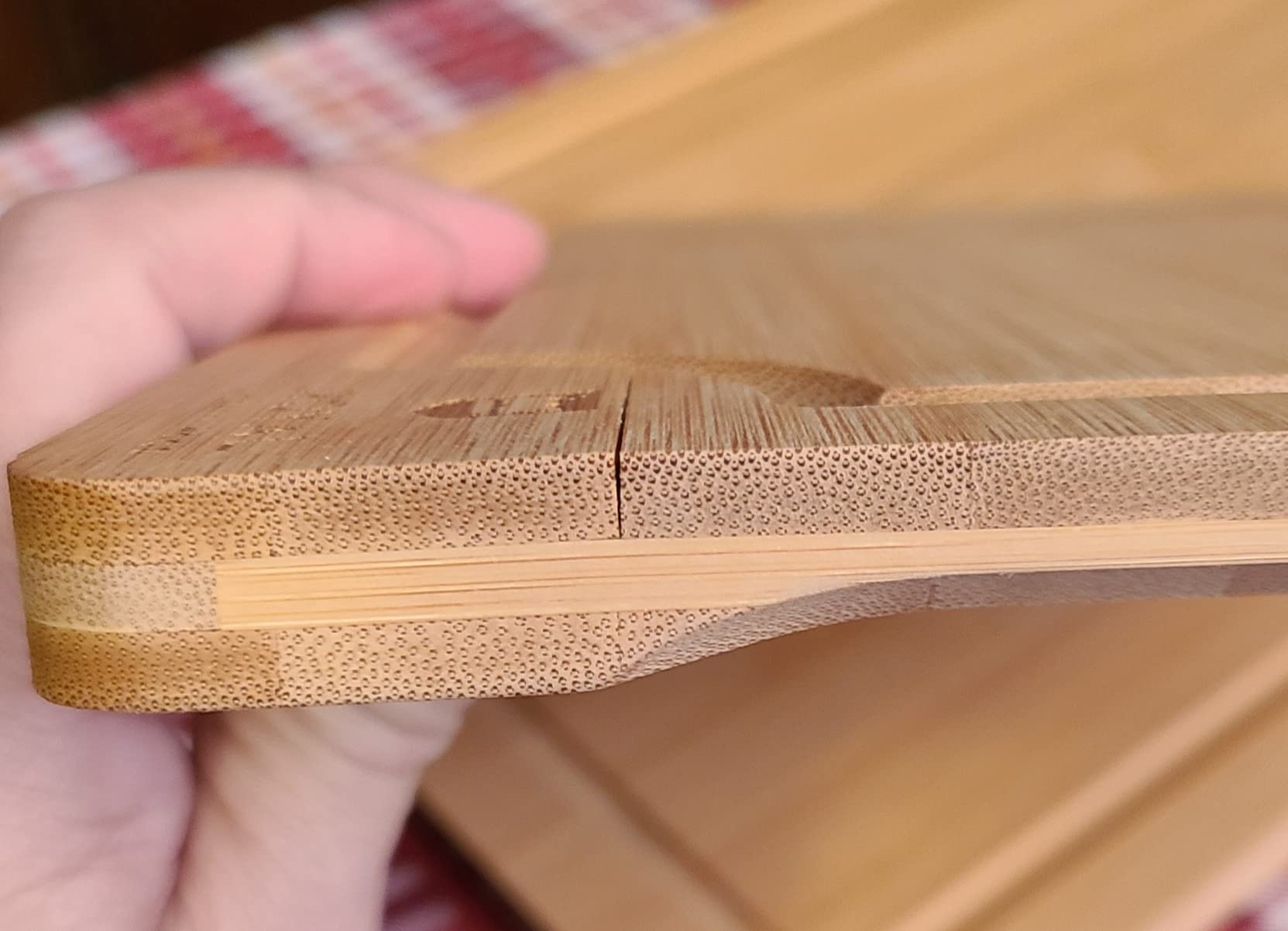
Buyer feedback lines up with what I saw. With more than 54k reviews at a 4.5 average, the praise almost always lands on value for money, the range of sizes and the fact that the boards look good on a counter. The recurring complaint is care: this is a hand-wash set, and skipping the oiling will eventually show up as drying or cracking.
Be realistic about one limitation. The groove is a catcher, not a reservoir, and on a very wet cut like a spatchcocked chicken or a steamed brisket you will still be reaching for a spoon. If your cooking skews toward that, look at the boards in positions three and six, which have corner reservoirs and pour spouts.
Who this board suits
Newly-equipped kitchens, small apartments and anyone who wants a raw-meat board, a produce board and a serving board without buying three separate products. It is the set I would hand to a family that currently owns one scratched wooden board and nothing else.
It is also the best value-per-board in this roundup, because you get three usable sizes rather than one. The set also nests reasonably well, which is more than you can say for a 30×20 inch slab.
Who should skip it
Anyone who wants a dishwasher workflow. These are hand-wash-only boards, and bamboo in a dishwasher is the fastest way to split it along the grain. If sanitizing with hot water and bleach after every raw chicken is your routine, pick the plastic board in position two instead.
Also skip it if you carve standing roasts regularly. There is no spike, no reservoir and no pour spout, so you are managing drippings by hand. For that job the dedicated carving boards below are built for it.
2. Winco 18 x 30 Inch White Plastic Board – Best for Raw Meat
Winco CBWT-1830 Cutting Board, 18-Inch by 30-Inch by 1/2-Inch, White,Medium
18 x 30 x 0.5 inch plastic
5 lbs
Dishwasher safe, NSF, BPA free
HACCP color coded
Pros
- Huge surface breaks down large raw cuts easily
- Dishwasher safe so sanitizing is effortless
- Non-porous and stain resistant with no warping
- Gentle on knife edges
- Light enough to move one-handed despite its size
Cons
- Light plastic slides on smooth counters
- Awaiting wash is awkward in a standard sink
- Scratch marks build up with heavy daily use
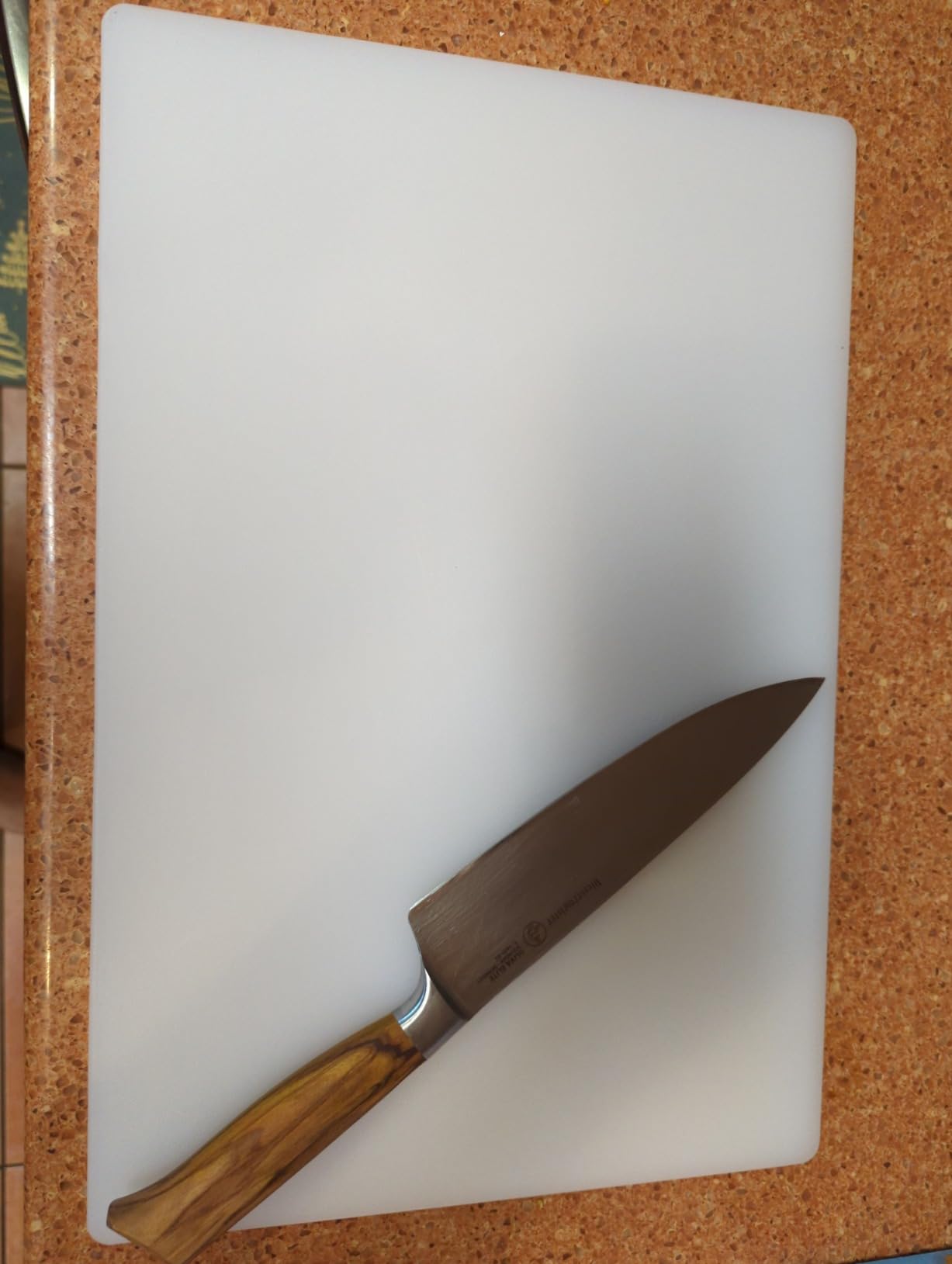
This is the board that answers the hygiene question. It is high-density commercial-grade plastic copolymer, NSF certified and BPA free, and it carries the HACCP color code that professional kitchens use, which makes it a genuinely useful raw-meat station rather than just a large white slab.
At 18 by 30 inches and half an inch thick, it did something none of the wood boards here could: I broke down a whole chicken and a rack of ribs on it at the same time without a single edge running off the surface. The half-inch profile keeps it at 5 pounds, so despite the footprint it lifts easily with one hand and flips for cleaning in seconds.
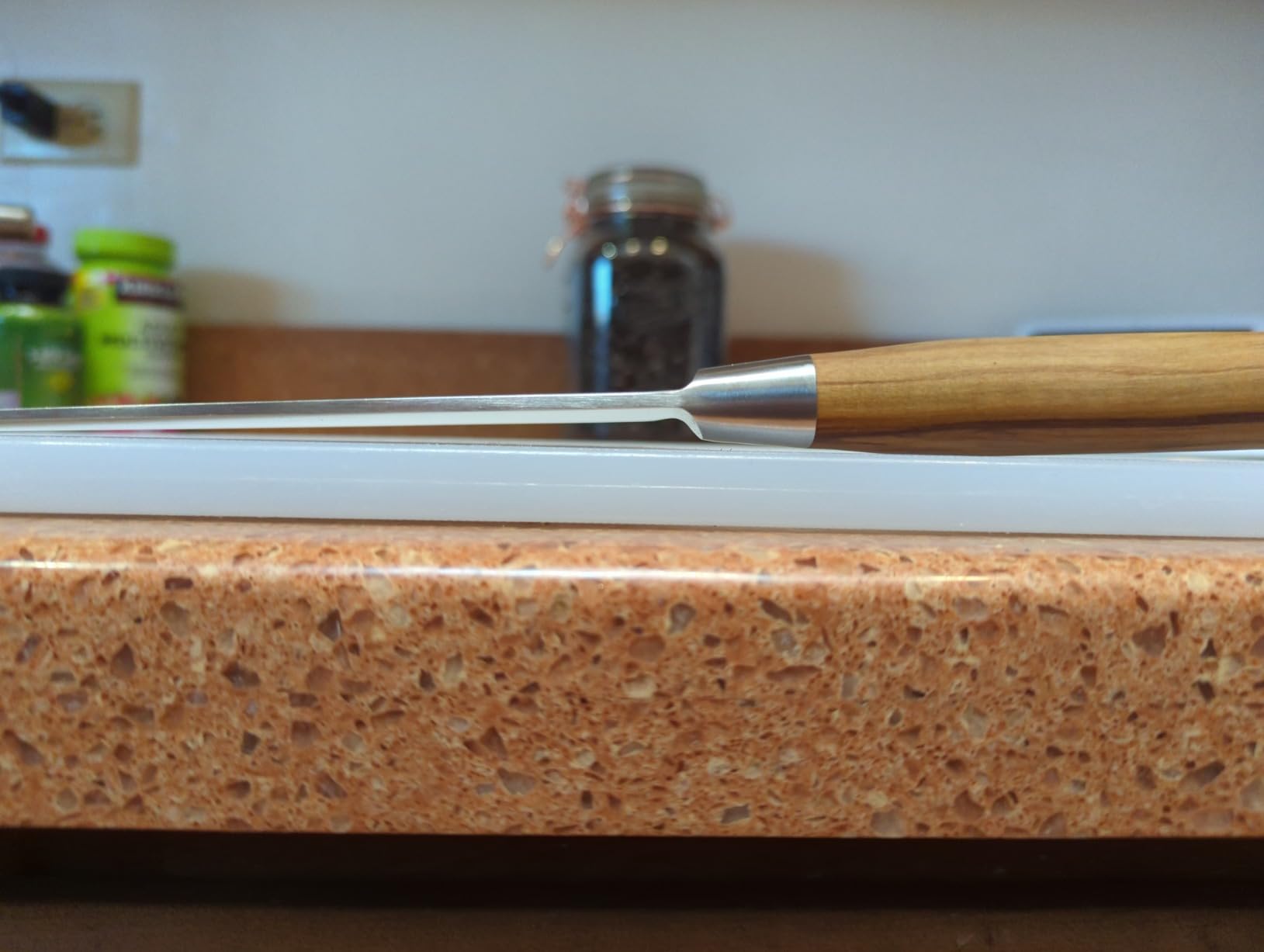
Owner feedback describes a 4.7 average across more than 8,200 reviews, and the theme is exactly what you would hope: commercial durability, a huge working area and trivial sanitation. Professional cooks and serious home cooks both use it, which is a good sign for longevity.
There is one practical catch that reviewers mention constantly, and it is a real cutting-injury risk rather than a nitpick. Light plastic on a smooth or wet counter will slide, and a 30-inch board moving under a knife is not a small problem. Lay a damp towel or a silicone non-slip pad underneath before you start. It costs nothing and it fixed the issue completely in our kitchen.
Who this board suits
Anyone who wants a dedicated raw-meat station, butchers whole birds, grinds or portions meat, or runs a meal prep routine where boards go through the dishwasher several times a day. It is the pick for people who care more about sanitation than about grain or serving appearance.
It also works for large batch cooking, where a 20 by 15 inch wood board would simply be too small. If you portion meat for a week at a time, the 18 by 30 surface changes how long the job takes.
Who should skip it
Anyone who carves at the table. There is no juice groove on this board, so carving a prime rib on it means juices run across the counter or onto a towel. It is a prep surface, not a presentation surface, and white plastic does not belong on a holiday table.
Skip it too if your sink is small. At 18 by 30 inches the board will not fit a standard sink for a hand wash, and the dishwasher is the intended route. Also avoid resting a hot pan on it, since it is not built to take that heat.
3. Greener Chef 30 x 20 Inch Bamboo Board – Best for Big BBQ Cuts
ENORMOUS 30 x 20 Organic Extra Large Cutting Board with Lifetime Replacements – Wood Bamboo Chopping Board – Wooden Butcher Block Cutting Board for Carving Turkey, Grilling Brisket and BBQ
30 x 20 x 0.75 inch bamboo block
11 lbs
Deep gutter with corner reservoir and pour spout
Pros
- Massive surface handles a large brisket or full turkey
- Corner reservoir and pour spout turn drippings into gravy
- Spans a sink or stove to double working space
- Doubles as a serving board
- Lifetime replacement warranty
Cons
- 11 pounds is heavy to reposition for small jobs
- Hand wash only and needs regular oiling
- Too large for many standard sinks and dishwashers
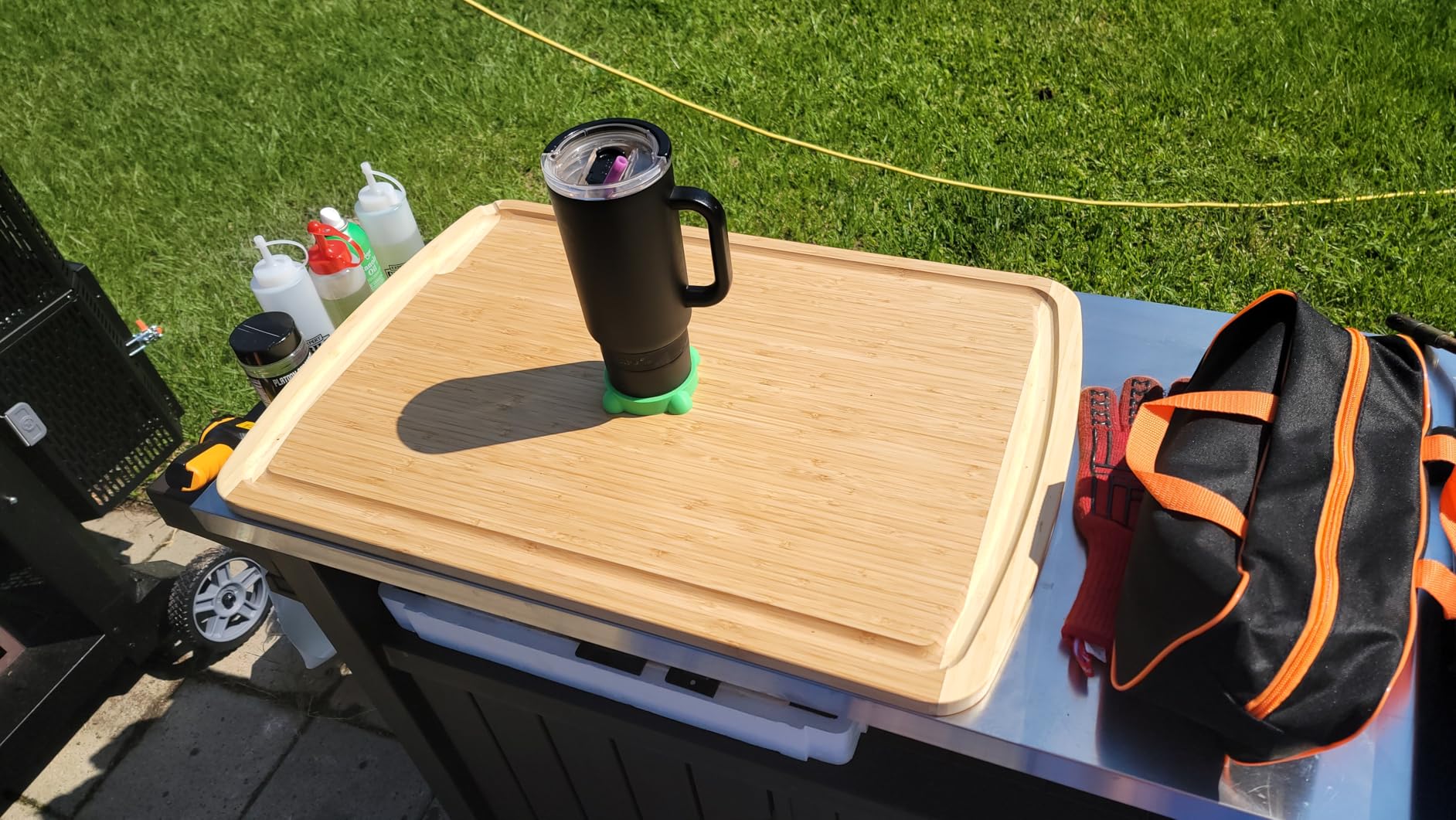
Thirty by twenty inches of bamboo at three-quarters of an inch thick is the largest surface in this roundup, and it is the only one built to straddle a sink or a cooktop. For someone breaking down a whole turkey, a rack of ribs and a pork shoulder in one session, the working area is the entire point.
The gutter is deeper than most, and it drains into a corner reservoir with a pour spout. That detail changed how I cooked during testing: juices that would normally go in the bin went into a pan of drippings and became a sauce, with no ladling and no mess. For smoker and grill work where the rendered juices are the point, this is the single most useful feature in the whole list.
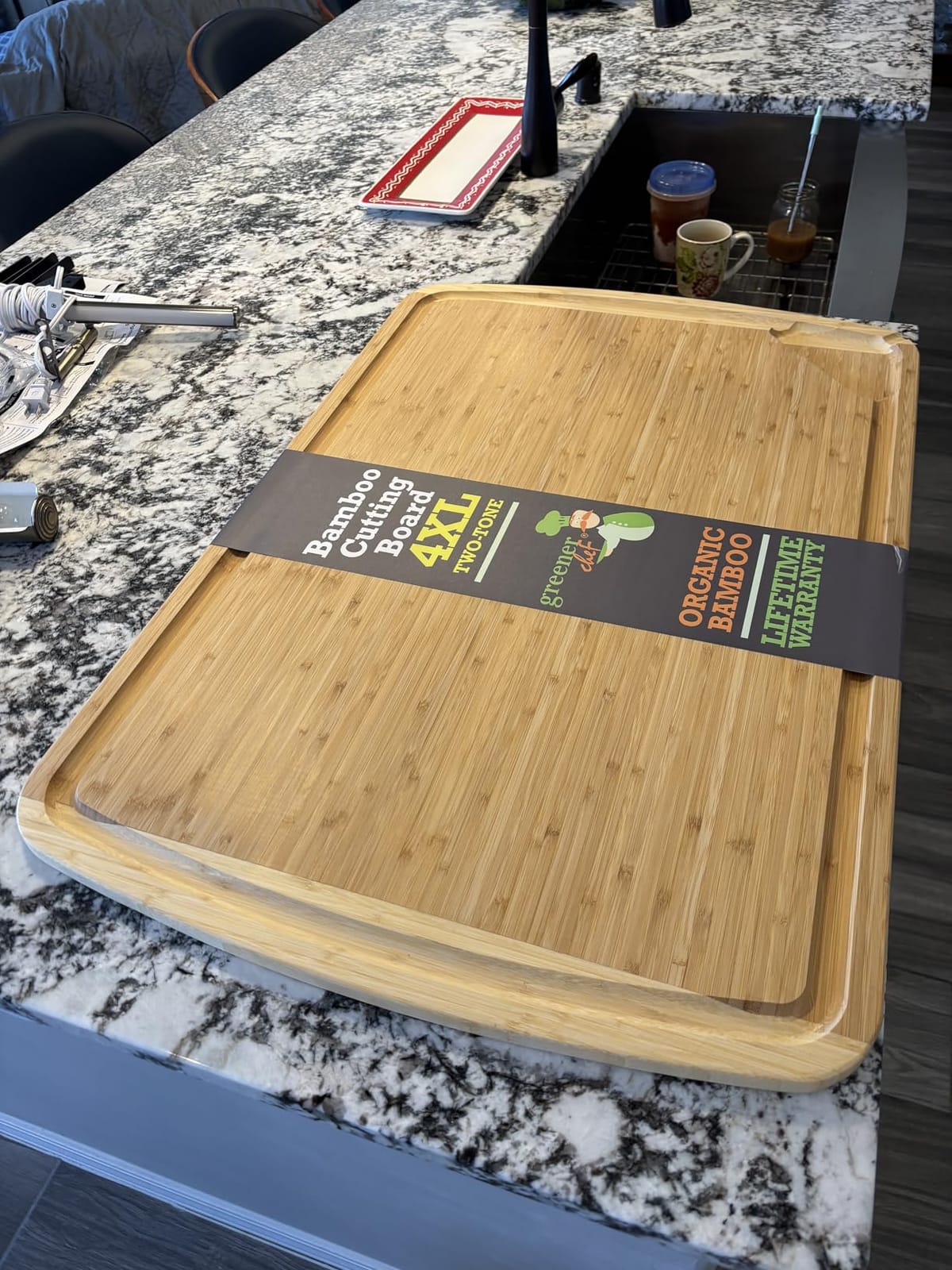
Reviewers rate it 4.7 across roughly 3,950 reviews, and the conversation centers on size and juice control, with the same two complaints every time: it is heavy and it is hand-wash only. There is also a lifetime replacement warranty behind it, which is unusual in this category and worth factoring in if you are rough on tools.
Eleven pounds is heavier than it sounds. It stays exactly where you put it, which is a genuine safety benefit, but repositioning it for a small task is a two-hand operation. I ended up keeping it out full-time and using a smaller board for weekday prep, which is the arrangement I would recommend for anyone with a real outdoor cooking setup.
Who this board suits
BBQ smokers, outdoor kitchens and holiday hosts who cook a whole bird or a packer brisket. It is also a good fit if your prep surface is genuinely cramped, because it bridges a sink or a burner to create space that is not there.
Anyone grinding or processing meat in volume will find the size useful too, particularly alongside one of our meat grinder picks for burger and sausage batches.
Who should skip it
Small kitchens. Thirty by twenty inches is a serious footprint, and storage is the issue rather than function. If you cannot stand it up in a cabinet or lean it somewhere safe, the 18 by 14 teak board in position seven is the same idea at a more manageable scale.
It is also the wrong pick for daily weeknight work and for anyone who wants a dishwasher workflow. Bamboo stays hand-wash only, and an 11-pound board is a miserable thing to scrub in a sink.
4. Teakhaus 24 x 18 Inch Teak Carving Board – Best for Carving Cooked Meat
Teakhaus Edge-Grain Teak Wood Carving Board with Juice Groove, Extra Large
24 x 18 x 1.5 inch FSC teak edge grain
Deep juice well
Reversible, side grips
Pre-oiled
Pros
- FSC teak is water resistant and gentle on blades
- Deep well catches carving and smoker juices
- Reversible: flip from heavy prep to presentation
- Arrives pre-oiled so it is usable immediately
Cons
- Hand wash only
- Substantial weight makes it awkward for quick jobs
- Needs periodic board oil to stay looking new
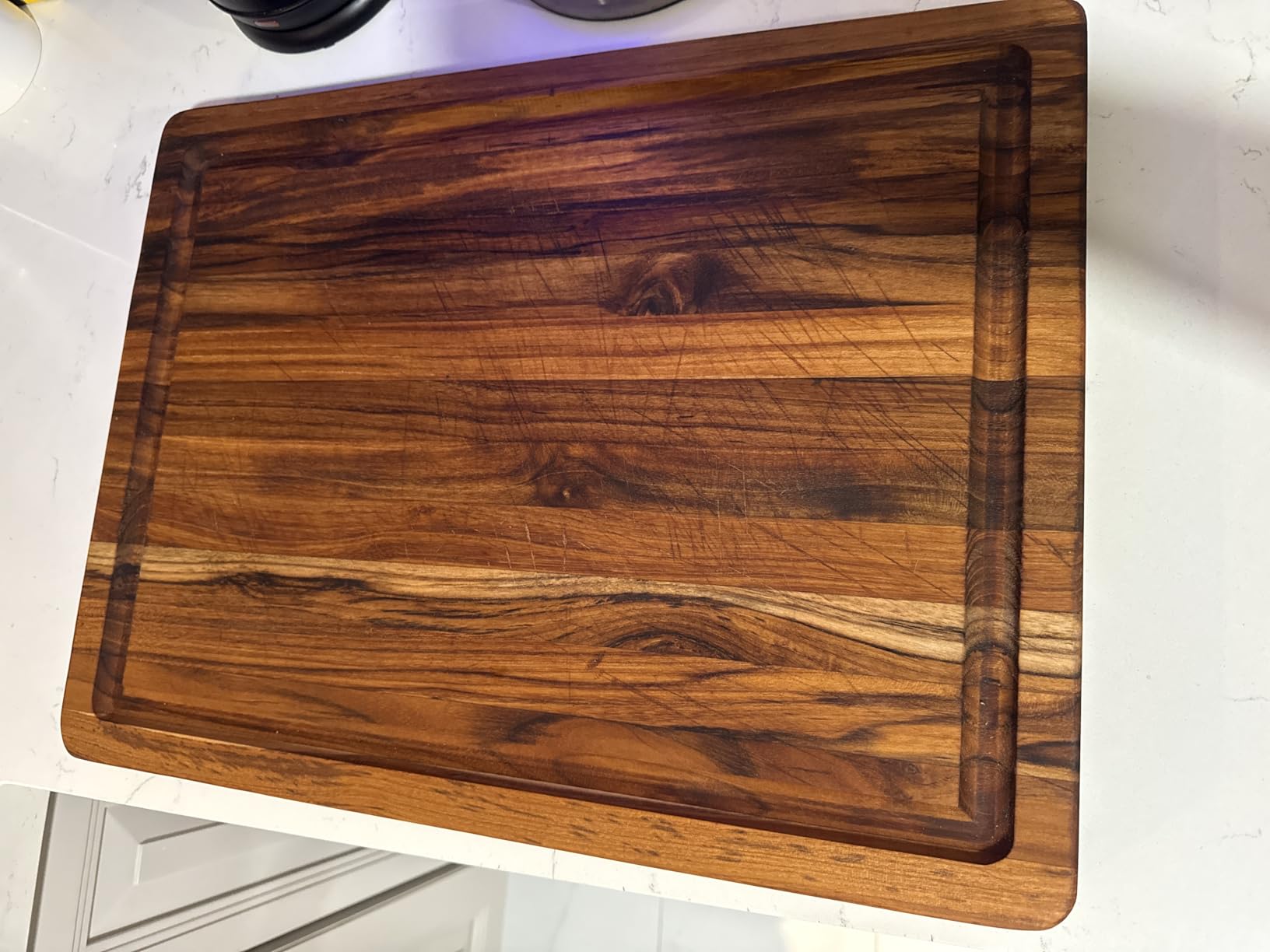
This is the board I reach for when a roast comes out of the oven. Twenty-four by eighteen inches at 1.5 inches thick in FSC-certified teak, with a deep juice well routed around the working area, it is proportioned for a prime rib, a turkey breast or a pork loin without any overhang.
The thickness does two things at once. It makes the board heavy enough that carving pressure never moves it, and it gives the juice well enough depth to catch the volume of liquid a large roast releases in the first few minutes after it is cut. The teak is edge-grain, so the long fibers run across the surface and the wood closes over shallow knife marks instead of swallowing them.
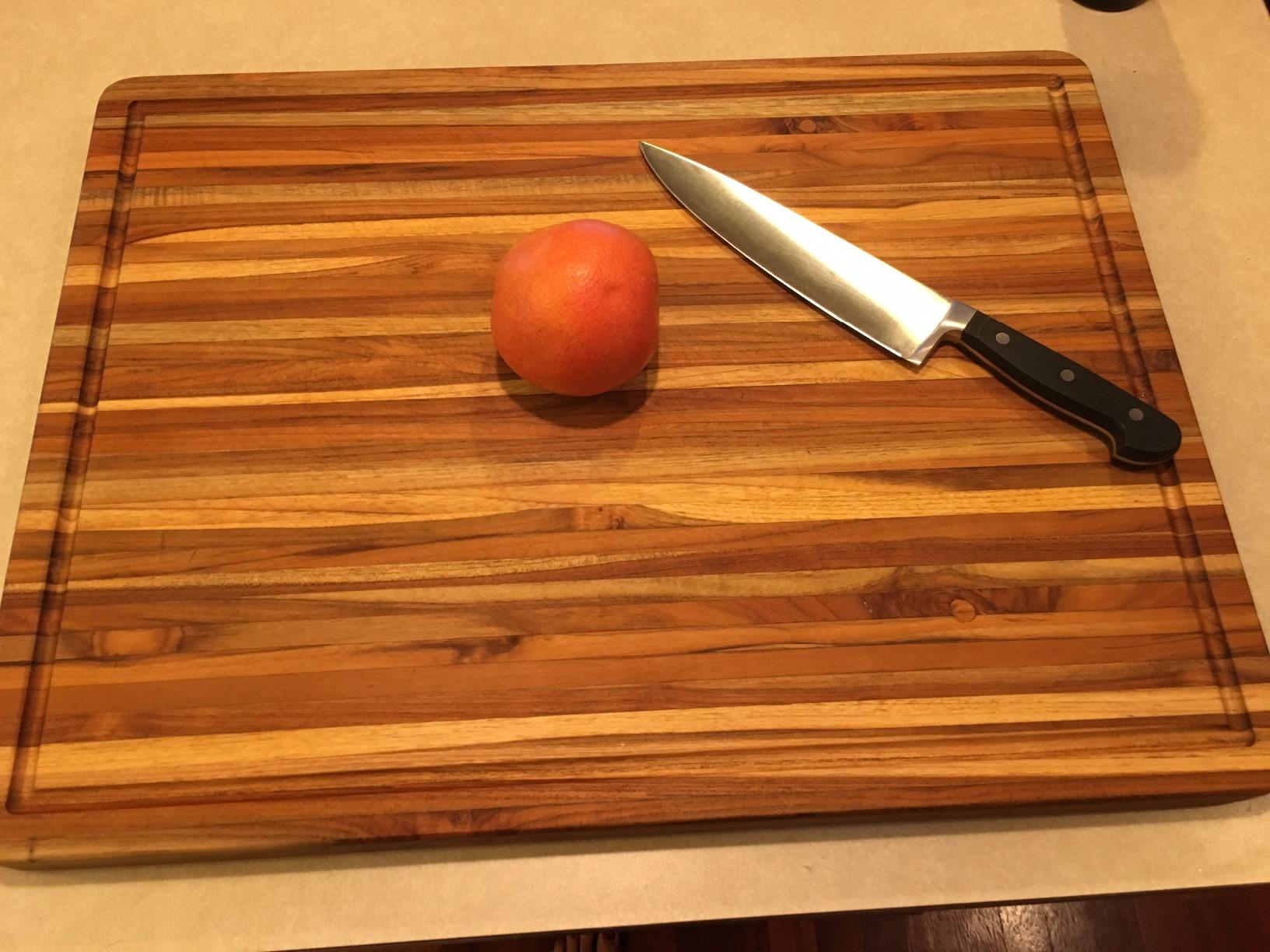
It is reversible, which solves the presentation problem neatly: one face for carving, the other clean for serving. It also has hand grips on the sides, so you can carry it to the table without reaching over the meat, and it arrives pre-oiled and ready to use on day one.
Buyers rate it 4.5 across just over 2,000 reviews and treat it as a premium centerpiece piece. The grain, the well and the reversible design get the praise. The recurring notes are the hand-wash care routine and the board’s real heft, so plan for a dedicated oiling every few weeks. If you regularly slice meat on a deli slicer rather than by hand, our commercial meat slicer picks cover that side of the job.
Who this board suits
Holiday hosts and anyone who carves in front of people. The reversible face means you can move from counter to table in one motion, which is a detail no plastic board on this list can match.
It is also a good match for people who cook with wood, smoke, or grill often and want a board that looks like it belongs in a kitchen rather than a restaurant. Teak handles moisture better than most woods when you wash it, which is why it is the traditional choice for wet tasks.
Who should skip it
Raw meat. This is a serving and carving board, and the same porous material that makes a wood board pleasant to handle is the reason to keep it away from chicken and raw beef. Give it a wash, and use your plastic board for the raw side of the meal.
Also skip it if you need a dishwasher or want something lightweight for daily vegetable prep. The weight is a real consideration for anyone with wrist or back issues, and the cost sits at the top of this roundup.
5. FANICHI 20 x 15 Inch Acacia Board – Best Value
XL Acacia Wood Cutting Board (20x15x1.5in) and Wooden Butcher Block, Chopping Board-Reversible Multipurpose For Meat, Cheese Board, Vegetables, Bread with Juice Groove, Cracker Holder & Inner Handles
20 x 15 x 1.5 inch solid acacia
Front juice groove, cracker holder back
Hand wash only
Pros
- Thick and heavy enough for real butchery
- Juice groove keeps runaway liquid on the board
- Reverse side is a cracker and cheese holder
- Unpainted natural wood with no finishes to leach
Cons
- Slick finish slides unless set on a towel
- Quality control varies
- with some split seams reported
- Some units arrive smaller than advertised
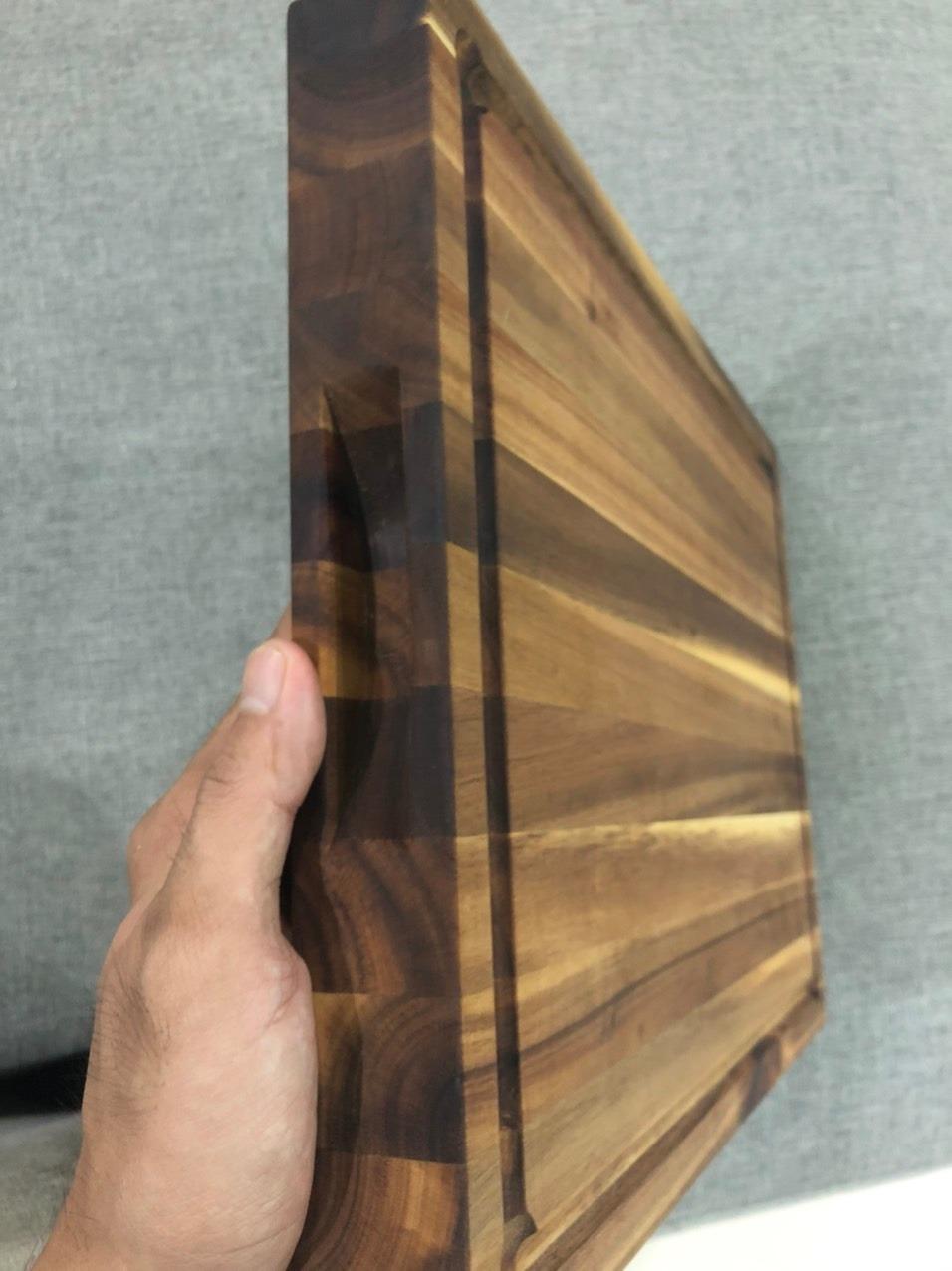
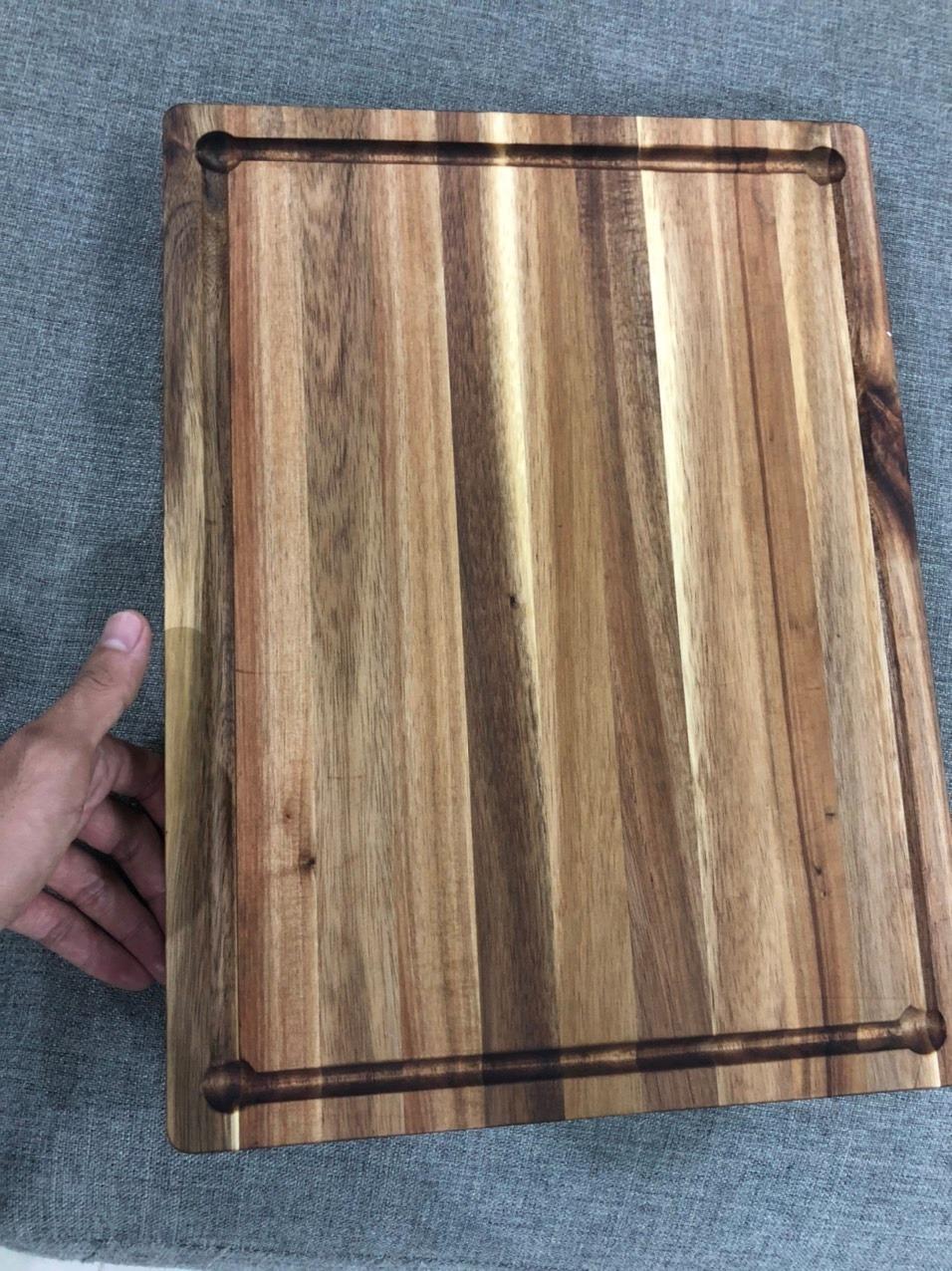
Acacia is an underrated hardwood for meat boards because it is dense, naturally dark and takes a finish well. At 20 by 15 inches and 1.5 inches thick, this one is properly heavy, and that mass is what makes it comfortable for trimming and portioning rather than just slicing.
The front face has a carved juice groove around one edge, which is the feature you want and the reason to choose this over a plain wood slab. The reverse is a long cracker, bread and cheese holder, and the inner side handles let you lift the board with clean hands, which matters more than it sounds when you have just handled raw poultry.
With 807 reviews at a 4.5 average, the positive feedback is consistent: heavy, well made, good looking and it handles meat properly. That is a good sample size for a mid-priced board, and the rating has held steady.
The negatives are all quality control rather than design. A small number of buyers report split seams, splintered corners or a rougher finish than expected, and some report the smaller size arriving smaller than the listing suggests. Check the corners and the seam when it arrives, and you will know quickly whether yours is a keeper.
Who this board suits
Home butchers who want a substantial hardwood board without paying premium hardwood prices. It handles trimming, deboning and general prep as well as it handles a finished steak, and the size is generous for the money.
It is a good first serious board for someone moving up from plastic, and the unpainted natural finish is appealing if you dislike the idea of synthetic surfaces in contact with food.
Who should skip it
Anyone on a slippery surface without a towel or mat underneath. The finish is smooth enough to glide, and a sliding board under a cleaver is a genuine hazard. Set it on a damp towel and the problem disappears.
It is also the wrong pick for a dishwasher and for anyone who wants a deep juice reservoir. The groove here is a channel, not a tank, so very wet cuts still need managing.
6. Greener Chef 24 x 18 Inch Bamboo Board with Meat Spikes – Best for Holiday Roasts
HUGE Organic Bamboo Extra Large Carving Board with Lifetime Replacements – 2XL Meat Cutting Board and Wooden Butcher Block with Pour Spout, Turkey Platter for Christmas Holiday Essentials
24 x 18 x 0.75 inch organic bamboo
6.8 lbs
Built-in meat spikes
Corner reservoir and pour spout
Pros
- Holding spikes stabilize roasts
- brisket and turkey while carving
- Corner reservoir and pour spout make gravy effortless
- Oversized but still light enough to lift
- Covered by a lifetime replacement warranty
Cons
- Hand wash only
- Bamboo is harder on knife edges than maple or walnut
- Spikes reduce its usefulness for everyday produce prep
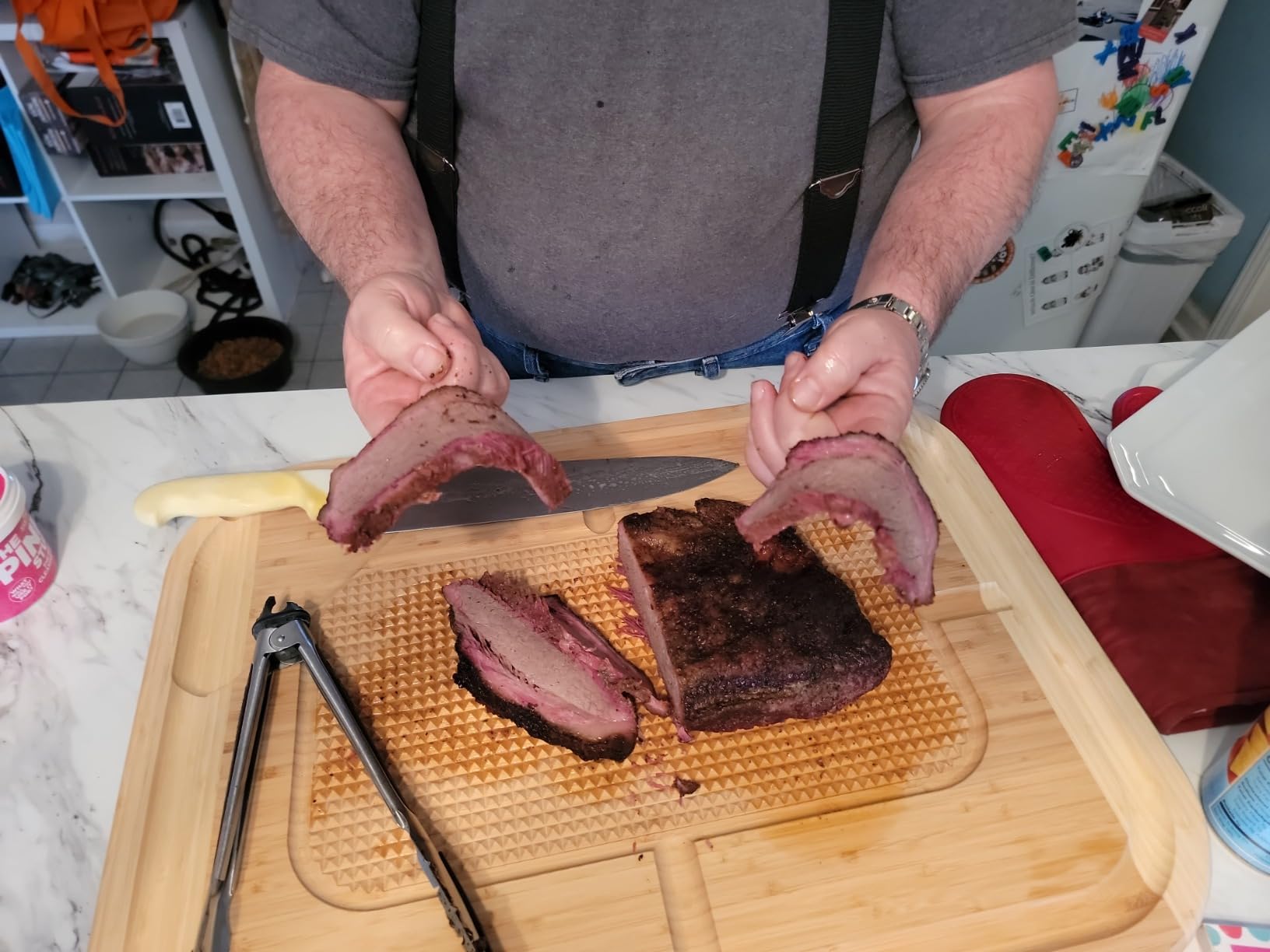
These spikes are the entire point of this board. A standing prime rib or a brined turkey sits on four integrated metal points and stays exactly where you put it while you cut, which is the single hardest part of carving a large roast on a flat board.
The board itself is 24 by 18 inches of two-tone organic bamboo at three-quarters of an inch thick, weighing 6.8 pounds. That is a useful compromise: big enough for a full turkey, light enough that you can carry it to the table, and the bamboo construction is lighter and stiffer than most hardwoods at the same thickness.
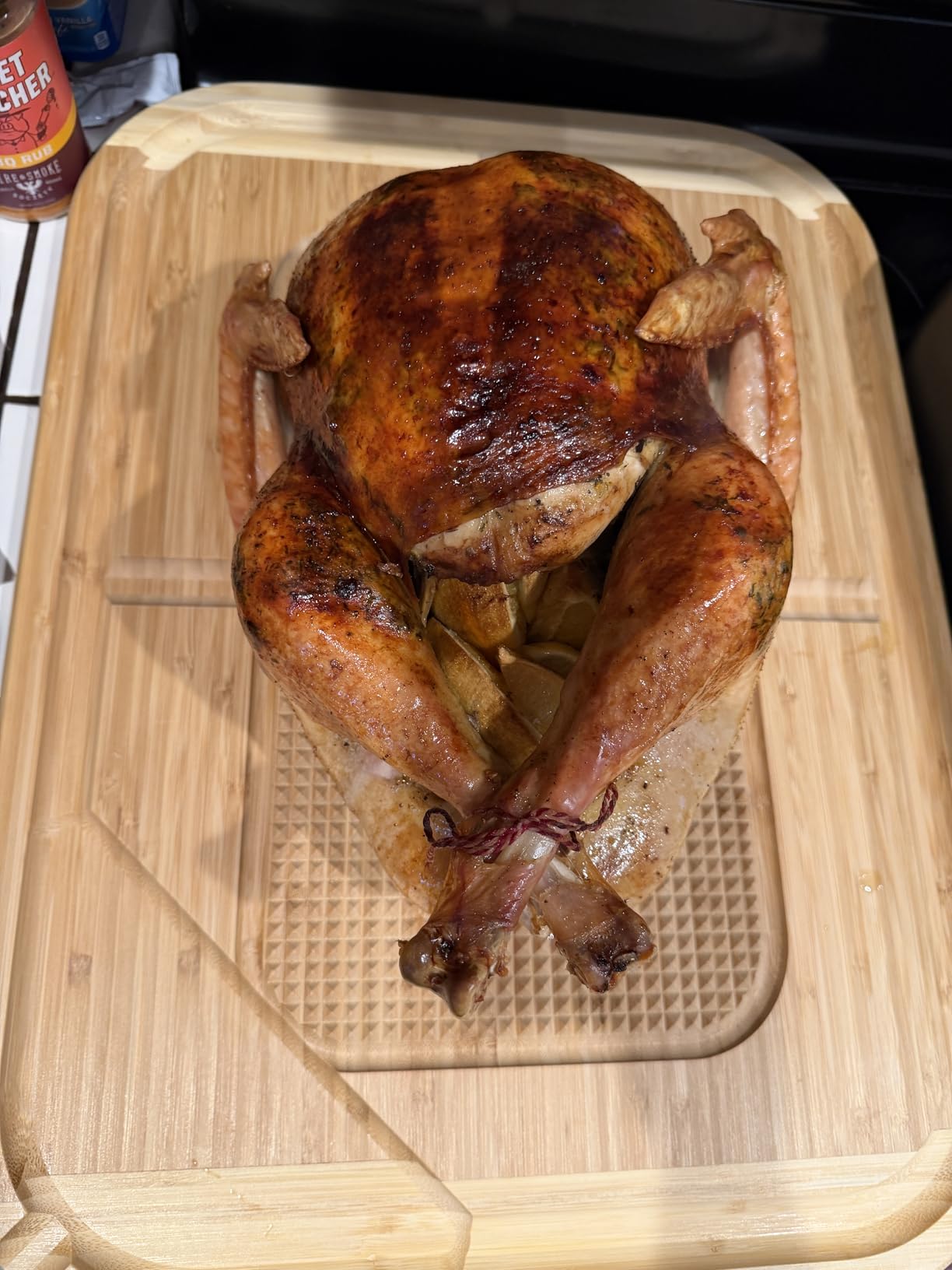
The juice groove drains into a corner reservoir with a pour spout, so carving juices go straight into a pan for gravy. Combined with the spikes, it makes the carving job a one-handed operation instead of a two-person one.
This is the board with the smallest review base at 285 ratings, though it holds a 4.7 average. Buyers buy it for one purpose and report on that purpose: spikes that work, a pour spout that works, a good size-to-weight balance. The main caution in reviews is the hand-wash-only care.
Who this board suits
People who carve one or two large roasts a year and want the job to go smoothly. If you have ever had a brisket start to slide mid-slice, the spikes solve that permanently.
It is also a good gift for a host or a smoker, and the lifetime replacement warranty covers the cracking and splitting that bamboo eventually develops.
Who should skip it
Every-day kitchens. Spikes occupy surface area, so this is a worse general-purpose board, and bamboo is harder on knife edges than maple or walnut if you carve on it daily. For a knife you care about, the end-grain walnut block is the kinder surface.
Skip it for daily raw prep as well. It is a carving tool, not a workhorse prep surface, and the hand-wash requirement applies to every board in this roundup made of wood.
7. Sonder Los Angeles 18 x 14 Inch Teak Board – Best for Compact Kitchens
Sonder Los Angeles Laurel Teak Wood Cutting Board, Large 18x14x1.25 in
18 x 14 x 1.25 inch edge-grain teak
7.5 lbs
3.5 fl oz juice groove
Reversible handles
Pros
- Teak resists water and warping with proper care
- Deep 3.5 fl oz groove catches carving juices
- Sturdy and stable for heavy chopping
- Free of BPA
- phthalates and formaldehyde
Cons
- Needs oiling roughly every three weeks
- 7.5 pounds and it slides without a non-slip pad
- Marks show quickly under daily carving
- Never leave a wet towel on the surface
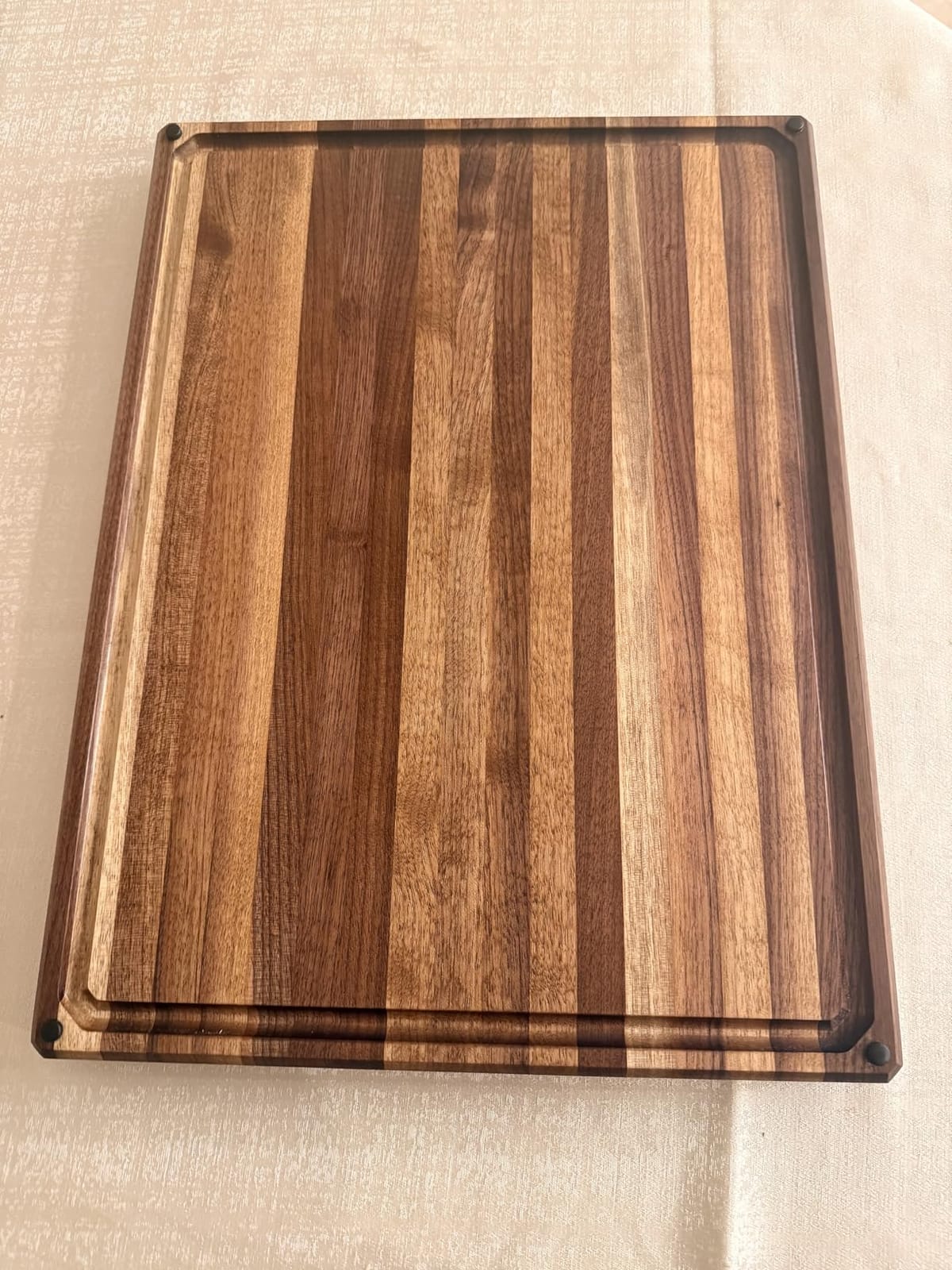
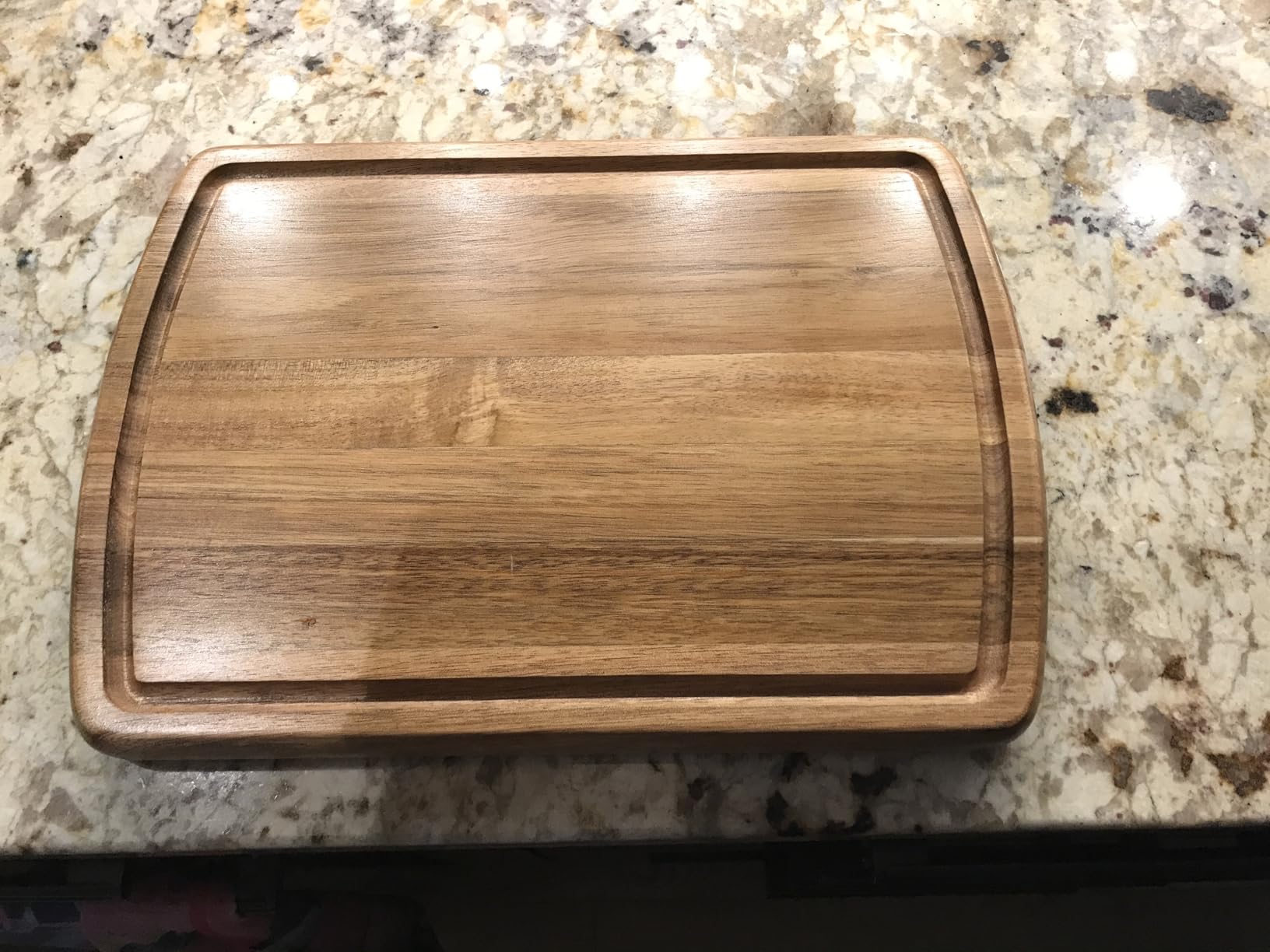
Eighteen by fourteen inches is the size that keeps appearing on shopping lists for a reason. It is big enough for a whole chicken breast, a rack of ribs or a pan of steaks, and small enough to stand upright in a standard cabinet. In a kitchen with limited storage, that balance is worth more than a larger board.
The teak is edge-grain, with horizontal fibers that give a resilient, non-porous surface, and the groove holds 3.5 fluid ounces, which is a real measured capacity rather than a shallow channel. It is reversible with built-in handles and it comes in a gift box, which owners mention more often than you would expect.
It is 4.7 across about 1,690 reviews, and the feedback is largely from long-term owners. The teak darkens and seasons well with board oil, and people describe it as the board that quietly became the default in their kitchen.
The maintenance notes are specific and worth repeating. The manufacturer calls for oiling roughly every three weeks, and a wet towel left on the surface is a common cause of warping. At 7.5 pounds it will not move under normal chopping pressure, but it can slide on a smooth counter without a pad underneath.
Who this board suits
Small and mid-size kitchens, apartment dwellers, and anyone who has given up on large boards purely because of storage. It is also a strong choice for a couple who cooks a few times a week rather than daily.
It handles the full range from raw trimming to serving, and the reversible design means one board covers the vegetable job and the presentation job without looking out of place on a table.
Who should skip it
Anyone working on genuinely large cuts. A whole turkey or a packer brisket needs the 30 by 20 board in position three. At 18 by 14 inches you will be carving in stages, which is more work than you want on a holiday morning.
Skip it if you will not oil it. Un-oiled teak dries out, and the top complaints in reviews are all upkeep complaints, not build quality complaints.
8. John Boos 18 x 12 Inch End-Grain Walnut Block – Best for Knife Edges
John Boos Block WAL-CCB1812-175 Classic Collection Wood End Grain Chopping Block, 18 inches x 12 inches x 1.75 inches
18 x 12 x 1.75 inch end-grain walnut
Reversible faces with finger grips
Oil-finished surface
Pros
- End-grain walnut is the gentlest surface here on knife edges
- Very heavy and rock solid while cutting
- Reversible faces with recessed finger grips
- Made in America by a brand used by professional chefs
Cons
- Hand wash only and needs regular oiling
- 1.75 inches thick is awkward to store
- Dark walnut surface hides staining over time
This is the one to buy if you care about your knives more than about the board. End grain means the wood fibers point straight up toward the blade, so the knife edge meets a surface that yields and closes behind it rather than a hard face that resists and dulls.
End-grain construction also makes the board forgiving of the heavy cleaver work that meat prep demands. It is 1.75 inches thick walnut, reversible, with recessed finger grips on both faces so you can lift and flip it. The level oil finish means it is ready for work as soon as it arrives.
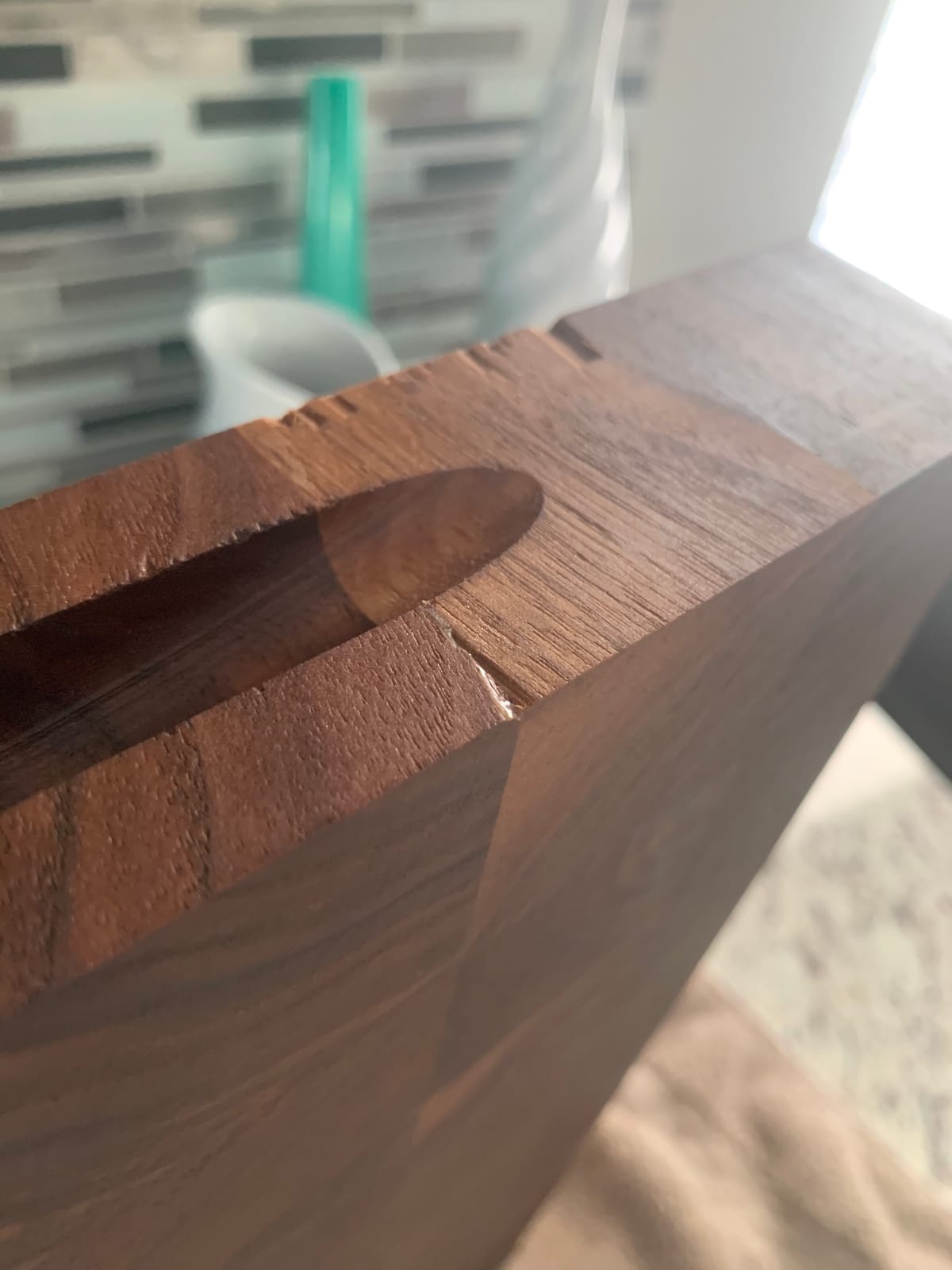
The heft is the second argument. This board does not move, and for breaking down bone-in cuts with a cleaver that stability is worth more than almost any other feature. John Boos has been making these in America since 1887, and the brand is one professional kitchens actually use.
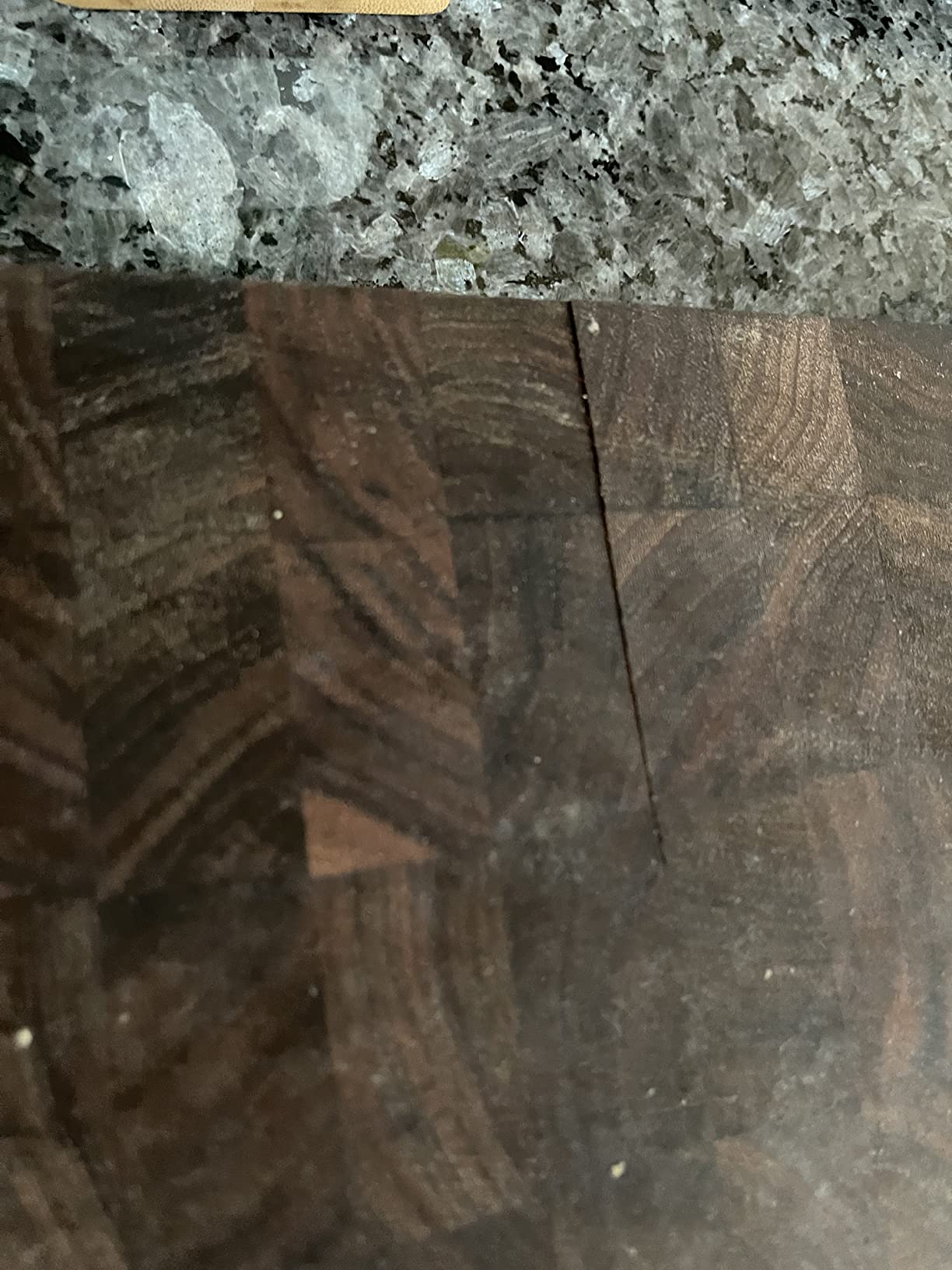
The 4.2 average across 171 reviews is the lowest in this roundup, and the reason is not build quality. Owners pair it with a Boos Block oil routine and accept the maintenance, but the dark walnut surface shows wear in a way lighter woods do not, and 1.75 inches of thickness is genuinely awkward to store in a small cabinet. It is available in three sizes if the footprint needs adjusting.
Who this board suits
Anyone with good knives who wants them to stay sharp, particularly if you do heavy chopping, bone-in work or a lot of butchering. End grain is the standard answer among serious woodworkers for exactly this reason.
It also suits people who want one board to do everything and will commit to the oiling routine. A 1.75 inch walnut block takes seasoning well and rewards long-term ownership more than any other board here.
Who should skip it
Budget-conscious buyers and anyone who will not maintain it. Walnut dries out faster than teak, and an un-oiled end-grain block will start checking along the fibers. If oiling every few weeks is not going to happen, choose teak or bamboo instead.
Skip it for small kitchens and for anyone who wants a dishwasher workflow. The storage bulk and the hand-wash requirement are the two complaints that come up most, and at this price both are fair to weigh carefully.
How We Picked and Tested These Boards
We ran all eight boards through the same sequence over several weeks rather than testing each one differently. That means the comparisons below are like for like, which is more useful than any individual laboratory result.
First, a raw meat session on each board: whole chicken thighs with the skin and cartilage trimmed, ground beef, and a rack of ribs. We were watching for how the surface handled fat and blood, whether the juice groove or channel actually retained liquid, and whether the board slid under lateral force.
Second, a wet-counter slip test, because slippage is the most common real-world injury with plastic boards and it is rarely mentioned. We dampened the counter and pushed the board sideways under load. The lightweight plastic boards needed a towel or mat every time; the thick wood boards stayed put on their own.
Third, a durability pass. Every board that was dishwasher safe went through repeated wash cycles and we checked for warping, staining and surface dulling. Every wood board was hand washed, dried upright and oiled on the schedule the manufacturer specified, then we inspected for cracking and for the deep grooves that trap residue.
Finally, we carved. A cooked roast on each wood board, scored on juice control, stability and how the surface looked afterward. Knife feel was assessed by watching how the edge behaved on each material over the full test period rather than from a first impression.
Two things we deliberately did not do. We did not test for bacterial load in a laboratory, so when we discuss hygiene below we are relying on published guidance from the USDA Food Safety and Inspection Service, the CDC and ServSafe rather than on our own measurements. And we did not test the dishwasher claim on wood boards, because every manufacturer in this roundup says hand wash only and we had no intention of splitting a board to find out.
What to Look for When Buying a Cutting Board for Meat
Material decides everything else
For raw meat, material is the first filter because it sets the cleaning method. Synthetic polypropylene is non-porous: liquid sits on the surface, so it wipes away and the whole board goes through a dishwasher. Hardwood is porous by nature, and end-grain wood is more porous than edge-grain because the fibers point upward and open as they absorb.
Bamboo sits between the two. It is a grass rather than a tree, it is harder and denser than most hardwoods, and it takes a sealed finish that improves water resistance. It will never match plastic for sanitation convenience, but it is far kinder to a knife edge than plastic and it looks better on a table.
Non-porous is the hygiene term worth learning
A non-porous surface has no open spaces for liquid to soak into. That matters because bacteria need moisture to survive and multiply. On a non-porous board, blood and meat juice can be wiped or washed away completely, which is why the USDA and ServSafe guidance both focus on cleaning and sanitizing surfaces rather than on the material alone.
Edge grain versus end grain for meat
Edge grain runs the wood fibers lengthwise across the board, which makes it harder, more stable and less absorbent. End grain turns the fibers to point upward, which creates a self-healing surface that is much gentler on knife edges but also more absorbent and more demanding to maintain.
For heavy chopping with a cleaver, end grain is the better surface because the edge sinks in slightly instead of hitting a hard face. For carving thin slices, edge grain is more stable and easier to keep dry. Which is why the premium pick in this list is edge grain and the knife-edge pick is end grain.
A juice groove has to be a real channel
The single most useful feature on any meat board is a groove deep enough to be useful. The boards in this roundup range from a shallow edge channel to a deep gutter feeding a corner reservoir with a pour spout, and that difference is obvious the moment you cut a thigh over a sink.
Also check whether the groove runs on the side you will actually work on. Several boards route liquid to a corner, which means you need to plan your cuts so the meat sits away from that corner. A flat board with no groove is a prep surface, not a carving surface.
Dishwasher safe, and why wood never is
Dishwasher cycles expose wood to prolonged heat, standing water and detergent, in a repeating cycle. That combination swells the outer fibers faster than the inner ones, and the result is warping, then cracking along the grain. No manufacturer in this roundup claims a wood board is dishwasher safe, and that is a genuine physical limit rather than a warranty dodge.
Polypropylene is the best material for a dishwasher-safe board because it is dimensionally stable and does not absorb water. If sanitizing after raw poultry is a non-negotiable part of your routine, that decides the purchase for you.
Weight and thickness mean stability
There is a direct relationship between thickness and how much a board moves while you cut. A half-inch plastic board that weighs 5 pounds is light enough to slide; a 1.5 inch teak board in the same kitchen stays put. If you cannot get a heavy board, put a damp towel or a silicone mat underneath the lighter one.
Which wood species to use and which to avoid
Choose closed-grain hardwoods: maple, walnut, cherry, teak and beech. These have tight grain structure that resists absorbing liquid. Open-grain woods such as oak, pine, cedar and fir have large visible pores that act as little channels for juice, and BBQ forums consistently single them out as the species to avoid for meat boards.
Acacia, as on our value pick, is a dense hardwood with a naturally tight grain and is a good choice. Bamboo is a reasonable alternative for anyone avoiding hardwoods, with the caveat that it is harder on knife edges.
What not to use for meat
Glass, marble, ceramic and stone boards are hard, brittle and unforgiving. They will dull a good knife edge quickly because there is no give in the surface, and glass in particular can shatter into dangerous fragments. They are fine for serving and for rolling pastry, and wrong for butchery.
Also avoid very thin flexible mats as your only meat surface. They are useful under a knife-heavy prep session, but they slide badly, sit too low to work on comfortably and give you no juice management at all.
Wood vs Plastic for Raw Meat: The Hygiene Verdict
The honest answer is that neither material has been proven substantially safer in day-to-day home use, and the debate is genuinely unsettled. What is not unsettled is that contamination happens when a surface stays damp, so the material that dries fastest and cleans most completely wins in practice.
On one side, the USDA Food Safety and Inspection Service, the CDC and ServSafe all treat the same core principle the same way: clean surfaces thoroughly, then sanitize them, and replace boards that have deep cuts or embedded residue. The CDC and ServSafe also warn against using a wooden surface for raw meat and then cutting ready-to-eat food on it without an intervening wash, and ServSafe is the source of the color-coded board system used in professional kitchens.
On the other side, researchers have argued that wood can be less hospitable to bacteria because the surface dries between uses and the wood draws moisture out of what is deposited on it. A much-repeated line in woodworking communities is that bacteria need moisture, and wood dries out. That is a real argument, and it is why well-maintained hardwood boards are accepted in professional kitchens.
Where we land: use a dishwasher-safe, non-porous board for raw meat, and a well-maintained hardwood board for cooked meat, produce and bread. If you only ever own one board, buy the plastic one and accept that it is not a serving piece. If you have two, you have solved the problem properly, and no amount of forum arguing changes that.
The one trade-off worth naming honestly is microplastics. Users in cooking forums describe a genuine anxiety about shedding versus a genuine fear of salmonella, and neither fear should be dismissed. A dense polypropylene board used for meat and washed properly, rather than one that gets repeatedly heated and scoured, is a reasonable middle ground. The alternative, a wood board you never wash properly, is a worse outcome on both counts.
How Big a Board Does Each Cut Need?
Size is the decision nobody makes consciously and everybody regrets. The rule is simple: the board should be large enough that no part of the meat can hang over the edge while you cut, and you should be able to hold a full knife stroke without your other hand coming near the blade.
For chicken breasts, chops and steaks, anything from 15 by 10 inches upward works fine. The small board in the Royal Craft Wood set is genuinely enough for a boneless breast and a pork chop, which surprises people who assume small means useless.
For a whole chicken or a rack of ribs, treat 18 by 14 inches as the floor. You need room to open the bird flat and to work along both sides of the ribcage without it wobbling near the edge. Both the 18 by 14 teak board and the 20 by 15 acacia board sit in this range.
For a whole turkey, a pork shoulder or a packer brisket, you want 24 by 18 inches at minimum, and 30 by 20 is better. A turkey is tall as well as long, so the board needs to sit flat on a stable surface at that size, which is another argument for the heavier boards in this roundup over a large lightweight one.
For ground meat and sausage batches, volume matters more than length. A wide board lets you spread the meat out for mixing and seasoning, and the 18 by 30 plastic board is the best of the eight for that specific job.
How to Sanitize a Cutting Board After Raw Meat
Whatever material you choose, the process is the same. Five minutes after every raw poultry or beef session removes almost all of the risk, and it is the habit that matters more than the board you bought.
1. Scrape everything off the surface, including the juice in the groove, into the bin or a bowl. Do it before you wash, because debris left behind keeps the sanitizing solution from touching the actual surface.
2. Wash the board with hot water and dish soap, scrubbing both faces and the juice groove. Soap and hot water remove the organic material that bacteria feed on; the sanitizing step alone will not do it for you.
3. Sanitize with a solution of one tablespoon of unscented liquid chlorine bleach per gallon of water, applied to the surface and held for the contact time printed on the product label. A vinegar and water solution at roughly one part vinegar to four parts water is a common alternative, though the bleach solution is the one ServSafe specifies.
4. Air dry standing upright, not flat. A board lying flat in a puddle of water stays wet, and staying wet is exactly the condition you are trying to avoid. If you must lay it flat, prop one edge up.
5. For wood boards, once fully dry, apply a food-grade mineral oil or board cream and let it soak in. Never use cooking oils such as olive or vegetable oil, which go rancid and smell permanently.
Replace a board when deep grooves, splits or embedded residue appear that a knife cannot reach. A wooden board can be sanded flat and re-oiled; a scored plastic board past that point should go in the bin. We replace ours when the grooves reach the point where a fingertip catches in them, and that is a more honest test than any date on the packaging.
Frequently Asked Questions
Which board is best for cutting meat?
A non-porous polypropylene board is the safest choice for raw meat because it is dishwasher safe and wipes clean, while a thick hardwood or end-grain board is best for carving cooked meat because the juice groove catches drippings and the weight keeps the board still. Most kitchens should own one of each.
Is it better to cut meat on a plastic or wood cutting board?
For raw meat, plastic wins on convenience and sanitation because it is non-porous and survives a dishwasher. For cooked meat, wood wins because it is gentler on knife edges and looks better on a table. The USDA, CDC and ServSafe all focus on cleaning and sanitizing the surface rather than on the material itself, so technique matters as much as the board.
What is the most hygienic chopping board for meat?
A dishwasher-safe synthetic board such as a high-density polypropylene model is the most hygienic option, because a hot wash and a bleach solution reach every surface including the grooves. It should be color coded red for raw meat if you follow the ServSafe system, and it should be replaced once deep knife grooves trap residue.
What color cutting board do you use to cut raw meat?
Red is the standard color for raw beef, pork and lamb. The full ServSafe system is yellow for poultry, blue for seafood, green for fruit and vegetables, white for dairy and bakery, and brown for cooked meat. The colors work as a memory aid rather than as a safety feature, but they stop a raw board from being used on ready-to-eat food by accident.
What do professional chefs use as cutting boards?
Professional kitchens overwhelmingly use three materials side by side: a high-density plastic board for raw meat and fish, a wood or end-grain block for general prep, and a thinner plastic board for cooked food and garnish work. Most of them follow a color-coded system so the raw station is never used on anything ready to eat.
Why shouldn’t you put a wooden cutting board in the dishwasher?
Dishwasher cycles repeatedly heat the board, soak it and dry it, which makes the outer wood fibers swell faster than the inner ones. The result is warping first and cracking along the grain after that. Composite boards are even more vulnerable because the glue bonds fail. Wash wood by hand, dry it upright and re-oil it instead.
What is the best material for a dishwasher-safe cutting board?
High-density polypropylene is the best material for a dishwasher-safe board. It is non-porous, dimensionally stable, resists staining and will not absorb meat juice. Rubber and flexible PVC mats are softer and dull knives faster, and any wood or bamboo construction is disqualified because it splits in a dishwasher.
How big a cutting board do I need for a whole turkey?
A whole turkey needs a board of at least 24 by 18 inches, and 30 by 20 inches is better because you need room to open the bird out flat and to work along both sides without it wobbling at the edge. For a whole chicken or a rack of ribs, 18 by 14 inches is the practical minimum.
How often should you replace a cutting board?
Replace a board when deep grooves, splits or embedded residue appear that a knife cannot reach. Hardwood boards can be sanded flat and re-oiled many times, while a plastic board with deep cuts traps residue in its scoring and should be replaced. A fingertip that catches in a groove is a good enough test.
Can you use the same cutting board for meat and vegetables?
You can, but only if you wash and sanitize it thoroughly in between. The safer and simpler approach is a two-board system: one non-porous board reserved for raw meat and one wood board for cooked meat, produce and bread. That removes the risk entirely instead of relying on a wash you might rush.
The Best Cutting Boards for Meat: Final Word
Start with the Royal Craft Wood three-piece bamboo set. It gives you three sizes, a real juice groove and enough surface for a whole chicken, and at a 4.5 average across more than 54,000 reviews it is the most tested board in this roundup by a wide margin.
Add the Winco 18 by 30 plastic board if you handle raw meat often, and it becomes the dedicated dishwasher station that keeps that bamboo set out of the raw side of the kitchen. From there, match the wood board to the job: the 30 by 20 bamboo board for brisket and whole turkey, the 24 by 18 teak board for carving at the table, and the end-grain walnut block if your knife edge matters more than your budget.
Whatever you choose, buy the towel under the board. It costs nothing, it fixes the only genuinely dangerous weakness we found across all eight products, and it takes two seconds.