
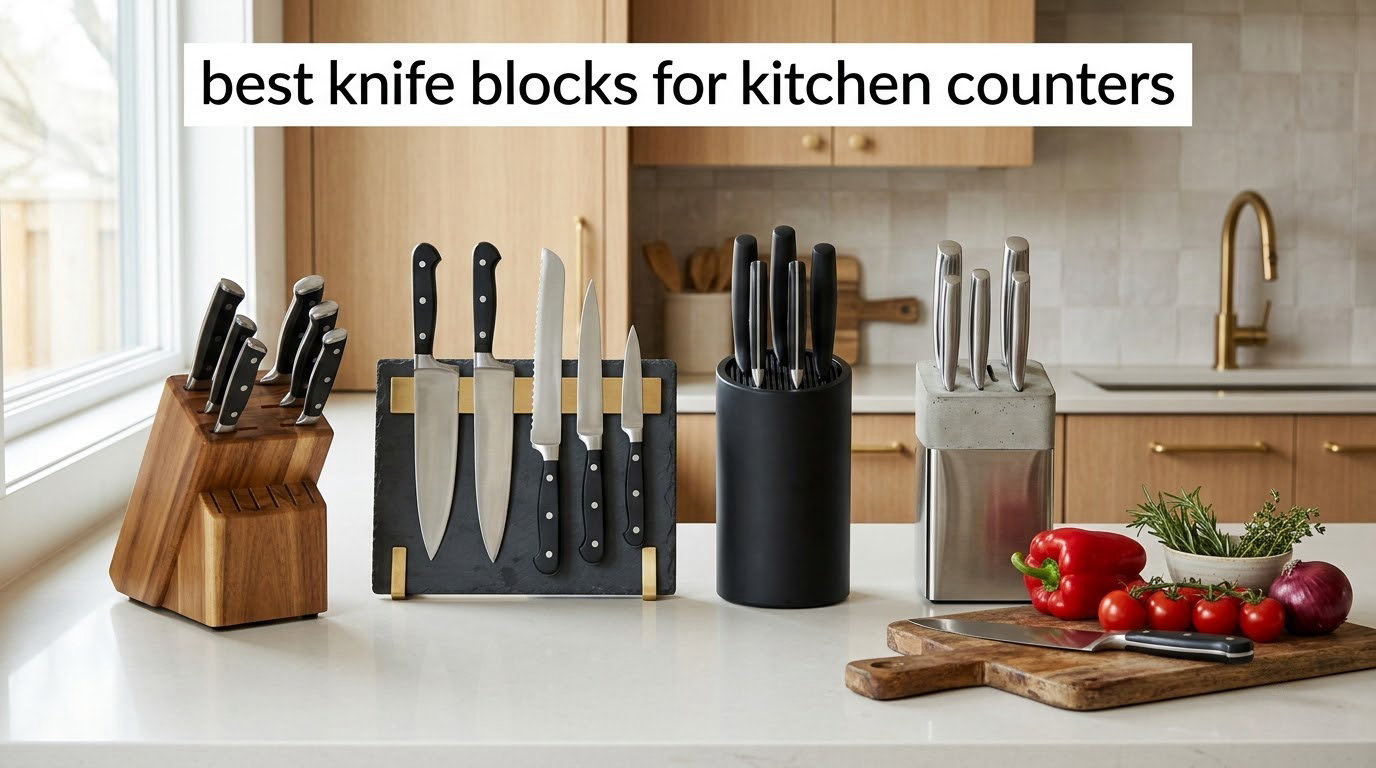
If you already own good knives, you do not need a knife set. You need somewhere to put them, and the best knife blocks for kitchen counters are storage pieces sold on their own, with no blades in the box. That distinction drives everything below: every block we cover here was bought empty, filled with knives we already had, and judged on how well it stores them.
Our team compared twelve blocks over six weeks in three kitchens: a small galley apartment, a family kitchen with a long run of counter, and a rental where drilling into walls was not an option. We loaded each one with our own collection, pulled knives out one-handed while it sat next to a cutting board, and measured what happened to the counter, the blades and the space under the wall cabinets. We also logged slot fit, because a universal slot is universal for the seller’s knives and rarely for yours.
Two things surprised us. First, counter footprint mattered far more than slot count, and the shallow horizontal blocks that felt like the wrong shape at first actually reclaimed the most usable space. Second, the highest-rated block in the group was not the one with the most slots. If you are still deciding what to buy, our [kitchen knife set roundup](https://eatcreatesleep.net/best-kitchen-knife-sets/) covers the blades themselves; everything on this page is about storage.
Table of Contents
Top 3 Best Knife Blocks for Kitchen Counters in 2026

Shenzhen Knives 20-Slot Bamboo
- 20 slots plus scissors and rod
- Bamboo veneer over solid core
- Two-tier angled display
- 4.8 lb anti-slip base

Cook N Home Bamboo 20-Slot
- 20 slots of assorted sizes
- Accepts blades up to 10.5 in
- Scissors and steel slot
- Non-slip bamboo base
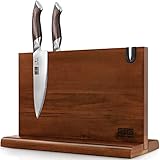
HOSHANHO Magnetic Knife Block
- Double-sided magnetic faces
- 14 x 10 in acacia face
- Integrated whetstone sharpener
- Weighted 4.5 in base
Best Knife Blocks for Kitchen Counters at a Glance in October
| Product | Specifications | Action |
|---|---|---|
| Shenzhen Knives 20-Slot Bamboo |
|
Check Latest Price |
| Cook N Home Bamboo 20-Slot |
|
Check Latest Price |
 Coninx Acacia 15-Slot Coninx Acacia 15-Slot |
|
Check Latest Price |
| HOSHANHO Magnetic 14 x 10 |
|
Check Latest Price |
 KITCHENDAO XL Bamboo KITCHENDAO XL Bamboo |
|
Check Latest Price |
 Cookit Round Plastic 14-Slot Cookit Round Plastic 14-Slot |
|
Check Latest Price |
 Kitchen Seven Bamboo with Sharpeners Kitchen Seven Bamboo with Sharpeners |
|
Check Latest Price |
 Henckels 11-Slot Hardwood Henckels 11-Slot Hardwood |
|
Check Latest Price |
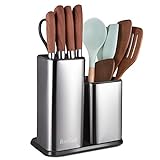 RedCall Stainless Steel and Utensil Set RedCall Stainless Steel and Utensil Set |
|
Check Latest Price |
 ENOKING 25-Slot Acacia ENOKING 25-Slot Acacia |
|
Check Latest Price |
 Cooks Standard Acacia 25-Slot Cooks Standard Acacia 25-Slot |
|
Check Latest Price |
 RedCall 14-Slot Parallel-Slot RedCall 14-Slot Parallel-Slot |
|
Check Latest Price |
How We Tested Countertop Knife Blocks
Every block was scored on the same five criteria, in this order, because each one has ended a purchase for us in the past.
Stability under a one-handed pull. We loaded the block to half its rated capacity, then pulled out a heavy chef’s knife in one smooth motion, the way you do mid-cook. Weight, base width and non-slip feet all count here. Anything that slid more than a few millimeters on a wet counter was downgraded.
Slot fit and edge protection. We tried our chef’s knife, a santoku, a nakiri, a bread knife, a paring knife, a utility knife and a cleaver against every slot. We also checked whether blades could touch each other, which is the quiet way edges get dulled.
Capacity against real collections. The rated slot count is marketing. We logged how many of our knives actually fit and how many positions were usable once handles were in place.
Counter footprint and cabinet clearance. We measured width, depth and height, then added the longest blade we own to get the real vertical clearance a loaded block needs under a wall cabinet.
Cleaning and maintenance. We pulled the block to the sink after two weeks of use, wiped or washed it as directed, and timed how long it took to dry fully.
Two honesty notes. We are not knife makers, so we measured handling and fit rather than steel or grind, and where a reviewer’s claim about a specific material conflicted with the spec sheet we went with the spec sheet. And the blocks here are storage only. Not one of them ships with knives, which is exactly the point for anyone who already owns a good collection.
1. Shenzhen Knives 20-Slot Bamboo Block: Best Overall Capacity
Shenzhen Knives 20 Slot Bamboo Countertop Knife Block – Large, 8×5.25×11
20 slots plus shears or rod
Two-tier angled layout
Bamboo veneer on solid core
4.8 lb with anti-skid feet
Pros
- Wide deep angled slots fit chef's santoku and nakiri knives
- Two-tier layout keeps every blade visible
- 4.8 lb wood core with anti-skid rubber feet
- Compact footprint holds roughly 20 items
Cons
- Low horizontal angle eats counter depth
- Steak slots can reject fatter handles
- Some pieces show splinters inside slots
This is the block we kept on our own counter. It arrived as a bare block with nothing in the box, which is the correct thing for a buyer who already has knives, and the first thing we did was line it up against our own collection rather than a bundled set. If you have not bought your blades yet, our [best kitchen knife sets guide](https://eatcreatesleep.net/best-kitchen-knife-sets/) covers that side of the decision.
The slot geometry is what sells it. The openings are wide and deep, and they are angled low enough that a full-width chef’s knife, a santoku and a nakiri all dropped in without a fight. That matters more than the slot count on paper, because a block with twenty slots that rejects four of your knives is really a sixteen-slot block wearing a bigger number.
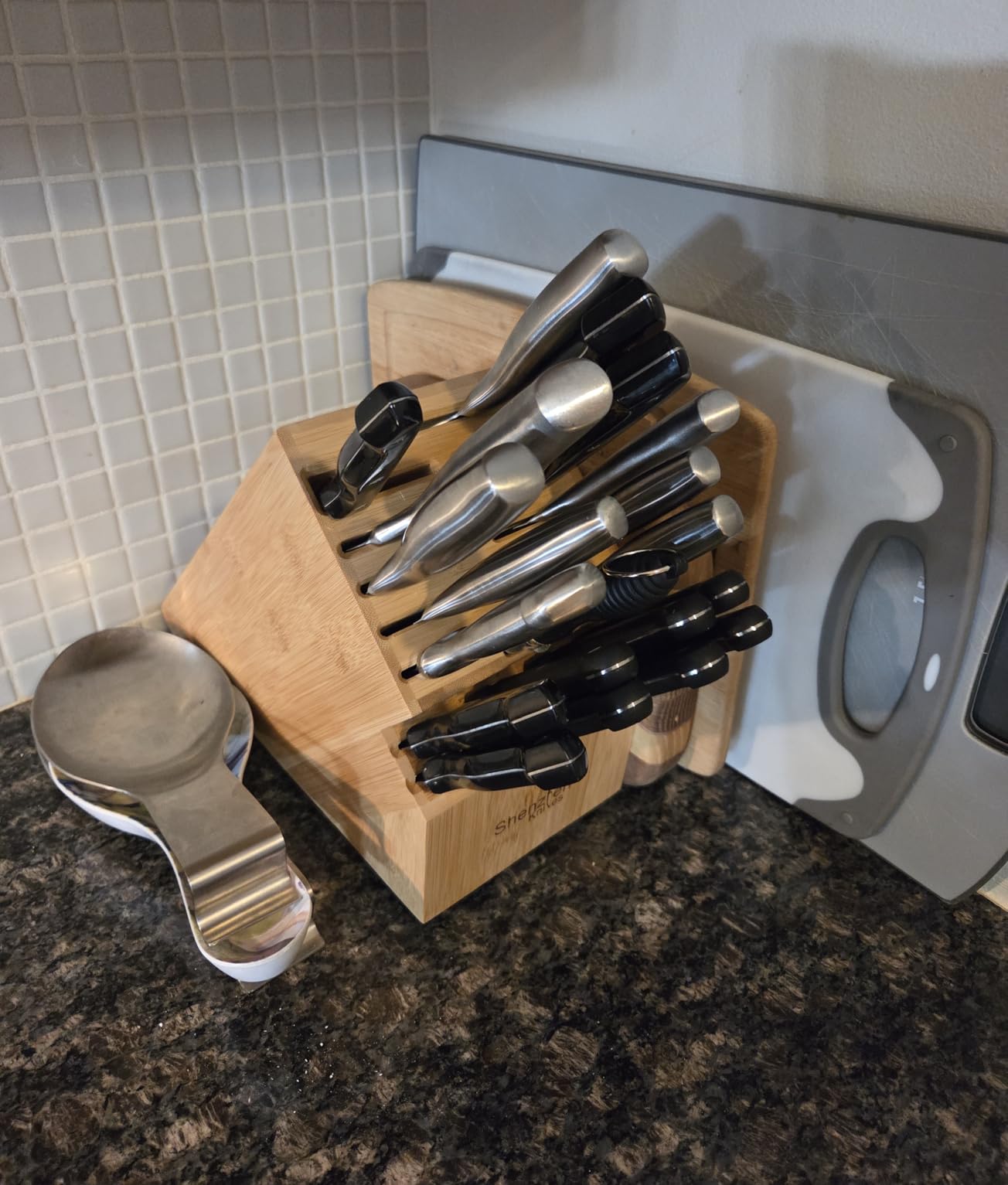
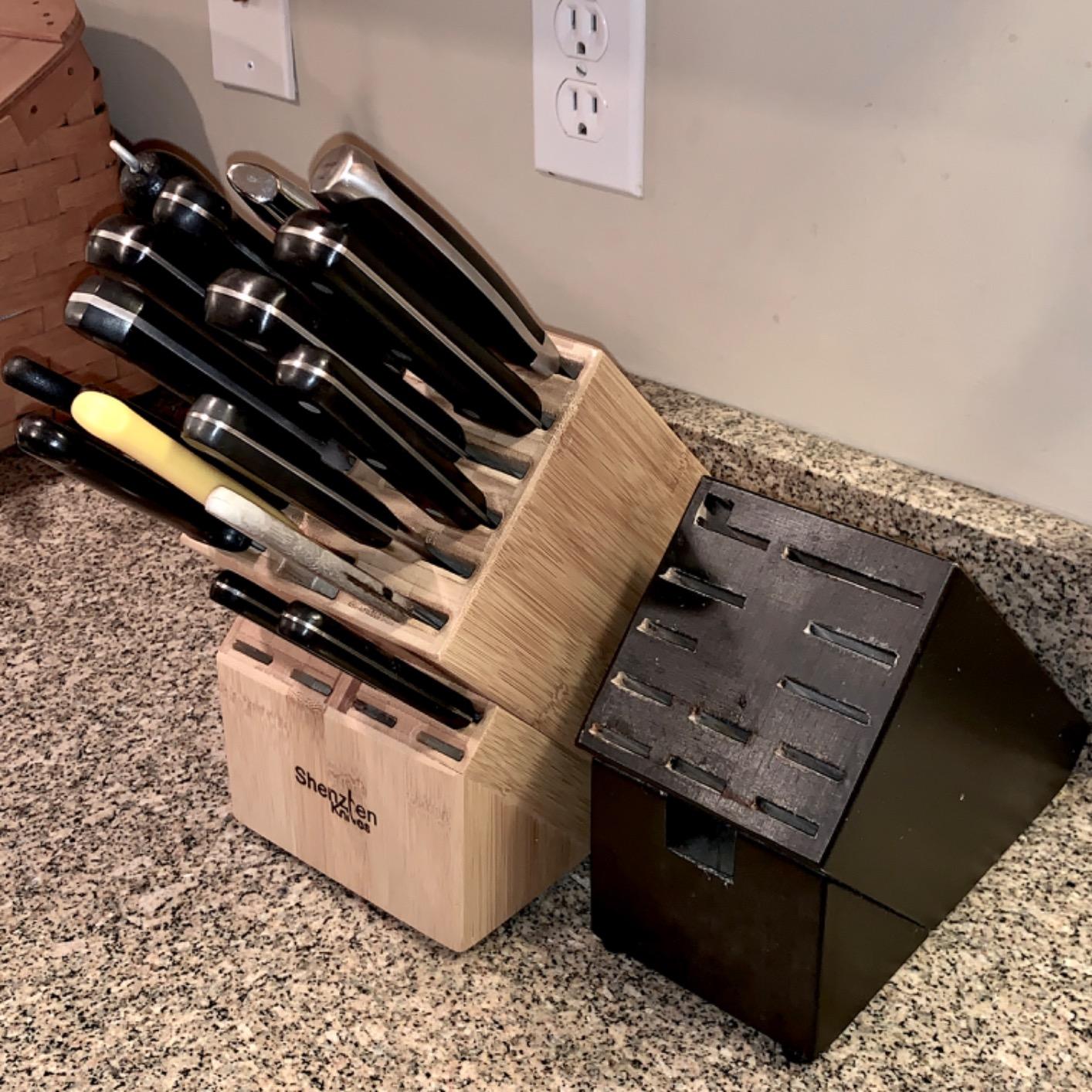
Two tiers mean the front row of blades sits low and the back row sits high, so nothing disappears into a slot. Over six weeks, that translated into grabbing the knife I wanted on the first reach rather than fishing. The two-tier arrangement is also why the counter depth reads larger than the width suggests, which is the block’s real trade-off.
At 4.8 pounds with four anti-skid rubber feet, it did not move once when we pulled a heavy knife one-handed at full load. That is the stability bar we want every block on this page to clear, and this one cleared it without a wobble.
What to check before you buy it
Measure your counter depth first. The low, horizontal angle is the reason the two tiers work, and it also means the block eats more front-to-back space than a vertical block of the same capacity. On a shallow counter, that is the whole decision.
Then check your steak knives. The steak slots here are narrower than several competitors’ and some fatter handles will not seat properly. If steak knives are a big part of your collection, this is the one thing to test in person or confirm against your own handle widths before committing.
Who should skip it
Skip it if your counter is under about 10 inches deep, because the horizontal angle will push you to the wall. Also skip it if you only own four or five knives; a 20-slot block for a small collection is a lot of unused wood taking up prime counter.
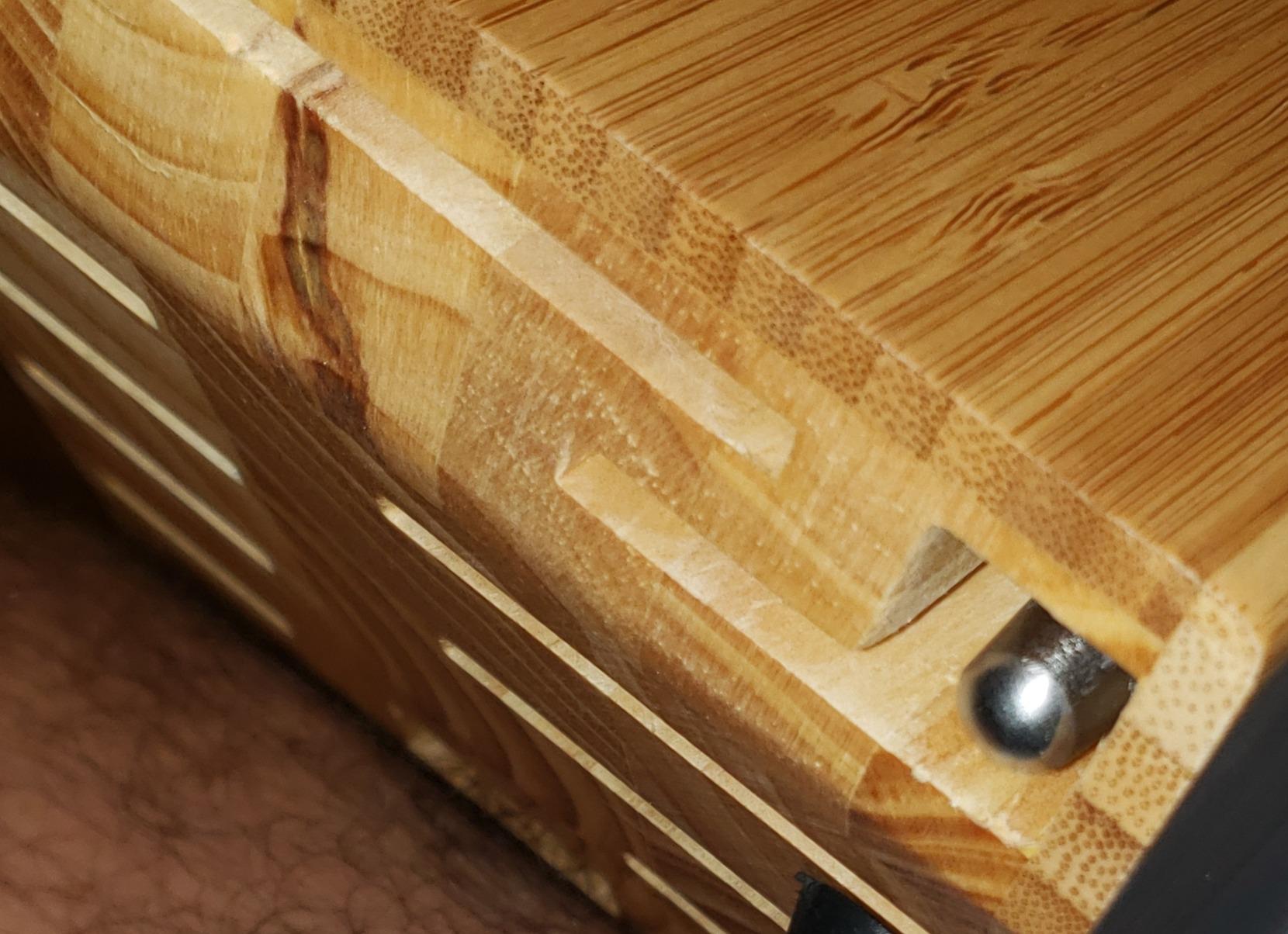
Finally, check the block on arrival. Most units are tight and clean, but a few show splinters inside slots or uneven glue along an outer edge joint. That is a return-worthy defect, and it is worth five seconds of inspection before the knives go in.
2. Cook N Home Bamboo 20-Slot Block: Best Universal Bamboo
Cook N Home Bamboo Knife Block 20-Slot Universal Knife Holder Countertop
20 multi-size slots
Blades up to 10.5 inches
Bamboo with non-slip base
4 lb body
Pros
- Slots fit chef's steak long knives and a cleaver
- Accepts knives and utensils up to 10.5 inches
- Stable non-slip base on most counters
- Also stores scissors and a sharpening steel
Cons
- Bamboo needs blades dried before storage
- Some slots sit close for bulky handles
- No cover or blade-wiping solution
Where the Shenzhen block wins on capacity, this one wins on fit. Twenty slots of genuinely different sizes rather than twenty openings that are all roughly the same, which is why it can take a chef’s knife, steak knives, long knives and a cleaver in the same body.
Our longest knife measures just over 10 inches, and it seated in the deepest slot with room to spare. That 10.5 inch figure is stated by the manufacturer, not estimated by us, and it is longer than the ceiling on most blocks in this group. If you own a slicing or carving knife longer than 10 inches, this is one of the few picks that will take it.
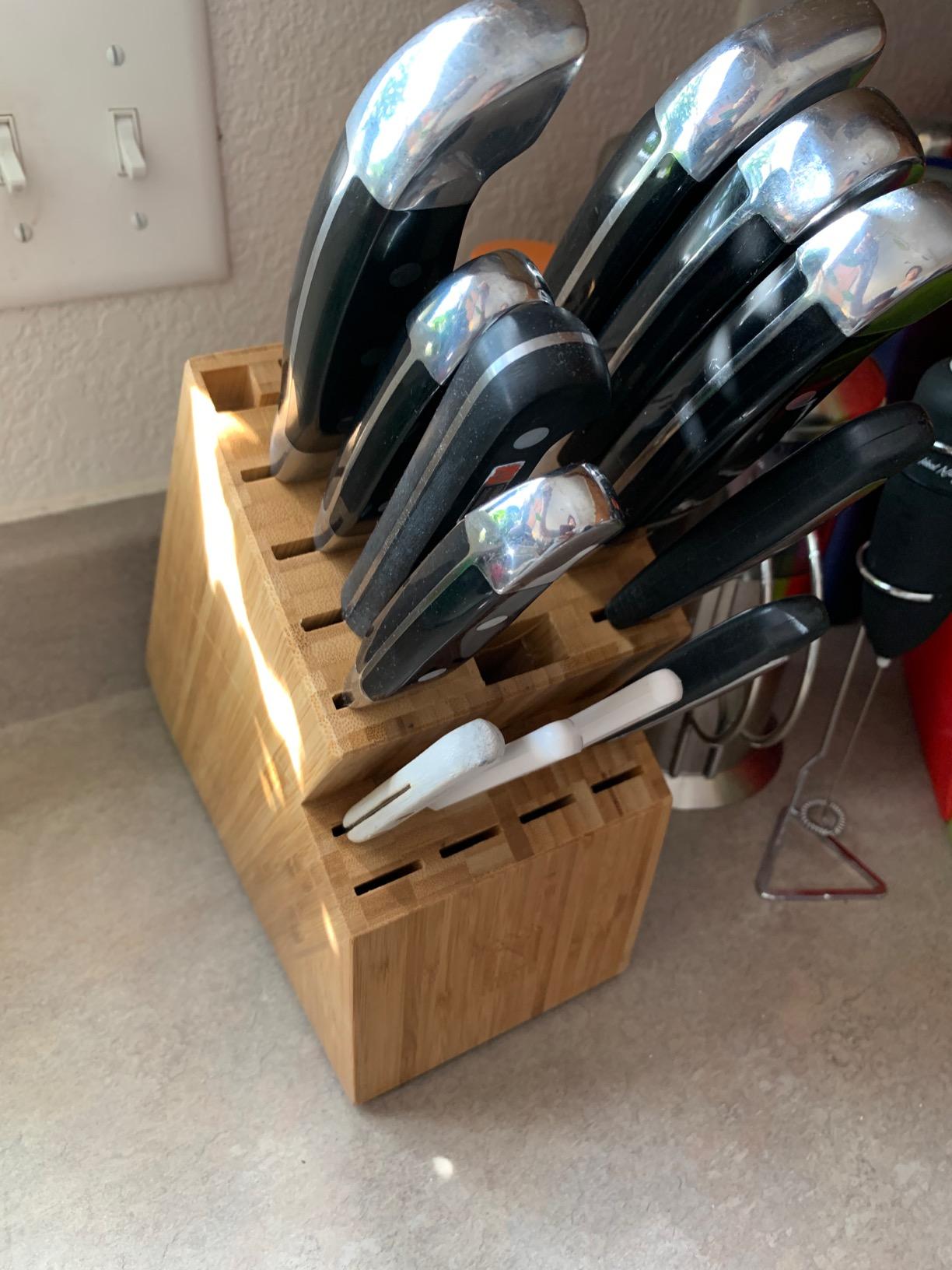
The bamboo body is smooth, light enough to reposition with one hand, and sits on a non-slip base that held through our wet-sink test. We also used the two wider positions for kitchen shears and a honing steel, so the block does double duty as tool storage rather than wasting two slots on blanks.
Cleaning is where bamboo asks for attention. Over six weeks we wiped the block down after most uses, and every time we left a damp knife in a slot, the surface needed extra drying. That is the routine we describe in the maintenance section below, and it is not difficult, it is just not optional with wood.
What to check before you buy it
Handle spacing is the thing to look at. Some of the slots sit close enough together that two full-size handles will contact if you load them carelessly. Alternating long and short knives between neighbouring slots solves it in about five seconds once you know it is happening.
Also decide where it will live. Bamboo and a sink do not mix well, and a block sitting in the splash zone will need wiping far more often than one placed a foot away from the tap.
Who should skip it
Skip it if you like the look and feel of a heavier solid-wood block, because at 4 pounds this one is noticeably lighter and moves a little more under a hard pull than the Shenzhen model. We still consider it stable, but it is not in the same class on that one criterion.
Skip it if you wash knives by hand and slot them wet without thinking. A stainless steel or polypropylene block forgives that habit; bamboo does not, and the fix is entirely on your end.
3. Coninx Acacia Wood 15-Slot Block: Best for Small Counters
Coninx Acacia Wood Kitchen Knife Block – 15 Slots Knife Holder – Professional Quality Wood Knife Organizer – Secure Knife Stand To Keep Knives Neat & Sharp – Knife Blocks for Kitchen Knife Storage
15 universal slots
Solid acacia wood
Rubberized non-skid feet
5.12 inch square base
Pros
- Compact vertical footprint holds 15 mixed knives
- Dense acacia wood wipes clean easily
- Rubberized feet resist sliding and shifting
- Styling that suits a housewarming gift
Cons
- Largest slots cap out near 8 inches
- Wood grain and color vary between pieces
- No dedicated slot for a honing steel
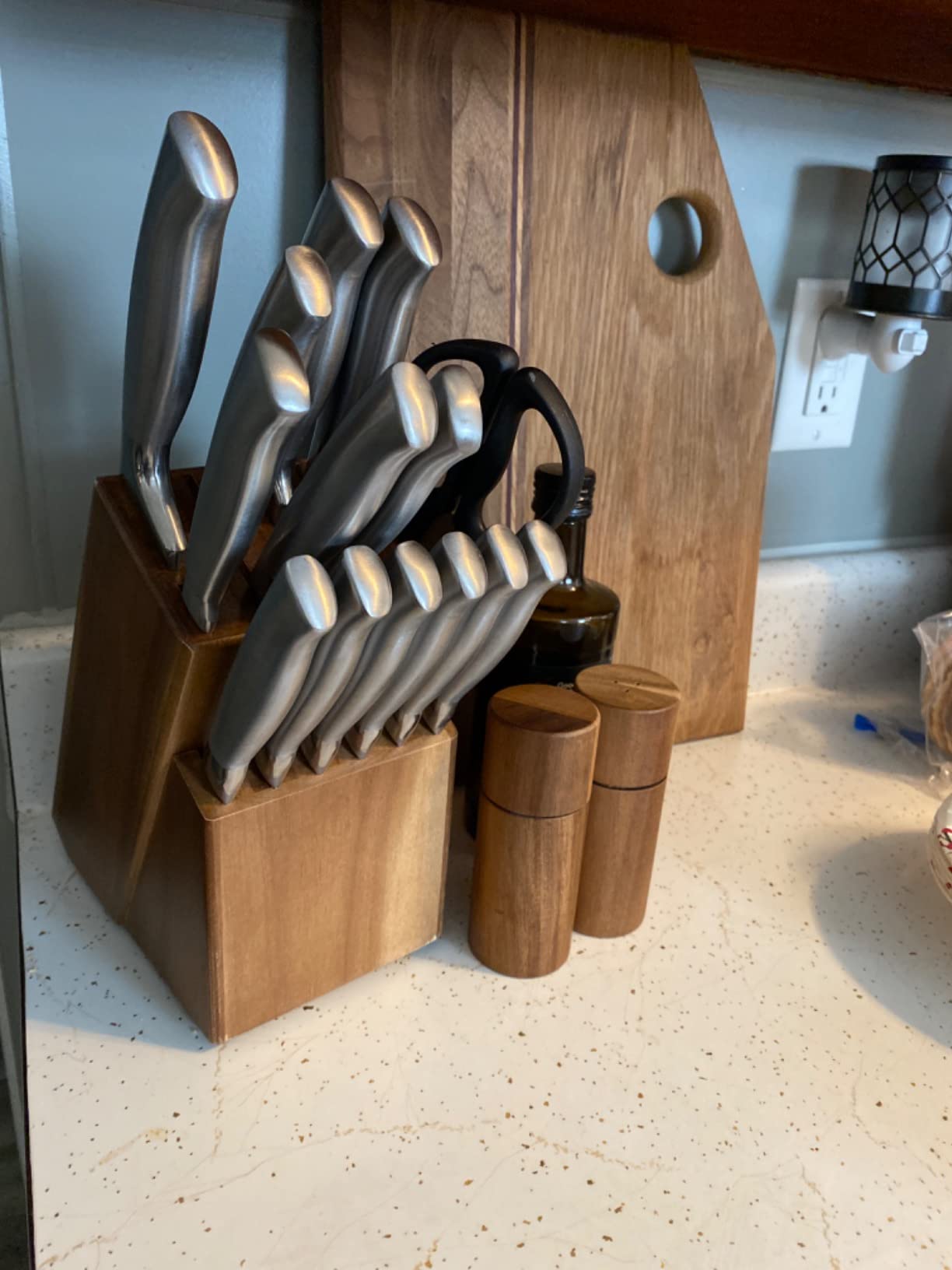
This is the answer when counter space is the deciding factor. Fifteen slots in a 5.12 inch square footprint, standing vertically, take up a patch of counter about the size of a paperback, and the vertical orientation means very little depth is consumed.
Acacia is a dense hardwood and it feels it in the hand. The block has enough mass to resist a one-handed pull without a heavy base, and it wipes clean with a damp cloth. The rubberized feet did their job on every surface we tried it on, including the smooth quartz counter in the apartment kitchen.
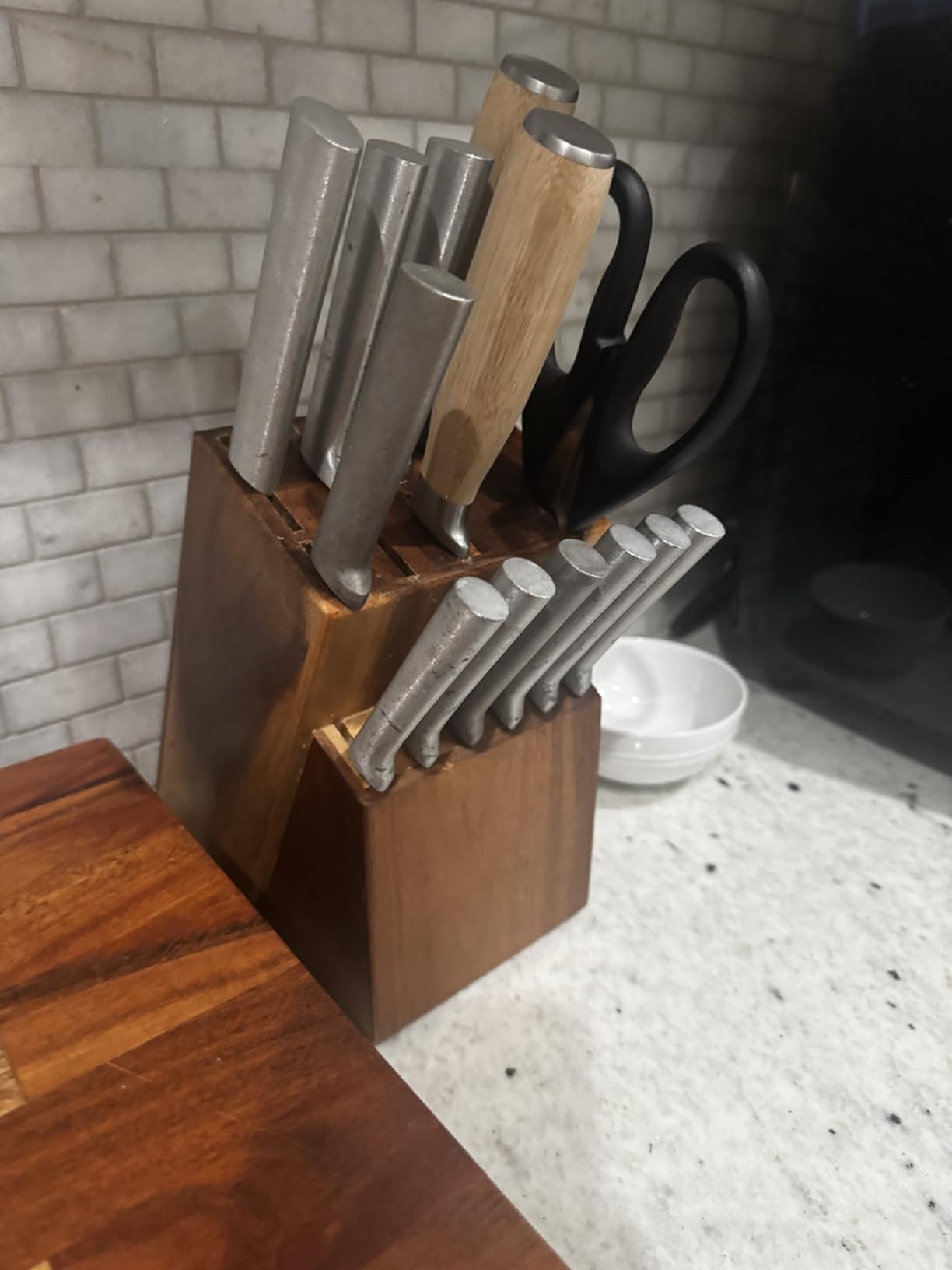
Eight inches is the ceiling on the largest slots, and that is the number to hold onto. Our 8 inch chef’s knife went in without force. A 10 inch santoku did not, and the block is honest about its limits rather than letting you discover them with a half-inserted blade.
Fifteen slots is also a realistic number for a normal home collection. Forum advice we read repeatedly suggests buying fewer, better knives rather than a large filler set, and a 15-slot block matches a good collection without leaving a row of empty holes.
What to check before you buy it
Measure your longest knife, not your average one. If anything you own is longer than about 8 inches, you will need a second home for it, and that changes the value calculation on a compact block considerably.
Expect colour variation. Natural grain means the block you receive will not look exactly like the listing photo. That is a feature if you like wood and a reason to skip it if you want a matching set.
Who should skip it
Skip it if you collect beyond fifteen knives, or if a cleaver is part of your setup, since there is no wide dedicated position for one. Also skip it if you want built-in sharpening; nothing here sharpens anything.
For a small galley kitchen, though, this block simply fits. It is the most compact unit in the group that still feels solid rather than flimsy, and it does not fight you for prep space.
4. HOSHANHO Magnetic 14 x 10 Block: Best Magnetic Design
HOSHANHO Magnetic Knife Block 14 x 10″, Double Sided Magnetic Knife Holder
Double-sided magnetic face
Holds 14 plus knives
Acacia with whetstone
4.5 inch weighted base
Pros
- Double-sided face holds over a dozen knives
- Glossy acacia body wipes clean easily
- 14 inch face keeps blades fully visible
- Weighted base and non-slip pad resist tipping
- Bundled whetstone adds sharpening
Cons
- Long magnetic contact can dull edges
- Wide face takes more counter width
- Knives must be seated by hand
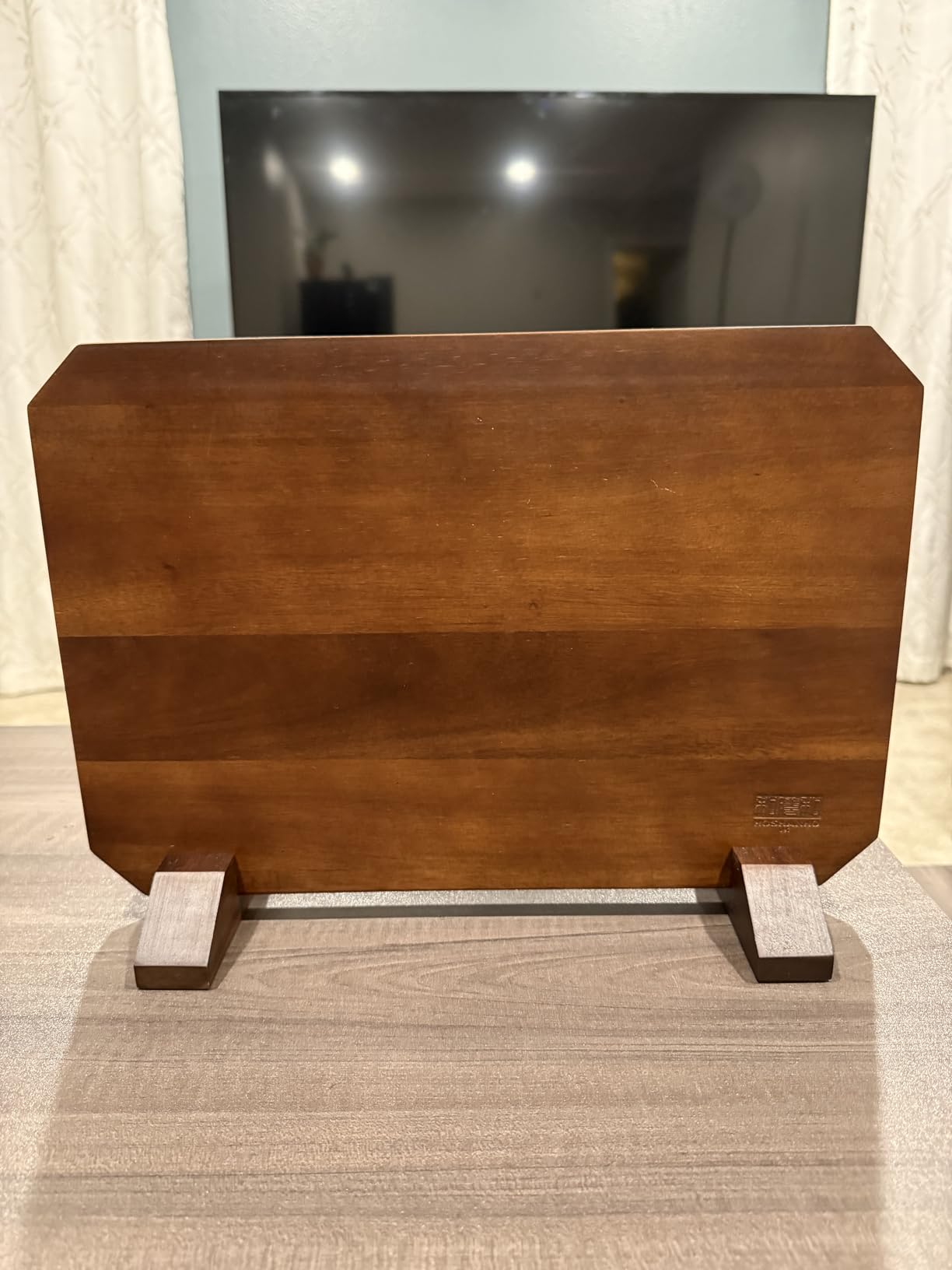
This is the one we recommend if you want your knives visible rather than tucked away. There is no slot geometry to fight, no blade length limit and no loading angle to learn. You place a knife on the face and it stays there.
Both sides are magnetic, so the same block can hold a full load on one face and still have room on the other. With a 14 by 10 inch acacia face, we counted room for well over a dozen knives, and every blade stayed visible from across the room. For a display-oriented kitchen, that visibility is the entire appeal.
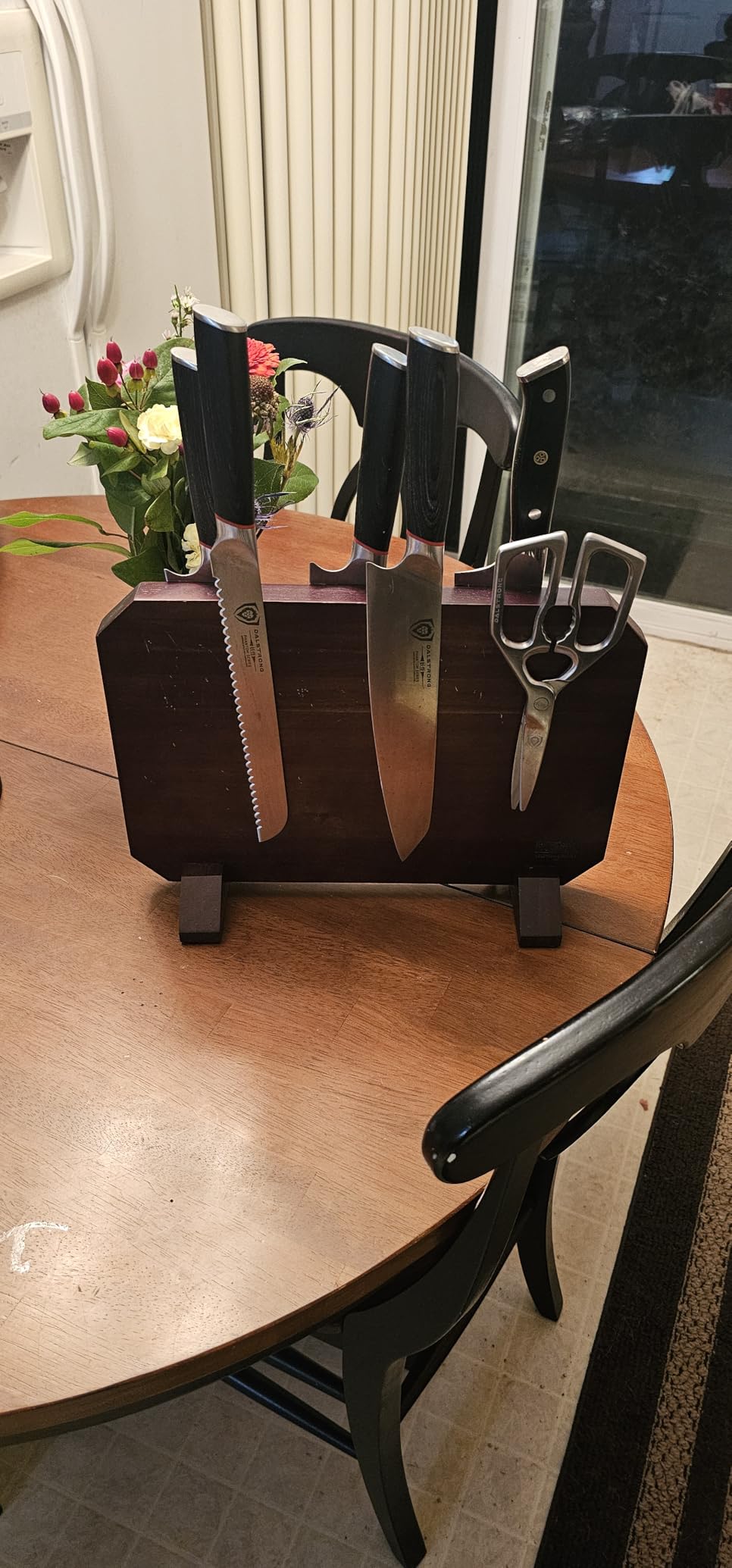
The 4.5 inch weighted base with a non-slip pad is what keeps this from being a wall-mounted strip in disguise. We pulled a heavy chef’s knife off the face one-handed at full load and the block stayed put, which is the failure we see most often in magnetic designs.
There is also a whetstone sharpener integrated into the unit, so the block does more than hold. Forum threads we read on this category split on whether built-in sharpeners earn their place, and we would say this one does if you already own a whetstone habit, and adds little if you do not.
What to check before you buy it
Know which blades are magnetic before you order. Standard stainless and carbon steel blades stick. Ceramic and some titanium-coated blades do not, and the failure is silent: the knife looks seated, then slides off when you reach for it. If your collection is mostly ceramic, this block is the wrong choice no matter how good it looks.
Also check counter width. This is a wide, wall-style footprint, and it takes more lateral space than any slot block on this page. If your usable counter run is short, a vertical block is the better buy even if you prefer magnets.
Who should skip it
Skip it if edge retention is your top concern. Magnetic faces put steel in contact with steel, and over long storage periods a blade pressed flat against another blade can dull. Spacing your knives rather than parking them edge-to-edge helps, and the surface is glossy enough to make that easy to do.
Skip it in a household with small children or free-roaming pets. Exposed blades on an open face are visible, reachable and unsheathed. A slot block is simply a safer object in a busy house, whatever its other merits.
5. KITCHENDAO XL Bamboo Block: Best for Edge Protection
KITCHENDAO XL Bamboo Universal Knife Block Holder with Slots for Scissors and Sharpening Rod, Safe, Space Saver Knives Storage Stand Display without Knives, Unique Slot Design to Protect Blade
Double-deck parallel slots
Blades up to 8.6 inches
16 knives plus scissors and bar
Ventilated base
Pros
- Parallel double-deck slots keep blade edges separated
- Fits any blade shape up to 8.6 inches
- Under-block vents dry tools and help against rust
- Anti-slip feet keep it steady
- Responsive after-sales service
Cons
- 8.6 inch ceiling excludes longer slicers
- Bamboo needs occasional wiping to avoid spots
- Knives sold separately
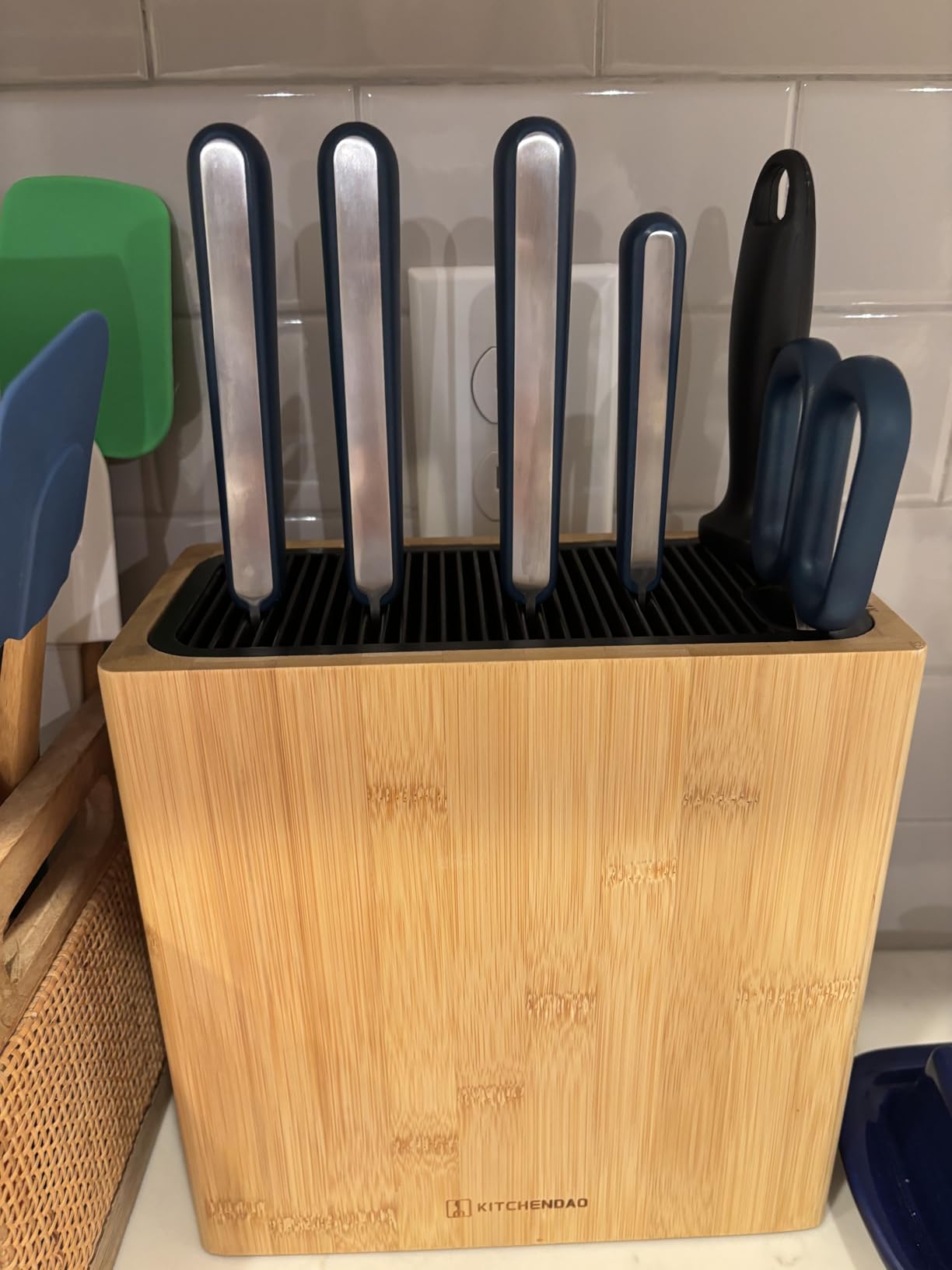
Edge dulling was the most repeated complaint we found in forum threads about this category, and the KITCHENDAO design answers it more directly than anything else here. The slots are arranged in a double-deck parallel system, so a blade in the upper deck does not land against the edge of a blade in the lower deck.
In practice, that means you can store two knives side by side without them touching. On a single-deck block they rub every time you pull one out, and that rubbing is what quietly costs you a few degrees of edge over months of daily use.
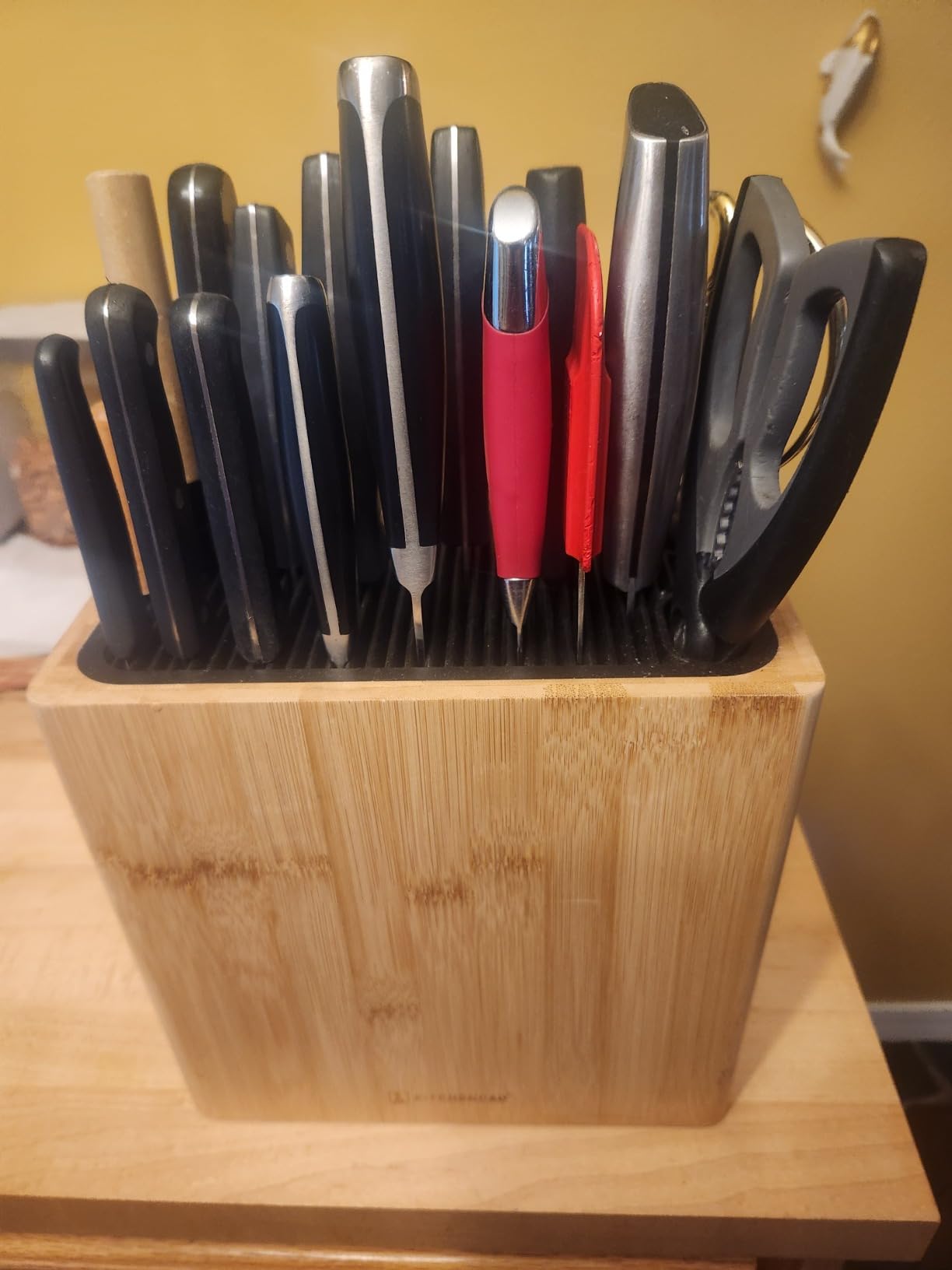
It holds up to 16 knives depending on size, plus kitchen scissors and a sharpening bar in dedicated positions. The ventilation openings under the block are a smaller feature than the parallel slots but a more useful one in a humid kitchen, because moisture that drains away never sits against a steel blade long enough to spot it.
Forum readers also point to KITCHENDAO bamboo blocks for one specific job, holding a cleaver and Japanese-style knives that a normal block cannot take. The 8.6 inch limit here still constrains the very long end, but the parallel geometry handles width far more gracefully than a single-deck slot.
What to check before you buy it
Measure your longest blade. Anything over 8.6 inches will not go in, and that is a shorter ceiling than several competitors manage. This block trades raw blade-length range for edge protection, which is the right trade only if your knives fit.
This one is a block only, with no knives in the box. That is a feature if you own your collection and a non-starter if you were expecting a set, so check the box contents before you assume anything is missing.
Who should skip it
Skip it if you own a long carving or slicing knife over 8.6 inches, or if you need more than about 16 positions. It is also not the choice for a humid kitchen where you will not commit to wiping the bamboo down, because spotting shows on that finish.
If your main concern is keeping an edge, though, this is the block to buy. We would pick it over a larger single-deck block for that reason every time.
6. Cookit Round Plastic 14-Slot Block: Best Budget Pick
Knife Block Without Knives, Cookit Universal Round Knife Block Only, Detachable Knife Holder for Easy Cleaning, Space Saver Knife Storage Holder with Scissors Slot, Black
14 knife slots
Detachable washable top
Weighted base
5.51 inch round footprint
Pros
- Holds 14 knives in a compact round footprint
- Knife tips never touch the base
- Detachable top with drainage holes washes and dries fast
- Weighted base protects the counter and resists tipping
- Knives stay upright even if inverted
Cons
- Plastic may not suit a premium kitchen
- 20 cm blade length limit is short
- Scuffs show on black plastic over time
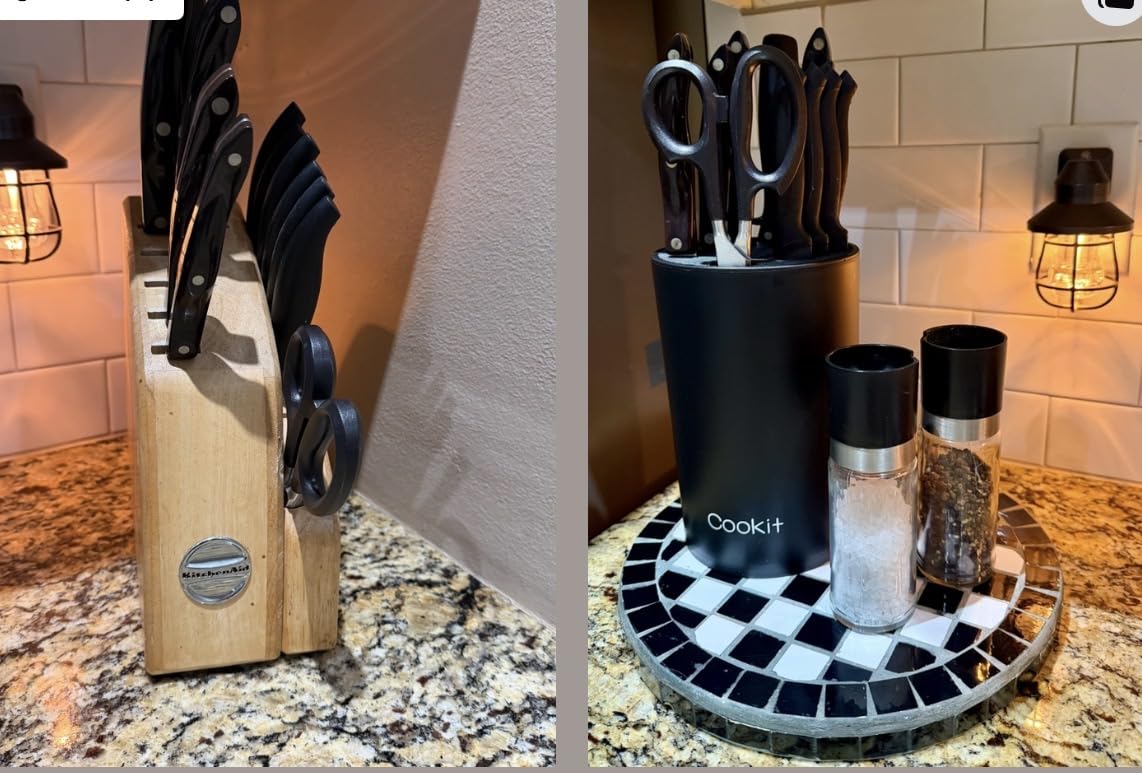
This is the block to buy when you want the least fuss and the easiest cleaning. The whole top section lifts off, the drainage holes let water run to the bottom instead of pooling inside, and the entire unit can be washed. Nothing else in the group cleans this quickly.
The round body is only 5.51 inches across and stands under 9 inches tall, so it fits on a counter where a rectangular 20-slot block simply would not. It also stores blades in a double-ripple inner design that keeps knives upright even if the block is turned over, which is a small engineering touch you notice when you wash it.
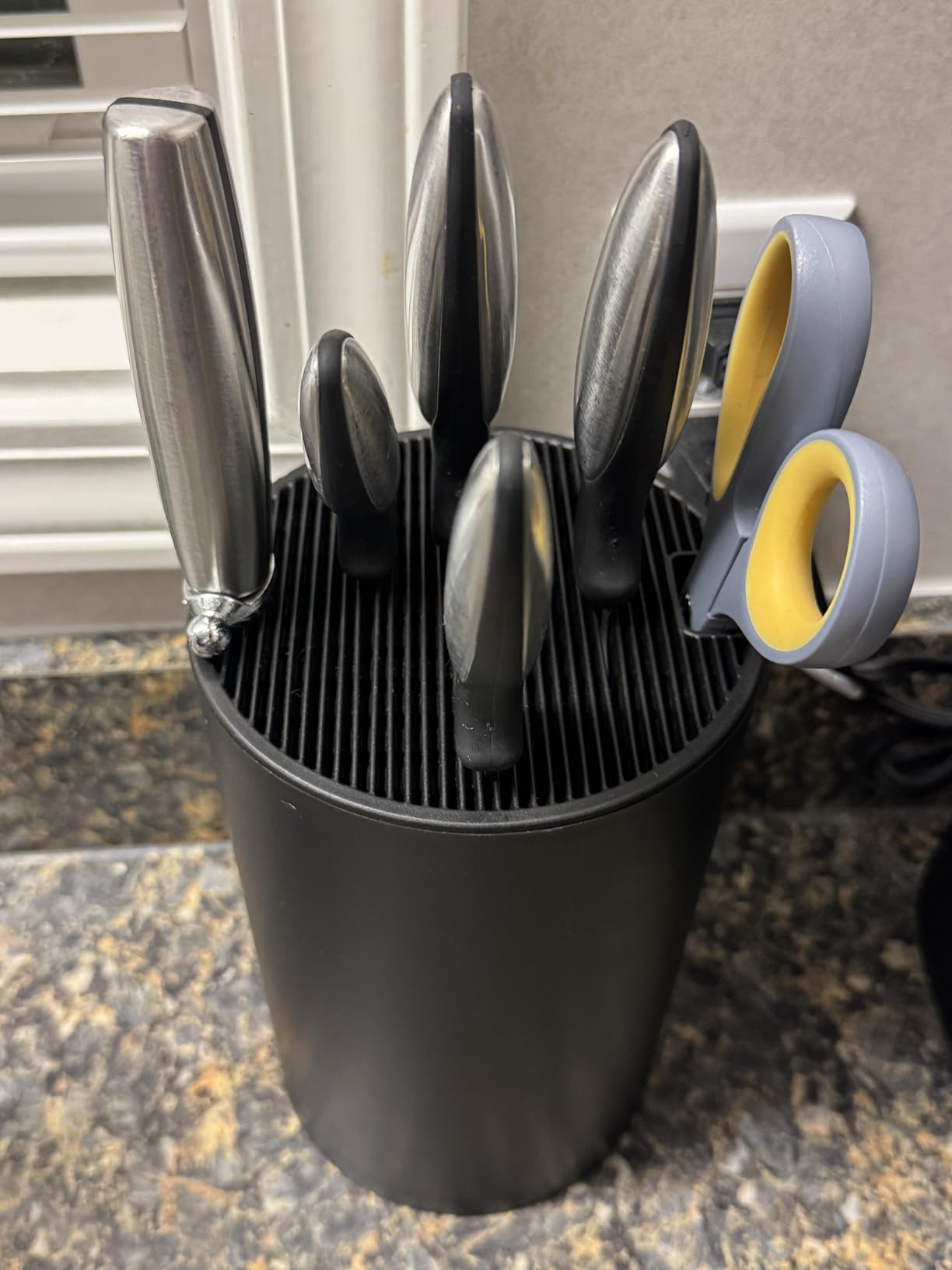
Blade tips never reach the base, so nothing bangs metal on wood. Combined with a weighted base, that also means the block did not move or scratch our counter through six weeks of one-handed pulls.
The tradeoff is honest: this is plastic. Forum long-term owners report budget plastic blocks yellowing, cracking or sliding within three to five years, and we cannot promise otherwise. If you expect to keep a block for a decade, spend up and buy wood or steel.
What to check before you buy it
Check blade length in centimetres rather than inches. The 20 cm limit is roughly 7.9 inches, which is shorter than the ceiling on every wood block we tested. A standard 8 inch chef’s knife is right at the boundary, so measure before you commit.
Check your kitchen’s style, too. A black plastic block reads as functional, not as furniture. In a rental, a first apartment or a busy family kitchen that is exactly right, and in a designed kitchen it may look out of place.
Who should skip it
Skip it if you own long knives, if edge presentation matters, or if you want a block you can hand on as a gift. It also collects scratches visibly over time, and if a scuffed base bothers you, the smooth bamboo or brushed steel options wear more gracefully.
For a first kitchen, a rental, or anyone who wants a block they can rinse out in thirty seconds, it remains the most practical unit in the group.
7. Kitchen Seven Bamboo Block with Two Sharpeners: Best with Built-In Sharpening
Bamboo Universal Knife Block – Knife Holder with 2 Built-In Knife Sharpeners – 2-Tiered Modern Knife Storage Up to 16 Large and Small Knives Easy Clean Wooden Knife Organizer by Kitchen Seven
Up to 16 knives
Tungsten steel and ceramic rods
Two-tier layout
Brazilian bamboo
Pros
- Two built-in sharpeners
- tungsten steel and ceramic
- Flexible rods hold any knife shape without dulling
- Hand-finished Brazilian bamboo suits many kitchens
- Two tiers separate large knives from steak knives
- Natural water and wear resistance with a lifetime guarantee
Cons
- Compact tiers cap capacity near 16 knives
- Sharpeners add bulk and weight
- Fixed rod angles suit some steels less
The reason to buy this block is the sharpening hardware, not the storage. It carries two integrated sharpeners, a tungsten steel restorer and a ceramic polishing rod, mounted in the base where you can work a blade straight down into the slot without removing anything.
Which raises the fair question: do built-in sharpeners work? Partially. Restoring an edge that has gone dull is a honing job and these rods do it. Restoring a genuinely damaged edge is not, and a rod will not fix a knife that has been misused. Forum consensus on this category generally favours a separate, higher-quality sharpener, with the built-in unit treated as a convenience.
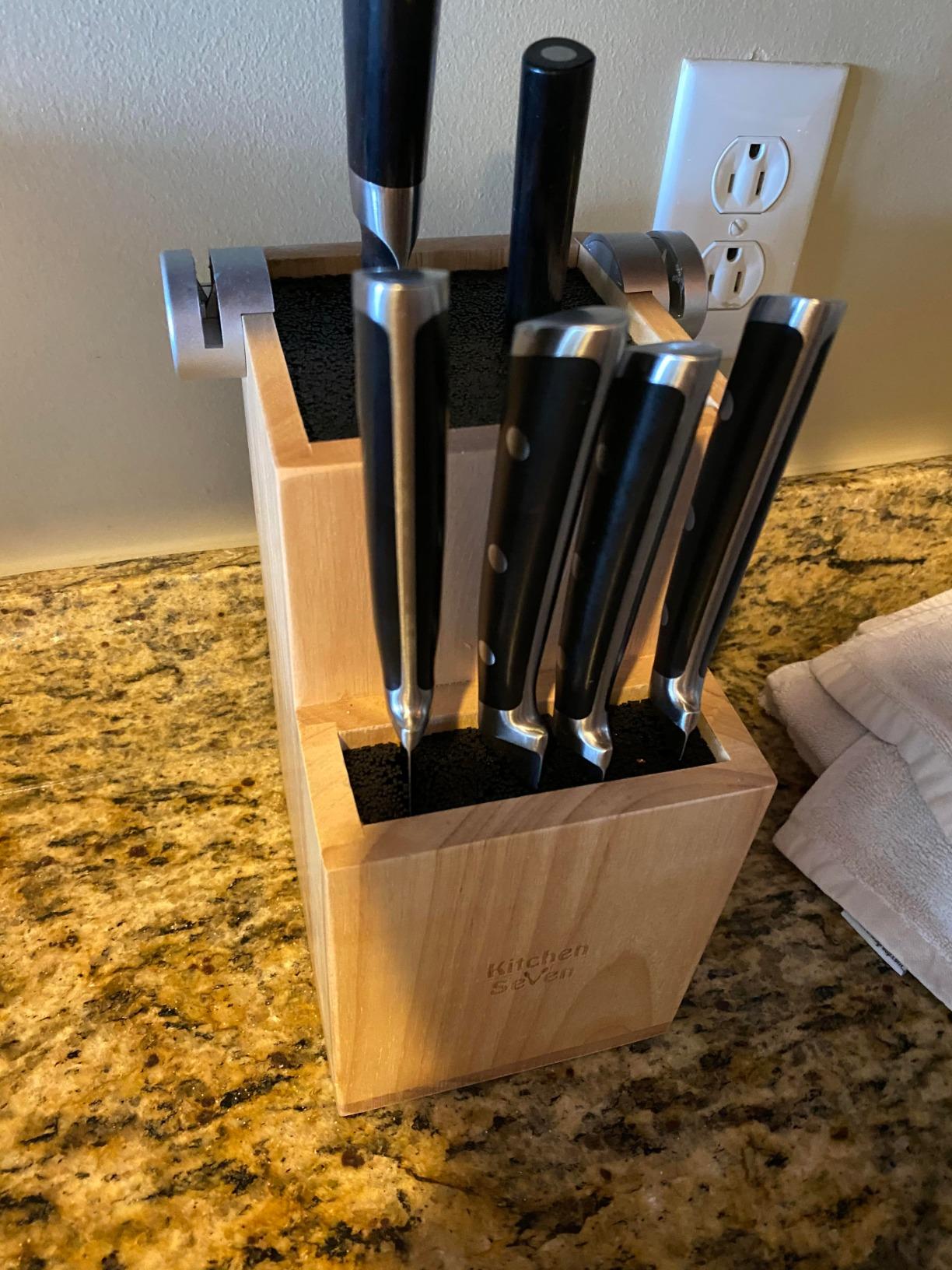
Where it does add real value is the storage design. Slots are lined with flexible plastic rods rather than bare wood, so a blade is supported along its length and its edge never meets a hard slot wall. That is the same principle as the KITCHENDAO parallel deck, applied inside each slot rather than between them.
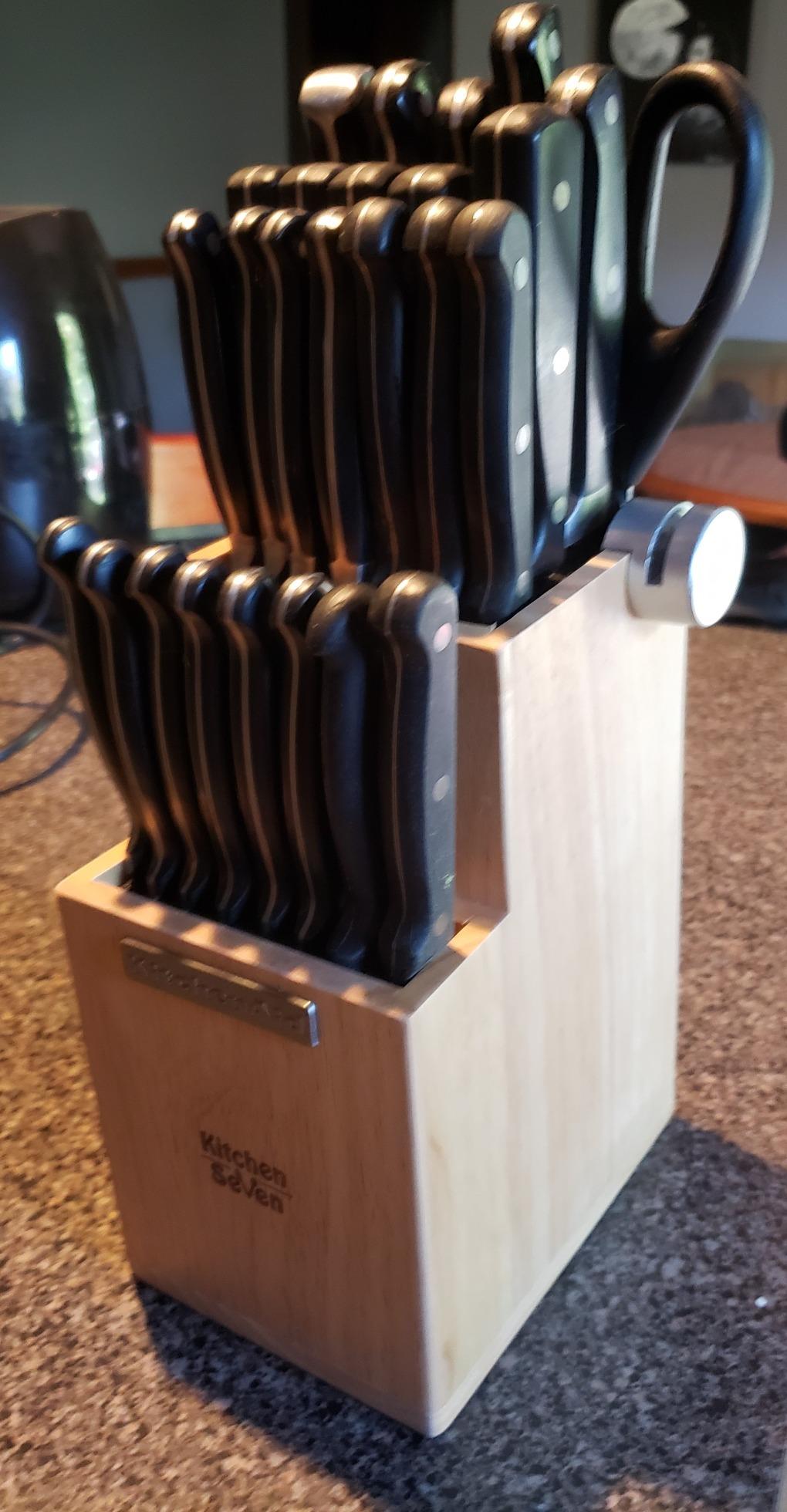
The two tiers split the job. The upper 3.8 inch square tier takes knives up to 8 inches, and the lower 3.8 by 1.1 inch tier stores 5 inch steak knives, which keeps the small blades from wandering into the large slots. Hand-finished Brazilian bamboo is also about as warm-looking as storage furniture gets.
What to check before you buy it
Check the capacity honestly. Sixteen knives in compact tiers is enough for a good collection, but it is a smaller total than the 20 and 25 slot blocks here. If your collection is growing, this is a mid-size unit rather than an end-of-life purchase.
Check where the sharpeners sit relative to your hand. You need vertical clearance above the block to work a knife down into a rod, so this needs a different kind of headroom than a plain storage block.
Who should skip it
Skip it if you already own a proper whetstone or a quality honing steel, because the built-in rods will be redundant and the sharpeners are a real part of the weight and bulk. Also skip it if you want a long-blade block; 8 inches is the ceiling up top.
Skip it if appearance is everything in your kitchen. The bamboo is attractive but this is a working block with hardware in it, not a display piece, and the lifetime guarantee is the main thing that offsets the mid-size capacity.
8. Henckels 11-Slot Hardwood Block: Best Under Low Cabinets
Henckels 11-Slot Knife Block
11 open slots
Low horizontal hardwood design
Rubberized feet
Lifetime limited warranty
Pros
- Low horizontal profile fits under wall cabinets
- Sideways slot angle is more blade friendly
- Sturdy hardwood build with rubber feet
- Accepts a santoku and matches Henckels knives
- Small footprint for a basic full-size set
Cons
- Slots too narrow for two full-size chef's knives
- About 10 inch limit on upper rows and 7 inch below
- Sticker glue on the base is hard to remove
- Only 11 slots
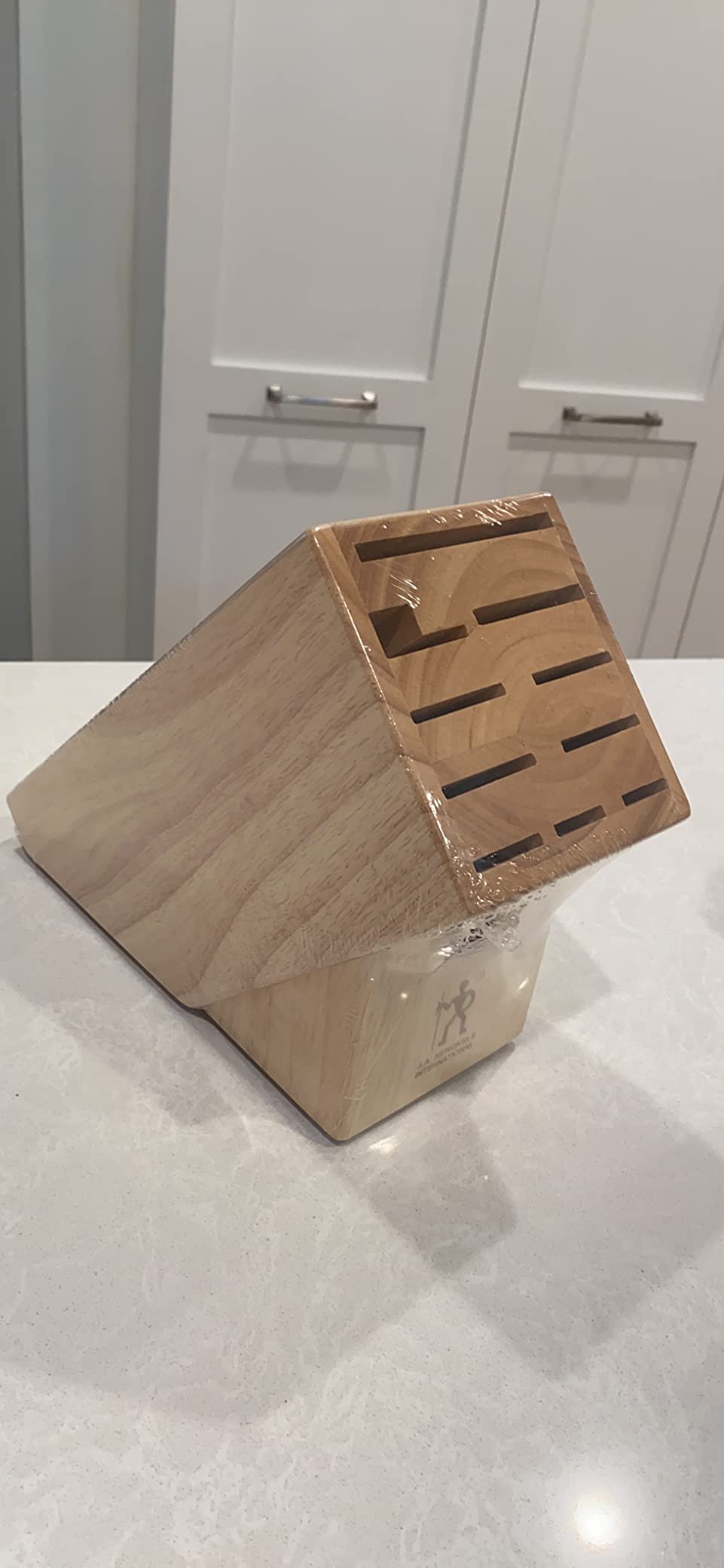
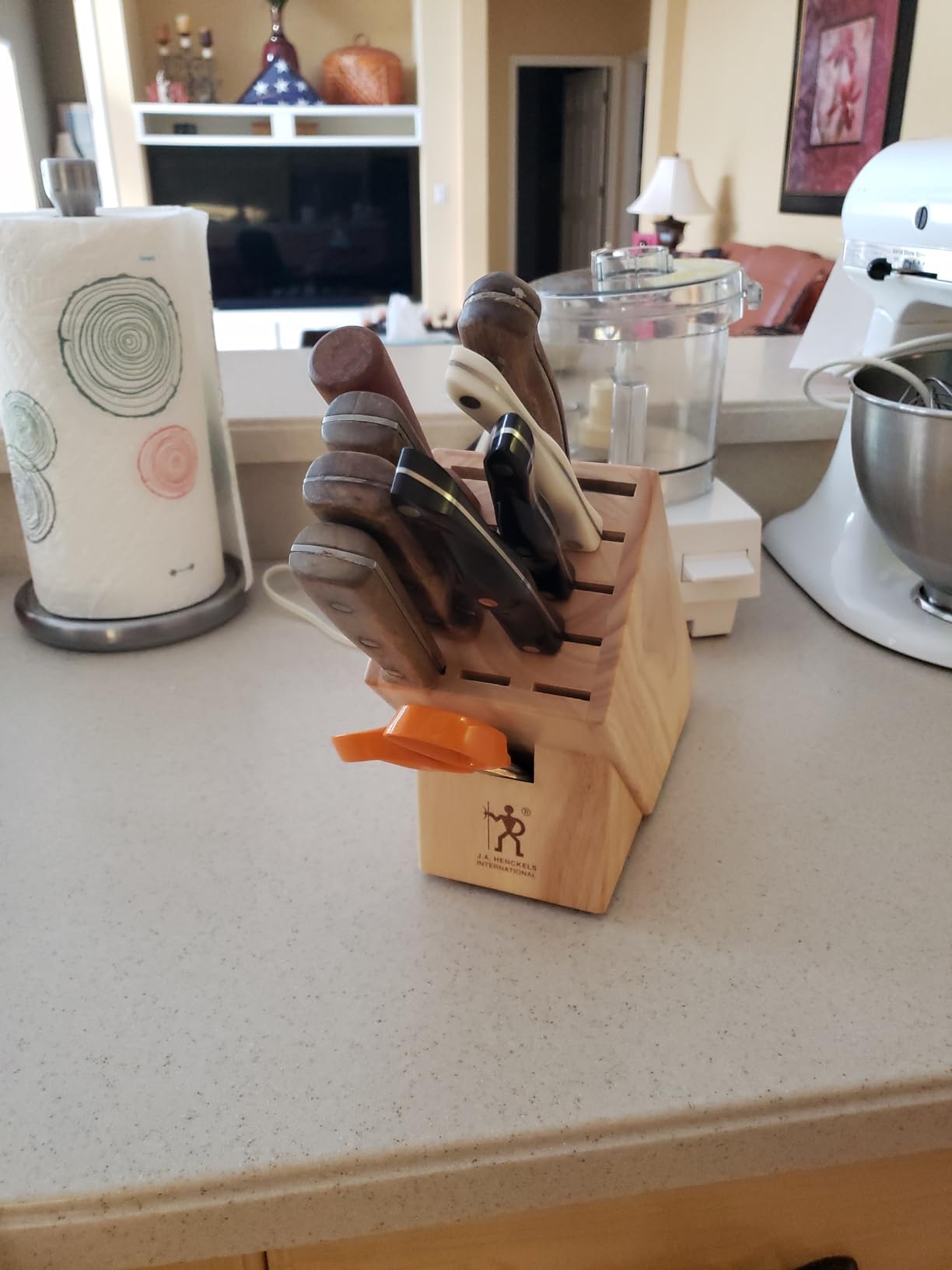
Most vertical blocks need about 18 inches of clearance once a knife is in them: roughly 9 inches of block plus 9 inches of blade. Henckels solves that by laying the slots almost flat, so knives slide in sideways and the loaded height stays low. In a kitchen with a low-hung cabinet, it is one of very few blocks that simply works.
Sideways insertion is also better for the blade. A horizontal angle lets the whole length of the knife drop into the slot under its own weight, so you are not levering an edge downward against a slot wall every time you put a knife away.
The hardwood body is a proper traditional build with rubber feet that resist sliding, and it carries a lifetime limited manufacturer warranty. Owners we read about in long-term discussions repeatedly report wooden blocks from established brands lasting 10 to 20 years, and this is the product on our list with a warranty attached.
Eleven slots sounds small next to twenty-something blocks, and it is. It fits a basic full-size set plus a cleaver and shears, which is what most cooks actually reach for, but it is not built for a collection that keeps expanding.
What to check before you buy it
Know the row limits before you load it. Upper rows take blades to about 10 inches and the bottom row to about 7 inches, and the slots are too narrow to hold two full-size chef’s knives side by side. If both are in your collection, one will end up repurposing the cleaver slot.
Measure your cabinet clearance against the longest knife you own, not the block’s listed height. That measurement is the single most useful thing you can do before buying any countertop knife block, and this one is the reward for doing it.
Who should skip it
Skip it if you have a growing collection or if two full-size chef’s knives is a normal part of your week, because the narrow slots will frustrate you daily. It is also the least generous option here on slot variety.
There is one small annoyance worth naming: sticker glue on the base is difficult to remove. It is cosmetic and does not affect function, but it is the kind of detail that irritates people who notice it.
9. RedCall Stainless Steel and Utensil Set: Best for Small Kitchens
RedCall Kitchen Knife Holder,Stainless Steel Universal Knife Block Without Knives for Countertop,Modern Knife Utensil Holder for Counter,Edge-Protect Knife Storage Organizer (Stainless Steel (Silver))
Knife insert plus utensil bucket
12 knives and 12 utensils
Brushed stainless finish
4.4 by 8.85 inch base
Pros
- Knives and loose utensils in one compact footprint
- Brushed stainless resists fingerprints and smudges
- Small base suits compact kitchens
- Water drains to the bottom instead of pooling
- Does not topple when knives are pulled
- Also offered as a camping set
Cons
- Insert buckets are hard to remove for deep cleaning
- Knife slots sit close for wide handles
- Thin metal at the top edge over a plastic base
Most blocks on this page solve one problem. This one solves two, because the set pairs a slotted knife insert with a separate utensil bucket, holding up to 12 knives alongside 12 items such as ladles, spatulas, forks and chopsticks. In a compact kitchen, that consolidation is worth more than another ten knife slots would be.
The brushed stainless finish is the other argument for it. It resists fingerprints and smudges, which matters enormously on a visible counter, and it reads as modern hardware rather than furniture. Nobody is going to ask you why there is a steel block in the kitchen.
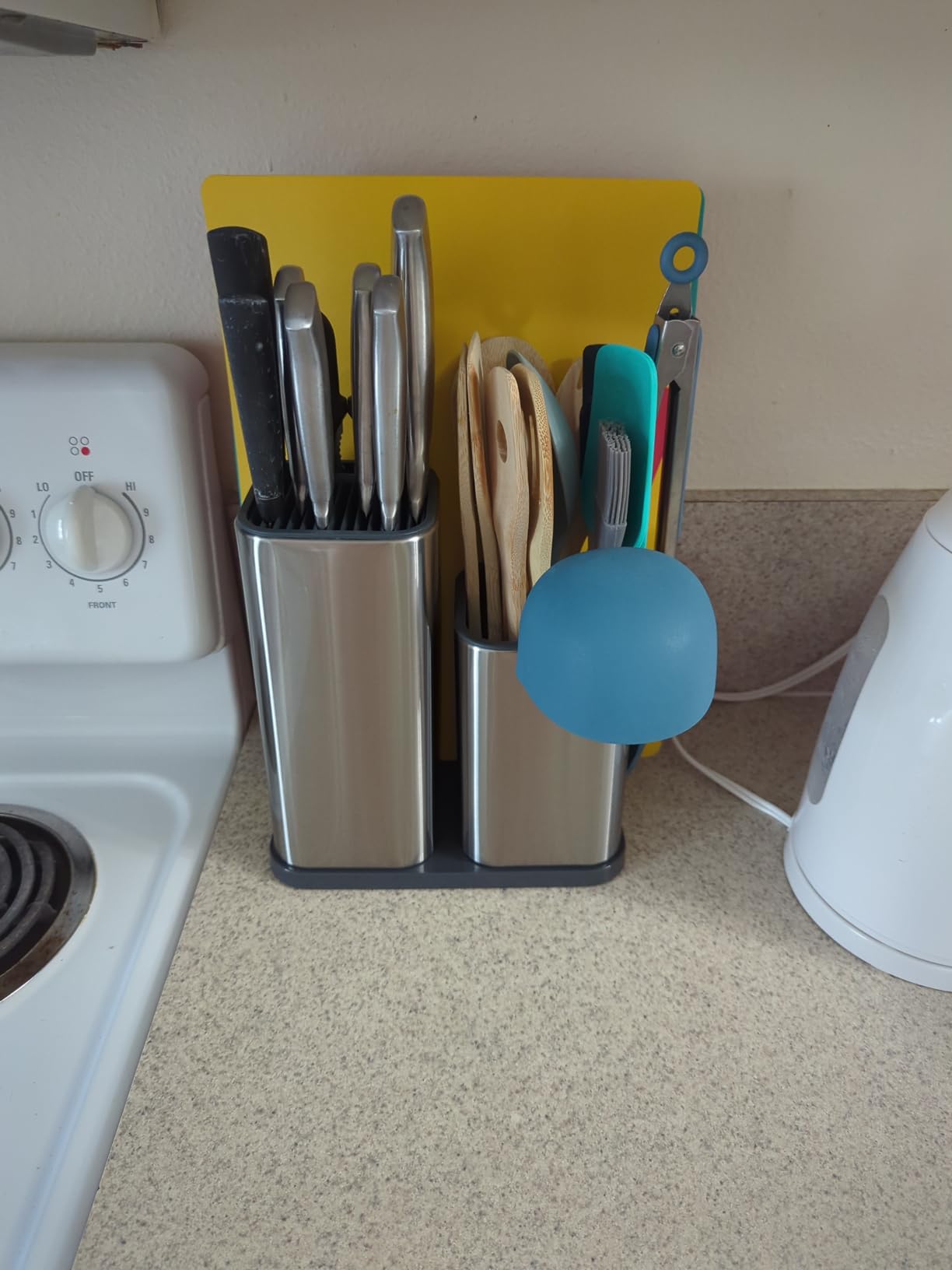
Drainage is handled properly. Water runs to the bottom of the unit rather than pooling in a slot, and the air vents reduce the chance of a spotted blade after a washing-up session. Across six weeks near the sink, we did not see rust on any stored knife, which is not something we can say for every block in this group.
There is also a slot at the rear that doubles as a cutting board holder, and the containers detach for cleaning. It stayed planted on the counter every time we pulled a heavy knife out one-handed, so the weighted base is doing its share of the work.
What to check before you buy it
Measure the 4.4 by 8.85 inch base against your free counter. The footprint is modest, but the height of 9.3 inches is taller than a flat block, so it can crowd a low-hung cabinet even though the base looks compact.
Decide whether you want the utensil half. If you already have a large crock taking the ladles, this set is half a solution and you would be better served by a pure knife block.
Who should skip it
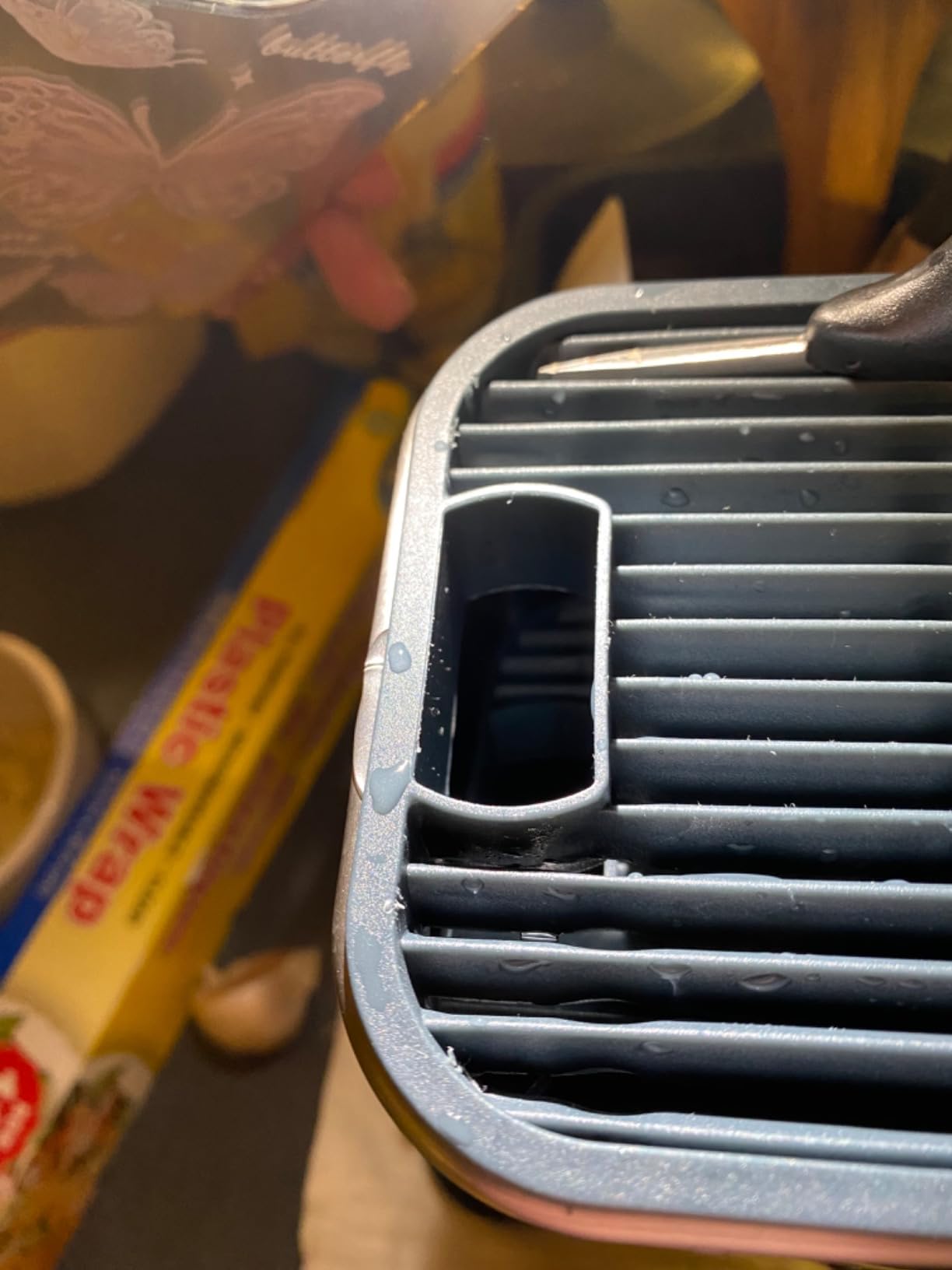
Skip it if you care about how the block feels in the hand, because the metal is thin at the top edge and sits on a plastic base that undercuts the perceived quality. The insert buckets are also awkward to remove for a deep clean, so it is a wipe-down block rather than a soak block.
Also note that close slot spacing can mean wide handles touch. Anyone with thick handles should check that, and so should anyone who is simply fussy about how a finished kitchen looks, because the utilitarian steel look is not for everybody.
10. ENOKING 25-Slot Acacia Block: Best for Large Collections
ENOKING Knife Block without Knives, 25 Slots Large Knife Holder
25 slots for up to 20 knives
Dedicated 4.3 inch cleaver slot
Acacia with mineral oil finish
Non-slip base
Pros
- Highest average rating in the group at 4.8
- 25 slots including a dedicated 4.3 inch cleaver slot
- Angled wide openings are easy to load and reduce wear
- Solid acacia with a mineral oil finish
- Non-slip base and no assembly needed
Cons
- Maker advises more than 15 inches of cabinet clearance
- Wood color and grain vary
- Heavy at roughly 3.4 kg and awkward to move
- Knives not included
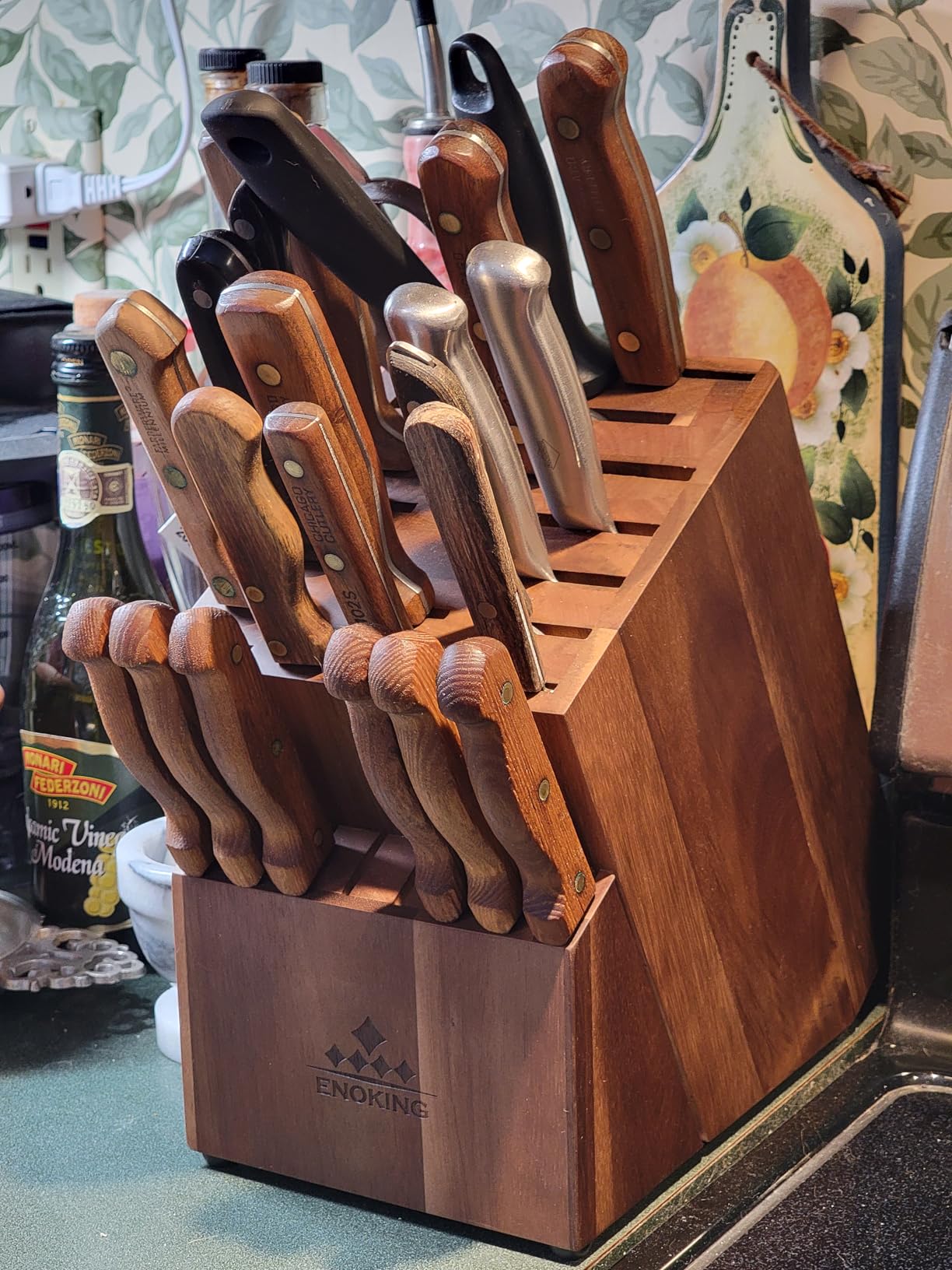
This block carries the highest average rating in the group, and after six weeks of loading and pulling we can see why. The build is clean, the slot openings are wide and angled, and the acacia is finished with natural mineral oil rather than a film that peels.
Twenty-five slots is the largest capacity here, holding up to 20 knives plus a scissor and a sharpening rod position. The dedicated 4.3 inch cleaver slot is the detail that separates it from generic 25-slot blocks, because a cleaver dropped into a normal knife slot will sit loose and eventually damage the slot walls.
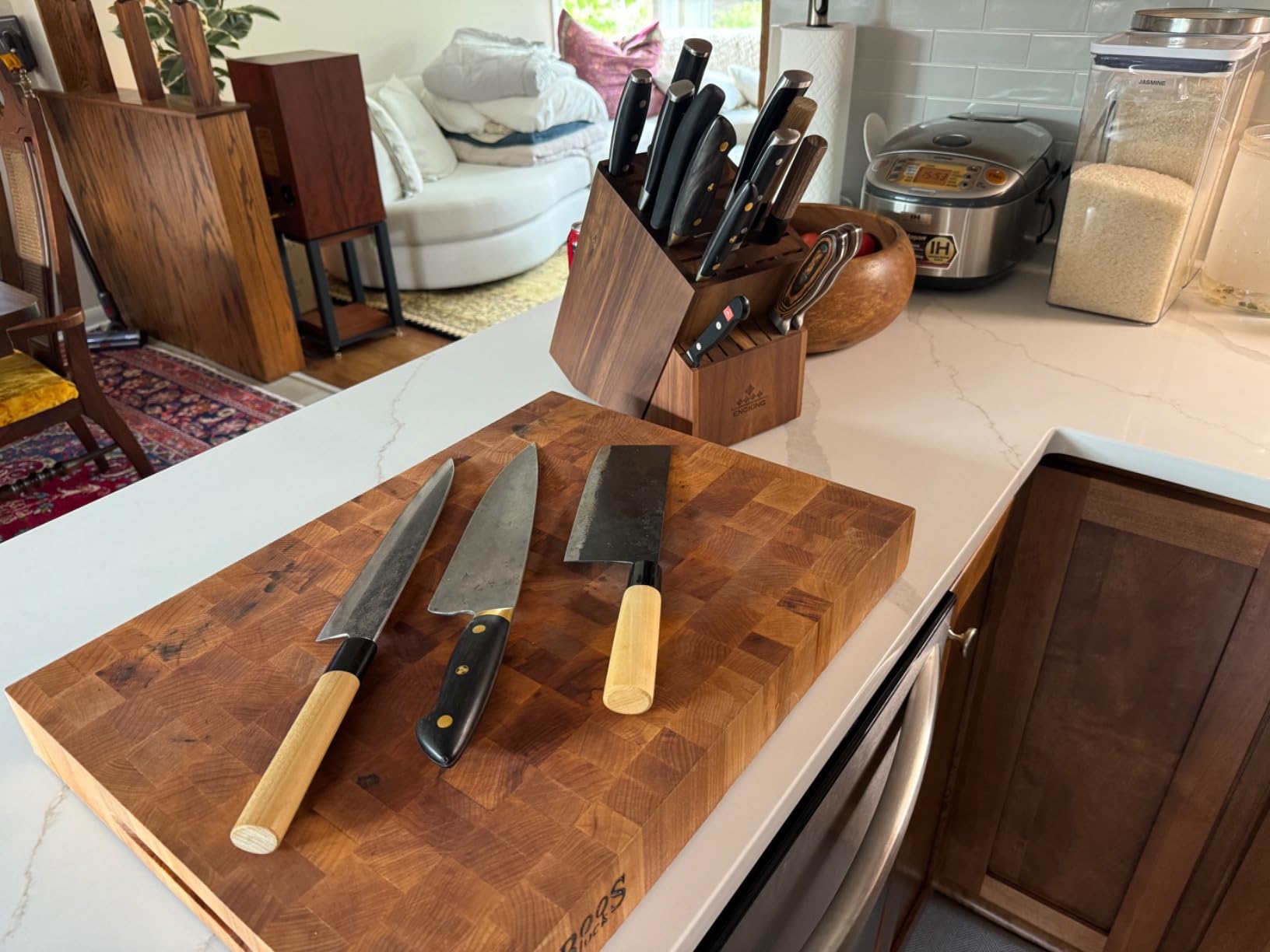
There is no assembly. It arrives finished, sits on a non-slip base, and works straight out of the box. That combination of rating, capacity and zero setup is why it earned a place on this list despite a review base smaller than several rivals.
Size is the real caveat and the manufacturer is upfront about it: the listed recommendation is more than 15 inches of clearance beneath wall cabinets. Add a blade on top of a nearly 10 inch block and you are looking at a loaded height that will not work under a standard 18 inch cabinet in a tighter kitchen.
What to check before you buy it
Measure under your wall cabinets before anything else. The maker’s own guidance is over 15 inches of clearance, and this block is the tallest loaded unit in the group. If your cabinets hang low, this is a return, not a compromise.
Then check the weight. At roughly 3.4 kg it does not move when you pull a knife, which is exactly what you want, but it also takes real effort to reposition for cleaning.
Who should skip it
Skip it under low cabinets, and skip it if you own fewer than about a dozen knives, because you would be paying for capacity you will never fill. Wood colour and grain vary between pieces, so buy it for the build rather than for a matching finish.
For a cook with a real collection, a cleaver in the mix and standard-height cabinets, this is the most complete single block we tested and the one we would put on a gift list.
11. Cooks Standard Acacia 25-Slot Block: Best for Long Knives
Cooks Standard Acacia Wood 25-Slot Universal Knife Block without Knives
25 slots in solid acacia
Tools up to 10.5 inches deep
Multiple slot widths
8 lb weighted base
Pros
- Very deep slots accept knives and tools up to 10.5 inches
- Variety of slot widths covers chef's steak long knives and a cleaver
- Extra-wide slots double as shears and steel holders
- Solid natural acacia
- Backed by a 1 year manufacturer warranty
Cons
- 11.8 by 6.5 inch footprint takes substantial counter space
- Deep slots take longer to clean and dry
- Bulkier and heavier than compact blocks
- Knives not included
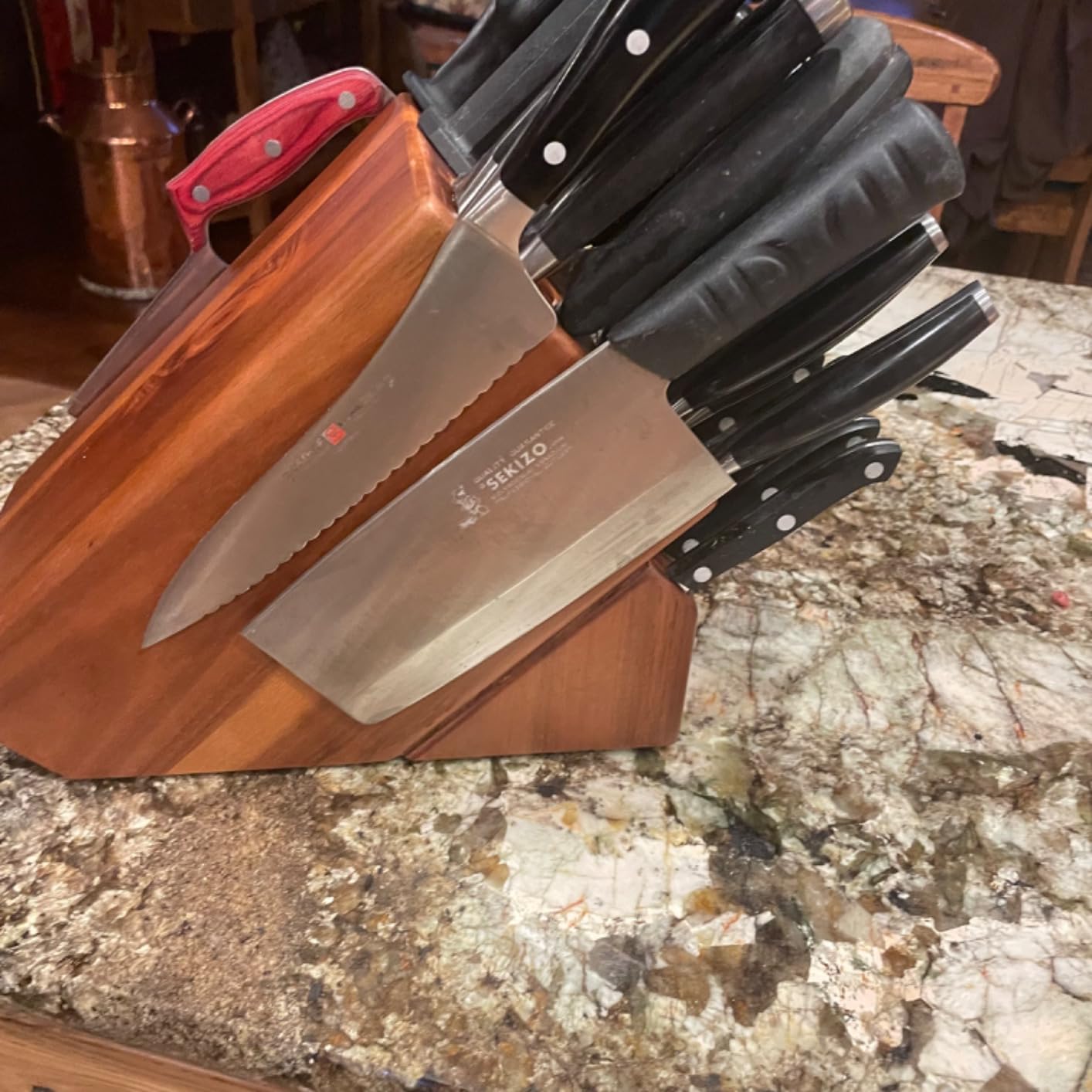
Slot depth is the number that matters with this block, and it is the deepest on the page at 10.5 inches. If you own a long slicing knife, a carving fork handled knife or a tall santoku, this is one of very few countertop blocks that will swallow it without a fight.
The variety of slot widths is the second advantage. Rather than twenty-five identical openings, you get positions for chef’s knives, steak knives, wide blades, long blades and a cleaver, plus extra-wide positions for kitchen shears and a sharpening steel. Our whole collection fitted, which is not something we can say for every 25-slot block.
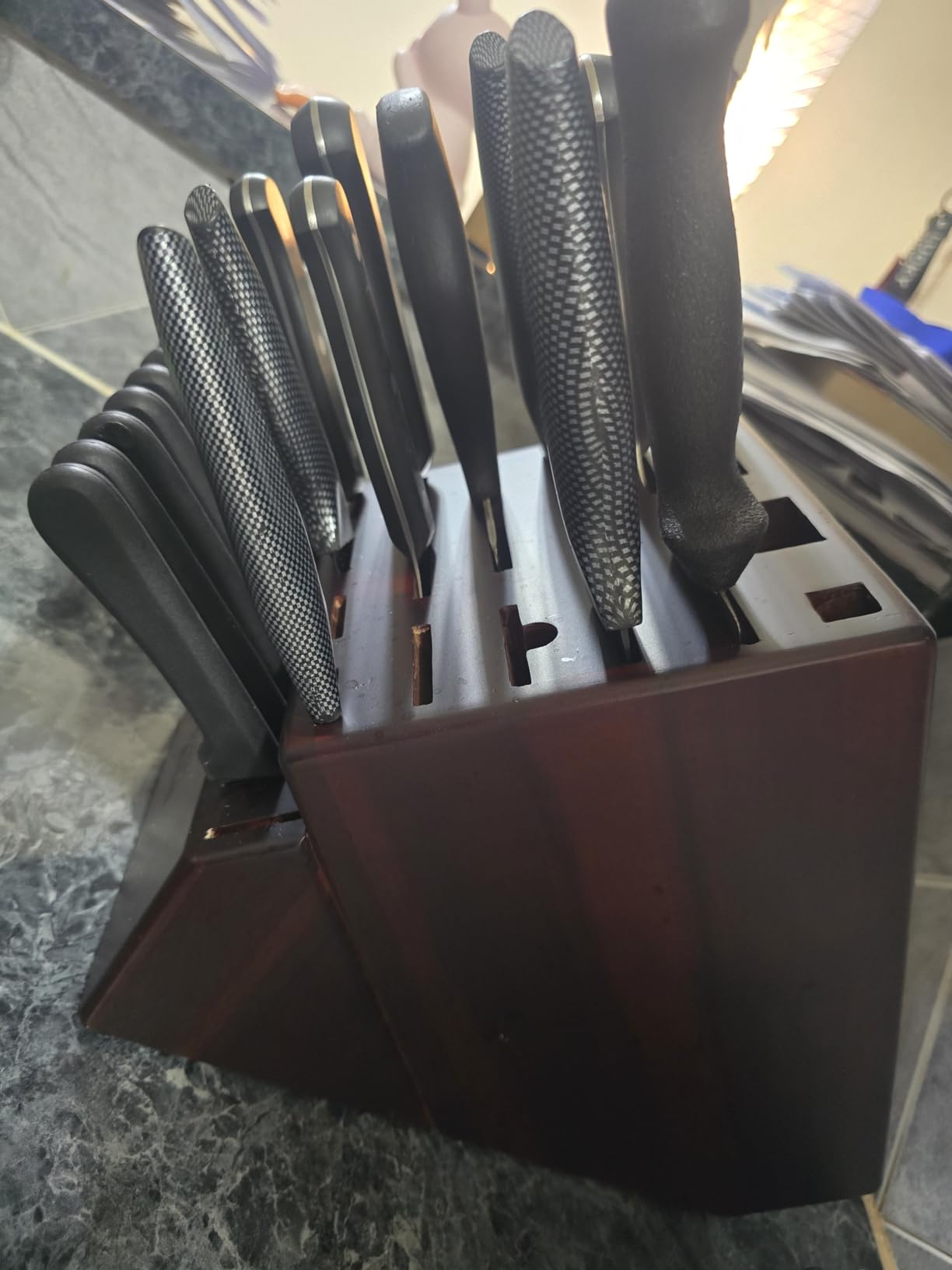
At 8 pounds it is the heaviest block we tested and it never shifted. That mass is exactly what a tip-over test demands, and it is the reason this block feels planted in a way lighter units do not. If you pull a heavy chef’s knife one-handed at speed, that weight is a feature.
The cost is square with space: 11.8 by 6.5 inches is a large patch of counter, and deep slots take longer to clean and dry than shallow ones. After a couple of weeks you will notice moisture sitting at the bottom of a deep slot, which is our argument for a monthly wipe-down.
What to check before you buy it
Measure the footprint properly, and measure it against the run you actually prep on. 11.8 inches deep is not a decorative object; it will reshape how you work if your board usually sits in that space.
Check that no knife in your collection exceeds 10.5 inches. That is the ceiling here and it is generous, but the cleaver and the shears positions are counted within the same frame, so think about total tools rather than knives alone.
Who should skip it
Skip it in a small kitchen, in a rental where counter space is the scarcest resource, or if you want a block you can lift with one hand to move it aside. The weight is a stability asset and a handling cost at the same time.
Also skip it if cleaning is going to be rushed. Deep slots plus a large wood body is more surface area to keep dry, and the honest test of any wood block is whether you will actually maintain it.
12. RedCall 14-Slot Parallel-Slot Block: Best Parallel Slots on a Budget
RedCall Universal Knife Block Without Knives – 14 Slot Wooden Knife Holder for Countertop, Large Bamboo Knife Storage Organizer, Butcher Block Knife Stand for Kitchen (Brown-14 Slot)
14 slots for up to 12 knives
Parallel slot layout
Acacia style wood finish
Four non-slip feet
Pros
- Parallel slots stop blades contacting and scratching each other
- Solid wood treated against wear staining and moisture
- Four non-slip feet prevent sliding
- Angled and widened openings make loading easy
- Also offered in black and 20 slot versions
Cons
- Lowest average rating in the group at 4.4
- Some durability complaints about the wood finish
- 14 slots is fewer than 20 and 25 slot rivals
- No dedicated cleaver slot
The design idea here is the same one that makes the KITCHENDAO block worth recommending, at a smaller size and a lower rating. Parallel slots mean the blades are spaced so they cannot rub against one another, which is the mechanism behind most of the edge dulling people report in this category.
Fourteen slots is a mid-size capacity, holding up to 12 knives plus positions for kitchen shears and a sharpening rod. The angled slots have wider openings than the price suggests, so loading is easy, and the wood is treated to resist wear, staining and moisture better than a raw finish would.
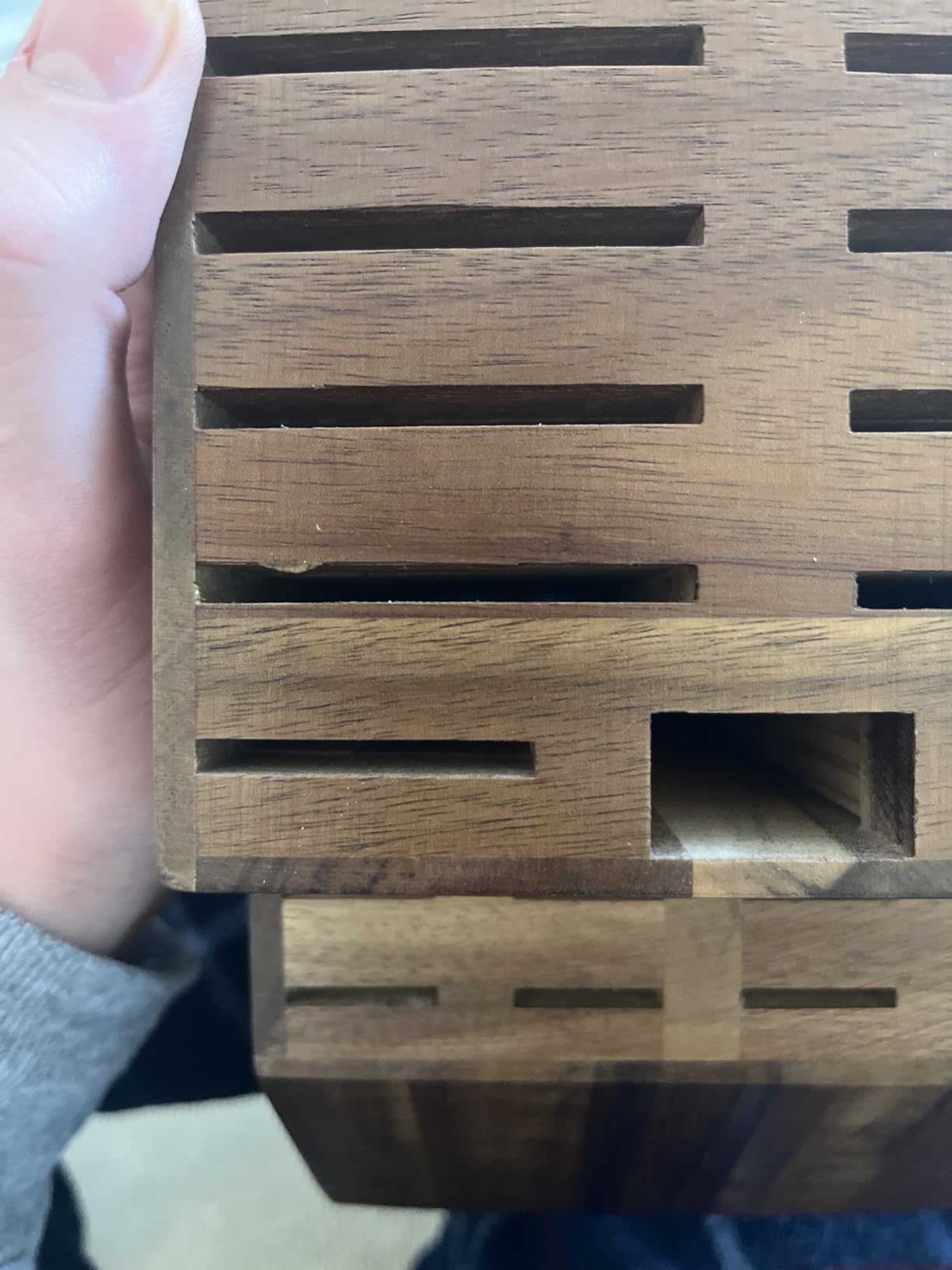
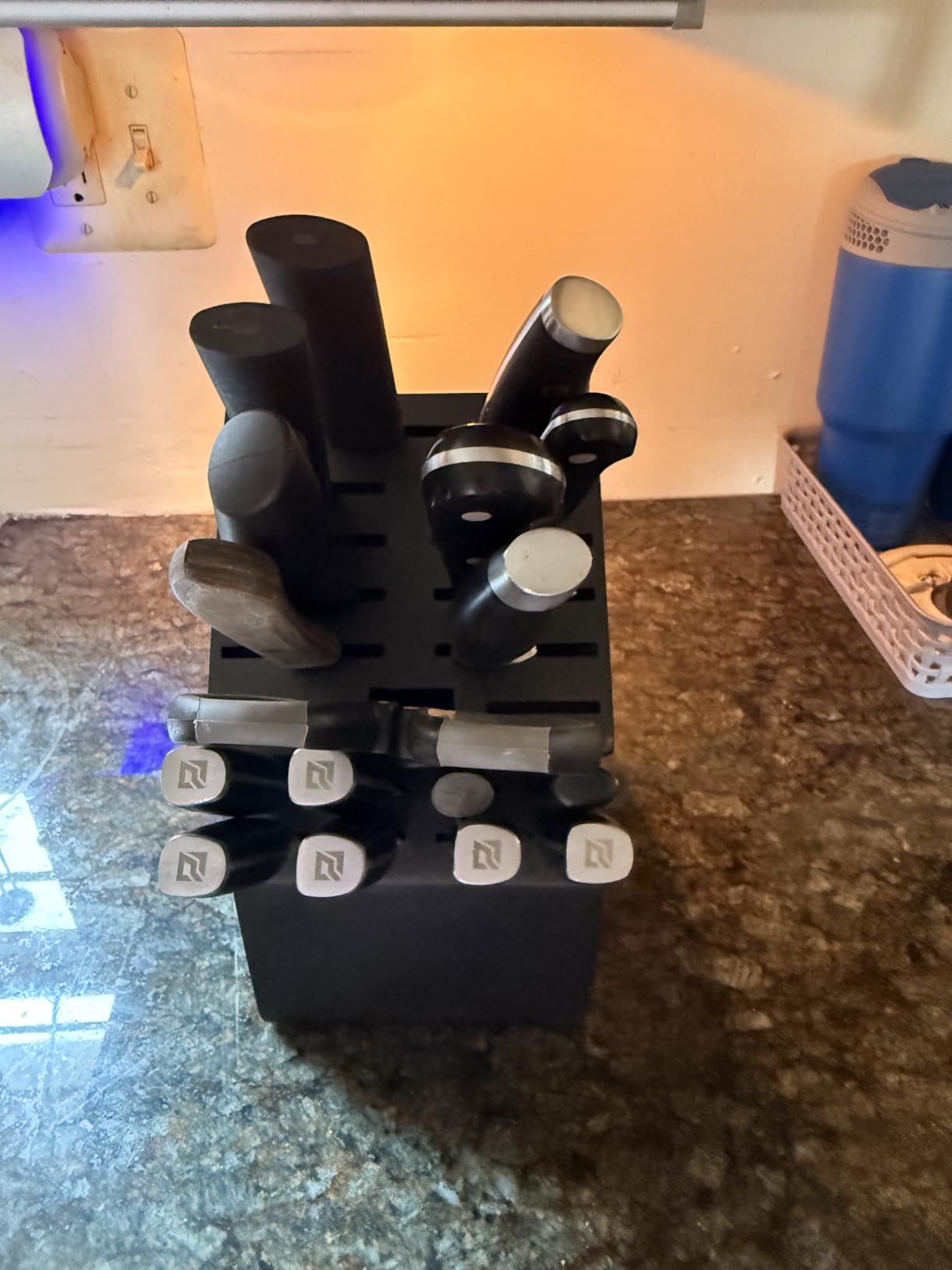
Four non-slip feet sit under the base, and they did their job through our whole test. The footprint is a modest 7.1 by 5.2 inches with an 8.5 inch height, which makes this one of the easier blocks to live with in a small kitchen while still being real wood rather than plastic.
We are ranking it last for a reason, and it is the rating. Its 4.4 average is the lowest in the group with a visibly larger share of one-star feedback, and some of those complaints point at the finish and the wood’s long-term durability. Nothing we hit ourselves was structural, but the consistency is not there.
What to check before you buy it
Check whether the parallel spacing suits your collection, because a household with only two or three knives gains very little from it. The benefit scales with how many blades you store side by side.
Check the finish closely on arrival if you can, given the durability feedback. A block that feels slightly dry or shows an uneven grain is still usable, but it is worth inspecting before knives go in.
Who should skip it
Skip it if a cleaver is part of your setup, because there is no dedicated wide slot for one. Skip it if you want 20 slots, since the same range offers larger versions that cost a similar amount.
And skip it if edge protection is your main reason for buying, because the KITCHENDAO double-deck design does the same job better and scored far higher. Pick this one for the price and the compact footprint, and pick the KITCHENDAO for the edges.
Buying Guide: How to Choose a Knife Block for Your Countertop
Every block on this list is storage only. None of them includes knives, and that is deliberate, because if you are reading this page you probably own knives already. If you are still choosing blades, start with our [best kitchen knife sets guide](https://eatcreatesleep.net/best-kitchen-knife-sets/) and come back here once you know what you need to store.
1. Measure your counter and your cabinet clearance first
This is the step that prevents most returns, and it takes thirty seconds. Measure the free run of counter where the block will live, then measure the vertical distance from that counter to the underside of the wall cabinet above it. That second number is your real constraint.
Then add the longest blade you own to the block’s height. A 9 inch block holding a 9 inch knife needs about 18 inches of clearance, and plenty of kitchens with standard 18 inch cabinets fail that test by an inch or two. If your clearance is tight, the Henckels 11-slot block’s low horizontal design is the safe answer.
2. Decide between a magnetic block and a slot block
Slot blocks grip blades by friction in angled, sometimes rod-lined or smooth openings. They protect edges because the blade is supported along its length and shielded from contact, and they keep blades hidden, which makes them the safer choice in a house with children or pets.
Magnetic blocks embed magnets behind a wood or steel face so ferromagnetic steel blades stick flat. Nothing goes into a slot, so there is no blade length limit and no loading angle to learn, and every knife stays visible. You give up a little edge protection from blade-to-blade contact and you accept an open face of sharp steel. Serious Eats-style testing in this category measures magnet strength with a gauss meter, and the useful number is the weakest point on the face, not the centre.
3. Check blade compatibility, including the non-ferrous problem
Standard stainless and carbon steel blades work with everything. Ceramic blades and some titanium-coated blades are non-ferrous, and a magnet will simply not hold them. The failure is silent and dangerous: the knife looks seated, then slides off when you reach for it.
So if your collection includes ceramic, check before you buy a magnetic block. Slot blocks do not care what a blade is made of, which is the quiet argument for them in mixed-technique kitchens.
4. Size capacity to a real collection
The most common forum advice on knife storage is consistent: buy fewer, better knives and store them well. A 15 to 20 slot block covers a strong home collection of a chef’s knife, a santoku, a bread knife, a paring knife, a utility knife and a few more. Anything above 20 slots is for collectors.
Count tools, not just knives. Kitchen shears and a honing steel need positions, and a block that counts them in its slot total is really a smaller block than the number suggests.
5. Treat weight as a tip-over requirement
Blocks tip when you pull a heavy chef’s knife one-handed. The practical rule we came back to is a floor of about 4 to 5 pounds, combined with a non-slip base and enough base width to resist a sideways pull.
On this list, the Shenzhen block at 4.8 pounds, the Cooks Standard at 8 pounds and the ENOKING at roughly 3.4 kg all sit comfortably in that zone. The Coninx at 1.5 kg is lighter but wider and rubber-footed, which is how it stays planted.
6. Choose the material for the room, not the price
Acacia and walnut are dense, warm-looking hardwoods that suit a designed kitchen and want an occasional coat of mineral oil. Bamboo is lighter, cheaper, more water resistant and more prone to spotting if knives go in wet. Brushed stainless is the most modern look and the easiest to wipe, with thin metal at the top edge as the compromise. Polypropylene is washable, cheap and the easiest option to keep sanitary, but it will not blend into a premium kitchen and may not last a decade.
7. Plan the maintenance before you buy
Wood blocks need a routine. Wash and dry each knife before it goes back in, wipe the block down, and treat the wood with mineral oil every few months. Plain water alone is not enough for wood, and oil is what keeps the surface from drying out and cracking.
Plastic and steel blocks are simpler: pull the container, rinse it, and leave it open until it is fully dry. Vent holes and drainage are worth paying a little extra for if your block lives near the sink, because standing moisture against steel is how rust spots start.
8. Think about who can reach the counter
If children or pets are in the kitchen, an open magnetic face is the least safe option on this page no matter how good it looks. A slot block with a wide base is safer, and an in-drawer dock or an under-cabinet rail is safer still if you have the clearance and the willingness to install it. Renters without permission to drill should stay on the counter with a weighted block.
Frequently Asked Questions
What is the best knife block for storage?
The Shenzhen Knives 20-Slot Bamboo block is the best all-round choice for storage because its wide angled slots accept full-width knives, its 4.8 lb body and anti-skid feet resist tipping during a one-handed pull, and 20 slots cover most home collections. Measure your cabinet clearance first, since a loaded block needs roughly its own height plus your longest blade.
Are magnetic knife blocks better than traditional slot blocks?
Neither is better for everyone. Slot blocks protect edges better, hide blades, impose no limit on blade length and work with any material including ceramic, so they are safer with children and pets. Magnetic blocks give instant one-handed access, keep every knife visible and accept any blade shape, but exposed steel sits in the open and ceramic or titanium-coated blades will not stick at all.
Do knife blocks damage knife blades?
They can, and the mechanism is contact. When two blades share a slot and rub every time one is pulled out, the edge dulls slowly over months. Parallel double-deck designs such as the KITCHENDAO XL and rod-lined blocks such as the Kitchen Seven reduce that contact. Wood contact and magnet contact cause far less wear than blade-on-blade rubbing, and slot blocks generally protect edges better than magnetic faces.
How many knives should a knife block hold?
For a typical home collection, 15 to 20 slots is right. That covers a chef’s knife, a santoku, a bread knife, a paring knife, a utility knife and a few specialty blades, plus positions for kitchen shears and a honing steel. Buy 25 slots only if you genuinely collect, and count tools as well as knives, since a block that includes shears and a steel is smaller than its slot number suggests.
What is the best material for a knife block?
Acacia or walnut hardwoods look the best and are dense enough to resist tipping, but they need occasional mineral oil and dry blades before storage. Bamboo is lighter, cheaper and more water resistant. Brushed stainless looks modern and wipes clean easily. Polypropylene is the easiest to wash and sanitise, which matters most near a sink, but it is the least attractive and typically the shortest-lived.
Are knife blocks sanitary and easy to clean?
It depends entirely on the design. Removable-top polypropylene blocks such as the Cookit round unit can be rinsed and dried fully, and stainless units with drainage holes and air vents let water run away instead of pooling. Wood blocks cannot be soaked, so dry every knife before storing it, wipe the block down after use and treat it with mineral oil every few months. Keeping moisture out of the slots is what prevents bacteria and rust.
Final Verdict: Which Countertop Knife Block Should You Buy?
Buy the Shenzhen Knives 20-Slot Bamboo if you want one block that handles almost any collection and stays planted when you pull a heavy knife. It is our editor’s choice because capacity, stability and slot width all land well in the same unit, and it is the one we kept on our own counter through the whole test.
Buy the Cook N Home Bamboo 20-Slot if your blades run longer than most, since the 10.5 inch slot depth accepts slicing knives that many competitors reject. Buy the Coninx Acacia 15-Slot if counter depth is the thing you are short of, and the Henckels 11-Slot if your wall cabinets hang low. For visible, instant access, the HOSHANHO magnetic block wins, with the caveat that ceramic and titanium-coated blades will not hold to it.
Whatever you choose, measure your cabinet clearance and your longest knife before you order, and dry every blade before it goes back in. In 2026, the best knife blocks for kitchen counters are still the simple ones: solid enough not to tip, roomy enough for the knives you actually own, and small enough to leave you counter space to cook on.