
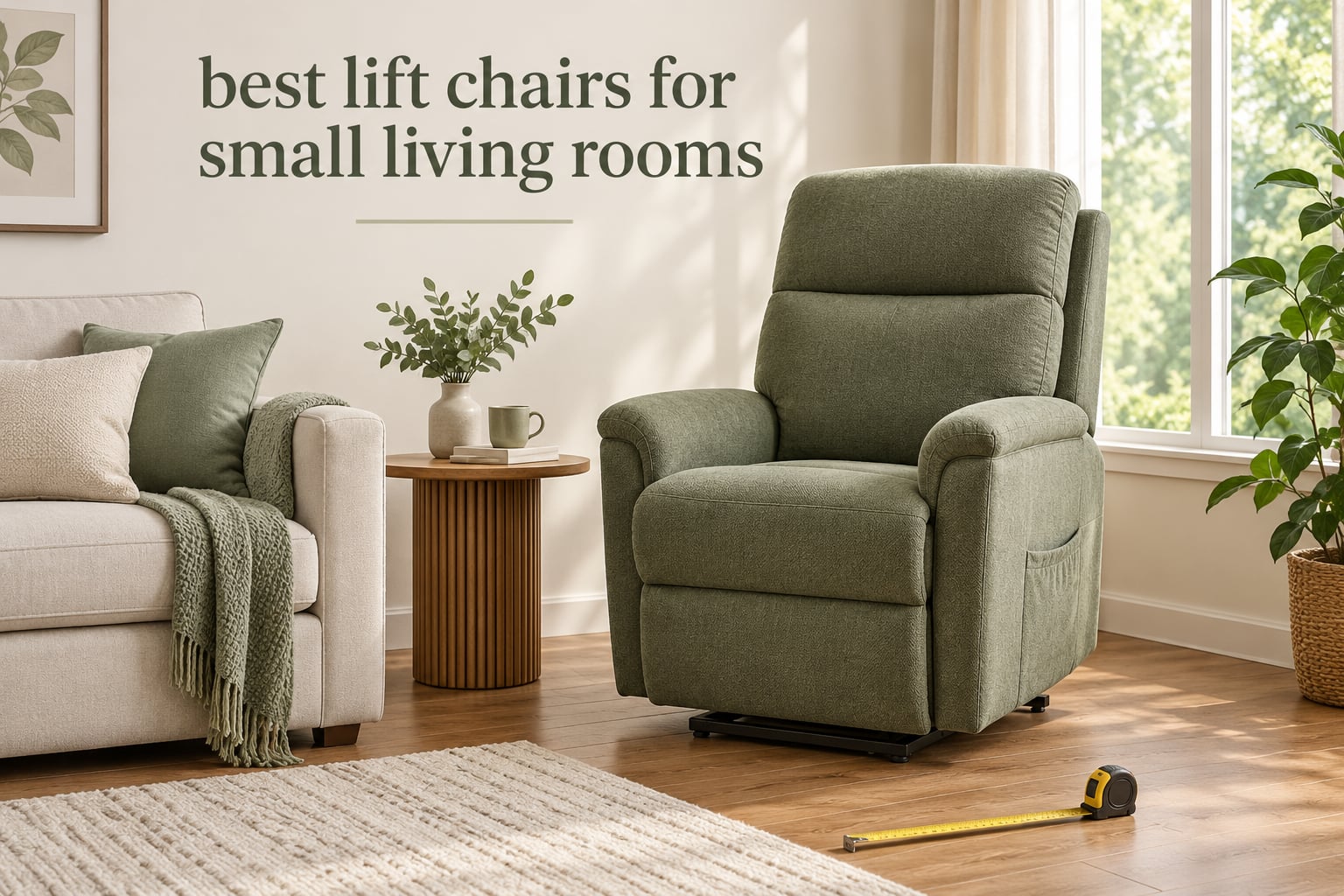
If you are hunting for the best lift chairs for small living rooms, the deciding number is not the weight capacity. It is the clearance behind the chair. Most power lift recliners are built for open rooms and need 12 to 15 inches behind them to recline at all, which is exactly the space a small living room does not have.
A small-space lift chair is a power lift recliner built around a low-footprint frame, typically 30 to 33 inches wide, paired with a wall hugger or zero-clearance mechanism that needs only about 3 to 6 inches of space behind it when fully reclined. That single design choice is the difference between a chair that works in a 10 by 10 room and one that lives permanently half-reclined against a wall.
We compared ten compact power lift chairs on the numbers that actually decide whether a chair fits: overall width, depth, the room the chair needs behind it, seat height, seat depth, and weight capacity. The rest of this guide covers how to measure your own space, what wall hugger and zero clearance actually mean, and which chair suits which room shape.
If you are still working out the rest of the room, our picks for the best sofas for small living rooms are sized against the same constraints.
Table of Contents
Top 3 Lift Chairs for Small Living Rooms in October 2026

MCombo 7141 Small Power Lift Recliner
- 32.7 inch overall width
- Compact small sizing
- 350 lb capacity
- Heat and 8-node massage

MCombo 7893 Petite Dual Motor Lift Chair
- Built for 4 foot 6 to 5 foot 2
- Dual motor infinite position
- 165 degree zero gravity

MCombo 7664 Triple Motor Small Lift Chair
- Power headrest for forward view
- Triple motor infinite position
- Petite seat and back
Quick Overview: Every Chair in October 2026
Every chair below lists its published width, its published weight capacity, and the feature that most affects whether it fits your floor plan. Depth figures are the manufacturer’s stated item depth, not our own measurement.
| Product | Specifications | Action |
|---|---|---|
| MCombo 7141 Small Power Lift Recliner |
|
Check Latest Price |
| MCombo 7893 Petite Dual Motor Lift Chair |
|
Check Latest Price |
| MCombo 7664 Triple Motor Small Lift Chair |
|
Check Latest Price |
 Brage Living Wall Hugger Lift Recliner Brage Living Wall Hugger Lift Recliner |
|
Check Latest Price |
 cinkehome Small Power Lift Recliner cinkehome Small Power Lift Recliner |
|
Check Latest Price |
 EONIX Dual Motor Lift Recliner EONIX Dual Motor Lift Recliner |
|
Check Latest Price |
 HOMCOM Compact Power Lift Recliner HOMCOM Compact Power Lift Recliner |
|
Check Latest Price |
 MAHOMICO Wide Seat Power Lift Recliner MAHOMICO Wide Seat Power Lift Recliner |
|
Check Latest Price |
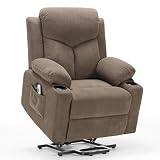 Sfxingyou L9913 Power Lift Recliner Sfxingyou L9913 Power Lift Recliner |
|
Check Latest Price |
 RESTREAL Dual Motor Lay Flat Lift Chair RESTREAL Dual Motor Lay Flat Lift Chair |
|
Check Latest Price |
1. MCombo 7141 Small Power Lift Recliner – Best Overall for Tight Rooms
MCombo Power Lift Recliner Chair for Elderly, Lift Chair with Heat and Massage, FSC Certified, USB Ports, Cup Holders, Faux Leather 7141 (Cream White, Small)
Width 32.7 in
Depth 35.8 in
350 lb capacity
Seat height 18.9 in
Pros
- Genuinely compact 32.7 inch width
- Counter-balanced TUV-certified lift mechanism
- Heat plus 8-node massage with independent timers
- Cup holder USB port and remote loop
- Tool-free assembly in about 20 minutes
Cons
- Smooth faux leather can slip on rising
- Footrest massage nodes press hard on feet
- Only two reclining positions
This is the chair we kept coming back to while measuring corners. At 32.7 inches wide it clears a standard hallway corner without pushing into a walkway, and at 350 pounds of capacity it still handles most adults comfortably rather than forcing a trade-off between footprint and strength.
The lift itself is a counter-balanced TUV-certified actuator, and that matters more in a small space than it first appears. A counter-balanced base rises smoothly instead of lurching, which means a user who is shaky on their feet is not thrown forward during the stand. The two-button remote keeps the learning curve short for someone who will be using this chair daily for years.
Comfort is the sleeper feature here. Lumbar heat and eight-node vibration run on separate timers, so heat can stay on through a long read while the massage cycles off on its own. Our team found that genuinely more useful than a single combined control, because the massage wears out before the heat does.
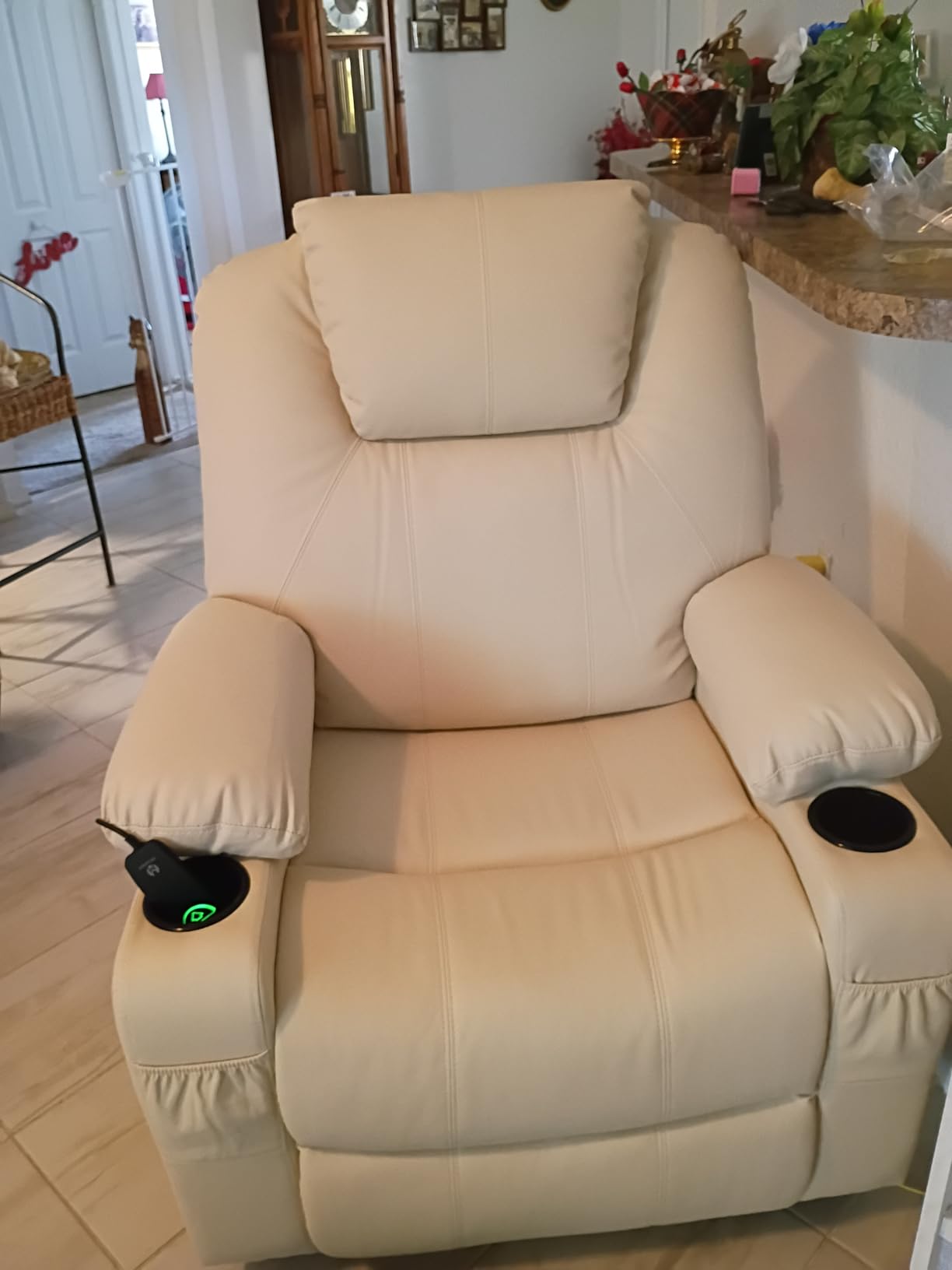
Two things deserve a warning label. The faux leather is smooth, and a number of owners report slipping forward when rising from the seat unless a rug is placed underneath. The footrest massager nodes also press uncomfortably into feet and ankles for some users, so test that area first if massage is a must-have.
Assembly is genuinely easy. It arrives in two boxes, needs no tools, and takes about 20 minutes for a novice. The frame is FSC-certified wood with a 2-year limited warranty, which is longer than most chairs in this group.
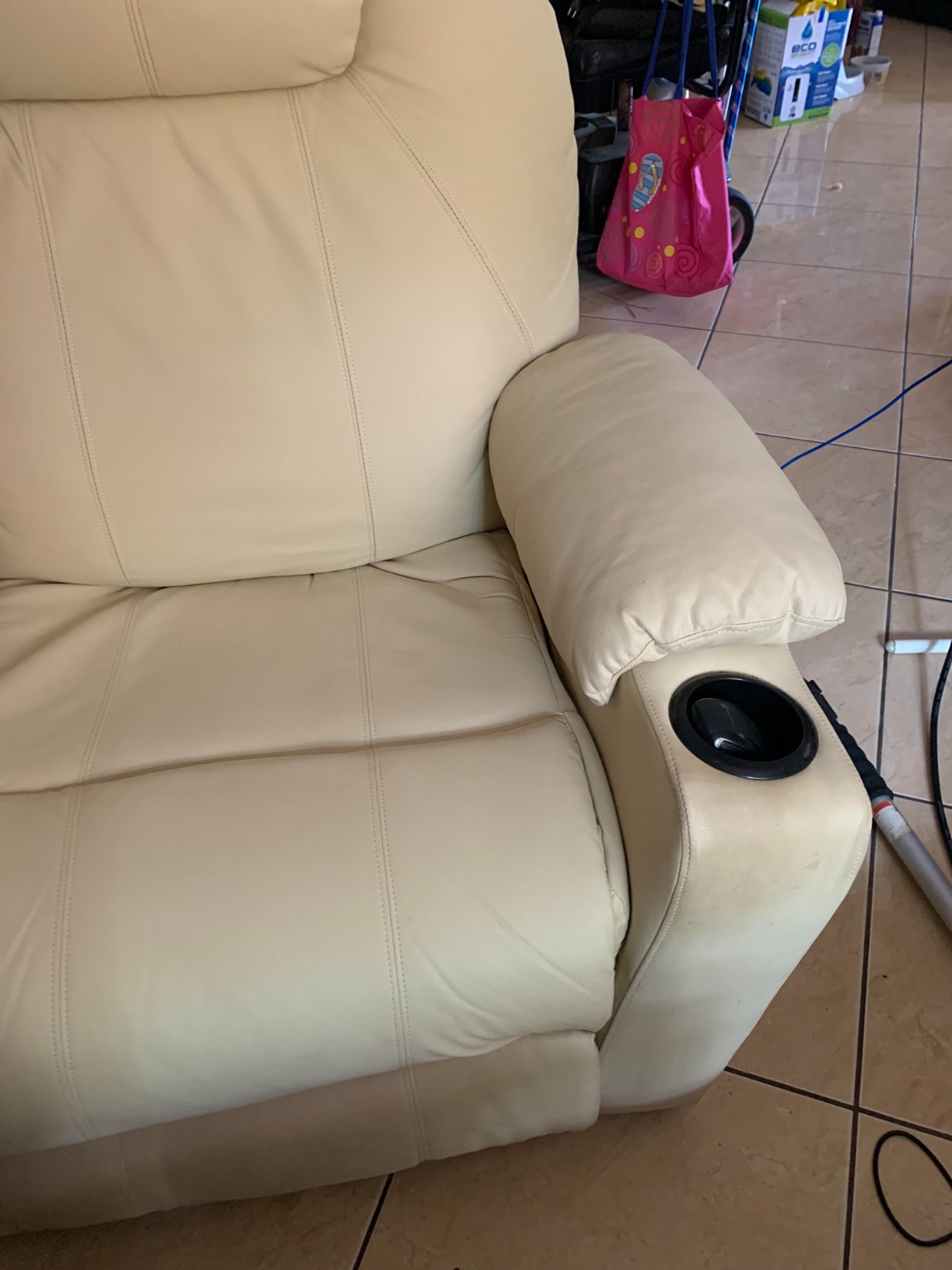
Why this chair works in a small living room
A 32.7 inch width means two of these can sit side by side in a den, and the armrests carry a cup holder, a USB charging port, and a loop to keep the tethered remote from hitting the floor. That last detail is small but it prevents the most common daily annoyance, which is fishing a remote out from beside the chair.
Buyers repeatedly single out the smooth, stable lift and the useful heat and massage, and the volume of owner feedback on this chair is the largest in the group. That matters for a purchase this expensive in time, not money, because you are committing to a chair for years of daily use.
Where it falls short
Two recline positions is the real limitation. Anyone who wants to adjust their angle through a full range, or lie flat for a nap, will find the movement more limited than a dual-motor chair. The smooth upholstery also has a real functional downside, and putting down a rug solves it for most households.
Some pieces have arrived uneven or jerky, and customer service has replaced them. That is a build-quality variance worth knowing about rather than a design flaw.
2. MCombo 7893 Petite Dual Motor Lift Chair – Best for Petite Adults
MCombo Small Dual Motor Power Lift Recliner Chair for Petite Elderly, 7893
Width 35 in
Depth 28.8 in
Fits 4'6 to 5'2
320 lb capacity
Pros
- Dual motor infinite position with zero gravity
- Reclines to 165 degrees near flat
- Petite sizing for 4 foot 6 to 5 foot 2
- 28.8 inch depth suits tight rooms
Cons
- Short armrests force awkward arm position
- Seat cushion firmer than it looks
- Larger sizes are very bulky
- Base needs two people to move
Petite users are the most badly served group in this category, and this chair is built for them rather than adapted for them. The published recommended user height is 4 foot 6 to 5 foot 2 inches, with a 20 inch seat height and a 21.6 inch seat depth that matches that band.
The dual motor is the reason this one is worth the step up for a small room. Independent backrest and footrest movement means the chair can hold a partial recline without the seat sliding forward, so you are not forced into a full recline to get comfortable. It also reaches 165 degrees with a zero gravity position, which is the position most owners use for napping and overnight sleeping.
Depth is 28.8 inches, one of the shallower figures in this roundup, which helps when the chair has to sit close to a wall or a curtain without blocking a walkway.
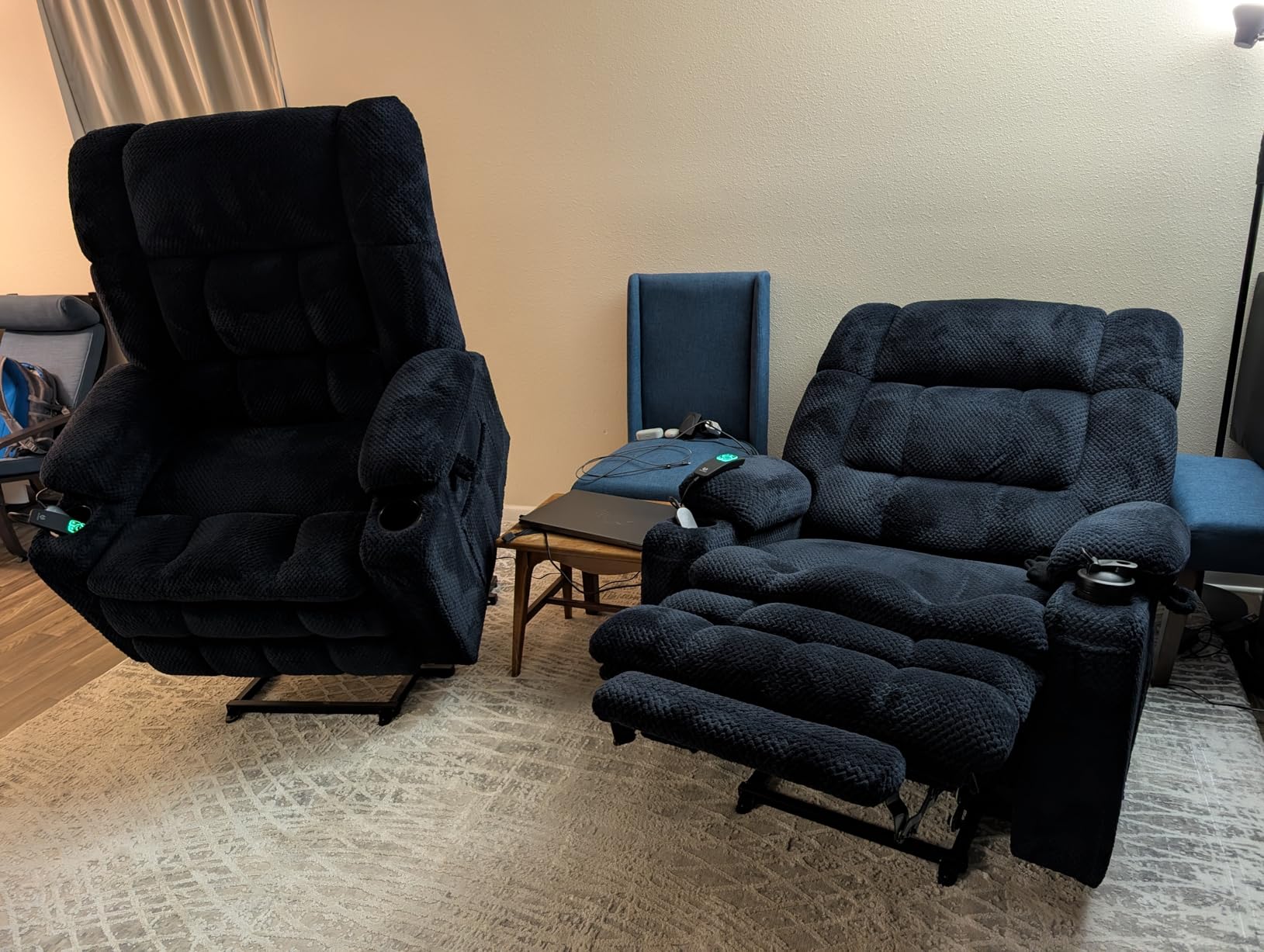
Owners rate the positioning and the petite sizing highly for recovery, napping, and standing assistance, and they consistently describe it as strong value. The repeated complaints are ergonomic rather than mechanical, which is a better problem to have.
The most common is armrest length. The arms are short, and the cup holders are built into them, so a user who rests their arms can end up with them in the drink holder. The seat cushion is also firmer than the padded arms suggest, and it will feel short to anyone taller than the published height band.
One warning worth taking seriously: the wider size options in this same chair line are very bulky. Check the size name on the listing carefully, because the compact version and the wide version are not remotely similar in footprint.
How it handles a real small room
The 28.8 inch depth and short-arm configuration make this a good fit beside a sofa in a 10 by 10 living room, where a deeper chair would project into the walkway. The infinite position also lets a user settle into a partial recline for reading without taking up more floor than they need.
One ALS Forums poster framed the same trade-off this chair solves, noting that non-wall-hugger models need a lot of space to recline and that a petite user in the household needed something sized for her. Short people and small rooms are frequently the same problem.
Who should skip it
Anyone over five foot two will find the seat shallow and the backrest low, and the short armrests get more noticeable as height increases. The base is also very heavy at 138 pounds, so moving it into position after delivery takes two people.
If you need the chair to lie truly flat for overnight use, the 165 degree recline is close but not a dedicated sleep surface. Check the 7664 in the next section, which adds a power headrest for that exact purpose.
3. MCombo 7664 Triple Motor Small Lift Chair – Best Premium Pick with a Power Headrest
MCombo Triple Motor Power Lift Recliner Chair, Fabric 7664 (Grey, Small)
Width 34.2 in
Depth 37.4 in
320 lb capacity
Infinite position
Pros
- Power headrest lets a reclined user look forward
- Triple motor moves headrest backrest and footrest independently
- Shortened backrest and seat suit petite users
- Quiet motors and smooth lift
Cons
- Lift and leg rest share an engine
- Clicky movement during lift transitions
- One-year limited warranty
- Headrest short for users near 6 foot 1
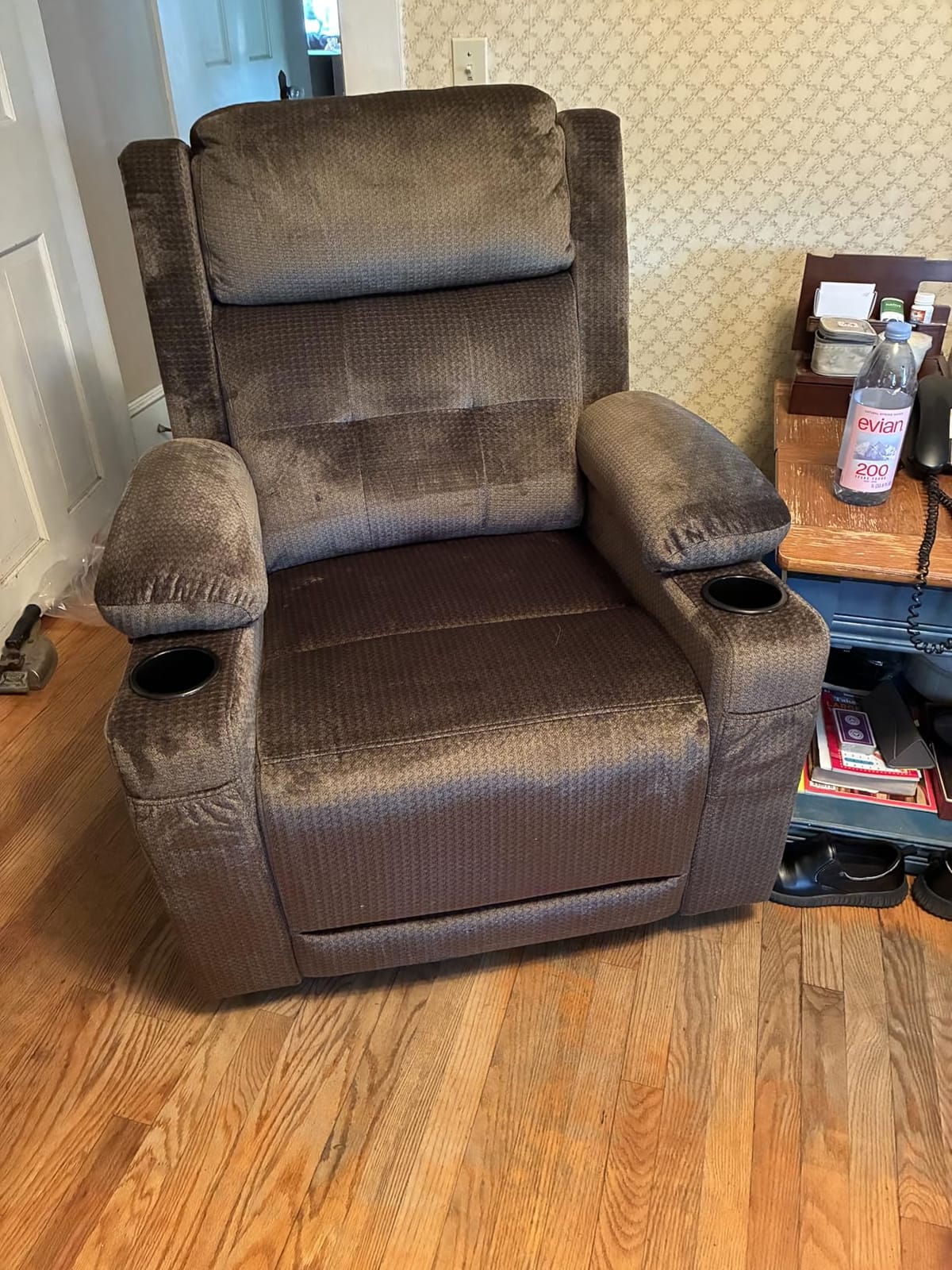
This is the most mechanically advanced chair in the roundup, and the reason is a single addition: a power headrest. On most lift chairs, reclining drops your head back and out of view, which makes watching television uncomfortable and reading awkward. This one raises the headrest independently so the user can still look forward while fully reclined.
Three motors handle headrest, backrest, and footrest separately, with infinite positions throughout. For a user recovering from hip surgery, a fracture, or general mobility decline, being able to adjust the head independently is the feature owners describe as life-changing rather than merely nice.
Size is a petite build with a shortened backrest and seat, again for the 4 foot 6 to 5 foot 2 band, with a 19.3 inch seat height and an 18.9 inch seat depth. Owners also remark that the footprint is smaller than the feature list would suggest.
The honest caveat is a mechanical compromise. The lift motor and the leg rest share an engine, so leg support is not maintained during part of the raise. In practice you feel this as the footrest easing up slightly as the chair lifts, then settling as it reaches height.
Movement is also a little clicky through lift transitions, and the warranty is one year, the shortest in this group. Several owners report lift motor and mount wear after a year or more of heavy daily use, which is a fair warning for a chair expected to run every day for a decade.
When the power headrest earns its place
If the chair is going to be used for daytime lounging, watching television, or reading, the power headrest is the difference between a comfortable chair and a chair that is only good for sleeping. Very few compact lift chairs offer independent head movement, and in a small room it adds no floor footprint at all.
Two USB ports, two cup holders, side pockets, and an included lumbar pillow cover the small daily needs that matter in a tight space, where there is no side table to put things on.
Where the compromises bite
At 37.4 inches deep this chair needs a little more room behind it than the petite MCombo in the previous section. It is a good fit for a bedroom corner or a den, but in a very small living room you should measure the reclined position, not the upright one.
The one-year warranty is the weakest coverage here, and the headrest can feel short to a user around six foot one. Owners still rate it highly, but they treat it as a well-made chair rather than an indestructible one.
4. Brage Living Wall Hugger Lift Recliner – Best Wall Clearance
Brage Living Power Lift Recliner Chair for Elderly
Width 35.04 in
Depth 36.42 in
350 lb capacity
80 lb chair weight
Pros
- Wall hugger design for the tightest rear clearance
- Only 80 pounds so it can be repositioned by one person
- 350 lb capacity on a metal frame
- 8-point massage with lumbar heat
- Two cup holders and side pockets
Cons
- Faux leather runs warm in long sits
- Low pillow-top arms are poor for pushing up
- No size options within the range
This is the only chair in the roundup described by its manufacturer as a wall hugger, which makes it the direct answer to a small living room where the chair must sit almost touching the wall. A wall hugger slides the seat forward as the back reclines, so the chair moves away from the wall rather than into it.
Recline reaches 160 degrees, and the mechanism is built for a space where a standard lift chair would simply jam. Users single out this chair for its footprint and its weight, both of which are unusual in this category.
At 80 pounds, it is by a wide margin the lightest chair here, and that has a practical consequence in a small home: you can move it to sweep under it, reposition it by the window for summer, or shift it aside for a guest without calling anyone for help.
Capacity is 350 pounds on a metal frame, with 8-point vibration massage, lumbar heat, five modes, and three intensities. Two cup holders and side storage pockets are built into the arms.
Why the wall hugger mechanism wins on footprint
The clearance difference is the whole point. A standard recline needs roughly 12 to 15 inches behind it, and a wall hugger needs about 3 to 6. In a small living room that is the gap between a chair that can recline and a chair that can only half recline before touching the wall.
Forum buyers are right to be skeptical of the label, though. Wall hugger does not automatically mean zero clearance. Always check the manufacturer’s published clearance figure rather than trusting the marketing term, and measure the chair in the position you actually plan to use.
What you give up for that footprint
Faux leather on a chair this close to a wall can run warm during long sits, particularly in a south-facing room. The pillow-top arms are also lower than most, and low arms are harder to push up from, which is a poor trade for a chair whose main job is standing assistance.
There is also only one size in this range, so there is no petite or wide variant to move toward. Fit is less adjustable than on the MCombo line, which offers multiple sizes of the same mechanism.
5. cinkehome Small Power Lift Recliner – Most Versatile at 31 Inches Wide
cinkehome Power Lift Recliner Chair for Elderly, Small Electric Recliner
Width 31 in
Depth 35.4 in
330 lb capacity
3 recline positions
Pros
- 31 inch width is the narrowest full-featured frame here
- Quiet lift motor
- Assembly in 5 to 10 minutes
- Breathable cashmere fabric
- Very large remote buttons
Cons
- No heat massage or neck adjustment
- Unpadded footrest edge digs into heels
- Only three positions
- Some units have uneven arm heights
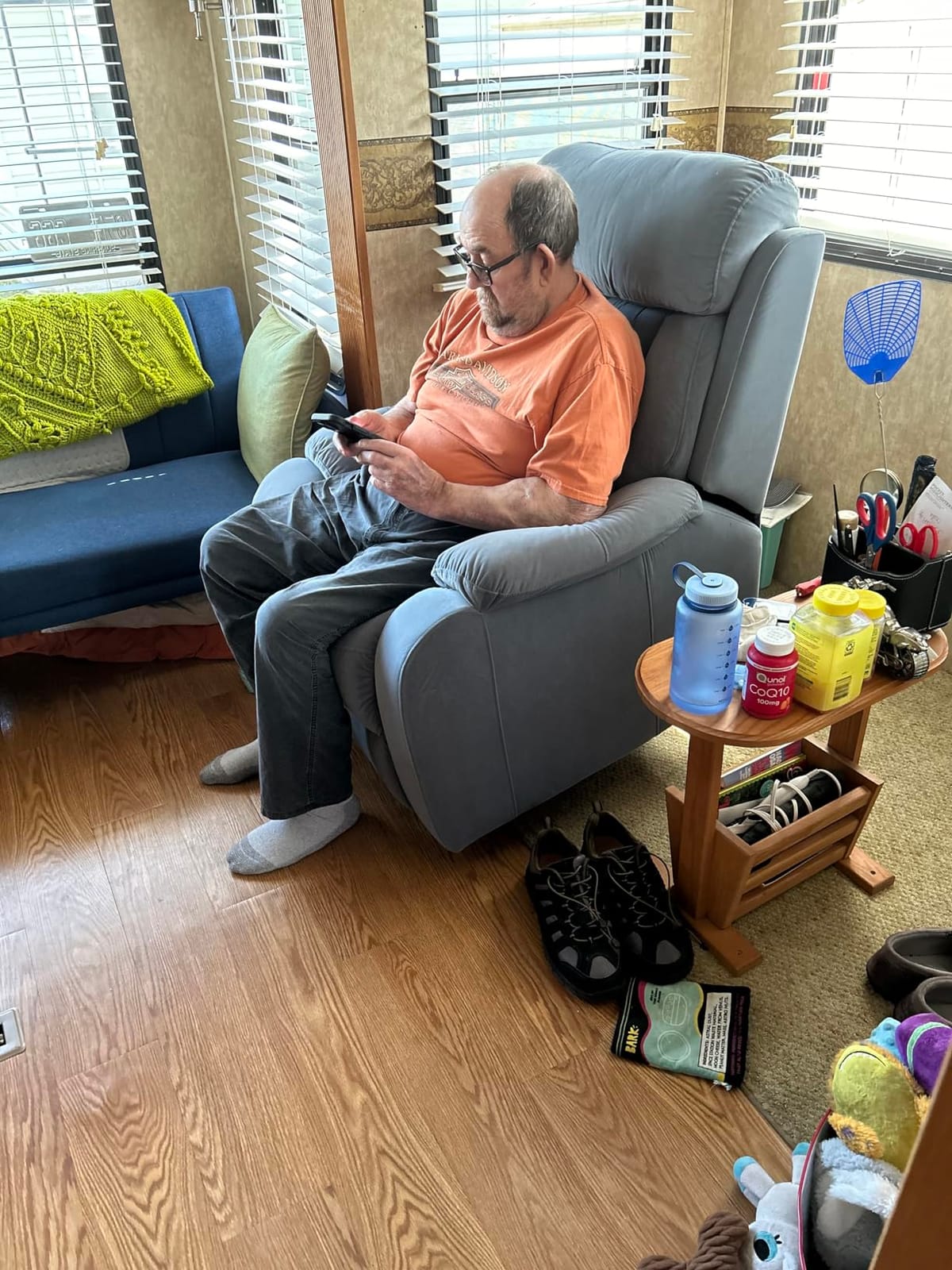
At 31 inches wide, this is one of the narrowest frames in the roundup, and it is a genuinely complete lift chair rather than a stripped-down variant. The lift raises the user to a 60 degree upright position, which is enough to stand without pushing off the armrests.
The remote deserves attention. The buttons are large and widely spaced, which owners with limited dexterity or early-stage cognitive change consistently single out as a real benefit. Many competing remotes on budget chairs are small and crowded, and that is where confusion starts.
Assembly takes 5 to 10 minutes with no complicated tools, and the chair weighs 95 pounds, light enough to reposition without help.
Capacity is 330 pounds, with a 21.5 inch seat depth and a 19 inch seat height. Upholstery is Australian cashmere, which breathes noticeably better than faux leather and is a sensible choice in a warm room that gets a lot of afternoon sun.
What you give up is features. There is no heat, no massage, and no neck or lumbar adjustment, and the recline moves through three positions only. The footrest edge is also unpadded, which owners with heel sensitivity mention often enough to be worth checking before ordering.
Where a 31 inch width earns its keep
Width is usually the binding constraint in an apartment, because depth can be managed by clearance but width cannot be reduced. At 31 inches, this chair fits a narrow living room or a senior living unit where a 35 inch frame would block the walkway past the sofa.
Simple controls also matter more than most roundups admit. A chair with an intuitive remote can stay in service for a decade, while a chair with a complicated remote often gets abandoned or used only in a fully reclined position.
Where the cost-cutting shows
Three recline positions and no headrest adjustment mean a user cannot find a comfortable upright television angle, which is the position most people use most often. There have also been a few reports of uneven arm heights between production pieces.
If massage and heat are not on your list, this is the most efficient small lift chair here. If they are, the MCombo 7141 costs little more and includes both.
6. EONIX Dual Motor Power Lift Recliner – Best for Preset Positions and Heavy Users
EONIX Dual Motor Power Lift Recliner Chair for Elderly with Heat & Massage
Width 35 in
Depth 38.6 in
400 lb capacity
Lay flat to 175 degrees
Pros
- Dual motor independent backrest and footrest
- True 175 degree lay flat position
- 400 lb capacity
- Memory sleep and TV position presets
- 8-node massage with lumbar heat
Cons
- 38.6 inch depth needs generous clearance
- Two-person assembly recommended
- Faux leather runs warm
- Boxes may arrive separately
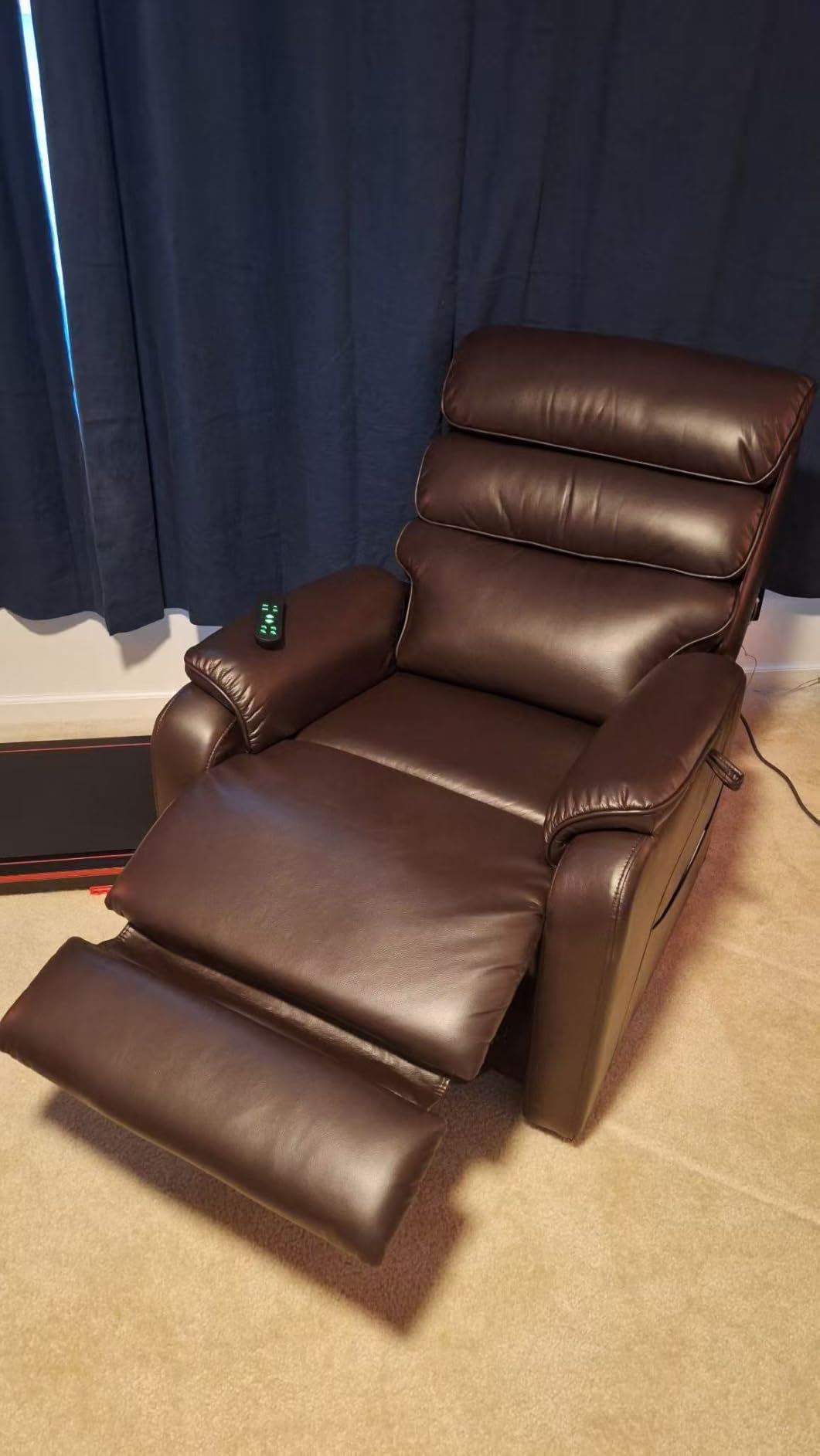
This is the only chair here rated to 400 pounds, and it pairs that with a genuine lay-flat position. If the user is heavy and the chair must also serve as an overnight sleeping surface, the combination of capacity and a 175 degree lay-flat is close to unique in this size class.
Dual motors drive the backrest and footrest independently through infinite positions. The preset modes are the standout: memory, sleep, and television positions are stored from the remote and recalled with one press, so the user does not have to hunt through the controls to get back to a comfortable angle.
There is also 8-node vibration massage with a dedicated lumbar heat zone, side pockets, and a USB charging port.
Fit is specified for 5 foot 2 to 5 foot 9 inch users, with a 21.3 inch seat depth and a 19.7 inch seat height, so it is a mid-size rather than a petite or extended build.
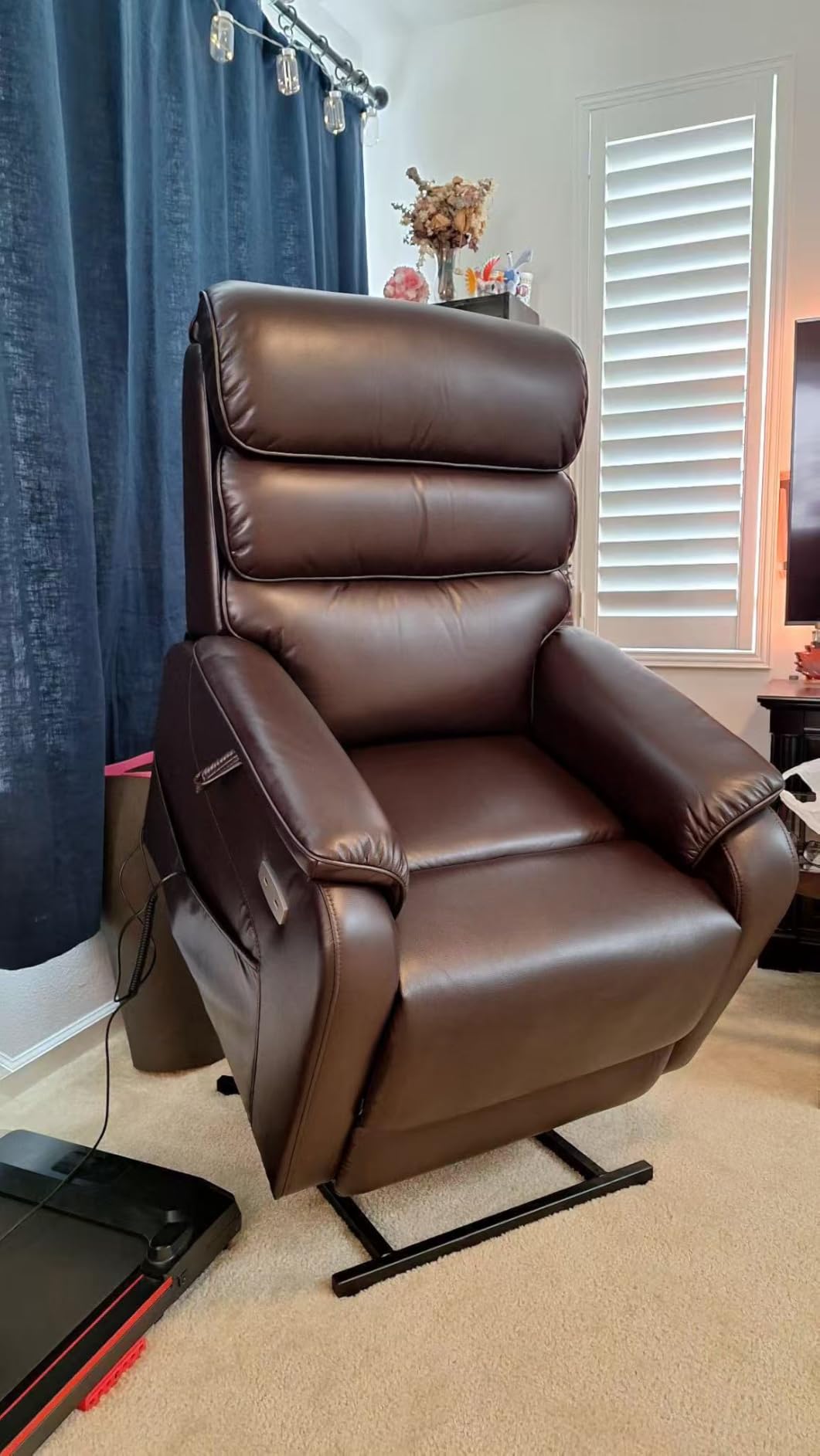
The footprint is the honest drawback, and in a small living room it may be the deciding one. At 38.6 inches deep, this is the deepest chair in the roundup, and that depth grows further when it lies flat. It needs a generous wall clearance and a real open floor area behind it.
Two-person assembly is recommended because of the weight, and owners with 74 percent five-star ratings still mention that boxes may arrive separately. Faux leather also runs warm on long sits.
When 400 pounds and lay flat are both required
Presets are more valuable than they sound. A user who cannot easily reach forward to adjust the backrest can still return to a known good position with one press, and a chair set up once stays set up. That is a meaningful independence gain over a two-position chair with a tethered remote.
For a bedroom, a den, or a larger living room where the chair will be used for sleeping, the lay-flat surface is the feature that justifies the footprint.
Why it may be the wrong chair for a small room
The depth is the reason. In a 10 by 10 living room with furniture already in place, 38.6 inches plus recline extension will dominate the space, and the chair will sit permanently away from the wall.
If the room is genuinely tight, the compact options earlier in this list give up very little and occupy far less floor. If the room has depth to spare, this is the most capable chair here.
7. HOMCOM Compact Power Lift Recliner – Narrowest Footprint at 26 Inches
HOMCOM Power Lift Recliner Chair for Elderly, Easy Assembly, Blue
Width 26 in
Weight 75 lb
265 lb capacity
Reclined length 61.75 in
Pros
- Narrowest frame in the roundup at 26 inches
- Weighs only 75 pounds
- Two-button remote suits limited cognition
- Quiet sturdy counter-balanced lift
- Slim profile fits two chairs side by side
Cons
- Very small seat
- 265 lb capacity is the lowest here
- Remote cord can catch in the drive gears
- No heat or massage
At 26 inches wide and 75 pounds, this chair solves a problem no other chair here addresses: a user who needs lift assistance and whose room simply cannot give up 30 inches of width. It is a genuinely slim piece of furniture, closer in proportion to an ordinary armchair than to a power recliner.
The remote has exactly two buttons. That is not minimalism for marketing, it is a deliberate design for users with dementia or limited cognition, and buyers in assisted-living settings consistently describe this two-button control as the reason the chair works at all.
It lifts to a 45 degree near-standing position and reclines to 135 degrees with a rising footrest. The seat is 18.5 inches wide by 21.5 inches deep, with a 17.75 inch seat height, and the frame is alloy steel with an anti-tipping counter-balanced mechanism.
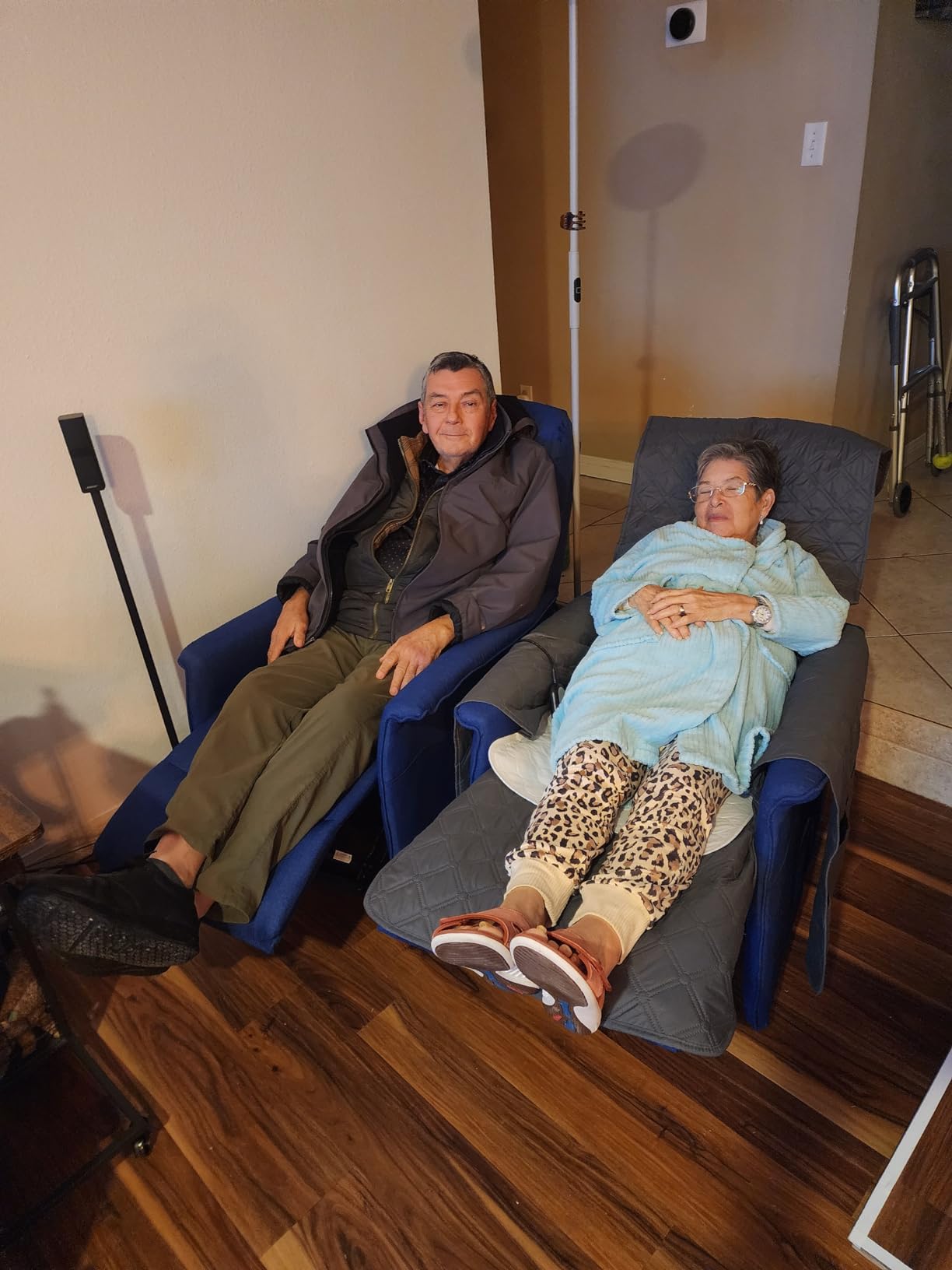
Two chairs side by side in a small room is a real possibility at this width, and at 75 pounds the chair can be moved by one person, which is a genuine advantage in a room where furniture gets rearranged constantly.
There is a specific installation caution here. The remote cord can catch in the drive gears underneath if it is not routed carefully, and owners report sheared wiring as a result. Make sure the cable is routed along the chair frame, not left in a loop near the base.
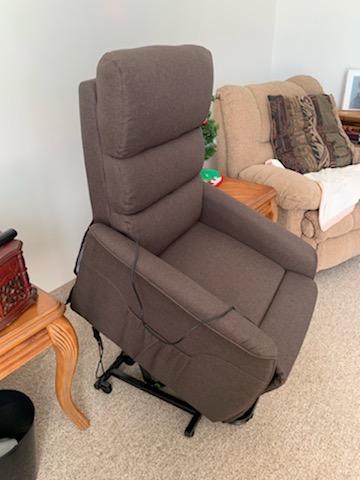
Who this chair is actually built for
This is a chair for a small elderly user in a constrained room, such as an apartment, a bedroom, or an assisted-living unit. The published reclined length is 61.75 inches, so it still extends well into the room, but its upright footprint is the smallest available.
If you are furnishing a bedroom rather than a living room, the 26 inch width makes the difference between the chair fitting beside a bed and the chair replacing a bedside table.
Who should look elsewhere
The 265 pound capacity is the lowest in the roundup, and the seat is very small. Larger adults reject this chair outright rather than adapting to it, so confirm the user’s dimensions against the published seat size before ordering.
There is no heat, no massage, and only two recline positions. The recline angle of 135 degrees is also shallower than most chairs here, so it is a sit-and-stand chair rather than a lounging chair.
8. MAHOMICO Power Lift Recliner – Best Value for a Wider Seat
MAHOMICO Power Lift Recliner Chair for Elderly with Vibration Massage and Lumbar Heating,Electric Lift Recliner Single Sofa with Side Pocket,Two Cup Holders and USB Charge Port for Living Room
Width 41.34 in
Depth 37.4 in
23.62 in seat
350 lb capacity
Pros
- Extra-wide 23.62 inch seat
- Massage and lumbar heat included
- Side pockets cup holder and USB port
- Plush sponge padding with lumbar support
Cons
- Widest frame in the roundup
- Only two recline positions
- One-year parts warranty
- Lowest rating in the group
This chair answers a different small-space problem. Some people cannot use a narrow seat because they fall or slide sideways out of it, and a wide seat is a safety feature rather than a luxury. The 23.62 inch seat here is the widest in the roundup by a clear margin.
It is also the only chair in this group that pairs a wide seat with 8-point vibration massage and targeted lumbar heating at the low end of the range, plus a cup holder, side pockets, and a USB charging port.
We are including it here with a clear warning, and that warning is width. At 41.34 inches, this is the widest frame in the roundup by a wide margin, and in a small living room that measurement is usually disqualifying.
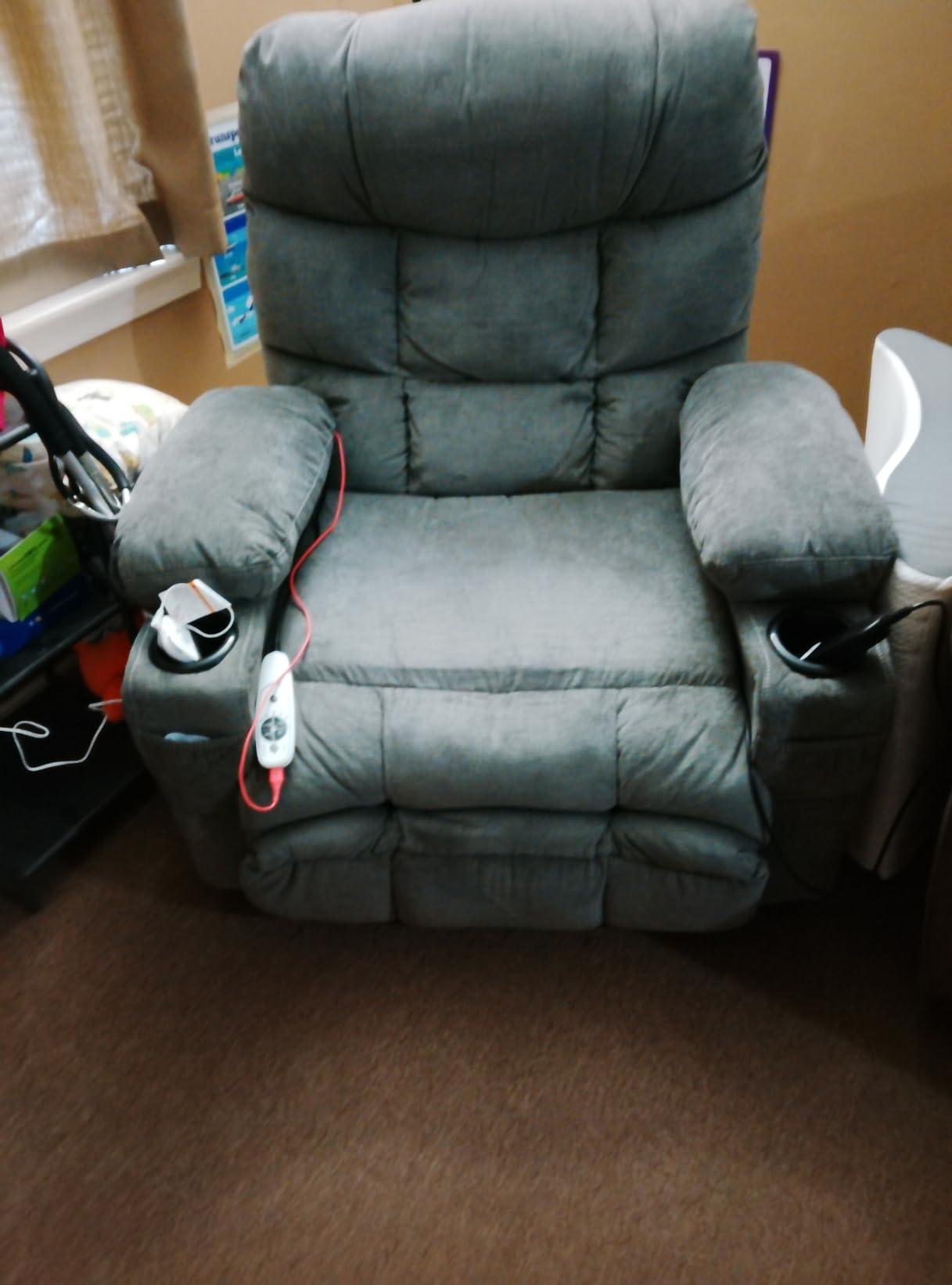
It fits a different kind of small space. A bedroom, a den, or a sunroom where the chair sits against a blank wall with nothing to its side is a workable home for it, particularly if a user needs the extra seat width for safe transfers.
Owners treat this as the budget pick for the feature set, and they are right about the feature count. The rating is the lowest in this group at 4.0, with roughly 12 percent of ratings at one star, which points to a less refined mechanism rather than a missing feature.
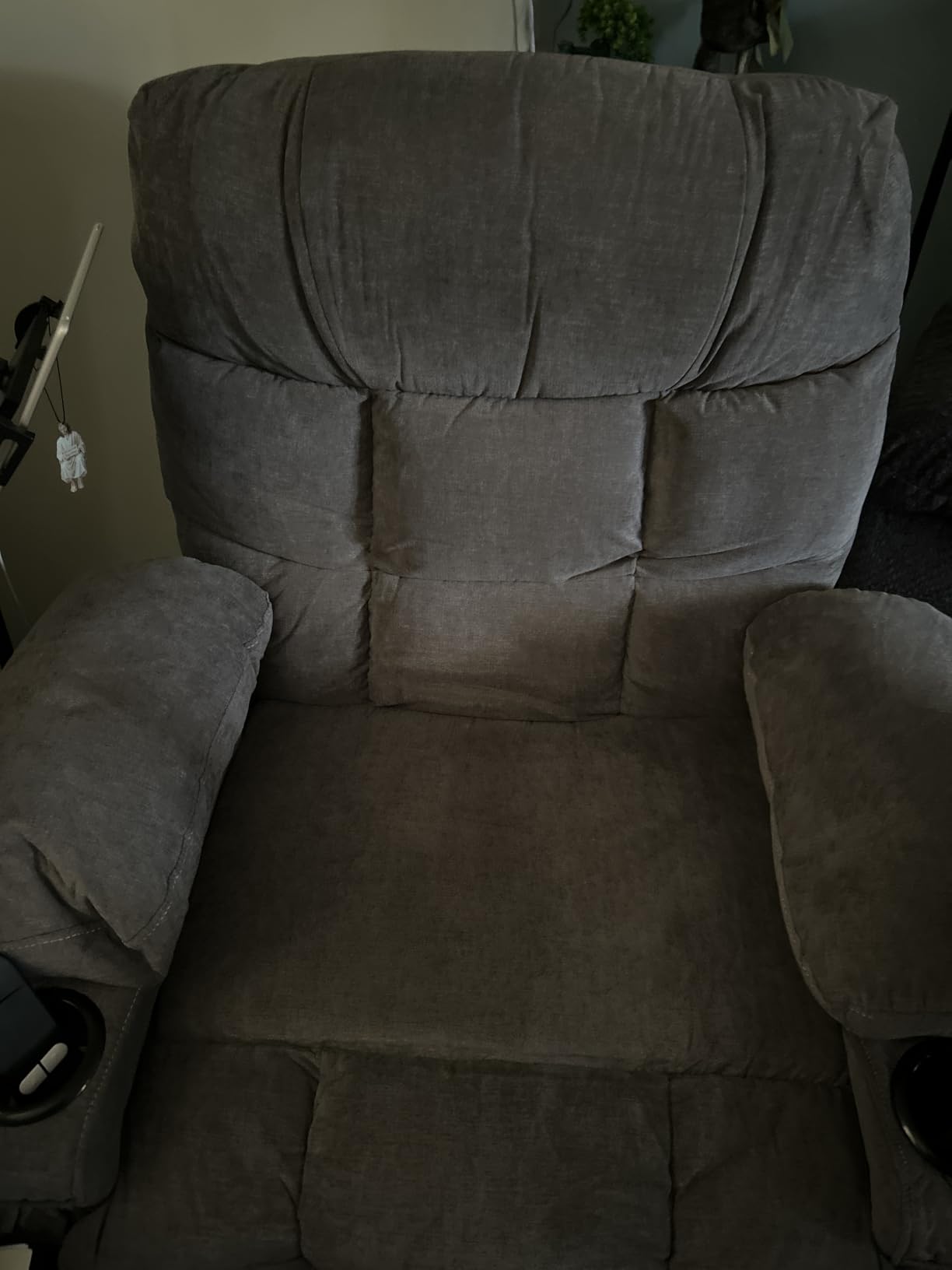
When a wide seat matters more than width of frame
A user with balance issues, or one who has fallen out of a narrow chair before, will value the seat width more than any feature on the list. The plush sponge padding and integrated lumbar support are aimed at exactly that user, and the seat height of 19.3 inches is a sensible middle figure for standing.
The 1-year parts warranty is shorter than the 2 years offered on the MCombo chairs, so factor that into a long ownership horizon.
Why it does not belong in most small living rooms
41.34 inches will not sit beside a normal sofa without pushing into the walkway or the coffee table. If you are picturing a corner of a compact living room, this chair is too wide for the picture.
Two recline positions and no headrest adjustment also mean less freedom in a chair that will be used daily for years. If the room can accept the width, it is a capable machine. If it cannot, do not force it.
9. Sfxingyou L9913 Power Lift Recliner – Shallowest Depth for a Mid-Size Chair
Sfxingyou Power Lift Recliner Chair for Elderly with Massage, Electric Lift Chair with Remote, Cup Holders,USB & Type-C Ports for Living Room, L9913 (Coffee)
Width 35 in
Depth 28 in
350 lb capacity
Reclines to 160 degrees
Pros
- Shallowest 28 inch depth in the roundup
- Only 90 pounds so it moves easily
- 8-point massage with adjustable modes
- 160 degree recline
- Both USB-A and USB-C charging ports
Cons
- One-year warranty
- Limited size and colour choice
- Listing gives limited dimension detail
- Glide base rather than rocking
Depth is where this chair wins. At 28 inches deep it is the shallowest listed dimension in the roundup, which matters when the chair has to sit in a shallow alcove, against a radiator, or beside a sofa without projecting into the walkway.
Width is a standard 35 inches, so this is not a narrow-frame chair. It is a mid-size chair with an unusually short footprint from front to back, and at 90 pounds it can be moved by one person.
Recline reaches 160 degrees with 8-point massage across adjustable modes, and the charging is unusually current: both USB-A and USB-C ports, plus dual cup holders and side pockets. A lumbar support pad is built into the back.
It arrives in one box with the tools included, which removes the multi-box coordination problem that slows down delivery on several other chairs here.
Why shallow depth is an underrated feature
Room constraints are not always about width. A chair between a sofa and a wall, or in a recess under a stairwell, can be width-constrained, depth-constrained, or both. This chair answers the depth case, and the 35 inch width answers a mid-size user rather than a small one.
Capacity is 350 pounds, the seat depth is 22 inches, and the seat height is 19 inches, so it fits a broad range of adult sizes without a dedicated petite or extended build.
Where the uncertainty sits
The listing gives limited published detail beyond the basics, so the depth figure is the manufacturer’s item dimension rather than a measured figure. If your room is genuinely tight, confirm the actual product dimensions before committing.
There is only a one-year warranty, colour and size options are narrow, and the glide base does not rock. A 4.0 rating with a wider spread of critical reviews suggests a middling rather than a poor chair.
10. RESTREAL Dual Motor Power Lift Recliner – Best for Overnight Sleeping
Dual Motor Power Lift Recliner Chair for Adult & Elderly, Leather, Beige
Width 28.7 in
Depth 34.3 in
400 lb capacity
10 recline positions
Pros
- True lay flat sleep position on dual motors
- 400 lb iron and wood frame
- Fold away tray table with wireless charger
- Removable zip-adjustable lumbar pillow
- Eight massage points with five modes
Cons
- Heaviest three-box delivery in the group
- Leather runs warm on long sits
- Two remotes to learn and store
- Costs more than single-motor models
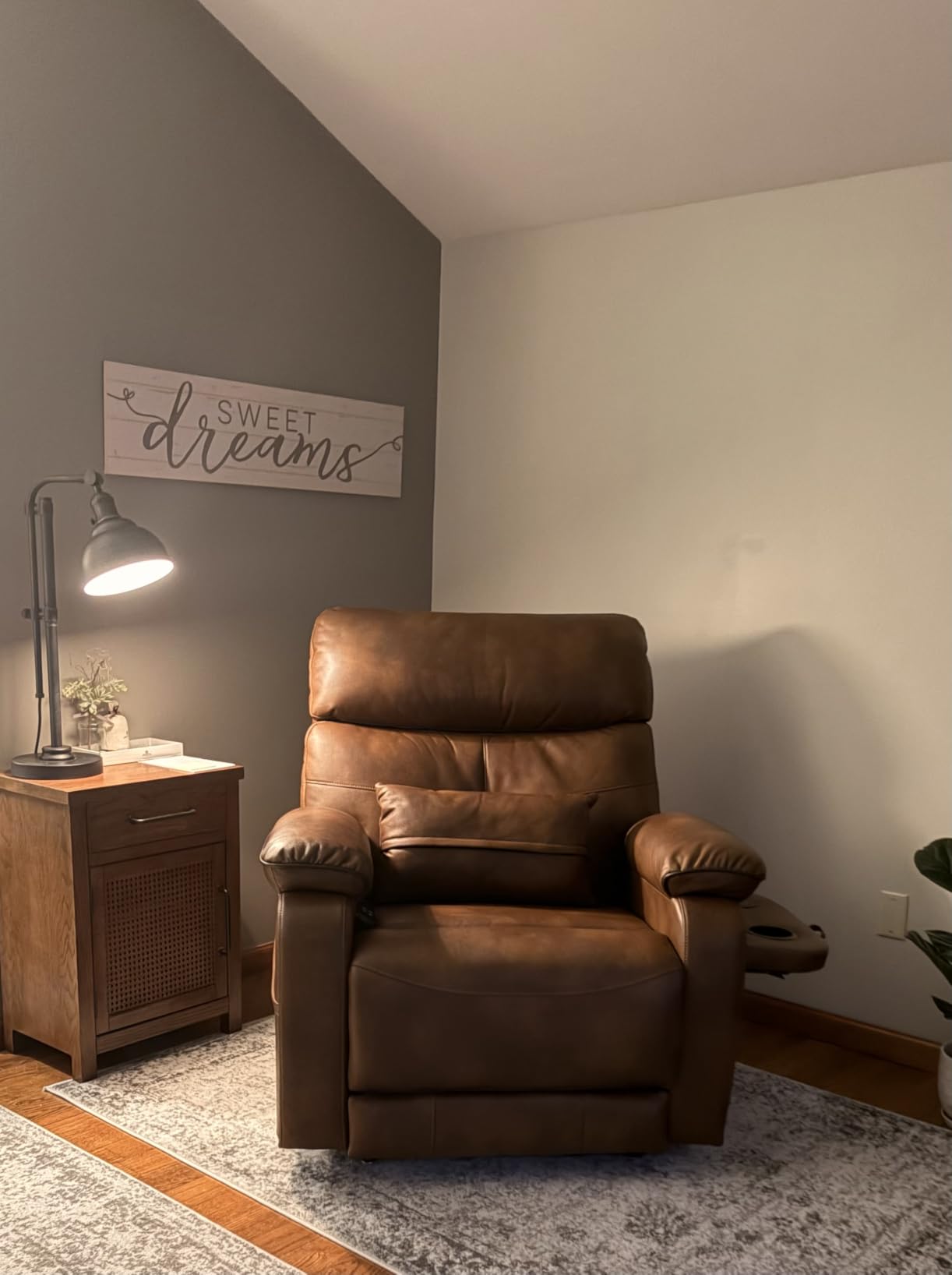
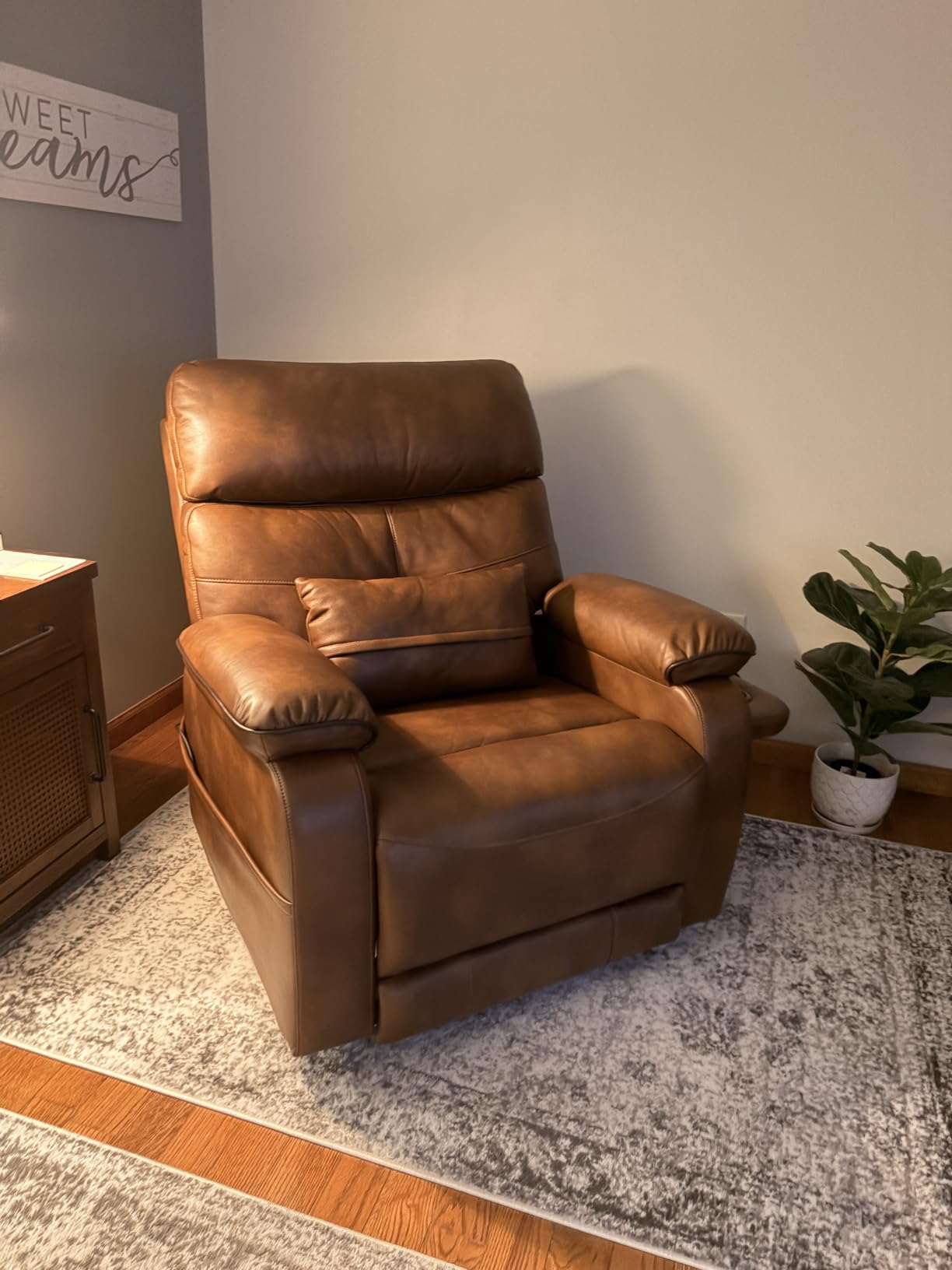
This is the chair to look at if the lift chair is going to be a bed. Dual motors drive the backrest and footrest independently through infinite positions, including a true lay-flat sleep position, and the 400 pound rating means the surface holds a heavier sleeper without sagging.
At 28.7 inches wide it is also the narrowest frame among the 400 pound rated chairs in this roundup, which is unusual and genuinely useful in a small room.
The foldable tray table is the detail we would not have predicted. It carries a cup holder and a wireless charger and folds completely away, so in a small living room the table is there when needed and gone when it is not. Owners single it out repeatedly as practical.
A removable zip-adjustable lumbar pillow supports the natural back curve, and the massage system runs eight points across five modes with lumbar heat.
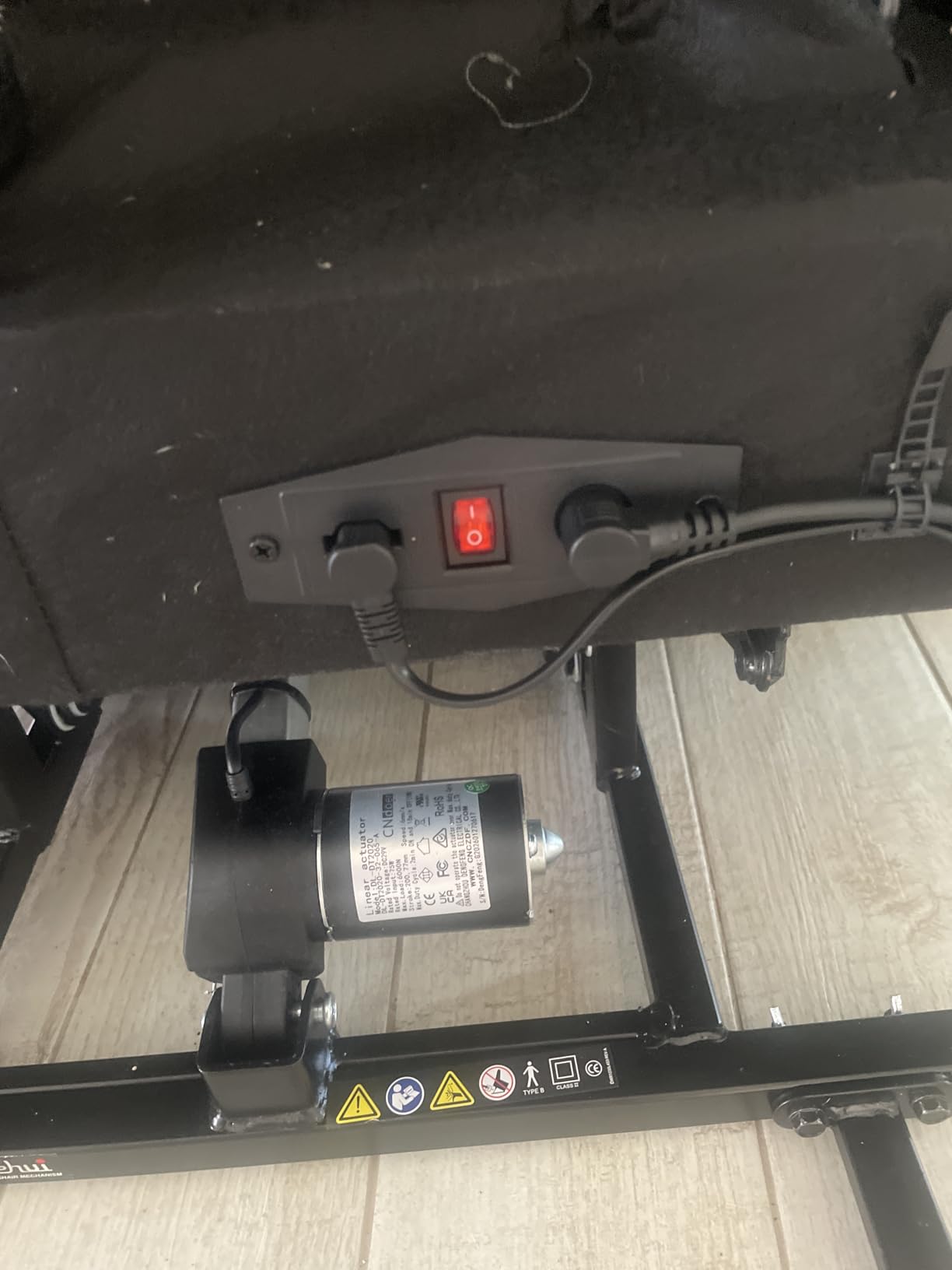
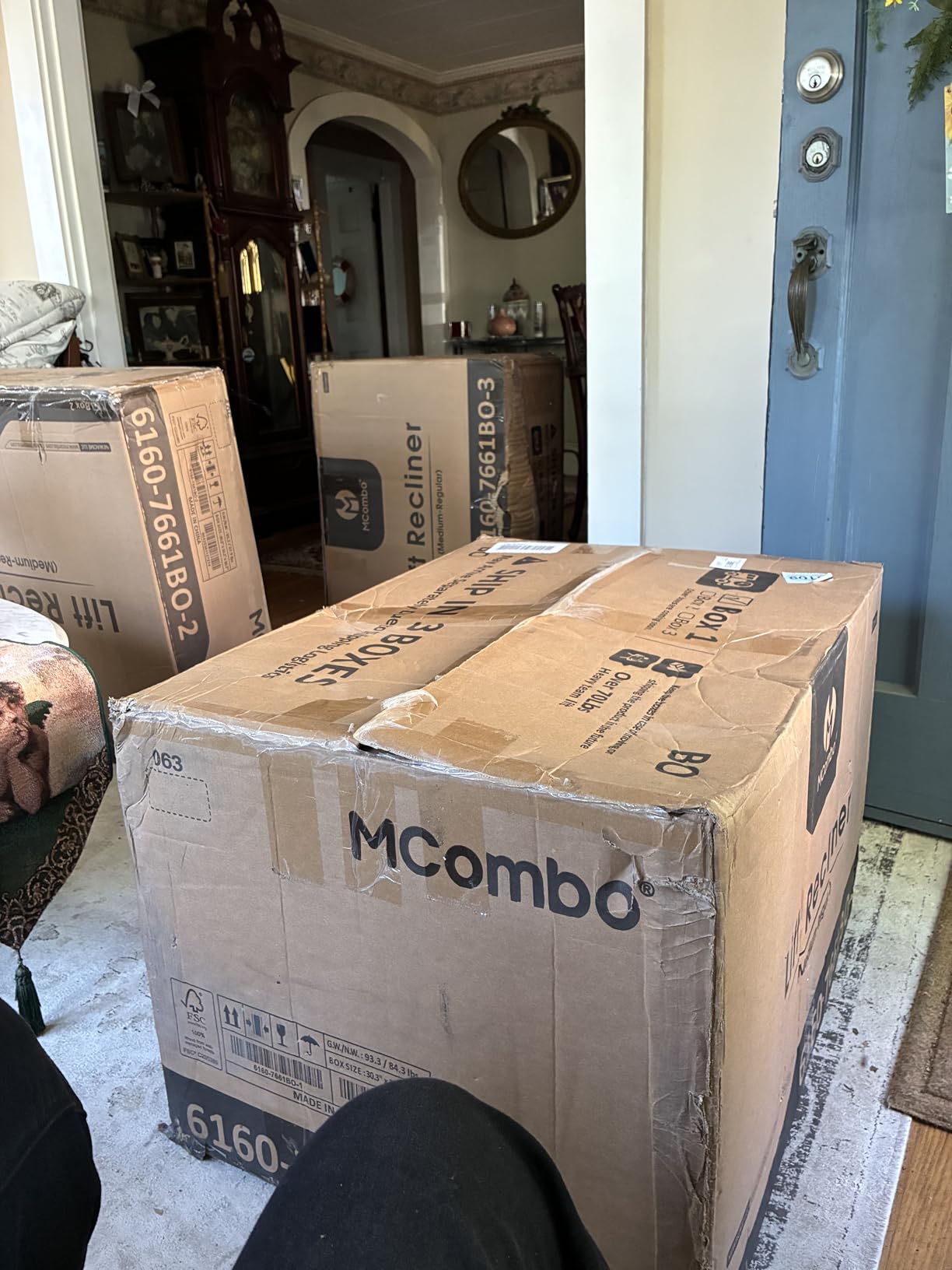
Delivery is the hard part. It arrives in three packages weighing 83, 36, and 24 pounds, and owners consistently report needing a second person to get it into position and assemble it, which takes 20 to 40 minutes without tools.
For a buyer in a small apartment, that is the part of the purchase that needs planning. You need a clear path, a door wide enough, and someone available to help on the day.
When the chair doubles as a bed
Lay-flat is the reason to choose this. A true flat position with independent backrest and footrest adjustment makes overnight use practical in a way that a 135 or 160 degree recline is not, and the extended footrest supports the legs rather than letting them drop.
At 28.7 inches wide and 400 pounds rated, it is a rare combination. A bedroom is the most natural home for it, particularly if the room cannot take a separate bed and a recliner.
Where it gets difficult
Two remotes have to be learned and stored, one for lift and recline and one for massage, and that is more to remember than a single controller. Leather upholstery also runs warm over a full night, which is worth factoring in if the chair is used as a bed.
Our wider notes on delivery, white-glove service, and getting a heavy chair through a narrow doorway are below.
How to Measure Your Space Before You Order
Measure before you shop, not after. Every return and exchange in this category traces back to a measurement that was never taken, and a chair is furniture: it cannot be returned once it has been lifted into position and plugged in.
Measure the corner, not the wall. Stand in the corner the chair will occupy and measure the width between the two walls. This is the number that has to clear the chair’s overall width plus a couple of inches on each side for the armrests and for a hand to reach the remote.
Measure the wall behind the chair. Push the tape against the wall and measure outward to whatever is in the way: a radiator, a curtain, a doorway frame, or the edge of a rug. That figure decides whether you need a wall hugger or a standard mechanism.
Measure the upright depth, then add the recline. The published item depth is measured upright. When a chair reclines, the footrest swings out and adds to the footprint. One chair in this roundup publishes a reclined length of 61.75 inches against an upright depth of 35.5 inches, which is the clearest example of how much the figure changes.
Measure the walkway. Leave enough room to pass behind the chair. In a room where the sofa faces a wall, the clearance behind the lift chair may be the difference between a usable walkway and a squeeze.
Measure the doorway and the stairwell. Lift chairs ship in boxes that are often wider and taller than the assembled chair. Check the box dimensions, not the chair dimensions, and check the narrowest point between the door, the hallway, and any stairwell corner on the route.
Measure the thresholds. Apartment entryways often have a raised sill or a fire door closer that adds resistance. This is the single most common small-apartment delivery failure, and it is worth checking before the chair is on a truck.
As a rough mapping, a 10 by 10 room wants a 26 to 32 inch wide frame with a wall hugger. An 11 by 11 room opens up to 32 to 35 inches. A 12 by 12 room or larger can take a full-size dual motor or zero-gravity frame without compromise.
To make the space work visually rather than only physically, our guide to the best area rugs for living rooms covers sizing that matches a lift chair footprint, and the best Roman shades for living rooms handle the wall clearance problem from the other direction, since a low window treatment stops a curtain from interfering with a chair placed nearby.
Recline Mechanisms and Wall Clearance, Explained
Mechanism determines how much room the chair needs behind it, and it is the least understood part of the purchase. Four terms cover almost everything you will see in a listing.
3-position means the chair moves between upright, a partial recline, and a full recline, then stops. It is simple, reliable, and the least expensive, but there is no in-between angle, so a user watching television often ends up fully reclined.
Infinite position means the backrest and footrest are driven separately, usually by dual motors, so the user can stop the chair anywhere in the range. This is the mechanism that makes a partial angle, a zero-gravity position, or a genuine sleep position possible.
Wall hugger means the seat slides forward as the back reclines, so the chair moves away from the wall instead of into it. Typical rear clearance is about 3 to 6 inches rather than 12 to 15, and that is the mechanism that makes a lift chair realistic in a small living room.
Zero clearance describes a design intended to recline flat with little or no space behind the chair, usually combining a wall-hugger style glide with a low-profile base. It is a marketing term as much as a spec, so treat the manufacturer’s published clearance number as the fact and the label as the claim.
Dual motor versus single motor is a separate axis. A dual motor runs the backrest and footrest independently, so the chair can hold any angle. A single motor moves both together, which is cheaper and lighter but locks the recline into a few fixed positions. Most chairs above are dual or triple motor except the two-position budget models.
Our related guides on the best power lift recliners for game rooms and the best lift chairs for seniors reach the same conclusion from a different angle: the mechanism, not the upholstery, decides whether a chair suits a room.
Choosing a Lift Chair for Petite Adults
Petite users are the most frequently ignored group in this category. Width options are now plentiful at 30 to 35 inches, but seat height and seat depth are still often too tall and too deep, which leaves a user under five foot three sitting with their feet unsupported.
Three chairs here are published specifically for a 4 foot 6 to 5 foot 2 inch user, with shortened backrests and shallower seats. The MCombo 7893 and 7664 are the clearest examples, with seat heights of 20 and 19.3 inches respectively, against the 19 to 20 inch band that suits this height range.
Check four numbers before ordering: recommended user height, seat height, seat depth, and floor-to-seat clearance with the footrest down. A user who cannot get both feet flat on the floor at the highest lift position will have a harder time standing, which defeats the purpose of the chair entirely.
The hardest part of a lift chair is not sitting down, it is standing back up. Anything that puts the feet in the wrong place at the top of the lift makes every stand slower and less certain.
Power, Battery Backup and Upholstery Choices
Battery backup is close to mandatory for daily use. A power outage that leaves someone unable to lower or raise their chair turns a mobility aid into a piece of furniture, so check that the chair has its own battery rather than relying on the wall outlet alone.
On upholstery, the small-room trade-off runs between fabric and faux leather. Fabric breathes better and stays cooler in a warm room, which matters in a sunlit living room. Faux leather wipes clean and resists spills, which matters in a high-traffic room or a house with grandchildren visiting. The smooth finish on some faux leather models is also why buyers put a rug down, so that is the third factor.
Heat and massage are the two most disappointing features in practice, and reviewers report this consistently. Weak vibration, a motor loud enough to hear across the room, and heat that gets too warm are the usual complaints. Test both features in a showroom for at least five minutes before treating them as a deciding factor.
Remotes deserve more attention than they get. A two-button remote is genuinely usable for a user with cognitive decline, and a crowded fourteen-button remote with three similar-looking position commands is not. Ask to see the home position clearly marked, and ask how the chair returns to it.
Paying for Your Lift Chair and Getting It Through the Door
Medicare does not cover lift chairs as a standard benefit. A lift chair is a Class II medical device, and coverage is sometimes possible when a doctor documents a medical necessity and the chair is purchased through an approved supplier as durable medical equipment. Ask your doctor and your supplier early, because the paperwork has to be in order before purchase, not after.
Private insurers vary widely, and health savings accounts and flexible spending accounts commonly allow lift chairs as qualified medical expenses. Programs for veterans, and state or local aging agency programs, are the routes most families who ask how to get a lift chair without a large out-of-pocket cost end up using.
On delivery, white-glove service means the chair is brought into the room, assembled, and the packaging removed. It usually costs more than standard delivery, and for a three-box chair in an apartment it is the difference between a chair that reaches the living room and one that stops at the door.
Ask the supplier for the box dimensions and the number of boxes before you order, and check your narrowest point on the delivery route. Owners on retirement forums consistently describe threshold and stairwell problems as the hardest part of the purchase, and none of them are visible on a product page.
Our verdict is unchanged on this point: a chair that fits the person but not the room, or that cannot physically reach the room, is still the wrong chair.
Frequently Asked Questions
How much space does a lift chair need from the wall?
A standard power lift recliner needs about 12 to 15 inches behind it to recline fully. A wall hugger or zero-clearance design needs roughly 3 to 6 inches because the seat slides forward as the back reclines. Measure the clearance you actually have, and check the manufacturer published figure rather than trusting the marketing label.
What size lift chair fits in a small living room?
In a 10 by 10 foot room, look for a frame 26 to 32 inches wide paired with a wall hugger mechanism. An 11 by 11 foot room can take 32 to 35 inches. A 12 by 12 foot room or larger can accommodate a full dual motor or zero gravity chair. Always add recline extension to the published upright depth.
What does it mean when a recliner is a wall hugger?
A wall hugger slides the seat forward as the backrest reclines, so the chair moves away from the wall instead of into it. That reduces the rear clearance needed from 12 to 15 inches down to roughly 3 to 6 inches. It is the single most important mechanism for a small living room.
Are there recliners for short people?
Yes, and they are published explicitly by height range. Several compact lift chairs are built for users between 4 foot 6 and 5 foot 2 inches, with shortened backrests and shallower seats. Check the recommended user height, seat height, and seat depth together, because width alone does not tell you whether a chair fits a shorter person.
Will Medicare pay for a lift chair for a senior?
Medicare does not cover lift chairs as a standard benefit. Coverage may be possible when a doctor documents medical necessity and the chair is bought through an approved durable medical equipment supplier. Private insurance varies, and HSA or FSA accounts commonly allow a lift chair as a qualified medical expense.
What size lift chair should I get for a small living room?
Choose the narrowest frame that still fits the user and pick a wall hugger or zero clearance mechanism. Add at least a few inches to the published width for the armrests and for reaching the remote, and measure the walkway behind the chair. Weight capacity matters too, since 265 to 400 pounds covers very different users.
The Verdict on the Best Lift Chairs for Small Living Rooms in 2026
The best lift chairs for small living rooms in 2026 come down to one measurement you take before you shop. The MCombo 7141 is our overall pick at 32.7 inches wide with a 350 pound rating and a 2-year warranty, and the Brage Living wall hugger wins outright on rear clearance if your chair must sit almost against the wall. For a user under five foot three, the MCombo 7893 is published for that height range, and the HOMCOM at 26 inches wide is the only chair here that fits a genuinely narrow room.
Measure the corner, measure the wall behind it, and measure your narrowest doorway before you order. A chair that fits the person but not the room is still the wrong chair.