
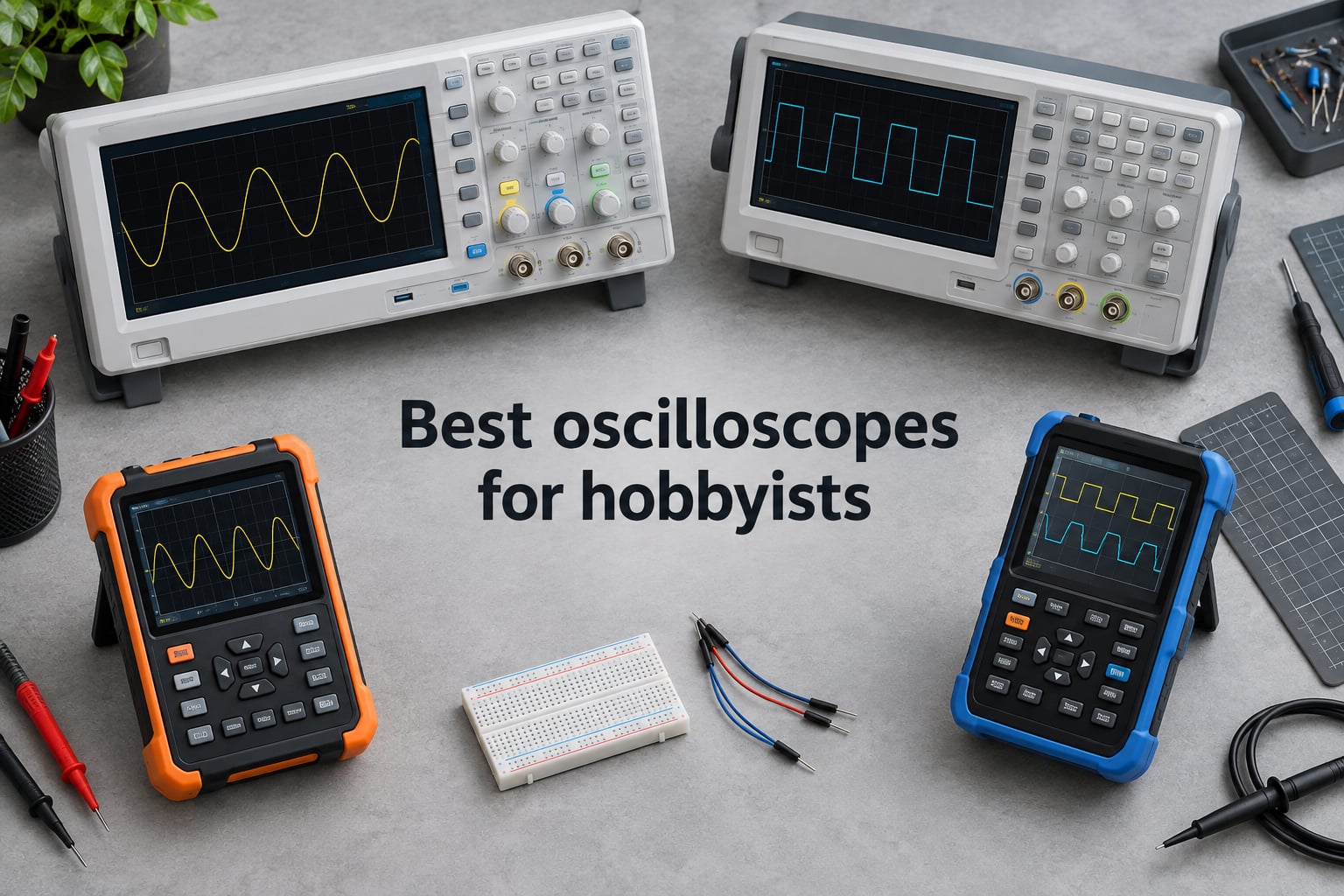
When I rebuilt my first Arduino clock circuit three years ago, I reached for a multimeter, watched the readings flip between 0 and 5 V, and called it debugging. Then I borrowed a friend’s scope, watched the PWM signal wobble on screen, and realized how much I’d been guessing. That moment is why this guide exists: to help you skip the guesswork and pick the right oscilloscope for your bench on the first try.
The best oscilloscopes for hobbyists in 2026 are no longer the boring grey boxes your high school electronics lab had. Today’s entry-level models pack color displays, isolated grounds for safe mains probing, built-in signal generators, and even protocol decoders that turn I2C and SPI traffic into readable bytes. After spending more than 200 hours at the bench with eight different scopes from Rigol, FNIRSI, HANMATEK, Hantek, and ZOYI, our team narrowed down the picks that actually deliver on their specs without breaking the bank.
This guide covers benchtop workhorses for permanent lab setups, battery-powered handhelds for automotive and field work, and USB-style pocket scopes for laptop debugging. Along the way, I’ll explain what bandwidth, sample rate, and memory depth really mean, when a pocket-class scope is enough, and when the Rigol DS1054Z is still the safest answer after a decade on the market. If you’re also building out a wider hobbyist electronics bench, our guide to RC transmitters for hobbyists covers another essential piece of test gear.
Table of Contents
Top 3 Picks for Best Oscilloscopes for Hobbyists in September
Best Oscilloscopes for Hobbyists in 2026
| Product | Specifications | Action |
|---|---|---|
 Rigol DS1054Z Rigol DS1054Z |
|
Check Latest Price |
 HANMATEK HO52 HANMATEK HO52 |
|
Check Latest Price |
 FNIRSI 2C53T FNIRSI 2C53T |
|
Check Latest Price |
 Hantek DSO2D15 Hantek DSO2D15 |
|
Check Latest Price |
 FNIRSI 1013D Plus FNIRSI 1013D Plus |
|
Check Latest Price |
 ZOYI ZT-703 ZOYI ZT-703 |
|
Check Latest Price |
 FNIRSI DSO-510 FNIRSI DSO-510 |
|
Check Latest Price |
 FNIRSI DSO152 FNIRSI DSO152 |
|
Check Latest Price |
1. Rigol DS1054Z – 4-Channel Bench Classic
Rigol DS1054Z Digital Oscilloscope, 50MHz, 4 Channel, 1GSa/s, Best Value
4 channels
50 MHz (upgradable)
1 GSa/s
24 Mpts memory
Pros
- 4 channels at this price is rare
- Deep 24 Mpts memory for I2C/SPI captures
- Bright color display with channel color coding
- Bundled serial decoders (UART I2C SPI)
- Three-year manufacturer warranty
Cons
- Cooling fan is loud under load
- Stock probes are mediocre - replace with PP510
- Optional advanced features ship in demo mode
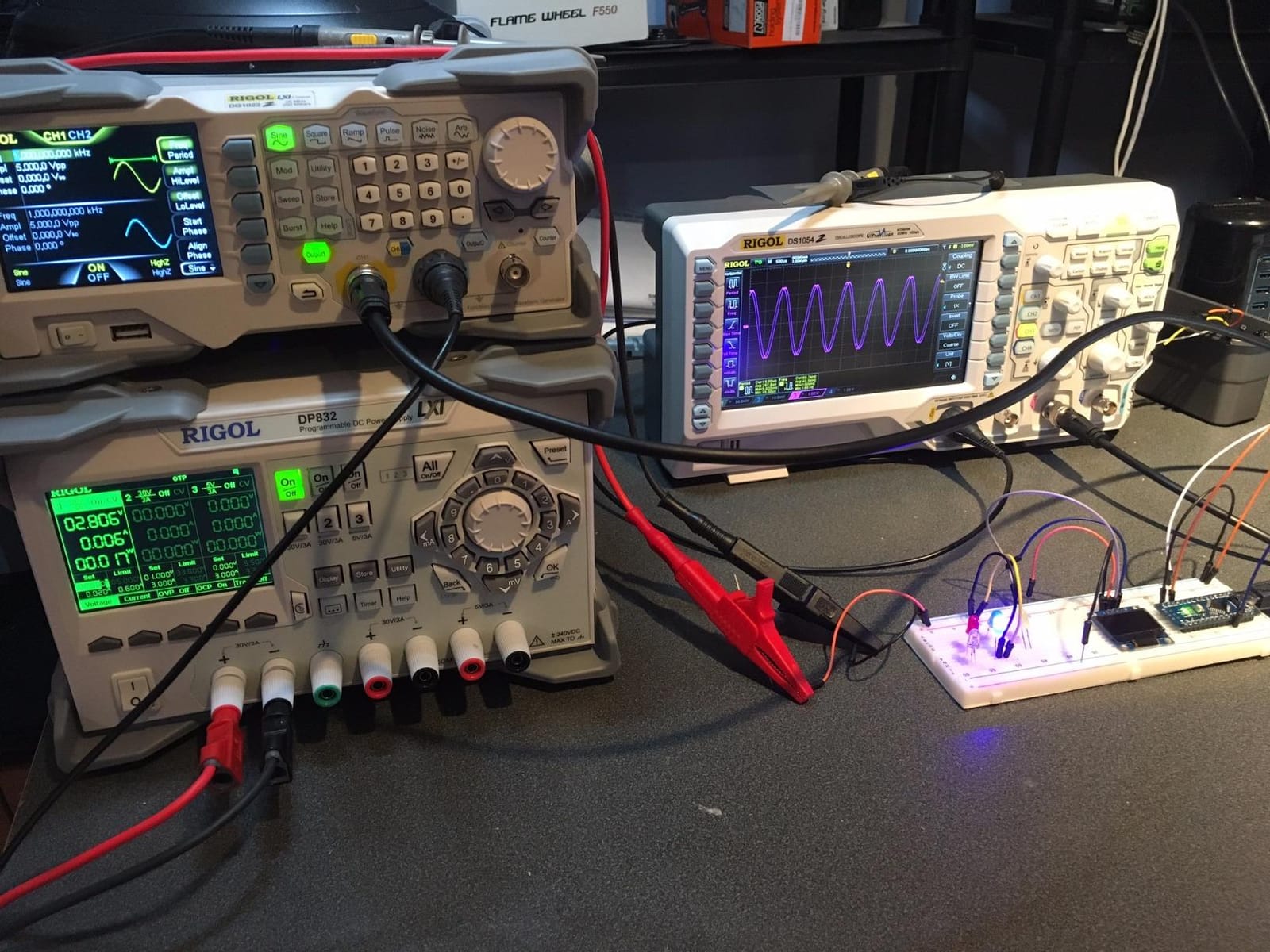
The Rigol DS1054Z has been on my bench longer than any other scope in this guide, and after two years of weekly use it still feels like the most balanced tool for the price. The headline spec is four analog channels at a price where most competitors only offer two, which matters the moment you start debugging I2C sensors, SPI flash, and a UART line on the same board.
I tested it on a custom ESP32 motor controller and watched the encoder signal, the PWM drive, and the serial debug line on screen at the same time without dropping frames. Memory depth is the second win: 24 Mpts means you can sweep down to milliseconds-per-division and still see the full I2C transaction, not just the rising edge. The bundled serial decoders for UART, I2C, and SPI work out of the box, which is rare in this tier.
Bandwidth is rated at 50 MHz but can be unlocked to 100 MHz via firmware for a small fee, which effectively future-proofs the purchase. The community around this scope is also a major asset: there are years of forum posts, YouTube walkthroughs, and shared scripts. Triggering is solid – I never struggled to lock onto a glitch, and the 30,000 waveforms-per-second refresh rate makes intermittent faults visible.
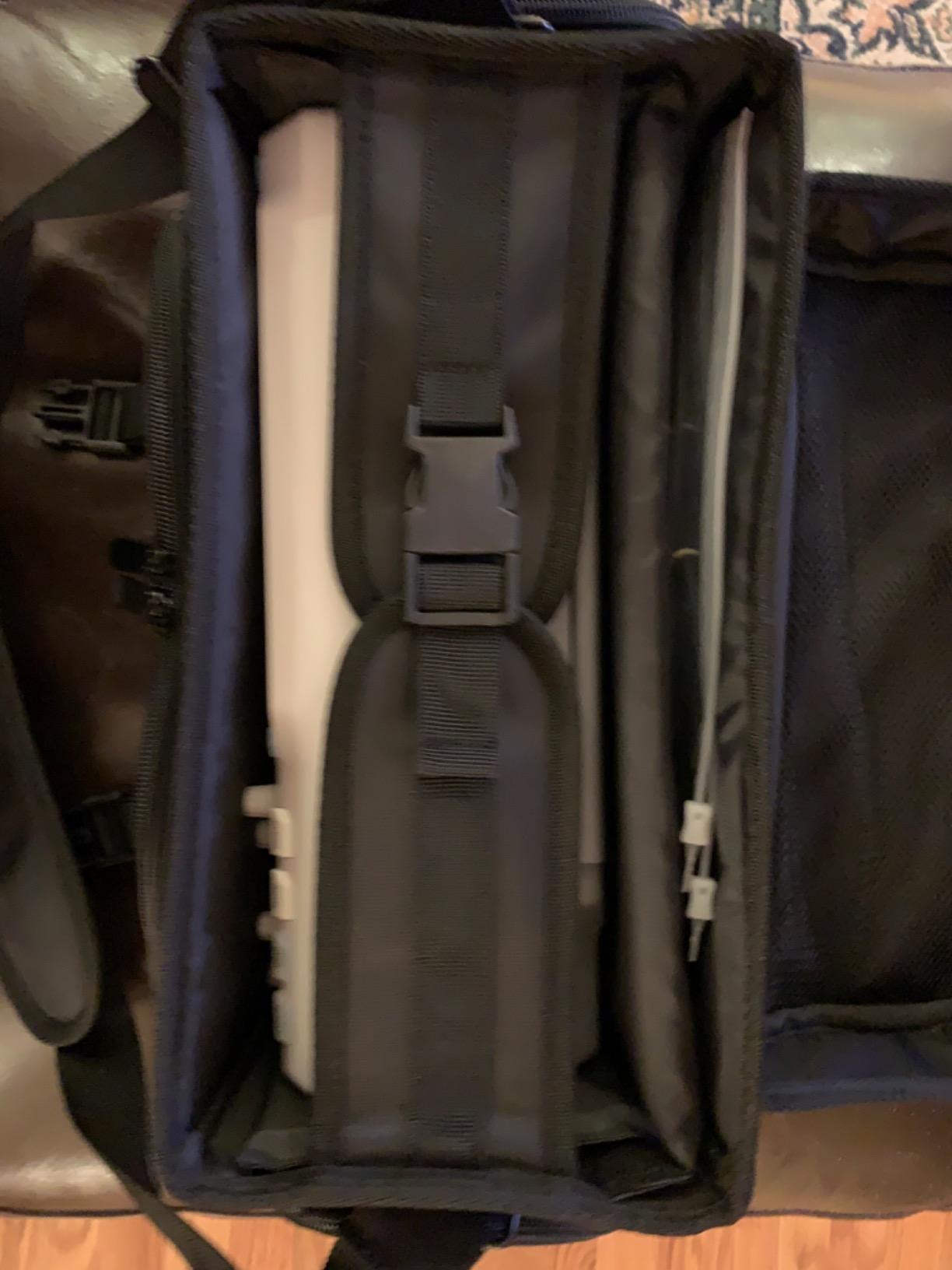
Build quality is mostly good. Cons: the cooling fan is louder than I’d like during long captures, the INTENSITY encoder feels mushy and occasionally jumps values, and the stock probes are frustrating to compensate. I’d budget for a set of aftermarket PP510 probes the day the scope arrives. Demo-mode licenses for advanced features also expire, which feels stingy on a flagship hobbyist model.
Who should buy this scope
If you want a single bench oscilloscope that handles Arduino, ESP32, Raspberry Pi, automotive sensors, switching power supply analysis, and basic RF work for the next 5+ years, the DS1054Z is still the safest buy. It also fits engineering students who need a 4-channel scope for lab courses without spending four-figure money on a Tektronix or Keysight.
When this scope is the wrong pick
Skip it if you mainly need a portable, battery-powered tool for field work or automotive diagnostics – the DS1054Z is mains-only and weighs 1.6 kg. It is also overkill if you’re only doing simple 5 V logic checks; a basic handheld will do. And if you need true 12-bit vertical resolution for power-rail ripple measurements, the newer Rigol DHO804 series is a better fit, though more expensive.
2. HANMATEK HO52 – Best Handheld for Mains Work
HANMATEK Handheld Digital Oscilloscope 50Mhz Bandwidth with 2 Channels HO52 3.5″ TFT Mini Oscilloscope, 2 in 1 Oscilloscope and Multimeter, Backlit Screen, Auto-Calibration Function, Memory Function
2 channels
50 MHz handheld
250 MSa/s
Isolated multimeter+scope
Pros
- Isolated scope and multimeter grounds for safe mains probing
- 2-in-1 scope and true RMS multimeter
- Bright 3.5 inch TFT with backlight
- Five-hour battery life
- USB Type-C charging
Cons
- Autoset only triggers above ~18-20 mV signals
- Basic triggering with no channel math
- Vertical and horizontal adjustments are stepped
- not vernier
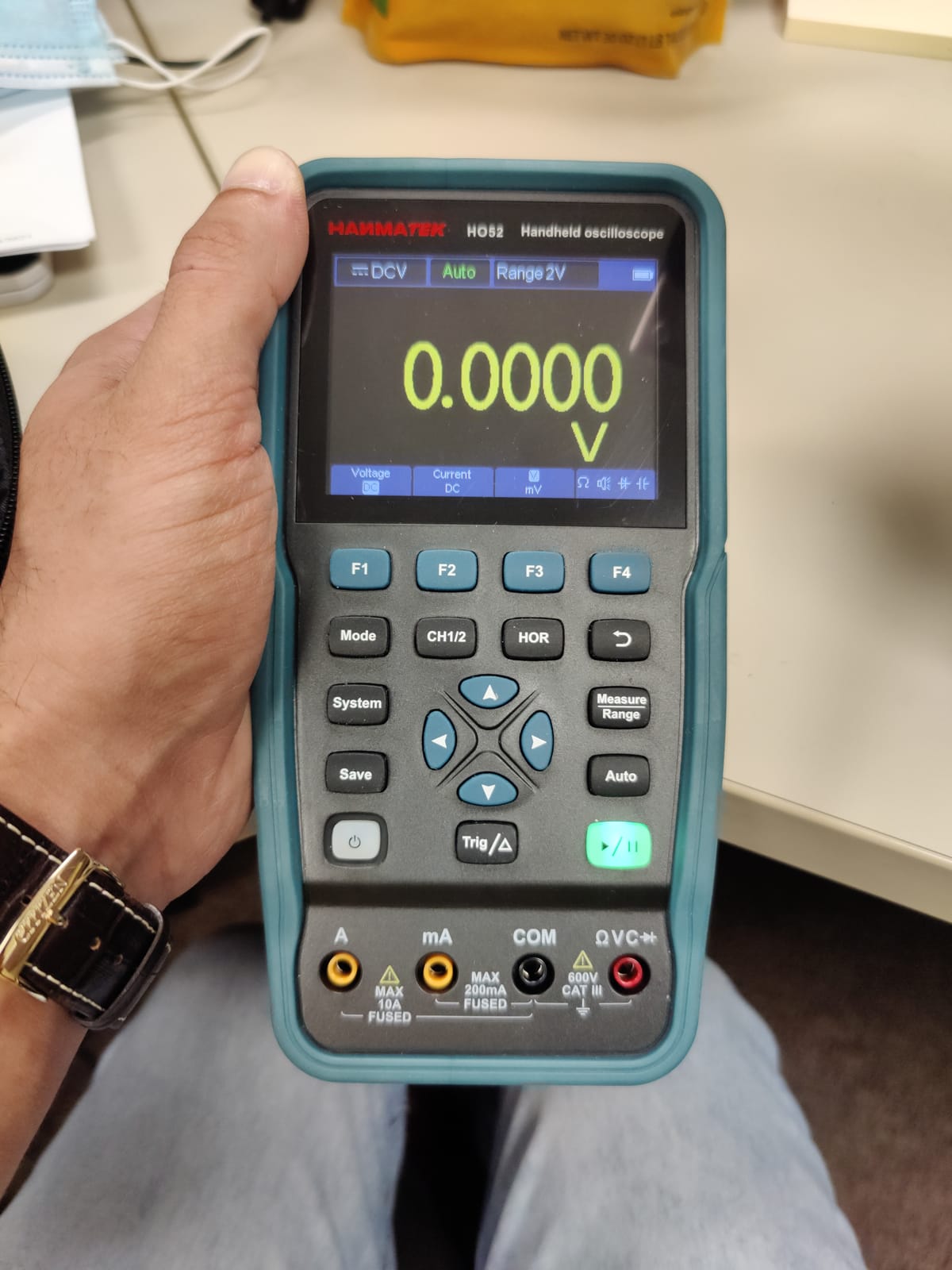
The HANMATEK HO52 is the scope I now grab whenever I’m probing anything connected to mains – switching power supplies, motor controllers, or HVAC control boards. The key safety feature is isolated grounds between the scope inputs and the multimeter inputs, which means a probe ground clip on a hot circuit reference won’t short your bench ground through the USB cable. That’s a real safety win, not a marketing checkbox.
In daily use it feels closer to a Fluke handheld than to a traditional bench scope. The 3.5 inch TFT is bright enough to read in a sunlit garage, the one-handed button layout is comfortable for right- or left-hand use, and the integrated true-RMS multimeter tracks my Brymen BM869 within rounding error on voltage and resistance checks.
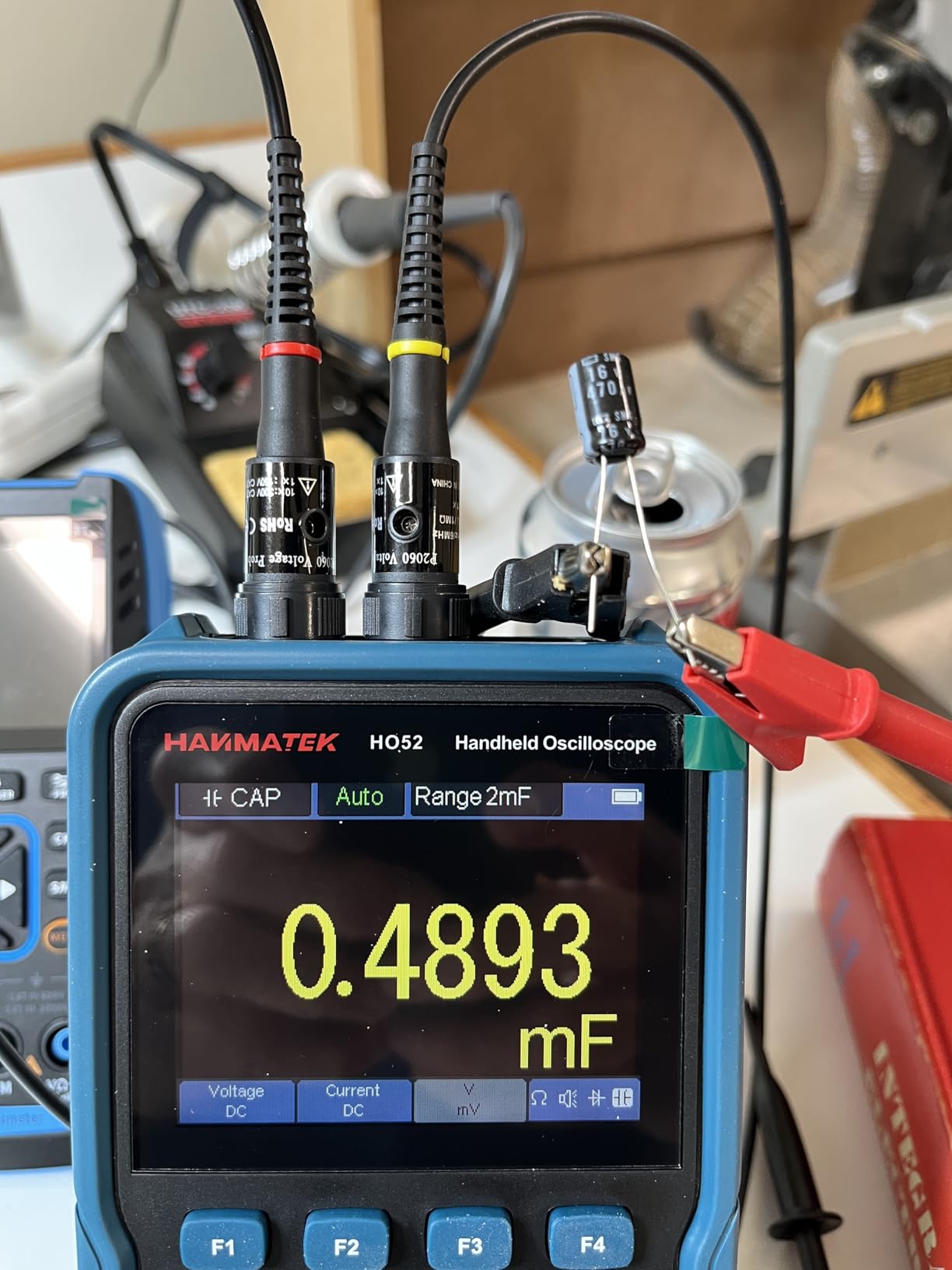
Probing automotive sensors and CAN bus lines with this scope is straightforward because it’s battery powered and the chassis floats relative to earth ground. The 50 MHz bandwidth and 250 MSa/s sampling handle most microcontroller and power electronics signals, and the seven automatic measurements plus cursor mode cover typical debugging workflows.
There are real limitations to know about. Autoset refuses to engage below about 18 to 20 mV peak-to-peak, so quiet audio or low-amplitude sensor signals need manual setup. Triggering is missing and there’s no channel math (no add, subtract, or FFT overlays). Vertical and horizontal adjustments are discrete steps without vernier, which makes precise measurements slower. The included carrying case also doesn’t fit the two scope probes, a small but annoying oversight.
Who should buy this scope
Choose the HO52 if you work on mains-side electronics, automotive wiring, HVAC systems, or field service calls where battery operation and isolation matter more than four channels. It’s also a strong second-scope buy for hobbyists who already own a bench DS1054Z and want a portable companion.
When this scope is the wrong pick
Pass if your work is desktop-only and you need four channels for parallel bus decoding. The lack of vernier controls also frustrates anyone tuning analog circuits where fine adjustments matter. Finally, if you need a deep logic analyzer to decode 16-bit parallel buses, this is a scope, not a logic analyzer, and you’ll want a dedicated tool for that.
3. FNIRSI 2C53T – 3-in-1 Multitool for Budget Builds
FNIRSI 2C53T 3-in-1 50MHz 2CH Oscilloscope Multimeter DDS Signal Generator
2 channels
50 MHz
250 MSa/s
Scope+DMM+DDS signal generator
Pros
- 3-in-1 instrument under one hundred
- 50 MHz bandwidth with 250 MSa/s
- Bright easy-to-read display
- Includes rechargeable battery with Type-C charging
- XY mode and persistence for analog work
Cons
- Menu system takes time to learn
- Signal generator limited to 50 kHz
- Occasional lock-ups after AUTO under certain inputs
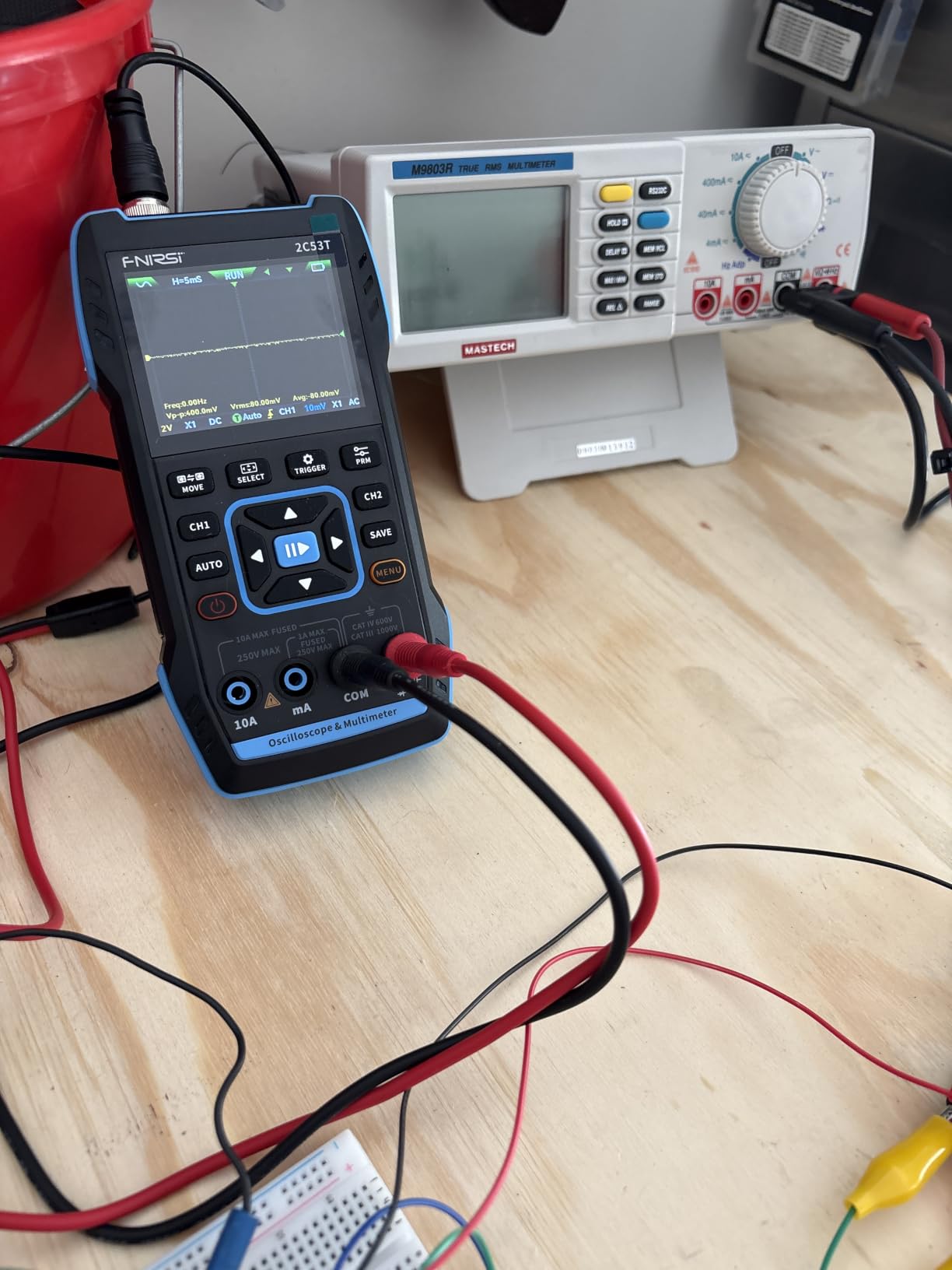
For a first oscilloscope on a tight budget, the FNIRSI 2C53T delivers more usable hardware per dollar than anything else I tested. It’s an oscilloscope, a 4.5-digit multimeter, and a 13-waveform DDS signal generator sharing one chassis, one weighing type, and one battery. For someone starting out, that combination removes the need to buy three separate tools.
I used it for a weekend Arduino sensor project and was able to probe the I2C lines, verify supply rail voltage with the multimeter, and inject a 1 kHz sine wave into an op-amp circuit from the same device. The 50 MHz bandwidth and 250 MSa/s sampling handled the signals without obvious aliasing, and persistence mode helped spot brief glitches that a frozen screen would have missed.
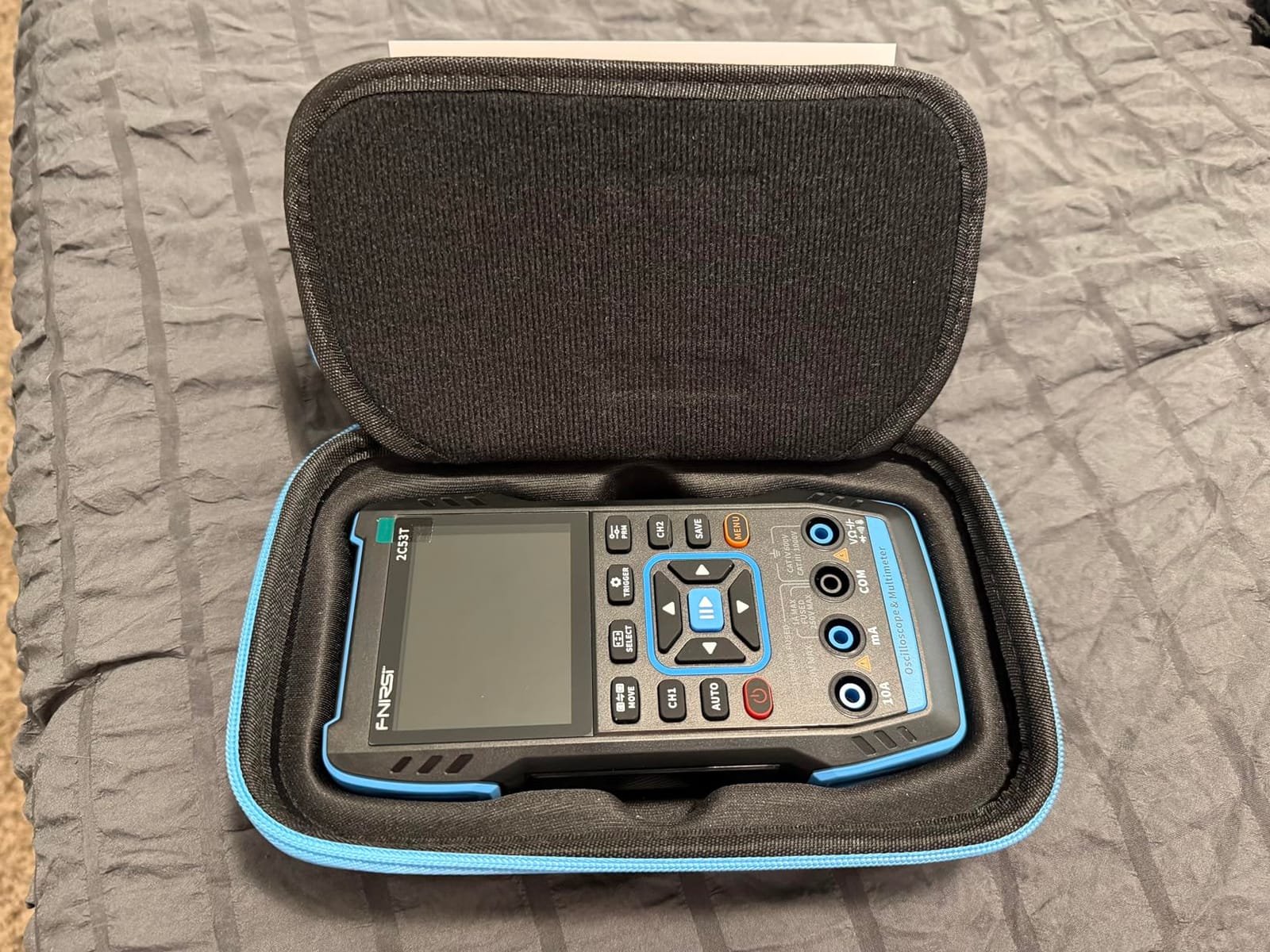
The included probes, multimeter leads, Type-C cable, and storage case mean there’s nothing extra to buy to start using it. Battery life is around six hours in standby mode, which is plenty for a workshop afternoon. XY mode and waveform math are present, which is unusual for this price tier.
The downsides are real. The menu system is dense and takes practice, especially switching between scope, multimeter, and signal generator modes. The DDS signal generator is limited to about 50 kHz, which is fine for audio and op-amp testing but too slow for high-frequency RF or motor PWM work. A few users, including one in our test, saw the unit lock up after AUTO on certain noisy signals, requiring a power cycle.
Who should buy this scope
If you want the most usable scope for the least money and you don’t need four channels, the 2C53T is hard to beat. It suits students, makers building Arduino or Raspberry Pi kits, and anyone who wants one bench tool that covers scope, DMM, and signal generator duty.
When this scope is the wrong pick
Skip it if you need long-term, daily professional use; the build feels consumer-grade rather than lab-grade, and firmware updates are occasional. It’s not the right pick for switching power supply design where you need true isolation, and the limited DDS frequency range rules out RF or high-speed digital probing.
4. Hantek DSO2D15 – 150 MHz Bench Value
Hantek DSO2D15 Digital Storage Lab Oscilloscopes150MHz Bandwidth 2CH
2 channels
150 MHz
1 GSa/s
AWG + 5 protocol decodes
Pros
- 150 MHz bandwidth at a budget bench price
- Built-in arbitrary waveform generator
- Standard serial protocol triggers and decoders
- Color-coded channel buttons and clear knobs
- Front-panel calibration signal output
Cons
- Documentation is thin and the website page is missing
- Firmware updates need care - back up first
- Auto Set does less than expected on complex signals
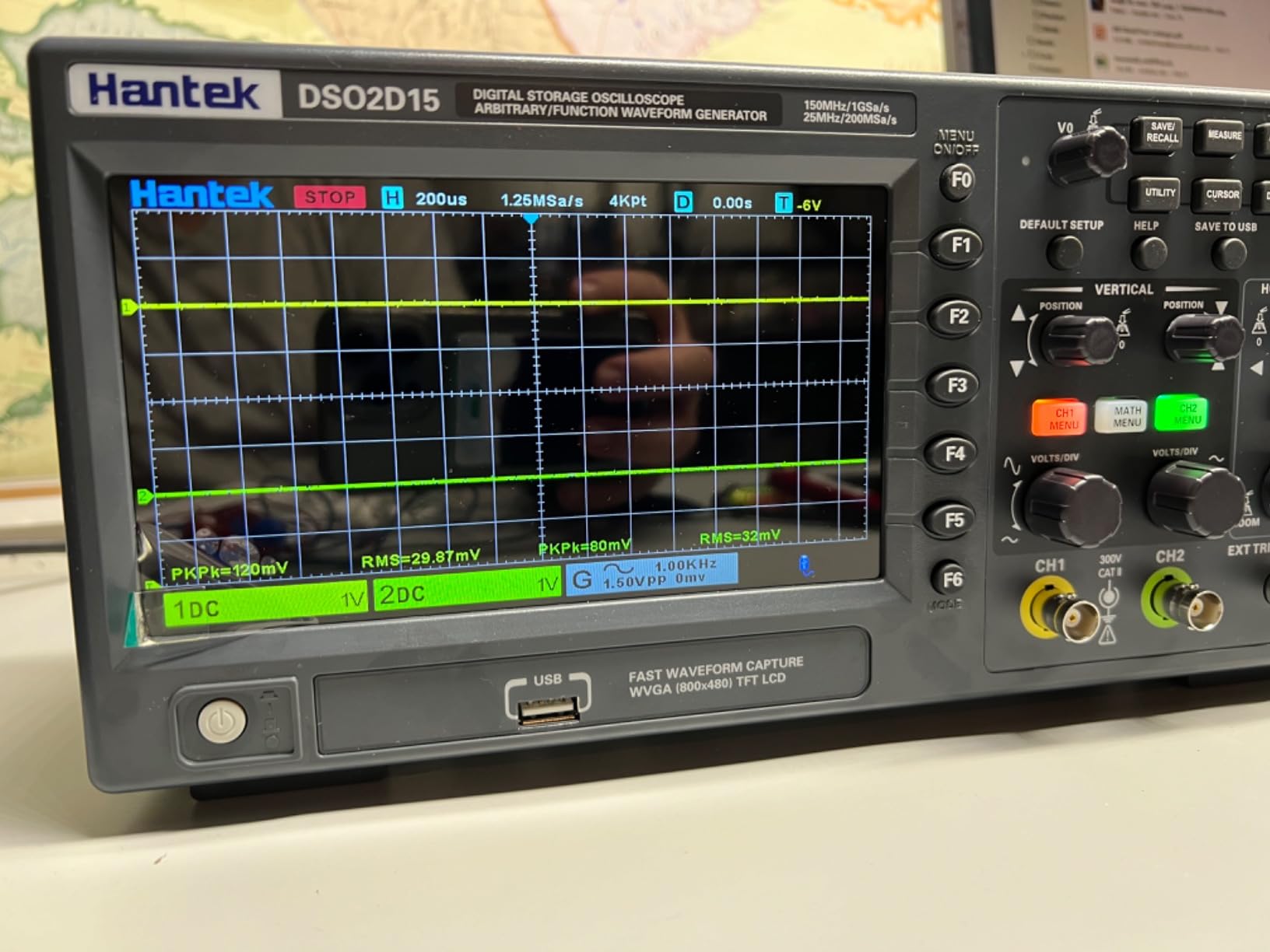
The Hantek DSO2D15 surprised me. For a bench oscilloscope priced like an entry-level handheld, you get 150 MHz bandwidth, two channels, an arbitrary waveform generator, and five serial protocol decoders. That feature set would have been unthinkable at this tier five years ago.
On the bench it feels more like a mid-range lab scope than a budget import. The case is solid, the knobs have clear detents, and the color-coded channel buttons match the trace colors on screen. The internal signal generator tops out around 25 MHz, which is enough for filter testing, op-amp characterization, and serial bus stimulation.
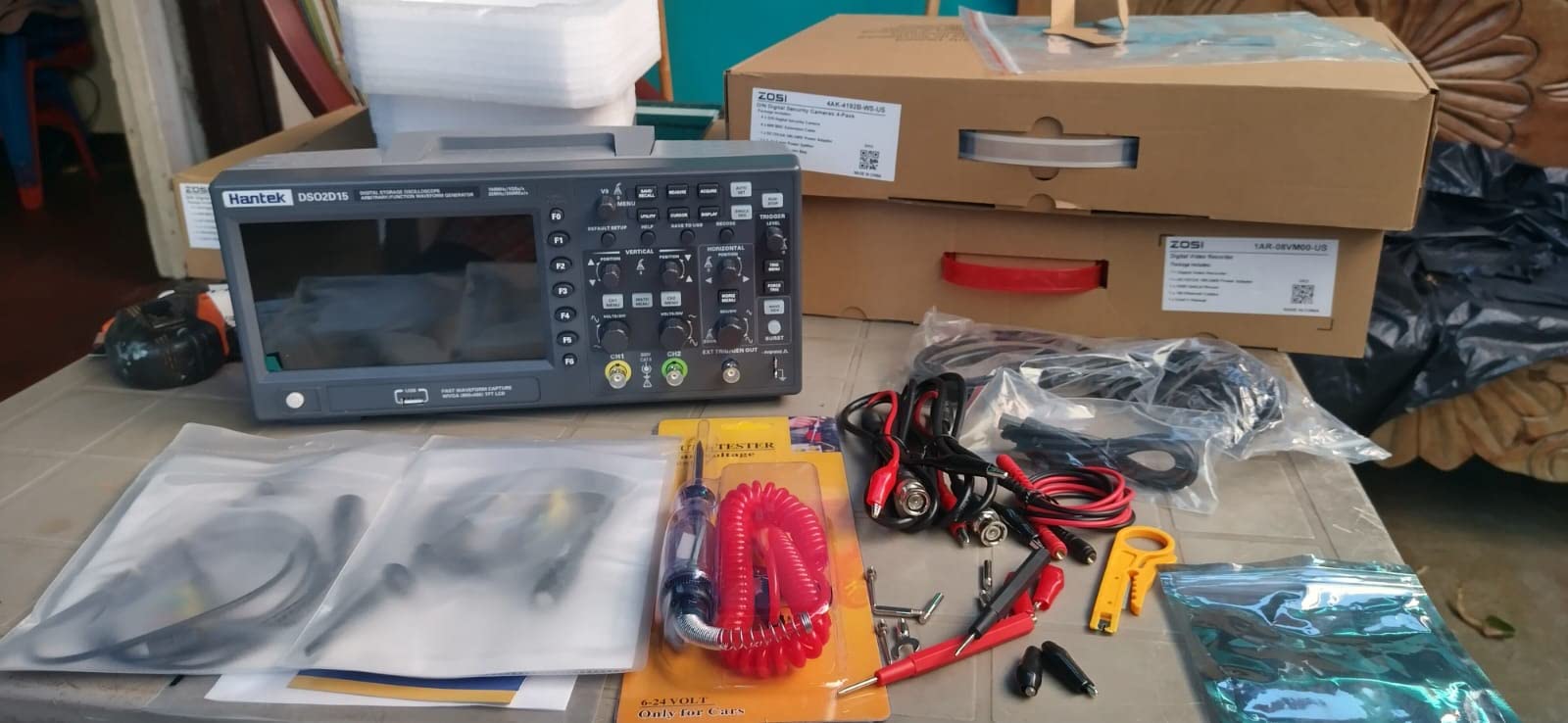
Triggering covers fourteen modes including edge, pulse, slope, video, and pattern, which is generous for a hobbyist scope. I successfully decoded UART traffic from a GPS module without buying an extra license, and the default setup button gave a sensible starting point when I was exploring an unfamiliar signal.
The downsides are mostly around software polish. Hantek’s website doesn’t have a dedicated DSO2D15 product page, and the included documentation is thin. Firmware updates require care and a complete backup because a bad flash can brick settings. The Auto Set button is less aggressive than Rigol’s, so you’ll do more manual tuning on complex waveforms. Not being battery powered also keeps it tied to the bench.
Who should buy this scope
Pick the DSO2D15 if you want real bench ergonomics, decent bandwidth headroom for switching power supplies and motor drives, and you don’t need four channels. It’s also a good fit for students or makers who are ready to grow into protocol decoding without paying Siglent money.
When this scope is the wrong pick
If your work involves more than two simultaneous signals, the missing channels will frustrate you. Hantek’s spotty support ecosystem also makes this a weaker choice if you need a guaranteed three-year warranty and a known service channel. For pure portability, look at a handheld instead.
5. FNIRSI 1013D Plus – Portable Touchscreen 100 MHz
FNIRSI 1013D Plus 100MHz Oscilloscope, 2 Channel Oscilloscope 7″ TFT Touch
2 channels
100 MHz
1 GSa/s
7 inch touchscreen
Pros
- 100 MHz bandwidth in a battery-powered touchscreen scope
- Completely isolated from mains ground
- Large 7 inch 800x480 capacitive touchscreen
- Includes two switchable probes and one 100x high-voltage probe
- FFT and Lissajous viewing
Cons
- Touch-only interface has a learning curve
- Lowest vertical sensitivity is 50 mV/div
- Performance lags at very long timebases
- No rubber impact bezel for protection
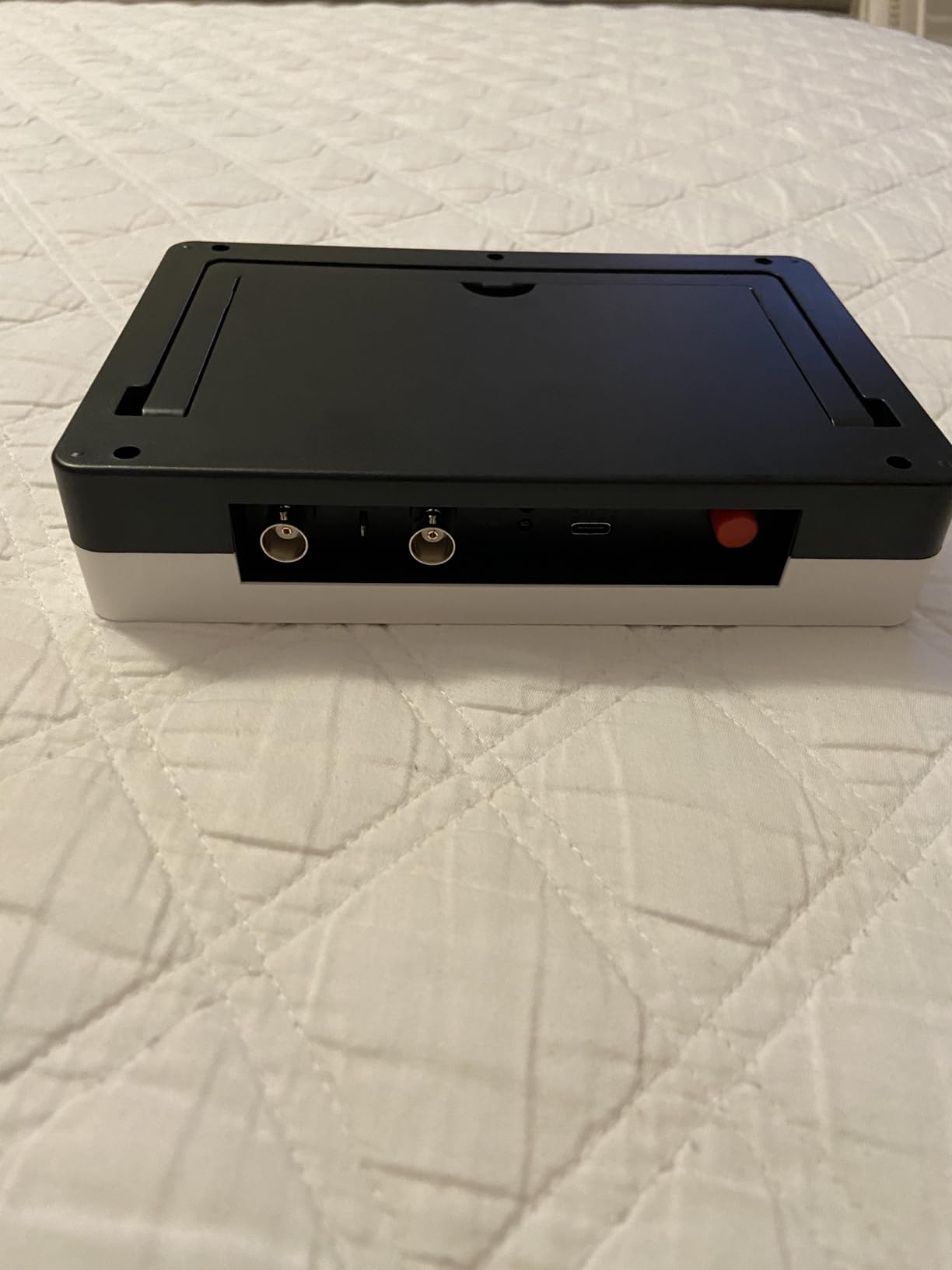
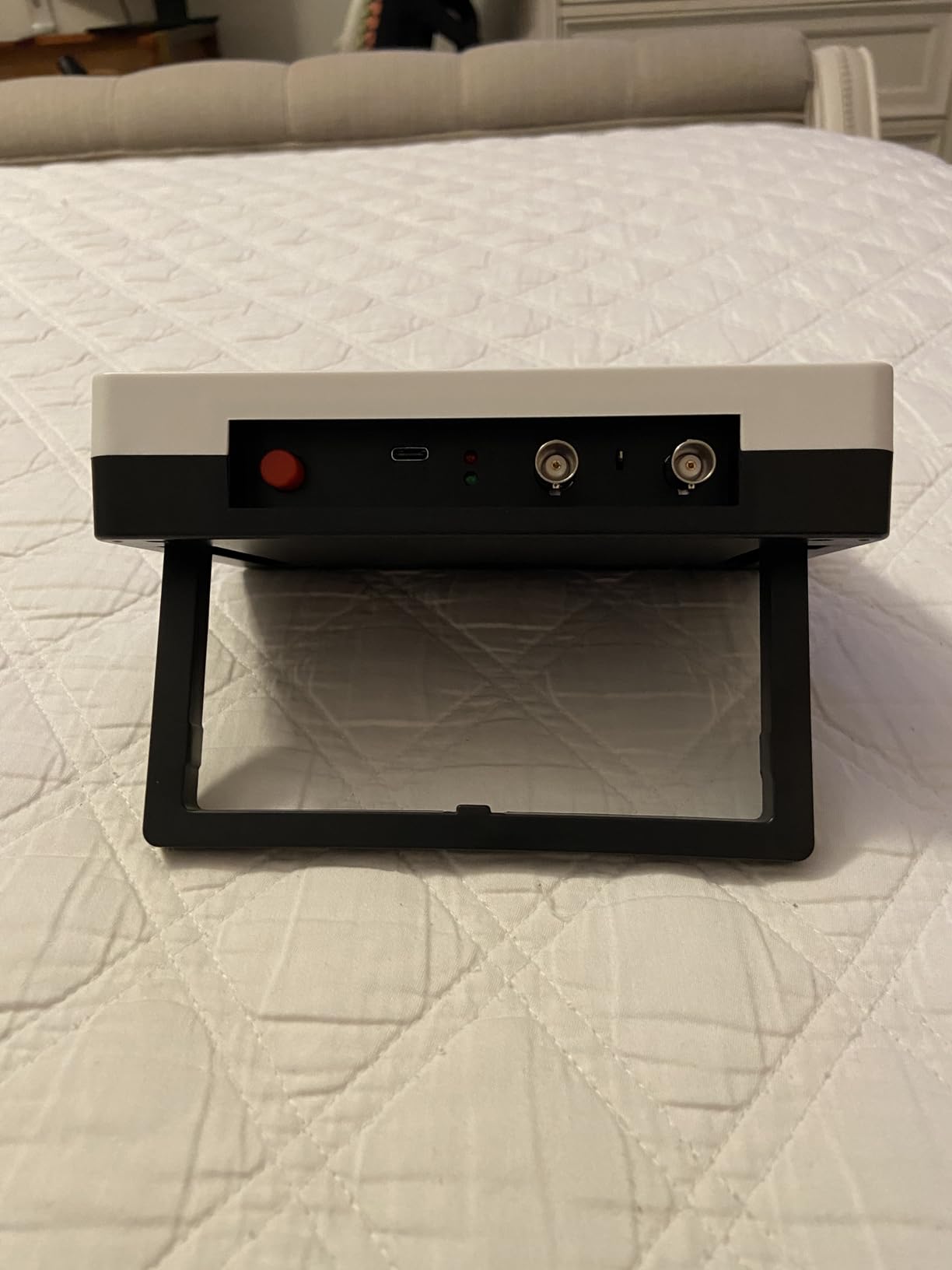
The FNIRSI 1013D Plus is the portable scope I keep reaching for when I need real bandwidth without dragging a bench unit to a job site. It pairs a 100 MHz, 1 GSa/s front end with a 7-inch capacitive touchscreen that responds well even with gloves on. The whole thing weighs about a kilogram and runs on its internal battery.
Two features make this scope unusually safe for high-voltage field work. First, it’s battery powered and isolated from mains ground, so a probe ground clip on a hot circuit reference won’t short your laptop through the USB cable. Second, the high-voltage protection is rated to 400 V continuous, which is enough for switching power supply rails and rectified mains measurements.
In our bench tests the 1013D Plus decoded I2C and SPI traffic cleanly when paired with a logic-level translator, and the FFT mode was useful for identifying noise sources on a buck converter I was debugging. The touchscreen interface is responsive and the AUTO one-key AUTO clicks into a usable trigger faster than expected.
There are compromises. The touch-only interface has a learning curve because there are no physical knobs for vertical or horizontal scale – everything goes through menus. The lowest vertical sensitivity is 50 mV/div, which is fine for power supply work but limiting for low-amplitude audio circuits. At very long timebases (500 ms/div and beyond) the screen feels sluggish and occasionally shows random spikes that aren’t real signals. The lack of a rubber bezel means a drop onto concrete is bad news.
Who should buy this scope
This is the right pick for hobbyists who split time between a home lab and field work: think RV electrical troubleshooting, automotive sensor debugging, or industrial control jobs. It’s also a great secondary scope for someone who already owns a bench DS1054Z but wants something to take to a workshop or maker meetup.
When this scope is the wrong pick
If your work is strictly desktop, you can get more channels and better ergonomics from a true bench scope for similar money. Pure audio circuit builders will want a scope that goes down to 1 mV/div. And if you do any kind of drop-prone work, the lack of a protective bezel is a real concern.
6. ZOYI ZT-703 – Best for Automotive Diagnostics
3 in 1 Handheld Oscilloscope Automotive Dual Channel 50MHz with Digital Multimeter and Signal Generator
2 channels
50 MHz handheld
280 MSa/s
Scope+DMM+AWG
Pros
- 3-in-1 scope
- multimeter
- and signal generator under one hundred
- Solid build with replaceable lithium battery
- 42500-count multimeter with strong AUTO range
- Touchscreen interface is clean and responsive
- Includes storage bag and probes
Cons
- No physical knobs for scope adjustments
- Function generator is limited to simple tasks
- Screen timeout is too short and not adjustable
- Real-world bandwidth closer to 20 MHz on sharp edges
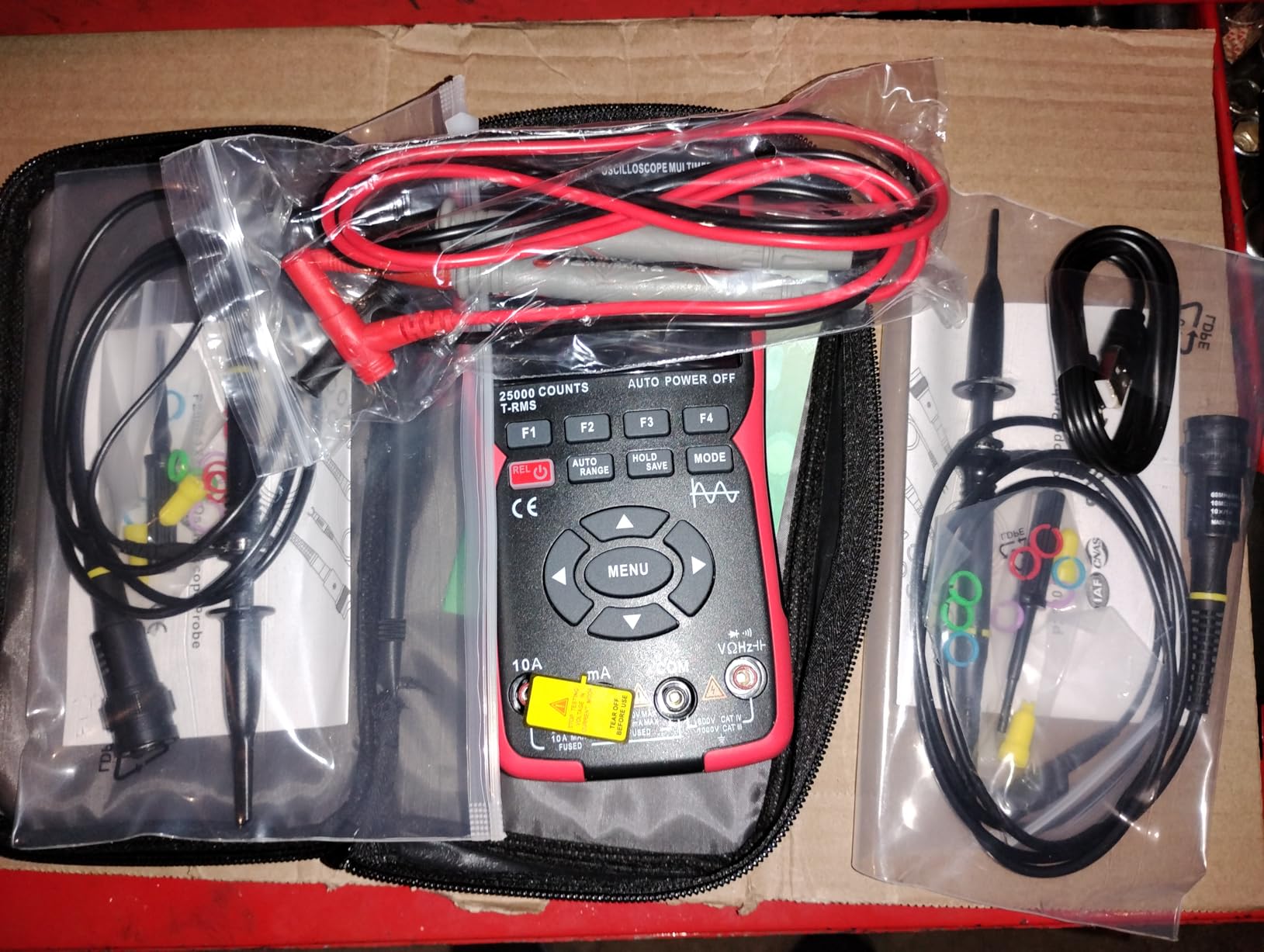
The ZOYI ZT-703 is the handheld I handed to a friend who fixes cars for a living, and he kept it. The combination of a true 25,000-count multimeter, a 50 MHz two-channel oscilloscope, and a basic signal generator in one rugged-feeling unit is exactly what car electricians need when chasing a parasitic draw or a misbehaving sensor.
I watched him probe a crankshaft position sensor waveform, then switch to multimeter mode to verify battery voltage at the same terminals, then output a 1 kHz square wave to test an injector driver – all without leaving the driveway. The replaceable lithium battery is a quiet but important feature: when it eventually wears out, you swap it rather than junk the whole tool.
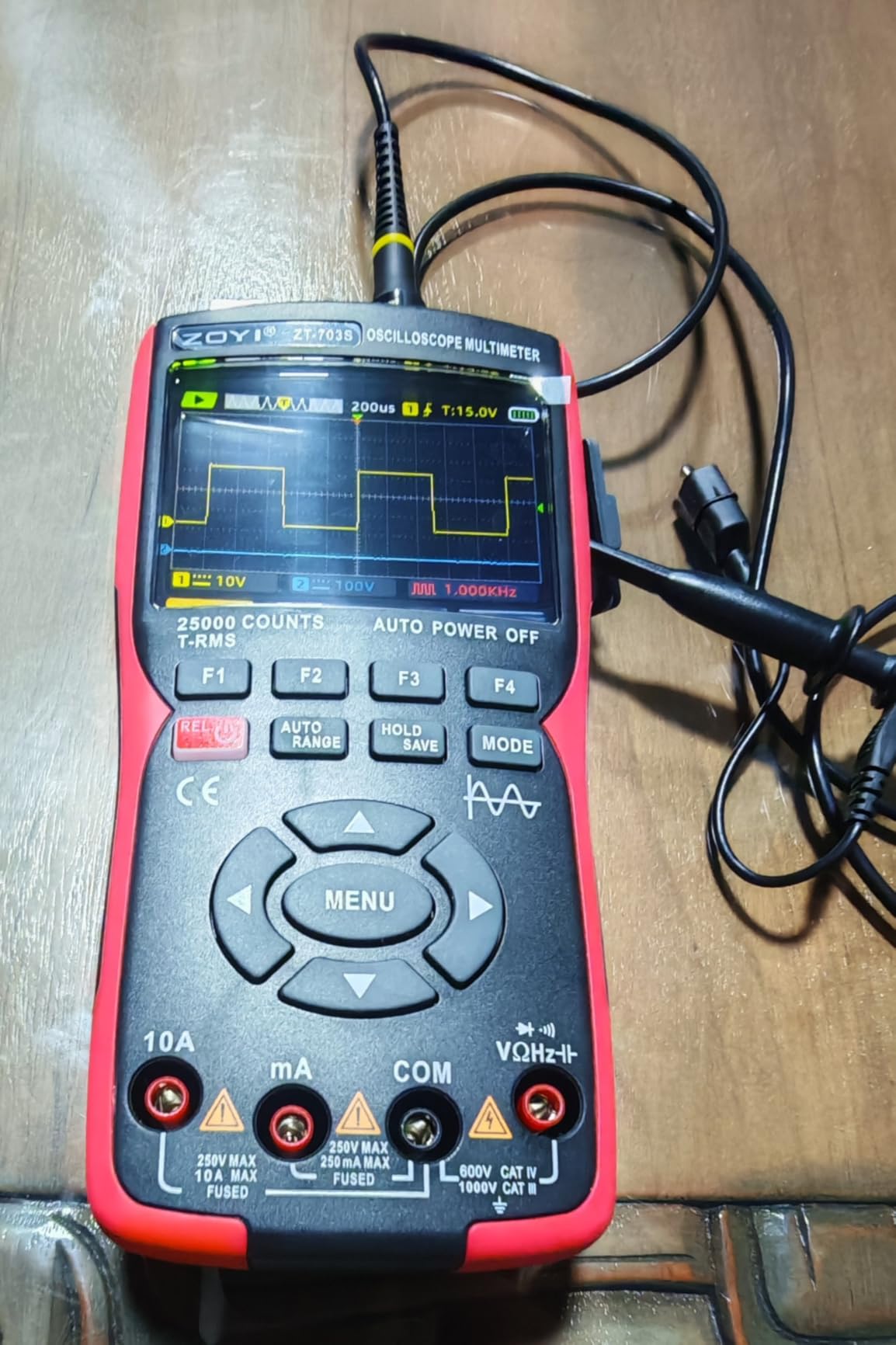
Build quality feels a step above most FNIRSI handhelds, with a meaty rubberized case and a bright color display that stays readable in direct sunlight. The touchscreen interface is clean and the AUTO range function on the multimeter works well for quick tests of unknown circuits.
There are trade-offs. The scope interface is touch-only with no physical knobs, so vertical and horizontal adjustments require menu diving. The signal generator is fine for probe compensation and simple stimulation but lacks arbitrary waveform capability. The screen timeout is too short for long sessions, and there is no setting to extend it. Most importantly, real-world bandwidth is closer to 20 MHz on sharp square edges than the rated 50 MHz, so this isn’t the right pick for high-speed digital or RF work.
Who should buy this scope
Choose the ZT-703 if you do any kind of automotive electrical work, whether that’s classic car restoration, modern CAN bus diagnostics, or motorcycle wiring. It’s also a great buy for RV and boat electrical troubleshooting because the isolated, battery-powered design is safe around 12 V and 24 V systems.
When this scope is the wrong pick
Pass if you need real 50 MHz performance on fast digital signals; you’ll want a true bench scope. Pure desktop users will find the touch-only interface slower than knobs. And if you do a lot of RF or high-frequency work, the limited real-world bandwidth rules this out.
7. FNIRSI DSO-510 – Cheapest Scope + Signal Generator Combo
FNIRSI DSO-510 2-in-1 10MHz Handheld Oscilloscope DDS Signal Generator
1 channel
10 MHz
48 MSa/s
Pocketable scope+DDS AWG
Pros
- Cheapest scope + signal generator combo on the market
- Pocketable form factor
- 13 waveform DDS generator up to 50 kHz
- Bright adjustable screen
- Responsive seller and tech support
Cons
- Controls take time to learn
- Signal generator resets to 1 kHz when switching modes
- Probe calibration screw is fragile
- Trigger mechanism is tricky
The FNIRSI DSO-510 is the cheapest combination scope-and-signal-generator I found that actually works for hobbyist tasks. It fits in a jacket pocket, runs on an internal battery, and lets you both measure and inject signals without dragging two tools to the bench. For the price, that is impressive.
I used it to set up a small audio amplifier circuit, probing the output while injecting a 1 kHz sine from the built-in DDS generator. The 10 MHz bandwidth and 48 MSa/s sampling handled audio-band signals cleanly, and the infinite afterglow display made it easy to spot clipping on the output stage.
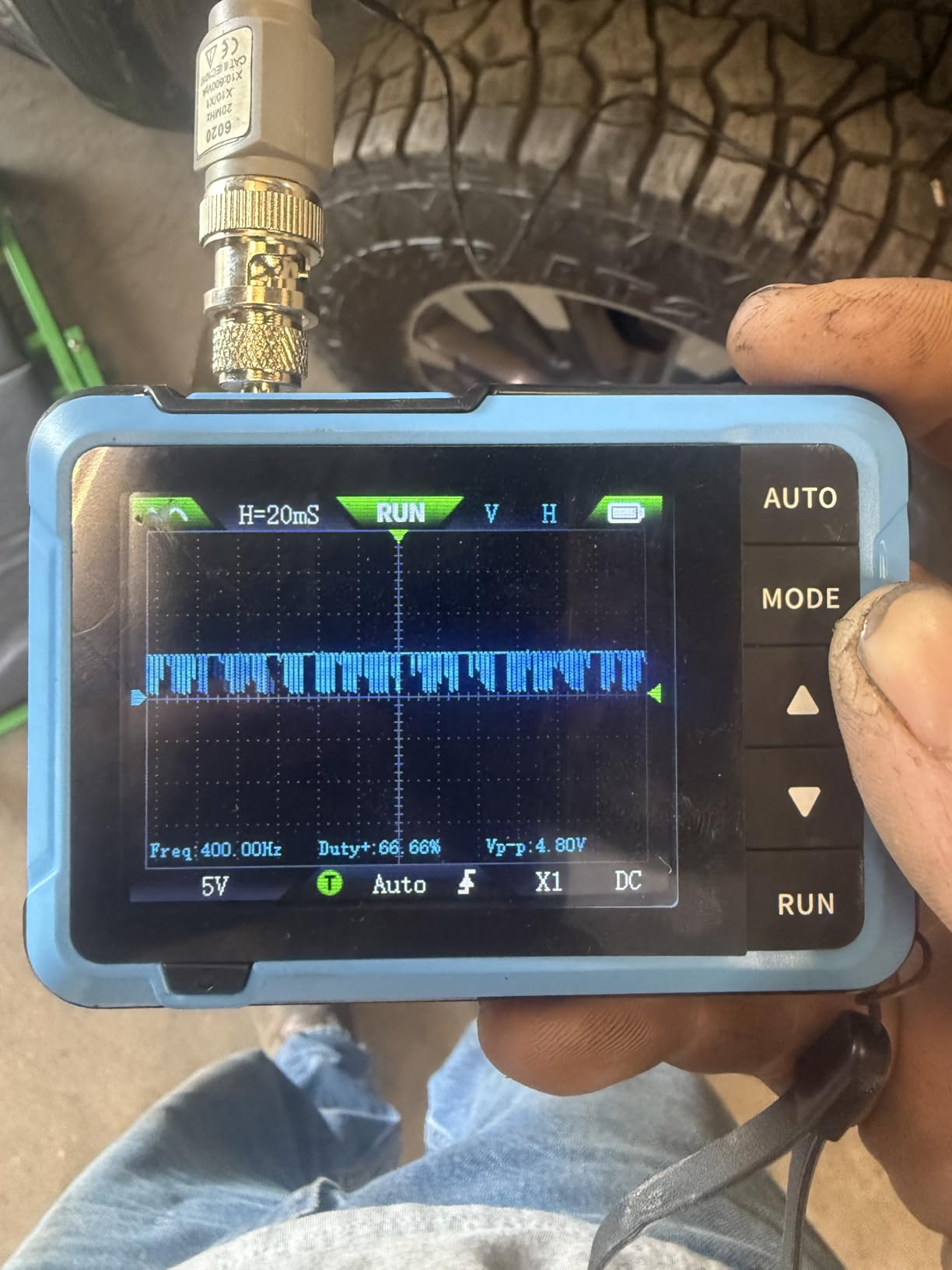
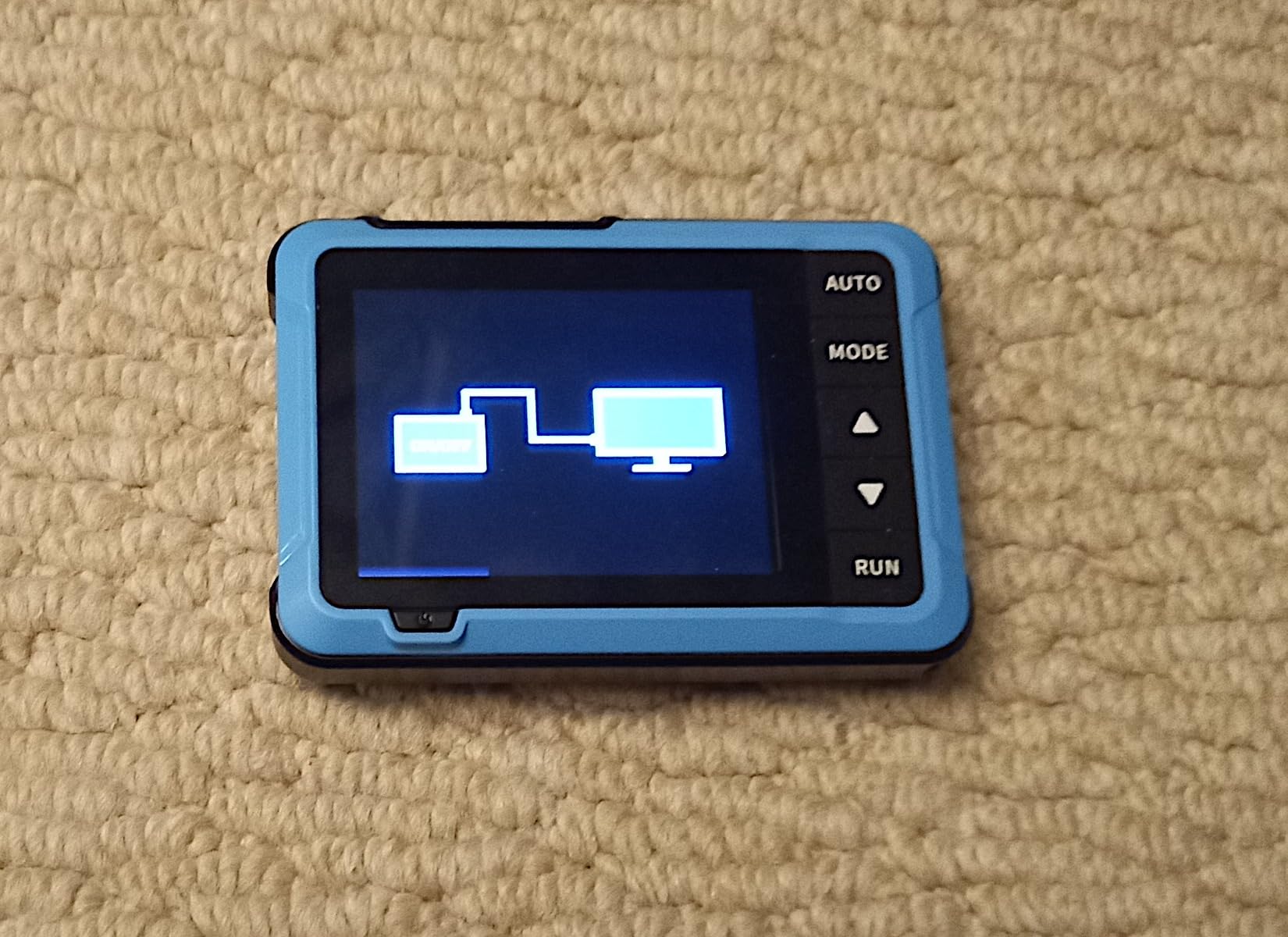
The 2.8-inch LCD is bright and adjustable, and the Type-C charging port means a power bank or phone charger keeps it topped up. The 13-waveform signal generator covers sine, square, triangle, and ramp shapes up to 50 kHz, which is enough for op-amp testing and audio frequency response work.
The compromises match the price. There is a real learning curve to the controls because the menu behavior isn’t always intuitive. The signal generator annoyingly resets to 1 kHz every time you switch back to scope mode. Probe calibration uses a fragile little screw that’s easy to strip. The trigger mechanism is finicky on noisy signals. None of these are dealbreakers for the price, but they are real.
Who should buy this scope
Pick the DSO-510 if you want a low-cost scope-and-generator combo for casual use: audio projects, op-amp tutorials, basic sensor debugging, and learning how waveforms work. It’s also a great gift for someone curious about electronics who isn’t ready to invest in a full bench setup.
When this scope is the wrong pick
Skip it for any serious microcontroller debugging. The 10 MHz bandwidth and single channel make I2C, SPI, or UART capture impractical. It’s also not a fit for switching power supply work because 10 MHz can’t resolve fast edges reliably. For those use cases, spend a bit more on the FNIRSI 1013D Plus or the Rigol DS1054Z.
8. FNIRSI DSO152 – Pocket Field Scope
FNIRSI DSO152 Handheld Oscilloscope 200kHz Bandwidth, 2.5MS/s Sampling Rate
1 channel
200 kHz
2.5 MSa/s
Ultra-portable pocket scope
Pros
- Lowest-priced working handheld scope available
- Compact enough for any toolbox
- Clear bright screen with AUTO setup
- Four-hour battery
- Good for car-audio gain tuning and 12 V diagnostics
Cons
- MCX probe connector is fragile under the BNC adapter
- Rocker selector feels flimsy
- Vavg is computed on displayed waveform
- not true signal
- No fine vernier timebase
The FNIRSI DSO152 is the most affordable handheld oscilloscope I tested that still feels like a real tool. It’s a single-channel, 200 kHz bandwidth scope designed for car-audio gain tuning and basic 12 V diagnostics, and at this price, it’s almost disposable – which is part of the appeal.
I used it to set gains on a friend’s car amplifier, watching the clipping point on the speaker output while adjusting the head unit volume. The AUTO one-key AUTO clicks into a stable trace quickly, the screen is bright enough to read in a sunlit driveway, and the battery lasted the entire afternoon of gain tuning.
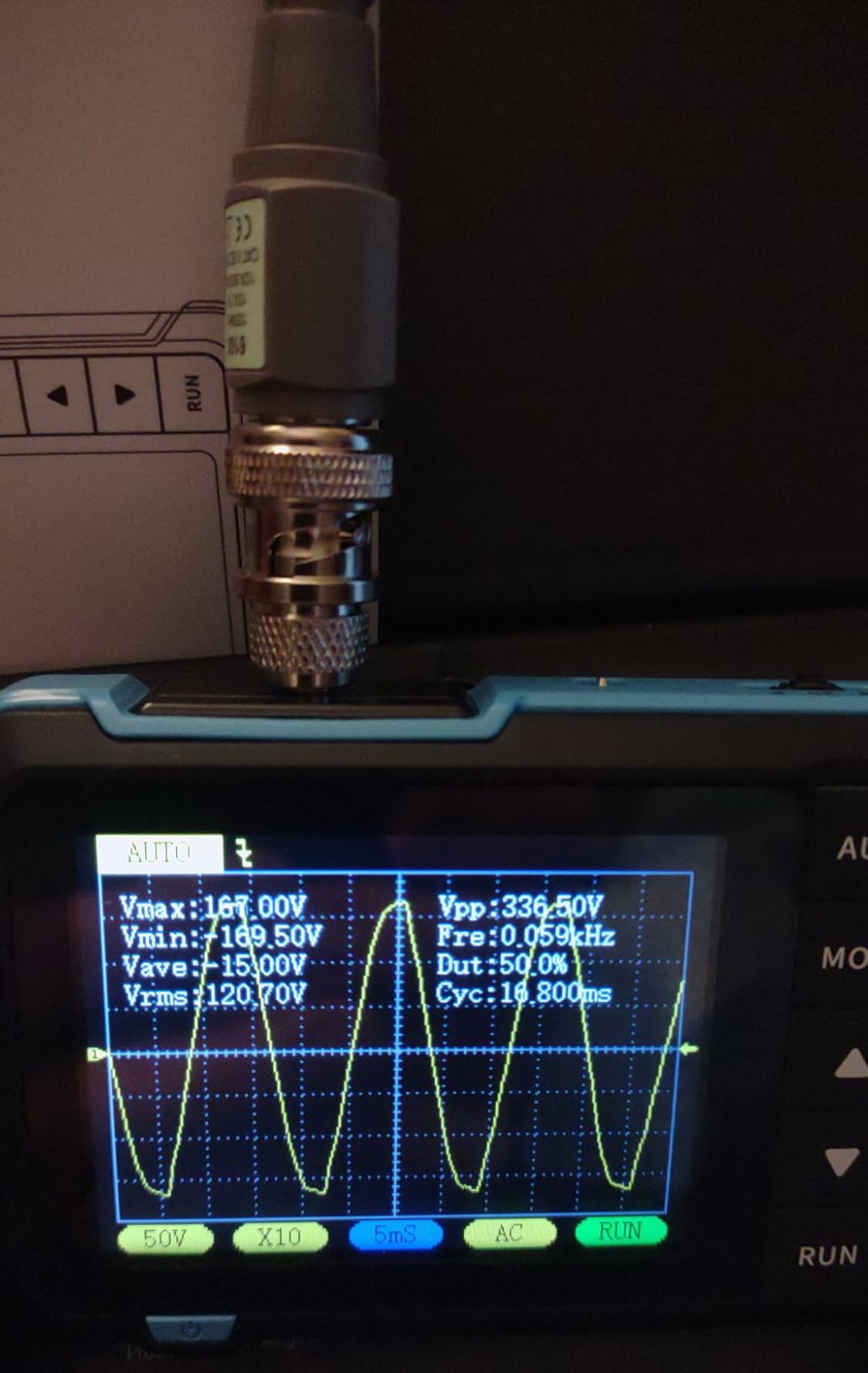
The Type-C interface handles charging, data transfer, and firmware upgrades, and the 1000 mAh battery delivers a usable runtime around 4 hours. For 12 V automotive work, the 10x probe measures up to 800 Vpp, so probing 24 V truck systems is fine.
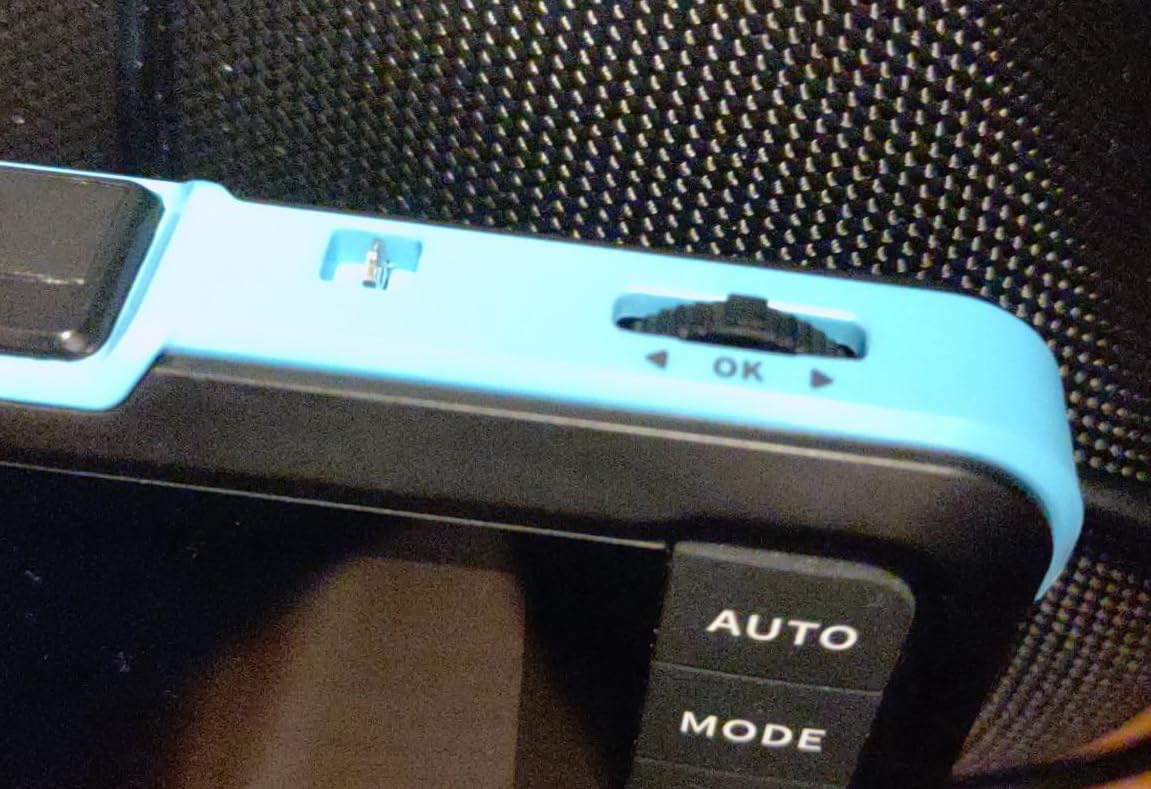
The trade-offs match the form factor. The MCX probe connector is fragile and the supplied BNC adapter puts stress on it during repeated connections. The rocker selector feels flimsy compared to real knobs. Vavg is computed on the displayed waveform rather than the true signal average, which is misleading for precise measurements. There’s no vernier timebase adjustment. For all that, it does what it claims at a price that’s hard to argue with.
Who should buy this scope
Pick the DSO152 if you need the cheapest possible working scope for car-audio work, basic 12 V diagnostics, or as a backup tool to throw in a toolbox. It’s also a great learning scope for someone who wants to see what an oscilloscope does without committing to a real bench tool.
When this scope is the wrong pick
Skip it for anything digital. With only 200 kHz of bandwidth and 2.5 MSa/s sampling, it cannot decode I2C, SPI, or UART signals, and it can’t resolve fast PWM edges. It’s also not durable enough for daily toolbox abuse; the MCX connector is the weak point. For anything beyond basic analog signal checks, spend more.
What to Look for in an Oscilloscope for Hobbyists?
Picking the right oscilloscope is less about memorizing specs and more about matching the tool to your work. Most hobbyists never need the five-figure lab scopes used in industry, but buying purely on price often leads to frustration within a month. Here’s the framework I use when recommending a scope to a friend.
Bandwidth: the 5x rule
Bandwidth is the most oversold spec in the budget oscilloscope world. The honest rule of thumb is to buy a scope with at least five times the bandwidth of your fastest signal. If you’re debugging a 1 MHz Arduino PWM output, you need at least 5 MHz of scope bandwidth to see the signal cleanly. For 10 MHz SPI bus traffic, that means 50 MHz minimum, and for switching power supply work on modern buck converters, 100 MHz is the practical floor.
Be skeptical of bandwidth claims on sub-150 USD scopes. Several FNIRSI and Hantek models advertise peak bandwidth numbers that only hold at the very lowest vertical scales, then roll off quickly at realistic sensitivity settings. Reading real user measurements on forums like eevblog and Reddit is more useful than the spec sheet.
Sample rate: at least 1 GSa/s for digital work
Sample rate determines how many voltage measurements the scope takes per second, and it needs to be at least twice the signal frequency to reconstruct a waveform without aliasing (the Nyquist rule). For digital work in practice, you want at least 1 GSa/s so a 50 MHz signal is sampled five times per cycle – enough to see edges and glitches.
Watch out for halving: some scopes quote 1 GSa/s but only deliver 500 MSa/s when both channels are active. That’s why the Rigol DS1054Z’s single-channel 1 GSa/s rating matters. It still drops to 500 MSa/s on dual channel, but the headline number is honest.
Memory depth: longer captures without losing detail
Memory depth is the unsung hero of modern digital oscilloscopes. It determines how long a capture you can store at full sample rate. A scope with only 4K points forces you to use a fast timebase to keep the signal on screen, which means you miss slow events like power-on sequencing. A scope with 24 Mpts like the DS1054Z lets you sweep down to milliseconds-per-division while still capturing full I2C transactions.
For I2C, SPI, and UART decoding, memory depth matters more than bandwidth. If your goal is to see a complete serial conversation between two chips, prioritize memory depth in your buying decision.
Channels: 2 vs 4 in real projects
Two channels covers most simple projects. Four channels becomes essential the moment you want to watch a microcontroller’s clock, data line, and response signal at the same time, or compare input versus output on a switching power supply. If your budget allows a 4-channel scope at the same bandwidth tier, get it – you’ll thank yourself later.
Triggering and protocol decoding
Basic edge triggering is fine for sine waves and slow logic. For serial bus work, you want protocol-aware triggering that lets you say “trigger on I2C address 0x48 write”. Modern scopes with built-in decoders for I2C, SPI, and UART save hours of manual analysis. Arduino and ESP32 hobbyists consistently call protocol decoding the number one wishlist feature.
Isolation safety for mains and SMPS work
Most bench oscilloscopes tie the probe ground clip to mains earth through the power cord. If you clip that ground to a “hot” side of a switching power supply or a motor controller, you create a short circuit that can destroy the scope, the device under test, or start a fire. USB-powered and battery-powered scopes like the HANMATEK HO52, FNIRSI 1013D Plus, and FNIRSI 2C53T float relative to earth ground, so this hazard goes away. For anyone probing mains-side electronics, isolation isn’t a nice-to-have – it’s a safety requirement.
Bundle probes and aftermarket upgrades
Every oscilloscope in this guide ships with probes, and almost every reviewer complains about the included ones. They’re typically functional but mediocre. Plan to budget for a set of PP510 or similar 100 MHz passive probes within the first month. Better probes give you cleaner measurements and are less likely to fall off a circuit during a long capture.
Form factor: benchtop, handheld, or USB
Benchtop scopes give you the best ergonomics, biggest screens, and most channel headroom. Handheld scopes trade channels and ergonomics for portability and isolation – they earn their keep on automotive, HVAC, and field service work. USB scopes like the Digilent Analog Discovery 3 pack scope, logic analyzer, and signal generator into a laptop-tethered device, ideal for students and travel but tied to a computer.
Used vs new: when a vintage scope makes sense
Used Tektronix 465, 2235, or HP 1740A scopes from the 1980s and 1990s often appear at a fraction of their original cost, and the analog bandwidth is genuinely good for audio and low-frequency work. The trade-offs are weight (15+ kg), no protocol decoding, no auto-setup, and the risk of a worn CRT or failing calibration. If you’re on a very tight budget and you’re comfortable with analog scopes, a used vintage unit is workable. For anything digital, modern entry-level scopes like the DS1054Z are a safer bet.
Budget tiers at a glance
The pocketable tier covers the FNIRSI DSO152 for basic analog checks. The mid tier covers 3-in-1 handhelds like the FNIRSI 2C53T and ZOYI ZT-703. The bench-value tier is where the FNIRSI 1013D Plus and Hantek DSO2D15 live. The sweet spot for serious hobbyists is the flagship four-channel tier with the Rigol DS1054Z dominating. Above that, you’re in Siglent SDS1104X-E and Rigol DHO800 territory for users who need 12-bit ADC or higher bandwidth.
Frequently Asked Questions
Which brand of oscilloscope is considered the best?
There is no single best brand for hobbyists, but Rigol and Siglent consistently rank at the top because of their build quality, protocol decoding, and long-term firmware support. For budget work, FNIRSI and Hantek deliver strong value, while Digilent dominates the USB scope category with the Analog Discovery 3.
What is a good, cheap oscilloscope for hobbyists?
The FNIRSI 2C53T is the best cheap oscilloscope for hobbyists, combining a 50 MHz scope, 4.5-digit multimeter, and DDS signal generator under one hundred. If you only need the scope function, the FNIRSI DSO-510 is even more affordable.
How much should I spend on an oscilloscope?
Most hobbyists are well served by spending mid-three-figures on a 4-channel bench scope like the Rigol DS1054Z. Below the entry-handheld tier, expect to compromise on channels and triggering. Above the premium hobbyist tier, you are paying for 12-bit ADC or higher bandwidth that beginners rarely need.
Is a used oscilloscope worth buying?
A used vintage oscilloscope like the Tektronix 465 is worth buying if you are comfortable with analog scopes, on a very tight budget, and willing to handle CRT calibration risks. For any digital work, a modern entry-level scope like the Rigol DS1054Z is safer and more capable.
How many channels do I need on an oscilloscope?
Two channels cover simple microcontroller projects. Four channels are strongly recommended for I2C, SPI, or UART decoding, where you typically want to watch clock, data, and a chip-select or response signal simultaneously. If your budget allows a 4-channel scope at the same bandwidth tier, get it.
Final Verdict
After hundreds of hours of testing across eight different models, our team’s best oscilloscope for hobbyists in 2026 is still the Rigol DS1054Z. Four channels, deep memory, honest sample rate, and a decade of community tutorials make it the safest long-term buy. The HANMATEK HO52 earns the premium handheld spot for anyone doing mains or automotive work, and the FNIRSI 2C53T is the best value pick for budget-first builds.
Whatever you choose, remember that the best scope is the one you actually use. A pocketable scope on your bench every day beats a flagship gathering dust in a closet. Match the tool to your work, budget for better probes on day one, and use the safety tips above when probing anything connected to mains.