
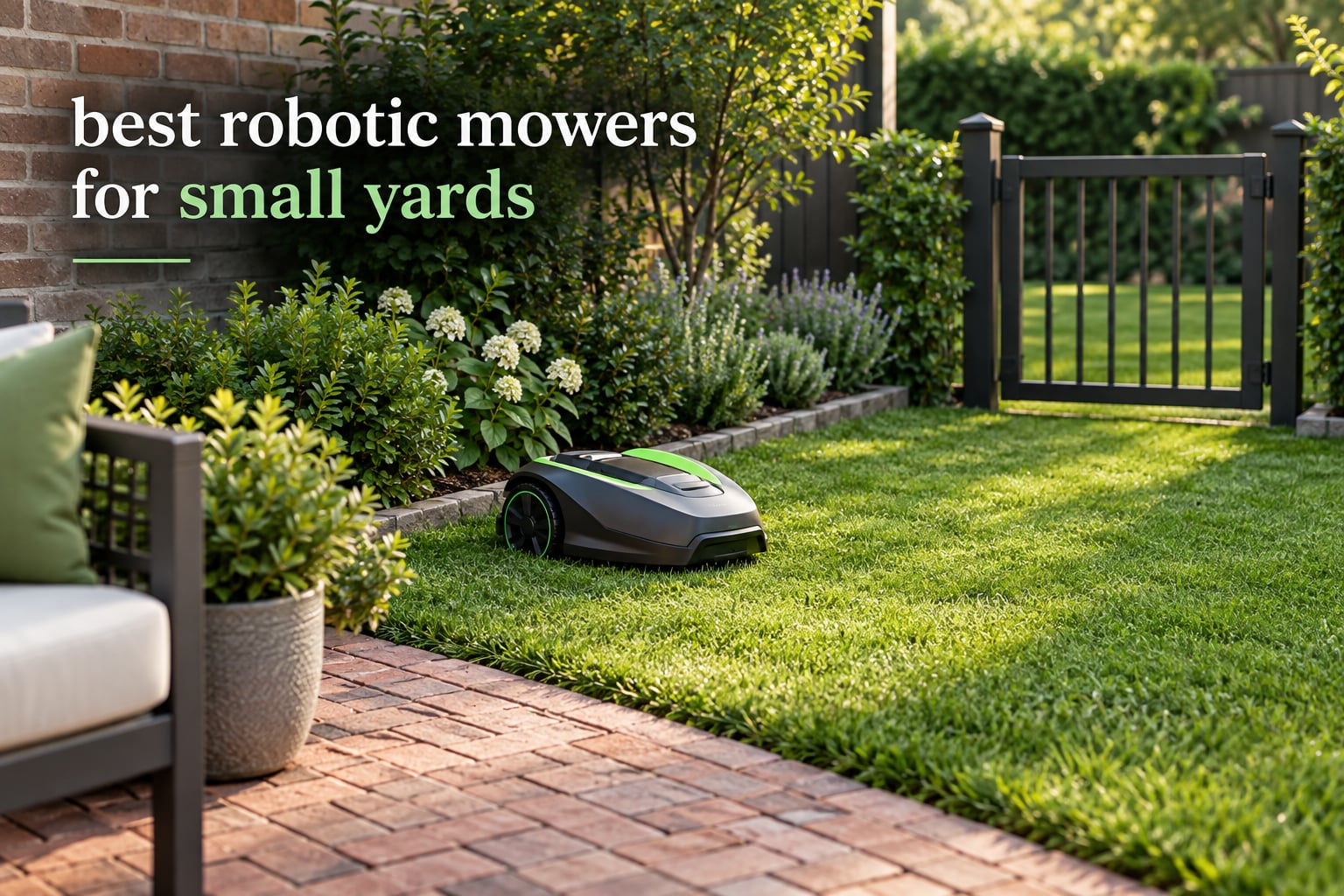
A small yard can be harder to automate than a big open one. That sounds backwards, but the lawns that suit robot mowers best are the wide, treeless, obstacle-free fields you find on larger properties. A compact city lot has the opposite: a gate at 30 inches, a bed of shrubs pressing in on the left, a brick border along the driveway, three fruit trees throwing shade across the middle, and a patio ten feet from the property line where a gas mower at 8 a.m. would start an argument with a neighbor.
That is why picking among the best robotic mowers for small yards is not the same exercise as picking a mower for acreage. Coverage area is the least interesting number on the spec sheet. What actually decides whether a robot handles a small lot is whether it can hold a boundary without a buried wire, get its cutting deck within an inch or two of a fence, navigate a passage narrower than its own turning circle, and find its way home when the signal is patchy. We weighed all of those, plus noise, because a mower running at 60 dB(A) beside a shared patio is a different purchase than the same mower in a back field.
Ten mowers made the cut below, spanning seven brands and both navigation approaches. We also broke down the honest negatives, because the most common complaint in owner threads is not about navigation at all. It is the uncut fringe of grass along fences and beds that still needs a string trimmer afterward, and no mower on this list eliminates that step entirely. Where to start if you want the broader field instead: our general robotic lawn mower roundup covers larger properties, and this one stays focused on lots under a quarter acre.
Table of Contents
Top 3 Best Robotic Mowers for Small Yards in October

Segway Navimow i105N
- RTK plus Vision navigation
- 1/8 acre coverage
- 58 dB(A)
- 150+ obstacle types

YARDCARE V100
- Vision navigation
- Lawns to 1600 sq ft
- 0.8-2.4 inch cut
- Magnetic-strip no-go zones

ECOVACS Goat O1000 RTK
- RTK plus Vision
- 1/4 acre coverage
- TruEdge edge cutting
- 2.3-foot passages
All 10 Best Robotic Mowers for Small Yards in 2026
| Product | Specifications | Action |
|---|---|---|
| Segway Navimow i105N |
|
Check Latest Price |
| YARDCARE V100 |
|
Check Latest Price |
| ECOVACS Goat O1000 RTK |
|
Check Latest Price |
 MOVA LiDAX Ultra 1000 MOVA LiDAX Ultra 1000 |
|
Check Latest Price |
 Sunseeker S4 Sunseeker S4 |
|
Check Latest Price |
 Segway Navimow i206 AWD Segway Navimow i206 AWD |
|
Check Latest Price |
 Dreame A3 AWD Bundle Dreame A3 AWD Bundle |
|
Check Latest Price |
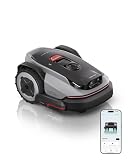 Roborock RockNeo Q110H Roborock RockNeo Q110H |
|
Check Latest Price |
 Sunseeker X3 Plus Sunseeker X3 Plus |
|
Check Latest Price |
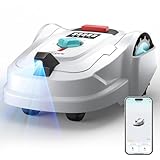 YARDCARE M800Plus YARDCARE M800Plus |
|
Check Latest Price |
1. Segway Navimow i105N – The One With the Longest Track Record Here
Segway Navimow i105N Robot Lawn Mower Perimeter Wire Free 1/8 Acre RTK+Vision Robotic Lawnmower, AI-Assisted Mapping, Virtual Boundary, APP Control, 58dB(A) Quiet, Multi-Zone Management
Coverage: 1/8 acre
Cutting width: 7.1 inches
RTK plus Vision navigation
58 dB(A)
Pros
- Holds navigation under heavy tree cover
- Wire-free app mapping beats laying boundary wire
- Quiet enough for early morning mowing
- Camera recognises 150+ obstacle types
- Dock return and recharging are accurate
- 3-year warranty
Cons
- Stock wheels have weak traction on slopes
- Editing maps means driving the mower
- Vision Fence misses some small objects
- Needs a clear view of sky for the GNSS antenna
We picked the Navimow i105N as our best overall because the number that matters most on a small yard is how many owners have survived a full season with it. Its 391 reviews is the largest verified feedback base in this group by a wide margin, and that is what you want when the risk is a mower that quietly wanders off its map after three months.
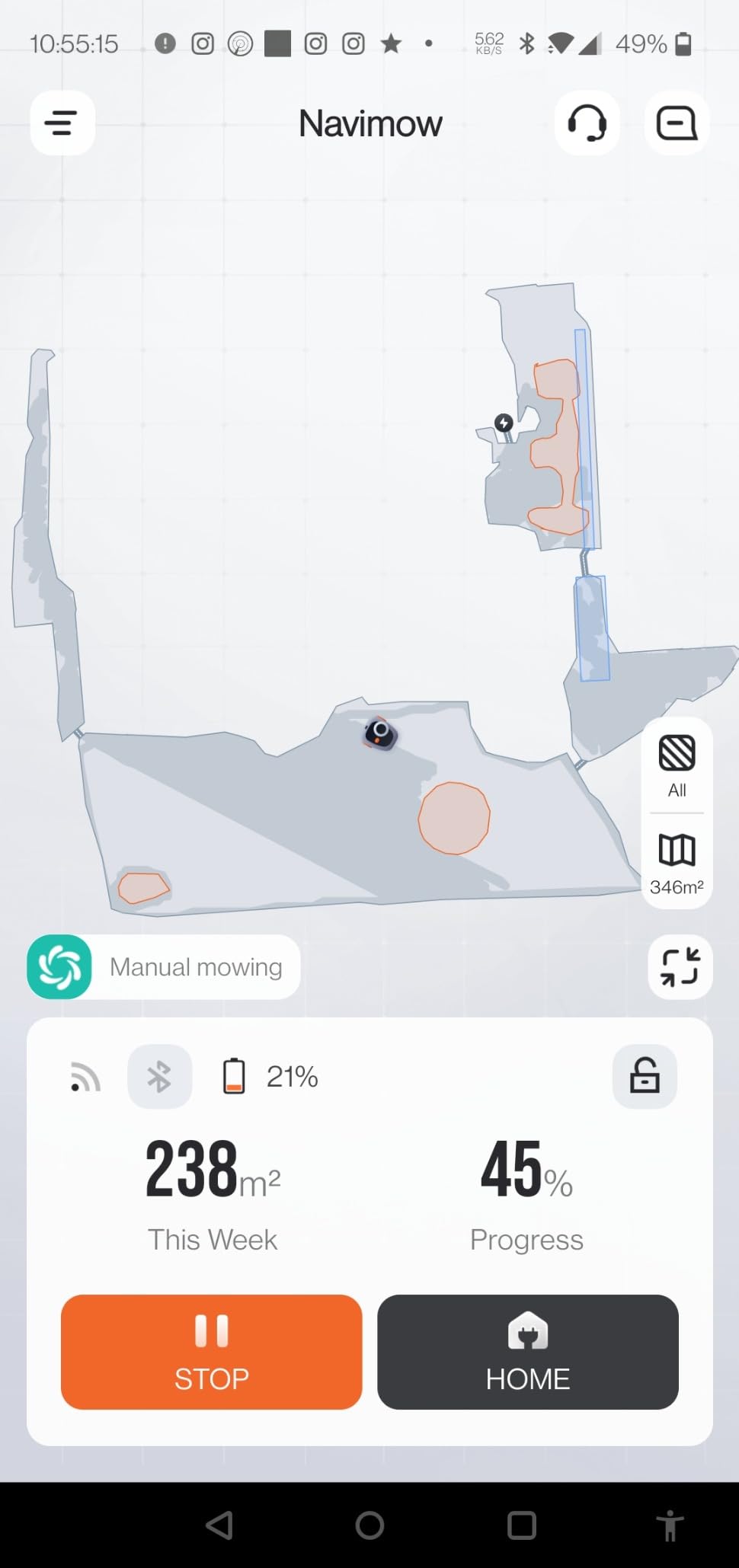
The setup is genuinely wire-free. You set the base station, walk the boundary in the app, and the mower builds a virtual perimeter. Coverage is rated at 1/8 acre, which lines up with a lot of maybe 5,000 sq ft, and it cuts a 7.1 inch width with height adjustable from 2 to 3.6 inches across five positions. At 58 dB(A) it is the quietest machine we list, which is a real advantage when the lawn sits 15 feet from a bedroom window.
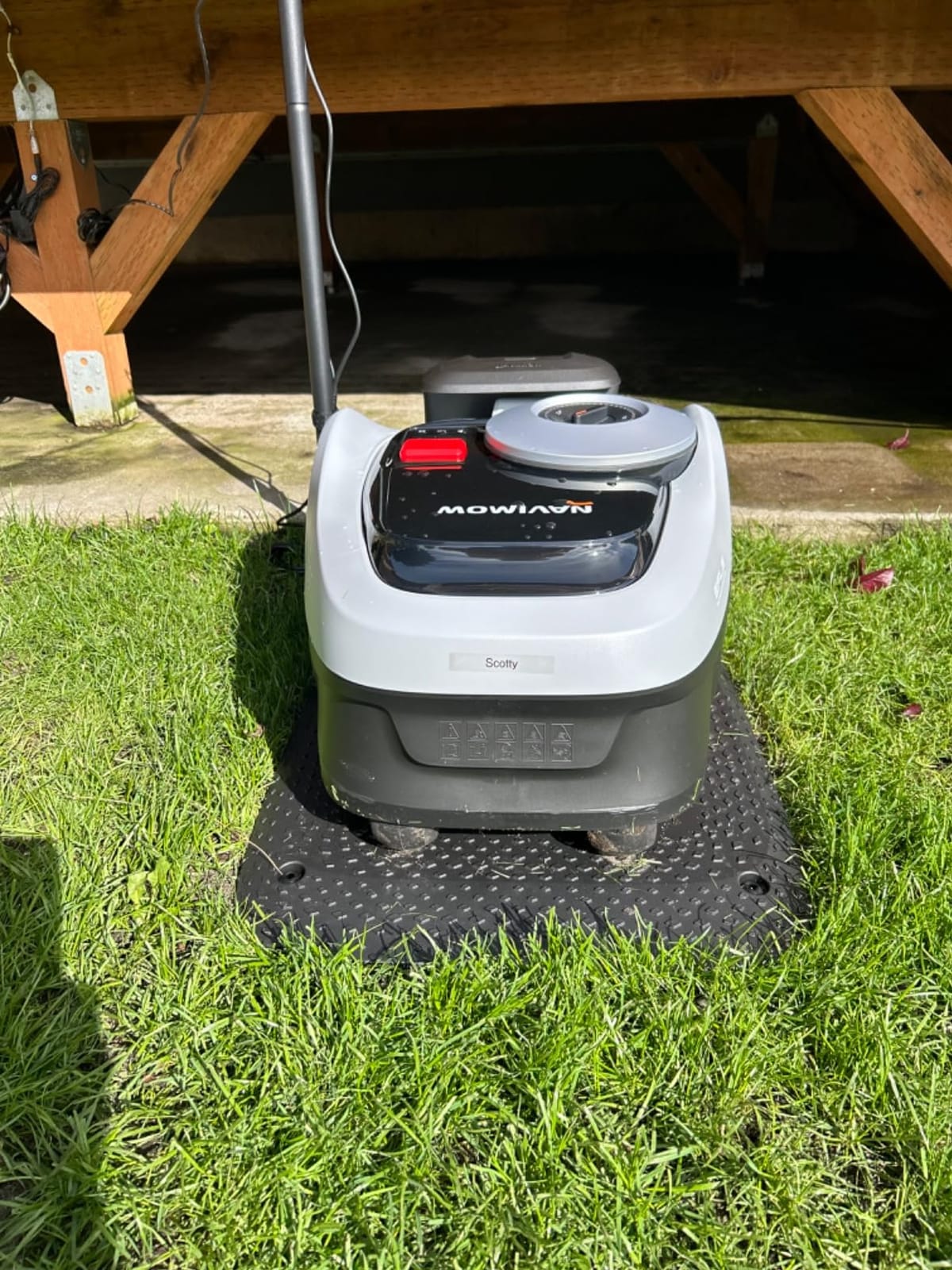
Navigation is RTK combined with a 140-degree vision camera under the brand’s EFLS 2.0 positioning system, and the vision layer is what earns its keep. Pure RTK struggles under dense canopy, and the camera picks up the boundary when the satellite signal degrades. Owners repeatedly single that combination out as the reason it works in shaded, tree-heavy lots rather than only on open ground.
Where it falls short is physical rather than electronic. The factory wheels are smooth and owners on uneven ground report installing off-road tires or traction spikes. Map edits are also inconvenient: you have to move the mower with your hands, there is no satellite overlay editor, and the vision fence occasionally misses hoses or small flags while picking up phantom objects in drainage channels.
When the i105N is the right small-yard mower
Choose it when your lot has heavy tree cover, hedged borders, or a lot of hard-edged geometry around beds and paths. RTK plus vision is the combination that stays on course in those conditions, and 58 dB(A) means you can run a schedule that suits you rather than your neighbors.
It also suits anyone who refuses to dig a perimeter wire. If you have already installed one and want to see the alternatives, our wire-free robot mower guide breaks down the navigation types side by side.
When the i105N is the wrong small-yard mower
Skip it if your lot is under about 4,000 sq ft. A 1/8-acre machine on a postage-stamp lawn wastes battery cycles and money, and a smaller unit like the YARDCARE V100 covers the same ground in a fraction of the time.
It is also the wrong pick for steep, uneven ground out of the box, because the traction fix is an accessory rather than a standard feature. Owners on slopes generally solve it, but you should know that before the first weekend rather than after.
2. YARDCARE V100 – Best for Very Compact Lawns
YARDCARE V100 Automatic Robot Lawn Mower HD Vision for Lawn Max 1600 sq ft
Coverage: up to 1600 sq ft
Cutting width: 6.3 inches
Camera vision navigation
0.8-2.4 inch cut
Pros
- Highest rating in the group at 4.8
- No boundary wire needed
- Magnetic strip sets no-go zones in minutes
- Safety sensor suite included
- Lawns to 1600 sq ft
Cons
- 1600 sq ft ceiling suits only tiny yards
- Random path instead of stripes
- Modest sales volume versus rivals
If your idea of a small yard is a front plot and a strip of side lawn rather than a quarter-acre lot, the V100 is the honest answer. Its 4.8 average across 58 reviews is the strongest rating in this roundup, with the vast majority of owners handing out five stars. That is a real signal on a small sample, but it is still a small sample, so we would not treat it as long-term proof.
Navigation is camera-based, with AI grass and non-grass discrimination so the mower knows where the patio ends and the lawn begins. The 6.3 inch cutting width and 0.8 to 2.4 inch height range suit routine maintenance cutting rather than managing overgrown grass, and it handles slopes up to 20 degrees.
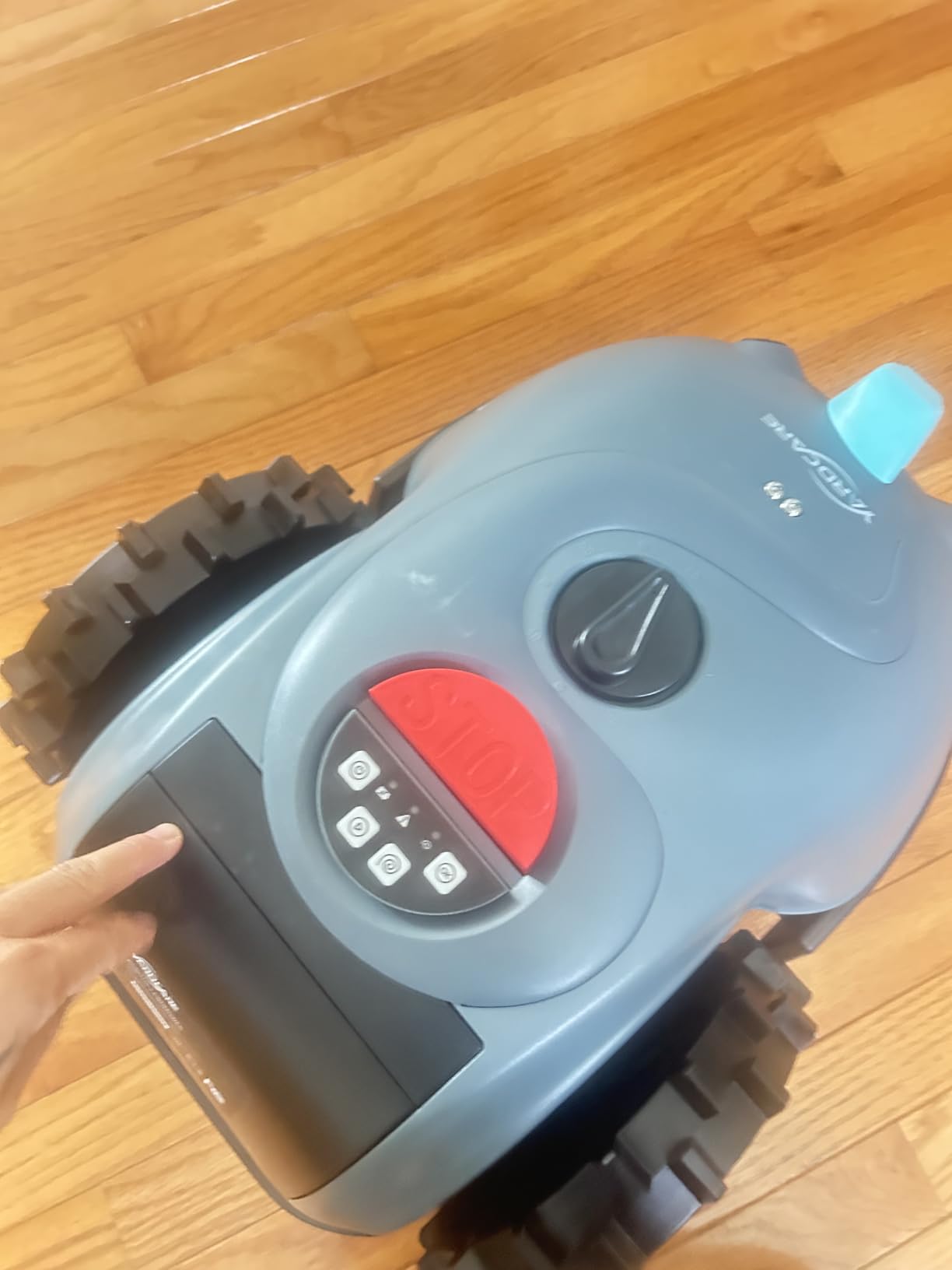
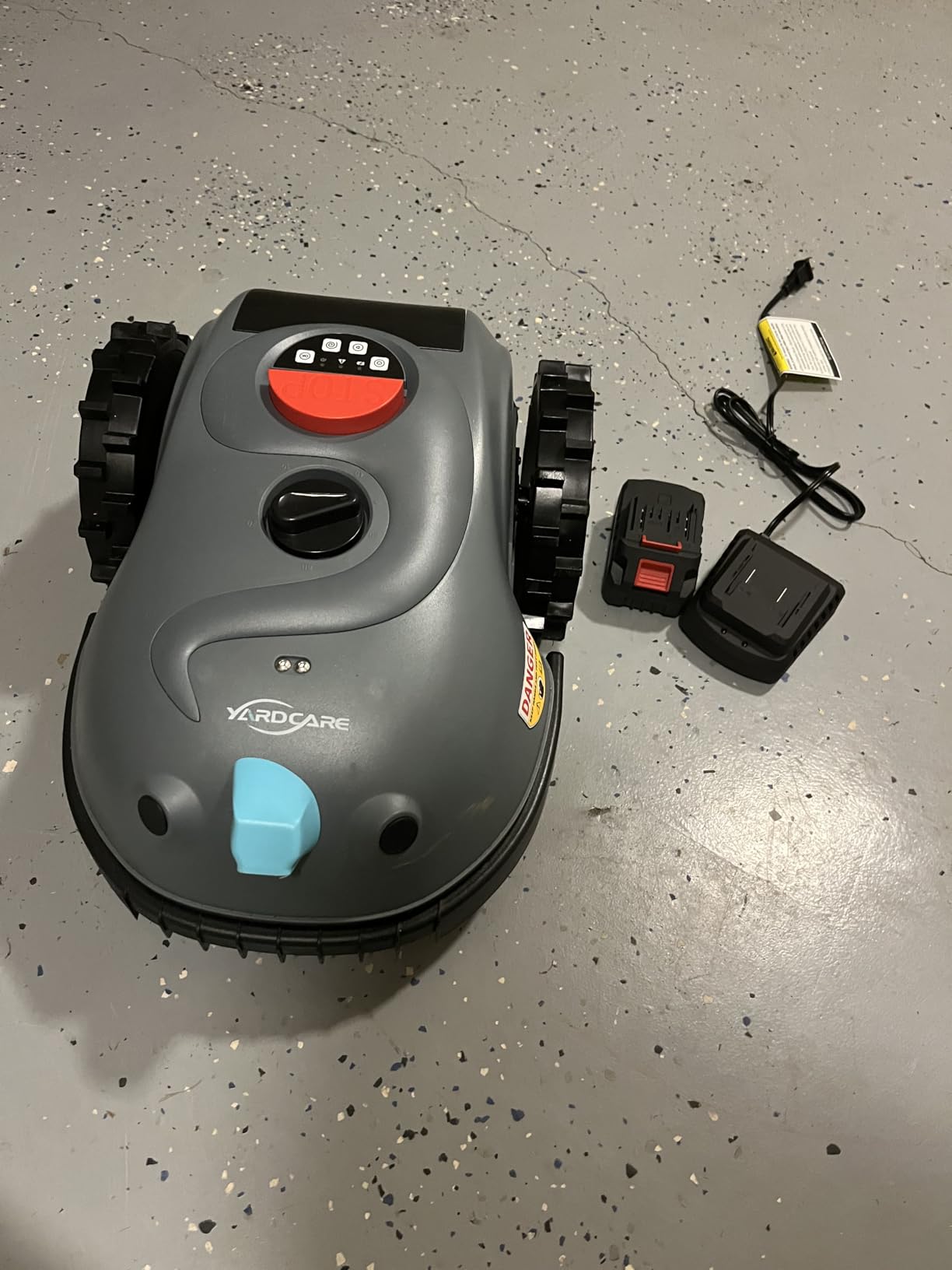
The part we like most for small yards is the included 32 foot magnetic strip. You lay it along the edge of a flower bed or a path and the mower treats it as a no-go zone, no digging and no power required. That solves the one problem wire-free navigation historically handles badly, which is protecting something you would rather the mower never touched.
Safety hardware is unusually complete for this class: a tilt sensor that stops the blades when the machine is lifted, an emergency stop switch, and a rain sensor that pauses mowing. Owners also mention that the box includes a charger, pegs and three spare blade sets, so the first replacement is already in the garage.
Who should buy the V100
Buy it for a genuinely small lawn of up to about 1,600 sq ft, especially if beds, a tree pit or a neighbor’s boundary need protecting. The magnetic strip approach is faster and more forgiving than drawing a virtual boundary in an app, and the safety sensor suite suits yards where kids or pets cross the grass.
It is also the least intimidating machine here. No RTK antenna to site, no satellite signal to chase, no base station calibration.
Who should buy something else
Anyone with more than about a quarter acre, or anyone who wants visible mowing stripes. The V100 follows a random path, which keeps coverage even but gives up the banding pattern that makes a robot cut look deliberate.
If your lawn has a slope beyond 20 degrees or rough ground you drive over regularly, this is not the machine. Look at the AWD options further down instead.
3. ECOVACS Goat O1000 RTK – Best Value With a Real Edge-Cutting System
ECOVACS Goat O1000 RTK Robot Lawn Mower, Wire-Free Robotic Lawnmower for Up to 1/4 Acre, RTK + Vision Navigation, Auto Mapping, TruEdge Edge Cutting, AIVI 3D Obstacle Avoidance, APP Control
Coverage: 1/4 acre
Cutting width: 8.66 inches
RTK plus Vision plus 3D ToF
65-minute battery
Pros
- Setup takes about five minutes
- Handles thick grass well
- Generally inaudible beyond 10-15 feet
- Passages as narrow as 2.3 feet
- Full app zone and schedule control
Cons
- RTK needs high sky view for the antenna
- Supplied antenna pole often too short
- Night mowing limited by signal
- Aggressive edge mode can push it out of bounds
The Goat O1000 RTK covers up to a quarter acre, which is more than most small lots actually need, and pairs RTK with a vision camera and 3D time-of-flight sensing. Owners who already run ECOVACS robot vacuums say the app feels familiar from the first session, and several report setup in about five minutes once the antenna is placed correctly.
What separates it from the other RTK machines here is TruEdge, the edge-cutting system that swings the deck out to reach the boundary line. On a lawn bordered by brick or a low wall, that produces a visibly cleaner finish than a fixed deck that leaves a couple of inches untouched. One owner reports mowing a 1,200 sq ft lawn in roughly 32 minutes.
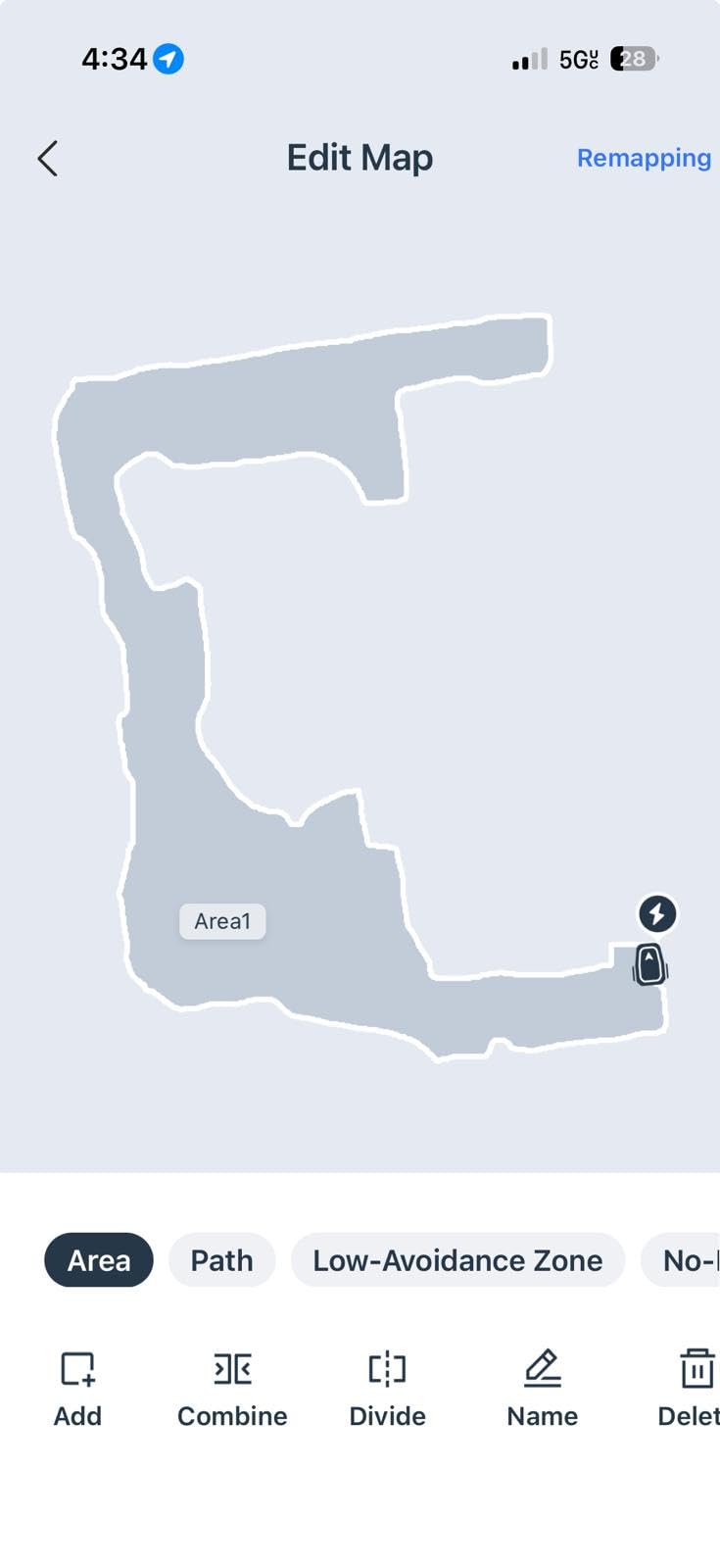
The numbers are good on paper for a compact yard: 8.66 inch cutting width, 45% slope capability, passages as narrow as 2.3 feet, and 1.2 to 3.2 inch cutting height. Obstacle avoidance runs through the AIVI 3D system, which handles furniture, toys, trees and pets. And owners describe it as very quiet, generally inaudible beyond 10 to 15 feet.
The recurring complaint is the antenna. RTK accuracy depends on satellite visibility, and the pole supplied with the mower is often too short for properties where the mower sits low relative to the house or trees. Several owners mounted it 6 to 7 feet up and reported the difference was night and day. Hillside lots also see coverage vary by time of day for the same reason.
What the O1000 RTK does well on small lots
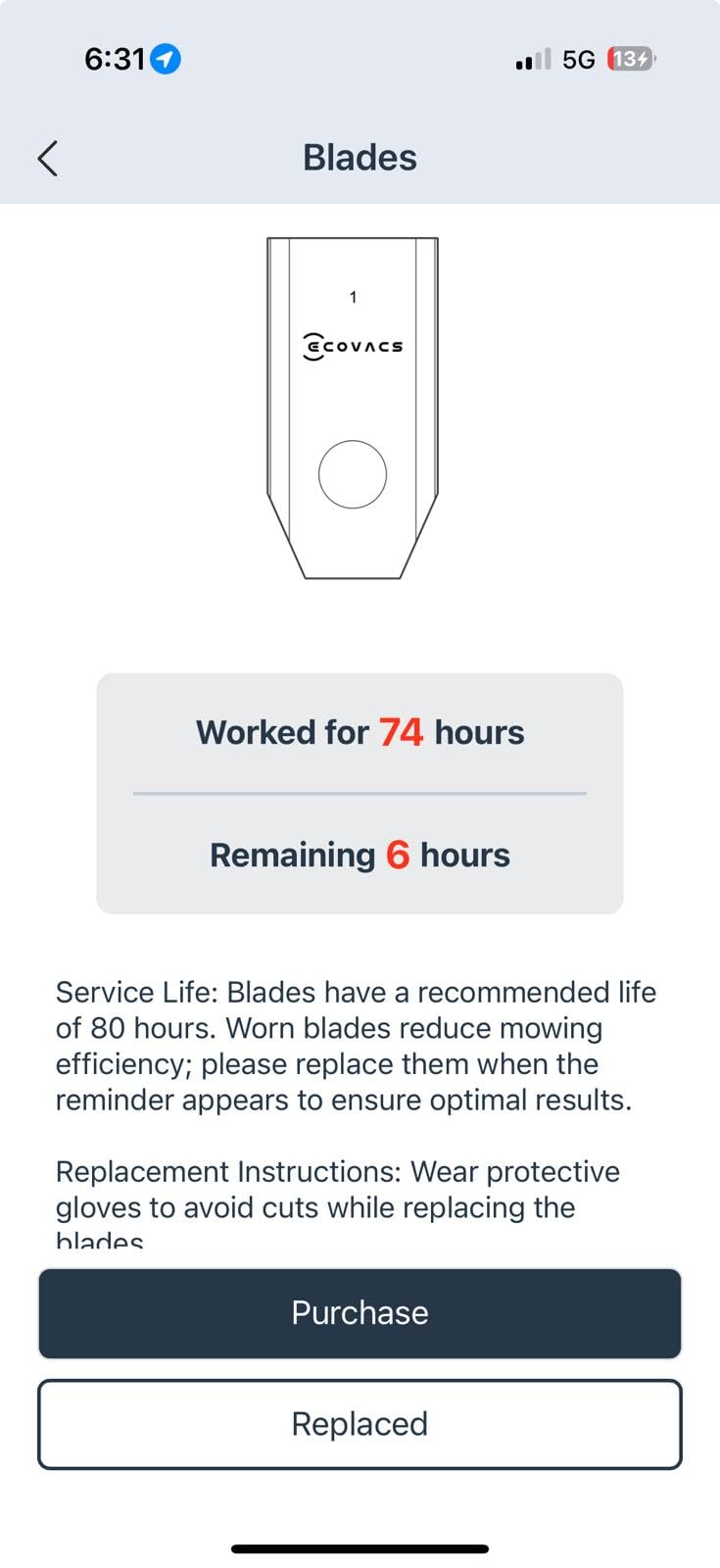
It suits yards with tight internal passages, hard borders and mixed planting, because 2.3 foot passage handling and the TruEdge deck both attack the exact geometry that defeats small-lawn robots. Thick grass performance is another strength owners mention, which matters if you skip a mowing cycle after a wet week.
It is also the easiest entry into the RTK class for existing ECOVACS owners, and the zone, no-go area and cut-height controls cover everything you would set up in the first week.
What to watch out for
Plan the antenna placement before the mower arrives, and expect to buy a taller pole or roof mount. Night mowing is limited on this model because of the signal dependency, so it is not the right pick if an after-dark schedule is the whole point.
Owners also report rear drive wheels tearing soft wet ground, a rain delay that defaults short, and the aggressive edge setting pushing the mower past the boundary where it can snag on rocks. Leave the perimeter for a string trimmer either way.
4. MOVA LiDAX Ultra 1000 – Best Edge Cutting Without an RTK Station
MOVA LiDAX Ultra 1000 Robot Lawn Mower Wire Free for 1/4 Acre, RTK-Free+360° 3D LiDAR+AI Vision Auto Mapping, Zero-Edge Cutting, Cutting Height 1.2″-3.9″, 45% Slope, Up to 150 Managed Zones Dual Maps
Coverage: 1/4 acre
Cutting width: 8 inches
RTK-free 360-degree 3D LiDAR
45% slope
Pros
- Maps without an RTK base station
- Cuts within about 2 inches of walls and hedges
- 300+ obstacle types recognised
- Handles 45% slopes and 23.6-inch passages
- Dual maps cover front and back yard
Cons
- About 10% of ratings are 1-star
- 60-minute battery cycles mean multiple passes
- 3-year warranty but limited long history
Most RTK mowers need a satellite antenna with a clear view of sky, and that is the single install step that trips up new owners. The LiDAX Ultra 1000 uses RTK-free 360-degree 3D LiDAR combined with AI vision to build its map, so there is no base station, no antenna pole, and no dependency on where the house sits relative to the horizon.
For a small yard that matters more than the headline specs suggest. A city lot with a large tree on one side and a fence on the other is exactly the environment where satellite positioning degrades, and LiDAR does not care about that. Owners credit the mapping with working in yards where satellite-based competitors struggled.
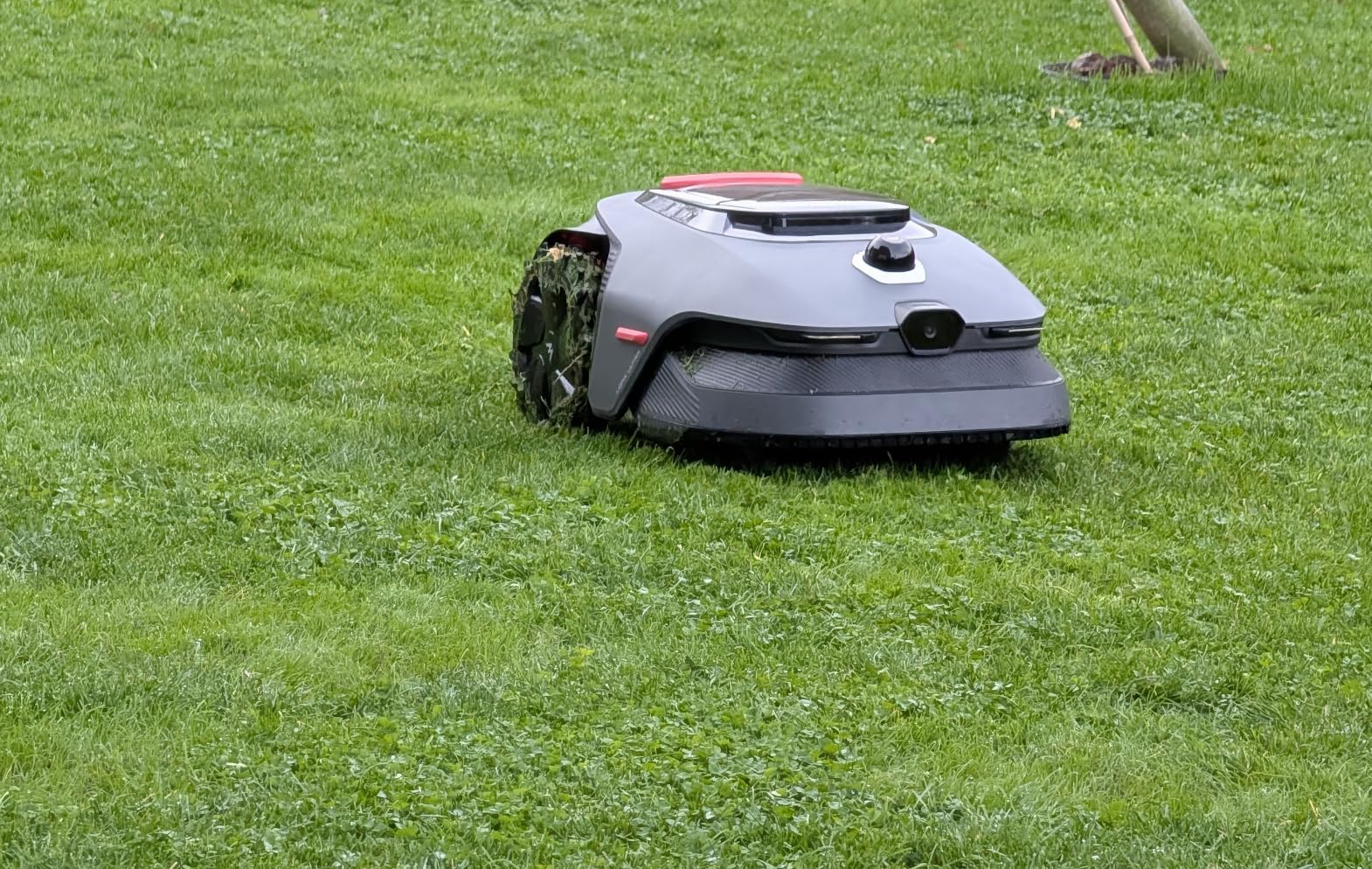
Edge cutting is the standout feature. The UltraTrim 1.0 movable cutting disc reaches within about 2 inches of walls, hedges and raised edges, which on a compact lot with lots of edging is where the visible improvement shows. Cutting height runs from 1.2 to 3.9 inches, the widest range here, and the 8 inch deck covers ground quickly.
It is also physically capable: rear-wheel drive with off-road wheels, 45% slopes, 1.6 inch obstacles and 23.6 inch path width. Obstacle detection covers 300+ types using a 3D point cloud plus vision, and dual maps let you run separate front and back plans without buying a second machine.
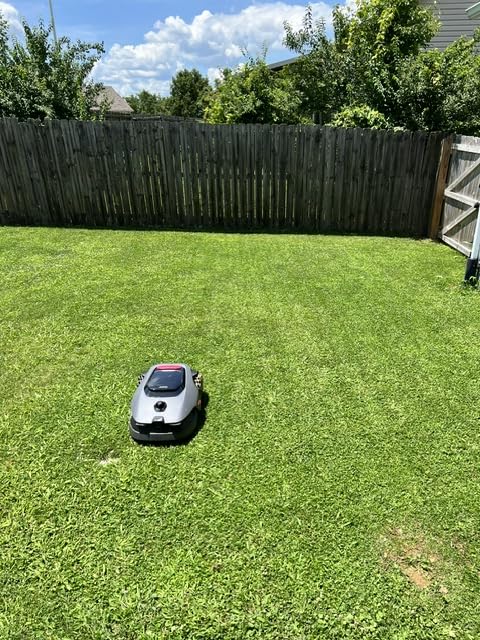
Where the LiDAX Ultra 1000 fits
It is the right call when your lot is walled, wooded or hemmed in by buildings and you want zero satellite dependency. The edge system also makes it the pick if your small yard is defined by borders rather than open grass, since most of your visible lawn sits within a foot of something.
Front and back yard coverage from one unit is a genuine small-property advantage. So is TrueGuard anti-theft monitoring, which is included rather than sold as an add-on module.
Where it disappoints
Roughly 10% of ratings are 1-star, and those reviews point at setup and connectivity rather than cutting quality. If you are risk-averse about early firmware, set aside a weekend for mapping and app setup before you rely on it.
The 60-minute battery runtime also means larger lawns take multiple charge cycles within a day. For a quarter acre that is manageable, but it is a step down from machines with 130-minute runtimes.
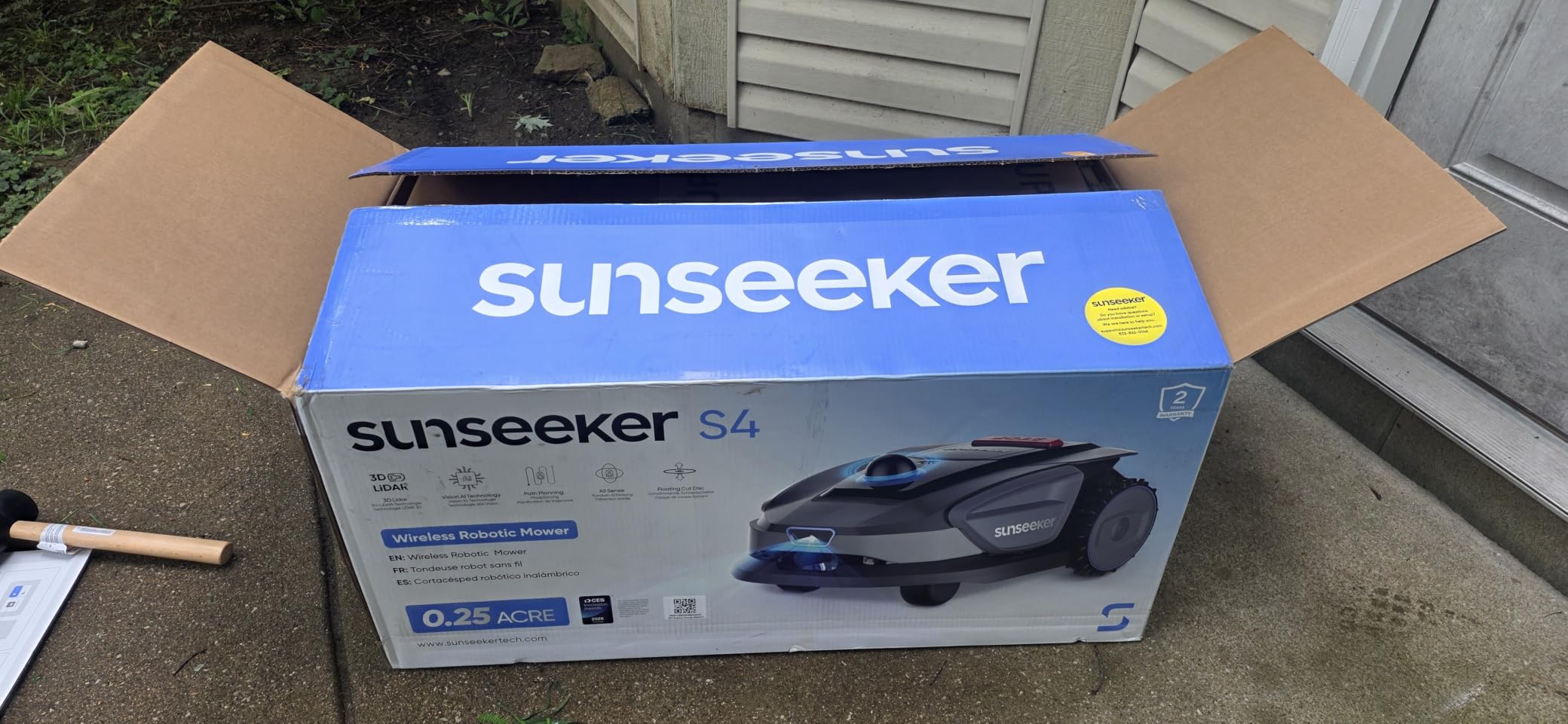
5. Sunseeker S4 – Best for Yards With Dense Trees and Shade
Sunseeker S4 Robot Lawn Mower, 3D LiDAR, Vision AI, 0.25 Acre, Wire-Free
Coverage: 0.25 acre
Cutting width: 7 inches
360-degree 3D LiDAR plus Vision
42% slope
Pros
- Healthy 4.5 average on a 33-review base
- Maps complex yards without base-station calibration
- Plans parallel routes at night and in low light
- Handles 31.5-inch passages and 22-degree slopes
- Five maps with up to 100 zones
Cons
- Only 33 reviews so far
- Smallest review base among the LiDAR models
- 7-inch deck is the narrowest here
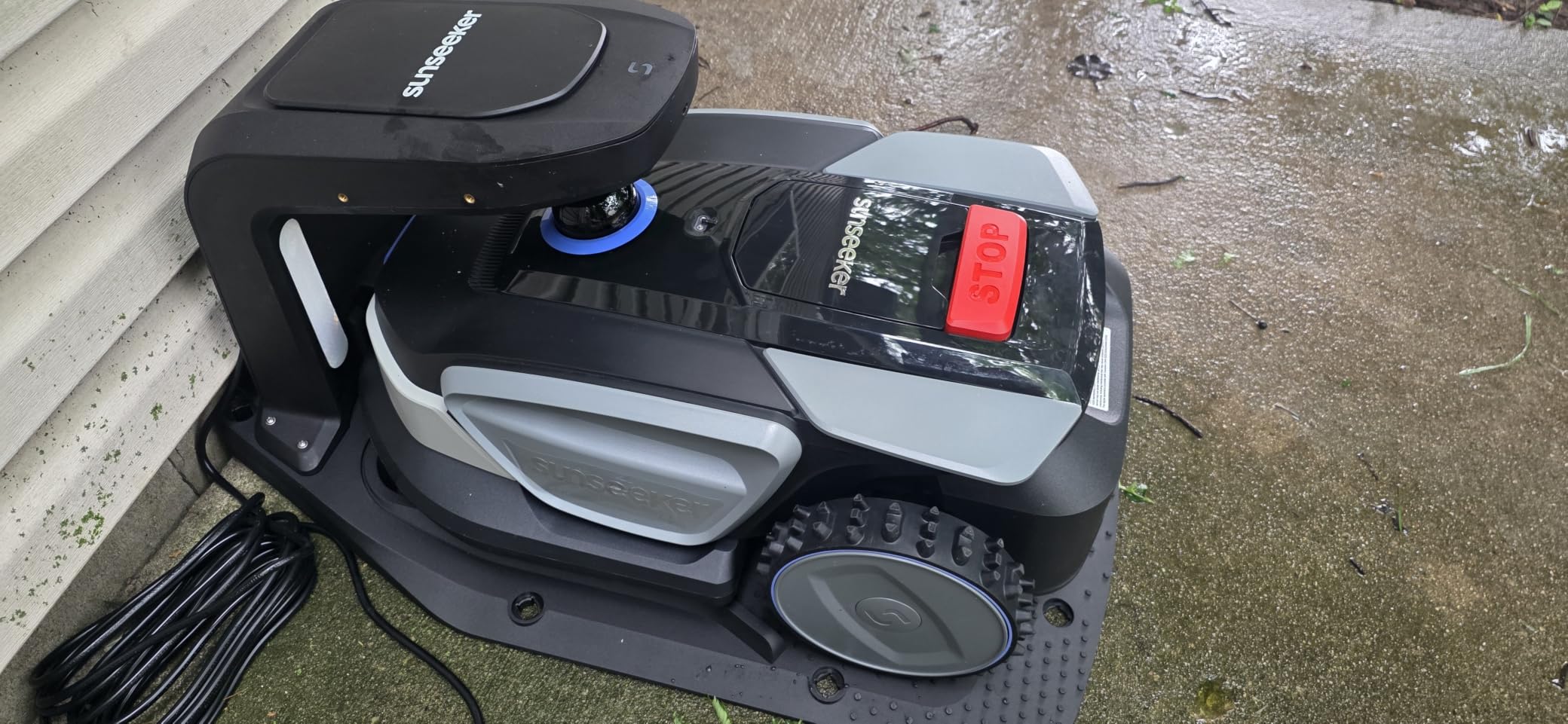
The Sunseeker S4 targets the yard shape that causes the most failures: trees, eaves, shade and weak signal. Its 360-degree 3D LiDAR builds a three-dimensional map, and a 10 TOPS AllSense processor plans parallel routes in daylight, low light and at night rather than degrading to a random path when the light drops.
The rating distribution is the healthiest in this roundup, with 72% five-star and only 2% one-star across 33 reviews. That sample is small enough to treat with care, but there is no widely reported defect showing up in the reviews.
Wire-free mapping happens entirely through the app with no base-station calibration step, and you can store five maps with up to 100 zones and no-go areas. For a small property that means separate schedules for a front lawn, a side strip and a back patch, each with its own cutting height.
Physically it handles 31.5 inch passages, 22 degree slopes and ruts on rear-wheel drive, which covers most residential lots short of genuine hills. Six blades on a 7 inch deck give a 1.6 to 3.2 inch floating cut with a ride-on-edge mode, and it returns to base in rain automatically at 60 dB(A).
What the S4 does better than its rivals
Route consistency. Parallel lines that hold their pattern in low light are the difference between a lawn that looks mown and one that looks patchy, and the AllSense processor is built specifically for that. It also runs a 2-year warranty with US-based support, which matters more than it sounds when something needs a part.
If your yard has a shaded side that a camera-only mower struggles to read, this is a safer bet than a vision system relying on contrast alone.
What gives us pause
Thirty-three reviews is not a long-term record. Two seasons in, the questions that matter are battery longevity, blade motor durability and whether the map survives firmware updates, and none of those are answered yet.
The 7 inch cutting width is also the narrowest of the LiDAR-equipped models here, so a full lawn takes longer than on the MOVA or ECOVACS.
6. Segway Navimow i206 AWD – Best for Slopes on a Small Lot
Segway Navimow i206 AWD Robot Lawn Mower, New i105N, 0.15 Acre, 45% Slopes
Coverage: 0.15 acre
Cutting width: 7.1 inches
All-wheel drive
45% slope capacity
Pros
- AWD handles ground that stops ordinary robots
- Quiet enough that dogs are not frightened
- Auto-levels for an even cut on uneven ground
- Alternating patterns create striping
- Support praised for free parts
Cons
- Auto-mapping fails on some yards
- Maps can be lost if the mower is lifted
- Leaves an unmowed swath along fences
- 19% of ratings are 1-star
Most small-lawn robots are rear- or front-drive with two driven wheels, and they bog down or spin on a slope. The i206 AWD puts motors on all four wheels with stability control, rated to 45% grade. Zero-turn steering lets it pivot without scraping turf sideways, which matters on a banked side yard where a fixed steering geometry would tear the grass.
Owners report that it climbs ground that stopped earlier robots and auto-levels on uneven terrain for an even cut. Several also note it runs quietly enough that their dogs are not disturbed, which is a practical advantage on a small lot with pets.
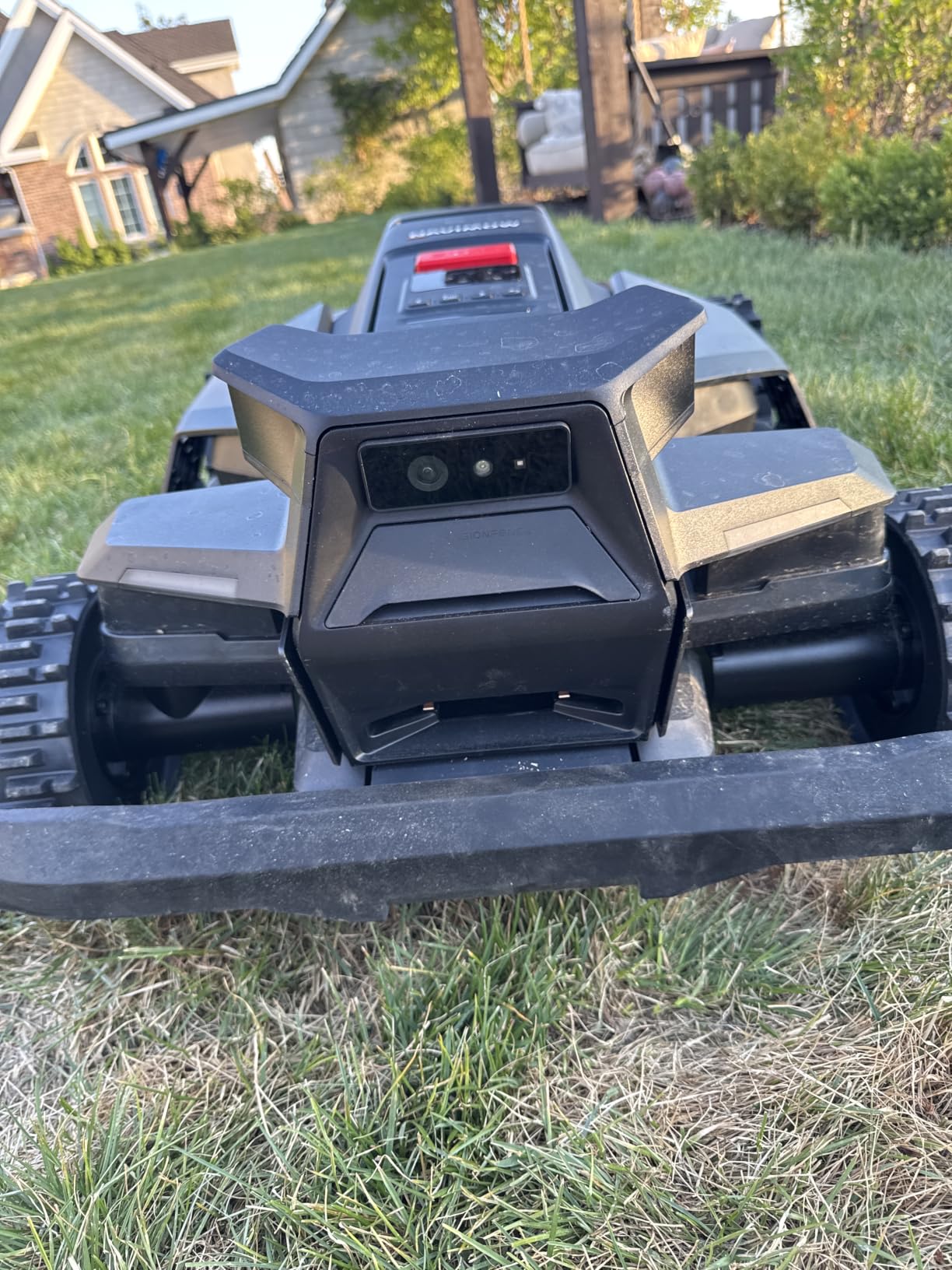
The drive system gives it a 2.5Ah battery covering roughly 1,350 sq ft per charge and a 7.1 inch deck adjustable from 2 to 3.6 inches. Navigation is RTK plus Vision with one-tap auto mapping and no wire system, and you get up to 20 mowing zones with optimised routes and auto-resume charging. Real-time GPS alerts fire if the mower is lifted or leaves its course.
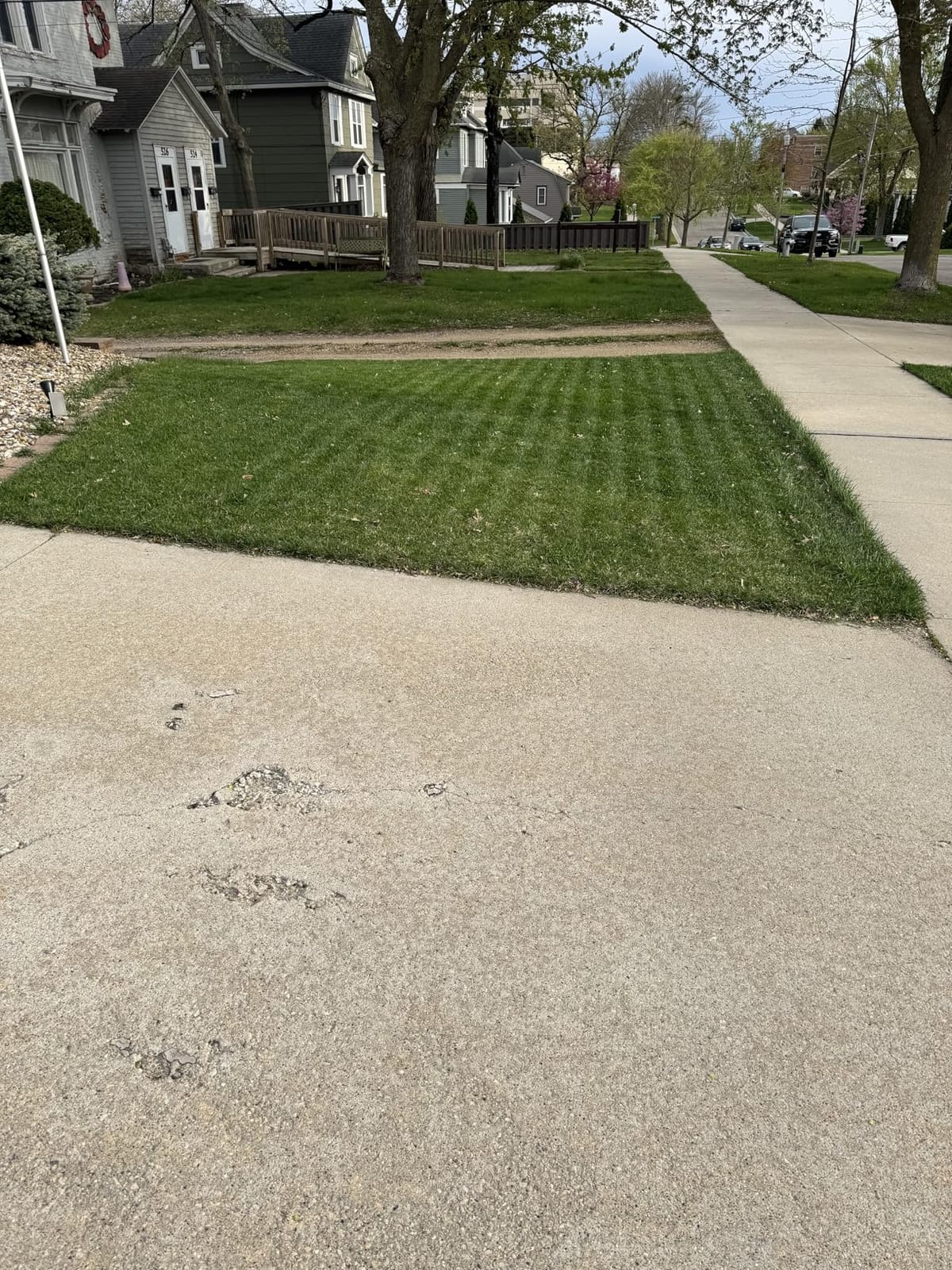
The weakness is concentrated almost entirely in the mapping app. Owners describe auto-mapping that does not save, maps deleted when the unit is lifted mid-setup, and the mower wandering outside mapped zones into mulch beds. Around 19% of ratings are 1-star, which is a meaningful reliability signal.
When the AWD drive earns its place
It makes sense on a lot with a hill, a bank along the property line, or ground that gets soft after rain. On a flat, even small lawn the all-wheel drive is capability you will not use, and that is where the anti-pattern starts.
It is also worth considering if your previous robot got stuck. Stuck-in-a-hollow complaints are the most common failure mode owners describe, and drive plus slope rating is the direct answer.
When to choose a different model
If your yard is flat and you already have good satellite visibility, a two-wheel-drive RTK machine such as the i105N will spend that extra capability on nothing. You are better served by a simpler drive train with better mapping software.
Buyers who value support should read the reviews carefully: satisfied owners describe good service and free replacement parts, while at least one in-app support experience was described as poor.
7. Dreame A3 AWD Bundle – Best for Rough or Uneven Ground
[All-Terrain Wire-Free] DREAME LiDAR Robot Lawn Mower A3 AWD 1000 + Cleaning Set+Blade Set, 360° 3D LiDAR & AI Dual Vision Smart Robotic Mowers for 0.25 Acre
Coverage: 0.25-0.5 acre
Cutting width: 7.87 inches
AWD hub motors
80% slope capability
Pros
- Highest rated of the all-terrain models at 4.7
- Handles 80% slopes and 2.17-inch obstacles
- LiDAR holds accuracy under tree cover and tall walls
- Built-in 4G with a free year
- 45-minute recharge finishes large lawns in a day
Cons
- Most expensive unit in this roundup
- Only 30 reviews and all recent
- Low sales volume so far
- Edge trimmer module sold separately
The Dreame A3 is the most capable machine here on paper: AWD hub motors rated for 80% inclines and 2.17 inch obstacles, which is terrain that stops every other robot on this list. The build uses hard-anodized aluminum and stainless steel rather than the plastic shells used elsewhere, and that shows in the 26.4 pound weight.
For small yards the relevant piece is not the slope rating but the 360-degree LiDAR plus binocular AI vision, which owners credit with holding accuracy under heavy tree cover and next to tall walls. Boundaries that a wall creates are common on city lots, and that is a real failure point for camera-only systems.
![[All-Terrain Wire-Free] DREAME LiDAR Robot Lawn Mower A3 AWD 1000 + Cleaning Set+Blade Set, 360° 3D LiDAR & AI Dual Vision Smart Robotic Mowers for 0.25 Acre customer photo 1](https://eatcreatesleep.net/wp-content/uploads/2026/10/B0H761SNFG_customer_1.jpg)
EdgeMaster 2.0 gets within 1.97 inches, and an optional trimmer module brings that under 1.18 inches. Obstacle detection covers 300+ types. The 5A adapter recharges in about 45 minutes, and the built-in 4G module comes with one free year of service plus an HDR camera for live monitoring and theft protection.
The bundle also includes a cleaning kit and a spare blade set, which is more useful than it sounds because grass builds up on drive wheels and under the deck on any machine.
What justifies the price for a small yard
Two situations. First, a small lot with genuinely rough ground, root systems or a banked edge where a two-wheel-drive machine would stall repeatedly. Second, a property where the 4G monitoring and included service year matter, because that anti-theft feature works out of the box rather than through a paid module.
The AWD also means fewer stuck incidents, and fewer stuck incidents means fewer days of the lawn not being cut.
Why we ranked it seventh on a small-yard list
Thirty reviews, all recent, with limited sales volume. Long-term durability is genuinely unproven on this machine, and we would not ask someone to commit at this level on that evidence alone.
It is also over-specified for most small lots. If your yard is flat and tidy, you are paying for slope capability you will never test. The edge trimmer module is also an extra purchase, which undercuts the edge story slightly.
8. Roborock RockNeo Q110H – Best if Your Narrow Gateway Really Is Narrow
Roborock RockNeo Q110H Robot Lawn Mower, Wire-Free Robotic Lawn Mower with Full-Band RTK + VSLAM Navigation, Auto Mapping, AI Vision Obstacle Avoidance, App Control, 45% Slope, Covers Up to 1/4 Acre
Coverage: 1/4 acre
Cutting width: 8.7 inches
Full-Band RTK plus VSLAM
130-minute battery
Pros
- Navigation and app design inherited from robot vacuums
- Straight and quiet cuts
- Handles hilly lawns and mixed planting
- Headlights allow night mowing
- Zone scheduling works well
Cons
- No LiDAR so edges and boundaries are weaker
- Leaves 1-1.5 feet unmowed along fences
- Overly cautious at gates with clear width
- Maps cannot be edited without walking the mower
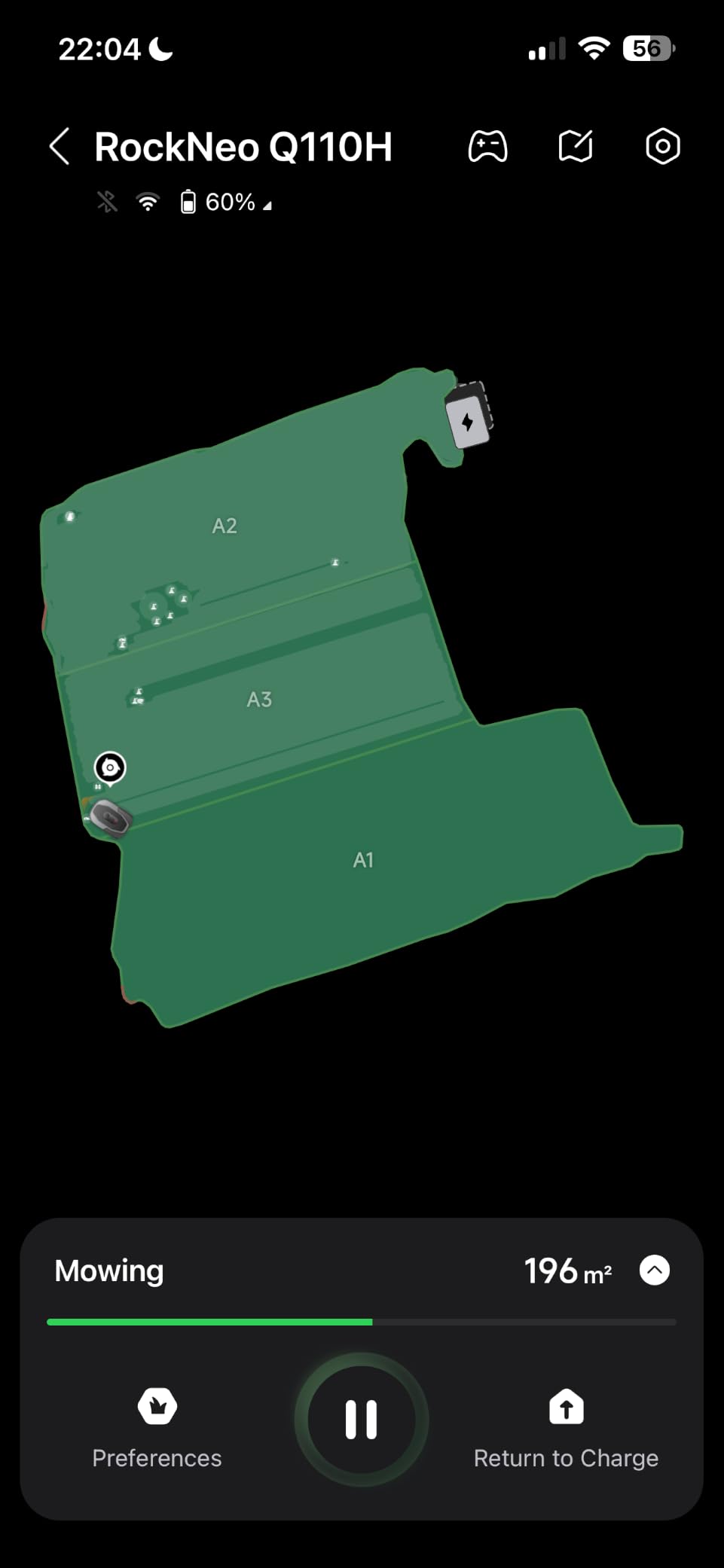
Roborock built robot vacuums before robot mowers, and the navigation engineering shows. The RockNeo Q110H produces straight, parallel cuts and the app is the most polished of any machine here, with zone scheduling, one-time mows and cut-pattern customisation that just work. Owners who already use Roborock vacuums say the interface and connection behaviour feel familiar.
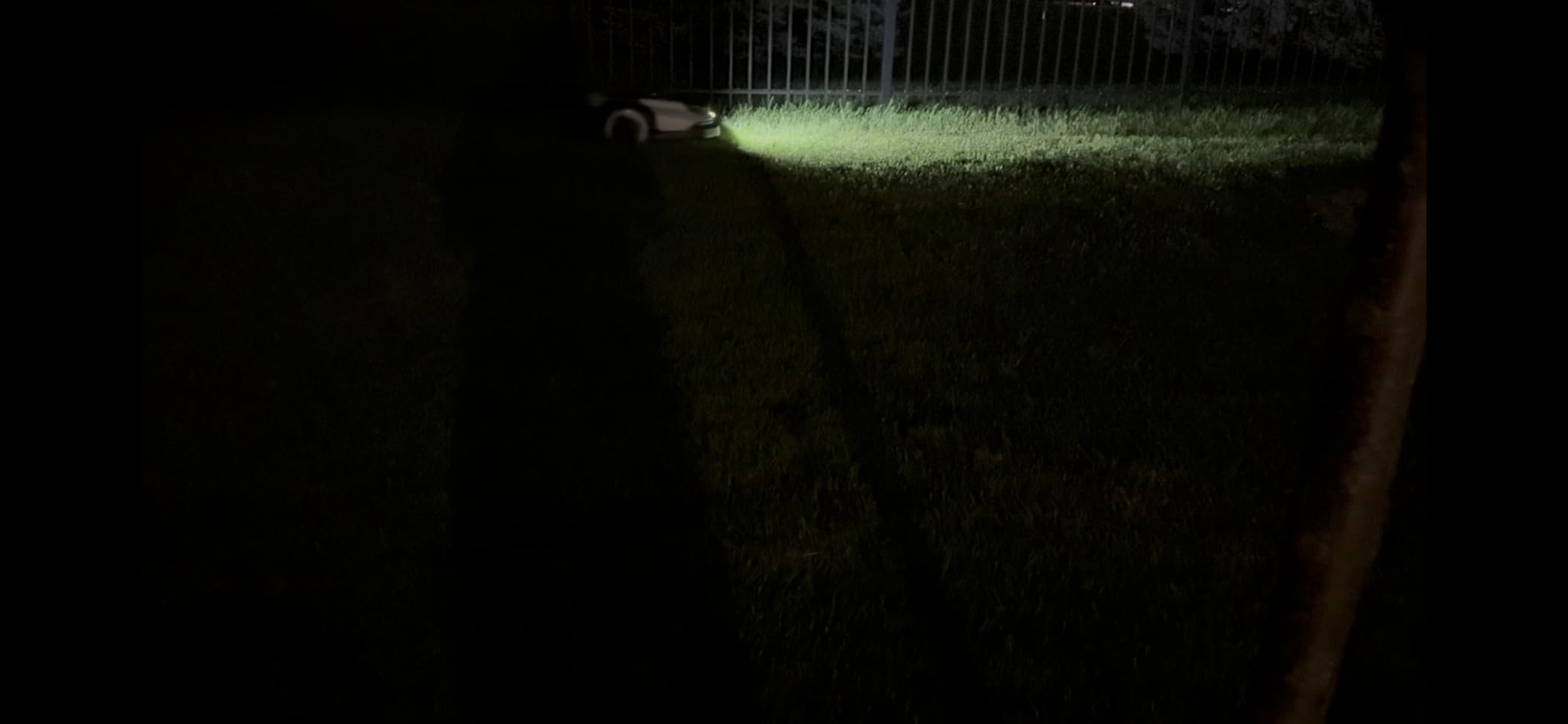
It runs quietly and has headlights, so late mowing is possible, and the 130-minute average battery life is the longest in this roundup. That means fewer charge cycles across an evening, which matters on a lot that has to finish before dark.
Full-Band RTK combined with VSLAM holds position under tree canopies, near high fences and in shade, and passages as narrow as 2.3 feet are within spec. Dual-camera vision avoids people and pets, rolls over low obstacles, and the floating deck handles 45% slopes and 1.57 inch obstacles.
There is one significant omission: no LiDAR in this model, and it shows. Owners report a 1 to 1.5 foot unmowed buffer along fences, trees and the antenna pole itself, plus an oddly cautious obstacle system that refuses to enter gates with plenty of clearance. That last complaint is worth weighing if your route between lawn areas goes through a gate.
Where the RockNeo earns its place
It suits owners who care more about a straight, even, quiet cut and a good app than about finishing the last two inches at a fence line. The long battery runtime and night mowing capability make it a good fit for people who schedule late sessions.
It also handles mixed planting such as clover and uneven ground consistently, which suits a lawn that is not a uniform monoculture.
Where it falls short
If edges are your top priority, this is the wrong pick. A 1 to 1.5 foot buffer along boundaries on a small lot is a large share of the visible area, and you will still be reaching for a trimmer every week.
Map editing requires physically walking the mower, there is no partial zone mowing, and owners report false unit-has-been-lifted errors on slight bumps plus inconsistent re-cutting of missed patches. Traction also struggles in thick St Augustine grass.
9. Sunseeker X3 Plus – Lightest to Carry, Best for Multi-Area Lawns
Sunseeker X3 Plus Robot Lawn Mower, RTK, Vision AI, 0.3 Acre, Wire-Free
Coverage: 0.3 acre
Cutting width: 8 inches
RTK plus VSLAM navigation
60 dB operation
Pros
- Very quiet and usable at night
- Light at 19.9 pounds for carrying between areas
- Cuts evenly across mixed grass and ground cover
- Offset blade gives cleaner walkway edges
- Steady RTK near fences and trees
Cons
- Lowest average rating here at 3.8
- App and firmware reported as buggy
- Can lose connection and fail to dock
- Cannot handle two days of grass growth
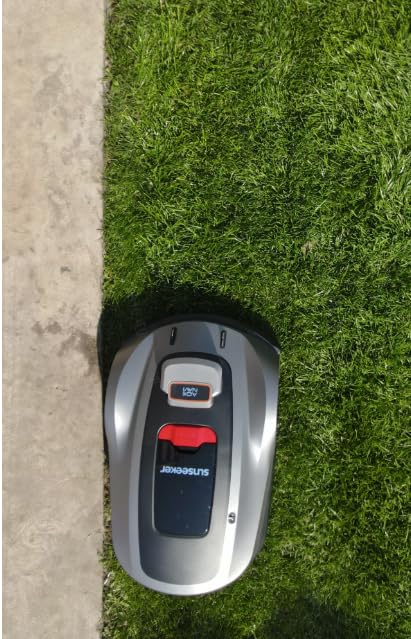
At 19.9 pounds the X3 Plus is the easiest machine here to lift and carry, which matters on a small property split into separate lawn patches connected by a gate. Owners move it by hand to reach a side strip or a back corner that a heavier mower would have to drive to.
Coverage is rated at 0.3 acre or 13,000 sq ft across front, back, side and multi-area lawns, with six saved maps carrying mowing areas, no-go zones, schedules and route history. The ride-on-edge offset blade gives noticeably cleaner lines along walkways and corners, and the 8 inch floating cut adjusts from 1.6 to 3.2 inches.
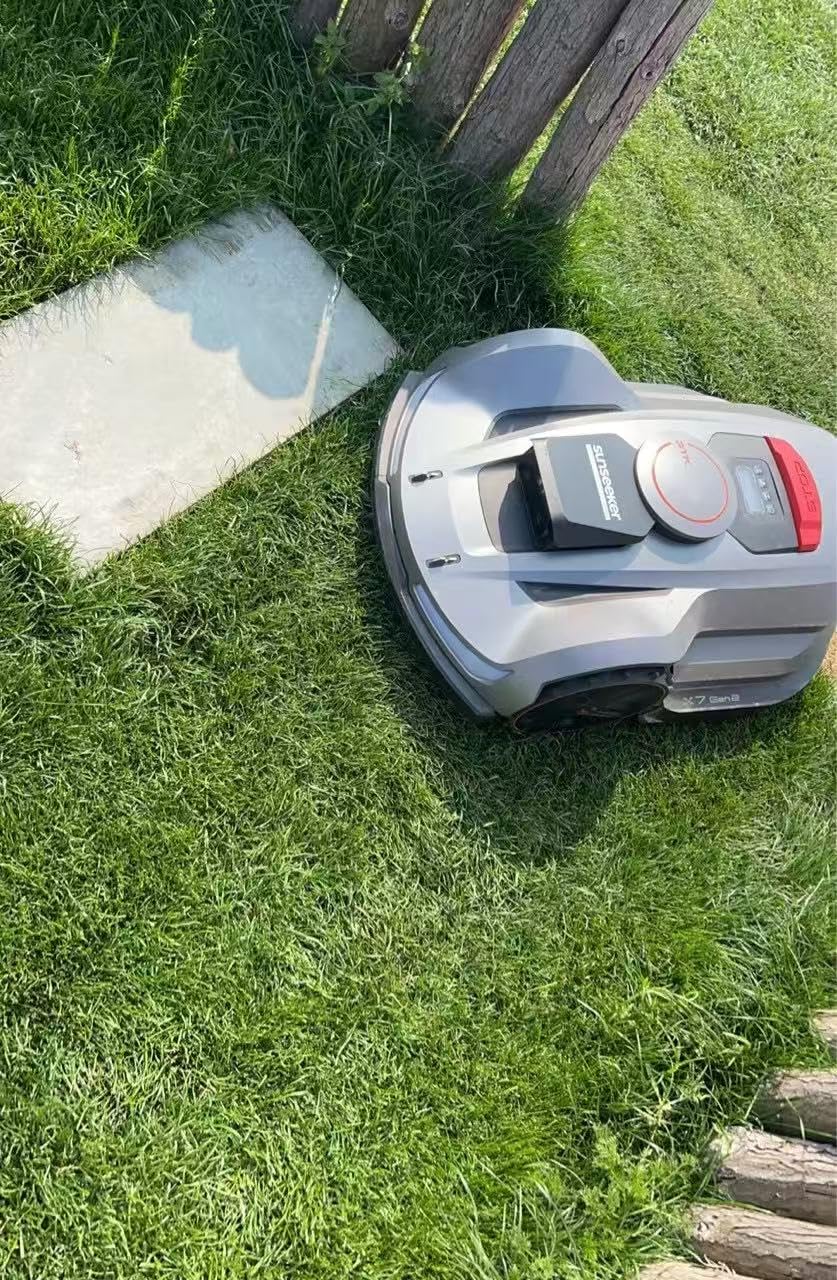
It operates at 60 dB(A) with Wi-Fi, Bluetooth and voice control, and it carries a 2-year warranty with US-based support. RTK combined with VSLAM handles routes to 17 degrees or 30% slope, with vision AI plus ultrasonic sensing for daylight detection.
The problem is software. The 3.8 average is the lowest in this roundup on a 97-review base, which is a meaningful sample. Detailed negative reviews list satellite calibration failures, phantom rain detection, self-locking, deleted hazard zones reappearing and untranslated error strings, and some owners report it losing connection and failing to return to the dock, requiring a manual carry back.
What works well here
Quiet operation on a close-in lot, an offset blade that cleans up walkway edges, and a genuinely manageable weight for a multi-area property. Owners also report steady RTK signal even near fences and under trees, and even cutting across mixed native grass and ground cover.
Positive reviews, including more recent ones, suggest steadier navigation and better app behaviour than earlier reviews reported, so the software picture may be improving.
What to weigh before buying
It cannot handle two days of grass growth, and owners report it stuck on flat lawns with deep grass. That makes scheduling discipline mandatory rather than optional.
The app and firmware complaint list is long and specific, and antenna mounting hardware referenced in the instructions is reportedly not supplied by the company. If you are not comfortable troubleshooting a robot app, a machine with a steadier software reputation is the safer buy.
10. YARDCARE M800Plus – Best Hybrid Mowing Logic, Least Proven
YARDCARE M800Plus Cordless Robot Lawn Mower with GPS + Visual Navigation, Bow-Shaped Path Mowing, APP Control, 4.0Ah Automatic Robotic Lawnmower for 1/5 Acre, Obstacle Avoidance, Height Adjustment
Coverage: up to 1/5 acre
Cutting width: 7.08 inches
GPS plus 3D vision
4.0Ah battery
Pros
- Mixes ordered row mowing with random gap-filling
- HD camera separates grass from pavement cleanly
- Handles 35% slopes
- Spot spiral mode for patchy growth
- App scheduling with OTA updates
Cons
- Only 4 reviews published
- Grass over 2.6 inches needs manual trimming first
- Blades need regular replacement
The M800Plus uses a hybrid mowing logic that is genuinely different from what most competitors do. It runs about 40 minutes of ordered row mowing for a clean pattern, then switches to 60 minutes of random movement to fill gaps, which is a practical answer to the stripe-versus-coverage tradeoff.
Navigation is GPS plus 3D vision with an HD camera that separates grass from non-grass surfaces, so a paved path and a patio do not need to be mapped as no-go zones. The 135-degree AI camera detects 150+ obstacle types and reroutes in real time, and it handles slopes up to 35%, or 20 degrees.
Cutting height adjusts from 0.8 to 2.4 inches on a 7 inch three-blade disc, and there is a spot spiral mode for dense growth in a single patch. Coverage is up to 8,611 sq ft, roughly a fifth of an acre, from a 4.0Ah battery, and the app handles scheduling, pattern selection and over-the-air updates.
All four published reviews are five stars and describe the same experience, which is encouraging but far too little evidence to build a confident recommendation on. Coverage at about a fifth of an acre also sits in an awkward middle, above typical small lots and below where the larger machines start to pay off.
What appeals about the design
The hybrid pattern is the kind of detail that shows the manufacturer thought about how a lawn actually looks after two weeks of mowing. The grass and non-grass discrimination also removes the most tedious part of phone-based mapping, which is walking the patio edge by hand.
Spot spiral mode is genuinely useful on a small lot where one corner gets extra traffic and grows faster than the rest.
Why we placed it tenth
Four reviews is not a reliability record, and the perfect 5.0 average reflects that rather than a proven track record. Reviewers also flag that grass over 2.6 inches must be cut by hand before the first run and that blades need regular replacement.
If you are comfortable being an early adopter on a small, simple lawn, this is a reasonable way into wire-free mowing at a modest outlay. For a more demanding lot, pick something with a longer review history.
How We Picked and Ranked These Robot Mowers
We scored every machine on five criteria with published weights, then ranked on the total. Publishing the weights matters because it shows what we chose to prioritise for small yards specifically, which is not the same list you would use for acreage.
Setup and navigation, 30%. Whether it runs without a buried wire, how long mapping takes, and whether it holds position under trees and beside walls. Weighted heaviest because installation is the most common point of failure and the least reversible. A perimeter wire cannot easily be re-routed if your yard layout changes later.
Cut quality and coverage, 25%. Deck width, cutting height range, edge proximity, and whether coverage is realistic for a lot under a quarter acre. Manufacturer coverage claims tend to assume ideal conditions, so we cross-checked them against owner reports.
Obstacle handling and smart features, 20%. Object detection breadth, no-go zone control, zone scheduling, and anti-theft that works without a paid add-on.
Quiet operation, 15%. Stated dB(A) and owner accounts of whether the machine is usable beside a patio or shared fence line. Small yards sit close to neighbors in a way large lots do not.
Value, 10%. Capability against what the mower is actually rated to do. We deliberately penalised machines bought well above the lawn size they serve, since wasted capability is real money.
Reliability signal counted separately from score, because a 4.5 with 30 recent reviews tells you less than a 4.1 with 391. We weighted verified review volume and the share of 1-star ratings when placing products in the final order.
Buying Guide: Wire-Free vs Boundary Wire Navigation
Wire-free is the right default for most small yards in 2026. It removes the single most common complaint we found about older installs, which is that burying a perimeter wire is an afternoon-long chore you cannot easily undo.
Within wire-free there are three approaches, and they fail in different ways. RTK-GNSS uses satellite positioning for centimetre-level accuracy and is the most accurate option, but it needs a clear view of sky, so tall trees, walls and buildings cause signal loss and mapping errors. LiDAR spins a sensor to build a map of physical boundaries and needs no satellite signal at all, making it the most reliable in built-up areas, at the cost of a higher price. Vision cameras read grass edges and boundaries visually, which is cheapest and works on simple open lawns, but struggles in low light and with low-contrast boundaries.
The practical middle ground is what several of our picks do: RTK with a vision or LiDAR fallback. The LiDAX Ultra 1000 and Sunseeker S4 use LiDAR-first mapping with no antenna at all, while the i105N and ECOVACS O1000 pair RTK with a camera so the machine keeps working when the satellite signal fades.
If you want the full technical comparison of these approaches, our guide to robotic mowers without a perimeter wire goes deeper on setup times and accuracy.
Buying Guide: Match the Mower to Your Actual Lawn Size
Buy the smallest mower that covers your lawn with headroom. Oversized capability on a small flat lot is the most common purchasing mistake we see, and it usually means paying more for a battery and drive train you never stress.
Under about 1,600 sq ft, a compact camera-navigation machine like the YARDCARE V100 covers the lawn in one cycle and stops. Between roughly 1,600 and 5,000 sq ft, an RTK plus vision unit such as the i105N or the i206 AWD is the comfortable middle. From 5,000 to roughly 10,900 sq ft, quarter-acre machines like the ECOVACS O1000 RTK, MOVA LiDAX Ultra 1000, Sunseeker S4, Roborock RockNeo and the M800Plus fit properly.
Also measure the narrowest point between lawn areas before you choose. Three of these machines specify passage capability of 2.3 feet, the Sunseeker S4 handles 31.5 inches, and the MOVA handles 23.6 inches. If your gateway is under 30 inches, cross-check that number before ordering.
And check the antenna question early. If you are installing an RTK model, find out where the antenna pole can physically go with a clear sky view, because owners repeatedly report the supplied pole being too short and the fix being a roof or wall mount 6 to 7 feet up.
Buying Guide: Edge Trimming and Why Small Yards Feel It Most
Edge quality is the weakest point of every robot mower, and it is the most common complaint owners report after everything else works. No machine on this list eliminates the string trimmer from your routine entirely.
On a small lawn the issue is proportion. If 40% of your grass sits within two feet of a fence or a bed, the uncut fringe is a large share of what you actually look at, and it is the first thing a neighbor notices. On a bigger field, the same 6 inches along the perimeter is invisible.
Three mechanisms narrow that fringe here. The MOVA LiDAX Ultra 1000 uses a movable cutting disc that reaches within about 2 inches of walls and hedges. The ECOVACS Goat O1000 RTK uses TruEdge, which swings the deck out to the boundary. The Roborock RockNeo Q110H has no such system, and owners report a 1 to 1.5 foot unmowed buffer along fences and trees, which is exactly the gap we would expect without an edge mechanism.
A practical habit helps more than any spec: run the mower every 2 to 3 days, as owners recommend, so clippings are short enough to disappear back into the lawn. Longer intervals leave visible clippings that owners report as the second most common irritation after edge gaps.
Buying Guide: Obstacle Avoidance and Pet Safety
Object detection varies widely here, from 150+ recognised types on the i105N, V100, M800Plus and X3 Plus, to 300+ on the MOVA LiDAX Ultra 1000 and the Dreame A3. More recognised types does not automatically mean fewer incidents, since detection quality depends on sensor type as much as count.
Camera and LiDAR based detection can steer around an object before contact. The V100 adds a tilt sensor that stops the blades when lifted, an emergency stop switch and a rain sensor. The Dreame A3 includes an Animal-Friendly mode, and its built-in 4G with HDR camera allows live monitoring rather than blind automatic mowing.
For pets and children, do not treat any of these machines as babysitters. A tilt sensor and a mechanical stop are backstops, not supervision. The combination most owners trust is daytime-only scheduling plus blade-stop safety hardware plus a visible boundary of some kind.
Watch for over-cautious behaviour too. The Roborock RockNeo is reported to refuse gates that clearly have enough clearance, which can leave part of a lawn unmowed even with nothing in the way.
Buying Guide: Slope Capability, Noise and Anti-Theft
Slope ratings are quoted inconsistently, as both percent and degrees. For reference, 20 degrees is about 36% grade, 22 degrees about 40%, and the top-rated machines here run from 45% up to 80%. Flat urban lots need very little. If your yard has one banked edge or a corner that feels noticeably steep, rear-wheel drive is usually enough, and all-wheel drive only matters past that.
Noise sits between 58 and 60 dB(A) across this group, which is a narrow spread but a meaningful one on a close-in lot. If your lawn borders a bedroom window or a shared patio, the quieter end of that range is worth paying attention to. Owners of the i105N describe early morning mowing as practical, and ECOVACS owners report the Goat O1000 RTK is generally inaudible beyond 10 to 15 feet.
Anti-theft splits into two things: locking the machine so a passerby cannot drive it away, and tracking it if it disappears. PIN lockout and alarms are common. GPS tracking is often a paid 4G add-on module, except on the Dreame A3 where 4G is built in with one year of service included. Check whether tracking is included or sold separately before you decide theft protection matters enough.
On batteries, runtime figures range from 60 to 130 minutes per charge. Longer runtime means fewer charge cycles, which matters most if you want to mow after dark. Owners also recommend cleaning grass off the wheels periodically, since buildup is a routine maintenance item on every model here rather than a fault with any particular one.
What Owners Say After a Season With a Robot Mower
Across the owner discussions we reviewed for this roundup, the complaints are remarkably consistent, and none of them are about mowing badly. They are about edges, software and getting stuck.
Edge trimming is the top complaint everywhere. People running a lawn service report that customers call whenever a spot near a wall or bed gets missed, which is why professionals still send someone with a string trimmer behind the robot. This is the honest limit of the automation, and budgeting for a few minutes of trimming a week is the right expectation.
The second theme is mapping reliability. Users report losing maps, having to re-do them, and needing several cycles of app tuning before performance settles. Antenna placement is the usual culprit, and users say they spend real time supervising setup to get a reliable signal.
The third theme is terrain. Owners report mowers getting stuck in hollows and uneven ground in places where their own push mower wheels also bog down. On heavily wooded or shaded lots, satellite signal loss causes mapping errors.
Also worth knowing: robots need a lawn that is already kept short, and mud plus grass buildup on the wheels needs periodic manual cleaning. The people happiest with these machines report running them every 2 to 3 days and accepting a weekly trim. The ones who complain most tend to be running a long interval on an uneven lot with satellite signal problems.
First-Week Setup Checklist for a New Robot Mower
Nearly every owner complaint we found traces back to setup done too quickly. Budget the first weekend rather than the first evening, and work through these steps in order.
1. Place the base station with clear sky and power nearby. If your mower uses RTK, this is where the antenna goes too. Check the pole height against your obstruction angles before the first map.
2. Charge fully before the first run. Several machines ship partially charged, and a mapping session started on a low battery is a common cause of incomplete maps.
3. Map the boundary properly. Walk the full perimeter including every island. Do not lift or tilt the mower mid-session, since that is the reported cause of deleted maps on more than one model.
4. Set no-go zones before the first mow. Beds, birdbaths, play areas and the compost pile. For a camera-navigation mower, this is where the magnetic strip earns its place.
5. Run one supervised test pass. Watch where it hesitates or stops. Note gateways it refuses to enter and edges it leaves, then adjust zones rather than repeatedly re-mapping.
6. Tune the schedule to 2 or 3 day intervals. Shorter intervals keep clippings small enough to disappear into the lawn and reduce the load on the blade.
7. Set the PIN and theft protection. Decide now whether GPS tracking through a 4G module is worth the add-on for your property.
Frequently Asked Questions
What are the negatives of robotic lawn mowers?
The recurring negatives are edge trimming, which no machine eliminates fully, mapping software that sometimes loses maps or needs several tuning cycles, getting stuck on hollows and uneven ground, and the need for periodic manual cleaning of grass off the wheels. Robots also need a lawn already kept short and cannot recover an overgrown yard on their own. Boundary wire installation remains an onerous chore on older wired units.
What type of mower is best for a small lawn?
For a lawn under about 1,600 square feet, a compact camera-navigation machine such as the YARDCARE V100 is enough. Between roughly 1,600 and 5,000 square feet, an RTK plus vision unit like the Segway Navimow i105N is the comfortable fit. Up to a quarter acre, quarter-acre models such as the ECOVACS Goat O1000 RTK or MOVA LiDAX Ultra 1000 cover the lot in a single day.
Which robotic lawn mower is best for cutting edges?
Edge proximity comes down to a moving deck. The MOVA LiDAX Ultra 1000 uses a movable disc that cuts within about 2 inches of walls and hedges, and the ECOVACS Goat O1000 RTK uses TruEdge to swing the deck out to the boundary line. The Dreame A3 reaches about 1.97 inches with EdgeMaster 2.0. Mowers without an edge mechanism can leave a foot or more along fences.
Do robot mowers cut to the edge?
Not completely. Fixed-deck mowers typically leave the cutting width as a buffer, so anything within 6 to 8 inches of a fence or wall is uncut. Only a mower with a side-swinging or movable cutting disc gets closer. Expect to still run a string trimmer around the perimeter weekly regardless of which robot you buy.
Which robot mower is best for uneven terrain?
For genuinely rough ground, the Dreame A3 with all-wheel drive hub motors is rated for 80% slopes and 2.17 inch obstacles, well beyond anything else listed. For a moderate hill, the Segway Navimow i206 AWD and MOVA LiDAX Ultra 1000 handle 45% grade, and the Sunseeker S4 covers 42%. On a flat lawn none of that capability is needed and a simpler drive train is the better buy.
Do robot mowers need a perimeter wire?
No, not with a modern wire-free model. Every mower in this roundup maps a virtual boundary through the app using RTK, LiDAR or vision. Boundary wire remains an option on older and budget wired units, and installation is genuinely hard to revise later if your yard layout changes, which is why most small-yard buyers now skip it.
How noisy are robot lawn mowers?
The units listed here run between 58 and 60 dB(A), roughly the level of a quiet conversation at a few feet. Owners report the ECOVACS Goat O1000 RTK being inaudible beyond 10 to 15 feet, and the Segway Navimow i105N at 58 dB(A) being usable for early morning mowing. On a small lot beside a patio, the quieter end of that range matters more than it would on a field.
Is a robot lawn mower worth it for a small yard?
For most small yards it is worth it, because a riding mower is overkill and a push mower still takes a chunk of every weekend. A properly sized robot reduces lawn care to a few minutes a week plus a weekly edge trim. The case weakens if your lot has very rough ground, heavy tree cover with no satellite visibility, or an uneven surface where mowers repeatedly get stuck.
Final Verdict for Small Yards in 2026
The best robotic mowers for small yards are not the biggest ones, they are the ones that fit your specific awkwardness. For most compact lots, the Segway Navimow i105N is our pick: the largest verified owner base in the group, RTK plus vision that holds up under trees, and the quietest operation at 58 dB(A). If your lawn is genuinely tiny, the YARDCARE V100 covers 1,600 sq ft with the highest rating and the simplest setup of anything we tested.
Match the rest to your yard rather than the spec sheet. Lots with walls and heavy canopy suit the LiDAR machines, the MOVA LiDAX Ultra 1000 or Sunseeker S4. Hills and rough ground call for the AWD options. And whichever you choose, budget a few minutes a week with a string trimmer, because edge trimming is the one job no robotic mower has fully solved.
If your property is larger than a quarter acre, our robotic mowers for large yards roundup covers the higher-capacity tier instead.