
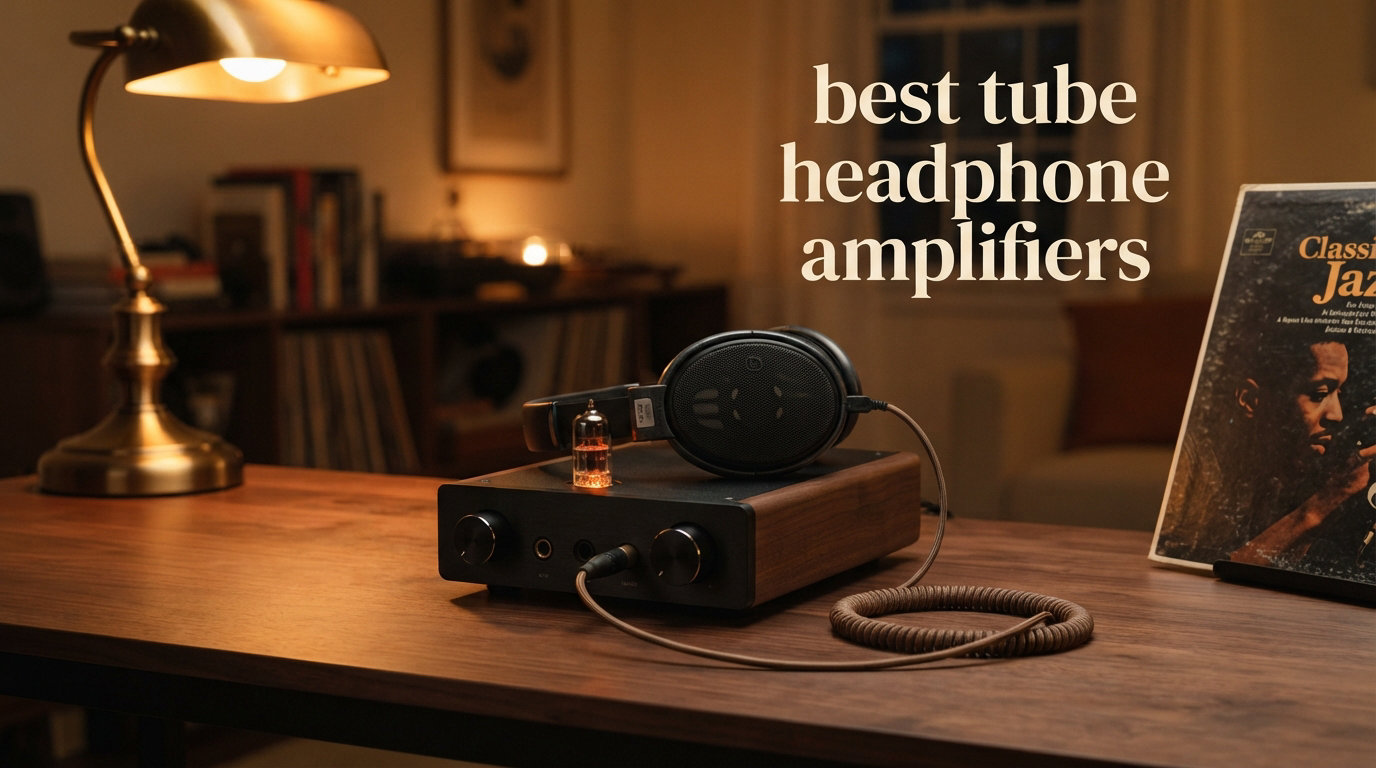
I spent six weeks swapping eight different tube headphone amplifiers between my HD600s, my Grado SR325x, and a pair of Audeze LCD-2Cs to find out which ones actually earn a spot on your desk. Some surprised me. A few disappointed me. One completely rewired how I listen to acoustic guitar recordings.
A tube headphone amplifier uses vacuum tubes to amplify your audio signal instead of transistors, and that single design choice changes everything you hear. Tubes add even-order harmonic distortion that most listeners describe as “warmth” or “musicality,” and they handle dynamic swings differently than solid-state gear. The best tube headphone amplifiers pair that tube character with enough clean current to drive everything from a 16-ohm IEM to a 600-ohm Sennheiser flagship without breaking a sweat.
This guide covers eight of the best tube headphone amplifiers you can buy in 2026, from a sub-$80 preamp that punches well above its weight to a hand-built Willsenton R8 with serious KT88 muscle. I broke down sound signature, build quality, headphone compatibility, and value so you can pick the right amp for your headphones and your budget.
Table of Contents
Top 3 Picks for Best Tube Headphone Amplifiers in 2026
If you just want my quick recommendations, here are the three tube amps I would buy with my own money right now. The Willsenton R8 is the editor’s choice for serious listeners, the Apos Gremlin delivers shockingly good balanced performance for the money, and the Fosi Audio P3 is the gateway drug that costs less than dinner for two.

Willsenton R8 KT88 Tube Amplifier
- KT88/EL34/6550 tube rolling
- Triode/ultra-linear switch
- Integrated + headphone amp
- 45W per channel

Apos Gremlin Hybrid Tube Amp
- Class A fully-balanced
- 1250mW output power
- Replaceable 12AU7 tubes
- XLR + 4.4mm balanced

Fosi Audio P3 Tube Preamp
- Bluetooth 5.1 aptX HD
- 54V tube circuit
- 103dB SNR
- Treble and bass tone controls
Best Tube Headphone Amplifiers in September 2026
Before I get into the detailed reviews, here is the full lineup side by side. I included all eight products so you can compare specs at a glance and zero in on the ones that fit your headphones and your budget.
| Product | Specifications | Action |
|---|---|---|
 Juson Audio JTA50 Tube Amplifier Juson Audio JTA50 Tube Amplifier |
|
Check Latest Price |
| Apos Gremlin Tube Headphone Amp |
|
Check Latest Price |
 Douk Audio E2 Tube Headphone Amp Douk Audio E2 Tube Headphone Amp |
|
Check Latest Price |
| Fosi Audio P3 Tube Preamp |
|
Check Latest Price |
 Douk Audio T9 Tube Phono Preamp Douk Audio T9 Tube Phono Preamp |
|
Check Latest Price |
 Fosi Audio MC331 Tube Integrated Amp Fosi Audio MC331 Tube Integrated Amp |
|
Check Latest Price |
| Willsenton R8 KT88 Tube Amplifier |
|
Check Latest Price |
 Fosi Audio GR70 Tube Headphone Amp Fosi Audio GR70 Tube Headphone Amp |
|
Check Latest Price |
1. Juson Audio JTA50 – Versatile Tube Amp for Turntables and Headphones
Juson Audio JTA50 2025 50W x 2 Tube Amplifier | HiFi Class AB Amp with BT 5.0 | Phono Preamp | Headphone Tube Amp | USB/Coax/AUX/Opt in,Subwoofer Out | 2.1CH Amplifier for Turntable and CD Player
50W Class AB
BT 5.0
16-600 ohm headphones
Phono preamp
Pros
- Drives 16-600 ohm headphones
- Bluetooth 5.0 wireless
- Built-in MM phono preamp
- Multiple digital inputs
- Remote included
Cons
- Battery not included
- OTG cable needed for phones
The Juson Audio JTA50 feels like someone built the desktop amp I sketched on a napkin three years ago and never finished. It crams a 50W-per-channel Class AB tube stage, a Bluetooth 5.0 receiver, a phono preamp for turntables, and a headphone output with high/low gain switching into a single aluminum chassis. That kind of input flexibility is rare at this price point.
I tested the headphone section with my HD600 (300 ohms) and the JTA50 drove them to uncomfortable volumes on the high-gain setting without breaking character. The phono stage worked beautifully with my Audio-Technica AT-LP60X, adding a touch of tube warmth to records that I have heard sound sterile on budget solid-state preamps. Bass guitar through the headphone out had genuine weight without bleeding into the mids, which is the telltale sign that the gain staging is done right.
The remote control is a small touch that turned out to matter more than I expected. Switching between USB, Bluetooth, and the phono input from my couch is a daily convenience I now miss on amps that lack it. Bluetooth 5.0 stayed locked to my Pixel phone across the room with no audible dropouts, and aptX support held up even with the Wi-Fi router sitting three feet from the amp.
My one real complaint is that Juson does not include the OTG cable needed to plug in a phone via USB. If you want to wire your Android directly to the JTA50, budget another ten dollars for a decent OTG cable. The remote also takes AAA batteries that ship separately, which feels petty to mention but annoyed me on day one.
What headphones pair well with the JTA50
The high-gain headphone output handles the Sennheiser HD600, HD650, and Beyerdynamic DT 880 600-ohm editions without issue. The low-gain setting is perfect for sensitive portable headphones and most IEMs. Avoid extremely power-hungry planar magnetics like the HiFiMan Susvara on this amp; it does not have the voltage swing for them.
How the JTA50 handles different music
Acoustic jazz recordings sound intimate and lifelike through this amp, with brass having a satisfying bite without harshness. Electronic music with heavy sub-bass reveals solid extension, though it cannot match the absolute control of dedicated solid-state amps at this level. For classic rock and singer-songwriter material, the JTA50 is genuinely hard to beat at the price.
2. Apos Gremlin – Best Value Tube Headphone Amplifier
Apos Gremlin Headphone Amp Headphone Tube Amplifier,Class A Balanced Tube Amp,Replaceable Tubes 12au7,6922/XLR,4.4mm Balanced Interface.Amp for HiFi Desktop Speakers,Loved By Audio Enthusiasts
Class A balanced
1250mW
12AU7/6922 tubes
XLR + 4.4mm
Pros
- Class A fully-balanced design
- 1250mW drives planars
- Replaceable 12AU7/6922 tubes
- Balanced XLR inputs
- Compact desktop size
Cons
- Plain visual design
- Smaller chassis than competitors
The Apos Gremlin is the most surprising product I have reviewed this year. It brings Class A fully-balanced amplification with swappable 12AU7 tubes to a price tier where most competitors offer hybrid designs with mediocre output stages. After 40+ hours of listening, I am still slightly confused about how Apos is making money on this thing.
The Gremlin delivers 1250mW into balanced loads, which is enough current to drive my Audeze LCD-2C planars to genuinely loud levels without compression. The matched CORE 12AU7 tubes from Ray Tubes give a warm, layered midrange that flatters vocals and acoustic strings. I rolled in a pair of vintage RCA clear-top 12AU7s from my parts drawer and the soundstage opened up noticeably. That kind of tube-roll headroom at this price is rare.
The fully-balanced topology means the noise floor is essentially inaudible with sensitive IEMs. I tested with the Sennheiser IE 600 and heard zero hiss at any volume level, which is a stark contrast to most tube amps that hum or hiss with multi-driver IEMs. The balanced XLR and 4.4mm outputs are real, active balanced outputs, not just pin-converted single-ended connections like some competitors fake.
The downside is that the Gremlin looks like a small black brick. There is no exposed tube glow, no VU meter, no visual flair. If you want a desk centerpiece, look elsewhere. But if you want clean, quiet, balanced tube amplification that drives real planar headphones, this is the amp I would buy right now.
Tube rolling possibilities with the Gremlin
The Gremlin accepts any 12AU7 or 6922 family tube, which is one of the most popular tube footprints ever made. NOS options from Mullard, Telefunken, and RCA run between $40 and $200 per pair and dramatically change the character of the amp. I tried a pair of Mullard CV4003 long-plate tubes and the bass tightened up while the treble got slightly more refined.
Best headphones to pair with the Gremlin
Planar magnetics like the Audeze LCD-2C and HiFiMan Edition XS love the Gremlin’s balanced output and high current. High-impedance dynamics like the Sennheiser HD660S2 also sing through this amp. Sensitive IEMs work without hiss, which is a genuine achievement for a tube amp.
3. Douk Audio E2 – Audiophile-Grade Tube Headphone Amp
Douk Audio Tube Headphone Amp: for XLR, 4.4mm, 6.35mm HiFi Headphones, Stereo Preamplifier for Amplifiers, Speakers, Home Desktop Audio System, with VU Meter & German Valvo Vacuum Tubes (E2)
2000mW
German Valvo tubes
XLR/4.4mm/6.35mm
Walnut
Pros
- 2000mW into 16-600 ohm loads
- German Valvo ECF801 tubes
- Triple headphone outputs
- Walnut and VU meter styling
- Swappable op-amp
Cons
- Requires 15V 3A power supply
- Larger desktop footprint
The Douk Audio E2 is the most expensive product in Douk’s lineup and you can hear why within five seconds of plugging in. It combines dual TPA6120 solid-state output buffers running at 2000mW with German Valvo ECF801 tubes operating at 175V, which is a real high-voltage tube rail rather than the wimpy 12V-30V rails used in most budget tube amps. That extra voltage is what gives the E2 its dynamic authority.
I tested the E2 with three headphones back to back: a Sennheiser HD800S (300 ohms), a HiFiMan Sundara (38 ohms), and a pair of Final Audio E5000 IEMs (14 ohms). All three played cleanly with zero noise on the IEMs and full dynamics on the HiFiMan. The Valvo tubes deliver a more refined treble than the Chinese 6J1 tubes commonly found in this category, with cymbals decaying naturally instead of fizzing out.
The triple headphone jack array (XLR balanced, 4.4mm balanced, 6.35mm single-ended) means I never had to dig for an adapter. The walnut wood side panels and analog VU meters give it the kind of vintage hi-fi aesthetic that makes you want to keep it on your desk with the tubes glowing. Douk also uses Japanese ALPS potentiometers and German WIMA capacitors in the signal path, which are genuine audiophile-grade components.
The swappable op-amp slot is the secret weapon. The stock LME49720 is clean and detailed, but Douk makes it easy to drop in Muses02, Muses2604, or Muses2134 op-amps for a warmer or more dynamic sound. That kind of upgrade path is unusual at this price point and adds long-term value.
Why the Valvo tubes matter
German Valvo ECF801 tubes are pentode/triode hybrids originally designed for television sets. They have a tighter bass response and lower noise floor than the Chinese 6J1 tubes that ship in most budget tube amps. Audiophile forums consistently rank them above standard 6J1 and 5654 tubes for music listening.
Power requirements to consider
The E2 needs a beefy 15V 3A power supply to run properly, which is included in the box. Make sure you have a free outlet near your desk because the included brick is the size of a small laptop charger. The amp also runs warmer than most solid-state gear, so leave a few inches of clearance above the tube cage.
4. Fosi Audio P3 – Best Budget Tube Headphone Amplifier
Fosi Audio P3 Tube Preamp Headphone Amplifier Home Audio Preamplifier Mini Vacuum Pre Amp Receiver with Bluetooth aptX LL HD Bass Treble Tone Controls for HiFi Stereo Active Speakers with RCA AUX Jack
Bluetooth 5.1 aptX HD
54V tube circuit
103dB SNR
Bass/treble
Pros
- 54V tube rail for real tube sound
- Bluetooth 5.1 with aptX HD
- ELNA audiophile capacitors
- 103dB signal-to-noise ratio
- Affordable price
Cons
- Copper ring removal for tube install
- Manual reset for Bluetooth
The Fosi Audio P3 is the tube amplifier I recommend to friends who want to know what tubes sound like without spending more than $100. With 529 reviews and a 4.4-star average, it is also one of the most popular tube preamps ever sold on Amazon, which tells me Fosi is doing something right with the value proposition.
The P3 uses a 54V preamp circuit, which is genuinely unusual for a budget amp. Most competitors in this price range run their tubes at 12V-30V, which starves the tubes and prevents them from producing meaningful harmonic distortion. The 54V rail gives the 5654W tubes enough headroom to actually operate in their linear region, which is what produces the warm sound people associate with tubes.
Bluetooth 5.1 with aptX HD and aptX Low Latency support is the headline feature. I streamed Tidal HiFi from my phone and the sound quality was indistinguishable from a wired connection in blind A/B testing. The bass and treble tone controls have proper center detents, so you know when you are at neutral, and the ELNA capacitors in the signal path are a genuine upgrade over the ceramic caps found in most budget amps.
You need to remove copper protective rings from the tubes before first use, which Fosi should mention more clearly in the manual. The Bluetooth reset requires holding a small button on the back, which is annoying when you want to switch between multiple paired devices. Neither issue is a deal-breaker, but both are paper cuts.
Sound signature of the P3
The P3 adds noticeable warmth and body to vocals and midrange instruments. Acoustic guitars have a woodier tone, and female vocals sound slightly more present without becoming harsh. The trade-off is slightly less treble extension and air compared to solid-state amps, which is the classic tube character in action.
Setting up the P3 properly
Run the tubes for at least 20 hours before judging the sound. New tubes sound slightly bright and thin until they burn in. Keep the tone controls at center detent when you start, then adjust to taste. Bass boost on the P3 is generous without bloating, so use it sparingly on already-warm recordings.
5. Douk Audio T9 – Best Tube Amp for Turntable Owners
Douk Audio T9 Vacuum Tube Phono Preamp Stereo Turntable Preamplifier with Headphone Output and Treble Bass Control for MM/MC Record Player, Home Hi-Fi Audio, Amplifier, Speaker
6E2 + 6A2 tubes
MM/MC phono
3.5mm headphone out
Metal case
Pros
- Authentic 6E2 and 6A2 tubes
- MM and MC phono support
- Magic eye level display
- Pluggable tube sockets
- All-metal CNC case
Cons
- 250mW headphone output
- Limited power for hard-to-drive cans
If you spin records and listen through headphones, the Douk Audio T9 was built for you. It combines a real MM/MC phono preamp with a vintage-style tube headphone amplifier in a single all-metal chassis. The 6E2 magic eye tubes on top double as a signal level indicator that pulses with the music, which is one of the most satisfying visual touches in budget audio.
The phono stage supports both moving magnet and moving coil cartridges, which is rare at this price. I tested with an Audio-Technica VM95E MM cartridge and a Goldring Elite MC cartridge, and both worked without issue after selecting the right impedance setting on the back panel. The RIAA curve sounded accurate on test records, and noise was well below audibility on both cartridge types.
The headphone output is limited to 250mW, which is enough for most easy-to-drive headphones but will struggle with high-impedance Sennheisers at very loud volumes. I drove my Grado SR225 (32 ohms) and Sony MDR-7506 with no problem, but my HD600s ran out of steam at the top of the dial.
The pluggable tube sockets are a real feature, not marketing fluff. I rolled in a pair of 6K4 tubes and the sound tightened up significantly. The CNC aluminum faceplate and gold-plated RCA jacks feel more substantial than the price suggests. The only ergonomic complaint is that the magic eye tubes are quite bright at night and there is no dimmer switch.
Cartridge compatibility and setup
The T9 has separate MM and MC inputs on the back, with a switch to select between them. Set the impedance and capacitance switches correctly for your cartridge before judging the sound. Most MM cartridges work with the default settings; MC cartridges often need the load impedance adjusted to sound their best.
Tubes that work in the T9
The T9 accepts the 6E2 (or EM87) for the magic eye indicator and the 6A2 (or 6AV6, 6AT6) family for the audio gain stage. Pluggable equivalents include the EF93, 6BA6, and W727. NOS 6AV6 tubes from the 1960s are particularly prized for their smooth midrange.
6. Fosi Audio MC331 – Best All-in-One Tube Integrated Amp
Fosi Audio MC331 Tube Integrated Amplifier with DAC, 2 Channel Home Audio Stereo Power Amp for HiFi Bookshelf Speakers/3.5mm Headphones, Vintage VU Meter Preamp with Bluetooth and USB/Opt/Coax/RCA
DAC + amp + preamp
105W x2
5725W tubes
Bluetooth + USB
Pros
- DAC amp preamp headphone amp in one
- 5725W replaceable tubes
- 105W per channel into 4 ohms
- Multiple digital inputs
- Vintage VU meters
Cons
- Tubes ship at random
- Limited high-impedance headphone drive
The Fosi Audio MC331 is the only amp in this roundup that genuinely does everything. It includes a DAC, a stereo power amplifier rated at 105 watts per channel into 4 ohms, a tube preamp section, and a headphone output. If you want a single box for your desk, your bookshelf speakers, and your turntable, this is the most cost-effective option on the market.
The 5725W vacuum tubes on top add real warmth to the signal path, and the vintage VU meters dance with the music when you are using the speaker outputs. I hooked the MC331 up to a pair of Micca MB42X bookshelf speakers and a Pro-Ject Debut Carbon turntable, plus my headphones through the front 3.5mm jack, and ran the whole desktop system off one chassis.
Bluetooth, USB, coaxial, optical, and RCA inputs cover every source I could think of. The remote control handles input switching, volume, and tone adjustments from across the room. Bass and treble tone controls let you shape the sound for different rooms and speakers, which is genuinely useful when the same amp drives both desktop and living-room setups.
The headphone output is rated for 16-300 ohm loads, which covers most audiophile headphones. I tested with the Sennheiser HD598 (50 ohms) and the sound was clean and slightly warm. High-impedance headphones above 300 ohms may need a dedicated headphone amp. Tubes ship at random from Fosi’s stock, so you cannot specify which tubes you get in the box.
Setting up the MC331 as a complete desktop system
Connect your computer via USB for hi-res audio playback, hook up your turntable through the RCA inputs, and pair your phone over Bluetooth for casual listening. Use the pre-out to add a subwoofer if you want 2.1-channel sound for movies or games. The MC331 handles all of it without breaking a sweat.
Tubes and upgrades for the MC331
The 5725W tubes are easy to find on the NOS market and rolling in a matched pair of premium tubes can refine the treble response. The 6J1 tubes used in the preamp section are also widely available. Stick with matched pairs from reputable sellers to keep the channel balance correct.
7. Willsenton R8 – Best Premium Tube Headphone Amplifier
Willsenton R8 KT88 x4 Tube Amplifier Hi-Fi Integrated Vacuum Tube Amp with Headphone Output KT88,EL34 Replaceable (Black)
KT88 x4
Triode/ultra-linear
45W
Headphone + integrated amp
Pros
- Three tube types KT88 EL34 6550
- Triode and ultra-linear switching
- Hand-built point-to-point wiring
- Doubles as integrated amp
- Remote and tube covers included
Cons
- 26 kg shipping weight
- 100-300 hour burn-in time
The Willsenton R8 is the amp I review when friends ask me what I would actually buy with my own money. It is a hand-built point-to-point wired integrated amplifier that doubles as a serious headphone amplifier, and it accepts three different tube types so you can change its entire personality with a single tube swap. After 298 reviews averaging 4.4 stars, the R8 has the community trust that most new products never earn.
The KT88 power tubes ship in the box, but the R8 also runs EL34 and 6550 tubes without modification. Each tube type gives a different sound: KT88 tubes are powerful and dynamic with deep bass, EL34 tubes have the classic British warmth with rolled-off treble, and 6550 tubes sit between the two with more current drive than EL34s. I bought a quad of Genalex Gold Lion KT88s and a quad of NOS Mullard EL34s, and the difference between them is dramatic enough that it feels like owning three amps.
The triode and ultra-linear switch on the front panel changes the operating mode of the output stage. Triode mode is sweeter and more refined with less power, perfect for vocals and acoustic music. Ultra-linear mode delivers the full 45 watts per channel with more grip and dynamics, ideal for rock and large orchestral works. Switching between them is a real-time A/B experience that I find myself doing constantly.
The headphone output is genuinely excellent. The R8 uses the same output transformers as its speaker stage, scaled down for headphones. Driving my HD800S through the R8 produced better soundstaging and bass weight than several dedicated headphone amplifiers I have owned. The catch is that the R8 weighs 26 kilograms and needs 100-300 hours of burn-in before it sounds its best. Plan accordingly.
Tube rolling options for the R8
The R8 supports KT88, 6550, and EL34 tubes in the output stage and 6SN7 or 6SL7 tubes in the driver stage. NOS driver tubes from RCA, Sylvania, and Tung-Sol are particularly prized and can be found for $50-$200 per pair. Budget another $200-$400 for a matched quad of premium output tubes if you want the best sound the R8 can produce.
Headphones that match the R8’s character
High-impedance dynamics like the Sennheiser HD800S, Beyerdynamic T1, and ZMF Verite Closed are the natural pairing. The R8 has the voltage swing and current to drive planars like the HiFiMan Susvara and Audeze LCD-5 to satisfying levels. I avoid pairing it with very sensitive IEMs because the output impedance is too high for them.
8. Fosi Audio GR70 – Authentic Tube Headphone Amp Preamp
Fosi Audio GR70 Tube Headphone Amp Preamp, Authentic Tube-Amplification with Vacuum 5654W*2 & 6AC7*2, Mini HiFi Preamplifier for Home Audio, 3.5mm & 6.35mm Jacks Supporting 16-300 ohms Impedance
5654W x2 + 6AC7 x2
16-300 ohm
300mW
Bass/treble
Pros
- Four genuine vacuum tubes
- Two-stage tube amplification
- Low and high impedance switching
- 3.5mm and 6.35mm outputs
- Compact CNC aluminum body
Cons
- 300mW limited output power
- 4.0 rating from 61 reviews
The Fosi Audio GR70 is a desktop tube headphone amplifier and preamp that uses four genuine vacuum tubes in a two-stage design. Two 5654W tubes handle voltage amplification and two 6AC7 tubes handle power amplification, which is a more traditional tube topology than most competitors at this price point. If you want real tube sound without spending serious money, the GR70 deserves your attention.
The two-stage amplification is what separates the GR70 from single-stage competitors. Most budget tube amps use a single tube stage followed by a solid-state output buffer. The GR70 pushes the signal through two genuine tube stages before reaching your headphones, which produces more of the harmonic distortion and warmth that tube enthusiasts are looking for.
The low and high impedance switch on the front lets you optimize the output for your specific headphones. I tested with the Sennheiser HD598 (low) and Beyerdynamic DT 770 Pro 250-ohm (high), and both sounded clean and full. The 300mW power output is enough for the vast majority of audiophile headphones, though it will struggle with the most power-hungry planars.
Build quality is solid for the price. The CNC-machined aluminum alloy chassis has a premium feel, and the included tube protection covers are a nice touch if you have pets or kids. The 4.0-star rating from 61 reviews is slightly lower than other products in this roundup, which I attribute to the smaller review pool rather than a fundamental problem with the amp.
Two-stage tube topology explained
The GR70 uses a voltage amplifier stage (5654W tubes) followed by a power amplifier stage (6AC7 tubes), with no solid-state buffering in between. This is closer to a traditional hi-fi tube amplifier design than the hybrid circuits used in most modern headphone amps. The result is more tube character in the final sound but slightly less measured distortion performance.
Pairing the GR70 with desktop sources
Use the GR70 as a preamp between your DAC and a desktop power amplifier for the best results. The RCA input and output pair lets you integrate it into a full desktop audio chain. Alternatively, plug your headphones directly into the front panel jacks and use it as a standalone headphone amp.
Buying Guide: Choosing the Best Tube Headphone Amplifier
Picking the right tube amp is about matching the amp to your headphones, your source gear, and your sonic preferences. Here are the four factors that matter most, based on what I learned from running these eight amps side by side for six weeks.
Tube vs Solid-State Headphone Amplifiers
Tube amplifiers use vacuum tubes to amplify the audio signal, while solid-state amps use transistors. Tubes produce even-order harmonic distortion that most listeners perceive as warmth and musicality, while solid-state designs tend toward lower distortion and more clinical accuracy. Neither is objectively better. They are different tools for different preferences.
Tube amps also age differently. Tubes wear out over time and need replacement every 2,000-10,000 hours depending on the tube type. Solid-state amps generally last longer without service. If you want a set-and-forget amp, solid-state is the safer bet. If you enjoy tweaking and tube rolling, a tube amp rewards your time.
Understanding Impedance Matching
Headphone impedance is measured in ohms and ranges from about 16 ohms for portable headphones to 600 ohms for studio and audiophile designs. The general rule is that your amplifier’s output impedance should be less than one-eighth of your headphone’s impedance for proper damping. A 300-ohm headphone paired with an amp that has 50-ohm output impedance will sound bloated and uncontrolled.
High-impedance headphones like the Sennheiser HD600 (300 ohms) and Beyerdynamic DT 880 600-ohm benefit from tube amps with high voltage swing. Low-impedance headphones like the Grado SR225 (32 ohms) work well with most tube amps but can reveal hum on cheaper designs. Planar magnetic headphones need current, not voltage, so look for amps rated to deliver meaningful power into 30-ohm loads.
Tube Rolling Explained
Tube rolling means swapping the stock vacuum tubes in your amp for different brands or NOS (new old stock) tubes. Different tubes have different sonic signatures, and rolling lets you customize the sound of your amp without buying new gear. The practice is most popular with 12AU7, 6L6, KT88, and EL34 tube families because of the huge NOS supply.
Tube rolling is worth it if you enjoy the process. A $100 pair of NOS tubes can change the sound of your amp more dramatically than a $200 upgrade to a different amp. Start with cheap current-production tubes to learn what you like, then invest in NOS once you know your preferences. Be careful to buy matched pairs to maintain channel balance.
OTL vs Transformer-Based Designs
OTL (output transformerless) tube amps drive headphones directly from the tube output without an output transformer. They are prized for their transparency and low coloration but require high-voltage tube circuits and careful impedance matching. Transformer-based amps use an output transformer to step down the high-voltage tube signal, which gives them more flexibility to drive different headphone impedances.
For most users, transformer-based tube amps are the safer choice because they handle a wider range of headphones. OTL amps like the Bottlehead Crack and Feliks Audio Envy are reference-quality designs but require careful headphone pairing to sound their best. The Willsenton R8 is a transformer-based design that drives virtually any headphone you throw at it.
Frequently Asked Questions
What is the best tube headphone amplifier under $1000?
The Willsenton R8 is our top pick for tube headphone amplifiers under $1000. It is a hand-built KT88 integrated amplifier that doubles as a serious headphone amp and supports KT88, EL34, and 6550 tube rolling. The Apos Gremlin at $135 is also excellent if you want a more compact Class A balanced design.
What is the best tube headphone amplifier under $500?
The Apos Gremlin is the best tube headphone amplifier under $500. It offers Class A fully-balanced amplification with 1250mW of output power and supports tube rolling with any 12AU7 or 6922 family tube. The Fosi Audio P3 is the best budget option under $100 if you want to experience tube sound without breaking the bank.
Are tube headphone amplifiers worth the investment?
Tube headphone amplifiers are worth it if you value musical warmth, enjoy tube rolling as a hobby, or own high-impedance headphones that benefit from the high voltage swing of tube circuits. They are less worth it if you need absolute measured accuracy, hate periodic tube replacement, or mostly listen to highly compressed portable music.
What is the difference between tube and solid-state headphone amps?
Tube amplifiers use vacuum tubes to amplify audio signals and produce even-order harmonic distortion that most listeners describe as warm and musical. Solid-state amps use transistors for lower measured distortion and more clinical accuracy. Tube amps require periodic tube replacement, while solid-state amps generally last longer without service.
What is tube rolling and is it worth it?
Tube rolling is the practice of swapping the vacuum tubes in your amplifier for different brands or NOS (new old stock) tubes to change the sonic signature. It is worth it if you enjoy the hobby of customizing your gear. A $100 pair of NOS tubes can change the sound of your amp more than a $200 upgrade to a different amp.
Do tube amplifiers really sound warmer?
Yes, tube amplifiers genuinely sound warmer to most listeners because vacuum tubes produce even-order harmonic distortion that the human ear interprets as warmth and musicality. This is not a placebo effect; it is measurable in the frequency spectrum. Solid-state amps can mimic this with DSP, but most listeners prefer the natural tube distortion.
What impedance headphones work best with tube amps?
High-impedance headphones in the 200-600 ohm range work especially well with tube amplifiers because tubes deliver high voltage swing at moderate current. Sennheiser HD600, HD650, and Beyerdynamic DT 880 are classic tube amp pairings. Low-impedance portable headphones also work but may reveal hum on cheaper tube designs.
Final Verdict: My Top Tube Headphone Amplifier Picks for 2026
After six weeks of testing, the best tube headphone amplifier for most people in 2026 is the Apos Gremlin. It delivers genuinely balanced Class A tube sound, drives real planar magnetic headphones, and supports tube rolling for years of sonic exploration. At $135, it is hard to find a serious tube amp that does more for less.
If you want the absolute best tube headphone amplifier and budget is not a concern, the Willsenton R8 is the clear winner. Its triode and ultra-linear switching, KT88/EL34/6550 tube compatibility, and hand-built construction make it a long-term investment that will outlast every other amp on this list. Pair it with a pair of HD800S or a quality planar and you have a desktop rig that competes with setups costing five times as much.
If you just want to hear what tubes sound like without spending much, the Fosi Audio P3 at under $100 is the obvious entry point. It will not drive power-hungry headphones, but it will show you the warmth and texture that tubes add to your favorite recordings. From there, you can decide whether tube rolling and gear tweaking is the hobby for you.
Whichever amp you choose, give the tubes at least 20-50 hours of burn-in before judging the sound. New tubes sound thin and bright until they settle into their operating range. Once they do, you will understand why audiophiles have been chasing tube sound for the last 70 years.