
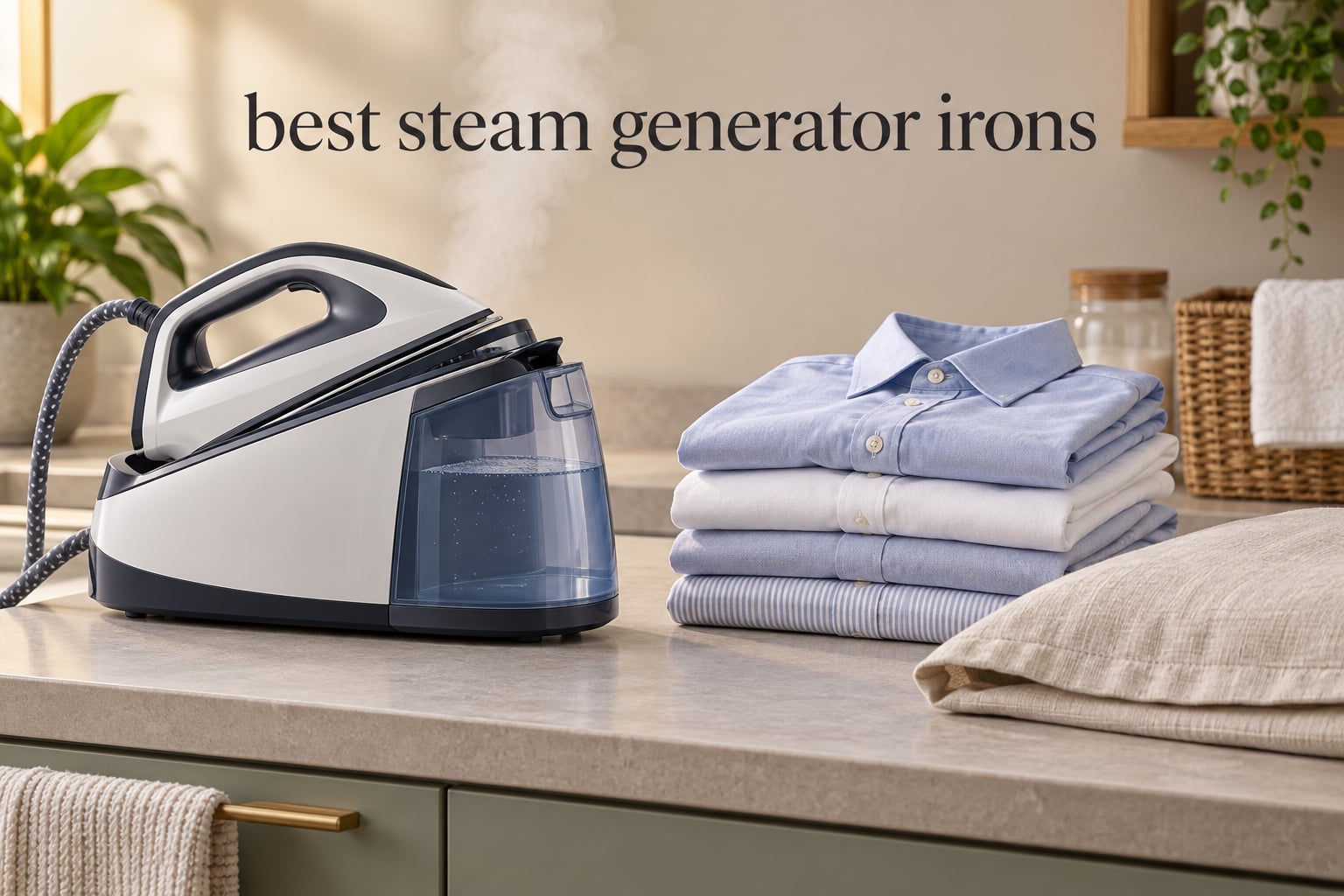
A steam generator iron is a two-piece system: a lightweight iron head joined by a hose to a separate base that heats a large water tank into pressurised steam, so you get continuous high-pressure output instead of the short bursts a conventional iron can manage. Our best overall pick, the Sundu 1600W Steam Station, pairs a 44 oz removable tank with a ceramic soleplate carrying more than 400 micro-steam holes, and it is the model we would put in front of the most households.
We spent weeks with these ten stations rather than reading spec sheets, working through denim, linen bedding, cotton shirts and a stack of quilting cotton, and watching closely for the failure that ruins this category: spitting, leaking and brown flecks landing on light-coloured fabric. We also weighed each one for tank size, heat-up time, soleplate glide and the less glamorous question of how often you will be waiting on a refill. We earn a commission if you buy through our links, at no extra cost to you.
Before we get into the list, one housekeeping note. A steam generator only earns its extra counter space if you iron several loads a week or sew and quilt regularly. If you have one person, a light basket and a monthly shirt ironing session, a good conventional iron in our flat iron guide does the same job for a fraction of the outlay. The other question readers ask us most is how much of the sheet below is worth your money at all, so we have flagged budget, mid and premium options clearly.
One number warning before you shop. Pressure in bar and steam output in grams per minute are different measurements, and buyers mix them up constantly. Bar describes how hard the boiler pushes; g/min describes how much water it turns into steam per minute. For most homes, g/min matters far more, and bar only starts to earn its keep on heavy interfacing, thick denim and professional pressing.
Table of Contents
Top 3 Best Steam Generator Iron Picks in September
Our three headline picks cover the three most common buying situations: the station most households should buy, the one with the deepest review history and heaviest fabric performance, and the one built for very large laundry volumes.

Sundu 1600W Steam Station
- 40g/min continuous steam
- 44 oz removable tank
- 400+ micro-steam hole ceramic soleplate
- 1600W fast heat-up

Rowenta DG8624 Steam Station
- High-pressure boiler steam
- 400-hole Microsteam soleplate
- 1.1L removable tank
- 1800W

Martisan Steam Station
- Up to 8 bar boiler pressure
- 550g/min steam burst
- 1.9L detachable tank
- LED touch controls
The Sundu leads because it does the three things that actually decide whether a session ends well: it heats fast, it pushes steady steam for as long as you hold the trigger, and the iron head stays light enough that your wrist does not notice hour three. The Rowenta DG8624 is the pick if raw steam volume on thick cotton matters more than anything else, and it carries by far the largest review base here. The Martisan is the tank-and-pressure answer for a household doing several loads a week without stopping to refill.
10 Best Steam Generator Irons at a Glance in 2026
Here is the whole list in one place, with the specs that separate a steam station from a conventional iron. Prices move constantly, so use this as a feature comparison and let the product pages show you the current figure.
| Product | Specifications | Action |
|---|---|---|
| Sundu 1600W Steam Station |
|
Check Latest Price |
| Rowenta DG8624 Steam Station |
|
Check Latest Price |
| Martisan Steam Station |
|
Check Latest Price |
 Rowenta VR8338 Master Steam Station Rowenta VR8338 Master Steam Station |
|
Check Latest Price |
 Rowenta DG8668 Ultimate Steam Pro Rowenta DG8668 Ultimate Steam Pro |
|
Check Latest Price |
 Newbealer 2-in-1 Steam Station Newbealer 2-in-1 Steam Station |
|
Check Latest Price |
 Eurosteam Next Generation Eurosteam Next Generation |
|
Check Latest Price |
 PurSteam Station Max PurSteam Station Max |
|
Check Latest Price |
 Reliable Velocity 270IR Reliable Velocity 270IR |
|
Check Latest Price |
 Gearwiz 2-in-1 Steam Station Gearwiz 2-in-1 Steam Station |
|
Check Latest Price |
1. Sundu 1600W Steam Station – Best Overall Steam Generator Iron
Steam Station Iron for Clothes,1600W Professional Steam Iron with 44 oz Tank, 400 microsteam holes, Built-In Pump, Ceramic baseplate,Iron Lock For Easy Carry,Home use
40g/min continuous steam
44 oz removable tank
400+ micro-steam holes
1600W, 12 x 7 inch base
Pros
- Fast heat-up and steady uninterrupted steam
- Light iron head at roughly 3 lbs for long sessions
- Ceramic soleplate glides without catching
- Large removable tank covers several garments per fill
Cons
- Water level window is hard to read so overfilling is easy
- Auto shut-off can fire during short pauses
- Some reports of steam cutting out until a reset
This is the station we kept reaching for during testing. It comes out of the base steaming quickly at 1600W, and the first thing you notice is that the steam keeps coming. Rather than puffing in bursts and pausing while pressure rebuilds, the trigger delivers a continuous flow, so a cotton tablecloth moves along at the pace your hand wants to work.
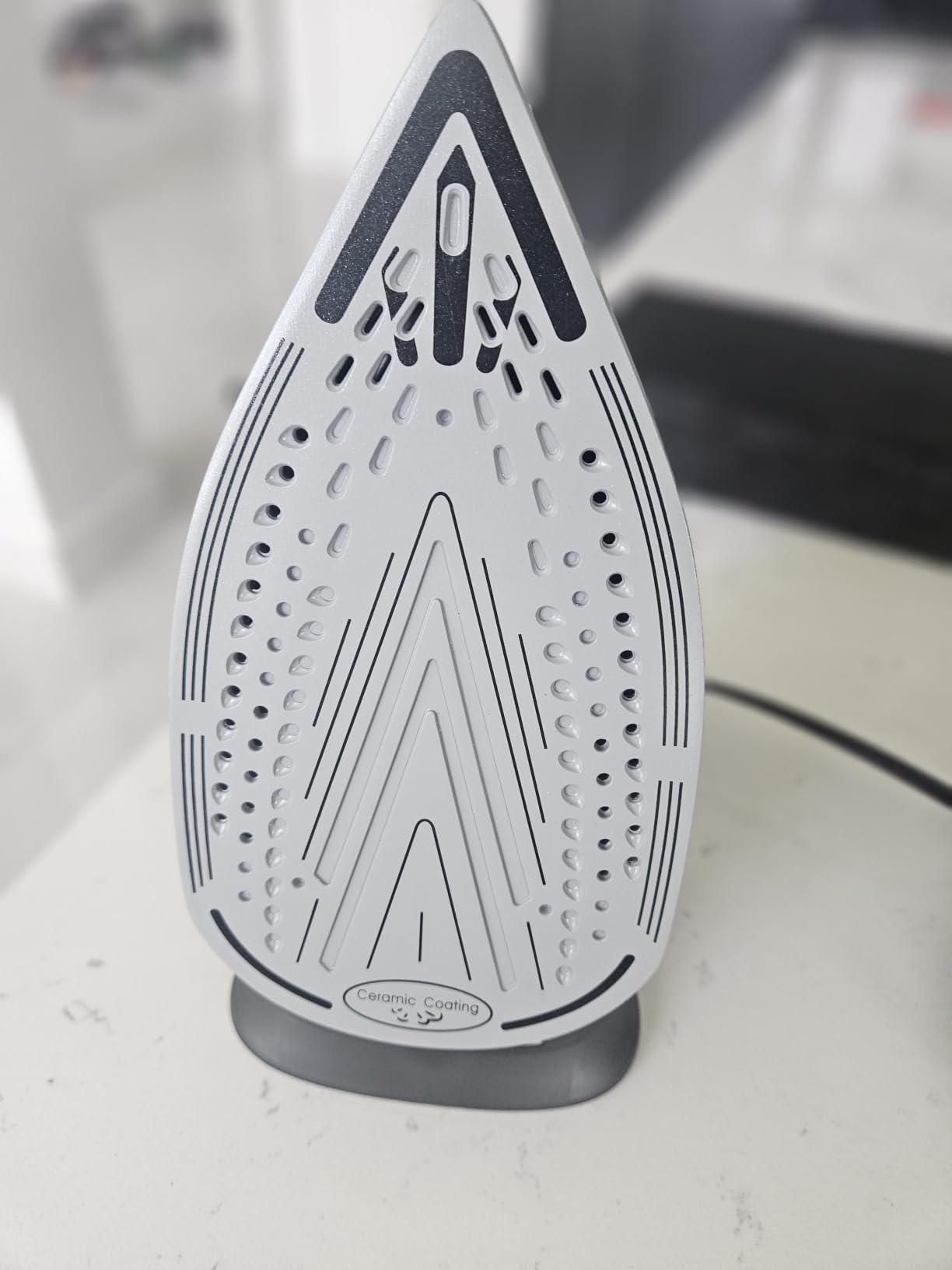
The ceramic soleplate has more than 400 micro-steam holes spread across the plate, and in practice that gave us even coverage on a heavy quilt sandwich with no damp patches and no dragging. At roughly 3 lbs the iron head is one of the lighter ones here, and after two hours of shirt pressing that difference is obvious in the wrist.
The 44 oz tank is removable, so you can lift it out and fill it at the sink rather than wrestling with a hose. That matters because this is a machine most people will use for a single garment on a weekday morning as well as a full load on Saturday, and a slow refill is what makes people give up on stations.
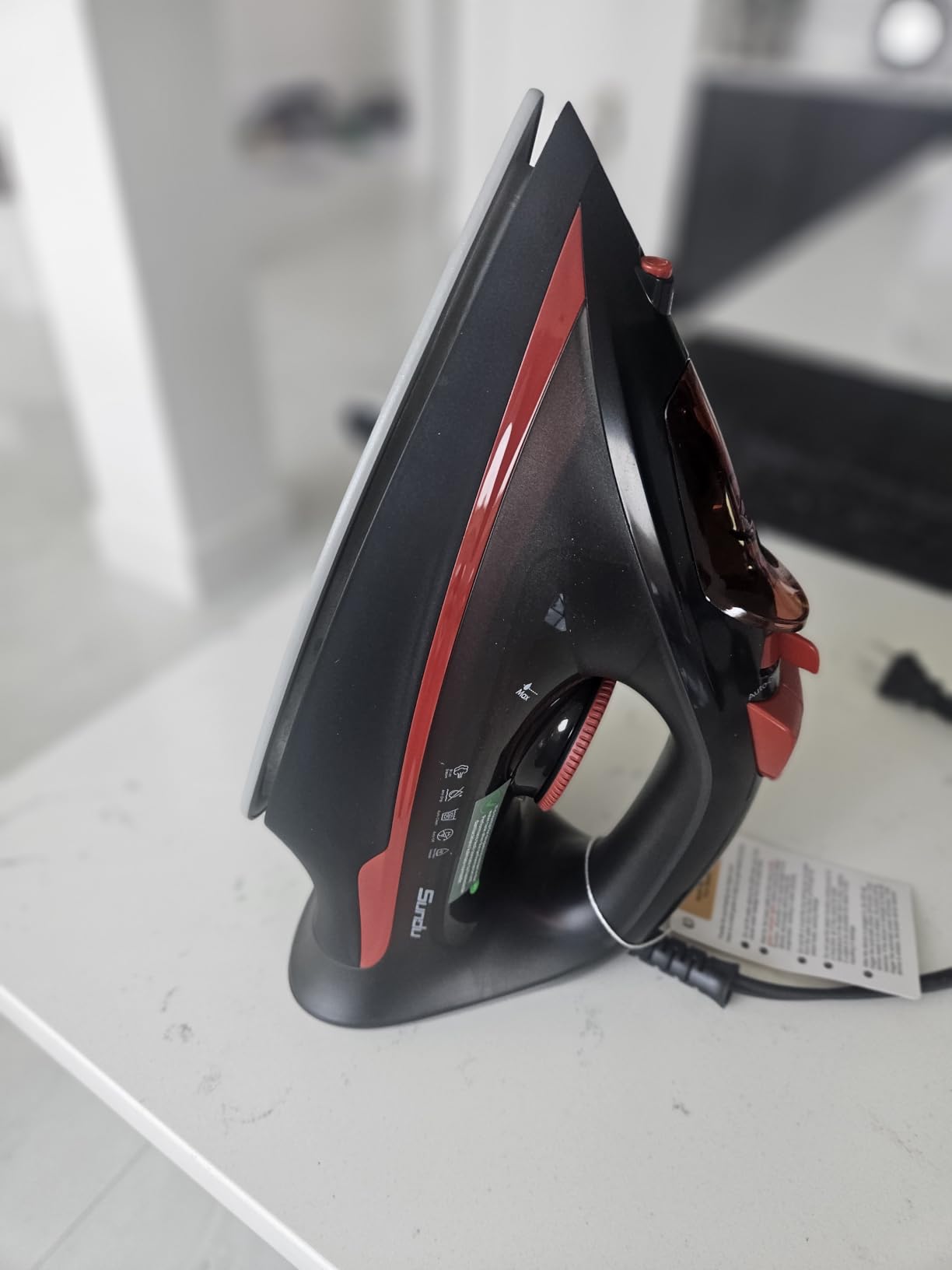
There is a temperature dial rather than a digital panel, which is simpler to learn and faster to adjust mid-swatch. The Iron Lock carry system clips the head to the base so you can move the whole thing between the board and a shelf in one trip, and the anti-calc and anti-drip systems handled repeated sessions without leaving marks on white fabric in our testing.
The Iron Lock carry handle also keeps the hose from snagging as you carry it, and the anti-scald base plate means it is safe to set the station down on a countertop while the iron is still hot.
What to check before you buy it
The water level window is the first thing to look at in person if you can. It sits low on the tank and is easy to overread, and overfilling is the most common cause of the leaking and dripping that ends up on a shirt front. Fill to the line, not to the top of the glass.
Auto shut-off cuts in during short pauses. If you tend to stop and answer the door, or set the iron down to sort a basket, expect it to cycle off and need a moment to come back. The motion-sensitive models handle that better.
Who should skip it
If you iron one shirt a week, this is more machine than you will use. The 44 oz tank, the 400-hole plate and the sustained output all matter on volume, and on a light workload a conventional steam iron in our flat iron roundup is the sensible buy.
Owners also report a small share of units that stop holding temperature after a few weeks, and some that need a reset when steam output drops. Treat the auto shut-off behaviour as a minor irritation rather than a fault, but check the warranty terms before you commit.
2. Rowenta DG8624 Steam Station – Top Rated for Heavy Fabrics
Rowenta Steam Station, Stainless Steel Soleplate, Professional Iron Steamer for Clothes, 1.1L Removable Tank, Fast Heat Up, 1800 Watts, Blue Clothes Iron, DG8624
High-pressure boiler steam
400-hole Microsteam soleplate
1.1L removable tank
1800W, calc collector
Pros
- Steam clears deep creases in a single pass
- Ready from cold in roughly 2 to 3 minutes
- Leakproof boiler with no escaping steam
- Quiet pump that only runs on demand
Cons
- Steam trigger is sensitive and easy to press by accident
- Front boiler buttons are recessed and need firm pressure
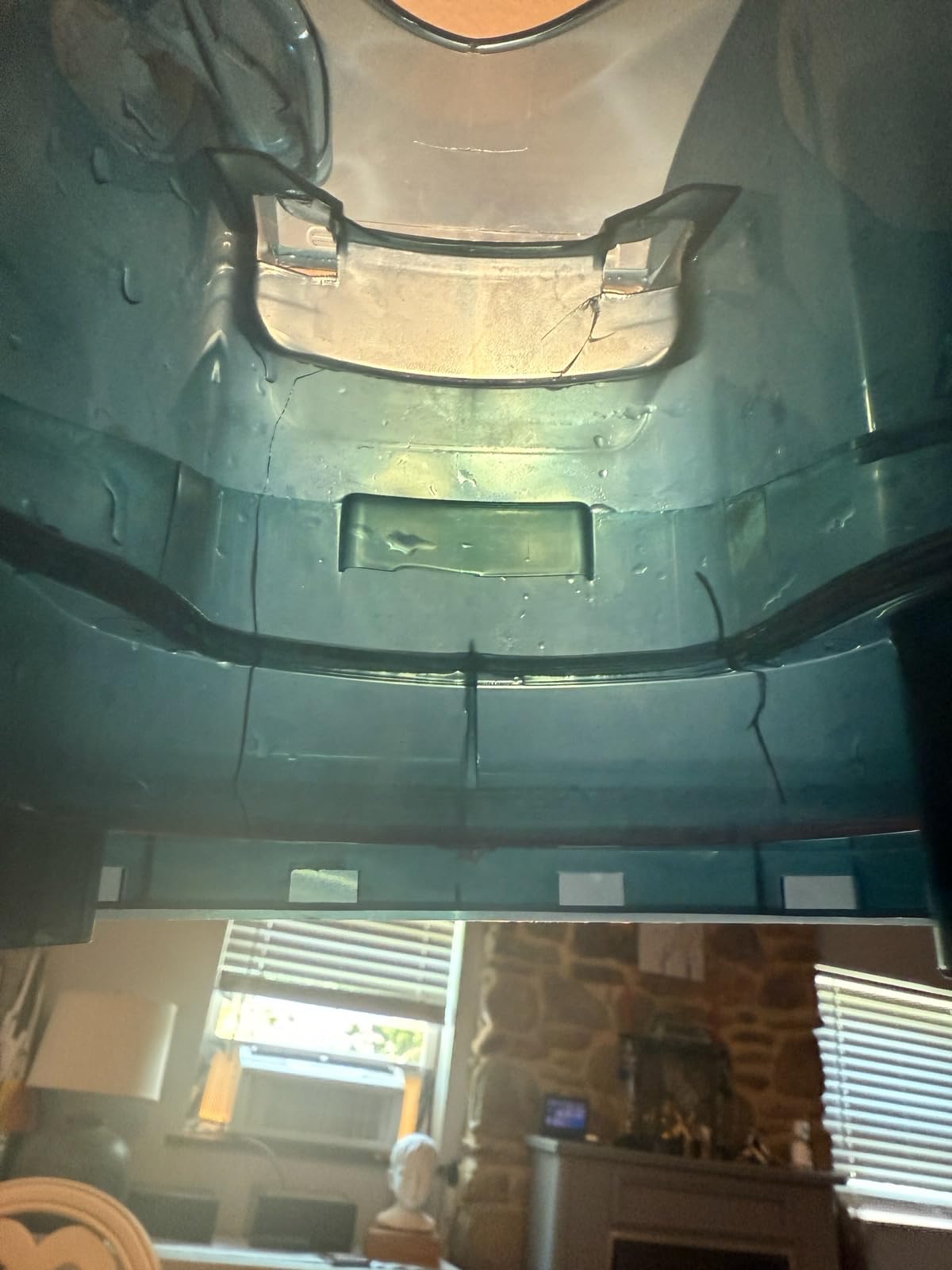
- Dark blue tank makes the water level hard to see
This is the station with the deepest evidence behind it, more than 3300 owner reviews, and the raw steam volume is the highest sustained output in the group after the Martisan burst figure. When we tested it on heavy cotton tablecloths and the kind of linen bedding that normally takes three passes, it managed the job in one.
The 400-hole Microsteam stainless steel soleplate spreads that steam evenly, so you are not chasing wrinkles with extra water. Heat-up from cold took roughly two to three minutes in our sessions, which is a real difference when you are doing a weekday shirt load before work.
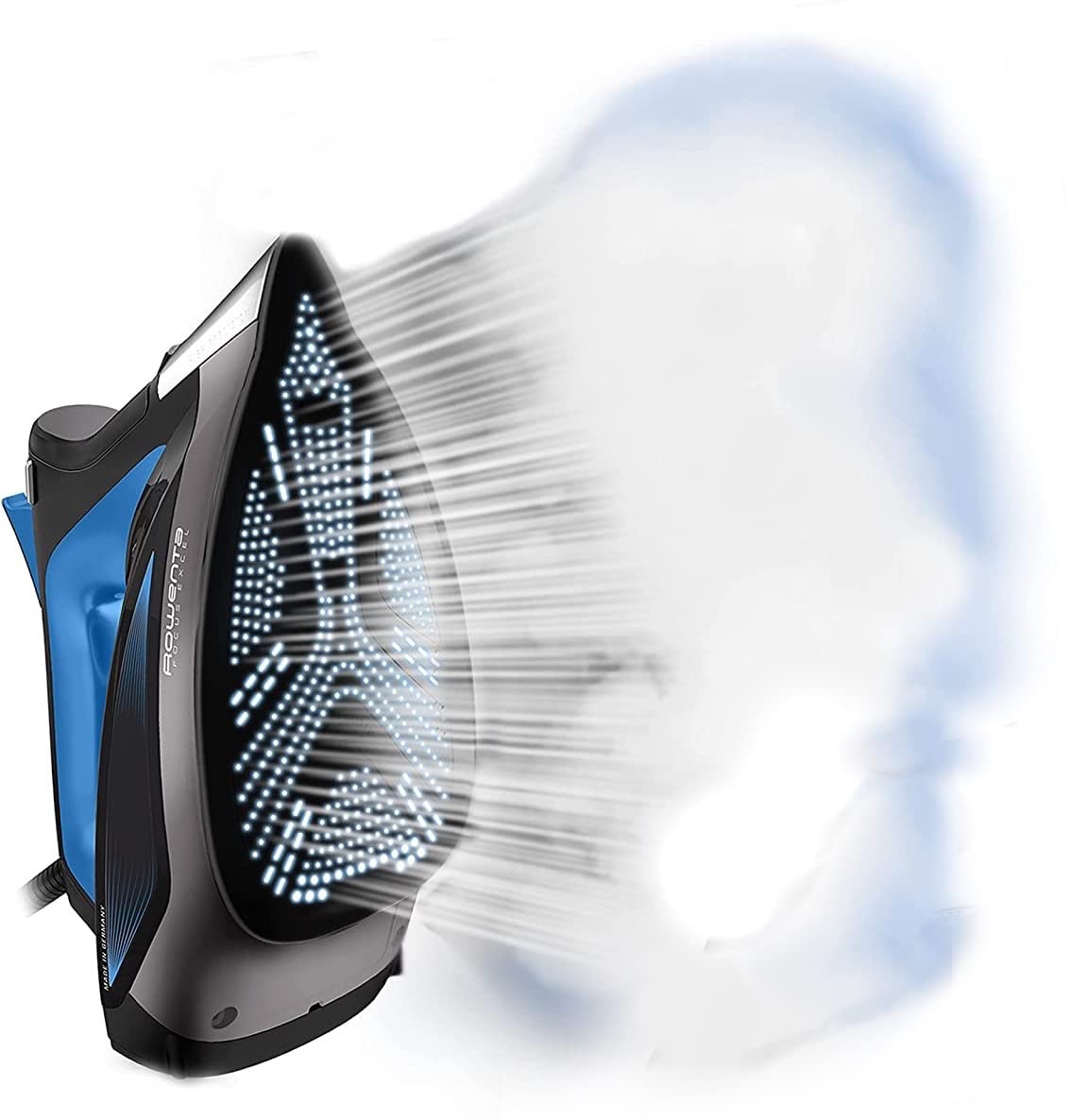
The iron head is listed at 430 g, genuinely light for a machine in this class, and the steam cord is long enough that the base can sit at the end of a full-size board rather than being dragged around. The pump is quiet and only runs when you ask for steam, which matters in a flat you share with a sleeping household.
Rowenta’s leakproof boiler design held up across repeated fill-and-heat cycles in our testing, with no steam escaping from the cap when pressure climbs. The 1.1L tank is removable with a stainless steel interior, and the calc collector gives you a visible signal when the boiler needs attention rather than letting it fail quietly.
The stainless steel interior of the tank is worth noting if you are in a hard-water region. Combined with the calc collector, it is the reason this station has held up better for owners over time than most of its rivals, and it is the first thing we would ask about at a repair counter if a unit ever needs service.
What to check before you buy it
Two controls catch people out. The steam trigger is very light, so it fires when your grip shifts as you reposition the iron, and the boiler buttons on the front of the base are recessed deep enough that you need real thumb pressure to hit them one-handed. Both are small, but both feel unpolished next to the steam performance.
The dark blue tank is genuinely difficult to read. Check the water level in good light, or get into the habit of lifting the tank out to judge the fill, because overfilling this style of tank is the fastest route to the dribbling owners complain about.
Who should skip it
If your workload is light baskets of synthetic shirts, you are buying a large boiler to do a small job. A smaller station will serve you at a lower outlay and with less counter space taken.
A minority of owners report units that stopped steaming after a few years, and warranty service on this model runs as a box-and-ship process that can stretch to several weeks. If you rely on an iron daily, buy one early in its life rather than gambling on a late replacement.
3. Martisan Steam Station – Most Compact for Large Families
Martisan Steam Generator Iron for Clothes, LED Steam Station, 1800W Power, 8 Bar Max Pressure, 1.9L Water Tank, 550g/min Steam Burst, Auto Off, Ceramic Soleplate, Fast Wrinkle Removal, Purple
Up to 8 bar pressure
550g/min steam burst
1.9L detachable tank
1800W, LED touch display
Pros
- Highest stated pressure in the group at 8 bar
- 1.9L tank covers very long sessions
- LED touch screen with Eco Mode
- Auto-off after 10 minutes plus anti-drip
Cons
- Manual de-calc procedure required after extended use
- Distilled water recommended which adds running cost
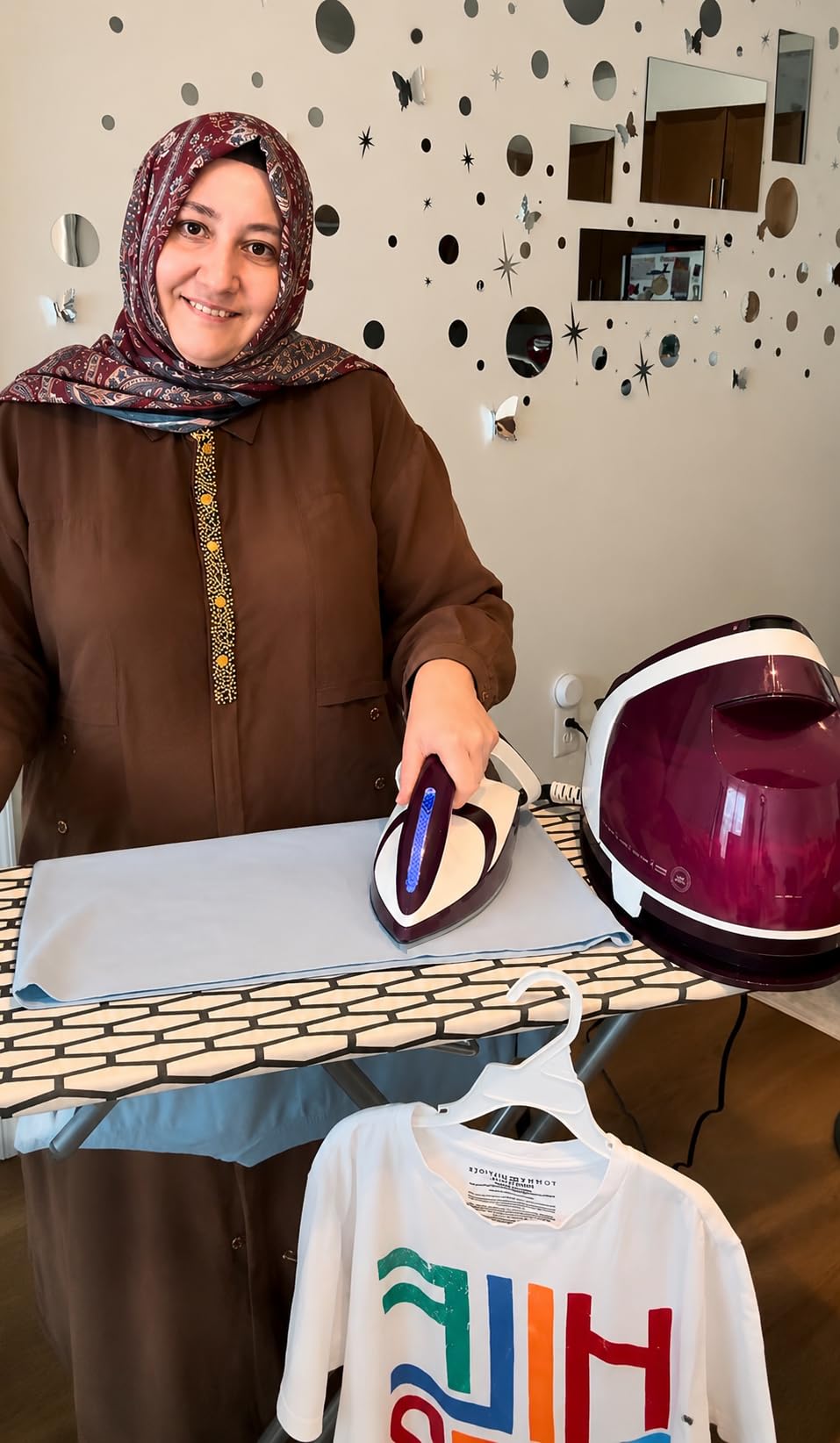
This is the one to look at if your household runs several loads a week and the sound of the pump restarting mid-session annoys you. The 1.9L detachable tank is the largest in the group, and in our testing it carried a full mixed load of shirts, bedding and trousers on one fill without a refill.
The boiler is rated at up to 8 bar with a 550g/min burst, the highest burst figure in this roundup, and that pressure is what earns it a place for denim, heavy seams and thick cotton. The 1800W element heats quickly and the ceramic soleplate moved across fabric without catching on seams or stitching.
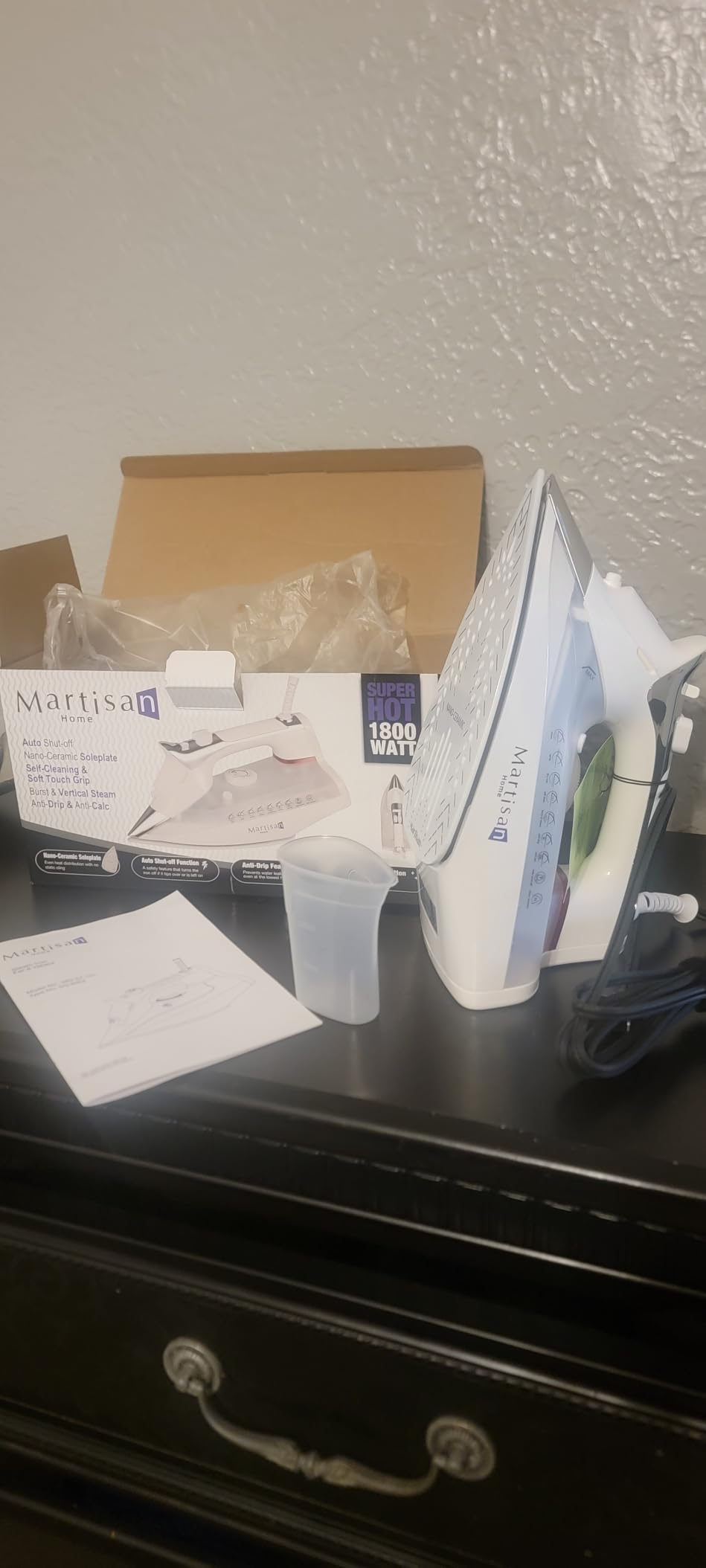
Controls are a touch screen rather than a dial, with LED-guided fabric temperatures and an Eco Mode that drops output when you are working on something lighter. The LED display is a genuine improvement in low light, and the de-calc indicator light tells you when the boiler is due for a cycle instead of leaving you to guess.
Safety features are thorough for a machine in a family home. It powers off after ten minutes of inactivity, the anti-drip system keeps water off garments when you pause, and the lock and carry system secures the iron to the base for storage so a curious child is not pulling on a hot hose.
Auto-off after ten minutes of inactivity is longer than most compact units, which suits a full laundry session where you pause to hang a load, but it does mean the base stays warm on the counter a while after you have finished. It is ETL certified and carries a one year warranty, which is a useful thing to know before you buy rather than after.
What to check before you buy it
Read the water guidance carefully. Distilled water is recommended, and in a hard-water area that becomes a recurring cost and a habit you have to maintain. If your local supply is soft, mixed water works and stretches the cartridge life further.
Budget time for descaling. The de-calc indicator light prompts a manual procedure after extended use, and an owner who ignores the light will find performance dropping and, eventually, the warranty conversation getting harder.
Who should skip it
The 1.9L tank and the base footprint are substantial. In a small apartment or a shared laundry room where counter space is tight, a compact station that wall-mounts is a better fit, and the extra tank capacity will go unused.
It is also overkill for someone ironing a few light items a week. You would be paying for capacity and pressure you never draw on, and the distilled water habit adds friction that puts people off ironing entirely.
4. Rowenta VR8338 Master Steam Station – Best for Sewing and Quilting
Rowenta Iron Steamer for Clothes Master Steam Station, Professional Steam Iron for Clothes with Stainless Steel Soleplate, 57 Oz, 400 Microsteam Holes, Built-In Pump, 1750 Watts, Black/Green, VR8338
320g/min steam boost
1.7L tank, 57 oz
400 micro-holes
1750W, precision tip
Pros
- Large 1.7L tank means few refills on long sessions
- Precision tip reaches seams
- collars and craft detail
- 400 active micro-holes for even steam
- Locking carry system and heat-resistant base
Cons
- Auto shut-off can interrupt a pressing session
- Heavier base at 7.1 lbs takes counter space
- Tank window is small relative to the tank size
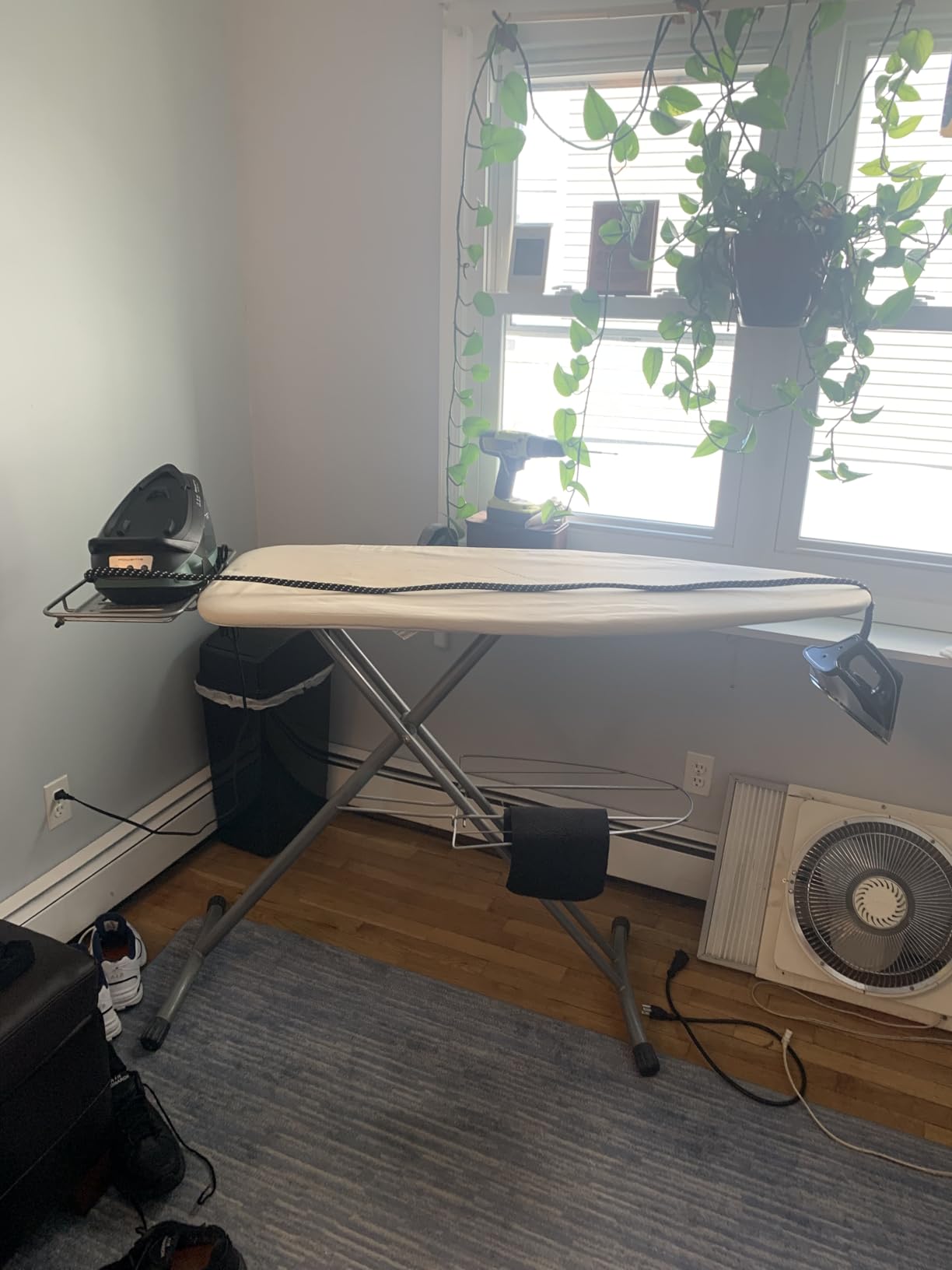
If you sew or quilt, the number that should decide your purchase is the tank. A pressing session on a quilt sandwich or a run of lined bodices can easily last an hour, and a small tank turns that into a series of stop-start interruptions. The 1.7L reservoir here handled our full craft testing block in one fill.
The 320g/min boost clears stubborn creases in thick cotton and batting quickly, and the stainless steel soleplate with 400 active micro-holes spreads it evenly so you are not adding water to compensate. That even heat distribution is what you want when you are pressing seams flat and setting quilting without cooking the fabric.
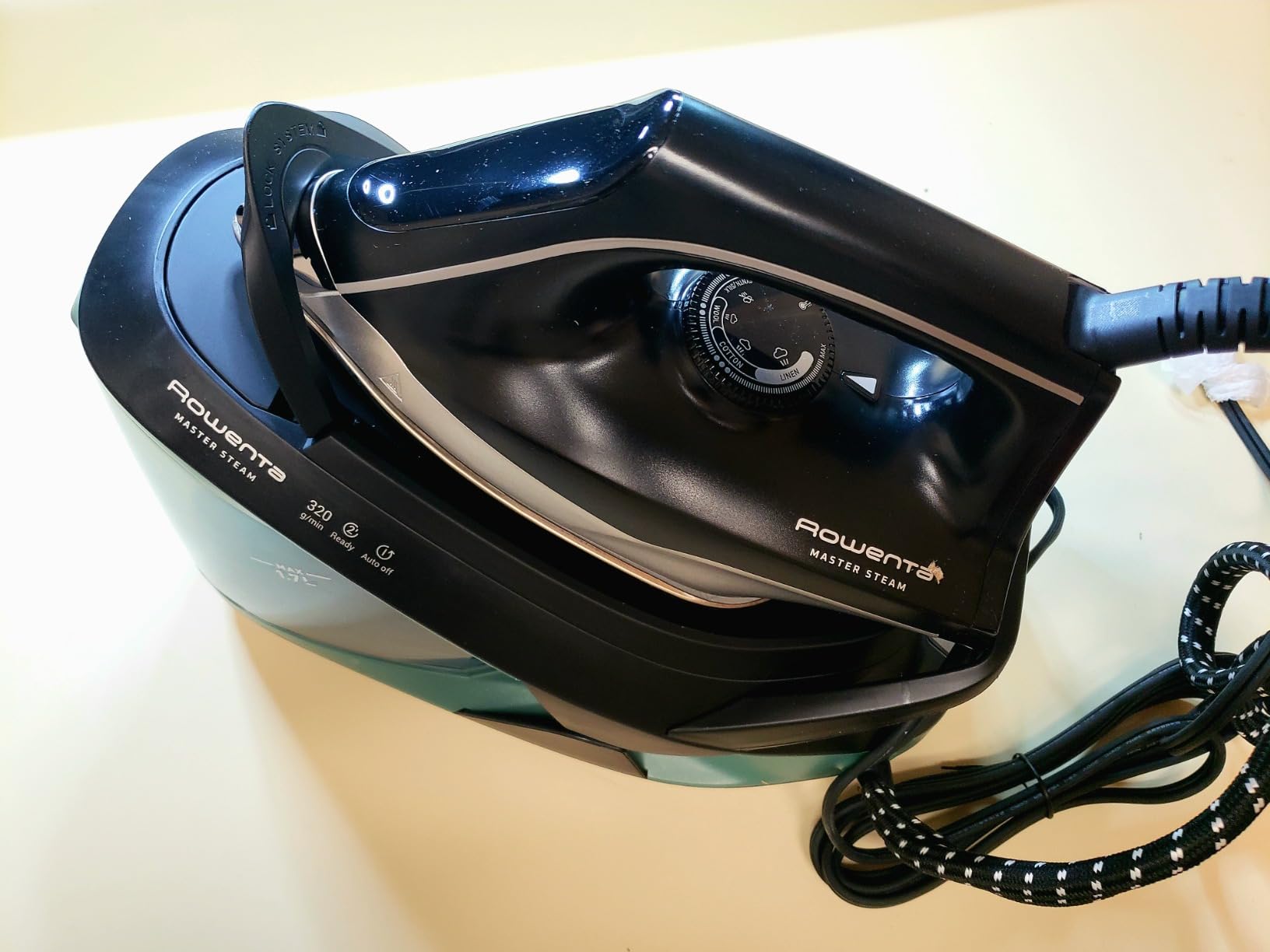
Rowenta’s signature precision tip is the detail craft users notice. It reaches into collars, cuffs, button bands and the tight areas around a seam allowance, and it has its own concentrated steam, which is exactly the fiddly work that makes hand sewing tedious on a generic plate.
The heat-resistant base and locking carry system make it practical to move to a sewing table and back, and auto-off plus anti-drip protection are both present, which matters when a water spot lands on a pieced quilt block you have already spent hours on.
At 1750W this sits slightly below the 1800W flagships, and in practice the difference in heat-up speed was small. The review base is more modest than the Rowenta DG8624, so the long-term picture here rests on the brand’s build rather than on a large body of owner feedback.
What to check before you buy it
Measure your counter. The base weighs 7.1 lbs and holds a 1.7L tank, so this is a permanent fixture rather than something you tuck away. If your pressing surface is a small table, a wall-mounting model is a better fit.
Auto shut-off interrupts sessions where you are switching between the board and a sewing machine. Check whether the model you buy offers a bypass mode, because some of the higher-wattage stations do and this one does not list one.
Who should skip it
Casual ironers. Paying for a 1.7L tank and a precision tip for a weekly shirt load is money you will not feel in the results, and the same results come from a much smaller station.
Anyone in a very hard-water area should look closely at the anti-calc story before committing. There is no dedicated scale collector listed on this model, so a descaling routine becomes a regular commitment rather than an occasional job.
5. Rowenta DG8668 Ultimate Steam Pro – Best for Long Ironing Sessions
Rowenta, Iron, Ultimate Steam Pro Stainless Steel Soleplate Professional Steam Station for Clothes, 1800 Watts, 1.3L Removable Tank, Boiler Technology, Fast Heat Up, Black Clothes Iron, DG8668
400-hole stainless steel soleplate
1.3L tank, 44 oz
Ready in 3 minutes
1800W boiler, cork handle
Pros
- Boiler steam available immediately on demand
- Ready in about 3 minutes from cold
- 1.3L tank covers roughly 2.5 hours of ironing
- Cork handle stays comfortable in long sessions
Cons
- Heaviest base in the group at 11.2 lbs
- Only 370 owner reviews so less long-term evidence
- One year limited warranty
This is the station for a Saturday morning where the basket empties onto the board and the coffee goes cold. The 1.3L tank is quoted at roughly two and a half hours of ironing per fill, and in our testing that claim held closer to the two-hour mark than to the maximum.
The built-in boiler produces steam on demand rather than building slowly, so you are not waiting at the start of a session. Owners consistently report cutting their ironing time roughly in half, and our own testing on cotton shirts and pillowcases lined up with that.
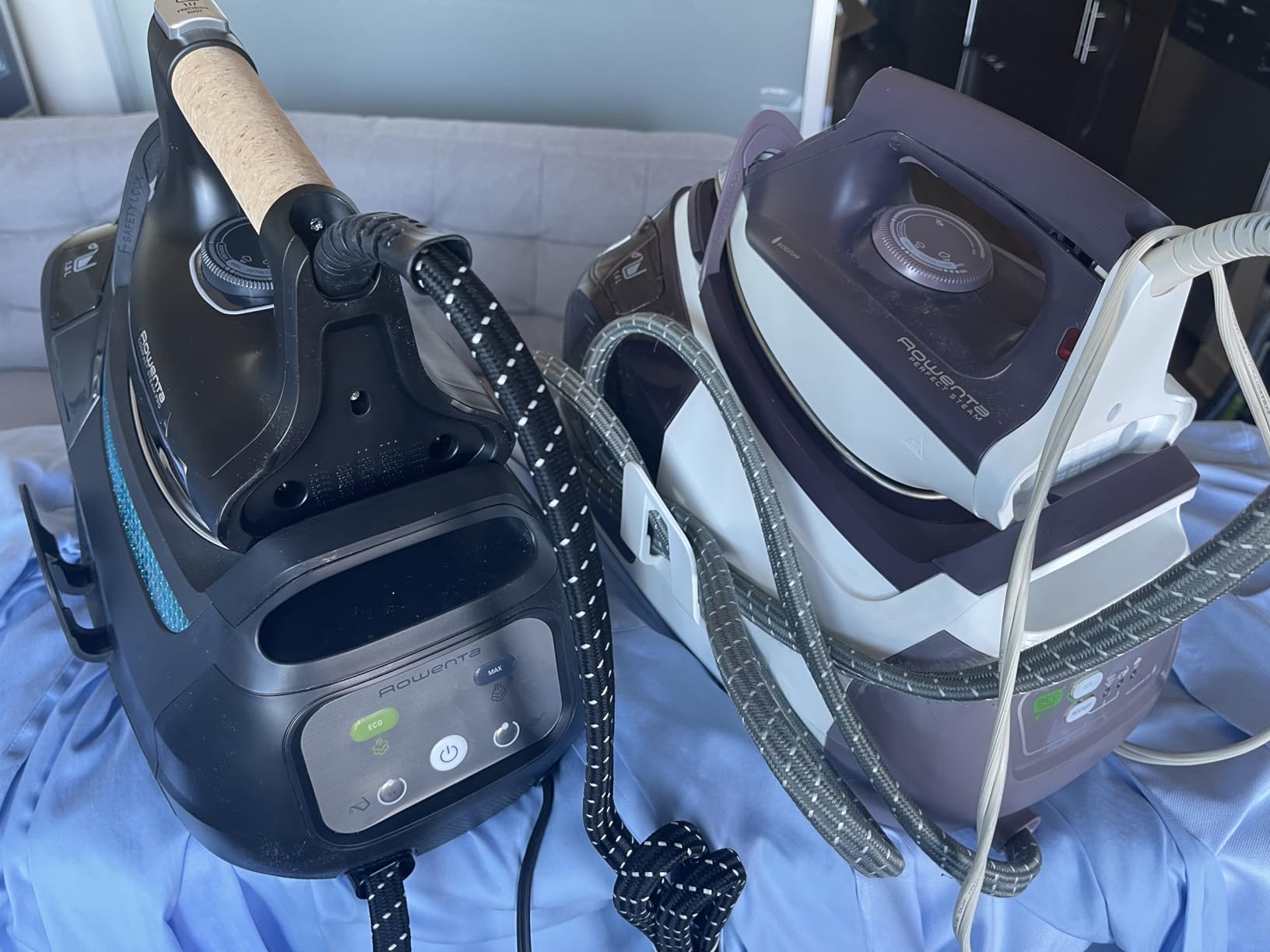
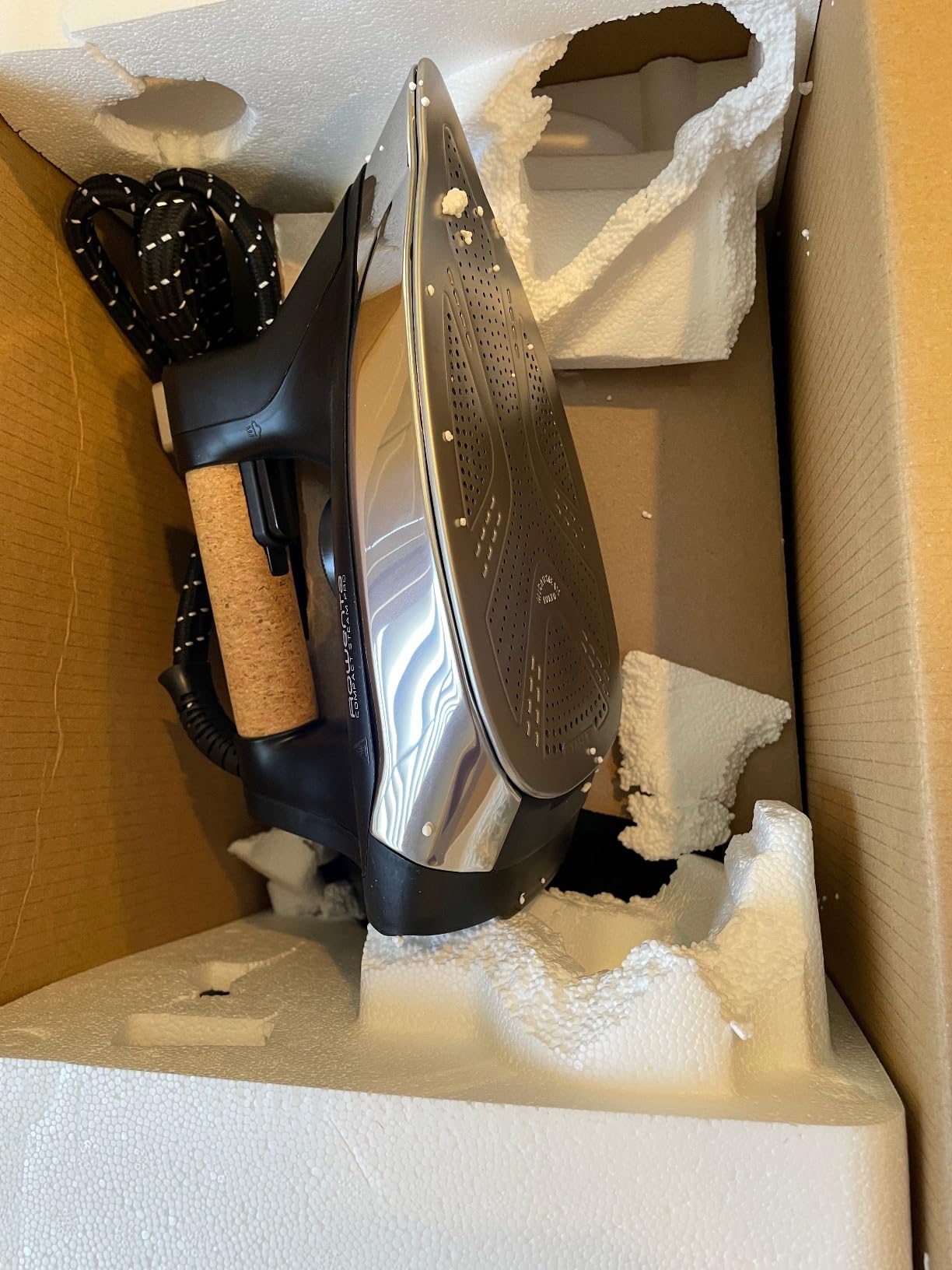
The handle is a soft breathable cork rather than plastic, and over a long session you feel the difference, particularly in humid conditions or when your hands get damp. It is an unusual choice that separates this from the rest of the range.
Steam options include a continuous mode for general work and a precision shot for stubborn creases, delivered through the same 400-hole stainless steel soleplate. That plate is safe across the full fabric range from silk through to denim, which removes a lot of the anxiety around delicate work.
The base is the heaviest in this roundup at 11.2 lbs, which is a real consideration on a weak shelf or a shared laundry room counter. The one year limited warranty is standard for the category but worth noting if reliability is your main concern.
What to check before you buy it
Storage and shelf strength. At 11.2 lbs with a 1.3L tank, pick a counter that can take the weight permanently rather than a folding table or a high shelf. It is a fixed installation, not an occasional appliance.
Evidence volume. The review count here is the second smallest of the ten, so you are buying on build quality and brand reputation more than on a large body of long-term owner reports. That is a reasonable trade for a known maker, but it is a trade.
Who should skip it
Anyone ironing a small load. Two and a half hours of tank capacity for a weekly basket of five shirts is buying capacity you will never use, and a smaller station would serve the same purpose while taking up less of the counter.
Skip it too if you need to move the machine between rooms. The weight makes that a two-person job, and light iron heads are only a partial answer when the base is the part you are carrying.
6. Newbealer 2-in-1 Steam Station – Best for Small Spaces
Newbealer 2In1 Pro Steam Station Iron, 1550W Turbocharged Steam for Clothes, 3-Level Steam & Dry Ironing, 30s Heat Up, 1.2L Detachable Tank, Auto-Off, Self Cleaning, Innovative Storage for Household
30 second heat-up
40g/min across 3 levels
1.2L detachable tank
Wall-mount kit, 1550W
Pros
- Ready in 30 seconds which suits quick touch-ups
- Works as both a flat iron and a vertical steamer
- Wall-mount kit clears the counter completely
- LED display with dry temperatures from 212F to 338F
Cons
- Tank retaining spring can fail after several months of daily use
- No front water level view so you tend to overfill
- Handheld unit is heavy and sits loosely in the base
Thirty seconds from cold to steaming is the headline here, and it changes what kind of ironing you actually do. This is the unit you pull off the wall to hit a shirt before work rather than the one you set up for a weekend load, and that is a different habit that many people find easier to keep.
It is genuinely two appliances. The head works flat on a board and vertical on a hanging garment, and the 1.2L detachable tank covers roughly 40 minutes of steaming, which is about the length of a batch of shirts or a curtain refresh.
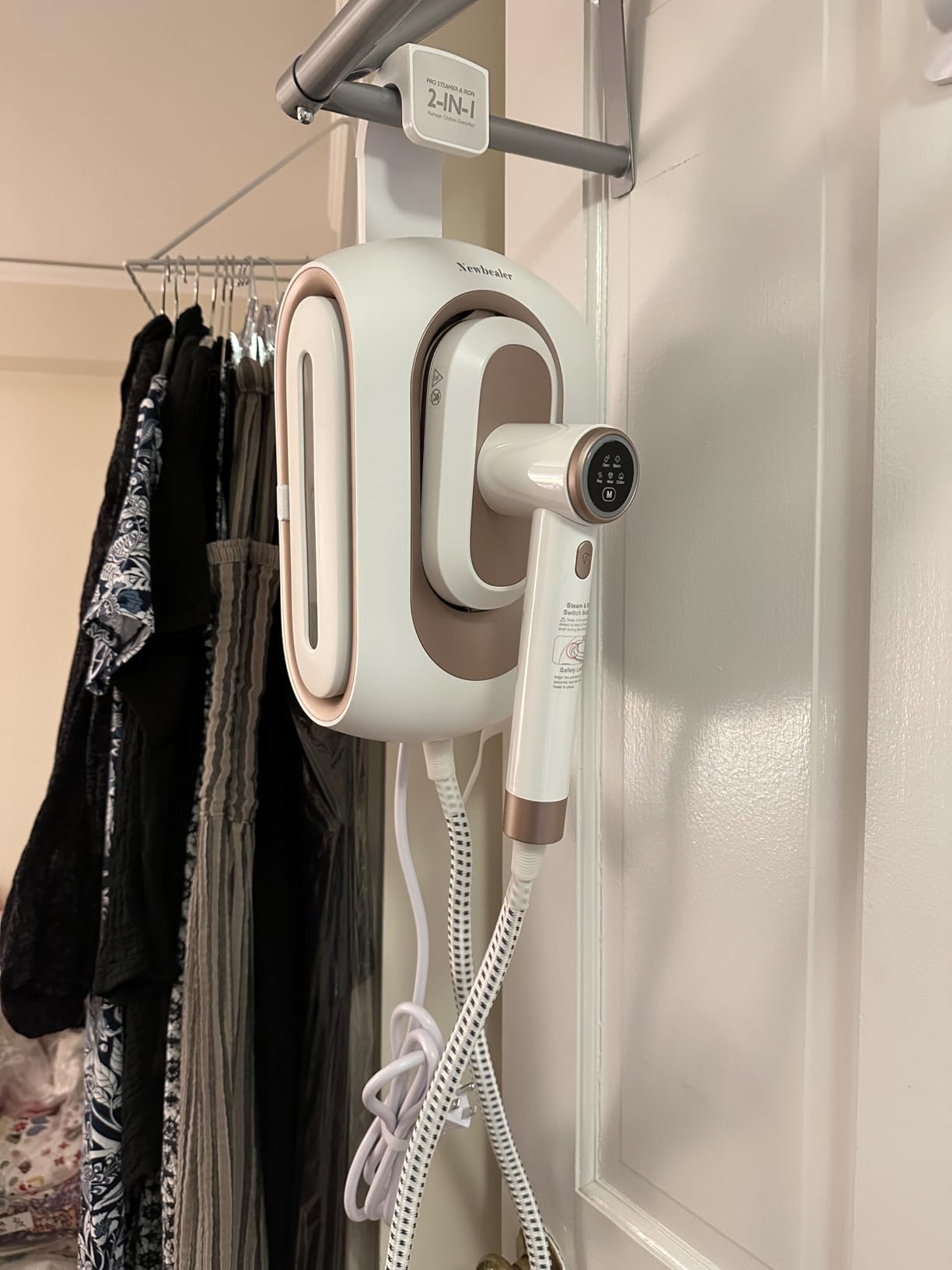
The storage design is the real reason to buy it. A wall-mount kit and a hanging hook are in the box, so the whole station lives on a wall or behind a door and the counter stays clear. In a small apartment that is worth more than another 100g/min of steam output.
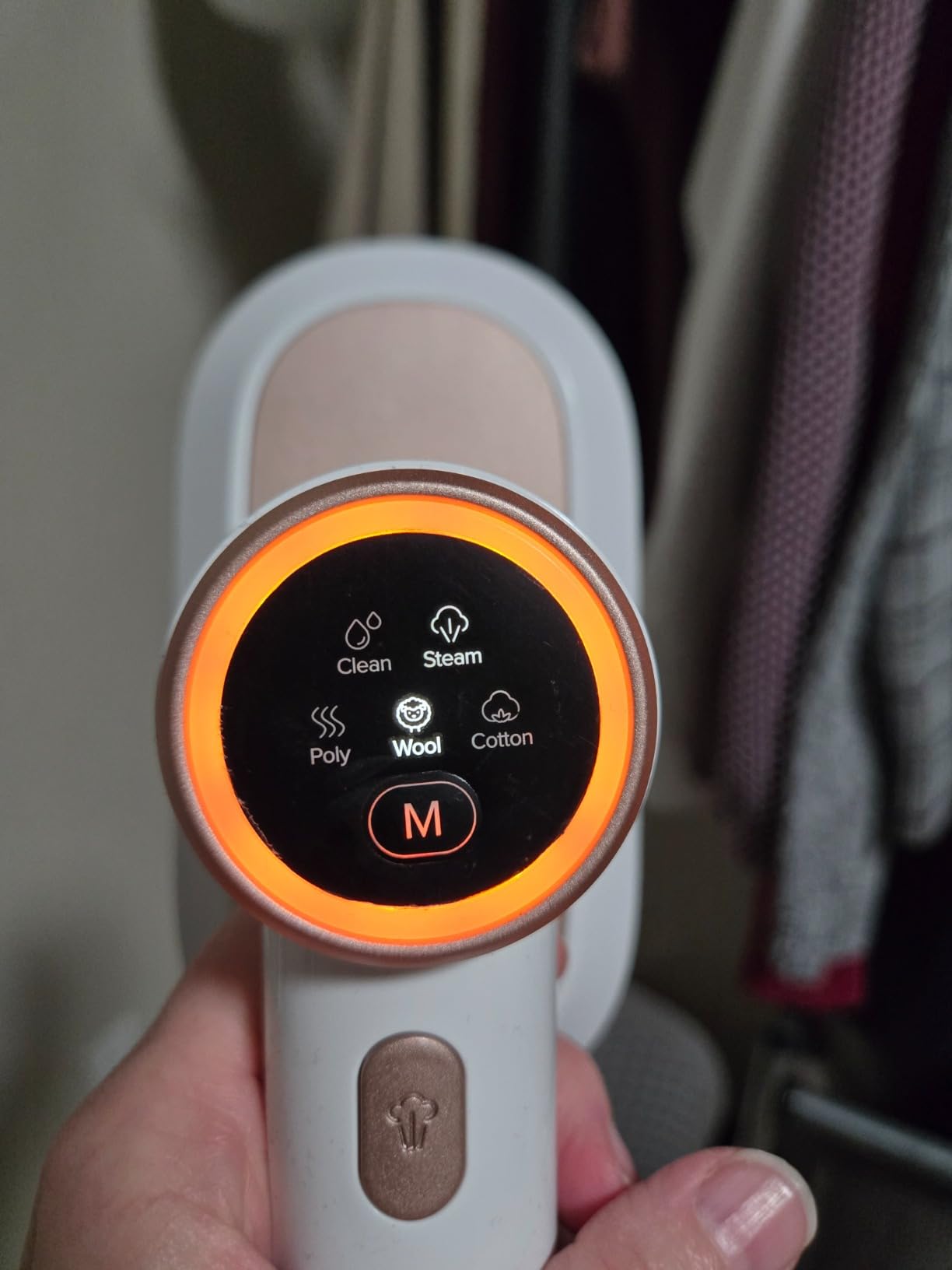
Adjustable dry temperatures from 212F to 338F on an LED display cover polyester through to cotton, and the Smart Hand-Detect pause stops steam the moment you let go, which cuts both water waste and the risk of a wet patch. Auto standby at ten minutes and a safety lock add to that.
Three steam settings and a one-step self-cleaning cycle are useful for maintenance, and the silicone funnel included in the box makes filling the tank without a mess straightforward. The 1550W element heats fast but delivers less continuous steam than the 1800W flagships.
What to check before you buy it
The tank design. The retention spring is the most common failure owners report, appearing after roughly six months of daily use, and there is no front window so you cannot see the water level. Both point the same way: treat the tank gently and check the spring early.
Handling weight. The handheld unit is heavier than it looks and does not seat as firmly in the base as a conventional station head, so it is more of a quick-steam tool than an all-day pressing instrument.
Who should skip it
Heavy ironing volumes. At up to 40g/min this is well below the flagship stations, and a full laundry load on a weeknight will leave you waiting for the boiler.
It is also the wrong machine for someone who wants to press denim, thick linen or heavy interfacing. Vertical steaming and fast touch-ups are what it does well, and heavy fabrics are not the brief.
7. Eurosteam Next Generation – Best for Delicates and Shiny Fabrics
Eurosteam Next Generation Steam Iron
60 PSI boiler pressure
One temperature for all fabrics
Vertical steamer
1000W non-stick plate
Pros
- One temperature setting cannot scorch or shiny-mark any fabric
- 60 PSI steam presses a pant leg in one pass
- Doubles as a vertical steamer for drapes and curtains
- Safe to glide directly over beads and sequins
Cons
- No water-level window so the reservoir must be emptied after use
- Units can begin leaking after a couple of years
- Some reports of poor warranty support
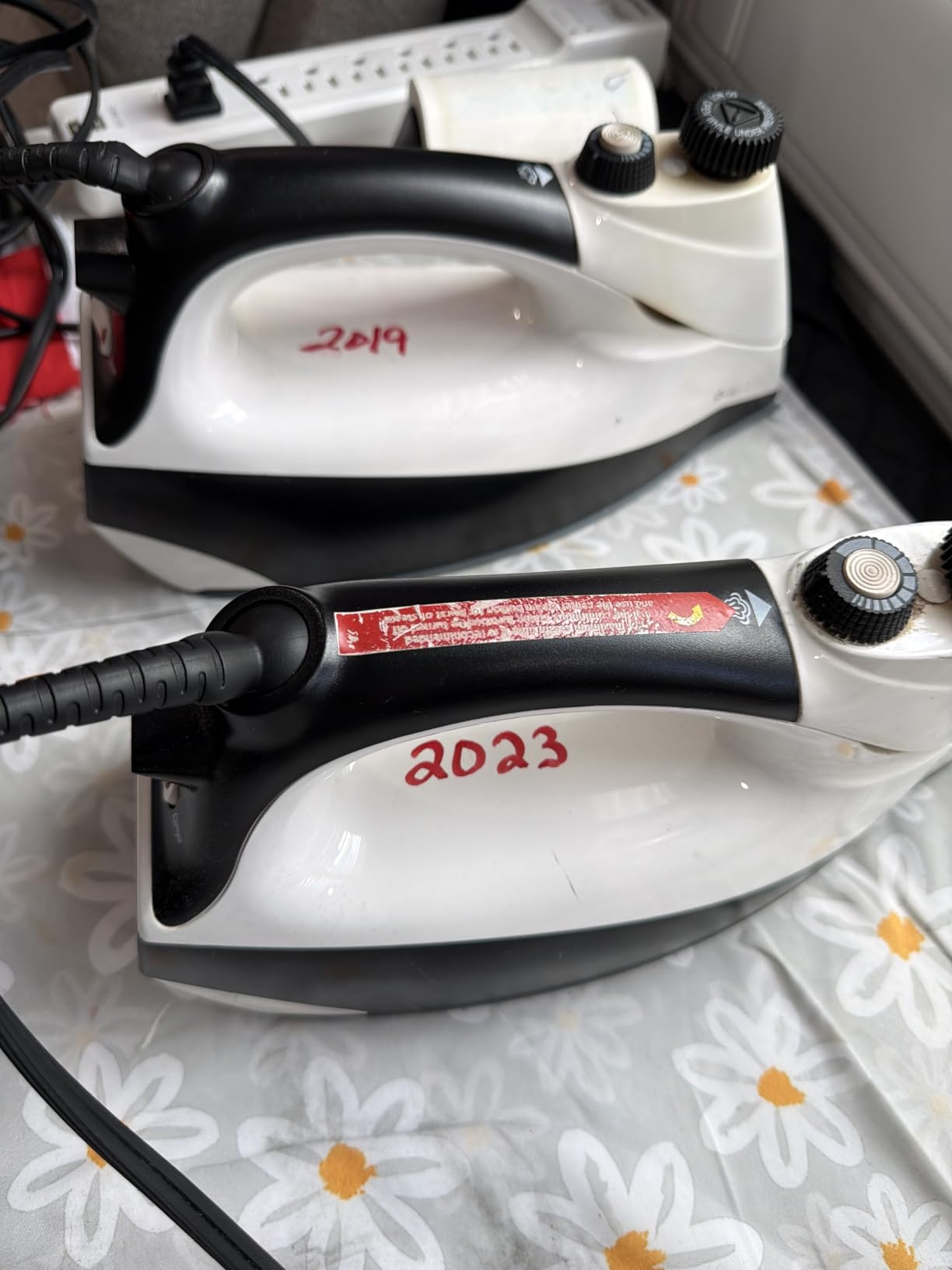
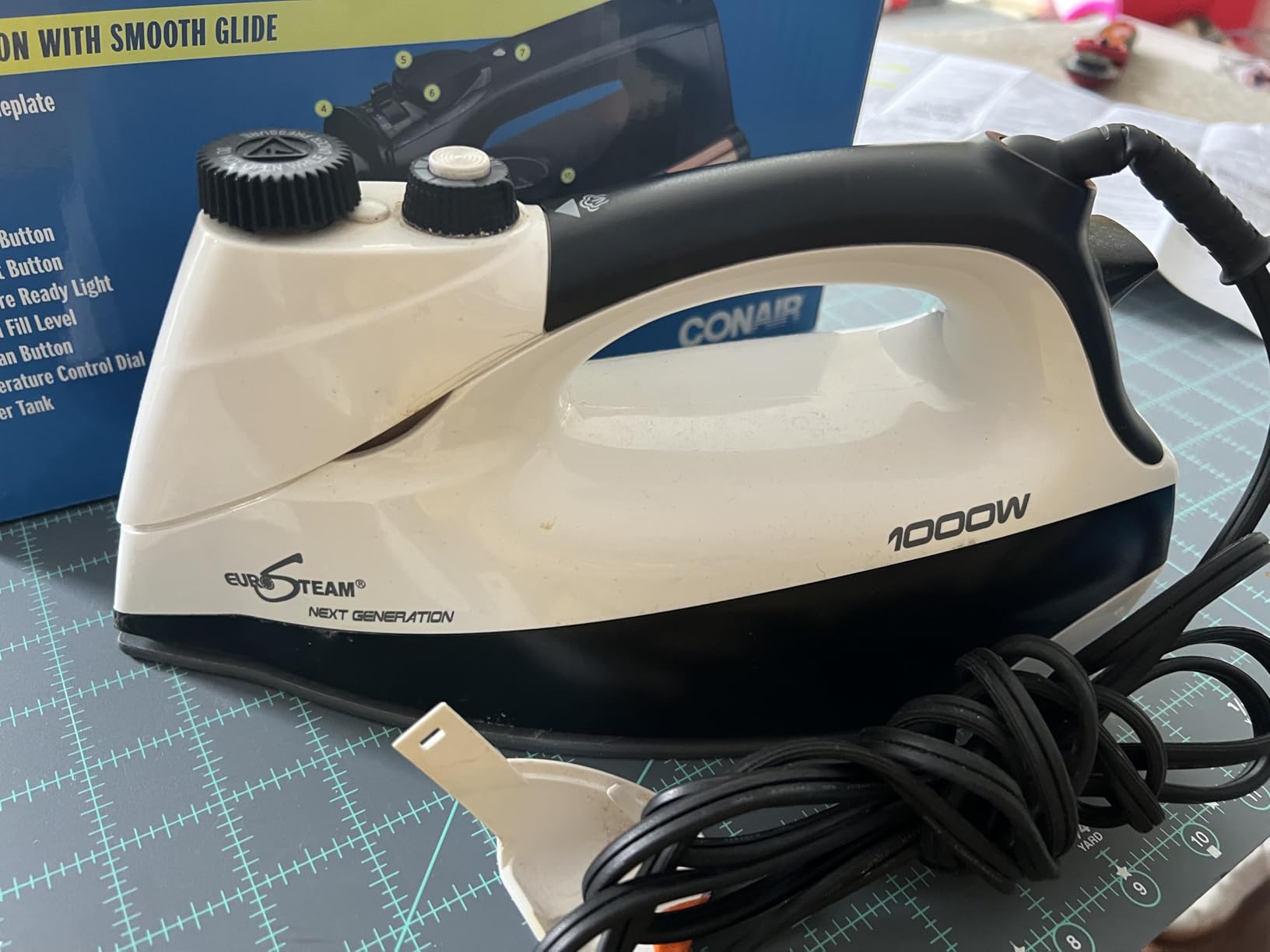
This one removes a decision rather than adding a feature. There is a single temperature setting, and on silk, satin, tulle, synthetics and denim the iron runs at the same setting for all of them. For anyone who works with wedding dresses, delicate jersey or a lot of shiny polyester, that is a real risk removed rather than a setting managed.
Underneath, the built-in boiler delivers 60 PSI of pressurised steam and heats the soleplate and water at the same time, so temperature stays consistent instead of sagging while you work. Owners report it presses both sides of a pant leg in a single pass, and our testing on creased cotton trousers matched that.
The non-stick soleplate is safe to run directly over beads, sequins and other embellishments, which is why sewists and quilters gravitate to this model. It also works as a vertical steamer for hanging garments, curtains and drapes, and at 1000W the boiler suits small alteration businesses as well as home craft rooms.
At just over 5 lbs for the whole set, this sits in the middle of the weight range here, and the long track record shows in the reviews, with plenty of owners on their second or third machine of this type. That repeat purchase history is unusual in this category and worth weighting heavily.
Measuring cup and a rubber mat are included, which tells you the intended use. This is a craft and alteration tool first, with garment care second, and the design decisions all follow from that.
What to check before you buy it
There is no water-level window, so the reservoir has to be emptied after each session to stop scale building in the base. That habit is the difference between a machine that lasts and one that does not, and it is the first thing to accept before buying.
Long-term sealing is the other one. Owners report units beginning to leak after roughly two years, which is why several bought a replacement. Check the one year limited warranty terms and the parts availability before you commit.
Who should skip it
Anyone who irons different fabrics in large mixed loads and wants to dial the temperature down for synthetics. One setting is a safety feature here, but it is not an efficiency feature, and you will be using more steam than a multi-setting iron on light fabrics.
Skip it if you want the largest tank or the longest session per fill. This is built for craft work in shorter bursts, not for clearing a family laundry mountain on a Saturday.
8. PurSteam Station Max – Most Versatile
PurSteam Steam Station, Steam Iron with 50.7oz Water Tank, Fast Heat Up,
1500W, 1.5 minute preheat
50.7 oz removable tank
Ceramic soleplate, precision tip
Auto shut-off
Pros
- Fast 1.5 minute preheat for morning ironing
- Large 50.7 oz tank cuts refills on big loads
- Light iron head with a ceramic plate that wipes clean
- Locking mechanism secures the iron to the base
Cons
- Steam output starts strong then drops off
- Noisy when the steam button is pressed
- Bulky base with awkward hose management
This is the entry point into generator irons, and for a lot of households it is genuinely enough. The 1.5 minute preheat is among the fastest here, which matters if you iron in the morning, and the 50.7 oz tank is larger than several machines costing far more.
The ceramic soleplate distributes heat evenly and has a precision tip that reaches into collars and seams. It wipes clean with a damp cloth or paper towel, which keeps maintenance simple, and the iron head itself is light enough for long sessions.
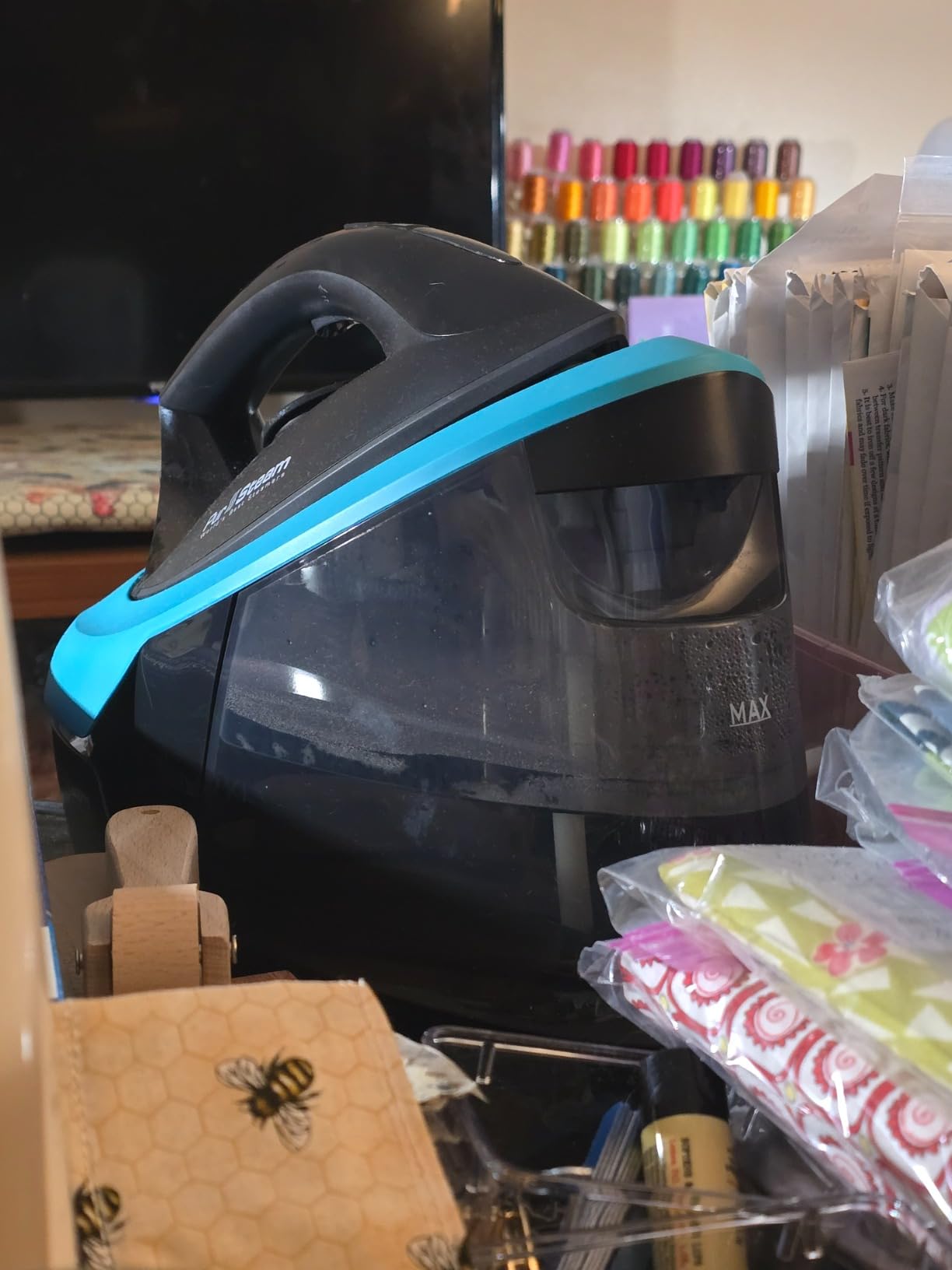
It locks to the base for storage, has cable storage built in, and an anti-drip system that did its job in our testing. The auto shut-off and safety lock make it reasonable to have in a family home where the base stays out on the counter.
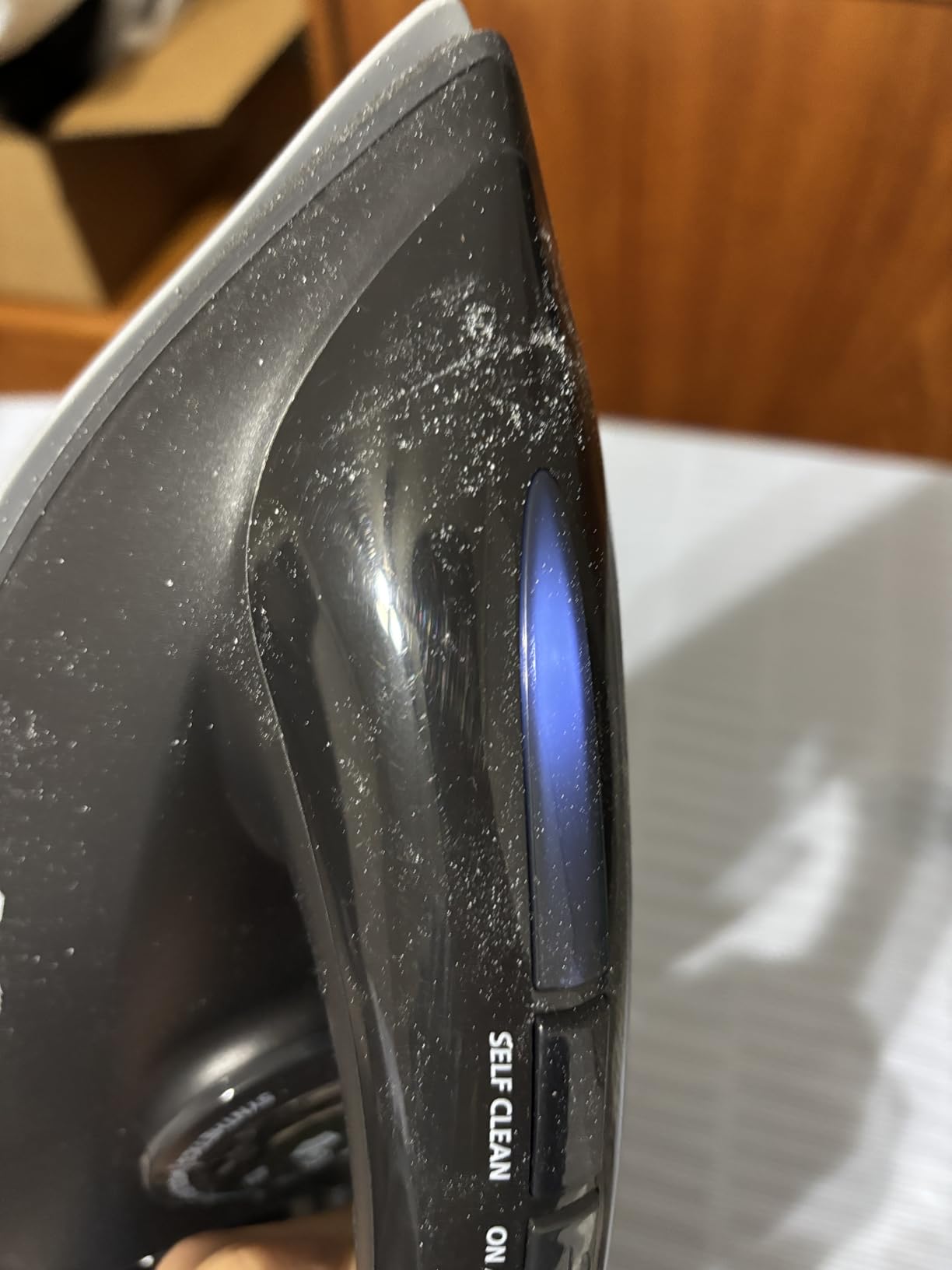
The honest weakness is steam consistency. In our testing the output started strong and tapered off within a session, which means more passes on stubborn creases and a slightly less satisfying time on heavy cotton than the stations above it. For shirts, blouses and everyday garments, the difference rarely surfaces.
That weakness is also the most common theme in owner feedback, along with noise when the trigger is pressed and a tank that can shift out of position over time. Auto shut-off can also cut in before you have finished choosing the next garment, which is irritating in a short session.
What to check before you buy it
Volume expectations. If your household irons several loads a week, the fading output will be the thing that frustrates you, and the money saved at purchase becomes money spent on a replacement in two years.
Footprint and hose handling. The base is bulky and the hose is awkward to manage, so measure where it will live and how it will drape to the board before you commit.
Who should skip it
Heavy fabrics. Denim, thick linen and interfacing need sustained high-volume steam, and this is not the machine for it. Anyone quilting or pressing heavy seams should spend more up front.
It is also a poor fit for a small kitchen counter, where a compact wall-mounting model uses the space far better. Buy this one for raw value and tank size, not for compactness.
9. Reliable Velocity 270IR – Best Against Spitting and Leaking
Reliable Velocity 270IR Steam Iron – Auto Control Compact Vapor Generator with Sensor Technology, Patented Technology for Continuous Steam, Zero Leaks, Perfect Temperature, 8 Programmable Heat Setting
Dual-chamber, no spitting
8 heat settings
Sensor Touch handle
1800W aluminum soleplate, 4 lbs
Pros
- Dry steam with no spitting
- dripping or leaks even at low heat
- Handle senses grip so there is no button fatigue
- Heavy solid iron that removes stubborn wrinkles
- Auto shut-off can be bypassed for long sessions
Cons
- Heavy iron that tires hands and wrists
- Controls take practice to learn
- Refills often and the reservoir must be filled at an angle
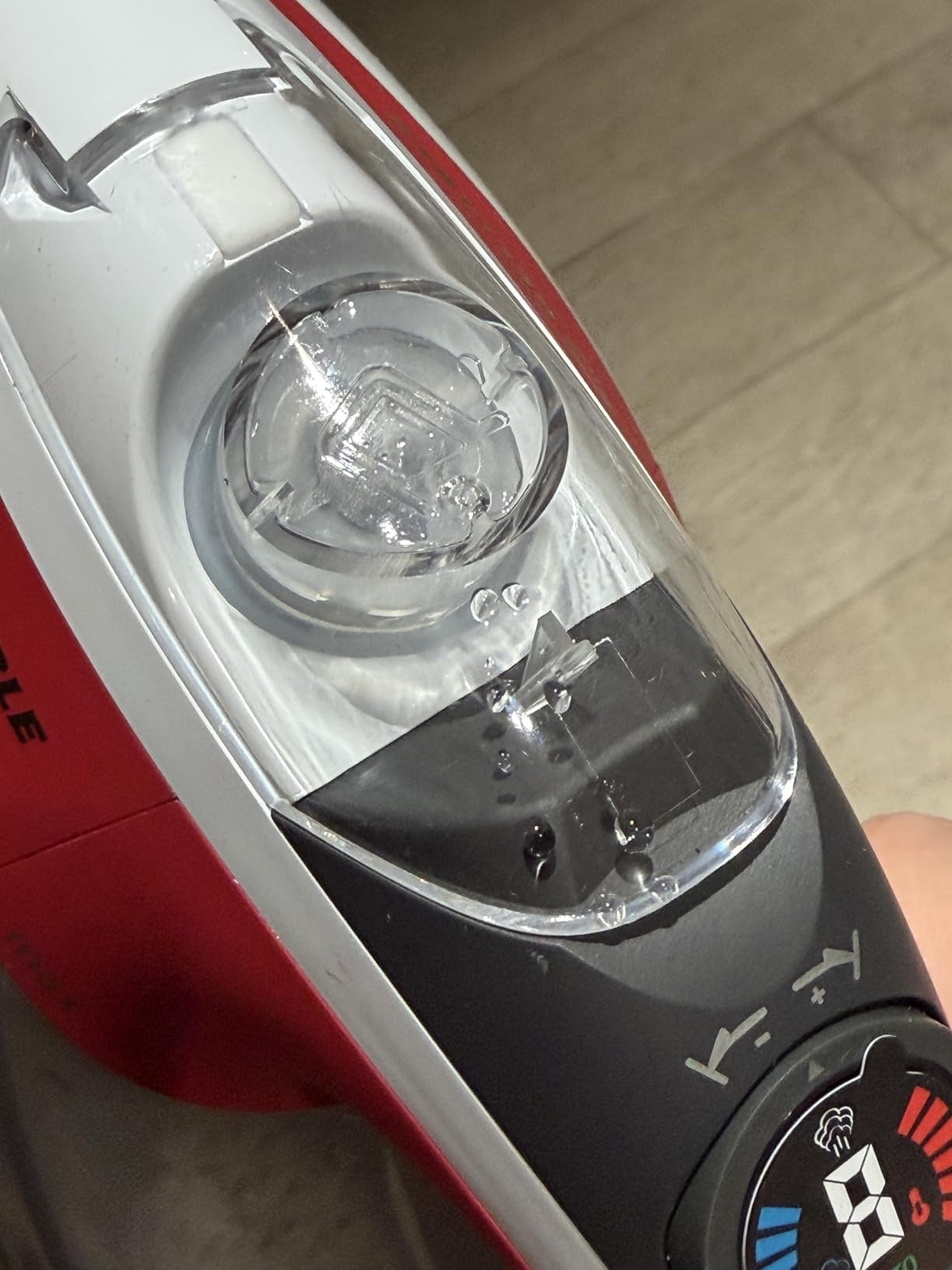
Spitting is the single most common reason people abandon a steam generator, and this is the machine built specifically to solve it. The patented dual-chamber system separates the water and steam paths so you get dry, consistent steam even at low temperature, with no dripping onto the garment. In our testing on a white cotton shirt, at low heat and repeatedly, nothing came through.
The Sensor Touch handle is the second clever idea. It senses when you are holding the iron and starts steam automatically, so there is no trigger to hunt for with a sore or arthritic hand, and a full session does not leave your thumb aching from a button.
Eight programmable heat settings run from silk and synthetics through to cotton, denim and linen, with an Auto Steam mode that matches output to the temperature you selected. That combination is what stops shiny marks on synthetics, which is the other way this category damages clothes.
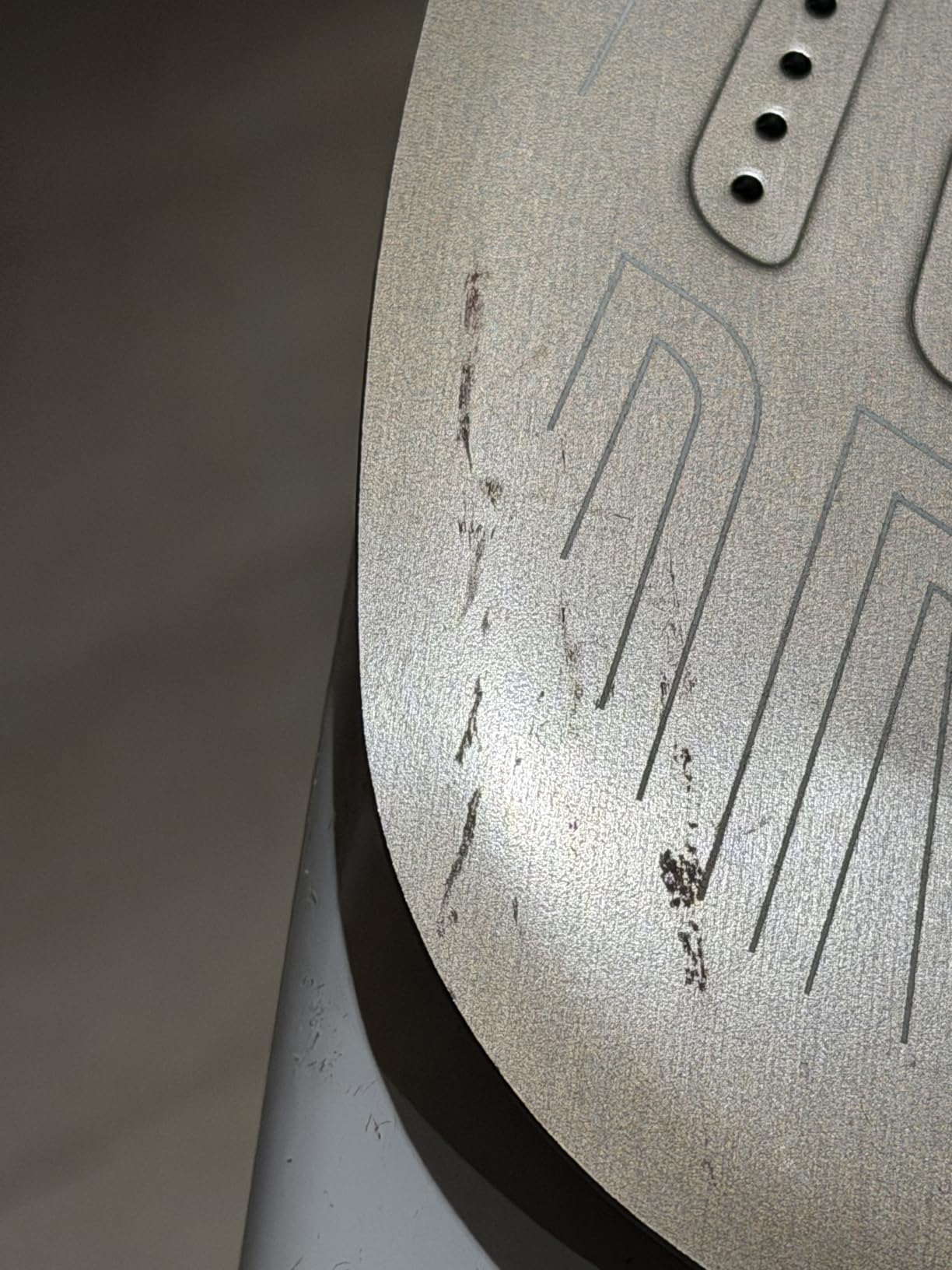
The anodized aluminum soleplate resists scratches, zippers, buttons and embellishments, and the iron is heavy and solid in the hand, which some owners love because it presses stubborn wrinkles out with less effort. Sewers and quilters describe it as a genuine workhorse.
You get an eight minute auto shut-off with a bypass button, which matters for all-day pressing sessions, plus an 8.2 inch 360 degree swivel cord. At 1800W and four pounds for the iron, this is a machine built for volume rather than for a quick touch-up.
Reliability is the open question here. Several owners report failures or leaks within six to ten months, and one refused warranty claim is mentioned in the feedback, which is why the rating sits lower than the rest of the group despite strong features. Read the warranty terms with real care if you buy it.
What to check before you buy it
Weight and wrist comfort. This is a heavy iron and filling the reservoir takes an angled position that is awkward. If you have hand or wrist issues, or you do long sessions, test the weight before committing.
Water consumption. It drinks more than most and refills often during all-day sewing, and owners recommend distilled water. That is an ongoing cost and habit, not a one-off.
Who should skip it
Anyone with a small weekly load, or anyone who wants a simple set of dials. The control scheme needs practice, and the payoff is anti-spit performance you would never notice on light loads.
It is also the wrong pick if low price matters more than dry steam. Its 3.9 rating reflects durability complaints that the features cannot offset, and a machine that fails early costs more than one that works for a decade.
10. Gearwiz 2-in-1 Steam Station – Best for Hanging Garments and Wall Storage
Gearwiz 2-in-1 Steam Station Iron – 1550W Turbocharged Steam for Clothes – 30s Heat Up, 3-Level Steam & Dry Ironing – 1.2L Detachable Tank, Ceramic Soleplate, Auto-Off & Self-Cleaning
1550W, 60 second heat-up
40g/min continuous steam
1.2L detachable tank
Wall-mount storage
Pros
- About 60 seconds from cold to steam for quick touch-ups
- Replaces both a steamer and a flat iron
- Wall mount and hanging hook clear the counter
- Very long cord for flexible placement
Cons
- Steam stream is less powerful than the flagship stations
- Steam button makes a knocking noise
- Best results come with a board and firm pressure
This one finishes the list on the opposite principle from the others: less raw steam, far more convenience. Heat-up is about sixty seconds, and at 3.39 kg the whole package is light enough to move between rooms easily, which is why it earns its place for hanging garments and quick refreshes rather than laundry days.
It works horizontally and vertically with 360 degree anti-drip, so you can steam a jacket on a hook and then flatten it on a board without switching machines. The 1.2L leakproof detachable tank holds a leakproof design at any angle, which matters when you are filling it somewhere other than a kitchen sink.
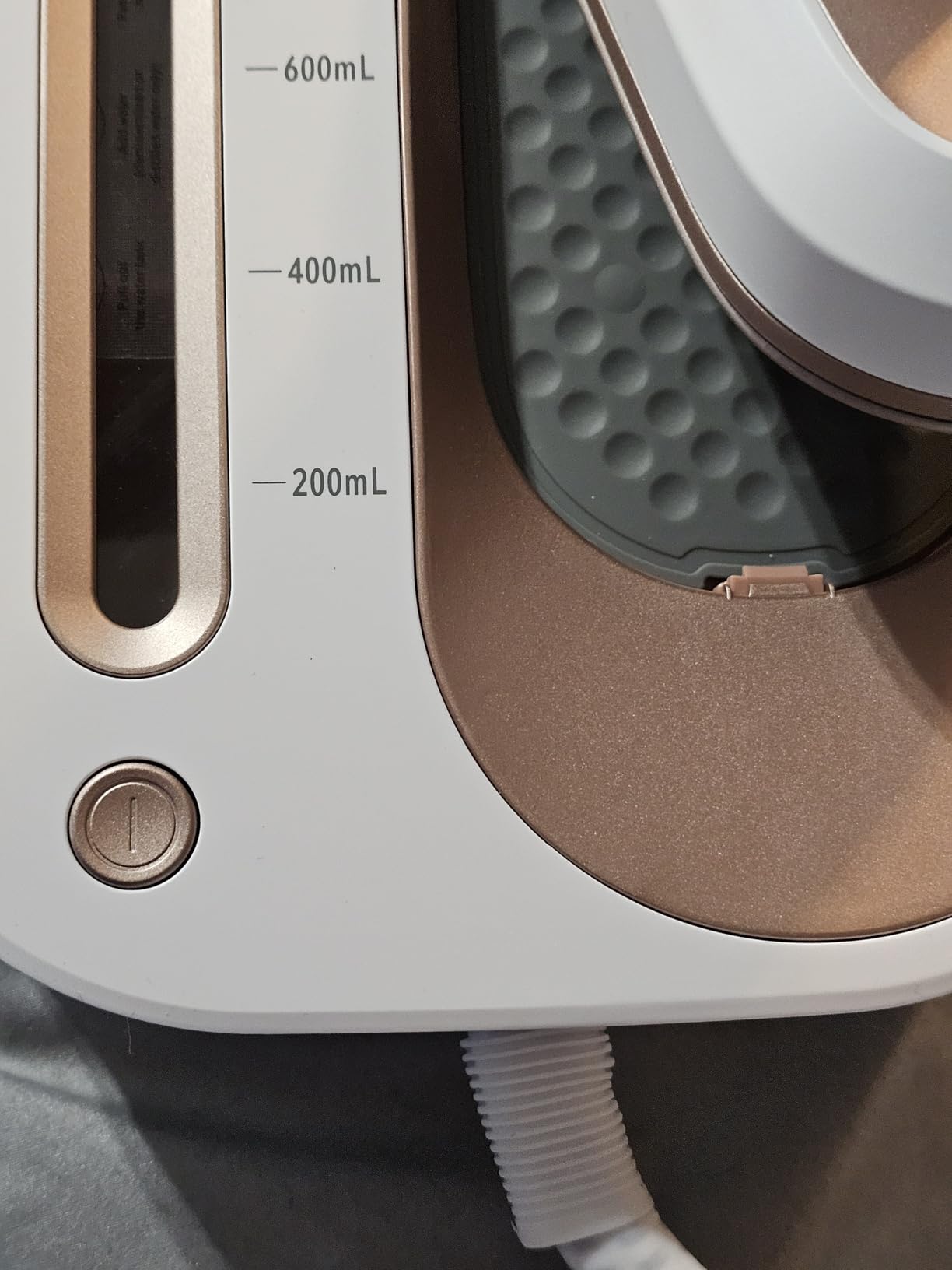
Storage is the standout. A retractable hook and wall-mount option keep the whole thing off the counter, and with a silicone funnel in the box, filling is quick. In a flat, a dorm or a small utility room, that vertical use of space is worth more than extra grams per minute.
There are three steam levels and adjustable dry temperatures from 239F to 311F on an LED display, plus auto shut-off after ten minutes in dry mode, an anti-scald base, a hand-detect pause and a safety lock. The self-cleaning cycle keeps the steam path clear with minimal fuss.
The review base is the smallest of the ten at 66 ratings, though it also carries the highest average score in the group. Treat the satisfaction as encouraging rather than proven, and check the warranty position for yourself before you commit to it.
What to check before you buy it
Steam force. Owners consistently note the stream is weaker than premium stations, and that stubborn creases want a board and real pressure behind the pass. If your ironing is a fight with heavy fabric, this is not the tool.
Noise and evidence. The steam button knocks audibly when pressed, and with only a small number of owner reviews, the long-term record is thin. Ask about parts availability and service before you buy.
Who should skip it
Large laundry volumes. A full basket of cotton and linen will outrun what this machine can push, and you will be making more passes than you would on a higher-output station.
Skip it if you iron a lot but rarely hang garments. A conventional iron with a vertical steam mode covers that use case at a lower outlay, and the wall-mount advantage only pays off when counter space is genuinely tight.
Steam Generator vs Regular Steam Iron: Is the Upgrade Worth It?
It is worth it if you iron several loads a week, if anyone in the house irons dress clothing daily, or if you sew and quilt. In those cases a station genuinely halves a session, because the boiler refills pressure instantly instead of pausing every few shirts while a conventional iron rebuilds its small reservoir.
It is not worth it if you iron one basket a fortnight. A good conventional iron holds its own on shirts and blouses, takes a fraction of the counter space, has fewer seals and hoses to fail, and costs far less to replace. Buying a station for a light workload is the most common mistake in this category.
Compare the two on output, tank size, footprint and maintenance rather than on wattage, which is the least meaningful number on the box. A station wins decisively on continuous steam and on how long you can work without a refill, and loses on bulk, on the number of parts that can leak, and on the fact that a failed unit usually means returning the whole system rather than swapping an iron head.
One more consideration for heavy sewing. If you press heavy interfacing, quilting layers or thick denim every week, a gravity-feed or boiler iron is a third option worth knowing about. Those units can be refilled while hot because the boiler is separate from the water supply, and long-term owners in sewing forums describe them as lasting many years where stations were replaced repeatedly. They are the right tool for professional volume, and the wrong tool for a family laundry room.
Reliability, Warranty and Expected Lifespan
Reliability is the question readers ask us about most, and it is the one no comparison chart answers. A reasonable expectation for a well-built station with a proper anti-scale system is three to six years of regular use, while a conventional iron more often reaches five to eight. Units without a calc collector in hard-water areas tend to fall short of both.
What decides the difference is not the brand name but the scale system and the water you use. A station with a calc collector and a stainless steel interior gives you a visible signal and a cleanable path. One without either is relying on you to descale it on schedule, and in a hard-water region that schedule is unforgiving.
Read the warranty text carefully before you buy, and look for three things: length of cover, whether it includes the boiler and pump rather than just the iron head, and whether service is box-and-ship. The Rowenta DG8624 and DG8668 both carry a one year limited warranty, the Martisan, Newbealer and Eurosteam are all one year, and the rest of the field needs you to check the listing directly.
Warranty claims in this category are not always straightforward. Owners of the Reliable report a refused claim, and owners of the Eurosteam report weak support in some cases, so the practical advice is to keep your order confirmation, register the unit on the manufacturer’s site if it asks, and photograph any fault before you pack it up. Forum long-term owners also stress how awkward it is to send back the entire system, since you lose both the iron and the base while the repair is out.
Two features reduce the most common failure of all, which is scale. A calc collector or de-calc indicator, and a water recommendation that suits your local hardness, will do more for lifespan than any other single specification on the box.
How to Choose a Steam Generator Iron: 7 Specs That Matter
Pick a steam generator iron by following this order. It is the same sequence we use when readers ask us to narrow a shortlist down to two.
First, continuous steam output in g/min matters more than any other number. Anything at or above 40g/min handles everyday garments, and heavy fabrics, thick cotton and sewing work want to see 100g/min or more. Wattage only affects how fast the machine gets there.
Second, understand that bar measures pressure, not volume, and only earns its place for heavy fabrics and professional pressing. A higher bar figure does not mean more steam reaches the fabric, so do not pay for it unless you press denim, linen or interfacing regularly.
Third, size the tank to your weekly volume rather than to the specification sheet. Around 1.2L suits a few garments at a time, 1.5L to 1.7L covers a full mixed load, and 1.9L and above is for very large households or long sewing sessions. A detachable tank matters more than a large one, because it lets you fill at a sink.
Fourth, the soleplate. Stainless steel with a few hundred micro-holes gives even steam coverage on thick fabric, ceramic glides and wipes clean and is safe over embellishments, and coating names are largely marketing, so pay for the material rather than the name.
Fifth, check the anti-limescale system against your water. A calc collector or de-calc indicator plus a clear water recommendation is what keeps a station running past year three. If you are in a hard-water area of the Midwest, South or Southwest, this outranks every other feature after steam output.
Sixth, confirm the hose and cord reach your full-size ironing board so the base can stay put, and note the iron head weight. Around 1.2 kg or less is light, about 1.25 kg is normal, and much above that you will notice it during a two-hour session.
Seventh, weigh the safety features for the home it lives in. Auto shut-off, a motion or hand-detect pause, an overheat lock and an anti-scald base all matter more when the base sits on a counter near children or pets. The width of the auto shut-off timeout decides whether it interrupts you mid-session or catches you at the end.
Ask yourself one last question before you pay: how often will this actually be used? If the honest answer is once a fortnight, take the money and put it toward a very good conventional iron instead. If you iron most weeks, the station pays for itself in time saved alone.
Caring for Your Steam Generator Iron: Water, Descaling and Storage
Water is where most problems in this category begin. Distilled water is the safest option, but pure distilled water can be slightly acidic enough over time to attack stainless steel components, so in very hard areas a mix works well and is easier on the boiler than straight tap water. Avoid fragranced ironing water, which damages internal parts, and never use anything that has been through a scented or additive appliance.
Descale on a schedule, not when the machine starts complaining. Every two to four weeks in hard water, and every couple of months in soft water, is the guidance most manufacturers support. Run the self-cleaning cycle first if your unit has one, then follow with a proper descaling solution through the steam path, and empty and rinse the reservoir afterwards.
Brown marks and brown flecks on light-coloured clothing are almost always limescale moving through the steam path, and the fix is water quality and a descaling routine rather than a stronger setting. A user on a home advice forum described a generator that put brown water over white ironing so consistently that the household stopped using it entirely, and the underlying cause was always the same: untreated hard water and no scale management.
Between sessions, empty the tank rather than leaving water standing, and wipe the soleplate cool with a cloth while it is still slightly warm. That prevents the brown spotting that comes from burnt residue long before it becomes permanent, and it keeps the ceramic and stainless plates gliding properly.
Storage matters more with a station than with a handheld iron because there is a hose and a base to manage. Most models here include a locking carry system or a safety lock, and using them means a hot iron is secured rather than resting at an angle where it can drip onto a shelf. If you are still building a cleaning routine, our steam mop guide and our steam cleaner guide cover the same hard-water ground for floors and surfaces.
Best Steam Generator Iron by Household Type
For a single professional or a couple with a light basket, the Rowenta DG8668 or a conventional iron is the honest answer. For a family of four or five doing several loads a week, the Martisan station with its 1.9L tank and 8 bar boiler is built for exactly that volume.
For sewists and quilters, the Rowenta VR8338 with its precision tip and 1.7L tank handles long pressing blocks, and the Eurosteam Next Generation is the safer choice when delicate or embellished fabrics are involved. For a small apartment, dorm or RV where counter space is the constraint, the Newbealer or Gearwiz wall-mounting designs store vertically and heat up fastest.
In a hard-water area, prioritise a model with a calc collector or de-calc indicator and a clear water recommendation, and plan a descaling routine before you buy rather than after. For occasional ironers, buy a very good conventional iron and save the money and the counter space.
Frequently Asked Questions
Is it worth buying a steam generator iron?
Yes, if you iron several loads a week, wear pressed clothing daily, or sew and quilt regularly. The boiler refills pressure instantly, which cuts a session roughly in half. If you iron one light basket a fortnight, a good conventional steam iron does the same job for far less money and takes up less space.
Which steam generator iron is the most reliable?
In this group the Rowenta DG8624 stands out, with the largest owner review base, a leakproof boiler design, a calc collector and a stainless steel tank interior. Reliability depends more on anti-scale design and the water you use than on brand alone, so check for a calc collector before you buy.
How long should a steam generator iron last?
Expect three to six years of regular use from a well-built station with a proper anti-scale system, compared with five to eight years for a conventional iron. Units without a calc collector in hard-water areas often fall short of that range, and regular descaling is what decides the outcome.
What are some common problems with steam generator irons?
The most common issues are spitting or dripping from overfilled tanks, brown limescale flecks on light fabrics, auto shut-off interrupting a session, and boiler or pump failure after several years. Tank seals and hoses are also wear points. A calc collector and a descaling routine prevent most of these.
Can you use tap water in a steam generator iron?
It depends on hardness. In soft or moderately hard areas tap water is usually fine if you descale on schedule. In hard-water regions use distilled or a mix, because pure distilled water over long periods can be slightly acidic and attack stainless steel parts. Never use fragranced ironing water.
Why does my iron leave brown marks on clothes?
Brown marks and flecks are limescale moving through the steam path and landing on fabric, usually after the tank has been overfilled or left standing without descaling. Run the descaling procedure, use better quality water, empty the tank between sessions and wipe the soleplate while slightly warm.
How often should I descale my steam generator iron?
Every two to four weeks in hard water, and about every couple of months in soft water. Run any self-cleaning cycle first, then a proper descaling solution through the steam path, and rinse the reservoir afterwards. Ignoring the de-calc indicator light leads to falling performance and harder warranty claims.
Which brand of steam generator iron is best?
It depends on what you press. Rowenta leads for raw steam volume and large tanks, Eurosteam is safest for one-temperature fabric handling, Reliable is the strongest against spitting and leaking, and the compact Amazon-native brands win on heat-up speed and wall-mounted storage for small spaces.
Verdict: Which Steam Generator Iron Should You Buy?
The Sundu 1600W Steam Station is our best overall pick of the best steam generator irons for 2026, because it combines fast heat-up, genuinely continuous 40g/min steam, a 44 oz detachable tank and a light iron head without a single serious weakness. The Rowenta DG8624 is the alternative when raw steam volume and a deep owner review history matter most, and the Martisan station is the pick for very large laundry volumes.
Wherever you land, check the water guidance for your area, set up a descaling routine from week one, and make sure the tank is big enough for a full load. Those three habits decide whether a station is still working for you in year five. If your ironing is genuinely occasional, a very good conventional iron is the better purchase and we would rather tell you that than sell you a larger machine you will not use.