
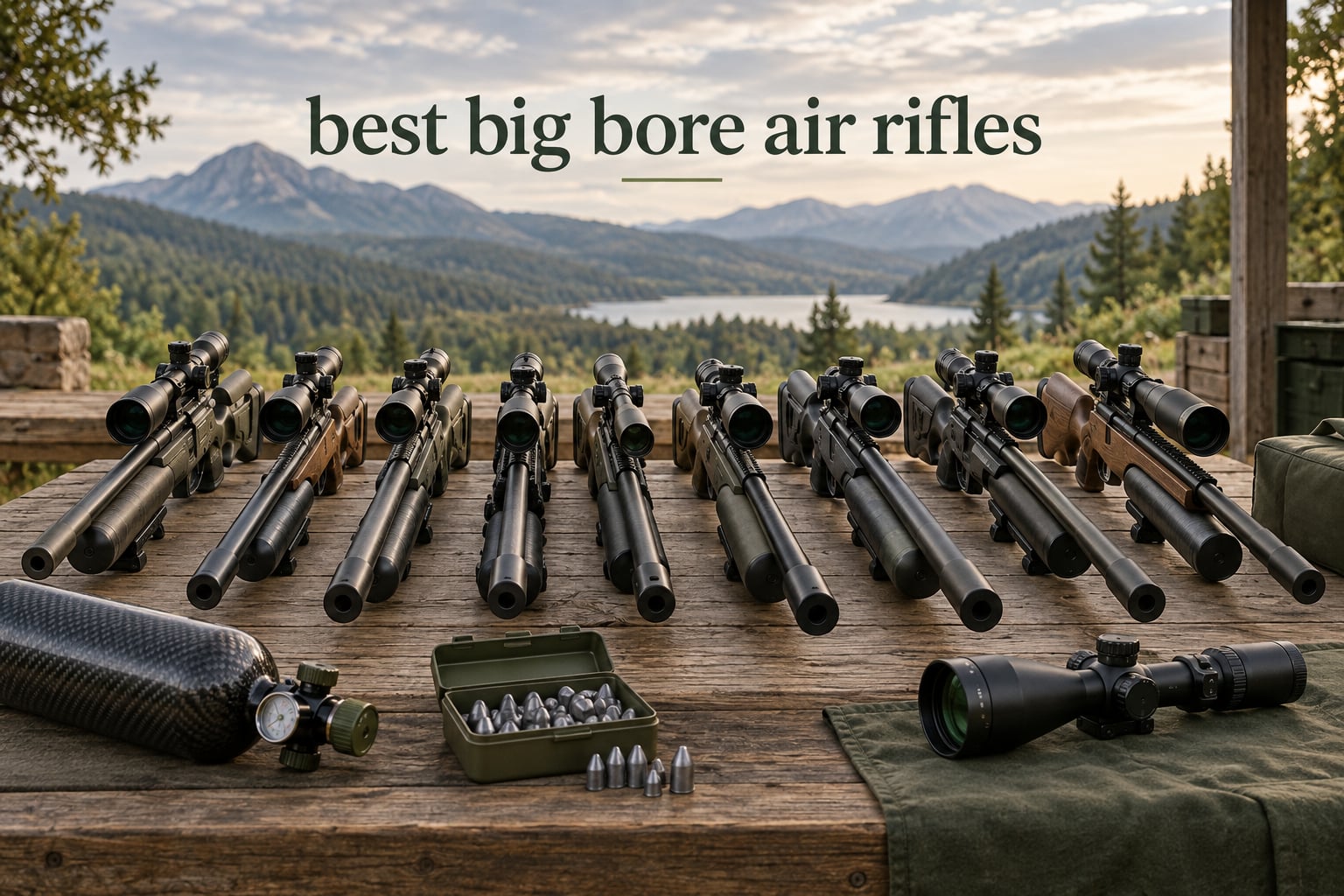
A big bore air rifle is not a bigger version of a pellet gun. It is a different tool, built around a heavy slug or pellet and a large air reservoir, and the whole buying decision hinges on energy rather than velocity. We pulled specs, ratings and owner feedback for eight of them, verified as of September 2026, and the honest answer is that the best big bore air rifle for you depends almost entirely on which animal you want to hit and how far you intend to shoot.
That is the part most roundups get wrong. They stack energy figures in a column, crown a winner, and leave out the two facts that decide whether a big bore is worth owning: a full-power fill is three to eight shots, not forty, and energy does not produce accuracy. Shooters on the Airgun Nation boards and r/airguns ask for the projectile weight and the fill pressure behind every number, because a headline figure with no slug attached tells you very little.
We built this guide around those complaints. Every rifle below carries its own caliber, published energy, velocity, shot count, weight and warranty, with the source noted where the number came from a manufacturer listing. Where a listing publishes no energy figure at all, we say so instead of guessing.
Table of Contents
Top 3 Best Big Bore Air Rifle Picks for 2026
For most buyers the Benjamin Bulldog .357 is the safest first big bore, because it pairs the largest review base in the group with a rifle that is easy to carry and cycle. The Umarex Hammer .50 is the energy answer for anyone who wants maximum punch and already owns a way to fill it. The Hatsan BT 65 SL QE bundle is the value pick if you want a complete ready-to-shoot package rather than a bare rifle.


Umarex Hammer .50 Caliber
- Up to 1130 fps
- 4500 psi carbon fiber tank
- 4 full-power shots per fill

Hatsan BT 65 SL QE .30 Bundle
- 7-shot rotary magazine
- Quattro trigger
- scope and accessories included
All 8 Big Bore Air Rifles Side by Side in 2026
The table below is the canonical dataset for this roundup. Every caliber, energy figure, velocity, shot count and weight in it comes from the manufacturer or retailer listing, and energy figures are not comparable across manufacturers because each is measured with a different projectile in a different barrel.
| Product | Specifications | Action |
|---|---|---|
| Benjamin Bulldog .357 PCP |
|
Check Latest Price |
| Umarex Hammer .50 Caliber |
|
Check Latest Price |
 Hatsan Hercules Bully .30 Hatsan Hercules Bully .30 |
|
Check Latest Price |
 Umarex Gauntlet SL30 .30 Bundle Umarex Gauntlet SL30 .30 Bundle |
|
Check Latest Price |
 Hatsan PileDriver .45 Hatsan PileDriver .45 |
|
Check Latest Price |
| Hatsan BT 65 SL QE .30 Bundle |
|
Check Latest Price |
 Hatsan Factor Bullpup .30 Hatsan Factor Bullpup .30 |
|
Check Latest Price |
 AirForce Texan .51 AirForce Texan .51 |
|
Check Latest Price |
What Counts as a Big Bore Air Rifle
A big bore air rifle is a pre-charged pneumatic airgun chambered in .30 caliber or larger, typically .357, .45, .457, .50 and .51, firing heavy lead slugs or polymer slugs instead of light pellets. The community threshold is usually described as .257 caliber and up, which means a .25 is not a big bore no matter how it is marketed.
That threshold exists for a reason. Below .30 caliber, most states and wildlife agencies treat the rifle as a small game or pest tool. At .30 and above, you are in the category where hunting rules, energy minimums and backstop discipline start to matter. The largest production caliber in this roundup is the AirForce Texan at .51, which sits above the .510 slugs most owners actually use.
One more structural point. Big bores exist almost exclusively as PCPs, because a break barrel or CO2 platform cannot hold enough air to drive a heavy projectile. When you see a big bore air rifle, you are looking at a compressed-air rifle with an external reservoir, and that single fact drives the shot count, the weight and the cost of every model that follows.
How Big Bore Power Actually Works
Energy, not velocity, is what kills, and the formula is simple: a heavy projectile moving at a modest speed carries far more energy than a light projectile moving fast. This is why the slowest rifle in our group is still worth discussing and why a 710 ft/sec .51 can be a serious proposition. Shooters on the Airgun Nation boards and r/WAGuns repeatedly make the same point about the .50 Hammer, that the physics does not change just because the tool is quiet.
Two numbers describe a shot, and people mix them up constantly. Feet per second measures speed. Foot-pounds of energy measures the combination of projectile weight and that speed. A rifle that reaches 1130 fps with a heavy .50 projectile will out-energy a rifle that reaches 1400 fps with a light pellet, and only one of those numbers predicts what happens to game.
The other thing energy does not do is produce accuracy. Owners on Gateway to Airguns and r/airguns are blunt that grouping depends on slug fit, barrel twist, chronograph consistency and how steady the shooter is, not on the FPE sticker. That is why we note when a listing publishes no energy or velocity figure at all, such as the Hatsan Factor Bullpup. Absence of data is a buying risk, not a hidden advantage.
Also worth setting expectations early: on r/guns, participants are consistent that a PCP big bore can produce a report loud enough to startle everyone within a hundred yards. The community does not treat PCP as quiet. Quietness on these rifles comes from integrated moderators and baffle traps, and the legality of those devices varies by state.
1. Benjamin Bulldog .357 PCP – Best All-Round Pick
Benjamin Bulldog BPBD3S .357 PCP Hunting Air Rifle
PCP bullpup
36 inch overall
9.2 lb
Up to 910 fps
5-shot magazine
5-year warranty
Pros
- Largest review base in the group at 369 reviews and a 4.5 average
- Rifled alloy steel barrel rated up to 910 fps
- Reversible sidelever bolt suits either handedness
- Baffle-less sound trap built for big bore suppression
- 26 inch Picatinny rail for optics
Cons
- 9.2 pounds makes it a heavy carry over long distances
- 5-shot magazine means more cylinder refills in the field
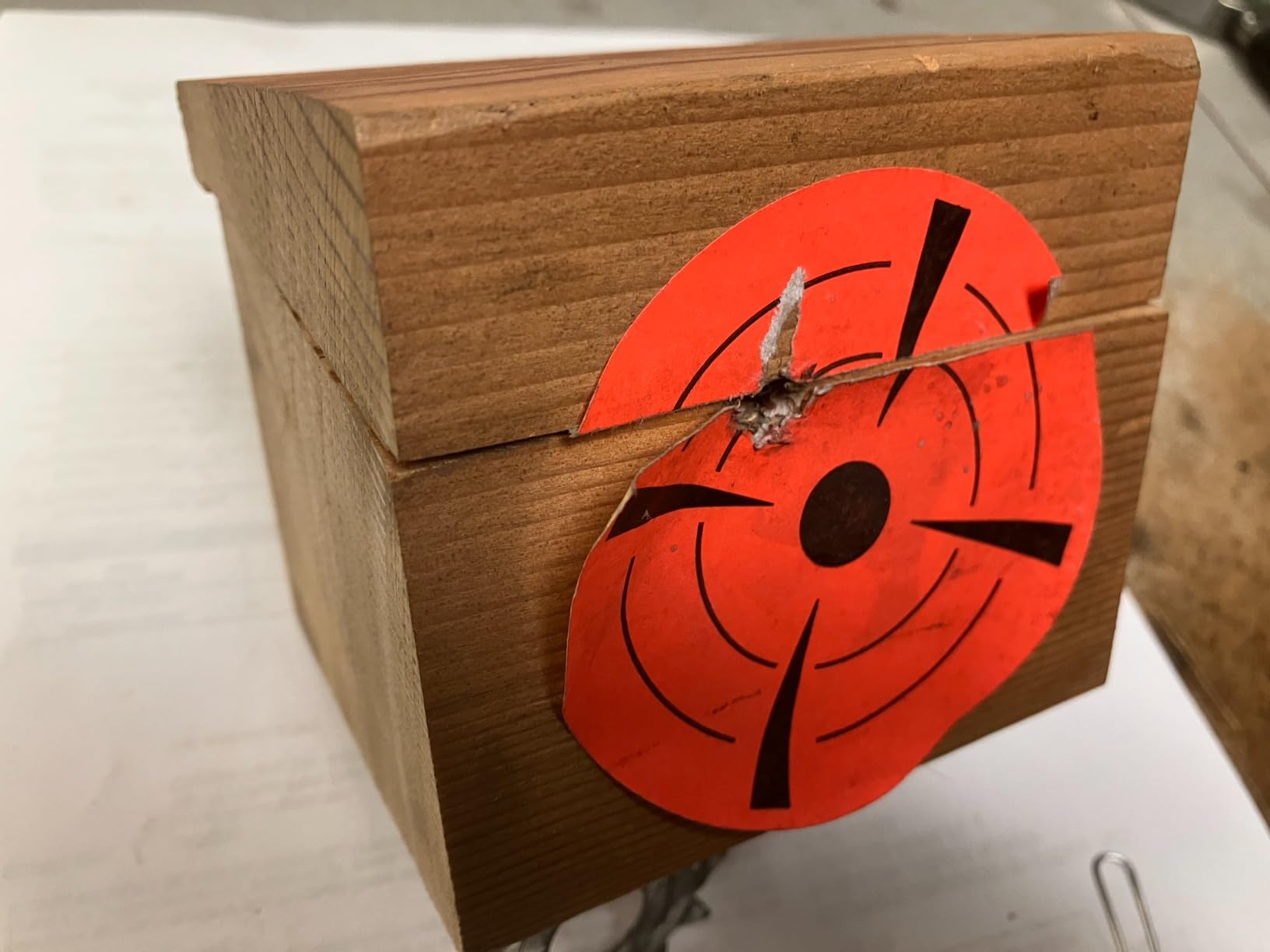
The Bulldog is the rifle the community actually recommends, and the reason shows up in the numbers rather than the marketing. It carries 369 reviews at a 4.5 average, far more owner history than anything else here, and 81 percent of those ratings are five star. When a hunting forum asks for a universal big bore, this is the name that comes back, usually with the same two reasons: the short bullpup format and a magazine that cycles smoothly.
That format does real work. At 36 inches overall, the rifle is short enough to move through timber and brush without a barrel catching, and the reversible sidelever bolt means the action works for shooters of either handedness. Cocking a 9.2 pound rifle sounds heavy until you remember you are not cocking it once per shot in the way you would a break barrel.
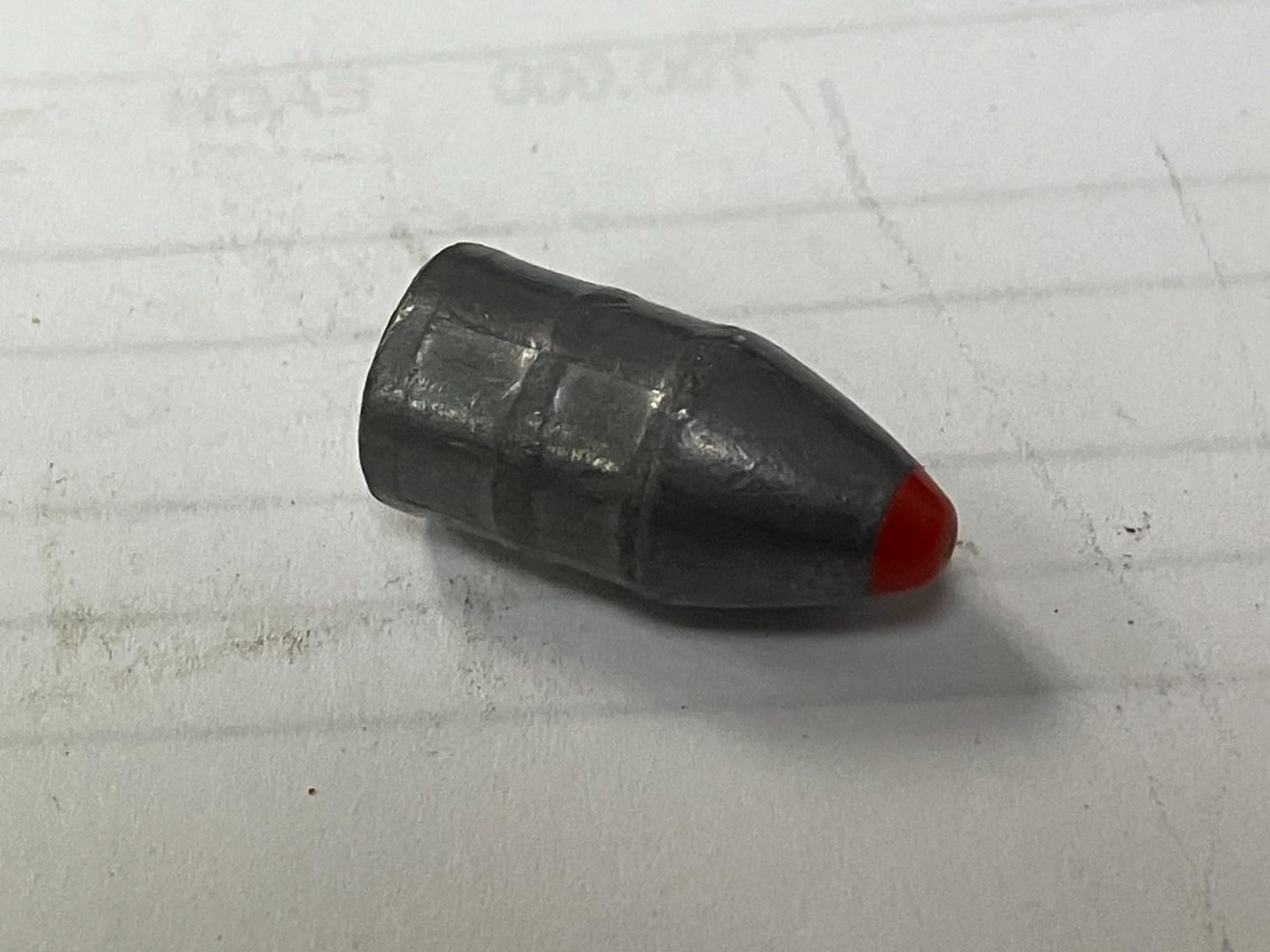
The technical details are sensible for the class. The barrel is rifled alloy steel, published up to 910 fps, which is a sensible figure for a .357 projectile where velocity is not the point. A baffle-less sound trap is fitted for big bore suppression, and a 26 inch Picatinny rail on top leaves the optics decision entirely open to you.
The warranty matters more here than it does elsewhere. Benjamin offers a limited five-year warranty, which is the longest in this roundup against the one-year limited terms on the Hatsan rifles and the AirForce Texan. For a compressed-air rifle that will be pressure-cycled repeatedly, that is a meaningful difference in what happens when a seal ages out.
Who the Bulldog suits
It suits the shooter who wants a genuine big bore for deer or hog work but who also wants to be able to walk to the treeline without the rifle fighting him. Owners on r/airguns endorse it as a universal big bore for exactly that reason. The .357 caliber sits in the sweet spot where energy is sufficient and the rifle stays manageable at 9.2 pounds.
It also suits a first-time big bore owner better than anything else on this list, because 369 reviews means an unusually well-documented rifle with a long warranty behind it. You are not betting on a thin support structure.
Where it falls short
The 5-shot magazine is the main constraint. A five-round capacity is not large by big bore standards, and it means you are topping off the cylinder more often than you would with a rotary magazine design. Combined with a shot count per fill that is measured in single digits, the field day logistics are the real cost of ownership here.
A minority of reviews also question long-term durability of the synthetic chassis. That is not a widespread theme in the reviews, but it is worth factoring in if you plan to keep the rifle for years rather than seasons.
2. Umarex Hammer .50 Caliber – Highest Energy In The Group
Umarex Hammer .50 Caliber PCP Pellet Gun Air Rifle
PCP
.50 caliber up to 1130 fps
5 lb
4500 psi 24 cc carbon fiber tank
4 full-power shots per fill
Pros
- Chambered for .50 class projectiles at up to 1130 fps
- Regulated shots hold power steady across the string
- 2-pound straight-pull bolt cycles easily
- 5 pounds is light for a rifle in this caliber class
- Umarex warranty service praised by owners who used it
Cons
- Only 4 full-power shots per 4500 psi fill
- Two 2-shot magazines are far short of modern capacity
- Box says .50 caliber but the rifle is chambered in .510
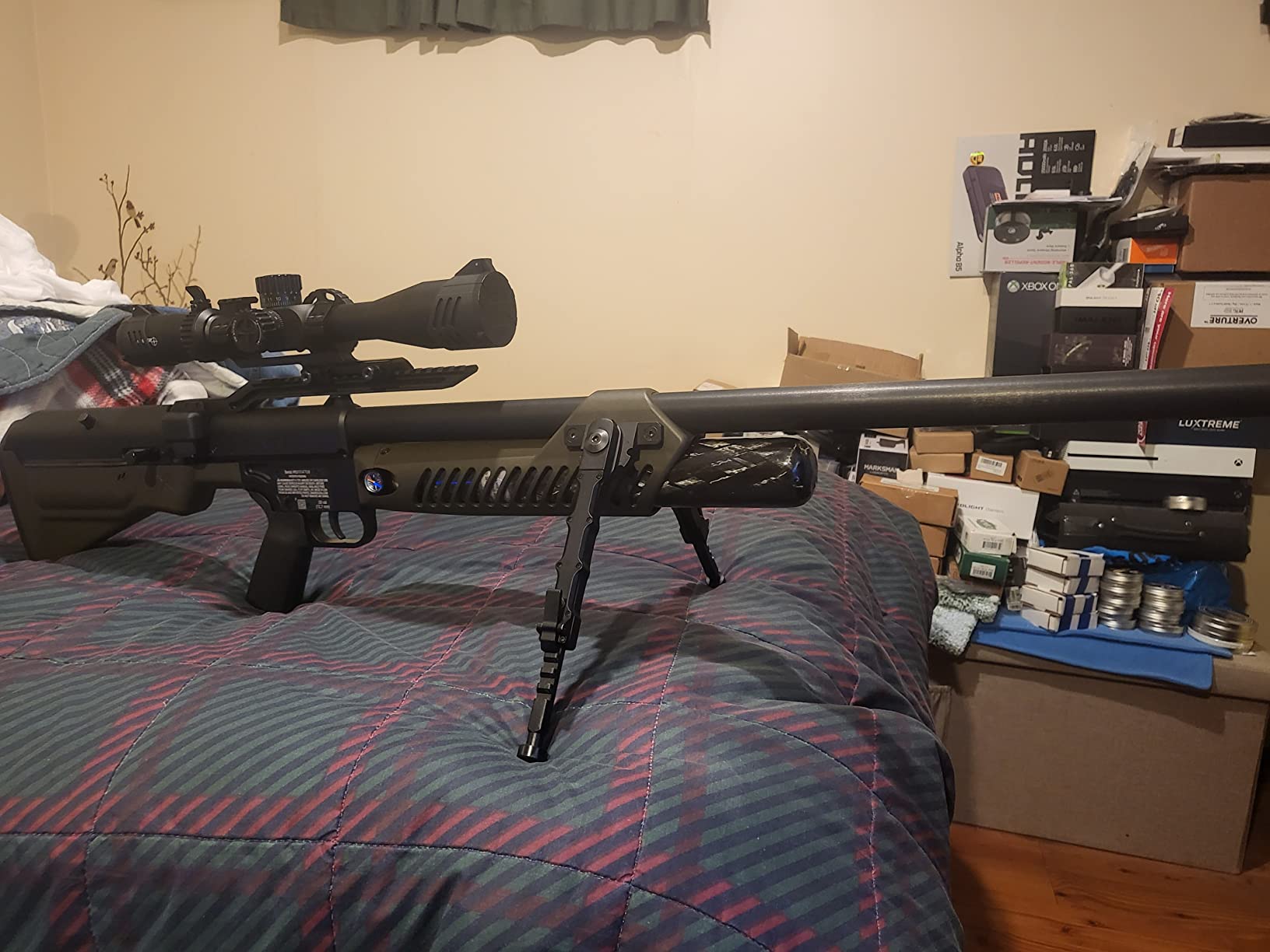
The Hammer is the answer when energy is the deciding factor, and the owner reports support that claim rather than just advertising it. Reviews describe black bear, mountain lion and hog kills, and describe the report as sounding like a 30-06. At 5 pounds it is also the second-lightest rifle here, which nobody expects from a .50 caliber platform.
The regulator is the part that makes it usable. One full tank delivers 4 full power regulated shots plus a finishing shot, and because those shots are regulated, power stays consistent across the string instead of falling away as the reservoir empties. Inconsistent power is what turns a capable rifle into an unpredictable one, so this matters more than the raw headline number.
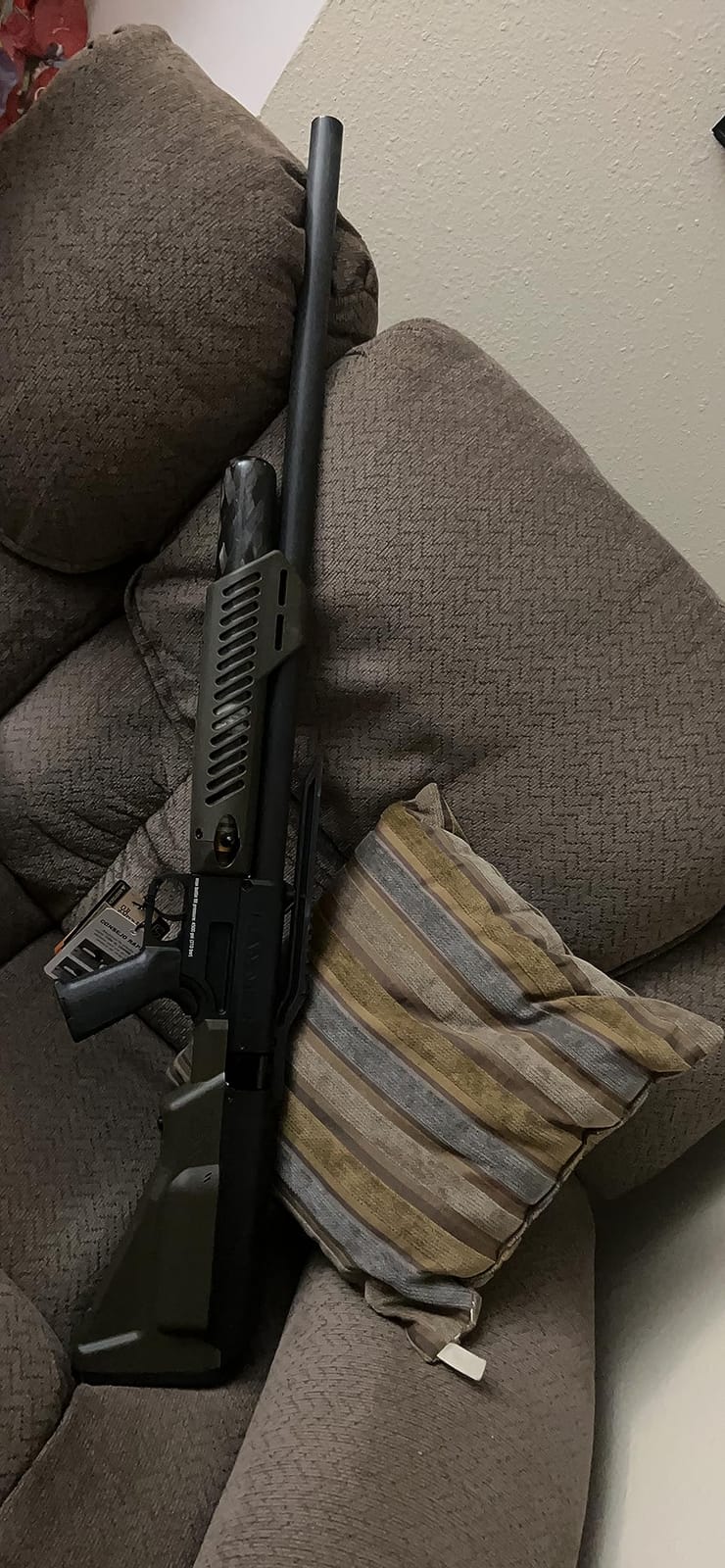
Two cautions before you commit. First, four full-power shots per fill is the single most-cited complaint in the entire review set, and on r/WAGuns the recurring theme is that the cost of the rifle is only part of the system. Without a compressor or a high-pressure fill setup, this rifle is a range gun and a backyard gun, not a hunting rifle.
Second, there is a caliber trap. The box says .50 caliber, but the rifle is actually chambered in .510, which trips up buyers who order the wrong ammunition. Confirm the chambering before you buy a single projectile. The magazines are also 2-shot, so capacity is minimal even before you count fills.
Who the Hammer suits
It suits a shooter who has already decided they need maximum energy and has the fill equipment to support it. If you own a high-pressure compressor or plan to buy one, four shots per fill is an inconvenience rather than a barrier. The 5-pound weight and the 2-pound straight-pull bolt make it far easier to carry and cycle than the caliber suggests.
It also suits anyone who wants a ready-made scope platform. M-LOK locations in the chassis plus a top Picatinny rail mean you can mount a scope, a bipod and a sling without hunting for hardware, and a pair of magazines are included.
Where it falls short
The 17 percent share of 1-star ratings on this listing traces almost entirely to tank seal and slow leak defects, including some units leaking out of the box. That is a manufacturing consistency problem rather than a design problem, but it is the one that decides whether your particular rifle works, so it is worth checking on arrival.
Umarex customer service itself is rated well by the owners who have used warranty service, with replacement units sent out quickly after seal and leak failures. That is the mitigating factor, and it is the reason this rifle still earns a place on the list despite the failure rate.
3. Hatsan Hercules Bully .30 – Quietest Big Bore Layout
Hatsan Hercules Bully PCP Air Rifle, .30 Caliber
PCP bullpup
.30 caliber
10.3 lb
480 cc carbon fiber bottle
10-shot
Up to 1070 fps and 115 FPE
Pros
- QuietEnergy moderator and shroud keep the report down for a PCP
- Two-stage adjustable trigger for travel and pull weight
- 480 cc carbon fiber bottle sits in the forearm for balance
- 21 inch rail accepts both 11 mm and Picatinny mounts
Cons
- 10.3 pounds is the heaviest rifle in this roundup
- Only a 1-year limited warranty
- 115 FPE sits at the low end of the big bore range
The Hercules Bully is the one to look at if report noise is your top concern, because it is the only rifle here with a named integrated sound system at .30 caliber power. Hatsan calls it QuietEnergy, and the shroud wraps the barrel to slow escaping gas. That will not make it silent, but it changes the character of the report more than any other change you can make to a big bore.
The trigger is the other reason to like it. A two-stage adjustable unit lets you set trigger travel and pull weight rather than accepting whatever the factory set, which matters on a rifle you are shooting off a bipod or a shooting rest. Owners on r/airguns treat trigger adjustability as one of the few genuine upgrades available on a production big bore.
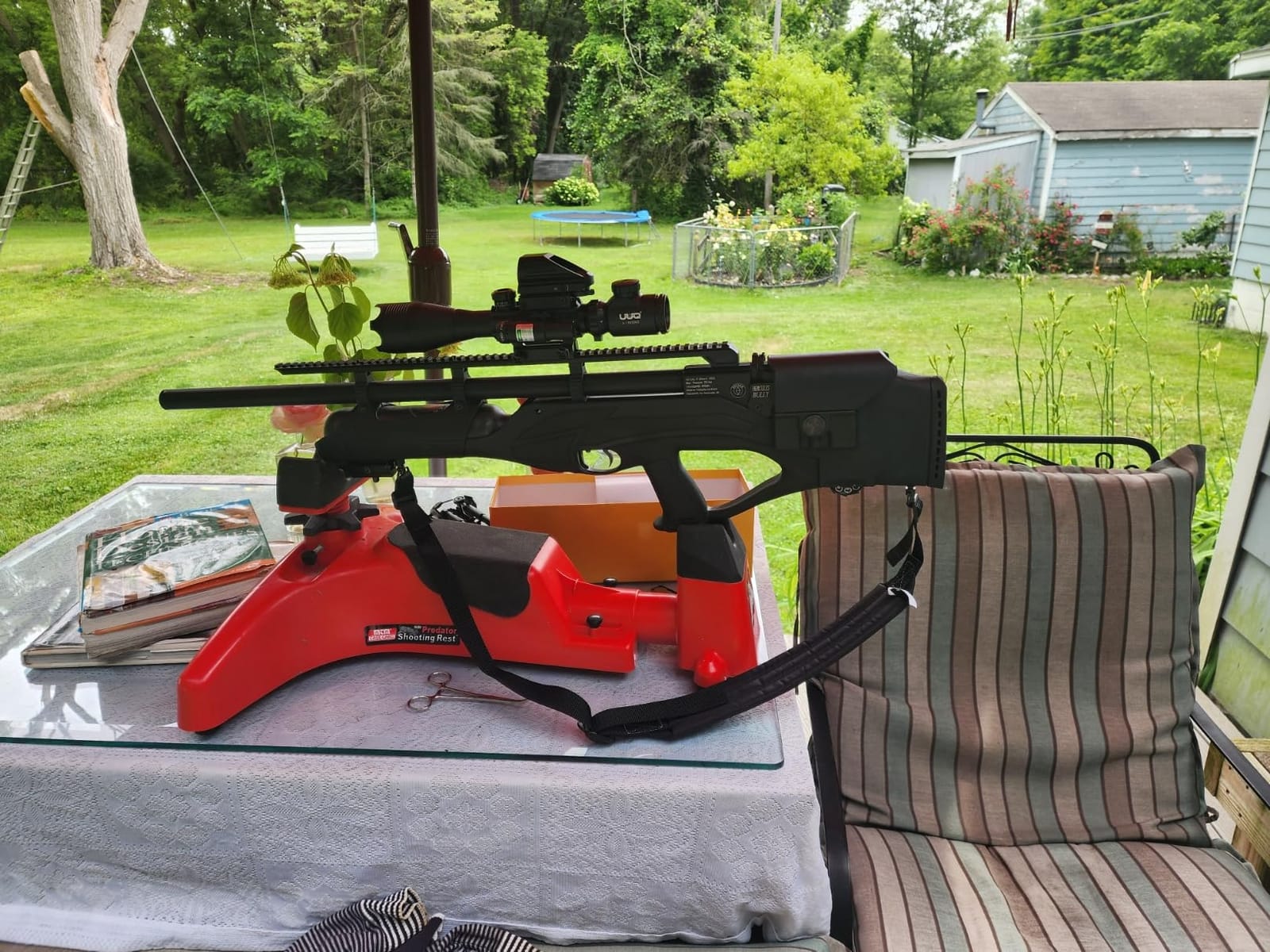
Balance is handled well for a bullpup. The 480 cc carbon fiber air bottle sits in the forearm, which puts the mass forward rather than behind the grip, and the 21 inch optics rail accepts both 11 mm dovetail and Picatinny mounts. Very few rifles in any caliber let you choose between the two standards on the same rail.
The bundle is generous for a bare rifle listing: three magazines, flip-up fiber optic sights, a fill nozzle and an owner’s manual. The 10-shot magazine is well above what the other big bores here offer, and it is the main practical advantage of this design.
Who the Hercules Bully suits
It suits a shooter who wants big bore capability with the least noise they can reasonably get, and who will accept .30 caliber rather than chasing maximum energy. At 115 FPE with lead pellets, this is a serious big game figure in the field but it is nowhere near the Hammer or the PileDriver.
It also suits a plinker and target shooter who wants a big bore platform for silhouette or bench work, where a quieter report and a ten-round magazine matter far more than penetration. The fiber optic sights included make it shootable straight out of the box.
Where it falls short
Weight is the headline problem. At 10.3 pounds this is the heaviest rifle in the roundup, and it is all in the synthetic bullpup shell. Anyone planning long walks will feel it in a way they will not with the 5-pound Hammer or the 9.2-pound Bulldog.
The warranty is only one year limited, against the Bulldog’s five. And with 24 reviews the rating is a 4.0 with limited history, so you are buying on specification and layout rather than on a deep body of owner evidence.
4. Umarex Gauntlet SL30 .30 – Regulator Plus 7-Shot Rotary
Bundle of Umarex Gauntlet SL30 PCP Pellet Gun Air Rifle with Side Lever Cocking + Umarex Gauntlet PCP Pellet Gun Air Rifle Magazine, .30 Caliber, 7-Shot Mag
Side-lever PCP
.30 caliber
Up to 1000 fps
7-shot rotary magazine
Bundle with spare magazine
Pros
- 7-shot auto-indexing rotary magazine is the highest capacity on a slim PCP here
- State-of-the-art regulator keeps shot strength consistent
- M-LOK slots plus sling mount and adjustable cheek piece add versatility
- Side lever is easier to operate than the bolt-action Gauntlet
Cons
- Only one review exists for this bundle and it is a 1-star rating
- At .30 and 1000 fps it sits well below .45 and .50 class energy
- Rifle and spare magazine share a single 1-star review history
This bundle is included because the design is genuinely interesting, not because the review history supports a recommendation. It pairs a .30 caliber side-lever PCP with a 7-shot auto-indexing rotary magazine and a state-of-the-art pressure regulator, and it shoots up to 1000 fps. That combination of regulator and multi-shot magazine is what makes a PCP worth owning for target work.
The side lever is the practical improvement over the bolt-action Gauntlet it is based on. Cocking effort on a bolt-action big bore is the most common physical complaint in owner threads, and a side lever is a genuine step down in that effort. The M-LOK slots, quick disconnect sling mount and adjustable cheek piece round out a chassis that is clearly aimed at a shooter who wants to configure the rifle.
The bundle also includes a spare magazine, a single-shot tray and a degassing tool, which is a better starting kit than most. You get what you need to experiment with different projectile types without a second order.
Who the Gauntlet SL30 suits
It suits a precision or benchrest-oriented shooter who wants a regulated, multi-shot .30 platform and is comfortable treating accuracy as a tuning project rather than a spec. The 7-shot rotary and single-shot tray make it easy to compare loads under identical conditions, which is exactly how serious shooters test.
It also suits anyone who wants a first serious PCP and wants a side lever rather than a bolt. The layout is friendly to a shooter moving up from a break barrel or a CO2 rifle.
Where it falls short
The honest problem is that there is no review signal. A single 1-star rating is 100 percent of the history for this bundle, which means you should read the 1.0 average as unproven rather than as a verdict on the rifle. The rifle and the spare magazine share that one rating, so neither is independently assessed.
On power, .30 caliber at 1000 fps sits well below the .45 and .50 rifles in this roundup. If your goal is big game rather than target work, this is not the platform, regardless of how good the magazine and trigger are.
5. Hatsan PileDriver .45 – Big Caliber Thumbhole Bullpup
Hatsan PileDriver PCP Air Rifle, .45 Caliber
PCP bullpup
.45 caliber
700 ft/lbs muzzle energy
Up to 900 fps
10 lb
Single-shot capacity
Pros
- Genuine .45 caliber with 700 ft/lbs of published muzzle energy
- Long sidelever makes cocking easier than standard Hatsan bolt actions
- Quattro two-stage trigger on a thumbhole chassis with adjustable cheekpiece
- Precision rifled barrel
Cons
- Single-shot capacity is a real limit for a hunting rifle
- 900 fps is the lowest velocity here despite the caliber
- 22 percent of ratings are 1-star
The PileDriver is the second-largest caliber in this roundup, and the published 700 ft/lbs of muzzle energy is a serious number for a production air rifle. At .45 caliber you are working with a projectile heavy enough that velocity becomes almost irrelevant, which is why 900 fps here means something very different from 900 fps on a .30 rifle.
The ergonomics are the strongest part of the package. The synthetic thumbhole chassis has an adjustable cheekpiece and an angle and elevation adjustable buttpad, which is real adjustability rather than a fixed stock. The Quattro trigger is the more refined two-stage unit Hatsan fits to its higher-end rifles, and the precision rifled barrel supports the slug weights this caliber wants to use.
The long sidelever is worth calling out too. Owners compare it to standard Hatsan bolt actions and consistently find cocking easier, which matters when the rifle weighs 10 pounds and the caliber is .45.
Who the PileDriver suits
It suits a shooter who wants genuine large-caliber power and a rifle they can fit to their body, which is a genuine problem with most bullpups. The adjustable cheekpiece and multi-axis buttpad are features you normally find on target rifles, not hunting air guns.
It also suits anyone who specifically wants .45 rather than .50, because the ammunition is smaller and easier to source than .510 slugs and the rifle does not need the same level of fill pressure as the largest calibers.
Where it falls short
Single-shot capacity is the serious limitation. A single-shot hunting air rifle means a separate load, chamber and bolt cycle for every animal you take, and the other rifles here offer between 2 and 16 shots. For hunting that is a real disadvantage no amount of energy offsets.
This rifle carries a 3.8 average, with a 22 percent share of 1-star ratings, and the listing itself describes the item as an airsoft rifle, which is inconsistent with a .45 caliber PCP. Check that the rifle you receive matches the caliber and power you paid for before you rely on it.
6. Hatsan BT 65 SL QE .30 – Most Complete Ready-To-Shoot Bundle
Wearable4U – Hatsan BT 65 SL QE Big Bore Carnivore .30 Cal PCP Air Rifle w/Scope and 100 Paper Targets and 100x .30 Cal Pellets and Hard Case Bundle
PCP bullpup
.30 caliber
Up to 920 fps and 85 FPE
255 cc cylinder
7-shot rotary
9.7 lb
Pros
- QuietEnergy shroud and moderator cut report noise roughly in half
- Bundle includes scope plus bipod and sling and two magazines and a repair kit and a hard case
- 7-shot rotary magazine with side lever cocking
- Quattro 2-stage match adjustable trigger and fully adjustable chassis
Cons
- 85 FPE and 920 fps is the lowest power output of any rifle here
- 255 cc cylinder means low shot counts between fills
- Only 9 reviews back the score and the bundle is listed under a third-party brand
This is the value pick because of what arrives in the box, not because of what the rifle does. You get the rifle, a scope, a bipod, a sling, two rotary magazines, a repair kit, a fill probe, 100 paper targets, a pack of 100 .30 pellets and a hard case. On a platform where the accessory budget is often as large as the rifle budget, that changes the arithmetic entirely.
The rifle itself is well specified for its class. QuietEnergy shroud and integrated moderator cut the report by roughly half, the Quattro two-stage match adjustable trigger is the premium trigger option, and the side lever action is an improvement over the previous bolt version. The Monte Carlo polymer chassis gives you an adjustable cheek piece, butt pad and comb, which puts it level with the PileDriver on fit.
The 7-shot rotary magazine is also well above what most big bores offer. Owners treat this as a complete ready-to-shoot package, and the 62 percent five-star share reflects that framing.
Who the BT 65 SL QE suits
It suits a first-time big bore owner who wants to shoot the rifle this week rather than spend a month buying a scope, a bipod, magazines and a case. The hard case matters more than it sounds when a rifle runs 9.7 pounds and needs a high-pressure fill source.
It also suits a shooter in a state where report noise is a real practical issue, since the integrated moderator is the headline feature and is built in rather than bolted on as a separate purchase.
Where it falls short
Power is the honest weakness. At 85 FPE and 920 fps in .30 caliber, this is the softest-shooting rifle in the roundup despite carrying a big bore label. The 255 cc cylinder is also small, so shot counts between fills are low even before you consider the power setting.
Only 9 reviews back the 3.8 rating, with 14 percent at 2 stars and 13 percent at 1 star. The bundle is also listed under a third-party brand rather than Hatsan, which makes support and authenticity harder to judge than if you were buying the rifle directly.
7. Hatsan Factor Bullpup .30 – Highest Shot Capacity
Factor Bullpup .30 Caliber
PCP bullpup
.30 caliber
16-shot capacity
Metal barrel in polymer frame
9 lb
Pros
- 16-shot capacity is the highest in this roundup
- Metal barrel rather than the polymer barrels used elsewhere here
- Polymer frame and bullpup layout hold the weight to 9 pounds
- Highest average rating among the rifles with very few reviews
Cons
- Only 4 reviews
- so the 4.1 rating carries little statistical weight
- No published velocity or energy figures to compare against the field
The Factor Bullpup exists on this list for one reason: 16-shot capacity. Every other big bore here runs between one and ten shots, and on a rifle where a fill might give you five full-power rounds, capacity is not a luxury. Sixteen is the number that changes what a shooting day looks like.
The other specification worth noting is the metal barrel. Several competitors in this category use polymer barrels, and a metal barrel with a rifled bore is a better starting point for slug stability. At 9 pounds, the polymer frame and bullpup layout keep the weight reasonable despite the capacity.
Here is the problem, and it is a real one. There is no published velocity and no published muzzle energy for this rifle, which means it cannot be compared on the two numbers that matter most for a big bore. You would be choosing on magazine capacity alone.
Who the Factor Bullpup suits
It suits a shooter who values staying on target between fills above everything else, particularly on small game, pest work or a silhouette match where a five-round magazine means walking back to the truck. The 16-shot capacity and the side-fed magazine layout are the whole argument.
It also suits a buyer who wants the metal barrel construction of the premium Hatsan chassis without the premium caliber. If you are buying .30 for its handling rather than its energy, this is the layout to look at.
Where it falls short
Four reviews is not enough to make a judgement from. The 4.1 average splits into 77 percent five-star and 23 percent one-star with nothing in between, which tells you almost nothing about the middle of the distribution. The listing also repeats the same product name for every bullet and carries no real feature detail.
It also has the lowest sales rank in the group, which usually means thinner demand and fewer opportunities to see one in person. The absence of published power data means a buyer who cares about energy has to take the caliber on faith.
8. AirForce Texan .51 – Lightest Big Bore To Carry
Airforce Texan Big Bore Air Rifle air Rifle
PCP
.51 caliber
710 ft/sec
Spin-Loc tank
2.1 lb
One-year warranty
Pros
- Largest caliber offered in this roundup at .51
- 2.1 pounds is the lightest big bore platform here
- Spin-Loc tank system fills without removing the cylinder
Cons
- 710 ft/sec is the slowest velocity in the roundup
- Only 2 reviews
- so the 5.0 rating is essentially unsubstantiated
The Texan is the most interesting physics case in the roundup. At 710 ft/sec it is the slowest-shooting rifle here, and at 2.1 pounds it is the lightest, and it is chambered in .51, the largest caliber on this list. That combination says the design trades penetration speed for carryability, and whether that trade is right depends entirely on how far you are shooting.
Slow projectiles drop more, so at distance the velocity figure works against you. Up close, in timber or over a feeder, the caliber and the weight of the projectile do the work and the velocity number matters far less. Buyers should think about that trade rather than reading 710 ft/sec as weakness in isolation.
The Spin-Loc tank system is the practical feature. It allows filling without removing the cylinder, which saves time at a compressor or a dive tank fill and reduces the fiddliness that owners otherwise complain about on big bores.
Who the Texan suits
It suits a shooter whose priority is the largest caliber and the lowest carry weight, particularly anyone hunting in thick cover or who wants a big bore that can be carried all day without fatigue. Nothing else here is in the same weight class.
It also suits a buyer who wants the newest design in the category. The Texan became available in recent years, and the newer platform carries the Spin-Loc fill system that older rifles in this roundup lack.
Where it falls short
Two reviews produce a 5.0 average that carries essentially no information, and the listing publishes no chassis, rail, trigger or magazine details, so fit and finish are unverifiable. The warranty is one year limited, the shortest meaningful term on the list.
Most importantly, treat the rating as decoration rather than evidence. On caliber and weight this rifle is genuinely distinctive, but everything else about it needs to be confirmed with the manufacturer or a dealer before you commit.
How To Choose A Big Bore Air Rifle
Start with the animal, not the caliber. Owners in the community commonly cite 150 foot-pounds as a practical floor for big game, while the same threads acknowledge the real threshold depends on species, projectile weight and shot placement. If your actual job is squirrels, rats and gophers, a .25 caliber PCP will serve you better and cost far less to shoot, and several people searching for a big bore in the forums are misclassified in exactly that way.
Next, decide how you will fill the rifle, because this changes the total cost more than the rifle does. The #1 complaint in every forum thread we found is fill logistics. Four full-power shots per tank means a compressor, a carbon fiber bottle or a dive tank is effectively part of the purchase, not an accessory.
Then work through these factors in order:
Caliber against species. .30 caliber handles small game and pest work with far more shot count than you need. .357 and .45 cover deer. .50 and above is where you are making a deliberate power decision and accepting the logistics that come with it.
Energy, not velocity. Compare foot-pounds of energy across rifles only when the projectile weight is similar. Manufacturer energy figures are not directly comparable because each is measured with a different slug in a different barrel.
Shot count per fill. Published figures range from 4 full-power shots on the Hammer to more on cylinder-heavy layouts. Multiply that by how many animals you expect to see in a day.
Fill equipment. A high-pressure compressor is the most convenient route for a dedicated shooter. A carbon fiber tank adds portability. Filling from a SCUBA bottle is the cheapest per fill but the least convenient.
Magazine capacity. Two-shot magazines change how you shoot. The 7-shot and 10-shot rotary layouts in this roundup are a genuine step up for follow-up shots.
Weight and carry. The spread here is 2.1 pounds to 10.3 pounds. That is not a rounding difference, it decides whether you walk to the treeline or set up in the yard.
Warranty length. The range is one year to five years. On a pressure-cycled air rifle, that difference shows up when the first seal ages out.
Optic and support rails. A 21 inch rail that accepts both 11 mm and Picatinny saves you a decision, and M-LOK locations make bipod and sling mounting straightforward.
Two more things owners bring up constantly. Accuracy is a setup result, not a spec: a stable support like a shooting rest or a bipod will reveal more about a rifle’s real precision than any published figure. And for estimating holdover at range, a hunting rangefinder matters more with a heavy slug than with a pellet, because trajectory drop scales with projectile weight.
On noise, treat PCP as loud rather than quiet. The only real reductions come from integrated moderators such as QuietEnergy on the Hatsan rifles and the Bulldog’s baffle-less sound trap, and the legality of those devices varies by state. If you shoot near neighbors, verify before you buy rather than after.
Big Bore Air Rifle Legal And Safety Rules
Rules vary by state and change, so verify everything below with your state wildlife agency before you buy or hunt. A big bore air rifle can cause fatal injury at ranges where a .22 rimfire would not, and that fact governs everything else in this section.
What to check before you buy, in order: minimum energy requirements for the species and caliber you intend to hunt, whether lead or polymer projectiles are restricted or prohibited in your state, season dates and licensing, and whether an integrated sound moderator is permitted where you live. Several of these are species-specific rather than general, so a rifle that is legal for pest control can still be illegal for deer.
On storage, a big bore is a locked item, not an indoor item. Treat it the way you would treat a firearm: locked and inaccessible to anyone who should not have it. The air reservoir is a stored energy source regardless of whether the rifle can fire, and owners repeatedly note that keeping a charged rifle in a vehicle or an unlocked room is the most common avoidable risk in this category.
On the range, a big bore requires a verified backstop and a wider exclusion zone than a pellet rifle. On r/guns, participants are consistent that these rifles are not appropriate near populated areas even when the report sounds manageable. Slugs do not stop at the backstop of a plinking berm.
One FAQ worth answering here rather than burying: a person prohibited from possessing firearms is not automatically prohibited from owning an air rifle in many jurisdictions, because air rifles are regulated as sporting equipment rather than firearms. That classification varies by state and by circumstance, so the only correct answer is to check your own state’s law directly or ask an attorney. Do not rely on a general article, including this one, for a legal conclusion.
Frequently Asked Questions
What is the best big bore air rifle?
The Benjamin Bulldog .357 is the best all-round big bore air rifle because it combines the largest owner review base with a short bullpup format that stays manageable in the field. The Umarex Hammer .50 is the choice for maximum energy, and the Hatsan BT 65 SL QE .30 bundle is the best value if you want a complete ready-to-shoot package.
Which .357 caliber air rifle is the most powerful?
Among the rifles here, the Umarex Hammer is the most powerful and it is not a .357. The Bulldog is the only .357 in this roundup, rated up to 910 fps from a rifled alloy steel barrel. If you need more energy than that, the step up is the PileDriver at .45 caliber with 700 ft/lbs published muzzle energy.
Which big bore PCP air rifle is the quietest?
The Hatsan Hercules Bully .30 and the Hatsan BT 65 SL QE .30 are the quietest options here, because both use Hatsan QuietEnergy shrouds with integrated sound moderators, and the BT 65 is described as roughly 50 percent quieter. The Bulldog adds a baffle-less sound trap. Confirm that an integrated moderator is legal in your state before relying on it.
Which PCP air rifle is the most accurate?
Accuracy is not a fixed model attribute. It depends on slug fit, barrel twist, chronograph consistency and shooter steadiness more than on published energy. The Umarex Gauntlet SL30 and the Hatsan BT 65 SL QE are the best starting platforms for accuracy work because both pair a regulator with a 7-shot rotary magazine, so you can compare loads under identical conditions.
What is the biggest bore air rifle available?
The AirForce Texan at .51 caliber is the largest caliber in this roundup, and .510 is the largest caliber most owners actually shoot. Note that the Umarex Hammer is labelled .50 on the box but is chambered in .510, so confirm the chambering before you buy ammunition.
Can a felon own a big bore air rifle?
Possession rules for air rifles are set by state law and vary considerably, and in many jurisdictions air rifles are regulated as sporting equipment rather than as firearms. That classification is not uniform, so verify your own state’s rules directly with a state agency or an attorney before purchasing. Nothing in this article is legal advice.
Bottom Line: Which Big Bore Air Rifle To Buy
The best big bore air rifle for most people is the Benjamin Bulldog .357, because 369 reviews at a 4.5 average and a five-year warranty make it the least risky way into this category. Choose the Umarex Hammer .50 instead if energy is the whole point and you already have a compressor, and the Hatsan BT 65 SL QE if you want a complete package to shoot on day one.
Two warnings before you commit. Buy the fill equipment in the same order as the rifle, because four shots per tank changes what kind of shooting you can do. And if your actual target is squirrels, gophers or rats, a .25 caliber PCP will do the job for a fraction of the running cost, which is the honest answer that most big bore roundups skip.
All figures in this guide are from manufacturer and retailer listings, verified as of September 2026. Verify your state’s hunting rules with your wildlife agency, and use a proper hard gun case and a secured storage solution before you take delivery.