
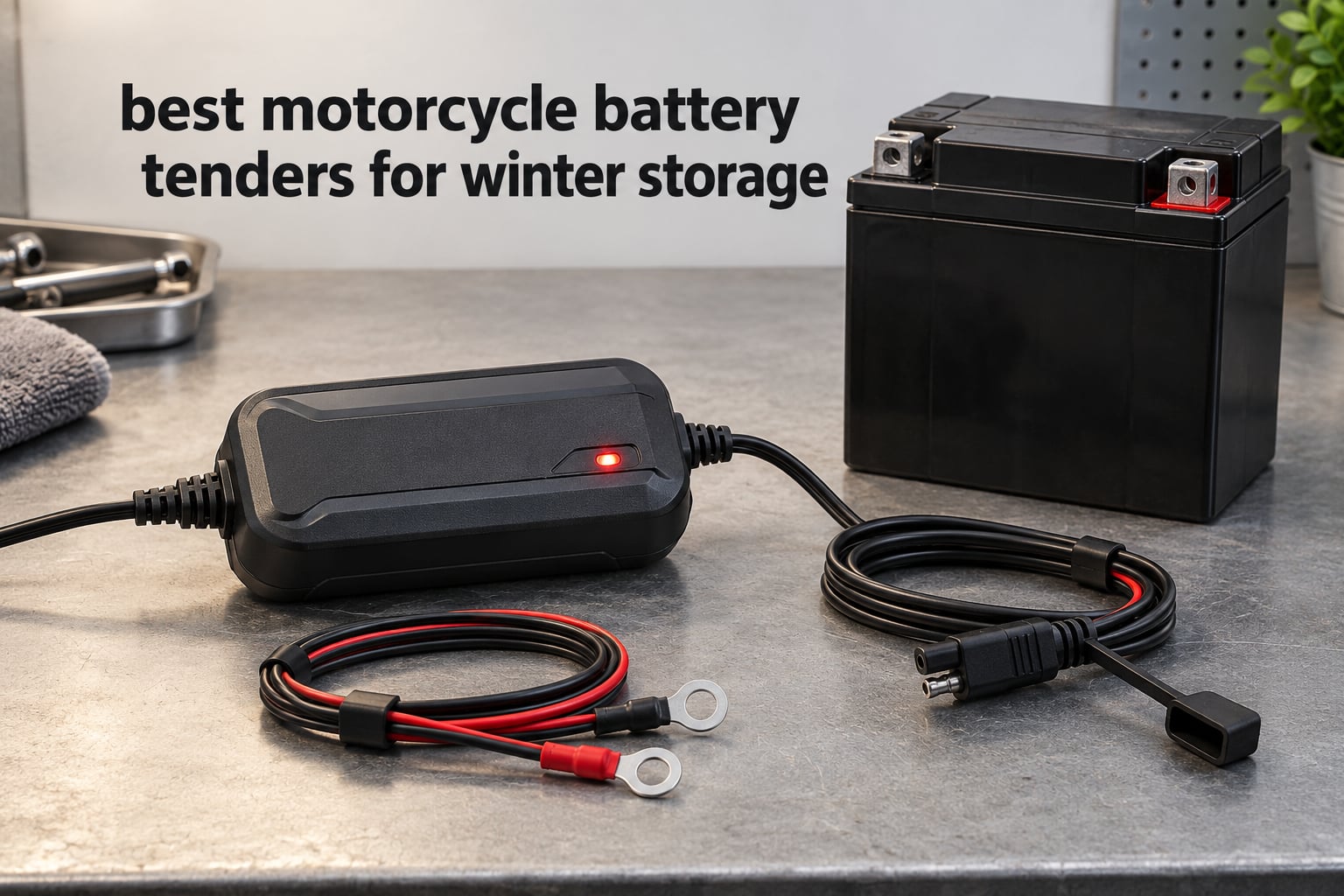
A motorcycle battery tender is a low-current smart charger that holds your 12V battery at its full-charge float voltage, roughly 12.6V, for as long as it sits. The words tender, maintainer, trickle charger and smart charger all describe that same job; the difference is how much thinking the unit does before it settles into float. We compared eight of them for this roundup of the best motorcycle battery tenders for winter storage in 2026, and the honest summary is that a tender is the cheapest insurance a rider can buy against the most common spring failure there is.
Most motorcycles that refuse to start in March did not break. The battery simply sat, absorbed parasitic draw from the clock and alarm, went cold, and slowly sulfated until it would no longer hold a charge. Riders on r/motorcycles put the economics plainly: a tender is a fraction of what a replacement battery costs, so the calculation is easy. We agree with that framing, with one caveat we will come back to, because plenty of bikes do start fine without one.
What separates the units in this roundup is chemistry handling, current output, connector type and heat management in a closed garage. Those four things decide whether a tender quietly does its job for four months or becomes the problem you were trying to avoid. We looked at the eight most-reviewed maintenance chargers aimed at powersports storage, read what owners actually report after a full season of unattended use, and pulled out the ones worth wiring to your bike this month.
Table of Contents
Top 3 Best Motorcycle Battery Tenders for Winter Storage in October

Battery Tender Junior 750mA
- 4-step program with float mode
- Works with 12V lead-acid AGM and gel
- Fused ring harness included
- 5-year warranty

Battery Tender Plus 1.25A
- 1.25A output for larger packs
- 4-step adaptive charging
- Quick-disconnect harness
- 10-year warranty
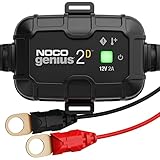
NOCO GENIUS2D 2A
- Snap-fit onboard mounting
- Built-in thermal sensor
- Recovers from as low as 1V
- Safe to connect indefinitely
All 8 Tenders Compared at a Glance in 2026
This table is the fast way to narrow the field. We sorted the roundup so the highest-rated, most-reviewed unit sits at the top, with the higher-current chargers and the lithium-specific units below it.
| Product | Specifications | Action |
|---|---|---|
| Battery Tender Junior 12V 750mA |
|
Check Latest Price |
| Battery Tender Plus 12V 1.25A |
|
Check Latest Price |
| NOCO GENIUS2D 2A Onboard |
|
Check Latest Price |
 CTEK MXS 5.0 4.3A CTEK MXS 5.0 4.3A |
|
Check Latest Price |
 BikeMaster Lithium-Ion Charger BikeMaster Lithium-Ion Charger |
|
Check Latest Price |
 BatteryMINDer 1500 1.5A BatteryMINDer 1500 1.5A |
|
Check Latest Price |
 LEICESTERCN 1.1A Smart Charger LEICESTERCN 1.1A Smart Charger |
|
Check Latest Price |
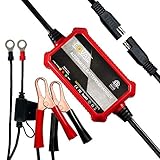 FOVAL 1A Smart Charger FOVAL 1A Smart Charger |
|
Check Latest Price |
1. Battery Tender Junior 12V 750mA: The Classic Set-and-Forget Tender
Battery Tender Junior 12V, 750mA Charger and Maintainer: Automatic 12V Powersports for Motorcycle, ATVs, and More – Smarter Than a Trickle Charger – 021-0123
0.75A 12V output
4-step program with float mode
Fits 12V lead-acid AGM and gel
Fused ring harness included
Pros
- Fully automatic 4-step program that switches to float
- Works with flooded lead-acid AGM and gel
- Two-color LED resumes full output on voltage sag
- Spark-proof with reversed hook-up detection
- 5-year warranty
Cons
- 750mA is slow to recover a deeply discharged battery
- Single-color status LED gives limited detail
- Ring terminals need permanent fitting for unattended use
The Battery Tender Junior is the unit most riders meet first, and after a season on it we understand why it has accumulated more owner feedback than anything else in this roundup. It is a 750mA 12V unit that runs a four-step program: initialization, bulk charge, absorption, then float. The body weighs 1 lb and measures 3.3 by 1.3 by 2.4 inches, so it disappears under a seat or inside a side case rather than becoming a garage object.
The important behaviour is what it does after the battery is full. It drops into float, holds the pack at storage voltage, and monitors for voltage sag under load, at which point it resumes full output. That is the mechanism that makes leaving it connected through January safe, and it is why this class of unit is genuinely different from a cheap constant trickler.
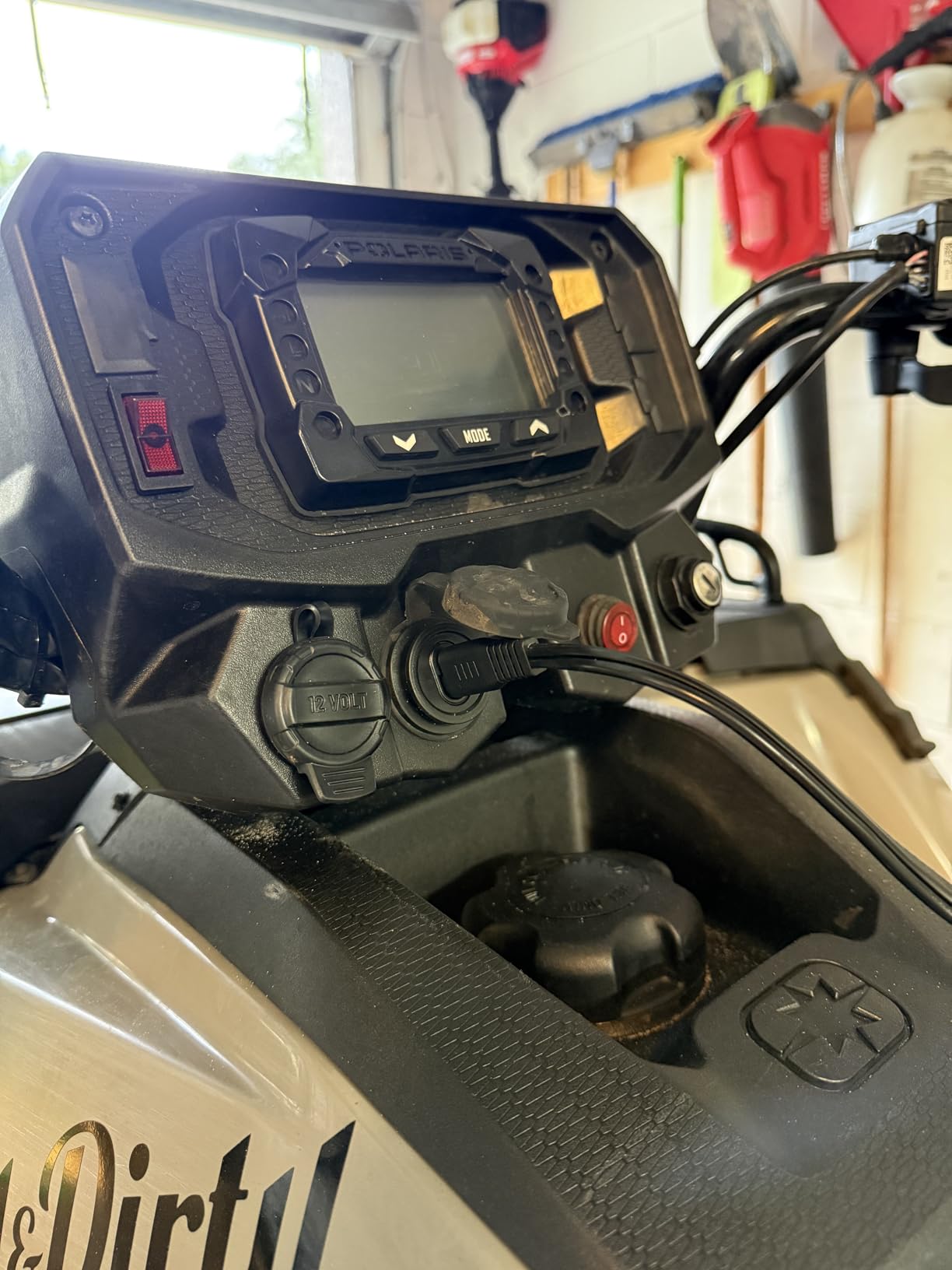
Owners treat it as a permanent fixture. The box includes a 12ft output cord, a fused ring terminal harness and alligator clip accessory cables, and the small encapsulated case is sealed enough to live in an engine bay or under a seat. Spark-proof circuitry and automatic reversed hook-up detection mean a mistake during setup in a dark garage does not end with a dead battery.
Where it falls short is raw current. At 750mA it is sized for maintenance, not rescue, so a battery that has already dropped into deep discharge will take a long time to come back. On r/motorcycles there is a well-known view that the category name has burned people who expected recovery from a dead pack; this is the unit that view describes. It is also worth noting that the chemistry list here is lead-acid only, flooded, AGM and gel, with no lithium mode.
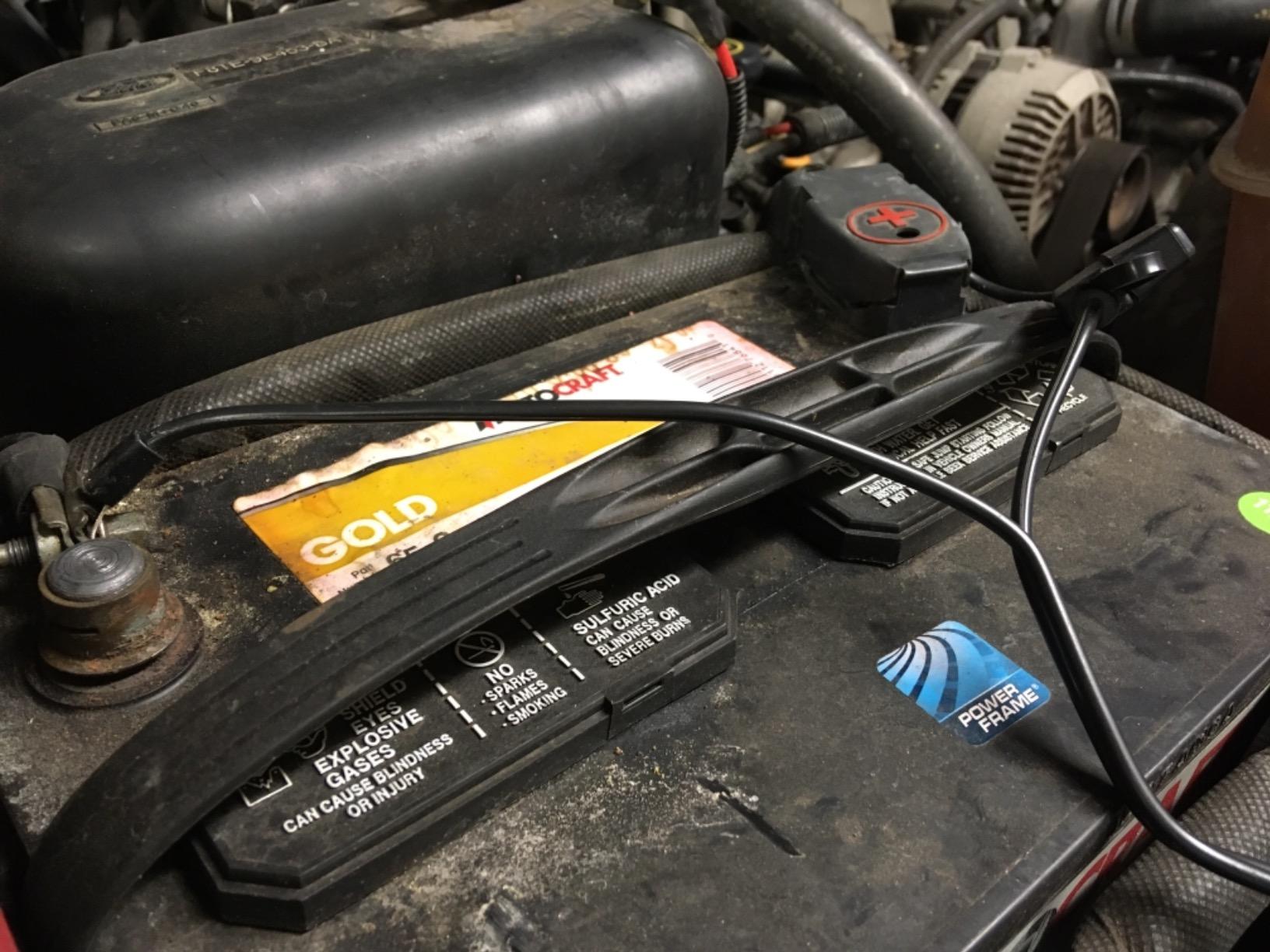
What the Junior handles well in a cold garage
The 4-step program is conservative in exactly the way you want for a pack that has been sitting in a cold garage for weeks. It does not rush current into a cold battery, which is the mechanism behind most AGM complaints, and it settles into a low float that runs for months without cooking anything.
The fused ring terminal harness is the other quiet win. Once it is fitted, connecting and disconnecting for the season takes seconds, so you are far more likely to actually hook it up in October and not think about the battery again until spring. Owners on britbike.com describe running the small Battery Tender Jr on four bikes for three years without killing a single battery, which is the kind of boring reliability record that matters more than any spec sheet.
When the Junior is the wrong tool
If your battery is already below roughly 10V, this unit will take far too long to be useful, and you would be better served by a higher-current charger for the recovery stage. The same applies if you have swapped in a lithium iron phosphate pack, because a lead-acid float profile is not what a BMS expects.
The single-color status LED also frustrates owners who want to see charge stage at a glance, and the ring terminals need to be permanently attached to the battery for unattended use, which means one permanent modification to your bike. Riders who want visible stage data or a chemistry switch should look at the CTEK instead.
2. Battery Tender Plus 12V 1.25A: More Current for Bigger Touring Batteries
Battery Tender Plus 12V 1.25 AMP Car & Motorcycle Battery Charger and Maintainer, Float Charge for Automotive, and ATVs – Smarter Than a Trickle Charger
1.25A 12V output
4-step adaptive charging with float
Quick-disconnect harness included
10-year manufacturer warranty
Pros
- 1.25A suits larger touring and automotive packs
- 4-step adaptive program tops off then floats
- Quick-disconnect harness for fast seasonal hookup
- Two-color LED resumes full output on voltage sag
- 10-year manufacturer warranty
Cons
- Basic on and off operation with no chemistry selector
- Two-color LED shows little charge-stage detail
- 1.25A is modest for reviving a dead large battery
The Plus is the Junior with more current, and that single change is what makes it the sensible default for a large touring bike or a big cruiser with a group-style battery. At 1.25A it has more headroom to bring a neglected pack back up, while keeping the same set-and-forget float behaviour that makes the brand name familiar in the first place.
Owners single out the quick-disconnect harness more than anything else. Once the pigtail is installed on the battery, seasonal connection is a matter of snapping two halves together at the frame rail, which is the difference between actually using the tender and leaving it in a drawer. The fused ring terminal and alligator clip accessory cables are both included.
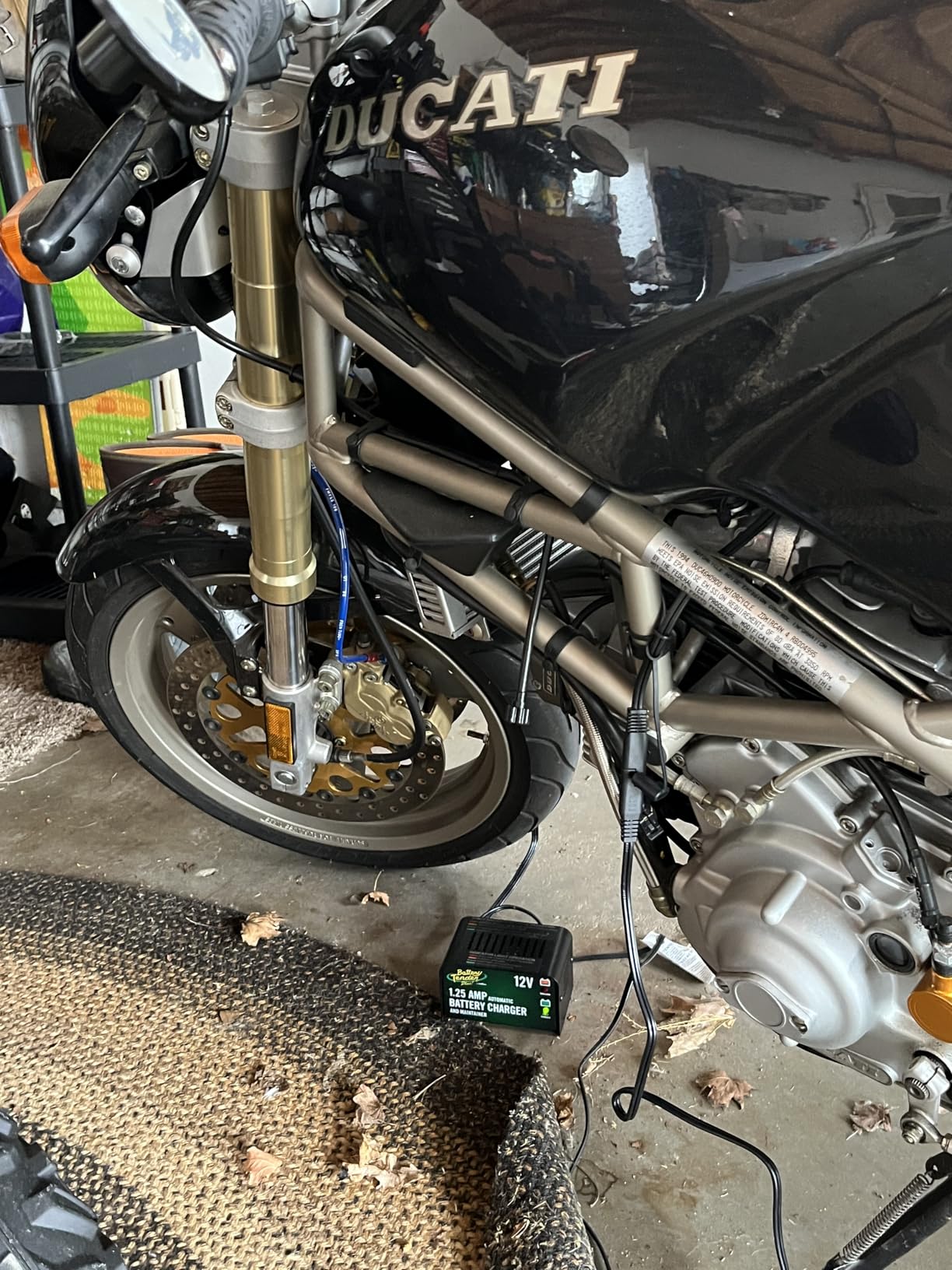
It is also the most widely applicable of the lead-acid options here, since the manufacturer lists cars, motorcycles, ATVs and lawn mowers as compatible devices. At 1.5 lb and the same 2.9 by 2.15 by 4.4 inch footprint as the Junior, it stows just as easily. A 10-year manufacturer warranty is the longest coverage claim in this roundup, which tells you something about the brand’s confidence in the float circuit.
What you give up is control. This is a basic on and off design with no selectable chemistry mode, so a lithium pack is out of scope even though the lead-acid program is thorough. Reviewers who came from display-equipped smart chargers mention the two-color LED as a step down, since it shows charging versus charged and little else.
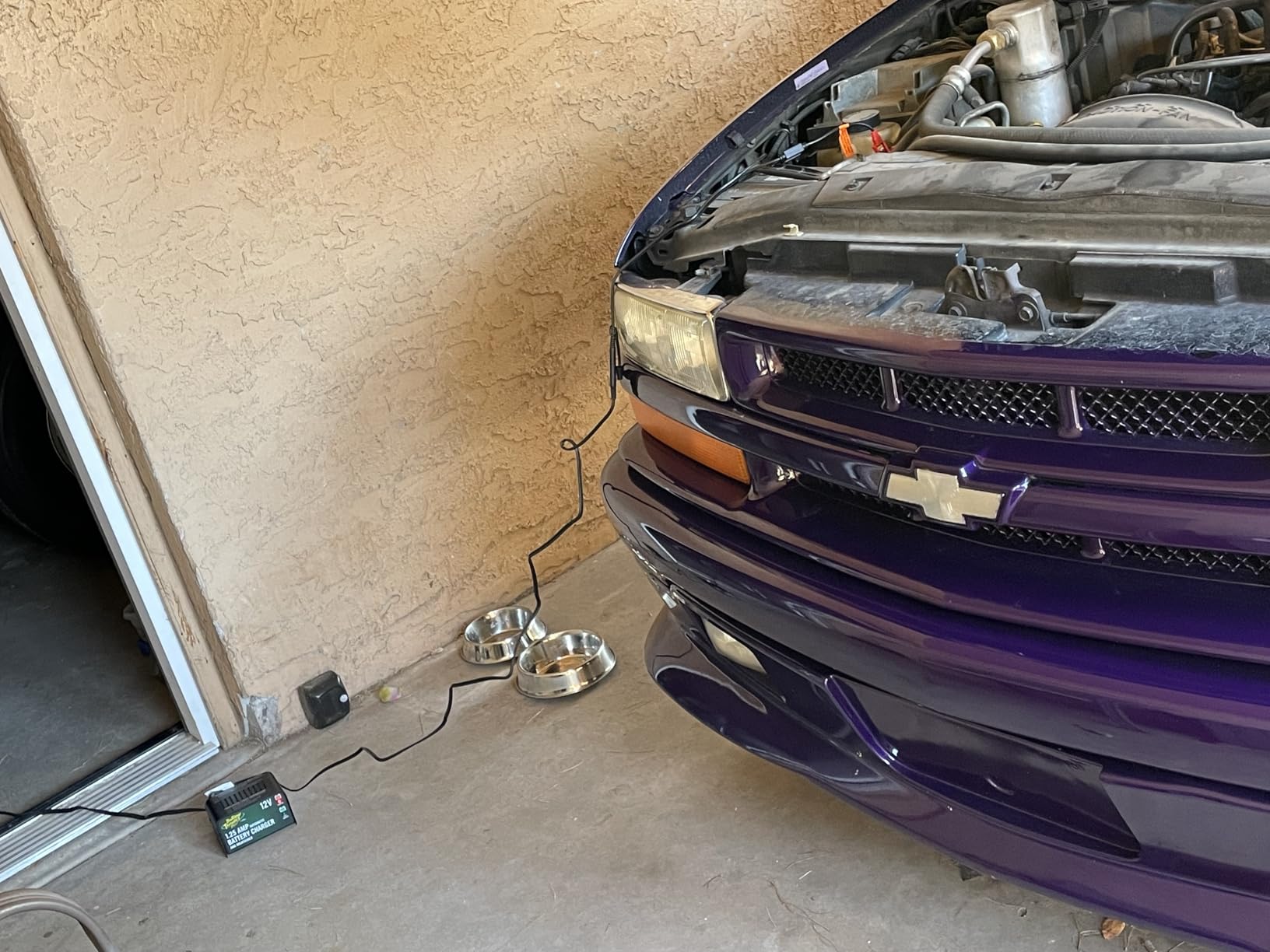
Why 1.25A is the right middle rung for cold climates
Cold slows chemical reaction rates, so a battery that sat in an unheated garage has less surface area available to accept charge than the same pack in a warm room. A higher current tender puts energy back faster and spends fewer weeks of the winter at a partial state of charge, which is when sulfation starts forming crystals on the plates.
For a bike ridden occasionally in winter, the 1.25A output means a top-up happens in a weekend rather than dragging into the following month. It is still a maintainer, not a recovery charger, but it gives you a useful margin over the 0.75A class without adding the heat concerns that come with multi-amp units running in a closed space.
Where this leaves you short
Anyone running an aftermarket LiFePO4 battery needs a chemistry switch or an auto-detecting unit, and this one has neither. A lithium pack that gets a lead-acid float profile for four months is exactly the scenario riders on ninetowners.com are worried about after a battery management system failure on a lithium phosphate pack.
Large automotive or deep-cycle packs also want more current than 1.25A to recover meaningfully, and the two-color LED means you cannot confirm charge stage in detail. If either of those applies, the CTEK in this roundup handles both problems.
3. NOCO GENIUS2D 2A: The Permanent Onboard Install
NOCO GENIUS2D 2A 12V Onboard Battery Charger, Trickle Charger & Maintainer
2A 12V direct-mount charger
Integrated thermal sensor for cold climates
Charges from as low as 1V with Force Mode
Pulse charging reverses sulfation
Pros
- Snap-fit bracket makes it a permanent install
- Thermal sensor adjusts output to ambient temperature
- Recovers from as low as 1V plus Force Mode
- Safe to keep connected indefinitely
Cons
- 2A ceiling is slow for a large depleted car battery
- AC and DC leads are short and may need an extension
- Inline fuse sits very close to the eyelet terminal
- No printed guide to the indicator lights
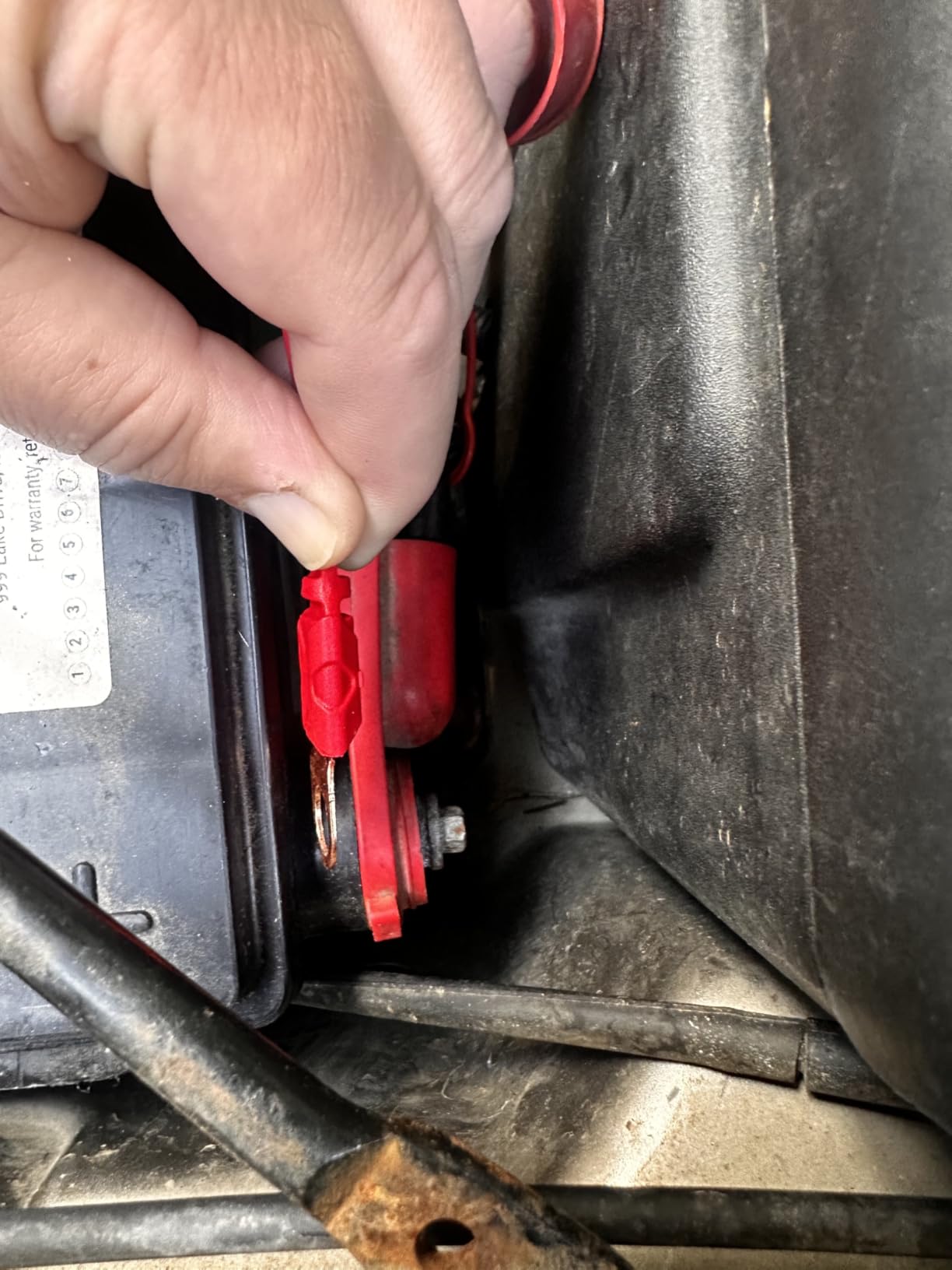
The GENIUS2D is built around one idea: mount it once and never think about it. The durable snap-fit bracket installs with truss-head self-tapping screws, the 24-inch DC lead with eyelet terminals bolts to the battery, and from then on the charger lives on the vehicle. The box includes the bracket, screws, a 24-inch AC cable and a 3-year limited warranty.
Two features matter more for winter than the 2A headline. The integrated thermal sensor adjusts charging to ambient temperature, which is the specific thing that goes wrong with cheap chargers in a cold garage, and the precision pulse charging is designed to detect and reverse sulfation and acid stratification rather than only topping off the surface charge. Owners on r/Harley describe the NOCO Genius line as the charger that genuinely prolonged their battery life through off-season droughts, and riders on ktmforums report switching from Battery Tender to the NOCO line and being very happy with the change.
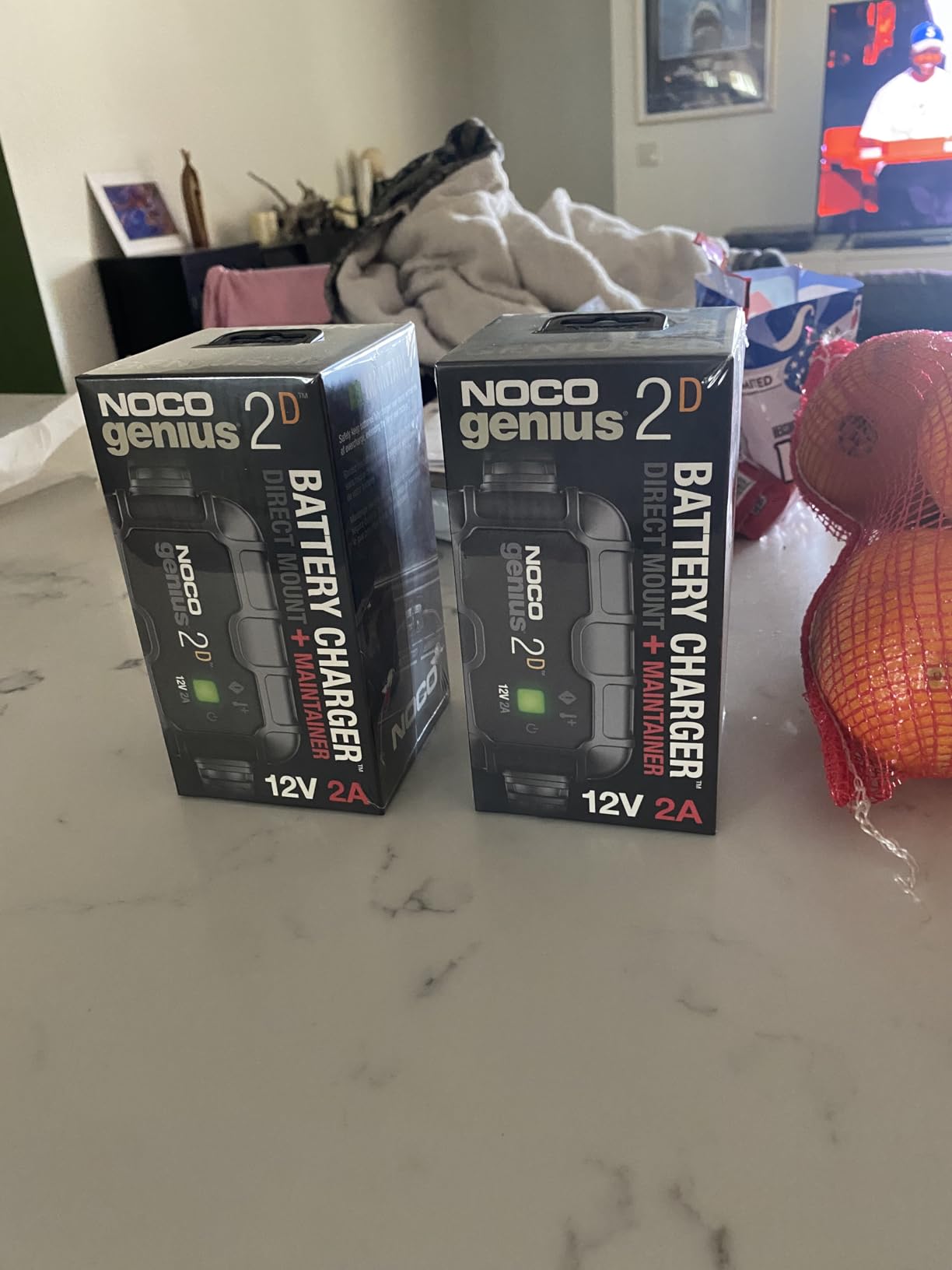
It is also the most capable recovery unit in this roundup. It charges from as low as 1V, and a Force Mode handles batteries that have gone all the way down. Rated for 12V lead-acid including AGM, gel, SLA and VRLA in flooded, maintenance-free, deep-cycle, marine and RV flavours, it is safe to keep connected indefinitely for float maintenance, which is the answer to the leave-it-on-all-winter question for this unit specifically.
The honest limitation is speed. At 2A the listed battery charge time is around 40 hours, so it is not the right tool for quickly bringing a large depleted car battery back from a dead stop. The leads are also short, so mounting near the battery with a distant outlet may require an extension, and reviewers note that the inline fuse on the positive lead sits very close to the eyelet, which makes the connection awkward in tight spaces.
Why the thermal sensor earns its place in winter
A fixed-output charger pushes the same current whether the garage is at 40 degrees or at 80. That is how AGM batteries get damaged, because the charging acceptance of a battery changes with temperature while the charger does not. The GENIUS2D reads ambient temperature and adjusts, so cold-soaked storage is handled at the point where a fixed unit would either undercharge or overcharge.
It is a small part of the spec sheet with an outsized effect on a four-month storage duty, and combined with the ability to sit on the bike permanently it makes this the pick for riders who want one install and zero seasonal effort. The 1 lb of hardware stays with the motorcycle, which also makes sense if the bike lives somewhere exposed.
When it falls short of the job
Two amps is not enough for fast recovery, and if your last two batteries died in storage you need something with real bulk current. Owners also mention that there is no printed documentation explaining the indicator light meanings, which is a small thing that matters when the unit is permanently mounted and rarely looked at.
Lithium packs are outside the stated design scope, since the feature list covers 12V lead-acid chemistries only. A rider running LiFePO4 should choose a unit with a lithium mode rather than assuming a lead-acid profile is close enough.
4. CTEK MXS 5.0 4.3A: Most Charge Stages and Real Motorcycle Modes
CTEK – 40-206 MXS 5.0 Fully Automatic 4.3 amp Battery Charger and Maintainer 12V
4.3A 12V output
Fully automatic 8-step program
Dedicated AGM and motorcycle modes
IP65 splash and dust proofing
Pros
- Eight-step program with a status light per step
- Dedicated AGM plus motorcycle and motorcycle-AGM modes
- Recondition mode revives underperforming batteries
- IP65 rated with reverse-polarity protection
- Resumes charging after a power interruption
Cons
- Chemistry must be selected manually with no auto-detect
- Motorcycle modes cap output at roughly 0.8A
- Eyelet lead is short for routed installations
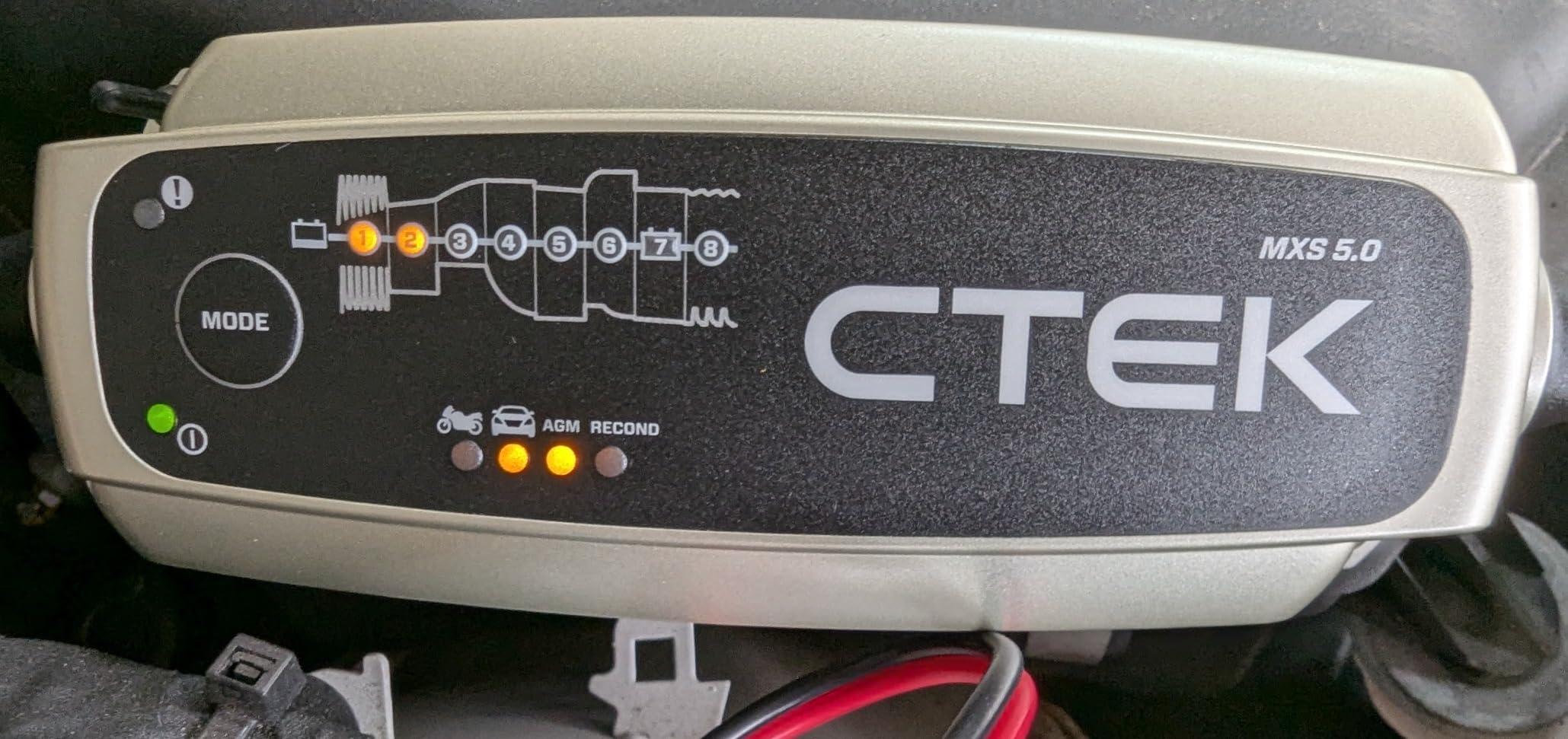
The MXS 5.0 is the most capable charging machine here and the least compact, at 5.91 by 11.02 by 2.36 inches and 1.3 lb. What you get for the bulk is a fully automatic eight-step program with a clear status light for each step, documented in the manual, so you can see which stage the battery is in rather than guessing from a single LED.
More importantly, it has dedicated motorcycle and motorcycle-AGM settings alongside a separate AGM mode. That is a genuinely different piece of engineering from a generic lead-acid profile, and it is why the unit shows up in motorcycle-specific buying conversations. The reconditioning function is designed to improve the lifespan of healthy batteries and bring underperforming ones back, and the patented float and pulse charging is rated for months of unattended connection.
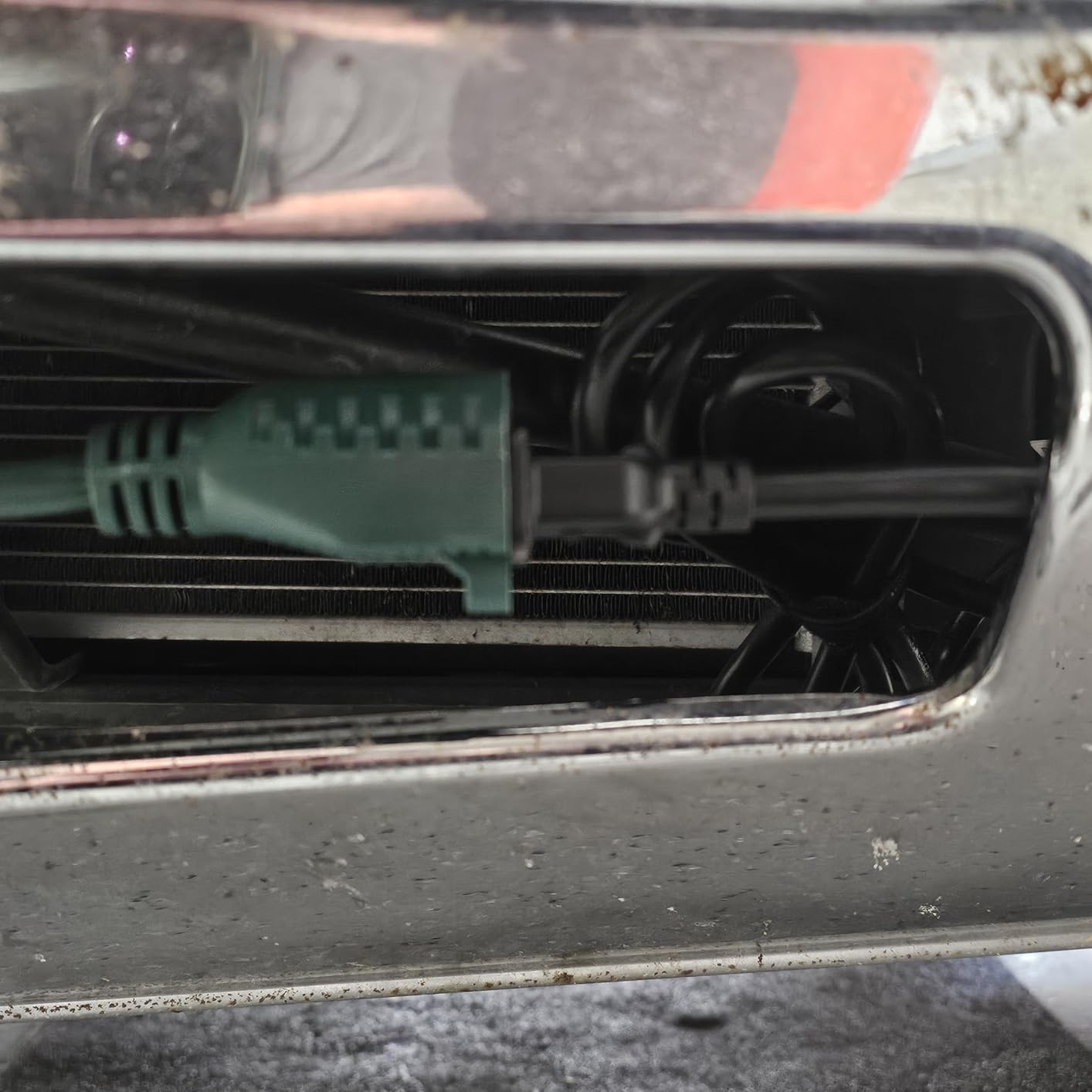
Build quality suits a damp garage. It carries an IP65 rating and is described as splash, dust, spark and shock proof with short-circuit protection and reverse-polarity protection, and it automatically resumes charging after a power interruption, which matters if your garage loses power in a storm. Clamps, eyelets and a storage drawstring bag are included, and the Comfort Connect ports let you swap leads.
The catch is that chemistry selection is manual. There is no auto-detect, so you have to remember to set AGM or motorcycle-AGM correctly yourself, and getting it wrong is exactly the kind of mistake that ages a battery unnecessarily. The included eyelet lead is also short, which matters if you are routing it under a tank or along a frame rail to a permanent install.
What 4.3 amps actually buys you in a cold month
Higher current is not automatically better for storage, because a big charger left in float in a hot enclosed garage generates more heat. That heat complaint is real: owners on hdforums-type threads have described a tender too hot to hold for more than ten seconds in a poorly ventilated space. The MXS 5.0 answers it with the IP65 sealed enclosure and an eight-step program that steps current down rather than holding it flat.
What the extra current really buys is recovery headroom when a battery has already been neglected, and the ability to handle a large touring pack or a second vehicle on the same unit. Pair that with the recondition mode and this becomes the strongest rescue tool in the roundup, at the cost of needing to set the chemistry mode yourself.
The compromise the motorcycle modes force
Selecting a motorcycle mode drops output to roughly 0.8A, which is a sensible compromise on a small pack and rather defeatist if you picked this unit for its 4.3A. Riders with a big touring battery who want the higher current are better off leaving it in the standard program and accepting the longer charge time.
Reviewers also note the clamp cord is limited relative to some layouts, and that the alligator clips can rust with prolonged outdoor rain exposure while their plastic shells degrade over years. If your bike is stored outside, plan on replacing the leads rather than leaving them in the rain season after season.
5. BikeMaster Lithium-Ion Charger: Built for Lithium Packs
BikeMaster Lithium-Ion Battery Charger/Maintainer
Purpose-built for 12V lithium-ion
2A output with auto maintenance drop
SAE quick disconnect and ring terminals
Overcharge short and reverse-polarity protection
Pros
- Purpose-built for 12V lithium-ion motorcycle packs
- SAE quick disconnect plus ring terminals and clips
- Drops to a low maintenance current when full
- Built-in overcharge short and reverse-polarity protection
- Small enough to mount or stow under a seat
Cons
- Cannot revive a deeply discharged lithium pack
- LED indicators do not always match real state of charge
- 1-year warranty coverage only
- Some units report no charging action at all
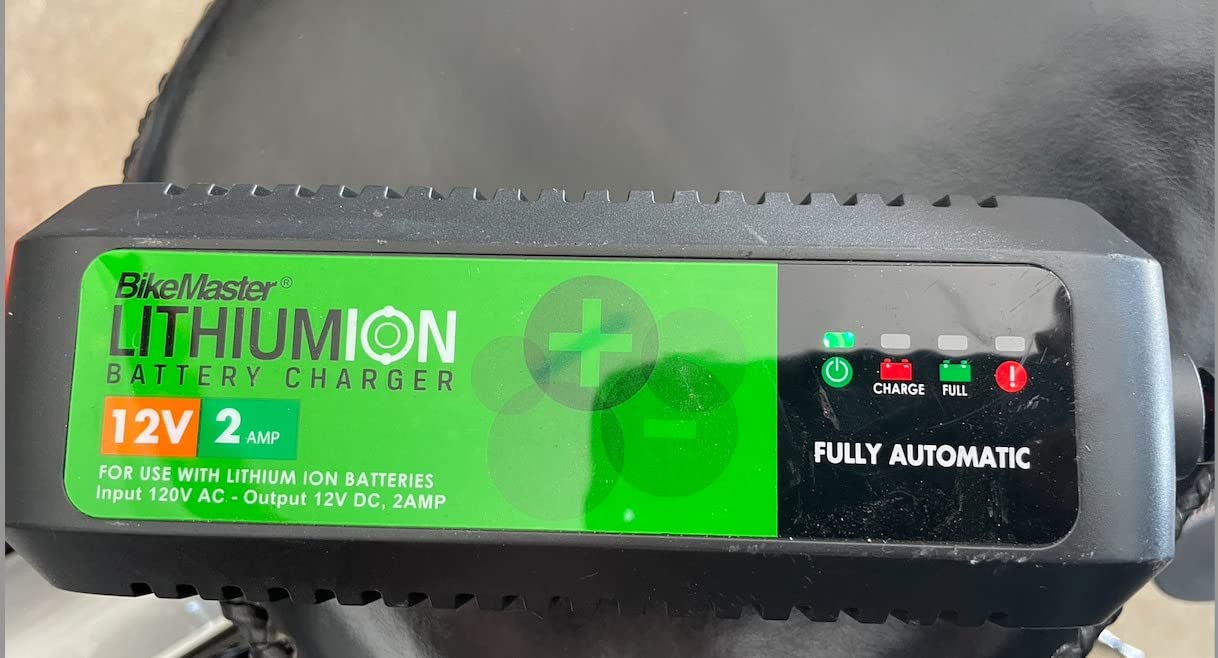
If your bike runs a 12V lithium-ion pack, this is the only unit in the roundup designed for the chemistry from the start, and that single fact changes everything. Output is 12V at 2 amps, and the unit drops to a low maintenance current once the pack is full so it can stay hooked up through storage. Built-in circuit protection covers overcharging, short circuits and reverse polarity.
The connector set is the best of the group for a permanent install. It includes an SAE quick disconnect, ring terminals and large alligator style clips, and the shock-resistant ABS housing is small enough to mount or stow under a motorcycle seat. Owners with lithium bikes report restoring a depleted pack in under 45 minutes, which is the fastest recovery in the lithium category.
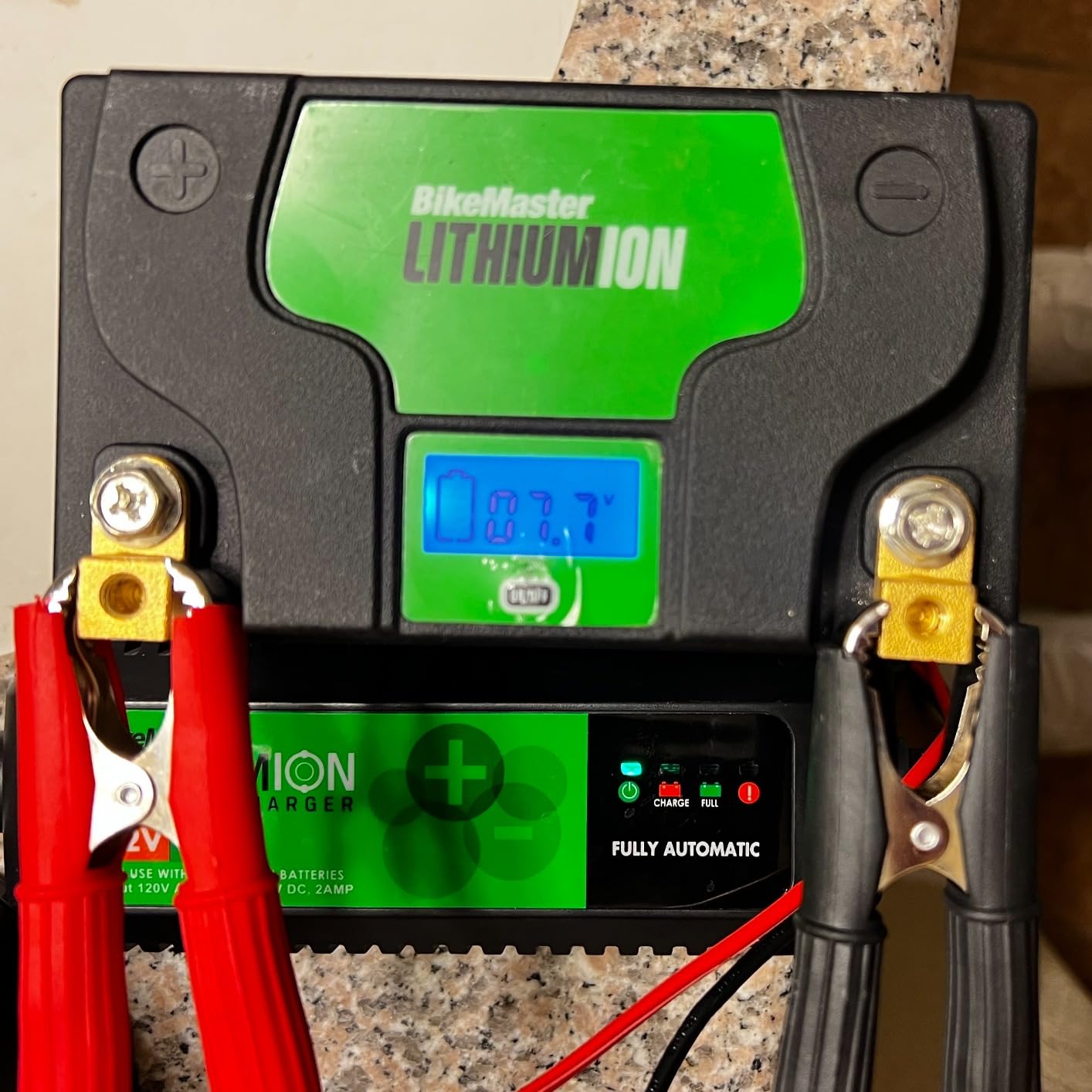
The dominant negative theme is not a defect but a design choice. Once a lithium pack falls below its cutoff voltage, the charger will not revive it, and owners have to prime the pack with a standard lead-acid charger first. That is the correct behaviour for the chemistry, because pushing current into a deeply discharged lithium cell is how you get the battery management system failures that riders worry about, but it does mean this unit is useless as a rescue tool.
There is also a small share of owners who report the unit powering on without taking any charging action, which is what accounts for the 1-star portion of the ratings, and the LED indicators do not always match the pack’s real state of charge. The 1-year warranty is the shortest in the roundup.
Why lithium packs need their own tender setting
A lead-acid battery is happy at a float voltage around 12.6 to 12.8V. A lithium iron phosphate pack wants a lower storage voltage, usually nearer 13.2 to 13.4V on the way up and a tighter ceiling on the way down. Send a lead-acid float profile into a LiFePO4 pack for months and you are holding it above its ideal storage point, which is precisely the mechanism behind the battery management system failure discussed on ninetowners.com.
That uncertainty among owners is real. On r/Triumph, riders have been asking whether lithium-ion batteries and winter storage interact safely, and on motorcycleforum.com people are actively hunting chargers that carry an explicit lithium and lithium-iron mode, naming NOCO and CTEK as examples. If your bike has an aftermarket lithium pack, buy the tender for the chemistry rather than the cheapest one that fits the terminals.
Where it is not the right pick
Anyone on a conventional flooded, AGM or gel battery should skip this, because a lithium-specific profile is not what those cells want for long storage. The inability to wake a depleted pack also rules it out as a recovery tool, and the short warranty means you have less long-term assurance than with the lead-acid units here.
If you want one device that handles both lead-acid and lithium packs on different bikes, the LEICESTERCN later in this roundup has a manual chemistry switch instead, which is the compromise option for a mixed garage.
6. BatteryMINDer 1500 1.5A: Continuous Desulfation for Multi-Bike Garages
BatteryMINDer 1500 12V-1.5A Smart Trickle Charger, Battery Maintainer, and Battery Desulfator – for Winter and Long Term Storage
1.5A 12V smart maintainer
Full-time high-frequency desulfator
Maintains up to four batteries in parallel
Ambient temperature compensation
Pros
- Continuous desulfation pulses while connected
- Built specifically for winterizing motorcycles and boats
- Temperature compensation adjusts the float voltage
- Can maintain four batteries with Y-connectors
- Works with flooded sealed AGM and marine batteries
Cons
- 1.5A is low for bulk charging large packs
- Cannot reverse physical cell damage or vibration damage
- Y-connectors sold separately
The BatteryMINDer 1500 is the odd one out in this roundup because it does not simply hold a battery at float. It runs a full-time high-frequency pulse desulfator alongside the 1.5A charging function, working continuously on sulfate crystal buildup while the battery sits connected. If sulfation is the mechanism that actually kills stored lead-acid batteries, attacking it continuously is a defensible design choice.
Long-term owners back that up. Reviewers report measurably longer battery life, including a motorcycle battery still in service after 11 years and a failing SUV battery that was revived and then kept alive for nearly seven more years. The consistent theme is that gentle uninterrupted float with pulsing beats aggressive bulk charging for storage duty, which is a useful corrective to the idea that more amps is always better.
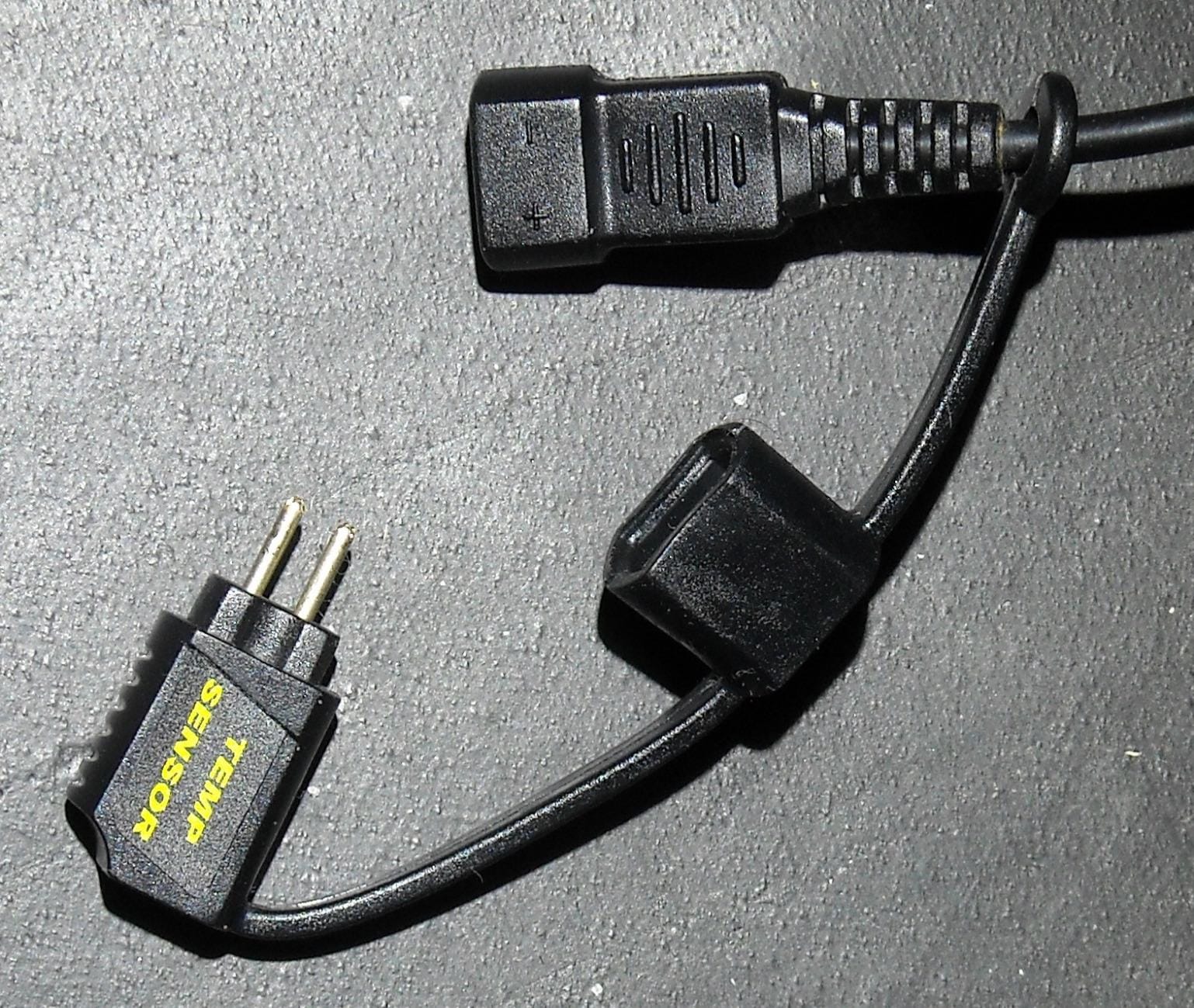
It is also the only unit here designed around multiple machines. The unit has four ports and can maintain up to four batteries in parallel using Y-connectors, which are sold separately, and the built-in ambient temperature sensor adjusts charging voltage for seasonal conditions. Reverse polarity, short-circuit and over-temperature protection are all present, and it runs on 90-240V AC input for worldwide use.
The honest limitation is current. At 1.5A it will not bulk charge a large automotive or deep-cycle pack meaningfully, and some high-demand AGM chemistries want more rate to recover capacity. The desulfation pulses also cannot rescue a battery that is damaged physically, whether by vibration, electrolyte loss or grid corrosion.
What full-time desulfation is actually for
Sulfation is the slow accumulation of lead sulfate crystals on the plates when a battery sits at partial charge. A tender that only holds float does not reverse it. A unit that pulses continuously has a chance to break the crystals loose while the battery is still chemically able to use them, which is why the long-term results associated with this design skew so strongly positive for storage-only duty.
That makes it a poor fit for a quick top-up before riding and an excellent fit for a bike that will sit for three to five months. It is also worth being honest about the limit: desulfation helps a mildly sulfated battery and does nothing for a physically damaged one, so if your battery has already been sitting flat for a season, no maintainer in this roundup is a substitute for a replacement.
When a single-bike owner does not need it
With one bike in a garage, the four-battery capability and the desulfation circuitry are simply extra capability you will not use, and 1.5A is a middling output for the money. Households with two or more motorcycles, or a shop maintaining several machines, are the audience that gets real value from the parallel capability.
The connector situation is also thinner than the leaders here, since the listed lead is battery clips and the Y-connectors for multi-battery use are an extra purchase. Plan the routing and the extra leads before you commit to a four-bike setup.
7. LEICESTERCN 1.1A: Budget Pick With a Chemistry Switch
Motorcycle Battery Charger and Maintainer 12V, 1.1Amp Smart Trickle Charger – Automatic Float Charger for Cruiser Sport Bike ATV Scooter Dirt Bike Lawn Mower, LiFePO4 Lithium Lead Acid AGM Gel
1.1A 12V for motorcycle batteries
MODE button for lead-acid or LiFePO4
3-second force start below 8V
8ft total cable reach
Pros
- Low current correctly sized for small motorcycle packs
- MODE button switches lead-acid and LiFePO4
- Force start recovers packs discharged below 8V
- Fused SAE ring terminals plus alligator clips
- 8ft of total cable reach
Cons
- Budget-tier build and clamp quality
- Cannot recover physically damaged or fully dead cells
- Slow overnight recharge rather than a fast top-up
The LEICESTERCN C11 does something most of the category does not at this end of the market, which is offer a real chemistry decision. A MODE button switches between lead-acid, covering wet, AGM, gel, SLA and VRLA, and LiFePO4 with a built-in BMS. For a rider with a lithium upgrade on one bike and a conventional battery on another, that switch is worth more than raw amperage.
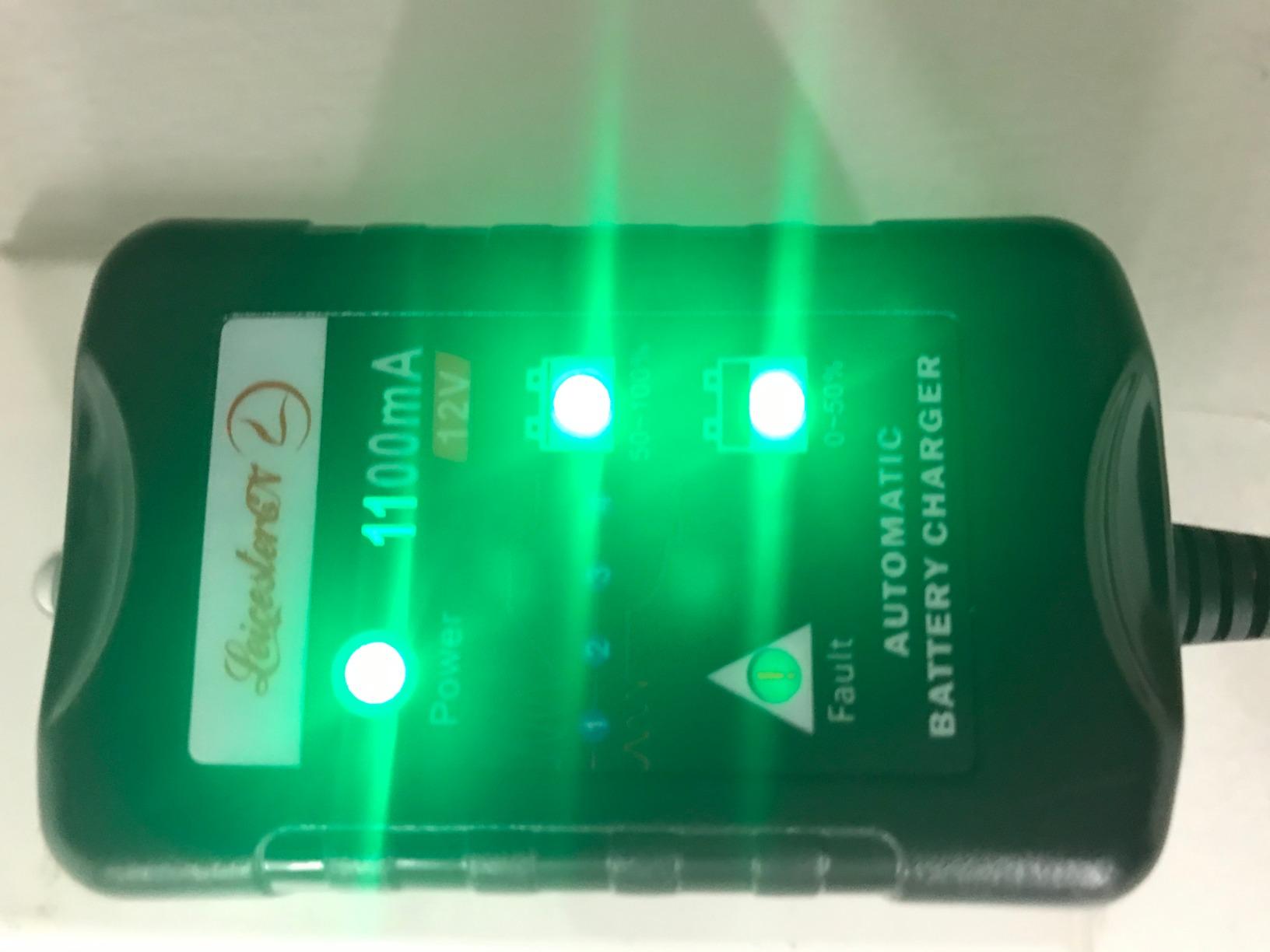
The current is deliberately restrained at 1.1 amps, and that is the correct choice rather than a shortfall. Motorcycle packs are small, commonly 5Ah to 32Ah, and owners consistently point out that low current avoids stressing the plates the way a high-amp automotive charger would. The MCU-controlled system switches to float maintenance and then monitors continuously, with LED indicators for power, charging and full.
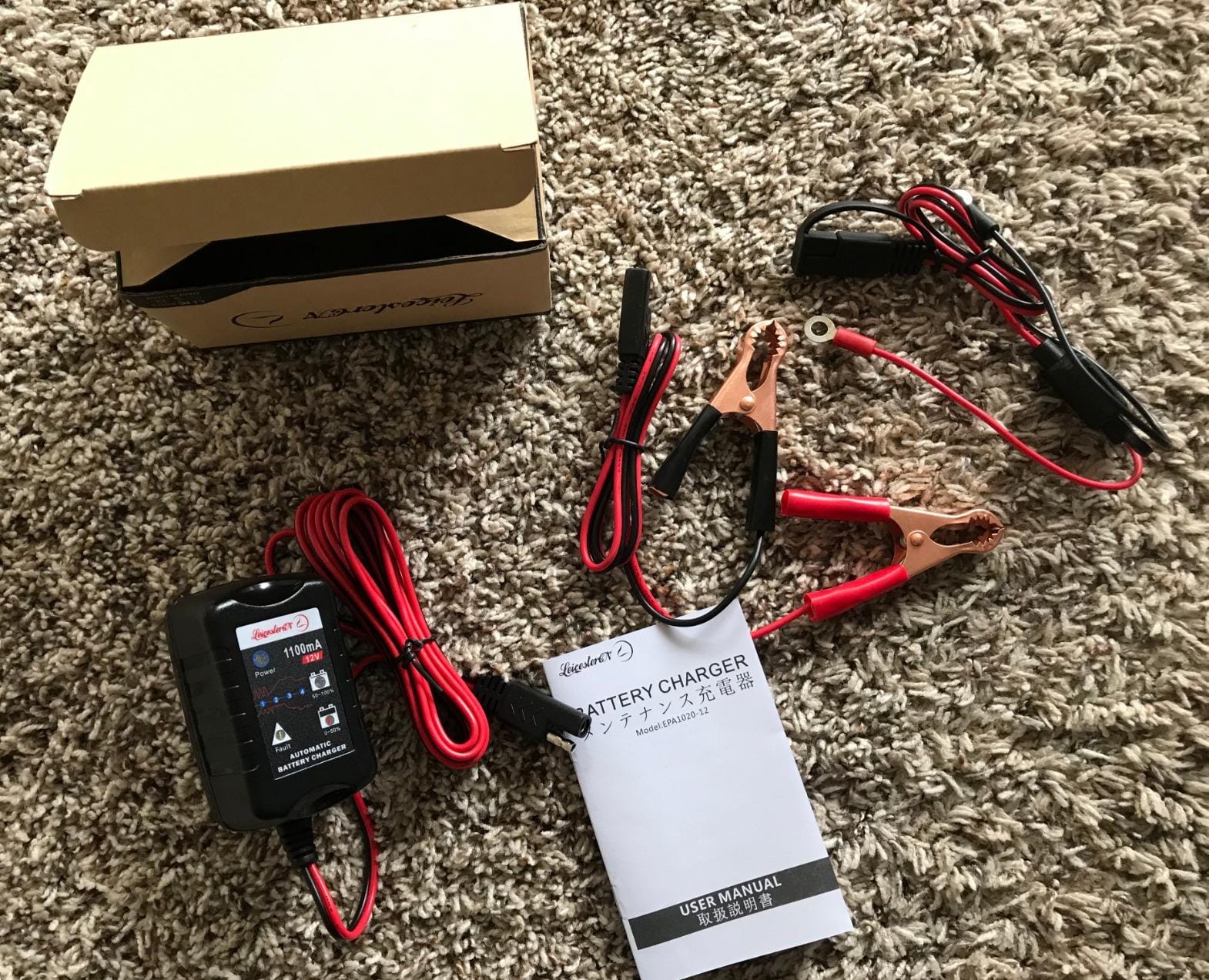
There is also a force-start recovery mode. Holding the MODE button for three seconds activates charging for batteries that have dropped below 8V, which covers a real category of winter casualty without needing a second device. The cable reach totals 8 feet, made up of a 6-foot AC cord and a 2-foot DC lead, so in most garages you avoid an extension cord entirely.
Included leads are fused SAE ring terminals for a permanent under-seat install plus alligator clips, and the unit carries spark-proof, reverse-polarity, short-circuit and overcharge protection. Owners report reviving batteries that had been sitting for years, and one long-term user notes a prior unit of the same design running eight years on continuous duty.
Why a chemistry switch beats more amps on a mixed garage
Matching charge behaviour to the cell type is what prevents damage, not current. A unit that knows whether it is talking to flooded lead acid or LiFePO4 applies the right absorption and float targets and, in the lithium case, the right cutoff behaviour. That removes the single most common mistake in this whole category, which is leaving a lithium pack on a lead-acid profile for a full winter.
For a small bike stored indoors in a heated garage, this is more than sufficient. The gentle 1.1A float is exactly what a small pack needs over three months of storage, and the force-start mode covers the case where you forgot to hook it up in the autumn.
Where the budget tier shows
The build is the trade. Owners describe the alligator clamps as not being premium, and the occasional first unit arriving defective. The listed dimensions of 1 by 1 by 1 inch also look like a packaging artifact rather than a real measurement, so do not plan a tight under-seat install around it.
It is a maintainer rather than a charger, so an overnight top-up is slow, and it cannot recover physically damaged or fully dead cells. Coverage is a 1-year limited warranty. Riders who want a visible charge-stage readout and harder-wearing leads should spend up for the FOVAL or the Battery Tender Junior instead.
8. FOVAL 1A Smart Charger: Long Cable, Simple Three-LED Readout
Foval Automatic Trickle Battery Charger 12V 1000mA Smart Battery Charger
1A 12V smart charger
4-step program with desulfation
102-inch combined AC and DC cable
Ring and alligator leads included
Pros
- Compact and light enough to mount or stash
- Four-step program with a desulfation function
- 102-inch cable run reduces extension cord need
- Ring and alligator leads both included
- Three clear LED charge states
Cons
- 1A output is maintenance-grade only
- No voltage or battery health readout
- Budget construction against premium maintainers
The FOVAL is the most quietly capable budget option here and the one with the second-largest body of owner feedback in the roundup. At 1 amp with a full four-step program, initialization, bulk charge, absorption and float, plus a desulfation function, it covers every lead-acid chemistry worth covering: SLA, VRLA, gel, AGM and wet.
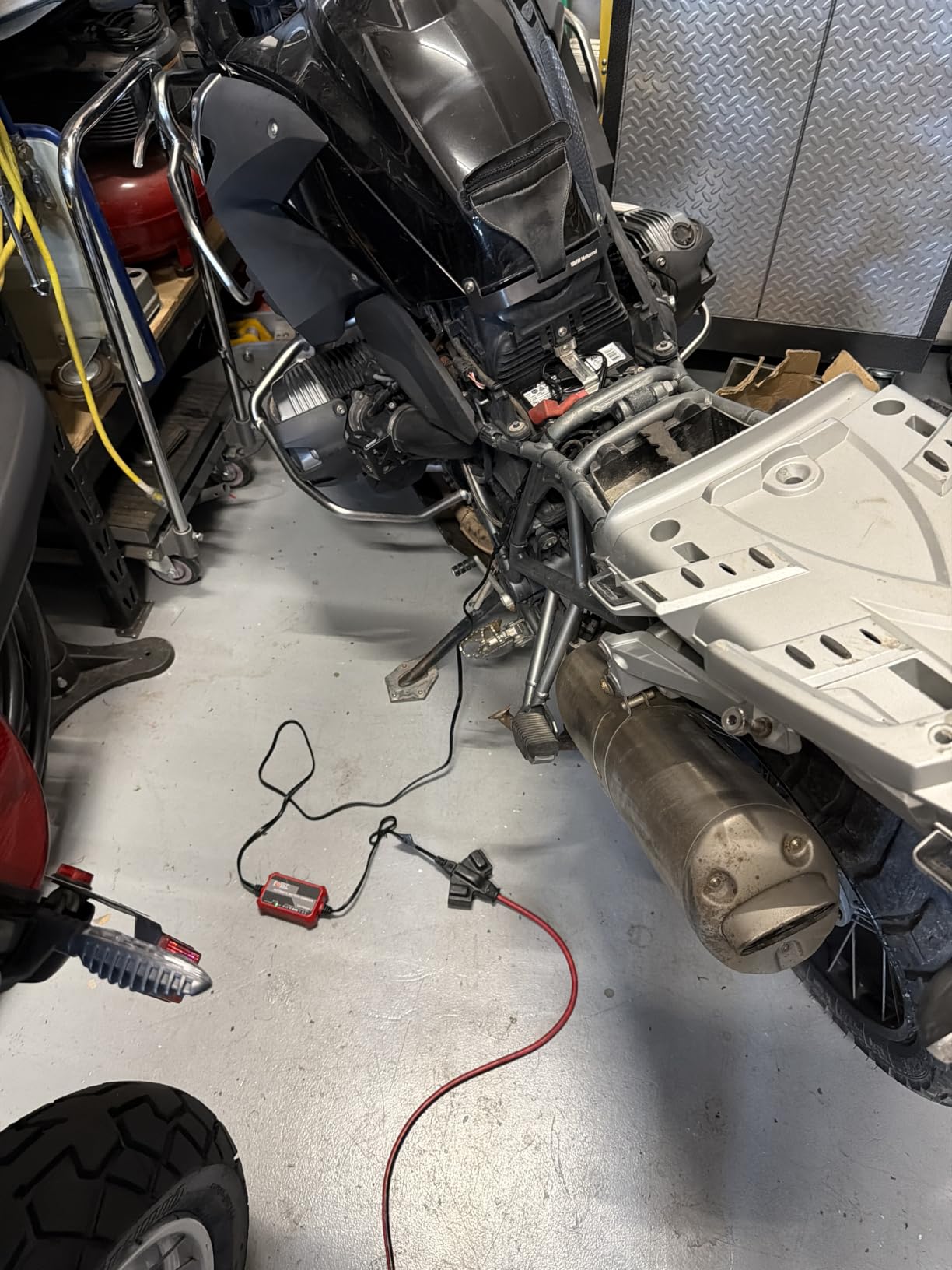
The physical design is the standout. At 3.9 by 2.4 by 1.25 inches and 10.5 oz it is phone-sized, and the 102-inch combined AC and DC cable run is long enough that you can mount it near an outlet in a shared garage and still reach the battery on a bike parked at the back. Both ring and alligator connector leads are in the box, so you can choose a permanent install or a temporary one.
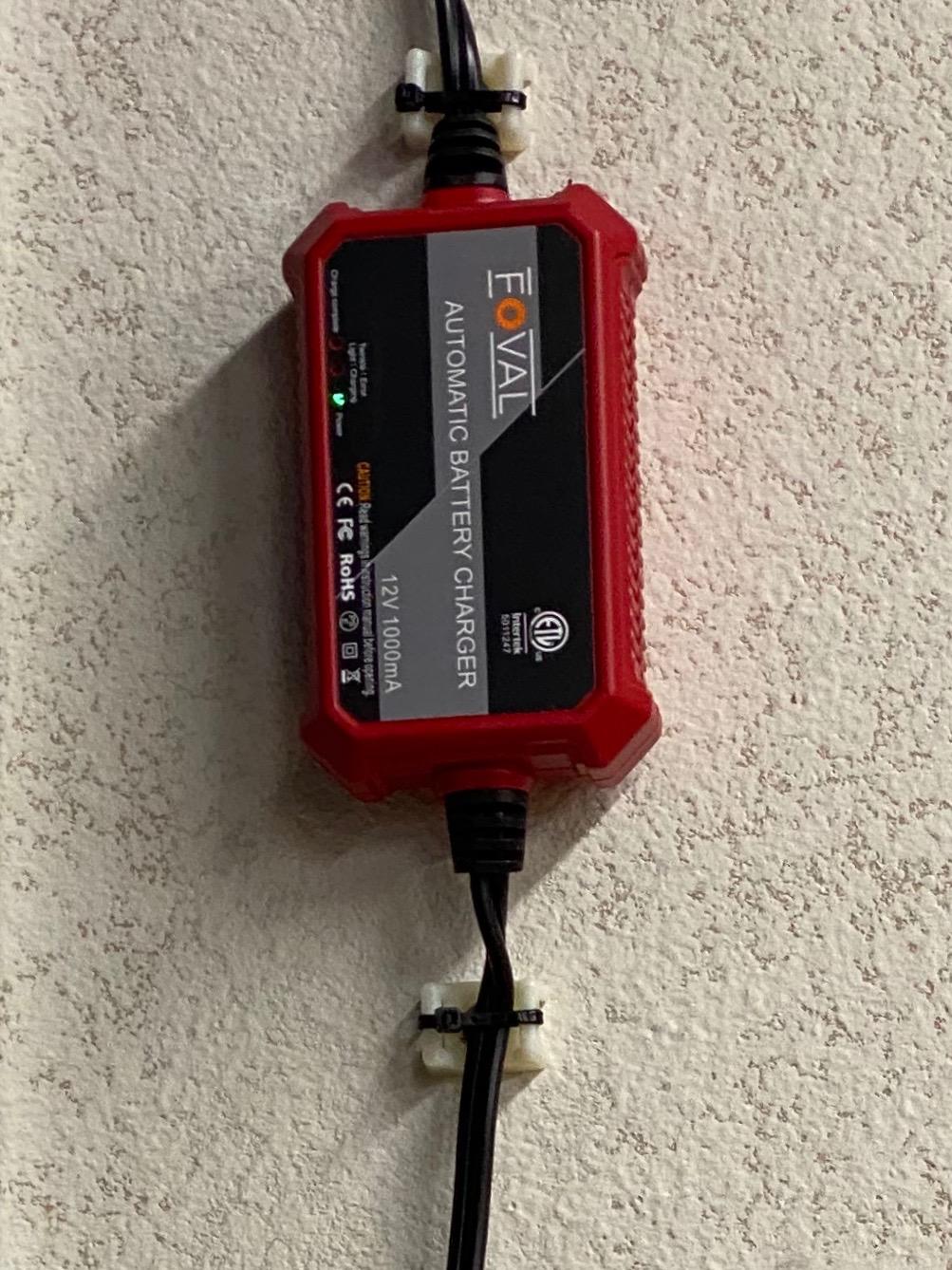
The LED scheme is genuinely clear compared to most single-indicator units. Green means power, green with red means charging, green with yellow means full, which is more information than the two-color LEDs on the Battery Tender units provide and comparable to most of the rest of the field. The multi-protection circuitry covers reverse polarity, over-current, overload, over-voltage and both hot and cold climate extremes, and it carries an 18-month warranty.
Compatibility is broader than the name suggests, with the manufacturer listing cars, boats, motorcycles, trucks, RVs, ATVs, UTVs, tractors, lawn mowers, personal watercraft, jet skis and snowmobiles, which is a reasonable sign of how these small maintainers actually get used in mixed households.
What a 1A maintainer does well and where it stops
At one amp this is a maintenance unit and nothing more, which is precisely the correct duty for a battery that will be stored rather than revived. Because the float current is so low, heat generation is minimal, and that is a real advantage in the unventilated garage scenario where higher-output chargers have drawn complaints.
The stopping point is straightforward. If a battery needs recovering rather than holding, one amp is a long conversation, and there is no recovery mode, no display and no diagnostic data beyond three LED states. For a first bike with a healthy battery stored in a dry garage, that limitation rarely comes up.
Where it loses to the premium units
The build is the trade against units like the Battery Tender Junior, and there is no chemistry selector, so a lithium pack is again out of scope. The absence of any voltage or battery health readout also means you cannot confirm the float voltage yourself before the season, which is the one diagnostic that would tell you a battery is finished.
Coverage is 18 months, which is shorter than the Battery Tender warranty terms. If you want the same four-step float with better leads and a much longer warranty behind it, the Junior in this roundup is the step up.
Can I Leave a Battery Tender On All Winter?
Yes, you can leave a genuine float-stage maintainer connected continuously for the whole winter, and that is exactly what it is designed to do. Once the battery reaches full charge the unit drops into a float stage around 12.6V and stops putting meaningful current in, so it holds the battery rather than overcharging it. Every unit in this roundup except the lithium-specific one states that it is safe to connect indefinitely.
The distinction that matters is between a real maintainer and a cheap constant trickler. A maintainer measures the battery and modulates output through multiple stages, including a float or pulse stage. A constant trickle keeps pushing current whether the battery wants it or not, and that is what produces the overheating complaints riders describe, including a unit running too hot to hold in a hot and poorly ventilated garage.
Two cautions apply even with a good unit. First, a tender maintains; it does not resurrect. A battery that has already dropped deep will not be brought back by a 0.75A maintainer, and a lithium pack that has fallen below its cutoff needs a lead-acid charger to prime it first. Second, if the garage gets genuinely hot in summer, more heat is generated from any charger, so check that the unit is not wedged in an enclosed space or draped under a blanket.
For riding advice on storage, our guides to motorcycle batteries for cruisers and tires for cruisers cover the parts of prep that sit outside the charger itself.
How to Hook a Tender Up for Winter Storage
Most of the difficulty in this task is the connector, not the charging. The units in this roundup ship with a mix of fused ring terminals, SAE quick disconnects and alligator clips, and which one you use determines whether seasonal hookup takes ten seconds or ten minutes.
Confirm the battery chemistry first. Check the label for lead acid, AGM, gel or lithium, and set the chemistry mode on the charger to match. This is the step that prevents the kind of damage riders fear most.
Choose your connector. Fused ring terminals bolt permanently to the battery posts and are the most secure for unattended storage. An SAE quick disconnect lets you unplug in one motion without touching the battery. Alligator clips are the most flexible and the least secure, which makes them the wrong choice for a bike sitting in a damp garage for months.
With the engine off, connect positive to positive and negative to negative. Every unit here has reverse-polarity detection or protection, but confirming polarity yourself is still faster than diagnosing a fault.
Select float or maintenance mode, and for lithium packs confirm the lithium setting is engaged rather than assumed.
Position the charger where air can move around it. Do not seal it inside a closed toolbox or wrap it in an insulating cover, and keep the leads clear of moving parts, exhaust and sharp frame edges.
Plug into the mains and confirm the status light shows charging or full, then check again the following week to make sure nothing has come loose.
If your bike is stored where condensation is a problem, the sealed units are a better fit. The CTEK carries an IP65 rating for splash and dust, and the NOCO GENIUS2D is designed as a fixed onboard mount where condensation is expected.
How to Choose a Motorcycle Battery Tender: Sizing, Chemistry and Connectors
Matching tender amps to your battery and climate
More amps is not automatically better for storage, and this is the most misunderstood spec on retail pages. A tender that delivers too much current continuously in float mode generates heat, and heat is what damages a battery left unattended for months. A tender that delivers too little simply takes longer to bring a neglected pack back up.
Start with the job you actually have. For a healthy battery on a small or mid-size bike stored in a dry indoor garage, the 0.75A to 1.1A class is the right answer, and these units run cool. For a large touring pack, a big cruiser battery or anything that has already been sitting partially discharged, the 1.25A to 2A class gives you useful recovery headroom. For a deep-discharge rescue or a second vehicle on the same unit, you want the 3A and up class.
Cold matters more than most sellers admit. Low temperatures slow the chemical reactions that let a battery accept charge, so a pack that sat in an unheated garage has less capacity available to take current than the same pack in a warm room. That argues for the middle rung of the ladder in cold climates rather than the smallest unit, and it is the reason the units with a built-in thermal sensor have an advantage even at the same rated current.
Lithium and LiFePO4 compatibility
If your motorcycle has a lithium iron phosphate pack, do not treat chemistry as a checkbox. Lead-acid and LiFePO4 batteries want different storage voltages and different float behaviour, and leaving a lithium pack on a lead-acid profile for a full winter can age the battery management system. The failure mode is documented and discussed at length by owners, and the fear is legitimate rather than alarmist.
Three options exist in this roundup. The BikeMaster unit is purpose-built for 12V lithium-ion and handles it correctly out of the box, with the caveat that it will not revive a deeply discharged pack. The LEICESTERCN has a manual MODE button for switching between lead-acid and LiFePO4. The rest are lead-acid designs, and for a lithium bike you should look at brands that carry an explicit lithium mode rather than relying on the generic lead-acid profile.
Float stage, display and heat
Check that the unit has a genuine float or pulse maintenance stage, because that is what makes continuous connection safe. Units with a status light per charge step, as the CTEK does, let you confirm what the charger is doing without pulling a meter out. Units that run hot enough to be uncomfortable are a failure mode worth avoiding, particularly in a sealed garage or a hot climate.
Weather resistance is the other differentiator. A bike stored outside or in a damp garage needs a sealed unit and solid connections, not a loose pair of alligator clips. For riders parking under a cover with no mains power, a solar maintainer is the alternative, though none of the eight units here includes one.
Multi-bike households and single-bike basics
For two motorcycles, look for a 2-bank charger with independent channels rather than a Y-connector splitter, since a single low-current unit shared across two batteries is stretched thin. The BatteryMINDer 1500 in this roundup can maintain up to four batteries in parallel with Y-connectors sold separately, which works for a household that wants one simple box, though it shares a single charging channel across all of them.
For a single bike, keep it simple. A 1A to 1.25A unit with fused ring terminals and a long warranty covers the vast majority of riders for a decade of storage seasons, and that is where our top pick sits. If you also want a way to lift the bike for other winter work, our guide to motorcycle lifts for home garages is the other half of the same weekend project.
What a tender cannot do
A maintainer holds a healthy battery. It does not restore a battery that has already been destroyed, whether by deep discharge left for months, acid evaporation, physical damage, or a lithium pack that fell below cutoff. If a battery has been sitting flat since last season, the honest answer is a replacement battery, and our guide to motorcycle batteries for cruisers covers the picking side.
Desulfation is a real but limited tool. It helps a mildly sulfated battery and does nothing for a physically damaged cell. Any seller claiming a small maintainer will bring back a battery that other maintainers wrote off is describing a different category of machine, and it deserves scepticism.
If you still ride through winter
You do not need to ride weekly to keep a battery alive, which is a question that comes up constantly on first-winter threads. A tender connected at the start of winter handles the standing drain, and riding occasionally on top of that is enough. If you ride most weekends, your alternator is doing the work and a tender matters far less, which is exactly the case where you can skip one entirely.
For storage in a warm attached garage with short off periods rather than full months, a maintainer is optional. Riders on r/motorcycles describe parking through winter without a tender and starting right up in spring, and that is a real outcome. The tender becomes necessary when storage is long, the garage is unheated, the bike sits outdoors, parasitic drain is high, or the last two batteries both died over winter.
If your storage plan is to pull the battery instead, riders on r/motorcycles describe that as the alternative to a tender: remove it and keep it indoors off the floor and on a charger. Off the floor matters more than most people expect, because concrete holds moisture and cold that will shorten battery life. Our guide to motorcycle tires for touring covers the other seasonal check riders do before the season starts.
Do You Actually Need a Tender? An Honest Answer
Sometimes you do not, and any roundup that says otherwise is selling you something. If your motorcycle sits in a warm attached garage, you ride it most weekends through the cold months, and the battery is relatively new, the alternator keeps it topped up on its own. Plenty of riders on r/motorcycles park through an entire winter with no tender and start without drama, and that experience is legitimate.
You genuinely need one when the storage period is long, the garage is unheated or the bike is outside, the battery is a few years old, or the machine has electronics that draw enough to matter over weeks. Riders with lithium packs should be on a tender with a lithium mode whether or not they expect to need the charge, because the storage profile is the issue rather than the capacity.
The argument that convinced us is the simple one riders make themselves: a tender is a fraction of a replacement battery, and a single no-start morning in cold rain is a reminder of what that fraction buys. We think the eight units here are a reasonable way to spend that fraction, provided you pick one that matches your battery chemistry.
Pre-Season Wake-Up Checklist Before Your First Ride
Do not just unplug and ride. A battery that has floated for four months may be fine, but checking takes five minutes and turns an ambiguous failure into a clear diagnosis.
Disconnect the tender before anything else, and confirm the charger is fully unplugged from mains before you handle the battery.
Read the resting voltage with a meter after the surface charge settles. Around 12.6V or higher indicates a full charge, roughly 12.4V means it wants a charge, around 12.2V points to sulfation, and anything under 12.0V is a deep discharge that needs a real charger rather than a maintainer.
If the voltage is low, put the battery on a charger with meaningful current and let it come up before you try to start.
Check the terminals for corrosion and clean them if needed, and confirm the ground strap is tight while you are there.
Then start the bike, let it idle for a couple of minutes to wake the alternator and rebuild surface charge, and watch the charging voltage before you ride out.
If the tender was installed with ring terminals or an SAE quick disconnect, the disconnection step takes seconds. That convenience is the real argument for spending an afternoon in October setting the install up properly.
Frequently Asked Questions
Can I leave my battery tender on all winter?
Yes. A genuine float-stage maintainer can stay connected continuously for the whole winter. Once the battery reaches full charge it drops to a float stage near 12.6V and stops pushing meaningful current, so it holds the battery instead of overcharging it. This is different from a cheap constant trickle charger, which keeps feeding current whether the battery needs it or not and is the usual cause of overheating complaints. Just make sure the chemistry setting matches your battery and that the unit has airflow around it in a closed garage.
How long can you leave a motorcycle battery on a battery tender?
For as long as the bike is stored, provided the unit has a real float or maintenance stage. The units in this roundup that state they are safe to connect indefinitely are designed to run for months without overcharging. A tender maintains a healthy battery rather than reviving a dead one, so if your pack has already dropped below about 10V you will need a higher-current charger for recovery, and a lithium pack below its cutoff needs to be primed with a lead-acid charger first.
How do I know what size battery tender I need?
Match the tender to the job rather than to the biggest number. A healthy battery on a small or mid-size bike in a dry indoor garage needs only the 0.75A to 1.1A class, which runs cool in float. A large touring pack, a big cruiser battery or anything already partly discharged benefits from the 1.25A to 2A class for recovery headroom. Deep discharge rescue or a second vehicle needs 3A or more. Cold garages argue for the middle rung because low temperatures slow how fast a battery accepts charge.
Do battery tenders work on lithium motorcycle batteries?
Only if the tender has a lithium or LiFePO4 mode, because a lead-acid float profile is not what a lithium iron phosphate pack wants. A lithium pack needs a lower storage voltage and a tight cutoff, and leaving it on a lead-acid maintainer for a full winter is a known way to age the battery management system. Among the units we reviewed, the BikeMaster charger is built for 12V lithium-ion from the start, and the LEICESTERCN has a manual chemistry button. For everything else, choose a charger with an explicit lithium setting.
Do I need to ride my bike every week in winter?
No. If you have connected a tender at the start of winter, the standing parasitic drain is handled and you do not need to ride weekly. If you ride most weekends anyway, your alternator is doing the charging and a tender matters much less, which is also the clearest case where you can skip one entirely. The situations where a tender genuinely earns its place are long storage, an unheated garage, a bike parked outside, a battery a few years old, or a lithium pack that needs the right storage profile.
The Verdict for 2026 Winter Storage
The Battery Tender Junior takes our editor’s choice for a simple reason: it carries the highest rating and the largest body of owner feedback in this roundup, it runs a proper four-step program into float, and its fused ring harness makes unattended storage genuinely set-and-forget. If your battery is a healthy lead-acid pack on a normal bike, it is the least complicated correct answer.
Ride a lithium pack and the BikeMaster unit is the only one built for that chemistry. Want more recovery current and a display of charge stages, and the CTEK MXS 5.0 does more than anything else here, with a manual chemistry setting as the cost. The NOCO GENIUS2D suits anyone who wants one permanent onboard install with temperature compensation built in.
Whatever you choose, connect it in October, match the chemistry, and check the resting voltage before the first ride in spring. That is the whole job, and it is a fraction of the cost of the battery it protects.