
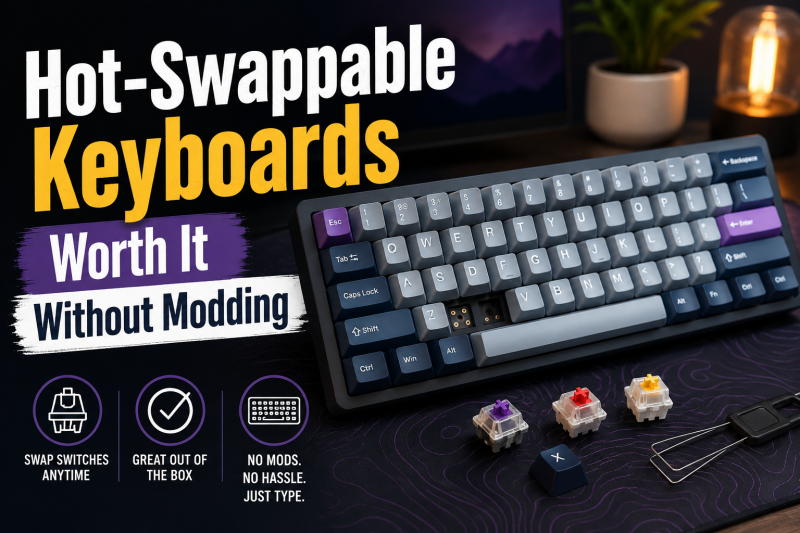
You’re staring at two nearly identical mechanical keyboards. Same layout, same switches, same RGB. One says “hot-swappable” on the box and costs $25 more. You don’t plan to mod. You just want a keyboard that types well for the next five years. So the real question is: are hot-swappable keyboards worth it if you never plan to mod? I’ve tested both types for years, talked to keyboard builders, and dug through hundreds of Reddit threads to give you a straight answer.
The short version: hot-swappable is worth the small premium for most people, even non-modders, but not for everyone. It depends on what kind of buyer you are, how long you plan to keep the keyboard, and how much peace of mind is worth $25 to you.
Table of Contents
Quick Verdict: Is Hot-Swappable Worth It Without Modding?
Yes, in most cases. Hot-swappable keyboards are worth the $25-50 premium even if you never plan to mod, primarily because switch failure is rare but inevitable, and hot-swap turns a $150 board from “landfill when a switch dies” into a 5-minute fix. The premium also buys you flexibility you may want later and stronger resale value. Skip it only if you’re on a tight budget, replacing the keyboard within two years, or buying a board under $60 where the savings matter more than the feature.
What Hot-Swappable Actually Means (And Why It Exists)
A hot-swappable keyboard has switches mounted on small PCB sockets instead of being soldered directly to the circuit board. You can pull a switch out with your fingers or a $3 switch puller and push a new one in. No soldering iron, no technical skill, no YouTube tutorial required.
A soldered keyboard has its switches permanently fused to the PCB with metal solder. Replacing a switch requires desoldering the old one with a hot iron, cleaning the pads, and soldering a new one. Most people can’t do this. The rest don’t want to.
The technology isn’t new. Millmax sockets have existed for years in DIY kits. What changed around 2026 is that mainstream prebuilt boards from Keychron, Glorious, Akko, and dozens of others started including hot-swap as a standard feature, not a $200 custom build upgrade.
Here’s what matters for the “never mod” crowd: the socket is just there. You can ignore it for the entire life of the keyboard and never think about it. But if something goes wrong, or you change your mind, the option is there.
5 Reasons Hot-Swappable Helps Even If You Never Mod
1. Switch Failure Insurance
Switches fail. It’s not a question of “if” but “when.” Most quality mechanical switches are rated for 50-80 million keystrokes. That sounds like a lot until you realize heavy users hit 5-10 million keys per year. A switch on your spacebar or “E” key can die in 5-7 years of daily use. On a soldered board, that means desoldering or replacing the entire keyboard. On a hot-swap board, you pop the dead switch out and drop in a $0.50 replacement. The premium you paid for hot-swap pays for itself the first time a switch dies.
2. Resale Value
Hot-swappable boards sell faster and for more on the secondhand market. A Keychron Q1 with hot-swap goes for $50-80 used. The same board without it sits longer and sells for less. Buyers know that hot-swap means the next owner can fix the board themselves, which translates to higher trust and higher offers.
3. Future Flexibility (Even If You Doubt It)
I said the same thing you just said, three years ago. “I’ll never change the switches.” Then I tried a friend’s board with Holy Pandas and realized my linears felt boring. Hot-swap let me try 12 different switch types over the next year before settling. You may not change your mind. But hot-swap makes that experiment cost $15 in switches instead of $150 in a new keyboard. It’s a low-cost option to keep open.
4. Easier Cleaning and Repairs
Spilled coffee under the spacebar. Crumbs in the switches. A sticky modifier. On a soldered board, these are weekend projects. On a hot-swap board, you pull the affected switches, clean them, and put them back. Five minutes, no tools beyond a switch puller. The Reddit user who said “I don’t have to open the whole keyboard just to waste more time” was describing exactly this scenario.
5. Troubleshooting Becomes Possible
When a key stops working, the first question is: software, cable, switch, or PCB? On a soldered board, you can’t isolate the switch. On a hot-swap board, you swap the suspect switch with a known-good one and you have your answer in 30 seconds. This alone has saved me from returning two perfectly fine keyboards.
The Real Downsides Nobody Mentions
Hot-swap isn’t free of trade-offs. Here are the honest drawbacks, including some you’ll only find in community discussions.
Socket wear over time. Hot-swap sockets are rated for a finite number of insertions, typically 50-100 cycles. If you swap switches constantly, the socket can loosen and cause intermittent connection issues. For a non-modder who might swap a switch twice in a decade, this is irrelevant. For a tinkerer, it matters.
Slight feel difference. Some users report that hot-swap boards feel slightly less “solid” than soldered equivalents because of the small gap introduced by the socket. The difference is subtle, often under 5% in perceived firmness, but enthusiasts with trained fingers can feel it. Beginners almost never notice.
Static electricity risk. Pulling switches while the board is plugged in can, in rare cases, cause static discharge that damages the PCB. Best practice is to unplug the keyboard before swapping. Not a deal-breaker, but worth knowing.
The cost premium. $25-50 is real money. On a $50 keyboard, that’s a 50% markup. On a $200 keyboard, it’s a 12% upgrade. The math works out very differently depending on what you’re buying.
5-pin vs 3-pin compatibility quirks. Hot-swap sockets can sometimes have fit issues with certain switch brands, especially older or boutique 5-pin designs. Most modern switches work fine, but it’s a minor hassle soldered boards don’t have.
Hot-Swap vs Soldered: A Side-by-Side Look
Here’s how the two approaches stack up across the dimensions that matter for non-modders.
Upfront cost: Soldered wins. Hot-swap adds $25-50 to the price, sometimes more on budget boards.
Switch replacement difficulty: Hot-swap wins by a mile. Soldered requires a $50 iron, $20 of solder, and 30+ minutes of work. Hot-swap requires a $3 puller and 30 seconds.
Long-term durability: Roughly even. Soldered connections are permanent but can crack from physical impact. Hot-swap sockets can wear from repeated swaps, but rarely fail from sitting still.
Repairability: Hot-swap wins. If a switch dies, hot-swap is a 5-minute fix. Soldered often means shipping the board for repair ($40-80 in labor) or replacing it.
Resale value: Hot-swap wins. Buyers prefer the flexibility, and secondhand prices reflect that.
Sound and feel consistency: Soldered has a slight edge. The direct connection can feel marginally more solid. Most users never notice.
Future flexibility: Hot-swap wins. Soldered locks you in. Hot-swap keeps options open.
Beginner-friendliness: Hot-swap wins. Zero tools required for any switch work.
For a non-modder, hot-swap wins 5 of 8 categories and ties in 1. The two categories soldered wins (upfront cost, feel consistency) are minor compared to the long-term repair advantage.
Should YOU Pay the Extra $25-50? A Decision Guide
Now that we’ve covered the technical side, here’s the practical question. The answer depends on which of these scenarios sounds like you.
Pay extra for hot-swap if:
You’re spending over $100 on a keyboard. At this price tier, $25-50 is under 30% extra. The repair and resale advantages easily justify it. Below $60, the math gets tighter.
You plan to keep the keyboard 3+ years. Switch failure risk compounds with time. A 3-year ownership window means a 5-15% chance of needing to replace at least one switch, depending on usage. Hot-swap turns that from a hassle into a non-event.
You value flexibility even in theory. Some people sleep better knowing they have options. That’s not a technical argument, but it’s a real one. If the $25 buys you peace of mind about “what if,” that’s worth it.
You have a history of breaking things. Coffee spills, crumbs, pet hair. Hot-swap makes cleaning and recovery dramatically easier. If your previous keyboard died from environmental damage, hot-swap is a no-brainer.
You might gift or resell the board later. Hot-swap boards hold value better and gift more easily because the recipient can tailor the switches.
Skip hot-swap if:
You’re buying under $50. At this price point, every dollar matters. The premium represents a huge percentage of the total cost. Save your money.
You replace keyboards every 1-2 years. Switch failure is unlikely in that window. You won’t experience the main benefit.
You genuinely, absolutely will never open the keyboard. If even a 5-minute switch swap feels like too much commitment, the feature won’t help you. Soldered boards often feel slightly more solid anyway.
You’re buying purely for sound or feel optimization. Some premium soldered boards offer marginally better acoustics and typing feel. Audiophiles and feel obsessives may prefer that trade.
What the Community Says (Reddit Consensus)
Across hundreds of threads on r/MechanicalKeyboards and r/keyboards, the consensus is surprisingly consistent. Most non-modder buyers who chose hot-swap report being glad they did, even if they never swapped a single switch. The reasons they cite: resale value, the rare repair, and “I just like having the option.”
One experienced builder put it bluntly: “Being hotswap means you can change the switches out. But the switches are only one component in a keyboard.” The point is valid. Hot-swap doesn’t make a bad keyboard good. It just makes a good keyboard more resilient.
Another user paid the $25 extra for a Keychron K6 and reported that two years in, they still hadn’t changed a switch, but they were glad they had the option when a switch started feeling inconsistent. They pulled it, swapped in a spare, and kept typing.
The strongest counter-argument from the community: on a budget board, the $25-50 is better spent on better stock switches or a metal case. Once you’re in the $120+ tier, though, hot-swap stops being a “nice to have” and becomes “why wouldn’t you.”
FAQs: Hot-Swappable Keyboards for Non-Modders
Should you get a hot-swappable keyboard?
You should get a hot-swappable keyboard in 2026 if you are spending over $100, plan to keep the board 3+ years, or value the option to repair a switch without soldering. Skip it on sub-$50 boards or if you replace keyboards every 1-2 years.
What are the downsides of hot-swap?
The main downsides of hot-swap are the $25-50 cost premium, possible socket wear after 50-100 insertions, a slight feel difference compared to soldered boards, and rare static electricity risk when swapping switches with the board plugged in. For non-modders, these are mostly theoretical concerns.
What is the advantage of a hot-swappable keyboard?
The main advantage of a hot-swappable keyboard is easy switch replacement without soldering. You can fix a dead switch in 5 minutes with a $3 puller, experiment with different switch types without buying a new board, clean sticky switches easily, and resell the keyboard for more money.
Do hot-swappable keyboards last longer than soldered ones?
Hot-swappable keyboards do not last longer than soldered ones in normal use, but they recover better from switch failure. A soldered board with a dead switch often becomes e-waste. A hot-swap board with a dead switch gets a 5-minute repair and continues for years.
Is hot-swappable worth it for beginners?
Hot-swappable is worth it for beginners in 2026 because it removes the fear of switch problems. New users do not need to learn soldering, can experiment with switches, and can recover from mistakes like spills or sticky keys without buying a new board.
Final Verdict: Worth It for Most Non-Modders
So, are hot-swappable keyboards worth it if you never plan to mod? For most people buying a board over $100 that they plan to keep for years, yes. The $25-50 premium buys you insurance against switch failure, flexibility you may want later, easier cleaning, and stronger resale value. The downsides (slight feel difference, theoretical socket wear) only matter to people who swap switches constantly, which is exactly the audience that already wants hot-swap. The only cases where it doesn’t make sense are tight budgets under $60 or short-term ownership under two years. For everyone else, hot-swap is one of the few “future-proof” features in the keyboard world that actually pays off.