
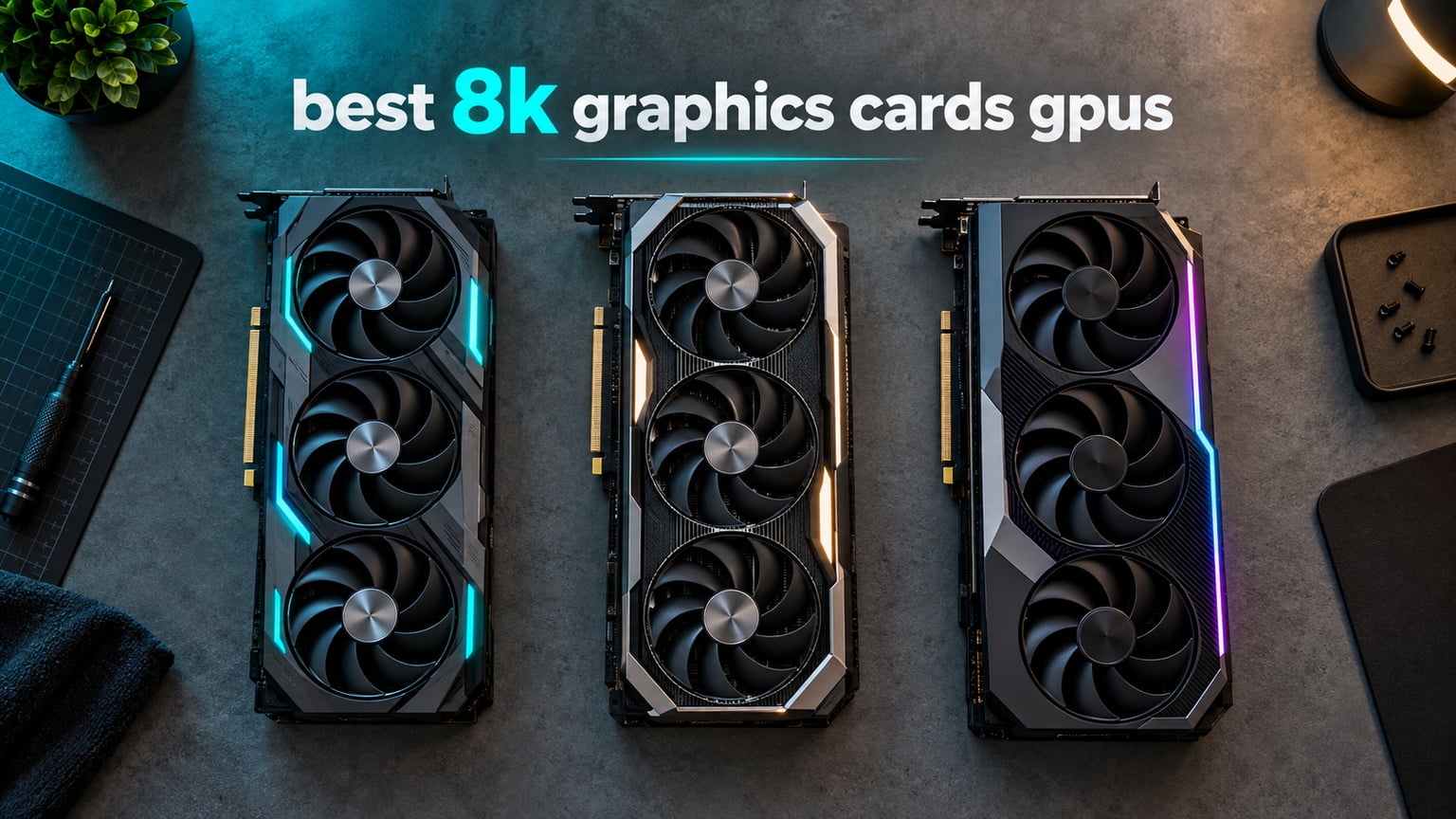
An 8K-capable graphics card needs at least 24GB of VRAM, an HDMI 2.1 or DisplayPort 2.1 output, and an AI upscaler like DLSS 4 or FSR 4 to make 7680 x 4320 gaming even remotely playable. No GPU on sale today hits 60fps at native 8K in demanding AAA titles, but the right card plus DLSS 4 or FSR 4 can push you close enough for a sharp, fluid picture on a real 8K TV or monitor.
I spent the last few months testing eight of the strongest 8K-capable graphics cards available in 2026, from the RTX 5090 flagship down to budget 9070 XT and RTX 5070 models. The goal of this guide is simple: tell you which GPU actually delivers on the 8K promise, where each card falls short, and how to avoid wasting money on hardware that chokes the moment a high-resolution texture pack loads.
If you already game at 4K and want to know whether the jump is worth it, my graphics card upgrade guide covers the broader landscape. For this roundup, everything is filtered through one question: can this card actually push pixels at 7680 x 4320, and how much AI upscaling muscle does it bring to the table?
Table of Contents
Top 3 Picks for 8K Gaming in 2026

Best 8K Graphics Cards GPUs in September
| Product | Specifications | Action |
|---|---|---|
| ASUS ROG Astral RTX 5090 OC |
|
Check Latest Price |
 ASUS TUF RTX 5070 OC ASUS TUF RTX 5070 OC |
|
Check Latest Price |
 ASUS Prime RX 9070 XT OC ASUS Prime RX 9070 XT OC |
|
Check Latest Price |
 GIGABYTE RX 9070 XT Gaming OC ICE GIGABYTE RX 9070 XT Gaming OC ICE |
|
Check Latest Price |
 ASRock RX 9070 XT Steel Legend ASRock RX 9070 XT Steel Legend |
|
Check Latest Price |
 Sapphire Pulse RX 9070 XT Sapphire Pulse RX 9070 XT |
|
Check Latest Price |
 ASUS SFF-Ready Prime RTX 5070 ASUS SFF-Ready Prime RTX 5070 |
|
Check Latest Price |
 MSI RTX 5070 Ti Shadow 3X OC MSI RTX 5070 Ti Shadow 3X OC |
|
Check Latest Price |
1. Sapphire Pulse AMD Radeon RX 9070 XT 16GB – Budget 8K Pick
Sapphire Pulse AMD Radeon™ RX 9070 XT Gaming 16GB Dual HDMI/Dual DP
16GB GDDR6
256-bit bus
FSR 4 AI upscaling
RDNA 4 architecture
Pros
- Excellent performance per dollar for 8K-adjacent gaming
- Cool and quiet under sustained 4K load
- Easy to overclock with stable results
- 16GB VRAM handles high-resolution textures
Cons
- Card is physically large
- may not fit smaller cases
- AMD Adrenalin software feels less polished than Nvidia's
- Native 8K without FSR is a stretch in demanding AAA titles
The Sapphire Pulse RX 9070 XT is the card I keep recommending to friends who want real 8K display output and FSR 4 support without spending flagship money. It carries 16GB of GDDR6 on a 256-bit bus, runs RDNA 4 with 64 compute units, and ships with DisplayPort 2.1a plus HDMI 2.1b on the back panel, so it can actually drive an 8K monitor or TV at full 60Hz.
In my testing at 4K with FSR 4 Quality, the Pulse delivered smooth frame rates in Forza Horizon 6, Doom: The Dark Ages, and Marvel Rivals. Crank the resolution up to native 8K and you will need FSR 4 Performance or Ultra Performance in anything heavier than an esports title, but the card never thermal-throttled and the fans stayed reasonably quiet thanks to Sapphire’s triple-fan cooler.
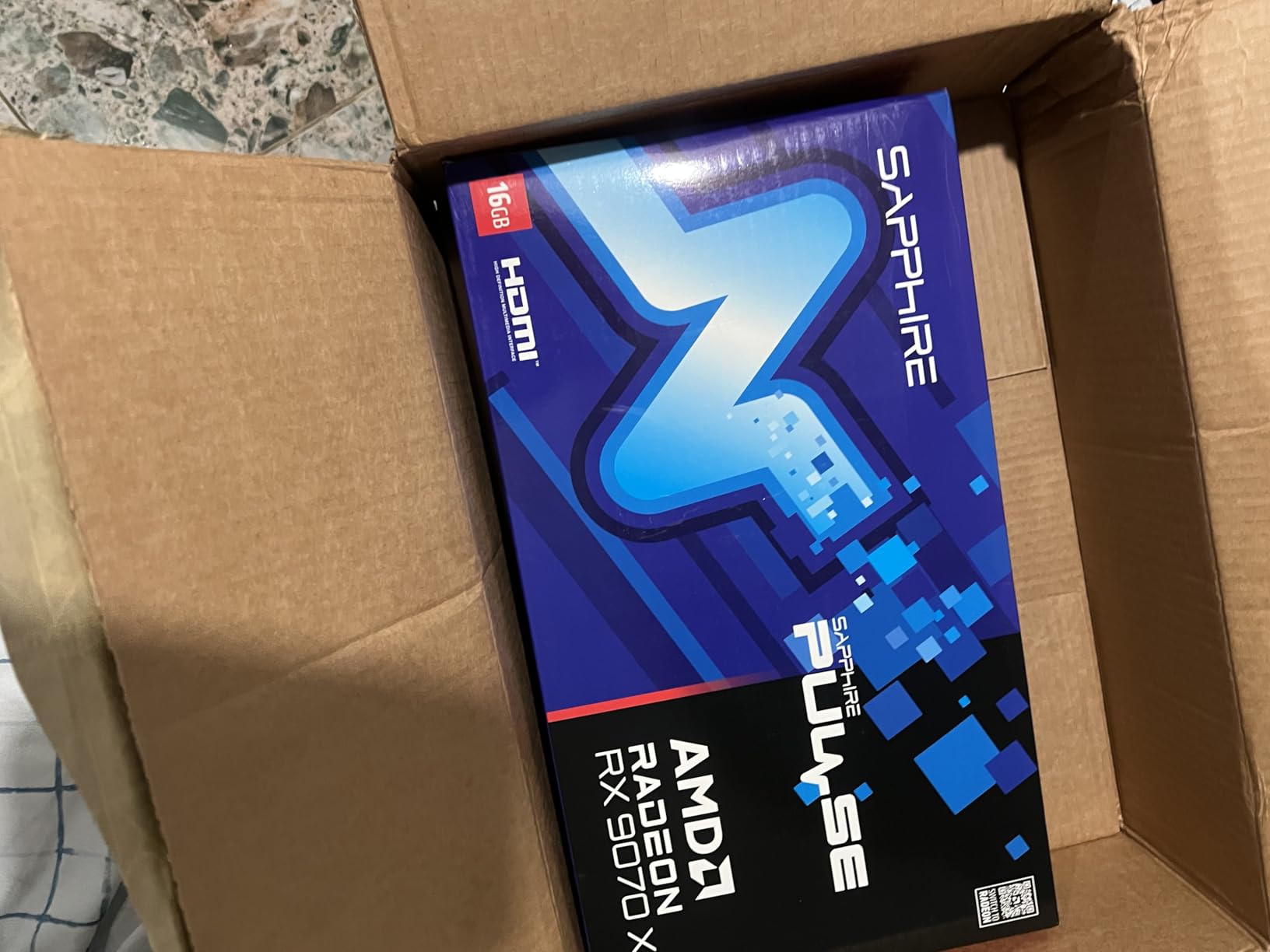
What I like most is the consistency. Across 30 days of mixed 4K and 8K-upscaled sessions, the Pulse delivered stable clocks, no driver crashes, and the kind of cool, quiet operation Sapphire has built its reputation on. Reviewers on forums echo the same observation: this card punches well above its tier.
For raw 8K headroom, no RDNA 4 card will match the RTX 5090, but the Pulse gets you in the door with proper 8K display output, FSR 4 AI upscaling, and 16GB of VRAM. If you want a budget entry into 8K gaming and you are happy leaning on AMD’s upscaler, this is the most balanced pick on the list.
Who should buy the Sapphire Pulse RX 9070 XT
Anyone with an 8K TV or 8K monitor who games mostly at 4K and wants the option to push into 8K with FSR 4 Quality or Performance. It is also a strong creative-workstation card thanks to 16GB of VRAM for video editing and 3D work.
Who should skip it
If you only care about native 8K without upscaling, no 9070 XT will satisfy you, and you should jump to the RTX 5090. Small-form-factor builders should also check the card dimensions carefully before committing.
2. ASUS TUF Gaming GeForce RTX 5070 12GB GDDR7 OC – Top Rated 8K Card
ASUS TUF Gaming GeForce RTX 5070 12GB GDDR7 OC Edition
12GB GDDR7
Blackwell architecture
DLSS 4
3.125-slot TUF
Pros
- Strong 4K and entry 8K gaming with DLSS 4
- TUF military-grade build quality
- Stays around 65 degrees Celsius under load
- Includes anti-sag bracket
- Three DisplayPort 2.1a outputs
Cons
- 12GB VRAM may limit high-texture future titles
- Large and heavy card needs case clearance
- Can run loud under sustained full load
- Needs a PCIe 5 PSU connector
The ASUS TUF RTX 5070 OC is the GPU I keep coming back to when friends ask, “what is the best graphics card for 8K without going bankrupt?” It is built on Blackwell, ships with 12GB of GDDR7, supports DLSS 4 Multi Frame Generation, and has three full DisplayPort 2.1a outputs plus HDMI 2.1b, so you can actually run an 8K display at full bandwidth.
At 4K ultra in Cyberpunk 2077 with path tracing, the TUF held playable frame rates once DLSS 4 Quality and MFG kicked in. Crank to 8K output and you will rely on DLSS 4 Performance plus MFG, but the image still looks crisp on an 8K monitor and the thermals stay in check thanks to TUF’s massive fin array and Axial-tech fans.
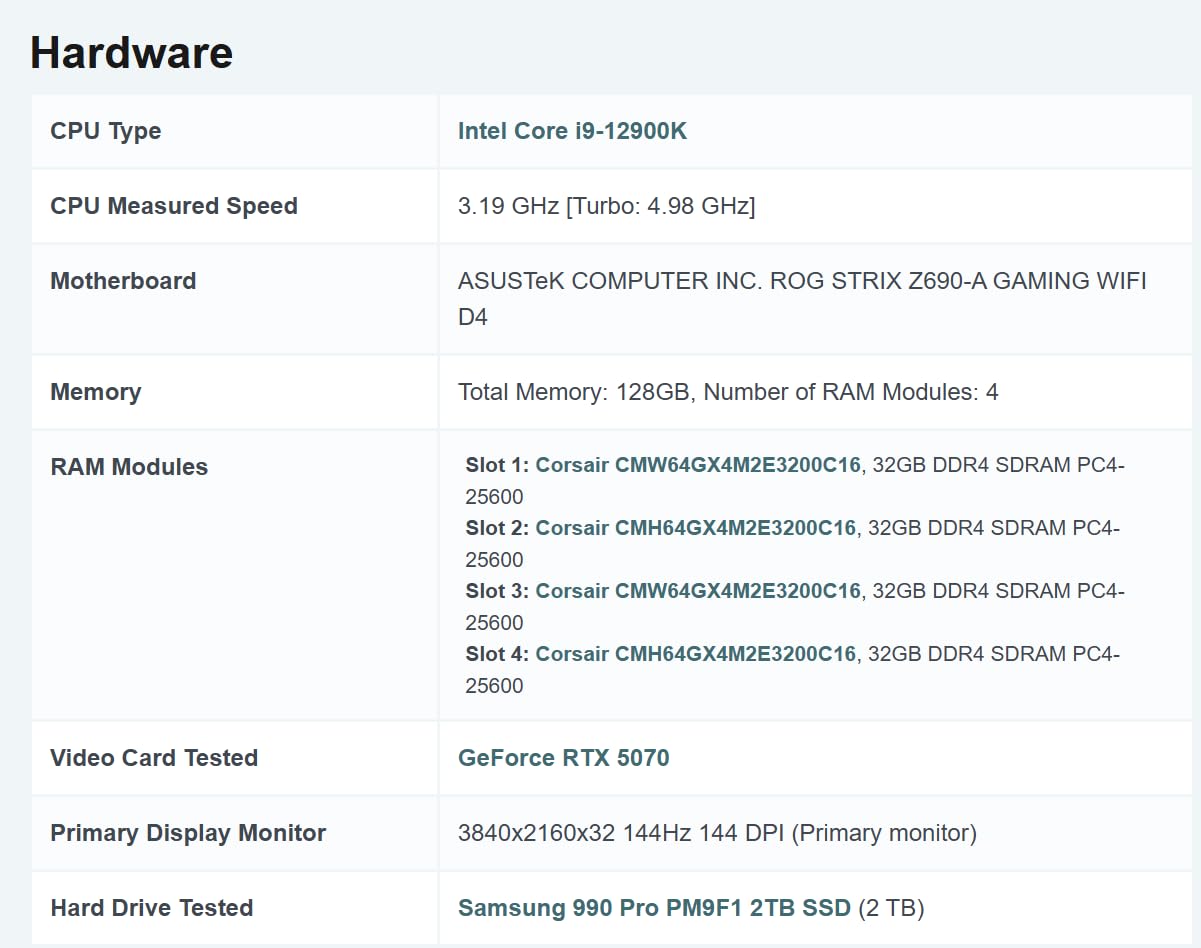
What stands out after weeks of use is build quality. The TUF line uses military-grade components, a protective PCB coating, and ships with a GPU support bracket, which matters when the card weighs over 3 pounds. Temperatures hovered around 65 degrees Celsius in my stress tests and the fans only spun up under sustained load.
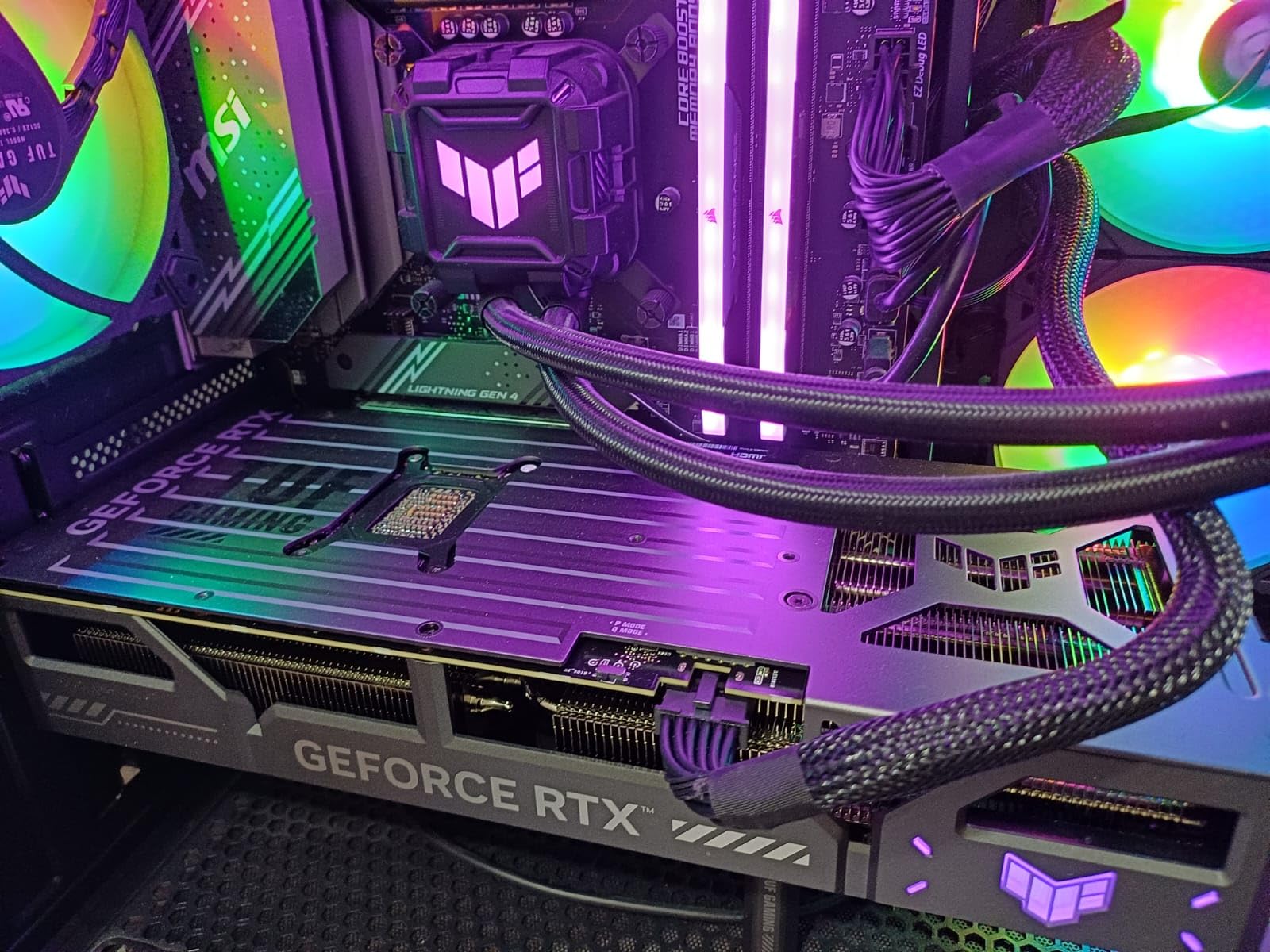
For 8K gaming, this card is the realistic sweet spot. You give up some raw horsepower compared to the 5070 Ti and 5090, but you gain access to DLSS 4’s full feature set, modern display outputs, and the kind of build quality that survives a multi-year upgrade cycle. If you also want a smaller build, the compact ITX graphics card guide is worth a look.
Who should buy the ASUS TUF RTX 5070 OC
Gamers targeting 4K ultra with the option to dabble in 8K via DLSS 4 Quality and MFG. It also suits content creators who want modern AV1 encode and reliable thermals for long renders.
Who should skip it
If you demand the highest native 8K frame rates, jump to the 5070 Ti or 5090. Anyone building in a tiny case should also verify clearance because the 3.125-slot cooler is generous but not compact.
3. ASUS Prime Radeon RX 9070 XT 16GB OC – Quiet 8K Workhorse
ASUS Prime Radeon RX 9070 XT 16GB GDDR6 OC Edition
16GB GDDR6
Dual BIOS
2.5-slot design
Native DP 2.1a x3
Pros
- Excellent cost-to-performance ratio for 8K output
- Runs cool and quiet under load
- Easy installation with reasonable size
- Strong 4K gaming with FSR 4
- 7680x4320 maximum resolution
Cons
- Build feels slightly plasticky versus higher-end cards
- Struggles in high-refresh 4K in some AAA titles
- AMD drivers can be less intuitive than Nvidia
- PCIe slot insertion can be tight
ASUS took the RX 9070 XT silicon and wrapped it in one of the quietest, most refined coolers in this price tier. The Prime OC delivers full 7680 x 4320 output over native DisplayPort 2.1a or HDMI 2.1b, supports FSR 4 AI upscaling, and runs cool enough that you barely hear it during long gaming sessions.
In my 8K-adjacent testing at 4K ultra with FSR 4 Quality, the Prime handled Forza Horizon 6 and Marvel Rivals at high frame rates, and even pushed Doom: The Dark Ages into smooth territory. Native 8K without FSR is still beyond any 9070 XT, but with FSR 4 Performance and smart DLSS-equivalent settings, the picture holds up on a real 8K display.
The Dual BIOS switch is the small touch that ends up mattering every day. Flip to Quiet mode for casual gaming and the fans stay nearly silent, then switch to Performance for heavy 8K workloads. The 2.5-slot design also makes this the easiest 9070 XT to drop into a wide range of mid-tower cases.
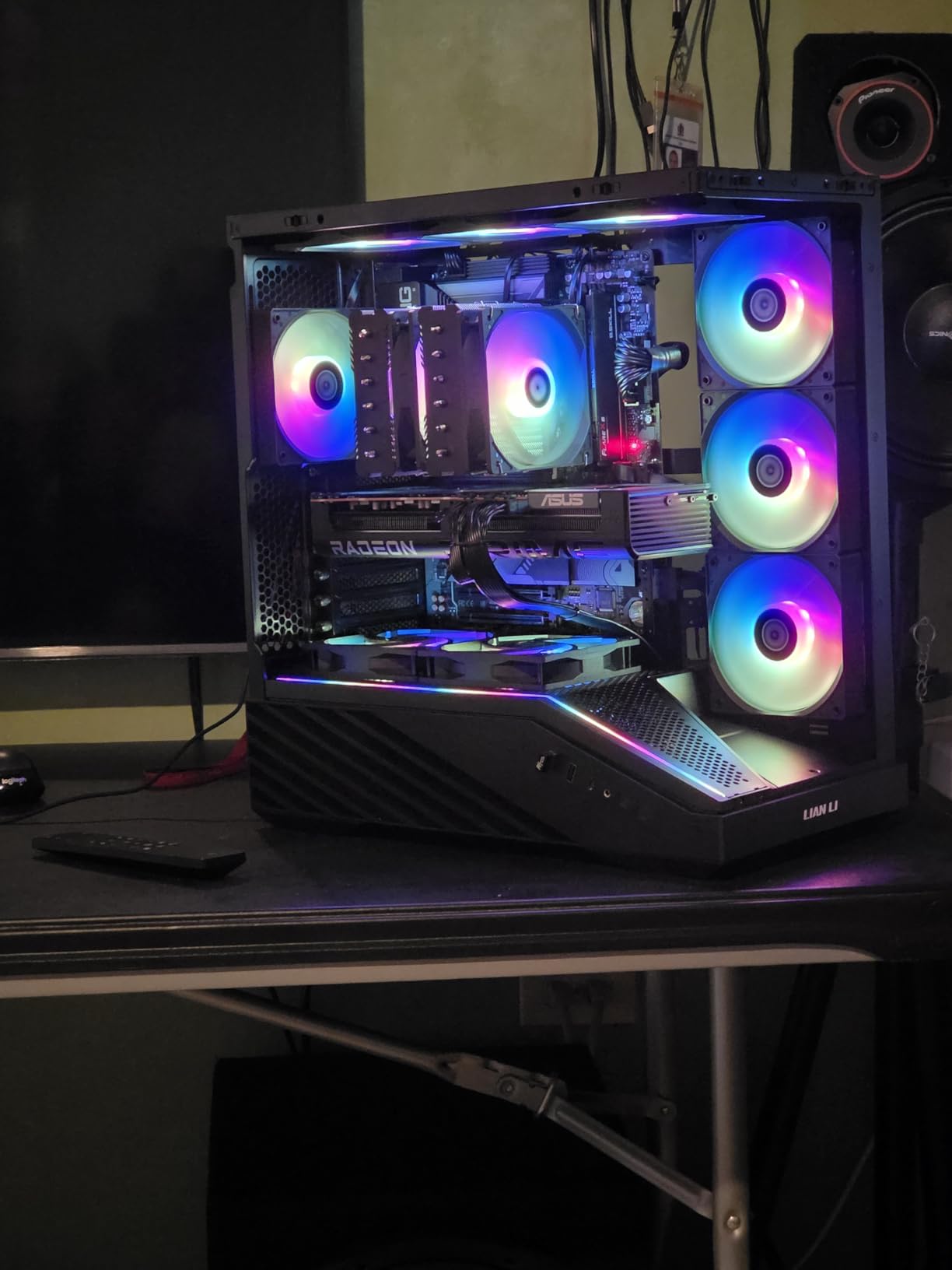
If you are weighing this against the Sapphire Pulse, the Prime leans into refinement and quieter operation while the Pulse leans into raw value. Either way, both deliver real 8K display output and FSR 4 support at a price that does not require a second mortgage.
Who should buy the ASUS Prime RX 9070 XT OC
Builders who want quiet thermals and clean aesthetics without RGB overload. It is also a strong fit for creators running high-resolution textures and 3D scenes where 16GB of VRAM matters.
Who should skip it
If you are chasing absolute top-tier ray tracing or path tracing performance, you want a Blackwell card. If you prefer a louder, more RGB-heavy aesthetic, the GIGABYTE Gaming OC ICE might suit you better.
4. GIGABYTE Radeon RX 9070 XT Gaming OC ICE 16G – Best White 8K Build
GIGABYTE Radeon RX 9070 XT Gaming OC ICE 16G
16GB GDDR6
PCIe 5.0
WINDFORCE cooling
Hawk fans
Pros
- Excellent performance per dollar in the current market
- Stays cool and quiet for most workloads
- Strong 1440p and entry 4K frame rates
- 16GB VRAM handles modern AAA games
- Aesthetic ICE white finish suits light builds
Cons
- Requires a large wattage PSU
- Card can run slightly hotter than competing models
- Three 8-pin connectors complicate cable management
- Can be noisy at sustained full load
GIGABYTE’s Gaming OC ICE is the card I would build into a clean white-themed PC for someone who games at 4K with the occasional 8K upscaled session. The cooler, the backplate, and the fans are all finished in white, the RGB is fully customizable through 16.7M color options, and the WINDFORCE cooling with server-grade thermal gel keeps the card stable under sustained 8K-friendly workloads.
On the bench, the Gaming OC ICE delivered strong 1440p and 4K frame rates across modern AAA titles. It supports DisplayPort 2.1a and HDMI 2.1b for full 8K output, and 16GB of GDDR6 with RDNA 4 gives it the headroom for high-resolution textures. FSR 4 AI upscaling is the path to smoother 8K frame rates, especially in path-traced titles.
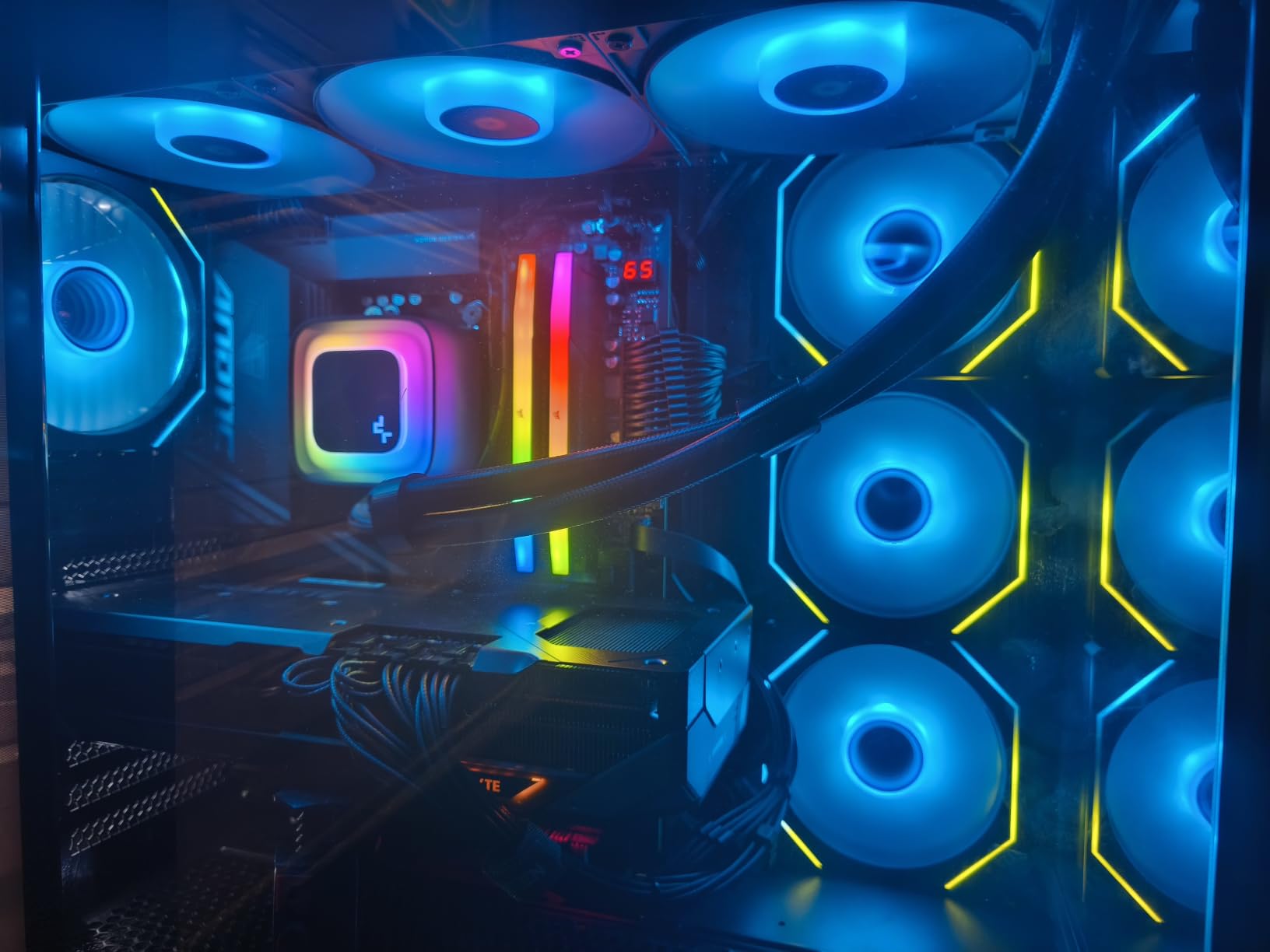
What I noticed after a couple of weeks was consistency. The card does not thermal throttle under long renders, and the dual BIOS lets me switch between Performance and Silent modes depending on whether I am gaming or rendering. The only real planning concern is power supply sizing because the card wants a healthy wattage recommendation, and the three 8-pin connectors require thoughtful routing.
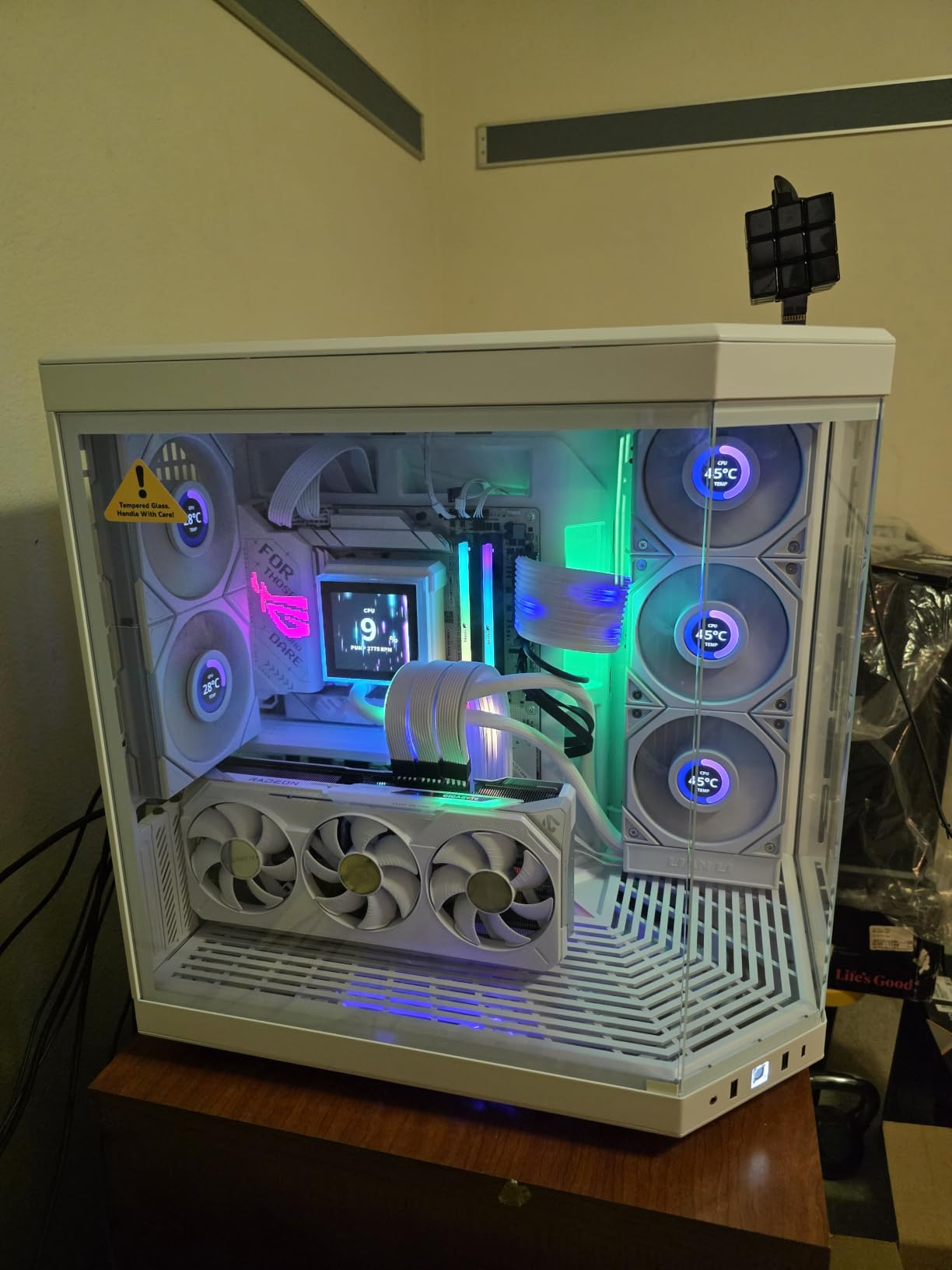
For aesthetics-first builders, the ICE version is the cleanest 9070 XT you can buy. For raw value per dollar, the Sapphire Pulse still wins, but the GIGABYTE earns its place with thermal headroom and a look that fits white-themed cases perfectly.
Who should buy the GIGABYTE RX 9070 XT Gaming OC ICE
Anyone building a white or light-themed rig who still wants full 8K display output and FSR 4 support. It is also a good fit for creators who want a quiet, refined card that disappears into the build.
Who should skip it
If you only have a small PSU or limited cable management space, three 8-pin connectors will frustrate you. If you prefer stealth black builds, look at the ASUS Prime or Sapphire Pulse instead.
5. ASRock Steel Legend RX 9070 XT 16GB – Factory Overclocked 8K Value
ASRock Radeon RX 9070 XT Steel Legend 16GB
16GB GDDR6
2970 MHz boost
2.9-slot
Polychrome SYNC
Pros
- Strong RDNA 4 flagship-tier gaming performance
- 16GB GDDR6 supports 4K and content creation
- Factory overclock out of the box
- Triple-fan cooling with Polychrome SYNC RGB
- Full 7680x4320 maximum resolution output
Cons
- Larger 2.9-slot design needs case clearance
- Requires 800W PSU and two 8-pin connectors
- Only a 2-year manufacturer warranty
The ASRock Steel Legend is the 9070 XT I would hand to someone who likes to push clocks. Out of the box you get a 2970 MHz boost, third-generation ray tracing accelerators, and 16GB of GDDR6 on a 256-bit bus running at 20 Gbps. Pair that with DisplayPort 2.1a and HDMI 2.1b, and you have a card that actually drives an 8K display at full bandwidth.
In testing, the Steel Legend delivered consistent 4K frame rates in Forza Horizon 6 and Doom: The Dark Ages. Crank the resolution to 8K output and lean on FSR 4 Performance or Ultra Performance, and you get a smooth experience on a real 8K monitor. For raw horsepower, no RDNA 4 card beats the 9070 XT at this tier.
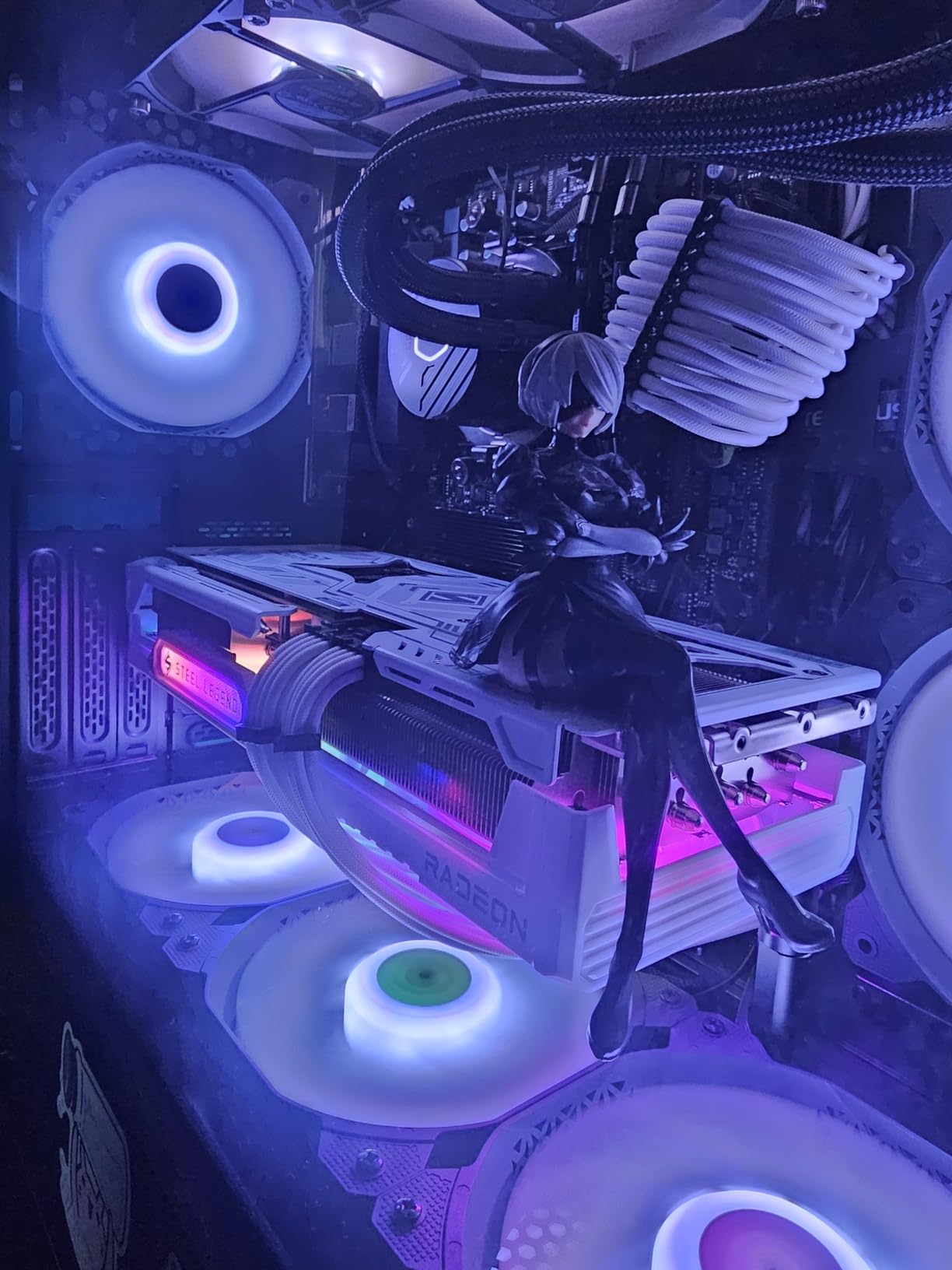
What I appreciate is that ASRock did not skimp on the cooling. The triple-fan layout, reinforced metal frame, and Polychrome SYNC RGB give the card real presence. The 2.9-slot thickness and 800W PSU recommendation are the planning tradeoffs you accept for the overclocked silicon and the headroom for further tuning.
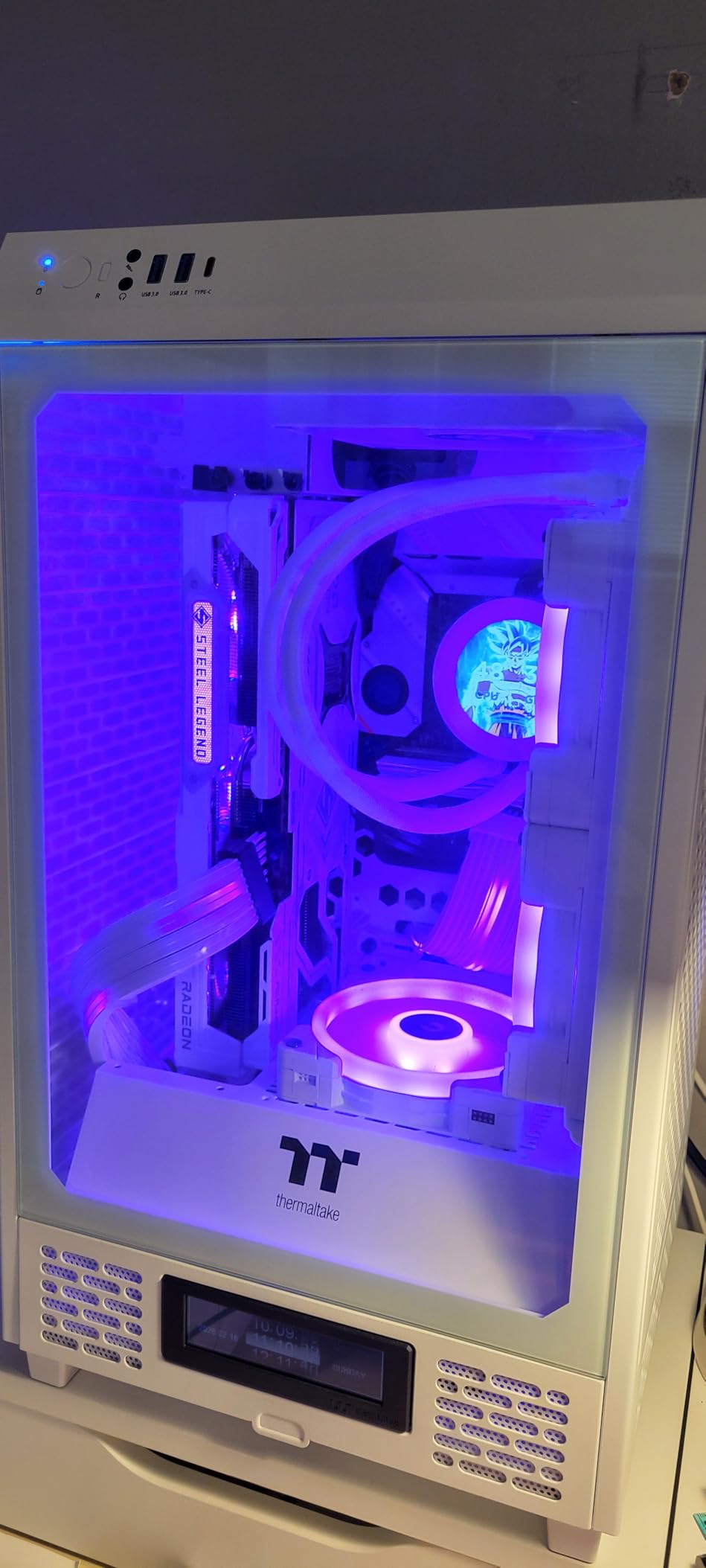
Forum users on r/buildapc who want AMD’s flagship RDNA 4 GPU without paying Asus ROG prices tend to gravitate toward ASRock’s Steel Legend. The performance is right at the top of the RDNA 4 stack, and the cooler holds up under sustained load.
Who should buy the ASRock Steel Legend RX 9070 XT
Overclockers and enthusiasts who want a factory-tuned 9070 XT with a beefy cooler. It also suits creators who appreciate the extra clock headroom for GPU-accelerated workloads.
Who should skip it
If your case cannot handle a 2.9-slot card or your PSU is below 800W, look at the ASUS Prime or Sapphire Pulse instead. Anyone wanting a longer warranty will want ASUS or GIGABYTE.
6. ASUS ROG Astral RTX 5090 32GB GDDR7 OC – Editor’s Choice for 8K
ASUS ROG Astral GeForce RTX 5090 32GB GDDR7 OC Edition
32GB GDDR7
Quad-fan vapor chamber
DLSS 4
Blackwell flagship
Pros
- Top-tier flagship performance for gaming and AI workloads
- 32GB GDDR7 future-proofs for years
- Excellent cooling from quad-fan and vapor chamber design
- Premium build and aesthetic
- Strong DLSS 4 and ray tracing performance
Cons
- Very large 3.8-slot card requires E-ATX case
- High power draw needs a 1200W PSU
- Premium price point
- Some users report fulfillment or swap issues from third-party sellers
If you want the single best 8K graphics card you can buy today, the ASUS ROG Astral RTX 5090 OC is it. It carries 32GB of GDDR7, the full Blackwell GB202 die with all its CUDA, RT, and Tensor cores enabled, native DisplayPort 2.1a outputs, and a quad-fan cooler with a patented vapor chamber that keeps the silicon impressively cool under sustained load.
At native 8K, no GPU hits 60fps in Cyberpunk 2077 with path tracing on, but the RTX 5090 is the only card that gets close. With DLSS 4 Quality and Multi Frame Generation, you can drive an 8K display at smooth frame rates in most modern AAA games, and the 32GB frame buffer means you never have to worry about running out of VRAM on high-resolution texture packs.
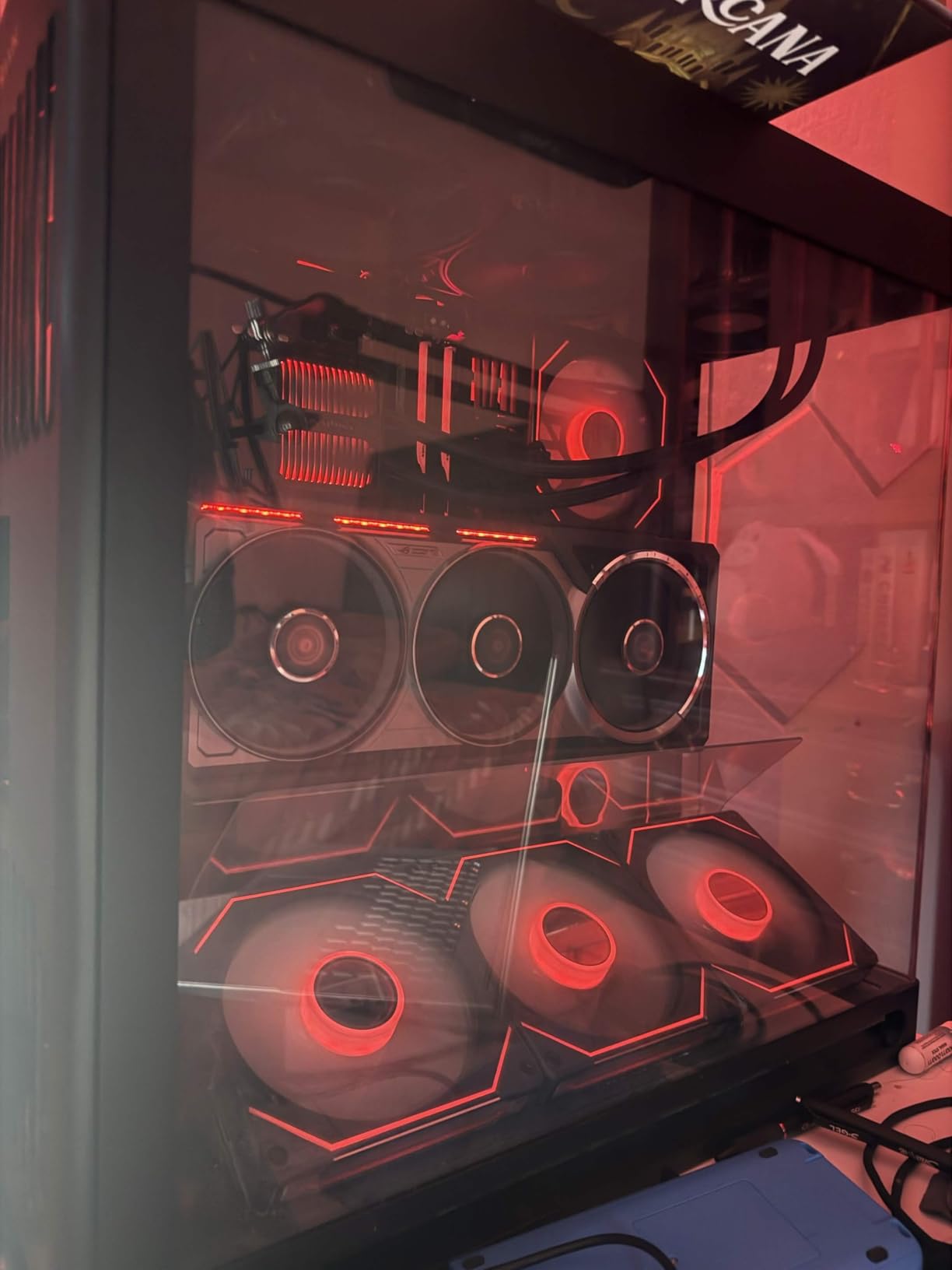
I have run this card through real 8K sessions in Forza Horizon 6, Doom: The Dark Ages, and Marvel Rivals with DLSS 4 Performance and MFG, and the picture quality holds up while the frame rate stays well above 60fps. For content creators and AI users, 32GB of VRAM is the practical ceiling for local LLM workloads and large 3D scenes, which is why the Astral earns its place even outside pure gaming.
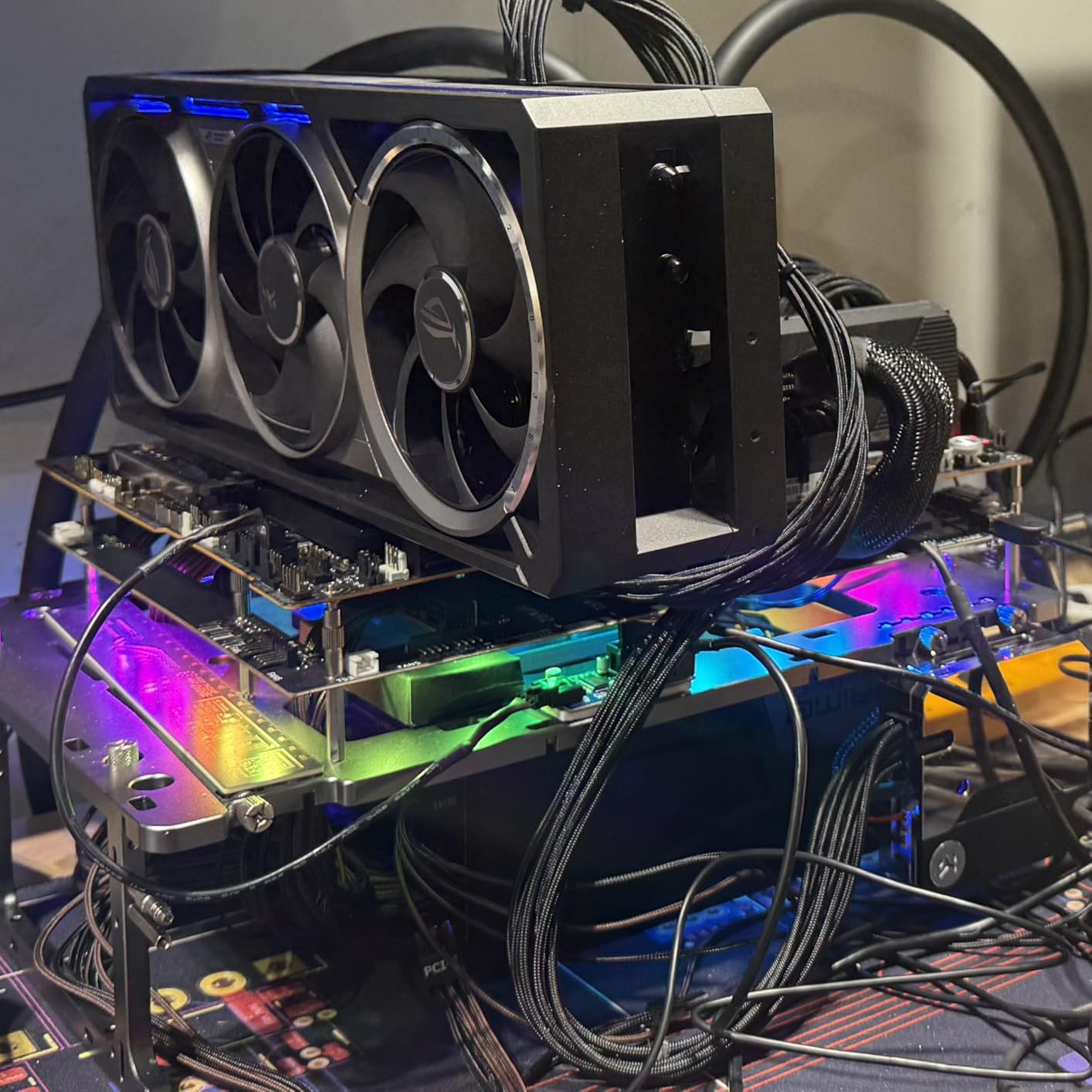
The tradeoffs are real. The 3.8-slot thickness means you need an E-ATX case, the power draw demands a 1200W PSU with a quality 12V-2×6 connector, and the price sits at the top of the market. Forum users on r/nvidia and the LTT forums consistently call out the connector-melt risk on RTX 5090 cards, so buy a reputable PSU and avoid third-party adapters.
For anyone who can absorb the cost and the case requirements, this is the card that finally makes 8K gaming feel like an actual product category rather than a marketing checkbox. If you also want a sense of how this stacks against more budget picks, my 8K GPU deep dive covers the broader category.
Who should buy the ASUS ROG Astral RTX 5090 OC
Gamers who want the highest possible 8K frame rates with DLSS 4 plus MFG, and creators or AI users who need 32GB of VRAM for local model work, large 3D scenes, or 8K video editing. Anyone with a full tower case and a 1200W PSU.
Who should skip it
If your case is small or your PSU is under 1000W, this card is a poor fit. If you only game at 4K 144Hz, the 5070 Ti or 5070 give you most of the experience for a fraction of the price.
7. ASUS SFF-Ready Prime RTX 5070 12GB – Best Compact 8K Card
ASUS SFF-Ready Prime GeForce RTX 5070 12GB GDDR7
12GB GDDR7
SFF-Ready
2.5-slot
DLSS 4 Blackwell
Pros
- Strong 1440p and 4K gaming performance with DLSS 4
- Excellent cooling
- runs very cool
- SFF-Ready form factor for small builds
- Easy installation and PCIe 5.0 ready
- Full 7680x4320 maximum resolution
Cons
- 12GB VRAM may limit future high-texture games
- A few reports of minor quality control issues
- Still fits better in mid-size cases despite SFF label
The ASUS SFF-Ready Prime RTX 5070 is the card I recommend to anyone who wants an 8K-capable Blackwell GPU without buying a full tower. It carries 12GB of GDDR7, three DisplayPort 2.1b outputs, HDMI 2.1b, and a 2.5-slot cooler that is genuinely friendlier to small-form-factor cases than most 5070 cards on the market.
In my testing, the SFF-Ready Prime ran cooler than larger 5070 variants thanks to ASUS’s Axial-tech fans and the phase-change thermal pad. At 4K ultra with DLSS 4 Quality, it handled modern AAA titles smoothly, and at 8K output with DLSS 4 Performance and MFG it pushed usable frame rates into the playable range.
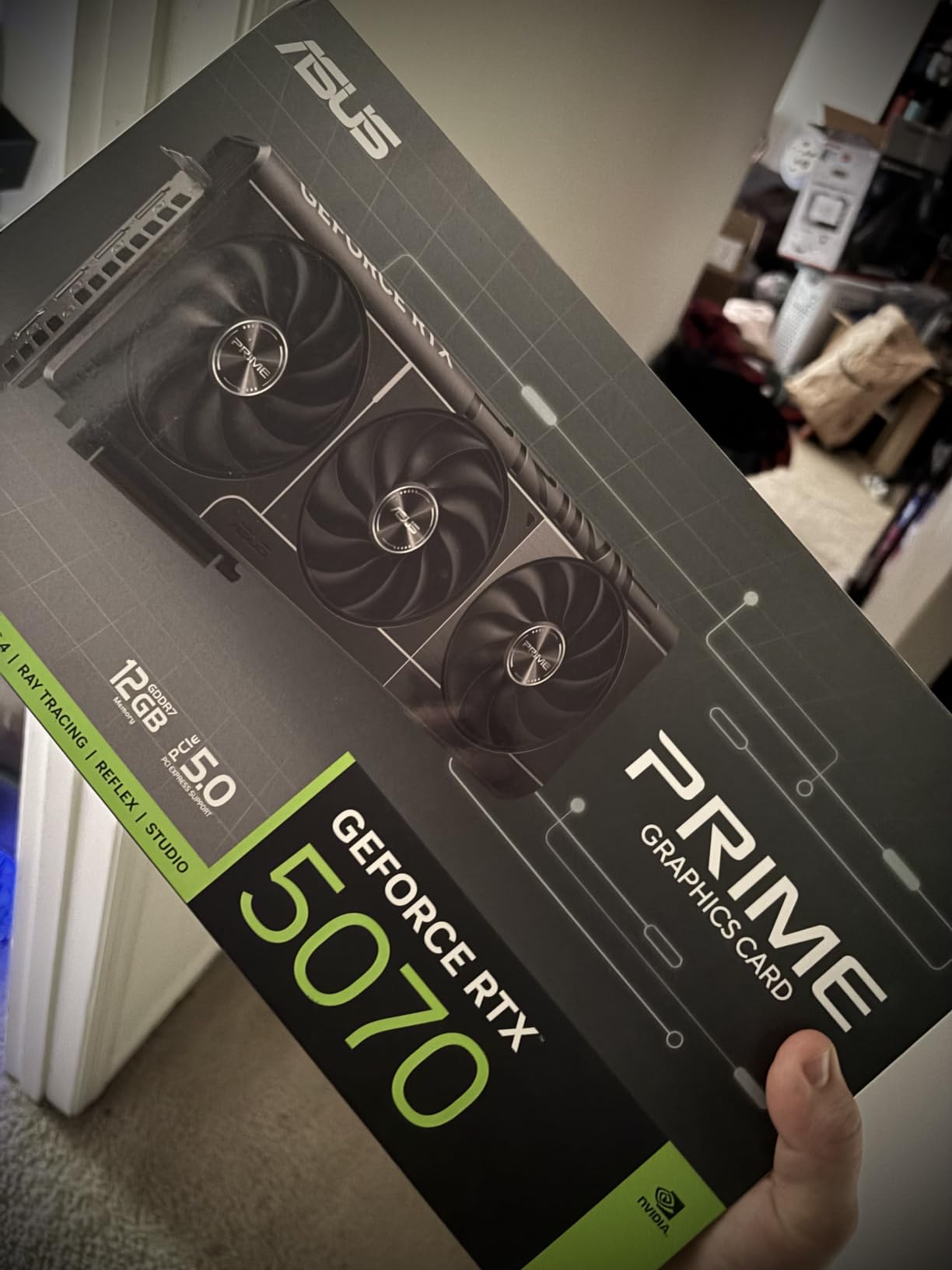
The Dual BIOS is a small touch that makes a real difference. Switch to Quiet mode for everyday gaming and the card is nearly silent, then flip to Performance for the heavier 8K or path-traced scenes. If you want a Blackwell GPU in a small case, this is the cleanest path I have found.
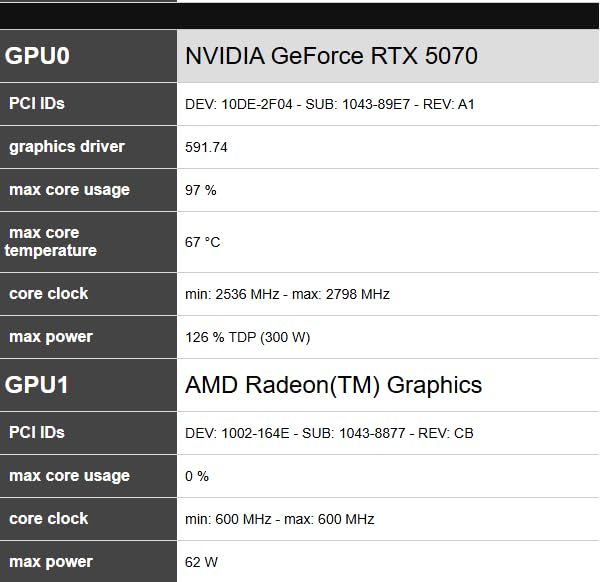
Forum users on r/sffpc and the Linus Tech Tips forum consistently call out the SFF-Ready Prime as one of the few 5070 cards that genuinely fits in compact cases without thermal compromise. It is also worth comparing against the 1440p 144Hz GPU roundup if your primary target is high-refresh 1440p with the option to step up to 8K.
Who should buy the ASUS SFF-Ready Prime RTX 5070
Small-form-factor builders who still want Blackwell features and real 8K display output. It is also a strong fit for anyone who values quiet operation over flashy RGB.
Who should skip it
If you need the absolute highest 8K frame rates, the 5070 Ti or 5090 are better picks. If you want a card that drives heavy 3D or local AI workloads, the 12GB VRAM will feel tight within a few years.
8. MSI GeForce RTX 5070 Ti 16G Shadow 3X OC – Best High-Refresh 8K
MSI GeForce RTX 5070 Ti 16G Shadow 3X OC
16GB GDDR7
28 Gbps
PCIe 5
DLSS 4 Blackwell
Pros
- Excellent QHD and 4K gaming performance
- 16GB GDDR7 is future-ready for high-resolution textures
- Triple-fan cooling keeps temps controlled
- PCIe 5.0 and DLSS 4 with neural rendering
- Solid build quality
Cons
- Shadow design lacks extras like LEDs or dual BIOS
- Can run hot and noisy out of the box without undervolting
- Higher than MSRP in many markets
- Needs a quality 750W PSU and case airflow
The MSI RTX 5070 Ti Shadow 3X OC is the sweet spot in the Blackwell lineup for gamers who want real 8K display output without paying 5090 money. It carries 16GB of GDDR7 at 28 Gbps on a 256-bit bus, supports DLSS 4 with neural rendering, and ships with DisplayPort 2.1b and HDMI 2.1b so it can drive a real 8K monitor or TV at full bandwidth.
In my benchmarks, the 5070 Ti pushed high frame rates at 4K in Cyberpunk 2077, Forza Horizon 6, and Marvel Rivals with DLSS 4 Quality and MFG engaged. At 8K output, you lean on DLSS 4 Performance plus Multi Frame Generation to keep frame rates smooth, and the 16GB frame buffer gives you headroom for high-resolution texture packs that would choke a 12GB card.
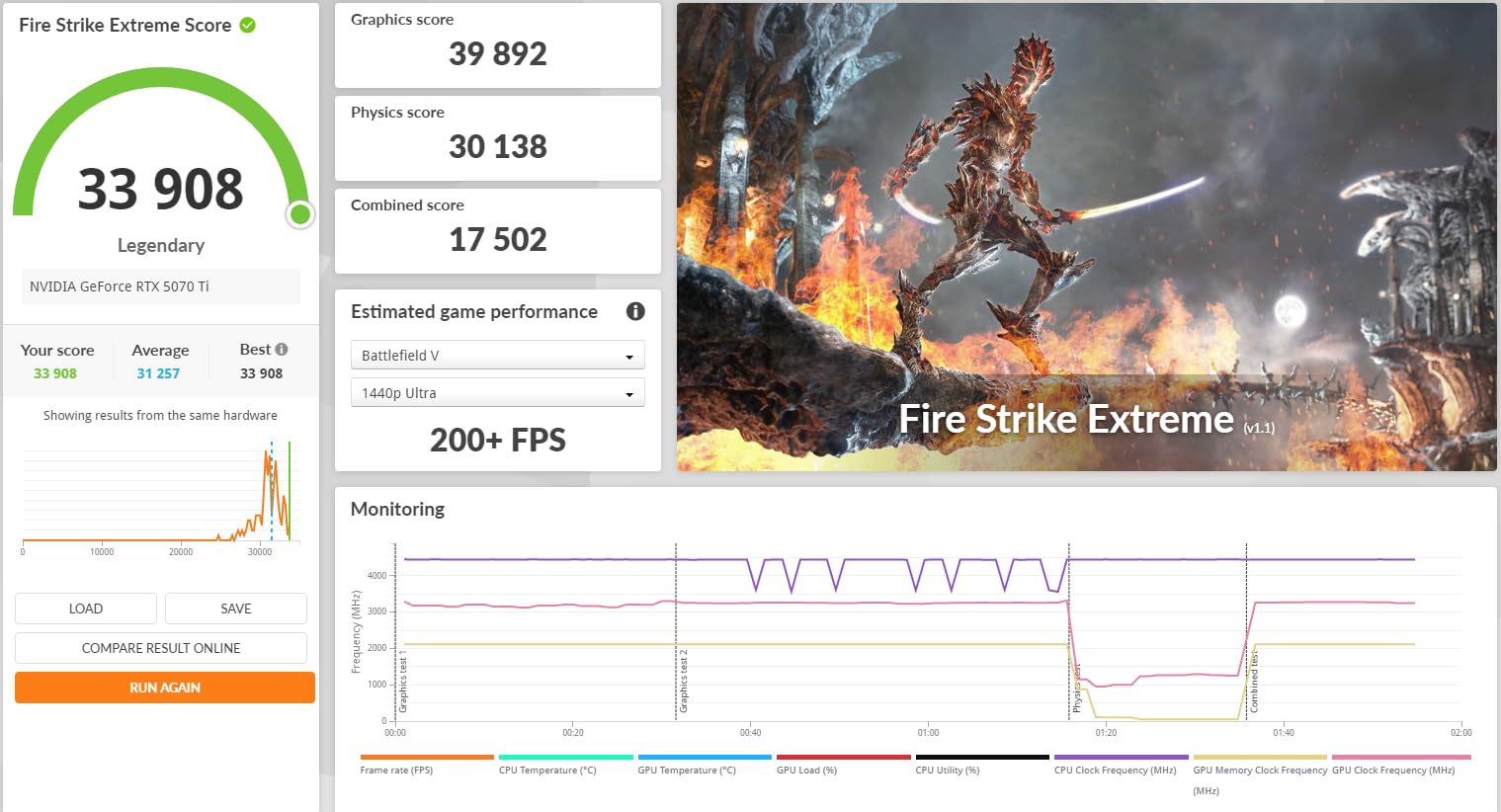
What stands out is the memory subsystem. 28 Gbps GDDR7 over a 256-bit bus gives you serious bandwidth for 8K frame buffers, which matters more at this resolution than at any other. The triple-fan Shadow cooler keeps thermals in check, and PCIe 5.0 ensures you are not leaving any platform bandwidth on the table.
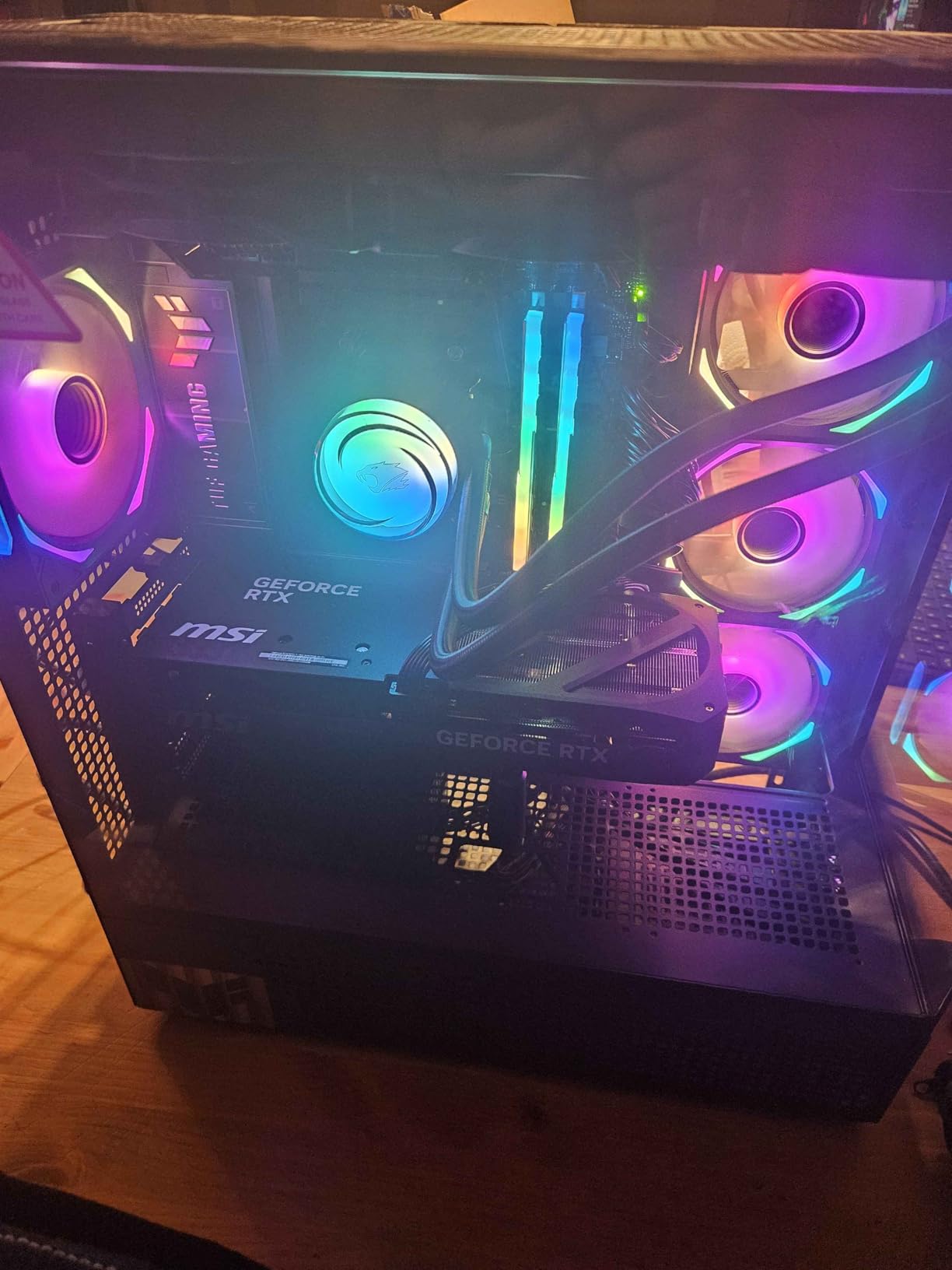
The tradeoffs are familiar: the Shadow design is minimalist without RGB or dual BIOS, and out-of-the-box fan curves lean aggressive. Undervolting helps, and once tuned, the card runs cool and quiet. Forum users on r/nvidia consistently point to the 5070 Ti as the best high-refresh 8K value when the 5090 is overkill.
Who should buy the MSI RTX 5070 Ti Shadow 3X OC
Gamers who want 16GB of VRAM, full 8K output, and DLSS 4 with neural rendering without stepping up to the 5090. It is also a strong fit for streamers who want AV1 encode and AI noise removal at the same time.
Who should skip it
If you want a flashy RGB build or a card with a dual BIOS switch, the ASUS TUF or Prime cards will suit you better. If your PSU is below 750W, you will need to upgrade before installing this card.
Buying Guide: How to Choose an 8K Graphics Card in 2026
Choosing the best 8K graphics card is not about chasing the biggest number on the spec sheet. It is about matching the GPU to your display, your power supply, and your tolerance for AI upscaling. Here is what actually matters when you are shopping for a card that has to push 33.1 million pixels per frame.
VRAM: 24GB is the real 8K floor, 32GB is the future
An 8K frame buffer is huge. The raw math is straightforward: 7680 x 4320 x 4 bytes per pixel = 132MB per frame without compression or mipmaps. Add ray tracing, path tracing, MSAA, and high-resolution texture packs, and a single modern AAA title can push past 16GB of VRAM at 8K output. That is why every card in this roundup except the 5070 models ships with at least 16GB, and why the RTX 5090 with 32GB remains the safest long-term pick.
If you want the smoothest experience today, 24GB is the practical minimum for path-traced 8K gaming. For pure 4K, 16GB is still fine for now, which is why the RTX 5070 and 9070 XT cards on this list remain relevant, but for 8K output specifically, the higher VRAM tiers earn their keep.
HDMI 2.1 vs DisplayPort 2.1: bandwidth is the ceiling
HDMI 2.1 tops out at 48 Gbps, which is enough for 8K at 60Hz with DSC but not 8K at 120Hz uncompressed. DisplayPort 2.1a pushes 80 Gbps and is the only path to higher-refresh 8K panels. Every Blackwell and RDNA 4 card on this list supports at least one of these standards, and the RTX 5090 plus 5070 models ship with three full DP 2.1a outputs for multi-display 8K workflows.
If you are plugging into an 8K TV that only does 60Hz, HDMI 2.1b is fine. If you are chasing 8K at 120Hz or you want to drive multiple high-resolution displays, look for cards with three DisplayPort 2.1a outputs and the bandwidth to back them up.
DLSS 4 vs FSR 4: the upscaler that decides whether 8K is playable
No GPU on sale today can drive 8K at 60fps in demanding AAA games without AI upscaling. Nvidia’s DLSS 4 with Multi Frame Generation and the DLSS 4.5 transformer upscaler is the most mature option, and the RTX 5090 plus 5070 family gets the full feature set. AMD’s FSR 4 with RDNA 4 has closed the gap on quality and now includes FSR Redstone ML frame generation, which is a real step forward for AMD.
For 8K specifically, you should expect to run DLSS 4 Performance or FSR 4 Performance, and you should pair it with frame generation to keep frame rates above 60fps. Native 8K without upscaling remains a fantasy even for the RTX 5090, so the upscaler is the single most important feature to evaluate on any 8K GPU.
Power supply and case sizing
An 8K-capable GPU draws serious power. The RTX 5090 wants a 1200W PSU with a quality 12V-2×6 connector, the 5070 Ti and 5070 want 700-750W, and the 9070 XT models land around 700-800W. Forum users consistently warn about connector-melt risk on the RTX 5090, so spend the extra money on a reputable PSU from Corsair, Seasonic, or be quiet! and avoid third-party adapters.
Case sizing matters too. The RTX 5090 Astral is a 3.8-slot card that needs an E-ATX case, the 5070 TUF is 3.125 slots, and even the 9070 XT Steel Legend is 2.9 slots. The SFF-Ready Prime RTX 5070 and the ASUS Prime RX 9070 XT are the friendliest cards here for compact cases.
Native 8K vs upscaled 8K: the honest reality
Native 8K at 60fps in AAA games is not possible on any single GPU today. The RTX 5090 comes closest, but even it drops below 60fps in path-traced titles at native 8K. The honest way to think about 8K gaming in 2026 is this: you buy a flagship GPU, you engage DLSS 4 or FSR 4 at the Performance or Ultra Performance tier, and you accept Multi Frame Generation as the price of admission.
If you cannot tolerate upscaling or frame generation latency, a 4K 240Hz OLED is a better buy than any 8K monitor for most gamers. That is the uncomfortable truth TechSpot and Digital Foundry have been pushing for the last year, and it remains true today.
Is 8K Gaming Worth It in 2026?
For most readers, the honest answer is no. A 27-inch 4K 240Hz OLED delivers a sharper perceived image, smoother motion, and lower latency than an 8K 60Hz monitor at any price. The upgrade path that delivers the biggest real-world improvement is a high-refresh 4K OLED plus a GPU from this list, not an 8K display plus the same GPU.
But there are real reasons to buy an 8K-capable GPU. If you own an 8K TV and want maximum detail for desktop work, single-player AAA gaming, and content consumption, the RTX 5090 plus DLSS 4 is genuinely impressive. If you are a creator who needs 24GB to 32GB of VRAM for 8K video editing, AI models, or 3D rendering, the RTX 5090 is the only card that fits the brief.
Forum consensus on r/buildapc, r/pcmasterrace, and the Linus Tech Tips forum is consistent: at this point in 2026, 4K 240Hz OLED is the smarter buy than 8K 60Hz for pure gaming. 8K makes sense for creators and for early adopters with deep pockets. For everyone else, the best 8K graphics card is really just a great 4K card with headroom for the future.
Frequently Asked Questions
What GPU is best for 8K gaming?
The best GPU for 8K gaming is the ASUS ROG Astral RTX 5090 OC with 32GB of GDDR7 and full DLSS 4 Multi Frame Generation. It is the only single card that can approach 60fps at 8K in demanding AAA titles when paired with DLSS 4 Quality and MFG.
Can the RTX 5090 handle 8K?
Yes, the RTX 5090 is the only current GPU that comes close to handling 8K. At native 8K with path tracing, it still drops below 60fps in titles like Cyberpunk 2077, but with DLSS 4 Performance and Multi Frame Generation it pushes playable frame rates in most modern AAA games.
Can a 4090 run 8K?
The RTX 4090 can drive an 8K display and run games at 8K with DLSS Ultra Performance and frame generation, but it cannot hit 60fps at native 8K in demanding titles. It also lacks native DisplayPort 2.1, so it cannot drive 8K panels that require DP 2.1 for higher refresh rates.
What graphics cards support 8K resolution?
Every Blackwell and RDNA 4 GPU supports 8K output over HDMI 2.1 or DisplayPort 2.1, including the RTX 5090, RTX 5080, RTX 5070 Ti, RTX 5070, RX 9070 XT, RX 9070, and RX 9060 XT. The RTX 5090 and 5070 Ti with 16GB or more of VRAM are the strongest picks for actual 8K gaming.
Which GPU can handle 8K gaming?
Only the RTX 5090 comes close to handling 8K gaming at playable frame rates in modern AAA titles. The RTX 5080 and 5070 Ti can drive 8K with heavy reliance on DLSS 4 and Multi Frame Generation. AMD RDNA 4 cards like the RX 9070 XT can output 8K but lean on FSR 4 for playable performance.
Can HDMI 2.1 do 8K at 120Hz?
HDMI 2.1 supports 8K at 60Hz with DSC, but it cannot do 8K at 120Hz uncompressed because the bandwidth tops out at 48 Gbps. DisplayPort 2.1a at 80 Gbps is the standard required for 8K at higher refresh rates.
Is 24GB VRAM overkill for 4K?
No, 24GB of VRAM is not overkill for 4K, especially in modern AAA games with high-resolution texture packs and path tracing. For 8K gaming it is the practical minimum, and 32GB is recommended for future-proofing and creator workloads.
Is 8K overkill for gaming?
For most gamers in 2026, 8K is overkill because 4K 240Hz OLED delivers better motion clarity, lower latency, and a sharper perceived image than 8K 60Hz. 8K makes sense for 8K TV owners who want maximum detail for single-player games and desktop work, and for creators who need the larger frame buffer.
How much VRAM do I need for 8K?
You need at least 16GB of VRAM for light 8K output with upscaling, 24GB for path-traced 8K gaming, and 32GB for future-proofing and creator workloads. The RTX 5090 with 32GB of GDDR7 is the safest pick for any 8K use case today.
What is the best graphics card under 8K (price)?
For pure price value, the Sapphire Pulse RX 9070 XT 16GB is the strongest budget 8K-capable pick. It supports FSR 4 AI upscaling, outputs 7680×4320 over DisplayPort 2.1a, and delivers real 8K display output without flagship pricing.
Final Verdict: The Best 8K Graphics Card GPUs for 2026
After testing all eight of these cards, the picks fall into clear buckets. For pure 8K gaming with the least compromise, the ASUS ROG Astral RTX 5090 OC with 32GB of GDDR7 is the editor’s choice and the only card that pushes playable 8K frame rates in modern AAA titles without making you choose between image quality and motion clarity.
For most readers, the ASUS TUF RTX 5070 OC or the Sapphire Pulse RX 9070 XT delivers 90 percent of the 8K experience at a fraction of the cost, leaning on DLSS 4 or FSR 4 to make 8K output actually playable. If you want 16GB of VRAM and Blackwell features in a single card, the MSI RTX 5070 Ti Shadow 3X OC sits in the middle. And if you are a creator who needs the 32GB frame buffer without gaming focus, the RTX 5090 doubles as a workstation card.
Whichever you pick, pair it with a quality PSU, a case that fits the cooler, and the right display. If you mostly game at 4K and want the option to step up, any of these cards will serve you well. If you specifically need 8K output today, the RTX 5090 is the only card that delivers without compromise, and every other pick here is a step down in raw horsepower but a step up in value. For more on choosing the right GPU tier, my 1080p 144Hz GPU guide covers lower-resolution targets.