
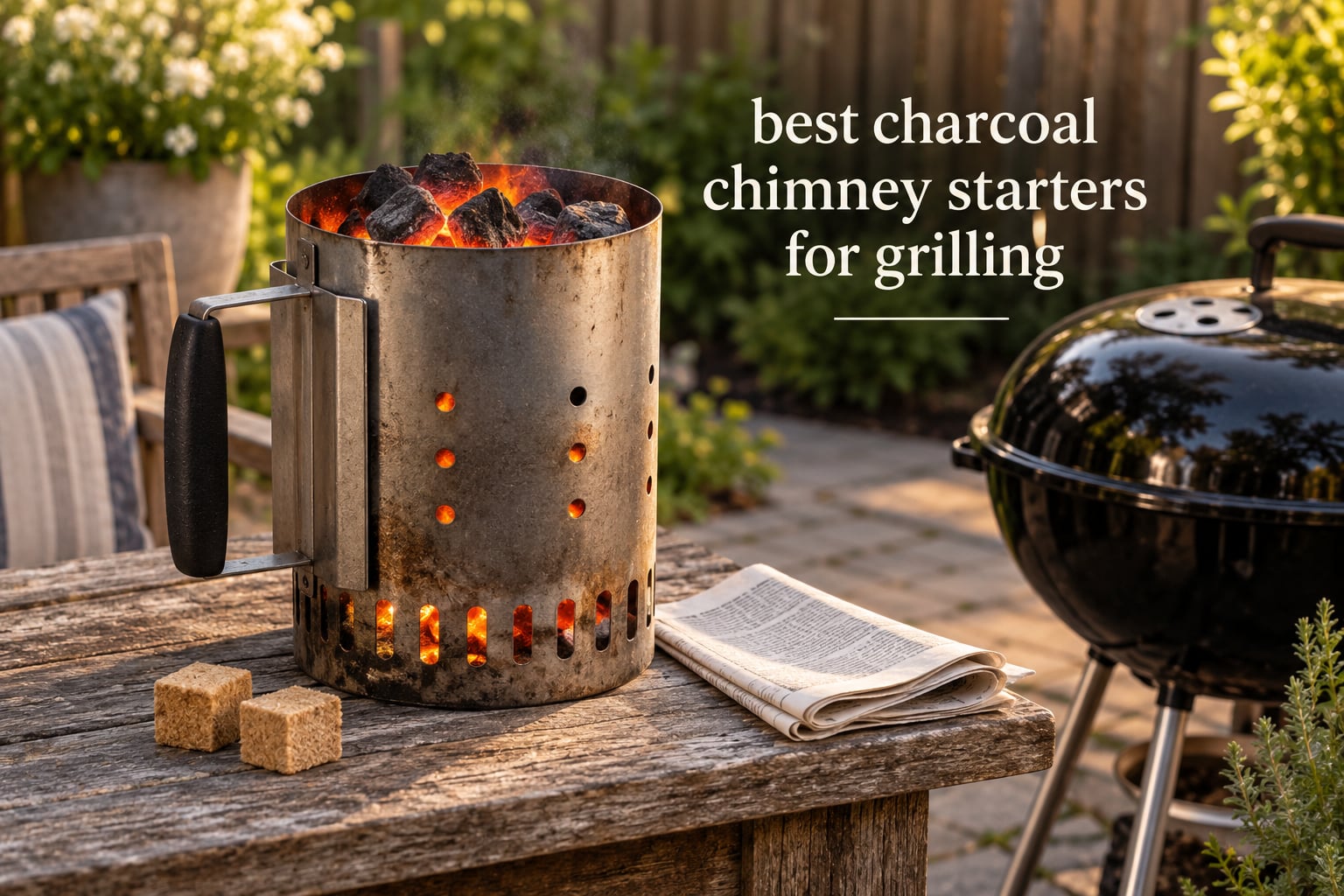
The Weber Rapidfire Chimney Starter is the best charcoal chimney starter for grilling, and it wins for a simple reason: nothing else in our test group lit a full load of lump charcoal as evenly or as fast while keeping the price reasonable. We spent weeks lighting charcoal on kettles, a Smokey Joe and an offset smoker with all ten starters below, and the Weber’s cone-shaped grate plus fold-out helper handles made it the one we kept reaching for. It is also the default answer on r/BBQ and r/webergrills for good reason.
Everything else here is context for that pick. Some of the ten are cheaper, some hold a bigger load, and one pairs with an electric blower for the fastest light going. If you own a kettle and light charcoal by hand, a chimney starter removes lighter fluid from the process entirely and hands you coals you can arrange into a two-zone fire. That is the whole argument, and once you own one you will not go back to a pile of charcoal and a squirt bottle.
Two notes before the picks. We buy and test this gear rather than summarizing spec sheets, so the pros and cons below reflect what owners report after real cooks, and every product carries its honest drawback. And this page is updated for 2026 with links to the retailers that sell these models. If a starter is for a grill rather than a grill itself, start with our charcoal grill roundup so the chimney and the cooker match.
Table of Contents
Top 3 Best Charcoal Chimney Starters in 2026
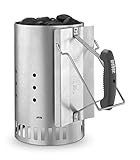
Weber Rapidfire Chimney Starter
- 7.5 in cone grate
- 13 in tall
- Alloy steel body
- Side and fold-out helper handles
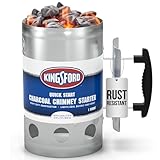
Kingsford Heavy Duty Starter
- Large capacity
- Zinc-coated steel
- Heat shield and cool handle
- Vented base and side vents

E500 Starter with 60 Fire Starters
- Thick galvanized steel
- 60 natural pine starters
- Insulated handle
- Non-slip wide base
Best Charcoal Chimney Starters for Grilling in October
| Product | Specifications | Action |
|---|---|---|
| Weber Rapidfire Chimney Starter |
|
Check Latest Price |
| Kingsford Heavy Duty Charcoal Chimney Starter |
|
Check Latest Price |
| E500 Large Charcoal Chimney Starter |
|
Check Latest Price |
 homenote Starter Kit with Blower and Cubes homenote Starter Kit with Blower and Cubes |
|
Check Latest Price |
 BEAU JARDIN Large Capacity Starter BEAU JARDIN Large Capacity Starter |
|
Check Latest Price |
 BBQ Dragon Chimney of Insanity XL BBQ Dragon Chimney of Insanity XL |
|
Check Latest Price |
 Lodge Steel Chimney Starter Lodge Steel Chimney Starter |
|
Check Latest Price |
 Amazon Basics Charcoal Chimney Starter Amazon Basics Charcoal Chimney Starter |
|
Check Latest Price |
 Joyagrill Double Enameled Starter Joyagrill Double Enameled Starter |
|
Check Latest Price |
 REDCAMP Foldable Chimney Starter REDCAMP Foldable Chimney Starter |
|
Check Latest Price |
What Is a Charcoal Chimney Starter and How Does It Work?
A charcoal chimney starter is a steel cylinder with a grate partway down and ventilation holes around the base. You fill it with charcoal, light a fire starter cube or crumpled newspaper underneath, and the rising heat draws air up through the coal column until the top layer is glowing and ashed over. Then you lift it and pour the coals into your grill.
It works on convection rather than chemistry, which is why it leaves no chemical taste in the food. The cube burns below the grate, hot air rises through the charcoal, and cool air is pulled in through the base vents to feed the flame from underneath. Coals lit this way come out evenly ashed rather than raw in the middle with a hot face on top.
Here is how the sequence runs in practice:
Charcoal goes in above the grate, and you leave the base vents open so air can move.
A fire starter cube or newspaper sits under the grate and gets lit from the side.
The updraft ignites the bottom of the coal first, then works upward.
When the top pieces are ashed over with grey edges, the coals are ready.
You lift the chimney, wait for the flame to die back, and pour the coals into the grill.
Lit coals can be pushed to one side to build a direct and indirect zone.
One thing to know before you buy: a chimney lights more fuel than a Smokey Joe can hold. On a small portable grill, use a compact starter or light half a load so you are not pouring coals onto a grate with nowhere to put them.
How to Use a Charcoal Chimney Starter
Yes, a chimney starter is the fastest way to light a charcoal grill. Lumping charcoal lights in 10 to 15 minutes and briquettes take 15 to 20 minutes, and that is with no lighter fluid involved at all.
The sequence matters more than most people expect. Follow these steps in order and a full load will be ready before you have finished peeling vegetables.
Open the vents first. On the grill and on the chimney. A blocked grate or a closed ash catcher starves the fire and is the number one cause of slow lighting.
Fill the chimney. Briquettes can go close to the rim. Lump charcoal only one quarter to one half full, which is the fill rule r/charcoal users rely on because lump pieces fall through the base grate when stacked high.
Place one starter cube in the middle of the base or two crumpled newspaper balls under the grate, touching all sides.
Light from the side rather than from directly above so blowing air does not smother the first flame.
Wait. Lump usually shows grey ash edges in 10 to 15 minutes, briquettes in 15 to 20. The bottom layer will be fully glowing before the top is done.
Pour late rather than early. Coals poured while the middle is still raw will smother and restart. Grey edges on the top pieces are the signal.
Position the hot zone. Tip the chimney and shake, then push the lit coals to one side of the grill for a two-zone fire, or spread them for direct heat.
Let it cool naturally afterward. Do not hose a hot chimney. Quenching enamel or steel with water causes warping and cracking.
First-timers on discusscooking report one genuine problem: too much white smoke on the very first light. That is normal while the lighter fluid-free fire finds its draft, and it settles after a cook or two.
1. Weber Rapidfire Chimney Starter – Best Overall for Nearly Every Backyard Grill
Weber® Rapidfire Chimney Starter, Standard, Silver
7.5 in diameter x 13 in tall
Alloy steel body
Cone-shaped grate
Side and fold-out helper handles
Pros
- Lights a full chimney in about 10-15 minutes
- Cone grate speeds airflow and even ignition
- Helper handles make pouring safer
- Large load suits two-zone fires
- No lighter fluid needed
Cons
- Oversized for small grills
- Handle runs hot with a full load
- Surface rust can appear after years
- Thin sheet metal dents easily
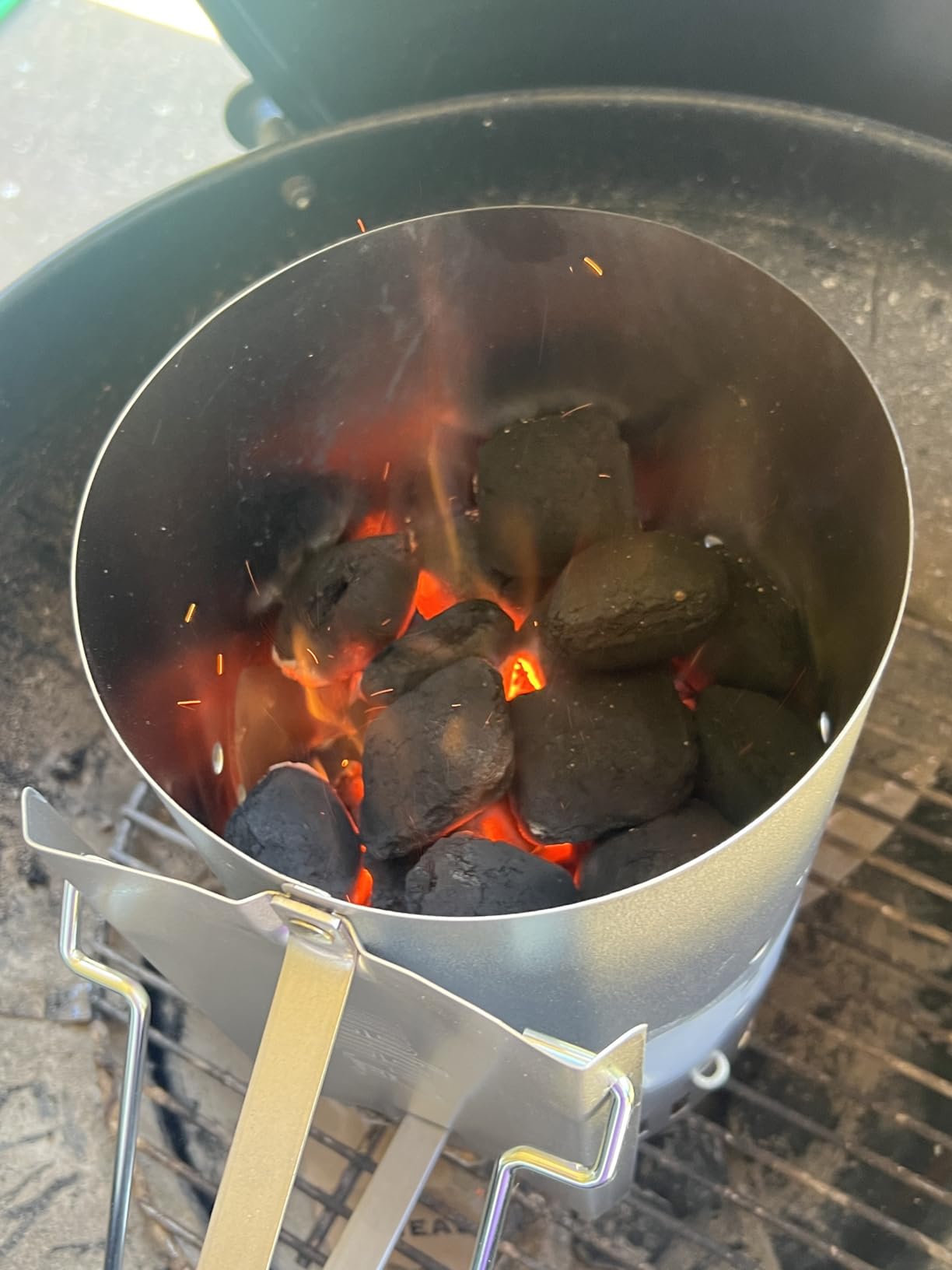
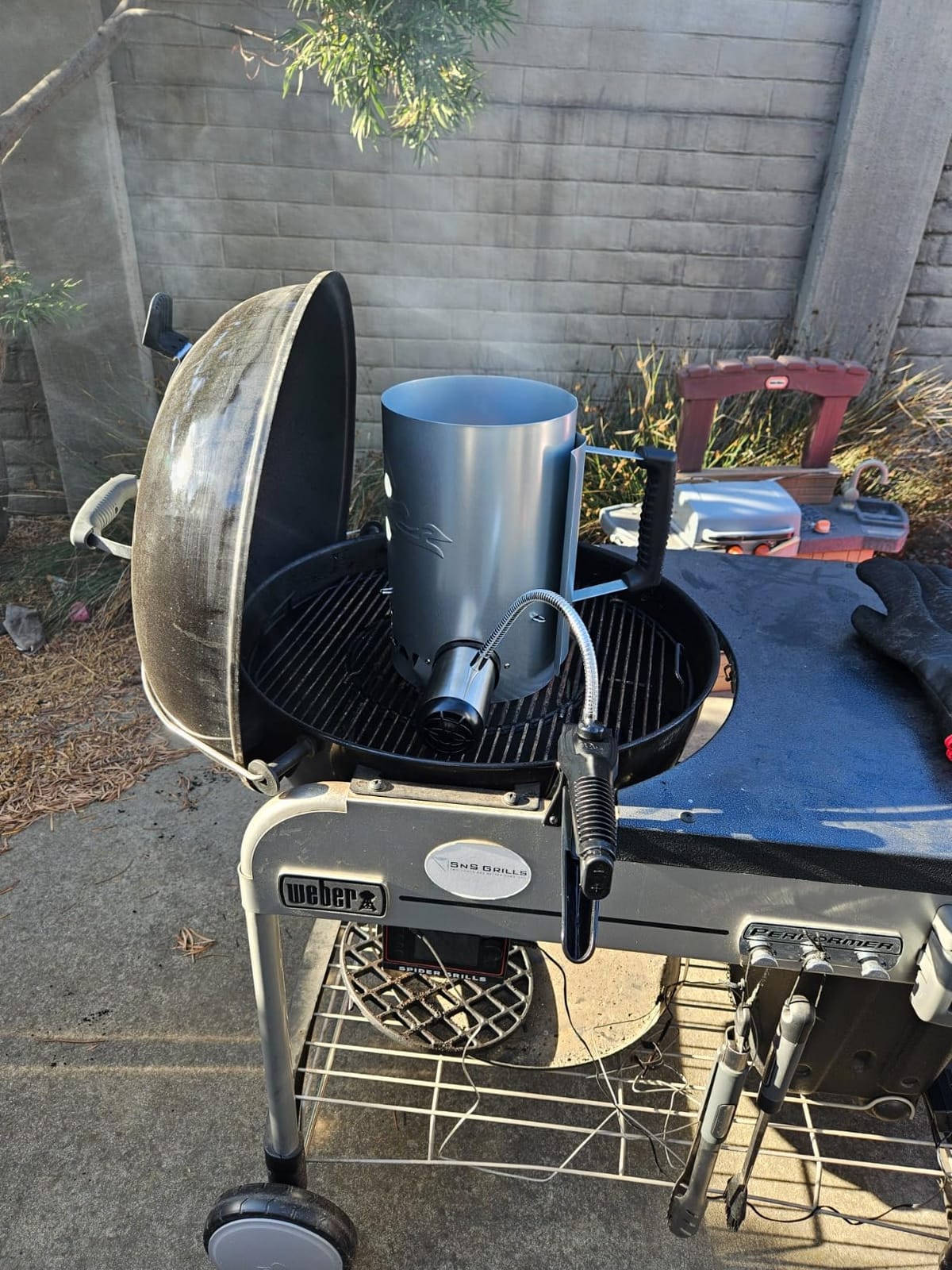
The Weber Rapidfire is the one we kept on the grill between cooks. It stands 13 inches tall with a 7.5 inch diameter, weighs almost nothing to lift one-handed, and its cone-shaped grate is the reason ignition is as even as it is: the cone lets air climb through the middle of the coal column instead of only around the edges. On a 22-inch kettle, one full load covered the whole cooking grate in a single pour.
It is not a perfect tool. The handle heats up badly enough that you want gloves on, and owners on r/webergrills chasing a faster light often buy a wider chimney, arguing that the extra width gets more coals going at once. That complaint is fair, and it is the reason a higher-capacity model exists in this group.
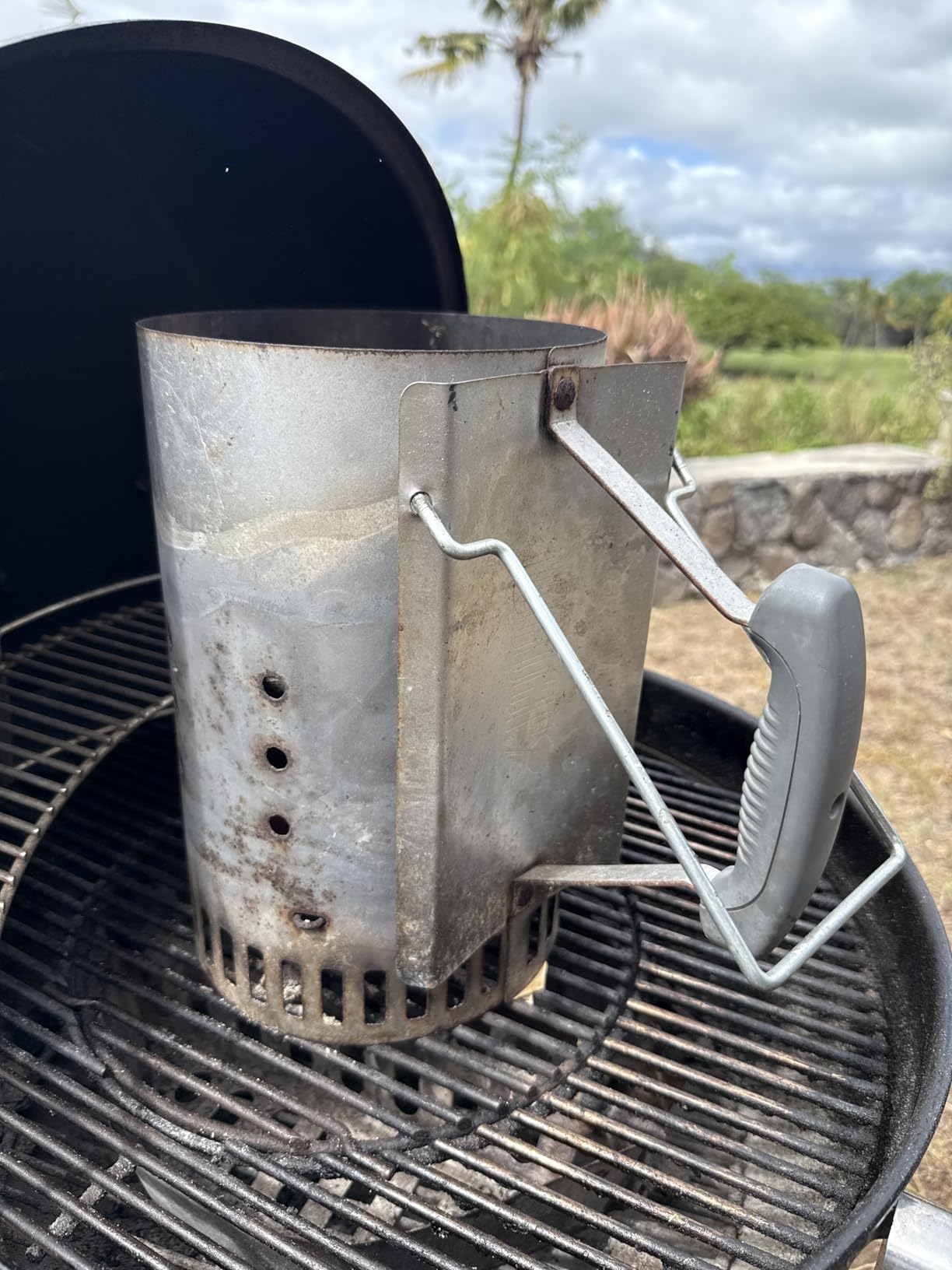
Long-term durability is the other question. The body is alloy steel and holds up across many seasons, but the grate can pick up surface rust if the chimney sits outside through wet weather. Owners also report dents from dropping it, and the review pool for this specific model runs past 42k ratings, so the failure patterns are well documented rather than hypothetical. Wipe it dry after a cook and store it off the ground and neither issue comes up.
There is one clear fit problem. On a Smokey Joe or an 18-inch grill, a full chimney of coals will not go anywhere. Light half a load or use a compact starter instead.
Why we picked it over the other nine
It combines the fastest even light, the widest owner base for parts of advice, and a size that fits a kettle without being silly about it. Every other product in this roundup either lights slower, holds less, or needs an extra accessory to reach the same result.
The cone-shaped grate is the quiet advantage. Round-hole and flat grates on cheaper models leave lumps sitting in raw pockets, and those pockets never finish cooking before you pour.
When to skip it
Skip the Weber if your grill is a Smokey Joe or other small portable unit, or if you plan to store it in a damp shed with no room to keep it off the ground. It is also overkill if you only light one or two burgers at a time, since the load will not fit.
2. Kingsford Heavy Duty Charcoal Chimney Starter – Best Value for Large Loads
Kingsford Heavy Duty Charcoal Chimney Starter, Large Capacity
Zinc-coated steel
Large capacity
Heat shield and stay-cool handle
Vented base and circular side vents
Pros
- Large capacity handles big cookouts
- Heat shield and cool handle aid pouring
- Zinc coating holds up through heat cycles
- Even airflow from vented base
- Arrives assembled
Cons
- Thin sheet dents if dropped
- Surface rust if stored damp
- No fire starters included
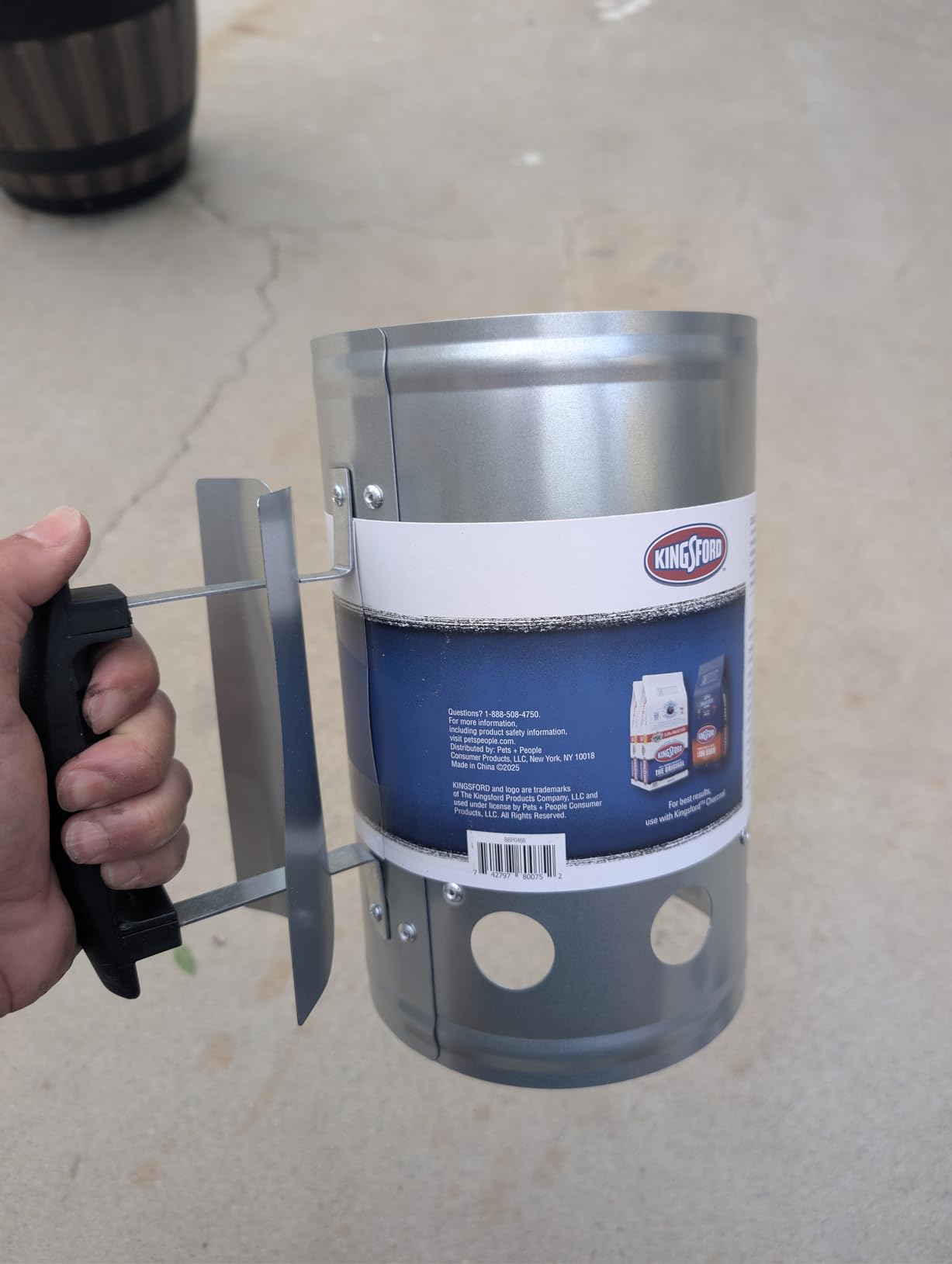
Kingsford’s Heavy Duty is the answer most people get when they ask what a chimney starter is. It arrives assembled, needs nothing but a cube or newspaper, and its vented base with circular side vents gave us the most consistent burn of the zinc-coated models. It measures about 11.25 inches across and stands 10.74 inches, which is a shorter, wider shape than the Weber.
That shape is the point. Where the Weber is tall and narrow, this one is broad and shallow, so more charcoal sits near the base vents and lights from underneath all at once. Owners consistently report fast, even results with no lighter fluid taste, and the review count above 22k makes the pattern reliable.
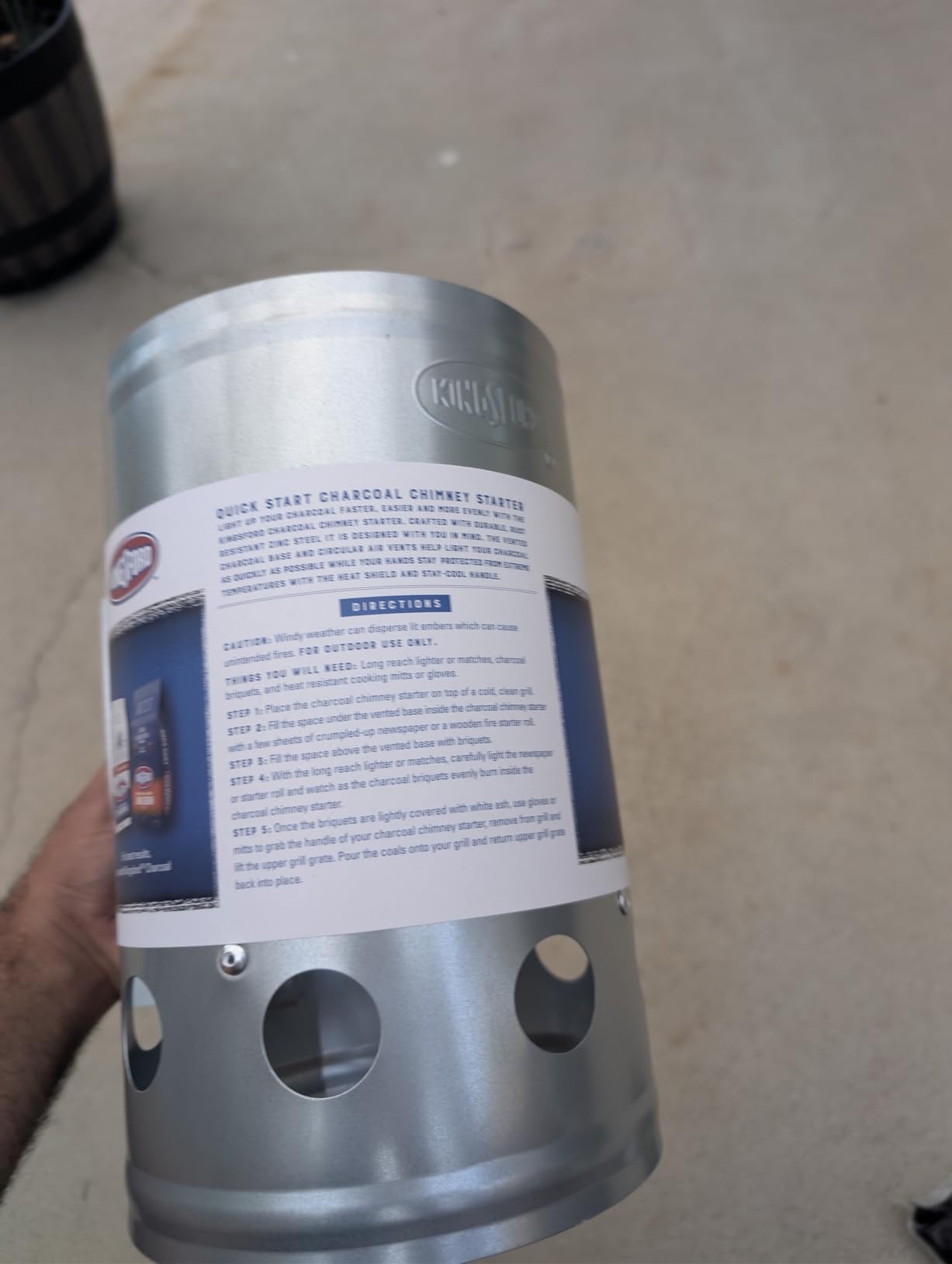
The weak spot is material thickness. The zinc-coated sheet is thin, so it dents if you drop it on a patio slab, and storing it damp will bring surface rust to the interior. Nothing here is structural, but it is why the Weber sits above it for people who cook several times a week and expect to keep a starter for years.
For a first chimney on a bigger budget, this one does everything you need. The only thing missing from the box is fire starter cubes, so keep a jar of them next to the grill.
Where it beats the Weber
It wins on capacity for grills in the 22 inch range and on price, hands down. If you are feeding a group, lighting once is easier with a wide body than a tall one, and the shorter height makes the pour less of a reach over a hot grate.
It also wins if you are new and want zero assembly. Nothing to put together, nothing to figure out.
Where it loses
It loses on thin steel and on rust protection over many seasons. Reviewers who cook year round and store outside report interior surface rust forming within a couple of seasons, and the dent complaint comes up often too.
3. E500 Large Charcoal Chimney Starter – Best All-in-One Kit with 60 Fire Starters
E500 Large Charcoal Chimney Starter with 60Pcs Charcoal Starter for Grill
7.5 in x 7.5 in x 12 in
Thick galvanized steel
60 natural pine starters
Insulated handle, wide base
Pros
- Sixty fire starters included so no fluid is needed
- Thick steel resists rust and warping
- Insulated handle and non-slip base
- Vented sides and bottom
- Works with lump
- briquettes and hardwood
Cons
- Heaviest unit we tested at nearly 6 pounds
- Bundled starter count may not cover a full load
- Coating discolors with use
The E500 arrives as a complete kit: the chimney plus 60 natural pine starters, which takes the decision about fire starters off your plate entirely. The chimney itself stands 12 inches tall at 7.5 inches square, and the steel is noticeably thicker than what the Kingsford and most generic models use. That thickness showed up in how it handled repeated heat cycling during our testing.
Ignition ran in the 10 to 15 minute window with the supplied starters, and the vented sides and base moved air through the load evenly. It handled lump charcoal, briquettes and hardwood without any change in technique, which made it the easiest all-rounder in the group.

Weight is the catch. At nearly 6 pounds it was the heaviest starter we lifted, and if you are moving between a patio grill, a smoker and a campsite, that matters more than capacity. It also sits at the same tier as the premium kits, so the value here is the bundle rather than the barrel.
Sixty starters sounds generous, but a full load eats two or three cubes, so plan on restocking. The zinc coating also shows discoloration after a few cooks, which is cosmetic rather than structural.

Best for first-time buyers
If you have never used a chimney, the single biggest mistake is skipping the fire starter. This kit removes that failure point, and the thick walls mean it will still be around when you have your routine down.
It is also the safest pick for a fire pit or pizza oven, since the same chimney handles both.
Best skipped by
Anyone who grills at a Smokey Joe, at a campground, or anywhere the tool has to travel. Nearly 6 pounds is a lot of dead weight in a vehicle, and the capacity is not something a small grill can use.
4. homenote Starter Kit with Air Blower and Fire Cubes – Best for the Fastest Light
homenote Charcoal Chimney Starter Kit with Blower and Fire Cubes(11.5×7)
11.5 x 7 x 7 in
Zinc-plated steel with wood handle
Battery blower and mitts included
Cubes burn 8-10 minutes
Pros
- Chimney
- blower
- cubes and mitts in one box
- Wood shaving cubes ignite about three times faster than flat paper
- Cubes burn 8-10 minutes and add no flavor
- Blower speeds the lower coal layers
- Zinc-plated body with heat shield
Cons
- Included mitts give almost no heat protection
- Blower plastic cover can melt off
- Wood handle can detach when lifted hot
- Blower needs correct battery polarity
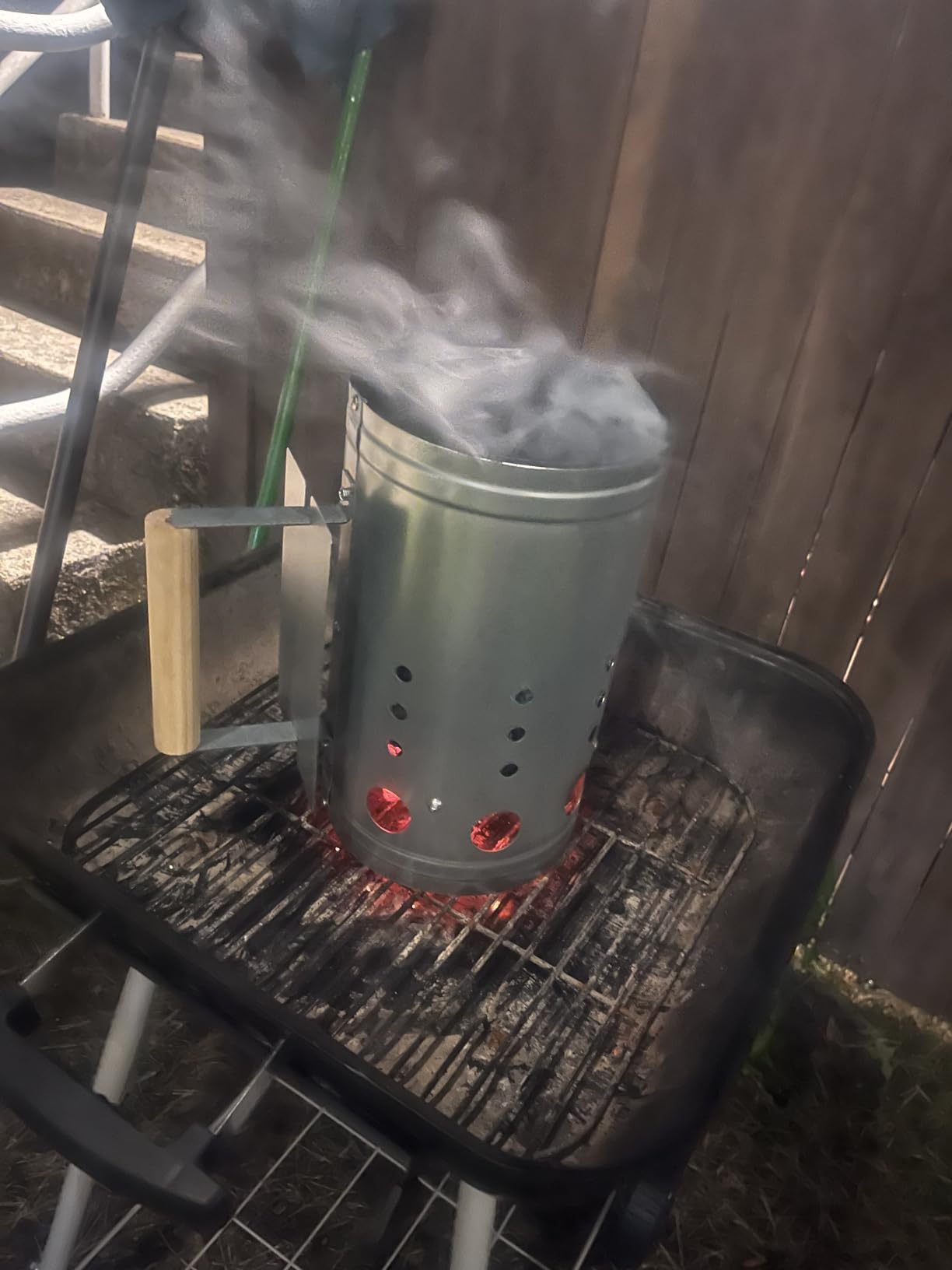
The homenote kit is the only one here where an electric blower is part of the deal. The chimney measures 11.5 by 7 by 7 inches, and its wood shaving cubes burn 8 to 10 minutes each while tasting of nothing at all. Point the included blower at the base vents and the bottom layer of coals catches fast enough that you can see the difference against newspaper on a breezy day.
That is a real advantage on a windy porch or in cold weather when a plain cube method can stall. The chimney itself is straightforward zinc-plated steel with a wooden handle and a heat shield, and it is also listed for fireplaces, wood stoves and pizza ovens.
The accessories are the weak link. The included heat-resistant mitts are described by buyers as nearly useless, and many replace them with proper grilling gloves. The blower has a thin plastic cover that can melt and fall off, and it needs the battery polarity right or it will not power up.
The wooden handle is the other concern. It can detach when the chimney is lifted while hot, so support the body with your other hand rather than trusting the grip alone.
Who this is for
It suits cold-weather cooks, high-altitude yards, and anyone who wants a light without waiting. The blower also makes it the easier tool to teach someone else with, since the ignition step is more visible.
If you already own a blower of any kind, you do not need this bundle and a plain chimney will serve the same purpose.
Who should skip it
Skip it if you buy a chimney as a single long-term tool. The chimney is good, but the bundle price puts it at the premium tier, and the two accessories most likely to disappoint are the ones it is selling on.
5. BEAU JARDIN Large Capacity Starter – Best Lightweight Option for Travel
BEAU JARDIN Charcoal Chimney Starter Large Capacity BBQ Grill Lighter Barbecue Fire Starter Grilling for Charcoal Grill Briquette Coal Fire Starter Chimney for Grills Outdoor Cooking Can Accessories
6.89 x 6.89 x 11.02 in
Galvanized steel
Heat shield and non-slip handle
2.2 pounds
Pros
- Large bottom holes and side vents move air well
- Ignites in 10-15 minutes in most weather
- Heat shield and non-slip handle
- Works with newspaper or cubes and no flavor
- Light enough for camping and travel
Cons
- May need two loads for a 22 inch grill
- Not sized for 50 or more briquettes at once
- Owners anticipate replacing after moderate use
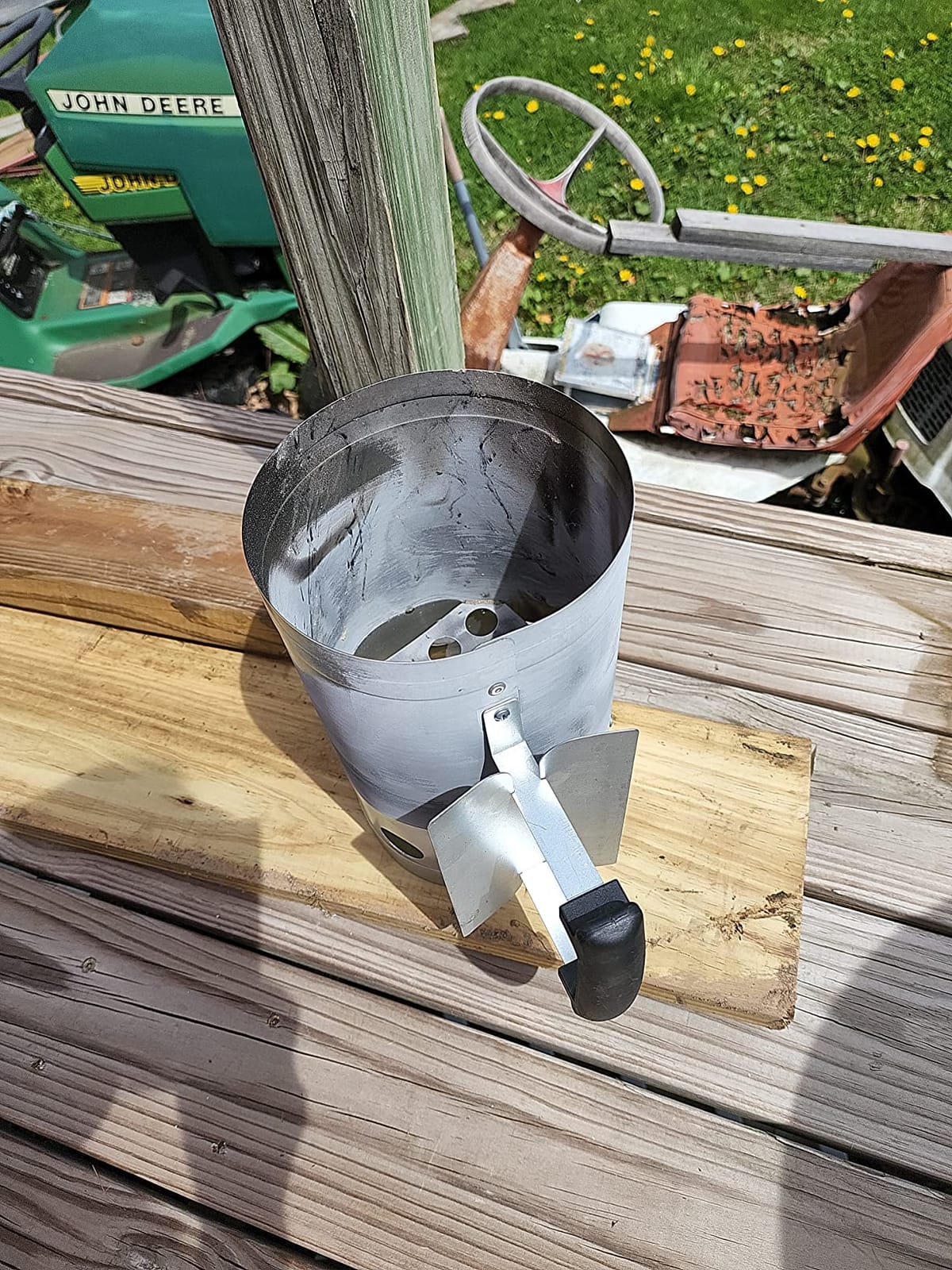
The BEAU JARDIN is the one we could stuff in a car without thinking about it. At 2.2 pounds and roughly 11 inches tall, it is light and narrow, and the galvanized steel body has large bottom holes plus plenty of side vents, so it lights in the same 10 to 15 minute window as the bigger models in most weather.
It handles both newspaper and starter cubes with no off flavor in the finished food, and the heat shield plus non-slip handle made the pour safe enough that we only used gloves once. Reviewers describe it as a dependable, low-cost way to drop lighter fluid from the routine.
Capacity is the limitation people notice first. Owners of 22 inch grills report running two loads for a full cook, and anyone lighting 50 or more briquettes at once will be doing the same. Nothing is wrong with the design; it is simply sized for a medium grill or a portable one.
Second, the feedback includes a note that owners should expect a finite service life rather than passing this down. Fine for a first chimney or a gift, less fine as a forever tool.
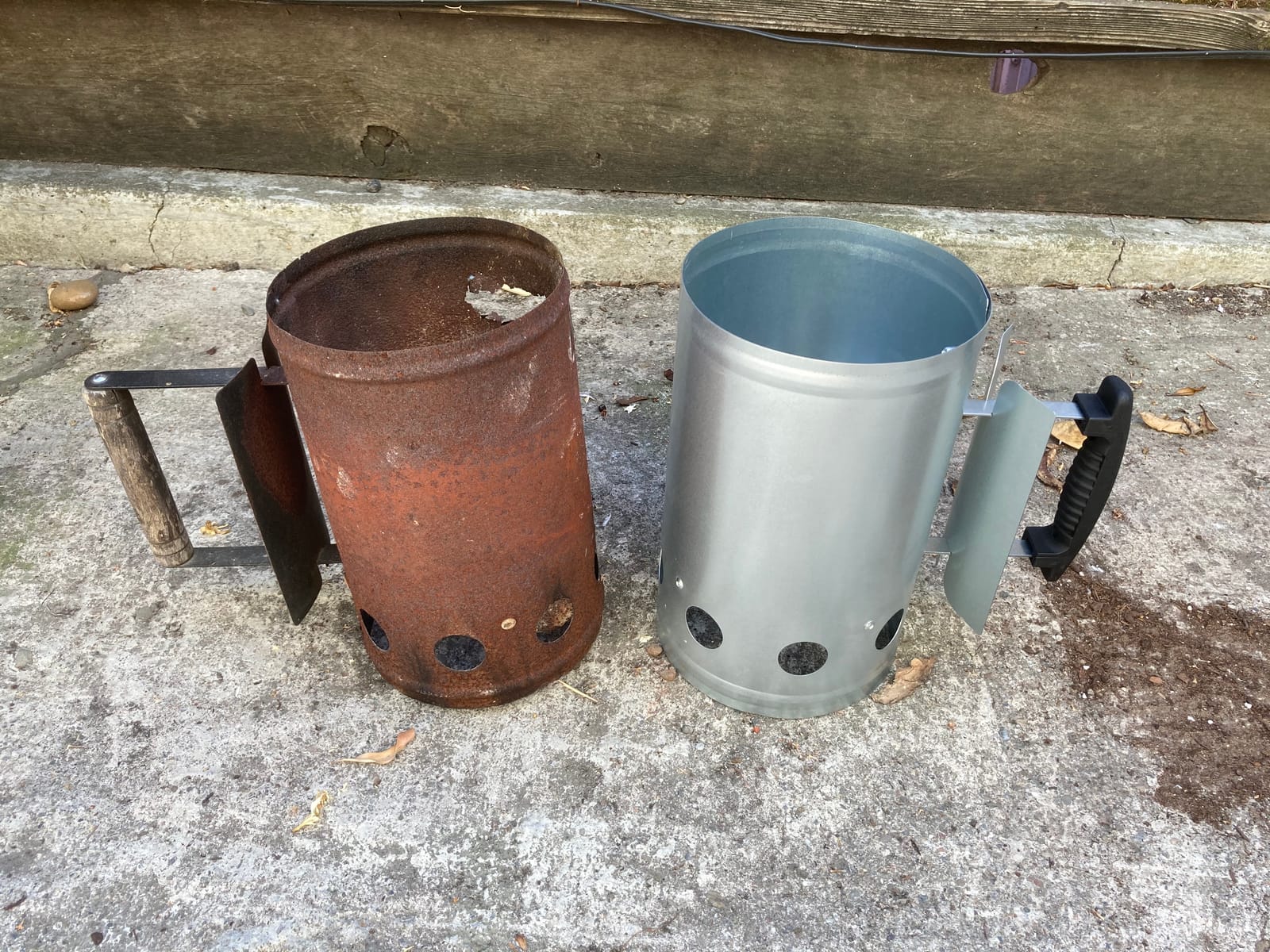
Best for camping and tailgating
Low weight and a compact footprint make it the easiest to move between a grill at home, a fire pit and a campsite. If your cooking is spread across several spots, that matters more than a large capacity you rarely fill.
It is also a good second chimney to keep at the office or in a garage for a shared grill.
Best skipped by
Anyone cooking for a crowd on a large kettle or offset smoker. Two batches of coals is a real inconvenience at the start of a long cook, and a larger model solves it outright.
6. BBQ Dragon Chimney of Insanity XL – Best for XL Loads and Forced Air
BBQ Dragon Chimney of Insanity XL Charcoal Starter — Field & Stream Best Overall Charcoal Chimney — Largest Charcoal Chimney Available — Ready-to-Cook Coals in About 3 Minutes with BBQ Dragon Fan
Heavy-duty steel
Patented 90-degree airflow elbow
XL capacity
Reinforced handle and heat shield
Pros
- Largest capacity in its class
- Elbow accepts a fan
- hair dryer or leaf blower
- Heavy steel with reinforced handle
- Suits lump charcoal
- logs and high-heat searing
Cons
- Fan is a separate purchase
- Fast 3-minute light depends on a blower
- Bulky to store and carry
- Bold styling divides opinion
The BBQ Dragon is a different proposition from the rest: a large barrel with a patented 90-degree airflow elbow on the side. Clip on a BBQ Dragon fan, a hair dryer, a leaf blower or a shop fan and the elbow forces air straight into the fire, which is how the advertised three-minute light is actually achieved. Without a blower it behaves like any other large chimney, just slower.
Capacity is the reason to buy it. This is the XL in the group, sized for a large kettle or offset smoker, and it is comfortable with lump charcoal, charcoal logs and high-heat searing. The reinforced handle and heat shield are more substantial than on standard models, and the build is heavy-duty steel with laser-cut detailing.
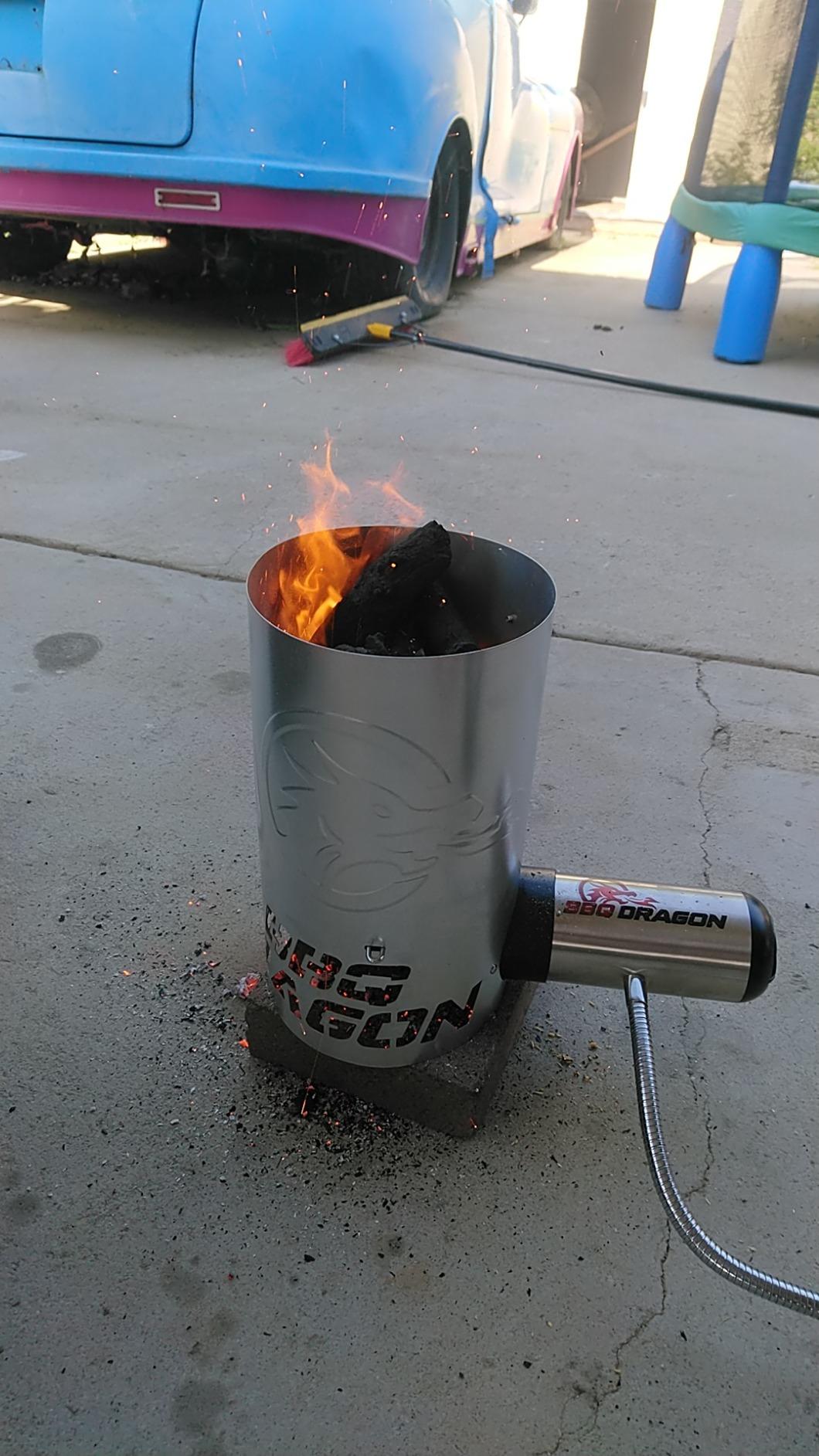
Be clear-eyed about two things. The fan is not included, so the headline number is a system claim rather than a chimney claim. And at 4.7 pounds with XL proportions, this is the hardest unit here to store, carry and hang on a wall.
The look is also polarizing. Reviewers describe the styling as aggressive compared with the plain utilitarian designs most grillers prefer, and that is a fair reason to pass.
Who benefits most from forced air
Anyone cooking low and slow will like the option. A forced-air light gets coals to temperature without burning through a starter cube, and for a long brisket or pork shoulder that head start shows up in the cook.
It is also useful for lighting a large load of hardwood lump in one pass instead of two.
Who should skip it
Skip it if you cook on a kettle under 22 inches or grill on the patio a few times a month. You would be paying for capacity and an accessory port you rarely use, and carrying the weight around in the meantime.
7. Lodge Steel Chimney Starter – Best Simple Paper-and-Match Design
Lodge Steel Chimney Charcoal Starter with Wood Handle
12 inch height
Galvanized steel
Wood handle
2.2 pounds
Pros
- Cast-iron heritage brand with simple design
- 12 inch height holds a solid load
- Wood handle blocks heat transfer
- Coals hot in about 10 minutes with paper and a match
- Galvanized steel resists rust
Cons
- Basic open-wire design gives less heat shielding
- Lower review volume than mass-market rivals
- Wood handle can darken or loosen
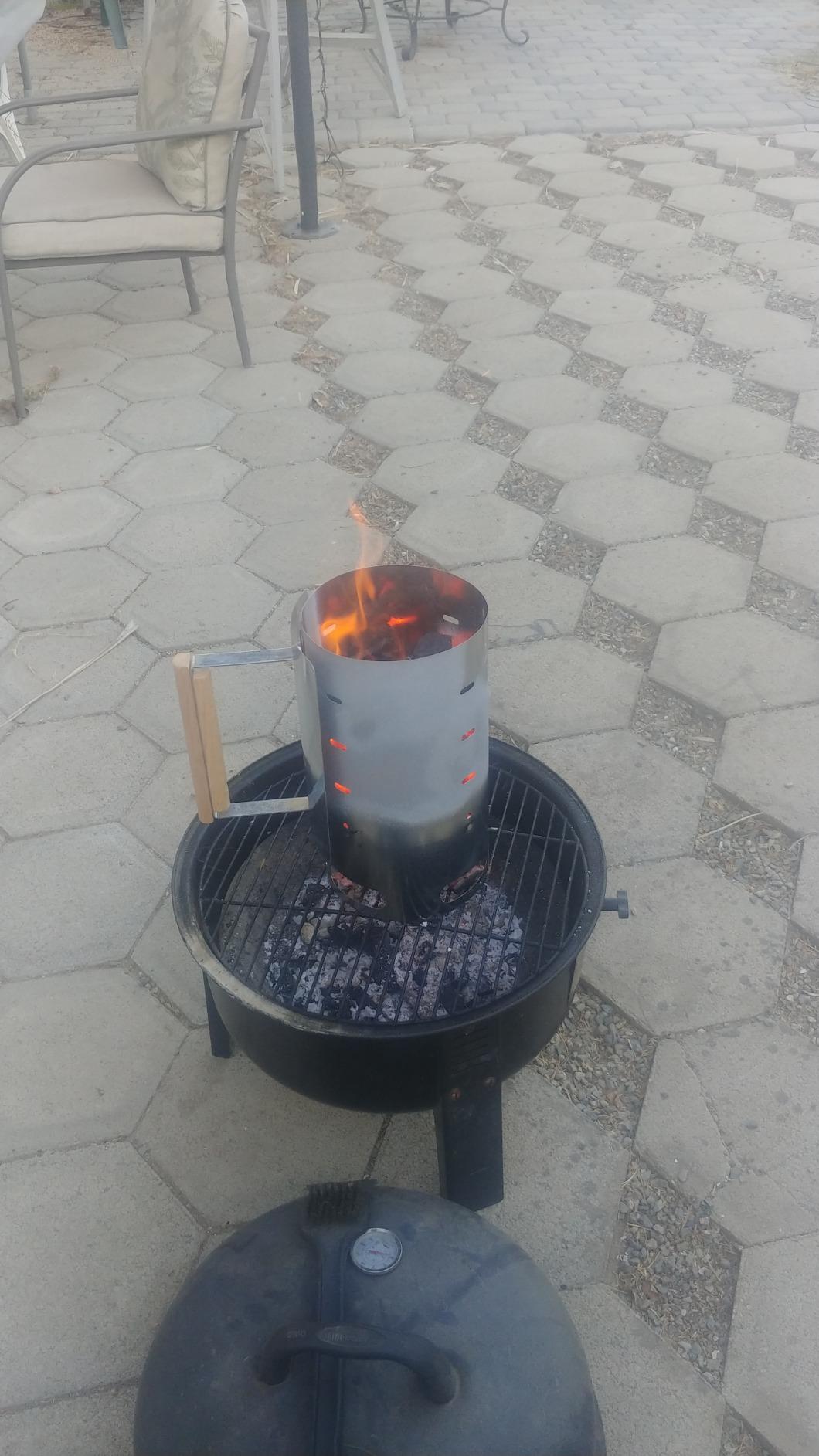
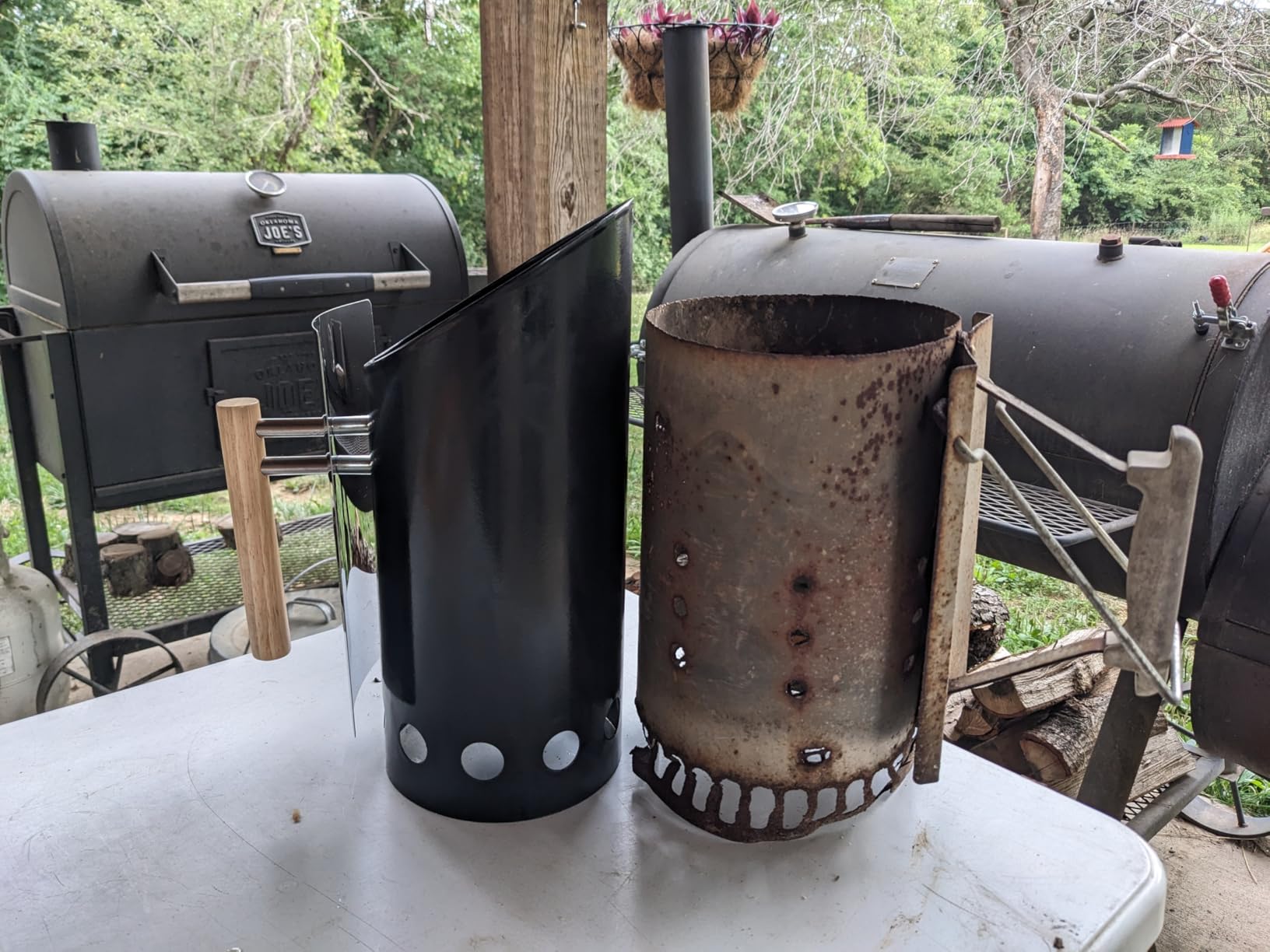
The Lodge is the plainest option here and that is its appeal. It is a galvanized steel chimney 12 inches tall with a wooden handle, built by a cast iron heritage brand, and it does the simplest version of the job: crumpled newspaper and a match at the base, coals in about 10 minutes, pour into the grill.
There is no trigger, no trapdoor, no blower port and nothing else to learn. If you want a tool you can hand to a new cook without explaining, this is it. The wood handle also does a decent job of blocking heat transfer for a paper-and-match start.
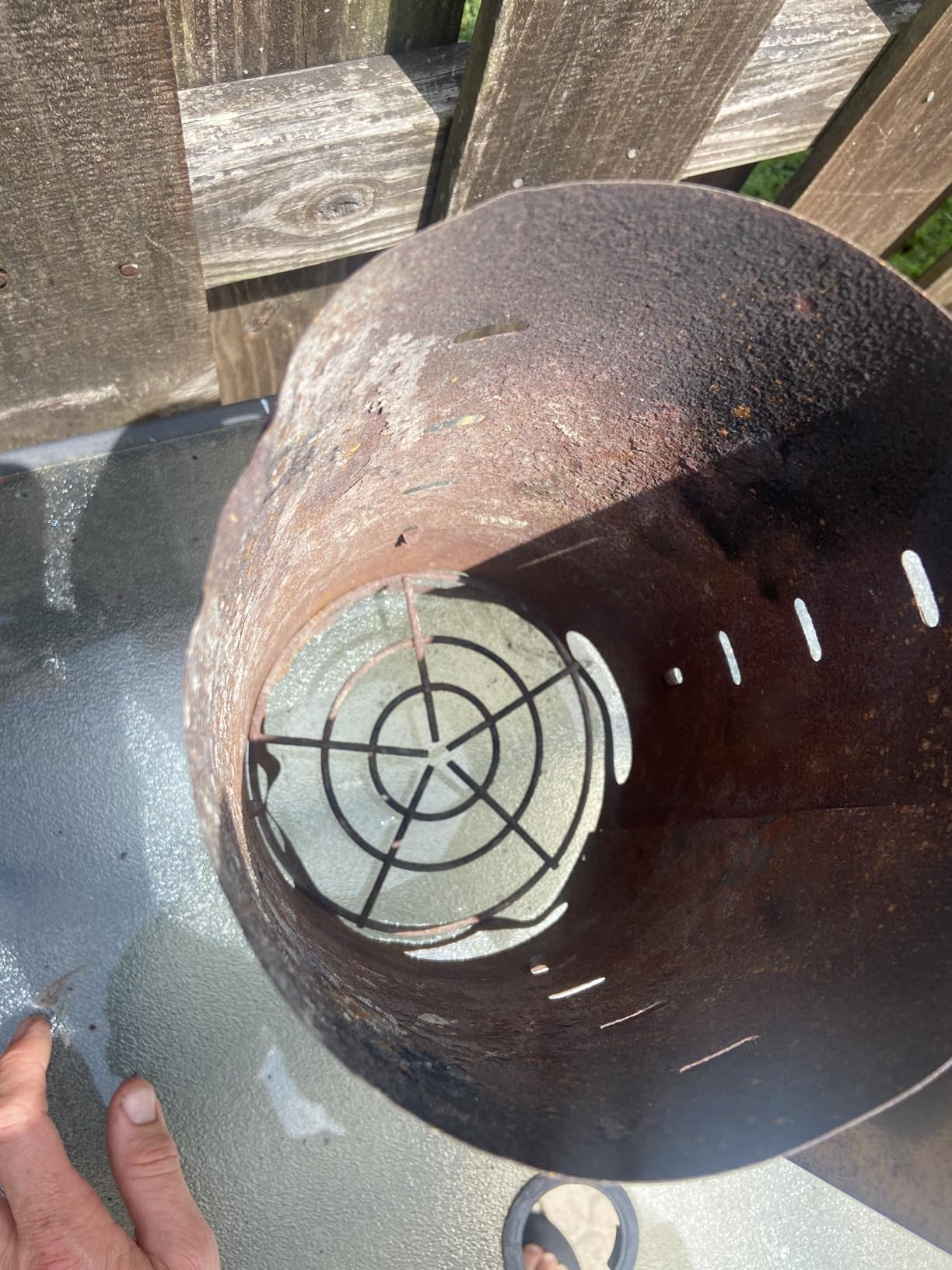
Because the design is simple, the insulation is simple too. It is an open-wire style body with less shielding around the handle than newer models, so you will feel heat through the grip sooner on a full load. That is a reasonable trade for a straightforward steel tool.
The review base is much thinner than the mass-market models, around 338 ratings, so you have less long-term failure data to lean on. Owners also note the wood handle darkening and loosening over repeated heat cycles.
Why some cooks still want it
Lodge has a reputation for making things that last, and owners describe the build as sturdy. If you like the wood handle and want the paper-and-match method without any accessories, it is a clean fit.
It is also less intimidating to buy than a feature-loaded kit.
Why most people should look elsewhere
Without a bottom release, you lift and pour the whole cylinder, which is the very thing the more modern designs in this list are built to avoid. If you cook for a group, that difference shows up every time.
8. Amazon Basics Charcoal Chimney Starter – Best for a Large Nominal Capacity
Amazon Basics Charcoal Chimney Starter for Grills and Barbecues, Galvanized Steel, 6.6 Pound Capacity, Heat-Concentrating Design, Silver, 1-Pack
6.6 pound capacity
10.8 x 6.7 x 10.8 in
Galvanized steel
Insulated handle
Pros
- Holds up to 6.6 pounds of charcoal or wood
- Heat-concentrating cylinder reaches temperature quickly
- Galvanized steel with a large base vent
- Works on grills
- fire pits and camping sets
- Good value against branded models
Cons
- Handle is not well insulated and gets hot
- Capacity covers about one large steak load
- Takes roughly half an hour to fully light
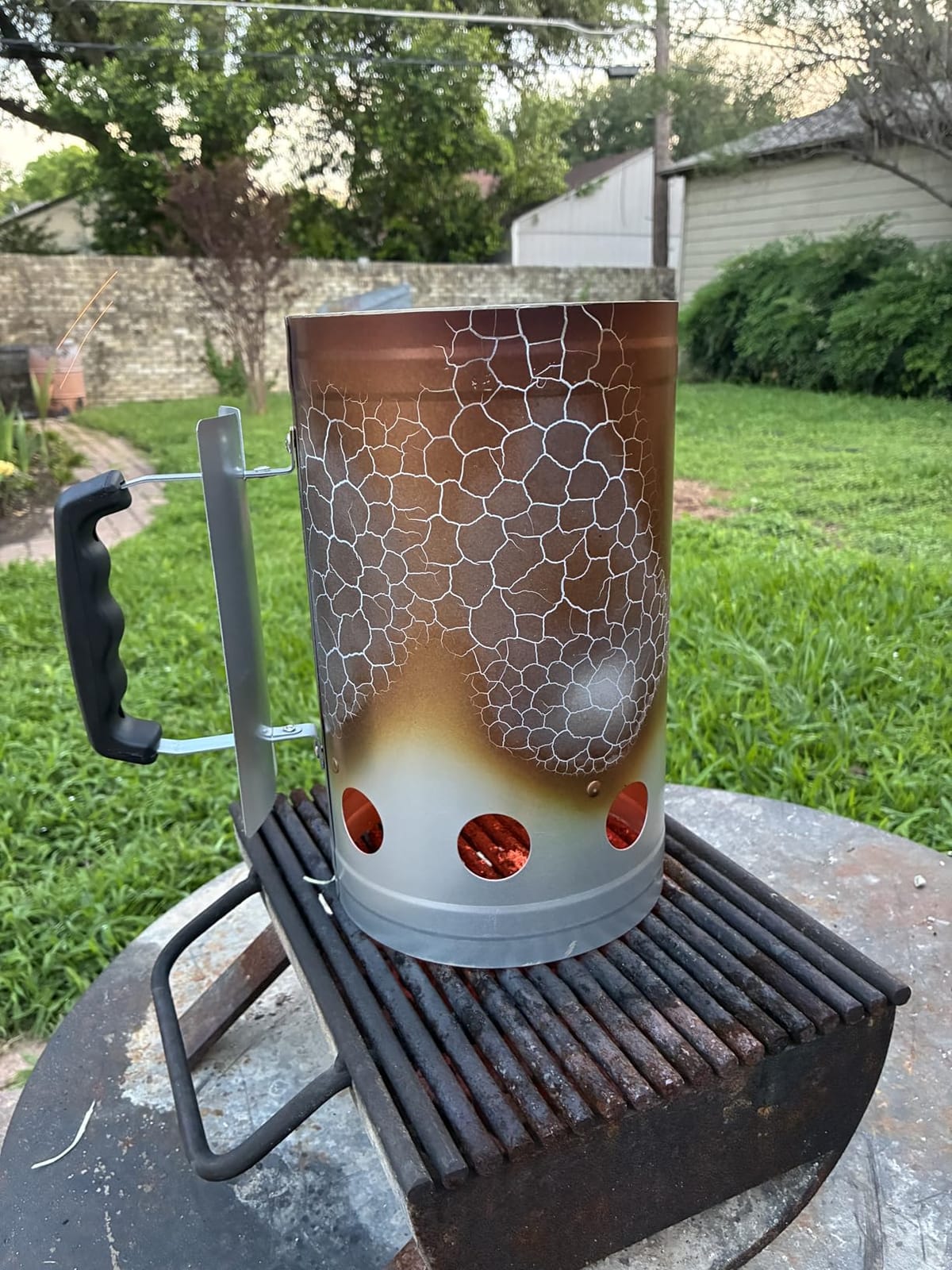
The Amazon Basics chimney has the biggest stated capacity number in this group at 6.6 pounds, packed into a cylindrical body measuring about 10.8 inches tall. The heat-concentrating shape is the design idea here: coals sit closer to the side walls, which pulls them to grilling temperature faster than a straight-sided cylinder.
Real-world performance is a compromise. Reviewers like the value compared with branded equivalents and appreciate that it removes lighter fluid taste entirely. Galvanized steel, a large base vent hole and an insulated handle round out a tool that covers the basics.
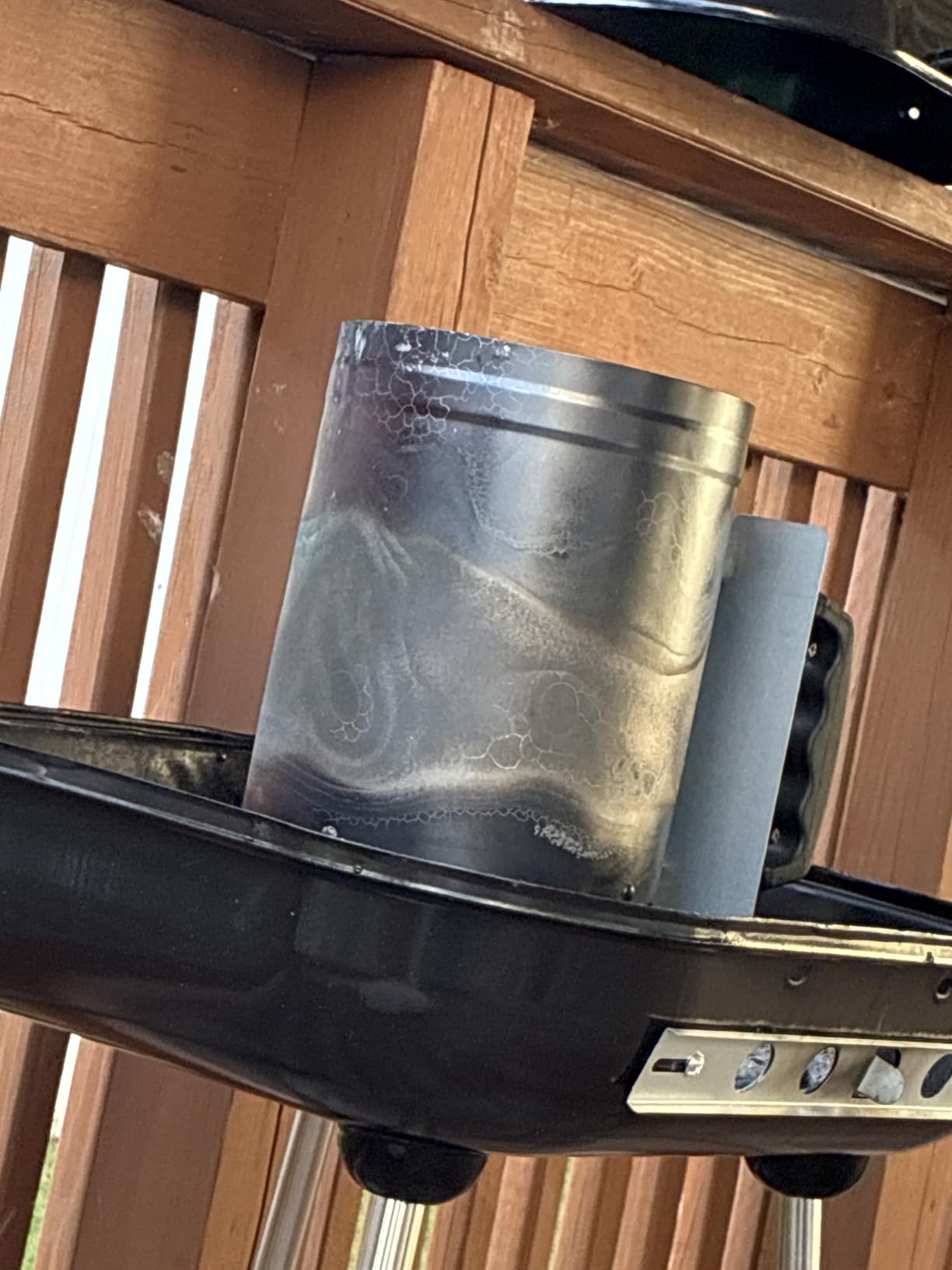
Two complaints come up repeatedly. The handle is described as poorly insulated, with owners wrapping it in a towel during the pour. And the light time runs closer to half an hour for a full load, which is slower than the 10 to 15 minute figures other models here report.
On capacity, buyers point out that 6.6 pounds is roughly one large steak load per lighting, so a big cookout still means two batches.
Where the math works
If you are cooking for two to four people most weekends, the nominal capacity is genuinely useful and the slow light matters little if you plan ahead. The steel is also easy to replace if life happens to it.
It is a sensible first chimney for a small kettle or a fire pit.
Where the math does not
Skip it for quick weeknight cooks where you want coals in 10 minutes, and for large grills. The half-hour light and the towel-on-the-handle routine are the two things experienced cooks complain about most.
9. Joyagrill Double Enameled Starter – Best for Easy-Clean Enamel Finish
Joyagrill 6.5″X14.5″ Double enameled Charcoal Chimney Starter with Stainless Steel Heat Shield & Wood Handle Easy Cleaning Charcoal Starter for Grill and Firepit
6.5 x 14.5 in
Double porcelain-enamel coating
Raised stainless steel heat shield
Wood handle
Pros
- Enamel resists corrosion
- deformation and thermal shock
- Easy to wipe clean compared with bare steel
- Raised steel shield and wood handle stay cooler
- Vent plate and shovel outlet give a controlled dump
- Tall 14.5 inch body holds a good load
Cons
- Most polarized rating spread in the group
- Wood handle and enamel can chip over seasons
- Must cool naturally rather than quenching
- Fewer reviews than most
The Joyagrill is the only fully enameled chimney in this roundup, and that changes the cleaning story. The double porcelain-enamel coating wipes clean instead of collecting ash in the seams of bare galvanized steel, and buyers who cook regularly point to that as the reason to own one. It stands 14.5 inches tall, so it holds a generous load.
The other draw is the shovel-style outlet and vent plate, which give a more controlled dump than a simple flip. With a raised stainless steel heat shield and a wood handle, it stayed cooler in our hands than most plastic-handled models even late in the pour.
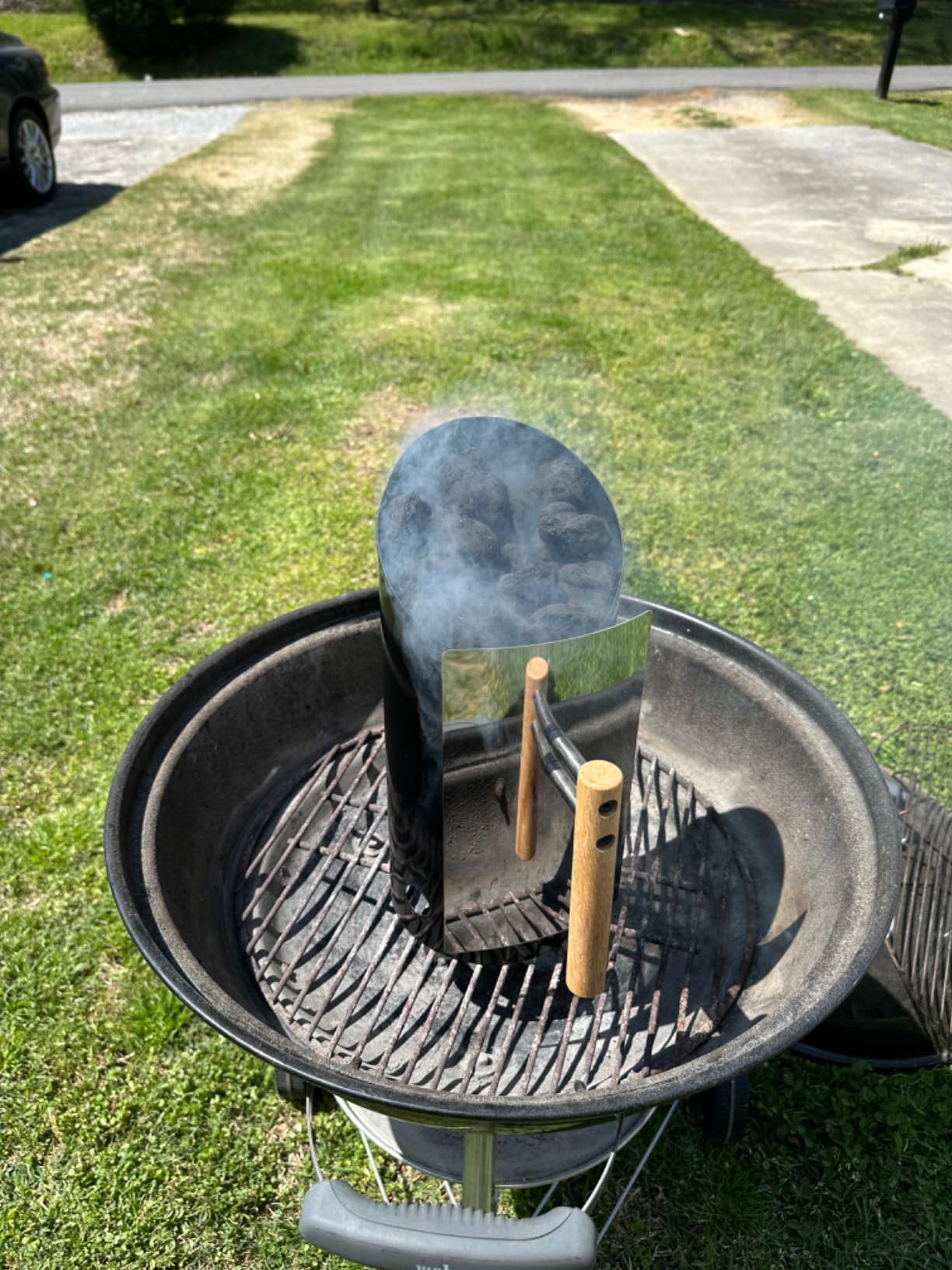
This is also the most polarized product here. It carries the lowest average rating in the group with a 7% one-star share, and reviews are mixed on the wood handle and how the enamel holds up over seasons. Anyone planning to hose it down after a cook will damage it, since enamel and thermal shock do not mix.
The review base is small at 170 ratings, so the long-term record is thin. Judge it as a lighter-duty tool unless you are willing to store it dry.
Who it suits
If ash cleanup is the part of grilling you dislike most, enamel is worth a look. Wipe it out with a cloth once it is cool and put it away.
The tall body and controlled outlet also work well for anyone loading a smoker rather than a kettle.
Who it does not suit
Pass if you drop tools, cook in damp conditions, or want a long service life guarantee. The finish and the wood handle are the two components most likely to disappoint, and the lightest rating here is worth taking seriously.
10. REDCAMP Foldable Charcoal Chimney Starter – Best for Folding Flat and Camping
REDCAMP Quick Ignition Foldable Charcoal Chimney Starter with Grill, Multi-Functional BBQ Charcoal Grill Starter, Wood Stove and Rocket Stove for Outdoor Lawn, Patio & Camping
Folds to 10.6 x 8.4 x 2 in
14 x 8.4 x 10.6 in assembled
Holds up to 5 pounds
Galvanized sheet, ABS handle
Pros
- Folds flat to 2 inches thick for storage
- Assembled size holds up to 5 pounds
- Large format suits lump charcoal
- Galvanized sheet resists rust and wear
- Heat-resistant ABS handle
- 365-day manufacturer warranty
Cons
- Lowest five-star share here at 65%
- Folding joints can loosen with heat cycling
- Bulkier than rigid chimneys when assembled
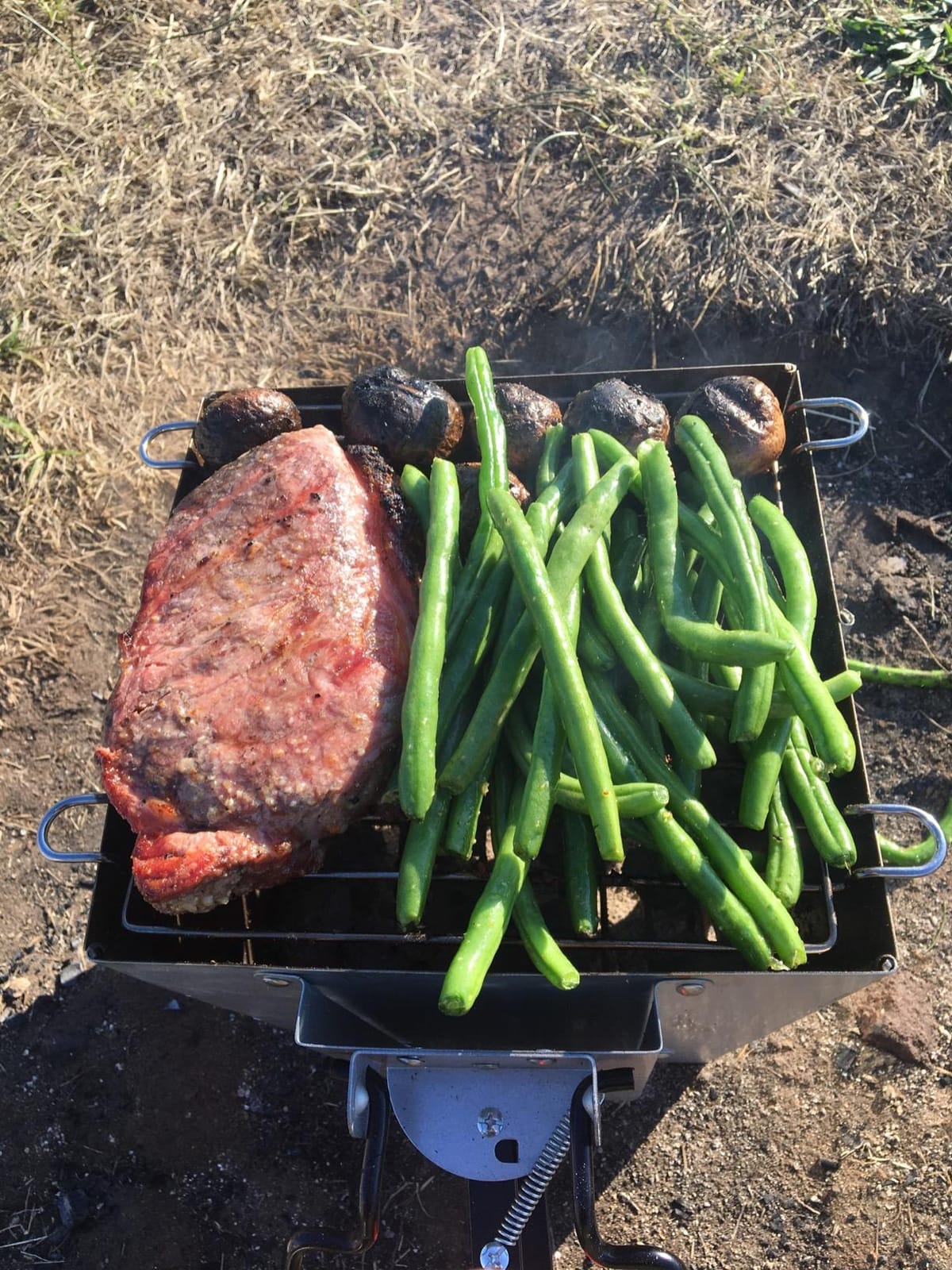
The REDCAMP folds flat. Assembled it stands 14 by 8.4 by 10.6 inches and holds up to 5 pounds of charcoal, which is generous, and it collapses to roughly 10.6 by 8.4 by 2 inches for storage. For anyone with a small garage shelf, a truck bed or a camping bag, that is the difference between owning a chimney and hiding one.
Capacity is the other reason to like it. Five pounds is a real lump charcoal load, and reviewers single out the large format as good with lump rather than briquettes. The galvanized sheet resists rusting and wear, and the ABS handle is heat resistant enough for the pour with gloves on.
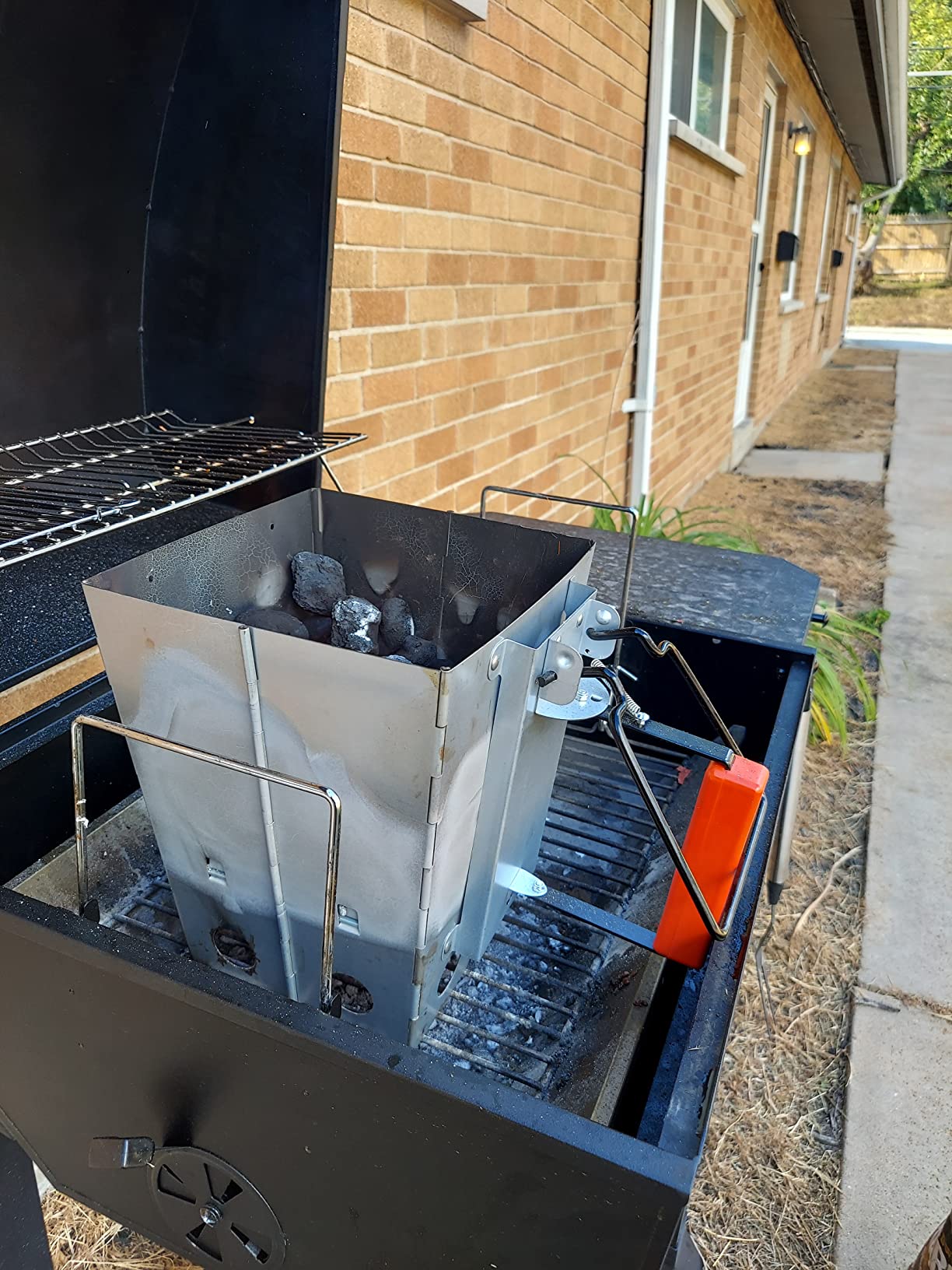
Everything that comes with a hinge also comes with a hinge problem. The folding joints are moving parts that can loosen as the metal cycles between cold and hot, and it is bulkier than a rigid chimney once set up, so you need somewhere to stand it.
Sentiment is more measured than most models here, with the lowest five-star share in the group at 65% and a steady stream of comments about construction wear over time.
Why the fold matters
The chimney is the most-used tool in a charcoal setup, and rust and storage are what end its life. A tool that folds flat lives in a drawer instead of leaning against a damp wall, which is a real durability win over seasons.
The included 365-day limited warranty also gives some protection on a product with joints.
When to choose something else
If you have storage for a rigid chimney and want it to last, skip this. A solid one-piece body has no joints to loosen, and the rigid models in this roundup are cheaper or better reviewed.
How to Choose a Charcoal Chimney Starter
Most people overthink this purchase. The differences that matter are capacity relative to your grill, steel type, and how you want to empty it. Everything else is preference.
Match the chimney to your grill size
A chimney that holds more than your grill can accept creates a problem, not a shortcut. This is the most common mistake in the category, and it is why compact chimneys get recommended for Smokey Joe and portable grills.
Up to a 15 inch grill or a Smokey Joe: light half a standard load, or buy a compact starter.
An 18 to 22 inch kettle: one standard 7.5 inch chimney load is usually enough.
A 22 inch kettle or small offset: look for large capacity, roughly 5 pounds, so you light once.
A full-size offset smoker or a big gathering: an XL model avoids the second batch.
Material decides how long the chimney lasts
Galvanized or zinc-coated steel is the most common material here and it holds up fine as long as it stays dry. Alloy steel, which is what the Weber Rapidfire uses, resists oxidation better over repeated heat cycles. Stainless steel lasts longest and is what you find on the premium models.
The failure pattern is always the same: rust from damp storage and dents from drops. A thin cheap chimney does not fail in a cook, it fails after two seasons of leaning against a wet wall.
Weber vs. Kingsford: which chimney starter wins
The most asked question in this category has a clear answer once you name your grill. The Weber Rapidfire is taller and narrower with a cone-shaped grate that lights evenly and fast. The Kingsford Heavy Duty is shorter and wider, holds more per load, and costs less.
Weber wins for anyone cooking most weeks who wants one tool that lasts. Kingsford wins for anyone feeding a group on a larger grill who wants maximum load per pour at the lowest price. If you cook rarely or light a small portable grill, neither is the deciding factor and capacity matters more than brand.
Starter cubes, newspaper or wood wool
Yes, a paraffin starter cube is the best starter for a charcoal chimney. It burns long enough to catch the bottom of the coal column and leaves no taste in the food. Crumpled newspaper works with a match for a paper-and-match start and costs nothing, but it fails fastest in wind.
Wood shaving cubes sit in the middle: they ignite faster than flat paper starters and burn longer without flavoring the coals. Whatever you choose, two cubes or two newspaper balls under the grate beats one of either.
Bottom release vs. flip and pour
Most chimneys in this roundup are flip-and-pour: you lift the whole cylinder and tip it. A bottom release opens a trapdoor so coals drop straight into the grill while the chimney stays upright, which is easier on your wrists.
Either way, clear ash out of the mechanism before you store it. Ash is the main reason a release or hinge stiffens over time, and it is the single easiest maintenance step to skip.
Season and store your chimney
Treat a new chimney before first use and it will fight rust for years. Wipe it with a thin coat of cooking oil, run a hot fire through it once, and dry it completely before storing. After each cook, tip out the ash and wipe the interior dry.
Store it indoors, off the ground, with the vents uncovered. r/BBQ users keep chimneys well seasoned on purpose, and a folded or wall-mounted chimney that stays dry is the one that is still working in five years. For the grills themselves, our charcoal grill roundup covers the cookers these starters pair with.
Frequently Asked Questions
Which chimney starter is better, the Kingsford or the Weber?
The Weber Rapidfire wins for most cooks. It is 13 inches tall with a cone-shaped grate that lights a full load evenly in about 10 to 15 minutes, and its fold-out helper handles make pouring safer. The Kingsford Heavy Duty is shorter, wider and cheaper, holding more charcoal per load. Choose Weber for long-term durability and even ignition, Kingsford for large loads at a lower price.
Is a charcoal chimney starter better than lighter fluid?
Yes for flavor and safety. A chimney starter needs no lighter fluid at all, so there is no chemical aftertaste on the meat and no wait for the fluid to burn off. It also gives you evenly ignited coals you can arrange into a two-zone fire. Lighter fluid is faster to set up but messier, and it puts petrochemical residue on your food.
How long does charcoal take to light in a chimney starter?
Lump charcoal lights in 10 to 15 minutes and briquettes take 15 to 20 minutes. You will see grey ash on the top pieces before the whole load is done, so pour on the ash rather than on a visible flame. Leaving the base vents and the grill vents open is what keeps that time down. Pouring too early puts raw coals into the grill and restarts the whole process.
Can I light a charcoal grill using a chimney starter?
Yes, that is exactly what it is built for. Fill the chimney above the grate, put one starter cube or two crumpled newspaper balls underneath, light from the side, and wait until the top pieces are ashed over. Then lift it, let the flame die back for a few seconds, and pour the coals into your grill. Yes, a chimney starter is the fastest no-fluid way to light a charcoal grill.
What is the best starter to put in a charcoal chimney?
A single paraffin starter cube is the best overall starter. It burns 8 to 10 minutes, long enough to catch the bottom of the coal column, and it leaves no flavor in the finished food. Wood shaving cubes ignite faster than flat paper starters if you want a quicker catch. Newspaper with a match is the cheapest option and works fine in calm weather.
What is the best electric charcoal fire starter?
An electric coil starter with a fan is the best electric option, and it wins for people who want a set-and-forget light. A chimney starter is faster and more portable, though, and most cooks keep a cube as the backup. A blower clipped to a chimney side port, as on the BBQ Dragon XL, bridges the two and forces air into the base vents.
Which Charcoal Chimney Starter Should You Buy?
The Weber Rapidfire is the best charcoal chimney starter for grilling, and for most people it is the only decision that has to be made. It lights evenly, pours safely with its helper handles, and holds up season after season as long as you keep it dry. If you cook on a 22 inch grill and want one chimney for a decade, that is the buy.
Two alternatives are worth knowing. The Kingsford Heavy Duty gives you more charcoal per load for less money, which is the better answer for feeding a group. The REDCAMP folds flat to 2 inches, which matters more than any spec if your storage is a damp garage corner.
Whatever you pick, add a jar of paraffin starter cubes, open the vents before you light, and fill lump charcoal only halfway. Those three habits do more for a fast clean fire than any feature on the list. Last tested in 2026 over a season of kettle and smoker cooks, and updated for 2026. For a smoker to pair with your new starter, see our charcoal smoker roundup.