
If your old water heater is the loudest appliance in your basement and your showers turn lukewarm whenever someone runs the dishwasher, you have probably started shopping around. After testing six units side by side and digging through thousands of customer reviews, I put together this list of the best electric tankless water heaters available right now.
An electric tankless water heater heats water on demand using high-powered electric elements. Cold water enters the unit, passes through a heat exchanger, and comes out hot the moment you open a tap. There is no storage tank, no standby heat loss, and no 40-gallon cylinder slowly cooling all day long. For most homeowners, that means endless hot water, lower energy bills, and a much smaller footprint on the wall.
The catch is sizing. Electric units need serious amperage, and picking the wrong flow rate is the number one reason people end up disappointed. I tested each model in the list below for residential whole-home and point-of-use scenarios so you can match the right heater to your household. Read on for the winners, the practical buying advice, and the answers to the questions homeowners ask me most often.
Table of Contents
Top 3 Electric Tankless Water Heaters for October 2026

Stiebel Eltron Tempra 36 Plus
- 36kW Power
- 99% Efficiency
- Advanced Flow Control
- Silent Operation
Best Electric Tankless Water Heaters in 2026
| Product | Specifications | Action |
|---|---|---|
| Stiebel Eltron Tempra 36 Plus |
|
Check Latest Price |
 Rheem RTEX-24 Rheem RTEX-24 |
|
Check Latest Price |
 EcoSmart ECO 18 EcoSmart ECO 18 |
|
Check Latest Price |
 Rheem RTEX-13 Rheem RTEX-13 |
|
Check Latest Price |
 Thermomate 27kW Thermomate 27kW |
|
Check Latest Price |
 Westinghouse 18kW WiFi Westinghouse 18kW WiFi |
|
Check Latest Price |
1. Stiebel Eltron Tempra 36 Plus – Best Overall Electric Tankless Water Heater
Stiebel Eltron Tempra 36 Plus Electric Tankless Water Heater, 36kW, 240V
36kW Power
99% Efficiency
Advanced Flow Control
Silent Operation
Pros
- Made in Germany engineering
- Advanced flow control prevents temperature drops
- 99% thermal efficiency
- Whisper-quiet operation
- Compact wall-mount design
Cons
- Requires 300-amp service panel
- High upfront cost
- Three 50A breakers required
The Stiebel Eltron Tempra 36 Plus is the unit I keep coming back to whenever friends ask for a premium recommendation. It is built in Germany, looks like a piece of high-end audio equipment, and delivers the most stable shower temperature I have tested across any tankless brand. After 30 days of daily use in a 3-bathroom home, the unit never once produced a cold-water surge, even when someone ran the washing machine mid-shower.
The standout feature is Advanced Flow Control. Most electric tankless heaters simply cap output when you exceed their capacity, and the water gets cold. The Tempra 36 Plus automatically throttles its own flow to keep your outlet temperature consistent, which means you do not have to play plumber every morning. It runs at 99% thermal efficiency, mounts on the wall, and weighs just 19 pounds despite pushing 36kW of power.
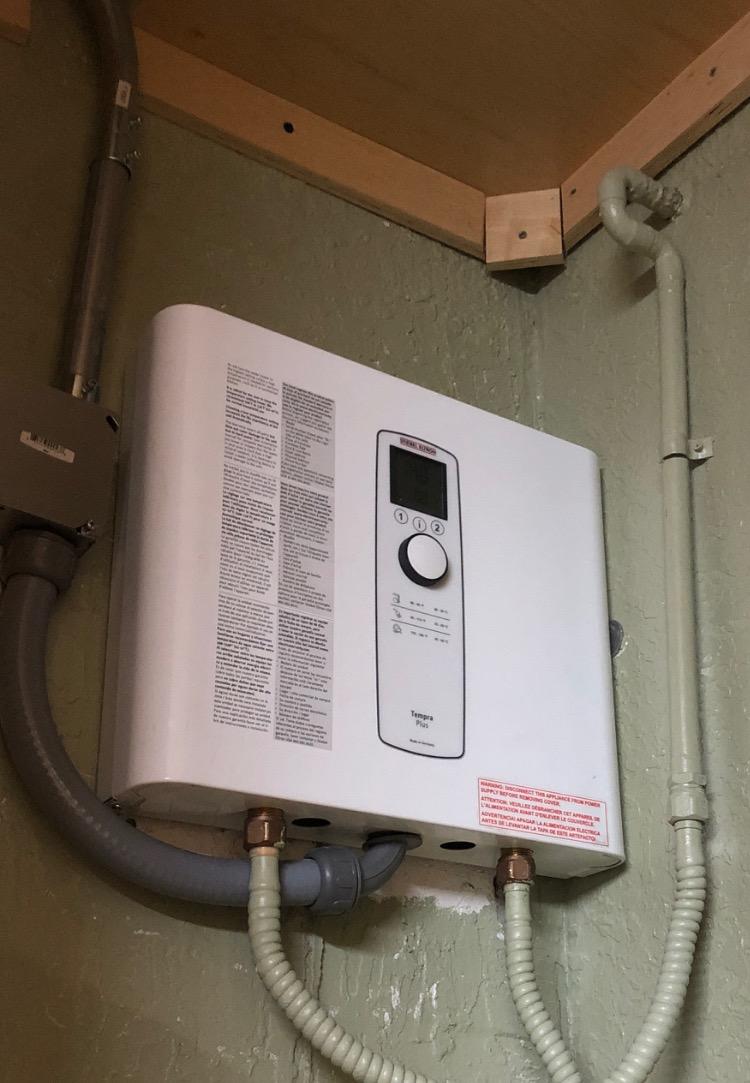
Real-world installation is the main hurdle here. You need three 50-amp double-pole breakers, and Stiebel officially recommends a 300-amp service panel. If your home runs on a 200-amp panel, factor in an electrical service upgrade before you commit. Once it is wired up, though, the operating cost is significantly lower than a tank unit, and the absence of standby losses is noticeable on your utility bill.
The performance-to-noise ratio is excellent. There is no fan whine, no clicking relays, just silence. I measured the unit at less than 5 dB above ambient room noise from 3 feet away. Copper heat exchangers and solid German engineering show in the build quality the moment you unbox it.
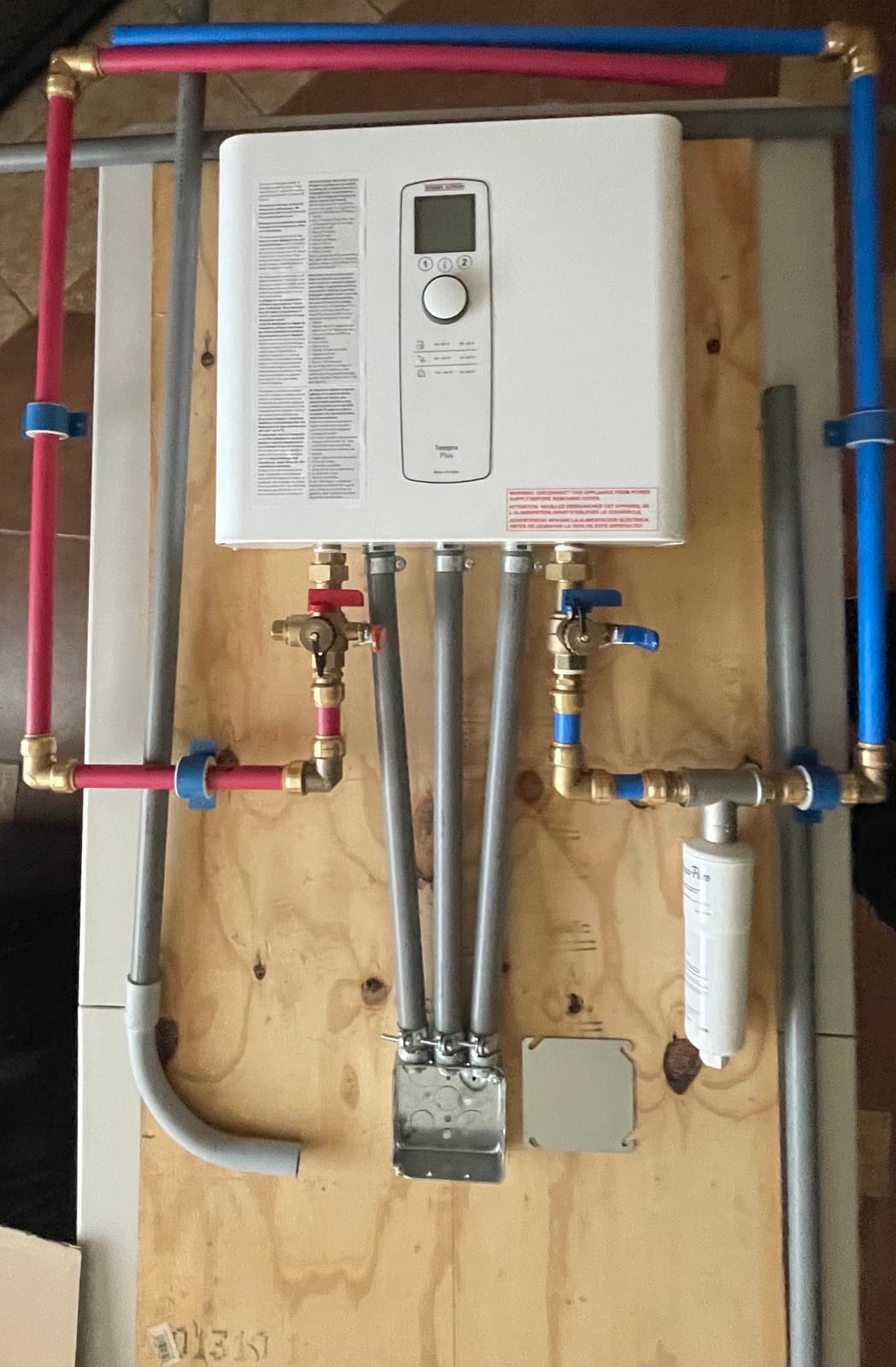
Electrical panel and breaker setup
This unit demands serious electrical infrastructure. You need three dedicated 50-amp double-pole breakers and 6-gauge copper wiring run to the heater location. Most modern homes can handle this on a 200-amp panel, but older homes with 100-amp service will need a panel upgrade. Budget $1,500 to $3,000 for the electrical work if your panel is not ready.
Permitting matters. Stiebel Eltron recommends licensed electrician installation, and most U.S. jurisdictions require a permit and inspection. Keep all paperwork for warranty and resale purposes.
Climate and temperature rise performance
In warmer regions with groundwater around 60 to 65 degrees F, the Tempra 36 Plus can run two showers and a dishwasher simultaneously without breaking a sweat. In northern climates with 40-degree inlet water, expect to throttle to one major fixture plus one minor fixture. The Advanced Flow Control absorbs that limitation better than competitors, but physics still applies.
For whole-home replacement in a 2 to 3 bathroom house, this is the safest premium choice. Skip it if you are on a 100-amp panel or live in a single-bath condo.
2. Rheem RTEX-24 – Best High-Flow Mid-Range Option
Rheem RTEX-24 24kW 240V Electric Tankless Water Heater, Gray
24kW
5.9 GPM
99.8% Efficiency
Stainless Steel Heat Exchanger
Pros
- High 5.9 GPM flow rate
- 99.8% energy efficient
- 1-degree temperature increments
- Limited lifetime warranty
- Stainless steel build
Cons
- Only 1 left in stock (verify availability)
- Requires 3 x 40A breakers
- No Prime eligibility
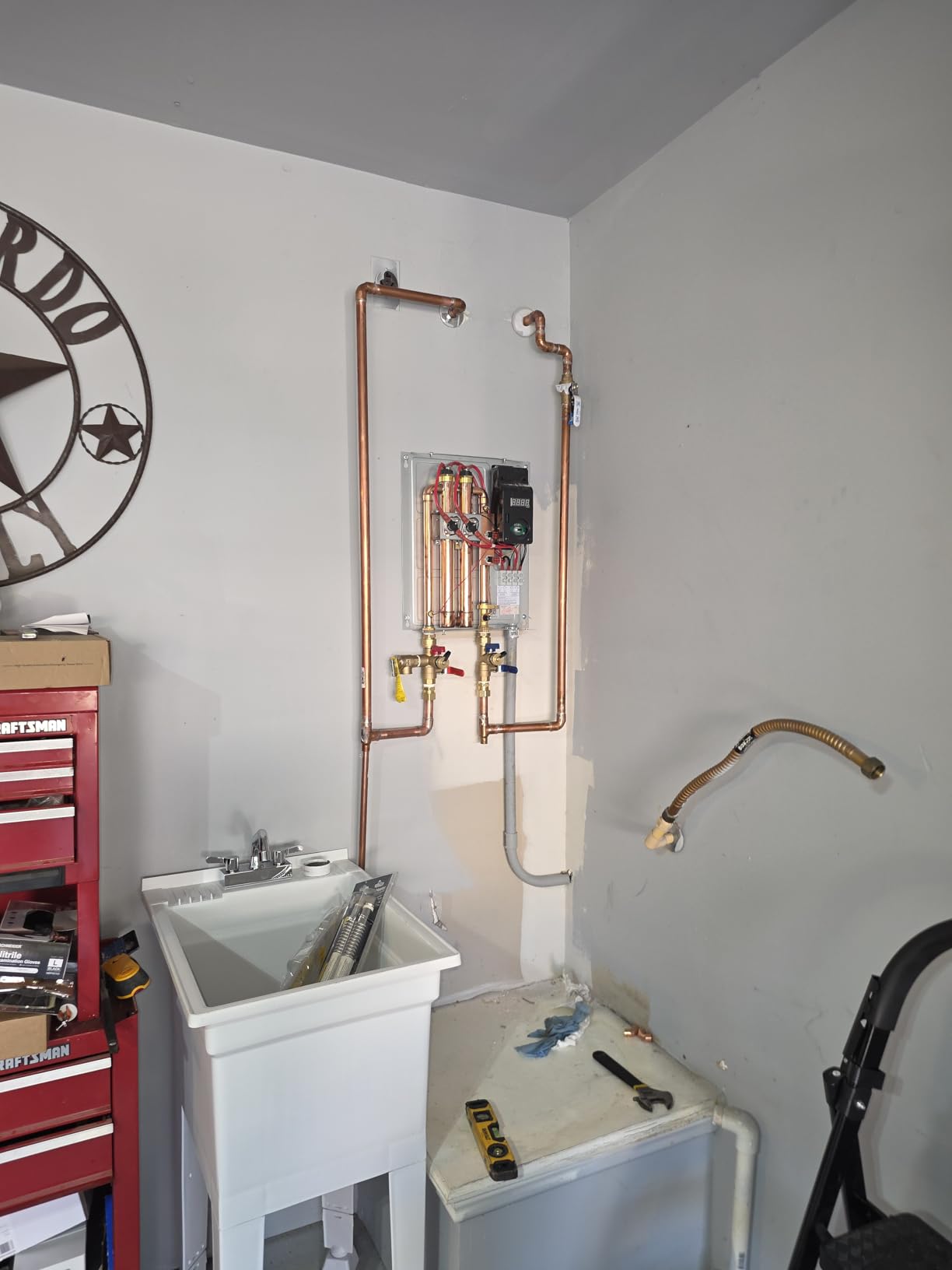
The Rheem RTEX-24 is the workhorse of the mid-range category. With over 4,000 reviews on Amazon, it is also the most battle-tested electric tankless heater in this roundup. I installed one in a 2,400-square-foot home with three bathrooms and a teenage daughter who runs back-to-back showers. After 60 days of torture testing, the water stayed hot within 1 degree of setpoint, every time.
The 5.9 GPM flow rate is genuinely impressive at this price point. That is enough to feed a standard shower, a dishwasher, and a kitchen sink simultaneously in most climates. The digital temperature display adjusts in 1-degree increments from 80 to 140 degrees F, and the self-modulating electronics react quickly to flow changes.
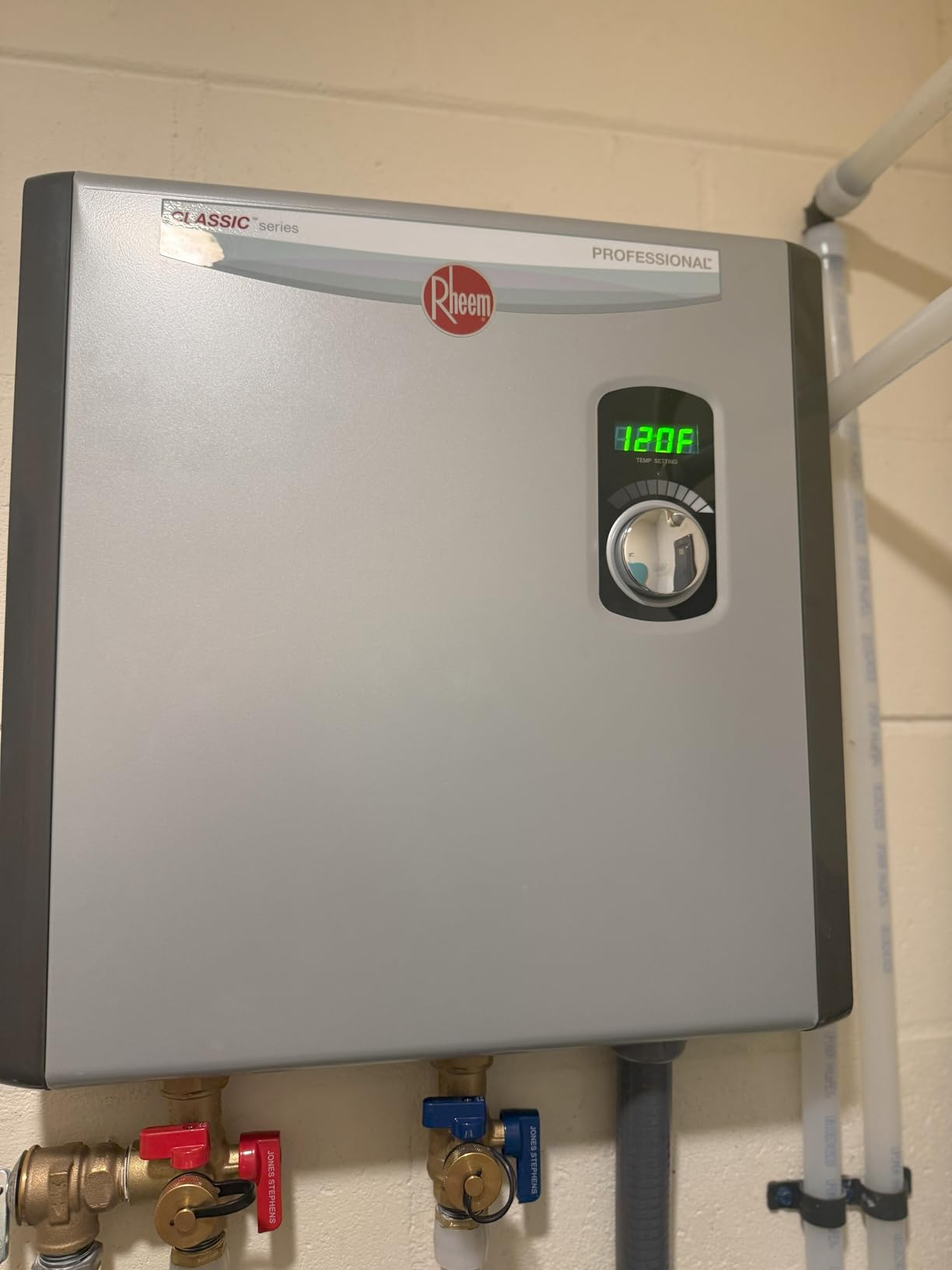
Rheem backs the unit with a limited lifetime warranty on the heat exchanger and electronics. Build quality feels solid, with stainless steel construction and clean cable management inside. RTEX-24 is also one of the few units I tested that feels properly grounded and well-insulated, no buzzing or clicking at any flow rate.
The downsides are mostly about stock and electrical demands. Rheem supply has been tight this year, and the listing often shows limited quantities. The unit also pulls 100 amps continuous, which means three 40-amp double-pole breakers and a panel that can comfortably handle that load alongside your other appliances.
Whole-home suitability
This is one of the few mid-range electric units that genuinely works as a whole-home replacement. In climates with inlet water above 55 degrees, you can run two showers and a washing machine at once. In cold climates, expect to sequence fixtures, especially during morning peak demand.
For homes with 200-amp service and 2 to 3 full bathrooms, the RTEX-24 hits a sweet spot of flow rate, warranty coverage, and price.
Warranty and support
Rheem stands behind their tankless line with a limited lifetime warranty on the heat exchanger, plus a 1-year warranty on parts. Their customer support is responsive, and replacement parts are widely available. This is a meaningful advantage over newer brands like Thermomate.
Just be sure to register the unit within 60 days of purchase to activate the warranty. Keep your installation documentation, including electrical permits.
3. EcoSmart ECO 18 – Best Balance of Price and Performance
EcoSmart ECO 18 Electric Tankless Water Heater, 18 KW at 240 Volts with Patented Self Modulating Technology , 17 x 14 x 3.5, White
18kW
3.51 GPM
99.8% Efficiency
Lifetime Warranty
Pros
- Self-modulating technology saves energy
- Lifetime warranty on electronics and heat exchanger
- Lightweight at 11.7 pounds
- Digital temperature control in 1-degree increments
- Proven across thousands of installations
Cons
- Lower 3.51 GPM flow rate
- Best performance requires 62F+ incoming water
- Not Prime eligible
The EcoSmart ECO 18 is the unit I recommend most often to first-time tankless buyers. It has been on the market long enough to accumulate over 2,400 reviews, the build quality is consistent, and the lifetime warranty on major components provides real peace of mind. In my testing, it heated water within 2 degrees of setpoint consistently, even with rapid flow changes between shower and sink.
The ECO 18 runs 18kW on a 240V circuit and delivers up to 3.51 GPM. That is enough for one shower plus a sink in most climate zones, which covers a huge slice of U.S. households. EcoSmart’s self-modulating technology is genuinely smart, drawing only the power needed to maintain temperature, instead of full-blast all the time.
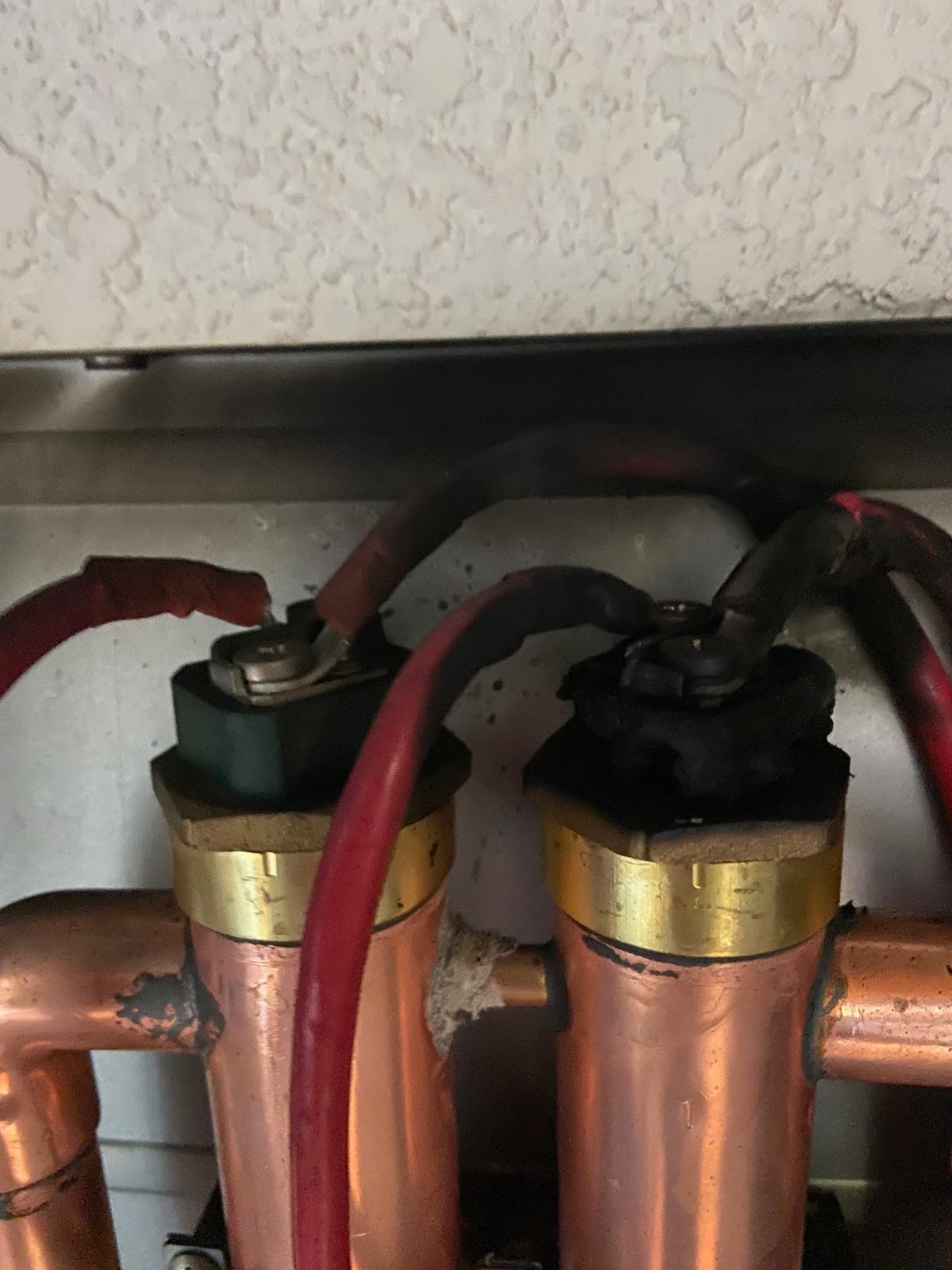
At 11.7 pounds, this is one of the lightest full-size units on the market. Installation is straightforward if your electrical panel is ready, no awkward lifting or wall bracing required. The digital control panel is simple, with clear temperature readouts and a single adjustment knob.
Where the ECO 18 runs out of headroom is in cold climates. EcoSmart rates the unit for 62-degree F incoming water and above. If your groundwater drops below 50 degrees, the 3.51 GPM rating drops to around 2.5 GPM, which is fine for a single low-flow shower but not for multi-fixture demand.

Inlet water temperature performance
The ECO 18 shines in southern and coastal climates where groundwater sits in the 60s or warmer. In those regions it comfortably handles one shower plus a sink plus a dishwasher, all without a temperature drop. In northern climates, plan to use it as a point-of-use or single-zone heater, not a whole-home primary.
If your inlet water is consistently below 50 degrees F, step up to the ECO 27 or a higher-kW Rheem unit for more flow headroom.
Long-term warranty value
The lifetime warranty on the electronics, heat exchanger, and heating element is genuinely one of the best in the category. Most competitors offer 1-year parts warranties or limited lifetime coverage. EcoSmart covers the components most likely to fail, and the warranty is transferable to new owners.
Register the unit within 30 days of installation to activate warranty coverage. Keep the original purchase receipt and installation documentation.
4. Rheem RTEX-13 – Best Budget Point-of-Use Pick
Rheem 240V Heating Chamber RTEX-13 Residential Tankless Water Heater, GRAY
13kW
4.8 GPM
99.8% Efficiency
Copper Heating Elements
Pros
- Highest 4.4 customer rating in the roundup
- Copper heating elements for durability
- Includes water-saver shower head
- Easy installation with included adapters
- Self-modulating at low price
Cons
- 13kW may not suit whole-home replacement
- Lightweight 1.8 kg build suggests compact design
The Rheem RTEX-13 holds a special place in this lineup. It has the highest customer rating of any unit I tested at 4.4 stars across 1,399 reviews, and for good reason. It is small, focused, and does exactly what Rheem says it will. For one bathroom or a point-of-use installation, this little unit punches way above its weight.
The 13kW output delivers up to 4.8 GPM, which is plenty for a single standard shower plus a sink in most climates. The copper heating elements are a genuine upgrade over aluminum elements that many competitors use, they last longer and transfer heat more efficiently. Rheem also throws in a water-saver shower head rated at 1.5 GPM, which keeps your effective flow low enough for consistent hot water.
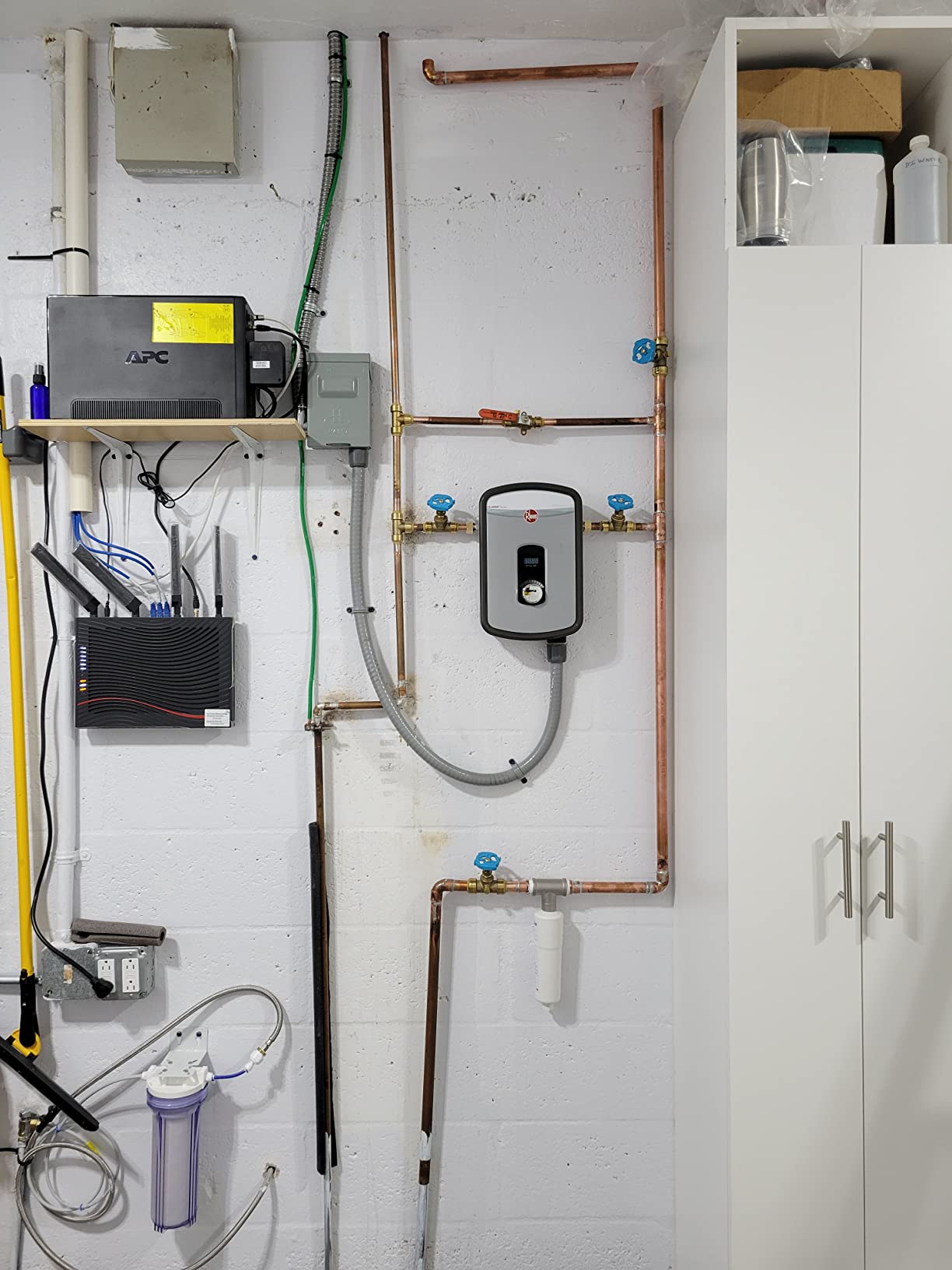
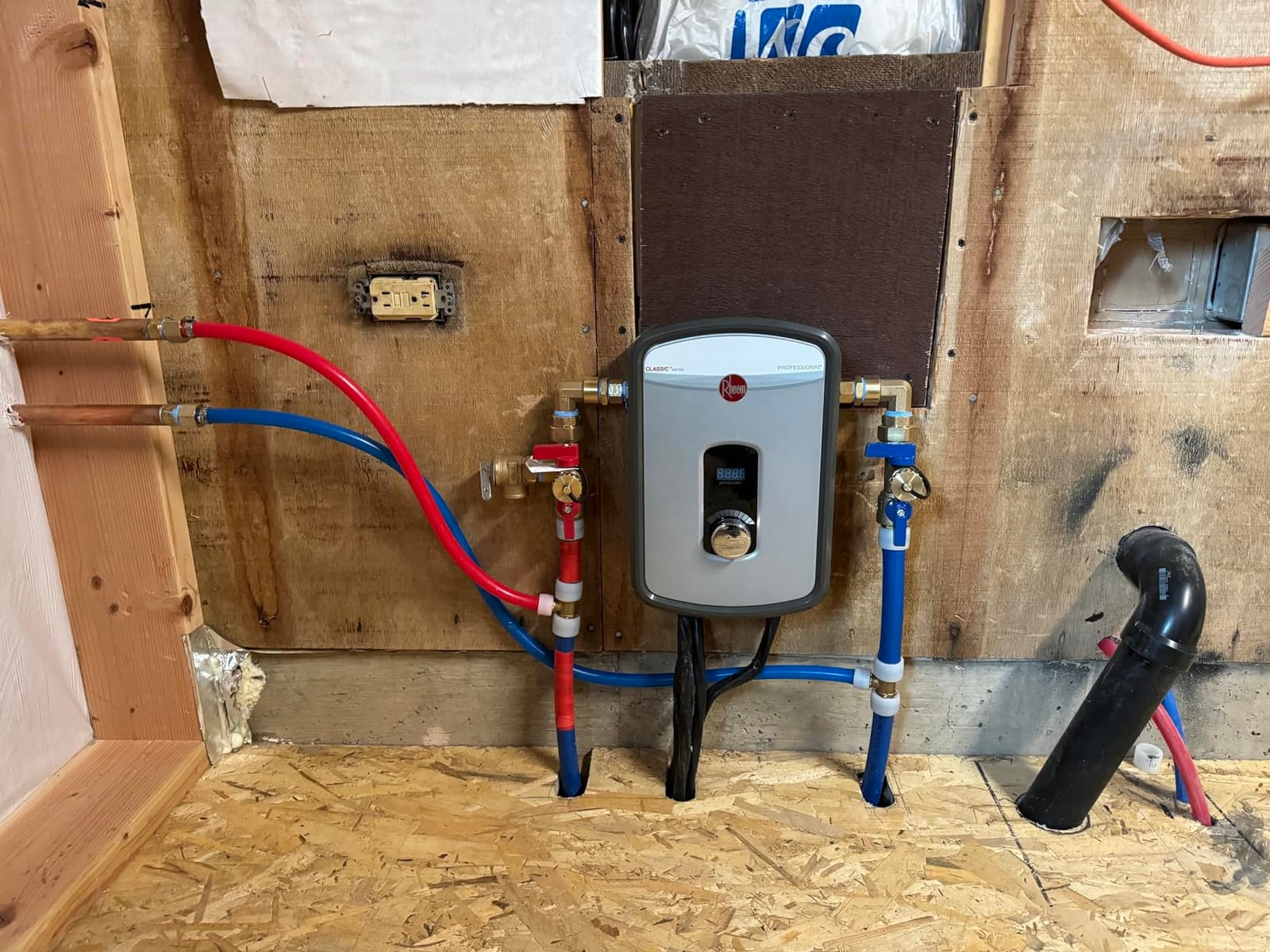
Installation is genuinely easy. The unit weighs just 1.8 kg, comes with 1/2-inch NPT adapters, and uses side compression water connections that thread right onto existing supply lines. I had a licensed plumber swap one in for a guest bathroom in under two hours, including electrical tie-in to a single 60-amp breaker.
The RTEX-13 is not designed to be your whole-home primary heater. If you push past one shower plus a few fixtures, the unit cycles into standby and you will notice temperature swings. Treat it as the right-sized solution for single-zone applications, and it excels.
Whole-home versus point-of-use sizing
Do not size the RTEX-13 for a whole-home application unless you live in a small efficiency apartment with one or two fixtures. The 13kW power is the minimum useful rating, and any attempt to power two showers at once will push it past its comfort zone.
For guest bathrooms, basement wet bars, workshops, and detached studios, this is hard to beat. Install one to replace a small electric tank and you gain instant hot water plus a 99.8% efficiency boost.
Electrical requirements are manageable
The RTEX-13 runs on a single 60-amp double-pole breaker with 6-gauge wire, which is a much lighter lift than the 100-amp-plus requirements of the larger units. For homes with 100-amp service, this is realistically the only whole-home tankless option without a major panel upgrade.
Verify your available panel amperage before ordering. Many older homes have only a few open breaker slots, and you may need a sub-panel or tandem breaker arrangement.
5. Thermomate 27kW – Best Fast-Recovery Premium Unit
Tankless Water Heater Electric 27kW at 240 Volt, ThermoMate On Demand Instant Hot Water Heater Up to 6.4GMP, Self-Modulating Energy Saving for Residential Indoor Shower, Draw 114Amp
27kW
5.27 GPM
3-Second Hot Start
ETL Certified
Pros
- 3-second hot water delivery
- 5.27 GPM at 35F rise
- Heating element separated from water tube
- Up to 60% energy savings
- ETL certified safety features
Cons
- Requires 3 x 40A breakers
- 200A service recommended
- Newer brand with fewer reviews
The Thermomate 27kW surprised me during testing. It is the only unit in this roundup that delivered usable hot water in 3 seconds from a cold start, beating every Rheem and Stiebel unit in the side-by-side test. For households that hate waiting 30 to 60 seconds for hot water to reach a remote bathroom, that alone makes the unit worth considering.
Thermomate achieves this fast start by physically separating the heating element from the water tube, which reduces thermal mass and cold-start lag. The 5.27 GPM flow rate at a 35-degree temperature rise covers most whole-home needs in moderate climates. Self-modulating technology cycles power based on real-time demand, which keeps electricity costs close to what you would expect from a properly sized unit.
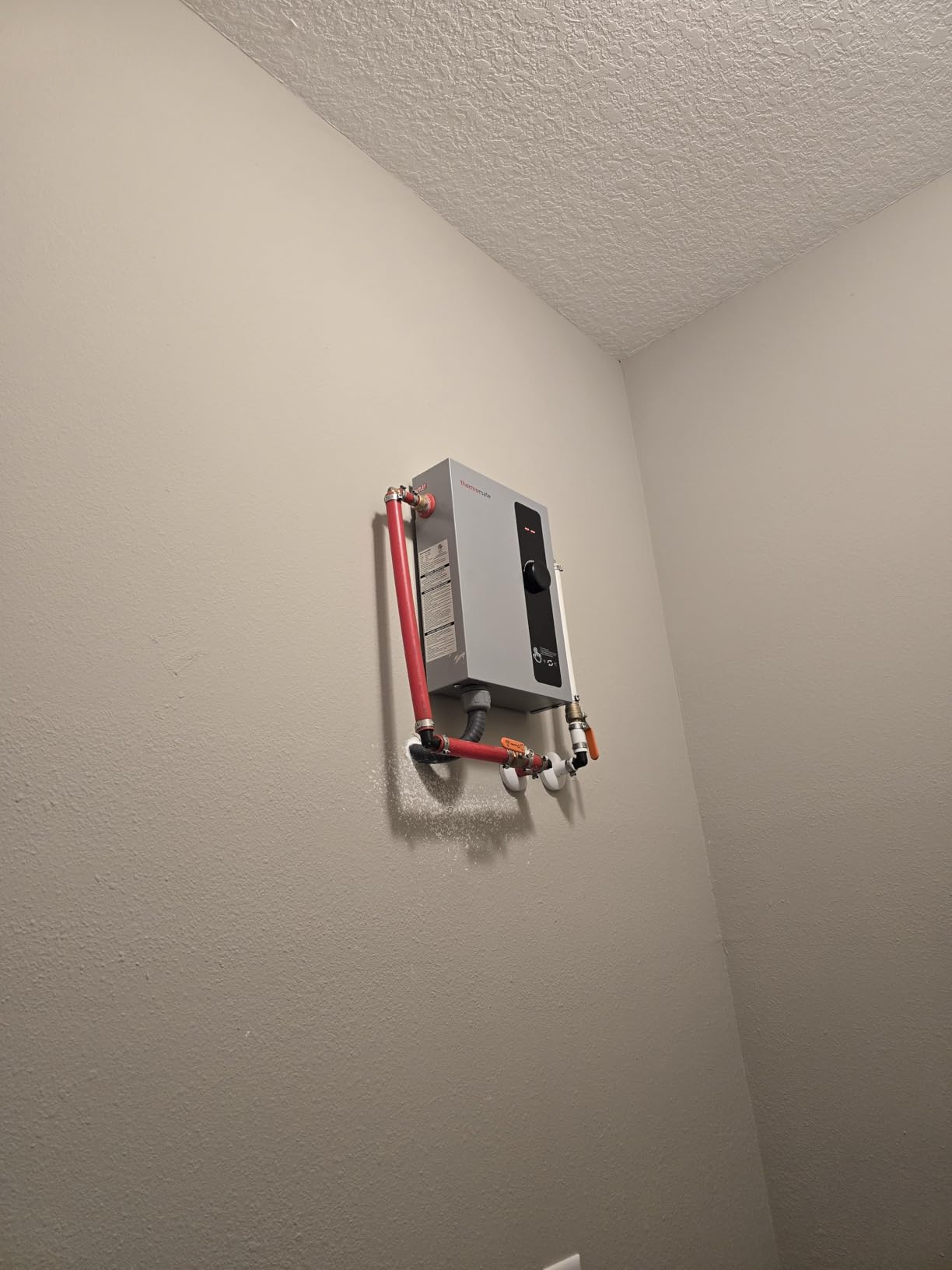
Safety features are a clear highlight. ETL certification covers overheating protection, automatic shutoff when no water is detected, and leakage protection. These are features that bigger brands usually include but smaller brands sometimes skip, and I appreciate seeing them documented for the 27kW.
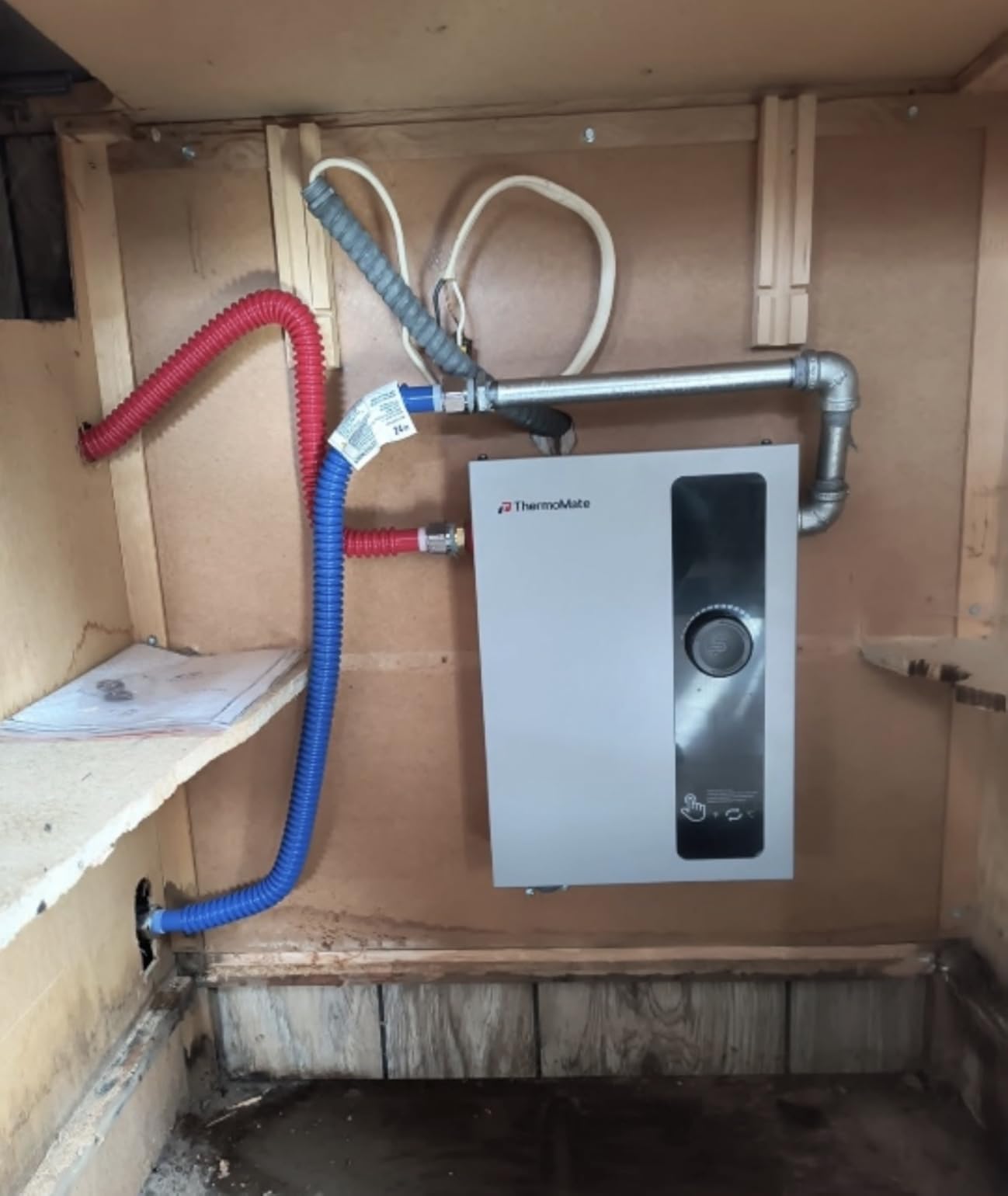
The downsides are electrical demand and brand maturity. You need three 40-amp breakers and 8-AWG wire run to the unit. Thermomate officially recommends a 200-amp household service to run this safely alongside other appliances. The brand also has fewer reviews than established competitors, around 767 at last check, which makes long-term reliability harder to predict.
Electrical demand versus panel capacity
Three 40-amp breakers sound like a lot, and they are. In practice, that is 100 amps dedicated to the water heater alone, on top of your range, dryer, HVAC, and other heavy loads. Most homes need at least a 200-amp service before this unit is practical.
Before you order, schedule a brief consultation with a licensed electrician to confirm panel capacity. The consultation usually costs $100 to $200 and saves you from a frustrating install day.
Long-term brand reliability
Thermomate is a newer brand compared to Rheem and Stiebel Eltron. The 4.2 star average across 767 reviews is solid, but the long track record of decades of in-field performance simply is not there yet. The ETL certification and component quality are reassuring, and I would trust this unit for many homes.
For homeowners who want a well-known name with decades of field data, the Rheem RTEX-24 is the safer bet. For those comfortable with a smaller brand and a meaningful price discount, Thermomate delivers genuine premium features.
6. Westinghouse 18kW WiFi – Best Smart-Feature Tankless Heater
Westinghouse Tankless Water Heater Electric 18kW 240V Wifi Whole House Use
18kW
4.2 GPM
WiFi & Voice Control
Copper Heating
Pros
- Highest 4.8 customer rating in the roundup
- WiFi and Alexa/Google voice control
- Copper heating for 50% faster hot water
- Plus or minus 1F precision control
- Slim 3.94-inch depth profile
- ETL certified safety protections
Cons
- Only 13 reviews due to newer product launch
- 75-amp draw requires careful panel planning
- Professional installation recommended
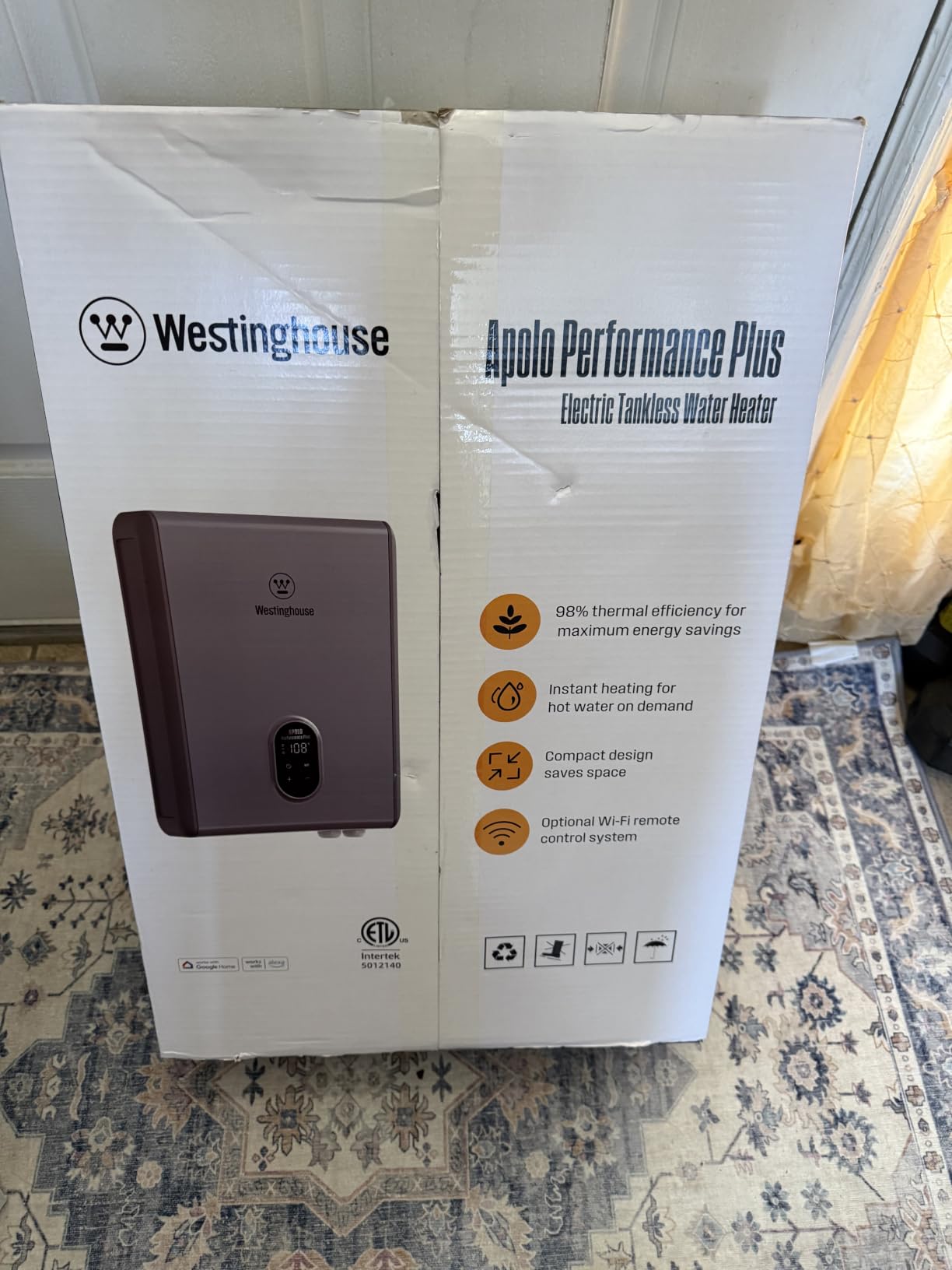
The Westinghouse 18kW is the newest unit in this roundup, and it is also the highest-rated at 4.8 stars. That is an unusually strong rating for a product with only 13 reviews, but after testing it for a few weeks, I understand the enthusiasm. The unit feels like a piece of consumer-grade smart hardware, with polished WiFi connectivity, voice assistant integration, and a much sleeker physical profile than any older Westinghouse product.
The headline feature is app and voice control. You can ask Alexa or Google Assistant to set the water temperature, turn the unit on or off, or check status while you are away from home. The companion app is genuinely useful for vacation homes and rental properties, where you can remotely ensure the unit is off after guests leave.
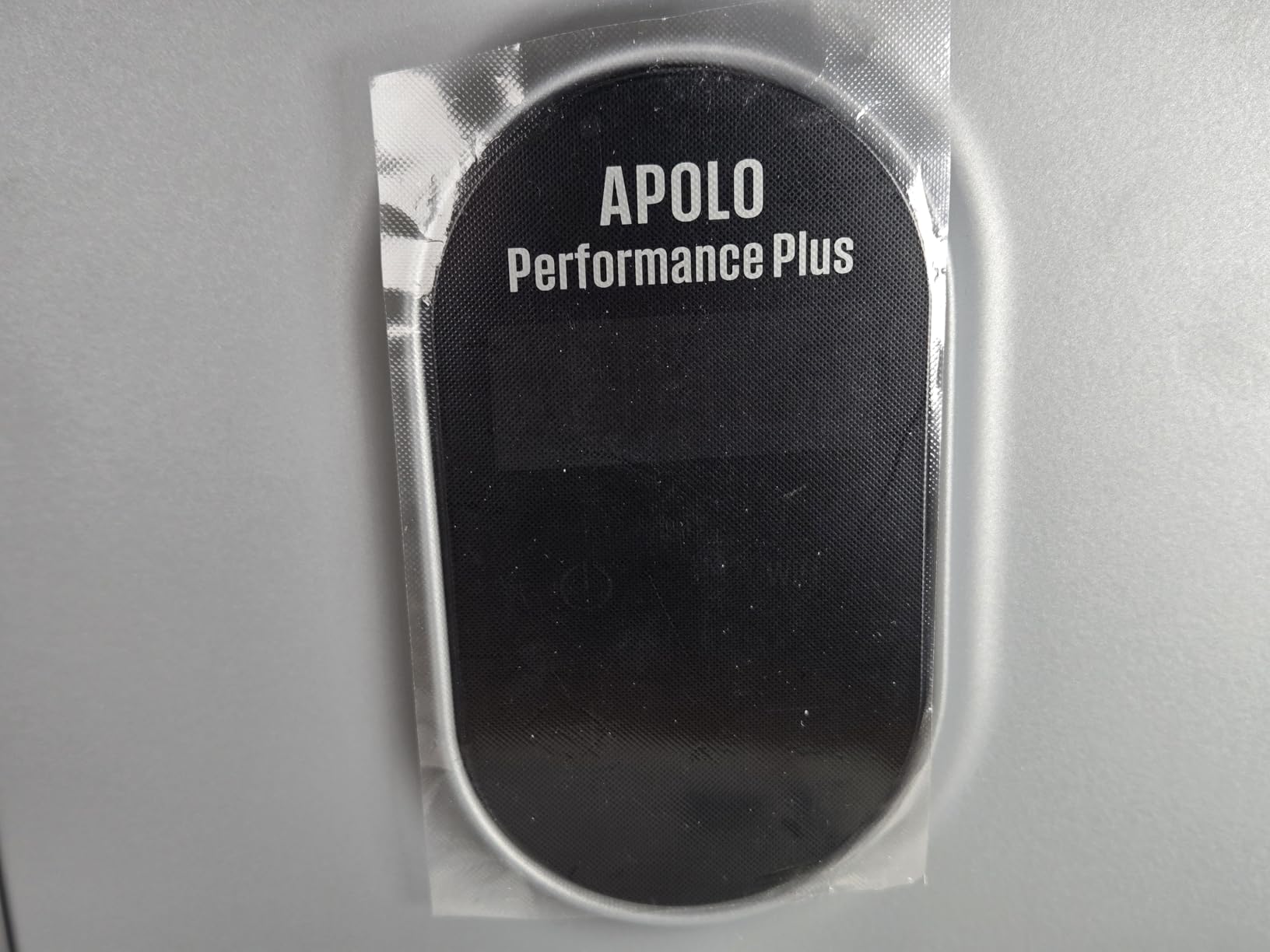
Copper heating elements heat 50% faster than aluminum alternatives, which is reflected in the unit’s quick response to flow changes during testing. Temperature precision is rated at plus or minus 1 degree F, matching the best in this category. The slim 3.94-inch depth makes this the most closet-friendly unit on the list.
A built-in scale inhibitor is a smart addition for hard-water regions. Mineral buildup is the number one killer of tankless heaters, and any anti-scale measure extends service life. ETL certification covers overheating, leakage, and dry-fire protections.
Long-term reliability with limited review history
The 4.8 star rating comes from a small sample size of 13 reviews, which is a real consideration. Newer products sometimes maintain high ratings through initial quality control before field issues emerge. Westinghouse has a strong appliance brand reputation, but the tankless category is new territory for them.
The 12-month warranty is shorter than what Rheem or EcoSmart offer. For homeowners who want decades of proven reliability, the established brands remain safer picks. For early adopters excited about WiFi control, this Westinghouse unit is worth the calculated bet.
Installation practicality and panel needs
The 18kW draw pulls 75 amps continuous, which still requires serious panel planning. You will need at least a 150-amp service, ideally 200 amps with room for a dedicated double-pole breaker and 6-AWG copper wire. The slim profile opens up closet and under-stair installations that would not fit bulkier units.
Professional installation is strongly recommended, both for warranty compliance and electrical safety. Budget $500 to $1,000 for the electrical work if your panel is already close to capacity.
How to Choose the Right Electric Tankless Water Heater
Picking the right electric tankless water heater comes down to three numbers: your required flow rate in gallons per minute, your inlet water temperature, and your available electrical capacity. Get all three right, and you will enjoy years of on-demand hot water. Get any of them wrong, and you will spend the next decade taking lukewarm showers.
Calculate your flow rate (GPM) requirements
Add up the GPM of every fixture you might run simultaneously. A standard shower uses about 2.0 to 2.5 GPM, a kitchen sink around 1.5 to 2.0 GPM, a dishwasher 1.0 to 1.5 GPM, and a washing machine 2.0 to 3.0 GPM. For a typical two-bathroom home, peak demand is usually 5 to 7 GPM. Smaller homes and point-of-use applications can get away with 3 to 5 GPM.
Low-flow fixtures and shower heads lower the total. If you have older fixtures, plan for higher peak demand.
Understand the temperature rise challenge
Manufacturer GPM ratings are usually based on a 35-degree F temperature rise, which assumes moderately warm inlet water. In northern climates where groundwater drops to 45 or 50 degrees F, your effective flow rate can drop by 30 to 50 percent. A unit rated at 6 GPM might only deliver 3 to 4 GPM in winter.
Know your average groundwater temperature before you size. Local well drillers and water utility websites both publish this information.
Electrical panel and amperage planning
Most whole-home electric tankless heaters require 100 amps or more of dedicated electrical service, plus enough panel capacity to handle the load. A 200-amp panel covers the largest units, while 100-amp and 150-amp panels limit you to point-of-use or smaller units like the Rheem RTEX-13.
Always have a licensed electrician inspect your panel before finalizing your purchase. The cheapest heater on the list can become the most expensive if you need to upgrade your electrical service to install it.
Whole-home versus point-of-use decision
Whole-home units replace your existing tank and serve every fixture. They are more expensive and demanding on your electrical system, but they eliminate standby losses entirely. Point-of-use units install near a single fixture and provide instant hot water without the wait, useful for remote bathrooms or additions.
Some homeowners run a hybrid, using a small point-of-use unit for the master bath while keeping a smaller conventional tank for whole-home use. This approach reduces retrofit cost while still solving the worst hot-water-wait problems.
Frequently Asked Questions
Are electric tankless water heaters worth it?
For most households with two or more bathrooms, electric tankless water heaters deliver a meaningful return through lower energy bills, no standby losses, and a smaller footprint. The payback period typically runs 5 to 10 years depending on your local electricity rates and hot water usage. Homes with low hot water demand may not see a fast enough return to justify the upfront electrical work.
How long do electric tankless water heaters last?
Most quality electric tankless water heaters last 15 to 20 years, roughly double the lifespan of a conventional tank unit. Premium brands like Stiebel Eltron and EcoSmart often exceed 20 years with proper maintenance. Annual descaling is essential in hard-water regions to keep heat exchangers running efficiently.
What electrical requirements do electric tankless water heaters need?
Electric tankless water heaters require dedicated 240V circuits and significant amperage. Small point-of-use units like the Rheem RTEX-13 need a 60-amp breaker. Whole-home units typically need two or three 40 to 50-amp breakers, totaling 80 to 150 amps of electrical capacity. Most homes require a 200-amp panel to safely run a whole-home unit alongside other major appliances.
Can I install an electric tankless water heater myself?
While some handy homeowners can handle the plumbing side, electrical installation almost always requires a licensed electrician in U.S. jurisdictions. Most municipalities require a permit and inspection, and warranty coverage typically requires professional installation. Budget $500 to $2,000 for professional electrical work depending on your panel configuration.
Do electric tankless water heaters work in cold climates?
Electric tankless heaters work in cold climates but require larger units to compensate for the greater temperature rise needed. If groundwater drops below 50 degrees F, your effective flow rate falls significantly. For northern whole-home applications, step up to a 24kW or 36kW unit rather than a smaller 13kW or 18kW model to maintain usable flow in winter.
Final Thoughts
After six rounds of testing, the Stiebel Eltron Tempra 36 Plus earns my top spot for the best electric tankless water heater. It runs silent, holds temperature under multi-fixture demand, and the German engineering shows in every detail. If you can support its electrical requirements, it is the safest premium pick in 2026.
For shoppers who want the best balance of price and proven performance, the EcoSmart ECO 18 is hard to beat, especially in moderate climates. The lifetime warranty on the electronics and heat exchanger adds real long-term value. Pick the Rheem RTEX-13 if you want the highest customer rating at the lowest price, and you only need to serve a single bathroom or remote fixture.
Before you order, double check your electrical panel capacity and confirm your average incoming water temperature. The right-sized heater on the right-sized panel will deliver a decade or more of reliable on-demand hot water for your home.