
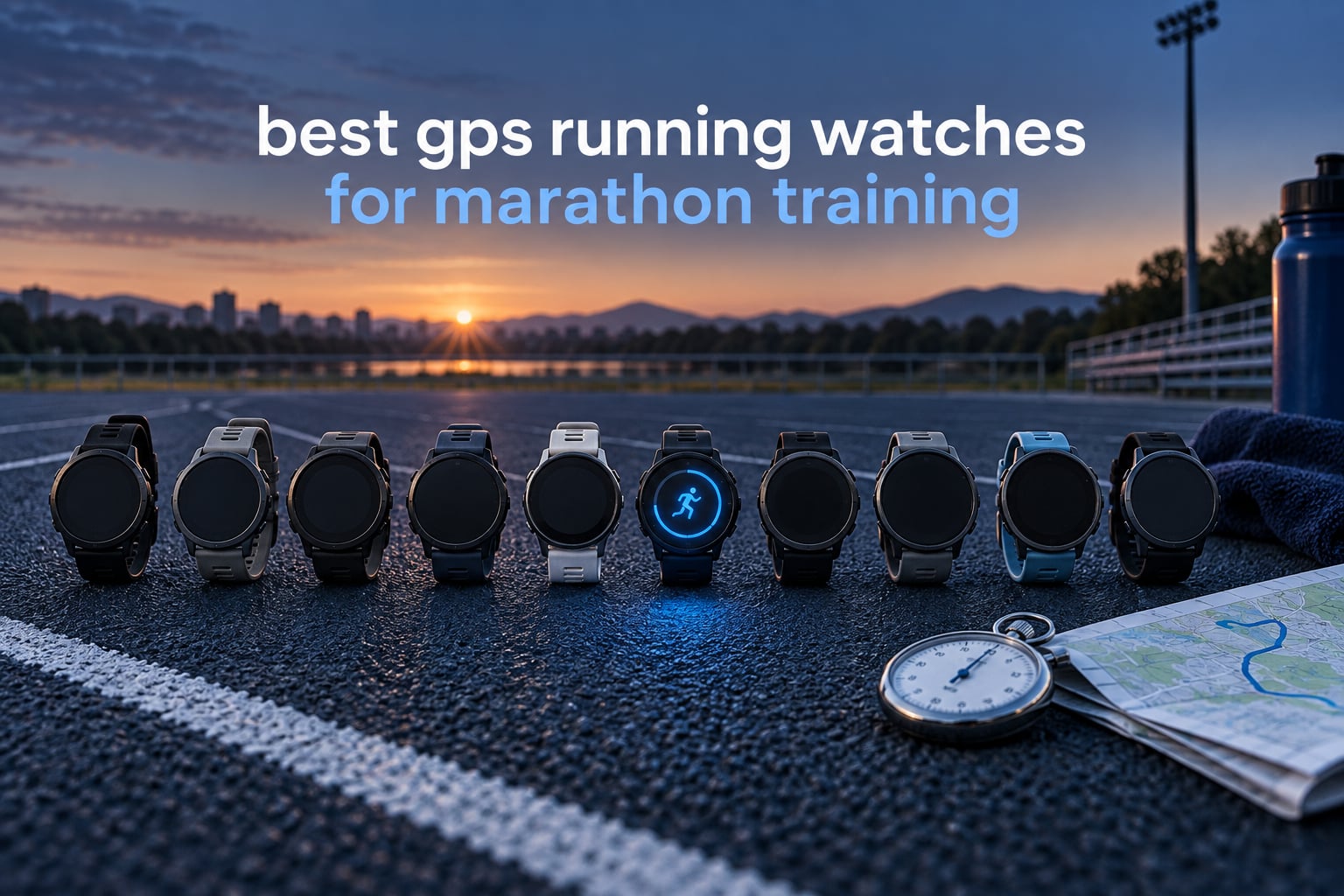
A 16-week marathon block is hundreds of miles of repetition, and the watch on your wrist is the only coach that never misses a session. The best GPS running watches for marathon training do three jobs at once: they hold a clean GPS line through a four-hour long run, they tell you when a tempo pace is drifting, and they feed your training load and recovery data back into the plan for the week ahead.
Most buying guides lead with headline GPS battery hours. That number is close to meaningless for marathon training, because every watch in this roundup comfortably covers 26.2 miles. The question that actually matters is how the watch behaves across a whole block, with always-on display, notifications, and daily wear between the long runs. We frame the whole roundup around that difference.
Direct answer: the Garmin Forerunner 265 is the best GPS running watch for most marathoners, because its 46mm AMOLED case, multi-band GNSS with SatIQ, training readiness, and 20 hours of GPS cover a full block without fuss. Runners chasing the longest battery and the lowest weight should look at the COROS PACE 4 instead.
How we picked: we compared ten current running watches across GPS modes, sensor stacks, case weight, training engines, and app ecosystems. Battery figures, weights, and display specs come from manufacturer listings, and we flag them as such rather than publishing drain numbers we cannot verify. Prices and configurations change constantly, so treat every figure here as a snapshot and confirm the live price at the retailer before you buy.
If you are still building the rest of your kit, our guide to the best marathon running shoes for beginners covers the footwear side, and our picks for the best GPS handheld devices are worth a look for runners who also hike the course on foot before race day.
Table of Contents
Top 3 Picks for Marathon Training in October 2026

Garmin Forerunner 265
- 1.3 inch AMOLED
- 46mm case
- 47g
- 20 hours GPS
- multi-band GNSS with SatIQ
- training readiness and race widget
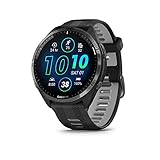
Garmin Forerunner 965
- 1.4 inch AMOLED
- 47mm titanium bezel
- 53g
- 31 hours GPS
- full-colour offline maps
- running dynamics

COROS PACE 4
- 32g ultralight
- 1.2 inch AMOLED
- 41 hours GPS
- dual-frequency GPS
- breadcrumb navigation
Best GPS Running Watches for Marathon Training in October 2026
The full lineup below covers everything from a 30g transflective budget watch to a titanium multisport flagship. GPS battery figures are manufacturer-stated maximums in the most demanding mode, and every number moves with your chosen settings.
| Product | Specifications | Action |
|---|---|---|
| Garmin Forerunner 265 |
|
Check Latest Price |
 Apple Watch Ultra 3 Apple Watch Ultra 3 |
|
Check Latest Price |
| Garmin Forerunner 965 |
|
Check Latest Price |
 COROS PACE Pro COROS PACE Pro |
|
Check Latest Price |
| COROS PACE 4 |
|
Check Latest Price |
 SUUNTO Race S SUUNTO Race S |
|
Check Latest Price |
 POLAR Vantage M3 POLAR Vantage M3 |
|
Check Latest Price |
 COROS PACE 3 COROS PACE 3 |
|
Check Latest Price |
 Garmin Forerunner 970 Garmin Forerunner 970 |
|
Check Latest Price |
 SUUNTO 9 Peak SUUNTO 9 Peak |
|
Check Latest Price |
1. Garmin Forerunner 265 – The Best GPS Running Watch for Most Marathoners
Garmin Forerunner® 265, Running Smartwatch, 46mm, Black/Powder Gray
1.3 inch AMOLED
46mm case, 47g
20 hours GPS
Multi-band GNSS with SatIQ
Pros
- Bright AMOLED touchscreen readable in direct sunlight
- Multi-band GNSS with SatIQ for reliable positioning
- Training readiness and HRV status guide long-run planning
- Race widget adapts daily workouts to your target race
- 30+ activity profiles for cross-training
Cons
- 8 GB storage limits offline music
- No LTE so calls and messages need a nearby phone
- Wrist heart rate trails a chest strap on interval work
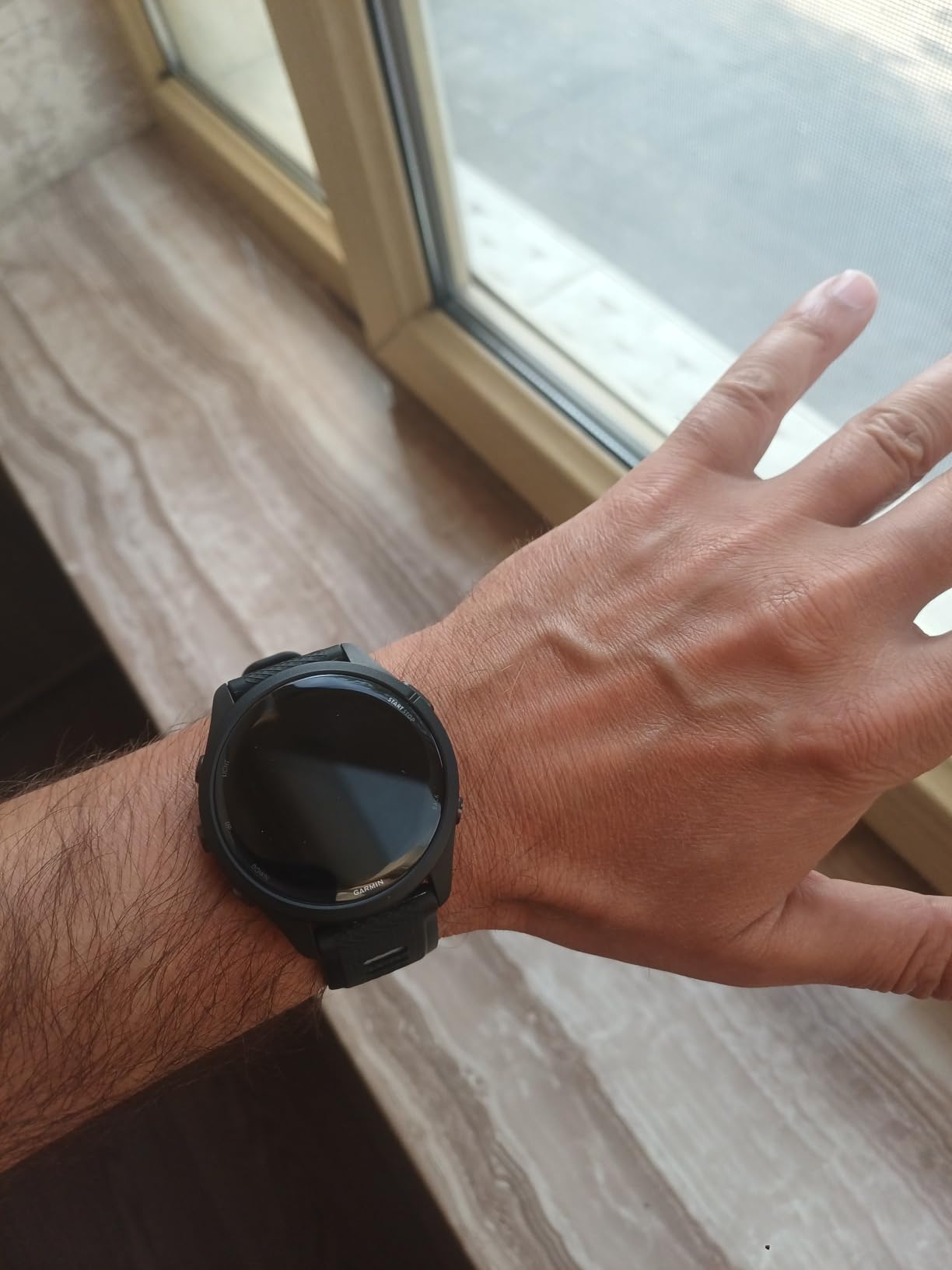
The Forerunner 265 is the watch I keep recommending to runners who want one device to carry a whole block. At 47g in a 46mm case with buttons on the side, it disappears on the wrist during a long run and stays comfortable overnight for sleep tracking, which is the input behind the readiness score that most marathoners will actually use. In the price band it sits in, that combination is hard to find elsewhere.
The 1.3-inch AMOLED panel is bright enough to read at a glance in open sun, and the physical buttons mean you can start a workout with sweaty hands mid-tempo session. Multi-band GNSS with SatIQ handles the urban canyon stretches where cheaper single-band watches drift and inflate distance.
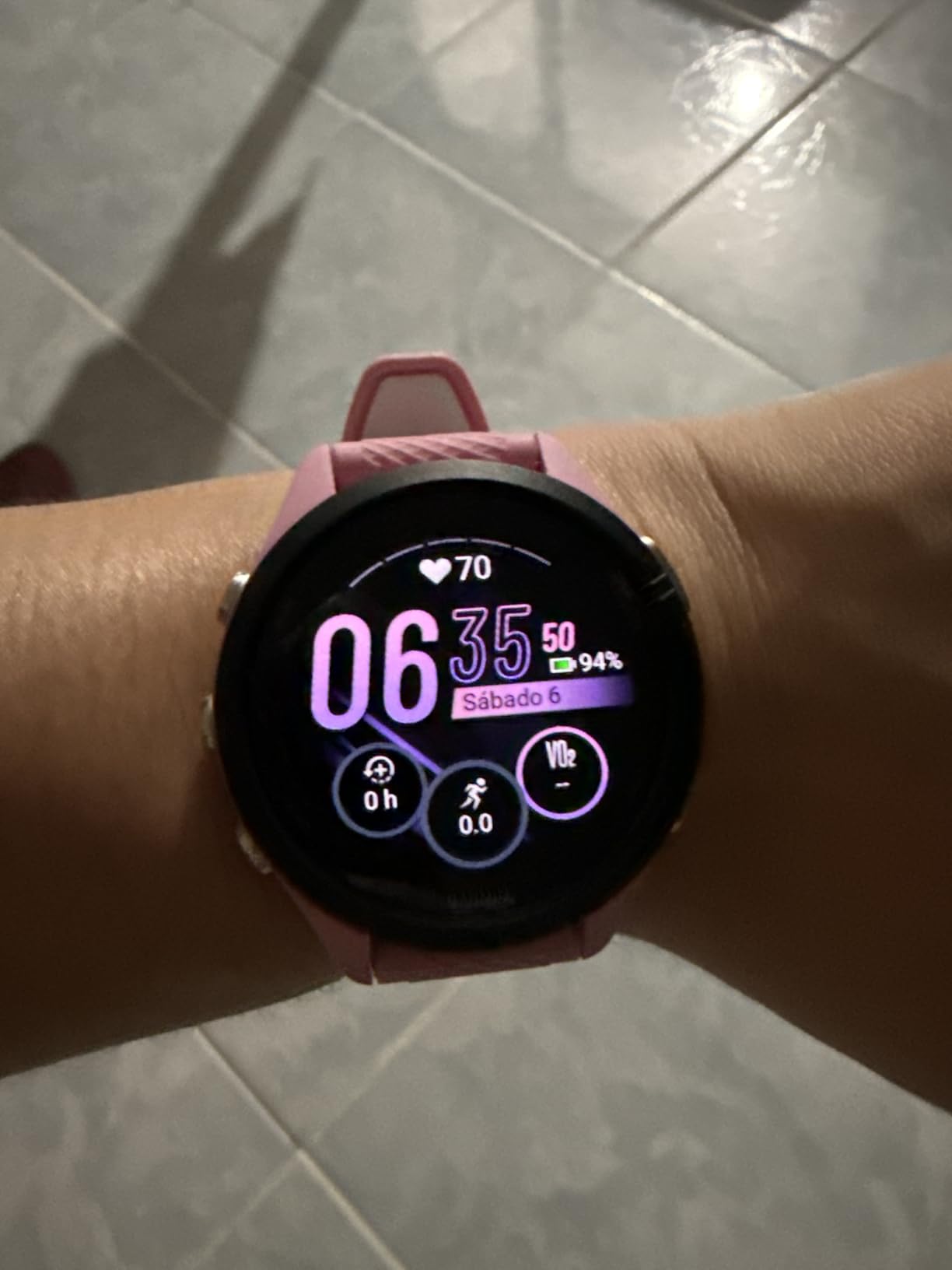
The training side is where this watch earns its place. Training readiness, training status, and HRV status combine sleep quality, recovery, and acute load into a morning report, and the race widget adapts daily suggested workouts to the race and course you enter in Garmin Connect. For a first marathoner, that is the difference between guessing and following a plan.
Twenty hours of GPS is more than a marathon, though it leaves less slack than the 31-hour and 38-hour watches here, so pick a longer-runtime model if you also train with the screen always on. The 8 GB of internal storage is genuinely tight for music, and there is no LTE, so your phone still handles notifications and calls.
What the 265 gets right for a marathon block
Readiness-based guidance is the feature that changes behaviour. On a high-readiness morning after an easy week, the suggested long run is there and ready; on a low-readiness morning, the same plan asks you to back off, which is how most runners blow up a taper.
Fit matters here too. The 46mm case sits in the middle of the size range, so it works for average wrists without the overhang runners complain about on 47mm bodies, and 47g is light enough for all-day wear.
Where the 265 falls short
Buy the Forerunner 965 instead if your training includes point-to-point long runs where offline maps matter, or if you want 31 hours of GPS and 32 GB of storage for music. The 265 is the smarter buy if your long runs are loops from the same door, which describes most of us for most of the year.
Buy the COROS PACE 4 if battery is your top worry. At 41 hours of continuous GPS and 32g, it outlasts the 265 by a wide margin and costs less, at the price of a smaller app ecosystem and a less detailed training engine.
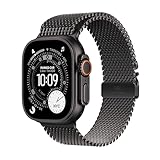
2. Apple Watch Ultra 3 – Best for Runners Who Also Carry an iPhone All Day
Apple Watch Ultra 3 [GPS + Cellular 49mm] Running & Multisport Smartwatch w/Rugged Titanium Case w/Black Titanium Milanese Loop – L. Satellite Communications, Advanced Health & Fitness Tracking
49mm titanium case
Sapphire crystal
Dual-frequency GPS
Cellular connectivity
Pros
- Battery life roughly double a standard Apple Watch
- Precision dual-frequency GPS with Pacer and running power
- Titanium case and sapphire crystal survive rough use
- Cellular lets you run without carrying a phone
- Mature ECG sleep and blood oxygen tracking
Cons
- Needs daily charging for heavy daily use
- Interface takes time to learn
- Metal bands can scratch the display
The Ultra 3 is the only watch in this roundup that doubles as a full phone. Cellular connectivity means you can leave the iPhone at home on a long run, stream music, and still be reachable, which removes a real friction point for runners who wear one device for training and daily life.
For marathon training, the relevant parts are dual-frequency GPS, Pacer for structured race pacing, heart rate zones, custom workouts, running power, and training load in a single unified view. The display emits more light at wider angles than earlier Apple Watches, which is the practical difference when you glance at pace at mile 20.
![Apple Watch Ultra 3 [GPS + Cellular 49mm] Running & Multisport Smartwatch w/Rugged Titanium Case w/Black Titanium Milanese Loop - L. Satellite Communications, Advanced Health & Fitness Tracking customer photo 1](https://eatcreatesleep.net/wp-content/uploads/2026/09/B0FQG17FTN_customer_1.jpg)
The health and recovery suite is unusually mature for a running watch, with ECG, atrial fibrillation notifications, Vitals, sleep score, and blood oxygen. Treat all of it as training and wellness data rather than medical guidance, but the sleep and readiness signals do feed your training decisions.
Battery is still the constraint that shapes a marathon plan. Up to 42 hours in normal use covers a long run and a full day comfortably, but the charging habit never really goes away the way it does on a multi-week watch, and you need to plan a charge before race week rather than assuming one.
![Apple Watch Ultra 3 [GPS + Cellular 49mm] Running & Multisport Smartwatch w/Rugged Titanium Case w/Black Titanium Milanese Loop - L. Satellite Communications, Advanced Health & Fitness Tracking customer photo 2](https://eatcreatesleep.net/wp-content/uploads/2026/09/B0FQG17FTN_customer_2.jpg)
When the Ultra 3 makes sense
It suits the runner who already lives inside the Apple ecosystem and does not want a second screen, a second charger, and a separate mental model for training. Strava, TrainingPeaks, and structured workouts are set up through the phone rather than a watch-first workflow, which many runners find faster.
The 49mm titanium body is large. If you have a smaller wrist and run marathons in a watch that rotates, check the fit before buying, and consider adding a screen protector since owners report metal bands scratching the crystal over time.
Where it is the wrong tool
It is the wrong tool if you care about GPS accuracy above all, or if you want wrist-based training load and readiness data that a dedicated running watch calculates differently. Wrist heart rate on the Ultra is no better than a Garmin optical sensor for interval precision.
It is also the wrong pick if charging anxiety is already your main race-week worry. Every multi-week watch on this list removes that problem, and for a first marathoner that is a bigger deal than cellular calling.
3. Garmin Forerunner 965 – The Most Versatile for Multi-Day GPS Endurance
Garmin Forerunner® 965, Running Smartwatch, 47mm, Black/Powder Gray
1.4 inch AMOLED
47mm case, 53g
31 hours GPS
Full-colour offline maps
Pros
- Runners report finishing marathons with power to spare
- Full-colour built-in maps for long and point-to-point runs
- Responsive buttons work with sweaty hands
- Training readiness and race predictor guide pacing
- Multisport profiles for brick and race weeks
Cons
- 47mm case is large on small wrists
- No LTE so calls need a nearby phone
- Wrist heart rate can lag on hard efforts
The Forerunner 965 is the marathon training watch I would buy with my own money if budget were not the question. Thirty-one hours of GPS leaves real margin, and reviewers repeatedly describe finishing a full marathon with charge remaining and charging roughly every ten days in normal use.
Full-colour built-in maps with multi-band GPS and turn-by-turn directions change the training day. Point-to-point long runs, race-course rehearsals, and trail loops all work without your phone, and dynamic route planning means you can extend a run when the long run goes long.
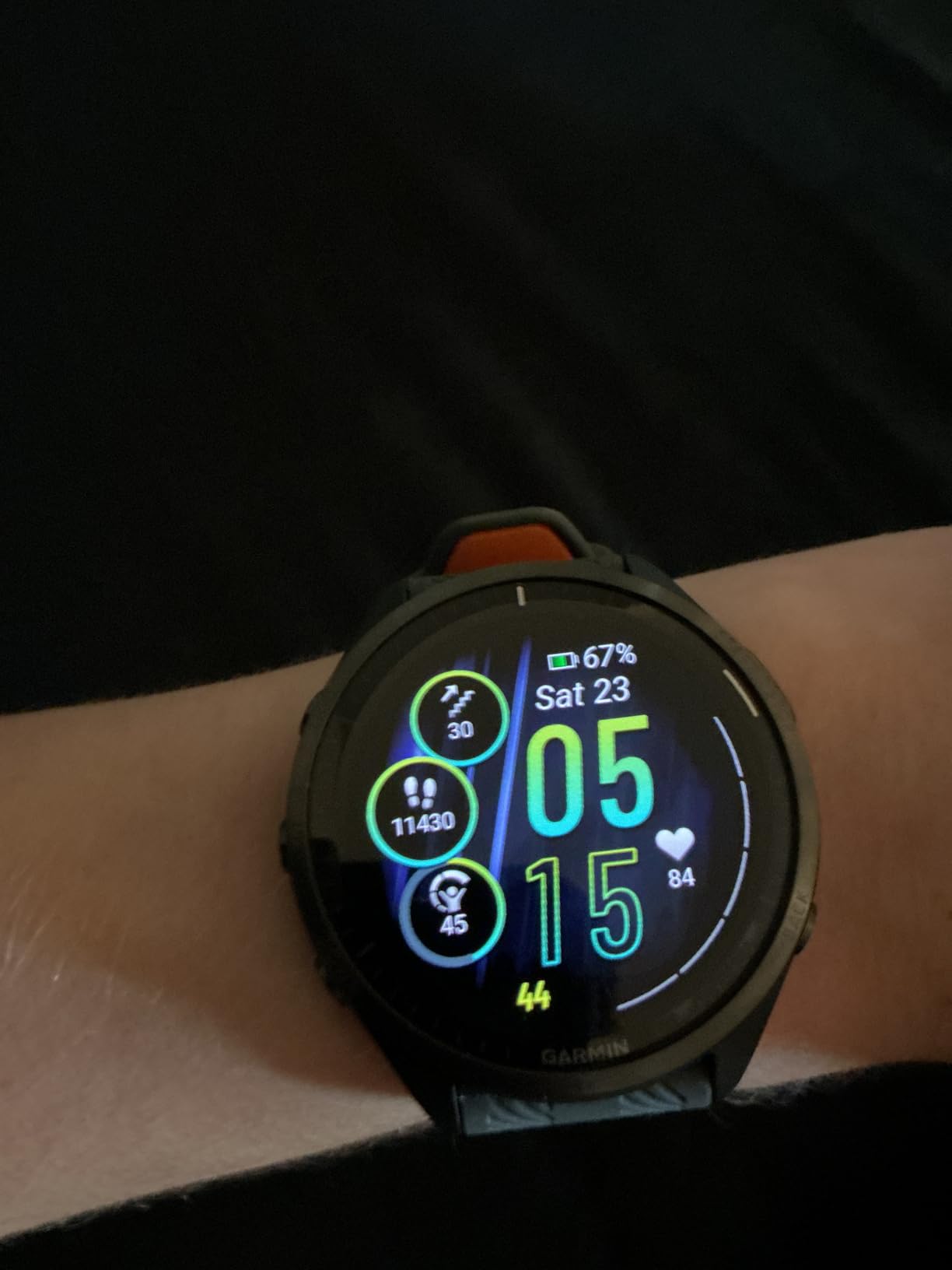
Training readiness, personalized daily suggested workouts, the race widget, and a race predictor cover the planning side well. Built-in triathlon, duathlon, brick workout, and swimrun profiles with custom multisport support mean athletes training for more than one distance keep every transition automatic.
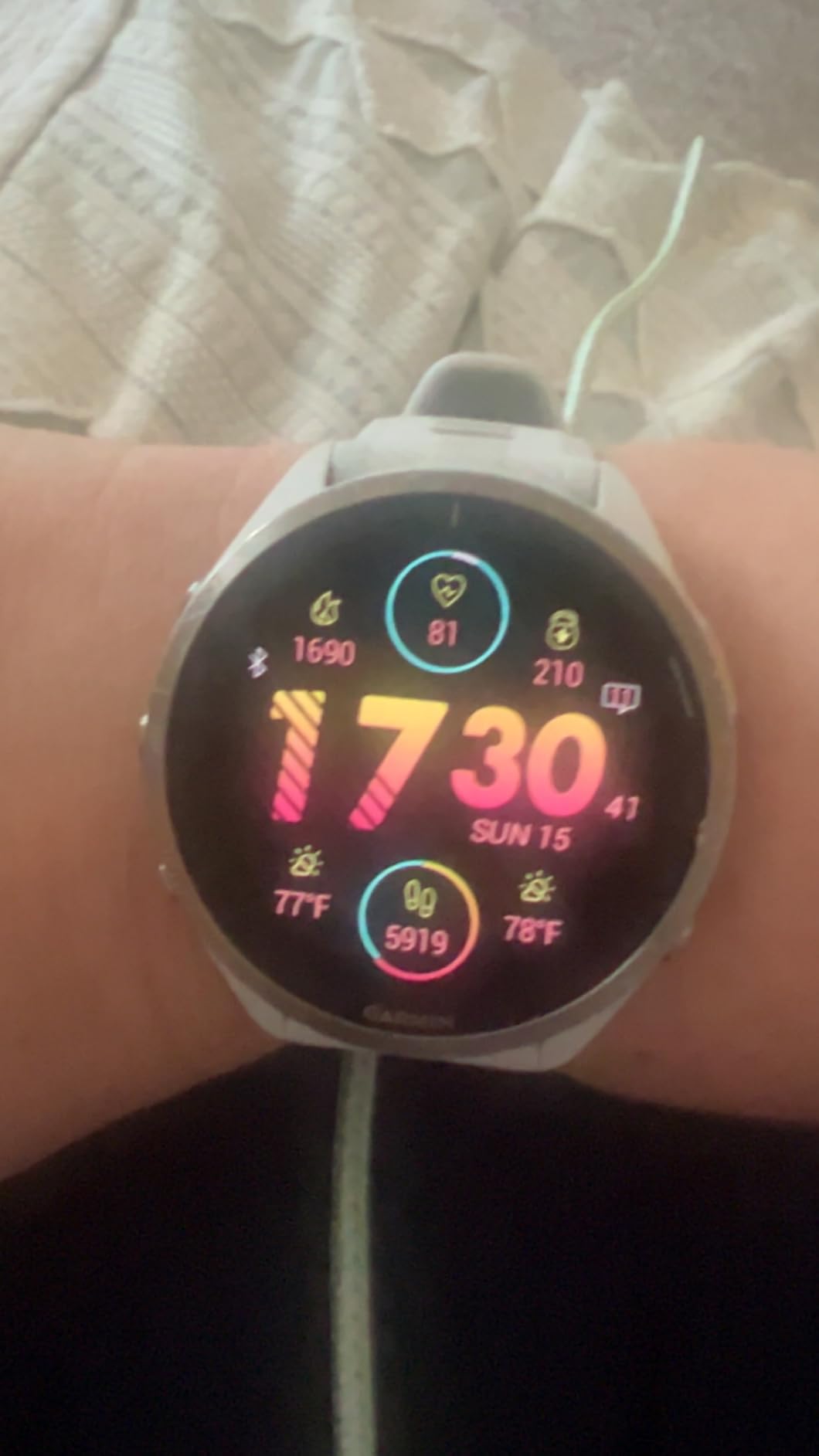
Wrist-based running dynamics add cadence, stride length, ground contact time, and running power, which is useful for form feedback across a block even if you are not chasing speed. Wrist heart rate, though, is sluggish on hard efforts and can be affected by sweat or tattoos.
Why this one earns the premium slot
The endurance figure changes how you plan. At 31 hours you can run the marathon on the same charge you started the week with, which removes the single most repeated anxiety in running forums: the watch dying mid-long-run.
Maps and multisport support are the second reason. If your marathon build includes long runs on unfamiliar routes, or you race in a city you have never trained in, having the course on the wrist is worth the step up in price and size.
Where the 965 is too much
On a small wrist the 47mm footprint is a genuine problem, and it is the most common complaint in reviews. The 46mm Forerunner 265 covers nearly the same training features at 6g lighter if size is your constraint.
It also costs more than most first-time marathoners need to spend. If your runs are loops and your plan lives in a free app, the COROS PACE Pro or PACE 4 give you most of the GPS and battery for a fraction of the outlay.
4. COROS PACE Pro – The Marathon Battery and Map Workhorse
COROS PACE Pro GPS Sport Watch, 1.3-inch AMOLED Touchscreen- Grey
1.3 inch always-on AMOLED
1500 nits
38 hours outdoor GPS
49g
Pros
- Very fast processor and snappy Wi-Fi syncing
- Bright always-on AMOLED reads clearly outdoors
- 38 hours of outdoor GPS covers ultra-distance blocks
- New satellite chipset for precise positioning
- Offline topographic and terrain maps with route planning
- Two-year warranty
Cons
- Smartwatch features limited next to Apple or Samsung
- No cellular so a phone is needed for calls
- 32 GB storage is useful but not class-leading
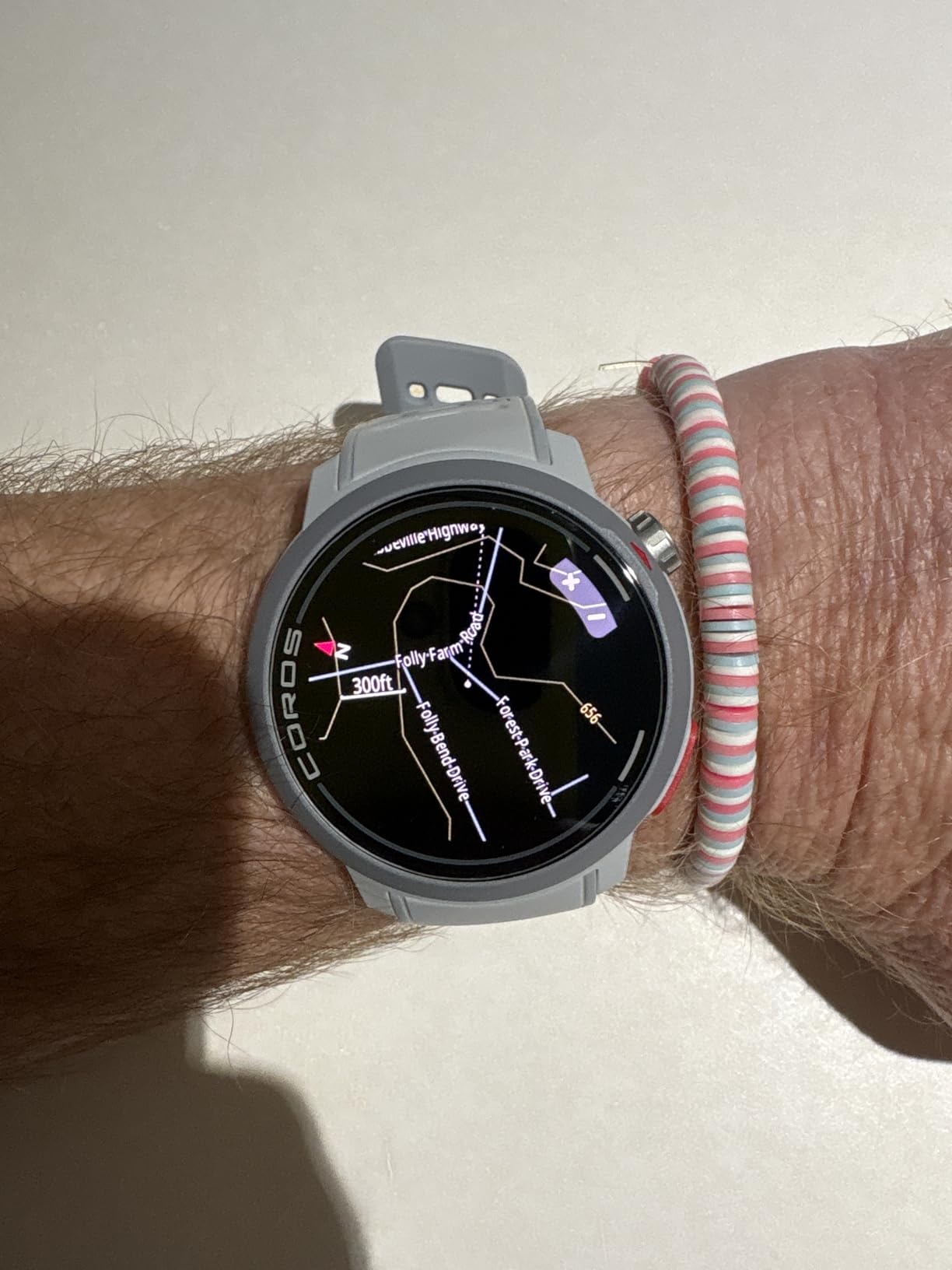
The PACE Pro is the running-first answer for anyone who wants marathon battery and offline maps without a smartwatch tax. Thirty-eight hours of outdoor GPS and thirty-one hours with dual-frequency enabled mean a four-hour long run barely registers, and the always-on AMOLED gives you glanceable pace data the whole way.
The new satellite chipset and hardware configuration deliver the most precise GPS in the COROS lineup, which matters in exactly the environment runners complain about most, the downtown stretch between tall buildings. The navigation route planner with topographic and terrain maps and turn-by-turn guidance covers point-to-point work.
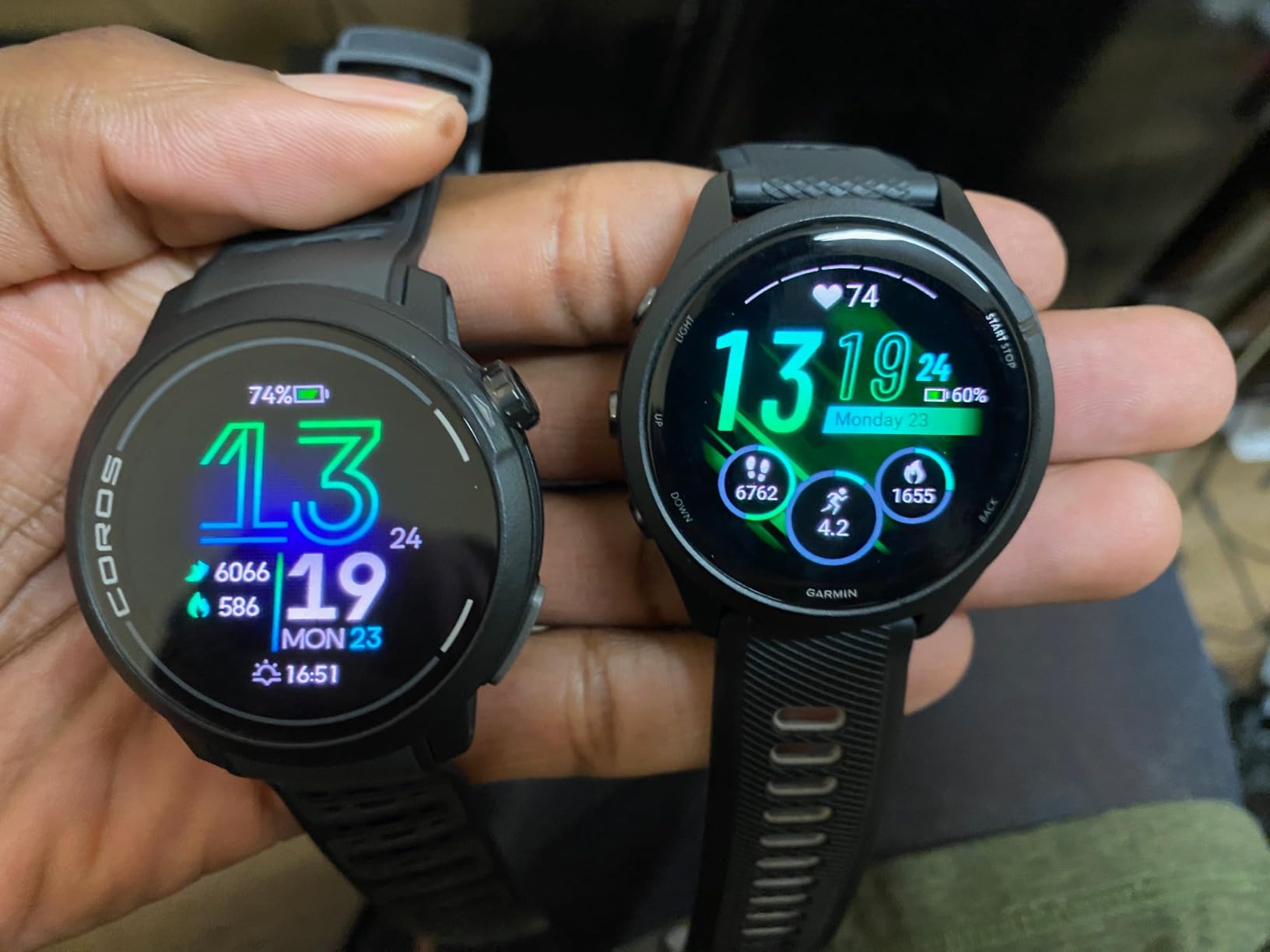
Over twice the processor performance of its predecessor and three times the zoom speed show up as a genuinely responsive interface. More efficient Wi-Fi transfer means your workout syncs quickly after a long run, and USB-C charging with a keychain adapter means one cable for all your devices.
Training status, custom workouts, detailed activity summaries, and sleep analysis are all present. The catch is that this is a running and multisport watch, not a general-purpose smartwatch, and reviewers note the limited notification and app feature set compared with Apple or Samsung wearables.
Why marathon runners gravitate to the PACE Pro
Runtime and brightness together are the pairing you notice on long runs. Thirty-eight hours of outdoor GPS means back-to-back long runs without a charge, and the 1500-nit panel is readable in full sun without waking the display.
The two-year warranty is longer than most competitors at this level, which matters if the watch will see multiple marathon cycles. Reviewers also consistently praise the COROS app as cleaner than the alternatives at the same price.
Where the PACE Pro is not the answer
It is the wrong pick if you want calls, payments, and a full phone on your wrist. There is no cellular connectivity, and the smartwatch feature set is deliberately thin, which is a fair trade for a dedicated training watch and a frustrating one if you expected a wearable.
The PACE 4 undercuts it on weight and price if you are training on roads with known routes. Choose the Pro when maps and the longest runtime in the midrange are the actual requirements of your block.
5. COROS PACE 4 – Best Value for Marathon Training
COROS PACE 4 Ultralight Sport GPS Watch (Black Silicone, Standard)
32g with nylon band
11.8mm thin
1.2 inch AMOLED
41 hours GPS
Pros
- A 40-mile week with the screen always on retained roughly 60% charge
- Exceptionally light at 32g and unnoticeable on runs
- Accurate GPS with clean tracks and no dropouts
- Offline maps pushed to the watch after release
- Crisp AMOLED readable in direct sunlight
- Two-year warranty and clean app syncing to Strava
Cons
- Smartwatch features stripped back with no message replies
- Heart rate spotty on intervals so a strap is advisable
- 4 GB storage and a 1.2 inch screen
- No contactless payment
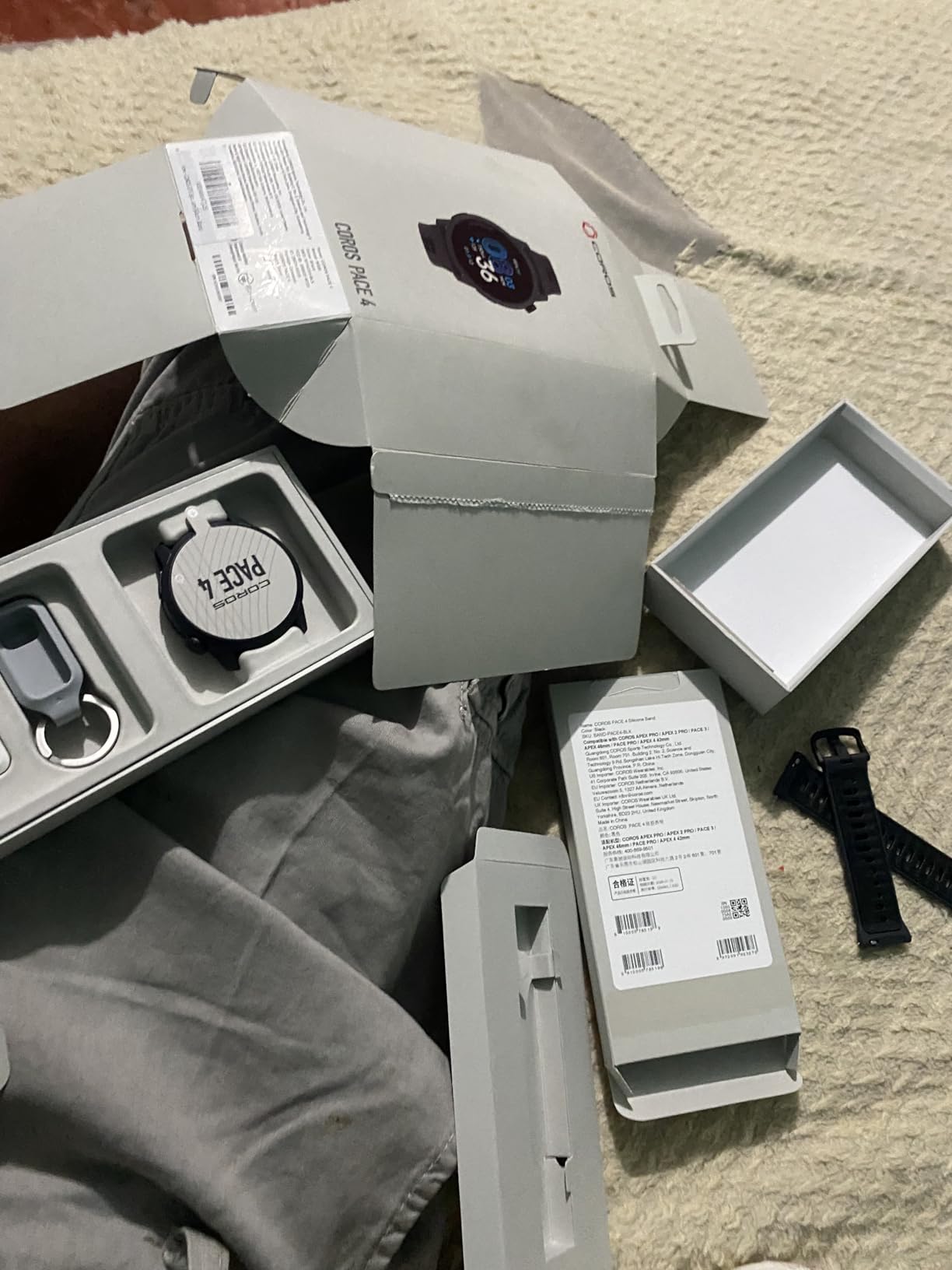
The PACE 4 is the watch I recommend most often to first-time marathoners, because it removes the two things that actually derail a training block: a dead watch and a sore wrist. Forty-one hours of continuous GPS and thirty-two grams mean the battery question stops existing and the watch genuinely disappears on a four-hour long run.
The 1.2-inch AMOLED has a resolution 164% higher than the PACE 3, with auto-adjusting brightness, and the digital crown, two buttons, and a customisable Action Button make it easy to operate mid-tempo without fumbling. Offline maps and breadcrumb navigation landed here after launch, which closed the gap with the PACE Pro for most runners.
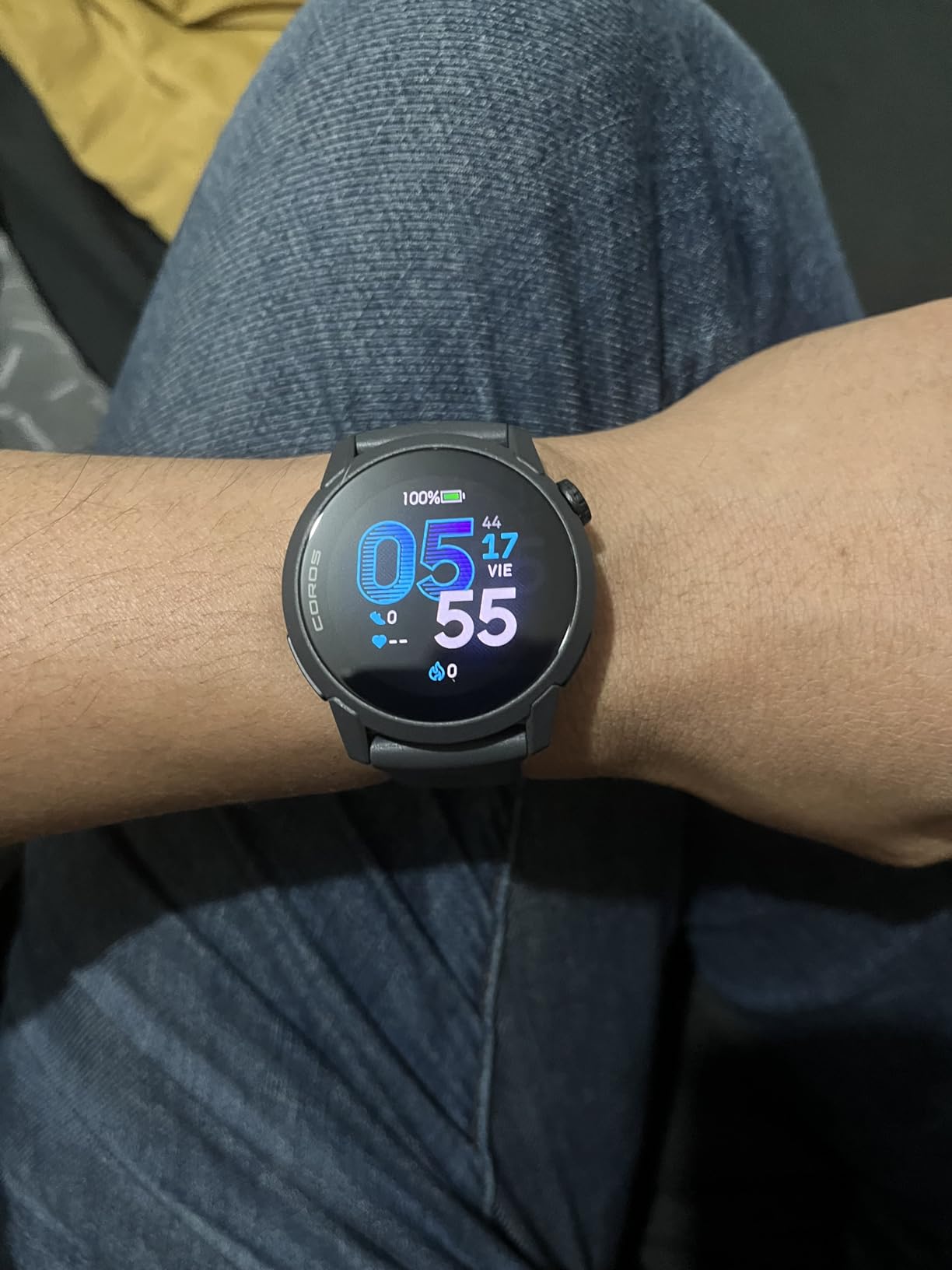
Voice features are the quiet differentiator. The voice recording tool lets you log a workout note hands-free at the end of a long run, and voice control handles alarms and starting custom workouts without touching the watch, which is useful when your hands are wet or your gloves are on.
Training load, recovery time, HRV, sleep stages, and menstrual cycle tracking all live in the COROS app, and reviewers note the app syncs cleanly to Strava, Nike Run Club, and Apple Health. The interval caveats are real: wrist heart rate can be spotty during hard sessions and pace can lag on anything harder than easy running.
Why the PACE 4 is the value pick
One marathon-focused reviewer logged close to 40 miles with maximum GPS accuracy and the screen always on, and still had more than half a week of charge in hand. That is the battery margin that makes a block plan work without charging anxiety.
For weight, thirty-two grams with the nylon band is a genuine difference over a fifty-plus gram watch over a twenty-miler, and the small profile sits well under a shirt cuff or a jacket sleeve in cold race-morning conditions.
Where the PACE 4 falls short
Buy the Forerunner 265 instead if your training engine is the priority. The PACE 4 gives you training load and recovery time, but it does not give you training readiness, adaptive race plans, or the depth of coaching Garmin users rely on.
Add a chest strap if your block contains threshold and interval work, because that is exactly where the wrist sensor is weakest on this watch. And if music on the wrist matters, the 4 GB of storage is not enough.
6. SUUNTO Race S – Best for Trail, Point-to-Point, and Map-Heavy Running
SUUNTO Race S GPS Sports Watch, 1.32” AMOLED 95+ Sports Modes, All Black
1.32 inch AMOLED
60g, 11.4mm thin
30 hours best-accuracy GPS
Dual-band L1 and L5
Pros
- Dual-band GNSS across five systems locks fast in cities and on trail
- Global offline maps with route navigation and find-back
- Heart rate reads accurately once the earlier cadence bug was fixed
- 30 hours of best-accuracy GPS in a compact body
- 95+ sport modes with TSS CTL HRV VO2 max and TSB
- Simple interface and a well-regarded app
Cons
- Firmware updates reset activity settings like auto-resume
- VO2 max readings reported as implausibly static
- Storage dedicated to maps so no offline music
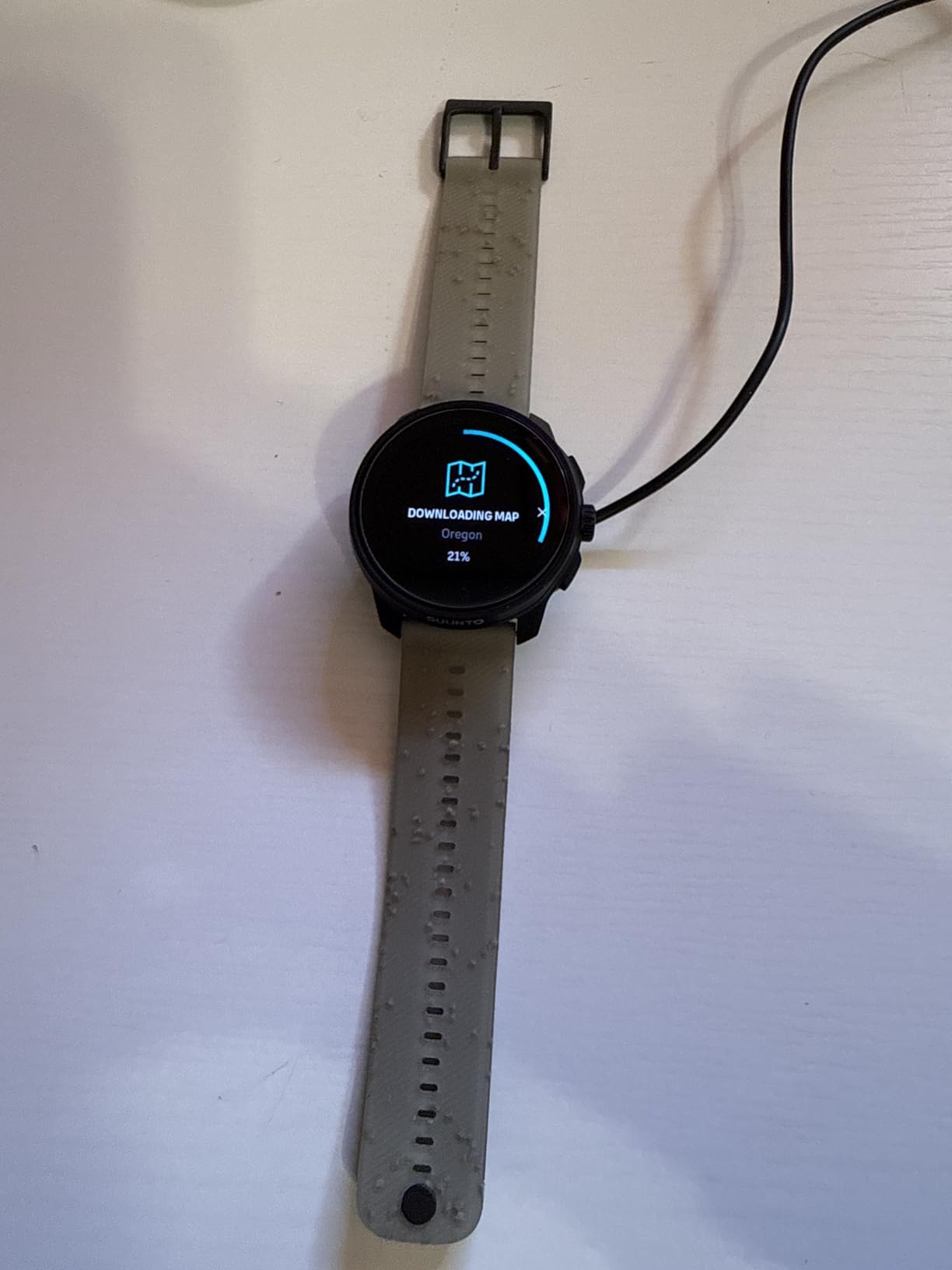
The Race S is one of the most capable navigators in this roundup for runners who train off the road. Global offline maps with two-kilometre zoom-out, points of interest, bearing, and find-back navigation mean a point-to-point long run or a mountain marathon rehearsal works without a phone.
Dual-band L1 and L5 reception across GPS, GLONASS, GALILEO, QZSS, and BEIDOU is the broadest multi-constellation support listed among these ten watches, and thirty hours of GPS at best accuracy in a sixty-gram, 11.4mm body is a fair trade for the map hardware. A full recharge takes about an hour, which is a genuine race-week convenience.
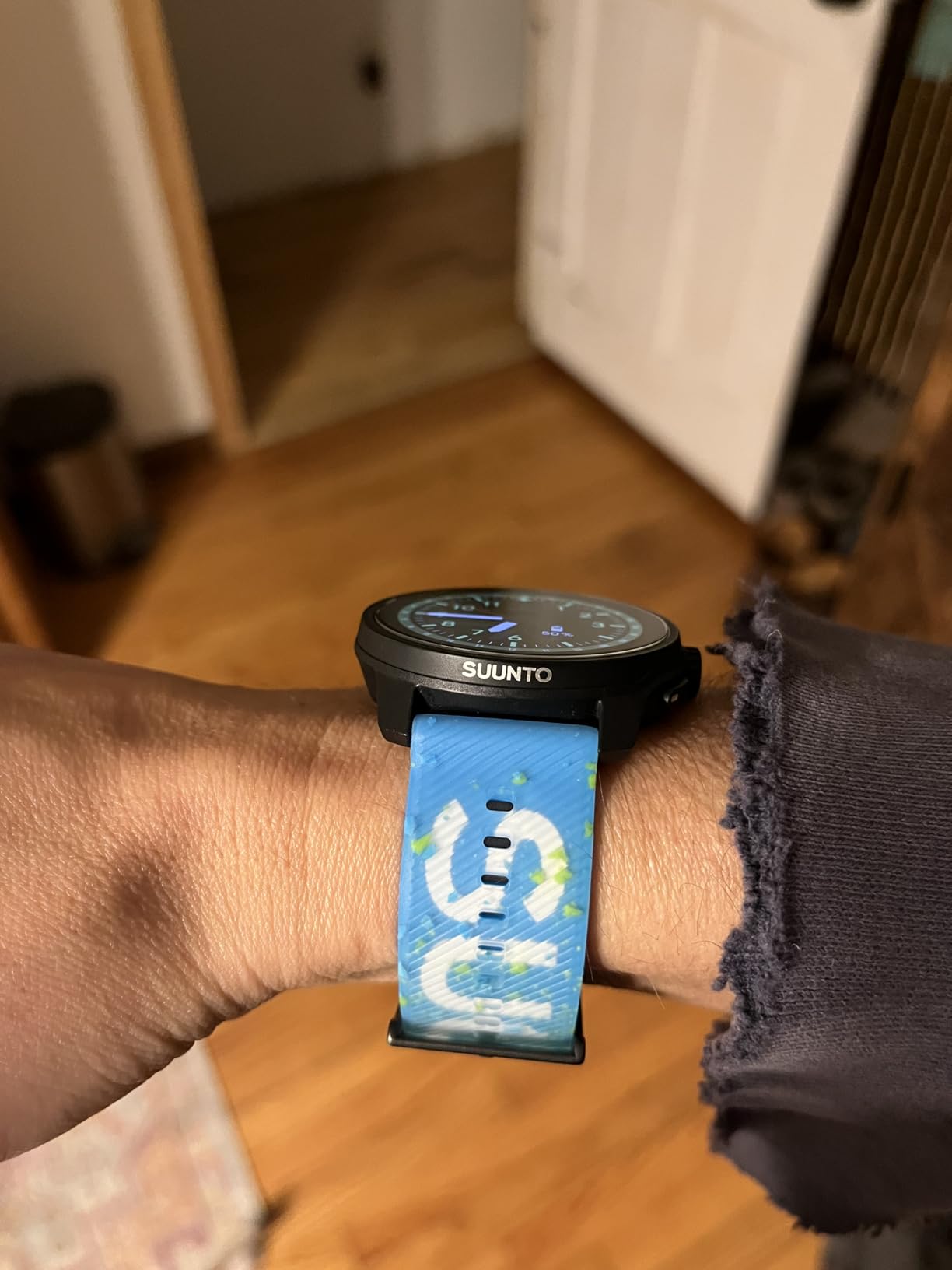
For training data, TSS, CTL, HRV, VO2 max, TSB, and AI Coach insights through the Suunto app and SuuntoPlus give you a proper performance-monitoring set over 95 preset sport modes. The digital crown and AMOLED make the interface easy to drive at pace.
Two caveats from reviewers are worth knowing before a long block. Firmware updates have been reported to reset activity settings such as auto-resume, and VO2 max readings are described as implausibly static across very different effort levels, so treat that number as a rough trend rather than a test result.
When the Race S is the right tool
Choose it when your long runs cross terrain where a breadcrumb line is not enough, or when you race somewhere unfamiliar and want the course on the wrist with turn-by-turn guidance. Trail and mountain marathon crossover is where this watch is most at home.
SuuntoPlus and 300-plus partner services mean your training data has somewhere to go beyond the phone app, which matters if your plan comes from a coach who works in the Suunto ecosystem.
Where it disappoints
Storage is committed to maps, so there is no offline music, and pairing external heart rate straps is reported as difficult, which is a real problem for interval work. Check the included silicone strap length against your wrist, as some buyers report it running short.
If your training is entirely on roads and you want the deepest adaptive plan tools, the Garmin Forerunner 265 is the better marathon-specific purchase, and it is lighter on the wrist at 47g.
7. POLAR Vantage M3 – Best for Recovery and Training Load Detail
POLAR Vantage M3 – Multi-Sport Smartwatch with AMOLED Display, Dual-Frequency GPS, Turn-by-Turn Navigation, Up to 7-Day Battery Life, Black
1.28 inch AMOLED, 1000 nits
53g stainless steel
Dual-frequency GPS
30 hours training mode
Pros
- Dual-frequency GPS with turn-by-turn and offline topographic maps
- 30 hours of training-mode battery covers long runs
- 53g stainless steel case with a bright 1000-nit AMOLED
- Deep recovery analytics with Nightly Recharge and SleepWise
- Running power and training load measured from the wrist
Cons
- 1.28 inch AMOLED with lower 240 by 240 resolution
- Only 37 MB of internal storage
- Smaller installed base and app ecosystem than Garmin or COROS
Polar has built its reputation on training science, and the Vantage M3 carries that into a marathon-appropriate package. Dual-frequency GPS, offline topographic maps, route planning, and Komoot-powered turn-by-turn guidance give it genuine navigation, and thirty hours of training-mode battery is competitive with much larger watches.
The recovery side is the reason to look here. Nightly Recharge, SleepWise, and Training Load Pro turn overnight heart rate and sleep data into a morning decision, and running power plus training load are measured from the wrist. Over 150 sport profiles cover the cross-training that a marathon build usually includes.
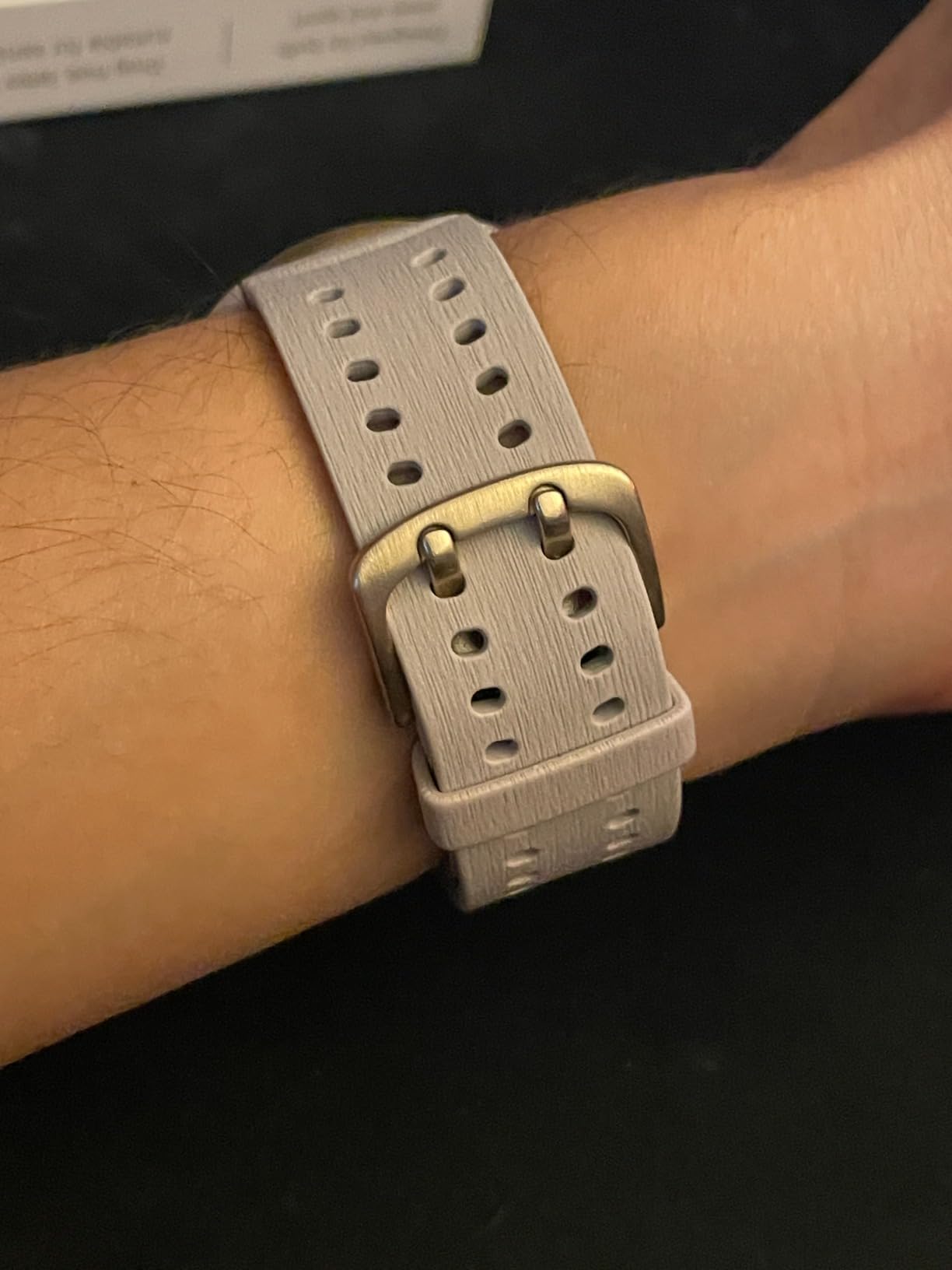
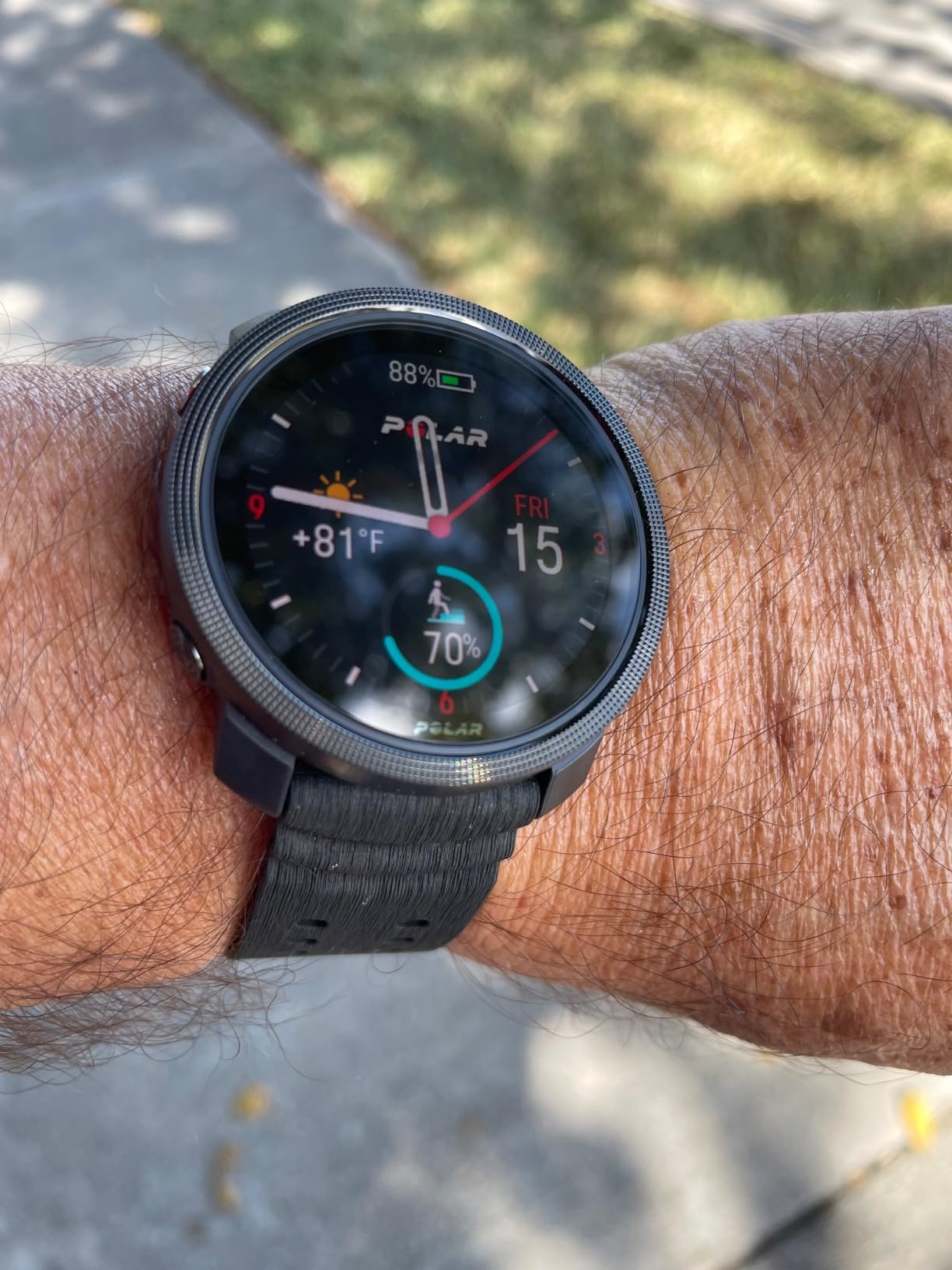
Physically, the 53g stainless steel case with Gorilla Glass 3 and a 1000-nit AMOLED is built for a full block of daily wear, and Polar includes two wristband sizes, which is a small courtesy that solves a real early-week problem.
Reviewers are honest about the trade-offs. The 1.28-inch panel runs at 240 by 240, which is visibly behind the AMOLEDs on the Garmin and COROS flagships, and 37 MB of internal storage is the smallest here, so expect no offline maps library beyond what ships with it or what the app streams.
What Polar does better than the Garmin options
Training load and recovery framing is Polar’s home ground. If your plan is recovery-led, if you have been burned by overreaching mid-block, the Nightly Recharge and Training Load Pro signals give you a daily reason to modify a session rather than a monthly one.
The stainless steel build and two-year manufacturer warranty also read as more robust than the plastic-bodied budget options, and 50m water resistance handles rain-heavy long runs without a thought.
Where it is the wrong choice
Skip it if the app ecosystem matters to you. Polar’s installed base and third-party app support are smaller than Garmin’s or COROS’s, and if your coach sends plans through a major platform, check compatibility before buying rather than after.
Skip it if you want music, payments, or a vivid display. None of those are the point of this watch, and there are better options for a runner who wants a wearable as well as a training tool.
8. COROS PACE 3 – Budget Pick for First-Time Marathoners
COROS PACE 3 GPS Sport Watch, Lightweight Running Watch – Chalk Nylon
30g with nylon band
11.7mm slim
1.2 inch transflective
38 hours GPS
Pros
- Very light 30g design that disappears on the wrist
- 38 hours of GPS and 24 days of daily use
- Dual-frequency GPS keeps tracks accurate in high-rise cities
- Breadcrumb navigation and route planner cover basic navigation
- Transflective always-on display reads clearly in bright sun
Cons
- Transflective LCD less vivid than AMOLED rivals
- 3 GB storage limits offline music
- Fewer sport modes and analytics than PACE 4 or Pro
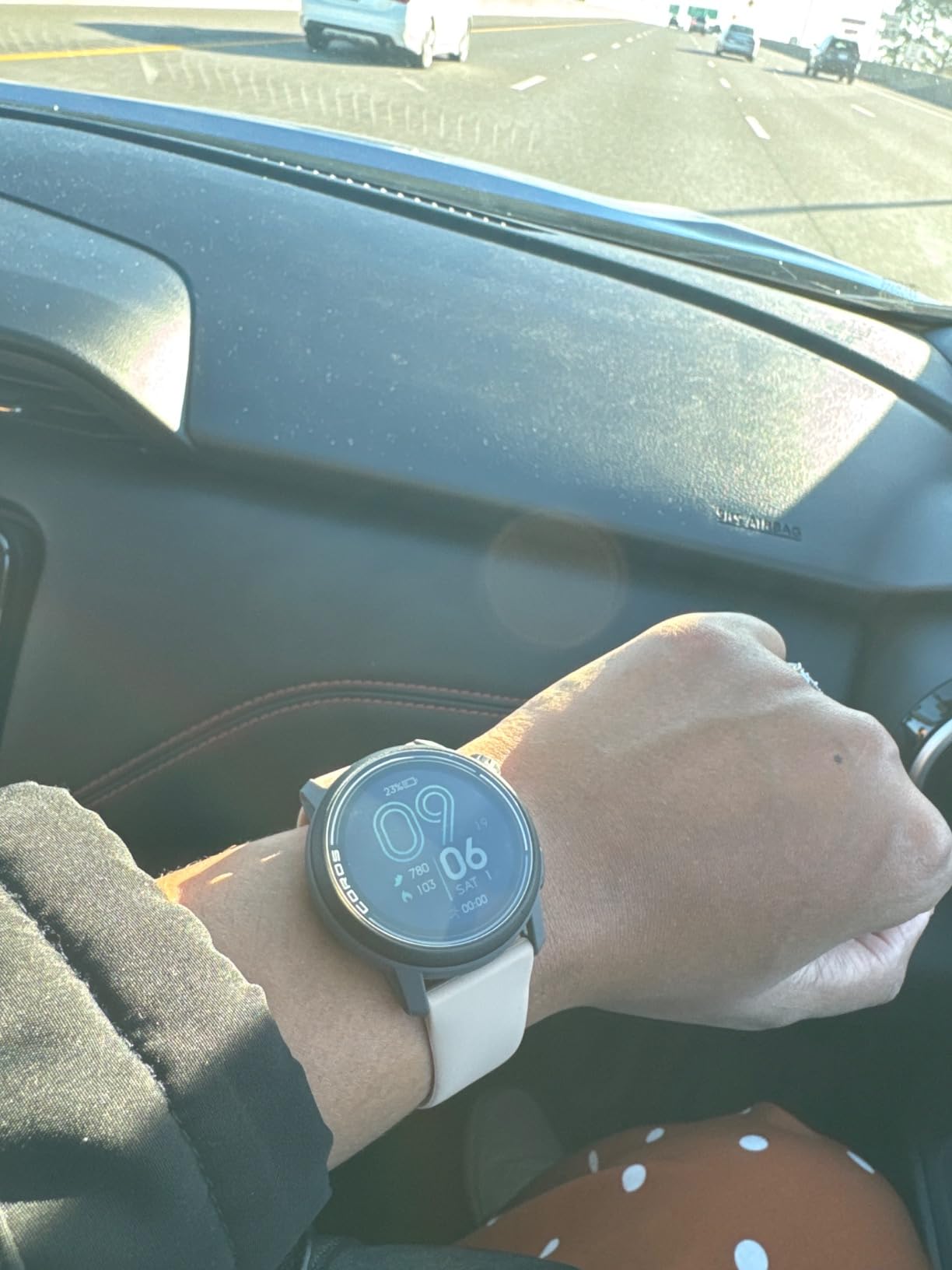
The PACE 3 is the least expensive watch here that still does the things a marathon block actually requires, and for many first-timers that is the whole decision. Thirty grams, an 11.7mm profile, thirty-eight hours of continuous GPS, and twenty-four days of daily use from one charge is a specification set most budget runners assume they have to give up.
Three backlight modes, always on, navigation and activity, or navigation only, let you decide how much the display costs you. The transflective panel stays readable in bright conditions without waking the watch, and it draws far less power than an AMOLED, which is a large part of why the battery figure is so high.
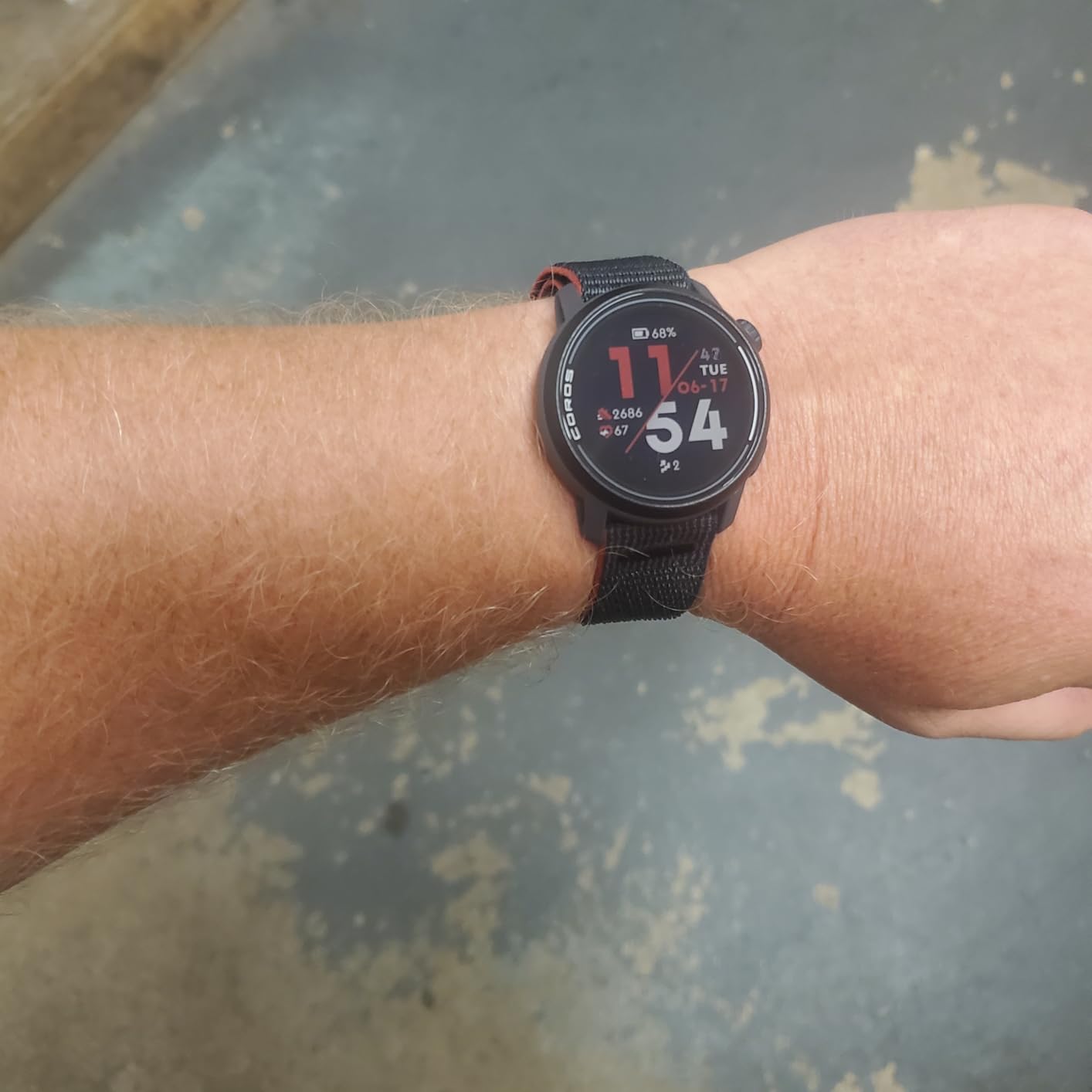
The redesigned dual-frequency satellite chipset is what makes this budget watch viable, since it is the feature runners most often sacrifice. It holds accurate tracks in high-rise cities and records air pressure and elevation gain, and the route planner with breadcrumb navigation covers basic off-route navigation.
What you give up is display quality and depth. The transflective screen is less vivid and lower resolution than the AMOLED panels on the PACE 4 and the Garmin flagships, storage is 3 GB, and the analytics and sport modes trail the newer COROS models.
Who this budget pick actually suits
The PACE 3 fits a runner on a first marathon block who runs loops, does not need music on the wrist, and wants the battery question to disappear entirely. At this weight you will forget it is on, which matters more over a sixteen-week block than any metric.
It is also a sensible second watch or a travel backup, since it is light and simple enough to pack. Dual-frequency accuracy in a city means your distance data stays honest even on the worst possible route.
Where to spend a little more instead
Spend up to the COROS PACE 4 if you can, because the AMOLED, the extra storage, the more advanced analytics, and the voice features are the difference between a tool and a watch you will still want to wear in year two.
Do not buy it if the display is what motivates you to run, or if you plan to run point-to-point routes where breadcrumb navigation is not enough guidance on its own.
9. Garmin Forerunner 970 – Best for Night Running and Ultramarathon Crossover
Garmin Forerunner® 970, 47mm, Carbon Gray DLC Titanium, Black/Whitestone
1.4 inch AMOLED, sapphire lens
47mm titanium bezel
LED flashlight
26 hours GPS
Pros
- Sapphire lens
- titanium bezel
- and a built-in LED flashlight
- 26 hours of GPS covers a full marathon with margin
- Advanced metrics including running economy and step speed loss
- Speaker and microphone enable wrist calls
- Dynamic round-trip routing for unplanned extensions
Cons
- Highest price in this group with less battery than the 965
- Running economy and step speed loss need the separate HRM 600
- Advanced features have a learning curve for newer runners
The Forerunner 970 is built for runners who train in the dark, in the rain, or past the point where most watches stay intact. The sapphire lens, lightweight titanium bezel, and the built-in LED flashlight are not running features, they are the reason this watch keeps working through a four-year cycle of daily wear.
Twenty-six hours of GPS covers a marathon with margin, and the bright 1.4-inch AMOLED is among the most readable screens in daylight. Full-colour built-in maps with multi-band GPS and dynamic round-trip routing let you extend a long run on no notice and still find your way back.
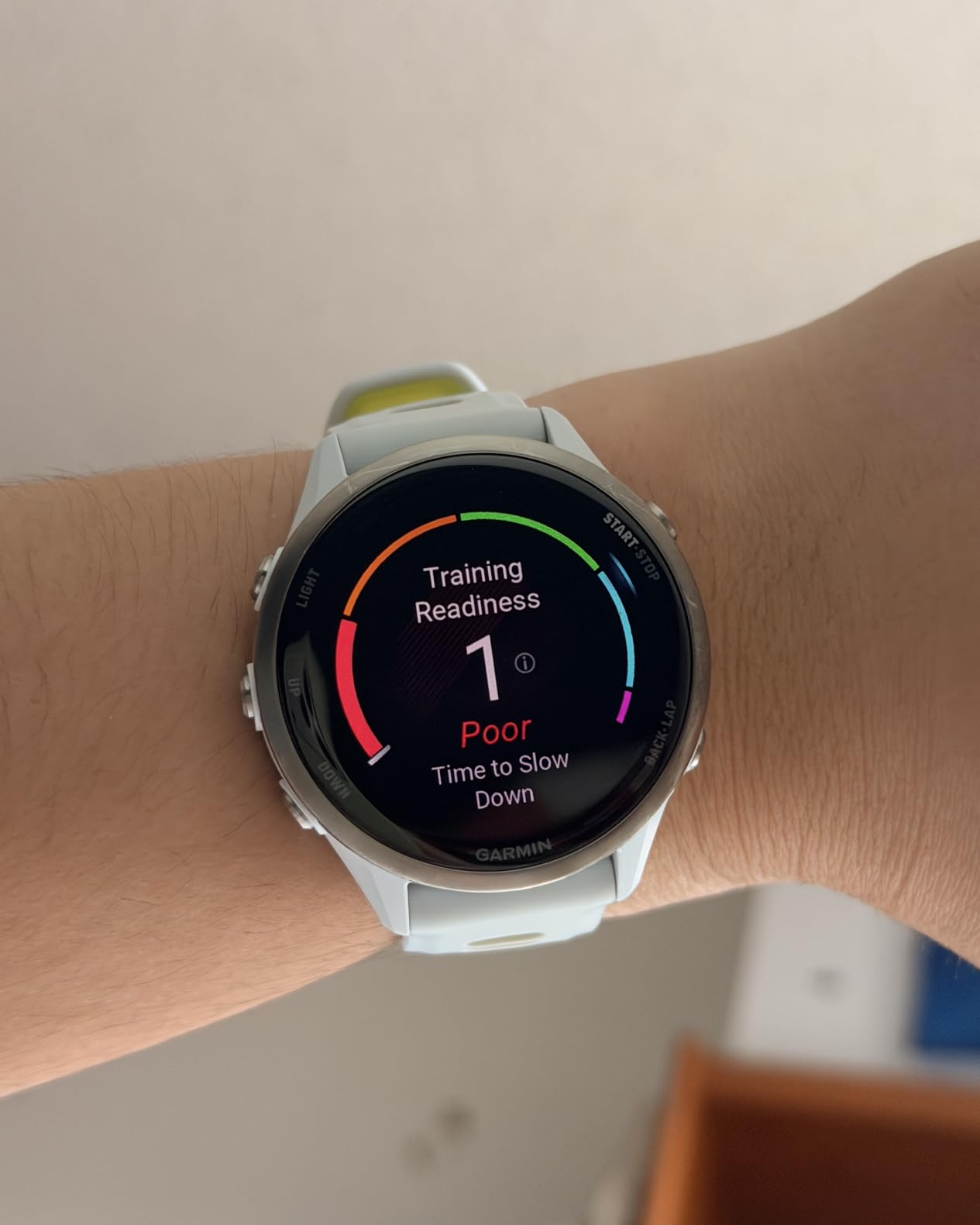
The training depth is what separates this model from a standard running watch. Garmin Coach personalised running and triathlon plans, training readiness based on sleep, recovery, training load, and HRV, plus running economy, step speed loss, and running tolerance, give serious racers real load-management tools. A built-in microphone and speaker also allow wrist calls and voice assistant replies.
Two cautions. Running economy and step speed loss require the separately sold HRM 600 monitor, so budget for that if those metrics are why you are looking at this model. And the advanced feature set has a real learning curve, which is exactly the complaint first-time marathoners raise.
When the 970 justifies its price
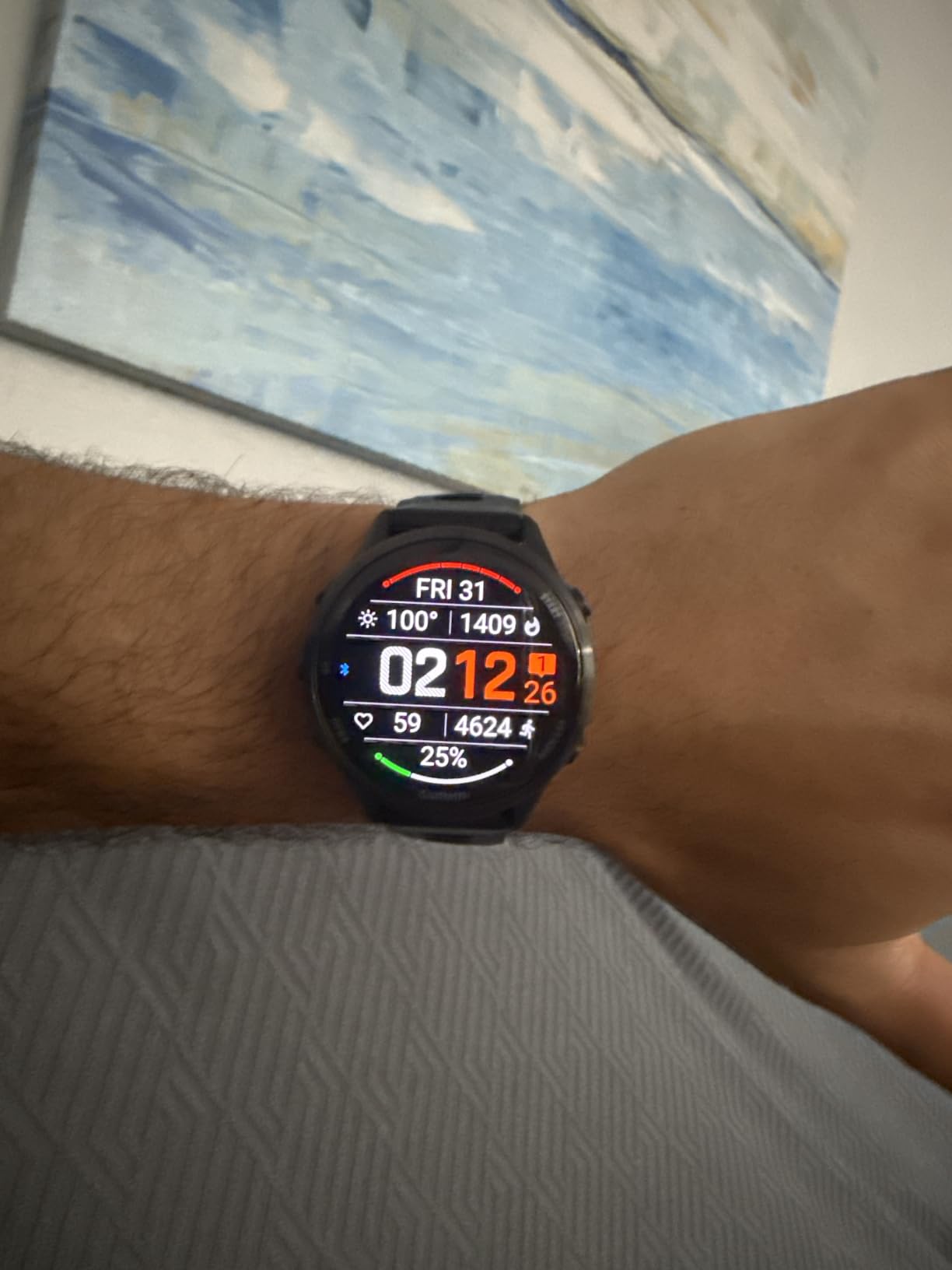
It makes sense if you are a multi-sport athlete moving between running and triathlon, if you train before dawn, or if you want a watch that still looks and works right in four years. The speaker, microphone, flashlight, and multisport auto-transition are the features you will notice most.
Dynamic round-trip routing is the sleeper feature for marathon training, because a long run that needs an extra two miles no longer requires guessing which way back is faster.
Where the 970 makes no sense
It costs more than any other watch here and lasts five hours less on GPS than the Forerunner 965, which is not what most marathoners are optimising for. If your budget stretches to this watch, the 965 is the more rational marathon pick.
It is also the wrong choice for a first marathon, where the advanced analytics add decision fatigue rather than removing it. A simpler watch with a clear plan engine will serve you better.
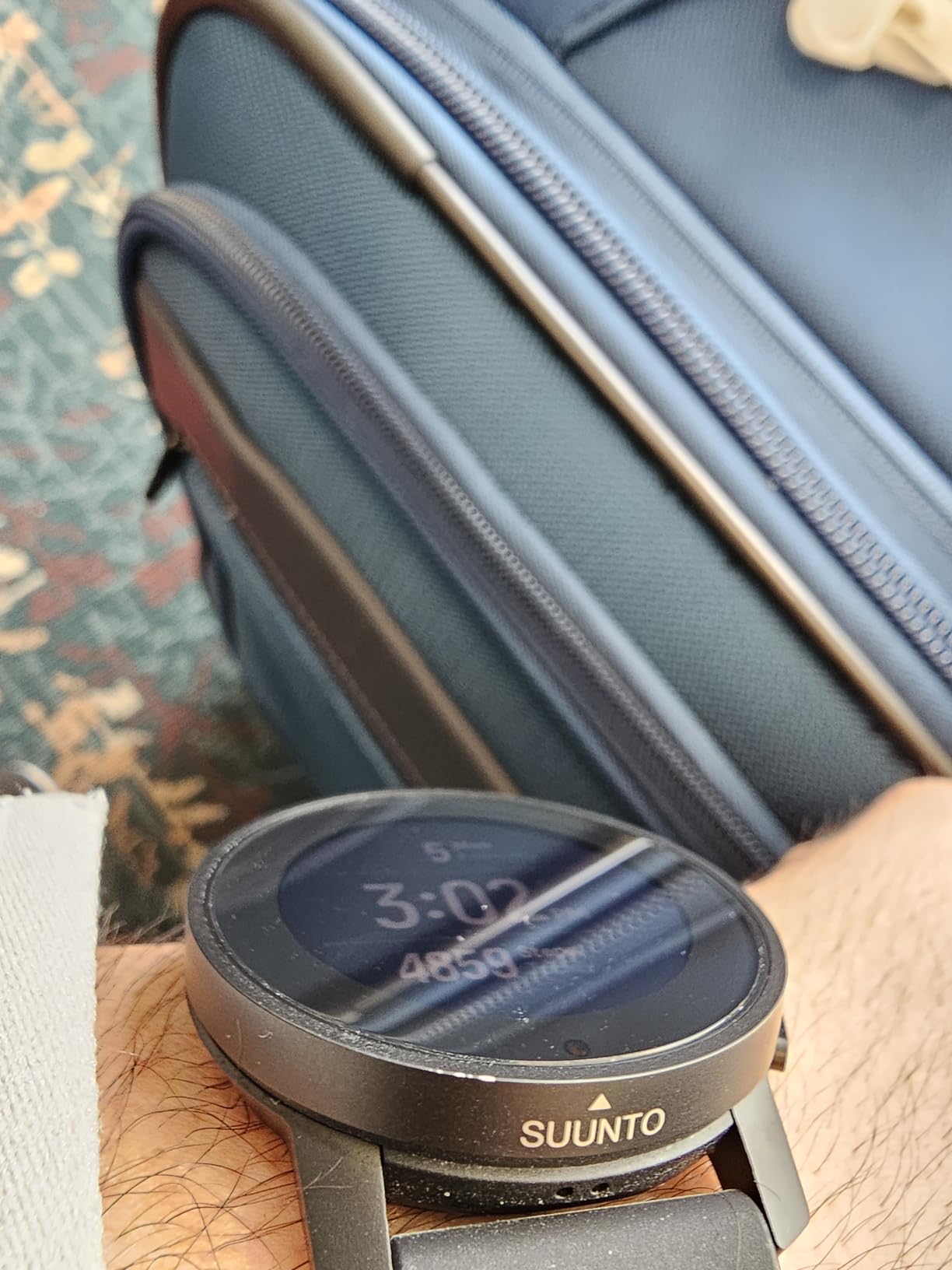
10. SUUNTO 9 Peak – Best Multi-Mode Battery, With Firmware Caveats
SUUNTO 9 Peak and Peak Pro Sports GPS Watch for Demanding, Performance Driven Athletes and Adventurers
1.2 inch MIP colour display
40 hours best GPS, 70 endurance
Titanium, stainless steel, sapphire
Pros
- Up to 300 hours in tour mode and 70 hours in endurance mode
- Ten-minute charge gives two hours of GPS training
- Titanium
- stainless steel
- and sapphire glass at 100m
- MIP display stays legible in direct sun and drains far less
- Compact sizing works well on smaller wrists
Cons
- Recent firmware updates have sharply reduced real-world battery for some users
- Heart rate sensor reported to stop measuring until a restart
- Swimming and physiological metrics can vary between identical sessions
The Suunto 9 Peak exists for a very specific reason: battery modes nobody else offers. Forty hours in best GPS mode, seventy in endurance mode, and three hundred in tour mode, plus two hours of GPS from a ten-minute top-up, means the charging conversation ends for a runner training several times a day or across a multi-week trip.
The transflective-style MIP colour display stays legible in direct sun and draws far less power than AMOLED, which is a large part of how those figures are achieved. Titanium, stainless steel, and sapphire glass with 100m water resistance make it a genuinely durable piece of kit, and the compact sizing suits smaller wrists than the 46mm, 47mm, and 49mm cases elsewhere in this roundup.
Ninety-seven sport modes, turn-by-turn navigation, weather alerts, sunrise and storm alerts, and avalanche maps cover the outdoor side well. The Suunto app creates structured workouts and goals with real-time guidance, and it connects to Strava, TrainingPeaks, and more than 200 fitness apps, which is unusually broad third-party support for a running watch.
Reviews are sharply split, and the reason is software. Recent firmware updates have sharply reduced real-world battery life for some users, the heart rate sensor has been reported to stop measuring until the watch is restarted, and swimming calories and average heart rate can vary widely between identical sessions. The 4.0 average rating and wide star spread reflect exactly that.
Who the 9 Peak is built for
It fits the ultrarunner, the multi-day hiker who runs some of those days, and anyone who wants a watch they can leave off the charger without thinking. Four satellite systems hold tracking well among tall buildings, mountains, and canyons.
The MIP screen is a genuine advantage for long days outdoors, because you are not managing an AMOLED backlight at dawn or watching the drain climb in full sun.
Why we ranked it last
The firmware complaints are the deciding factor for a sixteen-week block. A watch that loses heart rate sensing until you restart it, or whose battery life drops sharply after an update, is a bad foundation for structured training, and reviewers are clear about that.
Add a twenty-two millimetre strap that can be short on larger wrists, no payments, and inconsistent pool metrics, and the durability story is undermined by the software. The Forerunner 965 or the COROS PACE Pro are safer marathon choices.
What Actually Matters in a Marathon Training Watch
Headline GPS hours are table stakes, because every watch here runs well beyond marathon distance on a charge. Here is what actually separates a good marathon watch from a great one, in the order we would weight them.
Battery across a block, not battery across one run
Look at the always-on display figure and the daily-use figure, not just the GPS figure. The COROS PACE Pro gives you six days with always-on display, the COROS PACE 3 gives you twenty-four days of daily use, and the Apple Watch Ultra 3 gives you forty-two hours of normal use with a daily charging habit attached to it. Those numbers predict your actual experience over a sixteen-week block far better than the GPS maximum does.
Ask one question: how often do you want to think about charging during taper week? If the answer is never, that rules out the daily-charging watches no matter how good their screens are.
Dual-frequency and multi-band GPS, and when they matter
Single-band GPS locks onto one frequency from each satellite system. Dual-frequency or multi-band GNSS listens on two frequencies at once, which lets the watch resolve the ionospheric error that pushes single-band units metres off. In open parkland you will not notice. Between tall buildings, under dense tree cover, or on a mountain ridge, the difference shows up as a cleaner track and an honest distance.
Every watch here supports multi-band or dual-frequency reception: the Garmin Forerunner 265, 965, and 970 through multi-band GNSS with SatIQ, the COROS PACE 3, PACE 4, and PACE Pro through their dual-frequency chipsets, the SUUNTO Race S on dual-band L1 and L5, and the POLAR Vantage M3 on dual-frequency GPS.
The training engine behind your plan
Garmin’s strength is adaptive plans. Garmin Coach adjusts a marathon plan around your schedule, and the race widget on the Forerunner 265, 965, and 970 personalises daily suggested workouts to the race and course you enter in Garmin Connect. Training readiness combines sleep, recovery, training load, and HRV status into a single morning number.
COROS answers with Training Hub, EvoLab-style adaptation, training load, recovery time, HRV, and sleep stages in a cleaner, faster app. Polar answers with training science: Nightly Recharge, SleepWise, and Training Load Pro. If your plan comes from a coach through a specific platform, check that platform’s integration before you buy, because switching ecosystems later means losing history.
If you also enjoy outdoors sports, our guide to the best golf GPS watches covers the same mapping and battery thinking from a different angle.
Heart rate accuracy and the chest strap question
Wrist optical heart rate is good at steady state and on easy long runs. It lags on intervals, threshold work, and tempo efforts, where a chest strap such as the Polar H10 is still treated as the gold standard. This is the single most repeated complaint in the reviews of the lighter watches, and it appears on the COROS PACE 4, the Forerunner 265, and the Forerunner 965 alike.
The practical answer is to pair a strap for your hard sessions and run wrist-only for easy miles. Every watch here supports external heart rate monitors. Note that the SUUNTO Race S has reported pairing difficulties with external straps, which is a real consideration if intervals are a large part of your week.
Weight, case size, and wrist fit
Over a four-hour long run, weight becomes noticeable. The COROS PACE 3 at 30g and the PACE 4 at 32g are the two lightest here, and the difference against a 53g to 60g watch is something you feel in the second half of a long run.
Case size follows the same logic. Watches at 42mm or below work on small wrists, and the compact SUUNTO 9 Peak is the option in this group built for smaller wrists. The 46mm Forerunner 265 is the middle ground and the safest all-round fit. The 47mm Forerunner 965 and Forerunner 970 and the 49mm Apple Watch Ultra 3 are large, and reviewers of the 965 specifically call out how it looks on small wrists. Check fit in store where you can, and remember you will be wearing this overnight for sleep data for sixteen weeks.
Display type in real sun
AMOLED panels are vivid and bright, and the COROS PACE Pro is rated at 1500 nits against 1000 nits on the POLAR Vantage M3 and SUUNTO 9 Peak. MIP and transflective panels, as on the SUUNTO 9 Peak and COROS PACE 3, are duller in colour but far cheaper on power and readable in direct sun without waking the watch. For a runner who mostly runs in daylight, the transflective panel is a real feature rather than a compromise.
Maps, music, and race-week logistics
If you do point-to-point long runs or race somewhere you have never trained, onboard offline maps stop being a luxury. The Forerunner 965, Forerunner 970, and COROS PACE Pro carry full-colour offline maps with turn-by-turn guidance, the SUUNTO Race S has global offline maps with bearing and find-back, and the POLAR Vantage M3 uses Komoot-powered guidance.
Storage decides the music question. The Forerunner 965, Forerunner 970, COROS PACE Pro, and SUUNTO Race S carry 32 GB, the Forerunner 265 has 8 GB, the COROS PACE 4 has 4 GB, and the COROS PACE 3 has 3 GB. The SUUNTO 9 Peak commits its storage to maps instead.
Race-week settings that extend your battery
Forum discussions about dying watches almost always come back to settings. This is the checklist that gets a marathon watch through race week:
Turn multi-band or dual-frequency GPS off for easy runs, and keep it on only for the long run and race when you need the accuracy.
Switch the display from always-on to a gesture-wake or activity-only mode for the final block.
Stop syncing music to the watch, or download a smaller playlist, if you are not running phone-free.
Trim smart notifications to calls and messages only, and silence everything else.
Drop the sensor set to the essentials if your watch allows it, and turn off continuous every-second recording during long steady runs.
Charge fully the night before the race, and set a repeating alarm for the same time the two nights before.
And have a backup plan: know the mile markers on the course, carry your phone for the timing chip, and know what you will do if the watch dies at mile 18. Runners who have a plan for it stop worrying about it.
Common mistakes we see
Buying on headline GPS hours instead of block battery is the most common error, and it leads runners to overspend on a watch they do not need. The second is overspending on analytics before the first marathon, when a simpler watch with daily suggested workouts gives more clarity rather than less.
The third is ignoring case size until month three of constant wear, and the fourth is buying without checking that your training plan platform syncs. A fifth is running a sixteen-week block on a watch that needs charging every second day because nobody checked the daily-use figure.
Our guides to the best dog GPS trackers and the best training room tables cover the rest of a runner’s setup if you are building it out from scratch.
Frequently Asked Questions
What is the best GPS watch for marathon training?
For most marathoners the Garmin Forerunner 265 is the best GPS running watch for marathon training. Its 46mm AMOLED case at 47g, multi-band GNSS with SatIQ, 20 hours of GPS, and the training readiness and race widget features cover a full 16-week block without complexity. Choose the COROS PACE 4 instead if weight and battery margin matter more to you than plan depth.
Which Garmin watch is best for marathon training?
The Forerunner 265 is the best Garmin for most marathoners because it balances case size, weight, and training features. The Forerunner 965 is the choice if you want 31 hours of GPS, full-colour offline maps, and multisport profiles. The Forerunner 970 adds a sapphire lens, a built-in flashlight, a speaker and microphone, and deeper metrics, at a higher cost and with less battery than the 965.
Can you train for a marathon with Garmin?
Yes. Garmin watches handle a marathon block well because the training side is the strongest in the category. Garmin Coach adjusts plans around your schedule, the race widget personalises daily suggested workouts to the race and course you enter, and training readiness combines sleep, recovery, training load, and HRV status into one morning number. PacePro and race prediction then handle pacing on race day.
Is COROS or Garmin better for runners?
For battery, weight, and maps, COROS usually wins. The PACE 4 gives 41 hours of GPS at 32g and the PACE Pro gives 38 hours with offline maps. For training metrics, adaptive plans, and third-party app support, Garmin is deeper, with training readiness, daily suggested workouts, and a wider ecosystem. Road runners training on known routes often prefer COROS on value; coached and data-led runners usually prefer Garmin.
How accurate are GPS running watches?
Under open sky, good watches are accurate enough for pace and distance. The difference appears in difficult conditions, where single-band GPS can drift under tree cover or between tall buildings and inflate distance by a percent or two. Dual-frequency and multi-band GNSS listen on two satellite frequencies and resolve that error, which is why all ten watches in this roundup support it.
Why is my Garmin watch battery draining so quickly?
The usual causes are settings, not faults. Multi-band GPS, always-on display, music syncing, full smart notifications, and continuous sensor logging all draw heavily. Switch multi-band off for easy runs, use a gesture-wake display in the final block, trim notifications to calls and messages, and stop syncing music if you are not running phone-free. Check the GPS mode set in settings, since All-Systems plus multi-band is the most expensive combination.
Is it worth buying a Garmin GPS?
Yes, if you are running a structured block. The value is not the GPS chip alone, it is the training layer built on top of it: adaptive plans, training readiness, training load, recovery guidance, and race-day pacing tools. For casual runners a basic phone or cheap watch is enough, but for a 16-week marathon block the data shapes every weekly decision.
Can a Garmin watch tell you if you are going too fast?
Yes. PacePro gives on-wrist pace alerts against a target for structured long runs, and the Forerunner 265, 965, and 970 also carry a race predictor that estimates your finish time from training history. Tempo and interval workouts push pace targets to the watch, and Garmin Coach adjusts those targets as the plan progresses.
Final Verdict: Which Marathon Watch Should You Buy?
The Garmin Forerunner 265 is our pick as the best GPS running watch for marathon training in 2026, because it balances the three things a block demands: a reliable multi-band GPS line, a training engine that adapts when you miss a session, and a case size you will still like at week sixteen. If battery and weight are your priorities instead, the COROS PACE 4 gives you 41 hours of GPS at 32g.
Buy the Forerunner 965 for multi-day endurance and full-colour maps, the COROS PACE Pro for maps plus battery at a midrange price, the POLAR Vantage M3 for recovery data, and the Apple Watch Ultra 3 if one device has to do training and daily life. Pair a chest strap for your interval sessions on any of them, and check the price live at the retailer, since these figures move often.
Whichever you pick, set the GPS mode, display, and notification settings before race week, and start shopping early for your best marathon running shoes so your feet are as prepared as your data.