
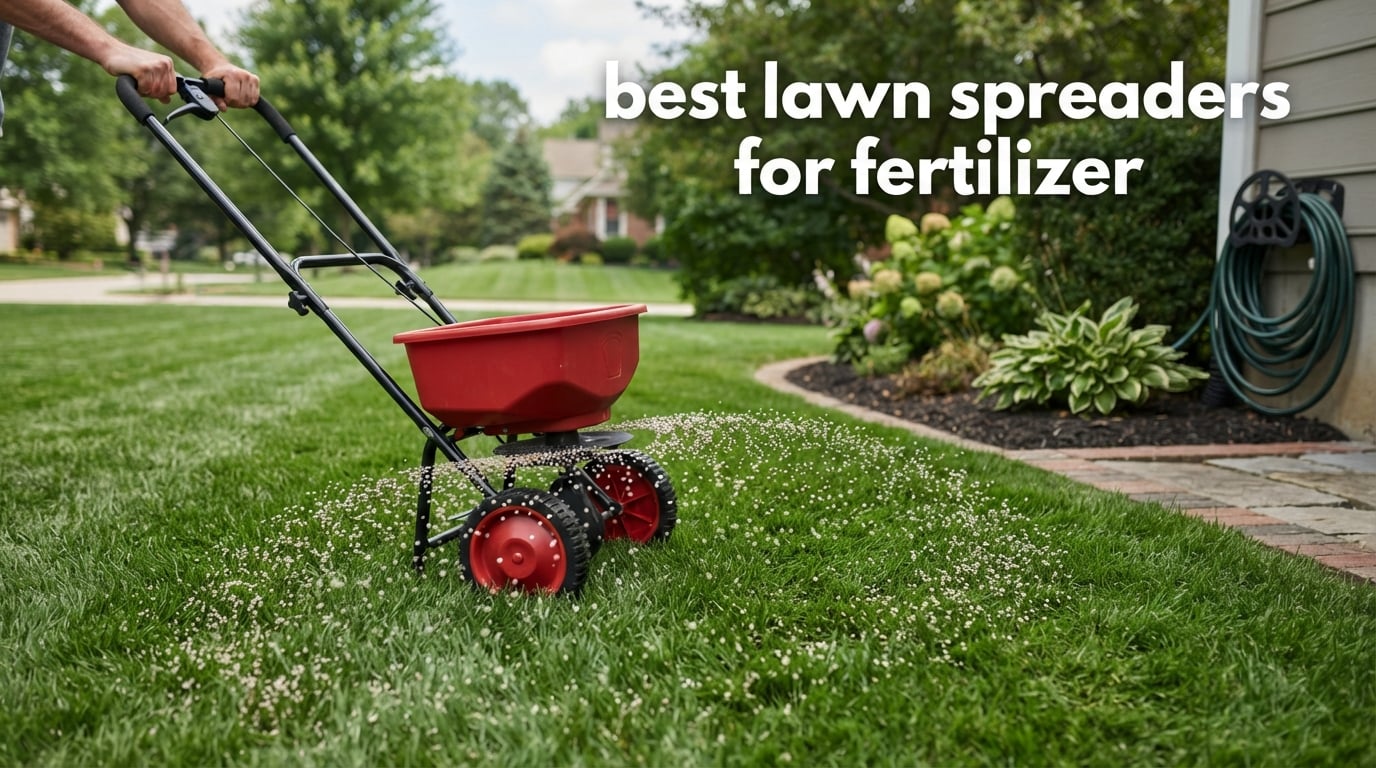
Most lawn problems that look like lawn problems are actually spreader problems. Uneven fertilizer application shows up as pale stripes, dark doubled bands, and burned patches along the edges of the lawn, and none of it goes away with more water or more fertilizer. Getting the best lawn spreaders for fertilizer is the single highest-return purchase in lawn care, because it changes the dose your grass actually receives rather than the dose printed on the bag.
We have handled a lot of these tools over the years, and the pattern is consistent. A spreader does one job: meter product onto the ground at a controlled rate across a predictable swath. Everything else, the bag, the weather, the watering schedule, depends on that rate being right. Get it wrong and you waste product and stress the turf. Get it right and one pass fixes the whole lawn.
This roundup covers ten lawn spreaders for fertilizer across every category a homeowner or property owner actually needs: mini broadcast for typical suburban lots, walk-behind spreaders with real capacity, hand-held and hand-shaker units for steps and touch-up patches, tow-behind and rider-mounted models for acreage, and cordless units for anyone who does not want to push. We looked at construction, hopper capacity, spread width, rate-control mechanics, and the complaints owners keep repeating. Prices change constantly, so use the buttons below to check current listings rather than trusting any number you read in an article.
If you want a narrower starting point, our fertilizer spreader roundup covers the core cases in more depth, and our seed spreader picks go further into overseeding and patch work.
Table of Contents
Top 3 Best Lawn Spreaders for Fertilizer in October

CHAPIN 8740A Hand Shaker
- 64 oz bottle
- Three lid openings
- Steps and paths
- Stores with product
Quick Overview of All 10 Lawn Spreaders for Fertilizer in 2026
Every pick below earned its place for a specific job. The hopper capacity and swath figures come straight from the manufacturers, and the best-for column is how we would match each one to an actual lawn.
| Product | Specifications | Action |
|---|---|---|
| Scotts Turf Builder EdgeGuard Mini |
|
Check Latest Price |
| Scotts Whirl Hand-Powered Spreader |
|
Check Latest Price |
| CHAPIN 8740A Hand Shaker |
|
Check Latest Price |
 Amazon Basics Fertilizer Spreader Amazon Basics Fertilizer Spreader |
|
Check Latest Price |
 Agri-Fab 130 LB Tow-Behind Agri-Fab 130 LB Tow-Behind |
|
Check Latest Price |
 EarthWay 2150 Commercial 50 LB EarthWay 2150 Commercial 50 LB |
|
Check Latest Price |
 WORKPROX Cordless 7.2V Spreader WORKPROX Cordless 7.2V Spreader |
|
Check Latest Price |
 Yard Commander 80 LB ATV and UTV Spreader Yard Commander 80 LB ATV and UTV Spreader |
|
Check Latest Price |
 EarthWay 2600A-PLUS 40 LB EarthWay 2600A-PLUS 40 LB |
|
Check Latest Price |
 Yhtpouqe 80 oz Handheld Spreader Yhtpouqe 80 oz Handheld Spreader |
|
Check Latest Price |
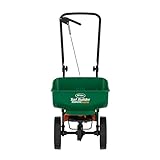
1. Scotts Turf Builder EdgeGuard Mini – Best Overall Broadcast Spreader
Scotts Turf Builder EdgeGuard Mini Broadcast Spreader
Holds up to 5,000 sq ft
EdgeGuard side shield
Pre-calibrated
Folds down flat
Pros
- No assembly needed
- EdgeGuard blocks product off driveways and beds
- Folds flat for shelf storage
- All-plastic body hoses clean easily
- 23k+ owners have rated it
Cons
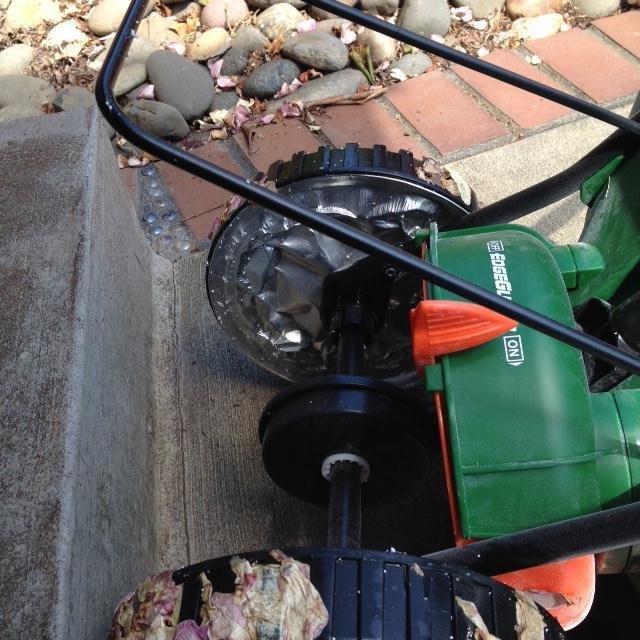
- Hollow rear wheels collect damp fertilizer
- Undersized rear stand can tip when full
- Hopper can hold product above the gate
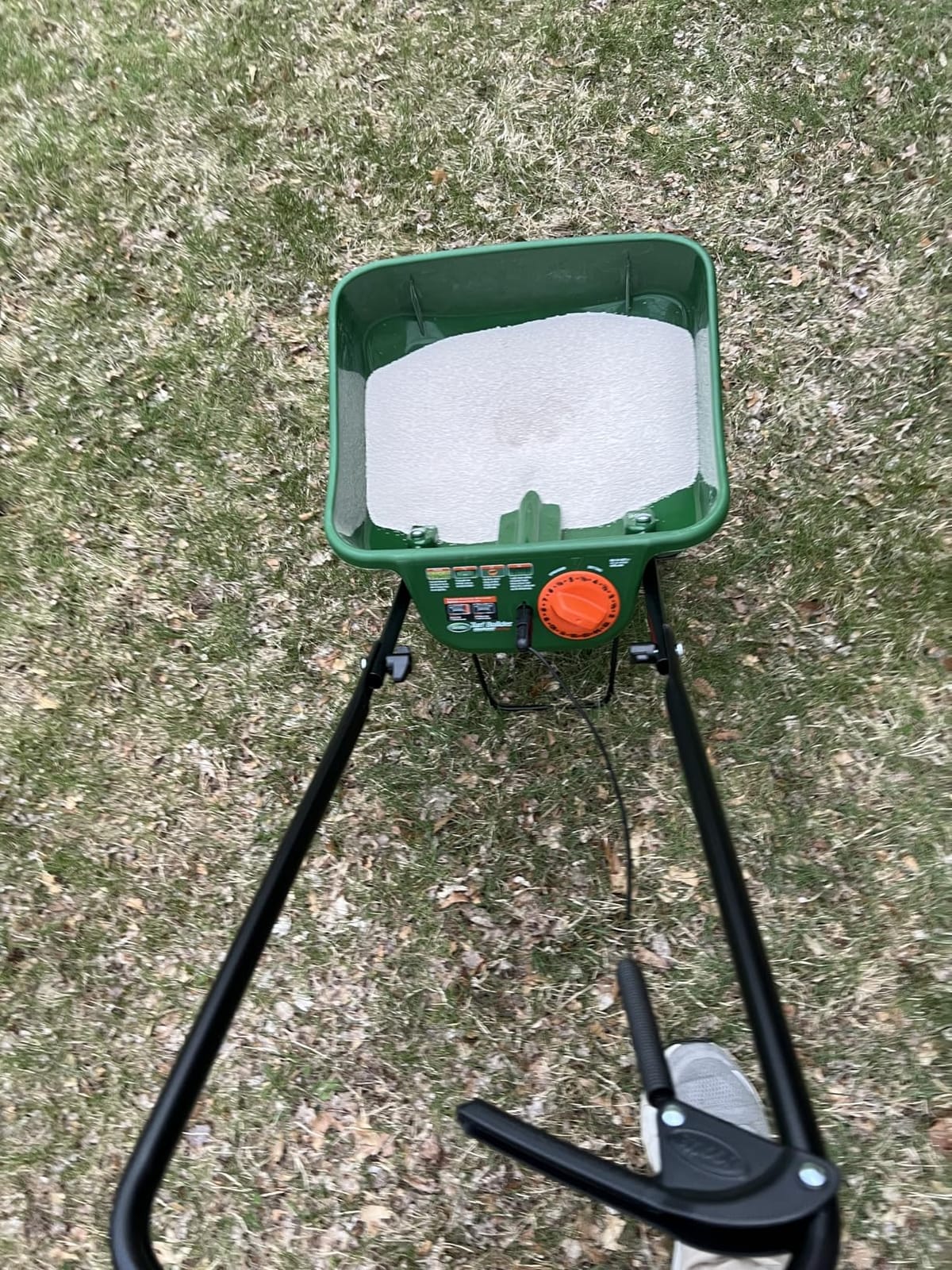
This is the spreader we hand to friends who ask for one recommendation, and the reasoning is simple. It arrives pre-calibrated, so there is nothing to assemble and no first-project guesswork. The EdgeGuard side shield stops granules from reaching the sidewalk, which is where most broadcast spreaders fail first.
Capacity is 5,000 square feet per load, which covers a typical suburban front and back lawn in a single fill. The smooth hopper and agitator feed product consistently, and the whole unit folds down to roughly the size of a shoebox for garage or shelf storage.
Over 23,000 owners have rated it, and the pattern in the reviews is unusually consistent for a product with that many ratings. Praise centers on even spread pattern, the EdgeGuard feature, and the fact that it works immediately out of the box.
There is a specific mechanical weakness worth knowing about. The hollow rear wheels can pick up wet fertilizer and fling it onto the rotary plate, which quietly changes the discharge rate, and the rear support stand is small enough that a full hopper can tip on uneven ground. The all-plastic frame is a genuine benefit, since fertilizer salts will never attack it.
Who this spreader suits
This suits anyone with a lawn up to about half an acre who wants a single tool for fertilizer, grass seed, pre-emergent, and winter ice melt. If you have a driveway or flower beds the spreader has to pass, the EdgeGuard shield is the reason to choose this over a cheaper open model.
It is also the safest recommendation for a first-time buyer. Nothing to assemble, nothing to calibrate before the first pass, and a body that rinses clean under a hose in a couple of minutes.
Where it falls short
The single-wheel drive means output drops noticeably on side-slopes, so on a steep lot walk the perimeter carefully and keep the product closed on the turns. Owners also report that the last of the product can sit above the gate in the hopper, and a tap or a shake gets it moving.
Worth noting on ratings: 4.6 stars across more than 23,000 reviews is a genuinely proven score. Later in this guide I explain why a five-star rating built on a handful of reviews tells you far less.
2. Scotts Whirl Hand-Powered Spreader – Top Rated for Small Lawns
Scotts Whirl Hand-Powered Spreader
1,500 sq ft capacity
Hand-crank operation
Adjustable arm support
13 x 8.7 in footprint
Pros
- Smooth hand crank with simple flow dial
- Arm brace cuts wrist fatigue
- Handles seed fertilizer salt and ice melt
- Lightweight and no assembly
Cons
- Not practical on large lawns
- Coverage depends on steady cranking speed
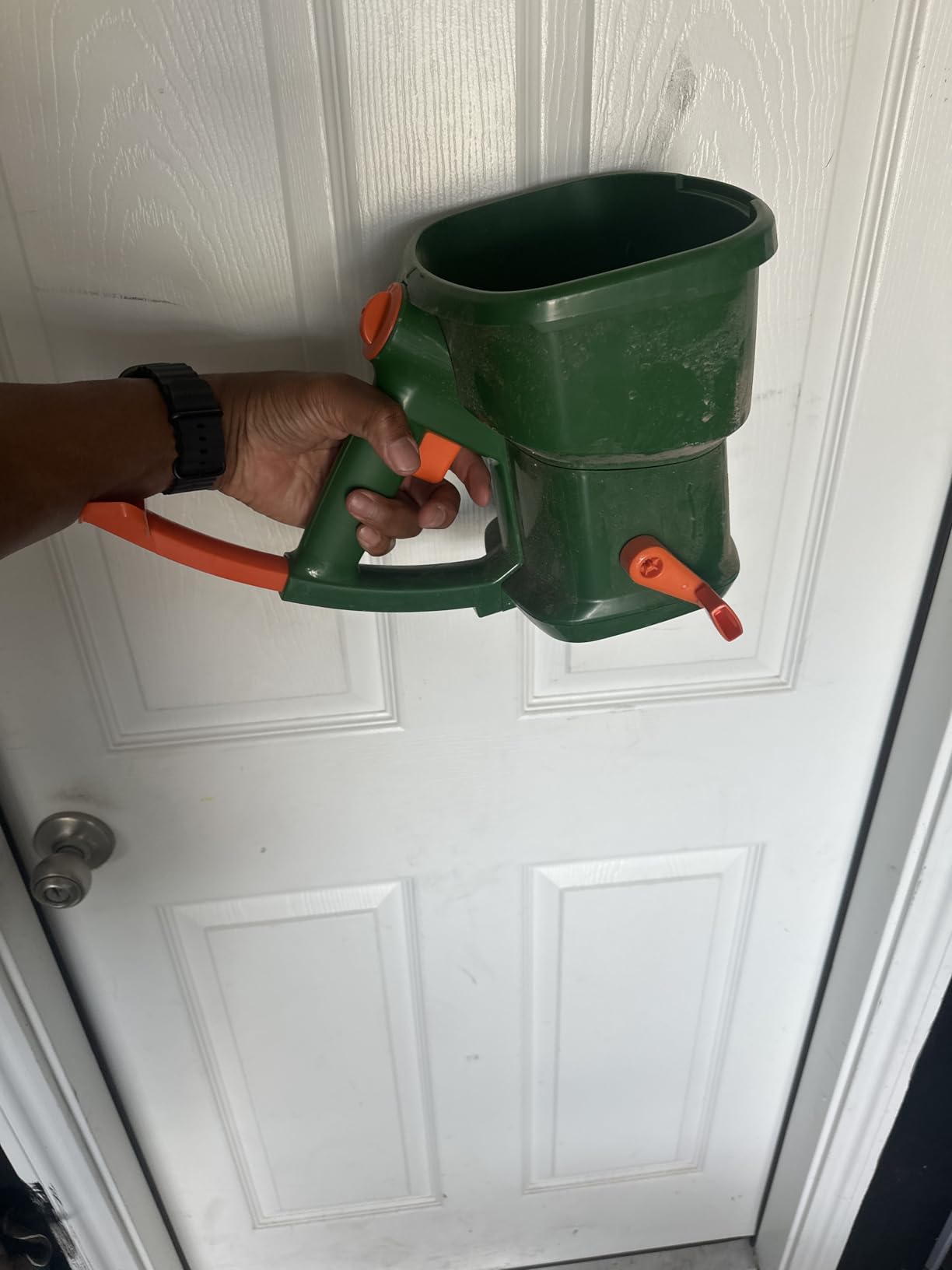
This is the highest-rated spreader in the group at 4.7 stars, with 81 percent of ratings at five stars. It is also a complement rather than a replacement: most owners keep a full-size walk-behind for the lawn and reach for this for the edges, the shaded corners, and the winter walkway.
The hand crank is smooth enough that coverage stays even as long as you keep a consistent pace, and the adjustable arm support is the detail owners praise most. It braces the forearm against the load of a full hopper, which is what keeps a hand unit from becoming tiring halfway through a fill.
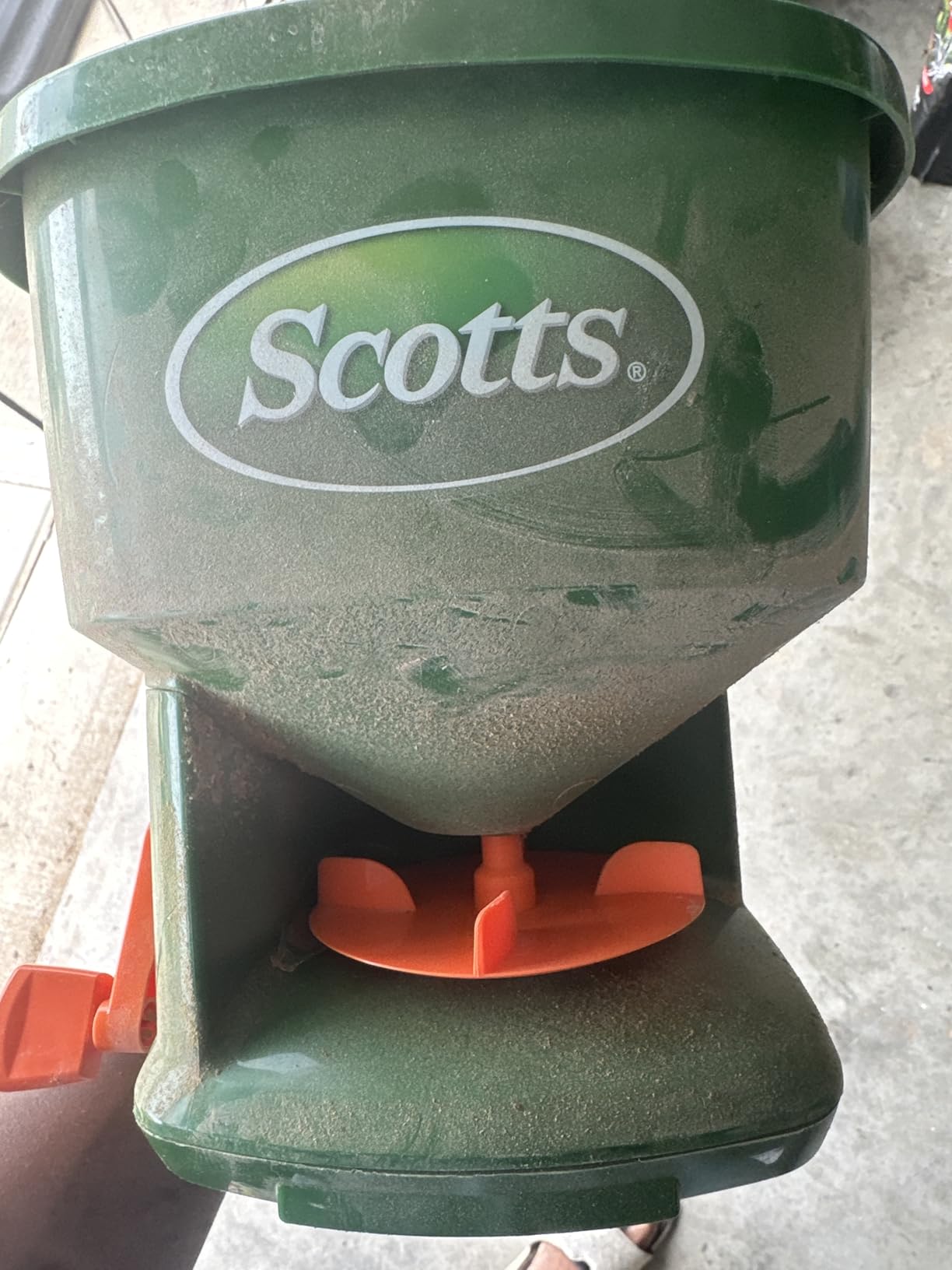
At 1,500 square feet of capacity it is built for real work, not token work. We have used it for overseeding a bare patch, spreading starter fertilizer over thin spring turf, and laying ice melt on steps, and it handled all three without complaint.
Everything you need is in the box and nothing needs assembling. The rubber-gripped handle and simple flow dial make the learning curve about a minute long.
Who this spreader suits
Homeowners with a small lot, a townhouse garden, or anyone who wants precision rather than throughput. It is equally useful as a second tool: a large walk-behind covers the lawn, and this covers the strip along the fence, the corner behind the shed, and the seed-only areas where full-strength fertilizer would be wrong.
Ice melt users get a second reason to own one, since hand-cranking on a walkway is far more controlled than shoving a walk-behind unit through a narrow path.
Where it falls short
This is not a whole-lawn tool and pretending otherwise is a mistake. The 1,500 square foot limit means frequent refills on anything larger, and coverage depends entirely on keeping the crank speed steady, which tires the arm on a long job.
Reviewers are candid that cranking fatigue is the limiting factor, not the spread pattern. The flow itself is smooth and the distribution is genuinely even when the pace is.
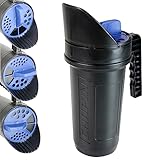
3. CHAPIN 8740A Hand Shaker – Budget Pick for Steps and Paths
CHAPIN 8740A 64 oz All-Season Hand Shaker Spreader, Seed, Fertilizer & Salt
64 oz poly bottle
Three lid openings
Hand-shaker format
11.2 oz weight
Pros
- Sturdy solid poly with a tight screw seal
- Three openings suit ice melt salt and seed
- Large handle works with gloves
- Stores on a shelf with product inside
Cons
- No mid-size lid opening
- Coarse rock salt can lodge in the widest hole
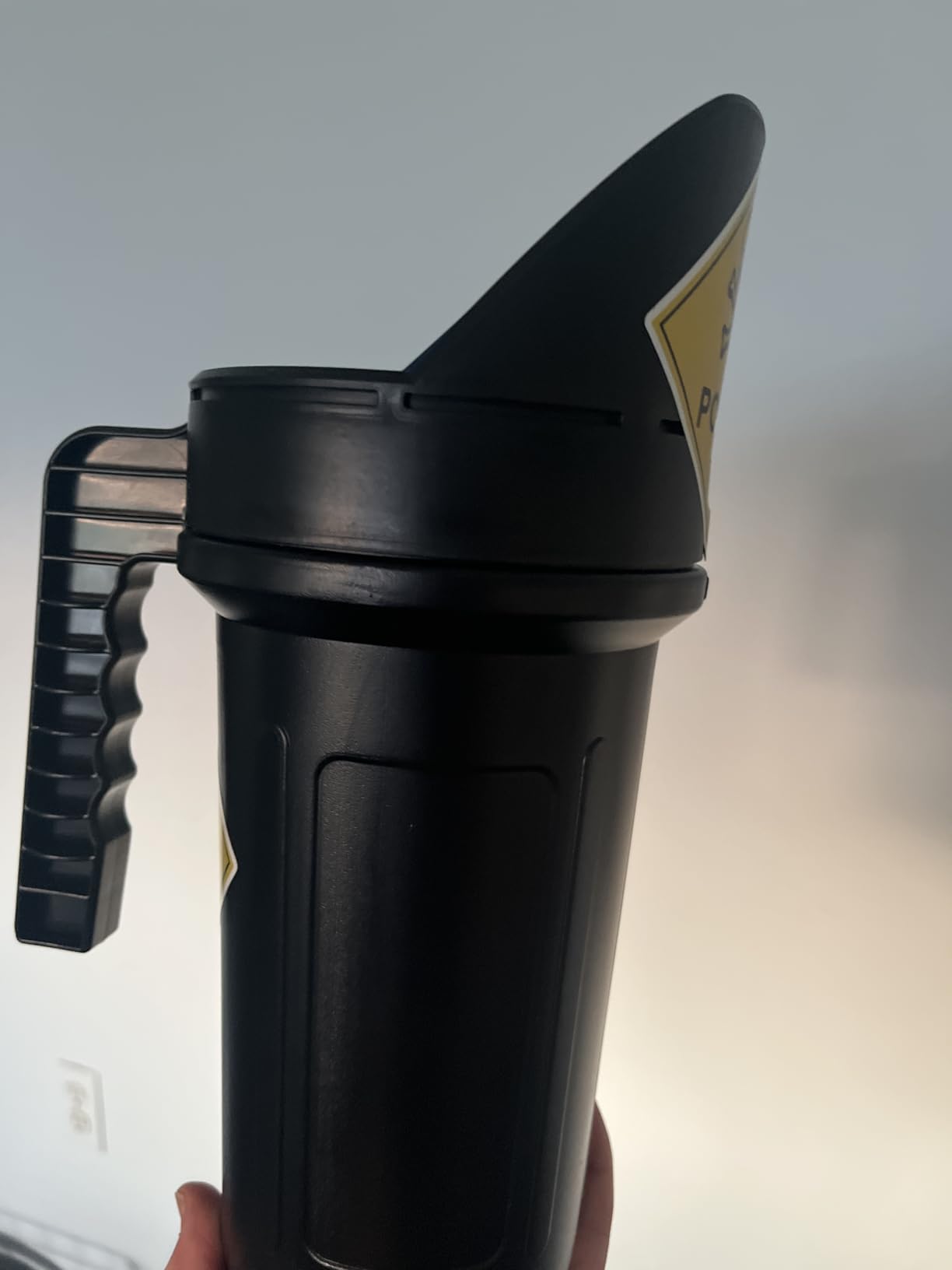
Sometimes the right tool is not a spreader at all, it is a bottle you can aim. The CHAPIN 8740A twists the lid to select between three opening sizes, which lets you meter coarse rock salt on a step or a fine pre-emergent on a patch from the same container.
At 64 ounces it carries real weight, and the large handle fits bare or gloved hands. Several owners in colder regions report units that have survived multiple winters without cracking, which is not nothing for a cheap plastic tool.
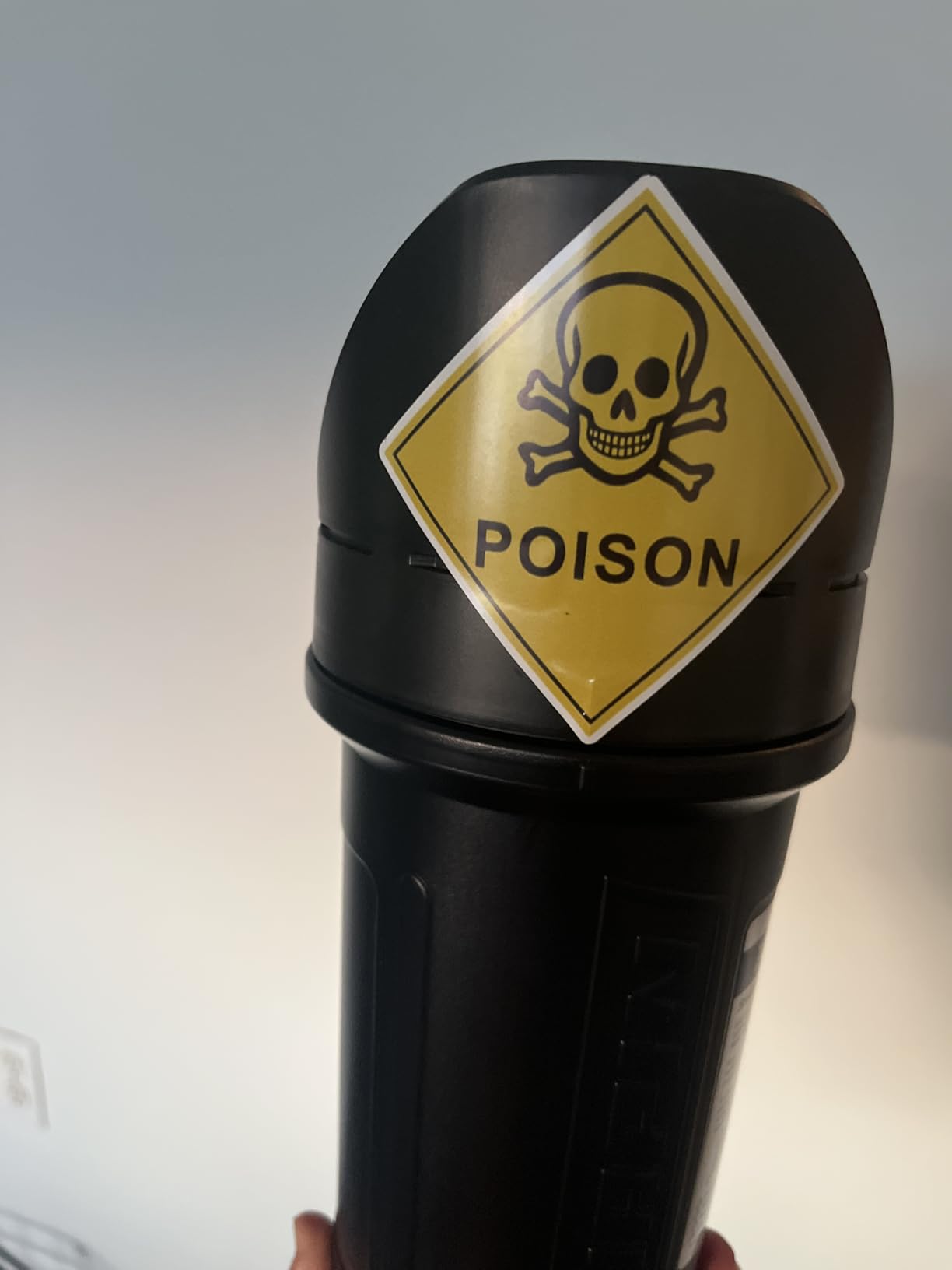
The most important operating note is the seal. The lid has to be twisted until it clicks or material leaks during transport, and that habit takes about one use to develop. Once it is seated, it stays put.
Coverage is controlled entirely by your hand motion rather than a mechanism, which makes it fast but imprecise. That is exactly the trade you want for a staircase and exactly the trade you do not want on a lawn.
Who this spreader suits
Anyone doing steps, walkways, small garden paths, or spot seeding where a walk-behind unit is simply too large to maneuver. It is also the easiest of the ten to store, since it lives on a shelf and can even sit with product inside between seasons.
For a household that only needs to handle ice melt and a small patch of grass, this answers the question on its own. It is the lowest-cost way to stop hand-scattering material.
Where it falls short
The three openings jump from a mid-size hole straight to fully open, and owners regularly ask for something in between. That gap makes it slightly less useful for a controlled mid-flow application of fertilizer.
Coarse rock salt is the other recurring snag. Rocks lodge in the widest opening and you need to shake the bottle to clear them, which is a minor annoyance on a winter step and a real one if you are doing a whole walkway.
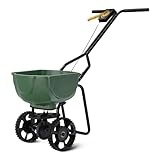
4. Amazon Basics Fertilizer Spreader – Best Value Walk-Behind
Amazon Basics Fertilizer Spreader for Lawn, Evenly Spreading, Multi-Gear System, Covers 5000 Square Feet per Load, 33 Pounds, 0.53 Cubic Feet, All Season, 1-Pack
5,000 sq ft per load
33 lb weight capacity
Multi-gear flow control
8.86 lb unit weight
Pros
- Covers 5000 sq ft in about 10 minutes
- Tool-free assembly in under five minutes
- Wide wheels handle sloped lawns
- Adjustable flow dial is simple and accurate
Cons
- Handle jams or fails to open
- Opaque hopper hides jams
- Some units arrive missing hardware
This is the only spreader here that combines a steel frame with a walk-behind footprint under about half an acre, and on paper the numbers are strong. Five thousand square feet per load, a 33 pound weight capacity, and a multi-gear flow control that handles fertilizer, seed, salt, and ice melt through the same dial.
Owners who like it describe it as good value with genuinely even coverage, and the wide wheels glide over uneven and sloped lawns without tipping. Assembly is tool-free and takes under five minutes, which puts it ahead of the commercial units further down this list.
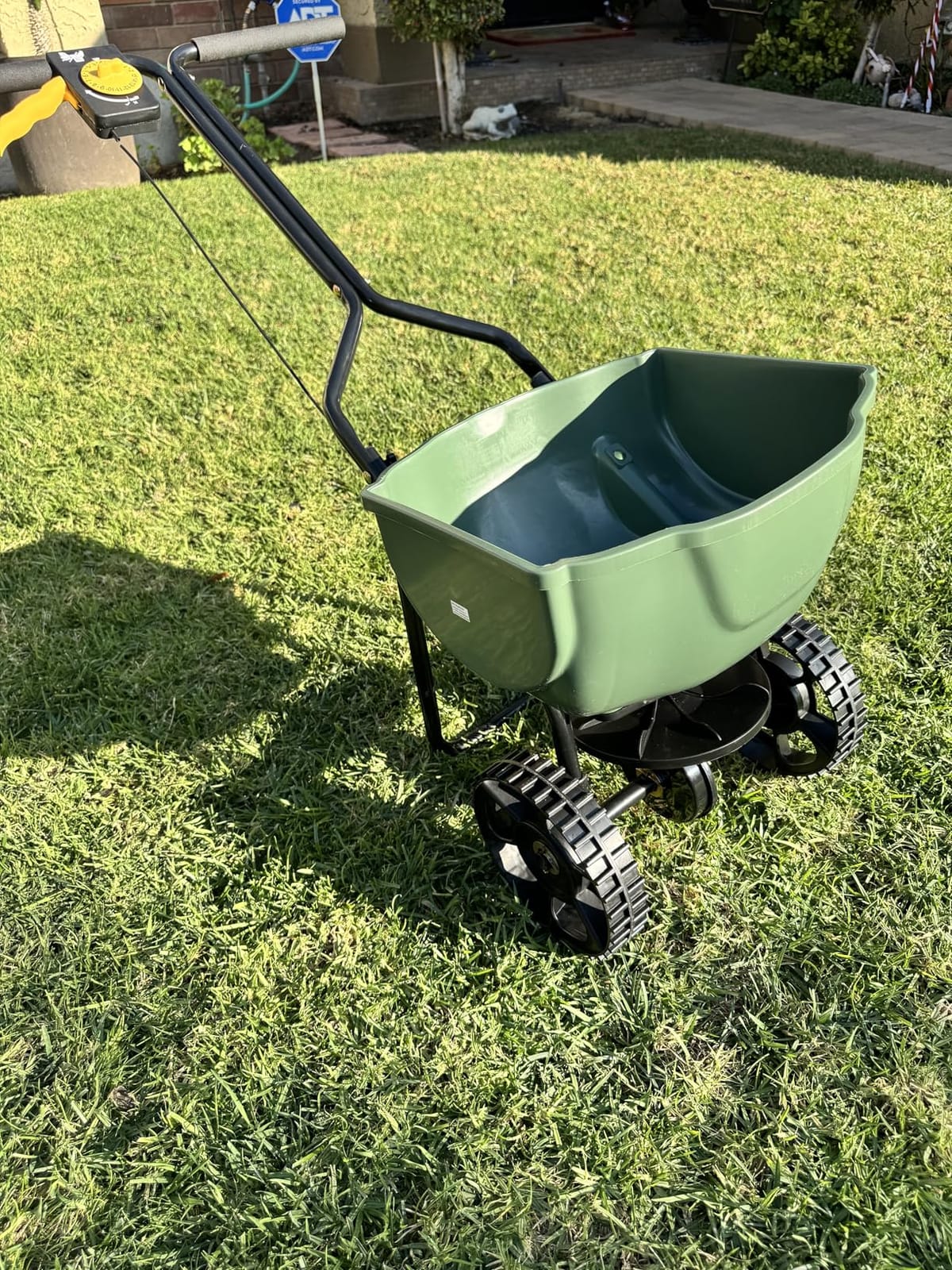
It is light enough to push with one hand and stable enough to hold a straight line, which is the combination that actually determines whether your passes overlap correctly. At 8.86 pounds, it is the easiest full-size unit in this roundup to move around a garage.
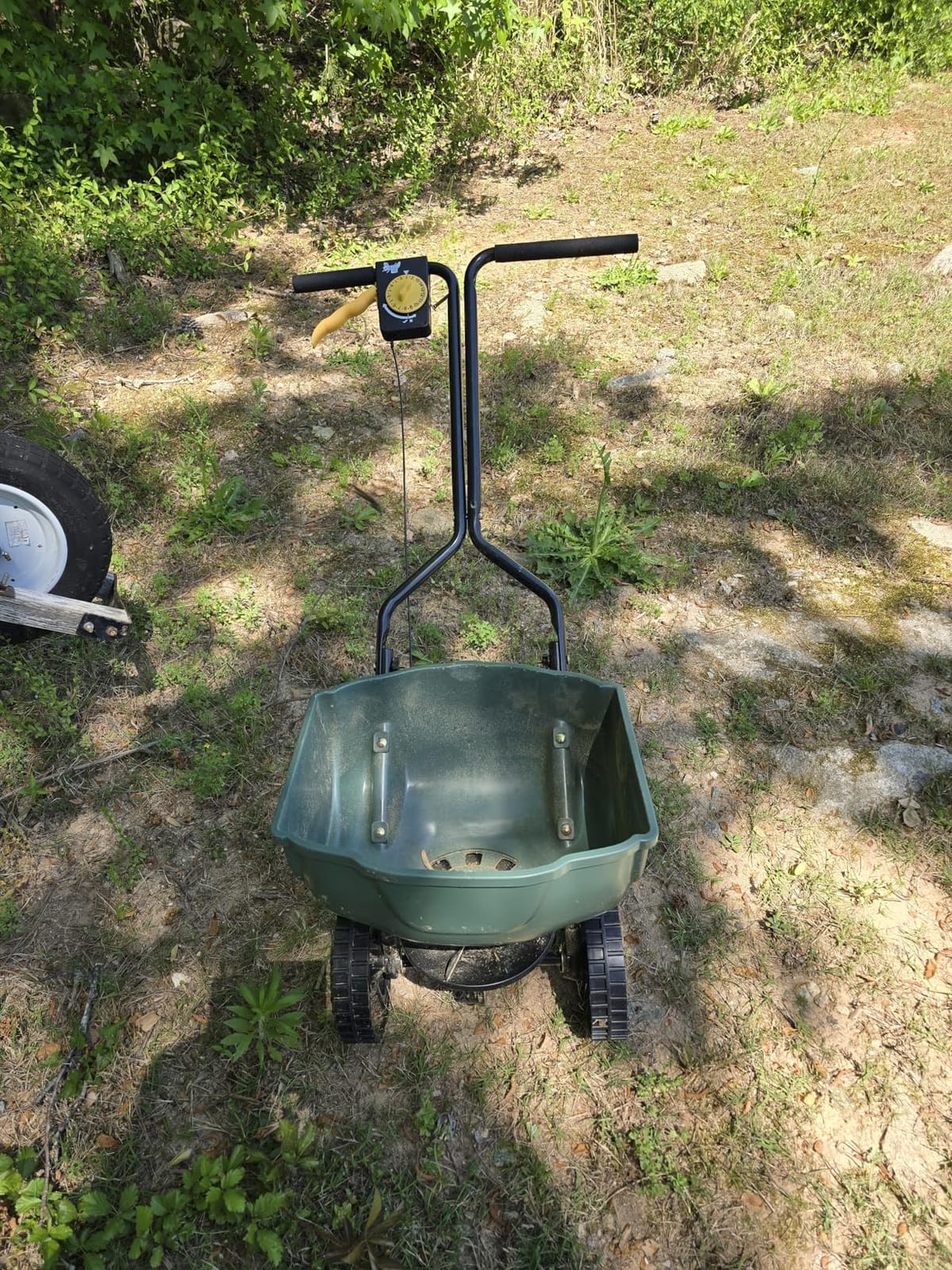
We rate this the lowest-rated unit here at 4.0 stars with a 14 percent one-star share, and the complaints are mechanical rather than fundamental. The handle does not always open smoothly, and the opaque plastic hopper means you cannot see the granules leaving, so a jam is hard to detect until the pattern changes behind you.
Who this spreader suits
A homeowner who wants a full walk-behind for a small-to-medium lot without paying for a name brand, and who is comfortable checking the rate visually after the first pass. The wide wheelbase makes it a good choice on yards with slope or rough patches.
It also works well as a secondary unit for seed. The 12 pound uncoated seed and 33 pound coated seed capacities cover meaningful ground in a single load.
Where it falls short
The rate control is a cable, and cables stretch and slip. Owners report a slack control cable and missing assembly hardware on some units, so check both before the first pass. The handle jamming is the single most repeated complaint in the reviews.
Because the hopper is opaque, we would run a calibration test over a measured area before treating the lawn. If the pattern is off, the problem is hidden from you by design.
5. Agri-Fab 130 LB Tow-Behind – Best Tow-Behind Spreader
Agri-Fab Pull Behind Broadcast Spreader for Seed, Fertilizer, Salt and Ice Melt, 130 lb Hopper Capacity with Universal Hitch and 12 Ft Spread Width
130 lb hopper
10 to 12 ft spread width
Alloy steel frame
29.4 lb unit weight
Pros
- Half acre covered per fill with few refills
- Universal hitch fits most riding mowers
- 13 in pneumatic tires roll over rough ground
- Enclosed gear house and clear assembly diagram
Cons
- No automatic flow shut-off
- Gears arrive unlubricated
- Narrow tires and high center of gravity on side slopes
Once you are past half an acre, a walk-behind stops making sense and this is the category where it starts. The 130 pound hopper covers up to half an acre or roughly 25,000 square feet per fill, and one owner reported using it to seed and fertilize ten acres across a season.
The 10 to 12 foot spread width cuts the number of passes dramatically compared with a mini broadcast. It attaches with a universal hitch to most riding mowers and lawn tractors, and the 13 inch pneumatic tires handle rough ground that would bog down solid wheels.
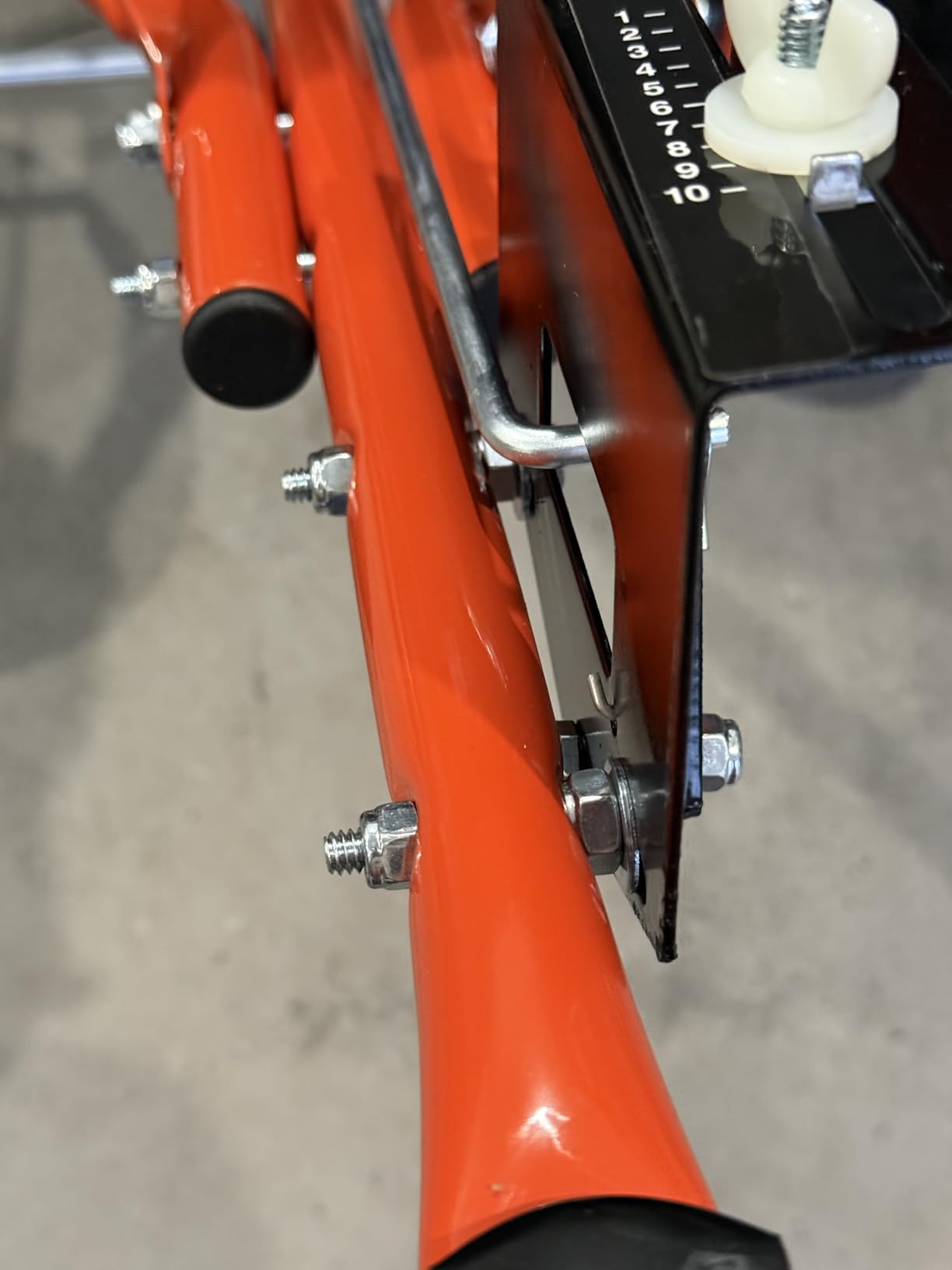
Build quality is the selling point. One inch steel tubing, an enclosed gear housing, and a polypropylene hopper mean this is a machine that keeps working rather than one that degrades after two seasons of salt exposure.
It ships with a 3 year limited warranty, and the assembly instructions are clear enough to include a full hardware diagram. That matters more than it sounds, because the 9 percent one-star share on this product is mostly assembly frustration rather than failure.
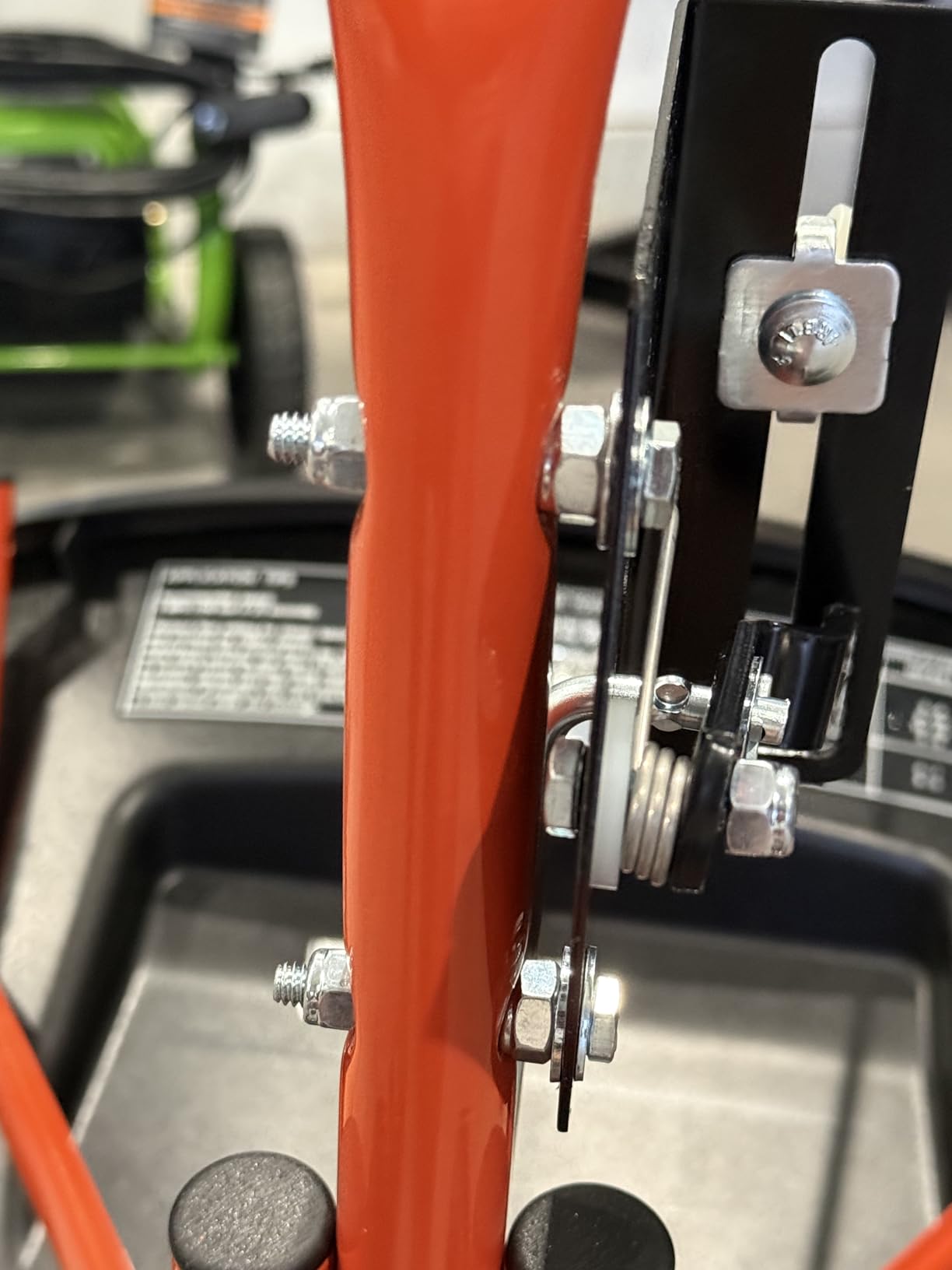
Who this spreader suits
Property owners with an acre or more, small farms, and anyone maintaining grounds where a walk-behind would take an entire weekend. The universal hitch means it works with the tractor you already own instead of requiring a specific brand.
It is equally good for ice melt on a large driveway or a commercial front lot, since the hopper capacity means you are not stopping every two hundred feet to refill.
Where it falls short
There is no automatic flow shut-off, so the lever has to be reached back to manually. On an 18 to 36 foot throw pattern that means a real gap at every turn, and corners need hand work.
Two other cautions. The gears arrive unlubricated and corrosion starts quickly if the unit is not cleaned after use, and the narrow tires combined with a high center of gravity make side slopes risky when the hopper is loaded. Take turns slowly on uneven ground.
6. EarthWay 2150 Commercial 50 LB – Best for Large Grounds
EarthWay 2150 Commercial 50 LB Broadcast Fertilizer Spreader. Heavy-Duty Walk-Behind Push Garden Seeder with Adjustable Drop Rate and Driving Handle. Large 13 inch Pneumatic Stud Tires
50 lb hopper
13 in pneumatic stud tires
Removable clog-free grate
Five-year limited warranty
Pros
- Very even wide spread pattern
- Built to last decades
- Handle has three length settings
- Removable grate breaks up damp clumps
- Enclosed gearbox works in damp conditions
Cons
- Assembly takes one to two and a half hours
- Very wide 18 to 36 ft throw is hard to manage
- Last of the product sticks in the hopper
The EarthWay 2150 is the one we would consider for institutional grounds, and it is the machine professional applicators name when durability comes up. Owners describe construction built to last decades, which is why a 4.1 star average across 779 reviews still reads as a proven product rather than a risky one.
The clog-free removable grate is the feature that matters most day to day. It sits inside the hopper, separates larger chunks from the flow, and slides in and out for cleaning, which is the direct answer to the caked-fertilizer complaints that show up on cheaper units.
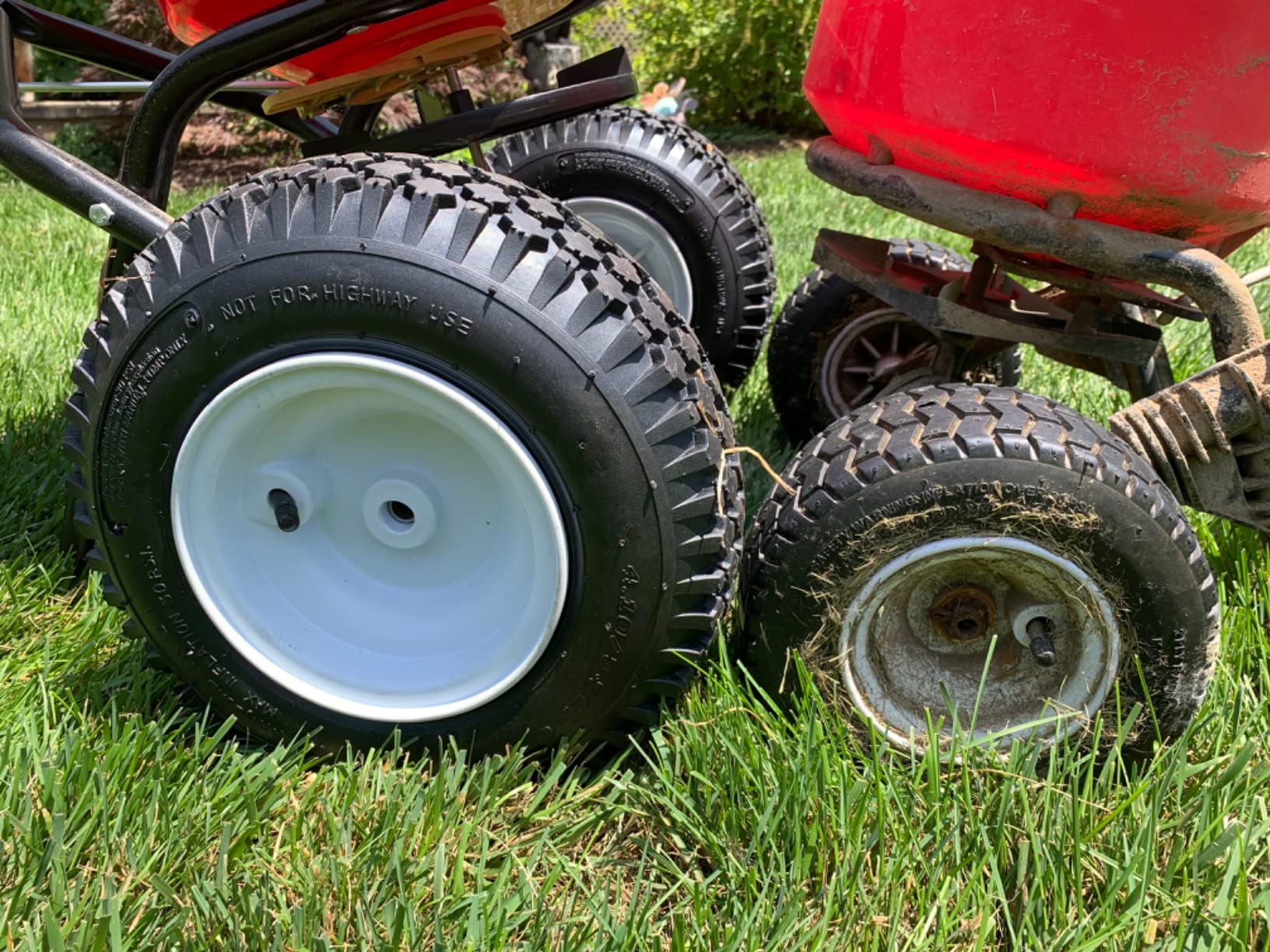
The 13 inch high-flotation pneumatic stud tires with rust-proof poly rims glide over rough or wet lawn and are easy to push uphill. The handle adjusts to three length settings, so the operator can stand upright rather than bend over the hopper, and the enclosed gearbox keeps working in damp conditions where an open gear housing would clog.
The three-hole drop system with side-spread control produces feathered edges, which is a real precision gain along beds and paths.
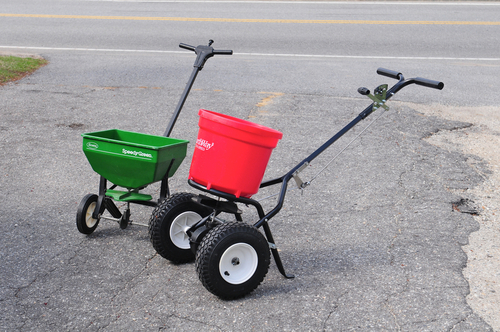
Who this spreader suits
Large properties, school and institutional grounds, and maintenance staff who will use the same machine dozens of times a year. The five-year limited warranty and lifetime technical support reflect a serviceable design rather than a disposable one.
It is also the right choice for anyone who stores equipment outdoors or in an unheated shed, because the enclosed gearbox and rust-proof components tolerate conditions that shorten the life of a plastic-frame spreader.
Where it falls short
Assembly is the biggest hurdle and nobody glosses over it. Owners report one to two and a half hours with poor printed instructions, and the universal advice is to follow an assembly video instead of the manual. EarthWay customer support is praised for shipping missing parts, which softens the problem.
On a standard suburban lawn the 18 to 36 foot throw is genuinely difficult to manage and throws product onto anything nearby. The side-spread control cable, lever, and hopper cover are also not included, and the last of the product can stick in the hopper needing manual agitation.
7. WORKPROX Cordless 7.2V Spreader – Best Cordless Option
WORKPROX Cordless Battery Powered 7.2V Fertilizer Spreader, 8-Level Setting
2.5 L hopper
8 flow settings
6 seeding angles
3.45 lb unit weight
Pros
- Arrives charged with no pulling effort
- Covers 6458 sq ft of seed or 3767 sq ft of fertilizer
- 8 settings and 6 angles give real control
- Two hours of runtime per charge
Cons
- Flow gate can stick open and waste product
- Seeds can catch under the dispersion wheel
- Not waterproof
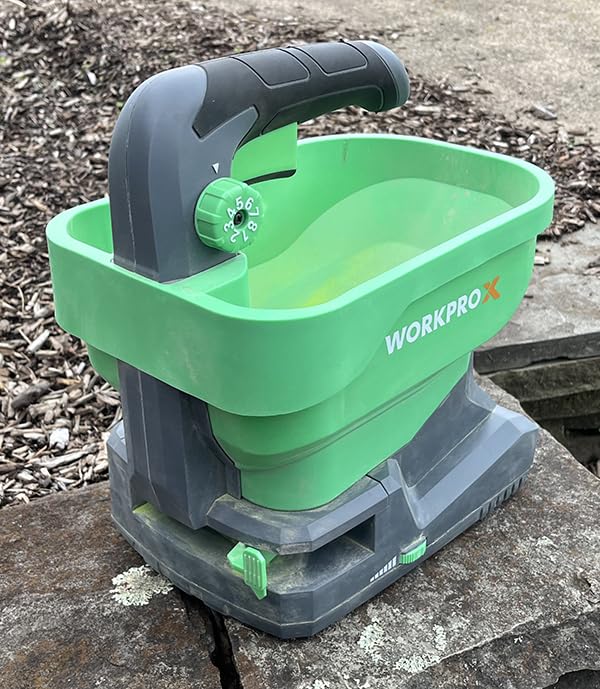
This is the only genuinely powered hand-held unit in the roundup, and the appeal is straightforward: no cranking, no pushing, no arm fatigue. It arrives charged, so the first application starts immediately, and at 3.45 pounds it is the lightest tool here.
Coverage figures are specific and useful. A single charge handles about 3,767 square feet of fertilizer or 6,458 square feet of grass seed, with roughly two hours of runtime. The 2.5 liter hopper holds enough product to reduce refills to a minimum on a normal-size lawn.
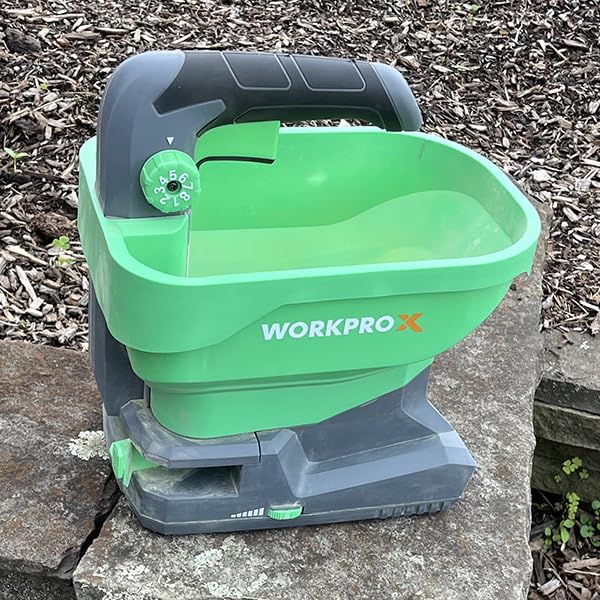
Control is better than a typical hand shaker. There are eight flow settings, divided across fine seed, moderate fertilizer, and heavy rock salt, plus six seeding angles up to 127 degrees and six motor speeds from 900 to 2200 rpm. Owners note the motor throws further than the stated 8 feet, which is useful if anything.
The critical reviews focus on the flow gate sticking open or freezing, which wastes product and soils your hands, and on seeds being crushed under the dispersion wheel. A charging adapter of 30W or higher is recommended.
Who this spreader suits
Anyone with a shoulder, back, or grip limitation who still needs to apply product over a full lawn. It is also good for people who simply do not enjoy pushing a loaded hopper across uneven ground, and the cordless format means no cable to snag on beds and no fuel to store.
For small and medium lots it covers the whole lawn in a single charge, which makes it a legitimate primary tool rather than an emergency backup.
Where it falls short
It is not waterproof, so cleaning requires a dry cloth or soft brush and the unit must be stored somewhere cool, dry, and ventilated. Battery health also depends on recharging every three to six months whether or not you are using it.
With 170 reviews the sample is thin, and the one-star share of 12 percent reflects real mechanical complaints rather than preference. The flow plate freezing up mid-pass is the failure to watch for.
8. Yard Commander 80 LB ATV and UTV Spreader – Best for Riders
Yard Commander – 80 LB ATV/UTV Broadcast Spreader – 12-Volt Heavy Duty Motor – Salt, Seed, Fertilizer & More – Adjustable Drop Rate – Included Hopper Cover – Mounts to Front or Rear Utility Rack
80 lb hopper
12 ft spread radius
12V motor
Powder-coated steel frame
Pros
- 80 lb hopper holds its rated load when full
- Powder-coated frame and vinyl-coated 12V motor
- Mounts to front or rear rack quickly
- Adjustable rate handle gives even distribution
- Hopper rain cover included
Cons
- Wiring harness and rocker switch will not mount as supplied
- No instructions for the on-off switch
- Feed cable is too short
Where the Agri-Fab trails a tractor, this unit bolts to a utility rack on an ATV or side-by-side. The 80 pound hopper is large enough to cover serious ground without constant refilling, and the 12 foot spread radius keeps the pass count down.
Two details set it apart in this category. The hopper cover is included, which matters more than it sounds since damp material clumps and bridges inside an uncovered hopper, and the drop-rate adjustment handle is within reach from the seat.
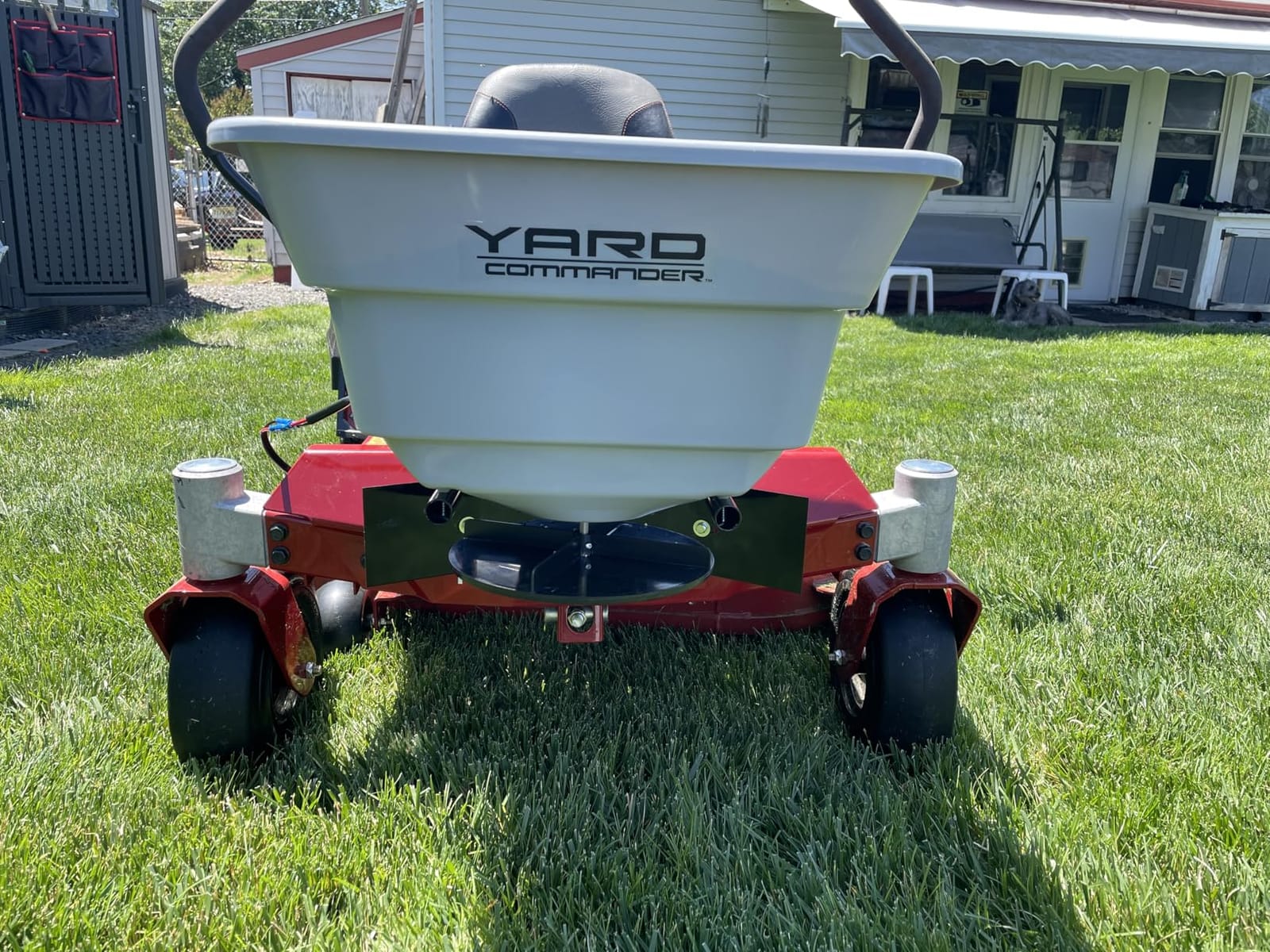
The powder-coated steel frame and vinyl-coated 12 volt motor are built to handle fertilizer, salt, and snow melt across a full year, and owners report the hopper holds its rated load when full rather than bottoming out early.
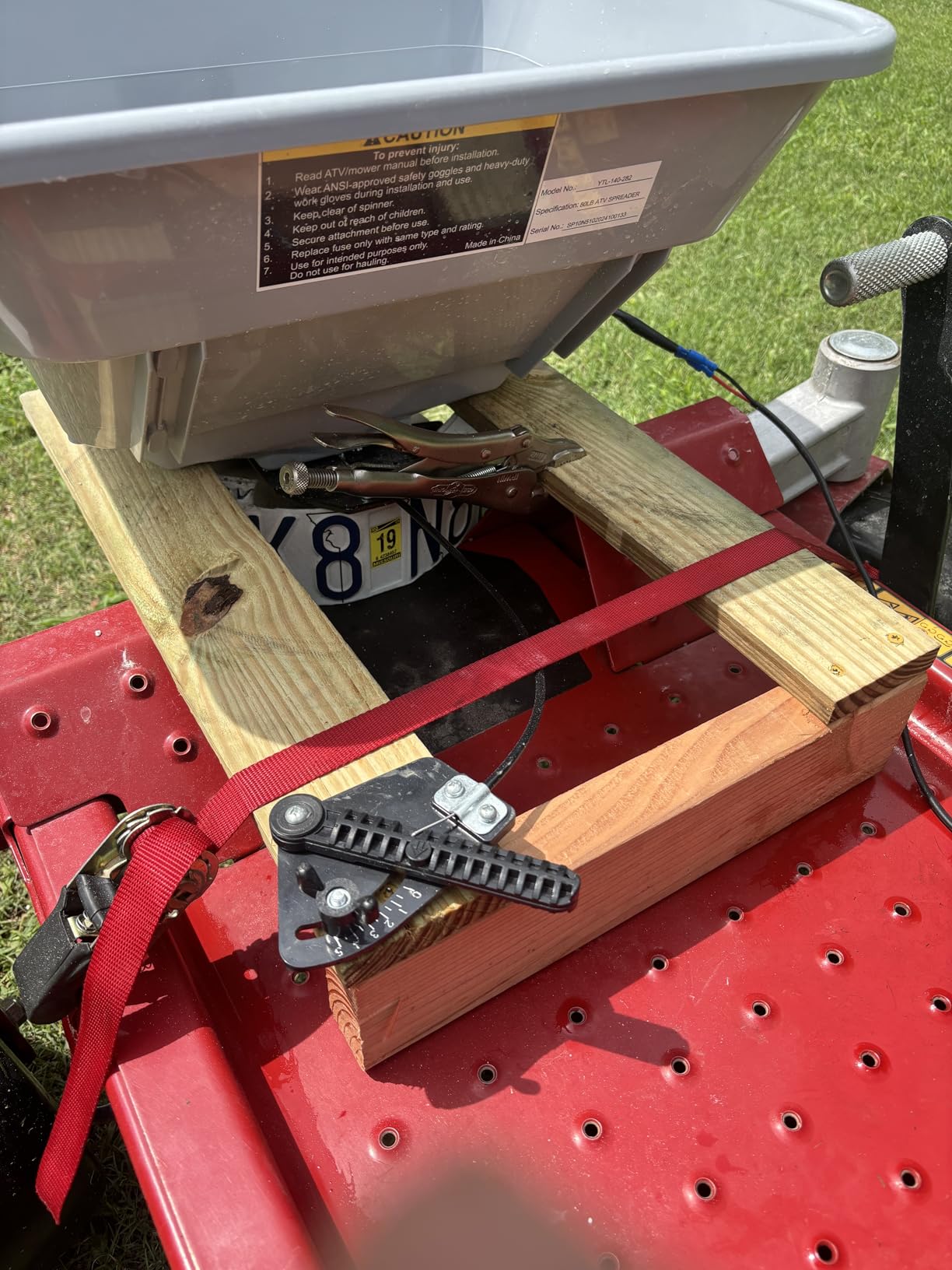
It is compact at 20 by 21 by 17 inches, so it does not dominate a small utility rack, and it carries a one-year limited warranty. Several owners fabricate their own mounting brackets to fit specific machines.
Who this spreader suits
Riders with an ATV, UTV, or zero-turn mower who already cover long distances per trip. Spreading from a vehicle turns a large application into a single job rather than a weekend, and the handlebar on-off switch means you control flow without dismounting.
It is also year-round useful: salt in winter, fertilizer and seed in spring, and deer feed in fall.
Where it falls short
The electrical harness is the weak point and several owners modified or rewired the unit. The fuse holder will not fit through the rocker switch opening as supplied, the shrink wrap blocks mounting, and there are no instructions for hooking up the on-off switch. Budget an evening and some electrical tape or terminals.
The feed cable is also reported as too short, and thin sheet-metal screws driven into the plastic hopper supports can strip under load. The material can also sit dormant in the hopper and needs pushing toward the outlet.
9. EarthWay 2600A-PLUS 40 LB – Best Repairable Build
EarthWay 2600A-PLUS Fertilizer Spreader, 40lb Hopper Capacity, Red, Durable, All Terrain Pneumatic Tires, Rust-Proof Polypropylene, Epoxy Coated Steel Frame
40 lb hopper
Epoxy-coated steel frame
All-terrain pneumatic tires
Three-hole drop shut-off
Pros
- Rust-proof hopper and epoxy-coated frame
- Replacement parts are available
- Pneumatic tires roll over roots and bumps
- 40 lb covers medium yards
- Upright handle height
Cons
- Spread pattern is not even and skews to one side
- Round pellets clog the wedge-shaped openings at low settings
- Shut-off linkage rod can bend
- Confusing instructions
This is the mid-capacity EarthWay, and the reason to choose it over the 2150 is scale. Forty pounds covers a medium yard with few refills, and at 15 pounds the whole unit is light enough to push and store in a small footprint. The handle height lets you stand upright, which matters on a long application.
The construction details are the argument. A rust-proof polypropylene hopper on an epoxy powder-coated steel frame is a combination that shrugs off fertilizer salt, and the all-terrain pneumatic tires roll easily over bumpy ground and exposed tree roots.
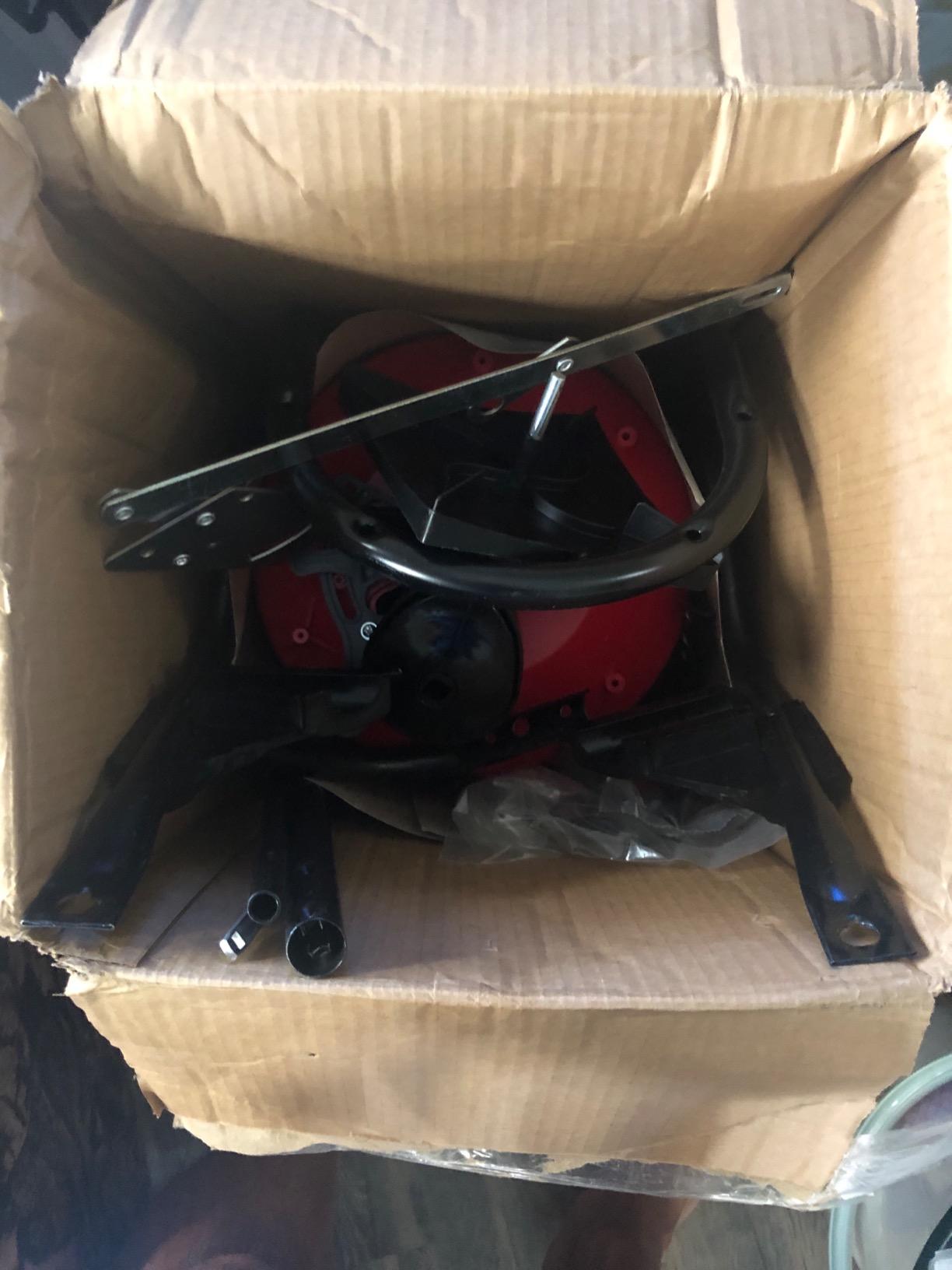
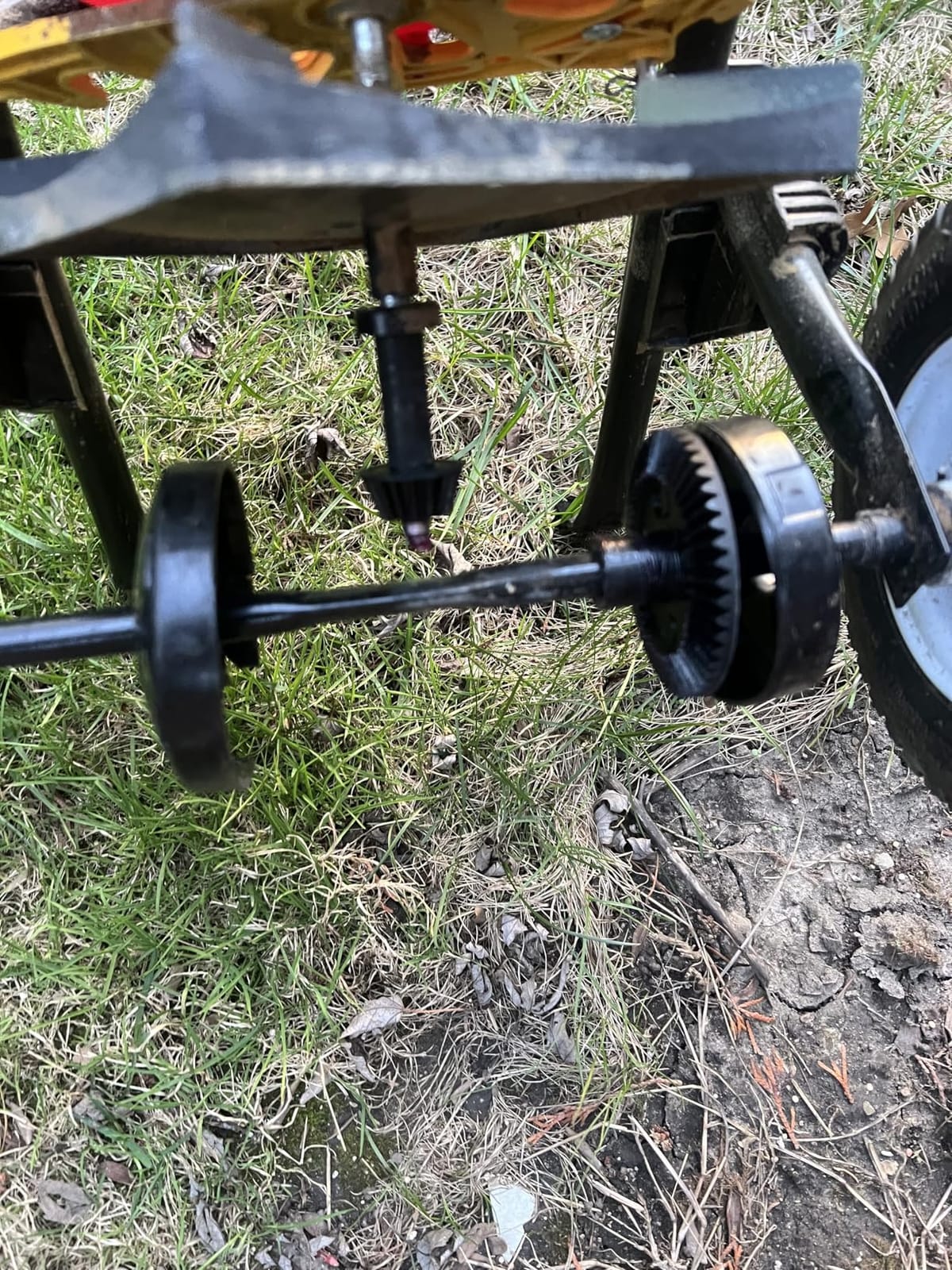
The three-hole drop shut-off system with solid linkage gives precise distribution control, and the edge guard is easy to engage when you need to keep product off an edge. One long-term owner reported that switching to this unit eliminated the burn spots his old plastic-wheeled spreader had been causing.
Replacement parts being available is the quiet advantage here. Over a decade of fertilizer salt exposure, having a serviceable machine rather than a sealed one is what determines whether you replace the whole spreader or one linkage.
Who this spreader suits
Owners with a medium lawn who want commercial-grade durability without a commercial-size hopper, and anyone who intends to keep the same spreader for many years. It is also a strong choice for coarse material like tall fescue seed, where the 40 pound capacity means fewer refills than a small unit.
For properties with rough ground or root systems, pneumatic tires make a measurable difference in how the job feels.
Where it falls short
The most-cited weakness is an uneven spread pattern that skews heavily to one side, which produces exactly the striping this article is meant to prevent. Round or ball-shaped pellets, particularly pre-emergent at low settings, clog the wedge-shaped hopper openings and need jostling.
The shut-off plate connecting rod can bend and stop opening correctly, the edging lever is awkward to engage, and the instructions are confusing enough that owners recommend assembly videos. Customer support on warranty issues has also drawn criticism.
10. Yhtpouqe 80 oz Handheld Spreader – Best Handheld for Touch-Ups
Yhtpouqe Hand held Spreader, Seed Spreader for Ice Melt, Grass Seed, Fertilizer Lawn and Garden. Multiple Adjustable Opening Sizes for Salt,Ice Melt, Up to 80 Oz
80 oz capacity
Three opening sizes
One-piece molded handle
1.21 lb weight
Pros
- Handle molded as one piece with the body
- 80 oz capacity cuts refills
- Scoop and gloves included
- Three openings suit seed salt and sand
- Secure screw top prevents spills
Cons
- Lid is difficult to twist on and off
- Not practical for large areas
Among the hand units, this is the one with the sturdiest handle, and the reason is a design choice rather than a feature list. The handle is molded as a single piece with the body, so there is no lid-mounted grip that can twist loose or split at the joint, which is the usual failure mode of a cheap hand spreader.
At 80 ounces the capacity is the largest of the hand units here, and reviewers point out that it covers a good area in a single fill. The package also includes a scoop and a pair of garden gloves, which sounds minor until you are filling it at the bag.
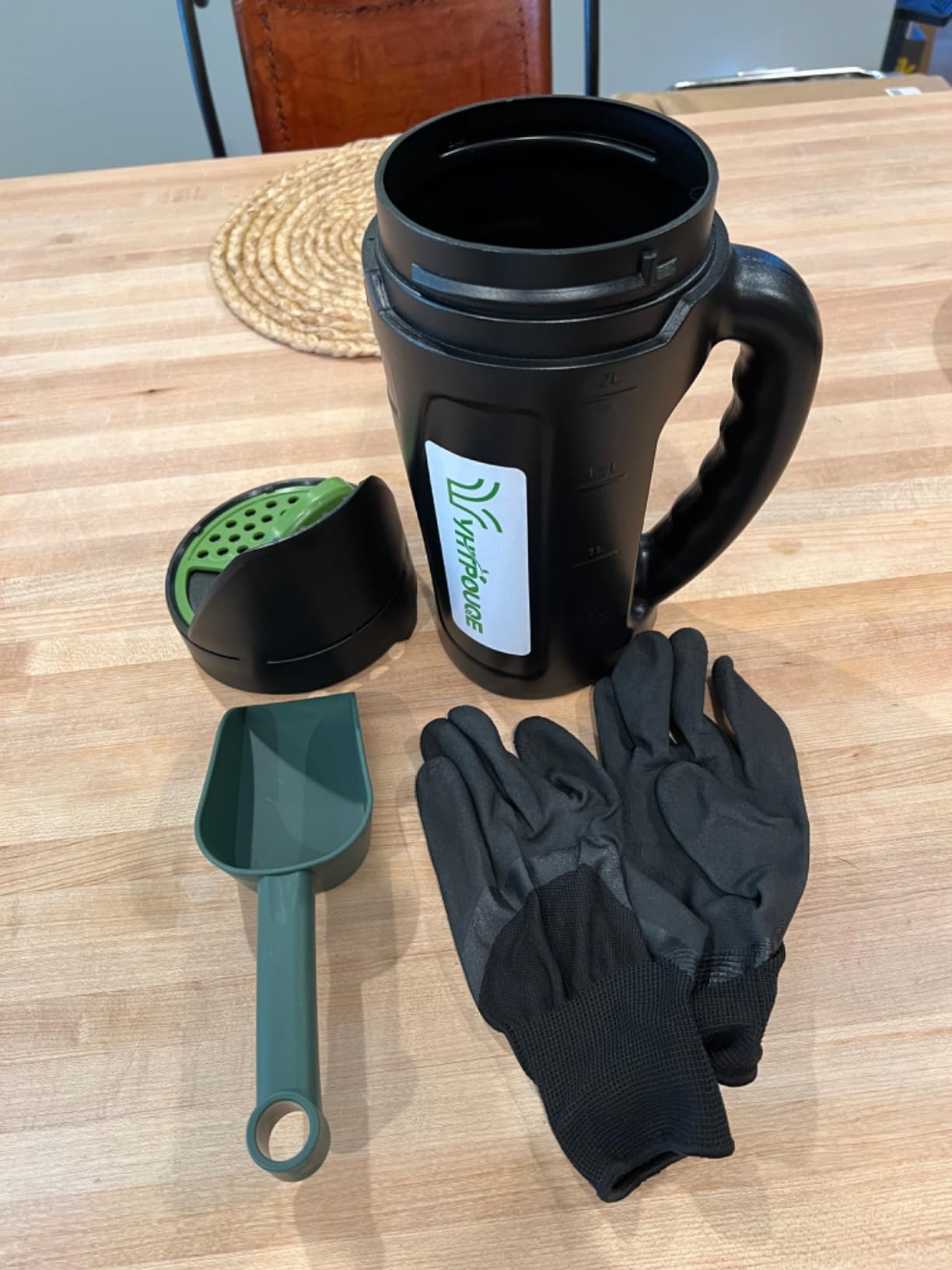
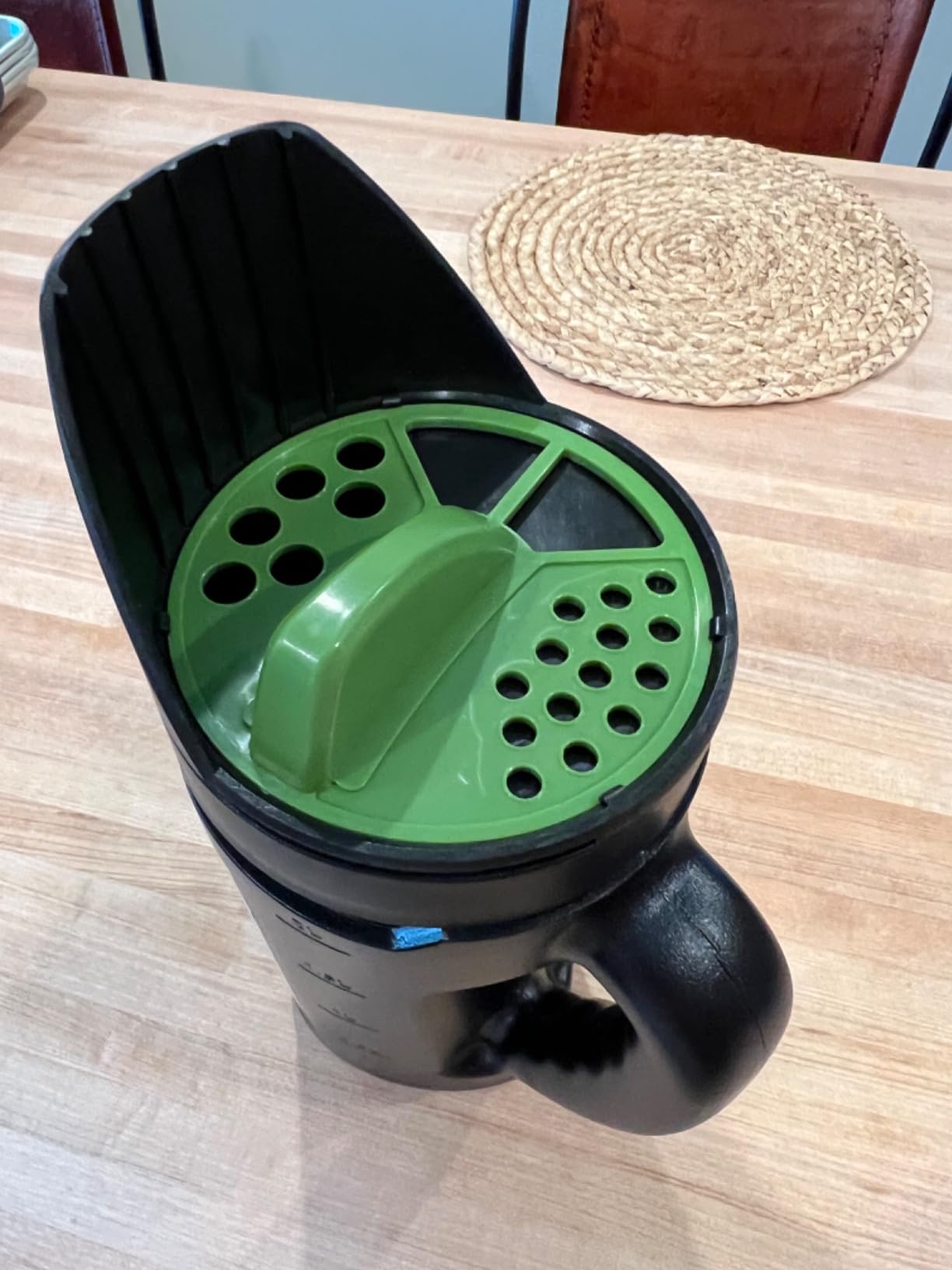
Three adjustable lid opening sizes cover pre-emergent, grass seed, fertilizer, sand, and salt, so one container handles the whole year. The ergonomic handle reduces wrist pain and over-spray, and the secure screw top keeps material dry and makes cleanup a quick wipe.
It scores 4.6 stars with 79 percent five-star ratings and only 2 percent one-star, which is a strong showing for a 398-review listing. The consistent theme in those reviews is that it simply feels sturdier than competing hand spreaders.
Who this spreader suits
Anyone doing ice melt on a walkway, spot seeding, or targeted fertilizing on thin patches. The larger capacity makes it more useful for a small lawn than most hand units, and the one-piece handle means it stays comfortable through a full fill.
It also stores easily in a closet or the car, which matters for anyone who wants the tool on hand in winter rather than in a garage in the summer.
Where it falls short
The one consistent complaint is the lid. It is stiff and fiddly to twist on and off, which is a real annoyance when you are refilling in the cold or with wet hands.
Like the other hand units here, it is not practical for large areas. Use it as the finishing tool after a walk-behind has covered the lawn, not as a replacement for one.
Broadcast vs Drop Spreader: Which Do You Need?
A broadcast spreader throws product from a spinning rotary disc across a wide swath, usually five to twelve feet. A drop spreader meters product straight down through a fixed slot, roughly twenty inches wide, with nothing thrown sideways. Broadcast wins on speed; drop wins on control.
Here is the threshold we use. Under about 2,000 square feet, especially with planting beds, a walkway, or a driveway in the middle of the lawn, a drop spreader is the better tool because the wasted product and the burn risk go away. Over 2,000 square feet of mostly open turf, a broadcast spreader cuts the job from an afternoon to well under an hour.
Drop spreaders have a striping problem of their own. The slot is narrow, so if your passes do not overlap correctly you get visible light and dark bands. Walk the perimeter first, then fill the interior in straight parallel passes with a deliberate slight overlap, and keep the same walking speed the entire way. The overlap is not optional, because edge granules scatter outward from every pass and leave a lighter seam if you butt them together.
One more deciding factor is the product. Coarse, heavy, or round granules and ice melt behave unpredictably on a rotary disc, and organic or natural fertilizers with large pellets are the most common cause of a bridging clog in a broadcast hopper. When in doubt about your material, check the next section before you buy.
How to Use a Fertilizer Spreader for Even Coverage
Even application is a sequence, not a single pass. These six steps are the order we use, and they work with any of the ten spreaders above.
1. Read the rate chart on the bag first. Every fertilizer bag lists a setting number for specific spreader brands. That number means nothing on a different brand, because the gate opening and disc speed are not standardized.
2. Run a test pass over a measured area. Mark out a ten by ten foot square, apply at your intended setting, and measure how much product came out. Compare it against the bag rate. If the product is not on your spreader chart, treat the chart as a starting point and adjust by measured output, not by feel.
3. Close the gate and walk the perimeter. Start and end each pass with the flow closed, and lay a header pass around the entire lawn. Doing the edges first means the interior passes finish right up to the border instead of leaving an untreated strip or a doubled band.
4. Walk at a steady, unhurried pace. Speed is the second half of the rate equation. A faster walk drops less product per square foot, and most striping is really just inconsistent speed between passes.
5. Overlap deliberately and turn with the gate closed. Overlap by about a foot on a mini broadcast, wider on a wide-swath commercial unit. Close the gate on every turn, because an open gate during a turn is the single most common source of burned patches at the corners of a lawn.
6. Rinse and store the spreader immediately. Do not wait until next season. Fertilizer salts attack steel, cables, and bearings in a way that gets expensive over years, and a rinse takes two minutes.
Matching Your Spreader to Your Granule Size
Granule size is the question that decides whether a spreader works for you, and it is the one most often ignored. Fine, uniform granules flow predictably through almost any gate. Coarse, irregular, or light material does not.
Standard synthetic fertilizer and most lawn blends are fine granules and pose no problem for any of the spreaders in this roundup. The difficulty starts with organic and natural fertilizers, which tend to be coarse and irregular, and with starter fertilizers containing larger seed carriers.
Coarse pellets bridge in the hopper, sit above the gate instead of falling through it, and then dump all at once when the pile breaks free. That is the classic clumping complaint in the reviews, and it is why a spreader with a removable grate, like the EarthWay 2150, handles damp or chunky material better than a smooth plastic hopper.
Ice melt and rock salt sit at the opposite extreme. They are heavy and often coarse, and hand-shaker units with a wide opening, such as the CHAPIN or the Yhtpouqe, deal with them better than a small walk-behind. Round pre-emergent pellets are a known weak point on wedge-shaped hopper openings, particularly at low settings, so raise the rate setting and walk faster if you are applying them.
Round or ball-shaped pellets at low settings are the single most reported material problem across the walk-behind spreaders here. If your product is that shape, the cordless unit with six seeding angles and six motor speeds gives you more ways to tune flow than a mechanical gate does.
Spreader Maintenance and Fertilizer Salt Corrosion
Fertilizer is salt. That single fact explains most of the durability differences in this category, because salt solution left on steel frames, axles, and cable linkages corrodes them from the inside out, usually on the parts you cannot see.
All-plastic construction, like the Scotts EdgeGuard Mini, simply cannot corrode and hoses clean in seconds. That is a real long-term advantage on a machine that lives in a damp shed. Steel frames with powder-coating or epoxy finish hold up well if you rinse them, and the corrosion complaints on the tow-behind and EarthWay units trace directly back to gear boxes and linkages that were not cleaned after use.
A short routine covers it. Rinse the hopper and the underside with a hose after every use, wipe the rotor and gate opening so no crust forms, and let the machine air dry fully before storage. Lubricate moving linkages periodically, and store under cover rather than in an open yard.
On ratings, be careful with small sample sizes. A five-star score built on a handful of reviews tells you almost nothing about long-term reliability, while a 4.2 across more than three thousand reviews is a real signal of how a product performs after a few seasons. We have deliberately weighted the review volume behind every score in this roundup rather than the number alone.
Serviceability is worth paying for. Availability of replacement parts, and a machine whose gate linkage and wheels can be replaced individually, will outlast a sealed unit of similar capability. That is the argument the EarthWay models in this list make, and it is the same reason experienced applicators keep choosing them over a cheaper name-brand alternative.
Frequently Asked Questions
Which is better, a broadcast or drop spreader?
A broadcast spreader is faster and better for open lawns over about 2,000 square feet, throwing product across a five to twelve foot swath. A drop spreader is more precise and keeps fertilizer off beds, driveways, and walkways, which makes it the better choice for small lawns, heavily landscaped yards, and anywhere burn risk is a concern. Most homeowners end up owning a broadcast unit and a hand spreader for edges and touch-ups.
What is the best fertiliser spreader?
For a typical suburban lawn, the Scotts Turf Builder EdgeGuard Mini is the best all-round choice: it is pre-calibrated, needs no assembly, covers up to 5,000 square feet per load, and its EdgeGuard side shield keeps product off driveways and planting beds. For large grounds the EarthWay 2150 Commercial 50 LB is the durable option, and for a small lot under 1,500 square feet the Scotts Whirl hand-powered unit is faster than pushing anything.
Is a fertilizer spreader worth it?
Yes, if you apply more than a few hundred square feet of product a year. A spreader turns a hand-scattered application into an even one, which is what prevents stripes and burn spots. The strongest argument is that uneven application wastes product you have already paid for, so a spreader pays for itself the first time you stop double-dosing an already-heavy strip along the driveway.
What are people saying about the Miracle-Gro lawn Seed Drop spreader?
That product is a budget drop spreader sold with a Miracle-Gro-specific calibration chart, and users generally find it does the job for small areas and spot seeding. The common complaint is that its rate settings do not transfer to fertilizers from other brands, so you have to calibrate it against measured output instead of trusting the printed number. It is not on our list because its sample size and adjustability trail the picks above.
How do I calibrate a fertilizer spreader?
Set the rate from the bag chart as a starting point, then apply product over a measured ten by ten foot area onto a tarp or sheet of cardboard. Weigh what came out, or compare it against the bag rate for your lawn size, and adjust the setting up or down until the output matches. Repeat the test with a different product, since granule size changes how much actually leaves the hopper.
The Best Lawn Spreaders for Fertilizer in 2026
After working through all ten, the Scotts Turf Builder EdgeGuard Mini is our pick for the widest range of people. It needs no assembly, is already calibrated, covers 5,000 square feet per load, and its EdgeGuard shield solves the edging problem that sends most broadcast users over the driveway twice. More than 23,000 reviews at 4.6 stars is the most proven combination on this list.
Beyond a half acre, the choices narrow. The EarthWay 2150 Commercial 50 LB is the machine built to last, and the EarthWay 2600A-PLUS 40 LB is the smarter capacity match for a medium yard. For acreage, the Agri-Fab 130 pound tow-behind covers half an acre per fill, and the Yard Commander 80 pound unit is the one to bolt to a utility rack if you would rather ride than push.
Do not forget the small tools. A hand-shaker or hand-crank unit handles steps, walkways, and patch seeding for a fraction of what a walk-behind costs, and it is the only realistic way to apply ice melt on a staircase. Check the current listing through the button on any pick, and run a measured test pass before you touch the whole lawn.
Whatever you choose, the results come down to technique rather than the machine: calibrate once, walk the perimeter, keep a steady pace, and close the gate on every turn. Get those four right with a mid-range spreader and you will beat most people with an expensive one. For the surrounding jobs, our guides to lawn aerators, lawn sweepers, and lawn edgers cover the rest of the seasonal routine.