
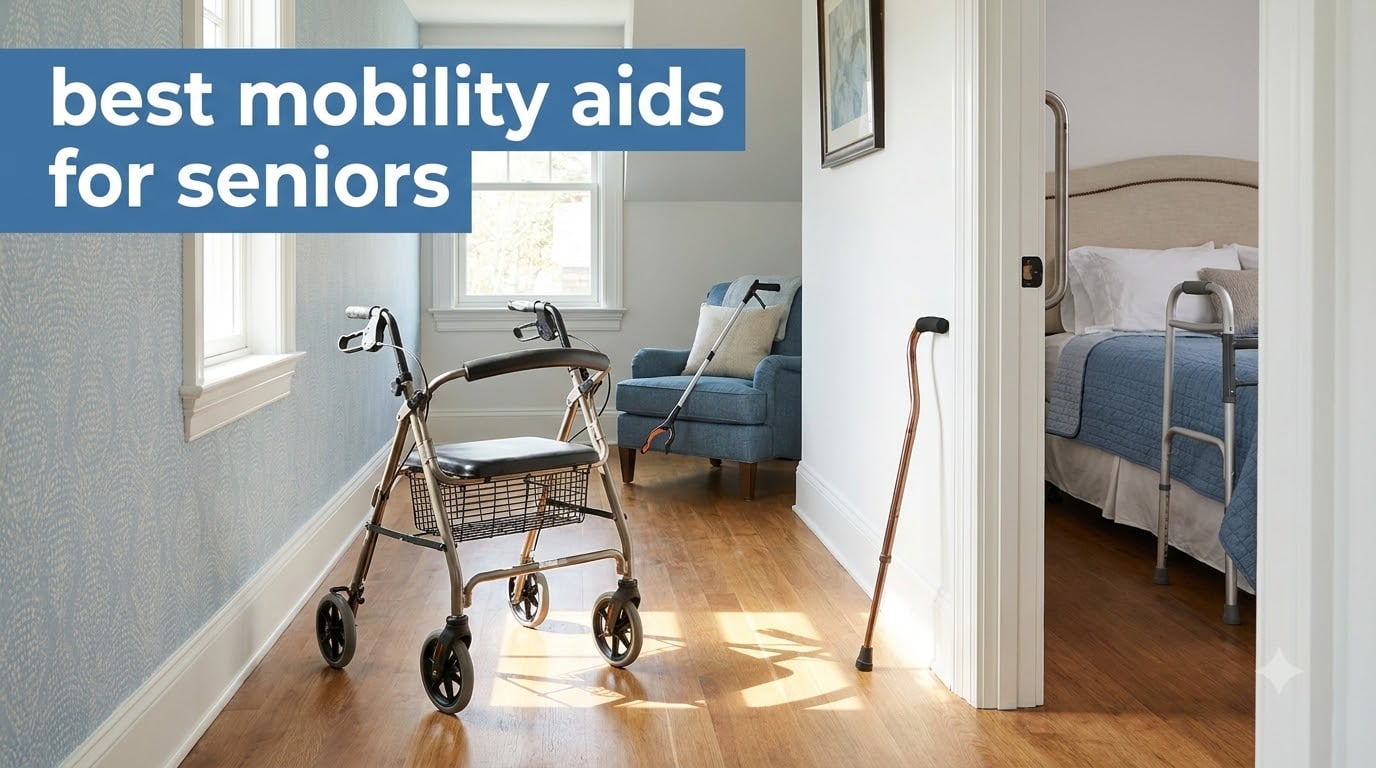
When my father started grabbing the countertop to cross the kitchen, we did what most families do: we bought the first cane we saw at the pharmacy. One near-fall on the back steps later, we knew we had guessed wrong. A cane was never going to be enough support for him, and nobody in the store told us that.
That experience is why I built this guide to the best mobility aids for seniors. Our team compared 12 products across every category that matters at home: walkers, rollators, canes, a folding wheelchair, bathroom safety gear, bed rails, a caregiver transfer belt, and a reacher tool. Every rating and review count here comes from real Amazon data.
Here is the part most guides skip: the right aid depends on balance, strength, endurance, and where it will be used. A rollator with a seat is wrong for someone who leans heavily on the frame, and a standard walker is overkill for someone who needs a steadying hand on bad days. Falls remain the leading cause of injury among older adults, so this decision deserves real thought.
Caregiver forums also shaped this list. Families kept describing the same two failures: buying for today instead of next year, and protecting the senior while forgetting the person doing the lifting. Both get coverage below, including transfer gear most lists ignore.
Table of Contents
Top 3 Mobility Aids for Seniors 2026
If you want the short version first, these three earned their spots. The Drive Medical Nitro is the best-built rollator we tested, and the one I would buy for a parent who walks daily but needs to rest often. The Drive Medical Two-Button Walker is the value pick of the whole list, and the frame physical therapists send home after knee and hip surgery. The ZAYAD Grabber costs less than lunch and solves the most common cause of indoor falls: bending over.


Drive Medical Two-Button Walker
- 7.5 lb frame
- 350 lb capacity
- Folds to 4 inches
- 5-inch wheels
Best Mobility Aids for Seniors in October
This table is the fastest way to build a shortlist. The twelve products appear in the same order as the reviews below, so you can jump from any row straight to the full write-up.
| Product | Specifications | Action |
|---|---|---|
| Drive Medical Two-Button Walker |
|
Check Latest Price |
 VOCIC Z21 Rollator with Seat VOCIC Z21 Rollator with Seat |
|
Check Latest Price |
| Drive Medical Nitro Rollator |
|
Check Latest Price |
 REHAND Foldable Walking Cane REHAND Foldable Walking Cane |
|
Check Latest Price |
 HONEYBULL Free-Standing Cane HONEYBULL Free-Standing Cane |
|
Check Latest Price |
 Drive Medical Blue Streak Wheelchair Drive Medical Blue Streak Wheelchair |
|
Check Latest Price |
 Drive Medical Tub Transfer Bench Drive Medical Tub Transfer Bench |
|
Check Latest Price |
 Lianjindun Toilet Safety Rails Lianjindun Toilet Safety Rails |
|
Check Latest Price |
 Lunderg Bed Assist Rail Lunderg Bed Assist Rail |
|
Check Latest Price |
 KingPavonini Bed Rails KingPavonini Bed Rails |
|
Check Latest Price |
 Vive Gait Belt with 7 Handles Vive Gait Belt with 7 Handles |
|
Check Latest Price |
| ZAYAD Grabber Reacher Tool |
|
Check Latest Price |
Two numbers deserve extra attention: weight capacity and product weight. A 350 lb capacity means little if the person lifting the aid into a car cannot manage the frame. I flag both in every review, because no competitor bothers to.
1. Drive Medical Two-Button Walker with Wheels – Maximum Stability on a Budget
Drive Medical Two-Button Folding Walker with Wheels, Height Adjustable
7.5 lb aluminum frame
350 lb capacity
Two 5-inch wheels
Folds to 4 inches
5-position height
Pros
- Very light at 7.5 lbs
- dual push-button folding works with limited hand strength
- tool-free assembly in minutes
- 350 lb weight capacity
- folds flat for storage
Cons
- Rear glide caps can scratch floors over time
- no seat or storage pouch
- narrower wheelbase than a rollator
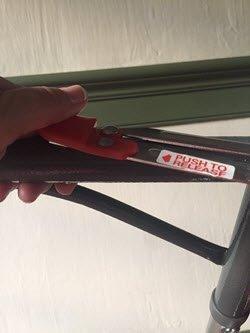
My father-in-law used this walker for eight weeks after his knee replacement, and it was the first product here I watched someone depend on daily. He has neuropathy in both hands, and the two-button fold was the only mechanism he could work without help. That single detail kept him independent while we were at work.
Assembly really does take minutes, because the legs slide on and lock with a push-button. At 7.5 pounds it is one of the lightest walkers in its class, which matters when someone must lift it over a threshold. The 350 lb capacity covers the vast majority of users.
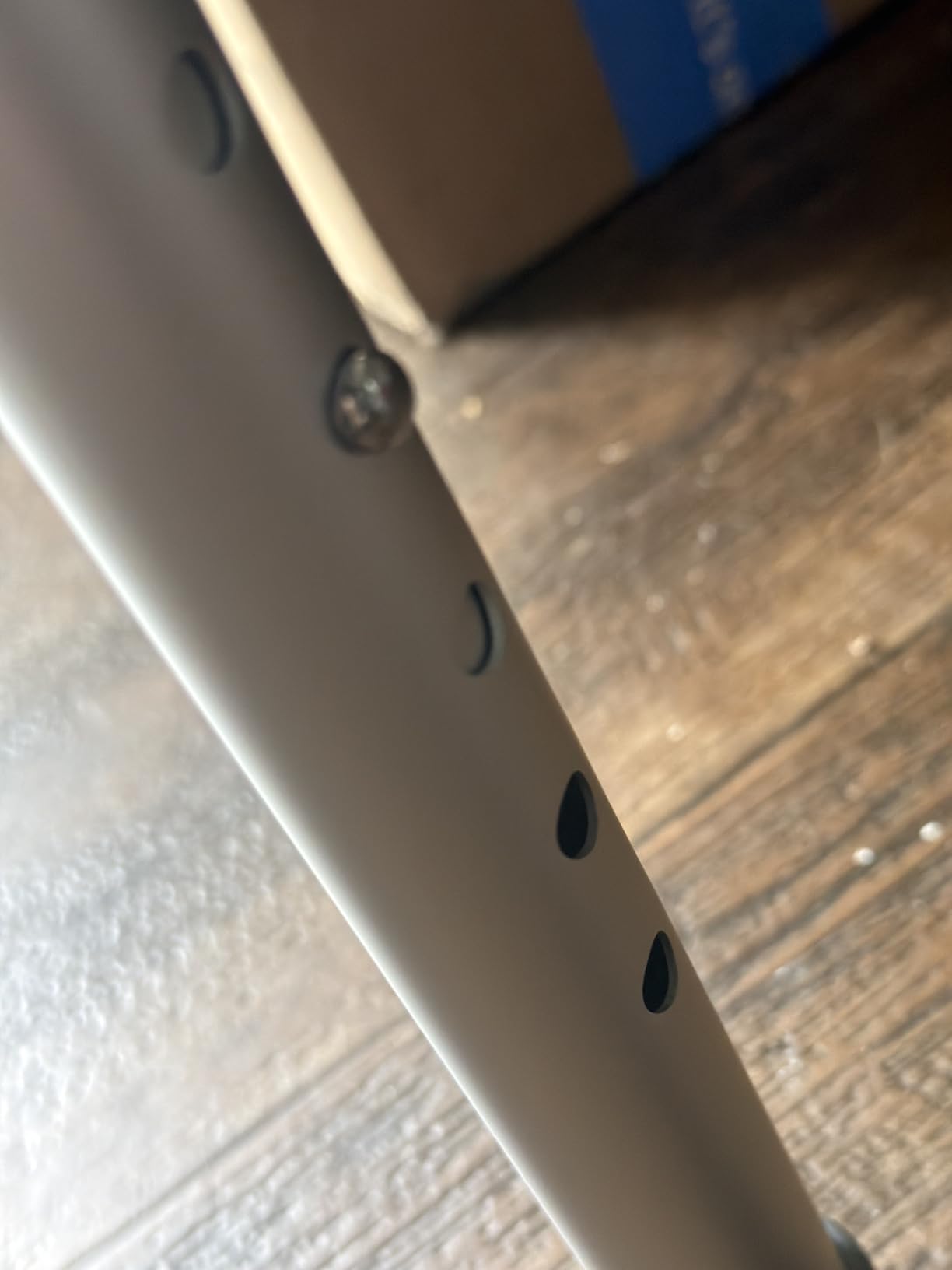
The two 5-inch front wheels roll smoothly over wood floors and low carpet. Physical therapists recommend this model constantly, and with more than 42,000 reviews at a 4.7 average, it has earned that reputation in the real world.
It fits through standard doorways while still giving a wide, stable base. That balance of narrow and steady is why it works in older homes.
The compromises are honest. There is no seat for anyone who tires quickly, and the rear glides can mark soft flooring over months of use. Grass and gravel are also asking too much of wheels this size.
Who the Two-Button Walker is right for
This is the best mobility aid for seniors recovering from hip or knee surgery, and for anyone who must lean full weight on both hands. If balance is the main worry rather than endurance, a standard walker beats any rolling option. It is also the frame to buy when a physical therapist has asked for a basic two-button model.
Who should pick something else
If walks are long and rest breaks are frequent, a rollator with a built-in seat serves you better. Anyone heading outdoors onto uneven ground will fight the small wheels. And if lifting 7.5 pounds is a strain, plan for a caregiver to do the transporting.
2. VOCIC Z21 Rollator Walker with Seat – Comfort for Long Days
VOCIC Z21 Rollator Walker for Seniors with Seat, 8″ All Terrain, 350 LBS
8 inch all-terrain tires
350 lb capacity
3-second fold
Dual height adjustment
Pros
- Thick 1.6-inch waterproof cushion
- seat and handles both adjust
- puncture-proof 8-inch tires
- quick 3-second fold
- large storage bag included
Cons
- Weighs 22.85 lbs
- does not fold completely flat
- backrest padding is thin
- seat may sit high for shorter users
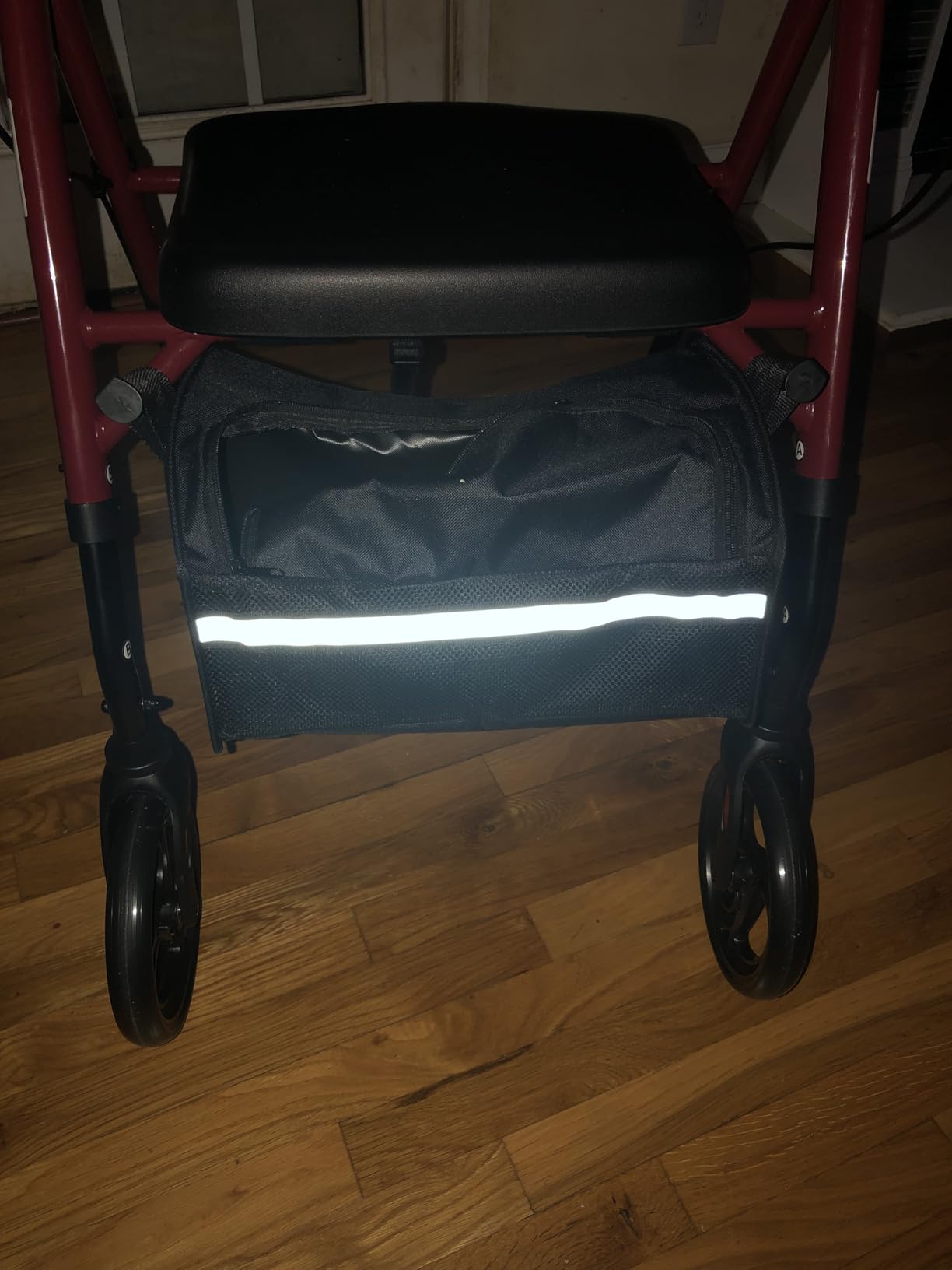
Our reviewer’s mother uses the Z21 for her daily neighborhood loop and the farmers market, and the seat is why she stopped refusing to leave the house. Being able to sit the moment her COPD flares up changed everything. Rollator owners on mobility forums call that feeling incredibly freeing, and I now understand why.
The seat is the standout: a curved design with a 1.6-inch thickened waterproof cushion and a widened breathable backrest. Handles adjust across five positions and the seat across three, fitting users from 4 ft 11 in to 6 ft 3 in. That range is rare at this price tier.
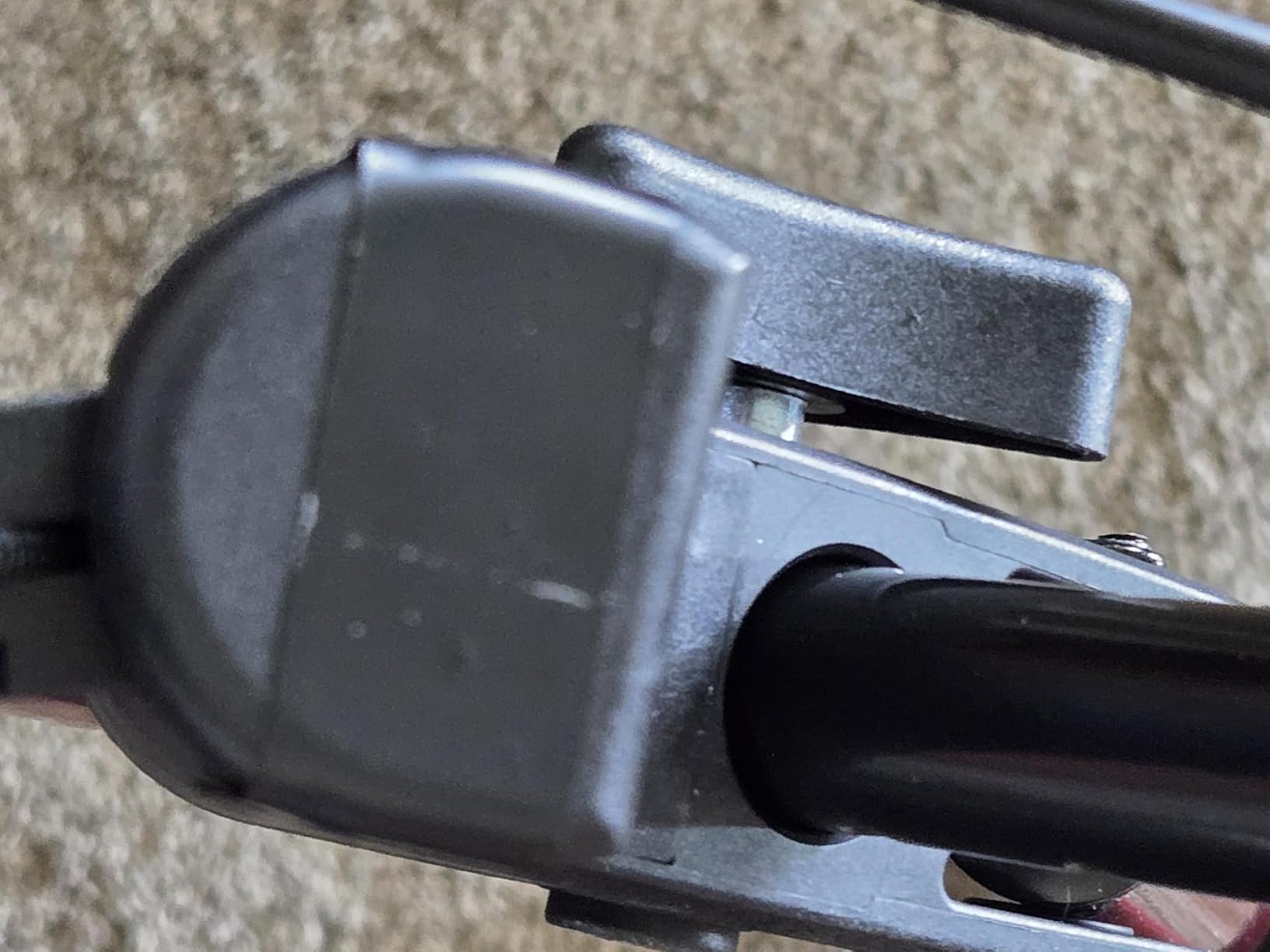
Technically, the 8-inch puncture-proof tires have a textured slip-resistant surface and the front wheels rotate a full 360 degrees. The three-mode brake system offers free, deceleration, and locked positions, and reflective strips add evening visibility.
It currently ranks as the number one rolling walker on Amazon, with over 6,500 reviews at a 4.6 average. Assembly is quick and the parts count is small.
The trade-off is weight. At 22.85 pounds, lifting it into a trunk takes real effort, and it does not fold completely flat. The backrest also wants more padding for long sits.
Fit and sizing to check before ordering
Measure the user’s height first, because the seat sits at 20 to 22 inches and shorter riders report it feeling high. Then check the folded dimensions against your trunk. If the user will also be lifting it, treat the weight as the deciding number.
Where the Z21 performs best
This is the pick for seniors who walk reasonably well but need frequent rest breaks on pavement, sidewalks, and light gravel. The 8-inch tires handle the mixed indoor-outdoor use that forum users say is hardest to find in one rollator. For heavy mud or thick grass, larger wheels still win.
3. Drive Medical Nitro Euro-Style Rollator – Best Build Quality
Drive Medical RTL10266 Nitro Euro-Style 4-Wheel Rollator with Seat, Red
10-inch front casters
17.5 lb frame
One-hand side fold
Enclosed brake cables
Padded seat
Pros
- Exceptional build quality
- large 10-inch casters handle curbs and rough ground
- folds side-to-side with one hand for narrow trunks
- comfortable seat and backrest
- enclosed brake cables never snag clothing
Cons
- Plastic tires lose traction on wet surfaces
- no cup holder included
- higher price than basic rollators
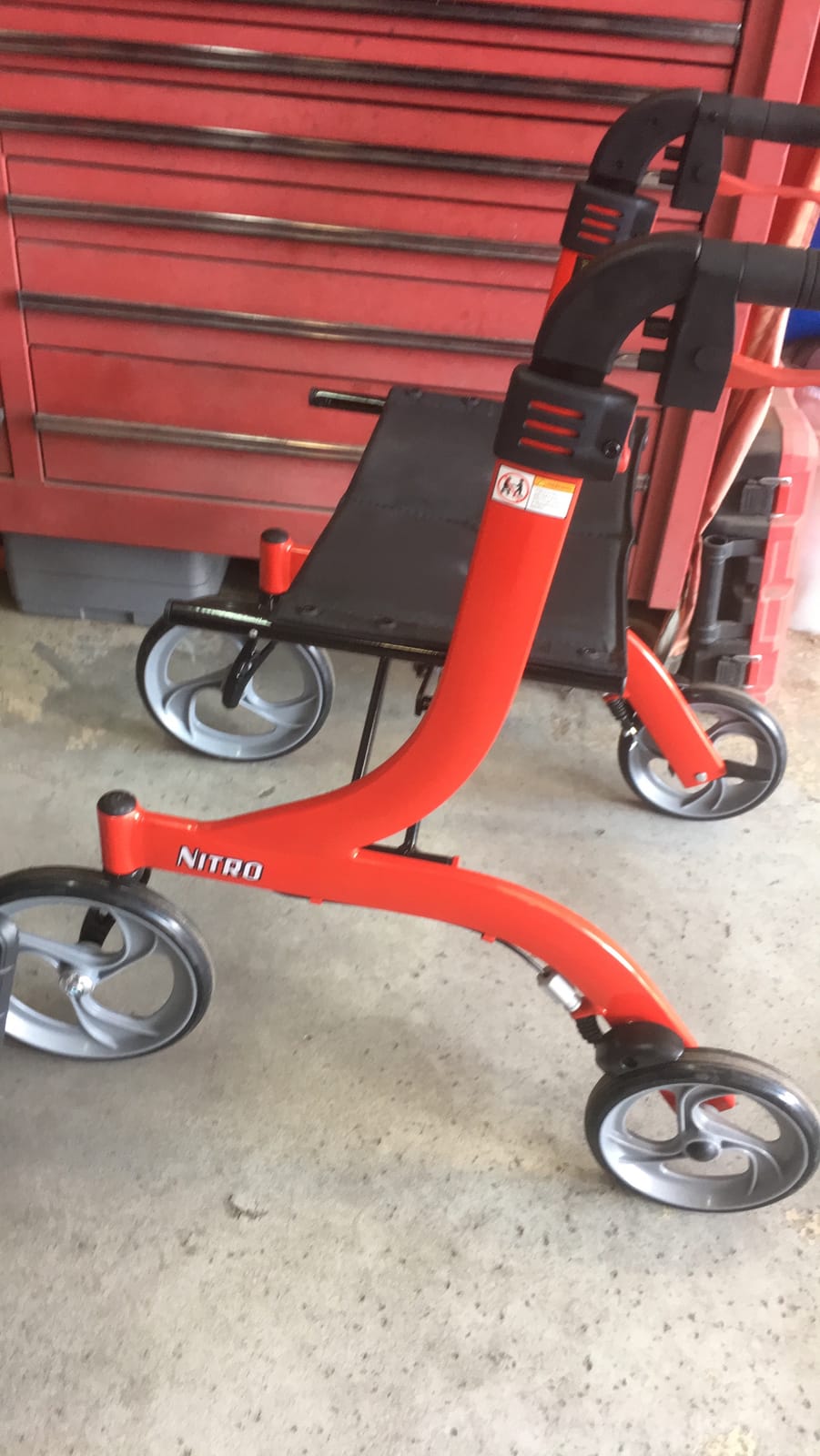
After testing several rollators back to back, the Nitro is the one I would buy with my own money, and our team’s editor’s choice among the best mobility aids for seniors. Everything about it feels one class above: the frame is stiffer, the fold is cleverer, and it arrives fully assembled from the factory. Owners consistently say it is worth more than cheaper alternatives.
The large 10-inch front casters are the practical difference. They roll over curb cuts, sidewalk cracks, and threshold bumps that stop smaller wheels dead. At 17.5 pounds it is lighter than the VOCIC while feeling more substantial.

The folding design is genuinely smart. Instead of folding front-to-back like most rollators, it collapses side-to-side with one hand into a narrow profile that fits tight doorways and trunks.
A carry strap on the seat helps with lifting, and the handles and backrest adjust without tools. The enclosed brake cables never snag on sleeves or furniture, and a removable zippered pouch sits under the seat.
The complaints are minor but real. The tires are plastic rather than rubber, so traction drops on wet surfaces, and there is no cup holder unless you step up to the Sprint model. It also costs more than a basic rollator.
Indoor and outdoor versatility
This is the strongest all-surface option in the roundup, handling wood floors, outdoor cement, and curbs in one package. The narrow folded width suits apartments and older homes with tight doorways. Seniors who split their week between home, car, and errands get the most from it.
When to skip the Nitro
If rain or dew is common in your climate, think twice about the plastic tires. Budget-focused buyers can get most of this experience from the VOCIC Z21 above. And anyone who cannot comfortably lift 17.5 pounds should test the carry motion first.
4. REHAND Foldable Walking Cane – Best Cane for Travel
REHAND Walking Cane – Foldable, Adjustable, Collapsible Walking Canes for Men & Women, Heavy Duty All Terrain Tip, with Travel Bag | Walking Sticks for Seniors & Adults (Natural Black)
Folds to 14 inches
8 height positions
All-terrain pivot base
Wide ergonomic handle
2-year warranty
Pros
- Outstanding stability on carpet
- grass
- gravel
- and wet pavement
- comfortable wide handle reduces palm fatigue
- folds one-handed into a bag
- adjusts for users 5 ft to 6 ft 5 in
- 2-year warranty
Cons
- Paint can chip if dropped
- rubber handle may bother users with sensitivities
- ergonomics still divide some reviewers
My aunt keeps one of these in her handbag for museum days and another in the car door pocket, and that portability is the whole point. It collapses to 14 inches, packs into its included travel bag, and reassembles in seconds when the ground turns uneven. For seniors who need support only sometimes, a cane that is always nearby beats a full-size one left at home.
The patented pivot base is the clever part. It stays flat on angled surfaces and grips carpet, grass, dirt, gravel, and wet pavement, with a multi-layer rubber structure that absorbs shock. Eight height positions adjust in 1-inch increments for users from 5 ft to 6 ft 5 in.
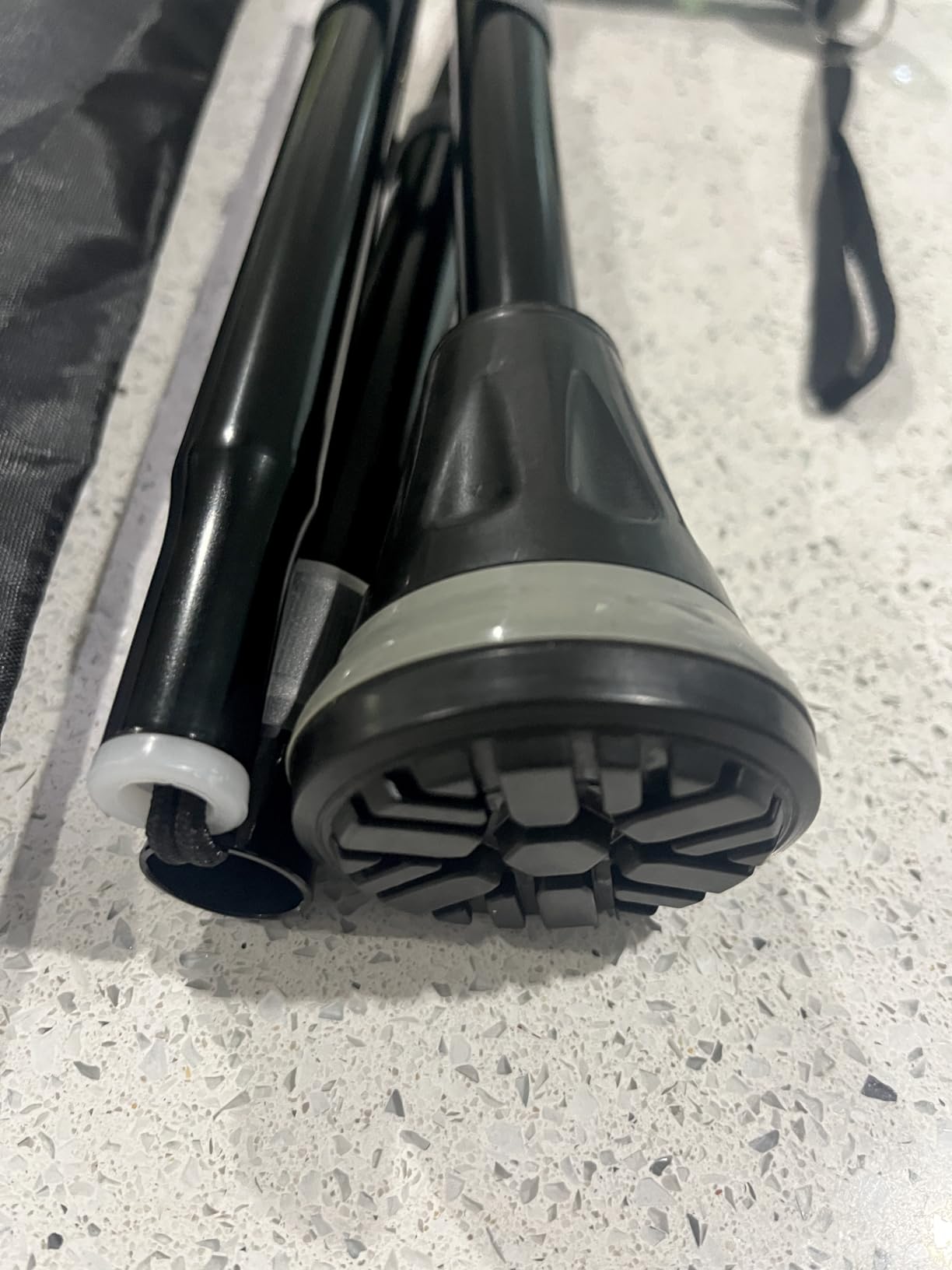
The wide ergonomic handle pairs a hard shell with a soft TPR grip, and it noticeably reduced the palm fatigue my aunt complained about with her old crook-neck cane. It is the number two bestseller in walking canes, with over 12,600 reviews at a 4.6 average.
The two-year warranty adds peace of mind that most cheap canes do not offer. Seven color options make it feel less clinical.
Durability complaints center on paint chipping when the cane is dropped, which is cosmetic. A small number of users with rubber sensitivities flag the handle material.

Sizing and fit before you buy
Stand upright in regular shoes and have someone measure from the wrist crease to the floor; that is the correct cane height. Then confirm the 34 to 38 inch range covers it. Users above 6 ft 5 in should look at an extended model.
Cane versus walker reality check
A cane suits mild balance support, not a progressive condition. Forum members with advancing Parkinson’s and arthritis consistently report outgrowing canes, and research on cane failures shows the highest critical component breakage rate among mobility aids. If support needs are rising, move to a walker sooner rather than later.
5. HONEYBULL Free-Standing Pivot Cane – Best Everyday Cane
HONEYBULL Walking Cane for Men & Women, Foldable, Free Standing, Purple
Free-standing 3-prong base
30-36 inch height
1.6 lb aluminum
Folds to 12.5 inches
2-year warranty
Pros
- Stands upright on its own so it never gets dropped
- pivoting tip keeps full ground contact on slopes
- folds small enough for a purse
- excellent slip resistance on tile and laminate
- ambidextrous
Cons
- Base adds bottom weight versus single-tip canes
- plastic handle feels less premium
- can still be knocked over despite the free-standing design
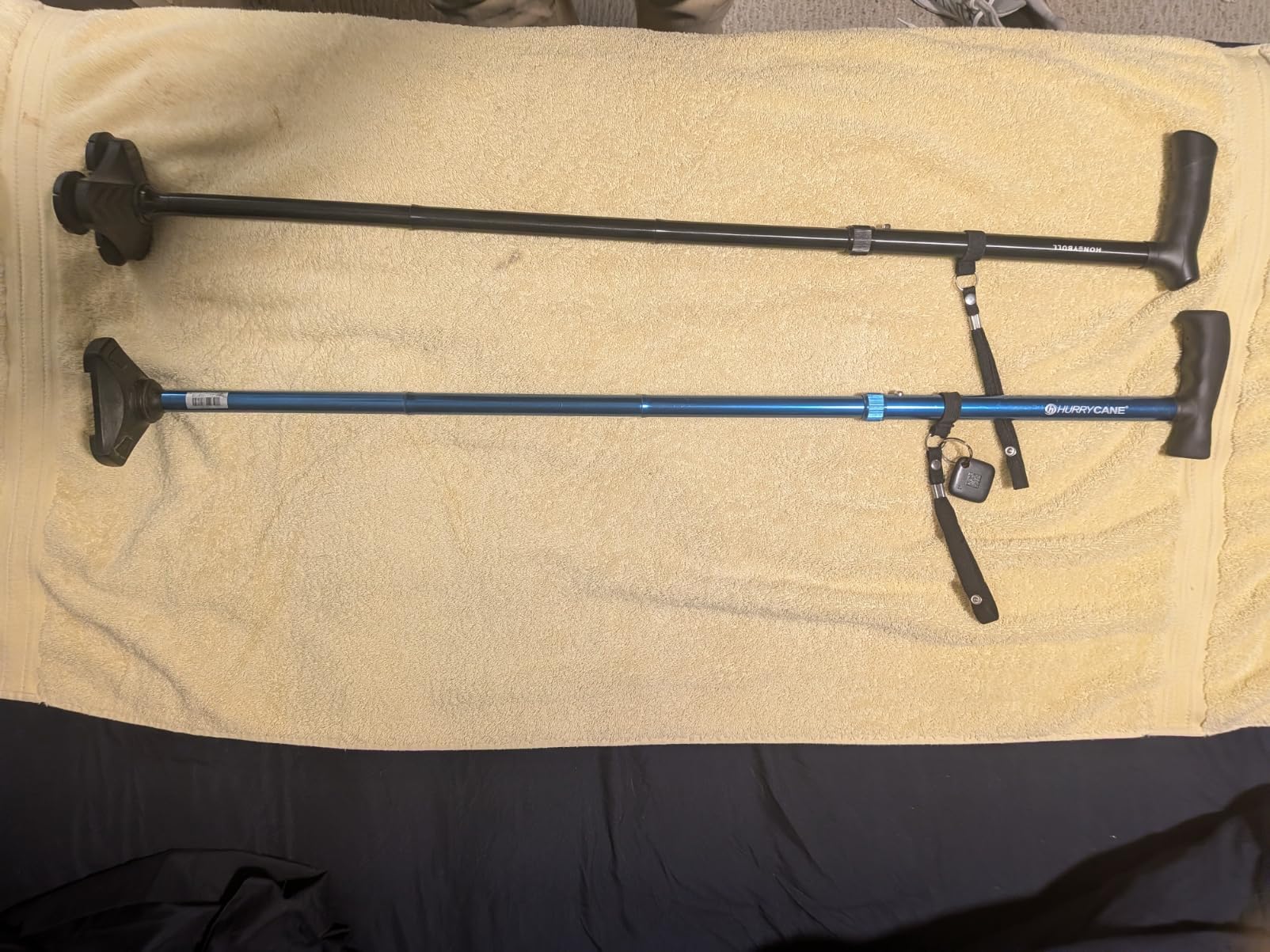
The feature that sells this cane is the one nobody thinks about until they live with a cane: it stands up by itself. Our tester’s father used to lean his old cane against the wall, watch it clatter to the floor, then bend to pick it up and risk exactly the fall the cane was meant to prevent. The three-prong base ended that loop entirely.
The pivoting rubber tip stays flat on angled surfaces for maximum ground contact, and reviewers specifically praise the grip on tile and laminate. Height adjusts from 30 to 36 inches with a push-button lock, covering users from 5 ft to 6 ft 5 in.
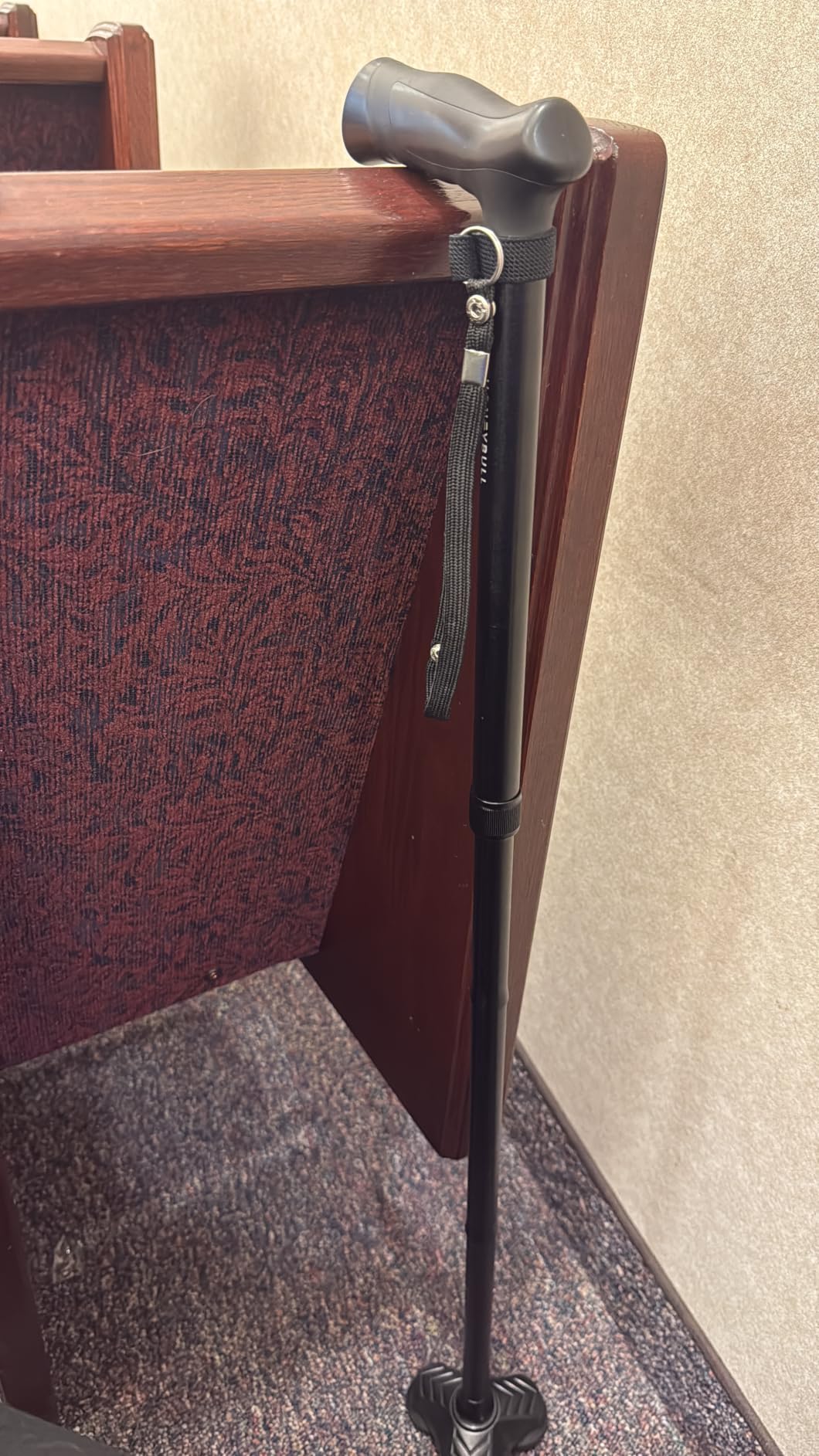
It folds to 12.5 inches, small enough for a purse or car door pocket, and weighs just 1.6 pounds on a heavy-duty aluminum shaft. The design is ambidextrous and comes in six colors.
With over 26,000 reviews at a 4.5 average, it is the number one bestseller in walking canes. The two-year warranty matches the REHAND.
Two honest caveats from buyers: the base adds bottom weight compared with a single-tip cane, which changes the swing feel, and the plastic handle is not as pleasant as the TPR grip on the REHAND. It stands upright but is not knock-proof.
Stability on smooth floors
This is the cane I recommend for apartment and condo dwellers who live mostly on hard flooring. The non-scratch rubber base and pivot tip grip tile and laminate better than any single-tip cane we compared. It also suits anyone recovering from knee or hip injuries who still has good arm strength.
When a cane stops being enough
If both sides of the body need support, or the cane is being leaned on hard enough to flex, it is time for a walker. Forum consensus is blunt here, and several members wished they had upgraded a year earlier. Watch for the cane drifting sideways under load, which is the tell.
6. Drive Medical Blue Streak Wheelchair – Best Folding Wheelchair
Drive Medical Blue Streak Lightweight Wheelchair, Footrests, 18″ Seat
18 inch seat width
300 lb capacity
12-inch turn radius
Swing-away footrests
Flip-back desk arms
Pros
- Sturdy steel frame that holds up at higher weights
- folds compactly for car trunks
- 12-inch turning radius for tight hallways
- swing-away footrests and flip-back arms ease transfers
- limited lifetime warranty
Cons
- Solid wheels skip and grind on rough asphalt
- brakes struggle on steep hills
- footrests are fixed and non-elevating
We borrowed the Blue Streak for a family reunion when the walk from the parking lot became impossible for my mother, and it earned its keep that weekend. It folded into the trunk without a fight and rolled through crowded pavilions. She participated instead of waiting in the car.
The 18-inch seat width suits most adults, and 16-inch and 20-inch variants exist for smaller or larger frames. The 12-inch turning radius is the spec to notice: it handles hallways and bathrooms that defeat bulkier chairs, and the push-to-lock brakes hold reliably on flat ground and gentle inclines.
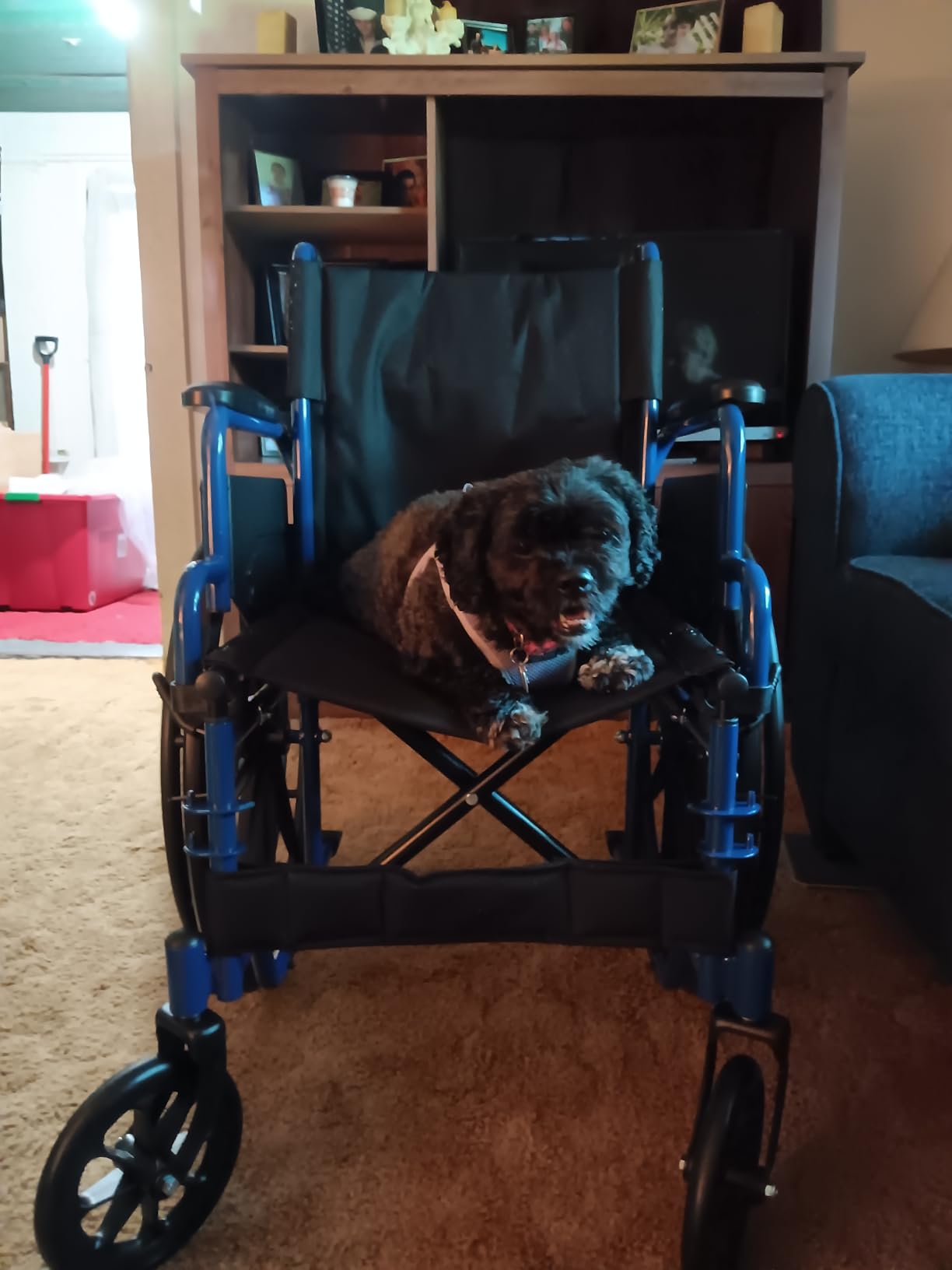
Swing-away footrests and flip-back desk arms make transfers far safer, because the user slides sideways from bed or car seat instead of stepping over hardware. It is the number one bestseller in self-propelled wheelchairs, with more than 18,000 reviews at a 4.5 average.
The limited lifetime warranty is unusually generous for the category. It also arrives nearly fully assembled, needing only the footrests attached.
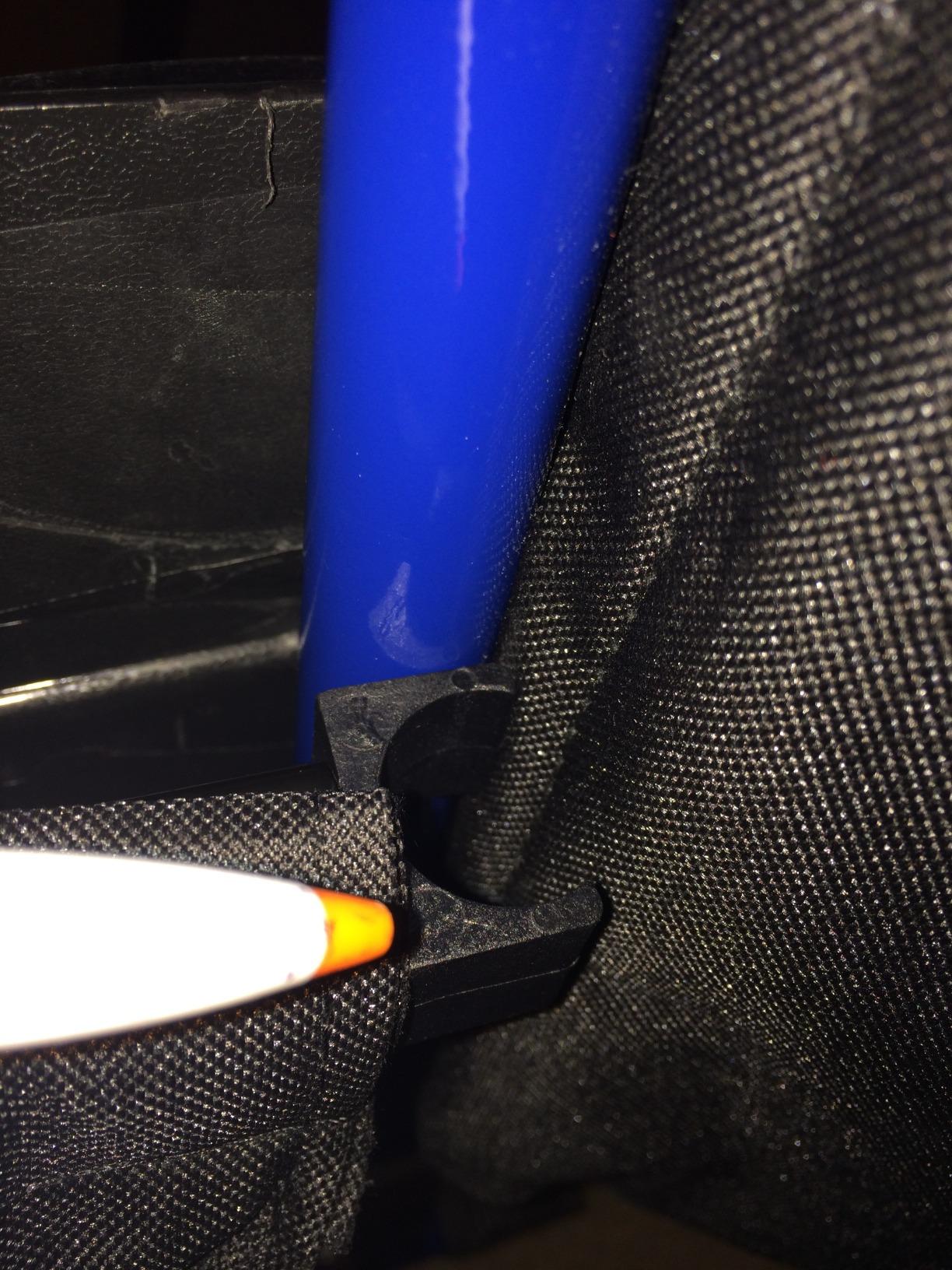
Know the limits before buying. The solid plastic wheels skip and grind on rough asphalt and gravel, the brakes are not rated for steep hills, and the footrests cannot elevate for swollen legs. All-day users tend to add a cushion.
Manual versus powered, and self-propel versus transport
A manual chair like this suits intermittent use: outings, appointments, recovery weeks, and travel. It needs either a caregiver pushing or reasonable upper body strength to self-propel, and it folds for storage in a way power chairs do not. For full-time indoor use, an electric wheelchair is the better tool despite the higher cost.
Getting the seat width right
Measure across the hips at the widest point while seated and add an inch; that is the correct seat width. Too narrow is restrictive and too wide makes self-propelling exhausting. Weight support is listed at a 300 pound maximum recommendation, so heavier users should shop the bariatric category.
7. Drive Medical Tub Transfer Bench – Best Bath Safety Pick
Drive Medical Tub Transfer Bench for Bathtub, Height Adjustable
350 lb capacity
Height adjustable legs
Adjustable backrest
Side handrail
Suction cup feet
Pros
- Sitting entry into the tub eliminates the step-over
- 0.5-inch height increments for a custom fit
- suction cup feet resist sliding
- drainage openings keep the seat from pooling
- assembles in 5 to 10 minutes
Cons
- Suction cups can be hard to remove from some tub surfaces
- not every tub gives a reliable seal
- plastic parts may fatigue over years
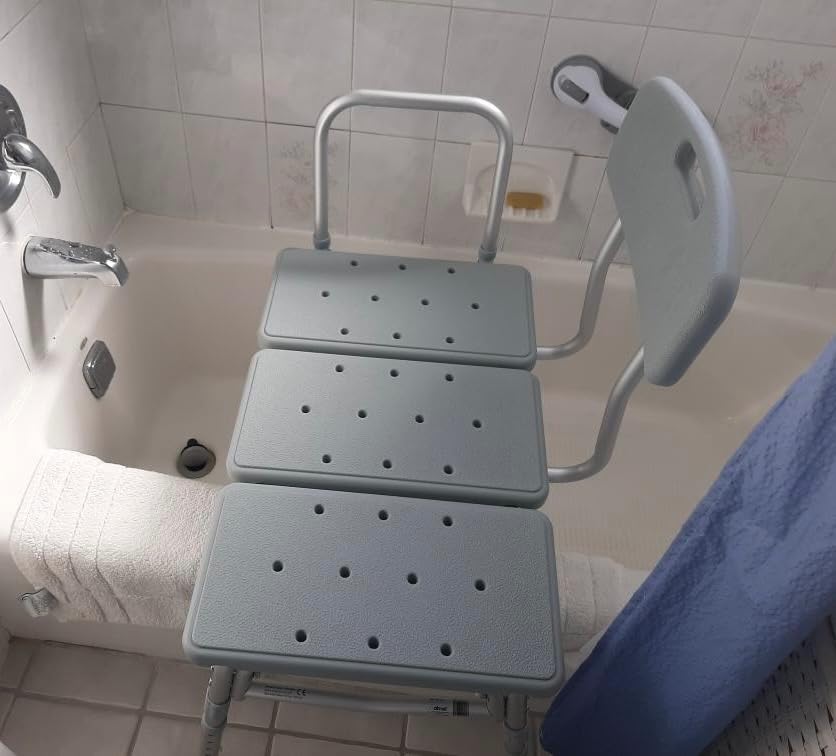
The bathroom is the most dangerous room in the house for an older adult, and our family learned that the hard way. This bench is the single change that reduced risk the most, because the user sits down outside the tub and slides across rather than stepping over the wall onto a wet floor. That one motion is where most tub falls happen.
Legs adjust in half-inch increments with dual column extensions, so the seat can be leveled even when the floor slopes toward the drain. The backrest repositions, a side handrail adds a grip point, and suction cup feet hold the bench steady on the tub floor.
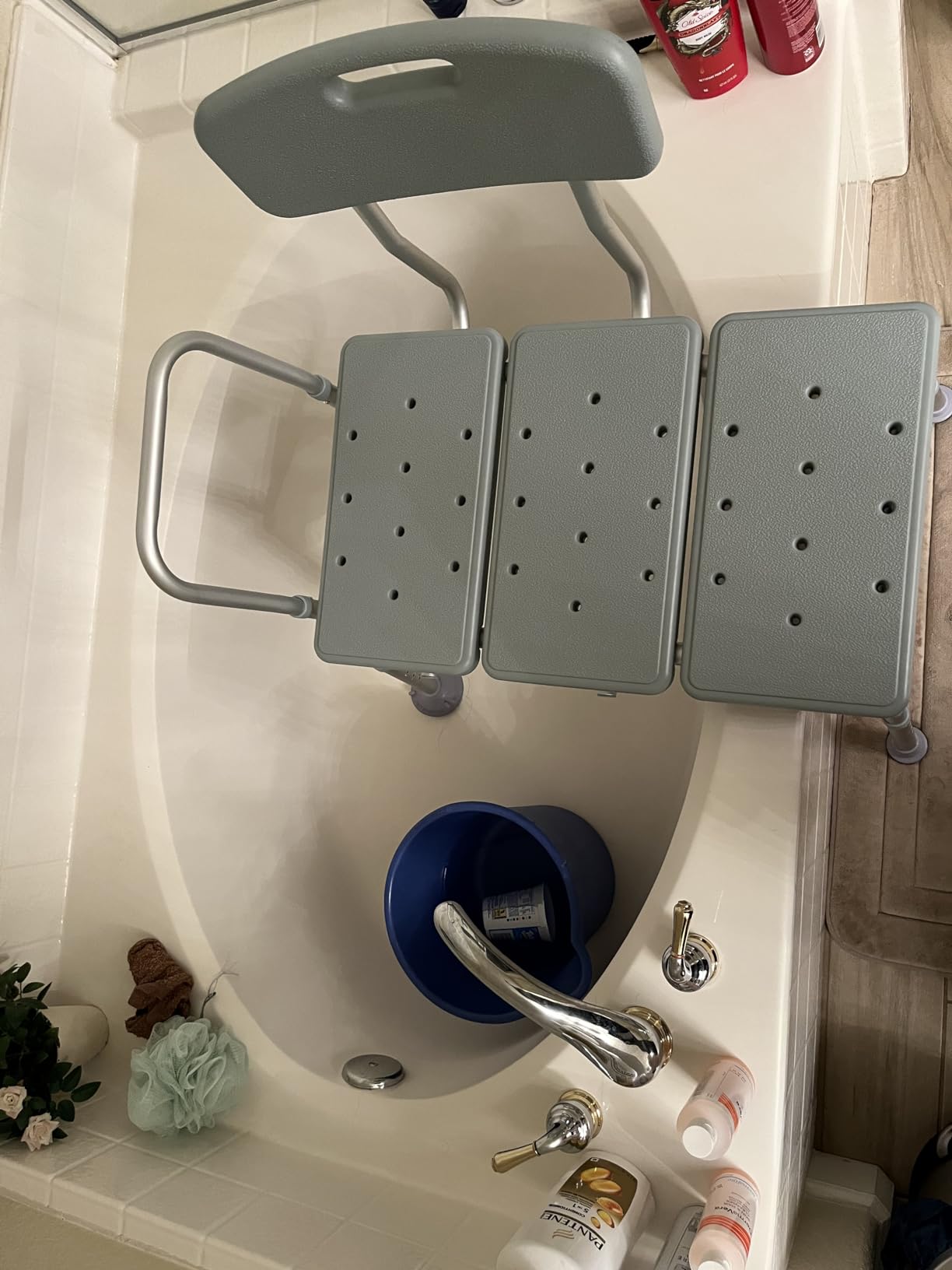
The aluminum frame carries a 350 lb capacity at just 10 pounds total. Drainage openings in the seat stop water from pooling during a shower.
With over 32,000 reviews at a 4.6 average, it is one of the most-purchased pieces of bath safety equipment in the country. Assembly reportedly takes five to ten minutes.
The complaints cluster around the suction cups. On some tub finishes they grip so tightly that removal is a chore, and on others they never seal confidently. A few long-term owners note plastic components bending after years of daily use.
Measuring your bathroom first
Check the tub width against the bench legs and confirm the minimum leg height clears your tub rim, because some shallow garden tubs sit too low. Measure the transfer path too, since the bench extends beyond the tub wall. Walk-in showers usually call for a simple shower chair instead.
What this pairs with for full protection
A transfer bench works best alongside grab bars inside the wet zone and a handheld showerhead, which removes the need to stand and rinse. Add the toilet rails below for consistent support across the whole bathroom, because safety gaps hide in the transitions between aids.
8. Lianjindun Toilet Safety Rails – Best Toilet Support
Lianjindun Toilet Safety Rails, 350 lbs, Adjustable Height & Width
350 lb capacity
Height 24-31 inches
Width 20-25 inches
Foldable
No-tool assembly
Pros
- Height and width both adjust to fit most toilets
- sturdy corrosion-resistant aluminum
- soft foam armrests
- folds for storage or travel
- no tools needed
Cons
- Slight wobble since it is not bolted to the toilet
- seat lid can drop when unsecured
- suction cups struggle on some flooring
Sitting down and standing up from a low toilet is a strength move that hip and knee surgery patients cannot make safely, and my father-in-law refused to leave the hospital until these rails were installed. It was the right call. The arms gave him a stable push point for the two weeks when his legs would not cooperate.
Adjustability is the strength here. Height ranges from 24 to 31 inches and width from 20 to 25 inches, so it fits most standard toilets without permanent mounting. The corrosion-resistant aluminum frame carries a 350 lb capacity, and the soft gray foam grips stay comfortable in bare hands.
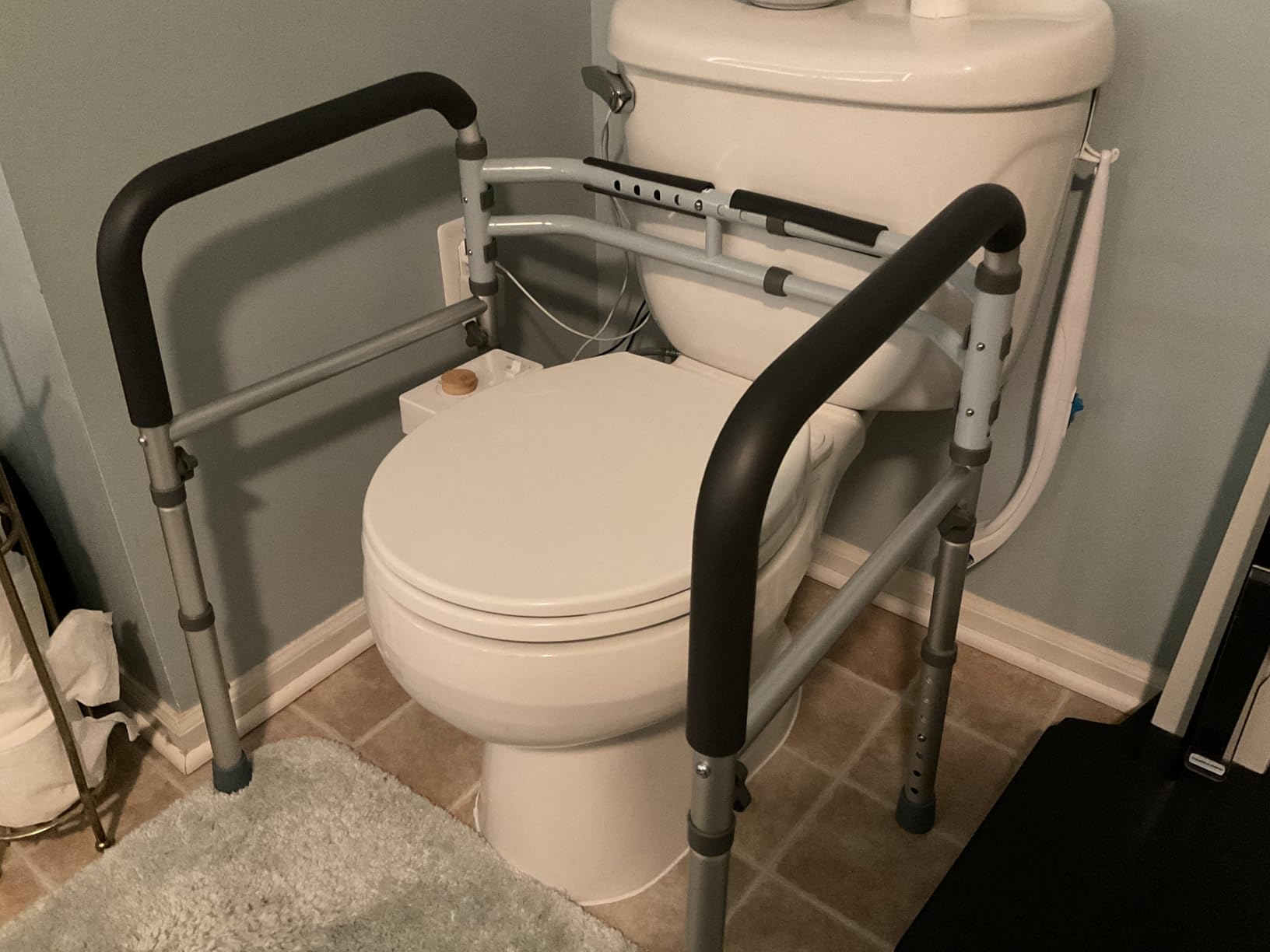
Assembly needs no tools, and the frame folds flat for travel. The package includes rubber feet plus two spare extra-strong suction cups for slippery tile.
Reviewers recovering from hip and knee surgery repeatedly call it essential for safe transfers. It ranks number one in toilet safety frames, with over 4,000 reviews at a 4.6 average.
Because it is freestanding rather than bolted down, a slight wobble is the most common complaint. The seat lid can drop on its own when unsecured, and larger users may find the arm spacing snug.
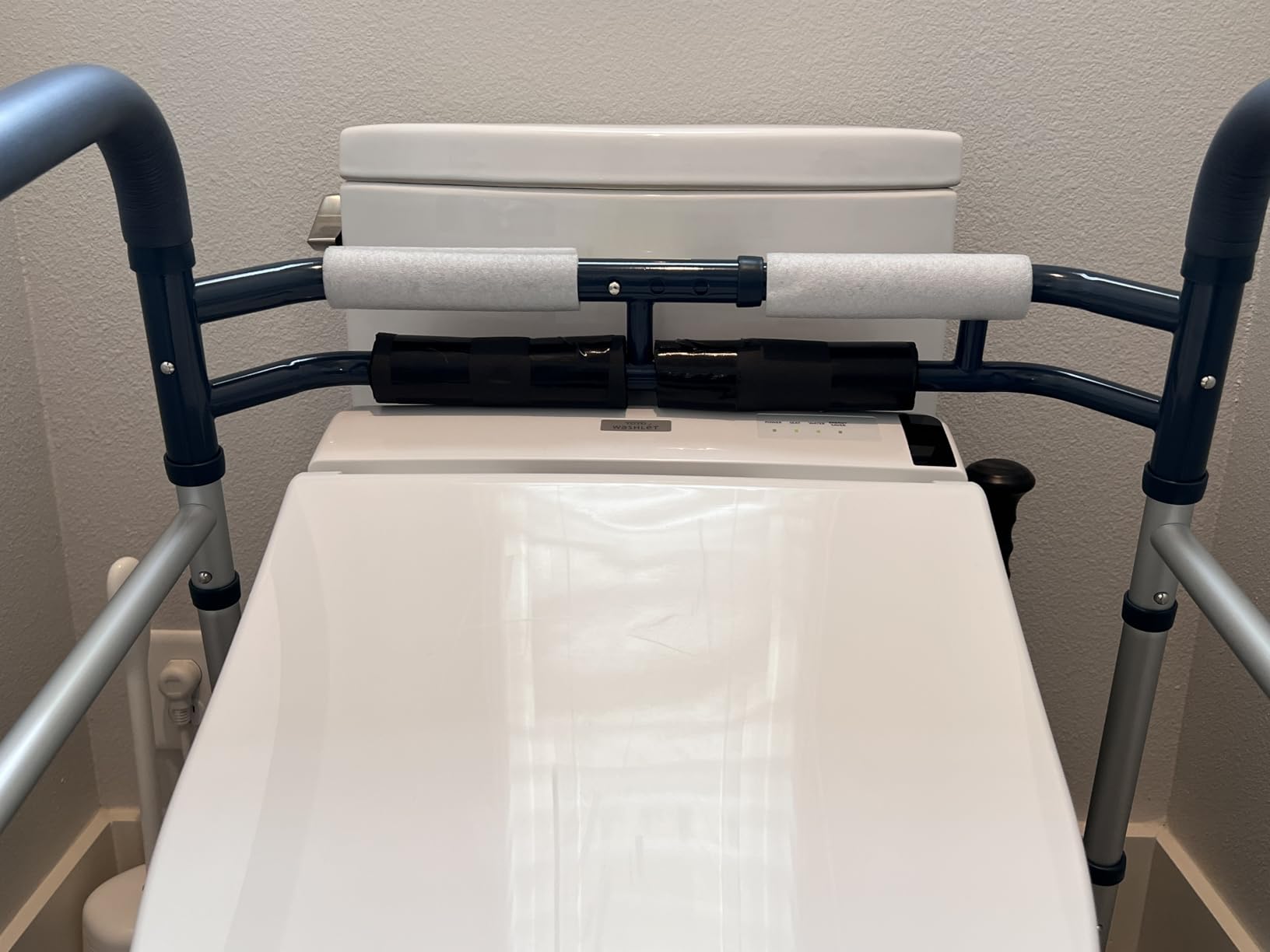
Installation and compatibility
Set the width so the arms clear the bowl, then set the height so the armrest sits level with the seat or just above. Measure the clearance around your toilet base before ordering, and choose between rubber feet and suction cups based on your flooring. Nothing here requires drilling.
Bonus use as shower support
Quite a few owners repurpose this frame as temporary shower safety rails, and the corrosion-resistant build handles the humidity. It is not a substitute for wall-mounted grab bars long term, but it travels well for visits to family.
9. Lunderg Bed Assist Rail with Motion Light – Best for Night Safety
Lunderg Bed Assist Rail for Seniors with Motion Light & Non-Slip Grab Bar
Motion-activated light
300 lb capacity
Tool-free 5-minute setup
Four stabilizing bars
Under-bed strap
Pros
- Motion-activated light makes nighttime bathroom trips safer
- tool-free setup in about five minutes
- four horizontal stabilizing bars eliminate wobble
- universal fit for Twin through King beds
- includes under-bed safety strap
Cons
- Not for adjustable beds
- motion light may need recharging every 2-3 days
- glow band underdelivers
Nighttime bathroom trips are the falls families do not witness, and the motion-activated light on this rail is the feature that sold me. It switches on the moment someone sits up and stays lit for sixty seconds. That is enough light to cross a dark bedroom without fumbling for a switch and losing balance.
The rail arrives partly pre-assembled and connects top to bottom with pushpins, so genuine tool-free setup takes about five minutes. Four horizontal stabilizing bars run beneath the mattress, and the included under-bed safety strap locks the assembly down so it does not shift when pulled hard.
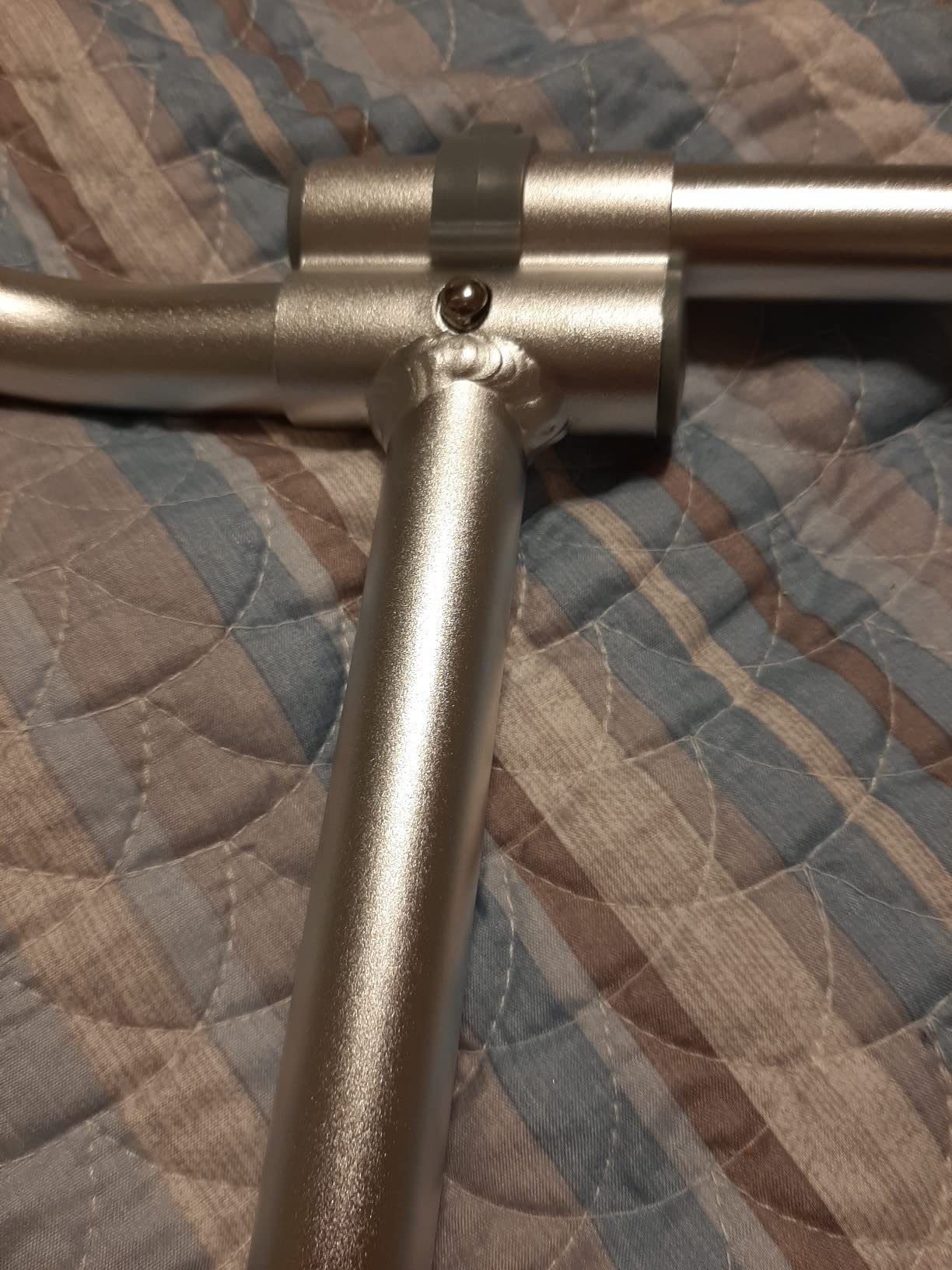
The carbon steel build is load-tested to 300 pounds, and the U-shaped grab bar has a non-slip ergonomic grip. It fits Twin through King beds with 7 to 13 inch mattresses over box springs, slats, or platforms.
The design is ADA compliant and ranks number three in its category, with a 4.7 average across nearly 2,800 reviews. Buyers also praise the brand’s responsive customer service.
The light is the weak point: some owners recharge it every two or three days, which is more attention than most people want to give a bed rail. The glow-in-the-dark handle band also underdelivers, and adjustable beds are off the table.
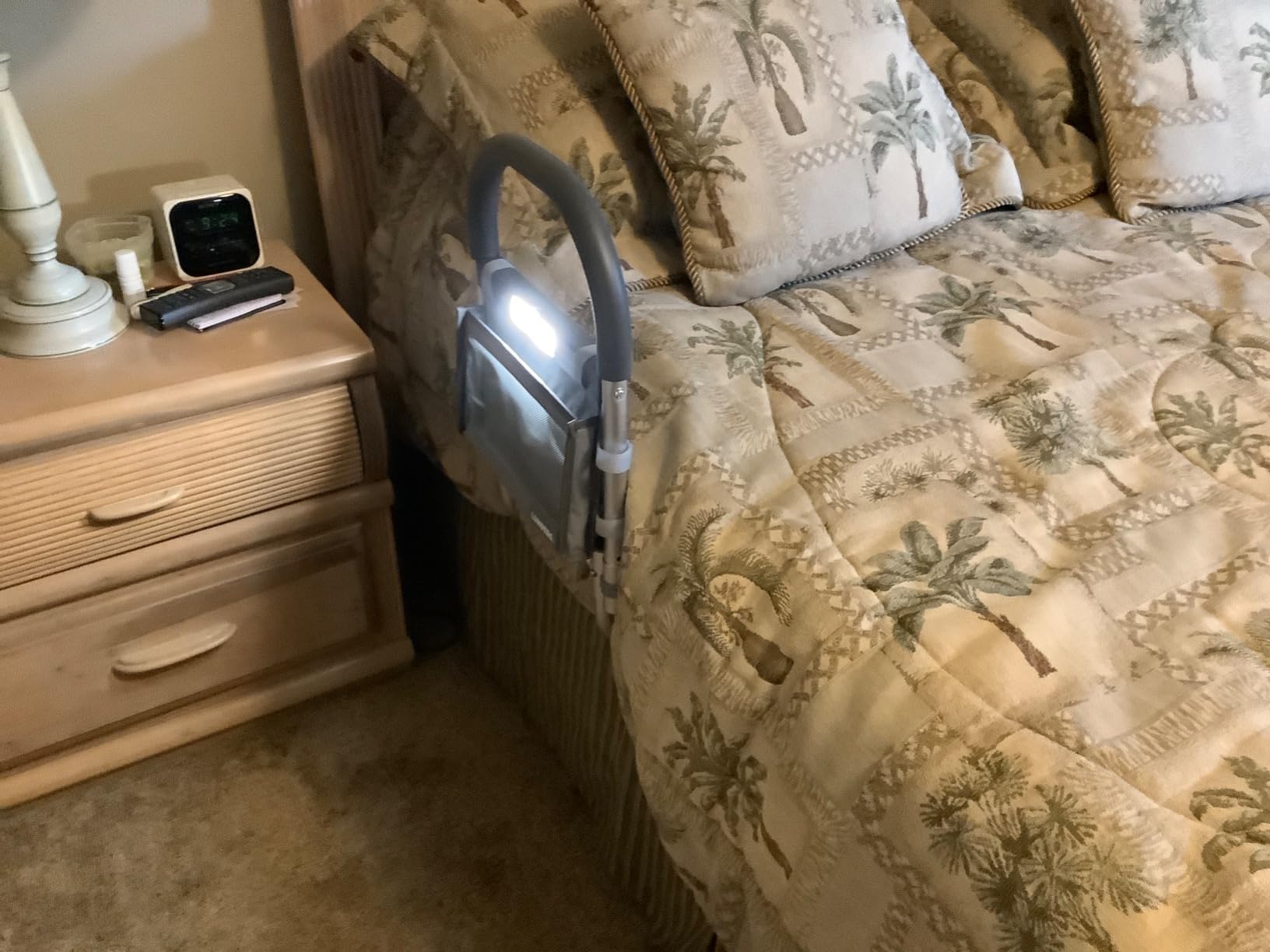
Mattress and bed frame compatibility
Measure mattress thickness first, because this rail is rated for 7 to 13 inches, and confirm you have a box spring, slats, or platform rather than an adjustable base. The two height options cover most standard setups. Platform beds with solid tops work well; adjustable frames do not work at all.
Why the light matters more than people expect
Forum caregivers call this rail a quiet fix for the 2 a.m. problem, and the reasoning is simple: the highest-risk moment is moving from lying to standing in the dark. A handle plus sixty seconds of light addresses both halves of that moment. If charging a light weekly sounds annoying, the KingPavonini below skips it entirely.
10. KingPavonini Adjustable Bed Rails – Highest Weight Capacity Rail
KingPavonini Bed Rails for Elderly Adults Safety, 380 LBS, Model BM03-1
380 lb capacity
ASTM approved
Height 17.6-20.9 inches
Horizontal 28.6-34.7 inches
Twin to King fit
Pros
- Highest weight capacity of the rails reviewed at 380 lbs
- ASTM-approved safety standard
- adjusts for height and horizontal reach
- tool-free install slides between mattress and box spring
- includes storage pouch
Cons
- Not compatible with adjustable beds
- may not fit very thick mattresses
- some users want extra handle padding
When the person getting in and out of bed is larger or pulls hard on the rail, capacity is the spec that matters, and this one is rated to 380 pounds. It is also ASTM approved, the safety standard I look for before trusting any bed rail with a family member’s weight. Our reviewer used it through her husband’s post-surgery recovery without a wobble.
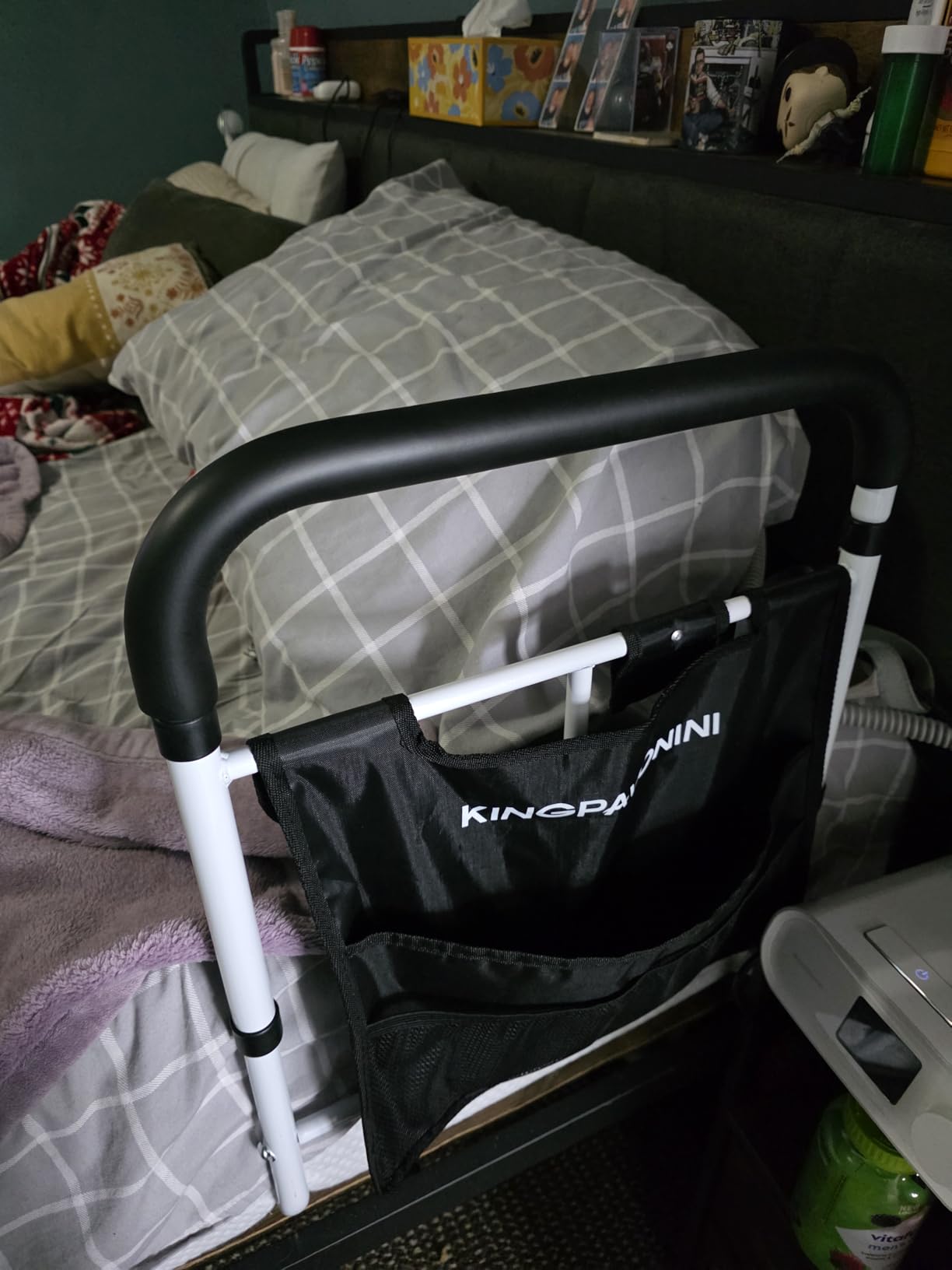
The L-shaped rail slides between the mattress and box spring with no tools, then adjusts vertically from 17.6 to 20.9 inches and horizontally from 28.6 to 34.7 inches. That horizontal range lets you extend the handle further onto the bed for users who need support earlier in the sit-up motion.
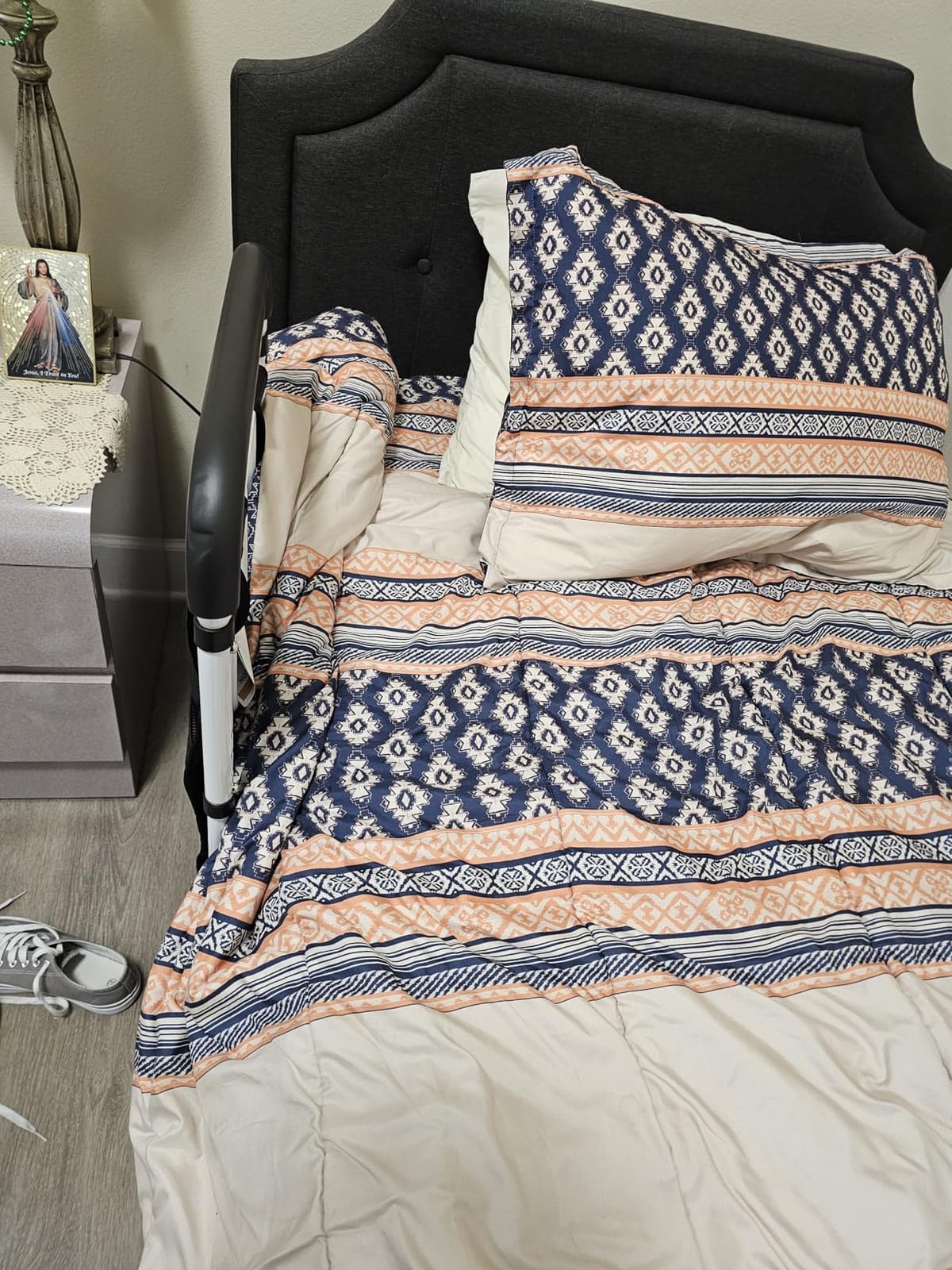
The curved handle has a non-slip padded grip, and a storage pouch keeps glasses, medication, and a phone within reach so nobody lunges for the nightstand. It fits mattresses from 3 to 12 inches thick and beds from Twin through King.
It ranks number one in medical bed safety rails, with a 4.6 average across more than 2,300 reviews. Most owners report it stays planted without frame straps.
The limitations repeat the category’s: no adjustable beds, and very thick mattresses can defeat the clamp. A handful of users add their own padding to the handle.
Weight capacity and mattress fit
Check two numbers before ordering: the user’s weight against the 380 lb rating, and the mattress height against the 3 to 12 inch range. The Q195 steel build justifies the capacity claim. Users near the limit should still put a rail on both sides of the bed.
Two rails or one
Anyone who rolls in their sleep or enters the bed from either side should get a rail for each side, which many families do. A single rail suits people with one strong side, such as stroke recovery. For pure sit-up assistance with a light-up feature, the Lunderg above is the stronger choice.
11. Vive Gait Belt with Seven Handles – Caregiver Essential
Vive Gait Belt (350lbs) Transfer Belt with Handles – Medical Nursing Safety
7 padded handles
350 lb capacity
4-inch wide strap
Fits up to 51-inch waist
FSA HSA approved
Pros
- Seven padded handles give caregivers a safe grip from any angle
- wide 4-inch strap spreads pressure comfortably
- quick-release metal buckle stays locked in use
- adjusts up to a 51-inch waist
- FDA registered and FSA/HSA approved
Cons
- Nylon feels slick against smooth fabrics
- buckle can slip if threaded incorrectly
- some users want more handle padding
Nothing on this list protects the caregiver as directly as this belt, and caregivers are the group every other guide forgets. My sister-in-law strained her back catching my father during a stumble, and the home nurse who visited afterward asked one question: why was nobody using a gait belt? We ordered one that week.
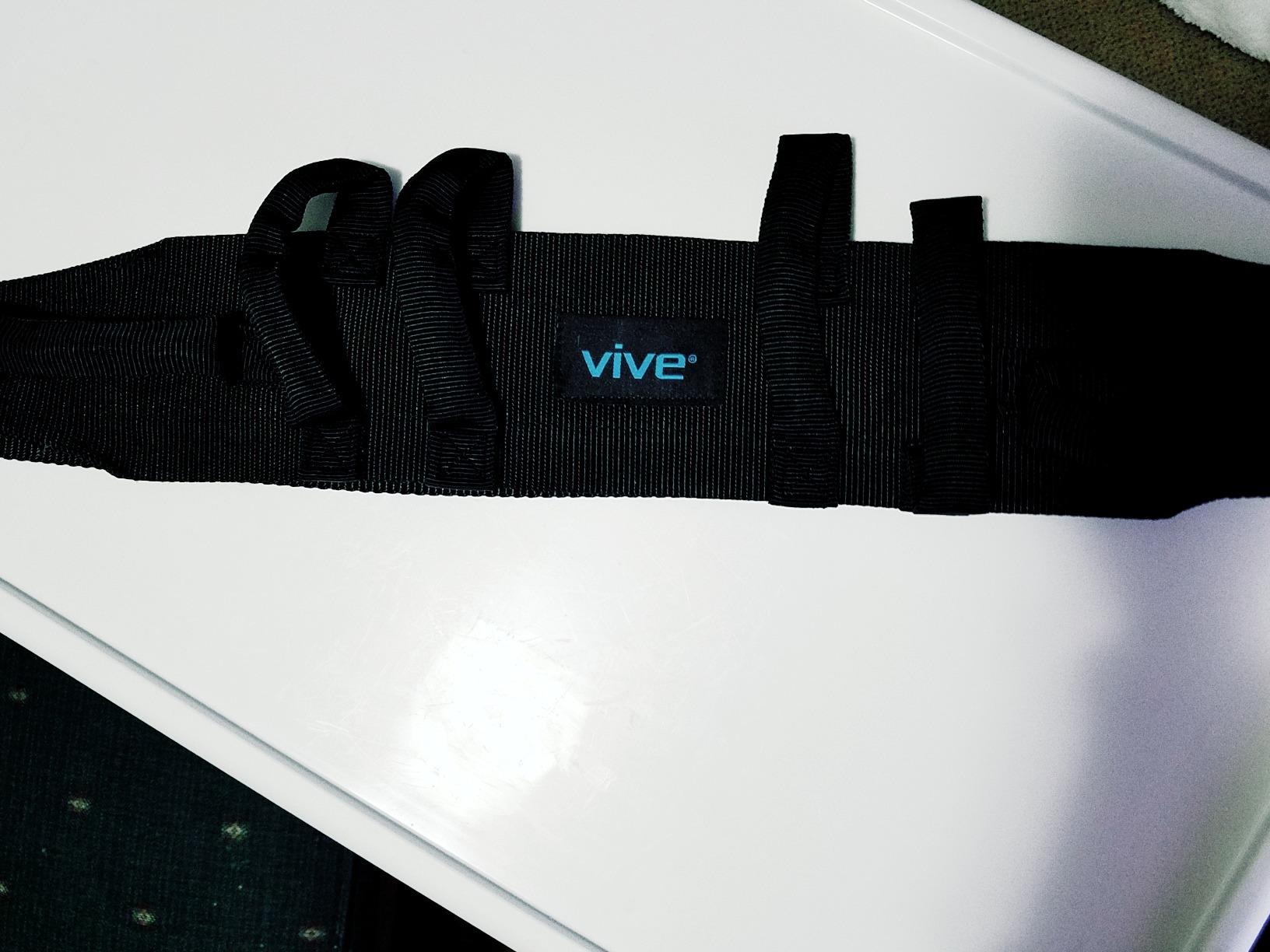
Seven padded handles are the reason this model stands out, because they let a caregiver find a safe grip from the front, side, or behind without grabbing clothing or arms. The 4-inch wide nylon strap spreads pressure across the torso instead of concentrating it. It supports up to 350 pounds.
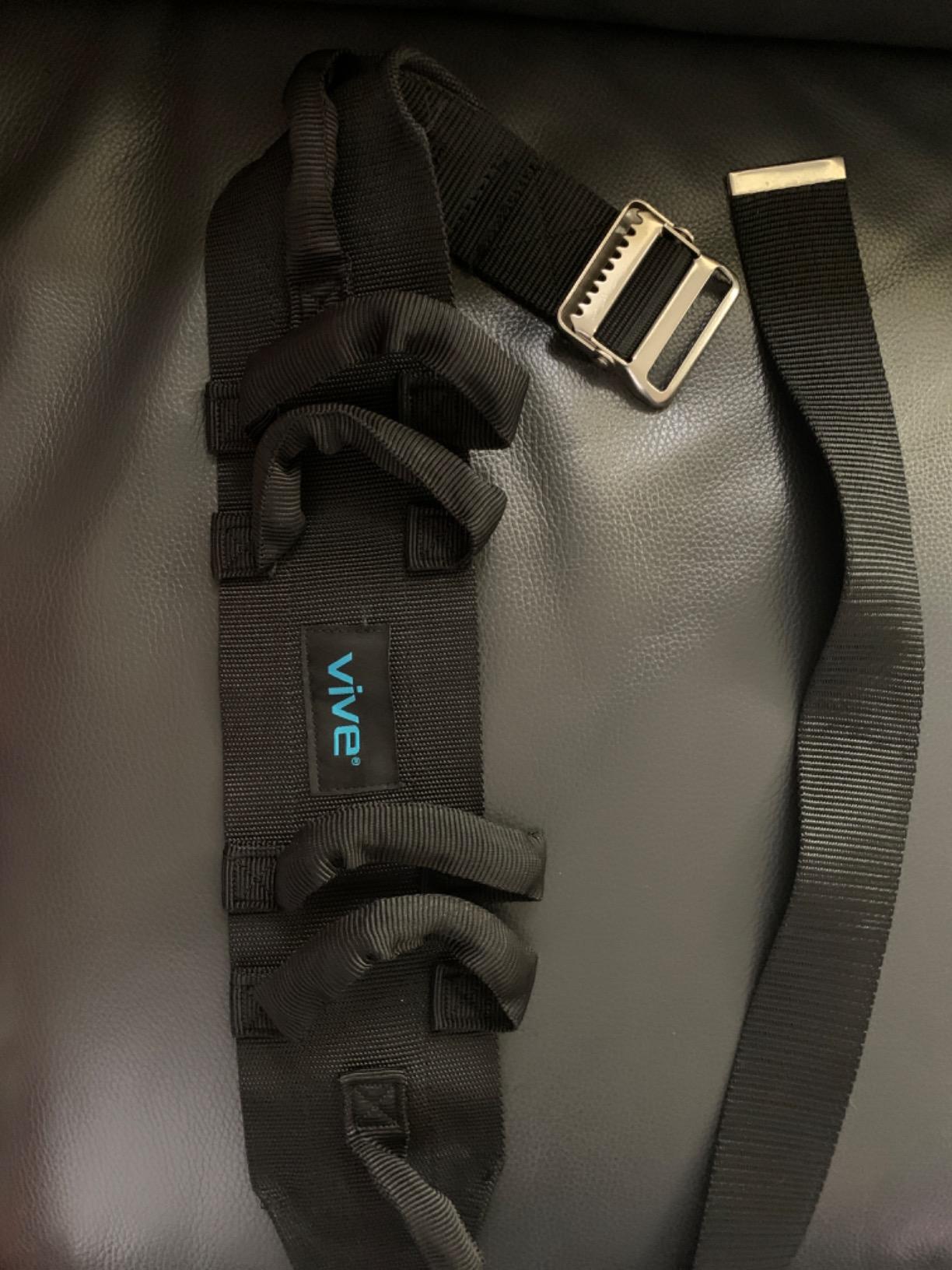
The quick-release metal buckle adjusts to waists up to 51 inches, and the webbing is reinforced stitched throughout. The whole belt weighs 11.36 ounces.
It is FDA registered, ADA compliant, FSA and HSA approved, and backed by a 60-day guarantee. Over 10,000 reviewers rate it 4.5, making it the number one bestseller in its category.
The caveats are small. The nylon can feel slick over smooth clothing, the buckle slips if threaded incorrectly on the first try, and a few users add their own handle padding.
How to use a gait belt correctly
Fasten it snugly over clothing around the waist, low enough to sit on the hip bones rather than the ribs, and always grip the handle rather than the strap. Use it to steady and guide, never to lift, because a belt is not a hoist. Have a nurse or physical therapist demonstrate once.
Who should keep one in the house
Any home where someone helps a senior stand, pivot into a chair, or move from bed to bathroom needs one of these. It is standard equipment for home health aides and physical therapy practices, which tells you what professionals already know. It prevents the back injuries that end caregiving arrangements.
12. ZAYAD Grabber Reacher Tool – Budget Pick That Prevents Falls
2026 Upgrade Grabber Reacher Tool, Foldable (Blue-32INCH)
32-inch reach
90-degree rotating head
3 lb grab capacity
Foldable
8.64 oz aluminum
Pros
- Extends reach 32 inches so nobody bends for dropped items
- rotating 90-degree head grabs from any angle
- light at under 9 oz
- folds for storage or travel
- number one bestseller in Reaching Aids
Cons
- Limited to 3 lb grab capacity
- trigger can feel stiff at first
- not meant for heavy-duty tasks
The cheapest item on this list might also prevent the most falls, because bending over to pick something up is how a startling number of senior falls begin. My father keeps one by his recliner and one in the kitchen. The dropped-remote problem simply stopped being a problem.
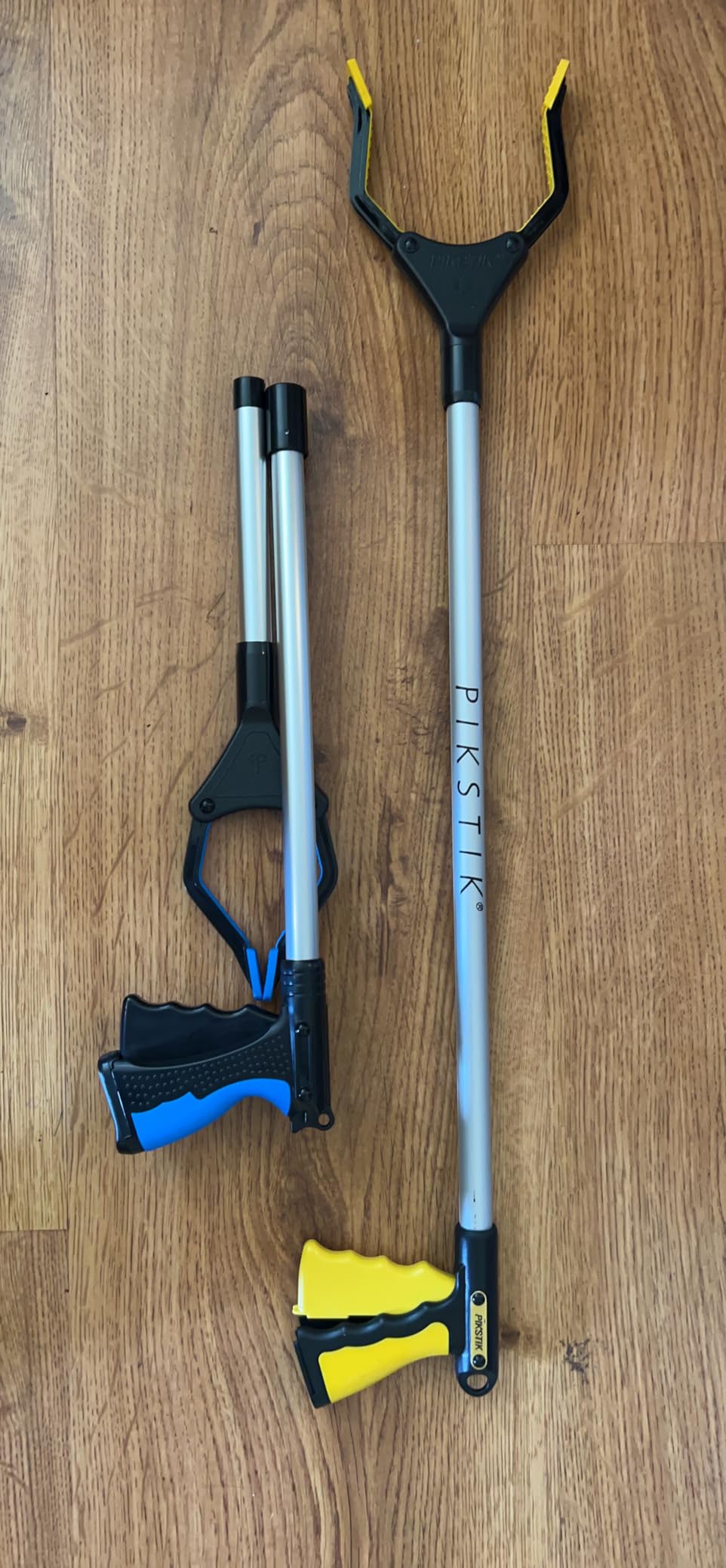
The 32-inch reach arm adds real distance without a ladder or a deep lean, and the jaw head rotates up to 90 degrees for vertical or horizontal grabs. It picks up coins, envelopes, pills, and remotes cleanly. The ergonomic trigger handle is comfortable enough for regular use.
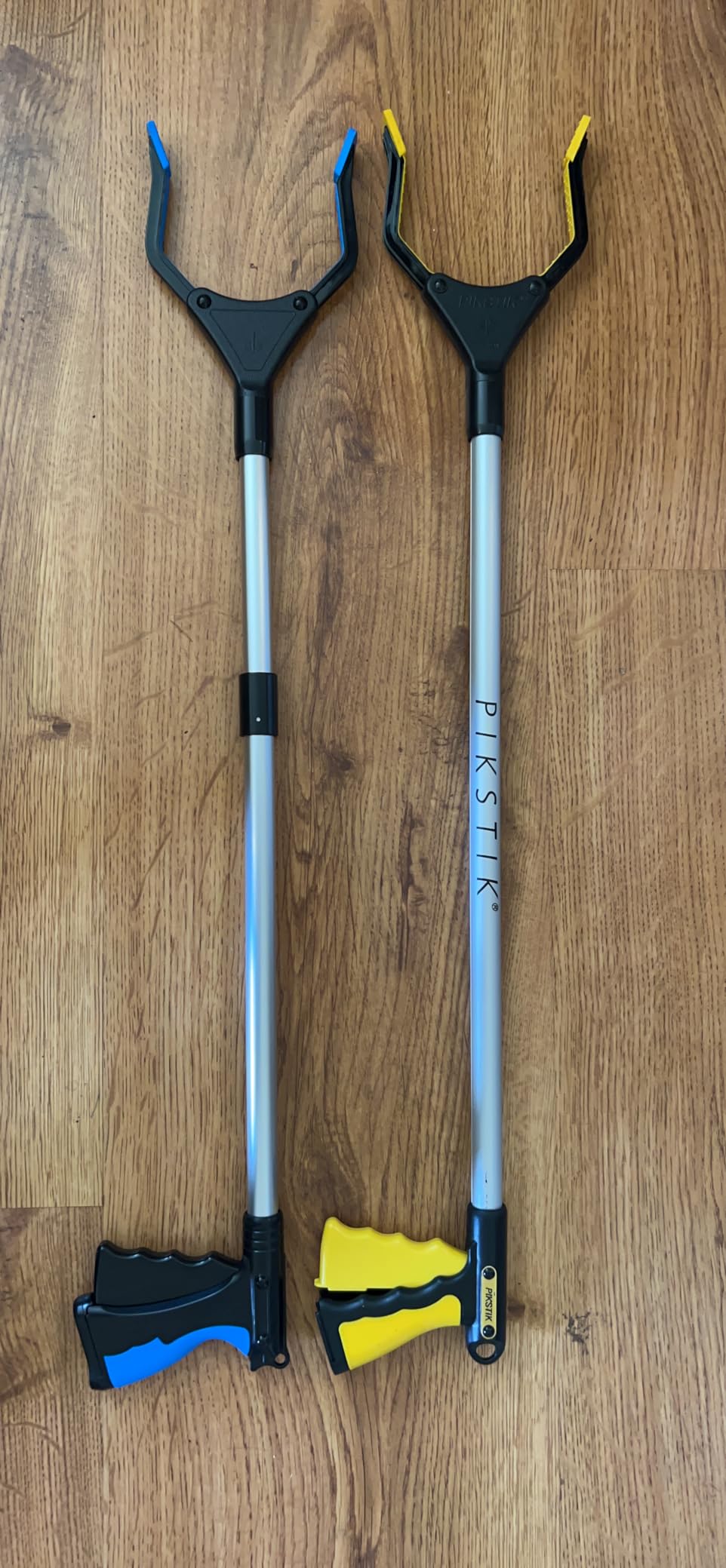
At 8.64 ounces the aluminum build is light enough for weak grips, and the tool folds for drawer storage or travel. It is the number one bestseller in Reaching Aids, with more than 70,000 reviews at a 4.4 average.
That makes it one of the most proven mobility accessories on Amazon. Two colors are available.
Know its lane. Grab capacity tops out at 3 pounds, so shoes and books are the practical limit, the trigger can feel stiff out of the box, and it will never replace a step stool for high shelves.
Best uses around the house
Keep one wherever drops happen most: beside the recliner, in the kitchen, by the laundry area, and in the car for errands. It also helps with light outdoor cleanup and low cabinets. Two units in different rooms is the setup our readers report works best.
What a reacher cannot do
This is a complement to mobility aids, not a replacement for any of them, and it does nothing for balance while walking. Anything above shoulder height still calls for a stable step stool with a handle. Treat the 3 pound rating as a hard limit, because overloading the jaw is how these tools break.
How to Choose the Right Mobility Aid for a Senior?
After a year of buying wrong and then buying right, I can compress the decision into a few checks. Work through them in order and the shortlist usually narrows itself.
Match the device to the mobility level first
A cane suits mild balance support and works when one side of the body needs a steadying contact point. A standard walker is the answer when both hands must bear weight, which is why surgeons send knee and hip patients home with one. A rollator with a seat fits seniors who walk well but run out of endurance, and a wheelchair fits when walking any real distance is no longer realistic.
The mistake families make is choosing the aid they hope the senior will need rather than the one needed today. The second is waiting too long to upgrade, which is how a cane turns into a fall. When needs are clearly progressing, buy for six months ahead.
Check weight capacity and sizing before anything else
Every product above lists a weight limit, and ignoring it voids both safety and warranty: the walkers and rollators here carry 350 pounds, the Blue Streak recommends a 300 pound maximum, the Lunderg rail is tested to 300 pounds, and the KingPavonini leads the rails at 380 pounds. Users near any limit should size up to a bariatric model.
Sizing matters just as much. Cane height should match the wrist crease measured to the floor in standing shoes, walker handles should land at the same line, and the Z21 fits users from 4 ft 11 in to 6 ft 3 in while the canes above top out around 6 ft 5 in. A wrong-size aid shifts weight into the shoulders and creates back pain nobody expected.
Indoor, outdoor, or both
Indoor-only users on smooth floors do well with a standard walker, a pivot-base cane, and bathroom equipment. Outdoor users need the wheel and tire specs: the Nitro’s 10-inch casters handle curbs and cracks, the Z21’s 8-inch tires cover pavement and light gravel, and small 5-inch wheels are happiest indoors. For mixed use, buy for the rougher surface.
Plan for the transition, not just today
Forum caregivers describe the same frustration: moving from cane to walker to rollator gets confusing and expensive when each stage is bought in a panic. Ask the doctor where mobility is heading over the next year, then buy for the realistic end of that range. Renting makes sense for temporary recovery after surgery, and buying wins for anything longer than a few months.
What Medicare and insurance typically cover
Medicare Part B treats canes, walkers, rollators, and wheelchairs as durable medical equipment when a doctor documents medical necessity and an approved supplier provides them, generally paying a portion of the approved amount after the Part B deductible. Grab bars, reachers, and most bath benches are not covered because they are classed as convenience items rather than medical equipment.
Rules shift and supplier networks matter, so confirm current coverage with Medicare or the supplier before ordering. Two practical notes from the research: the Vive gait belt is FSA and HSA approved, and those accounts often cover aids insurance will not. Also ask about rentals for scooters and wheelchairs before buying outright.
Protect the caregiver too
The gait belt on this list exists because caregivers get hurt catching falls, and a transfer belt turns a dangerous grab into a controlled assist. Add one to any home where someone helps with standing, pivoting, or bed-to-bathroom movement. Home safety is a system, and the person providing the help is part of it.
Frequently Asked Questions
What is the best walking aid for seniors?
For most seniors, a four-wheel rollator with a seat is the best walking aid because it provides stable support, a place to rest, and works indoors and out. If balance rather than endurance is the main concern, a standard two-button walker offers more stability, and the Drive Medical Two-Button Walker is the frame physical therapists recommend most often.
What is the best mobility aid for people with balance issues?
A standard walker with four fixed ground contact points gives the most stability for balance issues, which is why it is the default after hip and knee surgery. Add bathroom equipment such as a transfer bench, toilet rails, and a bed rail with a motion light, since balance-related falls cluster in the bathroom and at night.
What are seniors using instead of a walker?
Seniors who find standard walkers slow or tiring are switching to rollators with seats, upright walkers that encourage better posture, and three-wheeled rollators for tight indoor spaces. Mobility scooters replace walking entirely for longer outings, while grabber tools, bed rails, and toilet rails reduce fall risk without any walking aid at all.
When should a senior switch from a cane to a walker?
Switch when the cane no longer feels secure, when both sides of the body need support, or when near-falls start happening. Leaning hard enough to flex the shaft, drifting sideways under load, and avoiding walking altogether are the clearest signals. Canes support mild balance needs only, and forum users with progressive conditions consistently say they waited too long.
What is the new mobility device for seniors?
The biggest recent shift is the upright walker, which raises the handgrips so users stand straight instead of hunching over, alongside lighter rollators with padded seats and puncture-proof all-terrain tires. Bed rails with motion-activated lights and pivot-base canes that stand up on their own are newer refinements that address specific daily failure points.
Does Medicare cover mobility aids for seniors?
Medicare Part B generally covers canes, walkers, rollators, and wheelchairs as durable medical equipment when a doctor documents medical necessity and an approved supplier provides them, typically paying part of the approved amount after the deductible. Grab bars, reacher tools, and most bath benches are usually not covered, though FSA and HSA funds often apply. Confirm current rules with Medicare or the supplier first.
Final Thoughts on the Best Mobility Aids for Seniors
The best mobility aids for seniors are the ones matched to the person, not the ones with the longest feature list. For most families I would start with the Drive Medical Nitro rollator for an active senior who needs rest breaks, the Two-Button Walker for maximum stability after surgery, and the ZAYAD grabber in every room where things get dropped.
Then fill the gaps in the bathroom and bedroom, because that is where falls actually happen: a transfer bench, toilet rails, and a bed rail with a motion light cover the highest-risk moments of a typical day. Add a gait belt if anyone helps with transfers.
Whatever you choose, buy for where mobility is heading over the next year rather than where it sits this week, and confirm coverage before you order. The goal was never equipment. It is keeping the people we love independent and confident in their own homes for as long as possible.