
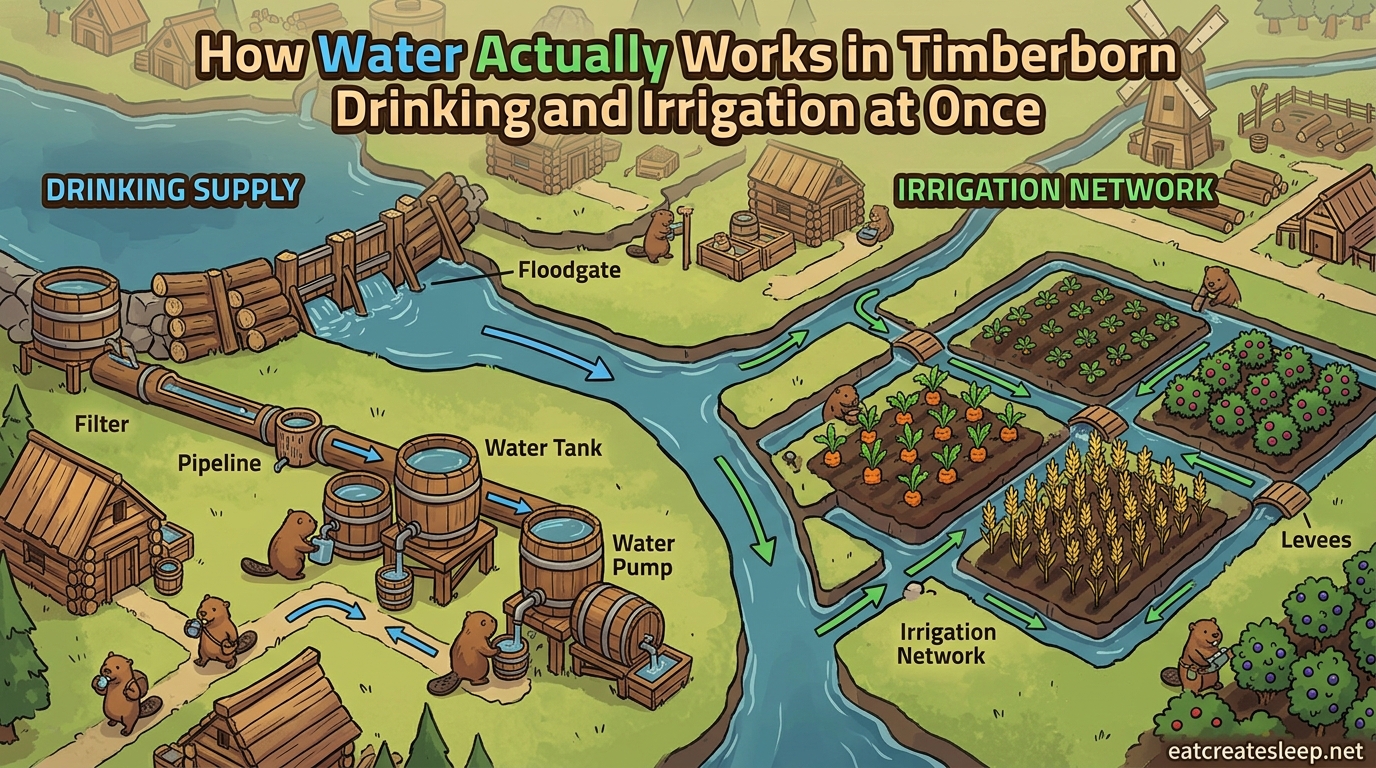
Water in Timberborn is the single most confusing system new players face. I have watched players with 200+ hours admit they still do not fully understand how a river stays alive during a drought. The good news is that once you grasp a few core rules, the whole picture clicks into place.
This guide breaks down Timberborn water mechanics from the ground up. You will learn how water physics actually simulate, what a “watered block” means, how much each beaver drinks, how far irrigation spreads, and most importantly how the same water serves both drinking and irrigation at the same time.
That last piece is the part most guides skip. Reddit and the community wiki touch on it, but no source clearly explains how one river keeps your beavers hydrated and your crops green simultaneously. We will fix that gap here, with specific numbers you can plan around.
By the end, you will understand how to design a water network that survives a 30-day drought without losing a single crop tile. Let us start with the physics engine underneath everything.
Table of Contents
How Water Physics Work in Timberborn
Timberborn uses a hybrid 2D/3D water simulation. Mechanically, water is modeled as a flowing sheet laid across a tile-based grid. Each tile tracks two values: the ground elevation and the current water height. The visible river you see is just the visual rendering of those numbers interacting.
Water flows from higher elevations to lower elevations following the path of least resistance. The steeper the height difference between two tiles, the faster water moves between them. Flow rate is measured in cubic meters per second, or cms, which you can read directly off water sources, sluices, and certain structures.
Water sources are special tiles, usually at the map edge, that continuously emit water at a fixed rate. They never run dry on their own. During a drought, the source itself shuts off, but any water already sitting in your reservoirs and channels remains and continues to behave physically until it evaporates or drains.
One of the most important physics rules to internalize: water cannot pass underneath other water. All release from dams, floodgates, and sluices happens from the top of the structure downward. This is why a tall dam with a floodgate at the bottom behaves differently than a levee with a floodgate at the top. The simulation has no concept of submerged pipes or hidden channels.
Water also has momentum. When it falls from a height, it carries that momentum downstream and can push further than a flat channel would suggest. This is why a waterfall at the edge of your district can irrigate soil surprisingly far away. Players exploit this with the so-called “water dump” technique, where a single dynamited tile paired with a water dump creates a wide irrigation zone for very little cost.
Finally, water has a defined spillover behavior at structures. A standard dam overflows at a height of 0.65, meaning water starts spilling over the top once it reaches that level on the upstream side. Levees do not overflow at all unless destroyed. Floodgates let you set the overflow height manually, which is the key tool for fine-tuning your river.
What Is a Watered Block in Timberborn
A watered block is any tile of terrain that has at least a thin layer of standing water on it. The exact threshold is low, around 0.01 depth, so even a barely-wet tile counts. This single definition unlocks almost everything else about water in the game.
A watered block does two jobs at the same time. First, it counts as a valid spot from which beavers can drink. Second, it acts as the source point from which soil irrigation spreads outward. One block of water is not split between these two functions, it simply serves both.
Here is the part that trips people up. A full block of water, meaning a tile with 1.0 depth, provides 5 units of drinkable water. That same tile also irrigates the surrounding soil up to 15 blocks in every direction. The water is not consumed by irrigation in the same way it is consumed by drinking. Irrigation is a property of proximity, not a drain on the volume.
This is why a single well-placed river can keep a whole district alive. The same physical water that beavers sip through pumps and water tanks is also keeping every crop and tree within 15 tiles green. You do not need separate rivers for separate jobs unless you are dealing with contamination, which we cover later.
Once a block dries out, it stops being a watered block immediately. Crops within its irrigation range begin the countdown to withering. Beavers cannot draw drinking water from it anymore. This is why monitoring your watered block count during a drought is more important than tracking total volume.
Timberborn Drinking Water Mechanics
Every beaver in your colony drinks between 2 and 3 units of water per day, depending on the species and the difficulty settings. Folktails tend toward the lower end, Iron Teeth slightly higher. Children drink less than adults but still draw from the same pool.
Beavers do not walk to the river and drink directly. They rely on water pumps placed on watered blocks, which extract raw water and send it through your district’s distribution network. From there, the water flows into water tanks, which act as local storage and dispensers. A beaver walking past a water tank grabs a drink the same way they grab food from a grill.
This means drinking water and irrigation water are physically the same substance, drawn from the same source blocks. The water pump is the only structure that “consumes” water for drinking purposes. The tank and distribution pipes do not remove water from the river for irrigation, because irrigation is not a consumption mechanic, it is a proximity effect.
Planning your drinking supply therefore comes down to two questions. Do you have enough watered blocks under your pumps to keep up with daily draw? And do you have enough tank storage to bridge a drought when the pumps stop working?
A safe rule of thumb from the community: plan for at least 3 units of stored water per beaver per day of expected drought, plus a 20 percent buffer. A 30-beaver district facing a 10-day drought needs roughly 1,080 units of water sitting in tanks when the source shuts off. Build tanks before you need them.
Water tanks themselves do not contaminate. They only hold whatever the pumps pulled from the river. If your river is clean, your tanks are clean. If badwater has crept into your intake zone, your tanks are now full of badwater, which we address under contamination below.
Timberborn Irrigation Mechanics
Irrigation in Timberborn is the system that keeps soil tiles “green” and able to grow crops and trees. Soil is irrigated up to 15 blocks from any watered block, measured in straight-line distance across terrain. The 15-block range extends in every direction, including diagonally, so a single river tile irrigates a circle roughly 30 blocks across.
The irrigation check happens continuously. The moment a soil tile loses contact with any watered block within 15 tiles, a timer starts. Crops on that tile do not die instantly. They enter a wither countdown, which varies by plant type but is usually several days. If water returns before the countdown ends, the crop recovers fully.
This wither window is what saves poorly-prepared districts during early droughts. It is also why a reservoir that lasts only five days can still save a 10-day drought’s worth of crops, as long as you refill the riverbed on day six.
Evaporation is the silent killer of irrigation systems. Every water tile exposed to air loses 0.045 units of depth per day. Shallow channels evaporate faster in proportional terms because each lost unit represents a larger fraction of total depth. A wide shallow reservoir covering 200 tiles loses 9 full units of water per day just to evaporation.
This is why deep narrow reservoirs are more drought-resistant than wide shallow ones, even when they hold the same volume. The smaller surface area means less evaporation loss per day. When designing your water network, treat evaporation as a real ongoing cost, not a rounding error.
Soil irrigation also works through certain structures. The irrigation tower, when placed on a watered block, extends irrigation further than the natural 15-block range by relaying the signal uphill. This is essential for farming on terraces and raised platforms where the river itself cannot reach.
How Water Works for Drinking and Irrigation at Once
This is the question the community asks most often and the question most guides answer least clearly: does one river actually serve both purposes at the same time? The answer is yes, and understanding why unlocks the entire game.
Picture a typical Folktails starting district. A river runs down the middle. Water pumps sit on the banks pulling drinking water. Crops line both sides of the river in long strips. Everything works. Now ask yourself which water is for drinking and which is for irrigation.
The honest answer is that the same water is doing both jobs, but through two separate game systems. The drinking system consumes water volume when pumps pull it out. The irrigation system does not consume water volume at all, it simply checks whether a watered block exists within 15 tiles of each soil tile.
Practically, this means your irrigation will keep working even if your pumps are running flat-out. Pulling 50 units of drinking water per day out of a 2,000-unit river does not measurably shrink the irrigation radius. The river is still a continuous band of watered blocks, and proximity is all the soil cares about.
The two systems only start competing when the river physically shrinks. During a drought, the source shuts off and evaporation eats away at the surface. Once individual tiles drop below the watered-block threshold, those tiles stop irrigating their 15-tile radius. If the same tiles are also where your pumps are sitting, your drinking supply drops at the same moment your irrigation radius contracts.
This is why deep reservoirs are the universal answer. A river held at depth 1.0 by a dam is far more drought-tolerant than a river held at depth 0.3. The deeper river takes many more days of evaporation before any tile crosses the watered-block threshold. Both your drinking pumps and your irrigation radius stay alive longer.
So the next time you wonder whether you need to “save water for drinking” by limiting irrigation, the answer is no. Build one strong water system with adequate depth, and let it serve both jobs simultaneously. That is how the game is designed to be played.
Dams, Levees, and Floodgates Compared
Three structures control water height in Timberborn, and new players routinely mix them up. Each does one specific job.
A dam is a fixed-height wall with a spillover at 0.65. Water builds up behind it until it reaches that height, then spills over the top and continues downstream. Dams are cheap, stackable, and ideal for raising a river to a stable irrigation-friendly depth without micromanagement. Most of your starting districts will be dam-based.
A levee is a solid wall with no spillover at all. Water builds up behind it indefinitely until it either overtops the levee from the sides or the levee is destroyed. Levees are how you build tall reservoirs, deep storage lakes, and walls that hold water back from areas you want dry. They cost more than dams but hold more water.
A floodgate is a controllable release valve. You set the overflow height manually, from 0 to several tiles tall. Floodgates are the precision tool for managing upstream water height without removing the wall entirely. Pair a floodgate with a levee and you can dial in exactly the depth you want on the upstream side.
The community consensus, repeated across Reddit and the official wiki, is this: use dams where you want a stable low-cost spillover, use levees where you want a tall solid wall, and use floodgates anywhere you need fine control. Sluices occupy a similar role to floodgates but control downstream height rather than upstream height.
For most districts running simultaneous drinking and irrigation, a single dam at the downstream edge of your building zone is enough. It holds the river at depth 0.65, which is deep enough to resist several days of evaporation and shallow enough that you do not waste resources over-engineering.
Separating Drinking Water From Irrigation Water
Under most conditions you do not need to separate them, as explained above. But there is one scenario where separation becomes mandatory: badwater contamination.
Badwater is a polluted variant of water that appears in certain maps and during certain events. If badwater reaches your pump intake, your drinking supply becomes contaminated and beavers get sick. Badwater still irrigates crops normally, but it is not safe to drink.
The standard fix is to physically separate your drinking intake from your irrigation river. Build a small off-channel reservoir fed by a floodgate from the clean upstream section. Pump your drinking water from that reservoir only. Let the main river continue downstream to handle irrigation, where contamination does not matter for crops.
This is the exact technique Reddit players recommend when they say “use sluices to control downstream water height and floodgates to control upstream water height.” Combine both structures around a junction and you can hold clean drinking water on one side while letting the main river do whatever it needs to on the other.
For districts without badwater, do not bother separating. The engineering cost is not worth it when one well-designed river serves both jobs cleanly.
Common Water Management Mistakes
The community has compiled a clear list of errors that kill districts. Avoid these and you are ahead of most new players.
Building wide shallow reservoirs instead of deep ones. Evaporation destroys wide reservoirs far faster than deep ones. Always prefer depth over surface area when storing water for droughts.
Placing pumps downstream of dams. Pumps work best on stable watered blocks. A pump sitting in the splash zone below a dam runs dry whenever flow dips. Place pumps upstream of control structures, in the reservoir itself.
Forgetting the wither window. Players panic when crops start wilting on day two of a drought and demolish perfectly good farms. Crops survive several days of dry soil before dying. Refill the river and the crops recover.
Underestimating evaporation during long droughts. A reservoir that comfortably survives a 5-day drought can run completely dry in a 20-day drought on the same map. Always size for your longest expected dry spell.
Frequently Asked Questions
How does irrigation work in Timberborn?
Irrigation in Timberborn keeps soil tiles green and able to grow crops. Soil is irrigated up to 15 blocks from any watered block, measured in straight-line distance in every direction including diagonally. Irrigation is a proximity effect, not a water consumption mechanic, so crops do not drain the river.
How much water does a Timberborn drink a day?
Each beaver drinks between 2 and 3 units of water per day, depending on species and difficulty settings. Plan for at least 3 units per beaver per day of expected drought in storage, plus a 20 percent buffer, to survive dry spells safely.
How does badwater work in Timberborn?
Badwater is a contaminated variant of water that appears on certain maps and during certain events. It still irrigates crops normally but is unsafe for beavers to drink. If badwater reaches your pump intake, your drinking supply becomes contaminated and beavers get sick. Separate your drinking intake from any badwater source using levees and floodgates.
Can water overflow in Timberborn?
Yes. Water overflows structures at set heights. A standard dam spills water over the top once upstream depth reaches 0.65. Levees do not overflow and hold water indefinitely until destroyed or overtopped from the sides. Floodgates let you set the overflow height manually for precise control.
Conclusion
Understanding Timberborn water mechanics comes down to four facts: water is a tile-based simulation, a watered block irrigates 15 blocks in every direction, a full block holds 5 units of drinking water, and beavers drink 2 to 3 units per day. Everything else, dams, levees, floodgates, reservoirs, is engineering built on top of those four rules.
The biggest insight most guides miss is that one river serves drinking and irrigation at once without any conflict. Drinking consumes water through pumps. Irrigation is a free proximity effect off the same watered blocks. Build one deep, well-managed water system and let it do both jobs.
Start simple with a single dam at depth 0.65. Add a floodgate when you need control. Build deep tanks before the first long drought. Watch your watered block count, not just your volume total, and your district will outlast any dry spell the game throws at you.