
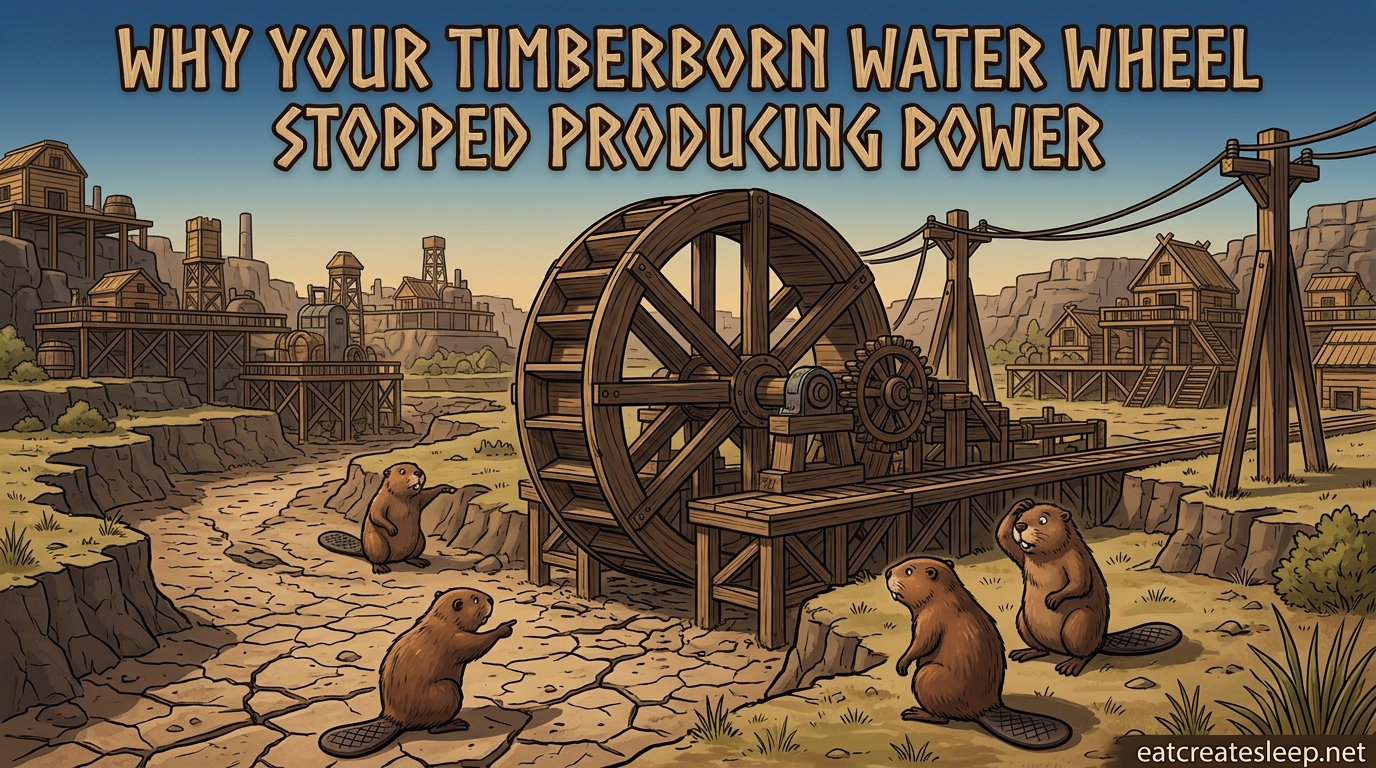
You built a tidy little power grid around a spinning water wheel, everything was humming along, and then suddenly it just stopped. I have been there, staring at a motionless wheel while my lumberjacks and bakeries sit idle waiting for hamsterpower that never comes. The good news is that almost every case of a Timberborn water wheel stopped producing power traces back to one of a handful of fixable issues.
In this guide I will walk through exactly how water wheels work, why they stall out, and the troubleshooting steps that get them spinning again. By the end you should be able to diagnose the problem in under a minute and prevent it from happening on your next map.
Table of Contents
How Water Wheels Actually Work in Timberborn?
Before fixing anything it helps to understand the mechanic. Water wheels in Timberborn are undershot wheels, which means they generate power only from water flowing horizontally beneath the axle. They are not turned by water falling on top of them or splashing against the side.
That detail matters more than any other. The wheel must be placed so the current runs parallel to its axle, with the blades dipping into moving water below. Power output scales with the speed and volume of that current, not with how deep the wheel sits. A wheel spinning in a lazy pool produces almost nothing, while the same wheel in a fast narrow channel can crank out serious hamsterpower.
Wheels also require no workers and no fuel. They run automatically as long as water is flowing, which makes them one of the most reliable early and mid-game power sources. The catch is that they shut off entirely during drought when rivers dry up, so they are a seasonal asset rather than a year-round guarantee.
Common Reasons Your Timberborn Water Wheel Stopped Producing Power
When a wheel that was working suddenly goes idle, one of these five culprits is almost always to blame. I have run into all of them across multiple playthroughs.
1. The Water Stopped Flowing
This is the number one cause. Water wheels need a current, not just standing water. If you built dams upstream, redirected a river, or pumped too much water out for irrigation, the flow passing under your wheel may have slowed to a crawl or stopped entirely. Even a small reduction in current speed can drop output to near zero.
Check the river above your wheel. If the water looks stagnant or the surface is flat with no visible movement, flow is the problem. Removing or opening a dam upstream usually restores it within a few seconds of in-game time.
2. The Wheel Got Flooded
Water wheels have a maximum water depth they can handle. Once water rises above roughly 2 meters at the wheel location the structure becomes flooded and power production shuts off. This commonly happens when a downstream dam backs water up, when badwater mixes and raises fluid levels, or when a terrain collapse redirects extra flow into your channel.
Flooded wheels show their status on the building itself. Lowering the water level, either by removing the downstream obstruction or opening a floodgate, brings them back online quickly.
3. Poor Placement in a Corner or Edge
Wheels wedged into a river bend or pressed against a bank often underperform or stall. The issue is that water finds a path around the wheel instead of flowing through it. When the current can sneak past on either side, the wheel barely turns even though the river looks active.
Steam Community players consistently report that wheels placed in the middle of a river, with open water on both sides, produce around 180 power on the starting map. The same wheel shoved into a corner might produce 30 or nothing at all.
4. Drought Hit and the River Dried Up
Timberborn droughts are brutal and they affect every water wheel on the map at once. When the freshwater sources shut off, your wheels stop generating until the rains return. This is not a bug, it is the core seasonal pressure the game is built around.
If your wheels all went idle at the same time and the riverbed is visibly lower, drought is the answer. The fix is preparation rather than reaction, which I cover in the survival section below.
5. Too Many Wheels Choking One River
Stacking three or four wheels back to back on the same narrow stretch of river sounds efficient, but each wheel slows the current for the next one in line. The first wheel might run fine while the ones behind it starve for flow. Reddit users have documented this exact issue when they tried to maximize power on a single short river segment.
Spread wheels out along the river or split them across multiple channels instead of clustering them. Each wheel needs clean, fast water feeding into it.
Quick Troubleshooting Checklist
When a wheel stops, work through this list in order. Most players find their answer by step three.
- Check the building status. Click the wheel and look for a flooded or no-flow warning.
- Trace the river upstream. Look for new dams, terrain changes, or heavy water pumping that might have reduced flow.
- Watch the water surface. If it is flat and still near the wheel, the current is too weak.
- Check for downstream backup. A dam or collapsed terrain below the wheel can raise water levels above the 2-meter flood threshold.
- Verify drought status. Open the season indicator. If a drought is active, all freshwater wheels will be offline.
- Count nearby wheels. If multiple wheels share one channel, the downstream ones may be starved.
- Test placement. Try demolishing and rebuilding the wheel a tile or two toward the center of the current.
In my experience steps one through three catch roughly 80 percent of cases. The rest usually come down to flooding or drought.
Optimal Water Wheel Placement Tips
Good placement prevents most problems before they start. Here is what I have learned from rebuilding more power grids than I care to admit.
Build mid-river, not against banks. Wheels need water flowing through them, not around them. The center of a strong current gives the best output and is least likely to stall when water levels shift.
Align the axle with the current. The wheel icon shows its orientation. Rotate it so the axle runs perpendicular to the direction the water is moving. A wheel turned 90 degrees the wrong way produces nothing.
Use dams and levees to funnel flow. If your river is wide and slow, narrow it. Build a dam or levee pair that squeezes the channel down around the wheel. Faster water through a tighter gap means more power per wheel.
Keep the wheel clear of overhangs. Blocks or structures directly above the wheel can interfere with placement and operation. Leave at least one open tile of clearance.
Spread wheels across multiple channels. Instead of lining up five wheels on one river, build a small canal network with one or two wheels per branch. Each wheel gets clean flow and you avoid the compounding slowdown effect.
Drought Survival and Backup Power
Because water wheels shut off during drought, you cannot rely on them as your only power source past the early game. Every colony needs a backup plan.
Engine power and, for the Iron Teeth, the engine line of buildings provide power that does not depend on water. They cost logs and boards to run, so they are more expensive than free-flowing water, but they work year-round. Most players run a hybrid setup with water wheels handling wet-season demand and engines covering drought gaps.
Badwater wheels are another option worth mentioning. They run on badwater flow rather than freshwater, and badwater sources behave differently during drought depending on the version and map. If your colony sits near a badwater river, a badwater wheel can keep spinning when your freshwater wheels go dark.
Gravity batteries and power shafts help you store and move power efficiently, but they do not generate anything themselves. Pair them with a diversified power setup so you always have something feeding the grid.
FAQs
How do water wheels work in Timberborn?
Water wheels are undershot power generators. They produce hamsterpower when water flows horizontally beneath the axle, parallel to the wheel. They do not generate power from water falling on top or hitting the side. Output scales with current speed and volume, and they require no workers or fuel.
Why did my water wheel stop producing power?
The most common causes are reduced water flow from upstream dams or pumping, flooding from a downstream backup raising water above 2 meters, poor placement in a river corner, a drought drying up the river, or too many wheels sharing one channel and starving each other for flow.
How to get power from a water wheel in Timberborn?
Place the wheel in flowing water, aligned so the axle runs perpendicular to the current. Build it mid-river where the current is strongest, use dams to narrow wide channels, and make sure water can flow freely under and through the wheel rather than around it.
Do water wheels work during drought in Timberborn?
No. Freshwater water wheels stop producing power during drought because the rivers dry up and flow stops. You need backup power from engines or, where available, badwater wheels to keep your grid running through dry seasons.
Why aren’t water wheels used anymore in real life?
In the real world water wheels were replaced by more efficient turbines and electrical generators during the industrial era. Modern hydroelectric dams use turbines that can extract far more energy from the same water flow.
Conclusion
A Timberborn water wheel stopped producing power is almost always a flow, flooding, or drought problem rather than a game bug. Run the troubleshooting checklist, fix the underlying cause, and the wheel should spin back to life. Once you understand the undershot mechanic and the importance of clean mid-river placement, future wheels become far more reliable.
For long-term stability, pair your water wheels with engine backup power and spread them across multiple channels so no single river bottleneck can take down your whole grid. Build smart, watch your currents, and your beavers will never sit in the dark for long.