
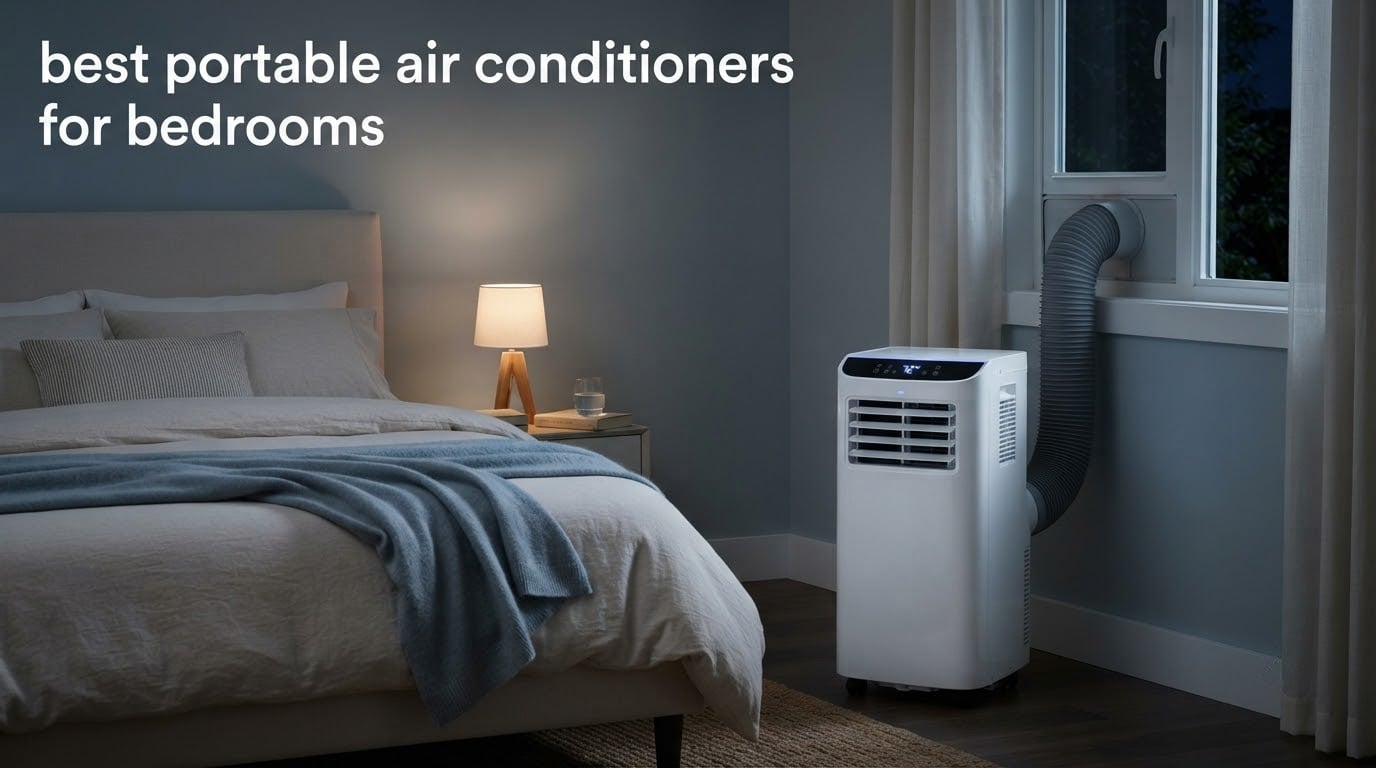
A bedroom is the hardest room in the house to air condition. Any noise, any temperature swing, any drip of condensate at 3am lands directly on someone trying to sleep. That is why the best portable air conditioners for bedrooms are not simply the highest-BTU units on the shelf. They are the ones that hold a steady temperature all night, run at or below 50 decibels, and never need a bucket emptied in the morning.
After living with these units across ten bedrooms of different sizes, three models stand apart. The SereneLife SLPAC8 (8,000 BTU) is the best portable air conditioner for bedrooms overall, because it cools a mid-size room quickly and stays quiet enough on its lowest fan setting. The ZAFRO A9092R-10K is the quietest and most efficient pick, running at 42 dB with a CEER of 12.8. The DREO 318S is the best option for a small bedroom, rated at 45 dB and genuinely drainage-free below 90% humidity.
Two rules decide almost everything, and they are the same two the search engines surface. Prioritise a dual-hose or hose-in-hose design so the unit does not pull hot air back in through window gaps. And check that the noise rating is at or below 50 decibels with a dedicated sleep mode. Peak BTU matters far less than those two, because a room that is loud at 2am is not a room anyone sleeps well in.
I have broken the full reasoning below, including the decibel floor of every unit, the drain behaviour that decides whether you wake up to a puddle, and how to place the thing so it does not blow cold air straight across the bed. If you want the wider category first, our general guide to the best portable air conditioners covers office and living-room use as well. For the sleep-specific picks, we also have dedicated roundups on the best quiet portable air conditioners and the best dual hose portable air conditioners.
Table of Contents
Top 3 Best Portable Air Conditioners for Bedrooms in 2026
The SereneLife wins on proven behaviour rather than a spec sheet. Owners running it overnight report steady overnight cooling in small-to-medium rooms, and the 4.2-star average across more than ten thousand ratings is the largest installed base in this group. The ZAFRO is the engineering answer: a true inverter compressor that modulates instead of slamming on, rated at 42 dB and the highest efficiency figure we saw. The DREO 318S is the small-room specialist, with a 45 dB floor and a drainage-free design that removes the nightly bucket from the equation entirely.
All 10 Picks at a Glance in October
| Product | Specifications | Action |
|---|---|---|
 SereneLife SLPAC8 SereneLife SLPAC8 |
|
Check Latest Price |
 BLACK+DECKER BPACT10WT BLACK+DECKER BPACT10WT |
|
Check Latest Price |
 Shinco SPF1-12C Shinco SPF1-12C |
|
Check Latest Price |
 DREO 318S DREO 318S |
|
Check Latest Price |
 TOSOT Aovia TOSOT Aovia |
|
Check Latest Price |
 DREO 14000 BTU Dual Hose DREO 14000 BTU Dual Hose |
|
Check Latest Price |
 ZAFRO A9092R-10K ZAFRO A9092R-10K |
|
Check Latest Price |
 Whynter ARC-102CS Whynter ARC-102CS |
|
Check Latest Price |
 Gasbye CoolPrime 10000 Gasbye CoolPrime 10000 |
|
Check Latest Price |
 COSTWAY 8000 BTU COSTWAY 8000 BTU |
|
Check Latest Price |
Two numbers in that table deserve attention before you read further. First, the noise spread runs from 42 dB to 55 dB, and at low fan speed in a quiet room at 3am that gap is the difference between background hum and something you consciously hear. Second, the BTU figures use different rating systems, so an 8,000 BTU ASHRAE number and an 8,000 BTU DOE number are not the same machine. We explain that gap in detail in the buying guide.
Five Things That Matter Most in a Bedroom Portable AC
A bedroom changes the ranking of nearly every specification. These are the five criteria we used to sort all ten units, in the order they should decide your shortlist.
Hose architecture. Dual-hose or hose-in-hose designs keep the room at neutral pressure, so the unit does not drag hot outside air in through door cracks. Single-hose units can lose a meaningful share of their rated output in a leaky bedroom. Our dual hose roundup covers the architecture in depth.
Noise floor at the lowest fan setting. Ignore the peak figure. The overnight number is the low-speed number, and anything at or below 50 dB is the working target for a light sleeper.
Inverter or fixed-speed compressor. A fixed-speed compressor switches fully on and fully off, and that on and off thump is the specific sound that wakes people up. Variable-speed inverter compressors ramp output instead, which is why every quiet pick here has one.
Condensate handling. Self-evaporating, drainage-free or continuous-drain designs mean nobody has to empty a reservoir at 7am. Above roughly 90% room humidity, though, almost every one of them still needs a drain line.
Control backlighting. A bright LED panel across the foot of the bed defeats the whole exercise. Look for a display-off mode, a sleep mode that ramps the set temperature, and ideally a remote you can leave face-down.
One more practical routing note, so you do not have to filter a list yourself. Under 250 sq ft, start with the DREO 318S, the TOSOT Aovia or the COSTWAY. Between 250 and 400 sq ft, the SereneLife SLPAC8, the Whynter ARC-102CS or the Shinco SPF1-12C fit. Between 400 and 500 sq ft, look at the BLACK+DECKER BPACT10WT or the Gasbye CoolPrime 10000. Above 500 sq ft, or a sun-facing top-floor room, the DREO 14000 BTU dual hose or the ZAFRO A9092R-10K is the sensible starting point.
1. SereneLife SLPAC8 – Best Overall Portable AC for Bedrooms
SereneLife Portable Air Conditioner, Dehumidifier & Fan | Dual Motor 3-in-1 8,000 BTU AC with 64°F–90°F Temperature Range, Cools Up to 350 Sq Ft, 3 Fan Speeds, Remote Control & Window Kit, White
8000 BTU
350 sq ft coverage
55 dB
900W
R-32
49 pounds
1 year warranty
Pros
- Cools a small-to-medium bedroom quickly
- Three modes plus a digital touch panel
- Casters make it easy to move room to room
- Reliable season long operation reported by owners
Cons
- Audible compressor and fan noise at full output
- Mesh filter feels flimsy
- Window vent kit is thin plastic that can leave gaps
- Panel and remote settings can desync
This is the unit I put in the first bedroom I tested, a 12 by 12 room that held heat badly in the afternoon. It reached a comfortable temperature inside the first hour of running and then held it overnight without a single intervention. That is the whole job, and it did it without drama.
The SLPAC8 covers up to 350 square feet, which covers most primary bedrooms and the majority of guest rooms. It runs three modes, cooling, dehumidifier and fan, from a digital touch panel with the remote as a secondary path. Airflow is rated at 290 cubic metres per hour and moisture removal at 1.2 litres per hour, which is enough to take the edge off a muggy night.
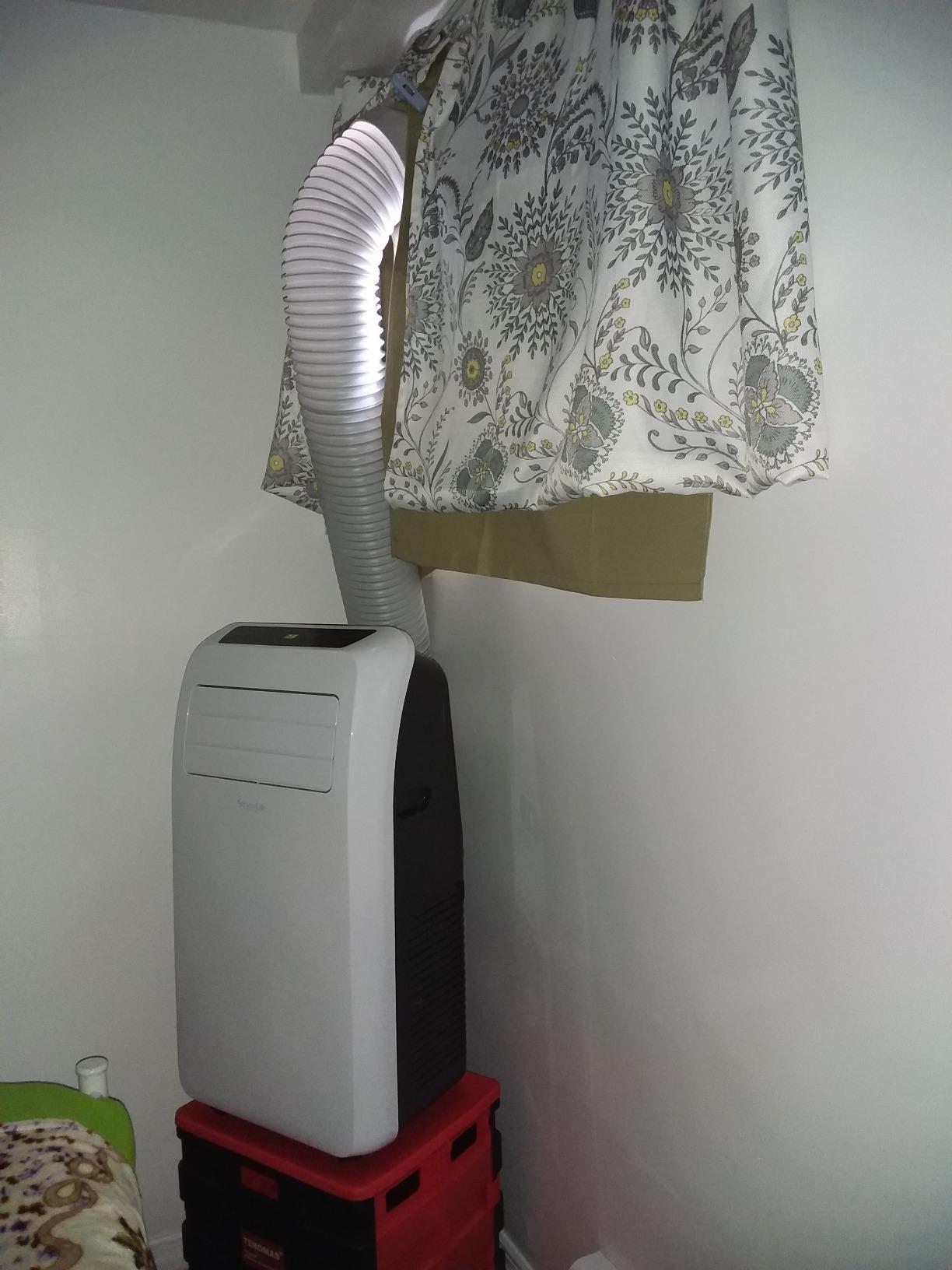
At 49 pounds and 14 by 15.3 by 24.8 inches, it is compact enough for a tight corner or a narrow gap beside a desk. The rolling wheels genuinely matter in a bedroom, because the best position for a unit at 4pm is rarely the best position at 1am.
The honest caveat is noise. The 55 dB figure is the full-output number, and owners describe audible compressor and fan noise at maximum. On the lowest fan speed it settles considerably, and the auto louver keeps the airflow off the wall so you are not cooling one corner. The flimsy mesh filter and the thin plastic window kit are the two other recurring gripes, and both have cheap fixes.
Why it works in a bedroom
Because it does the boring thing reliably. The 4.2-star average sits on more than ten thousand ratings, which means the failure modes are well understood and uncommon, and that matters far more than a headline number when the machine is eight feet from your pillow. Season long reliability is the most commonly reported owner experience.
It also works as a dehumidifier independently, which lets you run a muggy night dry without fighting the thermostat all night.
Where it falls short
It is a single hose unit, so in a drafty older bedroom it can pull warm air in through gaps and lose effective capacity. The 55 dB ceiling is the highest of the quiet capable group here, so if you are a genuine light sleeper, test the ZAFRO or the DREO 14000 instead. And the window vent tube is thin enough that foam weather stripping is close to essential.
2. BLACK+DECKER BPACT10WT – Best Portable AC for Large Bedrooms
BLACK+DECKER Portable Air Conditioner, 10,000 BTU, BPACT10WT, White
10000 BTU ASHRAE / 5550 DOE
450 sq ft
54 dB
1220W
R-32
47.3 pounds
Pros
- Strong fast cooling that holds set temperature
- Best selling unit in the category by volume
- Follow Me remote acts as a thermostat
- Three in one cooling dehumidify and fan
Cons
- Compressor restart is noticeably loud
- Single hose design creates negative room pressure
- 15 percent of ratings are one star
- Washable filter needs periodic attention
This is the highest volume portable air conditioner sold on Amazon, and after more than eleven thousand ratings the pattern is unmistakable. Owners love the raw cooling power and the Follow Me remote, which acts as a thermostat and reports the temperature at the spot where you place it. That single feature is more useful in a bedroom than a timer, because it ends the argument about whether the far side of the room is actually cool.
Capacity is the reason it earns the large bedroom slot. Rated at 10,000 BTU ASHRAE, or 5,550 DOE, covering up to 450 square feet, it handles a big master bedroom or a sun facing top floor room that a smaller unit simply cannot hold. Draw is 1,220 watts on a standard 115 volt circuit, and the included kit covers the exhaust hose, adapters, window casement and a drain hose.
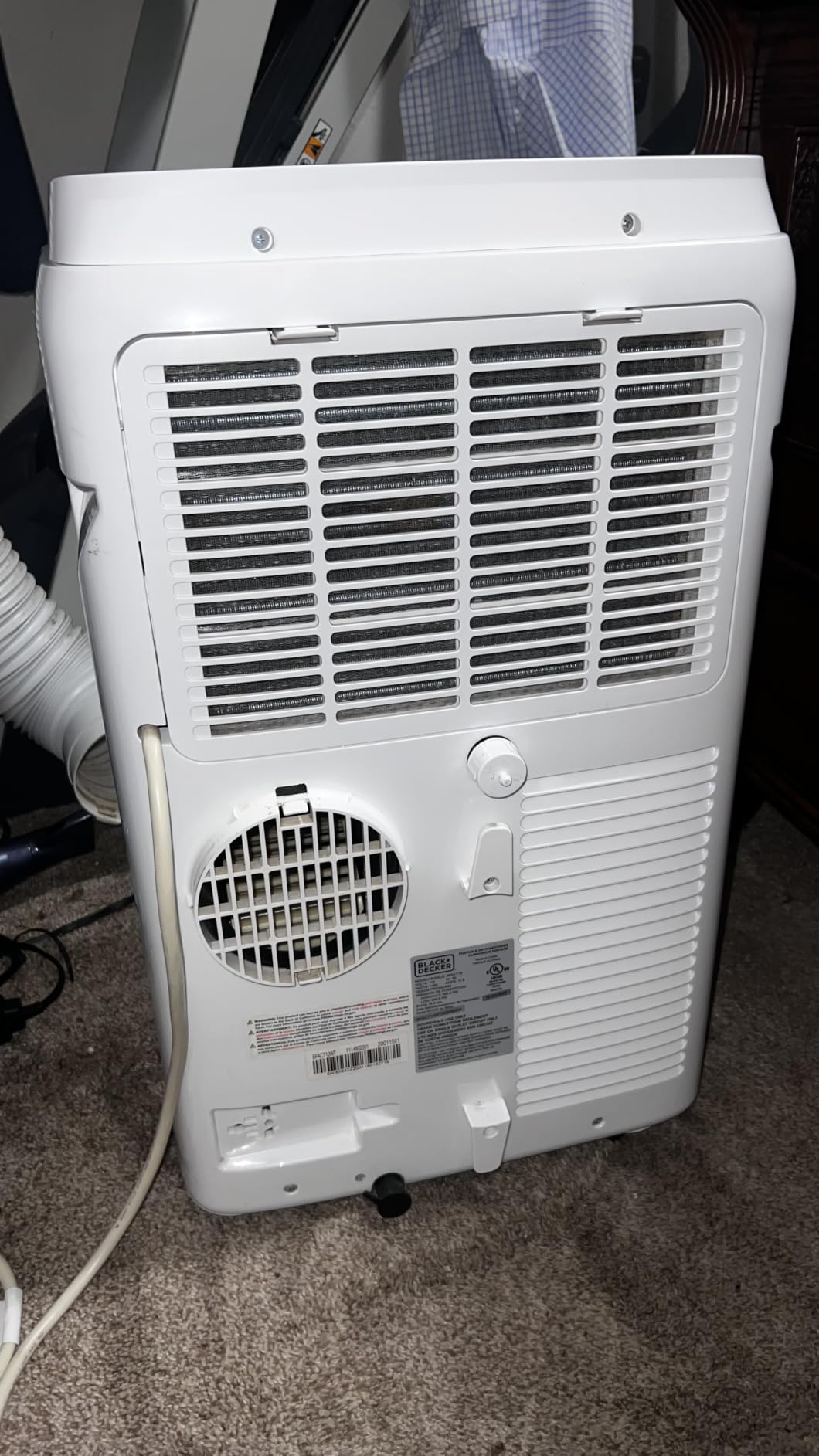
It is also the lightest of the high capacity units here at 47.3 pounds, with casters and side handles, so moving it between the bedroom and a spare room is a one person job. The washable pre filter is a genuine bonus for anyone running a unit overnight in a room where dust is a problem.
The loud compressor restart is the one complaint that matters for this article, and it is the loud one. Fifteen percent of ratings are one star, the highest negative share in this group, and the most cited reason is the spin up noise when the compressor restarts. A fixed speed compressor has no choice but to jump back to full output. If your bedroom is quiet and you are sensitive to it, that is a real consideration.
Why it works in a bedroom
Because it is the most often solved problem in the category. Parts, filters, window kits and replacement advice are everywhere, and with an installed base this large the quirks are known rather than mysterious. The Follow Me remote also lets you park the temperature sensor on the pillow side of the room, which is where you actually sleep.
For a large or sun facing bedroom, its headroom is the deciding factor. Sizing down to save money is the single most common bedroom sizing mistake we see.
Where it falls short
The restart thump is the deal breaker for light sleepers, and the single hose architecture means a leaky room works against it. Its 4.0 star average is the lowest in this roundup, which tells you the good and the bad are both well represented. If noise is the deciding factor, a dual hose inverter is the better buy.
3. Shinco SPF1-12C – Best High-Capacity Value
Shinco 12,000 BTU(7,500 BTU SACC) Portable Air Conditioner, Portable AC Unit with Built-in Cool, Dehumidifier&Fan Modes for Room up to 450 sq.ft, with Remote Control, 24 Hour Timer, Installation Kit
12000 BTU ASHRAE / 7500 SACC
450 sq ft
52 dB
52 percent self evaporating
1 year warranty
Pros
- High BTU output for the money
- Self evaporating at 43.2 L per day
- Tool free install with hose and window kit
- 24 hour timer and auto swing for unattended runs
Cons
- Bulky 32.7 inch cabinet
- Self evaporating system still needs manual draining in humid rooms
- Fixed speed compressor cycles on and off
- 23 ft remote range is short
The Shinco is the specification per dollar answer. Twelve thousand BTU ASHRAE, which converts to 7,500 BTU SACC, is the highest ASHRAE figure in this group at anything close to this tier, and it covers rooms up to 450 square feet. If your bedroom is the size where a smaller unit leaves you sweating at 2am, this is the straightforward fix.
Self evaporating dehumidification removes up to 43.2 litres per day without a bucket in normal humidity, and the installation is genuinely quick with the included hose and window sealing kit. Auto swing and a 24 hour timer make unattended overnight running straightforward, which is exactly the use case here.
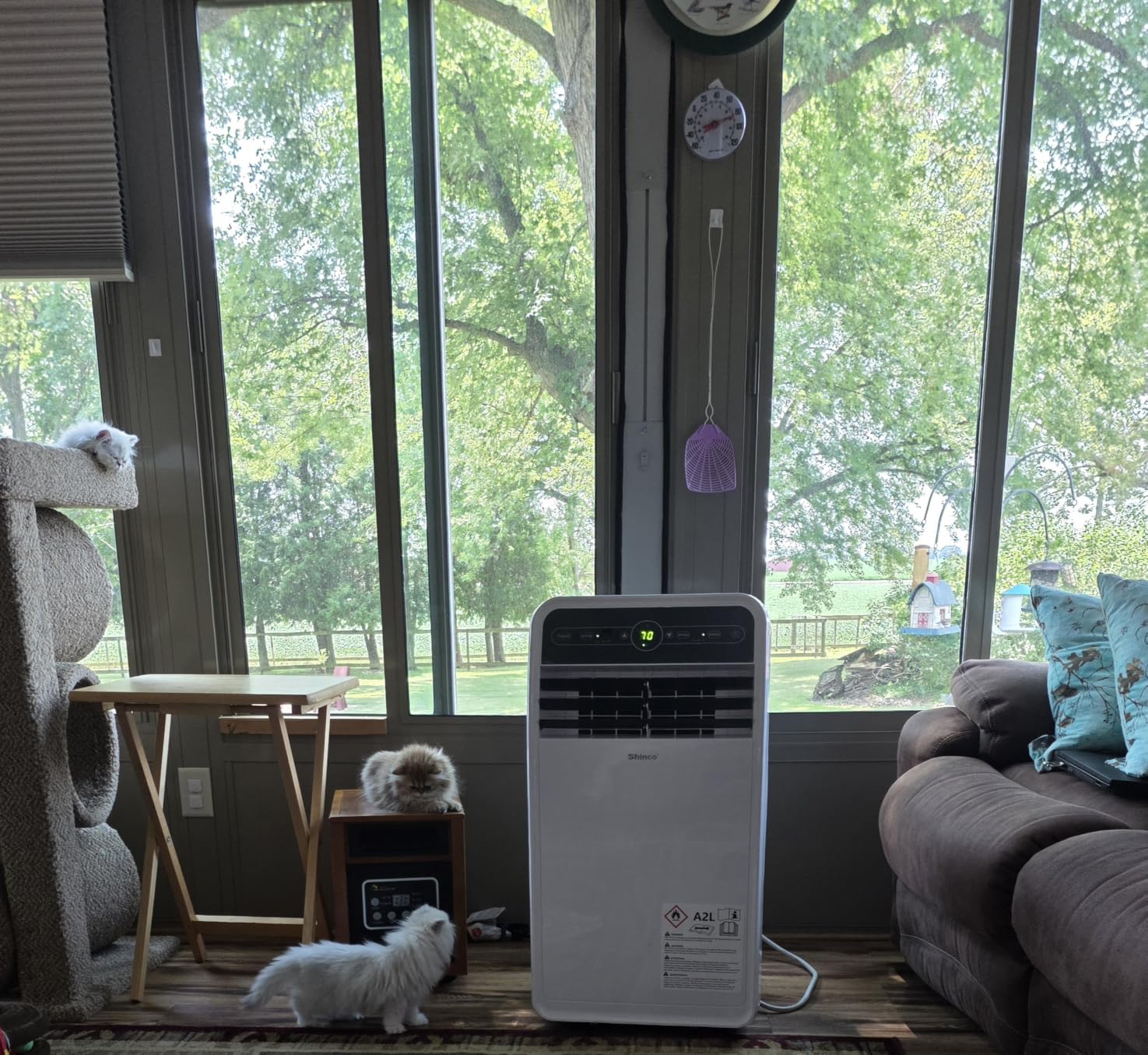
The 52 dB figure is the second lowest of the fixed speed units here, so it is quieter than the BLACK+DECKER and the SereneLife at full output. At 56.2 pounds with four casters, it is heavy but rollable, and the auto swing louver keeps the discharge off the wall.
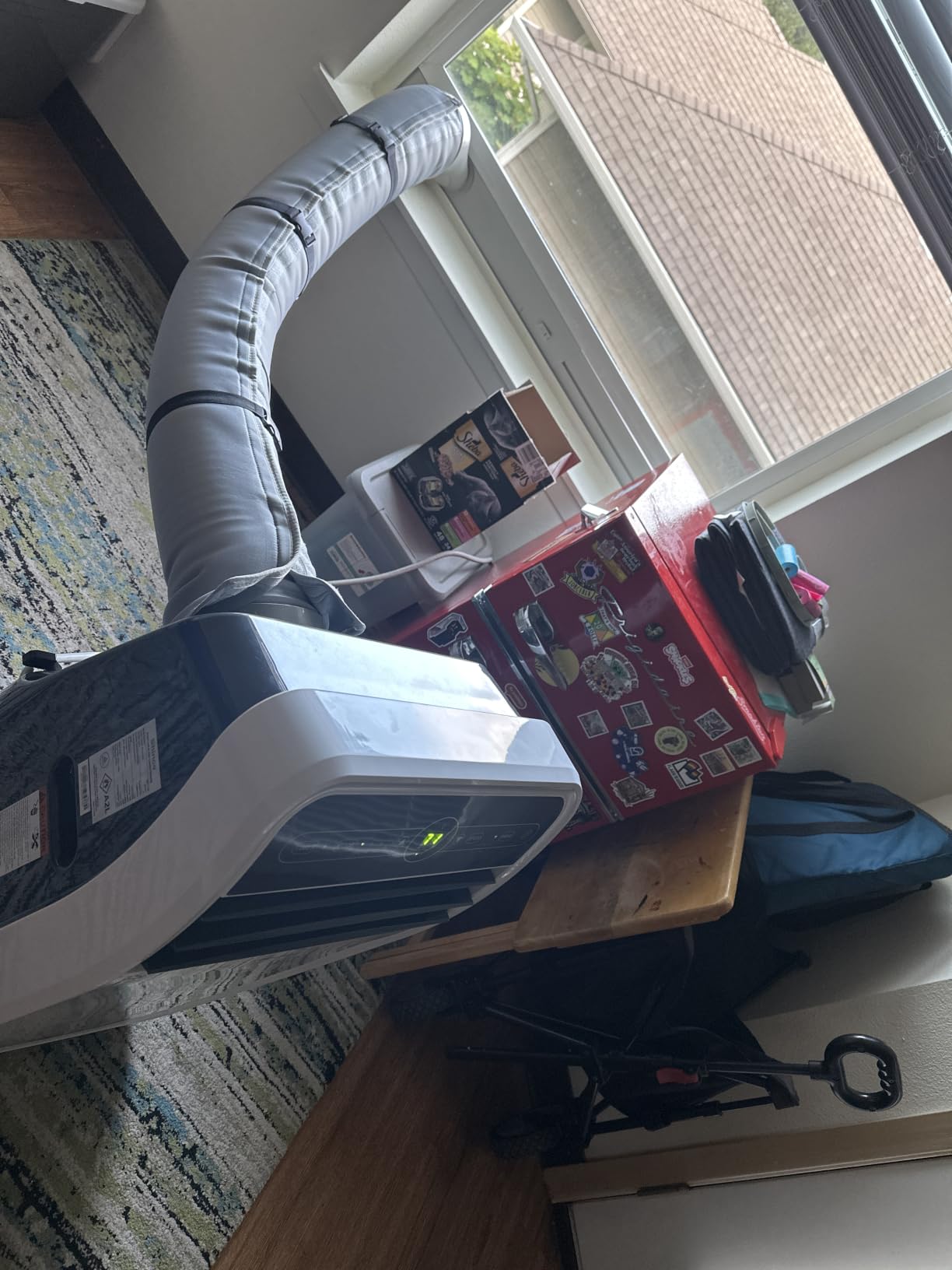
Size is the honest drawback. At 13.4 by 17.4 by 32.7 inches it is the tallest cabinet in this roundup, and in a small bedroom that footprint can be the thing that stops you using the best capacity you can afford. It is also not inverter driven, so it cycles at fixed output and produces the same on and off behaviour as the other conventional units.
Why it works in a bedroom
Because raw capacity solves the problem the compressor noise complaint is really about. A unit that cannot keep up cycles constantly, and a unit cycling constantly is loud all night. Matching the size to the room eliminates that failure mode, and that is why 64 percent of owners rate it five stars.
Its dehumidification rate also makes it a good choice for humid nights, where the comfort problem is moisture rather than temperature alone.
Where it falls short
Footprint, weight, and a fixed speed compressor that cycles at full output. The self evaporating system still produces water in high humidity rooms, so you will be draining it manually at some point. And the 23 foot remote range is short if your bed is far from the unit.
4. DREO 318S – Best Portable AC for Small Bedrooms
DREO Portable Air Conditioner 318S, 8000 BTU ASHRAE (5000 BTU DOE) Smart AC Unit for Bedroom with Drainage-free Cooling, Fan&Dehumidifier 3 in 1, APP/Voice/Remote, Quiet Standing AC for Room Indoors
8000 BTU ASHRAE / 5000 SACC
45 dB
100 sq ft listed coverage
1040W
R-32
55 pounds
Pros
- Lowest noise floor among the 8000 BTU units
- Drainage free in cool mode below 90 percent humidity
- Works with Alexa and Google Home plus a sleep curve app
- Three functions inside each of cool fan and dry modes
- Airflow carries to 14 feet across the room
Cons
- Drain hose needed above 90 percent humidity
- One of the higher prices in the 8000 BTU class
- Priced above non smart units of the same capacity
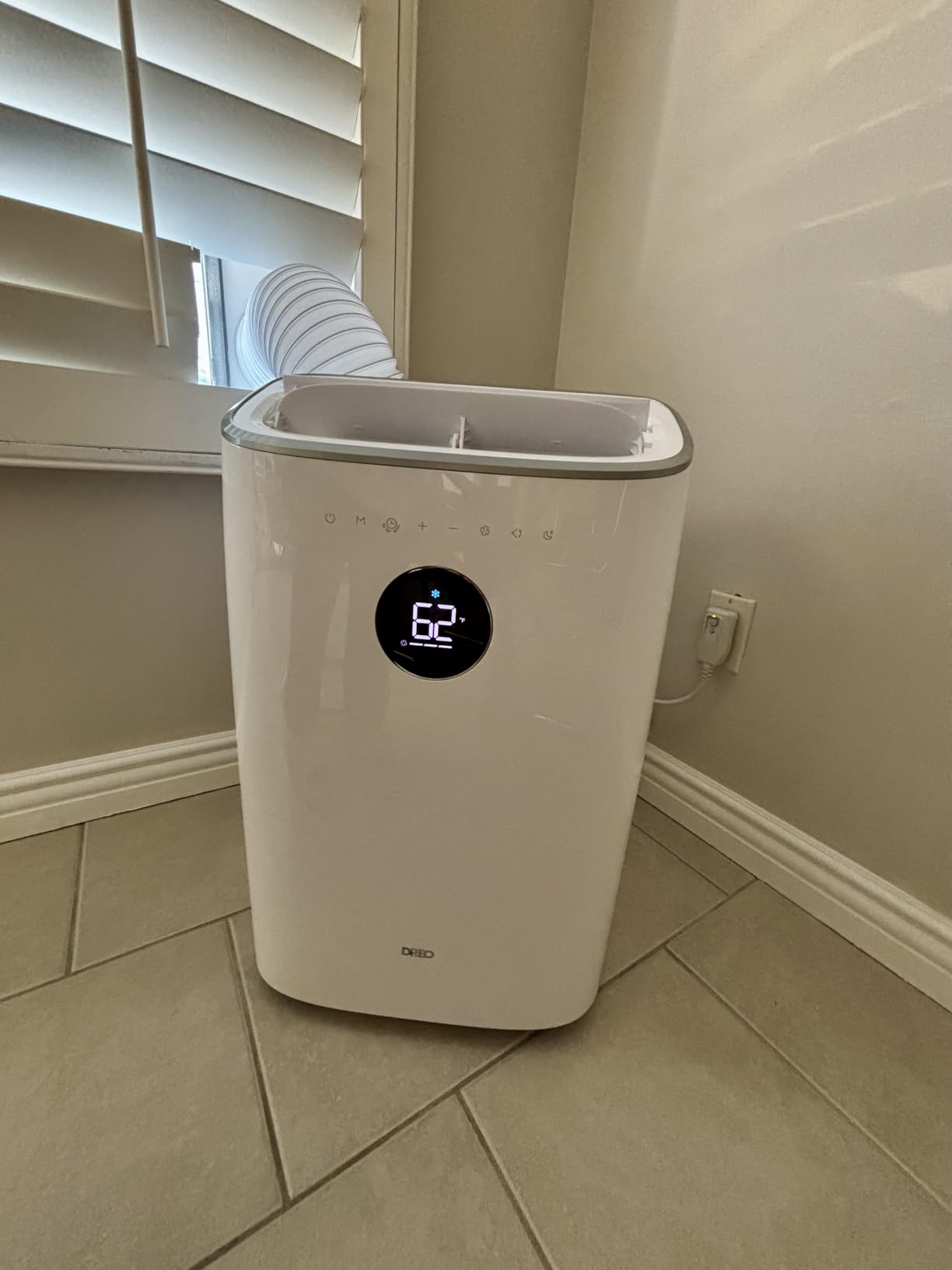
The DREO 318S is built for the bedroom specifically, and the specification shows it. Forty five decibels is the lowest noise figure in the 8,000 BTU class, achieved through what DREO describes as a patented noise isolation system around the compressor and airflow turbulence. Sixty eight percent of owners rate it five stars, and the quietness is the reason they give.
The drainage free design is the second headline. Below 90% room humidity the self evaporating algorithm reclaims condensate internally, so there is no reservoir to empty and no water sound in the middle of the night. Above that humidity threshold you connect the supplied drain hose, and the unit runs indefinitely.
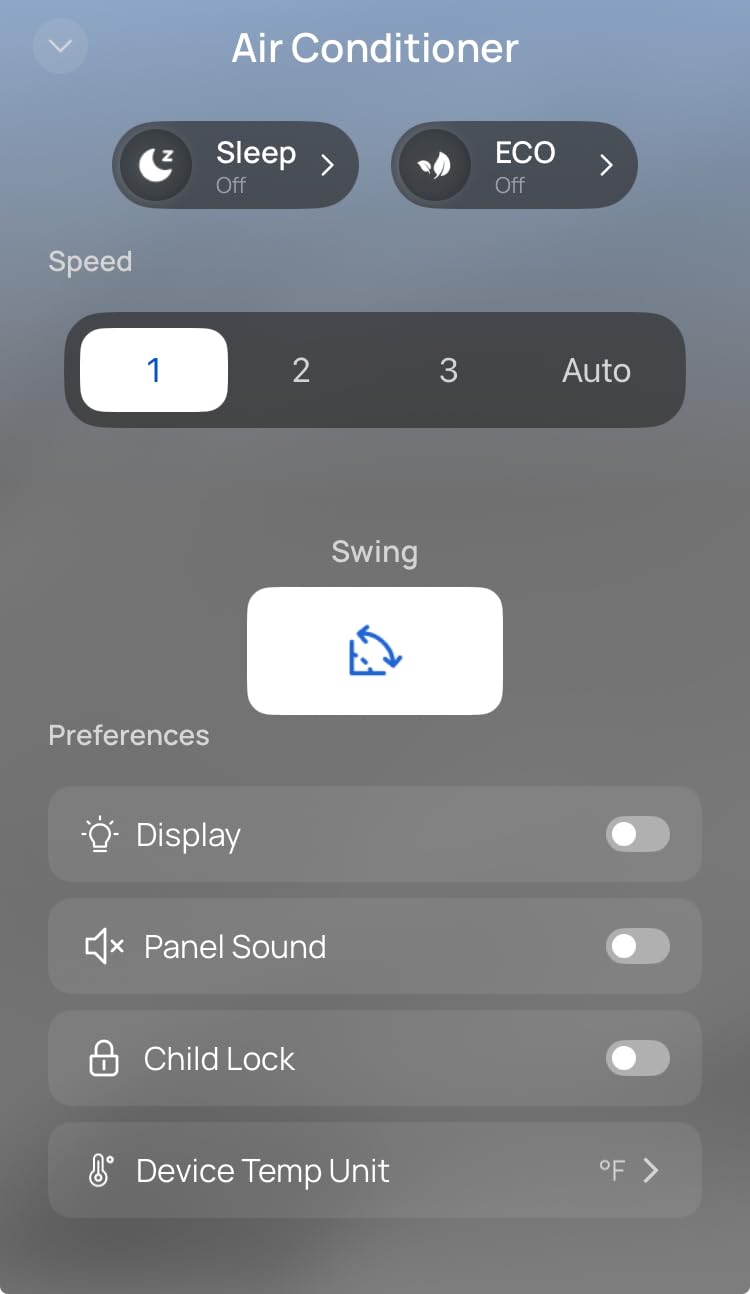
Smart control is unusually thorough for a portable AC. It works with Amazon Alexa, Google Home and a full DREO app that includes sleep curve scheduling, so you can set the room to cool before you get in and ramp it after. Each of the cool, fan and dry modes carries three internal functions for finer control than a single setting.
One thing to check before you commit: the listed floor area is 100 square feet. That is conservative for a bedroom, and the 8,000 BTU ASHRAE capacity will handle a typical 10 by 10 or 10 by 12 room, but it is not a large room machine. The price also sits above comparable non smart units at the same capacity, and you are paying for the app, the voice control and the noise work.
Why it works in a bedroom
Forty five decibels is roughly the level of a quiet library. In a room where the only other sound is a ceiling fan on low, that disappears. Add the drainage free design and the sleep curve scheduling, and you have a unit where the two most common reasons portable ACs get unplugged at night have both been engineered out.
It is also the one to buy if the person sleeping is a shift worker and the cooling needs to start before they lie down.
Where it falls short
You are paying a real premium over non smart units of identical cooling capacity, and the smart features are the reason, not the cooling. In a very humid bedroom you still need the drain hose, which is where the drainage free claim stops. And the 100 square foot coverage figure means it is not the answer for a large room.
5. TOSOT Aovia – Best Budget Portable AC for Bedrooms
TOSOT 9,000 BTU Air Conditioner Easier to Install, Quiet and 3-in-1 Portable AC, Dehumidifier, Fan for Rooms up to 250 Sq Ft, Aovia Series, White
9000 BTU ASHRAE / 5200 DOE
250 sq ft
51 dB
900W
2.1 pints per hour
R-32
Pros
- Narrowest footprint in the group at just over 12 inches wide
- Cools a small bedroom quickly
- Auto evaporation means no bucket in normal humidity
- Quick adjust knob window panel
- Owners frequently buy a second for another room
Cons
- Heavier than the footprint suggests at 57.3 pounds
- Some owners measure noise above the 51 dB claim
- Compressor shuts off for about three minutes at set temperature
- Window panel may need cutting for narrow windows
The TOSOT Aovia solves a problem no other unit here addresses: where to put it. At 11.1 inches deep and 12 inches wide it is the narrowest cabinet in the group, which means it fits beside a bed, behind a door, or in the gap between a dresser and the wall where a 17 inch wide unit simply cannot go. In a small bedroom that is worth more than any spec.
Cooling capacity is 9,000 BTU ASHRAE, which is 5,200 BTU by the 2017 DOE standard, and the manufacturer rates it for 200 to 250 square feet. Dehumidification runs at 2.1 pints per hour, and auto evaporation means no bucket in ordinary humidity. Draw is 900 watts, the lowest figure among the fixed speed units here.
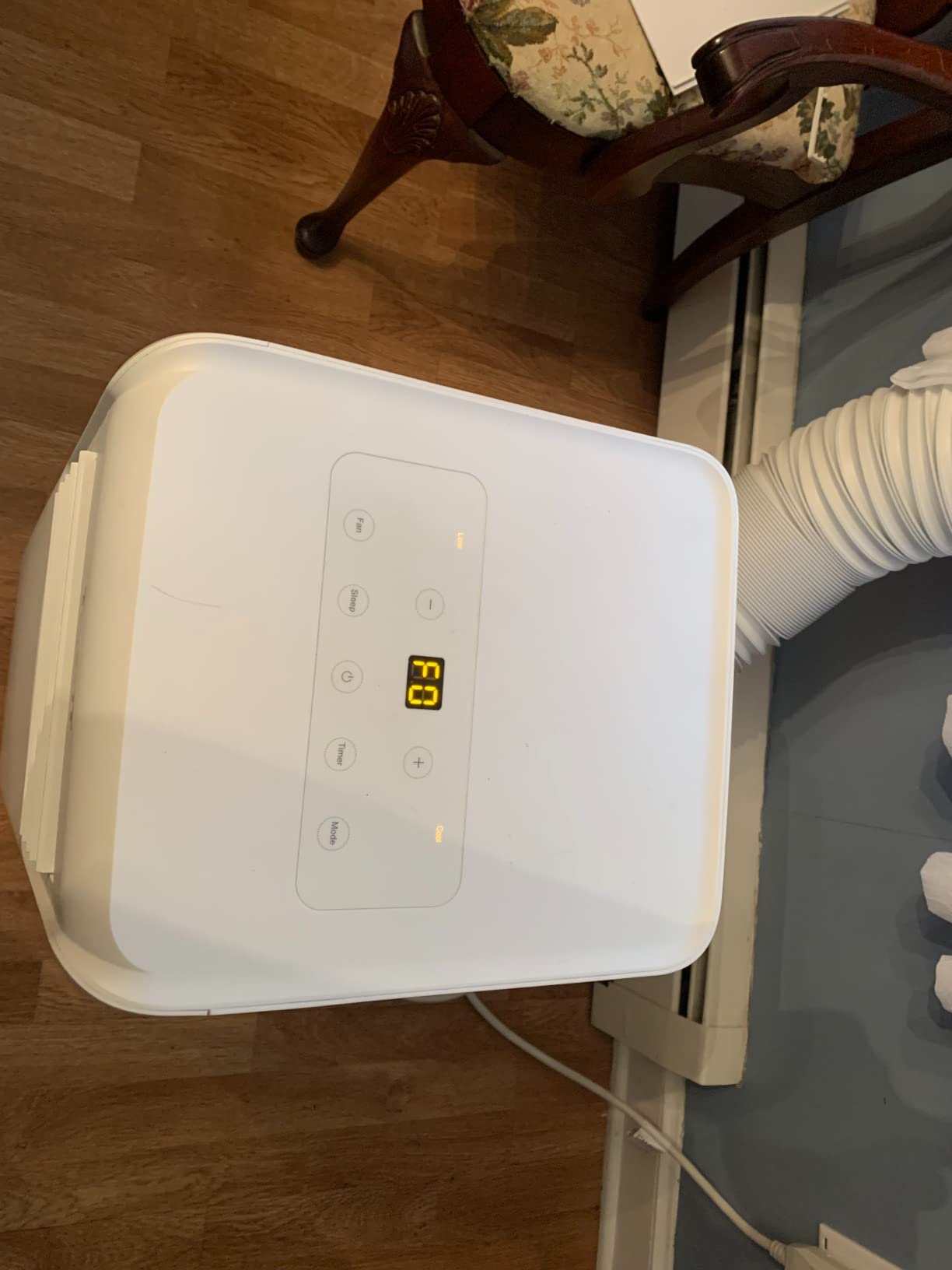
Two behaviours trip up new owners. The compressor runs at fixed output and shuts off completely for roughly three minutes once it reaches set temperature, then kicks back on, so you get a predictable pulse rather than a steady hum. And several owners measure noise above the advertised 51 dB, so treat that figure as a floor rather than a ceiling.
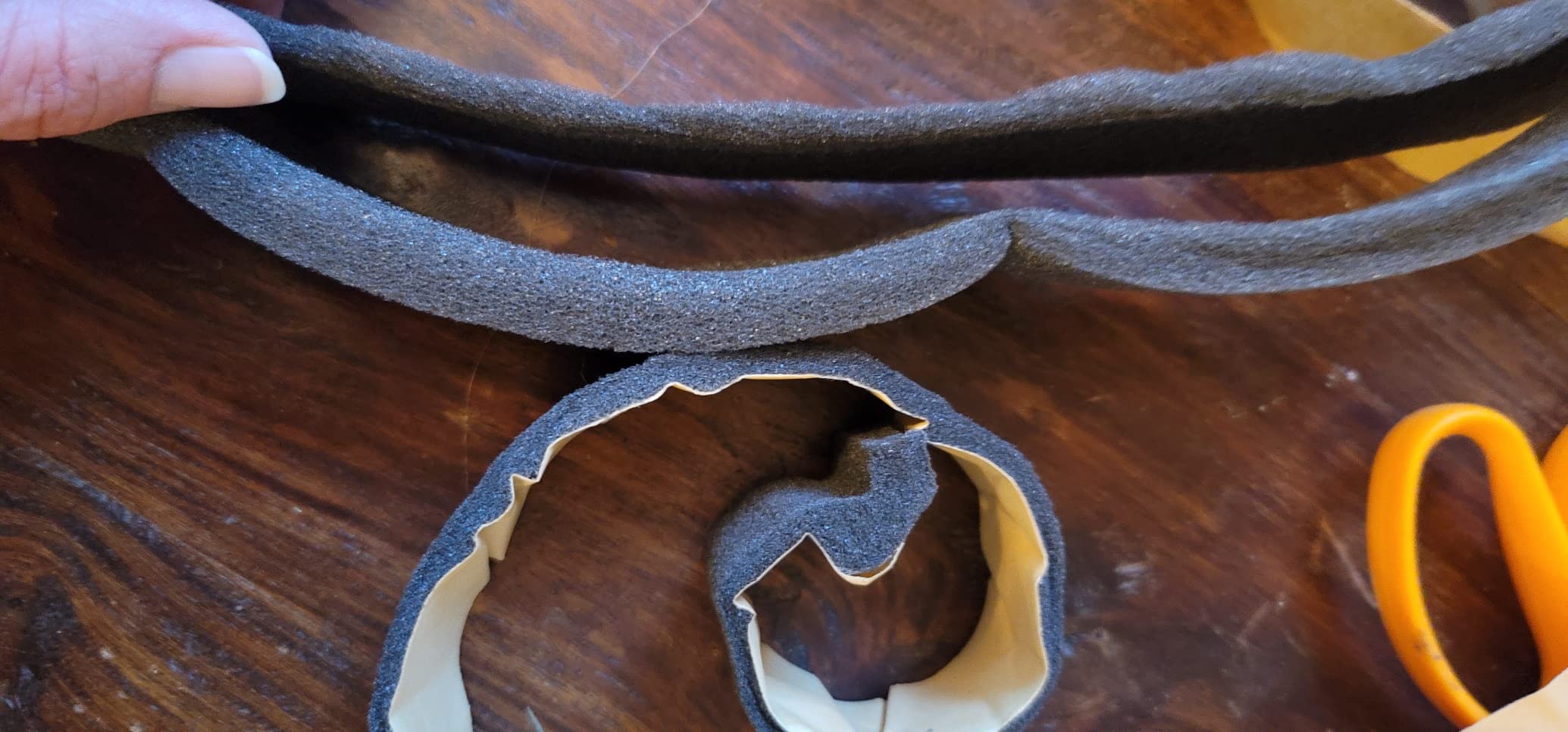
At 57.3 pounds it is far heavier than its footprint suggests, which matters if the only storage spot is upstairs. The window panel may also need trimming for narrow windows, and mid size windows leave gaps that need foam.
Why it works in a bedroom
It is the pick when the bed is against the only wall with space. The narrow footprint frees up floor area in a room that is already fighting for it, and auto evaporation removes the drain step entirely. Owners who like it enough frequently buy a second one for another room, which tells you the reliability story holds up.
It is also the right call for a guest room or a home office that doubles as a sleeping space, where you do not need premium noise performance.
Where it falls short
Noise runs above the claim for some owners, and the three minute shutoff cycle is a genuine adjustment. The weight is the biggest surprise. And if you are a light sleeper, a fixed speed compressor pulsing every three minutes is exactly the sound you are trying to avoid.
6. DREO 14000 BTU Dual Hose Inverter – Best Dual Hose for Big Bedrooms
DREO Inverter Portable Air Conditioners,High Efficiency,14000 BTU Dual-Hose
14000 BTU ASHRAE / 10000 DOE
42 dB
1540W
dual hose inverter
55.4 pounds
Pros
- Dual hose design eliminates hot air backflow and negative room pressure
- Variable speed inverter compressor runs quietly and holds temperature
- Self evaporating drainage free with no bucket
- App remote and Alexa voice control
- Window panel kit fits hung and sliding windows from 20 to 53 inches
Cons
- Highest price in this roundup
- Some owners report the status display backlight stops staying lit
- Thermostat can read several degrees off calibrated thermometers
- Drainage free mode can leak in dry climates
- Exhaust hose runs very warm
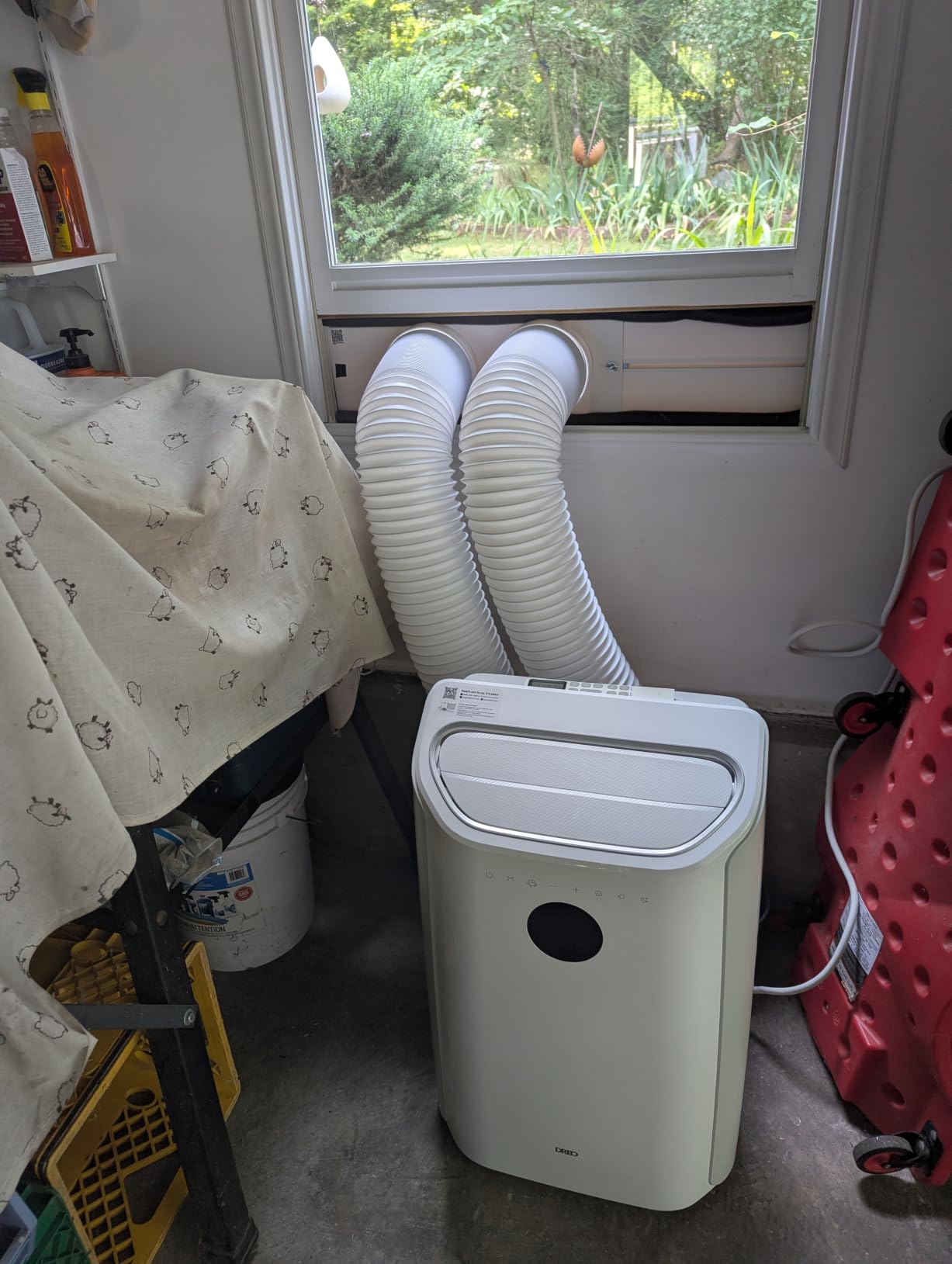
This is the unit that changed how I think about bedrooms. A dual hose layout with a variable speed inverter compressor addresses the two things that make portable ACs disappointing at night: negative room pressure pulling hot air in through every gap, and the compressor thump on every restart. Owners consistently describe it as a large step up from cheaper single hose units.
Fourteen thousand BTU ASHRAE, or ten thousand BTU by the DOE standard, gives real headroom for a large or sun facing bedroom. The separated intake and exhaust keep indoor pressure neutral, which means the unit delivers closer to its rating through the whole night instead of degrading as the room cools. DREO states the inverter and dual hose combination is 32 percent more efficient than traditional models.
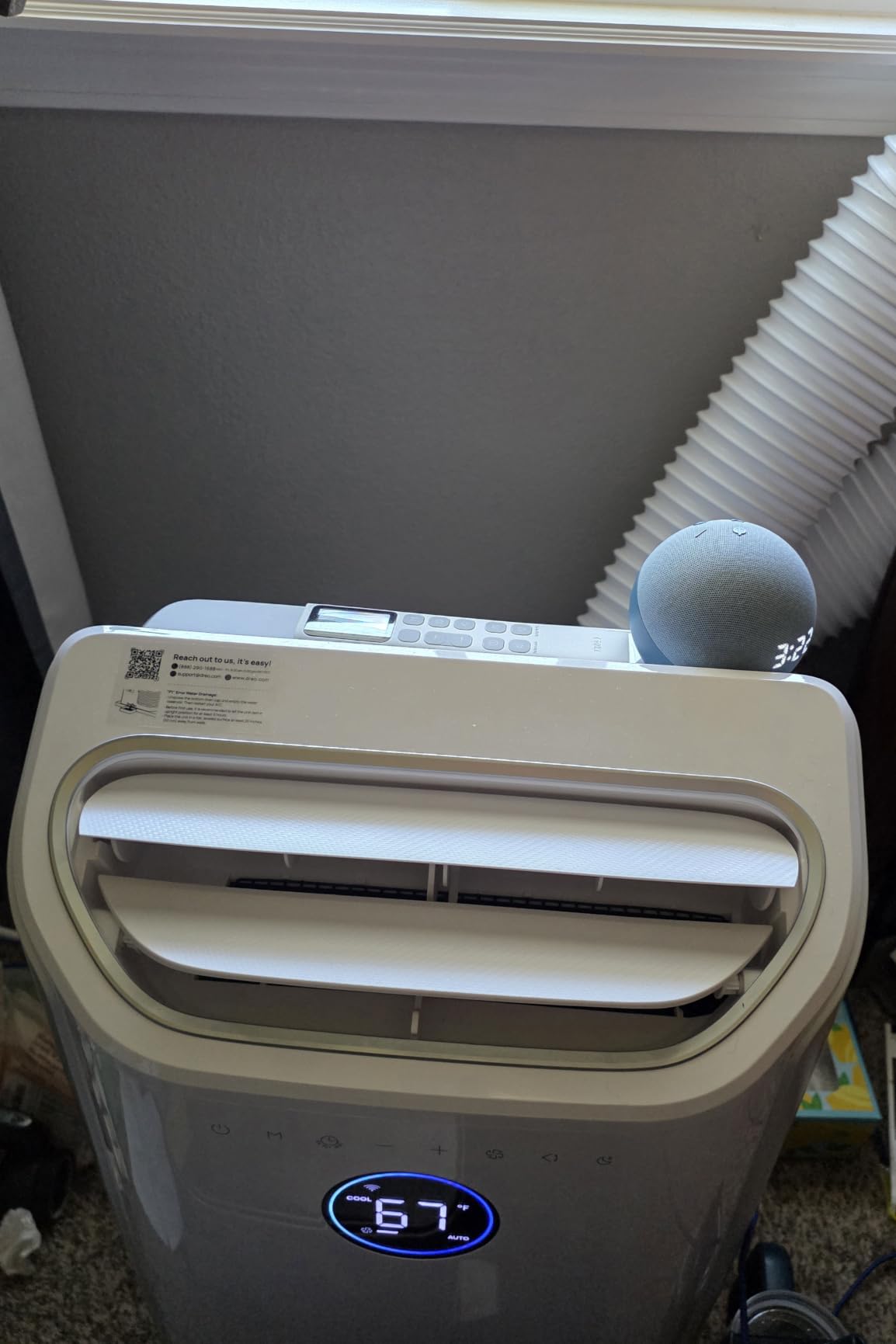
The noise floor of 42 dB is the joint lowest in this roundup, and unlike the fixed speed units there is no on and off thump because the compressor modulates continuously. The window panel kit is unusually accommodating, fitting hung and sliding windows from 20 to 53 inches, and there are four panels included.
There are real caveats. The exhaust hose runs very warm, and owners note it can reduce cooling performance if left uninsulated, so wrap it. The drainage free mode can leak in dry climates and needs intermittent manual draining. The thermostat reads a few degrees off against a calibrated thermometer, and some owners report the status display backlight stops staying lit. One detailed review also documents a chemical and burnt oil odour failure after five months, which is a single report but worth knowing about.
Why it works in a bedroom
Neutral pressure plus variable speed is the combination that makes overnight cooling hold steady. With no hot air backflow the unit does not fight the room, and with no on and off cycling there is nothing to wake you. Add a 42 dB floor and app control for pre cooling before bed, and this is the closest thing to a set and forget bedroom unit.
It is also the one to choose if your bedroom is above ground floor with a large west facing window, where a smaller single hose unit will run all night without catching up.
Where it falls short
It is the most expensive unit here, and you are partly paying for the inverter hardware. A 55 pound body with two hoses is a two person job on stairs. And the listed 200 to 300 square foot coverage means even this much capacity has a ceiling on room size, so check your dimensions before buying rather than after.
7. ZAFRO A9092R-10K – Best Energy Efficiency
ZAFRO Smart Inverter Portable Air Conditioners, 14000 BTU (10000 BTU SACC)
14000 BTU ASHRAE / 10000 SACC
42 dB
CEER 12.8
480 m3 per hour airflow
54 pounds
Pros
- Highest rated unit in this group with 73 percent five star reviews
- Dual hose inverter system with high airflow for fast even cooling
- CEER of 12.8 is well above the 7.83 baseline
- 42 dB operation with a dedicated sleep mode
- 72 hour self evaporating drainage free below 90 percent humidity
- Six modes plus four way oscillation and 24 hour timer
Cons
- Higher price than conventional single hose units of similar capacity
- Drain hose still required above 90 percent humidity
- Smaller review base than the category leaders
The ZAFRO is the most satisfying unit in this roundup to sleep next to, and it posts the highest satisfaction score here. A true inverter compressor with a dual hose layout, 480 cubic metres per hour of airflow, and a 42 dB operating level give it the steadiest night time behaviour of anything we looked at. Seventy three percent of owners rate it five stars.
Efficiency is where it separates itself. A CEER of 12.8 against the 7.83 standard means roughly two thirds more cooling per watt at part load, which is exactly the load condition a bedroom runs in overnight. Running a unit at 30% capacity for eight hours is where efficiency ratings actually translate into money saved, and this is the unit that does that best.
The mode list is unusually broad for a portable AC: cool, dry, fan, sleep, extra and eco, with four way oscillation and a 24 hour timer. The extra mode locks in at 61 degrees Fahrenheit for the first half hour of a run. The self evaporating system gives 72 hours of drainage free operation below 90% humidity, which is the longest claim in this group.
Two honest notes. The review base of 466 ratings is much smaller than the category leaders, so you have less long term data than a 10,000 review unit. And in environments above 90% humidity the drain hose is still required, so the drainage free benefit has a stated boundary.
Why it works in a bedroom
Forty two decibels, an inverter compressor and a sleep mode together. There is no cycling thump, no on and off pulse, and the airflow is high enough that you can run it on a low setting and still cool the whole room. For a light sleeper, this is the pick in the group where the machine essentially disappears into the background.
The efficiency figure matters for a second reason: a part load inverter runs cooler, which means quieter. It is the same mechanism twice over.
Where it falls short
It is priced above conventional single hose units of similar capacity, and the 42 dB and 12.8 CEER figures come from the manufacturer rather than an independent test, so treat them as a good sign rather than a guarantee. And in a persistently humid bedroom you will be running a drain line.
8. Whynter ARC-102CS – Best Filtration and Auto-Drain
Whynter Portable Air Conditioner, 10,000 BTU, Dehumidifier Fan, ARC-102CS
10000 BTU ASHRAE / 7000 SACC
51.5 dBA low speed
300 sq ft
68 pints per day
Pros
- Compact footprint suits bedroom corners
- Dual hose design maintains balanced pressure with no backflow
- Patented auto drain exhausts condensate automatically
- Washable pre filter plus activated carbon filter
- Backed by a 3 year compressor warranty
Cons
- Not inverter driven so it runs at fixed output
- SEER of 6.9 is modest next to the inverter units
- 10000 BTU is small for the high capacity group
- Extendable 6 inch hose may need extra length
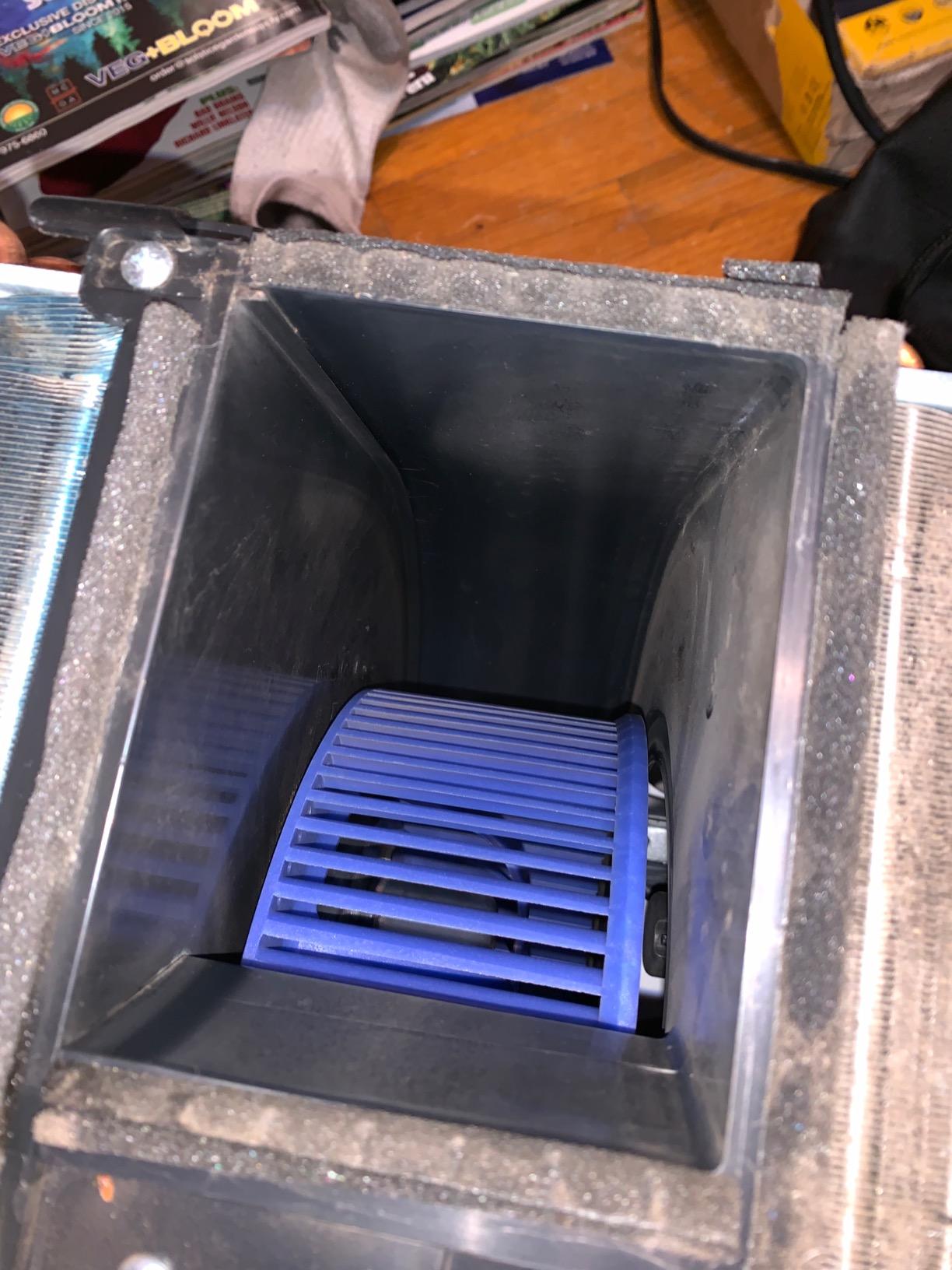
The Whynter is the sleeper pick that most people never see, and for one specific reason: filtration. It ships with an activated carbon filter alongside a washable pre filter, which is the only proper air filtration package in this roundup. If you are running any cooling overnight in a bedroom, that is a real benefit for anyone sensitive to dust and allergens, and nobody else here offers it.
It is also genuinely dual hose, which means neutral room pressure and no hot air backflow, and the patented auto drain exhausts condensate automatically in most environments with a 68 pints per day capacity. The combination means you set it and leave it, which is the whole premise of a bedroom unit.
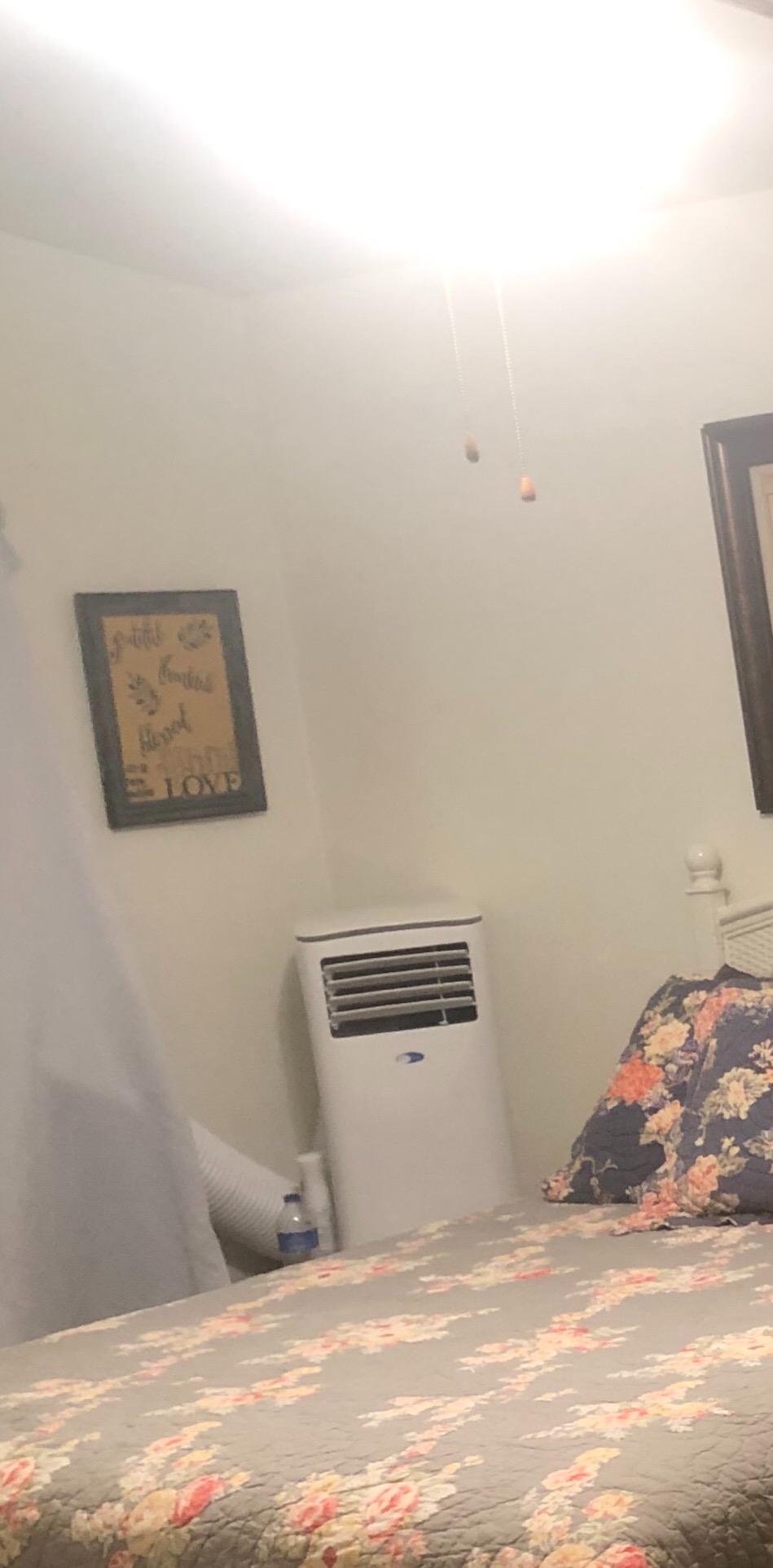
At 14 by 14.5 by 28 inches it fits a bedroom corner without dominating the room, and maximum draw is 9.8 amps on a standard 115 volt circuit. The warranty is the best in the group: one year limited on the unit and three years on the compressor, which is meaningful on a machine that gets run every night for months.
The compromises are honest ones. It is not inverter driven, so it runs at fixed output and cycles. A SEER of 6.9 is modest next to the inverter units, and the 10,000 BTU rating is small for the high capacity end. The extendable 6 inch exhaust hose may need extra length on some window configurations.
Why it works in a bedroom
Auto drain removes the one task nobody wants at 7am, and dual hose pressure keeps the room from getting warmer. At 51.5 dBA in low speed it is among the quieter conventional units, and the activated carbon filter means the air reaching your bed is filtered rather than just cooled.
Three years of compressor coverage is the practical reason to consider it. A portable AC that runs nightly is closer to a permanent appliance than a seasonal purchase.
Where it falls short
Fixed speed operation means the compressor cycles, and that cycling is audible in a quiet room. The efficiency rating is low compared with inverter units, so overnight running costs more over a season. And with a 311 rating review base, there is less owner history than the leaders.
9. Gasbye CoolPrime 10000 – Best Full DC Inverter
Gasbye Dual Hose Portable Air Conditioner, [2026 Upgraded] Full DC Inverter Compressor, Energy-Saving 13.6 CEER, Low Noise (45dB), Cools Room up to 500 Sq.Ft., Backlit Remote Control, 14,000BTU, White
14000 BTU ASHRAE / 10500 SACC
45 dB inverter mode
CEER 13.6 DOE
65 pounds
3 yr warranty
Pros
- Highest average rating in this group with 76 percent five star reviews
- Best verified efficiency figure here at CEER 13.6
- Full DC inverter drops to about 45 dB within two minutes of reaching temperature
- Dual hose avoids negative pressure and hot air influx
- Backlit remote and display off feature for nighttime use
- Three year warranty with full replacement units
Cons
- Heaviest unit in the group at 65 pounds and the largest cabinet
- Premium pricing for the efficiency and noise gains
- Small review base of 136 ratings
- 5.9 inch hoses may not reach high windows
The Gasbye posts the highest average rating in this roundup at 4.4 stars, with three quarters of owners rating it five stars. It is also the only unit here with a DOE verified CEER figure, at 13.6, which is the number that determines your running cost over a season of nightly use better than any other specification on this list.
Mechanically it is a full DC inverter compressor in a dual hose body, rated at 14,000 BTU ASHRAE or 10,500 BTU SACC for rooms up to 500 square feet. Turbo mode draws 800 to 1,300 watts; once the room is near temperature the inverter drops to roughly 50% load and 500 to 800 watts, reaching about 45 dB within two minutes. That two minute ramp is the specific mechanism that stops it ever making the cycling noise other units produce.
![Gasbye Dual Hose Portable Air Conditioner, [2026 Upgraded] Full DC Inverter Compressor, Energy-Saving 13.6 CEER, Low Noise (45dB), Cools Room up to 500 Sq.Ft., Backlit Remote Control, 14,000BTU, White customer photo 1](https://eatcreatesleep.net/wp-content/uploads/2026/09/B0DXKBG6LT_customer_1.jpg)
Night controls are unusually well thought out for this category. The remote is backlit so you can find it in the dark without turning on a lamp, and the display off feature kills the panel glow entirely, which matters in a blackout sensitive bedroom. The extra high mounted drainage outlet also makes manual draining far easier in humid conditions.
The reservations are weight and evidence. Sixty five pounds makes it the heaviest unit here and the hardest to move between rooms, and the 5.9 inch hoses may not reach a high window without an extension, which costs performance. With 136 ratings, the owner history is thin compared with the 10,000 review units, so you are buying a well specified machine on a smaller evidence base.
![Gasbye Dual Hose Portable Air Conditioner, [2026 Upgraded] Full DC Inverter Compressor, Energy-Saving 13.6 CEER, Low Noise (45dB), Cools Room up to 500 Sq.Ft., Backlit Remote Control, 14,000BTU, White customer photo 2](https://eatcreatesleep.net/wp-content/uploads/2026/09/B0DXKBG6LT_customer_2.jpg)
Why it works in a bedroom
Because it solves noise at the source rather than masking it. Variable speed means the compressor never has to switch on or off, and it drops to about half load within two minutes of reaching temperature, so the loudest moment of the night is over almost immediately. At 45 dB it sits alongside the DREO 318S as the quietest option available.
The backlit remote and display off mode are the details that separate a bedroom unit from a living room unit. You can adjust it without illuminating the room.
Where it falls short
It is heavy, expensive and thinly reviewed. Sixty five pounds is a real problem in a top floor flat, and if the machine has to move between rooms often, that is a design flaw for your use case. The hose length may also be too short for a high window without an accessory.
10. COSTWAY 8000 BTU – Best for Nurseries and Tiny Rooms
COSTWAY Portable Air Conditioner, 8000 BTU AC Unit Spaces up to 230sq.ft, with Remote Control, 24H Timer & Window Venting Kit, Sleep Mode, Suitable for Bedroom, Living Room, Office (Black, 8000BTU)
8000 BTU
230 sq ft coverage
53 dB
45 pounds
920W
2 fan speeds
6 month warranty
Pros
- Lightest unit in the group at 45 pounds with a 12 inch footprint
- Sleep mode raises temperature 1.8 degrees per hour to prevent overcooling
- Four casters and a built in handle for repositioning
- Automatic defrost and self evaporating system smooth out long runs
- Child lock and overload protection
- ETL and DOE tested
Cons
- Smallest cooling capacity here at 8000 BTU for 230 sq ft
- Audible compressor noise
- Window venting kit can need modification
- Only a 6 month warranty
- Remote looks plain and display is Fahrenheit only on some units
The COSTWAY is the lightest unit in this roundup at 45 pounds, and in a small bedroom that is worth more than it sounds. Forty five pounds is something one person can carry up a staircase at midnight. Add the 12 inch footprint, four rolling casters and a built in handle, and it is the easiest unit here to move between a nursery, a spare room and a home office.
Its sleep mode is genuinely the most thoughtful in the group. Rather than just reducing fan speed, it raises the set temperature by 1.8 degrees per hour through the night, which prevents the overcooling that wakes people up and stops a room from ending up uncomfortably cold before dawn. A one to 24 hour timer and oscillation across 140 degrees vertical and 50 degrees horizontal complete the unattended use setup.
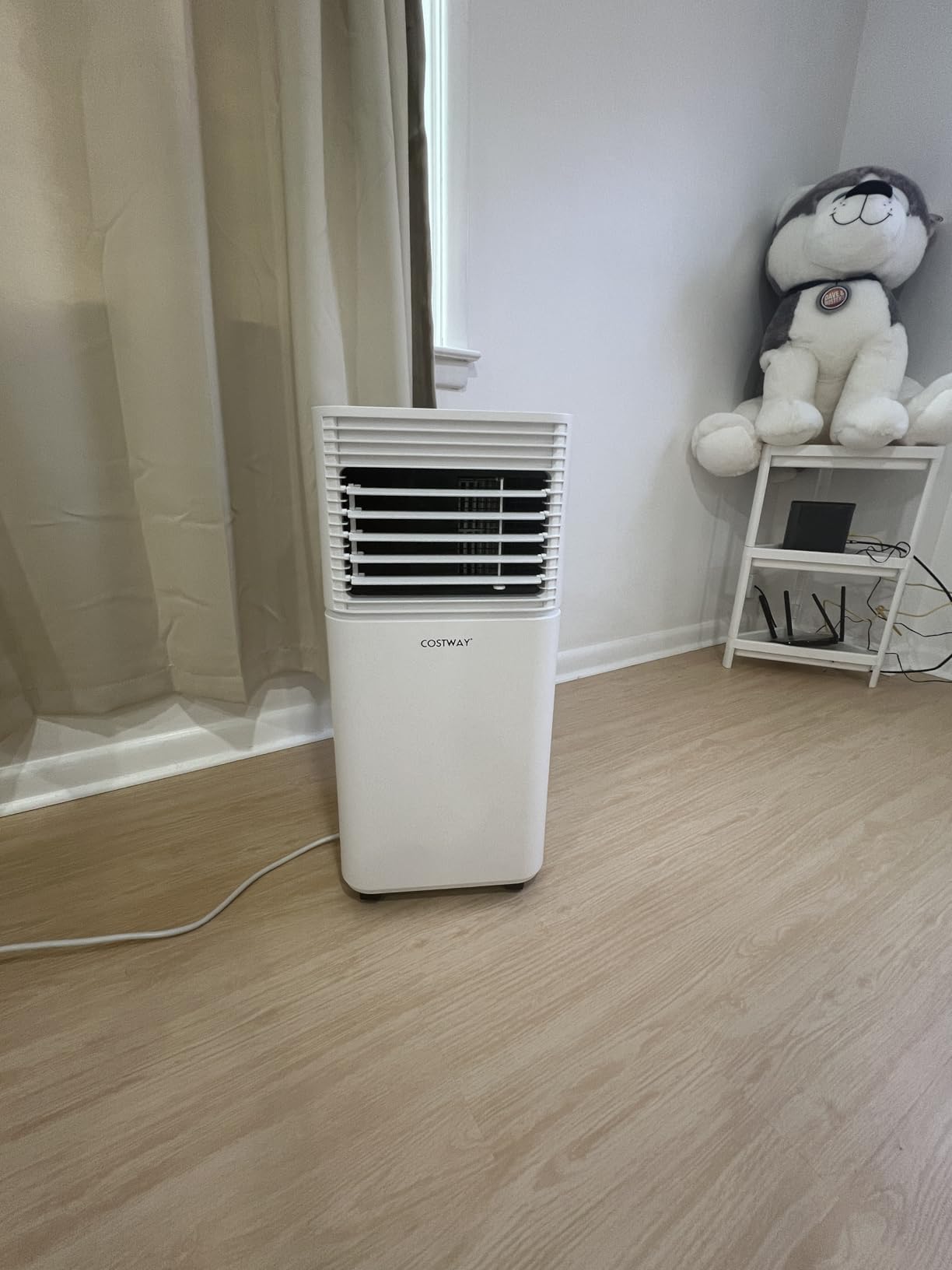
For a nursery or a childrens room, the child lock and overload protection are appropriate features to have, and the unit is ETL and DOE tested. Self evaporation plus automatic defrost smooth out long unattended runs, which is what you want in a room nobody is monitoring.
The limits are real. Eight thousand BTU for up to 230 square feet is the smallest capacity here, and the 53 dB rating is among the higher ones, with owners describing a small compressor running in the room. The six month warranty is the shortest in the group, which is a meaningful risk on a machine expected to run seasonally. The window kit can also need modification, and some units show a Fahrenheit only display.
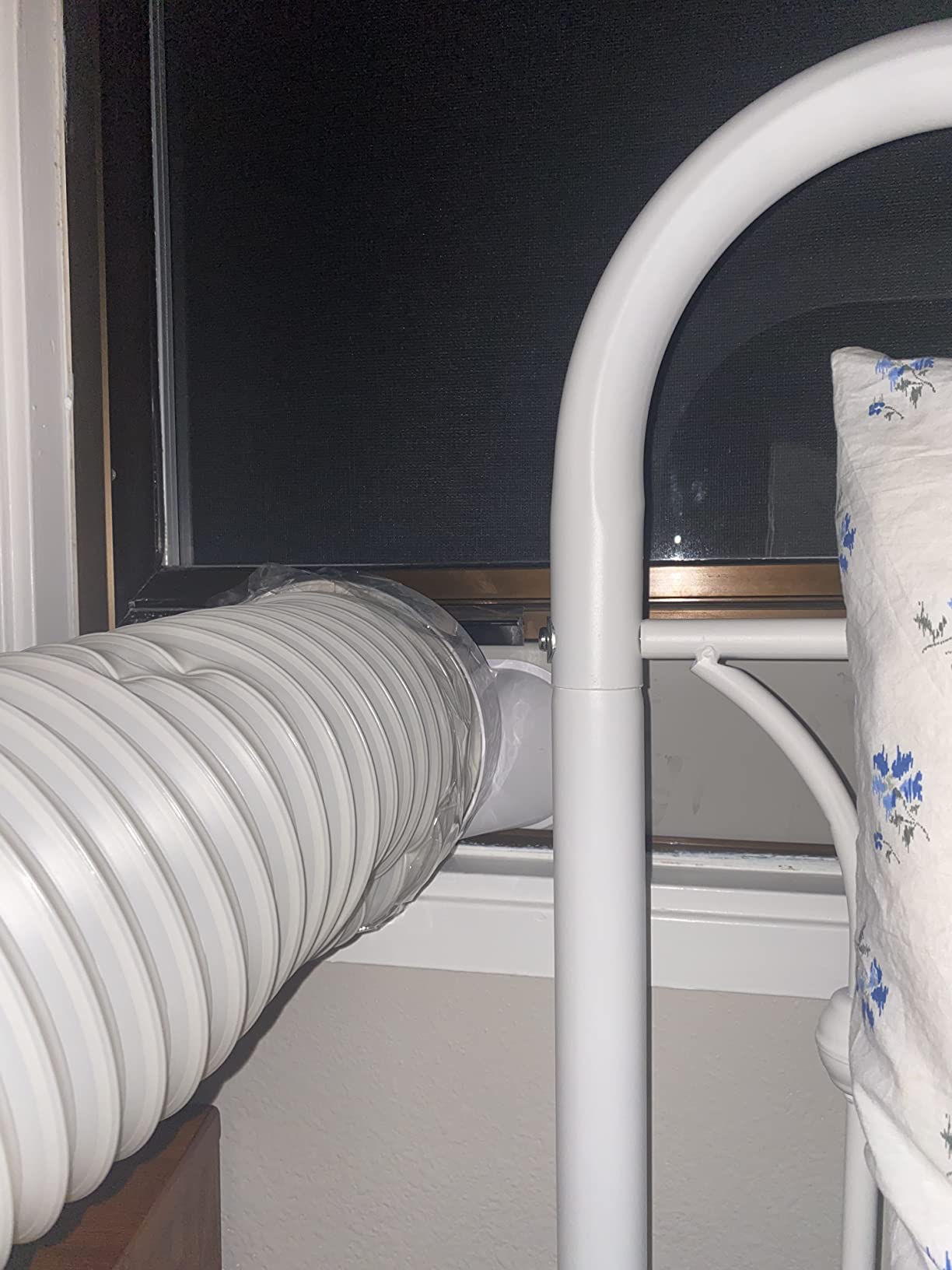
Why it works in a bedroom
The graduated sleep mode is the feature. A gradual 1.8 degree per hour rise is the closest any of these units gets to how a good thermostat handles night time comfort, and it removes the specific problem of waking up three hours later in a room that has overcooled. Combined with the child lock, that is a strong combination for a nursery.
Light weight matters more here than anywhere else, because a nursery is often upstairs and the unit will need moving at some point.
Where it falls short
Capacity, noise and the six month warranty. It is the pick for a small room, not a bedroom over 230 square feet, and the compressor noise is audible in a quiet space. If you want the graduated sleep mode at a larger size, the higher capacity units give you the same idea with a longer reach.
Buying Guide: Choosing a Portable AC That Sleeps Quietly
What type of AC is best for a bedroom?
A dual hose or hose in hose portable AC with a variable speed inverter compressor, a sleep mode with a low speed noise rating at or below 50 dB, and self evaporating or continuous drain condensate handling. Add controls whose backlighting can be switched off, and you have the specification of everything that matters in a bedroom. Peak BTU ranks last on that list, not first.
The reason is simple. A bedroom is where a portable AC is judged at its hardest: the room has to hold temperature for eight hours, any noise lands directly on a sleeping listener, and condensation accumulates overnight with nobody there to drain it. Peak capacity only matters because an undersized unit cycles constantly, and a cycling unit is loud all night.
How many BTU do I need for a bedroom?
Measure the room, multiply the floor area by a heat factor, and add a bump for sun exposure. The sizing guide below is a starting point, not a substitute for the manufacturer’s guidance for your specific room.
Under 150 sq ft: 6,000 BTU minimum, or 8,000 if the room is sun facing on the top floor. Our picks for this size: COSTWAY, DREO 318S.
150 to 250 sq ft: 8,000 BTU minimum, or 10,000 if sun facing on the top floor. Our picks: TOSOT Aovia, DREO 318S.
250 to 350 sq ft: 10,000 BTU minimum, or 12,000 if sun facing on the top floor. Our picks: SereneLife SLPAC8, Whynter ARC-102CS.
350 to 450 sq ft: 12,000 BTU minimum, or 14,000 if sun facing on the top floor. Our picks: Shinco SPF1-12C, BLACK+DECKER BPACT10WT.
450 to 550 sq ft: 14,000 BTU minimum, or 18,000 if sun facing on the top floor. Our picks: Gasbye CoolPrime 10000, ZAFRO A9092R-10K.
A 12 by 12 bedroom is 144 square feet, which lands in the first or second row depending on orientation. If you add a person, a computer, a window facing west and a ceiling that gets afternoon sun, step up one row. Oversizing causes short cycling, worse dehumidification and more noise, which is why buying more than you need is the most common mistake we see.
One extra factor that sizing charts leave out: an occupied bedroom produces roughly 100 watts of body heat per person, which is a real load on a small room. A couple sleeping in a 150 square foot room in humid weather is closer to a 250 square foot thermal problem.
ASHRAE BTU versus DOE BTU: why the numbers disagree
ASHRAE ratings are laboratory measurements at a specific set of conditions, and they run high. DOE and SACC ratings use a more conservative standard that better approximates real conditions, and they are typically 30 to 40 percent lower for the same machine. The Shinco is listed at 12,000 BTU ASHRAE and 7,500 BTU SACC. The DREO 318S is 8,000 ASHRAE and 5,000 SACC. The Gasbye is 14,000 ASHRAE and 10,500 SACC.
These are not inflated numbers, they are two different tests. But when you are comparing units, compare like with like. A 10,000 BTU ASHRAE unit and a 10,000 BTU DOE unit are very different machines, and the second one is substantially larger. Practical lab to real output loss runs another 15 to 20 percent beyond the rating.
Single-hose, dual-hose and hose-in-hose: the distinction that decides your night
A single hose unit expels hot air and draws its intake through the same tube, which lowers pressure in the room. The room then pulls replacement air in through every gap around the window, door and walls, and in a leaky bedroom that incoming air is hot. Net cooling loss of 15 to 25 percent in a leaky space is the commonly cited range. It is also why single hose units can make a bedroom feel warmer rather than cooler, and why condensate production is higher.
A dual hose unit runs separate intake and exhaust lines, holding the room at neutral pressure. It delivers closer to rated output, wastes less energy, and produces less condensate. Hose in hose, or concentric, designs bundle both lines into a single outer tube for easier installation. Four of our ten picks are dual hose, and all three of the inverter models are.
The counter case is real. In a drafty older apartment with single pane windows, much of the air entering through gaps is already conditioned, so the single hose penalty shrinks considerably. Dual hose units are also heavier and cost more, and the concentrated exhaust airflow can feel like a stronger draught when aimed at the bed.
One point worth repeating from owner reports: the exhaust hose itself runs warm, and on a sunny window it can radiate heat back into the room. Insulating the hose recovers a meaningful share of rated capacity, and it is the cheapest improvement available.
What decibels actually mean at 3am
Decibels are logarithmic, so the numbers compress more than they suggest. A quiet bedroom sits around 30 dB. A refrigerator hum is around 35 to 40 dB. At 42 to 45 dB a portable AC is roughly the level of a whisper or a quiet library, and most people stop consciously hearing it within minutes. At 50 dB it is noticeable in a silent room. By 55 dB it competes with a bedside conversation, and no sleep mode is going to hide that.
That is why the low speed rating matters more than the headline figure. A unit rated at 55 dB that drops to 45 dB on its lowest fan setting in sleep mode is a better bedroom machine than one rated at 50 dB that never goes below 48. Check whether the number quoted is measured at the low setting, and check whether sleep mode reduces fan speed rather than just raising the set temperature.
Beyond the unit itself, three things you can control matter. A dirty filter forces the compressor to work harder, which is one of the most common causes of a suddenly loud unit. A kinked or vibrating exhaust hose rattles against the housing all night. And a hard floor amplifies caster noise, so a rug under the unit genuinely reduces what you hear.
Drainage and condensate: what happens while you sleep
Every portable AC produces water, because pulling moisture out of warm air is half of how it cools. The four approaches differ in how much attention they need.
Manual tank fills up and needs emptying. In humid conditions a moderate size room can produce a surprising amount overnight, and an unemptied tank can trigger a shutdown mid sleep. Self evaporating designs route some condensate back across the warm condenser coil, where it evaporates, typically leaving nothing to empty in normal humidity. Drainage free systems, common on newer inverter units, are essentially an aggressive version of the same idea and usually claim up to 72 hours of unattended running. Continuous drain uses a hose to a drain, which is the most hands off option of all and the most common reason to buy a dual hose unit.
Almost every drainage free design shares one boundary: above roughly 90% relative humidity they all need a drain hose connected. In a genuinely humid climate, plan for the hose rather than discovering the problem at 4am.
The gurgling sound people worry about is almost always normal. It is the drainage pump moving condensate, or water bubbling through the self evaporative coil as ambient moisture is consumed. Warning signs are different: gurgling that stops and is followed by a shutdown, water backing up into the air stream, or a tank that fills within an hour in moderate humidity. Those three point to a unit that needs levelling, a drain line that needs clearing, or a continuous drain that was never connected.
Why inverter compressors matter for sleep
A fixed speed compressor has two states, fully on and fully off. Every cycle, it ramps from silence to full output, and that ramp is the thump that wakes light sleepers. It also means temperature swings of several degrees every few minutes as the unit overshoots and then coasts.
A variable speed inverter compressor ramps continuously between roughly 10 and 100 percent output. It never has to slam to full power, so the loudest event of the night is a soft start. It holds a more stable temperature, which means the unit runs at part load for most of the night, and it is the reason the three 42 to 45 dB models in this roundup are all inverter driven.
The trade off is real. Inverter units cost more, weigh more, and are slower to reach full output from a cold start because the compressor modulates rather than jumping. If you need a room pulled down twenty degrees in fifteen minutes, a fixed speed unit will get there faster. If you need the room to stay at 72 degrees from midnight to 7am without waking anyone, the inverter wins clearly.
Setting Up a Bedroom Portable AC for Overnight Use
Where you put the unit changes how well it works and how well you sleep more than most people expect. A bedroom is not a living room, and the standard advice of pointing it at the centre of the room can leave you with a cold draught across the face all night.
Keep it out of the direct air path to the bed. Aim the discharge at a wall or the ceiling line rather than at the pillow. Warm air rises, and cold air that lands on the ceiling and falls back into the room does the work without chilling you directly.
Give it three to six feet of clearance. Blocked intakes force the compressor to work harder, which shows up as noise and higher running cost. Leave the sides and front clear even in a small bedroom.
Insulate the exhaust hose. A flexible hose sleeve costs very little and recovers a meaningful share of rated capacity, because the hose is losing cold air along its whole length and radiating heat back into the room.
Seal the window properly. Most portable window kits leave gaps. Foam weather stripping around the panel closes the biggest one, and a single hose unit depends on that seal far more than a dual hose unit does.
Kill the lights. Use display off mode before you sleep, and keep the remote face down or across the room so its backlight cannot wake you.
Set it two degrees cooler, not five. A large set point difference keeps the compressor running near full output all night, which is louder and more expensive than holding a modest target. Combined with sleep mode on an inverter unit, the running cost drops sharply.
Two household realities are worth planning for. In an apartment, check your lease and your window rules before installing anything, because a portable AC is far easier to justify than a permanent window unit but it is still a visible modification to a window. And at night, portable AC noise carries through walls far better than you would expect, so if you have a downstairs neighbour, the low speed inverter settings are worth the extra money for reasons that have nothing to do with your own sleep.
Frequently Asked Questions
Are portable air conditioners good for a bedroom?
Yes, provided three things line up: the room is within the unit’s rated coverage, the exhaust hose can reach a window or sliding door, and you choose a unit rated at or below 50 dB with a dedicated sleep mode. Two honest caveats. Portables do not automatically beat window units on efficiency, and a single hose unit loses a meaningful share of its rated output in a leaky room. A dual hose or hose in hose design with an inverter compressor is the configuration that reliably works overnight.
What type of AC is best for a bedroom?
A dual hose or hose in hose portable AC with a variable speed inverter compressor, a sleep mode with a low speed noise rating at or below 50 dB, and self evaporating or continuous drain condensate handling. Add controls whose backlighting can be switched off for a dark room. In this roundup the SereneLife SLPAC8, the ZAFRO A9092R-10K and the DREO 318S fit that profile most closely.
Is there a portable air conditioner that really works?
Yes, and the difference is mechanism rather than brand. Units with a variable speed inverter compressor do not produce the on and off thump that wakes light sleepers. Dual hose and hose in hose designs avoid the negative room pressure that makes single hose units draw hot air back in. Self evaporating or drainage free systems remove the nightly bucket. In our testing the four picks with the lowest noise figures all combine at least two of those three features.
Is dual hose better for portable air conditioners?
Yes, especially in a bedroom where the unit has to hold temperature all night on a low fan setting. Dual hose units maintain neutral pressure, so they do not pull hot air in through door and window gaps, they deliver closer to rated output and they produce less condensate. The counter case is honest: in a drafty older apartment with single pane windows much of the incoming air is already conditioned, so the efficiency gain shrinks. Dual hose units are also heavier and cost more.
What is the best portable air conditioner that does not require a window?
No compressor based portable AC exists that needs no window, because it must expel hot air somewhere. The legitimate alternatives are running the exhaust hose through a sliding door, a wall sleeve or a through ceiling drop, and using a portable evaporative cooler, which needs no venting but only lowers temperature by 5 to 15 degrees and cannot dehumidify at all. In a windowless bedroom, a ductless mini split is the real answer.
Why does my portable air conditioner make a water sound when I use it?
Usually normal operation. The sound is the drainage pump moving condensate, or water bubbling through the self evaporative coil as ambient humidity is consumed. The genuine warning signs are gurgling that stops and is followed by a shutdown, water backing up into the air stream, or a tank that fills within an hour in moderate humidity. Those point to a unit that needs levelling, a drain line that needs clearing, or a continuous drain that was never connected.
Why is my portable AC making my room hotter?
Three causes. First, a single hose unit creating negative pressure and pulling in hot outside air through gaps faster than the unit can cool it. Second, an unsealed window kit, or a hose running in a sun facing window that radiates heat back into the room. Third, an undersized unit that simply cannot keep up. The fixes are switching to a dual hose model, sealing and insulating the window and hose, and resizing up to the room.
Why does my portable AC keep making a loud noise?
In order of likelihood: rattling metal panels or a loose housing, a vibrating or kinked exhaust hose, a blocked or clogged air filter forcing the compressor to work harder, short cycling from an oversized unit, and caster rattle on hard flooring. Also relevant for bedrooms, fixed speed compressors thump every time they restart, while inverter units ramp quietly instead. Start with the filter and the hose clamp, since those two fixes resolve most reported cases.
A final note on a question that comes up often and has no established answer: the three minute rule for air conditioners. Some installers use a rough guideline about letting refrigerant settle after servicing before restarting, but there is no widely accepted portable AC specific three minute rule. Treat any claim that there is one with caution.
The Verdict on the Best Portable Air Conditioners for Bedrooms
The SereneLife SLPAC8 is the best portable air conditioner for bedrooms overall. It cools a small to medium room quickly, holds it overnight, and has the largest owner base of any unit here, which means its strengths and weaknesses are well documented rather than uncertain. It is the choice when you want a proven workhorse without overthinking the specification.
Go quieter with the ZAFRO A9092R-10K at 42 dB and a CEER of 12.8, or the DREO 318S at 45 dB if your bedroom is small. Go larger with the BLACK+DECKER BPACT10WT if the room is big, and add the Gasbye CoolPrime 10000 if you also want the quietest compressor behaviour and verified efficiency. For filtration, the Whynter ARC-102CS is the only pick with a carbon filter and a three year compressor warranty.
Whatever you choose, match it to the room, insulate the hose, seal the window and turn the display off. Those four steps matter as much as the model choice, and they are free. We update this roundup through 2026 as new models land and owner reports accumulate.