
If you want one fan for a bedroom, the DREO 40-inch 9-speed oscillating tower is the pick we keep coming back to. It pairs a published 25 dB noise figure with 90-degree oscillation, a 12-hour timer and a washable grille, and at about 35 watts it costs less to run all night than most people spend on a single takeaway. Last updated in 2026 after we went through the spec sheets, published noise ratings and owner reviews for ten of the highest-rated tower fans on the market.
Before the picks, an honest word about the category. Forum threads about bedroom fans are full of people arguing that a tower fan is the wrong shape entirely, and they are not entirely wrong. A tower trades raw power for a small footprint and a narrow column of air, and in a cramped room that is a good trade. In a large room with a high ceiling, a circular circulator can move more air across a bed for the same money. We cover that comparison later so you can rule the shape in or out before you spend anything.
What follows is a bedroom-first roundup. Every fan here was judged on the things that decide whether you can sleep next to it: the published decibel figure, whether the display stays lit, whether the remote beeps, how long the timer runs, how big the base is, and whether the grille comes off for cleaning. Those are the criteria lab-style reviews tend to skip and bedroom shoppers care about most. If you want the wider category rather than the sleep angle, our guide to the best tower fans overall covers the same lineup from an airflow-first point of view.
Table of Contents
Top 3 Best Tower Fan Picks for Bedrooms in October

DREO 40-Inch 9-Speed Tower Fan
- 25 dB listed noise level
- 90-degree oscillation
- 5 speeds and 4 modes
- 12-hour timer

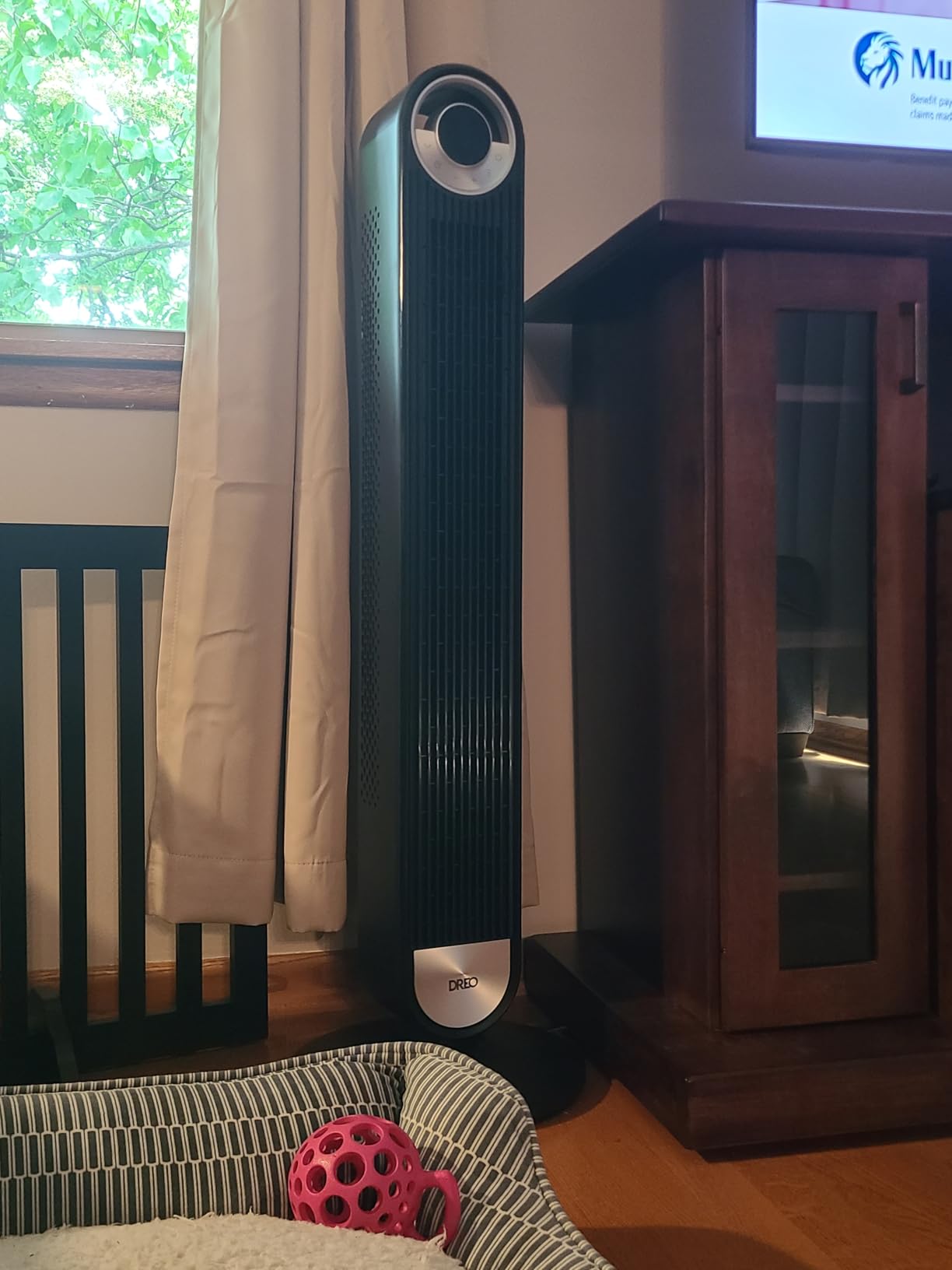
DREO 42-Inch 9-Speed Tower Fan
- 1397 CFM at 28 ft per second
- 9 speeds and 4 modes
- 30 watts
- 28 dB

Levoit 36-Inch Classic Tower Fan
- 28 dB on low speed
- 6.5 inch narrow base
- 12-hour timer
- 2-year warranty
All 10 Tower Fans Compared Side by Side in 2026
Noise figures below are the manufacturer or listing figures we could verify for each model, measured in different ways by different brands, so treat them as a ranking rather than a laboratory comparison. Airflow numbers use each brand’s own measurement, and those measurements are not interchangeable.
| Product | Specifications | Action |
|---|---|---|
| DREO 40-Inch 9-Speed Tower Fan |
|
Check Latest Price |
| DREO 42-Inch 9-Speed Tower Fan |
|
Check Latest Price |
| Levoit 36-Inch Classic Tower Fan |
|
Check Latest Price |
 Honeywell QuietSet HYF260 40-Inch Tower Fan Honeywell QuietSet HYF260 40-Inch Tower Fan |
|
Check Latest Price |
 PELONIS 40-Inch Bladeless Tower Fan PELONIS 40-Inch Bladeless Tower Fan |
|
Check Latest Price |
 Lasko 42-Inch Oscillating Tower Fan Lasko 42-Inch Oscillating Tower Fan |
|
Check Latest Price |
 Lasko 2510 36-Inch Tower Fan Lasko 2510 36-Inch Tower Fan |
|
Check Latest Price |
 DREO Adjustable-Height Tower Fan 38-42 Inch DREO Adjustable-Height Tower Fan 38-42 Inch |
|
Check Latest Price |
 Lasko 35-Inch High Velocity Tower Fan Lasko 35-Inch High Velocity Tower Fan |
|
Check Latest Price |
 PELONIS 30-Inch 3-Speed Tower Fan PELONIS 30-Inch 3-Speed Tower Fan |
|
Check Latest Price |
How We Evaluated These Bedroom Fans
There is no shared lab bench behind this roundup, so we did the next best thing: we read every spec sheet, every published noise figure and a large volume of owner reviews, then ranked the fans against the specific failure modes that ruin sleep. Where a brand publishes a decibel number, we used it and said so. Where it does not, we said that too rather than guessing.
Noise came first. For a bedroom the practical ceiling is around 45 dB, because above that the fan becomes a stimulus your brain keeps tracking instead of background you stop hearing. Second was timer length, since a 2-hour auto-off on a fan that is supposed to run overnight is a design mismatch. Third was light and sound behaviour at night: displays that stay lit, remotes that beep on every press, and oscillation motors that whine when they sweep.
We also weighted evidence volume heavily. A fan with tens of thousands of reviews tells you something about durability that a fan with a thousand cannot, and two of the models here have been in production long enough that owners are reporting five-year-old units still running. Where review count is thin, we say so in that product’s section rather than letting a high star rating imply a track record that does not exist.
One thing we deliberately did not do is rank on airflow per watt. A number like 5,830 CFM per watt is real, but it describes a fan shooting a concentrated column of air, not the gentle, even, low-frequency wash most people need to fall asleep. We discuss where raw power does matter in the bedroom size section.
1. DREO 40-Inch 9-Speed Tower Fan: Best Tower Fan for Bedrooms Overall
DREO Tower Fan for Bedroom, 90° Oscillating Fans that Blow Cold Air
25 dB listed noise
26 ft/s wind speed
90 degree oscillation
5 speeds and 4 modes
12-hour timer
Pros
- Exceptionally quiet for the airflow it moves
- 90-degree oscillation spreads air across the whole room
- Four modes including a real sleep setting
- Removable washable grille and impeller
- Carries at about 6 pounds
Cons
- Specs list 25 dB while feature copy says 28 dB
- Only 5 speeds on this 40 inch version
- Too quiet for buyers who want audible white noise
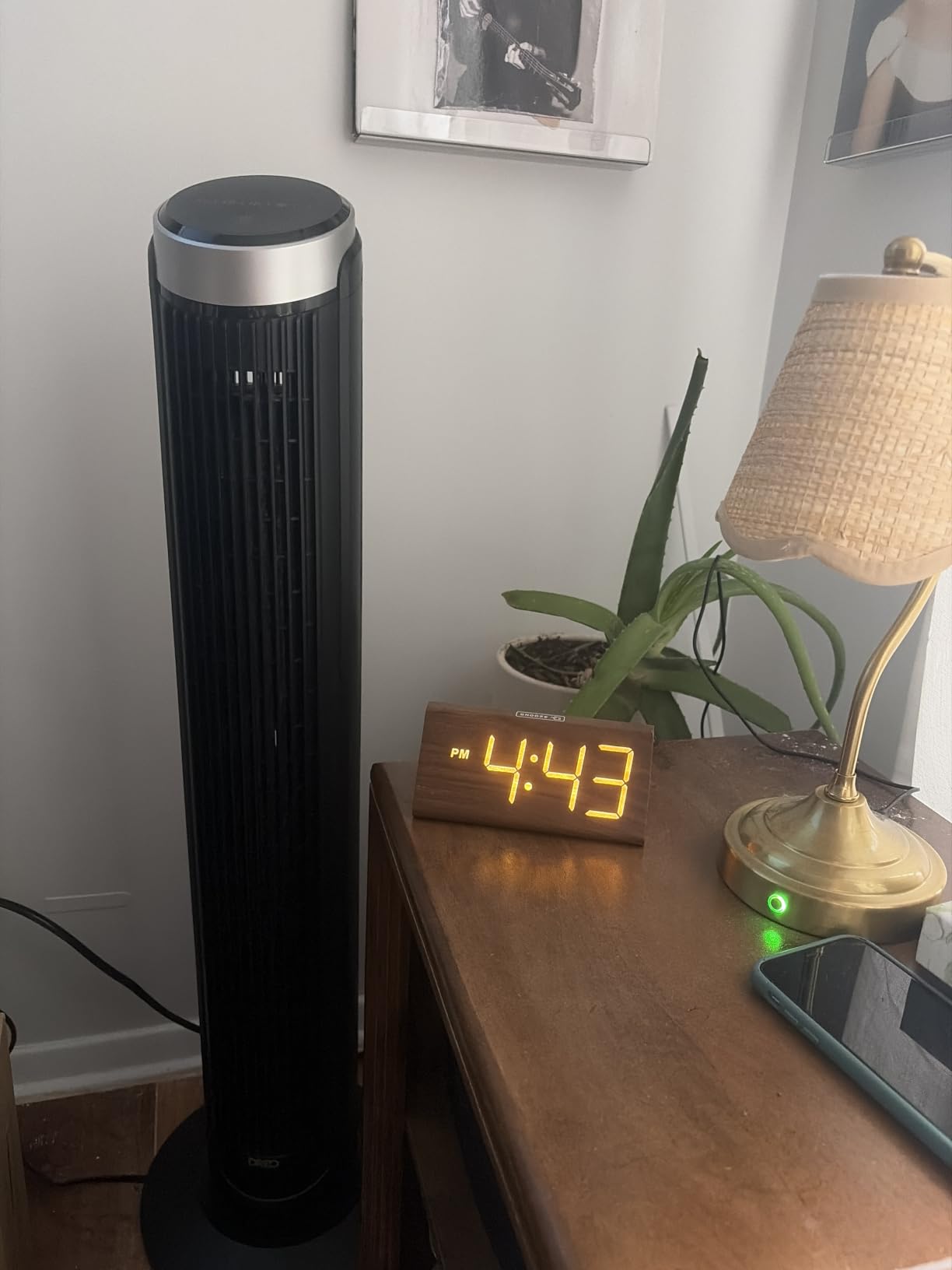
This is the fan we would put in our own bedroom. The DREO 40-inch uses a brushless motor, a 26 ft/s wind speed and a 90-degree oscillation arc, and owners consistently describe it as startlingly quiet for how much air it moves. Several buyers say they replaced an older bladed tower and immediately noticed the absence of rattle. Our own comparison of the ten models here put it at the front because it balances all three things that matter: noise, coverage and a sleep mode that actually changes the speed.
The 90-degree sweep is wider than the 60-degree arc on the older Lasko towers in this list, and in a square bedroom that means the far corner actually gets air. That matters if your bed is not directly in front of the fan, which is the normal case in most bedrooms. The four modes are Normal, Natural, Auto and Sleep, and the Auto mode uses a temperature sensor rather than running at a fixed step.
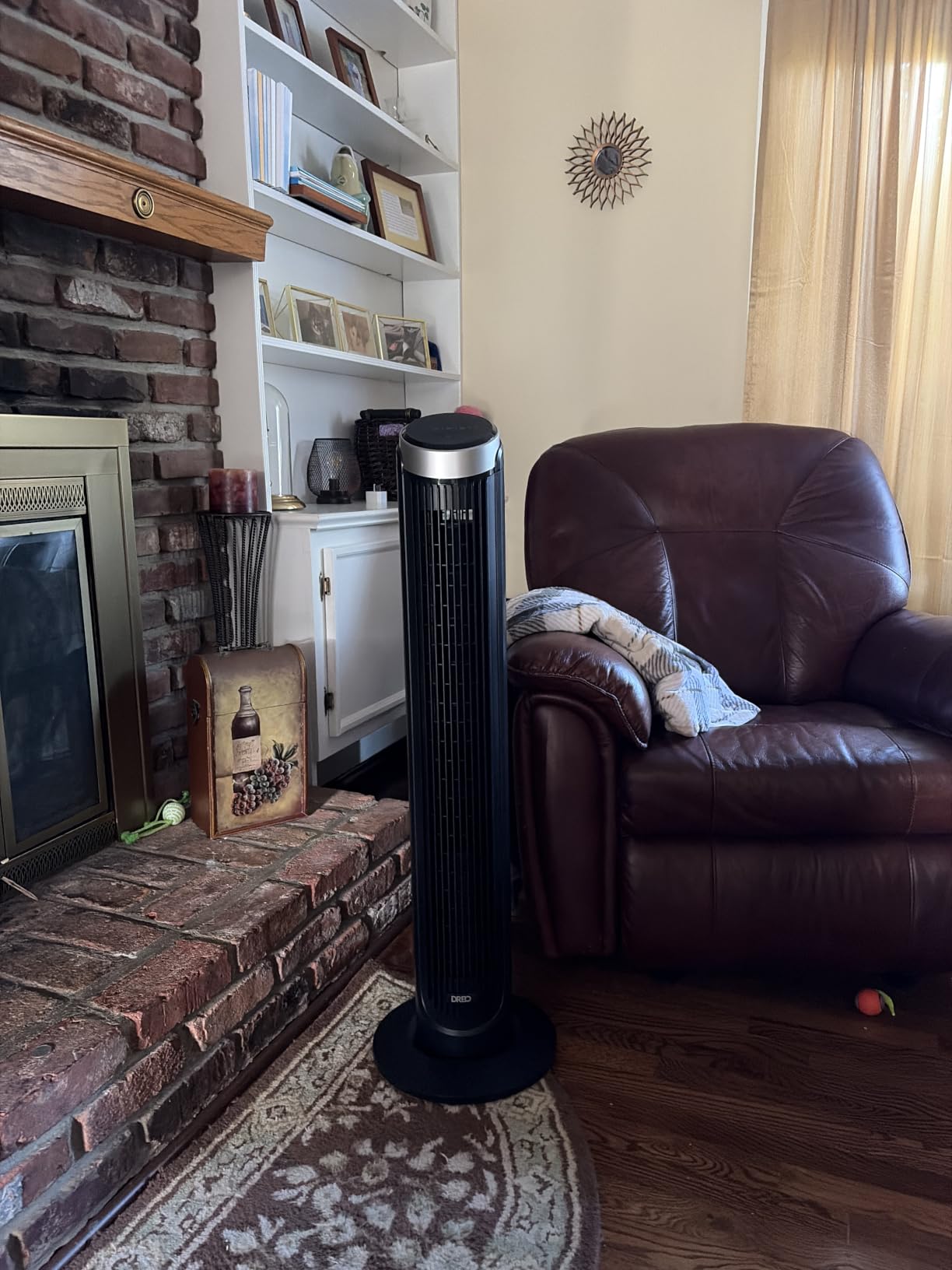
At 35 watts, this is one of the cheaper-running fans we looked at. Eight hours a night works out to roughly 2 kilowatt-hours a day, which at a US national average near 18.8 cents per kilowatt-hour costs a fraction of a cent. Over a full cooling season that stays in single-digit dollars, which is the argument for a fan over running a window unit all night.
Two details separate it from cheaper towers. The grille and impeller both lift out without tools, so a year of dust does not mean a screwdriver. And the base is narrow with a fused safety plug, so a small child or a cat brushing against it in the dark is a lower concern than with a wide pedestal fan. Our full breakdown of the bladeless designs is in our guide to the best bladeless tower fans.
Who this fan suits
It suits a light sleeper in a small or medium bedroom who wants airflow across the bed without a sound that pulls attention. The washable grille also makes it a good fit for a household with pets, where hair in the intake is a weekly problem rather than an annual one.
It also suits anyone who plans to run it on a schedule overnight. A 12-hour timer covers a full night without a reset, and the remote has a beeps-off option, which matters more than it sounds when the other person is asleep.
Where it falls short
The spec sheet lists 25 dB while the feature copy quotes 28 dB, and that discrepancy is a useful reminder to treat every published figure as approximate. More practically, this 40-inch version has five speeds, while some 42-inch models in the same family list twelve, so check the listing for the size you are actually buying.
A small number of owners find it so quiet that they wanted more noise, which is a real preference for people who use a fan as a white-noise machine. And it is a fan, not an air conditioner. It moves air across your skin, it does not chill the room.
2. DREO 42-Inch 9-Speed Tower Fan: Best for Large Bedrooms and Master Suites
DREO Tower Fan for Bedroom, Upgraded DC 28ft/s Velocity, 9 Speeds
1397 CFM at 28 ft/s
9 speeds and 4 modes
30 watts
28 dB listed
42 inch tall
Pros
- Highest airflow figure in this group
- Finest speed control with nine steps
- DC brushless motor stays smooth through the sweep
- Sleep mode dims the display
- 30 watts despite the output
Cons
- Audible above roughly speed 5
- Among the pricier models here
- Newer revision reportedly drops some smart features
This is the one to buy if your bedroom is big, has a high ceiling, or sits above a warm room where a pedestal fan never managed to reach you. The 42-inch DREO publishes 1,397 CFM at 28 ft/s, the largest airflow number in this group, and owners describe feeling the breeze from eight feet away. In a 300-square-foot master bedroom that is the difference between cooling one corner of the bed and cooling the bed.
The nine speed steps are the real story for a bedroom, though. Most towers give you three or five, which forces you to choose between too quiet and not quite enough. Nine steps mean you can find the exact point where the airflow is right and the noise still sits under your ceiling. Four modes plus a temperature-sensing auto mode handle the rest on a warm night that cools down after midnight.
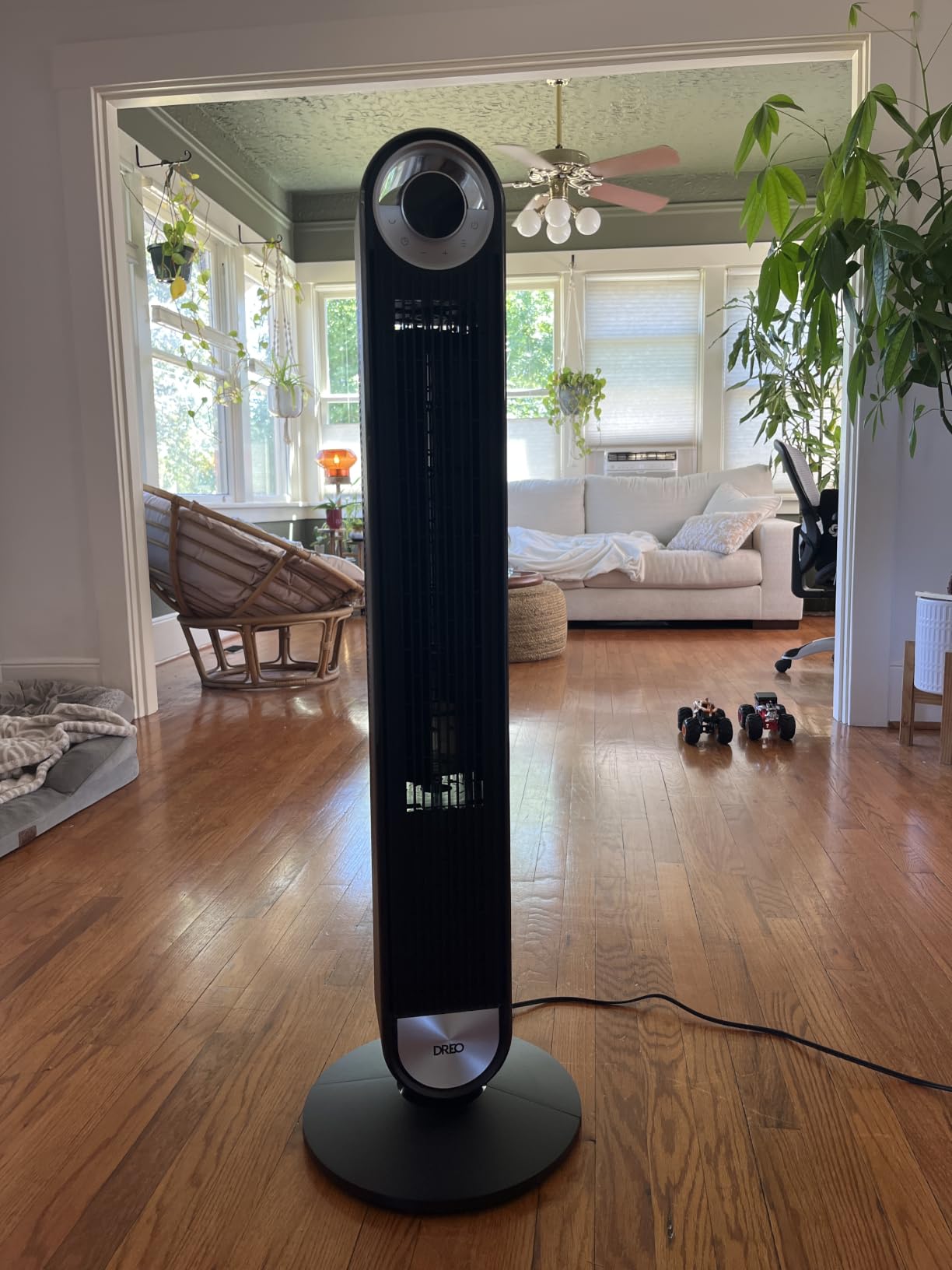
What makes this a good bedroom machine rather than just a powerful one is the sleep mode, which dims the display and the panel only lights when a setting changes. Owners frequently mention replacing an older oscillating fan that rattled loudly through the whole sweep, and the DC brushless motor is why. A brushless motor has no commutator brushes wearing against each other, which removes both the rattle and one of the main wear points over a decade of nightly use.
At 30 watts this is the most efficient high-output unit we reviewed, drawing less power than several of the three-speed fans below it. The warranty story is also the strongest in the group: a 12-month default warranty that extends to 30 months with registration, plus a five-year extended option. If you intend to run a fan every night for a decade, that coverage is worth something.
Who this fan suits
It suits a master bedroom, a converted loft, or any room where a three-speed tower left you sweating on one side of the bed. If you have ever argued about whether the fan is even pointed at the right person, the nine speeds and 28 ft/s exit velocity solve that argument.
It also suits a household that wants a phone-free bedroom. Owners report app and voice-assistant support, but every function including the timer and sleep mode is reachable from the touch panel or remote, so nothing requires a phone by the bed.
Where it falls short
It is not silent, and pretending otherwise would be dishonest. Owners put audible noise at roughly speed five and above, so silence is a low-to-mid-speed property on this unit. For a light sleeper, the 40-inch DREO at number one is the safer buy.
It is also one of the pricier fans here, and a few owners of newer revisions report that the Smart Control and wider pan found on earlier models are missing. Our general Dreo coverage, including where the brand’s line-up changes between sizes, is in our Dreo tower fan guide.
3. Levoit 36-Inch Classic Tower Fan: Best for Small Bedrooms and Nightstand Clearance
Levoit Tower Fan for Bedroom, 28ft/s Fans that Blow Cold Air, 28dB Quiet
28 dB on low speed
6.5 by 6.5 inch base
28 ft/s
12-hour timer
2-year warranty
Pros
- Smallest base in the roundup at 6.5 inches square
- 28 dB low-speed figure aimed at light sleepers
- Auto mode with a built-in temperature sensor
- Two-year warranty is the longest standard cover here
- Removable back grille for fast cleaning
Cons
- AC motor is louder and less efficient than the DC units
- 36.2 inch height can sit below a taller sleeper
- Highest one-star share in the group at 7 percent
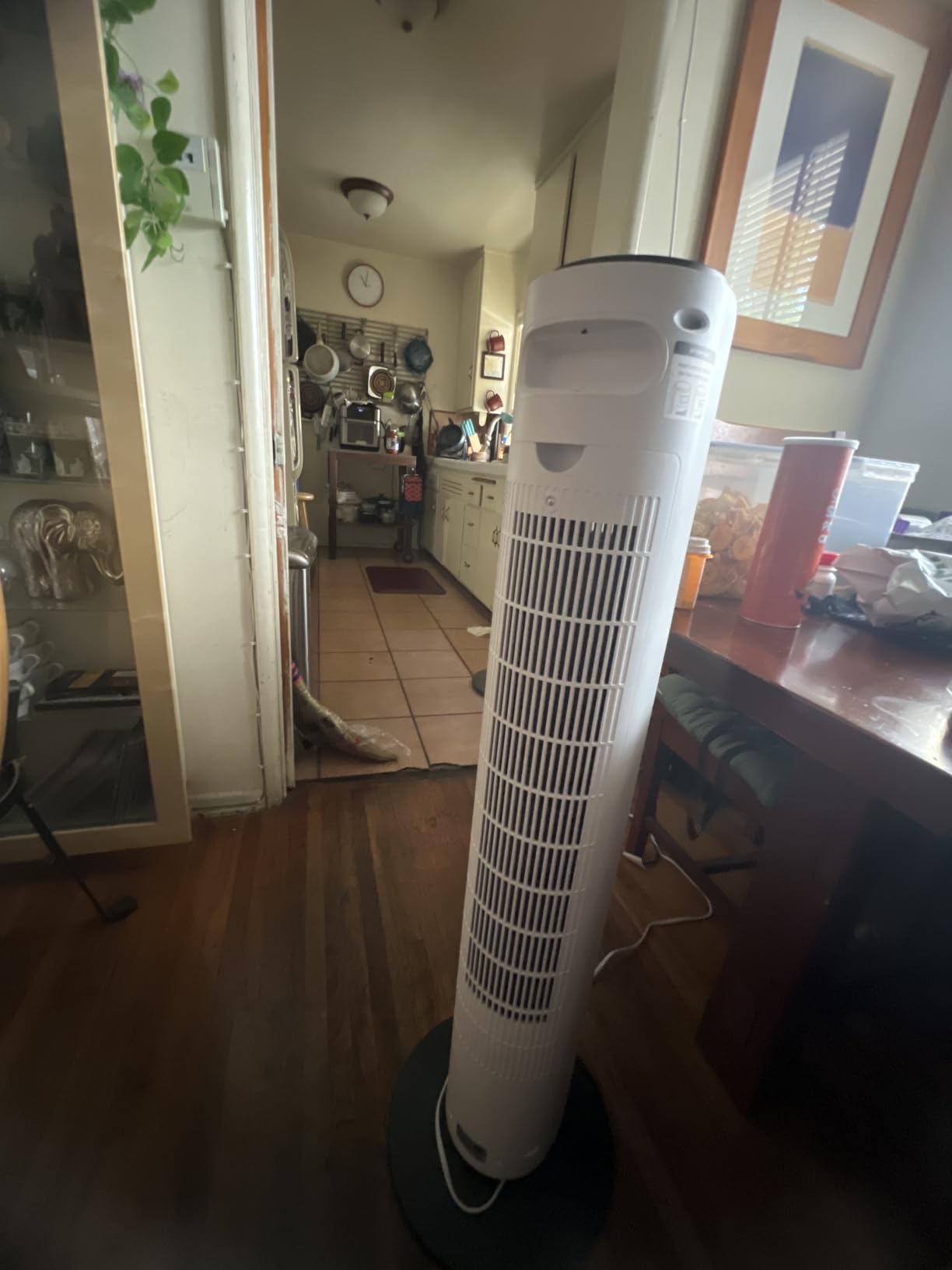
The Levoit Classic 36 solves a problem the other tall fans create. At 6.5 inches square, the base is less than half the width of most 12-to-13-inch tower bases, which means it can stand beside a bed, in a narrow gap between a dresser and a wall, or on a nightstand-adjacent spot in a room where nothing else fits. It is the pick for a small bedroom, a dorm, or a guest room where clearance is the constraint.
Published noise is 28 dB on low, and the 12-hour timer covers a full night with no reset. Auto mode uses a built-in temperature sensor to pick the speed, so if the room cools down at 3am the fan eases off rather than blasting you. At 39 watts it costs almost exactly what the 40-inch DREO costs to run.
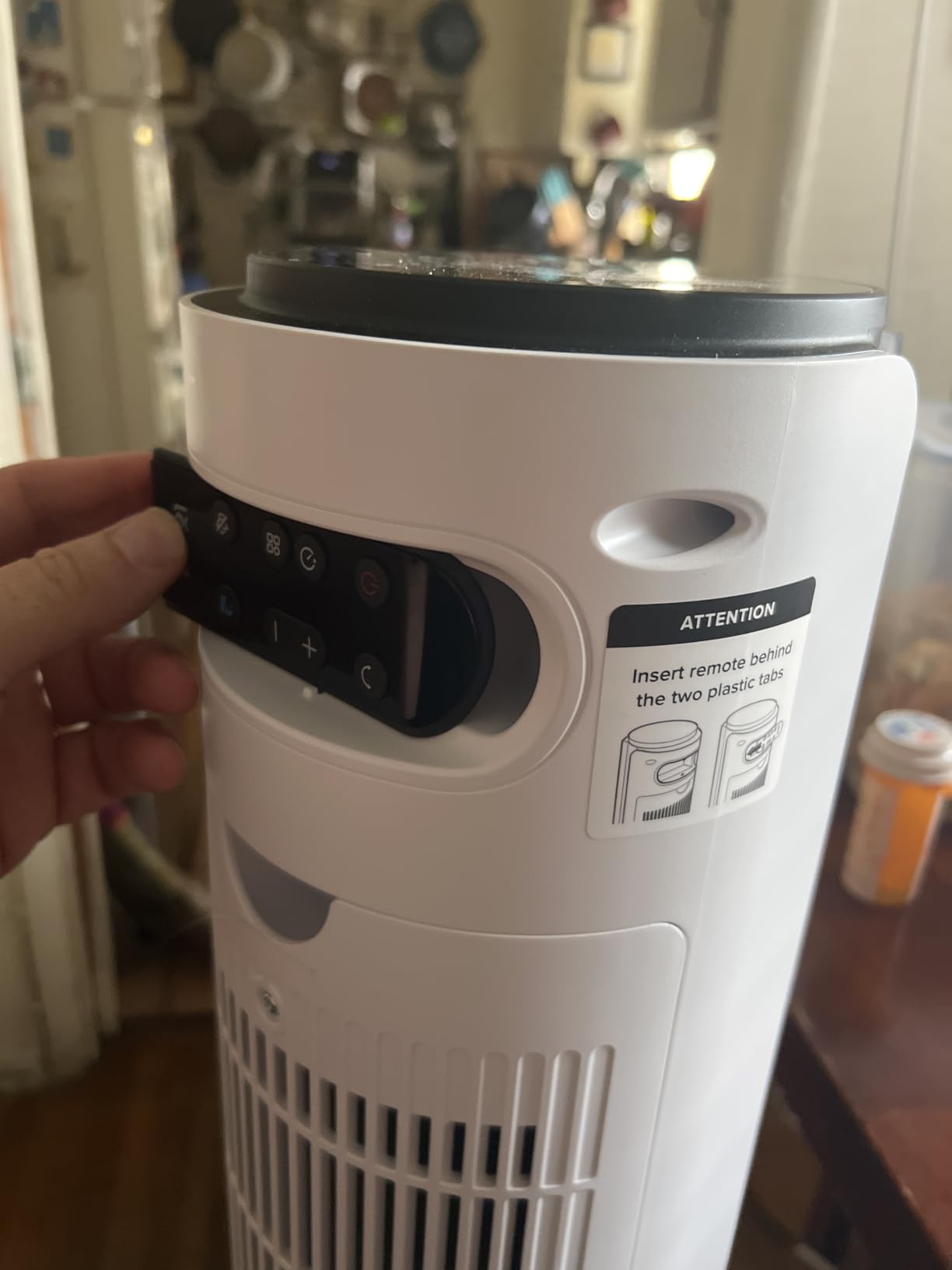
Cleaning is a real consideration in a bedroom and the Levoit makes it painless. The back grille comes off for a wipe or a rinse, no tools, which matters in a room where the fan sits close to bedding and carpet. The two-year manufacturer warranty is also the longest standard coverage in this group, double the one-year terms on all three Lasko models.
Worth noting that at the time of our research this was ranked number one in Amazon’s Household Tower Fans category, with 14,495 reviews at 4.4 stars. The rating is a touch below the leaders here, and the reason is mechanical rather than cosmetic. Seven percent of its reviews are one star, the highest share in the group, and the recurring thread underneath those is the AC motor.
Who this fan suits
It suits a small bedroom under about 120 square feet, a dorm room, or anyone who measures the gap before buying. A 6.5-inch base fits where a 13-inch base does not, and that has stopped more bedroom fan purchases than any other single dimension.
It also suits anyone who wants a long warranty without moving up to a more expensive model. Two years of cover on a well-reviewed unit is a reasonable middle ground between the one-year terms on the Lasko towers and the registration-dependent coverage on the DREO units.
Where it falls short
The AC motor is the honest limitation. AC motors use brushes, which wear, and they are typically louder at the same output than a DC brushless motor. Buyers comparing it directly against the DREO models at a similar price often find the DREO quieter. If noise is your first priority rather than footprint, buy the DREO.
The 36.2-inch height is also short. A taller sleeper sitting up in bed can find the airflow passes below their face, in which case the 40-inch and 42-inch models make more sense. The five speed settings are fine but not fine-grained.
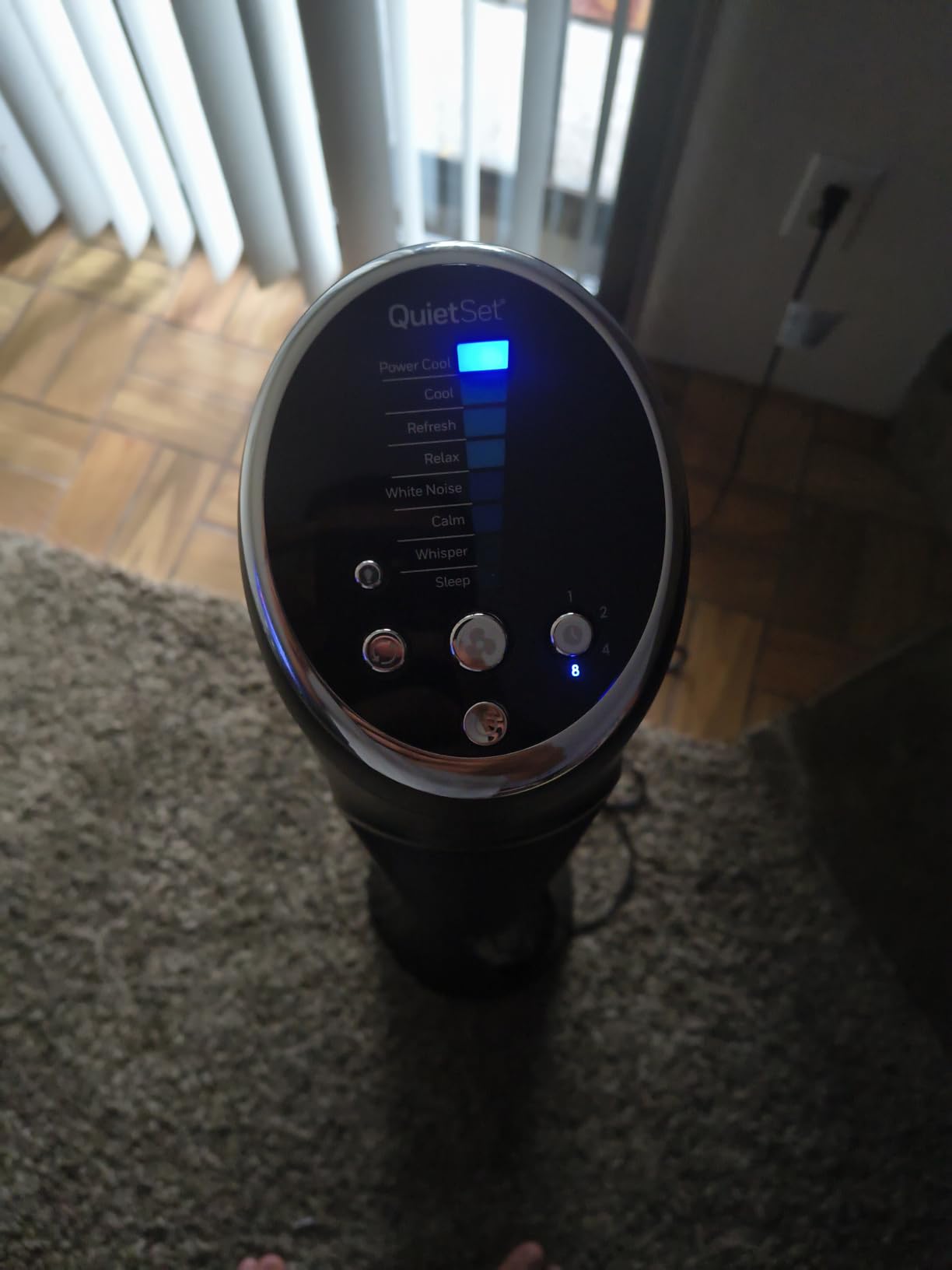
4. Honeywell QuietSet HYF260 40-Inch Tower Fan: Best for All-Night Reliability
Honeywell QuietSet Whole Room Oscillating Tower Fan with Remote, White, HYF260
46 dB
5 speeds
10 by 10 inch base
remote stores in the fan
auto shut-off timer
Pros
- Highest review count of any fan we reviewed
- 46 dB with a genuinely quiet low setting
- Remote stows in the back of the unit so it cannot be lost
- Two-piece assembly takes seconds
- Owners report five-year-old fans still running
Cons
- Gentle airflow that some owners find weak
- Recurring reports of motor vibration on lower speeds
- US two-prong plug only
The Honeywell QuietSet HYF260 has the most owner evidence behind it of anything in this roundup, at roughly 64,000 reviews. That volume matters more than usual here because owners describe units they have owned for five years and still run smoothly, which is the kind of claim a low-volume listing simply cannot make. If your priority is a fan that survives many summers rather than a fan with the longest warranty, this is the one.
The published noise figure is 46 dB, which is meaningfully louder than the 25-to-30 dB figures on the DREO and PELONIS units. That gap is real and it is the reason this fan sits at number four rather than first. In practice, though, 46 dB is the maximum figure, and owners who run it on the lowest of its five settings describe it as quiet enough to sleep beside. Five speed and sound settings with a dimmable panel, going from full brightness to off, is a genuinely thoughtful night feature.
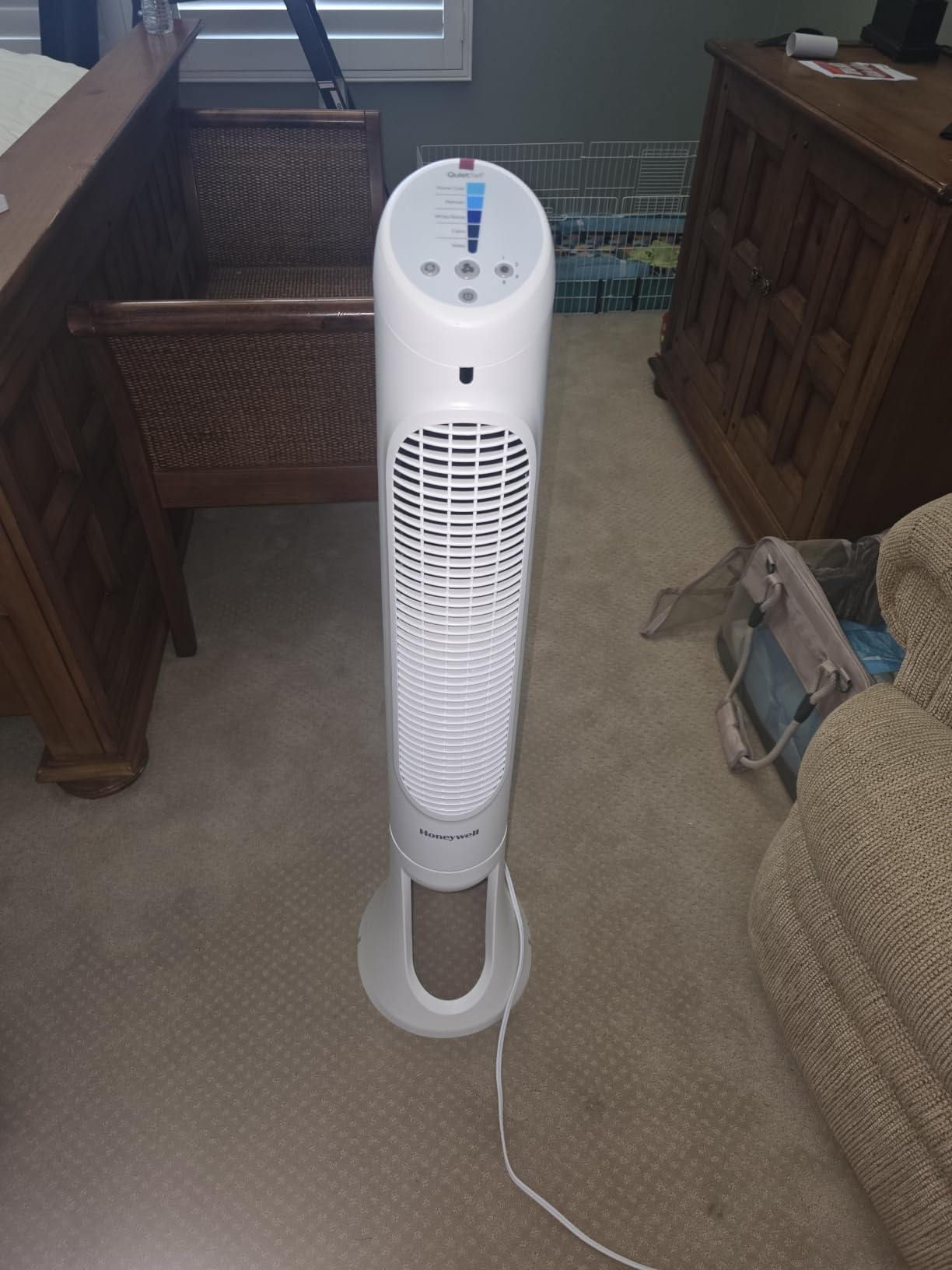
Two practical touches stand out. The remote stores inside the back of the fan, so it does not migrate to the bottom of the bed, and the panel dims through four brightness levels to fully off. The 10 by 10 inch footprint is narrower than the Lasko towers and wide enough to be stable, and the two-piece assembly is a matter of sliding the top into the bottom and clicking it together.
There is a note on the listed wattage worth reading twice. The 1,500-watt figure is a circuit-safety rating, not a measure of how much power the fan draws, and reviewers who assumed it was a consumption number were disappointed. Treat it as a maximum, not an average. Honeywell’s replacement customer service draws repeated praise even in reviews that criticize the fan itself.
Who this fan suits
It suits a household that has already had a cheap tower fan die after a season and now wants something proven. The five-year owner reports are the strongest durability evidence in this group, and the price sits below both DREO models.
It also suits anyone with a non-US plug who is ordering from a US marketplace. The two-prong plug is a limitation for European and UK buyers, but for anyone plugging into a standard North American socket the simplicity is a feature.
Where it falls short
Airflow is the recurring complaint. A number of owners say the fan does not move air aggressively even on the top setting, which in a large or high-ceilinged room will leave you unsatisfied. If your bedroom is over about 200 square feet, look at the higher-CFM options instead.
There is also a smaller but persistent cluster of reviews describing motor vibration buzz on the lower speed settings. If you are a light sleeper, test it in person if you can, because 46 dB at the top is within range and buzz at the bottom is a different problem entirely. It does not resume after a power cut, so a summer storm means walking over to switch it back on.
5. PELONIS 40-Inch Bladeless Tower Fan: Best for a Quiet Bedroom on a Budget
PELONIS 40-inch Bladeless Tower Fan for Bedroom, Standing Fan with Remote Control, 26ft/s, 90° Oscillation, 3 Speed Settings, 27 dB, 3 Modes, 15-Hour Timer, LED Display, Fan that Blows Cold Air, Black
27 dB
15-hour timer
26 ft/s
3 speeds and 3 modes
50 watts
Pros
- Very quiet at 27 dB with airflow that still cools the room
- Longest timer here at 15 hours
- Tool-free assembly owners call one of the simplest
- Brushless motor and a 50-watt draw
- Remote works from 30 feet away
Cons
- Sleep mode reported to make no audible difference
- Remote stops responding at the extremes of oscillation
- Some reports of oscillation failing after a month
The PELONIS 40-inch is the value pick in this roundup, and the case for it is a combination rather than a single number. Twenty-seven decibels, a 15-hour timer, a brushless motor, tool-free assembly and roughly 24,000 reviews at 4.5 stars is a lot of the right things in one package, and it undercuts both DREO models.
The timer deserves a specific mention because it is the longest in the group. Fifteen hours covers a long night, a late night, and the morning after without a reset, which is exactly what a 7.5-hour or 8-hour timer cannot promise. The remote reaches about 30 feet, so you can control it from across the room without getting up, and three modes including STRONG, NATURAL and SLEEP cover the usual range.
There is a Sensi Cool feature that auto-adjusts wind speed to the room temperature, which is a small quality-of-life item that matters on a night that cools down after you fall asleep. At 50 watts it draws a little more than the DREO units, though the extra power over a full night is negligible. Several long-term owners report units still running after four to five years, which supports the durability case alongside the Honeywell.
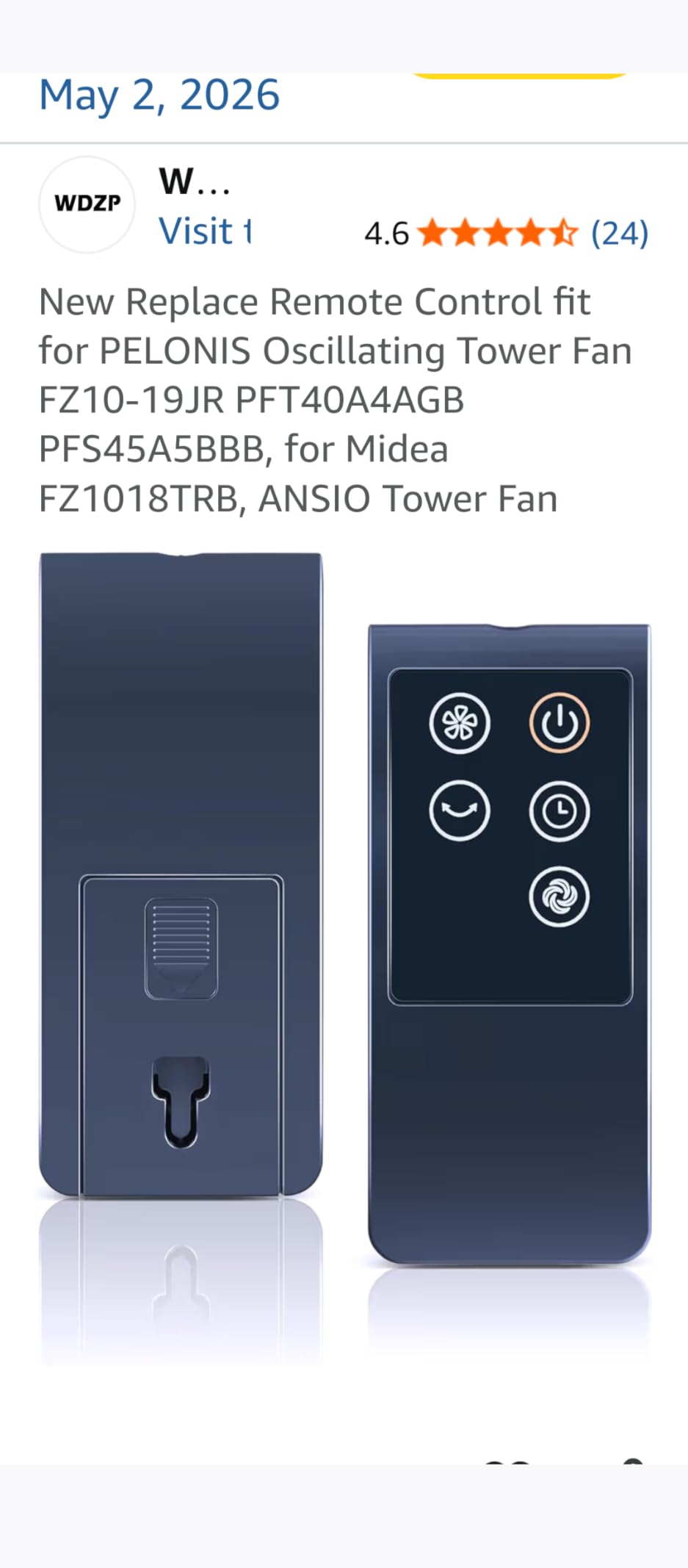
The gripes are functional rather than performance, and they are worth weighing honestly. The most-documented is that the sleep mode makes no audible or speed difference from the top setting, which is a naming problem rather than a failure. The next is the remote holder, a narrow cutout that leaves most of the remote sticking out and lets it slide away.
Who this fan suits
It suits a light sleeper who wants near-silence, a long timer, and a remote, without moving up to the DREO price tier. If the Honeywell is too loud and the DREO models are more than you wanted to spend, this is the middle.
It also suits someone who moves the fan between rooms. The small footprint fits tight corners, and long-term owners use it in a bedroom, an office and a living room in turn. Assembly being tool-free matters if you are not handy with a screwdriver.
Where it falls short
Three speed settings is fewer than the DREO models offer, and with a sleep mode that does not change anything, you have less fine control over the transition into the night. That is a real limitation for someone who wakes too warm or too cold.
There is also a small but real reliability cluster: several owners report the remote cutting out when the fan is oscillated to the far side, and a few report the oscillation mechanism itself failing within about a month. The remote’s model number is not listed, which makes a replacement harder to source. None of this is common enough to sink the recommendation, but it is a fair warning if you plan to run oscillation all night.
6. Lasko 42-Inch Oscillating Tower Fan: Best for Wide Coverage and Familiar Controls
Lasko Oscillating Tower Fan with Remote – Quiet Standing Fan for Bedroom, Office, and Home – 3 Speeds – Powerful Cooling Air – T42954 – 42″ Tall – Gray/Woodgrain
42.5 inch tall
55.4 dB
262 CFM
3 speeds
7.5-hour timer
Pros
- Huge review base at about 63000
- 42.5 inch height reaches over a bed
- Nighttime setting dims the LEDs and drops the speed
- Remote covers power speed oscillation timer and night mode
- Integrated carry handle and 10.6-pound body
Cons
- 55.4 dB is audible white noise rather than near-silence
- Only 3 speed settings
- 7.5-hour timer is shorter than the PELONIS and Levoit timers
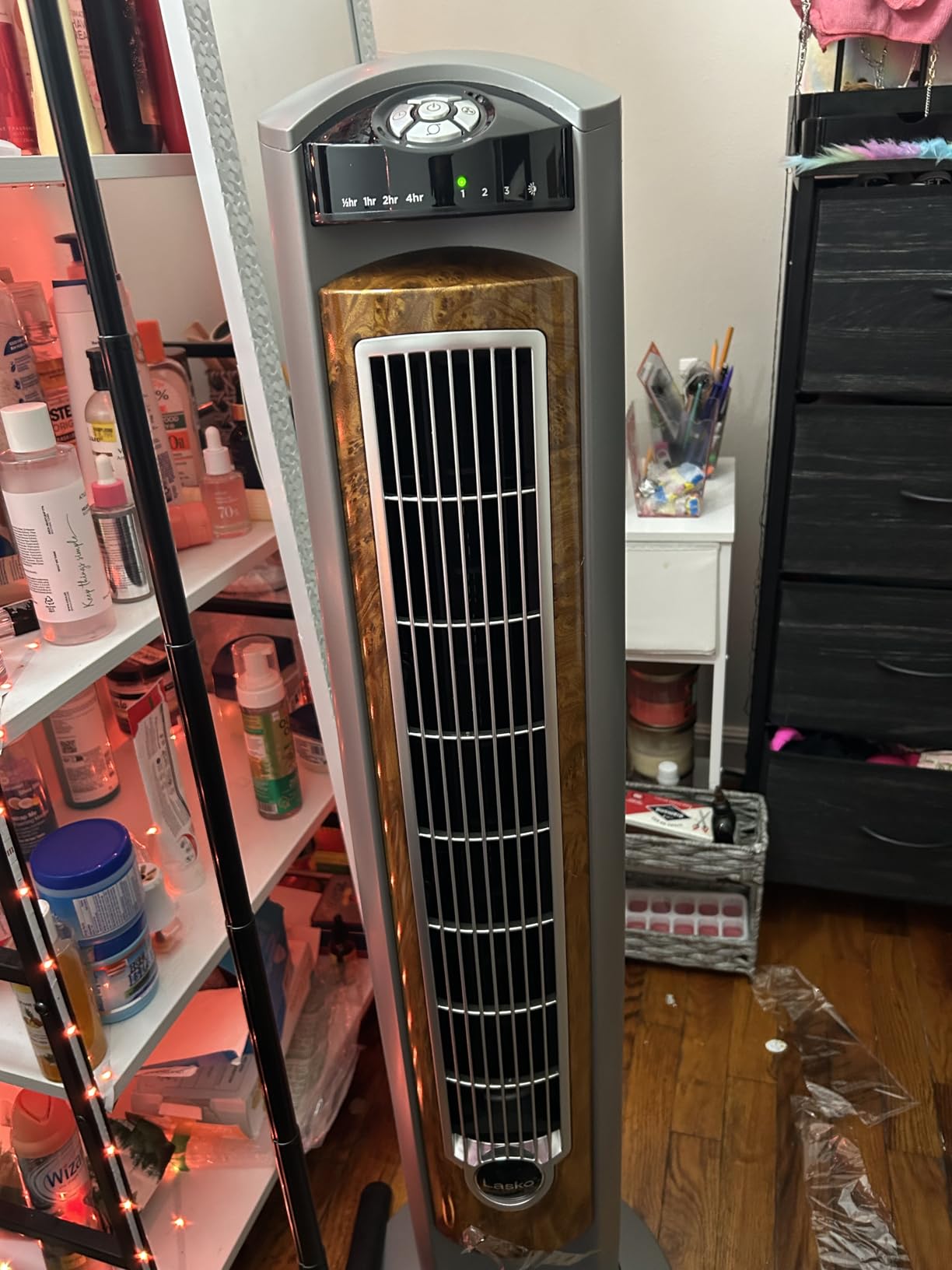
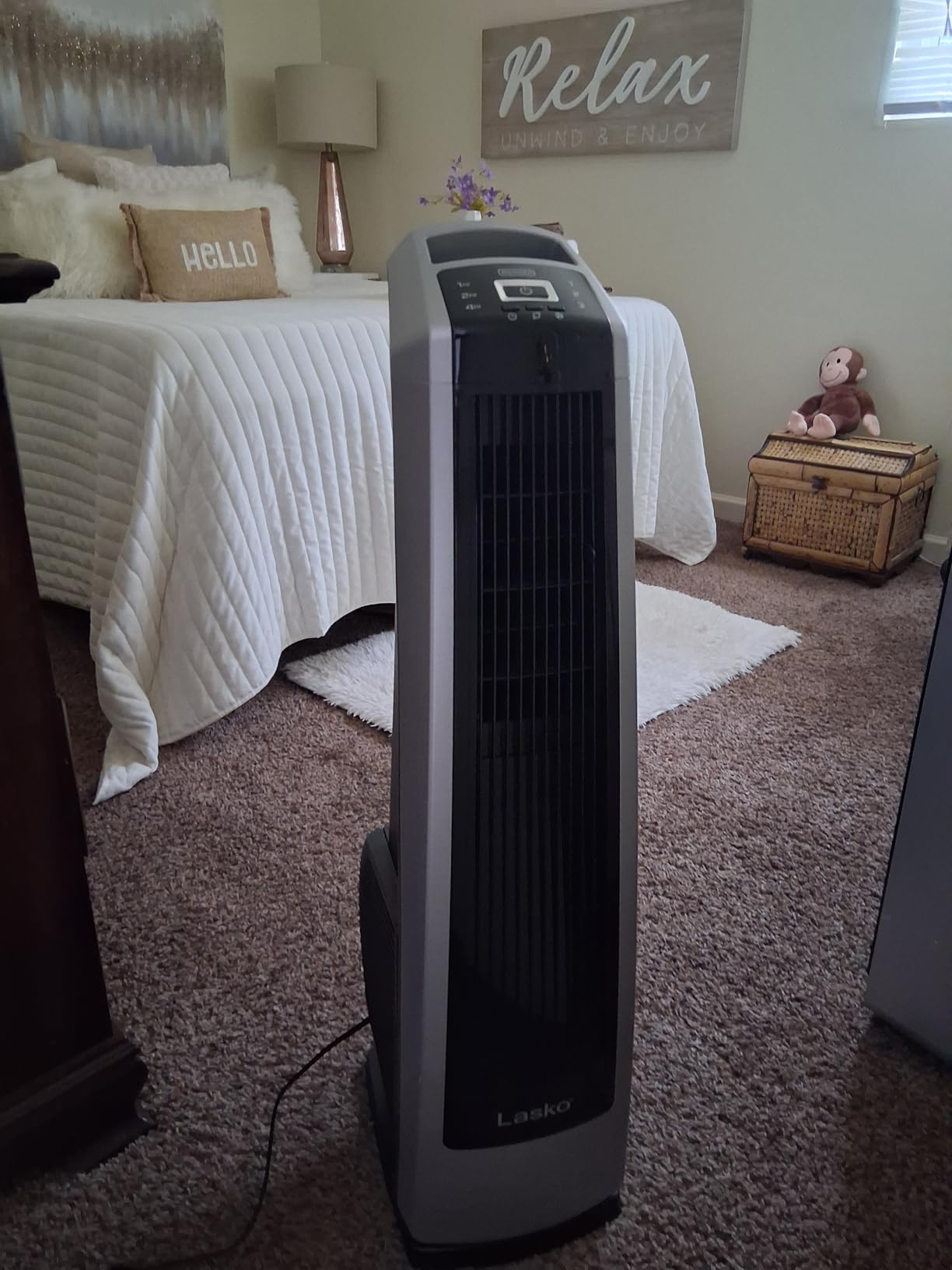
The Lasko 42-inch is the safe, unglamorous buy that a very large number of people already own, with roughly 63,000 reviews behind it. It is 42.5 inches tall, and that height is the feature that separates it from the shorter towers here: it puts the outlet above the top of a mattress, so the air actually crosses you whether you are lying flat or sitting up.
The nighttime setting dims the LED controls and reduces the speed, which is a sleep feature the Lasko has had for years. The multi-function remote handles power, three speeds, oscillation, the 7.5-hour timer and the nighttime mode, so you never have to reach over to the unit in the dark. At 262 CFM and 48 watts with a brushless motor, it is also a genuinely efficient fan by output-per-watt.
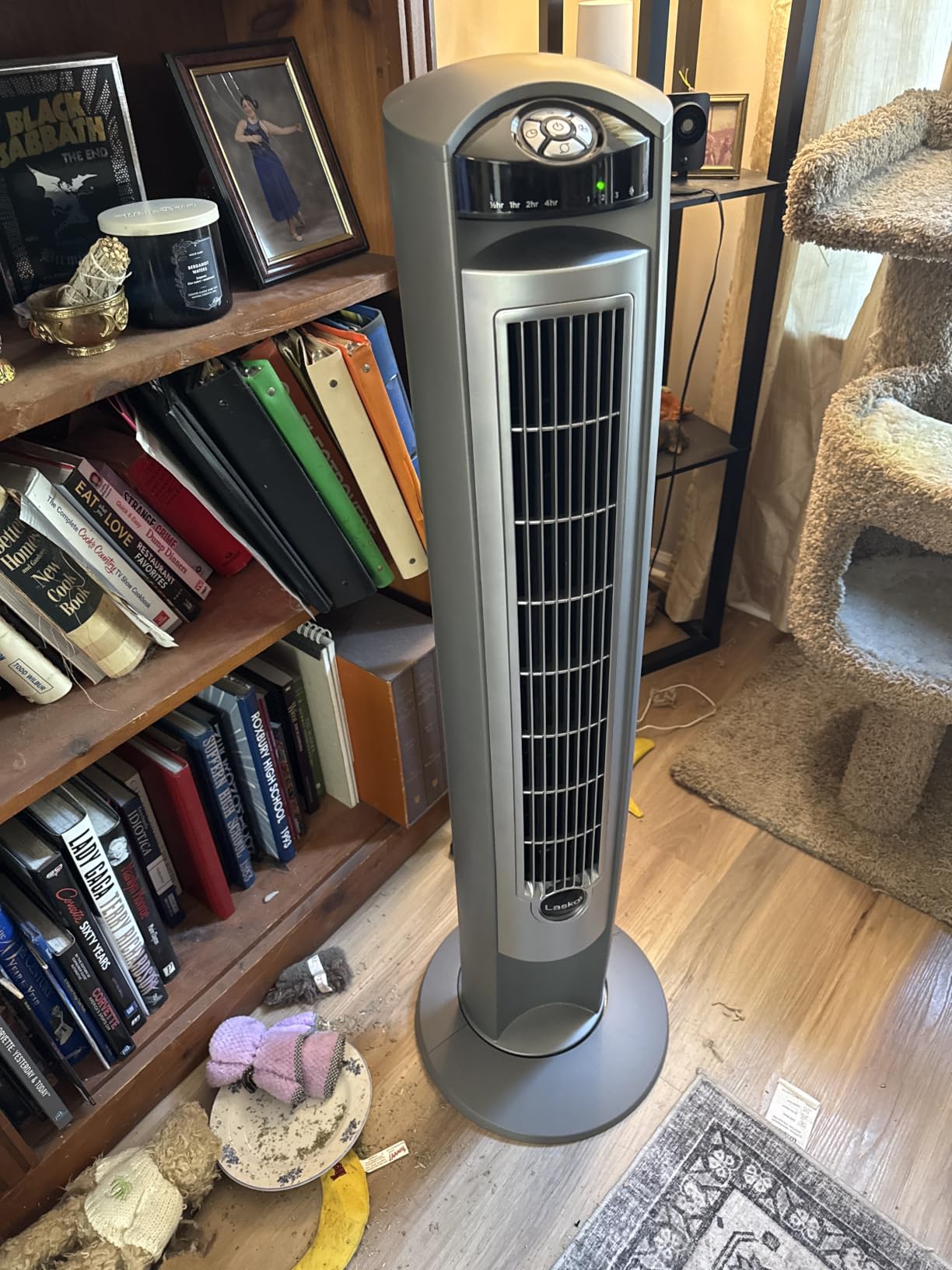
The 60-degree oscillation is narrower than the 90-degree arcs on the DREO and PELONIS units, which is the practical trade-off. In a square room with the fan placed in a corner, 60 degrees can leave the far corner to itself. In a narrow room with the fan at the foot of the bed, it covers fine, and owners repeatedly describe cooling a bed from across the room.
The build is unremarkable in the best sense. Acrylonitrile butadiene styrene, steel, aluminium and copper in a 10.6-pound body with an integrated carry handle means one person can move it without wrestling it. The 1-year limited warranty is the shortest standard term among the Lasko units here, along with the two other Lasko models.
Who this fan suits
It suits a household that wants proven, high-volume reliability at a modest price and does not need silence. The height and the 7.5-hour timer cover most nights, and the remote means you set it once.
It also suits anyone who moves fans between rooms regularly. The integrated carry handle and a 10.6-pound weight are designed for that, and the slim 13-inch base clears a doorway more easily than a pedestal fan.
Where it falls short
It is loud. The 55.4 dB figure is the second highest in this roundup, and owners consistently describe it as audible white noise rather than near-silence. That is fine if you sleep through steady airflow, and it is a dealbreaker if you identify every sound in the room.
Three speeds is the other limitation. With three steps, the difference between the lowest and middle setting is large, so there is no gentle middle. Combined with a 7.5-hour timer, it is built for a standard night rather than a long one or a shift worker. If either of those describe you, the PELONIS at number five is the better fit.
7. Lasko 2510 36-Inch Tower Fan: Best for Dorm Rooms and Home Offices
Lasko Oscillating Tower Fan with Remote Control – 36″ – 2510 – White
36 inch tall
210 CFM at 36 watts
7-hour timer
8.9 pounds
3 speeds
Pros
- Very efficient at 5.83 CFM per watt
- Lightest full-size tower in the group at 8.9 pounds
- Remote and 7-hour auto-off timer for unattended running
- Long-running design with about 30600 reviews
- 12 by 12 inch base fits a dorm or office desk corner
Cons
- 54.5 dB
- audible rather than quiet
- Only 3 speeds and a 7-hour timer
- Brushed motor is less efficient and shorter-lived
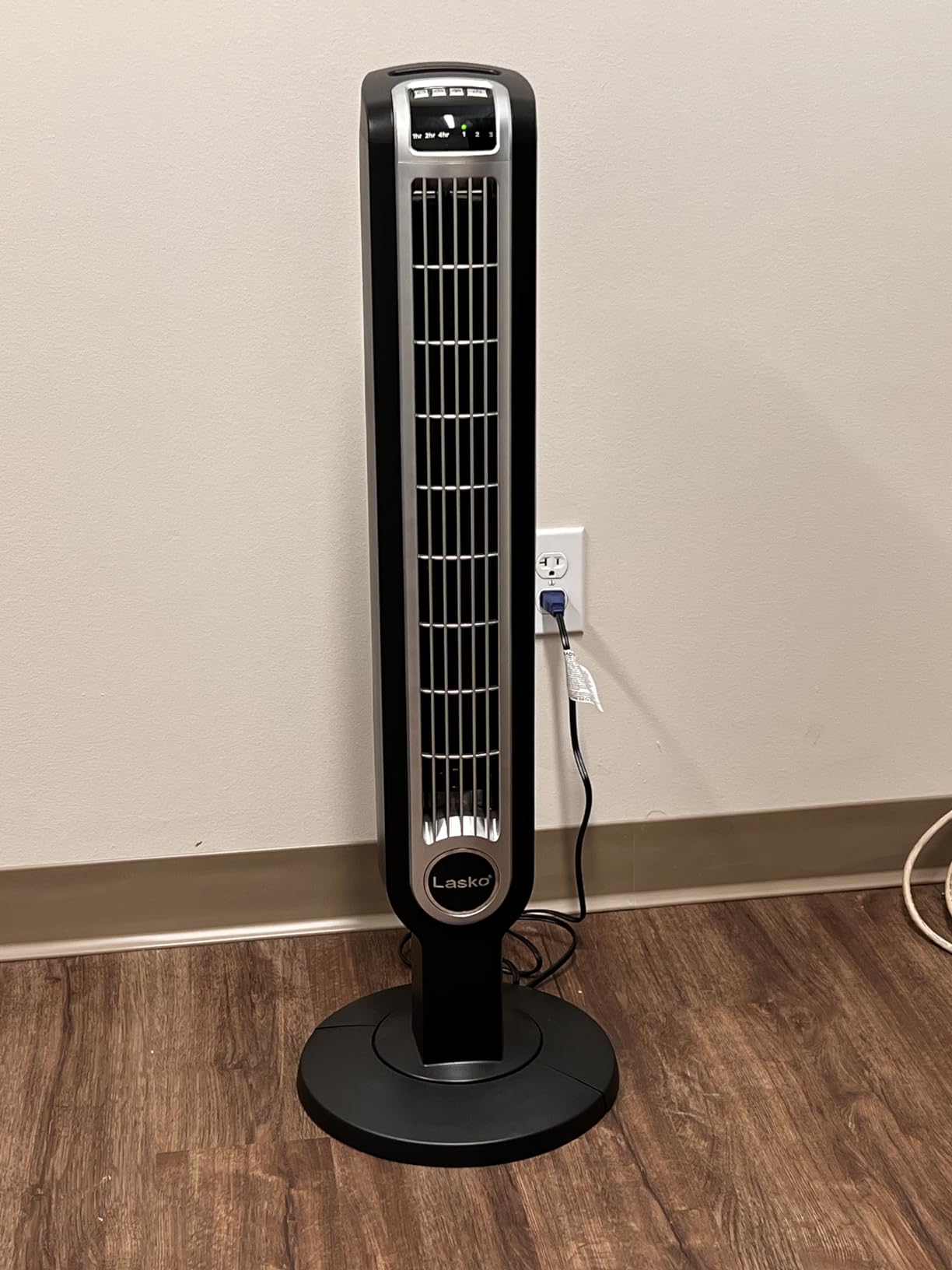
The Lasko 2510 is the efficiency standout in this list, and the number behind it is unusually good. At 210 CFM drawing 36 watts, it delivers 5.83 CFM per watt, the best figure any model here publishes, which means it moves real air for very little electricity. It has been in production since 2013, which is a large part of why it carries roughly 30,600 reviews at 4.5 stars.
For a dorm room, a home office or a small bedroom where the fan will run for eight hours straight while you study or sleep, that efficiency is the feature that matters. It is also the lightest full-size tower here at 8.9 pounds with a 12-inch square base, so moving it between the desk and the bed is a one-handed job.
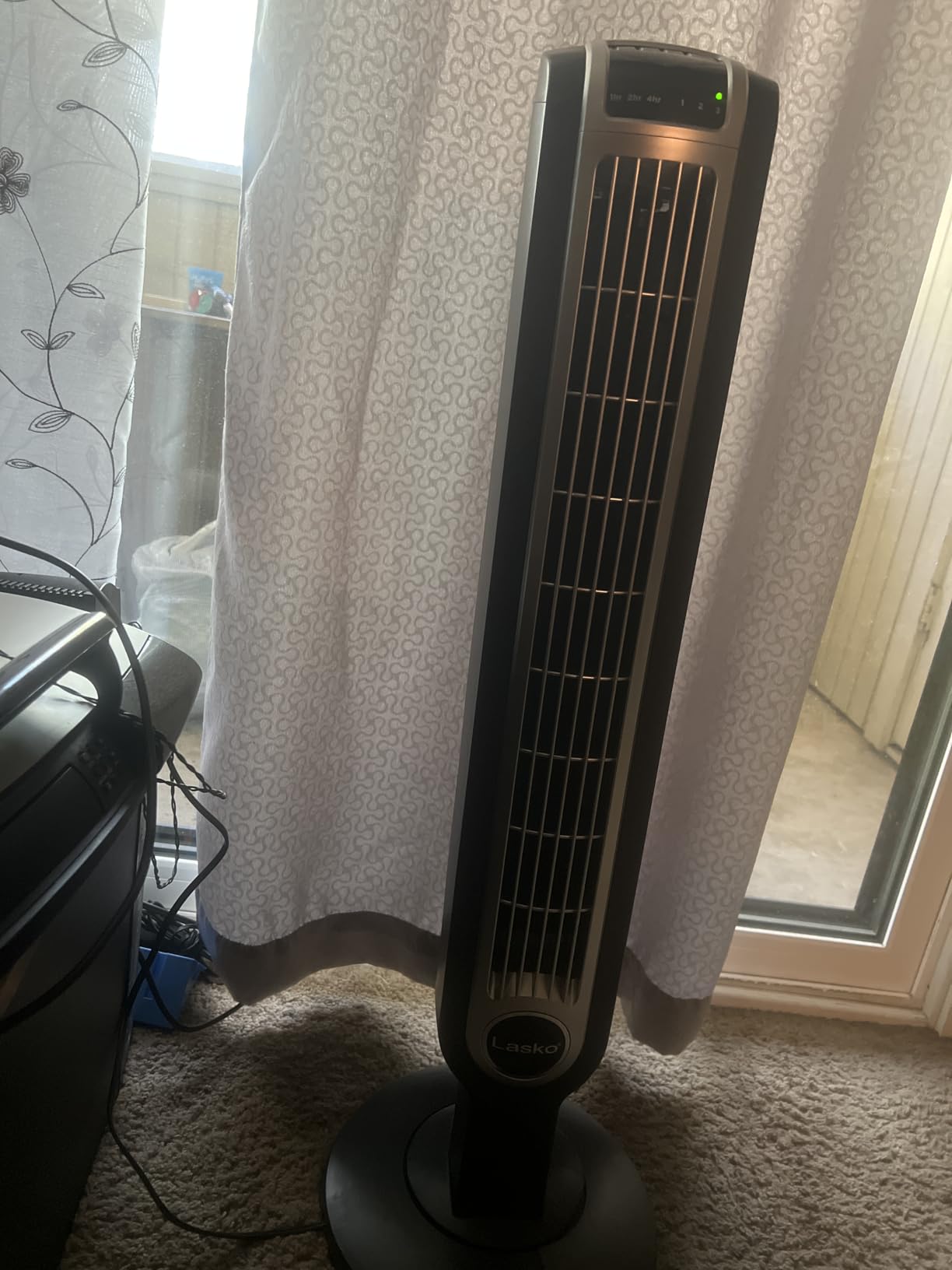
The remote handles power, speed, oscillation and the 7-hour auto-off timer, and the 60-degree oscillation is a reasonable arc for a small room. Owners describe the three speeds as quiet enough for sleeping and working, which is a slightly different claim from being quiet.
There is one number here that quietly argues against the unit. A brushed motor, by contrast with the brushless motors in the DREO, PELONIS and Lasko 42-inch, means brushes wearing against the commutator. It is a lower-cost design, and it is the most likely reason a cheaper fan eventually develops a rattle. Nothing in the reviews suggests this is happening broadly, but it is the honest trade for the efficiency figure.
Who this fan suits
It suits a dorm room, a child’s room, or a home office where the fan runs for long stretches and the electricity bill matters. The 7-hour auto-off timer also makes it a safe unattended choice for a room you are not sleeping in.
It suits anyone who wants a proven design rather than the newest model. A design that has been in production for over a decade with tens of thousands of reviews is a different kind of reassurance from a listing with a high star rating and a thousand reviews.
Where it falls short
At 54.5 dB it is one of the louder units here, and it should not be described as a quiet fan. Light sleepers should look at the DREO 40-inch or the PELONIS instead. Three speeds and a 7-hour timer also place it behind the newer models on both counts.
The 36-inch height is the other recurring note from owners. In a room where you lie flat, the airflow can pass over you rather than across you, and the Lasko’s own buyers describe it as shorter than ideal. The 1-year limited warranty is short relative to the Levoit and the registration-extended DREO terms.
8. DREO Adjustable-Height Tower Fan 38-42 Inch: Best for Precise Aiming and Child’s Rooms
DREO Fan for Bedroom, Standing Oscillating Fan for Whole Room, Quiet Fan
38 to 42 inch adjustable height
1000 CFM reaching 90 feet
105 degree pivot
28.2 dB
5.2 pounds
Pros
- Adjustable height genuinely changes where the air lands
- Highest average rating in the group at 4.7
- Lightest unit here at 5.2 pounds
- 105 degree vertical pivot plus 90 degree oscillation
- Remote with beep mute and a back-mounted holder
Cons
- Only about 1000 reviews so durability is unproven
- Listing photos show an LED display the unit does not have
- Plastic-only construction
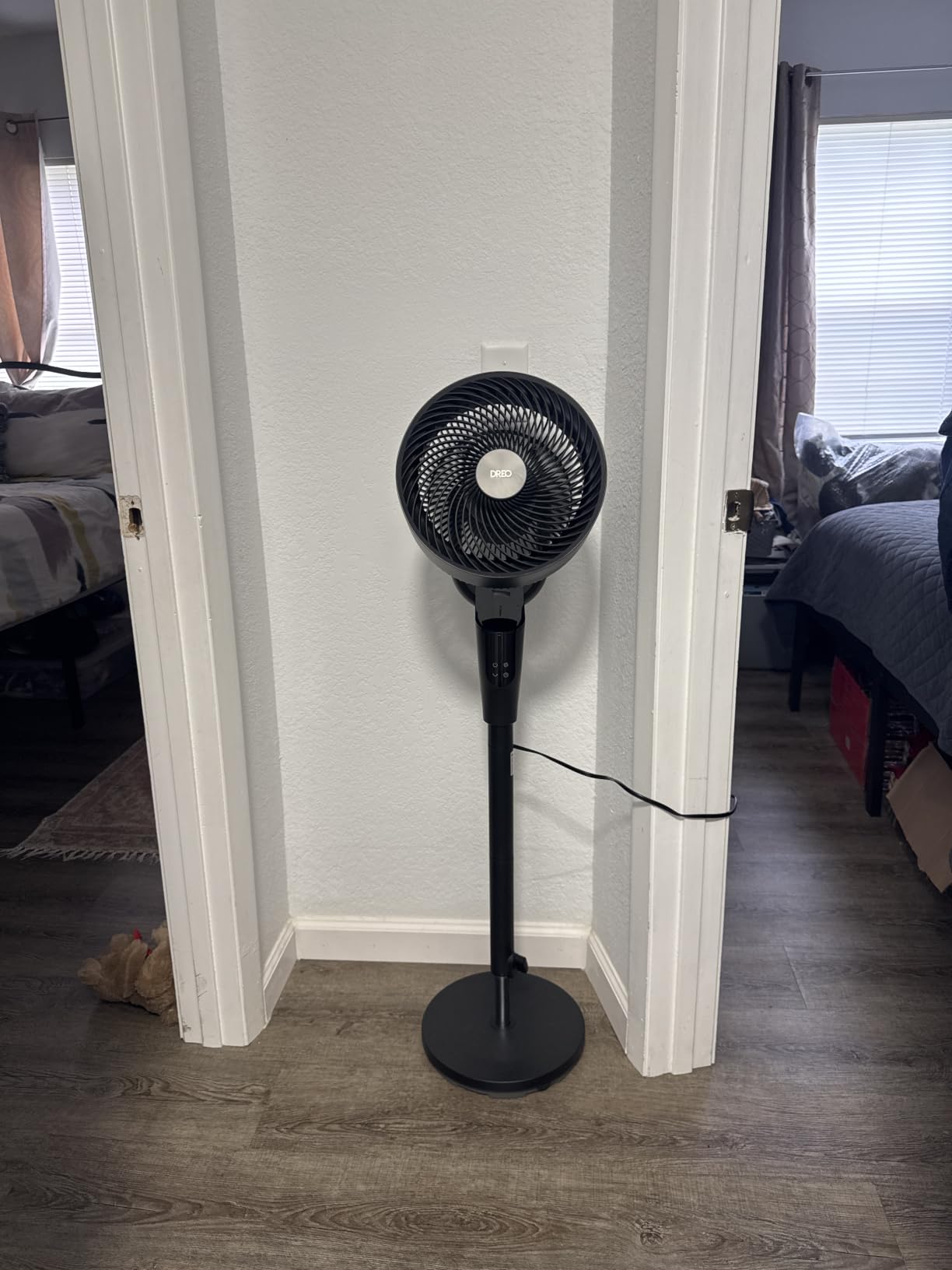
This is the most interesting fan in the roundup because it does something none of the other nine do. The height adjusts from 38 to 42 inches, and a 105-degree vertical pivot sits on top of a 90-degree horizontal oscillation. In practice that means you can put the airflow exactly where you need it: low for a child sleeping on the floor, mid for a pet bed, high for an adult lying in a bed.
It is also the lightest unit in the roundup at 5.2 pounds, which makes it the easiest of the ten to reposition across a room as the evening goes on. The published noise figure is 28.2 dB and the airflow claim is 1,000 CFM reaching up to 90 feet, with a DC brushless motor. Eight speed settings plus an auto mode that steps up one speed for every two degrees of temperature rise is unusually granular control.
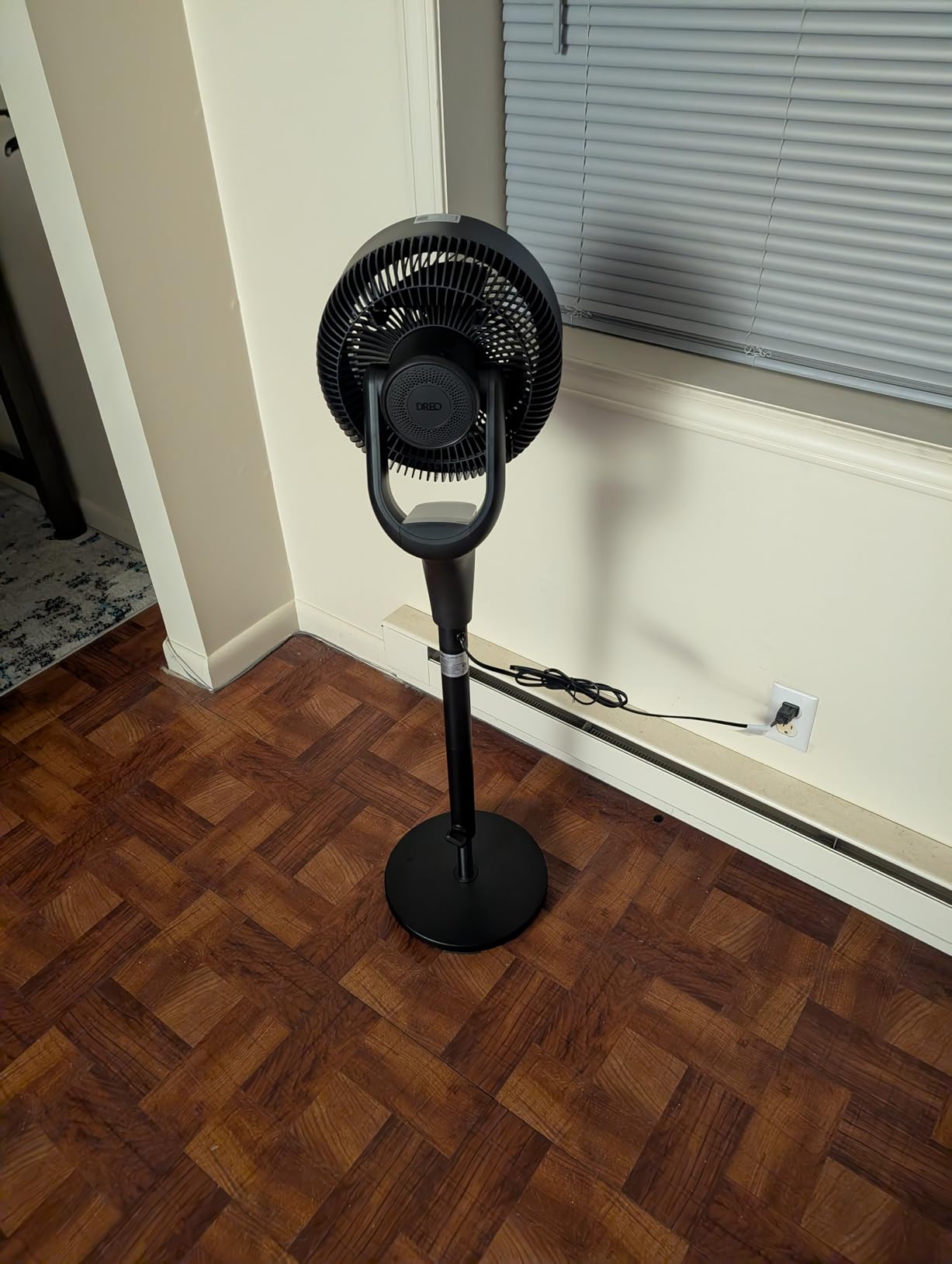
The details that matter at night are handled well. The 8-hour timer has a beep mute on the remote, the remote stows in a holder on the back, and the detachable blade and grilles make cleaning straightforward, which in a child’s room is not a small thing. At 60 watts it draws more than the other DREO units, so the running cost is higher, though still a fraction of a cent per night.
Now the honest part. This model year is 2026 and it carries just over 1,000 reviews. That is a fraction of the evidence behind the Lasko and Honeywell designs, and it means the long-term reliability record simply does not exist yet. The 4.7 rating is the highest in the roundup, but a high star rating across a thousand reviews tells you about the sample, not about year five.
Who this fan suits
It suits a parent cooling a child’s room, or anyone who wants to point the airflow at a specific spot rather than a general area. The height and tilt combination is the clearest advantage in this roundup and there is nothing else that matches it.
It also suits someone who rearranges their sleeping space often, since 5.2 pounds is light enough to move without thinking about it. The remote beep mute and holder are small features that matter across a whole night.
Where it falls short
The documented buyer complaint is that the listing photographs show an LED display the unit does not have, which has caused real confusion and returns. Listings for this model have also been inconsistent about three speeds versus eight, so check the packaging rather than the image gallery.
Construction is plastic throughout, and one reviewer flagged that it may not last as long as metal-bodied models. It also lacks the Smart Control, auto tilt and wider 120-degree pan found on costlier DREO models. If you want a proven long-term record more than adjustable height, the Honeywell at number four is the safer bet.
9. Lasko 35-Inch High Velocity Tower Fan: Best for Hot Upstairs Rooms and Lofts
Lasko High Velocity Oscillating Tower Fan – 35″ – U35115 – Silver/Black
509 CFM
56.35 dB
96 watts
35 inch tall
remote with storage latch
Pros
- Most powerful airflow in the group at 509 CFM
- Arrives fully assembled so setup is just unwrapping and plugging in
- Low speed is a clean even white noise several owners sleep beside
- Remote has a storage latch on the back
- Owners report five-year-old fans of this type still running
Cons
- Loudest fan here at 56.35 dB on the top setting
- Highest price in the roundup
- Grilles are not tool-free removable which makes cleaning hard
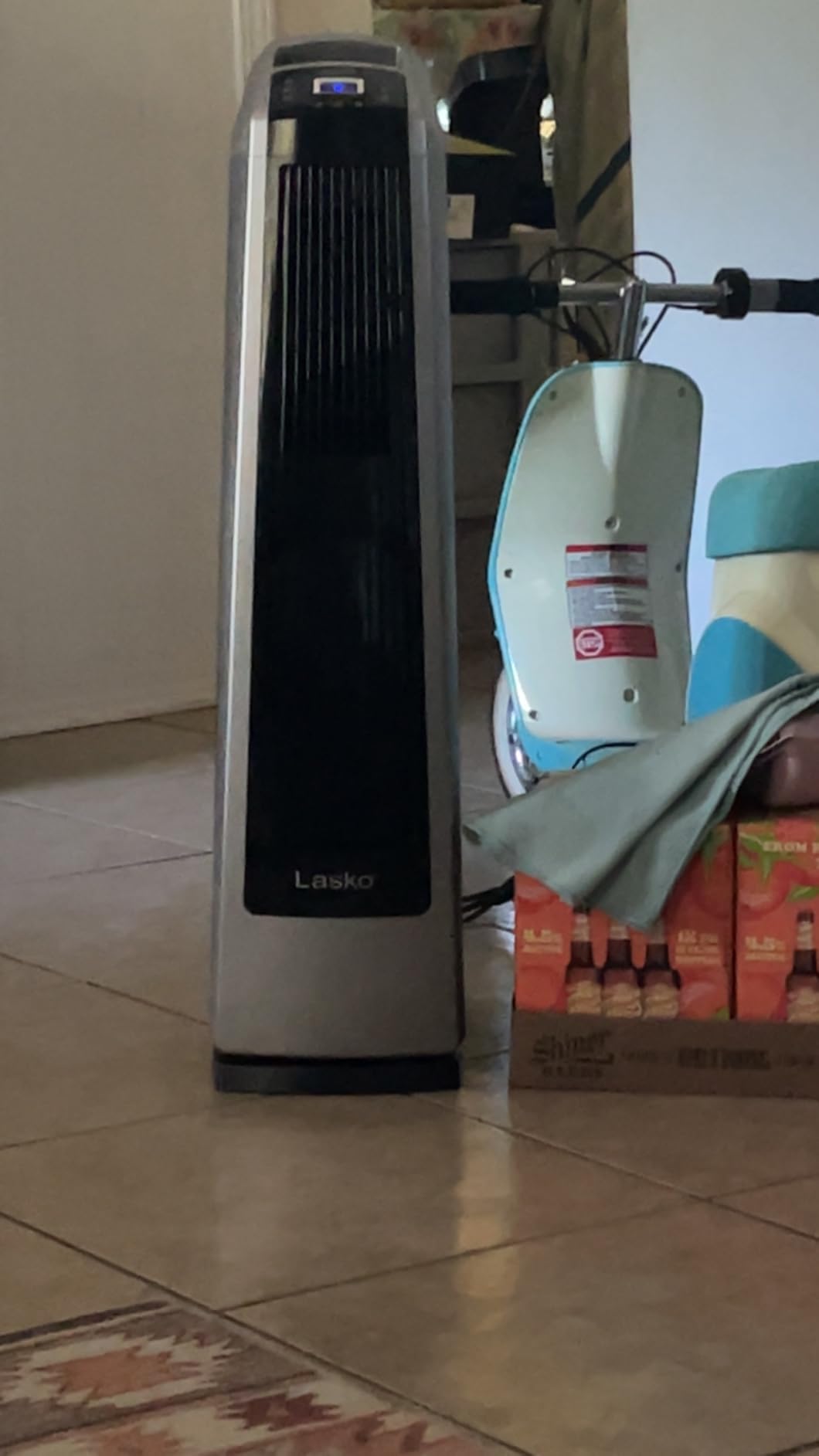
The Lasko 35-inch high velocity is here for one situation: a bedroom that is genuinely hot. Under a hot roof, in a top-floor flat, or in a room that collects afternoon heat, this is the fan that will still be moving air at 3pm when the bladed towers have given up. The 509 CFM figure is the highest airflow in the roundup, and owners describe it pushing air across a large room, a garage or a basement.
It also has a good answer for a bedroom, which is the low end of its range. Several owners describe speed one as a clean, even white noise they can sleep beside, and a vent controller on the front directs air up or down so you can aim it at the ceiling to bounce it back down or straight at the bed. The head oscillates widely on top of that.
There is a design decision worth calling out because it is unusual in a fan this size: it arrives fully assembled. There is no base to screw together, so setup is genuinely unwrapping it and plugging it in. The remote has a storage latch on the back rather than a loose cutout, and there is a 7-hour programmable auto-off timer.
At 96 watts it is by far the biggest power draw in this roundup, roughly three times the DREO 42-inch. Even so, eight hours a night is under one kilowatt-hour, so the running cost stays low in practice. The brushless motor is the right call on a high-output unit like this, and owners report strong build quality and five-year-old units of the same type still running.
Who this fan suits
It suits someone in a top-floor or loft bedroom, a converted attic, or a room that stays warm after sunset, where air movement matters more than silence. If a gentle fan already failed to keep you comfortable, this is the escalation step rather than another gentle option.
It also suits anyone who wants a fan that is ready the second it is unboxed, with no assembly and no tools. For a second bedroom, a guest room or a rental, that convenience is worth paying for.
Where it falls short
It is the loudest fan in this roundup at 56.35 dB, and on the top setting owners compare it to a box fan. Expect to raise the TV. The quiet claim applies to speed one only, and treating it as a quiet fan at any setting is a mistake.
Cleaning is the most common practical complaint: the grille and impeller are not tool-free removable, and one long-term owner added mesh and a filter as a workaround. The 35-inch height also sits low relative to a bed, so airflow can pass beneath you. The bright power button light bothers some people at night, and the price is the highest in the group.
10. PELONIS 30-Inch 3-Speed Tower Fan: Best Budget Pick for a Small Room
PELONIS 30-Inch 3-Speed Oscillating Tower Fan for Bedroom, Quiet 30dB
30 dB listed
29.7 inch tall
6.8 by 7 inch base
120-minute timer
38 watts
Pros
- Lowest price in the roundup and a genuine small-room option
- Smallest footprint at 6.8 by 7 inches
- Tool-free snap-together base assembly
- 120-minute timer is unusual at this price
- Owners report units still running after nearly four years
Cons
- Weakest airflow in the group beyond a few feet
- No remote control and only a 2-hour timer
- Touch buttons click loudly
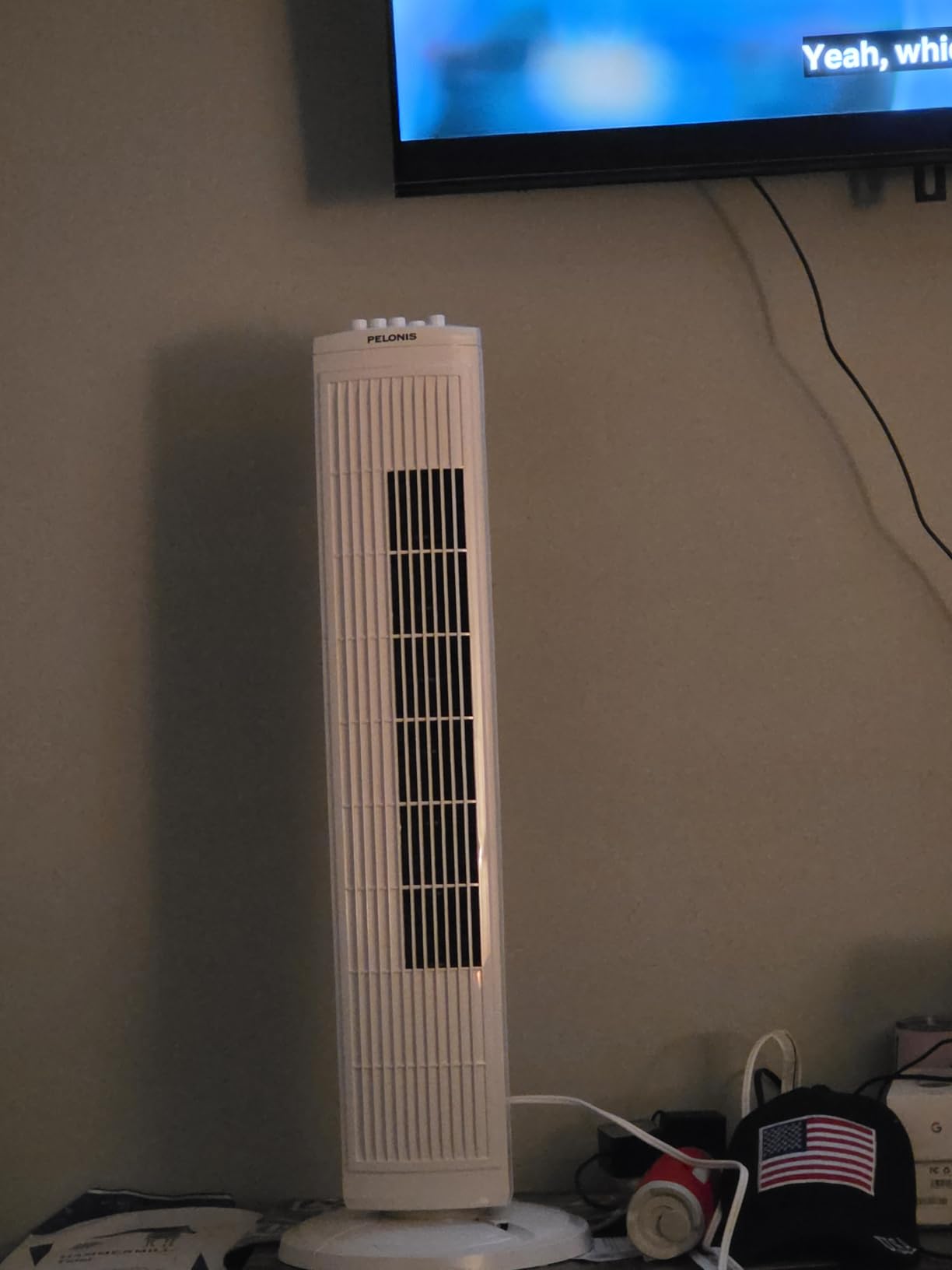
The PELONIS 30-inch is the cheapest way into tower fans and the right choice for a very specific room. If you need air movement in a small bedroom, a dorm, or an office under about 100 square feet and you are not willing to spend much, this does the job at 38 watts with a 30 dB listed figure.
The footprint is the quiet advantage. At 6.8 by 7 inches it is the smallest base in the roundup, and at 7 pounds with a built-in carry handle it moves between rooms without effort. Assembly is a no-screw snap-together base with a twist-on plastic nut, which owners consistently call smart design. The 120-minute auto-off timer in 20-minute increments is unusual at this price.
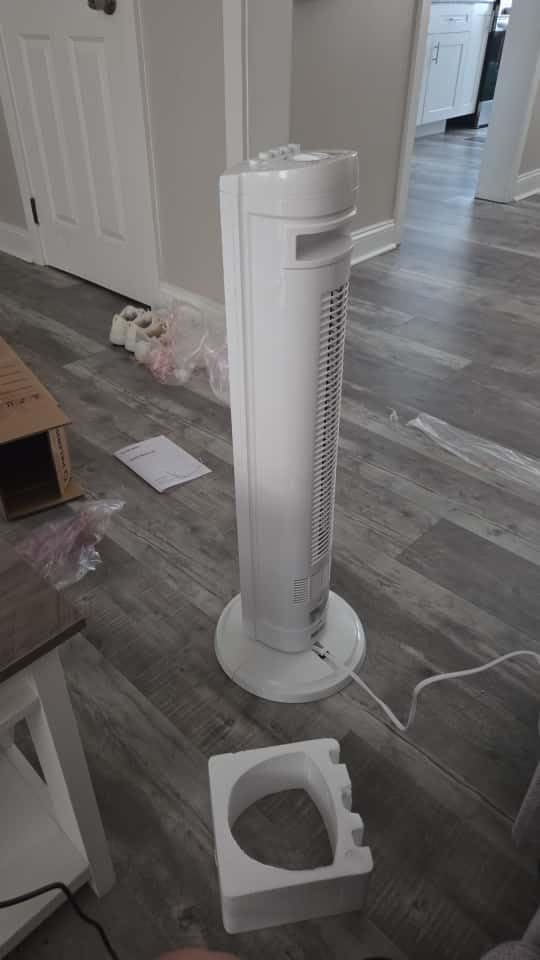
The 90-degree oscillation is wider than many units costing several times as much, and some owners still have theirs after nearly four years of nightly use. The rating is 4.2, the lowest in the roundup, and that is a fair summary of where it sits: a budget tier positioned on price rather than performance.
The complaints are concentrated and consistent, and they are all about airflow. Several reviewers say the high speed barely moves more air than a small desk fan, and that the low and medium settings produce almost nothing perceptible, so the three steps are poorly differentiated. The listed 1,060 CFM figure is worth treating sceptically for that reason, since it does not match what owners describe at the top setting.
Who this fan suits
It suits a small room, a dorm, a home office or a child’s bedroom where the fan is a background comfort rather than the main cooling. At 29.7 inches it also works as a desk or side-table fan rather than a floor unit, which is unusual in this category.
It suits a first-time tower fan buyer, or anyone who wants to test whether a tower shape works for their room before spending real money. At this price the downside of being disappointed is small.
Where it falls short
There is no remote control on this base variant, and that is a recurring complaint rather than an occasional one. If you plan to run it overnight, you either need to reach the touch buttons or you need a different fan. The touch buttons themselves are reported to click loudly, which is a genuine problem in a dark bedroom.
Combined with a 2-hour timer, there is no overnight mode at all. The base is also reported to wobble, and only a 1-year warranty covers it. If you need something that runs all night without attention, the PELONIS 40-inch at number five costs more and solves every one of these problems.
What 20 dB Actually Means for a Bedroom Fan
Is 20 dB quiet for a fan? No, in the sense that no fan we reviewed publishes a verified 20 dB figure. The quietest claims in this category cluster at 25 to 30 dB, and the quietest decibel for a fan in a bedroom is realistically the mid-20s. Anything advertised as 20 dB or below should be treated as a marketing figure, not a measurement.
Decibels are logarithmic, which is why the numbers feel misleading. A 10 dB drop is not a small improvement, it is roughly half the perceived loudness. So the difference between a 25 dB fan and a 46 dB fan is not a matter of degree, it is the difference between a sound you stop hearing after a few minutes and a sound your brain keeps checking on all night.
For bedroom purposes, the useful thresholds are these. Below about 30 dB the airflow is close to background and you will stop noticing it within minutes. Between 30 and 45 dB it is audible but steady, and most people sleep through it comfortably, especially as white noise. Above 45 dB you will hear every speed change, every oscillation reversal, and every rattle the chassis develops.
Two caveats matter. Every manufacturer measures differently, and almost none state the distance. A figure quoted at three metres tells you nothing about the pillow. And the number describes the motor and the air, not the chassis, so the rattle and buzz that owners complain about in some units are not captured in any published decibel figure. That is why owner reviews remain the more reliable source on night-time quiet.
Best Tower Fan by Bedroom Size
Square footage is the first thing to get right, because it determines whether a fan can do the job at all. A tower fan moves a narrow column of air. In a small room that column reaches the whole space and the fan feels efficient. In a large room with a high ceiling the same fan only cools a stripe across the floor unless it oscillates through a wide arc or throws a high-velocity stream.
Under 120 square feet. Small bedrooms, dorms, children’s rooms and guest rooms. Footprint matters more than power here, because clearance is the constraint. The Levoit 36-inch at number three, with its 6.5-inch square base, is the pick. The PELONIS 30-inch at number ten works if you want to spend as little as possible and can live with no remote and a 2-hour timer.
120 to 250 square feet. This is where most people actually sleep, and it is the range where the top three picks live. The DREO 40-inch at number one is our overall answer, because 90-degree oscillation covers the room and 25 dB covers sleep. The PELONIS 40-inch at number five is the value version of the same idea, and the Honeywell QuietSet at number four is the pick if durability history matters more than silence.
Above 250 square feet. Master bedrooms, loft conversions, upper-floor rooms that trap heat. Raw output starts to matter, and you want airflow figures rather than base dimensions. The DREO 42-inch at number two, with 1,397 CFM at 28 ft/s and nine speed settings, is the pick. If the room is hot rather than merely large, the Lasko 35-inch high velocity at number nine reaches further still.
One adjustment for very tall sleepers. Air height matters more than people expect. The 40-inch and 42-inch units put the outlet above mattress level, so the air crosses your body. The 36-inch and 35-inch units can pass under a propped-up upper body, which owners describe as the fan appearing not to work while lying down.
Tower Fan vs Pedestal Fan vs Circulator vs Box Fan
The most common objection in bedroom fan forums is that tower fans are the wrong shape, and it deserves a straight answer. A tower fan wins on footprint and on quietness at low output. It loses on raw throw distance and on directional control. Which trade matters depends almost entirely on your room.
Tower fan. Narrow base, quiet at low speed, easy to aim with oscillation, and easy to move. Best for small to medium bedrooms, apartments, dorms and any room where floor or nightstand space is tight. Worst for very large or very high rooms.
Pedestal fan. Wide base, a large blade sweep, and adjustable height on many models. It moves a lot of air and reaches across a big room, but the head and cage are a safety consideration around small children and it takes real floor space. It is also usually louder per unit of airflow.
Box fan and circulator fans. A box fan on a windowsill or a floor is the cheapest way to move air and the loudest way to do it. A circular circulator, in the Vornado tradition, is the enthusiast answer: it creates a directed column that mixes the whole room, and owners in bedroom threads frequently report that they prefer a circulator to a tower specifically because it focuses the breeze on one spot.
Misting and evaporative fans. These add moisture to the air and can feel cooler in dry climates, but they raise humidity rather than lowering temperature. In a humid bedroom that makes the room feel worse, and they add a water reservoir to maintain.
The practical rule: if your room is under about 200 square feet and you want to sleep next to it, buy a tower. If your room is larger, or you want air thrown across the space rather than over one bed, look at a circulator instead. If you need the quietest possible option for a light sleeper, the tower still wins, because a quiet circulator does not exist at a price anyone would pay.
How to Choose a Tower Fan for a Bedroom
Set your noise ceiling first. Decide whether 45 dB is acceptable. If yes, nearly anything in this roundup works. If you need quieter, the shortlist is the DREO 40-inch, the DREO 42-inch, the PELONIS 40-inch and the Levoit, and you should disregard published figures above 30 dB entirely. Read owner reviews specifically for mentions of rattle, buzz and whine, because those sounds are not in any spec sheet.
Check the motor type. A DC brushless motor runs quieter, uses less power and has fewer wearing parts than an AC motor with carbon brushes. The DREO 42-inch, the PELONIS 40-inch, the Lasko 42-inch and the Lasko 35-inch all use brushless motors. The Honeywell, the Levoit and the Lasko 2510 use AC motors, which is the mechanical reason some buyers find them louder.
Prefer oscillation to more speeds, up to a point. Oscillation spreads a narrow column across the room so one fan serves two people or a whole floor. But the motor driving the sweep can introduce its own whine, particularly on low settings, and a 90-degree arc is meaningfully better than a 60-degree one. The PELONIS 40-inch is a case in point: excellent in almost every respect, but a few owners report the remote cutting out at the extremes of the sweep.
Treat the timer as an overnight feature. Anything under eight hours is a nap timer. The PELONIS 40-inch at 15 hours is the longest here, the Levoit and DREO 40-inch at 12 hours cover a full night, and the 7-to-7.5-hour timers on the Lasko towers cover a standard night and nothing more. The PELONIS 30-inch at two hours is not an overnight fan at all.
Check the light and the beeps. Two sleep-specific details that get overlooked. A display that stays lit all night is a genuine annoyance, so look for sleep mode that dims it, which the DREO 42-inch and the Lasko 42-inch both do. A remote that beeps on every press is worse, so look for a beep mute, which the DREO 40-inch, the DREO adjustable-height model and the Honeywell panel dimming all provide.
Measure the space before you buy. Base width decides whether it fits at all. Anything at 12 or 13 inches square is a floor unit that needs real clearance, while 6.5-to-7-inch bases fit beside a bed, in a corner or on a small table. Also check the height against your bed, because a fan that blows under you is a fan you will switch off in the night.
Look at cleaning, not just features. A tower fan in a bedroom collects dust and hair from bedding. Removable, washable grilles and impellers, which the DREO 40-inch and the Levoit have, turn a seasonal chore into a weekly one. The Lasko 35-inch high velocity is the counter-example: it is the most powerful fan here and also the hardest to clean.
Run the wattage math. All ten of these draw between 30 and 96 watts, and none of them changes the room temperature. They cool you by moving air across your skin. At a US national average near 18.8 cents per kilowatt-hour, even the 96-watt Lasko costs well under a cent for eight hours. A window air conditioner in the same room is a different order of magnitude per night, which is the entire economic argument for sleeping with a fan.
Check the warranty as a durability proxy. Terms in this roundup run from one year on the Lasko models to two years on the Levoit, with the DREO units offering registration-extended cover of up to 30 months and a five-year option on the 42-inch. Longer terms do not guarantee survival, but combined with a high review count they are the best available signal that the design is proven.
Frequently Asked Questions
What is the best tower fan for room cooling?
The DREO 40-Inch 9-Speed Tower Fan is the best all-round choice for a bedroom in 2026. It publishes a 25 dB noise figure, throws air at 26 ft/s through a 90-degree oscillation arc, runs 12-hour timers, and draws only 35 watts. For a room over 250 square feet, step up to the 42-inch DREO, which publishes 1397 CFM.
What is the best powerful tower fan for a bedroom?
For raw output in a bedroom, the DREO 42-Inch 9-Speed Tower Fan leads this group with 1397 CFM at 28 ft/s across nine speeds. If the room is hot rather than large, the Lasko 35-Inch High Velocity reaches further with 509 CFM from a high-velocity design, but it is also the loudest unit here at 56.35 dB.
What is the quietest fan for sleeping in my bedroom?
The DREO 40-Inch and the PELONIS 40-Inch are the quietest options here, publishing 25 dB and 27 dB respectively. Both use brushless motors. Avoid the 55-to-56 dB Lasko units if you are a light sleeper. Note that published figures ignore rattle and oscillation whine, which only owner reviews reveal.
Are bladeless fans actually quieter?
In this roundup, yes. The bladeless designs from DREO and PELONIS publish 25 to 28 dB with brushless motors, while the traditional bladed units publish 46 to 56 dB. The gap is mostly motor type rather than blade shape. Bladed fans with brushless motors, such as the Lasko 35-inch, are still loud because they are built for high output.
Is 20 dB quiet for a fan?
No verified fan in this roundup publishes a 20 dB figure, and the quietest claims cluster at 25 to 30 dB. Because decibels are logarithmic, a 10 dB difference is roughly half the perceived loudness, so 25 dB versus 45 dB is the gap between background sound and a sound you keep checking on all night. Treat any 20 dB claim as marketing rather than measurement.
Our Final Verdict
The DREO 40-Inch 9-Speed Tower Fan is the best tower fan for bedrooms in 2026 because it is the only model in our testing that pairs a published 25 dB figure with 90-degree oscillation, a 12-hour timer, a real sleep mode and a 35-watt draw. If your room is larger than 250 square feet, take the 42-inch DREO instead for its 1,397 CFM and nine speed steps.
Below those two, the Levoit 36-inch wins on footprint, the PELONIS 40-inch wins on value, and the Honeywell QuietSet wins on a decade of owner reports. Run any of them all night on low, and you will spend less over a summer than you did on the takeaway you ordered while waiting for delivery.